Barriers to Effective
Communication and Their
Management
Points of Discussion
• Communication-what it is?
• Significance of communication
• Process of Communicatio
• Barrier?
• Barriers to communication
COMMUNICATION
Tuğçe AYDIN
What is communication?
• Communication is a process through
which two or more people exchange
information, ideas, thoughts,
emotions in such a way that each
gain a common understanding of the
intended message.
• Communication is a dyadic concept.
• In Communication system 35%
message is carried verbally and
rest of the 65% non verbally.
COMMUNICATION
Communication is the
process of sending and
receiving messages
between parties
Significance of Communication
• Lifeblood of an individual,
organisation, society
• As you grow you communicate more
and more
• In all domains of life and in all
directions Downwards Sideways
Upwards
BARRIERS FOR EFFECTIVE
COMMUNICATION
Ayşe Bilge ÇAKIR
Barrier ?
• Lack of Commonness is barrier
• A barrier to interpersonal
communications is anything that
prevents, restricts or impedes the
conveyance of meaning by words or
gestures between two or more
persons in a social setting.
• The term ‘Barriers’, ‘Obstacles’, ‘
Hindrances’ and ‘noise’ are all used
to describe the distracting stimuli
• associated with the
• communication process
Absence of defined role of any component = Creates Barrier
Barriers to Effective
Communication
• Social
• Psychological
• Cultural
• Physiological,
• System design
• Physical
• Receivers
Social Barriers
Gender
Age
Race
National or Cultural
Origin
Socioeconomic Class
Education Level
Urban or Rural
Residence
GENDER
Major influence on the way we
communicate with others.
When men and women work together
in a group, men tend to be more
assertive and self-confident.
Women are more likely than men to
express their emotions, to reveal how
they feel about a situation.
AGE
Young people and old people communicate
in different ways.
We do tend to judge a statement by
different standards if we know the
speaker’s age.
A person’s age or gender is not
important in judging the truth or
wisdom of what that person says .
Their maturity, their educational
backgrounds, and the different eras in
which they grew up make a Generation
Gap inevitable.
Psychological Barriers
• Attitude towards self
• Fear
• Attitude towards audience
• Attitude towards the message
• You Yourself is not convinced
with the subject
• Knowledge of subject
• Personality/Status of the
communicator
MOTIVATION
A Motive is a Reason For
Action!
The most strongest
motivations are those
that are most personal.
We are motivated by money,
fame, power, love, status, security,
skill, ambition...etc
it can be both positive
or negative.
TUNNEL VISION
A closed way of thinking, especially
about abstract topics, such as
religion and politics.
• The person with tunnel vision is one who
has firmly fixed ideas
• The opposite side is open-mindedness
• Person with tunnel vision has attitude
seems to say; “I’ve already made up my
mind, Don’t confuse me with the facts!!!”
EGO DEFENSIVENESS
A response pattern in which a person
who follows this pattern sees a
disagreement as a personal
attact .
A self-centered
communication
More than just being selfish
NEGATIVE EMOTIONS
Almost always obstacles to good
communication!
Especially true barrier if the
emotion is uncontrolled, unfocused,
or misdirected.
Other Psychological Barriers
• People’s State of Mind
Happy, Sad
• Personal Problems/Worries
• Pre conceived notions of Communicator
or Receiver
• Mental limitations of human beings,
failure to refer language to
experience, the confusion of concept.
Cultural Barriers
• Language
Different languages, dialect, individual
linguistic ability, use of difficult words,
inappropriate words, pronunciation
• Norms and values
• Belief
• Social practices and traditions
Physiological Barriers
• Individuals’ personal discomfort
ill health, poor eye sight, hearing
difiiculties
• Speech and voice defect, feeling of
inferiority, diseases, physical
appearance, lack of skill.
System Design
• Organisational Structure
unclear, to whom to communicate,
• Insufficient or inappropriate
information systems
• Information overloaded
• A lack of clarity in roles and
responsibilities
• A lack of supervision or training
Physical Barriers
• Channel
– Availability of channel to receiver (Common channel)
– Choice of channel
– Handling of channel by communicator
– Reach : depending on size of audience, mike, etc.
– Noise level in Channel
– Presentation of information/message treatment
Muddled messages
“Dogs for sale.Will eat anything.Especially likes
children. Call 888-3599 for more information.”
• Climate
– Extreme temperature (Hot/Cold)
– Bright/ Dim Light
– High Humidity
• Comfort
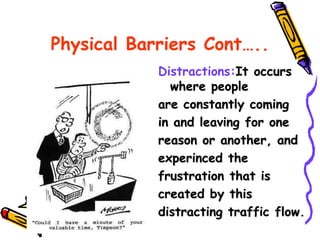
Physical Barriers Cont…..
Distractions:It occurs
where people
are constantly coming
in and leaving for one
reason or another, and
experinced the
frustration that is
created by this
distracting traffic flow.
Physical Barriers Cont…..
• Distractions
– Noise (Co-workers, Doors, etc.)
– Photographer
– Any announcements
– Instruction Sheet
– Tea
– Late Comers
• Physical Setting of Classroom/
Lecture Hall
– Sitting Arrangement
– Audio-Visual Aids
Points to Remember
• Communication is a two way process.
• Effective communication= Bridging the gap between
encoded and decoded message= Establishing Common
Understanding
• Responsibility of effective communication mainly lies
with the communicator
• Feedback is an important return message. Ensure
getting and using it effectively for better
performance
• Know the roadblocks. This will help you to handle
the communication process in an effective way
• Use Heart and Mind and Soul for an effective
result
• Communication is a skill, learn and practice
To Sum up
To Become an Effective communicator
Make effective use of
Heart and Body, Mind and Soul
jitendra sahu
u suman patnaik
itishree pattanaik

communication ppt.ppt

  • 1.
  • 2.
    Points of Discussion •Communication-what it is? • Significance of communication • Process of Communicatio • Barrier? • Barriers to communication
  • 3.
  • 4.
    What is communication? •Communication is a process through which two or more people exchange information, ideas, thoughts, emotions in such a way that each gain a common understanding of the intended message. • Communication is a dyadic concept. • In Communication system 35% message is carried verbally and rest of the 65% non verbally.
  • 5.
    COMMUNICATION Communication is the processof sending and receiving messages between parties
  • 6.
    Significance of Communication •Lifeblood of an individual, organisation, society • As you grow you communicate more and more • In all domains of life and in all directions Downwards Sideways Upwards
  • 7.
  • 9.
    Barrier ? • Lackof Commonness is barrier • A barrier to interpersonal communications is anything that prevents, restricts or impedes the conveyance of meaning by words or gestures between two or more persons in a social setting. • The term ‘Barriers’, ‘Obstacles’, ‘ Hindrances’ and ‘noise’ are all used to describe the distracting stimuli • associated with the • communication process Absence of defined role of any component = Creates Barrier
  • 10.
    Barriers to Effective Communication •Social • Psychological • Cultural • Physiological, • System design • Physical • Receivers
  • 11.
    Social Barriers Gender Age Race National orCultural Origin Socioeconomic Class Education Level Urban or Rural Residence
  • 12.
    GENDER Major influence onthe way we communicate with others. When men and women work together in a group, men tend to be more assertive and self-confident. Women are more likely than men to express their emotions, to reveal how they feel about a situation.
  • 13.
    AGE Young people andold people communicate in different ways. We do tend to judge a statement by different standards if we know the speaker’s age. A person’s age or gender is not important in judging the truth or wisdom of what that person says .
  • 14.
    Their maturity, theireducational backgrounds, and the different eras in which they grew up make a Generation Gap inevitable.
  • 15.
    Psychological Barriers • Attitudetowards self • Fear • Attitude towards audience • Attitude towards the message • You Yourself is not convinced with the subject • Knowledge of subject • Personality/Status of the communicator
  • 16.
    MOTIVATION A Motive isa Reason For Action! The most strongest motivations are those that are most personal. We are motivated by money, fame, power, love, status, security, skill, ambition...etc it can be both positive or negative.
  • 17.
    TUNNEL VISION A closedway of thinking, especially about abstract topics, such as religion and politics. • The person with tunnel vision is one who has firmly fixed ideas • The opposite side is open-mindedness • Person with tunnel vision has attitude seems to say; “I’ve already made up my mind, Don’t confuse me with the facts!!!”
  • 18.
    EGO DEFENSIVENESS A responsepattern in which a person who follows this pattern sees a disagreement as a personal attact . A self-centered communication More than just being selfish
  • 19.
    NEGATIVE EMOTIONS Almost alwaysobstacles to good communication! Especially true barrier if the emotion is uncontrolled, unfocused, or misdirected.
  • 20.
    Other Psychological Barriers •People’s State of Mind Happy, Sad • Personal Problems/Worries • Pre conceived notions of Communicator or Receiver • Mental limitations of human beings, failure to refer language to experience, the confusion of concept.
  • 21.
    Cultural Barriers • Language Differentlanguages, dialect, individual linguistic ability, use of difficult words, inappropriate words, pronunciation • Norms and values • Belief • Social practices and traditions
  • 22.
    Physiological Barriers • Individuals’personal discomfort ill health, poor eye sight, hearing difiiculties • Speech and voice defect, feeling of inferiority, diseases, physical appearance, lack of skill.
  • 23.
    System Design • OrganisationalStructure unclear, to whom to communicate, • Insufficient or inappropriate information systems • Information overloaded • A lack of clarity in roles and responsibilities • A lack of supervision or training
  • 24.
    Physical Barriers • Channel –Availability of channel to receiver (Common channel) – Choice of channel – Handling of channel by communicator – Reach : depending on size of audience, mike, etc. – Noise level in Channel – Presentation of information/message treatment Muddled messages “Dogs for sale.Will eat anything.Especially likes children. Call 888-3599 for more information.” • Climate – Extreme temperature (Hot/Cold) – Bright/ Dim Light – High Humidity • Comfort
  • 25.
    Physical Barriers Cont….. Distractions:Itoccurs where people are constantly coming in and leaving for one reason or another, and experinced the frustration that is created by this distracting traffic flow.
  • 26.
    Physical Barriers Cont….. •Distractions – Noise (Co-workers, Doors, etc.) – Photographer – Any announcements – Instruction Sheet – Tea – Late Comers • Physical Setting of Classroom/ Lecture Hall – Sitting Arrangement – Audio-Visual Aids
  • 27.
    Points to Remember •Communication is a two way process. • Effective communication= Bridging the gap between encoded and decoded message= Establishing Common Understanding • Responsibility of effective communication mainly lies with the communicator • Feedback is an important return message. Ensure getting and using it effectively for better performance • Know the roadblocks. This will help you to handle the communication process in an effective way • Use Heart and Mind and Soul for an effective result • Communication is a skill, learn and practice
  • 28.
    To Sum up ToBecome an Effective communicator Make effective use of Heart and Body, Mind and Soul
  • 29.
    jitendra sahu u sumanpatnaik itishree pattanaik