






Communicating Compensation:
Gaining Executive Support
Jennifer Ferris, CCP
Compensation Professional
Mykkah Herner, MA, CCP
Manager of Professional Services
www.payscale.com
www.payscale.com
14,000 Positions 3000 Customers 13 Countries
250 Compensable Factors
40 Million Salary Profiles
COMMUNICATING
COMPENSATION
Part I: Gaining Executive Support
Part II: Equipping Managers
Part III: Talking with Employees
www.payscale.com
Agenda
• Communication Basics
• Compensation Basics
Communicating Compensation to Executives
• Understanding the Executive Audience
• Align compensation to business goals
• Incorporate leading edge practices
• Keep executives up-to-date with quick snapshots
Next in series: Equipping Managers
Communication
Basics
Communication
Basics
 KNOW YOUR AUDIENCE!
 WATCH THE JARGON
 PRESENT A WAY FORWARD
 FOCUS ON RESULTS
 BE DIRECT AND EMPATHETIC
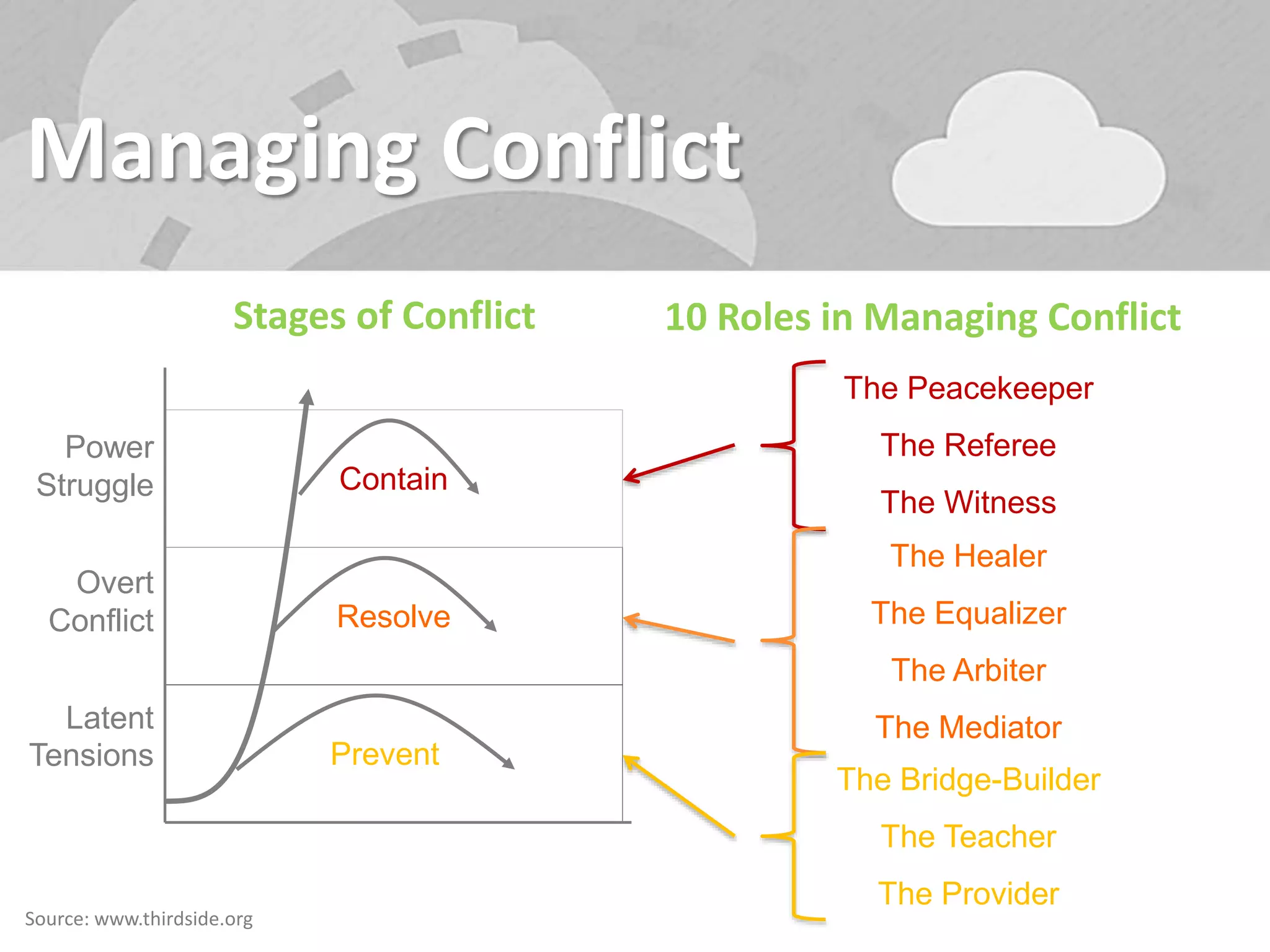
Managing Conflict
Prevent
Resolve
Contain
Power
Struggle
Overt
Conflict
Latent
Tensions
Stages of Conflict
The Bridge-Builder
The Teacher
The Provider
10 Roles in Managing Conflict
The Healer
The Equalizer
The Arbiter
The Mediator
The Peacekeeper
The Referee
The Witness
Source: www.thirdside.org
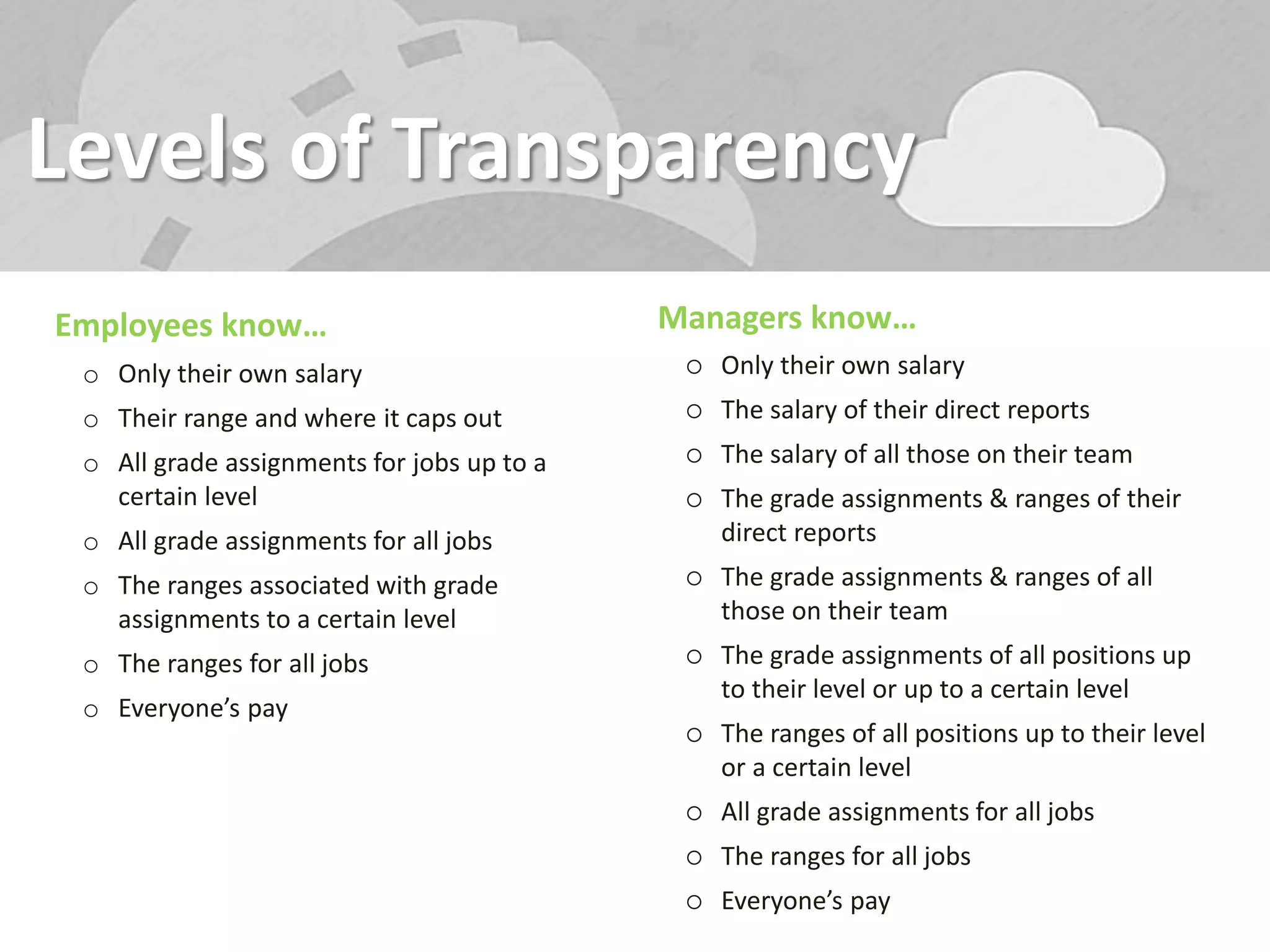
Levels of Transparency
Employees know…
o Only their own salary
o Their range and where it caps out
o All grade assignments for jobs up to a
certain level
o All grade assignments for all jobs
o The ranges associated with grade
assignments to a certain level
o The ranges for all jobs
o Everyone’s pay
Managers know…
 Only their own salary
 The salary of their direct reports
 The salary of all those on their team
 The grade assignments & ranges of their
direct reports
 The grade assignments & ranges of all
those on their team
 The grade assignments of all positions up
to their level or up to a certain level
 The ranges of all positions up to their level
or a certain level
 All grade assignments for all jobs
 The ranges for all jobs
 Everyone’s pay
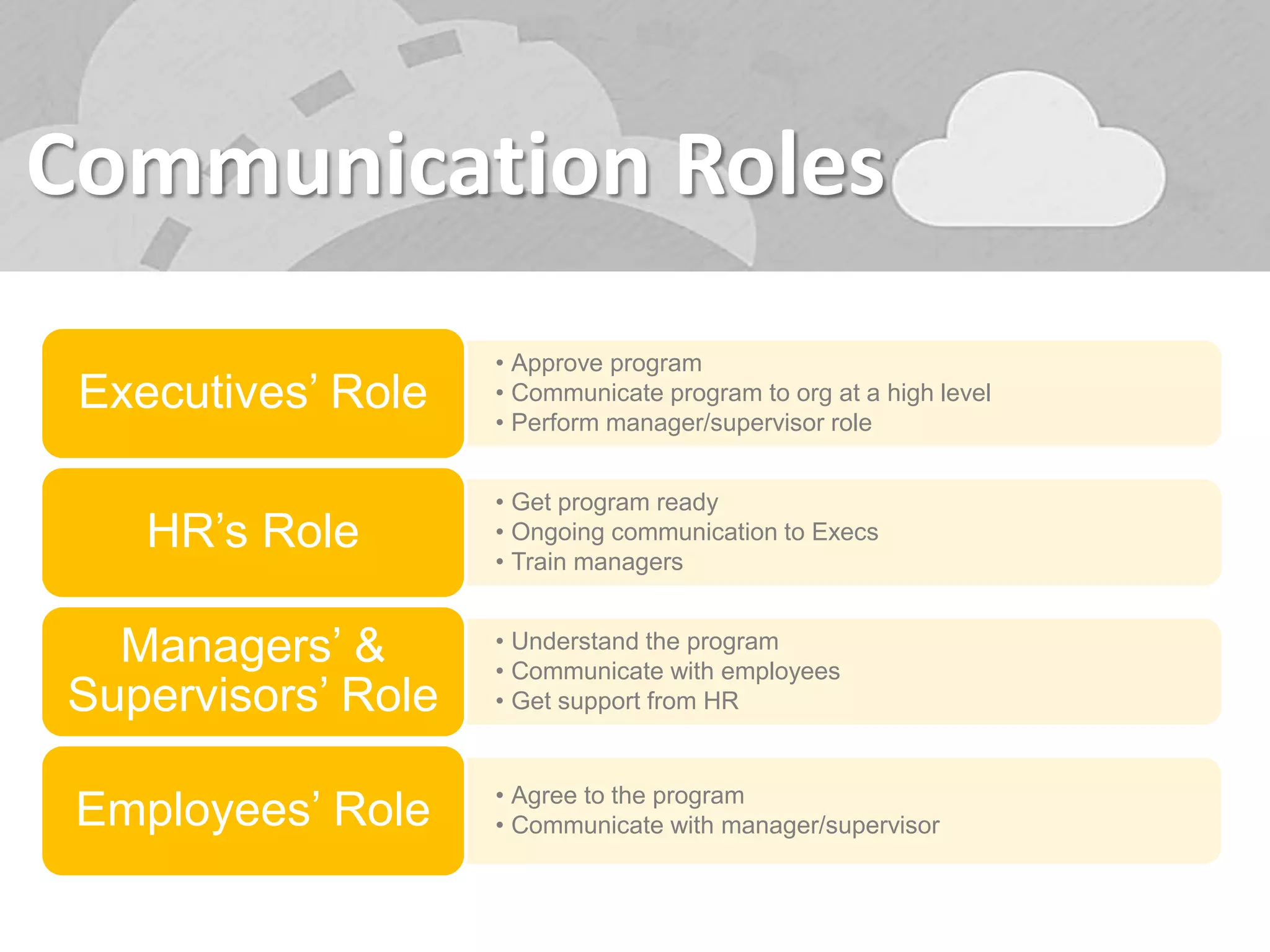
Communication Roles
• Approve program
• Communicate program to org at a high level
• Perform manager/supervisor role
Executives’ Role
• Get program ready
• Ongoing communication to Execs
• Train managers
HR’s Role
• Understand the program
• Communicate with employees
• Get support from HR
Managers’ &
Supervisors’ Role
• Agree to the program
• Communicate with manager/supervisorEmployees’ Role
Compensation
Basics
Compensation
is a keystone
Good
compensation
design ensures
organizational
success
The
Compensation
“Mix”
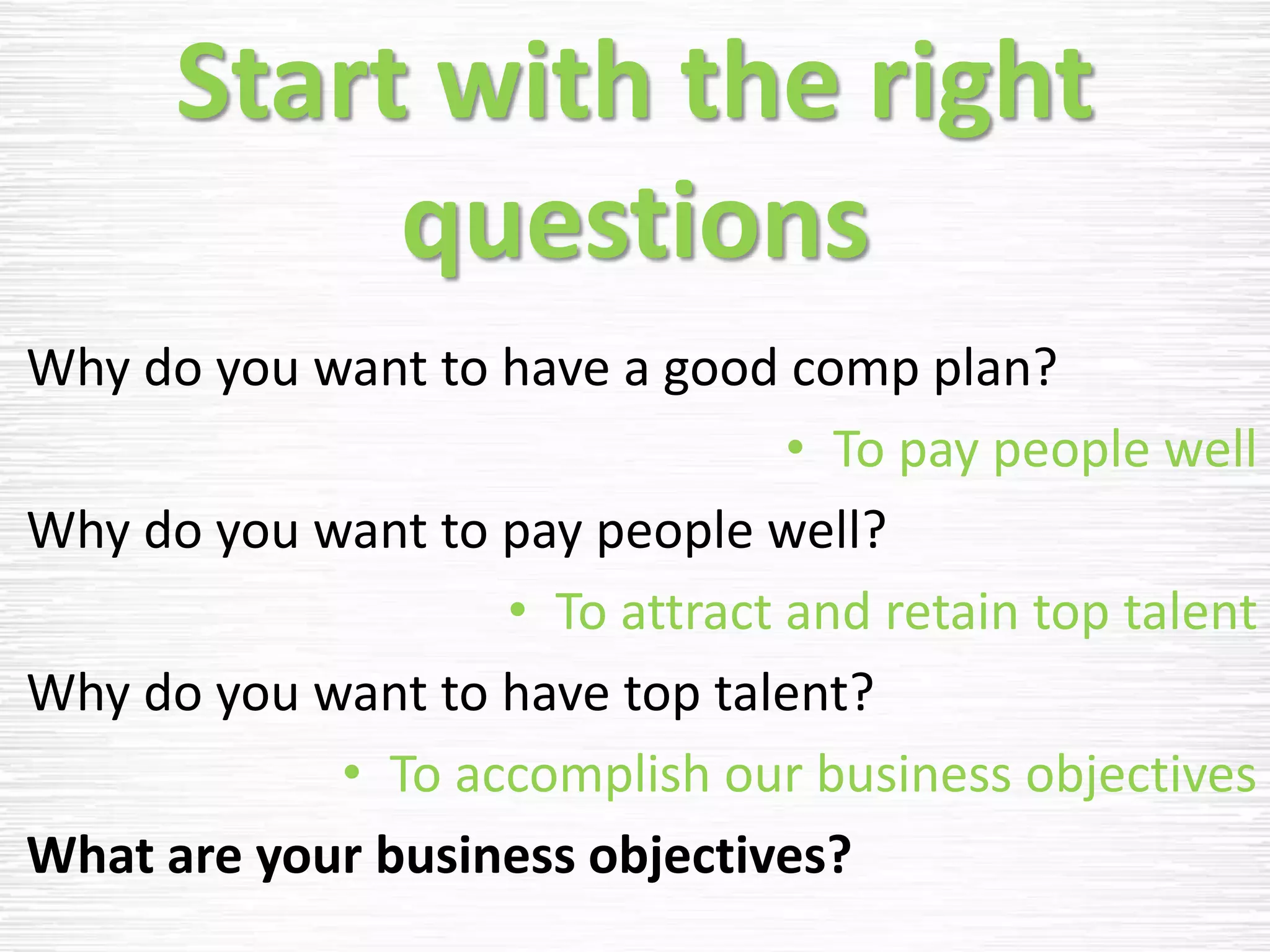
Start with the right
questions
Why do you want to have a good comp plan?
• To pay people well
Why do you want to pay people well?
• To attract and retain top talent
Why do you want to have top talent?
• To accomplish our business objectives
What are your business objectives?
COMP
DESIGN
ELEMENTS
PHILOSOPHY
STRATEGY/IES
STRUCTURE
POLICY
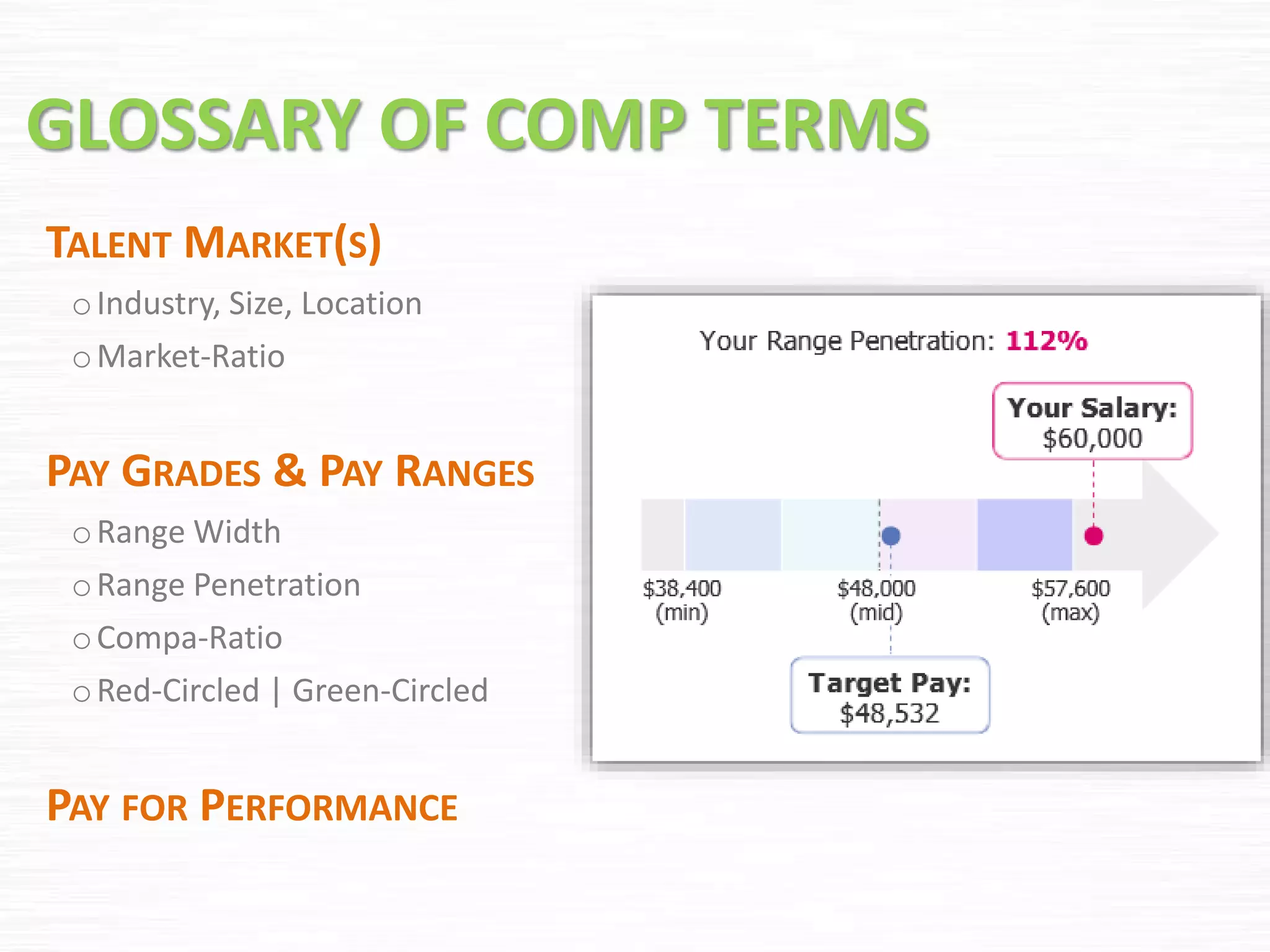
GLOSSARY OF COMP TERMS
TALENT MARKET(S)
oIndustry, Size, Location
oMarket-Ratio
PAY GRADES & PAY RANGES
oRange Width
oRange Penetration
oCompa-Ratio
oRed-Circled | Green-Circled
PAY FOR PERFORMANCE
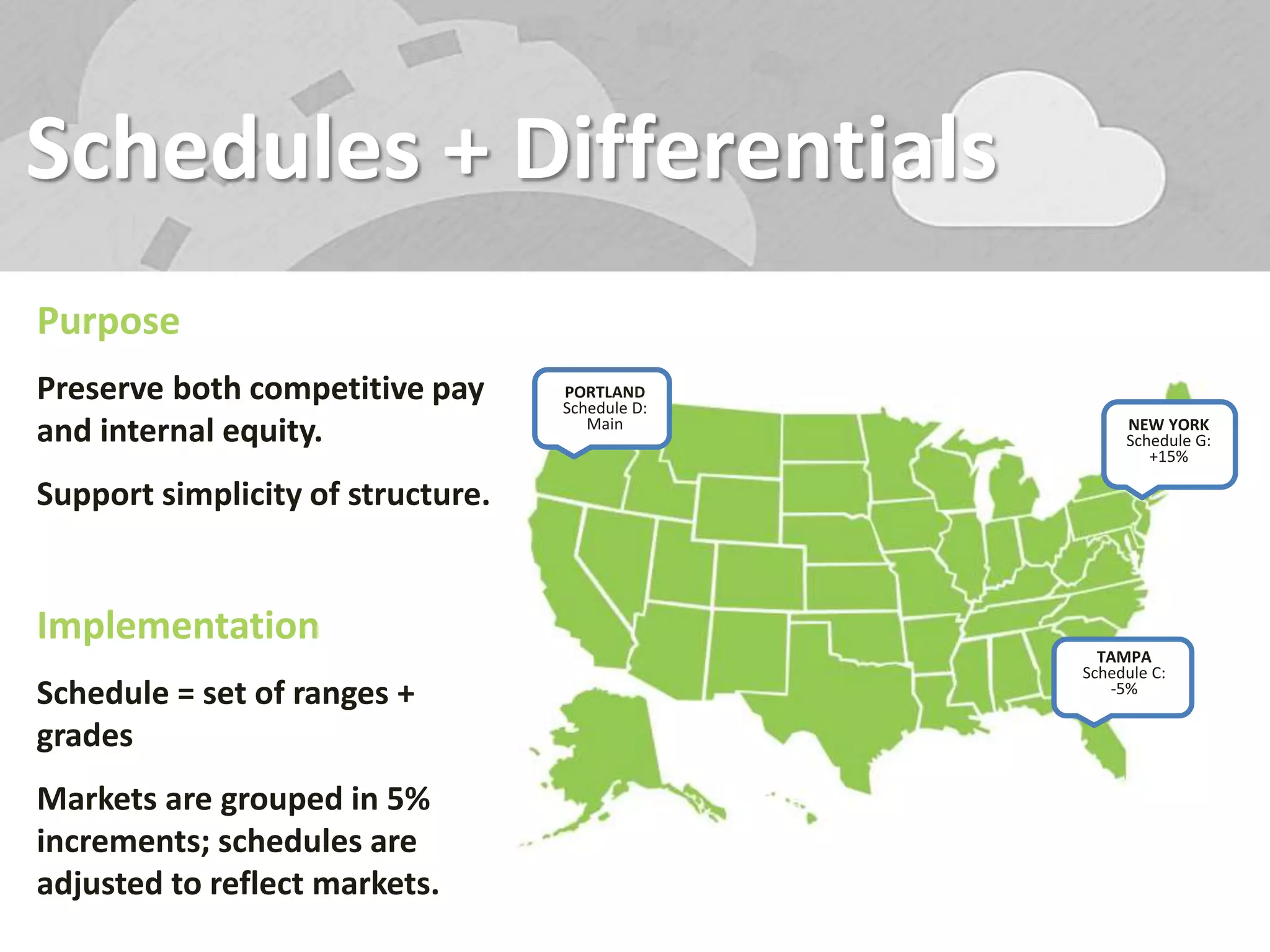
Schedules + Differentials
Purpose
Preserve both competitive pay
and internal equity.
Support simplicity of structure.
Implementation
Schedule = set of ranges +
grades
Markets are grouped in 5%
increments; schedules are
adjusted to reflect markets.
TAMPA
Schedule C:
-5%
NEW YORK
Schedule G:
+15%
PORTLAND
Schedule D:
Main
Advantages of Pay Structures
 Provide alignment to business strategy
 Clarify relative worth of the position internally & externally
 Ensure fair pay (legally defensible)
 Define a pay range for a position
 Create clear career paths
 Room to reward your employees based on performance,
tenure, etc.
Understanding
the Executive
Audience
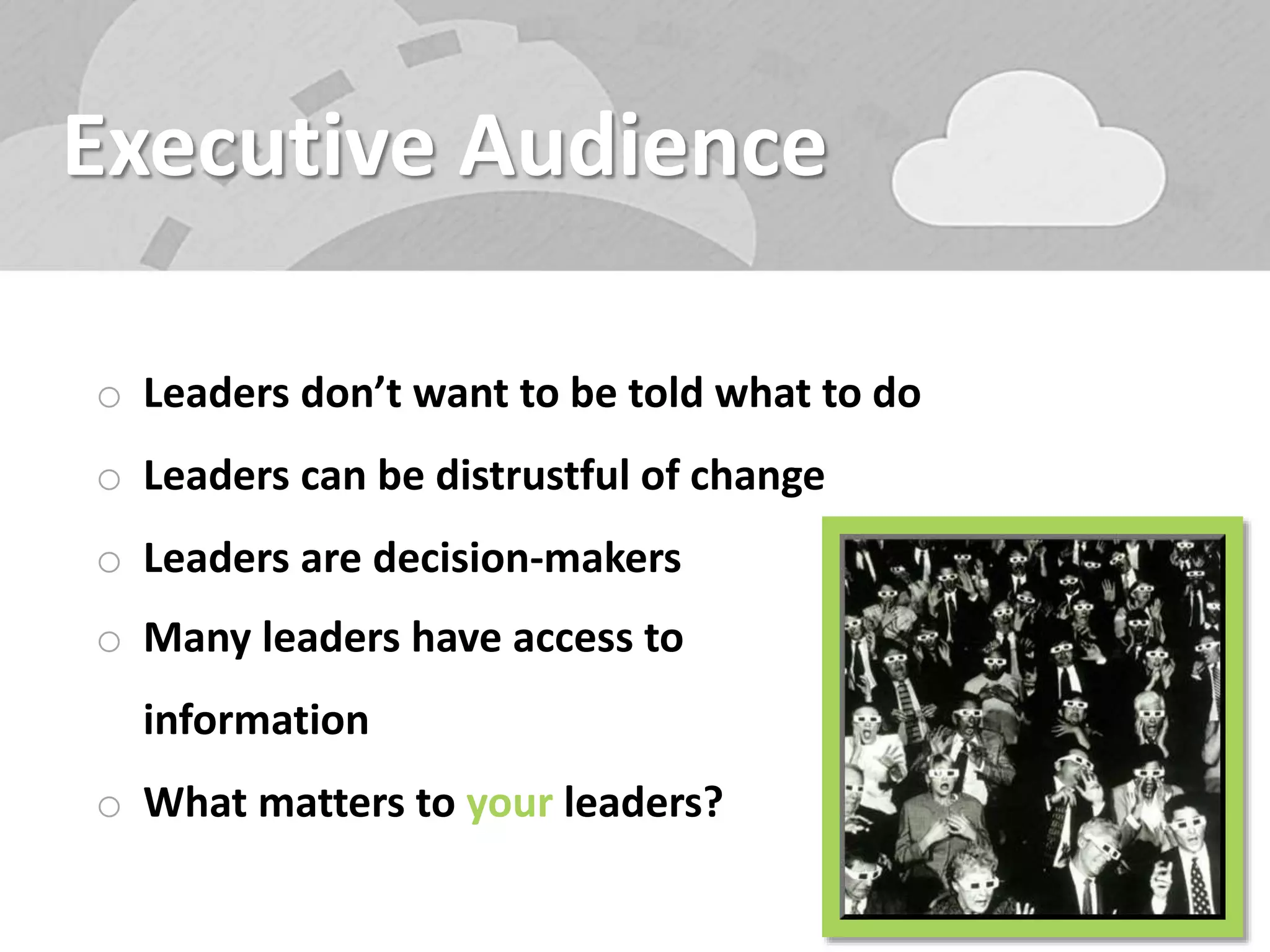
Executive Audience
o Leaders don’t want to be told what to do
o Leaders can be distrustful of change
o Leaders are decision-makers
o Many leaders have access to
information
o What matters to your leaders?
Align Compensation
to Organizational
Objectives
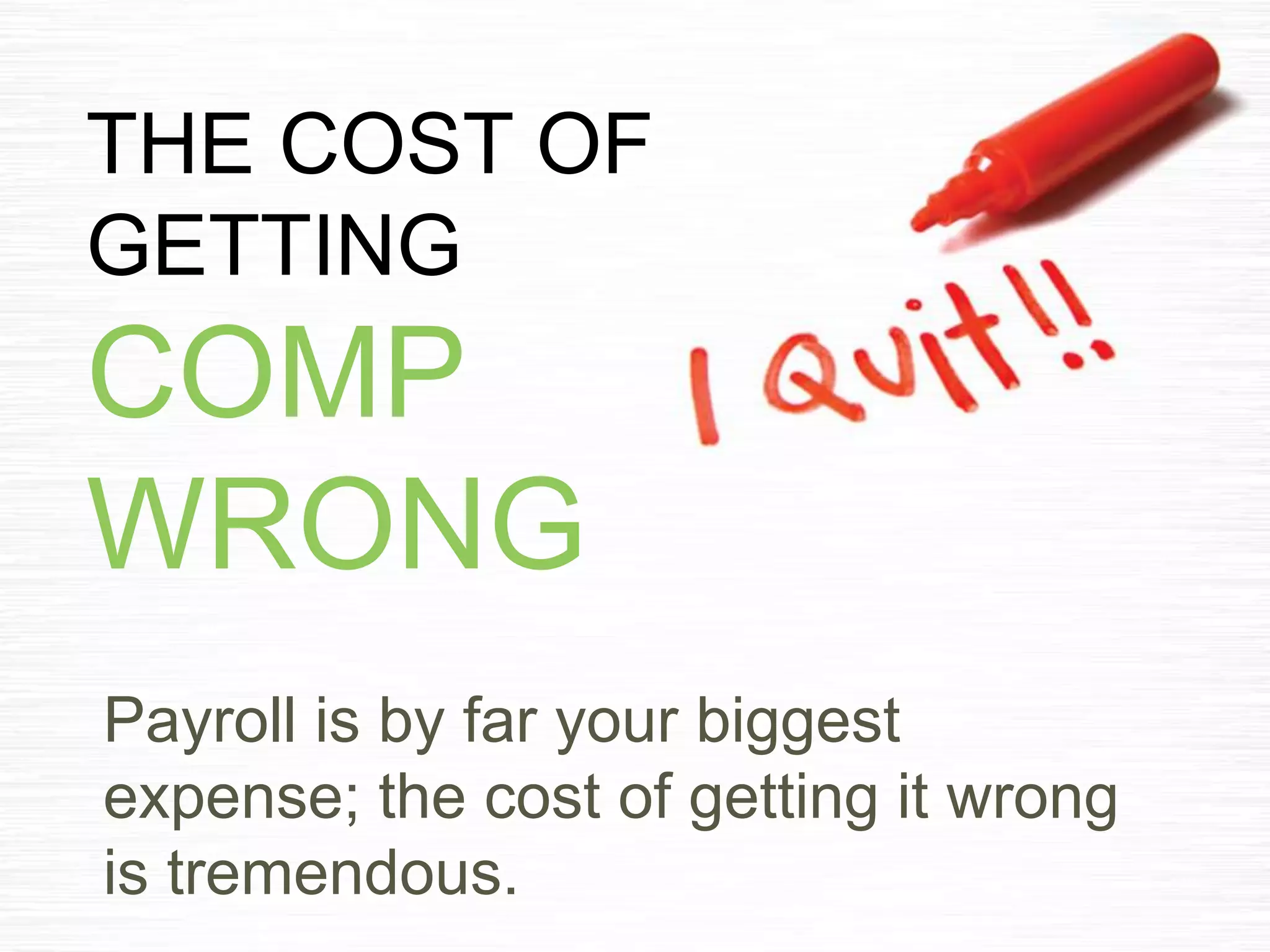
THE COST OF
GETTING
COMP
WRONG
Payroll is by far your biggest
expense; the cost of getting it wrong
is tremendous.
Align comp plan with business goals
THE REASONS
YOU’RE
CREATING A
COMP PLAN
1. IT MAKES GOOD
BUSINESS SENSE
2. IT HELPS ATTRACT AND
RETAIN TALENT
3. IT SUPPORTS THE
MISSION, STRATEGY AND
CULTURE OF THE
ORGANIZATION
Incorporate
Leading Edge
Practices
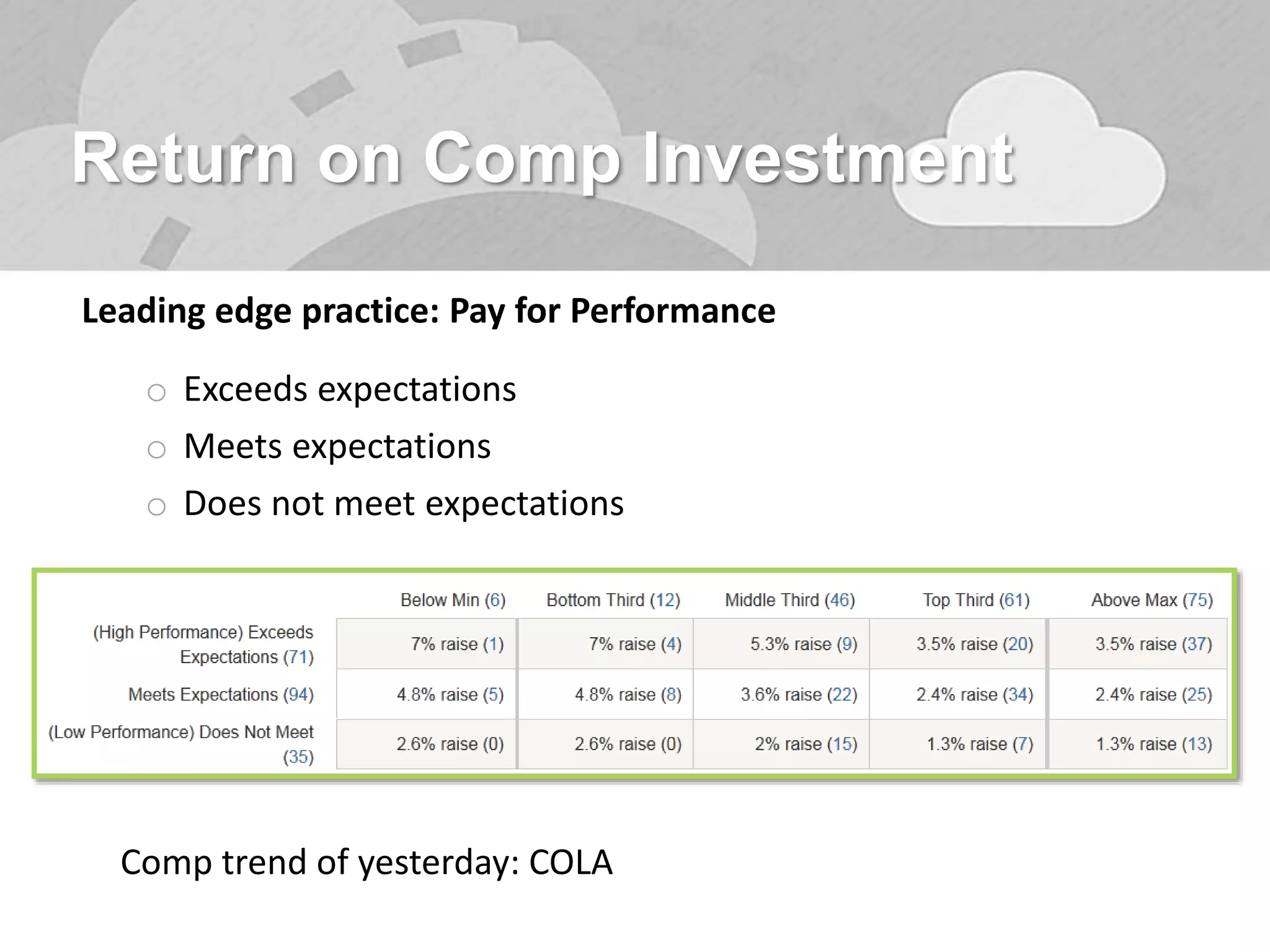
Return on Comp Investment
Leading edge practice: Pay for Performance
o Exceeds expectations
o Meets expectations
o Does not meet expectations
Comp trend of yesterday: COLA
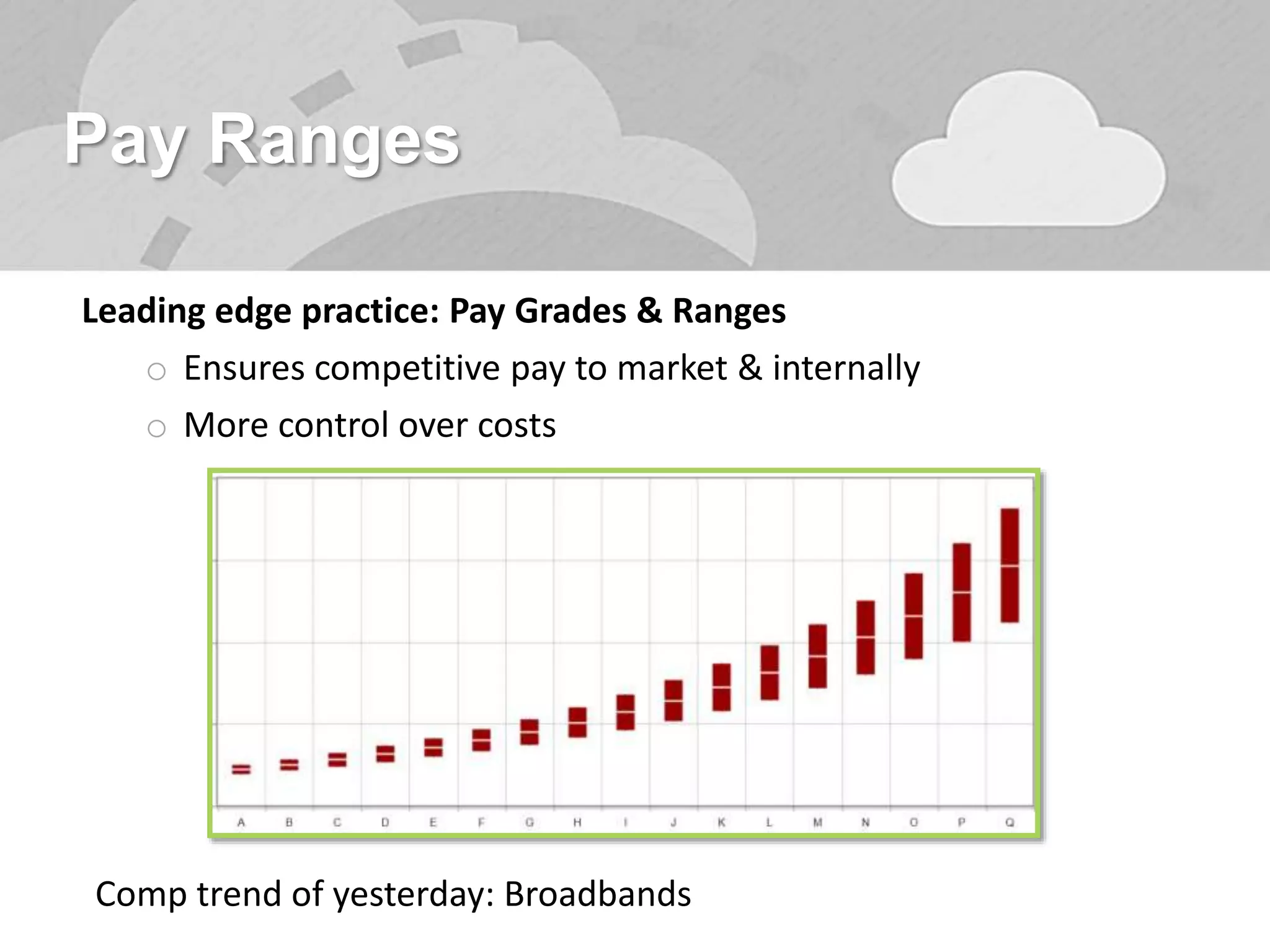
Pay Ranges
Leading edge practice: Pay Grades & Ranges
o Ensures competitive pay to market & internally
o More control over costs
Comp trend of yesterday: Broadbands
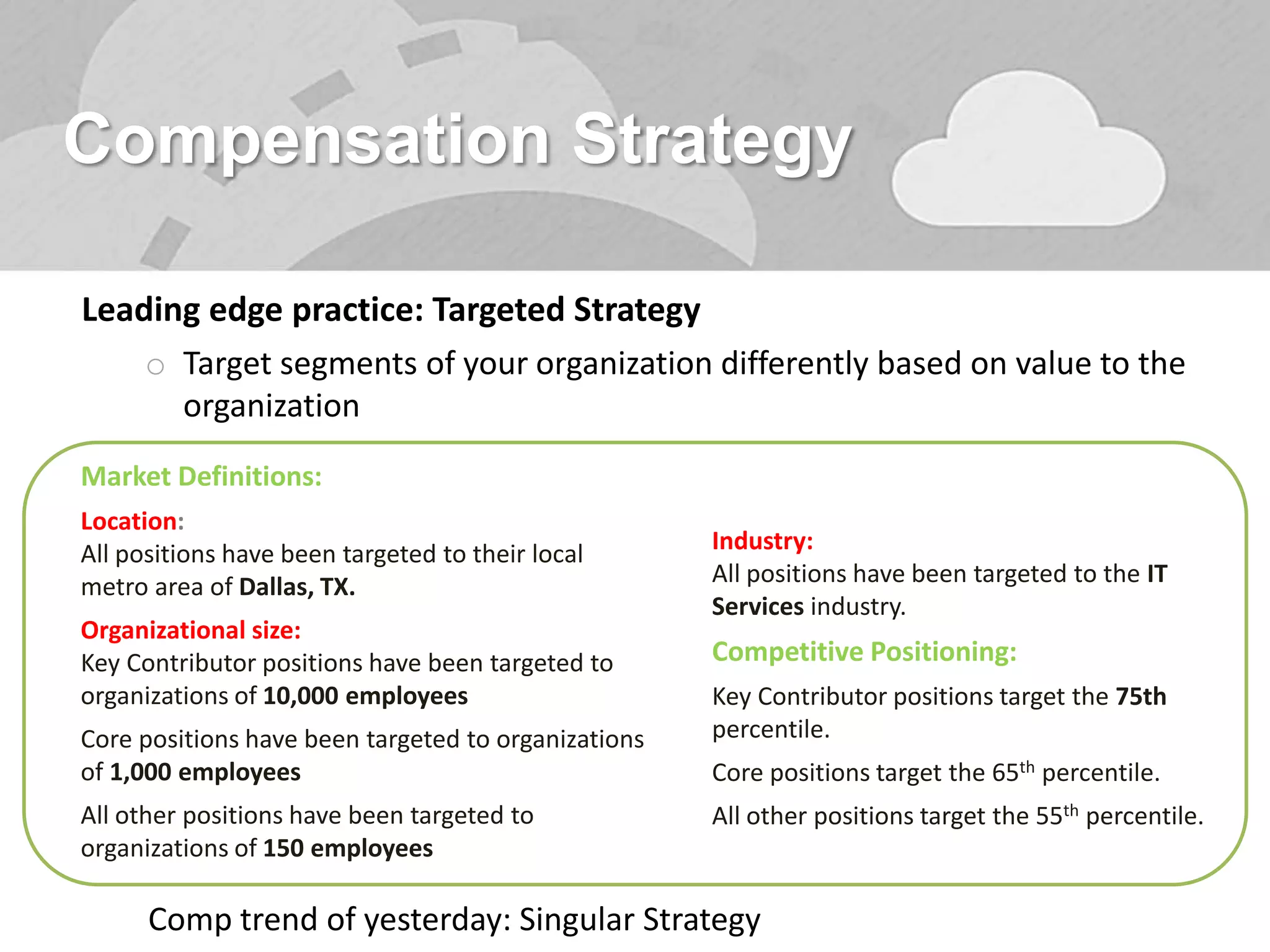
Compensation Strategy
Leading edge practice: Targeted Strategy
o Target segments of your organization differently based on value to the
organization
Comp trend of yesterday: Singular Strategy
Market Definitions:
Location:
All positions have been targeted to their local
metro area of Dallas, TX.
Organizational size:
Key Contributor positions have been targeted to
organizations of 10,000 employees
Core positions have been targeted to organizations
of 1,000 employees
All other positions have been targeted to
organizations of 150 employees
Industry:
All positions have been targeted to the IT
Services industry.
Competitive Positioning:
Key Contributor positions target the 75th
percentile.
Core positions target the 65th percentile.
All other positions target the 55th percentile.
S
T
A
Y
N
I
M
B
L
E
!
Keep
Executives
Up-to-Date
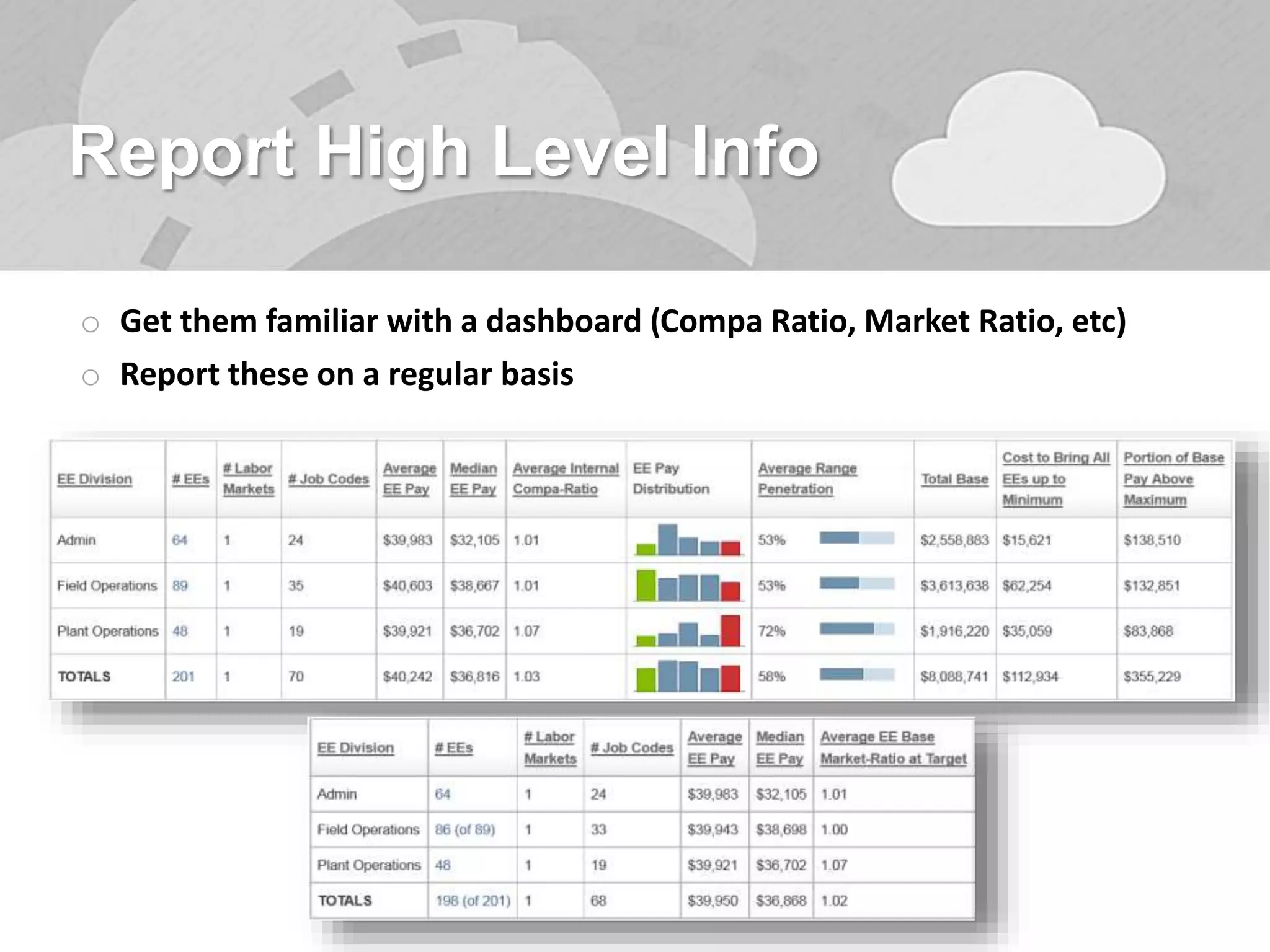
Report High Level Info
o Get them familiar with a dashboard (Compa Ratio, Market Ratio, etc)
o Report these on a regular basis
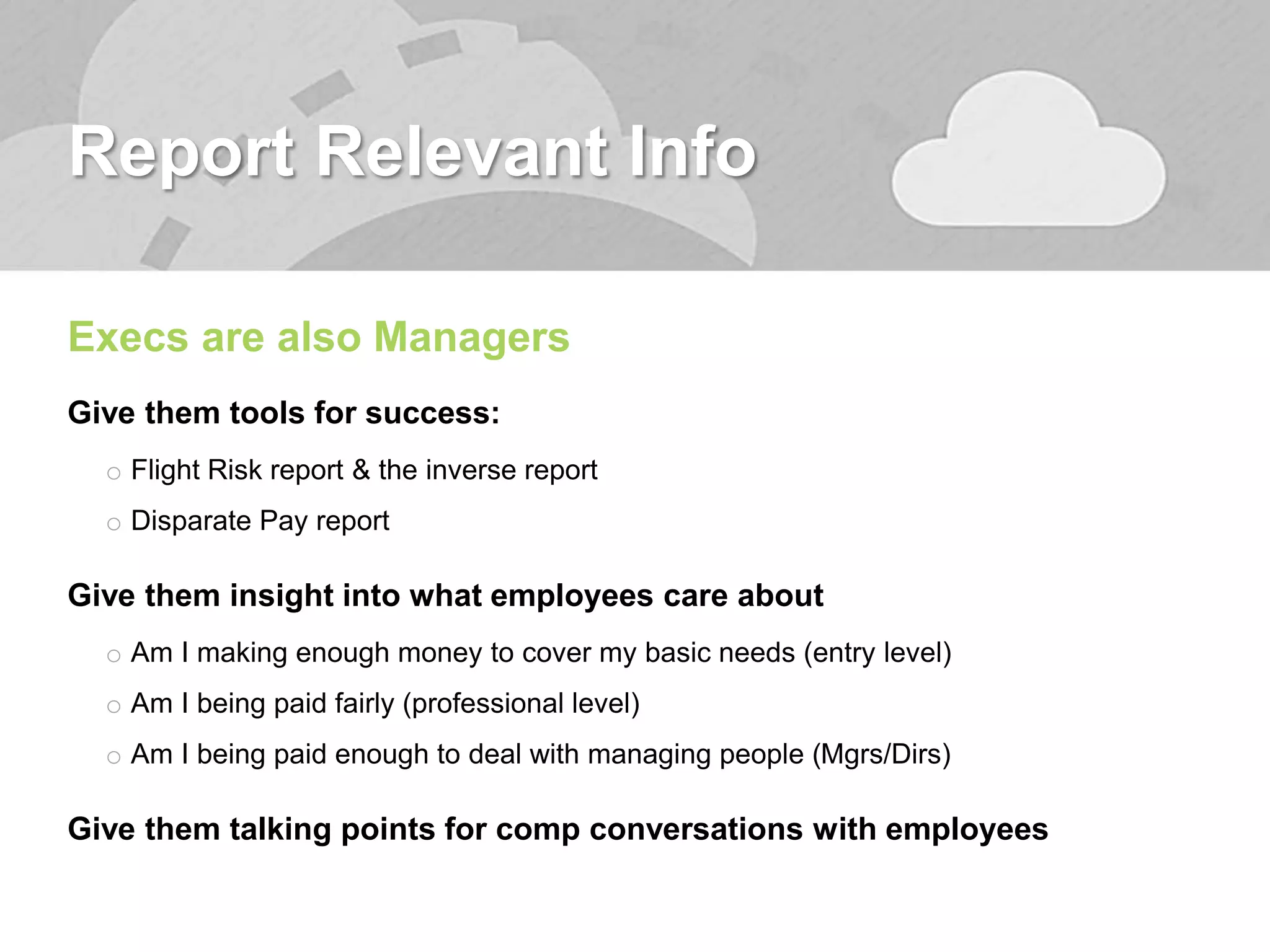
Report Relevant Info
Execs are also Managers
Give them tools for success:
o Flight Risk report & the inverse report
o Disparate Pay report
Give them insight into what employees care about
o Am I making enough money to cover my basic needs (entry level)
o Am I being paid fairly (professional level)
o Am I being paid enough to deal with managing people (Mgrs/Dirs)
Give them talking points for comp conversations with employees
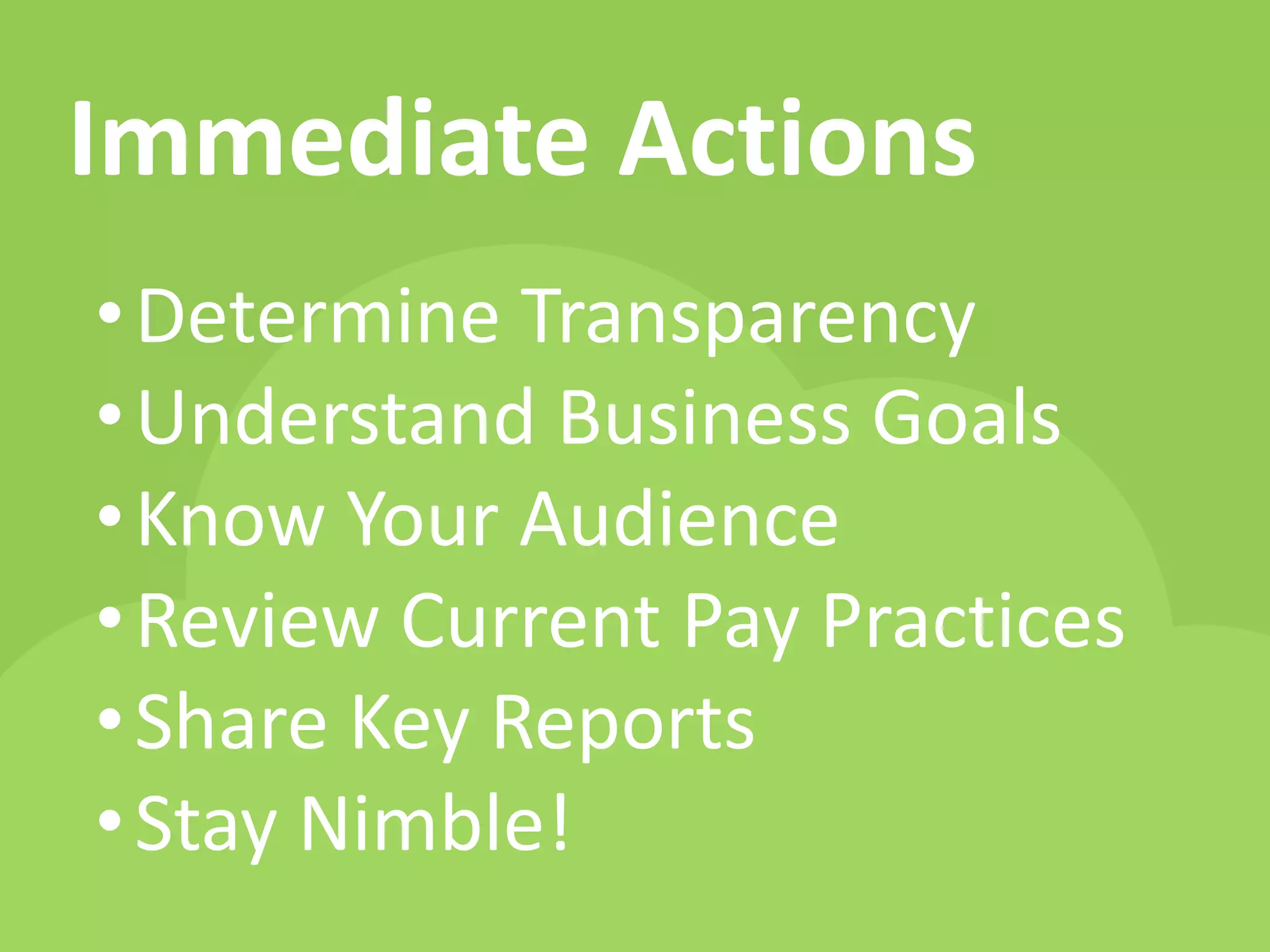
Immediate Actions
•Determine Transparency
•Understand Business Goals
•Know Your Audience
•Review Current Pay Practices
•Share Key Reports
•Stay Nimble!
EQUIP
MANAGERS
Set expectations
Educate them
Give them the big picture
Give them tools
PayScale Delivers Where Other Compensation Providers Fall Short
PayScale leads the world in compensation knowledge with the freshest and
most detailed data from over 40 million salary profiles. More than 3000
organizations use PayScale’s software and intelligence to get the greatest
return on their talent. Smart businesses use PayScale Insight to recruit, retain
and motivate their people.
Visit our blog: www.payscale.com/compensation-today
Join our Group on LinkedIn: Compensation Today: HR Best Practices
Jennifer Ferris, CCP
Compensation Professional
Mykkah Herner, MA, CCP
Manager of Professional Services,
PayScale, Inc.
www.payscale.com
Appendix
www.payscale.com
Basic Comp Language:
Understanding Ranges
o Range Width [=(max-min)/min]
o How much flexibility do we give our managers in setting pay?
o Midpoint Differential [=(midpoint grade2-midpoint grade1)/midpoint
grade1)]
o Do we have a more or less hierarchical org structure? Positions with multiple
levels?
www.payscale.com
Basic Comp Language: Using Ranges
o Range Penetration [=(EE Pay-min)/(max-min)]
o How well are employees moving through their ranges – do the ones at
the top deserve it?
o Green-Circled Employees [Below bottom of range]
o We may be untruthful and/or paying un”fair”ly.
o Red-Circled Employees [Above top of range]
o These are employees we decide to pay more, even though the data
doesn’t support it.
www.payscale.com
Basic Comp Language: Measuring
Plan Performance
o Compa-Ratio [=EE Pay/Mid]
o Are we on track with our pay philosophy?
o Market Ratio [=EE Pay/Market]
o How are we doing vs our competitors?
o Midpoint to Market Delta [=(Mid-Market)/Market]
o Are our ranges current to market?

Communicating Compensation: Gaining Executive Support

  • 1.
    Communicating Compensation: Gaining ExecutiveSupport Jennifer Ferris, CCP Compensation Professional Mykkah Herner, MA, CCP Manager of Professional Services www.payscale.com
  • 2.
    www.payscale.com 14,000 Positions 3000Customers 13 Countries 250 Compensable Factors 40 Million Salary Profiles
  • 3.
    COMMUNICATING COMPENSATION Part I: GainingExecutive Support Part II: Equipping Managers Part III: Talking with Employees
  • 4.
    www.payscale.com Agenda • Communication Basics •Compensation Basics Communicating Compensation to Executives • Understanding the Executive Audience • Align compensation to business goals • Incorporate leading edge practices • Keep executives up-to-date with quick snapshots Next in series: Equipping Managers
  • 5.
  • 6.
    Communication Basics  KNOW YOURAUDIENCE!  WATCH THE JARGON  PRESENT A WAY FORWARD  FOCUS ON RESULTS  BE DIRECT AND EMPATHETIC
  • 7.
    Managing Conflict Prevent Resolve Contain Power Struggle Overt Conflict Latent Tensions Stages ofConflict The Bridge-Builder The Teacher The Provider 10 Roles in Managing Conflict The Healer The Equalizer The Arbiter The Mediator The Peacekeeper The Referee The Witness Source: www.thirdside.org
  • 8.
    Levels of Transparency Employeesknow… o Only their own salary o Their range and where it caps out o All grade assignments for jobs up to a certain level o All grade assignments for all jobs o The ranges associated with grade assignments to a certain level o The ranges for all jobs o Everyone’s pay Managers know…  Only their own salary  The salary of their direct reports  The salary of all those on their team  The grade assignments & ranges of their direct reports  The grade assignments & ranges of all those on their team  The grade assignments of all positions up to their level or up to a certain level  The ranges of all positions up to their level or a certain level  All grade assignments for all jobs  The ranges for all jobs  Everyone’s pay
  • 9.
    Communication Roles • Approveprogram • Communicate program to org at a high level • Perform manager/supervisor role Executives’ Role • Get program ready • Ongoing communication to Execs • Train managers HR’s Role • Understand the program • Communicate with employees • Get support from HR Managers’ & Supervisors’ Role • Agree to the program • Communicate with manager/supervisorEmployees’ Role
  • 10.
  • 11.
  • 12.
  • 13.
    Start with theright questions Why do you want to have a good comp plan? • To pay people well Why do you want to pay people well? • To attract and retain top talent Why do you want to have top talent? • To accomplish our business objectives What are your business objectives?
  • 14.
  • 15.
    GLOSSARY OF COMPTERMS TALENT MARKET(S) oIndustry, Size, Location oMarket-Ratio PAY GRADES & PAY RANGES oRange Width oRange Penetration oCompa-Ratio oRed-Circled | Green-Circled PAY FOR PERFORMANCE
  • 16.
    Schedules + Differentials Purpose Preserveboth competitive pay and internal equity. Support simplicity of structure. Implementation Schedule = set of ranges + grades Markets are grouped in 5% increments; schedules are adjusted to reflect markets. TAMPA Schedule C: -5% NEW YORK Schedule G: +15% PORTLAND Schedule D: Main
  • 17.
    Advantages of PayStructures  Provide alignment to business strategy  Clarify relative worth of the position internally & externally  Ensure fair pay (legally defensible)  Define a pay range for a position  Create clear career paths  Room to reward your employees based on performance, tenure, etc.
  • 18.
  • 19.
    Executive Audience o Leadersdon’t want to be told what to do o Leaders can be distrustful of change o Leaders are decision-makers o Many leaders have access to information o What matters to your leaders?
  • 20.
  • 21.
    THE COST OF GETTING COMP WRONG Payrollis by far your biggest expense; the cost of getting it wrong is tremendous.
  • 22.
    Align comp planwith business goals
  • 23.
    THE REASONS YOU’RE CREATING A COMPPLAN 1. IT MAKES GOOD BUSINESS SENSE 2. IT HELPS ATTRACT AND RETAIN TALENT 3. IT SUPPORTS THE MISSION, STRATEGY AND CULTURE OF THE ORGANIZATION
  • 24.
  • 25.
    Return on CompInvestment Leading edge practice: Pay for Performance o Exceeds expectations o Meets expectations o Does not meet expectations Comp trend of yesterday: COLA
  • 26.
    Pay Ranges Leading edgepractice: Pay Grades & Ranges o Ensures competitive pay to market & internally o More control over costs Comp trend of yesterday: Broadbands
  • 27.
    Compensation Strategy Leading edgepractice: Targeted Strategy o Target segments of your organization differently based on value to the organization Comp trend of yesterday: Singular Strategy Market Definitions: Location: All positions have been targeted to their local metro area of Dallas, TX. Organizational size: Key Contributor positions have been targeted to organizations of 10,000 employees Core positions have been targeted to organizations of 1,000 employees All other positions have been targeted to organizations of 150 employees Industry: All positions have been targeted to the IT Services industry. Competitive Positioning: Key Contributor positions target the 75th percentile. Core positions target the 65th percentile. All other positions target the 55th percentile.
  • 28.
  • 29.
  • 30.
    Report High LevelInfo o Get them familiar with a dashboard (Compa Ratio, Market Ratio, etc) o Report these on a regular basis
  • 31.
    Report Relevant Info Execsare also Managers Give them tools for success: o Flight Risk report & the inverse report o Disparate Pay report Give them insight into what employees care about o Am I making enough money to cover my basic needs (entry level) o Am I being paid fairly (professional level) o Am I being paid enough to deal with managing people (Mgrs/Dirs) Give them talking points for comp conversations with employees
  • 32.
    Immediate Actions •Determine Transparency •UnderstandBusiness Goals •Know Your Audience •Review Current Pay Practices •Share Key Reports •Stay Nimble!
  • 33.
    EQUIP MANAGERS Set expectations Educate them Givethem the big picture Give them tools
  • 34.
    PayScale Delivers WhereOther Compensation Providers Fall Short PayScale leads the world in compensation knowledge with the freshest and most detailed data from over 40 million salary profiles. More than 3000 organizations use PayScale’s software and intelligence to get the greatest return on their talent. Smart businesses use PayScale Insight to recruit, retain and motivate their people. Visit our blog: www.payscale.com/compensation-today Join our Group on LinkedIn: Compensation Today: HR Best Practices Jennifer Ferris, CCP Compensation Professional Mykkah Herner, MA, CCP Manager of Professional Services, PayScale, Inc. www.payscale.com
  • 35.
  • 36.
    www.payscale.com Basic Comp Language: UnderstandingRanges o Range Width [=(max-min)/min] o How much flexibility do we give our managers in setting pay? o Midpoint Differential [=(midpoint grade2-midpoint grade1)/midpoint grade1)] o Do we have a more or less hierarchical org structure? Positions with multiple levels?
  • 37.
    www.payscale.com Basic Comp Language:Using Ranges o Range Penetration [=(EE Pay-min)/(max-min)] o How well are employees moving through their ranges – do the ones at the top deserve it? o Green-Circled Employees [Below bottom of range] o We may be untruthful and/or paying un”fair”ly. o Red-Circled Employees [Above top of range] o These are employees we decide to pay more, even though the data doesn’t support it.
  • 38.
    www.payscale.com Basic Comp Language:Measuring Plan Performance o Compa-Ratio [=EE Pay/Mid] o Are we on track with our pay philosophy? o Market Ratio [=EE Pay/Market] o How are we doing vs our competitors? o Midpoint to Market Delta [=(Mid-Market)/Market] o Are our ranges current to market?