COMMUNICATING
ACROSS CULTURES
Cultural Relativism- refers to a practice that cultures were treated as equal to one
another.
Describable- this refers to how functionalist approach assume reality in terms of
intercultural communication.
Critical- this approach view relationship of culture and communication wherein
culture is a site of power struggle.
Creative- this refers to the approach that is interpretative in terms of making an
assumption of human behavior.
.
Note: Critical approach in terms of method of study deals with textual analysis of media.
SOUTH KOREAN CULTURE
They will seldom give a flat “no” or a negative response due to saving of
face and politeness.
UNITED KINGDOM
They are polite and time conscious.
They give gifts by bearing in mind the recipient’s interest.
They view handshake as an important part of showing their courtesy.
JAPANESE CULTURE
Japanese person may smile and laugh to diffuse the uncomfortable situation
when communicating bad news.
AUSTRALIAN CULTURE
Australians, commonly make a circle with the thumb and forefinger with the
other fingers extended when indicating approval.
ARAB CULTURE
In Arab, showing the soles of your feet is considered rude and horrible for
them.
GERMAN CULTURE
The arms length distance is maintained when talking with one another.
ITALIAN CULTURE
When you raise your voice in Italy, it is viewed as an expression of
excitement or conviction.
BRITISH CULTURE
Like to be given a fair amount of personal space.
Do not always give away their emotions via facial expressions
Usually very patient and queue for everything.
CHINESE CULTURE
They may smile and laugh to diffuse the uncomfortable situation when relaying bad news.
BRAZILIAN CULTURE
They tend to stand very close to one another and the distance may be closer
than that of the Australians.
They tend to listen erratically and interrupt one another, as each person
attempts to express their viewpoint.
They tend to be quite tactile and touching of arms and backs is widely
accepted.
FRENCH CULTURE
Compliments are appreciated, but will usually be received by humble denial
instead of a thank you.
AMERICAN CULTURE
They generally do not appreciate loud or emotional outbursts.
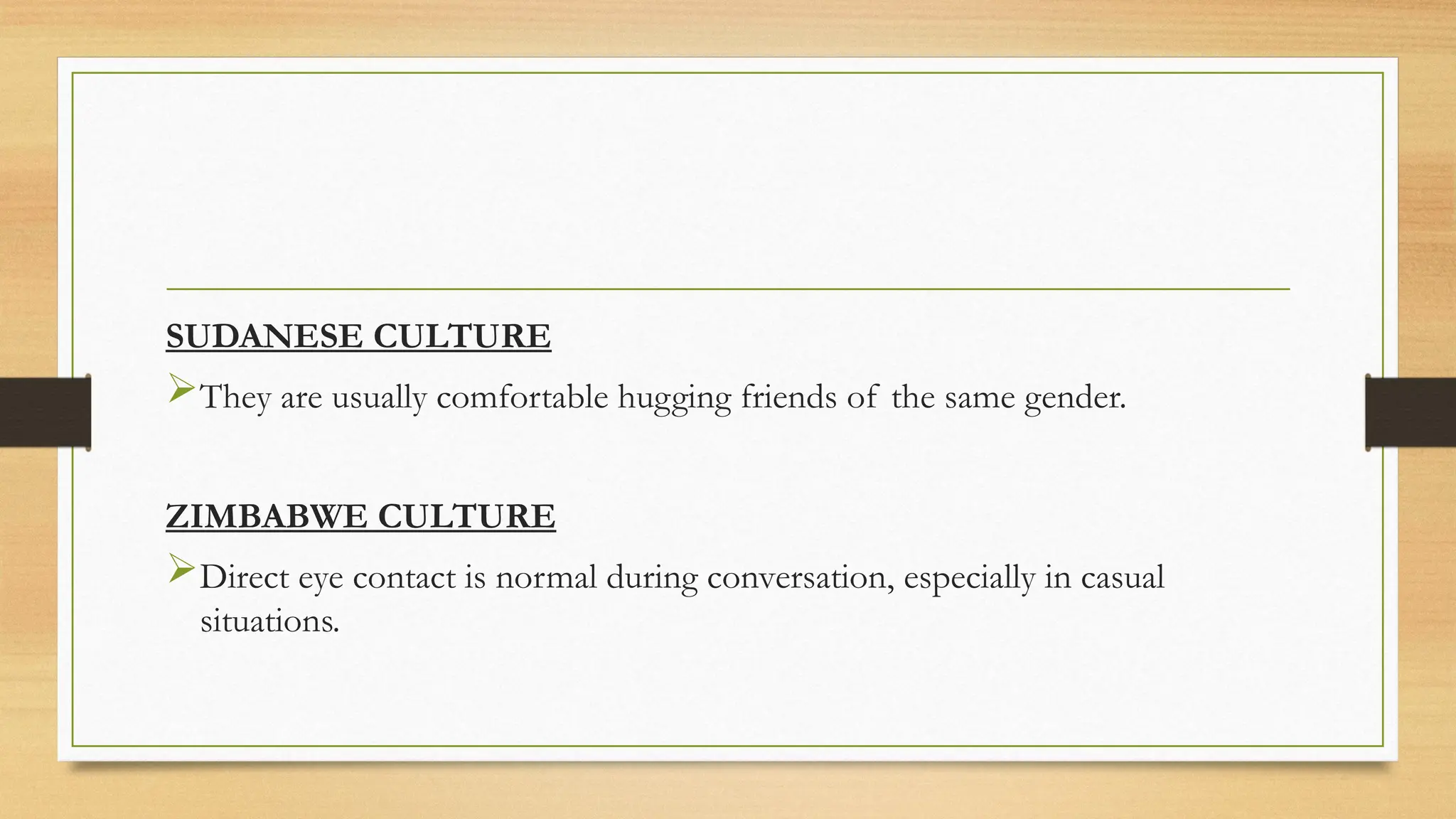
SUDANESE CULTURE
They are usually comfortable hugging friends of the same gender.
ZIMBABWE CULTURE
Direct eye contact is normal during conversation, especially in casual
situations.
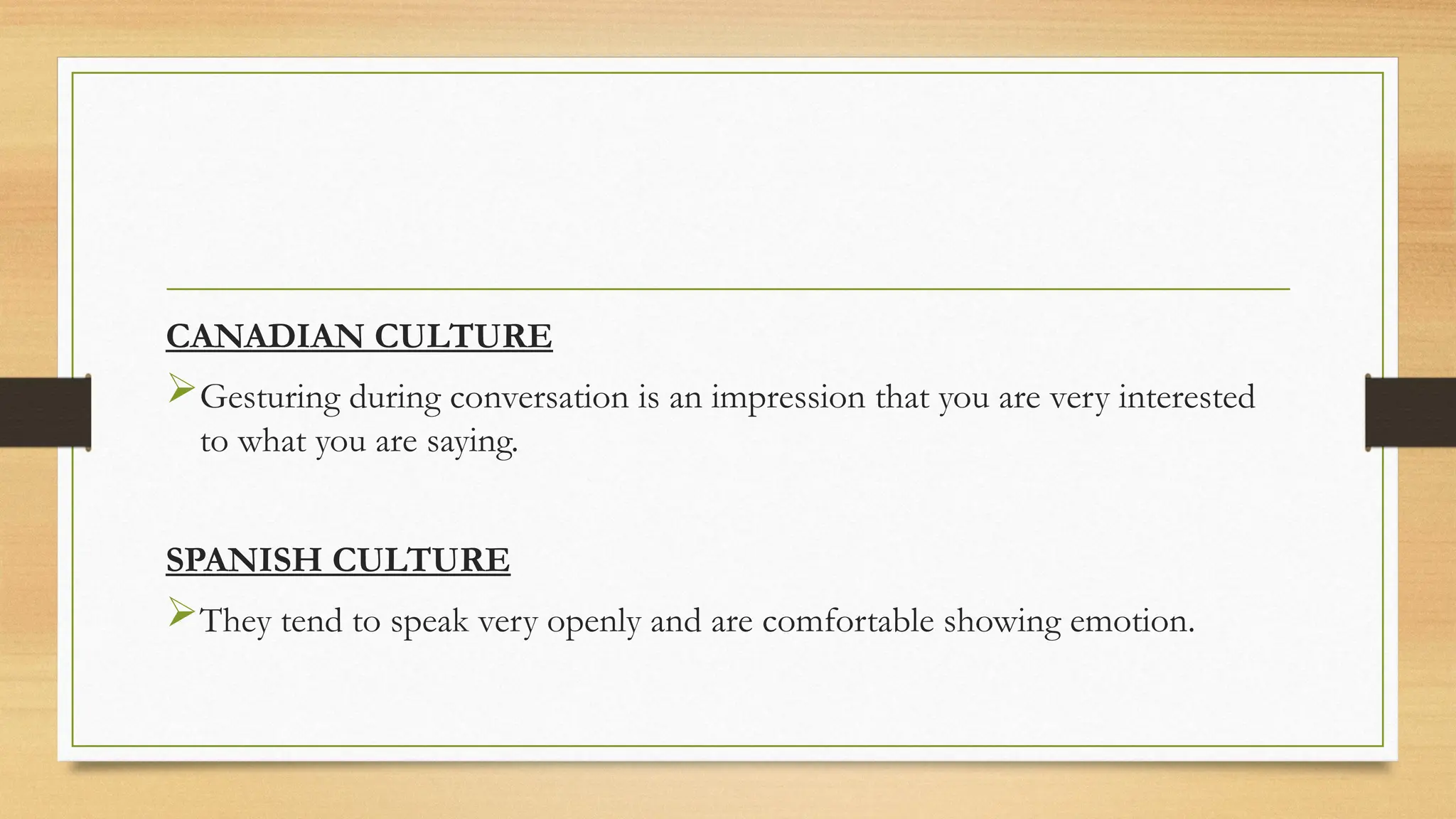
CANADIAN CULTURE
Gesturing during conversation is an impression that you are very interested
to what you are saying.
SPANISH CULTURE
They tend to speak very openly and are comfortable showing emotion.
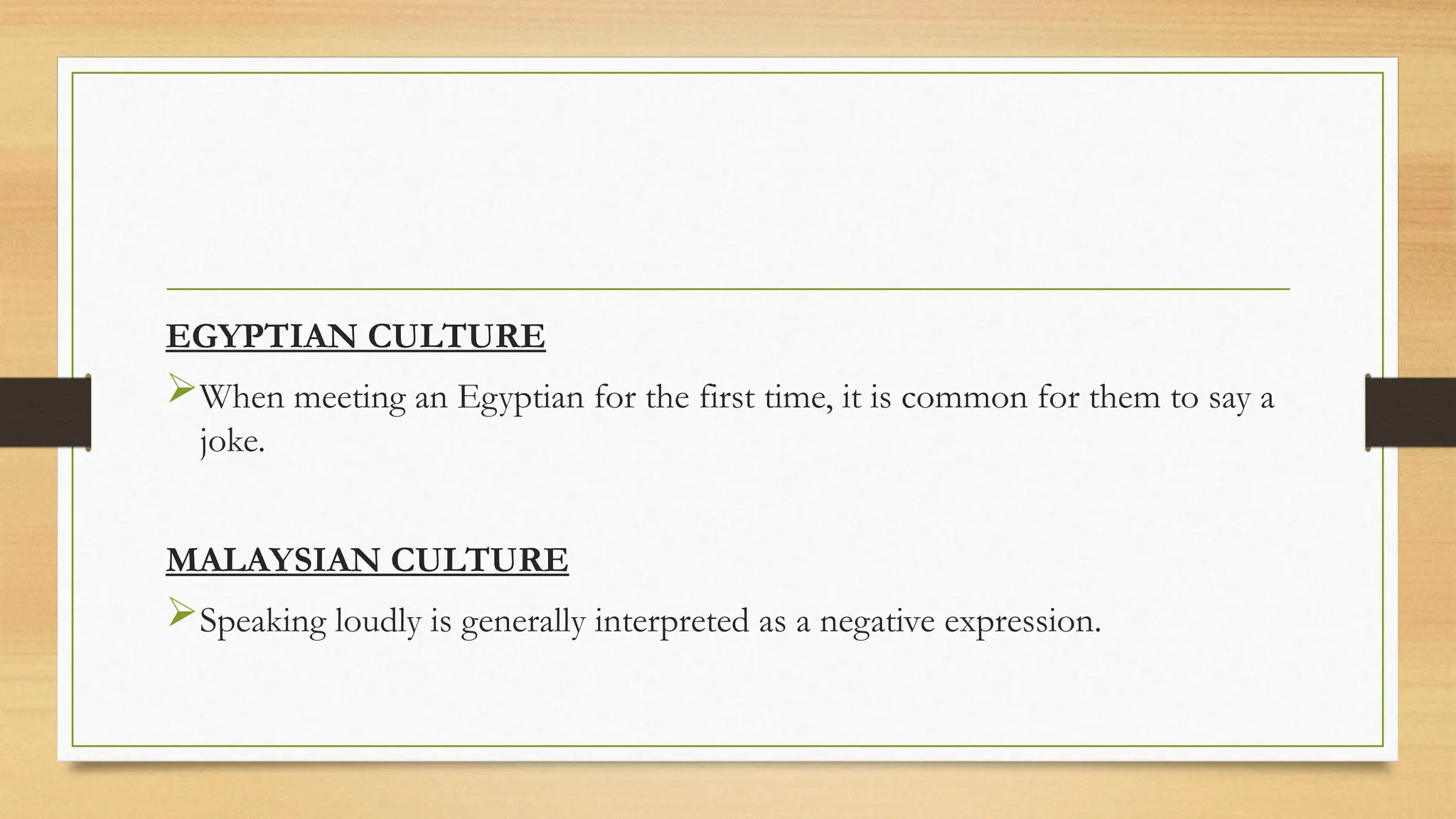
EGYPTIAN CULTURE
When meeting an Egyptian for the first time, it is common for them to say a
joke.
MALAYSIAN CULTURE
Speaking loudly is generally interpreted as a negative expression.
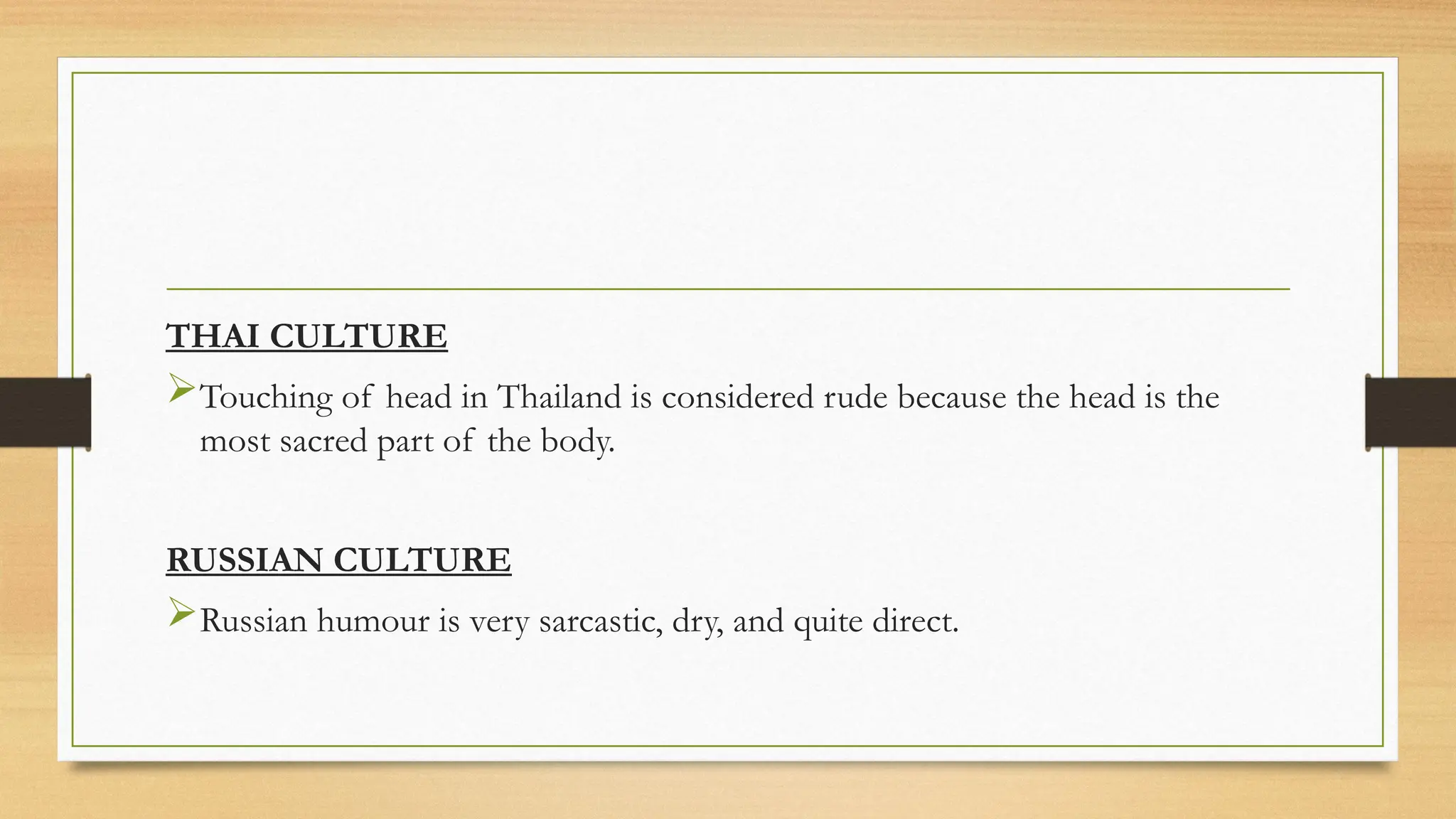
THAI CULTURE
Touching of head in Thailand is considered rude because the head is the
most sacred part of the body.
RUSSIAN CULTURE
Russian humour is very sarcastic, dry, and quite direct.
Communicating-Across-Cultures.pptx 1stsem

  • 1.
  • 2.
    Cultural Relativism- refersto a practice that cultures were treated as equal to one another. Describable- this refers to how functionalist approach assume reality in terms of intercultural communication. Critical- this approach view relationship of culture and communication wherein culture is a site of power struggle. Creative- this refers to the approach that is interpretative in terms of making an assumption of human behavior.
  • 3.
    . Note: Critical approachin terms of method of study deals with textual analysis of media. SOUTH KOREAN CULTURE They will seldom give a flat “no” or a negative response due to saving of face and politeness.
  • 4.
    UNITED KINGDOM They arepolite and time conscious. They give gifts by bearing in mind the recipient’s interest. They view handshake as an important part of showing their courtesy. JAPANESE CULTURE Japanese person may smile and laugh to diffuse the uncomfortable situation when communicating bad news.
  • 5.
    AUSTRALIAN CULTURE Australians, commonlymake a circle with the thumb and forefinger with the other fingers extended when indicating approval. ARAB CULTURE In Arab, showing the soles of your feet is considered rude and horrible for them.
  • 6.
    GERMAN CULTURE The armslength distance is maintained when talking with one another. ITALIAN CULTURE When you raise your voice in Italy, it is viewed as an expression of excitement or conviction.
  • 7.
    BRITISH CULTURE Like tobe given a fair amount of personal space. Do not always give away their emotions via facial expressions Usually very patient and queue for everything. CHINESE CULTURE They may smile and laugh to diffuse the uncomfortable situation when relaying bad news.
  • 8.
    BRAZILIAN CULTURE They tendto stand very close to one another and the distance may be closer than that of the Australians. They tend to listen erratically and interrupt one another, as each person attempts to express their viewpoint. They tend to be quite tactile and touching of arms and backs is widely accepted.
  • 9.
    FRENCH CULTURE Compliments areappreciated, but will usually be received by humble denial instead of a thank you. AMERICAN CULTURE They generally do not appreciate loud or emotional outbursts.
  • 10.
    SUDANESE CULTURE They areusually comfortable hugging friends of the same gender. ZIMBABWE CULTURE Direct eye contact is normal during conversation, especially in casual situations.
  • 11.
    CANADIAN CULTURE Gesturing duringconversation is an impression that you are very interested to what you are saying. SPANISH CULTURE They tend to speak very openly and are comfortable showing emotion.
  • 12.
    EGYPTIAN CULTURE When meetingan Egyptian for the first time, it is common for them to say a joke. MALAYSIAN CULTURE Speaking loudly is generally interpreted as a negative expression.
  • 13.
    THAI CULTURE Touching ofhead in Thailand is considered rude because the head is the most sacred part of the body. RUSSIAN CULTURE Russian humour is very sarcastic, dry, and quite direct.