Common types of
procurement risks
Common types of procurement risks
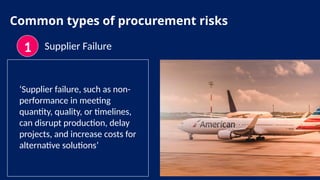
1 Supplier Failure
‘Supplier failure, such as non-
performance in meeting
quantity, quality, or timelines,
can disrupt production, delay
projects, and increase costs for
alternative solutions’
Common types of procurement risks
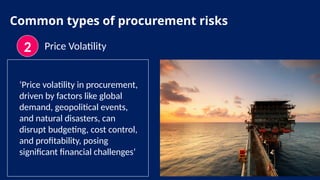
2 Price Volatility
‘Price volatility in procurement,
driven by factors like global
demand, geopolitical events,
and natural disasters, can
disrupt budgeting, cost control,
and profitability, posing
significant financial challenges’
Common types of procurement risks
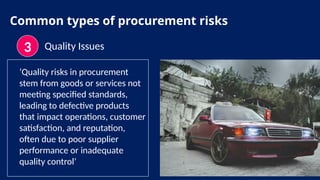
3 Quality Issues
‘Quality risks in procurement
stem from goods or services not
meeting specified standards,
leading to defective products
that impact operations, customer
satisfaction, and reputation,
often due to poor supplier
performance or inadequate
quality control’
Common types of procurement risks
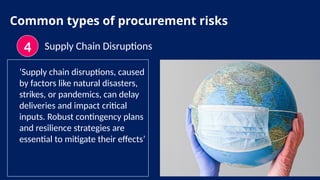
4 Supply Chain Disruptions
‘Supply chain disruptions, caused
by factors like natural disasters,
strikes, or pandemics, can delay
deliveries and impact critical
inputs. Robust contingency plans
and resilience strategies are
essential to mitigate their effects’
Common types of procurement risks
5
Regulatory and
Compliance Risks
‘Compliance with data protection
privacy regulations, other
relevant laws is vital in
procurement to avoid legal
penalties, reputational harm, and
loss of trust. Teams must
understand applicable laws and
implement processes to ensure
adherence’
Common types of procurement risks
6 Financial Risks
‘Financial risks in procurement,
such as payment delays, supplier
instability, and currency
fluctuations, can affect cash flow,
supplier relationships, and
stability. Effective monitoring and
management are crucial to
ensure financial health’
Common types of procurement risks
7
Legal and Contractual
Risks
‘Legal and contractual risks in
procurement, such as non-
compliance, disputes, or poor
documentation, stem from
inadequate contract
management or unclear terms.
Robust processes, well-drafted
contracts, and legal support are
essential to mitigate these risks’
Common types of procurement risks
8
Reputation and Brand
Risks
‘Reputation and brand risks in
procurement, such as supplier
scandals or ethical violations, can
harm public perception and
customer trust. Ethical sourcing,
sustainability, and transparent
supplier relationships are key to
mitigating these risks’
Procurement Management Course on Udemy
Six key objectives of learning this Procurement
Management course
1. Gain a Comprehensive
Understanding of Procurement
Processes
2. Enhance Strategic Planning and
Execution Skills
3. Learn Contract Lifecycle
Management and Risk Mitigation
4. Master Supplier Relationship and
Performance Management
5. Understand Procurement
Compliance and Ethics
6. Stay Ahead of Emerging Trends in
https://www.udemy.com/course/comprehensive-
course-on-procurement-management-process/?
referralCode=90029C6ECA3C4A9B9E8E
ENROLL NOW!

Common types of Procurement Risks and Mitigation Startegies

  • 1.
  • 2.
    Common types ofprocurement risks 1 Supplier Failure ‘Supplier failure, such as non- performance in meeting quantity, quality, or timelines, can disrupt production, delay projects, and increase costs for alternative solutions’
  • 3.
    Common types ofprocurement risks 2 Price Volatility ‘Price volatility in procurement, driven by factors like global demand, geopolitical events, and natural disasters, can disrupt budgeting, cost control, and profitability, posing significant financial challenges’
  • 4.
    Common types ofprocurement risks 3 Quality Issues ‘Quality risks in procurement stem from goods or services not meeting specified standards, leading to defective products that impact operations, customer satisfaction, and reputation, often due to poor supplier performance or inadequate quality control’
  • 5.
    Common types ofprocurement risks 4 Supply Chain Disruptions ‘Supply chain disruptions, caused by factors like natural disasters, strikes, or pandemics, can delay deliveries and impact critical inputs. Robust contingency plans and resilience strategies are essential to mitigate their effects’
  • 6.
    Common types ofprocurement risks 5 Regulatory and Compliance Risks ‘Compliance with data protection privacy regulations, other relevant laws is vital in procurement to avoid legal penalties, reputational harm, and loss of trust. Teams must understand applicable laws and implement processes to ensure adherence’
  • 7.
    Common types ofprocurement risks 6 Financial Risks ‘Financial risks in procurement, such as payment delays, supplier instability, and currency fluctuations, can affect cash flow, supplier relationships, and stability. Effective monitoring and management are crucial to ensure financial health’
  • 8.
    Common types ofprocurement risks 7 Legal and Contractual Risks ‘Legal and contractual risks in procurement, such as non- compliance, disputes, or poor documentation, stem from inadequate contract management or unclear terms. Robust processes, well-drafted contracts, and legal support are essential to mitigate these risks’
  • 9.
    Common types ofprocurement risks 8 Reputation and Brand Risks ‘Reputation and brand risks in procurement, such as supplier scandals or ethical violations, can harm public perception and customer trust. Ethical sourcing, sustainability, and transparent supplier relationships are key to mitigating these risks’
  • 10.
    Procurement Management Courseon Udemy Six key objectives of learning this Procurement Management course 1. Gain a Comprehensive Understanding of Procurement Processes 2. Enhance Strategic Planning and Execution Skills 3. Learn Contract Lifecycle Management and Risk Mitigation 4. Master Supplier Relationship and Performance Management 5. Understand Procurement Compliance and Ethics 6. Stay Ahead of Emerging Trends in https://www.udemy.com/course/comprehensive- course-on-procurement-management-process/? referralCode=90029C6ECA3C4A9B9E8E ENROLL NOW!