WHITEPAPER 
Common Sense 
Talent Management 
Twelve fundamental principles 
for increasing workforce productivity 
Steven T. Hunt, Ph.D., SPHR 
Director of 
Business Transformation 
SuccessFactors Inc.
SUCCESSFACTORS / WHITEPAPER 
Common Sense Talent Management 
Common Sense 
Talent Management 
Twelve fundamental principles 
for increasing workforce productivity 
Strategic 
Workforce 
Planning 
For a Changing Business 
Environment 
Talent management is about getting the right people in the right jobs doing the right things. This requires 
predicting how employees will act in the future and getting them to act differently from how they acted in 
the past. Neither of these is easy. To be effective, talent management processes must take into account 
the underlying factors that influence employees’ decisions and actions. They must be based on how 
people actually behave, which is often different from how business leaders and managers want them to 
behave. This paper reviews scientific research studying employee behavior and provides 12 basic truths 
about employee behavior. These truths can be thought of as “common sense” principles for successful 
talent management. Keeping these principles in mind will significantly improve the effectiveness of any 
talent management initiative. 
2 
Subscribe 
to our Blog
SUCCESSFACTORS / WHITEPAPER 
Common sense talent management 
Talent management is about 
getting the right people in the 
right jobs doing the right things. 
Twelve fundamental principles for increasing workforce productivity 
The last ten years have seen the emergence of a new field of human resources (HR) called “talent 
management”. Talent management broadly refers to strategic HR programs designed to maximize workforce 
productivity1. The field of talent management covers a range of HR functions focusing on attracting, retaining, 
managing, and developing high quality workforces. It includes performance management, staffing, 
compensation, learning management, employee development, and succession planning. The growing interest 
in talent management is primarily a result of increasing recognition of the impact talent management practices 
have on business growth and profitability and the role talent management plays for dealing with the shortage of 
skilled labor in the workforce (Berggren & Lozaga, 2008; Boudreau & Ramstad, 2007). 
The end goal of talent management initiatives is to help get the right people in the right jobs doing the right 
things to make a business succeed. This goal may sound straightforward, but it is often extremely difficult to 
achieve. Why? Because to be successful talent management processes must effectively predict and change 
the day-to-day behavior of individual employees. Predicting and influencing human behavior is difficult 
(Ackerman & Humphries, 1990; Hunt, 2007). The divorce rate and weight loss industries in the United States 
provide some sense of how bad people are at predicting and changing the behavior of themselves and others, 
even when their personal health and happiness are clearly at stake. Talent management does not require the 
same skills as those used by marriage counselors and nutritionists, but there are more similarities than many 
people realize. Being effective at talent management requires a strong understanding of how employees’ 
motives, abilities, and behaviors interact to influence business results. You do not need to be a psychologist, 
but it is useful to have a good understanding of many of the things psychologists study. 
This paper examines talent management practices from the perspective of how they impact the behaviors of 
individual employees. It reviews a variety of psychological research to define twelve fundamental principles that 
should guide development of any talent management program. These principles can be thought of as 
“common sense” factors for designing and evaluating talent management methods. Unfortunately, as the 
saying goes, common sense is frequently uncommon. Companies must constantly return to these 12 principles 
when designing and evaluating talent management methods or risk creating talent management systems that 
may work on paper, but won’t work with people. 
1.Talent management is a relatively recent term used to refer to strategic HR programs primarily focused on increasing workforce productivity. Talent 
management programs can be contrasted to more administrative HR programs designed to support companies with the legal requirements and accounting 
processes related to employing people. Both types of programs are important, and many HR processes support both strategic and administrative HR goals. 
However, the focus of this paper is solely on strategic HR programs whose goals are fundamentally to increase workforce productivity through improving 
employee effectiveness. 
3 
Strategic 
Workforce 
Planning 
For a Changing Business 
Environment 
Fan us on 
FaceBook
SUCCESSFACTORS / WHITEPAPER 
Common sense talent management 
Strategic 
Workforce 
Planning 
For a Changing Business 
Environment 
Tweet 
This 
The role of employee behavior in talent management 
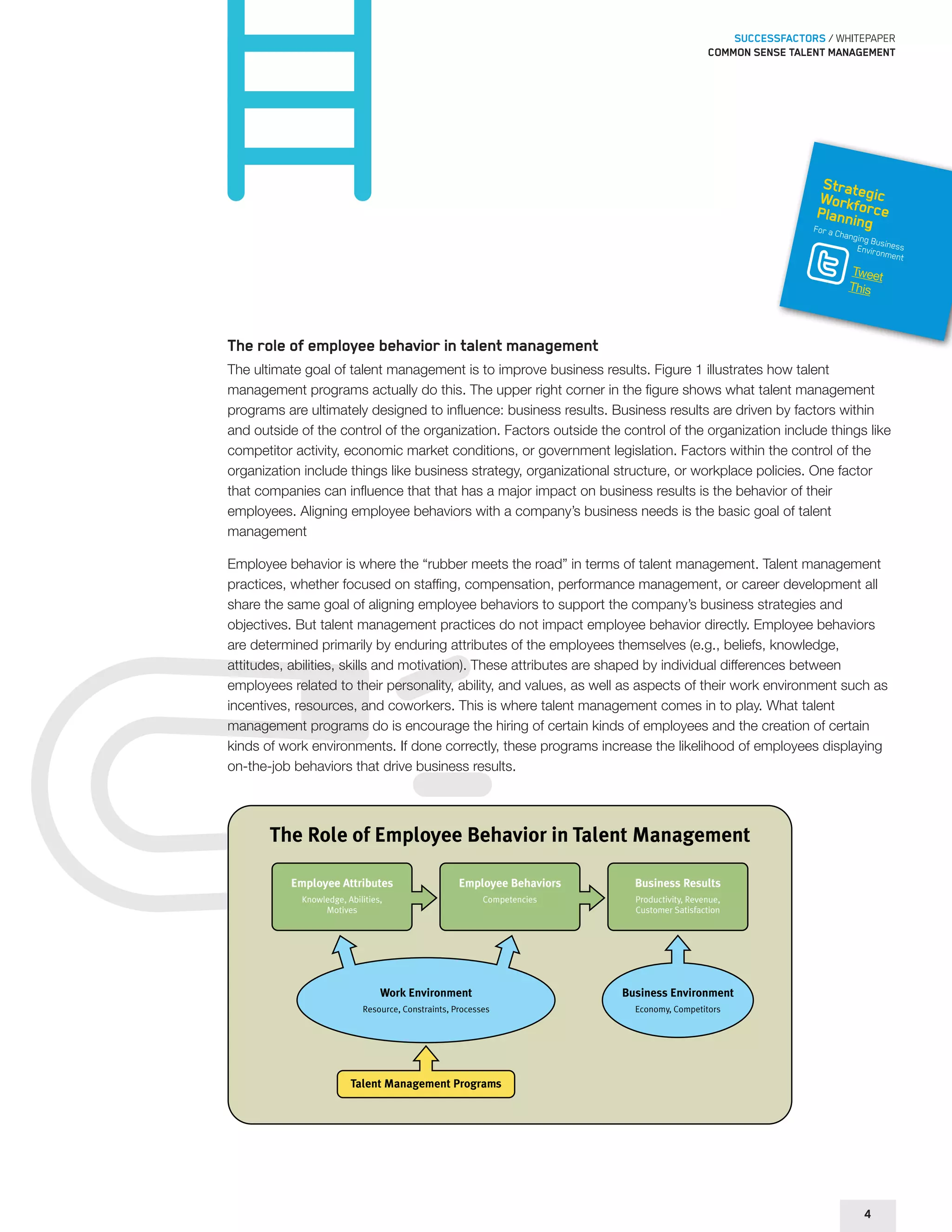
The ultimate goal of talent management is to improve business results. Figure 1 illustrates how talent 
management programs actually do this. The upper right corner in the figure shows what talent management 
programs are ultimately designed to influence: business results. Business results are driven by factors within 
and outside of the control of the organization. Factors outside the control of the organization include things like 
competitor activity, economic market conditions, or government legislation. Factors within the control of the 
organization include things like business strategy, organizational structure, or workplace policies. One factor 
that companies can influence that that has a major impact on business results is the behavior of their 
employees. Aligning employee behaviors with a company’s business needs is the basic goal of talent 
management 
Employee behavior is where the “rubber meets the road” in terms of talent management. Talent management 
practices, whether focused on staffing, compensation, performance management, or career development all 
share the same goal of aligning employee behaviors to support the company’s business strategies and 
objectives. But talent management practices do not impact employee behavior directly. Employee behaviors 
are determined primarily by enduring attributes of the employees themselves (e.g., beliefs, knowledge, 
attitudes, abilities, skills and motivation). These attributes are shaped by individual differences between 
employees related to their personality, ability, and values, as well as aspects of their work environment such as 
incentives, resources, and coworkers. This is where talent management comes in to play. What talent 
management programs do is encourage the hiring of certain kinds of employees and the creation of certain 
kinds of work environments. If done correctly, these programs increase the likelihood of employees displaying 
on-the-job behaviors that drive business results. 
The Role of Employee Behavior in Talent Management 
Employee Attributes 
Knowledge, Abilities, 
Motives 
Employee Behaviors 
Competencies 
Business Results 
Productivity, Revenue, 
Customer Satisfaction 
Business Environment 
Economy, Competitors 
Work Environment 
Resource, Constraints, Processes 
Talent Management Programs 
4
SUCCESSFACTORS / WHITEPAPER 
Common sense talent management 
Aligning employee behaviors with 
a company’s business needs is the 
basic goal of talent management. 
Strategic 
Workforce 
Planning 
For a Changing Business 
Environment 
Talent management methods increase the probability that employee will display behaviors that align with the 
company’s overall strategic direction. Over time, these employee behaviors lead to improved business results. 
But the indirect relationship between talent management practices and business results increases the risk of 
creating talent management programs that sound good in principle but fail to effectively influence employee 
behaviors. For example, implementing a pay-for-performance compensation structure does not directly lead to 
improved business results (Schaubroeck et al., 2008). What it does is provide managers with tools to reward 
employees based on goals that support the company’s strategy. This is done with the assumption that 
employees will be motivated to display behaviors associated with achieving these goals. But this assumption 
may not always be true. Pay for performance will only work if 1) employees see the rewards as adequate 
incentive for pursuing the goals, and 2) employees feel they are capable of achieving the goals. If neither of 
these conditions is true, pay for performance programs may actually decrease workforce productivity by 
alienating or de-motivating employees. 
The ability to influence employee behavior makes talent management a highly effective method for driving 
business results. Small changes in employee behavior can have massive impacts on business performance 
(Hunt, 2007). But the behavior of employees can be difficult to understand. Managers often wonder “why is 
that employee acting that way?” Similarly, the factors that underlie employee behavior are rarely simple. As a 
result, it is often difficult to determine exactly how well a talent management program is likely to work. For 
example, a 360 survey feedback process that works well in a company with a historically supportive and open 
culture might have negative consequences if used in a company with a less trusting, more cynical workforce 
(Morgeson et al., 2005). 
While understanding employee behavior can be confusing, talent management is not as complex as it might 
seem. The key is to design and deploy talent management systems with a good understanding of the basic 
factors that influence employees’ actions at work. This means implementing talent management systems 
based on how employees truly behave, and recognizing and accepting that this may be quite different from 
how we might wish they would behave. 
1 WP_Footnote, Helvetica Neue LT Std 55 Roman, 6 pt. type, 8 pt. leading, color: black; use footnote object style for 
text box 
2 WP_Footnote, “Title of Referenced Publication” Author of Referenced Publication, Affiliation of Author 
5 
Subscribe 
to our Blog
SUCCESSFACTORS / WHITEPAPER 
Common sense talent management 
12 Fundamental Principles for effective talent management 
Scientific fields such as industrial-organizational psychology have spent more than 100 years studying topics 
related to the fundamental question of “why do employees do what they do?” This research has uncovered 
several basic principles about employee behavior. Table 1 lists twelve of these principles that should be 
considered when developing any form of talent management system. The principles are roughly listed in order 
of importance. 
The first four principles listed in Table 1 are particularly critical. They are necessary to create any sustainable 
change in employee behavior. To emphasize their criticality, these four principles have been given the acronym 
ROAD (Respect, Objectives, Awareness, Dialogue) because they represent the ROAD to creating a fully 
productive workforce. These four principles establish the foundation for effective talent management. The eight 
other principles are characteristics associated with world class talent management programs. 
Table 1. Talent Management Fundamentals 
Core Principles: The ROAD to workforce productivity 
• Respect Employees 
• Clarify Objectives 
• Increase Awareness 
• Create Dialogue 
Principles for World Class Talent Management 
• Maintain Accountability 
• Integrate Development Into Work 
• Provide a Picture of High Performance 
• Give Your Employees Visibility to One Another. 
• Support People at Different Phases of Career Growth. 
• Evaluate Potential and Experience 
• Help People Figure Out What They Want 
• Create Processes that Strategically Engage People’s Attention. 
6 
Strategic 
Workforce 
Planning 
For a Changing Business 
Environment 
Fan us on 
FaceBook
SUCCESSFACTORS / WHITEPAPER 
Common sense talent management 
Many employees readily admit to 
not understanding what they are 
supposed to be doing in their jobs. 
Strategic 
Workforce 
Planning 
For a Changing Business 
Environment 
Tweet 
This 
The easiest way to ensure employees feel respected is to make sure managers regularly talk with them about 
their jobs and what the company could do to help them achieve their goals. One retail organization reinforced 
this concept by requiring every district manager to meet with each hourly employee within three weeks after 
they were hired (the district manager is the person who oversees individual store managers). Many retail hourly 
employees never meet their district managers. While the district managers may have quickly forgotten many of 
these conversations, the hourly employees remembered them. The simple act of having the hourly employees 
“boss’ boss” talk with them made a strong impression that the company recognized and appreciated that they 
had chosen to work there. Another company showed respect toward their employees’ goals by creating an 
electronic suggestion box so employees could send in questions, comments, and ideas to the company’s 
corporate headquarters. The company was not able to take action based on many of the comments, but 
always promptly thanked the employee for their input and explained the company’s position. While few 
comments led to actual organizational changes, every employee felt they had a way to give voice to their 
feelings and concerns and that the company respected them enough to listen and respond. 
Clarify Objectives 
Clarifying objectives requires clearly defining and communicating the goals employees are expected to achieve 
in their jobs. One of the most effective ways to maximize workforce productivity is to tell employees exactly 
what it is you want them to do (Locke & Latham, 2002). This may sound obvious, but many employees readily 
admit to not understanding what they are supposed to be doing in their jobs. It is important to also remember 
that there is a right way to set goals. Most people do not like to simply be told what to do. They want to be 
involved in helping determine what goals make the most sense for them given the company’s strategic 
objectives and their personal needs and capabilities (Locke & Latham, 1990). This involves giving employees 
some sense of participation in the goal setting process. 
There are many ways to establish and communicate goals. One technique is to use “cascading goals” software 
that allows organizational leaders to set strategic objectives and then communicate these to people throughout 
the organization. Employees set their initial goals based on reviewing their managers’ goals, and then send 
them to their managers for review and approval. This allows goals to be effectively communicated, revised, 
established and tracked on an ongoing basis. Another method is to create norms or habits in the organization 
centered on key goals. For example, some companies begin every workday with a review on progress toward 
critical goals and post goals and associated performance metrics in highly visible areas throughout the 
workplace. 
7
SUCCESSFACTORS / WHITEPAPER 
Common sense talent management 
Strategic 
Workforce 
Planning 
For a Changing Business 
Environment 
Increase Awareness 
Performance improvement in most jobs is primarily a result of learning from on-the-job experience (McCauley et 
al., 1994). Learning from experience cannot occur unless employees understand how their behaviors are 
affecting their performance. This requires providing performance feedback that increases employee awareness 
of what they need to change and why it is important. 
Providing performance feedback is one of the most critical and most difficult elements of talent management. 
Feedback can actually lower performance levels if it is not properly delivered (Kluger & Denisi, 1996). Providing 
effective feedback is not about telling people what they are doing wrong. It is about giving employees 
information that both increases their awareness of what they need to change and increases their confidence in 
their ability to change. Feedback is not simply a matter of telling people how to improve their performance. It 
must inspire them to become more effective. 
Three of the most critical elements to providing effective feedback are: 
1. Provide non-evaluative information about the employee’s behavior. 
2. Clarify how certain behaviors are contributing or hindering the employee’s ability to achieve their specific job and 
career objectives. 
3. Give the employee suggestions on ways they might be able to change or modify their behavior to improve their 
performance. 
Companies are increasingly using performance and goal management technology to support these three 
elements. This technology allows employees to get ongoing information from managers, colleagues, and 
customers about their behaviors and how they are impacting progress toward their goals. Many of these 
systems provide employees with access to development tips to help them take action based on the feedback 
they receive. Another method companies can use to increase employee awareness is to create social norms or 
habits focused on performance improvement. For example, many companies conduct “after action reviews” 
where employees to meet after critical projects or events to share ideas and information about how their past 
behaviors contributed or hindered their ability to achieve key job objectives. 
1 WP_Footnote, Helvetica Neue LT Std 55 Roman, 6 pt. type, 8 pt. leading, color: black; use footnote object style for 
text box 
2 WP_Footnote, “Title of Referenced Publication” Author of Referenced Publication, Affiliation of Author 
8 
Subscribe 
to our Blog
SUCCESSFACTORS / WHITEPAPER 
Common sense talent management 
Companies never know what they 
may learn from their employees 
until they actually take time to 
talk with them. 
Create Dialogue 
The most impactful talent management transformations tend to occur when employees and managers have 
substantive conversations around the issues impacting employee performance (Hallowell, 1999). These 
discussions create the “aha!” moments when people realize what behaviors they need to change to become 
more effective and what resources and support they need to bring about these changes. These conversations 
also help develop stronger employee-manager relationships that lead to greater employee commitment toward 
the organization and its goals. 
Despite the clear value of dialogue, most organizations struggle to maintain effective communication between 
managers and employees (Nadler, 1998). Companies must constantly strive to find ways to keep the lines of 
communication open and active. Technology is playing an increasing role in meeting this challenge by providing 
managers and employees with tools to exchange information about job roles, goals, and performance. 
Technology can also reinforce talent management processes that help ensure managers and employees meet 
regularly to discuss job performance and career growth (e.g., quarterly performance reviews). 
One of the dangers of technology is the risk that it may become a substitute for actual face-to-face meetings 
between managers and their employees. However, when used properly technology actually creates efficiencies 
that provide managers and employees with more time to meet directly to discuss important performance 
issues. For example, one company implemented a talent management technology system that significantly 
reduced time spent on administrative staffing tasks. HR managers throughout the company suddenly found 
themselves with several extra hours of time each month that used to be spent processing paperwork. Rather 
than using this to downsize staff, the company had the managers reallocate this time for regular one-on-one 
meetings with employees throughout the company. The purpose of the meetings was to simply ask employees 
“is your career progressing the way you want and is there anything we can do to help you achieve your goals?” 
The results of these meetings were both unexpected and overwhelmingly positive. By talking to employees, the 
managers were able to identify and address performance and retention issues they did not even know existed. 
During one of these conversations a high potential employee indicated that she enjoyed working for the 
company and was sad that she would have to leave to take care of her soon-to-be-born child. She was 
surprised to learn from her manager that the company provided childcare. Thanks to the dialogue, the child 
care concerns that were going to lead to turnover of a star employee ended up increasing her sense of 
commitment and satisfaction with the organization. Companies never know what they may learn from their 
employees until they actually take time to talk with them. This requires ensuring that your talent management 
processes afford and support regular opportunities for dialogue between managers and the employees they 
support. 
9 
Strategic 
Workforce 
Planning 
For a Changing Business 
Environment 
Fan us on 
FaceBook
SUCCESSFACTORS / WHITEPAPER 
Common sense talent management 
The rewards employees receive 
have less of an impact on 
employees’ sense of fairness than 
the methods used to determine 
how these rewards are allocated. 
Strategic 
Workforce 
Planning 
For a Changing Business 
Environment 
Tweet 
This 
Maintain Accountability 
Talent management processes that maintain accountability improve workforce productivity in two major ways. 
First, they align employee behaviors with business goals by creating connections between what people do on 
the job and what they receive from the company. The primary reason people change their behavior is to obtain 
pleasure and avoid pain (Vroom, 1964). Companies can take advantage of this basic truth by ensuring that 
people see clear connections between what they do on the job and the rewards they receive from the 
company. This requires establishing, communicating, and following processes that directly link employee 
performance to pay, job opportunities, promotions, and other employment decisions. 
Maintaining accountability also increases employee commitment toward the company by creating an 
organizational culture that is perceived to be more fair and equitable. Employees tend to evaluate “company 
fairness” based on three criteria: 1) does their job provide them with the rewards that they want, 2) are the 
processes their company uses to determine who receives job rewards based on performance and consistently 
administered across all employees, and 3) do the people administering these processes treat employees with 
appropriate respect (Sheldon et al., 1995). Of these three, the first tends to be the least important. The actual 
rewards employees receive have much less of an impact on employee’s sense of fairness than the methods 
used to determine how these rewards are allocated. Employee perceptions of organizational fairness depend 
primarily on the use of transparent consistently administered processes that reward employees based on well 
defined performance metrics and goals. 
To be maximally effective, methods used to establish employee accountability must reinforce and reward all of 
the competencies, goals, and requirements associated with job performance. Companies often build reward 
systems primarily around a few specific business objectives while ignoring other important aspects of the job. 
For example, rewarding sales people solely based on their volume of sales without linking rewards to other 
aspects of job performance such as customer satisfaction or adhering to ethical processes. Reward systems 
that only link to goals run the risk of rewarding people for “achieving the right things the wrong way”. Such 
systems can create significant cynicism among employees who learn that it doesn’t matter what you do as 
long as you hit your numbers. To avoid this problem, it is important to link rewards to multiple measures that 
reflect different aspects of job performance. For example, one retail company compensated managers based 
on a formula that balanced store profitability, customer satisfaction scores, and employee retention. They 
developed this formula because many cost cutting behaviors that drove profitability in the short-term did not 
necessarily lead to happy customers or engaged employees. Long-term, sustainable store profitability required 
maintaining customer satisfaction above certain levels and controlling employee turnover. Consequently, 
managers were not just rewarded based on how much money they generated each quarter, but on whether 
they were generating money in a sustainable fashion that included meeting customer expectations and 
supporting employees. 
10
SUCCESSFACTORS / WHITEPAPER 
Common sense talent management 
Strategic 
Workforce 
Planning 
For a Changing Business 
Environment 
Integrate Development into Work 
Many talent management processes require employees to create one plan for their job performance and 
another plan for their career development. The job performance plan contains critical business goals and 
objectives they need to accomplish over the coming year. The career development plan lists goals and actions 
focused on improving their personal performance and capabilities. The problem with this approach is that it 
often fails to work. Many employees, particularly high performing employees, focus solely on their job 
performance plan and put little if any attention to their career development plan. The career development plan 
becomes something akin to “the book I want to read if could just find the time to do it”. People know that their 
career development is important, but it is never seen as being more important than the goals and tasks that 
make up their “real job”. 
Development should not be viewed as something done outside of a person’s day to day job. It should be 
viewed as part of the job itself (Hall & Mirvis, 1995). The best way to ensure employee development is to give 
employees work goals that they can only accomplish by building new competencies or learning new skills. 
When managers and employees meet to discuss job goals, part of the discussion should include ensuring that 
some of goals require the employee to develop new capabilities. The company must also demonstrate a 
commitment to helping the employees learn the new competencies and skills they will need to achieve these 
goals. This includes providing coaching support, training materials, and other learning resources that allow 
them to develop the capabilities they need to succeed. 
A manufacturing company reinforced the concept of integrating development into work by changing their goal 
setting process to incorporate employee development. The process started with managers listing the business 
goals the company needed to achieve that year. Managers then asked their employee to rate the business 
goals on three dimensions: 
• Criticality: the goal’s importance to the business 
• Interest: whether the goal matched the employee’s personal career objectives 
• Development: whether the employee would have to perform new tasks or learn new things in order to 
achieve the goal 
The manager and employee used this framework to develop a set of goals that balanced the company’s 
business needs and the employees’ development. Key to this discussion was an underlying commitment by 
the organization to ensuring that employees are continuously building their capabilities for the future. The 
company clearly stated that it is not enough for employees to simply achieve their job objectives each year. 
Employees must also improve themselves as well. 
1 WP_Footnote, Helvetica Neue LT Std 55 Roman, 6 pt. type, 8 pt. leading, color: black; use footnote object style for 
text box 
2 WP_Footnote, “Title of Referenced Publication” Author of Referenced Publication, Affiliation of Author 
11 
Subscribe 
to our Blog
SUCCESSFACTORS / WHITEPAPER 
Common sense talent management 
Provide A Picture of High Performance 
One of the most powerful ways that people improve their performance is by watching and emulating the 
behavior of others (Bandura, 1986). Role models provide people with a tangible vision of what high 
performance looks like. Stories and other examples of exceptional performance give people a sense of what 
excellences looks like and inspire them to achieve similar accomplishments. 
Pictures of high performance should meet three criteria. First, they should clearly indicate the multi-dimensional 
nature of job performance (Campbell at al., 1993). There is always more than one way to succeed or fail in a 
job. Effective pictures of performance illustrate the full range of behaviors that “make or break” success. This 
helps avoid problems that occur when employees only focus on certain aspects of a job without paying enough 
attention to the full range of behaviors that impact job success. For example, the technical expert who excels 
at solving problems but fails to gain buy-in from the people needed to implement his/her suggestions. Second, 
they should provide clear descriptions of what effective performance looks like and how it is different from 
average or ineffective performance. Pictures of performance should clearly communicate the behaviors the 
company wishes to encourage and indicate how these are different from behaviors shown by average or 
ineffective employees. They should utilize language that is meaningful and familiar to the employees they are 
designed to guide. Third, pictures of performance should reflect the multi-cultural makeup of the company. 
Role models tend to be most powerful when the characteristics of the role model are similar to the people they 
are intended to inspire (McKay & Avery, 2006). 
The use of actual role models is an excellent method for creating pictures of high performance. But, sadly, role 
models are often in short supply. Fortunately there are several other ways that organizations can create pictures 
of high performance. One common method is to create detailed competency models that include behaviorally 
anchored rating scales illustrating what effective and ineffective performance looks like for different jobs 
(Campbell et al., 1973). The best competency models use behavioral examples that employees recognize as 
relevant and unique to their particular job or company. They describe performance using the same language 
and terms employees themselves use to talk about their jobs. 
Another method for communicating what high performance looks like is to share stories illustrating effective 
performance. One company did this by interviewing employees about colleagues who demonstrated 
outstanding performance related to different types of competencies. These interviews were used to develop a 
short book of “leadership tales” that was given to employees throughout the company. The stories gave people 
pictures of superior performance that were personal, meaningful and reflected the unique culture of the 
company. 
12 
Strategic 
Workforce 
Planning 
For a Changing Business 
Environment 
Fan us on 
FaceBook
SUCCESSFACTORS / WHITEPAPER 
Common sense talent management 
When employees view their 
coworkers as friends they tend 
to be more willing to invest their 
time and energy into supporting 
the company as a whole. 
Strategic 
Workforce 
Planning 
For a Changing Business 
Environment 
Tweet 
This 
Give Your Employees Visibility to One Another 
When employees view their coworkers as friends they tend to be more willing to invest their time and energy 
into supporting the company as a whole (Buckingham & Coffman, 1999). But as companies get larger 
employees tend to lose a sense of community or “connectedness” with their coworkers. This lost sense of 
community can lead to decreased employee collaboration, commitment, and retention. In many ways, a 
decrease in employees’ sense of community is a natural result of organizational growth. People are limited in 
the number of people they can work with each day. As companies become larger it is only natural that people 
within the company will become increasingly isolated from one another. 
One of the main ways people build friendships with their coworkers is by learning about each other. Talent 
management processes that make it easier for employees to establish connections with co-workers that share 
similar interests and goals can decrease the loss of community that tends to accompany organizational growth. 
The more we know about someone the more we view them as individuals that we can relate to and consider 
as friends as opposed to “just another person who gets a paycheck from the same company”. 
Companies are increasingly using internet based social networking technology to help establish and maintain 
connectivity among employees within their workforce. Like the popular applications Facebook and MySpace, 
these tools provide employees with a means to tell their coworkers about themselves, their interests, and their 
capabilities. These technologies encourage the creation of online communities where employees with similar 
interests share ideas and help one another achieve common goals. Companies are also using social programs 
and volunteer organizations as methods to build as sense of pride and belonging among employees. By 
working with charities such as United Way and Habitat for Humanity, companies can provide a way for 
employees to develop a greater sense of connectedness around common beliefs and values. 
13
SUCCESSFACTORS / WHITEPAPER 
Common sense talent management 
Strategic 
Workforce 
Planning 
For a Changing Business 
Environment 
Support People at Different Phases of Career Growth 
Most professional employees follow relatively predictable career growth patterns (Arnett & Tanner, 2006; Arthur 
et al., 1989). This starts with career exploration that typically occurs when people are in the early to mid 
twenties. This phase is characterized by moving through a series of positions to find the type of job or company 
that best suits the person’s talents and interests. The next phase is focused on career advancement. 
Employees in this phase put considerable energy into developing specialized skills and moving to positions of 
increasing responsibility. When employees enter their 30’s and 40’s their focus often shifts to one of career 
stabilization as they take on commitments outside of work associated with raising a family or becoming more 
involved in their communities. Employees in this phase are still interested in advancement, but may be reluctant 
to pursue opportunities that require making major changes to their lives outside of work. Many employees then 
move into more of a mentoring phase of their career. Employees in this phase are more interested in leveraging 
their accumulated knowledge and experience as opposed to advancing to positions of increasing responsibility. 
The final phase is one where employees increasingly transition their focus away from work to other interests 
outside of the workplace. Employees may not want to retire completely, but they are no longer willing or 
interested in jobs that prevent them from engaging in other life pursuits. While employees tend to progress 
linearly through these phases as they grow older, there are many cases where employees may go back to an 
earlier phase or may skip a phase completely. 
The work interests, needs, and expectations of employees change as they move from one career phase to 
another (Benko & Weisberg, 2007). Talent management practices that work well for a newly graduated college 
student in his/her first full time job are not necessarily going to work equally well when used with a 55 year old 
professional with 30 years of work experience. Talent management practices that might work well for a single 
person with no children may fail when applied to a married person with a working spouse and three children 
under the age of 10. One way to maximize workforce performance is to adapt talent management practices to 
fit employees’ different career phases. Admittedly, many employment laws designed to prevent discrimination 
of people based on their age and family status can make it difficult to modify talent management practices 
based on employees’ career stages. But this does not mean that companies should simply ignore these 
phases as though they did not exist. 
One way companies have adapted their talent management practices to account for employees’ career stages 
is through changing how jobs are structured. For example, a drug store company accommodated employees 
who wanted to spend part of the year in “retirement communities” in warmer climates by allowing employees to 
split their jobs across different locations. During the summer they worked in stores in northern states like Ohio 
or New York. In the winter they moved to jobs in stores located in Arizona of Florida. Other companies have 
accommodated the needs of parents with small children by designing career programs that allow people to 
take extended time off for maternity and paternity leave. There are a variety of ways that companies can more 
effectively accommodate the needs of employees at different career stages. What is most important is for 
companies to demonstrate flexibility in accommodating the reality that what employees want and need from a 
job changes significantly as they progress through life. 
1 WP_Footnote, Helvetica Neue LT Std 55 Roman, 6 pt. type, 8 pt. leading, color: black; use footnote object style for 
text box 
2 WP_Footnote, “Title of Referenced Publication” Author of Referenced Publication, Affiliation of Author 
14 
Subscribe 
to our Blog
SUCCESSFACTORS / WHITEPAPER 
Common sense talent management 
Evaluate Potential and Experience 
The goal of talent management practices such as staffing and succession planning is to predict what 
employees will do in the future if placed in certain positions. There are two basic ways to do this. One is to 
measure people’s past accomplishments and performance and use this to predict their future performance. 
This approach is based on the fact that one of the best predictors of future behavior is past behavior in similar 
situations (Janz et al., 1986). The problem with this approach is that many talent management decisions require 
determining if someone is likely to succeed doing tasks that they may never have had an opportunity to 
previously perform. For example, the challenge of evaluating whether someone who has never had direct 
reports is likely to be a good manager. Another way to predict future performance is to use psychometrically 
designed assessments that measure underlying attributes related to various personality and ability traits (Hunt, 
2007). When appropriately designed and applied, these assessments are often the single most accurate 
predictors of future employee performance. These assessments are relatively complex and can easily be 
misused. But to maximize workforce productivity it is critical that companies find ways to leverage these 
powerful assessment tools. 
There are many examples of effective talent management systems that evaluate both potential and experience. 
Perhaps the most extensively researched process is the one the US military uses to determine placement 
decisions for new recruits (Campbell, 1990). Consider the challenge the military is facing. As an organization 
they have thousands of specialized technical positions that need to be filled on a regular basis. The labor pool 
they are using to fill these positions consists mainly of people who recently graduated from high school. Most 
new recruits have little work experience, and the work experiences they do have probably has nothing to do 
with the kinds of jobs the military needs to fill (e.g., there is little relationship between working in a fast food 
restaurant and fixing the engine parts on a tank). To address this problem, new recruits complete an extensive 
series of assessments that measure their aptitude for performing different types of tasks needed by the military. 
They are assigned to different specialties based in part on the assessment results. Recruits still receive 
extensive training, but this training is more effective because it is focused on recruits who have already shown a 
“natural talent” for the tasks they are learning. For example, recruits who show a talent for performing 
mechanical tasks are directed toward jobs that require higher levels of mechanical skills. Similar approaches 
have been used by companies for a variety of talent management needs including screening candidates for 
sales and service positions, identifying and developing high potential leaders, and evaluating people for 
cross-cultural work assignments. 
15 
Strategic 
Workforce 
Planning 
For a Changing Business 
Environment 
Fan us on 
FaceBook
SUCCESSFACTORS / WHITEPAPER 
Common sense talent management 
Employees reach peak performance 
levels when they are placed in 
jobs that match what they can do 
and what they want to do. 
Strategic 
Workforce 
Planning 
For a Changing Business 
Environment 
Tweet 
This 
Help People Figure Out What They Want 
Employees reach peak performance levels when they are placed in jobs that match what they can do and what 
they want to do. The problem is many people do not have a good sense of what they actually want to do 
(Beach, 1996). There are several reasons for this. First, many employees, especially those earlier in their 
careers, have not had enough job experiences to actually know what sort of work they do and do not enjoy. 
For example, international work assignments may sound glamorous and appealing to a recent college graduate 
until they actually find themselves spending weeks in hotel rooms away from their friends and family. Second, 
people tend to evaluate the desirability of jobs based on more tangible characteristics such as pay or status 
without understanding what activities are actually required to perform the job. For example, being a CEO may 
sound good until you realize what most CEOs lives are really like. They spend far more time working long hours 
reviewing business plans and dealing with highly demanding people than they spend flying the corporate jet to 
attend conferences at golf resorts. Third, people are often unaware of job opportunities that exist beyond their 
particular sphere of experience. There may be jobs that are highly suited to their interests but if they have never 
been exposed to these jobs they will never consider them as possible career choices. 
One element of effective talent management is helping employees understand what job opportunities exist in 
your organization and how these opportunities relate to their needs and interests. There are many ways to do 
this. One is to put short vignettes on the company career site where employees share what their jobs are like 
with candidates. By providing these images of different jobs, candidates are able to envision what it might be 
like if they had a similar job. This leads to candidates creating images of “possible selves” that they might 
become if they joined your company. These possible selves can act as powerful tools for directing people’s 
career choices (Markus & Nurius, 1986). Another method is to provide candidates and employees with access 
to standardized assessments that help them define and clarify their job interests and goals. These assessments 
help employees think through the kinds of job tasks and work environments that best match their goals and 
needs (Dawis, 1990). A third method is to give employees opportunities to work with people performing 
different kinds of jobs. Creating this exposure fosters better understanding of employees about possible career 
paths within the company and also helps promote cross-company collaboration. These are just a few ways 
companies can help employees think through the seemingly easy but often difficult to answer question “what 
do I want from a job?” 
16
SUCCESSFACTORS / WHITEPAPER 
Common sense talent management 
Strategic 
Workforce 
Planning 
For a Changing Business 
Environment 
Tweet 
This 
Create Processes That Strategically Engage People’s Attention 
To some degree, people are naturally inclined to decrease the amount of energy spent on thinking. The main 
way we do this is by transferring mental tasks from “controlled” processes where we actively pay attention to 
what we are doing to “automatic” processes where we are simply repeating things we have done before 
(Shiffrin & Schneider, 1977). Learning to drive is a good example of this. When you first learn to drive it takes a 
lot of attention. You have to remember where the brake is located, pay attention to how far to turn the steering 
wheel, and so forth. But as you gain experience driving many of these things became embedded in your 
memory and so you no longer had to think about them. This frees up your mind to do other things while you 
driving such as talking on cell phones, eating food, etc. These are things that you probably could not have 
done when you first learned to drive without crashing (although just because you can do these things without 
crashing does not mean you should do them). 
The shift from controlled to automatic processing can occur for any repetitive task. The more we do a task over 
and over the less we pay attention to the task when we are doing it. The advantage of automatic processing is 
it frees up our minds to work on other things. The disadvantage is it removes our attention from the actual task 
at hand. In a sense, we perform the task without thinking about it. When you standardize processes what you 
are doing to some degree is inviting people to “turn their brains off” when carrying out these processes. 
Sometimes this is a good thing, particularly for activities that are more administrative than strategic. 
Standardization is also good for getting people in the habit of performing activities on a regular basis (e.g. 
conducting quarterly performance reviews). Standardization becomes problematic when it is applied to 
activities where people should be paying full attention to the task at hand (e.g., delivering sensitive performance 
feedback to employees). There are few if any talent management methods that could not benefit from some 
level of automation and standardization. But thought should be put into standardizing talent management 
processes in a way that balances the efficiency gained by performing things in a consistent, routine manner 
against the benefits gained by performing things in a less automated manner that requires more mental energy 
and effort from managers and employees. 
1 WP_Footnote, Helvetica Neue LT Std 55 Roman, 6 pt. type, 8 pt. leading, color: black; use footnote object style for 
text box 
2 WP_Footnote, “Title of Referenced Publication” Author of Referenced Publication, Affiliation of Author 
17
SUCCESSFACTORS / WHITEPAPER 
Common sense talent management 
Strategic 
Workforce 
Planning 
For a Changing Business 
Environment 
Conclusion 
The pace of change in the world of work is steadily increasing. Business models that worked well in the past 
are quickly becoming outdated as a result of technological innovations, evolving marketplaces, and shifts in the 
world economy and population. It seems like the only constant that can be found in companies is their reliance 
on people to achieve business goals. 
While there may be few fundamental truths about how businesses operate, there are several fundamental 
truths about why people do what they do. This paper has summarized several of these fundamentals from the 
perspective of how they impact talent management practices. The concepts pointed out in this paper are not 
new. They reflect long standing findings based on extensive psychological research However, companies 
frequently fail to incorporate these fundamentals into their talent management practices. 
Rather than focusing on creating systems that reinforce the fundamentals, companies exploring talent 
management often get distracted by training programs, assessment tools, or new types of technology in the 
hope that they may be the “magic pill” that will lead to massive improvement in workforce productivity. In this 
sense, one might draw a comparison between the talent management industry and the weight loss industry. 
Both industries are full of vendors promoting new products, books and technology that promise to deliver 
incredible results. But the people who succeed in achieving and sustaining their goals invariably say that it just 
comes down to focusing on the fundamentals that everyone has always known. For weight loss, these 
fundamentals are to eat a moderate, well balanced diet and exercise more. For talent management, the 
fundamentals are the 12 things listed in Table 2. If you create processes that reinforce and support these 
fundamental principles then you will see a steady and lasting improvement in workforce productivity. 
18 
Subscribe 
to our Blog
SUCCESSFACTORS / WHITEPAPER 
Common sense talent management 
References 
Ackerman, P.L., & Humphreys, L.G. (1990). Individual differences theory in industrial and organizational 
psychology. In M.D. Dunnette & L.M. Hough (Eds.), Handbook of industrial and organizational psychology 
(2nd ed, Vol 1, pp.223-282). Palo Alto, CA: Consulting Psychologists’ Press. 
Arnett, J.J., & Tanner, J.L. (2006). Emerging adults in america: coming of age in the 21st century. Washington, 
D.C.: American Psychological Association. 
Arthur, M.B. Hall, D.T., & Lawrence, B.S. (1989), Handbook of career theory. New York, NY: University 
of Cambridge. 
Bandura, A. (1986). Social foundations of thought and action: A social cognitive theory. Englewood Cliffs, NJ: 
Prentice Hall. 
Beach, L.R. (1996). Decision making in the workplace: a unified perspective. Mahwah, NJ: Lawrence Erlbaum. 
Benko, C., & Weisberg, A. (2007). Mass career customization: aligning the workplace with today’s 
nontraditional workforce. Boston, MA: Harvard Business School Press. 
Berggren, E., & Lozaga, C. (2007). Drive top and bottom line results with people performance. 
SuccessFactors, Inc. 
Boudreau, J.W., & Ramstad, P.M. (2007). Beyond HR: the new science of human capital. Harvard Business 
School Press: Boston, MA. 
Buckingham, M., & Coffman, C. (1999). First, break all the rules: what the world’s greatest managers do 
differently. New York, NY: Simon & Schuster. 
Campbell, J.P. (1990).. An overview of the Army Selection and Classification Project (Project A). Personnel 
Psychology, 43. 231-239 
Campbell, J. P., Dunnette, M. D., Arvey, R. D., & Hellervik, L. V. (1973). The development and evaluation of 
behaviorally based rating scales. Journal of Applied Psychology, 57, 15-22. 
Campbell, J.P., McCloy, R.A., Oppler, S.H., & Sager, C.E. (1993). A theory of performance. In N. Schmitt, W. 
Borman, and Associates, Personnel selection in organizations (pp. 35-70). San Francisco, CA: Jossey-Bass. 
Conway, E., & Monks, K. (2008). HR practices and commitment to change: an employee-level analysis. Human 
Resource Management Journal, 18, 72-89. 
19 
Strategic 
Workforce 
Planning 
For a Changing Business 
Environment 
Fan us on 
FaceBook
SUCCESSFACTORS / WHITEPAPER 
Common sense talent management 
Strategic 
Workforce 
Planning 
For a Changing Business 
Environment 
Tweet 
This 
References 
Dawis, R.V. (1990). Vocational interests, values, and preferences. In M.D. Dunnette & L.M. Hough (Eds.), 
Handbook of Industrial and Organizational Psychology (2nd ed, Vol 1, pp. 833-871). Palo Alto: Consulting 
Psychologists’ Press. 
Hall, D.T., & Mirvis, P.H. (1995). Careers as lifelong learning. In A. Howard (Ed.), The changing nature of work, 
323-361. San Francisco, CA: Jossey-Bass. 
Hallowell, E.M. (1999). The human moment at work. Harvard Business Review, January-February, 58-66. 
Hunt, S.T. (2007). Hiring success: the art and science of staffing assessment and employee selection. San 
Francisco, CA: Pfeiffer 
Janz, T., Hellvervik, L., & Gilmore, D.C. (1999). Behavioral description interviewing. Boston, MA: Allyn & Bacon. 
Kluger, A.N., & DeNisi, A. (1996). The effects of feedback interventions on performance: a historical review, a 
meta-analysis, and a preliminary intervention theory. Psychological Bulletin, 119, 254-284. 
Locke, E.A., & Latham, G.P. (1990). A Theory of Goal Setting and Task Performance. Englewood Cliffs, NJ: 
Prentice Hall. 
Locke, E.A., & Latham, G.P. (2002). Building a Practically Useful Theory of Goal Setting and Task Motivation: A 
35-Year Odyssey. American Psychologist 57, 705-717. 
Maertz, C.P., Jr., Campion, M.A. (2004). Profiles in quitting: integrating process and content turnover theory. 
Academy of Management Journal, 47, 566-582. 
Markus, H., & Nurius, P. (1986). Possible selves. American Psychologist, 41, 954-969. 
McCauley, C.D., Ruderman, M.N., Ohlott, P.J., & Morrow, J.E. (1994). Assessing the developmental 
components of managerial jobs. Journal of Applied Psychology, 79, 544-560. 
McKay, P.F., & Avery, D.R. (2006). What has race got to do with it? Unravelling the role of racioethnicity in job 
seekers’ reactions to site visits. Personnel Psychology, 59, 395-429. 
Morgeson, F.P., Mumford, T.V., & Campion, M.A. (2005). Coming Full Circle: Using Research and Practice to 
Address 27 Questions About 360-Degree Feedback Programs. Consulting Psychology Journal: Practice and 
Research, 57, 196–209. 
1 WP_Footnote, Helvetica Neue LT Std 55 Roman, 6 pt. type, 8 pt. leading, color: black; use footnote object style for 
text box 
2 WP_Footnote, “Title of Referenced Publication” Author of Referenced Publication, Affiliation of Author 
20
SUCCESSFACTORS / WHITEPAPER 
Common sense talent management 
Strategic 
Workforce 
Planning 
For a Changing Business 
Environment 
References 
Nadler, (1998). Champions of change. San Francisco, CA: Jossey-Bass. 
Schaubroeck, J., Shaw, J.D., Duffy, M.K., & Mitra, A. (2008). An under-met and over-met expectations model 
of employee reactions to merit raises. Journal of Applied Psychology, 93, 424-434. 
Sheldon, A., Sinclair, R.R., & Tetrick, L.E. (1995). The role of organizational justice in defining and maintaining 
the employment relationship. In Tetrick, L. E., & Barling, J. (Eds). Changing employment relations: Behavioral 
and social perspectives, pp. 61-89. Washington, DC: American Psychological Association. 
Shiffrin, R.M, & Schneider, W. (1977) Controlled and automatic human information processing: II. Perceptual 
learning, automatic attending, and a general theory. Psychological Review, 84, 127-190. 
Spencer, D.G. (1986). Employee voice and employee retention. Academy of Management Journal, 29, 
488-502. 
Vroom, V.H. (1964). Work and Motivation. New York, NY: Wiley. 
21 
Subscribe 
to our Blog
SUCCESSFACTORS / WHITEPAPER 
Common sense talent management 
About the Author 
Dr. Steven Hunt is Director of Business Transformation Services at SuccessFactors. He has over 15 years 
experience designing talent management solutions supporting performance management, staffing, employee 
development, culture change, workforce transformation, and succession planning. An active author and 
speaker, Dr. Hunt has written articles for dozens of trade and academic journals ranging from the Wall Street 
Journal to the International Journal of Selection & Assessment. He is also author of a book on the applied use 
of staffing assessment methods entitled “Hiring Success” (2007, Pfeiffer). Dr. Hunt holds a Ph.D. in industrial-organizational 
psychology from The Ohio State University, a B.A. in applied mathematics and psychology from 
the University of California, San Diego, and professional certification as a Strategic Professional of Human 
Resources (SPHR) from the Society of Human Resource Management. He is a member of the Society of 
Industrial and Organizational Psychology, the Academy of Management, the Society of Human Resource 
Management Special Expertise Panel on Human Capital Metrics, and the Workforce Institute. He can be 
reached at shunt@successfactors.com. 
22 
Strategic 
Workforce 
Planning 
For a Changing Business 
Environment 
Fan us on 
FaceBook
SuccessFactors 
Global Headquarters 
1500 Fashion Island Blvd. Suite 300 
San Mateo, CA 94404, USA 
TOL FREE 800 809 9920 
PHONE 650 645 2000 
FAX 650 645 2099 
EMEA +45 33 349 349 
APAC +612 9238 6680 
successfactors.com 
San Mateo, California 
Boston, Massachusetts 
San Francisco, California 
Copenhagen, Denmark 
Paris, France 
Munich, Germany 
Zürich, Switzerland 
London, United Kingdom 
Beijing, China 
Hong Kong, China 
Tokyo, Japan 
Manila, Phillipines 
Singapore 
Seoul, South Korea 
WHITEPAPER 
Sao Paulo, Brazil 
Mexico City, Mexico 
Dublin, Ireland 
Shanghai, China 
Bangalore, India 
Brisbane, Australia 
Sydney, Australia

Common sense-talent-management

  • 1.
    WHITEPAPER Common Sense Talent Management Twelve fundamental principles for increasing workforce productivity Steven T. Hunt, Ph.D., SPHR Director of Business Transformation SuccessFactors Inc.
  • 2.
    SUCCESSFACTORS / WHITEPAPER Common Sense Talent Management Common Sense Talent Management Twelve fundamental principles for increasing workforce productivity Strategic Workforce Planning For a Changing Business Environment Talent management is about getting the right people in the right jobs doing the right things. This requires predicting how employees will act in the future and getting them to act differently from how they acted in the past. Neither of these is easy. To be effective, talent management processes must take into account the underlying factors that influence employees’ decisions and actions. They must be based on how people actually behave, which is often different from how business leaders and managers want them to behave. This paper reviews scientific research studying employee behavior and provides 12 basic truths about employee behavior. These truths can be thought of as “common sense” principles for successful talent management. Keeping these principles in mind will significantly improve the effectiveness of any talent management initiative. 2 Subscribe to our Blog
  • 3.
    SUCCESSFACTORS / WHITEPAPER Common sense talent management Talent management is about getting the right people in the right jobs doing the right things. Twelve fundamental principles for increasing workforce productivity The last ten years have seen the emergence of a new field of human resources (HR) called “talent management”. Talent management broadly refers to strategic HR programs designed to maximize workforce productivity1. The field of talent management covers a range of HR functions focusing on attracting, retaining, managing, and developing high quality workforces. It includes performance management, staffing, compensation, learning management, employee development, and succession planning. The growing interest in talent management is primarily a result of increasing recognition of the impact talent management practices have on business growth and profitability and the role talent management plays for dealing with the shortage of skilled labor in the workforce (Berggren & Lozaga, 2008; Boudreau & Ramstad, 2007). The end goal of talent management initiatives is to help get the right people in the right jobs doing the right things to make a business succeed. This goal may sound straightforward, but it is often extremely difficult to achieve. Why? Because to be successful talent management processes must effectively predict and change the day-to-day behavior of individual employees. Predicting and influencing human behavior is difficult (Ackerman & Humphries, 1990; Hunt, 2007). The divorce rate and weight loss industries in the United States provide some sense of how bad people are at predicting and changing the behavior of themselves and others, even when their personal health and happiness are clearly at stake. Talent management does not require the same skills as those used by marriage counselors and nutritionists, but there are more similarities than many people realize. Being effective at talent management requires a strong understanding of how employees’ motives, abilities, and behaviors interact to influence business results. You do not need to be a psychologist, but it is useful to have a good understanding of many of the things psychologists study. This paper examines talent management practices from the perspective of how they impact the behaviors of individual employees. It reviews a variety of psychological research to define twelve fundamental principles that should guide development of any talent management program. These principles can be thought of as “common sense” factors for designing and evaluating talent management methods. Unfortunately, as the saying goes, common sense is frequently uncommon. Companies must constantly return to these 12 principles when designing and evaluating talent management methods or risk creating talent management systems that may work on paper, but won’t work with people. 1.Talent management is a relatively recent term used to refer to strategic HR programs primarily focused on increasing workforce productivity. Talent management programs can be contrasted to more administrative HR programs designed to support companies with the legal requirements and accounting processes related to employing people. Both types of programs are important, and many HR processes support both strategic and administrative HR goals. However, the focus of this paper is solely on strategic HR programs whose goals are fundamentally to increase workforce productivity through improving employee effectiveness. 3 Strategic Workforce Planning For a Changing Business Environment Fan us on FaceBook
  • 4.
    SUCCESSFACTORS / WHITEPAPER Common sense talent management Strategic Workforce Planning For a Changing Business Environment Tweet This The role of employee behavior in talent management The ultimate goal of talent management is to improve business results. Figure 1 illustrates how talent management programs actually do this. The upper right corner in the figure shows what talent management programs are ultimately designed to influence: business results. Business results are driven by factors within and outside of the control of the organization. Factors outside the control of the organization include things like competitor activity, economic market conditions, or government legislation. Factors within the control of the organization include things like business strategy, organizational structure, or workplace policies. One factor that companies can influence that that has a major impact on business results is the behavior of their employees. Aligning employee behaviors with a company’s business needs is the basic goal of talent management Employee behavior is where the “rubber meets the road” in terms of talent management. Talent management practices, whether focused on staffing, compensation, performance management, or career development all share the same goal of aligning employee behaviors to support the company’s business strategies and objectives. But talent management practices do not impact employee behavior directly. Employee behaviors are determined primarily by enduring attributes of the employees themselves (e.g., beliefs, knowledge, attitudes, abilities, skills and motivation). These attributes are shaped by individual differences between employees related to their personality, ability, and values, as well as aspects of their work environment such as incentives, resources, and coworkers. This is where talent management comes in to play. What talent management programs do is encourage the hiring of certain kinds of employees and the creation of certain kinds of work environments. If done correctly, these programs increase the likelihood of employees displaying on-the-job behaviors that drive business results. The Role of Employee Behavior in Talent Management Employee Attributes Knowledge, Abilities, Motives Employee Behaviors Competencies Business Results Productivity, Revenue, Customer Satisfaction Business Environment Economy, Competitors Work Environment Resource, Constraints, Processes Talent Management Programs 4
  • 5.
    SUCCESSFACTORS / WHITEPAPER Common sense talent management Aligning employee behaviors with a company’s business needs is the basic goal of talent management. Strategic Workforce Planning For a Changing Business Environment Talent management methods increase the probability that employee will display behaviors that align with the company’s overall strategic direction. Over time, these employee behaviors lead to improved business results. But the indirect relationship between talent management practices and business results increases the risk of creating talent management programs that sound good in principle but fail to effectively influence employee behaviors. For example, implementing a pay-for-performance compensation structure does not directly lead to improved business results (Schaubroeck et al., 2008). What it does is provide managers with tools to reward employees based on goals that support the company’s strategy. This is done with the assumption that employees will be motivated to display behaviors associated with achieving these goals. But this assumption may not always be true. Pay for performance will only work if 1) employees see the rewards as adequate incentive for pursuing the goals, and 2) employees feel they are capable of achieving the goals. If neither of these conditions is true, pay for performance programs may actually decrease workforce productivity by alienating or de-motivating employees. The ability to influence employee behavior makes talent management a highly effective method for driving business results. Small changes in employee behavior can have massive impacts on business performance (Hunt, 2007). But the behavior of employees can be difficult to understand. Managers often wonder “why is that employee acting that way?” Similarly, the factors that underlie employee behavior are rarely simple. As a result, it is often difficult to determine exactly how well a talent management program is likely to work. For example, a 360 survey feedback process that works well in a company with a historically supportive and open culture might have negative consequences if used in a company with a less trusting, more cynical workforce (Morgeson et al., 2005). While understanding employee behavior can be confusing, talent management is not as complex as it might seem. The key is to design and deploy talent management systems with a good understanding of the basic factors that influence employees’ actions at work. This means implementing talent management systems based on how employees truly behave, and recognizing and accepting that this may be quite different from how we might wish they would behave. 1 WP_Footnote, Helvetica Neue LT Std 55 Roman, 6 pt. type, 8 pt. leading, color: black; use footnote object style for text box 2 WP_Footnote, “Title of Referenced Publication” Author of Referenced Publication, Affiliation of Author 5 Subscribe to our Blog
  • 6.
    SUCCESSFACTORS / WHITEPAPER Common sense talent management 12 Fundamental Principles for effective talent management Scientific fields such as industrial-organizational psychology have spent more than 100 years studying topics related to the fundamental question of “why do employees do what they do?” This research has uncovered several basic principles about employee behavior. Table 1 lists twelve of these principles that should be considered when developing any form of talent management system. The principles are roughly listed in order of importance. The first four principles listed in Table 1 are particularly critical. They are necessary to create any sustainable change in employee behavior. To emphasize their criticality, these four principles have been given the acronym ROAD (Respect, Objectives, Awareness, Dialogue) because they represent the ROAD to creating a fully productive workforce. These four principles establish the foundation for effective talent management. The eight other principles are characteristics associated with world class talent management programs. Table 1. Talent Management Fundamentals Core Principles: The ROAD to workforce productivity • Respect Employees • Clarify Objectives • Increase Awareness • Create Dialogue Principles for World Class Talent Management • Maintain Accountability • Integrate Development Into Work • Provide a Picture of High Performance • Give Your Employees Visibility to One Another. • Support People at Different Phases of Career Growth. • Evaluate Potential and Experience • Help People Figure Out What They Want • Create Processes that Strategically Engage People’s Attention. 6 Strategic Workforce Planning For a Changing Business Environment Fan us on FaceBook
  • 7.
    SUCCESSFACTORS / WHITEPAPER Common sense talent management Many employees readily admit to not understanding what they are supposed to be doing in their jobs. Strategic Workforce Planning For a Changing Business Environment Tweet This The easiest way to ensure employees feel respected is to make sure managers regularly talk with them about their jobs and what the company could do to help them achieve their goals. One retail organization reinforced this concept by requiring every district manager to meet with each hourly employee within three weeks after they were hired (the district manager is the person who oversees individual store managers). Many retail hourly employees never meet their district managers. While the district managers may have quickly forgotten many of these conversations, the hourly employees remembered them. The simple act of having the hourly employees “boss’ boss” talk with them made a strong impression that the company recognized and appreciated that they had chosen to work there. Another company showed respect toward their employees’ goals by creating an electronic suggestion box so employees could send in questions, comments, and ideas to the company’s corporate headquarters. The company was not able to take action based on many of the comments, but always promptly thanked the employee for their input and explained the company’s position. While few comments led to actual organizational changes, every employee felt they had a way to give voice to their feelings and concerns and that the company respected them enough to listen and respond. Clarify Objectives Clarifying objectives requires clearly defining and communicating the goals employees are expected to achieve in their jobs. One of the most effective ways to maximize workforce productivity is to tell employees exactly what it is you want them to do (Locke & Latham, 2002). This may sound obvious, but many employees readily admit to not understanding what they are supposed to be doing in their jobs. It is important to also remember that there is a right way to set goals. Most people do not like to simply be told what to do. They want to be involved in helping determine what goals make the most sense for them given the company’s strategic objectives and their personal needs and capabilities (Locke & Latham, 1990). This involves giving employees some sense of participation in the goal setting process. There are many ways to establish and communicate goals. One technique is to use “cascading goals” software that allows organizational leaders to set strategic objectives and then communicate these to people throughout the organization. Employees set their initial goals based on reviewing their managers’ goals, and then send them to their managers for review and approval. This allows goals to be effectively communicated, revised, established and tracked on an ongoing basis. Another method is to create norms or habits in the organization centered on key goals. For example, some companies begin every workday with a review on progress toward critical goals and post goals and associated performance metrics in highly visible areas throughout the workplace. 7
  • 8.
    SUCCESSFACTORS / WHITEPAPER Common sense talent management Strategic Workforce Planning For a Changing Business Environment Increase Awareness Performance improvement in most jobs is primarily a result of learning from on-the-job experience (McCauley et al., 1994). Learning from experience cannot occur unless employees understand how their behaviors are affecting their performance. This requires providing performance feedback that increases employee awareness of what they need to change and why it is important. Providing performance feedback is one of the most critical and most difficult elements of talent management. Feedback can actually lower performance levels if it is not properly delivered (Kluger & Denisi, 1996). Providing effective feedback is not about telling people what they are doing wrong. It is about giving employees information that both increases their awareness of what they need to change and increases their confidence in their ability to change. Feedback is not simply a matter of telling people how to improve their performance. It must inspire them to become more effective. Three of the most critical elements to providing effective feedback are: 1. Provide non-evaluative information about the employee’s behavior. 2. Clarify how certain behaviors are contributing or hindering the employee’s ability to achieve their specific job and career objectives. 3. Give the employee suggestions on ways they might be able to change or modify their behavior to improve their performance. Companies are increasingly using performance and goal management technology to support these three elements. This technology allows employees to get ongoing information from managers, colleagues, and customers about their behaviors and how they are impacting progress toward their goals. Many of these systems provide employees with access to development tips to help them take action based on the feedback they receive. Another method companies can use to increase employee awareness is to create social norms or habits focused on performance improvement. For example, many companies conduct “after action reviews” where employees to meet after critical projects or events to share ideas and information about how their past behaviors contributed or hindered their ability to achieve key job objectives. 1 WP_Footnote, Helvetica Neue LT Std 55 Roman, 6 pt. type, 8 pt. leading, color: black; use footnote object style for text box 2 WP_Footnote, “Title of Referenced Publication” Author of Referenced Publication, Affiliation of Author 8 Subscribe to our Blog
  • 9.
    SUCCESSFACTORS / WHITEPAPER Common sense talent management Companies never know what they may learn from their employees until they actually take time to talk with them. Create Dialogue The most impactful talent management transformations tend to occur when employees and managers have substantive conversations around the issues impacting employee performance (Hallowell, 1999). These discussions create the “aha!” moments when people realize what behaviors they need to change to become more effective and what resources and support they need to bring about these changes. These conversations also help develop stronger employee-manager relationships that lead to greater employee commitment toward the organization and its goals. Despite the clear value of dialogue, most organizations struggle to maintain effective communication between managers and employees (Nadler, 1998). Companies must constantly strive to find ways to keep the lines of communication open and active. Technology is playing an increasing role in meeting this challenge by providing managers and employees with tools to exchange information about job roles, goals, and performance. Technology can also reinforce talent management processes that help ensure managers and employees meet regularly to discuss job performance and career growth (e.g., quarterly performance reviews). One of the dangers of technology is the risk that it may become a substitute for actual face-to-face meetings between managers and their employees. However, when used properly technology actually creates efficiencies that provide managers and employees with more time to meet directly to discuss important performance issues. For example, one company implemented a talent management technology system that significantly reduced time spent on administrative staffing tasks. HR managers throughout the company suddenly found themselves with several extra hours of time each month that used to be spent processing paperwork. Rather than using this to downsize staff, the company had the managers reallocate this time for regular one-on-one meetings with employees throughout the company. The purpose of the meetings was to simply ask employees “is your career progressing the way you want and is there anything we can do to help you achieve your goals?” The results of these meetings were both unexpected and overwhelmingly positive. By talking to employees, the managers were able to identify and address performance and retention issues they did not even know existed. During one of these conversations a high potential employee indicated that she enjoyed working for the company and was sad that she would have to leave to take care of her soon-to-be-born child. She was surprised to learn from her manager that the company provided childcare. Thanks to the dialogue, the child care concerns that were going to lead to turnover of a star employee ended up increasing her sense of commitment and satisfaction with the organization. Companies never know what they may learn from their employees until they actually take time to talk with them. This requires ensuring that your talent management processes afford and support regular opportunities for dialogue between managers and the employees they support. 9 Strategic Workforce Planning For a Changing Business Environment Fan us on FaceBook
  • 10.
    SUCCESSFACTORS / WHITEPAPER Common sense talent management The rewards employees receive have less of an impact on employees’ sense of fairness than the methods used to determine how these rewards are allocated. Strategic Workforce Planning For a Changing Business Environment Tweet This Maintain Accountability Talent management processes that maintain accountability improve workforce productivity in two major ways. First, they align employee behaviors with business goals by creating connections between what people do on the job and what they receive from the company. The primary reason people change their behavior is to obtain pleasure and avoid pain (Vroom, 1964). Companies can take advantage of this basic truth by ensuring that people see clear connections between what they do on the job and the rewards they receive from the company. This requires establishing, communicating, and following processes that directly link employee performance to pay, job opportunities, promotions, and other employment decisions. Maintaining accountability also increases employee commitment toward the company by creating an organizational culture that is perceived to be more fair and equitable. Employees tend to evaluate “company fairness” based on three criteria: 1) does their job provide them with the rewards that they want, 2) are the processes their company uses to determine who receives job rewards based on performance and consistently administered across all employees, and 3) do the people administering these processes treat employees with appropriate respect (Sheldon et al., 1995). Of these three, the first tends to be the least important. The actual rewards employees receive have much less of an impact on employee’s sense of fairness than the methods used to determine how these rewards are allocated. Employee perceptions of organizational fairness depend primarily on the use of transparent consistently administered processes that reward employees based on well defined performance metrics and goals. To be maximally effective, methods used to establish employee accountability must reinforce and reward all of the competencies, goals, and requirements associated with job performance. Companies often build reward systems primarily around a few specific business objectives while ignoring other important aspects of the job. For example, rewarding sales people solely based on their volume of sales without linking rewards to other aspects of job performance such as customer satisfaction or adhering to ethical processes. Reward systems that only link to goals run the risk of rewarding people for “achieving the right things the wrong way”. Such systems can create significant cynicism among employees who learn that it doesn’t matter what you do as long as you hit your numbers. To avoid this problem, it is important to link rewards to multiple measures that reflect different aspects of job performance. For example, one retail company compensated managers based on a formula that balanced store profitability, customer satisfaction scores, and employee retention. They developed this formula because many cost cutting behaviors that drove profitability in the short-term did not necessarily lead to happy customers or engaged employees. Long-term, sustainable store profitability required maintaining customer satisfaction above certain levels and controlling employee turnover. Consequently, managers were not just rewarded based on how much money they generated each quarter, but on whether they were generating money in a sustainable fashion that included meeting customer expectations and supporting employees. 10
  • 11.
    SUCCESSFACTORS / WHITEPAPER Common sense talent management Strategic Workforce Planning For a Changing Business Environment Integrate Development into Work Many talent management processes require employees to create one plan for their job performance and another plan for their career development. The job performance plan contains critical business goals and objectives they need to accomplish over the coming year. The career development plan lists goals and actions focused on improving their personal performance and capabilities. The problem with this approach is that it often fails to work. Many employees, particularly high performing employees, focus solely on their job performance plan and put little if any attention to their career development plan. The career development plan becomes something akin to “the book I want to read if could just find the time to do it”. People know that their career development is important, but it is never seen as being more important than the goals and tasks that make up their “real job”. Development should not be viewed as something done outside of a person’s day to day job. It should be viewed as part of the job itself (Hall & Mirvis, 1995). The best way to ensure employee development is to give employees work goals that they can only accomplish by building new competencies or learning new skills. When managers and employees meet to discuss job goals, part of the discussion should include ensuring that some of goals require the employee to develop new capabilities. The company must also demonstrate a commitment to helping the employees learn the new competencies and skills they will need to achieve these goals. This includes providing coaching support, training materials, and other learning resources that allow them to develop the capabilities they need to succeed. A manufacturing company reinforced the concept of integrating development into work by changing their goal setting process to incorporate employee development. The process started with managers listing the business goals the company needed to achieve that year. Managers then asked their employee to rate the business goals on three dimensions: • Criticality: the goal’s importance to the business • Interest: whether the goal matched the employee’s personal career objectives • Development: whether the employee would have to perform new tasks or learn new things in order to achieve the goal The manager and employee used this framework to develop a set of goals that balanced the company’s business needs and the employees’ development. Key to this discussion was an underlying commitment by the organization to ensuring that employees are continuously building their capabilities for the future. The company clearly stated that it is not enough for employees to simply achieve their job objectives each year. Employees must also improve themselves as well. 1 WP_Footnote, Helvetica Neue LT Std 55 Roman, 6 pt. type, 8 pt. leading, color: black; use footnote object style for text box 2 WP_Footnote, “Title of Referenced Publication” Author of Referenced Publication, Affiliation of Author 11 Subscribe to our Blog
  • 12.
    SUCCESSFACTORS / WHITEPAPER Common sense talent management Provide A Picture of High Performance One of the most powerful ways that people improve their performance is by watching and emulating the behavior of others (Bandura, 1986). Role models provide people with a tangible vision of what high performance looks like. Stories and other examples of exceptional performance give people a sense of what excellences looks like and inspire them to achieve similar accomplishments. Pictures of high performance should meet three criteria. First, they should clearly indicate the multi-dimensional nature of job performance (Campbell at al., 1993). There is always more than one way to succeed or fail in a job. Effective pictures of performance illustrate the full range of behaviors that “make or break” success. This helps avoid problems that occur when employees only focus on certain aspects of a job without paying enough attention to the full range of behaviors that impact job success. For example, the technical expert who excels at solving problems but fails to gain buy-in from the people needed to implement his/her suggestions. Second, they should provide clear descriptions of what effective performance looks like and how it is different from average or ineffective performance. Pictures of performance should clearly communicate the behaviors the company wishes to encourage and indicate how these are different from behaviors shown by average or ineffective employees. They should utilize language that is meaningful and familiar to the employees they are designed to guide. Third, pictures of performance should reflect the multi-cultural makeup of the company. Role models tend to be most powerful when the characteristics of the role model are similar to the people they are intended to inspire (McKay & Avery, 2006). The use of actual role models is an excellent method for creating pictures of high performance. But, sadly, role models are often in short supply. Fortunately there are several other ways that organizations can create pictures of high performance. One common method is to create detailed competency models that include behaviorally anchored rating scales illustrating what effective and ineffective performance looks like for different jobs (Campbell et al., 1973). The best competency models use behavioral examples that employees recognize as relevant and unique to their particular job or company. They describe performance using the same language and terms employees themselves use to talk about their jobs. Another method for communicating what high performance looks like is to share stories illustrating effective performance. One company did this by interviewing employees about colleagues who demonstrated outstanding performance related to different types of competencies. These interviews were used to develop a short book of “leadership tales” that was given to employees throughout the company. The stories gave people pictures of superior performance that were personal, meaningful and reflected the unique culture of the company. 12 Strategic Workforce Planning For a Changing Business Environment Fan us on FaceBook
  • 13.
    SUCCESSFACTORS / WHITEPAPER Common sense talent management When employees view their coworkers as friends they tend to be more willing to invest their time and energy into supporting the company as a whole. Strategic Workforce Planning For a Changing Business Environment Tweet This Give Your Employees Visibility to One Another When employees view their coworkers as friends they tend to be more willing to invest their time and energy into supporting the company as a whole (Buckingham & Coffman, 1999). But as companies get larger employees tend to lose a sense of community or “connectedness” with their coworkers. This lost sense of community can lead to decreased employee collaboration, commitment, and retention. In many ways, a decrease in employees’ sense of community is a natural result of organizational growth. People are limited in the number of people they can work with each day. As companies become larger it is only natural that people within the company will become increasingly isolated from one another. One of the main ways people build friendships with their coworkers is by learning about each other. Talent management processes that make it easier for employees to establish connections with co-workers that share similar interests and goals can decrease the loss of community that tends to accompany organizational growth. The more we know about someone the more we view them as individuals that we can relate to and consider as friends as opposed to “just another person who gets a paycheck from the same company”. Companies are increasingly using internet based social networking technology to help establish and maintain connectivity among employees within their workforce. Like the popular applications Facebook and MySpace, these tools provide employees with a means to tell their coworkers about themselves, their interests, and their capabilities. These technologies encourage the creation of online communities where employees with similar interests share ideas and help one another achieve common goals. Companies are also using social programs and volunteer organizations as methods to build as sense of pride and belonging among employees. By working with charities such as United Way and Habitat for Humanity, companies can provide a way for employees to develop a greater sense of connectedness around common beliefs and values. 13
  • 14.
    SUCCESSFACTORS / WHITEPAPER Common sense talent management Strategic Workforce Planning For a Changing Business Environment Support People at Different Phases of Career Growth Most professional employees follow relatively predictable career growth patterns (Arnett & Tanner, 2006; Arthur et al., 1989). This starts with career exploration that typically occurs when people are in the early to mid twenties. This phase is characterized by moving through a series of positions to find the type of job or company that best suits the person’s talents and interests. The next phase is focused on career advancement. Employees in this phase put considerable energy into developing specialized skills and moving to positions of increasing responsibility. When employees enter their 30’s and 40’s their focus often shifts to one of career stabilization as they take on commitments outside of work associated with raising a family or becoming more involved in their communities. Employees in this phase are still interested in advancement, but may be reluctant to pursue opportunities that require making major changes to their lives outside of work. Many employees then move into more of a mentoring phase of their career. Employees in this phase are more interested in leveraging their accumulated knowledge and experience as opposed to advancing to positions of increasing responsibility. The final phase is one where employees increasingly transition their focus away from work to other interests outside of the workplace. Employees may not want to retire completely, but they are no longer willing or interested in jobs that prevent them from engaging in other life pursuits. While employees tend to progress linearly through these phases as they grow older, there are many cases where employees may go back to an earlier phase or may skip a phase completely. The work interests, needs, and expectations of employees change as they move from one career phase to another (Benko & Weisberg, 2007). Talent management practices that work well for a newly graduated college student in his/her first full time job are not necessarily going to work equally well when used with a 55 year old professional with 30 years of work experience. Talent management practices that might work well for a single person with no children may fail when applied to a married person with a working spouse and three children under the age of 10. One way to maximize workforce performance is to adapt talent management practices to fit employees’ different career phases. Admittedly, many employment laws designed to prevent discrimination of people based on their age and family status can make it difficult to modify talent management practices based on employees’ career stages. But this does not mean that companies should simply ignore these phases as though they did not exist. One way companies have adapted their talent management practices to account for employees’ career stages is through changing how jobs are structured. For example, a drug store company accommodated employees who wanted to spend part of the year in “retirement communities” in warmer climates by allowing employees to split their jobs across different locations. During the summer they worked in stores in northern states like Ohio or New York. In the winter they moved to jobs in stores located in Arizona of Florida. Other companies have accommodated the needs of parents with small children by designing career programs that allow people to take extended time off for maternity and paternity leave. There are a variety of ways that companies can more effectively accommodate the needs of employees at different career stages. What is most important is for companies to demonstrate flexibility in accommodating the reality that what employees want and need from a job changes significantly as they progress through life. 1 WP_Footnote, Helvetica Neue LT Std 55 Roman, 6 pt. type, 8 pt. leading, color: black; use footnote object style for text box 2 WP_Footnote, “Title of Referenced Publication” Author of Referenced Publication, Affiliation of Author 14 Subscribe to our Blog
  • 15.
    SUCCESSFACTORS / WHITEPAPER Common sense talent management Evaluate Potential and Experience The goal of talent management practices such as staffing and succession planning is to predict what employees will do in the future if placed in certain positions. There are two basic ways to do this. One is to measure people’s past accomplishments and performance and use this to predict their future performance. This approach is based on the fact that one of the best predictors of future behavior is past behavior in similar situations (Janz et al., 1986). The problem with this approach is that many talent management decisions require determining if someone is likely to succeed doing tasks that they may never have had an opportunity to previously perform. For example, the challenge of evaluating whether someone who has never had direct reports is likely to be a good manager. Another way to predict future performance is to use psychometrically designed assessments that measure underlying attributes related to various personality and ability traits (Hunt, 2007). When appropriately designed and applied, these assessments are often the single most accurate predictors of future employee performance. These assessments are relatively complex and can easily be misused. But to maximize workforce productivity it is critical that companies find ways to leverage these powerful assessment tools. There are many examples of effective talent management systems that evaluate both potential and experience. Perhaps the most extensively researched process is the one the US military uses to determine placement decisions for new recruits (Campbell, 1990). Consider the challenge the military is facing. As an organization they have thousands of specialized technical positions that need to be filled on a regular basis. The labor pool they are using to fill these positions consists mainly of people who recently graduated from high school. Most new recruits have little work experience, and the work experiences they do have probably has nothing to do with the kinds of jobs the military needs to fill (e.g., there is little relationship between working in a fast food restaurant and fixing the engine parts on a tank). To address this problem, new recruits complete an extensive series of assessments that measure their aptitude for performing different types of tasks needed by the military. They are assigned to different specialties based in part on the assessment results. Recruits still receive extensive training, but this training is more effective because it is focused on recruits who have already shown a “natural talent” for the tasks they are learning. For example, recruits who show a talent for performing mechanical tasks are directed toward jobs that require higher levels of mechanical skills. Similar approaches have been used by companies for a variety of talent management needs including screening candidates for sales and service positions, identifying and developing high potential leaders, and evaluating people for cross-cultural work assignments. 15 Strategic Workforce Planning For a Changing Business Environment Fan us on FaceBook
  • 16.
    SUCCESSFACTORS / WHITEPAPER Common sense talent management Employees reach peak performance levels when they are placed in jobs that match what they can do and what they want to do. Strategic Workforce Planning For a Changing Business Environment Tweet This Help People Figure Out What They Want Employees reach peak performance levels when they are placed in jobs that match what they can do and what they want to do. The problem is many people do not have a good sense of what they actually want to do (Beach, 1996). There are several reasons for this. First, many employees, especially those earlier in their careers, have not had enough job experiences to actually know what sort of work they do and do not enjoy. For example, international work assignments may sound glamorous and appealing to a recent college graduate until they actually find themselves spending weeks in hotel rooms away from their friends and family. Second, people tend to evaluate the desirability of jobs based on more tangible characteristics such as pay or status without understanding what activities are actually required to perform the job. For example, being a CEO may sound good until you realize what most CEOs lives are really like. They spend far more time working long hours reviewing business plans and dealing with highly demanding people than they spend flying the corporate jet to attend conferences at golf resorts. Third, people are often unaware of job opportunities that exist beyond their particular sphere of experience. There may be jobs that are highly suited to their interests but if they have never been exposed to these jobs they will never consider them as possible career choices. One element of effective talent management is helping employees understand what job opportunities exist in your organization and how these opportunities relate to their needs and interests. There are many ways to do this. One is to put short vignettes on the company career site where employees share what their jobs are like with candidates. By providing these images of different jobs, candidates are able to envision what it might be like if they had a similar job. This leads to candidates creating images of “possible selves” that they might become if they joined your company. These possible selves can act as powerful tools for directing people’s career choices (Markus & Nurius, 1986). Another method is to provide candidates and employees with access to standardized assessments that help them define and clarify their job interests and goals. These assessments help employees think through the kinds of job tasks and work environments that best match their goals and needs (Dawis, 1990). A third method is to give employees opportunities to work with people performing different kinds of jobs. Creating this exposure fosters better understanding of employees about possible career paths within the company and also helps promote cross-company collaboration. These are just a few ways companies can help employees think through the seemingly easy but often difficult to answer question “what do I want from a job?” 16
  • 17.
    SUCCESSFACTORS / WHITEPAPER Common sense talent management Strategic Workforce Planning For a Changing Business Environment Tweet This Create Processes That Strategically Engage People’s Attention To some degree, people are naturally inclined to decrease the amount of energy spent on thinking. The main way we do this is by transferring mental tasks from “controlled” processes where we actively pay attention to what we are doing to “automatic” processes where we are simply repeating things we have done before (Shiffrin & Schneider, 1977). Learning to drive is a good example of this. When you first learn to drive it takes a lot of attention. You have to remember where the brake is located, pay attention to how far to turn the steering wheel, and so forth. But as you gain experience driving many of these things became embedded in your memory and so you no longer had to think about them. This frees up your mind to do other things while you driving such as talking on cell phones, eating food, etc. These are things that you probably could not have done when you first learned to drive without crashing (although just because you can do these things without crashing does not mean you should do them). The shift from controlled to automatic processing can occur for any repetitive task. The more we do a task over and over the less we pay attention to the task when we are doing it. The advantage of automatic processing is it frees up our minds to work on other things. The disadvantage is it removes our attention from the actual task at hand. In a sense, we perform the task without thinking about it. When you standardize processes what you are doing to some degree is inviting people to “turn their brains off” when carrying out these processes. Sometimes this is a good thing, particularly for activities that are more administrative than strategic. Standardization is also good for getting people in the habit of performing activities on a regular basis (e.g. conducting quarterly performance reviews). Standardization becomes problematic when it is applied to activities where people should be paying full attention to the task at hand (e.g., delivering sensitive performance feedback to employees). There are few if any talent management methods that could not benefit from some level of automation and standardization. But thought should be put into standardizing talent management processes in a way that balances the efficiency gained by performing things in a consistent, routine manner against the benefits gained by performing things in a less automated manner that requires more mental energy and effort from managers and employees. 1 WP_Footnote, Helvetica Neue LT Std 55 Roman, 6 pt. type, 8 pt. leading, color: black; use footnote object style for text box 2 WP_Footnote, “Title of Referenced Publication” Author of Referenced Publication, Affiliation of Author 17
  • 18.
    SUCCESSFACTORS / WHITEPAPER Common sense talent management Strategic Workforce Planning For a Changing Business Environment Conclusion The pace of change in the world of work is steadily increasing. Business models that worked well in the past are quickly becoming outdated as a result of technological innovations, evolving marketplaces, and shifts in the world economy and population. It seems like the only constant that can be found in companies is their reliance on people to achieve business goals. While there may be few fundamental truths about how businesses operate, there are several fundamental truths about why people do what they do. This paper has summarized several of these fundamentals from the perspective of how they impact talent management practices. The concepts pointed out in this paper are not new. They reflect long standing findings based on extensive psychological research However, companies frequently fail to incorporate these fundamentals into their talent management practices. Rather than focusing on creating systems that reinforce the fundamentals, companies exploring talent management often get distracted by training programs, assessment tools, or new types of technology in the hope that they may be the “magic pill” that will lead to massive improvement in workforce productivity. In this sense, one might draw a comparison between the talent management industry and the weight loss industry. Both industries are full of vendors promoting new products, books and technology that promise to deliver incredible results. But the people who succeed in achieving and sustaining their goals invariably say that it just comes down to focusing on the fundamentals that everyone has always known. For weight loss, these fundamentals are to eat a moderate, well balanced diet and exercise more. For talent management, the fundamentals are the 12 things listed in Table 2. If you create processes that reinforce and support these fundamental principles then you will see a steady and lasting improvement in workforce productivity. 18 Subscribe to our Blog
  • 19.
    SUCCESSFACTORS / WHITEPAPER Common sense talent management References Ackerman, P.L., & Humphreys, L.G. (1990). Individual differences theory in industrial and organizational psychology. In M.D. Dunnette & L.M. Hough (Eds.), Handbook of industrial and organizational psychology (2nd ed, Vol 1, pp.223-282). Palo Alto, CA: Consulting Psychologists’ Press. Arnett, J.J., & Tanner, J.L. (2006). Emerging adults in america: coming of age in the 21st century. Washington, D.C.: American Psychological Association. Arthur, M.B. Hall, D.T., & Lawrence, B.S. (1989), Handbook of career theory. New York, NY: University of Cambridge. Bandura, A. (1986). Social foundations of thought and action: A social cognitive theory. Englewood Cliffs, NJ: Prentice Hall. Beach, L.R. (1996). Decision making in the workplace: a unified perspective. Mahwah, NJ: Lawrence Erlbaum. Benko, C., & Weisberg, A. (2007). Mass career customization: aligning the workplace with today’s nontraditional workforce. Boston, MA: Harvard Business School Press. Berggren, E., & Lozaga, C. (2007). Drive top and bottom line results with people performance. SuccessFactors, Inc. Boudreau, J.W., & Ramstad, P.M. (2007). Beyond HR: the new science of human capital. Harvard Business School Press: Boston, MA. Buckingham, M., & Coffman, C. (1999). First, break all the rules: what the world’s greatest managers do differently. New York, NY: Simon & Schuster. Campbell, J.P. (1990).. An overview of the Army Selection and Classification Project (Project A). Personnel Psychology, 43. 231-239 Campbell, J. P., Dunnette, M. D., Arvey, R. D., & Hellervik, L. V. (1973). The development and evaluation of behaviorally based rating scales. Journal of Applied Psychology, 57, 15-22. Campbell, J.P., McCloy, R.A., Oppler, S.H., & Sager, C.E. (1993). A theory of performance. In N. Schmitt, W. Borman, and Associates, Personnel selection in organizations (pp. 35-70). San Francisco, CA: Jossey-Bass. Conway, E., & Monks, K. (2008). HR practices and commitment to change: an employee-level analysis. Human Resource Management Journal, 18, 72-89. 19 Strategic Workforce Planning For a Changing Business Environment Fan us on FaceBook
  • 20.
    SUCCESSFACTORS / WHITEPAPER Common sense talent management Strategic Workforce Planning For a Changing Business Environment Tweet This References Dawis, R.V. (1990). Vocational interests, values, and preferences. In M.D. Dunnette & L.M. Hough (Eds.), Handbook of Industrial and Organizational Psychology (2nd ed, Vol 1, pp. 833-871). Palo Alto: Consulting Psychologists’ Press. Hall, D.T., & Mirvis, P.H. (1995). Careers as lifelong learning. In A. Howard (Ed.), The changing nature of work, 323-361. San Francisco, CA: Jossey-Bass. Hallowell, E.M. (1999). The human moment at work. Harvard Business Review, January-February, 58-66. Hunt, S.T. (2007). Hiring success: the art and science of staffing assessment and employee selection. San Francisco, CA: Pfeiffer Janz, T., Hellvervik, L., & Gilmore, D.C. (1999). Behavioral description interviewing. Boston, MA: Allyn & Bacon. Kluger, A.N., & DeNisi, A. (1996). The effects of feedback interventions on performance: a historical review, a meta-analysis, and a preliminary intervention theory. Psychological Bulletin, 119, 254-284. Locke, E.A., & Latham, G.P. (1990). A Theory of Goal Setting and Task Performance. Englewood Cliffs, NJ: Prentice Hall. Locke, E.A., & Latham, G.P. (2002). Building a Practically Useful Theory of Goal Setting and Task Motivation: A 35-Year Odyssey. American Psychologist 57, 705-717. Maertz, C.P., Jr., Campion, M.A. (2004). Profiles in quitting: integrating process and content turnover theory. Academy of Management Journal, 47, 566-582. Markus, H., & Nurius, P. (1986). Possible selves. American Psychologist, 41, 954-969. McCauley, C.D., Ruderman, M.N., Ohlott, P.J., & Morrow, J.E. (1994). Assessing the developmental components of managerial jobs. Journal of Applied Psychology, 79, 544-560. McKay, P.F., & Avery, D.R. (2006). What has race got to do with it? Unravelling the role of racioethnicity in job seekers’ reactions to site visits. Personnel Psychology, 59, 395-429. Morgeson, F.P., Mumford, T.V., & Campion, M.A. (2005). Coming Full Circle: Using Research and Practice to Address 27 Questions About 360-Degree Feedback Programs. Consulting Psychology Journal: Practice and Research, 57, 196–209. 1 WP_Footnote, Helvetica Neue LT Std 55 Roman, 6 pt. type, 8 pt. leading, color: black; use footnote object style for text box 2 WP_Footnote, “Title of Referenced Publication” Author of Referenced Publication, Affiliation of Author 20
  • 21.
    SUCCESSFACTORS / WHITEPAPER Common sense talent management Strategic Workforce Planning For a Changing Business Environment References Nadler, (1998). Champions of change. San Francisco, CA: Jossey-Bass. Schaubroeck, J., Shaw, J.D., Duffy, M.K., & Mitra, A. (2008). An under-met and over-met expectations model of employee reactions to merit raises. Journal of Applied Psychology, 93, 424-434. Sheldon, A., Sinclair, R.R., & Tetrick, L.E. (1995). The role of organizational justice in defining and maintaining the employment relationship. In Tetrick, L. E., & Barling, J. (Eds). Changing employment relations: Behavioral and social perspectives, pp. 61-89. Washington, DC: American Psychological Association. Shiffrin, R.M, & Schneider, W. (1977) Controlled and automatic human information processing: II. Perceptual learning, automatic attending, and a general theory. Psychological Review, 84, 127-190. Spencer, D.G. (1986). Employee voice and employee retention. Academy of Management Journal, 29, 488-502. Vroom, V.H. (1964). Work and Motivation. New York, NY: Wiley. 21 Subscribe to our Blog
  • 22.
    SUCCESSFACTORS / WHITEPAPER Common sense talent management About the Author Dr. Steven Hunt is Director of Business Transformation Services at SuccessFactors. He has over 15 years experience designing talent management solutions supporting performance management, staffing, employee development, culture change, workforce transformation, and succession planning. An active author and speaker, Dr. Hunt has written articles for dozens of trade and academic journals ranging from the Wall Street Journal to the International Journal of Selection & Assessment. He is also author of a book on the applied use of staffing assessment methods entitled “Hiring Success” (2007, Pfeiffer). Dr. Hunt holds a Ph.D. in industrial-organizational psychology from The Ohio State University, a B.A. in applied mathematics and psychology from the University of California, San Diego, and professional certification as a Strategic Professional of Human Resources (SPHR) from the Society of Human Resource Management. He is a member of the Society of Industrial and Organizational Psychology, the Academy of Management, the Society of Human Resource Management Special Expertise Panel on Human Capital Metrics, and the Workforce Institute. He can be reached at shunt@successfactors.com. 22 Strategic Workforce Planning For a Changing Business Environment Fan us on FaceBook
  • 23.
    SuccessFactors Global Headquarters 1500 Fashion Island Blvd. Suite 300 San Mateo, CA 94404, USA TOL FREE 800 809 9920 PHONE 650 645 2000 FAX 650 645 2099 EMEA +45 33 349 349 APAC +612 9238 6680 successfactors.com San Mateo, California Boston, Massachusetts San Francisco, California Copenhagen, Denmark Paris, France Munich, Germany Zürich, Switzerland London, United Kingdom Beijing, China Hong Kong, China Tokyo, Japan Manila, Phillipines Singapore Seoul, South Korea WHITEPAPER Sao Paulo, Brazil Mexico City, Mexico Dublin, Ireland Shanghai, China Bangalore, India Brisbane, Australia Sydney, Australia