This PPT wasdesigned using resources from PoweredTemplate.com https://powerpoint.crystalgraphics.com/powerpoint-templates.html
Functional Groups
HJD
2.
Functional Group
Atom orgroup of atoms (different from C-H)
bonded in such a way that its structure gives
particular chemical and physical properties
(including reactivity) to the organic molecule
that contains it.
First (root)
name
Prefix Suffix
Parentchain
(number of C)
Meth (1)
Eth (2)
Prop (3)
But (4)
Pent (5)
Hex (6)
Hept (7)
…
ene (double)
yne (triple)
Unsaturated
(position, amount
and type)
di (2)
tri (3)
tetra (4)
penta (5)
….
ol
al
one
oic
oate
amine
amide
…
Main functional
group (position,
amount and
type)
Substituents
(position, amount
and type)
Alphabetical order
Secondary
functional
groups
Alkyl groups
(root name +
”yl” ending)
Bonds
How to name them?
Last name
Saturated
ane
di (2)
tri (3)
tetra (4)
penta (5)
….
For amount and position use:
• Comma between numbers
• Hyphen (dash) between number and letter
NO comma, hyphen and/or space between prefix and root name
di (2)
tri (3)
tetra (4)
penta (5)
….
6.
Rules and steps(1)
1. Identify the main functional group according to the priority table.
This will give you the suffix.
2. The parent chain is the one that contains the maximum number of
the corresponding main functional group, even if it is not the one
with the maximum number of carbons. If there are two or more
chains competing for selection as the chain with the maximum
number of main functional groups, then the choice goes to that one
with the greatest number of carbon atoms. This will give you the
(first) name.
3. The chain is so numbered as to give the lowest possible numbers
to the functional group. They have priority over double and triple
bonds and over alkyl groups (in this order).
4. If there are two or more main functional groups, the corresponding
multiplicative prefix (di-, tri-, tetra-, penta-, etc.) will be used.
7.
Rules and steps(2)
5. According to the 1993 IUPAC Recommendations for naming
organic compounds, when writing the name, locants (numerals
and/or letters), when required (this does not apply to aldehydes,
carboxylic acids and its derivatives) are placed immediately
before the part of the name to which they relate (e.g. hexan-1-ol
instead of 1-hexanol), but using the latter is still allowed.
6. Locate any unsaturated bonds (double = en(e); triple = yn(e)).
This will give you the last name. Remember that if there are no
unsaturations, you must use ane.
7. Identify, locate and name substituents (secondary FG's, alkoxy
and alkyl groups, halogens). This will give you the prefix.
8. Write the complete name as prefix (alphabetical order)-first
name-last name-suffix.
*A draft of the most recent rules can be found HERE.
8.
Alcohols
Functional group: R–OH(hydroxyl)
Suffix: ol Prefix: hydroxy
Properties and uses
• The -OH group forms hydrogen bonds
• The first four are highly soluble in water; solubility decreases
as the number of carbon increases.
• Their boiling points are higher that those of the similar
alkanes (ethanol = 78ºC; ethane = -89ºC).
• They are flammable, but flammability decreases as the size
of the chain increases.
• Uses: raw materials for other compounds, solvents, cleaning
agents, antiseptics, alcoholic beverages (ethanol).
• They react with carboxylic acids to produce esters.
9.
Alcohols are classifiedin primary, secondary and tertiary
according to the number of carbons (alkyl groups) bonded to
the carbon where the -OH group is.
Primary
alcohol
Secondary
alcohol
Tertiary
alcohol
Classification of alcohols
10.
Name the followingmolecules according to the
corresponding rules and steps.
How to name alcohols?
Properties and uses
●Together with ketones they are among the most abundant (and
important for living beings) organic compounds in Nature
(carbohydrates).
● They may have one or two carbonyl groups at the ends of the carbon
chain.
● Dipole-dipole interactions of carbonyl cause an increase in the boiling
point, but not as much as the -OH from alcohols (ethane = -89ºC;
ethanal = 20.2ºC; ethanol = 78ºC).
● Short chain aldehydes are soluble in water.
● Because of their reactivity they are used as intermediate products in
the textile, food and plastics industries, as well as for other
compounds.
● Aromatic aldehydes are present in perfumes and essences.
R
Aldehydes
Functional group: R–CHO (terminal carbonyl)
Suffix: al Prefix: oxo
15.
Properties and uses
●As it was previously mentioned, ketones are present in
carbohydrates and in some medicinal compounds, including
natural and synthetic steroid hormones.
● As aldehydes, ketones have higher boiling points than alkanes,
but lower than alcohols (propane = -42ºC; propanal = 49ºC;
propanone = 56ºC; propanol = 97ºC).
● Short chain ketones are very soluble in water.
● They have sweet and nice odors, so they are used in perfumes
and air fresheners.
● They are also used as solvents in producing explosives,
varnishes, paints and textiles.
● One of the most popular is propanone (acetone).
R R
Ketones
Functional group: R–CO–R´ (intermediate carbonyl)
Suffix: one Prefix: oxo
16.
Name the followingmolecules according to the
corresponding rules and steps.*Remember that this is a terminal group, so no
position is required
How to name aldehydes?
Name the followingmolecules according to the
corresponding rules and steps.*Remember that this is a terminal group, so no
position is required
How to name aldehydes?
Name the followingmolecules according to the
corresponding rules and steps.
How to name ketones?
21.
Name the followingmolecules according to the
corresponding rules and steps.
How to name ketones?
hexan–3–one
2,4,5–trimethylhexan–3–one
4–chloro–2,5-dimethylhex–4–en–3–one
3,4-dimethylnonane–2,5,6–trione
22.
Name the followingmolecules according to the
corresponding rules and steps.
How to name ketones?
23.
Name the followingmolecules according to the
corresponding rules and steps.
How to name ketones?
2,4-dimethylpentan–3–one 5-bromo-3–methylhexan–2–one
6-methylhept–4–yn–2–one
3-methylbutan–2–one
24.
Draw and nameFOUR molecules with the following
characteristics:
● One must be an alcohol
● One must be an aldehyde
● One must be a ketone
● The 4th one could be any of the previously
mentioned.
Each one must have:
● from 6 to 10 carbons
● at least twice the functional group
● at least two branches
● at least one bond
Quiz 4
25.
Functional group: R–COOH(carboxyl, terminal)
Suffix: oic acid Prefix: carboxy
Properties and uses
● They form hydrogen bonds, what makes them soluble in water. This property
decreases as the size of the carbon chain increases.
● Because of the hydrogen bonds they can form dimers among themselves, so
their boiling points are much higher than those of equivalent alcohols (propane =
-42ºC; propanal = 49ºC; propanone = 56ºC; propanol = 97ºC; propanoic acid =
141.2ºC).
● They have strong, irritant and even unpleasant odors.
● They are used in many industries, as food, pharmaceutical, polymers and others
● Long chain monocarboxylic acids are known as fatty acids ad they are present
in triglycerides and phospholipids.
● They react with alcohols to produce esters and with ammonia and amines to
produce amides.
● Some examples are acetic acid (vinegar), formic acid (ant poison) and lactic
acid (sour milk).
Carboxylic acids
R
26.
How to namecarboxylic acids?
Name the following molecules according to the
corresponding rules and steps.*Remember that this is a terminal group, so no
position is required
27.
butanoic acid
4–bromohex–2–enoic acid
2,3–diisopropylbutanedioicacid
butanedioic acid
How to name carboxylic acids?
Name the following molecules according to the
corresponding rules and steps.*Remember that this is a terminal group, so no
position is required
28.
How to namecarboxylic acids?
Name the following molecules according to the
corresponding rules and steps.*Remember that this is a terminal group, so no
position is required
Functional group: R–COO–R´(carboxylate)
Suffix: _yl (from alcohol) _oate (from acid)
Properties and uses
● They are the product of the reaction between a carboxylic acid and an alcohol
(esterification).
● They do not form hydrogen bonds, so they are more volatile than equivalent
alcohols and acids (propanol = 97ºC; propanoic acid = 141.2ºC, ethyl
methanoate = 54ºC; methyl ethanoate = 57.1ºC)
● The most abundant in Nature are triglycerides (saturated fats and unsaturated
oils) and phospholipids, all of them from glycerol (propane-1,2,3-triol) and fatty
acids.
● Many of them are responsible for the odors and/or flavors of flowers and fruits,
so their synthetic versions are commonly used as artificial flavors and
fragrances.
● They break down into alcohol and acid when reacting with water (hydrolysis)
● When fats and oils react with strong bases (NaOH, KOH), soap is produced
(saponification).
Esters
R
R’
Name the followingmolecules according to the
corresponding rules and steps.*This is not precisely a terminal group, but because
of its nature, no position is required.
How to name esters?
33.
methyl propanoate
ethyl 3–methylbutanoate
3-methylbutyletanoate
2-ethyl-1-methylbut-3-enyl pent-4-ynoate
Name the following molecules according to the
corresponding rules and steps.*This is not precisely a terminal group, but because
of its nature, no position is required.
How to name esters?
34.
Name the followingmolecules according to the
corresponding rules and steps.*This is not precisely a terminal group, but because
of its nature, no position is required.
How to name esters?
35.
methyl 4–bromo–2–methyl–6–oxoheptanoate dimethylpropanedioate
methyl 4–hydroxy–3–methylpentanoate isopropyl 6–oxoheptanoate
Name the following molecules according to the
corresponding rules and steps.*This is not precisely a terminal group, but because
of its nature, no position is required.
How to name esters?
1-methylethyl 6–oxoheptanoate
36.
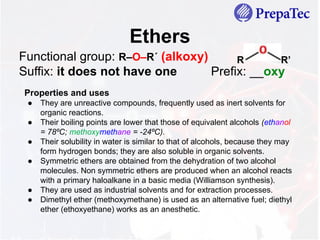
Functional group: R–O–R´(alkoxy)
Suffix: it does not have one Prefix: __oxy
Properties and uses
● They are unreactive compounds, frequently used as inert solvents for
organic reactions.
● Their boiling points are lower that those of equivalent alcohols (ethanol
= 78ºC; methoxymethane = -24ºC).
● Their solubility in water is similar to that of alcohols, because they may
form hydrogen bonds; they are also soluble in organic solvents.
● Symmetric ethers are obtained from the dehydration of two alcohol
molecules. Non symmetric ethers are produced when an alcohol reacts
with a primary haloalkane in a basic media (Williamson synthesis).
● They are used as industrial solvents and for extraction processes.
● Dimethyl ether (methoxymethane) is used as an alternative fuel; diethyl
ether (ethoxyethane) works as an anesthetic.
Ethers
R R’
37.
Common name (stillin use; it only works for simple ethers)
1. Identify the two alkyl groups attached to the oxygen atom, write
them as two separated words in alphabetical order and write the
word “ether” at the end (also as a separated word).
2. If the two alkyl groups are the same, use “di”.
How to name ethers?
38.
How to nameethers?
diethyl ether
ethyl propyl ether
sec-butyl ethyl ether
Common name (still in use; it only works for simple ethers)
1. Identify the two alkyl groups attached to the oxygen atom, write
them as two separated words in alphabetical order and write the
word “ether” at the end (also as a separated word).
2. If the two alkyl groups are the same, use “di”.
39.
IUPAC name
1. Choosethe longest carbon chain as the parent chain
(hydrocarbon) and the alkoxy group (shortest carbon chain
+ oxygen) as a substituent (it is above the unsaturated bonds
in the priority table, but below any other functional group).
2. Write the name following the already studied structure
(prefix-name-last name-suffix), including alkoxy groups in
the prefix.
How to name ethers?
40.
IUPAC name
1. Choosethe longest carbon chain as the parent chain
(hydrocarbon) and the alkoxy group (shortest carbon chain
+ oxygen) as a substituent (it is above the unsaturated bonds
in the priority table, but below any other functional group).
2. Write the name following the already studied structure
(prefix-name-last name-suffix), including alkoxy groups in
the prefix.
How to name ethers?
1-ethoxypropane
ethoxyethane
2-ethoxybutane
41.
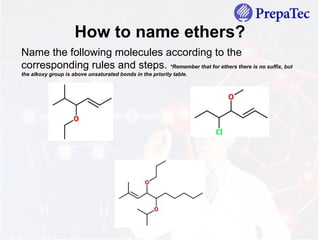
Name the followingmolecules according to the
corresponding rules and steps. *Remember that for ethers there is no suffix, but
the alkoxy group is above unsaturated bonds in the priority table.
How to name ethers?
42.
4–ethoxy–5–methylhex–2–ene 5–chloro–4–methoxyhept–2–ene
Name thefollowing molecules according to the
corresponding rules and steps. *Remember that for ethers there is no suffix, but
the alkoxy group is above unsaturated bonds in the priority table.
How to name ethers?
5–isopropoxy–2–methyl-4-propoxydec–2–ene
43.
Functional group: R–N–(amino)
Suffix: amine Prefix: amino
Amines
I
Properties and uses
● They derive from ammonia (NH3
) when at least one of the hydrogens is
replaced by an alkyl or aryl group.
● Short chain amines are gases and soluble in water.
● Most of them have unpleasant odors (similar to ammonia).
● Depending of the number of alkyl groups attached to nitrogen, they may be
primary, secondary or tertiary.
● Primary and secondary amines can form hydrogen bonds, but as
electronegarivity of N is lower that the one of O, those hydrogen bonds are
weaker, so they have lower boiling points that the corresponding alcohols
(ethanol = 78ºC; ethanamine = 16.6ºC)
● Aromatic amines are very toxic and they are easily absorbed by skin.
● They are strong bases and their aqueous solutions may be very irritant.
● They are important part of living beings (amino acids) and they are used in
different industries (pharmaceutical, dyes, textile and plastics, among
others).
44.
Similar to carbons,amines are classified in primary,
secondary and tertiary according to the number of alkyl
groups attached to the nitrogen atom.
primary amine secondary amine tertiary amine
Classification of amines
45.
As alkylamines (usedfor simple amines)
● For primary amines, name the alkyl group followed by the word
amine.
● For secondary and tertiary amines, name the alkyl groups attached
to nitrogen in alphabetical order, followed by the word amine. To
avoid ambiguity, if the alkyl groups are different (asymmetric
amines), use parenthesis for each one.
How to name amines?
46.
propylamine dipropylamine
ethyl(methyl)(propyl)amine
As alkylamines(used for simple amines)
● For primary amines, name the alkyl group followed by the word
amine.
● For secondary and tertiary amines, name the alkyl groups attached
to nitrogen in alphabetical order, followed by the word amine. To
avoid ambiguity, if the alkyl groups are different (asymmetric
amines), use parenthesis for each one.
How to name amines?
47.
Preferred IUPAC name
●Primary amines are named similar to alcohols, using the suffix
amine.
● In secondary and tertiary amines, choose the longest chain as the
parent chain and name the others as N-substituents in
alphabetical order (N indicates that they are located in the nitrogen
atom). If they are symmetric, any of the alkyl groups may be the
parent chain.
How to name amines?
48.
How to nameamines?
propan-1-amine N-propylpropan-1-amine
N-ethyl-N-methylpropan-1-amine
Preferred IUPAC name
● Primary amines are named similar to alcohols, using the suffix
amine.
● In secondary and tertiary amines, choose the longest chain as
the parent chain and name the others as N-substituents in
alphabetical order (N indicates that they are located in the nitrogen
atom). If they are symmetric, any of the alkyl groups may be the
parent chain.
49.
Name the followingmolecules according to the
corresponding rules and steps.
How to name amines?
Properties and uses
●They are derived from carboxylic acids, when the -OH group is replaced
by an amino group.
● The amide group is very polar, so most of the primary amides are solid
and very soluble in water.
● Their boiling points are much higher that the ones of carboxylic acids
(propanoic acid = 141.2ºC; propanamide = 213ºC).
● Secondary and tertiary amides have lower melting and boiling points
(secondary because of steric hindrance and tertiary because they do
not have hydrogens to form hydrogen bonds).
● They are very important in Nature, being essential part of proteins.
● Some popular examples are urea (diamide) and saccharin (artificial
sweetener).
● They are widely used in the pharmaceutical industry (tranquilizers,
sleep-inducing drugs, antibiotics and anesthetics) and in polymers as
nylon (polyamide).
Functional group: R–CO-N– (amide, terminal)
Suffix: amide Prefix: carbamoyl
Amides
I
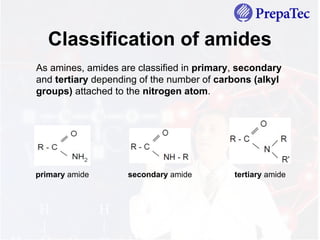
52.
As amines, amidesare classified in primary, secondary
and tertiary depending of the number of carbons (alkyl
groups) attached to the nitrogen atom.
Classification of amides
primary amide secondary amide tertiary amide
53.
Primary amides
● Primaryamides are named as derivatives of carboxylic acids,
replacing the oic acid suffix by amide.
Secondary and tertiary amides
● In this case, the chain coming from the acid will be the parent
chain and the other alkyl groups are named as N-substituents
in alphabetical order (as in secondary and tertiary amines).
How to name amides?
54.
Primary amides
● Primaryamides are named as derivatives of carboxylic acids,
replacing the oic acid suffix by amide.
Secondary and tertiary amides
● In this case, the chain coming from the acid will be the parent
chain and the other alkyl groups are named as N-substituents
in alphabetical order (as in secondary and tertiary amines).
How to name amides?
propanamide N-ethylpropanamide
N-butyl-N-ethylpropanamide
55.
How to nameamides?
Name the following molecules according to the
corresponding rules and steps.*Remember that this is a terminal group, so no
position is required
References
Cornejo, M.L. (2017).Los ácidos carboxílicos. Con-Ciencia 4(8).Recuperado de
https://www.uaeh.edu.mx/scige/boletin/prepa3/n8/m9.html
Cornejo, M.L. (2017). Cetonas y aldehídos. Con-Ciencia 4(8).Recuperado de
https://www.uaeh.edu.mx/scige/boletin/prepa3/n8/m8.html
Fernández, G. (s.f.). amines. Recuperado de https://www.quimicaorganica.org/amines.html
Interlab (s.f.). Los ácidos carboxílicos. Recuperado de
https://interlab.mx/pdf/interes/los-acidos-carboxilicos.pdf
Organization International del Trabajo (2012). Alcoholes, aldehídos y cetales. En Enciclopedia
de salud y seguridad en el trabajo. Recuperado de
https://www.insst.es/documents/94886/162038/2.+Alcoholes+-+Aldeh%C3%ADdos+y+ce
tales+-+Materiales+alcalinos
Organization International del Trabajo (2012). amides, amines alifáticas y amines aromáticas.
En Enciclopedia de salud y seguridad en el trabajo. Recuperado de
https://www.insst.es/documents/94886/162038/3.+amides+-+amines+alif%C3%A1ticas+-
+Formaci%C3%B3n+de+nitrosamines+-+amines+arom%C3%A1ticas
Portal Académico CCH (s.f.). Grupos funtionales. Recuperado de
https://portalacademico.cch.unam.mx/materiales/prof/matdidac/sitpro/exp/quim/quim2/qui
micaII/L_GruposF.pdf
Química.es (2021). Éster. Recuperado de
https://www.quimica.es/enciclopedia/%C3%89ster.html
Ramírez, E. (2011). amides. Recuperado de https://sites.google.com/site/quimica2ob/amides