Commodore International
 Commodore International Limited, or just simply Commodore was an
American home computer and electronics manufacturer founded by Jack
Tramiel. Commodore International (CI), along with its subsidiary
Commodore Business Machines (CBM), was a significant participant in the
development of the home personal computer industry in the 1970s and
1980s. The company developed and marketed the world's best-selling
desktop computer, the Commodore 64 (1982),and released
its Amiga computer line in July 1985. With quarterly sales ending 1983 of
$49 million (equivalent to $108 million in 2019), Commodore was one of the
world's largest personal computer manufacturers.
Made By: Commodore International
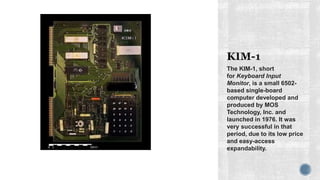
The KIM-1, short
for Keyboard Input
Monitor, is a small 6502-
based single-board
computer developed and
produced by MOS
Technology, Inc. and
launched in 1976. It was
very successful in that
period, due to its low price
and easy-access
expandability.
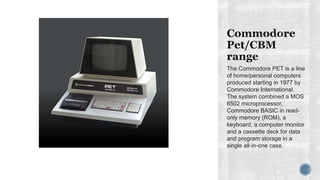
The Commodore PET is a line
of home/personal computers
produced starting in 1977 by
Commodore International.
The system combined a MOS
6502 microprocessor,
Commodore BASIC in read-
only memory (ROM), a
keyboard, a computer monitor
and a cassette deck for data
and program storage in a
single all-in-one case.
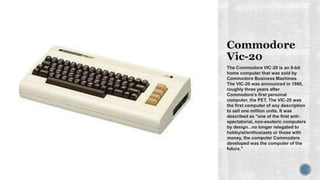
The Commodore VIC-20 is an 8-bit
home computer that was sold by
Commodore Business Machines.
The VIC-20 was announced in 1980,
roughly three years after
Commodore's first personal
computer, the PET. The VIC-20 was
the first computer of any description
to sell one million units. It was
described as "one of the first anti-
spectatorial, non-esoteric computers
by design...no longer relegated to
hobbyist/enthusiasts or those with
money, the computer Commodore
developed was the computer of the
future."
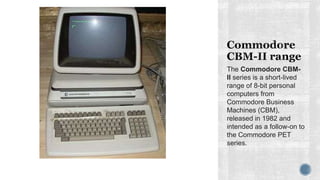
The Commodore CBM-
II series is a short-lived
range of 8-bit personal
computers from
Commodore Business
Machines (CBM),
released in 1982 and
intended as a follow-on to
the Commodore PET
series.
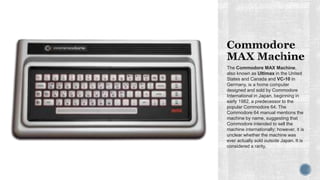
The Commodore MAX Machine,
also known as Ultimax in the United
States and Canada and VC-10 in
Germany, is a home computer
designed and sold by Commodore
International in Japan, beginning in
early 1982, a predecessor to the
popular Commodore 64. The
Commodore 64 manual mentions the
machine by name, suggesting that
Commodore intended to sell the
machine internationally; however, it is
unclear whether the machine was
ever actually sold outside Japan. It is
considered a rarity.
The Commodore 64, also known as the C64 or
the CBM 64, is an 8-bit home computer introduced
in January 1982 by Commodore International. It
has been listed in the Guinness World Records as
the highest-selling single computer model of all
time, with independent estimates placing the
number sold between 12.5 and 17 million units.
This claim is in spite of the Commodore 64 having
three different Kernal ROM versions, two different
SID sound chip versions, a few different
motherboard versions and two different cases
during its lifetime. Volume production started in
early 1982, marketing in August for US$595.
Preceded by the Commodore VIC-20 and
Commodore PET, the C64 took its name from
its 64 kilobytes (65,536 bytes) of RAM. With
support for multicolor sprites and a custom chip for
waveform generation, the C64 could create
superior visuals and audio compared to systems
without such custom hardware.
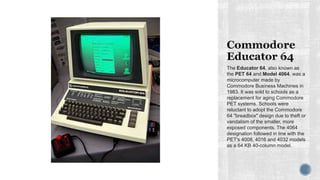
The Educator 64, also known as
the PET 64 and Model 4064, was a
microcomputer made by
Commodore Business Machines in
1983. It was sold to schools as a
replacement for aging Commodore
PET systems. Schools were
reluctant to adopt the Commodore
64 "breadbox" design due to theft or
vandalism of the smaller, more
exposed components. The 4064
designation followed in line with the
PET's 4008, 4016 and 4032 models
as a 64 KB 40-column model.
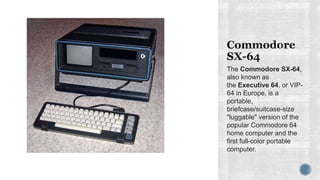
The Commodore SX-64,
also known as
the Executive 64, or VIP-
64 in Europe, is a
portable,
briefcase/suitcase-size
"luggable" version of the
popular Commodore 64
home computer and the
first full-color portable
computer.
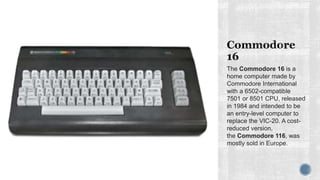
The Commodore 16 is a
home computer made by
Commodore International
with a 6502-compatible
7501 or 8501 CPU, released
in 1984 and intended to be
an entry-level computer to
replace the VIC-20. A cost-
reduced version,
the Commodore 116, was
mostly sold in Europe.
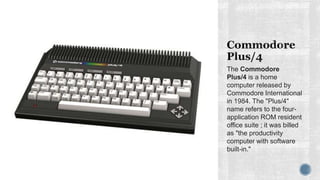
The Commodore
Plus/4 is a home
computer released by
Commodore International
in 1984. The "Plus/4"
name refers to the four-
application ROM resident
office suite ; it was billed
as "the productivity
computer with software
built-in."
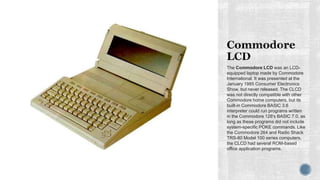
The Commodore LCD was an LCD-
equipped laptop made by Commodore
International. It was presented at the
January 1985 Consumer Electronics
Show, but never released. The CLCD
was not directly compatible with other
Commodore home computers, but its
built-in Commodore BASIC 3.6
interpreter could run programs written
in the Commodore 128's BASIC 7.0, as
long as these programs did not include
system-specific POKE commands. Like
the Commodore 264 and Radio Shack
TRS-80 Model 100 series computers,
the CLCD had several ROM-based
office application programs.
The Commodore 128, also
known as the C128, C-
128, C= 128, is the last 8-bit
home computer that was
commerciallay released by
Commodore Business
Machines (CBM). Introduced
in January 1985 at the CES
in Las Vegas, it appeared
three years after its
predecessor, the bestselling
Commodore 64.
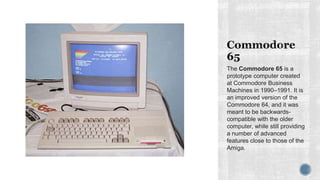
The Commodore 65 is a
prototype computer created
at Commodore Business
Machines in 1990–1991. It is
an improved version of the
Commodore 64, and it was
meant to be backwards-
compatible with the older
computer, while still providing
a number of advanced
features close to those of the
Amiga.
The Commodore 900 was a prototype
microcomputer originally intended for
business computing and, later, as an
affordable UNIX workstation. It was to
replace the aging PET/CBM family of
personal computers that had found
success in Europe as business
machines. The project was initiated in
1983 by Commodore systems engineers
Frank Hughes, Robert Russell, and
Shiraz Shivji. Manufacturing was to
commence in 1985 at Commodore
International's West Germany plant, but
only fifty prototypes were made and sold
as development systems before the
project was cancelled.
The Commodore
https://en.wikipedia.org/
wiki/Commodore_Intern
ational
The Commodore Amiga
(History)
https://en.wikipedia.org/
wiki/History_of_the_Ami
ga
See my Macintosh Presentation:
https://www.slideshare.net/DaveRiparip/macintosh-
timeline

Commodore timeline

  • 1.
  • 2.
     Commodore InternationalLimited, or just simply Commodore was an American home computer and electronics manufacturer founded by Jack Tramiel. Commodore International (CI), along with its subsidiary Commodore Business Machines (CBM), was a significant participant in the development of the home personal computer industry in the 1970s and 1980s. The company developed and marketed the world's best-selling desktop computer, the Commodore 64 (1982),and released its Amiga computer line in July 1985. With quarterly sales ending 1983 of $49 million (equivalent to $108 million in 2019), Commodore was one of the world's largest personal computer manufacturers.
  • 3.
    Made By: CommodoreInternational
  • 4.
    The KIM-1, short forKeyboard Input Monitor, is a small 6502- based single-board computer developed and produced by MOS Technology, Inc. and launched in 1976. It was very successful in that period, due to its low price and easy-access expandability.
  • 5.
    The Commodore PETis a line of home/personal computers produced starting in 1977 by Commodore International. The system combined a MOS 6502 microprocessor, Commodore BASIC in read- only memory (ROM), a keyboard, a computer monitor and a cassette deck for data and program storage in a single all-in-one case.
  • 6.
    The Commodore VIC-20is an 8-bit home computer that was sold by Commodore Business Machines. The VIC-20 was announced in 1980, roughly three years after Commodore's first personal computer, the PET. The VIC-20 was the first computer of any description to sell one million units. It was described as "one of the first anti- spectatorial, non-esoteric computers by design...no longer relegated to hobbyist/enthusiasts or those with money, the computer Commodore developed was the computer of the future."
  • 7.
    The Commodore CBM- IIseries is a short-lived range of 8-bit personal computers from Commodore Business Machines (CBM), released in 1982 and intended as a follow-on to the Commodore PET series.
  • 8.
    The Commodore MAXMachine, also known as Ultimax in the United States and Canada and VC-10 in Germany, is a home computer designed and sold by Commodore International in Japan, beginning in early 1982, a predecessor to the popular Commodore 64. The Commodore 64 manual mentions the machine by name, suggesting that Commodore intended to sell the machine internationally; however, it is unclear whether the machine was ever actually sold outside Japan. It is considered a rarity.
  • 9.
    The Commodore 64,also known as the C64 or the CBM 64, is an 8-bit home computer introduced in January 1982 by Commodore International. It has been listed in the Guinness World Records as the highest-selling single computer model of all time, with independent estimates placing the number sold between 12.5 and 17 million units. This claim is in spite of the Commodore 64 having three different Kernal ROM versions, two different SID sound chip versions, a few different motherboard versions and two different cases during its lifetime. Volume production started in early 1982, marketing in August for US$595. Preceded by the Commodore VIC-20 and Commodore PET, the C64 took its name from its 64 kilobytes (65,536 bytes) of RAM. With support for multicolor sprites and a custom chip for waveform generation, the C64 could create superior visuals and audio compared to systems without such custom hardware.
  • 10.
    The Educator 64,also known as the PET 64 and Model 4064, was a microcomputer made by Commodore Business Machines in 1983. It was sold to schools as a replacement for aging Commodore PET systems. Schools were reluctant to adopt the Commodore 64 "breadbox" design due to theft or vandalism of the smaller, more exposed components. The 4064 designation followed in line with the PET's 4008, 4016 and 4032 models as a 64 KB 40-column model.
  • 11.
    The Commodore SX-64, alsoknown as the Executive 64, or VIP- 64 in Europe, is a portable, briefcase/suitcase-size "luggable" version of the popular Commodore 64 home computer and the first full-color portable computer.
  • 12.
    The Commodore 16is a home computer made by Commodore International with a 6502-compatible 7501 or 8501 CPU, released in 1984 and intended to be an entry-level computer to replace the VIC-20. A cost- reduced version, the Commodore 116, was mostly sold in Europe.
  • 13.
    The Commodore Plus/4 isa home computer released by Commodore International in 1984. The "Plus/4" name refers to the four- application ROM resident office suite ; it was billed as "the productivity computer with software built-in."
  • 14.
    The Commodore LCDwas an LCD- equipped laptop made by Commodore International. It was presented at the January 1985 Consumer Electronics Show, but never released. The CLCD was not directly compatible with other Commodore home computers, but its built-in Commodore BASIC 3.6 interpreter could run programs written in the Commodore 128's BASIC 7.0, as long as these programs did not include system-specific POKE commands. Like the Commodore 264 and Radio Shack TRS-80 Model 100 series computers, the CLCD had several ROM-based office application programs.
  • 15.
    The Commodore 128,also known as the C128, C- 128, C= 128, is the last 8-bit home computer that was commerciallay released by Commodore Business Machines (CBM). Introduced in January 1985 at the CES in Las Vegas, it appeared three years after its predecessor, the bestselling Commodore 64.
  • 16.
    The Commodore 65is a prototype computer created at Commodore Business Machines in 1990–1991. It is an improved version of the Commodore 64, and it was meant to be backwards- compatible with the older computer, while still providing a number of advanced features close to those of the Amiga.
  • 17.
    The Commodore 900was a prototype microcomputer originally intended for business computing and, later, as an affordable UNIX workstation. It was to replace the aging PET/CBM family of personal computers that had found success in Europe as business machines. The project was initiated in 1983 by Commodore systems engineers Frank Hughes, Robert Russell, and Shiraz Shivji. Manufacturing was to commence in 1985 at Commodore International's West Germany plant, but only fifty prototypes were made and sold as development systems before the project was cancelled.
  • 18.
    The Commodore https://en.wikipedia.org/ wiki/Commodore_Intern ational The CommodoreAmiga (History) https://en.wikipedia.org/ wiki/History_of_the_Ami ga
  • 19.
    See my MacintoshPresentation: https://www.slideshare.net/DaveRiparip/macintosh- timeline