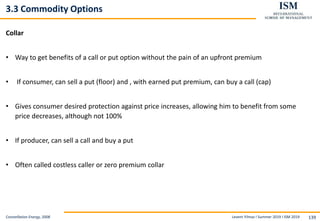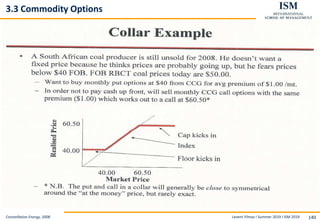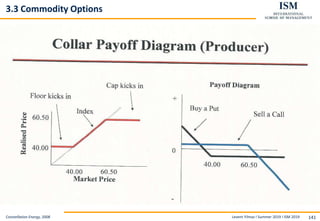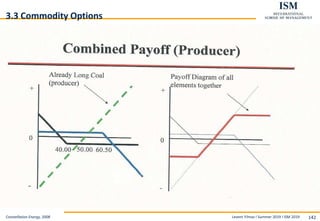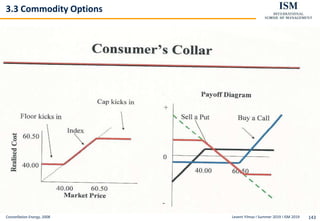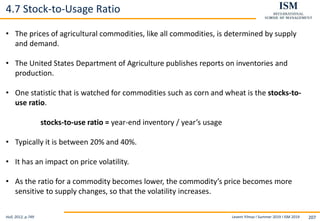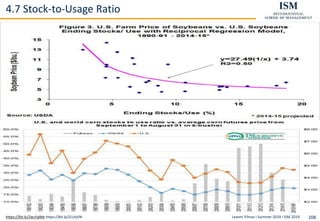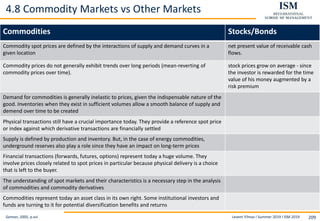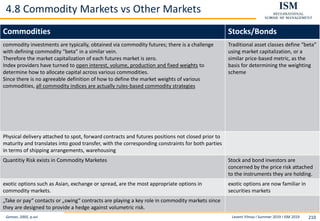
Levent Yilmaz I Summer 2019 I ISM 2019 1
ISM
M.Sc. Finance
Commodity Portfolio Management
Summer Term 2019
Levent Yilmaz
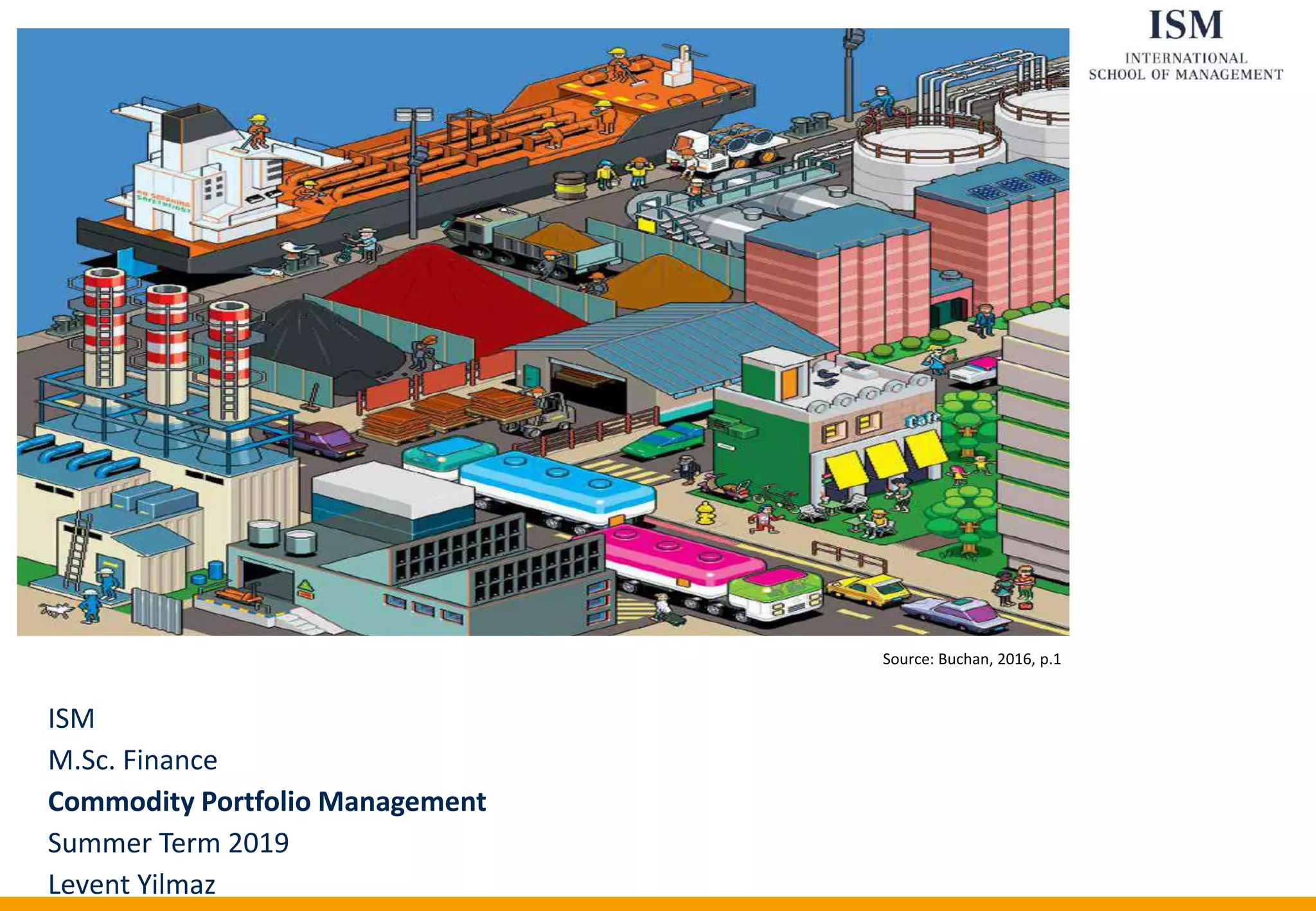
Source: Buchan, 2016, p.1
Levent Yilmaz I Summer 2019 I ISM 2019 2
Imprint
It is prohibited to use the script, even parts of it, without a prior approval by the university
outside the ISM or in courses undertaken by the ISM.
Responsible for the content of this script is the author or are the authors.
Scripts are not quotable in scientific work.
ISM International School of Management GmbH
Otto-Hahn-Str. 19 44227 Dortmund
www.ism.de
For feedback, or improvements please contact:
Levent Yilmaz
levent.yilmaz@ism.de
Levent Yilmaz I Summer 2019 I ISM 2019 3
Commodity Portfolio Management
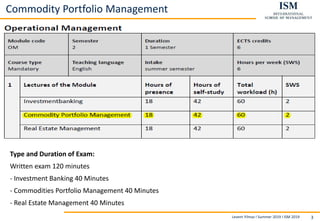
Type and Duration of Exam:
Written exam 120 minutes
- Investment Banking 40 Minutes
- Commodities Portfolio Management 40 Minutes
- Real Estate Management 40 Minutes
Levent Yilmaz I Summer 2019 I ISM 2019 4
CV – Levent Yilmaz
• 2017 – ISM, Lecturer, Commodity Portfolio Management, Rating
• 2017 - Tortorici & Partners, Geneva, Senior Director, Commodity Consultant,
• 2013 Innovative Energy GmbH, Frankfurt, Proprietary trader of oil, oil products, coal and gas
• 2011 N.M.F. AG, Frankfurt, Proprietary trader of oil/oil product futures and ETFs
• 2010 ČEZ, Prague, Proprietary trader of energy derivatives
• 2008 – 2009 Vattenfall Energy Trading, Copenhagen, Proprietary trader/analyst of energy
derivatives
• 2006 – 2008 Constellation Energy Commodities Group, London, Coal and Freight Market Analyst
• 2005 – 2006 Hadron Capital LLP, London Investment Analyst
• 2003 – 2005 Debtwire, London, Distressed Debt Analyst
• 2003 Moody’s, London, Banking Associate
• 2001 – 2002 S&P Capital IQ, London, European Banking Analyst
Levent Yilmaz I Summer 2019 I ISM 2019 5
Commodity Portfolio Management
Content Page
1 Commodity Basics 7
2 Rationale for Investing in Commodities 36
3 Commodity Investment Vehicles 42
4. Drivers of Commodity Markets 167
5 Commodity Portfolio Management 207
Levent Yilmaz I Summer 2019 I ISM 2019 6
1 Commmodity Basics
Page
1 Commodity Basics 7
1.1 Commodity Differentiation 9
1.2 Commodity Characteristics 15
1.3 Commodity Market Participants 18
1.4 Commitment of Traders Report 27
1.5 Open Interest 33
Levent Yilmaz I Summer 2019 I ISM 2019 7
11 Commodity BasicsBasics
Commodity Characteristics
• Raw material or a primary agricultural resource, that can be purchased or
sold for production and/or consumption.
• These tangible assets have no credit risks and many of them are most of
time liquid.
• Commodities are traded on open markets throughout the world.
• Nearly no commodity price can go to zero, because commodities are
always likely to be worth something to somebody. Only Power Prices have
traded below 0.
Levent Yilmaz I Summer 2019 I ISM 2019 8
11 Commodity BasicsBasics
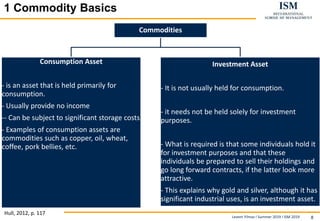
Hull, 2012, p. 117
Commodities
Consumption Asset
- is an asset that is held primarily for
consumption.
- Usually provide no income
-- Can be subject to significant storage costs
- Examples of consumption assets are
commodities such as copper, oil, wheat,
coffee, pork bellies, etc.
Investment Asset
- It is not usually held for consumption.
- it needs not be held solely for investment
purposes.
- What is required is that some individuals hold it
for investment purposes and that these
individuals be prepared to sell their holdings and
go long forward contracts, if the latter look more
attractive.
- This explains why gold and silver, although it has
significant industrial uses, is an investment asset.
Levent Yilmaz I Summer 2019 I ISM 2019 9
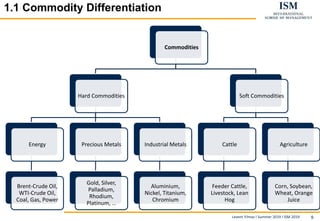
Commodities
Hard Commodities
Energy
Brent-Crude Oil,
WTI-Crude Oil,
Coal, Gas, Power
Precious Metals
Gold, Silver,
Palladium,
Rhodium,
Platinum, …
Industrial Metals
Aluminium,
Nickel, Titanium,
Chromium
Soft Commodities
Cattle
Feeder Cattle,
Livestock, Lean
Hog
Agriculture
Corn, Soybean,
Wheat, Orange
Juice
11.1 Commodity DifferentiationBasics
Levent Yilmaz I Summer 2019 I ISM 2019 10
11.1 Commodity DifferentiationBasics
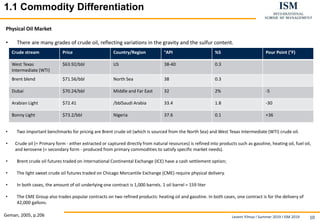
Physical Oil Market
• There are many grades of crude oil, reflecting variations in the gravity and the sulfur content.
• Two important benchmarks for pricing are Brent crude oil (which is sourced from the North Sea) and West Texas Intermediate (WTI) crude oil.
• Crude oil (= Primary form - either extracted or captured directly from natural resources) is refined into products such as gasoline, heating oil, fuel oil,
and kerosene (= secondary form - produced from primary commodities to satisfy specific market needs).
• Brent crude oil futures traded on International Continental Exchange (ICE) have a cash settlement option;
• The light sweet crude oil futures traded on Chicago Mercantile Exchange (CME) require physical delivery.
• In both cases, the amount of oil underlying one contract is 1,000 barrels. 1 oil barrel = 159 liter
• The CME Group also trades popular contracts on two refined products: heating oil and gasoline. In both cases, one contract is for the delivery of
42,000 gallons.
Geman, 2005, p.206
Crude stream Price Country/Region °API %S Pour Point (°F)
West Texas
Intermediate (WTI)
$63.92/bbl US 38-40 0.3
Brent blend $71.56/bbl North Sea 38 0.3
Dubai $70.24/bbl Middle and Far East 32 2% -5
Arabian Light $72.41 /bblSaudi Arabia 33.4 1.8 -30
Bonny Light $73.2/bbl Nigeria 37.6 0.1 +36
Levent Yilmaz I Summer 2019 I ISM 2019 11
1.1 Commodity Differentiation
Geman, 2008, p.1
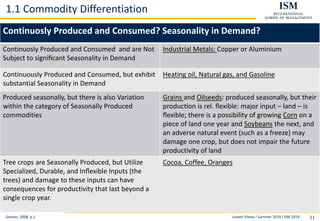
Continuosly Produced and Consumed? Seasonality in Demand?
Continuosly Produced and Consumed and are Not
Subject to significant Seasonality in Demand
Industrial Metals: Copper or Aluminium
Continuously Produced and Consumed, but exhibit
substantial Seasonality in Demand
Heating oil, Natural gas, and Gasoline
Produced seasonally, but there is also Variation
within the category of Seasonally Produced
commodities
Grains and Oilseeds: produced seasonally, but their
production is rel. flexible: major input – land – is
flexible; there is a possibility of growing Corn on a
piece of land one year and Soybeans the next, and
an adverse natural event (such as a freeze) may
damage one crop, but does not impair the future
productivity of land
Tree crops are Seasonally Produced, but Utilize
Specialized, Durable, and Inflexible Inputs (the
trees) and damage to these inputs can have
consequences for productivity that last beyond a
single crop year.
Cocoa, Coffee, Oranges
Levent Yilmaz I Summer 2019 I ISM 2019 12
1.1 Commodity Differentiation
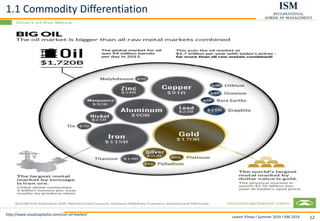
http://www.visualcapitalist.com/size-oil-market/
Levent Yilmaz I Summer 2019 I ISM 2019 13
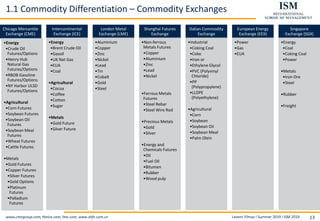
1.1 Commodity Differentiation – Commodity Exchanges
www.cmegroup.com, theice.com, lme.com, www.shfe.com.cn
Chicago Mercantile
Exchange (CME)
•Energy
•Crude Oil
Futures/Options
•Henry Hub
Natural Gas
Futures/Options
•RBOB Gasoline
Futures/Options
•NY Harbor ULSD
Futures/Options
•Agricultural
•Corn Futures
•Soybean Futures
•Soybean Oil
Futures
•Soybean Meal
Futures
•Wheat Futures
•Cattle Futures
•Metals
•Gold Futures
•Copper Futures
•Silver Futures
•Gold Options
•Platinum
Futures
•Palladium
Futures
Intercontinental
Exchange (ICE)
•Energy
•Brent Crude Oil
•Gasoil
•UK Nat Gas
•EUA
•Coal
•Agricultural
•Cocoa
•Coffee
•Cotton
•Sugar
•Metals
•Gold Future
•Silver Future
London Metal
Exchange (LME)
•Aluminium
•Copper
•Zinc
•Nickel
•Lead
•Tin
•Cobalt
•Gold
•Steel
Shanghai Futures
Exchange
•Non-ferrous
Metals Futures
•Copper
•Aluminium
•Zinc
•Lead
•Nickel
•Ferrous Metals
Futures
•Steel Rebar
•Steel Wire Rod
•Precious Metals
•Gold
•Silver
•Energy and
Chemicals Futures
•Oil
•Fuel Oil
•Bitumen
•Rubber
•Wood pulp
Dalian Commodity
Exchange
•Industrial
•Coking Coal
•Coke
•Iron or
•Ethylene Glycol
•PVC (Polyvinyl
Chloride)
•PP
(Polypropylene)
•LLDPE
(Polyethylene)
•Agricultural
•Corn
•Soybean
•Soybean Oil
•Soybean Meal
•Palm Olein
European Energy
Exchange (EEX)
•Power
•Gas
•EUA
Singapore
Exchange (SGX)
•Energy
•Coal
•Coking Coal
•Power
•Metals
•Iron Ore
•Steel
•Rubber
•Freight
Levent Yilmaz I Summer 2019 I ISM 2019 14
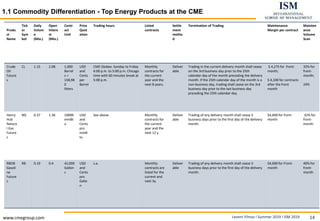
1.1 Commodity Differentiation - Top Energy Products at the CME
Produ
ct
Name
Tick
er
Sym
bol
Daily
Volum
e
(Mio.)
Open
Intere
st
(Mio.)
Contr
act
Unit
Price
Quot
ation
Trading hours Listed
contracts
Settle
ment
metho
d
Termination of Trading Maintenance
Margin per contract
Mainten
ance
Volume
Scan
Crude
Oil
Future
s
CL 1.15 2.08 1,000
Barrel
s =
158,98
0
litters
USD
and
Cents
per
Barrel
CME Globex: Sunday to Friday
6:00 p.m. to 5:00 p.m. Chicago
time with 60 minutes break at
5:00 p.m.
Monthly
contracts for
the current
year and the
next 8 years.
Deliver
able
Trading in the current delivery month shall cease
on the 3rd business day prior to the 25th
calendar day of the month preceding the delivery
month. If the 25th calendar day of the month is a
non-business day, trading shall cease on the 3rd
business day prior to the last business day
preceding the 25th calendar day.
$ 4,275 for front-
month;
$ 4,100 for contracts
after the front
month
32% for
front-
month;
24%
Henry
Hub
Natura
l Gas
Future
s
NG 0.37 1.36 10000
mmBt
u
USD
and
Cents
pro
mmB
tu
See above Monthly
contracts for
the current
year and the
next 12 y.
Deliver
able
Trading of any delivery month shall cease 3
business days prior to the first day of the delivery
month.
$4,600 for front-
month
32% for
front-
month
RBOB
Gasoli
ne
Future
s
RB 0.19 0.4 42,000
Gallon
s
USD
and
Cents
pro
Gallo
n
s.a. Monthly
contracts are
listed for the
current and
next 3y.
Deliver
able
Trading of any delivery month shall cease 3
business days prior to the first day of the delivery
month.
$4,600 for Front-
month
40% for
front-
month
www.cmegroup.com
Levent Yilmaz I Summer 2019 I ISM 2019 15
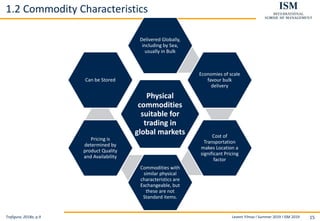
1.2 Commodity Characteristics
Trafigura, 2018a, p.9
Physical
commodities
suitable for
trading in
global markets
Delivered Globally,
including by Sea,
usually in Bulk
Economies of scale
favour bulk
delivery
Cost of
Transportation
makes Location a
significant Pricing
factor
Commodities with
similar physical
characteristics are
Exchangeable, but
these are not
Standard items.
Pricing is
determined by
product Quality
and Availability
Can be Stored
Levent Yilmaz I Summer 2019 I ISM 2019 16
11.2.1 Commodity VolatilityBasics
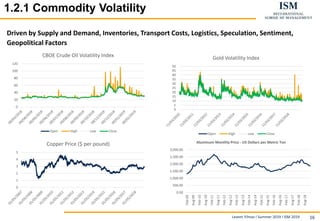
Driven by Supply and Demand, Inventories, Transport Costs, Logistics, Speculation, Sentiment,
Geopolitical Factors
0
20
40
60
80
100
120
CBOE Crude Oil Volatility Index
Open High Low Close
0
5
10
15
20
25
30
35
40
45
50
Gold Volatility Index
Open High Low Close
0
1
2
3
4
5
Copper Price ($ per pound)
0.00
500.00
1,000.00
1,500.00
2,000.00
2,500.00
3,000.00
Feb-09
Aug-09
Feb-10
Aug-10
Feb-11
Aug-11
Feb-12
Aug-12
Feb-13
Aug-13
Feb-14
Aug-14
Feb-15
Aug-15
Feb-16
Aug-16
Feb-17
Aug-17
Feb-18
Aug-18
Aluminum Monthly Price - US Dollars per Metric Ton
Levent Yilmaz I Summer 2019 I ISM 2019 17
11.2.1 Commodity VolatilityBasics
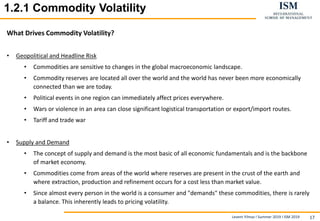
What Drives Commodity Volatility?
• Geopolitical and Headline Risk
• Commodities are sensitive to changes in the global macroeconomic landscape.
• Commodity reserves are located all over the world and the world has never been more economically
connected than we are today.
• Political events in one region can immediately affect prices everywhere.
• Wars or violence in an area can close significant logistical transportation or export/import routes.
• Tariff and trade war
• Supply and Demand
• The concept of supply and demand is the most basic of all economic fundamentals and is the backbone
of market economy.
• Commodities come from areas of the world where reserves are present in the crust of the earth and
where extraction, production and refinement occurs for a cost less than market value.
• Since almost every person in the world is a consumer and "demands" these commodities, there is rarely
a balance. This inherently leads to pricing volatility.
Levent Yilmaz I Summer 2019 I ISM 2019 18
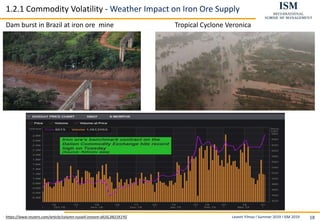
1.2.1 Commodity Volatility - Weather Impact on Iron Ore Supply
https://www.reuters.com/article/column-russell-ironore-idUSL3N21K1YG
Dam burst in Brazil at iron ore mine Tropical Cyclone Veronica
Levent Yilmaz I Summer 2019 I ISM 2019 19
1.2.1 Commodity Volatility
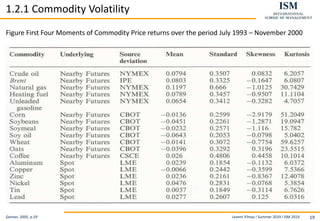
Figure First Four Moments of Commodity Price returns over the period July 1993 – November 2000
Geman, 2005, p.59
Levent Yilmaz I Summer 2019 I ISM 2019 20
1.2.1 Commodity Volatility
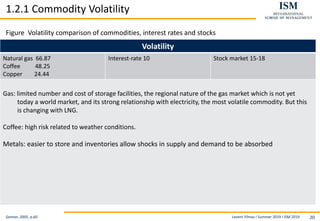
Figure Volatility comparison of commodities, interest rates and stocks
Geman, 2005, p.60
Volatility
Natural gas 66.87
Coffee 48.25
Copper 24.44
Interest-rate 10 Stock market 15-18
Gas: limited number and cost of storage facilities, the regional nature of the gas market which is not yet
today a world market, and its strong relationship with electricity, the most volatile commodity. But this
is changing with LNG.
Coffee: high risk related to weather conditions.
Metals: easier to store and inventories allow shocks in supply and demand to be absorbed
Levent Yilmaz I Summer 2019 I ISM 2019 21
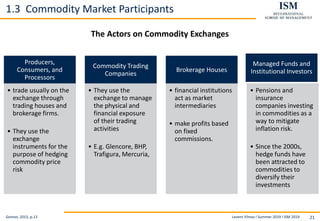
1.3 Commodity Market Participants
The Actors on Commodity Exchanges
Geman, 2015, p.13
Producers,
Consumers, and
Processors
• trade usually on the
exchange through
trading houses and
brokerage firms.
• They use the
exchange
instruments for the
purpose of hedging
commodity price
risk
Commodity Trading
Companies
• They use the
exchange to manage
the physical and
financial exposure
of their trading
activities
• E.g. Glencore, BHP,
Trafigura, Mercuria,
Brokerage Houses
• financial institutions
act as market
intermediaries
• make profits based
on fixed
commissions.
Managed Funds and
Institutional Investors
• Pensions and
insurance
companies investing
in commodities as a
way to mitigate
inflation risk.
• Since the 2000s,
hedge funds have
been attracted to
commodities to
diversify their
investments
Levent Yilmaz I Summer 2019 I ISM 2019 22
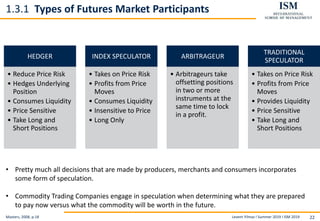
1.3.1 Types of Futures Market Participants
Masters, 2008, p.18
HEDGER
• Reduce Price Risk
• Hedges Underlying
Position
• Consumes Liquidity
• Price Sensitive
• Take Long and
Short Positions
INDEX SPECULATOR
• Takes on Price Risk
• Profits from Price
Moves
• Consumes Liquidity
• Insensitive to Price
• Long Only
ARBITRAGEUR
• Arbitrageurs take
offsetting positions
in two or more
instruments at the
same time to lock
in a profit.
TRADITIONAL
SPECULATOR
• Takes on Price Risk
• Profits from Price
Moves
• Provides Liquidity
• Price Sensitive
• Take Long and
Short Positions
• Pretty much all decisions that are made by producers, merchants and consumers incorporates
some form of speculation.
• Commodity Trading Companies engage in speculation when determining what they are prepared
to pay now versus what the commodity will be worth in the future.
Levent Yilmaz I Summer 2019 I ISM 2019 23
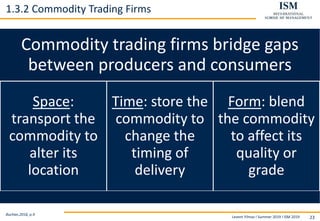
1.3.2 Commodity Trading Firms
Buchan,2016, p.9
Commodity trading firms bridge gaps
between producers and consumers
Space:
transport the
commodity to
alter its
location
Time: store the
commodity to
change the
timing of
delivery
Form: blend
the commodity
to affect its
quality or
grade
Levent Yilmaz I Summer 2019 I ISM 2019 24
1.3.2 Commodity Trading Firms
https://www.commoditiesdemystified.info/pdf/CommoditiesDemystified-summary-en.pdf#downloads
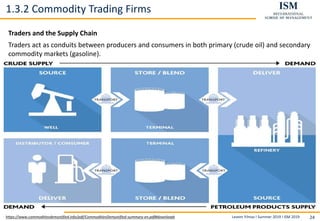
Traders and the Supply Chain
Traders act as conduits between producers and consumers in both primary (crude oil) and secondary
commodity markets (gasoline).
Levent Yilmaz I Summer 2019 I ISM 2019 25
1.3.2 Commodity Trading Firms
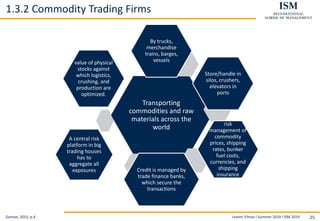
Geman, 2015, p.4
Transporting
commodities and raw
materials across the
world
By trucks,
merchandise
trains, barges,
vessels
Store/handle in
silos, crushers,
elevators in
ports
risk
management of
commodity
prices, shipping
rates, bunker
fuel costs,
currencies, and
shipping
insurance
Credit is managed by
trade finance banks,
which secure the
transactions
A central risk
platform in big
trading houses
has to
aggregate all
exposures
value of physical
stocks against
which logistics,
crushing, and
production are
optimized.
Levent Yilmaz I Summer 2019 I ISM 2019 26
1.3.2 Commodity Trading Firms
How does Physical Arbitrage work?
• Global commodity traders seek to identify and respond to supply and demand differentials
between linked markets.
• They use Arbitrage to trade physical commodities without incurring price risk.
– Arbitrage: The simultaneous purchase of a commodity/derivative in one market and the
sale of the same, or similar, commodity/derivative in another market in order to exploit
price differentials.
• They hedge price exposure using exchange-traded contracts and over-the-counter
instruments.
https://www.trafigura.com/how-physical-arbitrage-works/
Levent Yilmaz I Summer 2019 I ISM 2019 27
1.3.2 Commodity Trading Firms
https://www.trafigura.com/how-physical-arbitrage-works/
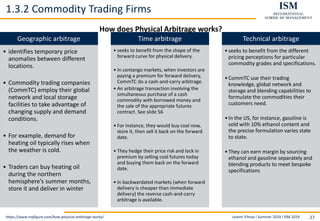
Geographic arbitrage
• identifies temporary price
anomalies between different
locations.
• Commodity trading companies
(CommTC) employ their global
network and local storage
facilities to take advantage of
changing supply and demand
conditions.
• For example, demand for
heating oil typically rises when
the weather is cold.
• Traders can buy heating oil
during the northern
hemisphere’s summer months,
store it and deliver in winter
Time arbitrage
• seeks to benefit from the shape of the
forward curve for physical delivery.
• In contango markets, when investors are
paying a premium for forward delivery,
CommTC do a cash-and-carry arbitrage.
• An arbitrage transaction involving the
simultaneous purchase of a cash
commodity with borrowed money and
the sale of the appropriate futures
contract. See slide 56
• For instance, they would buy coal now,
store it, then sell it back on the forward
date.
• They hedge their price risk and lock in
premium by selling coal futures today
and buying them back on the forward
date.
• In backwardated markets (when forward
delivery is cheaper than immediate
delivery) the reverse cash-and-carry
arbitrage is available.
Technical arbitrage
•seeks to benefit from the different
pricing perceptions for particular
commodity grades and specifications.
•CommTC use their trading
knowledge, global network and
storage and blending capabilities to
formulate the commodities their
customers need.
•In the US, for instance, gasoline is
sold with 10% ethanol content and
the precise formulation varies state
to state.
•They can earn margin by sourcing
ethanol and gasoline separately and
blending products to meet bespoke
specifications
How does Physical Arbitrage works?
Levent Yilmaz I Summer 2019 I ISM 2019 28
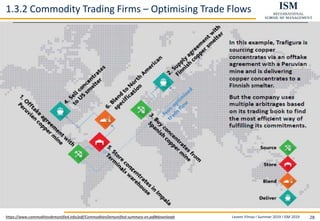
1.3.2 Commodity Trading Firms – Optimising Trade Flows
https://www.commoditiesdemystified.info/pdf/CommoditiesDemystified-summary-en.pdf#downloads
Levent Yilmaz I Summer 2019 I ISM 2019 29
1.4 Commitment of Traders Report
What does speculative participation look like as a fraction of open interest?
• The Commodity Futures Trading Commission (CFTC) publishes a weekly commodity futures/option
report which breaks down the total open interest as of each Tuesday’s settlement.
• The reports are released every Friday and provide market participants insight on how open interest
is distributed among different groups of traders
– (Producer/Merchant/Processor/User, Swap Dealers, Managed Money, and Other Reportable). 
see example in Remark file
Open Interest
• number of long and short positions in a specific contract which have not been liquidated or offset by
an opposing purchase or sale by the same participant.
• Non-commercials are momentum, or positive feedback traders
• commercials are on average contrarians (net short).
https://bit.ly/2UuQvx3 , Gorton, 2015, p.14
Levent Yilmaz I Summer 2019 I ISM 2019 30
1.4 Commitment of Traders Report
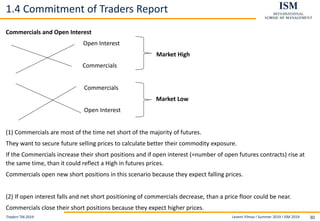
Commercials and Open Interest
Open Interest
Market High
Commercials
Commercials
Market Low
Open Interest
(1) Commercials are most of the time net short of the majority of futures.
They want to secure future selling prices to calculate better their commodity exposure.
If the Commercials increase their short positions and if open interest (=number of open futures contracts) rise at
the same time, than it could reflect a High in futures prices.
Commercials open new short positions in this scenario because they expect falling prices.
(2) If open interest falls and net short positioning of commercials decrease, than a price floor could be near.
Commercials close their short positions because they expect higher prices.
Traders‘’04.2019
Levent Yilmaz I Summer 2019 I ISM 2019 31
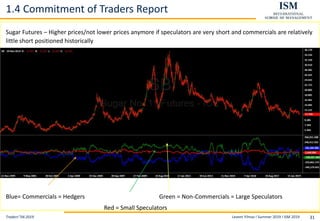
1.4 Commitment of Traders Report
Sugar Futures – Higher prices/not lower prices anymore if speculators are very short and commercials are relatively
little short positioned historically
Blue= Commercials = Hedgers Green = Non-Commercials = Large Speculators
Red = Small Speculators
Traders‘’04.2019
Levent Yilmaz I Summer 2019 I ISM 2019 32
1.4 Commitment of Traders Report
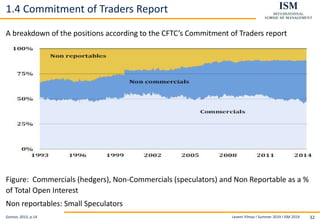
A breakdown of the positions according to the CFTC’s Commitment of Traders report
Figure: Commercials (hedgers), Non-Commercials (speculators) and Non Reportable as a %
of Total Open Interest
Non reportables: Small Speculators
Gorton, 2015, p.14
Levent Yilmaz I Summer 2019 I ISM 2019 33
1.4 Commitment of Traders Report
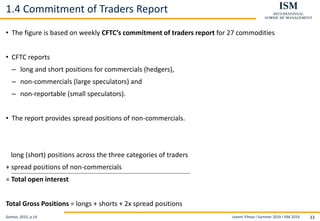
• The figure is based on weekly CFTC’s commitment of traders report for 27 commodities
• CFTC reports
– long and short positions for commercials (hedgers),
– non-commercials (large speculators) and
– non-reportable (small speculators).
• The report provides spread positions of non-commercials.
long (short) positions across the three categories of traders
+ spread positions of non-commercials
= Total open interest
Total Gross Positions = longs + shorts + 2x spread positions
Gorton, 2015, p.14
Levent Yilmaz I Summer 2019 I ISM 2019 34
1.4 Commitment of Traders Report
Drawback of the CFTC’s Commitment of Traders report
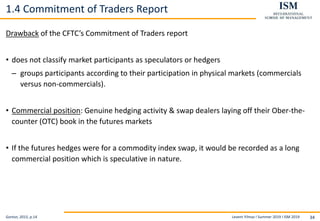
• does not classify market participants as speculators or hedgers
– groups participants according to their participation in physical markets (commercials
versus non-commercials).
• Commercial position: Genuine hedging activity & swap dealers laying off their Ober-the-
counter (OTC) book in the futures markets
• If the futures hedges were for a commodity index swap, it would be recorded as a long
commercial position which is speculative in nature.
Gorton, 2015, p.14
Levent Yilmaz I Summer 2019 I ISM 2019 35
1.5 Open Interest
Open Interest
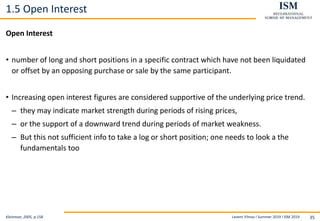
• number of long and short positions in a specific contract which have not been liquidated
or offset by an opposing purchase or sale by the same participant.
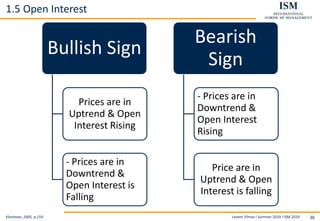
• Increasing open interest figures are considered supportive of the underlying price trend.
– they may indicate market strength during periods of rising prices,
– or the support of a downward trend during periods of market weakness.
– But this not sufficient info to take a log or short position; one needs to look a the
fundamentals too
Kleinman, 2005, p.158
Levent Yilmaz I Summer 2019 I ISM 2019 36
1.5 Open Interest
Kleinman, 2005, p.159
Bullish Sign
Prices are in
Uptrend & Open
Interest Rising
- Prices are in
Downtrend &
Open Interest is
Falling
Bearish
Sign
- Prices are in
Downtrend &
Open Interest
Rising
Price are in
Uptrend & Open
Interest is falling
Levent Yilmaz I Summer 2019 I ISM 2019 37
1.5 Open Interest
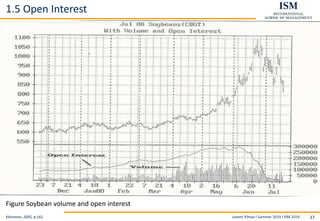
Figure Soybean volume and open interest
Kleinman, 2005, p.161
Levent Yilmaz I Summer 2019 I ISM 2019 38
2 Rationale for Investing in Commodities
2.1 Diversification Benefits of Commodities 38
2.2 Commodities as a possible Inflation Hedge 41
Levent Yilmaz I Summer 2019 I ISM 2019 39
2 Rationale for Investing in Commodities
• Diversification Benefits relative to traditional asset classes
– Potential low-to-uncorrelated return source to traditional asset classes
• Potential to hedge against unexpected inflation
– Physical assets have tended to move in line with broad inflation measures
• Potential incremental returns from each individual commodity’s market
structure
– Commodity supply and demand is correlated to the cyclicality of the
global economy
Doubeline, 2018, p.4
Levent Yilmaz I Summer 2019 I ISM 2019 40
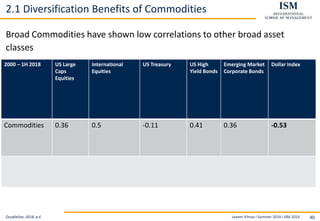
2.1 Diversification Benefits of Commodities
Broad Commodities have shown low correlations to other broad asset
classes
Doubleline, 2018, p.6
2000 – 1H 2018 US Large
Caps
Equities
International
Equities
US Treasury US High
Yield Bonds
Emerging Market
Corporate Bonds
Dollar Index
Commodities 0.36 0.5 -0.11 0.41 0.36 -0.53
Levent Yilmaz I Summer 2019 I ISM 2019 41
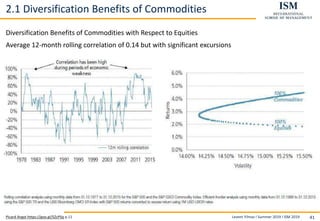
2.1 Diversification Benefits of Commodities
Diversification Benefits of Commodities with Respect to Equities
Average 12-month rolling correlation of 0.14 but with significant excursions
Picard Angst https://goo.gl/5ZcPSq p.11
Levent Yilmaz I Summer 2019 I ISM 2019 42
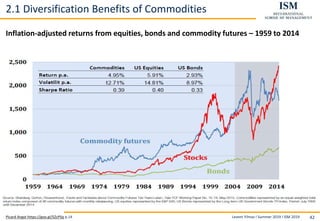
2.1 Diversification Benefits of Commodities
Inflation-adjusted returns from equities, bonds and commodity futures – 1959 to 2014
Picard Angst https://goo.gl/5ZcPSq p.14
Levent Yilmaz I Summer 2019 I ISM 2019 43
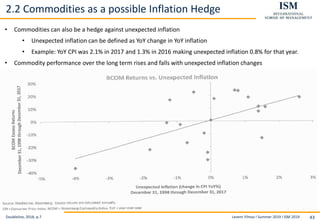
2.2 Commodities as a possible Inflation Hedge
Doubleline, 2018, p.7
• Commodities can also be a hedge against unexpected inflation
• Unexpected inflation can be defined as YoY change in YoY inflation
• Example: YoY CPI was 2.1% in 2017 and 1.3% in 2016 making unexpected inflation 0.8% for that year.
• Commodity performance over the long term rises and falls with unexpected inflation changes
Levent Yilmaz I Summer 2019 I ISM 2019 44
3 Commodity Investment Vehicles
3.1 Commodity Forwards 46
3.2 Commodity Futures 66
3.3 Commodity Options 96
3.4 Commodity Swaps 146
3.5 Commodity Index Investments 160
Levent Yilmaz I Summer 2019 I ISM 2019 45
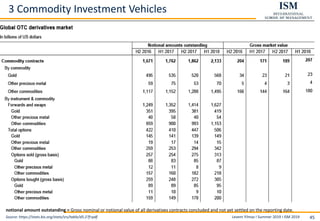
3 Commodity Investment Vehicles
Source: https://stats.bis.org/statx/srs/table/d5.2?f=pdf
notional amount outstanding = Gross nominal or notional value of all derivatives contracts concluded and not yet settled on the reporting date.
Levent Yilmaz I Summer 2019 I ISM 2019 46
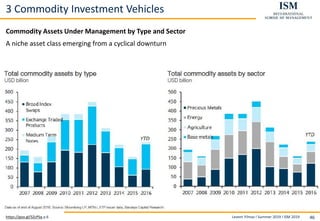
3 Commodity Investment Vehicles
Commodity Assets Under Management by Type and Sector
A niche asset class emerging from a cyclical downturn
https://goo.gl/5ZcPSq p.6
Levent Yilmaz I Summer 2019 I ISM 2019 47
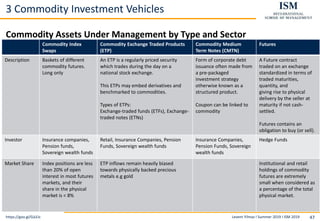
3 Commodity Investment Vehicles
Commodity Assets Under Management by Type and Sector
https://goo.gl/GJLEic
Commodity Index
Swaps
Commodity Exchange Traded Products
(ETP)
Commodity Medium
Term Notes (CMTN)
Futures
Description Baskets of different
commodity futures.
Long only
An ETP is a regularly priced security
which trades during the day on a
national stock exchange.
This ETPs may embed derivatives and
benchmarked to commodities.
Types of ETPs:
Exchange-traded funds (ETFs), Exchange-
traded notes (ETNs)
Form of corporate debt
issuance often made from
a pre-packaged
investment strategy
otherwise known as a
structured product.
Coupon can be linked to
commodity
A Future contract
traded on an exchange
standardized in terms of
traded maturities,
quantity, and
giving rise to physical
delivery by the seller at
maturity if not cash-
settled.
Futures contains an
obligation to buy (or sell).
Investor Insurance companies,
Pension funds,
Sovereign wealth funds
Retail, Insurance Companies, Pension
Funds, Sovereign wealth funds
Insurance Companies,
Pension Funds, Sovereign
wealth funds
Hedge Funds
Market Share Index positions are less
than 20% of open
interest in most futures
markets, and their
share in the physical
market is < 8%
ETP inflows remain heavily biased
towards physically backed precious
metals e.g gold
Institutional and retail
holdings of commodity
futures are extremely
small when considered as
a percentage of the total
physical market.
Levent Yilmaz I Summer 2019 I ISM 2019 48
3.1 Commodity Forwards
Forward contract:
• Agreement today to buy/sell commodity at a predetermined price at a predetermined
time in the future.
• It can be contrasted with a spot contract, which is an agreement to buy or sell an asset
today.
• A forward contract is traded in the over-the-counter market (OTC).
• One of the parties to a forward contract assumes a long position and agrees to buy the
underlying asset on a certain specified future date for a certain specified price.
• The other party assumes a short position and agrees to sell the asset on the same date for
the same price.
Levent Yilmaz I Summer 2019 I ISM 2019 49
3.1 Commodity Forwards
• Commodity Forwards provide information about the views of the market at future dates (the ‘price
discovery’ property of Futures prices), anticipated trends, and information about future supply and
demand.
• are also essential for marking to market books of existing positions in Futures as well as for risk
management activities such as Value at Risk calculations.
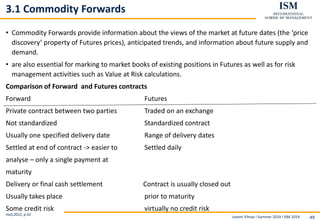
Comparison of Forward and Futures contracts
Forward Futures
Private contract between two parties Traded on an exchange
Not standardized Standardized contract
Usually one specified delivery date Range of delivery dates
Settled at end of contract -> easier to Settled daily
analyse – only a single payment at
maturity
Delivery or final cash settlement Contract is usually closed out
Usually takes place prior to maturity
Some credit risk virtually no credit risk
Hull,2012, p.41
Levent Yilmaz I Summer 2019 I ISM 2019 50
3.1 Commodity Forwards
• Over-the-counter (OTC) markets are markets where companies agree to derivatives transactions without
involving an exchange.
• Credit risk has traditionally been a feature of OTC derivatives markets.
• Consider two companies, A and B, that have entered into a number of derivatives transactions.
• If A defaults when the net value of the outstanding transactions to B is positive, a loss is likely to be taken by B.
• Similarly, if B defaults when the net value of outstanding transactions to A is positive, a loss is likely to be taken by
company A.
• In an attempt to reduce credit risk, the OTC market has borrowed some ideas from exchange-traded markets.
• Central Counterparties
• These are clearing houses for standard OTC transactions that perform much the same role as exchange clearing
houses.
• Members of the CCP, similarly to members of an exchange clearing house, have to provide both initial margin and
daily variation margin.
• Like members of an exchange clearing house, they are also required to contribute to a guaranty fund.
Hull, 2012, p.31
Levent Yilmaz I Summer 2019 I ISM 2019 51
3.1 Commodity Forwards
EXCURSION: Value at Risk
• Value at Risk (VaR) is an attempt to provide a single number summarizing the total risk in a portfolio of financial
assets.
VaR Measure
• When using the value-at-risk measure, an analyst is interested in making a statement of the following form:
– I am X percent certain there will not be a loss of more than V dollars in the next N days.
• The variable V is the VaR of the portfolio.
• It is a function of two parameters:
– the time horizon (N days) and
– the confidence level (X%).
• It is the loss level over N days that has a probability of only (100 – X)% of being exceeded.
• Bank regulators require banks to calculate VaR for market risk with N = 10 and X = 99
Hull, 2012, p. 471
Levent Yilmaz I Summer 2019 I ISM 2019 52
3.1 Commodity Forwards
Value at Risk
• When N days is the time horizon and X % is the confidence level, VaR is the loss
corresponding to the (100 – X)th percentile of the distribution of the gain in the
value of the portfolio over the next N days.
• When we look at the probability distribution of the gain, a loss is a negative gain
and VaR is concerned with the left tail of the distribution.
• When we look at the probability distribution of the loss, a gain is a negative loss
and VaR is concerned with the right tail of the distribution.
• For example, when N = 5 and X = 97, VaR is the third percentile of the distribution
of gain in the value of the portfolio over the next 5 days.
Hull, 2012, p. 471
Levent Yilmaz I Summer 2019 I ISM 2019 53
3.1 Commodity Forwards
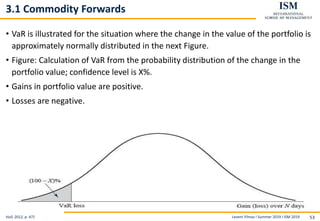
• VaR is illustrated for the situation where the change in the value of the portfolio is
approximately normally distributed in the next Figure.
• Figure: Calculation of VaR from the probability distribution of the change in the
portfolio value; confidence level is X%.
• Gains in portfolio value are positive.
• Losses are negative.
Hull, 2012, p. 471
Levent Yilmaz I Summer 2019 I ISM 2019 54
3.1 Commodity Forwards
Value at Risk
Example:
• You are a USD-based corporation and hold a EUR 140 million FX position.
What is your VaR over a 1-day horizon given that there is a 5% chance that
the realized loss will be greater than what VaR projected?
• What is your exposure?
• The first step in the calculation is to compute your exposure to market risk
(i.e., mark-to-market your position).
• As a USD based investor, your exposure is equal to the market value of the
position in your base currency.
• If the foreign exchange rate is 1.13 EUR/USD, the market value of the
position is USD 158.2 million (= 140 x 1.13).
Risk Metrics, 1996, p. 6
Levent Yilmaz I Summer 2019 I ISM 2019 55
3.1 Commodity Forwards
What is your risk?
• Moving from exposure to risk requires an estimate of how much the exchange rate can potentially move.
• The standard deviation of the return on the EUR/USD exchange rate, measured historically can provide an
indication of the size of rate movements.
• In this example, we calculated the EUR/USD daily standard deviation to be 0.42%.
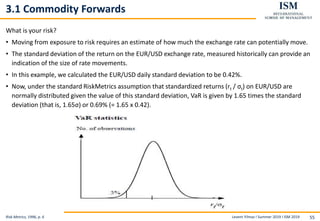
• Now, under the standard RiskMetrics assumption that standardized returns (rt / σt) on EUR/USD are
normally distributed given the value of this standard deviation, VaR is given by 1.65 times the standard
deviation (that is, 1.65σ) or 0.69% (= 1.65 x 0.42).
Risk Metrics, 1996, p. 6
Levent Yilmaz I Summer 2019 I ISM 2019 56
3.1 Commodity Forwards
• This means that the EUR/USD exchange rate is not expected to drop more than 0.69% per day, 95%
of the time.
• In USD, the VaR of the position is equal to the market value of the position times the estimated
volatility or:
– FX Risk: $158.2 million x 0.69% = $1.09m
– What this number means is that 95% of the time, you will not lose more than $1.09m over the
next 24 hours.
• From the standard normal tables we can read that 95 % confidence level is equal to – 1.645.
– Consequently (R* - µ) / σ equals -1.645.
• the R* stands for the cut off value,
• μ for mean return,
• (-1.645) defines alpha (α) corresponding to level of confidence (e.g. – 1.645 for a 95 % confidence
level)
Risk Metrics, 1996, p. 6
Levent Yilmaz I Summer 2019 I ISM 2019 57
3.1 Commodity Forwards
The Benefits of Forward Curves
• influence storage, production, and other strategic decisions of oil/mining companies.
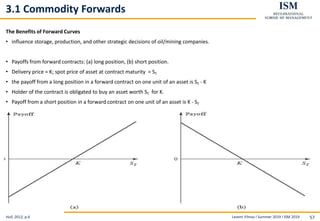
• Payoffs from forward contracts: (a) long position, (b) short position.
• Delivery price = K; spot price of asset at contract maturity = ST
• the payoff from a long position in a forward contract on one unit of an asset is ST - K
• Holder of the contract is obligated to buy an asset worth ST for K.
• Payoff from a short position in a forward contract on one unit of an asset is K - ST
Hull, 2012, p.6
Levent Yilmaz I Summer 2019 I ISM 2019 58
3.1 Commodity Forwards
What is a forward curve?
• A schedule of prices at which the market is willing to transact at today for delivery in
different time periods.
• A forward curve is not a prediction of future prices.
• It is today’s prices for future delivery.
www.cmegroup.com
Crude Oil Forwards/Futures; Term
Structure
Month Price
May 2019 59.25
June 2019 59.56
July 2019 59.86
August 2019 60.06
Sep. 2019 60.35
Oct. 2019 60.43
Levent Yilmaz I Summer 2019 I ISM 2019 59
3.1 Commodity Forwards
Doubleline 2017, p. 4
Term Structure of Commodity Prices
Contango
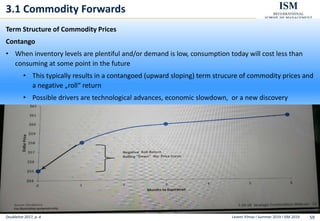
• When inventory levels are plentiful and/or demand is low, consumption today will cost less than
consuming at some point in the future
• This typically results in a contangoed (upward sloping) term strucure of commodity prices and
a negative „roll“ return
• Possible drivers are technological advances, economic slowdown, or a new discovery
Levent Yilmaz I Summer 2019 I ISM 2019 60
3.1 Commodity Forwards
Doubleline 2017, p. 4
Term Structure of Commodity Prices
Backwardation
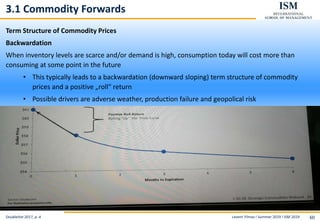
When inventory levels are scarce and/or demand is high, consumption today will cost more than
consuming at some point in the future
• This typically leads to a backwardation (downward sloping) term structure of commodity
prices and a positive „roll“ return
• Possible drivers are adverse weather, production failure and geopolical risk
Levent Yilmaz I Summer 2019 I ISM 2019 61
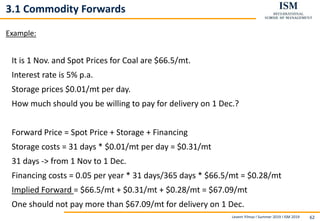
3.1 Commodity Forwards
• Forward prices are determined by the price of the commodity today plus
the costs of storage and financing.
• Forward Price = Spot Price + Storage + Financing
• Difference between Forward and Spot prices -> Cost of Carry
Levent Yilmaz I Summer 2019 I ISM 2019 62
3.1 Commodity Forwards
Example:
It is 1 Nov. and Spot Prices for Coal are $66.5/mt.
Interest rate is 5% p.a.
Storage prices $0.01/mt per day.
How much should you be willing to pay for delivery on 1 Dec.?
Forward Price = Spot Price + Storage + Financing
Storage costs = 31 days * $0.01/mt per day = $0.31/mt
31 days -> from 1 Nov to 1 Dec.
Financing costs = 0.05 per year * 31 days/365 days * $66.5/mt = $0.28/mt
Implied Forward = $66.5/mt + $0.31/mt + $0.28/mt = $67.09/mt
One should not pay more than $67.09/mt for delivery on 1 Dec.
Levent Yilmaz I Summer 2019 I ISM 2019 63
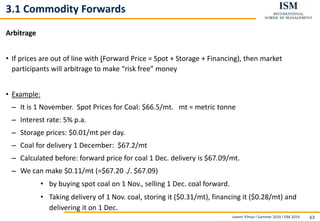
3.1 Commodity Forwards
Arbitrage
• If prices are out of line with (Forward Price = Spot + Storage + Financing), then market
participants will arbitrage to make “risk free” money
• Example:
– It is 1 November. Spot Prices for Coal: $66.5/mt. mt = metric tonne
– Interest rate: 5% p.a.
– Storage prices: $0.01/mt per day.
– Coal for delivery 1 December: $67.2/mt
– Calculated before: forward price for coal 1 Dec. delivery is $67.09/mt.
– We can make $0.11/mt (=$67.20 ./. $67.09)
• by buying spot coal on 1 Nov., selling 1 Dec. coal forward.
• Taking delivery of 1 Nov. coal, storing it ($0.31/mt), financing it ($0.28/mt) and
delivering it on 1 Dec.
Levent Yilmaz I Summer 2019 I ISM 2019 64
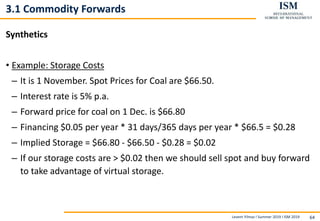
3.1 Commodity Forwards
Synthetics
• Example: Storage Costs
– It is 1 November. Spot Prices for Coal are $66.50.
– Interest rate is 5% p.a.
– Forward price for coal on 1 Dec. is $66.80
– Financing $0.05 per year * 31 days/365 days per year * $66.5 = $0.28
– Implied Storage = $66.80 - $66.50 - $0.28 = $0.02
– If our storage costs are > $0.02 then we should sell spot and buy forward
to take advantage of virtual storage.
Levent Yilmaz I Summer 2019 I ISM 2019 65
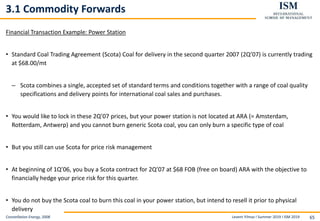
3.1 Commodity Forwards
Financial Transaction Example: Power Station
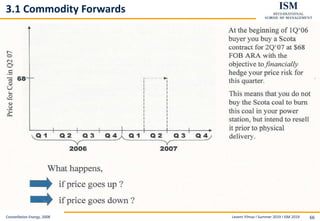
• Standard Coal Trading Agreement (Scota) Coal for delivery in the second quarter 2007 (2Q’07) is currently trading
at $68.00/mt
– Scota combines a single, accepted set of standard terms and conditions together with a range of coal quality
specifications and delivery points for international coal sales and purchases.
• You would like to lock in these 2Q’07 prices, but your power station is not located at ARA (= Amsterdam,
Rotterdam, Antwerp) and you cannot burn generic Scota coal, you can only burn a specific type of coal
• But you still can use Scota for price risk management
• At beginning of 1Q’06, you buy a Scota contract for 2Q’07 at $68 FOB (free on board) ARA with the objective to
financially hedge your price risk for this quarter.
• You do not buy the Scota coal to burn this coal in your power station, but intend to resell it prior to physical
delivery
Constellation Energy, 2008
Levent Yilmaz I Summer 2019 I ISM 2019 66
3.1 Commodity Forwards
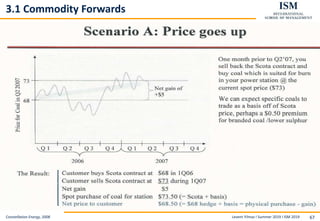
Constellation Energy, 2008
Levent Yilmaz I Summer 2019 I ISM 2019 67
3.1 Commodity Forwards
Constellation Energy, 2008
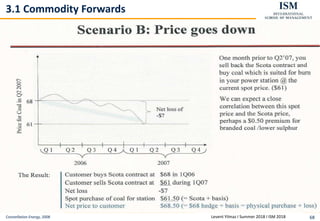
Levent Yilmaz I Summer 2019 I ISM 2019 68
3.1 Commodity Forwards
Levent Yilmaz I Summer 2018 I ISM 2018Constellation Energy, 2008
Levent Yilmaz I Summer 2019 I ISM 2019 69
3.2 Commodity Futures
• Future contract
– forward contract traded on an exchange
– standardized in terms of traded maturities, quantity of the commodity underlying the Future
contract, and
– giving rise to physical delivery by the seller at maturity
• If the settlement is specified as financial, there must be a liquid reliable index to represent the
underlying at date T (=maturity)
• Unlike an option, a Futures contains an obligation to buy (or sell).
• For both the buyer and the seller, the counterparty is the Clearing House of the Exchange.
• As the two parties to the contract do not necessarily know each other, the exchange also provides a
mechanism that gives the two parties a guarantee that the contract will be honored.
Geman, 2015, p.43
Levent Yilmaz I Summer 2019 I ISM 2019 70
3.2 Commodity Futures
• Long Futures Hedge -> you will purchase an asset in the future and want to
lock in the price
• Short Futures Hedge -> you will sell an asset in the future and want to lock
in the price
• Basis Risk:
– Difference between Spot and Futures
– Arises because of the uncertainty about the basis when the hedge is
closed out
Geman, 2015, p.43
Levent Yilmaz I Summer 2019 I ISM 2019 71
3.2 Commodity Futures
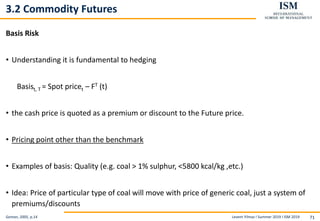
Basis Risk
• Understanding it is fundamental to hedging
Basist, T = Spot pricet – FT (t)
• the cash price is quoted as a premium or discount to the Future price.
• Pricing point other than the benchmark
• Examples of basis: Quality (e.g. coal > 1% sulphur, <5800 kcal/kg ,etc.)
• Idea: Price of particular type of coal will move with price of generic coal, just a system of
premiums/discounts
Geman, 2005, p.14
Levent Yilmaz I Summer 2019 I ISM 2019 72
3.2 Commodity Futures
Basis Risk
• Basis Risk: if what you trade is not exactly what you need you have basis risk
• It is the risk that the value of a futures contract will not move in line with that of the underlying
exposure.
• It is the risk that the cash-futures spread will widen or narrow between the dates at which a hedge
position is implemented and liquidated.
• It may reflect different time periods, product forms, qualities and locations
• One way to manage it is with a basis swap
• Basis swaps are used to hedge exposure to basic risk, such as locational risk or time exposure risk
Geman, 2005, p.14, p.360
Levent Yilmaz I Summer 2019 I ISM 2019 73
3.2 Commodity Futures
Several types of basic risk
• In the case of a trading desk which neds to cut at date t (e.g. to avoid negative margin
calls) – a position in Futures, which was meant to hedge a position in the spot commodity
– the basis risk is represented by the quantity
• Basis risk exists when Futures and spot prices do not change by the same amount over
time and, possibly, will not converge at maturity T:
– because the Futures contracts were written on an underlying similar but not identical to
the source of risk, such as an airline company hedging exposure to a rise in jet fuel
prices with NYMEX heating oil Futures contracts;
– because of the optionalities left to the seller at maturity in the physical settlement of
the Future contract: grade of the commodity, location, chemical attributes
Geman, 2005, p.14
Levent Yilmaz I Summer 2019 I ISM 2019 74
3.2 Commodity Futures
Typical pay-off structures of a futures contract
Deloitte, 2018, p.30
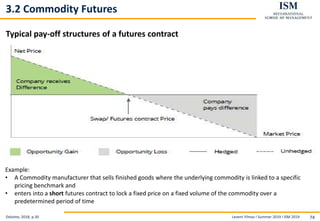
Example:
• A Commodity manufacturer that sells finished goods where the underlying commodity is linked to a specific
pricing benchmark and
• enters into a short futures contract to lock a fixed price on a fixed volume of the commodity over a
predetermined period of time
Levent Yilmaz I Summer 2019 I ISM 2019 75
3.2 Commodity Futures
Initial Margin:
• In order to avoid any credit event with the counterparty, the clearing house requires all
exchange participants to pay a margin deposit at the start.
• This one can be paid in cash or Treasury bills; recently, some exchanges have started
accepting gold.
• Margin calls have to be paid/received every day: if a trader holds a long Future contract
with maturity T, the value of his position has changed between date t and t + 1 day by
F(t + 1 day, T) – F(t, T)
• If this quantity is negative, a margin call equal to the loss has to be added to the account
of the trader with the exchange, otherwise the position is closed and the margin deposit is
used to offset the loss.
Geman, 2015, p.44
Levent Yilmaz I Summer 2019 I ISM 2019 76
3.2 Commodity Futures
Margin: Example
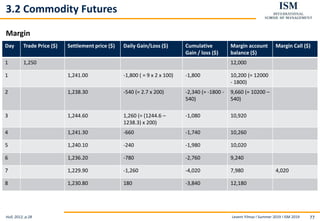
• Operation of margins for a long position in two gold futures contracts.
• 1 x Gold Futures Contract = 100 troy ounces
• Gold futures price = $1,250/ounce
=> 1 x Gold Futures Contract amount = 100 x $1,250/ounce = $125,000
• Initial Margin = $6,000 per contract (=> 6000 / 125000 = 5% of total amount), or $12,000
in total for 2 contracts;
• Maintenance Margin is $4,500 per contract, or $9,000 for 2 contracts in total.
• The contract is entered into on Day 1 at a gold price of $1,250/ounce
Hull, 2012, p.28, https://bit.ly/2FZCaAG
Levent Yilmaz I Summer 2019 I ISM 2019 77
3.2 Commodity Futures
Margin
Hull, 2012, p.28
Day Trade Price ($) Settlement price ($) Daily Gain/Loss ($) Cumulative
Gain / loss ($)
Margin account
balance ($)
Margin Call ($)
1 1,250 12,000
1 1,241.00 -1,800 ( = 9 x 2 x 100) -1,800 10,200 (= 12000
- 1800)
2 1,238.30 -540 (= 2.7 x 200) -2,340 (= -1800 -
540)
9,660 (= 10200 –
540)
3 1,244.60 1,260 (= (1244.6 –
1238.3) x 200)
-1,080 10,920
4 1,241.30 -660 -1,740 10,260
5 1,240.10 -240 -1,980 10,020
6 1,236.20 -780 -2,760 9,240
7 1,229.90 -1,260 -4,020 7,980 4,020
8 1,230.80 180 -3,840 12,180
Levent Yilmaz I Summer 2019 I ISM 2019 78
3.2 Commodity Futures
• The Exchange must also provide information on
– Daily traded volume
– Open interest, namely the number of contracts ‘open’ for a maturity T
with a buyer and a seller at each end
• important information to decide on the size of the order one may
want to place
– Amount of inventory held by the exchange (in fact its affiliated
warehouses) in the given commodity.
Geman, 2015, p.44
Levent Yilmaz I Summer 2019 I ISM 2019 79
3.2 Commodity Futures
• The exchange must specify the type (Arabica versus Robusta for coffee) and grade
of the commodity underlying the Future contract
• grades acceptable for delivery at date T (=maturity)
– in which case the seller will choose the least expensive one, exercising her
cheapest to deliver option, meaning that she will choose the least expensive
type accessible to her.
• Termination of a Futures position: a Futures position can be closed by
– Taking delivery of the goods according to rules specified by the exchange, each
exchange defining its warehousing and delivery rules.
– Entering a Futures position offsetting the existing one.
Geman, 2015, p.44
Levent Yilmaz I Summer 2019 I ISM 2019 80
3.2 Commodity Futures
Futures prices of commodities that are investment assets such as gold and silver.
Income and Storage Costs
• The hedging strategies of gold producers leads to a requirement on the part of investment banks to
borrow gold.
• Gold owners such as central banks charge interest in the form of what is known as the gold lease
rate when they lend gold.
• Gold and silver can therefore provide income to the holder
• they have storage costs
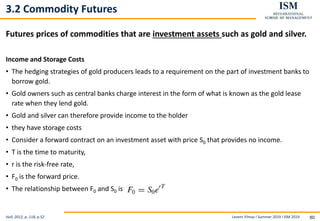
• Consider a forward contract on an investment asset with price S0 that provides no income.
• T is the time to maturity,
• r is the risk-free rate,
• F0 is the forward price.
• The relationship between F0 and S0 is
Hull, 2012, p..118, p.52
Levent Yilmaz I Summer 2019 I ISM 2019 81
3.2 Commodity Futures
Futures prices of commodities that are investment assets such as gold and silver.
Income and Storage Costs
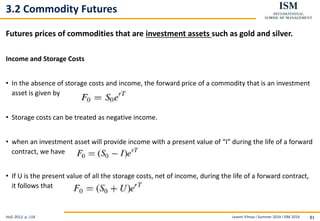
• In the absence of storage costs and income, the forward price of a commodity that is an investment
asset is given by
• Storage costs can be treated as negative income.
• when an investment asset will provide income with a present value of “I” during the life of a forward
contract, we have
• If U is the present value of all the storage costs, net of income, during the life of a forward contract,
it follows that
Hull, 2012, p..118
Levent Yilmaz I Summer 2019 I ISM 2019 82
3.2 Commodity Futures
Futures prices of commodities that are investment assets such as gold and silver.
Income and Storage Costs
Example
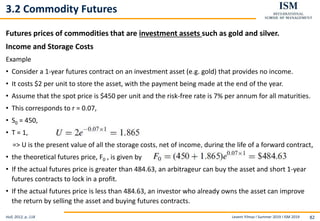
• Consider a 1-year futures contract on an investment asset (e.g. gold) that provides no income.
• It costs $2 per unit to store the asset, with the payment being made at the end of the year.
• Assume that the spot price is $450 per unit and the risk-free rate is 7% per annum for all maturities.
• This corresponds to r = 0.07,
• S0 = 450,
• T = 1,
=> U is the present value of all the storage costs, net of income, during the life of a forward contract,
• the theoretical futures price, F0 , is given by
• If the actual futures price is greater than 484.63, an arbitrageur can buy the asset and short 1-year
futures contracts to lock in a profit.
• If the actual futures price is less than 484.63, an investor who already owns the asset can improve
the return by selling the asset and buying futures contracts.
Hull, 2012, p..118
Levent Yilmaz I Summer 2019 I ISM 2019 83
3.2 Commodity Futures
Futures prices of commodities that are investment assets such as gold and silver.
Income and Storage Costs
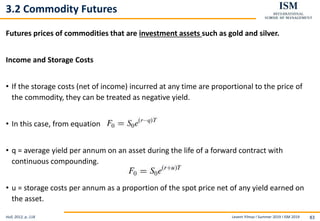
• If the storage costs (net of income) incurred at any time are proportional to the price of
the commodity, they can be treated as negative yield.
• In this case, from equation ,
• q = average yield per annum on an asset during the life of a forward contract with
continuous compounding.
• u = storage costs per annum as a proportion of the spot price net of any yield earned on
the asset.
Hull, 2012, p..118
Levent Yilmaz I Summer 2019 I ISM 2019 84
3.2 Commodity Futures
Income and Storage Costs
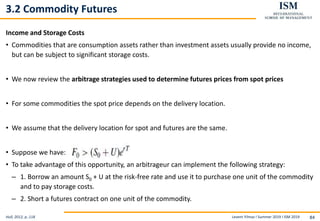
• Commodities that are consumption assets rather than investment assets usually provide no income,
but can be subject to significant storage costs.
• We now review the arbitrage strategies used to determine futures prices from spot prices
• For some commodities the spot price depends on the delivery location.
• We assume that the delivery location for spot and futures are the same.
• Suppose we have:
• To take advantage of this opportunity, an arbitrageur can implement the following strategy:
– 1. Borrow an amount S0 + U at the risk-free rate and use it to purchase one unit of the commodity
and to pay storage costs.
– 2. Short a futures contract on one unit of the commodity.
Hull, 2012, p..118
Levent Yilmaz I Summer 2019 I ISM 2019 85
3.2 Commodity Futures
Income and Storage Costs
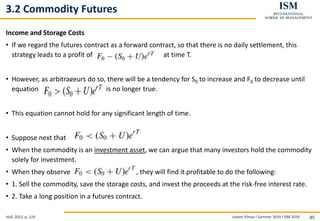
• If we regard the futures contract as a forward contract, so that there is no daily settlement, this
strategy leads to a profit of at time T.
• However, as arbitrageurs do so, there will be a tendency for S0 to increase and F0 to decrease until
equation is no longer true.
• This equation cannot hold for any significant length of time.
• Suppose next that
• When the commodity is an investment asset, we can argue that many investors hold the commodity
solely for investment.
• When they observe , they will find it profitable to do the following:
• 1. Sell the commodity, save the storage costs, and invest the proceeds at the risk-free interest rate.
• 2. Take a long position in a futures contract.
Hull, 2012, p..119
Levent Yilmaz I Summer 2019 I ISM 2019 86
3.2 Commodity Futures
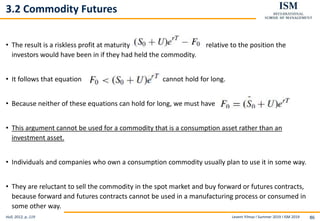
• The result is a riskless profit at maturity relative to the position the
investors would have been in if they had held the commodity.
• It follows that equation cannot hold for long.
• Because neither of these equations can hold for long, we must have
• This argument cannot be used for a commodity that is a consumption asset rather than an
investment asset.
• Individuals and companies who own a consumption commodity usually plan to use it in some way.
• They are reluctant to sell the commodity in the spot market and buy forward or futures contracts,
because forward and futures contracts cannot be used in a manufacturing process or consumed in
some other way.
Hull, 2012, p..119
Levent Yilmaz I Summer 2019 I ISM 2019 87
3.2 Commodity Futures
Consumption Commodities
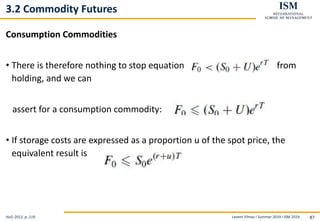
• There is therefore nothing to stop equation from
holding, and we can
assert for a consumption commodity:
• If storage costs are expressed as a proportion u of the spot price, the
equivalent result is
Hull, 2012, p..119
Levent Yilmaz I Summer 2019 I ISM 2019 88
3.2 Commodity Futures
Convenience Yield
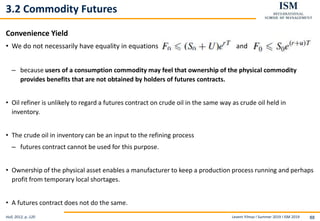
• We do not necessarily have equality in equations and
– because users of a consumption commodity may feel that ownership of the physical commodity
provides benefits that are not obtained by holders of futures contracts.
• Oil refiner is unlikely to regard a futures contract on crude oil in the same way as crude oil held in
inventory.
• The crude oil in inventory can be an input to the refining process
– futures contract cannot be used for this purpose.
• Ownership of the physical asset enables a manufacturer to keep a production process running and perhaps
profit from temporary local shortages.
• A futures contract does not do the same.
Hull, 2012, p..120
Levent Yilmaz I Summer 2019 I ISM 2019 89
3.2 Commodity Futures
Convenience Yield
• The benefits from holding the physical asset are sometimes referred to as the convenience yield
provided by the commodity.
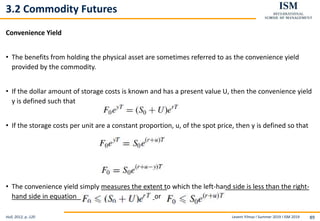
• If the dollar amount of storage costs is known and has a present value U, then the convenience yield
y is defined such that
• If the storage costs per unit are a constant proportion, u, of the spot price, then y is defined so that
• The convenience yield simply measures the extent to which the left-hand side is less than the right-
hand side in equation or
Hull, 2012, p..120
Levent Yilmaz I Summer 2019 I ISM 2019 90
3.2 Commodity Futures
Convenience Yield
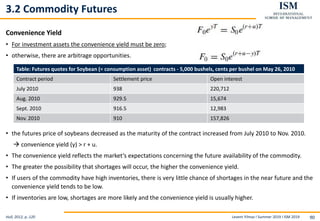
• For investment assets the convenience yield must be zero;
• otherwise, there are arbitrage opportunities.
• the futures price of soybeans decreased as the maturity of the contract increased from July 2010 to Nov. 2010.
 convenience yield (y) > r + u.
• The convenience yield reflects the market’s expectations concerning the future availability of the commodity.
• The greater the possibility that shortages will occur, the higher the convenience yield.
• If users of the commodity have high inventories, there is very little chance of shortages in the near future and the
convenience yield tends to be low.
• If inventories are low, shortages are more likely and the convenience yield is usually higher.
Hull, 2012, p..120
Table: Futures quotes for Soybean (= consumption asset) contracts - 5,000 bushels, cents per bushel on May 26, 2010
Contract period Settlement price Open interest
July 2010 938 220,712
Aug. 2010 929.5 15,674
Sept. 2010 916.5 12,983
Nov. 2010 910 157,826
Levent Yilmaz I Summer 2019 I ISM 2019 91
3.2 Commodity Futures
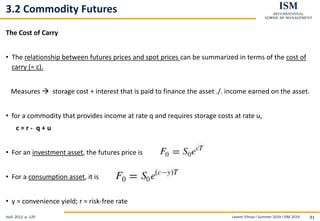
The Cost of Carry
• The relationship between futures prices and spot prices can be summarized in terms of the cost of
carry (= c).
Measures  storage cost + interest that is paid to finance the asset ./. income earned on the asset.
• for a commodity that provides income at rate q and requires storage costs at rate u,
c = r - q + u
• For an investment asset, the futures price is
• For a consumption asset, it is
• y = convenience yield; r = risk-free rate
Hull, 2012, p..120
Levent Yilmaz I Summer 2019 I ISM 2019 92
3.2 Commodity Futures
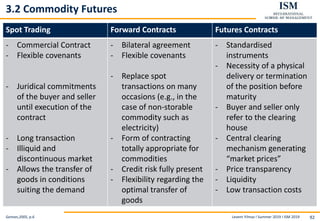
Geman,2005, p.6
Spot Trading Forward Contracts Futures Contracts
- Commercial Contract
- Flexible covenants
- Juridical commitments
of the buyer and seller
until execution of the
contract
- Long transaction
- Illiquid and
discontinuous market
- Allows the transfer of
goods in conditions
suiting the demand
- Bilateral agreement
- Flexible covenants
- Replace spot
transactions on many
occasions (e.g., in the
case of non-storable
commodity such as
electricity)
- Form of contracting
totally appropriate for
commodities
- Credit risk fully present
- Flexibility regarding the
optimal transfer of
goods
- Standardised
instruments
- Necessity of a physical
delivery or termination
of the position before
maturity
- Buyer and seller only
refer to the clearing
house
- Central clearing
mechanism generating
“market prices”
- Price transparency
- Liquidity
- Low transaction costs
Levent Yilmaz I Summer 2019 I ISM 2019 93
3.2.1 Price Discovery in Futures Markets
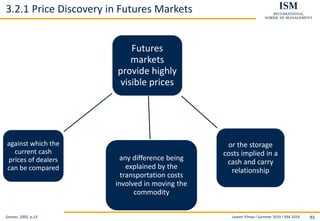
Geman, 2005, p.23
Futures
markets
provide highly
visible prices
against which the
current cash
prices of dealers
can be compared
any difference being
explained by the
transportation costs
involved in moving the
commodity
or the storage
costs implied in a
cash and carry
relationship
Levent Yilmaz I Summer 2019 I ISM 2019 94
3.2.2 Commodity Futures - Return Components
Commodity Futures have 3 Return Components
Total Return = Spot Return + Roll Yield + Collateral Yield
Spot Price Return
• Absolute price change of the commodity.
• Commodity selection
• Portfolio component weights
• Rebalancing strategy (-> diversification return)
Spot Return + Roll Yield = Excess Return
Geman, 2015, p.52
Levent Yilmaz I Summer 2019 I ISM 2019 95
3.2.2 Commodity Futures - Return Components
Commodity Futures have 3 Return Components
Total Return = Spot Return + Roll Yield + Collateral Yield
• Roll Yield
– Depending on the shape of the forward curve, an additional gain / loss can be earned by rolling
commodity futures forward.
– Impact of the commodity futures term structure
– Contango – upward sloping forward curve -> negative roll yield
– Backwardation – declining forward curve -> positive roll yield
• Collateral Yield
– Management of the underlying funding of an unleveraged investment
– For futures investments only a certain margin needs to be posted (typically 5% - 10% of notional).
• No money is transferred to the counterparty for the purchase!
• The remaining capital is invested usually in money market or government bonds and
earns interest.
Geman, 2015, p.52
Levent Yilmaz I Summer 2019 I ISM 2019 96
3.2.2. Commodity Futures - Return Components
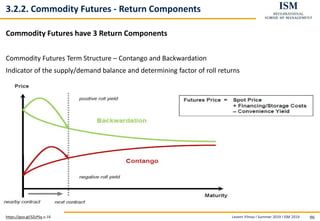
Commodity Futures have 3 Return Components
Commodity Futures Term Structure – Contango and Backwardation
Indicator of the supply/demand balance and determining factor of roll returns
https://goo.gl/5ZcPSq p.18
Levent Yilmaz I Summer 2019 I ISM 2019 97
3.2.2. Commodity Futures - Return Components
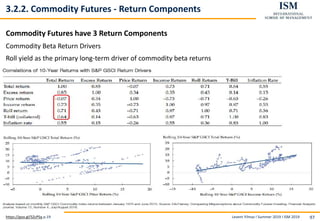
Commodity Futures have 3 Return Components
Commodity Beta Return Drivers
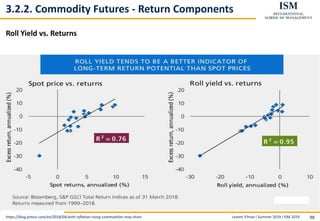
Roll yield as the primary long-term driver of commodity beta returns
https://goo.gl/5ZcPSq p.19
Levent Yilmaz I Summer 2019 I ISM 2019 98
3.2.2. Commodity Futures - Return Components
Roll Yield vs. Returns
https://blog.pimco.com/en/2018/04/with-inflation-rising-commodities-may-shine
Levent Yilmaz I Summer 2019 I ISM 2019 99
3.3 Commodity Options
Options Basics
• Options are traded both on exchanges and in the over-the-counter market.
• There are two types of option.
– A call option gives the holder the right to buy the underlying asset by a certain date for a certain price.
– A put option gives the holder the right to sell the underlying asset by a certain date for a certain price.
• The price in the contract is known as the exercise price or strike price;
• the date in the contract is known as the expiration date or maturity.
• American options can be exercised at any time up to the expiration date.
• European options can be exercised only on the expiration date itself.
• Most of the options that are traded on exchanges are American.
Hull, 2012, p.8
Levent Yilmaz I Summer 2019 I ISM 2019 100
3.3 Commodity Options
Options Basics
• European options are generally easier to analyze than American options, and some of the properties
of an American option are frequently deduced from those of its European counterpart.
• Option gives the holder the right to do something.
• The holder does not have to exercise this right.
• This is what distinguishes options from forwards and futures, where the holder is obligated to buy or
sell the underlying asset.
• Whereas it costs nothing to enter into a forward or futures contract, except for margin
requirements, there is a cost to acquiring an option.
Hull, 2012, p.8
Levent Yilmaz I Summer 2019 I ISM 2019 101
3.3 Commodity Options
Nature of Options of Futures
• In options on futures, also known as futures options contracts, exercise of the option gives
the holder a position in a futures contract.
• Futures Option is the right, but not the obligation, to enter into a futures contract at a
certain futures price by a certain date.
• Call Futures Option is the right to enter into a long futures contract at a certain price;
• Put Futures Option is the right to enter into a short futures contract at a certain price.
• Futures options are generally American; that is, they can be exercised any time during the
life of the contract.
Hull, 2012, p.361
Levent Yilmaz I Summer 2019 I ISM 2019 102
3.3 Commodity Options
Nature of Options of Futures
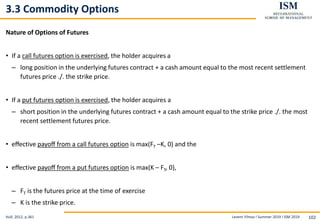
• If a call futures option is exercised, the holder acquires a
– long position in the underlying futures contract + a cash amount equal to the most recent settlement
futures price ./. the strike price.
• If a put futures option is exercised, the holder acquires a
– short position in the underlying futures contract + a cash amount equal to the strike price ./. the most
recent settlement futures price.
• effective payoff from a call futures option is max(FT –K, 0) and the
• effective payoff from a put futures option is max(K – FT, 0),
– FT is the futures price at the time of exercise
– K is the strike price.
Hull, 2012, p.361
Levent Yilmaz I Summer 2019 I ISM 2019 103
3.3 Commodity Options
Nature of Options of Futures
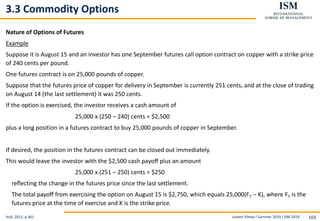
Example
Suppose it is August 15 and an investor has one September futures call option contract on copper with a strike price
of 240 cents per pound.
One futures contract is on 25,000 pounds of copper.
Suppose that the futures price of copper for delivery in September is currently 251 cents, and at the close of trading
on August 14 (the last settlement) it was 250 cents.
If the option is exercised, the investor receives a cash amount of
25,000 x (250 – 240) cents = $2,500
plus a long position in a futures contract to buy 25,000 pounds of copper in September.
If desired, the position in the futures contract can be closed out immediately.
This would leave the investor with the $2,500 cash payoff plus an amount
25,000 x (251 – 250) cents = $250
reflecting the change in the futures price since the last settlement.
The total payoff from exercising the option on August 15 is $2,750, which equals 25,000(FT – K), where FT is the
futures price at the time of exercise and K is the strike price.
Hull, 2012, p.361
Levent Yilmaz I Summer 2019 I ISM 2019 104
3.3 Commodity Options
Nature of Options of Futures
Example
An investor has one December futures put option on corn with a strike price of 400 cents per bushel.
One futures contract is on 5,000 bushels of corn.
Suppose that the current futures price of corn for delivery in December is 380, and the most recent settlement
price is 379 cents.
If the option is exercised, the investor receives a cash amount of
5,000 x (400 – 379) cents = $1,050
plus a short position in a futures contract to sell 5,000 bushels of corn in December.
If desired, the position in the futures contract can be closed out.
This would leave the investor with the $1,050 cash payoff minus an amount
5,000 x (380 - 379) cents = $50
reflecting the change in the futures price since the last settlement.
The net payoff from exercise is $1,000, which equals 5,000(K – FT)
Hull, 2012, p.362
Levent Yilmaz I Summer 2019 I ISM 2019 105
3.3 Commodity Options
Expiration Months
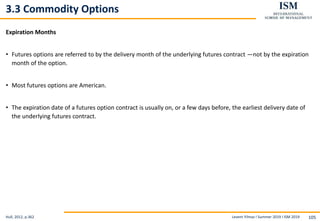
• Futures options are referred to by the delivery month of the underlying futures contract —not by the expiration
month of the option.
• Most futures options are American.
• The expiration date of a futures option contract is usually on, or a few days before, the earliest delivery date of
the underlying futures contract.
Hull, 2012, p.362
Levent Yilmaz I Summer 2019 I ISM 2019 106
3.3 Commodity Options
Call option
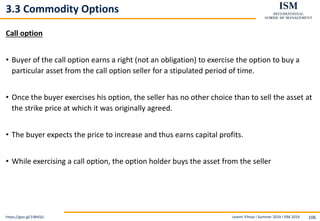
• Buyer of the call option earns a right (not an obligation) to exercise the option to buy a
particular asset from the call option seller for a stipulated period of time.
• Once the buyer exercises his option, the seller has no other choice than to sell the asset at
the strike price at which it was originally agreed.
• The buyer expects the price to increase and thus earns capital profits.
• While exercising a call option, the option holder buys the asset from the seller
https://goo.gl/1iWtQU
Levent Yilmaz I Summer 2019 I ISM 2019 107
3.3 Commodity Options
Put option
• buyer of the put option earns a right (not an obligation) to exercise his option to sell a
particular asset to the put option seller for a stipulated period of time.
• Once the buyer of put exercises his option (before the expiration date), the seller of put
has no other choice than to purchase the asset at the strike price at which it was originally
agreed.
• The buyer of put expects the value of asset to decrease so that he can purchase more
quantity at lower price.
• Strike price is the pre-determined price at which the buyer and seller of an option agree
on a contract or exercise a valid and unexpired option.
https://goo.gl/1iWtQU
Levent Yilmaz I Summer 2019 I ISM 2019 108
3.3 Commodity Options
• Option gives the holder the right to do something.
• The holder does not have to exercise this right.
• This is what distinguishes options from forwards and futures, where the holder is
obligated to buy or sell the underlying asset.
• There is a cost to acquiring an option - premium
– it costs nothing to enter into a forward or futures contract.
Hull, 2012, p.8
Levent Yilmaz I Summer 2019 I ISM 2019 109
3.3 Commodity Options
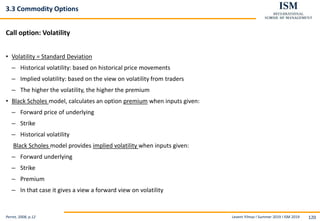
• Determinants of an Options Premium
• In return for the rights they are granted, options buyers pay options sellers
a premium.
• The four major factors affecting the premium are:
– Futures price relative to options strike price.
– Time remaining before options expiration.
– Volatility of underlying futures price.
– Interest rates.
Levent Yilmaz I Summer 2019 I ISM 2019 110
3.3 Commodity Options
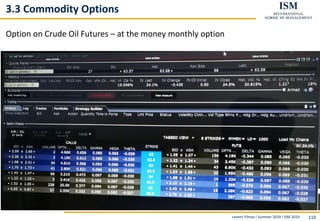
Option on Crude Oil Futures – at the money monthly option
Levent Yilmaz I Summer 2019 I ISM 2019 111
3.3 Commodity Options
Hull, 2012, p.12
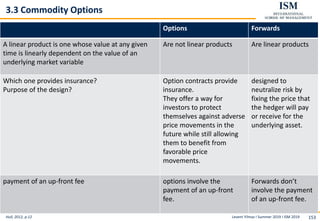
Fundamental difference between the use of forward contracts and options for
hedging
Forward contracts are designed to
neutralize risk by fixing the price that
the hedger will pay or receive for the
underlying asset.
Option contracts, by contrast,
provide insurance.
They offer a way for investors to
protect themselves against adverse
price movements in the future while
still allowing them to benefit from
favorable price movements.
Unlike forwards, options involve the
payment of an up-front fee.
Levent Yilmaz I Summer 2019 I ISM 2019 112
3.3 Commodity Options
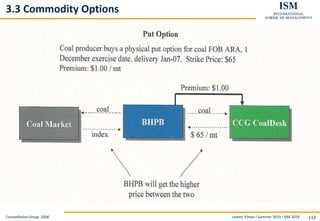
Constellation Group, 2008
Levent Yilmaz I Summer 2019 I ISM 2019 113
3.3 Commodity Options
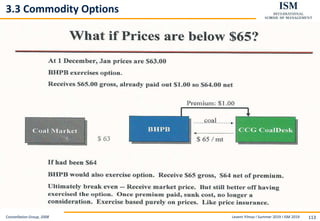
Constellation Group, 2008
Levent Yilmaz I Summer 2019 I ISM 2019 114
3.3 Commodity Options
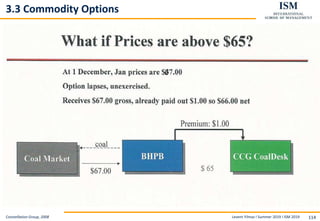
Constellation Group, 2008
6
Levent Yilmaz I Summer 2019 I ISM 2019 115
3.3 Commodity Options
Example: A gold manufacturer
• A put option available in MCX exchange effectively creates a floor price in exchange for an option
premium.
• This premium reflects the likelihood that the option will be exercised.
• the further the strike price is from trading levels, the lower the amount of premium paid upfront.
• The put option will reference to the underlying MCX gold futures price.
• At the end of each period, the price of the underlying is compared to the option "strike" price.
• If the price of underlying < the strike price, the Company can either close of the Options position and profit
from rise in value of Option, as with the fall in gold prices, the premium for gold put option will rise.
https://goo.gl/1iWtQU
Levent Yilmaz I Summer 2019 I ISM 2019 116
3.3 Commodity Options
Example: A gold manufacturer
• Assumption: European based options -> on expiry of the options, the put buyer can exercise his
option, which will result in creating a sell position in the underlying futures at the ‘strike price’,
which can be closed at the current market price, to realise profits.
• This payment offsets lower prices in the physical market.
• If the settlement price > the strike price, the purchased option expires and is rendered worthless.
• But the Company benefits from higher prices in the physical market.
https://goo.gl/1iWtQU
Levent Yilmaz I Summer 2019 I ISM 2019 117
3.3 Commodity Options
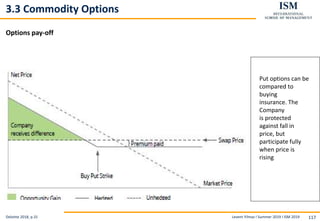
Options pay-off
Deloitte 2018, p.31
Put options can be
compared to
buying
insurance. The
Company
is protected
against fall in
price, but
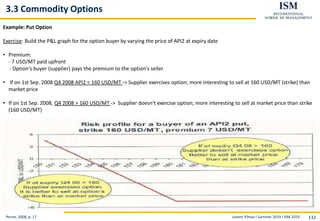
participate fully
when price is
rising
Levent Yilmaz I Summer 2019 I ISM 2019 118
3.3 Commodity Options
Example: Call Option
• European options. Expiry/declaration date fixed on the 1st of the month preceding the quarter. E.g. 1st of
September for a Q4 (=4th quarter) option.
• Assume a buyer buys today a call option for API2 (= Coal index delivered into North West Europe)
– Quantity 25KT/month (75KT total); because a quarter has 3 months = 25 x 3 = 75
– Delivery Q4 2008 (25KT/month)
– Forward curve today Q4 2008 at $165/ton
– Strike price: $165/ton (at the money option)
– Premium: $10/ton
– Expiry date: 1st Sep. 08
• The buyer pays upfront $10/ton ($750,000 in total) to the option's seller, to have the right but not the obligation
to be long of 75KT of API2 at $165/ton for the period Q4 2008.
• Exercise: draw the graph of the P&L of the call option from the buyer's perspective, by varying the API2 price at
expiry date
Perret, 2008, p.7
Levent Yilmaz I Summer 2019 I ISM 2019 119
3.3 Commodity Options
Example: Call Option
• Premium is a sunk cost whatever happens: 10 USD/MT paid upfront; Option's buyer pays the premium to option's seller
• If on 1st Sep. (expiry date), Q4 2008 > 165 USD/MT -> Buyer exercises option; It is cheaper to be long at option's strike price (165
USD/MT) than market price
• If on 1st Sep., Q4 2008 API2 < 165 USD/MT -> Buyer doesn't exercise option; It is cheaper to buy at market
• If Q4 2008 > 175 USD/MT (165+10 ), break even positive
Perret, 2008, p.8
08
Levent Yilmaz I Summer 2019 I ISM 2019 120
3.3 Commodity Options
Call option: Volatility
• Volatility = Standard Deviation
– Historical volatility: based on historical price movements
– Implied volatility: based on the view on volatility from traders
– The higher the volatility, the higher the premium
• Black Scholes model, calculates an option premium when inputs given:
– Forward price of underlying
– Strike
– Historical volatility
Black Scholes model provides implied volatility when inputs given:
– Forward underlying
– Strike
– Premium
– In that case it gives a view a forward view on volatility
Perret, 2008, p.12
Levent Yilmaz I Summer 2019 I ISM 2019 121
3.3 Commodity Options
N = Cumulative standard normal distribution
Standard deviation
Perret, 2008, p.13
Levent Yilmaz I Summer 2019 I ISM 2019 122
3.3 Commodity Options
Perret, 2008, p.13
Levent Yilmaz I Summer 2019 I ISM 2019 123
3.3 Commodity Options
• As a European futures option has the same payoff as a European spot option when the
futures contract matures at the same time as the option, the model used to value
European futures options (Black’s model) can also be used to value European spot options.
• However, American spot options and other more complicated derivatives dependent on
the spot price of a commodity require more sophisticated models.
• A feature of commodity prices is that they often exhibit mean reversion (similarly to
interest rates) and are also sometimes subject to jumps.
• Some of the models developed for interest rates can be adapted to apply to commodities.
Hull, 2012, p.748
Levent Yilmaz I Summer 2019 I ISM 2019 124
3.3 Commodity Options
Option Basics
Holder (Buyer) Writer (Seller)
Call Option Right to Buy Obligation to Sell
Put Option Right to Sell Obligation to Buy
Call Put
In-the-Money (ITM) Strike Price < Commodity Price Strike Price > Commodity Price
At-the-Money (ATM) Strike Price = Commodity Price Strike Price = Commodity Price
Out-of-the-Money (OTM) Strike Price > Commodity Price Strike Price < Commodity Price
Intrinsic Value = value of the contract
at expiration  only affected by
moves in the underlying security
= Commodity Price - Strike Price = Strike Price – Commodity Price
Time Value  an at-the money or
out-of-the-money option has only
time value. Subject to primarily time
to expiration and implied
volatility.
= Option Price - Intrinsic Value
= Option Price – Commodity Price -
Strike Price
= Option Price - Intrinsic Value
= Option Price - Strike Price –
Commodity Price
The premium of an option has two components, intrinsic value and time value.
Levent Yilmaz I Summer 2019 I ISM 2019 125
3.3 Commodity Options
Implied volatility
• market’s expectation of the future volatility of the underlying stock
• derived from the option price
• represents demand for the option
• The higher the implied volatility, the more expectation that the underlying commodity will
make big moves
– increasing the option’s chances of being in-the-money
– option’s premiums (that is, its time value) are higher
– value of time decays as expiration nears
Perret, 2008, p.7
Levent Yilmaz I Summer 2019 I ISM 2019 126
3.3 Commodity Options
Example: Seller of Call Option
• European options. Expiry/declaration date fixed on the 1st of the month preceding the quarter. E.g.
1st of September for a Q4 (=4th quarter) option.
• Assume a seller sells today a call option for API2 (= Coal index delivered into North West Europe)
– Quantity 25KT/month (75KT total); because a quarter has 3 months
– Delivery Q4 2008 (25KT/month)
– Forward curve today Q4 08 at $165/ton
– Strike price: $165/ton (at the money option)
– Premium: $10/ton
– Expiry date: 1st Sep. 2008
• The seller received upfront $10/ton ($750,000 in total) from the option's buyer, to have the right but
not the obligation to be short of 75KT of API2 at $165/ton for the period Q4 2008. (Whatever the
price of API2 Q4 08 is on the 1st of Sep. 2008).
• Exercise: draw the graph of the P&L of the call option from the seller's perspective
Perret, 2008, p.7
Levent Yilmaz I Summer 2019 I ISM 2019 127
3.3 Commodity Options
Example: Seller of Call Option
P&L profile for seller of a API2 Call, strike 165 USD/MT, premium 10 USD/MT
10
P&L in USD/MT
165 175 Market price for Q4 2008 at expiry date
• If coal trades anywhere below $165 then we keep the $10 that we received when we sold the call option - the option premium.
• However, if the market rallies then our losses become unlimited.
Perret, 2008, p.7
0
Levent Yilmaz I Summer 2019 I ISM 2019 128
3.3 Commodity Options
Perret, 2008, p. 17
Risk Analysis: why selling options?
• "Money talks", get cash premium upfront
- If an API2 option is sold at 10 USD/MT for a tonnage of 75,000 tonnes the total premium received
is $750,000 now
• Long term view underlying market: bearish (sell call), bullish (sell put)
• Long term view volatility:
- An option seller sells option with the view that the volatility will reduce
• Possibility to hedge I arbitrage when linked to physical position
- It is less dangerous for a supplier who is naturally long to sell a call option
• Make sure risk management is in place before selling options
- Nick Leason at Barings sold straddles (which involves buying a European call and put with the same
strike price and expiration date) and lost $1.4bn
- LTCM the option trader was one of the inventor of the Black Scholes model and he lost $3.7bn
Levent Yilmaz I Summer 2019 I ISM 2019 129
3.3 Commodity Options
Perret, 2008, p. 17
Call Option: Application Physical Market
• A supplier sells a cargo for Q4 2008 at 165 USD/MT and gives the buyer the option to buy
another cargo at the same price
• This means that the supplier sells an at the money call option for free
• As a buyer: buy as much as you can!
• Still it is more complex
• Take into account the existing and future business relationship. Is it the price to pay to
acquire a new customer?
• Can the buyer really sell the option in the market? And at what price?
• The Mark-to-Market and valuation can become an academic exercise
Levent Yilmaz I Summer 2019 I ISM 2019 130
3.3 Commodity Options
Perret, 2008, p. 17
Call Option: Greeks
Delta
• Is the daily change in an option tonnage for each change in the forward underlying
• It is also the probability that the option finishes in money. E.g.: an at the money call option has an
estimated delta of 0.5.
• This means that the seller of a naked call option for 100 KT with a delta of 0.5 should buy 50 KT to
protect himself
• It increases if the option is in the money and decreases if out of the money
• Delta hedging can be difficult and costly as it implies permanent small adjustments of the position.
• Hence trader often prefer to trade options in large chunks which makes delta hedging more efficient
Levent Yilmaz I Summer 2019 I ISM 2019 131
3.3 Commodity Options
Perret, 2008, p. 17
Example: Put Option
• A supplier buys today an API2 put option
- strike at 160 USD/MT, period Q4
- Forward curve Q4 2008 at 165 USD/MT
- expiry date 1st Sep.
- Premium: 7 USD/MT
- Note: out of the money put, premium is lower than for the call at the money option studied previously (10
USD/MT)
• The supplier pays 7 USD/MT upfront to have the right but not the obligation to sell API2 Q4 2008 at 160 USD/MT
whatever the price of API2 Q4 2008 will be on 1st September 2008.
• The put option seller may be "forced" to buy API2 at 160 USD/MT if the put option buyer decides to exercise the
option
• Exercise: Build the P&L graph for the option buyer
Levent Yilmaz I Summer 2019 I ISM 2019 132
3.3 Commodity Options
Perret, 2008, p. 17
Example: Put Option
Exercise: Build the P&L graph for the option buyer by varying the price of API2 at expiry date
• Premium:
- 7 USD/MT paid upfront
- Option's buyer (supplier) pays the premium to the option's seller
• If on 1st Sep. 2008 Q4 2008 API2 < 160 USD/MT -> Supplier exercises option; more interesting to sell at 160 USD/MT (strike) than
market price
• If on 1st Sep. 2008, Q4 2008 > 160 USD/MT -> Supplier doesn't exercise option; more interesting to sell at market price than strike
(160 USD/MT)
• If Q4 08 < 153 USD/MT (160 -7), break even positive
Levent Yilmaz I Summer 2019 I ISM 2019 133
3.3 Commodity Options
Perret, 2008, p. 17
Put Option: Application Physical Market
Example
• a supplier sells a cargo for Q4 ‘08 at 165 USDIMT and has the option to sell another cargo at same
price (or has the option to increase the tonnage)
• Supplier buys an at the money put option for free
• Supplier side: sell as much as you can under those terms!
Levent Yilmaz I Summer 2019 I ISM 2019 134
3.3 Commodity Options
Perret, 2008, p. 29
Option pay-off Chart
Levent Yilmaz I Summer 2019 I ISM 2019 135
3.3 Commodity Options
Perret, 2008, p. 29
Example: Call Option Application
Utility buys a call option to hedge physical position
• 3rd July 2008:
• A utility sells electricity for Q4 2008 at fixed price
• The corresponding coal price for dark spread (= electricity price ./. Coal price -> margin of utility!)
calculation is at 160 USD/MT for Q4 2008, quantity 150 KT
• The trader at the utility has the market view that coal prices will ease during the summer and that he
may be able to purchase coal cheaper later on
• buy on 3rd of July an API2 call option
• strike 170 USD/MT (out of the money)
• premium 5 USD/MT
• expiry date 1st Sept. 2008
• Exercise: Build the P&L profile for the deal
Levent Yilmaz I Summer 2019 I ISM 2019 136
3.3 Commodity Options
Perret, 2008, p. 29
Example: Call Option Application
Utility buys a call option to hedge physical position
Third scenario:
Advantage still has the upside if market goes down
Protection in case wrong market view and market goes up
But have to pay a cost = premium
In this example total cost: 5*150,000 = $750,000
The shape of resulting deal looks familiar? Long Put Option
Levent Yilmaz I Summer 2019 I ISM 2019 137
3.3 Commodity Options
https://bit.ly/2DIxNs6
FEBRUARY 2019 CRUDE OIL
Selling the February Crude Oil 90 call/45 put strangle
Levent Yilmaz I Summer 2019 I ISM 2019 138
3.3 Commodity Options
https://bit.ly/2DIxNs6
Example: Selling Option Strangle
• Selling the February crude 90 call, 45 put strangle for premiums of $600 per side.
• Margin per trade $1875.
• If worthless at expiration, the options would produce a 64% [(2 x 600 / 1875] return on investment.
• Strangle writers are NOT trying to predict what prices will do – only pick a price window where prices
will likely remain.
• Option strangles: offsetting nature (one side balancing out the other in an adverse move).
• By selling the option, the seller’s other risk is that the value of the option could increase during the
life of the option, thus increasing margin requirement to remain in the trade.
• The Option Seller wants to sell an option that is far enough out of the money and with low enough
volatility that the market can move a long way without greatly affecting the price or margin
requirement of her option.
• The strangle is most effective when the price of the underlying market remains in a defined range.
• While trending markets are not best for this approach, this does not mean that volatile markets
should be overlooked for strangling opportunities.
• Volatile markets often can still trade in wide trading ranges, and the volatility can boost option
premiums, meaning that a strangle often can be sold with a very wide profit zone.
Levent Yilmaz I Summer 2019 I ISM 2019 139
3.3 Commodity Options
Collar
• Way to get benefits of a call or put option without the pain of an upfront premium
• If consumer, can sell a put (floor) and , with earned put premium, can buy a call (cap)
• Gives consumer desired protection against price increases, allowing him to benefit from some
price decreases, although not 100%
• If producer, can sell a call and buy a put
• Often called costless caller or zero premium collar
Constellation Energy, 2008
Levent Yilmaz I Summer 2019 I ISM 2019 140
3.3 Commodity Options
Constellation Energy, 2008
Levent Yilmaz I Summer 2019 I ISM 2019 141
3.3 Commodity Options
Constellation Energy, 2008
Levent Yilmaz I Summer 2019 I ISM 2019 142
3.3 Commodity Options
Constellation Energy, 2008
Levent Yilmaz I Summer 2019 I ISM 2019 143
3.3 Commodity Options
Constellation Energy, 2008
Levent Yilmaz I Summer 2019 I ISM 2019 144
3.3 Commodity Options
Hedging with Costless Collar
A costless collar is the combination of two options.
In the case of a producer it is generally the combination of buying a put option (floor) and
selling a call option (ceiling)
Example: how an oil and gas producer can hedge with "producer costless collar" on Brent
crude oil, a strategy which will include buying a Brent crude oil put option and selling a Brent
crude oil call option.
To make the option costless, the options will be structured so that the premium paid for the
put option will be offset by the premium received from selling the call option.
https://www.mercatusenergy.com/blog/bid/106577/the-fundamentals-of-oil-gas-hedging-costless-collars
Levent Yilmaz I Summer 2019 I ISM 2019 145
3.3 Commodity Options
Hedge your December crude oil production with a Brent crude oil costless collar.
• Need to be hedged against December Brent prices trading below $40/BBL.
• Buy a $40 December Brent crude oil put option for a premium of $1.50/BBL.
• In order to offset the cost of the $1.50 premium associated with the $40 put option
– Sell a $59 December Brent crude oil call option for a premium of $1.50/BBL
 December Brent $40/$59 producer costless collar
 $40 floor and a $59 ceiling.
https://www.mercatusenergy.com/blog/bid/106577/the-fundamentals-of-oil-gas-hedging-costless-collars
Levent Yilmaz I Summer 2019 I ISM 2019 146
3.3 Commodity Options
Hedging with costless Collar
• Hedging Gain: Brent crude oil prices during December average less than $40/BBL
• Hedging Loss: Brent crude oil prices during December average more than $59/BBL
• Neither a Hedging Gain nor Loss: If the price is between $40 and $59
• How will the $40/$59 costless collar perform if Brent crude oil prices during the month of
December average less $40/BBL and more than $59/BBL?
https://www.mercatusenergy.com/blog/bid/106577/the-fundamentals-of-oil-gas-hedging-costless-collars
Levent Yilmaz I Summer 2019 I ISM 2019 147
3.3 Commodity Options
Hedging with Costless Collar
Average settlement price for the prompt Brent
crude oil futures, during the month of December, is
$70.00/BBL.
The price you receive at the wellhead for your
December crude oil production will be
approximately $70.00/BBL.
https://www.mercatusenergy.com/blog/bid/106577/the-fundamentals-of-oil-gas-hedging-costless-collars
Because you sold the $59 call option as part of your costless collar, you would have a hedging loss of
$11 on the call option.
The net price you receive for your December production, excluding the basis differential, (gathering
and transportation fees) will be $59/BBL.
Levent Yilmaz I Summer 2019 I ISM 2019 148
3.3 Commodity Options
Hedging with Costless Collar
Average settlement price for the prompt Brent
crude oil futures, during the month of December =
between $40 and $59  not incur a hedging gain or
loss.
Average settlement price for the month = $50.00 
the net price you receive for your December
production will be appr. $50/BBL.
https://www.mercatusenergy.com/blog/bid/106577/the-fundamentals-of-oil-gas-hedging-costless-collars
Levent Yilmaz I Summer 2019 I ISM 2019 149
3.3 Commodity Options
Hedging strategy of an oil consumer
• Hedging strategy of an oil consumer (like an airline) buying an out-of-the-money call option,
financed by selling an out-of-the-money put option in 2014.
• As the price of oil became closer to the put option strike, the consumer may have decided to close
out this hedge. Finalizing a transaction by making an equal and opposite trade to an open position.
Till, 2018, p.13
Levent Yilmaz I Summer 2019 I ISM 2019 150
3.3 Commodity Options
Airline Fuel Hedging
• Jet fuel accounts for around 25% of operating expenses.
• Hedging duration: 12 to 18 months
• Around 40% to 80% of fuel hedged
• Hedging instruments: Swaps, call options and costless collars
• Purpose:
– mitigate cash flow volatility
– obtain protection against short-term fuel price increases
• Hedging Index: Northwest Europe Jet Fuel (shorter tenors), ICE Brent Crude Oil (longer tenors)
Mercatus, 2004, p.2
Levent Yilmaz I Summer 2019 I ISM 2019 151
3.3 Commodity Options
• The price of a call option decreases as the strike price increases
• option tend to become more valuable as their time to maturity increases.
Hull, 2012, p.8; CME https://goo.gl/pZ7cx3
Settle Price of Crude Oil American CALL Options 22 March 2019 – May 2019 Futures settled at $59.04; June at
$59.29, July at $59.53
Strike Price in $ May 2019 June 2019 July 2019
Settlement Price in $
58 2.23 3.25 4.06
59 1.63 2.66 3.47
60 1.14 2.13 2.93
61 0.76 1.68 2.45
Levent Yilmaz I Summer 2019 I ISM 2019 152
3.3 Commodity Options
• The price of a put option increases as the strike price increases.
• option tend to become more valuable as their time to maturity increases.
Hull, 2012, p.8; CME https://goo.gl/pZ7cx3
Settle Price of Crude Oil American PUT Options 22 March 2019 – May 2019 Futures settled at $59.04; June at
$59.29, July at $59.53
Strike Price in $ May 2019 June 2019 July 2019
Settlement Price in $
58 1.2 1.97 2.54
59 1.59 2.37 2.95
60 2.1 2.84 3.4
61 2.72 3.38 3.91
Levent Yilmaz I Summer 2019 I ISM 2019 153
3.3 Commodity Options
Hull, 2012, p.12
Options Forwards
A linear product is one whose value at any given
time is linearly dependent on the value of an
underlying market variable
Are not linear products Are linear products
Which one provides insurance?
Purpose of the design?
Option contracts provide
insurance.
They offer a way for
investors to protect
themselves against adverse
price movements in the
future while still allowing
them to benefit from
favorable price
movements.
designed to
neutralize risk by
fixing the price that
the hedger will pay
or receive for the
underlying asset.
payment of an up-front fee options involve the
payment of an up-front
fee.
Forwards don’t
involve the payment
of an up-front fee.
Levent Yilmaz I Summer 2019 I ISM 2019 154
3.3 Commodity Options
Hull, 2012, p.12
Strategies for Commodity Buyers Strategies for Commodity Sellers
Buy futures for protection against rising prices Sell futures for protection against falling prices
Buy calls for protection against rising prices and
opportunity if prices decline
Buy puts for protection against falling prices and
opportunity if prices rally
Sell puts to lower your purchase price in a stable
market
Sell calls to increase your selling price in a stable
market
Buy a call and sell a put to establish a purchase
price range
Buy a put and sell a call to establish a selling price
range
Cash purchase without risk management Cash sale without risk management
Levent Yilmaz I Summer 2019 I ISM 2019 155
3.4 Commodity Swaps
Hull,, 2012, p.148
• Commodity swaps are in essence a series of forward contracts on a commodity with
different maturity dates and the same delivery prices.
• A swap is an over-the-counter agreement between two companies to exchange cash
flows in the future.
• The agreement defines the dates when the cash flows are to be paid and the way in
which they are to be calculated.
• Usually the calculation of the cash flows involves the future value of an interest rate,
an exchange rate, or other market variable.
• A forward contract can be viewed as a simple example of a swap.
• Whereas a forward contract is equivalent to the exchange of cash flows on just one
future date, swaps typically lead to cash flow exchanges on several future dates.
Levent Yilmaz I Summer 2019 I ISM 2019 156
3.4 Commodity Swaps
https://bit.ly/2wHKse7
• Swap Transaction: Agreement today to buy/sell commodity at a predetermined fixed
price over a predetermined period of time. (often financial)
• A commodity swap is a type of swap agreement whereby a floating (or market or spot)
price based on an underlying commodity is traded for a fixed price over a specified
period.
• A Commodity swap is similar to a Fixed-Floating Interest rate swap.
• A commodity swap is usually used to hedge against the price of a commodity
• Swaps are arguably the most popular - because swaps can be customized while futures
contracts cannot - hedging instrument used by oil and gas producers to hedge their
exposure to volatile oil and gas prices as hedging with swaps allows them to lock in or
fix the price they receive for their oil and gas production.
Levent Yilmaz I Summer 2019 I ISM 2019 157
3.4 Commodity Swaps
Hull, 2012, p.744
• Ten-year fixed-price supply contracts have been commonplace in the over-the-counter
oil market for many years.
• These are swaps where oil at a fixed price is exchanged for oil at a floating price.
• Example:
• A company that consumes 100,000 barrels of oil per year could agree to pay $8
million each year for the next 10 years and to receive in return 100,000S, where S
is the market price of oil per barrel.
• The agreement would in effect lock in the company’s oil cost at $80 per barrel.
• An oil producer might agree to the opposite exchange, thereby locking in the
price it realized for its oil at $80 per barrel.
Levent Yilmaz I Summer 2019 I ISM 2019 158
3.4 Commodity Swaps
Hull, 2015, p.101
Examples:
Suppose it is March 1, 2016, and a company enters into a forward contract to buy 100 ounces of gold for
$1,300 per ounce in one year.
The company can sell the gold in one year as soon as it is received.
The forward contract is therefore equivalent to a swap where the company agrees that on March 1,
2017, it will swap 100 times the spot price of gold for $130,000.
Whereas a forward contract is equivalent to the exchange of cash flows on just one future date, swaps
typically lead to cash flow exchanges taking place on several future dates.
Levent Yilmaz I Summer 2019 I ISM 2019 159
3.4 Commodity Swaps
Constellation Energy, 2008
Levent Yilmaz I Summer 2019 I ISM 2019 160
3.4 Commodity Swaps
Constellation Energy, 2008
LIBOR = London Interbank Borrowing Rate; CIF = delivered coal price into UK inclusive of freight and insurance
Levent Yilmaz I Summer 2019 I ISM 2019 161
3.4 Commodity Swaps
Constellation Energy, 2008
Levent Yilmaz I Summer 2019 I ISM 2019 162
3.4 Commodity Swaps
Constellation Energy, 2008
Levent Yilmaz I Summer 2019 I ISM 2019 163
3.4 Commodity Swaps
Constellation Energy, 2008
Levent Yilmaz I Summer 2019 I ISM 2019 164
3.4 Commodity Swaps
Constellation Energy, 2008
Levent Yilmaz I Summer 2019 I ISM 2019 165
3.4 Commodity Swaps
Constellation Energy, 2008
Levent Yilmaz I Summer 2019 I ISM 2019 166
3.4 Commodity Swaps
Constellation Energy, 2008
Levent Yilmaz I Summer 2019 I ISM 2019 167
3.4 Commodity Swaps
https://goo.gl/NKs6fv
Example:
An oil producer who needs to hedge its November crude oil production to ensure that its November revenue meets or
exceeds its budget estimate of $45.00/BBL.
If it had sold a November Brent crude oil swap at the close of business yesterday, the price would have been approximately
$48.78/BBL.
If the prompt month Brent crude oil futures contracts during the month of November average $10 higher and $10 lower than
the $48.78 price at which it sold the swap, what would be the outcome?
Levent Yilmaz I Summer 2019 I ISM 2019 168
3.4 Commodity Swaps
https://goo.gl/NKs6fv
1st Scenario: average settlement price for the prompt Brent crude oil futures for each
business day in November is 58.78/BBL.
The price you receive at the wellhead for your November crude oil production would
be approximately $58.78/BBL.
However, because you hedged with the $48.78 swap, you would incur a hedging loss
of $10/BBL which equates to net revenue of $48.78/BBL.
While you did experience a hedging loss of $10/BBL, the hedge did perform as
anticipated and allowed you to lock in a price which was $3.78/BBL more than your
budgeted price of $45/BBL.
Levent Yilmaz I Summer 2019 I ISM 2019 169
3.4 Commodity Swaps
https://goo.gl/NKs6fv
2nd Scenario:
Average settlement price for the prompt Brent crude oil futures, for each business day
in November, is $38.78/BBL.
As the settlement price is $38.78, you would receive approximately $38.78/BBL for
your November crude oil production.
However, due to the fact that you hedged with the $48.78 swap, you would incur a
hedging gain of $10/BBL.
Your net revenue in this case will be $48.78/BBL as well as the hedging gain offsets
the lower, actual price.
The hedge did perform as expected and allowed you to lock in a price of $48.78/BBL
or $3.78/BBL more than your budgeted price of $45/BBL.
Levent Yilmaz I Summer 2019 I ISM 2019 170
3.5 Commodity Index Investing
• A commodity index fund is a fund whose assets are invested in financial instruments based on
or linked to a commodity price index.
• In just about every case the index is in fact a commodity futures index
• New source of liquidity to commodity Futures contracts and allows pension funds and other
institutional investors to add commodity exposure to their portfolio.
Geman, 2015, p.236
Levent Yilmaz I Summer 2019 I ISM 2019 171
3.5 Commodity Index Investing
• We can recognize essentially two families of indexes:
– The first one where the main choices in the definition of the index were:
• the number of commodities in the index (small versus large)
• the choice of these commodities
– the weights of these commodities. For commodities, the choices vary between
constant weights (CRB) to weights related to production, or consumption, or
volume traded in the Futures where the money related to a commodity in the
index will be invested
• the frequency and choice of the rebalancing rule
– Second generation indices are superior to their first generation counterparts.
• This improvement comes from their systematic attempt to minimize the harmful impact
of negative roll yield (or contango) on performance, or
• from their use of active long-only signals based on momentum or roll-yields.
Geman, 2015, p.236
Levent Yilmaz I Summer 2019 I ISM 2019 172
3.5 Commodity Index Investing
Frist generation indices
Exposure concentrated in major beta benchmarks, systematic alpha strategies gradually gaining
ground
https://goo.gl/5ZcPSq p.9
Levent Yilmaz I Summer 2019 I ISM 2019 173
3.5 Commodity Index Investing
• Goldman Sachs Commodity Index
– It involves 24 components
– Only includes Futures denominated in dollars
– It is world production weighted; hence the weights fluctuate over time
• Reuters CRB Commodity Index
– It is the oldest and most published index
– It involves 17 components with equal weightings
• Dow Jones-UBS Commodity Index (previously DJ-AIG)
– The index is rebalanced annually
– It is US centered – only 12% of the Futures it uses are traded outside the USA
– It involves 19 components
Geman, 2015, p.237
Levent Yilmaz I Summer 2019 I ISM 2019 174
3.5 Commodity Index Investing
What is Commodity Beta?
• Traditional asset classes define “beta” using market capitalization, or a similar price-based metric, as
the basis for determining the weighting scheme
• Since commodity investments are typically, obtained via commodity futures there is a challenge
with defining commodity “beta” in a similar vein
– For each Futures contract outstanding there is one entity which is long the exposure and one
offsetting entity that is short the exposure
– Therefore the market capitalization of each futures market is zero
• Index providers have turned to other factors to determine how to allocate capital across various
commodities
– These include, but are not limited to open interest, volume, production and fixed weights
• Since there is no agreeable definition of how to define the market weights of various commodities,
all commodity indices are actually rules-based commodity strategies
Doubleline, 2017, p.2
Levent Yilmaz I Summer 2019 I ISM 2019 175
3.5 Commodity Index Investing
Second generation indices are superior to their first generation counterparts.
• This improvement comes from their systematic attempt to minimize the harmful
impact of negative roll yield (or contango) on performance, or from their use of
active long-only signals based on momentum or roll-yields.
• Second generation indices suffer from two major drawbacks.
– First, many of them hold distant contracts that are less liquid and thus are costly
to trade;
– as they are long-only, they cannot fully benefit from the price depreciation
associated with contango.
Miffre, 2013, p.31
Levent Yilmaz I Summer 2019 I ISM 2019 176
3.5 Commodity Index Investing
An interesting alternative: the third generation indices that accurately take into
account the fundamentals of commodity futures markets by going long
backwardated assets and short contangoed ones, simultaneously reducing overall
volatility.
• In their design, they are closer to actively managed commodity trading strategies
than they are to first or second generation indices.
• They offer good performance in periods of market downturn, good diversification
to equity investors, high liquidity and full transparency at a low cost.
• They might become serious contenders to commodity trading advisors that merely
replicate strategies based on momentum or term structure.
Miffre, 2013, p.31
Levent Yilmaz I Summer 2019 I ISM 2019 177
3.5 Commodity Index Investments
Main contributor to total return was Collateral Yield
Levent Yilmaz I Summer 2019 I ISM 2019 178
3.5 Commodity Index Investments
Roll Yield is quite volatile
Geman, 2015, p.52
Levent Yilmaz I Summer 2019 I ISM 2019 179
4. Drivers of Commodity Markets
4.1 Fundamentals of Commodity Pricing 179
4.2 Inventory and Theory of Storage 180
4.3 Supply and Demand 186
4.4 Marginal Cost of Production 198
4.5 USD vs. Commodities 201
4.6 Commodity Performance throughout Economic Cycle 202
4.7 Stock-to-Usage Ratio 204
4.8 Commodity Markets vs Other Markets 206
4.9 Technical Analysis 208
Levent Yilmaz I Summer 2019 I ISM 2019 180
4. Drivers of Commodity Markets
Key Drivers
for
Commodity
Markets
Supply,
Demand,
Inventories
Marginal
cost of
production,
Technology
Economic
growth,
inflation,
interest rates
Geopolitics,
Weather
Currencies
Investment
and
Speculation
Levent Yilmaz I Summer 2019 I ISM 2019 181
4.1 Fundamentals of Commodity Pricing
Buchan,2016, p.9
Fundamentals
of Commodity Pricing
Where?
Delivery
Location
When?
Delivery
Timing
What?
Product
Quality or
Grade
Supply and
Demand,
Trading by
Speculators,
Production
Costs
Levent Yilmaz I Summer 2019 I ISM 2019 182
4.2 Inventory and Theory of Storage
Figure: Inventories vs. Brent Time Spreads
Till, 2018, p.7
OECD Commercial Stocks in Days of OECD Demand Coverage vs. 3-Year Average (LHS) vs. 1-Month to
5-Year Brent Time Spreads (%, RHS, Inverted).
Levent Yilmaz I Summer 2019 I ISM 2019 183
4.2 Inventory and Theory of Storage
Figure: Brent Crude Oil Prices and Spare Productive Capacity
Till, 2018, p.9
.
Levent Yilmaz I Summer 2019 I ISM 2019 184
4.2 Inventory and Theory of Storage
Bloomberg Intelligence - Commodity Outlook Webinar March 2018
Levent Yilmaz I Summer 2019 I ISM 2019 185
4.2 Inventory and Theory of Storage
Commodities are stored for several reasons:
• Buffer against uneven or seasonal supply
• Reserve against uneven demand, which are typically used more in winter for heating.
• Hedge against any other supply or logistical disruption
– expensive pause of an industrial process.
• Investment purposes within physically-backed ETFs.
• Cash and Carry Strategies
Geman, 2015, p.49
Levent Yilmaz I Summer 2019 I ISM 2019 186
4.2 Inventory and Theory of Storage
Cash and Carry Arbitrage
• At a certain point, the possibility of so-called ‘cash and carry arbitrage’ emerges,
– whereby a risk-free profit can be obtained by buying the commodity in the spot market,
– simultaneously selling a Futures contract at a higher price, and
– storing (‘carrying’) the commodity until the delivery date of the Futures contract.
• This possibility limits the degree of contango for storable commodities.
• limit to the strength of backwardation
• Given sufficiently high spot prices, some consumers will cancel or postpone their demand,
or possibly substitute their demand to another commodity.
Geman, 2015, p.49
Levent Yilmaz I Summer 2019 I ISM 2019 187
4.2 Inventory and Theory of Storage
Example: Wheat forward curve on Sep. 15, 2011
• Interest rates were very low worldwide
• By buying the wheat spot at 630 cents/bushel using a loan (20 cents/bushel), leasing part of a silo
(30 cents/bushel) to store it, and selling a forward contract maturing in October 2012 at 720
cents/bushel,
• -> generate a sure profit (720 – 630 – 20 - 30 = 40 cents/bushel) at maturity after receiving the
forward price and repaying the loan with accrued interest and the lease rate.
Figure Wheat forward curve in contango like corn in December 2011
Geman, 2015, p.57
Levent Yilmaz I Summer 2019 I ISM 2019 188
4.3 Supply and Demand
Christian, 2006, p.216
Figure: The Price of Copper
Figure : Copper Supply and Demand
Levent Yilmaz I Summer 2019 I ISM 2019 189
4.3 Supply and Demand
Source: http://www.visualcapitalist.com/chinas-staggering-demand-commodities/
Levent Yilmaz I Summer 2019 I ISM 2019 190
4.3 Supply and Demand
http://www.glencore.com/investors/speeches-and-presentation
Levent Yilmaz I Summer 2019 I ISM 2019 191
4.3 Supply and Demand
Rogers, 2005, p.45
How much production is there
worldwide?
• How much production is there
worldwide?
• How many tons of reserves are
there?
• Is the production in areas that
might experience turmoil?
• Are the reserves rich with
copper or only marginally
productive?
• What are the existing
inventories?
• How many mines exist
worldwide?
• How productive are these
mines?
• What is the potential supply
over the next 10 years?
Are there new sources of
supply?
• Old mines expanding?
• When?
• How much will this cost?
• How much copper will this
expansion produce?
• How long will it take before
additional supplies get to
market?
Are there new potential
supplies?
• How much?
• How expensive to develop and
then produce?
• How long before these new
sources will be available?
• When will the new supplies
get to market?
Copper Market
Levent Yilmaz I Summer 2019 I ISM 2019 192
4.3 Supply and Demand
Rogers, 2005, p.46
Fundamental Analysis of Copper - Demand
What is this commodity most used for?
Which of the current uses will continue?
What alternatives are available to replace it if the prices go too high?
What new technological advances might require this commodity that did not exist
before?
So if your research indicates that supply is high and demand is not likely to improve,
learn to sell short or move on-but not before you consider the alternatives.
Levent Yilmaz I Summer 2019 I ISM 2019 193
4.3 Supply and Demand
http://www.glencore.com/investors/speeches-and-presentation
Levent Yilmaz I Summer 2019 I ISM 2019 194
4.3 Supply and Demand
http://www.glencore.com/investors/speeches-and-presentation
Levent Yilmaz I Summer 2019 I ISM 2019 195
4.3 Supply and Demand
http://www.glencore.com/investors/speeches-and-presentation
Levent Yilmaz I Summer 2019 I ISM 2019 196
4.3 Supply and Demand
http://www.glencore.com/investors/speeches-and-presentation
Levent Yilmaz I Summer 2019 I ISM 2019 197
4.3 Supply and Demand
http://www.kitcometals.com/charts/copper_historical_large.html
Copper Spot Price vs. Copper Warehouse Stocks
Levent Yilmaz I Summer 2019 I ISM 2019 198
4.3 Supply and Demand
http://www.kitcometals.com/charts/nickel_historical_large.html#5years
Nickel Spot Price vs. Copper Warehouse Stocks
Levent Yilmaz I Summer 2019 I ISM 2019 199
4.3 Supply and Demand
http://www.glencore.com/investors/speeches-and-presentation
Levent Yilmaz I Summer 2019 I ISM 2019 200
4.4 Marginal Cost of Production
The cost curve is a graph that plots the production capacity and costs of an entire industry.
On the X-Axis, cumulative production is ranked. Producers (or projects) are laid out from low to high
cost and bars are used to indicate their output — the wider the bar the more they churn out.
On the Y-Axis is the cost of production.
https://goo.gl/VKKQLn
Levent Yilmaz I Summer 2019 I ISM 2019 201
4.4 Marginal Cost of Production
• It provides a quick snapshot of the industry. Investors can overlay the current price if a commodity on to the cost
curve to and judge which producers are economic — and which are not.
• Generally, producers want their operations be in the lowest quartile.
• That’s especially true in a falling price environment.
• Cost curves have other uses.
• They can also be used to estimate price support levels and where the high-cost producer sits in a given industry.
Is that where the 90th percentile comes in?
• Beyond the 90th percentile are the projects that produce the 10 per cent of global output at the highest cost.
They are generally considered the “marginal producers”.
• If prices fall below the cost of production for these higher-cost producers for a sustained period, the theory is
that they should stop producing and so bring supply and demand back into balance.
• In that way, the 90th percentile can be seen as offering a measure of price support and a rough idea of the break-
even price.
https://goo.gl/VKKQLn
Levent Yilmaz I Summer 2019 I ISM 2019 202
4.4 Marginal Cost of Production
Figure: Marginal Cost (defined as the Average of the Highest Cost Producers vs. 5-Year WTI Futures
Price in $/Bbl
Till, 2018, p.13
Levent Yilmaz I Summer 2019 I ISM 2019 203
4.5 USD vs. Commodities
http://www.schroders.com/en/insights/economics/outlook-2018-commodities/
Levent Yilmaz I Summer 2019 I ISM 2019 204
4.6 Commodity Performance throughout Economic Cycle
https://www.valuewalk.com/2017/09/the-economic-clock/
Figure: The Theoretical Economic Cycle – Output Gap and Inflation
Levent Yilmaz I Summer 2019 I ISM 2019 205
4.6 Commodity Performance throughout Economic Cycle
Gorton, 2004, p. 21
Table: Average Returns by Stage of the Business Cycle
• During the Early Recession phase the returns on both Stocks and Bonds are negative, –18.64% and
–3.88% respectively.
• But, the return on Commodity Futures is a positive 3.74%.
• During the Late Recession phase the signs of the returns reverse, stocks and bonds are positive,
while commodity futures are negative.
Levent Yilmaz I Summer 2019 I ISM 2019 206
4.6 Commodity Performance throughout Economic Cycle
https://summerhavenindex.com/assets/sector_analysis_paper.pdf
Table Business cycle analyses, January 1970 – December 2012
Note: Table displays the monthly returns of commodities and stocks during various stages of the
business cycle. We divide the individual recession/expansion periods in equal halves to define early
and late recession/expansion. The period of expansion subsequent to June 2009 is not categorized as
either early or late expansion. Business cycle dates are based on National Bureau of Economic
Research’s Business Cycle Dating Committee.
Levent Yilmaz I Summer 2019 I ISM 2019 207
4.7 Stock-to-Usage Ratio
Hull, 2012, p.749
• The prices of agricultural commodities, like all commodities, is determined by supply
and demand.
• The United States Department of Agriculture publishes reports on inventories and
production.
• One statistic that is watched for commodities such as corn and wheat is the stocks-to-
use ratio.
stocks-to-use ratio = year-end inventory / year’s usage
• Typically it is between 20% and 40%.
• It has an impact on price volatility.
• As the ratio for a commodity becomes lower, the commodity’s price becomes more
sensitive to supply changes, so that the volatility increases.
Levent Yilmaz I Summer 2019 I ISM 2019 208
4.7 Stock-to-Usage Ratio
https://bit.ly/2wcFgMa https://bit.ly/2LUtjVN
Levent Yilmaz I Summer 2019 I ISM 2019 209
4.8 Commodity Markets vs Other Markets
Geman, 2005, p.xvi
Commodities Stocks/Bonds
Commodity spot prices are defined by the interactions of supply and demand curves in a
given location
net present value of receivable cash
flows.
Commodity prices do not generally exhibit trends over long periods (mean-reverting of
commodity prices over time).
stock prices grow on average - since
the investor is rewarded for the time
value of his money augmented by a
risk premium
Demand for commodities is generally inelastic to prices, given the indispensable nature of the
good. Inventories when they exist in sufficient volumes allow a smooth balance of supply and
demend over time to be created
Physical transactions still have a crucial importance today. They provide a reference spot price
or index against which derivative transactions are financially settled
Supply is defined by production and inventory. But, in the case of energy commodities,
underground reserves also play a role since they have an impact on long-term prices
Financial transactions (forwards, futures, options) represent today a huge volume. They
involve prices closely related to spot prices in particular because physical delivery is a choice
that is left to the buyer.
The understanding of spot markets and their characteristics is a necessary step in the analysis
of commodities and commodity derivatives
Commodities represent today an asset class in its own right. Some institutional investors and
funds are turning to it for potential diversification benefits and returns
Levent Yilmaz I Summer 2019 I ISM 2019 210
4.8 Commodity Markets vs Other Markets
Geman, 2005, p.xvi
Commodities Stocks/Bonds
commodity investments are typically, obtained via commodity futures; there is a challenge
with defining commodity “beta” in a similar vein.
Therefore the market capitalization of each futures market is zero.
Index providers have turned to open interest, volume, production and fixed weights to
determine how to allocate capital across various commodities.
Since there is no agreeable definition of how to define the market weights of various
commodities, all commodity indices are actually rules-based commodity strategies
Traditional asset classes define “beta”
using market capitalization, or a
similar price-based metric, as the
basis for determining the weighting
scheme
Physical delivery attached to spot, forward contracts and futures positions not closed prior to
maturity and translates into good transfer, with the corresponding constraints for both parties
in terms of shipping arrangements, warehousing
Quantitiy Risk exists in Commodity Marketes Stock and bond investors are
concerned by the price risk attached
to the instruments they are holding.
exotic options such as Asian, exchange or spread, are the most appropriate options in
commodity markets.
exotic options are now familiar in
securities markets
„Take or pay“ contacts or „swing“ contracts are playing a key role in commodity markets since
they are designed to provide a hedge against volumetric risk.
Levent Yilmaz I Summer 2019 I ISM 2019 211
4.9 Technical Analysis
Nymex, 1999, p.20
• The word “technical” is often used in connection with the action of prices in the futures
market.
• Often heard phrases are, the market declined because of a “technical reaction,” it went
up on a “technical rally,” the market is “technically weak” or “technically strong.”
• Technical is used to mean a price movement based on a continuation of, or deviation
from, an observed price pattern.
• The market price of a specific commodity is considered by technical traders to be the
most important determinant of the environment which will affect futures prices.
• Through the use of the information revealed from charting daily futures prices,
technicians attempt to make accurate predictions regarding futures price behavior.
Levent Yilmaz I Summer 2019 I ISM 2019 212
4.9 Technical Analysis
Nymex, 1999, p.20
• Charting Price Trend Lines is the practice of recording, in graph format, the market price movements of a particular commodity over time
with the objective of defining price levels at which commodities should be bought or sold.
• Daily price movements are plotted as high, low, and closing prices to help the trader determine trends, resistance points at which prices
should not be easily exceeded, and support points below which prices should not easily fall.
• These technical signals are used by traders to indicate when to buy or sell.
• Trend lines are the simplest form of technical analysis.
• Connecting a series of high points to draw a downtrend can give the trader his first set of clues to current market direction.
• Using lows and highs together, in either direction, will yield a price channel between the two lines, indicating if and when a piece
breakout beyond the channel may occur.
• Moving averages represent a more complex way of identifying these underlying trends.
• Technical traders always trade with the trend, never against it.
• While there will always be moderate rallies in downtrends and moderate reactions in uptrends, countertrend movement is seldom
sustained.
Levent Yilmaz I Summer 2019 I ISM 2019 213
4.9 Technical Analysis
Nymex, 1999, p.21
• A variety of patterns have been identified to help recognize changes in a trend.
• Market cycles have been variously depicted at “double tops,” (when the market rises but hits
resistance at a certain level, retreats, rises again, but still cannot breach the previous resistance
point, and falls back again);
• “double bottoms,” an inverse pattern that shows resistance to a falling market; “head-and-shoulder
formations,” again the same general pattern, but with the resistance points being hit at
succeedingly lower (or higher) levels;
• “triangular flag patterns,” when the market consolidates sideways;
• and “price gaps,” when the low price of one bar on a chart is higher than the high of the preceding
bar (or inversely, the high is lower than the low of the preceding bar, a price or price range where
no trades take place)
Levent Yilmaz I Summer 2019 I ISM 2019 214
4.9 Technical Analysis
Nymex, 1999, p.21
Other techniques and terms which are commonly used in technical analysis include:
• Historical Volatility: Analysis of a commodity’s past price variability based on time frame (for example, 20-day) and price interval.
• Moving Average: Moving average (open, high, low, close, midpoint, average) to follow the trend signal data fluctuations, and signal long
and short positions.
• Ratio: Despite large fluctuations in price, many commodities have price relationships. By calculating and analyzing their ratio, overvalued
and undervalued markets can be found.
• Rate of Change: Monitors and calculates the market’s rate of change relative to previous trend intervals, as specified in the value input
(also known as peaks and valleys).
• Relative Strength Index (RSI): Study to measure the market’s strength and weakness. A high RSI (>70) indicates an overbought or
weakening market, and a low RSI (>30) an oversold, bear market.
• Stochastic Oscillator: A computer-generated overbought/oversold indicator whose traditional interpretation is similar to that of the RSI. A
high stochastic reading (>80) indicates an overbought, or weakening, market and a low reading (>20) indicates an oversold market.
• Support/Resistance/Reversal: Levels determined through technical analysis that indicate trading support, resistance, or the reversal
(inverse) of a market price in a specific time frame.
Levent Yilmaz I Summer 2019 I ISM 2019 215
4.9 Technical Analysis
https://www.linkedin.com/feed/update/urn:li:activity:6536197920444698624
• Commodity, Inflation Risks Shift Downward With Chinese Yuan.
• The disinflationary trends of declining Treasury bond yields and futures priced for Federal Reserve rate easing
are soon to be joined by commodity prices.
• In the absence of a definitive U.S.-China trade accord, broad commodities appear to be in the early days of a
downshift.
Levent Yilmaz I Summer 2019 I ISM 2019 216
4.9 Technical Analysis
https://www.linkedin.com/feed/update/urn:li:activity:6535146390685786113
• Futures Show Copper on Cusp of Indicating Risk-Off Is Back On
• The CME-traded copper future is at elevated risk of breaking below 2018's high-volume price support level, indicating
risk-off for most assets.
• Our graphic depicts copper revisiting key support on the back of a weakening yuan.
• If copper follows the path of China's currency, we expect it to revisit January lows, with macroeconomic implications.
• Copper was one of the first risk-off indicators last year, when it broke down below its 52-week mean in June.
Levent Yilmaz I Summer 2019 I ISM 2019 217
4.9 Technical Analysis
https://www.linkedin.com/feed/update/urn:li:activity:6534738705922445312
• Remember the 2014-15 Crude Oil Bear Market? Similarities Abound.
• Its unlikely that dominant trends in increasing U.S. fuel production and decelerating global
demand will subside absent lower crude oil prices.
• Conditions for West Texas Intermediate are similar to the 2014-15 bear market.
• Geopolitical events that boost prices in the short-term also support more U.S. production
Levent Yilmaz I Summer 2019 I ISM 2019 218
4.9 Technical Analysis
https://www.linkedin.com/feed/update/urn:li:activity:6534737940742971392
• Hedge Funds' Big Grain Short Set for Similar Fate as Gold, Bonds.
• After last year's big short positions in gold and Treasury bonds supported price bottoms, BBG thinks corn, soybeans and wheat
are ripening for a similar fate.
• The current setup in the grains has the makings of a historic bear-market bottom. Increasing prices remain the aftermath of
similar extreme 2H net shorts in gold and bonds
Levent Yilmaz I Summer 2019 I ISM 2019 219
5 Commodity Portfolio Management
5.1 Commodity Matrix 217
5.2 Overbought/Oversold Indicator 219
5.3 Alternative Risk Premia in Commodities 221
5.4 Risk Premium Strategy 224
5.5 Commodity Strategies Based on Momentum and Term Structure 229
5.6 Combined Momentum, Term Structure and Idiosyncratic Volatility Signals 231
Levent Yilmaz I Summer 2019 I ISM 2019 220
5.1 Commodity Matrix
https://etfs.wisdomtree.eu/Documents/Commodities-see-saw-amidst-geopolitics-and-rising-yields.pdf
Levent Yilmaz I Summer 2019 I ISM 2019 221
5.1 Commodity Matrix
Commodity Monthly Matrix Explained
Green = returns positive, inventories falling, positioning rising, roll yield positive
Red = returns negative, inventories rising, positioning falling, roll yield negative
Black = neutral
Score based on unweighted sum of four fundamental/technical measures with each measure awarded a possible
score of -1, 0,or 1 depending on whether variable is viewed as fundamentally negative, neutral or positive.
The four fundamental/technical measures are as follow:
- price vs. 200 days moving average: 1 when price is above 200dma and return is positive, -1 when price is below
200dma and return is negative, 0 otherwise
- % change in net positioning over the past month: 1 when % change is positive, -1 when % change is negative, 0
when no change
- % change in inventory level over the past 3 months: 1 when % is negative, -1 when % is positive, 0 when no
change
- roll yield between the front and second month futures contracts: 1 when in backwardation, -1 when in
contango, 0 when no change
https://etfs.wisdomtree.eu/Documents/Commodities-see-saw-amidst-geopolitics-and-rising-yields.pdf
Levent Yilmaz I Summer 2019 I ISM 2019 222
5.2 Overbought/Oversold Indicator
https://goo.gl/Kk1WHU p.12
Levent Yilmaz I Summer 2019 I ISM 2019 223
5.2 Overbought/Oversold Indicator
• The SG OBOS indicator defines and identifies “oversold” (“overbought”) commodities on a
weekly basis as those that are lying at the intersection of extremes in both short (long)
positioning and price weakness (strength).
• Commodities within the “oversold” (“overbought”) box are trading in the bottom (top)
25% of their price range and have a short (long) position (calculated as the short [long]
Money Manager [MM] open interest [OI] as a percentage of total OI) more than 75% of
the historical maximum.
• These commodities are vulnerable to short-covering (profit-taking).
https://goo.gl/Kk1WHU p.12
Levent Yilmaz I Summer 2019 I ISM 2019 224
5.3 Alternative Risk Premia in Commodities
Commodity Beta vs Alternative Risk Premia
Characteristics, return drivers, implementation
Picard Angst, 2016, p.31
Commodity Beta Alternative Risk Premia
Characteristics • cyclical return profile
• inflation protection
• diversification due to on
average low correlation with
traditional asset classes
(equities, bonds)
• absolute returns
• moderate to low volatility
• diversification due to
persistently low correlation
with traditional asset classes
and commodity beta
Return Drivers risk premium compensating for
the assumption of general asset
class risk
(beta)
• momentum
• value
• carry
• volatility
• etc.
Implementation long only long/short market-neutral
Levent Yilmaz I Summer 2019 I ISM 2019 225
5.3 Alternative Risk Premia in Commodities
Sources of systematic commodity alpha
• The rich structure of commodity derivatives markets enables investors to access targeted
alternative risk premiums by accepting exposure to specific risk factors.
• Such risk factors typically exhibit behaviour that is largely independent of the general
trend in commodity markets (beta)
• Momentum
– Markets in commodities are highly cyclical.
– The economic cycle produces sustained divergences between supply and demand
dynamics resulting in persistent trending behaviour of commodity prices during the up-
and downswing phases of cycles
Picard Angst, 2016, p.32
Levent Yilmaz I Summer 2019 I ISM 2019 226
5.3 Alternative Risk Premia in Commodities
Sources of systematic commodity alpha
• Value
– Value strategies are intended to take advantage of situations of scarcity or excess of supply
relative to demand. To that end, the inverse relationship between inventories and prices is
exploited
• Carry / Seasonality
– Given the pronounced influence of weather and seasons on the demand and supply of energy
and agricultural commodities strong seasonal elements are evident in their price dynamics.
– By arbitraging the term structure investors can take advantage and profit from this phenomenon
• Volatility
– Volatility premium strategies aim to earn the premium at which implied volatility is traded in
option markets relative to realized volatility. In doing so they accept the risk of unanticipated
peaks in realized market volatility
Picard Angst, 2016, p.32
Levent Yilmaz I Summer 2019 I ISM 2019 227
5.4 Risk Premium Strategy
Combination of momentum and value factors vs commodity beta
Picard Angst, 2016, p.33
Levent Yilmaz I Summer 2019 I ISM 2019 228
5.5 Commodity Strategies Based on Momentum and Term
Structure
• When inventories are high, the Term Structure is upward-sloping which encourages inventory
holders to buy the physical commodity at a cheap price and
• Sell it forward at a premium that exceeds the cost of storing and financing the commodity.
• The Term Structure strategy recommends selling such contangoed commodities as their price tends
to decline with contract maturity.
• Inventories low -> Term Structure downward sloping
– -> convenience yield derived from owning the commodity spot > costs of storage and financing
incurred in the spot market.
• The Term Structure strategy recommends buying such backwardated commodities as their price
tends to rise with contract maturity.
Fuertes, 2014, p.3
Levent Yilmaz I Summer 2019 I ISM 2019 229
5.5 Commodity Strategies Based on Momentum and Term Structure
• Simultaneously buying contracts with high past performance (Momentum) and high roll-yields (term
structure), and
• Shorting contracts with poor past performance and low roll-yields
• Sharpe ratio 1985 to 2011: 5x S&P-GSCI.
• long-short portfolios based on various signals can capture the risk premium of commodity futures
• Term Structure (TS) signal: taking long positions in commodities with downward-sloping term
structures (or positive roll-yields) and
• short positions in commodities with upward-sloping term structures (or negative roll-yields)
– relates to the theory of storage and thus to inventory considerations
• long-short Momentum strategy that buys recent winners and shorts recent losers
Fuertes, 2014, p.3
Levent Yilmaz I Summer 2019 I ISM 2019 230
5.5 Commodity Strategies Based on Momentum and Term Structure
• Performance: The table presents summary statistics for the returns of fully-collateralized long-short portfolios.
• The asset allocation is based on double-screen strategies that exploit momentum (Mom) and term structure (TS).
The signals are measured over ranking periods R = 3 months.
• The sample covers the period from February 1985 to August 2011.
Fuertes, 2014, p.34
Ranking period 3 Months
Panel A: Excess returns Minimum 12M rolling return ‐0.1272
Annualized arithmetic mean 0.0904 Skewness 0.3877
Annualized geometric mean 0.0852 Kurtosis 4.4026
Panel B: Risk measures 99% VaR (Cornish‐Fisher) 0.0611
Annualized volatility 0.1028
Annualized downside volatility (0%) 0.0565 Panel C: Risk‐adjusted performance
% of positive months 0.5962 Sharpe ratio 1.9418
Maximum drawdown ‐0.1605 Sortino Ratio (0%) 0.8749
Drawdown length (months) 9 Omega ratio (0%) 0.4629
Maximum 12M rolling return 0.3837
Levent Yilmaz I Summer 2019 I ISM 2019 231
5.5 Commodity Strategies Based on Momentum and Term Structure
Data
• The analysis is based on the daily settlement prices of 27 commodity futures contracts over the
period January 2, 1979 to August 31, 2011
• most liquid futures contracts (i.e., nearest or second-nearest to maturity) are held in the long-short
portfolios.
– using the prices of the nearest contract until the last day of the month prior to maturity, when we
roll then to the prices of the second-nearest contract.
• Unless we explicitly refer to total (i.e., excess plus collateral) returns, the empirical results presented
are based on excess (i.e., total minus collateral) returns and will be simply referred to as returns.
• Proxying the risk-free rate by the 3-month US Treasury-bill rate implies that the collateral mean
return over our effective sample period (1985-2011) stands at 4.10%.
• Assuming no margin calls, the gross performance of the unlevered portfolios reported hereafter is
understated by that amount.
Fuertes, 2014, p.6
Levent Yilmaz I Summer 2019 I ISM 2019 232
5.5 Commodity Strategies Based on Momentum and Term Structure
Design and Performance of the Strategy with highest sharpe ratio
• At the time of portfolio formation we extract the signals for Ranking
windows (R = 3 months) and sort the available cross-section of
commodities accordingly.
• The sorting signal for Momentum is the past performance of each
commodity over the past R = 3 months.
• The sorting signal for TS is the roll-yield of each commodity measured as
the log price differential between front and second nearest contracts and
averaged out over the past R = 3 months
Fuertes, 2014, p.9
Levent Yilmaz I Summer 2019 I ISM 2019 233
5.5 Commodity Strategies Based on Momentum and Term Structure
Design and Performance of the Strategy with highest sharpe ratio
• In each of them, the long portfolio is the quintile that is expected to outperform based on the
corresponding signal; i.e.,
– the 20% of commodities with best past performance or highest average roll-yields.
• The short portfolio is the quintile that is expected to underperform based on the signal; i.e., the 20%
of commodities with the worst past performance or the lowest average roll-yields.
• the long-short portfolios are held for one month, at the end of which the portfolio formation process
is repeated again and so forth.
• choice of percentile to form the long and short portfolios (i.e., top and bottom quintiles)
• diversification, equal weights are given to the constituents of each (top and bottom) quintile
Fuertes, 2014, p.9
Levent Yilmaz I Summer 2019 I ISM 2019 234
5.6 Combined Momentum, Term Structure and Idiosyncratic
Volatility Signals
Design and Performance of Double-Screen Strategy with R = 3
• Two scores are assigned to each of the N commodities at the time of portfolio formation
according to past performance (Momentum) and roll-yields (TS) over the previous R = 3
months window.
• The highest score of N is given to the commodity with the best past performance
• lowest score of 1 is given to the commodity with the worst past performance.
• highest score of N is given to the commodity with the highest average roll-yield
• lowest score of 1 is given to the commodity with the lowest average roll-yield.
• We sort the commodities based on their total score, buy the quintile with the highest total
score, sell the quintile with the lowest total score and hold the long-short portfolio for one
month.
Fuertes, 2014, p.13
Levent Yilmaz I Summer 2019 I ISM 2019 235
5.6 Combined Momentum, Term Structure and Idiosyncratic
Volatility Signals
Design and Performance of Triple-Screen Strategy
Figure: Future value of $1 invested in commodity portfolios. The figure plots the future
value of $1 invested in January 1985 in the S&P-GSCI, the novel triple-screen strategy
proposed, and each of the three individual strategies based on momentum, term structure
or idiosyncratic volatility.
Fuertes, 2014, p.36
Levent Yilmaz I Summer 2019 I ISM 2019 236
Literature and other Sources
Compulsory Reading:
Geman, H. (Hrsg.) (2009): Risk Management in Commodity Markets: From Shippings to Agriculturals and Energy. New York: Wiley.
Supplementary literature
• Eller, R. (Hrsg.) (2010): Management von Rohstoffrisiken. Strategien, Märkte und Produkte. Wiesbaden: Gabler.
• https://activetrader.cmegroup.com – What drives Commodity Volatility?
• Basu, Devraj, Miffre, Joëlle (2012). Capturing the risk premium of commodity futures: The role of hedging pressure.
• Bhardwaj, Geetesh, 2013, How many commodity sectors are there, and how do they behave? https://summerhavenindex.com/assets/sector_analysis_paper.pdf
• BIS, OTC Derivatives Market - Source: https://stats.bis.org/statx/srs/table/d5.2?f=pdf
• Bredin, Don, Poti, Valerio, Salvador, Enrique (2018). Commodity Pricing
• Buchan, David, Commodities demystified, Trafigura, 2016
• Constellation Energy Commodities Energy, 2008, internal document
• Cordier, James, Gross, Michael (2009). The complete guide to option selling
• Deloitte, Managing extreme price volatility. https://goo.gl/BEpFcG
• Deloitte, (2018): Commodity Risk Price Management, https://bit.ly/2UvusGG
• Doubleline, (2017), https://bit.ly/2Z8EfSo
• Doubeline, (2018), Commodity Playbook, https://goo.gl/ee6kK1
• EY, Managing Commodity Volatility, https://goo.gl/dAPKpb
• Financial Times, 2015, Cost Curves, https://goo.gl/VKKQLn
• Fuertes, Ana Maria, Miffre, Joelle (2014), Commodity Strategies Based on Momentum, Term Structure and Idiosyncratic Volatility
• Geman, Helyette (2005) Commodities and and commodity derivatives
• Geman, Helyette (2008), Risk Management in Commodity Markets
Levent Yilmaz I Summer 2019 I ISM 2019 237
Literature and other Sources
• Geman, Helyette (2015) Agricultural Finance
• Glencore, Annual Report, 2017
• Gorton, Gary, Rouwenhorst, K. Geert (2004). Facts and Fantasies about commodity future
• Gorton, Gary, Rouwenhorst, K. Geert (2015). Facts and Fantasies about commodity future ten years later
• Hull, John C., (2012), Options, Futures, and other Derivatives, 8th edition
• Hull, John C., (2012b), Options, Futures, and other Derivatives, 8th edition, Solution Manual
• Hull, John C., (2015), Risk Management and Financial Institutions, 4th edition
• Kleinman, George (2005). Trading Commodities & Financial Futures
• Masters, Michael, 2008, Testimony before Committee on Homeland Security, https://goo.gl/dmectk
• Mercatus Energy Advisors (2014). The State of Airline Fuel Hedging and Risk Management in 2013
• Miffre, Joëlle (2013). Comparing First, Second and Third Generation Commodity Indexes, Alternative Investment Analyst Review
• NYMEX, Guide to Energy Heding, http://www.kisfutures.com/GuideEnergyHedging_NYMEX.pdf
• Understanding the CFTC COT Report, https://bit.ly/2UuQvx3
• #Perret, Guillaume (2008) Coaltrans, Coal Trading and Risk Management Training Cource
• Picard Angst (2016) Commodities as an asset class
• Risk Metrics, JPMorgan/Reuters, Technical Document, 1996
• Rogers, Jim (2005). Hot Commodities, 2005
• Societe Generale, 2018, Commodity Market Analysis and Outlook, https://goo.gl/Kk1WHU
• Till, Hilary, (2003). The Design of a Commodity Futures Trading Program
• Till, Hillary (2018), Deducing Petroleum-Complex Fundamentals, https://papers.ssrn.com/sol3/papers.cfm?abstract_id=3110900
• Traders‘ 04.2019 – Erfolgreiches Trading mit COT-Daten
• Trafigura, 2018a, Commodities Demystified, 2nd edition, https://goo.gl/Rq9Qnv
• Trafigura, 2018b, Corporate Brochure, https://www.trafigura.com/media/364955/2018-trafigura-corporate-brochure.pdf
• https://www.trafigura.com/how-physical-arbitrage-works/
Levent Yilmaz I Summer 2019 I ISM 2019 238
Thank you for attending the class
„Commodity Portfolio Management“. Good
luck in your final examination!
Sheikh Zayed Road, Dubai
Foto: Schlesinger 2007
Commodity Portfolio Management

Commodity Portfolio Management

  • 1.
    Levent Yilmaz ISummer 2019 I ISM 2019 1 ISM M.Sc. Finance Commodity Portfolio Management Summer Term 2019 Levent Yilmaz Source: Buchan, 2016, p.1
  • 2.
    Levent Yilmaz ISummer 2019 I ISM 2019 2 Imprint It is prohibited to use the script, even parts of it, without a prior approval by the university outside the ISM or in courses undertaken by the ISM. Responsible for the content of this script is the author or are the authors. Scripts are not quotable in scientific work. ISM International School of Management GmbH Otto-Hahn-Str. 19 44227 Dortmund www.ism.de For feedback, or improvements please contact: Levent Yilmaz levent.yilmaz@ism.de
  • 3.
    Levent Yilmaz ISummer 2019 I ISM 2019 3 Commodity Portfolio Management Type and Duration of Exam: Written exam 120 minutes - Investment Banking 40 Minutes - Commodities Portfolio Management 40 Minutes - Real Estate Management 40 Minutes
  • 4.
    Levent Yilmaz ISummer 2019 I ISM 2019 4 CV – Levent Yilmaz • 2017 – ISM, Lecturer, Commodity Portfolio Management, Rating • 2017 - Tortorici & Partners, Geneva, Senior Director, Commodity Consultant, • 2013 Innovative Energy GmbH, Frankfurt, Proprietary trader of oil, oil products, coal and gas • 2011 N.M.F. AG, Frankfurt, Proprietary trader of oil/oil product futures and ETFs • 2010 ČEZ, Prague, Proprietary trader of energy derivatives • 2008 – 2009 Vattenfall Energy Trading, Copenhagen, Proprietary trader/analyst of energy derivatives • 2006 – 2008 Constellation Energy Commodities Group, London, Coal and Freight Market Analyst • 2005 – 2006 Hadron Capital LLP, London Investment Analyst • 2003 – 2005 Debtwire, London, Distressed Debt Analyst • 2003 Moody’s, London, Banking Associate • 2001 – 2002 S&P Capital IQ, London, European Banking Analyst
  • 5.
    Levent Yilmaz ISummer 2019 I ISM 2019 5 Commodity Portfolio Management Content Page 1 Commodity Basics 7 2 Rationale for Investing in Commodities 36 3 Commodity Investment Vehicles 42 4. Drivers of Commodity Markets 167 5 Commodity Portfolio Management 207
  • 6.
    Levent Yilmaz ISummer 2019 I ISM 2019 6 1 Commmodity Basics Page 1 Commodity Basics 7 1.1 Commodity Differentiation 9 1.2 Commodity Characteristics 15 1.3 Commodity Market Participants 18 1.4 Commitment of Traders Report 27 1.5 Open Interest 33
  • 7.
    Levent Yilmaz ISummer 2019 I ISM 2019 7 11 Commodity BasicsBasics Commodity Characteristics • Raw material or a primary agricultural resource, that can be purchased or sold for production and/or consumption. • These tangible assets have no credit risks and many of them are most of time liquid. • Commodities are traded on open markets throughout the world. • Nearly no commodity price can go to zero, because commodities are always likely to be worth something to somebody. Only Power Prices have traded below 0.
  • 8.
    Levent Yilmaz ISummer 2019 I ISM 2019 8 11 Commodity BasicsBasics Hull, 2012, p. 117 Commodities Consumption Asset - is an asset that is held primarily for consumption. - Usually provide no income -- Can be subject to significant storage costs - Examples of consumption assets are commodities such as copper, oil, wheat, coffee, pork bellies, etc. Investment Asset - It is not usually held for consumption. - it needs not be held solely for investment purposes. - What is required is that some individuals hold it for investment purposes and that these individuals be prepared to sell their holdings and go long forward contracts, if the latter look more attractive. - This explains why gold and silver, although it has significant industrial uses, is an investment asset.
  • 9.
    Levent Yilmaz ISummer 2019 I ISM 2019 9 Commodities Hard Commodities Energy Brent-Crude Oil, WTI-Crude Oil, Coal, Gas, Power Precious Metals Gold, Silver, Palladium, Rhodium, Platinum, … Industrial Metals Aluminium, Nickel, Titanium, Chromium Soft Commodities Cattle Feeder Cattle, Livestock, Lean Hog Agriculture Corn, Soybean, Wheat, Orange Juice 11.1 Commodity DifferentiationBasics
  • 10.
    Levent Yilmaz ISummer 2019 I ISM 2019 10 11.1 Commodity DifferentiationBasics Physical Oil Market • There are many grades of crude oil, reflecting variations in the gravity and the sulfur content. • Two important benchmarks for pricing are Brent crude oil (which is sourced from the North Sea) and West Texas Intermediate (WTI) crude oil. • Crude oil (= Primary form - either extracted or captured directly from natural resources) is refined into products such as gasoline, heating oil, fuel oil, and kerosene (= secondary form - produced from primary commodities to satisfy specific market needs). • Brent crude oil futures traded on International Continental Exchange (ICE) have a cash settlement option; • The light sweet crude oil futures traded on Chicago Mercantile Exchange (CME) require physical delivery. • In both cases, the amount of oil underlying one contract is 1,000 barrels. 1 oil barrel = 159 liter • The CME Group also trades popular contracts on two refined products: heating oil and gasoline. In both cases, one contract is for the delivery of 42,000 gallons. Geman, 2005, p.206 Crude stream Price Country/Region °API %S Pour Point (°F) West Texas Intermediate (WTI) $63.92/bbl US 38-40 0.3 Brent blend $71.56/bbl North Sea 38 0.3 Dubai $70.24/bbl Middle and Far East 32 2% -5 Arabian Light $72.41 /bblSaudi Arabia 33.4 1.8 -30 Bonny Light $73.2/bbl Nigeria 37.6 0.1 +36
  • 11.
    Levent Yilmaz ISummer 2019 I ISM 2019 11 1.1 Commodity Differentiation Geman, 2008, p.1 Continuosly Produced and Consumed? Seasonality in Demand? Continuosly Produced and Consumed and are Not Subject to significant Seasonality in Demand Industrial Metals: Copper or Aluminium Continuously Produced and Consumed, but exhibit substantial Seasonality in Demand Heating oil, Natural gas, and Gasoline Produced seasonally, but there is also Variation within the category of Seasonally Produced commodities Grains and Oilseeds: produced seasonally, but their production is rel. flexible: major input – land – is flexible; there is a possibility of growing Corn on a piece of land one year and Soybeans the next, and an adverse natural event (such as a freeze) may damage one crop, but does not impair the future productivity of land Tree crops are Seasonally Produced, but Utilize Specialized, Durable, and Inflexible Inputs (the trees) and damage to these inputs can have consequences for productivity that last beyond a single crop year. Cocoa, Coffee, Oranges
  • 12.
    Levent Yilmaz ISummer 2019 I ISM 2019 12 1.1 Commodity Differentiation http://www.visualcapitalist.com/size-oil-market/
  • 13.
    Levent Yilmaz ISummer 2019 I ISM 2019 13 1.1 Commodity Differentiation – Commodity Exchanges www.cmegroup.com, theice.com, lme.com, www.shfe.com.cn Chicago Mercantile Exchange (CME) •Energy •Crude Oil Futures/Options •Henry Hub Natural Gas Futures/Options •RBOB Gasoline Futures/Options •NY Harbor ULSD Futures/Options •Agricultural •Corn Futures •Soybean Futures •Soybean Oil Futures •Soybean Meal Futures •Wheat Futures •Cattle Futures •Metals •Gold Futures •Copper Futures •Silver Futures •Gold Options •Platinum Futures •Palladium Futures Intercontinental Exchange (ICE) •Energy •Brent Crude Oil •Gasoil •UK Nat Gas •EUA •Coal •Agricultural •Cocoa •Coffee •Cotton •Sugar •Metals •Gold Future •Silver Future London Metal Exchange (LME) •Aluminium •Copper •Zinc •Nickel •Lead •Tin •Cobalt •Gold •Steel Shanghai Futures Exchange •Non-ferrous Metals Futures •Copper •Aluminium •Zinc •Lead •Nickel •Ferrous Metals Futures •Steel Rebar •Steel Wire Rod •Precious Metals •Gold •Silver •Energy and Chemicals Futures •Oil •Fuel Oil •Bitumen •Rubber •Wood pulp Dalian Commodity Exchange •Industrial •Coking Coal •Coke •Iron or •Ethylene Glycol •PVC (Polyvinyl Chloride) •PP (Polypropylene) •LLDPE (Polyethylene) •Agricultural •Corn •Soybean •Soybean Oil •Soybean Meal •Palm Olein European Energy Exchange (EEX) •Power •Gas •EUA Singapore Exchange (SGX) •Energy •Coal •Coking Coal •Power •Metals •Iron Ore •Steel •Rubber •Freight
  • 14.
    Levent Yilmaz ISummer 2019 I ISM 2019 14 1.1 Commodity Differentiation - Top Energy Products at the CME Produ ct Name Tick er Sym bol Daily Volum e (Mio.) Open Intere st (Mio.) Contr act Unit Price Quot ation Trading hours Listed contracts Settle ment metho d Termination of Trading Maintenance Margin per contract Mainten ance Volume Scan Crude Oil Future s CL 1.15 2.08 1,000 Barrel s = 158,98 0 litters USD and Cents per Barrel CME Globex: Sunday to Friday 6:00 p.m. to 5:00 p.m. Chicago time with 60 minutes break at 5:00 p.m. Monthly contracts for the current year and the next 8 years. Deliver able Trading in the current delivery month shall cease on the 3rd business day prior to the 25th calendar day of the month preceding the delivery month. If the 25th calendar day of the month is a non-business day, trading shall cease on the 3rd business day prior to the last business day preceding the 25th calendar day. $ 4,275 for front- month; $ 4,100 for contracts after the front month 32% for front- month; 24% Henry Hub Natura l Gas Future s NG 0.37 1.36 10000 mmBt u USD and Cents pro mmB tu See above Monthly contracts for the current year and the next 12 y. Deliver able Trading of any delivery month shall cease 3 business days prior to the first day of the delivery month. $4,600 for front- month 32% for front- month RBOB Gasoli ne Future s RB 0.19 0.4 42,000 Gallon s USD and Cents pro Gallo n s.a. Monthly contracts are listed for the current and next 3y. Deliver able Trading of any delivery month shall cease 3 business days prior to the first day of the delivery month. $4,600 for Front- month 40% for front- month www.cmegroup.com
  • 15.
    Levent Yilmaz ISummer 2019 I ISM 2019 15 1.2 Commodity Characteristics Trafigura, 2018a, p.9 Physical commodities suitable for trading in global markets Delivered Globally, including by Sea, usually in Bulk Economies of scale favour bulk delivery Cost of Transportation makes Location a significant Pricing factor Commodities with similar physical characteristics are Exchangeable, but these are not Standard items. Pricing is determined by product Quality and Availability Can be Stored
  • 16.
    Levent Yilmaz ISummer 2019 I ISM 2019 16 11.2.1 Commodity VolatilityBasics Driven by Supply and Demand, Inventories, Transport Costs, Logistics, Speculation, Sentiment, Geopolitical Factors 0 20 40 60 80 100 120 CBOE Crude Oil Volatility Index Open High Low Close 0 5 10 15 20 25 30 35 40 45 50 Gold Volatility Index Open High Low Close 0 1 2 3 4 5 Copper Price ($ per pound) 0.00 500.00 1,000.00 1,500.00 2,000.00 2,500.00 3,000.00 Feb-09 Aug-09 Feb-10 Aug-10 Feb-11 Aug-11 Feb-12 Aug-12 Feb-13 Aug-13 Feb-14 Aug-14 Feb-15 Aug-15 Feb-16 Aug-16 Feb-17 Aug-17 Feb-18 Aug-18 Aluminum Monthly Price - US Dollars per Metric Ton
  • 17.
    Levent Yilmaz ISummer 2019 I ISM 2019 17 11.2.1 Commodity VolatilityBasics What Drives Commodity Volatility? • Geopolitical and Headline Risk • Commodities are sensitive to changes in the global macroeconomic landscape. • Commodity reserves are located all over the world and the world has never been more economically connected than we are today. • Political events in one region can immediately affect prices everywhere. • Wars or violence in an area can close significant logistical transportation or export/import routes. • Tariff and trade war • Supply and Demand • The concept of supply and demand is the most basic of all economic fundamentals and is the backbone of market economy. • Commodities come from areas of the world where reserves are present in the crust of the earth and where extraction, production and refinement occurs for a cost less than market value. • Since almost every person in the world is a consumer and "demands" these commodities, there is rarely a balance. This inherently leads to pricing volatility.
  • 18.
    Levent Yilmaz ISummer 2019 I ISM 2019 18 1.2.1 Commodity Volatility - Weather Impact on Iron Ore Supply https://www.reuters.com/article/column-russell-ironore-idUSL3N21K1YG Dam burst in Brazil at iron ore mine Tropical Cyclone Veronica
  • 19.
    Levent Yilmaz ISummer 2019 I ISM 2019 19 1.2.1 Commodity Volatility Figure First Four Moments of Commodity Price returns over the period July 1993 – November 2000 Geman, 2005, p.59
  • 20.
    Levent Yilmaz ISummer 2019 I ISM 2019 20 1.2.1 Commodity Volatility Figure Volatility comparison of commodities, interest rates and stocks Geman, 2005, p.60 Volatility Natural gas 66.87 Coffee 48.25 Copper 24.44 Interest-rate 10 Stock market 15-18 Gas: limited number and cost of storage facilities, the regional nature of the gas market which is not yet today a world market, and its strong relationship with electricity, the most volatile commodity. But this is changing with LNG. Coffee: high risk related to weather conditions. Metals: easier to store and inventories allow shocks in supply and demand to be absorbed
  • 21.
    Levent Yilmaz ISummer 2019 I ISM 2019 21 1.3 Commodity Market Participants The Actors on Commodity Exchanges Geman, 2015, p.13 Producers, Consumers, and Processors • trade usually on the exchange through trading houses and brokerage firms. • They use the exchange instruments for the purpose of hedging commodity price risk Commodity Trading Companies • They use the exchange to manage the physical and financial exposure of their trading activities • E.g. Glencore, BHP, Trafigura, Mercuria, Brokerage Houses • financial institutions act as market intermediaries • make profits based on fixed commissions. Managed Funds and Institutional Investors • Pensions and insurance companies investing in commodities as a way to mitigate inflation risk. • Since the 2000s, hedge funds have been attracted to commodities to diversify their investments
  • 22.
    Levent Yilmaz ISummer 2019 I ISM 2019 22 1.3.1 Types of Futures Market Participants Masters, 2008, p.18 HEDGER • Reduce Price Risk • Hedges Underlying Position • Consumes Liquidity • Price Sensitive • Take Long and Short Positions INDEX SPECULATOR • Takes on Price Risk • Profits from Price Moves • Consumes Liquidity • Insensitive to Price • Long Only ARBITRAGEUR • Arbitrageurs take offsetting positions in two or more instruments at the same time to lock in a profit. TRADITIONAL SPECULATOR • Takes on Price Risk • Profits from Price Moves • Provides Liquidity • Price Sensitive • Take Long and Short Positions • Pretty much all decisions that are made by producers, merchants and consumers incorporates some form of speculation. • Commodity Trading Companies engage in speculation when determining what they are prepared to pay now versus what the commodity will be worth in the future.
  • 23.
    Levent Yilmaz ISummer 2019 I ISM 2019 23 1.3.2 Commodity Trading Firms Buchan,2016, p.9 Commodity trading firms bridge gaps between producers and consumers Space: transport the commodity to alter its location Time: store the commodity to change the timing of delivery Form: blend the commodity to affect its quality or grade
  • 24.
    Levent Yilmaz ISummer 2019 I ISM 2019 24 1.3.2 Commodity Trading Firms https://www.commoditiesdemystified.info/pdf/CommoditiesDemystified-summary-en.pdf#downloads Traders and the Supply Chain Traders act as conduits between producers and consumers in both primary (crude oil) and secondary commodity markets (gasoline).
  • 25.
    Levent Yilmaz ISummer 2019 I ISM 2019 25 1.3.2 Commodity Trading Firms Geman, 2015, p.4 Transporting commodities and raw materials across the world By trucks, merchandise trains, barges, vessels Store/handle in silos, crushers, elevators in ports risk management of commodity prices, shipping rates, bunker fuel costs, currencies, and shipping insurance Credit is managed by trade finance banks, which secure the transactions A central risk platform in big trading houses has to aggregate all exposures value of physical stocks against which logistics, crushing, and production are optimized.
  • 26.
    Levent Yilmaz ISummer 2019 I ISM 2019 26 1.3.2 Commodity Trading Firms How does Physical Arbitrage work? • Global commodity traders seek to identify and respond to supply and demand differentials between linked markets. • They use Arbitrage to trade physical commodities without incurring price risk. – Arbitrage: The simultaneous purchase of a commodity/derivative in one market and the sale of the same, or similar, commodity/derivative in another market in order to exploit price differentials. • They hedge price exposure using exchange-traded contracts and over-the-counter instruments. https://www.trafigura.com/how-physical-arbitrage-works/
  • 27.
    Levent Yilmaz ISummer 2019 I ISM 2019 27 1.3.2 Commodity Trading Firms https://www.trafigura.com/how-physical-arbitrage-works/ Geographic arbitrage • identifies temporary price anomalies between different locations. • Commodity trading companies (CommTC) employ their global network and local storage facilities to take advantage of changing supply and demand conditions. • For example, demand for heating oil typically rises when the weather is cold. • Traders can buy heating oil during the northern hemisphere’s summer months, store it and deliver in winter Time arbitrage • seeks to benefit from the shape of the forward curve for physical delivery. • In contango markets, when investors are paying a premium for forward delivery, CommTC do a cash-and-carry arbitrage. • An arbitrage transaction involving the simultaneous purchase of a cash commodity with borrowed money and the sale of the appropriate futures contract. See slide 56 • For instance, they would buy coal now, store it, then sell it back on the forward date. • They hedge their price risk and lock in premium by selling coal futures today and buying them back on the forward date. • In backwardated markets (when forward delivery is cheaper than immediate delivery) the reverse cash-and-carry arbitrage is available. Technical arbitrage •seeks to benefit from the different pricing perceptions for particular commodity grades and specifications. •CommTC use their trading knowledge, global network and storage and blending capabilities to formulate the commodities their customers need. •In the US, for instance, gasoline is sold with 10% ethanol content and the precise formulation varies state to state. •They can earn margin by sourcing ethanol and gasoline separately and blending products to meet bespoke specifications How does Physical Arbitrage works?
  • 28.
    Levent Yilmaz ISummer 2019 I ISM 2019 28 1.3.2 Commodity Trading Firms – Optimising Trade Flows https://www.commoditiesdemystified.info/pdf/CommoditiesDemystified-summary-en.pdf#downloads
  • 29.
    Levent Yilmaz ISummer 2019 I ISM 2019 29 1.4 Commitment of Traders Report What does speculative participation look like as a fraction of open interest? • The Commodity Futures Trading Commission (CFTC) publishes a weekly commodity futures/option report which breaks down the total open interest as of each Tuesday’s settlement. • The reports are released every Friday and provide market participants insight on how open interest is distributed among different groups of traders – (Producer/Merchant/Processor/User, Swap Dealers, Managed Money, and Other Reportable).  see example in Remark file Open Interest • number of long and short positions in a specific contract which have not been liquidated or offset by an opposing purchase or sale by the same participant. • Non-commercials are momentum, or positive feedback traders • commercials are on average contrarians (net short). https://bit.ly/2UuQvx3 , Gorton, 2015, p.14
  • 30.
    Levent Yilmaz ISummer 2019 I ISM 2019 30 1.4 Commitment of Traders Report Commercials and Open Interest Open Interest Market High Commercials Commercials Market Low Open Interest (1) Commercials are most of the time net short of the majority of futures. They want to secure future selling prices to calculate better their commodity exposure. If the Commercials increase their short positions and if open interest (=number of open futures contracts) rise at the same time, than it could reflect a High in futures prices. Commercials open new short positions in this scenario because they expect falling prices. (2) If open interest falls and net short positioning of commercials decrease, than a price floor could be near. Commercials close their short positions because they expect higher prices. Traders‘’04.2019
  • 31.
    Levent Yilmaz ISummer 2019 I ISM 2019 31 1.4 Commitment of Traders Report Sugar Futures – Higher prices/not lower prices anymore if speculators are very short and commercials are relatively little short positioned historically Blue= Commercials = Hedgers Green = Non-Commercials = Large Speculators Red = Small Speculators Traders‘’04.2019
  • 32.
    Levent Yilmaz ISummer 2019 I ISM 2019 32 1.4 Commitment of Traders Report A breakdown of the positions according to the CFTC’s Commitment of Traders report Figure: Commercials (hedgers), Non-Commercials (speculators) and Non Reportable as a % of Total Open Interest Non reportables: Small Speculators Gorton, 2015, p.14
  • 33.
    Levent Yilmaz ISummer 2019 I ISM 2019 33 1.4 Commitment of Traders Report • The figure is based on weekly CFTC’s commitment of traders report for 27 commodities • CFTC reports – long and short positions for commercials (hedgers), – non-commercials (large speculators) and – non-reportable (small speculators). • The report provides spread positions of non-commercials. long (short) positions across the three categories of traders + spread positions of non-commercials = Total open interest Total Gross Positions = longs + shorts + 2x spread positions Gorton, 2015, p.14
  • 34.
    Levent Yilmaz ISummer 2019 I ISM 2019 34 1.4 Commitment of Traders Report Drawback of the CFTC’s Commitment of Traders report • does not classify market participants as speculators or hedgers – groups participants according to their participation in physical markets (commercials versus non-commercials). • Commercial position: Genuine hedging activity & swap dealers laying off their Ober-the- counter (OTC) book in the futures markets • If the futures hedges were for a commodity index swap, it would be recorded as a long commercial position which is speculative in nature. Gorton, 2015, p.14
  • 35.
    Levent Yilmaz ISummer 2019 I ISM 2019 35 1.5 Open Interest Open Interest • number of long and short positions in a specific contract which have not been liquidated or offset by an opposing purchase or sale by the same participant. • Increasing open interest figures are considered supportive of the underlying price trend. – they may indicate market strength during periods of rising prices, – or the support of a downward trend during periods of market weakness. – But this not sufficient info to take a log or short position; one needs to look a the fundamentals too Kleinman, 2005, p.158
  • 36.
    Levent Yilmaz ISummer 2019 I ISM 2019 36 1.5 Open Interest Kleinman, 2005, p.159 Bullish Sign Prices are in Uptrend & Open Interest Rising - Prices are in Downtrend & Open Interest is Falling Bearish Sign - Prices are in Downtrend & Open Interest Rising Price are in Uptrend & Open Interest is falling
  • 37.
    Levent Yilmaz ISummer 2019 I ISM 2019 37 1.5 Open Interest Figure Soybean volume and open interest Kleinman, 2005, p.161
  • 38.
    Levent Yilmaz ISummer 2019 I ISM 2019 38 2 Rationale for Investing in Commodities 2.1 Diversification Benefits of Commodities 38 2.2 Commodities as a possible Inflation Hedge 41
  • 39.
    Levent Yilmaz ISummer 2019 I ISM 2019 39 2 Rationale for Investing in Commodities • Diversification Benefits relative to traditional asset classes – Potential low-to-uncorrelated return source to traditional asset classes • Potential to hedge against unexpected inflation – Physical assets have tended to move in line with broad inflation measures • Potential incremental returns from each individual commodity’s market structure – Commodity supply and demand is correlated to the cyclicality of the global economy Doubeline, 2018, p.4
  • 40.
    Levent Yilmaz ISummer 2019 I ISM 2019 40 2.1 Diversification Benefits of Commodities Broad Commodities have shown low correlations to other broad asset classes Doubleline, 2018, p.6 2000 – 1H 2018 US Large Caps Equities International Equities US Treasury US High Yield Bonds Emerging Market Corporate Bonds Dollar Index Commodities 0.36 0.5 -0.11 0.41 0.36 -0.53
  • 41.
    Levent Yilmaz ISummer 2019 I ISM 2019 41 2.1 Diversification Benefits of Commodities Diversification Benefits of Commodities with Respect to Equities Average 12-month rolling correlation of 0.14 but with significant excursions Picard Angst https://goo.gl/5ZcPSq p.11
  • 42.
    Levent Yilmaz ISummer 2019 I ISM 2019 42 2.1 Diversification Benefits of Commodities Inflation-adjusted returns from equities, bonds and commodity futures – 1959 to 2014 Picard Angst https://goo.gl/5ZcPSq p.14
  • 43.
    Levent Yilmaz ISummer 2019 I ISM 2019 43 2.2 Commodities as a possible Inflation Hedge Doubleline, 2018, p.7 • Commodities can also be a hedge against unexpected inflation • Unexpected inflation can be defined as YoY change in YoY inflation • Example: YoY CPI was 2.1% in 2017 and 1.3% in 2016 making unexpected inflation 0.8% for that year. • Commodity performance over the long term rises and falls with unexpected inflation changes
  • 44.
    Levent Yilmaz ISummer 2019 I ISM 2019 44 3 Commodity Investment Vehicles 3.1 Commodity Forwards 46 3.2 Commodity Futures 66 3.3 Commodity Options 96 3.4 Commodity Swaps 146 3.5 Commodity Index Investments 160
  • 45.
    Levent Yilmaz ISummer 2019 I ISM 2019 45 3 Commodity Investment Vehicles Source: https://stats.bis.org/statx/srs/table/d5.2?f=pdf notional amount outstanding = Gross nominal or notional value of all derivatives contracts concluded and not yet settled on the reporting date.
  • 46.
    Levent Yilmaz ISummer 2019 I ISM 2019 46 3 Commodity Investment Vehicles Commodity Assets Under Management by Type and Sector A niche asset class emerging from a cyclical downturn https://goo.gl/5ZcPSq p.6
  • 47.
    Levent Yilmaz ISummer 2019 I ISM 2019 47 3 Commodity Investment Vehicles Commodity Assets Under Management by Type and Sector https://goo.gl/GJLEic Commodity Index Swaps Commodity Exchange Traded Products (ETP) Commodity Medium Term Notes (CMTN) Futures Description Baskets of different commodity futures. Long only An ETP is a regularly priced security which trades during the day on a national stock exchange. This ETPs may embed derivatives and benchmarked to commodities. Types of ETPs: Exchange-traded funds (ETFs), Exchange- traded notes (ETNs) Form of corporate debt issuance often made from a pre-packaged investment strategy otherwise known as a structured product. Coupon can be linked to commodity A Future contract traded on an exchange standardized in terms of traded maturities, quantity, and giving rise to physical delivery by the seller at maturity if not cash- settled. Futures contains an obligation to buy (or sell). Investor Insurance companies, Pension funds, Sovereign wealth funds Retail, Insurance Companies, Pension Funds, Sovereign wealth funds Insurance Companies, Pension Funds, Sovereign wealth funds Hedge Funds Market Share Index positions are less than 20% of open interest in most futures markets, and their share in the physical market is < 8% ETP inflows remain heavily biased towards physically backed precious metals e.g gold Institutional and retail holdings of commodity futures are extremely small when considered as a percentage of the total physical market.
  • 48.
    Levent Yilmaz ISummer 2019 I ISM 2019 48 3.1 Commodity Forwards Forward contract: • Agreement today to buy/sell commodity at a predetermined price at a predetermined time in the future. • It can be contrasted with a spot contract, which is an agreement to buy or sell an asset today. • A forward contract is traded in the over-the-counter market (OTC). • One of the parties to a forward contract assumes a long position and agrees to buy the underlying asset on a certain specified future date for a certain specified price. • The other party assumes a short position and agrees to sell the asset on the same date for the same price.
  • 49.
    Levent Yilmaz ISummer 2019 I ISM 2019 49 3.1 Commodity Forwards • Commodity Forwards provide information about the views of the market at future dates (the ‘price discovery’ property of Futures prices), anticipated trends, and information about future supply and demand. • are also essential for marking to market books of existing positions in Futures as well as for risk management activities such as Value at Risk calculations. Comparison of Forward and Futures contracts Forward Futures Private contract between two parties Traded on an exchange Not standardized Standardized contract Usually one specified delivery date Range of delivery dates Settled at end of contract -> easier to Settled daily analyse – only a single payment at maturity Delivery or final cash settlement Contract is usually closed out Usually takes place prior to maturity Some credit risk virtually no credit risk Hull,2012, p.41
  • 50.
    Levent Yilmaz ISummer 2019 I ISM 2019 50 3.1 Commodity Forwards • Over-the-counter (OTC) markets are markets where companies agree to derivatives transactions without involving an exchange. • Credit risk has traditionally been a feature of OTC derivatives markets. • Consider two companies, A and B, that have entered into a number of derivatives transactions. • If A defaults when the net value of the outstanding transactions to B is positive, a loss is likely to be taken by B. • Similarly, if B defaults when the net value of outstanding transactions to A is positive, a loss is likely to be taken by company A. • In an attempt to reduce credit risk, the OTC market has borrowed some ideas from exchange-traded markets. • Central Counterparties • These are clearing houses for standard OTC transactions that perform much the same role as exchange clearing houses. • Members of the CCP, similarly to members of an exchange clearing house, have to provide both initial margin and daily variation margin. • Like members of an exchange clearing house, they are also required to contribute to a guaranty fund. Hull, 2012, p.31
  • 51.
    Levent Yilmaz ISummer 2019 I ISM 2019 51 3.1 Commodity Forwards EXCURSION: Value at Risk • Value at Risk (VaR) is an attempt to provide a single number summarizing the total risk in a portfolio of financial assets. VaR Measure • When using the value-at-risk measure, an analyst is interested in making a statement of the following form: – I am X percent certain there will not be a loss of more than V dollars in the next N days. • The variable V is the VaR of the portfolio. • It is a function of two parameters: – the time horizon (N days) and – the confidence level (X%). • It is the loss level over N days that has a probability of only (100 – X)% of being exceeded. • Bank regulators require banks to calculate VaR for market risk with N = 10 and X = 99 Hull, 2012, p. 471
  • 52.
    Levent Yilmaz ISummer 2019 I ISM 2019 52 3.1 Commodity Forwards Value at Risk • When N days is the time horizon and X % is the confidence level, VaR is the loss corresponding to the (100 – X)th percentile of the distribution of the gain in the value of the portfolio over the next N days. • When we look at the probability distribution of the gain, a loss is a negative gain and VaR is concerned with the left tail of the distribution. • When we look at the probability distribution of the loss, a gain is a negative loss and VaR is concerned with the right tail of the distribution. • For example, when N = 5 and X = 97, VaR is the third percentile of the distribution of gain in the value of the portfolio over the next 5 days. Hull, 2012, p. 471
  • 53.
    Levent Yilmaz ISummer 2019 I ISM 2019 53 3.1 Commodity Forwards • VaR is illustrated for the situation where the change in the value of the portfolio is approximately normally distributed in the next Figure. • Figure: Calculation of VaR from the probability distribution of the change in the portfolio value; confidence level is X%. • Gains in portfolio value are positive. • Losses are negative. Hull, 2012, p. 471
  • 54.
    Levent Yilmaz ISummer 2019 I ISM 2019 54 3.1 Commodity Forwards Value at Risk Example: • You are a USD-based corporation and hold a EUR 140 million FX position. What is your VaR over a 1-day horizon given that there is a 5% chance that the realized loss will be greater than what VaR projected? • What is your exposure? • The first step in the calculation is to compute your exposure to market risk (i.e., mark-to-market your position). • As a USD based investor, your exposure is equal to the market value of the position in your base currency. • If the foreign exchange rate is 1.13 EUR/USD, the market value of the position is USD 158.2 million (= 140 x 1.13). Risk Metrics, 1996, p. 6
  • 55.
    Levent Yilmaz ISummer 2019 I ISM 2019 55 3.1 Commodity Forwards What is your risk? • Moving from exposure to risk requires an estimate of how much the exchange rate can potentially move. • The standard deviation of the return on the EUR/USD exchange rate, measured historically can provide an indication of the size of rate movements. • In this example, we calculated the EUR/USD daily standard deviation to be 0.42%. • Now, under the standard RiskMetrics assumption that standardized returns (rt / σt) on EUR/USD are normally distributed given the value of this standard deviation, VaR is given by 1.65 times the standard deviation (that is, 1.65σ) or 0.69% (= 1.65 x 0.42). Risk Metrics, 1996, p. 6
  • 56.
    Levent Yilmaz ISummer 2019 I ISM 2019 56 3.1 Commodity Forwards • This means that the EUR/USD exchange rate is not expected to drop more than 0.69% per day, 95% of the time. • In USD, the VaR of the position is equal to the market value of the position times the estimated volatility or: – FX Risk: $158.2 million x 0.69% = $1.09m – What this number means is that 95% of the time, you will not lose more than $1.09m over the next 24 hours. • From the standard normal tables we can read that 95 % confidence level is equal to – 1.645. – Consequently (R* - µ) / σ equals -1.645. • the R* stands for the cut off value, • μ for mean return, • (-1.645) defines alpha (α) corresponding to level of confidence (e.g. – 1.645 for a 95 % confidence level) Risk Metrics, 1996, p. 6
  • 57.
    Levent Yilmaz ISummer 2019 I ISM 2019 57 3.1 Commodity Forwards The Benefits of Forward Curves • influence storage, production, and other strategic decisions of oil/mining companies. • Payoffs from forward contracts: (a) long position, (b) short position. • Delivery price = K; spot price of asset at contract maturity = ST • the payoff from a long position in a forward contract on one unit of an asset is ST - K • Holder of the contract is obligated to buy an asset worth ST for K. • Payoff from a short position in a forward contract on one unit of an asset is K - ST Hull, 2012, p.6
  • 58.
    Levent Yilmaz ISummer 2019 I ISM 2019 58 3.1 Commodity Forwards What is a forward curve? • A schedule of prices at which the market is willing to transact at today for delivery in different time periods. • A forward curve is not a prediction of future prices. • It is today’s prices for future delivery. www.cmegroup.com Crude Oil Forwards/Futures; Term Structure Month Price May 2019 59.25 June 2019 59.56 July 2019 59.86 August 2019 60.06 Sep. 2019 60.35 Oct. 2019 60.43
  • 59.
    Levent Yilmaz ISummer 2019 I ISM 2019 59 3.1 Commodity Forwards Doubleline 2017, p. 4 Term Structure of Commodity Prices Contango • When inventory levels are plentiful and/or demand is low, consumption today will cost less than consuming at some point in the future • This typically results in a contangoed (upward sloping) term strucure of commodity prices and a negative „roll“ return • Possible drivers are technological advances, economic slowdown, or a new discovery
  • 60.
    Levent Yilmaz ISummer 2019 I ISM 2019 60 3.1 Commodity Forwards Doubleline 2017, p. 4 Term Structure of Commodity Prices Backwardation When inventory levels are scarce and/or demand is high, consumption today will cost more than consuming at some point in the future • This typically leads to a backwardation (downward sloping) term structure of commodity prices and a positive „roll“ return • Possible drivers are adverse weather, production failure and geopolical risk
  • 61.
    Levent Yilmaz ISummer 2019 I ISM 2019 61 3.1 Commodity Forwards • Forward prices are determined by the price of the commodity today plus the costs of storage and financing. • Forward Price = Spot Price + Storage + Financing • Difference between Forward and Spot prices -> Cost of Carry
  • 62.
    Levent Yilmaz ISummer 2019 I ISM 2019 62 3.1 Commodity Forwards Example: It is 1 Nov. and Spot Prices for Coal are $66.5/mt. Interest rate is 5% p.a. Storage prices $0.01/mt per day. How much should you be willing to pay for delivery on 1 Dec.? Forward Price = Spot Price + Storage + Financing Storage costs = 31 days * $0.01/mt per day = $0.31/mt 31 days -> from 1 Nov to 1 Dec. Financing costs = 0.05 per year * 31 days/365 days * $66.5/mt = $0.28/mt Implied Forward = $66.5/mt + $0.31/mt + $0.28/mt = $67.09/mt One should not pay more than $67.09/mt for delivery on 1 Dec.
  • 63.
    Levent Yilmaz ISummer 2019 I ISM 2019 63 3.1 Commodity Forwards Arbitrage • If prices are out of line with (Forward Price = Spot + Storage + Financing), then market participants will arbitrage to make “risk free” money • Example: – It is 1 November. Spot Prices for Coal: $66.5/mt. mt = metric tonne – Interest rate: 5% p.a. – Storage prices: $0.01/mt per day. – Coal for delivery 1 December: $67.2/mt – Calculated before: forward price for coal 1 Dec. delivery is $67.09/mt. – We can make $0.11/mt (=$67.20 ./. $67.09) • by buying spot coal on 1 Nov., selling 1 Dec. coal forward. • Taking delivery of 1 Nov. coal, storing it ($0.31/mt), financing it ($0.28/mt) and delivering it on 1 Dec.
  • 64.
    Levent Yilmaz ISummer 2019 I ISM 2019 64 3.1 Commodity Forwards Synthetics • Example: Storage Costs – It is 1 November. Spot Prices for Coal are $66.50. – Interest rate is 5% p.a. – Forward price for coal on 1 Dec. is $66.80 – Financing $0.05 per year * 31 days/365 days per year * $66.5 = $0.28 – Implied Storage = $66.80 - $66.50 - $0.28 = $0.02 – If our storage costs are > $0.02 then we should sell spot and buy forward to take advantage of virtual storage.
  • 65.
    Levent Yilmaz ISummer 2019 I ISM 2019 65 3.1 Commodity Forwards Financial Transaction Example: Power Station • Standard Coal Trading Agreement (Scota) Coal for delivery in the second quarter 2007 (2Q’07) is currently trading at $68.00/mt – Scota combines a single, accepted set of standard terms and conditions together with a range of coal quality specifications and delivery points for international coal sales and purchases. • You would like to lock in these 2Q’07 prices, but your power station is not located at ARA (= Amsterdam, Rotterdam, Antwerp) and you cannot burn generic Scota coal, you can only burn a specific type of coal • But you still can use Scota for price risk management • At beginning of 1Q’06, you buy a Scota contract for 2Q’07 at $68 FOB (free on board) ARA with the objective to financially hedge your price risk for this quarter. • You do not buy the Scota coal to burn this coal in your power station, but intend to resell it prior to physical delivery Constellation Energy, 2008
  • 66.
    Levent Yilmaz ISummer 2019 I ISM 2019 66 3.1 Commodity Forwards Constellation Energy, 2008
  • 67.
    Levent Yilmaz ISummer 2019 I ISM 2019 67 3.1 Commodity Forwards Constellation Energy, 2008
  • 68.
    Levent Yilmaz ISummer 2019 I ISM 2019 68 3.1 Commodity Forwards Levent Yilmaz I Summer 2018 I ISM 2018Constellation Energy, 2008
  • 69.
    Levent Yilmaz ISummer 2019 I ISM 2019 69 3.2 Commodity Futures • Future contract – forward contract traded on an exchange – standardized in terms of traded maturities, quantity of the commodity underlying the Future contract, and – giving rise to physical delivery by the seller at maturity • If the settlement is specified as financial, there must be a liquid reliable index to represent the underlying at date T (=maturity) • Unlike an option, a Futures contains an obligation to buy (or sell). • For both the buyer and the seller, the counterparty is the Clearing House of the Exchange. • As the two parties to the contract do not necessarily know each other, the exchange also provides a mechanism that gives the two parties a guarantee that the contract will be honored. Geman, 2015, p.43
  • 70.
    Levent Yilmaz ISummer 2019 I ISM 2019 70 3.2 Commodity Futures • Long Futures Hedge -> you will purchase an asset in the future and want to lock in the price • Short Futures Hedge -> you will sell an asset in the future and want to lock in the price • Basis Risk: – Difference between Spot and Futures – Arises because of the uncertainty about the basis when the hedge is closed out Geman, 2015, p.43
  • 71.
    Levent Yilmaz ISummer 2019 I ISM 2019 71 3.2 Commodity Futures Basis Risk • Understanding it is fundamental to hedging Basist, T = Spot pricet – FT (t) • the cash price is quoted as a premium or discount to the Future price. • Pricing point other than the benchmark • Examples of basis: Quality (e.g. coal > 1% sulphur, <5800 kcal/kg ,etc.) • Idea: Price of particular type of coal will move with price of generic coal, just a system of premiums/discounts Geman, 2005, p.14
  • 72.
    Levent Yilmaz ISummer 2019 I ISM 2019 72 3.2 Commodity Futures Basis Risk • Basis Risk: if what you trade is not exactly what you need you have basis risk • It is the risk that the value of a futures contract will not move in line with that of the underlying exposure. • It is the risk that the cash-futures spread will widen or narrow between the dates at which a hedge position is implemented and liquidated. • It may reflect different time periods, product forms, qualities and locations • One way to manage it is with a basis swap • Basis swaps are used to hedge exposure to basic risk, such as locational risk or time exposure risk Geman, 2005, p.14, p.360
  • 73.
    Levent Yilmaz ISummer 2019 I ISM 2019 73 3.2 Commodity Futures Several types of basic risk • In the case of a trading desk which neds to cut at date t (e.g. to avoid negative margin calls) – a position in Futures, which was meant to hedge a position in the spot commodity – the basis risk is represented by the quantity • Basis risk exists when Futures and spot prices do not change by the same amount over time and, possibly, will not converge at maturity T: – because the Futures contracts were written on an underlying similar but not identical to the source of risk, such as an airline company hedging exposure to a rise in jet fuel prices with NYMEX heating oil Futures contracts; – because of the optionalities left to the seller at maturity in the physical settlement of the Future contract: grade of the commodity, location, chemical attributes Geman, 2005, p.14
  • 74.
    Levent Yilmaz ISummer 2019 I ISM 2019 74 3.2 Commodity Futures Typical pay-off structures of a futures contract Deloitte, 2018, p.30 Example: • A Commodity manufacturer that sells finished goods where the underlying commodity is linked to a specific pricing benchmark and • enters into a short futures contract to lock a fixed price on a fixed volume of the commodity over a predetermined period of time
  • 75.
    Levent Yilmaz ISummer 2019 I ISM 2019 75 3.2 Commodity Futures Initial Margin: • In order to avoid any credit event with the counterparty, the clearing house requires all exchange participants to pay a margin deposit at the start. • This one can be paid in cash or Treasury bills; recently, some exchanges have started accepting gold. • Margin calls have to be paid/received every day: if a trader holds a long Future contract with maturity T, the value of his position has changed between date t and t + 1 day by F(t + 1 day, T) – F(t, T) • If this quantity is negative, a margin call equal to the loss has to be added to the account of the trader with the exchange, otherwise the position is closed and the margin deposit is used to offset the loss. Geman, 2015, p.44
  • 76.
    Levent Yilmaz ISummer 2019 I ISM 2019 76 3.2 Commodity Futures Margin: Example • Operation of margins for a long position in two gold futures contracts. • 1 x Gold Futures Contract = 100 troy ounces • Gold futures price = $1,250/ounce => 1 x Gold Futures Contract amount = 100 x $1,250/ounce = $125,000 • Initial Margin = $6,000 per contract (=> 6000 / 125000 = 5% of total amount), or $12,000 in total for 2 contracts; • Maintenance Margin is $4,500 per contract, or $9,000 for 2 contracts in total. • The contract is entered into on Day 1 at a gold price of $1,250/ounce Hull, 2012, p.28, https://bit.ly/2FZCaAG
  • 77.
    Levent Yilmaz ISummer 2019 I ISM 2019 77 3.2 Commodity Futures Margin Hull, 2012, p.28 Day Trade Price ($) Settlement price ($) Daily Gain/Loss ($) Cumulative Gain / loss ($) Margin account balance ($) Margin Call ($) 1 1,250 12,000 1 1,241.00 -1,800 ( = 9 x 2 x 100) -1,800 10,200 (= 12000 - 1800) 2 1,238.30 -540 (= 2.7 x 200) -2,340 (= -1800 - 540) 9,660 (= 10200 – 540) 3 1,244.60 1,260 (= (1244.6 – 1238.3) x 200) -1,080 10,920 4 1,241.30 -660 -1,740 10,260 5 1,240.10 -240 -1,980 10,020 6 1,236.20 -780 -2,760 9,240 7 1,229.90 -1,260 -4,020 7,980 4,020 8 1,230.80 180 -3,840 12,180
  • 78.
    Levent Yilmaz ISummer 2019 I ISM 2019 78 3.2 Commodity Futures • The Exchange must also provide information on – Daily traded volume – Open interest, namely the number of contracts ‘open’ for a maturity T with a buyer and a seller at each end • important information to decide on the size of the order one may want to place – Amount of inventory held by the exchange (in fact its affiliated warehouses) in the given commodity. Geman, 2015, p.44
  • 79.
    Levent Yilmaz ISummer 2019 I ISM 2019 79 3.2 Commodity Futures • The exchange must specify the type (Arabica versus Robusta for coffee) and grade of the commodity underlying the Future contract • grades acceptable for delivery at date T (=maturity) – in which case the seller will choose the least expensive one, exercising her cheapest to deliver option, meaning that she will choose the least expensive type accessible to her. • Termination of a Futures position: a Futures position can be closed by – Taking delivery of the goods according to rules specified by the exchange, each exchange defining its warehousing and delivery rules. – Entering a Futures position offsetting the existing one. Geman, 2015, p.44
  • 80.
    Levent Yilmaz ISummer 2019 I ISM 2019 80 3.2 Commodity Futures Futures prices of commodities that are investment assets such as gold and silver. Income and Storage Costs • The hedging strategies of gold producers leads to a requirement on the part of investment banks to borrow gold. • Gold owners such as central banks charge interest in the form of what is known as the gold lease rate when they lend gold. • Gold and silver can therefore provide income to the holder • they have storage costs • Consider a forward contract on an investment asset with price S0 that provides no income. • T is the time to maturity, • r is the risk-free rate, • F0 is the forward price. • The relationship between F0 and S0 is Hull, 2012, p..118, p.52
  • 81.
    Levent Yilmaz ISummer 2019 I ISM 2019 81 3.2 Commodity Futures Futures prices of commodities that are investment assets such as gold and silver. Income and Storage Costs • In the absence of storage costs and income, the forward price of a commodity that is an investment asset is given by • Storage costs can be treated as negative income. • when an investment asset will provide income with a present value of “I” during the life of a forward contract, we have • If U is the present value of all the storage costs, net of income, during the life of a forward contract, it follows that Hull, 2012, p..118
  • 82.
    Levent Yilmaz ISummer 2019 I ISM 2019 82 3.2 Commodity Futures Futures prices of commodities that are investment assets such as gold and silver. Income and Storage Costs Example • Consider a 1-year futures contract on an investment asset (e.g. gold) that provides no income. • It costs $2 per unit to store the asset, with the payment being made at the end of the year. • Assume that the spot price is $450 per unit and the risk-free rate is 7% per annum for all maturities. • This corresponds to r = 0.07, • S0 = 450, • T = 1, => U is the present value of all the storage costs, net of income, during the life of a forward contract, • the theoretical futures price, F0 , is given by • If the actual futures price is greater than 484.63, an arbitrageur can buy the asset and short 1-year futures contracts to lock in a profit. • If the actual futures price is less than 484.63, an investor who already owns the asset can improve the return by selling the asset and buying futures contracts. Hull, 2012, p..118
  • 83.
    Levent Yilmaz ISummer 2019 I ISM 2019 83 3.2 Commodity Futures Futures prices of commodities that are investment assets such as gold and silver. Income and Storage Costs • If the storage costs (net of income) incurred at any time are proportional to the price of the commodity, they can be treated as negative yield. • In this case, from equation , • q = average yield per annum on an asset during the life of a forward contract with continuous compounding. • u = storage costs per annum as a proportion of the spot price net of any yield earned on the asset. Hull, 2012, p..118
  • 84.
    Levent Yilmaz ISummer 2019 I ISM 2019 84 3.2 Commodity Futures Income and Storage Costs • Commodities that are consumption assets rather than investment assets usually provide no income, but can be subject to significant storage costs. • We now review the arbitrage strategies used to determine futures prices from spot prices • For some commodities the spot price depends on the delivery location. • We assume that the delivery location for spot and futures are the same. • Suppose we have: • To take advantage of this opportunity, an arbitrageur can implement the following strategy: – 1. Borrow an amount S0 + U at the risk-free rate and use it to purchase one unit of the commodity and to pay storage costs. – 2. Short a futures contract on one unit of the commodity. Hull, 2012, p..118
  • 85.
    Levent Yilmaz ISummer 2019 I ISM 2019 85 3.2 Commodity Futures Income and Storage Costs • If we regard the futures contract as a forward contract, so that there is no daily settlement, this strategy leads to a profit of at time T. • However, as arbitrageurs do so, there will be a tendency for S0 to increase and F0 to decrease until equation is no longer true. • This equation cannot hold for any significant length of time. • Suppose next that • When the commodity is an investment asset, we can argue that many investors hold the commodity solely for investment. • When they observe , they will find it profitable to do the following: • 1. Sell the commodity, save the storage costs, and invest the proceeds at the risk-free interest rate. • 2. Take a long position in a futures contract. Hull, 2012, p..119
  • 86.
    Levent Yilmaz ISummer 2019 I ISM 2019 86 3.2 Commodity Futures • The result is a riskless profit at maturity relative to the position the investors would have been in if they had held the commodity. • It follows that equation cannot hold for long. • Because neither of these equations can hold for long, we must have • This argument cannot be used for a commodity that is a consumption asset rather than an investment asset. • Individuals and companies who own a consumption commodity usually plan to use it in some way. • They are reluctant to sell the commodity in the spot market and buy forward or futures contracts, because forward and futures contracts cannot be used in a manufacturing process or consumed in some other way. Hull, 2012, p..119
  • 87.
    Levent Yilmaz ISummer 2019 I ISM 2019 87 3.2 Commodity Futures Consumption Commodities • There is therefore nothing to stop equation from holding, and we can assert for a consumption commodity: • If storage costs are expressed as a proportion u of the spot price, the equivalent result is Hull, 2012, p..119
  • 88.
    Levent Yilmaz ISummer 2019 I ISM 2019 88 3.2 Commodity Futures Convenience Yield • We do not necessarily have equality in equations and – because users of a consumption commodity may feel that ownership of the physical commodity provides benefits that are not obtained by holders of futures contracts. • Oil refiner is unlikely to regard a futures contract on crude oil in the same way as crude oil held in inventory. • The crude oil in inventory can be an input to the refining process – futures contract cannot be used for this purpose. • Ownership of the physical asset enables a manufacturer to keep a production process running and perhaps profit from temporary local shortages. • A futures contract does not do the same. Hull, 2012, p..120
  • 89.
    Levent Yilmaz ISummer 2019 I ISM 2019 89 3.2 Commodity Futures Convenience Yield • The benefits from holding the physical asset are sometimes referred to as the convenience yield provided by the commodity. • If the dollar amount of storage costs is known and has a present value U, then the convenience yield y is defined such that • If the storage costs per unit are a constant proportion, u, of the spot price, then y is defined so that • The convenience yield simply measures the extent to which the left-hand side is less than the right- hand side in equation or Hull, 2012, p..120
  • 90.
    Levent Yilmaz ISummer 2019 I ISM 2019 90 3.2 Commodity Futures Convenience Yield • For investment assets the convenience yield must be zero; • otherwise, there are arbitrage opportunities. • the futures price of soybeans decreased as the maturity of the contract increased from July 2010 to Nov. 2010.  convenience yield (y) > r + u. • The convenience yield reflects the market’s expectations concerning the future availability of the commodity. • The greater the possibility that shortages will occur, the higher the convenience yield. • If users of the commodity have high inventories, there is very little chance of shortages in the near future and the convenience yield tends to be low. • If inventories are low, shortages are more likely and the convenience yield is usually higher. Hull, 2012, p..120 Table: Futures quotes for Soybean (= consumption asset) contracts - 5,000 bushels, cents per bushel on May 26, 2010 Contract period Settlement price Open interest July 2010 938 220,712 Aug. 2010 929.5 15,674 Sept. 2010 916.5 12,983 Nov. 2010 910 157,826
  • 91.
    Levent Yilmaz ISummer 2019 I ISM 2019 91 3.2 Commodity Futures The Cost of Carry • The relationship between futures prices and spot prices can be summarized in terms of the cost of carry (= c). Measures  storage cost + interest that is paid to finance the asset ./. income earned on the asset. • for a commodity that provides income at rate q and requires storage costs at rate u, c = r - q + u • For an investment asset, the futures price is • For a consumption asset, it is • y = convenience yield; r = risk-free rate Hull, 2012, p..120
  • 92.
    Levent Yilmaz ISummer 2019 I ISM 2019 92 3.2 Commodity Futures Geman,2005, p.6 Spot Trading Forward Contracts Futures Contracts - Commercial Contract - Flexible covenants - Juridical commitments of the buyer and seller until execution of the contract - Long transaction - Illiquid and discontinuous market - Allows the transfer of goods in conditions suiting the demand - Bilateral agreement - Flexible covenants - Replace spot transactions on many occasions (e.g., in the case of non-storable commodity such as electricity) - Form of contracting totally appropriate for commodities - Credit risk fully present - Flexibility regarding the optimal transfer of goods - Standardised instruments - Necessity of a physical delivery or termination of the position before maturity - Buyer and seller only refer to the clearing house - Central clearing mechanism generating “market prices” - Price transparency - Liquidity - Low transaction costs
  • 93.
    Levent Yilmaz ISummer 2019 I ISM 2019 93 3.2.1 Price Discovery in Futures Markets Geman, 2005, p.23 Futures markets provide highly visible prices against which the current cash prices of dealers can be compared any difference being explained by the transportation costs involved in moving the commodity or the storage costs implied in a cash and carry relationship
  • 94.
    Levent Yilmaz ISummer 2019 I ISM 2019 94 3.2.2 Commodity Futures - Return Components Commodity Futures have 3 Return Components Total Return = Spot Return + Roll Yield + Collateral Yield Spot Price Return • Absolute price change of the commodity. • Commodity selection • Portfolio component weights • Rebalancing strategy (-> diversification return) Spot Return + Roll Yield = Excess Return Geman, 2015, p.52
  • 95.
    Levent Yilmaz ISummer 2019 I ISM 2019 95 3.2.2 Commodity Futures - Return Components Commodity Futures have 3 Return Components Total Return = Spot Return + Roll Yield + Collateral Yield • Roll Yield – Depending on the shape of the forward curve, an additional gain / loss can be earned by rolling commodity futures forward. – Impact of the commodity futures term structure – Contango – upward sloping forward curve -> negative roll yield – Backwardation – declining forward curve -> positive roll yield • Collateral Yield – Management of the underlying funding of an unleveraged investment – For futures investments only a certain margin needs to be posted (typically 5% - 10% of notional). • No money is transferred to the counterparty for the purchase! • The remaining capital is invested usually in money market or government bonds and earns interest. Geman, 2015, p.52
  • 96.
    Levent Yilmaz ISummer 2019 I ISM 2019 96 3.2.2. Commodity Futures - Return Components Commodity Futures have 3 Return Components Commodity Futures Term Structure – Contango and Backwardation Indicator of the supply/demand balance and determining factor of roll returns https://goo.gl/5ZcPSq p.18
  • 97.
    Levent Yilmaz ISummer 2019 I ISM 2019 97 3.2.2. Commodity Futures - Return Components Commodity Futures have 3 Return Components Commodity Beta Return Drivers Roll yield as the primary long-term driver of commodity beta returns https://goo.gl/5ZcPSq p.19
  • 98.
    Levent Yilmaz ISummer 2019 I ISM 2019 98 3.2.2. Commodity Futures - Return Components Roll Yield vs. Returns https://blog.pimco.com/en/2018/04/with-inflation-rising-commodities-may-shine
  • 99.
    Levent Yilmaz ISummer 2019 I ISM 2019 99 3.3 Commodity Options Options Basics • Options are traded both on exchanges and in the over-the-counter market. • There are two types of option. – A call option gives the holder the right to buy the underlying asset by a certain date for a certain price. – A put option gives the holder the right to sell the underlying asset by a certain date for a certain price. • The price in the contract is known as the exercise price or strike price; • the date in the contract is known as the expiration date or maturity. • American options can be exercised at any time up to the expiration date. • European options can be exercised only on the expiration date itself. • Most of the options that are traded on exchanges are American. Hull, 2012, p.8
  • 100.
    Levent Yilmaz ISummer 2019 I ISM 2019 100 3.3 Commodity Options Options Basics • European options are generally easier to analyze than American options, and some of the properties of an American option are frequently deduced from those of its European counterpart. • Option gives the holder the right to do something. • The holder does not have to exercise this right. • This is what distinguishes options from forwards and futures, where the holder is obligated to buy or sell the underlying asset. • Whereas it costs nothing to enter into a forward or futures contract, except for margin requirements, there is a cost to acquiring an option. Hull, 2012, p.8
  • 101.
    Levent Yilmaz ISummer 2019 I ISM 2019 101 3.3 Commodity Options Nature of Options of Futures • In options on futures, also known as futures options contracts, exercise of the option gives the holder a position in a futures contract. • Futures Option is the right, but not the obligation, to enter into a futures contract at a certain futures price by a certain date. • Call Futures Option is the right to enter into a long futures contract at a certain price; • Put Futures Option is the right to enter into a short futures contract at a certain price. • Futures options are generally American; that is, they can be exercised any time during the life of the contract. Hull, 2012, p.361
  • 102.
    Levent Yilmaz ISummer 2019 I ISM 2019 102 3.3 Commodity Options Nature of Options of Futures • If a call futures option is exercised, the holder acquires a – long position in the underlying futures contract + a cash amount equal to the most recent settlement futures price ./. the strike price. • If a put futures option is exercised, the holder acquires a – short position in the underlying futures contract + a cash amount equal to the strike price ./. the most recent settlement futures price. • effective payoff from a call futures option is max(FT –K, 0) and the • effective payoff from a put futures option is max(K – FT, 0), – FT is the futures price at the time of exercise – K is the strike price. Hull, 2012, p.361
  • 103.
    Levent Yilmaz ISummer 2019 I ISM 2019 103 3.3 Commodity Options Nature of Options of Futures Example Suppose it is August 15 and an investor has one September futures call option contract on copper with a strike price of 240 cents per pound. One futures contract is on 25,000 pounds of copper. Suppose that the futures price of copper for delivery in September is currently 251 cents, and at the close of trading on August 14 (the last settlement) it was 250 cents. If the option is exercised, the investor receives a cash amount of 25,000 x (250 – 240) cents = $2,500 plus a long position in a futures contract to buy 25,000 pounds of copper in September. If desired, the position in the futures contract can be closed out immediately. This would leave the investor with the $2,500 cash payoff plus an amount 25,000 x (251 – 250) cents = $250 reflecting the change in the futures price since the last settlement. The total payoff from exercising the option on August 15 is $2,750, which equals 25,000(FT – K), where FT is the futures price at the time of exercise and K is the strike price. Hull, 2012, p.361
  • 104.
    Levent Yilmaz ISummer 2019 I ISM 2019 104 3.3 Commodity Options Nature of Options of Futures Example An investor has one December futures put option on corn with a strike price of 400 cents per bushel. One futures contract is on 5,000 bushels of corn. Suppose that the current futures price of corn for delivery in December is 380, and the most recent settlement price is 379 cents. If the option is exercised, the investor receives a cash amount of 5,000 x (400 – 379) cents = $1,050 plus a short position in a futures contract to sell 5,000 bushels of corn in December. If desired, the position in the futures contract can be closed out. This would leave the investor with the $1,050 cash payoff minus an amount 5,000 x (380 - 379) cents = $50 reflecting the change in the futures price since the last settlement. The net payoff from exercise is $1,000, which equals 5,000(K – FT) Hull, 2012, p.362
  • 105.
    Levent Yilmaz ISummer 2019 I ISM 2019 105 3.3 Commodity Options Expiration Months • Futures options are referred to by the delivery month of the underlying futures contract —not by the expiration month of the option. • Most futures options are American. • The expiration date of a futures option contract is usually on, or a few days before, the earliest delivery date of the underlying futures contract. Hull, 2012, p.362
  • 106.
    Levent Yilmaz ISummer 2019 I ISM 2019 106 3.3 Commodity Options Call option • Buyer of the call option earns a right (not an obligation) to exercise the option to buy a particular asset from the call option seller for a stipulated period of time. • Once the buyer exercises his option, the seller has no other choice than to sell the asset at the strike price at which it was originally agreed. • The buyer expects the price to increase and thus earns capital profits. • While exercising a call option, the option holder buys the asset from the seller https://goo.gl/1iWtQU
  • 107.
    Levent Yilmaz ISummer 2019 I ISM 2019 107 3.3 Commodity Options Put option • buyer of the put option earns a right (not an obligation) to exercise his option to sell a particular asset to the put option seller for a stipulated period of time. • Once the buyer of put exercises his option (before the expiration date), the seller of put has no other choice than to purchase the asset at the strike price at which it was originally agreed. • The buyer of put expects the value of asset to decrease so that he can purchase more quantity at lower price. • Strike price is the pre-determined price at which the buyer and seller of an option agree on a contract or exercise a valid and unexpired option. https://goo.gl/1iWtQU
  • 108.
    Levent Yilmaz ISummer 2019 I ISM 2019 108 3.3 Commodity Options • Option gives the holder the right to do something. • The holder does not have to exercise this right. • This is what distinguishes options from forwards and futures, where the holder is obligated to buy or sell the underlying asset. • There is a cost to acquiring an option - premium – it costs nothing to enter into a forward or futures contract. Hull, 2012, p.8
  • 109.
    Levent Yilmaz ISummer 2019 I ISM 2019 109 3.3 Commodity Options • Determinants of an Options Premium • In return for the rights they are granted, options buyers pay options sellers a premium. • The four major factors affecting the premium are: – Futures price relative to options strike price. – Time remaining before options expiration. – Volatility of underlying futures price. – Interest rates.
  • 110.
    Levent Yilmaz ISummer 2019 I ISM 2019 110 3.3 Commodity Options Option on Crude Oil Futures – at the money monthly option
  • 111.
    Levent Yilmaz ISummer 2019 I ISM 2019 111 3.3 Commodity Options Hull, 2012, p.12 Fundamental difference between the use of forward contracts and options for hedging Forward contracts are designed to neutralize risk by fixing the price that the hedger will pay or receive for the underlying asset. Option contracts, by contrast, provide insurance. They offer a way for investors to protect themselves against adverse price movements in the future while still allowing them to benefit from favorable price movements. Unlike forwards, options involve the payment of an up-front fee.
  • 112.
    Levent Yilmaz ISummer 2019 I ISM 2019 112 3.3 Commodity Options Constellation Group, 2008
  • 113.
    Levent Yilmaz ISummer 2019 I ISM 2019 113 3.3 Commodity Options Constellation Group, 2008
  • 114.
    Levent Yilmaz ISummer 2019 I ISM 2019 114 3.3 Commodity Options Constellation Group, 2008 6
  • 115.
    Levent Yilmaz ISummer 2019 I ISM 2019 115 3.3 Commodity Options Example: A gold manufacturer • A put option available in MCX exchange effectively creates a floor price in exchange for an option premium. • This premium reflects the likelihood that the option will be exercised. • the further the strike price is from trading levels, the lower the amount of premium paid upfront. • The put option will reference to the underlying MCX gold futures price. • At the end of each period, the price of the underlying is compared to the option "strike" price. • If the price of underlying < the strike price, the Company can either close of the Options position and profit from rise in value of Option, as with the fall in gold prices, the premium for gold put option will rise. https://goo.gl/1iWtQU
  • 116.
    Levent Yilmaz ISummer 2019 I ISM 2019 116 3.3 Commodity Options Example: A gold manufacturer • Assumption: European based options -> on expiry of the options, the put buyer can exercise his option, which will result in creating a sell position in the underlying futures at the ‘strike price’, which can be closed at the current market price, to realise profits. • This payment offsets lower prices in the physical market. • If the settlement price > the strike price, the purchased option expires and is rendered worthless. • But the Company benefits from higher prices in the physical market. https://goo.gl/1iWtQU
  • 117.
    Levent Yilmaz ISummer 2019 I ISM 2019 117 3.3 Commodity Options Options pay-off Deloitte 2018, p.31 Put options can be compared to buying insurance. The Company is protected against fall in price, but participate fully when price is rising
  • 118.
    Levent Yilmaz ISummer 2019 I ISM 2019 118 3.3 Commodity Options Example: Call Option • European options. Expiry/declaration date fixed on the 1st of the month preceding the quarter. E.g. 1st of September for a Q4 (=4th quarter) option. • Assume a buyer buys today a call option for API2 (= Coal index delivered into North West Europe) – Quantity 25KT/month (75KT total); because a quarter has 3 months = 25 x 3 = 75 – Delivery Q4 2008 (25KT/month) – Forward curve today Q4 2008 at $165/ton – Strike price: $165/ton (at the money option) – Premium: $10/ton – Expiry date: 1st Sep. 08 • The buyer pays upfront $10/ton ($750,000 in total) to the option's seller, to have the right but not the obligation to be long of 75KT of API2 at $165/ton for the period Q4 2008. • Exercise: draw the graph of the P&L of the call option from the buyer's perspective, by varying the API2 price at expiry date Perret, 2008, p.7
  • 119.
    Levent Yilmaz ISummer 2019 I ISM 2019 119 3.3 Commodity Options Example: Call Option • Premium is a sunk cost whatever happens: 10 USD/MT paid upfront; Option's buyer pays the premium to option's seller • If on 1st Sep. (expiry date), Q4 2008 > 165 USD/MT -> Buyer exercises option; It is cheaper to be long at option's strike price (165 USD/MT) than market price • If on 1st Sep., Q4 2008 API2 < 165 USD/MT -> Buyer doesn't exercise option; It is cheaper to buy at market • If Q4 2008 > 175 USD/MT (165+10 ), break even positive Perret, 2008, p.8 08
  • 120.
    Levent Yilmaz ISummer 2019 I ISM 2019 120 3.3 Commodity Options Call option: Volatility • Volatility = Standard Deviation – Historical volatility: based on historical price movements – Implied volatility: based on the view on volatility from traders – The higher the volatility, the higher the premium • Black Scholes model, calculates an option premium when inputs given: – Forward price of underlying – Strike – Historical volatility Black Scholes model provides implied volatility when inputs given: – Forward underlying – Strike – Premium – In that case it gives a view a forward view on volatility Perret, 2008, p.12
  • 121.
    Levent Yilmaz ISummer 2019 I ISM 2019 121 3.3 Commodity Options N = Cumulative standard normal distribution Standard deviation Perret, 2008, p.13
  • 122.
    Levent Yilmaz ISummer 2019 I ISM 2019 122 3.3 Commodity Options Perret, 2008, p.13
  • 123.
    Levent Yilmaz ISummer 2019 I ISM 2019 123 3.3 Commodity Options • As a European futures option has the same payoff as a European spot option when the futures contract matures at the same time as the option, the model used to value European futures options (Black’s model) can also be used to value European spot options. • However, American spot options and other more complicated derivatives dependent on the spot price of a commodity require more sophisticated models. • A feature of commodity prices is that they often exhibit mean reversion (similarly to interest rates) and are also sometimes subject to jumps. • Some of the models developed for interest rates can be adapted to apply to commodities. Hull, 2012, p.748
  • 124.
    Levent Yilmaz ISummer 2019 I ISM 2019 124 3.3 Commodity Options Option Basics Holder (Buyer) Writer (Seller) Call Option Right to Buy Obligation to Sell Put Option Right to Sell Obligation to Buy Call Put In-the-Money (ITM) Strike Price < Commodity Price Strike Price > Commodity Price At-the-Money (ATM) Strike Price = Commodity Price Strike Price = Commodity Price Out-of-the-Money (OTM) Strike Price > Commodity Price Strike Price < Commodity Price Intrinsic Value = value of the contract at expiration  only affected by moves in the underlying security = Commodity Price - Strike Price = Strike Price – Commodity Price Time Value  an at-the money or out-of-the-money option has only time value. Subject to primarily time to expiration and implied volatility. = Option Price - Intrinsic Value = Option Price – Commodity Price - Strike Price = Option Price - Intrinsic Value = Option Price - Strike Price – Commodity Price The premium of an option has two components, intrinsic value and time value.
  • 125.
    Levent Yilmaz ISummer 2019 I ISM 2019 125 3.3 Commodity Options Implied volatility • market’s expectation of the future volatility of the underlying stock • derived from the option price • represents demand for the option • The higher the implied volatility, the more expectation that the underlying commodity will make big moves – increasing the option’s chances of being in-the-money – option’s premiums (that is, its time value) are higher – value of time decays as expiration nears Perret, 2008, p.7
  • 126.
    Levent Yilmaz ISummer 2019 I ISM 2019 126 3.3 Commodity Options Example: Seller of Call Option • European options. Expiry/declaration date fixed on the 1st of the month preceding the quarter. E.g. 1st of September for a Q4 (=4th quarter) option. • Assume a seller sells today a call option for API2 (= Coal index delivered into North West Europe) – Quantity 25KT/month (75KT total); because a quarter has 3 months – Delivery Q4 2008 (25KT/month) – Forward curve today Q4 08 at $165/ton – Strike price: $165/ton (at the money option) – Premium: $10/ton – Expiry date: 1st Sep. 2008 • The seller received upfront $10/ton ($750,000 in total) from the option's buyer, to have the right but not the obligation to be short of 75KT of API2 at $165/ton for the period Q4 2008. (Whatever the price of API2 Q4 08 is on the 1st of Sep. 2008). • Exercise: draw the graph of the P&L of the call option from the seller's perspective Perret, 2008, p.7
  • 127.
    Levent Yilmaz ISummer 2019 I ISM 2019 127 3.3 Commodity Options Example: Seller of Call Option P&L profile for seller of a API2 Call, strike 165 USD/MT, premium 10 USD/MT 10 P&L in USD/MT 165 175 Market price for Q4 2008 at expiry date • If coal trades anywhere below $165 then we keep the $10 that we received when we sold the call option - the option premium. • However, if the market rallies then our losses become unlimited. Perret, 2008, p.7 0
  • 128.
    Levent Yilmaz ISummer 2019 I ISM 2019 128 3.3 Commodity Options Perret, 2008, p. 17 Risk Analysis: why selling options? • "Money talks", get cash premium upfront - If an API2 option is sold at 10 USD/MT for a tonnage of 75,000 tonnes the total premium received is $750,000 now • Long term view underlying market: bearish (sell call), bullish (sell put) • Long term view volatility: - An option seller sells option with the view that the volatility will reduce • Possibility to hedge I arbitrage when linked to physical position - It is less dangerous for a supplier who is naturally long to sell a call option • Make sure risk management is in place before selling options - Nick Leason at Barings sold straddles (which involves buying a European call and put with the same strike price and expiration date) and lost $1.4bn - LTCM the option trader was one of the inventor of the Black Scholes model and he lost $3.7bn
  • 129.
    Levent Yilmaz ISummer 2019 I ISM 2019 129 3.3 Commodity Options Perret, 2008, p. 17 Call Option: Application Physical Market • A supplier sells a cargo for Q4 2008 at 165 USD/MT and gives the buyer the option to buy another cargo at the same price • This means that the supplier sells an at the money call option for free • As a buyer: buy as much as you can! • Still it is more complex • Take into account the existing and future business relationship. Is it the price to pay to acquire a new customer? • Can the buyer really sell the option in the market? And at what price? • The Mark-to-Market and valuation can become an academic exercise
  • 130.
    Levent Yilmaz ISummer 2019 I ISM 2019 130 3.3 Commodity Options Perret, 2008, p. 17 Call Option: Greeks Delta • Is the daily change in an option tonnage for each change in the forward underlying • It is also the probability that the option finishes in money. E.g.: an at the money call option has an estimated delta of 0.5. • This means that the seller of a naked call option for 100 KT with a delta of 0.5 should buy 50 KT to protect himself • It increases if the option is in the money and decreases if out of the money • Delta hedging can be difficult and costly as it implies permanent small adjustments of the position. • Hence trader often prefer to trade options in large chunks which makes delta hedging more efficient
  • 131.
    Levent Yilmaz ISummer 2019 I ISM 2019 131 3.3 Commodity Options Perret, 2008, p. 17 Example: Put Option • A supplier buys today an API2 put option - strike at 160 USD/MT, period Q4 - Forward curve Q4 2008 at 165 USD/MT - expiry date 1st Sep. - Premium: 7 USD/MT - Note: out of the money put, premium is lower than for the call at the money option studied previously (10 USD/MT) • The supplier pays 7 USD/MT upfront to have the right but not the obligation to sell API2 Q4 2008 at 160 USD/MT whatever the price of API2 Q4 2008 will be on 1st September 2008. • The put option seller may be "forced" to buy API2 at 160 USD/MT if the put option buyer decides to exercise the option • Exercise: Build the P&L graph for the option buyer
  • 132.
    Levent Yilmaz ISummer 2019 I ISM 2019 132 3.3 Commodity Options Perret, 2008, p. 17 Example: Put Option Exercise: Build the P&L graph for the option buyer by varying the price of API2 at expiry date • Premium: - 7 USD/MT paid upfront - Option's buyer (supplier) pays the premium to the option's seller • If on 1st Sep. 2008 Q4 2008 API2 < 160 USD/MT -> Supplier exercises option; more interesting to sell at 160 USD/MT (strike) than market price • If on 1st Sep. 2008, Q4 2008 > 160 USD/MT -> Supplier doesn't exercise option; more interesting to sell at market price than strike (160 USD/MT) • If Q4 08 < 153 USD/MT (160 -7), break even positive
  • 133.
    Levent Yilmaz ISummer 2019 I ISM 2019 133 3.3 Commodity Options Perret, 2008, p. 17 Put Option: Application Physical Market Example • a supplier sells a cargo for Q4 ‘08 at 165 USDIMT and has the option to sell another cargo at same price (or has the option to increase the tonnage) • Supplier buys an at the money put option for free • Supplier side: sell as much as you can under those terms!
  • 134.
    Levent Yilmaz ISummer 2019 I ISM 2019 134 3.3 Commodity Options Perret, 2008, p. 29 Option pay-off Chart
  • 135.
    Levent Yilmaz ISummer 2019 I ISM 2019 135 3.3 Commodity Options Perret, 2008, p. 29 Example: Call Option Application Utility buys a call option to hedge physical position • 3rd July 2008: • A utility sells electricity for Q4 2008 at fixed price • The corresponding coal price for dark spread (= electricity price ./. Coal price -> margin of utility!) calculation is at 160 USD/MT for Q4 2008, quantity 150 KT • The trader at the utility has the market view that coal prices will ease during the summer and that he may be able to purchase coal cheaper later on • buy on 3rd of July an API2 call option • strike 170 USD/MT (out of the money) • premium 5 USD/MT • expiry date 1st Sept. 2008 • Exercise: Build the P&L profile for the deal
  • 136.
    Levent Yilmaz ISummer 2019 I ISM 2019 136 3.3 Commodity Options Perret, 2008, p. 29 Example: Call Option Application Utility buys a call option to hedge physical position Third scenario: Advantage still has the upside if market goes down Protection in case wrong market view and market goes up But have to pay a cost = premium In this example total cost: 5*150,000 = $750,000 The shape of resulting deal looks familiar? Long Put Option
  • 137.
    Levent Yilmaz ISummer 2019 I ISM 2019 137 3.3 Commodity Options https://bit.ly/2DIxNs6 FEBRUARY 2019 CRUDE OIL Selling the February Crude Oil 90 call/45 put strangle
  • 138.
    Levent Yilmaz ISummer 2019 I ISM 2019 138 3.3 Commodity Options https://bit.ly/2DIxNs6 Example: Selling Option Strangle • Selling the February crude 90 call, 45 put strangle for premiums of $600 per side. • Margin per trade $1875. • If worthless at expiration, the options would produce a 64% [(2 x 600 / 1875] return on investment. • Strangle writers are NOT trying to predict what prices will do – only pick a price window where prices will likely remain. • Option strangles: offsetting nature (one side balancing out the other in an adverse move). • By selling the option, the seller’s other risk is that the value of the option could increase during the life of the option, thus increasing margin requirement to remain in the trade. • The Option Seller wants to sell an option that is far enough out of the money and with low enough volatility that the market can move a long way without greatly affecting the price or margin requirement of her option. • The strangle is most effective when the price of the underlying market remains in a defined range. • While trending markets are not best for this approach, this does not mean that volatile markets should be overlooked for strangling opportunities. • Volatile markets often can still trade in wide trading ranges, and the volatility can boost option premiums, meaning that a strangle often can be sold with a very wide profit zone.
  • 139.
    Levent Yilmaz ISummer 2019 I ISM 2019 139 3.3 Commodity Options Collar • Way to get benefits of a call or put option without the pain of an upfront premium • If consumer, can sell a put (floor) and , with earned put premium, can buy a call (cap) • Gives consumer desired protection against price increases, allowing him to benefit from some price decreases, although not 100% • If producer, can sell a call and buy a put • Often called costless caller or zero premium collar Constellation Energy, 2008
  • 140.
    Levent Yilmaz ISummer 2019 I ISM 2019 140 3.3 Commodity Options Constellation Energy, 2008
  • 141.
    Levent Yilmaz ISummer 2019 I ISM 2019 141 3.3 Commodity Options Constellation Energy, 2008
  • 142.
    Levent Yilmaz ISummer 2019 I ISM 2019 142 3.3 Commodity Options Constellation Energy, 2008
  • 143.
    Levent Yilmaz ISummer 2019 I ISM 2019 143 3.3 Commodity Options Constellation Energy, 2008
  • 144.
    Levent Yilmaz ISummer 2019 I ISM 2019 144 3.3 Commodity Options Hedging with Costless Collar A costless collar is the combination of two options. In the case of a producer it is generally the combination of buying a put option (floor) and selling a call option (ceiling) Example: how an oil and gas producer can hedge with "producer costless collar" on Brent crude oil, a strategy which will include buying a Brent crude oil put option and selling a Brent crude oil call option. To make the option costless, the options will be structured so that the premium paid for the put option will be offset by the premium received from selling the call option. https://www.mercatusenergy.com/blog/bid/106577/the-fundamentals-of-oil-gas-hedging-costless-collars
  • 145.
    Levent Yilmaz ISummer 2019 I ISM 2019 145 3.3 Commodity Options Hedge your December crude oil production with a Brent crude oil costless collar. • Need to be hedged against December Brent prices trading below $40/BBL. • Buy a $40 December Brent crude oil put option for a premium of $1.50/BBL. • In order to offset the cost of the $1.50 premium associated with the $40 put option – Sell a $59 December Brent crude oil call option for a premium of $1.50/BBL  December Brent $40/$59 producer costless collar  $40 floor and a $59 ceiling. https://www.mercatusenergy.com/blog/bid/106577/the-fundamentals-of-oil-gas-hedging-costless-collars
  • 146.
    Levent Yilmaz ISummer 2019 I ISM 2019 146 3.3 Commodity Options Hedging with costless Collar • Hedging Gain: Brent crude oil prices during December average less than $40/BBL • Hedging Loss: Brent crude oil prices during December average more than $59/BBL • Neither a Hedging Gain nor Loss: If the price is between $40 and $59 • How will the $40/$59 costless collar perform if Brent crude oil prices during the month of December average less $40/BBL and more than $59/BBL? https://www.mercatusenergy.com/blog/bid/106577/the-fundamentals-of-oil-gas-hedging-costless-collars
  • 147.
    Levent Yilmaz ISummer 2019 I ISM 2019 147 3.3 Commodity Options Hedging with Costless Collar Average settlement price for the prompt Brent crude oil futures, during the month of December, is $70.00/BBL. The price you receive at the wellhead for your December crude oil production will be approximately $70.00/BBL. https://www.mercatusenergy.com/blog/bid/106577/the-fundamentals-of-oil-gas-hedging-costless-collars Because you sold the $59 call option as part of your costless collar, you would have a hedging loss of $11 on the call option. The net price you receive for your December production, excluding the basis differential, (gathering and transportation fees) will be $59/BBL.
  • 148.
    Levent Yilmaz ISummer 2019 I ISM 2019 148 3.3 Commodity Options Hedging with Costless Collar Average settlement price for the prompt Brent crude oil futures, during the month of December = between $40 and $59  not incur a hedging gain or loss. Average settlement price for the month = $50.00  the net price you receive for your December production will be appr. $50/BBL. https://www.mercatusenergy.com/blog/bid/106577/the-fundamentals-of-oil-gas-hedging-costless-collars
  • 149.
    Levent Yilmaz ISummer 2019 I ISM 2019 149 3.3 Commodity Options Hedging strategy of an oil consumer • Hedging strategy of an oil consumer (like an airline) buying an out-of-the-money call option, financed by selling an out-of-the-money put option in 2014. • As the price of oil became closer to the put option strike, the consumer may have decided to close out this hedge. Finalizing a transaction by making an equal and opposite trade to an open position. Till, 2018, p.13
  • 150.
    Levent Yilmaz ISummer 2019 I ISM 2019 150 3.3 Commodity Options Airline Fuel Hedging • Jet fuel accounts for around 25% of operating expenses. • Hedging duration: 12 to 18 months • Around 40% to 80% of fuel hedged • Hedging instruments: Swaps, call options and costless collars • Purpose: – mitigate cash flow volatility – obtain protection against short-term fuel price increases • Hedging Index: Northwest Europe Jet Fuel (shorter tenors), ICE Brent Crude Oil (longer tenors) Mercatus, 2004, p.2
  • 151.
    Levent Yilmaz ISummer 2019 I ISM 2019 151 3.3 Commodity Options • The price of a call option decreases as the strike price increases • option tend to become more valuable as their time to maturity increases. Hull, 2012, p.8; CME https://goo.gl/pZ7cx3 Settle Price of Crude Oil American CALL Options 22 March 2019 – May 2019 Futures settled at $59.04; June at $59.29, July at $59.53 Strike Price in $ May 2019 June 2019 July 2019 Settlement Price in $ 58 2.23 3.25 4.06 59 1.63 2.66 3.47 60 1.14 2.13 2.93 61 0.76 1.68 2.45
  • 152.
    Levent Yilmaz ISummer 2019 I ISM 2019 152 3.3 Commodity Options • The price of a put option increases as the strike price increases. • option tend to become more valuable as their time to maturity increases. Hull, 2012, p.8; CME https://goo.gl/pZ7cx3 Settle Price of Crude Oil American PUT Options 22 March 2019 – May 2019 Futures settled at $59.04; June at $59.29, July at $59.53 Strike Price in $ May 2019 June 2019 July 2019 Settlement Price in $ 58 1.2 1.97 2.54 59 1.59 2.37 2.95 60 2.1 2.84 3.4 61 2.72 3.38 3.91
  • 153.
    Levent Yilmaz ISummer 2019 I ISM 2019 153 3.3 Commodity Options Hull, 2012, p.12 Options Forwards A linear product is one whose value at any given time is linearly dependent on the value of an underlying market variable Are not linear products Are linear products Which one provides insurance? Purpose of the design? Option contracts provide insurance. They offer a way for investors to protect themselves against adverse price movements in the future while still allowing them to benefit from favorable price movements. designed to neutralize risk by fixing the price that the hedger will pay or receive for the underlying asset. payment of an up-front fee options involve the payment of an up-front fee. Forwards don’t involve the payment of an up-front fee.
  • 154.
    Levent Yilmaz ISummer 2019 I ISM 2019 154 3.3 Commodity Options Hull, 2012, p.12 Strategies for Commodity Buyers Strategies for Commodity Sellers Buy futures for protection against rising prices Sell futures for protection against falling prices Buy calls for protection against rising prices and opportunity if prices decline Buy puts for protection against falling prices and opportunity if prices rally Sell puts to lower your purchase price in a stable market Sell calls to increase your selling price in a stable market Buy a call and sell a put to establish a purchase price range Buy a put and sell a call to establish a selling price range Cash purchase without risk management Cash sale without risk management
  • 155.
    Levent Yilmaz ISummer 2019 I ISM 2019 155 3.4 Commodity Swaps Hull,, 2012, p.148 • Commodity swaps are in essence a series of forward contracts on a commodity with different maturity dates and the same delivery prices. • A swap is an over-the-counter agreement between two companies to exchange cash flows in the future. • The agreement defines the dates when the cash flows are to be paid and the way in which they are to be calculated. • Usually the calculation of the cash flows involves the future value of an interest rate, an exchange rate, or other market variable. • A forward contract can be viewed as a simple example of a swap. • Whereas a forward contract is equivalent to the exchange of cash flows on just one future date, swaps typically lead to cash flow exchanges on several future dates.
  • 156.
    Levent Yilmaz ISummer 2019 I ISM 2019 156 3.4 Commodity Swaps https://bit.ly/2wHKse7 • Swap Transaction: Agreement today to buy/sell commodity at a predetermined fixed price over a predetermined period of time. (often financial) • A commodity swap is a type of swap agreement whereby a floating (or market or spot) price based on an underlying commodity is traded for a fixed price over a specified period. • A Commodity swap is similar to a Fixed-Floating Interest rate swap. • A commodity swap is usually used to hedge against the price of a commodity • Swaps are arguably the most popular - because swaps can be customized while futures contracts cannot - hedging instrument used by oil and gas producers to hedge their exposure to volatile oil and gas prices as hedging with swaps allows them to lock in or fix the price they receive for their oil and gas production.
  • 157.
    Levent Yilmaz ISummer 2019 I ISM 2019 157 3.4 Commodity Swaps Hull, 2012, p.744 • Ten-year fixed-price supply contracts have been commonplace in the over-the-counter oil market for many years. • These are swaps where oil at a fixed price is exchanged for oil at a floating price. • Example: • A company that consumes 100,000 barrels of oil per year could agree to pay $8 million each year for the next 10 years and to receive in return 100,000S, where S is the market price of oil per barrel. • The agreement would in effect lock in the company’s oil cost at $80 per barrel. • An oil producer might agree to the opposite exchange, thereby locking in the price it realized for its oil at $80 per barrel.
  • 158.
    Levent Yilmaz ISummer 2019 I ISM 2019 158 3.4 Commodity Swaps Hull, 2015, p.101 Examples: Suppose it is March 1, 2016, and a company enters into a forward contract to buy 100 ounces of gold for $1,300 per ounce in one year. The company can sell the gold in one year as soon as it is received. The forward contract is therefore equivalent to a swap where the company agrees that on March 1, 2017, it will swap 100 times the spot price of gold for $130,000. Whereas a forward contract is equivalent to the exchange of cash flows on just one future date, swaps typically lead to cash flow exchanges taking place on several future dates.
  • 159.
    Levent Yilmaz ISummer 2019 I ISM 2019 159 3.4 Commodity Swaps Constellation Energy, 2008
  • 160.
    Levent Yilmaz ISummer 2019 I ISM 2019 160 3.4 Commodity Swaps Constellation Energy, 2008 LIBOR = London Interbank Borrowing Rate; CIF = delivered coal price into UK inclusive of freight and insurance
  • 161.
    Levent Yilmaz ISummer 2019 I ISM 2019 161 3.4 Commodity Swaps Constellation Energy, 2008
  • 162.
    Levent Yilmaz ISummer 2019 I ISM 2019 162 3.4 Commodity Swaps Constellation Energy, 2008
  • 163.
    Levent Yilmaz ISummer 2019 I ISM 2019 163 3.4 Commodity Swaps Constellation Energy, 2008
  • 164.
    Levent Yilmaz ISummer 2019 I ISM 2019 164 3.4 Commodity Swaps Constellation Energy, 2008
  • 165.
    Levent Yilmaz ISummer 2019 I ISM 2019 165 3.4 Commodity Swaps Constellation Energy, 2008
  • 166.
    Levent Yilmaz ISummer 2019 I ISM 2019 166 3.4 Commodity Swaps Constellation Energy, 2008
  • 167.
    Levent Yilmaz ISummer 2019 I ISM 2019 167 3.4 Commodity Swaps https://goo.gl/NKs6fv Example: An oil producer who needs to hedge its November crude oil production to ensure that its November revenue meets or exceeds its budget estimate of $45.00/BBL. If it had sold a November Brent crude oil swap at the close of business yesterday, the price would have been approximately $48.78/BBL. If the prompt month Brent crude oil futures contracts during the month of November average $10 higher and $10 lower than the $48.78 price at which it sold the swap, what would be the outcome?
  • 168.
    Levent Yilmaz ISummer 2019 I ISM 2019 168 3.4 Commodity Swaps https://goo.gl/NKs6fv 1st Scenario: average settlement price for the prompt Brent crude oil futures for each business day in November is 58.78/BBL. The price you receive at the wellhead for your November crude oil production would be approximately $58.78/BBL. However, because you hedged with the $48.78 swap, you would incur a hedging loss of $10/BBL which equates to net revenue of $48.78/BBL. While you did experience a hedging loss of $10/BBL, the hedge did perform as anticipated and allowed you to lock in a price which was $3.78/BBL more than your budgeted price of $45/BBL.
  • 169.
    Levent Yilmaz ISummer 2019 I ISM 2019 169 3.4 Commodity Swaps https://goo.gl/NKs6fv 2nd Scenario: Average settlement price for the prompt Brent crude oil futures, for each business day in November, is $38.78/BBL. As the settlement price is $38.78, you would receive approximately $38.78/BBL for your November crude oil production. However, due to the fact that you hedged with the $48.78 swap, you would incur a hedging gain of $10/BBL. Your net revenue in this case will be $48.78/BBL as well as the hedging gain offsets the lower, actual price. The hedge did perform as expected and allowed you to lock in a price of $48.78/BBL or $3.78/BBL more than your budgeted price of $45/BBL.
  • 170.
    Levent Yilmaz ISummer 2019 I ISM 2019 170 3.5 Commodity Index Investing • A commodity index fund is a fund whose assets are invested in financial instruments based on or linked to a commodity price index. • In just about every case the index is in fact a commodity futures index • New source of liquidity to commodity Futures contracts and allows pension funds and other institutional investors to add commodity exposure to their portfolio. Geman, 2015, p.236
  • 171.
    Levent Yilmaz ISummer 2019 I ISM 2019 171 3.5 Commodity Index Investing • We can recognize essentially two families of indexes: – The first one where the main choices in the definition of the index were: • the number of commodities in the index (small versus large) • the choice of these commodities – the weights of these commodities. For commodities, the choices vary between constant weights (CRB) to weights related to production, or consumption, or volume traded in the Futures where the money related to a commodity in the index will be invested • the frequency and choice of the rebalancing rule – Second generation indices are superior to their first generation counterparts. • This improvement comes from their systematic attempt to minimize the harmful impact of negative roll yield (or contango) on performance, or • from their use of active long-only signals based on momentum or roll-yields. Geman, 2015, p.236
  • 172.
    Levent Yilmaz ISummer 2019 I ISM 2019 172 3.5 Commodity Index Investing Frist generation indices Exposure concentrated in major beta benchmarks, systematic alpha strategies gradually gaining ground https://goo.gl/5ZcPSq p.9
  • 173.
    Levent Yilmaz ISummer 2019 I ISM 2019 173 3.5 Commodity Index Investing • Goldman Sachs Commodity Index – It involves 24 components – Only includes Futures denominated in dollars – It is world production weighted; hence the weights fluctuate over time • Reuters CRB Commodity Index – It is the oldest and most published index – It involves 17 components with equal weightings • Dow Jones-UBS Commodity Index (previously DJ-AIG) – The index is rebalanced annually – It is US centered – only 12% of the Futures it uses are traded outside the USA – It involves 19 components Geman, 2015, p.237
  • 174.
    Levent Yilmaz ISummer 2019 I ISM 2019 174 3.5 Commodity Index Investing What is Commodity Beta? • Traditional asset classes define “beta” using market capitalization, or a similar price-based metric, as the basis for determining the weighting scheme • Since commodity investments are typically, obtained via commodity futures there is a challenge with defining commodity “beta” in a similar vein – For each Futures contract outstanding there is one entity which is long the exposure and one offsetting entity that is short the exposure – Therefore the market capitalization of each futures market is zero • Index providers have turned to other factors to determine how to allocate capital across various commodities – These include, but are not limited to open interest, volume, production and fixed weights • Since there is no agreeable definition of how to define the market weights of various commodities, all commodity indices are actually rules-based commodity strategies Doubleline, 2017, p.2
  • 175.
    Levent Yilmaz ISummer 2019 I ISM 2019 175 3.5 Commodity Index Investing Second generation indices are superior to their first generation counterparts. • This improvement comes from their systematic attempt to minimize the harmful impact of negative roll yield (or contango) on performance, or from their use of active long-only signals based on momentum or roll-yields. • Second generation indices suffer from two major drawbacks. – First, many of them hold distant contracts that are less liquid and thus are costly to trade; – as they are long-only, they cannot fully benefit from the price depreciation associated with contango. Miffre, 2013, p.31
  • 176.
    Levent Yilmaz ISummer 2019 I ISM 2019 176 3.5 Commodity Index Investing An interesting alternative: the third generation indices that accurately take into account the fundamentals of commodity futures markets by going long backwardated assets and short contangoed ones, simultaneously reducing overall volatility. • In their design, they are closer to actively managed commodity trading strategies than they are to first or second generation indices. • They offer good performance in periods of market downturn, good diversification to equity investors, high liquidity and full transparency at a low cost. • They might become serious contenders to commodity trading advisors that merely replicate strategies based on momentum or term structure. Miffre, 2013, p.31
  • 177.
    Levent Yilmaz ISummer 2019 I ISM 2019 177 3.5 Commodity Index Investments Main contributor to total return was Collateral Yield
  • 178.
    Levent Yilmaz ISummer 2019 I ISM 2019 178 3.5 Commodity Index Investments Roll Yield is quite volatile Geman, 2015, p.52
  • 179.
    Levent Yilmaz ISummer 2019 I ISM 2019 179 4. Drivers of Commodity Markets 4.1 Fundamentals of Commodity Pricing 179 4.2 Inventory and Theory of Storage 180 4.3 Supply and Demand 186 4.4 Marginal Cost of Production 198 4.5 USD vs. Commodities 201 4.6 Commodity Performance throughout Economic Cycle 202 4.7 Stock-to-Usage Ratio 204 4.8 Commodity Markets vs Other Markets 206 4.9 Technical Analysis 208
  • 180.
    Levent Yilmaz ISummer 2019 I ISM 2019 180 4. Drivers of Commodity Markets Key Drivers for Commodity Markets Supply, Demand, Inventories Marginal cost of production, Technology Economic growth, inflation, interest rates Geopolitics, Weather Currencies Investment and Speculation
  • 181.
    Levent Yilmaz ISummer 2019 I ISM 2019 181 4.1 Fundamentals of Commodity Pricing Buchan,2016, p.9 Fundamentals of Commodity Pricing Where? Delivery Location When? Delivery Timing What? Product Quality or Grade Supply and Demand, Trading by Speculators, Production Costs
  • 182.
    Levent Yilmaz ISummer 2019 I ISM 2019 182 4.2 Inventory and Theory of Storage Figure: Inventories vs. Brent Time Spreads Till, 2018, p.7 OECD Commercial Stocks in Days of OECD Demand Coverage vs. 3-Year Average (LHS) vs. 1-Month to 5-Year Brent Time Spreads (%, RHS, Inverted).
  • 183.
    Levent Yilmaz ISummer 2019 I ISM 2019 183 4.2 Inventory and Theory of Storage Figure: Brent Crude Oil Prices and Spare Productive Capacity Till, 2018, p.9 .
  • 184.
    Levent Yilmaz ISummer 2019 I ISM 2019 184 4.2 Inventory and Theory of Storage Bloomberg Intelligence - Commodity Outlook Webinar March 2018
  • 185.
    Levent Yilmaz ISummer 2019 I ISM 2019 185 4.2 Inventory and Theory of Storage Commodities are stored for several reasons: • Buffer against uneven or seasonal supply • Reserve against uneven demand, which are typically used more in winter for heating. • Hedge against any other supply or logistical disruption – expensive pause of an industrial process. • Investment purposes within physically-backed ETFs. • Cash and Carry Strategies Geman, 2015, p.49
  • 186.
    Levent Yilmaz ISummer 2019 I ISM 2019 186 4.2 Inventory and Theory of Storage Cash and Carry Arbitrage • At a certain point, the possibility of so-called ‘cash and carry arbitrage’ emerges, – whereby a risk-free profit can be obtained by buying the commodity in the spot market, – simultaneously selling a Futures contract at a higher price, and – storing (‘carrying’) the commodity until the delivery date of the Futures contract. • This possibility limits the degree of contango for storable commodities. • limit to the strength of backwardation • Given sufficiently high spot prices, some consumers will cancel or postpone their demand, or possibly substitute their demand to another commodity. Geman, 2015, p.49
  • 187.
    Levent Yilmaz ISummer 2019 I ISM 2019 187 4.2 Inventory and Theory of Storage Example: Wheat forward curve on Sep. 15, 2011 • Interest rates were very low worldwide • By buying the wheat spot at 630 cents/bushel using a loan (20 cents/bushel), leasing part of a silo (30 cents/bushel) to store it, and selling a forward contract maturing in October 2012 at 720 cents/bushel, • -> generate a sure profit (720 – 630 – 20 - 30 = 40 cents/bushel) at maturity after receiving the forward price and repaying the loan with accrued interest and the lease rate. Figure Wheat forward curve in contango like corn in December 2011 Geman, 2015, p.57
  • 188.
    Levent Yilmaz ISummer 2019 I ISM 2019 188 4.3 Supply and Demand Christian, 2006, p.216 Figure: The Price of Copper Figure : Copper Supply and Demand
  • 189.
    Levent Yilmaz ISummer 2019 I ISM 2019 189 4.3 Supply and Demand Source: http://www.visualcapitalist.com/chinas-staggering-demand-commodities/
  • 190.
    Levent Yilmaz ISummer 2019 I ISM 2019 190 4.3 Supply and Demand http://www.glencore.com/investors/speeches-and-presentation
  • 191.
    Levent Yilmaz ISummer 2019 I ISM 2019 191 4.3 Supply and Demand Rogers, 2005, p.45 How much production is there worldwide? • How much production is there worldwide? • How many tons of reserves are there? • Is the production in areas that might experience turmoil? • Are the reserves rich with copper or only marginally productive? • What are the existing inventories? • How many mines exist worldwide? • How productive are these mines? • What is the potential supply over the next 10 years? Are there new sources of supply? • Old mines expanding? • When? • How much will this cost? • How much copper will this expansion produce? • How long will it take before additional supplies get to market? Are there new potential supplies? • How much? • How expensive to develop and then produce? • How long before these new sources will be available? • When will the new supplies get to market? Copper Market
  • 192.
    Levent Yilmaz ISummer 2019 I ISM 2019 192 4.3 Supply and Demand Rogers, 2005, p.46 Fundamental Analysis of Copper - Demand What is this commodity most used for? Which of the current uses will continue? What alternatives are available to replace it if the prices go too high? What new technological advances might require this commodity that did not exist before? So if your research indicates that supply is high and demand is not likely to improve, learn to sell short or move on-but not before you consider the alternatives.
  • 193.
    Levent Yilmaz ISummer 2019 I ISM 2019 193 4.3 Supply and Demand http://www.glencore.com/investors/speeches-and-presentation
  • 194.
    Levent Yilmaz ISummer 2019 I ISM 2019 194 4.3 Supply and Demand http://www.glencore.com/investors/speeches-and-presentation
  • 195.
    Levent Yilmaz ISummer 2019 I ISM 2019 195 4.3 Supply and Demand http://www.glencore.com/investors/speeches-and-presentation
  • 196.
    Levent Yilmaz ISummer 2019 I ISM 2019 196 4.3 Supply and Demand http://www.glencore.com/investors/speeches-and-presentation
  • 197.
    Levent Yilmaz ISummer 2019 I ISM 2019 197 4.3 Supply and Demand http://www.kitcometals.com/charts/copper_historical_large.html Copper Spot Price vs. Copper Warehouse Stocks
  • 198.
    Levent Yilmaz ISummer 2019 I ISM 2019 198 4.3 Supply and Demand http://www.kitcometals.com/charts/nickel_historical_large.html#5years Nickel Spot Price vs. Copper Warehouse Stocks
  • 199.
    Levent Yilmaz ISummer 2019 I ISM 2019 199 4.3 Supply and Demand http://www.glencore.com/investors/speeches-and-presentation
  • 200.
    Levent Yilmaz ISummer 2019 I ISM 2019 200 4.4 Marginal Cost of Production The cost curve is a graph that plots the production capacity and costs of an entire industry. On the X-Axis, cumulative production is ranked. Producers (or projects) are laid out from low to high cost and bars are used to indicate their output — the wider the bar the more they churn out. On the Y-Axis is the cost of production. https://goo.gl/VKKQLn
  • 201.
    Levent Yilmaz ISummer 2019 I ISM 2019 201 4.4 Marginal Cost of Production • It provides a quick snapshot of the industry. Investors can overlay the current price if a commodity on to the cost curve to and judge which producers are economic — and which are not. • Generally, producers want their operations be in the lowest quartile. • That’s especially true in a falling price environment. • Cost curves have other uses. • They can also be used to estimate price support levels and where the high-cost producer sits in a given industry. Is that where the 90th percentile comes in? • Beyond the 90th percentile are the projects that produce the 10 per cent of global output at the highest cost. They are generally considered the “marginal producers”. • If prices fall below the cost of production for these higher-cost producers for a sustained period, the theory is that they should stop producing and so bring supply and demand back into balance. • In that way, the 90th percentile can be seen as offering a measure of price support and a rough idea of the break- even price. https://goo.gl/VKKQLn
  • 202.
    Levent Yilmaz ISummer 2019 I ISM 2019 202 4.4 Marginal Cost of Production Figure: Marginal Cost (defined as the Average of the Highest Cost Producers vs. 5-Year WTI Futures Price in $/Bbl Till, 2018, p.13
  • 203.
    Levent Yilmaz ISummer 2019 I ISM 2019 203 4.5 USD vs. Commodities http://www.schroders.com/en/insights/economics/outlook-2018-commodities/
  • 204.
    Levent Yilmaz ISummer 2019 I ISM 2019 204 4.6 Commodity Performance throughout Economic Cycle https://www.valuewalk.com/2017/09/the-economic-clock/ Figure: The Theoretical Economic Cycle – Output Gap and Inflation
  • 205.
    Levent Yilmaz ISummer 2019 I ISM 2019 205 4.6 Commodity Performance throughout Economic Cycle Gorton, 2004, p. 21 Table: Average Returns by Stage of the Business Cycle • During the Early Recession phase the returns on both Stocks and Bonds are negative, –18.64% and –3.88% respectively. • But, the return on Commodity Futures is a positive 3.74%. • During the Late Recession phase the signs of the returns reverse, stocks and bonds are positive, while commodity futures are negative.
  • 206.
    Levent Yilmaz ISummer 2019 I ISM 2019 206 4.6 Commodity Performance throughout Economic Cycle https://summerhavenindex.com/assets/sector_analysis_paper.pdf Table Business cycle analyses, January 1970 – December 2012 Note: Table displays the monthly returns of commodities and stocks during various stages of the business cycle. We divide the individual recession/expansion periods in equal halves to define early and late recession/expansion. The period of expansion subsequent to June 2009 is not categorized as either early or late expansion. Business cycle dates are based on National Bureau of Economic Research’s Business Cycle Dating Committee.
  • 207.
    Levent Yilmaz ISummer 2019 I ISM 2019 207 4.7 Stock-to-Usage Ratio Hull, 2012, p.749 • The prices of agricultural commodities, like all commodities, is determined by supply and demand. • The United States Department of Agriculture publishes reports on inventories and production. • One statistic that is watched for commodities such as corn and wheat is the stocks-to- use ratio. stocks-to-use ratio = year-end inventory / year’s usage • Typically it is between 20% and 40%. • It has an impact on price volatility. • As the ratio for a commodity becomes lower, the commodity’s price becomes more sensitive to supply changes, so that the volatility increases.
  • 208.
    Levent Yilmaz ISummer 2019 I ISM 2019 208 4.7 Stock-to-Usage Ratio https://bit.ly/2wcFgMa https://bit.ly/2LUtjVN
  • 209.
    Levent Yilmaz ISummer 2019 I ISM 2019 209 4.8 Commodity Markets vs Other Markets Geman, 2005, p.xvi Commodities Stocks/Bonds Commodity spot prices are defined by the interactions of supply and demand curves in a given location net present value of receivable cash flows. Commodity prices do not generally exhibit trends over long periods (mean-reverting of commodity prices over time). stock prices grow on average - since the investor is rewarded for the time value of his money augmented by a risk premium Demand for commodities is generally inelastic to prices, given the indispensable nature of the good. Inventories when they exist in sufficient volumes allow a smooth balance of supply and demend over time to be created Physical transactions still have a crucial importance today. They provide a reference spot price or index against which derivative transactions are financially settled Supply is defined by production and inventory. But, in the case of energy commodities, underground reserves also play a role since they have an impact on long-term prices Financial transactions (forwards, futures, options) represent today a huge volume. They involve prices closely related to spot prices in particular because physical delivery is a choice that is left to the buyer. The understanding of spot markets and their characteristics is a necessary step in the analysis of commodities and commodity derivatives Commodities represent today an asset class in its own right. Some institutional investors and funds are turning to it for potential diversification benefits and returns
  • 210.
    Levent Yilmaz ISummer 2019 I ISM 2019 210 4.8 Commodity Markets vs Other Markets Geman, 2005, p.xvi Commodities Stocks/Bonds commodity investments are typically, obtained via commodity futures; there is a challenge with defining commodity “beta” in a similar vein. Therefore the market capitalization of each futures market is zero. Index providers have turned to open interest, volume, production and fixed weights to determine how to allocate capital across various commodities. Since there is no agreeable definition of how to define the market weights of various commodities, all commodity indices are actually rules-based commodity strategies Traditional asset classes define “beta” using market capitalization, or a similar price-based metric, as the basis for determining the weighting scheme Physical delivery attached to spot, forward contracts and futures positions not closed prior to maturity and translates into good transfer, with the corresponding constraints for both parties in terms of shipping arrangements, warehousing Quantitiy Risk exists in Commodity Marketes Stock and bond investors are concerned by the price risk attached to the instruments they are holding. exotic options such as Asian, exchange or spread, are the most appropriate options in commodity markets. exotic options are now familiar in securities markets „Take or pay“ contacts or „swing“ contracts are playing a key role in commodity markets since they are designed to provide a hedge against volumetric risk.
  • 211.
    Levent Yilmaz ISummer 2019 I ISM 2019 211 4.9 Technical Analysis Nymex, 1999, p.20 • The word “technical” is often used in connection with the action of prices in the futures market. • Often heard phrases are, the market declined because of a “technical reaction,” it went up on a “technical rally,” the market is “technically weak” or “technically strong.” • Technical is used to mean a price movement based on a continuation of, or deviation from, an observed price pattern. • The market price of a specific commodity is considered by technical traders to be the most important determinant of the environment which will affect futures prices. • Through the use of the information revealed from charting daily futures prices, technicians attempt to make accurate predictions regarding futures price behavior.
  • 212.
    Levent Yilmaz ISummer 2019 I ISM 2019 212 4.9 Technical Analysis Nymex, 1999, p.20 • Charting Price Trend Lines is the practice of recording, in graph format, the market price movements of a particular commodity over time with the objective of defining price levels at which commodities should be bought or sold. • Daily price movements are plotted as high, low, and closing prices to help the trader determine trends, resistance points at which prices should not be easily exceeded, and support points below which prices should not easily fall. • These technical signals are used by traders to indicate when to buy or sell. • Trend lines are the simplest form of technical analysis. • Connecting a series of high points to draw a downtrend can give the trader his first set of clues to current market direction. • Using lows and highs together, in either direction, will yield a price channel between the two lines, indicating if and when a piece breakout beyond the channel may occur. • Moving averages represent a more complex way of identifying these underlying trends. • Technical traders always trade with the trend, never against it. • While there will always be moderate rallies in downtrends and moderate reactions in uptrends, countertrend movement is seldom sustained.
  • 213.
    Levent Yilmaz ISummer 2019 I ISM 2019 213 4.9 Technical Analysis Nymex, 1999, p.21 • A variety of patterns have been identified to help recognize changes in a trend. • Market cycles have been variously depicted at “double tops,” (when the market rises but hits resistance at a certain level, retreats, rises again, but still cannot breach the previous resistance point, and falls back again); • “double bottoms,” an inverse pattern that shows resistance to a falling market; “head-and-shoulder formations,” again the same general pattern, but with the resistance points being hit at succeedingly lower (or higher) levels; • “triangular flag patterns,” when the market consolidates sideways; • and “price gaps,” when the low price of one bar on a chart is higher than the high of the preceding bar (or inversely, the high is lower than the low of the preceding bar, a price or price range where no trades take place)
  • 214.
    Levent Yilmaz ISummer 2019 I ISM 2019 214 4.9 Technical Analysis Nymex, 1999, p.21 Other techniques and terms which are commonly used in technical analysis include: • Historical Volatility: Analysis of a commodity’s past price variability based on time frame (for example, 20-day) and price interval. • Moving Average: Moving average (open, high, low, close, midpoint, average) to follow the trend signal data fluctuations, and signal long and short positions. • Ratio: Despite large fluctuations in price, many commodities have price relationships. By calculating and analyzing their ratio, overvalued and undervalued markets can be found. • Rate of Change: Monitors and calculates the market’s rate of change relative to previous trend intervals, as specified in the value input (also known as peaks and valleys). • Relative Strength Index (RSI): Study to measure the market’s strength and weakness. A high RSI (>70) indicates an overbought or weakening market, and a low RSI (>30) an oversold, bear market. • Stochastic Oscillator: A computer-generated overbought/oversold indicator whose traditional interpretation is similar to that of the RSI. A high stochastic reading (>80) indicates an overbought, or weakening, market and a low reading (>20) indicates an oversold market. • Support/Resistance/Reversal: Levels determined through technical analysis that indicate trading support, resistance, or the reversal (inverse) of a market price in a specific time frame.
  • 215.
    Levent Yilmaz ISummer 2019 I ISM 2019 215 4.9 Technical Analysis https://www.linkedin.com/feed/update/urn:li:activity:6536197920444698624 • Commodity, Inflation Risks Shift Downward With Chinese Yuan. • The disinflationary trends of declining Treasury bond yields and futures priced for Federal Reserve rate easing are soon to be joined by commodity prices. • In the absence of a definitive U.S.-China trade accord, broad commodities appear to be in the early days of a downshift.
  • 216.
    Levent Yilmaz ISummer 2019 I ISM 2019 216 4.9 Technical Analysis https://www.linkedin.com/feed/update/urn:li:activity:6535146390685786113 • Futures Show Copper on Cusp of Indicating Risk-Off Is Back On • The CME-traded copper future is at elevated risk of breaking below 2018's high-volume price support level, indicating risk-off for most assets. • Our graphic depicts copper revisiting key support on the back of a weakening yuan. • If copper follows the path of China's currency, we expect it to revisit January lows, with macroeconomic implications. • Copper was one of the first risk-off indicators last year, when it broke down below its 52-week mean in June.
  • 217.
    Levent Yilmaz ISummer 2019 I ISM 2019 217 4.9 Technical Analysis https://www.linkedin.com/feed/update/urn:li:activity:6534738705922445312 • Remember the 2014-15 Crude Oil Bear Market? Similarities Abound. • Its unlikely that dominant trends in increasing U.S. fuel production and decelerating global demand will subside absent lower crude oil prices. • Conditions for West Texas Intermediate are similar to the 2014-15 bear market. • Geopolitical events that boost prices in the short-term also support more U.S. production
  • 218.
    Levent Yilmaz ISummer 2019 I ISM 2019 218 4.9 Technical Analysis https://www.linkedin.com/feed/update/urn:li:activity:6534737940742971392 • Hedge Funds' Big Grain Short Set for Similar Fate as Gold, Bonds. • After last year's big short positions in gold and Treasury bonds supported price bottoms, BBG thinks corn, soybeans and wheat are ripening for a similar fate. • The current setup in the grains has the makings of a historic bear-market bottom. Increasing prices remain the aftermath of similar extreme 2H net shorts in gold and bonds
  • 219.
    Levent Yilmaz ISummer 2019 I ISM 2019 219 5 Commodity Portfolio Management 5.1 Commodity Matrix 217 5.2 Overbought/Oversold Indicator 219 5.3 Alternative Risk Premia in Commodities 221 5.4 Risk Premium Strategy 224 5.5 Commodity Strategies Based on Momentum and Term Structure 229 5.6 Combined Momentum, Term Structure and Idiosyncratic Volatility Signals 231
  • 220.
    Levent Yilmaz ISummer 2019 I ISM 2019 220 5.1 Commodity Matrix https://etfs.wisdomtree.eu/Documents/Commodities-see-saw-amidst-geopolitics-and-rising-yields.pdf
  • 221.
    Levent Yilmaz ISummer 2019 I ISM 2019 221 5.1 Commodity Matrix Commodity Monthly Matrix Explained Green = returns positive, inventories falling, positioning rising, roll yield positive Red = returns negative, inventories rising, positioning falling, roll yield negative Black = neutral Score based on unweighted sum of four fundamental/technical measures with each measure awarded a possible score of -1, 0,or 1 depending on whether variable is viewed as fundamentally negative, neutral or positive. The four fundamental/technical measures are as follow: - price vs. 200 days moving average: 1 when price is above 200dma and return is positive, -1 when price is below 200dma and return is negative, 0 otherwise - % change in net positioning over the past month: 1 when % change is positive, -1 when % change is negative, 0 when no change - % change in inventory level over the past 3 months: 1 when % is negative, -1 when % is positive, 0 when no change - roll yield between the front and second month futures contracts: 1 when in backwardation, -1 when in contango, 0 when no change https://etfs.wisdomtree.eu/Documents/Commodities-see-saw-amidst-geopolitics-and-rising-yields.pdf
  • 222.
    Levent Yilmaz ISummer 2019 I ISM 2019 222 5.2 Overbought/Oversold Indicator https://goo.gl/Kk1WHU p.12
  • 223.
    Levent Yilmaz ISummer 2019 I ISM 2019 223 5.2 Overbought/Oversold Indicator • The SG OBOS indicator defines and identifies “oversold” (“overbought”) commodities on a weekly basis as those that are lying at the intersection of extremes in both short (long) positioning and price weakness (strength). • Commodities within the “oversold” (“overbought”) box are trading in the bottom (top) 25% of their price range and have a short (long) position (calculated as the short [long] Money Manager [MM] open interest [OI] as a percentage of total OI) more than 75% of the historical maximum. • These commodities are vulnerable to short-covering (profit-taking). https://goo.gl/Kk1WHU p.12
  • 224.
    Levent Yilmaz ISummer 2019 I ISM 2019 224 5.3 Alternative Risk Premia in Commodities Commodity Beta vs Alternative Risk Premia Characteristics, return drivers, implementation Picard Angst, 2016, p.31 Commodity Beta Alternative Risk Premia Characteristics • cyclical return profile • inflation protection • diversification due to on average low correlation with traditional asset classes (equities, bonds) • absolute returns • moderate to low volatility • diversification due to persistently low correlation with traditional asset classes and commodity beta Return Drivers risk premium compensating for the assumption of general asset class risk (beta) • momentum • value • carry • volatility • etc. Implementation long only long/short market-neutral
  • 225.
    Levent Yilmaz ISummer 2019 I ISM 2019 225 5.3 Alternative Risk Premia in Commodities Sources of systematic commodity alpha • The rich structure of commodity derivatives markets enables investors to access targeted alternative risk premiums by accepting exposure to specific risk factors. • Such risk factors typically exhibit behaviour that is largely independent of the general trend in commodity markets (beta) • Momentum – Markets in commodities are highly cyclical. – The economic cycle produces sustained divergences between supply and demand dynamics resulting in persistent trending behaviour of commodity prices during the up- and downswing phases of cycles Picard Angst, 2016, p.32
  • 226.
    Levent Yilmaz ISummer 2019 I ISM 2019 226 5.3 Alternative Risk Premia in Commodities Sources of systematic commodity alpha • Value – Value strategies are intended to take advantage of situations of scarcity or excess of supply relative to demand. To that end, the inverse relationship between inventories and prices is exploited • Carry / Seasonality – Given the pronounced influence of weather and seasons on the demand and supply of energy and agricultural commodities strong seasonal elements are evident in their price dynamics. – By arbitraging the term structure investors can take advantage and profit from this phenomenon • Volatility – Volatility premium strategies aim to earn the premium at which implied volatility is traded in option markets relative to realized volatility. In doing so they accept the risk of unanticipated peaks in realized market volatility Picard Angst, 2016, p.32
  • 227.
    Levent Yilmaz ISummer 2019 I ISM 2019 227 5.4 Risk Premium Strategy Combination of momentum and value factors vs commodity beta Picard Angst, 2016, p.33
  • 228.
    Levent Yilmaz ISummer 2019 I ISM 2019 228 5.5 Commodity Strategies Based on Momentum and Term Structure • When inventories are high, the Term Structure is upward-sloping which encourages inventory holders to buy the physical commodity at a cheap price and • Sell it forward at a premium that exceeds the cost of storing and financing the commodity. • The Term Structure strategy recommends selling such contangoed commodities as their price tends to decline with contract maturity. • Inventories low -> Term Structure downward sloping – -> convenience yield derived from owning the commodity spot > costs of storage and financing incurred in the spot market. • The Term Structure strategy recommends buying such backwardated commodities as their price tends to rise with contract maturity. Fuertes, 2014, p.3
  • 229.
    Levent Yilmaz ISummer 2019 I ISM 2019 229 5.5 Commodity Strategies Based on Momentum and Term Structure • Simultaneously buying contracts with high past performance (Momentum) and high roll-yields (term structure), and • Shorting contracts with poor past performance and low roll-yields • Sharpe ratio 1985 to 2011: 5x S&P-GSCI. • long-short portfolios based on various signals can capture the risk premium of commodity futures • Term Structure (TS) signal: taking long positions in commodities with downward-sloping term structures (or positive roll-yields) and • short positions in commodities with upward-sloping term structures (or negative roll-yields) – relates to the theory of storage and thus to inventory considerations • long-short Momentum strategy that buys recent winners and shorts recent losers Fuertes, 2014, p.3
  • 230.
    Levent Yilmaz ISummer 2019 I ISM 2019 230 5.5 Commodity Strategies Based on Momentum and Term Structure • Performance: The table presents summary statistics for the returns of fully-collateralized long-short portfolios. • The asset allocation is based on double-screen strategies that exploit momentum (Mom) and term structure (TS). The signals are measured over ranking periods R = 3 months. • The sample covers the period from February 1985 to August 2011. Fuertes, 2014, p.34 Ranking period 3 Months Panel A: Excess returns Minimum 12M rolling return ‐0.1272 Annualized arithmetic mean 0.0904 Skewness 0.3877 Annualized geometric mean 0.0852 Kurtosis 4.4026 Panel B: Risk measures 99% VaR (Cornish‐Fisher) 0.0611 Annualized volatility 0.1028 Annualized downside volatility (0%) 0.0565 Panel C: Risk‐adjusted performance % of positive months 0.5962 Sharpe ratio 1.9418 Maximum drawdown ‐0.1605 Sortino Ratio (0%) 0.8749 Drawdown length (months) 9 Omega ratio (0%) 0.4629 Maximum 12M rolling return 0.3837
  • 231.
    Levent Yilmaz ISummer 2019 I ISM 2019 231 5.5 Commodity Strategies Based on Momentum and Term Structure Data • The analysis is based on the daily settlement prices of 27 commodity futures contracts over the period January 2, 1979 to August 31, 2011 • most liquid futures contracts (i.e., nearest or second-nearest to maturity) are held in the long-short portfolios. – using the prices of the nearest contract until the last day of the month prior to maturity, when we roll then to the prices of the second-nearest contract. • Unless we explicitly refer to total (i.e., excess plus collateral) returns, the empirical results presented are based on excess (i.e., total minus collateral) returns and will be simply referred to as returns. • Proxying the risk-free rate by the 3-month US Treasury-bill rate implies that the collateral mean return over our effective sample period (1985-2011) stands at 4.10%. • Assuming no margin calls, the gross performance of the unlevered portfolios reported hereafter is understated by that amount. Fuertes, 2014, p.6
  • 232.
    Levent Yilmaz ISummer 2019 I ISM 2019 232 5.5 Commodity Strategies Based on Momentum and Term Structure Design and Performance of the Strategy with highest sharpe ratio • At the time of portfolio formation we extract the signals for Ranking windows (R = 3 months) and sort the available cross-section of commodities accordingly. • The sorting signal for Momentum is the past performance of each commodity over the past R = 3 months. • The sorting signal for TS is the roll-yield of each commodity measured as the log price differential between front and second nearest contracts and averaged out over the past R = 3 months Fuertes, 2014, p.9
  • 233.
    Levent Yilmaz ISummer 2019 I ISM 2019 233 5.5 Commodity Strategies Based on Momentum and Term Structure Design and Performance of the Strategy with highest sharpe ratio • In each of them, the long portfolio is the quintile that is expected to outperform based on the corresponding signal; i.e., – the 20% of commodities with best past performance or highest average roll-yields. • The short portfolio is the quintile that is expected to underperform based on the signal; i.e., the 20% of commodities with the worst past performance or the lowest average roll-yields. • the long-short portfolios are held for one month, at the end of which the portfolio formation process is repeated again and so forth. • choice of percentile to form the long and short portfolios (i.e., top and bottom quintiles) • diversification, equal weights are given to the constituents of each (top and bottom) quintile Fuertes, 2014, p.9
  • 234.
    Levent Yilmaz ISummer 2019 I ISM 2019 234 5.6 Combined Momentum, Term Structure and Idiosyncratic Volatility Signals Design and Performance of Double-Screen Strategy with R = 3 • Two scores are assigned to each of the N commodities at the time of portfolio formation according to past performance (Momentum) and roll-yields (TS) over the previous R = 3 months window. • The highest score of N is given to the commodity with the best past performance • lowest score of 1 is given to the commodity with the worst past performance. • highest score of N is given to the commodity with the highest average roll-yield • lowest score of 1 is given to the commodity with the lowest average roll-yield. • We sort the commodities based on their total score, buy the quintile with the highest total score, sell the quintile with the lowest total score and hold the long-short portfolio for one month. Fuertes, 2014, p.13
  • 235.
    Levent Yilmaz ISummer 2019 I ISM 2019 235 5.6 Combined Momentum, Term Structure and Idiosyncratic Volatility Signals Design and Performance of Triple-Screen Strategy Figure: Future value of $1 invested in commodity portfolios. The figure plots the future value of $1 invested in January 1985 in the S&P-GSCI, the novel triple-screen strategy proposed, and each of the three individual strategies based on momentum, term structure or idiosyncratic volatility. Fuertes, 2014, p.36
  • 236.
    Levent Yilmaz ISummer 2019 I ISM 2019 236 Literature and other Sources Compulsory Reading: Geman, H. (Hrsg.) (2009): Risk Management in Commodity Markets: From Shippings to Agriculturals and Energy. New York: Wiley. Supplementary literature • Eller, R. (Hrsg.) (2010): Management von Rohstoffrisiken. Strategien, Märkte und Produkte. Wiesbaden: Gabler. • https://activetrader.cmegroup.com – What drives Commodity Volatility? • Basu, Devraj, Miffre, Joëlle (2012). Capturing the risk premium of commodity futures: The role of hedging pressure. • Bhardwaj, Geetesh, 2013, How many commodity sectors are there, and how do they behave? https://summerhavenindex.com/assets/sector_analysis_paper.pdf • BIS, OTC Derivatives Market - Source: https://stats.bis.org/statx/srs/table/d5.2?f=pdf • Bredin, Don, Poti, Valerio, Salvador, Enrique (2018). Commodity Pricing • Buchan, David, Commodities demystified, Trafigura, 2016 • Constellation Energy Commodities Energy, 2008, internal document • Cordier, James, Gross, Michael (2009). The complete guide to option selling • Deloitte, Managing extreme price volatility. https://goo.gl/BEpFcG • Deloitte, (2018): Commodity Risk Price Management, https://bit.ly/2UvusGG • Doubleline, (2017), https://bit.ly/2Z8EfSo • Doubeline, (2018), Commodity Playbook, https://goo.gl/ee6kK1 • EY, Managing Commodity Volatility, https://goo.gl/dAPKpb • Financial Times, 2015, Cost Curves, https://goo.gl/VKKQLn • Fuertes, Ana Maria, Miffre, Joelle (2014), Commodity Strategies Based on Momentum, Term Structure and Idiosyncratic Volatility • Geman, Helyette (2005) Commodities and and commodity derivatives • Geman, Helyette (2008), Risk Management in Commodity Markets
  • 237.
    Levent Yilmaz ISummer 2019 I ISM 2019 237 Literature and other Sources • Geman, Helyette (2015) Agricultural Finance • Glencore, Annual Report, 2017 • Gorton, Gary, Rouwenhorst, K. Geert (2004). Facts and Fantasies about commodity future • Gorton, Gary, Rouwenhorst, K. Geert (2015). Facts and Fantasies about commodity future ten years later • Hull, John C., (2012), Options, Futures, and other Derivatives, 8th edition • Hull, John C., (2012b), Options, Futures, and other Derivatives, 8th edition, Solution Manual • Hull, John C., (2015), Risk Management and Financial Institutions, 4th edition • Kleinman, George (2005). Trading Commodities & Financial Futures • Masters, Michael, 2008, Testimony before Committee on Homeland Security, https://goo.gl/dmectk • Mercatus Energy Advisors (2014). The State of Airline Fuel Hedging and Risk Management in 2013 • Miffre, Joëlle (2013). Comparing First, Second and Third Generation Commodity Indexes, Alternative Investment Analyst Review • NYMEX, Guide to Energy Heding, http://www.kisfutures.com/GuideEnergyHedging_NYMEX.pdf • Understanding the CFTC COT Report, https://bit.ly/2UuQvx3 • #Perret, Guillaume (2008) Coaltrans, Coal Trading and Risk Management Training Cource • Picard Angst (2016) Commodities as an asset class • Risk Metrics, JPMorgan/Reuters, Technical Document, 1996 • Rogers, Jim (2005). Hot Commodities, 2005 • Societe Generale, 2018, Commodity Market Analysis and Outlook, https://goo.gl/Kk1WHU • Till, Hilary, (2003). The Design of a Commodity Futures Trading Program • Till, Hillary (2018), Deducing Petroleum-Complex Fundamentals, https://papers.ssrn.com/sol3/papers.cfm?abstract_id=3110900 • Traders‘ 04.2019 – Erfolgreiches Trading mit COT-Daten • Trafigura, 2018a, Commodities Demystified, 2nd edition, https://goo.gl/Rq9Qnv • Trafigura, 2018b, Corporate Brochure, https://www.trafigura.com/media/364955/2018-trafigura-corporate-brochure.pdf • https://www.trafigura.com/how-physical-arbitrage-works/
  • 238.
    Levent Yilmaz ISummer 2019 I ISM 2019 238 Thank you for attending the class „Commodity Portfolio Management“. Good luck in your final examination! Sheikh Zayed Road, Dubai Foto: Schlesinger 2007 Commodity Portfolio Management