

BY VINCE STANZIONE
How to Trade
COMMODITIES
Introduction
History of commodities trading
Why you should consider trading commodities
The dominance of the US dollar in commodities trading
Commodities groups
Commodity stocks or commodities futures?
What you need to trade commodities on Deriv MT5
Leverage
Risk management
A CFD example to trade WTI oil
Order types
Factors affecting commodity prices
Technical analysis
Trading system ideas
Digital options
Useful websites and resources
Glossary of terms
Other ebooks in this series
Become an affiliate
5
6
7
8
8
10
11
13
14
15
17
21
24
34
36
42
44
48
49
Contents
How to Trade Commodities Vince Stanzione
3
Disclaimer
Information and strategies contained in this book are intended as educational
information only and should not be treated as advice or a recommendation to trade
nor used as a sole trading guide. The past is not a guide to future performance, and
strategies that have worked in the past may not work in the future.
Trading derivative products involves a high level of risk and may not be suitable
for all customers. The value of any trade, and the income derived from it, can go
down as well as up, and your capital is at risk. Although due care has been taken in
preparing this document, we disclaim liability for any inaccuracies or omissions.
Deriv is the manufacturer and distributor of its products. Products offered on deriv.
com are considered complex derivatives and may not be suitable for retail clients.
CFDs are complex instruments and come with a high risk of losing money rapidly
due to leverage. 70.78% of retail investor accounts lose money when trading CFDs
with this provider1
. You should consider whether you understand how CFDs work
and whether you can afford to take the risk of losing your money.
The information presented is intended for retail and professional clients.
Company information
• Deriv Investments (Europe) Ltd (W Business Centre, Level 3, Triq Dun Karm,
Birkirkara BKR 9033, Malta) is licensed and regulated in Malta by the Malta
Financial Services Authority under the Investment Services Act to provide
investment services.
• Deriv (BVI) Ltd is licensed and regulated by the British Virgin Islands Financial
Services Commission.
• Deriv (FX) Ltd is licensed and regulated by the Labuan Financial Services
Authority.
• Deriv (V) Ltd is licensed and regulated by the Vanuatu Financial Services
Commission.
For more information, please visit deriv.com.
1
These statistics are specific to Deriv Investments (Europe) Limited.
How to Trade Commodities
4
About Vince Stanzione
Vince Stanzione has been trading markets
for over 37 years and is a self-made multi-
millionaire. He is the New York Times
bestselling author of The Millionaire
Dropout and the author of the “Making
Money from Financial Spread Trading”
course. He has been quoted and featured
favourably in over 200 newspapers, media
outlets, and websites, including CNBC,
Yahoo Finance, MarketWatch, Reuters.
com, Independent, Sunday Independent,
Observer, Guardian, The Times, Sunday
Times, Daily Express, What Investment,
Growth Company Investor, New York
Times, Bullbearings, City Magazine, Canary
Wharf, Institutional Investor China, and
Shares Magazine.
He mainly lives in Mallorca, Spain, and
trades financial markets, including
currencies, stocks, and commodities.
Follow him for updates on Twitter/X
@vince_stanzione.
How to Trade Commodities Vince Stanzione
5
Introduction
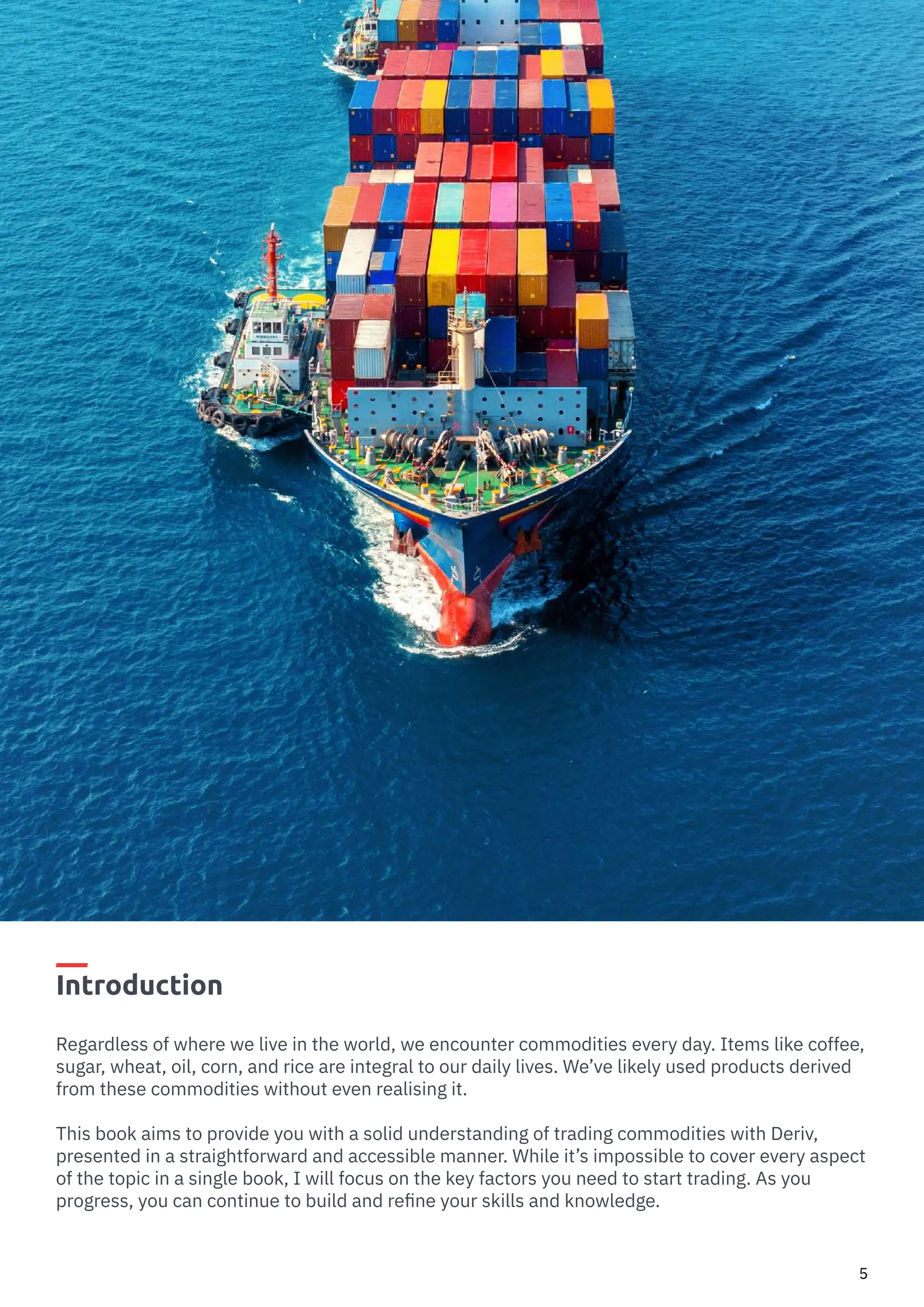
Regardless of where we live in the world, we encounter commodities every day. Items like coffee,
sugar, wheat, oil, corn, and rice are integral to our daily lives. We’ve likely used products derived
from these commodities without even realising it.
This book aims to provide you with a solid understanding of trading commodities with Deriv,
presented in a straightforward and accessible manner. While it’s impossible to cover every aspect
of the topic in a single book, I will focus on the key factors you need to start trading. As you
progress, you can continue to build and refine your skills and knowledge.
How to Trade Commodities Vince Stanzione
6
History of commodities trading
Commodities have a rich history, dating back to 4500 BC,
way before foreign exchange (forex) or stock trading began.
The earliest recorded commodity trading took place in
Ancient Mesopotamia between 4500 BC and 4000 BC.
People traded livestock and forms of commodity money,
such as shells, and later, gold and silver.
History also shows that in the 1700s, during Japan’s Edo
period, rice merchants stored their rice in warehouses and
issued receipts called “rice tickets.” These tickets detailed
the quantity and quality of the rice and initially served
as proof of ownership, allowing trade without physically
moving the rice. Over time, merchants and traders realised
they could sell these tickets for future delivery. This created
the first recorded form of futures contracts. These contracts
acted as promises to exchange rice and as a mode of raising
funds, eventually becoming their own form of currency.
The birth of commodities trading exchanges
The Chicago Board of Trade (CBOT) was founded in 1848 as a cash market for grain, marking
the inception of modern commodity trading exchanges. Forward or “to-arrive” contracts began
trading at the CBOT almost immediately, revolutionising the way commodities were bought and
sold. Over time, the CBOT merged with the Chicago Mercantile Exchange to form CME Group,
which today remains a major platform for commodities trading. To understand further, you can
visit the CME Group website.
Throughout its history, CME Group has acquired other prominent exchanges, including CBOT,
NYMEX, and COMEX. As a result, nearly all major products, such as crude oil, corn, cattle, copper,
and gold, are now traded on one of the CME Group exchanges.
In the UK, the London Metals Exchange is one of the few remaining exchanges that specialise in
industrial metals such as tin, aluminium, and zinc.
Similarly, in China, the Shanghai Futures Exchange (SHFE), established in 1993, focuses on
trading metals, energy, and chemical commodity products, contributing to the global landscape
of commodity trading.
The end of floor trading – Electronic trading
Open outcry commodities trading, as satirised in the 1983 film “Trading Places” with Eddie
Murphy and Dan Aykroyd, has now come to an end. However, the Frozen Orange Juice contract
still trades online. Instead of traders in bright jackets screaming at each other on trading floor
pits, today trading is nearly all done via trading screens.
Interesting fact
Japanese candlesticks, a
chart pattern still widely
used in today’s financial
markets, have their origins in
rice trading. This technique
was created by Munehisa
Homma, a Japanese
rice trader. I will explore
candlesticks further in the
technical analysis section.
How to Trade Commodities Vince Stanzione
7
The commodities trading doors are now open to everyone
Electronic trading has now allowed retail traders to join the market regardless of where they
reside. Anyone can place trades through online platforms such as the ones offered by Deriv
without having to depend on live brokers. These online platforms also offer trading charts, market
news and analysis, educational tools, and technical analysis programs. Information that was once
only available to professionals with large accounts and high fees is now accessible to all.
Another advantage of dealing with Deriv is that you can start trading commodities with a
relatively low starting balance, with some options available for less than USD 50. Additionally,
you can learn to trade and practice with a demo account using real prices and the MT5 platform,
all without any risk.
Why you should consider trading commodities
Many have been put off trading commodities due to worries that they are too complicated
and have unlimited risk. However, as I will explain in this book, risks can be managed, and
commodities are relatively straightforward to trade from either your mobile phone or laptop,
regardless of which country you reside in.
Flexibility
The majority of commodities trading is now done electronically, with prices readily available 24
hours a day. Commodities markets trade five days a week, from Sunday night at 10:00 pm (GMT)
to Friday at 9:00 pm (GMT). Some commodities may also take a one-hour break between 10:00
pm and 11:00 pm (GMT). You will find the exact trading times and specifications on the Deriv
website.
No ownership
Some also worry that if they do not close out a trade, they will end up taking delivery of the
commodities, and no one wants to have 20 tonnes of sugar on their doorstep! Rest assured, with
Deriv, this will never happen. You will be trading contracts for difference (CFDs) on commodity
prices. These are financial derivatives that allow you to trade the price movements of various
commodities without owning the underlying assets. They are “cash settled.” In other words,
you will never see the physical commodity. Funds will be credited or debited from your trading
account.
Profit from up and down moves
With Deriv, you’re not restricted to trading solely on rising prices; you can also potentially benefit
from downward price movements. As we go through this book, I will show you examples of both
scenarios.
You can also make a “pairs” trade, which consists of being long one commodity and short
another. For example, on Deriv MT5, you could go long on gold (XAUUSD) and short on copper
(XCUUSD), or short on silver (XAGUSD) and long on platinum (XPTUSD).
How to Trade Commodities Vince Stanzione
8
While the majority of those reading this will be looking to profit from trading commodities, it is
also possible to use a commodity contract for difference (CFD) to hedge an existing holding. For
example, if I own 100 ounces of gold at the current price of around USD 230,000 and believe gold
is starting to look weak, but I do not wish to sell my physical gold, I could place a short trade to
“hedge” my gold position. If gold goes down, I am hedged as my CFD will gain. If gold goes up,
then my CFD will decrease in value but my physical gold will increase. Hedging only makes sense
for a relatively short period of time.
Leverage
CFDs on commodities typically offer leverage, meaning you can control a large position with a
relatively small amount of capital. For example, with a leverage of 10:1, you could open a USD
100 position in gold with just USD 10. This leverage can amplify both gains and losses.
Managed risks
With Deriv, you can limit your risk and control your maximum exposure. For example, by setting
stop-loss orders, you can ensure that you never lose more than the amount you have decided to
risk.
Diversification
Trading commodities can help diversify your portfolio as they do not necessarily move in tandem
with other assets such as stocks, cryptocurrencies, or currencies. There have been decades
where commodities have performed better than the stock market and vice versa.
The dominance of the US dollar in commodities trading
The global settlement currency for commodities remains the US dollar. This is why you will see oil
trading and priced in USD, for example, USD 80 a barrel. Gold is also priced in USD, for example,
USD 2,300 an ounce.
Whilst you can settle transactions in other currencies, the US dollar remains king in the
commodities world. It’s worth noting that if the US dollar is weaker against the euro, it makes
oil, gold, or any other commodity cheaper in the local currency. Conversely, a strong dollar would
make it more expensive for someone buying gold in Indian rupees.
Commodities groups
There are a vast number of commodities that are traded around the globe; some are more
focused, like chemicals and coal. In this book, we will stick to the main commodities groups that
are widely traded. Please note that not all these categories are available on Deriv. Currently, only
metals and energies are offered.
How to Trade Commodities Vince Stanzione
9
Energies
This category includes crude oil, natural gas, heating oil,
and petrol. Energy commodities are crucial for powering
industries, transportation, and residential needs. Whilst
there is much talk about “green” energy such as wind and
solar reducing or eliminating the need for fossil fuels, we are
decades away from this becoming reality. Many parts of the
world still depend on coal as a primary energy source.
There are 2 primary crude oil markets: WTI, which
is West Texas Intermediate oil, and Brent crude oil, which is a
Europe-delivered oil. Both contracts can be traded with Deriv.
Livestock
This category includes live cattle, lean hogs, and feeder cattle. Livestock commodities are
essential for the meat and dairy industry.
Other energy commodities such as uranium and coal can be traded via investing in companies
that operate in those areas. Uranium now has its own exchange-traded fund (ETF) that tracks the
uranium price: Sprott Physical Uranium Trust Fund (U-UN.TO).
Metals
Precious metals like gold, silver, and platinum, as well as industrial metals like copper,
aluminium, palladium, zinc, and steel, fall into this category. Metals are widely used in various
industries, including construction, electronics, and manufacturing.
As previously stated, the move to clean energy and the electrification of transportation require
a massive quantity of metals. Copper plays a big part in electrification and is also used in air
conditioning and cooling. As many developing countries start to use more electricity and air
conditioning, copper demand increases. Electric vehicles, due to the significant use of batteries
and electric motors, are heavily dependent on copper and other metals.
Agricultural
Agricultural commodities encompass products such as wheat, corn, soybeans, cotton, coffee,
sugar, cocoa, rough rice, and orange juice. These commodities are vital for the food industry and
agricultural production.
Interesting fact
Green energy relies heavily
on commodities. For
example, solar panels use
silver, electric vehicles use
copper, and wind turbines
use a vast amount of steel.
Interesting fact
As the world’s population grows, especially in emerging economies, the demand for
protein-rich diets such as pork and beef increases. Consequently, the demand for animal
feed also rises.
How to Trade Commodities Vince Stanzione
10
Bloomberg commodities index
As well as individual commodities, there are also Exchange Traded Funds (ETFs) that trade a
basket of commodities, one of the best known being the Bloomberg Commodities Index.
This means that one trade would allow you to speculate on a basket of commodities. Think of the
Bloomberg Commodities Index as similar to a stock index, such as the S&P 500, which allows you
to trade a basket of stocks in one trade.
The most popular ETF is the US-listed Invesco DB Commodity Index Tracking Fund (DBC), which
is listed on the NYSE.
Commodity stocks or commodity futures?
In this book, I will concentrate on commodity futures (CFDs), which provide direct access to the
underlying price of commodities, such as gold. You can also gain exposure to gold by investing in
gold mining stocks or a basket of stocks via exchange-traded funds (ETFs) like the Gold Miners
ETF (NYSE: GDX), which can also be traded via a CFD.
Logic might suggest that if gold is performing well, gold mining stocks should also do well.
However, this is not always the case. While gold has increased in value in recent years, gold
mining stocks have not performed as well overall.
When you purchase a gold mining stock, you are exposed to various factors beyond the gold
price, such as management quality, environmental risks, mining costs, and political risks. Owning
a company that operates a gold mine and produces gold for the market is very different from
trading gold itself.
When you trade a gold futures contract or CFD, you eliminate these additional risks, making it a
pure trade on the price of gold. Although there is counterparty risk with your broker or exchange,
established entities like Deriv, which has been in business for over 25 years, present relatively
low counterparty risk.
I am not suggesting you should never trade commodity stocks, as there are opportunities,
particularly in takeovers and mergers. However, owning a gold mining stock does not guarantee
you will profit from an increase in the gold price. The same principles apply to other commodities
like oil, gas, and silver.
How to Trade Commodities
11
What you need to trade
commodities on Deriv MT5
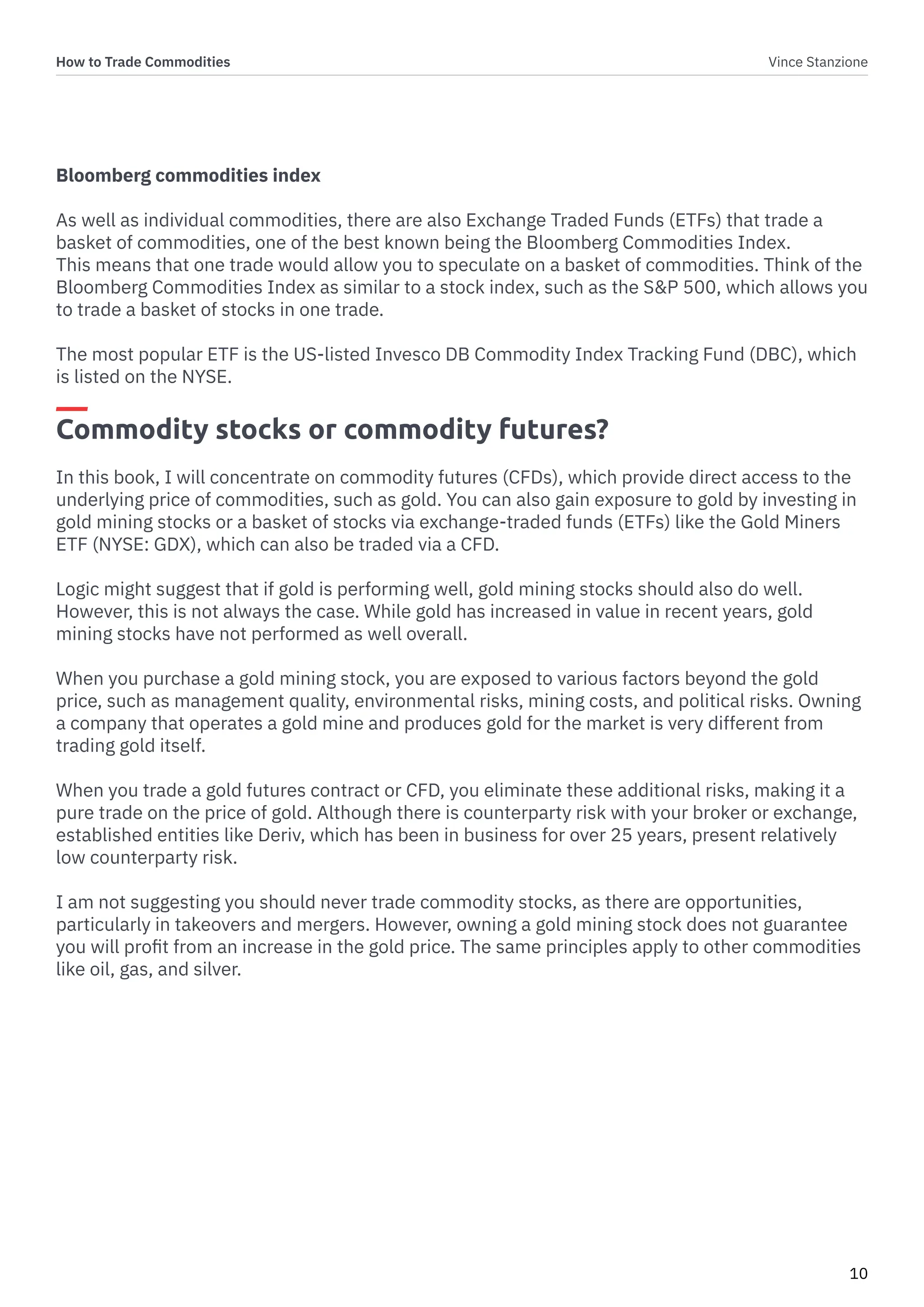
You will need an account with Deriv to
trade commodities. You can open both real
and demo accounts.
You will need to download the MT5 app,
which is available for free on the Apple
App Store or Android store. You can also
use MT5 on a Windows or Apple desktop
by using the Webtrader or downloading the
relevant app.
You can mix and trade via the mobile app
or desktop with the same account details.
Some traders prefer a larger screen
desktop setup for trading, but appreciate
the convenience of using the mobile
app for checking positions or making
adjustments.
Navigating MetraTrader 5 (MT5) for
beginners
For newcomers, the MetaTrader 5 (MT5)
platform may seem a bit overwhelming
at first glance. Fortunately, you can begin
with a demo account to practise trading
without risking real funds. This allows you
to familiarise yourself with the platform
and develop your trading strategies before
committing actual capital.
MetaTrader 5 boasts a substantial user
base, ensuring ample online resources and
tutorials are available to guide you. Deriv
Academy offers an excellent selection
of instructional videos to help you get
started. For more information, visit: Deriv
Academy. (Please note that this website
may not be accessible to EU residents.)
How to Trade Commodities Vince Stanzione
12
Essential trading specifications
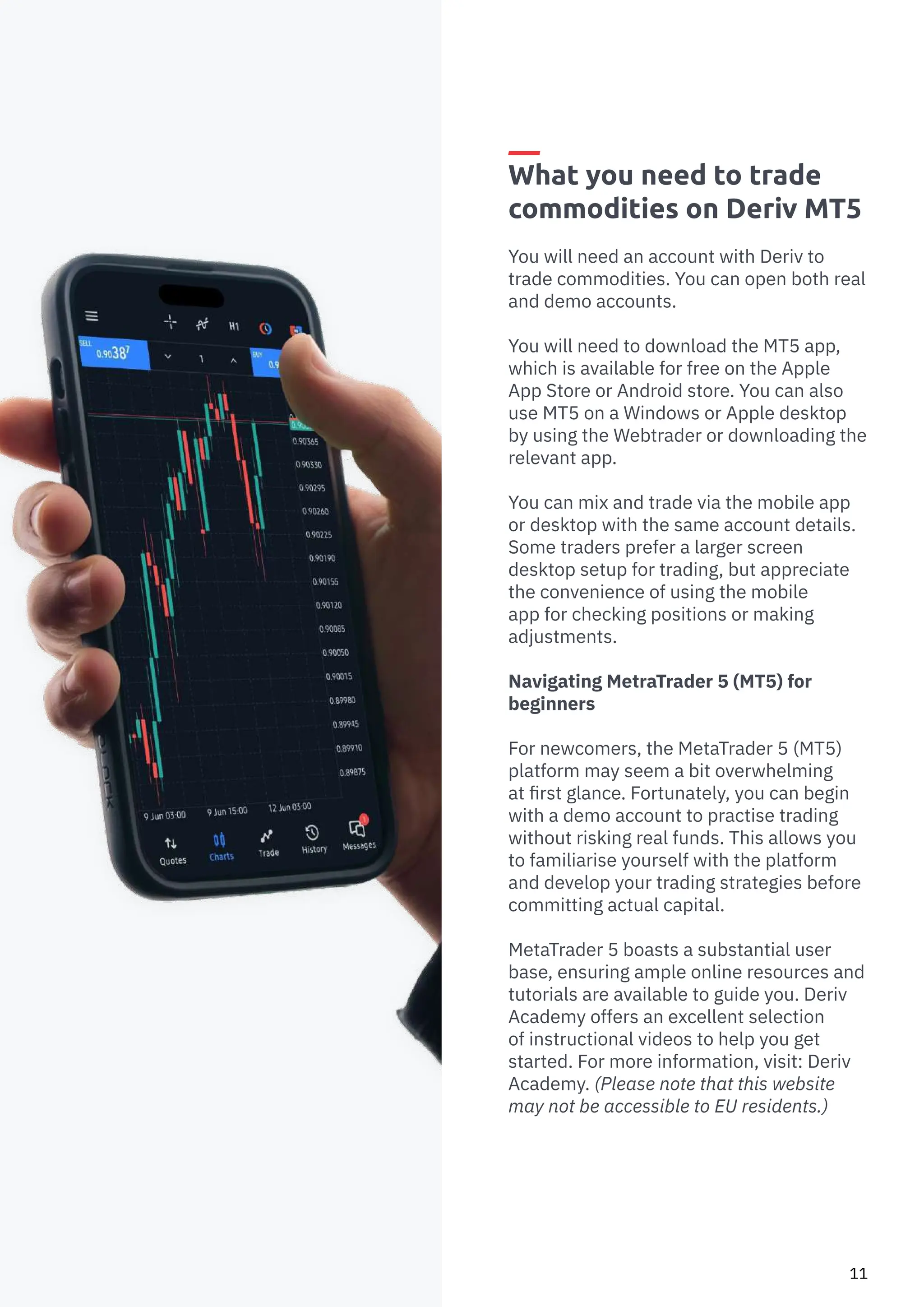
Keep this link handy: Deriv trading specifications. This resource provides important information
about the commodities available for trading on Deriv, including trading times, minimum trade
sizes, and leverage details. Within the MT5 app, selecting a product, such as Nat Gas, will display
its specific details, including minimum trade size, swap charges, and opening times.
Understanding trading times
Trading times are quoted in GMT, enabling you to access and trade commodities globally, but it’s
essential to account for official trading times. For instance, the trading hours for gold are:
• Sunday 23:05 - Friday 21:45
• Daily Break: 22:00 - 23:00 GMT
Contract for difference (CFD) rollover
When trading CFDs on Deriv, contracts roll over daily. Depending on whether you are long or
short, a swap charge may apply, or you might receive a payment if short. Deriv also offers some
swap-free contracts; however, to offset this, the spreads when opening and closing trades are
typically higher.
By familiarising yourself with these key aspects, you can better navigate MT5 and make informed
trading decisions on the Deriv platform.
A screenshot of the web MT5 terminal
How to Trade Commodities Vince Stanzione
13
Leverage
Understanding leverage in trading
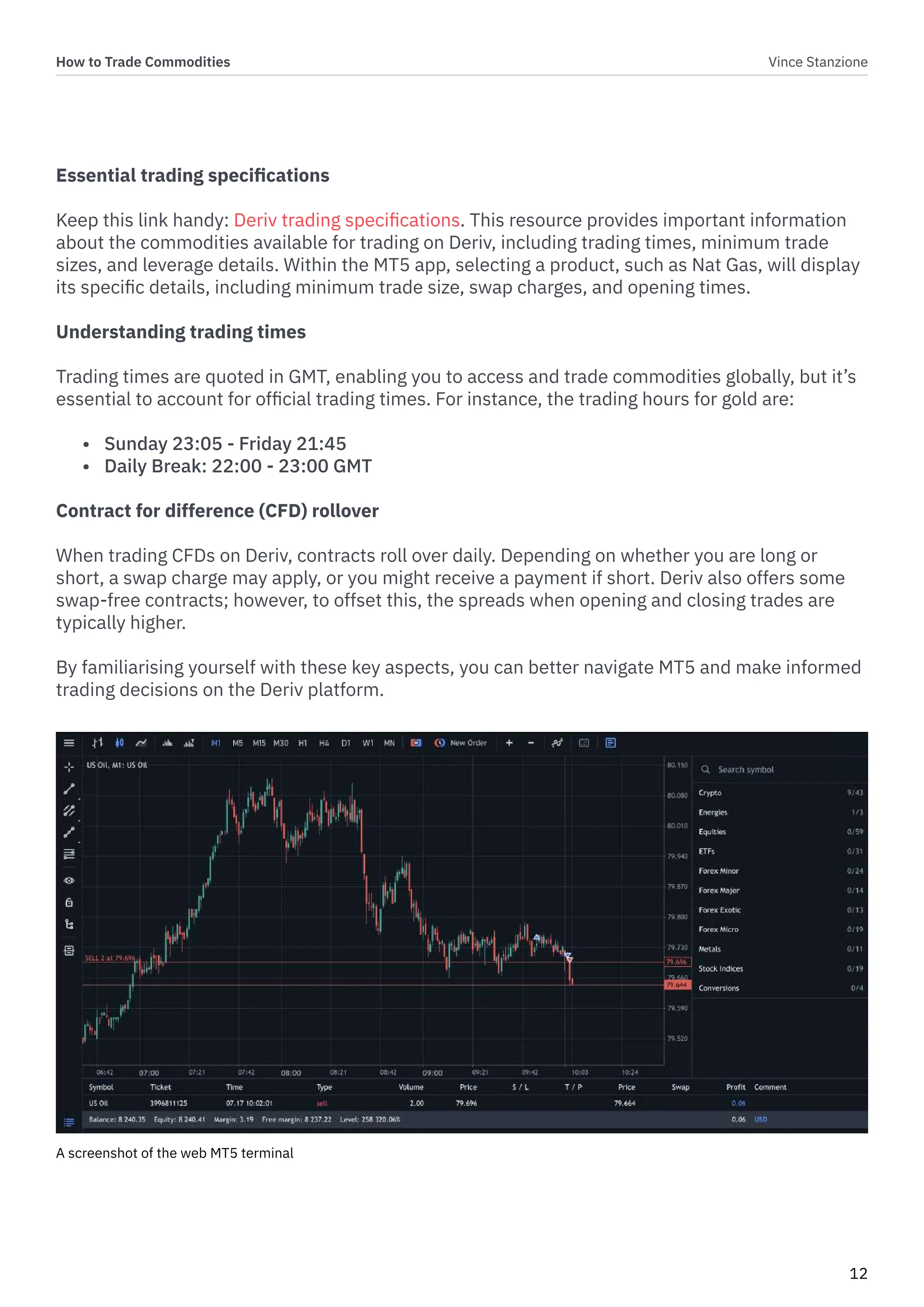
Leverage allows you to take a larger position than you would be able to with just buying a
commodity or share outright in cash. With leverage, you put up a deposit known as a “margin,”
and the broker lets you trade the rest on credit. The amount of leverage available to you depends
on the specific commodity and your location, as some countries impose lower leverage limits.
Example of leverage: Gold trading on Deriv
Using gold as an example, Deriv currently offers up to 1:500 leverage. This means that with a USD
1,000 deposit, you could control the equivalent of USD 500,000 worth of gold. However, there is
no mfree lunch in the financial world. A daily interest charge is applied for using this facility. For
short trades, you would receive a payment.
Financing rates depend on bank base rates and the individual broker. Deriv offers competitive
rates on financing, making it a favourable choice for traders.
The benefits and risks of leverage
Leverage is a good tool that Deriv offers across all its markets, but it must be used with caution.
Many new traders tend to utilise the maximum leverage available. However, it is often wiser to
use less leverage. Think of it like driving—you don’t always need to drive at the maximum speed
limit.
For instance, although you can obtain 1:500 leverage on gold, starting with a lower ratio, such
as 1:20, might be more prudent. While leverage can amplify profits when a trade moves in your
favour, it can also exaggerate losses when a trade moves against you, even by a small percentage.
Regardless of the trade’s outcome, you will still have to pay the financing costs which are
calculated on a daily basis.
How to Trade Commodities Vince Stanzione
14
Trading size
When trading in the futures market, you normally need to buy at least one contract, also known
as a LOT. The good news with Deriv is that you can trade smaller than the standard contract size.
You can find the minimum trading sizes at: Deriv trading specifications.
By understanding and carefully managing leverage and trading sizes, you can enhance your
trading potential while mitigating risks.
Risk management
Most new traders focus excessively on when to open a trade, whereas they should devote more
time to risk management and determining when to exit a trade. I would love to tell you that all my
commodity trades are profitable, but that is not the case. The truth is that a large percentage of
my trades either lose money or make a small profit (break-even trades).
The key to making money over time is by keeping losing trades relatively small. When I catch a
good trade, typically by following a trend, it compensates for the losses and generates a profit. I
will delve deeper into trading systems and risk sizing later on, but here is something important to
understand: never let a trade run more than 5% to USD 10 maximum against you.
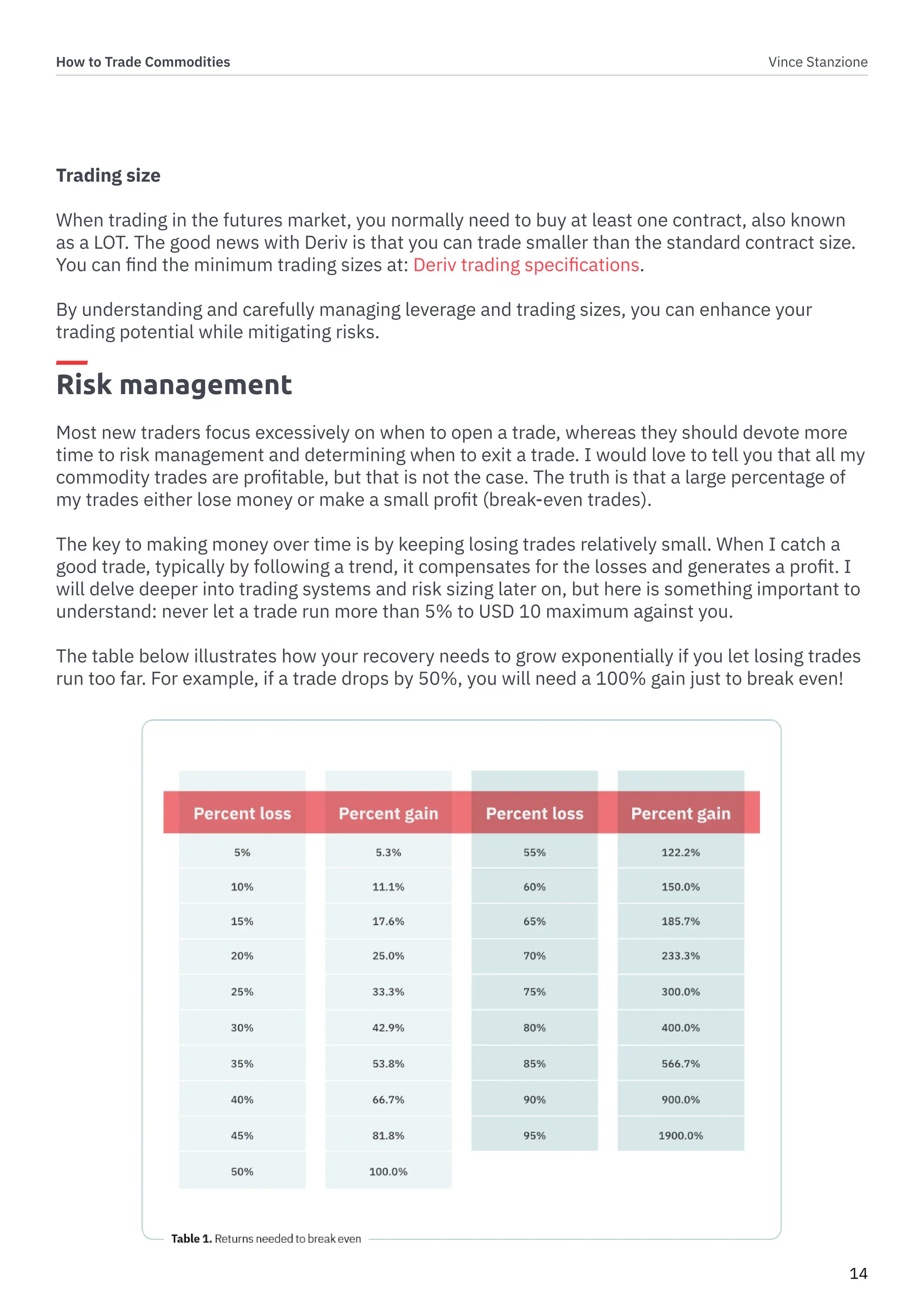
The table below illustrates how your recovery needs to grow exponentially if you let losing trades
run too far. For example, if a trade drops by 50%, you will need a 100% gain just to break even!
How to Trade Commodities Vince Stanzione
15
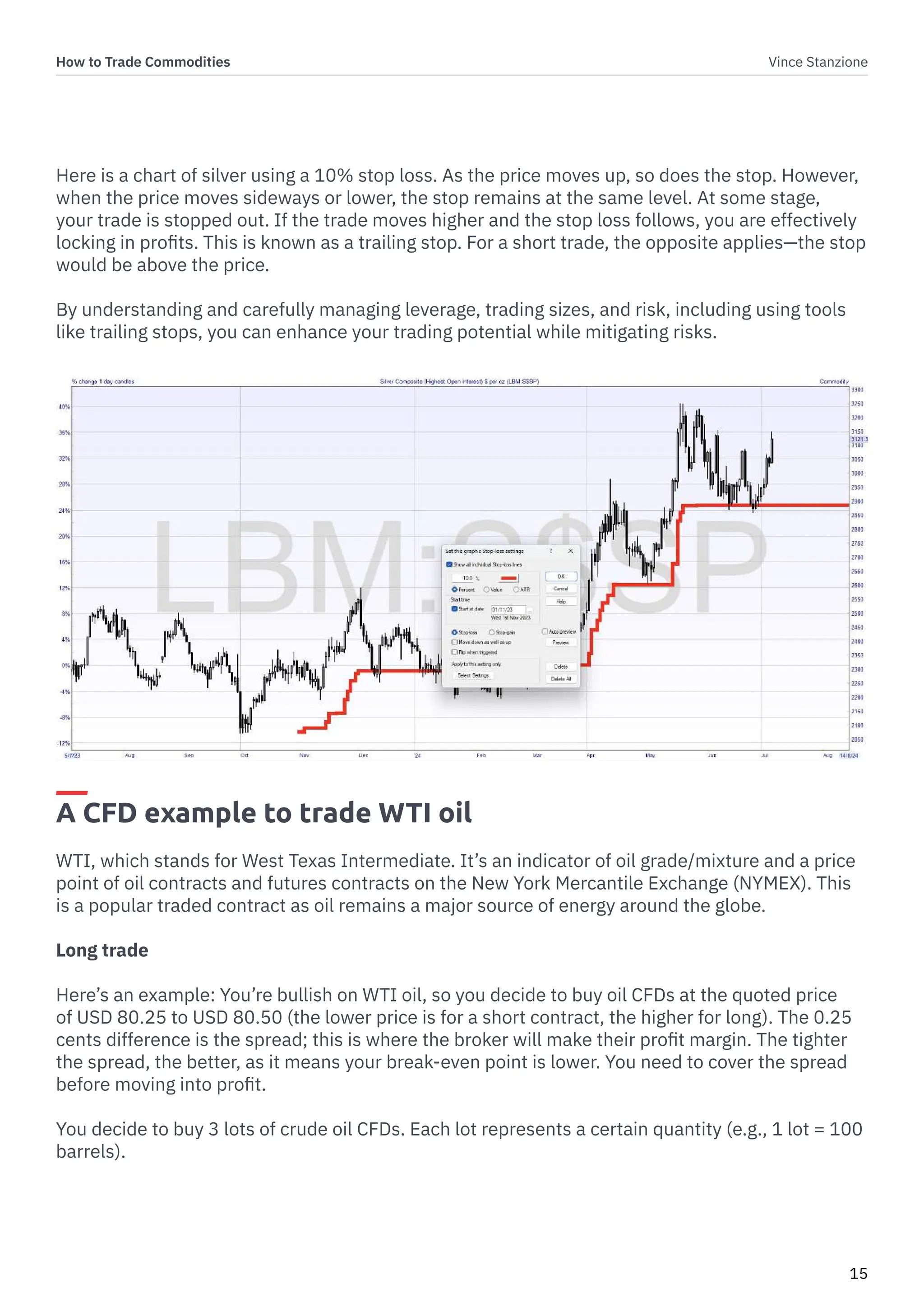
Here is a chart of silver using a 10% stop loss. As the price moves up, so does the stop. However,
when the price moves sideways or lower, the stop remains at the same level. At some stage,
your trade is stopped out. If the trade moves higher and the stop loss follows, you are effectively
locking in profits. This is known as a trailing stop. For a short trade, the opposite applies—the stop
would be above the price.
By understanding and carefully managing leverage, trading sizes, and risk, including using tools
like trailing stops, you can enhance your trading potential while mitigating risks.
A CFD example to trade WTI oil
WTI, which stands for West Texas Intermediate. It’s an indicator of oil grade/mixture and a price
point of oil contracts and futures contracts on the New York Mercantile Exchange (NYMEX). This
is a popular traded contract as oil remains a major source of energy around the globe.
Long trade
Here’s an example: You’re bullish on WTI oil, so you decide to buy oil CFDs at the quoted price
of USD 80.25 to USD 80.50 (the lower price is for a short contract, the higher for long). The 0.25
cents difference is the spread; this is where the broker will make their profit margin. The tighter
the spread, the better, as it means your break-even point is lower. You need to cover the spread
before moving into profit.
You decide to buy 3 lots of crude oil CFDs. Each lot represents a certain quantity (e.g., 1 lot = 100
barrels).
How to Trade Commodities Vince Stanzione
16
Using leverage of 20:1, you can place this trade with only a fraction of the total value. Let’s
calculate:
• Each lot is worth USD 80.50 (current price) × 100 barrels = USD 8,050.
• With 3 lots, the total trade value is USD 8,050 × 3 = USD 24,150.
• Leverage allows you to control this position with just USD 1,207.50 (20 times less than the
actual value), or in other words, just 5% required.
Note: Deriv may have much higher leverage ratios available, but for this example, we will use a 20:1 ratio. Additionally,
Deriv offers the opportunity to trade for less than 1 lot.
Later that day, WTI moved to 81.50/81.75. You decide to close out, selling at the bid price of
81.50. This means you have made USD 1 per contract, and with 300 contracts, your profit is USD
300. This is a 24.85% return on your outlay of USD 1,207.50. A relatively small move can give a
higher potential gain.
Of course, had WTI gone lower, you would have lost the same amount.
Note: The above is an example – not a recommendation.
Short trade
Let’s stay with WTI oil but this time consider going short (potentially profiting from a downward
move). WTI oil is now trading at USD 82.00/USD 82.25. You decide to sell (go short) 3 lots of
crude oil CFDs. Each lot represents a certain quantity (e.g., 1 lot = 100 barrels).
Using leverage of 20:1, you can place this trade with only a fraction of the total value. Let’s
calculate:
• Each lot is worth USD 82.00 (current price) × 100 barrels = USD 8,200.
• With 3 lots, the total trade value is USD 8,200 × 3 = USD 24,600.
• Leverage allows you to control this position with just USD 1,230 (20 times less than the actual
value), or in other words, just 5% required.
Note: Deriv may have much higher leverage ratios available, but for this example, we will use a 20:1 ratio. Additionally,
Deriv offers the opportunity to trade for less than 1 lot.
Later that day, WTI moved to 81.00/81.25. You decide to close out, buying to cover at the offer
price of 81.25. This means you have made USD 0.75 per contract, and with 300 contracts, your
profit is USD 225.
Of course, had WTI gone higher, you would have lost the same amount.
Note: The above is an example – not a recommendation.
How to Trade Commodities Vince Stanzione
17
For many, profiting from a commodity going down seems strange. However, over my career, I
have done very well trading markets both long and short. I may switch from one side to another,
such as being long on oil, trading the upward move, closing the trade, then opening a new short
trade.
Also, “commodities” is a general term, and they do not all move in the same direction. I might be
short on silver but long on copper. I could also be long on coffee but short on wheat.
Order types
Understanding the various order types available on Deriv
MT5 is essential for effective trading. These order types
are common across many trading platforms.
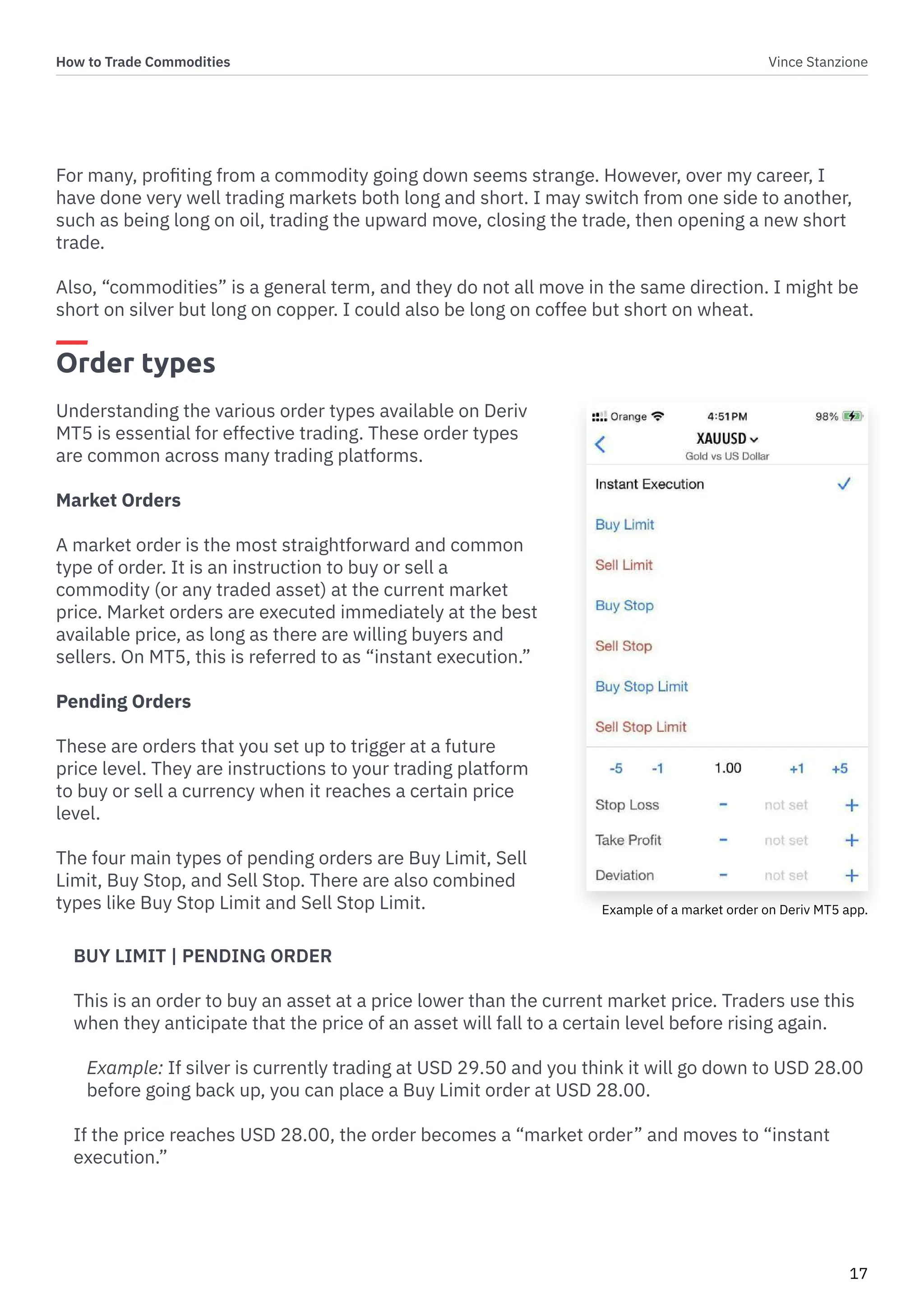
Market Orders
A market order is the most straightforward and common
type of order. It is an instruction to buy or sell a
commodity (or any traded asset) at the current market
price. Market orders are executed immediately at the best
available price, as long as there are willing buyers and
sellers. On MT5, this is referred to as “instant execution.”
Pending Orders
These are orders that you set up to trigger at a future
price level. They are instructions to your trading platform
to buy or sell a currency when it reaches a certain price
level.
The four main types of pending orders are Buy Limit, Sell
Limit, Buy Stop, and Sell Stop. There are also combined
types like Buy Stop Limit and Sell Stop Limit.
BUY LIMIT | PENDING ORDER
This is an order to buy an asset at a price lower than the current market price. Traders use this
when they anticipate that the price of an asset will fall to a certain level before rising again.
Example: If silver is currently trading at USD 29.50 and you think it will go down to USD 28.00
before going back up, you can place a Buy Limit order at USD 28.00.
If the price reaches USD 28.00, the order becomes a “market order” and moves to “instant
execution.”
Example of a market order on Deriv MT5 app.
How to Trade Commodities Vince Stanzione
18
SELL LIMIT | PENDING ORDER
A Sell Limit order is set to sell an asset at a price higher than the current market price. This
order is used when you anticipate the price will rise to a certain level before falling.
Example: If gold is trading at USD 2100, and you believe it will rise to USD 2150 before falling,
place a Sell Limit order at USD 2150.
Note: An order can be canceled as long as the price has not been triggered. Most orders are
GTC (Good ‘Til Canceled).
BUY STOP | PENDING ORDER
A Buy Stop order is set to buy an asset at a price higher than the current market price. Traders
use this when they expect the price to continue rising after reaching a certain level. This order
type can be used in breakout strategies, which will be covered later.
SELL STOP | PENDING ORDER:
A Sell Stop order is set to sell an asset at a price lower than the current market price. This order
is used when you expect the price to continue falling after hitting a certain level.
Example: If oil is trading at USD 81.00 and you want to go short if the price breaks the support
level at USD 80.00, you can place a Sell Stop order at USD 79.00.
BUY STOP LIMIT | PENDING ORDER
This is a combination of a Buy Stop order and a Buy Limit order. You set 2 prices: the stop price,
which triggers your order, and the limit price, which is the highest price you’re willing to pay.
If the market price reaches the stop price, a Buy Limit order is placed at the limit price. This is
used when you expect the price to rebound after reaching a specific level above the current
price.
SELL STOP LIMIT | PENDING ORDER
This is the opposite of a Buy Stop Limit order. You set 2 prices: the stop price and the limit
price. If the market price reaches your stop price, a Sell Limit order is placed at your limit price.
This is used when you expect the price to rebound after reaching a specific level below the
current price.
Take Profit
This is an order to lock in your profits. You set a Take Profit order at a specific price level above
or below the current price. If you’re long or buying a commodity (you’ve bought it expecting the
price to rise), you set the Take Profit above the current price. If you’re short or selling (you’ve sold
it expecting the price to fall), you set it below the current price. When the market hits this level,
your trade is automatically closed, and your profit is locked in.
How to Trade Commodities Vince Stanzione
19
Stop Loss
This is an order to limit your losses. It’s the opposite of a Take Profit. You set a Stop Loss order at
a specific price level. If you’re long or buying a currency, you set the Stop Loss below the current
price. If you’re short or selling, you set it above the current price. If the market hits this level, your
trade is automatically closed, and your loss is limited.
Key takeaways for order types
These orders help you trade without constantly monitoring the market, but they do not guarantee
profits. It’s essential to develop a solid understanding of market trends and dynamics and to have
a robust risk management strategy in place.
Remember, you can use a Deriv MT5 demo account to practice these orders in real market
conditions without taking any real risk.
How to Trade Commodities Vince Stanzione
20
How to Trade Commodities Vince Stanzione
21
Factors affecting commodities price
Let’s use gold as an example of what factors will move a commodity’s price. Of course, each
commodity has its own factors, but they do share similarities.
The key factors affecting gold’s price are:
Inflation
When a currency experiences greater than normal inflation, traders may prefer to store their
value in gold since it is relatively stable and has historically held its value well. In many ways,
gold can be seen as a currency rather than just a metal. Until 1971, the US dollar was actually
backed by gold.
Supply
Like other commodities, supply has the power to lower gold’s price if a market becomes
saturated or raise the price if scarce. New gold discoveries increase availability where there may
have been a shortage. This is also very relevant to oil prices. If there is a bumper harvest in Brazil
for coffee one year, thanks to good growing conditions, then supply will be plentiful, and this
will put downward pressure on prices as buyers (demand) have no problems finding supply. Of
course, if the reverse occurs, we would see buyers chase prices higher if supply is tight.
Unlike some consumable commodities such as oil and corn, gold is still tradeable even after
being used. If the price goes higher, it is more advantageous for miners to mine for new gold. If
the price drops, they may not mine as much, resulting in less supply in the market.
Demand
Demand for gold can be triggered by the demand for the metal in jewellery, industrial uses, and
trading. If demand is greater than supply, the price may go up. On the other hand, if demand is
low and the market has a surplus, the price may drop to attract buyers or it may rise depending
on buyer demand.
Higher prices can also bring out jewellery sellers that wish to cash out old or unwanted gold.
There are many outlets that offer “cash for gold” around the world. Also, scrap and recycling of
metals become more lucrative and viable when gold is at higher prices.
The US dollar
Gold is priced in dollars, making the US currency a player in how attractive the commodity is to
foreign investors. If someone trades in euros, pounds, or another currency, a devalued USD may
make the commodity more attractive, while a stronger dollar may have the adverse effect.
How to Trade Commodities Vince Stanzione
22
Geopolitical events
As a global metal, geopolitical events can affect the supply of gold. Such events can also
influence currency movements, altering the relative value of gold and potentially driving large
numbers of traders to or from this commodity.
Most commodities are exposed to geopolitical events, especially those with tight supply. For
example, the cocoa market is very sensitive to weather factors, but any political unrest in a major
producing country can sharply increase prices.
Similarly, oil prices are affected if a major oil-producing nation experiences unrest or war.
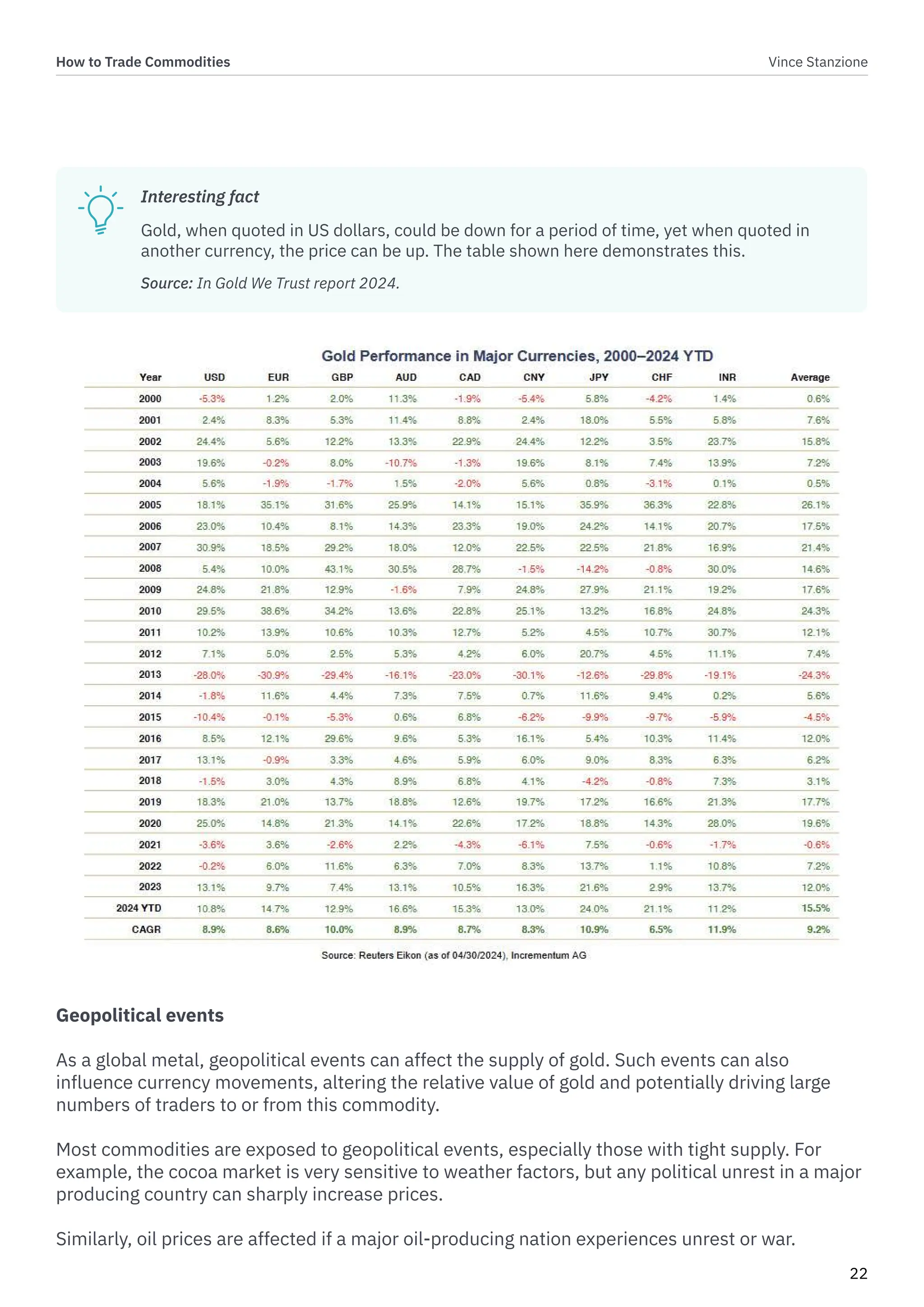
Interesting fact
Gold, when quoted in US dollars, could be down for a period of time, yet when quoted in
another currency, the price can be up. The table shown here demonstrates this.
Source: In Gold We Trust report 2024.
How to Trade Commodities Vince Stanzione
23
Participants in the commodities market
For simplicity, I will cover the 2 main participants in the commodities market. Most readers will
fall into the “speculators” category.
Hedgers/end users: Hedgers in commodities are typically producers or farmers. For example,
if I am a farmer growing corn, I can use the commodities futures market to lock in a price for
my crop today, which will be delivered in due course. This means I don’t have to worry about
the market price at the time of harvest.
End users, such as a confectionery maker like Mondelez, know they will need cocoa to make
their chocolate and other products. They can use the futures market to lock in a cocoa price
today to manage future price swings.
Similarly, an airline could use oil futures to project their running costs for years ahead. Since
fuel constitutes a large part of the airline’s operating costs, they could “hedge” this price 2 or 3
years out, providing stability in an unpredictable industry.
Speculators: In this book, we will focus on speculators, including myself. A speculator has
no interest in hedging or taking delivery of a commodity; our only goal is to profit from a
commodity moving up or down.
In the case of natural gas, which is used for heating and cooling (AC), colder-than-normal winters
or hot summers will cause prices to fluctuate. Of course, markets will have already factored in
seasonal factors and which months would be expected to see stronger or weaker supply, but it’s
the unexpected events that will cause large moves. You may be thinking, “If it’s unexpected, how
do I profit from this?” I will explain more in the next section.
Accessing seasonal charts for commodities is possible through resources like Seasonax. This
company analyses historical data to identify seasonal patterns. However, it’s important to
remember that history serves as a guide, not a guarantee.
Fundamentals in commodities
There are fundamentals or underlying factors that
influence the supply and demand dynamics, and
consequently the prices, of various commodities.
As mentioned earlier, factors such as demand,
supply, and geopolitical issues affect commodities.
Weather is also a fundamental factor that impacts
commodity prices. For example, in the case of
agricultural commodities like coffee, an expected
drought or frost could affect crops, reducing supply.
Brazil remains one of the largest coffee-producing
nations, followed by Vietnam.
Interesting fact
About 3 billion cups of coffee are
consumed around the world every
day, according to the International
Coffee Organization (ICO). If current
consumption trends continue, this
number is expected to double by 2050.
How to Trade Commodities Vince Stanzione
24
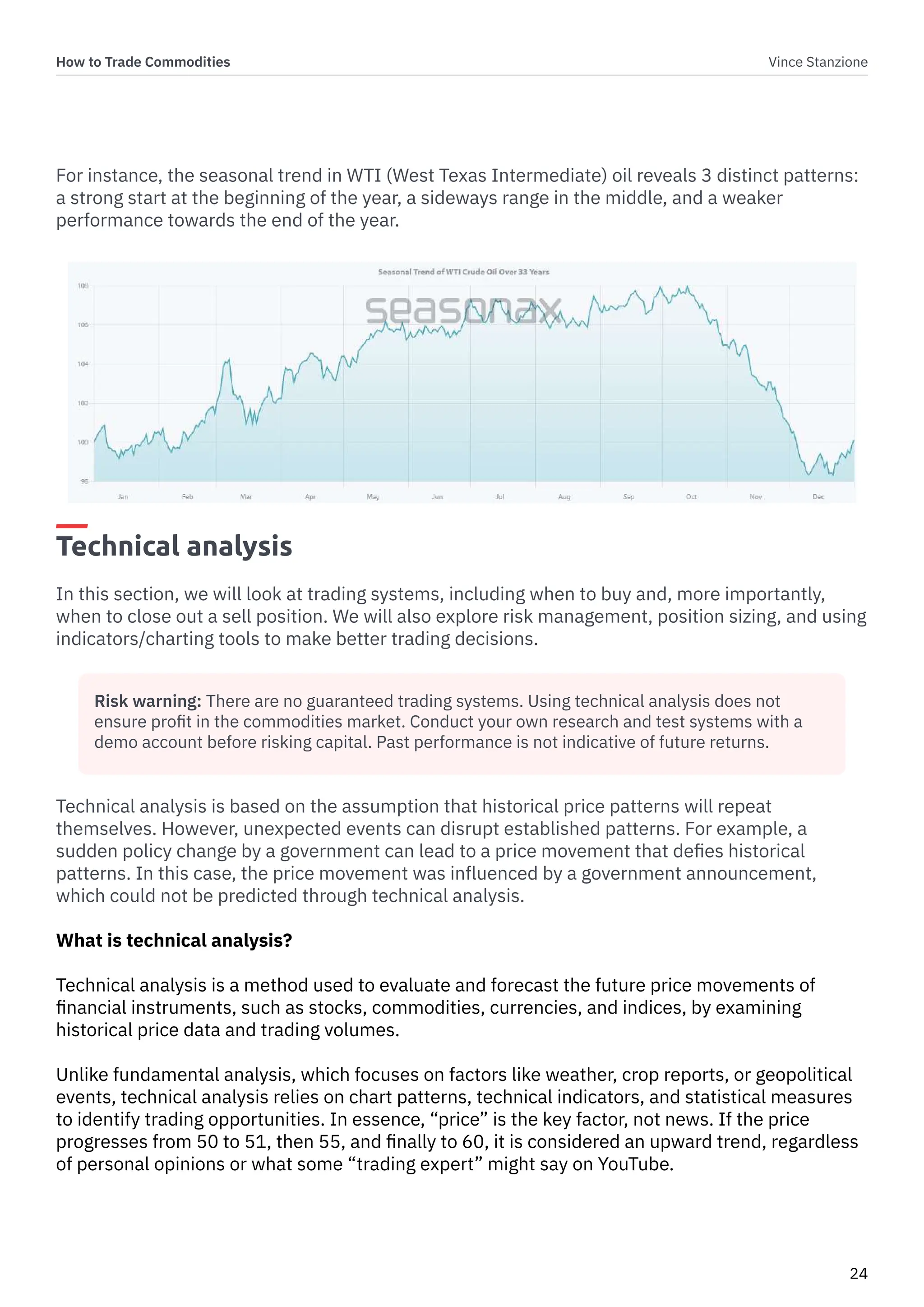
For instance, the seasonal trend in WTI (West Texas Intermediate) oil reveals 3 distinct patterns:
a strong start at the beginning of the year, a sideways range in the middle, and a weaker
performance towards the end of the year.
Technical analysis
In this section, we will look at trading systems, including when to buy and, more importantly,
when to close out a sell position. We will also explore risk management, position sizing, and using
indicators/charting tools to make better trading decisions.
Technical analysis is based on the assumption that historical price patterns will repeat
themselves. However, unexpected events can disrupt established patterns. For example, a
sudden policy change by a government can lead to a price movement that defies historical
patterns. In this case, the price movement was influenced by a government announcement,
which could not be predicted through technical analysis.
What is technical analysis?
Technical analysis is a method used to evaluate and forecast the future price movements of
financial instruments, such as stocks, commodities, currencies, and indices, by examining
historical price data and trading volumes.
Unlike fundamental analysis, which focuses on factors like weather, crop reports, or geopolitical
events, technical analysis relies on chart patterns, technical indicators, and statistical measures
to identify trading opportunities. In essence, “price” is the key factor, not news. If the price
progresses from 50 to 51, then 55, and finally to 60, it is considered an upward trend, regardless
of personal opinions or what some “trading expert” might say on YouTube.
Risk warning: There are no guaranteed trading systems. Using technical analysis does not
ensure profit in the commodities market. Conduct your own research and test systems with a
demo account before risking capital. Past performance is not indicative of future returns.
How to Trade Commodities Vince Stanzione
25
Key concepts of technical analysis
Price charts visually represent a commodity’s price movements over time, helping you analyse
trends and make informed decisions. They include:
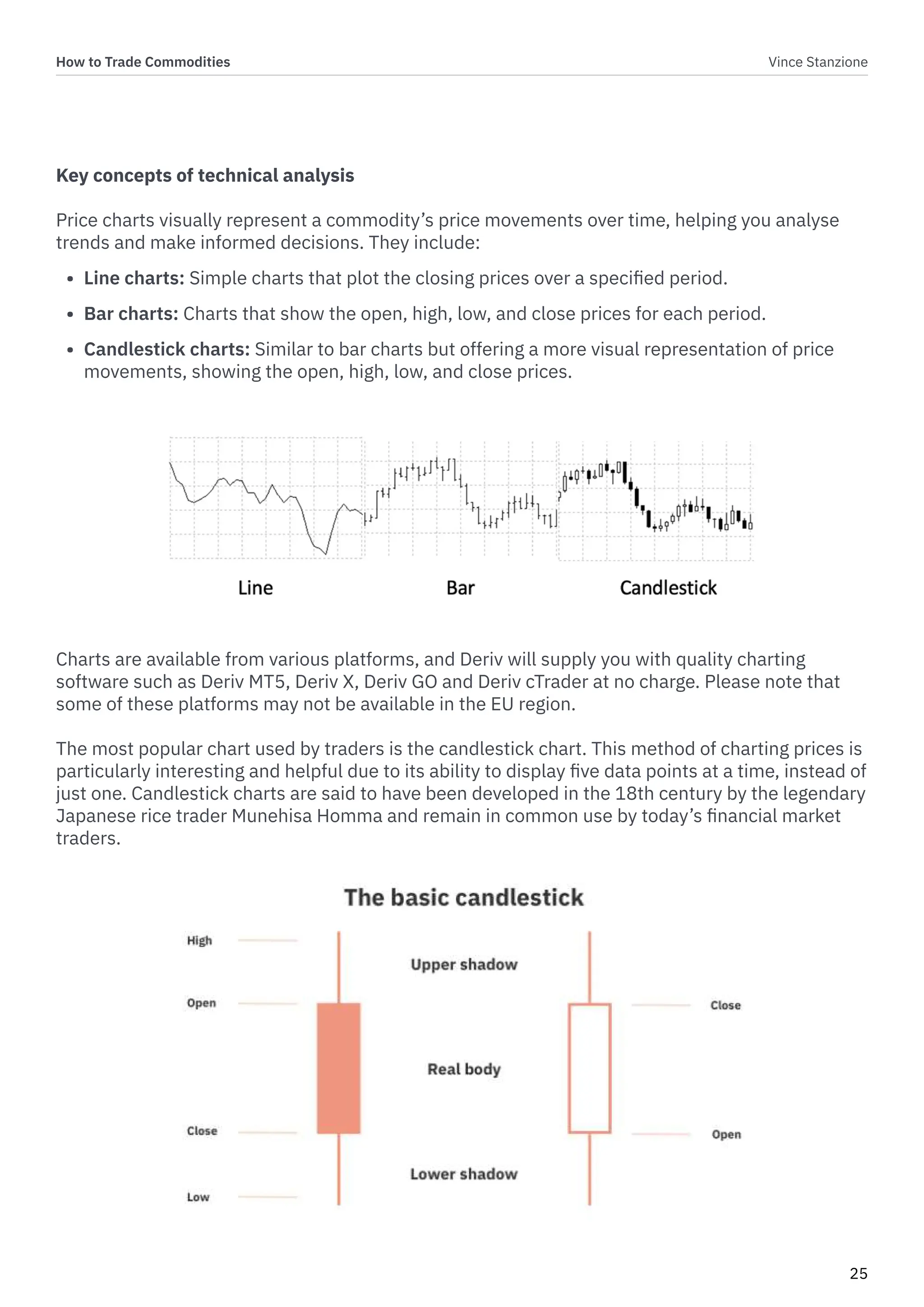
• Line charts: Simple charts that plot the closing prices over a specified period.
• Bar charts: Charts that show the open, high, low, and close prices for each period.
• Candlestick charts: Similar to bar charts but offering a more visual representation of price
movements, showing the open, high, low, and close prices.
Charts are available from various platforms, and Deriv will supply you with quality charting
software such as Deriv MT5, Deriv X, Deriv GO and Deriv cTrader at no charge. Please note that
some of these platforms may not be available in the EU region.
The most popular chart used by traders is the candlestick chart. This method of charting prices is
particularly interesting and helpful due to its ability to display five data points at a time, instead of
just one. Candlestick charts are said to have been developed in the 18th century by the legendary
Japanese rice trader Munehisa Homma and remain in common use by today’s financial market
traders.
How to Trade Commodities Vince Stanzione
26
Trends
A commodity can only be in 3 states:
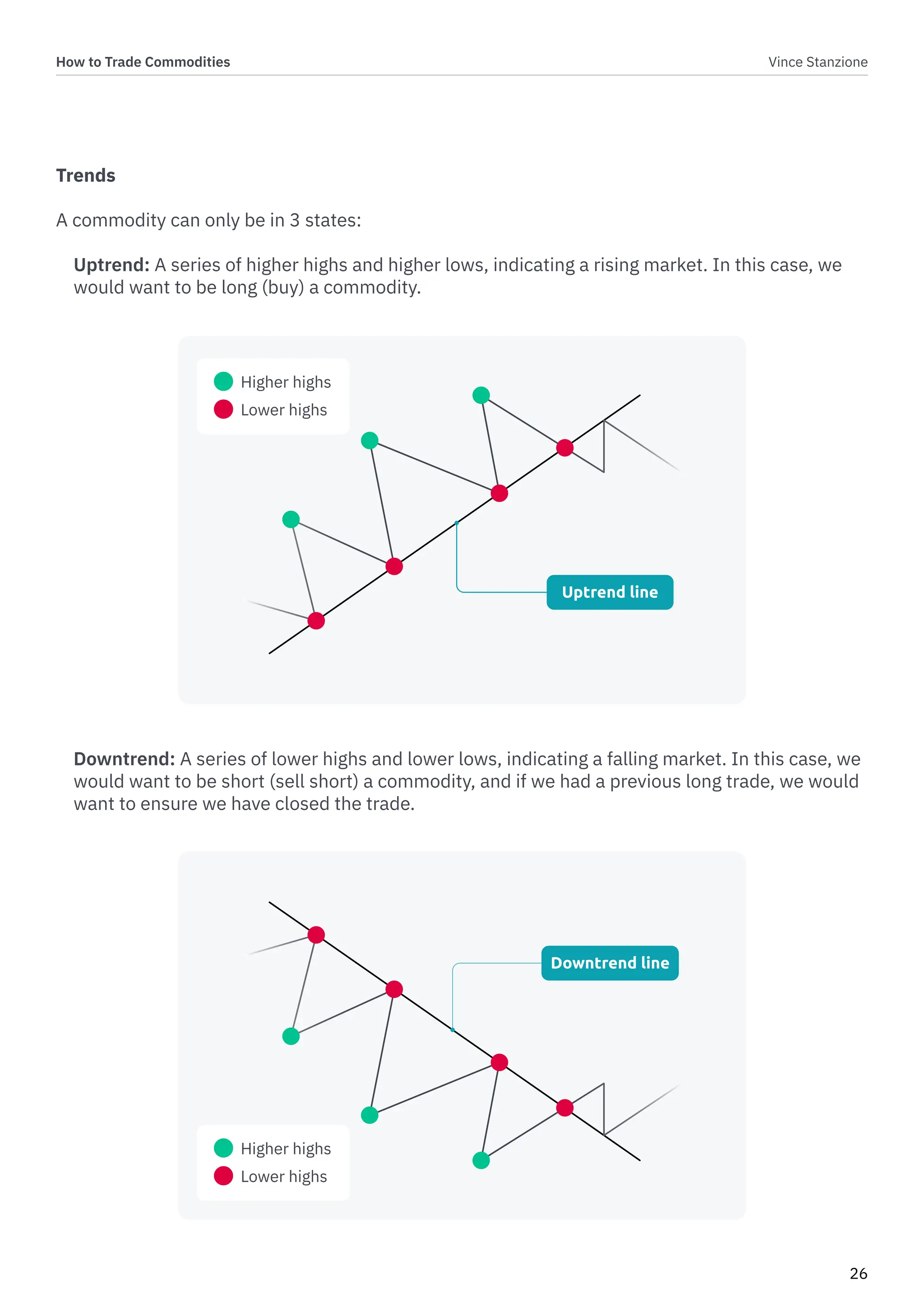
Uptrend: A series of higher highs and higher lows, indicating a rising market. In this case, we
would want to be long (buy) a commodity.
Downtrend: A series of lower highs and lower lows, indicating a falling market. In this case, we
would want to be short (sell short) a commodity, and if we had a previous long trade, we would
want to ensure we have closed the trade.
Higher highs
Lower highs
Uptrend line
Higher highs
Lower highs
Downtrend line
How to Trade Commodities Vince Stanzione
27
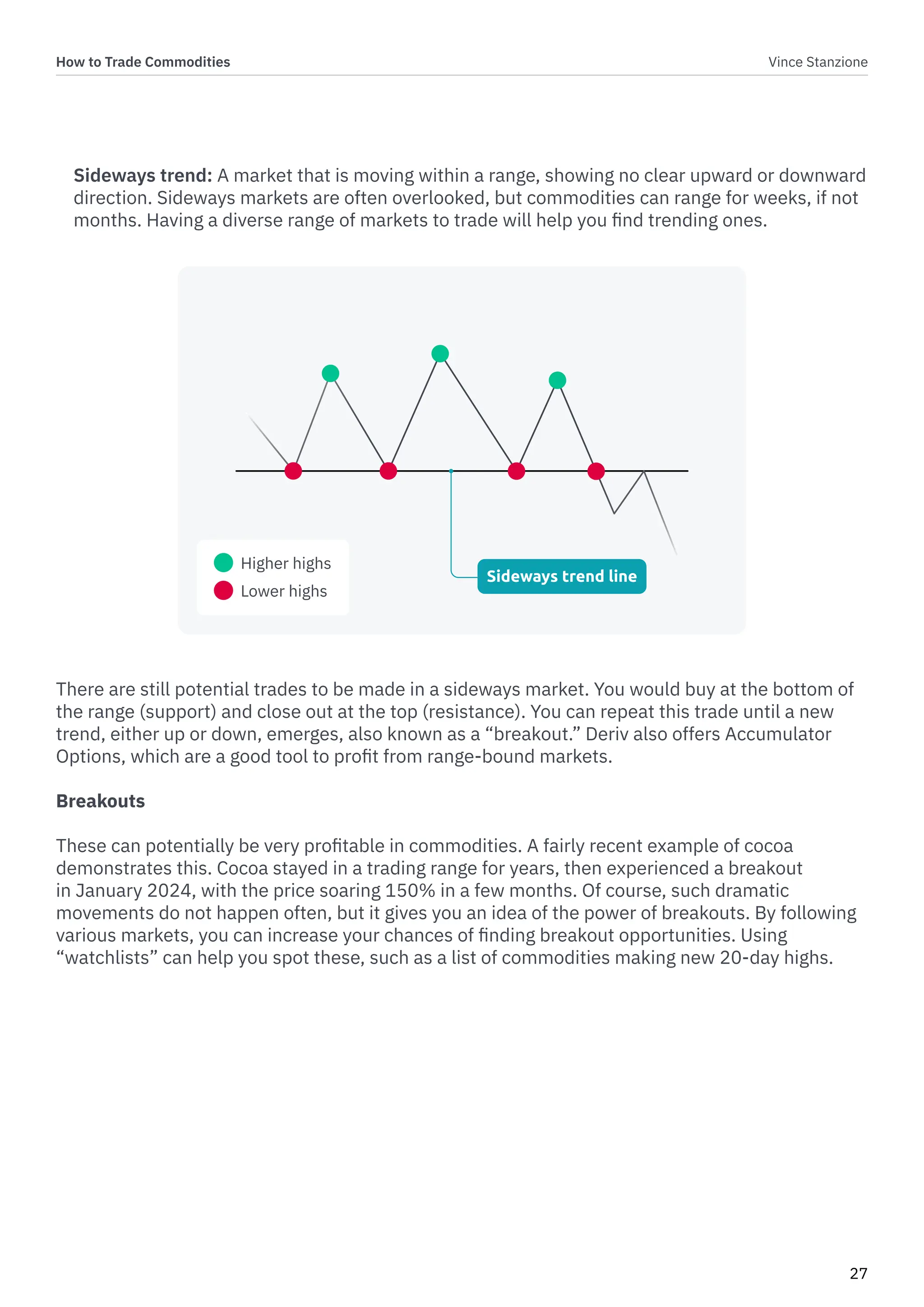
Sideways trend: A market that is moving within a range, showing no clear upward or downward
direction. Sideways markets are often overlooked, but commodities can range for weeks, if not
months. Having a diverse range of markets to trade will help you find trending ones.
There are still potential trades to be made in a sideways market. You would buy at the bottom of
the range (support) and close out at the top (resistance). You can repeat this trade until a new
trend, either up or down, emerges, also known as a “breakout.” Deriv also offers Accumulator
Options, which are a good tool to profit from range-bound markets.
Breakouts
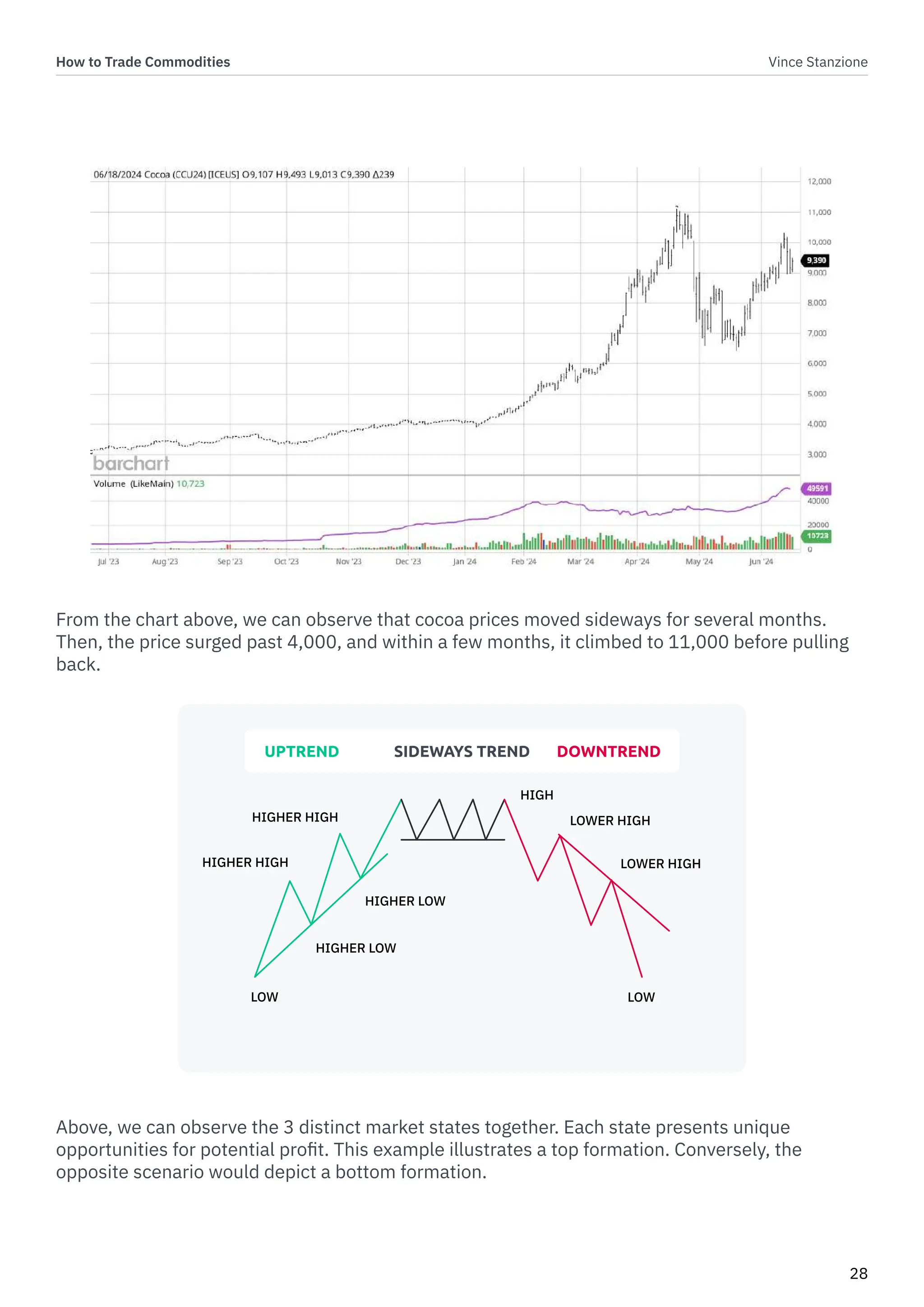
These can potentially be very profitable in commodities. A fairly recent example of cocoa
demonstrates this. Cocoa stayed in a trading range for years, then experienced a breakout
in January 2024, with the price soaring 150% in a few months. Of course, such dramatic
movements do not happen often, but it gives you an idea of the power of breakouts. By following
various markets, you can increase your chances of finding breakout opportunities. Using
“watchlists” can help you spot these, such as a list of commodities making new 20-day highs.
Higher highs
Lower highs
Sideways trend line
How to Trade Commodities Vince Stanzione
28
From the chart above, we can observe that cocoa prices moved sideways for several months.
Then, the price surged past 4,000, and within a few months, it climbed to 11,000 before pulling
back.
Above, we can observe the 3 distinct market states together. Each state presents unique
opportunities for potential profit. This example illustrates a top formation. Conversely, the
opposite scenario would depict a bottom formation.
UPTREND DOWNTREND
SIDEWAYS TREND
LOW
HIGHER LOW
HIGHER HIGH
HIGHER HIGH
HIGH
LOWER HIGH
LOWER HIGH
LOW
HIGHER LOW
How to Trade Commodities Vince Stanzione
29
Support and resistance
• Support: A price level where buying interest is strong enough to prevent the price from falling
further. For example, every time oil hits USD 60, buyers come in and support the market.
• Resistance: A price level where selling interest is strong enough to prevent the price from
rising further. For example, every time oil hits USD 80, sellers come in and resist the market.
Using charts, we can identify support and resistance areas. In the graphic of the three market
states, we see that the price is in a range but then breaks down lower. After three attempts,
support no longer holds, and a new downtrend starts. MT5 allows you to add support and
resistance lines to charts.
Technical indicators
I prefer to stick with a few basic indicators, as I like to keep my trading simple. I avoid
complicating my analysis with too many indicators, which can lead to confusion or what is
commonly known as ‘paralysis by analysis.’
Moving averages
Moving averages are used to smooth out price data and identify trends. Common types include
the Simple Moving Average (SMA) and the Exponential Moving Average (EMA). There are other
types of moving averages, such as the Variable Moving Average (VIDYA).
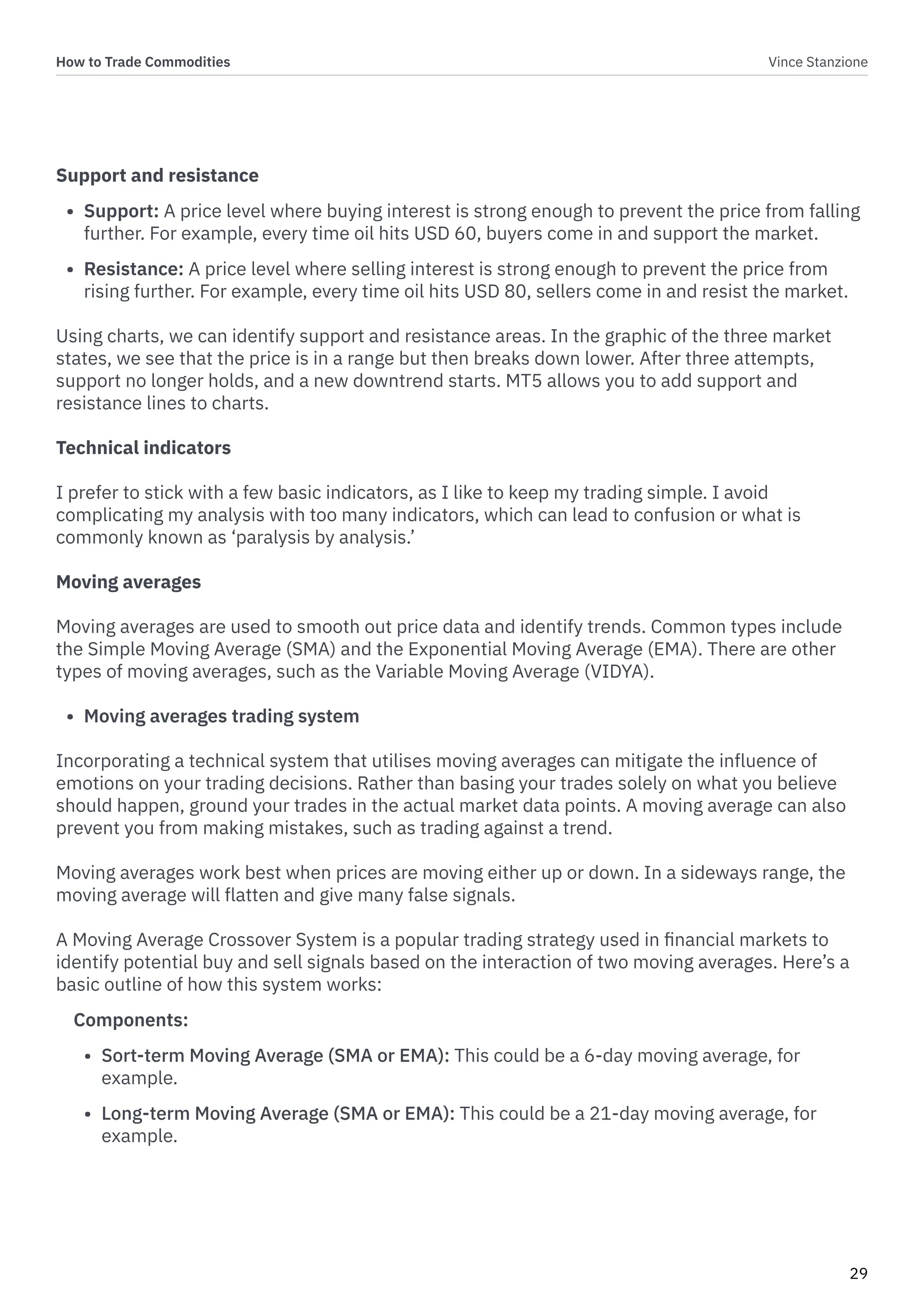
• Moving averages trading system
Incorporating a technical system that utilises moving averages can mitigate the influence of
emotions on your trading decisions. Rather than basing your trades solely on what you believe
should happen, ground your trades in the actual market data points. A moving average can also
prevent you from making mistakes, such as trading against a trend.
Moving averages work best when prices are moving either up or down. In a sideways range, the
moving average will flatten and give many false signals.
A Moving Average Crossover System is a popular trading strategy used in financial markets to
identify potential buy and sell signals based on the interaction of two moving averages. Here’s a
basic outline of how this system works:
Components:
• Sort-term Moving Average (SMA or EMA): This could be a 6-day moving average, for
example.
• Long-term Moving Average (SMA or EMA): This could be a 21-day moving average, for
example.
How to Trade Commodities Vince Stanzione
30
Signals:
• Buy Signal: When the short-term moving average crosses above the long-term moving
average, it indicates a potential upward trend.
• Sell Signal: When the short-term moving average crosses below the long-term moving
average, it indicates a potential downward trend.
You can also experiment with other combinations, and the time frames can be changed. For
example, a 21/6-day crossover system can become a 21/6-minute crossover system by changing
the chart timeframe.
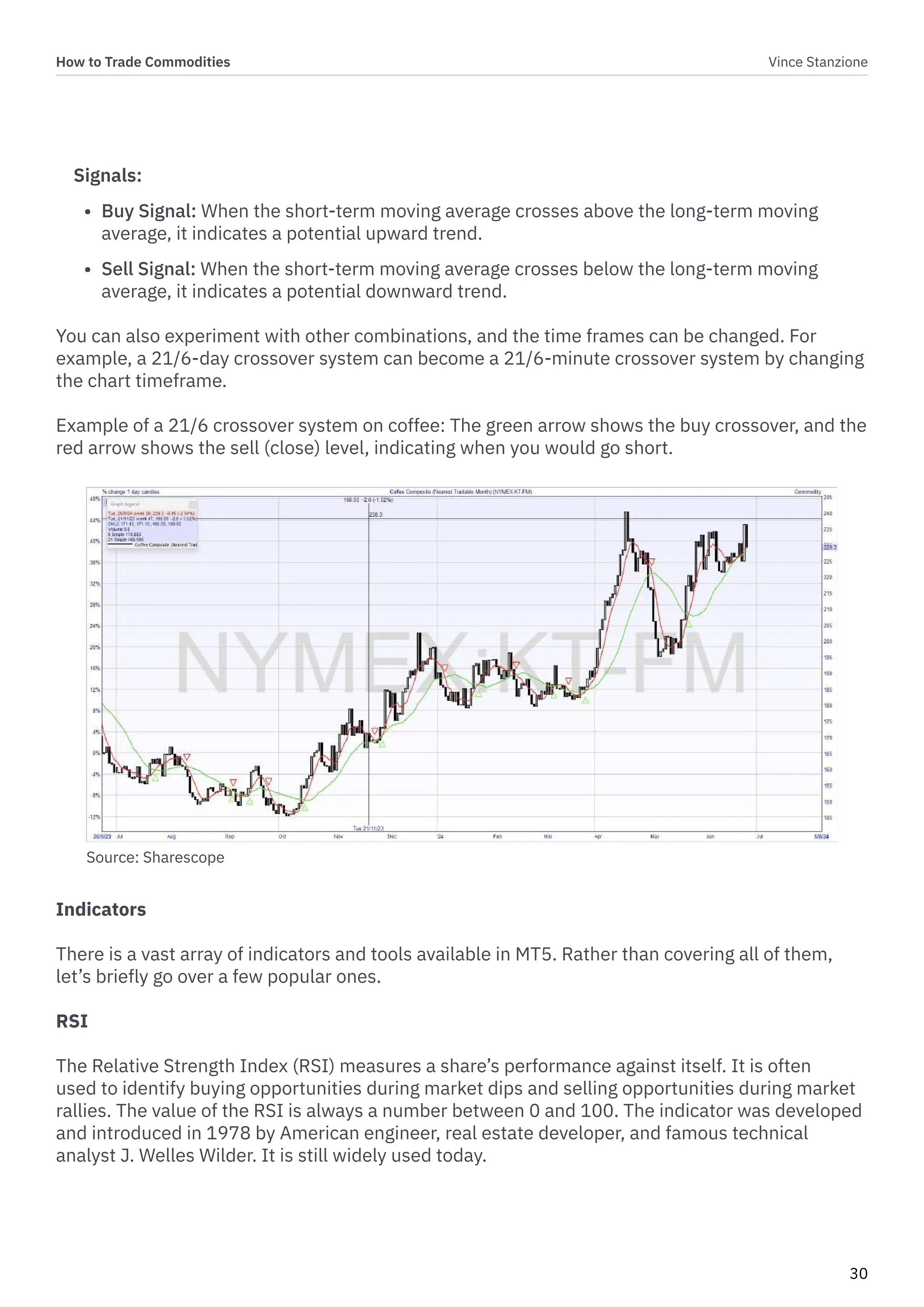
Example of a 21/6 crossover system on coffee: The green arrow shows the buy crossover, and the
red arrow shows the sell (close) level, indicating when you would go short.
Indicators
There is a vast array of indicators and tools available in MT5. Rather than covering all of them,
let’s briefly go over a few popular ones.
RSI
The Relative Strength Index (RSI) measures a share’s performance against itself. It is often
used to identify buying opportunities during market dips and selling opportunities during market
rallies. The value of the RSI is always a number between 0 and 100. The indicator was developed
and introduced in 1978 by American engineer, real estate developer, and famous technical
analyst J. Welles Wilder. It is still widely used today.
Source: Sharescope
How to Trade Commodities Vince Stanzione
31
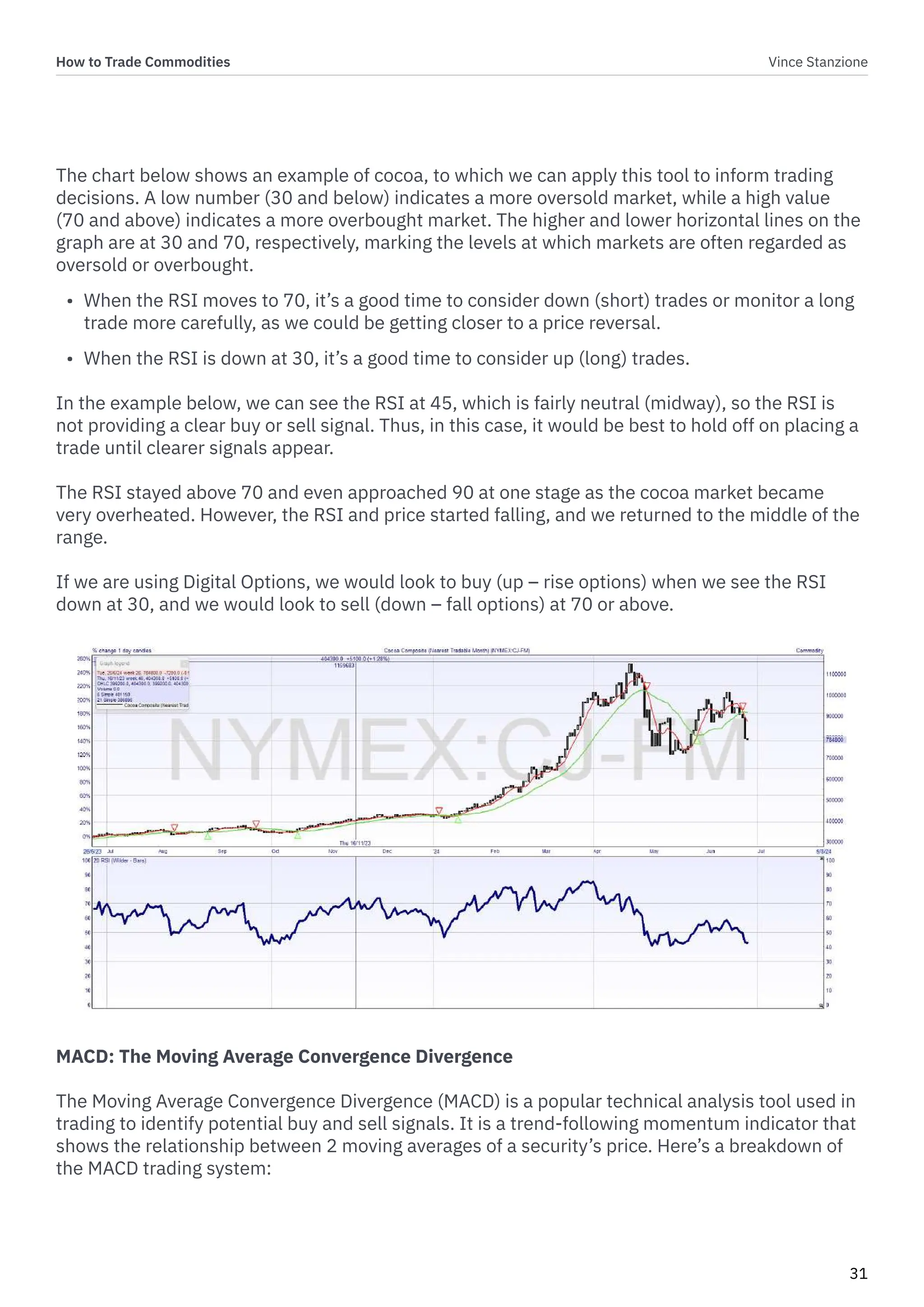
The chart below shows an example of cocoa, to which we can apply this tool to inform trading
decisions. A low number (30 and below) indicates a more oversold market, while a high value
(70 and above) indicates a more overbought market. The higher and lower horizontal lines on the
graph are at 30 and 70, respectively, marking the levels at which markets are often regarded as
oversold or overbought.
• When the RSI moves to 70, it’s a good time to consider down (short) trades or monitor a long
trade more carefully, as we could be getting closer to a price reversal.
• When the RSI is down at 30, it’s a good time to consider up (long) trades.
In the example below, we can see the RSI at 45, which is fairly neutral (midway), so the RSI is
not providing a clear buy or sell signal. Thus, in this case, it would be best to hold off on placing a
trade until clearer signals appear.
The RSI stayed above 70 and even approached 90 at one stage as the cocoa market became
very overheated. However, the RSI and price started falling, and we returned to the middle of the
range.
If we are using Digital Options, we would look to buy (up – rise options) when we see the RSI
down at 30, and we would look to sell (down – fall options) at 70 or above.
MACD: The Moving Average Convergence Divergence
The Moving Average Convergence Divergence (MACD) is a popular technical analysis tool used in
trading to identify potential buy and sell signals. It is a trend-following momentum indicator that
shows the relationship between 2 moving averages of a security’s price. Here’s a breakdown of
the MACD trading system:
How to Trade Commodities Vince Stanzione
32
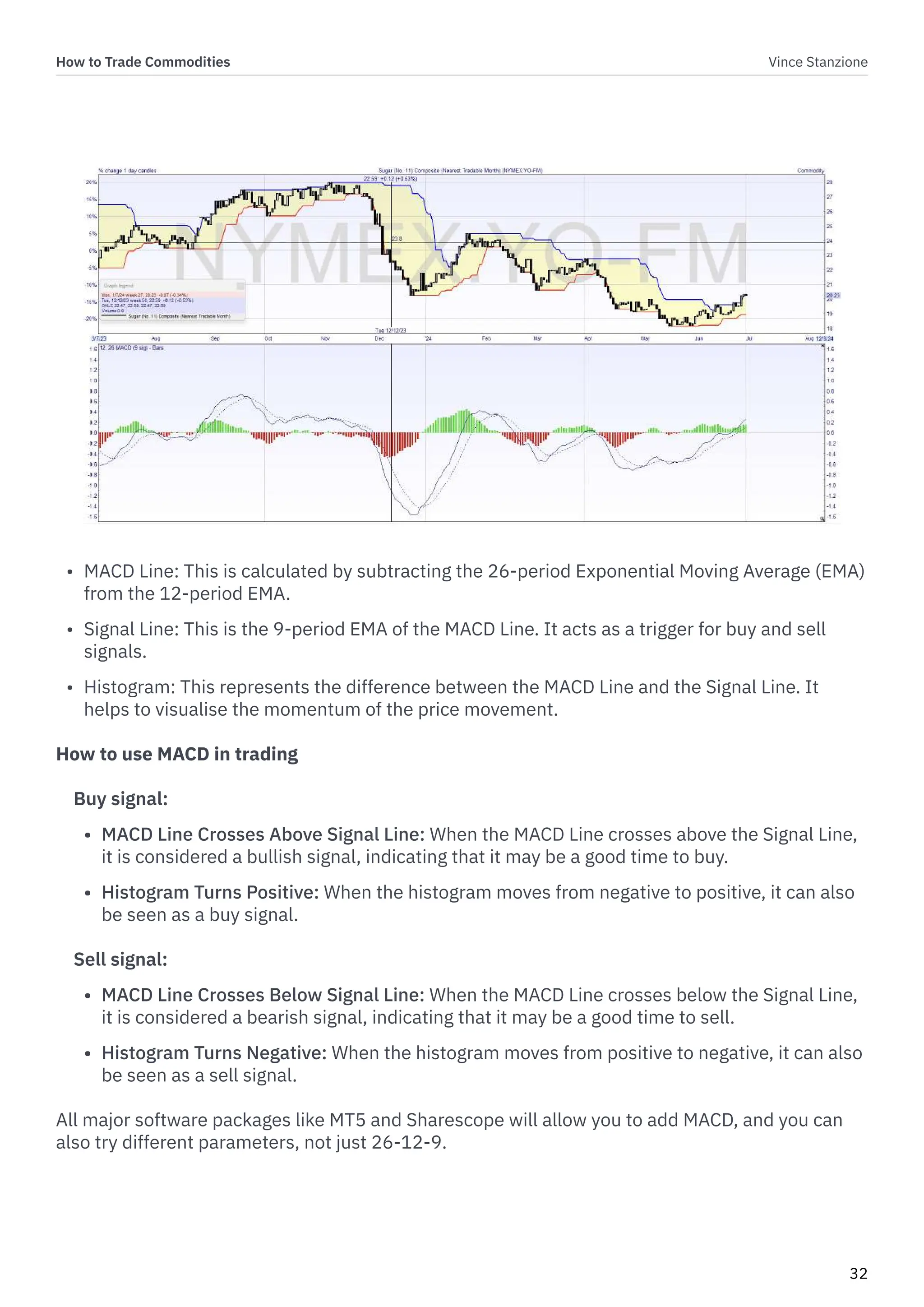
• MACD Line: This is calculated by subtracting the 26-period Exponential Moving Average (EMA)
from the 12-period EMA.
• Signal Line: This is the 9-period EMA of the MACD Line. It acts as a trigger for buy and sell
signals.
• Histogram: This represents the difference between the MACD Line and the Signal Line. It
helps to visualise the momentum of the price movement.
How to use MACD in trading
Buy signal:
• MACD Line Crosses Above Signal Line: When the MACD Line crosses above the Signal Line,
it is considered a bullish signal, indicating that it may be a good time to buy.
• Histogram Turns Positive: When the histogram moves from negative to positive, it can also
be seen as a buy signal.
Sell signal:
• MACD Line Crosses Below Signal Line: When the MACD Line crosses below the Signal Line,
it is considered a bearish signal, indicating that it may be a good time to sell.
• Histogram Turns Negative: When the histogram moves from positive to negative, it can also
be seen as a sell signal.
All major software packages like MT5 and Sharescope will allow you to add MACD, and you can
also try different parameters, not just 26-12-9.
How to Trade Commodities Vince Stanzione
33
Source: ShareScope
Chart Patterns
Technical analysts look for specific patterns in price charts, such as head and shoulders, double
tops and bottoms, triangles, and flags. These patterns can indicate potential future price
movements. I have written a guide called “10 Chart Patterns Every Pro Trader Should Know,”
which is available for free from Deriv. In this guide, I go into chart patterns in more depth. These
chart patterns are valid in commodities and other financial markets. Download your copy here.
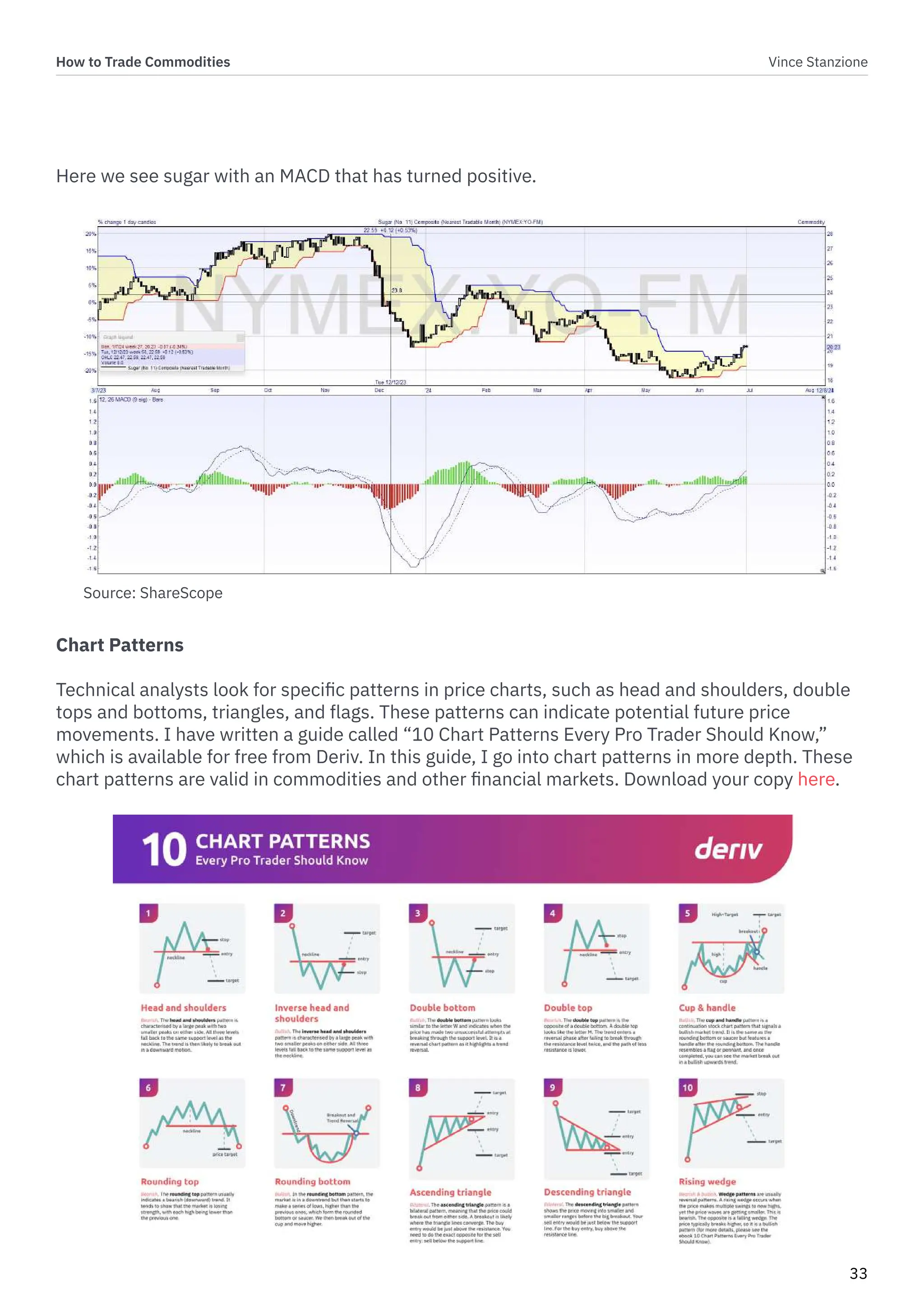
Here we see sugar with an MACD that has turned positive.
How to Trade Commodities Vince Stanzione
34
Volume Analysis: Analysing the volume of trading can provide insights into the strength or
weakness of a price movement. High volume on a price increase might indicate strong buying
interest, while low volume on a price increase might suggest a lack of conviction.
Time Frames: Technical analysis can be applied to different time frames, ranging from minutes,
hours, days, weeks, and even months, which would be very long-term. MT5 allows you to easily
switch and view different time frames.
My own style of trading is longer-term, and I use daily charts, so each bar represents one day,
and I am looking at 6 to 12 months. For shorter-term traders, using 1-minute, 10-minute, and
60-minute charts is worth considering.
Trading system ideas
Turtle trading in commodities
Turtle trading is a well-known trading strategy that was developed by Richard Dennis and William
Eckhardt in the 1980s. The strategy is based on a trend-following system that aims to capture
large market movements by entering trades in the direction of the prevailing trend. Here are the
key components of the turtle trading strategy:
1. Entry signals
Breakout method: The strategy typically involves entering a trade when the price breaks out
of a predefined range. For example, a common rule is to buy when the price exceeds the
highest high of the past 20 days and sell when the price falls below the lowest low of the
past 20 days.
2. Position sizing
Volatility-based position sizing: The position size is determined based on the volatility of
the asset. The more volatile the asset, the smaller the position size. This is often calculated
using the Average True Range (ATR) indicator. This is available on many websites and some
software, so you do not need to calculate it by hand.
3. Risk management
Fixed fractional risk: The strategy involves risking a fixed percentage of the trading capital
on each trade. For example, a trader might risk 1% or 2% of their capital on any single trade.
Stop losses: Stop losses are placed to limit potential losses. These are often set at a multiple
of the Average True Range (ATR) below the entry price for long positions and above the entry
price for short positions.
A reminder: a stop loss is an order you give to your broker that, if the price reaches a certain
level, your sell or buy order will become a market order and be executed. This means you
don’t have to keep watching the market all the time.
How to Trade Commodities Vince Stanzione
35
4. Exit signals
Trailing stops: The strategy uses trailing stops to lock in profits as the trade moves in the
trader’s favour. The trailing stop is often set at a multiple of the ATR.
Breakout in the opposite direction: Another exit signal is when the price breaks out in the
opposite direction of the trade. For example, if a long position was entered on a 20-day high
breakout, the position might be exited if the price falls below the lowest low of the past 10
days.
You can learn more about ATRs at Investopedia.
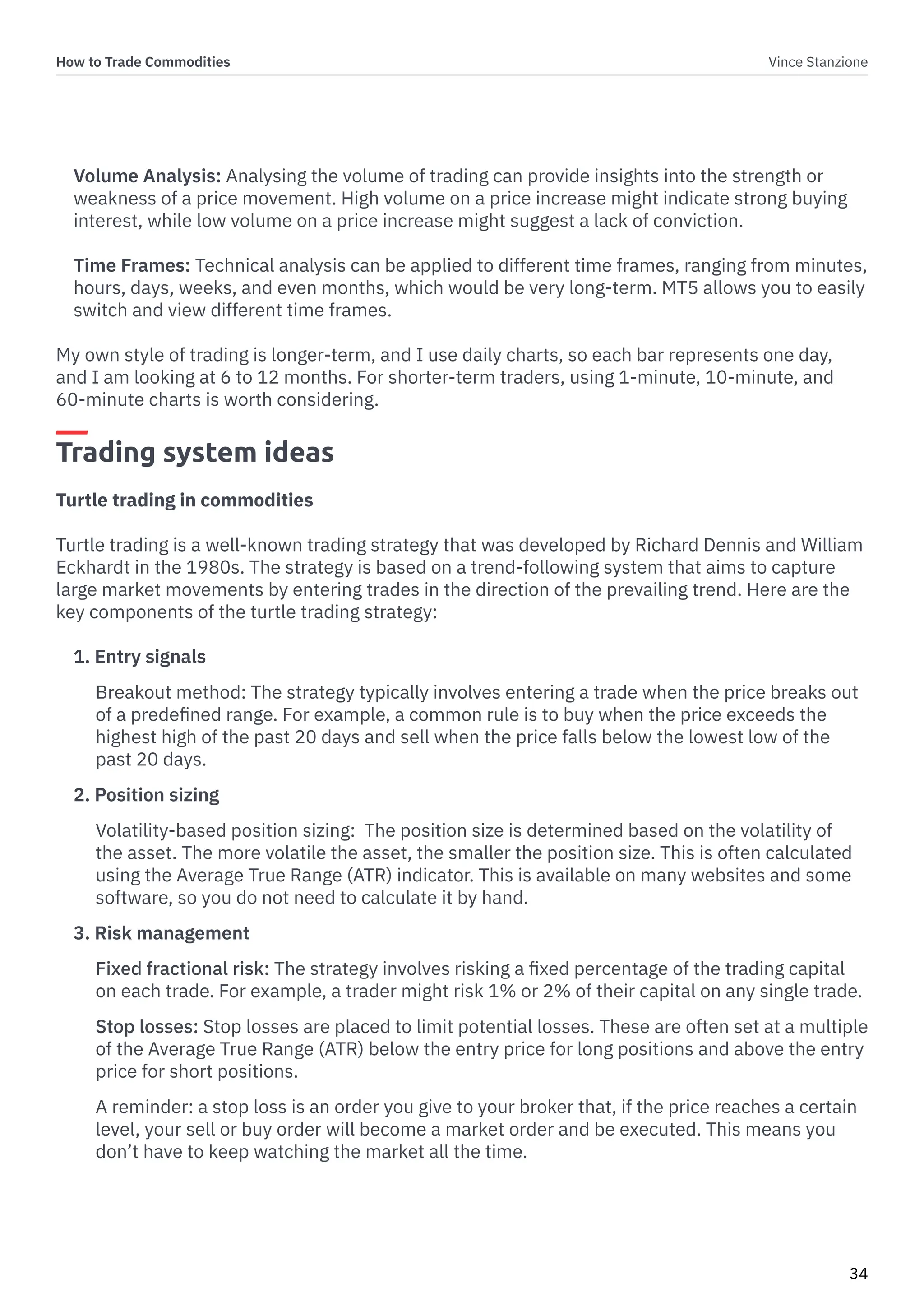
ATR example source: Barchart.com
Adaptations
The time frames can be reduced for short-term systems; for example, you could have a 20-hour
high breakout and exit on a 10-hour low. I have also seen 20-minute highs and 10-minute lows
for very short-term systems. Worth mentioning are Donchian channels, which are the basis for
the Turtle Traders system entry.
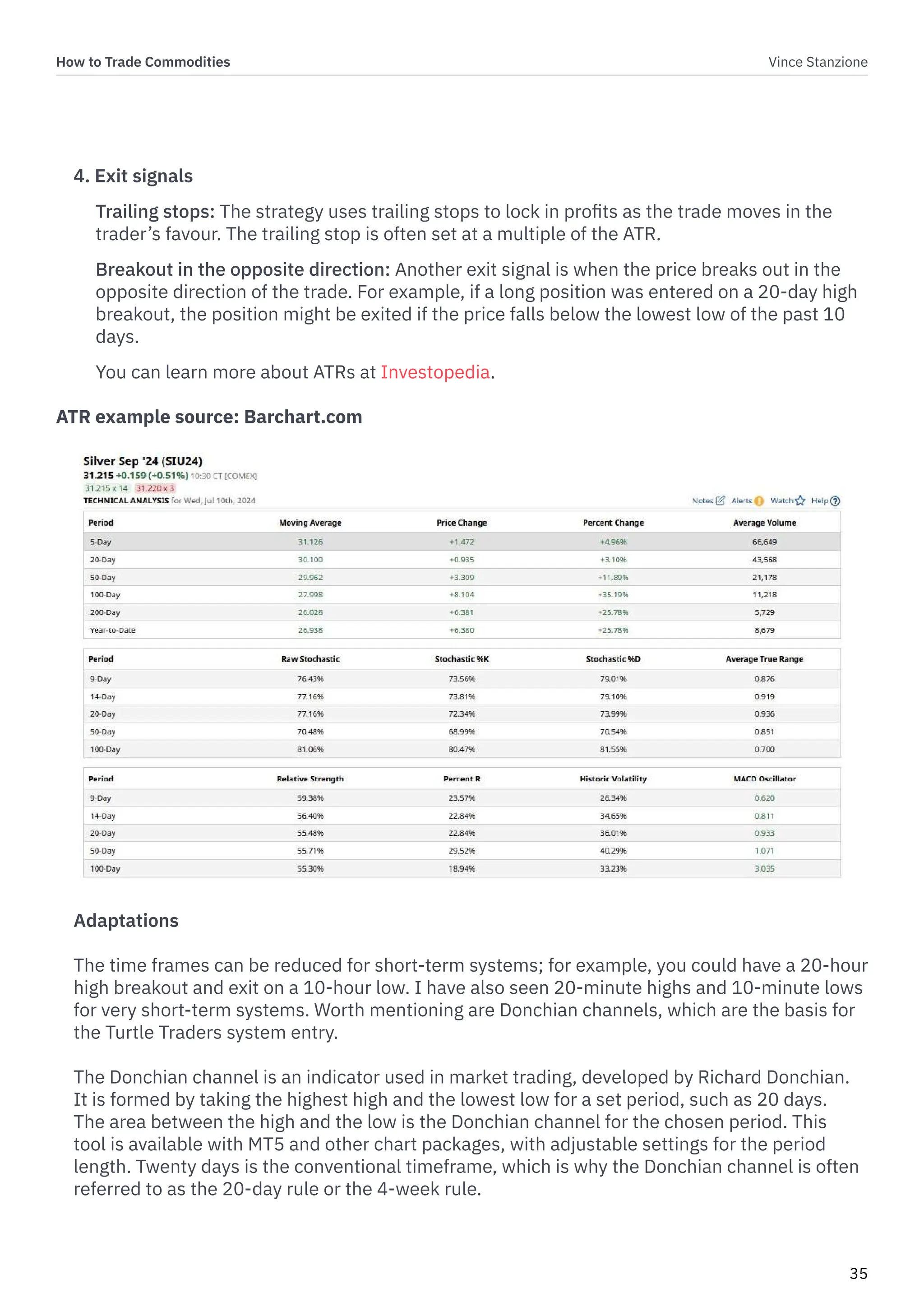
The Donchian channel is an indicator used in market trading, developed by Richard Donchian.
It is formed by taking the highest high and the lowest low for a set period, such as 20 days.
The area between the high and the low is the Donchian channel for the chosen period. This
tool is available with MT5 and other chart packages, with adjustable settings for the period
length. Twenty days is the conventional timeframe, which is why the Donchian channel is often
referred to as the 20-day rule or the 4-week rule.
How to Trade Commodities Vince Stanzione
36
While basic, this system has some powerful advantages:
• Winning trades are left to run.
• You have an exact exit strategy (no guessing).
• The system is rule-based.
• Your risk is always defined.
Even with more losing trades than winning ones, there’s a chance you can still make money as
long as the winning trades gain more points than the losing ones. You can also profit from down
moves as well as up moves.
ATR example source: Barchart.com
Digital options
So far, I have concentrated on contracts for difference (CFDs), which make up most of the
trading. Deriv also offers digital options, currently available on the Deriv Trader and SmartTrader
platforms. Gold, silver, platinum, and palladium are currently offered. Other markets may be
available in due course. Deriv CFDs offer a bigger choice, but it’s also worth considering digital
options. You can trade CFDs and digital options simultaneously.
A digital option allows you to back your view on a market going up or down with a fixed risk, such
as USD 10, and to know what your potential return will be. Digital options can last from 5 minutes
to 365 days, providing plenty of flexibility. Most types of options can also be sold before expiry, so
if you wish to take your profits or close out early with a loss and change your view, you can do this
as a resell price is offered.
Source: ShareScope
How to Trade Commodities Vince Stanzione
37
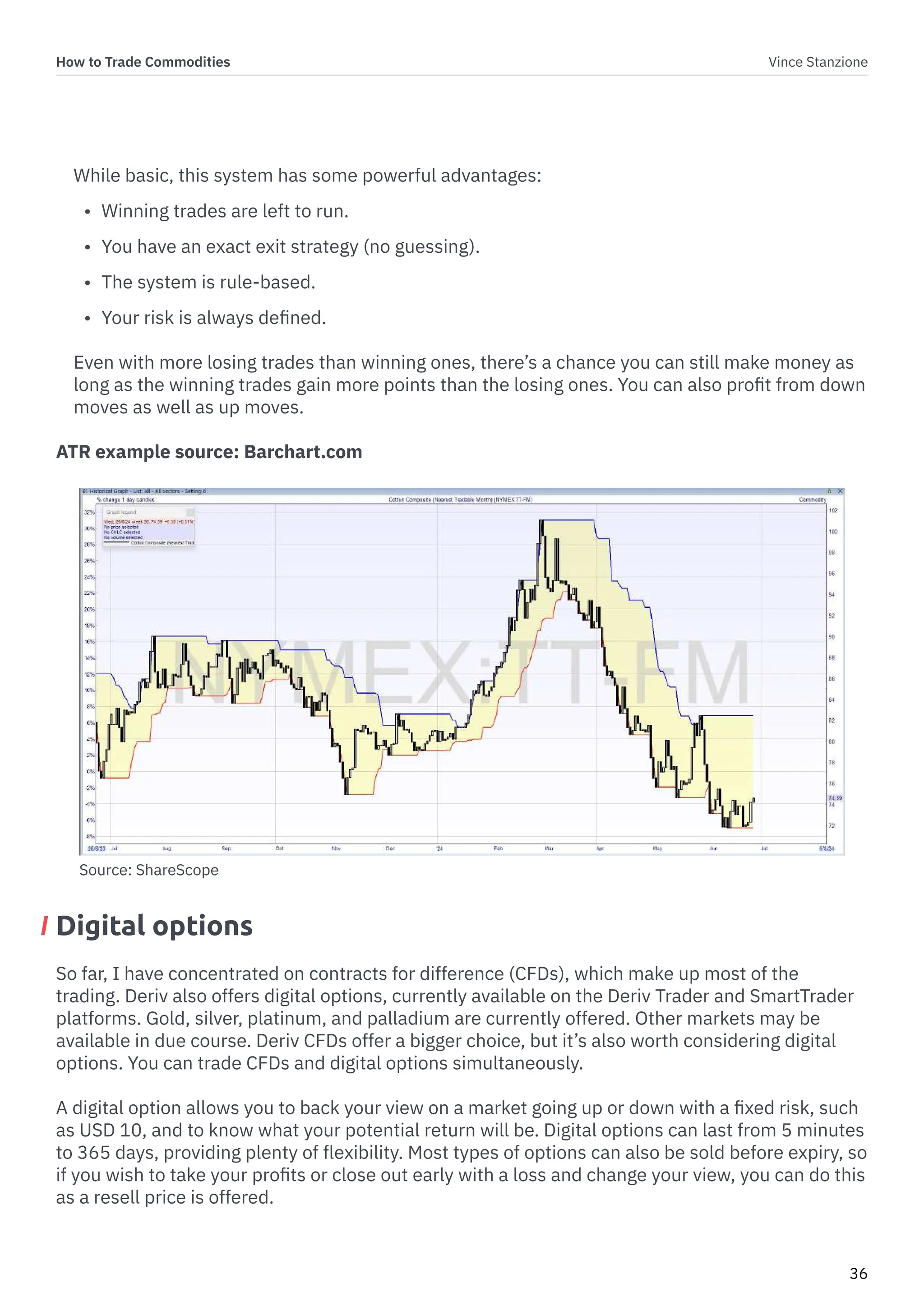
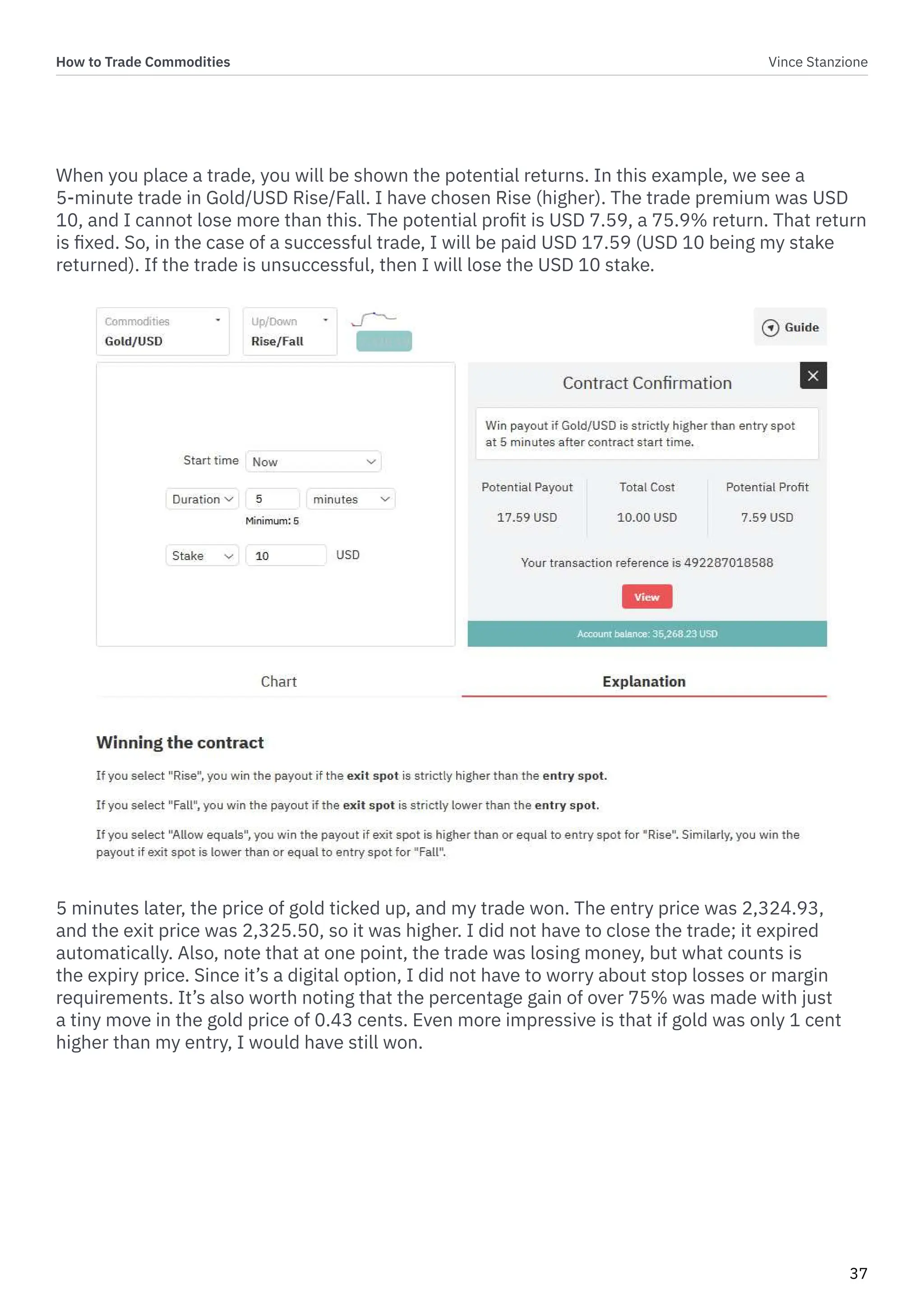
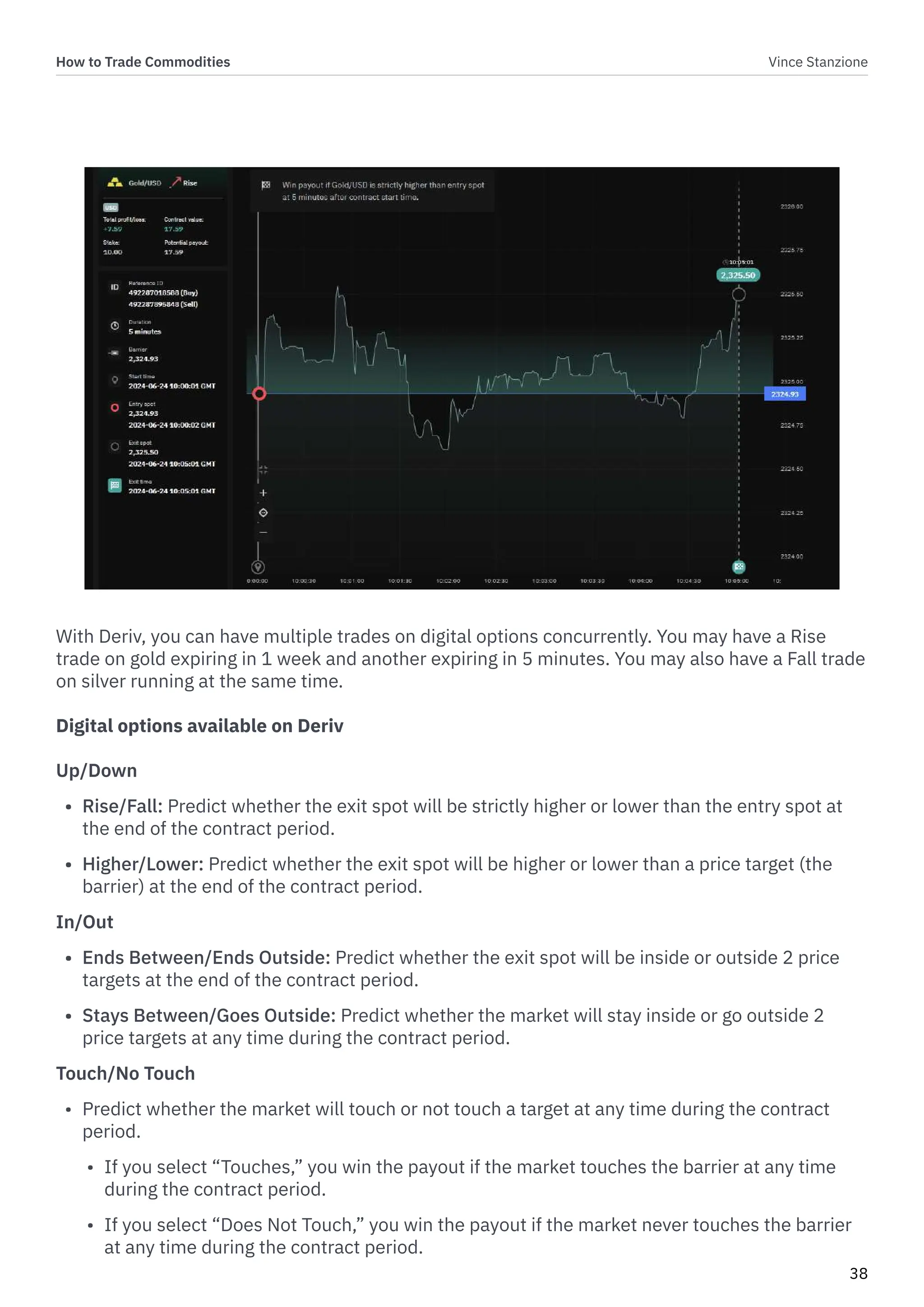
When you place a trade, you will be shown the potential returns. In this example, we see a
5-minute trade in Gold/USD Rise/Fall. I have chosen Rise (higher). The trade premium was USD
10, and I cannot lose more than this. The potential profit is USD 7.59, a 75.9% return. That return
is fixed. So, in the case of a successful trade, I will be paid USD 17.59 (USD 10 being my stake
returned). If the trade is unsuccessful, then I will lose the USD 10 stake.
5 minutes later, the price of gold ticked up, and my trade won. The entry price was 2,324.93,
and the exit price was 2,325.50, so it was higher. I did not have to close the trade; it expired
automatically. Also, note that at one point, the trade was losing money, but what counts is
the expiry price. Since it’s a digital option, I did not have to worry about stop losses or margin
requirements. It’s also worth noting that the percentage gain of over 75% was made with just
a tiny move in the gold price of 0.43 cents. Even more impressive is that if gold was only 1 cent
higher than my entry, I would have still won.
How to Trade Commodities Vince Stanzione
38
With Deriv, you can have multiple trades on digital options concurrently. You may have a Rise
trade on gold expiring in 1 week and another expiring in 5 minutes. You may also have a Fall trade
on silver running at the same time.
Digital options available on Deriv
Up/Down
• Rise/Fall: Predict whether the exit spot will be strictly higher or lower than the entry spot at
the end of the contract period.
• Higher/Lower: Predict whether the exit spot will be higher or lower than a price target (the
barrier) at the end of the contract period.
In/Out
• Ends Between/Ends Outside: Predict whether the exit spot will be inside or outside 2 price
targets at the end of the contract period.
• Stays Between/Goes Outside: Predict whether the market will stay inside or go outside 2
price targets at any time during the contract period.
Touch/No Touch
• Predict whether the market will touch or not touch a target at any time during the contract
period.
• If you select “Touches,” you win the payout if the market touches the barrier at any time
during the contract period.
• If you select “Does Not Touch,” you win the payout if the market never touches the barrier
at any time during the contract period.
How to Trade Commodities Vince Stanzione
39
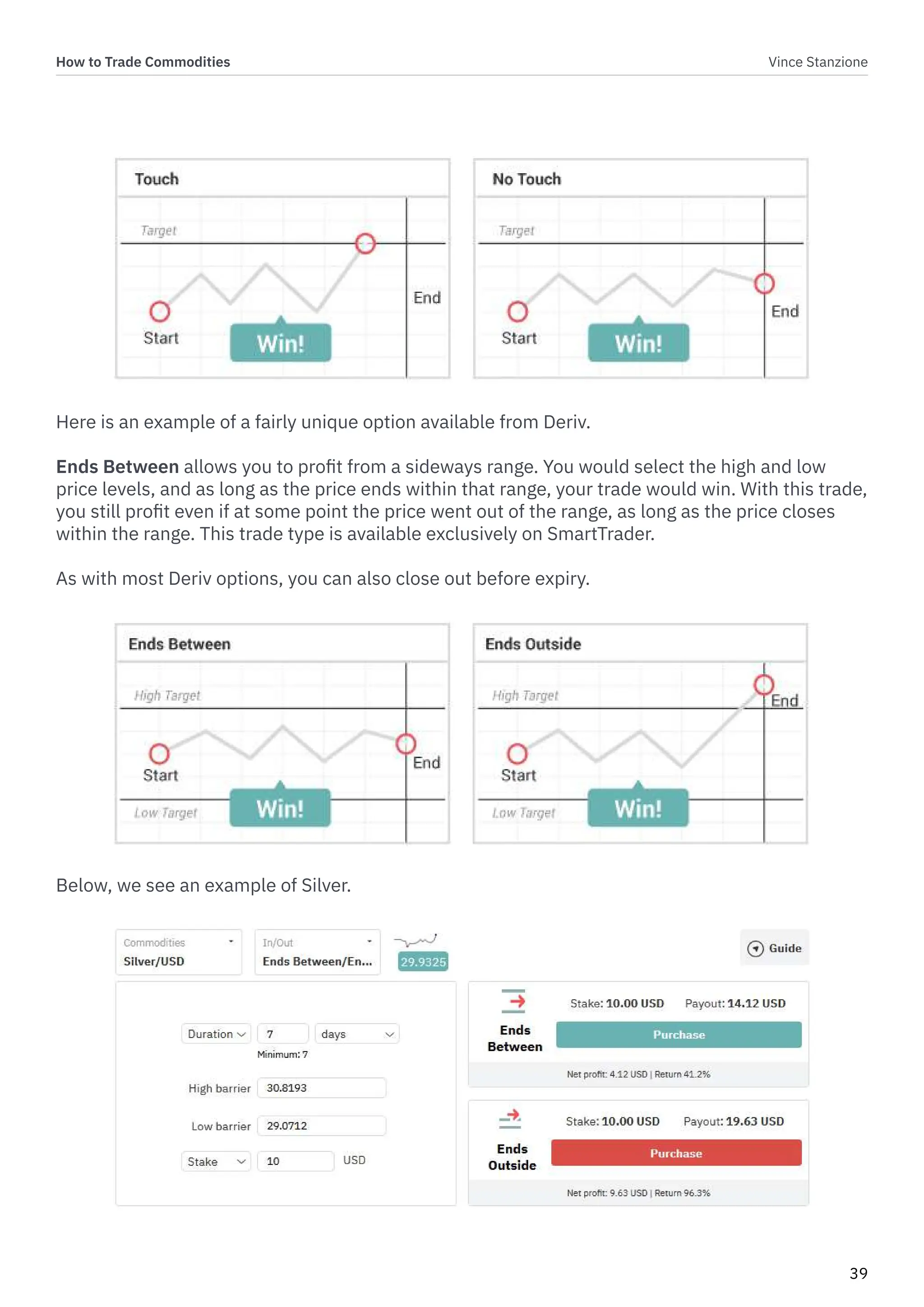
Here is an example of a fairly unique option available from Deriv.
Ends Between allows you to profit from a sideways range. You would select the high and low
price levels, and as long as the price ends within that range, your trade would win. With this trade,
you still profit even if at some point the price went out of the range, as long as the price closes
within the range. This trade type is available exclusively on SmartTrader.
As with most Deriv options, you can also close out before expiry.
Below, we see an example of Silver.
How to Trade Commodities Vince Stanzione
40
The option lasts 7 days (it could be closed out earlier). You can select the higher and lower
barriers, and Deriv will price the option for you. As you can see, “Ends Between” is more likely,
hence the return is 41.2%, whereas “Ends Outside” is 96.3%, a higher return but less likely.
Regardless, the maximum risk is known ahead of time.
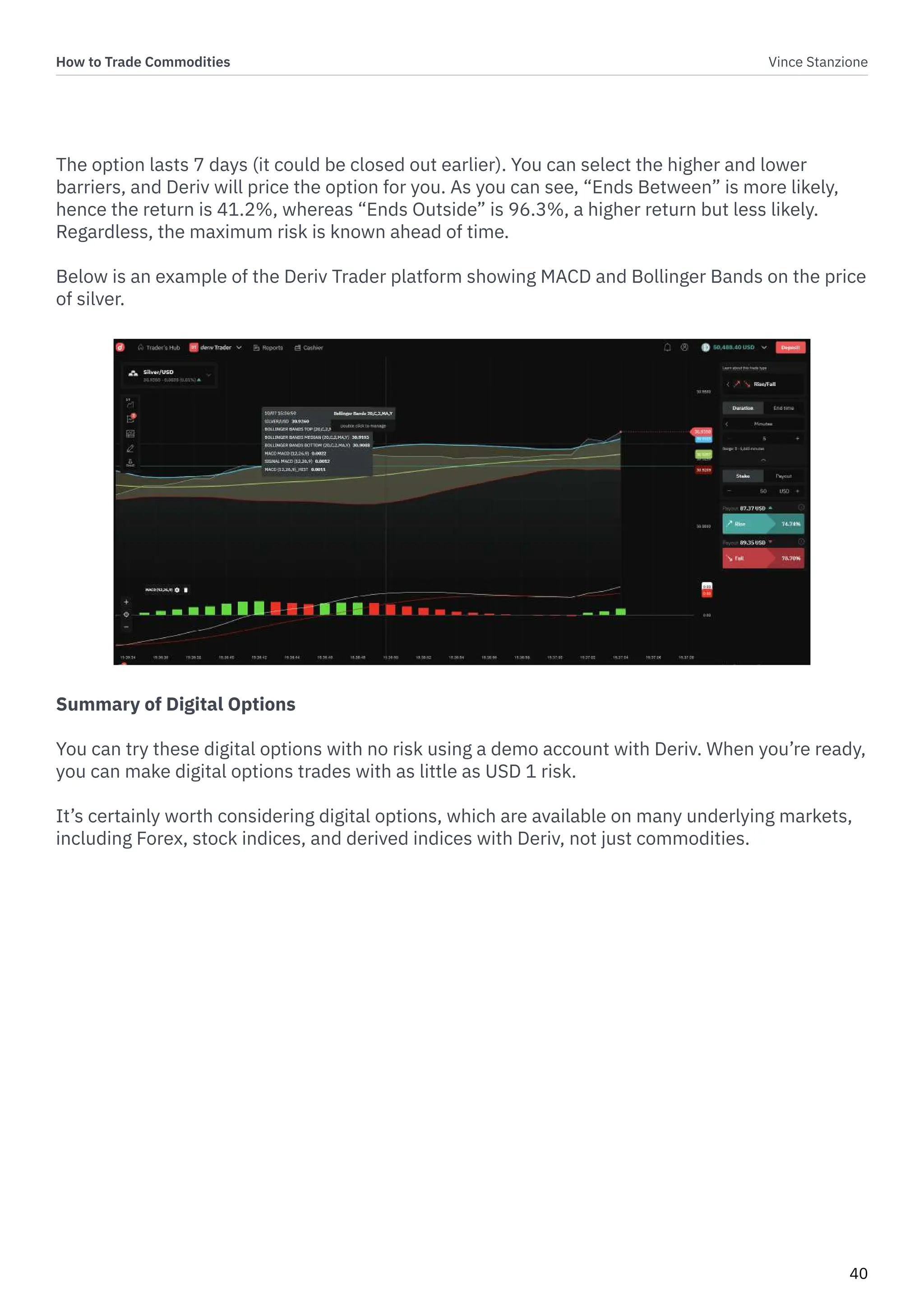
Below is an example of the Deriv Trader platform showing MACD and Bollinger Bands on the price
of silver.
Summary of Digital Options
You can try these digital options with no risk using a demo account with Deriv. When you’re ready,
you can make digital options trades with as little as USD 1 risk.
It’s certainly worth considering digital options, which are available on many underlying markets,
including Forex, stock indices, and derived indices with Deriv, not just commodities.
How to Trade Commodities Vince Stanzione
41
How to Trade Commodities Vince Stanzione
42
Useful websites and resources
Here are some of the websites I use that offer good commentary and tools on commodities:
Barchart.com
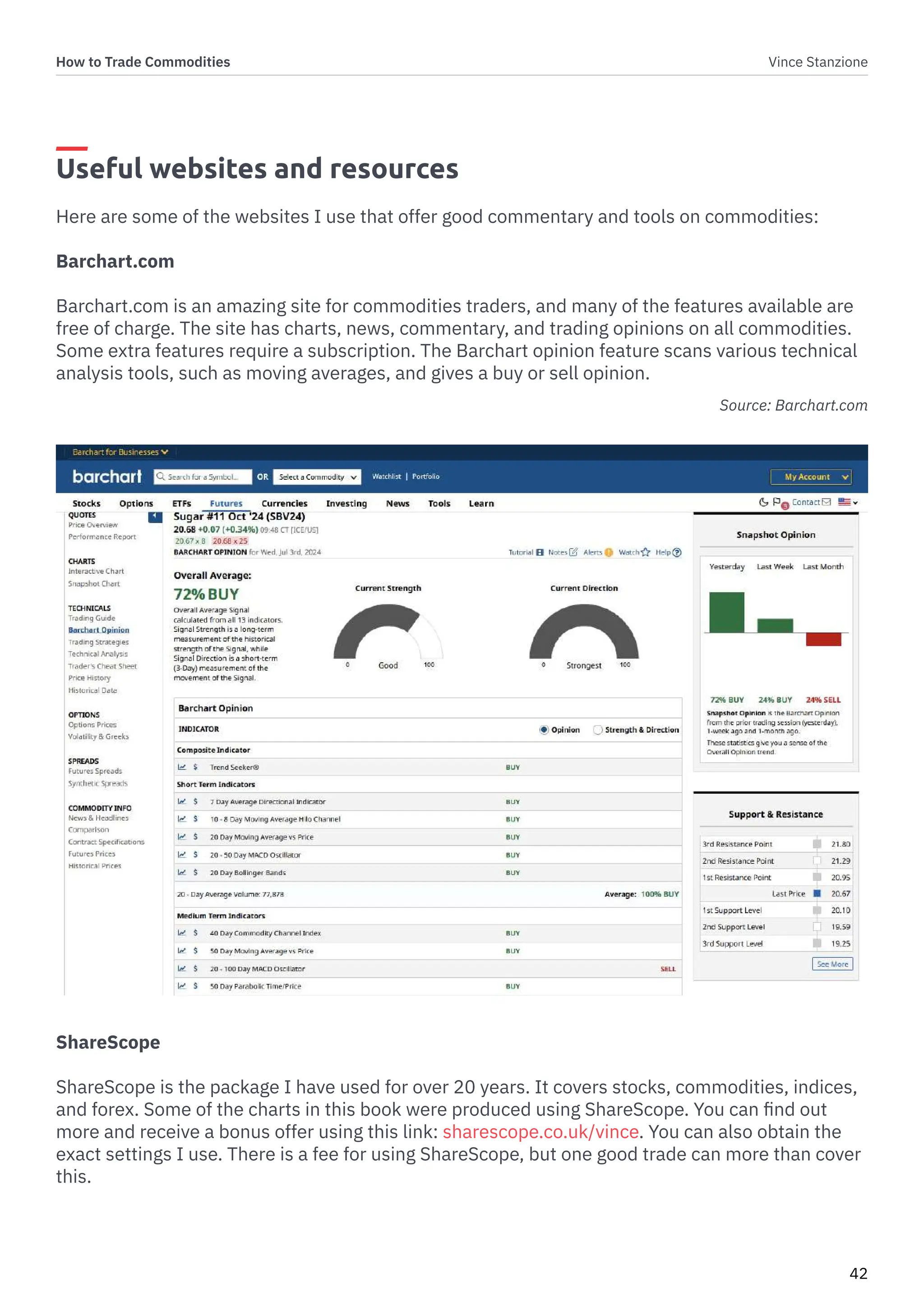
Barchart.com is an amazing site for commodities traders, and many of the features available are
free of charge. The site has charts, news, commentary, and trading opinions on all commodities.
Some extra features require a subscription. The Barchart opinion feature scans various technical
analysis tools, such as moving averages, and gives a buy or sell opinion.
Source: Barchart.com
ShareScope
ShareScope is the package I have used for over 20 years. It covers stocks, commodities, indices,
and forex. Some of the charts in this book were produced using ShareScope. You can find out
more and receive a bonus offer using this link: sharescope.co.uk/vince. You can also obtain the
exact settings I use. There is a fee for using ShareScope, but one good trade can more than cover
this.
How to Trade Commodities Vince Stanzione
43
Seasonax
Seasonal Analysis searches for predictable patterns of human behavior that occur repeatedly.
They use this information in the financial markets to add a high-probability edge to trading. You
can try out Seasonax and find out more at: https://www.seasonax.com/
Futures.Tradingcharts
This is a great site that is free to access. It covers all commodities and includes good news feeds.
https://futures.tradingcharts.com/
Finviz.com
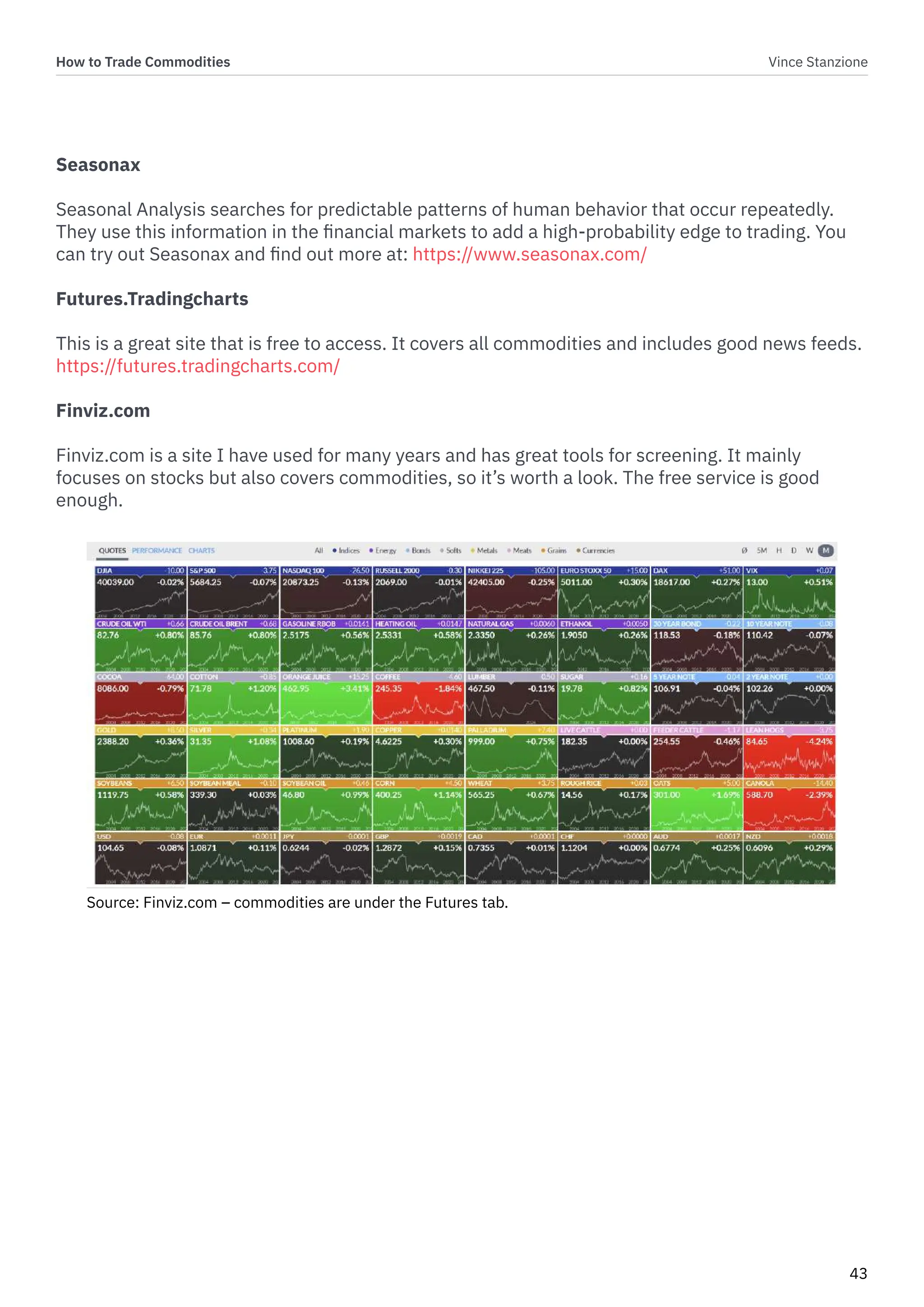
Finviz.com is a site I have used for many years and has great tools for screening. It mainly
focuses on stocks but also covers commodities, so it’s worth a look. The free service is good
enough.
Source: Finviz.com – commodities are under the Futures tab.
How to Trade Commodities Vince Stanzione
44
Glossary of terms
These terms are used in various financial markets and CFD trading and not just commodities.
At the market
An order to buy or sell at the best price obtainable at the time the order is placed.
Bearish
This refers to a market in decline. Someone with a negative view on a market would be a Bear.
Bear market
A bear market is the condition of a market in which prices are falling or are expected to fall. It typically
describes a condition in which the prices of securities fall 20% or more from recent highs.
Bid price
When trading a contract for difference (CFD), the bid price is the price at which you can sell. In the pair
of quoted prices, the first price is the bid price; for example, 31.01 (bid)/31.02 (offer).
Bullish
This refers to a market that is rising. Someone with a positive view on a market would be a Bull.
Bull market
A bull market is the condition of a market in which prices are rising or are expected to rise. The term
“bull market” is most often used to refer to the stock market. Unlike a bear market, there is no set
definition in percentage terms.
Closing price
An asset’s closing price is the last price at which it was traded on any given day. With Deriv CFDs, there
is no expiration, and the contracts stay open.
Contract for difference (CFD)
A contract for difference (CFD) is an agreement between an investor and a CFD broker to exchange the
difference in the value of a financial product between the time the contract opens and closes. This is
how Deriv enables you to trade commodities.
Contract period
The contract period is the time frame of a trade. It is also called the duration. In a digital option, you will
always have a duration, for example, one day.
Counterparty
The counterparty is the other party that participates in the trade with you. If you trade CFDs via Deriv,
your counterparty will be Deriv.
Expiry price
The expiry price is the price of the underlying asset when the contract expires.
How to Trade Commodities Vince Stanzione
45
Fundamental analysis
Fundamental analysis is a method of quantitative and qualitative analysis used by traders to determine
the macroeconomic outlook of a country and currency. Inflation, unemployment, and interest rates are
just a few of the considerations in fundamental analysis. In commodities, factors such as crop reports
and supply & demand releases would come under fundamental analysis.
GMT
GMT (Greenwich Mean Time) is used in trading as a standard time reference to coordinate and
synchronise trading activities across different time zones. It helps traders and financial markets to
operate efficiently by providing a uniform time standard.
GTC
GTC (Good ‘Til Canceled) is a type of order that remains active until the trader cancels it or the order
is executed. GTC orders are commonly used by traders who want to buy or sell a security at a specific
price but are willing to wait until the market reaches that price, regardless of how long it takes.
Limit order
A limit order is an instruction to your broker to execute a trade at a specific price or better.
Long
Being “long” with regard to a market or CFD (contract for difference) means that a trader has bought a
security or CFD with the expectation that its price will rise. It indicates a bullish attitude. For example,
being long gold.
Margin requirement – initial deposit
Deposit margin is the amount a trader needs to put up in order to open a leveraged trading position. It
can also be known as the initial margin.
Offer price (ask price)
When trading a CFD, the offer price or ask price is the price at which you buy. In the pair of quoted
prices, the second price is the offer price; for example, 31.10 (bid)/31.11 (offer).
Pairs trade
In commodity trading, we can make 2 separate trades to back a scenario. We could go short on copper
and long on gold. This would be a defensive play, taking the view that the industrial metal copper will go
down, whereas the precious monetary metal gold will go up.
Point
In commodities trading, this is normally a cent. For example, if orange juice is trading at USD 400.10
and moves to USD 400.11, it will be a 1 point move.
Premium
The premium is the amount that a trader must pay to enter into a trade. These funds must be available
in your account. This term is used more in digital options contracts. If you place an options trade with
Deriv and your stake/premium is USD 10, then that will be debited from your account at the opening of
the trade.
Profit
The profit is the difference between the purchase price and the sale price on a winning trade. In the
case of a short trade, your sale price would be higher than your purchase price to make a profit. With a
CFD that is held over a period of time, financing costs will also need to be factored into your final profit.
How to Trade Commodities Vince Stanzione
46
Short
Short is the opposite position of long. If I am short with regard to a commodity, I expect its price to
drop, so I enter the market with a sell trade. I will, at some stage, have to buy back to cover my short. To
profit, I want to be able to buy back lower than the level I sold at.
Spot price
This is the current price at which an underlying asset can be bought or sold at a particular time.
Spread
Spread is the difference between the bid and the offer. This is where the broker makes their profit. The
tighter the spread, the better for the trader and the quicker you can get into profit.
Stop loss order (or stop)
An order that only takes place when the market reaches the level mentioned in the order. Its purpose is
to limit losses. It may be either a buying order, which would cover a short position, or a selling order to
cover a long trade.
Technical analysis
Technical analysis is a system of analysis whereby historical data is examined to predict future trends in
the prices of assets. Charts and indicators are often used.
Tick
A tick is the minimum upward or downward movement in the price of a market. A tick chart is the
shortest possible chart time frame.
Underlying
Each contract for difference is a prediction concerning the future movement of an underlying market,
i.e., the specific type of asset involved in a given trade, for example, platinum.
Summary and parting words
I hope you have found this book a good introduction to trading
commodities with Deriv. Regardless of where in the world you live,
the opportunities to trade commodities, even with a small account,
are now available. Of course, all trading carries risk, but by using good
money management and trading discipline as outlined in this book,
you will be on the road to becoming a better trader. As outlined, you
can profit from upward, downward, and even sideways movements in
commodities. You can also trade commodities with very short-term
trades lasting minutes to longer-term trades lasting months.
Deriv gives you the opportunity and flexibility to try your new trading
skills with a USD 10,000 risk-free practice account. You can then start
trading on Deriv’s real account with a minimum deposit of USD 5.
Be sure to check out my other ebook available from Deriv.com and
access the excellent resources available at no charge from Deriv to
help you on your journey as a trader. While this book has focused
on commodities, many of the skills are applicable to other financial
markets. If you want to diversify your skills into Forex, stocks, cryptos,
or derived indices, you will find specific ebooks for those.
Wishing you lots of success.
Vince Stanzione
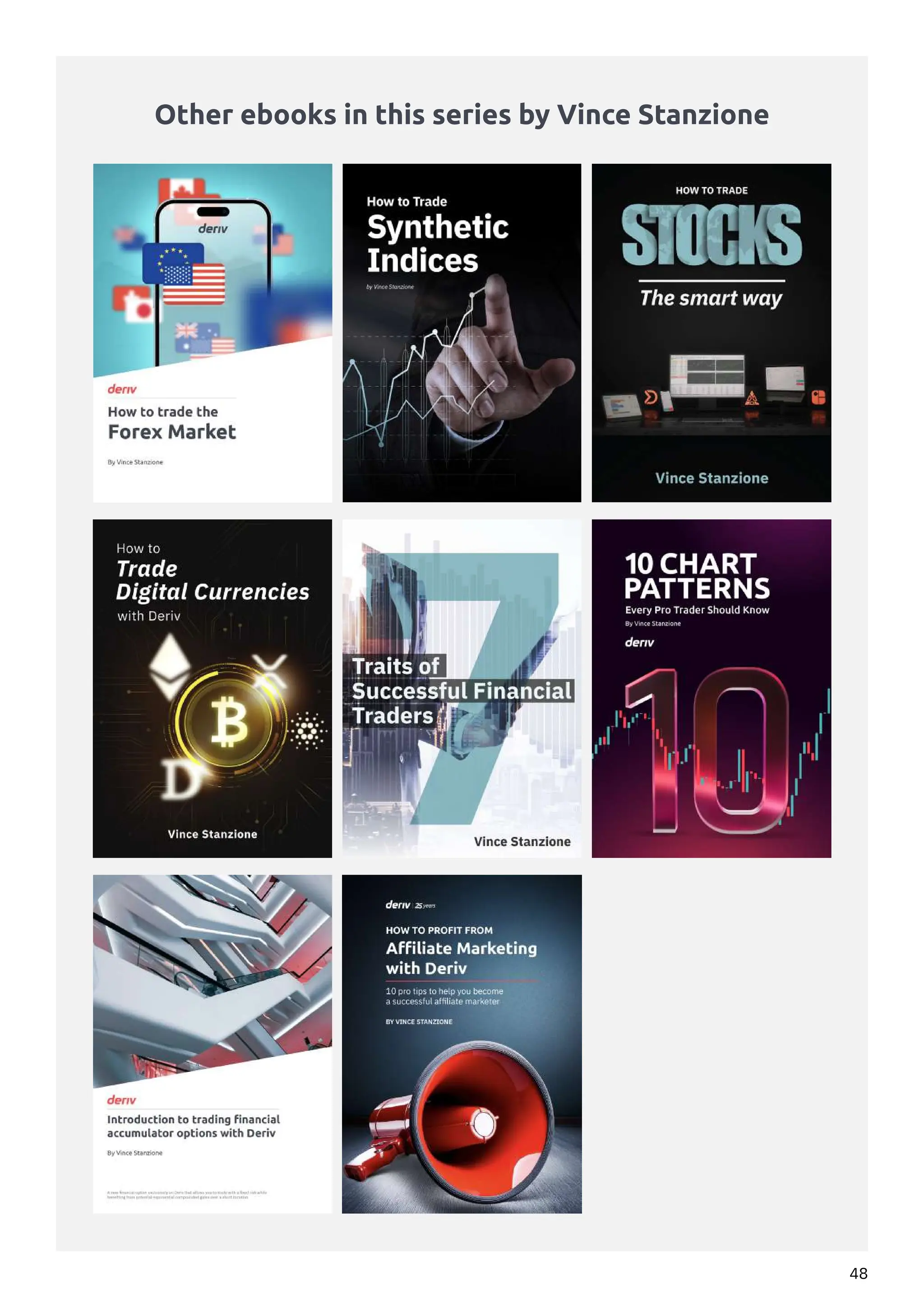
48
Other ebooks in this series by Vince Stanzione
How to Trade Commodities Vince Stanzione
49
Be a Deriv affiliate and earn an extra income
Deriv is expanding into many new territories and is on the lookout for talented and
hardworking partners. You can promote Deriv to your friends and contacts or market
Deriv’s services. In return, Deriv will pay you a generous commission. Additionally, you
can develop trading systems and provide education to new traders, further enhancing
your earning potential.
Some of Deriv’s best clients are also its best affiliates. To find out more, please visit our
partner’s webpage.
Deriv offers a wide range of products to its global client base,
enabling them to trade forex, stocks, stock indices, synthetic
indices, cryptocurrencies, and commodities.
With 25 years of experience, Deriv’s mission is to bring online
trading to everyone, everywhere via simple, flexible, and reliable
platforms tailored to fit any trading style.
Today, Deriv has 22 offices worldwide with over 1,400
employees from over 70 countries working together to create
an effortless online trading experience with diversified, market-
leading products.

A Beginner's Guide to Commodity Trading with Deriv.com by Vince Stanzione

  • 1.
    BY VINCE STANZIONE Howto Trade COMMODITIES
  • 2.
    Introduction History of commoditiestrading Why you should consider trading commodities The dominance of the US dollar in commodities trading Commodities groups Commodity stocks or commodities futures? What you need to trade commodities on Deriv MT5 Leverage Risk management A CFD example to trade WTI oil Order types Factors affecting commodity prices Technical analysis Trading system ideas Digital options Useful websites and resources Glossary of terms Other ebooks in this series Become an affiliate 5 6 7 8 8 10 11 13 14 15 17 21 24 34 36 42 44 48 49 Contents
  • 3.
    How to TradeCommodities Vince Stanzione 3 Disclaimer Information and strategies contained in this book are intended as educational information only and should not be treated as advice or a recommendation to trade nor used as a sole trading guide. The past is not a guide to future performance, and strategies that have worked in the past may not work in the future. Trading derivative products involves a high level of risk and may not be suitable for all customers. The value of any trade, and the income derived from it, can go down as well as up, and your capital is at risk. Although due care has been taken in preparing this document, we disclaim liability for any inaccuracies or omissions. Deriv is the manufacturer and distributor of its products. Products offered on deriv. com are considered complex derivatives and may not be suitable for retail clients. CFDs are complex instruments and come with a high risk of losing money rapidly due to leverage. 70.78% of retail investor accounts lose money when trading CFDs with this provider1 . You should consider whether you understand how CFDs work and whether you can afford to take the risk of losing your money. The information presented is intended for retail and professional clients. Company information • Deriv Investments (Europe) Ltd (W Business Centre, Level 3, Triq Dun Karm, Birkirkara BKR 9033, Malta) is licensed and regulated in Malta by the Malta Financial Services Authority under the Investment Services Act to provide investment services. • Deriv (BVI) Ltd is licensed and regulated by the British Virgin Islands Financial Services Commission. • Deriv (FX) Ltd is licensed and regulated by the Labuan Financial Services Authority. • Deriv (V) Ltd is licensed and regulated by the Vanuatu Financial Services Commission. For more information, please visit deriv.com. 1 These statistics are specific to Deriv Investments (Europe) Limited.
  • 4.
    How to TradeCommodities 4 About Vince Stanzione Vince Stanzione has been trading markets for over 37 years and is a self-made multi- millionaire. He is the New York Times bestselling author of The Millionaire Dropout and the author of the “Making Money from Financial Spread Trading” course. He has been quoted and featured favourably in over 200 newspapers, media outlets, and websites, including CNBC, Yahoo Finance, MarketWatch, Reuters. com, Independent, Sunday Independent, Observer, Guardian, The Times, Sunday Times, Daily Express, What Investment, Growth Company Investor, New York Times, Bullbearings, City Magazine, Canary Wharf, Institutional Investor China, and Shares Magazine. He mainly lives in Mallorca, Spain, and trades financial markets, including currencies, stocks, and commodities. Follow him for updates on Twitter/X @vince_stanzione.
  • 5.
    How to TradeCommodities Vince Stanzione 5 Introduction Regardless of where we live in the world, we encounter commodities every day. Items like coffee, sugar, wheat, oil, corn, and rice are integral to our daily lives. We’ve likely used products derived from these commodities without even realising it. This book aims to provide you with a solid understanding of trading commodities with Deriv, presented in a straightforward and accessible manner. While it’s impossible to cover every aspect of the topic in a single book, I will focus on the key factors you need to start trading. As you progress, you can continue to build and refine your skills and knowledge.
  • 6.
    How to TradeCommodities Vince Stanzione 6 History of commodities trading Commodities have a rich history, dating back to 4500 BC, way before foreign exchange (forex) or stock trading began. The earliest recorded commodity trading took place in Ancient Mesopotamia between 4500 BC and 4000 BC. People traded livestock and forms of commodity money, such as shells, and later, gold and silver. History also shows that in the 1700s, during Japan’s Edo period, rice merchants stored their rice in warehouses and issued receipts called “rice tickets.” These tickets detailed the quantity and quality of the rice and initially served as proof of ownership, allowing trade without physically moving the rice. Over time, merchants and traders realised they could sell these tickets for future delivery. This created the first recorded form of futures contracts. These contracts acted as promises to exchange rice and as a mode of raising funds, eventually becoming their own form of currency. The birth of commodities trading exchanges The Chicago Board of Trade (CBOT) was founded in 1848 as a cash market for grain, marking the inception of modern commodity trading exchanges. Forward or “to-arrive” contracts began trading at the CBOT almost immediately, revolutionising the way commodities were bought and sold. Over time, the CBOT merged with the Chicago Mercantile Exchange to form CME Group, which today remains a major platform for commodities trading. To understand further, you can visit the CME Group website. Throughout its history, CME Group has acquired other prominent exchanges, including CBOT, NYMEX, and COMEX. As a result, nearly all major products, such as crude oil, corn, cattle, copper, and gold, are now traded on one of the CME Group exchanges. In the UK, the London Metals Exchange is one of the few remaining exchanges that specialise in industrial metals such as tin, aluminium, and zinc. Similarly, in China, the Shanghai Futures Exchange (SHFE), established in 1993, focuses on trading metals, energy, and chemical commodity products, contributing to the global landscape of commodity trading. The end of floor trading – Electronic trading Open outcry commodities trading, as satirised in the 1983 film “Trading Places” with Eddie Murphy and Dan Aykroyd, has now come to an end. However, the Frozen Orange Juice contract still trades online. Instead of traders in bright jackets screaming at each other on trading floor pits, today trading is nearly all done via trading screens. Interesting fact Japanese candlesticks, a chart pattern still widely used in today’s financial markets, have their origins in rice trading. This technique was created by Munehisa Homma, a Japanese rice trader. I will explore candlesticks further in the technical analysis section.
  • 7.
    How to TradeCommodities Vince Stanzione 7 The commodities trading doors are now open to everyone Electronic trading has now allowed retail traders to join the market regardless of where they reside. Anyone can place trades through online platforms such as the ones offered by Deriv without having to depend on live brokers. These online platforms also offer trading charts, market news and analysis, educational tools, and technical analysis programs. Information that was once only available to professionals with large accounts and high fees is now accessible to all. Another advantage of dealing with Deriv is that you can start trading commodities with a relatively low starting balance, with some options available for less than USD 50. Additionally, you can learn to trade and practice with a demo account using real prices and the MT5 platform, all without any risk. Why you should consider trading commodities Many have been put off trading commodities due to worries that they are too complicated and have unlimited risk. However, as I will explain in this book, risks can be managed, and commodities are relatively straightforward to trade from either your mobile phone or laptop, regardless of which country you reside in. Flexibility The majority of commodities trading is now done electronically, with prices readily available 24 hours a day. Commodities markets trade five days a week, from Sunday night at 10:00 pm (GMT) to Friday at 9:00 pm (GMT). Some commodities may also take a one-hour break between 10:00 pm and 11:00 pm (GMT). You will find the exact trading times and specifications on the Deriv website. No ownership Some also worry that if they do not close out a trade, they will end up taking delivery of the commodities, and no one wants to have 20 tonnes of sugar on their doorstep! Rest assured, with Deriv, this will never happen. You will be trading contracts for difference (CFDs) on commodity prices. These are financial derivatives that allow you to trade the price movements of various commodities without owning the underlying assets. They are “cash settled.” In other words, you will never see the physical commodity. Funds will be credited or debited from your trading account. Profit from up and down moves With Deriv, you’re not restricted to trading solely on rising prices; you can also potentially benefit from downward price movements. As we go through this book, I will show you examples of both scenarios. You can also make a “pairs” trade, which consists of being long one commodity and short another. For example, on Deriv MT5, you could go long on gold (XAUUSD) and short on copper (XCUUSD), or short on silver (XAGUSD) and long on platinum (XPTUSD).
  • 8.
    How to TradeCommodities Vince Stanzione 8 While the majority of those reading this will be looking to profit from trading commodities, it is also possible to use a commodity contract for difference (CFD) to hedge an existing holding. For example, if I own 100 ounces of gold at the current price of around USD 230,000 and believe gold is starting to look weak, but I do not wish to sell my physical gold, I could place a short trade to “hedge” my gold position. If gold goes down, I am hedged as my CFD will gain. If gold goes up, then my CFD will decrease in value but my physical gold will increase. Hedging only makes sense for a relatively short period of time. Leverage CFDs on commodities typically offer leverage, meaning you can control a large position with a relatively small amount of capital. For example, with a leverage of 10:1, you could open a USD 100 position in gold with just USD 10. This leverage can amplify both gains and losses. Managed risks With Deriv, you can limit your risk and control your maximum exposure. For example, by setting stop-loss orders, you can ensure that you never lose more than the amount you have decided to risk. Diversification Trading commodities can help diversify your portfolio as they do not necessarily move in tandem with other assets such as stocks, cryptocurrencies, or currencies. There have been decades where commodities have performed better than the stock market and vice versa. The dominance of the US dollar in commodities trading The global settlement currency for commodities remains the US dollar. This is why you will see oil trading and priced in USD, for example, USD 80 a barrel. Gold is also priced in USD, for example, USD 2,300 an ounce. Whilst you can settle transactions in other currencies, the US dollar remains king in the commodities world. It’s worth noting that if the US dollar is weaker against the euro, it makes oil, gold, or any other commodity cheaper in the local currency. Conversely, a strong dollar would make it more expensive for someone buying gold in Indian rupees. Commodities groups There are a vast number of commodities that are traded around the globe; some are more focused, like chemicals and coal. In this book, we will stick to the main commodities groups that are widely traded. Please note that not all these categories are available on Deriv. Currently, only metals and energies are offered.
  • 9.
    How to TradeCommodities Vince Stanzione 9 Energies This category includes crude oil, natural gas, heating oil, and petrol. Energy commodities are crucial for powering industries, transportation, and residential needs. Whilst there is much talk about “green” energy such as wind and solar reducing or eliminating the need for fossil fuels, we are decades away from this becoming reality. Many parts of the world still depend on coal as a primary energy source. There are 2 primary crude oil markets: WTI, which is West Texas Intermediate oil, and Brent crude oil, which is a Europe-delivered oil. Both contracts can be traded with Deriv. Livestock This category includes live cattle, lean hogs, and feeder cattle. Livestock commodities are essential for the meat and dairy industry. Other energy commodities such as uranium and coal can be traded via investing in companies that operate in those areas. Uranium now has its own exchange-traded fund (ETF) that tracks the uranium price: Sprott Physical Uranium Trust Fund (U-UN.TO). Metals Precious metals like gold, silver, and platinum, as well as industrial metals like copper, aluminium, palladium, zinc, and steel, fall into this category. Metals are widely used in various industries, including construction, electronics, and manufacturing. As previously stated, the move to clean energy and the electrification of transportation require a massive quantity of metals. Copper plays a big part in electrification and is also used in air conditioning and cooling. As many developing countries start to use more electricity and air conditioning, copper demand increases. Electric vehicles, due to the significant use of batteries and electric motors, are heavily dependent on copper and other metals. Agricultural Agricultural commodities encompass products such as wheat, corn, soybeans, cotton, coffee, sugar, cocoa, rough rice, and orange juice. These commodities are vital for the food industry and agricultural production. Interesting fact Green energy relies heavily on commodities. For example, solar panels use silver, electric vehicles use copper, and wind turbines use a vast amount of steel. Interesting fact As the world’s population grows, especially in emerging economies, the demand for protein-rich diets such as pork and beef increases. Consequently, the demand for animal feed also rises.
  • 10.
    How to TradeCommodities Vince Stanzione 10 Bloomberg commodities index As well as individual commodities, there are also Exchange Traded Funds (ETFs) that trade a basket of commodities, one of the best known being the Bloomberg Commodities Index. This means that one trade would allow you to speculate on a basket of commodities. Think of the Bloomberg Commodities Index as similar to a stock index, such as the S&P 500, which allows you to trade a basket of stocks in one trade. The most popular ETF is the US-listed Invesco DB Commodity Index Tracking Fund (DBC), which is listed on the NYSE. Commodity stocks or commodity futures? In this book, I will concentrate on commodity futures (CFDs), which provide direct access to the underlying price of commodities, such as gold. You can also gain exposure to gold by investing in gold mining stocks or a basket of stocks via exchange-traded funds (ETFs) like the Gold Miners ETF (NYSE: GDX), which can also be traded via a CFD. Logic might suggest that if gold is performing well, gold mining stocks should also do well. However, this is not always the case. While gold has increased in value in recent years, gold mining stocks have not performed as well overall. When you purchase a gold mining stock, you are exposed to various factors beyond the gold price, such as management quality, environmental risks, mining costs, and political risks. Owning a company that operates a gold mine and produces gold for the market is very different from trading gold itself. When you trade a gold futures contract or CFD, you eliminate these additional risks, making it a pure trade on the price of gold. Although there is counterparty risk with your broker or exchange, established entities like Deriv, which has been in business for over 25 years, present relatively low counterparty risk. I am not suggesting you should never trade commodity stocks, as there are opportunities, particularly in takeovers and mergers. However, owning a gold mining stock does not guarantee you will profit from an increase in the gold price. The same principles apply to other commodities like oil, gas, and silver.
  • 11.
    How to TradeCommodities 11 What you need to trade commodities on Deriv MT5 You will need an account with Deriv to trade commodities. You can open both real and demo accounts. You will need to download the MT5 app, which is available for free on the Apple App Store or Android store. You can also use MT5 on a Windows or Apple desktop by using the Webtrader or downloading the relevant app. You can mix and trade via the mobile app or desktop with the same account details. Some traders prefer a larger screen desktop setup for trading, but appreciate the convenience of using the mobile app for checking positions or making adjustments. Navigating MetraTrader 5 (MT5) for beginners For newcomers, the MetaTrader 5 (MT5) platform may seem a bit overwhelming at first glance. Fortunately, you can begin with a demo account to practise trading without risking real funds. This allows you to familiarise yourself with the platform and develop your trading strategies before committing actual capital. MetaTrader 5 boasts a substantial user base, ensuring ample online resources and tutorials are available to guide you. Deriv Academy offers an excellent selection of instructional videos to help you get started. For more information, visit: Deriv Academy. (Please note that this website may not be accessible to EU residents.)
  • 12.
    How to TradeCommodities Vince Stanzione 12 Essential trading specifications Keep this link handy: Deriv trading specifications. This resource provides important information about the commodities available for trading on Deriv, including trading times, minimum trade sizes, and leverage details. Within the MT5 app, selecting a product, such as Nat Gas, will display its specific details, including minimum trade size, swap charges, and opening times. Understanding trading times Trading times are quoted in GMT, enabling you to access and trade commodities globally, but it’s essential to account for official trading times. For instance, the trading hours for gold are: • Sunday 23:05 - Friday 21:45 • Daily Break: 22:00 - 23:00 GMT Contract for difference (CFD) rollover When trading CFDs on Deriv, contracts roll over daily. Depending on whether you are long or short, a swap charge may apply, or you might receive a payment if short. Deriv also offers some swap-free contracts; however, to offset this, the spreads when opening and closing trades are typically higher. By familiarising yourself with these key aspects, you can better navigate MT5 and make informed trading decisions on the Deriv platform. A screenshot of the web MT5 terminal
  • 13.
    How to TradeCommodities Vince Stanzione 13 Leverage Understanding leverage in trading Leverage allows you to take a larger position than you would be able to with just buying a commodity or share outright in cash. With leverage, you put up a deposit known as a “margin,” and the broker lets you trade the rest on credit. The amount of leverage available to you depends on the specific commodity and your location, as some countries impose lower leverage limits. Example of leverage: Gold trading on Deriv Using gold as an example, Deriv currently offers up to 1:500 leverage. This means that with a USD 1,000 deposit, you could control the equivalent of USD 500,000 worth of gold. However, there is no mfree lunch in the financial world. A daily interest charge is applied for using this facility. For short trades, you would receive a payment. Financing rates depend on bank base rates and the individual broker. Deriv offers competitive rates on financing, making it a favourable choice for traders. The benefits and risks of leverage Leverage is a good tool that Deriv offers across all its markets, but it must be used with caution. Many new traders tend to utilise the maximum leverage available. However, it is often wiser to use less leverage. Think of it like driving—you don’t always need to drive at the maximum speed limit. For instance, although you can obtain 1:500 leverage on gold, starting with a lower ratio, such as 1:20, might be more prudent. While leverage can amplify profits when a trade moves in your favour, it can also exaggerate losses when a trade moves against you, even by a small percentage. Regardless of the trade’s outcome, you will still have to pay the financing costs which are calculated on a daily basis.
  • 14.
    How to TradeCommodities Vince Stanzione 14 Trading size When trading in the futures market, you normally need to buy at least one contract, also known as a LOT. The good news with Deriv is that you can trade smaller than the standard contract size. You can find the minimum trading sizes at: Deriv trading specifications. By understanding and carefully managing leverage and trading sizes, you can enhance your trading potential while mitigating risks. Risk management Most new traders focus excessively on when to open a trade, whereas they should devote more time to risk management and determining when to exit a trade. I would love to tell you that all my commodity trades are profitable, but that is not the case. The truth is that a large percentage of my trades either lose money or make a small profit (break-even trades). The key to making money over time is by keeping losing trades relatively small. When I catch a good trade, typically by following a trend, it compensates for the losses and generates a profit. I will delve deeper into trading systems and risk sizing later on, but here is something important to understand: never let a trade run more than 5% to USD 10 maximum against you. The table below illustrates how your recovery needs to grow exponentially if you let losing trades run too far. For example, if a trade drops by 50%, you will need a 100% gain just to break even!
  • 15.
    How to TradeCommodities Vince Stanzione 15 Here is a chart of silver using a 10% stop loss. As the price moves up, so does the stop. However, when the price moves sideways or lower, the stop remains at the same level. At some stage, your trade is stopped out. If the trade moves higher and the stop loss follows, you are effectively locking in profits. This is known as a trailing stop. For a short trade, the opposite applies—the stop would be above the price. By understanding and carefully managing leverage, trading sizes, and risk, including using tools like trailing stops, you can enhance your trading potential while mitigating risks. A CFD example to trade WTI oil WTI, which stands for West Texas Intermediate. It’s an indicator of oil grade/mixture and a price point of oil contracts and futures contracts on the New York Mercantile Exchange (NYMEX). This is a popular traded contract as oil remains a major source of energy around the globe. Long trade Here’s an example: You’re bullish on WTI oil, so you decide to buy oil CFDs at the quoted price of USD 80.25 to USD 80.50 (the lower price is for a short contract, the higher for long). The 0.25 cents difference is the spread; this is where the broker will make their profit margin. The tighter the spread, the better, as it means your break-even point is lower. You need to cover the spread before moving into profit. You decide to buy 3 lots of crude oil CFDs. Each lot represents a certain quantity (e.g., 1 lot = 100 barrels).
  • 16.
    How to TradeCommodities Vince Stanzione 16 Using leverage of 20:1, you can place this trade with only a fraction of the total value. Let’s calculate: • Each lot is worth USD 80.50 (current price) × 100 barrels = USD 8,050. • With 3 lots, the total trade value is USD 8,050 × 3 = USD 24,150. • Leverage allows you to control this position with just USD 1,207.50 (20 times less than the actual value), or in other words, just 5% required. Note: Deriv may have much higher leverage ratios available, but for this example, we will use a 20:1 ratio. Additionally, Deriv offers the opportunity to trade for less than 1 lot. Later that day, WTI moved to 81.50/81.75. You decide to close out, selling at the bid price of 81.50. This means you have made USD 1 per contract, and with 300 contracts, your profit is USD 300. This is a 24.85% return on your outlay of USD 1,207.50. A relatively small move can give a higher potential gain. Of course, had WTI gone lower, you would have lost the same amount. Note: The above is an example – not a recommendation. Short trade Let’s stay with WTI oil but this time consider going short (potentially profiting from a downward move). WTI oil is now trading at USD 82.00/USD 82.25. You decide to sell (go short) 3 lots of crude oil CFDs. Each lot represents a certain quantity (e.g., 1 lot = 100 barrels). Using leverage of 20:1, you can place this trade with only a fraction of the total value. Let’s calculate: • Each lot is worth USD 82.00 (current price) × 100 barrels = USD 8,200. • With 3 lots, the total trade value is USD 8,200 × 3 = USD 24,600. • Leverage allows you to control this position with just USD 1,230 (20 times less than the actual value), or in other words, just 5% required. Note: Deriv may have much higher leverage ratios available, but for this example, we will use a 20:1 ratio. Additionally, Deriv offers the opportunity to trade for less than 1 lot. Later that day, WTI moved to 81.00/81.25. You decide to close out, buying to cover at the offer price of 81.25. This means you have made USD 0.75 per contract, and with 300 contracts, your profit is USD 225. Of course, had WTI gone higher, you would have lost the same amount. Note: The above is an example – not a recommendation.
  • 17.
    How to TradeCommodities Vince Stanzione 17 For many, profiting from a commodity going down seems strange. However, over my career, I have done very well trading markets both long and short. I may switch from one side to another, such as being long on oil, trading the upward move, closing the trade, then opening a new short trade. Also, “commodities” is a general term, and they do not all move in the same direction. I might be short on silver but long on copper. I could also be long on coffee but short on wheat. Order types Understanding the various order types available on Deriv MT5 is essential for effective trading. These order types are common across many trading platforms. Market Orders A market order is the most straightforward and common type of order. It is an instruction to buy or sell a commodity (or any traded asset) at the current market price. Market orders are executed immediately at the best available price, as long as there are willing buyers and sellers. On MT5, this is referred to as “instant execution.” Pending Orders These are orders that you set up to trigger at a future price level. They are instructions to your trading platform to buy or sell a currency when it reaches a certain price level. The four main types of pending orders are Buy Limit, Sell Limit, Buy Stop, and Sell Stop. There are also combined types like Buy Stop Limit and Sell Stop Limit. BUY LIMIT | PENDING ORDER This is an order to buy an asset at a price lower than the current market price. Traders use this when they anticipate that the price of an asset will fall to a certain level before rising again. Example: If silver is currently trading at USD 29.50 and you think it will go down to USD 28.00 before going back up, you can place a Buy Limit order at USD 28.00. If the price reaches USD 28.00, the order becomes a “market order” and moves to “instant execution.” Example of a market order on Deriv MT5 app.
  • 18.
    How to TradeCommodities Vince Stanzione 18 SELL LIMIT | PENDING ORDER A Sell Limit order is set to sell an asset at a price higher than the current market price. This order is used when you anticipate the price will rise to a certain level before falling. Example: If gold is trading at USD 2100, and you believe it will rise to USD 2150 before falling, place a Sell Limit order at USD 2150. Note: An order can be canceled as long as the price has not been triggered. Most orders are GTC (Good ‘Til Canceled). BUY STOP | PENDING ORDER A Buy Stop order is set to buy an asset at a price higher than the current market price. Traders use this when they expect the price to continue rising after reaching a certain level. This order type can be used in breakout strategies, which will be covered later. SELL STOP | PENDING ORDER: A Sell Stop order is set to sell an asset at a price lower than the current market price. This order is used when you expect the price to continue falling after hitting a certain level. Example: If oil is trading at USD 81.00 and you want to go short if the price breaks the support level at USD 80.00, you can place a Sell Stop order at USD 79.00. BUY STOP LIMIT | PENDING ORDER This is a combination of a Buy Stop order and a Buy Limit order. You set 2 prices: the stop price, which triggers your order, and the limit price, which is the highest price you’re willing to pay. If the market price reaches the stop price, a Buy Limit order is placed at the limit price. This is used when you expect the price to rebound after reaching a specific level above the current price. SELL STOP LIMIT | PENDING ORDER This is the opposite of a Buy Stop Limit order. You set 2 prices: the stop price and the limit price. If the market price reaches your stop price, a Sell Limit order is placed at your limit price. This is used when you expect the price to rebound after reaching a specific level below the current price. Take Profit This is an order to lock in your profits. You set a Take Profit order at a specific price level above or below the current price. If you’re long or buying a commodity (you’ve bought it expecting the price to rise), you set the Take Profit above the current price. If you’re short or selling (you’ve sold it expecting the price to fall), you set it below the current price. When the market hits this level, your trade is automatically closed, and your profit is locked in.
  • 19.
    How to TradeCommodities Vince Stanzione 19 Stop Loss This is an order to limit your losses. It’s the opposite of a Take Profit. You set a Stop Loss order at a specific price level. If you’re long or buying a currency, you set the Stop Loss below the current price. If you’re short or selling, you set it above the current price. If the market hits this level, your trade is automatically closed, and your loss is limited. Key takeaways for order types These orders help you trade without constantly monitoring the market, but they do not guarantee profits. It’s essential to develop a solid understanding of market trends and dynamics and to have a robust risk management strategy in place. Remember, you can use a Deriv MT5 demo account to practice these orders in real market conditions without taking any real risk.
  • 20.
    How to TradeCommodities Vince Stanzione 20
  • 21.
    How to TradeCommodities Vince Stanzione 21 Factors affecting commodities price Let’s use gold as an example of what factors will move a commodity’s price. Of course, each commodity has its own factors, but they do share similarities. The key factors affecting gold’s price are: Inflation When a currency experiences greater than normal inflation, traders may prefer to store their value in gold since it is relatively stable and has historically held its value well. In many ways, gold can be seen as a currency rather than just a metal. Until 1971, the US dollar was actually backed by gold. Supply Like other commodities, supply has the power to lower gold’s price if a market becomes saturated or raise the price if scarce. New gold discoveries increase availability where there may have been a shortage. This is also very relevant to oil prices. If there is a bumper harvest in Brazil for coffee one year, thanks to good growing conditions, then supply will be plentiful, and this will put downward pressure on prices as buyers (demand) have no problems finding supply. Of course, if the reverse occurs, we would see buyers chase prices higher if supply is tight. Unlike some consumable commodities such as oil and corn, gold is still tradeable even after being used. If the price goes higher, it is more advantageous for miners to mine for new gold. If the price drops, they may not mine as much, resulting in less supply in the market. Demand Demand for gold can be triggered by the demand for the metal in jewellery, industrial uses, and trading. If demand is greater than supply, the price may go up. On the other hand, if demand is low and the market has a surplus, the price may drop to attract buyers or it may rise depending on buyer demand. Higher prices can also bring out jewellery sellers that wish to cash out old or unwanted gold. There are many outlets that offer “cash for gold” around the world. Also, scrap and recycling of metals become more lucrative and viable when gold is at higher prices. The US dollar Gold is priced in dollars, making the US currency a player in how attractive the commodity is to foreign investors. If someone trades in euros, pounds, or another currency, a devalued USD may make the commodity more attractive, while a stronger dollar may have the adverse effect.
  • 22.
    How to TradeCommodities Vince Stanzione 22 Geopolitical events As a global metal, geopolitical events can affect the supply of gold. Such events can also influence currency movements, altering the relative value of gold and potentially driving large numbers of traders to or from this commodity. Most commodities are exposed to geopolitical events, especially those with tight supply. For example, the cocoa market is very sensitive to weather factors, but any political unrest in a major producing country can sharply increase prices. Similarly, oil prices are affected if a major oil-producing nation experiences unrest or war. Interesting fact Gold, when quoted in US dollars, could be down for a period of time, yet when quoted in another currency, the price can be up. The table shown here demonstrates this. Source: In Gold We Trust report 2024.
  • 23.
    How to TradeCommodities Vince Stanzione 23 Participants in the commodities market For simplicity, I will cover the 2 main participants in the commodities market. Most readers will fall into the “speculators” category. Hedgers/end users: Hedgers in commodities are typically producers or farmers. For example, if I am a farmer growing corn, I can use the commodities futures market to lock in a price for my crop today, which will be delivered in due course. This means I don’t have to worry about the market price at the time of harvest. End users, such as a confectionery maker like Mondelez, know they will need cocoa to make their chocolate and other products. They can use the futures market to lock in a cocoa price today to manage future price swings. Similarly, an airline could use oil futures to project their running costs for years ahead. Since fuel constitutes a large part of the airline’s operating costs, they could “hedge” this price 2 or 3 years out, providing stability in an unpredictable industry. Speculators: In this book, we will focus on speculators, including myself. A speculator has no interest in hedging or taking delivery of a commodity; our only goal is to profit from a commodity moving up or down. In the case of natural gas, which is used for heating and cooling (AC), colder-than-normal winters or hot summers will cause prices to fluctuate. Of course, markets will have already factored in seasonal factors and which months would be expected to see stronger or weaker supply, but it’s the unexpected events that will cause large moves. You may be thinking, “If it’s unexpected, how do I profit from this?” I will explain more in the next section. Accessing seasonal charts for commodities is possible through resources like Seasonax. This company analyses historical data to identify seasonal patterns. However, it’s important to remember that history serves as a guide, not a guarantee. Fundamentals in commodities There are fundamentals or underlying factors that influence the supply and demand dynamics, and consequently the prices, of various commodities. As mentioned earlier, factors such as demand, supply, and geopolitical issues affect commodities. Weather is also a fundamental factor that impacts commodity prices. For example, in the case of agricultural commodities like coffee, an expected drought or frost could affect crops, reducing supply. Brazil remains one of the largest coffee-producing nations, followed by Vietnam. Interesting fact About 3 billion cups of coffee are consumed around the world every day, according to the International Coffee Organization (ICO). If current consumption trends continue, this number is expected to double by 2050.
  • 24.
    How to TradeCommodities Vince Stanzione 24 For instance, the seasonal trend in WTI (West Texas Intermediate) oil reveals 3 distinct patterns: a strong start at the beginning of the year, a sideways range in the middle, and a weaker performance towards the end of the year. Technical analysis In this section, we will look at trading systems, including when to buy and, more importantly, when to close out a sell position. We will also explore risk management, position sizing, and using indicators/charting tools to make better trading decisions. Technical analysis is based on the assumption that historical price patterns will repeat themselves. However, unexpected events can disrupt established patterns. For example, a sudden policy change by a government can lead to a price movement that defies historical patterns. In this case, the price movement was influenced by a government announcement, which could not be predicted through technical analysis. What is technical analysis? Technical analysis is a method used to evaluate and forecast the future price movements of financial instruments, such as stocks, commodities, currencies, and indices, by examining historical price data and trading volumes. Unlike fundamental analysis, which focuses on factors like weather, crop reports, or geopolitical events, technical analysis relies on chart patterns, technical indicators, and statistical measures to identify trading opportunities. In essence, “price” is the key factor, not news. If the price progresses from 50 to 51, then 55, and finally to 60, it is considered an upward trend, regardless of personal opinions or what some “trading expert” might say on YouTube. Risk warning: There are no guaranteed trading systems. Using technical analysis does not ensure profit in the commodities market. Conduct your own research and test systems with a demo account before risking capital. Past performance is not indicative of future returns.
  • 25.
    How to TradeCommodities Vince Stanzione 25 Key concepts of technical analysis Price charts visually represent a commodity’s price movements over time, helping you analyse trends and make informed decisions. They include: • Line charts: Simple charts that plot the closing prices over a specified period. • Bar charts: Charts that show the open, high, low, and close prices for each period. • Candlestick charts: Similar to bar charts but offering a more visual representation of price movements, showing the open, high, low, and close prices. Charts are available from various platforms, and Deriv will supply you with quality charting software such as Deriv MT5, Deriv X, Deriv GO and Deriv cTrader at no charge. Please note that some of these platforms may not be available in the EU region. The most popular chart used by traders is the candlestick chart. This method of charting prices is particularly interesting and helpful due to its ability to display five data points at a time, instead of just one. Candlestick charts are said to have been developed in the 18th century by the legendary Japanese rice trader Munehisa Homma and remain in common use by today’s financial market traders.
  • 26.
    How to TradeCommodities Vince Stanzione 26 Trends A commodity can only be in 3 states: Uptrend: A series of higher highs and higher lows, indicating a rising market. In this case, we would want to be long (buy) a commodity. Downtrend: A series of lower highs and lower lows, indicating a falling market. In this case, we would want to be short (sell short) a commodity, and if we had a previous long trade, we would want to ensure we have closed the trade. Higher highs Lower highs Uptrend line Higher highs Lower highs Downtrend line
  • 27.
    How to TradeCommodities Vince Stanzione 27 Sideways trend: A market that is moving within a range, showing no clear upward or downward direction. Sideways markets are often overlooked, but commodities can range for weeks, if not months. Having a diverse range of markets to trade will help you find trending ones. There are still potential trades to be made in a sideways market. You would buy at the bottom of the range (support) and close out at the top (resistance). You can repeat this trade until a new trend, either up or down, emerges, also known as a “breakout.” Deriv also offers Accumulator Options, which are a good tool to profit from range-bound markets. Breakouts These can potentially be very profitable in commodities. A fairly recent example of cocoa demonstrates this. Cocoa stayed in a trading range for years, then experienced a breakout in January 2024, with the price soaring 150% in a few months. Of course, such dramatic movements do not happen often, but it gives you an idea of the power of breakouts. By following various markets, you can increase your chances of finding breakout opportunities. Using “watchlists” can help you spot these, such as a list of commodities making new 20-day highs. Higher highs Lower highs Sideways trend line
  • 28.
    How to TradeCommodities Vince Stanzione 28 From the chart above, we can observe that cocoa prices moved sideways for several months. Then, the price surged past 4,000, and within a few months, it climbed to 11,000 before pulling back. Above, we can observe the 3 distinct market states together. Each state presents unique opportunities for potential profit. This example illustrates a top formation. Conversely, the opposite scenario would depict a bottom formation. UPTREND DOWNTREND SIDEWAYS TREND LOW HIGHER LOW HIGHER HIGH HIGHER HIGH HIGH LOWER HIGH LOWER HIGH LOW HIGHER LOW
  • 29.
    How to TradeCommodities Vince Stanzione 29 Support and resistance • Support: A price level where buying interest is strong enough to prevent the price from falling further. For example, every time oil hits USD 60, buyers come in and support the market. • Resistance: A price level where selling interest is strong enough to prevent the price from rising further. For example, every time oil hits USD 80, sellers come in and resist the market. Using charts, we can identify support and resistance areas. In the graphic of the three market states, we see that the price is in a range but then breaks down lower. After three attempts, support no longer holds, and a new downtrend starts. MT5 allows you to add support and resistance lines to charts. Technical indicators I prefer to stick with a few basic indicators, as I like to keep my trading simple. I avoid complicating my analysis with too many indicators, which can lead to confusion or what is commonly known as ‘paralysis by analysis.’ Moving averages Moving averages are used to smooth out price data and identify trends. Common types include the Simple Moving Average (SMA) and the Exponential Moving Average (EMA). There are other types of moving averages, such as the Variable Moving Average (VIDYA). • Moving averages trading system Incorporating a technical system that utilises moving averages can mitigate the influence of emotions on your trading decisions. Rather than basing your trades solely on what you believe should happen, ground your trades in the actual market data points. A moving average can also prevent you from making mistakes, such as trading against a trend. Moving averages work best when prices are moving either up or down. In a sideways range, the moving average will flatten and give many false signals. A Moving Average Crossover System is a popular trading strategy used in financial markets to identify potential buy and sell signals based on the interaction of two moving averages. Here’s a basic outline of how this system works: Components: • Sort-term Moving Average (SMA or EMA): This could be a 6-day moving average, for example. • Long-term Moving Average (SMA or EMA): This could be a 21-day moving average, for example.
  • 30.
    How to TradeCommodities Vince Stanzione 30 Signals: • Buy Signal: When the short-term moving average crosses above the long-term moving average, it indicates a potential upward trend. • Sell Signal: When the short-term moving average crosses below the long-term moving average, it indicates a potential downward trend. You can also experiment with other combinations, and the time frames can be changed. For example, a 21/6-day crossover system can become a 21/6-minute crossover system by changing the chart timeframe. Example of a 21/6 crossover system on coffee: The green arrow shows the buy crossover, and the red arrow shows the sell (close) level, indicating when you would go short. Indicators There is a vast array of indicators and tools available in MT5. Rather than covering all of them, let’s briefly go over a few popular ones. RSI The Relative Strength Index (RSI) measures a share’s performance against itself. It is often used to identify buying opportunities during market dips and selling opportunities during market rallies. The value of the RSI is always a number between 0 and 100. The indicator was developed and introduced in 1978 by American engineer, real estate developer, and famous technical analyst J. Welles Wilder. It is still widely used today. Source: Sharescope
  • 31.
    How to TradeCommodities Vince Stanzione 31 The chart below shows an example of cocoa, to which we can apply this tool to inform trading decisions. A low number (30 and below) indicates a more oversold market, while a high value (70 and above) indicates a more overbought market. The higher and lower horizontal lines on the graph are at 30 and 70, respectively, marking the levels at which markets are often regarded as oversold or overbought. • When the RSI moves to 70, it’s a good time to consider down (short) trades or monitor a long trade more carefully, as we could be getting closer to a price reversal. • When the RSI is down at 30, it’s a good time to consider up (long) trades. In the example below, we can see the RSI at 45, which is fairly neutral (midway), so the RSI is not providing a clear buy or sell signal. Thus, in this case, it would be best to hold off on placing a trade until clearer signals appear. The RSI stayed above 70 and even approached 90 at one stage as the cocoa market became very overheated. However, the RSI and price started falling, and we returned to the middle of the range. If we are using Digital Options, we would look to buy (up – rise options) when we see the RSI down at 30, and we would look to sell (down – fall options) at 70 or above. MACD: The Moving Average Convergence Divergence The Moving Average Convergence Divergence (MACD) is a popular technical analysis tool used in trading to identify potential buy and sell signals. It is a trend-following momentum indicator that shows the relationship between 2 moving averages of a security’s price. Here’s a breakdown of the MACD trading system:
  • 32.
    How to TradeCommodities Vince Stanzione 32 • MACD Line: This is calculated by subtracting the 26-period Exponential Moving Average (EMA) from the 12-period EMA. • Signal Line: This is the 9-period EMA of the MACD Line. It acts as a trigger for buy and sell signals. • Histogram: This represents the difference between the MACD Line and the Signal Line. It helps to visualise the momentum of the price movement. How to use MACD in trading Buy signal: • MACD Line Crosses Above Signal Line: When the MACD Line crosses above the Signal Line, it is considered a bullish signal, indicating that it may be a good time to buy. • Histogram Turns Positive: When the histogram moves from negative to positive, it can also be seen as a buy signal. Sell signal: • MACD Line Crosses Below Signal Line: When the MACD Line crosses below the Signal Line, it is considered a bearish signal, indicating that it may be a good time to sell. • Histogram Turns Negative: When the histogram moves from positive to negative, it can also be seen as a sell signal. All major software packages like MT5 and Sharescope will allow you to add MACD, and you can also try different parameters, not just 26-12-9.
  • 33.
    How to TradeCommodities Vince Stanzione 33 Source: ShareScope Chart Patterns Technical analysts look for specific patterns in price charts, such as head and shoulders, double tops and bottoms, triangles, and flags. These patterns can indicate potential future price movements. I have written a guide called “10 Chart Patterns Every Pro Trader Should Know,” which is available for free from Deriv. In this guide, I go into chart patterns in more depth. These chart patterns are valid in commodities and other financial markets. Download your copy here. Here we see sugar with an MACD that has turned positive.
  • 34.
    How to TradeCommodities Vince Stanzione 34 Volume Analysis: Analysing the volume of trading can provide insights into the strength or weakness of a price movement. High volume on a price increase might indicate strong buying interest, while low volume on a price increase might suggest a lack of conviction. Time Frames: Technical analysis can be applied to different time frames, ranging from minutes, hours, days, weeks, and even months, which would be very long-term. MT5 allows you to easily switch and view different time frames. My own style of trading is longer-term, and I use daily charts, so each bar represents one day, and I am looking at 6 to 12 months. For shorter-term traders, using 1-minute, 10-minute, and 60-minute charts is worth considering. Trading system ideas Turtle trading in commodities Turtle trading is a well-known trading strategy that was developed by Richard Dennis and William Eckhardt in the 1980s. The strategy is based on a trend-following system that aims to capture large market movements by entering trades in the direction of the prevailing trend. Here are the key components of the turtle trading strategy: 1. Entry signals Breakout method: The strategy typically involves entering a trade when the price breaks out of a predefined range. For example, a common rule is to buy when the price exceeds the highest high of the past 20 days and sell when the price falls below the lowest low of the past 20 days. 2. Position sizing Volatility-based position sizing: The position size is determined based on the volatility of the asset. The more volatile the asset, the smaller the position size. This is often calculated using the Average True Range (ATR) indicator. This is available on many websites and some software, so you do not need to calculate it by hand. 3. Risk management Fixed fractional risk: The strategy involves risking a fixed percentage of the trading capital on each trade. For example, a trader might risk 1% or 2% of their capital on any single trade. Stop losses: Stop losses are placed to limit potential losses. These are often set at a multiple of the Average True Range (ATR) below the entry price for long positions and above the entry price for short positions. A reminder: a stop loss is an order you give to your broker that, if the price reaches a certain level, your sell or buy order will become a market order and be executed. This means you don’t have to keep watching the market all the time.
  • 35.
    How to TradeCommodities Vince Stanzione 35 4. Exit signals Trailing stops: The strategy uses trailing stops to lock in profits as the trade moves in the trader’s favour. The trailing stop is often set at a multiple of the ATR. Breakout in the opposite direction: Another exit signal is when the price breaks out in the opposite direction of the trade. For example, if a long position was entered on a 20-day high breakout, the position might be exited if the price falls below the lowest low of the past 10 days. You can learn more about ATRs at Investopedia. ATR example source: Barchart.com Adaptations The time frames can be reduced for short-term systems; for example, you could have a 20-hour high breakout and exit on a 10-hour low. I have also seen 20-minute highs and 10-minute lows for very short-term systems. Worth mentioning are Donchian channels, which are the basis for the Turtle Traders system entry. The Donchian channel is an indicator used in market trading, developed by Richard Donchian. It is formed by taking the highest high and the lowest low for a set period, such as 20 days. The area between the high and the low is the Donchian channel for the chosen period. This tool is available with MT5 and other chart packages, with adjustable settings for the period length. Twenty days is the conventional timeframe, which is why the Donchian channel is often referred to as the 20-day rule or the 4-week rule.
  • 36.
    How to TradeCommodities Vince Stanzione 36 While basic, this system has some powerful advantages: • Winning trades are left to run. • You have an exact exit strategy (no guessing). • The system is rule-based. • Your risk is always defined. Even with more losing trades than winning ones, there’s a chance you can still make money as long as the winning trades gain more points than the losing ones. You can also profit from down moves as well as up moves. ATR example source: Barchart.com Digital options So far, I have concentrated on contracts for difference (CFDs), which make up most of the trading. Deriv also offers digital options, currently available on the Deriv Trader and SmartTrader platforms. Gold, silver, platinum, and palladium are currently offered. Other markets may be available in due course. Deriv CFDs offer a bigger choice, but it’s also worth considering digital options. You can trade CFDs and digital options simultaneously. A digital option allows you to back your view on a market going up or down with a fixed risk, such as USD 10, and to know what your potential return will be. Digital options can last from 5 minutes to 365 days, providing plenty of flexibility. Most types of options can also be sold before expiry, so if you wish to take your profits or close out early with a loss and change your view, you can do this as a resell price is offered. Source: ShareScope
  • 37.
    How to TradeCommodities Vince Stanzione 37 When you place a trade, you will be shown the potential returns. In this example, we see a 5-minute trade in Gold/USD Rise/Fall. I have chosen Rise (higher). The trade premium was USD 10, and I cannot lose more than this. The potential profit is USD 7.59, a 75.9% return. That return is fixed. So, in the case of a successful trade, I will be paid USD 17.59 (USD 10 being my stake returned). If the trade is unsuccessful, then I will lose the USD 10 stake. 5 minutes later, the price of gold ticked up, and my trade won. The entry price was 2,324.93, and the exit price was 2,325.50, so it was higher. I did not have to close the trade; it expired automatically. Also, note that at one point, the trade was losing money, but what counts is the expiry price. Since it’s a digital option, I did not have to worry about stop losses or margin requirements. It’s also worth noting that the percentage gain of over 75% was made with just a tiny move in the gold price of 0.43 cents. Even more impressive is that if gold was only 1 cent higher than my entry, I would have still won.
  • 38.
    How to TradeCommodities Vince Stanzione 38 With Deriv, you can have multiple trades on digital options concurrently. You may have a Rise trade on gold expiring in 1 week and another expiring in 5 minutes. You may also have a Fall trade on silver running at the same time. Digital options available on Deriv Up/Down • Rise/Fall: Predict whether the exit spot will be strictly higher or lower than the entry spot at the end of the contract period. • Higher/Lower: Predict whether the exit spot will be higher or lower than a price target (the barrier) at the end of the contract period. In/Out • Ends Between/Ends Outside: Predict whether the exit spot will be inside or outside 2 price targets at the end of the contract period. • Stays Between/Goes Outside: Predict whether the market will stay inside or go outside 2 price targets at any time during the contract period. Touch/No Touch • Predict whether the market will touch or not touch a target at any time during the contract period. • If you select “Touches,” you win the payout if the market touches the barrier at any time during the contract period. • If you select “Does Not Touch,” you win the payout if the market never touches the barrier at any time during the contract period.
  • 39.
    How to TradeCommodities Vince Stanzione 39 Here is an example of a fairly unique option available from Deriv. Ends Between allows you to profit from a sideways range. You would select the high and low price levels, and as long as the price ends within that range, your trade would win. With this trade, you still profit even if at some point the price went out of the range, as long as the price closes within the range. This trade type is available exclusively on SmartTrader. As with most Deriv options, you can also close out before expiry. Below, we see an example of Silver.
  • 40.
    How to TradeCommodities Vince Stanzione 40 The option lasts 7 days (it could be closed out earlier). You can select the higher and lower barriers, and Deriv will price the option for you. As you can see, “Ends Between” is more likely, hence the return is 41.2%, whereas “Ends Outside” is 96.3%, a higher return but less likely. Regardless, the maximum risk is known ahead of time. Below is an example of the Deriv Trader platform showing MACD and Bollinger Bands on the price of silver. Summary of Digital Options You can try these digital options with no risk using a demo account with Deriv. When you’re ready, you can make digital options trades with as little as USD 1 risk. It’s certainly worth considering digital options, which are available on many underlying markets, including Forex, stock indices, and derived indices with Deriv, not just commodities.
  • 41.
    How to TradeCommodities Vince Stanzione 41
  • 42.
    How to TradeCommodities Vince Stanzione 42 Useful websites and resources Here are some of the websites I use that offer good commentary and tools on commodities: Barchart.com Barchart.com is an amazing site for commodities traders, and many of the features available are free of charge. The site has charts, news, commentary, and trading opinions on all commodities. Some extra features require a subscription. The Barchart opinion feature scans various technical analysis tools, such as moving averages, and gives a buy or sell opinion. Source: Barchart.com ShareScope ShareScope is the package I have used for over 20 years. It covers stocks, commodities, indices, and forex. Some of the charts in this book were produced using ShareScope. You can find out more and receive a bonus offer using this link: sharescope.co.uk/vince. You can also obtain the exact settings I use. There is a fee for using ShareScope, but one good trade can more than cover this.
  • 43.
    How to TradeCommodities Vince Stanzione 43 Seasonax Seasonal Analysis searches for predictable patterns of human behavior that occur repeatedly. They use this information in the financial markets to add a high-probability edge to trading. You can try out Seasonax and find out more at: https://www.seasonax.com/ Futures.Tradingcharts This is a great site that is free to access. It covers all commodities and includes good news feeds. https://futures.tradingcharts.com/ Finviz.com Finviz.com is a site I have used for many years and has great tools for screening. It mainly focuses on stocks but also covers commodities, so it’s worth a look. The free service is good enough. Source: Finviz.com – commodities are under the Futures tab.
  • 44.
    How to TradeCommodities Vince Stanzione 44 Glossary of terms These terms are used in various financial markets and CFD trading and not just commodities. At the market An order to buy or sell at the best price obtainable at the time the order is placed. Bearish This refers to a market in decline. Someone with a negative view on a market would be a Bear. Bear market A bear market is the condition of a market in which prices are falling or are expected to fall. It typically describes a condition in which the prices of securities fall 20% or more from recent highs. Bid price When trading a contract for difference (CFD), the bid price is the price at which you can sell. In the pair of quoted prices, the first price is the bid price; for example, 31.01 (bid)/31.02 (offer). Bullish This refers to a market that is rising. Someone with a positive view on a market would be a Bull. Bull market A bull market is the condition of a market in which prices are rising or are expected to rise. The term “bull market” is most often used to refer to the stock market. Unlike a bear market, there is no set definition in percentage terms. Closing price An asset’s closing price is the last price at which it was traded on any given day. With Deriv CFDs, there is no expiration, and the contracts stay open. Contract for difference (CFD) A contract for difference (CFD) is an agreement between an investor and a CFD broker to exchange the difference in the value of a financial product between the time the contract opens and closes. This is how Deriv enables you to trade commodities. Contract period The contract period is the time frame of a trade. It is also called the duration. In a digital option, you will always have a duration, for example, one day. Counterparty The counterparty is the other party that participates in the trade with you. If you trade CFDs via Deriv, your counterparty will be Deriv. Expiry price The expiry price is the price of the underlying asset when the contract expires.
  • 45.
    How to TradeCommodities Vince Stanzione 45 Fundamental analysis Fundamental analysis is a method of quantitative and qualitative analysis used by traders to determine the macroeconomic outlook of a country and currency. Inflation, unemployment, and interest rates are just a few of the considerations in fundamental analysis. In commodities, factors such as crop reports and supply & demand releases would come under fundamental analysis. GMT GMT (Greenwich Mean Time) is used in trading as a standard time reference to coordinate and synchronise trading activities across different time zones. It helps traders and financial markets to operate efficiently by providing a uniform time standard. GTC GTC (Good ‘Til Canceled) is a type of order that remains active until the trader cancels it or the order is executed. GTC orders are commonly used by traders who want to buy or sell a security at a specific price but are willing to wait until the market reaches that price, regardless of how long it takes. Limit order A limit order is an instruction to your broker to execute a trade at a specific price or better. Long Being “long” with regard to a market or CFD (contract for difference) means that a trader has bought a security or CFD with the expectation that its price will rise. It indicates a bullish attitude. For example, being long gold. Margin requirement – initial deposit Deposit margin is the amount a trader needs to put up in order to open a leveraged trading position. It can also be known as the initial margin. Offer price (ask price) When trading a CFD, the offer price or ask price is the price at which you buy. In the pair of quoted prices, the second price is the offer price; for example, 31.10 (bid)/31.11 (offer). Pairs trade In commodity trading, we can make 2 separate trades to back a scenario. We could go short on copper and long on gold. This would be a defensive play, taking the view that the industrial metal copper will go down, whereas the precious monetary metal gold will go up. Point In commodities trading, this is normally a cent. For example, if orange juice is trading at USD 400.10 and moves to USD 400.11, it will be a 1 point move. Premium The premium is the amount that a trader must pay to enter into a trade. These funds must be available in your account. This term is used more in digital options contracts. If you place an options trade with Deriv and your stake/premium is USD 10, then that will be debited from your account at the opening of the trade. Profit The profit is the difference between the purchase price and the sale price on a winning trade. In the case of a short trade, your sale price would be higher than your purchase price to make a profit. With a CFD that is held over a period of time, financing costs will also need to be factored into your final profit.
  • 46.
    How to TradeCommodities Vince Stanzione 46 Short Short is the opposite position of long. If I am short with regard to a commodity, I expect its price to drop, so I enter the market with a sell trade. I will, at some stage, have to buy back to cover my short. To profit, I want to be able to buy back lower than the level I sold at. Spot price This is the current price at which an underlying asset can be bought or sold at a particular time. Spread Spread is the difference between the bid and the offer. This is where the broker makes their profit. The tighter the spread, the better for the trader and the quicker you can get into profit. Stop loss order (or stop) An order that only takes place when the market reaches the level mentioned in the order. Its purpose is to limit losses. It may be either a buying order, which would cover a short position, or a selling order to cover a long trade. Technical analysis Technical analysis is a system of analysis whereby historical data is examined to predict future trends in the prices of assets. Charts and indicators are often used. Tick A tick is the minimum upward or downward movement in the price of a market. A tick chart is the shortest possible chart time frame. Underlying Each contract for difference is a prediction concerning the future movement of an underlying market, i.e., the specific type of asset involved in a given trade, for example, platinum.
  • 47.
    Summary and partingwords I hope you have found this book a good introduction to trading commodities with Deriv. Regardless of where in the world you live, the opportunities to trade commodities, even with a small account, are now available. Of course, all trading carries risk, but by using good money management and trading discipline as outlined in this book, you will be on the road to becoming a better trader. As outlined, you can profit from upward, downward, and even sideways movements in commodities. You can also trade commodities with very short-term trades lasting minutes to longer-term trades lasting months. Deriv gives you the opportunity and flexibility to try your new trading skills with a USD 10,000 risk-free practice account. You can then start trading on Deriv’s real account with a minimum deposit of USD 5. Be sure to check out my other ebook available from Deriv.com and access the excellent resources available at no charge from Deriv to help you on your journey as a trader. While this book has focused on commodities, many of the skills are applicable to other financial markets. If you want to diversify your skills into Forex, stocks, cryptos, or derived indices, you will find specific ebooks for those. Wishing you lots of success. Vince Stanzione
  • 48.
    48 Other ebooks inthis series by Vince Stanzione
  • 49.
    How to TradeCommodities Vince Stanzione 49 Be a Deriv affiliate and earn an extra income Deriv is expanding into many new territories and is on the lookout for talented and hardworking partners. You can promote Deriv to your friends and contacts or market Deriv’s services. In return, Deriv will pay you a generous commission. Additionally, you can develop trading systems and provide education to new traders, further enhancing your earning potential. Some of Deriv’s best clients are also its best affiliates. To find out more, please visit our partner’s webpage.
  • 50.
    Deriv offers awide range of products to its global client base, enabling them to trade forex, stocks, stock indices, synthetic indices, cryptocurrencies, and commodities. With 25 years of experience, Deriv’s mission is to bring online trading to everyone, everywhere via simple, flexible, and reliable platforms tailored to fit any trading style. Today, Deriv has 22 offices worldwide with over 1,400 employees from over 70 countries working together to create an effortless online trading experience with diversified, market- leading products.