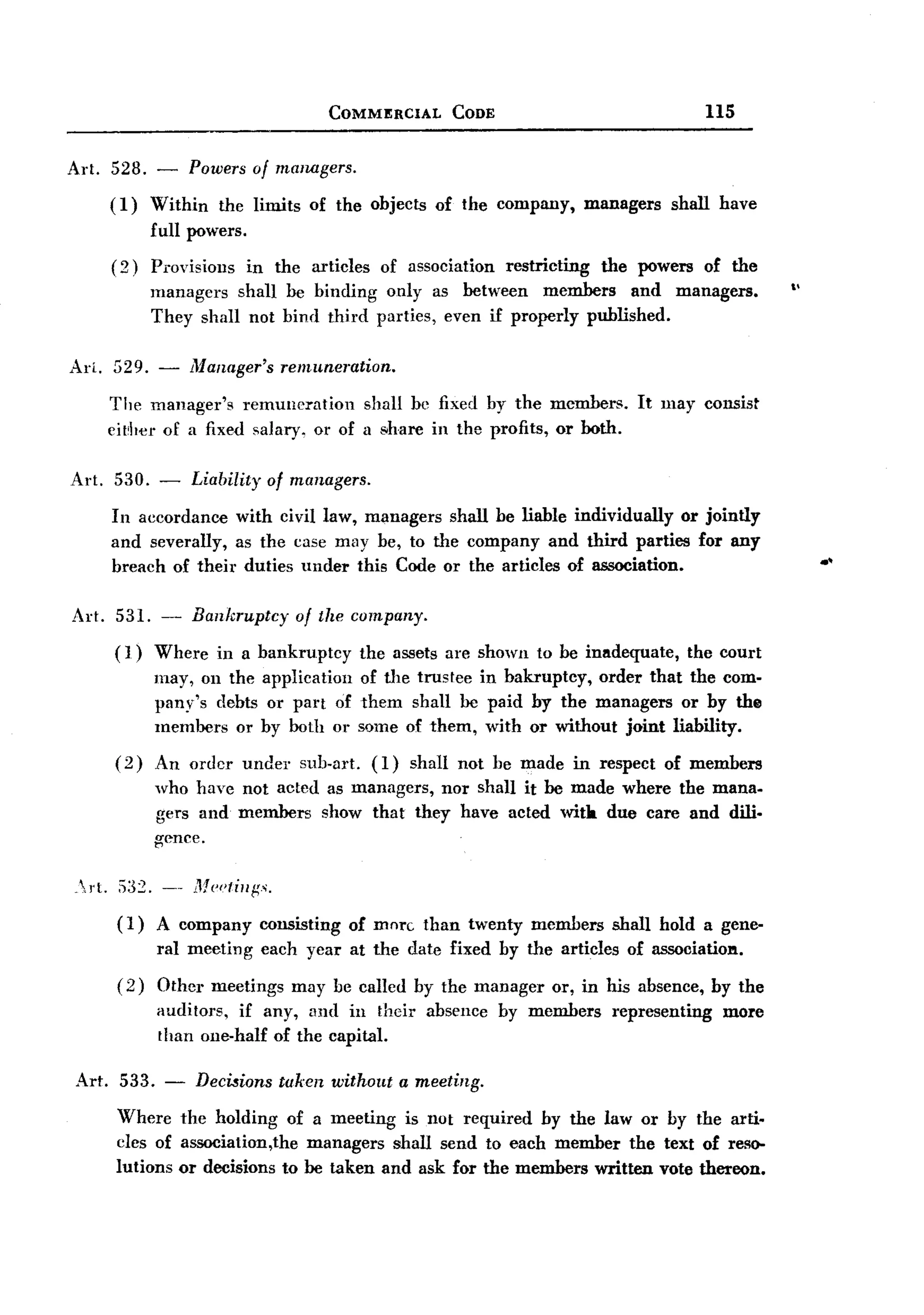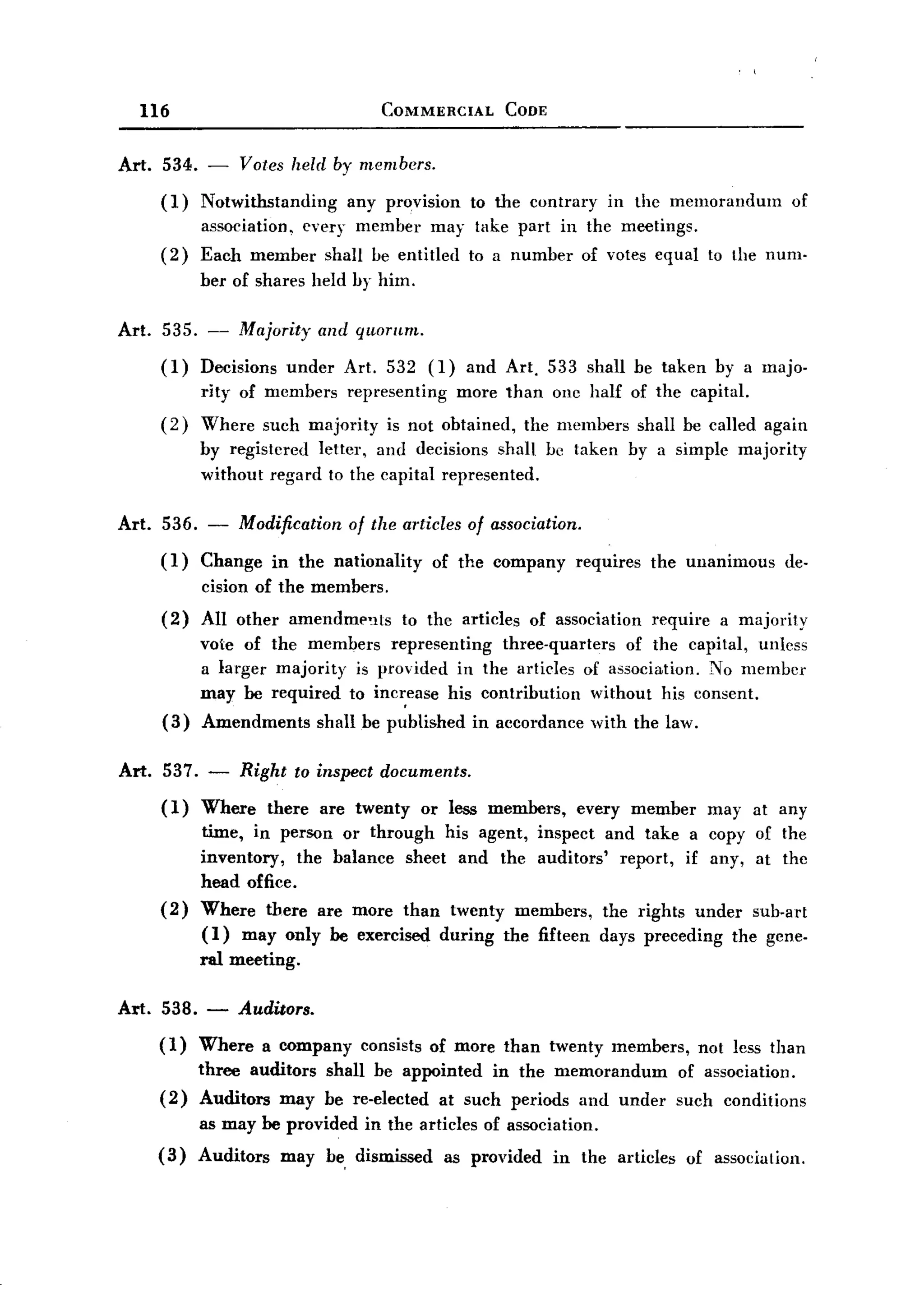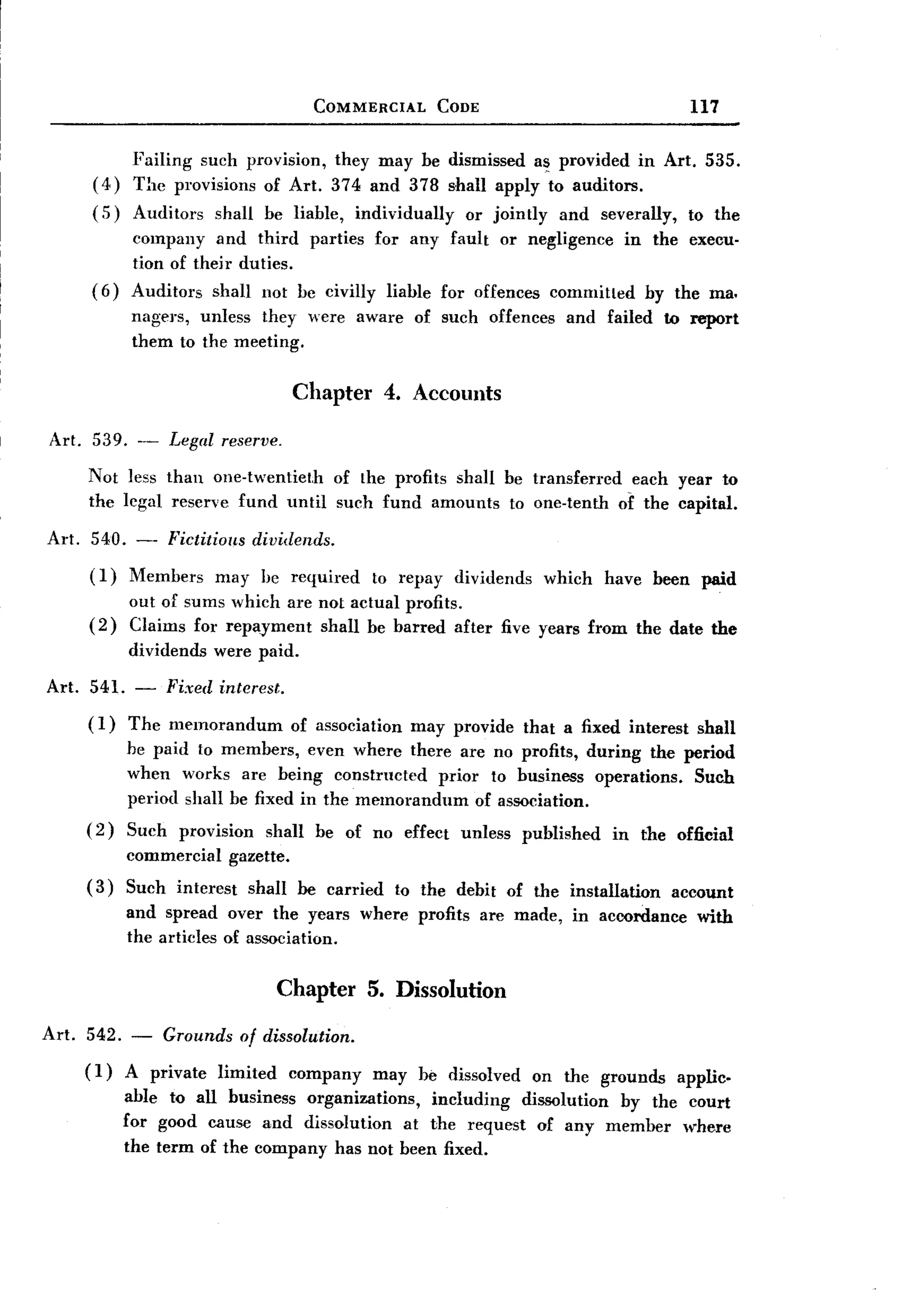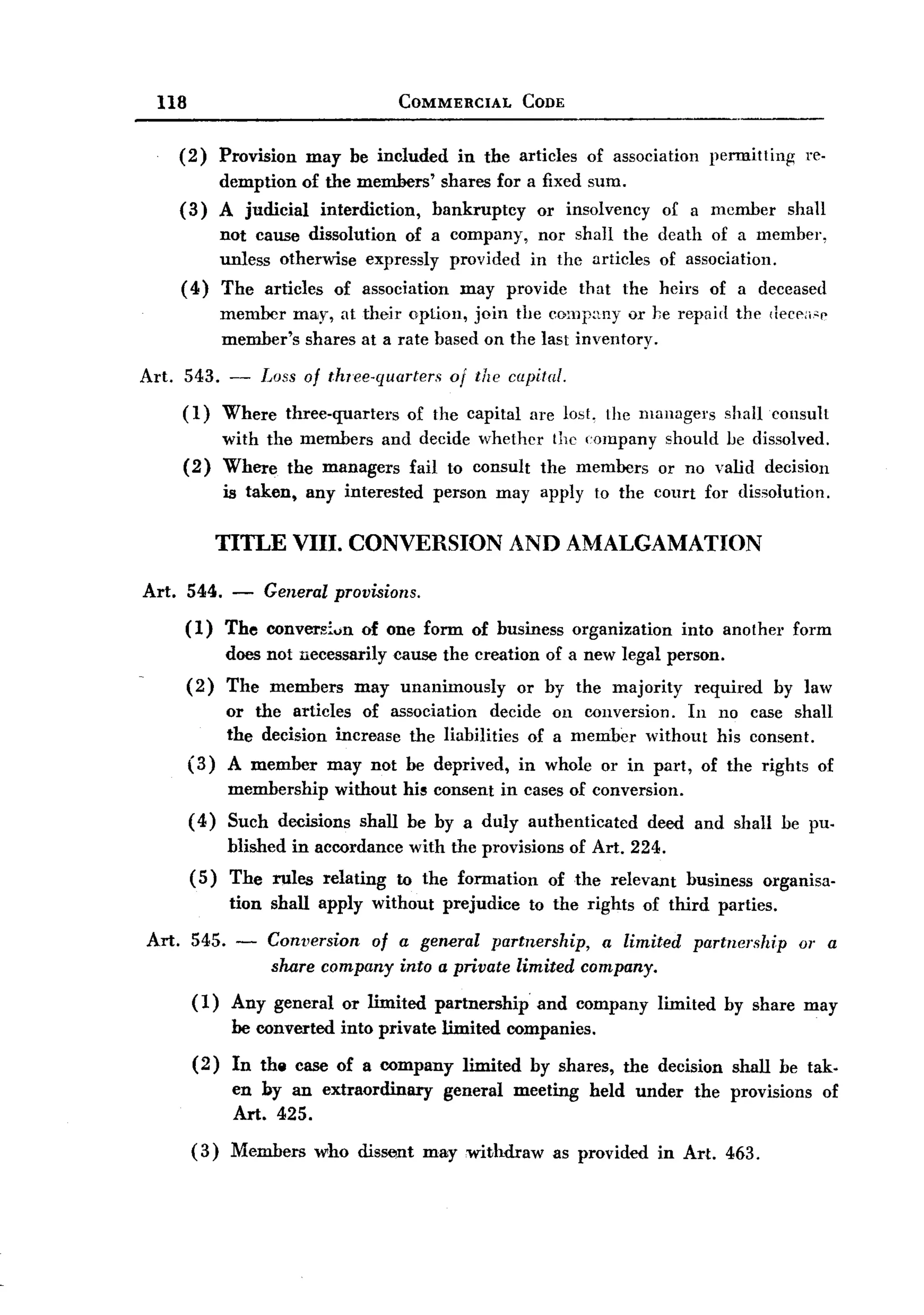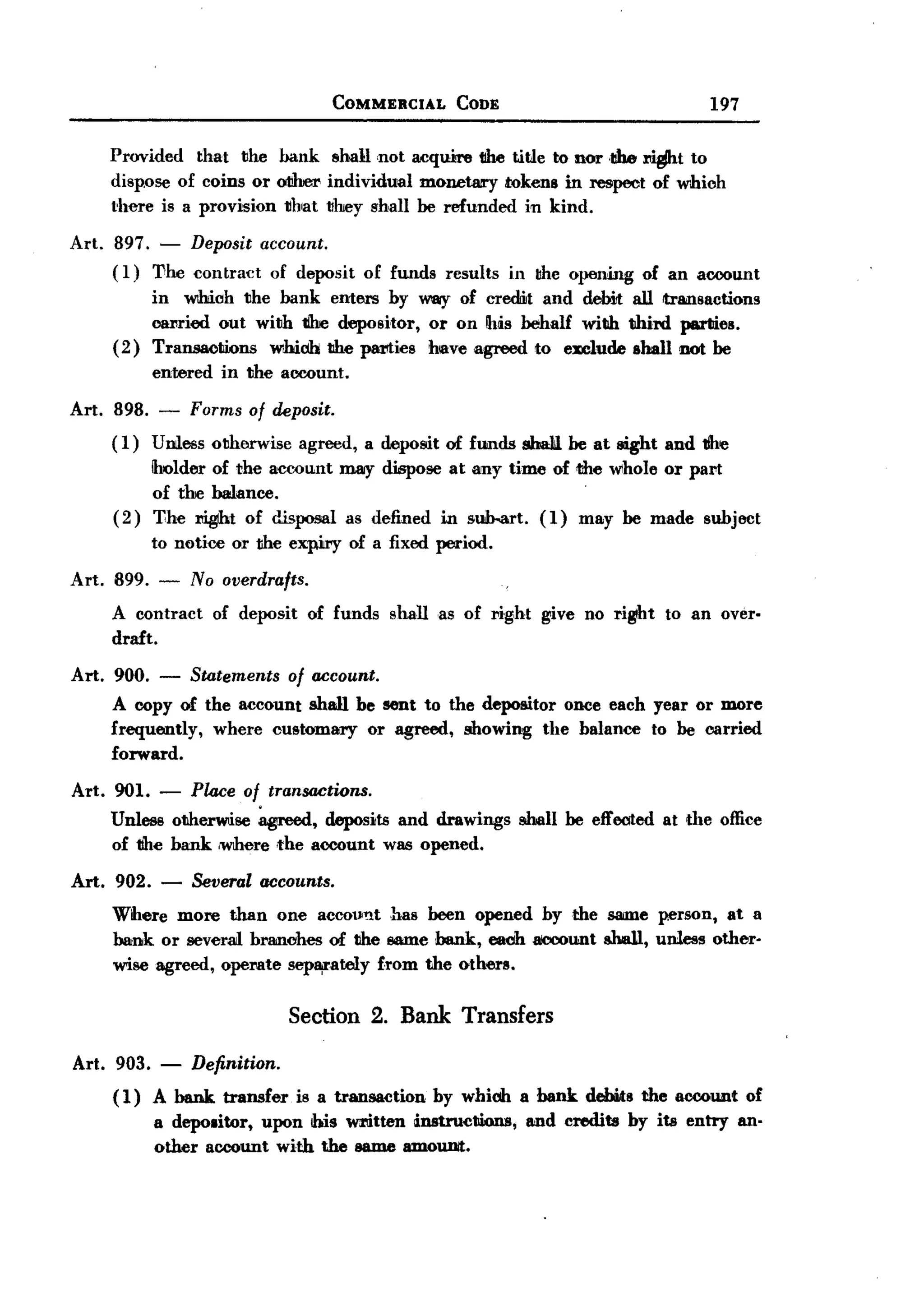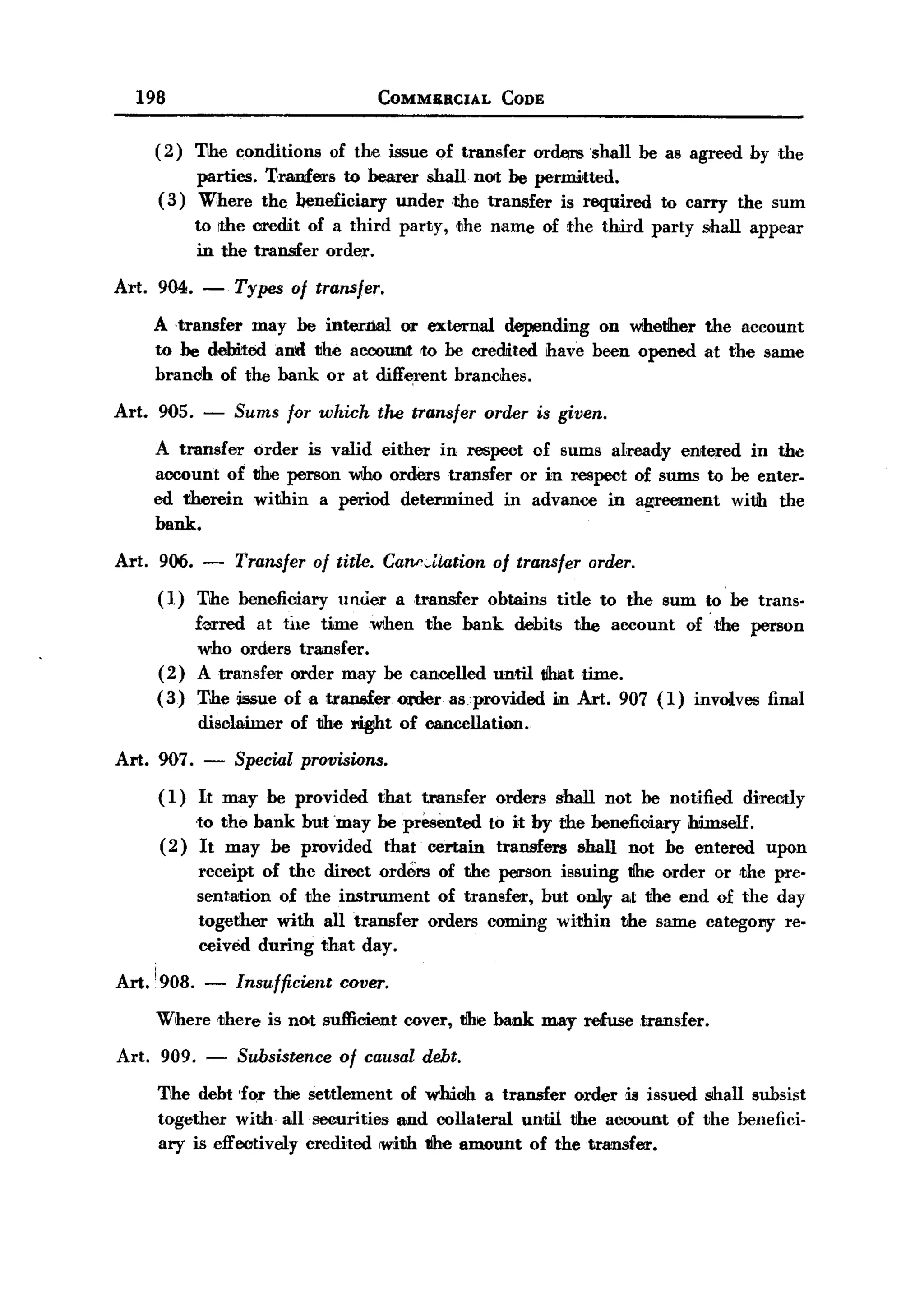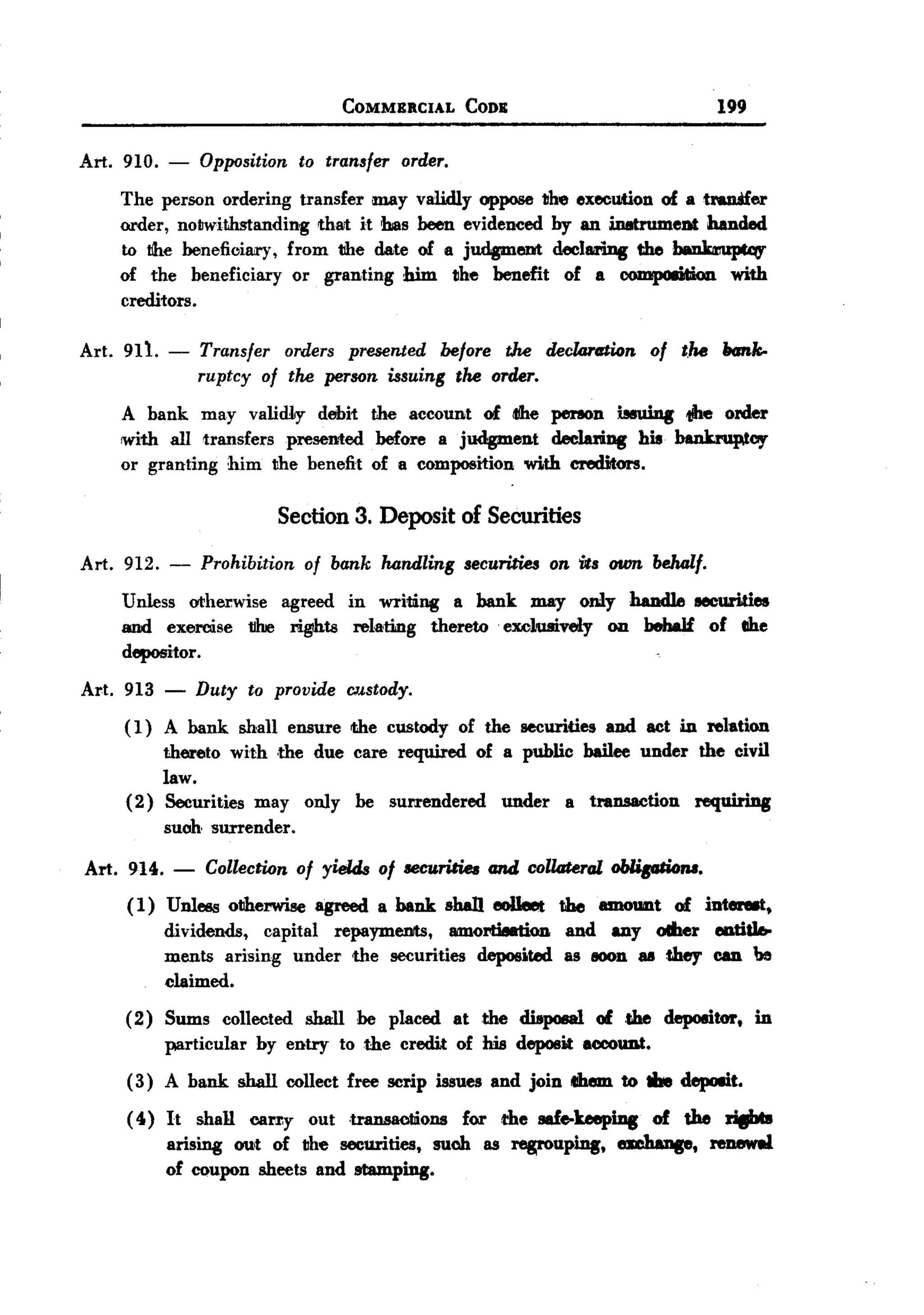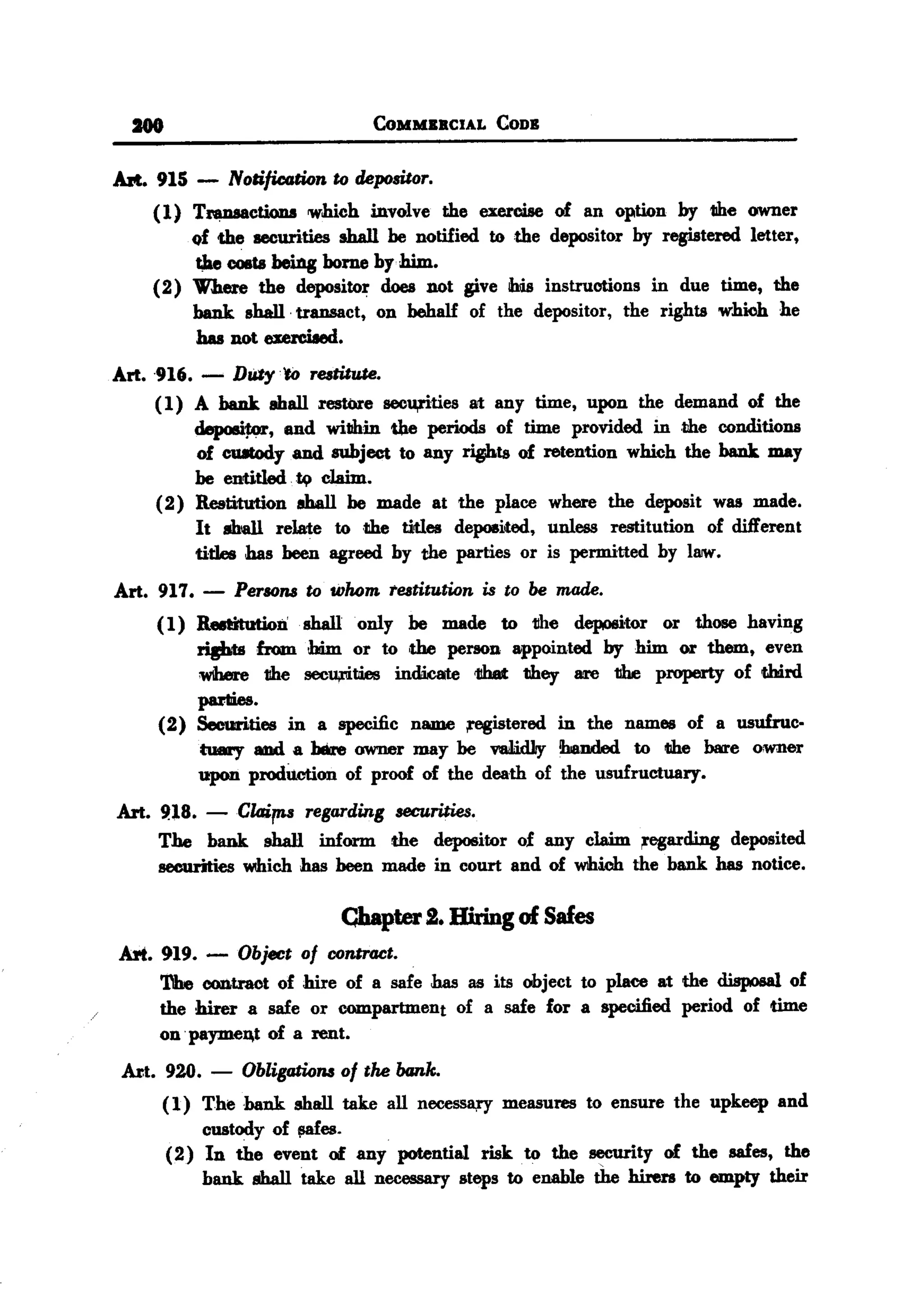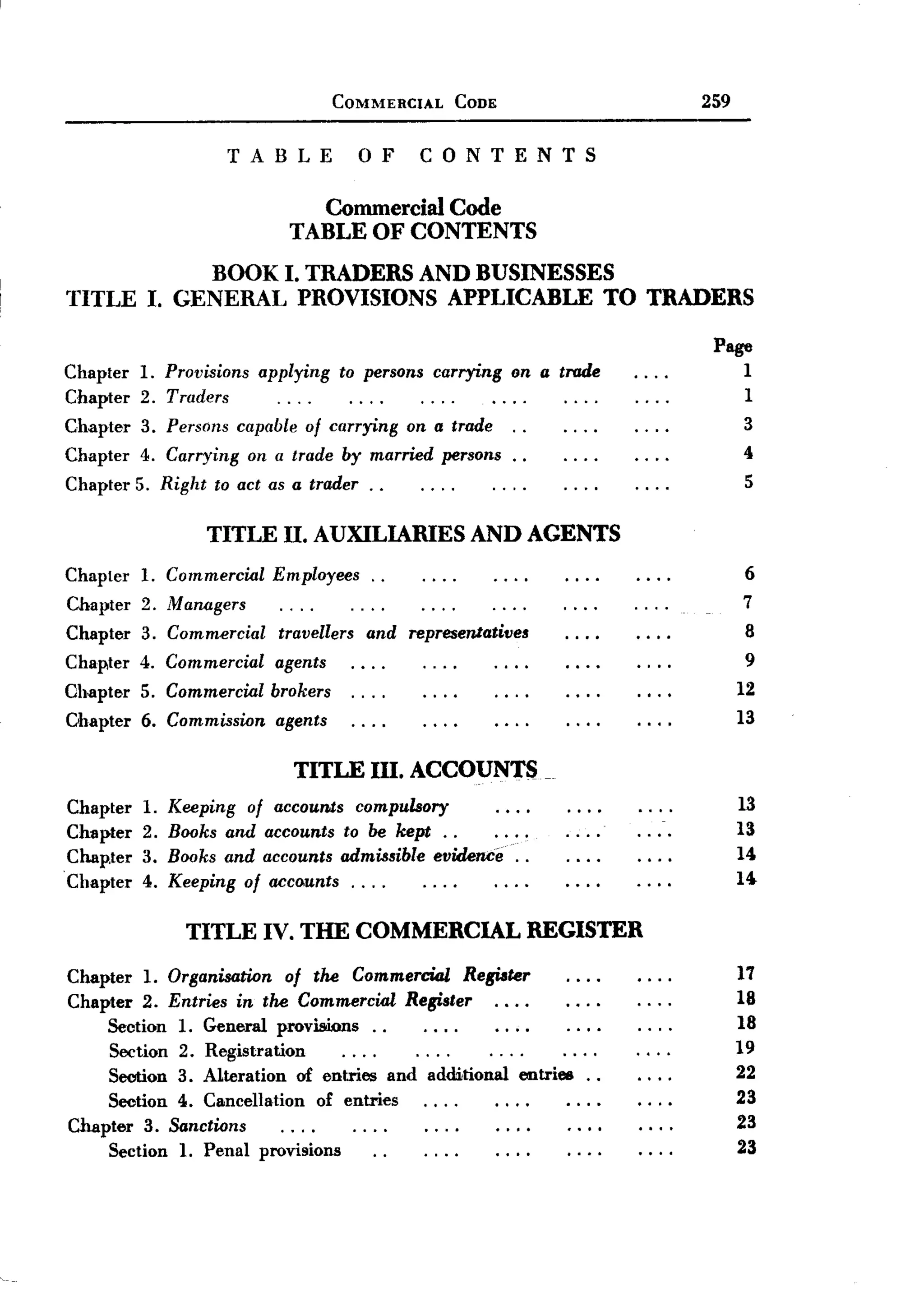
COMMERCIAL      CODE                  259

                      TABLE             OF       CONTENTS

                                  Commercial Code
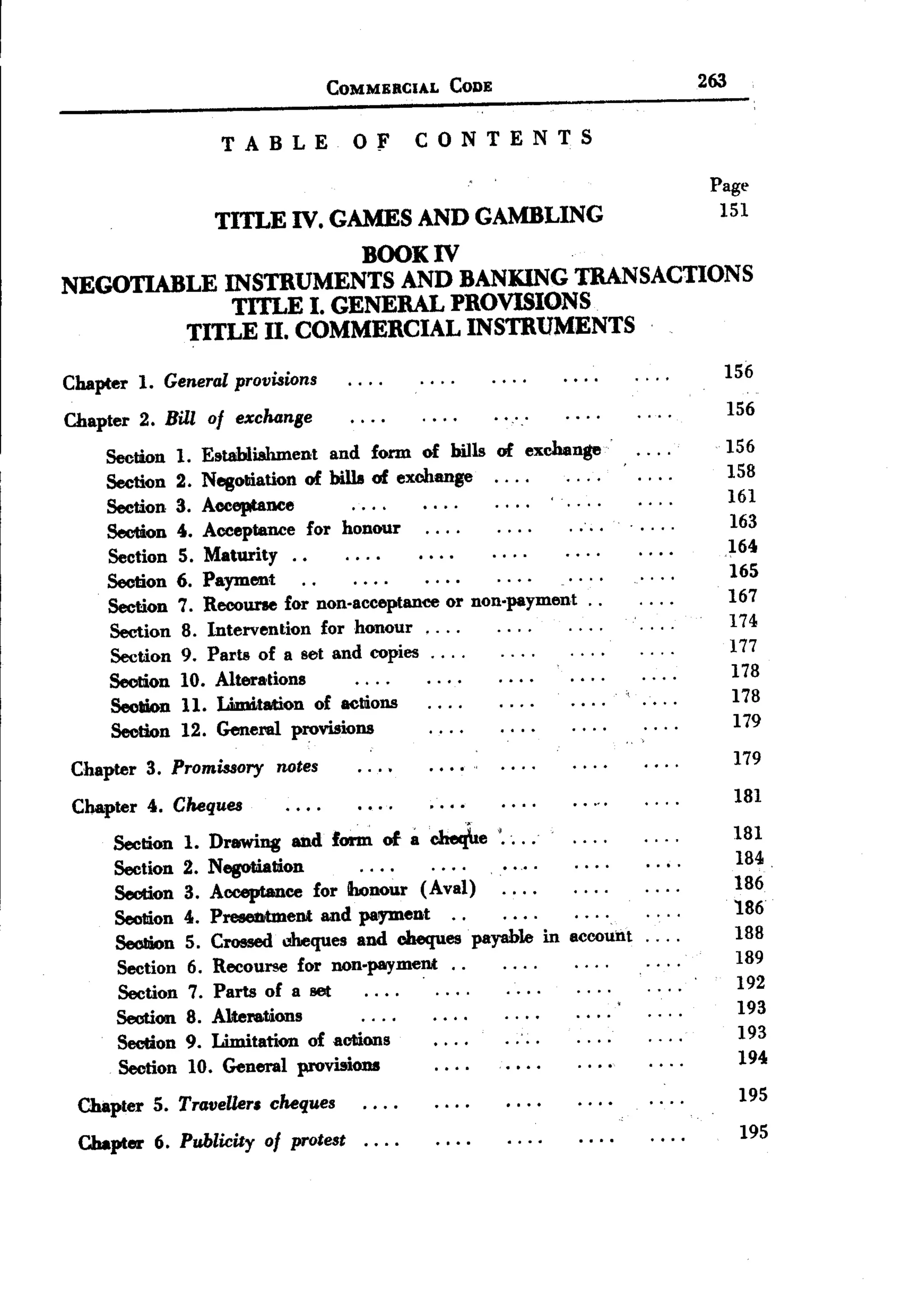
                               TABLE OF CONTENTS
                  BOOK I. TRADERS AND BUSINESSES
TITLE       I. GENERAL PROVISIONS APPLICABLE TO TRADERS

                                                                          Page
Chapter     1. Provisions applying to persons carrying on a trade            1
Chapter     2. Traders                                                       1
Chapter     3. Persons capable of carrying on a trade. .                     3
Chapter     4. Carrying on a trade by married persons. .                     4
Chapter    5. Right to act as a trader. .                                    5

                    TITLE II. AUXILIARIES             AND AGENTS
Chapter    1.   Commercial   Employees.    .                                 6
Chapter    2.   Managers                                                     7
Chapter    3.   Commercial    travellers and representatives                 8
Chap,ter   4.   Commercial   agents                                          9
Chapter    5.   Commercial   brokers. . . .                                 12
Ohapter    6.   Commissian    agents                                        13

                               TITLE III. ACCOUNTS              -


Chapter    1.   Keeping of accounts compulsory                              13
Chapter    2.   Books and accounts to be kept ..                            13
Chap.ter   3.   Books and accounts admissible eviJenee . .                  14
Chapter    4.   Keeping of accounts. . . .                                  14

                  TITLE IV. THE COMMERCIAL                     REGISTER
Chapter 1. Organisatian of the Commercial Repter                            17
Chapter 2. Entries in the Commercial Register.     ...                      18
    Section 1. General provisions. .                                        18
    Section 2. Registration                                                 19
    Section 3. Alteration of entries and additional entries.        .       22
    Section 4. Cancellation of entries                                      23
Chapter 3. Sanctians                                                        23
    Section 1. Penal provisions                                             23
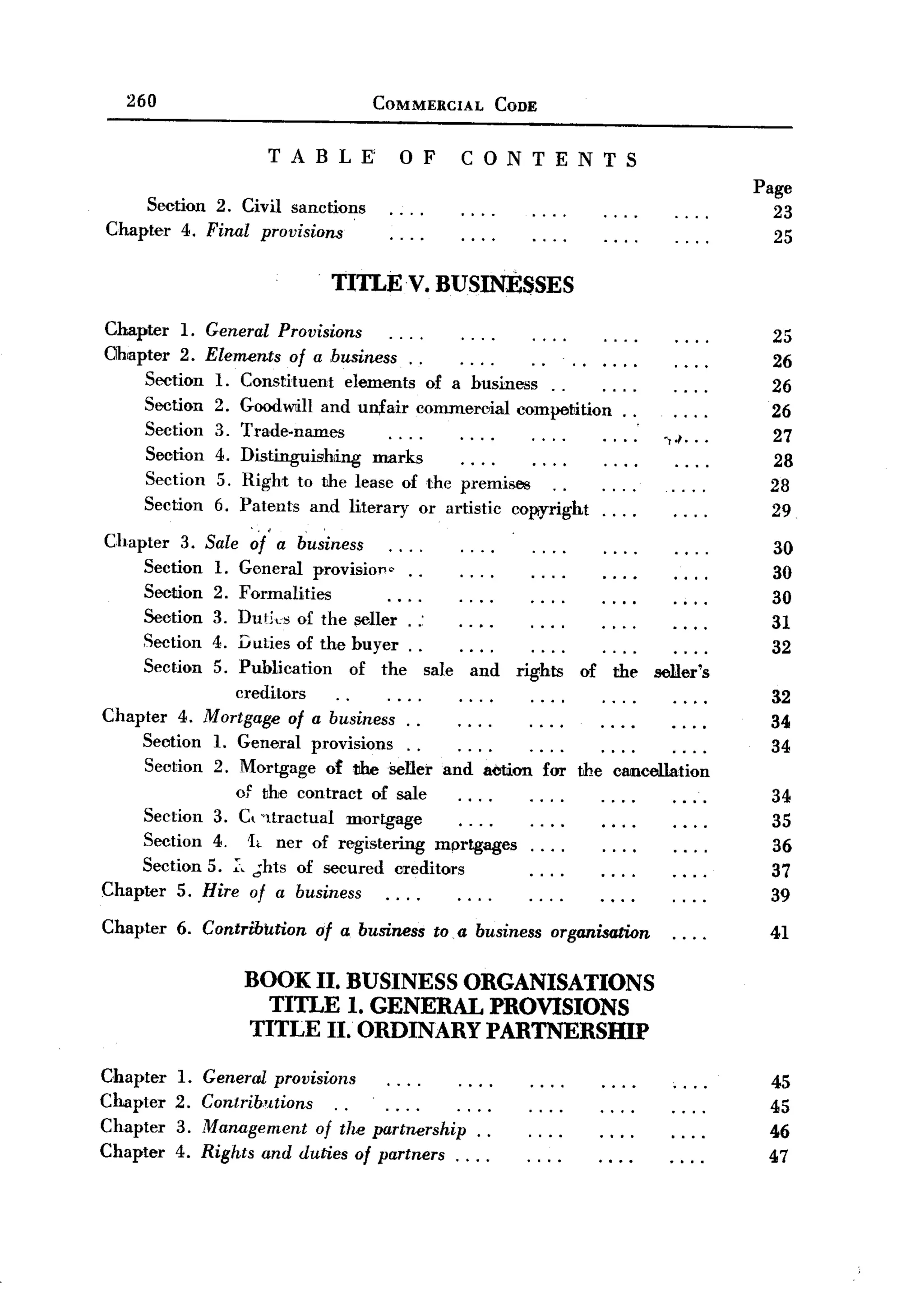
260                                  COMMERCIAL              CODE


                       TABLE'                  OF           CONTENTS
                                                                                                         Page
     Section 2. Civil sanctions                                                                            23
Chapter 4. Final provisions                                                                                25

                                   TITLE V. BUSINESSES

Chapter 1. General Provisions                                                                             25
Ohapter 2. Elements of a business.    .                                                                   26
     Section 1. Constituent elements of a husiness ..                                                     26
     Section 2. Goodwill and un,£air oommeroiaJ competition.                              .               26
                                                                                           .
     Section 3. Trade-names                                                                    .,.1...    27
     Section 4. Distinguishing  marks                                                                     28
     Section 5. Right to the lease of the premises                                                        28
     Section    6. Patents   and    literary      or artistic    oopyright         ....                   29
                 '.         .
Chapter 3. Sale ~f a business                                                                             30
    Section 1. General provisioJ1o ..                                                                     30
    Secmon 2. Formalities                                                                                 30
    Section 3. Duti"s of the :;eller . .-                                                                 31
    Seetion 4. Duties of the huyer . .                                                                    32
    Section 5. Publication of the sale and rights of the seller's
               creditors                                                                                  32
Chapter 4. Mortgage of a business. .                                                                      34
    Section 1. General provisions. .                                                                      34
    Section 2. Mortgage ot t1hei>ener and aCtion for the cancellation
               of the contract of sale                                                                    34
    Section 3. C, 'ltractual mortgage                                                                     35
    Section 4. 1e ner of registering mprtgages                                                            36
     Section 5. ;:, .;hts of secured           crreditors              ""
                                                                                                          37
Chapter 5. Hire of a business                                                                             39
Chapter   6. Contribution    of a. business          to a business          organisation                  41
                                                        -

                    BOOK II. BUSINESS ORGANISATIONS
                      TITLE 1. GENERAL PROVISIONS
                    TITLE II. ORDINARY PARTNERSHIP

Chapter   1.   General provisions                                                                         45
Chapter   2.   Contribntions                                                                              45
Chapter   3.   Management of the partnership. .                                                           46
Chapter   4.   Rights and duties of partners. . . .                                                       47
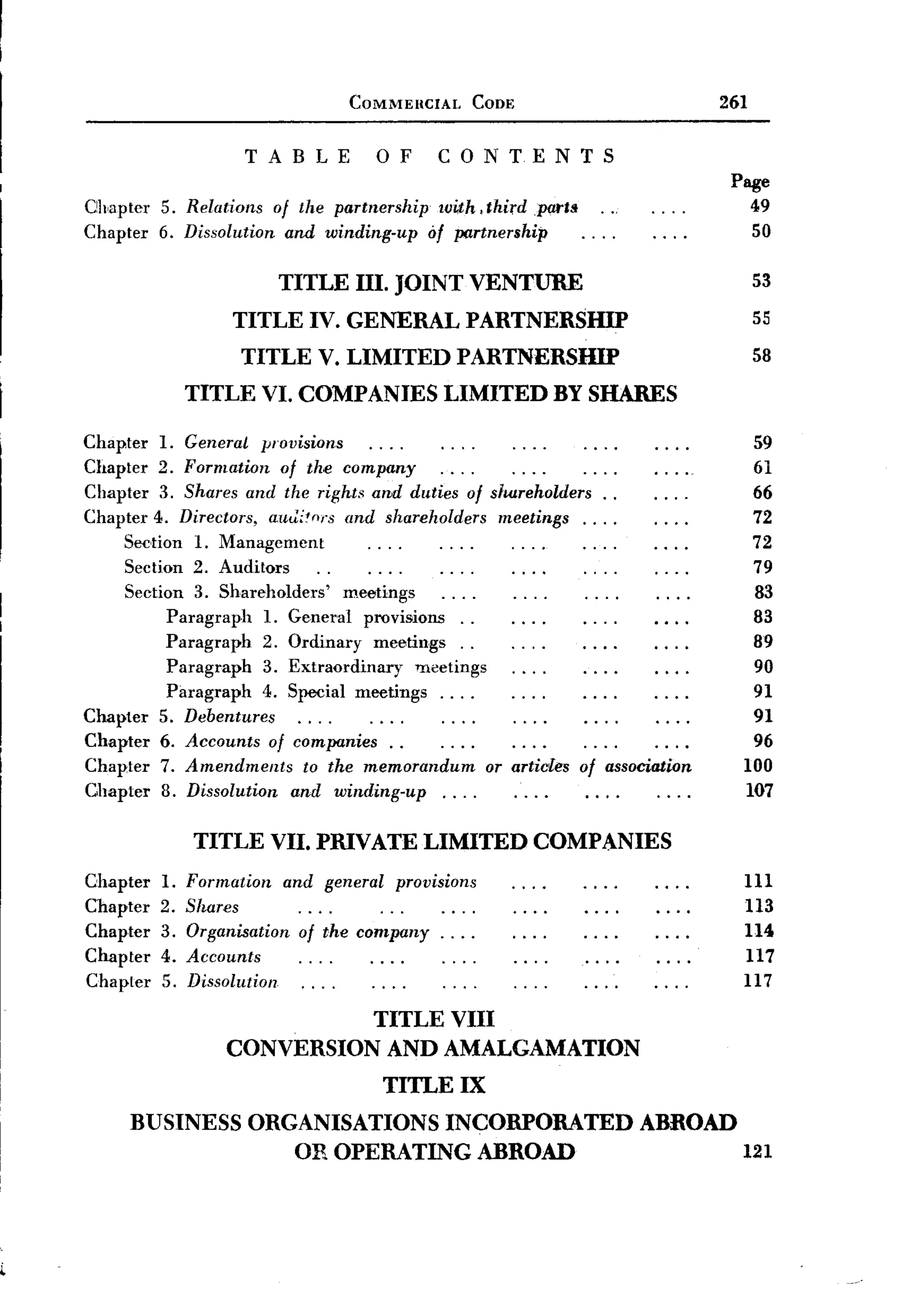
COMMEIICIAL     CODE                         261

                      TABLE           0 F        CONTENTS
                                                                                Page
Ohapter    5. Relations of the partnership with, third parts                      49
Chapter    6. Dissolution and winding-up of partnership                           50

                          TITLE III. JOINT VENTURE                                53
                     TITLE IV. GENERAL PARTNERSHIP                                55
                      TITLE V. LIMITED            PARTNERSHIP                     58
                TITLE VI. COMPANIES              LIMITED    BY SHARES

Chapter 1. General provisions                                                     59
Chapter 2. Formation of the company                                               61
Chapter 3. Shares and the rights and duties of shareholders.       .              66
Chapter 4. Directors, autlitnrs and shareholders meetings....                     72
     Sedion 1. Management                                                         72
     Section 2. Auditors                                                          79
     Section 3. Shareholders'    meetings                                         83
           Paragraph  1. General provisions..                                     83
           Paragraph  2. Ordinary meetings.      .                                89
           Paragraph  3. Extraordinary    meetings                                90
           Paragraph  4. Special meetings.     ...                                91
Chapter 5. Debentures                                                             91
Chapter 6. Accounts of companies.       .                                         96
Chapter 7. Amendments       to the memorandum      or articles of association    100
Chapter 8. Dissolution and winding-up....                                        107

                TITLE VII. PRIVATE LIMITED                 COMPANIES
C,hapter   1.   Formation and general provisions                                 111
Chapter    2.   Shares                                                           113
Chapter    3.   Organisation of the company. . . .                               114
Chapter    4.   Accounts                                                         117
Chapter    5.   Dissolution                                                      117
                              TITLE VIII
                    CONVERSION AND AMALGAMATION
                                       TITLE IX
      BUSINESS ORGANISATIONS INCORPORATED ABROAD
                  OR OPERATING ABROAD            121
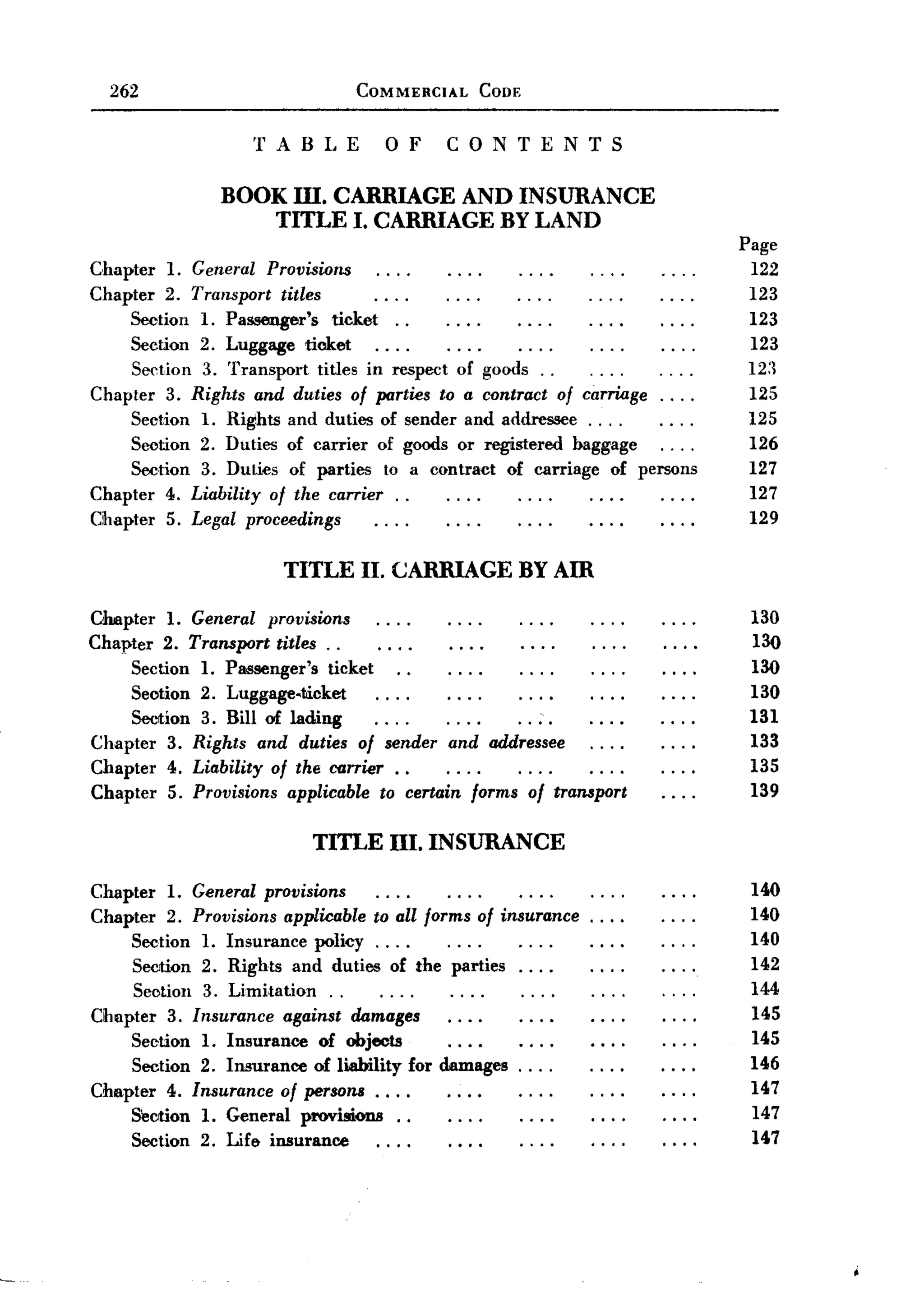
262                           COMMERCIAL    CODE


                   TABLE           OF     CONTENTS

               BOOK m. CARRIAGE AND INSURANCE
                   TITLE I. CARRIAGE BY LAND
                                                                           Page
Chapter 1. General Provisions                                               122
Chapter 2. Transport titles                                                 123
    Section 1. Passenger's ticket..                                         123
    Section 2. Luggage ticket                                               123
    Section 3. Transport titles in respect of goods. .                      123
Chapter 3. Rights and duties of parties to a rontract of carrioge   ....    125
    Section 1. Rights and duties of sender and addressee. . . .             125
     Section 2. Duties of carrier of goods or registered baggage            126
     Section 3. Duties of parties to a contract of carriage of persons      127
Chapter 4. Liability of the carrier. .                                      127
Chapter 5. Legal proceedings                                                129

                       TITLE II. CARRIAGE BY Am

Chapter 1. General provisions                                               130
Chapter 2. Transport titles. .                                              130
    Section 1. Passenger's ticket                                           130
    Seotion 2. Luggage-ticket                                               130
     Section 3. Bill of lading                                              131
Chapter 3. Rights and duties of sender and addressee                        133
Chapter 4. Liability of the carrier. .                                      135
Chapter 5. Provisions applicable to certain forms of transport              139

                          TITLE III. INSURANCE

Chapter 1. General provisions                                               140
Chapter 2. Provisions applicable to all forms of insurance.   ...           140
    Section 1. Insurance policy. . . .                                      140
    Section 2. Rights and duties of the parties. . . .                      142
     Section 3. Limi,tation ..                                              144
Chapter 3. Insurance against damages                                        145
    Section 1. Insurance of objects                                         145
    Section 2. Insurance of liability for damages. . . .                    146
Chapter 4. Insurance of persons. . . .                                      147
    section 1. General provisions. .                                        147
    Section 2. Life insurance                                               147
COMMERCIAL    CODE                     263

                      TABLE           Of        CONTENTS

                                                                            Page
                                                                             151
                     TITLE IV. GAMES AND GAMBLING
                        BOOK IV
NEGOTIABLE INSTRUMENTS AND BANKING TRANSACTIONS
             TITLE I. GENERAL PROVISIONS
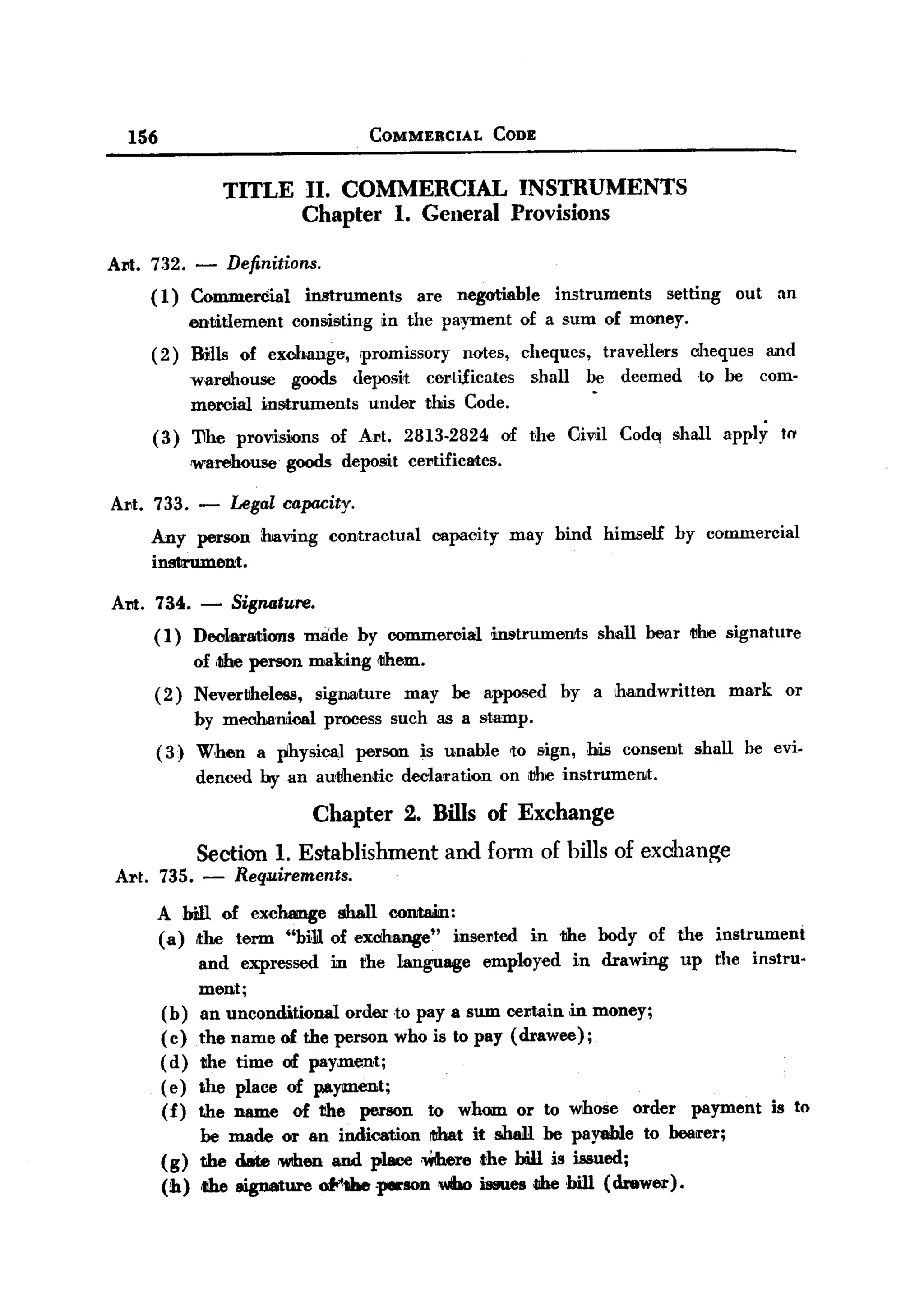
         TITLE II. COMMERCIAL INSTRUMENTS
                                                                             156
Chapter     1. General provisions
                                                                             156
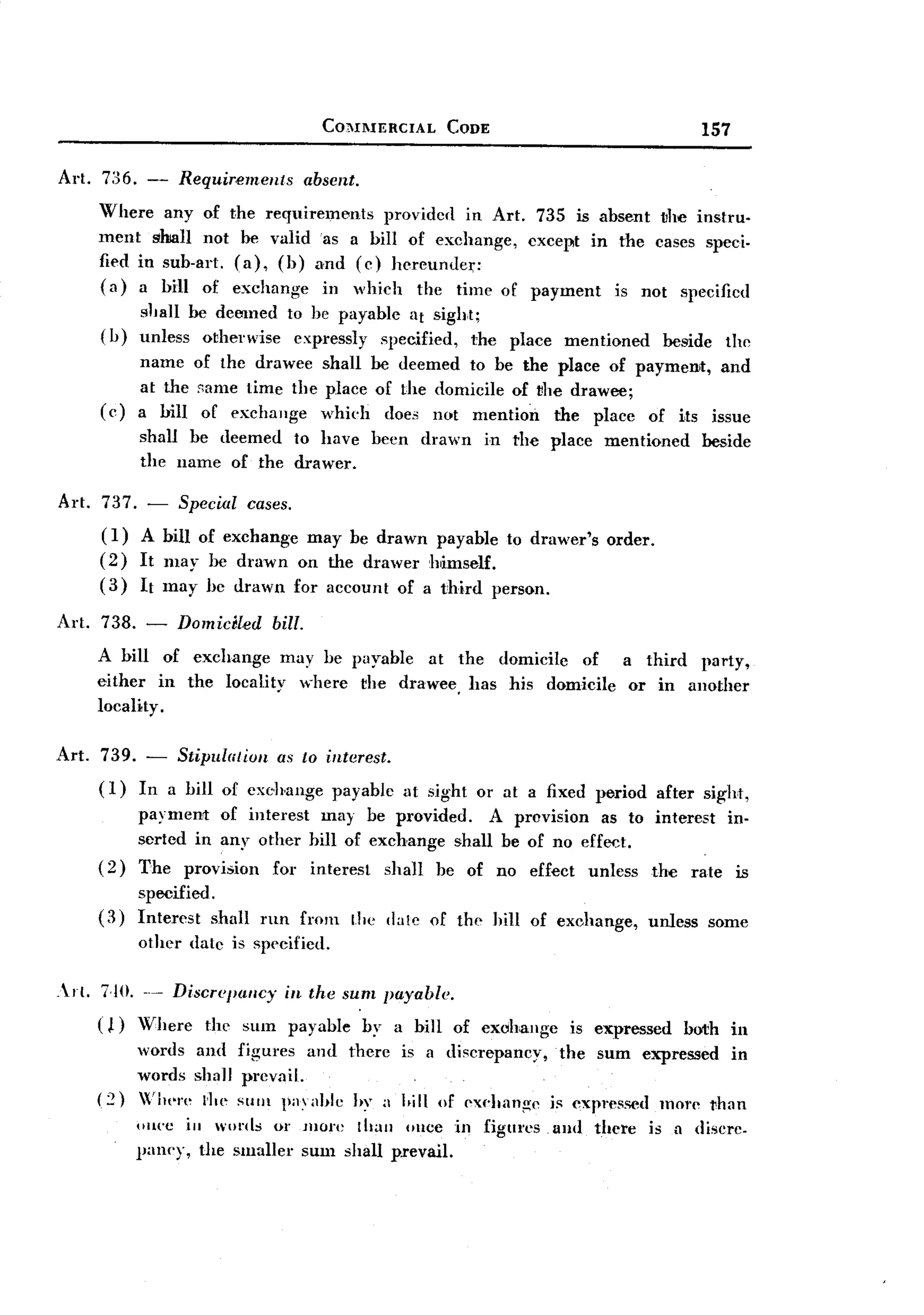
Chapter 2. Bill of exchanse
                                                                             156
     Section 1.     Establiahment and form of bills of exchange
                                                                             158
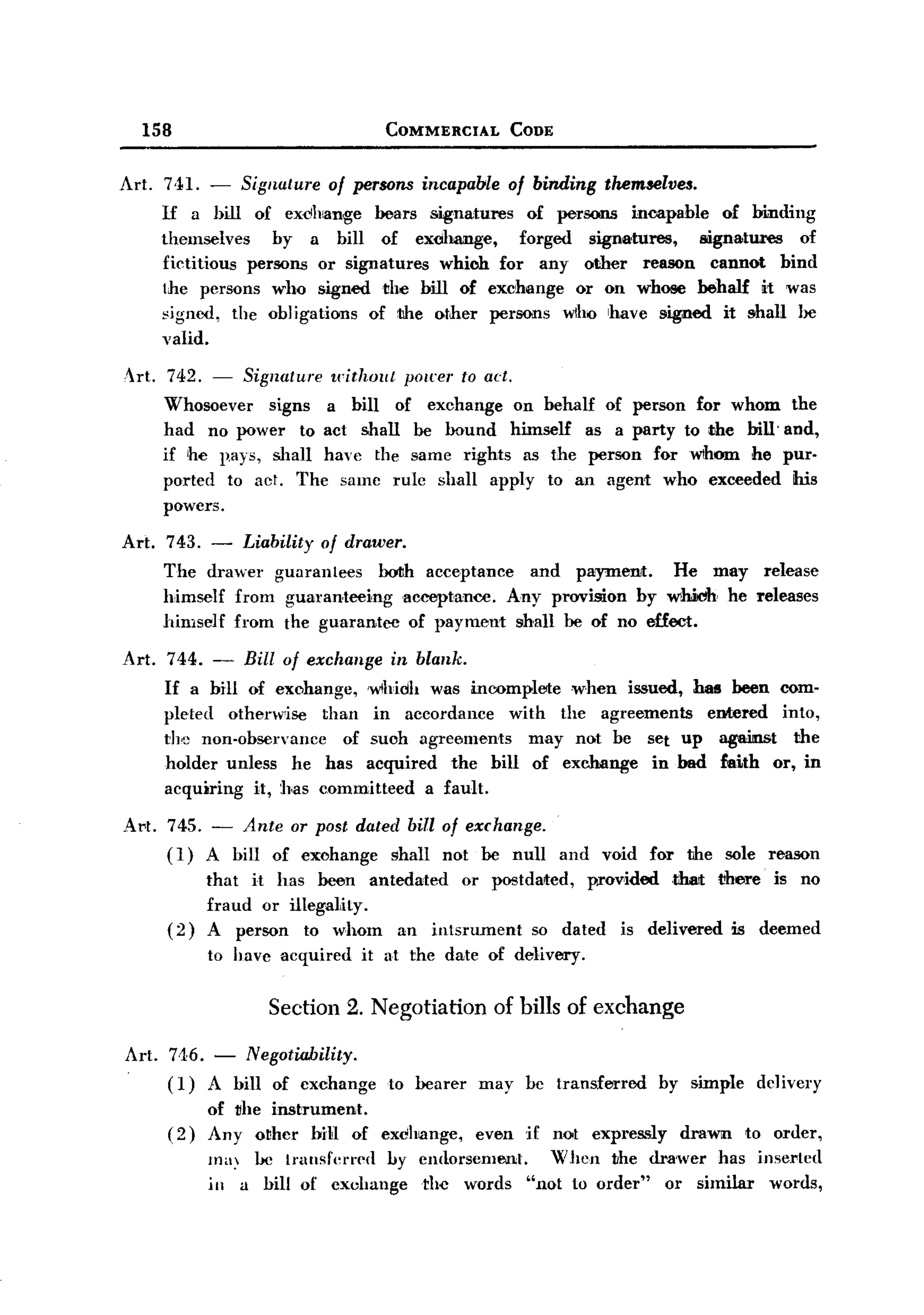
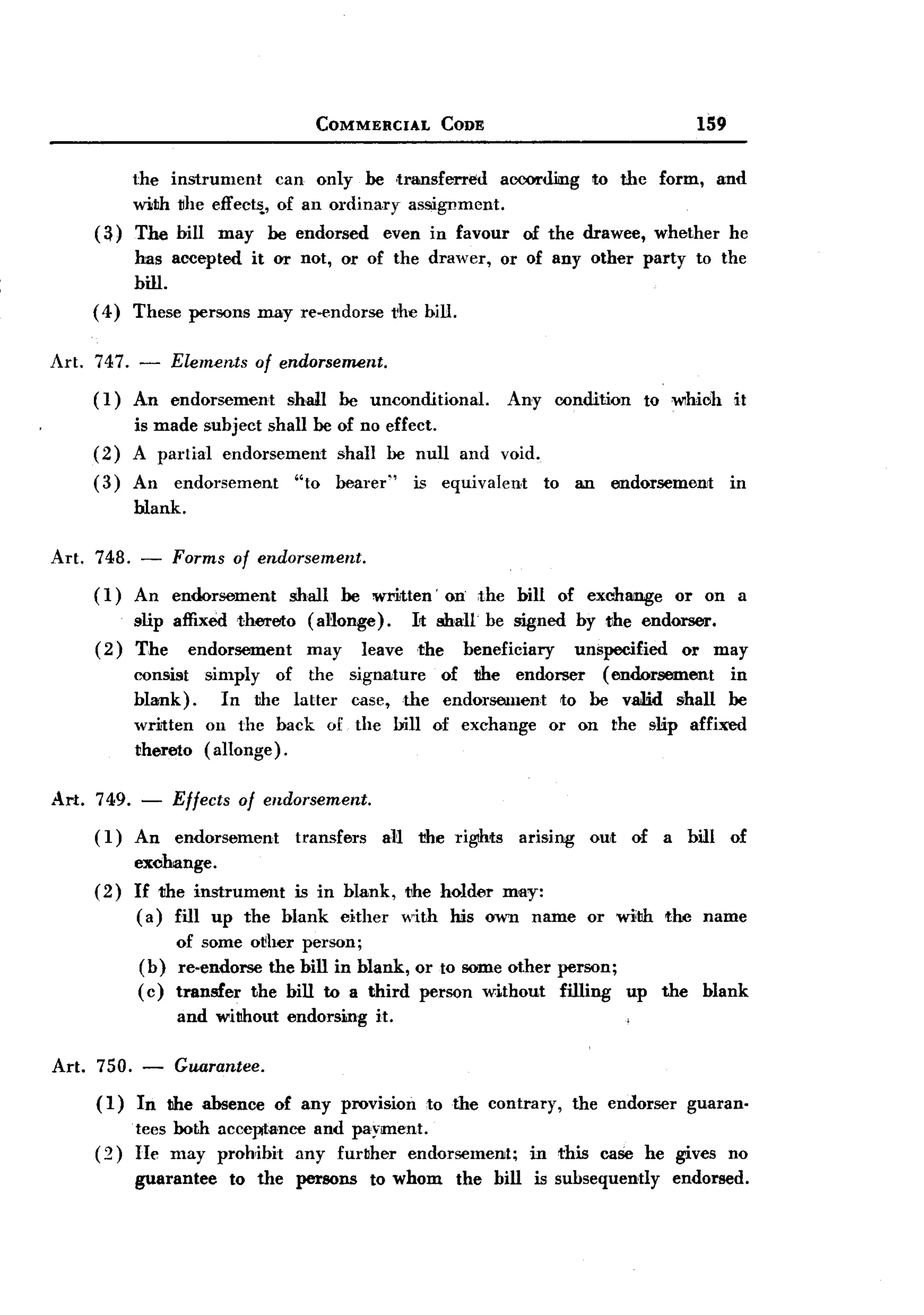
     Section 2.     Negoution of bills of exchange. . . .
                                                                             161
     Section 3.     Acceptance
                                                                             163
     Section 4.     Acceptance for honour
                                                                             164
     Section 5.     Maturity..
                                                                             165
     Section 6.     Payment                                 .


                                                                             167
     Section     7. Recourse for non-acceptance or non.payment ..
                                                                             174
     Section     8. Intervention for honour. . . .
                                                                             177
     Section     9. Parts of a set and copies. . . .
                                                                              178
     Section     10. Alterations
                                                                              178
     Section     11. Limttation of actions
                                                                              179
     Section     12. GenenU provisions
                                                                                 179
 Chapter 3. Promissory notes
                                                                                 181
 Chapter 4. Cheques
                                                                                 181
      Section 1.    Drawing and form of acheqhe '....
      Section 2.    Negotiation                                                  184.
                                                                                 186
      Seotion 3.    Acceptance for honour (A val)
                                                                                 186
      Seotion 4.    Presentment and pal)'D1ent .. .
                                                                                 188
      SeoIiion 5.   Crossed d1eques and cheques payable in accoun.t ....
                                                                                 189
      Section 6.    Recourse for non-payment. .
                                            .
                                                                                 192
          Section 7. Parts of a set
                                                                                 193
          Section 8. Altera.tions
                                                                                 193
          Section 9. Limitation of actions
                                                                                 194
          Section 10. General provisions
                                                                                 195
 Chapter 5. Traveller. cheques
                                                                                 195
  Chapter 6. Publicity of protest..        ..
261                                COMMERCIAL          CODE


                    TABLE               OF    CONTENTS
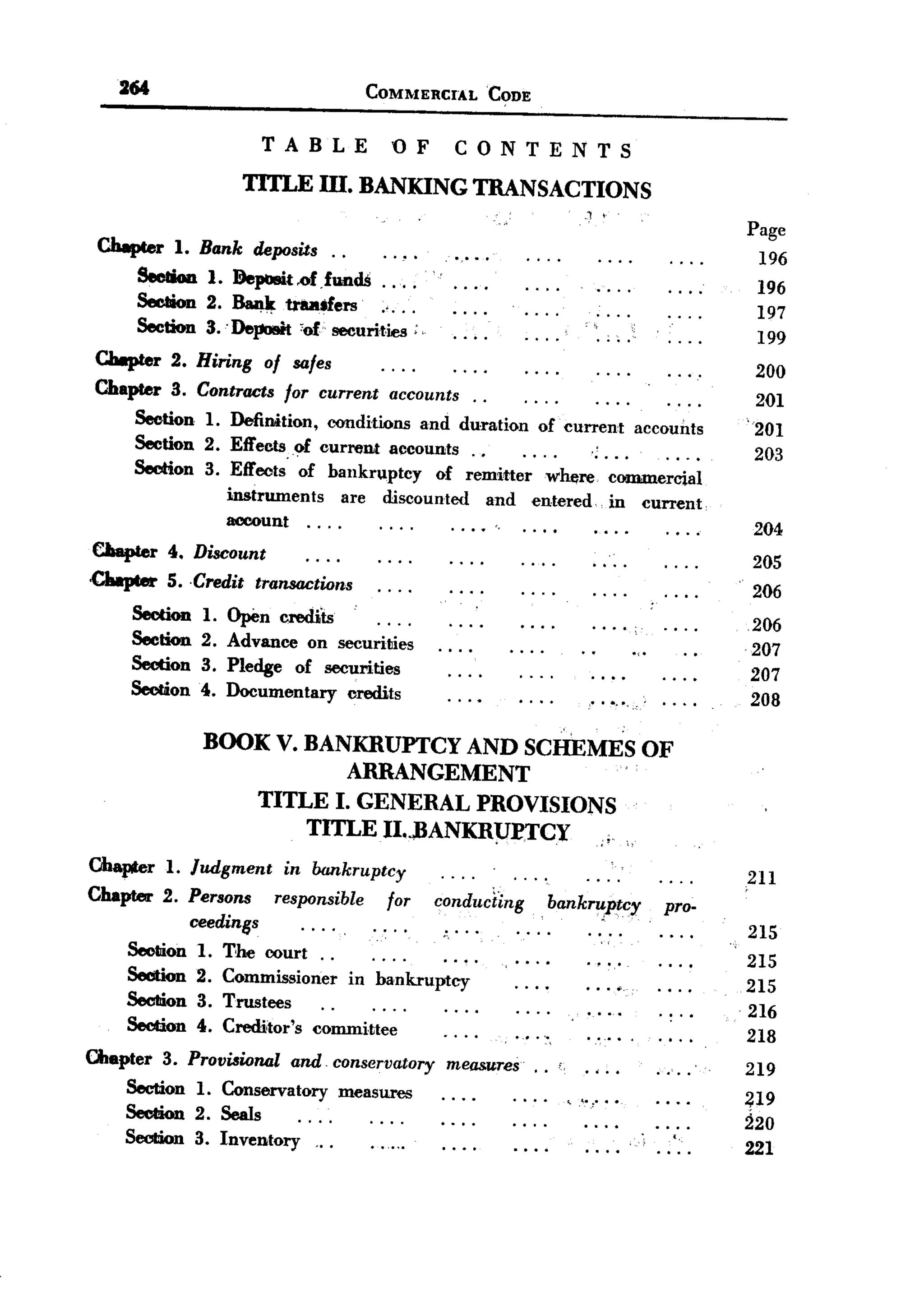
                  TITLE m. BANKING TRANSACTIONS
                                                                             .,   ;


                                                                                                   Page
 Chapter 1. Bank deposits..
                                                                                                    196
     Section 1. Deposit.of.fundS ... .
                                                                                                    196
     Section 2. ~     traailers     ....                                                            197
     Section 3.' DepoBit 'of securities ;                                         .. .              199
 Chapter 2. Hiring of safes
                                                                                                    200
 Chapter 3. Contracts for current accounts.           .
                                                                                                    201
     Section 1. Definition, oonditions and duration of current accounts
                                                                                                   '201
     Section 2. Effects. of current accounts. .            ....                                     203
     Section 3. Effects of bankruptcy of remitter where commercial
                instrwnents are discounted and entered. in current
                account. . . .                .. ..                                                204
CIaapter 4. Discount
                                                                                                   205
Chapter 5. .Credit transactions
                                                                                                   206
                                  .
     Section 1. Open crediis
                                                                                                   206
     Section 2. Advance on securities
                                                                                                   207
     Section 3. Pledge of securities
                                                                                                   207
     Section 4. Documentary credits
                                                                                                   208

             BOOK V. BANKRUPTCY AND SCHEMES OF
                         ARRANGEMENT
                 TITLE I. GENERAL PROVISIONS
                     TITLE II..)JANKRPETCY,
Ohapter 1. Judgment in bankruptcy
                                                                                                   211
Chapter 2. Persons responsible for conduci~ng                        bankru,ptcy            pro-
            ceedinss                                                                               215
                                       '.
    SeclIion 1. The court. .
                                                                                                   215
    Section 2. Commissioner in bankruptcy
                                                                                                   215
    SecIiion 3. Trustees
                                                                                                   216
    Section 4. Creditor's committee
                                                                                                   218
Chapter 3. Provi&ional and. conservatory measures.                   .
                                                                                                   219
    Section 1. Conservatory measures                        . . ..       .            ..           ~19
    SecIIion 2. Seals                                                        ""            ... .   220
    Section 3. Inventory   ...                                                               '.    221
t
1-                                     COMMERCIAL      CODE                   265

                          TABLE           OF        CONTENTS
                                                                               Page
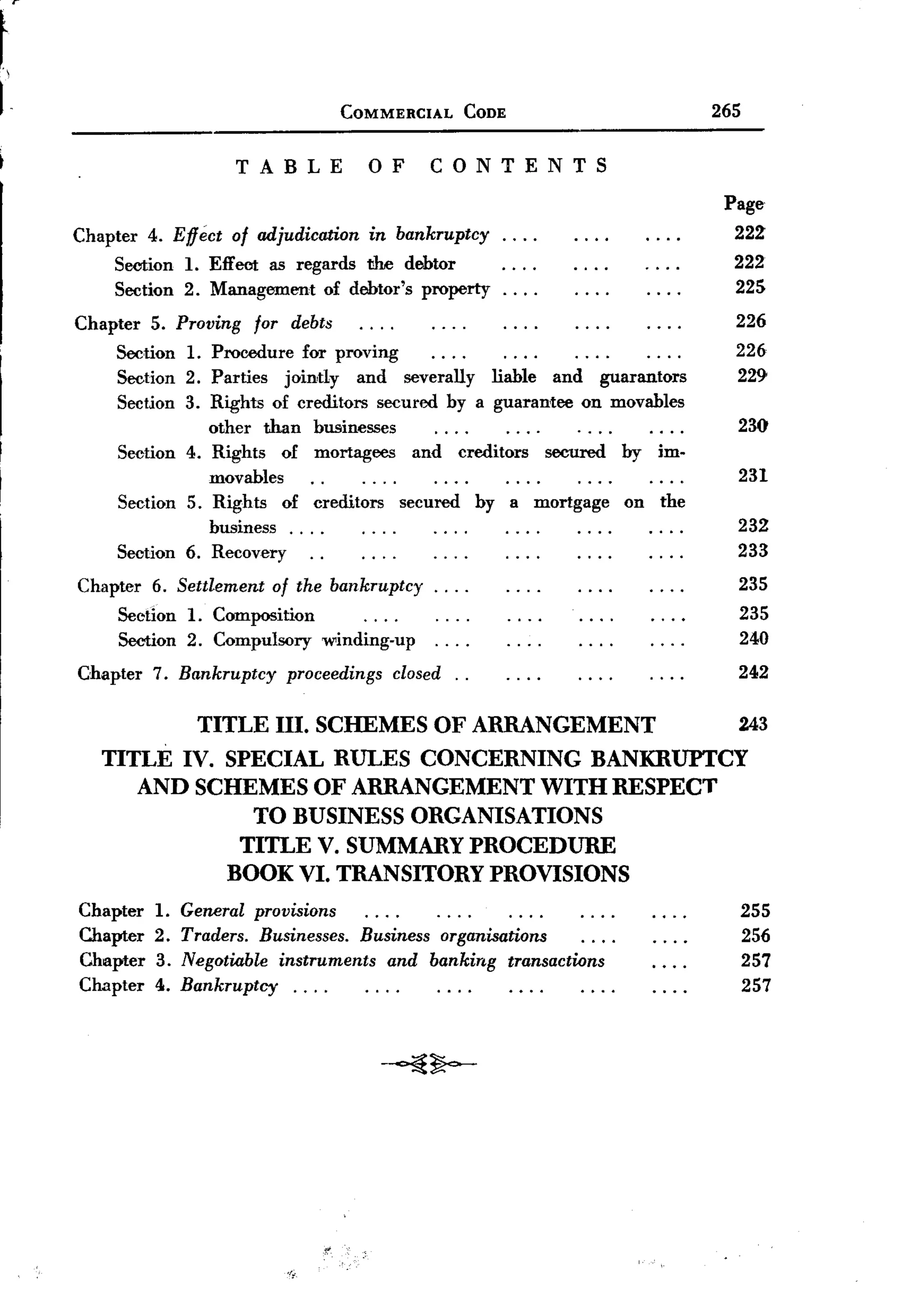
     Chapter 4. Effect of adjudication in bankruptcy.         ...               222
         Section 1. Effect as regards the debtor                                222
         Section 2. Management of debtor's property.          ...               225
     Chapter 5. Proving for debts                                               226
         Section 1. Procedure for proving                                       226
         Section 2. Parties jointly and severally liable and guarantors         229
          Section 3. Rights of creditors secured by a guarantee on movables
                     other than businesses                                      230
          Section 4. Rights of mortagees and creditors secured by im-
                     movables                                                   231
          Section 5. Rights of creditors secured by a mortgage on the
                     business. . . .                                            232
          Section 6. Recovery                                                   233
     Chapter 6. Settlement of the bankruptcy.        ...                        235
         Section 1. Composition                                                 235
         Section 2. Compulsory winding-up.           ...                        240
     Chapter 7. Bankruptcy     proceedings closed. .                            242

                     TITLE III. SCHEMES OF ARRANGEMENT                          243
        TITLE IV. SPECIAL RULES CONCERNING BANKRUPTCY
           AND SCHEMES OF ARRANGEMENT WITH RESPECT
                    TO BUSINESS ORGANISATIONS
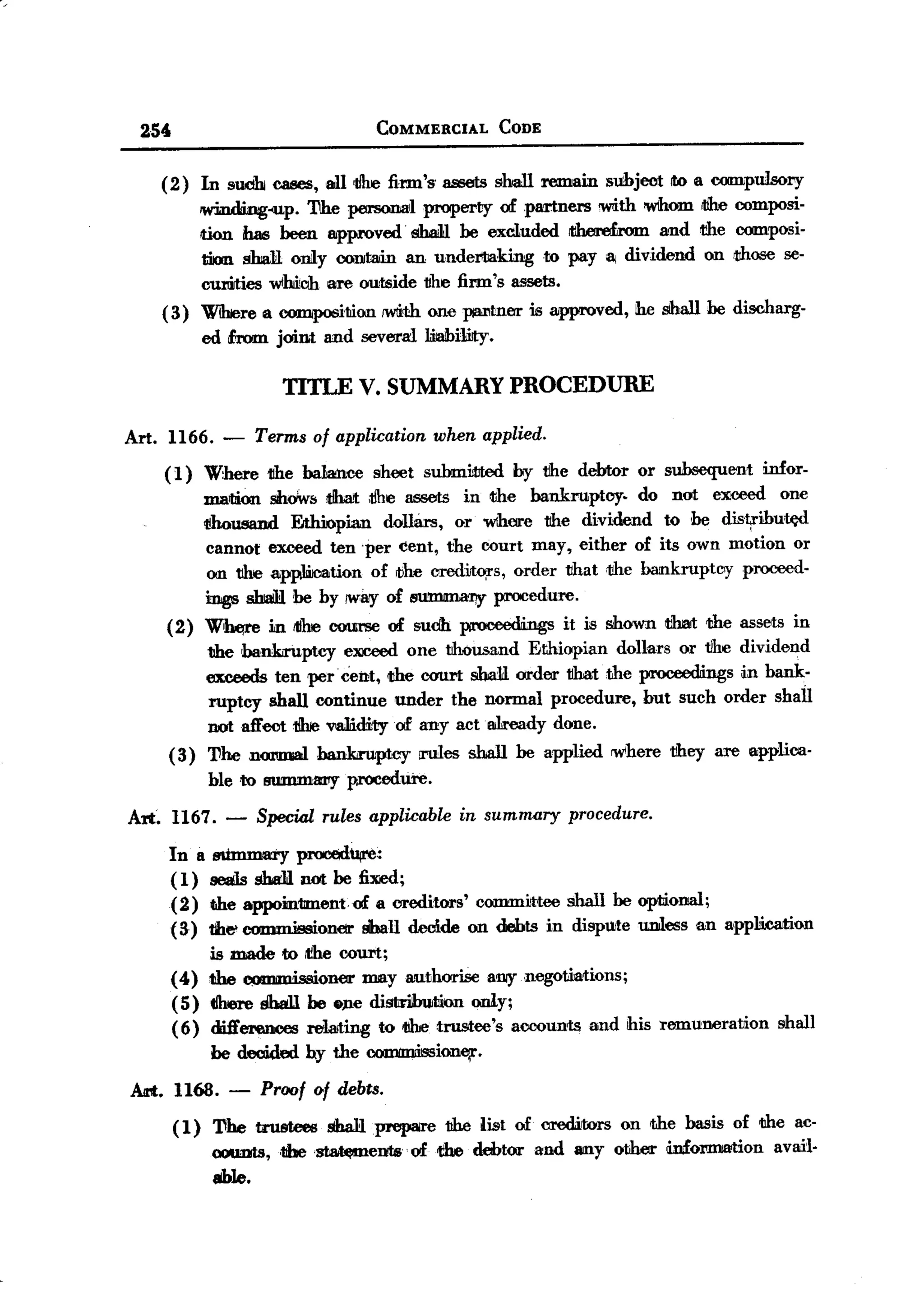
                   TITLE V. SUMMARY PROCEDURE
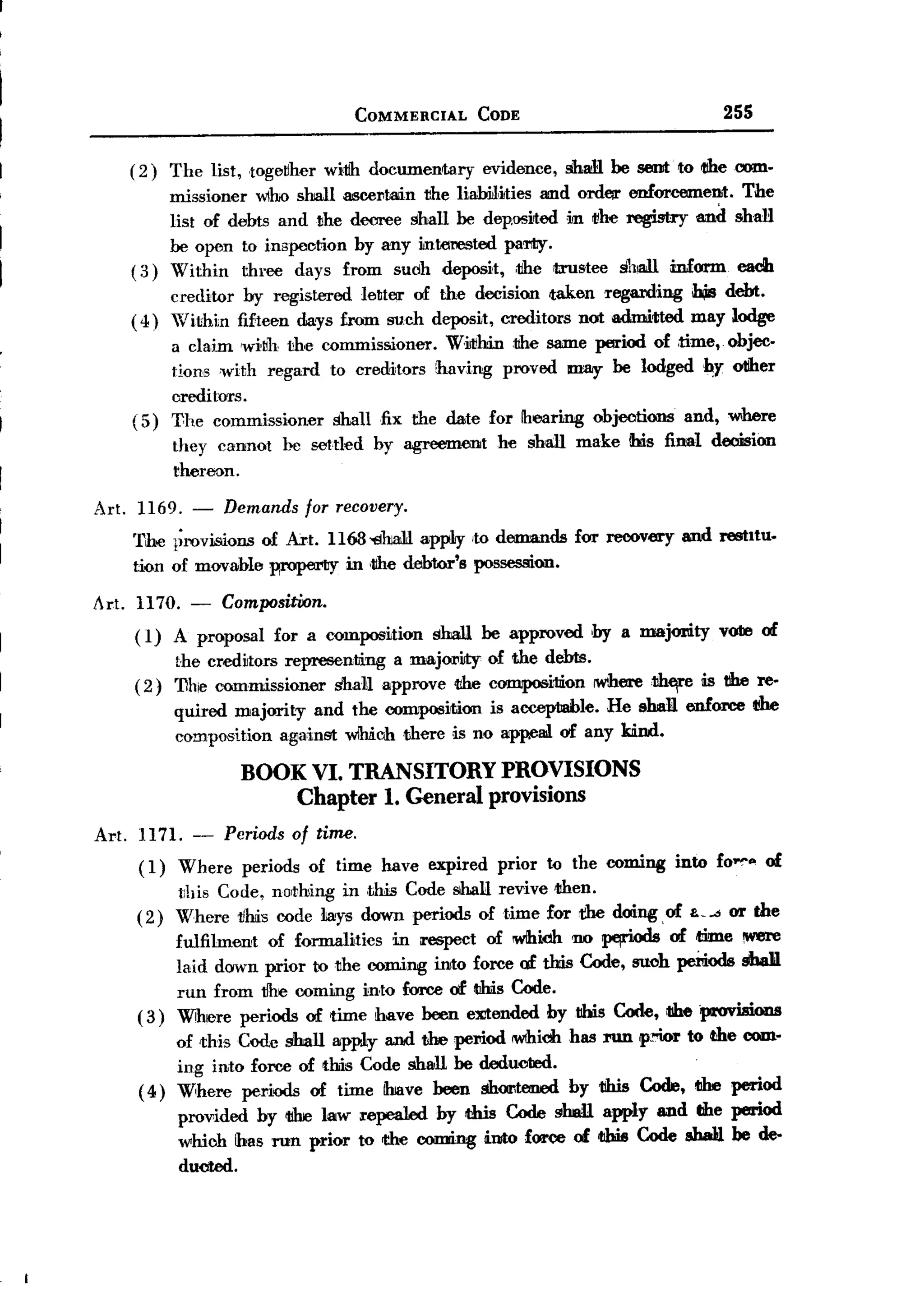
                  BOOK VI. TRANSITORY PROVISIONS
     Chapter   1.   General provisions                                              255
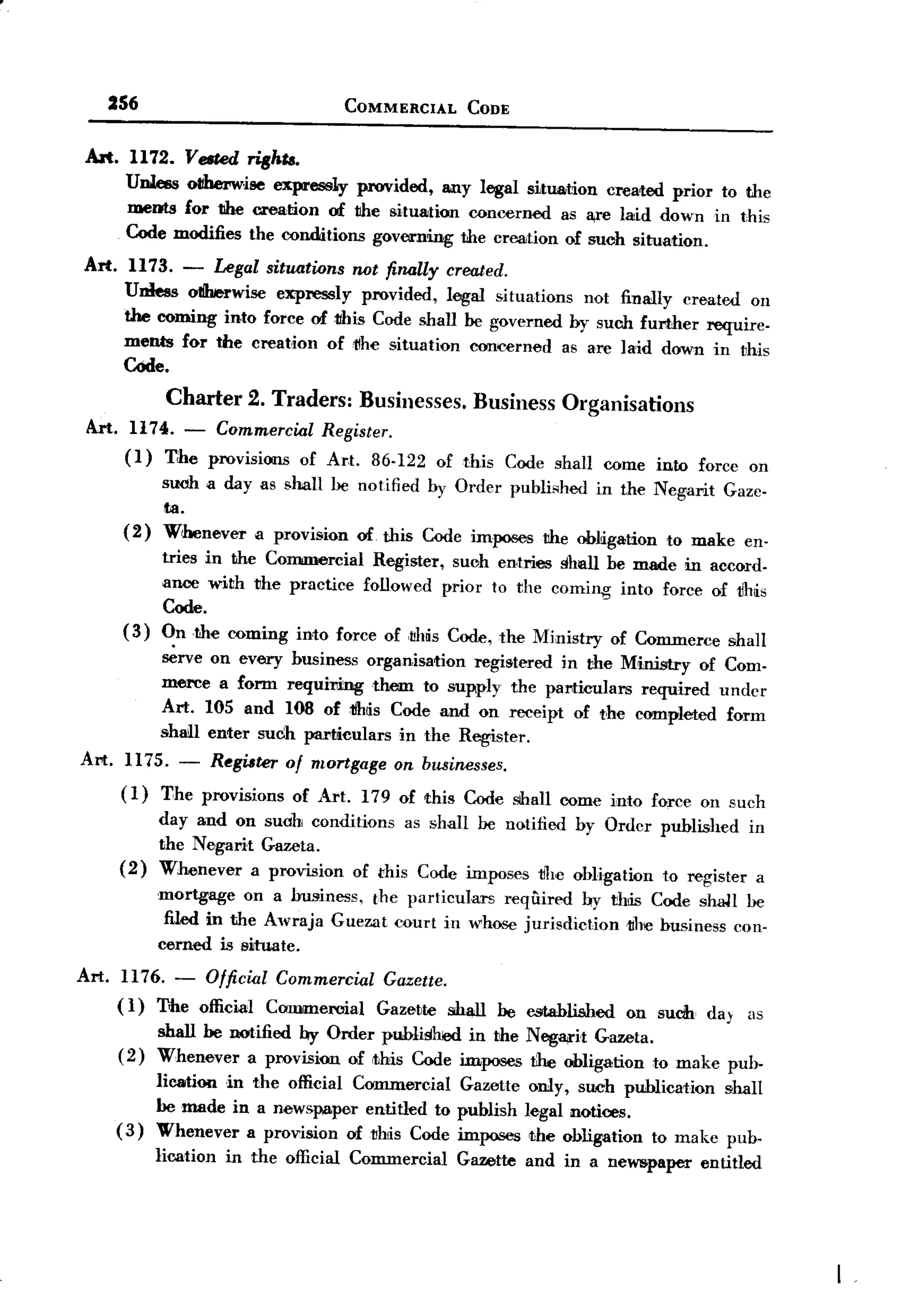
     Chapter   2.   Traders. Businesses. Business organisations                     256
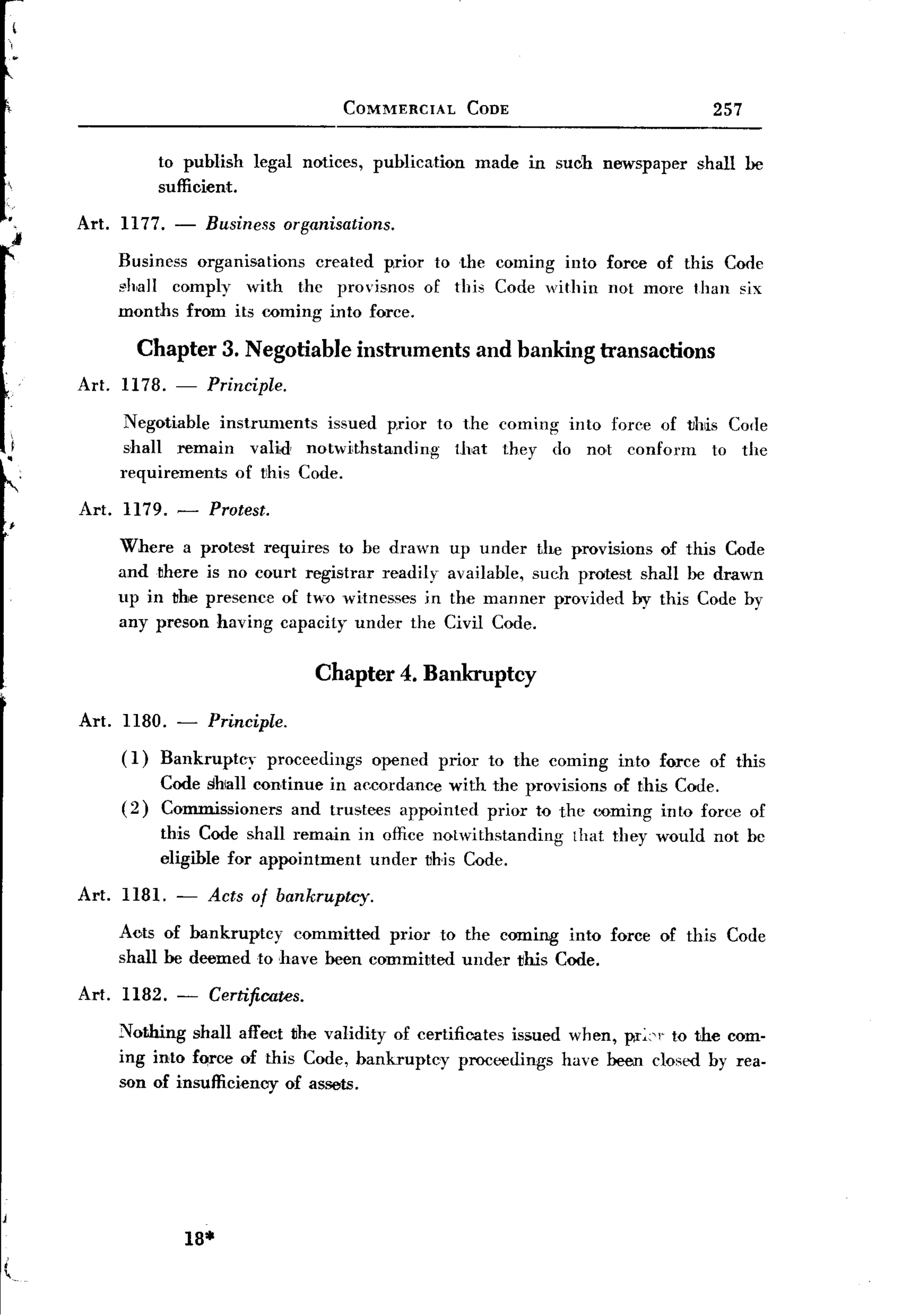
     Chapter   3.   Negotiable instruments and banking transactions                 257
     Chapter   4.   Bankruptcy.    ...                                              257


                                           -~~


                               ,/~ "
'


            OF&. Ifm~" 't-:"
                         ..-rCr.
                 19th Year No.3
                                                 ~.                           h-h hOq "7.1111
                                                                                    II!!I     q. IJ".
                                                                              Addis Ababa 5th May 1960
                                                                                                          n +,


             ,           :,. V- .r                                                  -'''IP'+
                  "-               *          '''IP                ~"F:"


                              ~,?t:"                             ,?t1ffJ ::
                                            n ". 1         ,.          flDllI


                 NEGARIT                                            GAZETA
                                   Gazette Extraordinary


                                                                                      ~~n.nll Rmc A't~              1.11.1
                                       RJ.o1ofoA"J' 't.,....
                 '1';1
                                                                  ~1"'+ -'t"'l"'+           ,.;1-....,.     .
                                          RK"ihL+       "'I.tll-tC ...mC1C14:t+

      I
                                                          ,...- .                            ".""""..-----.......
                                                                                      ,rll;l- "M"t f". 137


      nh~        "''I'C lif~/ll1nl             'to IJ". fClJllJ
                                                              f"-+V-*1 '''IP ~"P'+ -''''p'+
                                                  ""1 ~          ih"l    II

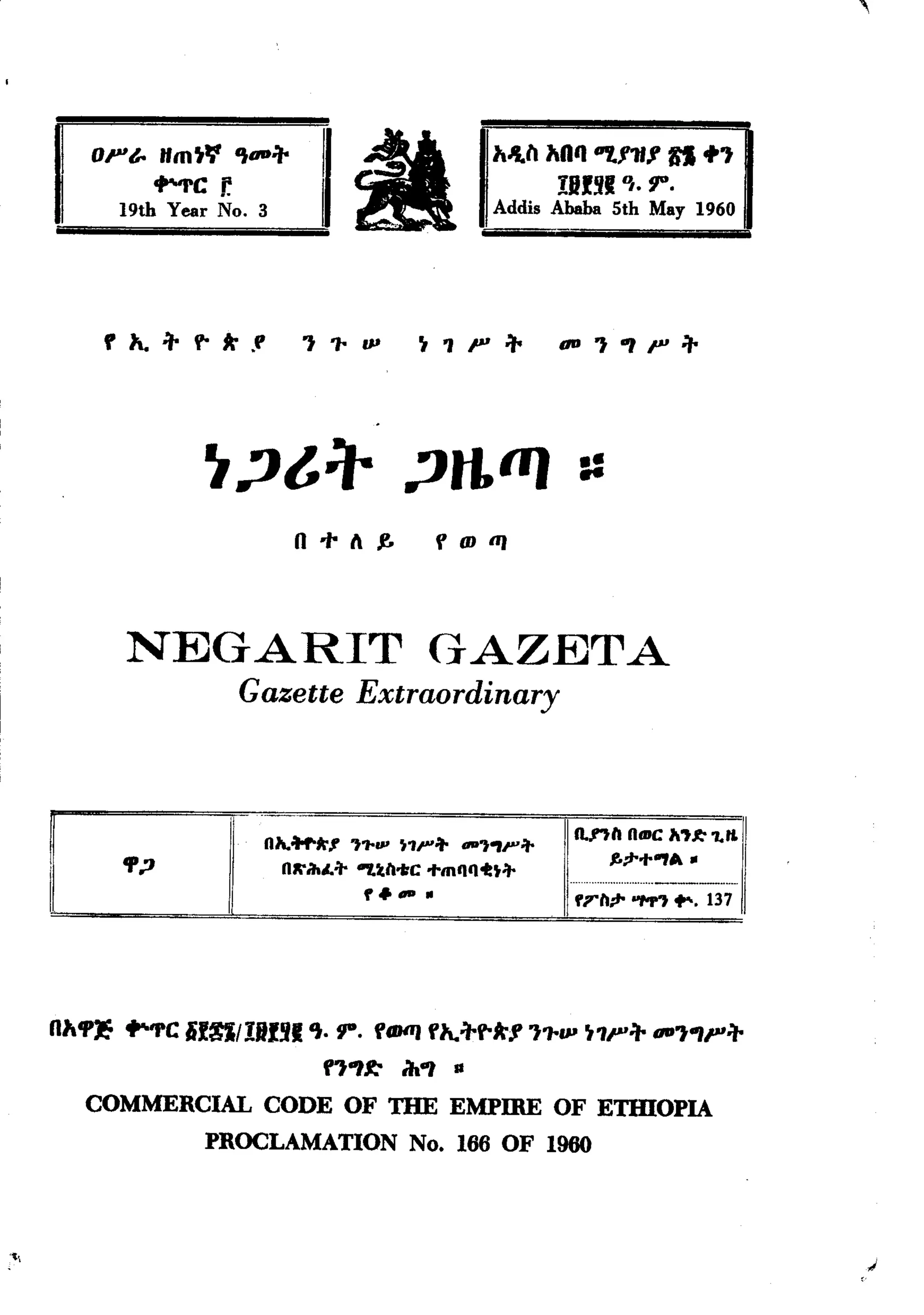
          COMMERCIAL CODE OF THE EMPIRE OF ETlUOPIA
                              PROCLAMATION No. 166 OF 1960


't,                                                                                                                           J
reign
 The fir~t edition of this book was published during the 30th year of
                                                                Ethiopia.
     of His Imperial    Majesty Haile Selassie I, Emperor    of


                                                                                     5000
Berhanena Selam Pdnting Press of H.I.M. Haile Selassie I - 17-9-52 - No. 2071-52 -


                                            n
PROCLAMA TION        No.   166 of 1960
     THE COMMERCIAL               CODE PROCLAMATION                  OF 1960

              CONQUERINGLION OF THE TRIBE OF JUDAH
                         HAILE SELASSIEI
                ELECT OF GOD, EMPEROROF ETHIOPIA

     WHEREAS        the progress of Ou,r Empire   in the field of commerce    requires
the codlification of Our commercial laws; and

    WHEREAS         a Commercial   Code has been prepared    under Our supervisioll
and has received   the approval of Our Sena'te and Chamber   of Deputies;

     NOW, THEREFORE,        in accordance with Articles 34 and 88 of Ou,r Revis-
ed Constitution,  We approve the, resolutions of Our Senate and ChaIT.ber of
Deputies and W c 'hereby proclaim as follows:

     1. This Proclamation   may be dted    as the "Commercial    Code Proclamation,
1960."

      2. The Commercial   Code of 1960, as published in a separate volume ap-
p.caring as Extraordinary Issue No.3 of 1960 of the Negarit Gazeta, shall come
into force on the 11th day of September, 1960.

     3. The Bankruptcy      Law and the Company law of 12th         July,    1933,   are
herehy repealed as fronvt,he 11th day of September, 1960.

     Done at Addis Ababa this 5th day of May, 1960.

                              TSAHAFE TAEZAZ AKLILU HABTE WOLD
                                Deputy Prime Minister and Minister of Pen


                                          III


                                                                                               .
                                                                                                "

                                                                                           .


                                                                                                    /'
PREFACE
        CONQUERING UON OF TIlE TRIBE OF JUDAH
                   HAILE SELASSIE I
          ELECT OF GOD, EMPEROR OF ETIDOPIA
     In the modem world, no nati6n can hope to expand iA CO.JReJ'Cial and
e~onomic life unless there exists a firm legal basis which will casaure the
neceaary elemenf$ of stability and security in business tranlaCti6,., wIUU at
tM Nme Rae providing a sufficiently articulated yet flexible framework within
which tnule and commerce may flouris.h and grow. Today, in EthWpiD, the
developaent of commerce has out grown the provisio,., of thie laws reltJtting to
b~.      organi.8ati6ns and bankruptcy which were promulgated during the first
y.,.. 01 Our Reign and which were o.:lapted to the commerce and industry of
those _ly day.. The commercial life of EthWpia has expanded, increosing
_mber. 0/. EthWpiDn and foreign compa.        have been forJMd and registered,
ahd mOTe comple% methods of transacting business have been det>eloped in reo
emir-'""
      Recognisins the impetus whid&. a modern Cod.e regulating the constituti6n
tm,d tlCtifJriei of all business organiaations could give to the furtMr p-owth
01 mule cn4 commerce, We directed the Codific6ti6n Commissi6n created by US
to prepare" moderft Commercial Code which would serve for the present day
 IJ8vell as prot1ide a solid foundati6n for the further refinement of laws creating of
these subjectB.W e Mve directed that in the expami6n and consolidati6n of
Our' commercial, laws. great attention should be given to tM control of all trad.

                                          'v                                             J


                                                                                             /
pcusengers and goods, an
ing, and in pUl.ticular to the control of the carriage of
aspect of commercial        activity which has increased greatly in the last decade.
Similarly,     in view of the further expansion of both foreign and internal com-
 merce, it has been necessary to elaborate laws governing negotiable instruments
 and banking transactions.
        The Commercial       Code which is today being promulgated           fulfils these
 requirements.     It is grounded in Ethiopia's     ancient laws and customs and has
 been further extended by reference to the laws of other great commercial powers.
 Weare confident that this Code will fulfil the aspirations of Our Beloved People
 and will assist in the swift and orderly development        of Ethiopia's eC01wmic life.
 Our Parliament       has studied with care and patience the detailed provisions of
  this Code and what has been approved by it is well suited to the needs of Our
  Own Country and to those persons and enterprises from other lands who are
  participating   and sharing in the benefits of the commercial life of Our Empire.
  We are ever mindful that in the all-important task of the codification of Our laws
   TV have been g,uided by Almighty
      e                                    God, and that the fruits of this work will
   underline the principle of international     justice without    which no nation can
  survive or prosper.
               Given in the 30th year of Our Reign, this 5th day of May, 1960
                                                    HAILE SELASSIE I
                                                          Emperor


                                              VII


                                                                                             /
BACK
                         BOOK I. TRADERS AND BUSINESSES
TITLE              I. GENERAL PROVISIONS APPLICABLE TO TRADERS
                         Chapter 1. Provisions Applying to Persons
                                    Carrying on a Trade

Art.!.         -       Scope of application      of the Civil Code.

         Unless otherwise provided in this Code, the pro"isioue of the Givil Code
         shall apply to the status and activities of pt11"SOD8nd business orgaWsations
                                                             a
         carry.i.ng on a trade.

Art. 2. -              Scope of applicati{)n of the Maritime Code.
         The relevant provisions of the MariltIime Code shall app~y to persons and
         business organisations carrying on maritime trade.
Art. 3.            -     Persons and business organisations.
         The provisions of 1ihiis Code applicable to persons other t.haIn those provisions
         applIicable to physical    persons only shl8ill appIJy to buakees organisations.
         Nothing shall affect the special prov,isions of Book II and Book V Title IV
         of this Code app1icahle to business organisaltions only.

Art. 4.        -       Bodies corporate under Public Law.
         (1)       Unless    othel""ise   e~y          WOvided       by law, bodies 00l'p0I'6te under
              public law, such as adminish1!lUve or religiousilnstitUJtions or 811yother
              public undertakings,    shall not be deemed to be muJers even where they
              carry on acl1iiVIitiesunder Art. 5.
         ( 2) 1lhe prov,isioue of sub-art. (1) shall mot apply to undertakdngs         in
                   which    bodies oorpol'llte under     public law only pamcipate.

                                              Chapter 2. Traders

Art. 5., -             Persons to be regarded as, traders.

         Persons who professionally       and for gaim carry on 8IIlY of tiIre following
         acl1iv,ities !!ball be deemed ,to be tmders:
         ( 1) Purchase of movables or immovables with a view Ita re.selling them
              either as they are or aEter aIt_tion    ~ adaptaJW:m;
         (2) Purchase of movables with a view to letting them for hire;
         (3) Wa,rehousing     activi:1Iies as defined in Art. 2806 of 1!b.e Givil Code:
         ( 4) Exploi,tation  of mines, including      prospecting  for and working   of
             mineral oils;
         5) Exploitation of quarries             nat by han~smen;


                                                                                                         /
BACK
       2                                      COMMERCIAL            CODE


            ( 6) Exploitation of swt pans;
            (7) Conversion and adaptaition               of cih~!Jtels, such as foodstuffs,          raw materials
                or semi.linished products not hy handicraftsmen;
            (8) Building, repairing,   maintaining, cleaning, painting                            or dyeing      mov-
                  ables not hy handicraftsmen;
            (9)   Emhankiiing, levelling,   trenching               or dmining          carried    out for a third
                 pal'ty not by handiC1'a£tsmen;
           ( 10) Carriage. of goods or persons 110t by handicra£tsmen;
       (11)       Printing      and   engraving          and    works       connected      with    photography      or
             cinematography     not hy handicra:fu:smen;
       (12) Capturing, distributing and. supplying water;
       ( 13) Producing,   distributing  and supplying eloot;ticity,                          gas, compressed       air
                  inclu~        heating and cooling;
       (14)       Operating     p"mces of entertainment     or radio or television startJions;
       (15)       Operating      ihotels, restaurants,  bars, cafes, inns, hairdressing     establish-
                  menrts not operated hy handicraftsmen and public harths;
       '(16)      Publishing am. w1hmever form, and in particular hy means                             of prinrtJing,
                  engreving, photography or recording;
       (17)       Operating news and information services;
       (18)       Opemting      travel and p.ublicitJy agencies;
       (19)       Operating      husiness    as     an     agent,   broker,     stock broker        or commercial
             ~;
       (20rOperating            a bankii.ng and money changing                 business;
       (2~'       Operalling    an inswwtce        business.

  Art. 6. -           AgriClJ.ltural or Forestry         undertakings.
           (1)    Persons     wlro carryon        activities   relating      to agri,culture,      forestry,   breed-

                  ~    catde or maintaining   pastureland, shall not he deemed to he traders
                  'WIhere they sell the produds of the land they exploit or use, or anim:lls
                  or ,~ products of animals bred mainly from the resourees of the Innd
                  1W1bich11M said persons exploit or use.
           (2)    Such penJQJlS shall not he deemed to he traders whether the eXploitation
                  is !individual or collective,            such     as an     agricultural        community      or a
                  cooperative under1iakJing.
            3) . Nurserymen WIho sell plants which grow on the land they exploit or use
                  shiall JJet be deemed to he traders.

  Art. 7. -           Agricultural Products How Dealt with.
           (I)    Persons    (who carry on actirvities under              Al't. 6 (1)      shall not he deemed
                  to he ,traders where       they deal with their             wOOucts in accordance              with
BACK
       2                                     COMMERCIAL            CODE


            (6)   Exploitation of sMt pans;
            (7)   Conversion and adaptaition            of chattels,     such as foodstuffs,        raw materials
                  or semi.1inished products not hy handicradJtsmen;
            (8)   Building, repairing,   maintaining, cleaning, painting                         or dyeing      mov-
                  ables not hy handicraftsmen;
            (9)   Emhankiiing, levelling,   trenching              or draining         carried    out for a third
             pal"ty not hy handiCl'a£tsmen;
       ( 10) Carriage. of goods or persons not by handicraftsmen;
       (11)       Printing      and   engraving         and    works       connected      with    photography      or
                  cinemato~raphy     not hy Jmndicra:£tsmen;
       (12)       CaptW'ing, distributing and. supplying water;
       (13)       Producing,   distributing  and supplying eloot;ticity,                    gas, compressed       air
                  inclu~        heating and cooling;
       (14)       Operating     JilitCC8of entertainment     or radio or television statlions;
       (15)       Operating      ihotels,restaurants,    bars, cafes, inns, hairdressing     establish.
                  mentis not operated hy handicraftsmen and public baths;
       '(16)      Publishing din w1hatever form, and in particular hy means                           of printing,
                  engmving, photography or recording;
       (17)       Operating news and information services;
       (18)       Opemting      travel and p.uhlicirty agencies;
       (19)       Operating      business   as     an     agent,   broker,     stock broker        or commercial
             ~;
       (20 tOperating           a ha.nIcing and money changing                husiness;

       (2~'       Operalling an i.nsumnce         business.

  Art. 6. -           AgriClJ.ltural or Forestry        undertakings.
           (1)    Persons     who carryon        activities   relating      to agri,culture,      forestry,   breed-

                  ~    catlt'le or maintaining pastureland, shall not be deemed to be traders
                  'WIhere they sell the products of the land they exploit or use, or animals
                  or ,1Jhieproducts of animals bred mainly from the resources of the l~nd
                  1W1hich1!1resaid persons exploit or use.
           (2)    Such persons shall not be deemed to be traders whether the exploitation
                  is <individual or collective,           such     as an     agricultural        community      or a
                  coopera:tive undertaking.
            3) N~n            WIho sell plants which grow on the land they exploit or use
                sbJalI JJet he deemed1JO be traders.

  Art. 7.-            Agricultural Products How Dealt with.
           (1)    Persons    ,who carry on acti¥ities         under      Art. 6 (1)       shall not be deemed
                  to be 'traders where      they deal with their             woducts        in <lccordance with
BACK
                                          COMMERCIAL         CODE                                          3


             the usual lHactice of their business, so long as such dealing relates only
             to products of the land which they exploit or use, or to animals or
             products of animals bred mainly from the resources of the land which
             they exploit or use.
     (2)     Such persons shall not be deemed to be traders whether the undertak-
             ing is individual   or collecbive such as an agricultural community or
             a cooperative undertaking.

Art. 8. -      Fishermen and persons breeding fish, shell.fis.h or shells.
     Fishermen and persons who breed fish or shell-fish or shells shall not be
     deemed to be traders where they sell the products of their fishing or breed.
      ing.

 Art. 9. -     Handicraftsmen.
      (1)    The provisions      of this Code relating          to traders    shall not apply to handi-
             craftsmen.
      (2)    Handicraftsmen          are persons who carryon           an ,independent        activity,     who
              live mainly on their own manual work, who may carry on their activity
              ;with the assistance of members of their family and of not more than
              three employees or apprentices and who buy such material only as is
              necessary for (Jarryi~g out their activi1JiI'..5,without setting up stocks.
      (3)     Handicraftsmen         mlllY use mechanical        power.
      ( 4 ) Handicra£tsmen           are subject     to the provision        of any special law relating
              to their activities.

 AN. 10. -        Business     Organisations.
       ( 1 ) Business     organisations      shall    be deemed       to be of a commercial               nature
              where their objects under the memorandum                         of association or in fact
              a,re to carryon any of the activities specified                 in Art. S of this Code.
       (2)    Share compaines         and private     limited     companies      shall always be deemed
              to be of a commercial         nature     whatever     their objects.

                 Chapter 3. Persons Capable of Carrying on a Trade
  Art. 11. -      Persons incapable under the Civil Code.
       (1)     Persons   incapable      under      the Civil Code may not carry              on any trade.
       (2)     Where     incapab~e     persons     carryon       a trade,     they   shall   not, subject          to
               the provisions of Art. 14 andIS, acquire the status of traders and their
               acts may be invalidated
                                     .   in accordance witlh the relevant     provisions
               of the Civil Code.
BACK

          "                                      COMMERCIAL         CODE


    Art. 12. -           Tutors.
            Tutors may not carryon       a trade in the name and on behalf of a minor
            cxcept in the cases provided in Art. 288 of the Civil Code.The same pro-
            visions shall apply to the tutor of an interdicted person.

    Art.      13. - Emancipated            Minors.
              ( 1) Notwithstanding          the provisions      of Art.      333 of the Civil Code. eman-
                    cipated minors may not carryon   a trade unless authorised in -writing
                    by the family council.
            (2)     In default of au~horisation under sub-art. (1), emancipated    minors
                    s1Jalluot      he deemed to he of age.

   Art.       14. -      Effect    of ;1<1inoril)"in relation    to thir,' p<lrties.
            Notwithstanding    the provisions of Art. 3]8 of the Civil Code, where a minor
            who carries on a trade has caused himself to he entered in the commercial
            rcgister as though he were of age. his being a minor shall not affect third
            parties, in accordance with Art. 12] of this Codc.

   Art.     15. - Publication of incapociry.
           Where a person has been declared ill('<!l~able, such incapacity sJIall not affect
           third parties unless notice of such incapacity has heen entered in the com-
           mercia] register (Art. 121).


                      Chapter 4. Carrying on a Trade by Married Persons
   Art.     ]6. -Mari"iedpel'sonsmay carry                   on trade.

           Any married     person may carryon      a trade as though he were unmarried
           unless his spouse objects thereto as provided in Art. 645 of the Civil Code.

   Art.     17. -      Notification      of objecti{)n.
           (1)    As between         spouses an objection       under Art. 16 may he notified        to [hI'
                  trading spouse in any manner.
           (2)    An objection under Art. 16 shall not aff('Ct third parties.                in accordance
                  Iith Art. 12] of this Code, unless               notice    of such objection   has heen
                  entered in the commercial register.
  Art.     ]8.~       Setting     aside of objection.
           ( ])   Where the trading spouse is of the opinion that the objection is not
                  justified, having regard to the interest of the family, he may app.ly to
                  the family arbitrators to sot aside the objection.
           (2)    Where the objection     is set aside by the arhitralors, a notice to this
                  effect shall be entered        in t'he commercial       register.
BACK
                                        COMMERCIAL      CoDE                                  s

    Art.    19. - Debts contracted by the trading spouse.
           Debts contracted by the trading spouse shall be deemed to be debt. of the
           marriage within the meaning of Art. 659 of the Civil Code and may be
           recovered on the personal estate of each spouse and on common property.
    Art. 20.- Effect of objection.
         Where an objection under Art. 16 has been eI1Jtered in the commeroial
         register, debts contracted by the trading spouse may be recovered on his
         personal estate only.
    Art. 21.- CooMration of spouses.
         Where spouses together carry on a trade, they shall both be deemed to be
         traders, unless it is shown that one of them is the employee of the other.

                             Chapter   5. Right to Act as a Trader
    Art. 22. -:- Freedom to l"J,rryon trade.
         Subject to such prohibitions or lawful restrictioDs regarding unfair compe.
         tition as may be prescribed, any, person or busine!!8 organization has the
         right to carryon any trade in accordance with the plVVisions regulating
        such trade.
    Art.    23. - Legal prohibitions or restrictions.
           ( 1) Paritcular persons may be restricted    or prevented   from acting 88 traders
                or from carrying on a particular     trade by legal provisions setting up
                prohibitions or incompatibilities.
           ( 2) Specific requirements    as to age, qualifications, sex, nationality or li.
                 cence may be imposed    by law in respect of particular     trades.

    Art.    24.-   Effect of prohibitions and restrictions.
           ( 1) Persons who carry on a trade subject to prohibition         or :restriction       or
                 without having the prescribed qualifications    shall be liable to the pe-
                 nalties provided by law.
           (2)   Persons who carry on a trade subject to prohibition or restriction may
                 J)pt Pivoke the said prohibition or restriction to free thenueIves from
                 Iillbilities incurred in carrying on a trade subject to prohibition or re-
                 striction. They may not hold themselves out to be traders to thUd
                 parties but they shall be liable as though they were traders.

    Art. 25.     -   Associations.
           (1) Associations may not carry on any trade.
           f2)- An-yqviolation -of-the provisions-of-sub-art. (1 ) shall CODItituteagrowad
                for dissolution under Art. 461 of the Civil Code.


I
BACK
       6                                 COMMIIBCIAL      CODE


   .Art. 26. -      Bruiness orsanisations carnns on trade.
           No "1nuineeeorgiu:t.isation. shaIJ. carry on a trade wlUcb it is not permitted
           to carTy on or Wlhich is subject to specific requirements with which the
           IIIi4 bU8ine8eorganisation bas not complied.
   Art. 27.-        Bodies corporate under Public Law.
           'the.~      wbere a trade may be carrie(! on by administrative or religious
           iD8titntions or any other public undertaking and the conditions and effect
           of euch trade sball be prescribed.

                        1'ITLE II. AUXILIARIES              AND AGENTS
                             Chapter 1. Commercial          Employees

   Art. 28.     - Definition.
           1) Commercial employees are persons who are bound to a trader by a con-
               tract of employment and who 8'1Sistthe trader by doing work of a non.
               manual IlAture as a salesm.m, secretary, accountant, guardian, inspec.
               tor or director.
           2) Commercial :.mployees are not traders.
   Art. 29.     -   Civil Code applicable.
           Without prejudice to the provisions of this Code, the provisions of tbe Civil
           Code relating to contracts of employment sball apply to commercial
           EmpJoyees.
   Art. 30.     -   Prohibition   from   carryins   on private   trade.
           1)   A commercial      employce    may not carry on, on his own behalf   or on
                behalf of a third party, a trade similar to the trade carried on by his
                ;employer. Where an employee infringe;tbis     prohibition, his t!mployer
                may c1aim damages and may cancel or refuse to renew .the contract of
            .   employment in accordance with Art. 2591 of the Civil Code.
           2)   A contract of employment may only contain a prohibition from carry-
                ing on private trade upon the expiry of the contract of employment
                on the conditions specified in Art. 2589, 2590 and 2592 of the Civil
                 Code.

   Art. 31.     - Asents.
           1)   Commercial employees may ,act as agents by express or tacit agreement.
           2)   The revocation of the power of agency shall not result in the cancella.
                tion of the contract of employment.
BACK
                                   COMMERCIAL     CODE                          7

Art. 32.-       Powers of Employee in charge of sales.
     1)     The employee in charge of the sales in a store shall be deemed. to have
            a power of agency for the purpose of selling or receiving goods which
            come within the normal business activities of stores of such nature.
     2)     He may demand that goods sold by him be paid to him, unless pay-
            ment is to be made to a special account.
     3)     The employee may not demand paymM! outside the store unless so
            expressly authorised or unless he produces d Tet'.A!ipt
                                                                  signed by the tra-
            der.

                                 Chapter 2. Managers

Art. 33.    -    Definition.
     1)     A manager is a person who has been authori~~d, expressly or tacitly, to
            carry out acts of management and to sign in the name of the trader.
     2)     A manager is not a trader.
Art. 34.    -    Publicity.
     1)     Where a manager has been appointed, the trader shall cause an entry
            to be made in the commercial register.
     2)     The manager shall have power to act by virtue of his appointment, not-
            withstanding that the provisions of sub-art. (1) have not been com.
            plied with.
Art. 35. - POwe1'Sof Manager.
     1) In his relations with third parties, the manager shall be deemed to
          have full power to carry out all acts of management connected. with
          the exercise of the trade, including the power to sign a negotiable in-
          strument.
     2)     Unless ~pressly authorised to do so, he may not sell or pledge immov-
            able property, nor may he sell, hire or pledge a business.
Art. 36.    -     Restriction on powers.
      1)    The powers of a manager may be limited to the management of a
            branch. Such a restriction shall not affect third parties in accordance
            with Art. 121 of this Code unless notice of such restriction has been
            entered in the commercial register.
      2)    Any other restriction shall not affect third parties.
BACK

          8                                  COMMERCIAL      CODE


                    Chapter     3. Commercial       Travellers      and Representatives
       Art. 37. - Commercial travellers.
            (1) A commercial traveller is a person, domiciled at the place where the
                 head office of the business is !lit1.li8te nd bound to a trader by a con-
                                                          a
                 tract of employment, who is entrusted by the trader with viaiting
                 clients and offering to them goods or services in the name and on
                 behalf of the trader.
            (2) Unless otherwise agreed, contracts entered into by a commercial tra-
                 veller shall be of no effect unless confirmed by trader.
            ( 3) Commercial travellers are not traders.

       Art.   38. - Commercial         representatives.
              (1) A commercial         representative   is a person,    not domiciled      at the place
                    where thc head office of the business is situate and hound to a trader
                    by a contract of employment,       who is entrusted by the trader with
                    visiting clients in a specified area and offering to them goods or ser-
                    vices in the name and on behalf of the trader.
              (2)   Unless otherwise agreed, contracts entered into by a commercial     re-
                    presentatives    shall become effective without      confirmation     by the trader.
              (3)   Commercial      representatives are not traders.

       Art.    39. - Private Business.
              (1) Unless otherwise provided         in the contract     of employment,      commercial
                    travellers  and representatives   may not carry on private business.
                    Wihere they carryon      private business, they shall lose their compen-
                    sation as provided in Art. 42 and 43.
              (2)   The provisions of Art. 30 (2) shall apply where commercial travellers
                    and representatives     have been authorised       to carry on private        business.
       Art.    40. - Acting on behalf of other traders.
              ( 1 ) Unless otherwise   agreed, commercial    travellers and representatives
                    may not act on behalf of traders other than the trader to whom they
                    are hound. Where they act on behalf of other traders, they shall lose
                    their compensation as provided in Art. 42 and 43.
              ( 2 ) In no case may they act on behalf of a trader selling goods or offer-
                    ing services similar to the goods sold or the services              offered     by the
                    trader to whom they are bound.
       Art.    41. - Remuneration.
              (1) Commercial  travellers       and representatives      shall   be paid    by salary      or
                    on commission or both.
              (2)   The remuneration   shall      be fixed by the contract        of employment          or,
                    where not fixed, by custom.
BACK
                                           COMMERCIAL          CODE                                      9


Art.    42. -     Compensation in case of termination of contract.
       Where the trader terminates    the contract without good cause, l..'Ommercial
       travellers and representatives  who are bound by a contract entered into
       for an undefined period of time shall be entitled to fair compensation   fix-
       ed in accordance with Art. 2583 of the Civil Code.

Art.    43.   -     Compensation      on account of clients introduced.

       Where a contract entered into for an undefined pel1iod of time is termina-
       ted by the trader or where a contract entered into for a specified period of
       time is not renewed by the trader, no fault being attributable    to the com-
       mercial traveller or representative,  the commercial    traveller or represen-
       tative shall be entitled to compensation   equal -to the profit derived from
       the customers introduced or goodwill created or extended by him.
                                                                                                     .
                                                                                                    ~.
                                Chapter 4. Commercial Agents

Art. 44. -          Definition.
       (1)    A commercial         agent   is a person     or business      organisation,        not bound
              to a trader by a contract of employment                  and carrying out independent
              activities, who is entrusted by a trader                with representing him perma-
              nently in a specified area and dealing                  or making agreements in the
                                                                                                         ..
              name and on behalf of the trader.
       (2)    Unless   otherwise     provided      in the agency       agreemeht,     contracts     entered
              into by a commercial           agent     shall become      effective   without      confirma-
              tion by the trader.
       (3)    A commercial         agent    normally     acts as agent      and may act as broker.
              He is a trader.

Art. 45. - Commercial agent exclusive agen~.
     Unless otherwise provided in the agency agreement, a commercial agent
     shall be the exclusive agent of the principal in the area specified in the
     agreement.
                                                                                                                 . .
Art. 46. -          Duties of commercial agent.                                                                 "Ii j.
       (1)    A commercial         agent   shall   safeguard     the principal's     interests     with the
              care due by a good trader.
       (2)    He shall:
              (a)   carry out all instructions of the principal;
              (b)   inform the principal      of all contracts negotiated              or entered        into
                    by him;
BACK
         10                             COMMERCIAL        CODE


                   (c) send to the principal periodical reports on his activities and all
                       such information as may be required on the state of affairs with.
                       in the area where he acts.
              ( 3) Where the agency agreement comes to an end, a commercial agent
                   may not 'take advantage of or disclose trade secrets revealed to him
  .                by the principal or of which he learned in the course of his duties
                   as an 'agent.

       Art. 47. -      Prohibition from carrying on private trade.
              (1) A commercial agent may carry on any private trade which is not
                  similar to tihe trade carried on by the principal. The agency agree-
                  ment may be cancelled and damages may be due where the agent
                  carries on trade similar to the trade carried on by the principal.
              (2) Unless otherwise provided in the agency agreement, a commercial
                  agent may not act in ,the area specified in the agreement on behalf
                  of traders other than the principal.
              ( 3) In no CII8emay a commercial agent act, in the area specified in the
                   agency agreement, on behalf of traders who carry on a trade similar
                   to the trade carried on by the principal. T,he agency agreement may
                   be cancelled and damages may be due where the agent disregards this
                                                      .
                   prohibition.
       Art. 48.    -   Duties of principal.
              The principal    shall, to the best of his ability, enable h,is agent to carry
              oUt successfully   his duties under the agency agreement,     in plirticular by
                                                                                  .
              making all necessary information and samples available to him.

       Art. 49.    -   R~payment of expenses.
              Unl-    otherwise agreed, current costs and expenses of the agency shall
              be borne by the commercial agent and are not subject to repayment by
              the principal. The agent' shall only be entitled to the repayment of expen-
              ses occasioned by dealings made on behalf of the principal and of such
              special expenses as were made by him on the order of the principal.

       Art.   5'0. -   Remuneration.
              ( 1) A commercial agent shall .."Ceive remuneration for all d~       nego-
                   tiatedor   made by him. Unless otherwise provided, he shall receive
                   remuneration for all dealings made, in the area where he acts, either
                   by the principaJ. himself or by another agent of the principal.
/


    BACK

                                                COMMERCIAL          CODE                                   11

           (2)    A commercial         agent    shall   receive     remuneration       even where       dealings
                  made by him are hot carried out by the principal.
           (3)    The    remuneration      shaH be fixed in the agency                 agreement       or, where
                  not fixed, by custom.

    Art. 51. -          Agent personallyto carry out his duties.
           A commercial     agent may not assign the agency agreement and may not
           substitute a third party for himself, as an agency agreement is made on
           the basis of the personal qualifications of the agent.

    Art. 52. -           Termination of agency agreement.
           (1) An agency agreement shall terminate:
                  (a)    where     the period     of time for which             it was entered     into expIres;

                  (b)    where     the agent,     being    a person,       dies, becomes      incapable    or is
                         declared bankrupt;
                  (c)    where     the business     organisation        acting     as agent   is wound-up.

           ( 2) Either     party     to an agency         agreement        made    for an undefined       period
                  of time may terminate      it on notice.             Notice      need not be given where
                  there is good cause for termination.
           (3)    The period of notice shall be fixed in the agency agreement                          or, where
                  nOt fixed, by custom. It shall not be less than one month during the
                  first year of service and not less than two months after the first year.

    Art.    53.    -     Compensation      due in case of termination.

           Where the .principal terminates  without good cause an agency agreement
           entered into for an undefined period of time, the agent shall receive fair
           compensation  which shall be fixed having regard in particular to the time
           for whidh he aoted on behalf of the principal and to the customers intro-
           duced or goodwill created or extended by him.

    Art.    54.    -     Uncom pleted business upon termination.
           (1)    Whenever       an agency       agreement        terminates,     the agent   or his heirs or
                  the business organisation   having              acted as agent shall receive remune-
                  ration for all contracts negotiated             or entered into prior to the termina-
                  tion of the agreement.
           (2)    Upon     termination     of the agreement,            all remunerations        and    expenses
                  due shall be paid forthwith           by the principal.
BACK

          12                                          COMMERCIAL    CODE


       Art.    55. -        Prohibi~ion      from carrying     on similar    private     trade on termination
                             of the agreement.
               ( 1) The       agency      agreement      may   provide    that,   upon    termination   of the
                       agreement,      the    commercial       agent shall not carry        on the same trade
                       as thc principal or act as commercial agent or representative  for a
                       trader carrying on the same trade as the principal.
               (2)     Notwithstanding   any provision w the contrary, any such prohibition
                       shall not he effective for more than five years.

                                          Chapter       5. Commercial       Brokers
       Art. 56. - Definition.
            ( 1) A commercial broker is a person or business organisation who, inde.
                 pendently, professionally and for gain, brings parties together for the
                 purpose of their entering into an agreement such as a contract of sale,
                 lease, insurance or carriage.
            ( 2) A commercial broker is a trader, regardless of the parties he brings
                 t()gether and of the nature and object of the contract for the comple-
                 tion of which-he_acts as an intermediary.
       Art . 57.        -    Notice to parties.
               (1)     Unless customary         or otherwise    agreed, a commercial        broker shall, where
                       the parties have agreed to enter into a contract, inform both parties of
                       the terms of the proposed contract.
               (2)     Unless customary or Otherwise agreed, the proposed contract shall not
                       become effective unless it is confirmed           by both parties.

       Art. 58. -             Liability of broker.
               A commercial broker shall he liable for any damage he causes to either
               party    .
       Art. 59. -             Remuneration.
               (1)     A commercial          broker    shall receive remuneration        when the contract   for
                       the completion of which he acted as an intermediary    is entered into,
                       whether such contract is performed or not.
               (2)     Unless customary or otherwise agreed, the remuneration    shall be paid
                       only by the party having required the services of the broker.
               (3)     The remuneration   shall he fixed in the agreement or, where not fixed,
                       by custom. The court may reduce the agreed remuneration         where it
                       appears excessive and disproportionate  to the services rendered by the
                       broker.
BACK
                                        COMMERCIAL       CODE                                13


                              Chapter        6. Commission        Agents
Art. 60. - Definition.
     (1) A commission agent is a person or business organisation who, inde-
         pendently, professionally and for gain, undertakes to huy or to sell in
         his name, hut on behalf of the principal, goods, movables or any other
         thing of a similar nature, or to enter in his name hut on behalf of the
         principal into a contract of carriage of goods.
     (2) A commission agent is a trader. regardless of the parties and of the
         nature and object of the contract.
Art. 61. - Civil Code applicable.
     The provisions of Art. 2234-2252 of the Civil Code shall apply to contracts
     of commission.
Art.    62. - Stock brokers.
       (1) Stock brokers are commission agents.
       (2) Unless otherwise provided by law, they shall be subject                   to the provi.
             sions relating   to contracts    of commission.

                                 TITLE III. ACCOUNTS
                   Chapter      1. Keeping of Accounts Compulsory
Art. 63. Traders and Business Organisations.
     (1) Any person or business organisation        carrying on trade shall keep such
             books and accounts as are required in accordance with business practice
             and regulations.  having regard to the nature and importance       of the
             trade carried on.
       (2)   The provisions of Art. 66-70 of this Code shall apply.

Art.    64. - Petty traders.
       Petty traders may bc exempted             from   keeping     accounts   on such conditions
       as may be preserilied.

Art.    65. -- Special rules applicable to business organisatwns.
       Nothing in this Title shall affect the s!:,ecial provisions             of Book II of this
       Code applicable to business organisations.

                      Chapter      2. Books and Accounts             to be kept
Art. 66. - Entry of dealings.
     (]) Every trader shall keep a journal where he shall make daily entries
         of all his d!'alings regardless of the nature of su('h dealings or of the
         manner in whi"'l they wcre carried oul.
BACK

          14                                 COMMERCIAL        CODE


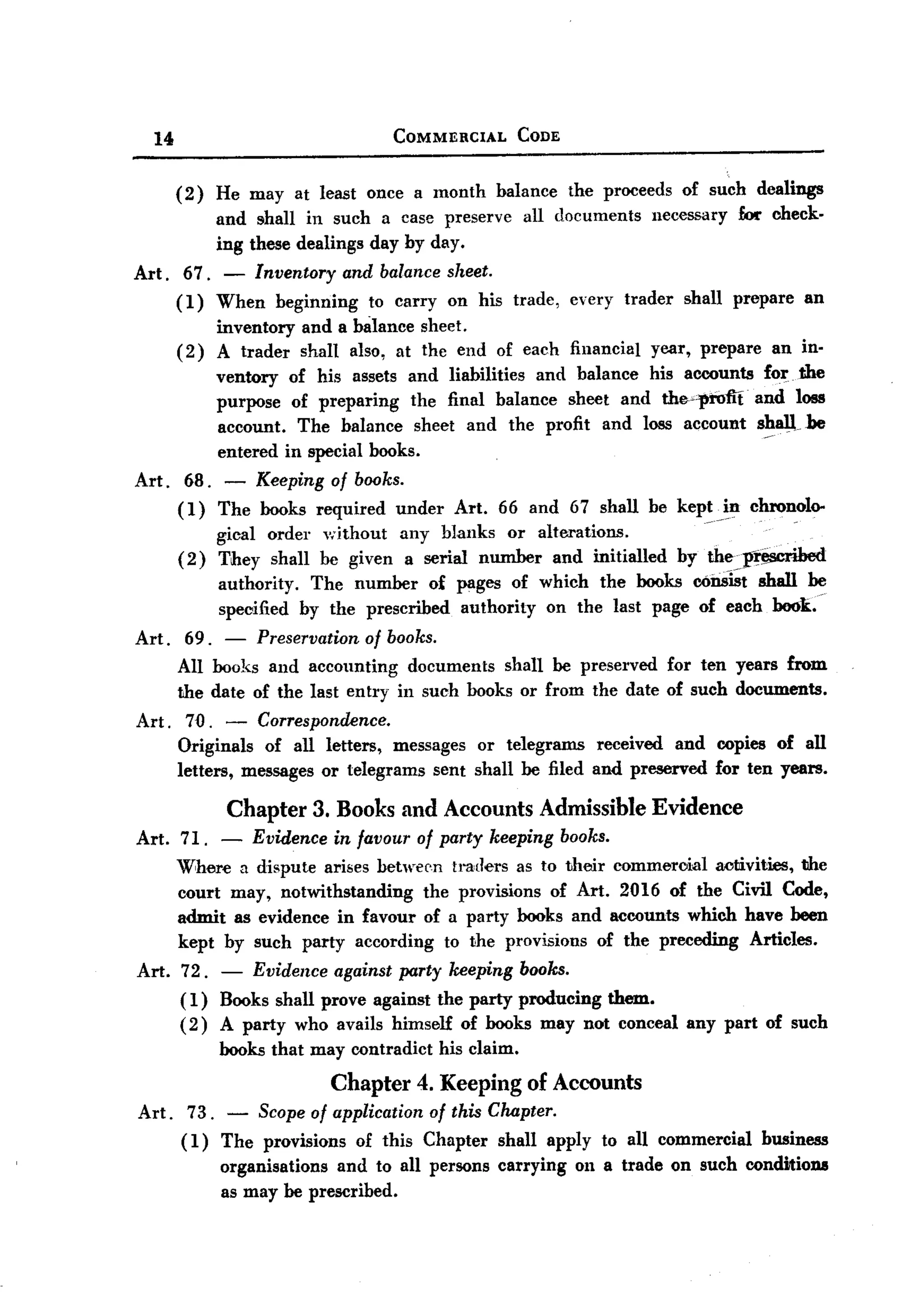
               (2)    He may at least once a month        balance      the proceeds   of such dealings
                      and shall in such a case preserve        all documents     necessary   fAx- check-
                      ing these dealings day by day.
       Art.     67. - Inventory and balance sheet.
               (1) When beginning to carryon    his trade,             every trader   shall prepare   an
                      inventory   and a lnilance sheet.
               (2)    A trader    shan also, at the end of each financial        year, prepare   an in-
                      ventory of his assets and liabilities and balance his accounts for. the
                      purpose of preparing    the final balance sheet and the."cprom. and loss
                      account. The balance sheet and the profit and loss account shall.be
                      entered in special books.
       Art.     68. - Keeping of books.
               (1) The books required under Art. 66 and 67 shall be kept _in chronolo-
                                                                         -         .
                    gical order without any blanks or alterations.
               (2) They shall be given a serial number and initialled by theJf~
                      authority. The number o£ pages of which the books c6i1i~t shall be
                      specified by the prescribed authority on the last page of each book..
       Art.     69.  - Preservation of books.
               All books and accounting documents shan be preserved for ten years from
               the date of the last entry in such books or from the date of such documents.
       Art.     70. - Correspondence.
               Originals of all letters, messages or telegrams received and copies of all
               letters, messages or telegrams sent shall be filed and preserved for ten years.

                       Chapter     3. Books and Accounts         Admissible      Evidence
       Art.    71.  -     Evidence   in favour of party keeping       books.
               Where a dispute arises between traders as to their commeroial activities, the
               court may, notwithstanding   the provisions of Art. 2016 of the Civil Code,
               admit as evidence in favour of a party books and accounts which have been
               kept by such party according to the provisions of the preceding Articles.
       Art.    72. - Evidence against party keeping books.
               ( 1) Books shall prove against the party producing them.
               ( 2) A party who avails himself of books may not conceal any part of such
                      books that may contradict   his claim.
                              Chapter 4. Keeping of Accounts
       Art. 73. - Scope of application of this Chapter.
            (1) The provisions of this Chapter shall apply to all commercial business
                organisations and to all persons carrying 011a trade on such conditions
                as may be prescribed.
BACK

                                                COMMERCIAL          CODE                               15


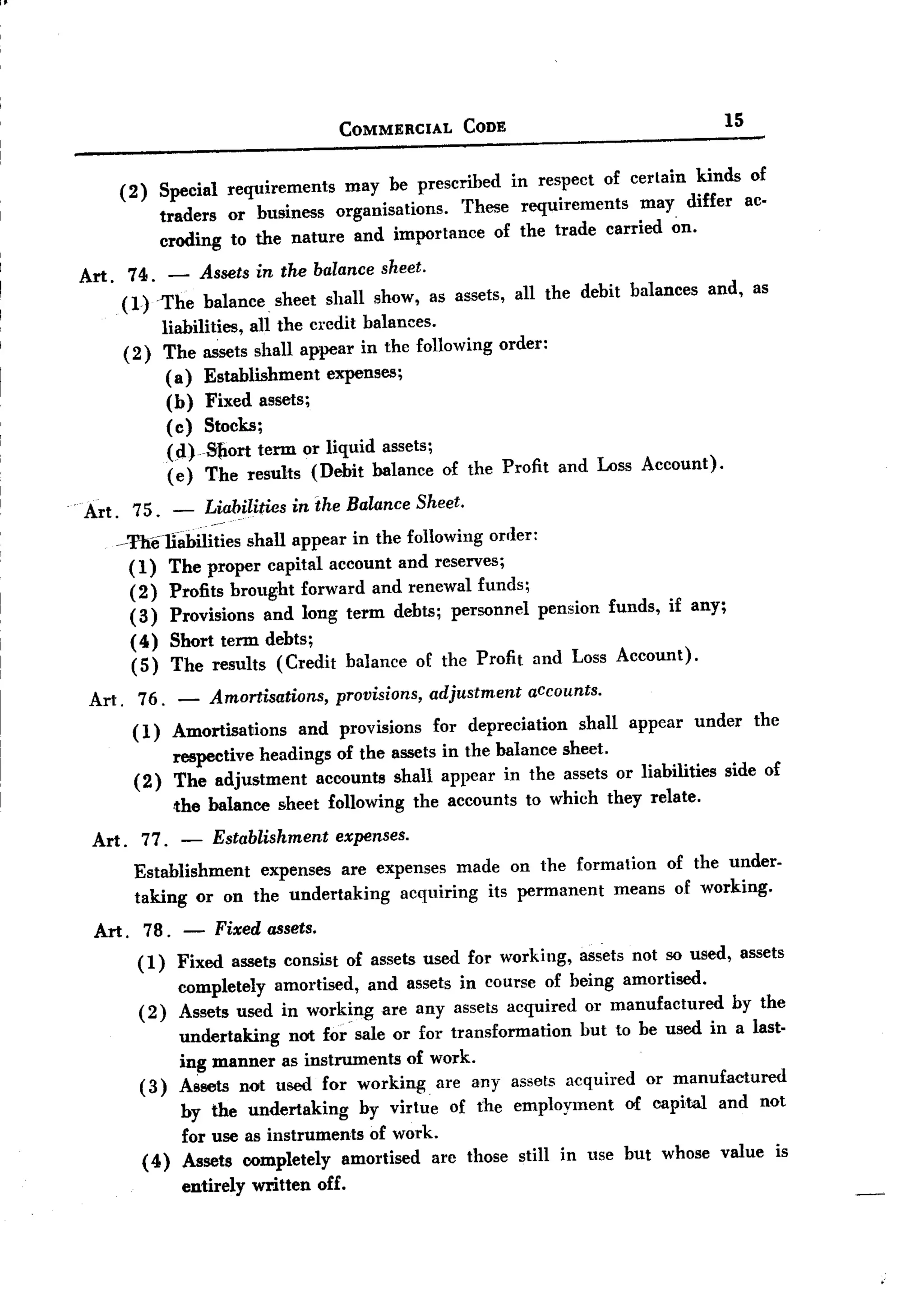
             (2)     Special requirements  may be prescribed in respect of certain kinds of
                     traders or business organisations.  These requirements may differ ac-
                     croding to the nature and importance of the trade carried on.

     Art.     74. - Assets in the balance sheet.
             (1) The balance sheet shall show, as assets, all the debit balances                      and, as
                  liabilities, all the credit balances.
             (2) The assets shall appear in the following order:
                   (a) Establishment      expenses;
                   (b) Fixed assets;
                   (c) Stocks;
                      Cd)S1iort term or liquid assets;
                      (e) The results (Debit balance of the Profit               and Loss Account).
 .
     Art. 75. -            Liabilities inihe Balance Sheet.
             -Thellabilities  shall appear in the following order:
               (1) The proper capital account and reserves;
               (2) Profits brought forward and renewal funds;
               (3) Provisions and long term debts; personnel pension funds, if any;
               ( 4) Short term debts;
               (5) The results (Credit balance of the Profit and Loss Account).

      Art.     76.     -    Amortisations,      provisions,     adjustment   accounts.
              (1)     Amortisations   and provisions for depreciation    shall appear under the
                      respective headings of the assets in the balance sheet.
               (2)    The adjustment     accounts shall appear in the assets or liabilities side of
                       the balance    sheet following         the accounts   to which they relate.
      Art . 77.       - Establishment   expenses.
               Establishment   expenses are expenses made on the formation of the under-
               taking or on the undertaking       acquiring its permanent means of working.
       Art. 78. -            Fixed assets.
               (1)  Fixed assets consist of assets used for working, assets not so used, assets
                    completely amortised, and assets in course of being amortised.
               ( 2) Assets used in working are any assets acquired or manufactured      by the
                        undertaking   not for sale or for transformation but to be used in a last-
                        ing manner as instruments of work.
                   (3) Assets not used for working. are any assets acquired or manufactured
                        by the undertaking     by virtue of the employment     of capital and not
                        for use as instruments of work.
                   ( 4) Assets completely amortised arc those still in use but whose value is
                        entirely   written   off.
BACK
          16                                        COMMERCIAL           CODE


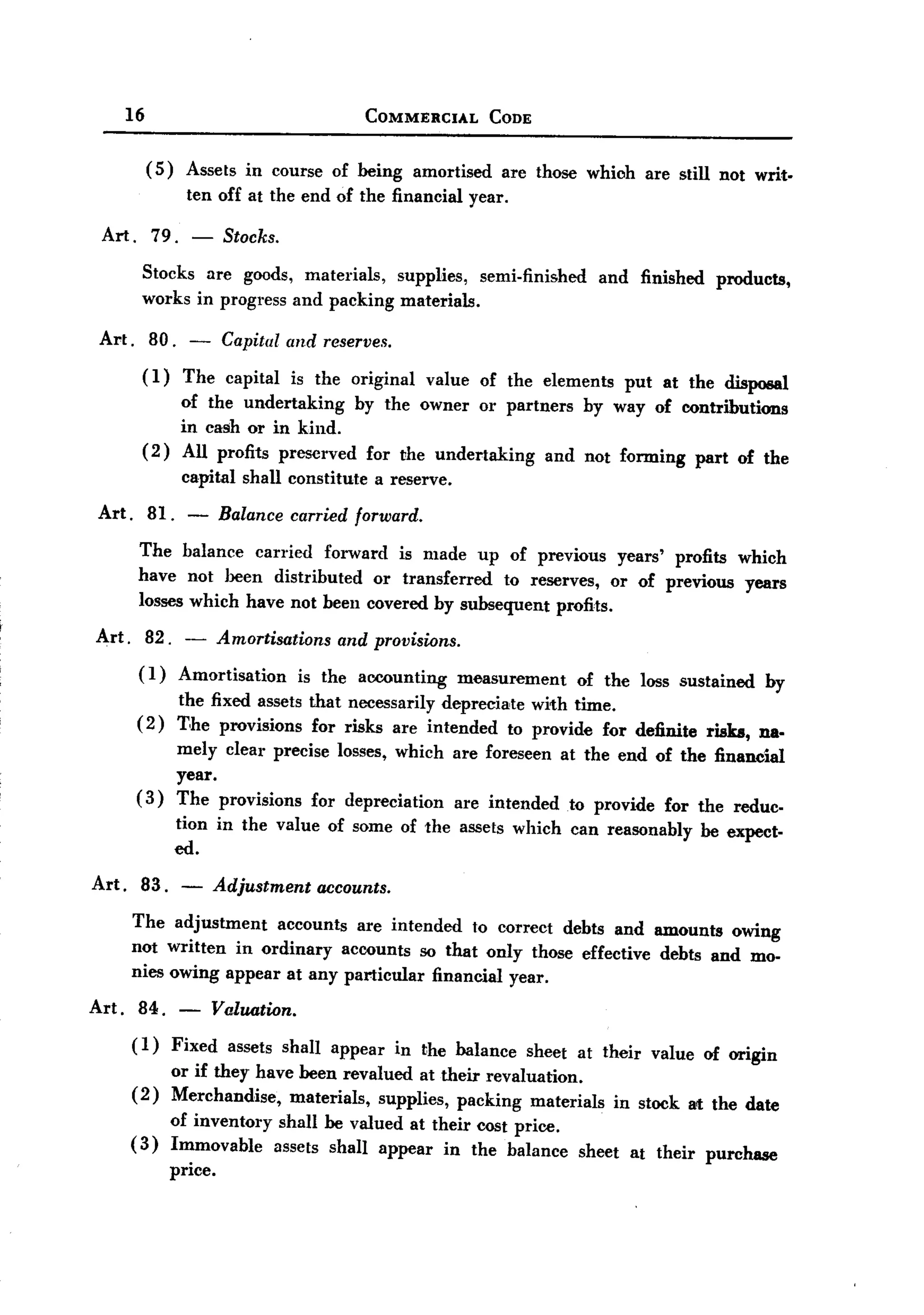
               (5)     Assets in course of being             amortised    are those which are still not writ.
                       ten off at the end of the financial            year.

    Art. 79. -                 Stocks.
           Stocks are goods, materials,  supplies, semi-finished                      and finished     products,
           works in progress and packing materials.

   Art.        80.        -    Capital and reserves.
           (1)         The capital         is the original    value
                                                    of the elements put at the disposal
                of the undertaking   by the owner or partners by way of contributions
                in cash or in kind.
           ( 2) All profits preserved for the undertaking  and not forming part of the
                      capital shall constitute        a reserve.

   Art.        81.        -   Balance carried forward.

           The balance carried forward is made up of previous years' profits which
           have not been distributed   or transferred  to reserves, or of previous years
           losses which have not been covered by subsequent profits.

   Art.        82.     -      Amortisations      and provisions.
           (I)        Amortisation         is the accounting       measurement      of the loss sustained       by
                      the fixed assets that necessarily depreciate with time.
           (2)        T,he provisions for risks are intended to provide for definite                 risks, na.
                      mely clear precise losses, which are foreseen at the end of the financial
                      year.
           (3)        The provisions for depreciation are intended to provide for the reduc-
                     tion in the value of some of the assets which can reasonably                    be expect-
                     ed.

  Art. 83. -                  Adjustment accounts.
          The adjustment   accounts are intended to correct debts and amounts owing
          not written in ordinary accounts so that only those effective debts and mo-
          nies owing appear at any particular financial year.

  Art.     84.        -       Valuation.
          (1)        Fixed      assets shall appear     in the balance        sheet at their value m origin
                     or if they have been revalued at their revaluation.
          (2)        Merchandise,   materials, supplies, packing materials              in stock art the date
                     of inventory shall be valued at their cost price.
          (3)        Immovable    assets shall appear in the balance                sheet at their   purchase
                     price.
BACK

                                COMMERCIAL     CODE                            17


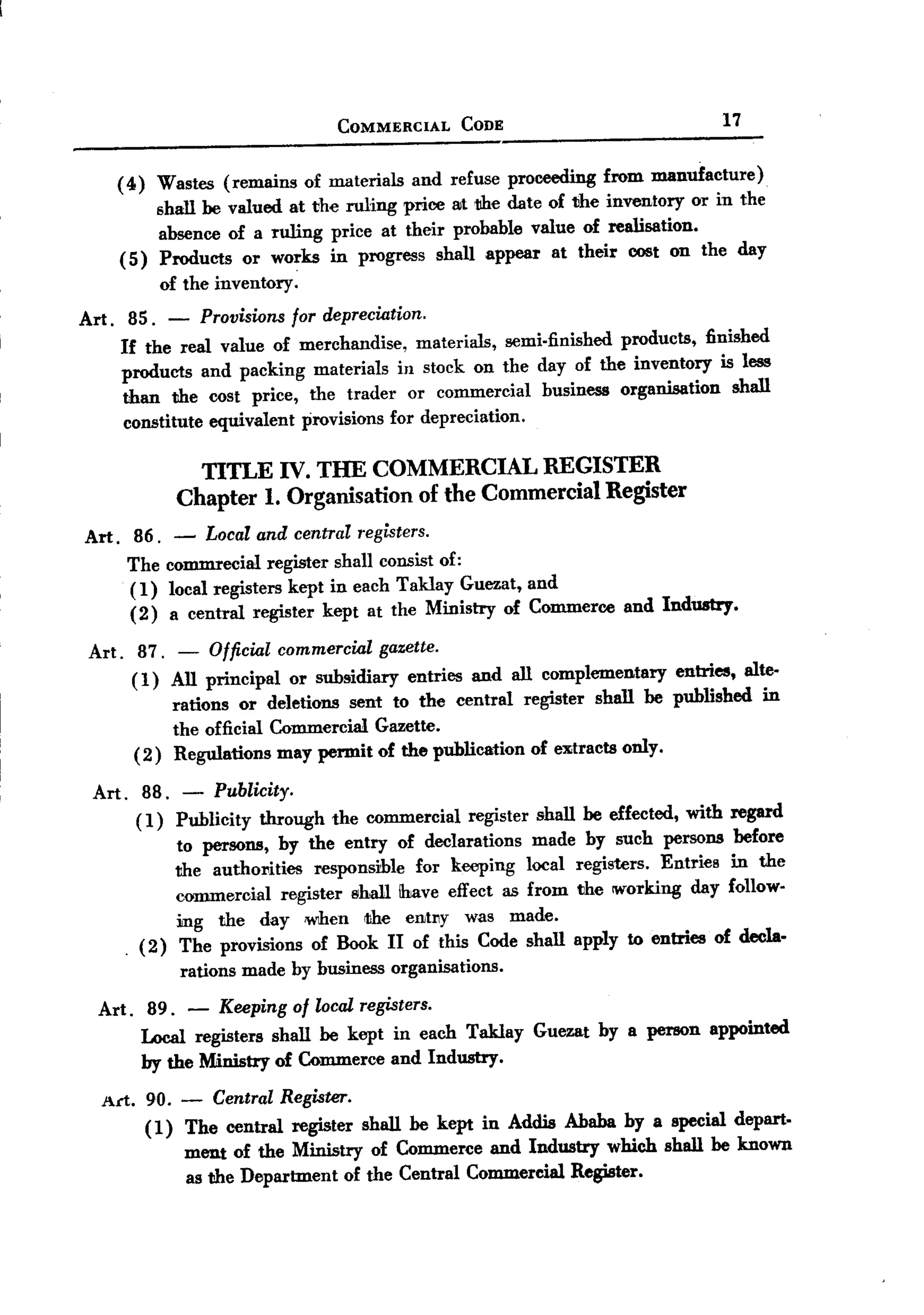
     ( 4 ) Wastes (remains of materials and refuse proceeding from manufacture)
           shall be valued at the ruling price at the date of the inventory or in the
           absence of a ruling price at their probable value of realisation.
     ( 5) Products or works in progress shall appear at their cost on the day
           of the inventory.
 Art. 85. - Provisions for depreciation.
      If the real valne of merchandise, materials, semi.finished products, finished
      products and packing materials in stock on the day of the inventory is less
      than the cost price, the trader or commercial business organisation shall
      constitute equivalent provisions for depreciation.

                TITLE IV. THE COMMERCIAL REGISTER
              Chapter 1. Organisation of the Commercial Register
 Art. 86.     - Local and central registers.
      The    commrecial register shall consist of:
      ( 1)   local registers kept in each T aklay Guezat, and
      (2)    a central register kept at the Ministry of Commerce and Industry.

  Art. 87. - Official commercial gazette.
       ( 1) All principal or subsidiary entries and all complementary entries, alte.
            rations or deletions sent to the central register shall be published in
            the official Commercial Gazette.
       ( 2) Regulations may permit of the publication of eXitractsonly.

  Art. 88. - Publicity.
        (1) Publicity through the commercial register shall be effected, with regard
             to persons, by the entry of declarations made by such persons before
             the authol1ities responsible for keeping local registers. Entries in the
             cmnmercial register shall ibJaveeffect as from the 1W0rkingday follow.
             ing the day when rtihe entl1Y was made.
      .  (2) The provisions of Book II of this Code shall apply to entries of decla-
              rations made by business organisations.
   Art. 89. - Keeping of local registers.
        Local registers shall be kept in each Taklay Guezat by a person appointed
        by the Ministry of Commerce and Industry.
   Arl. 90. - Central Register.
        ( 1) The central register shall be kept in Addis Ababa by a special depart-
             ment of the Ministry of Commerce and Industry which shall be known
             as the Department of the Central Commercial Register.
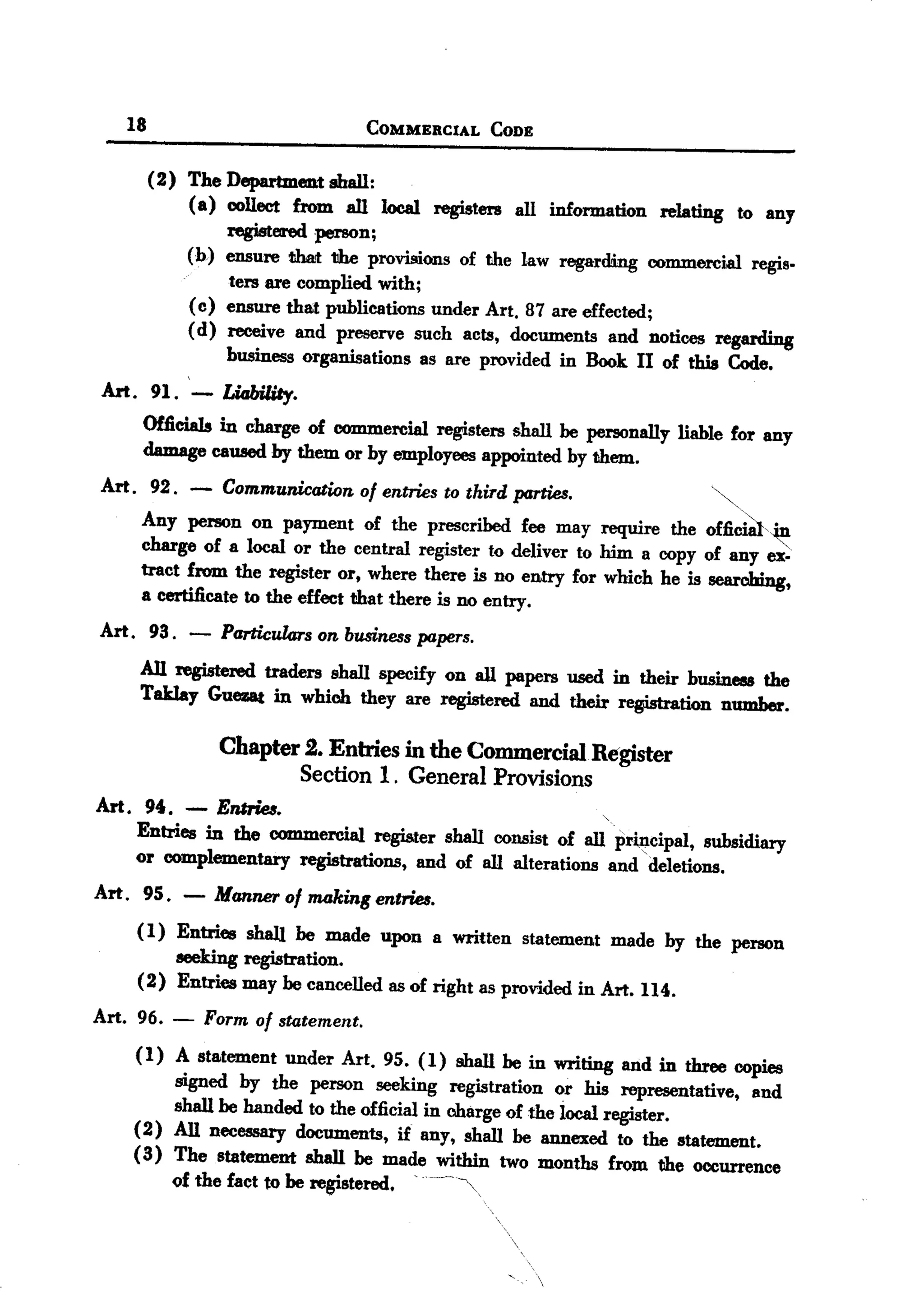
BACK
       18                              COMMERCIAL   CODE


            (2) The Department shall:
                (a) collect from all local registers all information relating to any
                     registered person;
                (b) ensure that the provisions of the law regarding commercial regis-
                     ters are complied with;
                (c) ensure that publications under Art. 87 are effected;
                ( d) receive and preserve such acts, documents and notices regarding
                     business organisations as are provided in Book II of this Code.
  Art. 91. - Li4biliIy.
        Officials in charge of commercial registers shall be personally liable for any
        damage caused by them or by employees appointed by them.
  Art. 92. -        Communication of entries to third parties.
                                                                            ~
        Any person on payment of the prescribed fee may require the o£ficid,~
        charge of a local or the central register to deliver to him a copy of any ex-
        tract from the register or, where there is no entry for which he is searching,
        a certificate to the effect that there is no entry.
  Art. 93. -        Particularson businesspapers.
        All registered traders shall specify on all papers used in their business the
        Taklay Guez&tin which they are registered and their ~tion            number.

             Chapter 2. Enmes in the Commercial Register
                     Section 1. General Provisions
  Art. 94. - Emrie8.
       Entries in the commercial register shall consist of all priJtcipal, subsidiary
       or complementary registrations, and of all alterations and 'deletions.
  Art. 9S. -       Manner ofl1UJking entries.
        ( 1) Entries shall be made upon a written statement made by the person
             seeking registration.
        (2) Entries may be cancelled as of right as provided in Art. 114.
  Art. 96.    -   Form of statement.
       (1) A statement under Art. 95. (1) shall be in writing and in three copies
            signed by the person seeking registration or his representative, and
            shall be handed to the official in charge of the iocal register.
       (2) All necessary documents, if any, shall be annexed to the statement.
       ( 3) The statement shall be made within two months from the occurrence
              of the fact to be registered.   '
BACK
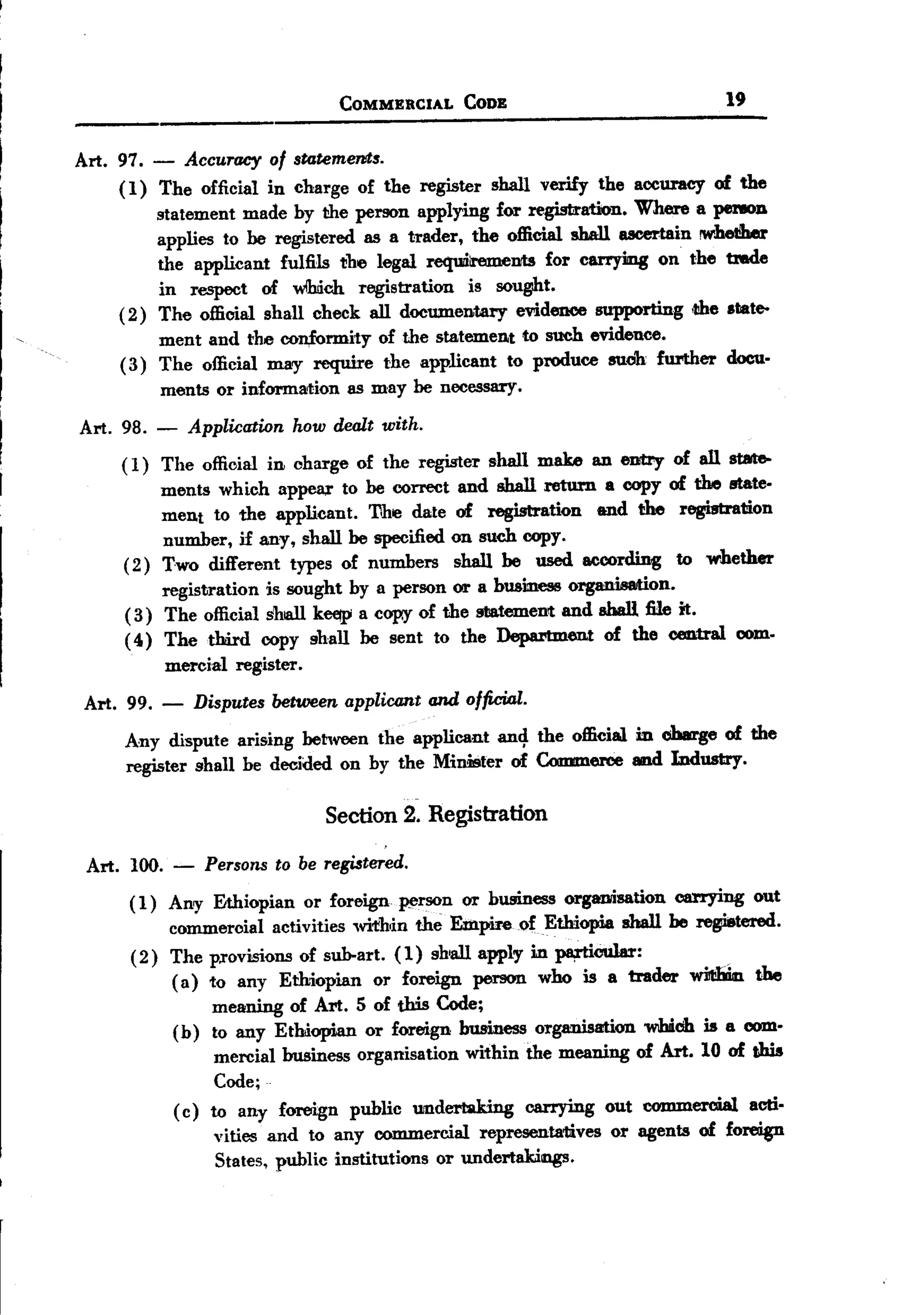
                                    COMMERCIAL      CODE                        19


 Art. 97. - Accuracy of statements.
      ( 1) The official in charge of the register shall verify the accuracy of the
           statement made by the person applying for registration. Where a perIOD
           applies to be registered as a trader, the official shall ucer.tain !W'he1!her
           the applicant fulfils the legal requdlrements for carryiIDg on the tmde
           in respect of wlhdch registration is sought.
      ( 2) The official shall check all documentary evidence supporting ,the .tate-
           ment and the con,£ormity of the statemen.t to such evidence.
      ( 3) The official may require the applicant to produce suoh f1U'ther docu.
           ments or information as may be necessary.
 Art. 98. - Application how dealt with.
      ( 1) The official in charge of the register shall make an eDJtry of all stilt&-
            ments which appelU"to be correct and shall return a copy of the state.
            ment to the applicant. The date of registration and the registration
            number, if any, shall be specified on such copy.
      (2) Two different types of numbers shall be used according to whether
            registration is sought by a person or a business organisation.
       ( 3) The official shall k~ a cop.y of the st!atement and sball file it.
       ( 4) The third copy shall be sent to the Department of the central com.
            mercial register.
  Art. 99. -       Disputes between applicant and officio,l.
       Any dispute arising between the applicant an4 the official in charge of the
       register shall be decided on by the Mimster of Commerce and Industry.

                                   Section 2. Registration

  Art. 100.    -    Persons to be registered.
       ( 1) Any Ethiopian or foreign ~rson or business organisation carrying out
            commeroial activities wifhin the Empire of Ethiopia sball be registered.
       ( 2) The p.rovisions of sub-art. (1) shall apply in pa,rtiCular:
            ( a) to any Ethiopian or foreign person who is a trader wi1tbk the
                  meaning of Art. 5 of this Code;
            (b) to any Ethiopian or foreign business organisation which is a com.
                   mercial business organisation within the meaning of Art. 10 of this
                   Code;
             ( c) to any foreign public undertaking carrying out commercial actio
                   vities and to any commercial representa1li.ves or agents of foreign
                   States, public institutions or undertakings.
BACK
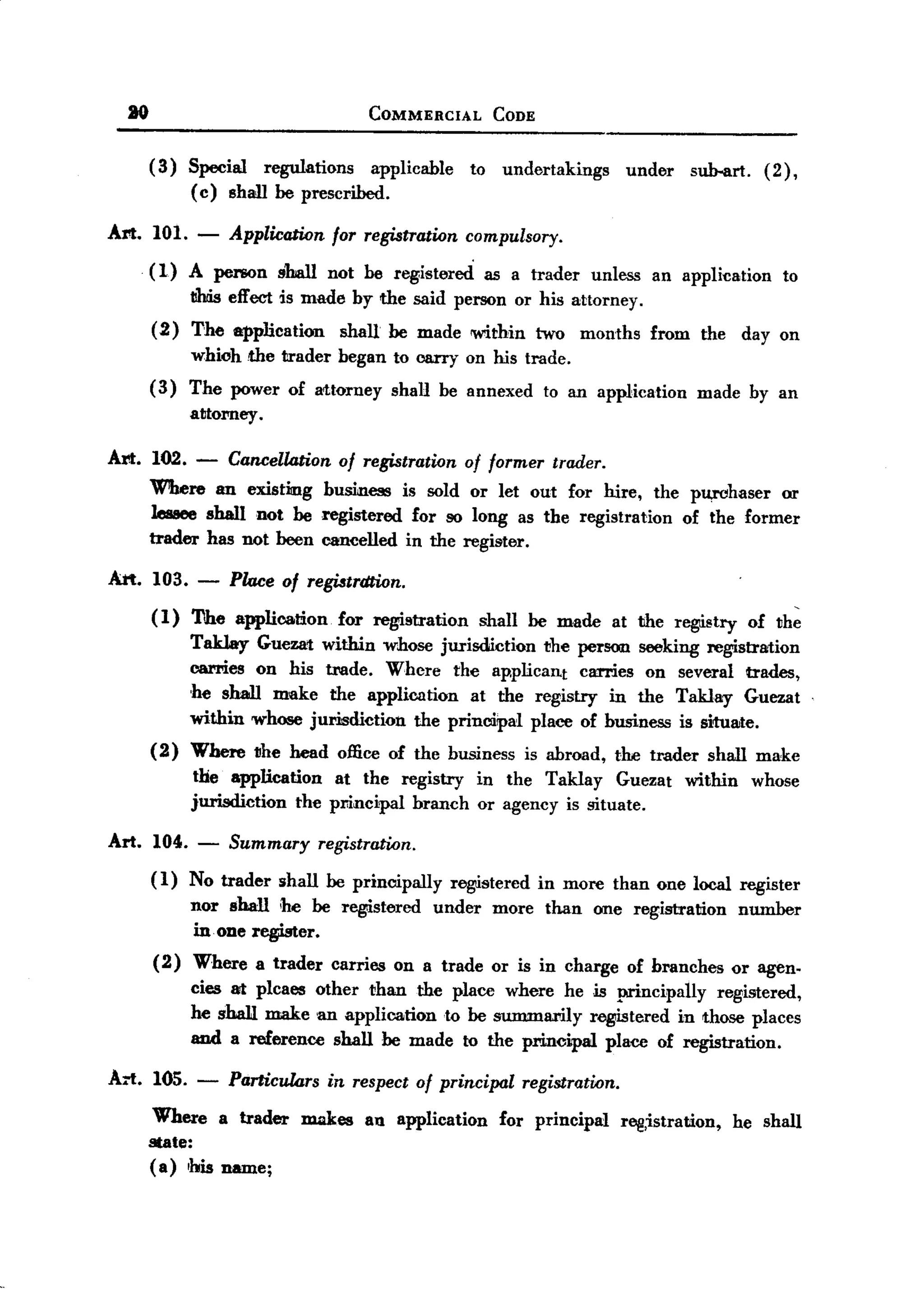
       JO                                       COMMERCIAL        CODE


            ( 3) Special regulations applicable               to undertakings         under      sub-art. ( 2) ,
                 ( c) shan be prescribed.

   Art. 101. -         Application for registration compulsory.
            (1)   A person       shall    not be registered      as a trader     unless   an application      to
                  !!his effect is made by the said person or his attorney.
            (2)   The application           shall be made 'Within two           months    from    the    day on
                  whiohthe       trader began to carry on his trade.
            (3)   The power of attorney              shall be annexed    to an application       made by an
                  attorney   .
   Art. 102. -         Cancell4tionof registrationof former trader.
            Wlbere an existing business is sold or let out for hire, the pu,rohaser or
            lessee shall not be registered for so long as the registration of the former
            trader has not been cancelled in the register.

   Art. 103. - Place of registrdtion.
        ( 1) 'I1he application. for registration shall be made at the reg1i.stryof the
             TakJay Guezat within whose jurisdiction the person seeking registration
             carries on his tmde. Whcre the ap.plicant carries on several trades,
             ,he shall make the application at the registry in the Taklay Guezat
             within whose jurisdiction the principal place of business is situate.
            (2) Where the head office of the business is abroad, the trader shall make
                the application at the registry in the Taklay Guezat within whose
                jurisdiction the principal branch or agency is situate.

   Art.     104. -     Summary           registration.
            (1)   No trader      shall be principally       registered   in more than one local register
                  nor shall he be reg1i.stered under              more   than    one registration       number
                  in one register.
            ( 2) Where       a trader      carries   on a trade or is in charge       of branches       or agen.
                  cies at plcaes other than the place where he is principally  registered,
                  he sha1I make an application to be summarily registered in those places
                  and a reference shall be made to the principal place of registration.

   Arl. 105. -         Particurors in respect of principal registration.
           Where a trader makes an application for principal r~,istration,                              he shall
          state:
          (a) his name;
BACK
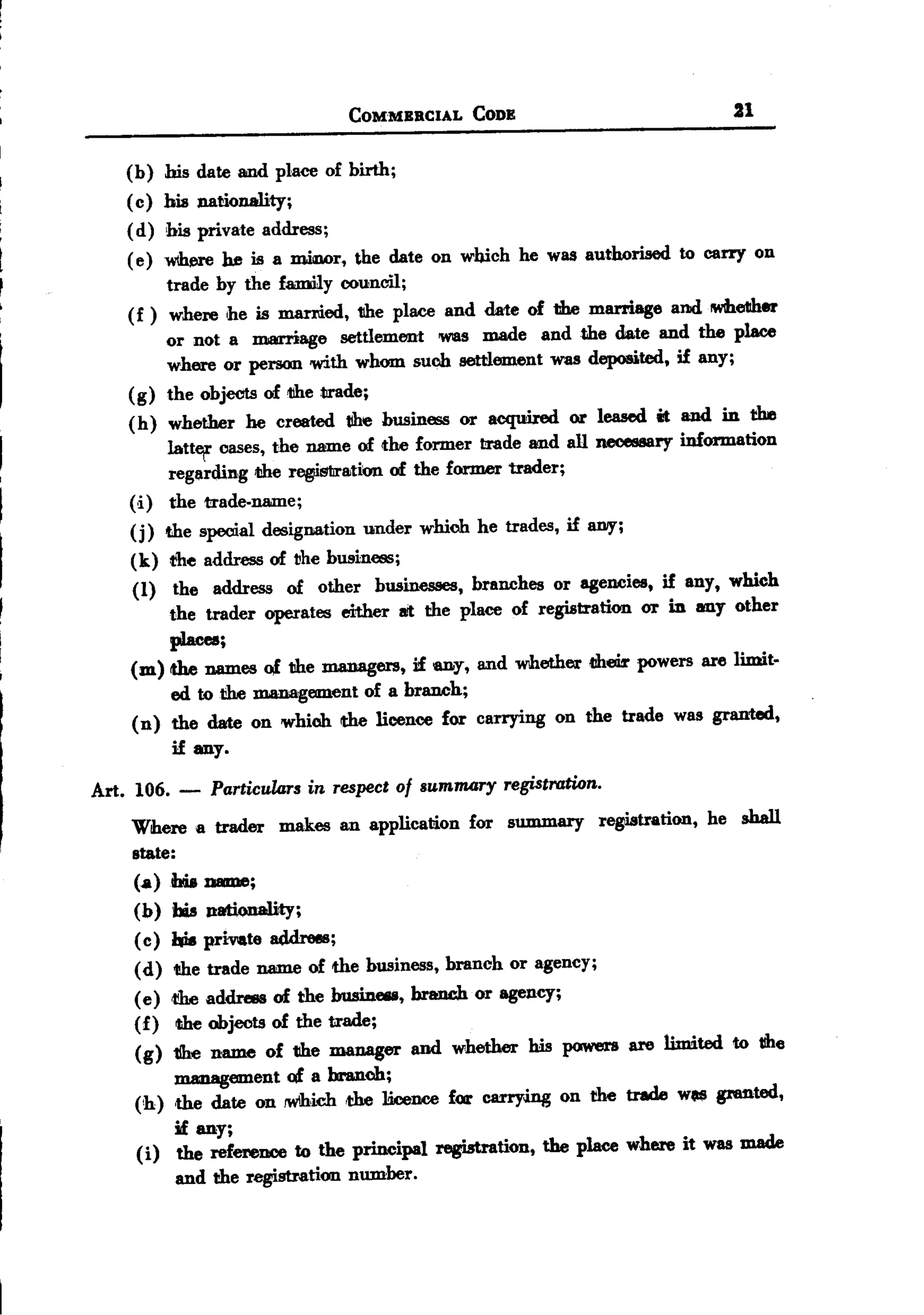
                                   COMMBRCIAL     CODB                           21

       (b)    his date and place of birth;
       ( c)   hill nationality;
       (d)    bis private address;
       ( e)   WIhue he is a miawr, the date on which he was authorised to carry on
              trade by the family council;
       (f)     where ,he is maI'l'iied, the place and date of the marriage and lWhe1lher
              or not a marriage settlement was made and the date and the place
              where or person with whom such settlement was deposited, if any;
       (g)    the objects of tihe trade;
       (h)     whether he created tihe business or acquired or leased it and in the
              iatt«f oases, the name of the former trade and all necell8Bryinformation
               regarding die r~S1iration of the former trader;
       (i)     the trade-name;
       (j)    the special designation under which he trades, if IUIIY;
       (k) the address of the business;
       (I) the address of other businesses, branches or agencies, if any, which
           the trader operates either IIJtthe place of regiatration or in any other
           pJacea;
       (m) the names of the managers, if any, and whether t!heilrpowers are limit.
           ed totihe management of a branch;
       (n) the date on which the licence for carrying on the trade was granted,
           if any.

  Art. 106. -      Particulm-sin respect of summary registration.
       Where a trader makes an applicaaon for summary            registration, he shall
       state:
       (a)bia D81DJe;
       (b) his P8lionality;
       ( c) hie privlate addrees;
        (d)  tihe trade name of the business, branch or agency;
        (e) <!!be ddress of the bnsiDeIII, branch or agency;
                  a
        (f)  die objects of the trade;
        (g)  1Ihe name of tihe manager and whether his powers are limited to tihe
             uumagement of a branch;
        (<h) ,the date on rwlhiclIthe licence for carryJ.ng on the trade wo. granted,
             if any;
        (i) the reference to the principal registration, the place where it was made
             and the registration number.
BACK
     22                            COMMERCIAL     CODE

  Art. 107. -     Commercial business organisations.
        The relevant provisions of Book II of this Code shall apply to registration
        of commercial business organisations.

             Section 3. Alteration of Entries and Additional Entries
  Art. loa. -    Alteration of entries.
        ( I) Any l'eg~red     person shall, witlmntwo months from the occurrence
             of a fact making necessary an alteration in the pamlculars of regis-
             tration, apply for the entry ,to be altered.
        (2) An application under sub-art. (I) may be made by any lesally inte-
             rested perSQIl.
        (3) In particular, the dismissal of the manager shall be entered.

  Art. 109. -    Additional entries in respect of pe1'lOns.
        ( I) Any registered person shall apply for the following addi1liona1 entries
             to be made where necessa;ry:
             (a) the marriage of the ,tradq, 1ihe place and date of the marriage
                  and whether or not a marriage setUemenJt was made, the date and
                  the place where or the person with whom the settlement was
                  deposited, if any;
          -Tb) the dissolution of the marriQge on the decision of the family
                  arbitrators or hy the 00IJrt;
             (c) the judgment declaring .the trader incapable;
             (d) an objec:liion of t!be spouse, if any;
             (e) the setting aside of an objection under Art. 18 of this Code;
            (f) the appointment of new managers;
            (g) t!be opening of new branches or agencies. Where a Dew bmnch
                 or agency is opened, it sha1l be summarily registered in the register
                 of the Taklay Guezat where such branch or agency is situate.
       (2) An application under sub-art. (1) may he made by any legally interest.
            ed pel'SQIl.
 Art. llO. -    Additional entries in respect of bwiness organisGtiolU.
       The relevant provdsions of Book II of this Code shall apply to additional
       enl;rriesin respect of e.QIl1JIlercial usiness organisations.
                                            b

 Art. Ill. -    Judgments in bankruptcy.
    i The relevant provisiol18of Book V of 1IlUsCode shall apply to additional
      entries of judgments relating to bankruptcy or schemes of an.angement.
BACK
BACK
                                      COMMBRCIAL     CoDE                           25


                          Section 4. Cancellation       of Entries
Art. 112. - Cessationof trade.
     Any registered person shall apply for IIJheegistra1ionto be cancelled <within
                                               r
     two months from bis ceasing to carry on his trade or where he letB his
     business out for hire.
Art. 113. - Death of trader.
     ( 1) ~he heirs of a deceased trader shall apply for the registration to be
          cancelled within two montlhs from the dearth.
     ( 2) Where the heirs carry OIl the trade under joint owner9h!ip, they shall
          apply for a new registmrtion to be entered.
     (3) Where the joint ownership is dissolved, the entry made under sub-art.
          (2) shall be oancelled and tbe person to whom the business is assigned
          shall apply for a new registration to be entered.
Art. 114.   -   Entries   cancelled   as of right.
     ( 1 ) Cancellation    may be ordered      116of right by the Minister   of Commerce
            and Indus~    in particular /Where he knows that a business has ceased
            to operate or .that a trader ms been declared incapable to trade or to
            carry on the registered trade.
     (2)    The order of oancellation     shell be notified by the Minister of Com-
            merce and lndustry !to th.etrader    concerned and to 1!he official in charge
            of the ~istry   where the cancellation is to be entrered.

                                  Chapter 3. Sanctions
                               Section 1. Penal Provisions
 Art. 115. -     Failure to register.
     Whosoever fails to register or to cause an entry to be made in the register
     in accordance with the provisions of this Code shall be guitty of an offence
     and shall on conviction be liable to the penalties provided in Art. 428 of
     the Penal Code.
 Art. 116. - Inaccurate statements.
      Wihosoever intentionally makes inaccurate statements in relation to regis-
      tration sha1l be guilty of an offence and shall on conVliotion be liable to tlhe
      the penalities provided in ~t. 387 of the Penal Code.
                                Section 2. Civil Sanctions
 Art. 117. - Effect of registration.
      ( 1) All registered persons or business organisations shall be deemed to be
           traders, unless the contrary is proved.
BACK

       u                                         COMMBRCIAL         CODE


           ( 2) Registered persons qr business organisaliions shall not be permitted
                lIDprove that they are not traders and shall inol¥" all liabilities <whiCh.
                the status of trader entails.

   A1'It. 118. -       Effect of failure to regUiter.
           (1) Any person who 'ails to register in accordance with the p.rovwons of
               this Code may not hold himse]£ out to be a trader to third parties,
               but he shall be &hIe as Ithougih he were a trader.
           (2) The relevant provisions of Book II of this Code shaH apply to business
               organisations.
   Art. 119. -        Effect of failure to cancel entries.
           Any tregistered person who assigns his husiness or lets it out for hire shall,
           until hm ;registration is cancelled, be jointly and severally liable for all
           debts mcurred by the assignee or lessee.

  Art. 120.       -   Effect of entries.
           ( 1) Any person who caused an entry to be made in IJhe register shall not
                he permitted to show that such entry is inaccu:rate unless an applioatiol/.
                is made for suCh.entry to be a1tered.
           (2) Tlilid parties shall not be permitted to prove thm they did not know
                of a fact enrtered in 11Iheommercial register.
                                          c

  Art.     121. -     Facts relating        to persons      not to affeCt rights     of third   parties.

           The foliOWliing facts shaU not affect the rights of third                       pM'ties in good
           faith where they have not been entered in the commercial                        register:
           (a) the minority of the trader;
           (h)   the marriage       of the ,trader;
           (c)   the marriage       settlement     of the trader;
           (d)   ,the dissolution     of IJhe marl'iage      of the ¥,ader;
           ( e) dIe judgment        dec:tar.ing the trader incapable;
           (f)   an   objection       under      Art.     16 of this       Code;
           (g)   the limitation      of ~        powers     of a manager       to   the   management       of a
                branch or agency;
           (ih) the dismissal of a JJl&D888r.

  Art. 122. -         Facts relating to business organisations not to affect rights of third
                      parties.
           Facts reJating to business organisations whioh do Dot affect the rights to
BACK
 BACK

                                             COMMERCIAL   CODE                             2S


       third parties where they have not been entered            in the 8O~cial         register
       ue prescribed by Book II of this Code.

                                   Chapter 4. Final Provisions
Art.    123.-     Matters to be prescribed.
       Regulations shall he IIUlde by the Ministry of. Commerce and Industry for
       the purpose of car1'ying i'nto effect the provisions of 1ihis Title relating to:
              (a) foreign public undertakings     under Art. 100 (2) (0);
              (b) the manner of keeping local registers and tbe central register;
              (c) the manner of numbering reg,istrations;
              (d) documentary    evidence to he produced;
               (e) forms for making applications;
               (f) fees to be paid on registration and on delivery of copies or extracts
                     from registers;
               (g)   publication   of the official commercial    gazette,   notices   to be pub-
                     lished therein and costs of such publiioation;
               (h)   any other matters which IIUlY or shall he prescribed.


                                   TITLE V. BUSINESSES
                                 Chapter 1. General Provisions
Art. 124.       - Definirion.
       A business is an incorporeal movable consisting of all movabl4l property
       hrou8ht tog~her and organiaed for the purpose of carrying out lPly of the
       commercial ac1livities specified in Art. 5 of this Code.
Art.    125.    -    Traders    and businesses.

       (1) Every ,trader operates a business.
       (2) A ,trader may operate several busin~      for the purpose of                 carrying
            out V8!l'iouscommercial acti",iues.
       ( 3) A ader may operate a business in tb,e ~paciby of owner,                      usufruc-
            tuary or 'lessee. Only the person who operates the business                  .shall be
            deemed to he a trader and the owner or lessor of the business               shall not
            he rregarded as a trader.
 Art. 126. -         Principallnuiness         and branches.
        ( 1) A business IIUlYconsist of one ]¥'incipal bWlin.eiSor of a prinoipal
             business wi1!h!branches or agencies which shall be deemed to be part
             of the business.
        (2) The head office of t!biebusiness ~    be at the place where Ibe trader
               opeJIIl'tes his prinoiip,eJ    business.
BACK
 BACK

        26                             COMMERCIAL     CODE

             a
             ( ) Where a branch or agenoy is sold or let out for Wre without the
                 principal being sold or let out for Ihdre, such sale or lease shall be
                 deemed to be a sale or lease of a business and the head office of suclJ.
                 business shall be at the place where the assignee or lessee operates the
                 branch ~ agency.

                             Chapter 2. Elements of a business
                            Section 1. Consistency of a Business
    Art. 127. .,-- Goodwill and iTICorpor~ elements.
         ( 1) A business consists :mainly c4 a ~will.
         (2) A business may consist of other i!ncorporeal elements such as:
              (a) the ,trade.name;
              (b) tihe special designation under whiclh the trade is carried on;
              ( c) the right to lease the premises in which the trade is carried on;
              (d) patents or copyri~;
              ( e) such special rights as attach to the busine98 itself and not to the
                  trader.
    Art. 128. - Corporeal elements.
         A business may consist of ~real           elements such as equipment or goods.
    Art. 129.    - Assets and liabilities.
         ( 1) A business shall normally not include the assets and debta of the
              trader, with the exception of the right to the lease of the premises.
         (2) Nothing in this Article shall affect the special rules provided in
              Art. 2587 of the Giivil Code and in Art. 159 and 673 of tlhlisCode.

               Section 2. Goodwill and Unfair Commercial Competition
    Art. 130. -      Definition of goodwill.
         The goodwill results from the creation and operation of a business and is
         of a value whieih may vary according to the probable or possible rela<tions
         between a trader and third parties who may require from him goods or
         services.
    Art. 131. -      PreservatWn of goodwill.
                                               -
        A trader may preserve his goodwill by instituting proceedi.nt¥ for unfair
        competition or by setting up the legal or contractual prohibitions provided
        in Art. 30,40, 47, 55, 144,158, 159,204 and 205 of this Code.
    Art. 132. -      Unfair commercial competiUon.
        A trader may claim damages under Art. 2057 of the Givil Code from any
        person who commits an act of competition which amounts to a fault.
                                                                                          '
BACK
 BACK

                                  COMMERCIAL    CODE                        27

Art. 133. -      Cases of unfair competition.
     ( 1) Any aot of competi1Jion eontrary to honest cornmeroial practice shall
          conetHute a fault.
     (2) The following shall be deemed to be acts of unfair com~:
          (a) any acts likely to mislead customers regudiDg the Undertaking,
               products or commercial activities of a competitor;
          (b) any false statements made in the course of businees !With a view
               to discrediting the undertaking, productS or commercial activitiea
               of a competitor.
Art. 134. -   Effect of unfair competition.
     ( 1) ~he court may, in cases of unfair competiJtion:
          ( a)cmler that damages be paikl.by the unfair competJitor; and
          (b) make sudh: orders as are necess8l!y to put an end to the unfair
              competition.
     (2) 'I1he court may in particular:
         (a) order tihe publication, at the costs of the unfair competitor, of
              notices designed to remove the effect of the ~.1 d,         acta or
              statements o,f the unfair competitor, in accordance with Art. 2120
              of the Civil Code;
         (b) order the unfair competitor to cease ibis unlawful acts in accor-
              dance with Art. 2122 of the Givil Code.

                              Section 3. Trade-Names
Art. 135. - Definition.
     ( 1) A trade-name is the name underwhioh a ~n        0perate8 hie busiDese
          and 'Which clearly desi&nMest1he busm-.
     ( 2) The relevant prov.iswns of Book 11 of this Code ahaU apply to firm.
          names used by business organisations.
Art. 136.   -    Family Name of trader or assumed nome.
    The trad.e-name' may be the trader's family name, 'With .r'~          IUs
    surname, or an assumed name, but all business papers IIhall be signed by
    the trader in biis own name.
Art. 137. - Trader's Name.
     ( 1) Every trader may carry OR his trade under his family name, wi8h or
          without his patronym.is:
          Provided that Art. 45 of the GiNn Code IIhall apply where 8UChD8IDII
          or patronymic is likely to Cl-ea1eeonfusion in a manner pl8judWal
          to the interests of another 1nder.
BACK
 BACK


          .                                      OoMM8RCIAL


               (2) Where proceedings for unfairoompetition
                                                              CoDE


                                                               lire inmtuted by reuon of
                   ~        ezeated by the use of the trader's name,tihe COU1"tmay o,rder
                   that cbmages be paid by the trader who created confiu.tion and may,
                      .ba addition,. GIfd~ such trader to include his surname or patronymic
                       iu.!rlI trad.e-DQ1e aDas to obviate. confusion.
        Art. 138.      -
                       Auumea ruame.
             (1) '~~irader    may carry on his trade under an assumed name provided
                      .:0.011
                            'DbJe is not likely to create confusion in a manner       prejudiaial   to
                      the iDterests of another trader.
               (2)    Wi.      proceedings for unfair competition   are in&~           by reason    of
                      confusion    created   by the use of an assumed    name, 1Ihe oourt may order
                      'tihat dam!i!es be 'P,&id bytbe   ,trader who created confusion and may,
                       in ad4iiion., prohibit such trader from using the assum'ld name.

        Art. 139. - A8&ignment of trade-ruame.
             (1) 'I1be trade-name. may not be assigned except together wiIIh the business
                 ..1Vtiich it !efen.
             (., fti.~cfet.namemay     not he 1l!Iedby tllhenew trader unless it is foll.ow-
                 ~.;hy      the nane of suCh trader and bytb.e words "successor" or
                       "lfJ8IIee".The new trader may only use his own name in signing com-
                       mem..t.~.
                                        Section 4. D~tinguishing        Marks
        Art.    1400.   - Definition.


                (2)
                    ~
                        .
                (1) A distinglMhingmark is the name, design8Jl1i.on, or emblem.
                          ea ahe ~'WIhere
                        Iy designates the businelNt.
                             ~     (Ii a ~iIng

         Art. 1401.- Choice of distinguishing mark.
                                                                      sign
                                            tihe trade is carried on and 'WthiChIeaI:-
                                                                               c

                                                        IDm'k is not compulsory.


              (1) A ,trader may choG8e'any dist.i:nguishing mark.
              ~)~~            .may.JM, claimed on the ground of unfair. competition where
                   ~!~                   mark it likely to create confusion in a mtUlDer
                   prejudicial to anotihler trader having used an identical or ai.milar
                   dDtinguishing mark.

                                 Section 5. Right to the lease of the premises
         Art. 142. - Civil Code GPplicable.
              WU)JQv.t~j-p.c&e to 'lJ4e pnwisions of 11his Section, ,the p~ns      of the
              piviJ .~.IIhaJl.app1y    te the ftcbtto the lease of the premises in which
              the trade is carried on.
BACK
 BACK

                                            COMMERCIAL           CODE                                      29

Art.   143. - Nature of the trade carried on.
       Where the contract of lease specifies the nature of the trade to be carried
       on by the lessee, the contract may be cancelled where the lessee carries
       on a different trade.

Art.   144.   -     Prohibition       of trade by the lessor.
       ( 1) After     the contract        of lease has been entered           into,       the lessor may not
            carry on in the same building a trade similar to the trade carried on
            by the lessee.
       ( 2) Where the lessor disregards the prohibition  provided in sub-art. (1) ,
              he shall be liable for damages and his business may be closed.

Art.   145. - Pro.hibition            from assigning or sub-letting.
       (1) Notwithstanding              the provisions of Art. 2959            of the Civil Code, any
              provision  in the contract    of lease which prevents      the lessee from
              assigning the contract of lease or from sub-letting 1Ihe premises to the
              person who buys his business, or which makes such assignment or sub.
              lease dependent on the lessor's consent, shall be of no effect.
       (2)    Any provision which p,reventa or restricts a trustee in bankruptcy from
              exercising     his rights     under     Art. 1062 of this Code shall he of no effect.

Art. 146.     -     Termination        of contract     of lease.
       ( 1) Where       a business        is mortgaged,      .the lessor shall        inform      the creditors
            when he terminates the lease or he intends amicably to tenninate the
            lease or to enforce a provision for teNIlination made in the contract.
            The lease shall terminate   not earlier than one month following such
            notice to the creditors.
       ( 2) Where notice is not given,tJhe        termination of the contract of lease
              shall not affect creditors         having    secured rights on the business.

Art.   147. - Lessee declared bankrupt.
       (1)  Any clause in the contraot of lease providling                         that    tihe contract    shall
            terminate   as of right where the lessee is declared bankrupt  shall be
            of no effect.
       ( 2) Wilrere the lessee as declared bankrupt,  ,the trustee may e~ise     his
              rights under Art. 1040 and 1062 of thds Code and the lessor may
              exercise his rights under Art. 1060 IIiIld 1061 of this Code.

               Section 6. Patents and Literary or Artistic Copyright
 Art. 148.     -     Patents.
       (1)    A business        may    consist      of patents     relating   to      regiMered      inventions,
              trade-marks,        designs   and models.
BACK
 BACK


          30                                       COMMERCIAL         CODE


               (2)    Patents    shall be subject       to the provi8ions      of special laws.

    Art.       149.   -     Literary     and artistic copyright.
               ( 1) A business         may consist of literary       or artistic    copyright.
               (2)    The    provisions     of Art.      1647-1674      of the Civil       Code shall    apply     to
                      literary   or artistic     copyright.

                                         Chapter 3. Sale of a business
                                         Section 1. General Provisions
        Art. 150 -          Civil Code applicable.
               Without prejudice to the provisions of this Chapter, the provisions                            of Art.
               2266-2367 of t,11(' Civil Code shall apply to the sale of a business.

        Art. 151. -         Scope of application          of thi~ Chapter.
               ( 1) The provisions          of this Chapter      regarding         the sale of a business       shall
                      apply:
                      (a) to any sale or assignment, even under a disguised form;
                      (b) to any sale by auction at the request of joint owners.
                      ( c) to any distribution accompanied by compensation,
                        where such saJ,e, assignment or distribution   relates to a business
                        or its goodwill or to a branoh or agency ass~$l1ed wi1Jhout the prin-
                        cipal business being assigned or the goodwill of such branch or
                        agency.
               ( 2) The provisions of this Chapter shall not apply to the sale of individual
               parts of a business other than the goodwill, unless such sale entai~s or
               conceals the sale of the blL~iness or of the goodwill of a business.

                                                Sections 2. Fonnalities
        Art. 152. -         Sale to be in writing.
               The sale of a business             shall be null and void unless evidenced               in writing.

        Art.   153. -       Particulars        in the contract   of sale.

               Tihe contract of sale shall specify:
               ( 1) the turnover and profi.ts made                 during     the last three      financial     years
                    or since the business was created or acquired by the seIler, where
                    such creation or acquisition    took place less rtihan tfll'I'OOyears before
                    the sale;
               ( 2) Wlhere the business is carried on in premises let out for ltir6, the date
                      on which the contract of lease was made and is to expire and the same
                      and address of the lessor;
BACK
 BACK

                                COMMEJiCIAL     CODE                          31


      ( 3) the mortagages on the business, Wfany.
 Art. 154. -    Cancellation of the contract.
      ( 1) 'l1he court nmy cancel 1I!becontract of sale on the applicatit1n Of die
           buyer where it is of opinion that ,the buyer was injured bY the' 'failure
           to comply with any of the requirements p,rovided in Art. 153.
      ( 2) The court may cancel the contract of sale or reduce the price of ,the
           sale on the application of tlhe buyerwbere it is of opinion tbBt.'"
           buyer was injured by any inaccurate statelneot made nndei Art. 153.
      (3) Proceedings under sub-art. ( 1) and (2) shall ibe iaslituted.:'duriJJs
           the year <within which the contract 'W88made.
                        Section 3. Duties of the Seller
 Art. 155. - Duty to hand over.
      ( 1) The seller shall ,Wmdover tJhe busiinessto I!he buiyer.
      (2) Unless otherwise agreed, the sale of 8. business impiieetbe sauof"aU
           the conhtituent parts of such business.
       (3) The seller shall enable the buyer to take over the ~       by bend.
            ing to ihim all neces58l"Ydocuments and information.
       ( 4) The provisions of the Civil Code and of special laws sliaU apply to
            the assignment of patents and copyrigIhts.
  Art. 156 - Books and accountS.
       ( 1) On the day of the sale, the seller and the buyer shan check. all at>
            counts and prepa,re an inventory of all accounting dooUmentti and
            books.
       (2) The seller shall retain all his books and accolDti.ng documeots and
            the correspondence seot or ,eceived by him, but he i.ban, notwith.
            standing any provision to the contrary, keep them. available {or in.
             spection by 1ihe buyer for a period of two years.
  Art. 157. -    Commereial corresporn;lence.
        The seller shall hand to the buyer all correspondence relating to the
        business which ihe may receive after the sale of the business.
   Art. 158. - Seller prohibited from comIJeriJl-g.
        ( 1) During five years from rJJhesale, the seller shell. re(rain from doing
             ~     act of competition likely to injure the buyer. He may not carry
             on, in the vicinity of 1Jhebusiness he sold, a trade siInia:t to the
             trade carried on by the buyer.
         (2) 'l1he contract of eale may specify <1Ihextent of sudb ~on
                                                     e                        which
             shall in no case exceed five 'Years.
BACK
 BACK

      .                               CeuMII1ICJa;L   CoDB


   Art. 159. - RisM. of .ubaequmt buyer.
          A prohibition under Art. 158 !iball be deemed to be an element of the
        ~         uad ID8)I'~ euforced by the buyer and his heirs end by any eubse.
          .., buyer.
                            Section 4. Duties of the Buyer
   AIrt. H6      Duty to pay ,II. price.
        'PM n,er sli8l1 paytbe price in the manner provided in the contract or,
                 ,
                   Ipeoi81 provision is made, in cub. Notwithstanding any agreement
        to the CODtruy, tlhepnm.ions of Art. 162 of this ~e shall apply.
   Art. 161. -     Publicati4~f)f   the saL,.
         The buyer ahall ensure that notice of sale is published in accordance with
        the provisions of Art. 164-170 of this Code.
   An~ .I6f.~.      ~           from dispoBilis of proceeds of 1tIle.
        (1) Afttrrthe sale, the price of the sale shall DOtbe paid to the seDer until
            t.Le ~.     of time lor making applications to set aside expires or, where
            any mob. appJication has been made, 11DtHthe ~ts           of the creditors
             haft been eett1ed by agreement or by the court and such creditors
            have been paid.
        (2) Until that time, no pa}'IIlent or assignment of the claim shall affect
            the l'ijbta of the aeIler'. creditors.
        {3)Tbe.CODb8ct of sale may provide that the buyer shall depoBit the price
            of the sale :with a third party. Any sUdh deposit shall discharge the
            ~18r ~          his liabilities   to the seHer hUt the buoyer &hall remain
            liaWe.te!&be seller's creditors.
   Alt. 165'. --- GUdrilntt1e'r1fthe seller.
        Until be is fully paid, the seller .ha1I be secured by a legal mortgege and
        8Iba11 ibave 1Jheright to cancel the contraot as provided in Art. 173-176 of
        tJdIr CdcIt.

                     Section 5. Publication of the Sale and Rights
                               of the Seller'~ Cl'edftors
   Arl. 161. -     PUblication of. the sale.
        ( 1)
                      ".. busineIWis IOld, the buyer &hall ensure .that a notice to this
               effect is published in the official CODlItlercial gazette and in a news-
               "'-emp.wered        tepWilish lfJ8al notiees ci,rculating in the Taklay
               Guezat where ~e head office of the business is llituate.
BACK
 BACK

                                 COMMERCIAL.   CODE                            33


     (2) Where the business sold comprises branches or agencies situate in
         dift'erent places, the notice under sub-art. (1) shall be published in a
         newspaper empowered to publish legal notices circulatiDg in the
         Taklay Guezat where each branch or agency is situate.

 Art. 165. - Particulars to be published.
      Notice under Art. 164 shall show:
           ( a) the names and addre&&es f the seller and buyer;
                                       o
           (b) the objects and addres& of the businesa;
           ( c) the objects and addresa of any branch or agency which may have
                 been sold !With the busineS&;
           ( d) the date and nature of the contract of sale;
           (e) illbeprice of tlhe sale;
           (f) the address for aervice &t the place where the business D aituate.

  Art. 166. -    Time within whic.h to publish notices.
       (1) Notices under .Art. 164 shall be published during the JDDnth within
            'WIMob sale took place.
                   the
       ( 2) Late notice shall be va1id, bUitthe buyer Dl8IY liable for any damage
                                                               be
             cauaed to the seller or to the seller's crec:Utorsby reason of the delay.

  Art. 167. -    Application to set aside.
       ( 1) Within one month from the publication of the last notice, any creditor
            of the seller may, even where his claim is not due, move 1I11e ourt c
            to set aside the proceeds of the salt'! and shall notify the buyer at his
            address for service.
       (2) The application shall show t.he name and address of iIIhecreditor and
           the amount and basis of the claim.
        (3) Where notices under Art. 164 have not been published or did not
            contain all the particulars required under Art. 165, an application to
            set aside may be made at any time.
        ( 4) Until the application is decided on, the buryer or 1Jhird party wi11h
             whom the proceeds of the. sale have been deposited may not dispose
             thereof and the provisions of Art. 162 shall apply.

   Art. 168. -    Application rejected.

        The buyer may move the COUl'tto r~jeot an application which is not cor-
        rect in form, or which is late or made without good cause.
BACK
           BACK

               34                                         COMMERCIAL       CODE


             Art. 169.     -     Distribution of the proceedsof the sale.
                    ( 1) The proceeds of the sale shall he distributed by agreement or by order
                         of the court between the creditors having a claim secured by the
                         business and the creditors having made an application to set aside.
                    (2) The surplus, if any, shall he handed to the seller.

            A tit. 170.   -     Overbid   by creditors.
                  (1)     Creditors   under    Art.       169 (1)      may move the court          to order   that   the
                          business be sold by auction            wrhere the price of I1he sale is insufficient
                          ,to meet their claims.
                  (2)     The    court shall     order      the sale by auction        and the price of tthe sale
                         shall be higher by one tenth               than   the price    specifi~     in the contract
                         of sale.
                    ( 3) Where no third party presents              himself   at the sale, the business       shall be
                          sold to the creditor    making       the highest bid.

                                      Chapter 4. Mortgage of a business
                                         Section 1. General Provisions
            Art. 171. - Mortgage possibl~.
                 ( 1) A business may he mOJJtgaged.
                  (2) MOJJtgageof a business flows from the law or a contract.
                  ( 3) Any mortgage, whether legal or contractual, shall be. registered.

            Art. 172. -         Mortgage under tM law.
                 ( 1) The following persons shall have their claims secured by a legal mortg-
                      age on the business:
                      ( a) the seller of a business, for so long as the price of ,the sale has
                           not heen ful1y paid to him;
                      (b) 1he creditors of bankrupt trader.
                 ( 2) The relevant provisions of Book V of this Code shall apply ,to a
                      mortgage under sub-art. (1) (b).

                                                      .
                                    Section 2. Mortgage of the seller and
                               action for the cancellation of the contract of sale
            Art. 173. -         Legal mortgage.
                 ( 1) Where a person sells a business and the price of the sale is not fully
f'
     ..               paid to him, the payment of ,the price or such part thereof as is still
                      due shall be secured by a legal mortgage on the business sold.
BACK
 BACK

                                  COMMBRCIAL       Coos                                   85

     ( 2 ) T1he provisions of sub-a,rt. ( 1) shall not appLy unless the saJe. was
           made in writing and ,the mortgage has been registered in the manner
           provided hy law during the month within wibioh the aaie took place.

 Art. 174.   -   Action for the conceUation of the contraCt.
     The seller who lis not fWIy paid may cancel the contraot of P.      The
     cancellation of the contract shall not aft'ect third parties unless tthe
     mortgage has been registered as provided hy law and ~e possibility of
     bringing an action f~r cancellation has been entered in the register in
     which the mortg~e was registered.

 Art. 175: -     Registration of legal mortgage.
      ( 1) 'Dhe entry of the legal mOl"tgagein the register shaH Ihow:
            ( a) the names and addresses of the seller and buyer;
            (h ) the date and na'ture of ithe contr8lct of sale and the pirce of the
                  sale;
            ( c) the amount of the purehase price paid;
            ( d) the conditions for demanding payment and tIhe rate of interest:
             ( e) the possihi1ity of bringing an action under Art. 174;
            (f) the objects and address of !the business;
            (g) the scope of the mortgage;
            (h) the address of any branch or agency morlpged with 1II1eprin-
                   cipal business, if any.
       (2) The mortgage. shall apply to such. parts only of the bu8iness as are a-
             pressly specified in the entry.
  Art. 176. -     Bringing of action for cancell4tion.
       ( 1) The seller   who cancels   the contract       on the ground   that   be ...        ~
            been fully paid (Art.174) shall, whateve;r the put of the price 8Iill
            due, take back the whole buamess in its condition on the day of Can-
            cellation, but not i.Dcluding new parts a~              oter the ooutraot of
            sale .was made.
       ( 2) The increase or reduotiDn in the ftlue of the parta I01d abaiJ. he tabu
             into account in settling ,the rights of the seller uuI buyer.

                         Section 3. Contractual Mortgage
  Art. 177. -     Conditions of controotual mortgtJB8.
       ( 1) Any person who is capable under civil law uuI who 0W1IIa bU8inell
            may mortgage such business notwilihstanding t:b8t be does DOt operate
            it himseH.
BACK
 BACK

     36                                COMMERCIAL        CODE


          (2)   Tihe mortgage     shall be in writing     and shall be registered    during    the
                month within which the mortgage         deed is drawn up.

  Art.    178. - Registration.
          (1) The entry of the mortgage in the register shall show:
               ( a) the names and address of the mortgagor and mortgagee;
                (b) the date and nature of the mortgage deed;
                (c) the claim secured by mortgage, the conditions            on which    it may
                     become due and the rate of interest;
                (d) the objects and address of the business;
                ( e) the scope of the mortgage;
                (f) the address of any branch or agency mortgaged            with the principal
                     business, if any.
          (2)   The mortgage shall apply to such           p.arts only of the business    as are
                expressly specified in the entry.

                     Section 4. Manner          of Registering         Mortgages
   Art. 179.     -   Place of registration.
          ( 1) 'I1he mOJ:tgage    shall be registered by the official entrusted by the
                Ministry of Commerce and Industry       with keeping in each Taklay
                Guezat the register of mortgages of businesses.
          (2)   'I1he mortgage    shaH be entered in the register kept in the Taklay
               Guezat within whose jurisdiction the business is si,tuate.
          ( 3) Where the business comprises branches or agencies situate             outside   the
                jurisdiction of the Taklay Guezat, .the mortgage shall be entered in
                the register kept in each Taklay Guezat within whose jurisdiction eaoh
                 branch or agency is situate.

   Art. 180.     -   Removal of the business.
          ( 1) A debtor   who wishes to remove          his business   sheH inform   the secured
                creditors. The debt shaH become due immediately      where such notice
                is not given or removal is effected earlier than one month from such
                notice.
          (2)   Creditors may exercise their rights under Art. 188 where they are
                of opinion that     the r6JD.ovai would reduce the value of the business.
          (3)   Where creditors     agree to the removal and the business removed remains
                within the same area of jurisdiction,   the creditors shall apply for the
                entry in the register to be varied accordingly.     Where the business is
                removed ,to another place, the creditors shaH ensure that a new entry
                is made in the register kept in the Taklay Guezat within whose juris-
                diction the new head office is situate.
BACK
 BACK
                                   COMMERCIAL      CODE                          87

      (4) Where an entry is varied or a new entry is made under aub-ert. (8),
          such varied or new entry shall. have effect uUom   the day of the
          original entry.
 Art. 181.   -   Principal claim and interest.
      Reg~str/ltion shall have the. effect of securing two yearsinte;reat in the same
      rank as the principal claim.
 Art. 182.   -   Duration of registration.
      Registration shall Secure the claim for five years from the date of resiatra-
      tion and shall cease to have effect where not renewed before the expiry of
      five years.
 Art 183.    -   Cancellation. of registration.
      Registration shall be cancelled either where all interested parties 80 agree in
      writing or following a final judgment by the court.
 Art. 184.   -   Communication     of entries to third parties.
      Any person on payment of the prescribed fee may req'l!ire the offi~        in
      charge of the register of mortgages to deliver to h~  a copy of any. extract
      from the register or, where there is no entry for which he is searching, a
      certificate to the effect that there is no entry.

 Art. 185.   -   Liability.
      The official in charge of the register of mortgages shall be liable for fail.
      ing to make the entries he is required to make and for any error or omis-
      sion committed in delivering a copy or a certificate under Art. 184.
 Art.. 186. - Regulations.
       (1) Regulations shpll specify:
            (a) the manner of keeping registers of mortgages;
            (b) the manner of making or cancelling entries.
       ( 2) The fees to be paid on registration and on delivery of extracts or certi.
             ficates under Art. 184 shall be prescribed   by law.

                     Section 5. Rights of Secured Creditors
 Art. 187. - Business assigned or let out for hire.
      (1) Notwithstanding any provision to the contrary, the debt()rmay assign
          his business or let it out for hire.
      (2) It may be provided that the mortgage shall become due on the busi-
          ness being assigned or let out for hire. Such provision shall be of no
          effect unless it is entered in the register.
BACK
 BACK

     38                               COMMERCIAL        CODE


   Art. 188. - Reduction of the guarantee.
        Where the debtor reduces or is likely to reduce the value of the business
        in particular by removing it, by failing to pay the rent of the premises
        in which the trade is carried on or by reducing the stocks, any secured
        creditor may demand that new sureties be produced and, where not pro-
        duced, may move the court to order that his claim be paid forthwith.
   Art. 189. - Attachment of business.
        ( 1) A secured creditor whose claim is not paid on becoming due may
             move the court to order attachment of the business with a view to caus-
             ing it to be sold by auction. Attachment may not be effected earlier
             than one month from the creditor having demanded payment and not
             having been paid.
           (2) Any provision to the effect that a credit may, failing payment, attach
               the business or cause it to be sold without complying with the require.
               ments of the law, shall be of no effect.
    Art.   190.   -   Right   to follow the business.
           (1) A secured creditor may claim the business from a third party, as the
               mortgage follows the business into whatever hands it may fall.
           (2) The third party may avoid attachment            by paying fully all secured
               creditors.
    Art. 191.     -
                  Scope of mortgage.
         (1) The mortgage charges the business in its condition at the time of at-
              tachment, whatever the importance or value of its parts at that time.
           (2) The mortgage shall apply to such parts only of the business as are
               expressly specified in the entry.
    Art. 192. - Preferred rights.
         ( 1) Secured creditors shall have a preferred right on the proceeds of the
              sale of a business.
           (2) As between secured creditors, rights shall rank. in accordance with the
               date on which such rights have been registered. Mortgages registered
               on the same day shall rank concurrently.
           (3) The legal mortgage of the seller shall rank before contractual mort-
               gages.
    Art. 193. - Mortgages may be set up against the creditors of a bankrupt person.
         The relevant provisions of Book V of this Code shall apply where regis-
BACK
 BACK

                                  COMMERCIAL       CODE                                    39

       tered mortgages on a business are set up against the creditors of a bauk.
       rupt person.

                           Chapter 5. Hire of a Business
Art. 194.     -Civil Code applwable.
     ( 1) A business may be let out for hire.
     (2) Without prejudice to Art. 195-2()5 of this Code, the provisions of
          Art. 2'896-2974 of the Civil Code shall apply where a business is let
          out for hire.
Art.   195.   - PublwatWn    of the contract of lease.
       ( 1) A contract of lease shall not affect the rights of third parties         unless it
            is in writing and it is published, on the application       of either party,
            in the official commercial    gazette and in a newspaper empowered to
            publish legal notices circulating    at the place where the head oUice of
            the business is situate.
       ( 2) Notices published under sub-art. (1) shall show:
            ( a) the names and addresses of the lessor and lessee;
            (b) the date and nature of the contract;
            ( c) the objects and address of the business;
            ( d) the period of time for which the contraCt ill entered into.

Art. 196.    -  Registration.
     The owner of the business let out for hire shall cause his name to be struck
     off and the lessee shall cause his name to be entered in the commercial
     register in accordance with the provisions of Title IV of this Book.

Art. 197. -       Liability of the lessor.
       Until the provisions  of Art. 195 and 196 have been complied with and
       within one month from such formalities      having been completed,    th&
       owner shall be jointly and severally liable with the lessee for an:y debt
       inCUl'l'M by the lessee i,n operating   the business.
Art.   198.  -   Particulars on business papers.
       The contract of lease may be cancelled          where   the lessee fails   to add   the
       word "lessee" on all his business papers.

Art. 199. - Duties of lessee.
     The contract of lease may be cancelled where the lessee fails to pay the
     agreed rent on the agreed day or does not operate the business with the
     care due. by a good trader and in accordance with the objects of such
     business.
...
                                                                                                   '


BACK
 BACK

      40                                   COMMERCIAL       CODE


   Art. 200 - Guarantee.
        (1) In addition to the rent, the contract of .lease may provide that the
            lessee shall produce sureties to guarantee    the fulfilment  of his obli-
            gations towards the lessor or third parties.
        (2) Notwithstanding    any provision to the contrary, the sureties     shall be
            fully returned to the lessee upon the termination      of the lease, where
            the lessee has fulfilled his obligations and no application is made by
            the creditors within the period of time specified in Art. 202 (3).

   Art.    201.   -    Lessee personally to carry out his duties.
           The lessee may not assign the contract of lease without the written consent
           of the lessor, as a contract of lease is made on the basis of the personal
           qualificiations of the lessee.

   Art. 202.      -    Termination     of co~tract of loose to be published.
           ( 1) Where     the   contract      of lease   terminates,   notices     to this         effect        shall
                be published as provided in Art. 195 (1).
           (2) Notices published under sub-art (1) shall show:
                ( a) the names and addresses of the lessor and lessee;
                (b) the objects and address of the business;
                (c) the date of termination of the contract;
                (d) the amount of the guarantee under Art. 200, if any.
           ( 3) The owner of the business shall be liable to third parties                             where       the
                  sureties under Art. 200 are returned      to the lessee earlier                         than     one
                  month from the publication of the last notice.

    Art. 203. -        Debts of lesseeshall becomedue.
           Any claim which a creditor may have against                       the   lessee         shall     become
           due on the termination of the contract of lease.

    Art.   2'04.   -  Prohibition of trade by the lessor.
           (1) During the currency of the contract of lease, the owner of the business
                 may not compete with the lessee by creating or acquiring   a business
                 having similar objects.
           (2) Where the owner disregards the prohibition    provided in sub.art. (1),
                  he shall be liable for damages          and his business     may be closed.

    Art.   205.    -   Prohibition     of trade by the lessee.
           ( 1) The parties      may       agree that,   upon   the termination      of the contract                 of
                  lease, the lessee shall not compete with the owner of the business by
                  carrying on a trade similar to the trade carried on by the owner.
           (2)    Any such prohibition    shall not be effective for more than five years.
BACK
 BACK

                                       COMMERCIAL       CODE                                41

                       Chapter 6. Contribution of a Business
                             to a business organisation
 Art. 206.    -
              Contribution to be published.
     Where a business is contributed to a business organisation   being formed
     or in operation, notices to this effect shall be published as provided  in
     Art. 195 (1).

Art. 20-7. - Particulars to be published.
     Notices published under Art. 206 shall show:
     ( 1) the name and address of the contributor;
     (2) the objects and address of the buisiness contributed;
     ( 3) the firm-name, nature and head office of the business organisation to
          which the contribution is made;
     ( 4) the date of the memorandum of association.
Art. 208. -       Objection to contrib",tion.
     (1)     During    the month    within   which   the last publication   under    Art.    206
          was made any creditor of the contributor   may,            even where his claim
          is not due, send a notice to the head office of            the business organisa.
          tion to which the contribution was made to th~              effect that he objects
          to the contribution.
     ( 2) Where no publication was made or it is invalid,             a creditor    may
                                                                                            mak"
             his objection   at any time.

Art. 209. - Steps taken by partners.
     ( 1) Within one month from an application under Art. 208 being made.
          any partner may move the court to dissolve the business organisation
          under formation or to cancel the contribution made to the business
          organisation in operation.
     (2) Where an application under sub-art. ( 1) is not made, the business
          organisation shall be jointly and severally liable with the contributor
          where the contribution is cancelled.

                      BOOK II. BUSINESS ORGANISATIONS
                        TITLE I. GENERAL PROVISIONS

Art. 210.    - Business organisation defined.
     ( 1) A business organisation is any association arising out of a partner-
          ship agreement.
     (2) Any buainess organisation other than a joint venture shall be deemed
          to be a legal person.
BACK
     BACK

            42
"                                                 COMMERCIAL              CODE


       Art. 211.            -   Pro.lnership agreement.
                 A partnership     agreement is a. contract whereby two or more perIODI who
                 intend    to join together    and to cooperate undertake       to bring topther
                 contributions   for the purpose of carrying     out activities of an _DO~c                                        -
                 nature and of participating      in the profits and loS8e8 ari8ing out thereof,
                 if any.                                                     .    .                              ..

       Art. 212. - Different business organisalions.
            ( 1) There are six forms of business organisations under this Code:
                 ( a) ordinary partnership;
                           (b) joint venture;
                           (~).generat-parmenmp;--                 --

                           (d) limited Partnership;
                           ( e) share compary;
                           (f) private limited co~pany;
                 (2)       Special provisions      applicable           to   cooperative        organisations    may      he
                           pNIGrihed.

       Art. 213.            -
                      Commercial business organisations.
            ( 1) Any bwdness organisation other than an ordinary partnership may be
                 a commercial business organisation within the meaning of Art. 10 (1)
                 of this Code.
                 (2)       Where    a commercial        business        organisation       is   created    in   the    form
                           of an ordinary partnership     or where the form of                         the organisation
                           is DOt i!lpecified, the commercial business organisation                     shan be deemed
                           to be a general partnership.

       Art. 214. - Formation to be in writing.
            The formation of any business organisation other than a joint venture
            shall be of no effect unless it is made in writing.

       Art. 215;- -:-Vow propisions.
            ( 1) Any provision giving all the profits to one partner                                      shall be of no
                 effect.
                 (2) Any provision relieving one 01' more of the partners                                  of his share
                     in the losses shall be of no effect.

       Arti 2~. - Agents.
                 (1) A business organisation               shall acquire rights and incur liabilities by
                       .
                           its agents in accordance with the provisions relating to agency.
                 (2)       A business    organisation     shall act in legal p~.:...byits                       aaents.
                                                                                                                               -
BACK
 BACK

                                 COMMBBCl4£ CoR                              u

     (.3) Al1Y8UJIUDOJJ8 be :aerved on
                         to                    a buain-    orp8i8atiou ..        tw.
          served at the head4fice.

 Art. 217. - Diaolution under the law or by agreemerit.
      Any businesa organiaation ehall be diuolved:
      ( a) where its purpose has been achieved or cannot be achieved;
      (b) where the partneR agree to diuolutioB prior to the espiry of the term
           for w'hich the busine!18organisation was formed;
      ( c) where the term for which the huainesa organisation was formed expire8,
          nnI-   the partners agree to continue the businees orgaaisatioQ.

 Art. 218. -    Dissolution by the court.
      (1) Notwithstanding any provision to the contrary, abu.lb1e&a organiation
           may be diseolved for good cauae by the court on the app1icatiaa of.
           partner.
      (2) There shall be good cauae in particular where a J'811net seriouIiy f8iI8
          in his duties or becomes throop infnmity or permanent m-          01' ,.
          any other reason incapable of carrying oUt his duties or where
                                                                           --
          disagreement exists between the partneD.

 Art. 219. - Publicity.
      ( 1) Any business organisation other than a joint ventUre sha11 be made
           known to third parties.
      (2) Such publicity shall be made:
          (a) by a notice published in a newspaper empowered'to publUh lepl
               notices; and
          (b) by the deposit of two copies of the documents provided: in Art. 221
               with the official in charge of the commercial register; and
          ( c) by registration in the commercial register.

 Art. 220. - Publication of notice.
      A notice under Art. 219 (2) (a) shall be published io. a newspaper empow-
      ered to publish legal notices circulating at the place where tbe heed..office
      is situate.

 Art. 221. -lJeprniniriIocument8~
      (1) A deposit under Art. 219 (2 (b) shall be made
                                                         wi'" the al&cIal in
      charge of ~e COb1mercial register at the place where the head.office is
      lituate.
BACK
 BACK

        44                                   COMMBBCIAL      CoDB


             (2) Two copies of the memorandum                 and all complementary documents,
                 if any, shall be deposited.
             ( 3) The official shall keep one copy of the documents deposited and shall
                  send the second copy to the Department of the central commercial re-
                  gister provided in Art. 90 of this Code.
             (4) Any person may, on payment of the prescribed fee, require the offic-
                 ial in charge of a local or of the central commercial register to deliver
                 to him a copy of all entries relating to a business organisation.

   Art. 222. - Registration.
        ( 1) The application for registration in the commercial register shall be
             deposited with the documents specified in Art. 221.
             (2) The provisions of Art. 95-99 of this Code shall apply. The official in
                 charge of the register shall examine whether the legal conditions re-
                 lating to the formation of the business organisation have been fulfilled.

   Art. 223.         -   Effect of publicity.
             A business organization shall have no legal existence nor personality until
             all the provisions of this Code relating to publicity have been complied with
             and registration is published in accordance with Art. 87 of this Code.

    Art. 224. - Modifications.
         ( 1) Any modification in the memorandum of association shall be deposited.
             ( 2) Any modification of a fact published and registered, shall be publish.
                  ed and the entry shall be corrected in accordance with Art. 108 of this
                  Code.

    Art. 225.        - Branches.
             ( 1) Where      a business    organization   comprises     branches   or agencies   situate
                    in places other than the place where thehead-office       is situate, the
                    provisions of this Code relating to publicity shall be complied with in
                    each place where a branch or agency is situate.
             (2)    Registration   in the commercial      register    shall be made by way of sum.
                   : mary registration    and shall refer to the principal   registration.
             (3)      A summary registration   shall contain the same particulars as a prin.
                    . cipal registration and shall show the address of the branch and the
                      name of the manager of the branch.
BACK
 BACK

                                       COMMERCIAL       CODE                                     45


Art. 226. - Cancellation of registration.
     Where a business organisation       is dissolved and wound-up, the liquidators
     shall apply for the registration      of the business organisation   in the com-
     mercial register to be cancelled. The business organisation        shall have no
     legal personality after cancellation has been published in the Official Com-
     mercial Gazette.

                    TITLE II. ORDINARY PARTNERSIDP
                        Chapter 1. General Provisions
Art. 227.   -    Definition.
     A 'partnership  is an ordinary partnership    within the meaning of this Title
     where it does DOt have characteristics     which make it a busineas organisa-
     tion covered by another Title of this Code.

Art. 228.   -    Joint ownership.
     (1)    The provisions of' this Title shall not apply to joint ownership, where
            property is held by several persons for reasons outside their control.
     (2)    Joint owners may agree to create a partnership             for the management             of
            the property   jointly owned.

                                 Chapter      2. Contributions

Art. 229.    -   Nature and amount.
     (1)    Each partner       shall make a contriblltion,     which may be in money, debts,
          other property or skill.
     ( 2) Property or the use of property may form a contribution.
     (3) Unleas otherwise agreed, contributions   shall be equal and of the Dature
          and extent required for carrying out the purposes of the partnership.

Art. 230.    -   Guarantee.
     (1)    Where    property     is contributed,   the contributing   partner     shall carry out
          the duties of a seller.
     ( 2) Where the use of property            is co~~uted,     the contributing     partner     shan
          carry out the duties of a lessor. '.
     ( 3) Where a partner corltributes a debt, he guarantees                only the existence
            of the debt and not the solvency of the debtor, unleas otherwise                   agreed.

Art. 231. - Risks.
     ( 1) Where property is contributed, the risks shall pass to the partnership
BACK
 BACK

     46                                    COMMERCIAL        CODE


               in accordance with the provisions relating to sale.
          ( 2) Where the use of property is contributed,     the risks shall remain             with
                the contributing      partner.

   Art. 232. -        Interest.
          Where money        is contributed,   the contributing partner shall be liable to
          the partnership     for interest thereon where payment is made after the due
          date.

                     . Chapter 3. Management of the Partnership

   Art. 233.     -    Modification     of the agreement.
          ( 1) The partnership        agreement      may be varied only with the CODBeDtof all
                the partners.
          (2)   The partnership     agreement  may contain a clause providing for the
                variation of n particular clause with the consent of the majority of the
                partners.

   Art. 234. -        Majority.
          (1)  Where the law or the partnership     agreement provides that a decision
               may be taken by a majority of the partners, the majority means a
               majority of the individual partners.
          ( 2) The partnership    agreement   may provide that the majority shall be
                calculated   on a majority       holding ,in the partnership.

   Art. 235.     -    Special acts.
          The consent of an the partners shall be required for the appointment of
          an attorney or the carrying out of any act which goes beyond normal part-
          nership practice.

   Art. 236.    -  Appointment of managers.
        All the partners shall have a right to act as managers, unless the partner-
        ship agreement or a decision of the partnership     has appointed one or more
        of the partners or a third party to be the manager.

   Art. 237.    -     More than one manager.
          ( 1) Where     several persons         have been appointed     managers   and their duties
               have not been specified or where it has not been specified that they
               act jointly, they may each carry out acts of management.
          ( 2) Each manager may object to dealings contemplated by other managers.
          ( 3) The objection shall be decided on by a majority vote of all the partnen.
BACK
 BACK

                                     COMMERCIAL      CODE                             47

Art. 238. - Joint m4JUJgement.
     ( 1) Where joint managers have been appointed, decisions shall be taken
          jointly.
     (2) Where an act of management is of an urgent nature and the other
          joint managers cannot be consulted, one joint manager may act alone.

Art. 239.    -   MaJUJgerappointed under partnership agreement.
     A partner appointed as manager under the partnership  agreement may car-
     ry out all acts of management  in disagreement with the other partners in
     the absence of fraud.

Art. 2400.   -   Revocation of the statutory maJUJger.
     (1)    The appointment       of a manager    appointed     under   Art. 239 may not be
            revoked or his powers restricted by the other partners, save for good
            cause.
     (2)    Where there is good cause, the appointment   may be revoked notwith.
            standing any provision to the contrary in the partnership   agreement.
     (3)    Gross breach of duty or unfitness to exercise powers of management
            shall constitute   good cause under this Article.

Art. 241.    -   Rights and duties of ma1lagers.                              -
     ( 1) The provisions relating to agency shall apply to the rights and duties
          of managers.
     (2) Managers shall be jointly and severally liable to the partners for fai.
          lure to carry out their duties according to law or under the partner-
          ship agreement.
     ( 3) Where liability has been incurred and such liability is nOt due to
          the fault of a manager, the manager shall have a right of action against
          the person through whose fault the liability was occasioned.

Art. 242.    -   UJUJutharised agency.
    Where a person holds himself out to be a manager of a partnership or
    where a manager exceeds his powers, the rules relating to unauthori8ed
    agency shall apply.

                  Chapter 4. Rights and Duties of Partners
Art. 243. - Duties of the partners.
     ( 1) Every partner sh~, in conducting partnership business, use the dili-
          gence end skill yhich he uses in conducting his private affairs.
BACK

       48                                    COMMERCIAL      CODE


            (2)   Every partner shaH be liable to the other partners in respect .pf any
                  damage which he has caused by his default. Any benefit which he
                  has procured for the partnership in handling other business may not
                  be set off against such damage.

   Art. 244.       -   Duty to obtain.
            No partner may handle, either for his own benefit                  or for a third person,
            any business which would be contrary or yrejudicial                 to the partnership.
   Art. 245.       -   Use of partnership      property.
            ( 1) Froperty, debts and rights brought into or acquired                    by   the    partner-
             .'  ship shall belong to the partners in common under                      the terms    of the
                 partnership agreement.
            (2)   Every partner may use partnership            property     in accordance      with usual
                  partnership  practice.
            (3)   No partner may use partnership       property against the interests of the
                  partnership   or so as to prevent his co-partners from using such pro-
                  perty in.accordance with their rights.

   Art. 246.       -   Necessary expe~.ses.
            Every partner. may require his partners to share such expenses                     as may be
            necessary to preserve the partnership property.

   Art. 247.       -
                 Advances or loans.
        ( 1) A partner who makes an advance                  of funds     to the partnership        shall he
                  entitled to interest.
            (2)   A partner who borrows funds from the partnership shall pay interest.
            (3)   He may, where appropriate, be liable to pay damages     in addition
                  to interest.

   Art. 248.       -   Right to check books and papers.
            Every partner shall, notwithstanding      any provision to the contrary in the
            partnership   agreement, have the right to check the state of the firm's
            business, to consult the books and papers of the partnership      and to draw
            up a statement of the financial position.

   Art. 249. - Reports.
        (1) Where a partnership   continues for more                    than one year, the partners
             may require a report on the management                       to he prepared at the end
                  of each year.
            (2)   Any provision     in a partnership       agreement      for reports    to be submitted
                  at intervals   exceeding     twelve months    shall he of no effect.
BACK
BACK
                                          COMMERCIAL             CoDE                                        49


Art. 250.     -    Association     with third parties.
       ( 1) No partner     may introduce           a third party as a partner            without      the consent
              of the other partners.
       (2)    Where a partner gives an interest in his partnership                           share to a third
              party or assigns his share to him, the third party                            does not become
              a partner and has no right under Art. 248.

Art. 251.     -    Profit sharing.
       ( 1) The     partners      shall share      all profits     which,       by their    nature,      are part-
              nership profits.
       (2)    Unless otherwise        agreed,      every     partner      may  require that the profits
              be distributed       immediately       after     approval     of the management   report.

Art. 252.     -    Manner of distributing           profits and losses.
       (1)    Unless   otherwise      agreed,      every     partner    shall     have     an equal      share    in
            the profits and losses, irrespective of his.contribution.
       ( 2) If the agreement specifies either the share in the profits                             or the share
              in the losses, this provision           shall apply equally           to the share of profits
              and losses.

Art. 253.      -   Distribution      by a third party.
       ( 1) Where      the partners        agree     to refer     the distribution          of profits     to one
              of them or to a third party, such distribution may only be challenged
              as being inequitable.
       (2)    No claim shall be entertained   where the partner who considers him.
              self to be aggrived    by the distribution    has not challenged luch
              disribution within three months of his becoming aware thereof, or
              where such partner has initiated the execution of the distribution.

Art.   254.    -   Contribution       of skill.
       Notwithstanding the provisions of Art. 215, provisions may be made to the
       effect that a partner who contributes skill only shall share in the profits
       and not in the losses.

                       Chapter        5. Relations of the partnership
                                         with third parties

Art. 255.      -   Creditors of the partnership.
       (1) The creditors of the partnership may claim against partnership assets.
       ( 2) They may also claim against the personal property of the partners
BACK
BACK
       50                               COMMEaCIAL          CODE


                'Who sIWl, unless otherwise agreed, be jointly and severally liable to
                them for the obligations of the partnership. A partner who is sued
                on his penonal property may require, as though he were a guarantor,
                that the creditor first distrain the property of the partnership.
            (3) Any proviaion relieving the partners or some of them of joint and
                8eVeral liability JI1!tynot be set up against third parties unless it is
                shown tI1.t such parties were aware o!J!'U~h-pmvisieJr.NOt~ithstand-
                ing allY provision to the contrary, the partners who acted in the name
                of the partnership shaH always be jointly and severally liable.
   Art. 256. - Personal creditor,.
        (l) Penooal creditors of the partners may attach the share in the profits
            due to their debtor.
        (2) They may take all steps necessary to protect the share due to their
            debtor upon the winding-up of the partnership.
        (3) U the personal property of their debtor is not sufficient to indem.
            nify them, ,they may require that, within three months from the date
            of their demand, the debtor's share in the partnership be disposed of.
   Art. 251.- &HfI.
        A person who is a debtor of the partnership                may not set off a debt
               one of the partners.

                ~pter       6. Dissolution and winding-up of p~ership
   Art. 258. - PG11IuJr,hipfor /In undefined period.
        (1) 1VheJe a partnership is entered Jnto for an undefined period or for
            the life of one of the partners, or where the power to, dissolve on
            DOtioe is PJOVided in the agreement, every partner may bring about
            ita disIolution by giving six months notice.
        (2) NCIticeto diseoIve shall be men in good fai,th and not be unseasonable.'",
        (3) Notice to diseoIve sIWl be I.med to be unseasonable where the situa.            ~.
            tion ia DOt determined and the dissolution of ,the partnersmpshould
            he poetponed.
   Art. .259. - lVitlulrGwal of II partner.
        Where a partner bas given notice to dissolve under~.-'2ti8,  his part.
        Den 11187pNVeDt dissolution by paying out his share, and the partner-
        IIiip Ihall continue u betweenthe other partners:                          '

   Art. 260.     -   DfIIII1a,ilu:t&paeity or bankruptcy.
                                                                   .
        (1) A put:nenIIaip Ihal1 be diseolved where one of the partners dies or is
BACK
        BACK
                                                          COMMERCIAL             Com:                           11

                    DOlouger able, under the law, to he . partner.
               (2) A. partnership shel1 be -4iss0J:ve<lwhere a partner 18 deelared IlaDbapt
                    or where one of his personal creditors causes his ahue to he dispo8ed
                    of under Art. 256 (3).
               ( a) The partnership may by agreement continue 88 hetweeD the            wn.
                    ing- Partners, or with the heir& or reprellfJDtativee of the den.ell.
                    incapable or bankrupt -par!D.eI'.

        Art. 261. ~               Expr.tl8ion of a partner.
               The court             may order the expulsion of a partner for good C8W1e and the
               partnership           shall continue as between the J'f!IIIR;n;ng partners.

        Art. 262.           -     Paying out partner leaving.
                (1)         Where        a partner   leaves    a partnership              and the    ~     ~
                            as between       the. other    partners,       the   rights     of the   ~~~   I~    left
                     shall be settled in cash, on the basis of the value of Lie            '.the
                     day when he leaves the partnership.
                ( 2) A partner who leaves the partnerShip shall share in the JDUfiI!t8iIId
                     losses arisbtg from . dealings. completoo. or outatand:iDs OIl the d8y ,..
                     he leaves.
                ( 3) He shall be liable to third partiee for all deelinp              prior tu bU
                     leaviug.

        Art. 263            -    Powers of managers after disMution.
                ( 1) The managers shall retain on diuolution their powen untll daey haft
                     made arraugements for the diuolution.
                (2) During dissolution, they may onlt exerci8e such powers 88 8Je neoee-
                     sary to complete the dissolution.

        Art. 264. - Appointment of liquidators.
             ( 1) Mter dissolution, the winding-up &hall be carried out by one or more
                  liquidators, appointed under the partn~       agreement or by all the
                  partners.
             ( 2) Failiug the agreement of the partners, the court shall
                                                                               ..~
                            liquidators.                         /;/////-/_.

        Art. 265. - Duties and responsjJJii[tieso!Uiiuidators.
                                      //.
             (1) Unless otherwise~~ided       in the partneI'Ship agreement or by taw,
                 the liquidat~ll        haye the aame duties and reIpOII8ihilitiee 88
-   -    ~.-DlJUl8fJ.U'!V
                                     /
BACK
              BACK
                     S2                               COMMERCIA.L       CODE


                          (2) The appointment of liquidators may he revoked by the decision
                              all the partners, or by the court at the request of one partner. 0'


.1 ~.             Art. 266. -      Inventory.
 ,
. ~f~                     ( 1) The managers shall hand over to the liquidators the property of, and
  ~
         ..               documents relating to,. the partnership and render an account of their
                          management upto the date of handing over.
   , ,
                      (2) The liquidators shall draw up an inventory of the assets and liabilitiea
                          of the partnership

                 Art. 267. -       Powers of tM liquidators.
                      ( 1) The liquidators shalI take all steps necessary to complete    the wind.
                            ing-up of the partnership.
                      (2) The liquidators may sell the property of the partnership,       represent
                            the partnership in legal proceedings and may compromise       or refer
                            to arbitration any matters in issue.
                      ( II) The liquidators may not undertake new business in the         name of
                            partnership but may complete business already started.

                 Art. 268. -      Settlem.ent with creditors.
                      ( 1) The liquidators shall pay the creditors of the partnership, where ne-
                           cessary calling upon the partners for contributions.
                      (2) They 8ha1l settle with the partners debts which they hold against the
                           partnership and restore to partners property whose use only was
                           contributed to the partnership.

                 Art. 269.    -   Restitution of contributions.
                     (1) A partner who has contributed property may not claim it back in
                          kind.
                     (2) He ahall have a claim to the value of his contribution as accepted in
                          the partnership's accounts.
                     (II) If the value has ",ot heen so fixed, restitution shall. he made on the
                          basis of the actual value at the time the contribution was made.

                Art. 270.    -    Distribution of profits and losses.
                     ( 1) Where there is a surplus after all claims have heen :met and contri-
                          butions returned, the surplus shall he distributed among the partners.
BACK
BACK
                                        COMMERCIAL          CODE                                         53

     (2)    Where       the assets are insufficient         to    repay     contributions        after   pay-
            ment of debts, expenses and advances, the loss shall be distributed
            among the partners.
     (3)    The distribution of profits and losses is to be made aDlong the part-
            ners in equal shares, where          no other         proportion     has been specified           in
            the partnership 'agreement.

                            TITLE fiI. JOINT VENTURE
Art. 271.    -    Definition.
     A joint venture is an agreement     between partners  on terms mutually
     agreed and is subject to the general principles  of law relating to part-
           nerships.
Art. 272.    -    Absence of divulgation.
     (1)    A joint venture is not made known to third parties.
     (2)    A joint venture agreement need not be in writing                            and is not subject
         . to registration      _d other forms of publication    required in respect of
           other business       organisations.
     (3) A joint venture         does not haveJegal'personality.
     ( 4) Where a joint,         venture, is made known to third parties, it shall be
            .deemed,     insofar as such' parties M'e concerned, to be an actual part-
             nership.
Art. 273.    - Contributions.
     Unless otherwise provided,          every partner      owns his contribution.
Art. 274. - Shares.
     ( 1) A joint venture           may not issue negotiable securities.
     (2) Unless othewise            provided, shares may be assigned                      only    with    the

        . a~eement of all the part~ers.
Art. 275. - Management.
     (1) A joint venture shall be managed                        by one or more            managers,     who
            need not be partners.    ,
     (2)    Where no manger is appointed,                all the partners         shall have the status
          of managers.                                                                      .
     ( 3) The appointment            of a partner     as manager          may not be revoked with-
          out good Ca11se.
     ( 4) The powers of the manager              shall be specified            in the memorandum              of
            association.     The    provisions   relating        to these      powers     may    not be set
            up against      third   parties.
Art. 276. - Partners who are not managers.
     ( 1) The manager is known to third parties. He shall' be fully responsible
BACK
BACK
       SA.                              COMMERCIAL      CODE


              for the HabUities of the joint venture.
         (:I) P8Z't1M1:8 ho81'e not managers shall meet liabilities
                        w                                                             only to the
              atent fixed in the memorandum of association.
         ( 3) The petne.rs may supervise the work of the manage~.
         (4) In a commercial joint venture, partners who are not managers and
              'who tale part in the management shall be jointly and severally liable
               as between themselv~ and with the manager.
         ( 5) E'VWypartner shall deal with third parties in his own name.

   Art. 277. -       Duty to ClCoount.
        A manager shall account to the partners.               Any provision relieving       him
        from this duty shall be of no effect.

   Art. 278. -       Grounds for dissolution.
         (1) A joint venture may be dissolved on one of the following grounds:
             (a) the expiry of the term fixed by the memorandum of association,
                  uni- there is provision for its extension;
             (b) the completion of the venture;
             ( c) failure of the purpose or impossibility of performance;
             (d) a decision of all the partners for dissolution taken at any time;
             (e) a request for dissolution by one partner, where no fixed term has
                  been epecified;
             (f) dissolution by the court for good cause at the request of one
                  partner;
             (g) the acquisition by one partner of all the shares;
             (h) death, bankruptcy or incapacity of a partner, unless otherwise
                                               .
                  lawfully agreed;
               ( i) a decision   of, the manager,   if such power is conferred        upon him in
                     the memorandum     of association.
         (2)   The    provisions of this Article' shall    apply    notwithstanding      any pro-
               vision to the contrary    in the memorandum      of association.

   Art. 279.   -     Expulsion   of a partner.
         (1) Where dissolution is requested for reasons attributable to one partner,
              the court may, on the application,. of1be--other partners, order the
              expulsion of the partner at faulHnlieu of dissolution.
         (2) The memorandum of association may provide for expulsion.
         ( 3) A partner who is expelled shall be paid what is due to him on the
              day of expu1sion.
BACK
BACK
                                         COMMERCIAL      CODE                                55


                     TITLE IV. GENERAL PARTNERSmp

Art. 280. -        Nature of general partnership.

       (l)A      general partnership  consists of partners who are personally,      joint.
              ly, severally and fully liable as between themselves and to the part.
              nership for the partnership     firm's undertakings.  Any provision to -the
              contrary in the partnership      agreement shall be of no effect with re-
              gard to third parties.
       (2)    Where the partnership    is a commercial partnership,    each partner shall
              have the status of a trader.
       (3)    The partnership     shall have a firm-name.
       ( 4) The provisions        of Aft.' 282 shall      apply   where   partnership   shares    are
              assigned or transferred.

Art. 281.      - Firm-name.
       (I)    The firm-name       shall consist of the names of at least two of the part-
            ners followed by the words "General partnership,"    and may not con-
            tain names of persons who are not partners.
       ( 2) Where a partner who is mentioned in the firm-name ceases to be a
            partner, the firm-name shall be changed accordingly.
       ( 3) Where a person not being a partner permits his name to be used
              in the firm-name,      he shall be liable as a full partner.

Art. 282.      -   Rules concerning       shares.
       ( 1) A share may be assigned or transferred     ~here all the partners agree.
       (2) The memorandum       of association may provide that approval shall be
            given by a majority of the partners.
       (3) Unless the firm's creditors agree, a partner who has assigned his share
              shall be liable for the firm's        debts up to the date of assitpunent.

Art.   283.    -   Granting     of beneficial   interest in share to third party.
       (I) A partner may without approval grant to a third party the beneficial
           rights and interests in his share.
       (2) Such grant shall not bind the partnership.
       (3) The third party has none of the rights of a partner.

Art. 284.      -   Memorandum of association.
       The memorandum of association shall be drawn up by the partners. It aha1l
       contain:                                                   .
       (1) the name, address and nationality of each partner;
BACK
BACK
       56                                    COMMERCIAL       CODE


            ( 2)   the firm-name;
            (3)    the head office and branches, if any;
            ( 4)   the business purposes of the firm;
            ( 5)   the contributions of each partner.. their value and the method of valua.
                   tion;
            ( 6)   the services required f:rom persons contributing skill;
            (7)    the share of each partner in the profits and in the losses and the agreed
                   procedure for allocation;
            (8)    the managers and agents of the firm;
            ( 9)   the period of time for which the partnership has been established.

  Art. 285.        -   Publication of notice and registration..
            (1)    A notice published   under Art. 219 (2) (a) and 220 shall contain the
                  particulars specified in Art. 284 (1) - (6), (8) and (9).
            ( 2 ) The same particulars     shall appear on the application for registration
                   in the commereial   register. The application            shall   be signed       by the
                   manager or a person acting on his behalf.

  Art. 286.        -   Undertakinl!s of partnership.
        The partnership may acquire rights and liabilities and sue or be sued
        UDder its firm.name.

  Art. 287.        -   Administration of partnership.
        (!)/l'he   partnership shaH be administered by one or more managers who
               mayor may not be partners.
        (2 ) Where no manager is appointed, each partner shall be a manager.

  Art. 288. -More            than one manager.
        (1)        Where   all the partners     are managers,        or where   several   persons        have
                   been appointed    managers and their duties have not been specified,
                   or it has .~ been specified that they act jointly, they may each carry
                   out acts of management.
        (2)  Where the memorandum        provides for the separation of duties of the
             mangers, such separation shall only affect third parties. where it has
             been entered in the commercial       register or if it is shown that the
             third parties were aware of such separation.
        ( 3) Each. manage. may object to dealings contemplated      by other m.anagers.
                   Such objection    shall     be   decided    on     by   a majority     vote      of     all
                   the partners.
BACK
BACK
                                      C~MMERC.AL       COBE                             5'1


Art. 289.    -   Scope 0/ duties 0/ maTWgers.
      (1)   Managers    may, ibaceordaaee        with the law, act for and. bind their fim...
      (2)   Any provisions     res,tricting   the extent. of thl'SC powers shall only affeet
            third parties hwhere such proviaionjj have heen entered in the com.
            mercial register or if it is sho).Vn that the thnd parties were aware
            of such provisions.

Art. 290    -    Manager's   exercise o/powers.
     ( 1) Where a manager acts in the firm-name fbr his own profit, the part.
          nership. shall be Fable to tbird plirties in good faith. Where it is
          shown by the firm that the third party wlIf aware of the improper
          use of the firm-name by the manager, the manager alone shall be
          liable.
     ( 2) Where a mana,ger deaJt. with a fhird party witlwut using W. firm.
          name, he shall be ~JUed to. have 8C1~ .on his own behal(. The firm
          shall be liable where the third party can show that the manager Will!
          transacting business for the firm.
     ( 3) A manager who Mar outside the scope of 'his employment aball uone
          be liable.                        .


Art. 291. -      Dealings u,iththe      partnership.
     Except with the speeial approval of the partners, a manager may nOt haft
     dealings with the firm on his own behalf.
Art. 292. - Restrictions on private trade.
     (1) Unless otherwise agreed, no partner may carry out transactions on behalf
          of a tIfud part,.. or on his own behalf which relate to businCIII carried
          on by his firm, nor may he be a partner with joint and several liability
          in the management of a firm carrying 011similar businCIII.
     (2) Av unlimited agreement under sub-article (1) shall be valid for 0118
          year only.

Art. 293.   -    Dis~issal   of manager.
     (I)A  manager appointed. in the memorandum of auoeiation or following
         an amendment of the memorandum may only be dismissed by the
         court for good cause.
     (2) A manager not appointed as provided in sub-art. (1) may be freely
         dismissed by the partners.
BACK
BACK
         58                                   COMMERCIAL    CODE


       Art. 294.    -       Liability of partners.
              No action may he taken against individual partners for debts due by the
              partnership until after payment has been demanded from the partnership:
              Provided that au action for the repayment of fictitious dividends may
              he brought directly against individual partners.

       Art. 295.    -       Other provisions applicable.
              The provisions of Art. 227-23-2, 233 (1),235,248,249,258,260,267.270
              of this Code shall apply to general partnerships.

                                TITLE V. LIMITED            PARTNERSHIP

       Art. 296.    - Nature of limited partnership.
              A limited partnership comprises two types of partners: general partners
              in full liable personally, jointly and severally and limited partners who
              are only liable to the extent of their contributions.

       Art. 297. - Firm-name.
            ( 1) A limited partnership shall have a firm-name.
            (2) This name shall cOllsist of the names of the general partners, with
                 the words "Limited Partnership" added.
            ( 3) Where a limited partner allows his name to he included in the firm-
                 n~~, he shall he liable to third parties in good faith as though he
                 were a general partner.

       Art. 298.    -       Memorandum of association.
             The memorandum      of association       shall contain the particulars required   by
           , Art. 284 and particulars showing         who are general or limited partners.

        Art. 299.       -    Publication of notice and registration.
               (1) A notice published under Art. 219 (2) (a) and 220 shall contain the
                   particulars specified in Art. 284 (1) . (6), (8) and (9) and 298.
               (2) The same particulars shall appear on the application for registration
                   in the commercial register. The application> shall be signed by the
                   manager or a person acting on his behalf.
        Art. 300.       -    General partners.
               The general partners in a limited partnership shall have the same rights
               and obligations as partners in a general partnership and only they may be
               appointed managers.
BACK
 BACK
                                 COMMERCIAL      CODE                              59


Art. 00.1. -   Limited partners.
      (1) Action may be taken by a firm's creditor to compel limited partners
           to subscribe their contribution.
      (2) Limited partners need not repay dividends received by them in good
           faith after approval of the firm 'sbalance sheet.
     (8) Limited partners may not act as manaprs             even under a power of
           attorney. A limited partner who contravenes this rule 8han be fully
          jointly and severally liable for any liabiliti81 ariaing out of hi. activities.
          Wher~ appropriate, he may he declared jointly and IIIverally liable in
          ~t       of. IOme or all the firm's undertakings.
     (4) A limited partner shall not he deemed to act as manager when he:
           (a) consults with other partners;
           (b) deals with the firm;
           (c) investigates managerial acts;
           (d) gives advice and counsel to the firm;
           (e) gives permission to do acts outside the manager's powers.
     (5) Limited partners may he employed in the firm and bind themselves
          by contracts of employment.
     ( 6) Limited partners may inspect the books of the firm and may call for
          the accounts.
     (7) Unless otherwise agreed, nothing affecting a limited partner shall be a
          ground for dissolution.

Art. 302. -Assignment      of shares.
    Shares may not he assigned except with .the agreement of the managers and
    the majority of the limited partners.

Art. 303. - Other provisions applicable.
     Without prejudice to the provisions of the preceding Articles, the provisions
     of Art. 227.232, 233 (1),235,248,249,258,260,262.27'0,282,283,286.
     291,293 and 294 shall apply to limietd partnerships.

           TITLE VI. COMPANffiS I.IMITED BY SHARES
                   Chapter 1. General Provisions
Art. 304. - Definition of share comprmy.
     ( 1) A share company is a company whose capitaJ. is fixed in advance and
         divided into shares and whose liabilities are met only by the assets of
         the company.
BACK
BACK

        60                                   COMMERCIAL          CODE


             (2)    The members       shall be liable only to the extent       of their   share holdiDg.


   Art. 3'05.       -    Company name.

             The company name shall be as agreed but shall not. offend public policy nor
             the rights of third parties and shall include the words "Share company."

   Art. 3Q6. -           Minimum       amount   of capital and a nominal       value of shares.

             (1)    The capital shall not be less than 501000 Ethiopian dollars.
             (2)    The amount of the par value of each share shall not be less than                   10
                    (ten) Ethiopian dollars.


   Art. 307. -           Founcrers.

             ( 1) A company          may not be established       by less than five members.

             ( 2) Persons     who sign the memorandum               of association   and subscribe     the
                    whole of the capital shall have the legal status of founders.

             (3)    Where a company is to be formed by the issue of shares to the public,
                    persons who sign the prospectus, bring in contributions   in kind or are
                    to be allocated a special share in the profits, shall have the status of
                    foundeD.
             ( 4) Any person,        even though      outside   the company,   who has initiated     plans
                    or facilitated    the formation     of the compar:.y, shall have the status of a
                    founder.                                     "


       Art. 30B.     -   Commitments        entered into by the founders of the comptmy.
              (1) The founders shall be fully jointly and severally liable to third. parties
                  in respect of commitments entered into for the formation of the com.
                  pany. All persons who have acted in the name of the company before
                  its registration in the commercial register shall be similarly liable.
              ( 2) The company         shan takeover      these commitinents    from the founders      and
                    refund the founders with all th~ expe~   made by them insofar as such
                    commitments    and expenses were necessary for the formation of the
                    company or approved by the general meeting of the subscribel'B.

              (3)   Where the company is not es~lished       for whatever reason, the sub-
                    scribers shall not be liable for the commitments  or expenses made by
                    the founders.
BACK
BACK
                                        COMMERCIAL   £ODB                                 61

Art.   3{)9;    -  Liability of the founders.
       (1)     The founders shall be jointly     and severally   liable to the eompanl'     and
               third parties for any damage in connection with:
               ( a) the subscription  of the capital and the payments         ~f.r          the
                     formation of the company;
               (b)   contributions in kind as provided under Art. 315;
               (c)   the accuracy of statements made to the public in respect            of the
                    formation of the co~pany.
       (2)     Claims for damages under this Article        shall be barred    after five. yean
            from the date when the aggrieved party knew of the danaage and of thf
            person liable. There shall be absolute limitation after ten years froll'
            the date when the act complained of took place.
       ( 3) Nothing in this Article shall affect cases where the liability of the
               founders   arises from   the commission   of a criminal   offence.

Art. 316. - Limit of profits which may be allocated to the founders.    /
     (1) The founders may, for a period not exceeding three years, ~rve   per-
               sonally to themselves in the memorandum     of association andio addition
               to their rights as shareholders, a share which shall not exceed one fifth
               of the net profits in the balance sheet.
       (2)     No other advantdge to founders may be provided in the memora,adum
            of association.
       ( 3) T'he benefits provided by this Article       are pel1!Onal to the founders      but
            no founder shares may be issued.
Art. 311.-  Members rPtluced in number below the legal minimum.
     (1) No eompany shall remain in business for more than six months .after
               the number of members is reduced to less than five. Every memller
               aware of such reduction shall be personally liable for the debts. eontrAC-
               ted thereafter.
       (2)     Where the members are less than five in number or the company does
               not possess the prescribed organs, the court may order the winding-up
               of wch company on the application of a member or creditor. The eourt
               may adjourn its decision upon such term as it thinks fit to permit of
               the reorganisation  of the company and order such eonservatory measu-
               res as may be necessary,


                          Chapter   2. Fonnation     of the company
Irt. 312. - General requirements in respect of formation.
      (1) A share COJDpIUly   shall not heJI)1'D1ett ntil:
                                                   u
           (a) .the capital hu heeD fuDy.uheeribed;
BACK
BACK

       62                                        COMMERCtAL       CODE


                (b) one quarter at least of the par value of the shares has been paid
                      up and deposited in a bank, in the name and to the account of
                      the company.
            (2) Sums deposited under sub-art. (1) shall not be paid over to the legal
                representatives of the company until registration in the commercial
                register has been effected.
            (3) Where registration has not been effected within one year from deposit
                in a bl1nk, the sums deposited shall be repaid -to the lIuhscrWel'B.Such
                repayment shall be effected by the founders who shall be jointly and
                severally liable. After one year such sums shall bear interest at the
                legal rate.

   Art. 313.       -    Memorandum of association.
            The formation of a company shall be by public memorandum which shall
            contain:
            (1)    the names,      nationality     and address     of    the    members,     the   number     of
                   shares which they have subscribed,              provided       that a member        may   not
                   subscribe less than one share;
            (2)    the name of the company;
            (3)    the head office, and the branches,          if any;
            ( 4) the business purposes of the company;
            ( 5) the amount of capital subscribed             and paid up;
             (6)   the par value, number,          form and classes of shares;
             (7)   the value of contributions   in kind, their object, the price. at which
                   they are accepted, the designation of the shareholder and the number
                   of shares allocated to him by way of exohange;
             (8)   the manner of distributing profits;
             (9)   any share in the profits allocated             to the ,founders     and reasons for such
                   share;
            (10)   th" number       of directors      and their    powers and the agents           of the com-
                   pany;
            (11) the auditors;
            ( 12) the period of time for which the company                     is to be established;
            (13)   the manner       in which the company          will publish its reports.

   Art. 314.        -       Articles of association.
             (1) The articles of association which govern the operation of the company
                 shall be drawn up by the founders in accordance with the law.
BACK
     BACK
                                             COMMERCIAL         CODE                                  63


         (2)     Articles   of association    may follow the model supplied             by the Ministry    of
              Commerce and Industry with any necessary modifications.
         ( 3) Articles of association shall be deemed to form. part of the memorandum
                 of association    and shall be attached        thereto.

     Art. 815. -       Valuation of contributioru in kind.
         ( 1)     A member who makes a contribution in kind shall file a report made
                 and sworn by experts appointed by the Ministry of Commeroe and In-
                                                                                    .
                 dustry.
          (2) The report shall contain a detailed description of the property contri.
              buted, the value given to each item and the method of valuation. It shall
              be annexed to the memorandum of association.
          (3) Within six months from the date of formation of the company the di.
              rectors and auditors shall verify and, where necessary, review the va-
              luation given in the report. The shares representing contributions in
              kind shall remain deposited with the company and may not be assign-
              ed until the valuation has been verified.
          ( 4) Where        verification     under   sub-art.   (3)    results   in the value of the con-
                 tribution being lowered by one fifth, the value of the capital shall be
                 reduced accordingly:   provided that the contributor may make good the
                 difference or shall withdraw from the company.
          (5)     The provisions of sub.art. (3) and (4) shall apply notwithstanding
                  approval having been given to the report undel:, sub-art. (1) by a ge-
                  neral meeting      of the subscribers.

     Art. 316.     -    Formation as between founders.
          Where shares are not offered for public subscription,                         the founders shall
          show in the memorandum of association:
          (1)     that all the shares have been allocated;
          (2)     that the sums have been deposited               in the manner      required   by Art. 312
                   (1) (b);
           (3)    that the provisions of Art. 315 have been applied to contributions  in
                  kind;
           (4)    that they have provided for the administrative organs of the company.

      Art. 317.    -    Formation by public subscription.
          Where a company is formed by public subscription, the provisions of Art.
          318-322 shall apply.


,/


r
BACK
BACK
       64                                           COMlIE'CIAL.          CODE


   Art. 318. - Prospectus.
        ( 1) An offer to subscribers shall be made by a prospectus signed by all the
             founders and shall contain:
             (a) the text of the draft memorandum of association;
             (b) a summary of the principal provisions of the articles of association;
             (c) a summary of the expert report under Art. 315, if any;
             (d) the date until when the subscribers may be required to discharge
                                                                     .-~

                         their obligations;
                    ( e) the price at which shares are to be issued;
                    (f)   the amount       to be paid up on the shares until                  the general        meeting
                          of the subscribers;
                    (g)   the place ~'here applications             and payments        shall be made.

            (2)    Copies of the prospectus             and of the expert            report   shall be made avail.
                   able to all persons who may wish to subscribe.

   Art.     319.    -     Application     for shares.
            (1)    Applications        for shares      shall bc made          on the form           provided     and de-
                   posited in the place of application.
          (2) 'The applicant for shares stIalldeclare  that he has read the prospectus
               and the expert report, if any. He shall state on the form his name and
               address, the number of shares applied for and the date of application.

   Art. 320.        -     Meeting of subscribers.
          (1) When the time for milking applications has expired, the founders shall
              call a meeting of the subscribers.
          (2)      The provisions        relating     to the calling        and decisions of an extraordinary
                   general meeting shall apply to meetings                        of subscribers,      without    preju.
                   dice to the provisions of Art. 322.

   Art.   321.      -     Purpose of the meeting.
          The purpose of the meeting under Art. 320 shall be:
          (1)      to verify    that    the requirements           relating       to the formation       of the com.
                   pany have been complied with;
          ( 2) to draw up the final text of the memorandum                            and articles of aSSOciation;

          (3)      to approve     contributions         in kind,     if any, and the sha~.             in the profits
                   allocated   to the founders;
BACK
BACK
                                     COMMERCIAL   CODE                                65


     (41) to mU.e all appointments required under the memorandum of UBOcia-
            tkm.                             /

                          -                /
Art. 322. - Special rules regardUJ-grudlution$ ,of the meeting.
     (1) ReIfOlutions of s~'               meetings shall be drawn up and signed by
            the founders and I1Ii documents submitted to the meetitlg shall be an-
            nexed thereto. -/
     (2) Any                   may take part in the discussions at the meeting and
                  -~
            may ex9Cise his voting rights under the article.q of association.
     (3) Fo~ers         may not vOte in their capacity of shm-eholders or proxies on
          ,the resolution approving their special share in the profits. The same
            shall apply to contributors in kind as regards the resolution approving
             the valuation of their contributionS in kind.
      ( 4) Amendments of substance to the draft memorandum and articles of
             association require the approval of all subscribers.
                   Provided that a majority vote shall be sufficient where the amen-
             dments relate to approval of contributions in kind or approval of shares
             allocared to the founders.
      (5) The provisions of Art. 315 (4) shall apply where the meeting redu.
             ces the number of shares allocated to contributors in kind.
Art.   3'23'j   -   IJ~pogj,t of the memorandum   of association   and registration   in the
                    com~        register.
       (1) The provisions of Art. 219-224 of t:ha Code 1ili.allapply regardless of the
            manner in which the company was formed.
       (2) The following documents shall be deposited:
                 ( a) the memorandum of association;
                 (b) the articles of association, if any;
                 (c) the prospectus;                  ,

                 (d) the minutes of the subscribeis' m~g       and all complemen-
                      tary documents.
       ( 3) The notice to be published and the application for registration shall
            contain the particulars speci1ied in An. 313 (1). (7) and (1<0) - (12).
Art. 324. -         Effect of publicity.
       ( 1) Where publication and registration have been made, the company
            shall have a legal existence Ii11dpersorlality notwithstanding that all
            the legat requirements relating to the formation of the company have
            not been complied with.
BACK
BACK
    66                                    COMMERCIAL        CODE


         (2) Where the interests of creditors or shareholders are endangered by the
              legaJ. or statutory requirements not having been complied with, the
              court may, on the application of any such creditor or shareholder, or-
              der the diI8O'lution of. the company and such provisionaJ. measures as
              may be neceeary.
         ( 8) An appUoation not made within three montbt from the date of pu.
              bUoation in the Offioial Commeroial Gaette .haIl nOt be oontidered.

           Chapter 3. Shares and the rights and duties of shareholders

  Art. 825.    -   Form of .ha,..,.
         (1) Share8 are either regiltered in the name Of the shareholder or to bearer,
              as required by the 8hareholder.
         (2) Shares shaII be registered in the name of the shareholder where bearer
              mares are prohibited by law, the memorandum or articles of lI88OCia~n.
         ( 3) Where bearer shares are not prohibited, any shareholder may notwillh.
              standing any provision to the contrary convert his bearer shares into re-
              gistered shares and vice versa.

  Art. 326. -       Price at which shareslUued.
         ( 1) Shares may not be issued at a price lower than their par value.
         (2) Shares may be issued at a price greater lIhan lIheir par value where
              su.oh issue   i8 provided    by the meflI1(Jf1'8DJdium or 8I1'Iliicies of association   or
              decided by an extraordinary genC1.'almeeting. The difference between
              the par value and the price at which shares are issued shl1l"be known
                                                             .
              as a premium.

  Art. 327.    -    Shmes issued before registration of the company in the commercial
                   register.
         S~      issued before the registration of the company in the commercial re-
         giSter shalI be null and void, but liabilities arising th~unaer shall not be
         affected.

  Art. 328. -- Indivilibility of shares.
       (1) Shares are indivisible.
       (2) Where severaIpersons h~1d &bares jointly, they shaII appoint a repro-
           BCn",tive to exezcise I!heshareholder's rights.
       (3) Failing such appointment, notices and declarations made ~y the com.
           pany to one joint owner shall be effective against all joint owners.
BACK
BACK
                                  COMMERCIAL    CODE                             67

     ( 4) Joint owners of a share s'ball he jointly and sever&Jilyliable in respect of
          any liabilities as shareholder.

Art. 329.    -   Pkdge or usufruct.
     ( 1) Where a share is pledged or subject to a usufruct, the right to vote at
          meetings shall, unless otherwise agreed, he exercised by the pledgee or
          usufructuary   .
     ( 2) Where there is a preferential right subscription, such right shall he
          retained by the shareholder. If the right is not exercised, it shall he sold
          on behalf of the shareholder as provided in Art. 342.
     ( 3) The shareholder shall be liable for callij..on shares which have been
          pledged. If the calls are not met, the pledgee may sell the share under
          Art. 342.
     ( 4) A usufructuary shall he liable for calls on shares but may claim for
          repayment when the usufruct expires.

Art. 33=0.   -   Indications on shares.
     Every share shall he signed by a director and shall show:
     (a) the name, head office and period for which the company is established;
     (b) the amount of capital and the par value of the share;
     ( c ) the date of the memorandum of association and of registration of the
           company in the commercial register, and the place of registration;
     (d) the serial number of the share, i~ series or class, whether it is ordinary
           OTpreferential and the kind of prefejreJlJCeshare;
     ( e) the amount of part payments on shares not fully paid up, or a state-
           ment that the share is fully paid up;
     (f) a statement showing whether a share may he transferred to a foreigner.

Art. 331. -      Register of sharehaldms.
     (1) Every share company shall keep at its head office a register of share-
         holders.
     ( 2) The register shall contain the names and addresses of shareholders, the
          number and numeration of the shares, th,e amount paid up and the
          date of entry of the shareholder in the register.
     (3) The register may be inspected by any shareholder without charge; it
         may also be inspected by any other person upon payment of the pres-
         cribed fee.
BACK
BACK
       68                             COMMERCIAL      CODE


            (4) Any person may within one month obtain a copy of or an extract
                 from the register upon payment of the prescribed fee.
            ( 5) The Ministry of Commerce and Industry may, on the request of any
                 interested party or partner or of the company itself,' order the rectifi.
                 cation of the register, where an "rror has occurred.
   Att.332.      -   Purchaseby the company of its own shares.
            (1) A company may acquire its own shares where:
                ( a) the acquisition has been authorised by a meeting of' the share.
                     holders; and
                (b) the purchase price is made from the net profits of the company;
                     and
                ( c) the shares are tully paid.
            (2) The directors may not dispose of shares thus purchased and the vot.
                ing rights on such shares shall be suspended.
            (3) The provisions of sub-art.. (1) shall not apply where t11e purchase
                has been decided by an extraordinary general meeting to reduce the
                capital.
            (4) The provisions of this Article shall apply where a company receives
                its own shares in pledge.
  Art. 333. -        Restriction on free transfer of shares.
            (1) Provisions may be made in the articles of association or by resolution
                of an extraordinary meeting restricting the free tra~fer of shares.
            (2) Provisions may be made for the assignment of shares with the con.
                sent of the board of directors. Such provisions shall be of no effect
                unless:
                ( a) a right of pre-emption is reserved to the company or, the share.
                      holders; and
                (b) the conditions relating to the exercise of the right of pre-emp'
                      tion are specified and the price of pre-emption is fixed.
            (3) These provisions may not result in preventing assignment of shares
                nor in causing serious damage to a shareholder who. may wish to
                assign his shares.
            (4) Where the pre-emptive right is reserved to the company, the price
                shall be paid from reserve funds.
  Art. 334. -        Company sluJl not grant advances nor make loans on its shares.
            A compant"shall not grant advances on its own shares, nor make loans
            to enable thirdjt8rtie. to acquire shares.
BACK
BACK
                                   COMMEBCIAL   CODE                             69


Art. 335.   -   Classesof ,hares.
    ( 1) The memorandum of auociation or an lIJI18DdJp t thereto by a po
         neral meeting may providfI for the setting.up of eeveral clu8e8 of
         shares with different rights.
    (2) All shares of the lI8D1eclaas shall have the lI8D1epar value and the
         same rights.
    ( 3) No change in the rights conferred to a class of sharee may be made
         unless a meeting of the class of shareholders has agreed under the
         same conditions as the general meeting having recommeuded the
         change.
Art. 336.   -   Preference ,hares.
     ( 1) A share company may create preference shares either in the mem0-
          randum of association or by resolution of an extraordinary general
            meeting. Such shares enjoy. a preference over other shares,   111m   as a
          preferred right of subscription in the event of future issues, or rights
          of priority over profits, qr assets or both.
     (~) The issue of shares wi~ a preference as to voting rights is ptohibited.
     (3) Notwithstanding the provisions of Art. 345 (3), the memorandum of
          association may provide that shareholders who have been given ripI8
          of priority over profits and distribution of capital upon dissolution of
          the company may vote only on matters which concern extraordinary
          meetings.
     ( 4) The number of shares having restricted voting rightt under sub-art.
          (3) may not exceed half the amount of capital.
Art. 337.   -   Dividend shores.
     (1) A company may repay, from profits or reserve funds, without reduc-
         ing the capital, to shareholders the par value of their shares.
     (2) Shareholders whose shares are thWi. redeeJJMld.shall . receive dividend
         shares (actions de jouiuance). Tiheee shares do not confer any right
         to that part of the dividend representing the statutory interest, nor to
         repayment of contributions upon the dissolution of the company. They
         retain however a right of. vote, unless otherwise provided in the me-
         morandum of 888OCiation,a right to that part of the dividend exceed.
         ing the statutory interest and a right to distribution of a share of the
         smplus in the winding.up.
Art. 338. -     Paying up of cask ,hares.

     ~1) Shares subscribed in cash shaIIbe paid up upon subscription as to one
BACK
BACK
        70                             COMMERCIAL    CODE


                  fourth of their par value or a greater amount if so provided in the
                  memorandum of association and, where appropriate, as to the whole of
                  the premium. They may only be registered shares until they are fully
                  paid.
             (2) Payment of the balance may be spread over a period of five years from
                  the date of registration of the company.
             ( 3) Where shares have been issued by existing companies before the com-
                  ing into force of' this Code, the period of five years shall run from
                  the date of coming into force.
   Art. 339. - Paying up of shares by way of contribution.
        (1) Shares representing contributions in kind shall normally be fully paid
            at. the time of formation of the company and not later than the day of
            registration of the company.
        (2) They may not be separated from the counterfoil and be negotiated be-
            fore two years from registration.
   Art. 340. -        Assignment of shares.
             (1) Bearei shares are assigned by'delivery, without any other requireme!lt.
             (2) Unless the country is proved, such shares shall be deemed to be the
                 property of the holder for the purpose of payment of dividends, redem-
                 ption and right of participation in general meetings.
             (3) The provisions of Art. 7in of this Code shall apply to bearer shares
                 which are l05t or stolen.
   Art. 341. - Conveyance of registered shares.
        ( 1) Ownership of registered shares shall be established by the relevant en-
             try in the. register kept aCthe head office.
        (2) No transfer is complete until recorded in this register.
       Art. 342. -    Liability to meet calls.
             (1) Holders, previous assignees and subscribers shall be jointly and seve-
                  rally liable for cills on shares.
             (2) Any subscriber or shareholder who has assigned his share shall cease
                  to be liable for calls after two years from the date of the "assignment.
             (3) Where a shareholder fails to pay the call at the due date, he shall be
                  liable to pay interest at the legal rate where no rate has been provided
                  in the articles of association.
             ( 4) The company may fifteen days after the receipt by the shareholder of
                  a registered lette' demanding payment offer the unpaid shares for we
BACK
BACK

                                      COMMERCIAL        CODE
                                                                                                11

            by auction. These shares shall be cancelled and new shares delivered
            to the purchaser.
       ( 5) Where the sale of the shares cannot be effected, the directors may oroer
           the forfeiture of the shares and retain the amounts paid up, without
           prejudice to any other claim they may have.
      ( 6) Where unsold shares have not been put in circulation during the trade
             ing period in which forfeiture       was ordered, they shall          be cancelled
             and the capital reduced accordingly.
      (7)    A member who fails to make payments on shares when                    they become
             due shall lose his voting rights.
 Art. 343. -  Temporary warrants.
      (1) Temporary  bearer warrants          shall only be issued      in respect     of bearer
             shares which are fully paid. Temporary warrants shall be of no effect
             where they are issued before bearer shares are fully paid.
     (2)     Where temporary registered warrants are issued in respect of bearer
             shares, they Iruly only be transferred under         the provisions     relating     to
             the assignment of debts.
     (3)     Temporary warrants in respect of registered          shares shall be registered.
            The provisions relating     to registered   shares   shall apply to the transfer
            of such warrants.
Art. 344. -      Joint holdings.
     (I)    Where   ten per cent or more of the capital          of one company      is held by
            a second company, the fil'8t company may not hold shares in the second
            company.
    (2)     Where two companies each have a capital holding in the other com.
         pany and one of ImOO holdings is ten per cent or more of the capital,
           the companies shall declare their holdings to the Ministry of Commer.
           ce and Industry which shall require the coD;lpanies by agreement to
           reduce their holdings so as to conform to the provisions of suh-art (1).
          If the companies fail to agree, the Ministry of Commerce and Industry
          shall order the company possessing the smaller holding to dispose of
          that holding.
    ( 3) Where the respective holdings are equal, and failing one company dis.
            posing of its shares in the other, each company shall reduce              its hold.
            ing to less than ten per cent of the capital of the other.
    ( 4 ) The companies shall furnish to the Ministry of Commerce and Indu.
          stry aswom statement that they have complied with either sub-art. (2)
          or sub.art. (3) of this Article.


                                                                                                       #'
BACK
BACK
     72                                  COMMERCIAL       CODE


  Art.    345. -       Rights arising out of shares.
          (1)    Every share shall confer a right to participation          in the annual     net pro-
                 fits and to a share in the net proceeds on a winding-up.
          (2)    Unless otherwise provided in the memorandum        or articles of association,
                 the share in the profits or in the net proceedr on a winding-up shall be
                 calculated in proportion to the amount of capital held.
          (3)    Subject to the provisions of Art. 336, every share shall confer voting
               rights.
          ( 4) Every shareholder        has a preferred   right,     in proportion     to his holding,
               to allotment of cash shares issued on an increase of capital.
          (5) The provisions of Art. 470 et seq shall apply to the exercise of this
               right.
          ( 6) Similar rights may be reserved to holders of preference shares by an
                  express provision in the memorandum         or articles of association.

  Art. 346.       -    Liability of founders and directors.
          Subject to the provisions of Art. 3'09, founders and directors shall be joint.
          ly and severally liable to the company and to third parties for the observ-
          ance of the provisions of this Chapter.

                Chapter 4. Directors, Auditors and Shareholders' Meetings
                                 Section 1. Management

  Art. 347. - Directors.
       (1) Only members of a company may manage the company.
       ( 2) A company shall have not less than three nor more than twelve di-
            rectors who shall form a board of <Ur~tors.
       ( 3) Where the memorandum of association does. not specify the number
            of directors but fi~es only a maximum and a minimum, the meeting
            of subscribeJ.~ Shall decide the number of directors to be appoimed.
       ( 4) Bodie~ corporate may be directors, but the chairman of the board of
             directors shall be a pesron.
  Art.    348.     -   Chairman. - GeneralManager.- Secretary.
          ( 1 ) The board shall elect a chairman          from among         its members     where    no
               chairman has been elected by a meeting                of subscribers or shareholders.
          ( 2) The board may revoke the a~;;')intment                of a chairman elected by the
               board.
          ( 3) A general      manager    shall be appointed        by the board.     The provisions      of
                  Art. 34, 35, 109 (1)       (f)   and 121 (h)       of this Code shall apply.
BACK
BACK
                                    COMMERCIAL   CODE                            73


        ( 4) The general manager is an employee of the company and mar not be
             a director.
        ( 5) The board may appoint a secretary.

Art. 349.     -   Qualificatron shares.
       ( 1) The directors shall deposit as security with the company such num.
             ber of their registered shares in the company as is fixed in the memo-
             randum of association.
       ( 2 ) These shares shall not be handed back until the owners have ceased to
             be directors and have fully discharged their liahilities, if amy. to the
             company.

Art. 350.     -   Appointment of directors.
       ( 1) The first directors may be appointed under the memorandum or arti-
            cles of association. This appointment shall be submitted to a meeting
            of subscribers for confirmation. If such confirmation is not giVen, the
            meeting shall appoint other directors.
       ( 2) Subsequent directors shall be appointed by a general meeting.
       ( 3) Directors may not be appointed for more than three yeus.
       ( 4) Unless otherwise provided in the memorandum or artieLIe of associa.
            tion, directors are eligible for re-election.
       ( 5) Where more than ,two directors are to be elected, suchelectioDs may
            not take place simultaneously.
Art.   351.   -   Replacement   of directors.
        (1) Where, during a financial year, one or more of the directors haTe
                left the board, the surviving directors may appoint other; persons to
                complete the period for which the directors who Mve left the board
                were appointed.
        ( 2 ) Their appointments shall be submitted to the next general meeting for
             -
               confirmation and the general meeting may confirm their appointments
               or appoint other directors in their place. The acts done by persons
               appointed under sub-art. ( 1) shall be valid notwithstanding that the
               appointment of such persons is not confirmed by the general meeting.
       (3) Where the surviving directors are less than half of the board,of direc-
               tors, they may not appoint directors under sub-art. (1 ) but shall con.
              vene a general meeting to appoint other directors.
       ( 4) Where there are no surviving directors, the auditors sha1l convene a
              general meeting without delay for directors to be elected.
BACK
BACK
     74                                      COMMERCIAL          CODE


          ( 5) During        the period prior to the calling of the general meeting                  under sub-
                 art. (4),    the auditors       may carry on the management                 of the company.

  Art.    352.   -      Rights of a minority.
          Where there are several groups of shareholders with a differeut legal status,
          the articles of association shall provide for each group to elect a~ least one
          representative on the board of directors.

   Art. 353.      -     Remuneratwn.

          (1)    Directors may receive a fixed annual xemuneration, the amount of which
                 shall be determined by a general meeting and charged against general
                 expenses.
          (2)    The articles      of association     may provide        that the directors         may receive
                 a specified share in the net profits of a financial               year.
          (3)    The fixed remuneration             and share in the profits to be allocated                 to the
                 board of directors shall be allocated in one sum. The board shall ar-
                 range the distribution among its members in such proportion as it deems
                 fit.
          (4)    The amount        of the share in the net profits may not exceed 10%.                        This
                 share is calculated after deduction of:
                 ( a) amounts allocated to reserve funds provided                     by law or the articles
                        of association;
                 (b)    the statutory     dividend,      where    provided        in the articles     of associa-
                        tion or where not provided, a sum representing                         5% of the paid
                        up value of shares which have not been redeemed;
                  (c)   amounts     allocaited     to reserve    funds    established        by resolution     of a
                        gener'! meeting;
                  (d)   amounts carried forward.
          ( 5) In fixing the share under              sub-art.    (4)    regard     may be had to amounts
                 distributed or capitalised and charged in a previous balance sheet, with
                 the exception of those arising in a 1iuancial year closed before the com-
                 ing into force of this Code.

           (6)    The director's     share in the net profits shall not be paid where no divid-
                  end has been distributed          to the shareholders.
           ( 7) The Ministry         of Commerce        and Industry,        taking        into account   the spe-
                  cial benefits which have been provided to directors having the status
                  of founders and having regard to the position of the company and to
BACK
BACK
                                      COMMERCIAL         CODE                             75


          the salaries and benefits of its employees, may, on the position of share.
          holders representing   not less than 10% of the capital, order tJIe reduc.
          tion of the remuneration    of the directors where it considers it excessive.

Art. 354. -     Removal.
    Notwithstanding  any provision to the contrary, directors may be removed at
    any time by a general meeting: provided that a director who was removed
    without good cause may claim compensation.

Art. 355. -     Restri~tions    on private trade.

    Unless authorised by a gencral meeting, directors may not be partuers with
    joint and several liability in rival companies nor compete against the com-
    pany either on their own behalf or on behalf of third parties.

Art. 356. -     Dealings between a company          and its directors.
    (1)   Any    dealings      made   directly   or indirectly   between   a company     and a
         director shall receive the prior approval of the board of directors and
         notice shall be given to the auditors.
    ( 2) Approval and notice under sub-art. (l) shall be required in respect
          of any dealings made between a company and another concern where
          one of the directors of the company is owner, partner, agent, director
          or manager of such concern.
    (3)   The auditors shall submit a special report to the general meeting relat-
         ing to dealings approved by the board of directors. The meeting may
         take any action it thinks fit.
    ( 4) Dealings approved by the meeting may only be set aside on the ground
          of fraud.
    (5)   Dealings    not approved      shall remain      in force but the director    concern.
         ed shall be liable for damages arising from fraud and if he fails to
         meet his liability the board of directors shall be liable.
    ( 6) The provisions of this Article shall not apply to normal agreements
          between the company         and its clients.

Art. 357. - Directors may not contract loons with the company.
     (1) Directors of a company other than bodies corporate may nOt borrow
          money from the company, obtain an overdraft in current account or
          have any obliga>tion guaranteed in respect of business transacted with
          third parties.
    ( 2 ) The provisions of sub-art. (1) shall not apply in respect of day to day
          business of a company which carries on banking business.


                                                                                                  )
BACK
BACK
       16                              COMMERCIAL      CODE


   4ft. 858.. -       DecUit)na Of the boord of directors.
            ( 1) No deci8ion may be taken by the board of directors unless a majority
                 of 'direCtors is present. Decisions shall be taken by an absolute majority.
                 Voting may be by proxy.
            (2) An aheent director may be represented at a board meeting only by
                 aDOtIaerdirector who acts as proxy for the absent director only.
            (3 )DecUdons of the board shan be drawn up as minutes and shall be
                 signed by the chairman and a secretary. The minutes shall be kept in
                 . :inmate book.
            ( 4) Copies of decisions shall be signed by the chairman and a secretary.

   "-t. 359,- R~               of directors.
            (1) Every company shall keep at its head office a register of its directors
                and managers with, particulars as to their civil status, profession, and
                any directorship held in other companies and, where the director is a
                'VJD.pany, the name of the company and the address of its head office.
            (2) An particwars entered in the register and any amendments thereto
                aha1l be sent to the Ministry of Commerce and Industry within fifteen
                days from the. making of the entry or amendment.
            (3) Tile repter   shall be open to inspection in accord1lnce with Art. 331 (3).

   Art. 360. - Regi8ter of shares and debentures held by the directors.
        (1) Every COIDp8D.ytballkeep at its head office a register showing the num.
            ber and value of shares or deben!tures held by each director:
             (JI.) ju the company;
             (b) in subsidiary companies;
             ( c) in any holding company of whiell the company is a subsidiary.
            (2) The          and any documents to be submitted at the general meet.
                ing shall he open to in8pection by any share or debenture holder be-
                fme.the annual general meeting.
            ( 3) The register shall be open to inspectioJl by a representative of the Mi.
                 nistry of CommtUW and Iu.dU$y at any time and. extracts or a copy
                 of the register may be taken.
            (')   TiIw Wfiiste.rof dUecton shall be available at the annual general meet-
                  jq for ~QI1        by any member attending the meeting.
   Art. 361.      -   Statements to be provided concerning remuneration of directors.
            (1) The baJa:ace sheet submitted to the annuaJ general meeting shall show
BACK
BACK
                                           COMMERCIAL          CODE                                          71


              the total amount of remuneration,       allowances,   annuities,                      Jetinmlent
              benefits and benefits in kind given to the directors.
       (2)    Loans or guarantees to directors shall also be shown.

Art.   362.    -       Duties of directors.
       In addition to their duties under Art. 364, directors shall be responsible                             for:
       ( a) keeping regular records of the management and of meetings;
       (b)    keeping      accounts and books;
       ( c) submitting        the accounts       to the auditors        and an annual           report    of the
              company's      operations including a financial statement to the meetings;
       (d)    convening      meetings as provided in the articles of association;
       ( e) convening         a general     meeting      without      delay    where    three     quarters        of
              the capital are lost;
       (f)    setting up the reserve            funds    required     by law or the articles             of 8880-
              ciation;
       (g)    applying      to the court where          the company      stops payments          with a view
              either     to a composition        with creditors       or the winding-up          of the com.
              pany.

Art.   3()";. -        Powers of directors.
       (I)    The directors      shall have such powers as are given to them by law, the
              memorandum      or articles        of association       and resolutions     passed at meet.
              ings of shareholders.
       (2)    The articles of association shall specify whether the directors are joint.
              ly responsible as managers or agents of the company or whether one
              only of the directors is responsible.
       (3)    Persons      authorised     to act as agents      for the company          may exercise             in
              its name their powers as agents. Any restriction                    on their powers shall
              not affect third parties acting in good faith.

Art.   364. - Liability of directors to the company.
       ( I) Direetors shall be responsible for exercising                 the duties imposed on them
              by law, the memorandum      or articles of association                   and resolutions            of
              meetings, with the care due from an agent.
       (2)    Directors     shall. be jointly     and severally       liable   to the company            for da.
              mage caused by failure to carry out their duties.
       ( 3) Directors       who are jointly      and severally      liable shall have a general              duty
              to act with due care in relation           to the general management.
BACK
BACK
    78                                    COMMERCIAL          CODE


         (4)    Directors   shall be jointly        and severally       liable     when   they fail to take
              all steps within their power to prevent or to mitigate acts prejudicial
              to the company which are within their knowledge.
         ( 5) Directors shall be responsible for showing that they have exercised due
              care and diligence.
         ( 6) A director shall not be liable where he is not at fau1t and has caused
                a minute dissenting from the action which has been taken by the board
                to be entered forthwith in the directors' minute book and sent to the
                auditors.

  Art.   365. -        Proceedings    to enforce      directors     liabil,ity,

         (1)    No proceedings       shall be instituted          against    the directors     without   a re-
                solution of a general meeting to this effect. Such a resolution may be
                moved and adopted although not on the agenda,
         (2)    Where a resolution to institute proceedings or to compromise the claim
                is adopted hy a vote of shareholders representing   at least one fifth of
                the capital, the director concemed shall be removed. The same meet-
                ing shall appoint a director to replace the director who has been re-
                moved.
          (3)   A resolution not to institute proceedings and to compromise shall not
               be adopted where shareholders       representing one fifth of the capital
               vote against the resolution.
          ( 4) Where a resolution      under sub-art. (2) is adopted but the company
                 fails to institute proceedings within three months, the shareholders                      who
                 voted for the resolution may jointly institute proceedings.

  Art. 366.       -   Liability   to creditors.

          (1)    Directors shall be liable to the company's creditors where they fail to
                 preserve intaot the company's assets.
          (2)    Proceedings    may be instituted  hy the creditors against the directors
                 where the company's assets are insufficient to meet its liabilities.
          (3)    A resolution of the general meeting not to institute proceedings against
               the directors shall not affect the creditor's rights.
          ( 4) Creditors may not apply to set aside a resolution                       to compromise     except
                 on the grounds      available to them under civil law.

   Art. 367.      -    Proceedings     instituted     by shareholders             and third   parties.

          Nothing in this Section shall affect the rights of shareholders                      or third parties
          who havc been injured by the fault or fraud of the directors.
BACK
  BACK
                                          COMMERCIAL        CODE                                  79


                                         Section    2. Auditors

Art. 368. - Appointment of auditors.
     (1) The general meeting of every company limited by shares shall elect
         one or more auditors and one or more assistant auditors.
       (2)   Shareholders      representing    not less than 20% of the capital may appoint
             an auditor     selected by them.
       (3)   Where there is more than              one auditor,      they may exercise    thp-ir duties
             jointly or separately.
       ( 4) A body corporate          may act as auditor.

Art. 369. -       Nomination          and term of appointment.
       (1)   Auditors shall be elected by the meeting                 of subscribers    and thereafter
             by the annual general meeting.
       (2)   Auditors      elected    by the meeting      of subscribers     shall hold office until
             the first annual general meeting. Auditors                elected at' an annual    general
             meeting may hold office for three years.
       (3)   When signing as auditor, an auditor                  shall add the name of the com-
             pany whose accounts he is auditing.

Art.   370. -     Persons not competent.
       ( 1) The following persons may not be elected as auditors:
            (a) founders, contributors   in kind, beneficiaries holding special bene-
                fits, directors of the company or of one of its subsidiaries or of itl!
                holdings company;
            (b) spouses or relatives by consanguinity    of affinity to the fourth de.
                  gree inclusive, of the persons mentioned in sub-art. (1) (a);
             ( c) persons who receive from the persons mentioned in sub-art. (1)
                   (a) a salary or periodical remuneration in connection with duties
                  other than those of an auditor.
       (2)   Auditors      may not be appointed          directors    or managers      of the company
             which they audit, nor of one of its subsidiaries or its holding company
             within three years from the date of the termination of thdr functions.
       ( 3) Reports       submitted      by an auditor      and adopted      by the annual      general
             meeting shall not, save in the case of fraud, be invalid merely by
             reason of the faot that the provisions of this Article have not been
             observed.
BACK
BACK
       80                                    COMMERCIAL        CODE


   Art. 371.      -
                 Revocation of the appointment of an auditor.
        A general meeting may at any time revoke the appointment                            of any auditor
        without prejudice 'to an'Y claim ne may have for wrongful                         dismissal.
   Arl. S7i. ~ Remuneration.
        ( 1) The remuneration           of auditors       shall be fixed by the          general      meeting
                 OJ!their appointment.
            ( 2) Where the general meeting            fails to agree on the remuneration               of thE
                 auditors, the Ministry of Commerce and Industry                    may on the applica.
                 tion of any mterested party fix the remuneration.

   Art. 873. -        ProfeuionaZ    teereey.
        Auditors shall be liable to the penalties prescribed                   in AI'!:. 407 of the Penal
        Code for breaches of professional secrecy.

   Art. 374. - Dutwa of tlu! auditors.
        The auditors shall have the following duties:
        ( a) to audit the books and securities of the company;
        (b) to wrify the Correctness and accuracy of the inventories,                       balance     sheets
                  and profit and loss accounts;
            ( c) to certify that the report of the board of directors                reflects     the correct
                 state of the company's affairs;
            ( d) to carry out such special duties as may be assigned to them.

   Art. 375.     -    Report to general meetings.
                                                                                                                  .
        (1)     The auditors     shall submit       to the annual     general     meeting       a written   re-
                port on the manner in which they have carried out their duties and
                their comments on the report of the board of directors.
        (2)     They shall recommend      approval   of the accounts    and make such
                e-oJJ1JDent!!thereon as they think fit or refuse to recommend approval,
                giving rea'SOns for referring the matter back to the directors.
        (3)     They may comment on the proposed distribution of profits.
        (4)     The general meeting         shall not consider the balance sheet in the
                absence of a report under sub.art.(l).

   Art. 816. -        Auditor$   to inform      directors of irregularities.
        (1)     Where    the auditors    find irregularities       or breaches     of legal or statutory
                requirements,   they shall inform the directors and, where grave irregu.
                Iaritie8 or breaches have occurred, they shall inform the general meet-
                ing.
        (2)     The 1IUditors shall inform the public prosecutor of any matters which
                would appear     to disclose the commission           of an offence.
BACK
 BACK
                                      COMMERCIAL        CODE                                      81


Art. 377.   -    Calling of general meetings.
     (1)    The auditors     shall   call a general     meeting    where     the directors    fail to
            do so under the law or in accordance              with the memorandum        or articles
            of association.
     ( 2) They    shall    call a general    meeting     where    shareholders     representing        at
            least 2,0% of the capital so request.
     ( 3) Where     there are several auditors,        they may joimly       call a meeting    in ac-
            cordance with the articles of association and may, where they think
            fit, fix for the meeting a place other than the company's ht:.ad office
            or other place laid down in the articles of association, but in the same
            locality.
     ( 4 ) The auditors      shall prepare       the agenda    and a report      to be read at the
            meeting giving the reasons for calling            the meeting.    One of the auditors
            shall preside over the meeting.
     ( 5) Where     the auditors     disagree,    one of them may move the court having
            jurisdiction in the area in which the head office is situate for an order
            appointing   an officer of the court to exercise the powers under sub-
            art. (3) and (4).
     (6)    Expenses incurred under this Article shall be borne by the company.

Art. 378. - Powers.
     (1) The auditors       may at any time make on the spot such audits and checks
            as they think necessary and may call for any information,      agreements,
            books, accounts, minute books and such other documents as may be re-
            quired for the proper execution of 'their duties.
     (2)    Audit8rs shall be present at shareholders'     meetings and at the annual
            general meeting.

Art. 379. - Audit of the accounts of a holding company.
     Auditors shall exercise their powers under Art. 378 in respect of the ac-
     counts of holding companies under Art. 451.

Art. 380. - Liability of auditors.
     (1) Auditors shall be civilly liable to the company and thi,.d parties for
         any fault in the exercise of their duties which occasioned loss.
     (2) An auditor who knowingly gives or confirms an untrue report concern-
         ing the position of a (''ompany or fails to inform the public prosecutor
         of an offence which he knows to have been committed shall be punish-
         ed under Art. 438 or Art. 664 of the Penal Cede, u the case may be.
BACK
BACK
         82                                        COMMERCIAL          CODE


   Art. 381.          -   Investigatum       into the position of a company on the request of
                           sTun-eholders.
              (I)    Shareholders      representing      at least one tenth        of the shares    issued may
                     ask the Ministry of Commerce and Industry                      to appoint     one or more
                     qualified inspectors to make an investigation                  and report     on the com-
                     pany's state of affairs.
              (2)    The petition      shall contain      such evidence        as the Ministry     deems neces-
                     sary and the petitioners may be required to guarantee up to a maxi-
                     mum of 500 Ethiopian dollars the expenses of the investigation.

   Art.       382.    -   Investigation     compulsory.

          The Ministry shall appoint one or more qualified inspectors to act under
          Art. 381 where there has been a resolution of a general meeting or an
          order of the court.

   Art. 383.          -   Investigation     ordered     by the Ministry         of Commerce      and Industry.

          The         Ministry of Commerce and Industry may appoint inspectors to con-
          duct         an investigation   where it has good reason to believe that the opera-
          tions       of the company are such as may reveal:
          ( a)       fraud on creditors; or
          (b)        acts prejudicial to a class of shareholders; or
          ( c)       illegal or fraudulent activities; or
          ( d)       acts which constitute offences against the law.

   Art. 384. -            Investigations may be extended to the affairs of Mlding compa-
                          nies and subsidiaries.
          Where inspectors have been appointed under Art. 381, 382 or 383 to inve-
          stigate into the affairs of a company and they are of the opinion that a full
          investigation  into the affairs of such company cannot properly be carried
          out without an investigation      into the affairs of the holding or subsidiary
          company of such company, they shall report their opinion to the Ministry
          of Commerce and Industry which may order that the investigation          he ex-
          tended to the affairs of the holding or subsidiary company.

  Art.    385.        -   Duties    of companies      under   investigation.
          (I)        The directors     and authorised         agents    of any company      under    investiga-
                     tion shall produce to the inspectors all hooks and documents required
                     by them and furnish all information     necessary for the investigation.
BACK
 BACK
                                      COMMERCIAL              CODE                                    83

       (2)   Any director     or authorised        agent    who obstmcts         the inspectors     in the
             course of the investigation  shall be reported to the Ministry of Com-
             merce and Industry which may caU8e proceedings to be instituted un-
             der Art. 433 of the Penal Code.

Art.    386. - Inspectors' Report.
       On receipt of the inspectors' report, the Ministry of Commerce                          and Indu.
       stry shall send a copy thereof:
       (a) to the companies whose affairs have been investigated;
       (b) to the shareholders who petitioned for investigation;
       (c) to the court which ordered an investigation.

Art. 387. - Investigation regarding rwminees.
     (1) Where the Ministry of Commerce and                           Industry     has good reason         to
             believe that rpg-istered shareholders  are only nominees of the persons
             who exercise effective control of a company, the Ministry may appoint
             inspectors to ascertain the real owners of the shares under Art. 383.
       (2)   The   Ministry    may   order     an investigation          under     sub-art.   (1)   at the
             request of shareholders         representing       not    less than     one tenth      of the
             shares issued.


                          Section 3. Shareholders'                Meetings
                              Paragraph 1.     -    General     provisions

Art. 388. - General rules.
     ( 1) A general meeting of shareholders, properly established and conduct-
          ing its business in accordance with the law, acts on behalf of all share-
          holders. Decisions of a general meeting bind all shareholders whether
          absent, dissenting, incapable or having no right to vote.
     (2) The provisions of sub-art. (1
                                         J shall apply mutatis mutandis to special
          meetings.

Art. 389. - Rights proper to shareholders.
     (1) Notwithstanding the provisions of Art. 388, no shareholder may be
         deprived without his consent of the rights inherent in membership.
     (2) Rights inherent in membership are rights which, under the law or the
         memorandum or articles of association, do not depend upon decisions
         of the general meeting or board of directors or which are connected
         with the right to take part in meetings, such as the right to he a
BACK
BACK
       84                                      COMMERCIAL         CODE


                  member, to vote, to challenge a decision               of thc company         or to receive
                  dividends and a share in a winding-up.

   Art. 390. -         Classes of meetings
            (1)   Shareholders' meetings may be general or special.
            (2)   General meetings are ordinary or extraordinary                     and     comprise     share-
                  holders of all classes.
            (3)   Special meetings comprise          only shareholders         of a specific     class.

   Art.     391. - Calling meetings.
            (1)  General meetings are called               by the directors,     the auditors,      the liqui-
                  dators or, where appropriate,        by an officer of the court.
            (2)   The court of the pl~ce where the head-office                 is situate    may appoint       an
                  officer of the court to call a meeting and to draw up the agenda for
                  consideration  where shareholders   representing one tenth of the share
                  capital show that such an appointment is necessary.

   Art.    392. - Mode of calling.
          (1) Notices calli.,,; nlcetings          shall be issued in accordance            with the articles
                  of association and shall be published in the Official Commercial Ga-
                  zette and in one newspaper authorised to publish legal notices and cir-
                  culating in the area where the head office is situate.
            (2)   The provisions     of sub.art.     (1)     shall not apply where          all the sharehol-
                  ders are registered and are notified             of meetings     by registered      letter   at
                  the company's expense.
            (3)   Any registered shareholder  may, by registered letter, require the com-
                  pany to notify him of meetings by registered letter at his own expense.
            ( 4) The calling      of meetings      made      necessary    in the absence       of a quorum
                  is prescribed    in the provisions        relating   to each class of meeting.

   Art. 393.      -    Ordinary     meetings     called by reason of lack of quorum.
          Where an ordinary general meeting has been unable to function for lack
          of the quorum provided in Art. 421, a second meeting shall be called in
          the same manner and within the same period of time as the first meeting.

   Art. 394. - Extraordinary or special meetings called by reason of lack of quorum.
        Where for lack of the quorum provided in Articles 425 and 428 an extraordi-
        nary or spe<1ial meeting has been unable to funotion, a second and a third
        meeting, if necessary, shall be called by two notices published at one week's
BACK
 BACK
                                         COMMERCIAL         CODE                                   85


    interval   in the Official Commercial Gazette and in a newspaper autJhorised to
    publish    legal notices, or under the provisions of Art. 392 (2), where appro-
    pria te.
Art. 395. - Time of notice of meetings.
     Notice to he given for a first meeting shall be fifteen full days and for a
     second or subsequent meeting called for lack of a quorum at the first meet.
     ing, eight full days, irrespective of the mode of calling.
Art. 396. -   Contents of notices of meetings.
     (1) Notices of meetings shall give the company's                    name, the nature,      capital
           and head offiee of the company and the place where and time ,within
           whidh hearer shares (if any) are to he deposited.
     (2)   Notices of subsequent          meetings     made necessary by lack of quorum            shall
           give the dates of the abortive meetings.
Art. 397. - Agenda.
     (1) Save as is provided            in Art. 391 (2),          the agenda   shall be prepared        by
           the person      calling     the meeting.
     (2)   Unless otherwise          provided,    only items on the agenda may be discussed.
           However, the meeting may at any time revoke the appointment                           of di-
           rectors and appoint new directors in their place.
     (3)   Only items on the agenda of the first meeting                  may be discussed      at sub-
           sequent      meetings      made   necessary     by lack     of quorum     (Art.   393 and
           394).
Art. 398. - Proxies.
     ( 1)
          4- shal'eholder may nominate one proxy only. Where a shareholder has
          appointed a proxy, he may not vote in person.
     (2) The representation   of joint holders of shares, of reversioners and of
           pledgees     is provided     for in Art. 328 and 329.
Art. 399. - Requirements   in respect of conduct of business.
     ( 1) A meeting is not legally constituted for taking decisions                     where    there
           is not a quorum         and a majority.
     (2)   The quorum         in relation        to the capital    is as laid down for each class
         of meeting. For all meetings the quorum shall he calculated on all the
        shares making up the capital, less these shares wihich carry no voting
        riglhts under the law or the articles of association.
    (3) The memorandum        and the articles of association may not vary the
           provisions     of this Code relating         to majority    and quorum.
BACK
BACK
         86                              COMMERCIAL     CODE


       Art. 400. ..;.. Shares redeemed by the company carry no votin:J rights.
            A company may not vote with shares which it has redeemed under Art. 332.
       Art. 4IIH. -    Period of time for registration of shares.
              The articles of association shall determine the period of time within which
         .    the holders of registered shares shall be entered in the company's register
              and bearer shares deposited.   This period of time shall not expire more than
              five full days before the date of the meeting. This period may be shortened
              in the articles of association.
       Art. 4<12.-     Proxy.
              The form of proxy, the place where and the time within which they shall
              be deposited shall be determined by the directors: Provided that such pe-
              riod of time may not expire more than three full days before the meeting.
       Art. 403. - Attendance sheet.
            (1) An attendance sheet shaH be kept for each meeting. It shall show the
                names and address of sha:.'eholders present or represented by proxy and
                 the number of sharl'5 and votes held by each shareholder.
            (2) The attend..nce sheet shall be initialled by the shareholders or their pro.
                 xies, and shall he certified as correct by the bureau of the meeting.

       Art. 404. - Chair11l4n.
            (1) The chairman of the board of directors or, in his absence, the senior
                director shall preside at all meetings. In the absence of both such per-
                sons, the person named in the articles of association or appointed by
                the meeting shall preside.
              (2) Where the meeting has been called by the auditors, an officer of the
                  court or a liquidator, the person calling the meeting shall preside.
       Art. 405. -      Tellers and secretary.
              (1) The two members of the meeting who hold or represent the greater
                  number of shares shall be appointed tellers, where they are willing to
                  accept such appointment.
              (2) The bureau shall appoint a secretary who, unless otherwise provided,
                  need not be a shareholder.
       Art. 40,6. -     Right to inspect documents.
              ( 1) Every shareholder may ataR times, lilt the head office, inspect and
                   take copies of:
                   ( a) balance sheets and profit and loss accounts;
BACK
BACK
                                           COMMERCIAL        CODE                                       87

             (b)     reports   submitted    by the directors        and by the auditors            to general
                 meetings relating to the three preceding financial years;
             (c) minutes and attendance sheets of these meetings.
      (2)    Where a company refuses to give a shareholder       access to any of the
             documents specified in sub-art. (1), the Ministry of Commerce and
             Industry shall be informed.
      (3)    The rights under this Article are enjoyed by joint holders of shares,
             reversioners      and usufructuaries,       and pledgees.

 Art. 407. - Voting rights attached to shares.
      ( 1) The voting ];ights attached to ordinary                    or dividend     shares shall be in
             proportion to the amount of capital represented.
      (2)    Every share carries at least one vote.

 Art. 408.    -      Limitation of votes.
     The memorandum       or articles of association may limit the number of votes
     which shareholders    may exercise at meetings so long as such limitation is
     equal for all shares without distinction of class.

 Art. 409. - Conflicts of interest.
      (1) Where the interests of a member,                   acting     on his own beha1f or 011.be-
           half of a third party, conflict with the interests of the COInpmy. III1Ch
           member may not exercise his right to vote.
      ( 2) Where failure to comply with the provisions of sWHu-t. (1) reeulta in
           a resolution being adopted' prejudicial to the company, such ftIIOludon
           may be set aside in accordance with the provisions of Art. U6.
      ( 3) Directors may not vote on resolutions relating to their duties aDd li8.
           bilities.
      ( 4) Shares which          are deprived    of voting rights under             this Article     ab8I1 he
             taken     into account     in calculating      the quorum.

 Art. 410.   -       Provisions restricting the free exercise of floring riglw intlGlid.
      Any provision restricting the free exercise of voting rights                       in aharehoJden'
      meetings shall be of no effect.

 Art. 411. -         Minutes.
      (1) Discussions at meetings shall be reduced to minutes entered in a mi-
            nute book and signed by a majority of the members of the bureau.
            Such entry shall be certified as correct by the chairman of the board
            of directors of the company or by two directors.
      ( 2 ) The minutes of a meeting shall include:
BACK
BACK
    88                                      COMMERCIAL         CODE


               (a)   the manner in which the meeting was called; and
               (b)   the place and date of the meeting; and
               (c)   the agenda; and
               (d)   the members of the bureau; and
               (e)   the number of shares represented and the quorum;                      and
               (f)   the documents laid before the meeting; and
               (g)   a summary of the di5cussions; and
               (h)    the results of votes taken; and
               (i)   the texts of resolutions adopted.

  Art. 412. -        Minute where there is no quorum.
         Where a meeting         lacks   a quorum,         the chairman     shall record    this fact in
         the minute book.

  Art. 413.    -     Copies or extracts of the minutes.
         Copies or extracts of the minutes shall be certified                   by the chairman    of the
         board of directors or by two directors.

  Art. 414. -        Adjournment ?f meetings.
         (1)   Where    shareholders        representing     one third     of the capital    represented
               at a meeting consider that they have insufficient information upon the
               matters to be discussed, thcy may require the meeting to be adjourned
               for a period not exceeding three days.
         (2)   This right may be exercised once in respect of one matter.

   Art. 415. -       Informal     meeting    of all shareholders.
         (1)   Shareholders      or proxies     representing      all the shares     may by agreement
               hold a general meeting         without further      formality.
         (2)   Where    shareholders        or proxies     representing    all the shares are present,
               the meeting may take any decision                 and adopt any resolution         as in a
               general meeting.

   Art. 416. - Effect of resolutions.
        (1) Resolutions adopted by a meeting        in accordance with the law, the me-
               morandum or articles of association shall bind all members, including
               those who were not present or dissented.
         (2)   Resolutions      adopted contrary      to the law, ~he memorandum            or articles of
               association may be challenged within three months from the resolution
               but in no case after three months from the entry of the resolution in
               the commercial register.
BACK
BACK
                                         COMMERCIAL      CODE                                89


     (3)    Applications     to set aside resolutions        shall be made to the court within
          whose area of jurisdiction     the head office is situate. The court may re-
          quire 1!he clai.m.ant to provide security for costs.
     ( 4) On the request <,f the claimant and after hearing the directors and audio
          tors, the court may, where good rea5()llS are disclosed, suspend the
          execution of the resolution challenged pending the court's decision.
     ( 5) Where a resolution is set aside, the decision of the court shall bind all
            members and the directors shall be responsible for taking all measures
            necessary to implement such decision.
     (6)    Nothing in this Article shall affect rights of third parties acquired in
            good faith while the resolution was effective.

                    PARAGRAPH             2.   -   ORDINARY MEETINGS
Art. 417.    -   Right     to inspect documents.
     In addition to his rights under Art. 406, any shareholder may,                  during the
     fifteen days which precede an annual ordinary general meeting,                 inspect 8Dd
     take copies at the head office of the balance sheet, the profit and            10118account
     and the directors' and auditors' reports to be submitted at the                 annual ge-
     neral meeting.

Art. 418. -      Meetings.
     (1) Within four months from the end of each financial year, an ordinary
          annual general meeting shall be called by the directors.
     ( 2) This period of time may be extended to six months by the articles ot
          association.
     (3) Where necessary, other ordinary general meetings may be held.

Art. 419.   -    Business    conducted     at the meeting.
     ( 1) The balance        sheet,   the profit   and loss account     and the directors'   8Dd
            auditors' reports shall be read out at the ordinary general meeting. After
            discussion it shall approve or reject the accounts for the past fin.n~,1
            year. It shall decide, where necCSDary, on the allocation and dUtriba.tion
            of profits and on all questions arising out of the accounts for the put
            financial year.
     (2)    The meeting may appoint or remove directors and auditors, decide the
            amount of their remuneration,      amend where neceeury    the 8CCOUDU
            after considering the report required under Art. 375, approve the i8IIIe
            of debentures as well as the guarantees attached thereto and decide all
            matters other than those reserved ,to extraordinary geuenl meetiup.
BACK
BACK
                                                   COMMERCIAL           CODE
       90


   Art. 420. -                Taking     part in meetings.

            (1)  Notwithstanding   any provision to the contrary, any shareholder has the
                 right to tak6 part in ordinary meetings without regard to the number
                 of shares held.
            ( 2) Unless otherwise provided in the articles ot association, any person may
                        be represented      by a third party,      whether      a shareholder    or not.

    rt.    ,t21. -           Majority     and quorum        in ordinary       general   meetings.

            ( 1) When            first called,   general     meetings    shall be composed       of that number
                 of shareholders which represents either in person or by proxy at least
                 one-quarter of the voting shares.
            ( 2) When called for a second time, the meeting may be held and discussions
                  made without regard to the number of voting shares represented.
             ( 3) Decisions are taken by a simple majority, abstentions and blank ballots
                  (if any) being disregarded.

                              PARAGRAPH 3. -               EXTRAORDINARY MEETINGS

    Art. 422. - Right to inspect documents.
         (1) Any sllmwholder may, during the fifteen days whiclh precede                                 an exua-
               ordinary meeting, inspect and take copies at the head office                            of the text
               of resolutions to be proposed or of the auditors' report to be                           submitted.
         ( 2 ) A shareholder may require the company in writing to send                                him copies
                         at his own expense.

     Art. 423.            -    Business.
              Unless otherwise             provided by law, only extraordinary              meetings   may amend
              the memorandum                 or articles of association.

       Art. 424.           - Admission.
              Any shareholder, including preference shareholders, may take part in an
              extraordianxy meeting without regard to the number of shares held.
       Art. 525. -              Majority and quorum in extraordinary meetings.
                  (1) Not less than a two-thirds majority is required for a resolution to be
                      adopted in an extraordinary   meeting, abstentions and blank ballots be-
                      ing disregarded.
                  (2) Resolutions to:
                       (a) change the nationality of the company; or
                       (b) require shareholders to increase their investments in the company,
BACK
BACK
                                      COMMERCIAL         CODE                                91

            shall only he adopted where the holders of all shares having                    voting
            rights are present or represented and the vote is unanimous.
     (3)    Resolutions    other than resolutions       under sub-art.     (2) may only be adop-
            ted:
            (a) at a first meeting,     where not less than one half of the holders               of
                  all shM'es having voting rights are present or represented;
            (b)   alta second meeting, wlhiere not less than one third of the iholders
                  of aiIl shaI'es having voting rights are present or represented;
            (c)   at a third mooting, where not less tihan one tenth of the IT10lders of
                 all shares having voting rights are present or represnted.
     (4)    Nothing in this Article shall affect the provisions of Art. 463.

                      PARAGRAPH          4. -    SPECIAL MEETINGS

Art. 426.    -    Cases where special meetings are to be called.
    A resolution of a general meeting to modify the rights of a class of share-
    holders becomes effective only when confirmed by a special meeting of the
    shareholders in the class concerned.

Art. 427.    -    Right to inspect documents.
    The provisions of Art. 422 shan apply mutatis mutandis to special meetings.

Art. 428. -       Quorum    and majority    in special meetings.
     (1)    Special meetings shall he composed:
     (a)    at a first meeting, of shareholders holding           not less than one half of all
            voting shares;
    (b)     at a second meeting,      of shareholders      holding     not less than one third of
            all voting shares;
     (c)    at a third meeting,    of shareholders      holding      not less than one quarter    of
            all voting shares.
            Shareholders may he represented by proxies.
    (2)     The majority in special meetings shan he as provided                in Art. 425 (1).


                                  Chapter 5. Debentures

Art. 429.   -     Cases where issue is prohibited.
    No negotiable debentures shall he issued by:
    ( 1) individuals;
    (2) companies whose capital is not fully paid;
BACK
BACK
       92                                      COMMERCIAL        CODE


            (3)   companies      which have not issued a balance        sheet in respect of their first
                  finaneial   year.

   Art. 430. -         Maximum        amount     of the issue.
            (1)   Debentures issued by a company may not exceed the amount of paid
                  up capital shown in the last adopted balance sheet. This amount may
                  be exc~ded:
                  (a) where the company's immovable property is mortgaged and the
                       debentures issued do not exceed two thirds of the value of the
                       mortgage; or
                  (b) where the excess over the paid-up capital is guaranteed:
                       (i ) by registered securities or securities issued or guaranteed by
                            the State and the date of redemption is not earlier than that
                            of the debentures;   or
                       (ii) by government     or public authorities annuities.
            (2)   Such securities shall he deposited ill a bank and such part of the an.
                  nuities shall be blocked in a bank upto the time of repayment as is ne.
                  cessary to meet payments of interest and amortisation.
            (3)   The provisions of sub.art. (I) shall    not apply to real estate loan or
                  agricultural    mortgage     companies.

   Art. 431. -          Reduction     of capital where there (Ire debentures.

            A company which has issued debentures lllay only reduce its capital in pro.
            portion to the debentures redeemed. Where a reduction of capital is neces.
            sary owing to losses, the amount of the legal reserve shall continue to be
            calculated on the basis of the capital existing at the time of issue for so long
            as the capital and the legal reserve are less than the value of the unredeemed
            debentures.

   Art. 432. - Premium bonds and bonds at a discount.
        (1) Bonds may be issued at a price greater than their par value.
        (2) Bonds may not be issued at a price lower than their par value except
                  in accordance       with special laws.

   Art. 433. - Contents of debenture certificates.
        Debenture certificates shall be issued from a counterfoil register and shall
        show:
        (a) the .company's name, its objects, the head office of the company, and
                  the place where the company was registered:
            (b)   when the company was formed and for how long;
BACK
BACK
                                          COM~IERCIAL           CODE                                       93


    (c)    the paid-up capital on the date of issue;
    (d)    the date of resolution of the general meeting and its entry in the register;
    ((')   the ,-erial number and nominal value of the certificate, the rate and
           dale of interest payments and the terms for redemption;
     (f)   the amount of the issue and the special gum'antees attaching                             to the de-
           bentures and the date of the deed setting up such guarantees;
    (g)    the amount of debentures or loan stock issued previously and not amor.
           tised, indicating the guarantees attaching thereto;
    (h)    wherc appropriate,    the period or periods of time within which deben.
           ture holders may convert              their     debentures        into shares,     and the provi-
           sions for such conversion.

Art. 434. -     Application        of provisions       relating to shares.

    The provisions of Art. 318, 319, 325, 328, 329, 340 and 341 of this Code
    shall apply mutatis mutandis to dehentures.

Art. 435. -     Debenture         holders' meetings.
    (1)    Holders     of debentures        of a given issue           may combine          as a legal perso-
           nality to protect their common intel'ests as provided hereinafter.
    (2)    Notwithstanding   any provision to the contrary, debenture holders                               who
           have combined          under     sub-art.     (1)     may at any time meet in general
           meeting.

Art. 436. -     Calling of debenture           holders'        meetings.

    (1)    A meeting     of debenture        holders may be called by the company                    or by the
           representative     of the debenture           holders, if any.
    (2)    A meeting        may     also be callcd        by debenture         holders      representing    one
           twentieth    of the issued and unrcdeemed                debentures.
    (3)    The provisions         of Art. 388 et seq. relating               to the calling      and holding
           of shareholders' mectings shall apply mutatis                        mutandis       to the calling
           and holding of debenture holders' meetings.
    ( 4) Directors,      auditors     or employees         of the company           having      issued deben-
           tures or of eompanies having guaranteed                         such issue may not represent
           debenture holders in general meetings.
    (5)    Holders     of debentures        which      have been amortised            and redeemed         may
           not take part in meetings.
    (6)    The company which has redeemed                       debentures     may not take part in the
           debenture    h:>lders' meeting        by reason of the debentures                it ihias redeemed.
BACK
BACK
    94                                       COMMERCIAL             CODE


               A company which holds more than 30 per cent of the capital of the com-
               pany which has issued the debentures may not take part in the debenture
               holders'   meeting.
         ( 7) The calling      and holding           of general     meetings         of debenture       holders    shall
               be at the expense of the debtor company.

  Art. 437.     -   Business       of debentures      holders' meetings.
         (1)   Resolutions     adopted       by debenture          holders'       meetings      bind all debenture
               holders, whether       absent, dissenting          or incapable.
         (2)   Meetings      may     adopt    resolutions         to protect        the interests       of debenture
               holders, to enforce the loan agreement                      and to provide          for all necessary
               expenses in connection therewith.

  Art. 438.     -   Decisions on proposals by the company.
         ( 1) The meeting          may also consider          proposals        of the debtor           company     relat-
               ing to:
                (a) modifications in the structure of the company;
                (b) amalgamation with another company;
                (c) i&sue of debentures having priority over existing                             debenture.
         (2)   The company          may enforce         proposals         under     sub-art.     (1)    nOh'l'ithstand-
                 ing that the debenture     holders' meeting does not approve such pro-
                 posals: Provided that the company shall in such a case redeem with-
                 in three months from such proposals having become effective the de.
               . bentllres of such debenture holders as may so request.
         (3)   The meeting         may also consider          proposa~            relating     to variations      in the
               terms of the loan.
         ( 4) The meeting          may not increase         the liability          of the debenture          holders   by
               imposing additional payments or agree to the conversion of debentures
               into shares, except by an unanimous   vote, nor provide for differential
               treatment amongst the debenture holders.

  Art. 439. - Conditions for the validity of decisions. Quorum.
       (1) A meeting may take decisions where its members                                        represent     not less
               than one-third of the debentures                   which may be represented.
         (2)   For matters to be decided under                    Art. 438, the quorum shall be three-
               quarters.
         (3)   Where the quorum              under     sub-art.     (1)     and (2)          is not attained      at the
               first meeting, a second meeting shall be called in the same manner and
               within the same period of time. The notice of calling shall contain
BACK
 BACK
                                   COMMERCIAL     CODE                             95


            the same agenda, showing the date of the abortive meeting. The. second
            meeting may make decisions regardless of the quorum present.
    ( 4) For matters to be decided under Art. 438, where a quorum of one-
         hall is not attained at the second meeting, a furhter meeting shall be
         called in the same manner and within the same period of time. Such
         meeting may make decisions where one-quarter of the debent1ue8 a:re
         present or represented.

Art. 440.    -   Majority.
    (1) Resolutions shall be adopted by simple majority.
    (2) Resolutions under Art. 438 shall be adopted by a two-thirds majority.
    (3) The voting rights of debentures ahall be in proportion to the share of
        ,the loan which they represent respectively, each debenture giving thJ
            right to nOt less than one vote.                         '


Art. 441. - Confirmation of certain decisions.
     (1) A resolution adopted under Art. 438 shall be submitted to the court
          for confirmation within fifteen days from the meeting by the compa-
          ny, the representative of the debenture holders or by a debenture holM
          der. In default of submission, the :resolution shall be of no effect.
     ( 2) Debenture holders who dissented or were absent may oppose the confir.
          mation of the resolution.

Art. 442. -      Agent of debenture    holders.

     (1)    Debenture   holders   may be represented     by one or more agents who shall
            be nominated    or removed by a general meeting of debenture holders
            having th~ quorum specified in Art. 439 (1) and (3) and a majority
            as specified in Art. 440 (1).
     (2)  The same quorum and majority shall be required for a decision on thE:r
          remuneration   and powers. Remuneration   shall be bome by the debtor
          company.
     (3) The agents of the debenture holders may, in case of urgency, be ap-
          pointed or replaced by the court on the application <:;' the debtor com-
          pany in the absence of appointments     made by a properly constituted
          general meeting, or on the application of one or more {~ebenture hoI.
          ders holding not less than one twentieth of the debentures issued.
     ( 4) The provisions of Art. 436 (4) shall apply to the appointment       of an
            agent of the debenture    holders.
BACK
BACK
       96                                  COMMERCIAL   CODE


   Art. 443. - Powers of agents.
        (I) Unless otherwise provided          by the general   meeting   of debenture     holders,
                 agents of the debenture holders may do all things necessary in the
                 interest of the debenture holders, and in particular accept and preserve
                 securities guaranteeing the loan.
            (2) They shall represent the debenture holders in all legal proceedings.
            (3) They may take part in shareholders' general meetings.
            ( 4) They shall be present at the drawing of debentures for redemption.

   Art. 444. - Duties in the event of the bankruptcy of the debtor company.
        ( I) Where the debtor company is adjudged bankrupt or enters into a sche.
                  me of arrangement,     the agent of the debenture holders, if any, shall
                  prove for all debenture holders thereof. He shall receive on their be-
                  half all notices of meetings.
            (2)   The agent of the debenture holders may, if so authorised by the gene.
                   ral meeting of debenture holders, vote at creditors' meetings on behalf
                  of all the debenture holders. In calculating  the quorum and major~ty,
                  ull debenture" issued on the same date shall be deemed to constitUite one
                   debt.


                             Chapter       6. Accounts of companies

   Art. 445.       -   General   provisions.
            Unless otherwise expressly provided by law, the provisions of this Code rela.
            ting to commercial Looks and hcok-keeping shall appIy to tbe accounts of
             ,;.;.lwrcpOil1panies.

   Art. 446. - Accounts. Annual report.
        (J) At the end of each financial year, the directors          shall prepare      a detailed
                  inventory and valuation of assets and liabilities.
            (2)   They shall draw up a balance sheet and a profit         and loss account      and
                 prepare a report on the state of the company's activities and affairs
                 during the last financial year.
            ( 3) The report shall give detailed information on the profit and loss account,
                  an cxact statement of the total amount of remuneration    of the directors
                  and auditors, and proposals for the distribution of dividends, if any.

   Art. 447. - Submission of accounts and report to the auditors.
        The inventory, balance sheet, profit and loss account and the directors' reo
        port shall be submitted to the auditors and the Ministry of Commerce and
BACK
BACK
                                    COMMERCIAL       CODE                                 97


     Industry not less than forty days before the notices calling           the annual    gene-
     ral meeting are despatched.

Art. 448. - Drawing-up of the balance sheet and profit and loss account.
     (1) Thc balance sheet and profit and loss account shall be prepared each
          year in the same form as in preceding years and the methods of valua-
          tion shall remain the same, unless the general meeting adopts variations
          in the mode of presentation  of the accounts or the metlhods of valua.
         tion on the reasoned advice of the auditors.
     (2) The profit and loss account shall show under separate heads losses or
           profits   arising out of the company's     various activities.

Art. 449. - Annexures.
     A return of liabilities which do not appear in the balance sheet, such as
     guarantees, shall be annexed to the balance sheet.

Art. 450. - Amortisation and allowances.
     (1) Provisions for amortisation shall be made             each year so that     the item
           to be amortised be written off at the end of its period of use. Where,
           during the peoriod of amortisation,   the rate proves insufficient, such
           rate shall be increased so that the amortisation  corresponds to the de-
           preciation.
     (2)   Provisions shall be made for amortisation   and allowances for deprecia-
           tion of assets at the end of each financial year, even where             there are
           no profits.
     (3)   The costs of capital issues and increases shall be amortised              not later
           than on the expiry of the fifth financial           year following    that    during
           which such issue or increase was made.

Art. 451. - Accounts of holding companies.
     (1) Where a company is a holding company,               the accounts    of its subsidiar-
         ies shall be submitted to the am1ual general meeting at the same time
         and in tlhe same manner as its own accounts.
     (2) A consolidated balance sheet and profit and loss account shall be prepa-
           red in respect     of the holding company and its subsiJiaries.
     (3)   The provisions      of sub-art. (2) shall not apply where ,he directors             are
          of opinion that the drawing up of such balance sheet would be imprac.
          ticable or too onerous, or of little concern to the shareholders on account
          of the small financial interests involved.
     ( 4) The prov isiom of sub-art. (2) shall not apply if the Ministry of Com-
           merce     and Industry   approves,    where the directors    of the holding     001)1-


8*
BACK
BACK
       98                                      COMMERCIAL      CODE


                  pany are of opinion that the drawing up of such balance sheet could
                  prejudice the company or its subsidiaries, or that the company and its
                  subsidiaries carry out business of such a differing nature that they may
                  not reasonably be deemed to form a single enterprise.

   Art. 452. -         Profits.
            (1)   The net profits comprise         the net receipts for the financial       ycar after de-
                  duction of general costs and other charges, and of amorlisatioa       and
                  allowances.
            (2)   The profit for distribution is the profit for the financial year less pre-
                 vious losses and plus additional revenue and any distribution from the
                 reserve funds speeially approved by the general meeting.
            ( 3) The general meeting shall specify the reserve funds from which profit
                  for distribution     may be taken.

   Art. 453. -         Reserve       funds.
            (I)   Transfers       to reserve   funds   shall be made     from    the net profits      shown
                  in the profit and loss aceount.
            (2)   Reserve funds shall be as follows:
                   ( a ) the legal reserve required by law;
                  (b) the supplementary       reserve created         by an ordinary      general    meeting
                       in accordance with the articles of association;
                  ( c) optional reserve created by an ordinary general                 meeting      in accor-
                       dance with the articles of association;
                  ( d) free reserve created by an ordinary general              meeting    there being no
                       spccial prmision in the la or articles of a,;so(';8tiOI1. '
            (3)   Unless otherwise provided in the articles of association. reservc                    funds
                  shall not bear interest.

   Art.     454. -     Legal reserve fund.
            (I)   Not less than one twentieth          of the net profits shall be transferred          each
                  year to the legal reserve fund until it amounts           to one-fifth of the capital.
            (2)   Transfers shall be made to the legal reserve              fund where it has fallen
                  below the amount fixed in sub-art.         (I).

   Art. 455. -          Reserve created by issue premiums.
            (I)   Where an extraordinary     general meeting has approved an increase                      in
                  capital, the issue premiums may be transferred to a reserve fund.
BACK
BACK
                                     COMMERCIAL       CODE                                  99


     ( 2 ) Only former        and new shareholders      may share     in the distribution        of
            such reserve.

Art. 456. - Allocation and distribution of profits.
     ( 1) Distribution of profits shall be effected after transfer to the legal reser-
          ve as provided in Art. 454.
     (2) Unless otherwise provided by law, the balance shall be distributed in
          accordance with the articles of association.
     ( 3) Payments to directors shall be made in accordance with the provisions
          of Art. 353.
Art. 457. - Fixed aT interim interests.
     ( 1) The articles of association may provide            that a fixed or interim   interest
           shall be paid to shareholders even where there are no profits.
     ( 2 ) Such interest, in a fixed amount, shall be carried to the debit of the
          installation  account. It may only be provided for during the period of
          preparatory    works and construction  of the enterprise and shall ceue
          to be payable as soon as normal business begins. The articles of 8880-
          ciation shall, within these limits, specify the date when such interest
          shall cease to be paid.
     ( 3) Where the articles of association provide for a fixed or interim iDtere8t
            as defined in sub-art. (1) and (2), such interest         shall not be paid unless
            the articles of association have been published.

Art. 458.    -   Payment of dividends. Rights of sluzreholders.
     (1)    Dividends   may only be paid to shareholders           from net profit shown in
            the approved balance sheet.
     (2)    Dividends distributed contrary        to the provisions   of &oo.art. (1) shall be
          treated as fictitious dividends and the persons making the distribution
          shall be criminally and civilly liable.
     ( 3) The date and methods of paymel1lt of dividends shall be decided by the
            general meeting.
     (4)    Up to the date fixed for payment,           the general   meeting   may for good
          reason vary or cancel decisions of a preceding general meeting concern-
          ing the distribution of dividends or reserves.
     ( 5) A shareholder shall become a creditor of the company for the amount
            of the dividend    from the date fixed for payment.

Art. 459.    -   Claiming back afdividends.
     Dividends distributed contrary to the provisions of Art. 458 may not be
     claimed back from the shareholders, except in t:he case of family companie8
BACK
BACK
       100                                COMMERCIAL        CODE


        or where distribution was made in the absence of a balance                      sheet or not in
        accordance with the approved balance sheet.

   Art. 460. -         Effect of approval of the balance sheet.
         The approval of the balance sheet by the meeting shall not affect the liabi-
         lity of directors, auditors or general managers in respect of their manage-
         ment.

   Art. 461. - Publication of the balance sheet.
        Within thirty days of the approval of the halance sheet, a copy thereof toge-
        ther with the relevant minute of approval by the meeting shall be sent by
        the directors to the Ministry of Commerce and Industry for publication in
        the Official Commercial Gazette.

                                    Chapter 7
               Amendments to the memorandum or articles of association

   Art. 462.     -     Application of general ",res.
         (1)    Extraordinary      meetings   called to vote on amendments             to the memoran.
             dum or artic:es of association shall conduCt their business in accordan-
             ce with tIle provision of Art. 388-416 and 422-425.
         (2) Resolutions   shall be published in accordance with the provisions of
             Art. 224.

   Art. 463. -         Right of wilhdrawal     from the company.
         ( 1) Shareholders       who dissent     from    resolutions      concerning    any change     in
                the objects or nature of the company or the transfer of the head office
                aIn-oad may withdraw from the company and have their shares redeem.
                ed, at the average price on the stock exchange over the last six months.
                Where the shares are not quoted on the stock exchange, they shall be
                redeemed at a price proportionate to the company's assets as shown in
                the balance sheet fOl' the last financial year.
         (2)    Where shareholders     wish to withdraw undcr sub-art. (1), they shall
                 notify the company by registered letter:
                 (a) within three days from the meeting,               where they have taken         part
                       in such meeting; or
                 (b)   where they were not present          at the meeting,       within   fifteen   days
                     from the publication of the :resolution in the Official Commercial
                     Gazette.
         (3)     The provisions of this Article shall apply notwithstanding any provision
                 to the contrary     in the articles    of association.
BACK
BACK
                                   COMMERCIAL      CODE                                   101

Art. 464.   -   lrzcrese of capital. Procedure.
     (1)    The capital   may be increased    hy the issue of new sharcs or hy an in.
            crease in the par value of existing shares.
     (2)    New shares issued may either be paid up:
            (a) in cash;
            (h) hy paying off current dehts with shares; or
            (c) hy capitalisation   of reserves or other funds        at the disposal     of the
                company; or
            (d) by conversion of debentures into shares.
     (3)    An increase of capital hy increasing the par value of shares may only
            he effected under Art. 425 (2) where such increase            is not paid up hy
            capitalisation of reserves or other funds.

Art. 465. - Delegation of powers to directors.
     (1) An extraordinary  general meeting may hy resolution                 delegate     to the
            directors all powers to effect the increase of capital approved by the
            meeting.
     (2)    Any provision in the memorandum        or articles of association delegat-
            ing such powers in advance to the directors          shall be of no effect.

Art. 466. -     Period for effecting   an increase of capital.
    A resolution of a general meeting to increase the capital under Art. 465
    shall become of no effect if not carried out within five years unless the
    increase is hy conversion of debentures.

Art. 467. -     Capital to be fully paid before a new issue.
    Where a company whose capital is not fully paid increases its capital by
    a new issue of shares to he paid up in cash or of convertible debentures,
    such issue shall he null and void.

Art. 468.   -   Conditions for the issue of new shares.
    Unless otiherwise provided br !dW, a company may only issue new shares in
    accordance with the provisions relating to the formation of share compa-
    mes.

Art. 469. - Subscription with oller to the public.
     Where new shares are offered for public suhscription, the offer to the suh.
     scribers shall he hy prospectus signed by a representative of the company.
     The prospectus shall show:
     (1) the date of registration of the company in the commercial register;
     (2) the company's name and head office;
BACK
BACK
         102                                    COMMERCIAL       CODE


           (3)       the existing      amount    and composition         of the capital,   showing    the va-
                     rious kinds and classes of shares,          their     par value    and preferences     at-
                     taching thereto;
           (4)       the managers and auditors;

           (5)       the last profit and loss account,        balance      sheet and auditors'    report;

           (6)       dividends   paid during     the last five years or since formation;

           (7)       dehenture   loans issued;

           (8)       the decision of the general meeting regarding the new shares, showing
                     in particular  the total amount, their number, par value, nature and
                     issue price;
           (9)       contributions     in kind and special henefits allocated;

          ( 10) the period from which the new shares will give the right to a dividend
                     and any restrictions        regarding    such   right,    as well as any preference
                     accorded;

          (11)       the date up to which the subscriber         is bound.

       Art. 470. --        Preferred    right of subscription.
               ( 1) Shareholders        shall have a preferred       right    of subscription    of new cash
                     shares, in proportion to the number of shares held.
               (2)   This right may be transferred or assigned under                   the same conditions
                    as the share itself, during the period of subscription.
               ( 3) This right may not be exercised in the event of conversion                       of deben-
                     tures into shares. SharehQlders shall renounce such right under the
                     provisions of Art. 474, at the time of issue of debentures convertible
                     into shares at the will of the holders.

       Art. 471.      -    Rights of reduced subscription.
               Where any shareholdem have not subscribed shares in respect of which they
               had a preferred right, the shares shall be allocated to those shareholders
               having applied for a greater number of shares than they would have been
               entitled to under their preferred right, such allocation being proportional
               to their share in the capital and within the limits of their applications.

       Art. 472.       -   Allocation     of the remainder.

               Wher€; preferred allocations and the reduced allocations provided in Art.
               471 have not taken up the whole of the increase of capital, the balance
               shall he allocated in a""ordance with the decisions of the general meeting.
BACK
BACK
                                        COMMER~lAL          CODE                             103


Art. 473. - Exceptions to the preferred right.
     ( 1) The general meeting wmoh resolves an inCre&IIeof capital may also
           resolve that the promOl1ll of Art. 470, 471 and 472 shall not apply,
          ;.;" whole or in part, but after considering:
         ..:.~             -
             '~''!J a directors' report giving rea8OII8for the increase of capital and
                    the setting aside of the preferred right of subscription, the allottees
                    of the new shares, the number of shares allocated to each, the issue
                    price and the basis for determining such price; and
             (b) an ijuditors' reportcertify,ing the correctness of the directors' report.
      ( 2) Any allottees of new shares may not vote in person or by proxy at
           a metting which sets aside in their favour the application of 'the pr0-
           visions of Art. 470, 471 and 472.
      ( 3) The quorum         and majority       required     for such decision     shall be calcu.
             lated on the whole of the ehares making up the share capital but to the
             exclusion of the shanlsheld  or represented by Suob i111ottees.

 Art. 474. - Issue of convertible debentures.
      ( 1) The issue of convertible debentures is subject tn ~he prior approval of
           'an extraordinary general meeting.
      ( 2) Such approval       requires     expreM renunciation       by the shareholders    of the
             preferred right of 311b$cription of the shares to be issued under such
             conversion, for the benefit of the holders of the convertible debentures.
      (3)    The director~'    report     required   under    Art. 437 (1)    (a)   shall give rea.
             sons for the issue and the period of time within which the option gran.
             ted to the debenture holders shall be exercised, and the manner of con-
             version.
      ( 4) The auditors       shall prepare      a special report    on the propoaa1s submitted
             to the meeting as regards ,the manner           of conversion.

 Art. 475.    -   Documents conferring speciGl preferred rights prohibited.
      No documents conferring a preferred right of sublleription may be issued.

 Art. 476.    -   Periods of time fOT the uercise of the right of IJ11.hlCription.
      The period of time within which shareholders may exercise their right of
      subscription may not be 1- than thirty days from the opening of the mb-
      scription.
BACK
BACK
       104                                  COMMERCIAL        CODE


   Art. 477.    -    Publication of notices of subscription.
         ( 1) The date of apeniag           el a sab8cription     sbaIl be notified    to shareholders
              by a DOtioe published in the Official Commercial Gazette and in a new-
              spaper empowered to publiah legal notices circulating at the place where
              the JJe8d office is situate, ten days before the subscripion list opens.
              Such notice shall indicate to shareholders their preferred right, the da-
              tes of opening and cbing      of the subscription list and the issue price
              of the 8baree and the amount to be paid-up.
         ( 2) WJJere aU the shares are registered shares, the shareholders       may be
               notified   by registered      letter   ten days before the subscription          list opens.

   Art. 478.    -    Subecriptiolt. of new shmes.
        (1) An application to subscribe is not effective unless accompanied by the
            amount to be paid on subscription.
        (2) Where increases of capWil are effected by the issue of cash shares, the
            pl'Ov»ions of Art. 312 (3) and 319-324 shall apply.
   Art. 479.    -    Declaration      of subscription.

        The directors shall keep a record showing that:
        (a) the new shares have been fully subscribed;
        (b)    the amounts     to be paid up have been paid;
         ( c) the authorised       increase of capital has taken place; and
         (4)   the necessary       amendmenta         to the articles    of association     have      been
               effected.

   Art. 489.    -    Increase of capital by contribution in kind.
        The provisions of Art. 315, 321 and 322 of this Code shall apply to increases
        of capital effeoted. by contributions in kind or which carry special benefits.
  Art. 481. -        Payment by set off.
         (1)   New cash shares which           form the whole or part of aD increase of capital
               may he used to pay olf           the current liquid debts of the company at the
               date 1!he subscription list     opens.
         (2)   An account showing the           settlement of the debt shall be drawn up by the
               directors and cerltified as correct by the auditors            who shall prepare             a
               report showing the value of the debt so settled.

   Art. 482. -       Capitalisation     of TeseTV~.

        Subject     to the provisions      of Art. 454 (2),     an extraordinary      general     meeting
BACK
 BACK
                                    COl1I1EHCIAL     COilE                              105

     may decide to inI'TI'a.<c the       capital hy transferring    thereto the whole 01' part
     of the reserves and to vary          the articles of a~sociation accordingly: Provided
     that, where the legal reserve         is so transferred, no distribution to sharehol(le~
     may be made until the legal          reserve is restored

Art. 483. - Amortisation    of capital.
     (1) Only the articles of association         or a resolution   of an extraordinary   gene-
           ral meeeting may authorise amortisation of capital.
     (2)   Only profits and reserves other than the legal reserve may be used for
           such amortisation.
     (3)   Amortisation    is effected     by the redem ption of shares within        the saml'
           class. The date on which shares shall be redeemed may be selected by
           drawings.
     (4)   Reduction of capital shall not result from amortisation.

Art. 484. - Reduction of capital.
     Proposals for a reduction of capital shall be sent to the auditors not less
     than fifteen days before calling the meeting to approve such rcduetioll. The
     auditors shall J'eport to t]", meeting their opinion and the reasons therefor
     on the proposals.

Art. 485. - Reduction of capital to be published.
     Where a reduction of capital has been effected, an entry shall be made in
     the commercial register 'Ind published in accordance with the provisions of
     Art. 224.

Art. 486. - Reduction of capital following losses.
     The provisions of Art. 487.490 shall apply when losses are the reason for a
     reduction of capital.

Art. 487. - Manner of reduction.
      ( 1) A reduction of capital shall be effected;
           (a) by reducing the par value of shares; or
           (b) by exchanging old shares for a lesser, number             of new shares.
     (2) Where a general meeting resolves that a reduction                of capital shall be
           effected as provided in (b), the shareholders             holding an insufficient
           number of shares to be exchanged shall within             the period fixed by the
           meeting make up the number of shares to a                  number which can be
           exchanged or dispose of their shares to another            shareholder.

Art. 488. -    Preservation or conferral of rights on shareholders.
    A general meeting may in a resolution authorising a reduction provide that
BACK
BACK
         106                                     COMMERCIAL       CODE


           the shareholders  shall be paid as a compeDllation for the reduction of the
           number of their shares or of the par value thereof an amount corresponding
           to the reduction, before any distribution of profits is made in any financial
           year.

       Art. 489. -         Rights   of creditors.

           Where the claim of a creditor holding rights prior to the publication of the
           reduction of capital is not paid or such creditor is not given adequate gua.
           rantees for the payment of his claim, he may oppose the adoption of a res0-
           lution under Art. 488 or any distribution of profits until the capital is resto.
           red to the amount existing at the time when the claim originated.

       Art. 490.      -    Reduction of capital below the minimum required by law.
            (1)       Where, by reason of losses, the capital is reduced below the minimum
                      permitted in Art. 306 (1),     the capital shall be increased to the mini.
                      mum required in Art. 306 (1) within a period of one year from the
                      date of publication in the official commercial gazette in accordance with
                      the provisions of Art. 485.
               (2)    Nothing    in this Article shall affect the rights of creditors under Art. 489.

               (3)    Where     the increase     of capital   required   by sub.art.   (1)   is not effected
                      or the company is not reorganised, the dissolution of the company may
                      be ordered by the court upon the application of any int~ed    person.

        Art. 491.      -    Reduction of capital not motivated by losses.
               The provisions       of Art. 492-494       shall auply where losses are not the reason
               for a reduction      of capital.

        Art. 492. -         Equality of shareholders.
               The equality of shareholders shall not be affected by a reduction of capital.

        Art. 493. -           Rights of creditors.
               ( 1) Any creditor       holding      rights prior to the publication    in the official com.
                       mercial gazette under Art. 485 may, where the reduction of capital is
                       in an amount exceeding 1<0.%, object to the resolution  within three
                       months from such publication.

                (2)    The court may disallow such objection or order the company to pay the
                       claimant or to provide adequate guarantees for payment.
BACK
BACK
                                         COMMERCIAL        CODE                                     107


     (3)    No reduction      of capital       may be effected        until    the period   specified     in
            sub-art.   (1) has expired.

Art. 494.    -     Minute   recording     reduction.

     (1)    Where      a reduction     of capital   has been effected,         a minute     shall be prc-
            pared by the directors within one month and not later than one year
            from the date of publication in the official commercial gazette as pro-
            vided in Art. 485.
     (2)    The minute       shall be published         in the same time and manner               as deci-
            sions of general      meetings      amending        the articles   of association.

                       Chapter 8. Dissolution and Winding-up

Art. 495.    -     Grounds for dissolution.
     (1)    A share company may be dissolved for one of the following reasons:
            ( a) expiry of the life of the company as fixed in the memorandum                             of
                 association, unless extended by a decision of an extraordinary        I!:("
                 neral meeting;
            (b) completion of the venture for which the company was formed;
            ( c) failure of the purpose or impossibility of performance;
            (d) voluntary dissolution resolved by an extraordinary       general meeting;
            (e) dissolution by order of the court for good cause on the application
                    of a member;
             (f)    subject to the provisions       of Art. 311, acquisition         of all the shares by
                  a member;
             ( g) inst~tution of bankruptcy            prooeedings;
             (h)    lose of tihree-quarters     of the capital.

     ( 2) An extraordinary           general    meeting    shall be called to consider           voluntary
            dissolution or the continuation  of the company where three-quarters                           of
            the capital have been lost as provided in sub-art. (1) (h).
      ( 3) Where       the directors     or auditors    fail to call a general meeting           or a gene-
             ral meeting cannot be regularly held, the court may, on the applica-
             tion of any interested party, order dissolution.


Art. 496. -         Appointment        and removal of liq!lidators.
      ( 1) Where        the appointment        of liquidators      is not provided     for in the memo.
             randum or articles of association, they shall be appointed                      by the gene-
             neral meeting which resolved dissolution.
BACK
BACK
       108                                COMMERCIAL       CODE


         (2)   Where liquidators are no! appointed under sub-art. (1), they may be
               appointed by the court on the application of the members, directors or
               auditors.
         (3)   The appointment   of liquidators may be revoked by the general meeting
              or by the court for good cause on the application of members or audi-
              tors.
         ( 4) Appointment   of new liquidators shall be made as provided in sub-art.
              (1) and (2).

   Art. 497.   -       Survival   of the company    during winding-up.
         (1)   Until     winding-up    is completed,   the company       shall retain    i,ts legal per.
               sonality and name,        to which the words "in liquidation"   slUin be added.
         (2)   During winding-up,         1Jhe organs of the company shall restrict their actio
               vities to acts necessary to facilitate the winding-up              and which      are not
               acts within the scope of the liquidators.

   Art. 498. -         Bankruptcy and winding-up.
         (1) Where a company is declared bankrupt, the winding-up shall proceed
             under the provisions of Book V of this Code.
         (2) The dM-ectors' powers shall be restricted to represenrting tJhe company if
             necessary.

   Art. 499.    -      Duties and liability of liquidators.
         ( 1) UDiless otherwise       provided   by law or the articles of association,       the liqui-
               dators shall have the same duties and liabilities as directors.     -
         (2)   The liquidartors shall take poII8CS8ion of the property and books of the
              company. 'Uhe directors shall prepare Ii report for dIe liquidators on
              the management of the company from the end of the last financlal year
              to the date of the winding-up.
         ( 3) The liquidators and directors' shall jointly prepare and sign an inven.
             tory of assets and liabilities.
        ( 4) When, the assets appNr to he iDBuHicientto                   cover    the   debts    of the
               company, the liquidators  sh8llJ. oaU upon the members to pay accord-
               ing to their share holding such instalmema     as may be due on their
               shares.

   Art. 500.   -       Powers of liquidators.
         ( 1) Suhjeqt to any limitations imposed by the articles of 888OCiationor by
              the meeting appointing t!hem, liquidators shall ib.ave full pQWers.
BACK
BACK
                                        COMMERCIAL           CODE                                       109

           liquidators may sell the property of the company as whole, compro-
            mise and arbitrate and ",hall rcpre,ent the company in legal proceed-
            ings.
       (2) They may not undertake new business, unless required for the exccu-
             tion of contracts still running or where the interests of the winding-up
             so require. They shall be personally, jointly amI severally Hable in res-
             pect of any business undertaken    outside thc limits provided in this Ar-
             ticle.

Art. 501. -       Prohibition from        di8triblllil1{i   aswts       among       111"nlbers before full
                payment of debts.

       Until the creditors of the company have been paid or provisions for payment
       made, the liquidators   may not distribute any part of the assets among the
       members.

Art. 502. -     Calling on creditors.
     (1) Creditors shall be paid on the basis of a halance                        sheet prepared       by thc
          liquidators as soon as they are appointed.   .

       (2)   Creditors     shall be informed     of the dissolution        of the company         and requi-
             red to file their claims with suppmting               vouchers.
       (3)   Creditors     appearing   in the company's           books or who are otherwise           known
             shan be notified by registered letter. Notice to other creditors shall be
             given by notice, published in three successive monthly issues of the
             official commercial gazette and in the form laid down in the articles of
             association.

Art.   503. - Protection         of creditors.
       (1) Where known           creditors have failed            to file thcir     claims.     the amounts
             owing to them shall he paid into court.
       (2)   Sums shall be set aside to meet claims in respect of undertakings                         of the
             company which are not completed or disputed claims where the credi-
             tors have not heen guaranteed     or distribntion  of assets has not been
             postponed until such undertakings   arc completed.

Art. 504.. -         Final balance sheet.
       (1)   After     paying   the company's      liabilities,     thc liquidators        shall prepare      a
             final balance 1!beet, showing what percentage                of tihe surplus        assets j" av-
             ailable for distribution on each share.
       (2)   Subject     'to the provisions    of the articles        of association,      the liquidators
             shall calculate    the percentage      under    sub-art.     (1)     having      regard to whe-
BACK
BACK

     no                                    COMMERCIAL          CODE


                 ther shares have been fully paid up and to preferential rights attaching
                 to shares.
          (3)    The balance sheet signed by the liquidators   and the auditors's report
                shall be deposited in the Ministry of Commerce and Industry.
          ( 4 ) Any shareholder may, within three months from the deposit of the fi-
                 nal balance sheet under sub-art. (3), apply to the court to set aside the
                 final balance sheet. Such application   shall be heard after the period
                 of three months has expired and, where there are several applications,
                 they shall be heard together. The court's decision shall be binding on
                 all members and shareholders of the company.
          (5)    Where no application has been made within three months, the final ba-
                 lance sheet shall be deemed to be approved.

  Art. 505.-          Suspension   of distribution.
          The surplus assets shall not be distribtued to the shareholders until one year
          from the third publication specfied in Art. 5,02 (3) in the official commer-
          cial gazette:
          Provided that the court may order the distribution of the surplus assets be-
          fore the expiry of this period when satisfied that the creditors will not suf-
          fer.

  Art. 506. - Deposit of amounts uncollected.
       Where a shareholder has not collected the percentage of the surplus assets
       due to him within three months from the deposit mentioned in ADt. 5'04 (3),
       the liquidators shan deposit such sum in a special account in the State Bank
       of Ethiopia together with the name of the shareholder or the numbers of the
       shares, if they are to bearer.

  Art. 507. - Striking off the commercial register.
       When the final balance sheet has been approved, the liquidators shall make
       an application for the registration of the company to be cancelled in accor-
       dance with the provisions of Art. 226.

  Art. 508. - Rights of creditors.
       (1) After action has been taken                 under    Art.   507, creditors   who have not
                 been paid may claim against the shareholders in person to the extent
                 of their shares in the surplus assets.
          (2)    Creditors may claim against the liquidators, where they have not been
                 paid owing to the liquidators'       negligence.

   Art.   509.    -    Preservation   of the books.
          (1) The books of a company which has been dissolved shall be deposited
BACK
 BACK
                                     COMMERCIAL       CODE                               111


              with the Ministry of Commerce and Industry where they shall be kept
              for ten years.
       (2)    They shall be open to inspection after payment of the prescribed fee.


                  TITLE VII. PRIVATE             LIMITED     COMPANIES
                    Chapter 1. Formation          and General Provisions
Art. 510. - Definitions. Nature.
     (1) A private limited company is a company whose members are liable only
         to the extent of their contributions.
     (2) A private limited company shall not have less than two or more than
         fifty members and is always commercial in form.
     (3) The company shall not issue transferable securities in any form.

Art.   511. -       Reduction   of the number     of members   below the legal minimum.
       Where       the number of members is reduced below two, or where the organs
       of the     company cease to exist, the court may, on the application of a mem-
       ber or     a creditor, order the dissolution of the company and make such pro-
       visional      orders as are necessary unless the company makes arrangements  to
       oomply      with the law within a reasonable time.

Art. 512. -    Capital.
     (1) The capital of a private limited liability company shall not be less
          than 15,000 Ethipian dollars.
     (2) The amount of a share shall not be less than 10 Ethiopian dollars.
     ( 3) All shares shall be of equal value and a member may hold more than
              one share.

Art. 513. - Prohibited transactiuns.
     A private limited company shall not undertake              banking,     insurance   or any
     business of a similar nature.

Art.    514. - Designation.
        (1) A private limited      company      may havc a firm-name       which may indicate
              the nature of its business.
        (2)   The firm-name shall be followed        by the words "Priv".t.e Limited       Com-
              pany."

Art. 515. - Particulars required on company papers.
     The firm.name as defined in Art. 514 (2) and the amount of the capital
     of the company !!hall appeal' on all company documents, invoices, publi-
                                        .
     cations and other papers.
BACK
BACK
       112                                    COMMERCIAL         CODE


   Art. 516. -         Formation.
          The company is instituted when the deed, in the form of a memorandum
          of association, setting up the company is signed by all the members or hy
          persons acting on their behalf and is authenticated.

   Art. 517. -         Terms of the memorandum               of association.

          The memorandum      of association shall show:
              (a) the names, nationality and addresses of the members;
              (b) the company name, head office, and branches if any;
              ( c) the business purposes of the company;
              (d) the amount or the capital;
              (e) the value of contributions made by each member;
              (f) the valuation of contributions in kind;
              (g) a statement that the capital is fully paid;
              (h) the number of shares held by each member;
              (i) the procedure for distribution of profits;
              (j) the number of managers, their powers and the agents, if any;
              (k) the number of auditors, if any;
              (l) the period of time for which the company is established.

   Art. 518.       -   Articles     of association.

          The provisions          of Art. 314 shall apply to priva,te limited               companies.

   Art.   519. -       Contributions      in kind.
          ( 1) Where          a member     makes      a contribution     in kind,    the memorandum            of
                  association shall show the nature and the value of the contribution, the
                  price accepted by the other members and the share in the capital allo-
                  cated to the member.
          (2)     The method        of valuation      shall be determined        by the members.

          ( 3) Members          shall be jointly      and severally     liable   to third     persons    for the
                  valuation      fixed.
          ( 4) Where          it is shown that a contribution          has been overvalued,        the contri-
                  buting member shall make good the overvaluation        in cash. Members
                  shall be jointly and severally liable for such payment, notwithstanding
                  that they were not aware of the overvaluation.

   Art.   52,0.    - Publicity.
          (1)     The company         shall be made known         to third parties     in accordance        with
                  the provisions      of Art. 219-224      of this Code. The memorandum                  of asso-
BACK
BACK
                                     COMMERCIAL         CODE                              113

           ciation and the articles of association, if any, shall be deposited.
     ( 2 ) The notice to be published and the application for registration                in the
           commercial register shall contain the particulars            specified   in Art. 517
           (a) . (h) and (j)
                              - (1).
     (3)   The provisions of Art. 324 shall apply.


                                    Chapter 2. Shares
Art. 521. -      Share register.

     ( 1) All    shares shall be entered in a register which shall show:
          (a)     the names of the members;
          (b)     the value of all contributions made by the members;
          ( c)    all transfers of shares;
          ( d)    all amendments to these particulars.

     ( 2 ) At the beginning of each calendar year a list containing the praticu-
           lars under (a) and (b) of sub-art. (1) shall be signed by the managers
           and sent to the Ministry of Commerce and Industry, unless the mana.
           gers declare that there has been no change since the last list was depo-
           sited.
     (3)   The managers      shall be jointly     and severally   liable for any loss occasion-
           ed by inaccuracy in the keeping of the share register             or lists. The lists
           shall be open for inspection by the public.

Art. 522. -      Assignment of s/w;res.
    Assignments of shares shall be in writing -and shan be of no effect in reJa-
    tion to the company or third parties unless they have been entered in the
    share register.
Art. 523. - Assignement of shares outside the company.
     (1) Unless otherwise provided in the articles of association, there shall be DO
         restriction on the transfer of shares between members.
    ( 2) A transfer     of shares outside       the company    shall be approved    by a majo-
           rity of the members representing    at least three-quarters of the capital,
           unless a larger majority or unanimity is fixed in the art1des of associa-
           tion.
    (3)    Such approval     shall be entered      in the commercial    register.

    ( 4) The provisions      of sub-art.    (2)   shall app1yeven      where the company        is
           in liquidation.
BACK
BACK
       114                                    COMMERCIAL            CODE


          (5)   Where       execution      is levied     On a member's          share,     the purchaser     shall
                obtain     the consent      of the other members.

   Art. 524. - Devolution of shares by way of succession.
        (1) Unless otherwise provided in the articles of association, the shares of
            a deceased member devolve upon his heirs.
          (2)   The articles         of association     may provide t!hiat a member             has the right to
                leave his shares to the heir he wishes.

                          Chapter 3. Organisation of the Company
   Art. 525. -       Management.
          (1)   A private limited company shall be managed by one or more managers.
          (2)   Where there are more than twenty members, decisions shaH be taken
                at meetings of the members and auditors shall be appointed.
          (3)   Where there are twenty or less members ,the members shall not be
                bound by the provisions           of sub-art. (2).

   Art.   526. -         Appointment       of managers.

          Managers, other than members, may be appointed by the members or by the
          memorandum    or articles of association for such period as is considered desir-
          able.

   Art.   527. -         Dismissal     of managers.
          ( 1) A manager         appointed       by the memorandum              of association      may only be
                dismesed by the members                  under     a decision     taken     in accordance     with
                the provisions of Art. 536.
          (2)   A manager        appointed       by the members          may be dismissed          in aecordance
                with the provisions of Art. 535.
          (3)   Dismissal      shall only be for good cause acceptable                   to a court. A manager
                who has been dismissed shall forthwith and for ever cease to function.
                Where the court is of opinion that a dismissal was without good cause,
                                                                                .
                it may grant damages to the manager who has been dismissed.
          (4)   Notwithstanding            the provisions        of sub-art.    (3),     the articles   of associa-
                tion may stipulate that managers may be removed at the pleasure                                  of
                the members, irrespective of the form of appointment.
          ( 5) Revocatory        proceedings          for due cause may be brought               by any member
                individually.
BACK
BACK
                                              COMMERCIAL     CODE                                 us

Art. 528. - Powers of managers.
     (1) Within the limits of the objects of the company, managers shall have
         full powers.
        (2)    Provisions    in the articles        of association   restricting   the powers     of the
                                                                                                           ,.
               managers shall be binding only as between members and                         managers.
               They shall not bind third parties, even if properly published.

Arl. 529. -         Manager's       remuneration.

        The manager's remuneration       shall be fixed by the members.                It lllay consist
        eit;her of a fixed salary, or of a share in the profits, or both.

Art. 530. -         Liability     of managers.

        In accordance with civil law, managers shall be liable individually or jointly
        and severally, as the case may be, to the company and third parties for any
        breach of their duties under this Code or the articles of association.                                  .'

Art. 531. -         Bankruptcy        of the company.
        ( 1) Where in a          bankruptcy      the assets are shown to be inadequate, the court
             may, on the          application    of tlle trustee in bakruptcy, order that the com-
             pany's debts          or part of    them shall be paid by the managers or by the
             members or          by both or      some of them, with or without joint liability.
        (2)    An order under         sub.art.     (1)   shall not be made in respect of members
               who have not acted as managers, nor shall it be made where the mana.
               gers and members show that they have acted witla due care and dili.
               gence.

,rt.    ;)32. --   MediI/ii'.
         (1)   A company         consisting     of more than twenty members         shall hold a gene-
               ral meeting       each year at the date fixed by the articles          of associatiol'l.
         (2)   Other meetings may be called by the manager or, in his absence, by the
               auditors, if any, and in their absence by members representing   more
               than one-half of the capital.

Art. 533. -          DecMions taken without a meeting.

         Where the holding of a meeting is not required by ilie law or by the arti.
         cles of association,the managers shall send to each member the text of reso-
         lutions or decisions to be taken and ask for ilie members written vote iliereon.
BACK
BACK
       116                                  COMMERCIAL      CODE


  Art.   534. -     Votes held by members.
         (1)   Notwithstanding   any provision to the contrary in the memorandum                      of
               association, every member may take part in the meetings.
         (2)   Each member        shaH be entitled     to a number     of votes equal to the num.
               ber of shares held by him.

  Art.   535. -     Majority     and qlwmm.

         (1)   Decisions under        Art. 532 (1) and Art. 533 shall be taken by a majo-
               rity of members        representing more than one half of the capital.
         (2)   Where such majority is not obtained, the members shall be called again
               by registered letter, and decisions shall be taken by a simple majority
               withont regard to the capital represented.

  Art. 536. - Modification of the articles of association.
       (1) Change in the nationality of the company requires the unanimous de-
            cision of the members.
         (2)   All other      amendmp'lts     to the articles   of association   require    a majority
               vote of the members representing    three-quarters    of the capital, unless
               a larger majority is provided in the articles of association. No member
               may be required to inc~ease his contribution     without his consent.
         (3)   Amendments        shall be published    in accordance      with the law.

  Art. 537. -       Right     to inspect documents.
         (1)   Where there are twenty or less members, every member may at any
               time, in person or through his agent, inspect and take a copy of the
               inventory,   the balance sheet and the auditors' report, if any, at the
               head office.
         (2)   Where there are more than twenty members, the rights under sub-art
               (I) may only be exercised during the fifteen days preceding the gene-
               ral meeting.

  Art. 538. -       Auditors.
         (1)   Where      a company    consists of more than twenty members,              not less than
               three auditors shall be appointed in the memorandum                   of association.
         (2)   Auditors may be re-elected at such periods and under                  such conditions
               as may be provided       in the articles of association.
         (3)   Auditors     may be dismissed       as provided     in the articles    of association.
BACK
  BACK
                                             COMMERCIAL            CODE                                  117


               Failing such provision, they may be dismissed a~ provided in Art. 535.
        (4)    The provisions of Art. 374 and 378 shall apply to auditors.
        (5)    Auditors     shall be liable,        individually      or jointly      and severally,     to the
              company and third parties for any fault or negligence in the execu-
              tion of their duties.
        (6)   Auditors shall not be civilly liable for offences committed by the ma.
              nagers, unless they were aware of such offences and failed to report
              them to the meeting.

                                          Chapter 4. Accounts
 Art. 539. -         Legal reserve.
       Not less than one-twentieth of the profits shall be transferred each year to
       the legal reserve fund until such fund amounts to one-tenth of the capital.
Art. 540. -          Fictitious    dividends.
       (1)    Members       may hc required           to repay       dividends     which     have been paid
              out of sums which are not actual profits.
       (2)    Claims for repaJ'ment shall be barred after five years from the date the
              dividends     were paid.

Art. 541. -          Fixed interest.
       (1)    The memorandum              of association    may provide          that a fixed interest    shall
              he paid to members, even where there are no profits, during the period
              when works are being constructed      prior to business operations. Such
              period shall be fixed in the memorandum    of association.
       (2)    Such    provision       shall be of no effect          unless      published   in the official
              commercial       gazette.
       (3)    Such interest        shall be carried        to the debit of the installation            account
              and spread over the years where profits are made,                        in accordance      with
              the articles of association.


                                       Chapter 5. Dissolution
Art.   542. -        Grounds      of dissolution.
       (1)    A private     limited       company     may be dissolved            on the grounds       applic.
              able to all business organizations, including dissolution by the court
              for good cause and dissolution at the request of any member where
              the term of the company has not been fixed.
BACK
BACK
         118                                       COMMERCIAL          CODE


              (2)     Provision      may be included       in the articles        of association         permitting       re-
                      demption of the members' shares for a fixed sum.
              (3)     A judicial interdiction, bankruptcy  or insolvency                       of a member            shall
                      not cause dissolution of a company, nor shall the death of a member,
                      unless otherwise expressly provided in the articles of association.
              (4)     The articles of association may provide that the heirs of a deceased
                      member may, at their option, join the comp:my or he repair! the deeen-c
                      member's shares at a rate based on the last inventory.

       Art.    543. -       Loss of thlee-quarters        of the capital.
               (1)     Where      three-quarters    of the capital      are 10s1, the managers             shalleonsult
                       with the members and decide whether the company should be dissolved.
               (2)     Where the managers fail to consult the members or no valid decision
                       is taken,     any interested     person     may apply to the court for dissolution.

                      TITLE VIII. CONVERSION                         AND AMALGAMATION

       Art.    544.     -   General provisions.
               (1)     The convers:'un       of one form of business            organization      into another        form
                       does not necessarily        cause the creation of a new legal person.
               (2)     The members          may unanimously           or by the majority            required      by law
                       or the articles of association decide on conversion. In no case shall
                       the decision increase the liabilities of a member without his consent.
               (3)     A member may not be deprived, in whole or in part, of the rights of
                       membership        without his consent in cases of conversion.
               ( 4) Such decisions           shall be by a duly authenticated             deed and shall be pu-
                       blished in accordance        with the provisions         of Art. 224.
                (5)    The rules       relating    to the formation       of the relevant          business     organisa-
                       tion shall apply without          prejudice      to the rights of third parties.

       Art.     545.    -      Conversion  of a geMral partnership,   a limited                     partnership        or a
                               share company into a private limited company.
                (1)     Any general       or limited    partnership      and company           limited     by share may
                        be converted      into private limited companies.
                (2)     In the case of a company            limited     by shares,     the decision         shall be tak.
                        en by an extraordinary           general      meeting     held under        the provisions            of
                        Art. 425.
                ( 3) Members          who dissent      may withdraw        as provided         in Art. 463.
BACK
 BACK
                                            COMMERCIAL        CODE                                    119


Art. 546. -         Rights of creditors.
       ( 1) The assets of the former                firm shall pass automatically          to the new bu.
               siness organisation        as from the date of registration            in the Commercial
               Register.
       (2)     On registration,        creditors    of the former      firm shall be required        to esta.
               blish their claims within a reasonable time and shall be inform~   that,
               unless they object thereto, they shall be deemed to be creditors of the
               new firm.
       (3)     The provisions         of Art. 502 shall apply to calls to creditors             under    sub-
               art. (2).
       ( 4) Creditors        who do not accept           the new firm shall be paid off or gua.
               ranteed. No payment out of the assets shall be made                         to shareholders
               until all creditors have been paid or guaranteed.
       (5)     Managers       shall be Jointly       and severally    responsible     for carrying   out the
               provisions     of sub-art. (2 )-( 4) inclusive.
       ( 6) Managers          shall cause the conversion           of the former firm to be published.
               They shall cause the registration   of the former firm to be cancelled
               wherc the provis.ions of sub-art. (4) have been complied With.

Art. 547. -         Conversion         of a private     limited     comp«ny      into a company      limiled
                    by shares.

       (1)     Private      limited    company       may be converted         into share    companies       un.
            der the provisions of Art. 536.
       ( 2) The names of the members taking                       the decision    shall be written      in the
               minutes and such            members       shall become      founders      of the Dew share
               company.
       (3)     Members        who dissent          and whose dissent       is recorded     in the minutes
               may withdraw           under the provisions        of Art. 463.

Art.    548.    -    Liability of members.
       ( 1) The conversion of a firm shall not disclmrge members with unlimited
            liability of their liability for undertakings made prior to the regi8tra.
            tion of the decision of conversion in the. commercial register, unleu
            such registration indicates that the creditors have approved the c0n-
            version.
        (2) Approval shall be presumed where ~reditors have been informed of
            the decision of conversion by registered letter and have Dot exple88ly
BACK
BACK
        120                                       COMMERCIAL          CODE


                     dissented       therefrom   within      thirty   days from the date of such notifica-
                     tion.

   Art. 549. -                 Amalgamation.
              (1)    Two or more fi'rIDS may amalgamate,    either by taking over or by the
                     formation of a new firm.
              (2)    The provisions of sub-art. (1) shall apply to firms in liquidation.

   Art.       550.     -       Decision   to amalgamate.

              A decision to amalgamate    shall be taken by caeh of the firms concel'1led.
              Special meetings of shareholders   of different classes or mcetings of deben-
              ture hoLders shall approve the taking oVI'.r or being taken over.

       Art. 551. -             Deed of amalgamation.

              (1)    The terms of the amalgamation       shall be drawn up by a deed which
                     shall be published in accordance with the provisions of Art. 224.
              (2)    Notices of the amalgamation    shall be published at the head office of
                  the firm taking over or of the new firm resulting from the amalgama-
                  tion, as well as at the head offices of firms ceasing to exist on amalga-
                  mation.
              (3) The claims and liabilities of the firm ceasing to exist shall pass . to the
                       firm taking over or to the new firm.

       Art. 552. -             Rights of creditors.
               ( 1) Creditors         of the firm or firms taken over or the firms constituting       a new
                       11m1, whose claims came into being before the publication of the deed
                       of amalgamation     in the official commercial gazette may object to the
                       amalgamation    within three months from the date of such publication.
               (2)     The court shall reject such objection where it is satisfied that all the
                       creditors have agreed to amalgamation      and that those who dissented
                       have been paid or that sums corresponding       to their debts have been
                       paid into a special account in the State Bank of Ethiopia.
               (3)     The court may reject' such objection and order that the deed of amal.
                       gamation shall be confirmed and that the firm taking over or the new
                       firm resulting from the amalgamation   shall pay the debts or provide
                       adequate guarantees.

       Art.     553.       -    Rights of debenture        holders.

               ( 1) Whcre amalgamation is not approved by a meeting of the debenture
                    holders of the firm being taken over, the debtor firm shall redeem the
BACK
 BACK
                                       CoMMERCIAL       CoDE                               121


             debentul'es of holders who so require, not later than three months from
             the date of publication of the deed. of amalgamation  in the official com-
             mercial gazette.
       ( 2 ) These provisions shan apply to debenture holders of firms amalgamat-
              ing on the creation of a new firm.

Art. 554. - Publication    of the rights of creditors and debenture holders.
     Entries made in the commercial register &han expres81yrefer    to the ;riglhits
     of creditors w1der Art. 552 and of debenture holders under Art. 553.

                         TITLE IX
       BUSINESS ORGANISATIONS INCORPORATED ABROAD
                   OR OPERATING ABROAD

Art. 555. - Finns incorporated abroad having their head office in Ethiopia.
     Finns incorporated    abroad and whose head office or principal place of bu-
     siness is in Ethiopia shall be subject to all ,the provisions of this Code and
     regulations macle thereunder,  including provi~ions relating to memoranda of
     association.

Art.   556.    -   Firms incorporated       abroad having      a subsidiary   office or branches
                   in Ethiopia.
       (1)    Firms    incorporated    abroad   and which   have suh6idiary     offiees .1' bran.
            ches in Ethiopia, with permanent     representation,    sball be subject in
            respect of each office or branch to the provisions of this Code relating
            to deposit and publication of the memorandum         of association ani pu.
            blication of balance sheets.
       ( 2) Such firms shall publish the n8Dles of persons representing        them per-
              manently in Ethiopia, and shan furnish their signatures.
       (3)    Such finns shan be subject as regards their branches                or subsidiaries
              to the provisions governing        the operation    of the enterprise   and impoe-
              ing special conditions.

Art. 557.      -      Foreign firms which differ from the forms of Ethiopian bU8ines
                      organizations.
       Finns incorporated     abroad, which differ from those provided for and c0-
       vered by this Code, shan be subject to those provisions of this Code con-
       cerning share companies, which relate to the publication of the acts of the
       firm and the liability of directors.

Art. 558. -         Liability arising out of failure to comply with requiremems.
     Persons       acting in the name of the firm who have not -plied          with the
BACK

        122                                 COMMBBCIAL         CODB


              provisions of Art. 555-557 inclusive shall in full be jointly            and severally
              liable in res~ct of the firm's undertakings.

   Art. 559. -             Finns incorporated    in Ethiopia   and operating abroad.
              The provisions of Ethiopian laws shall apply to firms whioh arc incorporat-
              ed in Ethiopia for the purpose of business activity abroad.

   Art. 560. - Firms in which foreign interests are represented.
        Nothing in this Code shall affect the pl"Ovisions of special prohibiting,   01'
        subjecting to special conditions, the exercise of certain activities by firms
        in which forcign interests are represented.

                            BOOK III. CARRIAGE AND INSURANCE
                                TITLE I. CARRIAGE BY LAND
                                  Chapter I. General Provisions

   Art. 561.          -    Contract of carriage.
              A contract of carriage is a contract whereby a person, called the carrier,
              undertakes  for reward to carry persons, baggage or goods and to convey
              them to a specified place.

       Art.    562.   -    Baggage.
               (1)    Objects which a passenger causes to be carried with him, such as
                      objects contained in trunks, baskets, hand-bags or other packages of
                      a similar nature, shall be deemed to be baggage.
               (2)    Objects which a passenger is allowed to carry with him and which
                      are not registered by the carrier shall be deemed to be hand-baggage.
               (3)    Objects which are entrusted to and taken over by the carrier shall be
                      deemed to the registered     baggage.

       Art. 563.       -    Carriage by land.
               The provisions of this Title shall apply to any person who undertakes for
               reward to carry persons, baggage or goods by land, in particular by road,
               railway or inland waterways such as rivers, canals or lakes.

       Art. 564. - Carriage by air.
            The provisions of Title II of this Book shall apply to the carriage by air
            of persons, baggage or goods.
       Art. 565.       -    Carriage by sea.
               The relevant provisions of the Maritime Code shall apply to the carriage
               by sea of persons, baggage or goods.
BACK

                                       COMMERCIAL    Com:                         123

Art. 566. -      Contract 01 carriage made by agel/f.
    The provisions of Art. 2251 of the Civil Code sllall apply 10 ('onIm<:l,;of
    carriage made by agents.

                           Chapter 2. Transport             Titles
                           Section 1. Passenger's           Ticket
Art. 567.   -    Ticket may be required.
    (1)     A contract   of carriag~    of persons shall cornc into heing where the par-
          ties agree. The carrier may require the passenger to procure for him-
          self and to preserve until completion of thc voyage a transport titlc
          such as a bill, ticket or season ticket.
    (2)   Provisions may be made to the cffect that a person who travels with-
          out a ticket shall be liable to pay a surcharge in addition to thc cost
          of the journey.
    (3)   The cost of transportation  and the time of departure and arrival shall
          be specified on the passenger's      ticket.


                     Section 2. Luggage - Tickets
Art. 568. - Right 01passenger.
    The passenger may require the carrier to deliver to him in respect of
    registered baggage a luggage-ticket       showing the date and place of issue,
    the place from and to which the baggage is to be carried, the number of
    pieces and the weight of the baggage, and the cost of transport unless it
    is included in the cost of the passenger's transport.

Art. 569. -      Purpose 01 luggage-ticket.
    (1) Unless the contrary is proved, a luggage-ticket shall be proof of the
        registration and conditions of transport of the baggage.
    (2) The provisions of this Title shall apply and the contract of carriage
        shall be valid and remain in force notwithstanding that there is no
        luggage-ticket or no valid ticket or the ticket has been lost. The car-
        rier shall not hand the baggage to the person who requires it without
        a luggage-ticket unless such peroon can show that he is entitled to
        the baggage.

                 Secti<:m3. Transport titles in respect of goods
Art. 570. -      Transport title not issued, not valid or lOllt.
    The provisions of this Title shall apply and the contract of carriage of
BACK


                                                 COMMERl:IAL       CODE
         124

              goods shall be valid and remain in force                    notwithstanding   that     there     is
              no valid ticket or the title has been lost.

       Art. 571. -            Issue of consignment note.
              Any carrier of goods may require the sender to prepare and to hand to
              him a document called a consignment      note. Any sender may require the
              carrier to accept such consignment note.

       Art.    572.   -       Copies of consignment     note.

               (1) Three copies of the consignment note shall be made.
               ( 2) The first copy shall be signed by the sender and shall                       remain      with
                    the carrier.
               ( 3) The second          copy shall be signed        by the sender     and the carrier         and
                    shall remain with the goods.
               ( 4) The third copy shall be signed by the carrier and                       handed        by the
                    carrier to the sender after the goods have been accepted.

       Art. 573.      -        Particulars   in consignment     note.

               The    consignment note shall show:
               ( 1)   the date and place of issue;
               ( 2)   the place from and to which the goods are to be carried;
               (3)    the names and addresses of the sender and addressee;
               (4)    the name of the carrier;
               ( 5)    the means of transport;
                (6)    the nature, number, volume or weight of the goods;
                (7)    the distinguishing   marks or numbers affixed on the parcels, if any;
                (8)     the cost of transport,  the time within which and the route whereby
                      the goods are to be carried.

        Art. 574.         -     Consignment note to order.

                A consigDment note may be made to order where the sender and the car-
                rier agree.

         Art.,575.        -     Other documents.
                Where the sender and the carrier agree, a consignment    note may be re-
                placed by any other document, such as a receipt delivered by the carrier
                on the sender having made all appropriate statements.

         Art. 576. -            Effect of transport titles.
                 Unless       the contrary     is proved,     a consignment    note or receipt     delivered        by
BACK

                                     COMMERCIAL        CODE                                   125


    the carrier shall be proof of tl1C makiilg of the contract,                  of the receipt      of
    the goods and of the nalmc,. number, volume or weight                        of the goods.

  Chapter 3. Rights and Duties of parties to a contract of carriage
         Section 1. Rights and duties of sender and addressee

Art. 577.   -    Statements    by sender.
     ( 1) Each     piece of the consignment shall show:
          ( a)   the name and address of the sender and the addressee;
          (b)     the place from and to which the goods are to be carried;
          ( c)   the nature, numher, value or weight, of the goods;
          (d)    the distinguishing    marks or numbers affixed on the parcels,                      if
                  any.
     (2)    The sender      shall be liable for any damage         caused to the carrier          or to
            a person for whom the carrier is responsible arising oUt of irregular,
            inaccurate or incomplete statements relating to the consignment.

Art. 578. -      Packing.
     (I)    Where   the nature    of the goods is such that packing           is needed,     the sen-
            der shall pack the goods so that iliey be not lost nor damaged nor
            likely to damage persons, baggage or other goods carried.
     (2)    The sender shall be liable for any damage arising out of defective pack-
            ing. The carrier shall be liable for such damage where he accepted to
            caITy the goods and he knew that they were not packed or the pack-
            ing was defective.

Art. 579. -      Right of sender to dispose of the goods.
     (1)    Where   he carries    out all his duties    under     the contract     of carriage,     the
            sender IlUly dispose of the goods, either by taking             them back from the
            carrier or by stopping iliem during their transport              or by causing them
            to be delivered during the transport before they                 arrive at the place
            of destination to a person other than the addressee               named in the con-
            tract.
     (2)    Where a transport title has been delivered to the               sender,    he may not
            dispose of ilie goods unless he produces            ilie title to the carrier.

Art. 580. -      When sender may not dispose of the goods.

    The sender may not dispose of the goods after the transport title has been
    handed to the addressee or where the goods have been carried to their desti.
    nation and the addressee has required the carrier to deliver them to him.
BACK


         126                                      COMMERCIAL        CODE


       Art. 581. -           Rights of a,ddressee.
               Without prejudice to the provi,ions of Art. 579 and 580, the addressee
               may exercise all the rights and shall incur all the liabilities arising out
               of a contract of carriage to which he has agreed.

       Art. 582. -           Cost of transport.
               (1)     The cost of transport       and all incidental      expenses     shall be met by the
                       sender.
               (2)     Where the goods have been sent carriage forward, the sender and
                       the addressee who accepted the consignment     shall be jointly and seve-
                       rally liable for the cost of transport and all incidental expenses.


                      Section 2. Duties of carrier of goods or registered baggage

       Art. 583. -            Conveyance       of goods and baggage.

                (1)     The carrier shall, within the agreed time, convey the goods to the agreed
                        place with all customary care and deliver them to the addressee.
                (2)     He shall in the same manner convey registered baggage and deliver
                        it to the addressee or the person acting on his behalf.

        Art. 584. -           Notice to addressee.
                Where the goods cannot be delivered at the addressee's domicile or are 110t
                taken away by the addressee, the carrier shall witbout delay inform the
                addressee of the arrival of the goods and of the time when and place where
                they are available.

        Art.    585. -        Goods which cannot be delivered.
                (1)     Where    goods cannot       be delivered,    thc carrier      shall   without   delay in-
                     form the sender and require him to give instructions.    Where the car-
                     rier cannot keep the goods in his custody, he shall move the court to
                     order that the goods be deposited with a third party.
                 (2) Where goods which cannot be delivered are of a perishable nature
                     and the carrier cannot receive the sender's instructions   in due time,
                     he shall cause the goods to be sold.

        Art.     586.    -    Baggage which cannot be delivered.

                 (1)     Where    registered    baggage   cannot    be delivered   at the addressee's       domi-
                         cile and is not taken away on arrival by the passengCT or the person
                         acting on his behalf, the carrier shall where possible require :~f! passen-
                         ger to give instructions.
BACK


                                      COMMERCIAL       CoDE                           127

     (2) Where the carrier cannot keep the registered baggage in his custody
         or such baggage is of a perishable nature, ,the provisions of Art. 585
         shall apply.

     Section       3. Duties    of parties    to a contract    of carriage   of persons
Art. 587. - Duties of passenger.
     Tihe passenger shall pay the fare agreed in tlhe contract, present ihdmseH at
     the time and place of departure and comply during the journey With the
     instructions given by the carrier or prescribed by law.
 Art. 588. - Dut~s of camero
      The carrier shall carry the passenger safely to his destination and shall
      complywith the terms of the contract as to time and comfort.

                           Chapter 4. Liability of the carrier
 Art. 589. - Hand baggage.
      Hand baggage shall remain in the passenger's custody and the carrier                shall
      not be liable for the loss of or damage to such baggage.

 Art. 590.     -    Loss of or damage to goods or registered baggage.
      Wihtout prejudice to the provisions of the following articles, the carrier
      shall be liable for the loss, whether total or partial, of goods or registered
      baggage or for any damage thereto or delay in the conveyance thereof.

 Art. 591.     -    Liability   excluded   in certain cases.
      The carrier shall be relieved in whole or in part of his. liability under
      Art. 590 where he can show that the loss, damage or delay was due in
      whole or in part to force majeure, an inherent defect in the object carried
      or the fault of the sender or addressee.

  Art. 592. - Wear and tear.
       The loss of weight or volume which goods or registered baggage suHer
       by reason of the transport shall be regarded as an inherent defect and
       the carrier shall be liable for such loss only as exceeds customary limits.
  Art. 593. - Provisions excluding liability.
       ( I) The carrier may by agreement relieve himseH of liability for delay in
            the conveyance of goods or registered baggage.
       ( 2) kly provision relieving the carrier of liability for loss of or damage
            to goods or registered baggage shall be of no effect.
BACK

         128                                   COMMERCIAL      CODE


   Art. 594. -         Limitation afliability.
          The carl"ier mar by agreement                limit his liability for any total or partial
          loss pf or damage to goods ~or                registered baggage. Any suob limitation
          shall be of no effect where the              agreed compensation is 80 disproportionate
          to the value of the object carried            as to make the carrier's liability negligible.

   Art. 595. -         Liability of carrier of passengers.
          Without prejudice to the provisions of the following articles, a person who
          carries passengers shall be liable for any delay in the carriage and for the
          death of or bodily injury to a passenger due to an accident occurring duro
          ing the journey or whilst the passenger was mounting or alighting.

   Art. 596.      -    Liability excluded in certain cases.
          The carrier shall be relieved in whole or in part of his liability for death
          or bodily injury under Art. 595 where he can show that the accident
          was due in whole or --in part to force majeure, the act of a third party
          or the fault of the passenger himself.

  Art.    597. -      Lim~tation    of liability.
          (1)    The carrier's     liability   shall   not exceed Eth.    $ 40,0.0..0. per passenger,
                whoever the passenger          may be.
          (2)   Where compensation             is to be paid    by way of annuity,       the   capital
                of the annuity     shall not exceed Eth. S 40.;1>0.0..

  Art. 598. -         Provisions excluding liability.
         ( 1) The carrier may by agreement relieve himself of liability for any delay
              in the carrying.
         ( 2) Any provision relieving the carrier of liability for death or bodily in-
              jury or limiting the carrier's liability to less than Eth. S 40.,000. shall
              be of no effect.
  Art. 599. -         Liability not limited in certain cases.
         The provisions of Art. 594 and 597 shall not apply where it is proved that
         the damage is due to the carrier's act or omission and the carrier knew
         that such act or omission would or could cause damage.
  Art. 600.. - Liability of successive. carriers.
       ( 1) Where a contract of carriage js- performed                 by more than     one carrier,
                the passenger or those having rights from him may ouly claim against
                the carrier in charge of that part of the journey during which the
BACK

                                          COMMERCIAL     CODE
                                                                                           129


              accident or delay occurred unless it has been expressly specified that
              the liability of the first carrier would extend to the whole journey.
      (2)     In respect of goods or registercd baggage, the sender may claim against
          the first carrier and the addressee may claim against the last carner.
          The sender and addressee may in addition claim against the carrier
          in charge of that part of the carrying during which the loss, whether
          total or partial, the damage or the delay occurred.
      (3) The carriers mentioned in sub-art. (2) shall be jointly and severally
           liable to the sender and addressee.

                                  Chapter 5. Legal proceedings

Art. 601.      -       Expert opinion, deposit and sale.

      (I)   Where a dispute arises as to goods or registered baggage, the court
            within whose area of jurisdiction    the goods or baggage are, may on
            application allow the calling of expert evidence. The applicant shall
            give notice thereof to all interested parties except in cases of urgency
            where notice may be waived by the court.
       ( 2) The court may order the goods or baggage to be deposited with a third
            party.
       ( 3) The court may order the goods or baggage to be sold on having                       check-
               edthe      condition   thereof.

 Art. 602. -           Acceptance and protest.
       (1) UncQnditional acceptance of goods or registered baggage shall be a
           bar to any claim for total or partial loss, damage or delay being
           brought against the carrier, unless there has been fraud on the car-
           rier's part.
       (2) The carrier shall be liable for any non-apparent damage where the ad-
           dressee enters a protest against the carrier as soon as he is aware of
           such damage or within not more than seven days from the delivery
           of the goods or baggage.
 Art. 603.         -    Limitation.
        ( 1) Any claim          arising    out of a contract    of carriage   shall be barred     after
                two years from the day when the passengers, goods or registered bag-
                gage have or should have arrived at their destination or when their
                carrying was abandoned.
        (2)     Where e claim is barred,         the creditor   may not set up his claim by way
                of counter claim nor by way of defence.

10.
BACK

       130                              COMMERCIAL    CODE


                            TITLE II. CARRIAGE BY Am
                             Chapter 1. General provisions
  Art. 604. -      Scope of application.
        The provisions of this Title shall apply to the carriage of persons, baggage
        or goodsby aircraft whether for reward or free of charge.
  Art. 605.    - Definition of aircraft.
       Any apparatus capable of raising or circulating in the air shall be deemed
       to be an aircraft within the meaning of Art. 604.

                                Chapter 2. Transport titles
                               Section    1. Passenger's     ticket
  Art. 606.   - Issue of ticket.
        ( I) A ticket shall be delivered to any person to be carried by air.
        (2) The ticket shall show:
             ( a) the place and date of issue;
             (b) the name and address of the carrier;
             ( c) the place from and to which the passenger is to be carried and
                   the places of call, if any;
             ( d) the fare of transport.
        ( 3) The ticket shall contain a notice informing the passenger that the
             carrier's liability is limited for death or bodily injury and for the loss
             of or damage to baggage.
  Art. 607. -      Purpose o/,ticket.
        (1) Unless the contrary is proved, the ticket shall be proof of the making
             and conditions of the contract of carriage.
        ( 2) The provisions of this Title shall apply and the contract of carriage
              shall be v8lld and remain in force notwithstanding that there is no
              ticket or no valid ticket or the ticket has been lost. Where the carrier
              agrees to a passenger embarking without a ticket or where the ticket
              does not contain the notice provided in Art. 606 (3), the provisions of
              Art. 636, 637 and 638 regarding the carrier's limited liability shall
              not apply.

                          Section 2. Luggage - Ticket
  Art. 608. - Issue of IuSsase.ticket.
       ( 1) A luggage-ticket shall be issued where registered baggage is to be car.
            ried by air.
BACK

                                    COMMERCIAL      CODE                        131

      (2) The luggage-ticket shall show:
           (a) the place and date of issue;
           (b) the name and address of the carrier;
           ( c) the number of the passenger's ticket;
           ( d) the place from and to which the baggage is to     be carried;
           ( e) the number and weight of the pieces.
      (3) Where the luggage-ticket is not connected with a         passenger's ticket
          under Art. 606 or is not included therein, it shall     show that the car.
          rier's liability is limited in respect of the loss of   or damage to the
          baggage.
 Art. 609. -     Purpose of luggage-ticket.
     (1) Unless the contrary is proved, the luggage-ticket shall be proof of the
          registration of the baggage and of the conditions of the contract of
          carriage.
     (2) The provisions of this Title shall apply and the contract of carriage
         shall be valid and remain in force notwithstanding that there is no
         luggage-ticket or no valid ticket or the ticket has been lost. Where
         the carrier accepts the baggage without a luggage-ticket or where a
         luggage-ticket is not connected with or included in a passanger's ticket
         and does not contain the notice provided in Art. 60S (3), the pro.
         visions of Art. 637 regarding the carrier's limited liability shall not
         apply.

                             Section 3. Bill of lading
Art. 610. - Issueof billof lading.
    Any carrier of goods may require the sender to prepare and to hand to
    him a document eaIled a bill <!flading. Any sender may require the carrier
    to accept such bill of lading.
Art. 611.   -   Bill of lading not issued, not valid or lo8t.
    The provisions of this Title shall apply and the contract of carriage shall
    be valid and remain in force notwithstanding that there is no bill of lading
    or no valid bill or the bill ,has been lost.
Art. 612. -     Copies of bill of lading.
    ( 1) Three copies of the bill of lading shall be prepared by the sender and
        delivered to the carrier together with the goods.
    (2) The first copy shall bear the words: "for the carrier" and shall be
        signed by the sender.
BACK
       132                                         COMMERCIAL      CODE


         (3)   The second copy shall bear the words: "for the mluressee."                           It shall Ilc
              signed by the sender and the carrier and shall. remain with the goods.
         ( 4) The third copy shall. be signed by the carrier and hlll1ded to thc sender
               after the goods have been accepted by the carrier.

  Art.   613. -       Signatures.

         (1)   Thc carrier         shall. sign the bill of lading          before    thc goods are loaded.
         (2)   The carrier's           signature       may be replaced    by a stamp.      The sender's    sign-
               nature may be printed or replaced by a stamp.
         (3)   Unless the contrary is proved, the carrier shall. be deemed                           to act on
               behalf of the sender                where    he prepares    the bill of lading       at the re-
               quest of the sender.

  Art. 614. -         More than olle parcel.
         Where more than one parcel is to be carried,                        the carrier    may require     the
         sender to prepare separate bills of lading.

  Art. 615.      -    Particulars        in the bill of lading.

         (1) The      bill   of lading shall show:
             ( a)     the    place and date of issue;
             (b)      the     place from and to which the goods are to be carried;
             ( c)     the    name and addresses of the sender, the addressee and the first
                     carrier;
               (d) the nature, number of pieces, volume or weight of the goods;
               ( e) the distinguishing marks or numbers affixed on the parcels, if any;
               (f) the condition of the goods and the nature and condition of pack-
                       ing, if any;
               (g)     the cost of transport;
               (h)     the time within which                and the route whereby        the goods are to be
                   carried.
         (2)   The bill of lading              shall contain      a notice informing       the sender     of the
               carrier's      limited      liability     for loss of or damage      to the goods.

   Art. 616.     -     Bill of lading to order.
         Where       the sender and carrier              agree, the bill of lading    may be to order.

   Art. 617.     -     Bill of lading not issued or incomplete.
         Where       the     carrier     LCcepts goods        to be loaded     withont      a bHl of lading


                                                                                                                   ..,~.
BACK

                                   CoMMERCIAL   CoDE                          133

    having been prepared or containing the noUce provided in Art. 615 (2),
    the provisions of Art. 637 ~               the carrier's limited .liability shall
    not apply.
    ( 1) The sender shall be liable for the accuracy of the statements he makes
         in ,the bill of lading.
    (2) He shall be liable for any damage caused to the carrier or to a person
         for whom the carrier is responsible arising out of irregular, inaccurate
         or incomplete lltatements in the bill of lading.
Art. 619. -     Effect of bill of lading.
    (1) Unless the contrary is proved, a bill of lading shan be proof of the
         making of the contract, of the receipt of the goods and of the conditions
         of transport.
    ( 2) Statements as to the ~t,        size and packing of the goods and to
         the number of parcels shall be deemed to be correct unless the con.
         trary is proved.
    ( 3) Statements as to the quautity, volume or condition of the goods may
         be proved against the carrier only where the accuracy of the bill ~f
         lading has been checked by the carrier in the presence of the sender
         and the result of the check certified on the bill of lading, or where
         such statements relate to the apparent condition of the goods.

            Chapter    3. Rights   and duties of sender    and addressee
Art. 620. -     Right of sender to dispose of the goods.
     ( 1) Where he carries out all his duties under the contract of carriage, the
           sender may dispose of the goods, either by withdrawing them from
           ,the airport at the plaee of departure of destination, or by stopping
           them at a place of call or by cawnng them to be delivered during the
           carrying or on completion of the carrying to a person other ~han the
           addressee named in the bill of lading or by requiring them to be flown
           back to the airport at the place of departure.                   .
     ( 2 ) The sender may exercise IUa rights under sub-art. (1) where no damage
           is caused thereby to the carrier or other senders. He shall be liable
           for all expenses arising out of the exercise of such rights.
     ( 3) The carrier shall forthwith inform the sender where instructions given
           by the sender under sub-art. (1) cannot be carried out.
Art. 621.   -   Failure to produce bill of lading.
     ( 1) A carrier who complies with instructions given by the sender without
BACK

       134                               COMMERCIAL       CODE


              requiring the llell.der to produce Jrla copy of the bill of lading shall
              be liable for any damage caused thereby to any person who may have
              regularly obtained the bill of lading.
          (2) A carrier who has paid co~tion           for damages under suh-art. (1)
              may cladm against the sender for the reimbursement of such compen.
              sation.

  Art. 622. - When sender may not dUpose of the goods.
       The sender may not exercise Jrla rights under Art. 62'0 as from. the date
       when the addressee may exercise Jrla rights under Art. 623, unless the ad.
       clre!!seecannot he found. or refuses to accept the goods or the bill of lading.

  Art. 623. -         Rights of addressee.
          (1)    Unless   the sender   exercises   his right    under   Art.     620, .the   addressee
              may on .the arrival of tlhe goods at their destination reqmre .the carrier
              to hand to him the copy of the bill of lading and to deliver the
              goods to him.
          (2) The provisions of sub.art. ( 1 ) shall not apply unless the addressee
              carrit:3 out his duties as to payment and transport under the bill of
              lading.

   Art. 624.      -   Notice to addressee.
          Unless otherwise agreed, the carrier          shall    forthwith     inform   the addressee
          of the arrival of the goods.

   Art.   625.    -   Loss of tlu! goods.
          Where the carrier admits that goods have been lost or where the goods
          have not arrived within seven days from the date on which they were due,
          the addressee may require the carrier to discharge his liabilities under the
          contract of carriage.

   Art. 626.      -   Rights exercised on behalf of a third party.
          Where they comply with the conditions laid down in the contract of car.
          riage, the sender and addressee may exercise all their rights under the pre-
          ceding articles in their own name; whether on their own behaU or on be.
          half of a third party.

   Art.    627. - Relations between sender and addressee.
          Nothing in Art. 620-626 shall affect the relations between the scnder and
          the addressee nor the relations between third parties who have ri:ghts from
          the sender or address.,c.
BACK
                                     COMMERCIAL          CODE                             135


Art. 628.    -   Art. 620.626 not applicablein certain cases.
       Any provision contrary to the provisions of Art. 620-626 shall be of no
       effect unless it is laid down in the bill of lading.
Art. 629.    -   Information    to be given by sender.
       ( 1) The sender     shall give all information       and annex      to the bill of lading
             all documents necessary for complying with customs, dues or control
             regulations before the goods can be delivered to the addressee.
       (2)   The sender shall be liable for any damage caused to the carrier where
             he does not give such information     or documents or gives inaccurate
             or incomplete information or documents.
       (3)   The provisions of sub-art. (2) shall not apply where a fault has been
            committed by the carrier or his agent.
       ( 4) The carrier shall not be bound to examine            whether     the information    or
             documents    given to him are accurate or sufficient.

                           Chapter 4. Liability of the Carrier
Art.   630. -    Injury    to tM person.
       The carrier shall be liable for the death of or bodily injury to a passen-
       ger due to an accident occurring aboard an aircraft or whilst the passenger
       was embarking or disembarking.

Art.   631. - Loss of or damage to baggage or goods.
       The carrier shall be liable for the loss of or damage to registered baggage
       or goods due to an occurrence having taken place whilst such baggage or
       goods were carried by air.

Art.   632. - Carrying by air.
       (1)  Carrying by air within         the meaning    of Art. 631 shall include     the time
             within which the baggage or goods are in the carrier's custody, whe-
             ther at the airport or in the aircraft or in any other place not being'
             all airport where the aircraft ma.y have to land.
       (2)   Carrying by air shall not include any carrying by land, sea or river
             taking place outsid'e au airport. In cases of carrying by land, sea or
             river ,taking place with a view to loading, delivering or transhipping,
             any loss or damage shall be deemed to have occurred while the bag-
             gage or goods were carried by air, unless the contrary is proved.

Art. 633. -       Delay.
       The carrier shall be liable for any delay in carrying passengers,baggage or
       goods.
BACK

         136                             COMMBRCIAL      CODE


   Art. 634.       -    Proof of care by cG7"l'ier.
           The carrier shall not be liable where he can show that he and his agents
           have taken all measures necessary for averting the damage or that such
           measures could not be taken.
   Art. 635. -          Injured party at fault.
           The court may reduce or waive the carrier's liability where the carrier
           can show that the damage was caused in whole or in part by the injured
           party himself.
       Art. 636.    -   Limitation of liability for damage to the person.
           (1) The carrier's liability shall not exceed Eth. $ 40,000 per passenger.
               Where compensation is to be paid by way of annuity, the capital of
               the annuity shall not exceed Eth. $ 40,OGO.
           (2) The provisions of sub-art. (1) shall apply only where no higher limit
               bas been agreed by the passenger and the carrier.
       Art. 637. -      Limitation of liability for baggage or goods.
            (1) In respect of goods and registered baggage, the carrier's liability shall
                not exceed Eth. $ 410per kg.
            (2) The provisions of sub-art. (1) shall not apply where the sender on
                handing the goods or baggage to the carrier, expressly specifies that
                he has a special interest in their delivery and pays such surcharge as
                may be required.
            ( 3) In the case provided in sub-art. (2) the carrier shall pay the agreed
                 compensation unless he can show that such compensation exceeds the
                 sender's actUal interest in the delivery.
            ( 4) In the event of loss, damage or delay affecting part only of the regi-
                 stered baggage or goods or any object fomrlng part thereof, the car.
                 rier's limited liability shall be determined having regard to the total
                 weight of the baggage, goods or object concerned.
               ( 5) Where a loss, damage or delay under sub-art. (4) affects other goods
                    carried under the same luggage-ticket or bill. of lading, the carrier's
                    limited liability shall be determined having regard,,,to the total weight
                    of the goods concerned.
       Art. 638. -       Objects in the passenger's custody.
               In respect of objects in the passenger's custody, the carrier's liability shall
               not exceed Eth. $ 80.Oper passenger.
BACK
                                          COMMERCIAL              CODE                                       137


Art.    639. -        Cases wherc the limits are exceeded.
       (1) The limits laid down in Art. 636.638 shall not prevent the court from
           granting such additional compensation as may be required to cover
           all or part of the expenses incurred by the plantiff in bringing his suit.
       (2) The provisions of sub-art. (1) shaH not apply where the compensa-
           tion granted, not including expenses incurred by the plantiff, doas not
           exceed the sum oHered in writing by the carrier to the plaintiff within
           six months from the occurrence of the damage or before the suit was
           brought, where it was brought more than six months after the occur-
           rence of the damage.

Art.   640. -      Provisions     excluding      liability.

       Any provision relieving the carrier from liability or fixing limits lower
       than those provided in the preceding Articles shall be of no effect, and
       the provisions of this Title shall apply and the contract shall remain in
       force.

Art. 641. -        Inherent defect in the goods.
       Notwithstanding    the provisions of Art. 64,0, the carrier may relieve him.
       self of liability for any loss or damage arising out of an inherent defect
       in the goods carried.

Art.   642. - Legal proceedings.
       (1) An aotion for damages              under       Art. 6 31-633            may only be brought             on
              the conditions     and subject to the limits provided in this Title.
       (2)    The provisions       of sub-art.      (1)       shall    also apply     to claims     under     Art.
              630, wilihout prejudice to the persons                      who are entitled        to claim     all(!
              to their respective rights.

Art.   643.
              -   Liability     not limited   in certain         cases.

       (1)    The provisions      of Art.     636, 637 and 638 shall not apply where                          it i~
              proved that the damage is due to an act or omission of the carrier
              or his agent, where the carrier or agent knew that such act or omis-
              sion would or could cause damage.
       (2)    Wh~e the act or omission is due to an agent, it shall have to :be
              proved that the agent was acting in the discharge of his duties.

Art. 644. -        Claim against the carner's agent.
       (1)    Where     a claim     for damages        under          this Title    is brought     against     the
BACK

        138                                   COMMERCIAL           CODE


                carrier's agent, the provisions of Art. 636, 637 and 638 shall apply to
                the agent, provided he acted in the discharge of his duties.
           ( 2) The total compensation     due from the carrier and the agent shall not
                exceed the limits laid down in Art. 636, 637 and 638.
           ( 3) The provisions of sub-art. (1) and ( 2 ) shall not apply                             where     it is
                    proved that the damage is due to the agent's act or omission and
                    the agent knew that such act or omission would or would be likely
                    to cause damage.

   Art. 645.        -    Accepronce      and protest.

           (1)      Unless    the contrary       is proved,      unconditional       acceptance        of baggage
                or goods by the addressee shall be proof that the goods have been
                delivered in good condition and in accordance with the bill of lading.
           (2) In cases of damage, the addressee shall enter a protest against the
                carrier a8 soon as hc is aware of t!he damage or w1t1rin not more tlhan
                seven days from the delivery of the baggage and not more than four-
                teen days from the delivery of the goods.
           ( 3) In cases of delay, protest shall be enetred within not more than
                twenty-one days from the date on which the baggage or goods were
                delivered to the addressee.
           ( 4) Prote6t under tihis Al1tide shall be entered                     by a notice      on the bill of
                   lading or by any other document sent ,to the carrier within the periods
                   provided in this Article.
              ( 5) Where protest is not entered in due time, no claim may be brought
                    against    the carrier,   unless     there    has been fraud        on the carrier's       part.

       Art. 646.     -   Death of debtor.
            Where the debtor dies, claims for damages under                              this Title shall be
            brought against those having rights from him.
       Art. 647. -       Jurisdiction.
              ( 1) Any claim       for damages       under       this Title may be brought,             in the dis-
                    cretion of the plaintiff, either before the court of the place where
                    the carrier is domiciled, has his principal place of bnsiness or has an
                    agent who made the contract      or before the court of the place of
                    destination.
              (2)    Any provision       contrary      to the provisions         of sub-art.   (1)     shall   be of
                   no effect.
              ( 3) In respect      of carriage      of goods, provisions          may be made with a view
                     to arbitration,  provided such arbitration              is to take        place    in any of
                     the places mentioned in sub-art. (1).
BACK


                                          COMMERCIAL          CODE                           139


 Art.    648.   - Limitation.
         Any claim for damages under this Title shall be barred after two years
                                                                      I
         from the day when the aircraft             arrived     or should   have arrived   or when
         the carrying was abandoned.

Art.     649.   -   Definition     of days.

        For the purpose of this Title "days" shall include all days, whether working
        days or holidays.

                    Chapter 5. Provisions applicable to certain fonns
                                      of transport
Art. 650. - Extraordinary ircumstances.
                        c
        The provisions of Art. 60,6-617 of this Code relating to transport        titles
        shall not apply to carriage taking place in extraordinary circumstances outside
        normal operll.tion of the transport undertaking.

Art. 651. -         Succes~ve carriers.
        For the purpose of this Title, carriage by air undertaken      by successive
        carriers shall be deemed to be one carriage where it has been regarded
        by the parties as a single operation and whether it was provided in one or
        more contracts.

Art.    652.    -   Liability    of successive carriers.
        ( I ) In cases of carriage by air undertaken             by successive carriers, the pro-
              visions of this Title shall apply to each carrier who carries passen.
              gers, baggage or goods and the carrier shall be deemed to be a party to
              the contract of carriage where such contract relates to that part
              of carrying to be effected under that carrier's responsibility.
        ( 2) In cases of carriage as .defined in sub-art. (1), lIhe passenger or those
              having rights from him may only claim against the carrier in charge
              of that part of the journey during which the accident or delay oc.
              curred, unless it has been spressIy specified that the liability of the
              first carrier would extend to the whole journey.
        ( 3) In respect of goods or registert 1 baggll8e, the sender may claim
              against the first carrier and the addressee may claim l18ainst the last
             carrier. The sender and addressee may in addition claim l18ainst the
             carrier in charge of ,that part of the carrying during which the loss,
             whether total or partial, the damage or the delay occurred.
        (j.) The carriers mentioned in sub-art. (3) shall be jointly and severally
             liable to the sender and addressee.
BACK


        140                                COMMERCIAL      CODB


   Art. 653. -          Combined carnage.
           (1) In cases of combined carriage effected partly by air and partly by
                other means of transport, the provisions of this Title shall apply to
                the carrying by air only.
           ( 2) The parties may make provisions on other means of transport in
                the provisions of this Title regarding carrying by air.

                                       TITLE III. INSURANCE
                                      Chapter 1. General Provisions
       Art. 654.   -    Definition.

            (1)  An insurance policy is a contraCt whereby a          person, called the in-
                 surer, undertakes    against payment of one or       more premiums   to pay
                 to a person, called the beneficiary,   a sum of      money where a speci-
                 fied risk materialises.
            ( 2) Where damages are insured,         the insurance     policy    shall extend to
                                                                               insured person's
                   the risks affecting property or arising out of the
                   civil liability.
              ( 3) Where persons are insured,      the in surance policy       shall extend     to
                                                                   arising     out of injury    to
                   risks ariBing out of death or life, or to risks
                   the person or illness.

       Art. 655.    -   Scope of application   of this Title.

              (1) The provisions of this Title shall apply to insurance of risks arising on
                  land, on rivers or in the air.
              (2) They shall not apply to marine insurance which shall be subject to
                  the relevant provisions of the Maritime Code, nor to State insurance.
       Art. 656. -       Insurance companies.
              The conditions on which physical persons or business organisations               may
              carry on insurance business shan be provided by law.

                   Chapter 2. Provisions applicable to all forms of insurance
                                 Section 1. Insurance Policy
        Art. 657. - Proof of contractof insurance.
             ( 1) The contract of insurance shall be supported hy a document called
                  an insurance policy.
             (2) The policy may only be varied in writing by documents called
                  endorsements.
BACK


                                        COMMERCIAL      CODE                           141

        (3) The insurer and beneficiary shall be bound where, prior to the
            signature of the ~licy or endorsements, the insurer hands to the
            beneficiary a document setting up a provisional guarantee until the
            policy or endorsement is signed.

Art. 658.     -   Particulars     in the policy.

       The insurance      policy shall show:
           (a) the     place and date of the contract;
           (b) the     names and addresses of the parties;
           ( c) the    item, liability or person insured;
           (d) the     nature of the risks insured;
           (e) the     amount of the guarantee;
           (f) the     amount of the premium;
           (g) the     term for whict.. t~e contract is made.

Art.   659. - Entry into force of insurance policy.
       (1)  Unless otherwise expressly specified, the insurance       policy   shall   come
             into force on the day when the policy is signed.
       (2)   Provisions may be made to the effect that the policy shall only come
             into force after the first premium      has been paid.

Art. 660. - Policy to order.
     ( 1) The policy may be in the name of a specified person or to order.
     (2) The insurer may set up against the assignee or endorsee the defences
          which he could have set up against the original beneficiary.

Art. 661. -       Policy made on-behalf       of a third party.
       (1) An insurance         policy may be made by an accredited agent.
       ( 2) An insurance         policy may be made on behalf of a third       party    even
             where the subscriber      is not an agent. The beneficiary     may avail
             himself of the insurance policy where he accepted it. Such accept-
             ance may be given even after the risk insured has materiali8ed.      The
             subscriber shall incur all liabilitks under the contract until the policy
             is accepted by the beneficiary.

Art. 662. -       Policy made for an unspecified       third party.

       (1)   A cont.ract of insurance may be made for an unsp.ooified ,ulilirdparty who
             may eventually have an interest. It shall 00 deemed to be made on be-
             half of t'he prospective beneficiary.
BACK


                                               COMMERCIAL           CODE
        142

           ( 2) The subscriber of a policy under sub-art. ( 1) shall be liable to pay
                the premiums. The insurer may set up against the beneficiary the
                defences which he could have set up against the subscriber.

                            Section 2. Rights and duties of the parties

   Art. 663. - Risks insured.
        (I) The insurer shall guarantee                       the beneficiary     against       the risks specified
                    in the policy.
           (2)      Unless otherwise agreed, risks arising               out of unforeseen events or the
                    negligence of the beneficiary shall be               covered by the insurance.
              (3)   Notwithstanding      any provision to the           contrary, risks arising out of the
                    intentional   default of the beneficiary            shall not be covered by the insu.
                     rance.

       Art. 664. -       Faults committed           by persons for whom the beneficiary               is responsible.

              ( 1) The insurer        shall guarantee         the beneficiary         against    losses or damages
                    due to the fault of persons for whom the beneficiary                          is responsible.
              (2)   The provisions of sub-art. (1) shall apply regardless                          of the nature    or
                    gravity of the fault committed.

       Art. 665. -        Duties of insurer.

              (1)   The insurer shall pay the agreed sum within the time specified in the
                    policy or when the risk insured against occurs or at the time specified
                     in the policy.
              (2)    The insurer's      liability     shall    not exceed       the    amount      specified   in the
                     policy.

       Art. 666. -        Payment of premiums.
               ( 1) The beneficiary        shall pay the agreed premium                  at the time specified          in
                    the policy.
               (2) Notwithstanding    any provision to the contrary, the policy shall not
                    terminate as of right when the premium       is not paid in due time.
                    The insurer shall demand payment.
               (3) Notwithstanding    any provision to the contrary, the p<>liey shall be sus-
                    pended after one month from a demand under sub-art. (2) where the
                    premium is not paid.
               ( 4) Where the period of one month has expired, the insurer may claim
                     payment of the premium or require the termination    of the policy.
BACK


                                          COMMERCIAL       CODE                            143


        (5)     Where the premium         is paid, the policy shall re-enter    into force on the
                day of payment.
        (6)     The provisions      of this Article   shall not apply to life insurance.


Art 667. -             Statements   on making   proposals for a policy.

        On making proposals for a policy, the beneficiary shall state exactly all the
        circumstances   within his knowledge and which are likely to assist the in-
        surer to appreciate fully the risks he undertakes to insure.


Art. 668. -             Facts concealed and false statements.

        (1)     The policy shall be of no effcct wherc the beneficiary       intentionally
                concealed facts or made false statcments and such concealment or false
                statements cause the insurer wrongly to appreciate the risks to be in-
                sured so that, had he been aware of the truth, the insurer would not
                have entered into the policy or would have imposed terms less favour-
                able to the beneficiary. The insurer shall retain all premiums paid.
         (2)    Notwithstanding     any provision to the contrary,     the policy shall re-
                main in force where concealment        or fnlce statements are not delibe-
                rate and it cannot be shown that the beneficiary acted in bad faith.
                (a) Where concealment       or false statements are discovered before the
                     risk materialises,  the insurer may terminate the policy by giving
                     one month's notice or may maintain the policy and increase the
                     premium.
                 (b)     Where concealment      or false statements are discovered after the
                         risk has materialised,   the sum to be paid by the insurer shall be
                         reduced having regard to the difference between the premiums
                         actually paid and the premiums which ought to have been paid,
                         had the beneficiary not concealed the facts or made no false state-
                         ments.

 Art.     669. -         Increase of risks.

          (1)    Where the risks increase in such a manner that the insurer, had he
                 known the facts at the time when the policy was made, would not have
                 entered into the policy or would have imposed terms less favourable
                 to the beneficiary, the beneficiary shall inform the insurer within fifteen
                 days from the occurrence incrcasing the risks, where such occurrence
                 is due to the beneficiary, or within fifteen days from the beneficiary
                 being aware' of such occurrence.     These periods may not be shortened
                 in the policy.
BACK

       144                                COMMERCIAL     CODE


          (2) The insurer may terminate the policy or maintain it and increase the
               premium.
          (3) 1100 pro¥isions of ""rt. 668 mall apply where the beneficiary does not
               inform the insurer under sub.art. (1) or gives false information.
          ( 4) The provisions of this Article shall not apply to life insurance.

   Art. 670. -        Occurrence of ri6k to be notified.
          (1) Unless he is prevented by force majeure, the beneficiary shall inform
               the insurer of any occurrence likely to render the il18urer liable as
               soon as he knows of such occurrence or within not more than five days.
          ( 2) This period may not be shortened in the policy.

   Art.   671.    - Bankruptcy.
          (1)    T,he insurance     policy shall not terminate   as of right   where the bene.
                 ficiary is declared bankrupt.     The. trustees in bankruptcy shall benefit
                 by the policy and shall be liable for the unpaid premiums.
          (2)    The trustees in bankruptcy      and the insurer may terminate the policy
               within three months from the judgment in bankruptcy.
          ( 3) The policy shall terminate within one month from the insurer              being
                 declared   bankrupt.

   Art. 672. -        Death of beneficiary.
          (1) Notwithstanding any provision to the contrary, the policy shall con-
              tinue with the heirs where the beneficiary dies.
          (2) The heirs and the insurer may terminate the policy within three months
              from the beneficiary's death.
   Art. 673. - Assignment of object insured.
        ( 1) Notwithstanding any provision to the contrary, the policy shall conti.
             nue with the assignee where the object insured is a~gned.
        ( 2) The assignee and the insurer may terminate the policy within three
             months from the assignment.

                                        Section 3. Limitation
   Art. 674. - Limitation.
        ( 1) Any claim arising out of a contract of insurance shall be barred after
             two years from the occurrence giving rise to the claim or from the
             day when the parties knew of the occurrence.
        (2) In case of concealment or false statements, the period of limitation
             shall run from the day when the insurer knew of the concealment
             or false statement.
BACK


                                   COMMERCIAL   CODE                       itS


     ( 3) The periods proV'ided in tlhis Article ~      nOlt be shortened in the
          policy.
                     Chapter 3. Insurance against damages
                        Section 1. Insurance of objects
Art. 675.    -Insurance permitted.
     ( 1) Any person interested in the preservation of an object may insure it.
     (2) Any direct or indirect interest in a risk may be in8tlred.

Art. 6:16. - Risks excl1ukd.
     (1) Unless otherwise agreed, the insurer shall not be liable for 10uea or
          damages due to international or civil war.                      .
     ( 2) The' insurer shall establish that the loss or damage occurred as
          provided in sub-art. (1).

Art. 677. -      Loss of object insured.
     'the policy shall terminate as of right where the object insured is l08t
     for a r~n     not specified in the policy.
 An. ,~78~ -     C;ompensstion.
     A. contract for the insurance of an object is Ii contract forcoibpenaation.
     The compensation shall not exceed the value of' the object iD8ured on
     the day of the occurrence.
 An. ~r9. -:- ~bject -dnderinmred.
     Where on the day of the occurrence the object imured is of a value
     greater than the amount for which it is insured, the ins~     perIOn shall
     be deemed to be his own insurer for the difference and shall share
     proportionately in the damage, unless otherwise provided in the polley.
 Art. 680.   -   Object   overinsured.   ,

      ( 1) Where the compensation provided in the policy exceeds the value
           of the obj~t insured and 'there has been fraud on the pert of either
           party, the other party may require the policy to terminate and may
           in addition claim damages.
      (2) Where there has been no fraud, the policy shall remain in force
           but to the extent only of the actual value' of- the object insured.
                                         .


      (3) Where the beneficiary requires the insurance to. be .Jf)(iuced, the
             insured shall be entitled to reduced premiUms but he shail retain all
             premiums paid prior to the reduction.

    11*
BACK

       1t6                          COMMBRCIAL     CODB


  Art. 681.   -  Cumulalive insurance.
       ( 1) Where several iDB1l1'ers insure the same object against the same risk
            so that the object is overinsured, each insurer may, where there has
            been fraud on the part of the beneficiary, require the termination
            of the policy and may in addition claim damages.
       (2) Where the beneficiary is in good faith, each insurer shall, where
            the risk materialises, pay compensation in proportion to the value
            imured by him.
  Art. 682.   -   Loss of object insured.
         (1) The policy shall be of no effect where, at the time when it is made,
             the object is already lost or no longer exposed to a risk. The
             premiums paid shall be refunded to the beneficiary.
  Art. 683.   -   Substitution of insurer.
         ( 1) The insurer who has paid the agreed compensation shall substitute
              himself to the extent of the amount paid by him for the beneficiary
              for the purpose of claiming against third parties who caused the
              damage.
         (2) Where the beneficiary makes substitution under sub-art. ( 1) impoe-
              sible, the insurer may be relieved in whole or in part of his
              liabilities to the beneficiary.
         (3) Notwithstanding any provision to the contrary, the insurer may not
              claim against the ascendants, descendants, agents or employees of the
              insured person nor against persons living with him, unless such per-
              sons have acted maliciously.
  Art. 684. -     Rights of privileged and secured creditors.
         (1) Notwithstanding any provision to the contrary, where a mortgaged
              object is insured, compensation shall be paid to the mortgagee.
              The mortgagee may claim directly from the insurer who may set up
              the defences which he could have set up against the beneficiary.
         ( 2) Payments made in good faith by the insurer to the insured in ignoran-
              ce of the mortgage shall be valid.

                   Section 2. Insurance of liability for damages
  Art. 685. - Insurer when liable.
        The insurer who insured a liability for damages shall not pay compensation
        until a cHam is made against the insured person with a view to amicable
        or judicial settlement.
BACK
                                      COMMERCIAL       CODE                  14.7


Art. 686. - Liability admitted.
     (1) Provisions may be made to the effect that admission of liability or
         compromise made without the insurer's consent may not be let up
         against the insurer.
     (2) Admi&:oionof. a fact does 110tamount to admission of liability.
Art. 687. - Direction of the case.
     (1) Provisions may be made to the effect that the insurer shall have the
          direction of any civil case originating from a claim brought by the
          injured party.
     ( 2) Any provision to the effect that the insurer shall have the direction
          of any criminal case originating from criminal proceedings instituted
          against the beneficiary shall be of no effect. The' beneficiary may,
          in particular, exercise or r!1use to exercise his right of recoU1'8e.
Art. 688. - Compensation to 'be paid to injured party.
     (I) No insured person shall receive compensatio'n until the third party
          injured has been paid to the extent of the amount in8ured.
     ( 2) Any stipulation contrary to the provisiOns of this Article BbaI1be of no
          effect.
                            Chapter     4. Insurance     of persons
                                Section 1. General provisions
Art. 689. - Amount insured f~eely fixed.
     A contract for the. insurance of persona shaIl not be deemed to be a
     contract for compensation. The amount insured maybe freely fixed and
     shall be due regardless of the damage suffered by the ii1sured person.
Art. 690. - Substitution not possible.
     Notwithstanding any provision to the contrary, the insured who has paid
     the agreed amount may not substitute himself for the subscriber or bene-
     ficiary for the purpose of claiming against third parties who caused the
     damage.

                                  Section 2. Life insurance
Art.   691.   -   Definition.
       A life insurance is a contract whereby the insurer undertakes againat the
       payment of one or more premiums to pay to the subscriber or to the
       beneficiary a specified sum on certain conditions dependent upon the life
       or death of the subscriber or third party insured.
Art. 692. - Life insurance.
     (1) The insurer who enters into a life insurance undertakes        to    pay a
168                              COMMERCIAL     CODE


          specified capital or life interest provided the iniured person is alive
          at a date fixed in the policy.
     (2) Tile insurer who enters into an insurance for the event of death
          underrtakes to pay, on the death of 1Ihe insured perIIOn a specified
          capital or life interest to those having rights from the insured person
          or to the beneficiary named in the policy.
     ( 3) A combined policy may be made where the insurer undertakes to
          pay both under sub-art. (1) and sub~art. (2).
Art. 693.   -   Life insurance made by third party.
    An insu'an~ policy for the event of death may be made by a third
    party. Such policy shall be of no effect unless the insured person agrees
    in writing and indicates the amount insured. Where the insured person
    is married, the consent of his spouse shall be required.
Art.. 694. - Incapabk person insured.
      An insurance policy made for the event of the death of an incapable
      pena. shaD. be of no effect notwithstanding that the incapabale' perIOn
      or his legal representative agreed to the insurance. The policy may be
      cancelled on the application of any interested party and all premiums
                                         .
      paid shall be refunded. '
Art. 695. -     Particulars in life insurance palicy.
    In- -addition ta the' partidalars recwired under Art. 65&, a life insurance
    poHey 8hall _w:
           (a) the D8me,' surname and the date of birth of the ilasured person;
           (b) the name and surname of the beneficiary, if he is known;,
           ( c) the occurrence on which the payment of the agreed ~ount
            - depends;
           (d) ,the manner ot calculating imy reduction in the' value of the
                Policy or its redemption value.
Art. 696. -     Policy to order.
    Where the policy is to order, the endorsment of the policy shall be of
    no effect unless it is dated and shows the name of the beneficiary.
Art. 697.- P~.
    A life insurance policy may be pledged hy annexing a schedule to this
    effect to the policy or by endorsing a policy to order or in accordance
    with Art. 2866 of the Civil Code.
COMMERCIAL           CODE                                         149


Art. 698. -         Insured persolt to agree tu assignment or pledge.
       The assignment, endorsement or pledge of the policy or the changing of
       the beneficiary named in the policy shall he of no effect unless Lhe
       insured person agrees in writing.
Art. 699.     -     Suicide.
       (1)    Notwithstanding       any provision        to    the     contrary,     an   insurance          policy
              for the event of death shall he of no effcct where the insured person
              knowingly commits suicide. The insurer shall establish    that suicide
              was committed knowingly.
       (2)    The policy shall be effective where the beneficiary    ean show that
              suicide was not committed           knowingly.

Art.   700. -       Murder     of beneficiary.

       An insurance policy for the event of death shall be of no effect where the
       beneficiary intentionally kills the insured person and is convicted there-
       of by a criminal court.

Art. 701.      -    Beneficiary of insurance policy.
       (1)    An insurance        policy    for   the    event        of   death    may be made              to     thc
            benefit of specified beneficiaries.
       ( 2) The following persons shall be deemed                          to be    specified        beneficiaries
              notwithstanding that they are not mentioned by name:
              (a) the subscriber's   spouse, even where the marriage                                  took        place
                    after the policy was entered into;
              (b)   the subscriber's children, whether or not horn at the time                                    when
                 the policy is entered into.
       ( 3) Where the beneficiary is not                 specified         in the   policy      or     the        bene-
              ficiary specified in the policy does not agree, the subscriber    may
              name a beneficiary     or substitute a beneficiary for another by will,
              schedule or endorsement.

Art.   702.    -    Beneficiary     must be alive.

       .Unless otherwise        agreed,    the benefit        shall    be deemed       to be payable              only
       on the condition that the beneficiary                  be alive      on the day when the capital
       or life interest is to be paid.

Art. 703.      -    Agreement of beneficiary.
       (1)    The allocation of the benefit of a policy to a specified beneficiary
              may not be revoked after the beneficiary has agreed to the policy.
150                                       COMMERCIAL       CODE


       (2)     The allocation       of the benefit of a policy Lo a specified          bencficiary         may
               be revoked       until      such   time    as the   beneficiary   has     agreed      to the
               policy.

Art.   704.      -    Effect on insurer.
       The agreement   of the beneficiary   or the revocation of the beneficiary
       may not be pleaded against the insurer unless he was aware thereof.

Art. 705. -           Beneficiary not specified.
       Where no beneficiary has been specified or he has heen revoked or i~ noL
       alive, the capital to be' paid by the insurer shall be paid into the suI,.
       scriber's estate.
Art.   706. -         Rights of beneficiary.
       ( 1) The beneficiary may claim directly against the insurer.
       ( 2) The sums to he paid to a specified beneficiary    shall                      not   form        part
                 of the insured person's estate. The beneficiary    shall be deemed to
                 be entitled thereto as from the day when the policy was entered into,
                 notwithstanding    that he agreed to the policy after the death of the
                 insured person.
       (3)       The sums to be paid to the subscriber's spouse shall be regarded as
                 the personal property of that spouse.

Art. 707. -           No refund.
       The sums paid          to the beneficiary          shall not have     to be     refunded       to    the
       inheritance.

Art.     7'08.    -   Rights of creditors.
         ( 1) The creditors         of the insured       person have no right        on the    sums        to he
                 paid to the beneficiary.
         (2)     The provisions of Art. 1029 (a) of this Code shall not apply where the
                 insured   person       is declared   bankrupt.

 Art. 709. -           Premiums not paid.
         (1) The insurer may not bring an action for the payment of premiums
             due in respect of a life insurance.
         (2) 1£ a premium has not heen paid 8't the due datc on a policy on whie,h
             less than three annual premiums have been paid, the insurer may
             demand payment. If payment is not made within one month from
             the date of the demand, the insurer may terminate the policy,. This
             period may not b8 shortened in the policy.
BACK
                                           COMMERCIAL           CODE                                            151


          (:q   ]I' it premiullI     "iI~ IHJI !wen pai,[ at tile             due     ,latc        on II policy       on
                which at least three annual premiums have been paid        and payment
                is not made within one month from the date of a demand for pay-
                ment, the poliey shall not lapse. The insurer    may issue a paid up
                policy or otherwise   reduce the capital or life interest of the policy
                according to regulations made under Art. 656.

     Art. 710. -     Redeeming.
          (1)   Notwithstanding      any       provision   to the      contrary,           the      insured     person
                may, at any time after three annual               premiums have been paid, ask
                to redeem an insurance policy made for the event of his death.
          (2)   The manner of calculating the price of redeeming     shall be specified
               in the policy according to regulations made under Art. 656.
          ( 3) The provisions of this Article shall not apply to provisional                                insurance
                policies for the event of death.


                 Section 3. Insurance against accidents and illness
     Art. 711. - Risks insured.
          ~J)   An insurance policy against accidents is a contract whereby the in-
                surer undertakes to pay a specified sum to the insured person where
                the insured person is the victim of an I!ccident during the period speci-
                fied in the policy, or to the beneficiary named in the policy, where
                the insured perSon dies.
          (2)   The insurer may limit his guarantee      to specified accidents or spe-
                cified consequences of an accident.
          (3)   Accident includes any bodily injury                 arising         out     of     unexpected         ex-
                traneous occurrences;
          ( 4 ) The insurer may insure against illness.

     Art. 712. -    Provisions     relating to life insurance       not applicable.

         The provisions of Section 2 of this Chapter          relating                        to    life   insurance
         shall not apply to insurance against accidents or illness.

                         TITLE IV. GAMES AND GAMBLING
     Art. 713. -     Games and gambling.
         (1)    Thc provisions      relating     to insurance      shall      not         apply      to    operations
                which are in' the nature of games or gambling.
         (2)    Without prejudice to the provisions of Art. 714,                      games         and     gambling
                shall not give rise to valid claims for payment.

r

t


~
BACK
         152                                   COMMERCIAL           CODE


              (3)     Where     a person   capable     under      civil      law has   spontaneously            paid    a
                      debt arising out of a game or gambling in which 110 fraud                            has     been
                      committed, sueh person cannot claim back the sum paid.

       Art. 714.      -    Defence based on game not admissible.
              (1)  A defence based on game shall not be admissible in respect of stock
                   exchange speculations,  even where such speculations     are liquidated
                   hy paying the differences, and regardless   of the profession     and in-
                   tention of the parties and of the importance of the speculations.
              ( 2) A defence based on game shall not be admissible in respect of games.
                   or gambling connected with sporting activities but the court may reduce
                   the amount claimed where it thinks it to be excessive.
              ( 3) A defence based on game shall not be admissible in respect of any lot.
                      tery or betting authorised      by the government.

                              BOOK IV
       NEGOTIABLE INSTRUMENTS AND BANKING TRANSACTIONS
                   TITLE I. GENERAL PROVISIONS
       Art.   715. - Definitions.
              (1) A negotiable   instrument             is any     docwrient       incorporating          a right       to
                      an entitlement    in such manner that it be not                  possible      to enforce        or
                      transfer the right separately from the instmment.
              (2)     The law recognises      in     particular     as negotiable        instmments          commer-
                      cial instruments,     transferabl~       securities,     documents     of title       to goods.

       Art. 716. - Obligations arising out of negotiable instruments.
            (J) The possessor of a negoti'able'inst'''.!ment  has a right                           to the entitle-
                      ment as expressed in the            instrument   against presentment   of the saiel
                      instrument   to the debtor,         on eondition that he establishes      that he
                      is a lawful possessor in the       manner provided by law.
               (2)    The debtor shall only pay          against delivery of the instrument.
               ( 3) Except       in case of fraud     or gross      negligence     on his         part,   the     debtor
                      shall be released by payment at maturity to the person to whom                                   the
                      instrument   gives the capacity of creditor, notwithstanding that                                the
                      said person is not the holder of the right.

       Art.    717.    -      Defences.

               (1)     The (lebtor may only set up against the holder of the instrument
                       defences based on their personal -relations, defences of form and
                       those based on the text of the instrument.


                                                                                                                             ,~
BACK
                                              COMMERCIAL        CODE                                153

         (2)     He may 8pt        rkfnlces haf'f'rJ Ull Fal-dficRtion of signature,   lack of
                               "I'
                 capacity or power uf representation      at lhc timc of issue of the ins-
                 strument, or on the absence of the necessary conditions          for bringing
                 the proceedings.
         (3)     The debtor may not sel up against the holder of the instrument              Ill"
                 fences based on his personal relations with preceding   holders,                   unless
                 the holder, in acquiring the instrument,  has knowingly   acted                   to the
                 detrimcnt of the debtor.
 Art. 718. -           Holder in due course.
        No claim for recovery may be made against a person who has acquired
        a negotiable instrument in due course, in accordance with the rilles npply.
        ing to negotiation.

 Art.    719.    -     Forms of transfer.

        According to the forms provided for their transfer, negotiable instruments
        may be to bearer, in a speficied name or to order.
 Art.    720.    -     Conversion of instruments.
        (1)     Negotiable      instruments       to   bearer    may    be   converted      into   instru-
                ments in a specified name by the person issuing them, on the requcst
                and at the expense of the possessor.
        (2)     Except ~here conversion is forbidden by law or expressely by the person
                 issuing the instruments,    instruments    in a specified name may be con.
                 verted into instruments   to bearer, on the request and at the expense of
                the holder, the latter establishing      his identity and his capacity in ac-
                 cordance with the provisions of Art. 723 (2).

 Art. 721. -           Instruments    to bearer. Transfer and establishment                 of right by
                     holder.
        (1)     An instrument        to bearer    shall    be transferred    by delivery     of the ins-
                trument.
        (2)     The holder      of an instrument           to bearer   establishes    his right    to the
                entitlement as expressed in the instrument              by the sole fact of present.
                ment of the said instrument.

 Art. 722.       -    Instruments    in a specified       name. Establiahmem
                                                                                     01 right by holder.
        The holder of an instrument in a specified name establishes his right to
        the entitlement as expressed in the instrument by the fact of his designa.
        tion as beneficiary therein and in the register held by the person issuing
        the said instrument.
BACK

         154                                     COMMERCIAL           CODE


       Art. 723. -         Inslrumeflts   in II s}Jf'eijied nam". Transfer.

            (1)   Instruments         in a specified     name        may be transferred          by the entry      or
                  the name of the transferee in the instrument    and in the register held
                  hy the person issuing the said instrument.     They may also he trans-
                  ferred bY' delivery of a new instrument  in the name of the new holder.
                  Such ddivery shall be entered in the register.
            (2)   A person requesting registration of an instrument   in favour of another
                  person, or delivery of a new instrument     registered in the name of the
                  latter shall establish his identity and his capacity to dispose thereof
                  under the law. If any of these formalities is required by the transferee,
                  the said transferee shall produe~ the instrument     and establish his rights
                  by deed drawn up by a public officer.
            (3)   The person         issuing    the instrument        shall be liable         for making    the ne-
                  cessary entries in the register and the instrument.
            ( 4) A person         who' issues      and   transfers     an instrument           under   this Article
                  shall be liable only for fault.

       Art. 724. -         lnstruments    te order. Transfer         and establishment         of right by holder.
           (1)    Instruments        to order      may be transferred        by endorsement,           followed    by
                  delivery      of the instrument        !o the beneficiary           under     the transfer.
           (2)    The holder        of an instrument        to order establishes        his right to the entit-
                  lement as expr~ssed in the instrument      by an uninterrupted   series of
                  endorsments,  even if the last endorsement   is in blank. Cancelled en-
                  dorsements shall be deemed not to be written. Where an endorsement
                  in blank is followed by another endorsement,    the signatory vf this last
                  endorsement  shall be deemed to !..lVe acquired the instrument     by the
                  endorsement in blank.

       Art. 725. - Forms of endorsement.
            (1) An endorsement shall be written on the instrument                                  and signed by
                the endorser.
           ( 2) An endorsement             not     containing    the     name     of the       endorsee    shall   be
                  valid.
           (3)    An endorsemlillt        "to bearer"      shall be equivalent          to an endorsement          in
                  blank.
           ( 4) An endorsement             shall    be unconditional.           Any    condition       to which    it
                  is made subject shall be of no effect.
           (5)    A partial      endorsement       shall be null and void.
BACK

                                              COMMERCIAL            CODE
                                                                                                                            v
                                                                                                                 155

 Art. 726. -             Ellerts of endorsement.
          (1)    An endorsement           transfers      all the   rights     arang      out     of       the   instru-
                mont.
         (2)    If the endorsement    is in blank, ~he holder may:
                ( a) fill up jjhe blank ei'ther with his own name or tibat of apother
                     ,person; or
                (b) re-endorse   the instrument     in blank or to another      person; or
                (c) transfer the instrument     to a third person, without fil1IDg up the
                         blank   and without          endorsing    it.                                '


 Art.    727.    -       Obligations   of endorser.
         Unless othemvise provided by lsw or by the instrument,                           the endorser shall
         nort be liable where the person issuing jj!Je instrument                         fails to carry out
         h~s obligamons.

 Art.    728. - Endorsement  for collection or by attorney.
         ( 1) Where the endorsement     contains the words                            "value     in collection,"
                "for collection,"   "by attorney"   or any oIIher similar words implying
                agenoy, ,jjhe OOlder may exercise all tIhe rights arising out o£f!:1e instru-
                ment, but ,he can only endorse it in his capaciJty as agent.
         (2)    The person issuing the instrument     may only set up against the agent
             su'ch defences as conld be set up against the principal.                                     '
        ( 3) The agency grarnted by power of attorney          shall not                          terminate            by
                reason     of the death     of the principal         or his becoming       legaUy inc'apahle.

Art. 729. - ETldtJrsement in pledge.
     ( 1) Wlhere the endorsemtmt contains                                1Ihe words
                                                                '"mue in security" ,
            "value m pledie" or any other similar words implying pledge, ,the
            holder may exeroise all the ~ts      ILrising out of the iristrum6Dit, but
            his endorsement has the effects only of
                                                        ~ endorsement by an agent.
        (2) The p.erson issuing the inSitrument may only set up againsttheendor-
            see in pledge such defences as are based on his personal relations
            with the erndorser, unless the endorsee, in receiving the instruments,
            knowingly aoled to the detriment of the debtor.
Art.    ';30. - Assignment       of instruments    to order.
        Acquisimon of an instrument         to order by means other                       than        endorsement
        gives rise to the effects of an onlinary assignmeDt only.

Art.    731. - Negotia.ble instruments   damaged, destroyed, lost or stolen.
        The procedure    to be followed in the case of negoliiiable instruments
        damaged, destrqypd, lost ~ stolen shall he prescribed.
BACK

       156                                  COMMERCIAL               CODE


                       TITLE II. COMMERCIAL INSTRUMENTS
                             Chapter 1. General Provisions

   Al'It. 732.     - Definitions.
         (1)       Commercial      instruments        are    negotiable        instruments             setting     out     an
                   entitlement   cons.isting in the payment              of a sum of money.
         (2)       Bills of exohange,      promissory         notes,     cheques,         travellers      oheques         and
                   warehouse    goods deposit          cert,i,fieates     shall     be      deemed         to be         com-
                   meroial instruments  under          tlhis Code.
         (3)       'I1he provisions    of Art.       2813-2824        of the      Civil     Cod~ shall           apply     to'
                   rwarehouse    goods deposit       certificates.

   Art. 733. -          Legal capacity.
         Any person          having    contractual      capacity        may bind          himself       by commercial
         instrument.

   Am. 734.         - Signature.
          ( 1) Declarations        made by oommercial                mstrumeIlll:s shall bear I1he signature
                   of ,the person making      lJIhem.
          ( 2) Nevertheless, signature may be apposed                          by a handwritten                    mark     or
               by mechanical process such as a stamp.
          ( 3) When         a physical    person      is unable         to sign, !his consent              shall    be evi-
                    denced by an au1lhentic declaration               on IJhe instrumeIllt.

                                      Chapter 2. Bills of Exchange
                    Section 1. Establishment and fonn of bills of exchange
    Art. 735. -          Req,uirements.
             A bill of exchange shall COIIItaia1:
             (a) the term "bill of exclmnge"   inserted                   in the body of the instTument
                  and expressed m the language employed in drawing up the instru-
                  ment;
             (b) an unconditional  order to pay a sum oeJ::tain in money;
             ( c) the name of the person who is to pay (drawee);
             (d) the time of payment;
             ( e) the place of payment;
             (f) the name of the person to whom or to whose order payment is to
                    be made or an indication !lJbat it shall. be payable to OOail'er;
             (g)    the date lWIhen and place :Where the bill is issued;
             (h)    ,the lligDature ofo'!b .penon Who issues die hill (drewer).
BACK

                                            CO'HIIERCIAL         CODE                                      157


Art. n6.       -   Requirements           absent.
        Where any of       the requirements   provided in Art. 735 is absent the instru.
        ment shall not       be valid 'as a bill of exchange, except in the cases speci-
        fied in sub-art.    (a), (b) and (c) hcreundc,:
        (a) a bill of       exchange in which the time of payment is not specified
              slJall be deemed to be payable at sight;
        (b)   unless o~hel'wise expressly specified, the                    place    mentioned       beside       the
              name of the drawee shall be deemed to be the place of payment, and
              at the same time the place of the domicile of vhe drawee;
        (c)   a bill of exchange whieh does not mention       the place of its issue
              shall be deemed to have                 been     drawn     in the place      mentioned        beside
              the name of the drawer.

Art. 737. - Special cases.
     (I) A bill of exchange may be drawn payable to drawer's order.
     (2) It Illay be drawn on the drawer himself.
     (3) It may he drawn for account of a third person.
Art. 738. -        Domidled       bill.
        A bill of exchange may be payable at the domicile of a third party,
        either in the locality where the drawee, has his domicile or in another
        10caHty.

Art.    739. - Stipulatiun as to interest.
        (I)  In a bill of cxchange payable                   at sight or at a fixed period          after sight,
              payment of interest may be provided.      A provision as to interest in-
              serted in any other hill of exchange shall be of no effect.
        (2)   The provision for interest shall be of no effect unless the rate is
              specified ,
        (3)   Interest shall run from               the dale of the hill of exchange,              unless     some
              other dale is specified.

.rl.   7.10. ..- Discr<'j)/tl/cy in the sum payable.
        ( ~) Vhere   the stun payable               by a hill of exchange             is expressed both in
              words and figures and there is a discrepancy,                          the sum expressed in
              words shall prevail.
        (:n   Wb"!'e 1'1." Stun j;1;1hle hy a 1.ill of "xehang"                   is expressed     mOJ'" vhan
              o'I('C ill wo!'tls or more Ihan Ollce in figm'cs                      and there      is a discrc.
              paney, the smaller sum shall p.revail.
BACK

           158                                   COMMERCIAL         CODE


   Art.        HI. - Signature 01 persons incapable 01 binding themselves.
              If a hill .of exchange bears signatures      .of persons incapable .of binding
              themselves      by a bill .of exohange,     f.orged signatures,   signa.tures .of
              fictiti.ous persons .or signatures which f.or any .other reason cannQt bind
              the pers.ons wh.o signed the bill .of exchange .or .on whose behalf it was
              ~jgned, the .obJigations .of the .other persons wlho have signed it shall be
              valid.

       Art. 742. -         Signature   without     pO/eer to ad.
              Wh.osoever signs a bill .of exchange .on behalf .of person far wh.om                           the
              had n.o power t.o act shall be bound himself as a party t.o the bill'                         and,
              if he p.ays, shall have the same rights as the person far wthom he                            pur-
              parted t.o act. The same rule shall apply t.o an agent wh.o exceeded                           his
              p.owers.

   Art.       743. - Liability .01 drawer.
              The drawer guarantees      OOIIh acceptance and paymeJ1Jt. He may release
              himself fr.om guaranteeing   acceptance. Any provisi.on by whiJdh he releases
              himself fr.om the guarantee .of payment shall be .of n.o effect.

       Art.    744. - Bill .01 exchange in blank.
              If a bill .of exohange, wlhidh was moompltJIte .when issued, has been com-
              pleted .otherwise than in acc.ordance with the agreements      entered int.o,
              the n.on-abservancc    .of such agree.ments may n.ot be set up agaittu>t the
              h.older unless he has acquired the bill .of exchange in bad faith .or, in
              acquiring it, has c.ommitteed a fault.

       Art. 745. - Ante .or post dated bill 01 exchange.
            (1) A bill .of exchange   shall n.ot be null                   and   vaid   far   tihe sole reason
                       that it has been antedated .or postdated,   pr.ov.ided .tthat there is n.o
                       fraud .or illegality.
              (2)      A person t.o wham an intsrument      so dated is delivered is deemed
                       ta have acquired     it at the date .of delivery.


                              Section 2. Negotiation           of bills of exchange

       1rt. 7-16.-        Negatiability.
       .
              (1)      A bill .of exchange       t.o bearer   may    be transferred      by simple      dclivery
                       .of the instrument.
              (2)      Any .other bi1l .of exclhl8nge, even          if noot expressly        draWlll t.o .order,
                       ma~ he ll'Unsfcl'l'cd by eIHI.orsement. When the dra'wer has inserted
                       ill a bill .of exchange  the wards "n.ot t.o .order" .or similar wards,
BACK

                                              COMMERCIAL          CODE                                             159


              the instrument     can only be ,transferred    aocorilimg                          to the    form,      and
              with ~he effeel'i, of an ordinary asSlignment.
       (~)    The bill      may    be endorsed         even in favour          of the drawee,              whether       he
            has accepted it or not, or of the drawer,                      or of any other party                   to the
            bill.
       ( 4) These persons may re-endorse the bill.


Art.   747. -       Elements      of endorsement.
       (I)    An endorsement           shall    be unconditional.          Any        condition           to which       it
              is made subject shall be of no effect.
       (2)    A parlial endorsement    shall be null                and void.
       (3)    An    endorsement         "to     bearer"     is equivalent            to     an     endorsement           in
              blank.

Art. 748.      -    Forms of endorsement.
       ( 1) An endorsement             shall    be written'       on the      bill        of exchange         or on a
              slip affixed thereto        (aNonge).         Irt shall be signed             by the endorser.
       (2)    The       endorsement       may       leave   the     beneficiary            unspecified        or     may
              consist     simply of the signature   of the endorser   (endorsement in
              blank).        In the laHer case, the endorsement  to be valid shall be
              written     on the back of the bill of exchange or on the slip affixed
              thereto     (allonge).

Art.   749. -       Effects    of endorsement.
       ( I)   An    endorsement         transfers      aN the rigdtts         arising        ont     of a bill           of
              exohange.
       (2)    If the instrument  is in blank, the holder may:
              ( a) fill up the blank either with his own name                                or with        the name
                   of some other person;
              (b) re-endorse the bill in blank, or to some other person;
              ( c) transfer the bill to a third person without filling                               up     the     blank
                       and wil1hout endorsing         it.

Art.   750.    - Guarantee.
       (1)    In l1he absenee         of any provision        to the contrary,             the endorser           guaran-
              tees both acceptance and payment.
       (2)    He may prohibit any further endorsement;                          in this           case he gives no
              guarantee       to the    persons      to whom       the bill      is subsequently             endorsed.
BACK

          160                               COMMERCIAL     CODE


        Art. 751.    -    Establishment of title by holder.
             ( 1 J The possessor of a bill of exChange        shall he deemed          to he the lawful
                     holder if he establishes his title to the bill through an uninterrupted
                    series of endorsements,     ev= if the last endorsement      is in blank.
                    Cancelled =dorsements       shall he deemed not to be written.      Where
                    an endorsement     in blank is followed by another endorsemenl,         t'hc
                    person who signed this last endorsement         shall be deemed to have
                    acquired the bill by the endorsement in blank.
            (2)     W'here a person has been dispossessed of a hill of exchange, in any
                    manner whatsoever,      the holder who establishes his right .thereto as
                    provided in sub-art. (I) shall nOt be bound to give up the bill unless
                    he has acquired it in bad fa~th or unless in acquiring          it he has
                    committed a fault.

       Art. 752. -       Defences.
            Persons       sued on a bill of exchange cannot set up against the holder
            defences       based on t!heir personal     relations  with the drawer   or with
            previous      rholders, unless the !holder, in acquiring the bill, has knowingly
            acted to     the detriment of the debtor.
       Al't. 753. - Endorsement by attorney.
             (1) W;here an endorsement   contains          the   words      "value        in    colleetion,"
                    "for collection,"   "by .attorney" or any other similar words implying
                    agency, .the holder may exercise aU tihe rights arising ouit of tlhe bill of
                    exchange, but he ean only endorse it in his eapacity as agent.
            (2)     T,he parties liable can only set up against ~the agent defences which
                 could be set up against the principal.
            ( 3) The agency granted by power of aHorney                   shall     not    terminate       by
                  reason of the death of the prineipal     or his becoming           legally     incapable.

       Art. 754. -       Endorsement in pledge.
           (1)    Where      an   endorsement   contains   the    words      "value        in    security,"
                  "value in pledge" or any other similar words                    implying   a pledge,
                  <the holder m.ay exercise all the rights arising                 out of the bill of
                  exchange, but an endorsement      by !hlim has the               effects only of an
                  endol'Sementby   an agent.
           (2)    'Dhe pel'Sons sued on the bill may not set up                against the holder
                  def!IDces based on their personal relations with            the endorser unless
                  the iholder, in acquiring the bill, has knowingly             aeted to. the dNrj.
                  ment of the debtor.
BACK

                                           C:OMMERCIAL       CODE                                    161


 Art. 75,;           Endorsement       after maturity     or after protest.
        (1)     An e-ndorsement after maturity            shall have the same effeot as an en.
                ({orsement before maturity.     An          endorsement   after protest for non-
                payment, or after the expiration           of the limit of time fixed for draw.
                ing up vile protest, shall operate        only as an ordinary assignment.
        (2)     Unless the contrary     is proved,          an endorsement     without dwte shall
                be deemed to have been written on the bill before the expiration of
                the Jimit of time jixcd for drawing up the protest.
        (a)     Where a re£u;'al to pay has been evidenced by a declaration    of the
                drawee in accordance          with Art. 781 (2), an endorsement                   wirhout
                date shall be deemed         to have been made before the protest.

 Al'l. 756. - Presumption   as to the place of endorsement.
       Unless the contmry is proved, an endorsement        shall be deemed to have
       been written on the bill at the place wihere the endorsemenJt is dated.

                                         Section 3. Acceptance

  Art. 757. -           Presentment    for acceptance.

        Until maturity   a hin of exchange may                  be presented to the drawec for
        acceptance at his domicile, either by the               holder or by a person who is
        merely in possession of the bill.

 Art.   758. - Order or prohibition              as to presentment.
        ( 1) In any bill of exchange            the drawer     may srtipuJa,te 1Ihat it be presented
                for acceptance with or without fixing a limit of time for presentment.
        (2)     Except in the case of a bill payable at the address of a third party
                or in a locality other ~han that of the domicile of tlhe drawee or
                of a bill drawn payable at a fixed period after sight, the drawer may
                prohibit presentment for acceptance.
        (3)     He may also stipulate     that presentment   for acceptance   slmll not
             take place before a fixed date.
        ( 4) Unless the drawer has prohibited                   acceptance,     every     endorser       may
                stipulate that        the bill shall be presented      for       acceptance      with      or
                without fixing        a limit of time for presentment.

  , rt. 759.           Obligation    to present for acceptance         bills   of exchange       payable
                 -
                        lit a fixed   period after sight.
        (1)     Bills     of exuhange      payable   at   a fixed     period    afte.r   sight   shill     he
                presented     for acceptance    within    one year of their      date.


12*
BACK

         162                                COMMERCIAL        CODE


           (2)   The drawer may shorten or extend this period.
           (3)   These periods may be shortened by ~he endorsers.

   AI,t. 760. -       Presentment      a second time.
           (1)   T,he drawee      to whom    a bill is presented     may demand      that   such hill
                 be wesented       again to him on the following   day. Parties interestefl
                 may not set       up that this demand has not been complied with unless
                 such demand       -is mentioned in the protest.
           (2)   The holder       shall not be hound to surrender   to the drawee a hill
                 presented     for acceptance.

   Art. 761. -        Form of accepta~lce.
           ( 1) An acceptance        ihlall he written   on the hill of exchange     and expresscd
                by the rword "accepted" or any other similar words. It shall be signed
                by the drawee. The simple signa'ture of the drawee on rhe face of the
               bill constitute an acceptance.
           (2) When the bill is payable at a certain time after sight or when it is to be
                 presented for acceptance within a certain limit of time in accordance
                  with a special stipulation, the acceptance shall be dated as of the day
                  when the acceptance is given, unless ~he holder requires that it shall
                  be dated as of 'tlhe day of presentment.   If it is undated, the holder
                  in order to preserve his right of recourse against the endorsers and the
                  drawer shall authenticate   the omission by a protest drawn up within
                  the proper time.

       Art. 762. -    Restrictive acceptance.
           (1)   An acceptance       is unconditional    but the drawee   may restrict      it to parI
                 of ltihe sum payable.
           (2)   Any oIIher modification         introduced   by an acceptancc     in the terms     of
                 the bill of exchange shall be deemed to be a refusal to accept.                  The
                 acceptor shall be bound according to the lerms of his acceptance.

       Art. 763. -    Domiciliation      and place of payment.
           (1)   Where       the drwwer of a bill has indri.cated a place of payment             other
                 tlhan the domicile of the drawee 'W'ithout specifying a third parI y a I
                 wnose address payment is to be made, ~he drawee may name Sll(.h
                 ,third party at the time of aeceptancc.  In derault of this iIldication,
                 the acceptor shall be deemed to have undertaken       10 pay the hill
                 himself at the place of payment.
BACK
                                   COMMERCIAL           CODE                               168

     ( 2 ) If a MIl is payable at .the domicile of ,the dnwee, thelalter    may
           in his acoopta.nce indioote an address in tlhe Same pllU!e where }1lIIY-
           ment is to be made.
 Art. 764. - Effect of acceptance.
      ( 1) By accepting the drawee        undertakes       to PIIiy the bill of exclutnge        at
           its maturiJty.
     (2)   In default of payment        the   holder,     notwithstanding      that    he is the
           d,rawer, may claim under .the bill. of ex.cbange against tihe acceptor
           for alltha.t can be demanded in accordance wiJtih Art. 791 and 792.

 Art. 765. -  Cancelled acceptance.
      (1) Where the drawee who has wriltten ihlis acceptance                on a bii1ilbas can-
           celled it before restoring the biH, acceptance shan be deemed to be
          refused. Unless the contrary is proved the cancellation    shaUbe deemed
           to have taken place before the bill was restored.
     ( ?) If flhe drawee has natified his a.coopIian.ee in writiIOg to tihe ho]d~ or
           to any party who !has signed the bill, he is liable to such pal'Iiies ac.
           cording to the terms of his acceptance.


                      Section 4. Acceptance for honour
Art. 766. -    Acceptor for honour.
     ( 1) Pa.yment      of a bill of exchange     may he guaMDteed          by an acceptance
           for honour as to the JW!boleor part of iIts amoUllllt.
     ( 2 ) This guarantee may be given by a tIhinl pe.-son' or even by a person
           wtho has signed as a p.amy to the bill.

Art. 767. - Forms of acceptance for honour.
     ( 1 ) The acceptance for honour shall be given either on the bin itself or
           on an allonge, or by sepa1"ate act showing tihe place ~  it is made.
     (2) It shall be expressed by ,the "Yords "good as acceptamwe for honou,r"
         or any other similar words followed by the signature of the acceptor
          for honour.
     (3) It shall be effeotive on the sign8lture of the acceptor for honour
          placed as provided in sub-art. (2).
     ( 4) An acceptance for iIronoul' shall specify            for !W1hoseaccount     it is given.
           In default    of this, it shall be deemed       to be given for tIhe dr8JWeJ.'.

Art. 768. - Effects of acceptance for honour.
     (1) The acceptor for honour shall be bound in the same mann,er as the
         person for whom he has become guarantor. .
BACK
              164                              COMMERCIAL         CODE


                (2)    His undertaking     shall be valid even when           tihe liability    which      hc has
                       guaranteed is inoperative for any reason other than defect of form.
                (3)    Where he pays a bill of exchange, he may exercise the rights arising
                       out of the bill of exchange against the person guaranteed                  and against
                       Lhose who are liable to the laUeI' on the bill of exchange.


                                              Section 5. Maturity

       Art.     769. - Categories of maturities.
                (I)  A bill of exchange may be drawn payable:
                     (a) at sight;
                     (b) at a fixed period after sight;
                     (c) at a fixed period after date;
                     (d) at a fixed date.
                (2) Bills of exchange at other matur~ties or payable                  by instalments         shall
                       be null and void.

       Art. 770. - Bills of exchange at sight.
            ( I) A bill of exchange at sight is payable                  on     p,resentment.     It shall      be
                       presented for payment witlhin a year of its date. The drawcr may
                       shorten or extend this period. These periods may be shortened by the
                       endorsers.
               (2)     The drawer may stipulate tha,t a hill of exohange payable at sight
                       shall not be presented for payamen'!: before a fixed date. In this ease
                       the period for preseIJJtment shall nm from the said date.

       Art. 771. - mlls of exchange payable at a fixed period after sight.
            ( 1) The maturity of a bill of eXclhange payable at a fixed                           period    afLer
                       sight sooll be determined   either by the date of the acceptance or hy
                       the date of the protest.
               (2)     In the absence of ,the protest, an undated acceptance shall be deemed,
                       so far as regards the aeceptor, to have been given               on the last day of
                       the limit of time for presentment  for accepLance.

       Arl.     772.   -   Calculation   of periods.
               (1)     Where   a bill of exchange      is drawn   a,t one or more months            a£[cr dale
                       or after sight, the bill shall mature on the corresponding   daLe of the
                       month when payment shall be made. If there be no correspondinf(
                       dale, Lhe hill shall maturc 011 l-he last day of this month.
               (2)     When a hill oCexcllange is drawn at one or more months, and a half
                       after date 01' sight, entire months   shall first be calculated.
BACK
                                        COMMERCIAL          CODE                                              165

     ( 3) II the     maturity        is fixed at the       beginning,        in CIhe middle           or at     the
            cnu or a month, thi~ $hall mean tJhe first, fifteenth or last dar of the
            month respectively.
     (4)    The words "eig1ht days" or "fifteen days" shall indiC8lte not one 011'
            two weeks but an aetuan            period of .t           or fifteen days.
     (;;)   '11l1ewords ''half       mon~"     shall mean a period of fifteen days.
Art. 773.    -   Differences     in calendars.
     ( I) Where      a bill of exohange          ,is payable     on a fixed day in a place were
            the calendar is different from the calendar                  in the place of iesue, the day
            of maturity shall be deemed to be fixed                      to the calendar of the place
            of payment.
     (2)    Where a bill of exchange drawn ~                               tJwo places having different
          calenda,rs is payable a1 a fixed period afJter date, the day of issue
          shan be referred to the equivalent   day of the caleudar in tIhe. place
          of payment and 'the maturity shaR be fixed accordingly.
     ( 3) The time for presen1ing     bills of excihange men be caWuIIIted as
          provided in sub-art. (1) and (2).
     ( 4) 'Dhis Article shan nQt apply if a                    different      form      of      calculation     bas
            been expressly       provided       in .the instrumeJlJt         or results         fl'OlDl the }¥Il"
            1iculars entered     therein.


                                        Section 6. Payment

Art. 774.    -Presentment for payment.
     ( 1) The holder of a bill of exchange                     payable      on a fixed            day or at a
            fixed period after date or            after sight shall present, the bill for pay.
            ment either on the day on              which it is payable or on one of .the tJwo
            business days .W1hiohfollow.
     (2)    The presentment   of a bill            of exchange          at a financial institution     ap-
            proved by the Governml.mt             shall amount         to preseJlJtmeJlJt for payment.
Art. 775. -      Receipts. Partial payment.
     ( I)   The drawee         who    pays    a bill     of exchange          InaY require           that      it be
          surrendered to him receipted by the holder.
     (2) The holder may not refuse partia,l paymeJlJt.
     ( 3) In case of partial payment, the drawee may                                 require      tlhat .mention
          of this payment             be made     on the       bill   and     that     a receipt therefor           he
          given to him.
     ( 4) Payments made              on aooount     on    the sum           expreesed          in a bill of ex.
            change   shall discharge         ,the drawer and libe endoner.
BACK
         166                                  COMMERCIA.L               CODE


           (5) The holder shall protem lIhe bill of exohange for the remainder.

       Art. 776. -       Paymene in advance and paymene ae maturity.
           (l}The     holder 01. a bill of exchange cannot be compelled to receive
                paymem thereof before matUrity.
           (2) The drawee who payw before maturity does so at his own risk and
                peAl.
           ( 3) He 'Who pays at maturity is va.1i.dlydischarged, unless he has been
                .
                    guilty 01. fraud or committeda fault. He shall be bound to verify
                    t!he regu1arMy oft1he             series of
                                                           .       endorsements     but   not the    signature
                                                  .
                    of 1Ihe endorsers.

       Art. 777.    -    Paymene in a foreign currency.
            ( 1) Wihen a bill of exchange                  is draMm payable        in a currency     which       is
                 not that of the p1ace of payment, the sum payable may be paid in
                the CUNeDQy of ,the place of payment, according to iJts value on the
                 date of matumlty. If the debtor is in default, the holder may at his
                option deDland that the amount of the bill be paid in the currency
                 of the place of payment according to the rate on ,the day of maturity
                 or 1Ihe'day of payment.
            (2) The drawer may specify that the sum payable shall be calculated
                    according   to a ralte    ~              iIIl the   bill.
            ( 3) The foregoing        rules       sha1J not apply          to the case in which     the drawer
                 has stipulated  that payment    shall be made in a certain specified
                 currency (WOWsion for paymeIlJt. in foreign currency).
            ( 4) If the amount of th~ bill of exchange is specified in a currency having
                    ~he same denominMIion, but a different        vaLue in the country of
                    issue and the country of paymeDJt, reference    shall be deemed to be
                    made to the currency of the place of payment.

       Art. 778. -        Deposu.
            When a bill or exchange is not presented for payment within the limit
            of time fixed by Art. 774, any debtor is aullhorised ,to deposit the amount
            wiJtih a financial institution   approved by tlhe Government  at the oharge,
                  risk and peril of the holder.

       Art. 779. -        Oppositionto payment.
               Payimetrt may only be opposed               in the case of loss of the bill of exchange
               or the bankruptcy of tlhe.holder.
BACK
                                         COMMERCIAL        CODE                           167


           Sedion        7. Recourse for lion-acceptance           or non-payment

Art. 730. _u Recourse of the holder.
     The Ilmldcr may exel'cise his right of recourse against t!he endorsers, the
     IIt'awer and other pal-ties liable:
     (1) at maturity, Iwhere payment has not been made; or
     (2) before maturity:
           (a) if therc has been total or partial refusal to accept; or
           (h) in thc cvcnt or bankruptcy        of the drawee, whether he hias ac-
                  cepted or not,        or in~he everut of a stoppage of paymerut on his
                 part even when          not declared by a judgment,     or where execution
                  has heen levied        on his goods without result; or
            ( c) in the event of                                              -
                                        bankruptcy of the drawer of a non acceptable hill.

Art. 781. -         Protest.   Conditions   and periods.
     (1)   Default       of acceptance or of payment shall be evidenced by a deed
           drawn        up   by a public officer (protest for non-acceptance or non-
           payment)        .
    (2)    A dated        declaration    ,wl.'itten on the bill itself may replace   this deed.
        except where the drawer, in the text of ;the bill itself, stipulates for a
        protest by dede drawn up by a public officer.
    (3) Protest for non-acceptance shall be made within 1J1lClimit of time
         fixed for presentmeru't for            acceptance.  Where, in the case p,rovided
         in Al.'t. 760 (I), ;the first          presentment takes place on the last day of
         that time, rhe protest may            he drawn up on ,the next day.
    ( 4) Protest for non-paYlment               of a bill of exchange payable on a fixed
        day or at a fixed period after sight shall be made on one of the two
        working days following the day on wIh~(Jh the bill is PlIIYablc. In the
        case of a bill payable at sight, the protest shall be made as provided
        in sub-art. (3).
    (5) Presentment    for payment and protest for non-payment    shall not he
           necessal1Y W)here protest for non-acceptance is made.
    (6)    Where the drawee, Wlhether he has accepted or not, has suspended
           payment or where execution on lhis goods has been unsuccessful,        the
           holder may not exercise       his right of recource   until after present-
           ment of rbe bill to the drawee for payment and after the protest has
           been drawn up.
    (7)    Where the drawee, whether he has accepted or not, is declared bank-
           rUl'l,    or where     the drawer    of a non-aceel)table   bill is declared   bank-
BACK
         168                                   COMMERCIAL        CODE


                   rup,t, the production of the judgment              in bankruptcy         shall cnable        the
                   holder to exercisc his righL of recourse.

       Art. 782.   -     Responsible    public officer.
            A protest shall be dnllwn up by a notary or hy a court registrar.

       Art. 783. -       Place of drawing-up       of the protest.
            A protest shall be drawn up ,in one document:
            (a) at the domi~ile of1ihe      person on whom                    the bill of exooange              was
                p.ayable or at his last known domicile;
            (h) at the domicile of the persons specified                   on the bill of exchange               as
                paying it in need;
            (c) at 1111'domicilc of the Ihird party having                 Accepled by int!rvention.

       Art. 784. - Requirements.
            (1) A protest shall contain:
                 (a) 1ihe name of1ihe person              or busLiness organisation         for and against
                         whom it is drawn up;
                   (b)   a statement that the person or business             organisation     against     whiclh
                         the protest is drawn up have been unsuccessfully    summoned to
                        satisfy the entitlement   arising out of the bill of exchange, or
                         that they eannot be found;
                   ( c) the place and day on which the summons was made or unsuccess-
                      fully presented;
                 ( d) the sLignature of the person who has drawn up the protest.
            (2) Any partial payment shall be stated in the protest.
            ( 3) Wiherethe   drawee to whom a bill of exchange is presented for accep-
                   Lance requires      that   a second     presenLment      be made    on the day after,
                   thi" reque"t   shall be entered       in the pratest.
       Art. 785. - Form of the protest.
            (1) A protest shall be drawn             up by separate        act and atached       to the         bill
                   of exchange.
            (2)    Where the protest          is drawn    up on presentment         of identical        parts    of
                   the same bill of exchange or of the original and a copy of the bill,
                   it shall be attadhed to any of the parts or to the original bill.
            (3)    A note to this effect shall be made on the other parts or on the copy.

       Art. 786. - Partial acceptance.
            Where acceptance is limited to a p,art of the amount and a protest is
            drawn up to this cffel't, a copy of the hill shall be made and the protest
            written on this copy.
BACK
                                          COMMERCIAL     CODE                                  169
Art.737.-         Copy of/he        protest.

     The public oJlieor w:]w has drawn up the pl'otest shall make a copy IJhereof
     which shall contain:
     ( a) rhe amQunt payaWe;
     (1) the date Qf maturity;
     ( c) the place and date Qf issue Qftihe hill Qf exchange;
     (d)rhe       drawer,   the dr3IWce, and the ~rson          of   business   organisation     to
          whom OIl'to whasc OIl' paymen.t shauld he made;
                                del'
     (c) the person OIl'business organisation .required tQ pay, if nol: the drawee;
     (f) those persons designated as having ta pay in case of need and persons
            accepting    by intervention.

Art. 788. -       Notice.
    ( I)    The   holder    shall     give natice   Qf nan-acceptance      OIl' nan-payment      ta
           his endorser and ,ta the drawer within the four 'working days ,wlMch
           follQwthe day af pl"otest OIl',in case of a provision "retour sans ~rais,"
           the day of presentment.
    (2)    The public afficer wha has drawn up the. protest shall inform in
           "TiLing the persans hound 1y ,~he 1iIl of exclhange ~     addresses arc
           either speoified on the 1iIl af excthange or known to the public ofIiecr
         OIl'speoified by the persons il:uaving required the protest. The expenses
         arising out of such notice shall be added to the costs of the protest.
    ( 3) Every endorser     shall within    the tWQ wQrking days following the
        day an 'whioh he receives notice, noti£y ihIis endorser of the notice
        Ihc has received, mentioning    rhe names and addresses of ,thase wha
        have given the previaus notices, and so on through tJhe series until
        the drawer is reached. The p.eriods menrtioned above shall run from
        the receipt of the preceding nolIice.
   ( 4) Where in accordance wirh sub-art. (3) notice is given ,tQ
                                                                     a persan
        wha has signed a 1iIl Qf exohange, the same notice shall be given
        willhin the same limit Qf time tQ his acceptor fOIl'honQur.
   ( 5) Where an endorser either ihas nor specified his address or has speci-
        fied it in an illegihle manner, notice shall he given ta ,the preceding
        endorser.
   ( 6) A person required      ta give notice may give it in any form OIl'1y
           returning    the hiIl Qf exchange.
   (7)     Ill' shall shaw that he has given nOltice widun the prescribed time.
           This time-limit shall be deemed to have been Qhserved if a letter giving
           the nOLice has been pasted within the prescribed time.
BACK
       l7{)                                COMMERCIAL       CODE


          (8) A person         who doe.    nQt giye n<Jtice within the prescribed        time shall
                    not forfe~t his rights. 111' sl.,,11 he lialtle for the dalllagc, if any, c.aus-
                    cd by his negligence, hut ~he damages shall not exceed the amount
                    of the hill of exohange.

   Art. 789. -           Provision "sans protet".
              (l)   The drawer, an endorser or acceptor for honour may, by the provi-
                    sion "retour     sans frais,"   "sans protet" or any other similar words
                   written on the instnllllent    and signed, release the holder from having
                    a protest of non-acceptance       or non-payment     drawn up in order to
                    exercise his right of recourse.
              (2) 11his provision shall not release the holder from presenting         the bill
                    within the prescl"ibed time, nor from the notices he is required to
                     give. The burden of proving the non-observance of the limits of time
                     lies on the person who seeks to set it up agai:lUlt the holder.
              (3) Where the provision is written by !JIle drawer, it sihall be effective
                     agamst all persons who have signed the bill;' <where it is writ,ten by
                     an endorser or acceptor for honour, it sluill be effective against such
                     endorser or acceptOr for honour.
               ( 4) Where, m spite of the provisionwriJtten          by the drawer, the holder
                     has tlheprotest    drawn up, he shall bear ~he expenses thereof. Where
                    the prvoision has been written by an endorser or acceptor for honour,
                     1Jhe costs of ,the protest, if any, may be recovered from all the persons
                     whio have signed the bill.

       Art, 790. - Joint and several guarantee of persons bound by bill.
            ( l) AIl dr3lWers, acceptors, endorsers or aceept01''S for honour              of a bill
                   of exchange shall be jointly and severally liable to the holder.
               (2) The holder may claim against all these persons individually      or col-
                   lectively without being required to observe the order in wlhich they
                   have become liable.
               (3) Any person signing the bill who has taken it up and paid it has the
                      same rigbt.
                ( 4) ProceediJngs against one of the plU"ties liahle shall not bar pl'occerl-
                     ings against the others, even though they may be subsequent     to the
                      p8l"ty first proceeded against.

       Art. 791. - Extent of the right of recourse of the holder.
            (1) 11he holder may recover from the person against whom he exercises
                 his right of recourse:
BACK

                                         COMMERCIAL        CODE                                    171

               (a)   the amOll!Jt of the      Ulli1{"('pl'ted 01' unpaid   bill of     cxchau;;c    with
                      intere~t, if inlcn'st has heell provided for;
               (h)   interest at the legal rate from the date of ma.turity;
               (c)   the expenses of protest and of the notices given as we]] as olher
                    expenses;
               ( d) a commission not exceedi 11 one third ~r ('Bnt.
                                              g
       (2)     Where tihe right of recourse is exercised befol'e maturity,                 the amount
               of the bill shall he Hlhject to a discount ",hid, shall he calcuJated
               aooording to the o/licial rate of discount    ruUllg Oil the date whell
               recourse is exercised at the place of domicile of the holder.

Art.   792.    -     Extent   of the right of recourse of a person who takes up ((lid poys,
       A party who takes up and pays a hill of exchange can recover from i hi'
       parties liable to him:
       (a) the entire sum whioh he has paid;
       (b) interest on the said sum calcula.ted at the legal rate, starting from
           the day wihen he made paymenlt;
       (c) any expenseswhidh  he has incurred;
       (d) a commission not exceeding two per mille.

Art.   793. -        Right to surrender      of the     bill,   to the protest       and   a receiJIII'r/
                      account.
       (1)    Any party against whom a right of rBCourse is or may be exercised
              may require against payment that the bill be surrendered to him w itlt
              the protest and a receipted aceount.
       (2)    Any endorser who has taken up and paid a bill of exdhange may
              cancel his own endorsement         and those of subsequent          endorsers.

Art.794.    - Right of recourse after partial acceptance.
       ( 1) Where the right of recourse is exercised after                  a    partial    acceptanec
              the party who pays the sum in respoot of which Iilie bill has not been
              accepted may require that this payment be ~pecified on the bill and
              that he be given a receipt therefor.
       (2)    The holder shaH give him a certified copy of the hill, togothcr ,iil,
              the protest,    in order   to permit    subsequent     recourse    to be excrcised.

Art. 795. - Redraft.
     (1) Any person having           the right of recourse may, in the absence of
              ,~greement to the contrary,   rBimburse himself by means of a fre~h
              bill (redraft) 10 be drawn at sight on one of the p.arlies IiaI,Ie to
              him and payable at tIre domicile of that party.
BACK

         172                                 COMMERCIAL       CODE


            (:::) Th", .[<'<lrAfl )'HH       i 11 I
                                                n
                                                    "'.1    ill <Jc!ditkl11 to the 8um3 I11~nti~'nerl ill
                 .1'1. ',"11 ,1".1 "'I~. "r..kel''';;'' ,,,,,I .',1""'[' dnty to lie paid 011 the rcdmft.
            (:1) 1£ the redraft is drawn by the holder, Lhe sum payable shall he fixed
                 according to the rate for a sight bill drawn a.t the place wherc thc
                 original biU was payable upon the pal.ty liable at vhe place of his
                 domicile.
            ( ,t) If the redraf t is drawn by an endorser,     the sum payable shall be
                  fixed according 10 the ralc for a sight bill drawn at the place where
                  ~he drawer of the rcdraft is domiciled upon the p.lace of domicile
                  of the party liahle.

       Art. 796. -       Loss of rights of recourse.
           (1)   After     the expiration    of the limits    of time    fixed for ,the presentment
                 of a bill of     eX(Jhange drawn at sight or at a fixed period after sight or
                 for drawing       up the protest for non-aooeptance    or non payment or for
                 presentment       for payment in the case of a provision "retour sans frais,"
                 the holder      loses his rights of recourse against endorsers, against the
                 <!,rawer and      against the other parties liable, with the exeption of the
                 acceptor.
           (2)   In default      of prcsentment      for acceptance      ;w1i!hin the   limit     of timc
                 stipulated by the drM'.J        }'older loses ihis right of recourse for
                 non-payment,   as well as for non-acceptance,    unless it appears from
                 the terms of the provision ,that the drawer only meant to release
                 himself from the guarantee of acceptance.
           (3)   Where the provision for a limit of time for presentment      is contained
                 in an endorsement,         the endorser   alone can avail himself       tlhereof.

       Art. 797. - Force majeure.
            ( 1) Where the presentment            of the hill of exchange        or the drawing         up
                 of the protest within      the prescribed time is absc i, t:' y prevented
                 (legal prohibition by any State or other cases of force majeure),    these
                 limits of time shall he eJitended.
           (2)   'I1he ilrolder shall give notice without         delay of the case of forcc ma-
                 jeure to his endorser and specify this           notice, which he shall date and
                 sign, on the bill or on an allonge; in           other respeats the provisions of
                 Art. 788 shall apply.
           (3)   Where force majeure has terminated,              jjhe holder    shall   wiJthout delay
                 present the hill of exchange           for acceptanee     or pAyment       and,     where
                 necessary, draw up the protest.
BACK

                                             COMMERCIAL       CODE
                                                                                                    173
              ( 4) Wib'ere force majeure continues
                                                       to' O'pera'te beyond 1ihtirty days a£ter
                   maturity,   recaurse may he exercised, and neicl1er presentment
                   the drawing up of II protest shall he necessary                         110'1'
                                                                         0

              (5)     In the case af hills
                                       O'f exchange drawn at sight
                after sight, the time limit O'fthhoty days shall run froma fixed date on
                                                                         0'1' at  the   period
                whioh rtlhe holder, even befO're the expiration
                ment, has given notice                              O'f the time for present.
                                          O'f force majeure to' his endorser. In ,the case
                af hills of exchange drawn at a certain time after sight, the above
                time-limit   of thirty days shall he added
                                                                   to' the period after sight
               specified in the bill of exohange.
          ( 6) Faots which arc p,urely persanal
                                                       to' the hO'lder 0'1' to' 1ilre person
               entrusted    with the presentment
                                                       O'f the bilI 0'1' drawing up O'fthe
               protest shall nat be deemed
                                                  to' constitute cases of force majeure.
 Art.     798.            Sequestration
                     -             of the movable property of parties bound by bill.
         Apart from the conditians prescribed
                                                  fO'r lillie bringing of proceedings for
         guarantee, ,the holder af a hill of exahlllnge
                                                             whO' has protested for non.
         p,ayment may, with the permission of ,tihe court,attaoh      the movable property
         of t'he drawers, acceptors and endorses.

 Art. 799. -              Proceedings for unlawful enrichment.
         (1)         The drawer and the acceptar shall he liable to the holder up
                    amount af the sum by whiah vhey have unlawfully          e=iohed to' the
                                                                                         them-
                    selves at his expense, even where l'heir obligaltions under the hill of
                    eXdhange~ave       terminated   by reason of extinctive prescription
                    limitatian af actions.                                                   0'1'
        (2)         Proceedings   for unlawful    enrichment may be brought      against the
                drawee, the third   party at whO'se domicHe the bill is payable and
                the person 0'1' business O'rganisatiO'n an whose beh.llf the bill was
                drawn.
        (3)     Endorsers  whose O'iJligatiO'ns have terminated  cannO't he made the
             subject O'f these proceedings.
        ( 4) These prO'ceedings may nat            be     brought    unless   tllehO'lder        cannot
                bring causal prO'ceedings.

Art. 800. -              Reservation af causal praceedings.
    (1)         The 1'l'Ocec(lings arising    out O'f tbe legal relat,io.ns on IWlhidh the issue
               0'1' transfer of the bill O'f exchange       is based shall subsist,     unless    it is
               praved that there has been novation.
BACK

         174                               COMMERCIAL         CODE


           2) These proceedings  can only he broug1.t if non-acceptance   or non-
                payment has been evidenced by a protest.
           ( 3) The iholder may not bAng causal proceedings unless he offers to re-
                  tore to the debtor the bill      of exchange, at the same 1Iime depositing in
                  with the court registrar,       after satisfying ~he necessll1'y formalities for
                  preserving  to the debtor       sHah proceedings by way of recourse which
                  the latter may be entitled      to bring.

       Art. 801. -     Cover for a bill and its transfer       to sllcceeding    holders.
            (1)   A hill of exchange      is covered when       at maturity     the drawee     is in pos-
                  session of     securities or guarantees   sufficient to fully cover the hill
                  and which      arc intended hy the drawer or the principal to secure the
                  payment of      the bill.
            (2)   W!here the     drawer is hankrupt,    the civil proceedings wlMch he could
                  have brought against the drawee for restitution of the cover or repay-
                  ment of the amounts by whioo the latter 'was oredited devolve upon
                  the holder of the bill of exc:hange. The right to bring these proceed-
                  ings is transmitted to succeeding holders by WIlly of endorsement.
            (3)   Where a drawer declared bankrupt has endorsed the bill of exohange
                   and has set up the cover during the suspected period, tlhe provisions
                   of suh-art. (2) shall not appl,y.
            ( .1,) The debt arising out oftlhe cover ill the hands of the drawee at the
                 time that a claim can be made on the bill of exchange is preferred as
                 regards tlhe creditors of the drawer.
            ( 5) T,he drawee may not release himself from the cover where the holder
                  prohibits   ~1lim from doing so. This prohibition     mlay be made by
                  registered leMer followed by the bringing of proceemng within fifteen
                  days from tlhe date of matur~ty. A prmest for non-payment is equivalent
                  to a prohibition under this Article.


                                 Section 8. Intervention         for honour

       Art. 802. -    General pTovisions.
           (l)    11he drawer,    an   endorser   or an     acceptor   for    honour   may     specify     a
                  person who is to accept or pay in case of need.
           (2)    A bill of exchange may, subjoot as hereinafter              mentioned,     he accepted
                or paid hy a person who inte.rvenes for rho !honour of any debtor
                al~ainst IW'hom 11rigoht of rt'{~ourse exists.
           ( 3) 1~he person intervening      may he a t!hil'd pal'ty, even Ule drawee, 01:,-
                  save the acceptor,    a party   already   liable on the bill of exchange.
BACK

                                         COMMERCIAL       CODE                                  175

       (4)   The      person   intervening    is bound   to give, within       two working       days,
              notice of his intervention   to l1he party for' whose honour      he has
              intervened.  In default, he ~lall be Ii-able for the damage, if any, due
             to his negligence,    but the damages shall not exceed the amount of
              the hill of exdhiange.

Art.   803. - Acceptance  by intervention.    Conditions. Position of the holder.
       (1) Acceptance  by intervention     may be given in all cases where the
             holder has a right of recourse before maturity on a bill which is
             capable of acceptance.
       (2)   WJtere the hill of exchange specifies a person who is designated to
             accept      or pay it in case of need 811:he place of payment,
                                                      t                                    <IIheholder
            m~ not exercise his rights of recourse before maturity        against the
            person naming such referee in case of need and against subsequent
            signatories, unless he has presented -l1hehill of exchange to ,the referee
            in case of need and until, if acceptance is refused by the latter, this
            refusal has been aU1!11lenticated by a protest.
       (3) In other cases of intervention      the holder may refuse an acceptance
           by intervention.    Where he allows it, he loses his right of recourse
             before maturity against the person on whose                  behalf   such    acceptance
             was given and against suhsequent signatories.

Al't. 804. -       Forms.
       Acceptance   by intervention ~ll  be specified on the bill of exchange. It
       shall be signed by the person intervening.    It shall m~ntion  the person
       or whose honour    it has            been given. In default of suoh meution,                 the
       acceptance shall be deemed            to ,have been given for the honour   of                 the
       drawer.

Art.   805. - Obligations of the acceptor. Position                as to right of recourse.
       (I) 'I1he acceptor hy intervention is liahle               to the holder    and to            the
             endorsers, subsequent to ,the party for .whose honour !he intervened, in
             the same manner as such pMlty.
       (2)   Nol!wIithStanding an aooeptance by intervention,  the person for whom
              it has been given and the acceptors for honour may require rt!he holder,
              in exdhlange ifor payment of dIe sum mentioned in Art. 792, to deliver
             the bill, the protest and a receipted account, if any.

Art. 806. - Payment by intervention.     Conditions.
     ( I) Payment by in.tervl.mtioll may ,lake plat'cin                 all cases where,    either    at
             maturity      or hefore    maturity,   vile holder   has    a right   of recourse        on
             the bill.
BACK

              176                                  COMMERCIAL        CODE


                ( 2) Payment       shall   include      11he Wlhole mnoUDIt pay8ble        by the party        for
                      wIbose honour Iiitis made.
                (3)   1t sbaY be made at the latest              on the     day    following   the     last   day
                      allowed for draiwing up the protest for non-payment.

       Art. 807. - Obligations of tlu! holder.
            ( I) Where a bill of exchange has heen                      accepted    by persons       intervening
                     who are domiciled inrhe place of payment, or where persons domiciled
                     Iiliere lhave been named as referees in case of need, the holder shall
                     present the bill to all tlhese presons and, IW!here necessary, have a
                     protest for non-payment   drawn up at the latest on the day following
                     the last day allowed for drawing up the protest.
                (2), In default of protest within this limit of time, the pal'ty who has
                      named tlhe referee in case of need or for whose account 11he bill hlas
                      been accepted, and the subsequent endorsers, shall be discharged.

       Al't. 808. - Consequences of refusal.
             The holder who refuses payment by intervention shall lose his right of
             recourse against any person who would hlave been discharged ,thereby.

       Art.    809.    -   Right     to delivery     of tlu! bill, t.he protest and th6 receipt.
               (1) Payment by intervention shall be authenticated by a receipt given
                   on the bill of eJWhange mentioning the person for whoee honour
                   payment has been made. In default of sudh mention, payment shall
                   he deemed to have heen made for th.e honour of tihe drawer.
               (2) l1he bill of exclmnge and the protest, it any, shall be surrendered to
                   the person pay;ing by interv=tion.

       Art. 810. -         Transfer of rights of the holder. Competition for payment                           by
                           intervention.
               (1)    T,J1e person     payling     by inlervention     shall   acquire   tlhe rights      arising
                      out of th.e bill of eXdhange against the party for whose honour he
                      :has paid and against 'persons who a,re liable to the latter on the bill
                      of exchange. He may not re-endorse t!he Pill of exohange.
               (2)    Endorsers subsequent  to the pal'ty for whose honour        payment has
                     been made shall be disdharged.
               ( .3) In the case of competition   for payment               hy intervention,     the payment
                      which effects the greater number of releases has tne preference. Any
                      person who, wirh knowledge of the facts, intervenes         in a manner
                      contrary to thlis rule shall lose his right of recourse against those who
                      would !have heen discharged.
BACK

                                     COMMERCIAL     CODE                                 177

                        Section 9. Parts of a set and copies

Art. 811.   -    Parts of a set. Right   to several parts.
     (])    A biIl of exohange    may be drawn in several ideThtical parts.
     (2)    These parts shall     he numbered in the body of the instrument                  itsclf
            or eaah paTt shall be regarded    as a separate bill of exchange.
     (3)    Every hQJder of a bill which      does not specify 1!hlllt it has been drawn
            as a sole bill may, at his own expense, require the delivery of several
            paNs. For this purpose, he shall apply to his immediate        endorser
            who shall assist him in proceeding     against his own endorser, and
            so on in the sel"ies until the drawer is readhed. The endorsers shall
            reproduce their endorsements on the new pam of the set.

Art. 812. - Relation between parts of a set.
     (I) Payment made on one part of a set operates                   as a discharge,        even
          though there is no provi~ion that IJhis payment annuls the effect of
           tJhe other parts. The draJWee shall be liable on each accepted part
          which he has not recovered.
     ( 2) An endorser who has transferred      parts of a set to different persons,
            as well as subsequent endorsers, shall be liable on all tihe parts               bear.
            ing their signature wlhich ,have not been restored.

Art. 813. - Sw.iement as to acceptance.
     ( I) A party wlho bas sent one part          for acceptance     shall   specify    on     the
            other pms the name of the person in wIIrose hands 1!W part is to
            be found. That person shall surrender it to the lawful holder of an.
            other part.
     (2)    Where he refuses, rhe holder may not exercise his right of recourse
            until he has had a protest drawn up sp.ooifying:
            ( a) that the pa!'t seTht for acceptance has not been surrendered           to him
                 on his demand;
            l b) thataceeptance      or payment     could    not   be obtained    of another
                 part.

Art. 814.    -   Form and effects.
     (I) Every holder of a bill of exohange has ,the right to make copies of it.
     ( 2) A copy shall reproduce   the origional exaotly with lIhe endorsements
            and all other statements therein. It shall specify where the copy ends.
     (3)    It may be endorsed and guaranteed      by acceptance for honour in the
            same manner    and with the same effects as the original.


           13*
BACK

         178                                   COMMERCIAL            CODE


       Art. 815. -      Delivery of the onginat.
            (1)    A copy shall         specify ,the person     in    possession    of the original     instru-
                   ment. The la~ter shall          hand      over 1Jhe said instrument        to 1Jhe lawful
                   holder of 1ihe copy.
            ( 2) Where     he refuses,        the holder     may not exerci!'6 his right          of recourse
                   against 1;he persons who have endorsed 1ihe copy or guaranteed      it by
                   acceptance for honour until he has had a protest drawn up specifying
                   that the orig.inal !has not been sut;rendered to him on his demand.
           ( 3) Where      1ihe origin8il instrument,          Miter ",he last endorsement         before the
                   making of the copy, contains a provision    "commencing    from here
                   an endorsement is only valid if made on the copy" or any other similar
                   ~rds,   a subsequent  endorsement  on the original shan be null and
                   void.

                                            Section 10. Alterations

       Art. 816.   -    Extent of the obligations of signatories.
           In case of 8ilJteration of ltIhe ,text of a biill of exchange, parties who have
           signed subsequent to the alteration sha1J. be bound by the terms of the
           altered Itext;parties  who have signed before tlhe alteration shall be bound
           by die terms of the original text.


                                   Section 11. Limitation of actions

       Art. 817.    -   Periods.
           ( 1) .All acliions ari.sing out of a bill of exchange                against   ",he aocepto;r shall
                   be barred    Miter tihree years from the date of maturity.
           ( 2) Aations        by the     ihJolder against      1!M endorers        and against   tihe dra:wer
                   8ba1l be barred ait~r one iyear from the date of a protest drawn up
                   wi1Jbin proper time, or from the date of maturity where there is a
                   provision "retour sans frais."
           ( 3) Actions        by endorsers     against    each other       and against    the drawer     shall
                   be barred aiiter six months from 111Mday 'When the endorser                        took up
                   and paid the bill or from the day when he himself lWas sued.
           ( 4) Limitation        shaUrun,       in .the case of legaJ proceedings,           from the date
                of the conclusion          of the last proceedings.
           ( 5) LinUtation shall           not apply wlbere judgment               has been pronounced       or
                   if the debt ihas been acknowledged by separate act.
BACK
                                          COMMERCIAL          CODE                               179


Al't. 818.   -     lnterruption.
     (1)     The    period   of limitation      shall     be interrupted      by the bringing    of an
          action, by notice being given of a third party action or by lodging a
          claim in bankruptcy.
     (2) Interruption   of the period of limi,tation is only effective against the
          person in respect of whom the pel'iod has been interrupted.
     ( 3) Where the period of limitation is interrupted,   a further period of the
             same duration         shall begin to run.

                               Section 12. General provisions

Art. 819. - Time limits. Holirkys.
     (1) Payment of a bill of exchange                     which     falls due on a public      holiday
             cannot be demanded until the next working day. Any other proceed-
             ings relating  tf) bill of exchange,    in pal'tioular presentment for
             acceptance and protest, can only be taken on a !WOrking d8iY.
     (2)     Where any of these proceedings must be taken wi1!hin a cel'tain limit
             of time the last day of wlhioh is a public Iholiday, the limit of time
             is extended until the fi.rst working day whicih foLlows Ithe expiration
             of that time. Holidays which occur during the period shall be in-
             cluded in calculating limits of time.

Art. 820. - Days regarded as official holidays.
     Days on 'WIhioh, under tlhe provision of the laws in force, no payment can
     be required  nor any protest drawn up, shall be deemed to be public
     holidays.

Art. 821.    -     Calculation of time limits.
     Legal or contractual limits            of time shall not include          the day on which      the
     period begins to run.

Al't. 822. - Prohibition of days of giace.
      No day of grace may be granted.

                                   Chapter 3. Promissory Notes

Art. 823.     -    Requirements.
     A promissory note shall contain:
     (a) the term "promissory    note"                  inserted   in the body     of the  instrument
             and expl'essed        in the language         employeed       in drawing   up the instru-
             ment;
BACK
         180                                COMMERCIAL            CODE


            (b) an unoonditional promise to pay a sum certain in money;
            (c) the ,time of pay,ment;
            (d) the place of payment;
            ( e) the name of the person ,to whom or to !Whose order pwyment is to h~
                   made or a statement that the note is payable to bearer;
            (f)    the date ,when and placewlhere 1100note is issued;
            (g)    the signMure of 1Ihe person w:ho issues the instrument  (maker).

       Art. 824.    -   Requirements     absent.
           Where any of the requirements     provided in Am. 823 is absent, the instru-
           ment shall not be valid as a promissory note except in tJhe oases specified
           in sub-al't. (a), (b) and (c) hereunder:
           (a) a promissory note in whioh the time of payment is not specified shall
                   be deemed to be payable at sight;
           (b)     unless otherwise expressly specified,             the place    where     the instrument
                  is made shall be deemed ,to be both t1he place of payment and the
                  place of the domicile of the maker;
           (c)    & promissory nate which does not mention 1Ih:e place Wlh.ere it was
                   made shall be deemed to have been                 made    in   the     place        mentioned
                   beside tllhe name of the maker.

   Am. 825.        -    Reference   to provisions     relating     to bills of exchange.
           (I)     The following    provisions      relating     to bills of exchange        shall      apply     to
                  promissory notes insofar as they are not inconsistent                    with      the nature
                  of tihese instruments:
                  (a) endorsement (Al1t. 746-756);
                  (b) time of payment (Art. 769-773);
                  (c) recourse in case of non-payment  (Art. 780-793,                     795-797);
                  (d) protests (Al't. 781-791);
                  (e) red:refts (Am. 795);
                  (f) payment by intervtmtion (Art. 802, 806.810);
                  (g) copies (Art. 814 and 815);
                   ('h) alterations (Art. 816);
                   (i) limitation 01.actions (Art. 817 and 818);
                   (j) holidays, calculation of time limits and               prohibition         of     days    of
                      grace (Art. 819-822).
           (2)    The following provisions          shall      also apply   to p~ry                notes:       the
                  provisions concerning a hiIIof   exdhiange payable a,t ,the address of a
                  third paRy or in a locality other than that of the domicile of the
                  drawee (Art. 738 and 763); stipulation for interest (Art. 739); discre-
BACK
                                       COMMERCIAL         CODE                                       181

            pancies as regards the sum payable (Art. 740); the colUlequeoeetl of
           signature under the conditions mentioned in Art. 741; the consequen-
           ces of signature by a person who acts without authority or wIho exceeds
            his authority  (Art. 742); and the provisions regarding bills of exchan.
            ge in blank (Art. 744).
       (3) The followiJng provisions shall also apply to promis50l1y notes: provi-
             sions relating to acceptance for honour  (Art. 766-768);    in the case
             provided for in Art. 767 (4), where the acceptance for Ihonour does
             not specify on whose behalf h has been given, it shan be deemed to
             have been I#ven on behalf of the maker of ilhe promissorY' note.

Art.   826. - Liability of maker. Presentment and time after sight.
       ( 1) The maker of a promissory note shall be bound in the same manner
             as an acceptor of a bill of exchange.
       (2)   Promissory   notes payable at a certain             time   after     sight   shall     be pre-
             sented for the      viaa of the maker within tihe limits of time fixed by
              Art. 759. The       limit of time shall run from the date of the visa signed
              by the maker       on the note. The refusal of the maker to give his visa
             with the date       thereon shall be autihenticated by a protest (Art. 761),
             the   date   of which   marks     the   beginning   -of    the     ~od       of time     after
             sight.

                                     Chapter 4. Cheques
                          Section 1. Drawing and form of a cheque
Art. 827. - Requirements.
     A cheque shall contain:
     (a) an unconditional order to pay a sum certain in money;
     ( b) the name of the person wihlO to pay (drawee);
                                       is
     ( c) the place of payment;
     (d) the date when and the place where the cheque is drawn;
     ( c) the signature of the per~ni<who draws the cheque (drawer).

Art. 828. -           Requirements   absent.
       Where any of the requirements     mentioned in Art. 827 is absent, the instru-
       ment shall not be valid as a cheque except in the cases provided in sub-
       art. (a) and (b) hereunder:
        ( a) unless otherwise expressly prorided, tb place mentioned under the name
              of the drawee shan be deemed fG be, the place of payment. If &everal
              places are mentioned under the name of -the drawee, the cheque 1Ih8Jl be
              payable at the first place mentioned;
BACK
          182                                   COMMERCIAL        CODE


              (b)    in the absence      uf the:>e statements,    and of any other           indication,   the
                     cheque shall be parable        at the place where the drawee has his principal
                     establishment.

       Art. 829. - Specification of the drawee.
            A cheque may only be drawn on a banker or on an institution or establi~h.
            ment regarded by law as a banker.

       Art. 830. -         Previous covel'.
              ( ])   A dlleque may only be issued if the drawer has funds with the drawee
                     and ill accordance with an express or implicd agreement under which
                     the drawer has the right to dispose of these funds by cheque. The va.
                     lidity of the cheque shall not be affected if these provisions are not
                     complied with.
              (2)    In case of refusal the drawer shall prove that the drawee iheld (JOver at
                     the time of issue of the instrument. If not, he shall guarantee it irres-
                      pective of whether the protest was made after the limits of time fixed.

       Al't. 831. - Prohibition as to acceptance.
            A cheque cannot !;e accepted. A statement of acceptance on a cheque shall
             be disregarded.

       Art. 832. - Certification           of Ii cheque.
            (1) Notwithstanding       any p.rovision to the contrary, a cheque in respect
                    of whioh cover is available to the drawer may be certified by the
                    drawee if the drawer so requests.
              ( 2 ) The cover in respect of a certified cheque shall remain blocked in a
                  separate account for the benefit of the holder until the expiry of the
                   period of time for presentment provided in .Ar:t. 855.
              (3) Cel'tification is effected by the signature of the drawee on the face
                     of the cheque.

       Art.    833. - Designation of payee.
              ( 1) A cheque may be made payable             to;
                   (a) a specified person with               or   without         the   express   clause   "to
                           order"; or
                     (b)   a specified    person    with   a clause   "not    to order"       or any similar
                         clause; or
                     (c) bearer.
              (2)    A cheque made        p.ayable to a specified        person     with the words "or to
                     bearer"   or any similar      words shall be deemed          to be a cheque to bearer.
BACK
                                       COMMERCIAL      CODE                                183

        (3)   A chequc     which    docs not specify    dlC payec     shall   be deem€d    to be
              a ch€que to bea~r.

AI'. 834. - Cheque to drawer's order and cheque drawn on the drawer.
      ( I) A cheque may be drawn to rhe drawer's own order.
      (2) A oheque may be drawn for account of a vhird person.
      (3) A cheque drawn by a banker on himself may not be to bearer.

Al't. 835.     -   Provision   for interest.
       A cheque may be payable        at the domicile of a third party in the locality
       where the drawee has his domicile or in another locality provided tihot
       such third pal'ty is a banker.

Art. 837. - Discrepancy in the sum payable.
     (I) Where the amount of a oheque is expressed                  both in words and figures
            and there is a discrepancy, the amount expressed in words shall be
            paid.
       ( 2) Where the amount of a cheque is expressed more ~han once in words
              or more than once in figures      and there     is a discrepancy,    the smaller
              sum shall be paid.

Art.    838. -     Signature   of persons incapable    of binding    themselves.
       Where a cheque bears, signatures      of persons incapable of hil.ding them-
       selves by a cheque,       forged signatures   or signatures   of fictious per-
       sons ,who signed the cheque or on whose behaH it was signed, the obliga-
       tions of the other persons who have signed it shall he valid.

Art. 839. - Signature without power to act.
     Whosoever signs a dheque on behalf of a person for whom he has no power
     to act shall bind himself as a party to the cheque and, if he pays, shall
     have the same rights as the person for whom he purported       to act. The
     same rule shall apply to an agent who has exceeded bis powers.

Art. 840. -        Responsibility of t.he drawer.
       The drawer      guarantees payment.       Any provision by whiclh, the             drawer
       releases himself from his guarantee      shall be of no effect.

Art.   841. -      Cheq.ue incomplete at issue.
       If a oheque wh,ich was incomplete when issued has been completed other-
       wise than in accordance witih vhe agreements entered into, the non-obser-
BACK

         184                                COMMERCIAL          CODE


              vance of such agreements may not be set up against                  the holder unless he
              has acquired the clIeque in bad faith or, in acquiring               it, tie has committed
              a fault.

                                Section 2. Neg;otiation
       Art. 842. - Negotiability.
               (1)  A clIeque IIIIIIlde payable to a specified person,            with or without the
                    express clause "to order," may be transferred                 by means of endor-
                    sement.
               ( 2) A cheque made payable to a specified petson                   in     which    the   words
                    "not to order" or any similar words have been inserted, can only he
                     transferred according to the form and with the effects of an ordinary
                    assignment.
               ( 3) A clIeque may be endorsed      even to the drawer or to any person
                     liable under   the cheque,   who may re-endorse        the dlreque.

       Art.    843. - Elements of endorsement.
               (1) An endorsement shall be unoonditional.                 Any     condition      to   which   it
                     is made subject shall be of no effect.
                ( 2) A partial endorsement     or an endonement                 by the     draiwee shall      be
                    null and void.
               (3) An endorsement        "to bearer" shall amount to an endorsement in blank..
               ( 4) An endorsement       to the drawee has tlhe effect of a receipt, unless the
                     drawee has several establishments            and the endorsement  is made in
                     favour of an establishment   other         than on which the ciheque has been
                     drawn.

        Art.    844. - Forms.
                ( 1) An endorsement       shall   be written     on the cheque         or on a slip affixed
                    thereto (allonge). It shall be signed by the endorser.
                (2) The endorsement    may leave the beneficiary unspecified or may consist
                     simply of the signature of ,the endorser (endorsement       in blank). In
                    the latter case the endorsement     to be valid shall be written on the
                    back. of the cheque or on 1!he slip attached thereto (allonge).

        Art. 845. -         Effects.
                 ( 1) An endorsement      shall transfer       all the rights    arising    out of a chequ«1
                      in particular the rights in respect of cover as set forth in Art. 801.
                 ( 2) Where the endorsement is in blank, the holder may:
                      (a) fill up tihe blank. either with his own name or with the name
                            of SOlDJeother person;    or
BACK
                                         COMMERCIAL         CODE                                 185


              (b)   re-clldol'bC the cheque in blank or to some other pe1"!IOD.;
                                                                              or
              (c)   transfer the cheque to third parTy !Wi.thout filling up the blank
                    and ,without endorsing        it.

Art.    846. - Guarantee.
       (1)   Unless otherwise         expressly     ~rovided,      the   endorser   guarantees     pay-
              ment.
       (2)    He may      prohibit    any furvher       endorsement;     in this case he gives no
              guarantee   to the persons to Wlhom the clheque is subsequently              endor!led.

Art. 847.      -    Establishment of title by the holder.
        The possessor of an endorsable cheque shall be deemed to be the lawful
       holder if he establishes ,his title to the cheque through an uDint~pted
       series of endorsements,  even iftJhe laet endorsement  is in blank. Cancelled
       endorsements    shaH be disregarded.    Where   an endorsement    in blank ill
       followed by another endorsement      the person who signed this last endor-
       sement shal,l be deemed to have acquired the cheque by 1!he en~ment
       in bJank.

Art.    848. -      Cheque      to bearer.
        An endorsement     on a cheque to bearer shall render the end01'$er 1ieb1e
        in accordance   with the provisions    l'eBarding the right of recourse but
       thall not convert tlhe instrument into a cheque to order.

Art.   849.    -    Dispossession.
       Where a person has, in any manner wJ.tsoever,"             dUpo8ed of .
       Clheque (whether it is a cheque to beal'8J' or an eudan8hle cheque !(t.
       which the holder establishes his right in the manner mentioned in Am.
       847), the holder into wthose possession tihe abeque ... come 8bdl not
       surrender the cheque unless he has aeqoired it in bed faith or 11Dlesein
       acquiring it he has committed a fault.

Art.   850. -       Defences.
       Persons sued on a cheque cannot set ep againet tire hold« delenoee' .found-
       ed on their personal relations with the drawer or with pnwioul bolder,
       unless the holder in acquiring  the ciIeque baa knowiDgly acted to the
       detriment of the debtor.

Art. 851. - Endorsement by attorney.
     ( 1) Wihere an endorsement contains lIhe words "value in collection,"
          "for collection," "by attorney" or any other 8imil8tr wGlda impIyiDs
BACK
         186                                     COMMERCIAL          CODE


                    agency t the holder may exercise all rights ariBing out of thc cheque,
                   but hc can endorse it only in his capacity as agent.
              ( 2) In 1Ihis case the parties liable can only set up against                         the   holder
                    defences wlhich could be set up against the endorser.
              (3)   The agency granted by power of attorney shall                         not    terminate    by
                    reason of the death of ,the principal            or his becoming      incapable.

       Art. 852. - Endorsement            after maturity          or after protest.
            (1) An endorsement           a£ter protest       or     after   an   equivalent     declaration    or
                    a£ter the expiration of the limit of time for presentment    shall have
                    the effect of an ordinary assignment.
              (2)   Unless the contrary is woved, an undated endorsement      i.s deemed to
                    have been placed on the cheque prior to the protest or equivalent dec-
                    laration or prior ,to ~he expiration of the limit of time referred to in
                     su.b-art. (1).

                            Section 3. Acceptance for Honour (Aval)
       Art. 853. - General provisions applicable.
            The provsions of Art. 766-768 of this Code relating to acceptance for hon-
            our sba1l apply to cheques.

                               Section 4. Presenbnent and payment
       Art. 854. -        Maturity.
              A cheque is Mfable        SIt eight.
       Art. 855.     -    Presentment for payment.
              A cheque shall be presented for payment withi.n six months                           of the date
              thereof, regardless of wihllm the cheque was issued.
       Art.    856. -     Difference    in calend4rs.
              Where a     cheque is drawn in one place and is payaible in another having a
              different   calendar, the day of issue shaU be construed as being the equiv-
              alent day   of ,I!hiecalendar of the place of payment.
       Art. 857.     -    Stopping     payment       of c.heq,ue.
              The stopping of the payment of a dheque by the drawer                       is sufficient   autho-
              rity for a bank to refuse payment.
       Art. 858. - Death of drawer after issue of a cheque.
            Neither the death of the drawer norms incapacity taking place after tlhe is-
            Bue of the cheque shiallihave any effect as regards tihe cheque.
BACK

                                     COMMERCIAL      CODE
                                                                                           187

Art. 859. - Receipts. Partial payment.
     (1) The drawee who pays a cheque             may l"c(!uire that it be given         to him
             receipted by the holder.
     (2)     The holder may not refuse partial payment.
     (3)     Where ~he cover is less than the amount           of the cheque,        the holder
             may require payment up to the amount of the cover.
     (4)     In case of purtial payment, the drawee may require              that    the p.artial
         payment be mentioned on the cheque and a reciept given to him.
     (5) Partial payments on the amount of a cheque shall discharge~he                     draw.
          er and endorsers.
     ( 6) The holder shall pro test the cheque for the remainder.

Art. 860. - Verification    of endorsements.
     The drawee 1110 pays an endorsable cheque slhall not be hound to verify
     the signature of the endorsers and shall only verify the signature of the
     drawer and of the last endorsee.

Art. 861.    -    Discharge   of the drawee.
    A drawee weho in the absence of objection pay a cheque in good faith and
    in accordance wi~h normal business pratice shall be deemed to be validly
    discharged.

Art. 862. - Payment in a foreign c.urrency.
     ( 1) Where a cheque is drawn pa'yable in a currency             which    is not that of
            the place of payment, the sum pay~le may, within tlhe limit of time
            for the presentment  of the cheque, be paid in tlhe currency   of the
            place Qf payment according to its value on the date of payment.
            Where payment has not been made on presentment,      the holder may
            demand that payment of the amount of the cheque in the currency of
            bhe place of payment be made according to the rate on the day of
            presentment  or day of payment.
    (2)     The drawer may provide that the sum payable shall be calculated ac.
            cording to a rate expressed in the cheque.
    (3)     The provisions   of sub-art.  (I) and (2)       shall   not   apply     ,Wlhere the
         drawer rhas provided that payment shall he made in a specified cur-
         rency (stipulation  for effective payment in a foreign currency).
    ( 4) Where the amount of the cheque is specified in a currency having
           the same denomination    but a different value in the country of issue
           and the country of p.ayment, reference shall he deemed to be made to
           the currency of the place of payment.
BACK


         188                                       COMMERCIAL       CODE


                 Section 5. Crossed cheques and cheques payable in account

       Art. 863.       -       Crossed cheqlW. Definition.

               (1)     The drawer      or holder    of a cheque may cross it to cause the effects set
                    out in Art. 864.
               (2) A crossing is effected by tvo paraHel lines drawn on the face of the
                    cheque. The crossing may be gcncral or special.
               ( 3) The crossing is general if it consists of the two lines only or if bet.
                    ween the lines the term "banker" or some equivalent term is inserted;
                    it is special if the name of a banker is written between the lines.
               ( 4) A general crossing ~ay be converted into a special crossing, but a
                       special crossing may not be converted into a general crossing.
               (5)     The obliteration  ei~her of a crossing or of the name of the banker
                       shall be regarded as not having taken place.

       Art. 864.        - Effects.
               (1)     A cheque       which   is crossed gene!rally oon be paid by the drawee               only
                       to a banker      or to a customer     of the dra'wee.
               (2)     A cheque whidh is orossed specially can be paid by ,the drawer only to
                       tihe named banker or, where t'he latter is the drawee, to a customer of
                       the drawee. T,he named banker may have the cheque collected by an-
                       other banker.
                (3)    A banker       may not acquire        a, crossed     dlu~que excep,t from   one of his
                     customers or from another banker. He may not collect it for the ac-
                     count of ot~r persons than t1he foregoing.
                ( 4) A cheque bearing contradiotory   or irreconciliable special crossing may
                        not be paid.

        Art.    865. - Crossed cheque beari.ng the words "not negotiable."
                ( 1) A crossed cheque may bear the words "not negotiable."
                (2) Where a person takes a cl'08lled cheque which bears on it the words
                        "not ne~tiable"     he shall not have and shall not be capable of giving
                        a better .title to the cheque than that whidh the person from whom he
                        took it had.

        Art. 866.          -    Liability of thie banker.
                 (1)    A banker       who does not comply           with    the provisions   of Articles     864
                        and 865 shall be liable for the resulting              damage   up to the amount           of
                        the cheque.
BACK

                                       COMMERCIAL          CODE                                 189


       (2)   Where     a banker    pays a oheque         in good faith   and wi,thout negligence
           !he shall not be liable where the crossing has been altered, struck out
           or modified contrary to law. He shall be deemed to have lmide pay-
           ment to the true owner of the cheque.
       (3) A banker who receives payment of a crossed cheque for a customer's
             account in a good faith and without neg-1igence shall not be liable
             where it is ghown that the customer has no right to the in!!trument or
             that his right is subject to a disability.
       (4)   'I1he crediting    in advance     of a customer's     account     with the amount        of
             a crossed ohcque shall not deprive             the banker      from   enjoying   the pro.
             visions of this Amcle.

Art. 867.     -   Cheque payable       in account.
       (1)   '!1h,e drawer     or the holder      of a oheque     may prohibit       its payment      in
             cash by writing transversally across 1Jhe faee of the cheque the words
             "payable in account" or any similar words.
       (2)   In suoh a case the oheque can only be settled by the drawee by means
            of book-entry   (credit in account, transfer from one account to anoth-
            er, set off or clearing-house  settlement).  Settlement by book-entry shall
            amount to payment.
       (3) 'I1lre deletion of the words "payable in account" !!hall be of no effect.
       ( 4) The draweewlho       does not observe the foregoing provisions shall be li-
             able for resulting     damage     as provided    in Art. 866.

                         Section 6. Recourse              for non-payment

Art.    868. -       Rig.hts of the holder.
       The holder may exercise ,his right of recourse against the endorsers, the
       drawer and 1Jhe other parties liable where tlhe cheque on p,resentment in
       due time is not paid and the refusal to pay is evidenced:
            ( a) by a formal instrument   (protest); or
            (b) by a declm-ation by the drawee dated and written on the cheque
                   and specifying the day of presentment; or
             ( c) by a dated declaration   made by a financial                 institution    approved
                     by the Government         stating   that <the cheque     has been prerented      in
                     due time and !has not been paid.

Art. 869. - Protest. Periods of time.
     (1) The protest or equivalent declaration shall he made before t~llCexpira-
         tion of the limit of time for presentment.
BACK

         190                                     COMMERCIAL         CODE


            (2)      Where      the cheque      is presented     on the last day of the limit       of ,time,
                     the protest may be drawn up or the equivalent                    dec1aration   madc   on
                     the first wurImng day following.

       Art. 870.      -   Notice.
            (1)      'TIhe iholder shall     give notiet) of non-paymerut         to his endorser     and to
                     the d;rower within the four working days following the day on which
                     1Ihe protest is draWln up or the equivalent    declaration is made or, in
                     the case of a provision "retour sans Lmis," the day of presentment.
            (2)      The public officer wlho Ihas dra,wn up the protest shall inform in writ-
                     ting without delay the pel'sons bound by the cheque whose addresses
                     are &peoified on the cheque or known to the public officer drawing up
                     the protest, or specified by the persons .having demanded the protest.
                      'I1hie expenses arising out of such notice shaH be added to rth.e costs of
                     1Ihe protest.
            (3)      Every endorser        shall, within       the two wOil'king days following      the day
                 on whiCh he ;receives, inform ms endorser of the notice which he has
                 received, mentioning tJlre names and addresses of those who have given
                 1!he previous notices and so on through the series until the drawer is
                 ,reached. 'TIhe pel1iods mentioned  above shall il"Un from tihe receipt of
                 the preceeding notice.
            ( 4) Where in lIOOO,rdance with rtihe provisions of sub-art. (3) notice is giv.
                     en to a person w1ho has signed a cheque, the same notice Shall be giv-
                     en ,witihin rtIhe same limit of time to Msacceptor for honour.
               (5)   W,IJere an end<m.er has not specified his address or has 8pecified it in
                 ,1m illegible manner, it is sufficient if notice is given to the endorser
                  preceding him.
            (6) The person 'Who is required to .give notice may give it in any form
                  wbaitsoever, even by simply ;retUirning ,the cheque.
            (7) He shall show that he has given 1I10tice withilIl the limit of time pre.
                  8Crihed. Tms time-limit mall be regarded as ihaving been observed rif a
                  letter giving tihe notice has been posted within rthe said time.
            ( 8) A person who does not give notice wiltthin t!he limit of time prescribed
                      above does not forfeit his ~ts.    He shall be liable for the damage, if
                      any, caused by his negligence, but the amount of his liability mall not
                      exceed tihe amourut of the ciheqe.

        Art. 871. - 'Provision "sans protet."
               (1)    The drawer,      an endorser      or an acceptor     for honour    may, by the words
                      "retour     53ns fmis,"     "88IIlS proret"    Oil' any other   similair words written
BACK

                                   COMMERCIAL     CODE                                    191


             on the instrumen,t and signed, release the ,holder from having a protest
             drawn up Or an equiv,alent declaration made in order to exercise his
             right of recourse.
    (2)      These words shall not release the holder from presenting the cheque
             within~he   prescribed limit of time or from giving the requisite
             words written by the drawer, the holedr has the protest drawn up or
             equivalent declaration made, he shall bear the eXlpenses thereof.
     (3)     Where these words are written by the drawer, they shall be effective
          against all persons Wlho have signed the cheque; where they are writ-
          ten by a,n endorser or acceptor for honour,    they sh~ll be effective
          against such endorser or acceptor for honour. Where in spi,te of the
          word written     by the drawer, the holder has the protest drawn up or
           equivalent  declaration made, he shall bear the expenses thereof.'
     ( 4) Where the 'Words are written hy an endorser or acce~tor for honour,
             the costs of the protest or equivalent  declaration           may    be   recovered
             from all the persons ,who have signed the cheque.

Art. 872. - Joint guarantee of persons bound by cheq,'.le.
     (1) All ,~he persons liable on a cheque shall be jointly                 ,and severally    lia-
          able to the ihlOlder.
     (2) The holder may sue        all these persons individaully or collectiveIy with.
          out being compelled      to observe the order in which they have become
          bound.
     (3) Any petson signing        <the dheque   who has taken       it up and paid it has
          the same right.
     ( 4) Proceedings   against    one of the parties    liable    shall      be no bar to pro-
             ceedings against the others, notwithstanding         that       suoh other parties
             may be subsequent to the party £irst proceeded       against.

Al1t. 873.    -   Extent of the right of rec;ourse.
     The holder may claim from ,the party against whom he exercises his right
     of recourse:
     (a) the unpaid amount of IJIhecheque;
     (b) interest at ~he legal rate as from ~he daite of presentment;
     (c) the expenses of the Rrotest or equivalent declaration,     and of the noti-
             ces given and any other expenses;
     (d)     a commission not exceeding one third per OO11t.

Art. 874. - Extent of the right of recourse of a party who takes up and pays.
     A pal'Ly who takes up and pays a cheque cnn recover from tlhe parties liable
     to him:
BACK

       ,192                            COMMERCIAL     CODE


                ( a) the entire sum wUioh be has paid;
                (b) interest an the said sum calculated at the legal rate, as from the
                     day an WIhWh ibe made payment;
                (c) any expenses IWihidh he has incurred;
                 (d) a COIIlDIi8IIicmnot exceeding two. per mille.

   Art. 875. - Right to surrender of cheque, protest and receipt acco.unt.
        (1) Every party liable against whom a right of recou,rse is or may be ex-
                ercised may require against plII}'iJDent tlbiat the dheque be surrendered
                to him witlh iIhe protest or equivalent declaration andi a receipt.
          (2)   Every endorser wiho. has taken up and paid a dheque m~ cancel his
                own endorsement    amd tho.se o.f subsequenrt endo.rsers.

   Art.   876. - Force majeure.
          (1) Wihere the presentment      o.f tlhe cheque o.r the draWling up of the pro.test
              o.r <the marking o.f the eqUlivalent declaratio.n w:ilihin the wescribed li.
              mits o.f time is absolutely prevented by force majeure (legal prohibi.
              tio.n by any State or other cases of force majeure),     these limits o.f time
              8W1 be extended.
          (2) 'I1he holder shiall give no.tice witho.ut delay o.f the case o.f farce maje-
                ure to. his endo~       and make a dated and signed dec1araliicm of this
                no.tice, an <the oheque or an a slip affixed thereto (allonge);    in o<ther
                reepects, the provisio.ns of Art. 870 shall apply.
          (3)   Where force majeure has terminated         the ho.lder shall witham delay
               preeent the oheque for payment and, where necessary, have a protest
               drawn up or an equivalent declaratio.n made.
          ( 4) Where. force majeure continues to. operate beyo.nd fifteen days after the
              date an which the holder, even befo.re .the expiration o.f the time li-
              mit far preeenrtment, has given no.tice o.f force majeure to his endOl'Ser,
              recourse may be exercised amd neitiher .presentment      no.r a pro.test no.r
               an equiV'8llenrt declaration shall be necessal1)'.
          (5) Facts wjhioh are purely personal to. ,the ho.lder o.r to. the person en-
                trusted with the presentment      o.f ,tthe dheque o.r the drawing up o.f the
                protest o.r the ID1I8Icingo.f an equivalent declaration shall not be deem-
                ed to. const~tute cases o.f force majeure.


                                  Section 7. Parts of a Set
   Art. 877. -       Right to several parts.
          With the exception of bearer cheques, any cheque iSiSUed in o.ne country
          and payable in ano.ther, o.r issued and payable in the same country, may be
BACK

                                       COMMERCIAL      CODE                                 193


     drawn in a set of identical part. Where a cheque is in a set of parts, each part
     shall be numbered in the body of the instrument,        or eaoh part shall be
     deemed to be a separate oheque.

 Art. 873. -      Relation   between    parts of a set.
      ( I)    Payment     made   on one part     operates    as a discharge,     notwithstanding
             ~hat there is no provision that        such payment        shall render     the other
             parts of no eff eot.
      (2)    An endorser who has negotiated          parts of different     persons    and the en-
             dorsers subsequent to him shall be liable on all the parts beari.ng their
             signatures, whioh have not been surrendered.

                                   Section 8. Alterations

 Art. 879.-      Extent   of the obligations   of signatories.
      In case of alterration   of t!he text of a cheque, parties who have signed sub-
      sequent to the alteration shall be bound according to the terms of the alter-
      ed text; parties who have signed before the alteration shall be bound> ac.
      cording to the terms of the original text:.

 Art. 880. - Alteration of crossed cheque.
      (I) In the case of a crossed oheque,             any alteration     of the crossing     made
              without  aut1l1Orisation shall invalidate the cheque except as regards
              any person who has himself made or consented to the alteration, and
              towards later endorsers.
      (2)     Where the alteration is not apparent, the lawful Iholder may rely on
              the cheque as if it had not been altered and require             payment    as origin-
              al1y provided.

                             Section 9. Limitation            of actions

  Art. 881. - Periods of time.
       ( I) Actions of recourse by the holder               against   the endorsers,     the drawer
              and the other parties liable shall be barred after six months from the
              expiration of the limit of time for presentment.
       (2)    Actions of recourse by the different parties liable for the payment of
               a cheque against otlh~r such parties shall be barred after six months
               from the day on ,whicJhthe party liable has paid the cheque or the day
               on which he was sued 1fIrereon.
       (3)     Ae!ions by the holder of the cheque against Ule drawee shall be barred
               after three years from the expiry of the time limit for presentment.


       14*
BACK

          196                                 COMMERCIAL        CODE


            ( 4) Limitation sba11 run, in the case onegal                proceedings, from the date of
                   1Jhe conclusion of 1ih.elast proceedings.
            (5)    Limitaliion shan not apply where judgement                   has been pronounced       or
                   the debt has been acknowledged           by separate act.

   Art.     882.    - Interruption.
            (1)    The pe11iod of timitati()n     shall he interrupted      hy hringing       of an aotion,
                   by notice being given of~hird    party action or by lodging a claim in
                   bankruptcy.
           (2)     1nt.erruption of the period of limitation   Slmll be effective against the
                   person in respect of whom the act interrupting   such period was per.
                   formed.
           (3)     Where1lhe period of funitation is interrupted, a further period of the
                   lIBDle duration    shall begin to run.


                                     Section 10. General             Provisions
   Art. 883.        -   Time limits. Holidays.
           (1)     'I1hie presentment     or protest      of a cheque     may     only take    place   on a
                   working day.
           (2)     Where the last day of the limit of time prescribed               by law for pedorm.
                   ing any act relating to a cheque, and partioularly      for presentment    or
                   for the drawing up of a protest of the maIcing of an equivalent decla.
                   ration, is a public holiday, the limit of time shiaJl he extended Ul1Itil the
                   first rworking day whiCh follows the expi!l'a,tion of that time. Holid8iyS
                   wibidh ooour during 1Ihe period shall he included in calculamng limits
                   of time.
           (3)     Days on whioh, under the provisions of the laws in force, no paymenJt
                   can he required      nor any protest      drawn    up., shall be deemed      to be pub.
                   lic holidays.

   Art.    884.    -    Calcukltion     of time limits.
           Legal or contractual limits of time shaH not include the day on whioh the
           period hegins to run.
   Art. 885. - Prohibition of d4ys of grace.
        No day of grace may be granted..
   Art. 886. - Reference to provisions reklting to bills of exchange.
        The follow1i.ng pl"OVlisionsrelating to bills of eX!JhangeappJy to dheques
        jD so far as they are not inconsistent rwith the provisions of this Chapter:
        Allt. 781.785 and 788 (protest), Art. 798 (sequestration), Art. 799 (pro.
BACK
                                            (JOMMERCIAL     'CoBB                                195

       ceedings for unlatwful emidhment),               Art. 800 (reservation'     of c:ia8uaI :(Jroce-
       edmgs) and Art. 801 (cover).


                             Chapter 5. Travellers Cheques
Art. 887. -        Definition.
       (1)   A travellers    cheque     is a document        handed    by a banker     t&hk'cWmt
            under which an amount specified in tIhe document ili payable' to the
            payee either at a branch of 1ihe bank. issuing tIhe document' or at any
            other bank in co~dence.
       ( 2) Regulations  may detennine   tJh~ banks authorised    to issue: travelIms
             cheques.

Art.    888. - Particulars.
       No travellers oheque shall be valid unless itOOllf.ali.ns tihiefollo.w.ing pl¥'ti.
       culars:
       (1) the words "travellers cheque;"
       ( 2) the name and signature of the bamker issuing the cheque;
       (3) the name of 1Jhe payee;
       ( 4) the promise to pay a specified am.(JI1Dt;
       (5) the words "to order" or "not negotiable;"
       ( 6) the place and date of issue;
                                                                            .
       (7) the period during which the cheque shall be valid;' provided' tJbdt such
             period shall not exceed one year.

Art. 889. - Place and conditions of payment.
     ( 1) T1he place where tJhre cheque will be paid may be speoified in tae
             cheque or in any other document handed to the pa,.,.,.
       (2)   The conditions on which the payee may demand payment may                                  be
             specified in the cheque or in alliY 01lher document handed to tIIre ~.

Art.   890. - Provisions         regarding      cheques not applicable.
       ( 1) The provisions       relating     to clteques   shall   not apply    to travellere
             Cheques.
       (2)   Nothing in sub-art.        (1)     slmJl affect 1!he provisions     of tdre Penal    Code
             relating   to false or falsified dhieques.

                             Chapter 6. Publicity of protest
Art. 891.     -    Duty to send list of protests.
       Public officials entitled to draw up protests in respect of aegot:idle
       instruments  shall every month supply ilJhe registrw of.dIe court within
BACK
         196                                     COMMERCIAL            CODE


              whose jurisdiction  tllhey act witlh a list of all protests drawn up during                 the
              preceding month in respect of bills of exchange accepted and not paid,
              and unpaidwomissory       notes or cheques.

   Art.       892.     -    Duties of registrar.
              The registrar shaH keep up to date a nominal :ralJ for every debtor
              shoiwing:
              ( 1) the date of the protest;
              ( 2) 1Jhename, profession and domicile of tIDe payee or drawer;
              (3) tihe name or firm-nmne, profession and domicile of the maker of a
                     promissory note, or drawer of a cheque                   or acceptor of a bill of
                     exohange;
              (4)    the date of maturity, if any;
              (5)    the value of the instrument;
              (6)    Ihe result of the protest.

       Art.   893.     -    Copies.
              After one month and witJ»n IIW1years from the protest, all!y person InalY
              at his 0WtIlexpense :require the ,registrar ,to deliver to hlim a copy of ,the
              roll WOvided in ~:te preceding Amide.

       Art.   394. -   Cancellation.
              ( 1) Where the debtor             deposits    again;;t    receipt the instrument   or the
                     protest or a receipt !loowing payment of a oheque, the registrar        shall,
                     at the debtor's ~,         strike oft' tihe notice of protest entered lin
                     the nominal roll concerning that debtor.
              (2)    The registrar's  liability m :respect of documents deposited shall cea;;e
                       aftertibree    yea,rs from ttbe protest.

       Art. 895.        -    Publication    not permitted
              Publication in any form of lists and rolls prepared in accordance with
              the provisions of 1Ims Ohiapter is proIhiibited under pain of damages.

                               TITLE m. BANKING TRANSACTIONS
                                      Chapter 1. Bank Deposits
                                     Section 1. Deposit of funds
       Art.    896.-        Nature    of the contract.
               The contract of deposit of funds renders the bank owner of the funds
               deposited, irrespective of the mode of deposit. 'l1he hank ma~ dispose of
               these funwin     respect of its professional activity, subject to their repay-
               ment under the conditions provided in tJhe contract:
BACK
                                          COMMERCIAL       CODE                                 197

        Provided that the bank !lhallnot acquire tIhetitle to nor .1Ihet
                                                                      .                    to
        dispose of coins or otIher individual monetary tokens in :respect of which
        there is a provision that they shall be refunded in kind.

 Art.   897. - Deposit account.
        ( I) The contract of deposit           of funds   results   in thc opening   of an account
             in which the bank enters by way of credit and deMt aU transactions
             caIlried out wilih tihe depositor, or on Ibis behalf with thi:rd parties.
        ( 2) Transactions  whidb the plUltics have agreed to exclude shall not be
             entered     in the account.

 Art. 898.    -      Forms of deposit.
        ( 1) Unless otherwise         agreed, a depoSiit of ftmds shaIil be at sight and 1Ihe
             Iholder of the account        may dispose at any time of the Wlhole or pa!'t
                                                                        .
             of the balance.
        (2) '!:he .t        of disposal as defined in su&art. (1) may be made subject
             to notice or the expiJry of a fixed period.
 Art. 899. -         No overdrafts.
        A contract      of deposit     of funds    shall as of :N.ght give no right    to an over.
        draft.

 Art. 900.    -      Statements      of account.
        A copy of the account shall be sent to the depoSlitor once each year or more
        frequently, where customary or agreed, showing the balance to be carried
        forward.

 Art. 901. - Place of transactions.
      Unless otherwise ~,       deposits and drawings                shall be effected at the office
      of 1Ihebank lWIhere.the account was opened.
 Art. 902. -         Several accounts.
        Wlhere more than one account has been opened by the SIIIDleperson, at a
        bank or seveI'm branches of 1Ihe liIaDlebank, each aICOOtmtsha1l, unless other-
        wise agreed, opemte sep¥,ately f.rom the others.

                                     Section 2. Bank Transfers

 Art. 903.    -      Definition.
        ( 1) A bank transfer is a transaction by whidh a bank debits the account of
             a depolitor, upon his written instructions, and credits by its entry an.
             other account with the IllUDe  amoUllit.
BACK
       198                                   COMMBBCIAL          CODE


          ( 2 ) The conditions      of the issue of transfer         ord.tmlshall   be as agreed by the
               parties. Traufers to bearer shall not be pel'IDlitted.
          ( 3) Where the beneficiary under <the transfer is required                  to carry the sum
                 to die credit of a third party,          the name of the third party shall appear
                 in the tNlnsfer order.

   Art.   904.    -   Types of transfer.
          A 'transfer may be internal or external depending on whetiher the account
          to be debited and the account to be credited have been opened at the same
          branch of the bank or at diff~ent branches.

   Art.   905. -      Sums for which         the transfer     order is given.

          A transfer order is valid either in respect of sums already entered in the
          account of the person who orders transfer or in respect of sums to be enter-
          ed therein ,within a period determined   in advance in ag;reement with the
          bank.

   Art.   906.    -   Transfer of title. Canr~Uation of transfer order.
          (1)    The beneficiary     under     a transfer      obtains   title to the sum to be trans-
              fm-red at hle timeWlhen     the bank debits the account of the person
              who orders transfer.
          (2) A transfer order may be cancelled until t/lmt time.
          (3) The issue of a tranefer Ot'der as provided in Art. 907 (1) involves final
                 disolainter   of tihe .t       of cancellation.

   Art. 907.      -   Special provisions.

          (1)    It may be provided          that     tl"ansfer orders   shall not be notified   direcitly
              to the bank but may be presented to it by the beneficiary himself.
          (2) It may be provided that certain transfers shall not be entered                        upon
                 receipt of the direct orders of the person issuing tihe order or ,the pre-
                 sentation of the instrument  of transfer, but only at tihe end of the day
                 together with all transfer orders coming within the same catego11Y re-
                 ceived during that day.

   Art. !908.     -   Insufficient cover.
          Where there is not sufficient             cover, the bank may refuse transfer.

   Art.   909.    -    Subsistence of causal debt.
          The debt 'for the settlement of whioh a transfer order is issued shall subsist
          together with. all securities and collateral until the account of the benefid-
          ary is effectively credited with tihe amount of the transfer.
BACK
                                            COMMERCIAL           CODE                                   199

 Art. 910. -           Opposition to transfer order.
      The person ordering transfer may validly oppose the execution of a tranSfer
      order, notwithstanding that it bas been evidenced by an in8trumeDt banded
       to the       beneficiary,     from   the   date     of 8 judgment     declariDg        the   ~
      of the beneficiary or granting him the benefit of a oompoDtion with
      creditors.

 Art. 911. -          Transfer orders presented before tJ7.e declartrtion of the hank-
                      ruptcy of the person issuing the order.
      A bank may validLy debit the account of dte perIOn iMuing the order
      with all transfers presented before a judgment declari.ng his bankruptcy
      or granting him the benefit of a composition with creditors.

                                   Section 3. Deposit of Securities

 Art. 912.      -      Prohibition     of bank     handling     securities   on its own behalf.

       Unless otherwise agreed in writing a bank may only handle eecurities
       and exercise tJhJe riglhts relating thereto exclusively on behaJf of lIhe
       depositor.
 Art. 913       -     Duty     to provide    Cl'/'stody.
       ( 1) A bank shall ensure the custody of the securities and act in relation
            thereto with ,the due care required of a public bailee under the civil
            law.
       (2) Securities may only be surrendered under a transaction requiring
            suob surrender.

  Art. 914.     -       Collection of yields of securities and collateral                ~.
       (1) Unless otherwise agreed a bank shaD eoIleet the amount of int--.
           dividends, capital repayments, 8IDlOrti8etion and any oIher eotid.
           ments arising under the securities deposj,ted as lOOn all they can ~
           claimed.
       (2) Sums collected shall be placed at the dispoeal 01 the depoeitor. in
           particular by entry to the credit of his deposit account.
       ( 3) A bank shall collect free scrip issues and join tIhem to the depoait.
       ( 40) It shaH cany out transaoliions for the safe-keeping of the ri8I*
             arising out of the securities, such as regrouping. embange. renewal
             of coupon sheets and stamping.
BACK

        -
   Art. 915 -           Notification
                                              CoMMBRCIAL


                                       to depositor.
                                                               CODB


          (1) Tnmsacti.0D8 which involve the exercise of an option by the owner
              of the securities shall he notified to the depositor by registered letter,
              ~ COIIts eing borne by him.
                       b
          (2) Where the depositor does not give his instructions in due time, the
              bank shall. transact, on behalf of the depositor, the rights which he
              has not exerciIed.
   Art. 916.       -
                  DUty 'to re&titute.
        (1) A bank aball restore secu,rities at any time, upon the demand of the
             depositor, and willhin the periods of time provided in .the conditions
             of CUItody and subject to any ripots of retention which the bank may
             he entitled. ~ claim.
        (2) Restitution 8ball he made at the place where the deposit was made.
             It 8hall relate to ,the titles deposited, unless restitution of different
             tides has been agreed by the parties or is permitted by I8IW.
   Art. 917.       -    Persons to whom. teatitution is to be made.
           (1) RedItution shall only he made to the depositor or those having
               rights from him or to ,the person appointed by him or them, even
               W1here the secU#tIies indWate 1!hat they are the property of third
               panics.
           (2) Securities in a specific name ;registered in the names of a usufruc.
               twIry aDd a b8re owner may be validJiy !handed to the bare owner
               upon prodUction of proof of the death of the usufructuary.
   Art. 9.18. -Claims     regarding securities.
        The bank shall inform the depositor of any claim ;regarding deposited
        securities which has heen made in court and of which the bank has notice.

                                           Chapter     2. Hiring     of Safes
   Art. 919. -           Object of conlrGCt.
           'l11e contract of hire of a safe has as its object to place at the disposal of
           the hirer a safe or compartment of a safe for a specified period of time
           on .payme~t of a rent.
       Axt. 920.    -     Obligations of tM bank.
            ( 1) The bank        aball take all necessary          measures     to ensure   the upkeep   and
                   custody    of !l8fes.
            (2) In the event of any potential risk .to the security of the safes, the
                   bank shall take all necessary steps to enable the hirers to empty their
BACK

                                     COMMERCIAL         CODE                             201

             safes before the risk materiaIises, even outside working days and
             hours of business. The bank is not bound to give individual notices
             to ,the hirers.
 Art. 921.    -Access to safes. Keys.
      (1) The bank shall only permit the hirer or his agent to have access
           to a safe.
      (2) The key of a safe shell remain the property of !!he bank.
 Art. 922. -      Obligations of hirer.
     Where the hirer places in his safe anything ,which is dangerous                in itself,
     the bank may f~thwith   cancel the contract of hire.

 Art. 923. -      Termination   for failure    to pay rent.
       (1)    In default   of payment      of the rent for any single 'term, the contract
             shall terminate as of right one month after the bank            has sent notice
             by registered letter and the rent has not been paid.            At the expiry
         of this period the bank shall take possession of the Safe after calling
         upon the hirer to be present at the safe on a day and time fixed.
     (2) Where a ihirer so called upon does not present himself or refuses to
             give up his     safe open with its contents removed and to return the
             key giving    the combination,    the said safe shall be fo,rced in thc
             presence of   a court official who shall draw up a descriptive       report
             whioh shall   constitute evidence as regards all interested parties.

 Art. 924. - Execution levied on a IIO.fe.
      Execution may be levied on a safe in accordance with the provisions of
      the Civil Procedure Code.

                     Chapter 3. Contracts'for           current accounts
 Section 1. Definition, conditions and duration of current accounts
Art. 925. - Definition.
     ( 1) A contract       for a current      account   is a contraot   wthereby named    cor.
         respondents    agree to enter in an account, by reciprocal and simul.
         taneous remittances,    debts arising out of transactiODS between them
         and thus 'to substitute     for individual   and successive settlements of
         these transactioDS a single settlement to be carried to the sole balance
         of ,the account at its closure.
     (2) Where it has been agreed that the remittanees         of one party shall
         only begin when the remittances         of the other have terminated,   or
         where an examination      of the account so indicates, the rules govern.
         ing current accounts shall not apply.
BACK


       202                                   COMMERCIAL         CODE


   Art. 926. -            Dcbt8 brougl~t iuto account.

          ( 1) All debts arising          out of the business      relations     between   the correspon-
                   dents and which are not guaranteed. by security by operation                    of law
                   or under      agreement   are the subject   of remittances    into             current
                   account,   unless it ,has been agreed that certain of them                    shall be
                   excluded by general or particular stipulations.
             (2)   Debts guaranteed       by security  under agreement,     accorded              by one.
                   correspondent    or by a third party, may be entered in current                account
                    under a special and formal agreement      between the interested               parties.

   Art.      927. -       Debts expressed   in different    currencies   or dealing with non-fungible
                          thlings.

             (1)   Where      given debts deal either      with sums of money expresesd           in diffe-
                   rent currencies or with non.fungible     things, the correspondents   may
                   enter them in current account provided that:
                   ( a) they enter the remittances relating    thereto under sep8j1'ate heads
                        within which fungibility is required; and
                   (b) it is provided that the current account shall retain its unity, despite
                           the material   division   into sevel"lll heads.
             (2)   In this case, all the balances       under    the different    heads must be capable
                   of bemg converted, in order to be m.erged 80 as to tWow a 801ebUaDce
                    at a time fixed by the correspondents                and in no case later 1Ihan the
                    closure of ,the current account.

       Art. 928.      -    Duration of current. account.
              ( 1) A current account which has been opened without specifying its dura-
                   tion may be closeclat any :time Ii£ a correspondent 80 de&ires, eabject
                   to the time limits for notice provided or, where not provided, CU8toIDa1'y.
              ( 2) A current account which has been opeMd for a fixed period ehall be
                   closed at the expiry of the term or earlier by agreement between 1Ihe
                   correspondents.
              ( 3) A current account shan be closed in any event by the death of one or
                   other of the correspondents, or by his becomiDg legally incapable or
                   bankrupt.

       Art. 929. -          Effects of closure of account.
               The closure of a current account converts the statements at tihe date of
               closure ioto a balance and this balance is thereupon at call unl- the cor-
f.


     BACK
                                              COMMERCIAL      CODE                                   203


          respondents      have otherwise agreed or certain    transactions   giving rise to
          remittances     and not completed are of sudhlnature   as to modify the balance.


                           Section 2. Effects of current accounts
      Art. 930.    -    Disposal of the credit balance in the books.
          Unless othelTWise agreed, either correspondent                may     freely     dispose, at any
          time, of the credit balance shown in his favour.

      Art. 931.   -     Extinction or reduc;tion of debt.
          Where a debt which has been the subject of a remittance mto cunent account
          ceases to exist or is reduced by reason of an act arising after tthe entry of
          the remittance in <the account, <the corresponding  item in the account shall
          be struck out or written down to the same extent and the account according.
          ly amended.

      Art. 932. -       Carry forward    of the product     of security.
           (1)    Unless oIIherwise provided       in the agreement        made under       Art. 926 (2),
                  the product     of the security originally relating to a debt entered in
                  current    account   shall jJecarried  f~       up to the amount of the
                  contingent    balance of the account, without regard to cJumges which
                mi~t arise in ,the books until closure.
           ( 2) Such carry- forward may only be set up against                  llhiird parties    if it has
                  been published    in accordance          with   the   rules   of civil      law for      the
                  preservation o~ the said security.

      Art. 933. -       Prohibition of appropriation of one item to anotoor.
           No item in ,a current account may be appropriated to an item on the other
           side.
      Art. 934. -' Ru1Jes regarding prescription and interest.
           ( 1) Debts entered   in current    account shian not be subject                    to the rules
                  applying thereto in respect of presonption and m1ere8t.
           (2)    'I1he provisions of civil law shall apply toprescrip1lion                 of the balance
                  after closure.
           (3)    Remittances    shallbea,r     inrerest   at "1he rate provided         by the correspon'
                  dents, or in ,the ahlence       of such provision,       at the rate fixed under         the
                  Civil Code.
           (4)    Unless otherwise agreed         and untiJ closure     of theacoount          this interest
                  shall itself bear interest from. the day -pi its remittmwe into account,
                  provided that 1!hcis remittance   shall be made in accordance with the
                  inte,rvals of time fixed under the Civil Code.


,-
I
BACK
        204                           COMMERCIAL       CODE


   Art. 935.    - Different rates of interest on credit and debit items.
        Whenever the rate of interest proyided in a current account is not the same
        for credit and debit items, interest shall be Mm-ged at the time of each
        remittance by calculllJt:i.ng interest produced from the date of tfhe previous
                                    the
        remittance on the balance following suob remittance, and by adding this
        interest to that hav,ing already run on the same side, unotil Bet off against
        interest on the other side at the ,time of remittance of interest into the
        account.
   Art. 936. -       Security established during suspected period may not be set up
                     against the estate.
           ( 1) Wibere one of the cot;respondents becomes bankrupt, any security under
                agreement on ibis property established during the period provided in
                Art. 1029 of this Code, by -y of guarantee of the contingent debit
                balance of the current accou.nt,may .not be Bet up against the estate
                insofar 85, at the time the said security was established, the current
                account already showed tihat correepondent 86 a. debtor.
           (2) This security may be set up agai:DStthe estate as regards the surplus,
                 if any, of the debit balance of the account on the day of closure over
                this debit position, subject to the provisions of ht. 1030 of this Code,
                if app1icab1e.
   Art. 937. -       Sequestration of current account.
           (1) The sequestration of a ourrent account may be effected at any time
               on the credit balan.oe, in -coordanee with the provisions of the Civil
                Procedure Code.
           (2) Such sequestration sbal1 not prejudice suob riBhts as the debtor's
               correspondent may enjOy :wi1lhrespect to this credit under an agree-
               ment by wmch the debtor bas reJlinquished the free disposal at any
               time of this credit balance.

         Section 3. Effects of bankruptcy of remitter where commercial
              instruments   are discounted and entered in current account
       Art. 938. -   Contra tJ'Gmfer of instrumenll.
           ( 1) Where the yield on discount of oommerojaJ instruIwmts .!hasbeen entered
                in current account and the instruments bave DOtbeen paid on preeent.
                ment, tbereceiver ofllhe instrumeDts may, even ~         the remitter is
                dec1arod bankrupt, contra tnDIIfer tJbese instrumeDts, tihat is to say
                carry to the debit of the aocouot - sum equal to the nOOJiDal'amount
                of the instirumeD1lstogether with the 006ts provided in An. 791.
BACK
                                       COMMERCIAL       CODB                         205

      (2) In tthe event of the bankiruptcy of die remitter, contm transfer is only
          permitted in respect of irimuments unpaid at the da~ of maturity;
          any agreement to the oonta'ary' shall he ~rded.
 Am. 939.     -    Disposal of contra transferred instruments.

      ('1' Where, after contra transfer, the cur,rent aecount shows a credit
           balance in favour of the renrltter who ~ become bankrupt, lIbe
           receiver shlllllrestore the contra transfe;rred instruments.
      (2) Where, after contra transfer, tlie current acoou.nt shows a debit
           balance to the remitter who has become bankru.pt, ~ receiver may
            retain the instruments, il'lreSpectiveof the date of maturity.
      (3) The receiver may, in tlhe case provided in sub-art. (2),'aooumulate
           the sums collected hy him from persons jointly and severally liable,
           as a result of his exercise of IIhe .ts        and securities arising. out of
            the contm transferred instrvments, with the dividend in the bank.
           ruptcy collected by him for ,the balance owing to his IIICOOtmt        drawu
           up after contra ItMnsfer, subject however to tlhe provisions of Art. 940.
 Am. 940.     -    Extent of right of receiver.
      (1) 11he receiver may in no caee take as a result of the eccumulation
           provMed m Art. 939 (3) a total amount 1VfJB. 1Ihan tIhe debit
          halance of the current account after contra transfer, his ri~t to a
           dividend in the bankruptcy of the remitter being thereby as of right
          reduced.
      (2) Where 1Ihesta.tus of ,the account is such that on the date of bank.
          ruptcy1ibere is already a dehit balance to tihe remitter before contra
           transfer of the instruments, the receiver may not take by way of
          accumulllJtion a total amount jgre81terthan the sum contra transferred
          together with the dividend caloula.ted on the debit balance of the
             account before contra transfer, his .t   to a dividend in lIhe bank.
             ruptcy of the remitter being thereby as of right reduced.
                                      Chapter 4. Discount
 Art. 941.    -Definition.
     ( 1) Discount is an agreement            whereby    a banker   undertakes   to pay in
          advance to the holder the value of commercial instruments          or other
          negotiable  securities ihaving a definite time of payment, which ,the
          holder assigns to the banker subject to repayment        of their value if
          not paid by ,the person principally      liable.
      (2) This transaction     gives to ,the banker the right to charge interest and
             further   an endorsing    or other   commission.
BACK

       206                                       COMMERCIAL        CODE


          ( 3) A special           a,grooIJ1ent IJ1ay provide     for a fixed discount.

   Art.   942. - Calmlation       of interest and commission.
          (1) Interest shall be calculated on the basis of the time remaining       until
               IJ1aturity of the instruIJ1ents, or for a shOl'lter period in the case of
               so-called pawning transactions     or others under which there is reiIJ1.
               burseIJ1ent before IJ1aturity by the beneficiary under the discount.
          (2) Co=ission       shall be calculated    on the basis of the value of the
                        instruments.
           (3)           A IJ1iniIJ1UDl amount   of interest    and of oo=ission           may be fixed.

   Art.    943. - Duties of beneficiary.
           ( 1) The beneficiary under a diScount                   shall     reimburse     to the banker       the
                        nominal value of unpaid instruments         or securities.
           (2)          Instruments  accepted for discount          for a pal'tial         amount     only    shall
                        be ,reimbursed   up to that amount.
   Art. 944. - Rights of banker.
        (1) The banker may, with                       regard    to the       principal     debtors   under      an
                        instrument,    the beneficiary   under the discount and ather persons
                        jointly liable, exercise all the rights arising out of the instruments
                        discounted by him.
             (2)        The banker has in addition,         as regards the beneficiary  under the
                        discount,   a separte right to reimbursement       of sums placed at ,the
                        disposal of the beneficiary,     togellhe,r with interest and commission.
                        This ~t      may be exercised up to theamouIIII: of t1he unpaid instru.
                        ments, irrespective    of the reasons for non-payment,    and, in the case
                        of a current account between the parties, in accordance with the pro.
                        visions of Art. 938.940.

                                         Chapter 5. Credit Transactions
                                            Section 1. Open Credits
    Art. 945. -               Object.
             (1)         An open credit has as its object to place directly or indirectly at the
                         disposal of the beneficiary means of payment upto a certain sum
                    .
                         of money.
              (2)        An open credit    may be granted         for      a limited      or unlimited       period.
                        An unlimilted    credit may be cancelled        at any time by the banker.

       Art. 946.          -   Cancellation.
             An Opl']1 credit may bc' cancelled by the dcath or incapacity   of the
             heneficiary or suspension of payment,  even where not established   by
BACK
                                      COMMERCIAL           CODE                                     207


    judgment,      or on account           of gross   negligence        in    the   use    of the   credit
     granted.

                          Section 2. Advances on Securities
Art. 947. - Definition.
     An advance on securities is a transaction by which a banker grants a
     credit against securities belonging to the benefioiary under ;the credit 0'1'
     to a tlhiird party who has Bg1I'eedto' the pledge.
Art. 948. -      Forms.
     (1)    An advanee     O'n securities      shall be in writing           0'1' it shall be null        and
            void.
     (2)    It shall contain:
            ( a) the designation of the securities deposited; and
            (b) the name and domicile of the owner or other beneficiary                              under
                  the credit;    and
            ( c) the amount      O'f and conditiO'ns        under     whioh the credit         is graded.

Art. 949.    -   Selling of securities.
     Where the borrower            dO'es not fulfil his undertaking    to maintain                         the
     percentage of margin          or fails to' repay-the loan in accordance with                          the
     terms of the contraot,        the banker may sell the securities.

                            Section 3. Pledge of Securities
Art. 950. -      Principle.
     Any transferable  securities,          irrespective    O'f their    form,      may be pledged          as
     provided in this Seotion.

Art. 951. - Obligations guaranteed.
     ( 1) Transferable securities may be pledged to' guarantee       the execution
          of any obligation even where, in the case O'f sums O'f money, the
          amount due is not specified.
     (2) The provisions of sub-art. (1) shall apply to' a guarantee of obliga-
      .
          tiO'nswhich are only cO'ntingent at the time of setting up O'fthe pledge.
Art. 952. - Forms.
     (1) A guaranteed           creditor    who   already     holds     the     securities     invO'lved     in
           some other manner     shall be deemed                    to' be put        in     possession      as
           pledgee from the date O'f the cO'ntract.
      ( 2) Where the securities pledged are held                    by a third         party    already      in
             possession in sonle other manner;   the guaranteed creditor shall be
             deemed to' be in possession from the time when the third party pos.
BACK
         208                               COMMERCIA""
                                                             CODE


                sessor has placed the said securi~es in a special account whioh he
                shall open on first call.           
           ( 3) In the case of securities in respect of which there is a celltifica,te in
                a specific name constituting an entry in the register of the company
                issuing the securities, the guaranteed creditor shall be deemed to he
                in possesion from the time when the transfer by way of guarantee
                 has been entered.
       Art. 953.   -   Undertakings of pledger.
           Where the pledger is not personally responsilble for the obligation guaran-
           teed, he shall only be bound as a material surety.
       Art. 954.   -   Security set up by bare owner.
           The security set up by a bare owner on securities subject to a usufruct
           shall extend as of right to the full title at the termination of the usufruct.
       Art. 955.   -   Rights and obligatiolM of holder of securities.
           The hold~r of pledged securilties has the rights and is subject to the
           obligations set forth in Art. 897-900.
       Art. 956. -     Status of a third party possessor.
            A third party agreed upon as possesso,r by way of pledge shall be deemed
            to have relinquished any right of detainer to his advantage in respect of
            aU earlier grounds unless he has expressly reserved thereon in giving his
            acceptance.
       Art. 957. - Preferred rights of pledgee.
            The preferred rights of the pledgee subsist at the date thereof, both as
            between the parties and as regards third parties, on the proceeds, amounts
            reimbursed or inst,ruments of replacement of the securities pledged.
       Art. 958.   -   Failure   of pledger    to meet his obligations.
            Where the pledger fails to meet his obligations, the debt guaranteed shall
            became due immediately, unless new securities of an equivalent amount
            are produced without delay to replace the secuIity which does no longer
            exist or is imperilled.

                                 Section      4. Documentary         Credits
       Art. 959. - Definitions.
            ( 1) A documentary credit is a credit opened by a bank providing for
                 payment against presentation of specified documents to the open-
                 ing bank or to its agent. Goods represented by such docUments may
BACK
                                  COMMERCIAL     CODE                     209

         be held and disposed of by the bank in accordance with the terms
         agreed between the bank and its principal.
    ( 2) A documentary credit is independenJt of any contract of ale on
         whioh it may be based and to which a hank is not a party.
Al't. 960. - Obligations of the bank.
      The bank opening the oredit shall honour the conditions as to payment,
      acceptance, discount or negotiation.
Art. 961.   -   Revocable and irrevocable credits.
    A documentary credi;t may be revocable or irrevocable. Unless otherwise
    provided, a credit is deemed to be revocable even if it has been opened for
    a specific period.
Art. 962.   -   Effects of revocable credit.
    Revocable credits are not legally binding undertakings between banks and
    beneficiaries. Such credits may be modified or cancelled at any time
    without notice to the beneficiary. When a credit of this nature has been
    transmitted to a branch, or to another bank, its modification or cancella.
    tion can take effect only upon receipt of notice thereof by such branch
    or other bank, prior to payment or negotiation, or the acceptance of
    drawing thereunder by such or other bank.
Art. 963.   -   Effects of irrevocable credit.
    Irrevocable credits are definite undertakings by an iIsuing bank and
    constitute the engagement of that bank to the beneficiary or, as the cue
    may be, to the beneficiary and bona fide holdeI'll of drafts drawn there-
    under that the provisions for payment, acceptance or negotiation con-
    tained in the credit, will be duly fulfilled provided that the documents
    or, as tihe case may be, the documents and the drafts drawn thereunder
    comply with the terms and conditions of the credit.
Art. 964. - Confirmqtion of irrevocable credit.
     ( 1) When the issuing bank instructs another bank to confirm ita irre-
          vocable credit and when the latter does so, the confirmation implies a
          definite undertaking of the confirming bank as from. the date on
          which it gives confirmation.
     ( 2) In case of credits available by negotiation of drafts, the confirma.
          tion implies only the undertaking of the confirming bank to nego-
          tiate drafts without recourse to drawer.
     ( 3) Such JUldertakings can neither be modified nor cancelled without the
          agreement of all persons concerned.
BACK
         210                                  COMMERCIAL          CODE


            (4)    When     a correspondent       is instructed     by cable or telegram   to notify
                   a letter of credit, the issuing bank must send the original of the said
                   letter of credit to the said correspondent  if it is intended to put the
                   document    itself into circulation. If any other procedure were follo-
                   wed, the issuing bank would be responsible          for all consequences
                    which may result therefrom.

       Art. 965.   -    Obligation    to verify    documents.

            'I1he bank Bohall satisfy itself that the documets conform striotly to the
            instructions contained in the credit. When it refuses documents the bank
            shall notify the presenter within as short a time as possible and inform
            ibim of the errors found.

       Art. 966. -        Liability of t.he bank.
            The bank. shall not incur any liability where the documents are on their
            face in conformity    with the instructions received. It shall not incur any
            obHgation   in relation to the goods which are the subject of the credit
            opened.

       Art. 967.    -     Transfer and division of credit.
            A documentary     credit is only transferable or divisible where a bank is
            authorised to p.ay in whole or in part to one or more third parties on the
            instructions of the first beneficiary.    A credit is only transferable on the
            express order of the bank opening the credit. It is so transferable       once
            only, unless otherwise provided.


       BOOK V. BANKRUPTCY ANn SCHEMES OF ARRANGEMENT
                   TITLE I. GENERAL PROVISIONS
       Art. 968.    -     Scope of application.
               (1) The provisions of ,this Book shall apply to any trader within the
                   meaning of Art. 5 of this Code and to any commercial business orga-
                   nisation within the meaining of Art. 10 of this Code with the excep-
                                                                               i
                   tion of joint ventures.
               (2) Without prejudice to such provisions as are applicable to physical
                   persons only or to the provisions of Title IV applicable to business
                   organisations only, the provisions of Titles I, II, III and V of this
                   Book shall apply to traders and commercial business organisations.
        Art. 969. -        Conditions of bankrupky.
               Any- trader who IIms suspended payments and has been declared bankrupt
               shall be deemed to be bankrupt.
BACK

                                  COMMERCIAL     CODE                            211


Art. 970.   -   Bankruptcy of fact.
    ( 1) Where no       judgment in bankruptcy is given, bankruptcy shall not
         result from    mere suspension of payments.
    (2) A sentence      may be passed by a c.riminal court in respect of bankrupt-
         cy or any       offence connected with bankruptcy notwithstanding that
         suspension     of payments has not been established by a judgment in
         bankruptcy.
Art. 971.   -   Facts constituting suspension of payments.
     SuspeDllion of payments shall result from any fact, act or document show-
     ing that fJhe debtor. is no longer able to meet the commitments related to
     his commercial activities.
Art. 972. - Notice of suspension of payments.
     Any trader     who suspends payment of his commercial debts shall withi;
     fifteen daye   file a notice to iIIhiseffect with the registrar of the court having
     jurisdiction    under Art. 974 or 1157, witih a view to the institution of
     bankruptcy     proceedings or the approval of a scheme of arrangement.
Alt. 973. -     Documents to be anne:ced to the notice.
     (1) The following documents, dated and signed, shall be annexed to the
         notice given ~        Art. 972:
          ( a) the balance sheet of the fi.!bI;
          (b) the profit and loss account;
          (c) a list of commercial credits and debts, with 1he names and address
               of the creditors and debtors.
     (2) Reasons ahall be given in the notice where any of the documents
          required under sub-art. (1) cannot be provided or is incomplete.

                           TITLE n. BANImUFl'CY
                        Chapter 1. Judgment in bankruptcy
Art. 974.   -   Couft having jurisdiction.
      (1) The Ethiopian COUrthaving jurisdiction in bankruptcy proceedings
          shall be the court. of the place where the business of a trader who is
          a person is situate or, where there is more than one business, the place
          where the princiPal business is situate.
      (2) Subject to the provisiODII of international conventions, the Ethiopian
          court shall have jurisdiotio.n notwiJth.standi that the principal place
          of busiDess is abroad.and a foreip court has exercised bankruptcy
          juriadi.ction.
BACK

         212                                 COMMERCIAL     CODE


       Art. 975.   - Proceedings how instituted.
            Bankruptcy ~oceer1.ings shall be instituted by way of petition made by:
            (a) the debtor; or ~(1. ~
            (b) one or more creditors; or
            «() the public prosecutor; or
            (d) the court itself.

       Art. 976. - Preliminary investigation.
            (1) The court may, where it thinks fit, appoint a judge for the purpose
                of investigating into the affairs and activities of the debtor.
            (2) Any judge so appointed may require the assistance of a trustee.
            (8) An information collected shall be reported to the court.
       Art. 977. - Determination of the date of suspension of payments.
            ( 1) At the first hearing or, where appropriate, on receiving the report
                 under Art. 976, the court shall:
                 (a) fix the date of suspension of payments; and
                 (b) subject to the provisions relating to sooemes of arrangement,
                      declare the debtor bankrupt.
            (2) Where the date of suspension of payments is not fixed, IUob date,
                 subject to the provisions of Art. 978, slhall be deemed to be that of
                 the judgment declaring the debtor bankrupt.
       Art. 978.    -   Extension   of the date of supension    of payments.
            (1) The date fixed under Art. 977 ( 2) may be extended, after the judg-
                 ment in bankruptcy, by one or more judgments given on the applica-
                 tion of:
                 (a) the trustee or any interested party; or
                 (b) the p,ublic prosecutor; or
                 (c) the court itself.
            (2) No application under sub-art. (1) may be entertained after the ex-
                 piry of the period epecified m Art. 1046 and the date of 8U8pension of
                 payments may not be altered upon the expiry of lIuch period.
            ( 3) In no case may the date of suspension of payments be earlier than two
                   years before the judgment in bankruptcy.
       Art. 979. -      Bankruptcy after retirement.
            ( I) A trader wtho is a person may be dec1ared baakrupt within one year
                 from his name being struck off the commercial register where he had
                 suspended payments prior to suoh striking off.
            (2) Where the trader was not registered, he may be declared bankrupt at
                                                  ~


                   any time afttr   having    suspended   payments.
BACK

                                   COMMERCIAL       CODE                    31;1

 Art. 980.   -    Bankruptcy after death.
     ( 1) Where a trader who is a perIOD dieI after having IU8p8I1dedpapneDt8,
          he may he declared bankrupt within one rear 8lIer Lis ...
     (2) The petition may be lodged by:
          ( a) a credi,tor; or
          (b) the public prosecutor; or
          (c) the court itself.
     ( 3) An heir may lodge a petition for bankruptcy in order to preveat the
         IIB88tsof the succession being mixed 'Wi1Jb. own property.
                                                   his
     (4) Adjudication of bankruptcy after dead1 eha11 auspeud the effect of
         the separation of estates obtained by the c:reditcm of the deoeued
         under the provisions of the Civil Code.

Art. 981.    -   Judgment in bankruptcy.
     A judgment in bankruptcy aha11appoiDt a COIDD1is8ioner beDkruptcy
                                                        in
     and one or more trustees in bankruptcy.
Art. 982.    -   Enforcement of judgmentl.
    All judgments and ~rders in bankruptcy ahall be enforeed proriIicmaJly.
Art. 983.    -   Publication of judgment..
     ( 1) EJ&1tractsrom judgments given under Art. 977, 979 and 980 8baU be
                    f
           sent to the debtor, the trustee and the petidoniag areditor or heir
          not later than the day following judgment. The alftct ah8l1 give the
           names of the parties, the operative part and the date of the jrntpn'Rt.
     (2) An extract shall be posted by the registrar at the main eDtranoe of the
          court on the day following the judgment and it shall remain 10 p08tecI
          for a period of three months.
   ..(3) The registrar shall send an extract to the public pl'08eC1ltor.
    ( 4 ) The registrar shall send three copies of the atract totbe official in
          charge of the commercial register with a view to varying the entry
          in the register. Such variation shall be made in the local rep.ter, no-
          tified to the central register and publiahed in the official Commeroial
          Gazette in accordance wtih the provisions of Book I, Title IV, of
                                                .
        this Code.
    ( 5) An extract shall be published in a newspaper empowered to publiah
         legal notices circulating at the place where suspenaion of payments
         took place.
    ( 6) Publication shall also be made at the places wlhere the debtor carries
        on business.


                                                                                     -,
BACK

         214                                   COMMERCIAL          CODE


       Art. 9840. -         Application to set aside judgment.
            (1) An application to set aside a judgment in bankruptcy shall be mad
                within eight days from the date of such judgment. In respect of jud{
                ments subject to posting and to insertion in newspapers empowered 
                publish legal notices or in the official Commercial Gazette, the perio
                of time shall run only from the date when the last requirement h~
                been satisfied.
            (2) An application to set may not be lodged by the p.etitioner.
            (3) An application to set aside lodged by the debtor shall not susper
                judgment.
       Art. 985. -          Judgment on application to set aside.
               (1) A judgment rejecting an application to set a!li.de shall be notified t
                   the person having lodged the application.
               (2) A judgment setting aside an adjudication of bankruptcy shall be no
                   tified to the'trustee, the creditor having petitioned and the debtor,
                   where the' debtor has not lodged an application. The provisions of
                   Art. 983 shall apply.
        Art. 986. - Appeal against judgment.
             ( 1) An appeal against a judgment in bankruptcy may be lodged within
                  fifteen days from notification.
             (2) The appeal shall be heard summarily within three months and the
                   judgment s.hall be enforceable immediateLy.
        Art. 987. -          Judgments not open to applications to set aside or to appeal.
                ( 1) The following       judgments         slhall not be open to applications   to set a8ide
                      or appeal:
                      ( a) those concerning          the     appointment    or   replacement    of the com.
                             missioner  in bankruptcy,    or the appointment    or removal of
                             trustees;
                      (b)    those pronouncing  as to requests for discharge and as to requests
                           for assistance to the debtor and his family;
                      ( c) those authorising   the sale of property and goods forming                part of
                           assets ;
                      ( d) those by which       the court decides upon any application           to set aside
                          orders made by the commissioner in bankruptcy      !Within the scope
                          of his powers;
                      (e) those authorising the operation of the bnsiness.
                (2)   The commissioner in bankruptcy     may not appear i.a proceeding:> unde'
                      sub-art.    (1)   td).
BACK
                                COMMERCIAL    CODE                          215

Art. 988.   - Settingaside of the adjudication.
     ( 1) An adjudic&tion shall be set Hide where, between t!be pronouncement
        .   of the judgment and the date of the cmIer given in respect of an ap-
         plication to set aside or an appeal, the bankrupt has restored his af.
         fairs by repaying his creditors or by obtaining a composition.
     (2) The effeCt of acts taken by pe1'I0128reaponsibJe for conducting bank.
         ruptcy p~            shall not be affected.

                Chapter 2. Persons responsible for conducting
                          Bankruptcy Proceedings
                            Section 1. The Court
Art. 989.   - Powers of the court.
    The court whiClh has declared the debt~r bankrupt shall supervise all bank.
    ruptcy proceedings and shall make orden on InII>tters which are out.
    side the powers of the commissioner. It shall hear appeals from orders of
    the commissioner.
Art. 990. -    Jurisdiction.
    The court which has declared the debtor bankrupt shall have jurisdiction
    to hear all claims arising in the bankruptcy, unless there be claims in rem
    concerning immovable property which remain subject to the ordinary
    rules relating to jurisdiction.

                   Section 2. Commissioner in bankroptcy
Art. 991. - powers of the commissioner.
    ( 1) The commissioner shall have power to supervise and deal with all
          matters concerning the ba~pt     estate.
    ( 2) He shall refer to the court any claims which fall within the jurisdic.
          tion of the court and the court in its decisions shan mention such
          reference.
    ( 3) He shall take or cause to betaken by the competent authorities all
          steps and mel!sures necessary to preserve the assets.
    ( 4) He shall call the creditors' committee as required by law or where he
          considers it to be necessary.
    (5) Where it is in the interests of the estate, he shall authorise the trustee
          to appoint U8istantyunlese such ,an appointment is reserved to him
         ,by law.
    ( 6) He shall authorise the trustee in writing to enter appearance in legal      v
          proc_~ings.
BACK

                  216                               COMMERCIAL      CODE


              Art. 992. - Orders of t.he commissioner.
                   (1) Orders of the commissioner shaU be deposited without delay in the
                        court registry. All interested parties shall be notified by registered
~.                      letter.
     .".
                   (2) Any interested party ID4y apply to set aside any such order. Applica.
                        tion shan be made by notification to ,the registry within ten days of
                        the date of the sending of the registered letter.
                   (3) The court shall decide on these applications at the first hearing.
              Art. 993.      -   Replacement of commissioner.
                     The court may at any time of its own motion replace a commissioner
                     by another of its members.

                                                   Section 3. Trustees
              Art. 994. -        Appointment    of trustees.
                      ( I) Trustees shall be selected from a list of qualified persons of good
                           repute resident in Ethiopia. Such list shall be prepared at ,the begin-
                           ning of each year by the Ministry of Commerce and Industry.
                      (2) The trustees shan not exceed three in number.
                      ( 3) Where several trustees are appointed they 'shall act jointly and
                           severally:
                           Provided that the commissioner may in certain circumstances authorise
                            one or more of them to act individually. Trustees so authorised shall
                           alone be liable.
                      ( 4) The following persons may not be appointed trustees:
                            ( a) a person who has been declared bankrup,t; or
                            (b) a person who has been deprived of civil rights; or
                            (c) a relative by consanguinity or affinity of the debtor to the fourth
                                 degree inclusive: or
                            (d) a creditor.
                       (5) The trustees may not acquire the goods of the debtor.

                  Art. 995   -   Powers of trustee.
                      (1) The trustee shall lie responsible for the administration of the bank.
                          rupt estate under the supervision of the commissioner. He shall reo
                          present the universality of creditors in relation to third parties.
                      (2) He may not assign ~ fw'tctions but may, with the approval of the
                             commissioner,   delegate   them   in respect   of isolated   transactions.
BACK
                                COMMERCIAL     CODE                               217

Art. 996. - Depo6it of funds.
     ( 1) Any funds. received by the truatee, less the amOtmta determined by
          order of the commissioner to m~t legal costs and Dl8ll8{4'ementex-
          peDllll, shall be deposited without delay in the State Bmk of Ethiopia in
           an account opened in the wune of the ~pt              estate and may not
          be -withdrawn except by written order of the commissioner.
      (2) A trustee 8ha11be removed where he fails to comply with the provisions
          of this Article, without prejudice to suob: civil sanctions or crim~nal
          penalties as may be appropriate.
Art. 997,' -   Recourse-against act&of trustees.
    The bankrupt or any other interested person may object 10 any act of the
    truBtees in respect of the bankruPt estate to the commissioner who shall
    decide on the objection within three days.
Art. 998. -    Removal of trustees.
     (1) The commissioner may require the court to remove a tr1I8Iee on the
          application of the debtor or the creditors' commiUee 01' of his own
          motion.
     (2) Where the commissioner has not dealt with such applications 'WIitihin
          five days, the applicants may move the cou,rt themselves.
     ( 3) The court, sit.ting in chambers, shall conaider the report of the com-
          missioner, the explanations of the trustee and the opinion of the pub-
          lic prosecutor. Judgment shall be delivered in open court.
Art. 999. -    Replacement of trustees.
    The commissioner shall move the court to appoint      additional   trustees   Ol' to
    replace existing trustees.

Art. 1000. -    Liability of trustees.
     ( 1) Trustees are public officials in the exercise of their functions. They
          shall carry out their duties 'With all care and shall show, where neces-
          sary, that they have exercised t1henecessary care.
     (2) They shall keep a register which has been stamped free of oharge by
          the commissioner and make CJherein day to day en~           of aob done
          by them.
     ( 3) Until the bankruptcy proceediD88 are completed, claims agaiD8t .
          trustee who ihas been removed shall, 'WIi.ththe prior consent of the
          commissioner, be instituted by the trustee wtho ~laces him.
     ( 4) A trustee who retires from office, even during bankruptcy P~T,
          shall give a report on ibis activities under Art. 1090.
BACK
         218                             COMMBRCIAL       CoDE


       Art. 1001.   -    Remuneration of trwteu.
           (1) 'DIe costs and feee of hu8tees shall he fixed by the ~i..oner.
           (2) Fees shall be paid af,tertbe submission of the report under Art. 1090.
               An advance may be made to the trustees with the 00DBeDtof the com.
                   mission,erand for good cause.
                            .

            ( 3) 11he bankrupt and the creditors may object to the court against an
                 order made under sub-art. (1) within ei~t days of the making of the
                 order. The objection shall be heard in chambers.
            ( 4) The trustees shall he entitled to no otIher paymellit than costs and fees.
                 Any amounts paid in contravention of this Article shall be refunded,
                 without prejudice to suob civil sanctions or criminal penalties as may
                 be appropriate.

                                   Section 4. Creditors' committee
       Art. 1002.    -   Appointment of committee.
            ( 1) T,he creditors'    committee   shall   be appointed   not lRlter than   ten days
                    after tlhe deposit witJh the registrar of the order showing the list of
                    creditors provided in Art. 1044.
               (2) A provisional     creditors' committee may be appointed if the commis.
                    sioner thinks suoh Ii step to be desirable.
               ( 3) Three or five creditors chosen by the coIl1JDUeioner from among all
                     the creditors shall form the creditors' colDJIlittee. The commissioner
                     shall appoint the chair"Inan.
               ( 4 ) 'Dhe members of the committee may on their request be replaced by
                     the commissioner.    They may only be removed by the court on the
                     proposal of the commissioner.
               (5) No relative by consanguinity    or affinity of the debtor, up to the fourth
                      degree inclusive, may be a member of the creditors' committee.

        Art. 1003. - Functions of committee.
             ( 1) The committee shall give its advice where such is required by law
                   or .he considers a meeting desirable.
             ( 2) 'Dhe chairman shall call the committee whenever its advice is requested
                   or he considers a meeting desirable.
              ( 3) Decisions of the committee shall be by a majo:l.'ityvote.
             ( 4) 'Dhe eornmittee shall have special regard to the verification of the
                   accounts and 1Ihe statement of affairs prepared by the debtor and to
                   the supervision of the acts of the trnstees.
             ( 5) 11he committee may at any time require information on Nhe state of
                   the bankruptcy proceedings 'and on the position of receipts and
BACK

                                            COMMERCIAL           CODE                                     219

               payments.   l1he committee     shall he consulted by the h'ustees with
               regard to all legal proceedings.
       (6)     Members of the creditors'     committee shall be liable only in respect
               of gross negligence.
       (7)     The committee is entitled           to no remuneration           other    than     the reimbur-
               sem~nt     of expenses      approved    in writing         by the commissioner.

                     Chapter 3. Provisional and Conservatory Measures
                             Section 1. Conservatory Measures
Art. 1004. -           Closing    of debtor's books.
       ( 1) The        trustees    shall summon     the          debtor    to be present        at the writing
               up and closing of the books, the provisions                    of Art. 1011 having been
               complied with, where necessary.
       (2)     Where   the debtor does not appear,      he                    shall     be     summoned     by
               registered  letter to appear within forty-eight hours and to produce
               this books if they are in his possession.
       (3)     He may appear by his attorney if he satisfies the commissioner   that
            there are substantial reasons preventing his personal appearance.
       ( 4) Where the debtor fails to appear, either in person or by his attorney,
               or where      he absconds, the commissioner      shall inform  the public
               prosecutor    who shall take the necessary steps to secure his attendance.

Art. 1005. - Preserving debtor's rights.
     ( 1) The trustees on assuming office shall take all steps to preserve the
          rights of ,!lhedebtor in relation to his own debtors.
     (2) They shall enforce registration of mortgages uhere registration has not
          not been enforced by the debtor. Registration shall be made in the
          name of the bankrupt estate by the trustees on proof of their status.
Art.   1006.     -     Mortgage registration on immovable property of debtor.
       (1)     The    trustees    shaII   cause   registration      to be effected           in the name    of
           the bankrupt      estate on all immovable     property in the possession of
           the debtor or which may ,at a later darte come into his possession.
       (2) ~ortgages    !ili.all nat beregister( 1 on immovable property acquired
           by the debtor after payment of the last ,dividend under a composition
           or, where there is no composition,        after the final closure of the
           winding-up procedure.
Art. 1007. -          Registration of mortgage on business.
       (1) The trustees shall regist£<r the legal mortgage provided in Art. 172
           (1) (b) of this Code charging the debtor's business or businesses.
BACK


        220                             COMMBBClAL      CoDa


           (2) The     entry shall show:
               (a)     the name and address of the debtor;
               (b)    the date of the judgment declaring the debtor baakrupt;
               ( c)   the coUl1thavilIlg declared the debtor bankrupt;
               ( d)    the purposes and address of the business;
               ( e)   the parts of <thebusiness to which <themortgage extends;
               (f)    the address of any branch or agency mortgaged with ,the business,
                        if any.
              (3) The provisions of Art. 179.193 of this Code shall apply to a mortgage
                  underllhis Article.
       Art. 1008. -     Report to commissioner.
              ( 1) Within one month ,from assuming office, <the trustees sball send to
                    the commissioner a report on the affairs of the debtor stating how
                    they have occurred.
               ( 2) The commissioner Shall send the repo,t to the public prosecutor
                    and his observations thereon. Where he has not received the report
                    withintlhe prescribed period, he shall inform the public prosecutor,
                    explaining the cause of the delay in the submission of the report.

                                           Section 2. Seals

       Art. 1009. -     Affixing   of seals.
              ( 1) 11he court may wthen declaring. the debtor bankrupt order tihat seals
                    be affixed to all stores, pay counters, tills, bill-cases, books, documents,
                    papers, furniture and chattels belonging to the debtor.
                ( 2) Where the debtor has absconded or where there has been misap-
                     propriation of the whole or part of the debtor's assets, the competent
                     authorities of their own motion or on an application made by a
                     creditor may, before adjudication, affix seals ,to the property specifi-
                     ed in sub-art. (1).

        Art. 1010. - Property not subject to affixing of seals.
             (1) The commissioner may, on the 'application of the trustees, dispense
                 them with affixing, or authorise them to remove sea1s on the pro-
                 perty specified hereinafter:
                  (a) such movable property and chattels needed !:Jythe debtor and
                       his family as have been set out in a list submitted to the com-
                       missioner;
                   (b) perishable goods;
BACK

                                  COMMERCIAL      CODE                                  221

          (c ) property necessary for the continued operation of die buaine8
               or undertaking,    Wlhere suoh conti.iJ.ued operation has. been
               authrorised.
     (2) All property specified in sub.art. (1) shall he liSted and vlllued by
         the trustees, in lihe presence of the competent aullhorities who 8IJall
         sign the list.                                  '


Art. 1011.    -   Property removed from under seal.
     (1) Where hooks and accounting documents have been lCaled under Art.
         1009 (1) ,the seals shall be removed and the books and documents
         handed to the trustees by the competeDJt aulihorities drer baYing
         been closed by the Sllli.dauthorities Wlhich shall repo...""t iIIheslate of
                                                                    0111
         the books and documents 'WIhenihanded over.                        '

     (2) T,he competent authorities $hall remove from undersea! soort term
         bills or bills to he presented for acceptance or in respect of 'WIhioh
         conservatory steps are required, ]ist them and hand th.em to the
         trustees for purposes of collection or otherwise. A report 8hall be
         prepared and sent to the commissioner.

~.   1012. -      Correspondenceaddressed to debtor.
     The debtor has .the right    to be present   when       letters   addressed   to IIWn 81'e
     opened by the trustees.

Art. 1013. -      Removal of seals.
     Within mv~ days of 4IheaffWDg of seals, the trustees sbal1 ask for tihe
     removal of theeeals in order ,to w-epare an inveulol1y of the debtor's
     property.

                                 Section 3. Inventory
 Art. 1014.   -   Preparation and deposito! balance sheet.
     Where a balance sheet has not been pI'Cliared and deposited by the
     debtor, the trustees  shall without   delay prepare   and deposit with the
     registrar of the court a balance she~t based on the books, documents,
     papers and other information    as are available to them.

Art. 1015. -      Inventory of debtor'spropeny.
     (1) An' inventory of the dehtor's property shall be prepared, the debtor
         having been summoned by registered letter requiring an acknow-
         ledgement.
     (2) AJl property of the debtor under Art. 1010 (1) shall al80 he verified.
BACK

    222                                       COMMERCIAL           CODE


         ( 3) The     inventory       shall    he prepard          in    two originals,       ODe being      depo-
               sited in the registry          of the court and the other one being retained                     by
               ~he trustees.
         (4)   'I1he .trustees may,           with   the    consent        of the       commissioner,      employ
               suitable   persons       in    preparing      the        inventory      and   valuation     of the
               debtor's   property.

  Art.    1016.   -   Inventory       in the event         of bankruptcy            after de4th.
         Where the estate is declared bankrupt    after tibe dea1ih of the debtor and
         no invenfA?ry has heen prepared, orwihere1llre    debtor has died before the
         inventory has been completed, the heirs 9hell be duly sUmmoned to be
         present at the preparation ~r completion of the inventory.

  Art.    1017.   -   Rights of public prosecutor.
         The public prosecutor     has the ~t    to be present at the preparation of
         1!be inventory and to inspect at any .time any documeuta, boob or papers
         in~b&nkru.ptcy proceedings.

   Art. 1018. Handing over to trustees of debtor's property.
        On completion of the inventory, all goods, money, securities, boob,
        papers and documents, furniture and chattels of the debtOr shall be
        handed to the rtl'uBteesand a note of suob handing over shall be made at
        1be foot of1fbe mventOl1y.

                      Chapter 4. Effect of adjudication in banlauptcy
                         Section 1. Effect as regards the debotor
   Art. 1019. - Restrictions on debtor's movements.
          'I1he debtor 8ihal1not leave the area in 'WIhioh!he resides wi11hout,the per.
          mission of the COD1IIli88ioner.The provisions of Art. 433 of tihe Penal
          Code sball apply where ttihe debtor breaks any such prohibition.
   Art. 1020.     - AssistGnce to the debtor and his family.
        The commissioner may, when :requested to do so by the trustees, permit
        part of the bankrupt estate to be applied in supporting the debtor amd
        his family.
   Art. 1021.     - Employment of debtor by trustees.
          The debtor may be employed by the trustees on suob tmms ~d                                     conditions
          as the com.."..;oner sba11 fix ,to facilitate <thewinding-up.

   Art. 1022. - ProhlibitWnsand forfeitures.
        The bankrupt may be subjected .to 81dJ. proIdbItiou 01' forfeitures as are
BACK

                                       COMMERCIAL        CODE                                 223

    provided by Iaw. Unless otherwise'provided by Iaw, such prohibitions or
    forfeitures shall cease to be effective where the convicted bankrupt is
    reinstated.
Art. 1023. - Bankrupt urnible to deal wit.h his property.
     A bankrupt shall not administer ordisp.ose of his property, however'
     acquired, from the day he is declared bankrupt until he is ,wsClhafged.
Art. 1024. - Legal proceedin.lls"
     After adjuwcation, all legal proceedings shall be instituted and all ap-
     plications for execution be made by or' against the ttnstees. The bankrupt
     may be authorised to intervene in an)" proceedings.
Art. 1025. -      Universality of creditors in bankruptcy.
     (1) As from the day ~f the judgment' in bankruptcy, all creditors whose
         claims are not secured by a special privilege, a pledge or a mort-
         gage, shall bring their claims tOlgether in the universality of creditors
         in bankruptcy.
     (2) The universality is a legal entity. It m8iy acquire rights or incur
         liabilities and shall be represented by the trustee.
Art. 1026.   -    Suspension of individual suits.
    The judgment in bankruptcy         shall prevent any creditor who~e cIaim is
    included in the universality    from bringing an indivi'dual suit. As from
    the day of the judgment,     such c,reditor may not attach ,the debtor's pro.
    perty, whether movable or immovable.

Art. 1Q27.   -    Outstanding debts rendered due.
    (1)   On     adjudication    all     debts   owing     to    I1he debtor   shall become     due
          immediately.
     ( 2) Debts expressedinfilreign              currencies       shall be converted  into local
          currency     at the official     rate of exchange          on the day of adjudication.

Art. 1028.   -    Interest not to run.
    Interest on debts, with the exception of debts guaranteed     by security in
    rem, shall cease to run against the bankrupt    estate "as from the day of
    the judgment.     Only sums arising from propetry given as security may
    be tued to pay interest on secu~'ed debts.

Art. 1029. -      Acts prior to adjudication invalid.
                                          ,
     ( a) GratUitous' assignmems;
     (b) payments of debts not due,              whether        in cash   or by assignment,    sale,
          set-off or otherwise;
BACK

       224                             COMMERCIAL      CODE


         ( c) ,payments of debts due otherwise than in cash, by negotiable instru.
               m6llt or by transfer to a bank;
         (d) securities set up on the propetry oftlhe debtor in respect of debts
               contracted before the setting up of such securities, between fifteen
               days before the date of suspension of payments and the date of
               adjudication shall be invalid and shall not affect the creditors of the
               bankrupt.

   Art. 1030. -        Other acts prior to adjudication may be invalidated.
             Other payments made by the debtor in respect of debtS due and all acts
             for consideration entered into by the debtor after the date of suspension
             of payments may be invalidated on the request of the trU5tees where the
             parties 'Who have received payment or have dealt. with the debtOl' did
             so knowing that suspension of payments had taken place.

   A.N. 1031. - Rights registered prior to adjudication invalid.
         (1) Rights arising out of securities in rem validly set up may he register.
                                                   .
             ed up to the date of adjudication.
        ( 2) Registration effected after suspension of payments or within one
             month before suspension may. be invalidated where more than one
             month has .ela~ . between thel act creating the security and the date
             of registration.

   Art. 1032; -         Status of secured creditor ranking' after. party whose secured
                       claim is invalid.
              A creditor secured by a mortgage on an immovable or on the business
              who is olassed after a creditor whose claim secured by mortgage has, been
               invalidated shall substitute    himself for such creditor in the ~trihution
              of the price of the immovable or of tl1e business.       He shall pay into the
              assets in the bankruptcy      the difference between. the sum distributed    to
               him and the sum wlhich he would have received, had the prior secured
              claim not been invalidated.

       Art. 1033. -Negotiable        instruments   paid after suspension of payments.
              ( 1) Where negotiable instruments have been paid between the date
                   of suspension of payments and that of adjudication, proceedings for
                   reimbursement of sums so paid may only be instituted against the
                   third part:y having first received the vall1e of the instrument.
              ( 2) In the case of a promissory note, such proceedings may only be
                   instituted against the first endorser.
BACK

                                 Ci)MMERCIAL    CODE                                   225


       ( 3) The claimant undet suh-al'll:. ( 1) or (2) shall prove that. the party
            against 'WIhomthe. proceedin,gs. are instituted kmew of the suspension
            of payments at the time of paymenJt of the instrument.
A,rt. 1034. -:- Limitation of actions.
       Proceedings brou~t under Art. 1029, 1030 'and 1031 shall be barred sIter
       ,two years from ,the date of. adjudication.

              Section 2. Management of debtor's property
Art. 1035. - General duties of tr,ustees.
     ( 1) The trustees shall, with. 'the pemUssion of the commissioner, sell all
             depreciable' or perishable goods or propel'ity the preservation of which
           Lscostly.
       (2) They shall collect debts and, where authorised, continue business
           operations.
Art. 1036 - Sale of goods.
     ( 1) After hearing the bankrupt, whether he presents himself of his awn
          motion or on being summoned by regjgtered letter, the c~mi          ;oner
          may authorise the trustees to sell other movable pa'operty or goods.
     (2) The commissioner shall fix the conditions of sale.
Art. 1037. ;- Sale of bankrupt person's business.
     The sale of a btsiness by the trustees may only be permitted by the court
                                                                               .
       and the court shall fix the conditions of the sale.
Art.   1038. -'- Compromise and arbitrati.on.
       (1) Mter    taking  the opinion    of ,the      creditors'   eommitteeand             sIter
             hea.ringthe   bankrupt, whetther ,he presents himself of ihtis own motion
             or on being summoned      by registered    lettier, the coinmiSsioner may
             authorise the trustees to compromise and arbitrate in respect of any
              claim concerning the bankrupt estate.                                '


       (2)   Where the value of the subject matter of the compromise or arbitration
            is not determined      or exceeds the jurisdiction  of t!he trustees,             the
            compromise or arbitration shall be ratified by the court.     .
        (3) The bankrupt      shall be summoned       to attend the ratification              pro-
             ceedi~gs and may    make   an applicatiOn     to set aside the compromise
             or arbitration.

Art. 1039. - Continuation. of operation of business.
     ( 1) The trustees may continue operating the bwinesa or indwtry wh~re
          authorised hy the court after a report by the coJIlJniesioner and a
BACK

    226                                  COMMERCIAL      CODE


               reoomm.endation.of 1Ihe creditors' committee, .and autihorisMion shall
               not be given unless it is in rthe pub1ic or creW,tors' interest:.
         (2) Where tIhe business continues to operate, creditors ,whose claim has
               arisen out of such operation shall be creditors of ~e universality.
               'Vhey ellall not he subject to the provisions reg8.rding bankruptcy and
               shall be paid from 1Ihe assets of 1Ihe bankruptcy before1Jhe crediltors
               whose claims are included m the universali.ty.
         ( 3 ) Instead of o,perating the business himself, rtlhetrustee may be autJhorised
               by the commissioner to appoint a receiver to carry on the business.
  Art.   1040.     -   Continuation    of leases.
         ( 1) ~s        of immovable      property   used for the business   or industrial   ope-
             rations of the debtor, i.ncluding premises forming part 'llhereof and
             occupied by him or his family, shall not be cancelled by reason of
             the lessee's bankruptcy.
         (2) The trustees may either cancel or continue the lease and shall give
              notice to the lessor of 11heir decision !Within fifteen days from deposit
             of the inventory as provided in Art. 1044. Where the trustees continue
             dtel_,     they shall carry out r!hleduties of a lessee.
         (3) Notice may not be given except on the recommendation          of the Cil'edi.
              tors' COIIlIIlittee and 'With tihe autJhorisaition of the commissioner.
         ( 4) Until ,the expiry of tJhe period men,tioned in sub-a.rt. ( 2 ), movable
              property      used for 1Ihe business or industry shall not be distrained
              upon nor shall leases be cancelled,    W1i.tihout prejudice 'to provisional
              measures and ,the right of the lessor to take possession of the pre-
               mises. Wlhere the lessor takes possession of 1Ihe premises,        distraint
              is eft'ected.
         ( 5) W,here 11he trustee has informed tJhe lessor of, his mten1ionto    continue
               the lease, the lease shall continue        unless the lessor applies for a
              cancellation of the lease wilthitn fifteen days.
         ( 6) A clause in1Jhe lease providing for immediate cancellation of a lease
              in the event of a bankruptcy   shalll be of no effect.
         (7)Nothmg      in ,this Article   sha:lI affect bhe provisions           of Art.    1061
              and 1062.

                                 Chapter 5. Proving of debts
                               Section 1. Procedure for proving
   Art. 1041.      -   Production of proof by creditors.
          (1) After adjudIDation, tIhe creditors shaiIl produce to tIhe <trustees proof
              of 1Jheirdebts, showi~ the sums claimed.
BACK
                                   COMMERCIALCODB                             227

     (2) The trustees sbaJ1 issue reoei.p18 for proofs produced. They .wI
         return 1II1e proofs a&er die bankruptcy prov-'~8'       lire closed ad
         sbaJl cease to be &.ble !for such retum after one year.

Art. 1042.   -   Notice to creditors.
     (1) Creditors who appear on the balance sheet and who have not pro.
         duced proofs 'WIithinfUteen days £rom the adjudicati.OII1shall be request-
         ed :by the trustees to produce CIbeirproofs.
     (2) Such request shaill he made by notice in 8 DeW8p8per empowered to
         receive legal DotWes and in the official Commercial Gazette. Such
         nollice in the Gazette shall :refer to tJbe issue number of the newspaper
         CODItaWing legal notice issued unde,rlihis Article. Nollice to credi,tors
                      the
         by letter shaJJ.also be sent.
     (3) Proofs shall be produced 'WIithin fif.teen days of tIbe pub1icatiOll1in the
         Goette.
Art. 1043. -     Verification of debts.
     ( 1) Debts shall be verified by the trustees in the pmleDce of the credi.
          tors' com.mi.ttee or its representative, where sudh committee bas al-
          ready been formed. and of the debtoir. wIbether he :pmienu himself
         of ihJs own motion or on being summoned by regi8tered letter.
     (2) The inventory of debts when finalised ah8iIl be counter-aigned by the
                         .
          COJDJ:I1isIioner
     (3) w:here a debt is queried by the trustees in IWIhole in part, the
                                                                  or
          trustees shall inform the oreditor by registered letter, and he shall
         reply to the queries orally or in writing within eight days.

Art. 1044.   -   Deposit of inventory in registry.
     ( I) Where ,the debts bave been proved, the b:ulttees IIha11depoeit lIhe in.
          vemory of debts with the regist,ry, showing the proofs edmitted and
          the proofs rejected.
     (2) They shall also send to the I'nmmi..i.oner 8 li8t of crediiton olAimi~
          special preferences over movables.

Art. 1045.   -   Notification of deposit.
    (I)  The registrar shall inform the creditors of the deposit of the inven-
         'tory of debts as provided in Art. 1042 (2).
     (2) He 8Iball give notice by registered letter of rejected 'debts to the cre-
         ditors concerned.
BACK
       228                                    COMMERCIAL       CODE


   Art. -1046.' -            Claims.
          (1)' Any creditor who ap.pears on the balance sheet or w~o has proved
               has the right, either in person or through his agent, to lodge a
               claim with the registry by way of entry 011,~e sc.hedule, within eight
               days following the notice in the official Commercial Gazette.
          (2) The bankrupt may'also lodge a claim.

   Art. 1047. --.: Final drawing-up of inventory of debts.
          ( 1) Upon the expiry of the aforementioned period of dme, the com-
               missioner shall prepare the final inventory of debts, subject to any
               claims lodged with tihe COlU't.
           .           ,
          (2) The trustees shall accordingly enteron the list of uncontested proofs
                the admission of proof of the creditor and the amount of the debt
               proved.

   Art.   1048.     -      Judgement     upon contested    debts.

          Contested debts shall be referred by the registrar to the first hearing to be
          judg~    upon the report of ,the commissioner,     after having duly notified the
          parties by registered letter five da~s prior to thc hearing.

   Art. 1049.              Provisional admission.
          ( 1) The COUN may grant              an interlocutory     order allowing     a creditor   whose
                  claim is contested to join in bankrup.tcy            proceedings   in respect of such
                  amount as the court may decide.
          ( 2) Th~ registrar           $hall .inform   by registered    letter   the parties   concerned
                  within    three days.

   Art.   1050. - Stay of proceedings or disallowance of objection.
          (1)   Where an objection contesting a debt is lodged and such objection
               'may cause delay, the court ~1iall decide wlhether to stay bankruptcy
               proceedings    until the objeCtiOn is decided on by the ordinary     civil
                court Ihaving jurisdicdon  or to disallow the objection. Where the court
               disall~     the objection,   it ma!y at tihe same time make an order
                under Art. 1049.
          (2) Where a debt gives rise to criminal proceedings, the coUl'lt may order
                a stay of bankruptcy   proceedings. Where .the court disallows the objec-
                tion, it may not make an interlocutor.y order andtihe creditor holding
                the contested deb~ may not join in tihe proceedings until judgement in
                criminal procCC'lings has been given.                         '
BACK
                                 COMMERCIAL     CODE                         229

Ad. 1051. -      CreditoTl whose security is contested.
    Where a creditor holds a secw.ity in rem and only the security is oontested,
    such orediJtor may join in theprooeedings 8880 UD8ecured creditor.
Art. 1052. -      Creditors not having lodged proof wit,hin the specified period of
                 time.
    ( 1) Creditors failing to lodge ~r      claim wi.thin tiIre speoified period of
         mme shall not sh¥6 in 8IIlYdistribution bUit they may lodge an objec-
         tion until final distriJmtion of the residue and eha1l beer the costs aris-
         ing OUtof such objection.
    (2) Any such objection shall not suspend any distribution ordered by the
         commissioner.
    ( 3) Where further distribwtions are made, suclt creditors shall share the,re-
         in to the eEent of an amount provisionally fixed by d1e court and re-
         tained in reserve until adjudication upon their objection.
Art. 1053.   -   Creditors subsequently admitted.
    Creditors admitted dter distributions     OI1'dered by the OOIDJDiasioner shall
    have no claim in such distributions,    but they may deduct from undistribut-
    ed 88Sets ,the dividends relating to their cladms ion the fint distributions.

Ad. 1054. -       Period of time for proving debts.
    All proceedings for proving debts shall be concluded not later than five
    months from the date of the judgement in bank;ructy. Sudh, period may be
    extended by the commissioner in exceptional oases.

      Section 2. Parties jointly and severally liable and guarantors
Art. 1055. -     Proof of claims jointly and severally guaranteed.
    A creditor Wlhoseclaim has been endorsed 011' uar8lIlteed joinJtly and sever-
                                                     g
    ally by ,the b8lIlkrupt and other persons who bave suspended payments may
    prove in a1lthe estates for the iIlomiD.M  value of ibis clahn and ebm'ein the
    distributions until his cladm is fuRy satisfied.
Art. 1056.   -   No claim as between bankrupt estates. .
    No bankrupt guarantors, jointly and severally Uable, may cladm. agaiDst one
    anol1herin ~pect of dividends paid under Art. 1055, unless the total
    amount of tlhedlividends paid in the several bankruptcies ~xceeds the total
    amount of ,the claim. Any such excess shall devolve upon tihe persons hav-
    mg tlhe otllrersas gtW'8D'tors, in the order of their liability.
BACK
            230                                        COMMERCIAL   CODE


       Art. 1057.           -   Creditor having received payment on account before SWpensioB
                                of payments.
              ( 1) Any amoUilit paid prior to suspension of payments to a cm:litor iWhose
                   claim is jointly and severally guaraDJteed by the bankrupt and. other
                   persons shall be deducted in paying his claim. He shall retain, for
                   what remains due to him, his rights against suclh otJlier persOlllS or
                   guarantors.
              (2) Any person jointly and severally liable or any guarantor /Woo has paid
                        ~       amount on aocount towards tIhe claim,      ~   be eDJtitiled to prove
                        his claim to the eJlitent of the amount 50 paid.

           Section 3. Rights of creditors secured by a guarantee on movables
                                    other than business
       Art. 1058.           -    Guaranteed creditors.
               Creditors whose claim is secured by pledge shall be entered in the inventory
               for purposes of information only.. Wi1Jh the autlhorisation of the commis-
               siner, the trustees may atany .time pay fOil'and redeem the property pledg-
               ed, for the benefit of the e5tate.
           Art. 1059. --" Sale by pledgee.
               Where the property pledged has not been redeemed by the tru:rtees, and it
               is sold by the pledgee for a sum exceeding the amouDJtof1Jhe debt, 1Iheex-
              . cess shall be collected by the trustees. Where the price of. sale is less than
                 ,the amount of the debt, 1ilrepledgee may prove ibis claim for ,the differen-
                  ce, as an unseou,red     creditor.                       '

           Art. 1060.       ~    Extent of lessor'spreference.
                  (1)   Where a lease is termmllited under Art. 1040, 1Ihe lessor shall have a
                        preference    in respect of all .elaims arising out of tlhe pettOrmaIWe of
                        the contraQt of lease and. contingent damages f~the        two years of the
                        lease prior to1Jbe adjudication     of bankruptcy  and for C1hecurrent yeu'.
                  (2)   If .11b.elease is not terminated,    the lessor who has been paid all reDJts

7                       due may not claim pa}'lllent of any rent for the current period and of
                         any rent to fall due, if the guarllIlJtees given on the making of 1Ihe con.
                        tract are still in force or if those given 8ince the adjudication  of bank.
                        ruptcy are COiIISidered to be sufficient.

           Art. 1061. - Removal 01 movables furnishing premises leased.
                Where movable5 furnishing 11b.epremises leased are sold and removed,
                    lessor may exf'!'ci~ IMs preference as in the case of termination of a
                11b.e
BACK
                                                COMMERCIAL         CODE                              Ul

          lease as Rrovided in Art. 1060 (1), and such preference shaD. eDtmd to
          a further period of one year to run from the end of the current oyeur.

  Art. 1062. -             Continuation or assignment of lease by trustees.
         The trustees    may continue or assign a lease for the unexpired    pe,rlod,
         provided that they or the assignee shall keep the premises furnished with
         movables of sufficient value and carry out at the expiry of each letting
         period all obligations   arising OUt of tlhe I8IW or the agreement, and
         provided  further   that the purpose for whicl1 tlhe pr!mlises are utilised
         may not be changed.

 Art. 1063. -             Seller of movable       property.
         (1)     Without      prejudice      to the proviSiions of Art. 1075-1078,          tlhe gulmmteee
              provided in the CiVlil Codewiltlh regard to'the seIler of movable pr0-
             perty may not be set up against the bankrupt estate.
         (2) Any prowsion contrary to vhe provisions of suh-art. (1) shaJ1 be of
                 no effect.

 Art.    1064.     -      Payment of creditors /wIding preferences over movables.
         (1)     On presentation          of the list prescrihed    in Art.   1044   (2),    the c0mmis-
              sioner shall, in appropriate     cases, auth~     the payment of creditors
              listed ,jjherein from ,the funds first collected;
         ( 2) Any question of contestation of a preference shall be decided by the
                 court.

 Section 4. Rights of mortgagees and creditors secured by immovables
Art.     1065.     -      Sale price of immovables distributed before that of movables.
        Where the distribution    of the proceeds of sale of immovables    takes place
        before or at the same time as that of the p.roceeds of sale of movables,
        preferred or secured creditors not fully paid out of the proceeds of sale
        oflJihe immovables shall (provided their debts were admitted to proof in
        accordance wivh the provisions of Art. 1041 et sq.) nmk equally witlh the
        unsecured   creditors  for ~"'e amounts   still due to them in respect of Iihe
                                   I~t
        residue of the estate.

Art.    1066.     -       Proceeds of sale of movables distributed before that of immowrbles.
        Where one or more distributions   of the proceeds of sale of movables takes
        place before the distribution   of the proceeds    of sale of immovables,
        preferred  and secured creditors dulJyadmitted    to proof may participate
BACK
          fiU                                          COMMERCIAL            CODE


              in suoh cUstributions        in proportion    to the Wihole of their                        debts, subject
              o1ihe11Wiiseo ilJhe approprillltions set forth in Art. 1067.
                         t
       Art.   1067. -               Deduction     of   amounts        collected       from   estate     not      subject   to
                                    security.
              (1)       After        sale of    immovables      and        tihe   final establishment         of the order
                        of priority of secured and preferred  creditors, creditors  entitled to
                        claim on the proceeds of sale of the immovables for the whole of
                        their debt shall receive their secured dividend only after deduction
                        of amounts collected by them from the estate not subject to security.
              (2)       Amounts thus deducted    shall not remain inNIe      estate subject to
                    ,
                        security but shall be transferred    to the estate                   not subject         to security
                        to tihe benefit o~ which they shall be distrained.

       AN. 1068. -                  Partial payment of secured creditors.
              The followling procedure shall apply in respect of secured creditors who
               have received partial payment     from the distribution    of the proceeds of
              tlhe sale of immovables:
                    ( a) the rights of such creditors witJh respect to the estate not subject
                                .
                                    to securl.1ly shall be finally settled on the basis of the amounts
                                    for W'hioh tiheyremain     creditors after .the dividend received by
                                    them h~      the imm.ovabJes;
                        (b)         any residue wlhlich they have received over such amount in the
                                    prior distribution   shall be withheld     from the amouilit of their
                                    secured   dividend   and allocated    to the estate not subject to
                                    security.

                                         Section 5. Rights of creditors secured
                                            by a mortgage on ule business
       Art. 1069.          -         Proceeds   of sale of business            distributed   before     proceeds      of sale
                            of other movable property.
              Where tihe prooeec;Is of the sale of a business are distributed before or to-
              geliher wliththe       proceeds Of tihe sale of other mov,able property, the
              cred.itoo:s secured by a mortgage on the business who have not been fuHy
              pd.     frnm-, the proceeds of ,the sale of such business shall rank together
              with        ~                creditors    rto   the     extent      of their   unpaid     claim,      provided
                the4'      claim         has    been   admitted       in       accordance    with     ~he provisions           of
              Art. 1041 et .q.
        Art. 1070.-    ProCeeds of sale of other movable property distributed before
                       proceeds of sale of business.
              Where the proceeds of .the sale of other movable Pl'OMl"ty are distributed
BACK
                                      COMMERCIAL       CODE                               233

       before the proceeds of the sale of the business, secured creditors whose
       claim has been admitted shall shaxe in the distribwtion to dIe full extent of
       their claim, without prejudice to the provisions of Art. 1067.

Art.    1071. -     Deduction of sums      paid from    pl'oceeds of sale of property        not
                   subject to security.
       ( 1) After a business    has been sold and the manne.r of distributing           the pro.
             ceeds of the sale has been fixed, creditors wlhose claim is fully secured
             by the business shall be paid from the proceeds of the sale of the busi.
             ness, subjeot to the deduction of sums paid to them from the proceeds
             of the sale of property not the subject of security.
       ( 2 ) Sums deducted under sub-art. (1) shall be repaid ,to the estate not sub.
             ject to security   to the benefit   of which   they shall be distrained.
Art. 1072. - Deduction of sums paid from proceeds of sale of business.
     The following procedure shall apply to secured creditors who have been
     partially paid from the proceeds of the sale of tihe busine88:
     (a) the rights of such creditors in respect of the unsecured estate shall be
             finally settled on the basis of the amount        for which they remain
             creditors a,fter having shared in the distribwtion of the proceeds of the
             sale of the busmess;
       (b)   any residue which they have received in excess of such amount in the
             prior distribution sihall be dedUJcted from the amount        of their     secured
             dividend and repaid to the unsecured estate.

                                   Section 6. Recovery
Art. 1073.     -   Recovery of negotiable instruments.
       Negotiable instruments   or other     securities wthich have been handed to the
       debtor for purposes of collection      for. ,the benefit of the own~r and which,
       not having been collected, are in      pos5C85ion of the debtor attihe time of ad.
       judication of bankruptcy    may be    claimed by the owner. The same shall ap-
       ply to remittances specially made       by the owner to be appropmated to speci-
       fied p~ents.
Art.   1074. - Recovery of goods in deposit or handed to an agent.
       ( 1 ) Goods consigned to the debtor for deposit or for sale on behaH of the
            ow:ner may, Htihey exist in kind, in whole or in part, be recovered
            from the debtor.
       ( 2) The price or part of the price of the said goods may furt'hermore be
             recovered, where it ibas not been paid in cash, nor settled for value
             given, nor set off in current account between the debtor and the pur.
             chaser.
BACK

        234                                         COMMERCIAL                 CODE


   Art.       1075.     -       Recovery      of goods t.he sale of which has been cancelled before
                                                                bankruptcy.

              (1) Goods, the sale of whioh has been cancelled       prior to adjudica.mon
                  either by a decision of tlhe court or by operation of the terms of We
                  contract, may, if they exist in kind, be recovered from the debtor.
              (2) Where the cancellation   of sale has been ordered or confirmed by a
                      court after adjudication,                 goods may be recovered notwithstanding   ~hat
                      proceedings for recovery                  or for cancellation were brought prior to ad-
                      judication by the unpaid                  seller.

   Art. 1076. -                 Recovery      of movables          sold with ownership reserved.
              Movables sold to 1Jhe bankrupt !With reservation   of ownerMip may be re-
              covered where, before the judgement    in bankruptcy,   such reservation has
              been registered in accordance with the provisions of Art. 2387 of the Civil
              Code.
    Art. 1077. - Recovery of goods in transit.
         (1) Possession of goods transmitted   to the debtor may be recovered where
               such goods have not been delivered to the debtor's warehouse or to
               that of an agent entrusted !With their sale on the debtor's behalf.
         ( 2 ) Recovery is not admissible where priQr to their arrival the goods have
                      been sold with no intent to' defraud to a transferee                           in good faith   on
                      iIIh~basis of documents signed by the oonsignor.
       Art. 1078. -              Right of     retention.

               The seller shall be entitled to retain goods sold by lWn where such goods
               have not been delivered to the debtor or they have not been consigned
               either to him or to a third person on Ih~s behalf.
       Art.     1079.       -    Right     of trustees     to    require      deii'lJery.
               (1)      In the cases contemplated    in Art. 1077 and 1078, the trustees may,
                        upon authorisation   by the com~oner,     demand delivery of goods by
                        pa~ng the agreed price to the seUer.
                (2)     Where the trustees do not exercise suoh rigiht, the seller repay ,to the
                        estate any instalments received by him as well as any advances receiv-
                        ed from the bankrupt in respect of frcigihit or transport costs, commis-
                        sion, insurance or other expenses and to pay such amoun,ts himself:
                        Provided that the seller may claim damages in respect of such non-
                        performance of the contract.

       Art.     1080.       -     Admission       of claims        for     recovery.
                Claims for recovery may be admitted                               by the trustees   with the authorisa-
                tion of the commissioner.
BACK
                                          COMMERCIAL     CODE                             235

                         Chapter 6. SeJtlement of the Bankruptcy
                                 Sec~on 1. C;omposition
 Art. 1081. -         Proposal for composition.
         ( 1) At an,y time  after the expiry
                                              9f lIhe period of time provided in Art.
               1046, the bankrupt ~     propose a composition ,widib.'1jhe creditors and
            , submit the proposed composition to ,1ihe commissioner.
         (2) The proposed composition shall specify the persen18jge oHered Itp Wl.
                secured creditors and the pel'iod of time required for payment. I~ shall
                show the guarantees to cover the paymeDit of debts, legal costs and t1he
                remuneration   of ,the trustees.
         (3)    The winding-up is suspended by
                                                  apr°P?Sal f~ a compositJion.
 Art.    1082., - Examination   D/ proposal and notification to creditors.
         ( 1) On receipt of the proposal for a composition,    t!he COl'l'UJ1issmer shall.
                  take the advice of the trustees and dIe 'creditors' comm.i,ttee.
        (2)     Where he considers the proposal bas ment, he shall C8U8e 1ihe creditors
             to he notified.
        ( 3) Such notification       shall be by registered   letter. sent by the registrar     of
              the court to each creditor. If the number of creditors niakes,. such
             form of "notificirti~n Dnp;raotical, the oourt may, dter ihearimg 1!he trus-
             tees and the public prosecutor, order the propoSal for composition to be
             published by the commissioner        m: a n6WBpaper empowered Ito publish
             legal notices and in tlhe official Commercial Gazellte.
        ( 4) In addition to the proposals made by the bankrupt,         ,the notification
             shall refer to the recommenda,tions   of the 'trustees and 1ihe creditors'
             committee together willh a report oythe    trustees showing tthe state of
             the bankruptcy   proceedings and what ihas heen completed.
        ( 5) The notification   to the creditors shall state a period not less than
                twenty days nor more ,than thirty days within rwihich the dissenting
                creditors may file with the registry their refusal to accept the proposed
                composition.

Art.    1083.    -   Creditors'   vote.
        ( 1) Votes Shall he recorded in the minutes signed by the commissioner
             and the regis~ar of the court.
        (2) All duly admitted ~tors       ihave tthe rigtht to vote, including those ad.
             mitted provisionally or subject to a reservation.
        (3) Votes of credirtors enjoying special securities ~         not be counted in
             respect of their debts in lIhe transactions relating to tho composition
             unless they forego their guarantees., 'J1he resu1ts of such renunciation
BACK

       236                                     COMMERCIAL        CODE


               shall cease to have effect ~h~       ,the composition is not finalised, or is
               not l1atified, or is revoked or widu!raIWD;
          ( 4) The following may not vote: t!he debtor's spouse, Ihds relatives by cons.
                    anguinity   or affinity to the fourth d0gree mclusive, and parties who
                   have become assignees or purchasers with respect Ito these persons with-
                   in less than one year before the. declamtion of bankruptcy.
          (5)      Assignments of debts made after tihe declaration of bankruptcy jgive no
                   voting rights.

   Art.   1084. ~          Approval       of composition.
          ( 1) The         composition      shall   be of no effect unless     it be. .approved   by two-
               thirds of the creditors representing   two-thirds of tihe debts. The claims
               of creditors who do not take part in the voting shall not be taken into
                account in calculating the majo,r1ty under this Article.
          (2) Creditors who have not notified their dissent from the proposals of the
               bankrupt wiil:!biaJ.Jhe periodof
                                  t              time provided in Art. 1082 (5) shaH be
               deemed to be in agreement.
           (3) No subsequent      decision regarding   the number. of creditors     or the
               amount of !the debtsihas any effect on rthe app~oval of the composition.
          ( 4) The provisions o:f Art. 1083 (1) shall apply to tihds Article.

   Art.      1085.     -    Application      to set aside composition.

          (1)        All creditorswIw        were entitled     ,to a vote or w/ho have been accepted    as
                     creditors subsequently may apply to set aside the composition.
             (2)     Suclh application to be of effect shall be sent together Wirth the reasons
                     therefor to the debtor and trustees wi1hin eight dars                after   the vote
                     and shall &ummon them to appear at the next hearing.

   Am. 1086.           -    Confirmation       by the court.

             (1)     Application      for the confirmation      by the court may he made by any in-
                  terested party. The court may give no decision thereon before the ex-
                   piry of 1!he period of eigiht days provided in Art. 1085.
             ( 2) Wlhiere an application    to set aside has been made during this period,
                     the cou,rt shall decide upon both the application      to set aside and the
                     application  for confirmation at the slllJille time and ~baU deliver one
                     judgement.
             (3)     Before delivering judgement, the court shall consider:
                      (a) the report oft1he commissioner    and his recommendations      on the
                           proposed       composition;
                     (b) the report of tihe trustees provided in Art. 1082 (40);
BACK
                                                     COMMERCIAL          CODE
                                                                                                              237

                    (c)      the observations,       if any,     of parties     jointly     and   severally   liable
                     with the debtor.
           ( 4) W-here the applicaIion                  to set a~;ide is sustained,       an order shall be made
                   revoking the composition                 and suoh order shall be effective           as regards
                   an interested parties.
  Art.     1087.              Refusal      to confirm     composition.
                        -
           The court shall nOt confirm the composition:
           (a) where the provisions of the proceeding Articles                            have not been complied
                   with; or
           (b)     where confirmation            of the coonp.oSitiOll is contrary          to the puhlic interest
                   01' the interests        of the creditors.
  Art.     1088.        -    Supervising       carrying     out of composition.

           (1)     After       confil'matiol1,     the commissioner,          the truste1JS and the creditors'
                  committee shall ensure the carrying out of the composition, in acoord.
                  ance with the detailed instructions contained in the judgement  confir.
                  ming composition.
          (2)     The creditors' committee may cause the mortgages on the estate to be
                  struck      out wlhen the terms of the composition                  'have been completed.
 Art.     1089. - Results               of composition.
          (1) Confirmation       of the composition shall be binding on all crecHtors other
                  ithan those holding security in rem whieh they have not relinquished
                  and unsecured    creditors w1hose claims ihave arisen during the bank.
                  ruptcy proceedings.
          (2)     Confirmation slhall not affect the creditors' mortgage on the debtor's im.
                 movable propel'ty registered in the name of the estate under Art. 1006
                 and tlhe mortgage regiSitered on the business in the name of the estate
                 under Art. 1007, unless rIIhe composition otIherwise provides. To ,this
                 effect the trustees 1iliall register the judgement confirming the composi.
                 tion wih the competent authority.
         (3)     The composition shall not affect the creditors' rights in respect of per.
                 sons jointly       and severally         Iiable with the debtor.
Art.     1090.
                    -       Suspension      of effects of bankruptcy.
         (1)     Af-ter confirmation   the effects of the bankruptcy shall be suspended,
                 subject to the provisions of Art. 1022 and 1088.
         (2)     The trnstees shall hand to the debtor a final account after it has been
                 discnssed       and finalised in the presence of the commissioner   and the
                 creditors'      committee.   T-hey shall OOnd to the debtor all this hooks,
BACK

         238                                     COMMERCIAL       CODE


                    papers and property,     fur Wlhich the debtor shall give a recliept.
                   The ,trustees shall cease to he liable after two years from the firnilising
                   of <the accoun1: wthere the debtor has failed ,to take possission of his
                   books, papers and property.
              ( 3) When the provisions of1lhi.s Article have been complied IWith the com.
                     missioner shall cause a report ,to he drawn up,. Where there is 8II1Ydis.
                     ~sreement as ro its contents, the matter shall be referred to the court
                     for decision.

       Atr.   1091. -         Setting    aside of composition    after confirmation.

              (1)    No proceedillgs to set aside a composition W1hich has been confirmed,
                     except on grounds of fraud, founded either on a concealment of assets
                      or an oversta!Jement of liiabilit,ies, may beinst.iJtuted by aIlIY creditor
                     after five 'Years from the discovery of the fraud.
              (2)    Where rthe debtor is convicted of 1ihe offence o£fraudulent   bankruptcy,
                     the composition shall be revoked andalJ.              sureties,   otiher than   those in-
                     volved in the fraud, shall be disdharged.

       Art.   1092.    -      Provisional     measures   on prosecution      for fraudulent      bankruptcy.

              (1)     Where     the debtor is prosecuted        for fraudulent    bankruptcy    after confir-
                      mation of the composition, the court may make such provisional orders
                      as appear to be necessary.
              (2)     These orders shall cease to be of effect where a nolle prosequi is enter-
                      ed or 1II1edebtor is disdhJaa.ged.

       Art. 1093. -           Cancellationof composition.
               (1)    Wh~       the      debtor fails to carry out the terms of thecompositiOlll,      an
                      application        may he made Ito the court to set aside the composition, the
                      guarantors,        jf any, baving been duly summoned to be present at the
                      hearing of        t!he app1ication.
               (2)    Where the          composition is sat a5ide, tihe sureties shall not be discharge-
                      ed.

       Art. 1094. -           Re-opening of bankruptcy proceedings after setting aside of com.
                              position.
               (1) Wihere the composition is set aside, the trustees shall prepare without
                    de1ay a fresh inventory of assets and papers on the basis of ,the former
                    inventory and, if necessary, consult the authority who affixed the seals.
                    They shall prepare, if necessary, supplementary    inventories and balan-
                    ce sheets.


                                                                                                                 i
BACK
                                                  COMMERCIAL           CODE                                   239
           ( 2 ) They        shall     publish    a    notice     COilitaining     the operative     part     of the
                   judgment and a request for ne,w creditors                     to prove their claims under
                   the conditions set forllh in Art. 1043.

  Art.      1095. -   Verification of new debts.
           (1) The trustees shall verify the proofs of dehts under Art. 1094.
           ( 2) T:here shall not he further verification  of debts admitted to p.roof
                  earlier, !without prejudice to :the refusal                  or reduction        of those    paid
                  in whole or in part in the mean1Jme.

 Art.      1096. -       Acts of debtor subsequent              to confirmation       of composition.

          Acts of the delbtor hetween the date of the confh-mation of the composi.
          tion and the setting aside of the composition   may only he invalidated
          where there has heen fMud on the creditors.

 Art.     1097. -        Rights      of creditors prior to composition.

          Creditors   prior to composition   ~Ih!all he restored to their original rights
          in respect of the dehtor and of ,the estate:
          ( a) for the whole of their dehts wlhere they have received no part of the
                 di,idend;  or
          (b)    for that part of the debt w'h~ch                remains      to he paid    where     they have
                  received    part of ~he dividend.
Art.      1098. -        Opening       of second bankr.uptcy          proceedings.

         Where second bankruptcy     proceedings are opened at the m.stanee of new
          creditors  wiho did not share in a composition        which has not been set
         aside or cancelled, the creditors in the first bankruptcy      shall he creditors
         in the second hankruptcy        proceedings   without  preferential   rights over
         new creditors and shall be subject to 1Ihe provisions of Am. 1097.

Art.     1099.
                   -     Composition       by way      of surrender      of assets.
         (1)     Where       a composition       involving      total or partial      surrender     of assets is
                 approved, the procedure relating to ordinary compositiOiIlS                        shall apply
                 includirg   l1he ordinary   provisions relating to the effects                     and setting
                 aside of compositions.
         (2)     Surrendered    assets shall he liquidated as provided in Art                       llOl et sq.
         (3)     A composition       by way of surrender       of assets shall not                    affect any
                property    not included   in the composition    and any
                                                                            W'°perty sub-
                sequentlyacquired.
        (4)     Tihe composition   shall nOt affect the rights of creditors in respect of
                persons jointly        and severally     liahle with the debtor.
BACK
    240                                COMMERCIAL            CODE


 Art.   HOO. -      Entry    in commercial       register.
        The registrar shall ensure that any judgment  confirming, setting aside or
        cancelling  a composition be entered rn the commercial   register in accor-
        dance with~he provisions of Art. 983 (4).

                             Section 2. Compulsory winding-up
 Art. HOl. - Refusal to approve composition.
      Where a composition is not approved under Art. 1084, the bankruptcy
      &hall continue until compulsory winding-up and complete distribution of
      the assets to the creditors entitled.
 Art. H02. -        Assistance to debtor.
        Where     the creditors'    committee agrees !that assistance be given to the
        debtor and his family from the bankrupt        estate, the commissioner  shall
        fix theamount    of assistance to be given in accordance with the proposals
        of the trustees.
 Art. HOO.      -   Sale of assets.
        (1)   The trustees     SIhall sell the debtor's       movable       and immovable       property
             in accordance with tlhe Code of Civil Procedure without requircing the
             presence of the debtor.
        ( 2) The proceeds    of the sale shaIl be deposited rn accordance with
              Art. 996.
        (3)   T,he trustees may com~omise     and arbitrate                under   Al't. 1038 without
              requiring the presence of the debtor.
 Art. H04.      -   Sale of immovables.
        Where no proceedings for expropriation     of immovables have taken place
        before ,the opening of ~he winding-up,   only !the trustees shall proceed to
        seIl withrn one week, with the permission of the commission!¥,.
 Art.    HOS. - Sale of bankrupt            person's    business.
    .
        Where no proceedings     for        expropriation   of immovables rhave taken place
        before the open!ing of the          winding-up,    only the trustees shall proceed to
        sell with the permission of         rtlhe commissioner  and subject to ,the provisions
        of Art. 1106.
 Art. H06.      -   B.usiness carried on during winding-up.
        (1)   T,he unsecured    creditors    may authorise          the ,trustees to continue    business
              operations during     the windrng-up.
        (2)   T,he commissioner       Shall consu1t each creditor             by registered     letter     on
              the request of the creditors'            committee.      The provisions    of Art.         1082
               (3) shall apply in appropriate           cases.
BACK

                                          COMMERCIAL             CODE                                   241

       (3) Creditors shall be notified that within fifteen days tlooy shall submit
            their vote to the court registry.
       ( 4) The resolution of the creditors                   shall   specify     the duration       and scope
             of the powers of the trustees and the amount to be retained by them
             for costs and expenses. The resolution    shall be approved  by three-
             quarters  of thc creditors   representing  ~hree-quarters of thc debts
             and confirmed by order of the commissioner.

Art. 1107. -          Lump sale of assets.
       (1)   On the recommendahion              of the commissi{)ller,           the court may authorise
             the trustees to disfKJse of the assets, movable or immovable, by lump
             sale.
       (2)   Suoh authorisation    may be granted on the request of the creditors'
             committee    or of the debtor.
       (3)   The creditors shall be consulted                 as provided       in Art. 1106 (2)       and !!he
            resolution approved as provided in Art. 1106 (4).
       ( 4) The terms of the sale shall be confirmed by the court.
       ( 5) Wherc     the sale is approved,   the debtor shall be discharged                             of his
             liabilities    to the creditors.

Art.   1108. -       Dealings     involving     liabilities    in excess of the assets.

       Where dealings by the trustees involve liabilities in excess of the assets
       in the winding-up,     creditors who approved     such dealings shall be per-
       sonally liahle beyond their share in the assets wi1lhin the limits of the
        authorisation given by them, and in proportion to their debts.

Art.   1109. -       Scheme     of distri.bution.
       (1)   After    the    expiry   of the period            specified    in Art.     1046,    the   trustees
             shall send to the commissioner     every two mon~hs a report on the
             state of the bankruptcy   and an inventory of the amounts deposited
             under Art. 996.
       (2)   They shall submit to tlhe commissioner their prOfKJsals for distribution.
       (3)   On the recommendation       of the creditors' committee, the commis-
            sioner shall make such changes in the profKJsals as he 'hinks fit and
            shall order t:hedeposit   of the amended proposals in the registry. He
            shall cause the creditors to be informed of such deposit.
       ( 4) Within ten days the creditors may suhmit their comments thereon.
             The commissioner,       taking  into account     any                     ohservations      of   the
             creditors, shall fix the amount to be distributed.
BACK
         242                                   COMMERCIAL         CODE


  Art.     1110. -        Distribution     of proceeds      of winding-up.
          Mter the dedu(Jtion of:
          (a) OOglSand expenses;
          (b) sums applied ,for the support of the debtor or his family;                       and
          ( e) sums paid ,to prefe,rred creditors,
          the net proceeds of the winding-up                 shall he distributed to all the creditors
          in proportion to theil' debts proved               and admitted, sphject to the provisions
          of Art. 1065, 1066 and 1063.

  Art. 1111 - Setting aside of share corresponding to contested debts.
       A share corresponding to those debts on the admission of which a final
       decision has not been taken shall be set aside as a reserve.
  Art.     1112.     - Method      of payment.
           (1)     The trustees    shall      send   to    each   creditor     entitled   to   a dividend       a
                 cheque to his order, drawn on the distribution   account opened in the
                 name ofrhe bankruptcy under the p.rov1isions of Art. 996.
          (2)    A note of uhe amount paid shall he made on the proof of debt. Where
                 1ilie proof of debt cannot he produced,                 the commissioner   may autho-
                 :cise payment   on sight of the minute                  of deposit of the inventory of
                 debt~.

                           Chapter 7. Bankruptcy Proceedings closed
  Art. 1113.        -     Grounds for closing banckruptcy              proceedings.
          Subject       to the provisions       of Art.     1081-1100,       bankruptcy    proceedings      are
          closed:
          (a) by     the final distribution of the Product of thew1inding-up:
          (h) by     reason of insufficiency of assets;
          (c) by     reason of absence of any claim against the estate.

  Art.    1114. - Closure by reason of insufficiency of assets.
          (1) Where  at any time uhe bankruptcy         proceedings                       cannot     cDntinue
                 owing to insufficiency   of asset3, the court may on a :wport hy the
                 commissioner  or of ~ts own motion order rthe closure of the proceed-
                 ings.
          (2)    11he judgment  has the effect of restoring to each creditor the exercise
               of his personal      rights.
          ( 3) The bankrupt           shall     remain      dispossessed      of tlhe admilllisrtrllltion and
                 distribution of his property              and any      new debts contracted          by Ih:im
                 may not he set up against                the estate    in which no further          creditors
                 may prove.
BACK
                                          COMMERCIAL      CODE                               243

Art.    IllS.      -  Revocation of closure order given by reason of insufficiency
                                                                                     of
                     assets.
        (1)      The debtor or any other interested party may at any time apply to the
                court for setting aside the order upon showing that tihere are sufficient
                funds to meet the oosts of the proceedings,       or upon depositing Wlith
                the trustees a sufficient amount to meet the oosts.
        (2)     He Sihall first pay 1Ih'e costs arising from proceedings under Art. IIl4.

Art. IlI6. - Proofs not claimed by creditors.
     Tihe liability of trustees to hand back proofs shall be barred after five years
     from the adjudication of bankruptcy.
Art. 1117.
       (1)
                  -    Olosure by reason of absence of claim against the estate.
                A£terthe
                                                                                        .
                            deposit of the inventory of d!Obts specified ,in Art. 1044, the
                court may on the application of the dehtor order the bankruptcy          pro-
                ceedings ,to be closed, where the debtor proves thait ihe has paid all the
                creditors wiho have proved or that he has deposited 'With the trustees
                an amount necessary to pay all the creditors !having proved and all
                costs including the fees of the trustees. 11he court shall make its deci.
                sion upon a report hy the commissioner        slhowing thalt the debtor has
                satisfied ,the ahove-unentioned requirements.
       (2)      11he judgement Jllas the effect of hringing the bankruptcy       proceedmgs
                to an end and of restoring     the debtors to his full rights.

Art. 1118. - Entry in commercial register.
     11he registrar shall ensure that ainy judgement closing hankruptcy proceed-
     ings hy reason of insuffioieney of assets or of absence of any claim against
     the estate he entered in the commercial register in accordance. with the pro-
     visions of Am. 983 (4).

                       TITLE    III. SCHEMES         OF ARRANGEMENT
Art. 1119.        -
                Application for          scheme of arrangement.
     Any trader who has or is            31><>:'L Osuspend payments and has not heen dec-
                                                 L
     lared bankrupt may apply             to the court for tihe opeying of a scheme of ar-
      rangement, in accordance           witih ti)1e provisiom of this TiNe.

Art.   1120. -          Admissibility    of application.
       (1) The         application    shall not he considered    unless   it is p,repared   in the
                form of a declaration which shall he depcsirted in tJhe court registry.
       (2)      T,he debtor shall file ,the documents specified in Art. 973 togetJIer with
                a report giving the reasons for his suspen5,ion or impending suspension
                of payments, and the reasons for his proposing a scheme of arrange-
                ment.
BACK
    244                                    COMMERCIAL       CODE


          (3)        Tohe debtor shall also show:
                     ( a) that 'he has been registered wWth the commercial regi&try from the
                          opening of his business or for not less than two Yelm1;
                     (b) .tbrt during vhis period he bas kept proper accounts;
                     (c) that he has not been adjudicated    bankrupt nor made a sciheme of
                           ¥rangement   within the precedmg five years;
                      (d) that he has not been convWted of offences under Art. 680.688 of
                          the Penal Code.

  Art. 1121. -             Proposals rontained in application.
          (1) The application shiall contain the foUawing requiremenlts:
              (a) an undemUdng to pay not less cl1an 50% of the capHal value of
                    unsecured debts ~11hin one year fromvhe date of confirmation of
                    the sdheme, or 75% within a period of eighteen moIllbhsor 100%
                    within a period of w,ee years;
              (b) a promise to furnish material or ~rsonal guarantees to secure the
                    undertmngs made under paragraph (a) and giving details of
                    the guarantees.
          (2) The debtor may propose to assign to his cremitors all assets held by
              him at the date of rthe applica,liion for a scheme of arrangement Where
              !the assets are sufficient ,to meet payments as provided in sub.art. (1) .
  Art. 1122. -             Refusal to consider application.
          After hearilngthe  public prosecutor, the court may refuse the application
          wibme any of the conditions laid down in Art. H2O is not present.

  Art.     1123. -         Additwnal reasans for refusing to consider application.
           ( 1) The        court may refuse the application,     notwithstanding         that   it   is
                made in pro~r form, Wlhere it is of opinion that the debtor is not in
                a position to comply with the undertaking    required under Art. 1121.
           ( 2) The court shall refuse ,the application  where the debtor has abscon.
                      ded closing Ms place of business, or has misappropriated      or fraudu.
           I
                      lently reduced the value of part of his estate.
           (3)        Where rtheapplication   is refused under Art. 1122 or under this Article,
                      the court shall make an order           for adjudication   of the bankruptcy
                      where the debtor has susp.ended!his     payments.

   Art.        1124. -      Application   to set aside.

               (1)    No application      shall. be made to set aside judgments     given under
                      Art. 1122 and Art. 1123 (1) and (2).
               (2)    Anapplieation      to set aside an order under Art. 1123 (3) may be
                      entertained   in accordance willh the relevant provisions of Art. 984.988.
BACK
                                                    COMMERCIAL    CODE                                     245

  Alii:. 1125.        -
                   Judgment opening proceedings under scheme of arranpment.
         ( 1) Where the court considers ,that there are merits in the appJ.ication,
                 it shaU order rlte scheme of ammgemeDt         to be opened and no appli.
                 cation to set aside such an order shall be made.
         (2)     In .the decision on ,the application, 1he court shaH;
                 ( a) appoint a delegate judge and a commissioner in accordance 'With
                          Art. 994 (1), (4) and (5);
                 (b)      order the calling oftdre creditors'           meeting       within    not mare     than
                          .thirty   days £rom rlte judgment         and determine          the period      !Within
                      'Which the judgiment     shall be published   and notified to the
                      creditors;
                 ( c) determine a period of time not exceeding eight days within whidt.
                     the debtor shall complete t!he llis! of his creditors where ,1Ihedebtor
                      has given reasons in h[s application        for not haV'ing submitted
                      suoh list;
                ( d) fix a period of time not exceeding eight days within which dIe
                      debtor shall deposit in tihe court registTy an amount sufficient
                      to coVer ~he costs.
        (3)     Where the dehtor fails to comply with the provisions of pal'8@1'aphs
                (c) and (d), the provision of Art. 1123 (3) shall apply.

 Art. 1126.       -       Orders of delegate judge.
        Any interested party may apply                    to Set aside orders         of the delegate      judge
        in accordance with Art. 992.

 Art.   1127.     -       Commissioner.
        The provisions of Art. 997-1001                   shall apply    to t!he co~()ner               carrying
        out a scheme of arrangement.

Art. 1128. - Publication of judgment.
     ( 1) The judgment shall be published by the registrar by means of notices
          posted at the ell/trance of the ;;~t and by ani eXitrac.tpublished in a
                newspaper empowered to publish legal notices.                     !
        (2)     11he registrar shall ensure tihnt the judgment
                                                                  'be entered in the com.
                mercial register in accordance IW!iI1hhe provisions of Art. 983 (4.).
                                                     t
        (3)     T,he delegate judge and t1he registrar shall enter and sign a note of
               the judgment   at the end of tfhe entries !in the debtor's                      books,   and the
               books shall be handed back to the debtor.

Art.    1129.     -       Notice    to creditors.
        (1) T,he delegllite judge shall fix the place and time for the creditors'
            meeting.
BACK
    246                                       COMMERCIAL        CODE


         (2)    Within the period of time fixed 'hy the court under Art. 1125 (2)
                (h), the registrar shall send to each creditor, hy registered letter or
                cable as 'appropriate, a notice containing:
                (a) the names of the dehtor, the delegate judge and the commissioner;
                (h) the date of the judgment calling the credllitors and the place, date
                          and time of ,the meeting; and
                (c)       a summary of the p,roposals of the debtor.

  Art. 1130.      -       Documentary       evidence.

         Documentary     evidence showing that the publications                        required  have been
         made and that notice has been given to the creditors                          shall be inserted in
         the applicatilln file of the proceedings.

  Art.    1131. -          Effect   of application      for scheme    of arrangement.
         (1)    After       the application     has been       made      and   until    final   confirmation
                of 1ihesoheme,   no creditor holding a claim arising prior to judgment
                may distrain, acquire a prl"ferred right over the debtor's property or
                register a mortgage.
          (2)   Prescriptions, p,ert":'ilpt:ons and forfeitures shall he sm,pended.
          (3)   Unsecured debts enjoyimg no preferred           rights shall he deemed to be
               due but interest shall he suspended as regards the creditors.
          ( 4) Amounts due in respect of taxes are not subject to the p,rovisions of
                this Al'ticle.

  Art. 1132. -             Administration      of debtor's property.

          During ,the         course of proceedings      under a scheme of arrangement,    the
          debtor shall           retain the administration    of his property and the manage-
          ment of his           husiness under the supe1'vision of the oommrssioner and the
          guidance of          the delegate judge. The commissioner     and judge may at any
          time inspect        the books and accounts.

  Art. 1113>3.        -    Acts of debtor not to affect creditors.

          ~l) Gifts and other gratuitous       acts or acts by Will)' of guarantee done by
                 t1he debtor during     the p;roceedings shall not he set up, against ,the
                 creditors.
          (2)    Acts by wlhiobthe     debtor has contracted   loans, even by hill of ex-
                 change, or compromised       or arbitrated, or agreed to assignments not
                 falling within    the exercise of the husiness, or to mortgages or the
                 setting up of pledges, wi,thout the written approval of the delegate
                 judge, 'WIho shall not give approval unless tl1e necessity !is clear, shall
                  not he set up against the creditors.
BACK
                                               COMMERCIAL       CODE                                  247


 Art. 113'1. -         Adjudication          bankruptcy     d.uring    proceedings      under     scheme    of
                      arrangement.

       Where the debtor fails to comply with the provisions of ~t.          1132 and
       1133, or he is shown to have concealed part of his assets, fraudulently  omit-
       ted ccrtain creditors, increased h!is liabilities or commiued fraudulent  acts,
       the delega'te judge shall refer tlhe matter ,to the COUl"ton the recommenda-
       tion of the commissioner and the court shaH adjudge the debtor bankrupt,
       without prejudicc to Auch criminal penalties as may be appropriate.

Art. 1135. -          Duties of commissioner.
       The eonmlissioner shall prepare an inventory of the debtor's estate. He shiall
       check the list of creditors and debtors and prepare a detailed report on the
       affairs and conduct of the debtor, on the proposed scheme and the guaran-
       tees offered to creditors. Such report shall be deposited in the registry not
       less than fivc days before tlhe creditors' meeting convenes.

Art. 1136. -          Creditors'     meeting.
       (l)   The delegate judge shall preside at creditors'                 meetings.
       ( 2) An y credit~r         may be represen ted by an attorney            appoimed        by am entry
             made on the notice calling the creditor                  to the meeting.
       (3)   The debtor or his attorney              shall appear      in person.     The dehtor may be
             represented by a spe~ial agent 'W1here it is proved to the delegate                      judge
             that he cannot be present.
       (4)   After    the commissioner's           report has been read, the debtor shall submit
             his final proposals.

Art.   1137. -        Consideration          of proposals for scheme.
       (1)   Any creditor          may give reasons       for not accepting          the scheme    and dis-
             cuss the concurrence             of debts.
       (2)   The debtor may reply and discuss the debts. He shall give suob infor-
             mation     as may be required.
       (3)   The     discussion      shall    be summarily      recorded     in the minutes        and tJhe
             documents,      if any, shall be annexed           ,thereto.

Art. 1138. -          Extension of meeting.

       Where the business of the meeting cannot he finished on the day fixed, it
       shall be adjourned to the next working day without further notice to credi-
       tors, even though not present at the meeting.
BACK
       248                                    COMMERCIAL          CODE


   Art. 1139. -         Provisional       admission      of debts in dispute.
          (1)   The delegate        judge     may grant provisio~al          admission   of debts in dispu-
                te in whole or in part, for the purpose of voting and calculation                        of the
                majority, but such admission shall not affect the final deei,ion                        on the
                standing of suoh debts.
          (2)   Creditors        who have not been admitted              may, at the time of confirma-
                tion of the sdheme, appeal against vheir not having been admitted,
                where the majority would have been different, had they been admit-
                ted.

   Art.   1140. -       Majority      required     for approval     of scheme.

          (1)   The sehemc         of arrangement         shall be approved       by a majority       of credi-
                tors represbnting           not less than       two-thirds   of all non-preferred        or un-
                secured debts.
          (2)   Secured creditors         may not vote, unless they give up their security.                   Suoh
                surrender may be partial              but shall not he less than one-third          of the full
                value of the debt.
          (3)   Where       a secured     creditor     has voted without       having made a partial           sur-
                render under sub-art. (2), he shall be deemed to ,have made                                  a full
                surrender where he accepts the soheme under Art. 1141.
          (4)   The     court,     when     confirming      the scheme,      ~hall take into account            the
                increase in the debtor's              assets which     has occurred      under    sub-art.      (2)
                and (3).
          (5)   Where       a scheme        is not completed       or confirmed     or is set .:::::!:: or can-
                celled, the surrender            of a secur";.      evcn tlhough partial,        shall cease to
                 have effect.
          ( 6) The provisions           of Art.      1083 (4)    and (5)     shall apply    to voting under
                this Article.

   Art.   1141. -       Acceptance        of scheme.
          (1)   The names of the creditors,               the value of their debts and the way each
                of them voted shall be recovered in the minutes of the meeting, which
                shall be signed by the delegate judge, the commissioner and the regis.
                trar.
          (2)   Creditors notify;"g their acceptance of the sdheme by cable or letter
                within ten days after the minutes have been prepared shan be entered
                in vhe margin of the minutes by the regis~ar and included in the cal-
                culation of the majority.
BACK
                                            COMMERCIAL           CODE
                                                                                                       249

 Art.     1142. -        NUIl.apJilUl.a{ uf scheme.

         Where the schemc of arrangement     is not approved in accordance wiuh Art.
         1 HO and 1141, the delegate judge shall without delay inform dlc court,
         which shall of its own motion adjudge the debtor bankrupJ.

 Art.     1143. -       Procedure     for confirming     scheme.
         T[IC delegate judge shall in         the minutes and before such minutes are sign.
         ed, make an oder in writing           for the parties to appear before uhe court with.
         in the next twenty days when           the scheme will be confirmed.
         (2) The commissioner     shall        deposit his reasoned order in the registry not
                less than uhree days before the application  for confirmation   of the
                scheme is heard by the court and the delegate judge shall submit a re-
                port at the hearing.
         (3)    'I1he debtor and the creditors may be heard on the dJcaring of the ap'
                plication.
Art. 1144. -           Confirmation      of scheme     by tlu! court.
         (1)    When     uhe court     is satisfied    that     the provisions    of this     Tide     have
               been complied with, it shall:
               (a) oonsidertihe   financial  advisahmty      of
                                                                the sdheme Wlith respect
                      to the creditors, having regard ,to ,the eXiisting ac,tivities and po-
                      tentialities of the firm; and
                (b)   seek the majorities     required hy law. To this effect, the court
                     shall provisionally estimate the imJlO:rtance and amount of tlhe
                     debts declared with a view to estab1ishting whether there is a
                     majority,   without  prejudice  to the final judgments       to be
                     given; and
                ( c) e:mmine whether the securities offered are suffioient to guarantee
                      the enforcement of the sclheme and, in the case provided in Art.
                      1121 (2), whether the property assigned by the debtor is suffi.
                      oient to meet the claims to ~he exctent prescribed by Art. 1121
                      (1); and
               ( d) considcr   whether     the dehtor        deserves    to be granted      approval     of
                   the scheme, taking into account t1he rew!ODBfor h~ failure.
        (2)    The court shal] adjudge the debtor bankrupt    where it does not can.
               firm the scheme.
        (3)    In its judgment        confirming       the     scheme,    the   COUrt shall make         an
               order for:
               (a) the deposit      of ,the dividend due in respect of declared. debts;
               (b) the amount       to be set aside to cover debts in dispute; and
BACK
    250                                     COMMERCIAL               CODE


                ( c) the procedure         for payment              of amounts       due     at successive      inter.
                      vals under the             sc:heme,     unless     this     matter     is referred      to the
                      delegate judge.

  Art. 1145. -        Assignment         of property.

         Where the scheme provides for the assignment      of t'he debtor's property
         under Art. 1121 (2) and subjeot to different stipulations,  the court shall
         in its judgment:
          ( a) appoint liquidators and a committee of the three or five creditors to
                supervise the winding-up;            and
         (b)    fix the details therof.

  Art. 1146. -        Prohibitions       as regards debtor.
          (I)   Unless     otherwise     provided       in the scheme             or in a resolution          adopted
                under this Title and confirmed by the court, the debtor shall not
                dispose Qf or charge his immovable property, agree to rights of pldge
                or set aside any part of ihtis assets OItherwise than as required by the
                 nature of his business, until he has fully carried out in duties under
                the Boheme.
          (2)   Any act done in violation               of the provisions            of suh.al'lt. (I)     shall     not
                be set up against          creditors        prior    to the confirmation           of the scheme
                of arrangement.

  Art.     1147. - Pulilication of judgement.
          Judgments   confirming   or refusing   confirmation     of a soheme                                shall    be
          published inacoordance  ,with the relevaI1ft provisions of Art. 983.

  Art.     1148. -       Application     to set aside jud;:ment                 confirming     the scheme.

          (1)   'Dhe creditors who dissent and any interested                         par,ty may apply to the
                COUN to set aside the judgment    confirming                          the scheme within five
                days after the minutes have been prepared.
          (2)   The      reasons   for     the     appUcation          shall     be given and the ~pplication
                notified    to the debtor and the commissioner.

  Art. 1149. -          Appeals against judgment                    confirming        or refusing        to confirm
                       the scheme.
          The debtor and the creditors who have made an application under Art. 1148
          may appeal against th~ judgment     confirming or refusing to confirm the
          scheme within fifteen days from the publication    of the judgment,  notice
          of appeal being served on the debtor, 1ihe commissioner and all parties to
          the proceedings.
BACK
                                           COMMERCIAL      CODE                                 251


Art. 1150. - Effect of judgment confirming the sCMme.
     ( 1) The judgment   confirming tlhe soheme of arrangement                       shall    bind    all
             creditors prior to the opening of the proceedings for the soheme,                        but
             their rights. against     persons jointly    and severally liable with                   the
             debto:r, sureties and assignees, sIhall not be affected.
       ( 2 ) Such persons may be hlOOrd on the hearing of the application                             for
                                                                          .
             confirming the sCheme.
Art.   1151.   - Supervision of carrying out of scheme.
       ( 1) l1he carrying out of a 8Ciheme 'Which has been       confirmed shall be
             supervised by tihe commissioner,    in accordance  witlh the procedure
             laid dawn in the judgment.
       (2)   The commissioner    shall inform the delegate judge of any fact lik.ely
             to prejudice the creditors.
       (3)   'I1he delegate judge shall pay ,the costs and fees due to dIe commis.
             sioner during      his term     of office, notwithstanding       any provision     to the
                      .
             COIIItrary

Art.   1152. ~     Setting     aside of scheme of arrangement.
       (1)   11he provisions     of Art.    1091 and 1093 shall apply where a sdhenie of
           arrangement  is set aside but the duties of .the tiustee ShlalJ be carried
           out by the COlllIDissioner.
       (2) Where a scheme of arrangement      provides for an assignment of pro.
             perty under Art. 1121 (2), the soheme shan not be set aside where the
             proceeds of the assignment are sufficient to meet 50% of the debts.

Art. 1153.     -   Clause of return to good fortune.
       The appliCllltion of a       clause ina     soh.eme of II!I'Mngement providing that
       tihe debtor shall only       be discl1arged where Ms fortlIDe remains bad shall
        be 1imited ,to a period      oIfive years and to cases where the debtor's assets
       exceed his liabilities by     not less than 25%.

   TITLE IV. SPECIAL RULES CONCERNING BANKRUPTCY
   AND SCHEMES OF ARRANGEMENT WITH RESPECT TO
                 BUSINESS ORGANISATIONS
Art.    1154. - Application of general provisions.
       Save as is otIherwise provided in the preceding                Titles,   <I1heprovisions        of
       this Title shalJ apply to business organisations.

Art.    1155. - Business organisations whick may be adjudged                     bankrupt.
       ( 1) AJ:1 commercial business organisations, other than                   a joitnt velliture,
             may be adjudged       bankrupt     or he granted     a scl1eme of /l11l'8Dgemellit.
BACK
     252                                  COMMERCIAL          CODE


         (2) A ImEiness organisation  in liquida1ion                 ma'y be adjudged bankrupt.
         ( 3) 1Ihc provisions of ~his Art,idc shall                  apply to bus~ness organisations
                which    have been declared       null and void but which              exist in fact.

  Art.   1156. - Notice of suspension of payments.
         Notice of suspension of payments by a business organization   under Art.
         972 shall be made by the firm's legal representatives and, in the case of
         a firm in liquidation, by the liquidator.

  Art.   1157. - Court having jurisdiction.
         (I) The Ethiopian court in whose area of jurisdiction                         the head office of
             ~he business organisation    is situate   shall have jurisdiction      in ban-
             kruptcy proceedings.
         (2) Without prejudice to the provisions of international      conventions, such
             cow,t shall have jurisdiotion    notwithstanding   thatk      head office is
             abroad and a foreign court has exercised bankruptcy      jurisdiotion.

  Art. 1158. -           Bankruptcy   of business organisation            comprising        partners     jointly,
                        severally and fully liable.
         ( I)   Each     partner   in   a general        partnership      and     general     partners      in      a
                limited partn~hip     shall make tihe notioe under Art. 1156 within
                twenty days a£ter the company having suspended payments.
         (2)    The bankruptcy    of a firm comprising partners jointly, severally and
                fully liable shall cause the bankruptcy              of suoh partners.

  Art. 1159.      -     Institution of liability proceedings.
         Proceedings       under   Art. 365 and      366 of this          Code shall be jrntituted               by
         'the trustee with the permission           of the commissioner,             ,tihe creditors'       com-
         mittee having been heard.

  Art.     1160. -      Adjudication    of bankruptcy        in common.
         (1)    Where       a share     company     or     private      limited    company        is declared
                bankrupt,   ~he adjudication   may declare bankrupt     any person who
                has carried OUt commercial operations on !his awn behalf and disposed
                of company funds as though they were his awn and concealed his
                activities under the cover of suoh company.
         (2)    The provisions of sub-art. (1)     shall apply to limited partners who
                have carried out acts of management              in a limited partnership.

  Art. 1161. - Retired partner with joint and severallialnlity.
       (1) On request, a partner jointly and severally liable may be declared
           bankrupt within one year following his name being struck off the
BACK
                                              COMMERCIAL        CODE                                 253


                  commercial register W1here payments were suspended by the partner!lhip.
                  prior to the striking off.
            (2)   Where ~he partner (was not registered, .he may be declared bankrupt alt
                  any time after his retirement.

     Art. 1162. - Claim for payment of rontributions.
          The trustee may order the members or partners                   of any business organisation
          to complete the payment of their contributions,                  mnhout regard to tlhe time
          fixed by the articles of association.
     Art.   1163. -     Bankmptcy         proceedings   in respect of partners      jointly    and several.
                        ly liable.
            ( 1) The court     shall in one judgement           declare   both the firm and paTtners
                 jointly and severally liable bankrupt  and s>haUnormally      appoint onc
                 commissioner   and trustee. The assets of tlhe firm and of the partners
                 shall be dealt wi~h separately and tfhe bankruptcy    proceedings of iJlre
                 two, kept separate.
            ( 2) Debts proved in the firm's bankruptcy by the creditors of ",he firm shall
                 be deemed to be proved in each of the partner's bankruptcy.
            (3)  11he firm's creditors may participate in aU distributions  uIJJtiI they are
                 fully paid, without prejudice to claims as between the various bankrupt
                 estates regarding over payment of contributions.
            ( 4) Personal creditors of the partners may only claim in tilie estate of ,liheir
                  debtors.
            (5)   Any creditor    may contest priority       with other creditors.

     Art.   1164. -     Proposal for composition.
            ( I) A proposal for a compost ion by a bankruPt               firm shall be signed by the
                  legal representatives      of such firm.
            (.2) In the case of a geneml           or limited    pal'tnership,   tIle I¥'O'posals for and
                  the terms of tfh8 composition shall be approved                by partners     represent.
                  ing an absolute majority of the capital.
            (3)   In the case of a share company             or private   limited   company,      proposals
                  for a cOlDpI)Sition shall be approved by an extraordinary- general                  meet.
                  ing, unless such approval hasbeen delegated to .the direntors.
     Adt. 1165. -        Compostition      in respect of firm with partners jointly           and severally
                        liable.

            (1)   Where a firm comprising     partners jointly, severally and fully liable
                  requests a composition, the creditors may approve such composition in
                  favour of one or more partners.


,
BACK

       25'                                              COMMERCIAL   CODE


         (2)       In sUidb caBeS, al11/he firm'S' assets shall remain           subject !to a OOIDpulsory
                   lWinding-up. The personal property ofpartner5     with 'WIhom rtlhe composi-
                   non has been approved' shaJ1l be excluded iIihme£rom and the oomposi-
                   tiKm sball. onily contain an unde:rlliaking to pay 8i dividend on those 5e-
                   curiJties wmoh are O1.IJtside
                                               1Jhe firm's assets.
         (3)       WihJere a co:IIIip06ition 1WIi<th pI8il1tneris approved,
                                                  one                                ihe shall be discharg-
                   ed &om joint and several Jaiabi1iJty.

                                      TITLE V. SUMMARY PROCEDURE

   Art. 1166. -                    Terms of applicationwhen applied.
             (1)   Where 1Ihe bakmce sheet suhmWted by tlhe debtor or subsequent infor-
                   mailiion snoWs tlhat ;tfue assets in <the bankruptcy.   do not exceed one
                   1!housand EJthiopian doThlrs, or wihere 1Ihe dividend to he distrihutA:d
                   cannot exceed ten 'per cent, the court may, either of its own motion or
                   on 1Ihe applWootion of ibM orediJtors, order tihat tihe bankruptcy proceed-
                   ings sbaiH 'be by /Way of BUmmaIly procedure.
             (2)   Whe,re in tithe course of sudh proceedings               it is shown ti1mt the assets in
                 the bankiruptcy exceed one tihousand Ethiopian dollars or tlhe dividend
                 exceeds ten perCent, <the court shaY order tlhat the proceedings i.n bank-
                 ruptcy shall continue under the normal procedure, but sueh order shall
                 notafToot 1!hJevaJiidi1.yof any actlli1ready done.
             (3) 'I1he nmmal hank,mptcy roles shall be applied rw<here 1Ihey are applica-
                    ble       to   !RJfIIlII18:11y p,l'OCedure.

   A:rt~ 1167. -                   Special rules applicable in summary procedure.
             In B sUmIDlBi'y procedu,e:
             ( 1) seals sha1l not be fixed;
             (2) the appom1lment.of a creditors' committee shall be oplioDllll;
             (3) the> commissionelr !iba1l decide on debts in dispUite unless an applJi.calion
                  is made to iI!he court;
             (4) the ~1         ;oner may authorise BDI)"    negotiations;
             ( 5) tIhere Shall be o)1e dist1ilbUJtlion only;
             (6) dift'ereooes relating to 1Ihe.trustee's accounts and his remuneration                  shall
                    be decided by the COJIIlIIIdssione;r.

   Art. 1168.             -        Proof Qf debts.

              ( 1) 'I1he trustees shaHPJeP8re the list of creditors on <thebasis of the ae-
                   OOUDts, 1Jbe
                            , '~ems'       of d1e debtor and 8IIlYother dn£ol"DliMionvail-
                                                                                      a
                   able.
BACK
                                     COMMERCIAL          CODE                              255


     (2)   The list, toge!lher witih documentary         evidence,   shaM be sent' to 1!heoom-
          missioner who shall     ascel1l:a1inthe liamtities amd ordtJil' enforcemeDit. The
          list of debts and the     decree shall be dep.osited in t1he registry and shan
          be open to inspection      by any mterested partiy.
     ( 3) Within three days        from such deposit, ,the trustee sh!3lli mform each
          creditor by registered letter of the decision taken regarding             h,is debt.
     ( 4) Within fifteen days from such deposit, creditors not admitted             may lodge
          a claim wi~h the commisSoioner. WiJt!hinthe same period of ,time,. objec-
          tions ,with regard to creditors having proved may be lodged IIY otiher
          creditors.
     ( 5) The commissioner shall fix the date for Ihearing objections and, where
           they cannot     be settled     by agreement     he shall make ibis final decision
           thereon.

 Art. 1169. -     Demands     for recovery.
     The l;rovision.s of Art. 1163'13haiLl app1y ,to demands          for recovery ~d      restItu.
     tion of movable ~          in ,tihe debtor's possession.

 Art. 1170. - CompositiJon.
      ( 1) A proposal for a composition          shall be approved       ,by a majomty     yore of
            the creditors representing a m8.j01'ity of the debts.
       ( 2) 'Dhe commissioner shaH approve the composition IW'herethtfl'                 is the reo
           quired majority and the composition is acceptJable. He sba1l enIoree 1!he
           composition against wm.ch ,there is no appe8ll of any kind.

                    BOOK VI. TRANSITORY                     PROVISIONS
                        Chapter 1. General                provisions
 Art. 1171. - Periods of time.
      ( 1) Where periods of time have expired prior to the coming into fo~" of
           t:his Code, na,thing in ,tlllisCode shaH revive tihen.
      (2) Where vMs code liays down periods of time for the doing, of & or the
           fulfilment    of formalities     in respect   of iWlhiJdhno    ~       of time !W8le
            laid down prior to the coming into force of this Code, suoh peiUods8hUl
            run from tihe coming into force of t!his Code.
       ( 3) Wihere periods of time have been eXitended by this Code, tIhe provisions
            of this Code shall apptly and the period M'lhicl1 J'IlIl p!'Wr to the com-
                                                            has
            ing into force of this Code shall be deducted.
       ( 4) Where pel'iods of time ibJavebeen shootemed by this Code, t1he period
            provided by t1he law repealed by Uris Code ghaR apply and dIe period
            which has run prior to the coming !into force of I1bisCode sbaij be de.
            ducted.
BACK
        256                              COMMERCIAL      CODE


  Art.    1172. Vemd riBh".
          Unless oIIherwJse expressly provided, any legal situa,tion created prior to the
          meots for tihe creation of the situation concerned as a,re laid down in this
          Code modifies the conditions governing the creation of such situation.
  Art.     1173. - Legal situations rwt finally created.
          Unless oIJberwise expressly provided, legal situations not finally created on
          the coming into force of this Code shall be governed by suob further require-
          ments for the creation of 11he situation concerned as are laid down in this
          Code.
                   Charter 2. Traders: Businesses. Business Organisations
  Art. 1174.         -  Commercwl Register.
          (I)     T:he provisions of Art. 86-122 of this      Code shall come into force on
                  suoh a day as shall be notified   by Order publiAhed in the Negarit   Gaze-
                  fa.
          (2)     W'oonever a provision of. this Code imposes the obLigation to make en.
                  tries in the Commercial Register, suoh entries shall be made in accord-
                  ance with the practice followed prior to the coming into force of tblis
                  Code.
         (3)      On the coming into force of ,tMs Code, the Ministry of Commerce shall
                  ~rve on every business organisation registered in the Ministry of Com-
                  merce a form requiring them to supply the particulars required undcr
                  Art. 105 and 108 of :tIhiis Code and on receipt of the cmnpleted form
                  shall enter such particulars in the Register.
 Art.     Il7S.     - Register of mortgage on businesses.
         (1)      T,he provisions of Art. 179 of this Code shall come into force on such
                  day and on suoh conditions as shall be notified by Ordcr published in
                  the Negarit Gazeta.
         (2)      Whenever a provision of rhis Code imposes the obligation to register a
                  mortgage on a business, the particulars required by this Code shaH be
                   filed in the Awraja Guezat court in whOSe jurisdiction lIhc business con.
                  cerned is siltuate.
 Art.     Il76. - Officwl Commercwl           Gazette.
         ( I) The official Commercial        Gazette shall   be established   on sudh da} as
              shall be notified by Order published in the Nega,rit Gazeta.
         ( 2) Whenever a provision ofrthis Code imposes t:he obligation to make puh-
                lieatiQll in the official Commercial Gazette only, such publication shall
                be made in a news~per      entitled to publish legal notices.
         (3)    Whenever a provision o£~hiis Code imposes lihe obligation to make pub.
                lication   in the official Commercial   Gazette and in a neW5paper entitled
BACK
                                          COMMERCIAL         CODE                         257

                to publish    legal notices,   publication   made in such newspaper    shall be
                sufficient.

     Art. 1177. -       Business organisations.
J
         Business organisations created prior to the coming into force of this Code
         "h,all comply with the provisnos of this Code within not more than six
         months from its coming into force.

            Chapter 3. Negotiable instruments and banking transactions
     Art. 1178.   -     Principle.

           Negotiable instruments  issued p.rior to the coming into foree of vMs Corle
           shall remain valid notwithstanding      that they do not conform    to the
          requirements  of this Code.

     Art. 1179. -       Protest.
         Where a protest requires to be drawn            up under the provisions of this Code
         and there is no court registrar readily         available, such protest shall be drawn
         up in the presence of two witnesses in          the manner provided by this Code by
         any preson having capacity under the            Civil Code.


                                        Chapter 4. Bankruptcy

     Art. 1180. - Principle.
          ( 1) Bankruptcy  proceedings         opened   prior to the coming   into force of this
                Code shlall continue in aecordance with the provisions of this Code.
          (2)   Commissioners and trustees appointed prior to the <:Dming into force of
                this Code shall remain in office notwithstanding        that they would not be
                eligible for appointment under vhis Code.

     Art. 1181. -       Acts of bankruptcy.
         Aots of bankruptcy committed prior to the cilll1ing into force of this Code
         shall be deemed to have been commiued under this Code.
     Art. 1182. -       Certificates.

         Nothing shall affect the validity of certificates issued when, pr:"" to the com-
         ing into force of this Code, bankruptcy     proceedings have been closed by rea-
         son of insufficiency of assets.


                      18*

Commercial code

  • 1.
    COMMERCIAL CODE 259 TABLE OF CONTENTS Commercial Code TABLE OF CONTENTS BOOK I. TRADERS AND BUSINESSES TITLE I. GENERAL PROVISIONS APPLICABLE TO TRADERS Page Chapter 1. Provisions applying to persons carrying on a trade 1 Chapter 2. Traders 1 Chapter 3. Persons capable of carrying on a trade. . 3 Chapter 4. Carrying on a trade by married persons. . 4 Chapter 5. Right to act as a trader. . 5 TITLE II. AUXILIARIES AND AGENTS Chapter 1. Commercial Employees. . 6 Chapter 2. Managers 7 Chapter 3. Commercial travellers and representatives 8 Chap,ter 4. Commercial agents 9 Chapter 5. Commercial brokers. . . . 12 Ohapter 6. Commissian agents 13 TITLE III. ACCOUNTS - Chapter 1. Keeping of accounts compulsory 13 Chapter 2. Books and accounts to be kept .. 13 Chap.ter 3. Books and accounts admissible eviJenee . . 14 Chapter 4. Keeping of accounts. . . . 14 TITLE IV. THE COMMERCIAL REGISTER Chapter 1. Organisatian of the Commercial Repter 17 Chapter 2. Entries in the Commercial Register. ... 18 Section 1. General provisions. . 18 Section 2. Registration 19 Section 3. Alteration of entries and additional entries. . 22 Section 4. Cancellation of entries 23 Chapter 3. Sanctians 23 Section 1. Penal provisions 23
  • 2.
    260 COMMERCIAL CODE TABLE' OF CONTENTS Page Section 2. Civil sanctions 23 Chapter 4. Final provisions 25 TITLE V. BUSINESSES Chapter 1. General Provisions 25 Ohapter 2. Elements of a business. . 26 Section 1. Constituent elements of a husiness .. 26 Section 2. Goodwill and un,£air oommeroiaJ competition. . 26 . Section 3. Trade-names .,.1... 27 Section 4. Distinguishing marks 28 Section 5. Right to the lease of the premises 28 Section 6. Patents and literary or artistic oopyright .... 29 '. . Chapter 3. Sale ~f a business 30 Section 1. General provisioJ1o .. 30 Secmon 2. Formalities 30 Section 3. Duti"s of the :;eller . .- 31 Seetion 4. Duties of the huyer . . 32 Section 5. Publication of the sale and rights of the seller's creditors 32 Chapter 4. Mortgage of a business. . 34 Section 1. General provisions. . 34 Section 2. Mortgage ot t1hei>ener and aCtion for the cancellation of the contract of sale 34 Section 3. C, 'ltractual mortgage 35 Section 4. 1e ner of registering mprtgages 36 Section 5. ;:, .;hts of secured crreditors "" 37 Chapter 5. Hire of a business 39 Chapter 6. Contribution of a. business to a business organisation 41 - BOOK II. BUSINESS ORGANISATIONS TITLE 1. GENERAL PROVISIONS TITLE II. ORDINARY PARTNERSHIP Chapter 1. General provisions 45 Chapter 2. Contribntions 45 Chapter 3. Management of the partnership. . 46 Chapter 4. Rights and duties of partners. . . . 47
  • 3.
    COMMEIICIAL CODE 261 TABLE 0 F CONTENTS Page Ohapter 5. Relations of the partnership with, third parts 49 Chapter 6. Dissolution and winding-up of partnership 50 TITLE III. JOINT VENTURE 53 TITLE IV. GENERAL PARTNERSHIP 55 TITLE V. LIMITED PARTNERSHIP 58 TITLE VI. COMPANIES LIMITED BY SHARES Chapter 1. General provisions 59 Chapter 2. Formation of the company 61 Chapter 3. Shares and the rights and duties of shareholders. . 66 Chapter 4. Directors, autlitnrs and shareholders meetings.... 72 Sedion 1. Management 72 Section 2. Auditors 79 Section 3. Shareholders' meetings 83 Paragraph 1. General provisions.. 83 Paragraph 2. Ordinary meetings. . 89 Paragraph 3. Extraordinary meetings 90 Paragraph 4. Special meetings. ... 91 Chapter 5. Debentures 91 Chapter 6. Accounts of companies. . 96 Chapter 7. Amendments to the memorandum or articles of association 100 Chapter 8. Dissolution and winding-up.... 107 TITLE VII. PRIVATE LIMITED COMPANIES C,hapter 1. Formation and general provisions 111 Chapter 2. Shares 113 Chapter 3. Organisation of the company. . . . 114 Chapter 4. Accounts 117 Chapter 5. Dissolution 117 TITLE VIII CONVERSION AND AMALGAMATION TITLE IX BUSINESS ORGANISATIONS INCORPORATED ABROAD OR OPERATING ABROAD 121
  • 4.
    262 COMMERCIAL CODE TABLE OF CONTENTS BOOK m. CARRIAGE AND INSURANCE TITLE I. CARRIAGE BY LAND Page Chapter 1. General Provisions 122 Chapter 2. Transport titles 123 Section 1. Passenger's ticket.. 123 Section 2. Luggage ticket 123 Section 3. Transport titles in respect of goods. . 123 Chapter 3. Rights and duties of parties to a rontract of carrioge .... 125 Section 1. Rights and duties of sender and addressee. . . . 125 Section 2. Duties of carrier of goods or registered baggage 126 Section 3. Duties of parties to a contract of carriage of persons 127 Chapter 4. Liability of the carrier. . 127 Chapter 5. Legal proceedings 129 TITLE II. CARRIAGE BY Am Chapter 1. General provisions 130 Chapter 2. Transport titles. . 130 Section 1. Passenger's ticket 130 Seotion 2. Luggage-ticket 130 Section 3. Bill of lading 131 Chapter 3. Rights and duties of sender and addressee 133 Chapter 4. Liability of the carrier. . 135 Chapter 5. Provisions applicable to certain forms of transport 139 TITLE III. INSURANCE Chapter 1. General provisions 140 Chapter 2. Provisions applicable to all forms of insurance. ... 140 Section 1. Insurance policy. . . . 140 Section 2. Rights and duties of the parties. . . . 142 Section 3. Limi,tation .. 144 Chapter 3. Insurance against damages 145 Section 1. Insurance of objects 145 Section 2. Insurance of liability for damages. . . . 146 Chapter 4. Insurance of persons. . . . 147 section 1. General provisions. . 147 Section 2. Life insurance 147
  • 5.
    COMMERCIAL CODE 263 TABLE Of CONTENTS Page 151 TITLE IV. GAMES AND GAMBLING BOOK IV NEGOTIABLE INSTRUMENTS AND BANKING TRANSACTIONS TITLE I. GENERAL PROVISIONS TITLE II. COMMERCIAL INSTRUMENTS 156 Chapter 1. General provisions 156 Chapter 2. Bill of exchanse 156 Section 1. Establiahment and form of bills of exchange 158 Section 2. Negoution of bills of exchange. . . . 161 Section 3. Acceptance 163 Section 4. Acceptance for honour 164 Section 5. Maturity.. 165 Section 6. Payment . 167 Section 7. Recourse for non-acceptance or non.payment .. 174 Section 8. Intervention for honour. . . . 177 Section 9. Parts of a set and copies. . . . 178 Section 10. Alterations 178 Section 11. Limttation of actions 179 Section 12. GenenU provisions 179 Chapter 3. Promissory notes 181 Chapter 4. Cheques 181 Section 1. Drawing and form of acheqhe '.... Section 2. Negotiation 184. 186 Seotion 3. Acceptance for honour (A val) 186 Seotion 4. Presentment and pal)'D1ent .. . 188 SeoIiion 5. Crossed d1eques and cheques payable in accoun.t .... 189 Section 6. Recourse for non-payment. . . 192 Section 7. Parts of a set 193 Section 8. Altera.tions 193 Section 9. Limitation of actions 194 Section 10. General provisions 195 Chapter 5. Traveller. cheques 195 Chapter 6. Publicity of protest.. ..
  • 6.
    261 COMMERCIAL CODE TABLE OF CONTENTS TITLE m. BANKING TRANSACTIONS ., ; Page Chapter 1. Bank deposits.. 196 Section 1. Deposit.of.fundS ... . 196 Section 2. ~ traailers .... 197 Section 3.' DepoBit 'of securities ; .. . 199 Chapter 2. Hiring of safes 200 Chapter 3. Contracts for current accounts. . 201 Section 1. Definition, oonditions and duration of current accounts '201 Section 2. Effects. of current accounts. . .... 203 Section 3. Effects of bankruptcy of remitter where commercial instrwnents are discounted and entered. in current account. . . . .. .. 204 CIaapter 4. Discount 205 Chapter 5. .Credit transactions 206 . Section 1. Open crediis 206 Section 2. Advance on securities 207 Section 3. Pledge of securities 207 Section 4. Documentary credits 208 BOOK V. BANKRUPTCY AND SCHEMES OF ARRANGEMENT TITLE I. GENERAL PROVISIONS TITLE II..)JANKRPETCY, Ohapter 1. Judgment in bankruptcy 211 Chapter 2. Persons responsible for conduci~ng bankru,ptcy pro- ceedinss 215 '. SeclIion 1. The court. . 215 Section 2. Commissioner in bankruptcy 215 SecIiion 3. Trustees 216 Section 4. Creditor's committee 218 Chapter 3. Provi&ional and. conservatory measures. . 219 Section 1. Conservatory measures . . .. . .. ~19 SecIIion 2. Seals "" ... . 220 Section 3. Inventory ... '. 221
  • 7.
    t 1- COMMERCIAL CODE 265 TABLE OF CONTENTS Page Chapter 4. Effect of adjudication in bankruptcy. ... 222 Section 1. Effect as regards the debtor 222 Section 2. Management of debtor's property. ... 225 Chapter 5. Proving for debts 226 Section 1. Procedure for proving 226 Section 2. Parties jointly and severally liable and guarantors 229 Section 3. Rights of creditors secured by a guarantee on movables other than businesses 230 Section 4. Rights of mortagees and creditors secured by im- movables 231 Section 5. Rights of creditors secured by a mortgage on the business. . . . 232 Section 6. Recovery 233 Chapter 6. Settlement of the bankruptcy. ... 235 Section 1. Composition 235 Section 2. Compulsory winding-up. ... 240 Chapter 7. Bankruptcy proceedings closed. . 242 TITLE III. SCHEMES OF ARRANGEMENT 243 TITLE IV. SPECIAL RULES CONCERNING BANKRUPTCY AND SCHEMES OF ARRANGEMENT WITH RESPECT TO BUSINESS ORGANISATIONS TITLE V. SUMMARY PROCEDURE BOOK VI. TRANSITORY PROVISIONS Chapter 1. General provisions 255 Chapter 2. Traders. Businesses. Business organisations 256 Chapter 3. Negotiable instruments and banking transactions 257 Chapter 4. Bankruptcy. ... 257 -~~ ,/~ "
  • 8.
    ' OF&. Ifm~" 't-:" ..-rCr. 19th Year No.3 ~. h-h hOq "7.1111 II!!I q. IJ". Addis Ababa 5th May 1960 n +, , :,. V- .r -'''IP'+ "- * '''IP ~"F:" ~,?t:" ,?t1ffJ :: n ". 1 ,. flDllI NEGARIT GAZETA Gazette Extraordinary ~~n.nll Rmc A't~ 1.11.1 RJ.o1ofoA"J' 't.,.... '1';1 ~1"'+ -'t"'l"'+ ,.;1-....,. . RK"ihL+ "'I.tll-tC ...mC1C14:t+ I ,...- . ".""""..-----....... ,rll;l- "M"t f". 137 nh~ "''I'C lif~/ll1nl 'to IJ". fClJllJ f"-+V-*1 '''IP ~"P'+ -''''p'+ ""1 ~ ih"l II COMMERCIAL CODE OF THE EMPIRE OF ETlUOPIA PROCLAMATION No. 166 OF 1960 't, J
  • 9.
    reign The fir~tedition of this book was published during the 30th year of Ethiopia. of His Imperial Majesty Haile Selassie I, Emperor of 5000 Berhanena Selam Pdnting Press of H.I.M. Haile Selassie I - 17-9-52 - No. 2071-52 - n
  • 10.
    PROCLAMA TION No. 166 of 1960 THE COMMERCIAL CODE PROCLAMATION OF 1960 CONQUERINGLION OF THE TRIBE OF JUDAH HAILE SELASSIEI ELECT OF GOD, EMPEROROF ETHIOPIA WHEREAS the progress of Ou,r Empire in the field of commerce requires the codlification of Our commercial laws; and WHEREAS a Commercial Code has been prepared under Our supervisioll and has received the approval of Our Sena'te and Chamber of Deputies; NOW, THEREFORE, in accordance with Articles 34 and 88 of Ou,r Revis- ed Constitution, We approve the, resolutions of Our Senate and ChaIT.ber of Deputies and W c 'hereby proclaim as follows: 1. This Proclamation may be dted as the "Commercial Code Proclamation, 1960." 2. The Commercial Code of 1960, as published in a separate volume ap- p.caring as Extraordinary Issue No.3 of 1960 of the Negarit Gazeta, shall come into force on the 11th day of September, 1960. 3. The Bankruptcy Law and the Company law of 12th July, 1933, are herehy repealed as fronvt,he 11th day of September, 1960. Done at Addis Ababa this 5th day of May, 1960. TSAHAFE TAEZAZ AKLILU HABTE WOLD Deputy Prime Minister and Minister of Pen III . " . /'
  • 11.
    PREFACE CONQUERING UON OF TIlE TRIBE OF JUDAH HAILE SELASSIE I ELECT OF GOD, EMPEROR OF ETIDOPIA In the modem world, no nati6n can hope to expand iA CO.JReJ'Cial and e~onomic life unless there exists a firm legal basis which will casaure the neceaary elemenf$ of stability and security in business tranlaCti6,., wIUU at tM Nme Rae providing a sufficiently articulated yet flexible framework within which tnule and commerce may flouris.h and grow. Today, in EthWpiD, the developaent of commerce has out grown the provisio,., of thie laws reltJtting to b~. organi.8ati6ns and bankruptcy which were promulgated during the first y.,.. 01 Our Reign and which were o.:lapted to the commerce and industry of those _ly day.. The commercial life of EthWpia has expanded, increosing _mber. 0/. EthWpiDn and foreign compa. have been forJMd and registered, ahd mOTe comple% methods of transacting business have been det>eloped in reo emir-'"" Recognisins the impetus whid&. a modern Cod.e regulating the constituti6n tm,d tlCtifJriei of all business organiaations could give to the furtMr p-owth 01 mule cn4 commerce, We directed the Codific6ti6n Commissi6n created by US to prepare" moderft Commercial Code which would serve for the present day IJ8vell as prot1ide a solid foundati6n for the further refinement of laws creating of these subjectB.W e Mve directed that in the expami6n and consolidati6n of Our' commercial, laws. great attention should be given to tM control of all trad. 'v J /
  • 12.
    pcusengers and goods,an ing, and in pUl.ticular to the control of the carriage of aspect of commercial activity which has increased greatly in the last decade. Similarly, in view of the further expansion of both foreign and internal com- merce, it has been necessary to elaborate laws governing negotiable instruments and banking transactions. The Commercial Code which is today being promulgated fulfils these requirements. It is grounded in Ethiopia's ancient laws and customs and has been further extended by reference to the laws of other great commercial powers. Weare confident that this Code will fulfil the aspirations of Our Beloved People and will assist in the swift and orderly development of Ethiopia's eC01wmic life. Our Parliament has studied with care and patience the detailed provisions of this Code and what has been approved by it is well suited to the needs of Our Own Country and to those persons and enterprises from other lands who are participating and sharing in the benefits of the commercial life of Our Empire. We are ever mindful that in the all-important task of the codification of Our laws TV have been g,uided by Almighty e God, and that the fruits of this work will underline the principle of international justice without which no nation can survive or prosper. Given in the 30th year of Our Reign, this 5th day of May, 1960 HAILE SELASSIE I Emperor VII /
  • 13.
    BACK BOOK I. TRADERS AND BUSINESSES TITLE I. GENERAL PROVISIONS APPLICABLE TO TRADERS Chapter 1. Provisions Applying to Persons Carrying on a Trade Art.!. - Scope of application of the Civil Code. Unless otherwise provided in this Code, the pro"isioue of the Givil Code shall apply to the status and activities of pt11"SOD8nd business orgaWsations a carry.i.ng on a trade. Art. 2. - Scope of applicati{)n of the Maritime Code. The relevant provisions of the MariltIime Code shall app~y to persons and business organisations carrying on maritime trade. Art. 3. - Persons and business organisations. The provisions of 1ihiis Code applicable to persons other t.haIn those provisions applIicable to physical persons only shl8ill appIJy to buakees organisations. Nothing shall affect the special prov,isions of Book II and Book V Title IV of this Code app1icahle to business organisaltions only. Art. 4. - Bodies corporate under Public Law. (1) Unless othel""ise e~y WOvided by law, bodies 00l'p0I'6te under public law, such as adminish1!lUve or religiousilnstitUJtions or 811yother public undertakings, shall not be deemed to be muJers even where they carry on acl1iiVIitiesunder Art. 5. ( 2) 1lhe prov,isioue of sub-art. (1) shall mot apply to undertakdngs in which bodies oorpol'llte under public law only pamcipate. Chapter 2. Traders Art. 5., - Persons to be regarded as, traders. Persons who professionally and for gaim carry on 8IIlY of tiIre following acl1iv,ities !!ball be deemed ,to be tmders: ( 1) Purchase of movables or immovables with a view Ita re.selling them either as they are or aEter aIt_tion ~ adaptaJW:m; (2) Purchase of movables with a view to letting them for hire; (3) Wa,rehousing activi:1Iies as defined in Art. 2806 of 1!b.e Givil Code: ( 4) Exploi,tation of mines, including prospecting for and working of mineral oils; 5) Exploitation of quarries nat by han~smen; /
  • 14.
    BACK 2 COMMERCIAL CODE ( 6) Exploitation of swt pans; (7) Conversion and adaptaition of cih~!Jtels, such as foodstuffs, raw materials or semi.linished products not hy handicraftsmen; (8) Building, repairing, maintaining, cleaning, painting or dyeing mov- ables not hy handicraftsmen; (9) Emhankiiing, levelling, trenching or dmining carried out for a third pal'ty not by handiC1'a£tsmen; ( 10) Carriage. of goods or persons 110t by handicra£tsmen; (11) Printing and engraving and works connected with photography or cinematography not hy handicra:fu:smen; (12) Capturing, distributing and. supplying water; ( 13) Producing, distributing and supplying eloot;ticity, gas, compressed air inclu~ heating and cooling; (14) Operating p"mces of entertainment or radio or television startJions; (15) Operating ihotels, restaurants, bars, cafes, inns, hairdressing establish- menrts not operated hy handicraftsmen and public harths; '(16) Publishing am. w1hmever form, and in particular hy means of prinrtJing, engreving, photography or recording; (17) Operating news and information services; (18) Opemting travel and p.ublicitJy agencies; (19) Operating husiness as an agent, broker, stock broker or commercial ~; (20rOperating a bankii.ng and money changing business; (2~' Operalling an inswwtce business. Art. 6. - AgriClJ.ltural or Forestry undertakings. (1) Persons wlro carryon activities relating to agri,culture, forestry, breed- ~ catde or maintaining pastureland, shall not he deemed to he traders 'WIhere they sell the produds of the land they exploit or use, or anim:lls or ,~ products of animals bred mainly from the resourees of the Innd 1W1bich11M said persons exploit or use. (2) Such penJQJlS shall not he deemed to he traders whether the eXploitation is !individual or collective, such as an agricultural community or a cooperative under1iakJing. 3) . Nurserymen WIho sell plants which grow on the land they exploit or use shiall JJet be deemed to he traders. Art. 7. - Agricultural Products How Dealt with. (I) Persons (who carry on actirvities under Al't. 6 (1) shall not he deemed to he ,traders where they deal with their wOOucts in accordance with
  • 15.
    BACK 2 COMMERCIAL CODE (6) Exploitation of sMt pans; (7) Conversion and adaptaition of chattels, such as foodstuffs, raw materials or semi.1inished products not hy handicradJtsmen; (8) Building, repairing, maintaining, cleaning, painting or dyeing mov- ables not hy handicraftsmen; (9) Emhankiiing, levelling, trenching or draining carried out for a third pal"ty not hy handiCl'a£tsmen; ( 10) Carriage. of goods or persons not by handicraftsmen; (11) Printing and engraving and works connected with photography or cinemato~raphy not hy Jmndicra:£tsmen; (12) CaptW'ing, distributing and. supplying water; (13) Producing, distributing and supplying eloot;ticity, gas, compressed air inclu~ heating and cooling; (14) Operating JilitCC8of entertainment or radio or television statlions; (15) Operating ihotels,restaurants, bars, cafes, inns, hairdressing establish. mentis not operated hy handicraftsmen and public baths; '(16) Publishing din w1hatever form, and in particular hy means of printing, engmving, photography or recording; (17) Operating news and information services; (18) Opemting travel and p.uhlicirty agencies; (19) Operating business as an agent, broker, stock broker or commercial ~; (20 tOperating a ha.nIcing and money changing husiness; (2~' Operalling an i.nsumnce business. Art. 6. - AgriClJ.ltural or Forestry undertakings. (1) Persons who carryon activities relating to agri,culture, forestry, breed- ~ catlt'le or maintaining pastureland, shall not be deemed to be traders 'WIhere they sell the products of the land they exploit or use, or animals or ,1Jhieproducts of animals bred mainly from the resources of the l~nd 1W1hich1!1resaid persons exploit or use. (2) Such persons shall not be deemed to be traders whether the exploitation is <individual or collective, such as an agricultural community or a coopera:tive undertaking. 3) N~n WIho sell plants which grow on the land they exploit or use sbJalI JJet he deemed1JO be traders. Art. 7.- Agricultural Products How Dealt with. (1) Persons ,who carry on acti¥ities under Art. 6 (1) shall not be deemed to be 'traders where they deal with their woducts in <lccordance with
  • 16.
    BACK COMMERCIAL CODE 3 the usual lHactice of their business, so long as such dealing relates only to products of the land which they exploit or use, or to animals or products of animals bred mainly from the resources of the land which they exploit or use. (2) Such persons shall not be deemed to be traders whether the undertak- ing is individual or collecbive such as an agricultural community or a cooperative undertaking. Art. 8. - Fishermen and persons breeding fish, shell.fis.h or shells. Fishermen and persons who breed fish or shell-fish or shells shall not be deemed to be traders where they sell the products of their fishing or breed. ing. Art. 9. - Handicraftsmen. (1) The provisions of this Code relating to traders shall not apply to handi- craftsmen. (2) Handicraftsmen are persons who carryon an ,independent activity, who live mainly on their own manual work, who may carry on their activity ;with the assistance of members of their family and of not more than three employees or apprentices and who buy such material only as is necessary for (Jarryi~g out their activi1JiI'..5,without setting up stocks. (3) Handicraftsmen mlllY use mechanical power. ( 4 ) Handicra£tsmen are subject to the provision of any special law relating to their activities. AN. 10. - Business Organisations. ( 1 ) Business organisations shall be deemed to be of a commercial nature where their objects under the memorandum of association or in fact a,re to carryon any of the activities specified in Art. S of this Code. (2) Share compaines and private limited companies shall always be deemed to be of a commercial nature whatever their objects. Chapter 3. Persons Capable of Carrying on a Trade Art. 11. - Persons incapable under the Civil Code. (1) Persons incapable under the Civil Code may not carry on any trade. (2) Where incapab~e persons carryon a trade, they shall not, subject to the provisions of Art. 14 andIS, acquire the status of traders and their acts may be invalidated . in accordance witlh the relevant provisions of the Civil Code.
  • 17.
    BACK " COMMERCIAL CODE Art. 12. - Tutors. Tutors may not carryon a trade in the name and on behalf of a minor cxcept in the cases provided in Art. 288 of the Civil Code.The same pro- visions shall apply to the tutor of an interdicted person. Art. 13. - Emancipated Minors. ( 1) Notwithstanding the provisions of Art. 333 of the Civil Code. eman- cipated minors may not carryon a trade unless authorised in -writing by the family council. (2) In default of au~horisation under sub-art. (1), emancipated minors s1Jalluot he deemed to he of age. Art. 14. - Effect of ;1<1inoril)"in relation to thir,' p<lrties. Notwithstanding the provisions of Art. 3]8 of the Civil Code, where a minor who carries on a trade has caused himself to he entered in the commercial rcgister as though he were of age. his being a minor shall not affect third parties, in accordance with Art. 12] of this Codc. Art. 15. - Publication of incapociry. Where a person has been declared ill('<!l~able, such incapacity sJIall not affect third parties unless notice of such incapacity has heen entered in the com- mercia] register (Art. 121). Chapter 4. Carrying on a Trade by Married Persons Art. ]6. -Mari"iedpel'sonsmay carry on trade. Any married person may carryon a trade as though he were unmarried unless his spouse objects thereto as provided in Art. 645 of the Civil Code. Art. 17. - Notification of objecti{)n. (1) As between spouses an objection under Art. 16 may he notified to [hI' trading spouse in any manner. (2) An objection under Art. 16 shall not aff('Ct third parties. in accordance Iith Art. 12] of this Code, unless notice of such objection has heen entered in the commercial register. Art. ]8.~ Setting aside of objection. ( ]) Where the trading spouse is of the opinion that the objection is not justified, having regard to the interest of the family, he may app.ly to the family arbitrators to sot aside the objection. (2) Where the objection is set aside by the arhitralors, a notice to this effect shall be entered in t'he commercial register.
  • 18.
    BACK COMMERCIAL CoDE s Art. 19. - Debts contracted by the trading spouse. Debts contracted by the trading spouse shall be deemed to be debt. of the marriage within the meaning of Art. 659 of the Civil Code and may be recovered on the personal estate of each spouse and on common property. Art. 20.- Effect of objection. Where an objection under Art. 16 has been eI1Jtered in the commeroial register, debts contracted by the trading spouse may be recovered on his personal estate only. Art. 21.- CooMration of spouses. Where spouses together carry on a trade, they shall both be deemed to be traders, unless it is shown that one of them is the employee of the other. Chapter 5. Right to Act as a Trader Art. 22. -:- Freedom to l"J,rryon trade. Subject to such prohibitions or lawful restrictioDs regarding unfair compe. tition as may be prescribed, any, person or busine!!8 organization has the right to carryon any trade in accordance with the plVVisions regulating such trade. Art. 23. - Legal prohibitions or restrictions. ( 1) Paritcular persons may be restricted or prevented from acting 88 traders or from carrying on a particular trade by legal provisions setting up prohibitions or incompatibilities. ( 2) Specific requirements as to age, qualifications, sex, nationality or li. cence may be imposed by law in respect of particular trades. Art. 24.- Effect of prohibitions and restrictions. ( 1) Persons who carry on a trade subject to prohibition or :restriction or without having the prescribed qualifications shall be liable to the pe- nalties provided by law. (2) Persons who carry on a trade subject to prohibition or restriction may J)pt Pivoke the said prohibition or restriction to free thenueIves from Iillbilities incurred in carrying on a trade subject to prohibition or re- striction. They may not hold themselves out to be traders to thUd parties but they shall be liable as though they were traders. Art. 25. - Associations. (1) Associations may not carry on any trade. f2)- An-yqviolation -of-the provisions-of-sub-art. (1 ) shall CODItituteagrowad for dissolution under Art. 461 of the Civil Code. I
  • 19.
    BACK 6 COMMIIBCIAL CODE .Art. 26. - Bruiness orsanisations carnns on trade. No "1nuineeeorgiu:t.isation. shaIJ. carry on a trade wlUcb it is not permitted to carTy on or Wlhich is subject to specific requirements with which the IIIi4 bU8ine8eorganisation bas not complied. Art. 27.- Bodies corporate under Public Law. 'the.~ wbere a trade may be carrie(! on by administrative or religious iD8titntions or any other public undertaking and the conditions and effect of euch trade sball be prescribed. 1'ITLE II. AUXILIARIES AND AGENTS Chapter 1. Commercial Employees Art. 28. - Definition. 1) Commercial employees are persons who are bound to a trader by a con- tract of employment and who 8'1Sistthe trader by doing work of a non. manual IlAture as a salesm.m, secretary, accountant, guardian, inspec. tor or director. 2) Commercial :.mployees are not traders. Art. 29. - Civil Code applicable. Without prejudice to the provisions of this Code, the provisions of tbe Civil Code relating to contracts of employment sball apply to commercial EmpJoyees. Art. 30. - Prohibition from carryins on private trade. 1) A commercial employce may not carry on, on his own behalf or on behalf of a third party, a trade similar to the trade carried on by his ;employer. Where an employee infringe;tbis prohibition, his t!mployer may c1aim damages and may cancel or refuse to renew .the contract of . employment in accordance with Art. 2591 of the Civil Code. 2) A contract of employment may only contain a prohibition from carry- ing on private trade upon the expiry of the contract of employment on the conditions specified in Art. 2589, 2590 and 2592 of the Civil Code. Art. 31. - Asents. 1) Commercial employees may ,act as agents by express or tacit agreement. 2) The revocation of the power of agency shall not result in the cancella. tion of the contract of employment.
  • 20.
    BACK COMMERCIAL CODE 7 Art. 32.- Powers of Employee in charge of sales. 1) The employee in charge of the sales in a store shall be deemed. to have a power of agency for the purpose of selling or receiving goods which come within the normal business activities of stores of such nature. 2) He may demand that goods sold by him be paid to him, unless pay- ment is to be made to a special account. 3) The employee may not demand paymM! outside the store unless so expressly authorised or unless he produces d Tet'.A!ipt signed by the tra- der. Chapter 2. Managers Art. 33. - Definition. 1) A manager is a person who has been authori~~d, expressly or tacitly, to carry out acts of management and to sign in the name of the trader. 2) A manager is not a trader. Art. 34. - Publicity. 1) Where a manager has been appointed, the trader shall cause an entry to be made in the commercial register. 2) The manager shall have power to act by virtue of his appointment, not- withstanding that the provisions of sub-art. (1) have not been com. plied with. Art. 35. - POwe1'Sof Manager. 1) In his relations with third parties, the manager shall be deemed to have full power to carry out all acts of management connected. with the exercise of the trade, including the power to sign a negotiable in- strument. 2) Unless ~pressly authorised to do so, he may not sell or pledge immov- able property, nor may he sell, hire or pledge a business. Art. 36. - Restriction on powers. 1) The powers of a manager may be limited to the management of a branch. Such a restriction shall not affect third parties in accordance with Art. 121 of this Code unless notice of such restriction has been entered in the commercial register. 2) Any other restriction shall not affect third parties.
  • 21.
    BACK 8 COMMERCIAL CODE Chapter 3. Commercial Travellers and Representatives Art. 37. - Commercial travellers. (1) A commercial traveller is a person, domiciled at the place where the head office of the business is !lit1.li8te nd bound to a trader by a con- a tract of employment, who is entrusted by the trader with viaiting clients and offering to them goods or services in the name and on behalf of the trader. (2) Unless otherwise agreed, contracts entered into by a commercial tra- veller shall be of no effect unless confirmed by trader. ( 3) Commercial travellers are not traders. Art. 38. - Commercial representatives. (1) A commercial representative is a person, not domiciled at the place where thc head office of the business is situate and hound to a trader by a contract of employment, who is entrusted by the trader with visiting clients in a specified area and offering to them goods or ser- vices in the name and on behalf of the trader. (2) Unless otherwise agreed, contracts entered into by a commercial re- presentatives shall become effective without confirmation by the trader. (3) Commercial representatives are not traders. Art. 39. - Private Business. (1) Unless otherwise provided in the contract of employment, commercial travellers and representatives may not carry on private business. Wihere they carryon private business, they shall lose their compen- sation as provided in Art. 42 and 43. (2) The provisions of Art. 30 (2) shall apply where commercial travellers and representatives have been authorised to carry on private business. Art. 40. - Acting on behalf of other traders. ( 1 ) Unless otherwise agreed, commercial travellers and representatives may not act on behalf of traders other than the trader to whom they are hound. Where they act on behalf of other traders, they shall lose their compensation as provided in Art. 42 and 43. ( 2 ) In no case may they act on behalf of a trader selling goods or offer- ing services similar to the goods sold or the services offered by the trader to whom they are bound. Art. 41. - Remuneration. (1) Commercial travellers and representatives shall be paid by salary or on commission or both. (2) The remuneration shall be fixed by the contract of employment or, where not fixed, by custom.
  • 22.
    BACK COMMERCIAL CODE 9 Art. 42. - Compensation in case of termination of contract. Where the trader terminates the contract without good cause, l..'Ommercial travellers and representatives who are bound by a contract entered into for an undefined period of time shall be entitled to fair compensation fix- ed in accordance with Art. 2583 of the Civil Code. Art. 43. - Compensation on account of clients introduced. Where a contract entered into for an undefined pel1iod of time is termina- ted by the trader or where a contract entered into for a specified period of time is not renewed by the trader, no fault being attributable to the com- mercial traveller or representative, the commercial traveller or represen- tative shall be entitled to compensation equal -to the profit derived from the customers introduced or goodwill created or extended by him. . ~. Chapter 4. Commercial Agents Art. 44. - Definition. (1) A commercial agent is a person or business organisation, not bound to a trader by a contract of employment and carrying out independent activities, who is entrusted by a trader with representing him perma- nently in a specified area and dealing or making agreements in the .. name and on behalf of the trader. (2) Unless otherwise provided in the agency agreemeht, contracts entered into by a commercial agent shall become effective without confirma- tion by the trader. (3) A commercial agent normally acts as agent and may act as broker. He is a trader. Art. 45. - Commercial agent exclusive agen~. Unless otherwise provided in the agency agreement, a commercial agent shall be the exclusive agent of the principal in the area specified in the agreement. . . Art. 46. - Duties of commercial agent. "Ii j. (1) A commercial agent shall safeguard the principal's interests with the care due by a good trader. (2) He shall: (a) carry out all instructions of the principal; (b) inform the principal of all contracts negotiated or entered into by him;
  • 23.
    BACK 10 COMMERCIAL CODE (c) send to the principal periodical reports on his activities and all such information as may be required on the state of affairs with. in the area where he acts. ( 3) Where the agency agreement comes to an end, a commercial agent may not 'take advantage of or disclose trade secrets revealed to him . by the principal or of which he learned in the course of his duties as an 'agent. Art. 47. - Prohibition from carrying on private trade. (1) A commercial agent may carry on any private trade which is not similar to tihe trade carried on by the principal. The agency agree- ment may be cancelled and damages may be due where the agent carries on trade similar to the trade carried on by the principal. (2) Unless otherwise provided in the agency agreement, a commercial agent may not act in ,the area specified in the agreement on behalf of traders other than the principal. ( 3) In no CII8emay a commercial agent act, in the area specified in the agency agreement, on behalf of traders who carry on a trade similar to the trade carried on by the principal. T,he agency agreement may be cancelled and damages may be due where the agent disregards this . prohibition. Art. 48. - Duties of principal. The principal shall, to the best of his ability, enable h,is agent to carry oUt successfully his duties under the agency agreement, in plirticular by . making all necessary information and samples available to him. Art. 49. - R~payment of expenses. Unl- otherwise agreed, current costs and expenses of the agency shall be borne by the commercial agent and are not subject to repayment by the principal. The agent' shall only be entitled to the repayment of expen- ses occasioned by dealings made on behalf of the principal and of such special expenses as were made by him on the order of the principal. Art. 5'0. - Remuneration. ( 1) A commercial agent shall .."Ceive remuneration for all d~ nego- tiatedor made by him. Unless otherwise provided, he shall receive remuneration for all dealings made, in the area where he acts, either by the principaJ. himself or by another agent of the principal.
  • 24.
    / BACK COMMERCIAL CODE 11 (2) A commercial agent shall receive remuneration even where dealings made by him are hot carried out by the principal. (3) The remuneration shaH be fixed in the agency agreement or, where not fixed, by custom. Art. 51. - Agent personallyto carry out his duties. A commercial agent may not assign the agency agreement and may not substitute a third party for himself, as an agency agreement is made on the basis of the personal qualifications of the agent. Art. 52. - Termination of agency agreement. (1) An agency agreement shall terminate: (a) where the period of time for which it was entered into expIres; (b) where the agent, being a person, dies, becomes incapable or is declared bankrupt; (c) where the business organisation acting as agent is wound-up. ( 2) Either party to an agency agreement made for an undefined period of time may terminate it on notice. Notice need not be given where there is good cause for termination. (3) The period of notice shall be fixed in the agency agreement or, where nOt fixed, by custom. It shall not be less than one month during the first year of service and not less than two months after the first year. Art. 53. - Compensation due in case of termination. Where the .principal terminates without good cause an agency agreement entered into for an undefined period of time, the agent shall receive fair compensation which shall be fixed having regard in particular to the time for whidh he aoted on behalf of the principal and to the customers intro- duced or goodwill created or extended by him. Art. 54. - Uncom pleted business upon termination. (1) Whenever an agency agreement terminates, the agent or his heirs or the business organisation having acted as agent shall receive remune- ration for all contracts negotiated or entered into prior to the termina- tion of the agreement. (2) Upon termination of the agreement, all remunerations and expenses due shall be paid forthwith by the principal.
  • 25.
    BACK 12 COMMERCIAL CODE Art. 55. - Prohibi~ion from carrying on similar private trade on termination of the agreement. ( 1) The agency agreement may provide that, upon termination of the agreement, the commercial agent shall not carry on the same trade as thc principal or act as commercial agent or representative for a trader carrying on the same trade as the principal. (2) Notwithstanding any provision w the contrary, any such prohibition shall not he effective for more than five years. Chapter 5. Commercial Brokers Art. 56. - Definition. ( 1) A commercial broker is a person or business organisation who, inde. pendently, professionally and for gain, brings parties together for the purpose of their entering into an agreement such as a contract of sale, lease, insurance or carriage. ( 2) A commercial broker is a trader, regardless of the parties he brings t()gether and of the nature and object of the contract for the comple- tion of which-he_acts as an intermediary. Art . 57. - Notice to parties. (1) Unless customary or otherwise agreed, a commercial broker shall, where the parties have agreed to enter into a contract, inform both parties of the terms of the proposed contract. (2) Unless customary or Otherwise agreed, the proposed contract shall not become effective unless it is confirmed by both parties. Art. 58. - Liability of broker. A commercial broker shall he liable for any damage he causes to either party . Art. 59. - Remuneration. (1) A commercial broker shall receive remuneration when the contract for the completion of which he acted as an intermediary is entered into, whether such contract is performed or not. (2) Unless customary or otherwise agreed, the remuneration shall be paid only by the party having required the services of the broker. (3) The remuneration shall he fixed in the agreement or, where not fixed, by custom. The court may reduce the agreed remuneration where it appears excessive and disproportionate to the services rendered by the broker.
  • 26.
    BACK COMMERCIAL CODE 13 Chapter 6. Commission Agents Art. 60. - Definition. (1) A commission agent is a person or business organisation who, inde- pendently, professionally and for gain, undertakes to huy or to sell in his name, hut on behalf of the principal, goods, movables or any other thing of a similar nature, or to enter in his name hut on behalf of the principal into a contract of carriage of goods. (2) A commission agent is a trader. regardless of the parties and of the nature and object of the contract. Art. 61. - Civil Code applicable. The provisions of Art. 2234-2252 of the Civil Code shall apply to contracts of commission. Art. 62. - Stock brokers. (1) Stock brokers are commission agents. (2) Unless otherwise provided by law, they shall be subject to the provi. sions relating to contracts of commission. TITLE III. ACCOUNTS Chapter 1. Keeping of Accounts Compulsory Art. 63. Traders and Business Organisations. (1) Any person or business organisation carrying on trade shall keep such books and accounts as are required in accordance with business practice and regulations. having regard to the nature and importance of the trade carried on. (2) The provisions of Art. 66-70 of this Code shall apply. Art. 64. - Petty traders. Petty traders may bc exempted from keeping accounts on such conditions as may be preserilied. Art. 65. -- Special rules applicable to business organisatwns. Nothing in this Title shall affect the s!:,ecial provisions of Book II of this Code applicable to business organisations. Chapter 2. Books and Accounts to be kept Art. 66. - Entry of dealings. (]) Every trader shall keep a journal where he shall make daily entries of all his d!'alings regardless of the nature of su('h dealings or of the manner in whi"'l they wcre carried oul.
  • 27.
    BACK 14 COMMERCIAL CODE (2) He may at least once a month balance the proceeds of such dealings and shall in such a case preserve all documents necessary fAx- check- ing these dealings day by day. Art. 67. - Inventory and balance sheet. (1) When beginning to carryon his trade, every trader shall prepare an inventory and a lnilance sheet. (2) A trader shan also, at the end of each financial year, prepare an in- ventory of his assets and liabilities and balance his accounts for. the purpose of preparing the final balance sheet and the."cprom. and loss account. The balance sheet and the profit and loss account shall.be entered in special books. Art. 68. - Keeping of books. (1) The books required under Art. 66 and 67 shall be kept _in chronolo- - . gical order without any blanks or alterations. (2) They shall be given a serial number and initialled by theJf~ authority. The number o£ pages of which the books c6i1i~t shall be specified by the prescribed authority on the last page of each book.. Art. 69. - Preservation of books. All books and accounting documents shan be preserved for ten years from the date of the last entry in such books or from the date of such documents. Art. 70. - Correspondence. Originals of all letters, messages or telegrams received and copies of all letters, messages or telegrams sent shall be filed and preserved for ten years. Chapter 3. Books and Accounts Admissible Evidence Art. 71. - Evidence in favour of party keeping books. Where a dispute arises between traders as to their commeroial activities, the court may, notwithstanding the provisions of Art. 2016 of the Civil Code, admit as evidence in favour of a party books and accounts which have been kept by such party according to the provisions of the preceding Articles. Art. 72. - Evidence against party keeping books. ( 1) Books shall prove against the party producing them. ( 2) A party who avails himself of books may not conceal any part of such books that may contradict his claim. Chapter 4. Keeping of Accounts Art. 73. - Scope of application of this Chapter. (1) The provisions of this Chapter shall apply to all commercial business organisations and to all persons carrying 011a trade on such conditions as may be prescribed.
  • 28.
    BACK COMMERCIAL CODE 15 (2) Special requirements may be prescribed in respect of certain kinds of traders or business organisations. These requirements may differ ac- croding to the nature and importance of the trade carried on. Art. 74. - Assets in the balance sheet. (1) The balance sheet shall show, as assets, all the debit balances and, as liabilities, all the credit balances. (2) The assets shall appear in the following order: (a) Establishment expenses; (b) Fixed assets; (c) Stocks; Cd)S1iort term or liquid assets; (e) The results (Debit balance of the Profit and Loss Account). . Art. 75. - Liabilities inihe Balance Sheet. -Thellabilities shall appear in the following order: (1) The proper capital account and reserves; (2) Profits brought forward and renewal funds; (3) Provisions and long term debts; personnel pension funds, if any; ( 4) Short term debts; (5) The results (Credit balance of the Profit and Loss Account). Art. 76. - Amortisations, provisions, adjustment accounts. (1) Amortisations and provisions for depreciation shall appear under the respective headings of the assets in the balance sheet. (2) The adjustment accounts shall appear in the assets or liabilities side of the balance sheet following the accounts to which they relate. Art . 77. - Establishment expenses. Establishment expenses are expenses made on the formation of the under- taking or on the undertaking acquiring its permanent means of working. Art. 78. - Fixed assets. (1) Fixed assets consist of assets used for working, assets not so used, assets completely amortised, and assets in course of being amortised. ( 2) Assets used in working are any assets acquired or manufactured by the undertaking not for sale or for transformation but to be used in a last- ing manner as instruments of work. (3) Assets not used for working. are any assets acquired or manufactured by the undertaking by virtue of the employment of capital and not for use as instruments of work. ( 4) Assets completely amortised arc those still in use but whose value is entirely written off.
  • 29.
    BACK 16 COMMERCIAL CODE (5) Assets in course of being amortised are those which are still not writ. ten off at the end of the financial year. Art. 79. - Stocks. Stocks are goods, materials, supplies, semi-finished and finished products, works in progress and packing materials. Art. 80. - Capital and reserves. (1) The capital is the original value of the elements put at the disposal of the undertaking by the owner or partners by way of contributions in cash or in kind. ( 2) All profits preserved for the undertaking and not forming part of the capital shall constitute a reserve. Art. 81. - Balance carried forward. The balance carried forward is made up of previous years' profits which have not been distributed or transferred to reserves, or of previous years losses which have not been covered by subsequent profits. Art. 82. - Amortisations and provisions. (I) Amortisation is the accounting measurement of the loss sustained by the fixed assets that necessarily depreciate with time. (2) T,he provisions for risks are intended to provide for definite risks, na. mely clear precise losses, which are foreseen at the end of the financial year. (3) The provisions for depreciation are intended to provide for the reduc- tion in the value of some of the assets which can reasonably be expect- ed. Art. 83. - Adjustment accounts. The adjustment accounts are intended to correct debts and amounts owing not written in ordinary accounts so that only those effective debts and mo- nies owing appear at any particular financial year. Art. 84. - Valuation. (1) Fixed assets shall appear in the balance sheet at their value m origin or if they have been revalued at their revaluation. (2) Merchandise, materials, supplies, packing materials in stock art the date of inventory shall be valued at their cost price. (3) Immovable assets shall appear in the balance sheet at their purchase price.
  • 30.
    BACK COMMERCIAL CODE 17 ( 4 ) Wastes (remains of materials and refuse proceeding from manufacture) shall be valued at the ruling price at the date of the inventory or in the absence of a ruling price at their probable value of realisation. ( 5) Products or works in progress shall appear at their cost on the day of the inventory. Art. 85. - Provisions for depreciation. If the real valne of merchandise, materials, semi.finished products, finished products and packing materials in stock on the day of the inventory is less than the cost price, the trader or commercial business organisation shall constitute equivalent provisions for depreciation. TITLE IV. THE COMMERCIAL REGISTER Chapter 1. Organisation of the Commercial Register Art. 86. - Local and central registers. The commrecial register shall consist of: ( 1) local registers kept in each T aklay Guezat, and (2) a central register kept at the Ministry of Commerce and Industry. Art. 87. - Official commercial gazette. ( 1) All principal or subsidiary entries and all complementary entries, alte. rations or deletions sent to the central register shall be published in the official Commercial Gazette. ( 2) Regulations may permit of the publication of eXitractsonly. Art. 88. - Publicity. (1) Publicity through the commercial register shall be effected, with regard to persons, by the entry of declarations made by such persons before the authol1ities responsible for keeping local registers. Entries in the cmnmercial register shall ibJaveeffect as from the 1W0rkingday follow. ing the day when rtihe entl1Y was made. . (2) The provisions of Book II of this Code shall apply to entries of decla- rations made by business organisations. Art. 89. - Keeping of local registers. Local registers shall be kept in each Taklay Guezat by a person appointed by the Ministry of Commerce and Industry. Arl. 90. - Central Register. ( 1) The central register shall be kept in Addis Ababa by a special depart- ment of the Ministry of Commerce and Industry which shall be known as the Department of the Central Commercial Register.
  • 31.
    BACK 18 COMMERCIAL CODE (2) The Department shall: (a) collect from all local registers all information relating to any registered person; (b) ensure that the provisions of the law regarding commercial regis- ters are complied with; (c) ensure that publications under Art. 87 are effected; ( d) receive and preserve such acts, documents and notices regarding business organisations as are provided in Book II of this Code. Art. 91. - Li4biliIy. Officials in charge of commercial registers shall be personally liable for any damage caused by them or by employees appointed by them. Art. 92. - Communication of entries to third parties. ~ Any person on payment of the prescribed fee may require the o£ficid,~ charge of a local or the central register to deliver to him a copy of any ex- tract from the register or, where there is no entry for which he is searching, a certificate to the effect that there is no entry. Art. 93. - Particularson businesspapers. All registered traders shall specify on all papers used in their business the Taklay Guez&tin which they are registered and their ~tion number. Chapter 2. Enmes in the Commercial Register Section 1. General Provisions Art. 94. - Emrie8. Entries in the commercial register shall consist of all priJtcipal, subsidiary or complementary registrations, and of all alterations and 'deletions. Art. 9S. - Manner ofl1UJking entries. ( 1) Entries shall be made upon a written statement made by the person seeking registration. (2) Entries may be cancelled as of right as provided in Art. 114. Art. 96. - Form of statement. (1) A statement under Art. 95. (1) shall be in writing and in three copies signed by the person seeking registration or his representative, and shall be handed to the official in charge of the iocal register. (2) All necessary documents, if any, shall be annexed to the statement. ( 3) The statement shall be made within two months from the occurrence of the fact to be registered. '
  • 32.
    BACK COMMERCIAL CODE 19 Art. 97. - Accuracy of statements. ( 1) The official in charge of the register shall verify the accuracy of the statement made by the person applying for registration. Where a perIOD applies to be registered as a trader, the official shall ucer.tain !W'he1!her the applicant fulfils the legal requdlrements for carryiIDg on the tmde in respect of wlhdch registration is sought. ( 2) The official shall check all documentary evidence supporting ,the .tate- ment and the con,£ormity of the statemen.t to such evidence. ( 3) The official may require the applicant to produce suoh f1U'ther docu. ments or information as may be necessary. Art. 98. - Application how dealt with. ( 1) The official in charge of the register shall make an eDJtry of all stilt&- ments which appelU"to be correct and shall return a copy of the state. ment to the applicant. The date of registration and the registration number, if any, shall be specified on such copy. (2) Two different types of numbers shall be used according to whether registration is sought by a person or a business organisation. ( 3) The official shall k~ a cop.y of the st!atement and sball file it. ( 4) The third copy shall be sent to the Department of the central com. mercial register. Art. 99. - Disputes between applicant and officio,l. Any dispute arising between the applicant an4 the official in charge of the register shall be decided on by the Mimster of Commerce and Industry. Section 2. Registration Art. 100. - Persons to be registered. ( 1) Any Ethiopian or foreign ~rson or business organisation carrying out commeroial activities wifhin the Empire of Ethiopia sball be registered. ( 2) The p.rovisions of sub-art. (1) shall apply in pa,rtiCular: ( a) to any Ethiopian or foreign person who is a trader wi1tbk the meaning of Art. 5 of this Code; (b) to any Ethiopian or foreign business organisation which is a com. mercial business organisation within the meaning of Art. 10 of this Code; ( c) to any foreign public undertaking carrying out commercial actio vities and to any commercial representa1li.ves or agents of foreign States, public institutions or undertakings.
  • 33.
    BACK JO COMMERCIAL CODE ( 3) Special regulations applicable to undertakings under sub-art. ( 2) , ( c) shan be prescribed. Art. 101. - Application for registration compulsory. (1) A person shall not be registered as a trader unless an application to !!his effect is made by the said person or his attorney. (2) The application shall be made 'Within two months from the day on whiohthe trader began to carry on his trade. (3) The power of attorney shall be annexed to an application made by an attorney . Art. 102. - Cancell4tionof registrationof former trader. Wlbere an existing business is sold or let out for hire, the pu,rohaser or lessee shall not be registered for so long as the registration of the former trader has not been cancelled in the register. Art. 103. - Place of registrdtion. ( 1) 'I1he application. for registration shall be made at the reg1i.stryof the TakJay Guezat within whose jurisdiction the person seeking registration carries on his tmde. Whcre the ap.plicant carries on several trades, ,he shall make the application at the registry in the Taklay Guezat within whose jurisdiction the principal place of business is situate. (2) Where the head office of the business is abroad, the trader shall make the application at the registry in the Taklay Guezat within whose jurisdiction the principal branch or agency is situate. Art. 104. - Summary registration. (1) No trader shall be principally registered in more than one local register nor shall he be reg1i.stered under more than one registration number in one register. ( 2) Where a trader carries on a trade or is in charge of branches or agen. cies at plcaes other than the place where he is principally registered, he sha1I make an application to be summarily registered in those places and a reference shall be made to the principal place of registration. Arl. 105. - Particurors in respect of principal registration. Where a trader makes an application for principal r~,istration, he shall state: (a) his name;
  • 34.
    BACK COMMBRCIAL CODB 21 (b) his date and place of birth; ( c) hill nationality; (d) bis private address; ( e) WIhue he is a miawr, the date on which he was authorised to carry on trade by the family council; (f) where ,he is maI'l'iied, the place and date of the marriage and lWhe1lher or not a marriage settlement was made and the date and the place where or person with whom such settlement was deposited, if any; (g) the objects of tihe trade; (h) whether he created tihe business or acquired or leased it and in the iatt«f oases, the name of the former trade and all necell8Bryinformation regarding die r~S1iration of the former trader; (i) the trade-name; (j) the special designation under which he trades, if IUIIY; (k) the address of the business; (I) the address of other businesses, branches or agencies, if any, which the trader operates either IIJtthe place of regiatration or in any other pJacea; (m) the names of the managers, if any, and whether t!heilrpowers are limit. ed totihe management of a branch; (n) the date on which the licence for carrying on the trade was granted, if any. Art. 106. - Particulm-sin respect of summary registration. Where a trader makes an applicaaon for summary registration, he shall state: (a)bia D81DJe; (b) his P8lionality; ( c) hie privlate addrees; (d) tihe trade name of the business, branch or agency; (e) <!!be ddress of the bnsiDeIII, branch or agency; a (f) die objects of the trade; (g) 1Ihe name of tihe manager and whether his powers are limited to tihe uumagement of a branch; (<h) ,the date on rwlhiclIthe licence for carryJ.ng on the trade wo. granted, if any; (i) the reference to the principal registration, the place where it was made and the registration number.
  • 35.
    BACK 22 COMMERCIAL CODE Art. 107. - Commercial business organisations. The relevant provisions of Book II of this Code shall apply to registration of commercial business organisations. Section 3. Alteration of Entries and Additional Entries Art. loa. - Alteration of entries. ( I) Any l'eg~red person shall, witlmntwo months from the occurrence of a fact making necessary an alteration in the pamlculars of regis- tration, apply for the entry ,to be altered. (2) An application under sub-art. (I) may be made by any lesally inte- rested perSQIl. (3) In particular, the dismissal of the manager shall be entered. Art. 109. - Additional entries in respect of pe1'lOns. ( I) Any registered person shall apply for the following addi1liona1 entries to be made where necessa;ry: (a) the marriage of the ,tradq, 1ihe place and date of the marriage and whether or not a marriage setUemenJt was made, the date and the place where or the person with whom the settlement was deposited, if any; -Tb) the dissolution of the marriQge on the decision of the family arbitrators or hy the 00IJrt; (c) the judgment declaring .the trader incapable; (d) an objec:liion of t!be spouse, if any; (e) the setting aside of an objection under Art. 18 of this Code; (f) the appointment of new managers; (g) t!be opening of new branches or agencies. Where a Dew bmnch or agency is opened, it sha1l be summarily registered in the register of the Taklay Guezat where such branch or agency is situate. (2) An application under sub-art. (1) may he made by any legally interest. ed pel'SQIl. Art. llO. - Additional entries in respect of bwiness organisGtiolU. The relevant provdsions of Book II of this Code shall apply to additional enl;rriesin respect of e.QIl1JIlercial usiness organisations. b Art. Ill. - Judgments in bankruptcy. i The relevant provisiol18of Book V of 1IlUsCode shall apply to additional entries of judgments relating to bankruptcy or schemes of an.angement.
  • 36.
    BACK BACK COMMBRCIAL CoDE 25 Section 4. Cancellation of Entries Art. 112. - Cessationof trade. Any registered person shall apply for IIJheegistra1ionto be cancelled <within r two months from bis ceasing to carry on his trade or where he letB his business out for hire. Art. 113. - Death of trader. ( 1) ~he heirs of a deceased trader shall apply for the registration to be cancelled within two montlhs from the dearth. ( 2) Where the heirs carry OIl the trade under joint owner9h!ip, they shall apply for a new registmrtion to be entered. (3) Where the joint ownership is dissolved, the entry made under sub-art. (2) shall be oancelled and tbe person to whom the business is assigned shall apply for a new registration to be entered. Art. 114. - Entries cancelled as of right. ( 1 ) Cancellation may be ordered 116of right by the Minister of Commerce and Indus~ in particular /Where he knows that a business has ceased to operate or .that a trader ms been declared incapable to trade or to carry on the registered trade. (2) The order of oancellation shell be notified by the Minister of Com- merce and lndustry !to th.etrader concerned and to 1!he official in charge of the ~istry where the cancellation is to be entrered. Chapter 3. Sanctions Section 1. Penal Provisions Art. 115. - Failure to register. Whosoever fails to register or to cause an entry to be made in the register in accordance with the provisions of this Code shall be guitty of an offence and shall on conviction be liable to the penalties provided in Art. 428 of the Penal Code. Art. 116. - Inaccurate statements. Wihosoever intentionally makes inaccurate statements in relation to regis- tration sha1l be guilty of an offence and shall on conVliotion be liable to tlhe the penalities provided in ~t. 387 of the Penal Code. Section 2. Civil Sanctions Art. 117. - Effect of registration. ( 1) All registered persons or business organisations shall be deemed to be traders, unless the contrary is proved.
  • 37.
    BACK u COMMBRCIAL CODE ( 2) Registered persons qr business organisaliions shall not be permitted lIDprove that they are not traders and shall inol¥" all liabilities <whiCh. the status of trader entails. A1'It. 118. - Effect of failure to regUiter. (1) Any person who 'ails to register in accordance with the p.rovwons of this Code may not hold himse]£ out to be a trader to third parties, but he shall be &hIe as Ithougih he were a trader. (2) The relevant provisions of Book II of this Code shaH apply to business organisations. Art. 119. - Effect of failure to cancel entries. Any tregistered person who assigns his husiness or lets it out for hire shall, until hm ;registration is cancelled, be jointly and severally liable for all debts mcurred by the assignee or lessee. Art. 120. - Effect of entries. ( 1) Any person who caused an entry to be made in IJhe register shall not he permitted to show that such entry is inaccu:rate unless an applioatiol/. is made for suCh.entry to be a1tered. (2) Tlilid parties shall not be permitted to prove thm they did not know of a fact enrtered in 11Iheommercial register. c Art. 121. - Facts relating to persons not to affeCt rights of third parties. The foliOWliing facts shaU not affect the rights of third pM'ties in good faith where they have not been entered in the commercial register: (a) the minority of the trader; (h) the marriage of the ,trader; (c) the marriage settlement of the trader; (d) ,the dissolution of IJhe marl'iage of the ¥,ader; ( e) dIe judgment dec:tar.ing the trader incapable; (f) an objection under Art. 16 of this Code; (g) the limitation of ~ powers of a manager to the management of a branch or agency; (ih) the dismissal of a JJl&D888r. Art. 122. - Facts relating to business organisations not to affect rights of third parties. Facts reJating to business organisations whioh do Dot affect the rights to
  • 38.
    BACK BACK COMMERCIAL CODE 2S third parties where they have not been entered in the 8O~cial register ue prescribed by Book II of this Code. Chapter 4. Final Provisions Art. 123.- Matters to be prescribed. Regulations shall he IIUlde by the Ministry of. Commerce and Industry for the purpose of car1'ying i'nto effect the provisions of 1ihis Title relating to: (a) foreign public undertakings under Art. 100 (2) (0); (b) the manner of keeping local registers and tbe central register; (c) the manner of numbering reg,istrations; (d) documentary evidence to he produced; (e) forms for making applications; (f) fees to be paid on registration and on delivery of copies or extracts from registers; (g) publication of the official commercial gazette, notices to be pub- lished therein and costs of such publiioation; (h) any other matters which IIUlY or shall he prescribed. TITLE V. BUSINESSES Chapter 1. General Provisions Art. 124. - Definirion. A business is an incorporeal movable consisting of all movabl4l property hrou8ht tog~her and organiaed for the purpose of carrying out lPly of the commercial ac1livities specified in Art. 5 of this Code. Art. 125. - Traders and businesses. (1) Every ,trader operates a business. (2) A ,trader may operate several busin~ for the purpose of carrying out V8!l'iouscommercial acti",iues. ( 3) A ader may operate a business in tb,e ~paciby of owner, usufruc- tuary or 'lessee. Only the person who operates the business .shall be deemed to he a trader and the owner or lessor of the business shall not he rregarded as a trader. Art. 126. - Principallnuiness and branches. ( 1) A business IIUlYconsist of one ]¥'incipal bWlin.eiSor of a prinoipal business wi1!h!branches or agencies which shall be deemed to be part of the business. (2) The head office of t!biebusiness ~ be at the place where Ibe trader opeJIIl'tes his prinoiip,eJ business.
  • 39.
    BACK BACK 26 COMMERCIAL CODE a ( ) Where a branch or agenoy is sold or let out for Wre without the principal being sold or let out for Ihdre, such sale or lease shall be deemed to be a sale or lease of a business and the head office of suclJ. business shall be at the place where the assignee or lessee operates the branch ~ agency. Chapter 2. Elements of a business Section 1. Consistency of a Business Art. 127. .,-- Goodwill and iTICorpor~ elements. ( 1) A business consists :mainly c4 a ~will. (2) A business may consist of other i!ncorporeal elements such as: (a) the ,trade.name; (b) tihe special designation under whiclh the trade is carried on; ( c) the right to lease the premises in which the trade is carried on; (d) patents or copyri~; ( e) such special rights as attach to the busine98 itself and not to the trader. Art. 128. - Corporeal elements. A business may consist of ~real elements such as equipment or goods. Art. 129. - Assets and liabilities. ( 1) A business shall normally not include the assets and debta of the trader, with the exception of the right to the lease of the premises. (2) Nothing in this Article shall affect the special rules provided in Art. 2587 of the Giivil Code and in Art. 159 and 673 of tlhlisCode. Section 2. Goodwill and Unfair Commercial Competition Art. 130. - Definition of goodwill. The goodwill results from the creation and operation of a business and is of a value whieih may vary according to the probable or possible rela<tions between a trader and third parties who may require from him goods or services. Art. 131. - PreservatWn of goodwill. - A trader may preserve his goodwill by instituting proceedi.nt¥ for unfair competition or by setting up the legal or contractual prohibitions provided in Art. 30,40, 47, 55, 144,158, 159,204 and 205 of this Code. Art. 132. - Unfair commercial competiUon. A trader may claim damages under Art. 2057 of the Givil Code from any person who commits an act of competition which amounts to a fault. '
  • 40.
    BACK BACK COMMERCIAL CODE 27 Art. 133. - Cases of unfair competition. ( 1) Any aot of competi1Jion eontrary to honest cornmeroial practice shall conetHute a fault. (2) The following shall be deemed to be acts of unfair com~: (a) any acts likely to mislead customers regudiDg the Undertaking, products or commercial activities of a competitor; (b) any false statements made in the course of businees !With a view to discrediting the undertaking, productS or commercial activitiea of a competitor. Art. 134. - Effect of unfair competition. ( 1) ~he court may, in cases of unfair competiJtion: ( a)cmler that damages be paikl.by the unfair competJitor; and (b) make sudh: orders as are necess8l!y to put an end to the unfair competition. (2) 'I1he court may in particular: (a) order tihe publication, at the costs of the unfair competitor, of notices designed to remove the effect of the ~.1 d, acta or statements o,f the unfair competitor, in accordance with Art. 2120 of the Civil Code; (b) order the unfair competitor to cease ibis unlawful acts in accor- dance with Art. 2122 of the Givil Code. Section 3. Trade-Names Art. 135. - Definition. ( 1) A trade-name is the name underwhioh a ~n 0perate8 hie busiDese and 'Which clearly desi&nMest1he busm-. ( 2) The relevant prov.iswns of Book 11 of this Code ahaU apply to firm. names used by business organisations. Art. 136. - Family Name of trader or assumed nome. The trad.e-name' may be the trader's family name, 'With .r'~ IUs surname, or an assumed name, but all business papers IIhall be signed by the trader in biis own name. Art. 137. - Trader's Name. ( 1) Every trader may carry OR his trade under his family name, wi8h or without his patronym.is: Provided that Art. 45 of the GiNn Code IIhall apply where 8UChD8IDII or patronymic is likely to Cl-ea1eeonfusion in a manner pl8judWal to the interests of another 1nder.
  • 41.
    BACK BACK . OoMM8RCIAL (2) Where proceedings for unfairoompetition CoDE lire inmtuted by reuon of ~ ezeated by the use of the trader's name,tihe COU1"tmay o,rder that cbmages be paid by the trader who created confiu.tion and may, .ba addition,. GIfd~ such trader to include his surname or patronymic iu.!rlI trad.e-DQ1e aDas to obviate. confusion. Art. 138. - Auumea ruame. (1) '~~irader may carry on his trade under an assumed name provided .:0.011 'DbJe is not likely to create confusion in a manner prejudiaial to the iDterests of another trader. (2) Wi. proceedings for unfair competition are in&~ by reason of confusion created by the use of an assumed name, 1Ihe oourt may order 'tihat dam!i!es be 'P,&id bytbe ,trader who created confusion and may, in ad4iiion., prohibit such trader from using the assum'ld name. Art. 139. - A8&ignment of trade-ruame. (1) 'I1be trade-name. may not be assigned except together wiIIh the business ..1Vtiich it !efen. (., fti.~cfet.namemay not he 1l!Iedby tllhenew trader unless it is foll.ow- ~.;hy the nane of suCh trader and bytb.e words "successor" or "lfJ8IIee".The new trader may only use his own name in signing com- mem..t.~. Section 4. D~tinguishing Marks Art. 1400. - Definition. (2) ~ . (1) A distinglMhingmark is the name, design8Jl1i.on, or emblem. ea ahe ~'WIhere Iy designates the businelNt. ~ (Ii a ~iIng Art. 1401.- Choice of distinguishing mark. sign tihe trade is carried on and 'WthiChIeaI:- c IDm'k is not compulsory. (1) A ,trader may choG8e'any dist.i:nguishing mark. ~)~~ .may.JM, claimed on the ground of unfair. competition where ~!~ mark it likely to create confusion in a mtUlDer prejudicial to anotihler trader having used an identical or ai.milar dDtinguishing mark. Section 5. Right to the lease of the premises Art. 142. - Civil Code GPplicable. WU)JQv.t~j-p.c&e to 'lJ4e pnwisions of 11his Section, ,the p~ns of the piviJ .~.IIhaJl.app1y te the ftcbtto the lease of the premises in which the trade is carried on.
  • 42.
    BACK BACK COMMERCIAL CODE 29 Art. 143. - Nature of the trade carried on. Where the contract of lease specifies the nature of the trade to be carried on by the lessee, the contract may be cancelled where the lessee carries on a different trade. Art. 144. - Prohibition of trade by the lessor. ( 1) After the contract of lease has been entered into, the lessor may not carry on in the same building a trade similar to the trade carried on by the lessee. ( 2) Where the lessor disregards the prohibition provided in sub-art. (1) , he shall be liable for damages and his business may be closed. Art. 145. - Pro.hibition from assigning or sub-letting. (1) Notwithstanding the provisions of Art. 2959 of the Civil Code, any provision in the contract of lease which prevents the lessee from assigning the contract of lease or from sub-letting 1Ihe premises to the person who buys his business, or which makes such assignment or sub. lease dependent on the lessor's consent, shall be of no effect. (2) Any provision which p,reventa or restricts a trustee in bankruptcy from exercising his rights under Art. 1062 of this Code shall he of no effect. Art. 146. - Termination of contract of lease. ( 1) Where a business is mortgaged, .the lessor shall inform the creditors when he terminates the lease or he intends amicably to tenninate the lease or to enforce a provision for teNIlination made in the contract. The lease shall terminate not earlier than one month following such notice to the creditors. ( 2) Where notice is not given,tJhe termination of the contract of lease shall not affect creditors having secured rights on the business. Art. 147. - Lessee declared bankrupt. (1) Any clause in the contraot of lease providling that tihe contract shall terminate as of right where the lessee is declared bankrupt shall be of no effect. ( 2) Wilrere the lessee as declared bankrupt, ,the trustee may e~ise his rights under Art. 1040 and 1062 of thds Code and the lessor may exercise his rights under Art. 1060 IIiIld 1061 of this Code. Section 6. Patents and Literary or Artistic Copyright Art. 148. - Patents. (1) A business may consist of patents relating to regiMered inventions, trade-marks, designs and models.
  • 43.
    BACK BACK 30 COMMERCIAL CODE (2) Patents shall be subject to the provi8ions of special laws. Art. 149. - Literary and artistic copyright. ( 1) A business may consist of literary or artistic copyright. (2) The provisions of Art. 1647-1674 of the Civil Code shall apply to literary or artistic copyright. Chapter 3. Sale of a business Section 1. General Provisions Art. 150 - Civil Code applicable. Without prejudice to the provisions of this Chapter, the provisions of Art. 2266-2367 of t,11(' Civil Code shall apply to the sale of a business. Art. 151. - Scope of application of thi~ Chapter. ( 1) The provisions of this Chapter regarding the sale of a business shall apply: (a) to any sale or assignment, even under a disguised form; (b) to any sale by auction at the request of joint owners. ( c) to any distribution accompanied by compensation, where such saJ,e, assignment or distribution relates to a business or its goodwill or to a branoh or agency ass~$l1ed wi1Jhout the prin- cipal business being assigned or the goodwill of such branch or agency. ( 2) The provisions of this Chapter shall not apply to the sale of individual parts of a business other than the goodwill, unless such sale entai~s or conceals the sale of the blL~iness or of the goodwill of a business. Sections 2. Fonnalities Art. 152. - Sale to be in writing. The sale of a business shall be null and void unless evidenced in writing. Art. 153. - Particulars in the contract of sale. Tihe contract of sale shall specify: ( 1) the turnover and profi.ts made during the last three financial years or since the business was created or acquired by the seIler, where such creation or acquisition took place less rtihan tfll'I'OOyears before the sale; ( 2) Wlhere the business is carried on in premises let out for ltir6, the date on which the contract of lease was made and is to expire and the same and address of the lessor;
  • 44.
    BACK BACK COMMEJiCIAL CODE 31 ( 3) the mortagages on the business, Wfany. Art. 154. - Cancellation of the contract. ( 1) 'l1he court nmy cancel 1I!becontract of sale on the applicatit1n Of die buyer where it is of opinion that ,the buyer was injured bY the' 'failure to comply with any of the requirements p,rovided in Art. 153. ( 2) The court may cancel the contract of sale or reduce the price of ,the sale on the application of tlhe buyerwbere it is of opinion tbBt.'" buyer was injured by any inaccurate statelneot made nndei Art. 153. (3) Proceedings under sub-art. ( 1) and (2) shall ibe iaslituted.:'duriJJs the year <within which the contract 'W88made. Section 3. Duties of the Seller Art. 155. - Duty to hand over. ( 1) The seller shall ,Wmdover tJhe busiinessto I!he buiyer. (2) Unless otherwise agreed, the sale of 8. business impiieetbe sauof"aU the conhtituent parts of such business. (3) The seller shall enable the buyer to take over the ~ by bend. ing to ihim all neces58l"Ydocuments and information. ( 4) The provisions of the Civil Code and of special laws sliaU apply to the assignment of patents and copyrigIhts. Art. 156 - Books and accountS. ( 1) On the day of the sale, the seller and the buyer shan check. all at> counts and prepa,re an inventory of all accounting dooUmentti and books. (2) The seller shall retain all his books and accolDti.ng documeots and the correspondence seot or ,eceived by him, but he i.ban, notwith. standing any provision to the contrary, keep them. available {or in. spection by 1ihe buyer for a period of two years. Art. 157. - Commereial corresporn;lence. The seller shall hand to the buyer all correspondence relating to the business which ihe may receive after the sale of the business. Art. 158. - Seller prohibited from comIJeriJl-g. ( 1) During five years from rJJhesale, the seller shell. re(rain from doing ~ act of competition likely to injure the buyer. He may not carry on, in the vicinity of 1Jhebusiness he sold, a trade siInia:t to the trade carried on by the buyer. (2) 'l1he contract of eale may specify <1Ihextent of sudb ~on e which shall in no case exceed five 'Years.
  • 45.
    BACK BACK . CeuMII1ICJa;L CoDB Art. 159. - RisM. of .ubaequmt buyer. A prohibition under Art. 158 !iball be deemed to be an element of the ~ uad ID8)I'~ euforced by the buyer and his heirs end by any eubse. .., buyer. Section 4. Duties of the Buyer AIrt. H6 Duty to pay ,II. price. 'PM n,er sli8l1 paytbe price in the manner provided in the contract or, , Ipeoi81 provision is made, in cub. Notwithstanding any agreement to the CODtruy, tlhepnm.ions of Art. 162 of this ~e shall apply. Art. 161. - Publicati4~f)f the saL,. The buyer ahall ensure that notice of sale is published in accordance with the provisions of Art. 164-170 of this Code. An~ .I6f.~. ~ from dispoBilis of proceeds of 1tIle. (1) Afttrrthe sale, the price of the sale shall DOtbe paid to the seDer until t.Le ~. of time lor making applications to set aside expires or, where any mob. appJication has been made, 11DtHthe ~ts of the creditors haft been eett1ed by agreement or by the court and such creditors have been paid. (2) Until that time, no pa}'IIlent or assignment of the claim shall affect the l'ijbta of the aeIler'. creditors. {3)Tbe.CODb8ct of sale may provide that the buyer shall depoBit the price of the sale :with a third party. Any sUdh deposit shall discharge the ~18r ~ his liabilities to the seHer hUt the buoyer &hall remain liaWe.te!&be seller's creditors. Alt. 165'. --- GUdrilntt1e'r1fthe seller. Until be is fully paid, the seller .ha1I be secured by a legal mortgege and 8Iba11 ibave 1Jheright to cancel the contraot as provided in Art. 173-176 of tJdIr CdcIt. Section 5. Publication of the Sale and Rights of the Seller'~ Cl'edftors Arl. 161. - PUblication of. the sale. ( 1) ".. busineIWis IOld, the buyer &hall ensure .that a notice to this effect is published in the official CODlItlercial gazette and in a news- "'-emp.wered tepWilish lfJ8al notiees ci,rculating in the Taklay Guezat where ~e head office of the business is llituate.
  • 46.
    BACK BACK COMMERCIAL. CODE 33 (2) Where the business sold comprises branches or agencies situate in dift'erent places, the notice under sub-art. (1) shall be published in a newspaper empowered to publish legal notices circulatiDg in the Taklay Guezat where each branch or agency is situate. Art. 165. - Particulars to be published. Notice under Art. 164 shall show: ( a) the names and addre&&es f the seller and buyer; o (b) the objects and addres& of the businesa; ( c) the objects and addresa of any branch or agency which may have been sold !With the busineS&; ( d) the date and nature of the contract of sale; (e) illbeprice of tlhe sale; (f) the address for aervice &t the place where the business D aituate. Art. 166. - Time within whic.h to publish notices. (1) Notices under .Art. 164 shall be published during the JDDnth within 'WIMob sale took place. the ( 2) Late notice shall be va1id, bUitthe buyer Dl8IY liable for any damage be cauaed to the seller or to the seller's crec:Utorsby reason of the delay. Art. 167. - Application to set aside. ( 1) Within one month from the publication of the last notice, any creditor of the seller may, even where his claim is not due, move 1I11e ourt c to set aside the proceeds of the salt'! and shall notify the buyer at his address for service. (2) The application shall show t.he name and address of iIIhecreditor and the amount and basis of the claim. (3) Where notices under Art. 164 have not been published or did not contain all the particulars required under Art. 165, an application to set aside may be made at any time. ( 4) Until the application is decided on, the buryer or 1Jhird party wi11h whom the proceeds of the. sale have been deposited may not dispose thereof and the provisions of Art. 162 shall apply. Art. 168. - Application rejected. The buyer may move the COUl'tto r~jeot an application which is not cor- rect in form, or which is late or made without good cause.
  • 47.
    BACK BACK 34 COMMERCIAL CODE Art. 169. - Distribution of the proceedsof the sale. ( 1) The proceeds of the sale shall he distributed by agreement or by order of the court between the creditors having a claim secured by the business and the creditors having made an application to set aside. (2) The surplus, if any, shall he handed to the seller. A tit. 170. - Overbid by creditors. (1) Creditors under Art. 169 (1) may move the court to order that the business be sold by auction wrhere the price of I1he sale is insufficient ,to meet their claims. (2) The court shall order the sale by auction and the price of tthe sale shall be higher by one tenth than the price specifi~ in the contract of sale. ( 3) Where no third party presents himself at the sale, the business shall be sold to the creditor making the highest bid. Chapter 4. Mortgage of a business Section 1. General Provisions Art. 171. - Mortgage possibl~. ( 1) A business may he mOJJtgaged. (2) MOJJtgageof a business flows from the law or a contract. ( 3) Any mortgage, whether legal or contractual, shall be. registered. Art. 172. - Mortgage under tM law. ( 1) The following persons shall have their claims secured by a legal mortg- age on the business: ( a) the seller of a business, for so long as the price of ,the sale has not heen ful1y paid to him; (b) 1he creditors of bankrupt trader. ( 2) The relevant provisions of Book V of this Code shall apply ,to a mortgage under sub-art. (1) (b). . Section 2. Mortgage of the seller and action for the cancellation of the contract of sale Art. 173. - Legal mortgage. ( 1) Where a person sells a business and the price of the sale is not fully f' .. paid to him, the payment of ,the price or such part thereof as is still due shall be secured by a legal mortgage on the business sold.
  • 48.
    BACK BACK COMMBRCIAL Coos 85 ( 2 ) T1he provisions of sub-a,rt. ( 1) shall not appLy unless the saJe. was made in writing and ,the mortgage has been registered in the manner provided hy law during the month within wibioh the aaie took place. Art. 174. - Action for the conceUation of the contraCt. The seller who lis not fWIy paid may cancel the contraot of P. The cancellation of the contract shall not aft'ect third parties unless tthe mortgage has been registered as provided hy law and ~e possibility of bringing an action f~r cancellation has been entered in the register in which the mortg~e was registered. Art. 175: - Registration of legal mortgage. ( 1) 'Dhe entry of the legal mOl"tgagein the register shaH Ihow: ( a) the names and addresses of the seller and buyer; (h ) the date and na'ture of ithe contr8lct of sale and the pirce of the sale; ( c) the amount of the purehase price paid; ( d) the conditions for demanding payment and tIhe rate of interest: ( e) the possihi1ity of bringing an action under Art. 174; (f) the objects and address of !the business; (g) the scope of the mortgage; (h) the address of any branch or agency morlpged with 1II1eprin- cipal business, if any. (2) The mortgage. shall apply to such. parts only of the bu8iness as are a- pressly specified in the entry. Art. 176. - Bringing of action for cancell4tion. ( 1) The seller who cancels the contract on the ground that be ... ~ been fully paid (Art.174) shall, whateve;r the put of the price 8Iill due, take back the whole buamess in its condition on the day of Can- cellation, but not i.Dcluding new parts a~ oter the ooutraot of sale .was made. ( 2) The increase or reduotiDn in the ftlue of the parta I01d abaiJ. he tabu into account in settling ,the rights of the seller uuI buyer. Section 3. Contractual Mortgage Art. 177. - Conditions of controotual mortgtJB8. ( 1) Any person who is capable under civil law uuI who 0W1IIa bU8inell may mortgage such business notwilihstanding t:b8t be does DOt operate it himseH.
  • 49.
    BACK BACK 36 COMMERCIAL CODE (2) Tihe mortgage shall be in writing and shall be registered during the month within which the mortgage deed is drawn up. Art. 178. - Registration. (1) The entry of the mortgage in the register shall show: ( a) the names and address of the mortgagor and mortgagee; (b) the date and nature of the mortgage deed; (c) the claim secured by mortgage, the conditions on which it may become due and the rate of interest; (d) the objects and address of the business; ( e) the scope of the mortgage; (f) the address of any branch or agency mortgaged with the principal business, if any. (2) The mortgage shall apply to such p.arts only of the business as are expressly specified in the entry. Section 4. Manner of Registering Mortgages Art. 179. - Place of registration. ( 1) 'I1he mOJ:tgage shall be registered by the official entrusted by the Ministry of Commerce and Industry with keeping in each Taklay Guezat the register of mortgages of businesses. (2) 'I1he mortgage shaH be entered in the register kept in the Taklay Guezat within whose jurisdiction the business is si,tuate. ( 3) Where the business comprises branches or agencies situate outside the jurisdiction of the Taklay Guezat, .the mortgage shall be entered in the register kept in each Taklay Guezat within whose jurisdiction eaoh branch or agency is situate. Art. 180. - Removal of the business. ( 1) A debtor who wishes to remove his business sheH inform the secured creditors. The debt shaH become due immediately where such notice is not given or removal is effected earlier than one month from such notice. (2) Creditors may exercise their rights under Art. 188 where they are of opinion that the r6JD.ovai would reduce the value of the business. (3) Where creditors agree to the removal and the business removed remains within the same area of jurisdiction, the creditors shall apply for the entry in the register to be varied accordingly. Where the business is removed ,to another place, the creditors shaH ensure that a new entry is made in the register kept in the Taklay Guezat within whose juris- diction the new head office is situate.
  • 50.
    BACK BACK COMMERCIAL CODE 87 (4) Where an entry is varied or a new entry is made under aub-ert. (8), such varied or new entry shall. have effect uUom the day of the original entry. Art. 181. - Principal claim and interest. Reg~str/ltion shall have the. effect of securing two yearsinte;reat in the same rank as the principal claim. Art. 182. - Duration of registration. Registration shall Secure the claim for five years from the date of resiatra- tion and shall cease to have effect where not renewed before the expiry of five years. Art 183. - Cancellation. of registration. Registration shall be cancelled either where all interested parties 80 agree in writing or following a final judgment by the court. Art. 184. - Communication of entries to third parties. Any person on payment of the prescribed fee may req'l!ire the offi~ in charge of the register of mortgages to deliver to h~ a copy of any. extract from the register or, where there is no entry for which he is searching, a certificate to the effect that there is no entry. Art. 185. - Liability. The official in charge of the register of mortgages shall be liable for fail. ing to make the entries he is required to make and for any error or omis- sion committed in delivering a copy or a certificate under Art. 184. Art.. 186. - Regulations. (1) Regulations shpll specify: (a) the manner of keeping registers of mortgages; (b) the manner of making or cancelling entries. ( 2) The fees to be paid on registration and on delivery of extracts or certi. ficates under Art. 184 shall be prescribed by law. Section 5. Rights of Secured Creditors Art. 187. - Business assigned or let out for hire. (1) Notwithstanding any provision to the contrary, the debt()rmay assign his business or let it out for hire. (2) It may be provided that the mortgage shall become due on the busi- ness being assigned or let out for hire. Such provision shall be of no effect unless it is entered in the register.
  • 51.
    BACK BACK 38 COMMERCIAL CODE Art. 188. - Reduction of the guarantee. Where the debtor reduces or is likely to reduce the value of the business in particular by removing it, by failing to pay the rent of the premises in which the trade is carried on or by reducing the stocks, any secured creditor may demand that new sureties be produced and, where not pro- duced, may move the court to order that his claim be paid forthwith. Art. 189. - Attachment of business. ( 1) A secured creditor whose claim is not paid on becoming due may move the court to order attachment of the business with a view to caus- ing it to be sold by auction. Attachment may not be effected earlier than one month from the creditor having demanded payment and not having been paid. (2) Any provision to the effect that a credit may, failing payment, attach the business or cause it to be sold without complying with the require. ments of the law, shall be of no effect. Art. 190. - Right to follow the business. (1) A secured creditor may claim the business from a third party, as the mortgage follows the business into whatever hands it may fall. (2) The third party may avoid attachment by paying fully all secured creditors. Art. 191. - Scope of mortgage. (1) The mortgage charges the business in its condition at the time of at- tachment, whatever the importance or value of its parts at that time. (2) The mortgage shall apply to such parts only of the business as are expressly specified in the entry. Art. 192. - Preferred rights. ( 1) Secured creditors shall have a preferred right on the proceeds of the sale of a business. (2) As between secured creditors, rights shall rank. in accordance with the date on which such rights have been registered. Mortgages registered on the same day shall rank concurrently. (3) The legal mortgage of the seller shall rank before contractual mort- gages. Art. 193. - Mortgages may be set up against the creditors of a bankrupt person. The relevant provisions of Book V of this Code shall apply where regis-
  • 52.
    BACK BACK COMMERCIAL CODE 39 tered mortgages on a business are set up against the creditors of a bauk. rupt person. Chapter 5. Hire of a Business Art. 194. -Civil Code applwable. ( 1) A business may be let out for hire. (2) Without prejudice to Art. 195-2()5 of this Code, the provisions of Art. 2'896-2974 of the Civil Code shall apply where a business is let out for hire. Art. 195. - PublwatWn of the contract of lease. ( 1) A contract of lease shall not affect the rights of third parties unless it is in writing and it is published, on the application of either party, in the official commercial gazette and in a newspaper empowered to publish legal notices circulating at the place where the head oUice of the business is situate. ( 2) Notices published under sub-art. (1) shall show: ( a) the names and addresses of the lessor and lessee; (b) the date and nature of the contract; ( c) the objects and address of the business; ( d) the period of time for which the contraCt ill entered into. Art. 196. - Registration. The owner of the business let out for hire shall cause his name to be struck off and the lessee shall cause his name to be entered in the commercial register in accordance with the provisions of Title IV of this Book. Art. 197. - Liability of the lessor. Until the provisions of Art. 195 and 196 have been complied with and within one month from such formalities having been completed, th& owner shall be jointly and severally liable with the lessee for an:y debt inCUl'l'M by the lessee i,n operating the business. Art. 198. - Particulars on business papers. The contract of lease may be cancelled where the lessee fails to add the word "lessee" on all his business papers. Art. 199. - Duties of lessee. The contract of lease may be cancelled where the lessee fails to pay the agreed rent on the agreed day or does not operate the business with the care due. by a good trader and in accordance with the objects of such business.
  • 53.
    ... ' BACK BACK 40 COMMERCIAL CODE Art. 200 - Guarantee. (1) In addition to the rent, the contract of .lease may provide that the lessee shall produce sureties to guarantee the fulfilment of his obli- gations towards the lessor or third parties. (2) Notwithstanding any provision to the contrary, the sureties shall be fully returned to the lessee upon the termination of the lease, where the lessee has fulfilled his obligations and no application is made by the creditors within the period of time specified in Art. 202 (3). Art. 201. - Lessee personally to carry out his duties. The lessee may not assign the contract of lease without the written consent of the lessor, as a contract of lease is made on the basis of the personal qualificiations of the lessee. Art. 202. - Termination of co~tract of loose to be published. ( 1) Where the contract of lease terminates, notices to this effect shall be published as provided in Art. 195 (1). (2) Notices published under sub-art (1) shall show: ( a) the names and addresses of the lessor and lessee; (b) the objects and address of the business; (c) the date of termination of the contract; (d) the amount of the guarantee under Art. 200, if any. ( 3) The owner of the business shall be liable to third parties where the sureties under Art. 200 are returned to the lessee earlier than one month from the publication of the last notice. Art. 203. - Debts of lesseeshall becomedue. Any claim which a creditor may have against the lessee shall become due on the termination of the contract of lease. Art. 2'04. - Prohibition of trade by the lessor. (1) During the currency of the contract of lease, the owner of the business may not compete with the lessee by creating or acquiring a business having similar objects. (2) Where the owner disregards the prohibition provided in sub.art. (1), he shall be liable for damages and his business may be closed. Art. 205. - Prohibition of trade by the lessee. ( 1) The parties may agree that, upon the termination of the contract of lease, the lessee shall not compete with the owner of the business by carrying on a trade similar to the trade carried on by the owner. (2) Any such prohibition shall not be effective for more than five years.
  • 54.
    BACK BACK COMMERCIAL CODE 41 Chapter 6. Contribution of a Business to a business organisation Art. 206. - Contribution to be published. Where a business is contributed to a business organisation being formed or in operation, notices to this effect shall be published as provided in Art. 195 (1). Art. 20-7. - Particulars to be published. Notices published under Art. 206 shall show: ( 1) the name and address of the contributor; (2) the objects and address of the buisiness contributed; ( 3) the firm-name, nature and head office of the business organisation to which the contribution is made; ( 4) the date of the memorandum of association. Art. 208. - Objection to contrib",tion. (1) During the month within which the last publication under Art. 206 was made any creditor of the contributor may, even where his claim is not due, send a notice to the head office of the business organisa. tion to which the contribution was made to th~ effect that he objects to the contribution. ( 2) Where no publication was made or it is invalid, a creditor may mak" his objection at any time. Art. 209. - Steps taken by partners. ( 1) Within one month from an application under Art. 208 being made. any partner may move the court to dissolve the business organisation under formation or to cancel the contribution made to the business organisation in operation. (2) Where an application under sub-art. ( 1) is not made, the business organisation shall be jointly and severally liable with the contributor where the contribution is cancelled. BOOK II. BUSINESS ORGANISATIONS TITLE I. GENERAL PROVISIONS Art. 210. - Business organisation defined. ( 1) A business organisation is any association arising out of a partner- ship agreement. (2) Any buainess organisation other than a joint venture shall be deemed to be a legal person.
  • 55.
    BACK BACK 42 " COMMERCIAL CODE Art. 211. - Pro.lnership agreement. A partnership agreement is a. contract whereby two or more perIODI who intend to join together and to cooperate undertake to bring topther contributions for the purpose of carrying out activities of an _DO~c - nature and of participating in the profits and loS8e8 ari8ing out thereof, if any. . . .. Art. 212. - Different business organisalions. ( 1) There are six forms of business organisations under this Code: ( a) ordinary partnership; (b) joint venture; (~).generat-parmenmp;-- -- (d) limited Partnership; ( e) share compary; (f) private limited co~pany; (2) Special provisions applicable to cooperative organisations may he pNIGrihed. Art. 213. - Commercial business organisations. ( 1) Any bwdness organisation other than an ordinary partnership may be a commercial business organisation within the meaning of Art. 10 (1) of this Code. (2) Where a commercial business organisation is created in the form of an ordinary partnership or where the form of the organisation is DOt i!lpecified, the commercial business organisation shan be deemed to be a general partnership. Art. 214. - Formation to be in writing. The formation of any business organisation other than a joint venture shall be of no effect unless it is made in writing. Art. 215;- -:-Vow propisions. ( 1) Any provision giving all the profits to one partner shall be of no effect. (2) Any provision relieving one 01' more of the partners of his share in the losses shall be of no effect. Arti 2~. - Agents. (1) A business organisation shall acquire rights and incur liabilities by . its agents in accordance with the provisions relating to agency. (2) A business organisation shall act in legal p~.:...byits aaents. -
  • 56.
    BACK BACK COMMBBCl4£ CoR u (.3) Al1Y8UJIUDOJJ8 be :aerved on to a buain- orp8i8atiou .. tw. served at the head4fice. Art. 217. - Diaolution under the law or by agreemerit. Any businesa organiaation ehall be diuolved: ( a) where its purpose has been achieved or cannot be achieved; (b) where the partneR agree to diuolutioB prior to the espiry of the term for w'hich the busine!18organisation was formed; ( c) where the term for which the huainesa organisation was formed expire8, nnI- the partners agree to continue the businees orgaaisatioQ. Art. 218. - Dissolution by the court. (1) Notwithstanding any provision to the contrary, abu.lb1e&a organiation may be diseolved for good cauae by the court on the app1icatiaa of. partner. (2) There shall be good cauae in particular where a J'811net seriouIiy f8iI8 in his duties or becomes throop infnmity or permanent m- 01' ,. any other reason incapable of carrying oUt his duties or where -- disagreement exists between the partneD. Art. 219. - Publicity. ( 1) Any business organisation other than a joint ventUre sha11 be made known to third parties. (2) Such publicity shall be made: (a) by a notice published in a newspaper empowered'to publUh lepl notices; and (b) by the deposit of two copies of the documents provided: in Art. 221 with the official in charge of the commercial register; and ( c) by registration in the commercial register. Art. 220. - Publication of notice. A notice under Art. 219 (2) (a) shall be published io. a newspaper empow- ered to publish legal notices circulating at the place where tbe heed..office is situate. Art. 221. -lJeprniniriIocument8~ (1) A deposit under Art. 219 (2 (b) shall be made wi'" the al&cIal in charge of ~e COb1mercial register at the place where the head.office is lituate.
  • 57.
    BACK BACK 44 COMMBBCIAL CoDB (2) Two copies of the memorandum and all complementary documents, if any, shall be deposited. ( 3) The official shall keep one copy of the documents deposited and shall send the second copy to the Department of the central commercial re- gister provided in Art. 90 of this Code. (4) Any person may, on payment of the prescribed fee, require the offic- ial in charge of a local or of the central commercial register to deliver to him a copy of all entries relating to a business organisation. Art. 222. - Registration. ( 1) The application for registration in the commercial register shall be deposited with the documents specified in Art. 221. (2) The provisions of Art. 95-99 of this Code shall apply. The official in charge of the register shall examine whether the legal conditions re- lating to the formation of the business organisation have been fulfilled. Art. 223. - Effect of publicity. A business organization shall have no legal existence nor personality until all the provisions of this Code relating to publicity have been complied with and registration is published in accordance with Art. 87 of this Code. Art. 224. - Modifications. ( 1) Any modification in the memorandum of association shall be deposited. ( 2) Any modification of a fact published and registered, shall be publish. ed and the entry shall be corrected in accordance with Art. 108 of this Code. Art. 225. - Branches. ( 1) Where a business organization comprises branches or agencies situate in places other than the place where thehead-office is situate, the provisions of this Code relating to publicity shall be complied with in each place where a branch or agency is situate. (2) Registration in the commercial register shall be made by way of sum. : mary registration and shall refer to the principal registration. (3) A summary registration shall contain the same particulars as a prin. . cipal registration and shall show the address of the branch and the name of the manager of the branch.
  • 58.
    BACK BACK COMMERCIAL CODE 45 Art. 226. - Cancellation of registration. Where a business organisation is dissolved and wound-up, the liquidators shall apply for the registration of the business organisation in the com- mercial register to be cancelled. The business organisation shall have no legal personality after cancellation has been published in the Official Com- mercial Gazette. TITLE II. ORDINARY PARTNERSIDP Chapter 1. General Provisions Art. 227. - Definition. A 'partnership is an ordinary partnership within the meaning of this Title where it does DOt have characteristics which make it a busineas organisa- tion covered by another Title of this Code. Art. 228. - Joint ownership. (1) The provisions of' this Title shall not apply to joint ownership, where property is held by several persons for reasons outside their control. (2) Joint owners may agree to create a partnership for the management of the property jointly owned. Chapter 2. Contributions Art. 229. - Nature and amount. (1) Each partner shall make a contriblltion, which may be in money, debts, other property or skill. ( 2) Property or the use of property may form a contribution. (3) Unleas otherwise agreed, contributions shall be equal and of the Dature and extent required for carrying out the purposes of the partnership. Art. 230. - Guarantee. (1) Where property is contributed, the contributing partner shall carry out the duties of a seller. ( 2) Where the use of property is co~~uted, the contributing partner shan carry out the duties of a lessor. '. ( 3) Where a partner corltributes a debt, he guarantees only the existence of the debt and not the solvency of the debtor, unleas otherwise agreed. Art. 231. - Risks. ( 1) Where property is contributed, the risks shall pass to the partnership
  • 59.
    BACK BACK 46 COMMERCIAL CODE in accordance with the provisions relating to sale. ( 2) Where the use of property is contributed, the risks shall remain with the contributing partner. Art. 232. - Interest. Where money is contributed, the contributing partner shall be liable to the partnership for interest thereon where payment is made after the due date. . Chapter 3. Management of the Partnership Art. 233. - Modification of the agreement. ( 1) The partnership agreement may be varied only with the CODBeDtof all the partners. (2) The partnership agreement may contain a clause providing for the variation of n particular clause with the consent of the majority of the partners. Art. 234. - Majority. (1) Where the law or the partnership agreement provides that a decision may be taken by a majority of the partners, the majority means a majority of the individual partners. ( 2) The partnership agreement may provide that the majority shall be calculated on a majority holding ,in the partnership. Art. 235. - Special acts. The consent of an the partners shall be required for the appointment of an attorney or the carrying out of any act which goes beyond normal part- nership practice. Art. 236. - Appointment of managers. All the partners shall have a right to act as managers, unless the partner- ship agreement or a decision of the partnership has appointed one or more of the partners or a third party to be the manager. Art. 237. - More than one manager. ( 1) Where several persons have been appointed managers and their duties have not been specified or where it has not been specified that they act jointly, they may each carry out acts of management. ( 2) Each manager may object to dealings contemplated by other managers. ( 3) The objection shall be decided on by a majority vote of all the partnen.
  • 60.
    BACK BACK COMMERCIAL CODE 47 Art. 238. - Joint m4JUJgement. ( 1) Where joint managers have been appointed, decisions shall be taken jointly. (2) Where an act of management is of an urgent nature and the other joint managers cannot be consulted, one joint manager may act alone. Art. 239. - MaJUJgerappointed under partnership agreement. A partner appointed as manager under the partnership agreement may car- ry out all acts of management in disagreement with the other partners in the absence of fraud. Art. 2400. - Revocation of the statutory maJUJger. (1) The appointment of a manager appointed under Art. 239 may not be revoked or his powers restricted by the other partners, save for good cause. (2) Where there is good cause, the appointment may be revoked notwith. standing any provision to the contrary in the partnership agreement. (3) Gross breach of duty or unfitness to exercise powers of management shall constitute good cause under this Article. Art. 241. - Rights and duties of ma1lagers. - ( 1) The provisions relating to agency shall apply to the rights and duties of managers. (2) Managers shall be jointly and severally liable to the partners for fai. lure to carry out their duties according to law or under the partner- ship agreement. ( 3) Where liability has been incurred and such liability is nOt due to the fault of a manager, the manager shall have a right of action against the person through whose fault the liability was occasioned. Art. 242. - UJUJutharised agency. Where a person holds himself out to be a manager of a partnership or where a manager exceeds his powers, the rules relating to unauthori8ed agency shall apply. Chapter 4. Rights and Duties of Partners Art. 243. - Duties of the partners. ( 1) Every partner sh~, in conducting partnership business, use the dili- gence end skill yhich he uses in conducting his private affairs.
  • 61.
    BACK 48 COMMERCIAL CODE (2) Every partner shaH be liable to the other partners in respect .pf any damage which he has caused by his default. Any benefit which he has procured for the partnership in handling other business may not be set off against such damage. Art. 244. - Duty to obtain. No partner may handle, either for his own benefit or for a third person, any business which would be contrary or yrejudicial to the partnership. Art. 245. - Use of partnership property. ( 1) Froperty, debts and rights brought into or acquired by the partner- .' ship shall belong to the partners in common under the terms of the partnership agreement. (2) Every partner may use partnership property in accordance with usual partnership practice. (3) No partner may use partnership property against the interests of the partnership or so as to prevent his co-partners from using such pro- perty in.accordance with their rights. Art. 246. - Necessary expe~.ses. Every partner. may require his partners to share such expenses as may be necessary to preserve the partnership property. Art. 247. - Advances or loans. ( 1) A partner who makes an advance of funds to the partnership shall he entitled to interest. (2) A partner who borrows funds from the partnership shall pay interest. (3) He may, where appropriate, be liable to pay damages in addition to interest. Art. 248. - Right to check books and papers. Every partner shall, notwithstanding any provision to the contrary in the partnership agreement, have the right to check the state of the firm's business, to consult the books and papers of the partnership and to draw up a statement of the financial position. Art. 249. - Reports. (1) Where a partnership continues for more than one year, the partners may require a report on the management to he prepared at the end of each year. (2) Any provision in a partnership agreement for reports to be submitted at intervals exceeding twelve months shall he of no effect.
  • 62.
    BACK BACK COMMERCIAL CoDE 49 Art. 250. - Association with third parties. ( 1) No partner may introduce a third party as a partner without the consent of the other partners. (2) Where a partner gives an interest in his partnership share to a third party or assigns his share to him, the third party does not become a partner and has no right under Art. 248. Art. 251. - Profit sharing. ( 1) The partners shall share all profits which, by their nature, are part- nership profits. (2) Unless otherwise agreed, every partner may require that the profits be distributed immediately after approval of the management report. Art. 252. - Manner of distributing profits and losses. (1) Unless otherwise agreed, every partner shall have an equal share in the profits and losses, irrespective of his.contribution. ( 2) If the agreement specifies either the share in the profits or the share in the losses, this provision shall apply equally to the share of profits and losses. Art. 253. - Distribution by a third party. ( 1) Where the partners agree to refer the distribution of profits to one of them or to a third party, such distribution may only be challenged as being inequitable. (2) No claim shall be entertained where the partner who considers him. self to be aggrived by the distribution has not challenged luch disribution within three months of his becoming aware thereof, or where such partner has initiated the execution of the distribution. Art. 254. - Contribution of skill. Notwithstanding the provisions of Art. 215, provisions may be made to the effect that a partner who contributes skill only shall share in the profits and not in the losses. Chapter 5. Relations of the partnership with third parties Art. 255. - Creditors of the partnership. (1) The creditors of the partnership may claim against partnership assets. ( 2) They may also claim against the personal property of the partners
  • 63.
    BACK BACK 50 COMMEaCIAL CODE 'Who sIWl, unless otherwise agreed, be jointly and severally liable to them for the obligations of the partnership. A partner who is sued on his penonal property may require, as though he were a guarantor, that the creditor first distrain the property of the partnership. (3) Any proviaion relieving the partners or some of them of joint and 8eVeral liability JI1!tynot be set up against third parties unless it is shown tI1.t such parties were aware o!J!'U~h-pmvisieJr.NOt~ithstand- ing allY provision to the contrary, the partners who acted in the name of the partnership shaH always be jointly and severally liable. Art. 256. - Personal creditor,. (l) Penooal creditors of the partners may attach the share in the profits due to their debtor. (2) They may take all steps necessary to protect the share due to their debtor upon the winding-up of the partnership. (3) U the personal property of their debtor is not sufficient to indem. nify them, ,they may require that, within three months from the date of their demand, the debtor's share in the partnership be disposed of. Art. 251.- &HfI. A person who is a debtor of the partnership may not set off a debt one of the partners. ~pter 6. Dissolution and winding-up of p~ership Art. 258. - PG11IuJr,hipfor /In undefined period. (1) 1VheJe a partnership is entered Jnto for an undefined period or for the life of one of the partners, or where the power to, dissolve on DOtioe is PJOVided in the agreement, every partner may bring about ita disIolution by giving six months notice. (2) NCIticeto diseoIve shall be men in good fai,th and not be unseasonable.'", (3) Notice to diseoIve sIWl be I.med to be unseasonable where the situa. ~. tion ia DOt determined and the dissolution of ,the partnersmpshould he poetponed. Art. .259. - lVitlulrGwal of II partner. Where a partner bas given notice to dissolve under~.-'2ti8, his part. Den 11187pNVeDt dissolution by paying out his share, and the partner- IIiip Ihall continue u betweenthe other partners: ' Art. 260. - DfIIII1a,ilu:t&paeity or bankruptcy. . (1) A put:nenIIaip Ihal1 be diseolved where one of the partners dies or is
  • 64.
    BACK BACK COMMERCIAL Com: 11 DOlouger able, under the law, to he . partner. (2) A. partnership shel1 be -4iss0J:ve<lwhere a partner 18 deelared IlaDbapt or where one of his personal creditors causes his ahue to he dispo8ed of under Art. 256 (3). ( a) The partnership may by agreement continue 88 hetweeD the wn. ing- Partners, or with the heir& or reprellfJDtativee of the den.ell. incapable or bankrupt -par!D.eI'. Art. 261. ~ Expr.tl8ion of a partner. The court may order the expulsion of a partner for good C8W1e and the partnership shall continue as between the J'f!IIIR;n;ng partners. Art. 262. - Paying out partner leaving. (1) Where a partner leaves a partnership and the ~ ~ as between the. other partners, the rights of the ~~~ I~ left shall be settled in cash, on the basis of the value of Lie '.the day when he leaves the partnership. ( 2) A partner who leaves the partnerShip shall share in the JDUfiI!t8iIId losses arisbtg from . dealings. completoo. or outatand:iDs OIl the d8y ,.. he leaves. ( 3) He shall be liable to third partiee for all deelinp prior tu bU leaviug. Art. 263 - Powers of managers after disMution. ( 1) The managers shall retain on diuolution their powen untll daey haft made arraugements for the diuolution. (2) During dissolution, they may onlt exerci8e such powers 88 8Je neoee- sary to complete the dissolution. Art. 264. - Appointment of liquidators. ( 1) Mter dissolution, the winding-up &hall be carried out by one or more liquidators, appointed under the partn~ agreement or by all the partners. ( 2) Failiug the agreement of the partners, the court shall ..~ liquidators. /;/////-/_. Art. 265. - Duties and responsjJJii[tieso!Uiiuidators. //. (1) Unless otherwise~~ided in the partneI'Ship agreement or by taw, the liquidat~ll haye the aame duties and reIpOII8ihilitiee 88 - - ~.-DlJUl8fJ.U'!V /
  • 65.
    BACK BACK S2 COMMERCIA.L CODE (2) The appointment of liquidators may he revoked by the decision all the partners, or by the court at the request of one partner. 0' .1 ~. Art. 266. - Inventory. , . ~f~ ( 1) The managers shall hand over to the liquidators the property of, and ~ .. documents relating to,. the partnership and render an account of their management upto the date of handing over. , , (2) The liquidators shall draw up an inventory of the assets and liabilitiea of the partnership Art. 267. - Powers of tM liquidators. ( 1) The liquidators shalI take all steps necessary to complete the wind. ing-up of the partnership. (2) The liquidators may sell the property of the partnership, represent the partnership in legal proceedings and may compromise or refer to arbitration any matters in issue. ( II) The liquidators may not undertake new business in the name of partnership but may complete business already started. Art. 268. - Settlem.ent with creditors. ( 1) The liquidators shall pay the creditors of the partnership, where ne- cessary calling upon the partners for contributions. (2) They 8ha1l settle with the partners debts which they hold against the partnership and restore to partners property whose use only was contributed to the partnership. Art. 269. - Restitution of contributions. (1) A partner who has contributed property may not claim it back in kind. (2) He ahall have a claim to the value of his contribution as accepted in the partnership's accounts. (II) If the value has ",ot heen so fixed, restitution shall. he made on the basis of the actual value at the time the contribution was made. Art. 270. - Distribution of profits and losses. ( 1) Where there is a surplus after all claims have heen :met and contri- butions returned, the surplus shall he distributed among the partners.
  • 66.
    BACK BACK COMMERCIAL CODE 53 (2) Where the assets are insufficient to repay contributions after pay- ment of debts, expenses and advances, the loss shall be distributed among the partners. (3) The distribution of profits and losses is to be made aDlong the part- ners in equal shares, where no other proportion has been specified in the partnership 'agreement. TITLE fiI. JOINT VENTURE Art. 271. - Definition. A joint venture is an agreement between partners on terms mutually agreed and is subject to the general principles of law relating to part- nerships. Art. 272. - Absence of divulgation. (1) A joint venture is not made known to third parties. (2) A joint venture agreement need not be in writing and is not subject . to registration _d other forms of publication required in respect of other business organisations. (3) A joint venture does not haveJegal'personality. ( 4) Where a joint, venture, is made known to third parties, it shall be .deemed, insofar as such' parties M'e concerned, to be an actual part- nership. Art. 273. - Contributions. Unless otherwise provided, every partner owns his contribution. Art. 274. - Shares. ( 1) A joint venture may not issue negotiable securities. (2) Unless othewise provided, shares may be assigned only with the . a~eement of all the part~ers. Art. 275. - Management. (1) A joint venture shall be managed by one or more managers, who need not be partners. , (2) Where no manger is appointed, all the partners shall have the status of managers. . ( 3) The appointment of a partner as manager may not be revoked with- out good Ca11se. ( 4) The powers of the manager shall be specified in the memorandum of association. The provisions relating to these powers may not be set up against third parties. Art. 276. - Partners who are not managers. ( 1) The manager is known to third parties. He shall' be fully responsible
  • 67.
    BACK BACK SA. COMMERCIAL CODE for the HabUities of the joint venture. (:I) P8Z't1M1:8 ho81'e not managers shall meet liabilities w only to the atent fixed in the memorandum of association. ( 3) The petne.rs may supervise the work of the manage~. (4) In a commercial joint venture, partners who are not managers and 'who tale part in the management shall be jointly and severally liable as between themselv~ and with the manager. ( 5) E'VWypartner shall deal with third parties in his own name. Art. 277. - Duty to ClCoount. A manager shall account to the partners. Any provision relieving him from this duty shall be of no effect. Art. 278. - Grounds for dissolution. (1) A joint venture may be dissolved on one of the following grounds: (a) the expiry of the term fixed by the memorandum of association, uni- there is provision for its extension; (b) the completion of the venture; ( c) failure of the purpose or impossibility of performance; (d) a decision of all the partners for dissolution taken at any time; (e) a request for dissolution by one partner, where no fixed term has been epecified; (f) dissolution by the court for good cause at the request of one partner; (g) the acquisition by one partner of all the shares; (h) death, bankruptcy or incapacity of a partner, unless otherwise . lawfully agreed; ( i) a decision of, the manager, if such power is conferred upon him in the memorandum of association. (2) The provisions of this Article' shall apply notwithstanding any pro- vision to the contrary in the memorandum of association. Art. 279. - Expulsion of a partner. (1) Where dissolution is requested for reasons attributable to one partner, the court may, on the application,. of1be--other partners, order the expulsion of the partner at faulHnlieu of dissolution. (2) The memorandum of association may provide for expulsion. ( 3) A partner who is expelled shall be paid what is due to him on the day of expu1sion.
  • 68.
    BACK BACK COMMERCIAL CODE 55 TITLE IV. GENERAL PARTNERSmp Art. 280. - Nature of general partnership. (l)A general partnership consists of partners who are personally, joint. ly, severally and fully liable as between themselves and to the part. nership for the partnership firm's undertakings. Any provision to -the contrary in the partnership agreement shall be of no effect with re- gard to third parties. (2) Where the partnership is a commercial partnership, each partner shall have the status of a trader. (3) The partnership shall have a firm-name. ( 4) The provisions of Aft.' 282 shall apply where partnership shares are assigned or transferred. Art. 281. - Firm-name. (I) The firm-name shall consist of the names of at least two of the part- ners followed by the words "General partnership," and may not con- tain names of persons who are not partners. ( 2) Where a partner who is mentioned in the firm-name ceases to be a partner, the firm-name shall be changed accordingly. ( 3) Where a person not being a partner permits his name to be used in the firm-name, he shall be liable as a full partner. Art. 282. - Rules concerning shares. ( 1) A share may be assigned or transferred ~here all the partners agree. (2) The memorandum of association may provide that approval shall be given by a majority of the partners. (3) Unless the firm's creditors agree, a partner who has assigned his share shall be liable for the firm's debts up to the date of assitpunent. Art. 283. - Granting of beneficial interest in share to third party. (I) A partner may without approval grant to a third party the beneficial rights and interests in his share. (2) Such grant shall not bind the partnership. (3) The third party has none of the rights of a partner. Art. 284. - Memorandum of association. The memorandum of association shall be drawn up by the partners. It aha1l contain: . (1) the name, address and nationality of each partner;
  • 69.
    BACK BACK 56 COMMERCIAL CODE ( 2) the firm-name; (3) the head office and branches, if any; ( 4) the business purposes of the firm; ( 5) the contributions of each partner.. their value and the method of valua. tion; ( 6) the services required f:rom persons contributing skill; (7) the share of each partner in the profits and in the losses and the agreed procedure for allocation; (8) the managers and agents of the firm; ( 9) the period of time for which the partnership has been established. Art. 285. - Publication of notice and registration.. (1) A notice published under Art. 219 (2) (a) and 220 shall contain the particulars specified in Art. 284 (1) - (6), (8) and (9). ( 2 ) The same particulars shall appear on the application for registration in the commereial register. The application shall be signed by the manager or a person acting on his behalf. Art. 286. - Undertakinl!s of partnership. The partnership may acquire rights and liabilities and sue or be sued UDder its firm.name. Art. 287. - Administration of partnership. (!)/l'he partnership shaH be administered by one or more managers who mayor may not be partners. (2 ) Where no manager is appointed, each partner shall be a manager. Art. 288. -More than one manager. (1) Where all the partners are managers, or where several persons have been appointed managers and their duties have not been specified, or it has .~ been specified that they act jointly, they may each carry out acts of management. (2) Where the memorandum provides for the separation of duties of the mangers, such separation shall only affect third parties. where it has been entered in the commercial register or if it is shown that the third parties were aware of such separation. ( 3) Each. manage. may object to dealings contemplated by other m.anagers. Such objection shall be decided on by a majority vote of all the partners.
  • 70.
    BACK BACK C~MMERC.AL COBE 5'1 Art. 289. - Scope 0/ duties 0/ maTWgers. (1) Managers may, ibaceordaaee with the law, act for and. bind their fim... (2) Any provisions res,tricting the extent. of thl'SC powers shall only affeet third parties hwhere such proviaionjj have heen entered in the com. mercial register or if it is sho).Vn that the thnd parties were aware of such provisions. Art. 290 - Manager's exercise o/powers. ( 1) Where a manager acts in the firm-name fbr his own profit, the part. nership. shall be Fable to tbird plirties in good faith. Where it is shown by the firm that the third party wlIf aware of the improper use of the firm-name by the manager, the manager alone shall be liable. ( 2) Where a mana,ger deaJt. with a fhird party witlwut using W. firm. name, he shall be ~JUed to. have 8C1~ .on his own behal(. The firm shall be liable where the third party can show that the manager Will! transacting business for the firm. ( 3) A manager who Mar outside the scope of 'his employment aball uone be liable. . Art. 291. - Dealings u,iththe partnership. Except with the speeial approval of the partners, a manager may nOt haft dealings with the firm on his own behalf. Art. 292. - Restrictions on private trade. (1) Unless otherwise agreed, no partner may carry out transactions on behalf of a tIfud part,.. or on his own behalf which relate to businCIII carried on by his firm, nor may he be a partner with joint and several liability in the management of a firm carrying 011similar businCIII. (2) Av unlimited agreement under sub-article (1) shall be valid for 0118 year only. Art. 293. - Dis~issal of manager. (I)A manager appointed. in the memorandum of auoeiation or following an amendment of the memorandum may only be dismissed by the court for good cause. (2) A manager not appointed as provided in sub-art. (1) may be freely dismissed by the partners.
  • 71.
    BACK BACK 58 COMMERCIAL CODE Art. 294. - Liability of partners. No action may he taken against individual partners for debts due by the partnership until after payment has been demanded from the partnership: Provided that au action for the repayment of fictitious dividends may he brought directly against individual partners. Art. 295. - Other provisions applicable. The provisions of Art. 227-23-2, 233 (1),235,248,249,258,260,267.270 of this Code shall apply to general partnerships. TITLE V. LIMITED PARTNERSHIP Art. 296. - Nature of limited partnership. A limited partnership comprises two types of partners: general partners in full liable personally, jointly and severally and limited partners who are only liable to the extent of their contributions. Art. 297. - Firm-name. ( 1) A limited partnership shall have a firm-name. (2) This name shall cOllsist of the names of the general partners, with the words "Limited Partnership" added. ( 3) Where a limited partner allows his name to he included in the firm- n~~, he shall he liable to third parties in good faith as though he were a general partner. Art. 298. - Memorandum of association. The memorandum of association shall contain the particulars required by , Art. 284 and particulars showing who are general or limited partners. Art. 299. - Publication of notice and registration. (1) A notice published under Art. 219 (2) (a) and 220 shall contain the particulars specified in Art. 284 (1) . (6), (8) and (9) and 298. (2) The same particulars shall appear on the application for registration in the commercial register. The application> shall be signed by the manager or a person acting on his behalf. Art. 300. - General partners. The general partners in a limited partnership shall have the same rights and obligations as partners in a general partnership and only they may be appointed managers.
  • 72.
    BACK BACK COMMERCIAL CODE 59 Art. 00.1. - Limited partners. (1) Action may be taken by a firm's creditor to compel limited partners to subscribe their contribution. (2) Limited partners need not repay dividends received by them in good faith after approval of the firm 'sbalance sheet. (8) Limited partners may not act as manaprs even under a power of attorney. A limited partner who contravenes this rule 8han be fully jointly and severally liable for any liabiliti81 ariaing out of hi. activities. Wher~ appropriate, he may he declared jointly and IIIverally liable in ~t of. IOme or all the firm's undertakings. (4) A limited partner shall not he deemed to act as manager when he: (a) consults with other partners; (b) deals with the firm; (c) investigates managerial acts; (d) gives advice and counsel to the firm; (e) gives permission to do acts outside the manager's powers. (5) Limited partners may he employed in the firm and bind themselves by contracts of employment. ( 6) Limited partners may inspect the books of the firm and may call for the accounts. (7) Unless otherwise agreed, nothing affecting a limited partner shall be a ground for dissolution. Art. 302. -Assignment of shares. Shares may not he assigned except with .the agreement of the managers and the majority of the limited partners. Art. 303. - Other provisions applicable. Without prejudice to the provisions of the preceding Articles, the provisions of Art. 227.232, 233 (1),235,248,249,258,260,262.27'0,282,283,286. 291,293 and 294 shall apply to limietd partnerships. TITLE VI. COMPANffiS I.IMITED BY SHARES Chapter 1. General Provisions Art. 304. - Definition of share comprmy. ( 1) A share company is a company whose capitaJ. is fixed in advance and divided into shares and whose liabilities are met only by the assets of the company.
  • 73.
    BACK BACK 60 COMMERCIAL CODE (2) The members shall be liable only to the extent of their share holdiDg. Art. 3'05. - Company name. The company name shall be as agreed but shall not. offend public policy nor the rights of third parties and shall include the words "Share company." Art. 3Q6. - Minimum amount of capital and a nominal value of shares. (1) The capital shall not be less than 501000 Ethiopian dollars. (2) The amount of the par value of each share shall not be less than 10 (ten) Ethiopian dollars. Art. 307. - Founcrers. ( 1) A company may not be established by less than five members. ( 2) Persons who sign the memorandum of association and subscribe the whole of the capital shall have the legal status of founders. (3) Where a company is to be formed by the issue of shares to the public, persons who sign the prospectus, bring in contributions in kind or are to be allocated a special share in the profits, shall have the status of foundeD. ( 4) Any person, even though outside the company, who has initiated plans or facilitated the formation of the compar:.y, shall have the status of a founder. " Art. 30B. - Commitments entered into by the founders of the comptmy. (1) The founders shall be fully jointly and severally liable to third. parties in respect of commitments entered into for the formation of the com. pany. All persons who have acted in the name of the company before its registration in the commercial register shall be similarly liable. ( 2) The company shan takeover these commitinents from the founders and refund the founders with all th~ expe~ made by them insofar as such commitments and expenses were necessary for the formation of the company or approved by the general meeting of the subscribel'B. (3) Where the company is not es~lished for whatever reason, the sub- scribers shall not be liable for the commitments or expenses made by the founders.
  • 74.
    BACK BACK COMMERCIAL £ODB 61 Art. 3{)9; - Liability of the founders. (1) The founders shall be jointly and severally liable to the eompanl' and third parties for any damage in connection with: ( a) the subscription of the capital and the payments ~f.r the formation of the company; (b) contributions in kind as provided under Art. 315; (c) the accuracy of statements made to the public in respect of the formation of the co~pany. (2) Claims for damages under this Article shall be barred after five. yean from the date when the aggrieved party knew of the danaage and of thf person liable. There shall be absolute limitation after ten years froll' the date when the act complained of took place. ( 3) Nothing in this Article shall affect cases where the liability of the founders arises from the commission of a criminal offence. Art. 316. - Limit of profits which may be allocated to the founders. / (1) The founders may, for a period not exceeding three years, ~rve per- sonally to themselves in the memorandum of association andio addition to their rights as shareholders, a share which shall not exceed one fifth of the net profits in the balance sheet. (2) No other advantdge to founders may be provided in the memora,adum of association. ( 3) T'he benefits provided by this Article are pel1!Onal to the founders but no founder shares may be issued. Art. 311.- Members rPtluced in number below the legal minimum. (1) No eompany shall remain in business for more than six months .after the number of members is reduced to less than five. Every memller aware of such reduction shall be personally liable for the debts. eontrAC- ted thereafter. (2) Where the members are less than five in number or the company does not possess the prescribed organs, the court may order the winding-up of wch company on the application of a member or creditor. The eourt may adjourn its decision upon such term as it thinks fit to permit of the reorganisation of the company and order such eonservatory measu- res as may be necessary, Chapter 2. Fonnation of the company Irt. 312. - General requirements in respect of formation. (1) A share COJDpIUly shall not heJI)1'D1ett ntil: u (a) .the capital hu heeD fuDy.uheeribed;
  • 75.
    BACK BACK 62 COMMERCtAL CODE (b) one quarter at least of the par value of the shares has been paid up and deposited in a bank, in the name and to the account of the company. (2) Sums deposited under sub-art. (1) shall not be paid over to the legal representatives of the company until registration in the commercial register has been effected. (3) Where registration has not been effected within one year from deposit in a bl1nk, the sums deposited shall be repaid -to the lIuhscrWel'B.Such repayment shall be effected by the founders who shall be jointly and severally liable. After one year such sums shall bear interest at the legal rate. Art. 313. - Memorandum of association. The formation of a company shall be by public memorandum which shall contain: (1) the names, nationality and address of the members, the number of shares which they have subscribed, provided that a member may not subscribe less than one share; (2) the name of the company; (3) the head office, and the branches, if any; ( 4) the business purposes of the company; ( 5) the amount of capital subscribed and paid up; (6) the par value, number, form and classes of shares; (7) the value of contributions in kind, their object, the price. at which they are accepted, the designation of the shareholder and the number of shares allocated to him by way of exohange; (8) the manner of distributing profits; (9) any share in the profits allocated to the ,founders and reasons for such share; (10) th" number of directors and their powers and the agents of the com- pany; (11) the auditors; ( 12) the period of time for which the company is to be established; (13) the manner in which the company will publish its reports. Art. 314. - Articles of association. (1) The articles of association which govern the operation of the company shall be drawn up by the founders in accordance with the law.
  • 76.
    BACK BACK COMMERCIAL CODE 63 (2) Articles of association may follow the model supplied by the Ministry of Commerce and Industry with any necessary modifications. ( 3) Articles of association shall be deemed to form. part of the memorandum of association and shall be attached thereto. Art. 815. - Valuation of contributioru in kind. ( 1) A member who makes a contribution in kind shall file a report made and sworn by experts appointed by the Ministry of Commeroe and In- . dustry. (2) The report shall contain a detailed description of the property contri. buted, the value given to each item and the method of valuation. It shall be annexed to the memorandum of association. (3) Within six months from the date of formation of the company the di. rectors and auditors shall verify and, where necessary, review the va- luation given in the report. The shares representing contributions in kind shall remain deposited with the company and may not be assign- ed until the valuation has been verified. ( 4) Where verification under sub-art. (3) results in the value of the con- tribution being lowered by one fifth, the value of the capital shall be reduced accordingly: provided that the contributor may make good the difference or shall withdraw from the company. (5) The provisions of sub.art. (3) and (4) shall apply notwithstanding approval having been given to the report undel:, sub-art. (1) by a ge- neral meeting of the subscribers. Art. 316. - Formation as between founders. Where shares are not offered for public subscription, the founders shall show in the memorandum of association: (1) that all the shares have been allocated; (2) that the sums have been deposited in the manner required by Art. 312 (1) (b); (3) that the provisions of Art. 315 have been applied to contributions in kind; (4) that they have provided for the administrative organs of the company. Art. 317. - Formation by public subscription. Where a company is formed by public subscription, the provisions of Art. 318-322 shall apply. ,/ r
  • 77.
    BACK BACK 64 COMlIE'CIAL. CODE Art. 318. - Prospectus. ( 1) An offer to subscribers shall be made by a prospectus signed by all the founders and shall contain: (a) the text of the draft memorandum of association; (b) a summary of the principal provisions of the articles of association; (c) a summary of the expert report under Art. 315, if any; (d) the date until when the subscribers may be required to discharge .-~ their obligations; ( e) the price at which shares are to be issued; (f) the amount to be paid up on the shares until the general meeting of the subscribers; (g) the place ~'here applications and payments shall be made. (2) Copies of the prospectus and of the expert report shall be made avail. able to all persons who may wish to subscribe. Art. 319. - Application for shares. (1) Applications for shares shall bc made on the form provided and de- posited in the place of application. (2) 'The applicant for shares stIalldeclare that he has read the prospectus and the expert report, if any. He shall state on the form his name and address, the number of shares applied for and the date of application. Art. 320. - Meeting of subscribers. (1) When the time for milking applications has expired, the founders shall call a meeting of the subscribers. (2) The provisions relating to the calling and decisions of an extraordinary general meeting shall apply to meetings of subscribers, without preju. dice to the provisions of Art. 322. Art. 321. - Purpose of the meeting. The purpose of the meeting under Art. 320 shall be: (1) to verify that the requirements relating to the formation of the com. pany have been complied with; ( 2) to draw up the final text of the memorandum and articles of aSSOciation; (3) to approve contributions in kind, if any, and the sha~. in the profits allocated to the founders;
  • 78.
    BACK BACK COMMERCIAL CODE 65 (41) to mU.e all appointments required under the memorandum of UBOcia- tkm. / - / Art. 322. - Special rules regardUJ-grudlution$ ,of the meeting. (1) ReIfOlutions of s~' meetings shall be drawn up and signed by the founders and I1Ii documents submitted to the meetitlg shall be an- nexed thereto. -/ (2) Any may take part in the discussions at the meeting and -~ may ex9Cise his voting rights under the article.q of association. (3) Fo~ers may not vOte in their capacity of shm-eholders or proxies on ,the resolution approving their special share in the profits. The same shall apply to contributors in kind as regards the resolution approving the valuation of their contributionS in kind. ( 4) Amendments of substance to the draft memorandum and articles of association require the approval of all subscribers. Provided that a majority vote shall be sufficient where the amen- dments relate to approval of contributions in kind or approval of shares allocared to the founders. (5) The provisions of Art. 315 (4) shall apply where the meeting redu. ces the number of shares allocated to contributors in kind. Art. 3'23'j - IJ~pogj,t of the memorandum of association and registration in the com~ register. (1) The provisions of Art. 219-224 of t:ha Code 1ili.allapply regardless of the manner in which the company was formed. (2) The following documents shall be deposited: ( a) the memorandum of association; (b) the articles of association, if any; (c) the prospectus; , (d) the minutes of the subscribeis' m~g and all complemen- tary documents. ( 3) The notice to be published and the application for registration shall contain the particulars speci1ied in An. 313 (1). (7) and (1<0) - (12). Art. 324. - Effect of publicity. ( 1) Where publication and registration have been made, the company shall have a legal existence Ii11dpersorlality notwithstanding that all the legat requirements relating to the formation of the company have not been complied with.
  • 79.
    BACK BACK 66 COMMERCIAL CODE (2) Where the interests of creditors or shareholders are endangered by the legaJ. or statutory requirements not having been complied with, the court may, on the application of any such creditor or shareholder, or- der the diI8O'lution of. the company and such provisionaJ. measures as may be neceeary. ( 8) An appUoation not made within three montbt from the date of pu. bUoation in the Offioial Commeroial Gaette .haIl nOt be oontidered. Chapter 3. Shares and the rights and duties of shareholders Art. 825. - Form of .ha,..,. (1) Share8 are either regiltered in the name Of the shareholder or to bearer, as required by the 8hareholder. (2) Shares shaII be registered in the name of the shareholder where bearer mares are prohibited by law, the memorandum or articles of lI88OCia~n. ( 3) Where bearer shares are not prohibited, any shareholder may notwillh. standing any provision to the contrary convert his bearer shares into re- gistered shares and vice versa. Art. 326. - Price at which shareslUued. ( 1) Shares may not be issued at a price lower than their par value. (2) Shares may be issued at a price greater lIhan lIheir par value where su.oh issue i8 provided by the meflI1(Jf1'8DJdium or 8I1'Iliicies of association or decided by an extraordinary genC1.'almeeting. The difference between the par value and the price at which shares are issued shl1l"be known . as a premium. Art. 327. - Shmes issued before registration of the company in the commercial register. S~ issued before the registration of the company in the commercial re- giSter shalI be null and void, but liabilities arising th~unaer shall not be affected. Art. 328. -- Indivilibility of shares. (1) Shares are indivisible. (2) Where severaIpersons h~1d &bares jointly, they shaII appoint a repro- BCn",tive to exezcise I!heshareholder's rights. (3) Failing such appointment, notices and declarations made ~y the com. pany to one joint owner shall be effective against all joint owners.
  • 80.
    BACK BACK COMMERCIAL CODE 67 ( 4) Joint owners of a share s'ball he jointly and sever&Jilyliable in respect of any liabilities as shareholder. Art. 329. - Pkdge or usufruct. ( 1) Where a share is pledged or subject to a usufruct, the right to vote at meetings shall, unless otherwise agreed, he exercised by the pledgee or usufructuary . ( 2) Where there is a preferential right subscription, such right shall he retained by the shareholder. If the right is not exercised, it shall he sold on behalf of the shareholder as provided in Art. 342. ( 3) The shareholder shall be liable for callij..on shares which have been pledged. If the calls are not met, the pledgee may sell the share under Art. 342. ( 4) A usufructuary shall he liable for calls on shares but may claim for repayment when the usufruct expires. Art. 33=0. - Indications on shares. Every share shall he signed by a director and shall show: (a) the name, head office and period for which the company is established; (b) the amount of capital and the par value of the share; ( c ) the date of the memorandum of association and of registration of the company in the commercial register, and the place of registration; (d) the serial number of the share, i~ series or class, whether it is ordinary OTpreferential and the kind of prefejreJlJCeshare; ( e) the amount of part payments on shares not fully paid up, or a state- ment that the share is fully paid up; (f) a statement showing whether a share may he transferred to a foreigner. Art. 331. - Register of sharehaldms. (1) Every share company shall keep at its head office a register of share- holders. ( 2) The register shall contain the names and addresses of shareholders, the number and numeration of the shares, th,e amount paid up and the date of entry of the shareholder in the register. (3) The register may be inspected by any shareholder without charge; it may also be inspected by any other person upon payment of the pres- cribed fee.
  • 81.
    BACK BACK 68 COMMERCIAL CODE (4) Any person may within one month obtain a copy of or an extract from the register upon payment of the prescribed fee. ( 5) The Ministry of Commerce and Industry may, on the request of any interested party or partner or of the company itself,' order the rectifi. cation of the register, where an "rror has occurred. Att.332. - Purchaseby the company of its own shares. (1) A company may acquire its own shares where: ( a) the acquisition has been authorised by a meeting of' the share. holders; and (b) the purchase price is made from the net profits of the company; and ( c) the shares are tully paid. (2) The directors may not dispose of shares thus purchased and the vot. ing rights on such shares shall be suspended. (3) The provisions of sub-art.. (1) shall not apply where t11e purchase has been decided by an extraordinary general meeting to reduce the capital. (4) The provisions of this Article shall apply where a company receives its own shares in pledge. Art. 333. - Restriction on free transfer of shares. (1) Provisions may be made in the articles of association or by resolution of an extraordinary meeting restricting the free tra~fer of shares. (2) Provisions may be made for the assignment of shares with the con. sent of the board of directors. Such provisions shall be of no effect unless: ( a) a right of pre-emption is reserved to the company or, the share. holders; and (b) the conditions relating to the exercise of the right of pre-emp' tion are specified and the price of pre-emption is fixed. (3) These provisions may not result in preventing assignment of shares nor in causing serious damage to a shareholder who. may wish to assign his shares. (4) Where the pre-emptive right is reserved to the company, the price shall be paid from reserve funds. Art. 334. - Company sluJl not grant advances nor make loans on its shares. A compant"shall not grant advances on its own shares, nor make loans to enable thirdjt8rtie. to acquire shares.
  • 82.
    BACK BACK COMMEBCIAL CODE 69 Art. 335. - Classesof ,hares. ( 1) The memorandum of auociation or an lIJI18DdJp t thereto by a po neral meeting may providfI for the setting.up of eeveral clu8e8 of shares with different rights. (2) All shares of the lI8D1eclaas shall have the lI8D1epar value and the same rights. ( 3) No change in the rights conferred to a class of sharee may be made unless a meeting of the class of shareholders has agreed under the same conditions as the general meeting having recommeuded the change. Art. 336. - Preference ,hares. ( 1) A share company may create preference shares either in the mem0- randum of association or by resolution of an extraordinary general meeting. Such shares enjoy. a preference over other shares, 111m as a preferred right of subscription in the event of future issues, or rights of priority over profits, qr assets or both. (~) The issue of shares wi~ a preference as to voting rights is ptohibited. (3) Notwithstanding the provisions of Art. 345 (3), the memorandum of association may provide that shareholders who have been given ripI8 of priority over profits and distribution of capital upon dissolution of the company may vote only on matters which concern extraordinary meetings. ( 4) The number of shares having restricted voting rightt under sub-art. (3) may not exceed half the amount of capital. Art. 337. - Dividend shores. (1) A company may repay, from profits or reserve funds, without reduc- ing the capital, to shareholders the par value of their shares. (2) Shareholders whose shares are thWi. redeeJJMld.shall . receive dividend shares (actions de jouiuance). Tiheee shares do not confer any right to that part of the dividend representing the statutory interest, nor to repayment of contributions upon the dissolution of the company. They retain however a right of. vote, unless otherwise provided in the me- morandum of 888OCiation,a right to that part of the dividend exceed. ing the statutory interest and a right to distribution of a share of the smplus in the winding.up. Art. 338. - Paying up of cask ,hares. ~1) Shares subscribed in cash shaIIbe paid up upon subscription as to one
  • 83.
    BACK BACK 70 COMMERCIAL CODE fourth of their par value or a greater amount if so provided in the memorandum of association and, where appropriate, as to the whole of the premium. They may only be registered shares until they are fully paid. (2) Payment of the balance may be spread over a period of five years from the date of registration of the company. ( 3) Where shares have been issued by existing companies before the com- ing into force of' this Code, the period of five years shall run from the date of coming into force. Art. 339. - Paying up of shares by way of contribution. (1) Shares representing contributions in kind shall normally be fully paid at. the time of formation of the company and not later than the day of registration of the company. (2) They may not be separated from the counterfoil and be negotiated be- fore two years from registration. Art. 340. - Assignment of shares. (1) Bearei shares are assigned by'delivery, without any other requireme!lt. (2) Unless the country is proved, such shares shall be deemed to be the property of the holder for the purpose of payment of dividends, redem- ption and right of participation in general meetings. (3) The provisions of Art. 7in of this Code shall apply to bearer shares which are l05t or stolen. Art. 341. - Conveyance of registered shares. ( 1) Ownership of registered shares shall be established by the relevant en- try in the. register kept aCthe head office. (2) No transfer is complete until recorded in this register. Art. 342. - Liability to meet calls. (1) Holders, previous assignees and subscribers shall be jointly and seve- rally liable for cills on shares. (2) Any subscriber or shareholder who has assigned his share shall cease to be liable for calls after two years from the date of the "assignment. (3) Where a shareholder fails to pay the call at the due date, he shall be liable to pay interest at the legal rate where no rate has been provided in the articles of association. ( 4) The company may fifteen days after the receipt by the shareholder of a registered lette' demanding payment offer the unpaid shares for we
  • 84.
    BACK BACK COMMERCIAL CODE 11 by auction. These shares shall be cancelled and new shares delivered to the purchaser. ( 5) Where the sale of the shares cannot be effected, the directors may oroer the forfeiture of the shares and retain the amounts paid up, without prejudice to any other claim they may have. ( 6) Where unsold shares have not been put in circulation during the trade ing period in which forfeiture was ordered, they shall be cancelled and the capital reduced accordingly. (7) A member who fails to make payments on shares when they become due shall lose his voting rights. Art. 343. - Temporary warrants. (1) Temporary bearer warrants shall only be issued in respect of bearer shares which are fully paid. Temporary warrants shall be of no effect where they are issued before bearer shares are fully paid. (2) Where temporary registered warrants are issued in respect of bearer shares, they Iruly only be transferred under the provisions relating to the assignment of debts. (3) Temporary warrants in respect of registered shares shall be registered. The provisions relating to registered shares shall apply to the transfer of such warrants. Art. 344. - Joint holdings. (I) Where ten per cent or more of the capital of one company is held by a second company, the fil'8t company may not hold shares in the second company. (2) Where two companies each have a capital holding in the other com. pany and one of ImOO holdings is ten per cent or more of the capital, the companies shall declare their holdings to the Ministry of Commer. ce and Industry which shall require the coD;lpanies by agreement to reduce their holdings so as to conform to the provisions of suh-art (1). If the companies fail to agree, the Ministry of Commerce and Industry shall order the company possessing the smaller holding to dispose of that holding. ( 3) Where the respective holdings are equal, and failing one company dis. posing of its shares in the other, each company shall reduce its hold. ing to less than ten per cent of the capital of the other. ( 4 ) The companies shall furnish to the Ministry of Commerce and Indu. stry aswom statement that they have complied with either sub-art. (2) or sub.art. (3) of this Article. #'
  • 85.
    BACK BACK 72 COMMERCIAL CODE Art. 345. - Rights arising out of shares. (1) Every share shall confer a right to participation in the annual net pro- fits and to a share in the net proceeds on a winding-up. (2) Unless otherwise provided in the memorandum or articles of association, the share in the profits or in the net proceedr on a winding-up shall be calculated in proportion to the amount of capital held. (3) Subject to the provisions of Art. 336, every share shall confer voting rights. ( 4) Every shareholder has a preferred right, in proportion to his holding, to allotment of cash shares issued on an increase of capital. (5) The provisions of Art. 470 et seq shall apply to the exercise of this right. ( 6) Similar rights may be reserved to holders of preference shares by an express provision in the memorandum or articles of association. Art. 346. - Liability of founders and directors. Subject to the provisions of Art. 3'09, founders and directors shall be joint. ly and severally liable to the company and to third parties for the observ- ance of the provisions of this Chapter. Chapter 4. Directors, Auditors and Shareholders' Meetings Section 1. Management Art. 347. - Directors. (1) Only members of a company may manage the company. ( 2) A company shall have not less than three nor more than twelve di- rectors who shall form a board of <Ur~tors. ( 3) Where the memorandum of association does. not specify the number of directors but fi~es only a maximum and a minimum, the meeting of subscribeJ.~ Shall decide the number of directors to be appoimed. ( 4) Bodie~ corporate may be directors, but the chairman of the board of directors shall be a pesron. Art. 348. - Chairman. - GeneralManager.- Secretary. ( 1 ) The board shall elect a chairman from among its members where no chairman has been elected by a meeting of subscribers or shareholders. ( 2) The board may revoke the a~;;')intment of a chairman elected by the board. ( 3) A general manager shall be appointed by the board. The provisions of Art. 34, 35, 109 (1) (f) and 121 (h) of this Code shall apply.
  • 86.
    BACK BACK COMMERCIAL CODE 73 ( 4) The general manager is an employee of the company and mar not be a director. ( 5) The board may appoint a secretary. Art. 349. - Qualificatron shares. ( 1) The directors shall deposit as security with the company such num. ber of their registered shares in the company as is fixed in the memo- randum of association. ( 2 ) These shares shall not be handed back until the owners have ceased to be directors and have fully discharged their liahilities, if amy. to the company. Art. 350. - Appointment of directors. ( 1) The first directors may be appointed under the memorandum or arti- cles of association. This appointment shall be submitted to a meeting of subscribers for confirmation. If such confirmation is not giVen, the meeting shall appoint other directors. ( 2) Subsequent directors shall be appointed by a general meeting. ( 3) Directors may not be appointed for more than three yeus. ( 4) Unless otherwise provided in the memorandum or artieLIe of associa. tion, directors are eligible for re-election. ( 5) Where more than ,two directors are to be elected, suchelectioDs may not take place simultaneously. Art. 351. - Replacement of directors. (1) Where, during a financial year, one or more of the directors haTe left the board, the surviving directors may appoint other; persons to complete the period for which the directors who Mve left the board were appointed. ( 2 ) Their appointments shall be submitted to the next general meeting for - confirmation and the general meeting may confirm their appointments or appoint other directors in their place. The acts done by persons appointed under sub-art. ( 1) shall be valid notwithstanding that the appointment of such persons is not confirmed by the general meeting. (3) Where the surviving directors are less than half of the board,of direc- tors, they may not appoint directors under sub-art. (1 ) but shall con. vene a general meeting to appoint other directors. ( 4) Where there are no surviving directors, the auditors sha1l convene a general meeting without delay for directors to be elected.
  • 87.
    BACK BACK 74 COMMERCIAL CODE ( 5) During the period prior to the calling of the general meeting under sub- art. (4), the auditors may carry on the management of the company. Art. 352. - Rights of a minority. Where there are several groups of shareholders with a differeut legal status, the articles of association shall provide for each group to elect a~ least one representative on the board of directors. Art. 353. - Remuneratwn. (1) Directors may receive a fixed annual xemuneration, the amount of which shall be determined by a general meeting and charged against general expenses. (2) The articles of association may provide that the directors may receive a specified share in the net profits of a financial year. (3) The fixed remuneration and share in the profits to be allocated to the board of directors shall be allocated in one sum. The board shall ar- range the distribution among its members in such proportion as it deems fit. (4) The amount of the share in the net profits may not exceed 10%. This share is calculated after deduction of: ( a) amounts allocated to reserve funds provided by law or the articles of association; (b) the statutory dividend, where provided in the articles of associa- tion or where not provided, a sum representing 5% of the paid up value of shares which have not been redeemed; (c) amounts allocaited to reserve funds established by resolution of a gener'! meeting; (d) amounts carried forward. ( 5) In fixing the share under sub-art. (4) regard may be had to amounts distributed or capitalised and charged in a previous balance sheet, with the exception of those arising in a 1iuancial year closed before the com- ing into force of this Code. (6) The director's share in the net profits shall not be paid where no divid- end has been distributed to the shareholders. ( 7) The Ministry of Commerce and Industry, taking into account the spe- cial benefits which have been provided to directors having the status of founders and having regard to the position of the company and to
  • 88.
    BACK BACK COMMERCIAL CODE 75 the salaries and benefits of its employees, may, on the position of share. holders representing not less than 10% of the capital, order tJIe reduc. tion of the remuneration of the directors where it considers it excessive. Art. 354. - Removal. Notwithstanding any provision to the contrary, directors may be removed at any time by a general meeting: provided that a director who was removed without good cause may claim compensation. Art. 355. - Restri~tions on private trade. Unless authorised by a gencral meeting, directors may not be partuers with joint and several liability in rival companies nor compete against the com- pany either on their own behalf or on behalf of third parties. Art. 356. - Dealings between a company and its directors. (1) Any dealings made directly or indirectly between a company and a director shall receive the prior approval of the board of directors and notice shall be given to the auditors. ( 2) Approval and notice under sub-art. (l) shall be required in respect of any dealings made between a company and another concern where one of the directors of the company is owner, partner, agent, director or manager of such concern. (3) The auditors shall submit a special report to the general meeting relat- ing to dealings approved by the board of directors. The meeting may take any action it thinks fit. ( 4) Dealings approved by the meeting may only be set aside on the ground of fraud. (5) Dealings not approved shall remain in force but the director concern. ed shall be liable for damages arising from fraud and if he fails to meet his liability the board of directors shall be liable. ( 6) The provisions of this Article shall not apply to normal agreements between the company and its clients. Art. 357. - Directors may not contract loons with the company. (1) Directors of a company other than bodies corporate may nOt borrow money from the company, obtain an overdraft in current account or have any obliga>tion guaranteed in respect of business transacted with third parties. ( 2 ) The provisions of sub-art. (1) shall not apply in respect of day to day business of a company which carries on banking business. )
  • 89.
    BACK BACK 16 COMMERCIAL CODE 4ft. 858.. - DecUit)na Of the boord of directors. ( 1) No deci8ion may be taken by the board of directors unless a majority of 'direCtors is present. Decisions shall be taken by an absolute majority. Voting may be by proxy. (2) An aheent director may be represented at a board meeting only by aDOtIaerdirector who acts as proxy for the absent director only. (3 )DecUdons of the board shan be drawn up as minutes and shall be signed by the chairman and a secretary. The minutes shall be kept in . :inmate book. ( 4) Copies of decisions shall be signed by the chairman and a secretary. "-t. 359,- R~ of directors. (1) Every company shall keep at its head office a register of its directors and managers with, particulars as to their civil status, profession, and any directorship held in other companies and, where the director is a 'VJD.pany, the name of the company and the address of its head office. (2) An particwars entered in the register and any amendments thereto aha1l be sent to the Ministry of Commerce and Industry within fifteen days from the. making of the entry or amendment. (3) Tile repter shall be open to inspection in accord1lnce with Art. 331 (3). Art. 360. - Regi8ter of shares and debentures held by the directors. (1) Every COIDp8D.ytballkeep at its head office a register showing the num. ber and value of shares or deben!tures held by each director: (JI.) ju the company; (b) in subsidiary companies; ( c) in any holding company of whiell the company is a subsidiary. (2) The and any documents to be submitted at the general meet. ing shall he open to in8pection by any share or debenture holder be- fme.the annual general meeting. ( 3) The register shall be open to inspectioJl by a representative of the Mi. nistry of CommtUW and Iu.dU$y at any time and. extracts or a copy of the register may be taken. (') TiIw Wfiiste.rof dUecton shall be available at the annual general meet- jq for ~QI1 by any member attending the meeting. Art. 361. - Statements to be provided concerning remuneration of directors. (1) The baJa:ace sheet submitted to the annuaJ general meeting shall show
  • 90.
    BACK BACK COMMERCIAL CODE 71 the total amount of remuneration, allowances, annuities, Jetinmlent benefits and benefits in kind given to the directors. (2) Loans or guarantees to directors shall also be shown. Art. 362. - Duties of directors. In addition to their duties under Art. 364, directors shall be responsible for: ( a) keeping regular records of the management and of meetings; (b) keeping accounts and books; ( c) submitting the accounts to the auditors and an annual report of the company's operations including a financial statement to the meetings; (d) convening meetings as provided in the articles of association; ( e) convening a general meeting without delay where three quarters of the capital are lost; (f) setting up the reserve funds required by law or the articles of 8880- ciation; (g) applying to the court where the company stops payments with a view either to a composition with creditors or the winding-up of the com. pany. Art. 3()";. - Powers of directors. (I) The directors shall have such powers as are given to them by law, the memorandum or articles of association and resolutions passed at meet. ings of shareholders. (2) The articles of association shall specify whether the directors are joint. ly responsible as managers or agents of the company or whether one only of the directors is responsible. (3) Persons authorised to act as agents for the company may exercise in its name their powers as agents. Any restriction on their powers shall not affect third parties acting in good faith. Art. 364. - Liability of directors to the company. ( I) Direetors shall be responsible for exercising the duties imposed on them by law, the memorandum or articles of association and resolutions of meetings, with the care due from an agent. (2) Directors shall. be jointly and severally liable to the company for da. mage caused by failure to carry out their duties. ( 3) Directors who are jointly and severally liable shall have a general duty to act with due care in relation to the general management.
  • 91.
    BACK BACK 78 COMMERCIAL CODE (4) Directors shall be jointly and severally liable when they fail to take all steps within their power to prevent or to mitigate acts prejudicial to the company which are within their knowledge. ( 5) Directors shall be responsible for showing that they have exercised due care and diligence. ( 6) A director shall not be liable where he is not at fau1t and has caused a minute dissenting from the action which has been taken by the board to be entered forthwith in the directors' minute book and sent to the auditors. Art. 365. - Proceedings to enforce directors liabil,ity, (1) No proceedings shall be instituted against the directors without a re- solution of a general meeting to this effect. Such a resolution may be moved and adopted although not on the agenda, (2) Where a resolution to institute proceedings or to compromise the claim is adopted hy a vote of shareholders representing at least one fifth of the capital, the director concemed shall be removed. The same meet- ing shall appoint a director to replace the director who has been re- moved. (3) A resolution not to institute proceedings and to compromise shall not be adopted where shareholders representing one fifth of the capital vote against the resolution. ( 4) Where a resolution under sub-art. (2) is adopted but the company fails to institute proceedings within three months, the shareholders who voted for the resolution may jointly institute proceedings. Art. 366. - Liability to creditors. (1) Directors shall be liable to the company's creditors where they fail to preserve intaot the company's assets. (2) Proceedings may be instituted hy the creditors against the directors where the company's assets are insufficient to meet its liabilities. (3) A resolution of the general meeting not to institute proceedings against the directors shall not affect the creditor's rights. ( 4) Creditors may not apply to set aside a resolution to compromise except on the grounds available to them under civil law. Art. 367. - Proceedings instituted by shareholders and third parties. Nothing in this Section shall affect the rights of shareholders or third parties who havc been injured by the fault or fraud of the directors.
  • 92.
    BACK BACK COMMERCIAL CODE 79 Section 2. Auditors Art. 368. - Appointment of auditors. (1) The general meeting of every company limited by shares shall elect one or more auditors and one or more assistant auditors. (2) Shareholders representing not less than 20% of the capital may appoint an auditor selected by them. (3) Where there is more than one auditor, they may exercise thp-ir duties jointly or separately. ( 4) A body corporate may act as auditor. Art. 369. - Nomination and term of appointment. (1) Auditors shall be elected by the meeting of subscribers and thereafter by the annual general meeting. (2) Auditors elected by the meeting of subscribers shall hold office until the first annual general meeting. Auditors elected at' an annual general meeting may hold office for three years. (3) When signing as auditor, an auditor shall add the name of the com- pany whose accounts he is auditing. Art. 370. - Persons not competent. ( 1) The following persons may not be elected as auditors: (a) founders, contributors in kind, beneficiaries holding special bene- fits, directors of the company or of one of its subsidiaries or of itl! holdings company; (b) spouses or relatives by consanguinity of affinity to the fourth de. gree inclusive, of the persons mentioned in sub-art. (1) (a); ( c) persons who receive from the persons mentioned in sub-art. (1) (a) a salary or periodical remuneration in connection with duties other than those of an auditor. (2) Auditors may not be appointed directors or managers of the company which they audit, nor of one of its subsidiaries or its holding company within three years from the date of the termination of thdr functions. ( 3) Reports submitted by an auditor and adopted by the annual general meeting shall not, save in the case of fraud, be invalid merely by reason of the faot that the provisions of this Article have not been observed.
  • 93.
    BACK BACK 80 COMMERCIAL CODE Art. 371. - Revocation of the appointment of an auditor. A general meeting may at any time revoke the appointment of any auditor without prejudice 'to an'Y claim ne may have for wrongful dismissal. Arl. S7i. ~ Remuneration. ( 1) The remuneration of auditors shall be fixed by the general meeting OJ!their appointment. ( 2) Where the general meeting fails to agree on the remuneration of thE auditors, the Ministry of Commerce and Industry may on the applica. tion of any mterested party fix the remuneration. Art. 873. - ProfeuionaZ teereey. Auditors shall be liable to the penalties prescribed in AI'!:. 407 of the Penal Code for breaches of professional secrecy. Art. 374. - Dutwa of tlu! auditors. The auditors shall have the following duties: ( a) to audit the books and securities of the company; (b) to wrify the Correctness and accuracy of the inventories, balance sheets and profit and loss accounts; ( c) to certify that the report of the board of directors reflects the correct state of the company's affairs; ( d) to carry out such special duties as may be assigned to them. Art. 375. - Report to general meetings. . (1) The auditors shall submit to the annual general meeting a written re- port on the manner in which they have carried out their duties and their comments on the report of the board of directors. (2) They shall recommend approval of the accounts and make such e-oJJ1JDent!!thereon as they think fit or refuse to recommend approval, giving rea'SOns for referring the matter back to the directors. (3) They may comment on the proposed distribution of profits. (4) The general meeting shall not consider the balance sheet in the absence of a report under sub.art.(l). Art. 816. - Auditor$ to inform directors of irregularities. (1) Where the auditors find irregularities or breaches of legal or statutory requirements, they shall inform the directors and, where grave irregu. Iaritie8 or breaches have occurred, they shall inform the general meet- ing. (2) The 1IUditors shall inform the public prosecutor of any matters which would appear to disclose the commission of an offence.
  • 94.
    BACK BACK COMMERCIAL CODE 81 Art. 377. - Calling of general meetings. (1) The auditors shall call a general meeting where the directors fail to do so under the law or in accordance with the memorandum or articles of association. ( 2) They shall call a general meeting where shareholders representing at least 2,0% of the capital so request. ( 3) Where there are several auditors, they may joimly call a meeting in ac- cordance with the articles of association and may, where they think fit, fix for the meeting a place other than the company's ht:.ad office or other place laid down in the articles of association, but in the same locality. ( 4 ) The auditors shall prepare the agenda and a report to be read at the meeting giving the reasons for calling the meeting. One of the auditors shall preside over the meeting. ( 5) Where the auditors disagree, one of them may move the court having jurisdiction in the area in which the head office is situate for an order appointing an officer of the court to exercise the powers under sub- art. (3) and (4). (6) Expenses incurred under this Article shall be borne by the company. Art. 378. - Powers. (1) The auditors may at any time make on the spot such audits and checks as they think necessary and may call for any information, agreements, books, accounts, minute books and such other documents as may be re- quired for the proper execution of 'their duties. (2) Audit8rs shall be present at shareholders' meetings and at the annual general meeting. Art. 379. - Audit of the accounts of a holding company. Auditors shall exercise their powers under Art. 378 in respect of the ac- counts of holding companies under Art. 451. Art. 380. - Liability of auditors. (1) Auditors shall be civilly liable to the company and thi,.d parties for any fault in the exercise of their duties which occasioned loss. (2) An auditor who knowingly gives or confirms an untrue report concern- ing the position of a (''ompany or fails to inform the public prosecutor of an offence which he knows to have been committed shall be punish- ed under Art. 438 or Art. 664 of the Penal Cede, u the case may be.
  • 95.
    BACK BACK 82 COMMERCIAL CODE Art. 381. - Investigatum into the position of a company on the request of sTun-eholders. (I) Shareholders representing at least one tenth of the shares issued may ask the Ministry of Commerce and Industry to appoint one or more qualified inspectors to make an investigation and report on the com- pany's state of affairs. (2) The petition shall contain such evidence as the Ministry deems neces- sary and the petitioners may be required to guarantee up to a maxi- mum of 500 Ethiopian dollars the expenses of the investigation. Art. 382. - Investigation compulsory. The Ministry shall appoint one or more qualified inspectors to act under Art. 381 where there has been a resolution of a general meeting or an order of the court. Art. 383. - Investigation ordered by the Ministry of Commerce and Industry. The Ministry of Commerce and Industry may appoint inspectors to con- duct an investigation where it has good reason to believe that the opera- tions of the company are such as may reveal: ( a) fraud on creditors; or (b) acts prejudicial to a class of shareholders; or ( c) illegal or fraudulent activities; or ( d) acts which constitute offences against the law. Art. 384. - Investigations may be extended to the affairs of Mlding compa- nies and subsidiaries. Where inspectors have been appointed under Art. 381, 382 or 383 to inve- stigate into the affairs of a company and they are of the opinion that a full investigation into the affairs of such company cannot properly be carried out without an investigation into the affairs of the holding or subsidiary company of such company, they shall report their opinion to the Ministry of Commerce and Industry which may order that the investigation he ex- tended to the affairs of the holding or subsidiary company. Art. 385. - Duties of companies under investigation. (I) The directors and authorised agents of any company under investiga- tion shall produce to the inspectors all hooks and documents required by them and furnish all information necessary for the investigation.
  • 96.
    BACK BACK COMMERCIAL CODE 83 (2) Any director or authorised agent who obstmcts the inspectors in the course of the investigation shall be reported to the Ministry of Com- merce and Industry which may caU8e proceedings to be instituted un- der Art. 433 of the Penal Code. Art. 386. - Inspectors' Report. On receipt of the inspectors' report, the Ministry of Commerce and Indu. stry shall send a copy thereof: (a) to the companies whose affairs have been investigated; (b) to the shareholders who petitioned for investigation; (c) to the court which ordered an investigation. Art. 387. - Investigation regarding rwminees. (1) Where the Ministry of Commerce and Industry has good reason to believe that rpg-istered shareholders are only nominees of the persons who exercise effective control of a company, the Ministry may appoint inspectors to ascertain the real owners of the shares under Art. 383. (2) The Ministry may order an investigation under sub-art. (1) at the request of shareholders representing not less than one tenth of the shares issued. Section 3. Shareholders' Meetings Paragraph 1. - General provisions Art. 388. - General rules. ( 1) A general meeting of shareholders, properly established and conduct- ing its business in accordance with the law, acts on behalf of all share- holders. Decisions of a general meeting bind all shareholders whether absent, dissenting, incapable or having no right to vote. (2) The provisions of sub-art. (1 J shall apply mutatis mutandis to special meetings. Art. 389. - Rights proper to shareholders. (1) Notwithstanding the provisions of Art. 388, no shareholder may be deprived without his consent of the rights inherent in membership. (2) Rights inherent in membership are rights which, under the law or the memorandum or articles of association, do not depend upon decisions of the general meeting or board of directors or which are connected with the right to take part in meetings, such as the right to he a
  • 97.
    BACK BACK 84 COMMERCIAL CODE member, to vote, to challenge a decision of thc company or to receive dividends and a share in a winding-up. Art. 390. - Classes of meetings (1) Shareholders' meetings may be general or special. (2) General meetings are ordinary or extraordinary and comprise share- holders of all classes. (3) Special meetings comprise only shareholders of a specific class. Art. 391. - Calling meetings. (1) General meetings are called by the directors, the auditors, the liqui- dators or, where appropriate, by an officer of the court. (2) The court of the pl~ce where the head-office is situate may appoint an officer of the court to call a meeting and to draw up the agenda for consideration where shareholders representing one tenth of the share capital show that such an appointment is necessary. Art. 392. - Mode of calling. (1) Notices calli.,,; nlcetings shall be issued in accordance with the articles of association and shall be published in the Official Commercial Ga- zette and in one newspaper authorised to publish legal notices and cir- culating in the area where the head office is situate. (2) The provisions of sub.art. (1) shall not apply where all the sharehol- ders are registered and are notified of meetings by registered letter at the company's expense. (3) Any registered shareholder may, by registered letter, require the com- pany to notify him of meetings by registered letter at his own expense. ( 4) The calling of meetings made necessary in the absence of a quorum is prescribed in the provisions relating to each class of meeting. Art. 393. - Ordinary meetings called by reason of lack of quorum. Where an ordinary general meeting has been unable to function for lack of the quorum provided in Art. 421, a second meeting shall be called in the same manner and within the same period of time as the first meeting. Art. 394. - Extraordinary or special meetings called by reason of lack of quorum. Where for lack of the quorum provided in Articles 425 and 428 an extraordi- nary or spe<1ial meeting has been unable to funotion, a second and a third meeting, if necessary, shall be called by two notices published at one week's
  • 98.
    BACK BACK COMMERCIAL CODE 85 interval in the Official Commercial Gazette and in a newspaper autJhorised to publish legal notices, or under the provisions of Art. 392 (2), where appro- pria te. Art. 395. - Time of notice of meetings. Notice to he given for a first meeting shall be fifteen full days and for a second or subsequent meeting called for lack of a quorum at the first meet. ing, eight full days, irrespective of the mode of calling. Art. 396. - Contents of notices of meetings. (1) Notices of meetings shall give the company's name, the nature, capital and head offiee of the company and the place where and time ,within whidh hearer shares (if any) are to he deposited. (2) Notices of subsequent meetings made necessary by lack of quorum shall give the dates of the abortive meetings. Art. 397. - Agenda. (1) Save as is provided in Art. 391 (2), the agenda shall be prepared by the person calling the meeting. (2) Unless otherwise provided, only items on the agenda may be discussed. However, the meeting may at any time revoke the appointment of di- rectors and appoint new directors in their place. (3) Only items on the agenda of the first meeting may be discussed at sub- sequent meetings made necessary by lack of quorum (Art. 393 and 394). Art. 398. - Proxies. ( 1) 4- shal'eholder may nominate one proxy only. Where a shareholder has appointed a proxy, he may not vote in person. (2) The representation of joint holders of shares, of reversioners and of pledgees is provided for in Art. 328 and 329. Art. 399. - Requirements in respect of conduct of business. ( 1) A meeting is not legally constituted for taking decisions where there is not a quorum and a majority. (2) The quorum in relation to the capital is as laid down for each class of meeting. For all meetings the quorum shall he calculated on all the shares making up the capital, less these shares wihich carry no voting riglhts under the law or the articles of association. (3) The memorandum and the articles of association may not vary the provisions of this Code relating to majority and quorum.
  • 99.
    BACK BACK 86 COMMERCIAL CODE Art. 400. ..;.. Shares redeemed by the company carry no votin:J rights. A company may not vote with shares which it has redeemed under Art. 332. Art. 4IIH. - Period of time for registration of shares. The articles of association shall determine the period of time within which . the holders of registered shares shall be entered in the company's register and bearer shares deposited. This period of time shall not expire more than five full days before the date of the meeting. This period may be shortened in the articles of association. Art. 4<12.- Proxy. The form of proxy, the place where and the time within which they shall be deposited shall be determined by the directors: Provided that such pe- riod of time may not expire more than three full days before the meeting. Art. 403. - Attendance sheet. (1) An attendance sheet shaH be kept for each meeting. It shall show the names and address of sha:.'eholders present or represented by proxy and the number of sharl'5 and votes held by each shareholder. (2) The attend..nce sheet shall be initialled by the shareholders or their pro. xies, and shall he certified as correct by the bureau of the meeting. Art. 404. - Chair11l4n. (1) The chairman of the board of directors or, in his absence, the senior director shall preside at all meetings. In the absence of both such per- sons, the person named in the articles of association or appointed by the meeting shall preside. (2) Where the meeting has been called by the auditors, an officer of the court or a liquidator, the person calling the meeting shall preside. Art. 405. - Tellers and secretary. (1) The two members of the meeting who hold or represent the greater number of shares shall be appointed tellers, where they are willing to accept such appointment. (2) The bureau shall appoint a secretary who, unless otherwise provided, need not be a shareholder. Art. 40,6. - Right to inspect documents. ( 1) Every shareholder may ataR times, lilt the head office, inspect and take copies of: ( a) balance sheets and profit and loss accounts;
  • 100.
    BACK BACK COMMERCIAL CODE 87 (b) reports submitted by the directors and by the auditors to general meetings relating to the three preceding financial years; (c) minutes and attendance sheets of these meetings. (2) Where a company refuses to give a shareholder access to any of the documents specified in sub-art. (1), the Ministry of Commerce and Industry shall be informed. (3) The rights under this Article are enjoyed by joint holders of shares, reversioners and usufructuaries, and pledgees. Art. 407. - Voting rights attached to shares. ( 1) The voting ];ights attached to ordinary or dividend shares shall be in proportion to the amount of capital represented. (2) Every share carries at least one vote. Art. 408. - Limitation of votes. The memorandum or articles of association may limit the number of votes which shareholders may exercise at meetings so long as such limitation is equal for all shares without distinction of class. Art. 409. - Conflicts of interest. (1) Where the interests of a member, acting on his own beha1f or 011.be- half of a third party, conflict with the interests of the COInpmy. III1Ch member may not exercise his right to vote. ( 2) Where failure to comply with the provisions of sWHu-t. (1) reeulta in a resolution being adopted' prejudicial to the company, such ftIIOludon may be set aside in accordance with the provisions of Art. U6. ( 3) Directors may not vote on resolutions relating to their duties aDd li8. bilities. ( 4) Shares which are deprived of voting rights under this Article ab8I1 he taken into account in calculating the quorum. Art. 410. - Provisions restricting the free exercise of floring riglw intlGlid. Any provision restricting the free exercise of voting rights in aharehoJden' meetings shall be of no effect. Art. 411. - Minutes. (1) Discussions at meetings shall be reduced to minutes entered in a mi- nute book and signed by a majority of the members of the bureau. Such entry shall be certified as correct by the chairman of the board of directors of the company or by two directors. ( 2 ) The minutes of a meeting shall include:
  • 101.
    BACK BACK 88 COMMERCIAL CODE (a) the manner in which the meeting was called; and (b) the place and date of the meeting; and (c) the agenda; and (d) the members of the bureau; and (e) the number of shares represented and the quorum; and (f) the documents laid before the meeting; and (g) a summary of the di5cussions; and (h) the results of votes taken; and (i) the texts of resolutions adopted. Art. 412. - Minute where there is no quorum. Where a meeting lacks a quorum, the chairman shall record this fact in the minute book. Art. 413. - Copies or extracts of the minutes. Copies or extracts of the minutes shall be certified by the chairman of the board of directors or by two directors. Art. 414. - Adjournment ?f meetings. (1) Where shareholders representing one third of the capital represented at a meeting consider that they have insufficient information upon the matters to be discussed, thcy may require the meeting to be adjourned for a period not exceeding three days. (2) This right may be exercised once in respect of one matter. Art. 415. - Informal meeting of all shareholders. (1) Shareholders or proxies representing all the shares may by agreement hold a general meeting without further formality. (2) Where shareholders or proxies representing all the shares are present, the meeting may take any decision and adopt any resolution as in a general meeting. Art. 416. - Effect of resolutions. (1) Resolutions adopted by a meeting in accordance with the law, the me- morandum or articles of association shall bind all members, including those who were not present or dissented. (2) Resolutions adopted contrary to the law, ~he memorandum or articles of association may be challenged within three months from the resolution but in no case after three months from the entry of the resolution in the commercial register.
  • 102.
    BACK BACK COMMERCIAL CODE 89 (3) Applications to set aside resolutions shall be made to the court within whose area of jurisdiction the head office is situate. The court may re- quire 1!he clai.m.ant to provide security for costs. ( 4) On the request <,f the claimant and after hearing the directors and audio tors, the court may, where good rea5()llS are disclosed, suspend the execution of the resolution challenged pending the court's decision. ( 5) Where a resolution is set aside, the decision of the court shall bind all members and the directors shall be responsible for taking all measures necessary to implement such decision. (6) Nothing in this Article shall affect rights of third parties acquired in good faith while the resolution was effective. PARAGRAPH 2. - ORDINARY MEETINGS Art. 417. - Right to inspect documents. In addition to his rights under Art. 406, any shareholder may, during the fifteen days which precede an annual ordinary general meeting, inspect 8Dd take copies at the head office of the balance sheet, the profit and 10118account and the directors' and auditors' reports to be submitted at the annual ge- neral meeting. Art. 418. - Meetings. (1) Within four months from the end of each financial year, an ordinary annual general meeting shall be called by the directors. ( 2) This period of time may be extended to six months by the articles ot association. (3) Where necessary, other ordinary general meetings may be held. Art. 419. - Business conducted at the meeting. ( 1) The balance sheet, the profit and loss account and the directors' 8Dd auditors' reports shall be read out at the ordinary general meeting. After discussion it shall approve or reject the accounts for the past fin.n~,1 year. It shall decide, where necCSDary, on the allocation and dUtriba.tion of profits and on all questions arising out of the accounts for the put financial year. (2) The meeting may appoint or remove directors and auditors, decide the amount of their remuneration, amend where neceeury the 8CCOUDU after considering the report required under Art. 375, approve the i8IIIe of debentures as well as the guarantees attached thereto and decide all matters other than those reserved ,to extraordinary geuenl meetiup.
  • 103.
    BACK BACK COMMERCIAL CODE 90 Art. 420. - Taking part in meetings. (1) Notwithstanding any provision to the contrary, any shareholder has the right to tak6 part in ordinary meetings without regard to the number of shares held. ( 2) Unless otherwise provided in the articles ot association, any person may be represented by a third party, whether a shareholder or not. rt. ,t21. - Majority and quorum in ordinary general meetings. ( 1) When first called, general meetings shall be composed of that number of shareholders which represents either in person or by proxy at least one-quarter of the voting shares. ( 2) When called for a second time, the meeting may be held and discussions made without regard to the number of voting shares represented. ( 3) Decisions are taken by a simple majority, abstentions and blank ballots (if any) being disregarded. PARAGRAPH 3. - EXTRAORDINARY MEETINGS Art. 422. - Right to inspect documents. (1) Any sllmwholder may, during the fifteen days whiclh precede an exua- ordinary meeting, inspect and take copies at the head office of the text of resolutions to be proposed or of the auditors' report to be submitted. ( 2 ) A shareholder may require the company in writing to send him copies at his own expense. Art. 423. - Business. Unless otherwise provided by law, only extraordinary meetings may amend the memorandum or articles of association. Art. 424. - Admission. Any shareholder, including preference shareholders, may take part in an extraordianxy meeting without regard to the number of shares held. Art. 525. - Majority and quorum in extraordinary meetings. (1) Not less than a two-thirds majority is required for a resolution to be adopted in an extraordinary meeting, abstentions and blank ballots be- ing disregarded. (2) Resolutions to: (a) change the nationality of the company; or (b) require shareholders to increase their investments in the company,
  • 104.
    BACK BACK COMMERCIAL CODE 91 shall only he adopted where the holders of all shares having voting rights are present or represented and the vote is unanimous. (3) Resolutions other than resolutions under sub-art. (2) may only be adop- ted: (a) at a first meeting, where not less than one half of the holders of all shM'es having voting rights are present or represented; (b) alta second meeting, wlhiere not less than one third of the iholders of aiIl shaI'es having voting rights are present or represented; (c) at a third mooting, where not less tihan one tenth of the IT10lders of all shares having voting rights are present or represnted. (4) Nothing in this Article shall affect the provisions of Art. 463. PARAGRAPH 4. - SPECIAL MEETINGS Art. 426. - Cases where special meetings are to be called. A resolution of a general meeting to modify the rights of a class of share- holders becomes effective only when confirmed by a special meeting of the shareholders in the class concerned. Art. 427. - Right to inspect documents. The provisions of Art. 422 shan apply mutatis mutandis to special meetings. Art. 428. - Quorum and majority in special meetings. (1) Special meetings shall he composed: (a) at a first meeting, of shareholders holding not less than one half of all voting shares; (b) at a second meeting, of shareholders holding not less than one third of all voting shares; (c) at a third meeting, of shareholders holding not less than one quarter of all voting shares. Shareholders may he represented by proxies. (2) The majority in special meetings shan he as provided in Art. 425 (1). Chapter 5. Debentures Art. 429. - Cases where issue is prohibited. No negotiable debentures shall he issued by: ( 1) individuals; (2) companies whose capital is not fully paid;
  • 105.
    BACK BACK 92 COMMERCIAL CODE (3) companies which have not issued a balance sheet in respect of their first finaneial year. Art. 430. - Maximum amount of the issue. (1) Debentures issued by a company may not exceed the amount of paid up capital shown in the last adopted balance sheet. This amount may be exc~ded: (a) where the company's immovable property is mortgaged and the debentures issued do not exceed two thirds of the value of the mortgage; or (b) where the excess over the paid-up capital is guaranteed: (i ) by registered securities or securities issued or guaranteed by the State and the date of redemption is not earlier than that of the debentures; or (ii) by government or public authorities annuities. (2) Such securities shall he deposited ill a bank and such part of the an. nuities shall be blocked in a bank upto the time of repayment as is ne. cessary to meet payments of interest and amortisation. (3) The provisions of sub.art. (I) shall not apply to real estate loan or agricultural mortgage companies. Art. 431. - Reduction of capital where there (Ire debentures. A company which has issued debentures lllay only reduce its capital in pro. portion to the debentures redeemed. Where a reduction of capital is neces. sary owing to losses, the amount of the legal reserve shall continue to be calculated on the basis of the capital existing at the time of issue for so long as the capital and the legal reserve are less than the value of the unredeemed debentures. Art. 432. - Premium bonds and bonds at a discount. (1) Bonds may be issued at a price greater than their par value. (2) Bonds may not be issued at a price lower than their par value except in accordance with special laws. Art. 433. - Contents of debenture certificates. Debenture certificates shall be issued from a counterfoil register and shall show: (a) the .company's name, its objects, the head office of the company, and the place where the company was registered: (b) when the company was formed and for how long;
  • 106.
    BACK BACK COM~IERCIAL CODE 93 (c) the paid-up capital on the date of issue; (d) the date of resolution of the general meeting and its entry in the register; ((') the ,-erial number and nominal value of the certificate, the rate and dale of interest payments and the terms for redemption; (f) the amount of the issue and the special gum'antees attaching to the de- bentures and the date of the deed setting up such guarantees; (g) the amount of debentures or loan stock issued previously and not amor. tised, indicating the guarantees attaching thereto; (h) wherc appropriate, the period or periods of time within which deben. ture holders may convert their debentures into shares, and the provi- sions for such conversion. Art. 434. - Application of provisions relating to shares. The provisions of Art. 318, 319, 325, 328, 329, 340 and 341 of this Code shall apply mutatis mutandis to dehentures. Art. 435. - Debenture holders' meetings. (1) Holders of debentures of a given issue may combine as a legal perso- nality to protect their common intel'ests as provided hereinafter. (2) Notwithstanding any provision to the contrary, debenture holders who have combined under sub-art. (1) may at any time meet in general meeting. Art. 436. - Calling of debenture holders' meetings. (1) A meeting of debenture holders may be called by the company or by the representative of the debenture holders, if any. (2) A meeting may also be callcd by debenture holders representing one twentieth of the issued and unrcdeemed debentures. (3) The provisions of Art. 388 et seq. relating to the calling and holding of shareholders' mectings shall apply mutatis mutandis to the calling and holding of debenture holders' meetings. ( 4) Directors, auditors or employees of the company having issued deben- tures or of eompanies having guaranteed such issue may not represent debenture holders in general meetings. (5) Holders of debentures which have been amortised and redeemed may not take part in meetings. (6) The company which has redeemed debentures may not take part in the debenture h:>lders' meeting by reason of the debentures it ihias redeemed.
  • 107.
    BACK BACK 94 COMMERCIAL CODE A company which holds more than 30 per cent of the capital of the com- pany which has issued the debentures may not take part in the debenture holders' meeting. ( 7) The calling and holding of general meetings of debenture holders shall be at the expense of the debtor company. Art. 437. - Business of debentures holders' meetings. (1) Resolutions adopted by debenture holders' meetings bind all debenture holders, whether absent, dissenting or incapable. (2) Meetings may adopt resolutions to protect the interests of debenture holders, to enforce the loan agreement and to provide for all necessary expenses in connection therewith. Art. 438. - Decisions on proposals by the company. ( 1) The meeting may also consider proposals of the debtor company relat- ing to: (a) modifications in the structure of the company; (b) amalgamation with another company; (c) i&sue of debentures having priority over existing debenture. (2) The company may enforce proposals under sub-art. (1) nOh'l'ithstand- ing that the debenture holders' meeting does not approve such pro- posals: Provided that the company shall in such a case redeem with- in three months from such proposals having become effective the de. . bentllres of such debenture holders as may so request. (3) The meeting may also consider proposa~ relating to variations in the terms of the loan. ( 4) The meeting may not increase the liability of the debenture holders by imposing additional payments or agree to the conversion of debentures into shares, except by an unanimous vote, nor provide for differential treatment amongst the debenture holders. Art. 439. - Conditions for the validity of decisions. Quorum. (1) A meeting may take decisions where its members represent not less than one-third of the debentures which may be represented. (2) For matters to be decided under Art. 438, the quorum shall be three- quarters. (3) Where the quorum under sub-art. (1) and (2) is not attained at the first meeting, a second meeting shall be called in the same manner and within the same period of time. The notice of calling shall contain
  • 108.
    BACK BACK COMMERCIAL CODE 95 the same agenda, showing the date of the abortive meeting. The. second meeting may make decisions regardless of the quorum present. ( 4) For matters to be decided under Art. 438, where a quorum of one- hall is not attained at the second meeting, a furhter meeting shall be called in the same manner and within the same period of time. Such meeting may make decisions where one-quarter of the debent1ue8 a:re present or represented. Art. 440. - Majority. (1) Resolutions shall be adopted by simple majority. (2) Resolutions under Art. 438 shall be adopted by a two-thirds majority. (3) The voting rights of debentures ahall be in proportion to the share of ,the loan which they represent respectively, each debenture giving thJ right to nOt less than one vote. ' Art. 441. - Confirmation of certain decisions. (1) A resolution adopted under Art. 438 shall be submitted to the court for confirmation within fifteen days from the meeting by the compa- ny, the representative of the debenture holders or by a debenture holM der. In default of submission, the :resolution shall be of no effect. ( 2) Debenture holders who dissented or were absent may oppose the confir. mation of the resolution. Art. 442. - Agent of debenture holders. (1) Debenture holders may be represented by one or more agents who shall be nominated or removed by a general meeting of debenture holders having th~ quorum specified in Art. 439 (1) and (3) and a majority as specified in Art. 440 (1). (2) The same quorum and majority shall be required for a decision on thE:r remuneration and powers. Remuneration shall be bome by the debtor company. (3) The agents of the debenture holders may, in case of urgency, be ap- pointed or replaced by the court on the application <:;' the debtor com- pany in the absence of appointments made by a properly constituted general meeting, or on the application of one or more {~ebenture hoI. ders holding not less than one twentieth of the debentures issued. ( 4) The provisions of Art. 436 (4) shall apply to the appointment of an agent of the debenture holders.
  • 109.
    BACK BACK 96 COMMERCIAL CODE Art. 443. - Powers of agents. (I) Unless otherwise provided by the general meeting of debenture holders, agents of the debenture holders may do all things necessary in the interest of the debenture holders, and in particular accept and preserve securities guaranteeing the loan. (2) They shall represent the debenture holders in all legal proceedings. (3) They may take part in shareholders' general meetings. ( 4) They shall be present at the drawing of debentures for redemption. Art. 444. - Duties in the event of the bankruptcy of the debtor company. ( I) Where the debtor company is adjudged bankrupt or enters into a sche. me of arrangement, the agent of the debenture holders, if any, shall prove for all debenture holders thereof. He shall receive on their be- half all notices of meetings. (2) The agent of the debenture holders may, if so authorised by the gene. ral meeting of debenture holders, vote at creditors' meetings on behalf of all the debenture holders. In calculating the quorum and major~ty, ull debenture" issued on the same date shall be deemed to constitUite one debt. Chapter 6. Accounts of companies Art. 445. - General provisions. Unless otherwise expressly provided by law, the provisions of this Code rela. ting to commercial Looks and hcok-keeping shall appIy to tbe accounts of ,;.;.lwrcpOil1panies. Art. 446. - Accounts. Annual report. (J) At the end of each financial year, the directors shall prepare a detailed inventory and valuation of assets and liabilities. (2) They shall draw up a balance sheet and a profit and loss account and prepare a report on the state of the company's activities and affairs during the last financial year. ( 3) The report shall give detailed information on the profit and loss account, an cxact statement of the total amount of remuneration of the directors and auditors, and proposals for the distribution of dividends, if any. Art. 447. - Submission of accounts and report to the auditors. The inventory, balance sheet, profit and loss account and the directors' reo port shall be submitted to the auditors and the Ministry of Commerce and
  • 110.
    BACK BACK COMMERCIAL CODE 97 Industry not less than forty days before the notices calling the annual gene- ral meeting are despatched. Art. 448. - Drawing-up of the balance sheet and profit and loss account. (1) Thc balance sheet and profit and loss account shall be prepared each year in the same form as in preceding years and the methods of valua- tion shall remain the same, unless the general meeting adopts variations in the mode of presentation of the accounts or the metlhods of valua. tion on the reasoned advice of the auditors. (2) The profit and loss account shall show under separate heads losses or profits arising out of the company's various activities. Art. 449. - Annexures. A return of liabilities which do not appear in the balance sheet, such as guarantees, shall be annexed to the balance sheet. Art. 450. - Amortisation and allowances. (1) Provisions for amortisation shall be made each year so that the item to be amortised be written off at the end of its period of use. Where, during the peoriod of amortisation, the rate proves insufficient, such rate shall be increased so that the amortisation corresponds to the de- preciation. (2) Provisions shall be made for amortisation and allowances for deprecia- tion of assets at the end of each financial year, even where there are no profits. (3) The costs of capital issues and increases shall be amortised not later than on the expiry of the fifth financial year following that during which such issue or increase was made. Art. 451. - Accounts of holding companies. (1) Where a company is a holding company, the accounts of its subsidiar- ies shall be submitted to the am1ual general meeting at the same time and in tlhe same manner as its own accounts. (2) A consolidated balance sheet and profit and loss account shall be prepa- red in respect of the holding company and its subsiJiaries. (3) The provisions of sub-art. (2) shall not apply where ,he directors are of opinion that the drawing up of such balance sheet would be imprac. ticable or too onerous, or of little concern to the shareholders on account of the small financial interests involved. ( 4) The prov isiom of sub-art. (2) shall not apply if the Ministry of Com- merce and Industry approves, where the directors of the holding 001)1- 8*
  • 111.
    BACK BACK 98 COMMERCIAL CODE pany are of opinion that the drawing up of such balance sheet could prejudice the company or its subsidiaries, or that the company and its subsidiaries carry out business of such a differing nature that they may not reasonably be deemed to form a single enterprise. Art. 452. - Profits. (1) The net profits comprise the net receipts for the financial ycar after de- duction of general costs and other charges, and of amorlisatioa and allowances. (2) The profit for distribution is the profit for the financial year less pre- vious losses and plus additional revenue and any distribution from the reserve funds speeially approved by the general meeting. ( 3) The general meeting shall specify the reserve funds from which profit for distribution may be taken. Art. 453. - Reserve funds. (I) Transfers to reserve funds shall be made from the net profits shown in the profit and loss aceount. (2) Reserve funds shall be as follows: ( a ) the legal reserve required by law; (b) the supplementary reserve created by an ordinary general meeting in accordance with the articles of association; ( c) optional reserve created by an ordinary general meeting in accor- dance with the articles of association; ( d) free reserve created by an ordinary general meeting there being no spccial prmision in the la or articles of a,;so(';8tiOI1. ' (3) Unless otherwise provided in the articles of association. reservc funds shall not bear interest. Art. 454. - Legal reserve fund. (I) Not less than one twentieth of the net profits shall be transferred each year to the legal reserve fund until it amounts to one-fifth of the capital. (2) Transfers shall be made to the legal reserve fund where it has fallen below the amount fixed in sub-art. (I). Art. 455. - Reserve created by issue premiums. (I) Where an extraordinary general meeting has approved an increase in capital, the issue premiums may be transferred to a reserve fund.
  • 112.
    BACK BACK COMMERCIAL CODE 99 ( 2 ) Only former and new shareholders may share in the distribution of such reserve. Art. 456. - Allocation and distribution of profits. ( 1) Distribution of profits shall be effected after transfer to the legal reser- ve as provided in Art. 454. (2) Unless otherwise provided by law, the balance shall be distributed in accordance with the articles of association. ( 3) Payments to directors shall be made in accordance with the provisions of Art. 353. Art. 457. - Fixed aT interim interests. ( 1) The articles of association may provide that a fixed or interim interest shall be paid to shareholders even where there are no profits. ( 2 ) Such interest, in a fixed amount, shall be carried to the debit of the installation account. It may only be provided for during the period of preparatory works and construction of the enterprise and shall ceue to be payable as soon as normal business begins. The articles of 8880- ciation shall, within these limits, specify the date when such interest shall cease to be paid. ( 3) Where the articles of association provide for a fixed or interim iDtere8t as defined in sub-art. (1) and (2), such interest shall not be paid unless the articles of association have been published. Art. 458. - Payment of dividends. Rights of sluzreholders. (1) Dividends may only be paid to shareholders from net profit shown in the approved balance sheet. (2) Dividends distributed contrary to the provisions of &oo.art. (1) shall be treated as fictitious dividends and the persons making the distribution shall be criminally and civilly liable. ( 3) The date and methods of paymel1lt of dividends shall be decided by the general meeting. (4) Up to the date fixed for payment, the general meeting may for good reason vary or cancel decisions of a preceding general meeting concern- ing the distribution of dividends or reserves. ( 5) A shareholder shall become a creditor of the company for the amount of the dividend from the date fixed for payment. Art. 459. - Claiming back afdividends. Dividends distributed contrary to the provisions of Art. 458 may not be claimed back from the shareholders, except in t:he case of family companie8
  • 113.
    BACK BACK 100 COMMERCIAL CODE or where distribution was made in the absence of a balance sheet or not in accordance with the approved balance sheet. Art. 460. - Effect of approval of the balance sheet. The approval of the balance sheet by the meeting shall not affect the liabi- lity of directors, auditors or general managers in respect of their manage- ment. Art. 461. - Publication of the balance sheet. Within thirty days of the approval of the halance sheet, a copy thereof toge- ther with the relevant minute of approval by the meeting shall be sent by the directors to the Ministry of Commerce and Industry for publication in the Official Commercial Gazette. Chapter 7 Amendments to the memorandum or articles of association Art. 462. - Application of general ",res. (1) Extraordinary meetings called to vote on amendments to the memoran. dum or artic:es of association shall conduCt their business in accordan- ce with tIle provision of Art. 388-416 and 422-425. (2) Resolutions shall be published in accordance with the provisions of Art. 224. Art. 463. - Right of wilhdrawal from the company. ( 1) Shareholders who dissent from resolutions concerning any change in the objects or nature of the company or the transfer of the head office aIn-oad may withdraw from the company and have their shares redeem. ed, at the average price on the stock exchange over the last six months. Where the shares are not quoted on the stock exchange, they shall be redeemed at a price proportionate to the company's assets as shown in the balance sheet fOl' the last financial year. (2) Where shareholders wish to withdraw undcr sub-art. (1), they shall notify the company by registered letter: (a) within three days from the meeting, where they have taken part in such meeting; or (b) where they were not present at the meeting, within fifteen days from the publication of the :resolution in the Official Commercial Gazette. (3) The provisions of this Article shall apply notwithstanding any provision to the contrary in the articles of association.
  • 114.
    BACK BACK COMMERCIAL CODE 101 Art. 464. - lrzcrese of capital. Procedure. (1) The capital may be increased hy the issue of new sharcs or hy an in. crease in the par value of existing shares. (2) New shares issued may either be paid up: (a) in cash; (h) hy paying off current dehts with shares; or (c) hy capitalisation of reserves or other funds at the disposal of the company; or (d) by conversion of debentures into shares. (3) An increase of capital hy increasing the par value of shares may only he effected under Art. 425 (2) where such increase is not paid up hy capitalisation of reserves or other funds. Art. 465. - Delegation of powers to directors. (1) An extraordinary general meeting may hy resolution delegate to the directors all powers to effect the increase of capital approved by the meeting. (2) Any provision in the memorandum or articles of association delegat- ing such powers in advance to the directors shall be of no effect. Art. 466. - Period for effecting an increase of capital. A resolution of a general meeting to increase the capital under Art. 465 shall become of no effect if not carried out within five years unless the increase is hy conversion of debentures. Art. 467. - Capital to be fully paid before a new issue. Where a company whose capital is not fully paid increases its capital by a new issue of shares to he paid up in cash or of convertible debentures, such issue shall he null and void. Art. 468. - Conditions for the issue of new shares. Unless otiherwise provided br !dW, a company may only issue new shares in accordance with the provisions relating to the formation of share compa- mes. Art. 469. - Subscription with oller to the public. Where new shares are offered for public suhscription, the offer to the suh. scribers shall he hy prospectus signed by a representative of the company. The prospectus shall show: (1) the date of registration of the company in the commercial register; (2) the company's name and head office;
  • 115.
    BACK BACK 102 COMMERCIAL CODE (3) the existing amount and composition of the capital, showing the va- rious kinds and classes of shares, their par value and preferences at- taching thereto; (4) the managers and auditors; (5) the last profit and loss account, balance sheet and auditors' report; (6) dividends paid during the last five years or since formation; (7) dehenture loans issued; (8) the decision of the general meeting regarding the new shares, showing in particular the total amount, their number, par value, nature and issue price; (9) contributions in kind and special henefits allocated; ( 10) the period from which the new shares will give the right to a dividend and any restrictions regarding such right, as well as any preference accorded; (11) the date up to which the subscriber is bound. Art. 470. -- Preferred right of subscription. ( 1) Shareholders shall have a preferred right of subscription of new cash shares, in proportion to the number of shares held. (2) This right may be transferred or assigned under the same conditions as the share itself, during the period of subscription. ( 3) This right may not be exercised in the event of conversion of deben- tures into shares. SharehQlders shall renounce such right under the provisions of Art. 474, at the time of issue of debentures convertible into shares at the will of the holders. Art. 471. - Rights of reduced subscription. Where any shareholdem have not subscribed shares in respect of which they had a preferred right, the shares shall be allocated to those shareholders having applied for a greater number of shares than they would have been entitled to under their preferred right, such allocation being proportional to their share in the capital and within the limits of their applications. Art. 472. - Allocation of the remainder. Wher€; preferred allocations and the reduced allocations provided in Art. 471 have not taken up the whole of the increase of capital, the balance shall he allocated in a""ordance with the decisions of the general meeting.
  • 116.
    BACK BACK COMMER~lAL CODE 103 Art. 473. - Exceptions to the preferred right. ( 1) The general meeting wmoh resolves an inCre&IIeof capital may also resolve that the promOl1ll of Art. 470, 471 and 472 shall not apply, ;.;" whole or in part, but after considering: ..:.~ - '~''!J a directors' report giving rea8OII8for the increase of capital and the setting aside of the preferred right of subscription, the allottees of the new shares, the number of shares allocated to each, the issue price and the basis for determining such price; and (b) an ijuditors' reportcertify,ing the correctness of the directors' report. ( 2) Any allottees of new shares may not vote in person or by proxy at a metting which sets aside in their favour the application of 'the pr0- visions of Art. 470, 471 and 472. ( 3) The quorum and majority required for such decision shall be calcu. lated on the whole of the ehares making up the share capital but to the exclusion of the shanlsheld or represented by Suob i111ottees. Art. 474. - Issue of convertible debentures. ( 1) The issue of convertible debentures is subject tn ~he prior approval of 'an extraordinary general meeting. ( 2) Such approval requires expreM renunciation by the shareholders of the preferred right of 311b$cription of the shares to be issued under such conversion, for the benefit of the holders of the convertible debentures. (3) The director~' report required under Art. 437 (1) (a) shall give rea. sons for the issue and the period of time within which the option gran. ted to the debenture holders shall be exercised, and the manner of con- version. ( 4) The auditors shall prepare a special report on the propoaa1s submitted to the meeting as regards ,the manner of conversion. Art. 475. - Documents conferring speciGl preferred rights prohibited. No documents conferring a preferred right of sublleription may be issued. Art. 476. - Periods of time fOT the uercise of the right of IJ11.hlCription. The period of time within which shareholders may exercise their right of subscription may not be 1- than thirty days from the opening of the mb- scription.
  • 117.
    BACK BACK 104 COMMERCIAL CODE Art. 477. - Publication of notices of subscription. ( 1) The date of apeniag el a sab8cription sbaIl be notified to shareholders by a DOtioe published in the Official Commercial Gazette and in a new- spaper empowered to publiah legal notices circulating at the place where the JJe8d office is situate, ten days before the subscripion list opens. Such notice shall indicate to shareholders their preferred right, the da- tes of opening and cbing of the subscription list and the issue price of the 8baree and the amount to be paid-up. ( 2) WJJere aU the shares are registered shares, the shareholders may be notified by registered letter ten days before the subscription list opens. Art. 478. - Subecriptiolt. of new shmes. (1) An application to subscribe is not effective unless accompanied by the amount to be paid on subscription. (2) Where increases of capWil are effected by the issue of cash shares, the pl'Ov»ions of Art. 312 (3) and 319-324 shall apply. Art. 479. - Declaration of subscription. The directors shall keep a record showing that: (a) the new shares have been fully subscribed; (b) the amounts to be paid up have been paid; ( c) the authorised increase of capital has taken place; and (4) the necessary amendmenta to the articles of association have been effected. Art. 489. - Increase of capital by contribution in kind. The provisions of Art. 315, 321 and 322 of this Code shall apply to increases of capital effeoted. by contributions in kind or which carry special benefits. Art. 481. - Payment by set off. (1) New cash shares which form the whole or part of aD increase of capital may he used to pay olf the current liquid debts of the company at the date 1!he subscription list opens. (2) An account showing the settlement of the debt shall be drawn up by the directors and cerltified as correct by the auditors who shall prepare a report showing the value of the debt so settled. Art. 482. - Capitalisation of TeseTV~. Subject to the provisions of Art. 454 (2), an extraordinary general meeting
  • 118.
    BACK BACK COl1I1EHCIAL COilE 105 may decide to inI'TI'a.<c the capital hy transferring thereto the whole 01' part of the reserves and to vary the articles of a~sociation accordingly: Provided that, where the legal reserve is so transferred, no distribution to sharehol(le~ may be made until the legal reserve is restored Art. 483. - Amortisation of capital. (1) Only the articles of association or a resolution of an extraordinary gene- ral meeeting may authorise amortisation of capital. (2) Only profits and reserves other than the legal reserve may be used for such amortisation. (3) Amortisation is effected by the redem ption of shares within the saml' class. The date on which shares shall be redeemed may be selected by drawings. (4) Reduction of capital shall not result from amortisation. Art. 484. - Reduction of capital. Proposals for a reduction of capital shall be sent to the auditors not less than fifteen days before calling the meeting to approve such rcduetioll. The auditors shall J'eport to t]", meeting their opinion and the reasons therefor on the proposals. Art. 485. - Reduction of capital to be published. Where a reduction of capital has been effected, an entry shall be made in the commercial register 'Ind published in accordance with the provisions of Art. 224. Art. 486. - Reduction of capital following losses. The provisions of Art. 487.490 shall apply when losses are the reason for a reduction of capital. Art. 487. - Manner of reduction. ( 1) A reduction of capital shall be effected; (a) by reducing the par value of shares; or (b) by exchanging old shares for a lesser, number of new shares. (2) Where a general meeting resolves that a reduction of capital shall be effected as provided in (b), the shareholders holding an insufficient number of shares to be exchanged shall within the period fixed by the meeting make up the number of shares to a number which can be exchanged or dispose of their shares to another shareholder. Art. 488. - Preservation or conferral of rights on shareholders. A general meeting may in a resolution authorising a reduction provide that
  • 119.
    BACK BACK 106 COMMERCIAL CODE the shareholders shall be paid as a compeDllation for the reduction of the number of their shares or of the par value thereof an amount corresponding to the reduction, before any distribution of profits is made in any financial year. Art. 489. - Rights of creditors. Where the claim of a creditor holding rights prior to the publication of the reduction of capital is not paid or such creditor is not given adequate gua. rantees for the payment of his claim, he may oppose the adoption of a res0- lution under Art. 488 or any distribution of profits until the capital is resto. red to the amount existing at the time when the claim originated. Art. 490. - Reduction of capital below the minimum required by law. (1) Where, by reason of losses, the capital is reduced below the minimum permitted in Art. 306 (1), the capital shall be increased to the mini. mum required in Art. 306 (1) within a period of one year from the date of publication in the official commercial gazette in accordance with the provisions of Art. 485. (2) Nothing in this Article shall affect the rights of creditors under Art. 489. (3) Where the increase of capital required by sub.art. (1) is not effected or the company is not reorganised, the dissolution of the company may be ordered by the court upon the application of any int~ed person. Art. 491. - Reduction of capital not motivated by losses. The provisions of Art. 492-494 shall auply where losses are not the reason for a reduction of capital. Art. 492. - Equality of shareholders. The equality of shareholders shall not be affected by a reduction of capital. Art. 493. - Rights of creditors. ( 1) Any creditor holding rights prior to the publication in the official com. mercial gazette under Art. 485 may, where the reduction of capital is in an amount exceeding 1<0.%, object to the resolution within three months from such publication. (2) The court may disallow such objection or order the company to pay the claimant or to provide adequate guarantees for payment.
  • 120.
    BACK BACK COMMERCIAL CODE 107 (3) No reduction of capital may be effected until the period specified in sub-art. (1) has expired. Art. 494. - Minute recording reduction. (1) Where a reduction of capital has been effected, a minute shall be prc- pared by the directors within one month and not later than one year from the date of publication in the official commercial gazette as pro- vided in Art. 485. (2) The minute shall be published in the same time and manner as deci- sions of general meetings amending the articles of association. Chapter 8. Dissolution and Winding-up Art. 495. - Grounds for dissolution. (1) A share company may be dissolved for one of the following reasons: ( a) expiry of the life of the company as fixed in the memorandum of association, unless extended by a decision of an extraordinary I!:(" neral meeting; (b) completion of the venture for which the company was formed; ( c) failure of the purpose or impossibility of performance; (d) voluntary dissolution resolved by an extraordinary general meeting; (e) dissolution by order of the court for good cause on the application of a member; (f) subject to the provisions of Art. 311, acquisition of all the shares by a member; ( g) inst~tution of bankruptcy prooeedings; (h) lose of tihree-quarters of the capital. ( 2) An extraordinary general meeting shall be called to consider voluntary dissolution or the continuation of the company where three-quarters of the capital have been lost as provided in sub-art. (1) (h). ( 3) Where the directors or auditors fail to call a general meeting or a gene- ral meeting cannot be regularly held, the court may, on the applica- tion of any interested party, order dissolution. Art. 496. - Appointment and removal of liq!lidators. ( 1) Where the appointment of liquidators is not provided for in the memo. randum or articles of association, they shall be appointed by the gene- neral meeting which resolved dissolution.
  • 121.
    BACK BACK 108 COMMERCIAL CODE (2) Where liquidators are no! appointed under sub-art. (1), they may be appointed by the court on the application of the members, directors or auditors. (3) The appointment of liquidators may be revoked by the general meeting or by the court for good cause on the application of members or audi- tors. ( 4) Appointment of new liquidators shall be made as provided in sub-art. (1) and (2). Art. 497. - Survival of the company during winding-up. (1) Until winding-up is completed, the company shall retain i,ts legal per. sonality and name, to which the words "in liquidation" slUin be added. (2) During winding-up, 1Jhe organs of the company shall restrict their actio vities to acts necessary to facilitate the winding-up and which are not acts within the scope of the liquidators. Art. 498. - Bankruptcy and winding-up. (1) Where a company is declared bankrupt, the winding-up shall proceed under the provisions of Book V of this Code. (2) The dM-ectors' powers shall be restricted to represenrting tJhe company if necessary. Art. 499. - Duties and liability of liquidators. ( 1) UDiless otherwise provided by law or the articles of association, the liqui- dators shall have the same duties and liabilities as directors. - (2) The liquidartors shall take poII8CS8ion of the property and books of the company. 'Uhe directors shall prepare Ii report for dIe liquidators on the management of the company from the end of the last financlal year to the date of the winding-up. ( 3) The liquidators and directors' shall jointly prepare and sign an inven. tory of assets and liabilities. ( 4) When, the assets appNr to he iDBuHicientto cover the debts of the company, the liquidators sh8llJ. oaU upon the members to pay accord- ing to their share holding such instalmema as may be due on their shares. Art. 500. - Powers of liquidators. ( 1) Suhjeqt to any limitations imposed by the articles of 888OCiationor by the meeting appointing t!hem, liquidators shall ib.ave full pQWers.
  • 122.
    BACK BACK COMMERCIAL CODE 109 liquidators may sell the property of the company as whole, compro- mise and arbitrate and ",hall rcpre,ent the company in legal proceed- ings. (2) They may not undertake new business, unless required for the exccu- tion of contracts still running or where the interests of the winding-up so require. They shall be personally, jointly amI severally Hable in res- pect of any business undertaken outside thc limits provided in this Ar- ticle. Art. 501. - Prohibition from di8triblllil1{i aswts among 111"nlbers before full payment of debts. Until the creditors of the company have been paid or provisions for payment made, the liquidators may not distribute any part of the assets among the members. Art. 502. - Calling on creditors. (1) Creditors shall be paid on the basis of a halance sheet prepared by thc liquidators as soon as they are appointed. . (2) Creditors shall be informed of the dissolution of the company and requi- red to file their claims with suppmting vouchers. (3) Creditors appearing in the company's books or who are otherwise known shan be notified by registered letter. Notice to other creditors shall be given by notice, published in three successive monthly issues of the official commercial gazette and in the form laid down in the articles of association. Art. 503. - Protection of creditors. (1) Where known creditors have failed to file thcir claims. the amounts owing to them shall he paid into court. (2) Sums shall be set aside to meet claims in respect of undertakings of the company which are not completed or disputed claims where the credi- tors have not heen guaranteed or distribntion of assets has not been postponed until such undertakings arc completed. Art. 504.. - Final balance sheet. (1) After paying the company's liabilities, thc liquidators shall prepare a final balance 1!beet, showing what percentage of tihe surplus assets j" av- ailable for distribution on each share. (2) Subject 'to the provisions of the articles of association, the liquidators shall calculate the percentage under sub-art. (1) having regard to whe-
  • 123.
    BACK BACK no COMMERCIAL CODE ther shares have been fully paid up and to preferential rights attaching to shares. (3) The balance sheet signed by the liquidators and the auditors's report shall be deposited in the Ministry of Commerce and Industry. ( 4 ) Any shareholder may, within three months from the deposit of the fi- nal balance sheet under sub-art. (3), apply to the court to set aside the final balance sheet. Such application shall be heard after the period of three months has expired and, where there are several applications, they shall be heard together. The court's decision shall be binding on all members and shareholders of the company. (5) Where no application has been made within three months, the final ba- lance sheet shall be deemed to be approved. Art. 505.- Suspension of distribution. The surplus assets shall not be distribtued to the shareholders until one year from the third publication specfied in Art. 5,02 (3) in the official commer- cial gazette: Provided that the court may order the distribution of the surplus assets be- fore the expiry of this period when satisfied that the creditors will not suf- fer. Art. 506. - Deposit of amounts uncollected. Where a shareholder has not collected the percentage of the surplus assets due to him within three months from the deposit mentioned in ADt. 5'04 (3), the liquidators shan deposit such sum in a special account in the State Bank of Ethiopia together with the name of the shareholder or the numbers of the shares, if they are to bearer. Art. 507. - Striking off the commercial register. When the final balance sheet has been approved, the liquidators shall make an application for the registration of the company to be cancelled in accor- dance with the provisions of Art. 226. Art. 508. - Rights of creditors. (1) After action has been taken under Art. 507, creditors who have not been paid may claim against the shareholders in person to the extent of their shares in the surplus assets. (2) Creditors may claim against the liquidators, where they have not been paid owing to the liquidators' negligence. Art. 509. - Preservation of the books. (1) The books of a company which has been dissolved shall be deposited
  • 124.
    BACK BACK COMMERCIAL CODE 111 with the Ministry of Commerce and Industry where they shall be kept for ten years. (2) They shall be open to inspection after payment of the prescribed fee. TITLE VII. PRIVATE LIMITED COMPANIES Chapter 1. Formation and General Provisions Art. 510. - Definitions. Nature. (1) A private limited company is a company whose members are liable only to the extent of their contributions. (2) A private limited company shall not have less than two or more than fifty members and is always commercial in form. (3) The company shall not issue transferable securities in any form. Art. 511. - Reduction of the number of members below the legal minimum. Where the number of members is reduced below two, or where the organs of the company cease to exist, the court may, on the application of a mem- ber or a creditor, order the dissolution of the company and make such pro- visional orders as are necessary unless the company makes arrangements to oomply with the law within a reasonable time. Art. 512. - Capital. (1) The capital of a private limited liability company shall not be less than 15,000 Ethipian dollars. (2) The amount of a share shall not be less than 10 Ethiopian dollars. ( 3) All shares shall be of equal value and a member may hold more than one share. Art. 513. - Prohibited transactiuns. A private limited company shall not undertake banking, insurance or any business of a similar nature. Art. 514. - Designation. (1) A private limited company may havc a firm-name which may indicate the nature of its business. (2) The firm-name shall be followed by the words "Priv".t.e Limited Com- pany." Art. 515. - Particulars required on company papers. The firm.name as defined in Art. 514 (2) and the amount of the capital of the company !!hall appeal' on all company documents, invoices, publi- . cations and other papers.
  • 125.
    BACK BACK 112 COMMERCIAL CODE Art. 516. - Formation. The company is instituted when the deed, in the form of a memorandum of association, setting up the company is signed by all the members or hy persons acting on their behalf and is authenticated. Art. 517. - Terms of the memorandum of association. The memorandum of association shall show: (a) the names, nationality and addresses of the members; (b) the company name, head office, and branches if any; ( c) the business purposes of the company; (d) the amount or the capital; (e) the value of contributions made by each member; (f) the valuation of contributions in kind; (g) a statement that the capital is fully paid; (h) the number of shares held by each member; (i) the procedure for distribution of profits; (j) the number of managers, their powers and the agents, if any; (k) the number of auditors, if any; (l) the period of time for which the company is established. Art. 518. - Articles of association. The provisions of Art. 314 shall apply to priva,te limited companies. Art. 519. - Contributions in kind. ( 1) Where a member makes a contribution in kind, the memorandum of association shall show the nature and the value of the contribution, the price accepted by the other members and the share in the capital allo- cated to the member. (2) The method of valuation shall be determined by the members. ( 3) Members shall be jointly and severally liable to third persons for the valuation fixed. ( 4) Where it is shown that a contribution has been overvalued, the contri- buting member shall make good the overvaluation in cash. Members shall be jointly and severally liable for such payment, notwithstanding that they were not aware of the overvaluation. Art. 52,0. - Publicity. (1) The company shall be made known to third parties in accordance with the provisions of Art. 219-224 of this Code. The memorandum of asso-
  • 126.
    BACK BACK COMMERCIAL CODE 113 ciation and the articles of association, if any, shall be deposited. ( 2 ) The notice to be published and the application for registration in the commercial register shall contain the particulars specified in Art. 517 (a) . (h) and (j) - (1). (3) The provisions of Art. 324 shall apply. Chapter 2. Shares Art. 521. - Share register. ( 1) All shares shall be entered in a register which shall show: (a) the names of the members; (b) the value of all contributions made by the members; ( c) all transfers of shares; ( d) all amendments to these particulars. ( 2 ) At the beginning of each calendar year a list containing the praticu- lars under (a) and (b) of sub-art. (1) shall be signed by the managers and sent to the Ministry of Commerce and Industry, unless the mana. gers declare that there has been no change since the last list was depo- sited. (3) The managers shall be jointly and severally liable for any loss occasion- ed by inaccuracy in the keeping of the share register or lists. The lists shall be open for inspection by the public. Art. 522. - Assignment of s/w;res. Assignments of shares shall be in writing -and shan be of no effect in reJa- tion to the company or third parties unless they have been entered in the share register. Art. 523. - Assignement of shares outside the company. (1) Unless otherwise provided in the articles of association, there shall be DO restriction on the transfer of shares between members. ( 2) A transfer of shares outside the company shall be approved by a majo- rity of the members representing at least three-quarters of the capital, unless a larger majority or unanimity is fixed in the art1des of associa- tion. (3) Such approval shall be entered in the commercial register. ( 4) The provisions of sub-art. (2) shall app1yeven where the company is in liquidation.
  • 127.
    BACK BACK 114 COMMERCIAL CODE (5) Where execution is levied On a member's share, the purchaser shall obtain the consent of the other members. Art. 524. - Devolution of shares by way of succession. (1) Unless otherwise provided in the articles of association, the shares of a deceased member devolve upon his heirs. (2) The articles of association may provide t!hiat a member has the right to leave his shares to the heir he wishes. Chapter 3. Organisation of the Company Art. 525. - Management. (1) A private limited company shall be managed by one or more managers. (2) Where there are more than twenty members, decisions shaH be taken at meetings of the members and auditors shall be appointed. (3) Where there are twenty or less members ,the members shall not be bound by the provisions of sub-art. (2). Art. 526. - Appointment of managers. Managers, other than members, may be appointed by the members or by the memorandum or articles of association for such period as is considered desir- able. Art. 527. - Dismissal of managers. ( 1) A manager appointed by the memorandum of association may only be dismesed by the members under a decision taken in accordance with the provisions of Art. 536. (2) A manager appointed by the members may be dismissed in aecordance with the provisions of Art. 535. (3) Dismissal shall only be for good cause acceptable to a court. A manager who has been dismissed shall forthwith and for ever cease to function. Where the court is of opinion that a dismissal was without good cause, . it may grant damages to the manager who has been dismissed. (4) Notwithstanding the provisions of sub-art. (3), the articles of associa- tion may stipulate that managers may be removed at the pleasure of the members, irrespective of the form of appointment. ( 5) Revocatory proceedings for due cause may be brought by any member individually.
  • 128.
    BACK BACK COMMERCIAL CODE us Art. 528. - Powers of managers. (1) Within the limits of the objects of the company, managers shall have full powers. (2) Provisions in the articles of association restricting the powers of the ,. managers shall be binding only as between members and managers. They shall not bind third parties, even if properly published. Arl. 529. - Manager's remuneration. The manager's remuneration shall be fixed by the members. It lllay consist eit;her of a fixed salary, or of a share in the profits, or both. Art. 530. - Liability of managers. In accordance with civil law, managers shall be liable individually or jointly and severally, as the case may be, to the company and third parties for any breach of their duties under this Code or the articles of association. .' Art. 531. - Bankruptcy of the company. ( 1) Where in a bankruptcy the assets are shown to be inadequate, the court may, on the application of tlle trustee in bakruptcy, order that the com- pany's debts or part of them shall be paid by the managers or by the members or by both or some of them, with or without joint liability. (2) An order under sub.art. (1) shall not be made in respect of members who have not acted as managers, nor shall it be made where the mana. gers and members show that they have acted witla due care and dili. gence. ,rt. ;)32. -- MediI/ii'. (1) A company consisting of more than twenty members shall hold a gene- ral meeting each year at the date fixed by the articles of associatiol'l. (2) Other meetings may be called by the manager or, in his absence, by the auditors, if any, and in their absence by members representing more than one-half of the capital. Art. 533. - DecMions taken without a meeting. Where the holding of a meeting is not required by ilie law or by the arti. cles of association,the managers shall send to each member the text of reso- lutions or decisions to be taken and ask for ilie members written vote iliereon.
  • 129.
    BACK BACK 116 COMMERCIAL CODE Art. 534. - Votes held by members. (1) Notwithstanding any provision to the contrary in the memorandum of association, every member may take part in the meetings. (2) Each member shaH be entitled to a number of votes equal to the num. ber of shares held by him. Art. 535. - Majority and qlwmm. (1) Decisions under Art. 532 (1) and Art. 533 shall be taken by a majo- rity of members representing more than one half of the capital. (2) Where such majority is not obtained, the members shall be called again by registered letter, and decisions shall be taken by a simple majority withont regard to the capital represented. Art. 536. - Modification of the articles of association. (1) Change in the nationality of the company requires the unanimous de- cision of the members. (2) All other amendmp'lts to the articles of association require a majority vote of the members representing three-quarters of the capital, unless a larger majority is provided in the articles of association. No member may be required to inc~ease his contribution without his consent. (3) Amendments shall be published in accordance with the law. Art. 537. - Right to inspect documents. (1) Where there are twenty or less members, every member may at any time, in person or through his agent, inspect and take a copy of the inventory, the balance sheet and the auditors' report, if any, at the head office. (2) Where there are more than twenty members, the rights under sub-art (I) may only be exercised during the fifteen days preceding the gene- ral meeting. Art. 538. - Auditors. (1) Where a company consists of more than twenty members, not less than three auditors shall be appointed in the memorandum of association. (2) Auditors may be re-elected at such periods and under such conditions as may be provided in the articles of association. (3) Auditors may be dismissed as provided in the articles of association.
  • 130.
    BACK BACK COMMERCIAL CODE 117 Failing such provision, they may be dismissed a~ provided in Art. 535. (4) The provisions of Art. 374 and 378 shall apply to auditors. (5) Auditors shall be liable, individually or jointly and severally, to the company and third parties for any fault or negligence in the execu- tion of their duties. (6) Auditors shall not be civilly liable for offences committed by the ma. nagers, unless they were aware of such offences and failed to report them to the meeting. Chapter 4. Accounts Art. 539. - Legal reserve. Not less than one-twentieth of the profits shall be transferred each year to the legal reserve fund until such fund amounts to one-tenth of the capital. Art. 540. - Fictitious dividends. (1) Members may hc required to repay dividends which have been paid out of sums which are not actual profits. (2) Claims for repaJ'ment shall be barred after five years from the date the dividends were paid. Art. 541. - Fixed interest. (1) The memorandum of association may provide that a fixed interest shall he paid to members, even where there are no profits, during the period when works are being constructed prior to business operations. Such period shall be fixed in the memorandum of association. (2) Such provision shall be of no effect unless published in the official commercial gazette. (3) Such interest shall be carried to the debit of the installation account and spread over the years where profits are made, in accordance with the articles of association. Chapter 5. Dissolution Art. 542. - Grounds of dissolution. (1) A private limited company may be dissolved on the grounds applic. able to all business organizations, including dissolution by the court for good cause and dissolution at the request of any member where the term of the company has not been fixed.
  • 131.
    BACK BACK 118 COMMERCIAL CODE (2) Provision may be included in the articles of association permitting re- demption of the members' shares for a fixed sum. (3) A judicial interdiction, bankruptcy or insolvency of a member shall not cause dissolution of a company, nor shall the death of a member, unless otherwise expressly provided in the articles of association. (4) The articles of association may provide that the heirs of a deceased member may, at their option, join the comp:my or he repair! the deeen-c member's shares at a rate based on the last inventory. Art. 543. - Loss of thlee-quarters of the capital. (1) Where three-quarters of the capital are 10s1, the managers shalleonsult with the members and decide whether the company should be dissolved. (2) Where the managers fail to consult the members or no valid decision is taken, any interested person may apply to the court for dissolution. TITLE VIII. CONVERSION AND AMALGAMATION Art. 544. - General provisions. (1) The convers:'un of one form of business organization into another form does not necessarily cause the creation of a new legal person. (2) The members may unanimously or by the majority required by law or the articles of association decide on conversion. In no case shall the decision increase the liabilities of a member without his consent. (3) A member may not be deprived, in whole or in part, of the rights of membership without his consent in cases of conversion. ( 4) Such decisions shall be by a duly authenticated deed and shall be pu- blished in accordance with the provisions of Art. 224. (5) The rules relating to the formation of the relevant business organisa- tion shall apply without prejudice to the rights of third parties. Art. 545. - Conversion of a geMral partnership, a limited partnership or a share company into a private limited company. (1) Any general or limited partnership and company limited by share may be converted into private limited companies. (2) In the case of a company limited by shares, the decision shall be tak. en by an extraordinary general meeting held under the provisions of Art. 425. ( 3) Members who dissent may withdraw as provided in Art. 463.
  • 132.
    BACK BACK COMMERCIAL CODE 119 Art. 546. - Rights of creditors. ( 1) The assets of the former firm shall pass automatically to the new bu. siness organisation as from the date of registration in the Commercial Register. (2) On registration, creditors of the former firm shall be required to esta. blish their claims within a reasonable time and shall be inform~ that, unless they object thereto, they shall be deemed to be creditors of the new firm. (3) The provisions of Art. 502 shall apply to calls to creditors under sub- art. (2). ( 4) Creditors who do not accept the new firm shall be paid off or gua. ranteed. No payment out of the assets shall be made to shareholders until all creditors have been paid or guaranteed. (5) Managers shall be Jointly and severally responsible for carrying out the provisions of sub-art. (2 )-( 4) inclusive. ( 6) Managers shall cause the conversion of the former firm to be published. They shall cause the registration of the former firm to be cancelled wherc the provis.ions of sub-art. (4) have been complied With. Art. 547. - Conversion of a private limited comp«ny into a company limiled by shares. (1) Private limited company may be converted into share companies un. der the provisions of Art. 536. ( 2) The names of the members taking the decision shall be written in the minutes and such members shall become founders of the Dew share company. (3) Members who dissent and whose dissent is recorded in the minutes may withdraw under the provisions of Art. 463. Art. 548. - Liability of members. ( 1) The conversion of a firm shall not disclmrge members with unlimited liability of their liability for undertakings made prior to the regi8tra. tion of the decision of conversion in the. commercial register, unleu such registration indicates that the creditors have approved the c0n- version. (2) Approval shall be presumed where ~reditors have been informed of the decision of conversion by registered letter and have Dot exple88ly
  • 133.
    BACK BACK 120 COMMERCIAL CODE dissented therefrom within thirty days from the date of such notifica- tion. Art. 549. - Amalgamation. (1) Two or more fi'rIDS may amalgamate, either by taking over or by the formation of a new firm. (2) The provisions of sub-art. (1) shall apply to firms in liquidation. Art. 550. - Decision to amalgamate. A decision to amalgamate shall be taken by caeh of the firms concel'1led. Special meetings of shareholders of different classes or mcetings of deben- ture hoLders shall approve the taking oVI'.r or being taken over. Art. 551. - Deed of amalgamation. (1) The terms of the amalgamation shall be drawn up by a deed which shall be published in accordance with the provisions of Art. 224. (2) Notices of the amalgamation shall be published at the head office of the firm taking over or of the new firm resulting from the amalgama- tion, as well as at the head offices of firms ceasing to exist on amalga- mation. (3) The claims and liabilities of the firm ceasing to exist shall pass . to the firm taking over or to the new firm. Art. 552. - Rights of creditors. ( 1) Creditors of the firm or firms taken over or the firms constituting a new 11m1, whose claims came into being before the publication of the deed of amalgamation in the official commercial gazette may object to the amalgamation within three months from the date of such publication. (2) The court shall reject such objection where it is satisfied that all the creditors have agreed to amalgamation and that those who dissented have been paid or that sums corresponding to their debts have been paid into a special account in the State Bank of Ethiopia. (3) The court may reject' such objection and order that the deed of amal. gamation shall be confirmed and that the firm taking over or the new firm resulting from the amalgamation shall pay the debts or provide adequate guarantees. Art. 553. - Rights of debenture holders. ( 1) Whcre amalgamation is not approved by a meeting of the debenture holders of the firm being taken over, the debtor firm shall redeem the
  • 134.
    BACK BACK CoMMERCIAL CoDE 121 debentul'es of holders who so require, not later than three months from the date of publication of the deed. of amalgamation in the official com- mercial gazette. ( 2 ) These provisions shan apply to debenture holders of firms amalgamat- ing on the creation of a new firm. Art. 554. - Publication of the rights of creditors and debenture holders. Entries made in the commercial register &han expres81yrefer to the ;riglhits of creditors w1der Art. 552 and of debenture holders under Art. 553. TITLE IX BUSINESS ORGANISATIONS INCORPORATED ABROAD OR OPERATING ABROAD Art. 555. - Finns incorporated abroad having their head office in Ethiopia. Finns incorporated abroad and whose head office or principal place of bu- siness is in Ethiopia shall be subject to all ,the provisions of this Code and regulations macle thereunder, including provi~ions relating to memoranda of association. Art. 556. - Firms incorporated abroad having a subsidiary office or branches in Ethiopia. (1) Firms incorporated abroad and which have suh6idiary offiees .1' bran. ches in Ethiopia, with permanent representation, sball be subject in respect of each office or branch to the provisions of this Code relating to deposit and publication of the memorandum of association ani pu. blication of balance sheets. ( 2) Such firms shall publish the n8Dles of persons representing them per- manently in Ethiopia, and shan furnish their signatures. (3) Such finns shan be subject as regards their branches or subsidiaries to the provisions governing the operation of the enterprise and impoe- ing special conditions. Art. 557. - Foreign firms which differ from the forms of Ethiopian bU8ines organizations. Finns incorporated abroad, which differ from those provided for and c0- vered by this Code, shan be subject to those provisions of this Code con- cerning share companies, which relate to the publication of the acts of the firm and the liability of directors. Art. 558. - Liability arising out of failure to comply with requiremems. Persons acting in the name of the firm who have not -plied with the
  • 135.
    BACK 122 COMMBBCIAL CODB provisions of Art. 555-557 inclusive shall in full be jointly and severally liable in res~ct of the firm's undertakings. Art. 559. - Finns incorporated in Ethiopia and operating abroad. The provisions of Ethiopian laws shall apply to firms whioh arc incorporat- ed in Ethiopia for the purpose of business activity abroad. Art. 560. - Firms in which foreign interests are represented. Nothing in this Code shall affect the pl"Ovisions of special prohibiting, 01' subjecting to special conditions, the exercise of certain activities by firms in which forcign interests are represented. BOOK III. CARRIAGE AND INSURANCE TITLE I. CARRIAGE BY LAND Chapter I. General Provisions Art. 561. - Contract of carriage. A contract of carriage is a contract whereby a person, called the carrier, undertakes for reward to carry persons, baggage or goods and to convey them to a specified place. Art. 562. - Baggage. (1) Objects which a passenger causes to be carried with him, such as objects contained in trunks, baskets, hand-bags or other packages of a similar nature, shall be deemed to be baggage. (2) Objects which a passenger is allowed to carry with him and which are not registered by the carrier shall be deemed to be hand-baggage. (3) Objects which are entrusted to and taken over by the carrier shall be deemed to the registered baggage. Art. 563. - Carriage by land. The provisions of this Title shall apply to any person who undertakes for reward to carry persons, baggage or goods by land, in particular by road, railway or inland waterways such as rivers, canals or lakes. Art. 564. - Carriage by air. The provisions of Title II of this Book shall apply to the carriage by air of persons, baggage or goods. Art. 565. - Carriage by sea. The relevant provisions of the Maritime Code shall apply to the carriage by sea of persons, baggage or goods.
  • 136.
    BACK COMMERCIAL Com: 123 Art. 566. - Contract 01 carriage made by agel/f. The provisions of Art. 2251 of the Civil Code sllall apply 10 ('onIm<:l,;of carriage made by agents. Chapter 2. Transport Titles Section 1. Passenger's Ticket Art. 567. - Ticket may be required. (1) A contract of carriag~ of persons shall cornc into heing where the par- ties agree. The carrier may require the passenger to procure for him- self and to preserve until completion of thc voyage a transport titlc such as a bill, ticket or season ticket. (2) Provisions may be made to the cffect that a person who travels with- out a ticket shall be liable to pay a surcharge in addition to thc cost of the journey. (3) The cost of transportation and the time of departure and arrival shall be specified on the passenger's ticket. Section 2. Luggage - Tickets Art. 568. - Right 01passenger. The passenger may require the carrier to deliver to him in respect of registered baggage a luggage-ticket showing the date and place of issue, the place from and to which the baggage is to be carried, the number of pieces and the weight of the baggage, and the cost of transport unless it is included in the cost of the passenger's transport. Art. 569. - Purpose 01 luggage-ticket. (1) Unless the contrary is proved, a luggage-ticket shall be proof of the registration and conditions of transport of the baggage. (2) The provisions of this Title shall apply and the contract of carriage shall be valid and remain in force notwithstanding that there is no luggage-ticket or no valid ticket or the ticket has been lost. The car- rier shall not hand the baggage to the person who requires it without a luggage-ticket unless such peroon can show that he is entitled to the baggage. Secti<:m3. Transport titles in respect of goods Art. 570. - Transport title not issued, not valid or lOllt. The provisions of this Title shall apply and the contract of carriage of
  • 137.
    BACK COMMERl:IAL CODE 124 goods shall be valid and remain in force notwithstanding that there is no valid ticket or the title has been lost. Art. 571. - Issue of consignment note. Any carrier of goods may require the sender to prepare and to hand to him a document called a consignment note. Any sender may require the carrier to accept such consignment note. Art. 572. - Copies of consignment note. (1) Three copies of the consignment note shall be made. ( 2) The first copy shall be signed by the sender and shall remain with the carrier. ( 3) The second copy shall be signed by the sender and the carrier and shall remain with the goods. ( 4) The third copy shall be signed by the carrier and handed by the carrier to the sender after the goods have been accepted. Art. 573. - Particulars in consignment note. The consignment note shall show: ( 1) the date and place of issue; ( 2) the place from and to which the goods are to be carried; (3) the names and addresses of the sender and addressee; (4) the name of the carrier; ( 5) the means of transport; (6) the nature, number, volume or weight of the goods; (7) the distinguishing marks or numbers affixed on the parcels, if any; (8) the cost of transport, the time within which and the route whereby the goods are to be carried. Art. 574. - Consignment note to order. A consigDment note may be made to order where the sender and the car- rier agree. Art.,575. - Other documents. Where the sender and the carrier agree, a consignment note may be re- placed by any other document, such as a receipt delivered by the carrier on the sender having made all appropriate statements. Art. 576. - Effect of transport titles. Unless the contrary is proved, a consignment note or receipt delivered by
  • 138.
    BACK COMMERCIAL CODE 125 the carrier shall be proof of tl1C makiilg of the contract, of the receipt of the goods and of the nalmc,. number, volume or weight of the goods. Chapter 3. Rights and Duties of parties to a contract of carriage Section 1. Rights and duties of sender and addressee Art. 577. - Statements by sender. ( 1) Each piece of the consignment shall show: ( a) the name and address of the sender and the addressee; (b) the place from and to which the goods are to be carried; ( c) the nature, numher, value or weight, of the goods; (d) the distinguishing marks or numbers affixed on the parcels, if any. (2) The sender shall be liable for any damage caused to the carrier or to a person for whom the carrier is responsible arising oUt of irregular, inaccurate or incomplete statements relating to the consignment. Art. 578. - Packing. (I) Where the nature of the goods is such that packing is needed, the sen- der shall pack the goods so that iliey be not lost nor damaged nor likely to damage persons, baggage or other goods carried. (2) The sender shall be liable for any damage arising out of defective pack- ing. The carrier shall be liable for such damage where he accepted to caITy the goods and he knew that they were not packed or the pack- ing was defective. Art. 579. - Right of sender to dispose of the goods. (1) Where he carries out all his duties under the contract of carriage, the sender IlUly dispose of the goods, either by taking them back from the carrier or by stopping iliem during their transport or by causing them to be delivered during the transport before they arrive at the place of destination to a person other than the addressee named in the con- tract. (2) Where a transport title has been delivered to the sender, he may not dispose of ilie goods unless he produces ilie title to the carrier. Art. 580. - When sender may not dispose of the goods. The sender may not dispose of the goods after the transport title has been handed to the addressee or where the goods have been carried to their desti. nation and the addressee has required the carrier to deliver them to him.
  • 139.
    BACK 126 COMMERCIAL CODE Art. 581. - Rights of a,ddressee. Without prejudice to the provi,ions of Art. 579 and 580, the addressee may exercise all the rights and shall incur all the liabilities arising out of a contract of carriage to which he has agreed. Art. 582. - Cost of transport. (1) The cost of transport and all incidental expenses shall be met by the sender. (2) Where the goods have been sent carriage forward, the sender and the addressee who accepted the consignment shall be jointly and seve- rally liable for the cost of transport and all incidental expenses. Section 2. Duties of carrier of goods or registered baggage Art. 583. - Conveyance of goods and baggage. (1) The carrier shall, within the agreed time, convey the goods to the agreed place with all customary care and deliver them to the addressee. (2) He shall in the same manner convey registered baggage and deliver it to the addressee or the person acting on his behalf. Art. 584. - Notice to addressee. Where the goods cannot be delivered at the addressee's domicile or are 110t taken away by the addressee, the carrier shall witbout delay inform the addressee of the arrival of the goods and of the time when and place where they are available. Art. 585. - Goods which cannot be delivered. (1) Where goods cannot be delivered, thc carrier shall without delay in- form the sender and require him to give instructions. Where the car- rier cannot keep the goods in his custody, he shall move the court to order that the goods be deposited with a third party. (2) Where goods which cannot be delivered are of a perishable nature and the carrier cannot receive the sender's instructions in due time, he shall cause the goods to be sold. Art. 586. - Baggage which cannot be delivered. (1) Where registered baggage cannot be delivered at the addressee's domi- cile and is not taken away on arrival by the passengCT or the person acting on his behalf, the carrier shall where possible require :~f! passen- ger to give instructions.
  • 140.
    BACK COMMERCIAL CoDE 127 (2) Where the carrier cannot keep the registered baggage in his custody or such baggage is of a perishable nature, ,the provisions of Art. 585 shall apply. Section 3. Duties of parties to a contract of carriage of persons Art. 587. - Duties of passenger. Tihe passenger shall pay the fare agreed in tlhe contract, present ihdmseH at the time and place of departure and comply during the journey With the instructions given by the carrier or prescribed by law. Art. 588. - Dut~s of camero The carrier shall carry the passenger safely to his destination and shall complywith the terms of the contract as to time and comfort. Chapter 4. Liability of the carrier Art. 589. - Hand baggage. Hand baggage shall remain in the passenger's custody and the carrier shall not be liable for the loss of or damage to such baggage. Art. 590. - Loss of or damage to goods or registered baggage. Wihtout prejudice to the provisions of the following articles, the carrier shall be liable for the loss, whether total or partial, of goods or registered baggage or for any damage thereto or delay in the conveyance thereof. Art. 591. - Liability excluded in certain cases. The carrier shall be relieved in whole or in part of his. liability under Art. 590 where he can show that the loss, damage or delay was due in whole or in part to force majeure, an inherent defect in the object carried or the fault of the sender or addressee. Art. 592. - Wear and tear. The loss of weight or volume which goods or registered baggage suHer by reason of the transport shall be regarded as an inherent defect and the carrier shall be liable for such loss only as exceeds customary limits. Art. 593. - Provisions excluding liability. ( I) The carrier may by agreement relieve himseH of liability for delay in the conveyance of goods or registered baggage. ( 2) kly provision relieving the carrier of liability for loss of or damage to goods or registered baggage shall be of no effect.
  • 141.
    BACK 128 COMMERCIAL CODE Art. 594. - Limitation afliability. The carl"ier mar by agreement limit his liability for any total or partial loss pf or damage to goods ~or registered baggage. Any suob limitation shall be of no effect where the agreed compensation is 80 disproportionate to the value of the object carried as to make the carrier's liability negligible. Art. 595. - Liability of carrier of passengers. Without prejudice to the provisions of the following articles, a person who carries passengers shall be liable for any delay in the carriage and for the death of or bodily injury to a passenger due to an accident occurring duro ing the journey or whilst the passenger was mounting or alighting. Art. 596. - Liability excluded in certain cases. The carrier shall be relieved in whole or in part of his liability for death or bodily injury under Art. 595 where he can show that the accident was due in whole or --in part to force majeure, the act of a third party or the fault of the passenger himself. Art. 597. - Lim~tation of liability. (1) The carrier's liability shall not exceed Eth. $ 40,0.0..0. per passenger, whoever the passenger may be. (2) Where compensation is to be paid by way of annuity, the capital of the annuity shall not exceed Eth. S 40.;1>0.0.. Art. 598. - Provisions excluding liability. ( 1) The carrier may by agreement relieve himself of liability for any delay in the carrying. ( 2) Any provision relieving the carrier of liability for death or bodily in- jury or limiting the carrier's liability to less than Eth. S 40.,000. shall be of no effect. Art. 599. - Liability not limited in certain cases. The provisions of Art. 594 and 597 shall not apply where it is proved that the damage is due to the carrier's act or omission and the carrier knew that such act or omission would or could cause damage. Art. 600.. - Liability of successive. carriers. ( 1) Where a contract of carriage js- performed by more than one carrier, the passenger or those having rights from him may ouly claim against the carrier in charge of that part of the journey during which the
  • 142.
    BACK COMMERCIAL CODE 129 accident or delay occurred unless it has been expressly specified that the liability of the first carrier would extend to the whole journey. (2) In respect of goods or registercd baggage, the sender may claim against the first carrier and the addressee may claim against the last carner. The sender and addressee may in addition claim against the carrier in charge of that part of the carrying during which the loss, whether total or partial, the damage or the delay occurred. (3) The carriers mentioned in sub-art. (2) shall be jointly and severally liable to the sender and addressee. Chapter 5. Legal proceedings Art. 601. - Expert opinion, deposit and sale. (I) Where a dispute arises as to goods or registered baggage, the court within whose area of jurisdiction the goods or baggage are, may on application allow the calling of expert evidence. The applicant shall give notice thereof to all interested parties except in cases of urgency where notice may be waived by the court. ( 2) The court may order the goods or baggage to be deposited with a third party. ( 3) The court may order the goods or baggage to be sold on having check- edthe condition thereof. Art. 602. - Acceptance and protest. (1) UncQnditional acceptance of goods or registered baggage shall be a bar to any claim for total or partial loss, damage or delay being brought against the carrier, unless there has been fraud on the car- rier's part. (2) The carrier shall be liable for any non-apparent damage where the ad- dressee enters a protest against the carrier as soon as he is aware of such damage or within not more than seven days from the delivery of the goods or baggage. Art. 603. - Limitation. ( 1) Any claim arising out of a contract of carriage shall be barred after two years from the day when the passengers, goods or registered bag- gage have or should have arrived at their destination or when their carrying was abandoned. (2) Where e claim is barred, the creditor may not set up his claim by way of counter claim nor by way of defence. 10.
  • 143.
    BACK 130 COMMERCIAL CODE TITLE II. CARRIAGE BY Am Chapter 1. General provisions Art. 604. - Scope of application. The provisions of this Title shall apply to the carriage of persons, baggage or goodsby aircraft whether for reward or free of charge. Art. 605. - Definition of aircraft. Any apparatus capable of raising or circulating in the air shall be deemed to be an aircraft within the meaning of Art. 604. Chapter 2. Transport titles Section 1. Passenger's ticket Art. 606. - Issue of ticket. ( I) A ticket shall be delivered to any person to be carried by air. (2) The ticket shall show: ( a) the place and date of issue; (b) the name and address of the carrier; ( c) the place from and to which the passenger is to be carried and the places of call, if any; ( d) the fare of transport. ( 3) The ticket shall contain a notice informing the passenger that the carrier's liability is limited for death or bodily injury and for the loss of or damage to baggage. Art. 607. - Purpose o/,ticket. (1) Unless the contrary is proved, the ticket shall be proof of the making and conditions of the contract of carriage. ( 2) The provisions of this Title shall apply and the contract of carriage shall be v8lld and remain in force notwithstanding that there is no ticket or no valid ticket or the ticket has been lost. Where the carrier agrees to a passenger embarking without a ticket or where the ticket does not contain the notice provided in Art. 606 (3), the provisions of Art. 636, 637 and 638 regarding the carrier's limited liability shall not apply. Section 2. Luggage - Ticket Art. 608. - Issue of IuSsase.ticket. ( 1) A luggage-ticket shall be issued where registered baggage is to be car. ried by air.
  • 144.
    BACK COMMERCIAL CODE 131 (2) The luggage-ticket shall show: (a) the place and date of issue; (b) the name and address of the carrier; ( c) the number of the passenger's ticket; ( d) the place from and to which the baggage is to be carried; ( e) the number and weight of the pieces. (3) Where the luggage-ticket is not connected with a passenger's ticket under Art. 606 or is not included therein, it shall show that the car. rier's liability is limited in respect of the loss of or damage to the baggage. Art. 609. - Purpose of luggage-ticket. (1) Unless the contrary is proved, the luggage-ticket shall be proof of the registration of the baggage and of the conditions of the contract of carriage. (2) The provisions of this Title shall apply and the contract of carriage shall be valid and remain in force notwithstanding that there is no luggage-ticket or no valid ticket or the ticket has been lost. Where the carrier accepts the baggage without a luggage-ticket or where a luggage-ticket is not connected with or included in a passanger's ticket and does not contain the notice provided in Art. 60S (3), the pro. visions of Art. 637 regarding the carrier's limited liability shall not apply. Section 3. Bill of lading Art. 610. - Issueof billof lading. Any carrier of goods may require the sender to prepare and to hand to him a document eaIled a bill <!flading. Any sender may require the carrier to accept such bill of lading. Art. 611. - Bill of lading not issued, not valid or lo8t. The provisions of this Title shall apply and the contract of carriage shall be valid and remain in force notwithstanding that there is no bill of lading or no valid bill or the bill ,has been lost. Art. 612. - Copies of bill of lading. ( 1) Three copies of the bill of lading shall be prepared by the sender and delivered to the carrier together with the goods. (2) The first copy shall bear the words: "for the carrier" and shall be signed by the sender.
  • 145.
    BACK 132 COMMERCIAL CODE (3) The second copy shall bear the words: "for the mluressee." It shall Ilc signed by the sender and the carrier and shall. remain with the goods. ( 4) The third copy shall. be signed by the carrier and hlll1ded to thc sender after the goods have been accepted by the carrier. Art. 613. - Signatures. (1) Thc carrier shall. sign the bill of lading before thc goods are loaded. (2) The carrier's signature may be replaced by a stamp. The sender's sign- nature may be printed or replaced by a stamp. (3) Unless the contrary is proved, the carrier shall. be deemed to act on behalf of the sender where he prepares the bill of lading at the re- quest of the sender. Art. 614. - More than olle parcel. Where more than one parcel is to be carried, the carrier may require the sender to prepare separate bills of lading. Art. 615. - Particulars in the bill of lading. (1) The bill of lading shall show: ( a) the place and date of issue; (b) the place from and to which the goods are to be carried; ( c) the name and addresses of the sender, the addressee and the first carrier; (d) the nature, number of pieces, volume or weight of the goods; ( e) the distinguishing marks or numbers affixed on the parcels, if any; (f) the condition of the goods and the nature and condition of pack- ing, if any; (g) the cost of transport; (h) the time within which and the route whereby the goods are to be carried. (2) The bill of lading shall contain a notice informing the sender of the carrier's limited liability for loss of or damage to the goods. Art. 616. - Bill of lading to order. Where the sender and carrier agree, the bill of lading may be to order. Art. 617. - Bill of lading not issued or incomplete. Where the carrier LCcepts goods to be loaded withont a bHl of lading ..,~.
  • 146.
    BACK CoMMERCIAL CoDE 133 having been prepared or containing the noUce provided in Art. 615 (2), the provisions of Art. 637 ~ the carrier's limited .liability shall not apply. ( 1) The sender shall be liable for the accuracy of the statements he makes in ,the bill of lading. (2) He shall be liable for any damage caused to the carrier or to a person for whom the carrier is responsible arising out of irregular, inaccurate or incomplete lltatements in the bill of lading. Art. 619. - Effect of bill of lading. (1) Unless the contrary is proved, a bill of lading shan be proof of the making of the contract, of the receipt of the goods and of the conditions of transport. ( 2) Statements as to the ~t, size and packing of the goods and to the number of parcels shall be deemed to be correct unless the con. trary is proved. ( 3) Statements as to the quautity, volume or condition of the goods may be proved against the carrier only where the accuracy of the bill ~f lading has been checked by the carrier in the presence of the sender and the result of the check certified on the bill of lading, or where such statements relate to the apparent condition of the goods. Chapter 3. Rights and duties of sender and addressee Art. 620. - Right of sender to dispose of the goods. ( 1) Where he carries out all his duties under the contract of carriage, the sender may dispose of the goods, either by withdrawing them from ,the airport at the plaee of departure of destination, or by stopping them at a place of call or by cawnng them to be delivered during the carrying or on completion of the carrying to a person other ~han the addressee named in the bill of lading or by requiring them to be flown back to the airport at the place of departure. . ( 2 ) The sender may exercise IUa rights under sub-art. (1) where no damage is caused thereby to the carrier or other senders. He shall be liable for all expenses arising out of the exercise of such rights. ( 3) The carrier shall forthwith inform the sender where instructions given by the sender under sub-art. (1) cannot be carried out. Art. 621. - Failure to produce bill of lading. ( 1) A carrier who complies with instructions given by the sender without
  • 147.
    BACK 134 COMMERCIAL CODE requiring the llell.der to produce Jrla copy of the bill of lading shall be liable for any damage caused thereby to any person who may have regularly obtained the bill of lading. (2) A carrier who has paid co~tion for damages under suh-art. (1) may cladm against the sender for the reimbursement of such compen. sation. Art. 622. - When sender may not dUpose of the goods. The sender may not exercise Jrla rights under Art. 62'0 as from. the date when the addressee may exercise Jrla rights under Art. 623, unless the ad. clre!!seecannot he found. or refuses to accept the goods or the bill of lading. Art. 623. - Rights of addressee. (1) Unless the sender exercises his right under Art. 620, .the addressee may on .the arrival of tlhe goods at their destination reqmre .the carrier to hand to him the copy of the bill of lading and to deliver the goods to him. (2) The provisions of sub.art. ( 1 ) shall not apply unless the addressee carrit:3 out his duties as to payment and transport under the bill of lading. Art. 624. - Notice to addressee. Unless otherwise agreed, the carrier shall forthwith inform the addressee of the arrival of the goods. Art. 625. - Loss of tlu! goods. Where the carrier admits that goods have been lost or where the goods have not arrived within seven days from the date on which they were due, the addressee may require the carrier to discharge his liabilities under the contract of carriage. Art. 626. - Rights exercised on behalf of a third party. Where they comply with the conditions laid down in the contract of car. riage, the sender and addressee may exercise all their rights under the pre- ceding articles in their own name; whether on their own behaU or on be. half of a third party. Art. 627. - Relations between sender and addressee. Nothing in Art. 620-626 shall affect the relations between the scnder and the addressee nor the relations between third parties who have ri:ghts from the sender or address.,c.
  • 148.
    BACK COMMERCIAL CODE 135 Art. 628. - Art. 620.626 not applicablein certain cases. Any provision contrary to the provisions of Art. 620-626 shall be of no effect unless it is laid down in the bill of lading. Art. 629. - Information to be given by sender. ( 1) The sender shall give all information and annex to the bill of lading all documents necessary for complying with customs, dues or control regulations before the goods can be delivered to the addressee. (2) The sender shall be liable for any damage caused to the carrier where he does not give such information or documents or gives inaccurate or incomplete information or documents. (3) The provisions of sub-art. (2) shall not apply where a fault has been committed by the carrier or his agent. ( 4) The carrier shall not be bound to examine whether the information or documents given to him are accurate or sufficient. Chapter 4. Liability of the Carrier Art. 630. - Injury to tM person. The carrier shall be liable for the death of or bodily injury to a passen- ger due to an accident occurring aboard an aircraft or whilst the passenger was embarking or disembarking. Art. 631. - Loss of or damage to baggage or goods. The carrier shall be liable for the loss of or damage to registered baggage or goods due to an occurrence having taken place whilst such baggage or goods were carried by air. Art. 632. - Carrying by air. (1) Carrying by air within the meaning of Art. 631 shall include the time within which the baggage or goods are in the carrier's custody, whe- ther at the airport or in the aircraft or in any other place not being' all airport where the aircraft ma.y have to land. (2) Carrying by air shall not include any carrying by land, sea or river taking place outsid'e au airport. In cases of carrying by land, sea or river ,taking place with a view to loading, delivering or transhipping, any loss or damage shall be deemed to have occurred while the bag- gage or goods were carried by air, unless the contrary is proved. Art. 633. - Delay. The carrier shall be liable for any delay in carrying passengers,baggage or goods.
  • 149.
    BACK 136 COMMBRCIAL CODE Art. 634. - Proof of care by cG7"l'ier. The carrier shall not be liable where he can show that he and his agents have taken all measures necessary for averting the damage or that such measures could not be taken. Art. 635. - Injured party at fault. The court may reduce or waive the carrier's liability where the carrier can show that the damage was caused in whole or in part by the injured party himself. Art. 636. - Limitation of liability for damage to the person. (1) The carrier's liability shall not exceed Eth. $ 40,000 per passenger. Where compensation is to be paid by way of annuity, the capital of the annuity shall not exceed Eth. $ 40,OGO. (2) The provisions of sub-art. (1) shall apply only where no higher limit bas been agreed by the passenger and the carrier. Art. 637. - Limitation of liability for baggage or goods. (1) In respect of goods and registered baggage, the carrier's liability shall not exceed Eth. $ 410per kg. (2) The provisions of sub-art. (1) shall not apply where the sender on handing the goods or baggage to the carrier, expressly specifies that he has a special interest in their delivery and pays such surcharge as may be required. ( 3) In the case provided in sub-art. (2) the carrier shall pay the agreed compensation unless he can show that such compensation exceeds the sender's actUal interest in the delivery. ( 4) In the event of loss, damage or delay affecting part only of the regi- stered baggage or goods or any object fomrlng part thereof, the car. rier's limited liability shall be determined having regard to the total weight of the baggage, goods or object concerned. ( 5) Where a loss, damage or delay under sub-art. (4) affects other goods carried under the same luggage-ticket or bill. of lading, the carrier's limited liability shall be determined having regard,,,to the total weight of the goods concerned. Art. 638. - Objects in the passenger's custody. In respect of objects in the passenger's custody, the carrier's liability shall not exceed Eth. $ 80.Oper passenger.
  • 150.
    BACK COMMERCIAL CODE 137 Art. 639. - Cases wherc the limits are exceeded. (1) The limits laid down in Art. 636.638 shall not prevent the court from granting such additional compensation as may be required to cover all or part of the expenses incurred by the plantiff in bringing his suit. (2) The provisions of sub-art. (1) shaH not apply where the compensa- tion granted, not including expenses incurred by the plantiff, doas not exceed the sum oHered in writing by the carrier to the plaintiff within six months from the occurrence of the damage or before the suit was brought, where it was brought more than six months after the occur- rence of the damage. Art. 640. - Provisions excluding liability. Any provision relieving the carrier from liability or fixing limits lower than those provided in the preceding Articles shall be of no effect, and the provisions of this Title shall apply and the contract shall remain in force. Art. 641. - Inherent defect in the goods. Notwithstanding the provisions of Art. 64,0, the carrier may relieve him. self of liability for any loss or damage arising out of an inherent defect in the goods carried. Art. 642. - Legal proceedings. (1) An aotion for damages under Art. 6 31-633 may only be brought on the conditions and subject to the limits provided in this Title. (2) The provisions of sub-art. (1) shall also apply to claims under Art. 630, wilihout prejudice to the persons who are entitled to claim all(! to their respective rights. Art. 643. - Liability not limited in certain cases. (1) The provisions of Art. 636, 637 and 638 shall not apply where it i~ proved that the damage is due to an act or omission of the carrier or his agent, where the carrier or agent knew that such act or omis- sion would or could cause damage. (2) Wh~e the act or omission is due to an agent, it shall have to :be proved that the agent was acting in the discharge of his duties. Art. 644. - Claim against the carner's agent. (1) Where a claim for damages under this Title is brought against the
  • 151.
    BACK 138 COMMERCIAL CODE carrier's agent, the provisions of Art. 636, 637 and 638 shall apply to the agent, provided he acted in the discharge of his duties. ( 2) The total compensation due from the carrier and the agent shall not exceed the limits laid down in Art. 636, 637 and 638. ( 3) The provisions of sub-art. (1) and ( 2 ) shall not apply where it is proved that the damage is due to the agent's act or omission and the agent knew that such act or omission would or would be likely to cause damage. Art. 645. - Accepronce and protest. (1) Unless the contrary is proved, unconditional acceptance of baggage or goods by the addressee shall be proof that the goods have been delivered in good condition and in accordance with the bill of lading. (2) In cases of damage, the addressee shall enter a protest against the carrier a8 soon as hc is aware of t!he damage or w1t1rin not more tlhan seven days from the delivery of the baggage and not more than four- teen days from the delivery of the goods. ( 3) In cases of delay, protest shall be enetred within not more than twenty-one days from the date on which the baggage or goods were delivered to the addressee. ( 4) Prote6t under tihis Al1tide shall be entered by a notice on the bill of lading or by any other document sent ,to the carrier within the periods provided in this Article. ( 5) Where protest is not entered in due time, no claim may be brought against the carrier, unless there has been fraud on the carrier's part. Art. 646. - Death of debtor. Where the debtor dies, claims for damages under this Title shall be brought against those having rights from him. Art. 647. - Jurisdiction. ( 1) Any claim for damages under this Title may be brought, in the dis- cretion of the plaintiff, either before the court of the place where the carrier is domiciled, has his principal place of bnsiness or has an agent who made the contract or before the court of the place of destination. (2) Any provision contrary to the provisions of sub-art. (1) shall be of no effect. ( 3) In respect of carriage of goods, provisions may be made with a view to arbitration, provided such arbitration is to take place in any of the places mentioned in sub-art. (1).
  • 152.
    BACK COMMERCIAL CODE 139 Art. 648. - Limitation. Any claim for damages under this Title shall be barred after two years I from the day when the aircraft arrived or should have arrived or when the carrying was abandoned. Art. 649. - Definition of days. For the purpose of this Title "days" shall include all days, whether working days or holidays. Chapter 5. Provisions applicable to certain fonns of transport Art. 650. - Extraordinary ircumstances. c The provisions of Art. 60,6-617 of this Code relating to transport titles shall not apply to carriage taking place in extraordinary circumstances outside normal operll.tion of the transport undertaking. Art. 651. - Succes~ve carriers. For the purpose of this Title, carriage by air undertaken by successive carriers shall be deemed to be one carriage where it has been regarded by the parties as a single operation and whether it was provided in one or more contracts. Art. 652. - Liability of successive carriers. ( I ) In cases of carriage by air undertaken by successive carriers, the pro- visions of this Title shall apply to each carrier who carries passen. gers, baggage or goods and the carrier shall be deemed to be a party to the contract of carriage where such contract relates to that part of carrying to be effected under that carrier's responsibility. ( 2) In cases of carriage as .defined in sub-art. (1), lIhe passenger or those having rights from him may only claim against the carrier in charge of that part of the journey during which the accident or delay oc. curred, unless it has been spressIy specified that the liability of the first carrier would extend to the whole journey. ( 3) In respect of goods or registert 1 baggll8e, the sender may claim against the first carrier and the addressee may claim l18ainst the last carrier. The sender and addressee may in addition claim l18ainst the carrier in charge of ,that part of the carrying during which the loss, whether total or partial, the damage or the delay occurred. (j.) The carriers mentioned in sub-art. (3) shall be jointly and severally liable to the sender and addressee.
  • 153.
    BACK 140 COMMERCIAL CODB Art. 653. - Combined carnage. (1) In cases of combined carriage effected partly by air and partly by other means of transport, the provisions of this Title shall apply to the carrying by air only. ( 2) The parties may make provisions on other means of transport in the provisions of this Title regarding carrying by air. TITLE III. INSURANCE Chapter 1. General Provisions Art. 654. - Definition. (1) An insurance policy is a contraCt whereby a person, called the in- surer, undertakes against payment of one or more premiums to pay to a person, called the beneficiary, a sum of money where a speci- fied risk materialises. ( 2) Where damages are insured, the insurance policy shall extend to insured person's the risks affecting property or arising out of the civil liability. ( 3) Where persons are insured, the in surance policy shall extend to arising out of injury to risks ariBing out of death or life, or to risks the person or illness. Art. 655. - Scope of application of this Title. (1) The provisions of this Title shall apply to insurance of risks arising on land, on rivers or in the air. (2) They shall not apply to marine insurance which shall be subject to the relevant provisions of the Maritime Code, nor to State insurance. Art. 656. - Insurance companies. The conditions on which physical persons or business organisations may carry on insurance business shan be provided by law. Chapter 2. Provisions applicable to all forms of insurance Section 1. Insurance Policy Art. 657. - Proof of contractof insurance. ( 1) The contract of insurance shall be supported hy a document called an insurance policy. (2) The policy may only be varied in writing by documents called endorsements.
  • 154.
    BACK COMMERCIAL CODE 141 (3) The insurer and beneficiary shall be bound where, prior to the signature of the ~licy or endorsements, the insurer hands to the beneficiary a document setting up a provisional guarantee until the policy or endorsement is signed. Art. 658. - Particulars in the policy. The insurance policy shall show: (a) the place and date of the contract; (b) the names and addresses of the parties; ( c) the item, liability or person insured; (d) the nature of the risks insured; (e) the amount of the guarantee; (f) the amount of the premium; (g) the term for whict.. t~e contract is made. Art. 659. - Entry into force of insurance policy. (1) Unless otherwise expressly specified, the insurance policy shall come into force on the day when the policy is signed. (2) Provisions may be made to the effect that the policy shall only come into force after the first premium has been paid. Art. 660. - Policy to order. ( 1) The policy may be in the name of a specified person or to order. (2) The insurer may set up against the assignee or endorsee the defences which he could have set up against the original beneficiary. Art. 661. - Policy made on-behalf of a third party. (1) An insurance policy may be made by an accredited agent. ( 2) An insurance policy may be made on behalf of a third party even where the subscriber is not an agent. The beneficiary may avail himself of the insurance policy where he accepted it. Such accept- ance may be given even after the risk insured has materiali8ed. The subscriber shall incur all liabilitks under the contract until the policy is accepted by the beneficiary. Art. 662. - Policy made for an unspecified third party. (1) A cont.ract of insurance may be made for an unsp.ooified ,ulilirdparty who may eventually have an interest. It shall 00 deemed to be made on be- half of t'he prospective beneficiary.
  • 155.
    BACK COMMERCIAL CODE 142 ( 2) The subscriber of a policy under sub-art. ( 1) shall be liable to pay the premiums. The insurer may set up against the beneficiary the defences which he could have set up against the subscriber. Section 2. Rights and duties of the parties Art. 663. - Risks insured. (I) The insurer shall guarantee the beneficiary against the risks specified in the policy. (2) Unless otherwise agreed, risks arising out of unforeseen events or the negligence of the beneficiary shall be covered by the insurance. (3) Notwithstanding any provision to the contrary, risks arising out of the intentional default of the beneficiary shall not be covered by the insu. rance. Art. 664. - Faults committed by persons for whom the beneficiary is responsible. ( 1) The insurer shall guarantee the beneficiary against losses or damages due to the fault of persons for whom the beneficiary is responsible. (2) The provisions of sub-art. (1) shall apply regardless of the nature or gravity of the fault committed. Art. 665. - Duties of insurer. (1) The insurer shall pay the agreed sum within the time specified in the policy or when the risk insured against occurs or at the time specified in the policy. (2) The insurer's liability shall not exceed the amount specified in the policy. Art. 666. - Payment of premiums. ( 1) The beneficiary shall pay the agreed premium at the time specified in the policy. (2) Notwithstanding any provision to the contrary, the policy shall not terminate as of right when the premium is not paid in due time. The insurer shall demand payment. (3) Notwithstanding any provision to the contrary, the p<>liey shall be sus- pended after one month from a demand under sub-art. (2) where the premium is not paid. ( 4) Where the period of one month has expired, the insurer may claim payment of the premium or require the termination of the policy.
  • 156.
    BACK COMMERCIAL CODE 143 (5) Where the premium is paid, the policy shall re-enter into force on the day of payment. (6) The provisions of this Article shall not apply to life insurance. Art 667. - Statements on making proposals for a policy. On making proposals for a policy, the beneficiary shall state exactly all the circumstances within his knowledge and which are likely to assist the in- surer to appreciate fully the risks he undertakes to insure. Art. 668. - Facts concealed and false statements. (1) The policy shall be of no effcct wherc the beneficiary intentionally concealed facts or made false statcments and such concealment or false statements cause the insurer wrongly to appreciate the risks to be in- sured so that, had he been aware of the truth, the insurer would not have entered into the policy or would have imposed terms less favour- able to the beneficiary. The insurer shall retain all premiums paid. (2) Notwithstanding any provision to the contrary, the policy shall re- main in force where concealment or fnlce statements are not delibe- rate and it cannot be shown that the beneficiary acted in bad faith. (a) Where concealment or false statements are discovered before the risk materialises, the insurer may terminate the policy by giving one month's notice or may maintain the policy and increase the premium. (b) Where concealment or false statements are discovered after the risk has materialised, the sum to be paid by the insurer shall be reduced having regard to the difference between the premiums actually paid and the premiums which ought to have been paid, had the beneficiary not concealed the facts or made no false state- ments. Art. 669. - Increase of risks. (1) Where the risks increase in such a manner that the insurer, had he known the facts at the time when the policy was made, would not have entered into the policy or would have imposed terms less favourable to the beneficiary, the beneficiary shall inform the insurer within fifteen days from the occurrence incrcasing the risks, where such occurrence is due to the beneficiary, or within fifteen days from the beneficiary being aware' of such occurrence. These periods may not be shortened in the policy.
  • 157.
    BACK 144 COMMERCIAL CODE (2) The insurer may terminate the policy or maintain it and increase the premium. (3) 1100 pro¥isions of ""rt. 668 mall apply where the beneficiary does not inform the insurer under sub.art. (1) or gives false information. ( 4) The provisions of this Article shall not apply to life insurance. Art. 670. - Occurrence of ri6k to be notified. (1) Unless he is prevented by force majeure, the beneficiary shall inform the insurer of any occurrence likely to render the il18urer liable as soon as he knows of such occurrence or within not more than five days. ( 2) This period may not be shortened in the policy. Art. 671. - Bankruptcy. (1) T,he insurance policy shall not terminate as of right where the bene. ficiary is declared bankrupt. The. trustees in bankruptcy shall benefit by the policy and shall be liable for the unpaid premiums. (2) The trustees in bankruptcy and the insurer may terminate the policy within three months from the judgment in bankruptcy. ( 3) The policy shall terminate within one month from the insurer being declared bankrupt. Art. 672. - Death of beneficiary. (1) Notwithstanding any provision to the contrary, the policy shall con- tinue with the heirs where the beneficiary dies. (2) The heirs and the insurer may terminate the policy within three months from the beneficiary's death. Art. 673. - Assignment of object insured. ( 1) Notwithstanding any provision to the contrary, the policy shall conti. nue with the assignee where the object insured is a~gned. ( 2) The assignee and the insurer may terminate the policy within three months from the assignment. Section 3. Limitation Art. 674. - Limitation. ( 1) Any claim arising out of a contract of insurance shall be barred after two years from the occurrence giving rise to the claim or from the day when the parties knew of the occurrence. (2) In case of concealment or false statements, the period of limitation shall run from the day when the insurer knew of the concealment or false statement.
  • 158.
    BACK COMMERCIAL CODE itS ( 3) The periods proV'ided in tlhis Article ~ nOlt be shortened in the policy. Chapter 3. Insurance against damages Section 1. Insurance of objects Art. 675. -Insurance permitted. ( 1) Any person interested in the preservation of an object may insure it. (2) Any direct or indirect interest in a risk may be in8tlred. Art. 6:16. - Risks excl1ukd. (1) Unless otherwise agreed, the insurer shall not be liable for 10uea or damages due to international or civil war. . ( 2) The' insurer shall establish that the loss or damage occurred as provided in sub-art. (1). Art. 677. - Loss of object insured. 'the policy shall terminate as of right where the object insured is l08t for a r~n not specified in the policy. An. ,~78~ - C;ompensstion. A. contract for the insurance of an object is Ii contract forcoibpenaation. The compensation shall not exceed the value of' the object iD8ured on the day of the occurrence. An. ~r9. -:- ~bject -dnderinmred. Where on the day of the occurrence the object imured is of a value greater than the amount for which it is insured, the ins~ perIOn shall be deemed to be his own insurer for the difference and shall share proportionately in the damage, unless otherwise provided in the polley. Art. 680. - Object overinsured. , ( 1) Where the compensation provided in the policy exceeds the value of the obj~t insured and 'there has been fraud on the pert of either party, the other party may require the policy to terminate and may in addition claim damages. (2) Where there has been no fraud, the policy shall remain in force but to the extent only of the actual value' of- the object insured. . (3) Where the beneficiary requires the insurance to. be .Jf)(iuced, the insured shall be entitled to reduced premiUms but he shail retain all premiums paid prior to the reduction. 11*
  • 159.
    BACK 1t6 COMMBRCIAL CODB Art. 681. - Cumulalive insurance. ( 1) Where several iDB1l1'ers insure the same object against the same risk so that the object is overinsured, each insurer may, where there has been fraud on the part of the beneficiary, require the termination of the policy and may in addition claim damages. (2) Where the beneficiary is in good faith, each insurer shall, where the risk materialises, pay compensation in proportion to the value imured by him. Art. 682. - Loss of object insured. (1) The policy shall be of no effect where, at the time when it is made, the object is already lost or no longer exposed to a risk. The premiums paid shall be refunded to the beneficiary. Art. 683. - Substitution of insurer. ( 1) The insurer who has paid the agreed compensation shall substitute himself to the extent of the amount paid by him for the beneficiary for the purpose of claiming against third parties who caused the damage. (2) Where the beneficiary makes substitution under sub-art. ( 1) impoe- sible, the insurer may be relieved in whole or in part of his liabilities to the beneficiary. (3) Notwithstanding any provision to the contrary, the insurer may not claim against the ascendants, descendants, agents or employees of the insured person nor against persons living with him, unless such per- sons have acted maliciously. Art. 684. - Rights of privileged and secured creditors. (1) Notwithstanding any provision to the contrary, where a mortgaged object is insured, compensation shall be paid to the mortgagee. The mortgagee may claim directly from the insurer who may set up the defences which he could have set up against the beneficiary. ( 2) Payments made in good faith by the insurer to the insured in ignoran- ce of the mortgage shall be valid. Section 2. Insurance of liability for damages Art. 685. - Insurer when liable. The insurer who insured a liability for damages shall not pay compensation until a cHam is made against the insured person with a view to amicable or judicial settlement.
  • 160.
    BACK COMMERCIAL CODE 14.7 Art. 686. - Liability admitted. (1) Provisions may be made to the effect that admission of liability or compromise made without the insurer's consent may not be let up against the insurer. (2) Admi&:oionof. a fact does 110tamount to admission of liability. Art. 687. - Direction of the case. (1) Provisions may be made to the effect that the insurer shall have the direction of any civil case originating from a claim brought by the injured party. ( 2) Any provision to the effect that the insurer shall have the direction of any criminal case originating from criminal proceedings instituted against the beneficiary shall be of no effect. The' beneficiary may, in particular, exercise or r!1use to exercise his right of recoU1'8e. Art. 688. - Compensation to 'be paid to injured party. (I) No insured person shall receive compensatio'n until the third party injured has been paid to the extent of the amount in8ured. ( 2) Any stipulation contrary to the provisiOns of this Article BbaI1be of no effect. Chapter 4. Insurance of persons Section 1. General provisions Art. 689. - Amount insured f~eely fixed. A contract for the. insurance of persona shaIl not be deemed to be a contract for compensation. The amount insured maybe freely fixed and shall be due regardless of the damage suffered by the ii1sured person. Art. 690. - Substitution not possible. Notwithstanding any provision to the contrary, the insured who has paid the agreed amount may not substitute himself for the subscriber or bene- ficiary for the purpose of claiming against third parties who caused the damage. Section 2. Life insurance Art. 691. - Definition. A life insurance is a contract whereby the insurer undertakes againat the payment of one or more premiums to pay to the subscriber or to the beneficiary a specified sum on certain conditions dependent upon the life or death of the subscriber or third party insured. Art. 692. - Life insurance. (1) The insurer who enters into a life insurance undertakes to pay a
  • 161.
    168 COMMERCIAL CODE specified capital or life interest provided the iniured person is alive at a date fixed in the policy. (2) Tile insurer who enters into an insurance for the event of death underrtakes to pay, on the death of 1Ihe insured perIIOn a specified capital or life interest to those having rights from the insured person or to the beneficiary named in the policy. ( 3) A combined policy may be made where the insurer undertakes to pay both under sub-art. (1) and sub~art. (2). Art. 693. - Life insurance made by third party. An insu'an~ policy for the event of death may be made by a third party. Such policy shall be of no effect unless the insured person agrees in writing and indicates the amount insured. Where the insured person is married, the consent of his spouse shall be required. Art.. 694. - Incapabk person insured. An insurance policy made for the event of the death of an incapable pena. shaD. be of no effect notwithstanding that the incapabale' perIOn or his legal representative agreed to the insurance. The policy may be cancelled on the application of any interested party and all premiums . paid shall be refunded. ' Art. 695. - Particulars in life insurance palicy. In- -addition ta the' partidalars recwired under Art. 65&, a life insurance poHey 8hall _w: (a) the D8me,' surname and the date of birth of the ilasured person; (b) the name and surname of the beneficiary, if he is known;, ( c) the occurrence on which the payment of the agreed ~ount - depends; (d) ,the manner ot calculating imy reduction in the' value of the Policy or its redemption value. Art. 696. - Policy to order. Where the policy is to order, the endorsment of the policy shall be of no effect unless it is dated and shows the name of the beneficiary. Art. 697.- P~. A life insurance policy may be pledged hy annexing a schedule to this effect to the policy or by endorsing a policy to order or in accordance with Art. 2866 of the Civil Code.
  • 162.
    COMMERCIAL CODE 149 Art. 698. - Insured persolt to agree tu assignment or pledge. The assignment, endorsement or pledge of the policy or the changing of the beneficiary named in the policy shall he of no effect unless Lhe insured person agrees in writing. Art. 699. - Suicide. (1) Notwithstanding any provision to the contrary, an insurance policy for the event of death shall he of no effcct where the insured person knowingly commits suicide. The insurer shall establish that suicide was committed knowingly. (2) The policy shall be effective where the beneficiary ean show that suicide was not committed knowingly. Art. 700. - Murder of beneficiary. An insurance policy for the event of death shall be of no effect where the beneficiary intentionally kills the insured person and is convicted there- of by a criminal court. Art. 701. - Beneficiary of insurance policy. (1) An insurance policy for the event of death may be made to thc benefit of specified beneficiaries. ( 2) The following persons shall be deemed to be specified beneficiaries notwithstanding that they are not mentioned by name: (a) the subscriber's spouse, even where the marriage took place after the policy was entered into; (b) the subscriber's children, whether or not horn at the time when the policy is entered into. ( 3) Where the beneficiary is not specified in the policy or the bene- ficiary specified in the policy does not agree, the subscriber may name a beneficiary or substitute a beneficiary for another by will, schedule or endorsement. Art. 702. - Beneficiary must be alive. .Unless otherwise agreed, the benefit shall be deemed to be payable only on the condition that the beneficiary be alive on the day when the capital or life interest is to be paid. Art. 703. - Agreement of beneficiary. (1) The allocation of the benefit of a policy to a specified beneficiary may not be revoked after the beneficiary has agreed to the policy.
  • 163.
    150 COMMERCIAL CODE (2) The allocation of the benefit of a policy Lo a specified bencficiary may be revoked until such time as the beneficiary has agreed to the policy. Art. 704. - Effect on insurer. The agreement of the beneficiary or the revocation of the beneficiary may not be pleaded against the insurer unless he was aware thereof. Art. 705. - Beneficiary not specified. Where no beneficiary has been specified or he has heen revoked or i~ noL alive, the capital to be' paid by the insurer shall be paid into the suI,. scriber's estate. Art. 706. - Rights of beneficiary. ( 1) The beneficiary may claim directly against the insurer. ( 2) The sums to he paid to a specified beneficiary shall not form part of the insured person's estate. The beneficiary shall be deemed to be entitled thereto as from the day when the policy was entered into, notwithstanding that he agreed to the policy after the death of the insured person. (3) The sums to be paid to the subscriber's spouse shall be regarded as the personal property of that spouse. Art. 707. - No refund. The sums paid to the beneficiary shall not have to be refunded to the inheritance. Art. 7'08. - Rights of creditors. ( 1) The creditors of the insured person have no right on the sums to he paid to the beneficiary. (2) The provisions of Art. 1029 (a) of this Code shall not apply where the insured person is declared bankrupt. Art. 709. - Premiums not paid. (1) The insurer may not bring an action for the payment of premiums due in respect of a life insurance. (2) 1£ a premium has not heen paid 8't the due datc on a policy on whie,h less than three annual premiums have been paid, the insurer may demand payment. If payment is not made within one month from the date of the demand, the insurer may terminate the policy,. This period may not b8 shortened in the policy.
  • 164.
    BACK COMMERCIAL CODE 151 (:q ]I' it premiullI "iI~ IHJI !wen pai,[ at tile due ,latc on II policy on which at least three annual premiums have been paid and payment is not made within one month from the date of a demand for pay- ment, the poliey shall not lapse. The insurer may issue a paid up policy or otherwise reduce the capital or life interest of the policy according to regulations made under Art. 656. Art. 710. - Redeeming. (1) Notwithstanding any provision to the contrary, the insured person may, at any time after three annual premiums have been paid, ask to redeem an insurance policy made for the event of his death. (2) The manner of calculating the price of redeeming shall be specified in the policy according to regulations made under Art. 656. ( 3) The provisions of this Article shall not apply to provisional insurance policies for the event of death. Section 3. Insurance against accidents and illness Art. 711. - Risks insured. ~J) An insurance policy against accidents is a contract whereby the in- surer undertakes to pay a specified sum to the insured person where the insured person is the victim of an I!ccident during the period speci- fied in the policy, or to the beneficiary named in the policy, where the insured perSon dies. (2) The insurer may limit his guarantee to specified accidents or spe- cified consequences of an accident. (3) Accident includes any bodily injury arising out of unexpected ex- traneous occurrences; ( 4 ) The insurer may insure against illness. Art. 712. - Provisions relating to life insurance not applicable. The provisions of Section 2 of this Chapter relating to life insurance shall not apply to insurance against accidents or illness. TITLE IV. GAMES AND GAMBLING Art. 713. - Games and gambling. (1) Thc provisions relating to insurance shall not apply to operations which are in' the nature of games or gambling. (2) Without prejudice to the provisions of Art. 714, games and gambling shall not give rise to valid claims for payment. r t ~
  • 165.
    BACK 152 COMMERCIAL CODE (3) Where a person capable under civil law has spontaneously paid a debt arising out of a game or gambling in which 110 fraud has been committed, sueh person cannot claim back the sum paid. Art. 714. - Defence based on game not admissible. (1) A defence based on game shall not be admissible in respect of stock exchange speculations, even where such speculations are liquidated hy paying the differences, and regardless of the profession and in- tention of the parties and of the importance of the speculations. ( 2) A defence based on game shall not be admissible in respect of games. or gambling connected with sporting activities but the court may reduce the amount claimed where it thinks it to be excessive. ( 3) A defence based on game shall not be admissible in respect of any lot. tery or betting authorised by the government. BOOK IV NEGOTIABLE INSTRUMENTS AND BANKING TRANSACTIONS TITLE I. GENERAL PROVISIONS Art. 715. - Definitions. (1) A negotiable instrument is any docwrient incorporating a right to an entitlement in such manner that it be not possible to enforce or transfer the right separately from the instmment. (2) The law recognises in particular as negotiable instmments commer- cial instruments, transferabl~ securities, documents of title to goods. Art. 716. - Obligations arising out of negotiable instruments. (J) The possessor of a negoti'able'inst'''.!ment has a right to the entitle- ment as expressed in the instrument against presentment of the saiel instrument to the debtor, on eondition that he establishes that he is a lawful possessor in the manner provided by law. (2) The debtor shall only pay against delivery of the instrument. ( 3) Except in case of fraud or gross negligence on his part, the debtor shall be released by payment at maturity to the person to whom the instrument gives the capacity of creditor, notwithstanding that the said person is not the holder of the right. Art. 717. - Defences. (1) The (lebtor may only set up against the holder of the instrument defences based on their personal -relations, defences of form and those based on the text of the instrument. ,~
  • 166.
    BACK COMMERCIAL CODE 153 (2) He may 8pt rkfnlces haf'f'rJ Ull Fal-dficRtion of signature, lack of "I' capacity or power uf representation at lhc timc of issue of the ins- strument, or on the absence of the necessary conditions for bringing the proceedings. (3) The debtor may not sel up against the holder of the instrument Ill" fences based on his personal relations with preceding holders, unless the holder, in acquiring the instrument, has knowingly acted to the detrimcnt of the debtor. Art. 718. - Holder in due course. No claim for recovery may be made against a person who has acquired a negotiable instrument in due course, in accordance with the rilles npply. ing to negotiation. Art. 719. - Forms of transfer. According to the forms provided for their transfer, negotiable instruments may be to bearer, in a speficied name or to order. Art. 720. - Conversion of instruments. (1) Negotiable instruments to bearer may be converted into instru- ments in a specified name by the person issuing them, on the requcst and at the expense of the possessor. (2) Except ~here conversion is forbidden by law or expressely by the person issuing the instruments, instruments in a specified name may be con. verted into instruments to bearer, on the request and at the expense of the holder, the latter establishing his identity and his capacity in ac- cordance with the provisions of Art. 723 (2). Art. 721. - Instruments to bearer. Transfer and establishment of right by holder. (1) An instrument to bearer shall be transferred by delivery of the ins- trument. (2) The holder of an instrument to bearer establishes his right to the entitlement as expressed in the instrument by the sole fact of present. ment of the said instrument. Art. 722. - Instruments in a specified name. Establiahmem 01 right by holder. The holder of an instrument in a specified name establishes his right to the entitlement as expressed in the instrument by the fact of his designa. tion as beneficiary therein and in the register held by the person issuing the said instrument.
  • 167.
    BACK 154 COMMERCIAL CODE Art. 723. - Inslrumeflts in II s}Jf'eijied nam". Transfer. (1) Instruments in a specified name may be transferred by the entry or the name of the transferee in the instrument and in the register held hy the person issuing the said instrument. They may also he trans- ferred bY' delivery of a new instrument in the name of the new holder. Such ddivery shall be entered in the register. (2) A person requesting registration of an instrument in favour of another person, or delivery of a new instrument registered in the name of the latter shall establish his identity and his capacity to dispose thereof under the law. If any of these formalities is required by the transferee, the said transferee shall produe~ the instrument and establish his rights by deed drawn up by a public officer. (3) The person issuing the instrument shall be liable for making the ne- cessary entries in the register and the instrument. ( 4) A person who' issues and transfers an instrument under this Article shall be liable only for fault. Art. 724. - lnstruments te order. Transfer and establishment of right by holder. (1) Instruments to order may be transferred by endorsement, followed by delivery of the instrument !o the beneficiary under the transfer. (2) The holder of an instrument to order establishes his right to the entit- lement as expr~ssed in the instrument by an uninterrupted series of endorsments, even if the last endorsement is in blank. Cancelled en- dorsements shall be deemed not to be written. Where an endorsement in blank is followed by another endorsement, the signatory vf this last endorsement shall be deemed to !..lVe acquired the instrument by the endorsement in blank. Art. 725. - Forms of endorsement. (1) An endorsement shall be written on the instrument and signed by the endorser. ( 2) An endorsement not containing the name of the endorsee shall be valid. (3) An endorsemlillt "to bearer" shall be equivalent to an endorsement in blank. ( 4) An endorsement shall be unconditional. Any condition to which it is made subject shall be of no effect. (5) A partial endorsement shall be null and void.
  • 168.
    BACK COMMERCIAL CODE v 155 Art. 726. - Ellerts of endorsement. (1) An endorsement transfers all the rights arang out of the instru- mont. (2) If the endorsement is in blank, ~he holder may: ( a) fill up jjhe blank ei'ther with his own name or tibat of apother ,person; or (b) re-endorse the instrument in blank or to another person; or (c) transfer the instrument to a third person, without fil1IDg up the blank and without endorsing it. ' Art. 727. - Obligations of endorser. Unless othemvise provided by lsw or by the instrument, the endorser shall nort be liable where the person issuing jj!Je instrument fails to carry out h~s obligamons. Art. 728. - Endorsement for collection or by attorney. ( 1) Where the endorsement contains the words "value in collection," "for collection," "by attorney" or any oIIher similar words implying agenoy, ,jjhe OOlder may exercise all tIhe rights arising out o£f!:1e instru- ment, but ,he can only endorse it in his capaciJty as agent. (2) The person issuing the instrument may only set up against the agent su'ch defences as conld be set up against the principal. ' ( 3) The agency grarnted by power of attorney shall not terminate by reason of the death of the principal or his becoming legaUy inc'apahle. Art. 729. - ETldtJrsement in pledge. ( 1) Wlhere the endorsemtmt contains 1Ihe words '"mue in security" , "value m pledie" or any other similar words implying pledge, ,the holder may exeroise all the ~ts ILrising out of the iristrum6Dit, but his endorsement has the effects only of ~ endorsement by an agent. (2) The p.erson issuing the inSitrument may only set up againsttheendor- see in pledge such defences as are based on his personal relations with the erndorser, unless the endorsee, in receiving the instruments, knowingly aoled to the detriment of the debtor. Art. ';30. - Assignment of instruments to order. Acquisimon of an instrument to order by means other than endorsement gives rise to the effects of an onlinary assignmeDt only. Art. 731. - Negotia.ble instruments damaged, destroyed, lost or stolen. The procedure to be followed in the case of negoliiiable instruments damaged, destrqypd, lost ~ stolen shall he prescribed.
  • 169.
    BACK 156 COMMERCIAL CODE TITLE II. COMMERCIAL INSTRUMENTS Chapter 1. General Provisions Al'It. 732. - Definitions. (1) Commercial instruments are negotiable instruments setting out an entitlement cons.isting in the payment of a sum of money. (2) Bills of exohange, promissory notes, cheques, travellers oheques and warehouse goods deposit cert,i,fieates shall be deemed to be com- meroial instruments under tlhis Code. (3) 'I1he provisions of Art. 2813-2824 of the Civil Cod~ shall apply to' rwarehouse goods deposit certificates. Art. 733. - Legal capacity. Any person having contractual capacity may bind himself by commercial instrument. Am. 734. - Signature. ( 1) Declarations made by oommercial mstrumeIlll:s shall bear I1he signature of ,the person making lJIhem. ( 2) Nevertheless, signature may be apposed by a handwritten mark or by mechanical process such as a stamp. ( 3) When a physical person is unable to sign, !his consent shall be evi- denced by an au1lhentic declaration on IJhe instrumeIllt. Chapter 2. Bills of Exchange Section 1. Establishment and fonn of bills of exchange Art. 735. - Req,uirements. A bill of exchange shall COIIItaia1: (a) the term "bill of exclmnge" inserted in the body of the instTument and expressed m the language employed in drawing up the instru- ment; (b) an unconditional order to pay a sum oeJ::tain in money; ( c) the name of the person who is to pay (drawee); (d) the time of payment; ( e) the place of payment; (f) the name of the person to whom or to whose order payment is to be made or an indication !lJbat it shall. be payable to OOail'er; (g) the date lWIhen and place :Where the bill is issued; (h) ,the lligDature ofo'!b .penon Who issues die hill (drewer).
  • 170.
    BACK CO'HIIERCIAL CODE 157 Art. n6. - Requirements absent. Where any of the requirements provided in Art. 735 is absent the instru. ment shall not be valid 'as a bill of exchange, except in the cases speci- fied in sub-art. (a), (b) and (c) hcreundc,: (a) a bill of exchange in which the time of payment is not specified slJall be deemed to be payable at sight; (b) unless o~hel'wise expressly specified, the place mentioned beside the name of the drawee shall be deemed to be the place of payment, and at the same time the place of the domicile of vhe drawee; (c) a bill of exchange whieh does not mention the place of its issue shall be deemed to have been drawn in the place mentioned beside the name of the drawer. Art. 737. - Special cases. (I) A bill of exchange may be drawn payable to drawer's order. (2) It Illay be drawn on the drawer himself. (3) It may he drawn for account of a third person. Art. 738. - Domidled bill. A bill of exchange may be payable at the domicile of a third party, either in the locality where the drawee, has his domicile or in another 10caHty. Art. 739. - Stipulatiun as to interest. (I) In a bill of cxchange payable at sight or at a fixed period after sight, payment of interest may be provided. A provision as to interest in- serted in any other hill of exchange shall be of no effect. (2) The provision for interest shall be of no effect unless the rate is specified , (3) Interest shall run from the dale of the hill of exchange, unless some other dale is specified. .rl. 7.10. ..- Discr<'j)/tl/cy in the sum payable. ( ~) Vhere the stun payable by a hill of exchange is expressed both in words and figures and there is a discrepancy, the sum expressed in words shall prevail. (:n Wb"!'e 1'1." Stun j;1;1hle hy a 1.ill of "xehang" is expressed mOJ'" vhan o'I('C ill wo!'tls or more Ihan Ollce in figm'cs and there is a discrc. paney, the smaller sum shall p.revail.
  • 171.
    BACK 158 COMMERCIAL CODE Art. HI. - Signature 01 persons incapable 01 binding themselves. If a hill .of exchange bears signatures .of persons incapable .of binding themselves by a bill .of exohange, f.orged signatures, signa.tures .of fictiti.ous persons .or signatures which f.or any .other reason cannQt bind the pers.ons wh.o signed the bill .of exchange .or .on whose behalf it was ~jgned, the .obJigations .of the .other persons wlho have signed it shall be valid. Art. 742. - Signature without pO/eer to ad. Wh.osoever signs a bill .of exchange .on behalf .of person far wh.om the had n.o power t.o act shall be bound himself as a party t.o the bill' and, if he p.ays, shall have the same rights as the person far wthom he pur- parted t.o act. The same rule shall apply t.o an agent wh.o exceeded his p.owers. Art. 743. - Liability .01 drawer. The drawer guarantees OOIIh acceptance and paymeJ1Jt. He may release himself fr.om guaranteeing acceptance. Any provisi.on by whiJdh he releases himself fr.om the guarantee .of payment shall be .of n.o effect. Art. 744. - Bill .01 exchange in blank. If a bill .of exohange, wlhidh was moompltJIte .when issued, has been com- pleted .otherwise than in acc.ordance with the agreements entered int.o, the n.on-abservancc .of such agree.ments may n.ot be set up agaittu>t the h.older unless he has acquired the bill .of exchange in bad faith .or, in acquiring it, has c.ommitteed a fault. Art. 745. - Ante .or post dated bill 01 exchange. (1) A bill .of exchange shall n.ot be null and vaid far tihe sole reason that it has been antedated .or postdated, pr.ov.ided .tthat there is n.o fraud .or illegality. (2) A person t.o wham an intsrument so dated is delivered is deemed ta have acquired it at the date .of delivery. Section 2. Negotiation of bills of exchange 1rt. 7-16.- Negatiability. . (1) A bill .of exchange t.o bearer may be transferred by simple dclivery .of the instrument. (2) Any .other bi1l .of exclhl8nge, even if noot expressly draWlll t.o .order, ma~ he ll'Unsfcl'l'cd by eIHI.orsement. When the dra'wer has inserted ill a bill .of exchange the wards "n.ot t.o .order" .or similar wards,
  • 172.
    BACK COMMERCIAL CODE 159 the instrument can only be ,transferred aocorilimg to the form, and with ~he effeel'i, of an ordinary asSlignment. (~) The bill may be endorsed even in favour of the drawee, whether he has accepted it or not, or of the drawer, or of any other party to the bill. ( 4) These persons may re-endorse the bill. Art. 747. - Elements of endorsement. (I) An endorsement shall be unconditional. Any condition to which it is made subject shall be of no effect. (2) A parlial endorsement shall be null and void. (3) An endorsement "to bearer" is equivalent to an endorsement in blank. Art. 748. - Forms of endorsement. ( 1) An endorsement shall be written' on the bill of exchange or on a slip affixed thereto (aNonge). Irt shall be signed by the endorser. (2) The endorsement may leave the beneficiary unspecified or may consist simply of the signature of the endorser (endorsement in blank). In the laHer case, the endorsement to be valid shall be written on the back of the bill of exchange or on the slip affixed thereto (allonge). Art. 749. - Effects of endorsement. ( I) An endorsement transfers aN the rigdtts arising ont of a bill of exohange. (2) If the instrument is in blank, the holder may: ( a) fill up the blank either with his own name or with the name of some other person; (b) re-endorse the bill in blank, or to some other person; ( c) transfer the bill to a third person without filling up the blank and wil1hout endorsing it. Art. 750. - Guarantee. (1) In l1he absenee of any provision to the contrary, the endorser guaran- tees both acceptance and payment. (2) He may prohibit any further endorsement; in this case he gives no guarantee to the persons to whom the bill is subsequently endorsed.
  • 173.
    BACK 160 COMMERCIAL CODE Art. 751. - Establishment of title by holder. ( 1 J The possessor of a bill of exChange shall he deemed to he the lawful holder if he establishes his title to the bill through an uninterrupted series of endorsements, ev= if the last endorsement is in blank. Cancelled =dorsements shall he deemed not to be written. Where an endorsement in blank is followed by another endorsemenl, t'hc person who signed this last endorsement shall be deemed to have acquired the bill by the endorsement in blank. (2) W'here a person has been dispossessed of a hill of exchange, in any manner whatsoever, the holder who establishes his right .thereto as provided in sub-art. (I) shall nOt be bound to give up the bill unless he has acquired it in bad fa~th or unless in acquiring it he has committed a fault. Art. 752. - Defences. Persons sued on a bill of exchange cannot set up against the holder defences based on t!heir personal relations with the drawer or with previous rholders, unless the !holder, in acquiring the bill, has knowingly acted to the detriment of the debtor. Al't. 753. - Endorsement by attorney. (1) W;here an endorsement contains the words "value in colleetion," "for collection," "by .attorney" or any other similar words implying agency, .the holder may exercise aU tihe rights arising ouit of tlhe bill of exchange, but he ean only endorse it in his eapacity as agent. (2) T,he parties liable can only set up against ~the agent defences which could be set up against the principal. ( 3) The agency granted by power of aHorney shall not terminate by reason of the death of the prineipal or his becoming legally incapable. Art. 754. - Endorsement in pledge. (1) Where an endorsement contains the words "value in security," "value in pledge" or any other similar words implying a pledge, <the holder m.ay exercise all the rights arising out of the bill of exchange, but an endorsement by !hlim has the effects only of an endol'Sementby an agent. (2) 'Dhe pel'Sons sued on the bill may not set up against the holder def!IDces based on their personal relations with the endorser unless the iholder, in acquiring the bill, has knowingly aeted to. the dNrj. ment of the debtor.
  • 174.
    BACK C:OMMERCIAL CODE 161 Art. 75,; Endorsement after maturity or after protest. (1) An e-ndorsement after maturity shall have the same effeot as an en. ({orsement before maturity. An endorsement after protest for non- payment, or after the expiration of the limit of time fixed for draw. ing up vile protest, shall operate only as an ordinary assignment. (2) Unless the contrary is proved, an endorsement without dwte shall be deemed to have been written on the bill before the expiration of the Jimit of time jixcd for drawing up the protest. (a) Where a re£u;'al to pay has been evidenced by a declaration of the drawee in accordance with Art. 781 (2), an endorsement wirhout date shall be deemed to have been made before the protest. Al'l. 756. - Presumption as to the place of endorsement. Unless the contmry is proved, an endorsement shall be deemed to have been written on the bill at the place wihere the endorsemenJt is dated. Section 3. Acceptance Art. 757. - Presentment for acceptance. Until maturity a hin of exchange may be presented to the drawec for acceptance at his domicile, either by the holder or by a person who is merely in possession of the bill. Art. 758. - Order or prohibition as to presentment. ( 1) In any bill of exchange the drawer may srtipuJa,te 1Ihat it be presented for acceptance with or without fixing a limit of time for presentment. (2) Except in the case of a bill payable at the address of a third party or in a locality other ~han that of the domicile of tlhe drawee or of a bill drawn payable at a fixed period after sight, the drawer may prohibit presentment for acceptance. (3) He may also stipulate that presentment for acceptance slmll not take place before a fixed date. ( 4) Unless the drawer has prohibited acceptance, every endorser may stipulate that the bill shall be presented for acceptance with or without fixing a limit of time for presentment. , rt. 759. Obligation to present for acceptance bills of exchange payable - lit a fixed period after sight. (1) Bills of exuhange payable at a fixed period afte.r sight shill he presented for acceptance within one year of their date. 12*
  • 175.
    BACK 162 COMMERCIAL CODE (2) The drawer may shorten or extend this period. (3) These periods may be shortened by ~he endorsers. AI,t. 760. - Presentment a second time. (1) T,he drawee to whom a bill is presented may demand that such hill be wesented again to him on the following day. Parties interestefl may not set up that this demand has not been complied with unless such demand -is mentioned in the protest. (2) The holder shall not be hound to surrender to the drawee a hill presented for acceptance. Art. 761. - Form of accepta~lce. ( 1) An acceptance ihlall he written on the hill of exchange and expresscd by the rword "accepted" or any other similar words. It shall be signed by the drawee. The simple signa'ture of the drawee on rhe face of the bill constitute an acceptance. (2) When the bill is payable at a certain time after sight or when it is to be presented for acceptance within a certain limit of time in accordance with a special stipulation, the acceptance shall be dated as of the day when the acceptance is given, unless ~he holder requires that it shall be dated as of 'tlhe day of presentment. If it is undated, the holder in order to preserve his right of recourse against the endorsers and the drawer shall authenticate the omission by a protest drawn up within the proper time. Art. 762. - Restrictive acceptance. (1) An acceptance is unconditional but the drawee may restrict it to parI of ltihe sum payable. (2) Any oIIher modification introduced by an acceptancc in the terms of the bill of exchange shall be deemed to be a refusal to accept. The acceptor shall be bound according to the lerms of his acceptance. Art. 763. - Domiciliation and place of payment. (1) Where the drwwer of a bill has indri.cated a place of payment other tlhan the domicile of the drawee 'W'ithout specifying a third parI y a I wnose address payment is to be made, ~he drawee may name Sll(.h ,third party at the time of aeceptancc. In derault of this iIldication, the acceptor shall be deemed to have undertaken 10 pay the hill himself at the place of payment.
  • 176.
    BACK COMMERCIAL CODE 168 ( 2 ) If a MIl is payable at .the domicile of ,the dnwee, thelalter may in his acoopta.nce indioote an address in tlhe Same pllU!e where }1lIIY- ment is to be made. Art. 764. - Effect of acceptance. ( 1) By accepting the drawee undertakes to PIIiy the bill of exclutnge at its maturiJty. (2) In default of payment the holder, notwithstanding that he is the d,rawer, may claim under .the bill. of ex.cbange against tihe acceptor for alltha.t can be demanded in accordance wiJtih Art. 791 and 792. Art. 765. - Cancelled acceptance. (1) Where the drawee who has wriltten ihlis acceptance on a bii1ilbas can- celled it before restoring the biH, acceptance shan be deemed to be refused. Unless the contrary is proved the cancellation shaUbe deemed to have taken place before the bill was restored. ( ?) If flhe drawee has natified his a.coopIian.ee in writiIOg to tihe ho]d~ or to any party who !has signed the bill, he is liable to such pal'Iiies ac. cording to the terms of his acceptance. Section 4. Acceptance for honour Art. 766. - Acceptor for honour. ( 1) Pa.yment of a bill of exchange may he guaMDteed by an acceptance for honour as to the JW!boleor part of iIts amoUllllt. ( 2 ) This guarantee may be given by a tIhinl pe.-son' or even by a person wtho has signed as a p.amy to the bill. Art. 767. - Forms of acceptance for honour. ( 1 ) The acceptance for honour shall be given either on the bin itself or on an allonge, or by sepa1"ate act showing tihe place ~ it is made. (2) It shall be expressed by ,the "Yords "good as acceptamwe for honou,r" or any other similar words followed by the signature of the acceptor for honour. (3) It shall be effeotive on the sign8lture of the acceptor for honour placed as provided in sub-art. (2). ( 4) An acceptance for iIronoul' shall specify for !W1hoseaccount it is given. In default of this, it shall be deemed to be given for tIhe dr8JWeJ.'. Art. 768. - Effects of acceptance for honour. (1) The acceptor for honour shall be bound in the same mann,er as the person for whom he has become guarantor. .
  • 177.
    BACK 164 COMMERCIAL CODE (2) His undertaking shall be valid even when tihe liability which hc has guaranteed is inoperative for any reason other than defect of form. (3) Where he pays a bill of exchange, he may exercise the rights arising out of the bill of exchange against the person guaranteed and against Lhose who are liable to the laUeI' on the bill of exchange. Section 5. Maturity Art. 769. - Categories of maturities. (I) A bill of exchange may be drawn payable: (a) at sight; (b) at a fixed period after sight; (c) at a fixed period after date; (d) at a fixed date. (2) Bills of exchange at other matur~ties or payable by instalments shall be null and void. Art. 770. - Bills of exchange at sight. ( I) A bill of exchange at sight is payable on p,resentment. It shall be presented for payment witlhin a year of its date. The drawcr may shorten or extend this period. These periods may be shortened by the endorsers. (2) The drawer may stipulate tha,t a hill of exohange payable at sight shall not be presented for payamen'!: before a fixed date. In this ease the period for preseIJJtment shall nm from the said date. Art. 771. - mlls of exchange payable at a fixed period after sight. ( 1) The maturity of a bill of eXclhange payable at a fixed period afLer sight sooll be determined either by the date of the acceptance or hy the date of the protest. (2) In the absence of ,the protest, an undated acceptance shall be deemed, so far as regards the aeceptor, to have been given on the last day of the limit of time for presentment for accepLance. Arl. 772. - Calculation of periods. (1) Where a bill of exchange is drawn a,t one or more months a£[cr dale or after sight, the bill shall mature on the corresponding daLe of the month when payment shall be made. If there be no correspondinf( dale, Lhe hill shall maturc 011 l-he last day of this month. (2) When a hill oCexcllange is drawn at one or more months, and a half after date 01' sight, entire months shall first be calculated.
  • 178.
    BACK COMMERCIAL CODE 165 ( 3) II the maturity is fixed at the beginning, in CIhe middle or at the cnu or a month, thi~ $hall mean tJhe first, fifteenth or last dar of the month respectively. (4) The words "eig1ht days" or "fifteen days" shall indiC8lte not one 011' two weeks but an aetuan period of .t or fifteen days. (;;) '11l1ewords ''half mon~" shall mean a period of fifteen days. Art. 773. - Differences in calendars. ( I) Where a bill of exohange ,is payable on a fixed day in a place were the calendar is different from the calendar in the place of iesue, the day of maturity shall be deemed to be fixed to the calendar of the place of payment. (2) Where a bill of exchange drawn ~ tJwo places having different calenda,rs is payable a1 a fixed period afJter date, the day of issue shan be referred to the equivalent day of the caleudar in tIhe. place of payment and 'the maturity shaR be fixed accordingly. ( 3) The time for presen1ing bills of excihange men be caWuIIIted as provided in sub-art. (1) and (2). ( 4) 'Dhis Article shan nQt apply if a different form of calculation bas been expressly provided in .the instrumeJlJt or results fl'OlDl the }¥Il" 1iculars entered therein. Section 6. Payment Art. 774. -Presentment for payment. ( 1) The holder of a bill of exchange payable on a fixed day or at a fixed period after date or after sight shall present, the bill for pay. ment either on the day on which it is payable or on one of .the tJwo business days .W1hiohfollow. (2) The presentment of a bill of exchange at a financial institution ap- proved by the Governml.mt shall amount to preseJlJtmeJlJt for payment. Art. 775. - Receipts. Partial payment. ( I) The drawee who pays a bill of exchange InaY require that it be surrendered to him receipted by the holder. (2) The holder may not refuse partia,l paymeJlJt. ( 3) In case of partial payment, the drawee may require tlhat .mention of this payment be made on the bill and that a receipt therefor he given to him. ( 4) Payments made on aooount on the sum expreesed in a bill of ex. change shall discharge ,the drawer and libe endoner.
  • 179.
    BACK 166 COMMERCIA.L CODE (5) The holder shall protem lIhe bill of exohange for the remainder. Art. 776. - Paymene in advance and paymene ae maturity. (l}The holder 01. a bill of exchange cannot be compelled to receive paymem thereof before matUrity. (2) The drawee who payw before maturity does so at his own risk and peAl. ( 3) He 'Who pays at maturity is va.1i.dlydischarged, unless he has been . guilty 01. fraud or committeda fault. He shall be bound to verify t!he regu1arMy oft1he series of . endorsements but not the signature . of 1Ihe endorsers. Art. 777. - Paymene in a foreign currency. ( 1) Wihen a bill of exchange is draMm payable in a currency which is not that of the p1ace of payment, the sum payable may be paid in the CUNeDQy of ,the place of payment, according to iJts value on the date of matumlty. If the debtor is in default, the holder may at his option deDland that the amount of the bill be paid in the currency of the place of payment according to the rate on ,the day of maturity or 1Ihe'day of payment. (2) The drawer may specify that the sum payable shall be calculated according to a ralte ~ iIIl the bill. ( 3) The foregoing rules sha1J not apply to the case in which the drawer has stipulated that payment shall be made in a certain specified currency (WOWsion for paymeIlJt. in foreign currency). ( 4) If the amount of th~ bill of exchange is specified in a currency having ~he same denominMIion, but a different vaLue in the country of issue and the country of paymeDJt, reference shall be deemed to be made to the currency of the place of payment. Art. 778. - Deposu. When a bill or exchange is not presented for payment within the limit of time fixed by Art. 774, any debtor is aullhorised ,to deposit the amount wiJtih a financial institution approved by tlhe Government at the oharge, risk and peril of the holder. Art. 779. - Oppositionto payment. Payimetrt may only be opposed in the case of loss of the bill of exchange or the bankruptcy of tlhe.holder.
  • 180.
    BACK COMMERCIAL CODE 167 Sedion 7. Recourse for lion-acceptance or non-payment Art. 730. _u Recourse of the holder. The Ilmldcr may exel'cise his right of recourse against t!he endorsers, the IIt'awer and other pal-ties liable: (1) at maturity, Iwhere payment has not been made; or (2) before maturity: (a) if therc has been total or partial refusal to accept; or (h) in thc cvcnt or bankruptcy of the drawee, whether he hias ac- cepted or not, or in~he everut of a stoppage of paymerut on his part even when not declared by a judgment, or where execution has heen levied on his goods without result; or ( c) in the event of - bankruptcy of the drawer of a non acceptable hill. Art. 781. - Protest. Conditions and periods. (1) Default of acceptance or of payment shall be evidenced by a deed drawn up by a public officer (protest for non-acceptance or non- payment) . (2) A dated declaration ,wl.'itten on the bill itself may replace this deed. except where the drawer, in the text of ;the bill itself, stipulates for a protest by dede drawn up by a public officer. (3) Protest for non-acceptance shall be made within 1J1lClimit of time fixed for presentmeru't for acceptance. Where, in the case p,rovided in Al.'t. 760 (I), ;the first presentment takes place on the last day of that time, rhe protest may he drawn up on ,the next day. ( 4) Protest for non-paYlment of a bill of exchange payable on a fixed day or at a fixed period after sight shall be made on one of the two working days following the day on wIh~(Jh the bill is PlIIYablc. In the case of a bill payable at sight, the protest shall be made as provided in sub-art. (3). (5) Presentment for payment and protest for non-payment shall not he necessal1Y W)here protest for non-acceptance is made. (6) Where the drawee, Wlhether he has accepted or not, has suspended payment or where execution on lhis goods has been unsuccessful, the holder may not exercise his right of recource until after present- ment of rbe bill to the drawee for payment and after the protest has been drawn up. (7) Where the drawee, whether he has accepted or not, is declared bank- rUl'l, or where the drawer of a non-aceel)table bill is declared bank-
  • 181.
    BACK 168 COMMERCIAL CODE rup,t, the production of the judgment in bankruptcy shall cnable the holder to exercisc his righL of recourse. Art. 782. - Responsible public officer. A protest shall be dnllwn up by a notary or hy a court registrar. Art. 783. - Place of drawing-up of the protest. A protest shall be drawn up ,in one document: (a) at the domi~ile of1ihe person on whom the bill of exooange was p.ayable or at his last known domicile; (h) at the domicile of the persons specified on the bill of exchange as paying it in need; (c) at 1111'domicilc of the Ihird party having Accepled by int!rvention. Art. 784. - Requirements. (1) A protest shall contain: (a) 1ihe name of1ihe person or busLiness organisation for and against whom it is drawn up; (b) a statement that the person or business organisation against whiclh the protest is drawn up have been unsuccessfully summoned to satisfy the entitlement arising out of the bill of exchange, or that they eannot be found; ( c) the place and day on which the summons was made or unsuccess- fully presented; ( d) the sLignature of the person who has drawn up the protest. (2) Any partial payment shall be stated in the protest. ( 3) Wiherethe drawee to whom a bill of exchange is presented for accep- Lance requires that a second presenLment be made on the day after, thi" reque"t shall be entered in the pratest. Art. 785. - Form of the protest. (1) A protest shall be drawn up by separate act and atached to the bill of exchange. (2) Where the protest is drawn up on presentment of identical parts of the same bill of exchange or of the original and a copy of the bill, it shall be attadhed to any of the parts or to the original bill. (3) A note to this effect shall be made on the other parts or on the copy. Art. 786. - Partial acceptance. Where acceptance is limited to a p,art of the amount and a protest is drawn up to this cffel't, a copy of the hill shall be made and the protest written on this copy.
  • 182.
    BACK COMMERCIAL CODE 169 Art.737.- Copy of/he protest. The public oJlieor w:]w has drawn up the pl'otest shall make a copy IJhereof which shall contain: ( a) rhe amQunt payaWe; (1) the date Qf maturity; ( c) the place and date Qf issue Qftihe hill Qf exchange; (d)rhe drawer, the dr3IWce, and the ~rson of business organisation to whom OIl'to whasc OIl' paymen.t shauld he made; del' (c) the person OIl'business organisation .required tQ pay, if nol: the drawee; (f) those persons designated as having ta pay in case of need and persons accepting by intervention. Art. 788. - Notice. ( I) The holder shall give natice Qf nan-acceptance OIl' nan-payment ta his endorser and ,ta the drawer within the four 'working days ,wlMch follQwthe day af pl"otest OIl',in case of a provision "retour sans ~rais," the day of presentment. (2) The public afficer wha has drawn up the. protest shall inform in "TiLing the persans hound 1y ,~he 1iIl of exclhange ~ addresses arc either speoified on the 1iIl af excthange or known to the public ofIiecr OIl'speoified by the persons il:uaving required the protest. The expenses arising out of such notice shall be added to the costs of the protest. ( 3) Every endorser shall within the tWQ wQrking days following the day an 'whioh he receives notice, noti£y ihIis endorser of the notice Ihc has received, mentioning rhe names and addresses of ,thase wha have given the previaus notices, and so on through tJhe series until the drawer is reached. The p.eriods menrtioned above shall run from the receipt of the preceding nolIice. ( 4) Where in accordance wirh sub-art. (3) notice is given ,tQ a persan wha has signed a 1iIl Qf exohange, the same notice shall be given willhin the same limit Qf time tQ his acceptor fOIl'honQur. ( 5) Where an endorser either ihas nor specified his address or has speci- fied it in an illegihle manner, notice shall he given ta ,the preceding endorser. ( 6) A person required ta give notice may give it in any form OIl'1y returning the hiIl Qf exchange. (7) Ill' shall shaw that he has given nOltice widun the prescribed time. This time-limit shall be deemed to have been Qhserved if a letter giving the nOLice has been pasted within the prescribed time.
  • 183.
    BACK l7{) COMMERCIAL CODE (8) A person who doe. nQt giye n<Jtice within the prescribed time shall not forfe~t his rights. 111' sl.,,11 he lialtle for the dalllagc, if any, c.aus- cd by his negligence, hut ~he damages shall not exceed the amount of the hill of exohange. Art. 789. - Provision "sans protet". (l) The drawer, an endorser or acceptor for honour may, by the provi- sion "retour sans frais," "sans protet" or any other similar words written on the instnllllent and signed, release the holder from having a protest of non-acceptance or non-payment drawn up in order to exercise his right of recourse. (2) 11his provision shall not release the holder from presenting the bill within the prescl"ibed time, nor from the notices he is required to give. The burden of proving the non-observance of the limits of time lies on the person who seeks to set it up agai:lUlt the holder. (3) Where the provision is written by !JIle drawer, it sihall be effective agamst all persons who have signed the bill;' <where it is writ,ten by an endorser or acceptor for honour, it sluill be effective against such endorser or acceptOr for honour. ( 4) Where, m spite of the provisionwriJtten by the drawer, the holder has tlheprotest drawn up, he shall bear ~he expenses thereof. Where the prvoision has been written by an endorser or acceptor for honour, 1Jhe costs of ,the protest, if any, may be recovered from all the persons whio have signed the bill. Art, 790. - Joint and several guarantee of persons bound by bill. ( l) AIl dr3lWers, acceptors, endorsers or aceept01''S for honour of a bill of exchange shall be jointly and severally liable to the holder. (2) The holder may claim against all these persons individually or col- lectively without being required to observe the order in wlhich they have become liable. (3) Any person signing the bill who has taken it up and paid it has the same rigbt. ( 4) ProceediJngs against one of the plU"ties liahle shall not bar pl'occerl- ings against the others, even though they may be subsequent to the p8l"ty first proceeded against. Art. 791. - Extent of the right of recourse of the holder. (1) 11he holder may recover from the person against whom he exercises his right of recourse:
  • 184.
    BACK COMMERCIAL CODE 171 (a) the amOll!Jt of the Ulli1{"('pl'ted 01' unpaid bill of cxchau;;c with intere~t, if inlcn'st has heell provided for; (h) interest at the legal rate from the date of ma.turity; (c) the expenses of protest and of the notices given as we]] as olher expenses; ( d) a commission not exceedi 11 one third ~r ('Bnt. g (2) Where tihe right of recourse is exercised befol'e maturity, the amount of the bill shall he Hlhject to a discount ",hid, shall he calcuJated aooording to the o/licial rate of discount ruUllg Oil the date whell recourse is exercised at the place of domicile of the holder. Art. 792. - Extent of the right of recourse of a person who takes up ((lid poys, A party who takes up and pays a hill of exchange can recover from i hi' parties liable to him: (a) the entire sum whioh he has paid; (b) interest on the said sum calcula.ted at the legal rate, starting from the day wihen he made paymenlt; (c) any expenseswhidh he has incurred; (d) a commission not exceeding two per mille. Art. 793. - Right to surrender of the bill, to the protest and a receiJIII'r/ account. (1) Any party against whom a right of rBCourse is or may be exercised may require against payment that the bill be surrendered to him w itlt the protest and a receipted aceount. (2) Any endorser who has taken up and paid a bill of exdhange may cancel his own endorsement and those of subsequent endorsers. Art.794. - Right of recourse after partial acceptance. ( 1) Where the right of recourse is exercised after a partial acceptanec the party who pays the sum in respoot of which Iilie bill has not been accepted may require that this payment be ~pecified on the bill and that he be given a receipt therefor. (2) The holder shaH give him a certified copy of the hill, togothcr ,iil, the protest, in order to permit subsequent recourse to be excrcised. Art. 795. - Redraft. (1) Any person having the right of recourse may, in the absence of ,~greement to the contrary, rBimburse himself by means of a fre~h bill (redraft) 10 be drawn at sight on one of the p.arlies IiaI,Ie to him and payable at tIre domicile of that party.
  • 185.
    BACK 172 COMMERCIAL CODE (:::) Th", .[<'<lrAfl )'HH i 11 I n "'.1 ill <Jc!ditkl11 to the 8um3 I11~nti~'nerl ill .1'1. ',"11 ,1".1 "'I~. "r..kel''';;'' ,,,,,I .',1""'[' dnty to lie paid 011 the rcdmft. (:1) 1£ the redraft is drawn by the holder, Lhe sum payable shall he fixed according to the rate for a sight bill drawn a.t the place wherc thc original biU was payable upon the pal.ty liable at vhe place of his domicile. ( ,t) If the redraf t is drawn by an endorser, the sum payable shall be fixed according 10 the ralc for a sight bill drawn at the place where ~he drawer of the rcdraft is domiciled upon the p.lace of domicile of the party liahle. Art. 796. - Loss of rights of recourse. (1) After the expiration of the limits of time fixed for ,the presentment of a bill of eX(Jhange drawn at sight or at a fixed period after sight or for drawing up the protest for non-aooeptance or non payment or for presentment for payment in the case of a provision "retour sans frais," the holder loses his rights of recourse against endorsers, against the <!,rawer and against the other parties liable, with the exeption of the acceptor. (2) In default of prcsentment for acceptance ;w1i!hin the limit of timc stipulated by the drM'.J }'older loses ihis right of recourse for non-payment, as well as for non-acceptance, unless it appears from the terms of the provision ,that the drawer only meant to release himself from the guarantee of acceptance. (3) Where the provision for a limit of time for presentment is contained in an endorsement, the endorser alone can avail himself tlhereof. Art. 797. - Force majeure. ( 1) Where the presentment of the hill of exchange or the drawing up of the protest within the prescribed time is absc i, t:' y prevented (legal prohibition by any State or other cases of force majeure), these limits of time shall he eJitended. (2) 'I1he ilrolder shall give notice without delay of the case of forcc ma- jeure to his endorser and specify this notice, which he shall date and sign, on the bill or on an allonge; in other respeats the provisions of Art. 788 shall apply. (3) Where force majeure has terminated, jjhe holder shall wiJthout delay present the hill of exchange for acceptanee or pAyment and, where necessary, draw up the protest.
  • 186.
    BACK COMMERCIAL CODE 173 ( 4) Wib'ere force majeure continues to' O'pera'te beyond 1ihtirty days a£ter maturity, recaurse may he exercised, and neicl1er presentment the drawing up of II protest shall he necessary 110'1' 0 (5) In the case af hills O'f exchange drawn at sight after sight, the time limit O'fthhoty days shall run froma fixed date on 0'1' at the period whioh rtlhe holder, even befO're the expiration ment, has given notice O'f the time for present. O'f force majeure to' his endorser. In ,the case af hills of exchange drawn at a certain time after sight, the above time-limit of thirty days shall he added to' the period after sight specified in the bill of exohange. ( 6) Faots which arc p,urely persanal to' the hO'lder 0'1' to' 1ilre person entrusted with the presentment O'f the bilI 0'1' drawing up O'fthe protest shall nat be deemed to' constitute cases of force majeure. Art. 798. Sequestration - of the movable property of parties bound by bill. Apart from the conditians prescribed fO'r lillie bringing of proceedings for guarantee, ,the holder af a hill of exahlllnge whO' has protested for non. p,ayment may, with the permission of ,tihe court,attaoh the movable property of t'he drawers, acceptors and endorses. Art. 799. - Proceedings for unlawful enrichment. (1) The drawer and the acceptar shall he liable to the holder up amount af the sum by whiah vhey have unlawfully e=iohed to' the them- selves at his expense, even where l'heir obligaltions under the hill of eXdhange~ave terminated by reason of extinctive prescription limitatian af actions. 0'1' (2) Proceedings for unlawful enrichment may be brought against the drawee, the third party at whO'se domicHe the bill is payable and the person 0'1' business O'rganisatiO'n an whose beh.llf the bill was drawn. (3) Endorsers whose O'iJligatiO'ns have terminated cannO't he made the subject O'f these proceedings. ( 4) These prO'ceedings may nat be brought unless tllehO'lder cannot bring causal prO'ceedings. Art. 800. - Reservation af causal praceedings. (1) The 1'l'Ocec(lings arising out O'f tbe legal relat,io.ns on IWlhidh the issue 0'1' transfer of the bill O'f exchange is based shall subsist, unless it is praved that there has been novation.
  • 187.
    BACK 174 COMMERCIAL CODE 2) These proceedings can only he broug1.t if non-acceptance or non- payment has been evidenced by a protest. ( 3) The iholder may not bAng causal proceedings unless he offers to re- tore to the debtor the bill of exchange, at the same 1Iime depositing in with the court registrar, after satisfying ~he necessll1'y formalities for preserving to the debtor sHah proceedings by way of recourse which the latter may be entitled to bring. Art. 801. - Cover for a bill and its transfer to sllcceeding holders. (1) A hill of exchange is covered when at maturity the drawee is in pos- session of securities or guarantees sufficient to fully cover the hill and which arc intended hy the drawer or the principal to secure the payment of the bill. (2) W!here the drawer is hankrupt, the civil proceedings wlMch he could have brought against the drawee for restitution of the cover or repay- ment of the amounts by whioo the latter 'was oredited devolve upon the holder of the bill of exc:hange. The right to bring these proceed- ings is transmitted to succeeding holders by WIlly of endorsement. (3) Where a drawer declared bankrupt has endorsed the bill of exohange and has set up the cover during the suspected period, tlhe provisions of suh-art. (2) shall not appl,y. ( .1,) The debt arising out oftlhe cover ill the hands of the drawee at the time that a claim can be made on the bill of exchange is preferred as regards tlhe creditors of the drawer. ( 5) T,he drawee may not release himself from the cover where the holder prohibits ~1lim from doing so. This prohibition mlay be made by registered leMer followed by the bringing of proceemng within fifteen days from tlhe date of matur~ty. A prmest for non-payment is equivalent to a prohibition under this Article. Section 8. Intervention for honour Art. 802. - General pTovisions. (l) 11he drawer, an endorser or an acceptor for honour may specify a person who is to accept or pay in case of need. (2) A bill of exchange may, subjoot as hereinafter mentioned, he accepted or paid hy a person who inte.rvenes for rho !honour of any debtor al~ainst IW'hom 11rigoht of rt'{~ourse exists. ( 3) 1~he person intervening may he a t!hil'd pal'ty, even Ule drawee, 01:,- save the acceptor, a party already liable on the bill of exchange.
  • 188.
    BACK COMMERCIAL CODE 175 (4) The person intervening is bound to give, within two working days, notice of his intervention to l1he party for' whose honour he has intervened. In default, he ~lall be Ii-able for the damage, if any, due to his negligence, but the damages shall not exceed the amount of the hill of exdhiange. Art. 803. - Acceptance by intervention. Conditions. Position of the holder. (1) Acceptance by intervention may be given in all cases where the holder has a right of recourse before maturity on a bill which is capable of acceptance. (2) WJtere the hill of exchange specifies a person who is designated to accept or pay it in case of need 811:he place of payment, t <IIheholder m~ not exercise his rights of recourse before maturity against the person naming such referee in case of need and against subsequent signatories, unless he has presented -l1hehill of exchange to ,the referee in case of need and until, if acceptance is refused by the latter, this refusal has been aU1!11lenticated by a protest. (3) In other cases of intervention the holder may refuse an acceptance by intervention. Where he allows it, he loses his right of recourse before maturity against the person on whose behalf such acceptance was given and against suhsequent signatories. Al't. 804. - Forms. Acceptance by intervention ~ll be specified on the bill of exchange. It shall be signed by the person intervening. It shall m~ntion the person or whose honour it has been given. In default of suoh meution, the acceptance shall be deemed to ,have been given for the honour of the drawer. Art. 805. - Obligations of the acceptor. Position as to right of recourse. (I) 'I1he acceptor hy intervention is liahle to the holder and to the endorsers, subsequent to ,the party for .whose honour !he intervened, in the same manner as such pMlty. (2) Nol!wIithStanding an aooeptance by intervention, the person for whom it has been given and the acceptors for honour may require rt!he holder, in exdhlange ifor payment of dIe sum mentioned in Art. 792, to deliver the bill, the protest and a receipted account, if any. Art. 806. - Payment by intervention. Conditions. ( I) Payment by in.tervl.mtioll may ,lake plat'cin all cases where, either at maturity or hefore maturity, vile holder has a right of recourse on the bill.
  • 189.
    BACK 176 COMMERCIAL CODE ( 2) Payment shall include 11he Wlhole mnoUDIt pay8ble by the party for wIbose honour Iiitis made. (3) 1t sbaY be made at the latest on the day following the last day allowed for draiwing up the protest for non-payment. Art. 807. - Obligations of tlu! holder. ( I) Where a bill of exchange has heen accepted by persons intervening who are domiciled inrhe place of payment, or where persons domiciled Iiliere lhave been named as referees in case of need, the holder shall present the bill to all tlhese presons and, IW!here necessary, have a protest for non-payment drawn up at the latest on the day following the last day allowed for drawing up the protest. (2), In default of protest within this limit of time, the pal'ty who has named tlhe referee in case of need or for whose account 11he bill hlas been accepted, and the subsequent endorsers, shall be discharged. Al't. 808. - Consequences of refusal. The holder who refuses payment by intervention shall lose his right of recourse against any person who would hlave been discharged ,thereby. Art. 809. - Right to delivery of tlu! bill, t.he protest and th6 receipt. (1) Payment by intervention shall be authenticated by a receipt given on the bill of eJWhange mentioning the person for whoee honour payment has been made. In default of sudh mention, payment shall he deemed to have heen made for th.e honour of tihe drawer. (2) l1he bill of exclmnge and the protest, it any, shall be surrendered to the person pay;ing by interv=tion. Art. 810. - Transfer of rights of the holder. Competition for payment by intervention. (1) T,J1e person payling by inlervention shall acquire tlhe rights arising out of th.e bill of eXdhange against the party for whose honour he :has paid and against 'persons who a,re liable to the latter on the bill of exchange. He may not re-endorse t!he Pill of exohange. (2) Endorsers subsequent to the pal'ty for whose honour payment has been made shall be disdharged. ( .3) In the case of competition for payment hy intervention, the payment which effects the greater number of releases has tne preference. Any person who, wirh knowledge of the facts, intervenes in a manner contrary to thlis rule shall lose his right of recourse against those who would !have heen discharged.
  • 190.
    BACK COMMERCIAL CODE 177 Section 9. Parts of a set and copies Art. 811. - Parts of a set. Right to several parts. (]) A biIl of exohange may be drawn in several ideThtical parts. (2) These parts shall he numbered in the body of the instrument itsclf or eaah paTt shall be regarded as a separate bill of exchange. (3) Every hQJder of a bill which does not specify 1!hlllt it has been drawn as a sole bill may, at his own expense, require the delivery of several paNs. For this purpose, he shall apply to his immediate endorser who shall assist him in proceeding against his own endorser, and so on in the sel"ies until the drawer is readhed. The endorsers shall reproduce their endorsements on the new pam of the set. Art. 812. - Relation between parts of a set. (I) Payment made on one part of a set operates as a discharge, even though there is no provi~ion that IJhis payment annuls the effect of tJhe other parts. The draJWee shall be liable on each accepted part which he has not recovered. ( 2) An endorser who has transferred parts of a set to different persons, as well as subsequent endorsers, shall be liable on all tihe parts bear. ing their signature wlhich ,have not been restored. Art. 813. - Sw.iement as to acceptance. ( I) A party wlho bas sent one part for acceptance shall specify on the other pms the name of the person in wIIrose hands 1!W part is to be found. That person shall surrender it to the lawful holder of an. other part. (2) Where he refuses, rhe holder may not exercise his right of recourse until he has had a protest drawn up sp.ooifying: ( a) that the pa!'t seTht for acceptance has not been surrendered to him on his demand; l b) thataceeptance or payment could not be obtained of another part. Art. 814. - Form and effects. (I) Every holder of a bill of exohange has ,the right to make copies of it. ( 2) A copy shall reproduce the origional exaotly with lIhe endorsements and all other statements therein. It shall specify where the copy ends. (3) It may be endorsed and guaranteed by acceptance for honour in the same manner and with the same effects as the original. 13*
  • 191.
    BACK 178 COMMERCIAL CODE Art. 815. - Delivery of the onginat. (1) A copy shall specify ,the person in possession of the original instru- ment. The la~ter shall hand over 1Jhe said instrument to 1Jhe lawful holder of 1ihe copy. ( 2) Where he refuses, the holder may not exerci!'6 his right of recourse against 1;he persons who have endorsed 1ihe copy or guaranteed it by acceptance for honour until he has had a protest drawn up specifying that the orig.inal !has not been sut;rendered to him on his demand. ( 3) Where 1ihe origin8il instrument, Miter ",he last endorsement before the making of the copy, contains a provision "commencing from here an endorsement is only valid if made on the copy" or any other similar ~rds, a subsequent endorsement on the original shan be null and void. Section 10. Alterations Art. 816. - Extent of the obligations of signatories. In case of 8ilJteration of ltIhe ,text of a biill of exchange, parties who have signed subsequent to the alteration sha1J. be bound by the terms of the altered Itext;parties who have signed before tlhe alteration shall be bound by die terms of the original text. Section 11. Limitation of actions Art. 817. - Periods. ( 1) .All acliions ari.sing out of a bill of exchange against ",he aocepto;r shall be barred Miter tihree years from the date of maturity. ( 2) Aations by the ihJolder against 1!M endorers and against tihe dra:wer 8ba1l be barred ait~r one iyear from the date of a protest drawn up wi1Jbin proper time, or from the date of maturity where there is a provision "retour sans frais." ( 3) Actions by endorsers against each other and against the drawer shall be barred aiiter six months from 111Mday 'When the endorser took up and paid the bill or from the day when he himself lWas sued. ( 4) Limitation shaUrun, in .the case of legaJ proceedings, from the date of the conclusion of the last proceedings. ( 5) LinUtation shall not apply wlbere judgment has been pronounced or if the debt ihas been acknowledged by separate act.
  • 192.
    BACK COMMERCIAL CODE 179 Al't. 818. - lnterruption. (1) The period of limitation shall be interrupted by the bringing of an action, by notice being given of a third party action or by lodging a claim in bankruptcy. (2) Interruption of the period of limi,tation is only effective against the person in respect of whom the pel'iod has been interrupted. ( 3) Where the period of limitation is interrupted, a further period of the same duration shall begin to run. Section 12. General provisions Art. 819. - Time limits. Holirkys. (1) Payment of a bill of exchange which falls due on a public holiday cannot be demanded until the next working day. Any other proceed- ings relating tf) bill of exchange, in pal'tioular presentment for acceptance and protest, can only be taken on a !WOrking d8iY. (2) Where any of these proceedings must be taken wi1!hin a cel'tain limit of time the last day of wlhioh is a public Iholiday, the limit of time is extended until the fi.rst working day whicih foLlows Ithe expiration of that time. Holidays which occur during the period shall be in- cluded in calculating limits of time. Art. 820. - Days regarded as official holidays. Days on 'WIhioh, under tlhe provision of the laws in force, no payment can be required nor any protest drawn up, shall be deemed to be public holidays. Art. 821. - Calculation of time limits. Legal or contractual limits of time shall not include the day on which the period begins to run. Al't. 822. - Prohibition of days of giace. No day of grace may be granted. Chapter 3. Promissory Notes Art. 823. - Requirements. A promissory note shall contain: (a) the term "promissory note" inserted in the body of the instrument and expl'essed in the language employeed in drawing up the instru- ment;
  • 193.
    BACK 180 COMMERCIAL CODE (b) an unoonditional promise to pay a sum certain in money; (c) the ,time of pay,ment; (d) the place of payment; ( e) the name of the person ,to whom or to !Whose order pwyment is to h~ made or a statement that the note is payable to bearer; (f) the date ,when and placewlhere 1100note is issued; (g) the signMure of 1Ihe person w:ho issues the instrument (maker). Art. 824. - Requirements absent. Where any of the requirements provided in Am. 823 is absent, the instru- ment shall not be valid as a promissory note except in tJhe oases specified in sub-al't. (a), (b) and (c) hereunder: (a) a promissory note in whioh the time of payment is not specified shall be deemed to be payable at sight; (b) unless otherwise expressly specified, the place where the instrument is made shall be deemed ,to be both t1he place of payment and the place of the domicile of the maker; (c) & promissory nate which does not mention 1Ih:e place Wlh.ere it was made shall be deemed to have been made in the place mentioned beside tllhe name of the maker. Am. 825. - Reference to provisions relating to bills of exchange. (I) The following provisions relating to bills of exchange shall apply to promissory notes insofar as they are not inconsistent with the nature of tihese instruments: (a) endorsement (Al1t. 746-756); (b) time of payment (Art. 769-773); (c) recourse in case of non-payment (Art. 780-793, 795-797); (d) protests (Al't. 781-791); (e) red:refts (Am. 795); (f) payment by intervtmtion (Art. 802, 806.810); (g) copies (Art. 814 and 815); ('h) alterations (Art. 816); (i) limitation 01.actions (Art. 817 and 818); (j) holidays, calculation of time limits and prohibition of days of grace (Art. 819-822). (2) The following provisions shall also apply to p~ry notes: the provisions concerning a hiIIof exdhiange payable a,t ,the address of a third paRy or in a locality other than that of the domicile of the drawee (Art. 738 and 763); stipulation for interest (Art. 739); discre-
  • 194.
    BACK COMMERCIAL CODE 181 pancies as regards the sum payable (Art. 740); the colUlequeoeetl of signature under the conditions mentioned in Art. 741; the consequen- ces of signature by a person who acts without authority or wIho exceeds his authority (Art. 742); and the provisions regarding bills of exchan. ge in blank (Art. 744). (3) The followiJng provisions shall also apply to promis50l1y notes: provi- sions relating to acceptance for honour (Art. 766-768); in the case provided for in Art. 767 (4), where the acceptance for Ihonour does not specify on whose behalf h has been given, it shan be deemed to have been I#ven on behalf of the maker of ilhe promissorY' note. Art. 826. - Liability of maker. Presentment and time after sight. ( 1) The maker of a promissory note shall be bound in the same manner as an acceptor of a bill of exchange. (2) Promissory notes payable at a certain time after sight shall be pre- sented for the viaa of the maker within tihe limits of time fixed by Art. 759. The limit of time shall run from the date of the visa signed by the maker on the note. The refusal of the maker to give his visa with the date thereon shall be autihenticated by a protest (Art. 761), the date of which marks the beginning -of the ~od of time after sight. Chapter 4. Cheques Section 1. Drawing and form of a cheque Art. 827. - Requirements. A cheque shall contain: (a) an unconditional order to pay a sum certain in money; ( b) the name of the person wihlO to pay (drawee); is ( c) the place of payment; (d) the date when and the place where the cheque is drawn; ( c) the signature of the per~ni<who draws the cheque (drawer). Art. 828. - Requirements absent. Where any of the requirements mentioned in Art. 827 is absent, the instru- ment shall not be valid as a cheque except in the cases provided in sub- art. (a) and (b) hereunder: ( a) unless otherwise expressly prorided, tb place mentioned under the name of the drawee shan be deemed fG be, the place of payment. If &everal places are mentioned under the name of -the drawee, the cheque 1Ih8Jl be payable at the first place mentioned;
  • 195.
    BACK 182 COMMERCIAL CODE (b) in the absence uf the:>e statements, and of any other indication, the cheque shall be parable at the place where the drawee has his principal establishment. Art. 829. - Specification of the drawee. A cheque may only be drawn on a banker or on an institution or establi~h. ment regarded by law as a banker. Art. 830. - Previous covel'. ( ]) A dlleque may only be issued if the drawer has funds with the drawee and ill accordance with an express or implicd agreement under which the drawer has the right to dispose of these funds by cheque. The va. lidity of the cheque shall not be affected if these provisions are not complied with. (2) In case of refusal the drawer shall prove that the drawee iheld (JOver at the time of issue of the instrument. If not, he shall guarantee it irres- pective of whether the protest was made after the limits of time fixed. Al't. 831. - Prohibition as to acceptance. A cheque cannot !;e accepted. A statement of acceptance on a cheque shall be disregarded. Art. 832. - Certification of Ii cheque. (1) Notwithstanding any p.rovision to the contrary, a cheque in respect of whioh cover is available to the drawer may be certified by the drawee if the drawer so requests. ( 2 ) The cover in respect of a certified cheque shall remain blocked in a separate account for the benefit of the holder until the expiry of the period of time for presentment provided in .Ar:t. 855. (3) Cel'tification is effected by the signature of the drawee on the face of the cheque. Art. 833. - Designation of payee. ( 1) A cheque may be made payable to; (a) a specified person with or without the express clause "to order"; or (b) a specified person with a clause "not to order" or any similar clause; or (c) bearer. (2) A cheque made p.ayable to a specified person with the words "or to bearer" or any similar words shall be deemed to be a cheque to bearer.
  • 196.
    BACK COMMERCIAL CODE 183 (3) A chequc which docs not specify dlC payec shall be deem€d to be a ch€que to bea~r. AI'. 834. - Cheque to drawer's order and cheque drawn on the drawer. ( I) A cheque may be drawn to rhe drawer's own order. (2) A oheque may be drawn for account of a vhird person. (3) A cheque drawn by a banker on himself may not be to bearer. Al't. 835. - Provision for interest. A cheque may be payable at the domicile of a third party in the locality where the drawee has his domicile or in another locality provided tihot such third pal'ty is a banker. Art. 837. - Discrepancy in the sum payable. (I) Where the amount of a oheque is expressed both in words and figures and there is a discrepancy, the amount expressed in words shall be paid. ( 2) Where the amount of a cheque is expressed more ~han once in words or more than once in figures and there is a discrepancy, the smaller sum shall be paid. Art. 838. - Signature of persons incapable of binding themselves. Where a cheque bears, signatures of persons incapable of hil.ding them- selves by a cheque, forged signatures or signatures of fictious per- sons ,who signed the cheque or on whose behaH it was signed, the obliga- tions of the other persons who have signed it shall he valid. Art. 839. - Signature without power to act. Whosoever signs a dheque on behalf of a person for whom he has no power to act shall bind himself as a party to the cheque and, if he pays, shall have the same rights as the person for whom he purported to act. The same rule shall apply to an agent who has exceeded bis powers. Art. 840. - Responsibility of t.he drawer. The drawer guarantees payment. Any provision by whiclh, the drawer releases himself from his guarantee shall be of no effect. Art. 841. - Cheq.ue incomplete at issue. If a oheque wh,ich was incomplete when issued has been completed other- wise than in accordance witih vhe agreements entered into, the non-obser-
  • 197.
    BACK 184 COMMERCIAL CODE vance of such agreements may not be set up against the holder unless he has acquired the clIeque in bad faith or, in acquiring it, tie has committed a fault. Section 2. Neg;otiation Art. 842. - Negotiability. (1) A clIeque IIIIIIlde payable to a specified person, with or without the express clause "to order," may be transferred by means of endor- sement. ( 2) A cheque made payable to a specified petson in which the words "not to order" or any similar words have been inserted, can only he transferred according to the form and with the effects of an ordinary assignment. ( 3) A clIeque may be endorsed even to the drawer or to any person liable under the cheque, who may re-endorse the dlreque. Art. 843. - Elements of endorsement. (1) An endorsement shall be unoonditional. Any condition to which it is made subject shall be of no effect. ( 2) A partial endorsement or an endonement by the draiwee shall be null and void. (3) An endorsement "to bearer" shall amount to an endorsement in blank.. ( 4) An endorsement to the drawee has tlhe effect of a receipt, unless the drawee has several establishments and the endorsement is made in favour of an establishment other than on which the ciheque has been drawn. Art. 844. - Forms. ( 1) An endorsement shall be written on the cheque or on a slip affixed thereto (allonge). It shall be signed by the endorser. (2) The endorsement may leave the beneficiary unspecified or may consist simply of the signature of ,the endorser (endorsement in blank). In the latter case the endorsement to be valid shall be written on the back. of the cheque or on 1!he slip attached thereto (allonge). Art. 845. - Effects. ( 1) An endorsement shall transfer all the rights arising out of a chequ«1 in particular the rights in respect of cover as set forth in Art. 801. ( 2) Where the endorsement is in blank, the holder may: (a) fill up tihe blank. either with his own name or with the name of SOlDJeother person; or
  • 198.
    BACK COMMERCIAL CODE 185 (b) re-clldol'bC the cheque in blank or to some other pe1"!IOD.; or (c) transfer the cheque to third parTy !Wi.thout filling up the blank and ,without endorsing it. Art. 846. - Guarantee. (1) Unless otherwise expressly ~rovided, the endorser guarantees pay- ment. (2) He may prohibit any furvher endorsement; in this case he gives no guarantee to the persons to Wlhom the clheque is subsequently endor!led. Art. 847. - Establishment of title by the holder. The possessor of an endorsable cheque shall be deemed to be the lawful holder if he establishes ,his title to the cheque through an uDint~pted series of endorsements, even iftJhe laet endorsement is in blank. Cancelled endorsements shaH be disregarded. Where an endorsement in blank ill followed by another endorsement the person who signed this last endor- sement shal,l be deemed to have acquired the cheque by 1!he en~ment in bJank. Art. 848. - Cheque to bearer. An endorsement on a cheque to bearer shall render the end01'$er 1ieb1e in accordance with the provisions l'eBarding the right of recourse but thall not convert tlhe instrument into a cheque to order. Art. 849. - Dispossession. Where a person has, in any manner wJ.tsoever," dUpo8ed of . Clheque (whether it is a cheque to beal'8J' or an eudan8hle cheque !(t. which the holder establishes his right in the manner mentioned in Am. 847), the holder into wthose possession tihe abeque ... come 8bdl not surrender the cheque unless he has aeqoired it in bed faith or 11Dlesein acquiring it he has committed a fault. Art. 850. - Defences. Persons sued on a cheque cannot set ep againet tire hold« delenoee' .found- ed on their personal relations with the drawer or with pnwioul bolder, unless the holder in acquiring the ciIeque baa knowiDgly acted to the detriment of the debtor. Art. 851. - Endorsement by attorney. ( 1) Wihere an endorsement contains lIhe words "value in collection," "for collection," "by attorney" or any other 8imil8tr wGlda impIyiDs
  • 199.
    BACK 186 COMMERCIAL CODE agency t the holder may exercise all rights ariBing out of thc cheque, but hc can endorse it only in his capacity as agent. ( 2) In 1Ihis case the parties liable can only set up against the holder defences wlhich could be set up against the endorser. (3) The agency granted by power of attorney shall not terminate by reason of the death of ,the principal or his becoming incapable. Art. 852. - Endorsement after maturity or after protest. (1) An endorsement a£ter protest or after an equivalent declaration or a£ter the expiration of the limit of time for presentment shall have the effect of an ordinary assignment. (2) Unless the contrary is woved, an undated endorsement i.s deemed to have been placed on the cheque prior to the protest or equivalent dec- laration or prior ,to ~he expiration of the limit of time referred to in su.b-art. (1). Section 3. Acceptance for Honour (Aval) Art. 853. - General provisions applicable. The provsions of Art. 766-768 of this Code relating to acceptance for hon- our sba1l apply to cheques. Section 4. Presenbnent and payment Art. 854. - Maturity. A cheque is Mfable SIt eight. Art. 855. - Presentment for payment. A cheque shall be presented for payment withi.n six months of the date thereof, regardless of wihllm the cheque was issued. Art. 856. - Difference in calend4rs. Where a cheque is drawn in one place and is payaible in another having a different calendar, the day of issue shaU be construed as being the equiv- alent day of ,I!hiecalendar of the place of payment. Art. 857. - Stopping payment of c.heq,ue. The stopping of the payment of a dheque by the drawer is sufficient autho- rity for a bank to refuse payment. Art. 858. - Death of drawer after issue of a cheque. Neither the death of the drawer norms incapacity taking place after tlhe is- Bue of the cheque shiallihave any effect as regards tihe cheque.
  • 200.
    BACK COMMERCIAL CODE 187 Art. 859. - Receipts. Partial payment. (1) The drawee who pays a cheque may l"c(!uire that it be given to him receipted by the holder. (2) The holder may not refuse partial payment. (3) Where ~he cover is less than the amount of the cheque, the holder may require payment up to the amount of the cover. (4) In case of purtial payment, the drawee may require that the p.artial payment be mentioned on the cheque and a reciept given to him. (5) Partial payments on the amount of a cheque shall discharge~he draw. er and endorsers. ( 6) The holder shall pro test the cheque for the remainder. Art. 860. - Verification of endorsements. The drawee 1110 pays an endorsable cheque slhall not be hound to verify the signature of the endorsers and shall only verify the signature of the drawer and of the last endorsee. Art. 861. - Discharge of the drawee. A drawee weho in the absence of objection pay a cheque in good faith and in accordance wi~h normal business pratice shall be deemed to be validly discharged. Art. 862. - Payment in a foreign c.urrency. ( 1) Where a cheque is drawn pa'yable in a currency which is not that of the place of payment, the sum pay~le may, within tlhe limit of time for the presentment of the cheque, be paid in tlhe currency of the place Qf payment according to its value on the date of payment. Where payment has not been made on presentment, the holder may demand that payment of the amount of the cheque in the currency of bhe place of payment be made according to the rate on the day of presentment or day of payment. (2) The drawer may provide that the sum payable shall be calculated ac. cording to a rate expressed in the cheque. (3) The provisions of sub-art. (I) and (2) shall not apply ,Wlhere the drawer rhas provided that payment shall he made in a specified cur- rency (stipulation for effective payment in a foreign currency). ( 4) Where the amount of the cheque is specified in a currency having the same denomination but a different value in the country of issue and the country of p.ayment, reference shall he deemed to be made to the currency of the place of payment.
  • 201.
    BACK 188 COMMERCIAL CODE Section 5. Crossed cheques and cheques payable in account Art. 863. - Crossed cheqlW. Definition. (1) The drawer or holder of a cheque may cross it to cause the effects set out in Art. 864. (2) A crossing is effected by tvo paraHel lines drawn on the face of the cheque. The crossing may be gcncral or special. ( 3) The crossing is general if it consists of the two lines only or if bet. ween the lines the term "banker" or some equivalent term is inserted; it is special if the name of a banker is written between the lines. ( 4) A general crossing ~ay be converted into a special crossing, but a special crossing may not be converted into a general crossing. (5) The obliteration ei~her of a crossing or of the name of the banker shall be regarded as not having taken place. Art. 864. - Effects. (1) A cheque which is crossed gene!rally oon be paid by the drawee only to a banker or to a customer of the dra'wee. (2) A cheque whidh is orossed specially can be paid by ,the drawer only to tihe named banker or, where t'he latter is the drawee, to a customer of the drawee. T,he named banker may have the cheque collected by an- other banker. (3) A banker may not acquire a, crossed dlu~que excep,t from one of his customers or from another banker. He may not collect it for the ac- count of ot~r persons than t1he foregoing. ( 4) A cheque bearing contradiotory or irreconciliable special crossing may not be paid. Art. 865. - Crossed cheque beari.ng the words "not negotiable." ( 1) A crossed cheque may bear the words "not negotiable." (2) Where a person takes a cl'08lled cheque which bears on it the words "not ne~tiable" he shall not have and shall not be capable of giving a better .title to the cheque than that whidh the person from whom he took it had. Art. 866. - Liability of thie banker. (1) A banker who does not comply with the provisions of Articles 864 and 865 shall be liable for the resulting damage up to the amount of the cheque.
  • 202.
    BACK COMMERCIAL CODE 189 (2) Where a banker pays a oheque in good faith and wi,thout negligence !he shall not be liable where the crossing has been altered, struck out or modified contrary to law. He shall be deemed to have lmide pay- ment to the true owner of the cheque. (3) A banker who receives payment of a crossed cheque for a customer's account in a good faith and without neg-1igence shall not be liable where it is ghown that the customer has no right to the in!!trument or that his right is subject to a disability. (4) 'I1he crediting in advance of a customer's account with the amount of a crossed ohcque shall not deprive the banker from enjoying the pro. visions of this Amcle. Art. 867. - Cheque payable in account. (1) '!1h,e drawer or the holder of a oheque may prohibit its payment in cash by writing transversally across 1Jhe faee of the cheque the words "payable in account" or any similar words. (2) In suoh a case the oheque can only be settled by the drawee by means of book-entry (credit in account, transfer from one account to anoth- er, set off or clearing-house settlement). Settlement by book-entry shall amount to payment. (3) 'I1lre deletion of the words "payable in account" !!hall be of no effect. ( 4) The draweewlho does not observe the foregoing provisions shall be li- able for resulting damage as provided in Art. 866. Section 6. Recourse for non-payment Art. 868. - Rig.hts of the holder. The holder may exercise ,his right of recourse against the endorsers, the drawer and 1Jhe other parties liable where tlhe cheque on p,resentment in due time is not paid and the refusal to pay is evidenced: ( a) by a formal instrument (protest); or (b) by a declm-ation by the drawee dated and written on the cheque and specifying the day of presentment; or ( c) by a dated declaration made by a financial institution approved by the Government stating that <the cheque has been prerented in due time and !has not been paid. Art. 869. - Protest. Periods of time. (1) The protest or equivalent declaration shall he made before t~llCexpira- tion of the limit of time for presentment.
  • 203.
    BACK 190 COMMERCIAL CODE (2) Where the cheque is presented on the last day of the limit of ,time, the protest may be drawn up or the equivalent dec1aration madc on the first wurImng day following. Art. 870. - Notice. (1) 'TIhe iholder shall give notiet) of non-paymerut to his endorser and to the d;rower within the four working days following the day on which 1Ihe protest is draWln up or the equivalent declaration is made or, in the case of a provision "retour sans Lmis," the day of presentment. (2) The public officer wlho Ihas dra,wn up the protest shall inform in writ- ting without delay the pel'sons bound by the cheque whose addresses are &peoified on the cheque or known to the public officer drawing up the protest, or specified by the persons .having demanded the protest. 'I1hie expenses arising out of such notice shaH be added to rth.e costs of 1Ihe protest. (3) Every endorser shall, within the two wOil'king days following the day on whiCh he ;receives, inform ms endorser of the notice which he has received, mentioning tJlre names and addresses of those who have given 1!he previous notices and so on through the series until the drawer is ,reached. 'TIhe pel1iods mentioned above shall il"Un from tihe receipt of the preceeding notice. ( 4) Where in lIOOO,rdance with rtihe provisions of sub-art. (3) notice is giv. en to a person w1ho has signed a cheque, the same notice Shall be giv- en ,witihin rtIhe same limit of time to Msacceptor for honour. (5) W,IJere an end<m.er has not specified his address or has 8pecified it in ,1m illegible manner, it is sufficient if notice is given to the endorser preceding him. (6) The person 'Who is required to .give notice may give it in any form wbaitsoever, even by simply ;retUirning ,the cheque. (7) He shall show that he has given 1I10tice withilIl the limit of time pre. 8Crihed. Tms time-limit mall be regarded as ihaving been observed rif a letter giving tihe notice has been posted within rthe said time. ( 8) A person who does not give notice wiltthin t!he limit of time prescribed above does not forfeit his ~ts. He shall be liable for the damage, if any, caused by his negligence, but the amount of his liability mall not exceed tihe amourut of the ciheqe. Art. 871. - 'Provision "sans protet." (1) The drawer, an endorser or an acceptor for honour may, by the words "retour 53ns fmis," "88IIlS proret" Oil' any other similair words written
  • 204.
    BACK COMMERCIAL CODE 191 on the instrumen,t and signed, release the ,holder from having a protest drawn up Or an equiv,alent declaration made in order to exercise his right of recourse. (2) These words shall not release the holder from presenting the cheque within~he prescribed limit of time or from giving the requisite words written by the drawer, the holedr has the protest drawn up or equivalent declaration made, he shall bear the eXlpenses thereof. (3) Where these words are written by the drawer, they shall be effective against all persons Wlho have signed the cheque; where they are writ- ten by a,n endorser or acceptor for honour, they sh~ll be effective against such endorser or acceptor for honour. Where in spi,te of the word written by the drawer, the holder has the protest drawn up or equivalent declaration made, he shall bear the expenses thereof.' ( 4) Where the 'Words are written hy an endorser or acce~tor for honour, the costs of the protest or equivalent declaration may be recovered from all the persons ,who have signed the cheque. Art. 872. - Joint guarantee of persons bound by cheq,'.le. (1) All ,~he persons liable on a cheque shall be jointly ,and severally lia- able to the ihlOlder. (2) The holder may sue all these persons individaully or collectiveIy with. out being compelled to observe the order in which they have become bound. (3) Any petson signing <the dheque who has taken it up and paid it has the same right. ( 4) Proceedings against one of the parties liable shall be no bar to pro- ceedings against the others, notwithstanding that suoh other parties may be subsequent to the party £irst proceeded against. Al1t. 873. - Extent of the right of rec;ourse. The holder may claim from ,the party against whom he exercises his right of recourse: (a) the unpaid amount of IJIhecheque; (b) interest at ~he legal rate as from ~he daite of presentment; (c) the expenses of the Rrotest or equivalent declaration, and of the noti- ces given and any other expenses; (d) a commission not exceeding one third per OO11t. Art. 874. - Extent of the right of recourse of a party who takes up and pays. A pal'Ly who takes up and pays a cheque cnn recover from tlhe parties liable to him:
  • 205.
    BACK ,192 COMMERCIAL CODE ( a) the entire sum wUioh be has paid; (b) interest an the said sum calculated at the legal rate, as from the day an WIhWh ibe made payment; (c) any expenses IWihidh he has incurred; (d) a COIIlDIi8IIicmnot exceeding two. per mille. Art. 875. - Right to surrender of cheque, protest and receipt acco.unt. (1) Every party liable against whom a right of recou,rse is or may be ex- ercised may require against plII}'iJDent tlbiat the dheque be surrendered to him witlh iIhe protest or equivalent declaration andi a receipt. (2) Every endorser wiho. has taken up and paid a dheque m~ cancel his own endorsement amd tho.se o.f subsequenrt endo.rsers. Art. 876. - Force majeure. (1) Wihere the presentment o.f tlhe cheque o.r the draWling up of the pro.test o.r <the marking o.f the eqUlivalent declaratio.n w:ilihin the wescribed li. mits o.f time is absolutely prevented by force majeure (legal prohibi. tio.n by any State or other cases of force majeure), these limits o.f time 8W1 be extended. (2) 'I1he holder shiall give no.tice witho.ut delay o.f the case o.f farce maje- ure to. his endo~ and make a dated and signed dec1araliicm of this no.tice, an <the oheque or an a slip affixed thereto (allonge); in o<ther reepects, the provisio.ns of Art. 870 shall apply. (3) Where force majeure has terminated the ho.lder shall witham delay preeent the oheque for payment and, where necessary, have a protest drawn up or an equivalent declaratio.n made. ( 4) Where. force majeure continues to. operate beyo.nd fifteen days after the date an which the holder, even befo.re .the expiration o.f the time li- mit far preeenrtment, has given no.tice o.f force majeure to his endOl'Ser, recourse may be exercised amd neitiher .presentment no.r a pro.test no.r an equiV'8llenrt declaration shall be necessal1)'. (5) Facts wjhioh are purely personal to. ,the ho.lder o.r to. the person en- trusted with the presentment o.f ,tthe dheque o.r the drawing up o.f the protest o.r the ID1I8Icingo.f an equivalent declaration shall not be deem- ed to. const~tute cases o.f force majeure. Section 7. Parts of a Set Art. 877. - Right to several parts. With the exception of bearer cheques, any cheque iSiSUed in o.ne country and payable in ano.ther, o.r issued and payable in the same country, may be
  • 206.
    BACK COMMERCIAL CODE 193 drawn in a set of identical part. Where a cheque is in a set of parts, each part shall be numbered in the body of the instrument, or eaoh part shall be deemed to be a separate oheque. Art. 873. - Relation between parts of a set. ( I) Payment made on one part operates as a discharge, notwithstanding ~hat there is no provision that such payment shall render the other parts of no eff eot. (2) An endorser who has negotiated parts of different persons and the en- dorsers subsequent to him shall be liable on all the parts beari.ng their signatures, whioh have not been surrendered. Section 8. Alterations Art. 879.- Extent of the obligations of signatories. In case of alterration of t!he text of a cheque, parties who have signed sub- sequent to the alteration shall be bound according to the terms of the alter- ed text; parties who have signed before the alteration shall be bound> ac. cording to the terms of the original text:. Art. 880. - Alteration of crossed cheque. (I) In the case of a crossed oheque, any alteration of the crossing made without aut1l1Orisation shall invalidate the cheque except as regards any person who has himself made or consented to the alteration, and towards later endorsers. (2) Where the alteration is not apparent, the lawful Iholder may rely on the cheque as if it had not been altered and require payment as origin- al1y provided. Section 9. Limitation of actions Art. 881. - Periods of time. ( I) Actions of recourse by the holder against the endorsers, the drawer and the other parties liable shall be barred after six months from the expiration of the limit of time for presentment. (2) Actions of recourse by the different parties liable for the payment of a cheque against otlh~r such parties shall be barred after six months from the day on ,whicJhthe party liable has paid the cheque or the day on which he was sued 1fIrereon. (3) Ae!ions by the holder of the cheque against Ule drawee shall be barred after three years from the expiry of the time limit for presentment. 14*
  • 207.
    BACK 196 COMMERCIAL CODE ( 4) Limitation sba11 run, in the case onegal proceedings, from the date of 1Jhe conclusion of 1ih.elast proceedings. (5) Limitaliion shan not apply where judgement has been pronounced or the debt has been acknowledged by separate act. Art. 882. - Interruption. (1) The pe11iod of timitati()n shall he interrupted hy hringing of an aotion, by notice being given of~hird party action or by lodging a claim in bankruptcy. (2) 1nt.erruption of the period of limitation Slmll be effective against the person in respect of whom the act interrupting such period was per. formed. (3) Where1lhe period of funitation is interrupted, a further period of the lIBDle duration shall begin to run. Section 10. General Provisions Art. 883. - Time limits. Holidays. (1) 'I1hie presentment or protest of a cheque may only take place on a working day. (2) Where the last day of the limit of time prescribed by law for pedorm. ing any act relating to a cheque, and partioularly for presentment or for the drawing up of a protest of the maIcing of an equivalent decla. ration, is a public holiday, the limit of time shiaJl he extended Ul1Itil the first rworking day whiCh follows the expi!l'a,tion of that time. Holid8iyS wibidh ooour during 1Ihe period shall he included in calculamng limits of time. (3) Days on whioh, under the provisions of the laws in force, no paymenJt can he required nor any protest drawn up., shall be deemed to be pub. lic holidays. Art. 884. - Calcukltion of time limits. Legal or contractual limits of time shaH not include the day on whioh the period hegins to run. Art. 885. - Prohibition of d4ys of grace. No day of grace may be granted.. Art. 886. - Reference to provisions reklting to bills of exchange. The follow1i.ng pl"OVlisionsrelating to bills of eX!JhangeappJy to dheques jD so far as they are not inconsistent rwith the provisions of this Chapter: Allt. 781.785 and 788 (protest), Art. 798 (sequestration), Art. 799 (pro.
  • 208.
    BACK (JOMMERCIAL 'CoBB 195 ceedings for unlatwful emidhment), Art. 800 (reservation' of c:ia8uaI :(Jroce- edmgs) and Art. 801 (cover). Chapter 5. Travellers Cheques Art. 887. - Definition. (1) A travellers cheque is a document handed by a banker t&hk'cWmt under which an amount specified in tIhe document ili payable' to the payee either at a branch of 1ihe bank. issuing tIhe document' or at any other bank in co~dence. ( 2) Regulations may detennine tJh~ banks authorised to issue: travelIms cheques. Art. 888. - Particulars. No travellers oheque shall be valid unless itOOllf.ali.ns tihiefollo.w.ing pl¥'ti. culars: (1) the words "travellers cheque;" ( 2) the name and signature of the bamker issuing the cheque; (3) the name of 1Jhe payee; ( 4) the promise to pay a specified am.(JI1Dt; (5) the words "to order" or "not negotiable;" ( 6) the place and date of issue; . (7) the period during which the cheque shall be valid;' provided' tJbdt such period shall not exceed one year. Art. 889. - Place and conditions of payment. ( 1) T1he place where tJhre cheque will be paid may be speoified in tae cheque or in any other document handed to the pa,.,.,. (2) The conditions on which the payee may demand payment may be specified in the cheque or in alliY 01lher document handed to tIIre ~. Art. 890. - Provisions regarding cheques not applicable. ( 1) The provisions relating to clteques shall not apply to travellere Cheques. (2) Nothing in sub-art. (1) slmJl affect 1!he provisions of tdre Penal Code relating to false or falsified dhieques. Chapter 6. Publicity of protest Art. 891. - Duty to send list of protests. Public officials entitled to draw up protests in respect of aegot:idle instruments shall every month supply ilJhe registrw of.dIe court within
  • 209.
    BACK 196 COMMERCIAL CODE whose jurisdiction tllhey act witlh a list of all protests drawn up during the preceding month in respect of bills of exchange accepted and not paid, and unpaidwomissory notes or cheques. Art. 892. - Duties of registrar. The registrar shaH keep up to date a nominal :ralJ for every debtor shoiwing: ( 1) the date of the protest; ( 2) 1Jhename, profession and domicile of tIDe payee or drawer; (3) tihe name or firm-nmne, profession and domicile of the maker of a promissory note, or drawer of a cheque or acceptor of a bill of exohange; (4) the date of maturity, if any; (5) the value of the instrument; (6) Ihe result of the protest. Art. 893. - Copies. After one month and witJ»n IIW1years from the protest, all!y person InalY at his 0WtIlexpense :require the ,registrar ,to deliver to hlim a copy of ,the roll WOvided in ~:te preceding Amide. Art. 394. - Cancellation. ( 1) Where the debtor deposits again;;t receipt the instrument or the protest or a receipt !loowing payment of a oheque, the registrar shall, at the debtor's ~, strike oft' tihe notice of protest entered lin the nominal roll concerning that debtor. (2) The registrar's liability m :respect of documents deposited shall cea;;e aftertibree yea,rs from ttbe protest. Art. 895. - Publication not permitted Publication in any form of lists and rolls prepared in accordance with the provisions of 1Ims Ohiapter is proIhiibited under pain of damages. TITLE m. BANKING TRANSACTIONS Chapter 1. Bank Deposits Section 1. Deposit of funds Art. 896.- Nature of the contract. The contract of deposit of funds renders the bank owner of the funds deposited, irrespective of the mode of deposit. 'l1he hank ma~ dispose of these funwin respect of its professional activity, subject to their repay- ment under the conditions provided in tJhe contract:
  • 210.
    BACK COMMERCIAL CODE 197 Provided that the bank !lhallnot acquire tIhetitle to nor .1Ihet . to dispose of coins or otIher individual monetary tokens in :respect of which there is a provision that they shall be refunded in kind. Art. 897. - Deposit account. ( I) The contract of deposit of funds results in thc opening of an account in which the bank enters by way of credit and deMt aU transactions caIlried out wilih tihe depositor, or on Ibis behalf with thi:rd parties. ( 2) Transactions whidb the plUltics have agreed to exclude shall not be entered in the account. Art. 898. - Forms of deposit. ( 1) Unless otherwise agreed, a depoSiit of ftmds shaIil be at sight and 1Ihe Iholder of the account may dispose at any time of the Wlhole or pa!'t . of the balance. (2) '!:he .t of disposal as defined in su&art. (1) may be made subject to notice or the expiJry of a fixed period. Art. 899. - No overdrafts. A contract of deposit of funds shall as of :N.ght give no right to an over. draft. Art. 900. - Statements of account. A copy of the account shall be sent to the depoSlitor once each year or more frequently, where customary or agreed, showing the balance to be carried forward. Art. 901. - Place of transactions. Unless otherwise ~, deposits and drawings shall be effected at the office of 1Ihebank lWIhere.the account was opened. Art. 902. - Several accounts. Wlhere more than one account has been opened by the SIIIDleperson, at a bank or seveI'm branches of 1Ihe liIaDlebank, each aICOOtmtsha1l, unless other- wise agreed, opemte sep¥,ately f.rom the others. Section 2. Bank Transfers Art. 903. - Definition. ( 1) A bank transfer is a transaction by whidh a bank debits the account of a depolitor, upon his written instructions, and credits by its entry an. other account with the IllUDe amoUllit.
  • 211.
    BACK 198 COMMBBCIAL CODE ( 2 ) The conditions of the issue of transfer ord.tmlshall be as agreed by the parties. Traufers to bearer shall not be pel'IDlitted. ( 3) Where the beneficiary under <the transfer is required to carry the sum to die credit of a third party, the name of the third party shall appear in the tNlnsfer order. Art. 904. - Types of transfer. A 'transfer may be internal or external depending on whetiher the account to be debited and the account to be credited have been opened at the same branch of the bank or at diff~ent branches. Art. 905. - Sums for which the transfer order is given. A transfer order is valid either in respect of sums already entered in the account of the person who orders transfer or in respect of sums to be enter- ed therein ,within a period determined in advance in ag;reement with the bank. Art. 906. - Transfer of title. Canr~Uation of transfer order. (1) The beneficiary under a transfer obtains title to the sum to be trans- fm-red at hle timeWlhen the bank debits the account of the person who orders transfer. (2) A transfer order may be cancelled until t/lmt time. (3) The issue of a tranefer Ot'der as provided in Art. 907 (1) involves final disolainter of tihe .t of cancellation. Art. 907. - Special provisions. (1) It may be provided that tl"ansfer orders shall not be notified direcitly to the bank but may be presented to it by the beneficiary himself. (2) It may be provided that certain transfers shall not be entered upon receipt of the direct orders of the person issuing tihe order or ,the pre- sentation of the instrument of transfer, but only at tihe end of the day together with all transfer orders coming within the same catego11Y re- ceived during that day. Art. !908. - Insufficient cover. Where there is not sufficient cover, the bank may refuse transfer. Art. 909. - Subsistence of causal debt. The debt 'for the settlement of whioh a transfer order is issued shall subsist together with. all securities and collateral until the account of the benefid- ary is effectively credited with tihe amount of the transfer.
  • 212.
    BACK COMMERCIAL CODE 199 Art. 910. - Opposition to transfer order. The person ordering transfer may validly oppose the execution of a tranSfer order, notwithstanding that it bas been evidenced by an in8trumeDt banded to the beneficiary, from the date of 8 judgment declariDg the ~ of the beneficiary or granting him the benefit of a oompoDtion with creditors. Art. 911. - Transfer orders presented before tJ7.e declartrtion of the hank- ruptcy of the person issuing the order. A bank may validLy debit the account of dte perIOn iMuing the order with all transfers presented before a judgment declari.ng his bankruptcy or granting him the benefit of a composition with creditors. Section 3. Deposit of Securities Art. 912. - Prohibition of bank handling securities on its own behalf. Unless otherwise agreed in writing a bank may only handle eecurities and exercise tJhJe riglhts relating thereto exclusively on behaJf of lIhe depositor. Art. 913 - Duty to provide Cl'/'stody. ( 1) A bank shall ensure the custody of the securities and act in relation thereto with ,the due care required of a public bailee under the civil law. (2) Securities may only be surrendered under a transaction requiring suob surrender. Art. 914. - Collection of yields of securities and collateral ~. (1) Unless otherwise agreed a bank shaD eoIleet the amount of int--. dividends, capital repayments, 8IDlOrti8etion and any oIher eotid. ments arising under the securities deposj,ted as lOOn all they can ~ claimed. (2) Sums collected shall be placed at the dispoeal 01 the depoeitor. in particular by entry to the credit of his deposit account. ( 3) A bank shall collect free scrip issues and join tIhem to the depoait. ( 40) It shaH cany out transaoliions for the safe-keeping of the ri8I* arising out of the securities, such as regrouping. embange. renewal of coupon sheets and stamping.
  • 213.
    BACK - Art. 915 - Notification CoMMBRCIAL to depositor. CODB (1) Tnmsacti.0D8 which involve the exercise of an option by the owner of the securities shall he notified to the depositor by registered letter, ~ COIIts eing borne by him. b (2) Where the depositor does not give his instructions in due time, the bank shall. transact, on behalf of the depositor, the rights which he has not exerciIed. Art. 916. - DUty 'to re&titute. (1) A bank aball restore secu,rities at any time, upon the demand of the depositor, and willhin the periods of time provided in .the conditions of CUItody and subject to any ripots of retention which the bank may he entitled. ~ claim. (2) Restitution 8ball he made at the place where the deposit was made. It 8hall relate to ,the titles deposited, unless restitution of different tides has been agreed by the parties or is permitted by I8IW. Art. 917. - Persons to whom. teatitution is to be made. (1) RedItution shall only he made to the depositor or those having rights from him or to ,the person appointed by him or them, even W1here the secU#tIies indWate 1!hat they are the property of third panics. (2) Securities in a specific name ;registered in the names of a usufruc. twIry aDd a b8re owner may be validJiy !handed to the bare owner upon prodUction of proof of the death of the usufructuary. Art. 9.18. -Claims regarding securities. The bank shall inform the depositor of any claim ;regarding deposited securities which has heen made in court and of which the bank has notice. Chapter 2. Hiring of Safes Art. 919. - Object of conlrGCt. 'l11e contract of hire of a safe has as its object to place at the disposal of the hirer a safe or compartment of a safe for a specified period of time on .payme~t of a rent. Axt. 920. - Obligations of tM bank. ( 1) The bank aball take all necessary measures to ensure the upkeep and custody of !l8fes. (2) In the event of any potential risk .to the security of the safes, the bank shall take all necessary steps to enable the hirers to empty their
  • 214.
    BACK COMMERCIAL CODE 201 safes before the risk materiaIises, even outside working days and hours of business. The bank is not bound to give individual notices to ,the hirers. Art. 921. -Access to safes. Keys. (1) The bank shall only permit the hirer or his agent to have access to a safe. (2) The key of a safe shell remain the property of !!he bank. Art. 922. - Obligations of hirer. Where the hirer places in his safe anything ,which is dangerous in itself, the bank may f~thwith cancel the contract of hire. Art. 923. - Termination for failure to pay rent. (1) In default of payment of the rent for any single 'term, the contract shall terminate as of right one month after the bank has sent notice by registered letter and the rent has not been paid. At the expiry of this period the bank shall take possession of the Safe after calling upon the hirer to be present at the safe on a day and time fixed. (2) Where a ihirer so called upon does not present himself or refuses to give up his safe open with its contents removed and to return the key giving the combination, the said safe shall be fo,rced in thc presence of a court official who shall draw up a descriptive report whioh shall constitute evidence as regards all interested parties. Art. 924. - Execution levied on a IIO.fe. Execution may be levied on a safe in accordance with the provisions of the Civil Procedure Code. Chapter 3. Contracts'for current accounts Section 1. Definition, conditions and duration of current accounts Art. 925. - Definition. ( 1) A contract for a current account is a contraot wthereby named cor. respondents agree to enter in an account, by reciprocal and simul. taneous remittances, debts arising out of transactiODS between them and thus 'to substitute for individual and successive settlements of these transactioDS a single settlement to be carried to the sole balance of ,the account at its closure. (2) Where it has been agreed that the remittanees of one party shall only begin when the remittances of the other have terminated, or where an examination of the account so indicates, the rules govern. ing current accounts shall not apply.
  • 215.
    BACK 202 COMMERCIAL CODE Art. 926. - Dcbt8 brougl~t iuto account. ( 1) All debts arising out of the business relations between the correspon- dents and which are not guaranteed. by security by operation of law or under agreement are the subject of remittances into current account, unless it ,has been agreed that certain of them shall be excluded by general or particular stipulations. (2) Debts guaranteed by security under agreement, accorded by one. correspondent or by a third party, may be entered in current account under a special and formal agreement between the interested parties. Art. 927. - Debts expressed in different currencies or dealing with non-fungible thlings. (1) Where given debts deal either with sums of money expresesd in diffe- rent currencies or with non.fungible things, the correspondents may enter them in current account provided that: ( a) they enter the remittances relating thereto under sep8j1'ate heads within which fungibility is required; and (b) it is provided that the current account shall retain its unity, despite the material division into sevel"lll heads. (2) In this case, all the balances under the different heads must be capable of bemg converted, in order to be m.erged 80 as to tWow a 801ebUaDce at a time fixed by the correspondents and in no case later 1Ihan the closure of ,the current account. Art. 928. - Duration of current. account. ( 1) A current account which has been opened without specifying its dura- tion may be closeclat any :time Ii£ a correspondent 80 de&ires, eabject to the time limits for notice provided or, where not provided, CU8toIDa1'y. ( 2) A current account which has been opeMd for a fixed period ehall be closed at the expiry of the term or earlier by agreement between 1Ihe correspondents. ( 3) A current account shan be closed in any event by the death of one or other of the correspondents, or by his becomiDg legally incapable or bankrupt. Art. 929. - Effects of closure of account. The closure of a current account converts the statements at tihe date of closure ioto a balance and this balance is thereupon at call unl- the cor-
  • 216.
    f. BACK COMMERCIAL CODE 203 respondents have otherwise agreed or certain transactions giving rise to remittances and not completed are of sudhlnature as to modify the balance. Section 2. Effects of current accounts Art. 930. - Disposal of the credit balance in the books. Unless othelTWise agreed, either correspondent may freely dispose, at any time, of the credit balance shown in his favour. Art. 931. - Extinction or reduc;tion of debt. Where a debt which has been the subject of a remittance mto cunent account ceases to exist or is reduced by reason of an act arising after tthe entry of the remittance in <the account, <the corresponding item in the account shall be struck out or written down to the same extent and the account according. ly amended. Art. 932. - Carry forward of the product of security. (1) Unless oIIherwise provided in the agreement made under Art. 926 (2), the product of the security originally relating to a debt entered in current account shall jJecarried f~ up to the amount of the contingent balance of the account, without regard to cJumges which mi~t arise in ,the books until closure. ( 2) Such carry- forward may only be set up against llhiird parties if it has been published in accordance with the rules of civil law for the preservation o~ the said security. Art. 933. - Prohibition of appropriation of one item to anotoor. No item in ,a current account may be appropriated to an item on the other side. Art. 934. -' Ru1Jes regarding prescription and interest. ( 1) Debts entered in current account shian not be subject to the rules applying thereto in respect of presonption and m1ere8t. (2) 'I1he provisions of civil law shall apply toprescrip1lion of the balance after closure. (3) Remittances shallbea,r inrerest at "1he rate provided by the correspon' dents, or in ,the ahlence of such provision, at the rate fixed under the Civil Code. (4) Unless otherwise agreed and untiJ closure of theacoount this interest shall itself bear interest from. the day -pi its remittmwe into account, provided that 1!hcis remittance shall be made in accordance with the inte,rvals of time fixed under the Civil Code. ,- I
  • 217.
    BACK 204 COMMERCIAL CODE Art. 935. - Different rates of interest on credit and debit items. Whenever the rate of interest proyided in a current account is not the same for credit and debit items, interest shall be Mm-ged at the time of each remittance by calculllJt:i.ng interest produced from the date of tfhe previous the remittance on the balance following suob remittance, and by adding this interest to that hav,ing already run on the same side, unotil Bet off against interest on the other side at the ,time of remittance of interest into the account. Art. 936. - Security established during suspected period may not be set up against the estate. ( 1) Wibere one of the cot;respondents becomes bankrupt, any security under agreement on ibis property established during the period provided in Art. 1029 of this Code, by -y of guarantee of the contingent debit balance of the current accou.nt,may .not be Bet up against the estate insofar 85, at the time the said security was established, the current account already showed tihat correepondent 86 a. debtor. (2) This security may be set up agai:DStthe estate as regards the surplus, if any, of the debit balance of the account on the day of closure over this debit position, subject to the provisions of ht. 1030 of this Code, if app1icab1e. Art. 937. - Sequestration of current account. (1) The sequestration of a ourrent account may be effected at any time on the credit balan.oe, in -coordanee with the provisions of the Civil Procedure Code. (2) Such sequestration sbal1 not prejudice suob riBhts as the debtor's correspondent may enjOy :wi1lhrespect to this credit under an agree- ment by wmch the debtor bas reJlinquished the free disposal at any time of this credit balance. Section 3. Effects of bankruptcy of remitter where commercial instruments are discounted and entered in current account Art. 938. - Contra tJ'Gmfer of instrumenll. ( 1) Where the yield on discount of oommerojaJ instruIwmts .!hasbeen entered in current account and the instruments bave DOtbeen paid on preeent. ment, tbereceiver ofllhe instrumeDts may, even ~ the remitter is dec1arod bankrupt, contra tnDIIfer tJbese instrumeDts, tihat is to say carry to the debit of the aocouot - sum equal to the nOOJiDal'amount of the instirumeD1lstogether with the 006ts provided in An. 791.
  • 218.
    BACK COMMERCIAL CODB 205 (2) In tthe event of the bankiruptcy of die remitter, contm transfer is only permitted in respect of irimuments unpaid at the da~ of maturity; any agreement to the oonta'ary' shall he ~rded. Am. 939. - Disposal of contra transferred instruments. ('1' Where, after contra transfer, the cur,rent aecount shows a credit balance in favour of the renrltter who ~ become bankrupt, lIbe receiver shlllllrestore the contra transfe;rred instruments. (2) Where, after contra transfer, tlie current acoou.nt shows a debit balance to the remitter who has become bankru.pt, ~ receiver may retain the instruments, il'lreSpectiveof the date of maturity. (3) The receiver may, in tlhe case provided in sub-art. (2),'aooumulate the sums collected hy him from persons jointly and severally liable, as a result of his exercise of IIhe .ts and securities arising. out of the contm transferred instrvments, with the dividend in the bank. ruptcy collected by him for ,the balance owing to his IIICOOtmt drawu up after contra ItMnsfer, subject however to tlhe provisions of Art. 940. Am. 940. - Extent of right of receiver. (1) 11he receiver may in no caee take as a result of the eccumulation provMed m Art. 939 (3) a total amount 1VfJB. 1Ihan tIhe debit halance of the current account after contra transfer, his ri~t to a dividend in the bankruptcy of the remitter being thereby as of right reduced. (2) Where 1Ihesta.tus of ,the account is such that on the date of bank. ruptcy1ibere is already a dehit balance to tihe remitter before contra transfer of the instruments, the receiver may not take by way of accumulllJtion a total amount jgre81terthan the sum contra transferred together with the dividend caloula.ted on the debit balance of the account before contra transfer, his .t to a dividend in lIhe bank. ruptcy of the remitter being thereby as of right reduced. Chapter 4. Discount Art. 941. -Definition. ( 1) Discount is an agreement whereby a banker undertakes to pay in advance to the holder the value of commercial instruments or other negotiable securities ihaving a definite time of payment, which ,the holder assigns to the banker subject to repayment of their value if not paid by ,the person principally liable. (2) This transaction gives to ,the banker the right to charge interest and further an endorsing or other commission.
  • 219.
    BACK 206 COMMERCIAL CODE ( 3) A special a,grooIJ1ent IJ1ay provide for a fixed discount. Art. 942. - Calmlation of interest and commission. (1) Interest shall be calculated on the basis of the time remaining until IJ1aturity of the instruIJ1ents, or for a shOl'lter period in the case of so-called pawning transactions or others under which there is reiIJ1. burseIJ1ent before IJ1aturity by the beneficiary under the discount. (2) Co=ission shall be calculated on the basis of the value of the instruments. (3) A IJ1iniIJ1UDl amount of interest and of oo=ission may be fixed. Art. 943. - Duties of beneficiary. ( 1) The beneficiary under a diScount shall reimburse to the banker the nominal value of unpaid instruments or securities. (2) Instruments accepted for discount for a pal'tial amount only shall be ,reimbursed up to that amount. Art. 944. - Rights of banker. (1) The banker may, with regard to the principal debtors under an instrument, the beneficiary under the discount and ather persons jointly liable, exercise all the rights arising out of the instruments discounted by him. (2) The banker has in addition, as regards the beneficiary under the discount, a separte right to reimbursement of sums placed at ,the disposal of the beneficiary, togellhe,r with interest and commission. This ~t may be exercised up to theamouIIII: of t1he unpaid instru. ments, irrespective of the reasons for non-payment, and, in the case of a current account between the parties, in accordance with the pro. visions of Art. 938.940. Chapter 5. Credit Transactions Section 1. Open Credits Art. 945. - Object. (1) An open credit has as its object to place directly or indirectly at the disposal of the beneficiary means of payment upto a certain sum . of money. (2) An open credit may be granted for a limited or unlimited period. An unlimilted credit may be cancelled at any time by the banker. Art. 946. - Cancellation. An Opl']1 credit may bc' cancelled by the dcath or incapacity of the heneficiary or suspension of payment, even where not established by
  • 220.
    BACK COMMERCIAL CODE 207 judgment, or on account of gross negligence in the use of the credit granted. Section 2. Advances on Securities Art. 947. - Definition. An advance on securities is a transaction by which a banker grants a credit against securities belonging to the benefioiary under ;the credit 0'1' to a tlhiird party who has Bg1I'eedto' the pledge. Art. 948. - Forms. (1) An advanee O'n securities shall be in writing 0'1' it shall be null and void. (2) It shall contain: ( a) the designation of the securities deposited; and (b) the name and domicile of the owner or other beneficiary under the credit; and ( c) the amount O'f and conditiO'ns under whioh the credit is graded. Art. 949. - Selling of securities. Where the borrower dO'es not fulfil his undertaking to maintain the percentage of margin or fails to' repay-the loan in accordance with the terms of the contraot, the banker may sell the securities. Section 3. Pledge of Securities Art. 950. - Principle. Any transferable securities, irrespective O'f their form, may be pledged as provided in this Seotion. Art. 951. - Obligations guaranteed. ( 1) Transferable securities may be pledged to' guarantee the execution of any obligation even where, in the case O'f sums O'f money, the amount due is not specified. (2) The provisions of sub-art. (1) shall apply to' a guarantee of obliga- . tiO'nswhich are only cO'ntingent at the time of setting up O'fthe pledge. Art. 952. - Forms. (1) A guaranteed creditor who already holds the securities invO'lved in some other manner shall be deemed to' be put in possession as pledgee from the date O'f the cO'ntract. ( 2) Where the securities pledged are held by a third party already in possession in sonle other manner; the guaranteed creditor shall be deemed to' be in possession from the time when the third party pos.
  • 221.
    BACK 208 COMMERCIA"" CODE sessor has placed the said securi~es in a special account whioh he shall open on first call. ( 3) In the case of securities in respect of which there is a celltifica,te in a specific name constituting an entry in the register of the company issuing the securities, the guaranteed creditor shall be deemed to he in possesion from the time when the transfer by way of guarantee has been entered. Art. 953. - Undertakings of pledger. Where the pledger is not personally responsilble for the obligation guaran- teed, he shall only be bound as a material surety. Art. 954. - Security set up by bare owner. The security set up by a bare owner on securities subject to a usufruct shall extend as of right to the full title at the termination of the usufruct. Art. 955. - Rights and obligatiolM of holder of securities. The hold~r of pledged securilties has the rights and is subject to the obligations set forth in Art. 897-900. Art. 956. - Status of a third party possessor. A third party agreed upon as possesso,r by way of pledge shall be deemed to have relinquished any right of detainer to his advantage in respect of aU earlier grounds unless he has expressly reserved thereon in giving his acceptance. Art. 957. - Preferred rights of pledgee. The preferred rights of the pledgee subsist at the date thereof, both as between the parties and as regards third parties, on the proceeds, amounts reimbursed or inst,ruments of replacement of the securities pledged. Art. 958. - Failure of pledger to meet his obligations. Where the pledger fails to meet his obligations, the debt guaranteed shall became due immediately, unless new securities of an equivalent amount are produced without delay to replace the secuIity which does no longer exist or is imperilled. Section 4. Documentary Credits Art. 959. - Definitions. ( 1) A documentary credit is a credit opened by a bank providing for payment against presentation of specified documents to the open- ing bank or to its agent. Goods represented by such docUments may
  • 222.
    BACK COMMERCIAL CODE 209 be held and disposed of by the bank in accordance with the terms agreed between the bank and its principal. ( 2) A documentary credit is independenJt of any contract of ale on whioh it may be based and to which a hank is not a party. Al't. 960. - Obligations of the bank. The bank opening the oredit shall honour the conditions as to payment, acceptance, discount or negotiation. Art. 961. - Revocable and irrevocable credits. A documentary credi;t may be revocable or irrevocable. Unless otherwise provided, a credit is deemed to be revocable even if it has been opened for a specific period. Art. 962. - Effects of revocable credit. Revocable credits are not legally binding undertakings between banks and beneficiaries. Such credits may be modified or cancelled at any time without notice to the beneficiary. When a credit of this nature has been transmitted to a branch, or to another bank, its modification or cancella. tion can take effect only upon receipt of notice thereof by such branch or other bank, prior to payment or negotiation, or the acceptance of drawing thereunder by such or other bank. Art. 963. - Effects of irrevocable credit. Irrevocable credits are definite undertakings by an iIsuing bank and constitute the engagement of that bank to the beneficiary or, as the cue may be, to the beneficiary and bona fide holdeI'll of drafts drawn there- under that the provisions for payment, acceptance or negotiation con- tained in the credit, will be duly fulfilled provided that the documents or, as tihe case may be, the documents and the drafts drawn thereunder comply with the terms and conditions of the credit. Art. 964. - Confirmqtion of irrevocable credit. ( 1) When the issuing bank instructs another bank to confirm ita irre- vocable credit and when the latter does so, the confirmation implies a definite undertaking of the confirming bank as from. the date on which it gives confirmation. ( 2) In case of credits available by negotiation of drafts, the confirma. tion implies only the undertaking of the confirming bank to nego- tiate drafts without recourse to drawer. ( 3) Such JUldertakings can neither be modified nor cancelled without the agreement of all persons concerned.
  • 223.
    BACK 210 COMMERCIAL CODE (4) When a correspondent is instructed by cable or telegram to notify a letter of credit, the issuing bank must send the original of the said letter of credit to the said correspondent if it is intended to put the document itself into circulation. If any other procedure were follo- wed, the issuing bank would be responsible for all consequences which may result therefrom. Art. 965. - Obligation to verify documents. 'I1he bank Bohall satisfy itself that the documets conform striotly to the instructions contained in the credit. When it refuses documents the bank shall notify the presenter within as short a time as possible and inform ibim of the errors found. Art. 966. - Liability of t.he bank. The bank. shall not incur any liability where the documents are on their face in conformity with the instructions received. It shall not incur any obHgation in relation to the goods which are the subject of the credit opened. Art. 967. - Transfer and division of credit. A documentary credit is only transferable or divisible where a bank is authorised to p.ay in whole or in part to one or more third parties on the instructions of the first beneficiary. A credit is only transferable on the express order of the bank opening the credit. It is so transferable once only, unless otherwise provided. BOOK V. BANKRUPTCY ANn SCHEMES OF ARRANGEMENT TITLE I. GENERAL PROVISIONS Art. 968. - Scope of application. (1) The provisions of ,this Book shall apply to any trader within the meaning of Art. 5 of this Code and to any commercial business orga- nisation within the meaining of Art. 10 of this Code with the excep- i tion of joint ventures. (2) Without prejudice to such provisions as are applicable to physical persons only or to the provisions of Title IV applicable to business organisations only, the provisions of Titles I, II, III and V of this Book shall apply to traders and commercial business organisations. Art. 969. - Conditions of bankrupky. Any- trader who IIms suspended payments and has been declared bankrupt shall be deemed to be bankrupt.
  • 224.
    BACK COMMERCIAL CODE 211 Art. 970. - Bankruptcy of fact. ( 1) Where no judgment in bankruptcy is given, bankruptcy shall not result from mere suspension of payments. (2) A sentence may be passed by a c.riminal court in respect of bankrupt- cy or any offence connected with bankruptcy notwithstanding that suspension of payments has not been established by a judgment in bankruptcy. Art. 971. - Facts constituting suspension of payments. SuspeDllion of payments shall result from any fact, act or document show- ing that fJhe debtor. is no longer able to meet the commitments related to his commercial activities. Art. 972. - Notice of suspension of payments. Any trader who suspends payment of his commercial debts shall withi; fifteen daye file a notice to iIIhiseffect with the registrar of the court having jurisdiction under Art. 974 or 1157, witih a view to the institution of bankruptcy proceedings or the approval of a scheme of arrangement. Alt. 973. - Documents to be anne:ced to the notice. (1) The following documents, dated and signed, shall be annexed to the notice given ~ Art. 972: ( a) the balance sheet of the fi.!bI; (b) the profit and loss account; (c) a list of commercial credits and debts, with 1he names and address of the creditors and debtors. (2) Reasons ahall be given in the notice where any of the documents required under sub-art. (1) cannot be provided or is incomplete. TITLE n. BANImUFl'CY Chapter 1. Judgment in bankruptcy Art. 974. - Couft having jurisdiction. (1) The Ethiopian COUrthaving jurisdiction in bankruptcy proceedings shall be the court. of the place where the business of a trader who is a person is situate or, where there is more than one business, the place where the princiPal business is situate. (2) Subject to the provisiODII of international conventions, the Ethiopian court shall have jurisdiotio.n notwiJth.standi that the principal place of busiDess is abroad.and a foreip court has exercised bankruptcy juriadi.ction.
  • 225.
    BACK 212 COMMERCIAL CODE Art. 975. - Proceedings how instituted. Bankruptcy ~oceer1.ings shall be instituted by way of petition made by: (a) the debtor; or ~(1. ~ (b) one or more creditors; or «() the public prosecutor; or (d) the court itself. Art. 976. - Preliminary investigation. (1) The court may, where it thinks fit, appoint a judge for the purpose of investigating into the affairs and activities of the debtor. (2) Any judge so appointed may require the assistance of a trustee. (8) An information collected shall be reported to the court. Art. 977. - Determination of the date of suspension of payments. ( 1) At the first hearing or, where appropriate, on receiving the report under Art. 976, the court shall: (a) fix the date of suspension of payments; and (b) subject to the provisions relating to sooemes of arrangement, declare the debtor bankrupt. (2) Where the date of suspension of payments is not fixed, IUob date, subject to the provisions of Art. 978, slhall be deemed to be that of the judgment declaring the debtor bankrupt. Art. 978. - Extension of the date of supension of payments. (1) The date fixed under Art. 977 ( 2) may be extended, after the judg- ment in bankruptcy, by one or more judgments given on the applica- tion of: (a) the trustee or any interested party; or (b) the p,ublic prosecutor; or (c) the court itself. (2) No application under sub-art. (1) may be entertained after the ex- piry of the period epecified m Art. 1046 and the date of 8U8pension of payments may not be altered upon the expiry of lIuch period. ( 3) In no case may the date of suspension of payments be earlier than two years before the judgment in bankruptcy. Art. 979. - Bankruptcy after retirement. ( I) A trader wtho is a person may be dec1ared baakrupt within one year from his name being struck off the commercial register where he had suspended payments prior to suoh striking off. (2) Where the trader was not registered, he may be declared bankrupt at ~ any time afttr having suspended payments.
  • 226.
    BACK COMMERCIAL CODE 31;1 Art. 980. - Bankruptcy after death. ( 1) Where a trader who is a perIOD dieI after having IU8p8I1dedpapneDt8, he may he declared bankrupt within one rear 8lIer Lis ... (2) The petition may be lodged by: ( a) a credi,tor; or (b) the public prosecutor; or (c) the court itself. ( 3) An heir may lodge a petition for bankruptcy in order to preveat the IIB88tsof the succession being mixed 'Wi1Jb. own property. his (4) Adjudication of bankruptcy after dead1 eha11 auspeud the effect of the separation of estates obtained by the c:reditcm of the deoeued under the provisions of the Civil Code. Art. 981. - Judgment in bankruptcy. A judgment in bankruptcy aha11appoiDt a COIDD1is8ioner beDkruptcy in and one or more trustees in bankruptcy. Art. 982. - Enforcement of judgmentl. All judgments and ~rders in bankruptcy ahall be enforeed proriIicmaJly. Art. 983. - Publication of judgment.. ( 1) EJ&1tractsrom judgments given under Art. 977, 979 and 980 8baU be f sent to the debtor, the trustee and the petidoniag areditor or heir not later than the day following judgment. The alftct ah8l1 give the names of the parties, the operative part and the date of the jrntpn'Rt. (2) An extract shall be posted by the registrar at the main eDtranoe of the court on the day following the judgment and it shall remain 10 p08tecI for a period of three months. ..(3) The registrar shall send an extract to the public pl'08eC1ltor. ( 4 ) The registrar shall send three copies of the atract totbe official in charge of the commercial register with a view to varying the entry in the register. Such variation shall be made in the local rep.ter, no- tified to the central register and publiahed in the official Commeroial Gazette in accordance wtih the provisions of Book I, Title IV, of . this Code. ( 5) An extract shall be published in a newspaper empowered to publiah legal notices circulating at the place where suspenaion of payments took place. ( 6) Publication shall also be made at the places wlhere the debtor carries on business. -,
  • 227.
    BACK 214 COMMERCIAL CODE Art. 9840. - Application to set aside judgment. (1) An application to set aside a judgment in bankruptcy shall be mad within eight days from the date of such judgment. In respect of jud{ ments subject to posting and to insertion in newspapers empowered publish legal notices or in the official Commercial Gazette, the perio of time shall run only from the date when the last requirement h~ been satisfied. (2) An application to set may not be lodged by the p.etitioner. (3) An application to set aside lodged by the debtor shall not susper judgment. Art. 985. - Judgment on application to set aside. (1) A judgment rejecting an application to set a!li.de shall be notified t the person having lodged the application. (2) A judgment setting aside an adjudication of bankruptcy shall be no tified to the'trustee, the creditor having petitioned and the debtor, where the' debtor has not lodged an application. The provisions of Art. 983 shall apply. Art. 986. - Appeal against judgment. ( 1) An appeal against a judgment in bankruptcy may be lodged within fifteen days from notification. (2) The appeal shall be heard summarily within three months and the judgment s.hall be enforceable immediateLy. Art. 987. - Judgments not open to applications to set aside or to appeal. ( 1) The following judgments slhall not be open to applications to set a8ide or appeal: ( a) those concerning the appointment or replacement of the com. missioner in bankruptcy, or the appointment or removal of trustees; (b) those pronouncing as to requests for discharge and as to requests for assistance to the debtor and his family; ( c) those authorising the sale of property and goods forming part of assets ; ( d) those by which the court decides upon any application to set aside orders made by the commissioner in bankruptcy !Within the scope of his powers; (e) those authorising the operation of the bnsiness. (2) The commissioner in bankruptcy may not appear i.a proceeding:> unde' sub-art. (1) td).
  • 228.
    BACK COMMERCIAL CODE 215 Art. 988. - Settingaside of the adjudication. ( 1) An adjudic&tion shall be set Hide where, between t!be pronouncement . of the judgment and the date of the cmIer given in respect of an ap- plication to set aside or an appeal, the bankrupt has restored his af. fairs by repaying his creditors or by obtaining a composition. (2) The effeCt of acts taken by pe1'I0128reaponsibJe for conducting bank. ruptcy p~ shall not be affected. Chapter 2. Persons responsible for conducting Bankruptcy Proceedings Section 1. The Court Art. 989. - Powers of the court. The court whiClh has declared the debt~r bankrupt shall supervise all bank. ruptcy proceedings and shall make orden on InII>tters which are out. side the powers of the commissioner. It shall hear appeals from orders of the commissioner. Art. 990. - Jurisdiction. The court which has declared the debtor bankrupt shall have jurisdiction to hear all claims arising in the bankruptcy, unless there be claims in rem concerning immovable property which remain subject to the ordinary rules relating to jurisdiction. Section 2. Commissioner in bankroptcy Art. 991. - powers of the commissioner. ( 1) The commissioner shall have power to supervise and deal with all matters concerning the ba~pt estate. ( 2) He shall refer to the court any claims which fall within the jurisdic. tion of the court and the court in its decisions shan mention such reference. ( 3) He shall take or cause to betaken by the competent authorities all steps and mel!sures necessary to preserve the assets. ( 4) He shall call the creditors' committee as required by law or where he considers it to be necessary. (5) Where it is in the interests of the estate, he shall authorise the trustee to appoint U8istantyunlese such ,an appointment is reserved to him ,by law. ( 6) He shall authorise the trustee in writing to enter appearance in legal v proc_~ings.
  • 229.
    BACK 216 COMMERCIAL CODE Art. 992. - Orders of t.he commissioner. (1) Orders of the commissioner shaU be deposited without delay in the court registry. All interested parties shall be notified by registered ~. letter. .". (2) Any interested party ID4y apply to set aside any such order. Applica. tion shan be made by notification to ,the registry within ten days of the date of the sending of the registered letter. (3) The court shall decide on these applications at the first hearing. Art. 993. - Replacement of commissioner. The court may at any time of its own motion replace a commissioner by another of its members. Section 3. Trustees Art. 994. - Appointment of trustees. ( I) Trustees shall be selected from a list of qualified persons of good repute resident in Ethiopia. Such list shall be prepared at ,the begin- ning of each year by the Ministry of Commerce and Industry. (2) The trustees shan not exceed three in number. ( 3) Where several trustees are appointed they 'shall act jointly and severally: Provided that the commissioner may in certain circumstances authorise one or more of them to act individually. Trustees so authorised shall alone be liable. ( 4) The following persons may not be appointed trustees: ( a) a person who has been declared bankrup,t; or (b) a person who has been deprived of civil rights; or (c) a relative by consanguinity or affinity of the debtor to the fourth degree inclusive: or (d) a creditor. (5) The trustees may not acquire the goods of the debtor. Art. 995 - Powers of trustee. (1) The trustee shall lie responsible for the administration of the bank. rupt estate under the supervision of the commissioner. He shall reo present the universality of creditors in relation to third parties. (2) He may not assign ~ fw'tctions but may, with the approval of the commissioner, delegate them in respect of isolated transactions.
  • 230.
    BACK COMMERCIAL CODE 217 Art. 996. - Depo6it of funds. ( 1) Any funds. received by the truatee, less the amOtmta determined by order of the commissioner to m~t legal costs and Dl8ll8{4'ementex- peDllll, shall be deposited without delay in the State Bmk of Ethiopia in an account opened in the wune of the ~pt estate and may not be -withdrawn except by written order of the commissioner. (2) A trustee 8ha11be removed where he fails to comply with the provisions of this Article, without prejudice to suob: civil sanctions or crim~nal penalties as may be appropriate. Art. 997,' - Recourse-against act&of trustees. The bankrupt or any other interested person may object 10 any act of the truBtees in respect of the bankruPt estate to the commissioner who shall decide on the objection within three days. Art. 998. - Removal of trustees. (1) The commissioner may require the court to remove a tr1I8Iee on the application of the debtor or the creditors' commiUee 01' of his own motion. (2) Where the commissioner has not dealt with such applications 'WIitihin five days, the applicants may move the cou,rt themselves. ( 3) The court, sit.ting in chambers, shall conaider the report of the com- missioner, the explanations of the trustee and the opinion of the pub- lic prosecutor. Judgment shall be delivered in open court. Art. 999. - Replacement of trustees. The commissioner shall move the court to appoint additional trustees Ol' to replace existing trustees. Art. 1000. - Liability of trustees. ( 1) Trustees are public officials in the exercise of their functions. They shall carry out their duties 'With all care and shall show, where neces- sary, that they have exercised t1henecessary care. (2) They shall keep a register which has been stamped free of oharge by the commissioner and make CJherein day to day en~ of aob done by them. ( 3) Until the bankruptcy proceediD88 are completed, claims agaiD8t . trustee who ihas been removed shall, 'WIi.ththe prior consent of the commissioner, be instituted by the trustee wtho ~laces him. ( 4) A trustee who retires from office, even during bankruptcy P~T, shall give a report on ibis activities under Art. 1090.
  • 231.
    BACK 218 COMMBRCIAL CoDE Art. 1001. - Remuneration of trwteu. (1) 'DIe costs and feee of hu8tees shall he fixed by the ~i..oner. (2) Fees shall be paid af,tertbe submission of the report under Art. 1090. An advance may be made to the trustees with the 00DBeDtof the com. mission,erand for good cause. . ( 3) 11he bankrupt and the creditors may object to the court against an order made under sub-art. (1) within ei~t days of the making of the order. The objection shall be heard in chambers. ( 4) The trustees shall he entitled to no otIher paymellit than costs and fees. Any amounts paid in contravention of this Article shall be refunded, without prejudice to suob civil sanctions or criminal penalties as may be appropriate. Section 4. Creditors' committee Art. 1002. - Appointment of committee. ( 1) T,he creditors' committee shall be appointed not lRlter than ten days after tlhe deposit witJh the registrar of the order showing the list of creditors provided in Art. 1044. (2) A provisional creditors' committee may be appointed if the commis. sioner thinks suoh Ii step to be desirable. ( 3) Three or five creditors chosen by the coIl1JDUeioner from among all the creditors shall form the creditors' colDJIlittee. The commissioner shall appoint the chair"Inan. ( 4 ) 'Dhe members of the committee may on their request be replaced by the commissioner. They may only be removed by the court on the proposal of the commissioner. (5) No relative by consanguinity or affinity of the debtor, up to the fourth degree inclusive, may be a member of the creditors' committee. Art. 1003. - Functions of committee. ( 1) The committee shall give its advice where such is required by law or .he considers a meeting desirable. ( 2) 'Dhe chairman shall call the committee whenever its advice is requested or he considers a meeting desirable. ( 3) Decisions of the committee shall be by a majo:l.'ityvote. ( 4) 'Dhe eornmittee shall have special regard to the verification of the accounts and 1Ihe statement of affairs prepared by the debtor and to the supervision of the acts of the trnstees. ( 5) 11he committee may at any time require information on Nhe state of the bankruptcy proceedings 'and on the position of receipts and
  • 232.
    BACK COMMERCIAL CODE 219 payments. l1he committee shall he consulted by the h'ustees with regard to all legal proceedings. (6) Members of the creditors' committee shall be liable only in respect of gross negligence. (7) The committee is entitled to no remuneration other than the reimbur- sem~nt of expenses approved in writing by the commissioner. Chapter 3. Provisional and Conservatory Measures Section 1. Conservatory Measures Art. 1004. - Closing of debtor's books. ( 1) The trustees shall summon the debtor to be present at the writing up and closing of the books, the provisions of Art. 1011 having been complied with, where necessary. (2) Where the debtor does not appear, he shall be summoned by registered letter to appear within forty-eight hours and to produce this books if they are in his possession. (3) He may appear by his attorney if he satisfies the commissioner that there are substantial reasons preventing his personal appearance. ( 4) Where the debtor fails to appear, either in person or by his attorney, or where he absconds, the commissioner shall inform the public prosecutor who shall take the necessary steps to secure his attendance. Art. 1005. - Preserving debtor's rights. ( 1) The trustees on assuming office shall take all steps to preserve the rights of ,!lhedebtor in relation to his own debtors. (2) They shall enforce registration of mortgages uhere registration has not not been enforced by the debtor. Registration shall be made in the name of the bankrupt estate by the trustees on proof of their status. Art. 1006. - Mortgage registration on immovable property of debtor. (1) The trustees shaII cause registration to be effected in the name of the bankrupt estate on all immovable property in the possession of the debtor or which may ,at a later darte come into his possession. (2) ~ortgages !ili.all nat beregister( 1 on immovable property acquired by the debtor after payment of the last ,dividend under a composition or, where there is no composition, after the final closure of the winding-up procedure. Art. 1007. - Registration of mortgage on business. (1) The trustees shall regist£<r the legal mortgage provided in Art. 172 (1) (b) of this Code charging the debtor's business or businesses.
  • 233.
    BACK 220 COMMBBClAL CoDa (2) The entry shall show: (a) the name and address of the debtor; (b) the date of the judgment declaring the debtor baakrupt; ( c) the coUl1thavilIlg declared the debtor bankrupt; ( d) the purposes and address of the business; ( e) the parts of <thebusiness to which <themortgage extends; (f) the address of any branch or agency mortgaged with ,the business, if any. (3) The provisions of Art. 179.193 of this Code shall apply to a mortgage underllhis Article. Art. 1008. - Report to commissioner. ( 1) Within one month ,from assuming office, <the trustees sball send to the commissioner a report on the affairs of the debtor stating how they have occurred. ( 2) The commissioner Shall send the repo,t to the public prosecutor and his observations thereon. Where he has not received the report withintlhe prescribed period, he shall inform the public prosecutor, explaining the cause of the delay in the submission of the report. Section 2. Seals Art. 1009. - Affixing of seals. ( 1) 11he court may wthen declaring. the debtor bankrupt order tihat seals be affixed to all stores, pay counters, tills, bill-cases, books, documents, papers, furniture and chattels belonging to the debtor. ( 2) Where the debtor has absconded or where there has been misap- propriation of the whole or part of the debtor's assets, the competent authorities of their own motion or on an application made by a creditor may, before adjudication, affix seals ,to the property specifi- ed in sub-art. (1). Art. 1010. - Property not subject to affixing of seals. (1) The commissioner may, on the 'application of the trustees, dispense them with affixing, or authorise them to remove sea1s on the pro- perty specified hereinafter: (a) such movable property and chattels needed !:Jythe debtor and his family as have been set out in a list submitted to the com- missioner; (b) perishable goods;
  • 234.
    BACK COMMERCIAL CODE 221 (c ) property necessary for the continued operation of die buaine8 or undertaking, Wlhere suoh conti.iJ.ued operation has. been authrorised. (2) All property specified in sub.art. (1) shall he liSted and vlllued by the trustees, in lihe presence of the competent aullhorities who 8IJall sign the list. ' Art. 1011. - Property removed from under seal. (1) Where hooks and accounting documents have been lCaled under Art. 1009 (1) ,the seals shall be removed and the books and documents handed to the trustees by the competeDJt aulihorities drer baYing been closed by the Sllli.dauthorities Wlhich shall repo...""t iIIheslate of 0111 the books and documents 'WIhenihanded over. ' (2) T,he competent authorities $hall remove from undersea! soort term bills or bills to he presented for acceptance or in respect of 'WIhioh conservatory steps are required, ]ist them and hand th.em to the trustees for purposes of collection or otherwise. A report 8hall be prepared and sent to the commissioner. ~. 1012. - Correspondenceaddressed to debtor. The debtor has .the right to be present when letters addressed to IIWn 81'e opened by the trustees. Art. 1013. - Removal of seals. Within mv~ days of 4IheaffWDg of seals, the trustees sbal1 ask for tihe removal of theeeals in order ,to w-epare an inveulol1y of the debtor's property. Section 3. Inventory Art. 1014. - Preparation and deposito! balance sheet. Where a balance sheet has not been pI'Cliared and deposited by the debtor, the trustees shall without delay prepare and deposit with the registrar of the court a balance she~t based on the books, documents, papers and other information as are available to them. Art. 1015. - Inventory of debtor'spropeny. (1) An' inventory of the dehtor's property shall be prepared, the debtor having been summoned by registered letter requiring an acknow- ledgement. (2) AJl property of the debtor under Art. 1010 (1) shall al80 he verified.
  • 235.
    BACK 222 COMMERCIAL CODE ( 3) The inventory shall he prepard in two originals, ODe being depo- sited in the registry of the court and the other one being retained by ~he trustees. (4) 'I1he .trustees may, with the consent of the commissioner, employ suitable persons in preparing the inventory and valuation of the debtor's property. Art. 1016. - Inventory in the event of bankruptcy after de4th. Where the estate is declared bankrupt after tibe dea1ih of the debtor and no invenfA?ry has heen prepared, orwihere1llre debtor has died before the inventory has been completed, the heirs 9hell be duly sUmmoned to be present at the preparation ~r completion of the inventory. Art. 1017. - Rights of public prosecutor. The public prosecutor has the ~t to be present at the preparation of 1!be inventory and to inspect at any .time any documeuta, boob or papers in~b&nkru.ptcy proceedings. Art. 1018. Handing over to trustees of debtor's property. On completion of the inventory, all goods, money, securities, boob, papers and documents, furniture and chattels of the debtOr shall be handed to the rtl'uBteesand a note of suob handing over shall be made at 1be foot of1fbe mventOl1y. Chapter 4. Effect of adjudication in banlauptcy Section 1. Effect as regards the debotor Art. 1019. - Restrictions on debtor's movements. 'I1he debtor 8ihal1not leave the area in 'WIhioh!he resides wi11hout,the per. mission of the COD1IIli88ioner.The provisions of Art. 433 of tihe Penal Code sball apply where ttihe debtor breaks any such prohibition. Art. 1020. - AssistGnce to the debtor and his family. The commissioner may, when :requested to do so by the trustees, permit part of the bankrupt estate to be applied in supporting the debtor amd his family. Art. 1021. - Employment of debtor by trustees. The debtor may be employed by the trustees on suob tmms ~d conditions as the com.."..;oner sba11 fix ,to facilitate <thewinding-up. Art. 1022. - ProhlibitWnsand forfeitures. The bankrupt may be subjected .to 81dJ. proIdbItiou 01' forfeitures as are
  • 236.
    BACK COMMERCIAL CODE 223 provided by Iaw. Unless otherwise'provided by Iaw, such prohibitions or forfeitures shall cease to be effective where the convicted bankrupt is reinstated. Art. 1023. - Bankrupt urnible to deal wit.h his property. A bankrupt shall not administer ordisp.ose of his property, however' acquired, from the day he is declared bankrupt until he is ,wsClhafged. Art. 1024. - Legal proceedin.lls" After adjuwcation, all legal proceedings shall be instituted and all ap- plications for execution be made by or' against the ttnstees. The bankrupt may be authorised to intervene in an)" proceedings. Art. 1025. - Universality of creditors in bankruptcy. (1) As from the day ~f the judgment' in bankruptcy, all creditors whose claims are not secured by a special privilege, a pledge or a mort- gage, shall bring their claims tOlgether in the universality of creditors in bankruptcy. (2) The universality is a legal entity. It m8iy acquire rights or incur liabilities and shall be represented by the trustee. Art. 1026. - Suspension of individual suits. The judgment in bankruptcy shall prevent any creditor who~e cIaim is included in the universality from bringing an indivi'dual suit. As from the day of the judgment, such c,reditor may not attach ,the debtor's pro. perty, whether movable or immovable. Art. 1Q27. - Outstanding debts rendered due. (1) On adjudication all debts owing to I1he debtor shall become due immediately. ( 2) Debts expressedinfilreign currencies shall be converted into local currency at the official rate of exchange on the day of adjudication. Art. 1028. - Interest not to run. Interest on debts, with the exception of debts guaranteed by security in rem, shall cease to run against the bankrupt estate "as from the day of the judgment. Only sums arising from propetry given as security may be tued to pay interest on secu~'ed debts. Art. 1029. - Acts prior to adjudication invalid. , ( a) GratUitous' assignmems; (b) payments of debts not due, whether in cash or by assignment, sale, set-off or otherwise;
  • 237.
    BACK 224 COMMERCIAL CODE ( c) ,payments of debts due otherwise than in cash, by negotiable instru. m6llt or by transfer to a bank; (d) securities set up on the propetry oftlhe debtor in respect of debts contracted before the setting up of such securities, between fifteen days before the date of suspension of payments and the date of adjudication shall be invalid and shall not affect the creditors of the bankrupt. Art. 1030. - Other acts prior to adjudication may be invalidated. Other payments made by the debtor in respect of debtS due and all acts for consideration entered into by the debtor after the date of suspension of payments may be invalidated on the request of the trU5tees where the parties 'Who have received payment or have dealt. with the debtOl' did so knowing that suspension of payments had taken place. A.N. 1031. - Rights registered prior to adjudication invalid. (1) Rights arising out of securities in rem validly set up may he register. . ed up to the date of adjudication. ( 2) Registration effected after suspension of payments or within one month before suspension may. be invalidated where more than one month has .ela~ . between thel act creating the security and the date of registration. Art. 1032; - Status of secured creditor ranking' after. party whose secured claim is invalid. A creditor secured by a mortgage on an immovable or on the business who is olassed after a creditor whose claim secured by mortgage has, been invalidated shall substitute himself for such creditor in the ~trihution of the price of the immovable or of tl1e business. He shall pay into the assets in the bankruptcy the difference between. the sum distributed to him and the sum wlhich he would have received, had the prior secured claim not been invalidated. Art. 1033. -Negotiable instruments paid after suspension of payments. ( 1) Where negotiable instruments have been paid between the date of suspension of payments and that of adjudication, proceedings for reimbursement of sums so paid may only be instituted against the third part:y having first received the vall1e of the instrument. ( 2) In the case of a promissory note, such proceedings may only be instituted against the first endorser.
  • 238.
    BACK Ci)MMERCIAL CODE 225 ( 3) The claimant undet suh-al'll:. ( 1) or (2) shall prove that. the party against 'WIhomthe. proceedin,gs. are instituted kmew of the suspension of payments at the time of paymenJt of the instrument. A,rt. 1034. -:- Limitation of actions. Proceedings brou~t under Art. 1029, 1030 'and 1031 shall be barred sIter ,two years from ,the date of. adjudication. Section 2. Management of debtor's property Art. 1035. - General duties of tr,ustees. ( 1) The trustees shall, with. 'the pemUssion of the commissioner, sell all depreciable' or perishable goods or propel'ity the preservation of which Lscostly. (2) They shall collect debts and, where authorised, continue business operations. Art. 1036 - Sale of goods. ( 1) After hearing the bankrupt, whether he presents himself of his awn motion or on being summoned by regjgtered letter, the c~mi ;oner may authorise the trustees to sell other movable pa'operty or goods. (2) The commissioner shall fix the conditions of sale. Art. 1037. ;- Sale of bankrupt person's business. The sale of a btsiness by the trustees may only be permitted by the court . and the court shall fix the conditions of the sale. Art. 1038. -'- Compromise and arbitrati.on. (1) Mter taking the opinion of ,the creditors' eommitteeand sIter hea.ringthe bankrupt, whetther ,he presents himself of ihtis own motion or on being summoned by registered lettier, the coinmiSsioner may authorise the trustees to compromise and arbitrate in respect of any claim concerning the bankrupt estate. ' (2) Where the value of the subject matter of the compromise or arbitration is not determined or exceeds the jurisdiction of t!he trustees, the compromise or arbitration shall be ratified by the court. . (3) The bankrupt shall be summoned to attend the ratification pro- ceedi~gs and may make an applicatiOn to set aside the compromise or arbitration. Art. 1039. - Continuation. of operation of business. ( 1) The trustees may continue operating the bwinesa or indwtry wh~re authorised hy the court after a report by the coJIlJniesioner and a
  • 239.
    BACK 226 COMMERCIAL CODE reoomm.endation.of 1Ihe creditors' committee, .and autihorisMion shall not be given unless it is in rthe pub1ic or creW,tors' interest:. (2) Where tIhe business continues to operate, creditors ,whose claim has arisen out of such operation shall be creditors of ~e universality. 'Vhey ellall not he subject to the provisions reg8.rding bankruptcy and shall be paid from 1Ihe assets of 1Ihe bankruptcy before1Jhe crediltors whose claims are included m the universali.ty. ( 3 ) Instead of o,perating the business himself, rtlhetrustee may be autJhorised by the commissioner to appoint a receiver to carry on the business. Art. 1040. - Continuation of leases. ( 1) ~s of immovable property used for the business or industrial ope- rations of the debtor, i.ncluding premises forming part 'llhereof and occupied by him or his family, shall not be cancelled by reason of the lessee's bankruptcy. (2) The trustees may either cancel or continue the lease and shall give notice to the lessor of 11heir decision !Within fifteen days from deposit of the inventory as provided in Art. 1044. Where the trustees continue dtel_, they shall carry out r!hleduties of a lessee. (3) Notice may not be given except on the recommendation of the Cil'edi. tors' COIIlIIlittee and 'With tihe autJhorisaition of the commissioner. ( 4) Until ,the expiry of tJhe period men,tioned in sub-a.rt. ( 2 ), movable property used for 1Ihe business or industry shall not be distrained upon nor shall leases be cancelled, W1i.tihout prejudice 'to provisional measures and ,the right of the lessor to take possession of the pre- mises. Wlhere the lessor takes possession of 1Ihe premises, distraint is eft'ected. ( 5) W,here 11he trustee has informed tJhe lessor of, his mten1ionto continue the lease, the lease shall continue unless the lessor applies for a cancellation of the lease wilthitn fifteen days. ( 6) A clause in1Jhe lease providing for immediate cancellation of a lease in the event of a bankruptcy shalll be of no effect. (7)Nothmg in ,this Article sha:lI affect bhe provisions of Art. 1061 and 1062. Chapter 5. Proving of debts Section 1. Procedure for proving Art. 1041. - Production of proof by creditors. (1) After adjudIDation, tIhe creditors shaiIl produce to tIhe <trustees proof of 1Jheirdebts, showi~ the sums claimed.
  • 240.
    BACK COMMERCIALCODB 227 (2) The trustees sbaJ1 issue reoei.p18 for proofs produced. They .wI return 1II1e proofs a&er die bankruptcy prov-'~8' lire closed ad sbaJl cease to be &.ble !for such retum after one year. Art. 1042. - Notice to creditors. (1) Creditors who appear on the balance sheet and who have not pro. duced proofs 'WIithinfUteen days £rom the adjudicati.OII1shall be request- ed :by the trustees to produce CIbeirproofs. (2) Such request shaill he made by notice in 8 DeW8p8per empowered to receive legal DotWes and in the official Commercial Gazette. Such nollice in the Gazette shall :refer to tJbe issue number of the newspaper CODItaWing legal notice issued unde,rlihis Article. Nollice to credi,tors the by letter shaJJ.also be sent. (3) Proofs shall be produced 'WIithin fif.teen days of tIbe pub1icatiOll1in the Goette. Art. 1043. - Verification of debts. ( 1) Debts shall be verified by the trustees in the pmleDce of the credi. tors' com.mi.ttee or its representative, where sudh committee bas al- ready been formed. and of the debtoir. wIbether he :pmienu himself of ihJs own motion or on being summoned by regi8tered letter. (2) The inventory of debts when finalised ah8iIl be counter-aigned by the . COJDJ:I1isIioner (3) w:here a debt is queried by the trustees in IWIhole in part, the or trustees shall inform the oreditor by registered letter, and he shall reply to the queries orally or in writing within eight days. Art. 1044. - Deposit of inventory in registry. ( I) Where ,the debts bave been proved, the b:ulttees IIha11depoeit lIhe in. vemory of debts with the regist,ry, showing the proofs edmitted and the proofs rejected. (2) They shall also send to the I'nmmi..i.oner 8 li8t of crediiton olAimi~ special preferences over movables. Art. 1045. - Notification of deposit. (I) The registrar shall inform the creditors of the deposit of the inven- 'tory of debts as provided in Art. 1042 (2). (2) He 8Iball give notice by registered letter of rejected 'debts to the cre- ditors concerned.
  • 241.
    BACK 228 COMMERCIAL CODE Art. -1046.' - Claims. (1)' Any creditor who ap.pears on the balance sheet or w~o has proved has the right, either in person or through his agent, to lodge a claim with the registry by way of entry 011,~e sc.hedule, within eight days following the notice in the official Commercial Gazette. (2) The bankrupt may'also lodge a claim. Art. 1047. --.: Final drawing-up of inventory of debts. ( 1) Upon the expiry of the aforementioned period of dme, the com- missioner shall prepare the final inventory of debts, subject to any claims lodged with tihe COlU't. . , (2) The trustees shall accordingly enteron the list of uncontested proofs the admission of proof of the creditor and the amount of the debt proved. Art. 1048. - Judgement upon contested debts. Contested debts shall be referred by the registrar to the first hearing to be judg~ upon the report of ,the commissioner, after having duly notified the parties by registered letter five da~s prior to thc hearing. Art. 1049. Provisional admission. ( 1) The COUN may grant an interlocutory order allowing a creditor whose claim is contested to join in bankrup.tcy proceedings in respect of such amount as the court may decide. ( 2) Th~ registrar $hall .inform by registered letter the parties concerned within three days. Art. 1050. - Stay of proceedings or disallowance of objection. (1) Where an objection contesting a debt is lodged and such objection 'may cause delay, the court ~1iall decide wlhether to stay bankruptcy proceedings until the objeCtiOn is decided on by the ordinary civil court Ihaving jurisdicdon or to disallow the objection. Where the court disall~ the objection, it ma!y at tihe same time make an order under Art. 1049. (2) Where a debt gives rise to criminal proceedings, the coUl'lt may order a stay of bankruptcy proceedings. Where .the court disallows the objec- tion, it may not make an interlocutor.y order andtihe creditor holding the contested deb~ may not join in tihe proceedings until judgement in criminal procCC'lings has been given. '
  • 242.
    BACK COMMERCIAL CODE 229 Ad. 1051. - CreditoTl whose security is contested. Where a creditor holds a secw.ity in rem and only the security is oontested, such orediJtor may join in theprooeedings 8880 UD8ecured creditor. Art. 1052. - Creditors not having lodged proof wit,hin the specified period of time. ( 1) Creditors failing to lodge ~r claim wi.thin tiIre speoified period of mme shall not sh¥6 in 8IIlYdistribution bUit they may lodge an objec- tion until final distriJmtion of the residue and eha1l beer the costs aris- ing OUtof such objection. (2) Any such objection shall not suspend any distribution ordered by the commissioner. ( 3) Where further distribwtions are made, suclt creditors shall share the,re- in to the eEent of an amount provisionally fixed by d1e court and re- tained in reserve until adjudication upon their objection. Art. 1053. - Creditors subsequently admitted. Creditors admitted dter distributions OI1'dered by the OOIDJDiasioner shall have no claim in such distributions, but they may deduct from undistribut- ed 88Sets ,the dividends relating to their cladms ion the fint distributions. Ad. 1054. - Period of time for proving debts. All proceedings for proving debts shall be concluded not later than five months from the date of the judgement in bank;ructy. Sudh, period may be extended by the commissioner in exceptional oases. Section 2. Parties jointly and severally liable and guarantors Art. 1055. - Proof of claims jointly and severally guaranteed. A creditor Wlhoseclaim has been endorsed 011' uar8lIlteed joinJtly and sever- g ally by ,the b8lIlkrupt and other persons who bave suspended payments may prove in a1lthe estates for the iIlomiD.M value of ibis clahn and ebm'ein the distributions until his cladm is fuRy satisfied. Art. 1056. - No claim as between bankrupt estates. . No bankrupt guarantors, jointly and severally Uable, may cladm. agaiDst one anol1herin ~pect of dividends paid under Art. 1055, unless the total amount of tlhedlividends paid in the several bankruptcies ~xceeds the total amount of ,the claim. Any such excess shall devolve upon tihe persons hav- mg tlhe otllrersas gtW'8D'tors, in the order of their liability.
  • 243.
    BACK 230 COMMERCIAL CODE Art. 1057. - Creditor having received payment on account before SWpensioB of payments. ( 1) Any amoUilit paid prior to suspension of payments to a cm:litor iWhose claim is jointly and severally guaraDJteed by the bankrupt and. other persons shall be deducted in paying his claim. He shall retain, for what remains due to him, his rights against suclh otJlier persOlllS or guarantors. (2) Any person jointly and severally liable or any guarantor /Woo has paid ~ amount on aocount towards tIhe claim, ~ be eDJtitiled to prove his claim to the eJlitent of the amount 50 paid. Section 3. Rights of creditors secured by a guarantee on movables other than business Art. 1058. - Guaranteed creditors. Creditors whose claim is secured by pledge shall be entered in the inventory for purposes of information only.. Wi1Jh the autlhorisation of the commis- siner, the trustees may atany .time pay fOil'and redeem the property pledg- ed, for the benefit of the e5tate. Art. 1059. --" Sale by pledgee. Where the property pledged has not been redeemed by the tru:rtees, and it is sold by the pledgee for a sum exceeding the amouDJtof1Jhe debt, 1Iheex- . cess shall be collected by the trustees. Where the price of. sale is less than ,the amount of the debt, 1ilrepledgee may prove ibis claim for ,the differen- ce, as an unseou,red creditor. ' Art. 1060. ~ Extent of lessor'spreference. (1) Where a lease is termmllited under Art. 1040, 1Ihe lessor shall have a preference in respect of all .elaims arising out of tlhe pettOrmaIWe of the contraQt of lease and. contingent damages f~the two years of the lease prior to1Jbe adjudication of bankruptcy and for C1hecurrent yeu'. (2) If .11b.elease is not terminated, the lessor who has been paid all reDJts 7 due may not claim pa}'lllent of any rent for the current period and of any rent to fall due, if the guarllIlJtees given on the making of 1Ihe con. tract are still in force or if those given 8ince the adjudication of bank. ruptcy are COiIISidered to be sufficient. Art. 1061. - Removal 01 movables furnishing premises leased. Where movable5 furnishing 11b.epremises leased are sold and removed, lessor may exf'!'ci~ IMs preference as in the case of termination of a 11b.e
  • 244.
    BACK COMMERCIAL CODE Ul lease as Rrovided in Art. 1060 (1), and such preference shaD. eDtmd to a further period of one year to run from the end of the current oyeur. Art. 1062. - Continuation or assignment of lease by trustees. The trustees may continue or assign a lease for the unexpired pe,rlod, provided that they or the assignee shall keep the premises furnished with movables of sufficient value and carry out at the expiry of each letting period all obligations arising OUt of tlhe I8IW or the agreement, and provided further that the purpose for whicl1 tlhe pr!mlises are utilised may not be changed. Art. 1063. - Seller of movable property. (1) Without prejudice to the proviSiions of Art. 1075-1078, tlhe gulmmteee provided in the CiVlil Codewiltlh regard to'the seIler of movable pr0- perty may not be set up against the bankrupt estate. (2) Any prowsion contrary to vhe provisions of suh-art. (1) shaJ1 be of no effect. Art. 1064. - Payment of creditors /wIding preferences over movables. (1) On presentation of the list prescrihed in Art. 1044 (2), the c0mmis- sioner shall, in appropriate cases, auth~ the payment of creditors listed ,jjherein from ,the funds first collected; ( 2) Any question of contestation of a preference shall be decided by the court. Section 4. Rights of mortgagees and creditors secured by immovables Art. 1065. - Sale price of immovables distributed before that of movables. Where the distribution of the proceeds of sale of immovables takes place before or at the same time as that of the p.roceeds of sale of movables, preferred or secured creditors not fully paid out of the proceeds of sale oflJihe immovables shall (provided their debts were admitted to proof in accordance wivh the provisions of Art. 1041 et sq.) nmk equally witlh the unsecured creditors for ~"'e amounts still due to them in respect of Iihe I~t residue of the estate. Art. 1066. - Proceeds of sale of movables distributed before that of immowrbles. Where one or more distributions of the proceeds of sale of movables takes place before the distribution of the proceeds of sale of immovables, preferred and secured creditors dulJyadmitted to proof may participate
  • 245.
    BACK fiU COMMERCIAL CODE in suoh cUstributions in proportion to the Wihole of their debts, subject o1ihe11Wiiseo ilJhe approprillltions set forth in Art. 1067. t Art. 1067. - Deduction of amounts collected from estate not subject to security. (1) After sale of immovables and tihe final establishment of the order of priority of secured and preferred creditors, creditors entitled to claim on the proceeds of sale of the immovables for the whole of their debt shall receive their secured dividend only after deduction of amounts collected by them from the estate not subject to security. (2) Amounts thus deducted shall not remain inNIe estate subject to , security but shall be transferred to the estate not subject to security to tihe benefit o~ which they shall be distrained. AN. 1068. - Partial payment of secured creditors. The followling procedure shall apply in respect of secured creditors who have received partial payment from the distribution of the proceeds of tlhe sale of immovables: ( a) the rights of such creditors witJh respect to the estate not subject . to securl.1ly shall be finally settled on the basis of the amounts for W'hioh tiheyremain creditors after .the dividend received by them h~ the imm.ovabJes; (b) any residue wlhlich they have received over such amount in the prior distribution shall be withheld from the amouilit of their secured dividend and allocated to the estate not subject to security. Section 5. Rights of creditors secured by a mortgage on ule business Art. 1069. - Proceeds of sale of business distributed before proceeds of sale of other movable property. Where tihe prooeec;Is of the sale of a business are distributed before or to- geliher wliththe proceeds Of tihe sale of other mov,able property, the cred.itoo:s secured by a mortgage on the business who have not been fuHy pd. frnm-, the proceeds of ,the sale of such business shall rank together with ~ creditors rto the extent of their unpaid claim, provided the4' claim has been admitted in accordance with ~he provisions of Art. 1041 et .q. Art. 1070.- ProCeeds of sale of other movable property distributed before proceeds of sale of business. Where the proceeds of .the sale of other movable Pl'OMl"ty are distributed
  • 246.
    BACK COMMERCIAL CODE 233 before the proceeds of the sale of the business, secured creditors whose claim has been admitted shall shaxe in the distribwtion to dIe full extent of their claim, without prejudice to the provisions of Art. 1067. Art. 1071. - Deduction of sums paid from pl'oceeds of sale of property not subject to security. ( 1) After a business has been sold and the manne.r of distributing the pro. ceeds of the sale has been fixed, creditors wlhose claim is fully secured by the business shall be paid from the proceeds of the sale of the busi. ness, subjeot to the deduction of sums paid to them from the proceeds of the sale of property not the subject of security. ( 2 ) Sums deducted under sub-art. (1) shall be repaid ,to the estate not sub. ject to security to the benefit of which they shall be distrained. Art. 1072. - Deduction of sums paid from proceeds of sale of business. The following procedure shall apply to secured creditors who have been partially paid from the proceeds of the sale of tihe busine88: (a) the rights of such creditors in respect of the unsecured estate shall be finally settled on the basis of the amount for which they remain creditors a,fter having shared in the distribwtion of the proceeds of the sale of the busmess; (b) any residue which they have received in excess of such amount in the prior distribution sihall be dedUJcted from the amount of their secured dividend and repaid to the unsecured estate. Section 6. Recovery Art. 1073. - Recovery of negotiable instruments. Negotiable instruments or other securities wthich have been handed to the debtor for purposes of collection for. ,the benefit of the own~r and which, not having been collected, are in pos5C85ion of the debtor attihe time of ad. judication of bankruptcy may be claimed by the owner. The same shall ap- ply to remittances specially made by the owner to be appropmated to speci- fied p~ents. Art. 1074. - Recovery of goods in deposit or handed to an agent. ( 1 ) Goods consigned to the debtor for deposit or for sale on behaH of the ow:ner may, Htihey exist in kind, in whole or in part, be recovered from the debtor. ( 2) The price or part of the price of the said goods may furt'hermore be recovered, where it ibas not been paid in cash, nor settled for value given, nor set off in current account between the debtor and the pur. chaser.
  • 247.
    BACK 234 COMMERCIAL CODE Art. 1075. - Recovery of goods t.he sale of which has been cancelled before bankruptcy. (1) Goods, the sale of whioh has been cancelled prior to adjudica.mon either by a decision of tlhe court or by operation of the terms of We contract, may, if they exist in kind, be recovered from the debtor. (2) Where the cancellation of sale has been ordered or confirmed by a court after adjudication, goods may be recovered notwithstanding ~hat proceedings for recovery or for cancellation were brought prior to ad- judication by the unpaid seller. Art. 1076. - Recovery of movables sold with ownership reserved. Movables sold to 1Jhe bankrupt !With reservation of ownerMip may be re- covered where, before the judgement in bankruptcy, such reservation has been registered in accordance with the provisions of Art. 2387 of the Civil Code. Art. 1077. - Recovery of goods in transit. (1) Possession of goods transmitted to the debtor may be recovered where such goods have not been delivered to the debtor's warehouse or to that of an agent entrusted !With their sale on the debtor's behalf. ( 2 ) Recovery is not admissible where priQr to their arrival the goods have been sold with no intent to' defraud to a transferee in good faith on iIIh~basis of documents signed by the oonsignor. Art. 1078. - Right of retention. The seller shall be entitled to retain goods sold by lWn where such goods have not been delivered to the debtor or they have not been consigned either to him or to a third person on Ih~s behalf. Art. 1079. - Right of trustees to require deii'lJery. (1) In the cases contemplated in Art. 1077 and 1078, the trustees may, upon authorisation by the com~oner, demand delivery of goods by pa~ng the agreed price to the seUer. (2) Where the trustees do not exercise suoh rigiht, the seller repay ,to the estate any instalments received by him as well as any advances receiv- ed from the bankrupt in respect of frcigihit or transport costs, commis- sion, insurance or other expenses and to pay such amoun,ts himself: Provided that the seller may claim damages in respect of such non- performance of the contract. Art. 1080. - Admission of claims for recovery. Claims for recovery may be admitted by the trustees with the authorisa- tion of the commissioner.
  • 248.
    BACK COMMERCIAL CODE 235 Chapter 6. SeJtlement of the Bankruptcy Sec~on 1. C;omposition Art. 1081. - Proposal for composition. ( 1) At an,y time after the expiry 9f lIhe period of time provided in Art. 1046, the bankrupt ~ propose a composition ,widib.'1jhe creditors and , submit the proposed composition to ,1ihe commissioner. (2) The proposed composition shall specify the persen18jge oHered Itp Wl. secured creditors and the pel'iod of time required for payment. I~ shall show the guarantees to cover the paymeDit of debts, legal costs and t1he remuneration of ,the trustees. (3) The winding-up is suspended by apr°P?Sal f~ a compositJion. Art. 1082., - Examination D/ proposal and notification to creditors. ( 1) On receipt of the proposal for a composition, t!he COl'l'UJ1issmer shall. take the advice of the trustees and dIe 'creditors' comm.i,ttee. (2) Where he considers the proposal bas ment, he shall C8U8e 1ihe creditors to he notified. ( 3) Such notification shall be by registered letter. sent by the registrar of the court to each creditor. If the number of creditors niakes,. such form of "notificirti~n Dnp;raotical, the oourt may, dter ihearimg 1!he trus- tees and the public prosecutor, order the propoSal for composition to be published by the commissioner m: a n6WBpaper empowered Ito publish legal notices and in tlhe official Commercial Gazellte. ( 4) In addition to the proposals made by the bankrupt, ,the notification shall refer to the recommenda,tions of the 'trustees and 1ihe creditors' committee together willh a report oythe trustees showing tthe state of the bankruptcy proceedings and what ihas heen completed. ( 5) The notification to the creditors shall state a period not less than twenty days nor more ,than thirty days within rwihich the dissenting creditors may file with the registry their refusal to accept the proposed composition. Art. 1083. - Creditors' vote. ( 1) Votes Shall he recorded in the minutes signed by the commissioner and the regis~ar of the court. (2) All duly admitted ~tors ihave tthe rigtht to vote, including those ad. mitted provisionally or subject to a reservation. (3) Votes of credirtors enjoying special securities ~ not be counted in respect of their debts in lIhe transactions relating to tho composition unless they forego their guarantees., 'J1he resu1ts of such renunciation
  • 249.
    BACK 236 COMMERCIAL CODE shall cease to have effect ~h~ ,the composition is not finalised, or is not l1atified, or is revoked or widu!raIWD; ( 4) The following may not vote: t!he debtor's spouse, Ihds relatives by cons. anguinity or affinity to the fourth d0gree mclusive, and parties who have become assignees or purchasers with respect Ito these persons with- in less than one year before the. declamtion of bankruptcy. (5) Assignments of debts made after tihe declaration of bankruptcy jgive no voting rights. Art. 1084. ~ Approval of composition. ( 1) The composition shall be of no effect unless it be. .approved by two- thirds of the creditors representing two-thirds of tihe debts. The claims of creditors who do not take part in the voting shall not be taken into account in calculating the majo,r1ty under this Article. (2) Creditors who have not notified their dissent from the proposals of the bankrupt wiil:!biaJ.Jhe periodof t time provided in Art. 1082 (5) shaH be deemed to be in agreement. (3) No subsequent decision regarding the number. of creditors or the amount of !the debtsihas any effect on rthe app~oval of the composition. ( 4) The provisions o:f Art. 1083 (1) shall apply to tihds Article. Art. 1085. - Application to set aside composition. (1) All creditorswIw were entitled ,to a vote or w/ho have been accepted as creditors subsequently may apply to set aside the composition. (2) Suclh application to be of effect shall be sent together Wirth the reasons therefor to the debtor and trustees wi1hin eight dars after the vote and shall &ummon them to appear at the next hearing. Am. 1086. - Confirmation by the court. (1) Application for the confirmation by the court may he made by any in- terested party. The court may give no decision thereon before the ex- piry of 1!he period of eigiht days provided in Art. 1085. ( 2) Wlhiere an application to set aside has been made during this period, the cou,rt shall decide upon both the application to set aside and the application for confirmation at the slllJille time and ~baU deliver one judgement. (3) Before delivering judgement, the court shall consider: (a) the report oft1he commissioner and his recommendations on the proposed composition; (b) the report of tihe trustees provided in Art. 1082 (40);
  • 250.
    BACK COMMERCIAL CODE 237 (c) the observations, if any, of parties jointly and severally liable with the debtor. ( 4) W-here the applicaIion to set a~;ide is sustained, an order shall be made revoking the composition and suoh order shall be effective as regards an interested parties. Art. 1087. Refusal to confirm composition. - The court shall nOt confirm the composition: (a) where the provisions of the proceeding Articles have not been complied with; or (b) where confirmation of the coonp.oSitiOll is contrary to the puhlic interest 01' the interests of the creditors. Art. 1088. - Supervising carrying out of composition. (1) After confil'matiol1, the commissioner, the truste1JS and the creditors' committee shall ensure the carrying out of the composition, in acoord. ance with the detailed instructions contained in the judgement confir. ming composition. (2) The creditors' committee may cause the mortgages on the estate to be struck out wlhen the terms of the composition 'have been completed. Art. 1089. - Results of composition. (1) Confirmation of the composition shall be binding on all crecHtors other ithan those holding security in rem whieh they have not relinquished and unsecured creditors w1hose claims ihave arisen during the bank. ruptcy proceedings. (2) Confirmation slhall not affect the creditors' mortgage on the debtor's im. movable propel'ty registered in the name of the estate under Art. 1006 and tlhe mortgage regiSitered on the business in the name of the estate under Art. 1007, unless rIIhe composition otIherwise provides. To ,this effect the trustees 1iliall register the judgement confirming the composi. tion wih the competent authority. (3) The composition shall not affect the creditors' rights in respect of per. sons jointly and severally Iiable with the debtor. Art. 1090. - Suspension of effects of bankruptcy. (1) Af-ter confirmation the effects of the bankruptcy shall be suspended, subject to the provisions of Art. 1022 and 1088. (2) The trnstees shall hand to the debtor a final account after it has been discnssed and finalised in the presence of the commissioner and the creditors' committee. T-hey shall OOnd to the debtor all this hooks,
  • 251.
    BACK 238 COMMERCIAL CODE papers and property, fur Wlhich the debtor shall give a recliept. The ,trustees shall cease to he liable after two years from the firnilising of <the accoun1: wthere the debtor has failed ,to take possission of his books, papers and property. ( 3) When the provisions of1lhi.s Article have been complied IWith the com. missioner shall cause a report ,to he drawn up,. Where there is 8II1Ydis. ~sreement as ro its contents, the matter shall be referred to the court for decision. Atr. 1091. - Setting aside of composition after confirmation. (1) No proceedillgs to set aside a composition W1hich has been confirmed, except on grounds of fraud, founded either on a concealment of assets or an oversta!Jement of liiabilit,ies, may beinst.iJtuted by aIlIY creditor after five 'Years from the discovery of the fraud. (2) Where rthe debtor is convicted of 1ihe offence o£fraudulent bankruptcy, the composition shall be revoked andalJ. sureties, otiher than those in- volved in the fraud, shall be disdharged. Art. 1092. - Provisional measures on prosecution for fraudulent bankruptcy. (1) Where the debtor is prosecuted for fraudulent bankruptcy after confir- mation of the composition, the court may make such provisional orders as appear to be necessary. (2) These orders shall cease to be of effect where a nolle prosequi is enter- ed or 1II1edebtor is disdhJaa.ged. Art. 1093. - Cancellationof composition. (1) Wh~ the debtor fails to carry out the terms of thecompositiOlll, an application may he made Ito the court to set aside the composition, the guarantors, jf any, baving been duly summoned to be present at the hearing of t!he app1ication. (2) Where the composition is sat a5ide, tihe sureties shall not be discharge- ed. Art. 1094. - Re-opening of bankruptcy proceedings after setting aside of com. position. (1) Wihere the composition is set aside, the trustees shall prepare without de1ay a fresh inventory of assets and papers on the basis of ,the former inventory and, if necessary, consult the authority who affixed the seals. They shall prepare, if necessary, supplementary inventories and balan- ce sheets. i
  • 252.
    BACK COMMERCIAL CODE 239 ( 2 ) They shall publish a notice COilitaining the operative part of the judgment and a request for ne,w creditors to prove their claims under the conditions set forllh in Art. 1043. Art. 1095. - Verification of new debts. (1) The trustees shall verify the proofs of dehts under Art. 1094. ( 2) T:here shall not he further verification of debts admitted to p.roof earlier, !without prejudice to :the refusal or reduction of those paid in whole or in part in the mean1Jme. Art. 1096. - Acts of debtor subsequent to confirmation of composition. Acts of the delbtor hetween the date of the confh-mation of the composi. tion and the setting aside of the composition may only he invalidated where there has heen fMud on the creditors. Art. 1097. - Rights of creditors prior to composition. Creditors prior to composition ~Ih!all he restored to their original rights in respect of the dehtor and of ,the estate: ( a) for the whole of their dehts wlhere they have received no part of the di,idend; or (b) for that part of the debt w'h~ch remains to he paid where they have received part of ~he dividend. Art. 1098. - Opening of second bankr.uptcy proceedings. Where second bankruptcy proceedings are opened at the m.stanee of new creditors wiho did not share in a composition which has not been set aside or cancelled, the creditors in the first bankruptcy shall he creditors in the second hankruptcy proceedings without preferential rights over new creditors and shall be subject to 1Ihe provisions of Am. 1097. Art. 1099. - Composition by way of surrender of assets. (1) Where a composition involving total or partial surrender of assets is approved, the procedure relating to ordinary compositiOiIlS shall apply includirg l1he ordinary provisions relating to the effects and setting aside of compositions. (2) Surrendered assets shall he liquidated as provided in Art llOl et sq. (3) A composition by way of surrender of assets shall not affect any property not included in the composition and any W'°perty sub- sequentlyacquired. (4) Tihe composition shall nOt affect the rights of creditors in respect of persons jointly and severally liahle with the debtor.
  • 253.
    BACK 240 COMMERCIAL CODE Art. HOO. - Entry in commercial register. The registrar shall ensure that any judgment confirming, setting aside or cancelling a composition be entered rn the commercial register in accor- dance with~he provisions of Art. 983 (4). Section 2. Compulsory winding-up Art. HOl. - Refusal to approve composition. Where a composition is not approved under Art. 1084, the bankruptcy &hall continue until compulsory winding-up and complete distribution of the assets to the creditors entitled. Art. H02. - Assistance to debtor. Where the creditors' committee agrees !that assistance be given to the debtor and his family from the bankrupt estate, the commissioner shall fix theamount of assistance to be given in accordance with the proposals of the trustees. Art. HOO. - Sale of assets. (1) The trustees SIhall sell the debtor's movable and immovable property in accordance with tlhe Code of Civil Procedure without requircing the presence of the debtor. ( 2) The proceeds of the sale shaIl be deposited rn accordance with Art. 996. (3) T,he trustees may com~omise and arbitrate under Al't. 1038 without requiring the presence of the debtor. Art. H04. - Sale of immovables. Where no proceedings for expropriation of immovables have taken place before ,the opening of ~he winding-up, only !the trustees shall proceed to seIl withrn one week, with the permission of the commission!¥,. Art. HOS. - Sale of bankrupt person's business. . Where no proceedings for expropriation of immovables rhave taken place before the open!ing of the winding-up, only the trustees shall proceed to sell with the permission of rtlhe commissioner and subject to ,the provisions of Art. 1106. Art. H06. - B.usiness carried on during winding-up. (1) T,he unsecured creditors may authorise the ,trustees to continue business operations during the windrng-up. (2) T,he commissioner Shall consu1t each creditor by registered letter on the request of the creditors' committee. The provisions of Art. 1082 (3) shall apply in appropriate cases.
  • 254.
    BACK COMMERCIAL CODE 241 (3) Creditors shall be notified that within fifteen days tlooy shall submit their vote to the court registry. ( 4) The resolution of the creditors shall specify the duration and scope of the powers of the trustees and the amount to be retained by them for costs and expenses. The resolution shall be approved by three- quarters of thc creditors representing ~hree-quarters of thc debts and confirmed by order of the commissioner. Art. 1107. - Lump sale of assets. (1) On the recommendahion of the commissi{)ller, the court may authorise the trustees to disfKJse of the assets, movable or immovable, by lump sale. (2) Suoh authorisation may be granted on the request of the creditors' committee or of the debtor. (3) The creditors shall be consulted as provided in Art. 1106 (2) and !!he resolution approved as provided in Art. 1106 (4). ( 4) The terms of the sale shall be confirmed by the court. ( 5) Wherc the sale is approved, the debtor shall be discharged of his liabilities to the creditors. Art. 1108. - Dealings involving liabilities in excess of the assets. Where dealings by the trustees involve liabilities in excess of the assets in the winding-up, creditors who approved such dealings shall be per- sonally liahle beyond their share in the assets wi1lhin the limits of the authorisation given by them, and in proportion to their debts. Art. 1109. - Scheme of distri.bution. (1) After the expiry of the period specified in Art. 1046, the trustees shall send to the commissioner every two mon~hs a report on the state of the bankruptcy and an inventory of the amounts deposited under Art. 996. (2) They shall submit to tlhe commissioner their prOfKJsals for distribution. (3) On the recommendation of the creditors' committee, the commis- sioner shall make such changes in the profKJsals as he 'hinks fit and shall order t:hedeposit of the amended proposals in the registry. He shall cause the creditors to be informed of such deposit. ( 4) Within ten days the creditors may suhmit their comments thereon. The commissioner, taking into account any ohservations of the creditors, shall fix the amount to be distributed.
  • 255.
    BACK 242 COMMERCIAL CODE Art. 1110. - Distribution of proceeds of winding-up. Mter the dedu(Jtion of: (a) OOglSand expenses; (b) sums applied ,for the support of the debtor or his family; and ( e) sums paid ,to prefe,rred creditors, the net proceeds of the winding-up shall he distributed to all the creditors in proportion to theil' debts proved and admitted, sphject to the provisions of Art. 1065, 1066 and 1063. Art. 1111 - Setting aside of share corresponding to contested debts. A share corresponding to those debts on the admission of which a final decision has not been taken shall be set aside as a reserve. Art. 1112. - Method of payment. (1) The trustees shall send to each creditor entitled to a dividend a cheque to his order, drawn on the distribution account opened in the name ofrhe bankruptcy under the p.rov1isions of Art. 996. (2) A note of uhe amount paid shall he made on the proof of debt. Where 1ilie proof of debt cannot he produced, the commissioner may autho- :cise payment on sight of the minute of deposit of the inventory of debt~. Chapter 7. Bankruptcy Proceedings closed Art. 1113. - Grounds for closing banckruptcy proceedings. Subject to the provisions of Art. 1081-1100, bankruptcy proceedings are closed: (a) by the final distribution of the Product of thew1inding-up: (h) by reason of insufficiency of assets; (c) by reason of absence of any claim against the estate. Art. 1114. - Closure by reason of insufficiency of assets. (1) Where at any time uhe bankruptcy proceedings cannot cDntinue owing to insufficiency of asset3, the court may on a :wport hy the commissioner or of ~ts own motion order rthe closure of the proceed- ings. (2) 11he judgment has the effect of restoring to each creditor the exercise of his personal rights. ( 3) The bankrupt shall remain dispossessed of tlhe admilllisrtrllltion and distribution of his property and any new debts contracted by Ih:im may not he set up against the estate in which no further creditors may prove.
  • 256.
    BACK COMMERCIAL CODE 243 Art. IllS. - Revocation of closure order given by reason of insufficiency of assets. (1) The debtor or any other interested party may at any time apply to the court for setting aside the order upon showing that tihere are sufficient funds to meet the oosts of the proceedings, or upon depositing Wlith the trustees a sufficient amount to meet the oosts. (2) He Sihall first pay 1Ih'e costs arising from proceedings under Art. IIl4. Art. IlI6. - Proofs not claimed by creditors. Tihe liability of trustees to hand back proofs shall be barred after five years from the adjudication of bankruptcy. Art. 1117. (1) - Olosure by reason of absence of claim against the estate. A£terthe . deposit of the inventory of d!Obts specified ,in Art. 1044, the court may on the application of the dehtor order the bankruptcy pro- ceedings ,to be closed, where the debtor proves thait ihe has paid all the creditors wiho have proved or that he has deposited 'With the trustees an amount necessary to pay all the creditors !having proved and all costs including the fees of the trustees. 11he court shall make its deci. sion upon a report hy the commissioner slhowing thalt the debtor has satisfied ,the ahove-unentioned requirements. (2) 11he judgement Jllas the effect of hringing the bankruptcy proceedmgs to an end and of restoring the debtors to his full rights. Art. 1118. - Entry in commercial register. 11he registrar shall ensure that ainy judgement closing hankruptcy proceed- ings hy reason of insuffioieney of assets or of absence of any claim against the estate he entered in the commercial register in accordance. with the pro- visions of Am. 983 (4). TITLE III. SCHEMES OF ARRANGEMENT Art. 1119. - Application for scheme of arrangement. Any trader who has or is 31><>:'L Osuspend payments and has not heen dec- L lared bankrupt may apply to the court for tihe opeying of a scheme of ar- rangement, in accordance witih ti)1e provisiom of this TiNe. Art. 1120. - Admissibility of application. (1) The application shall not he considered unless it is p,repared in the form of a declaration which shall he depcsirted in tJhe court registry. (2) T,he debtor shall file ,the documents specified in Art. 973 togetJIer with a report giving the reasons for his suspen5,ion or impending suspension of payments, and the reasons for his proposing a scheme of arrange- ment.
  • 257.
    BACK 244 COMMERCIAL CODE (3) Tohe debtor shall also show: ( a) that 'he has been registered wWth the commercial regi&try from the opening of his business or for not less than two Yelm1; (b) .tbrt during vhis period he bas kept proper accounts; (c) that he has not been adjudicated bankrupt nor made a sciheme of ¥rangement within the precedmg five years; (d) that he has not been convWted of offences under Art. 680.688 of the Penal Code. Art. 1121. - Proposals rontained in application. (1) The application shiall contain the foUawing requiremenlts: (a) an undemUdng to pay not less cl1an 50% of the capHal value of unsecured debts ~11hin one year fromvhe date of confirmation of the sdheme, or 75% within a period of eighteen moIllbhsor 100% within a period of w,ee years; (b) a promise to furnish material or ~rsonal guarantees to secure the undertmngs made under paragraph (a) and giving details of the guarantees. (2) The debtor may propose to assign to his cremitors all assets held by him at the date of rthe applica,liion for a scheme of arrangement Where !the assets are sufficient ,to meet payments as provided in sub.art. (1) . Art. 1122. - Refusal to consider application. After hearilngthe public prosecutor, the court may refuse the application wibme any of the conditions laid down in Art. H2O is not present. Art. 1123. - Additwnal reasans for refusing to consider application. ( 1) The court may refuse the application, notwithstanding that it is made in pro~r form, Wlhere it is of opinion that the debtor is not in a position to comply with the undertaking required under Art. 1121. ( 2) The court shall refuse ,the application where the debtor has abscon. ded closing Ms place of business, or has misappropriated or fraudu. I lently reduced the value of part of his estate. (3) Where rtheapplication is refused under Art. 1122 or under this Article, the court shall make an order for adjudication of the bankruptcy where the debtor has susp.ended!his payments. Art. 1124. - Application to set aside. (1) No application shall. be made to set aside judgments given under Art. 1122 and Art. 1123 (1) and (2). (2) Anapplieation to set aside an order under Art. 1123 (3) may be entertained in accordance willh the relevant provisions of Art. 984.988.
  • 258.
    BACK COMMERCIAL CODE 245 Alii:. 1125. - Judgment opening proceedings under scheme of arranpment. ( 1) Where the court considers ,that there are merits in the appJ.ication, it shaU order rlte scheme of ammgemeDt to be opened and no appli. cation to set aside such an order shall be made. (2) In .the decision on ,the application, 1he court shaH; ( a) appoint a delegate judge and a commissioner in accordance 'With Art. 994 (1), (4) and (5); (b) order the calling oftdre creditors' meeting within not mare than .thirty days £rom rlte judgment and determine the period !Within 'Which the judgiment shall be published and notified to the creditors; ( c) determine a period of time not exceeding eight days within whidt. the debtor shall complete t!he llis! of his creditors where ,1Ihedebtor has given reasons in h[s application for not haV'ing submitted suoh list; ( d) fix a period of time not exceeding eight days within which dIe debtor shall deposit in tihe court registTy an amount sufficient to coVer ~he costs. (3) Where the dehtor fails to comply with the provisions of pal'8@1'aphs (c) and (d), the provision of Art. 1123 (3) shall apply. Art. 1126. - Orders of delegate judge. Any interested party may apply to Set aside orders of the delegate judge in accordance with Art. 992. Art. 1127. - Commissioner. The provisions of Art. 997-1001 shall apply to t!he co~()ner carrying out a scheme of arrangement. Art. 1128. - Publication of judgment. ( 1) The judgment shall be published by the registrar by means of notices posted at the ell/trance of the ;;~t and by ani eXitrac.tpublished in a newspaper empowered to publish legal notices. ! (2) 11he registrar shall ensure tihnt the judgment 'be entered in the com. mercial register in accordance IW!iI1hhe provisions of Art. 983 (4.). t (3) T,he delegate judge and t1he registrar shall enter and sign a note of the judgment at the end of tfhe entries !in the debtor's books, and the books shall be handed back to the debtor. Art. 1129. - Notice to creditors. (1) T,he delegllite judge shall fix the place and time for the creditors' meeting.
  • 259.
    BACK 246 COMMERCIAL CODE (2) Within the period of time fixed 'hy the court under Art. 1125 (2) (h), the registrar shall send to each creditor, hy registered letter or cable as 'appropriate, a notice containing: (a) the names of the dehtor, the delegate judge and the commissioner; (h) the date of the judgment calling the credllitors and the place, date and time of ,the meeting; and (c) a summary of the p,roposals of the debtor. Art. 1130. - Documentary evidence. Documentary evidence showing that the publications required have been made and that notice has been given to the creditors shall be inserted in the applicatilln file of the proceedings. Art. 1131. - Effect of application for scheme of arrangement. (1) After the application has been made and until final confirmation of 1ihesoheme, no creditor holding a claim arising prior to judgment may distrain, acquire a prl"ferred right over the debtor's property or register a mortgage. (2) Prescriptions, p,ert":'ilpt:ons and forfeitures shall he sm,pended. (3) Unsecured debts enjoyimg no preferred rights shall he deemed to be due but interest shall he suspended as regards the creditors. ( 4) Amounts due in respect of taxes are not subject to the p,rovisions of this Al'ticle. Art. 1132. - Administration of debtor's property. During ,the course of proceedings under a scheme of arrangement, the debtor shall retain the administration of his property and the manage- ment of his husiness under the supe1'vision of the oommrssioner and the guidance of the delegate judge. The commissioner and judge may at any time inspect the books and accounts. Art. 1113>3. - Acts of debtor not to affect creditors. ~l) Gifts and other gratuitous acts or acts by Will)' of guarantee done by t1he debtor during the p;roceedings shall not he set up, against ,the creditors. (2) Acts by wlhiobthe debtor has contracted loans, even by hill of ex- change, or compromised or arbitrated, or agreed to assignments not falling within the exercise of the husiness, or to mortgages or the setting up of pledges, wi,thout the written approval of the delegate judge, 'WIho shall not give approval unless tl1e necessity !is clear, shall not he set up against the creditors.
  • 260.
    BACK COMMERCIAL CODE 247 Art. 113'1. - Adjudication bankruptcy d.uring proceedings under scheme of arrangement. Where the debtor fails to comply with the provisions of ~t. 1132 and 1133, or he is shown to have concealed part of his assets, fraudulently omit- ted ccrtain creditors, increased h!is liabilities or commiued fraudulent acts, the delega'te judge shall refer tlhe matter ,to the COUl"ton the recommenda- tion of the commissioner and the court shaH adjudge the debtor bankrupt, without prejudicc to Auch criminal penalties as may be appropriate. Art. 1135. - Duties of commissioner. The eonmlissioner shall prepare an inventory of the debtor's estate. He shiall check the list of creditors and debtors and prepare a detailed report on the affairs and conduct of the debtor, on the proposed scheme and the guaran- tees offered to creditors. Such report shall be deposited in the registry not less than fivc days before tlhe creditors' meeting convenes. Art. 1136. - Creditors' meeting. (l) The delegate judge shall preside at creditors' meetings. ( 2) An y credit~r may be represen ted by an attorney appoimed by am entry made on the notice calling the creditor to the meeting. (3) The debtor or his attorney shall appear in person. The dehtor may be represented by a spe~ial agent 'W1here it is proved to the delegate judge that he cannot be present. (4) After the commissioner's report has been read, the debtor shall submit his final proposals. Art. 1137. - Consideration of proposals for scheme. (1) Any creditor may give reasons for not accepting the scheme and dis- cuss the concurrence of debts. (2) The debtor may reply and discuss the debts. He shall give suob infor- mation as may be required. (3) The discussion shall be summarily recorded in the minutes and tJhe documents, if any, shall be annexed ,thereto. Art. 1138. - Extension of meeting. Where the business of the meeting cannot he finished on the day fixed, it shall be adjourned to the next working day without further notice to credi- tors, even though not present at the meeting.
  • 261.
    BACK 248 COMMERCIAL CODE Art. 1139. - Provisional admission of debts in dispute. (1) The delegate judge may grant provisio~al admission of debts in dispu- te in whole or in part, for the purpose of voting and calculation of the majority, but such admission shall not affect the final deei,ion on the standing of suoh debts. (2) Creditors who have not been admitted may, at the time of confirma- tion of the sdheme, appeal against vheir not having been admitted, where the majority would have been different, had they been admit- ted. Art. 1140. - Majority required for approval of scheme. (1) The sehemc of arrangement shall be approved by a majority of credi- tors represbnting not less than two-thirds of all non-preferred or un- secured debts. (2) Secured creditors may not vote, unless they give up their security. Suoh surrender may be partial but shall not he less than one-third of the full value of the debt. (3) Where a secured creditor has voted without having made a partial sur- render under sub-art. (2), he shall be deemed to ,have made a full surrender where he accepts the soheme under Art. 1141. (4) The court, when confirming the scheme, ~hall take into account the increase in the debtor's assets which has occurred under sub-art. (2) and (3). (5) Where a scheme is not completed or confirmed or is set .:::::!:: or can- celled, the surrender of a secur";. evcn tlhough partial, shall cease to have effect. ( 6) The provisions of Art. 1083 (4) and (5) shall apply to voting under this Article. Art. 1141. - Acceptance of scheme. (1) The names of the creditors, the value of their debts and the way each of them voted shall be recovered in the minutes of the meeting, which shall be signed by the delegate judge, the commissioner and the regis. trar. (2) Creditors notify;"g their acceptance of the sdheme by cable or letter within ten days after the minutes have been prepared shan be entered in vhe margin of the minutes by the regis~ar and included in the cal- culation of the majority.
  • 262.
    BACK COMMERCIAL CODE 249 Art. 1142. - NUIl.apJilUl.a{ uf scheme. Where the schemc of arrangement is not approved in accordance wiuh Art. 1 HO and 1141, the delegate judge shall without delay inform dlc court, which shall of its own motion adjudge the debtor bankrupJ. Art. 1143. - Procedure for confirming scheme. T[IC delegate judge shall in the minutes and before such minutes are sign. ed, make an oder in writing for the parties to appear before uhe court with. in the next twenty days when the scheme will be confirmed. (2) The commissioner shall deposit his reasoned order in the registry not less than uhree days before the application for confirmation of the scheme is heard by the court and the delegate judge shall submit a re- port at the hearing. (3) 'I1he debtor and the creditors may be heard on the dJcaring of the ap' plication. Art. 1144. - Confirmation of scheme by tlu! court. (1) When uhe court is satisfied that the provisions of this Tide have been complied with, it shall: (a) oonsidertihe financial advisahmty of the sdheme Wlith respect to the creditors, having regard ,to ,the eXiisting ac,tivities and po- tentialities of the firm; and (b) seek the majorities required hy law. To this effect, the court shall provisionally estimate the imJlO:rtance and amount of tlhe debts declared with a view to estab1ishting whether there is a majority, without prejudice to the final judgments to be given; and ( c) e:mmine whether the securities offered are suffioient to guarantee the enforcement of the sclheme and, in the case provided in Art. 1121 (2), whether the property assigned by the debtor is suffi. oient to meet the claims to ~he exctent prescribed by Art. 1121 (1); and ( d) considcr whether the dehtor deserves to be granted approval of the scheme, taking into account t1he rew!ODBfor h~ failure. (2) The court shal] adjudge the debtor bankrupt where it does not can. firm the scheme. (3) In its judgment confirming the scheme, the COUrt shall make an order for: (a) the deposit of ,the dividend due in respect of declared. debts; (b) the amount to be set aside to cover debts in dispute; and
  • 263.
    BACK 250 COMMERCIAL CODE ( c) the procedure for payment of amounts due at successive inter. vals under the sc:heme, unless this matter is referred to the delegate judge. Art. 1145. - Assignment of property. Where the scheme provides for the assignment of t'he debtor's property under Art. 1121 (2) and subjeot to different stipulations, the court shall in its judgment: ( a) appoint liquidators and a committee of the three or five creditors to supervise the winding-up; and (b) fix the details therof. Art. 1146. - Prohibitions as regards debtor. (I) Unless otherwise provided in the scheme or in a resolution adopted under this Title and confirmed by the court, the debtor shall not dispose Qf or charge his immovable property, agree to rights of pldge or set aside any part of ihtis assets OItherwise than as required by the nature of his business, until he has fully carried out in duties under the Boheme. (2) Any act done in violation of the provisions of suh.al'lt. (I) shall not be set up against creditors prior to the confirmation of the scheme of arrangement. Art. 1147. - Pulilication of judgement. Judgments confirming or refusing confirmation of a soheme shall be published inacoordance ,with the relevaI1ft provisions of Art. 983. Art. 1148. - Application to set aside jud;:ment confirming the scheme. (1) 'Dhe creditors who dissent and any interested par,ty may apply to the COUN to set aside the judgment confirming the scheme within five days after the minutes have been prepared. (2) The reasons for the appUcation shall be given and the ~pplication notified to the debtor and the commissioner. Art. 1149. - Appeals against judgment confirming or refusing to confirm the scheme. The debtor and the creditors who have made an application under Art. 1148 may appeal against th~ judgment confirming or refusing to confirm the scheme within fifteen days from the publication of the judgment, notice of appeal being served on the debtor, 1ihe commissioner and all parties to the proceedings.
  • 264.
    BACK COMMERCIAL CODE 251 Art. 1150. - Effect of judgment confirming the sCMme. ( 1) The judgment confirming tlhe soheme of arrangement shall bind all creditors prior to the opening of the proceedings for the soheme, but their rights. against persons jointly and severally liable with the debto:r, sureties and assignees, sIhall not be affected. ( 2 ) Such persons may be hlOOrd on the hearing of the application for . confirming the sCheme. Art. 1151. - Supervision of carrying out of scheme. ( 1) l1he carrying out of a 8Ciheme 'Which has been confirmed shall be supervised by tihe commissioner, in accordance witlh the procedure laid dawn in the judgment. (2) The commissioner shall inform the delegate judge of any fact lik.ely to prejudice the creditors. (3) 'I1he delegate judge shall pay ,the costs and fees due to dIe commis. sioner during his term of office, notwithstanding any provision to the . COIIItrary Art. 1152. ~ Setting aside of scheme of arrangement. (1) 11he provisions of Art. 1091 and 1093 shall apply where a sdhenie of arrangement is set aside but the duties of .the tiustee ShlalJ be carried out by the COlllIDissioner. (2) Where a scheme of arrangement provides for an assignment of pro. perty under Art. 1121 (2), the soheme shan not be set aside where the proceeds of the assignment are sufficient to meet 50% of the debts. Art. 1153. - Clause of return to good fortune. The appliCllltion of a clause ina soh.eme of II!I'Mngement providing that tihe debtor shall only be discl1arged where Ms fortlIDe remains bad shall be 1imited ,to a period oIfive years and to cases where the debtor's assets exceed his liabilities by not less than 25%. TITLE IV. SPECIAL RULES CONCERNING BANKRUPTCY AND SCHEMES OF ARRANGEMENT WITH RESPECT TO BUSINESS ORGANISATIONS Art. 1154. - Application of general provisions. Save as is otIherwise provided in the preceding Titles, <I1heprovisions of this Title shalJ apply to business organisations. Art. 1155. - Business organisations whick may be adjudged bankrupt. ( 1) AJ:1 commercial business organisations, other than a joitnt velliture, may be adjudged bankrupt or he granted a scl1eme of /l11l'8Dgemellit.
  • 265.
    BACK 252 COMMERCIAL CODE (2) A ImEiness organisation in liquida1ion ma'y be adjudged bankrupt. ( 3) 1Ihc provisions of ~his Art,idc shall apply to bus~ness organisations which have been declared null and void but which exist in fact. Art. 1156. - Notice of suspension of payments. Notice of suspension of payments by a business organization under Art. 972 shall be made by the firm's legal representatives and, in the case of a firm in liquidation, by the liquidator. Art. 1157. - Court having jurisdiction. (I) The Ethiopian court in whose area of jurisdiction the head office of ~he business organisation is situate shall have jurisdiction in ban- kruptcy proceedings. (2) Without prejudice to the provisions of international conventions, such cow,t shall have jurisdiotion notwithstanding thatk head office is abroad and a foreign court has exercised bankruptcy jurisdiotion. Art. 1158. - Bankruptcy of business organisation comprising partners jointly, severally and fully liable. ( I) Each partner in a general partnership and general partners in a limited partn~hip shall make tihe notioe under Art. 1156 within twenty days a£ter the company having suspended payments. (2) The bankruptcy of a firm comprising partners jointly, severally and fully liable shall cause the bankruptcy of suoh partners. Art. 1159. - Institution of liability proceedings. Proceedings under Art. 365 and 366 of this Code shall be jrntituted by 'the trustee with the permission of the commissioner, ,tihe creditors' com- mittee having been heard. Art. 1160. - Adjudication of bankruptcy in common. (1) Where a share company or private limited company is declared bankrupt, ~he adjudication may declare bankrupt any person who has carried OUt commercial operations on !his awn behalf and disposed of company funds as though they were his awn and concealed his activities under the cover of suoh company. (2) The provisions of sub-art. (1) shall apply to limited partners who have carried out acts of management in a limited partnership. Art. 1161. - Retired partner with joint and severallialnlity. (1) On request, a partner jointly and severally liable may be declared bankrupt within one year following his name being struck off the
  • 266.
    BACK COMMERCIAL CODE 253 commercial register W1here payments were suspended by the partner!lhip. prior to the striking off. (2) Where ~he partner (was not registered, .he may be declared bankrupt alt any time after his retirement. Art. 1162. - Claim for payment of rontributions. The trustee may order the members or partners of any business organisation to complete the payment of their contributions, mnhout regard to tlhe time fixed by the articles of association. Art. 1163. - Bankmptcy proceedings in respect of partners jointly and several. ly liable. ( 1) The court shall in one judgement declare both the firm and paTtners jointly and severally liable bankrupt and s>haUnormally appoint onc commissioner and trustee. The assets of tlhe firm and of the partners shall be dealt wi~h separately and tfhe bankruptcy proceedings of iJlre two, kept separate. ( 2) Debts proved in the firm's bankruptcy by the creditors of ",he firm shall be deemed to be proved in each of the partner's bankruptcy. (3) 11he firm's creditors may participate in aU distributions uIJJtiI they are fully paid, without prejudice to claims as between the various bankrupt estates regarding over payment of contributions. ( 4) Personal creditors of the partners may only claim in tilie estate of ,liheir debtors. (5) Any creditor may contest priority with other creditors. Art. 1164. - Proposal for composition. ( I) A proposal for a compost ion by a bankruPt firm shall be signed by the legal representatives of such firm. (.2) In the case of a geneml or limited pal'tnership, tIle I¥'O'posals for and the terms of tfh8 composition shall be approved by partners represent. ing an absolute majority of the capital. (3) In the case of a share company or private limited company, proposals for a cOlDpI)Sition shall be approved by an extraordinary- general meet. ing, unless such approval hasbeen delegated to .the direntors. Adt. 1165. - Compostition in respect of firm with partners jointly and severally liable. (1) Where a firm comprising partners jointly, severally and fully liable requests a composition, the creditors may approve such composition in favour of one or more partners. ,
  • 267.
    BACK 25' COMMERCIAL CODE (2) In sUidb caBeS, al11/he firm'S' assets shall remain subject !to a OOIDpulsory lWinding-up. The personal property ofpartner5 with 'WIhom rtlhe composi- non has been approved' shaJ1l be excluded iIihme£rom and the oomposi- tiKm sball. onily contain an unde:rlliaking to pay 8i dividend on those 5e- curiJties wmoh are O1.IJtside 1Jhe firm's assets. (3) WihJere a co:IIIip06ition 1WIi<th pI8il1tneris approved, one ihe shall be discharg- ed &om joint and several Jaiabi1iJty. TITLE V. SUMMARY PROCEDURE Art. 1166. - Terms of applicationwhen applied. (1) Where 1Ihe bakmce sheet suhmWted by tlhe debtor or subsequent infor- mailiion snoWs tlhat ;tfue assets in <the bankruptcy. do not exceed one 1!housand EJthiopian doThlrs, or wihere 1Ihe dividend to he distrihutA:d cannot exceed ten 'per cent, the court may, either of its own motion or on 1Ihe applWootion of ibM orediJtors, order tihat tihe bankruptcy proceed- ings sbaiH 'be by /Way of BUmmaIly procedure. (2) Whe,re in tithe course of sudh proceedings it is shown ti1mt the assets in the bankiruptcy exceed one tihousand Ethiopian dollars or tlhe dividend exceeds ten perCent, <the court shaY order tlhat the proceedings i.n bank- ruptcy shall continue under the normal procedure, but sueh order shall notafToot 1!hJevaJiidi1.yof any actlli1ready done. (3) 'I1he nmmal hank,mptcy roles shall be applied rw<here 1Ihey are applica- ble to !RJfIIlII18:11y p,l'OCedure. A:rt~ 1167. - Special rules applicable in summary procedure. In B sUmIDlBi'y procedu,e: ( 1) seals sha1l not be fixed; (2) the appom1lment.of a creditors' committee shall be oplioDllll; (3) the> commissionelr !iba1l decide on debts in dispUite unless an applJi.calion is made to iI!he court; (4) the ~1 ;oner may authorise BDI)" negotiations; ( 5) tIhere Shall be o)1e dist1ilbUJtlion only; (6) dift'ereooes relating to 1Ihe.trustee's accounts and his remuneration shall be decided by the COJIIlIIIdssione;r. Art. 1168. - Proof Qf debts. ( 1) 'I1he trustees shaHPJeP8re the list of creditors on <thebasis of the ae- OOUDts, 1Jbe , '~ems' of d1e debtor and 8IIlYother dn£ol"DliMionvail- a able.
  • 268.
    BACK COMMERCIAL CODE 255 (2) The list, toge!lher witih documentary evidence, shaM be sent' to 1!heoom- missioner who shall ascel1l:a1inthe liamtities amd ordtJil' enforcemeDit. The list of debts and the decree shall be dep.osited in t1he registry and shan be open to inspection by any mterested partiy. ( 3) Within three days from such deposit, ,the trustee sh!3lli mform each creditor by registered letter of the decision taken regarding h,is debt. ( 4) Within fifteen days from such deposit, creditors not admitted may lodge a claim wi~h the commisSoioner. WiJt!hinthe same period of ,time,. objec- tions ,with regard to creditors having proved may be lodged IIY otiher creditors. ( 5) The commissioner shall fix the date for Ihearing objections and, where they cannot be settled by agreement he shall make ibis final decision thereon. Art. 1169. - Demands for recovery. The l;rovision.s of Art. 1163'13haiLl app1y ,to demands for recovery ~d restItu. tion of movable ~ in ,tihe debtor's possession. Art. 1170. - CompositiJon. ( 1) A proposal for a composition shall be approved ,by a majomty yore of the creditors representing a m8.j01'ity of the debts. ( 2) 'Dhe commissioner shaH approve the composition IW'herethtfl' is the reo quired majority and the composition is acceptJable. He sba1l enIoree 1!he composition against wm.ch ,there is no appe8ll of any kind. BOOK VI. TRANSITORY PROVISIONS Chapter 1. General provisions Art. 1171. - Periods of time. ( 1) Where periods of time have expired prior to the coming into fo~" of t:his Code, na,thing in ,tlllisCode shaH revive tihen. (2) Where vMs code liays down periods of time for the doing, of & or the fulfilment of formalities in respect of iWlhiJdhno ~ of time !W8le laid down prior to the coming into force of this Code, suoh peiUods8hUl run from tihe coming into force of t!his Code. ( 3) Wihere periods of time have been eXitended by this Code, tIhe provisions of this Code shall apptly and the period M'lhicl1 J'IlIl p!'Wr to the com- has ing into force of this Code shall be deducted. ( 4) Where pel'iods of time ibJavebeen shootemed by this Code, t1he period provided by t1he law repealed by Uris Code ghaR apply and dIe period which has run prior to the coming !into force of I1bisCode sbaij be de. ducted.
  • 269.
    BACK 256 COMMERCIAL CODE Art. 1172. Vemd riBh". Unless oIIherwJse expressly provided, any legal situa,tion created prior to the meots for tihe creation of the situation concerned as a,re laid down in this Code modifies the conditions governing the creation of such situation. Art. 1173. - Legal situations rwt finally created. Unless oIJberwise expressly provided, legal situations not finally created on the coming into force of this Code shall be governed by suob further require- ments for the creation of 11he situation concerned as are laid down in this Code. Charter 2. Traders: Businesses. Business Organisations Art. 1174. - Commercwl Register. (I) T:he provisions of Art. 86-122 of this Code shall come into force on suoh a day as shall be notified by Order publiAhed in the Negarit Gaze- fa. (2) W'oonever a provision of. this Code imposes the obLigation to make en. tries in the Commercial Register, suoh entries shall be made in accord- ance with the practice followed prior to the coming into force of tblis Code. (3) On the coming into force of ,tMs Code, the Ministry of Commerce shall ~rve on every business organisation registered in the Ministry of Com- merce a form requiring them to supply the particulars required undcr Art. 105 and 108 of :tIhiis Code and on receipt of the cmnpleted form shall enter such particulars in the Register. Art. Il7S. - Register of mortgage on businesses. (1) T,he provisions of Art. 179 of this Code shall come into force on such day and on suoh conditions as shall be notified by Ordcr published in the Negarit Gazeta. (2) Whenever a provision of rhis Code imposes the obligation to register a mortgage on a business, the particulars required by this Code shaH be filed in the Awraja Guezat court in whOSe jurisdiction lIhc business con. cerned is siltuate. Art. Il76. - Officwl Commercwl Gazette. ( I) The official Commercial Gazette shall be established on sudh da} as shall be notified by Order published in the Nega,rit Gazeta. ( 2) Whenever a provision ofrthis Code imposes t:he obligation to make puh- lieatiQll in the official Commercial Gazette only, such publication shall be made in a news~per entitled to publish legal notices. (3) Whenever a provision o£~hiis Code imposes lihe obligation to make pub. lication in the official Commercial Gazette and in a neW5paper entitled
  • 270.
    BACK COMMERCIAL CODE 257 to publish legal notices, publication made in such newspaper shall be sufficient. Art. 1177. - Business organisations. J Business organisations created prior to the coming into force of this Code "h,all comply with the provisnos of this Code within not more than six months from its coming into force. Chapter 3. Negotiable instruments and banking transactions Art. 1178. - Principle. Negotiable instruments issued p.rior to the coming into foree of vMs Corle shall remain valid notwithstanding that they do not conform to the requirements of this Code. Art. 1179. - Protest. Where a protest requires to be drawn up under the provisions of this Code and there is no court registrar readily available, such protest shall be drawn up in the presence of two witnesses in the manner provided by this Code by any preson having capacity under the Civil Code. Chapter 4. Bankruptcy Art. 1180. - Principle. ( 1) Bankruptcy proceedings opened prior to the coming into force of this Code shlall continue in aecordance with the provisions of this Code. (2) Commissioners and trustees appointed prior to the <:Dming into force of this Code shall remain in office notwithstanding that they would not be eligible for appointment under vhis Code. Art. 1181. - Acts of bankruptcy. Aots of bankruptcy committed prior to the cilll1ing into force of this Code shall be deemed to have been commiued under this Code. Art. 1182. - Certificates. Nothing shall affect the validity of certificates issued when, pr:"" to the com- ing into force of this Code, bankruptcy proceedings have been closed by rea- son of insufficiency of assets. 18*