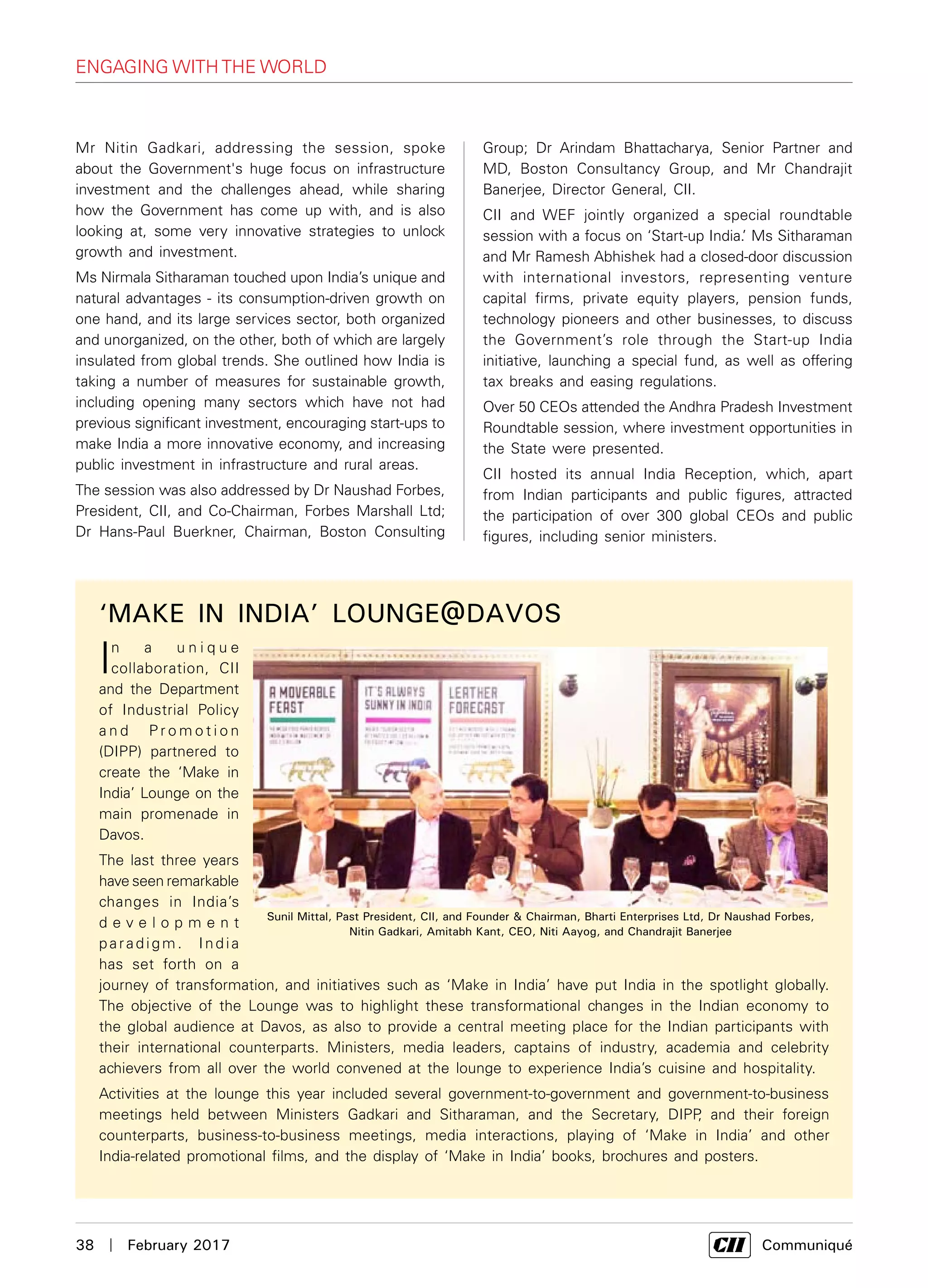
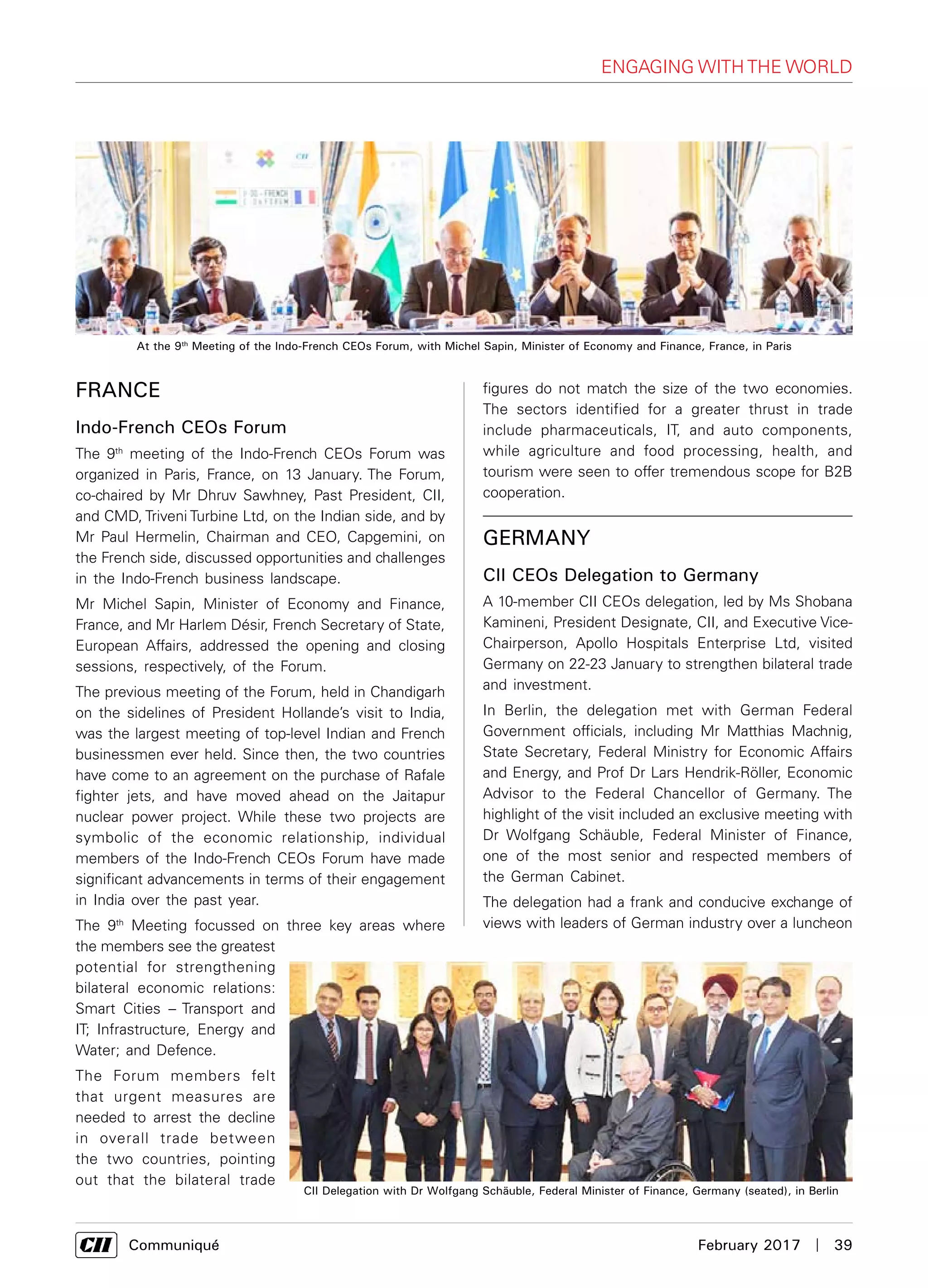
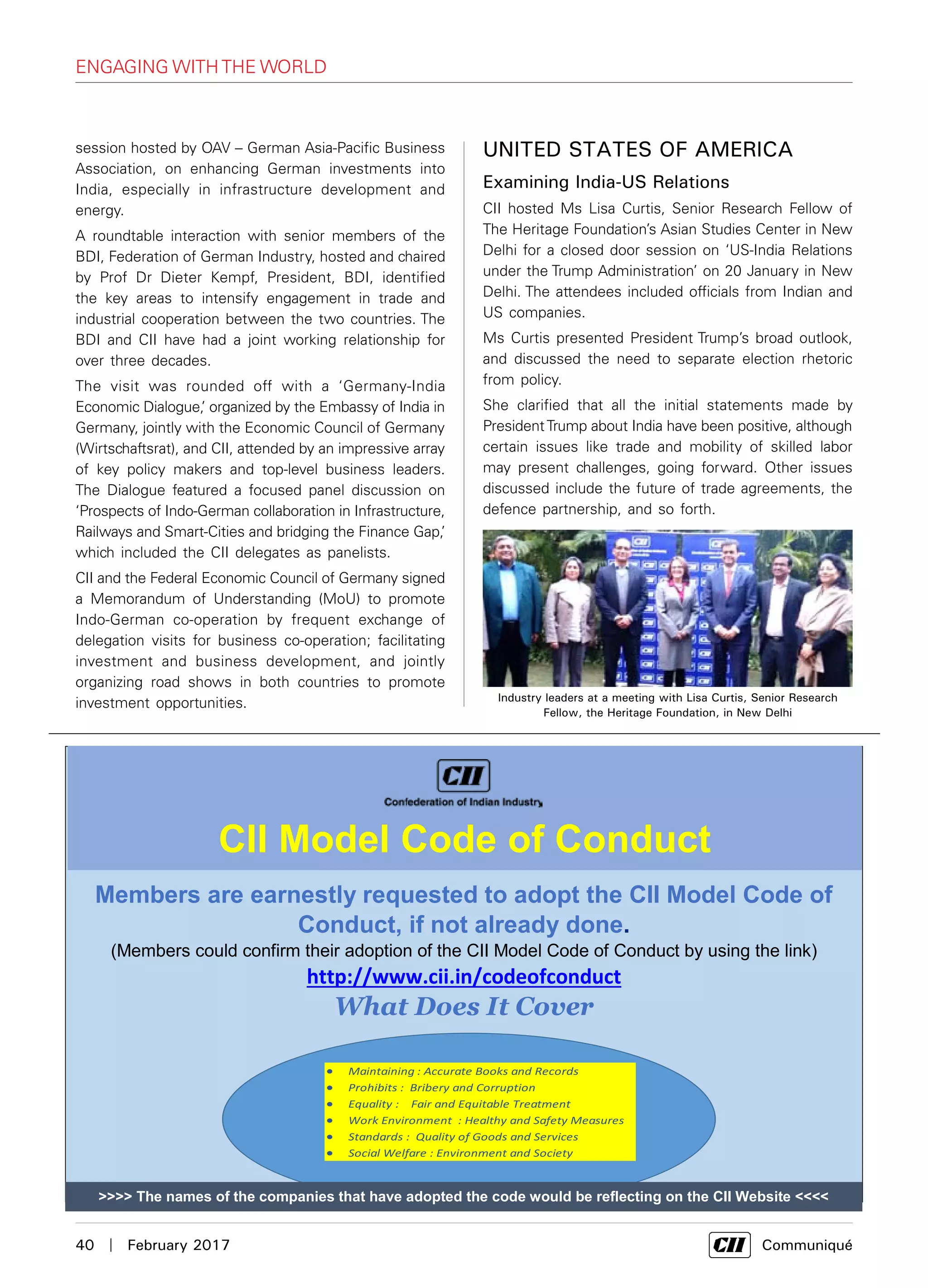
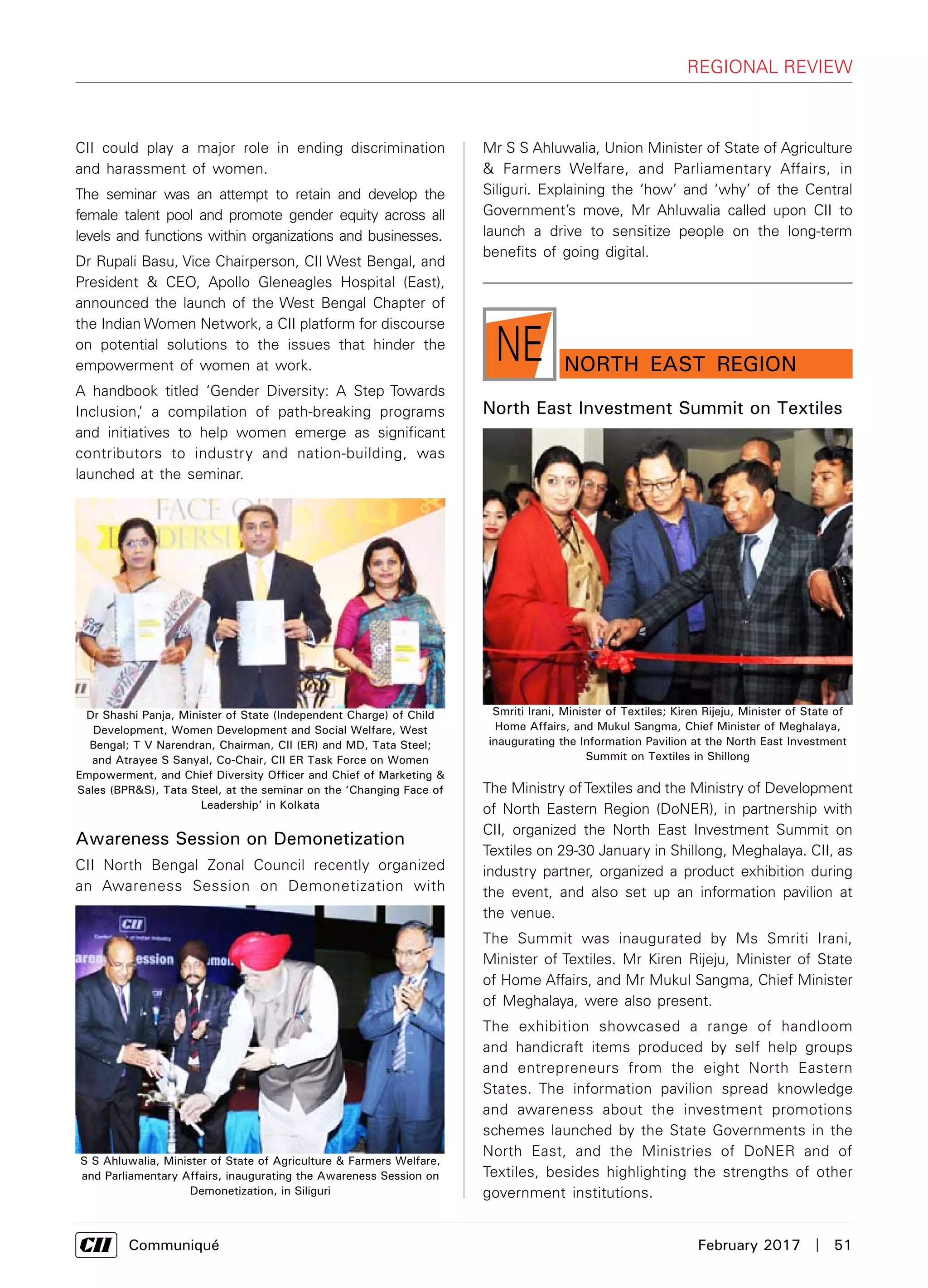
Edited, printed and published by Chandrajit Banerjee, Director General, CII, on behalf of Confederation of Indian Industry fromThe Mantosh Sondhi Centre,
23, Institutional Area, Lodi Road, New Delhi-110003, Tel: 91-11-24629994-7, Fax: 91-11-24626149, Email: info@cii.in, Website: www.cii.in
Printed at Lustra Print Process Pvt. Ltd., K No. 51/21, Rohad, Bahadurgarh (Haryana), PIN Code-124507  Registration No. 34541/79
Journal of the Confederation of Indian Industry
We welcome your feedback and suggestions. Do write to us at communique@cii.in
Contents Volume 39  No. 02  February 2017
cover story
07		 Building Partnerships for Sustained Growth
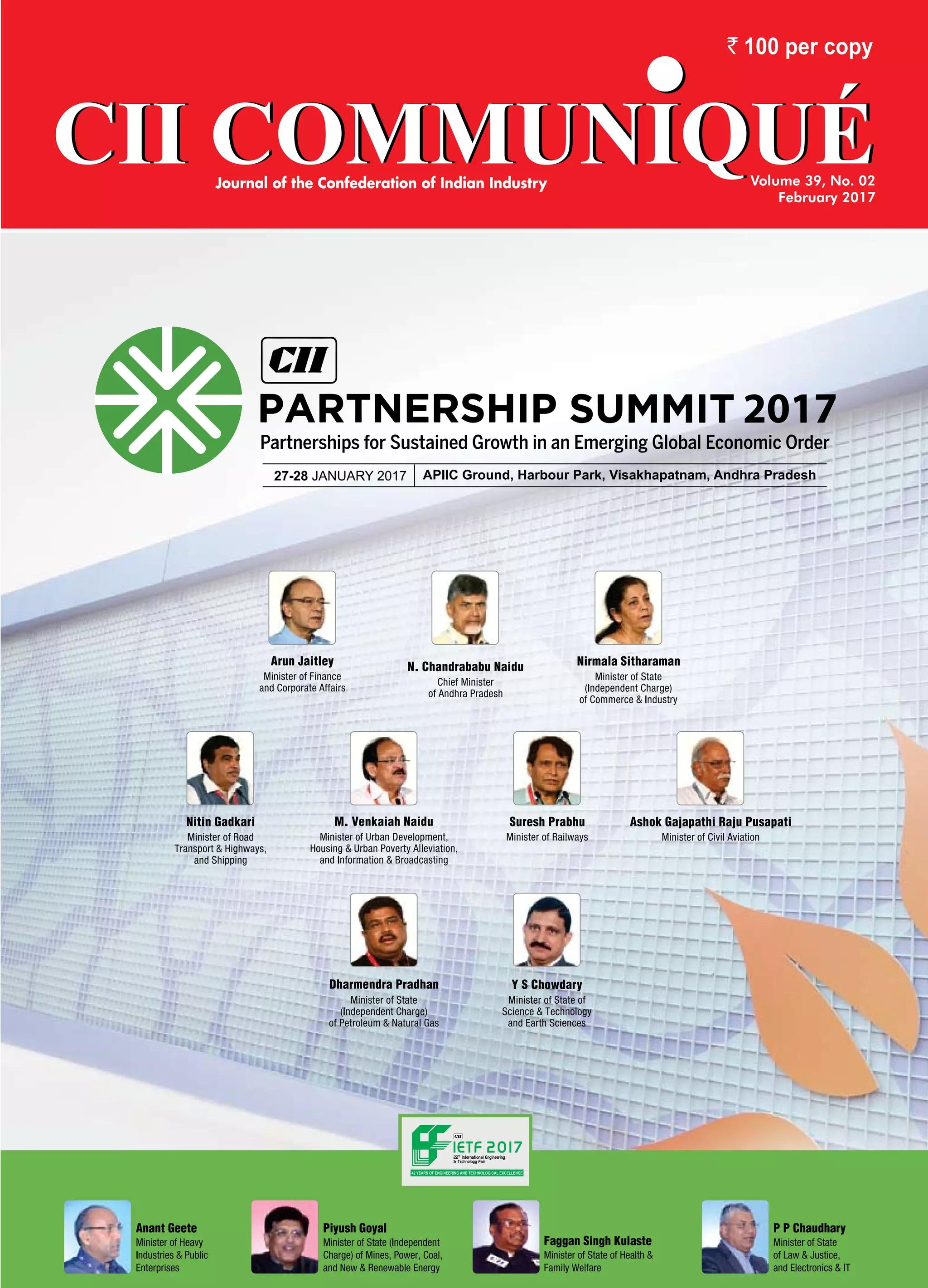
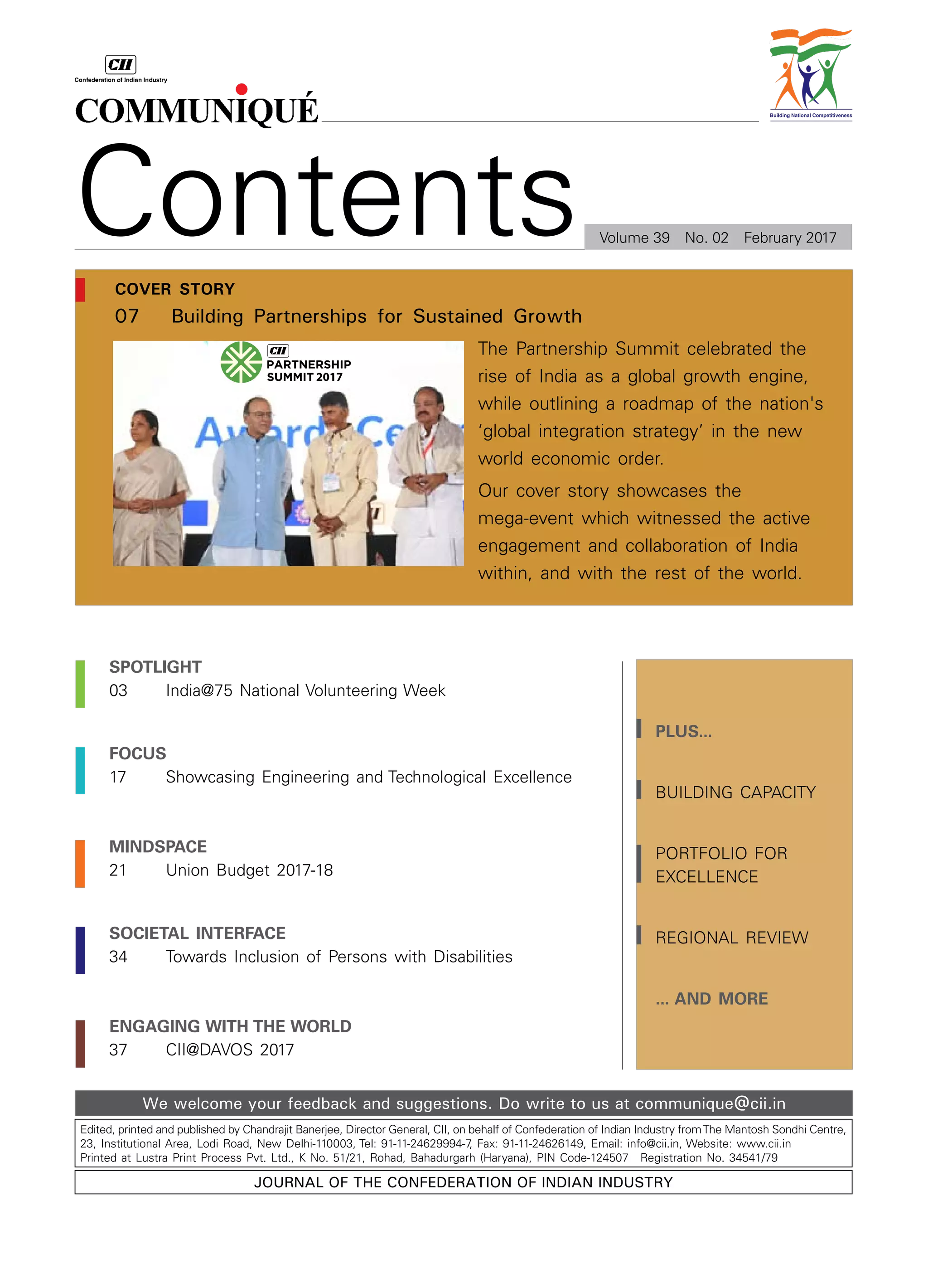
The Partnership Summit celebrated the
rise of India as a global growth engine,
while outlining a roadmap of the nation's
‘global integration strategy’ in the new
world economic order.
Our cover story showcases the
mega-event which witnessed the active
engagement and collaboration of India
within, and with the rest of the world.
spotlight
03		 India@75 National Volunteering Week
focus
17		 Showcasing Engineering and Technological Excellence
mindspace
21		 Union Budget 2017-18
Societal Interface
34		 Towards Inclusion of Persons with Disabilities
engaging with the world
37		 CII@DAVOS 2017
plus...
Building Capacity
portfolio for
excellence
REGIONAL REVIEW
... AND MORE
     Communiqué	 February 2017  |  3
spotlight
T
he India@75 Foundation,
an initiative symbolizing the
developmental agenda of CII,
organized the 4th
edition of the
National Volunteering Week (NVW)
from 18 to 24 January.
The Week celebrated volunteerism
with more than 1700 activities across
72 cities and 1401 villages. India@75
directly, and through partners,
reached out to approximately 13
lakh people, mobilizing 1.5 lakh
volunteers, and generated 2.5 lakh
volunteering hours.
In the coming year, the target is
to reach out to 50,000 villages and
100 cities.
India@75 and CII have been working
towards the vision of creating an
inclusive, developed India by 2022.
The vision elements comprise skills,
education, economy, urbanization
and environmental sustainability,
agriculture and health, innovation,
moral leadership, and more.
Technology and volunteerism have
been identified as the key drivers
cutting across the vision elements,
to make the exercise participative
and collaborative. These drivers
would also enable outreach and
scale within the time constraints, to
achieve the envisioned objectives by
the completion of 75 years of India's
Independence.
India@75
National
Volunteering
Week
4  |  February 2017	 Communiqué
spotlight
CII and India@75 have been celebrating Volunteering
Week since January 2014 in an endeavor to aggregate the
on-going efforts of the stakeholders in the volunteering
space, and facilitate synergy and alignment to augment
Government initiatives, by ensuring impactful delivery of
the various social developmental initiatives and schemes
at the grass roots.
The week-long activities comprised programs for meal
distribution, road safety, swachhta abhiyaan, tree
plantation, health and hygiene, etc, with an emphasis
on education and functional literacy.
Individuals, community organizations, youth associations,
homemakers, and retired and active professionals
representing all segments of society, pan-India, engaged
in these programs.Corporate and non-profit partners
enabled the outreach and execution of activities even
in far-flung remote areas.
Public consensus is being generated for the declaration
of an Indian National Volunteer Day /Week similar to
the UN Volunteer Day on 5 December, and National
Youth Day on 12 January. Also, traction is building
up emphasizing the need for a national policy on
volunteerism with a structured eco-system. This would
enable the engagement of Indians of different ages,
genders and professions, as well as the stakeholders,
for impactful and tangible delivery, contributing
towards nation-building efforts through participative
and collaborative action by the citizens.
India@75 is also working on a niche area of volunteering
under its Pro Bono initiative; wherein it connects
skilled corporate volunteers to non-profits through an
IT platform, for building their intrinsic capacities. This
endeavor has the larger objective of creating long term
sustainable relationships between corporates and non-
profits, thus moving beyond mere funding.
The week-long celebrations of NVW 2017 concluded
with a conclave on ‘Volunteerism: Key Enabler for Nation
Building’ in New Delhi on 24 January. In his keynote
address, Mr Vijay Goel, Minister of State (Independent
Charge) of Youth Affairs and Sports, while welcoming
the National Volunteering Week initiative, urged India@75
to “try and sustain volunteering beyond the National
Volunteering Week and undertake activities that would
have a long term impact on the ground.”
Distinguished panelists like Mr Shankar Venkateshwaran,
Chief, Tata Sustainability, Mr Anshu Gupta, Founder,
Goonj, Dr DineshTyagi, CEO, CSC E-Governance Services,
Mr Shrikant Sinha, CEO, NASSCOM Foundation, and
Mr Nishant Pandey, Country Director, American India
Foundation, amongst others, called for a structured
eco-system for volunteering. The event was attended by
various NGOs, corporates and young volunteers.
     Communiqué	 February 2017  |  7
A
s countries across the
world are gearing up
to keep pace with the
shifting dynamics in the world
order, innovation and adaptation
are setting the tone for ‘NeoGen’
prescriptions for successful and
sustainable partnerships.
Global headwinds notwithstanding,
developing Asia continues to
contribute 60% of world growth,
and is steadily becoming the
crucible for innovative economic
and geopolitical partnerships. China
and India, two of the region’s
largest economies, are showing
Building
Partnerships
for Sustained
Growth
COVER STORY
india and the world
The Partnership Summit celebrated the rise of
India as a global growth engine, while outlining a roadmap of
the nation's ‘global integration strategy’ in the new world economic order.
Our cover story showcases the mega-event which witnessed the active
engagement and collaboration of India within, and with the rest of the world,
through stimulating discussions between the key stakeholders – policy-makers,
institutions, businesses, media and academia.
Ministers and Industry leaders at the lamp-lighting ceremony to inaugurate
the Partnership Summit in Visakhapatnam
8  |  February 2017	 Communiqué
Dr Naushad Forbes, President, CII, and Co-Chairman, Forbes Marshall; Ramesh Abhishek, Secretary, DIPP; Nirmala Sitharaman,
Minister of State (Independent Charge) of Commerce & Industry; Arun Jaitley, Minister of Finance, and of Corporate Affairs; N Chandrababu Naidu,
Chief Minister of Andhra Pradesh; M Venkaiah Naidu, Minister of Urban Development, Housing, and Urban Poverty Alleviation, and Information
& Broadcasting; Ashok Gajapathi Raju Pusapati, Minister of Civil Aviation; Y S Chowdary, Minister of State of Science & Technology, and
Earth Sciences; Kumar Mangalam Birla, Chairman, Aditya Birla Group; Shobana Kamineni, President Designate, CII, and
Executive Vice Chairperson, Apollo Hospitals Enterprise Ltd, and Satya Prakash Tucker, Chief Secretary, Andhra Pradesh,
at the Inaugural Session of the Partnership Summit in Visakhapatnam
economic resilience. While Indonesia and Philippines are
ramping up investments, Vietnam is sustaining expansion,
and Thailand is gathering momentum.
According to the Asian Development Bank, in 2016, Asian
economies grew at about 5.6%, on the back of China’s
transition to a consumption and services-led economy,
and the on-going structural reforms in India. Emerging
markets in Latin America too are at an advantage due
to their huge domestic consumer base.
The year 2016 was a defining period for an emerging
world order, with events such as Brexit, the US
Presidential elections, and the civil war in Syria, as
well as momentous natural disasters, leading to global
economic and geopolitical churn. While creating an
environment of instability, these events have also
thrown open new opportunities for growth.
Interestingly, the year also marked some key developments
in the world’s progress towards collaboration for
sustainable growth and development.
•	 In the biggest coming-together of nations on
common ground, the Global Climate Change Pact
negotiated in Paris in 2015 was ratified by 118 of
the 194 nations, triggering new commitments to
combat global warming.
•	 For the first time, the B20/G20 Summit focused on
global economic development rather than that of
the G20 nations alone. The Hangzhou Consensus
signed by G20 members at the Summit called for a
comprehensive and integrated narrative for strong,
sustainable, balanced and inclusive growth.
•	 The World Bank’s latest review report reveals that
in 2016, a coalition of 60 governments, of both
developed and developing countries, committed a
record $75 billion towards the World Bank’s fund
for the poorest nations.
•	 Building upon the September 2015 acceptance of
the Sustainable Development Goals (SDGs), various
nations reiterated their commitment towards the
achievement of the UN Agenda 2030 SDGs.
•	 New technologies and techniques are giving rise to re-
shoring activities, and global value chains have become
a dominant feature of world trade, encompassing
developing, emerging, and developed economies.
The inter-dependence of advanced and emerging
economies is undeniable. In a global landscape with
several transformative forces at work, new economic,
technological, environmental and social challenges are
emerging. These challenges are transnational, and call
for collective solutions and global collaborations. Today,
efforts are being made to promote inclusiveness, with
fiscal and monetary policies and structures that maximize
synergies and cooperation amongst nations.
In these exciting and transformative times, India stands
at the cusp of growth. With 7.6% GDP growth in 2015-16,
over $2 trillion GDP in nominal terms, and an expected
869 million labor force by 2020, India can lead global
economic and trade growth.
The Indian Government has taken several initiatives to
improve the country’s attractiveness as an investment
destination as well as a business partner. India has
moved up 12 notches in the World Bank's Ease of
Doing Business rankings in the last two years. Strong
COVER STORY
     Communiqué	 February 2017  |  9
moves such as demonetization have paved
the way for a stronger economy, which is
expected to continue to grow at 7% in the
next fiscal. India’s new foreign trade policy,
international visits by the Prime Minister
and engagement with developed nations,
a successful push for membership of the
RCEP, and trade agreements with the ASEAN
nations, symbolize India’s renewed thrust
towards global integration.
A recent UN study highlights that India’s
growth will be underpinned by accelerated
infrastructure spending and measures to
create a better investment climate. The
Goods and Services Tax (GST) Constitutional
Amendment Bill has cleared the way for the
implementation of a uniform indirect tax
regime in the country, while the Bankruptcy
Code has replaced numerous archaic
legislations with a modern contemporary
law, allowing easy exit to companies. The
consistent convergence of Government and
industry efforts for an enabling ecosystem
as well as efficient governance can enhance
India’s competitiveness.
It is now India’s moment of truth to forge a
path to progress that has never been explored
before, encompassing both economic growth
and environmental sustainability.
Indeed, with 'Partnerships, to catalyze global
solidarity for sustainable development,' listed
by the UN as one of the 5 Ps of its anti-poverty
campaign, along with Prosperity, People,
Planet, and Peace, CII's Partnership Summit
assumes even greater relevance today.
COVER STORY
T
he India opportunity was effectively highlighted at
Visakhapatnam, with the convergence of over 2000
delegates from 51 countries on 27-28 January for CII’s
prestigious Partnership Summit. This year, the Government of
Andhra Pradesh was the Host State Partner for the annual flagship
event, organized by CII in association with the Department of
Industrial Policy and Promotion (DIPP), Ministry of Commerce
and Industry.
The Summit is a unique platform for close examination of the
partnerships and synergies to spark the next phase of global
growth, and to develop strong multi-country linkages and
networks. Initiated in 1995 to commemorate CII’s centenary
year, the event, with over two decades of active engagement
and collaboration of India at a global level, attracts around
2000 delegates every year with over 40% participation from
overseas.
The theme for this year’s Summit was ‘Partnerships for Shared
New Realities.' Over the years, global economic rebalancing
has taken a definitive shift towards Asia and the emerging
economies. Today the G20 nations together represent 85%
of global output. And China and India continue to create an
economic buzz in a milieu where the developed world clocked
in a low 2.5% growth.
Three key directional shifts are powering India’s growth, said
Mr Arun Jaitley, Minister of Finance, and of Corporate Affairs,
inaugurating the Partnership Summit. These are the JAM trinity
(Jan Dhan Yojana, Aadhar, Mobile), the Goods and Services Tax
(GST), and Demonetization, he said. While the JAM trinity would
Partnerships
for Shared
New Realities
10  |  February 2017	 Communiqué
COVER STORY
help promote financial inclusion in the country, the GST,
he explained, would make India one large market and
would go a long way in making doing business in India
much easier. Demonetization, he said, has helped make
the economy much more compliant. Mr Jaitley pointed
out that the formal economy was expanding at a rapid
pace now, and this would lead to much more revenue
for the Government.
The Finance Minister stated that the Center has a
vested interest in the progress of Andhra Pradesh,
whose GDP, he said, is likely to grow ahead of the
national GDP. Commending the State Government
for making Andhra Pradesh the easiest place to do
business, Mr Jaitley said that a large number of central
institutions have been established in the State over
the last 2.5 years, to help it overcome the challenges
of its bifurcation.
Mr N Chandrababu Naidu, Chief Minister of Andhra
Pradesh, invited businesses from India and abroad to
invest in the State. With Gross
State Domestic Product growth
consistently out-performing the
national average to clock 10.99%
this year, vis-a-vis India's overall
7.5% GDP growth, the target is
to touch 15% growth next year,
he declared.
The mantra of the Government is
‘Reform, Perform and Transform,’
stated Mr M Venkaiah Naidu,
Minister of Urban Development,
Housing and Urban Poverty Alleviation, and Information
and Broadcasting. The entire effort is to transform India
and bring about inclusive growth, he said, sharing that
his Ministry is taking measures to bring down the time
taken to obtain construction permits from over a year
to just 60 days. The Smart Cities Mission has led to an
urban renaissance, and there is a new-found enthusiasm
to improve urban conditions, he said.
Ms Nirmala Sitharaman, Minister of State (Independent
Charge) of Commerce and Industry, observed that
even though the overall global economic scenario is
not very bright, there is a lot of vibrancy in the Indian
economy, which is growing at over 7%, and has the
potential to grow faster. Many systemic reforms are
being undertaken, such as banking sector reforms, and
GST, among others, she said.
Mr Ramesh Abhishek, Secretary, DIPP, pointed out
that the States are now competing with each other to
improve the ease of doing business. They are learning
Partnership Summit at a Glance
Domestic Delegates 2000
Overseas Delegates 400
Foreign Participation 50 countries
Overseas Trade & Commerce
Ministers and Officials
7
MoUs Signed 665
Investments Pledged `10,54,590 crores
Potential Job Creation 22.3 lakh
from each others’ experiences. The Government is
steadfastly promoting cooperative federalism, thereby
galvanizing the growth potential of the State economies.
Even regulators are taking a re-look at their processes,
and reforming them, he said.
A slew of positive policy steps has contributed to
the country receiving $144 billion of foreign direct
investments in the last 2.5 years, he added.
Mr S P Tucker, Chief Secretary, Andhra Pradesh, said
reforms are being undertaken for the State to sustain
double digit growth for the next 10-15 years. The
State Government is working near real time to review
investment proposals: in 2016-17 alone, projects worth
`1,17,000 crores gained traction in the State, he said.
The sustained development of the economies of India's
States will help the country continue to be one of the
10-best performing economies in the world over the next
25 years, said Dr Naushad Forbes, President, CII, and Co-
Chairman, Forbes Marshall. One of India's key strengths
is that 2/3rd of its growth comes
from domestic consumption. At
a time when many countries in
the world are increasingly looking
inwards, India and China are
now the key advocates of free
trade. The mantle of leadership
is shifting, he said.
Mr Kumar Mangalam Birla, CMD,
Aditya Birla Group, stated that
his Group has already invested
`10,000 crores in Andhra Pradesh,
and expects to invest `7,000 crores more over the next
two years to expand their existing facilities.
Mr Baba Kalyani, CMD, Bharat Forge Ltd, announced
that his Group is investing `30,000 crores in a facility in
Nellore, construction for which would begin very soon.
Describing the Summit as “most constructive and
productive,” Mr Chandrajit Banerjee, Director General,
CII, expressed confidence that many of the international
delegates present, who had so far not factored India
into their growth models, would now be assessing
the country's potential, and coming out with lucrative
new investments.
The participation of leaders and delegations from
so many countries, and their interest in India is
very heartening and encouraging, said Ms Shobana
Kamineni, President Designate, CII, and Executive Vice
Chairperson, Apollo Hospitals Enterprise Ltd, in her
concluding remarks.
     Communiqué	 February 2017  |  11
COVER STORY
Andhra Pradesh: Sunrise State
A
t the special plenary session on ‘Celebrating
Sunrise Andhra Pradesh: Ready for the World,
Ready for the Future,’ leaders from Government
and industry shared how, with development on the
fast-track since 2015, Andhra Pradesh has emerged as
the fastest-growing State in India, with 10.99% GSDP
growth in 2015-16.
In his keynote address, Mr N Chandrababu Naidu, Chief
Minister of Andhra Pradesh, laid out his Vision 2050 –
to make Andhra Pradesh the leading global investment
destination. “Sustainable development of a region is
possible when happiness is considered as an index
of growth. Therefore my Government is working for
the overall development of our people. This includes
providing health security for the disabled, home security
for all citizens, and fodder security for people with
livestock," he said, adding that the State is taking the
United Nations Sustainable Development Goals as a
benchmark and is diligently working towards them.
“We have embarked on a journey of consistent double
digit growth, and are confident of emerging as a
developed State by 2029. Andhra Pradesh has been
rated as the top State in the country for 'Ease of Doing
Business' by the World Bank and the Government
of India, up from the 2nd
position the previous year.
This is a reflection of our continued commitment to
provide best-in-class policies, stable industrial relations,
and an investor-friendly business environment," said
Mr Naidu.
In terms of investment, Andhra Pradesh is aiming at
`7-8 lakh crores in the year 2018. Of the 328 MoUs
signed at the last Partnership Summit, also held in
Visakhapatnam in 2016, 50% have already translated into
projects. Investments of `2,82,715 crores have come
into the State in the last one year, he added.
Solomon Arokia Raj, Secretary, Industries & Commerce, Andhra Pradesh; Ashok Gajapathi Raju Pusapati; Suresh Prabhu, Minister of Railways;
N Chandrababu Naidu; Dharmendra Pradhan, Minister of State (Independent Charge) of Petroleum & Natural Gas; Dr Subhash Chandra,
Chairman, Essel Group; Tulsi Tanti, Chairman, Suzlon Energy, and Chandrajit Banerjee, Director General, CII
  BYTES
‘GST will bring a revolution in the way businesses are
done, and investments are made in India.To successfully
implement the Central Government’s vision, all State
Governments need to cooperate with the private sector,
neighboring States, technology providers, and also the
rest of the world.’
Suresh Prabhu,
Minister of Railways
'Availability of land plays a major in the development
of the aviation sector, and Andhra Pradesh has readily
agreed to provide land for the further development of
this sector.’
Ashok Gajapathi Raju Pusapati,
Minister of Civil Aviation
‘The Government is committed to taking all necessary
steps for improving the ease of doing business in India.
The total FDI inflow in the last 2.5 years has touched
$130 billion, the highest-ever recorded in India. This
has been possible due to the cooperation and robust
performance of States like Andhra Pradesh, which
are striving to build quality infrastructure and create
a conducive business environment.’
Dharmendra Pradhan, Minister of State
(Independent Charge) of Petroleum and Natural Gas
‘Availability of land, power, water, IT connectivity, favorable
policies, skilled manpower, sustainable leadership and
good governance contribute to the development of
the economy of a region. The Government of Andhra
Pradesh is proactive in providing investors with all these
requirements.’
G M Rao,
Group Chairman, GMR Group
12  |  February 2017	 Communiqué
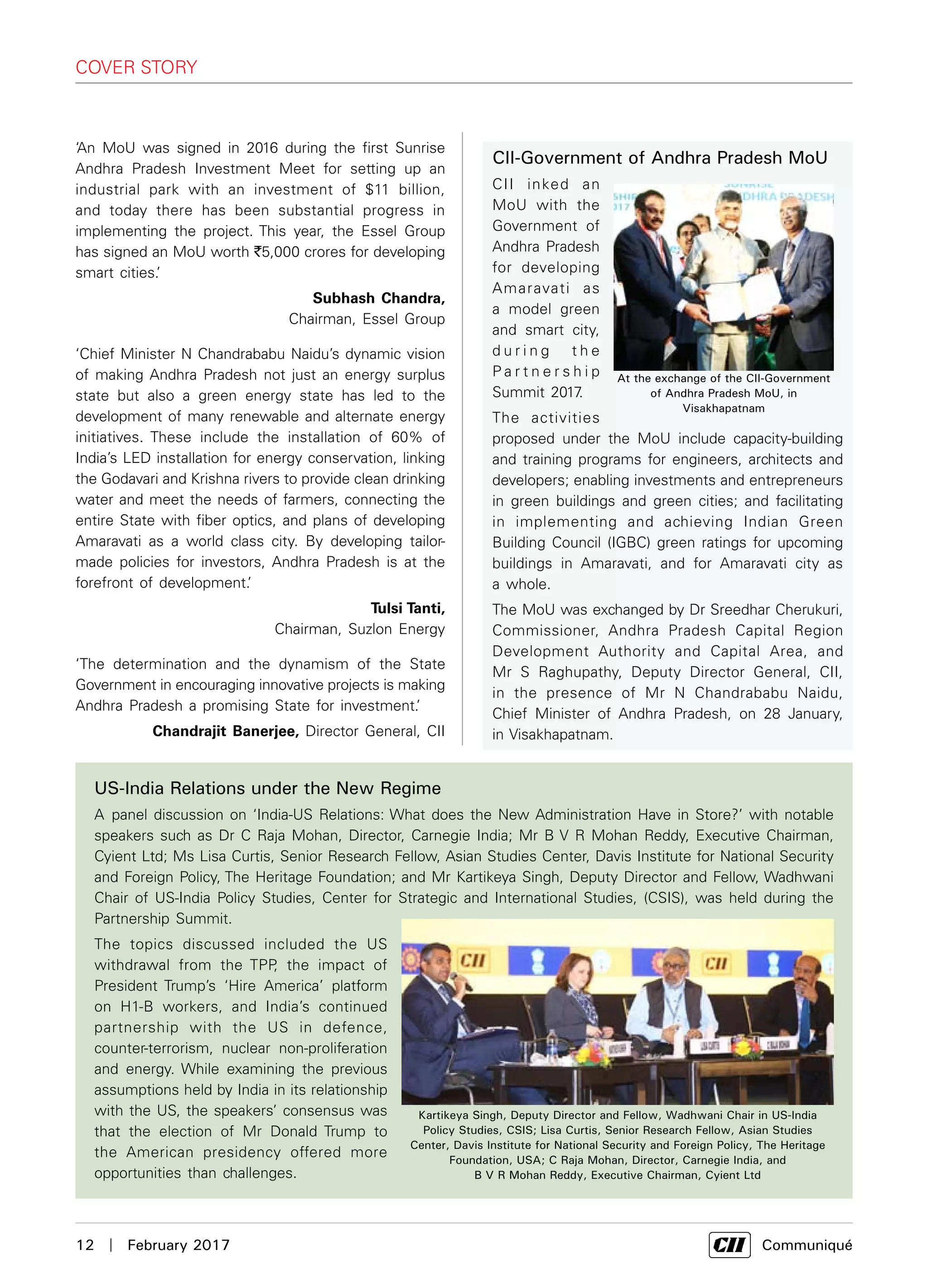
CII-Government of Andhra Pradesh MoU
CII inked an
MoU with the
Government of
Andhra Pradesh
for developing
Amaravati as
a model green
and smart city,
d u r i n g t h e
P a r t n e r s h i p
Summit 2017.
The activities
proposed under the MoU include capacity-building
and training programs for engineers, architects and
developers; enabling investments and entrepreneurs
in green buildings and green cities; and facilitating
in implementing and achieving Indian Green
Building Council (IGBC) green ratings for upcoming
buildings in Amaravati, and for Amaravati city as
a whole.
The MoU was exchanged by Dr Sreedhar Cherukuri,
Commissioner, Andhra Pradesh Capital Region
Development Authority and Capital Area, and
Mr S Raghupathy, Deputy Director General, CII,
in the presence of Mr N Chandrababu Naidu,
Chief Minister of Andhra Pradesh, on 28 January,
in Visakhapatnam.
COVER STORY
At the exchange of the CII-Government
of Andhra Pradesh MoU, in
Visakhapatnam
‘An MoU was signed in 2016 during the first Sunrise
Andhra Pradesh Investment Meet for setting up an
industrial park with an investment of $11 billion,
and today there has been substantial progress in
implementing the project. This year, the Essel Group
has signed an MoU worth `5,000 crores for developing
smart cities.’
Subhash Chandra,
Chairman, Essel Group
‘Chief Minister N Chandrababu Naidu’s dynamic vision
of making Andhra Pradesh not just an energy surplus
state but also a green energy state has led to the
development of many renewable and alternate energy
initiatives. These include the installation of 60% of
India’s LED installation for energy conservation, linking
the Godavari and Krishna rivers to provide clean drinking
water and meet the needs of farmers, connecting the
entire State with fiber optics, and plans of developing
Amaravati as a world class city. By developing tailor-
made policies for investors, Andhra Pradesh is at the
forefront of development.’
Tulsi Tanti,
Chairman, Suzlon Energy
‘The determination and the dynamism of the State
Government in encouraging innovative projects is making
Andhra Pradesh a promising State for investment.’
Chandrajit Banerjee, Director General, CII
US-India Relations under the New Regime
A  panel discussion on ‘India-US Relations: What does the New Administration Have in Store?’ with notable
speakers such as Dr C Raja Mohan, Director, Carnegie India; Mr B V R Mohan Reddy, Executive Chairman,
Cyient Ltd; Ms Lisa Curtis, Senior Research Fellow, Asian Studies Center, Davis Institute for National Security
and Foreign Policy, The Heritage Foundation; and Mr Kartikeya Singh, Deputy Director and Fellow, Wadhwani
Chair of US-India Policy Studies, Center for Strategic and International Studies, (CSIS), was held during the
Partnership Summit.
The topics discussed included the US
withdrawal from the TPP, the impact of
President Trump’s ‘Hire America’ platform
on H1-B workers, and India’s continued
partnership with the US in defence,
counter-terrorism, nuclear non-proliferation
and energy. While examining the previous
assumptions held by India in its relationship
with the US, the speakers’ consensus was
that the election of Mr Donald Trump to
the American presidency offered more
opportunities than challenges.
Kartikeya Singh, Deputy Director and Fellow, Wadhwani Chair in US-India
Policy Studies, CSIS; Lisa Curtis, Senior Research Fellow, Asian Studies
Center, Davis Institute for National Security and Foreign Policy, The Heritage
Foundation, USA; C Raja Mohan, Director, Carnegie India, and
B V R Mohan Reddy, Executive Chairman, Cyient Ltd
     Communiqué	 February 2017  |  13
Building International Partnerships
'Hydel-power could be a game-changer for Nepal.
The Himalayan country has the potential for
100,000-300,000MW of hydel power, which
will change the energy scenario in the region.
Investments from India and other countries can
help leverage the huge potential in hydel power
and other environmentally-friendly industries.'
Romi Gauchan Thakali,
Minister of Commerce, Nepal
'India has become a locomotive for growth in the
world. Events like the Partnership Summit have
become influential platforms for driving trade and
investment, and should be encouraged.'
Stepan Kubiv, First Vice-Prime Minister, and
Minister of Economic Development and
Trade, Ukraine
'The UAE is a strong believer in India’s growth
story. India is a 'miracle’ in the way it has
embraced so many diverse groups but still remains
united and strong. The 21st
century will be Asia’s
century, and the UAE will ensure that it is a part of
this economic growth.The UAE-India relationship
is being remodeled by Prime Minister Modi into
a special one.’
Sultan Bin Saeed Al Mansoori,
Minister of Economy, UAE
'While the rise of India and Asia is commendable,
there is huge potential in Africa too, especially in
agriculture, mining, manufacturing, infrastructure
and forestry. Africa is open for business. We need
South-South cooperation, and developing countries
need to ensure their interests in an equitable and
fair ecosystem for trade and investment.’
C I Mabuwa, Deputy Minister of Industry and
Commerce, Zimbabwe
COVER STORY
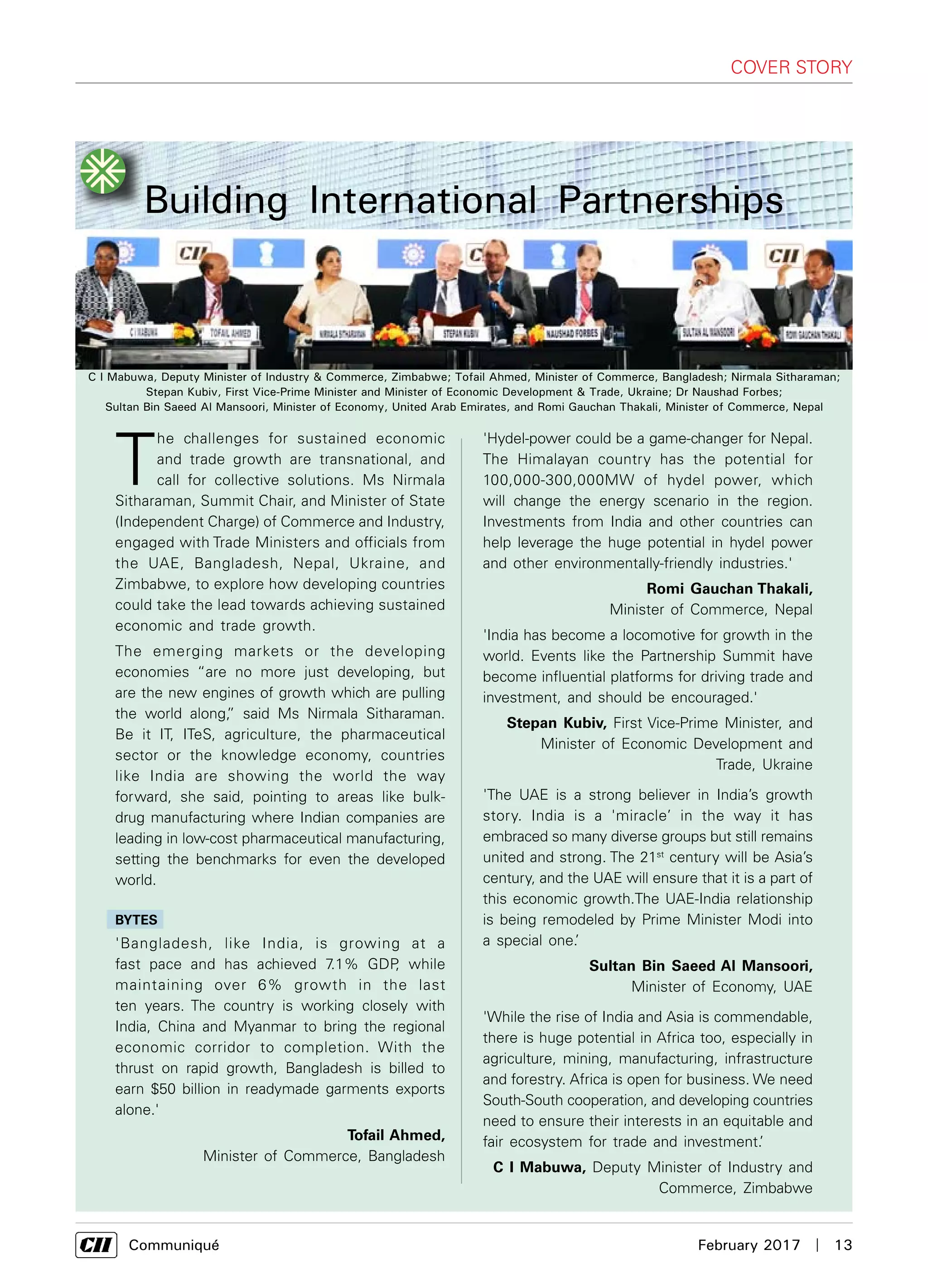
C I Mabuwa, Deputy Minister of Industry & Commerce, Zimbabwe; Tofail Ahmed, Minister of Commerce, Bangladesh; Nirmala Sitharaman;
Stepan Kubiv, First Vice-Prime Minister and Minister of Economic Development & Trade, Ukraine; Dr Naushad Forbes;
Sultan Bin Saeed Al Mansoori, Minister of Economy, United Arab Emirates, and Romi Gauchan Thakali, Minister of Commerce, Nepal
T
he challenges for sustained economic
and trade growth are transnational, and
call for collective solutions. Ms Nirmala
Sitharaman, Summit Chair, and Minister of State
(Independent Charge) of Commerce and Industry,
engaged with Trade Ministers and officials from
the UAE, Bangladesh, Nepal, Ukraine, and
Zimbabwe, to explore how developing countries
could take the lead towards achieving sustained
economic and trade growth.
The emerging markets or the developing
economies “are no more just developing, but
are the new engines of growth which are pulling
the world along,” said Ms Nirmala Sitharaman.
Be it IT, ITeS, agriculture, the pharmaceutical
sector or the knowledge economy, countries
like India are showing the world the way
forward, she said, pointing to areas like bulk-
drug manufacturing where Indian companies are
leading in low-cost pharmaceutical manufacturing,
setting the benchmarks for even the developed
world.
BYTES
'Bangladesh, like India, is growing at a
fast pace and has achieved 7.1% GDP, while
maintaining over 6% growth in the last
ten years. The country is working closely with
India, China and Myanmar to bring the regional
economic corridor to completion. With the
thrust on rapid growth, Bangladesh is billed to
earn $50 billion in readymade garments exports
alone.'
Tofail Ahmed,
Minister of Commerce, Bangladesh
14  |  February 2017	 Communiqué
Partnerships for Sustainable Development
The Sustainable Development Goals (SDGs) are a
set of 17 specific goals offering special focus on
important areas related to sustainable development,
that require urgent and extensive attention from
governments.
While the Government of India has implemented
many programs to bring improvement in the quality
of life in rural areas through employment generation,
development of rural infrastructure, and provision of
other basic amenities, it still needs to identify gaps
and prepare an implementation framework to meet
the major SDG goals. India is also emerging as a
development partner for countries in Asia and Africa
with a wide aid and growth agenda.
This session explored the environment for nurturing
the SDGs and the COP22. The Happiness Index made
its way into the discussions as one of the main
parameters for countries to keep on the radar to
achieve the SDGs. For this subject of global import,
the panelists included Ms Arancha Gonzalez, Executive
Director, International Trade Centre, Switzerland;
Dr Frank-Jurgen Richter, Chairman, Horasis,
Switzerland, and Mr Geoffrey Clements, Chairman,
The Commonwealth Association for Infrastructure
Development, United Kingdom, Mr Chrys Fernandes,
Regional Commercial Leader – India, SE Asia & Pacific,
Dow Chemicals, Mr Ramesh Kymal, Co-chair, CII
Committee on Renewable Energy, and MD, Gamesa
Wind Turbines Pvt Ltd.
  BYTES
‘Ideally, cities should partner with businesses to develop
cost-effective and energy-efficient technologies.’
Chrys Fernandes, Regional Commercial Leader –
India, SE Asia & Pacific, Dow Chemicals
Plenary Sessions
COVER STORY
Dr Frank-Jürgen Richter, Chairman, Horasis, Switzerland; Ramesh Kymal, Co-chair, CII Committee on Renewable Energy, and MD, Gamesa
Wind Turbines Pvt Ltd; Arancha Gonzalez, Executive Director, International Trade Centre, Switzerland; Pranjal Sharma, Economic Analyst &
Writer; Geoffrey Clements, Chairman, CIID, United Kingdom, and Chrys Fernandes, Regional Commercial Leader – India, SE Asia & Pacific,
Dow Chemicals
‘India had taken the lead in renewables in the 1990s, but
had then fallen off course. Only lately has it picked up
steam again. The country has set an ambitious goal of
generating renewable energies of 175 GW by 2022.’
Ramesh Kymal, Co-chair, CII Committee on Renewable
Energy, and MD, Gamesa Wind Turbines Pvt Ltd
Global Financial Architecture
The global financial system has still not fully recovered
from the 2008 financial crisis. While there is a need
to develop a comprehensive regulatory framework
to prevent such crisis in the future, the world's
financial system needs to be resilient enough to
support global investment dynamics and infrastructure
financing.
Underlining the importance of strengthening
the safety net for global financial stability, Mr Subir Gokarn,
ExecutiveDirector,InternationalMonetaryFund,USA,saidthe
safety net is linked to three key components – self-insurance
of individual economies by way of their respective forex
reserves,regionalfinancialarrangements,andtheIMF’sglobal
safety net. The panelists conclusively agreed that
investments in infrastructure are the key to ensuring the
resilience of the economy, if innovative financial instruments
can be developed that could be of interest to investors.
  BYTES
‘As the interest rates come down, it would be necessary
to develop innovative financial instruments to attract
investors. Moreover, as the country looks to develop
100 smart cities, a certain balance between utilizing
domestic savings and foreign investments will have
to be arrived at.’
Nimesh Kampani, Chairman,
CII National Committee on Financial Markets, and
Chairman, JM Financial Group
     Communiqué	 February 2017  |  15
‘The Government is now focused upon electrifying the
last 6,000 villages.’
P V Ramesh, CMD,
Rural Electrification Corporation Ltd
Industry 4.0
We are at the dawn of the 4th
Industrial Revolution,
integrating the digital and manufacturing worlds.
Technologies such as big data and analytics, autonomous
robots, simulations, horizontal and vertical system
integration, the industrial Internet ofThings, cyber security,
the cloud, additive manufacturing, and augmented reality
are transforming the manufacturing landscape.
India’s ambitious ‘Make in India’ initiative envisages a
25% share of manufacturing in the nation’s GDP from
the current 17%.
The deliberations explored how India can and should
embrace Industry 4.0 for sustained growth in the
emerging global economic order. Innovation would help
India move forward on its mission of digitization of the
manufacturing sector, it was suggested, with the focus on
employment generation, especially in renewable energy,
SMEs, and manufacturing. In this transformative process,
industry will also have to deal with challenges related
to working capital needs, financing of manufacturing
business and inventory management.
  BYTES
‘Digitization of the manufacturing sector and the
integration of digital technologies are the need of the
hour.To save existing
jobs and create new
ones it is important
for both Government
and industry to look at
the existing industrial
scenario and work
towards reviving and
reconstructing the
industries that are
lagging behind. ‘Go Rural, Go Green, Go Global’ should
be the motto for new innovations.’
Y S Chowdary, Minister of State of Science &
Technology, and Earth Science
'Automation has facilitated the remote operation of
mining activities in Western Australia. Using Big Data
and predictive maintenance, industry there has been
able to significantly increase productivity levels, making
Western Australia the number one destination for global
investments in the mining business. Western Australia
has signed an MoU with the Government of Andhra
Pradesh for developing a mining university, and for skill
development for mining industries.'
Stephen Wood, Director General, Department of
State Development, Western Australia
‘India is a hub of knowledge and technology and has the
capability to produce outstanding results in global markets.
Information technology, automotives, manufacturing and
pharma will be the key drivers of India’s future’
Rafael Escalona Reynoso,
Lead Researcher – Global Innovation Index, Cornell
College of Business, USA
'Some $2 trillion capex is needed in India’s manufacturing
sector over the next 10 years for the sector to gain 25%
share of national GDP. Mass customization, as opposed
to mass standardization, will define the contours of
Indian manufacturing in the coming years.’
Sunil Mathur,
MD & CEO, Siemens Ltd
COVER STORY
Nirvikar Jain, Chief Representative-India Office, First Gulf Bank; Dr Subir Gokarn, Executive Director, IMF, USA;
Nimesh Kampani, Chairman, CII National Committee on Financial Markets, and Chairman, JM Financial Group;
S V Muralidhar Rao, Executive Director, SEBI; and P V Ramesh, CMD, Rural Electrification Corporation Ltd
Rafael Escalona Reynoso, Lead Researcher- Global Innovation Index, Cornell College of Business, USA; Ramesh Datla, CMD, Elico Ltd;
Y S Chowdary; Ramesh Abhishek; Stephen Wood, Director General, Department of State Development, Western Australia;
Sunil Mathur, MD & CEO, Siemens Ltd, and Srini Srinivasan, MD, Hospira Healthcare Pvt Ltd
16  |  February 2017	 Communiqué
‘The challenge in ushering in
Industry 4.0 is about creating
a circular economy. All pieces
of industry, including SMEs,
need to be transformed. Job
creation is very important. The
skilling initiatives that support
the Industry 4.0 drive should
address the issue of job mis-
allocation too.’
R Mukundan, MD, Tata
Chemicals
‘We need to define Industry 4.0 in relation to the SME
sector. This calls for developing the right standards
for small enterprises and ensuring their adherence,
promoting innovation for value-addition in manufacturing,
increasing interaction between industry and research
institutions, developing centers of excellence, building
smart factories, and enabling skill development.’
Ramesh Datla, Chairman,
CII Southern Region, and CMD, Elico Ltd,
‘Industry 4.0 is critical for the Indian pharma industry
to increase its share of the global market. Today 2/5 of
all medicines consumed globally are manufactured in
India. The challenge is to consistently meet the quality
standards laid down by pharma regulators around the
globe, which can be achieved through Industry 4.0.’
Srini Srinivasan, MD, Hospira Healthcare Ltd
‘Skill development programs should be aligned with the
goal of creating smart jobs. The GST should perhaps
provision for encouragement of adoption of green
technologies for manufacturing.’
Jalaj Ashwin Dani, President – HR, Supply Chain &
Chemicals, Asian Paints Ltd
Industrial Corridors
India is developing industrial and transportation corridors
in a big way. The projects involve creating efficient
transport facilities and manufacturing infrastructure. The
Government’s initiatives in developing five industrial and
economic corridors, linking Delhi-Mumbai, Bengaluru-
Mumbai, Chennai-Bengaluru, Visakhapatnam-Chennai,
and Amritsar-Kolkata, will create a whole new map for
Indian industrial networks. Various infrastructure projects
like development of roads, drainage, sewage, potable
water, water treatment, sewage treatment plants,
logistics networks, et al are being developed to unleash
greater connectivity as well as provide impetus to the
success of the ‘Make in India’ campaign.
COVER STORY
Alkesh Sharma, CEO, DMICDC; M T Krishna Babu, Chairman, Visakhapatnam Port Trust;
Nitin Gadkari, Minister of Road Transport & Highways, and Shipping, and N Chandrababu Naidu
  BYTES
‘Developing sustainable infrastructure in the country remains
the highest priority of the Government. Visakhapatnam is
an arterial port connecting many manufacturing hubs and
industrial clusters, and the Government has invested over
`6,000 crores for its development. To reduce the logistics
costs within the country, the Government has taken up
the development of coastal economic zones through the
Sagar Mala Project. This project is expected to bring in
investments of over `8 lakh crores and generate a huge
number of jobs. Initiatives are being taken to connect
inland waterways with ports.’
Nitin Gadkari, Minister of Road Transport and
Highways, and Shipping
‘India’s GDP will grow if there is focus on creating
employment opportunities for the youth, developing an
export model economy, and working towards sustainable
growth.The Government of India’s initiatives of developing
industrial corridors will further these goals.’
Alkesh Sharma, CEO, Delhi Mumbai Industrial
Corridor Development Corporation (DMICDC)
'The Asian Development Bank has approved a $ 631
million loan for building India’s first coastal industrial
corridor, between Visakhapatnam and Chennai. This
corridor is expected to boost development on the
eastern coast of India and enable seamless trade links
with South-east and South Asia.’
Johanna Boatel, Principal Economist,
Asian Development Bank
‘The logistics cost in India is way too high compared
to developed countries. Therefore the focus of both
the Central and State Government on developing better
rail, roads, inland waterways and air facilities is critical.
Investors always look for availability of land, power and
basic amenities before going ahead with their projects.’
M T Krishna Babu, Chairman,
Visakhapatnam Port Trust
     Communiqué	 February 2017  |  17
T
he 22nd
International Engineering & Technology Fair (IETF) 2017,
a flagship event of CII, held in New Delhi from 2-4 February,
once again served as a unique platform for entrepreneurs,
businesses, policy-makers and innovators, to showcase their products
and services to take Indian industry to the next level of growth.
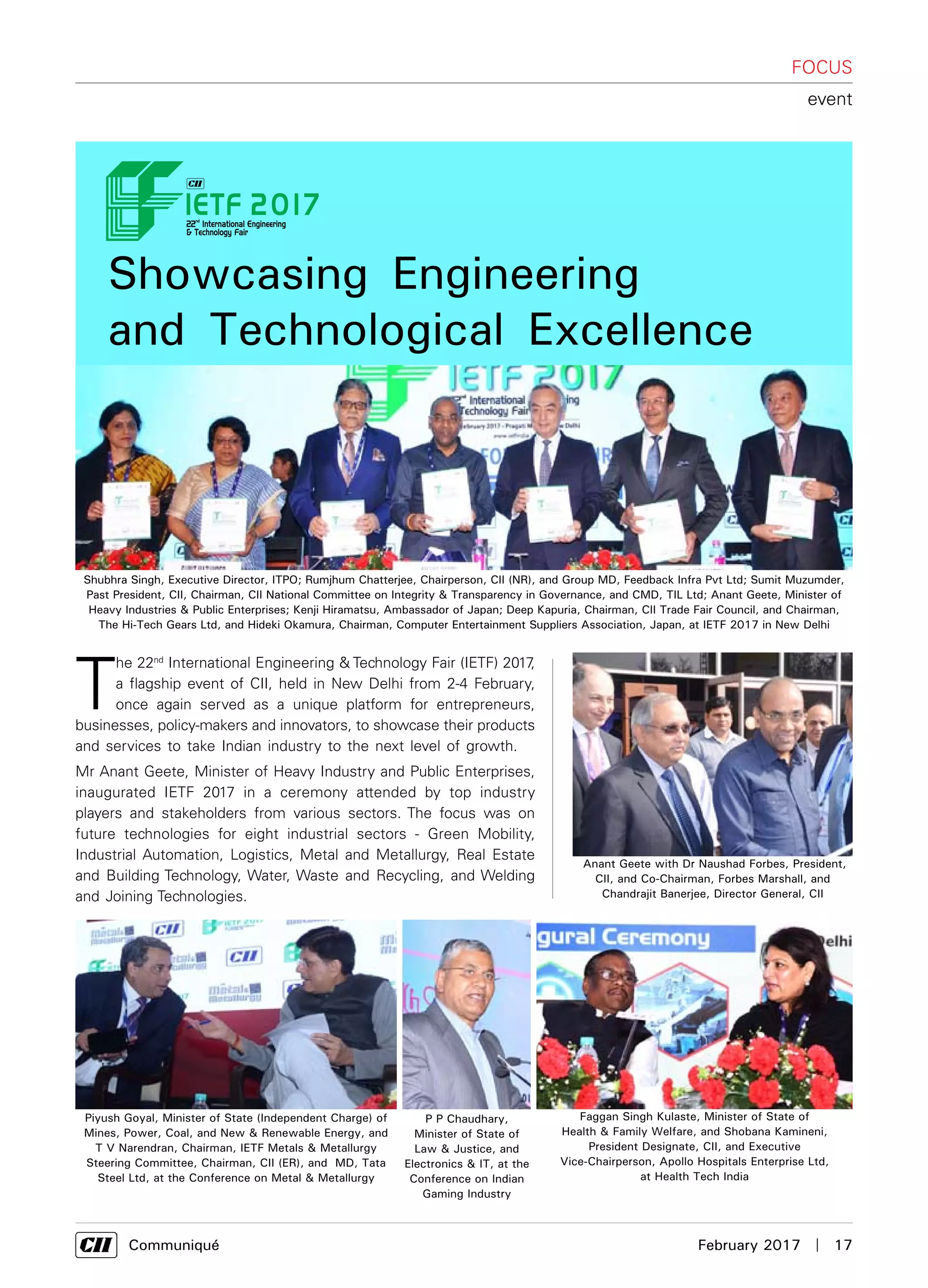
Mr Anant Geete, Minister of Heavy Industry and Public Enterprises,
inaugurated IETF 2017 in a ceremony attended by top industry
players and stakeholders from various sectors. The focus was on
future technologies for eight industrial sectors - Green Mobility,
Industrial Automation, Logistics, Metal and Metallurgy, Real Estate
and Building Technology, Water, Waste and Recycling, and Welding
and Joining Technologies.
Showcasing Engineering
and Technological Excellence
FOCUS
event
Shubhra Singh, Executive Director, ITPO; Rumjhum Chatterjee, Chairperson, CII (NR), and Group MD, Feedback Infra Pvt Ltd; Sumit Muzumder,
Past President, CII, Chairman, CII National Committee on Integrity & Transparency in Governance, and CMD, TIL Ltd; Anant Geete, Minister of
Heavy Industries & Public Enterprises; Kenji Hiramatsu, Ambassador of Japan; Deep Kapuria, Chairman, CII Trade Fair Council, and Chairman,
The Hi-Tech Gears Ltd, and Hideki Okamura, Chairman, Computer Entertainment Suppliers Association, Japan, at IETF 2017 in New Delhi
Faggan Singh Kulaste, Minister of State of
Health & Family Welfare, and Shobana Kamineni,
President Designate, CII, and Executive
Vice-Chairperson, Apollo Hospitals Enterprise Ltd,
at Health Tech India
P P Chaudhary,
Minister of State of
Law & Justice, and
Electronics & IT, at the
Conference on Indian
Gaming Industry
Piyush Goyal, Minister of State (Independent Charge) of
Mines, Power, Coal, and New & Renewable Energy, and
T V Narendran, Chairman, IETF Metals & Metallurgy
Steering Committee, Chairman, CII (ER), and MD, Tata
Steel Ltd, at the Conference on Metal & Metallurgy
Anant Geete with Dr Naushad Forbes, President,
CII, and Co-Chairman, Forbes Marshall, and
Chandrajit Banerjee, Director General, CII
18  |  February 2017	 Communiqué
The first-ever international
gaming and animation show in
India, the India Gaming Show
2017, was held concurrently with
IETF from 2-5 February, with the
participation of as many as 90
companies from 12 countries. Japan was the partner
country, while Korea was the guest country and the UK
the focus country, for the maiden edition of the Gaming
Show, which was backed by the Ministry of Electronics
and Information Technology.
Among other countries, Germany, USA and Poland
brought their best gaming companies to the show.
Some of the leading brands included J-Lop, Sega,
Konami, Square Enix, Sony India, Samsung and Asus.
Indian gaming start-ups also showcased their potential
to compete in the international market, and participated
in the show to attract potential collaborators and gain
exposure to the latest gaming technologies. With over
70 million gamers in the country, the Indian gaming
market is pegged at $890 million.
The India Gaming Show 2017 was inaugurated by
Mr PP Choudhary, Minister of State of Electronics
and Information Technology (IT), on 2 February. Mr
Debashish Dutta, Group Coordinator R&D (IT), Ministry
of Communications and IT, was the Guest of Honor.
The show was the first attempt to provide a strong
platform to all stakeholders in both Indian and
international gaming markets to present new trends
and technologies in the upcoming gaming sector. It
proved to be a major hit among youngsters, who were
treated to e-sports exhibition tournaments, and games
like DOTA2, CS:GO and Clash Royale, among hundreds
of others, along with the opportunity to see professional
gamers from the international circuit.
A one-day international conference on gaming brought
experts together to discuss ways to unlock India’s
potential in the sector.
Health Tech India
2017, organized by
CII concurrently
with the IETF from
3-5 February, brought over 100 health technology
companies, both national and international, together,
to showcase their innovations and decide on a future
roadmap to provide a fillip to the sector.
The first comprehensive show dedicated to health
technologies in the country was inaugurated by
Mr Faggan Singh Kulaste, Minister of State of Health
and Family Welfare. Over 10,000 medical and healthcare
FOCUS
Attending IETF on 3 February, Mr Piyush Goyal, Minister
of State (Independent Charge) of Mines, Power, Coal,
and New & Renewable Energy, said the Union Budget
focuses on ushering in new technologies, new ideas and
innovations, and supporting and encouraging SMEs.
This year, for the first time, three concurrent events
– Health Tech India, the India Gaming Show, and
Knowledge Expo, were organized as part of the
mega-event, enabling technological and knowledge
convergence on a single platform. The new initiatives
also included the debut of three focused shows: the
India Industrial Automation Show, the Real Estate and
Building Technology Show, and the Welding and Joining
Technology Expo.
Demonstrating its commitment as one of the most
important strategic partners of India's economic
resurgence, Japan participated as Partner Country
at IETF 2017 for the record 5th
time. Forty Japanese
companies put up a large display of their products
and technologies in IT and Gaming, in an exclusive
pavilion. Apart from Japan, around 500 companies from
25 countries participated as exhibitors.
Spread across three days, IETF 2017 featured 25
seminars, conferences and workshops. The subjects
discussed spanned new technologies in the real estate
and automotive sectors, smart waste management
under the Swachh Bharat Mission, water security and
sustainability, technological innovations in the logistics
sector, green mobility, societal manufacturing, and
leveraging engineering and technological excellence to
boost productivity, build capacity and enhance MSME
competitiveness, among many others.
Experts participating in the knowledge sessions
underscored the need for a central repository of
data on the products and services of Indian MSMEs
located all over the country, to enhance their visibility
and enhance their market access. They also stressed
on the application of decision support tools such as
CII’s WATSCAN, along with water audits, for smart
management of the country’s precious water resources.
The key role of the metal and metallurgy sector in
creating significant employment opportunities was also
highlighted.
The 22nd
edition of this biennial mega event was supported
by 11 Ministries of the Government of India – Ayush;
Coal; Electronics & IT; Environment, Forest & Climate
Change; Heavy Industries & Public Enterprises; Health &
Family Welfare; New & Renewable Energy; Petroleum &
Natural Gas; RoadTransport & Highways; Steel; and Urban
Development; as also the Government of Delhi.
     Communiqué	 February 2017  |  19
diseases like diabetes, the R&D landscape for life
sciences, leveraging IT for disruptive healthcare services,
innovations and trends in medical devices and equipment,
and innovations in diagnostics.
The event underscored that technology holds the key
to providing quality healthcare in a country like India
where close to 70% of the population resides in rural
areas. Disruptive technologies like telemedicine and
technology apps based on mobile telephony can, to
a great extent, help India achieve universal healthcare
in a relatively shorter timeframe. Health Tech India
also highlighted the importance of industry-academia
partnerships to bring down the imports of devices
and drugs, and to leverage India’s large
reservoir of knowledge and expertise in
traditional medicines and biotechnology
to achieve healthcare goals.
To provide a
fillip to ‘Global
K n o w l e d g e
Collaborations,’ the 2nd
edition of
Knowledgexpo was organized as a
concurrent show of IETF, between
2-4 February in New Delhi. The global
knowledge partnership platform saw
comprehensive convergence of key
FOCUS
professionals from across the country participated in the
event, along with representatives from the Central and
State Governments, Defence, Army, Railways, etc, as
did a large number of health tech start-ups.
Besides live product and equipment demonstrations,
the event offered opportunities for entrepreneurs and
businesses to connect through B2B meetings. It also
served as a platform for the Government to announce new
rules and regulations for the medical devices industry to
boost manufacturing under the ‘Make in India’ initiative.
Since knowledge-sharing was a crucial part of Health
Tech India, the event saw two days of conferences
covering diverse subjects such as non-communicable
Dr Shubnum Singh, Chair, CII-NITI Aayog Projects on PPP for NCDs, and Chief Executive,
Max Institute of Health Education & Research; Dr Rana Mehta, Knowledge Partner on
Healthcare to CII, and Partner & Lead, Healthcare, PwC; Chandrajit Banerjee; Pooja Kapur,
Joint Secretary (ASEAN) Ministry of External Affairs, India; Byambasuren Lamjav, Vice
Minister for Health, Mongolia; and Gonching Ganbolo, Ambassador of Mongolia to India,
at the ASEM Workshop on Diabetes in New Delhi
Glimpses of IETF 2017
20  |  February 2017	 Communiqué
players from various
domains: Science &
Technology, Research
& Development,
Innovation, Higher
Education, Design,
Intellectual Property
R i g h t s , a n d
Entrepreneurship,
for forging knowledge-business partnerships.
The exhibition area was divided into five zones, i.e. R&D
& Technology Showcase, India Design Show, Innovation &
Entrepreneurship Showcase, Intellectual Property Showcase,
and Higher Education Showcase.
The Technology Showcase had two major pavilions.One, created
for the Council of Scientific & Industrial Research (CSIR),
displayed the prowess of Indian research institutions in terms
of research capabilities and infrastructure, technologies and
technology-intensive products developed, and the capability
and achievements of CSIR labs. In the other, created for
the National Accreditation Board for Testing and Calibration
Laboratories (NABL), various testing and calibration laboratories
like Dr Lal Path Labs, Bureau Veritas, etc. presented their
services. The National Research and Development Corporation
also participated in the Technology Showcase.
The India Design Show, organized in partnership with the
Department of Industrial Policy and Promotion (DIPP), the
National Institute of Design, and the India Design Council,
featured a curated collection of CII Design Excellence Award-
winners, Indian iMark granted products, and MSME Design
Clinic Scheme-supported products. The exhibitors included top
design institutes and design firms from India.
Industries, start-ups, investors, and others participated in the
India Innovation & Entrepreneurship Showcase. These included
Tata Steel, RESCUW Earth Technologies and Advisory LLP,
Probus IOT Experience Centre, Green Farms Pvt Ltd, SenseHawk
Technologies, and the Entrepreneurship Development Institute
of Tamil Nadu, to name a few.
The India IP showcase featured the top IP owners of India,
including Reliance Industries Ltd, Vatta Smart Ltd, IIT Kharagpur,
IIT-Bombay and C-DOT, among others.
While the Higher Education showcase presented Indian
universities and institutes, a pavilion of Geographical Indications
(GI), organized in partnership with the DIPP, presented India’s
most potential GIs.
In addition to the exhibition, conferences and seminars were
held on Higher Education, Innovation and various aspects
and applications of Design, including Industrial Design, during
Knowledgexpo 2017.
FOCUS
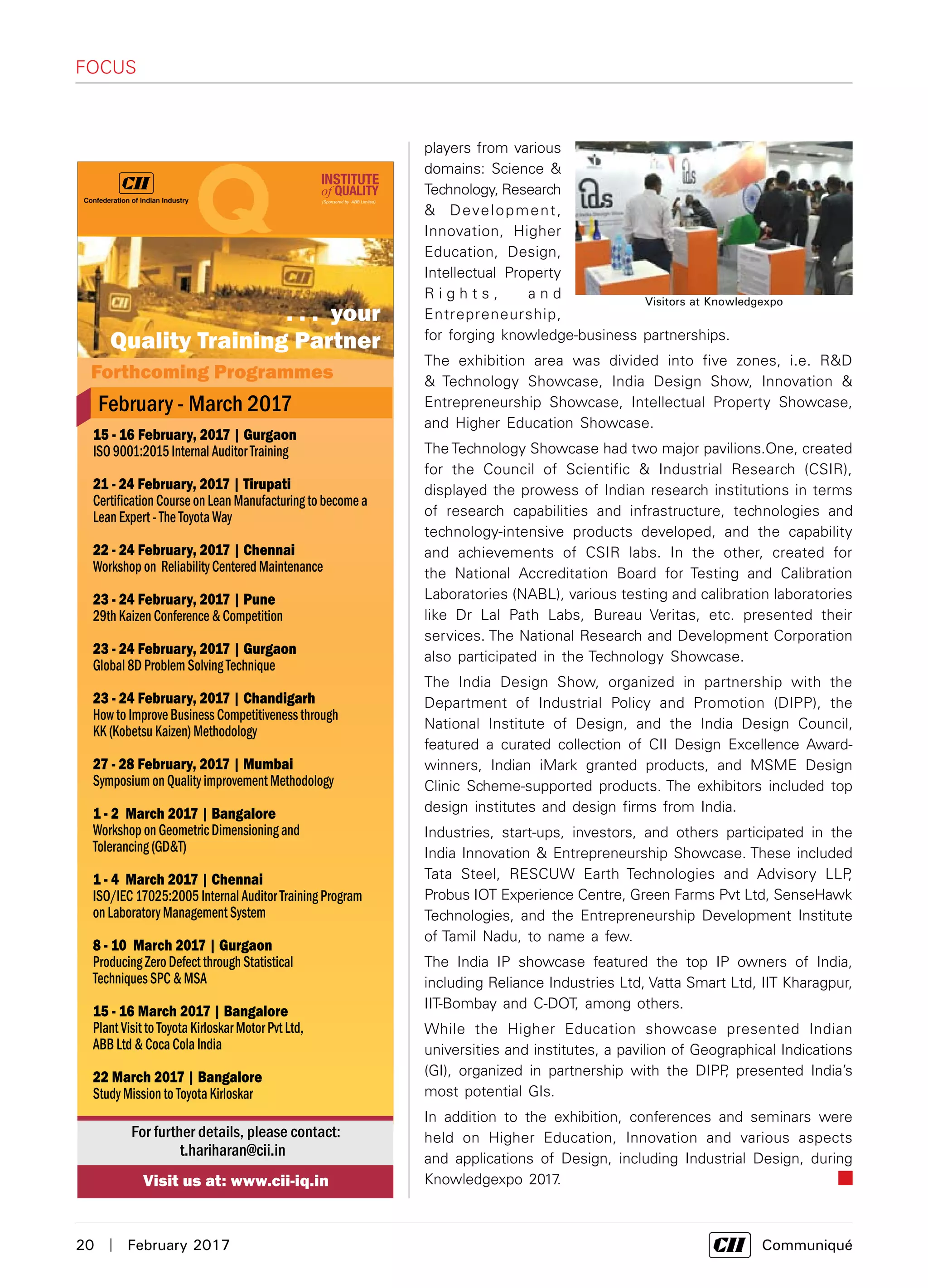
Visitors at Knowledgexpo
     Communiqué	 February 2017  |  21
Mindspace
economy
T
he Union Budget 2017-18 came at a time
when the economy is seeing a growth rate
exceeding 7% during this fiscal, despite global
turmoil. At the same time, inflation is down,
and the current account deficit is under control.
The progress to usher in the Goods and Services Tax
(GST) augurs well for future growth and inclusion.
While demonetization is expected to inhibit the Gross
Domestic Product (GDP) growth rate, this is not likely
to last beyond a quarter or two, as the underlying
fundamentals are largely positive.
Within this environment, Budget 2017-18 maintained a
path of fiscal prudence, and strengthened various drivers
of growth. As Mr Arun Jaitley, Minister of Finance, and
of Corporate Affairs, pointed out during the post-Budget
interaction with industry, the Budget is now less a
statement of income and expenditure and more
a policy document of the Government.
Our second lead story puts together various perspectives
on this annual financial exercise.
2017-2018
     Communiqué	 February 2017  |  23
Mindspace
A
t a time of global uncertainty, India is emerging
with a clear strategic direction for its economy,
with considerable focus on governance. Fiscal
prudence is evident with the goal of a fiscal deficit
being pegged at 3.2% of GDP.
We see a significant boost to investment in rural areas,
a fillip to MSMEs, and continued focus on widening the
tax base and creating a more tax-compliant economy.
GST implementation is on track through the collaboration
of the Center and the States. CII looks forward to
its roll-out, which will be a key milestone in India’s
economic journey.
A recent CII-Maersk study highlighted that high indirect
cost of trade accounts for as much as 38-47% of
the total transportation and logistics costs, severely
undermining the country’s export competitiveness
for manufactured goods. The significant increase in
infrastructure investments by 14% to `3.96 lakh crores is
extremely welcome and would have a multiplier effect on
the economy, including employment, especially through
high spending in transport infrastructure pegged at `2.4
lakh crores. For the first time, the Railway Budget has
been merged with the General Budget, supporting
planning for a multi-modal transport strategy for the
country. The development of railway stations, creation
of a rail safety fund, rail energy efficiency measures,
airport modernization and land monetization, expansion
of airports in tier-2 cities and increase in expenditure on
roads will fast-track the infrastructure mission.
The total allocation for rural, agriculture and allied
sectors, up at 24% to a record `1.87 lakh crores, will
promote agriculture, which accounts for 17% of India’s
GDP and 50% of the country’s workforce.
The reform agenda continues, with the abolition of
the Foreign Investment and Promotion Board, and
agricultural market reforms. The move to clean up
funding for elections, including the innovative electoral
bonds, reiterates the Government’s commitment
The Budget takes several welcome steps forward and is fully consistent
with the policy agenda of the Government, says Dr Naushad Forbes
towards transparency and good governance. CII had
recommended reducing the cash donation limits, and
the Budget has curtailed such donations to `2,000.
The push for autonomy in higher education is the best
way to foster quality. I have always argued that combining
autonomy with competition is the best way to deliver
quality in education, and is much more powerful than our
previous attempts to regulate quality into the system.
Additionally, measures proposed for skill development
and building the apprenticeship scheme will go a long
way in strengthening the skill base in the country.
One important announcement was the creation of a
National Innovation Fund with a corpus of at least
`10,000 crores for boosting research and development
(R&D). At present, research in the higher education
sector is 0.04% of GDP, which needs to increase
tenfold to the global average of 0.4%. Similarly, private
sector investment in R&D, which is currently at 0.3%
of GDP, needs to increase fivefold to the global average
of 1.5%.
We would have liked to see lower corporate income tax
for all companies, given that large companies contribute
significantly to investment and employment. And, the
additional surcharge on high-income tax payers deviates
from the principle of honoring honest tax payers. We
also look forward to hearing details about how the time-
bound listing of CPSEs will be achieved, and how the
Arbitration and Conciliation Act of 1996 will be amended
to address PPP resolution.
Overall, the Budget is prudent and pragmatic. It takes
several welcome steps forward and is fully consistent
with the policy agenda of the Government. This year’s
excellent Economic Survey gives the direction not just
for the next year, but a vision for the next phase in
the country’s development. We look forward to many
more steps to fulfill that vision.
This article by Dr Naushad Forbes, President, CII, and Co-Chairman,
Forbes Marshall, appeared in the Business Standard on 3 February.
Prudent and Pragmatic
24  |  February 2017	 Communiqué
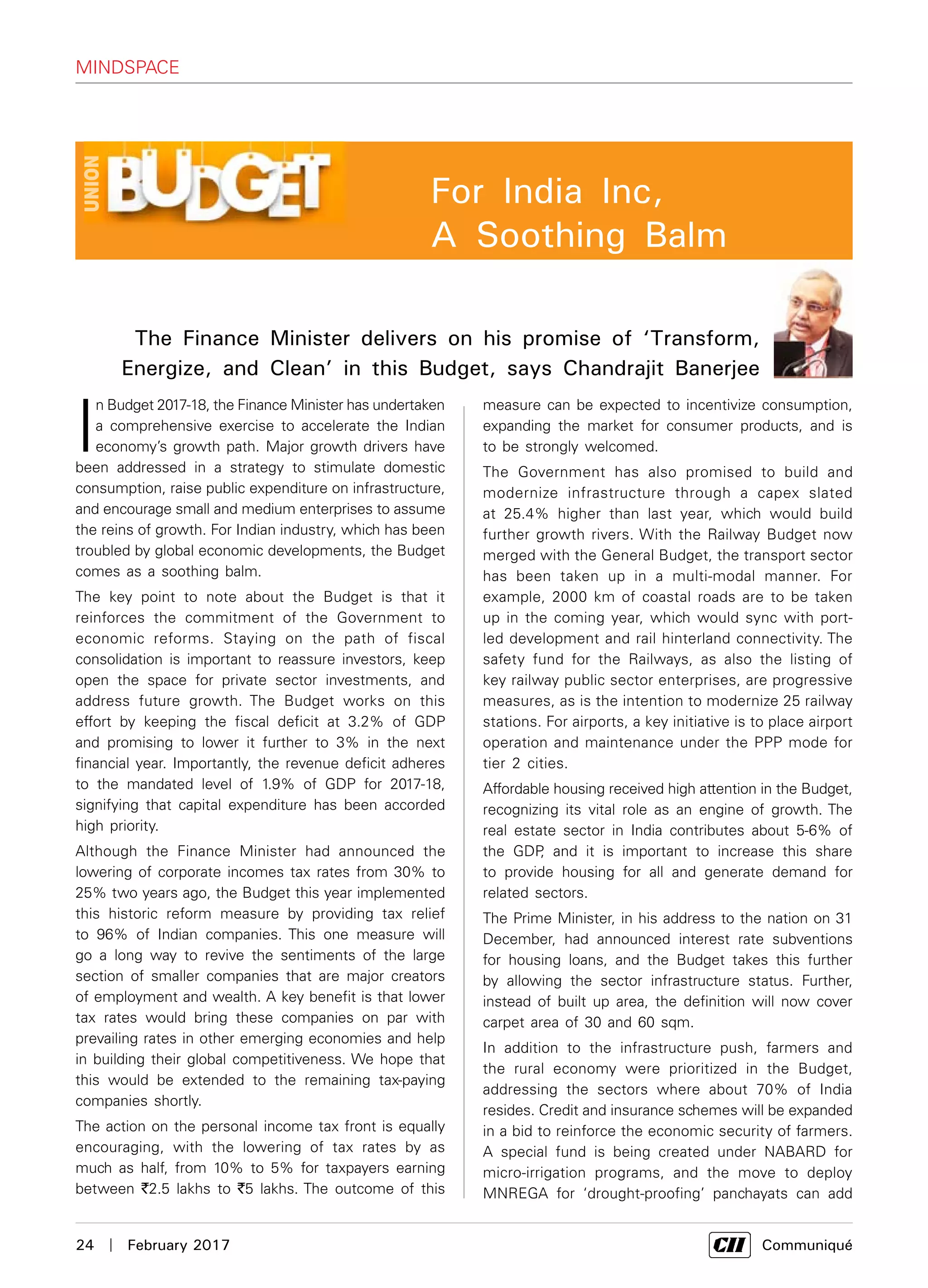
The Finance Minister delivers on his promise of ‘Transform,
Energize, and Clean’ in this Budget, says Chandrajit Banerjee
I
n Budget 2017-18, the Finance Minister has undertaken
a comprehensive exercise to accelerate the Indian
economy’s growth path. Major growth drivers have
been addressed in a strategy to stimulate domestic
consumption, raise public expenditure on infrastructure,
and encourage small and medium enterprises to assume
the reins of growth. For Indian industry, which has been
troubled by global economic developments, the Budget
comes as a soothing balm.
The key point to note about the Budget is that it
reinforces the commitment of the Government to
economic reforms. Staying on the path of fiscal
consolidation is important to reassure investors, keep
open the space for private sector investments, and
address future growth. The Budget works on this
effort by keeping the fiscal deficit at 3.2% of GDP
and promising to lower it further to 3% in the next
financial year. Importantly, the revenue deficit adheres
to the mandated level of 1.9% of GDP for 2017-18,
signifying that capital expenditure has been accorded
high priority.
Although the Finance Minister had announced the
lowering of corporate incomes tax rates from 30% to
25% two years ago, the Budget this year implemented
this historic reform measure by providing tax relief
to 96% of Indian companies. This one measure will
go a long way to revive the sentiments of the large
section of smaller companies that are major creators
of employment and wealth. A key benefit is that lower
tax rates would bring these companies on par with
prevailing rates in other emerging economies and help
in building their global competitiveness. We hope that
this would be extended to the remaining tax-paying
companies shortly.
The action on the personal income tax front is equally
encouraging, with the lowering of tax rates by as
much as half, from 10% to 5% for taxpayers earning
between `2.5 lakhs to `5 lakhs. The outcome of this
For India Inc,
A Soothing Balm
measure can be expected to incentivize consumption,
expanding the market for consumer products, and is
to be strongly welcomed.
The Government has also promised to build and
modernize infrastructure through a capex slated
at 25.4% higher than last year, which would build
further growth rivers. With the Railway Budget now
merged with the General Budget, the transport sector
has been taken up in a multi-modal manner. For
example, 2000 km of coastal roads are to be taken
up in the coming year, which would sync with port-
led development and rail hinterland connectivity. The
safety fund for the Railways, as also the listing of
key railway public sector enterprises, are progressive
measures, as is the intention to modernize 25 railway
stations. For airports, a key initiative is to place airport
operation and maintenance under the PPP mode for
tier 2 cities.
Affordable housing received high attention in the Budget,
recognizing its vital role as an engine of growth. The
real estate sector in India contributes about 5-6% of
the GDP, and it is important to increase this share
to provide housing for all and generate demand for
related sectors.
The Prime Minister, in his address to the nation on 31
December, had announced interest rate subventions
for housing loans, and the Budget takes this further
by allowing the sector infrastructure status. Further,
instead of built up area, the definition will now cover
carpet area of 30 and 60 sqm.
In addition to the infrastructure push, farmers and
the rural economy were prioritized in the Budget,
addressing the sectors where about 70% of India
resides. Credit and insurance schemes will be expanded
in a bid to reinforce the economic security of farmers.
A special fund is being created under NABARD for
micro-irrigation programs, and the move to deploy
MNREGA for ‘drought-proofing’ panchayats can add
Mindspace
     Communiqué	 February 2017  |  25
In these turbulent times, the Budget
provides much-needed stability, with
a steadfast resolve to stay on the
reforms course, says Rajiv Memani
A Commendable
Balancing Act
to this effort. The proposed model
law on contract farming can be a
huge step in integrating farmers with
markets, and incentivizing corporate
investments in the agriculture sector.
Electrification of villages, higher
support for employment generation,
and strengthening of panchayati raj
institutions can transform lives in
rural areas.
The Budget also accorded high
priority to skill development which
will empower the burgeoning youth
workforce to contribute to economic
growth. ‘Sankalp’ is a new program
for livelihood promotion, aimed at
providing relevant training to 35 million
youth. Extending the Prime Minister’s
Kaushal Kendras to 600 districts will
imply wider outreach to youth across
the country, while establishing 100
India International Skill Centers will
make them globally employable. These
measures will work towards capacity
creation and productivity enhancement
for our workforce, as was strongly
recommended by industry.
For businesses, there has been an
emphasis on tax administration,
simplification and rationalization. The
Minimum AlternateTax is now permitted
to be carried forward for 15 years, and
start-ups may avail deduction for three
out of seven years, instead of five years
as was previously allowed.
Ease of doing business received
attention through various measures such
as transfer pricing changes, audit limit
enhancement, and extension of the time
limit for tax return revisions, a welcome
series of measures for business.
In general, through strategies regarding
political funding, digitalization of the
economy, and encouraging formalization,
the Finance Minister delivers on his
promise of ‘Transform, Energize, and
Clean’ in Budget 2017-18.
This article by Mr Chandrajit Banerjee,
Director General, CII, appeared in the Asian
Age on 2 February.
T
he emerging trends of increased protectionism and tax
competitiveness from developed economies, hardening crude prices
and a dynamic global interest rate environment are just some of
the tough external factors within which the Union Budget 2017-18 was
presented by the Finance Minister. In these turbulent times, the Budget
provides much needed stability with a steadfast resolve to stay on the
reforms course. The last four Budgets have shown consistent focus
on some fundamental aspects - widening the tax base, addressing the
menace of the parallel economy, improving the ease of doing business,
and strengthening the anti-abuse provisions. At the same time, the
Government has stepped up its spending on infrastructure and achieving
inclusive growth; all this, while maintaining fiscal discipline. The fine
balancing act is truly commendable.
Arguably the boldest proposal of the Finance Minister is the move to
bring transparency in electoral funding. Receipt of donations by political
parties by cheque or digital mode will alter the political funding landscape
completely.
The continued commitment to spend on infrastructure development,
including roads, highways and railways, is evident in the `3.96 lakh
crores spending allocated for 2017-18. Combined with this, the thrust
on affordable housing will spur economic activity and job creation.
Legislative reforms are also being contemplated for consolidation of
labor laws to foster a conducive labor environment.
The Budget estimates on the tax revenue front project a very conservative
scenario. After nearly 17% growth in gross tax revenues over the last
two years, this Budget estimates tax revenue growth of only 12.2%.
This leaves room for improvement in the aftermath of demonetization,
which can yield dividends directly from RBI’s balance sheet readjustments
and indirectly from bank deposits with the potential of formalization of
a part of the parallel economy.
There are many positive measures in the Budget, which seek to
improve ease of doing business in India and attract foreign capital.
Additional clarifications and review of some of the proposals would go
a long way in ensuring certainty and improving domestic and foreign
investments.
Mindspace
26  |  February 2017	 Communiqué
Mindspace
Measures to Attract Foreign Capital
Proposals such as the retrospective clarifications on
applicability of the indirect transfer taxation provisions
to Foreign Portfolio Investors, further FDI liberalization,
and abolition of the FIPB, are significant messages to
attract foreign capital. The proposal to curb the long
term capital gains tax exemption post introduction
of the Securities Transaction Tax (STT) in 2004 only
to cases where both the legs of acquisition and
disposal have suffered such STT is well-intentioned.
However, supplemental notification, exempting genuine
transactions from any unintended consequences of
this proposal, such as acquisition of shares through
IPO, FPO, bonus or right issue etc., should be issued
at the earliest.
Given that India is primarily an inbound economy,
we believe that the tax policies should support the
country’s growth agenda. For many MNCs entering
India, the preferred route is to use lending from
overseas (or guarantee-based borrowing within
India). In such an environment, the introduction
of the capitalization rules are likely to adversely
impact many subsidiaries of MNCs that operate in
India and have huge capital requirement, especially
in the infrastructure sector. The Government can
consider OECD’s suggestion to introduce a group
ratio rule in addition to a fixed ratio rule. Secondly,
it would be important to exclude the reference to
implicit guarantee, since it is not possible to prove
or disprove implicit guarantee. The computation of
the allowable interest as per current draft regulations
considers only interest paid to AE and not the
interest paid to third parties (under a guarantee
from an AE).
The Transfer Pricing (TP) Rules are proposed to be
amended to provide for secondary adjustment. While
secondary adjustments are a globally accepted principle,
the timing of its introduction and implementation in
India is likely to lead to an adverse situation for many
companies given the current turmoil and the policy
changes in the US. Secondly, many APAs have been
signed and companies may have agreed to a higher
margin in the APAs after factoring in the fact that tax
incidence will only be on the primary adjustments,
with no additional dividend distribution tax arising in
the future. It is suggested that existing APAs should
be protected from any further secondary adjustment.
Further, an option to remit or not to remit the amount
of primary transaction should be provided to the
taxpayer.
Progressive Tax Relief
The limited give-away on the tax front, in terms of
marginal relief to the low income group between
`2.5-5 lakhs, and 5% tax reduction to MSMEs is also
well-targeted, reaching out to the segment that has
been the most impacted due to demonetization. The
reduction in the corporate tax rate to 25% for MSMEs
with a turnover of less than `50 crores will provide
considerable relief to small companies and enable
them to expand their capacities. In the interest of
simplification, it is suggested that the MAT for such
companies be done away with. As acknowledged by
the Finance Minister himself, these companies do not
get many exemptions.
Tax Simplification and Certainty
It is heartening to note that many proposals that were
part of the Justice Easwar Committee on Income
Tax Simplification have been addressed – reassuring
taxpayers of a consultative approach which has
become a hallmark of the tax legislative process
recently.
The much-needed clarity on MAT applicability post
Ind AS adoption has been provided, building largely
on the recommendation of the Committee constituted
in this regard. The proposals are premised on the
basis that existing adjustments provided in MAT
computation shall be made to net profits before
other comprehensive income. The resultant will
be further adjusted as now proposed for items in
other comprehensive income, as also the transition
adjustments. The fair value adjustments that are
mandated through the profit and loss account in Ind AS
need further clarity. In such adjustments, both losses
and profits should be treated similarly if considered
eligible adjustments to distributable profits. This may
have been an inadvertent miss, considering that the
matter rests between the CBDT and the Ministry of
Corporate Affairs.
The Budget sends out key messages on continuity in the
policy of fiscal prudence and resisting counter cyclical
measures to artificially boost the economy, consistency
of purpose, boldness of reforms, and building certainty
in tax through a collaborative approach. The implicit
message cannot be missed by any serious foreign
investor seeking to place bets on the most promising
of developing economies.
Rajiv Memani is Chairman, CII National Committee on Taxation,
and Chairman, India Region & Emerging Markets Committee,
Ernst & Young LLP.
28  |  February 2017	 Communiqué
M
r Arun Jaitley announced two major policies
for the Indian MSME sector in his Budget.
The first is lowering the corporate tax rate
for enterprises with an annual turnover of up to `50
crores from 30% to 25%. Second, for small traders
with turnover up to `2 crores, the presumptive tax has
been lowered from 8% to 6%. Along with a number of
other key measures, the Budget this year provides high
encouragement to MSMEs, which contribute greatly to
employment in the country.
The Finance Minister also announced the doubling of the
target lending under the Pradhan Mantri Mudra Yojana
from `1.2 lakh crores during the last fiscal to `2.44 lakh
crores, to enhance funding to micro enterprises. An
increase in the allowable provision for non-performing
assets (NPA) from 7.5% to 8.5% for banks will encourage
accelerated lending to MSMEs, since a surge in NPAs
has been a crucial factor in their cautionary stance
towards lending to these enterprises.
Earlier, the Government had pledged to enhance the credit
guarantee limit to MSMEs under the Credit Guarantee
Fund Trust for Micro and Small Enterprises (CGTMSE)
Scheme from the current `1 crore to `2 crores, and to
increase the cash credit limit from 20% to 25% of the
turnover to enhance the availability of working capital
for MSMEs. All these policies will significantly lower the
financial burden for MSMEs, which are reeling under the
pressure of acute financial paucity.
In addition, the Finance Minister stated that the
surplus money in the banking system owing to the
demonetization of high currency notes has enhanced
the capacity of banks to lend at reduced rates, which
will lead to greater credit availability and lower borrowing
costs for all enterprises, including MSMEs.
Tax incentives and exemptions as well as reduced tax
rates for MSMEs have long been part of CII’s policy
advocacy agenda for the sector. CII welcomes the
new initiatives by the Government as they address the
unavailability of affordable and adequate credit and lack
of access to formal funding.
A strong proponent of simplified labor laws and
regulatory requirements for Indian MSMEs, CII also
welcomes the announcement to undertake legislative
reforms to simplify, rationalize and amalgamate the
existing labor laws into four Codes on (1) Wages;
(2) Industrial Relations; (3) Social Security and Welfare;
and (4) Safety and Working Conditions, to foster a
conducive labor environment in the country.
CII has also been stressing the need to conduct
awareness sessions to enhance the preparedness of
Indian MSMEs to transition to the GST regime. The
Government has announced the launch of extensive
reach-out efforts to trade and industry from 1 April
2017 to make them aware of the new taxation system
and its provisions.
In its representations to the Government, CII has
recommended the implementation of the revised
MSME definitions as per the MSME Development
(Amendment) Bill, 2014 and, additionally, considering the
implementation of a framework for MSME definitions
along the criteria of (1) turnover (2) number of employees,
and (3) investment, to bring these at par with the global
framework.
Key CII recommendations for the MSME sector also
include:
•	 Enhancing the limit of priority lending
•	 Low cost credit schemes
•	 Classification of NPAs for MSME to be 120 days
with a special dispensation of 30 days
•	 Dedicated equity funds for MSMEs
•	 Implementation of the Trade Receivables electronic
Discounting System (TReDS) for MSME bill
discounting
•	 Setting up of land banks as well as reservation of
space for MSMEs in industrial corridors, etc.
The Budget announcements will provide significant relief
to MSMEs and spur their growth. These measures bear
testimony to the importance ascribed by the Indian
Government to these enterprises. CII hopes that the
momentum can be sustained through a continuously
evolving policy environment, with more reforms to
address the needs and concerns of Indian MSMEs,
which form the backbone of the Indian economy.
The Budget provides high encouragement to MSMEs, which contribute
greatly to employment in the country
Mindspace
Giving MSMEs a Boost
     Communiqué	 February 2017  |  29
S
enior officials
of the Ministry
o f F i n a n c e
shared their views
and comments on the
policy and direction
of the Union Budget
at CII's Post-Budget
Interactive Session
with the Ministry of
Finance, in New Delhi
on 6 February.
Mr Rajiv Memani, Chairman, CII
National Committee on Taxation,
and Chairman, India Region &
Emerging Markets Committee,
Ernst & Young LLP, congratulated
the Government on coming up
with an outstanding and prudent
budget, with the emphasis on
fiscal prudence, widening of
the tax base, ease of doing
business, and tax compliance.
He appreciated the reduction of
corporate tax rate for MSMEs,
saying that it would go a long
way in supporting the growth of
the sector.
Mr Memani requested the
Government to consider and
address the concerns of the
industry on various issues like
MAT, APA, GAAR, long term
capital gains, possible harassment
to tax payers and Operation
Clean money. “The Government
should reconsider the surcharge
proposed on incomes between
`50 lakhs and `1 crore, as the
move goes against the intention
to reward honest taxpayers. The
Government should consider
reducing the rate of surcharge to
5%, if not remove it altogether,”
he suggested.
Mindspace
'The Budget this year focuses on the clarity and certainty of the
tax laws, while at the same time endeavoring to make the country
more tax-compliant, and to honor honest tax-payers. The focus
areas for this budget are digitalization, demonetization, expansion
of tax base, and saving genuine tax payers from any harassment
from the taxman.
The Government would come up with any clarifications that might be
called for on any of the newly-introduced legislations, such as GAAR
and POEM.’
Sushil Chandra, Chairman, Central Board of Direct Taxes
‘Since the Government is committed to bringing in Good and Services
Tax (GST) with effect from 1 July, there are not many changes in the
area of indirect taxes. The changes that have been incorporated in the
Budget are largely in the areas of digitization, ease of doing business,
export promotion and anti-avoidance. The move to GST will be a
smart transformation i.e. Simple, Moral, Accountable, Responsible and
Transparent, and will radically change the indirect taxation scenario of
the country. The final GST law is expected to be in the public domain
by the end of March.’
Ram Tirath, Member - Budget and GST,
Central Board of Excise & Customs
‘The Government will save genuine tax-payers from any harassment
under the newly-launched Operation Clean Money, and will attempt
to address the concerns of industry on various issues.’
Sushil Kumar Sahai, Member - Income Tax,
Central Board of Direct Taxes
Ram Tirath, Member - Budget and GST, Central Board of Excise & Customs; Rajiv Memani, Chairman, CII
National Committee on Taxation, and Chairman, India Region & Emerging Markets Committee, Ernst & Young
LLP; Sushil Kumar Sahai, Member - Income Tax, Central Board of Direct Taxes, and Sushil Chandra, Chairman,
Central Board of Direct Taxes, at the Post-Budget Interactive Session in New Delhi
Policy and Direction
     Communiqué	 February 2017  |  31
T
he Economic Survey 2016-17 prepared by the
Ministry of Finance under the guidance of
Dr Arvind Subramanian, Chief Economic Adviser,
included analytical chapters on matters of pertinent
interest regarding the Indian economy.
Affirming that the underlying fundamentals are
manifestly strong, the Survey pointed towards
relatively low inflation, robust agriculture growth,
moderate current account deficit, stable exchange
rate and fiscal discipline.
It provided a strong and
convincing template for
improving productivity and
efficiency while boosting
economic growth.
On fiscal consolidation, the
Survey advocated adherence
to the basic precepts of
fiscal prudence, maintaining
that giving a greater role to
counter-cyclical policies is less
relevant for India. It is notable
that the Budget presented
the following day adhered to
this precept.
C I I w e l c o m e d t h e
recommendation to incentivize
good fiscal performance
by the Indian States as a
means to keep the overall
fiscal deficit under check. CII
also welcomed the Survey’s
suggestions that the Center should lead the way in
sound fiscal management.
CII appreciated the Economic Survey’s suggestion
for political consensus on privatizing sectors such as
Aviation, Banking and Fertilizers. Spreading privatization
to other sectors should also be a priority, as it would
release resources for investment and improve the
management of the enterprises concerned.
Addressing the balance sheet problem of high and
rising NPAs in the banking sector was mentioned by
the Survey as an area of concern. The RBI focus on
getting banks to clean up their balance sheets must
be sustained until the exercise is completed.
The implementation of the Goods and Services Tax
(GST) would be a game-changer which would result in
a common market, improve tax compliance and help
realize the vision of ‘Make in India.' CII welcomed
the Survey’s recommendation
that real estate and land be
brought under GST.
The proposal of a Universal
Basic Income expounded by
the Survey for the first time is
an idea which needs serious
deliberation as a mechanism
to provide a certain minimum
living standard to all citizens,
and, as well, remove
inefficiency in the subsidy
system.
The focus on labor-intensive
sectors such as apparel
and leather to make them
globally competitive is timely.
Reforms in labor and tax laws
not only in these sectors but
in many others would lead to
greater job creation. CII has
recommended that the labor
reforms articulated in the
apparel policy to allow fixed term employment should
be replicated across sectors. The Budget followed up
on this to extend the apparel package to the leather
and footwear sector.
Industry is hopeful that the ideas articulated in the
Economic Survey would generate new discussion
points that could be implemented over the next few
years.
‘The Survey offers
innovative solutions
and new ideas for
the Indian economy.
It maintains cautious
optimism about the
c o u n t r y ’s g r ow t h
prospects with GDP growth poised
to touch 6.75% to 7.5% in the
coming year. Uncertainty related to
the impact of demonetization and
muted external economic conditions
would have an impact on the Survey’s
estimate.’
Dr Naushad Forbes, President, CII,
and Co-Chairman, Forbes Marshall
Mindspace
Economic Survey provides
Innovative Solutions, New Ideas
32  |  February 2017	 Communiqué
Building Capacity
CII Marketing Summit
The rise of search engines, social media, and the
mobile revolution has changed the marketing landscape
completely over the past few years. Consumers are
becoming increasingly fastidious and are using the
most convenient channel, expecting a more personalized
shopping experience. This was brought out at the
CII National Marketing Summit held in Mumbai on
30 January, with the theme ‘Digital, The New Normal
of Marketing.’
Consumer behavior has evolved over the decade, and
marketers have to cater to multi-screen, mobile and
socially-networked customers. Digital is at the core
of everything in marketing today, said speakers at the
Summit. Enterprises are investing large amounts in new
marketing tools to keep pace with customers in the
digital age with a major focus on product positioning,
social media, e-commerce, etc. Businesses that digitally
transform are able to connect more closely with
customers, speed up the pace of innovation and, as a
result, claim a greater share of profit in their sectors,
said prominent industry leaders.
CII-KPMG released a report on ‘Digital: The New
Normal of Marketing’ at the Summit. The report
Marketing
Thomas Varghese, Chairman, CII National Committee on Marketing, and
Business Head-Textiles and Acrylic Fibre, Aditya Birla Group; Rajiv Dube,
Director, Aditya Birla Group; Ganesh Mohan, Head of Strategy, Bajaj Finserv
Ltd, and Aditya Rath, Partner, and Head for Digital Customer, KPMG,
at the Marketing Summit, in Mumbai
brings out valuable information on Indian digitization
and the shift from traditional to digital marketing.
The report estimates that India is one of the fastest-
growing advertising markets globally, with an estimated
growth of 15.5% in 2016, driven by a large consumer
base and a burgeoning e-commerce industry.
Although the share of digital advertising spend
remains low, at 12.7% in 2016, it is one of
the fastest-growing mediums at an expected
CAGR of 33.5% (2015-2020) to cross `255 billion
in 2020.
The report says that connected devices, smarter
devices and ‘hyper relevant rich content’ will
drive consumption. Marketers will be well-served
if they are able to ride the data wave and use
technology to build analytical models. The digital
marketer will need to deliver a distinctive consumer
experience using various channels, thus becoming
a key contributor to the overall omni-channel
experience, it says. The report also offers insights
into nascent technologies like emotions analytics
and predictive marketing.
“The post-demonetization days have clearly shown
that the country is set to leapfrog a few stages to
embrace the power of digital. Mobile is being rapidly
adopted and marketers have an incredible opportunity
to enhance the game of digital communication
and deliver great customer experiences at each
point of the journey,” said Mr Thomas Varghese,
Chairman, CII National Committee on Marketing, and
Business Head, Textiles and Acrylic Fibre, Aditya Birla
Group.
“Digital marketing is more about big data and
technology innovation than conventional marketing.
Today’s digital marketer has to look at the consumer
as a living sensor which creates data. Insights on
consumer behavior will drive the next big innovation
on the campaign. Success will depend upon
how the digital marketer is able to drive differentiated
strategies for each digital channel and eventually
converge on consumer experience,” said Mr Aditya Rath,
Partner, and Lead for Digital Customer, KPMG.
More than 400 delegates attended the Summit with
representation across industry sectors, including FMCG,
wellness, automobiles and manufacturing, to mention
a few.
     Communiqué	 February 2017  |  33
Building Capacity
Workshops on GI
CII, in association with the European Union Intellectual Property
Office (EUIPO), and the Indian Patent Office (IPO), Ministry
of Commerce and Industry, organized a series of training
programs –cum-workshops on Geographical Indications (GIs) for
producers, attorneys and advisors on 16, 18, 20 and 21 January,
in Kochi, Chennai, Vijayawada and Bengaluru, respectively.
The objectives of the programs were to exchange best practices
and cooperation in the field of IP, enhance the capacity of the
Indian productive sectors to create, protect and manage their
own IP; increase awareness among consumers on GI products,
and discuss how GI protection can be facilitated and leveraged
effectively. The aim was to increase the skill and capacity of
communities, officials of relevant departments, start-ups and
entrepreneurs, as well as advisors, trainers and facilitators
supporting GIs, and also sensitize stakeholders on how to use
GIs as a marketing tool.
The program drew more than 60 active participants in each
location.
IP AWAKE
CII, in association with the Indian Patent Office, Department of
Industrial Policy and Promotion, (DIPP), Government of India,
organized ‘IP Awake: Awareness Program on IPR & National
IP Policy’ on 21 January in Jabalpur. The session highlighted
the importance of IP in business, especially for MSMEs.
It also discussed IPR do’s and don’ts.
Intellectual Property
Training and Workshop on GIs in Chennai
Awareness Seminar on Intellectual Property Rights in Jabalpur
34  |  February 2017	 Communiqué
Societal Interface
C
II works towards promoting and
facilitating an enabling environment,
conducive for the inclusion of People
with Disabilities, within the corporate sector.
A National Committee on Special Abilities
anchors this agenda by galvanizing champions
from industry, conducting sensitization and
training programs, and facilitating corporate
sector response.
The Rights of Persons with Disabilities Bill 2014,
recently passed by both Houses of Parliament, is a
landmark decision towards ensuring equal opportunities
and accessibility to Persons with Disabilities (PwD).
The Bill has increased the provision to ensure that
PwD have barrier-free access in buildings, transport
systems and all kinds of public infrastructure, and are
not discriminated against in matters of employment
and education.
Highlights of the Bill
1.	 The Bill replaces the Persons with Disabilities
(Equal Opportunities, Protection of Rights and Full
Participation) Act 1995.
2.	 It covers 21 conditions, instead of 7 disabilities
specified in the earlier Act. Apart from listing these
disabilities, the Bill also lays down provisions to
allow the Central Government to notify any other
condition as a disability.
3.	 A person with 40% disability will be considered as
a PwD.
4.	 While the 1995 law had 3% reservation for the
disabled in higher education institutions and
government jobs, the 2014 Bill has raised this to
5%, adding 1% each for mental illness and multiple
disabilities.
5.	 The 2014 Bill has made violation of any provision
of the Act punishable with a jail term of up to
6 months, and/or a fine of `10,000. Subsequent
violations could attract a jail term of up to 2 years
and/or a fine of `50,000 to `5 lakh.
6.	 Constitution of a National Commission, State
Commissions, Central and State Advisory Boards,
and district-level committees for PwD.
Towards Inclusion of Persons with Disabilities
Implications for Industry
1.  The Bill directs all establishments,
including the private sector, to notify an Equal
Opportunity Policy, detailing the measures
to ensure non-discrimination in any matters
related to employment, including promotion
and pay scale.
2.  A copy of the Equal Opportunity Policy has to be
registered with the National Commission or State
Commission.
3.	 Establishments are to maintain records of PwD in
relation to their employment, and facilities provided,
in whatever form is prescribed by the Central
Government. The records shall be open to inspection
as required by the appropriate authority.
4.	 Establishments are to appoint a Grievance Redressal
Officer to address matters related to the employment
of PwD.
5.	 No promotion can be denied to PwD merely on the
ground of disability. No establishment can reduce
the rank of an employee who acquires disability
during his or her service.
6.	 The Bill mandates that all new buildings must
adhere to accessibility norms. Without this,
permission for constructing the building and
certificate of completion will not be provided by
the Government.
7.	 The Bill says that the Government must take
measures to ensure that all content available through
audio, print and electronic media is accessible to
PwD; and goods and equipment are designed as
per universal norms.
8.	 Service providers shall provide services in accordance
with accessibility norms within a period of two years
from the date of notification of such regulations.
9.	 The appropriate Government shall provide incentives
to employers in the private sector to ensure that at
least 5% of their work force is composed of PwD.
10.	Failure to produce any books, accounts, other
documents or any information as directed by the
Bill, shall be punishable. Government to create a
special courts for speedy trials.
     Communiqué	 February 2017  |  35
Building Capacity
CII SoccerFest
The CII National Committee on Sports is driving the
agenda to evangelize grassroot sports in India with
the vision of making India a sporting nation.
In this regard, the 4th
edition of the CII SoccerFest
was recently organized in New Delhi. The main
objective of this inclusive event was to create
awareness, develop grassroots football, and connect
and involve the key influencers for football within the
Indian corporate world. The CII Soccer Fest included
16 women teams, 16 boys’ teams, 32 men’s teams
and 8 disabled athlete teams.
36  |  February 2017	 Communiqué
Curtain Raiser
I
ndia’s knowledge-
driven service
s e c t o r i s
extremely critical
to the development
trajectory of the
e c o n o m y. T h e
digital platform for
service delivery is
an important step
in achieving this and
India should leverage
the demographic
dividend it enjoys,
stated Ms Nirmala
Sitharaman, Minister
of State (Independent Charge) of Commerce and
Industry, addressing the Curtain Raiser for the Global
Exhibition on Services (GES) 2017, to be held from 17-20
April in Noida, on 24 January in New Delhi. The GES
has attained the stature of an annual flagship event to
augment international trade in services not only for India
but for many countries in the world, she said.
Ms Sitharaman said India will soon submit a proposal
for a Trade Facilitation Agreement (TFA) in Services at
the WTO, to initiate discussions on this topic before
the WTO ministerial meeting, and at the Buenos Aires
ministerial in particular. India has already floated the
concept note for this, and is now “moving further
towards a proposal,” said the Minister.
The services sector constitutes a huge segment of the
value added to the GDP of the economy. The significant
growth of FDI signals the increasing interest of Indian
services globally, said Ms Rita Teaotia, Secretary,
Ministry of Commerce and Industry. The services
sector, she added, provides resilience to cushion the
economy against the cyclical economical risks that have
been witnessed in recent years. However, to maintain
growth and quality, we need to align Indian services
to world standards, she stressed.
Earlier, in his welcome remarks, Mr Chandrajit Banerjee,
Director General, CII, observed that the center of
gravity of global growth has moved to Asia. India
is regarded as a country with high potential, with
its economy now on the fulcrum of a high growth
trajectory. The landscape of the services sector in
India is also going through significant transformation
heralding a new paradigm of growth and development,
he said. CII this year will be working very closely with
each of the Indian States on their preparedness to
enhance service exports vis-a-vis their potential through
a wide array of advocacy and knowledge programs,
said Mr Banerjee.
The 3rd
edition of GES will build on the success of the
preceding events.This year, 20 sectors are being tapped
as compared to 17 sectors earlier. The new areas being
unveiled are Retail and E-Commerce, Sports Services
and Railway Services.
Spread over 42,000 sqm, GES 2017 will also host new
initiatives, such as a festival of Indian cuisine, drawing
attention to the high-growth and high-return potential
of India’s food sector.
Services data released by the Reserve Bank of India
(RBI), shows that services exports have retained a
significant absolute level of over $150 billion, reflecting
many years of sustained performance and growth,
despite the marginal dip last year in the face of the
global slowdown. It is, however, heartening that the
bleak global trade scenario in recent years appears to
be improving, with provisional numbers released by RBI
for the current financial year pegging service exports
for April to September 2016 at $80 billion, a rise of
almost 4% from the $77 billion for the corresponding
period of the previous fiscal.
3rd
Global Exhibition on Services to
showcase 20 sectors
Anup Wadhawan, Additional Secretary, Ministry of Commerce & Industry; Rita Teaotia, Secretary, Ministry of
Commerce & Industry; Nirmala Sitharaman, Minister of State (Independent Charge), of Commerce & Industry;
Chandrajit Banerjee, Director General, CII, and Sudhanshu Pandey, Joint Secretary, Ministry of Commerce &
Industry, at the Curtain Raiser of the Global Exhibition on Services (GES), in New Delhi
     Communiqué	 February 2017  |  37
Engaging with the World
A
125-member strong Indian delegation, comprising
senior Ministers, high-ranking Government
officials, CEOs of major Indian companies, and
media and civil society representatives, participated
in the 47th
Annual Meeting of the World Economic
Forum (WEF) in Davos-Klosters, Switzerland, from
17-20 January.
The Indian contingent was the 5th
largest, part of
the 3,000-strong community
that included over 50 heads
of state or government, key
finance, foreign, trade and
industry ministers, governors
of central banks, and 1500
business leaders, along with
religious, media, and cultural
leaders, social entrepreneurs,
and heads of non-governmental
organizations, from around 90
countries.
CII was the lead coordinator
for the Indian industry participation at the meeting,
held under the overarching theme of ‘Responsive and
Responsible Leadership.’ CII, as well as several Indian
companies, organized events on the sidelines of the
event. CII held its traditional annual ‘India Reception’ and
an India breakfast session. It also collaborated with the
Department of Industrial Policy and Promotion (DIPP) for
the ‘Make in India’ Lounge, and with the Government
of Andhra Pradesh for an Investment Roundtable.
Mr Nitin Gadkari, Minister of Road Transport and
Highways, and Shipping; Ms Nirmala Sitharaman,
CII@DAVOS 2017
Minister of State (Independent Charge) of Commerce
and Industry; Mr N Chandrababu Naidu, Chief Minister
of Andhra Pradesh; Mr Amitabh Kant, CEO, NITI Aayog;
Mr Ramesh Abhishek, Secretary, DIPP; and Mr Kamal
Nath, Member of Parliament, participated in the Annual
Meeting, along with senior officials.
The Indian industry delegation included Dr Naushad
Forbes, President, CII, and Co-Chairman, Forbes Marshall;
Mr Rahul Bajaj of Bajaj Auto;
Mr N Chandrasekaran of the
Tata Group; Mr Baba Kalyani of
Bharat Forge, Mr Nadir Godrej
of the Godrej Group, Mr Sunil
Bharti Mittal and Mr Rajan Bharti
Mittal of Bharti Enterprises,
Mr Uday Kotak of Kotak
Mahindra, Mr Dhruv Sawhney
of Triveni, Ms Arundhati
Bhattacharya of SBI, Mr GM
Rao of GMR Group; Mr Shashi
Kiran Shetty of All Cargo
Logistics; Mr Tulsi Tanti of Suzlon; Mr Pranav Adani of
Adani Group; Mr Nikhil Meswani of Reliance Industries;
and Mr Chandrajit Banerjee, Director General, CII,
among others.
Over 75 CEOs participated in the CII-BCG breakfast
session titled ‘India and Emerging Markets in the New
Phase of Globalization.’ The discussion revolved around
two fundamental questions. First, what has driven the
superior performance of India, and second, can India
maintain its position in the upper end of performance
and sustain the growth story of emerging markets?
Dr Naushad Forbes; Chandrababu Naidu, Chief Minister of
Andhra Pradesh, and Chandrajit Banerjee,
at the CII-Andhra Pradesh Roundtable at Davos 2017
Chandrajit Banerjee, Director General, CII; Hans-Paul Buerkner, Chairman, BCG; Nirmala Sitharaman, Minister of State (Independent Charge) of
Commerce and Industry; Nitin Gadkari, Minister of Road Transport & Highways, and Shipping; Dr Naushad Forbes, President, CII, and
Co-Chairman, Forbes Marshall, and Arindam Bhattacharya, Senior Partner (India), BCG, at the breakfast session on ‘India & Emerging Markets
in the new Phase of Globalization,’ during the WEF Annual Meeting in Davos
38  |  February 2017	 Communiqué
Mr Nitin Gadkari, addressing the session, spoke
about the Government's huge focus on infrastructure
investment and the challenges ahead, while sharing
how the Government has come up with, and is also
looking at, some very innovative strategies to unlock
growth and investment.
Ms Nirmala Sitharaman touched upon India’s unique and
natural advantages - its consumption-driven growth on
one hand, and its large services sector, both organized
and unorganized, on the other, both of which are largely
insulated from global trends. She outlined how India is
taking a number of measures for sustainable growth,
including opening many sectors which have not had
previous significant investment, encouraging start-ups to
make India a more innovative economy, and increasing
public investment in infrastructure and rural areas.
The session was also addressed by Dr Naushad Forbes,
President, CII, and Co-Chairman, Forbes Marshall Ltd;
Dr Hans-Paul Buerkner, Chairman, Boston Consulting
‘MAKE IN INDIA’ LOUNGE@DAVOS
In a u n i q u e
collaboration, CII
and the Department
of Industrial Policy
a n d P r o m o t i o n
(DIPP) partnered to
create the ‘Make in
India’ Lounge on the
main promenade in
Davos.
The last three years
have seen remarkable
changes in India’s
d e v e l o p m e n t
paradigm. India
has set forth on a
journey of transformation, and initiatives such as ‘Make in India’ have put India in the spotlight globally.
The objective of the Lounge was to highlight these transformational changes in the Indian economy to
the global audience at Davos, as also to provide a central meeting place for the Indian participants with
their international counterparts. Ministers, media leaders, captains of industry, academia and celebrity
achievers from all over the world convened at the lounge to experience India’s cuisine and hospitality.
Activities at the lounge this year included several government-to-government and government-to-business
meetings held between Ministers Gadkari and Sitharaman, and the Secretary, DIPP, and their foreign
counterparts, business-to-business meetings, media interactions, playing of ‘Make in India’ and other
India-related promotional films, and the display of ‘Make in India’ books, brochures and posters.
Group; Dr Arindam Bhattacharya, Senior Partner and
MD, Boston Consultancy Group, and Mr Chandrajit
Banerjee, Director General, CII.
CII and WEF jointly organized a special roundtable
session with a focus on ‘Start-up India.’ Ms Sitharaman
and Mr Ramesh Abhishek had a closed-door discussion
with international investors, representing venture
capital firms, private equity players, pension funds,  
technology pioneers and other businesses, to discuss
the Government’s role through the Start-up India
initiative, launching a special fund, as well as offering
tax breaks and easing regulations.
Over 50 CEOs attended the Andhra Pradesh Investment
Roundtable session, where investment opportunities in
the State were presented.
CII hosted its annual India Reception, which, apart
from Indian participants and public figures, attracted
the participation of over 300 global CEOs and public
figures, including senior ministers.
engaging with the world
Sunil Mittal, Past President, CII, and Founder & Chairman, Bharti Enterprises Ltd, Dr Naushad Forbes,
Nitin Gadkari, Amitabh Kant, CEO, Niti Aayog, and Chandrajit Banerjee
     Communiqué	 February 2017  |  39
engaging with the world
France
Indo-French CEOs Forum
The 9th
meeting of the Indo-French CEOs Forum was
organized in Paris, France, on 13 January. The Forum,
co-chaired by Mr Dhruv Sawhney, Past President, CII,
and CMD, Triveni Turbine Ltd, on the Indian side, and by
Mr Paul Hermelin, Chairman and CEO, Capgemini, on
the French side, discussed opportunities and challenges
in the Indo-French business landscape.
Mr Michel Sapin, Minister of Economy and Finance,
France, and Mr Harlem Désir, French Secretary of State,
European Affairs, addressed the opening and closing
sessions, respectively, of the Forum.
The previous meeting of the Forum, held in Chandigarh
on the sidelines of President Hollande’s visit to India,
was the largest meeting of top-level Indian and French
businessmen ever held. Since then, the two countries
have come to an agreement on the purchase of Rafale
fighter jets, and have moved ahead on the Jaitapur
nuclear power project. While these two projects are
symbolic of the economic relationship, individual
members of the Indo-French CEOs Forum have made
significant advancements in terms of their engagement
in India over the past year.
The 9th
Meeting focussed on three key areas where
the members see the greatest
potential for strengthening
bilateral economic relations:
Smart Cities – Transport and
IT; Infrastructure, Energy and
Water; and Defence.
The Forum members felt
that urgent measures are
needed to arrest the decline
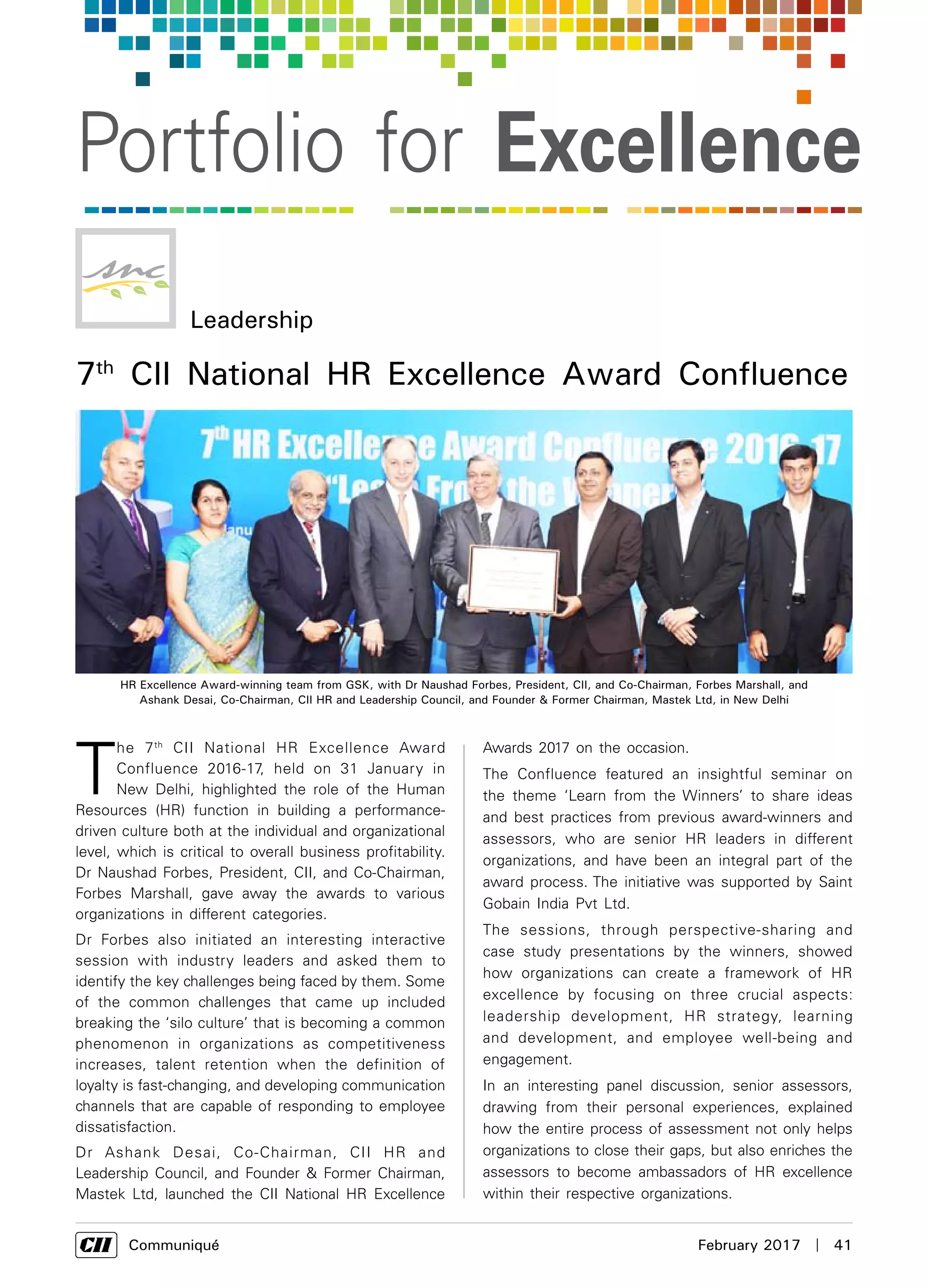
in overall trade between
the two countries, pointing
out that the bilateral trade
figures do not match the size of the two economies.
The sectors identified for a greater thrust in trade
include pharmaceuticals, IT, and auto components,
while agriculture and food processing, health, and
tourism were seen to offer tremendous scope for B2B
cooperation.
At the 9th
Meeting of the Indo-French CEOs Forum, with Michel Sapin, Minister of Economy and Finance, France, in Paris
Germany
CII CEOs Delegation to Germany
A 10-member CII CEOs delegation, led by Ms Shobana
Kamineni, President Designate, CII, and Executive Vice-
Chairperson, Apollo Hospitals Enterprise Ltd, visited
Germany on 22-23 January to strengthen bilateral trade
and investment.
In Berlin, the delegation met with German Federal
Government officials, including Mr Matthias Machnig,
State Secretary, Federal Ministry for Economic Affairs
and Energy, and Prof Dr Lars Hendrik-Röller, Economic
Advisor to the Federal Chancellor of Germany. The
highlight of the visit included an exclusive meeting with
Dr Wolfgang Schäuble, Federal Minister of Finance,
one of the most senior and respected members of
the German Cabinet.
The delegation had a frank and conducive exchange of
views with leaders of German industry over a luncheon
CII Delegation with Dr Wolfgang Schäuble, Federal Minister of Finance, Germany (seated), in Berlin
40  |  February 2017	 Communiqué
engaging with the world
session hosted by OAV – German Asia-Pacific Business
Association, on enhancing German investments into
India, especially in infrastructure development and
energy.
A roundtable interaction with senior members of the
BDI, Federation of German Industry, hosted and chaired
by Prof Dr Dieter Kempf, President, BDI, identified
the key areas to intensify engagement in trade and
industrial cooperation between the two countries. The
BDI and CII have had a joint working relationship for
over three decades.
The visit was rounded off with a ‘Germany-India
Economic Dialogue,’ organized by the Embassy of India in
Germany, jointly with the Economic Council of Germany
(Wirtschaftsrat), and CII, attended by an impressive array
of key policy makers and top-level business leaders.
The Dialogue featured a focused panel discussion on
‘Prospects of Indo-German collaboration in Infrastructure,
Railways and Smart-Cities and bridging the Finance Gap,’
which included the CII delegates as panelists.
CII and the Federal Economic Council of Germany signed
a Memorandum of Understanding (MoU) to promote
Indo-German co-operation by frequent exchange of
delegation visits for business co-operation; facilitating
investment and business development, and jointly
organizing road shows in both countries to promote
investment opportunities.
UNITED STATES OF AMERICA
Examining India-US Relations
CII hosted Ms Lisa Curtis, Senior Research Fellow of
The Heritage Foundation’s Asian Studies Center in New
Delhi for a closed door session on ‘US-India Relations
under the Trump Administration’ on 20 January in New
Delhi. The attendees included officials from Indian and
US companies.
Ms Curtis presented President Trump’s broad outlook,
and discussed the need to separate election rhetoric
from policy.
She clarified that all the initial statements made by
PresidentTrump about India have been positive, although
certain issues like trade and mobility of skilled labor
may present challenges, going forward. Other issues
discussed include the future of trade agreements, the
defence partnership, and so forth.
Industry leaders at a meeting with Lisa Curtis, Senior Research
Fellow, the Heritage Foundation, in New Delhi
Members are earnestly requested to adopt the CII Model Code of
Conduct, if not already done.
(Members could confirm their adoption of the CII Model Code of Conduct by using the link)
http://www.cii.in/codeofconduct
What Does It Cover
 Maintaining : Accurate Books and Records
 Prohibits : Bribery and Corruption
 Equality : Fair and Equitable Treatment
 Work Environment : Healthy and Safety Measures
 Standards : Quality of Goods and Services
 Social Welfare : Environment and Society
CII Model Code of Conduct
>>>> The names of the companies that have adopted the code would be reflecting on the CII Website <<<<
     Communiqué	 February 2017  |  41
Portfolio for Excellence
T
he 7th
CII National HR Excellence Award
Confluence 2016-17, held on 31 January in
New Delhi, highlighted the role of the Human
Resources (HR) function in building a performance-
driven culture both at the individual and organizational
level, which is critical to overall business profitability.
Dr Naushad Forbes, President, CII, and Co-Chairman,
Forbes Marshall, gave away the awards to various
organizations in different categories.
Dr Forbes also initiated an interesting interactive
session with industry leaders and asked them to
identify the key challenges being faced by them. Some
of the common challenges that came up included
breaking the ‘silo culture’ that is becoming a common
phenomenon in organizations as competitiveness
increases, talent retention when the definition of
loyalty is fast-changing, and developing communication
channels that are capable of responding to employee
dissatisfaction.
Dr Ashank Desai, Co-Chairman, CII HR and
Leadership Council, and Founder & Former Chairman,
Mastek Ltd, launched the CII National HR Excellence
Leadership
7th
CII National HR Excellence Award Confluence
Awards 2017 on the occasion.
The Confluence featured an insightful seminar on
the theme ‘Learn from the Winners’ to share ideas
and best practices from previous award-winners and
assessors, who are senior HR leaders in different
organizations, and have been an integral part of the
award process. The initiative was supported by Saint
Gobain India Pvt Ltd.
The sessions, through perspective-sharing and
case study presentations by the winners, showed
how organizations can create a framework of HR
excellence by focusing on three crucial aspects:
leadership development, HR strategy, learning
and development, and employee well-being and
engagement.
In an interesting panel discussion, senior assessors,
drawing from their personal experiences, explained
how the entire process of assessment not only helps
organizations to close their gaps, but also enriches the
assessors to become ambassadors of HR excellence
within their respective organizations.
HR Excellence Award-winning team from GSK, with Dr Naushad Forbes, President, CII, and Co-Chairman, Forbes Marshall, and
Ashank Desai, Co-Chairman, CII HR and Leadership Council, and Founder & Former Chairman, Mastek Ltd, in New Delhi
     Communiqué	 February 2017  |  43
The Winners
Strong Commitment to
HR Excellence
•	 Aditya Birla Finance Ltd
•	 Apollo Hospitals
Enterprise Ltd
•	 Carrier Air-Conditioning and
Refrigeration Ltd
•	 Jakson Ltd, JK Paper Ltd
•	 Reliance Commercial
Finance Ltd
•	 Sterlite Technologies Ltd
•	 Tata Steel Ltd (Hooghly
Metcoke Division)
•	 VE Commercial
Vehicles Ltd
Significant Achievement
in HR Excellence
•	 Amara Raja Batteries Ltd
•	 Bharat Petroleum
Corporation Ltd
•	 CESC Ltd
•	 Citibank NA
•	 Endress Hauser(India)
Automation
Instrumentation Pvt Ltd
•	 GlaxoSmithkline (GSK)
Pharmaceuticals Ltd
•	 JK Paper Ltd, Unit: CPM
•	 JK Tyre & Industries Ltd
•	 Mahindra & Mahindra
Financial Services Ltd
•	 Sterlite Copper Ltd
•	 Tata Housing Development
Company Ltd
•	 Tata Steel: Global Wires
Division
•	 The Indian Steel & Wire
Products Ltd
•	 Vedanta Ltd, Aluminium
and Power, Jharsugda
Additional Recognition
Categories
•	 Learning and
Development: Bharat
Petroleum Corporation Ltd
•	 Employee Engagement:
Vedanta Ltd, Aluminium
and Power, Jharsugda
T
he CII-Suresh
Neotia Centre
of Excellence
f o r L e a d e r s h i p
o r g a n i z e d t h e
first edition of
STRATEGYEDGE on
11 January in Kolkata.
STRATEGYEDGE is
being institutionalized
as a flagship annual
event of the Centre,
and will, each year, feature the world’s renowned thought leaders on strategy,
innovation and marketing, sharing the latest insights from their respective
domains, with the Indian business community.
Prof Vijay Govindarajan, Coxe Distinguished Professor at Dartmouth College’s
Tuck School of Business, USA, the keynote speaker this time, is widely regarded
as one of the world’s leading experts on strategy and innovation. In the latest
Thinkers 50 Rankings, he was ranked the #1 Indian Management Thinker.
The theme of the session was ‘Winning through Innovation: The Three
Box Strategy.’
Speaking on ‘India’s Innovation Challenge,’ Prof Vijay Govindarajan stressed that a
business mind and a social heart is a combination that will define and determine
whether and how Indian businesses will fare and thrive. Innovation is the next
frontier for Indian businesses in the next two decades, he said, stressing that the
fruits of innovation must percolate down to all strata of society. Frugal innovation
is about offering very high quality products at ultra low-cost, he said.
‘Breakthrough thinking,’ opined Prof Vijay Govindarajan, is all about cost and
quality, something which is extremely important and relevant in India which has
an affluent class, a rising middle class, and increasingly aspirational lower rungs
of society. Businesses will need to take all sections in their scheme of things
to produce a win-win future for all, he said.
'A critical element of leadership is the ability to envision the future and take
proper steps to address the challenges and opportunities,' said Mr T V Narendran,
Chairman, CII Eastern Region, and MD, Tata Steel.
In the Masterclass sessions, Prof Govindarajan focused on successfully creating
the future, while managing excellence in the present. The Three-Box Solution
describes the framework for managing a business’s responsibility to take action
in three time horizons at one time: executing the present core business at peak
efficiency (Box 1); taking steps to avoid the inhibiting traps of past success
(Box 2); and inventing a future built on non-linear ideas (Box 3). The workshop
showed the distinctive skills each box requires, how the boxes interrelate, and
what it takes to balance them.
STRATEGYEDGE
Thought Leadership Masterclass with
Prof Vijay Govindarajan
Arijit Basu, MD & CEO, SBI Life Insurance, Prof Vijay Govindarajan,
Tuck School of Business, Dartmouth College, USA; and
T V Narendran, Chairman, CII Eastern Region, and MD, Tata Steel,
at STRATEGYEDGE, in Kolkata
PORTFOLIO
44  |  February 2017	 Communiqué
Dealing with Climate Change
The COP22 in Marrakech, held in November 2016,
marked the beginning of a phase of global climate
efforts focused on implementation. The deliberations at
COP22 have enabled better understanding on various
issues of the Paris Agreement architecture, delineation
of the areas of convergence and divergence, and the
adoption of a work plan to achieve the goals.
In the light of this, the India Greenhouse Gas Program
(IGHGP) a tri-partner program led by CII, the World
Resources Institute (WRI) andThe Energy and Resources
Institute (TERI), organized discussions for action, post
COP 22, on 19 January in New Delhi. The program aims
to promote a profitable, sustainable and competitive
business environment in India by mainstreaming the
measurement and management of greenhouse gas
emissions. The key points raised at the discussions
were:
•	 Investors and businesses need to act in accordance
with the Paris Agreement, aligning their strategies
and portfolios with the <20C goal.
•	 Role of Indian industry in meeting India's NDC
goals.
•	 National GHG inventory system: readiness for
gauging fair and ambitious assessment of global
commitments.
•	 Opportunities for market and non-market based
policies and roadmaps for a low-carbon path to
progress.
IGBC Platinum Rating
The Indian Green Building Council (IGBC) awarded
the Platinum Rating to the Institute of Liver and
Green Business
Rajani Ranjan Rashmi, Special Secretary, Ministry of Environment,
Forest & Climate Change, addressing the Discussions for Action,
post COP 22, in New Delhi
Biliary Sciences
(ILBS) Phase
II Hospital in
New Delhi, at
the latter’s 4th
Convoca tion
Day, on 13
January. The
Delhi Metro Rail
Corporation Ltd
(DMRC) was
t h e p r o j e c t
consultant. The
plaque was presented in the presence of Mr M Hamid
Ansari, Vice President of India, to Dr S K Sarin, Director,
ILBS, by Dr Mangu Singh, MD, DMRC.
MoU with Government of Gujarat
At Vibrant Gujarat 2017,
the IGBC signed an MoU
for strategic partnership
with the Department
of Rural Development,
Gujarat, towards making
the state a role model for
the country in embracing
green initiatives at the
village level.
T h e M o U w a s
exchanged between Mr
Sunil Patel, Additional
Commissioner, Rural
Development, Gujarat,
and Mr Sameer Sinha, Chairman, IGBC Ahmedabad
Chapter, and MD, Savvy Infrastructure Ltd.
Promoting Green Buildings in Pune
Providing a major impetus to the green building
movement, the Pune Municipal Corporation (PMC) in its
new Development Control and Promotion Regulations,
has incorporated a provision for additional Floor Space
Index (FSI) for IGBC-rated projects.The PMC would offer
additional FSI of 3%, 5% and 7%, for projects with
IGBC silver, gold, and platinum ratings, respectively.
GPMDG National Workshop
The Green Power Market Development Group, India,
(GPMDG), a joint initiative of CII and the World Resources
Institute (WRI), supported by the Shakti Sustainable
Energy Foundation, aims to accelerate the scale up
of India’s green energy market through extensive
Presentation of IGBC Green Building
plaque to Dr S K Sarin, Director, ILBS, by
Dr Mangu Singh, MD, DMRC, in the presence
of M. Hamid Ansari, Vice President of India,
in New Delhi
Exchange of MoU between
Sunil Patel, Additional
Commissioner, Rural Development,
Gujarat, and Sameer Sinha,
Chairman, IGBC Ahmedabad
Chapter, and MD, Savvy
Infrastructure Ltd, in Gandhinagar
PORTFOLIO
     Communiqué	 February 2017  |  45
PORTFOLIO
engagement with Indian industry and Government for
the development of innovative procurement methods
and supportive policy measures.
The GPMDG has facilitated over 210 MW of green power
procurement by Indian industry and has successfully
engaged with over 350 companies in Karnataka and
Tamil Nadu to help them adopt renewable power in
an efficient and economic manner.
Following the recent launch of the initiative in
Maharashtra, the CII Godrej GBC organized a National
Workshop on 20 January in Mumbai, to discuss the
challenges and opportunities facing sectors such as
solar, wind, and biomass/biofuels, as well as waste-to-
energy technologies, in the State. The workshop also
looked into the policy, financial and regulatory barriers,
and shared successful case studies.
Energy Training Programs
CII Godrej GBC organized a week-long training program
on energy efficiency in buildings, from 13-19 January,
for a team of 10 participants from Nepal, in Hyderabad.
The participants were from the Federation of Nepalese
Chambers of Commerce and Industry (FNCCI) and
the Town Development Fund (TDF). The program was
marked by classroom sessions by internal faculty, guest
lectures and site visits to IGBC-rated green building
projects in Hyderabad.
An AdvancedTraining Program on Energy Efficiency, held
on 24 - 25 January in Pune, disseminated the latest
techniques and advancements in energy management
and conservation.
Participants from Nepal at the training program on energy
efficiency in buildings, in Hyderabad
Lean Six Sigma Programs
The CII Institute of Quality (CII IQ) conducted a
Lean Six Sigma Green Belt Phase-I Program for the
sales team of Aditya Birla Financial Services Ltd on
19-20 January in Mumbai. This, the first batch of 32
managers from the sales and HR teams, will be working
on projects leading to significant improvement in
efficiency, effectiveness and customer satisfaction. Post
the satisfactory completion of two phases of training
and project, the participants will be awarded the CII
Institute of Quality Green Belt Certificate.
Prior to this, the organization completed a green belt
program for 20 members from the operations team.
A six-day Six Sigma Master Black Belt Certification
Program was held for eight certified Black Belts,
currently playing a leadership role in their organizations,
on 9-14 January in Bengaluru. The program was aimed
at building leadership capability and application of
advanced tools and leading strategic change programs
for the organization.
A two-day Good Manufacturing Practices Mission
visited ABB Ltd, Toyota Kirloskar Motor Pvt Ltd, and
Hindustan Coca Cola Beverages Ltd, on 10-11 January
in Bengaluru, to get first-hand insights and experiences
of best practices. Observing the tools and techniques
in action enabled them to understand how the Toyota
Production System (TPS) is being implemented. The
program was attended by 17 participants from ten
organizations.
For more information on CII-IQ Lean Six Sigma programs,
please contact anurag.seksaria@cii.in
Quality
Participants of the Aditya Birla Sales Program Module 1 in Mumbai
Workshop on Green Power Market Development in Mumbai
46  |  February 2017	 Communiqué
PORTFOLIO
company-specific project
work, plant visits, and
Expert Speak sessions,
with parallel session on
communication skills,
personality development,
business etiquette, et al.
The first batch of the Gold
Sash initiative concluded on 21 January, with the awarding
of certificates to the successful participants.
Energy Efficient Systems
To sensitize industry members to promote energy-saving
and improve the country’s energy efficiency and, at
the same time, save costs and maximize profits, an
advanced training program on Energy Efficient Systems
was conducted on 19-20 January in Gurugram by
experienced energy auditors, certified by the Bureau
of Energy Efficiency, Ministry of Power.
Improving Quality in Manufacturing
Taking the guesswork out of quality control, Statistical
Process Control (SPC) is a scientific, data-driven methodology
for quality analysis and improvement. A training program
on ‘Improving Quality in Manufacturing through Statistical
Process Control,’ held on 24 January in Chandigarh,
discussed how higher percentage yield or higher quality
products or services can be achieved by maintaining
statistical control of various processes and parameters.
SME Competitiveness
Advanced Training Program on Energy Efficient Systems in Gurugram
Gold Sash Program
The Gold Sash program has been initiated by the CII Naoroji
Godrej Centre of Manufacturing Excellence, to transform
a ‘production’ manager into a ‘manufacturing’ manager.
Industry-driven and strong on manufacturing strategy,
the program adopts a `how to’ approach, spanning both
discrete and process manufacturing.
This is a sandwich program with an emphasis on
project work to equip participants with tomorrow’s
ideas today. The curriculum offers 6 modules of 6 days
every alternate month, i.e. 36 contact days spread over
one year, with practitioner faculty with rich industry/
consultancy experience. It includes assignments and
Manufacturing
Excellence
At the Gold Sash Program
in Mumbai
Promoting Cold Chains
The CII-Jubilant Bhartia Food and Agriculture Center
of Excellence (FACE) is the knowledge partner for the
National Center for Cold Chain Development (NCCD) to
promote awareness on the various support programs of
the Government of India for cold chain development.
FACE is conducting awareness workshops across
the country to disseminate information about these
schemes to prospective beneficiaries, such as growers,
aggregators, processors, logistics service providers, pack
house owners and warehouse operators.The workshops
highlight the schemes for developing a holistic farm-to-
consumer cold chain under the Mission for Integrated
Development of Horticulture, Ministry of Agriculture &
Farmers Welfare, the Ministry of Food Processing, and
the Agriculture and Processed Food Products Export
Development Authority (APEDA), Ministry of Commerce
and Industry.
Three such awareness workshops have already been
conducted in Lucknow, Periyakulam, (Tamil Nadu) and
Mysore, over the last few weeks.
These outreach events are being held following the NCCD’s
recent gap assessment for cold chain infrastructure. Private
industry and financial institutes like SIDBI and NABARD
are also participating in the workshops.
Food and Agriculture
Awareness Workshops on Cold Chain Development in
Mysore (left), and Lucknow
     Communiqué	 February 2017  |  49
Regional Review
Eastern RegionE
Insolvency and
Bankruptcy Code 2016
The Conference on Insolvency and Bankruptcy
Code: Impact Analysis – a first-of-its-kind
seminar held on January 12 in Kolkata, scanned
a wide range of dimensions embedded in the
policy. “The law is key to building institutional
capacity needed to ensure economic
freedom and performance. The Code will
ensure effective resource utilization,efficient
management, and clarify disclosure standards,”
Dr M S Sahoo, Chairperson of the recently-
constituted Insolvency and Bankruptcy Board of India,
told a large assembly of more than 280 MDs, CEOs,
CFOs, company secretaries, chartered accountants,
finance and tax professionals, corporate advisers,
cost accountants, law firms and consultants, and
representatives of asset reconstruction companies
and financial institutions from across the country. The
principal objective of the Code is to maximize returns to
creditors by removing certain flaws from the old laws,
he explained, saying the whole exercise is sought to
be driven by the market, not the State.
Later, at a special plenary, Mr Bhupender Yadav, Rajya
Sabha MP, and Chairman, Joint Parliamentary Committee
on the Insolvency and Bankruptcy Code, said the strength
of the Code lies in its transparency. It will not only root
out corruption and boost entrepreneurship, but will also
restore people’s faith in the administration, he said.
A knowledge paper titled ‘The Insolvency and Bankruptcy
Code 2016 – A Step Forward’ was unveiled at the event.
Destination East 2017
The 7th
Destination East, a mega Tourism Summit, held
in association with the Government of West Bengal in
Kolkata from 27 January - 2 February, attracted more
than 100 tourism stakeholders from 30 countries. The
Summit featured familiarization (FAM) trips for overseas
stakeholders to Darjeeling, Sikkim, Dooars, Assam,
Shantiniketan, Murshidabad, Bishnupur, Sunderbans,
and Kolkata. A number of pre-appointed B2B meetings
were also organized.
West Bengal is reaching out to prospective tourists
in India and abroad with the new slogan, ‘Experience
Bengal, the Sweetest Part of India’ said Mr Indranil Sen,
Minister of Tourism, West Bengal. Mr A R Bardhan,
Tourism Secretary, West Bengal, also addressed the
inaugural session.
The Changing Face of Leadership
The West Bengal Government has taken several
measures towards the upliftment and dignity of
women, especially those living on the fringes, said
Dr Shashi Panja, Minister of State
(Independent Charge), of Child
Development, Women Development
and Social Welfare, West Bengal, at
the seminar on the ‘Changing Face
of Leadership’ in Kolkata on 28
January. Society has not been able to
defeat gender stereotypes which still
influence our upbringing and values,
she said, suggesting that bodies likeAt the Conference on Insolvency and Bankruptcy Code 2016, in Kolkata
Indranil Sen, Minister of Tourism, West Bengal, Vijay Dewan, Chairman, CII (ER)
Tourism Sub-committee, and MD, Apeejay Surrendra Park Group of Hotels;
A R Bardhan, Tourism Secretary, West Bengal, and Atul Bhalla, Co-Chairman,
CII (ER) Tourism Sub-committee, and General Manager, ITC Sonar,
at Destination East in Kolkata
     Communiqué	 February 2017  |  51
regional review
nORTH EAST RegionNE
North East Investment Summit on Textiles
The Ministry ofTextiles and the Ministry of Development
of North Eastern Region (DoNER), in partnership with
CII, organized the North East Investment Summit on
Textiles on 29-30 January in Shillong, Meghalaya. CII, as
industry partner, organized a product exhibition during
the event, and also set up an information pavilion at
the venue.
The Summit was inaugurated by Ms Smriti Irani,
Minister of Textiles. Mr Kiren Rijeju, Minister of State
of Home Affairs, and Mr Mukul Sangma, Chief Minister
of Meghalaya, were also present.
The exhibition showcased a range of handloom
and handicraft items produced by self help groups
and entrepreneurs from the eight North Eastern
States. The information pavilion spread knowledge
and awareness about the investment promotions
schemes launched by the State Governments in the
North East, and the Ministries of DoNER and of
Textiles, besides highlighting the strengths of other
government institutions.
CII could play a major role in ending discrimination
and harassment of women.
The seminar was an attempt to retain and develop the
female talent pool and promote gender equity across all
levels and functions within organizations and businesses.
Dr Rupali Basu, Vice Chairperson, CII West Bengal, and
President & CEO, Apollo Gleneagles Hospital (East),
announced the launch of the West Bengal Chapter of
the Indian Women Network, a CII platform for discourse
on potential solutions to the issues that hinder the
empowerment of women at work.
A handbook titled ‘Gender Diversity: A Step Towards
Inclusion,’ a compilation of path-breaking programs
and initiatives to help women emerge as significant
contributors to industry and nation-building, was
launched at the seminar.
Awareness Session on Demonetization
CII North Bengal Zonal Council recently organized
an Awareness Session on Demonetization with
Smriti Irani, Minister of Textiles; Kiren Rijeju, Minister of State of
Home Affairs, and Mukul Sangma, Chief Minister of Meghalaya,
inaugurating the Information Pavilion at the North East Investment
Summit on Textiles in Shillong
Dr Shashi Panja, Minister of State (Independent Charge) of Child
Development, Women Development and Social Welfare, West
Bengal; T V Narendran, Chairman, CII (ER) and MD, Tata Steel;
and Atrayee S Sanyal, Co-Chair, CII ER Task Force on Women
Empowerment, and Chief Diversity Officer and Chief of Marketing &
Sales (BPR&S), Tata Steel, at the seminar on the ‘Changing Face of
Leadership’ in Kolkata
S S Ahluwalia, Minister of State of Agriculture & Farmers Welfare,
and Parliamentary Affairs, inaugurating the Awareness Session on
Demonetization, in Siliguri
Mr S S Ahluwalia, Union Minister of State of Agriculture
& Farmers Welfare, and Parliamentary Affairs, in
Siliguri. Explaining the ‘how’ and ‘why’ of the Central
Government’s move, Mr Ahluwalia called upon CII to
launch a drive to sensitize people on the long-term
benefits of going digital.
52  |  February 2017	 Communiqué
regional review
northern Region
N
Uttar Pradesh Pravasi Divas
Mr Akhilesh Yadav, Chief Minister of Uttar Pradesh,
inaugurated the 2nd
edition of the Uttar Pradesh Pravasi
Divas 2017, organized by the State Government with CII
as its National Partner, to showcase the development
of Uttar Pradesh in various sectors like investment,
healthcare, SME, manufacturing, skill and education, to
Indian diaspora from the State. The mega event, held
from 4-6 January in Lucknow, drew the participation
of NRIs from more than 14 countries, besides official
delegates from Mauritius, and a group of 45 student
delegates of the ‘Know India Program.’
The UP Non Resident Indian (NRI) Cell has been
upgraded to a full-fledged Government department and
is functioning with enhanced capabilities. All officers
are tasked towards prioritizing NRI queries and single
window facilities have been provided along with a
dedicated call center for assisting NRIs and Persons of
Indian Origin (PIO), said the Chief Minister.
"The biggest investment that any State can do is investing
in local human resources. Uttar Pradesh has a large
population, and investing in their education and skilling
them with the right tools would leapfrog the State in terms
of economic development,” said Mr Prithvirajsing Roopun,
Minister of Arts and Culture, and Social Integration and
Economic Empowerment, Mauritius.
“The Government of India has merged the PIO card with the
Overseas Citizens of India card to reach out to the diaspora
more effectively, said Mr MC Luther, Joint Seceretary,
Union Ministry of External Affairs. A web portal for NRIs
www.emigrate.gov.in, will serve as a one-stop shop for all
queries or grievances of the Indian diaspora, he added.
Mr Rama Raman, Principal Secretary, NRI Department,
Uttar Pradesh, assured the NRIs that their suggestions
would be implemented, and expressed the State’s
commitment to help, guide and work with the NRIs/
PIO for smooth and efficient implementation.
Mr J Goburdhan, High Commissioner of Mauritius to
India; and senior officials from the State Government,
including Mr Rahul Bhatnagar, Chief Secretary, and Mr
Alok Ranjan, Chief Advisor to the Chief Minister, as
well as Mr Sameer Gupta, CMD, Jakson Group, among
others, were also present at the Inaugural.
The Government of Uttar Pradesh honored several prominent
NRIs from across the globe with the ‘Uttar Pradesh Apravasi
Bharatiya Ratna’ awards, on the occasion.
The event featured three sessions on Umeedo-Ka-
Pradesh, Uttar Pradesh: Special Focus on investment in
Uttar Pradesh and Engaging Diaspora for Development,
Partners in Growth-Special Focus on Health, and Trace
Your Roots/Girmitiyas, respectively.
Opportunities in the Rice Industry
At a roundtable on ‘Opportunities and Challenges in the
Rice Industry in India and the way forward’, in New Delhi
on 21 January, 25 industry leaders from the sector called
on the Central and State Governments to create a better
enabling environment for agricultural market agencies and
boards, and to help these agencies monitor traceability
in paddy right from the farm to the market. They also
urged the Government to ensure better returns for paddy
farmers through transparent price discovery.
Mr Rajesh Srivastava, Chairman, CII (NR) Committee on
Food and Agriculture, and Chairman, Rabo Equity Advisors,
said that monitoring traceability in crops would help the rice
industry meet the varying quality standards and regulations
followed by different countries. This would enable export
of the right quality of rice, reducing rejection and losses,
Akhilesh Yadav, Chief Minister of Uttar Pradesh, with awardees at Uttar Pradesh Pravasi Divas, in Lucknow
     Communiqué	 February 2017  |  53
regional review
he said, urging the rice industry to ensure, as well as
push for, corrective measures for desired results, both
from the Government and the markets. It was decided to
establish a CII working group to focus on specific issues
in a very structured and result-oriented manner.
“The rice industry has a bright future, but it has to
address the issue of quality regulations. There is a
need to focus on clusters for rice production with
farmers, to address concerns about pesticide usage and
other requirements of the markets,” said Mr Devender
K Singh, Chairman, APEDA.
First Pravasi Haryana Divas
CII joined hands with the Government
of Haryana to host 400 Pravasis
of Haryana origin from all over
the world and other parts of the
country at the first Pravasi Haryana
Divas 2017 from 10-11 January in
Gurugram. The mega conclave not
only honored the enterprise of the
people of the State, but also served
as a platform for them to contribute to, and invest in,
its growth story.
The State Government signed 24 MoUs worth `20,000 crores
with the potential to generate employment for 43,000 people,
spanning enterprises across sectors, as well as townships,
sports, and knowledge and skill capacity building.
Ms Smriti Irani, Minister of Textiles, addressing the
inaugural session, announced the setting up of a Carpet
Cluster in Panipat, and a Hosiery Cluster in Sirsa.
Mr Birender Singh, Minister of Steel, drew attention to
the need to set up scrap-based steel production units,
and urged Pravasi Haryanvis to take up projects like
producing steel from scrap.
“The Central Government plans to set up 18 clusters in
400 towns and cities to focus on electronic equipment
manufacturing. India’s electronic equipment manufacturing
market would be $400 billion by 2020,” said Mr Ravi
Shankar Prasad, Minister of Electronics and Information
Technology, at a session on ‘IT-ITeS and ESDM: The next
era of State’s Growth and Innovation.’
Addressing a colorful cultural evening showcasing the
vibrant folk culture of Haryana, Mr Piyush Goyal, Minister
of State (Independent Charge) of Power, Coal, New and
Renewable Energy, and Mines, urged Pravasi Haryanvis to
adopt children from the State and train and groom them
as sportspersons.
Prof Kaptan Singh Solanki, Governor
of Haryana, called on Pravasi
Haryanvis to contribute to the rapid
development of their State.
Veteran cricketer Mr Kapil Dev
appreciated the manner in which
the sports culture has developed
in the State, with its sportspersons
earning laurels in national and international sports.
Mr Rakesh Bharti Mittal, Vice President, CII, and Vice-
Chairman, Bharti Enterprises, said CII would continue
to work closely with the Government of Haryana to
improve productivity, generate employment, and improve
the plight of the underprivileged sections of society.
“The participation of Pravasi Haryanvi business leaders and
domestic industry leaders in this event stands testimony
to the immense interest in the opportunities offered by
the State,” said Ms Rumjhum Chatterjee, Chairperson, CII
Northern Region, and Group MD, Feedback Infra Pvt Ltd.
A galaxy of achievers from Haryana were conferred
with Gaurav Sammans on the occasion.
Manohar Lal, Chief Minister of Haryana, inaugurating the
Pravasi Haryana Divas 2017 in Gurugram, with Piyush Goyal,
Union Minister of State (Independent Charge) of Power, Coal,
New & Renewable Energy, and Mines; Ram Bilas Sharma,
Minister of Education, Haryana, and Vipul Goel,
Minister of Industries & Commerce, Haryana
Smriti Irani, Union Minister of Textiles, awarding the
'Haryana Gaurav Samman' to wrestler sisters Geeta and
Babita Phogat, as Manohar Lal looks on,
during the Pravasi Haryana Divas, in Gurugram
Rakesh Bharti Mittal,
Vice President, CII,
and Vice-Chairman,
Bharti Enterprises
Rumjhum Chatterjee,
Chairperson, CII (NR),
and Group MD,
Feedback Infra
Pvt Ltd
     Communiqué	 February 2017  |  55
southern Region
S
Interaction with Mr Nitin Gadkari
The Government is giving highest priority to the
infrastructure sector, said Mr Nitin Gadkari, Minister of
Road Transport and Highways, and Shipping, addressing
a conclave organized by CII in association withThe Hindu
Business Line on 13 January in Chennai. Currently,
roads are being re-laid at a pace of 18 kms per day,
which would be increased to 28-30 kms per day, he
said. On development of ports, he said 12 major ports
had registered profits crossing `6,000 crores last year.
The Government has set an ambitious plan of providing
houses for all in both rural and urban areas by 2022,
said the Minister.
Mr Gadkari said the Center would soon come out
with the proposed draft vehicle-scrapping policy, aimed
at dumping vehicles that are over15 years old to
combat pollution. The Center is also planning to set
up 'automobile clusters' across the country, including
Chennai, he added.
Ms Shobana Kamineni, President Designate, CII, and
Executive Vice Chairperson, Apollo Hospitals Enterprise
Ltd spoke about the short term sacrifices due to
demonetization and its long term positive impact on
the industry and the economy.
Business and Human Rights
CII and the National Human Rights Commission
(NHRC), Government of India, jointly organized the
South Regional Conference on Business and Human
Rights in Chennai on 17 January. The conference
shared national and international developments in the
area of business and human rights, besides hearing
the experiences and views of regional stakeholders.
In addition, inputs on the draft self-assessment tool
on business and human rights were sought from
stakeholders.
Justice H L Dattu, Chairperson, NHRC, said organizations
should put in place policies and guidelines to protect
human rights. Due diligence is important in identifying
and also preventing human rights violations in business,
he said.
Mr S Gopalakrishnan, Past President, CII, and Co-
Founder, Infosys Ltd, and Chairman, Axilor Ventures,
urged companies to focus on growth through
conscious competitiveness, without compromising
on quality and the rights of consumers. “Corporate
enterprises should be sustainable. They should
make viable plans to create a sustainable business
ecosystem that protects not only people but also the
environment, he said.
Promoting Recycling Industries in Kerala
CII, in partnership with the Suchitwa Mission and the
Government of Kerala, organized an Investors’ Meet
to promote the recycling industry in Kerala. The Meet,
where business, Government and civil society came
together to rethink and rewrite their roles towards the
sustainable management of resources, was the first
step in initiating a dialogue between industry and the
State Government to facilitate a self-sustaining waste
management sector in Kerala.
Swachh Vidyalaya Project
Under the Swachh Bharat - Swachh Vidyalaya national
campaign, CII, along with Saint Gobain India Pvt Ltd,
launched a project for building and rebuilding toilet
blocks in eight Government schools in Sriperumbudur
District, Tamil Nadu, on 23 January. The project aims
to provide a healthy and safe school environment with
clean water and adequate toilets to the students.
Raghavan Srinivasan, Editor, The Hindu Business Line;
Nitin Gadkari, Minister of Road Transport and Highways, and
Shipping, and Shobana Kamineni, President Designate, CII, and
Executive Vice Chairperson, Apollo Hospitals Enterprise Ltd,
at an interaction in Chennai
At the South Regional Conference on Business and Human Rights,
in Chennai
regional review
     Communiqué	 February 2017  |  57
regional review
W WESTERN Region
Vibrant Gujarat
Global Summit 2017
The 8th
Vibrant Gujarat
Global Summit was
inaugurated by Mr
Narendra Modi, Prime
Minister of India,
in Gandhinagar. The
Summit, held from 9 – 13
January, with the central
theme ‘Connecting India
to the World,’ kicked-off
with a plenary session on ‘GST- A Game-changer for the
Indian Economy,’ chaired by Mr Arun Jaitley, Minister
of Finance, and of Corporate Affairs, which drew the
attendance of 4,000 people. Dr Naushad Forbes,
President, CII, and Co-Chairman, Forbes Marshall, shared
the industry perspective on GST at the session.
This year’s Summit was one of the largest, with 12
partner countries, 7 partner organizations, 9 theme
seminars, 3 action seminars, 16 country seminars, 4
State seminars, 11 ‘Make in Gujarat’ sectoral seminars,
and nearly 4,000 B2B and B2G meetings. A total of
52,500 delegates participated in the event. For the
first time, 9 Nobel Laureates marked their presence
at the Nobel Exhibition and the Nobel Dialogue on
10 January.
The Vibrant Gujarat Global Trade Show 2017 was
also inaugurated by Mr Narendra Modi on 9 January.
Surpassing the previous editions, both in terms of area
and participating companies, the gross exhibition area
of 1,50,000 sqm registered 1.5
million footfalls over five days.
CII, as the Exhibition Partner for
the first time since the inception
of the Summit, successfully
undertook the marketing and
sales of the mega-event in a
span of less than two months.
Genes, Gene Editing, and
the New Biotechnology
As part of Vibrant Gujarat
2017, CII, in association with
the Government of Gujarat,
organized a theme seminar on
‘Genes, Gene Editing and the New Biotechnology’
on 11 January. The seminar was addressed by Nobel
Laureates Dr Harold Varmus and Dr Randy Schekman.
Mr James Greenwood, President & CEO, Biotechnology
Innovation Organizations, and Prof Vijay Raghvan,
Secretary, Department of Biotechnology, Government of
India, as well as several industry leaders, also addressed
the seminar, wherein Mr Bhupendrasinh Chudasama,
Cabinet Minister, Gujarat was the Chief Guest. Various
MoUs relating to Biotechnology and Information and
Technology were exchanged at the seminar.
Skilling and Human Capital
As part of Vibrant Gujarat 2017, CII, in association
with the Government of Gujarat, organized a theme
seminar on ‘Skilling and Human Capital’ on 12 January
in Gandhinagar.
Mr Rajiv Pratap Rudy, Minister of State (Independent
Charge), of Skill Development and Entrepreneurship,
spoke about the gaps in the existing skill ecosystem
in India. Mr Dilipkumar Thakore, Minister of Labor and
Employment, Gujarat; Mr Manish Kumar, CEO and MD,
Narendra Modi, Prime Minister of
India, addressing the inaugural
session of the Vibrant Gujarat
Summit in Gandhinagar
D K Parekh, Director, Directorate of Employment & Training, Gujarat; Matsumoto Katsuo, Deputy
Director General (Planning), JICA; Dr Rajiv Kumar Gupta, Principal Secretary, Labor & Employment,
Gujarat; Dilipkumar Thakore, Minister of Labor & Employment, Gujarat; Rajiv Pratap Rudy, Union Minister
of State (Independent Charge) of Skill Development & Entrepreneurship; Punambhai Makwana,
Parliamentary Secretary, Labor & Employment, Gujarat; Bruce Leslie, Chancellor, Alamo College, USA;
Manish Kumar, MD & CEO, NSDC, and S L Amrani, Joint Secretary, Labor & Employment, Gujarat,
at the seminar on ‘Skilling and Human Capital’ during Vibrant Gujarat 2017 in Gandhinagar
Narendra Modi, Prime Minister of India touring the Exhibition at
Vibrant Gujarat Global Summit
     Communiqué	 February 2017  |  59
regional review
NSDC; Mr Matsumoto Katsuo, Deputy Director General
(India, Bhutan, Bangladesh and Nepal), South Asia
Department, Japan International Cooperation Agency
(JICA), and Mr Bruce Leslie, Chancellor, Alamo College,
Texas, USA, as well as senior officials of the State
Government participated in the seminar.
A panel discussion on ‘Creating eco-system for Skilling
and Human Capital’, had key officials from ILO, UNICEF,
UNCTAD, JICA, EIFE, Maruti Suzuki, etc as panelists.
Several MoUs in the area of skill development,
entrepreneurship and education, were signed with the
prime objective to co-create and co-design practices
to maximize the impact of skill development initiatives
in the State.
Interaction on Serbia
Serbia will be a visa-free destination for Indians by
May 2017, stated Mr Aleksandar Vucic, Prime Minister
of Serbia, at an exclusive interaction with CII members
on 11 January in Mumbai. The country recorded the
best performance in the World Bank’s Ease of Doing
Business report, he added.
"Improved investor confidence in the country has driven
the Indian markets to new highs and we would like to
leverage this growth to strengthen our relationship with
Serbia," said Mr Sudhir Mehta, Chairman, CII Western
Region, and CMD, Pinnacle Industries Ltd.
The discussions revolved around enhancing the bilateral
economic engagement between India and Serbia, with
a focus on propelling manufacturing, IT, MSME and
tourism, in both countries.
Tribute to Prime Minister of Portugal
CII organized a tribute by the Goan Civil Society to
Mr Antonio Costa, Prime Minster of Portugal, in Panaji
on 11 January. Mr Antonio Costa released the English
translation of the Portuguese play ‘Sem Flores Nem
Coroas’ (Without Flowers nor Wreaths) written by his
father, renowned poet and writer, Mr Orlando Da Costa,
on the occasion.
‘I hope my visit to Goa will contribute to a more robust
and forward-looking 21st
century partnership,” said
the Prime Minister, who
signed agreements in
science and technology,
infrastructure, renewable
e n e r g y, s t a r t - u p s ,
agriculture and defence
in New Delhi, during his
visit to India. He met
the Indian diaspora at
the Pravasi Bharatiya
Divas, Bengaluru, and
also participated in the
Vibrant Gujarat Summit.
Mr Antonio Costa was given a warm welcome by Mr
Francis D’souza, Deputy Chief Minister of Goa, and Mr
Shekhar Sardessai, Chairman, CII Goa, and CMD, Kineco
Kaman Composites India Pvt Ltd, among others.
12th
KAIZEN Competition
Around 100
teams from all
over the State
participated
in the 12th
CII
Maharashtra
S t a t e - l e v e l
K a i z e n
Competition in
Nashik on 20
January. The
winners were Bosch Ltd, Nashik, in the large scale
category, and SB Reshellers Pvt Ltd, Kolhapur, in the
small and medium scale category.
‘Mumbai Rise. Mumbai Vote’
CII, in collaboration with the Municipal Corporation
of Greater Mumbai and the University of Mumbai,
organized a seminar on ‘Mumbai Rise. Mumbai Vote’
in Mumbai on 25 January, which is celebrated by the
Government of India as 'National Voters' Day'. The
seminar discussed the mind-set of the potential voter
and ways to encourage youngsters to vote.
Interaction on Serbia, in Mumbai
Shekhar Sardessai, Chairman, CII
Goa, and CMD, Kineco Kaman
Composites India Private Ltd; and
Francis D’Souza, Deputy Chief
Minister of Goa; greeting
Antonio Luis Santos da Costa,
Prime Minister of Portugal,
in Panaji
Winning team from Bosch Ltd, Nashik,
at the 12th
Kaizen Competition in Nashik
Seminar on National Voters' Day in Mumbai

CII Communique February 2017

  • 2.
    Edited, printed andpublished by Chandrajit Banerjee, Director General, CII, on behalf of Confederation of Indian Industry fromThe Mantosh Sondhi Centre, 23, Institutional Area, Lodi Road, New Delhi-110003, Tel: 91-11-24629994-7, Fax: 91-11-24626149, Email: info@cii.in, Website: www.cii.in Printed at Lustra Print Process Pvt. Ltd., K No. 51/21, Rohad, Bahadurgarh (Haryana), PIN Code-124507  Registration No. 34541/79 Journal of the Confederation of Indian Industry We welcome your feedback and suggestions. Do write to us at communique@cii.in Contents Volume 39  No. 02  February 2017 cover story 07 Building Partnerships for Sustained Growth The Partnership Summit celebrated the rise of India as a global growth engine, while outlining a roadmap of the nation's ‘global integration strategy’ in the new world economic order. Our cover story showcases the mega-event which witnessed the active engagement and collaboration of India within, and with the rest of the world. spotlight 03 India@75 National Volunteering Week focus 17 Showcasing Engineering and Technological Excellence mindspace 21 Union Budget 2017-18 Societal Interface 34 Towards Inclusion of Persons with Disabilities engaging with the world 37 CII@DAVOS 2017 plus... Building Capacity portfolio for excellence REGIONAL REVIEW ... AND MORE
  • 3.
         Communiqué February 2017 |  3 spotlight T he India@75 Foundation, an initiative symbolizing the developmental agenda of CII, organized the 4th edition of the National Volunteering Week (NVW) from 18 to 24 January. The Week celebrated volunteerism with more than 1700 activities across 72 cities and 1401 villages. India@75 directly, and through partners, reached out to approximately 13 lakh people, mobilizing 1.5 lakh volunteers, and generated 2.5 lakh volunteering hours. In the coming year, the target is to reach out to 50,000 villages and 100 cities. India@75 and CII have been working towards the vision of creating an inclusive, developed India by 2022. The vision elements comprise skills, education, economy, urbanization and environmental sustainability, agriculture and health, innovation, moral leadership, and more. Technology and volunteerism have been identified as the key drivers cutting across the vision elements, to make the exercise participative and collaborative. These drivers would also enable outreach and scale within the time constraints, to achieve the envisioned objectives by the completion of 75 years of India's Independence. India@75 National Volunteering Week
  • 4.
    4  |  February2017 Communiqué spotlight CII and India@75 have been celebrating Volunteering Week since January 2014 in an endeavor to aggregate the on-going efforts of the stakeholders in the volunteering space, and facilitate synergy and alignment to augment Government initiatives, by ensuring impactful delivery of the various social developmental initiatives and schemes at the grass roots. The week-long activities comprised programs for meal distribution, road safety, swachhta abhiyaan, tree plantation, health and hygiene, etc, with an emphasis on education and functional literacy. Individuals, community organizations, youth associations, homemakers, and retired and active professionals representing all segments of society, pan-India, engaged in these programs.Corporate and non-profit partners enabled the outreach and execution of activities even in far-flung remote areas. Public consensus is being generated for the declaration of an Indian National Volunteer Day /Week similar to the UN Volunteer Day on 5 December, and National Youth Day on 12 January. Also, traction is building up emphasizing the need for a national policy on volunteerism with a structured eco-system. This would enable the engagement of Indians of different ages, genders and professions, as well as the stakeholders, for impactful and tangible delivery, contributing towards nation-building efforts through participative and collaborative action by the citizens. India@75 is also working on a niche area of volunteering under its Pro Bono initiative; wherein it connects skilled corporate volunteers to non-profits through an IT platform, for building their intrinsic capacities. This endeavor has the larger objective of creating long term sustainable relationships between corporates and non- profits, thus moving beyond mere funding. The week-long celebrations of NVW 2017 concluded with a conclave on ‘Volunteerism: Key Enabler for Nation Building’ in New Delhi on 24 January. In his keynote address, Mr Vijay Goel, Minister of State (Independent Charge) of Youth Affairs and Sports, while welcoming the National Volunteering Week initiative, urged India@75 to “try and sustain volunteering beyond the National Volunteering Week and undertake activities that would have a long term impact on the ground.” Distinguished panelists like Mr Shankar Venkateshwaran, Chief, Tata Sustainability, Mr Anshu Gupta, Founder, Goonj, Dr DineshTyagi, CEO, CSC E-Governance Services, Mr Shrikant Sinha, CEO, NASSCOM Foundation, and Mr Nishant Pandey, Country Director, American India Foundation, amongst others, called for a structured eco-system for volunteering. The event was attended by various NGOs, corporates and young volunteers.
  • 5.
         Communiqué February 2017 |  7 A s countries across the world are gearing up to keep pace with the shifting dynamics in the world order, innovation and adaptation are setting the tone for ‘NeoGen’ prescriptions for successful and sustainable partnerships. Global headwinds notwithstanding, developing Asia continues to contribute 60% of world growth, and is steadily becoming the crucible for innovative economic and geopolitical partnerships. China and India, two of the region’s largest economies, are showing Building Partnerships for Sustained Growth COVER STORY india and the world The Partnership Summit celebrated the rise of India as a global growth engine, while outlining a roadmap of the nation's ‘global integration strategy’ in the new world economic order. Our cover story showcases the mega-event which witnessed the active engagement and collaboration of India within, and with the rest of the world, through stimulating discussions between the key stakeholders – policy-makers, institutions, businesses, media and academia. Ministers and Industry leaders at the lamp-lighting ceremony to inaugurate the Partnership Summit in Visakhapatnam
  • 6.
    8  |  February2017 Communiqué Dr Naushad Forbes, President, CII, and Co-Chairman, Forbes Marshall; Ramesh Abhishek, Secretary, DIPP; Nirmala Sitharaman, Minister of State (Independent Charge) of Commerce & Industry; Arun Jaitley, Minister of Finance, and of Corporate Affairs; N Chandrababu Naidu, Chief Minister of Andhra Pradesh; M Venkaiah Naidu, Minister of Urban Development, Housing, and Urban Poverty Alleviation, and Information & Broadcasting; Ashok Gajapathi Raju Pusapati, Minister of Civil Aviation; Y S Chowdary, Minister of State of Science & Technology, and Earth Sciences; Kumar Mangalam Birla, Chairman, Aditya Birla Group; Shobana Kamineni, President Designate, CII, and Executive Vice Chairperson, Apollo Hospitals Enterprise Ltd, and Satya Prakash Tucker, Chief Secretary, Andhra Pradesh, at the Inaugural Session of the Partnership Summit in Visakhapatnam economic resilience. While Indonesia and Philippines are ramping up investments, Vietnam is sustaining expansion, and Thailand is gathering momentum. According to the Asian Development Bank, in 2016, Asian economies grew at about 5.6%, on the back of China’s transition to a consumption and services-led economy, and the on-going structural reforms in India. Emerging markets in Latin America too are at an advantage due to their huge domestic consumer base. The year 2016 was a defining period for an emerging world order, with events such as Brexit, the US Presidential elections, and the civil war in Syria, as well as momentous natural disasters, leading to global economic and geopolitical churn. While creating an environment of instability, these events have also thrown open new opportunities for growth. Interestingly, the year also marked some key developments in the world’s progress towards collaboration for sustainable growth and development. • In the biggest coming-together of nations on common ground, the Global Climate Change Pact negotiated in Paris in 2015 was ratified by 118 of the 194 nations, triggering new commitments to combat global warming. • For the first time, the B20/G20 Summit focused on global economic development rather than that of the G20 nations alone. The Hangzhou Consensus signed by G20 members at the Summit called for a comprehensive and integrated narrative for strong, sustainable, balanced and inclusive growth. • The World Bank’s latest review report reveals that in 2016, a coalition of 60 governments, of both developed and developing countries, committed a record $75 billion towards the World Bank’s fund for the poorest nations. • Building upon the September 2015 acceptance of the Sustainable Development Goals (SDGs), various nations reiterated their commitment towards the achievement of the UN Agenda 2030 SDGs. • New technologies and techniques are giving rise to re- shoring activities, and global value chains have become a dominant feature of world trade, encompassing developing, emerging, and developed economies. The inter-dependence of advanced and emerging economies is undeniable. In a global landscape with several transformative forces at work, new economic, technological, environmental and social challenges are emerging. These challenges are transnational, and call for collective solutions and global collaborations. Today, efforts are being made to promote inclusiveness, with fiscal and monetary policies and structures that maximize synergies and cooperation amongst nations. In these exciting and transformative times, India stands at the cusp of growth. With 7.6% GDP growth in 2015-16, over $2 trillion GDP in nominal terms, and an expected 869 million labor force by 2020, India can lead global economic and trade growth. The Indian Government has taken several initiatives to improve the country’s attractiveness as an investment destination as well as a business partner. India has moved up 12 notches in the World Bank's Ease of Doing Business rankings in the last two years. Strong COVER STORY
  • 7.
         Communiqué February 2017 |  9 moves such as demonetization have paved the way for a stronger economy, which is expected to continue to grow at 7% in the next fiscal. India’s new foreign trade policy, international visits by the Prime Minister and engagement with developed nations, a successful push for membership of the RCEP, and trade agreements with the ASEAN nations, symbolize India’s renewed thrust towards global integration. A recent UN study highlights that India’s growth will be underpinned by accelerated infrastructure spending and measures to create a better investment climate. The Goods and Services Tax (GST) Constitutional Amendment Bill has cleared the way for the implementation of a uniform indirect tax regime in the country, while the Bankruptcy Code has replaced numerous archaic legislations with a modern contemporary law, allowing easy exit to companies. The consistent convergence of Government and industry efforts for an enabling ecosystem as well as efficient governance can enhance India’s competitiveness. It is now India’s moment of truth to forge a path to progress that has never been explored before, encompassing both economic growth and environmental sustainability. Indeed, with 'Partnerships, to catalyze global solidarity for sustainable development,' listed by the UN as one of the 5 Ps of its anti-poverty campaign, along with Prosperity, People, Planet, and Peace, CII's Partnership Summit assumes even greater relevance today. COVER STORY T he India opportunity was effectively highlighted at Visakhapatnam, with the convergence of over 2000 delegates from 51 countries on 27-28 January for CII’s prestigious Partnership Summit. This year, the Government of Andhra Pradesh was the Host State Partner for the annual flagship event, organized by CII in association with the Department of Industrial Policy and Promotion (DIPP), Ministry of Commerce and Industry. The Summit is a unique platform for close examination of the partnerships and synergies to spark the next phase of global growth, and to develop strong multi-country linkages and networks. Initiated in 1995 to commemorate CII’s centenary year, the event, with over two decades of active engagement and collaboration of India at a global level, attracts around 2000 delegates every year with over 40% participation from overseas. The theme for this year’s Summit was ‘Partnerships for Shared New Realities.' Over the years, global economic rebalancing has taken a definitive shift towards Asia and the emerging economies. Today the G20 nations together represent 85% of global output. And China and India continue to create an economic buzz in a milieu where the developed world clocked in a low 2.5% growth. Three key directional shifts are powering India’s growth, said Mr Arun Jaitley, Minister of Finance, and of Corporate Affairs, inaugurating the Partnership Summit. These are the JAM trinity (Jan Dhan Yojana, Aadhar, Mobile), the Goods and Services Tax (GST), and Demonetization, he said. While the JAM trinity would Partnerships for Shared New Realities
  • 8.
    10  |  February2017 Communiqué COVER STORY help promote financial inclusion in the country, the GST, he explained, would make India one large market and would go a long way in making doing business in India much easier. Demonetization, he said, has helped make the economy much more compliant. Mr Jaitley pointed out that the formal economy was expanding at a rapid pace now, and this would lead to much more revenue for the Government. The Finance Minister stated that the Center has a vested interest in the progress of Andhra Pradesh, whose GDP, he said, is likely to grow ahead of the national GDP. Commending the State Government for making Andhra Pradesh the easiest place to do business, Mr Jaitley said that a large number of central institutions have been established in the State over the last 2.5 years, to help it overcome the challenges of its bifurcation. Mr N Chandrababu Naidu, Chief Minister of Andhra Pradesh, invited businesses from India and abroad to invest in the State. With Gross State Domestic Product growth consistently out-performing the national average to clock 10.99% this year, vis-a-vis India's overall 7.5% GDP growth, the target is to touch 15% growth next year, he declared. The mantra of the Government is ‘Reform, Perform and Transform,’ stated Mr M Venkaiah Naidu, Minister of Urban Development, Housing and Urban Poverty Alleviation, and Information and Broadcasting. The entire effort is to transform India and bring about inclusive growth, he said, sharing that his Ministry is taking measures to bring down the time taken to obtain construction permits from over a year to just 60 days. The Smart Cities Mission has led to an urban renaissance, and there is a new-found enthusiasm to improve urban conditions, he said. Ms Nirmala Sitharaman, Minister of State (Independent Charge) of Commerce and Industry, observed that even though the overall global economic scenario is not very bright, there is a lot of vibrancy in the Indian economy, which is growing at over 7%, and has the potential to grow faster. Many systemic reforms are being undertaken, such as banking sector reforms, and GST, among others, she said. Mr Ramesh Abhishek, Secretary, DIPP, pointed out that the States are now competing with each other to improve the ease of doing business. They are learning Partnership Summit at a Glance Domestic Delegates 2000 Overseas Delegates 400 Foreign Participation 50 countries Overseas Trade & Commerce Ministers and Officials 7 MoUs Signed 665 Investments Pledged `10,54,590 crores Potential Job Creation 22.3 lakh from each others’ experiences. The Government is steadfastly promoting cooperative federalism, thereby galvanizing the growth potential of the State economies. Even regulators are taking a re-look at their processes, and reforming them, he said. A slew of positive policy steps has contributed to the country receiving $144 billion of foreign direct investments in the last 2.5 years, he added. Mr S P Tucker, Chief Secretary, Andhra Pradesh, said reforms are being undertaken for the State to sustain double digit growth for the next 10-15 years. The State Government is working near real time to review investment proposals: in 2016-17 alone, projects worth `1,17,000 crores gained traction in the State, he said. The sustained development of the economies of India's States will help the country continue to be one of the 10-best performing economies in the world over the next 25 years, said Dr Naushad Forbes, President, CII, and Co- Chairman, Forbes Marshall. One of India's key strengths is that 2/3rd of its growth comes from domestic consumption. At a time when many countries in the world are increasingly looking inwards, India and China are now the key advocates of free trade. The mantle of leadership is shifting, he said. Mr Kumar Mangalam Birla, CMD, Aditya Birla Group, stated that his Group has already invested `10,000 crores in Andhra Pradesh, and expects to invest `7,000 crores more over the next two years to expand their existing facilities. Mr Baba Kalyani, CMD, Bharat Forge Ltd, announced that his Group is investing `30,000 crores in a facility in Nellore, construction for which would begin very soon. Describing the Summit as “most constructive and productive,” Mr Chandrajit Banerjee, Director General, CII, expressed confidence that many of the international delegates present, who had so far not factored India into their growth models, would now be assessing the country's potential, and coming out with lucrative new investments. The participation of leaders and delegations from so many countries, and their interest in India is very heartening and encouraging, said Ms Shobana Kamineni, President Designate, CII, and Executive Vice Chairperson, Apollo Hospitals Enterprise Ltd, in her concluding remarks.
  • 9.
         Communiqué February 2017 |  11 COVER STORY Andhra Pradesh: Sunrise State A t the special plenary session on ‘Celebrating Sunrise Andhra Pradesh: Ready for the World, Ready for the Future,’ leaders from Government and industry shared how, with development on the fast-track since 2015, Andhra Pradesh has emerged as the fastest-growing State in India, with 10.99% GSDP growth in 2015-16. In his keynote address, Mr N Chandrababu Naidu, Chief Minister of Andhra Pradesh, laid out his Vision 2050 – to make Andhra Pradesh the leading global investment destination. “Sustainable development of a region is possible when happiness is considered as an index of growth. Therefore my Government is working for the overall development of our people. This includes providing health security for the disabled, home security for all citizens, and fodder security for people with livestock," he said, adding that the State is taking the United Nations Sustainable Development Goals as a benchmark and is diligently working towards them. “We have embarked on a journey of consistent double digit growth, and are confident of emerging as a developed State by 2029. Andhra Pradesh has been rated as the top State in the country for 'Ease of Doing Business' by the World Bank and the Government of India, up from the 2nd position the previous year. This is a reflection of our continued commitment to provide best-in-class policies, stable industrial relations, and an investor-friendly business environment," said Mr Naidu. In terms of investment, Andhra Pradesh is aiming at `7-8 lakh crores in the year 2018. Of the 328 MoUs signed at the last Partnership Summit, also held in Visakhapatnam in 2016, 50% have already translated into projects. Investments of `2,82,715 crores have come into the State in the last one year, he added. Solomon Arokia Raj, Secretary, Industries & Commerce, Andhra Pradesh; Ashok Gajapathi Raju Pusapati; Suresh Prabhu, Minister of Railways; N Chandrababu Naidu; Dharmendra Pradhan, Minister of State (Independent Charge) of Petroleum & Natural Gas; Dr Subhash Chandra, Chairman, Essel Group; Tulsi Tanti, Chairman, Suzlon Energy, and Chandrajit Banerjee, Director General, CII   BYTES ‘GST will bring a revolution in the way businesses are done, and investments are made in India.To successfully implement the Central Government’s vision, all State Governments need to cooperate with the private sector, neighboring States, technology providers, and also the rest of the world.’ Suresh Prabhu, Minister of Railways 'Availability of land plays a major in the development of the aviation sector, and Andhra Pradesh has readily agreed to provide land for the further development of this sector.’ Ashok Gajapathi Raju Pusapati, Minister of Civil Aviation ‘The Government is committed to taking all necessary steps for improving the ease of doing business in India. The total FDI inflow in the last 2.5 years has touched $130 billion, the highest-ever recorded in India. This has been possible due to the cooperation and robust performance of States like Andhra Pradesh, which are striving to build quality infrastructure and create a conducive business environment.’ Dharmendra Pradhan, Minister of State (Independent Charge) of Petroleum and Natural Gas ‘Availability of land, power, water, IT connectivity, favorable policies, skilled manpower, sustainable leadership and good governance contribute to the development of the economy of a region. The Government of Andhra Pradesh is proactive in providing investors with all these requirements.’ G M Rao, Group Chairman, GMR Group
  • 10.
    12  |  February2017 Communiqué CII-Government of Andhra Pradesh MoU CII inked an MoU with the Government of Andhra Pradesh for developing Amaravati as a model green and smart city, d u r i n g t h e P a r t n e r s h i p Summit 2017. The activities proposed under the MoU include capacity-building and training programs for engineers, architects and developers; enabling investments and entrepreneurs in green buildings and green cities; and facilitating in implementing and achieving Indian Green Building Council (IGBC) green ratings for upcoming buildings in Amaravati, and for Amaravati city as a whole. The MoU was exchanged by Dr Sreedhar Cherukuri, Commissioner, Andhra Pradesh Capital Region Development Authority and Capital Area, and Mr S Raghupathy, Deputy Director General, CII, in the presence of Mr N Chandrababu Naidu, Chief Minister of Andhra Pradesh, on 28 January, in Visakhapatnam. COVER STORY At the exchange of the CII-Government of Andhra Pradesh MoU, in Visakhapatnam ‘An MoU was signed in 2016 during the first Sunrise Andhra Pradesh Investment Meet for setting up an industrial park with an investment of $11 billion, and today there has been substantial progress in implementing the project. This year, the Essel Group has signed an MoU worth `5,000 crores for developing smart cities.’ Subhash Chandra, Chairman, Essel Group ‘Chief Minister N Chandrababu Naidu’s dynamic vision of making Andhra Pradesh not just an energy surplus state but also a green energy state has led to the development of many renewable and alternate energy initiatives. These include the installation of 60% of India’s LED installation for energy conservation, linking the Godavari and Krishna rivers to provide clean drinking water and meet the needs of farmers, connecting the entire State with fiber optics, and plans of developing Amaravati as a world class city. By developing tailor- made policies for investors, Andhra Pradesh is at the forefront of development.’ Tulsi Tanti, Chairman, Suzlon Energy ‘The determination and the dynamism of the State Government in encouraging innovative projects is making Andhra Pradesh a promising State for investment.’ Chandrajit Banerjee, Director General, CII US-India Relations under the New Regime A  panel discussion on ‘India-US Relations: What does the New Administration Have in Store?’ with notable speakers such as Dr C Raja Mohan, Director, Carnegie India; Mr B V R Mohan Reddy, Executive Chairman, Cyient Ltd; Ms Lisa Curtis, Senior Research Fellow, Asian Studies Center, Davis Institute for National Security and Foreign Policy, The Heritage Foundation; and Mr Kartikeya Singh, Deputy Director and Fellow, Wadhwani Chair of US-India Policy Studies, Center for Strategic and International Studies, (CSIS), was held during the Partnership Summit. The topics discussed included the US withdrawal from the TPP, the impact of President Trump’s ‘Hire America’ platform on H1-B workers, and India’s continued partnership with the US in defence, counter-terrorism, nuclear non-proliferation and energy. While examining the previous assumptions held by India in its relationship with the US, the speakers’ consensus was that the election of Mr Donald Trump to the American presidency offered more opportunities than challenges. Kartikeya Singh, Deputy Director and Fellow, Wadhwani Chair in US-India Policy Studies, CSIS; Lisa Curtis, Senior Research Fellow, Asian Studies Center, Davis Institute for National Security and Foreign Policy, The Heritage Foundation, USA; C Raja Mohan, Director, Carnegie India, and B V R Mohan Reddy, Executive Chairman, Cyient Ltd
  • 11.
         Communiqué February 2017 |  13 Building International Partnerships 'Hydel-power could be a game-changer for Nepal. The Himalayan country has the potential for 100,000-300,000MW of hydel power, which will change the energy scenario in the region. Investments from India and other countries can help leverage the huge potential in hydel power and other environmentally-friendly industries.' Romi Gauchan Thakali, Minister of Commerce, Nepal 'India has become a locomotive for growth in the world. Events like the Partnership Summit have become influential platforms for driving trade and investment, and should be encouraged.' Stepan Kubiv, First Vice-Prime Minister, and Minister of Economic Development and Trade, Ukraine 'The UAE is a strong believer in India’s growth story. India is a 'miracle’ in the way it has embraced so many diverse groups but still remains united and strong. The 21st century will be Asia’s century, and the UAE will ensure that it is a part of this economic growth.The UAE-India relationship is being remodeled by Prime Minister Modi into a special one.’ Sultan Bin Saeed Al Mansoori, Minister of Economy, UAE 'While the rise of India and Asia is commendable, there is huge potential in Africa too, especially in agriculture, mining, manufacturing, infrastructure and forestry. Africa is open for business. We need South-South cooperation, and developing countries need to ensure their interests in an equitable and fair ecosystem for trade and investment.’ C I Mabuwa, Deputy Minister of Industry and Commerce, Zimbabwe COVER STORY C I Mabuwa, Deputy Minister of Industry & Commerce, Zimbabwe; Tofail Ahmed, Minister of Commerce, Bangladesh; Nirmala Sitharaman; Stepan Kubiv, First Vice-Prime Minister and Minister of Economic Development & Trade, Ukraine; Dr Naushad Forbes; Sultan Bin Saeed Al Mansoori, Minister of Economy, United Arab Emirates, and Romi Gauchan Thakali, Minister of Commerce, Nepal T he challenges for sustained economic and trade growth are transnational, and call for collective solutions. Ms Nirmala Sitharaman, Summit Chair, and Minister of State (Independent Charge) of Commerce and Industry, engaged with Trade Ministers and officials from the UAE, Bangladesh, Nepal, Ukraine, and Zimbabwe, to explore how developing countries could take the lead towards achieving sustained economic and trade growth. The emerging markets or the developing economies “are no more just developing, but are the new engines of growth which are pulling the world along,” said Ms Nirmala Sitharaman. Be it IT, ITeS, agriculture, the pharmaceutical sector or the knowledge economy, countries like India are showing the world the way forward, she said, pointing to areas like bulk- drug manufacturing where Indian companies are leading in low-cost pharmaceutical manufacturing, setting the benchmarks for even the developed world. BYTES 'Bangladesh, like India, is growing at a fast pace and has achieved 7.1% GDP, while maintaining over 6% growth in the last ten years. The country is working closely with India, China and Myanmar to bring the regional economic corridor to completion. With the thrust on rapid growth, Bangladesh is billed to earn $50 billion in readymade garments exports alone.' Tofail Ahmed, Minister of Commerce, Bangladesh
  • 12.
    14  |  February2017 Communiqué Partnerships for Sustainable Development The Sustainable Development Goals (SDGs) are a set of 17 specific goals offering special focus on important areas related to sustainable development, that require urgent and extensive attention from governments. While the Government of India has implemented many programs to bring improvement in the quality of life in rural areas through employment generation, development of rural infrastructure, and provision of other basic amenities, it still needs to identify gaps and prepare an implementation framework to meet the major SDG goals. India is also emerging as a development partner for countries in Asia and Africa with a wide aid and growth agenda. This session explored the environment for nurturing the SDGs and the COP22. The Happiness Index made its way into the discussions as one of the main parameters for countries to keep on the radar to achieve the SDGs. For this subject of global import, the panelists included Ms Arancha Gonzalez, Executive Director, International Trade Centre, Switzerland; Dr Frank-Jurgen Richter, Chairman, Horasis, Switzerland, and Mr Geoffrey Clements, Chairman, The Commonwealth Association for Infrastructure Development, United Kingdom, Mr Chrys Fernandes, Regional Commercial Leader – India, SE Asia & Pacific, Dow Chemicals, Mr Ramesh Kymal, Co-chair, CII Committee on Renewable Energy, and MD, Gamesa Wind Turbines Pvt Ltd.   BYTES ‘Ideally, cities should partner with businesses to develop cost-effective and energy-efficient technologies.’ Chrys Fernandes, Regional Commercial Leader – India, SE Asia & Pacific, Dow Chemicals Plenary Sessions COVER STORY Dr Frank-Jürgen Richter, Chairman, Horasis, Switzerland; Ramesh Kymal, Co-chair, CII Committee on Renewable Energy, and MD, Gamesa Wind Turbines Pvt Ltd; Arancha Gonzalez, Executive Director, International Trade Centre, Switzerland; Pranjal Sharma, Economic Analyst & Writer; Geoffrey Clements, Chairman, CIID, United Kingdom, and Chrys Fernandes, Regional Commercial Leader – India, SE Asia & Pacific, Dow Chemicals ‘India had taken the lead in renewables in the 1990s, but had then fallen off course. Only lately has it picked up steam again. The country has set an ambitious goal of generating renewable energies of 175 GW by 2022.’ Ramesh Kymal, Co-chair, CII Committee on Renewable Energy, and MD, Gamesa Wind Turbines Pvt Ltd Global Financial Architecture The global financial system has still not fully recovered from the 2008 financial crisis. While there is a need to develop a comprehensive regulatory framework to prevent such crisis in the future, the world's financial system needs to be resilient enough to support global investment dynamics and infrastructure financing. Underlining the importance of strengthening the safety net for global financial stability, Mr Subir Gokarn, ExecutiveDirector,InternationalMonetaryFund,USA,saidthe safety net is linked to three key components – self-insurance of individual economies by way of their respective forex reserves,regionalfinancialarrangements,andtheIMF’sglobal safety net. The panelists conclusively agreed that investments in infrastructure are the key to ensuring the resilience of the economy, if innovative financial instruments can be developed that could be of interest to investors.   BYTES ‘As the interest rates come down, it would be necessary to develop innovative financial instruments to attract investors. Moreover, as the country looks to develop 100 smart cities, a certain balance between utilizing domestic savings and foreign investments will have to be arrived at.’ Nimesh Kampani, Chairman, CII National Committee on Financial Markets, and Chairman, JM Financial Group
  • 13.
         Communiqué February 2017 |  15 ‘The Government is now focused upon electrifying the last 6,000 villages.’ P V Ramesh, CMD, Rural Electrification Corporation Ltd Industry 4.0 We are at the dawn of the 4th Industrial Revolution, integrating the digital and manufacturing worlds. Technologies such as big data and analytics, autonomous robots, simulations, horizontal and vertical system integration, the industrial Internet ofThings, cyber security, the cloud, additive manufacturing, and augmented reality are transforming the manufacturing landscape. India’s ambitious ‘Make in India’ initiative envisages a 25% share of manufacturing in the nation’s GDP from the current 17%. The deliberations explored how India can and should embrace Industry 4.0 for sustained growth in the emerging global economic order. Innovation would help India move forward on its mission of digitization of the manufacturing sector, it was suggested, with the focus on employment generation, especially in renewable energy, SMEs, and manufacturing. In this transformative process, industry will also have to deal with challenges related to working capital needs, financing of manufacturing business and inventory management.   BYTES ‘Digitization of the manufacturing sector and the integration of digital technologies are the need of the hour.To save existing jobs and create new ones it is important for both Government and industry to look at the existing industrial scenario and work towards reviving and reconstructing the industries that are lagging behind. ‘Go Rural, Go Green, Go Global’ should be the motto for new innovations.’ Y S Chowdary, Minister of State of Science & Technology, and Earth Science 'Automation has facilitated the remote operation of mining activities in Western Australia. Using Big Data and predictive maintenance, industry there has been able to significantly increase productivity levels, making Western Australia the number one destination for global investments in the mining business. Western Australia has signed an MoU with the Government of Andhra Pradesh for developing a mining university, and for skill development for mining industries.' Stephen Wood, Director General, Department of State Development, Western Australia ‘India is a hub of knowledge and technology and has the capability to produce outstanding results in global markets. Information technology, automotives, manufacturing and pharma will be the key drivers of India’s future’ Rafael Escalona Reynoso, Lead Researcher – Global Innovation Index, Cornell College of Business, USA 'Some $2 trillion capex is needed in India’s manufacturing sector over the next 10 years for the sector to gain 25% share of national GDP. Mass customization, as opposed to mass standardization, will define the contours of Indian manufacturing in the coming years.’ Sunil Mathur, MD & CEO, Siemens Ltd COVER STORY Nirvikar Jain, Chief Representative-India Office, First Gulf Bank; Dr Subir Gokarn, Executive Director, IMF, USA; Nimesh Kampani, Chairman, CII National Committee on Financial Markets, and Chairman, JM Financial Group; S V Muralidhar Rao, Executive Director, SEBI; and P V Ramesh, CMD, Rural Electrification Corporation Ltd Rafael Escalona Reynoso, Lead Researcher- Global Innovation Index, Cornell College of Business, USA; Ramesh Datla, CMD, Elico Ltd; Y S Chowdary; Ramesh Abhishek; Stephen Wood, Director General, Department of State Development, Western Australia; Sunil Mathur, MD & CEO, Siemens Ltd, and Srini Srinivasan, MD, Hospira Healthcare Pvt Ltd
  • 14.
    16  |  February2017 Communiqué ‘The challenge in ushering in Industry 4.0 is about creating a circular economy. All pieces of industry, including SMEs, need to be transformed. Job creation is very important. The skilling initiatives that support the Industry 4.0 drive should address the issue of job mis- allocation too.’ R Mukundan, MD, Tata Chemicals ‘We need to define Industry 4.0 in relation to the SME sector. This calls for developing the right standards for small enterprises and ensuring their adherence, promoting innovation for value-addition in manufacturing, increasing interaction between industry and research institutions, developing centers of excellence, building smart factories, and enabling skill development.’ Ramesh Datla, Chairman, CII Southern Region, and CMD, Elico Ltd, ‘Industry 4.0 is critical for the Indian pharma industry to increase its share of the global market. Today 2/5 of all medicines consumed globally are manufactured in India. The challenge is to consistently meet the quality standards laid down by pharma regulators around the globe, which can be achieved through Industry 4.0.’ Srini Srinivasan, MD, Hospira Healthcare Ltd ‘Skill development programs should be aligned with the goal of creating smart jobs. The GST should perhaps provision for encouragement of adoption of green technologies for manufacturing.’ Jalaj Ashwin Dani, President – HR, Supply Chain & Chemicals, Asian Paints Ltd Industrial Corridors India is developing industrial and transportation corridors in a big way. The projects involve creating efficient transport facilities and manufacturing infrastructure. The Government’s initiatives in developing five industrial and economic corridors, linking Delhi-Mumbai, Bengaluru- Mumbai, Chennai-Bengaluru, Visakhapatnam-Chennai, and Amritsar-Kolkata, will create a whole new map for Indian industrial networks. Various infrastructure projects like development of roads, drainage, sewage, potable water, water treatment, sewage treatment plants, logistics networks, et al are being developed to unleash greater connectivity as well as provide impetus to the success of the ‘Make in India’ campaign. COVER STORY Alkesh Sharma, CEO, DMICDC; M T Krishna Babu, Chairman, Visakhapatnam Port Trust; Nitin Gadkari, Minister of Road Transport & Highways, and Shipping, and N Chandrababu Naidu   BYTES ‘Developing sustainable infrastructure in the country remains the highest priority of the Government. Visakhapatnam is an arterial port connecting many manufacturing hubs and industrial clusters, and the Government has invested over `6,000 crores for its development. To reduce the logistics costs within the country, the Government has taken up the development of coastal economic zones through the Sagar Mala Project. This project is expected to bring in investments of over `8 lakh crores and generate a huge number of jobs. Initiatives are being taken to connect inland waterways with ports.’ Nitin Gadkari, Minister of Road Transport and Highways, and Shipping ‘India’s GDP will grow if there is focus on creating employment opportunities for the youth, developing an export model economy, and working towards sustainable growth.The Government of India’s initiatives of developing industrial corridors will further these goals.’ Alkesh Sharma, CEO, Delhi Mumbai Industrial Corridor Development Corporation (DMICDC) 'The Asian Development Bank has approved a $ 631 million loan for building India’s first coastal industrial corridor, between Visakhapatnam and Chennai. This corridor is expected to boost development on the eastern coast of India and enable seamless trade links with South-east and South Asia.’ Johanna Boatel, Principal Economist, Asian Development Bank ‘The logistics cost in India is way too high compared to developed countries. Therefore the focus of both the Central and State Government on developing better rail, roads, inland waterways and air facilities is critical. Investors always look for availability of land, power and basic amenities before going ahead with their projects.’ M T Krishna Babu, Chairman, Visakhapatnam Port Trust
  • 15.
         Communiqué February 2017 |  17 T he 22nd International Engineering & Technology Fair (IETF) 2017, a flagship event of CII, held in New Delhi from 2-4 February, once again served as a unique platform for entrepreneurs, businesses, policy-makers and innovators, to showcase their products and services to take Indian industry to the next level of growth. Mr Anant Geete, Minister of Heavy Industry and Public Enterprises, inaugurated IETF 2017 in a ceremony attended by top industry players and stakeholders from various sectors. The focus was on future technologies for eight industrial sectors - Green Mobility, Industrial Automation, Logistics, Metal and Metallurgy, Real Estate and Building Technology, Water, Waste and Recycling, and Welding and Joining Technologies. Showcasing Engineering and Technological Excellence FOCUS event Shubhra Singh, Executive Director, ITPO; Rumjhum Chatterjee, Chairperson, CII (NR), and Group MD, Feedback Infra Pvt Ltd; Sumit Muzumder, Past President, CII, Chairman, CII National Committee on Integrity & Transparency in Governance, and CMD, TIL Ltd; Anant Geete, Minister of Heavy Industries & Public Enterprises; Kenji Hiramatsu, Ambassador of Japan; Deep Kapuria, Chairman, CII Trade Fair Council, and Chairman, The Hi-Tech Gears Ltd, and Hideki Okamura, Chairman, Computer Entertainment Suppliers Association, Japan, at IETF 2017 in New Delhi Faggan Singh Kulaste, Minister of State of Health & Family Welfare, and Shobana Kamineni, President Designate, CII, and Executive Vice-Chairperson, Apollo Hospitals Enterprise Ltd, at Health Tech India P P Chaudhary, Minister of State of Law & Justice, and Electronics & IT, at the Conference on Indian Gaming Industry Piyush Goyal, Minister of State (Independent Charge) of Mines, Power, Coal, and New & Renewable Energy, and T V Narendran, Chairman, IETF Metals & Metallurgy Steering Committee, Chairman, CII (ER), and MD, Tata Steel Ltd, at the Conference on Metal & Metallurgy Anant Geete with Dr Naushad Forbes, President, CII, and Co-Chairman, Forbes Marshall, and Chandrajit Banerjee, Director General, CII
  • 16.
    18  |  February2017 Communiqué The first-ever international gaming and animation show in India, the India Gaming Show 2017, was held concurrently with IETF from 2-5 February, with the participation of as many as 90 companies from 12 countries. Japan was the partner country, while Korea was the guest country and the UK the focus country, for the maiden edition of the Gaming Show, which was backed by the Ministry of Electronics and Information Technology. Among other countries, Germany, USA and Poland brought their best gaming companies to the show. Some of the leading brands included J-Lop, Sega, Konami, Square Enix, Sony India, Samsung and Asus. Indian gaming start-ups also showcased their potential to compete in the international market, and participated in the show to attract potential collaborators and gain exposure to the latest gaming technologies. With over 70 million gamers in the country, the Indian gaming market is pegged at $890 million. The India Gaming Show 2017 was inaugurated by Mr PP Choudhary, Minister of State of Electronics and Information Technology (IT), on 2 February. Mr Debashish Dutta, Group Coordinator R&D (IT), Ministry of Communications and IT, was the Guest of Honor. The show was the first attempt to provide a strong platform to all stakeholders in both Indian and international gaming markets to present new trends and technologies in the upcoming gaming sector. It proved to be a major hit among youngsters, who were treated to e-sports exhibition tournaments, and games like DOTA2, CS:GO and Clash Royale, among hundreds of others, along with the opportunity to see professional gamers from the international circuit. A one-day international conference on gaming brought experts together to discuss ways to unlock India’s potential in the sector. Health Tech India 2017, organized by CII concurrently with the IETF from 3-5 February, brought over 100 health technology companies, both national and international, together, to showcase their innovations and decide on a future roadmap to provide a fillip to the sector. The first comprehensive show dedicated to health technologies in the country was inaugurated by Mr Faggan Singh Kulaste, Minister of State of Health and Family Welfare. Over 10,000 medical and healthcare FOCUS Attending IETF on 3 February, Mr Piyush Goyal, Minister of State (Independent Charge) of Mines, Power, Coal, and New & Renewable Energy, said the Union Budget focuses on ushering in new technologies, new ideas and innovations, and supporting and encouraging SMEs. This year, for the first time, three concurrent events – Health Tech India, the India Gaming Show, and Knowledge Expo, were organized as part of the mega-event, enabling technological and knowledge convergence on a single platform. The new initiatives also included the debut of three focused shows: the India Industrial Automation Show, the Real Estate and Building Technology Show, and the Welding and Joining Technology Expo. Demonstrating its commitment as one of the most important strategic partners of India's economic resurgence, Japan participated as Partner Country at IETF 2017 for the record 5th time. Forty Japanese companies put up a large display of their products and technologies in IT and Gaming, in an exclusive pavilion. Apart from Japan, around 500 companies from 25 countries participated as exhibitors. Spread across three days, IETF 2017 featured 25 seminars, conferences and workshops. The subjects discussed spanned new technologies in the real estate and automotive sectors, smart waste management under the Swachh Bharat Mission, water security and sustainability, technological innovations in the logistics sector, green mobility, societal manufacturing, and leveraging engineering and technological excellence to boost productivity, build capacity and enhance MSME competitiveness, among many others. Experts participating in the knowledge sessions underscored the need for a central repository of data on the products and services of Indian MSMEs located all over the country, to enhance their visibility and enhance their market access. They also stressed on the application of decision support tools such as CII’s WATSCAN, along with water audits, for smart management of the country’s precious water resources. The key role of the metal and metallurgy sector in creating significant employment opportunities was also highlighted. The 22nd edition of this biennial mega event was supported by 11 Ministries of the Government of India – Ayush; Coal; Electronics & IT; Environment, Forest & Climate Change; Heavy Industries & Public Enterprises; Health & Family Welfare; New & Renewable Energy; Petroleum & Natural Gas; RoadTransport & Highways; Steel; and Urban Development; as also the Government of Delhi.
  • 17.
         Communiqué February 2017 |  19 diseases like diabetes, the R&D landscape for life sciences, leveraging IT for disruptive healthcare services, innovations and trends in medical devices and equipment, and innovations in diagnostics. The event underscored that technology holds the key to providing quality healthcare in a country like India where close to 70% of the population resides in rural areas. Disruptive technologies like telemedicine and technology apps based on mobile telephony can, to a great extent, help India achieve universal healthcare in a relatively shorter timeframe. Health Tech India also highlighted the importance of industry-academia partnerships to bring down the imports of devices and drugs, and to leverage India’s large reservoir of knowledge and expertise in traditional medicines and biotechnology to achieve healthcare goals. To provide a fillip to ‘Global K n o w l e d g e Collaborations,’ the 2nd edition of Knowledgexpo was organized as a concurrent show of IETF, between 2-4 February in New Delhi. The global knowledge partnership platform saw comprehensive convergence of key FOCUS professionals from across the country participated in the event, along with representatives from the Central and State Governments, Defence, Army, Railways, etc, as did a large number of health tech start-ups. Besides live product and equipment demonstrations, the event offered opportunities for entrepreneurs and businesses to connect through B2B meetings. It also served as a platform for the Government to announce new rules and regulations for the medical devices industry to boost manufacturing under the ‘Make in India’ initiative. Since knowledge-sharing was a crucial part of Health Tech India, the event saw two days of conferences covering diverse subjects such as non-communicable Dr Shubnum Singh, Chair, CII-NITI Aayog Projects on PPP for NCDs, and Chief Executive, Max Institute of Health Education & Research; Dr Rana Mehta, Knowledge Partner on Healthcare to CII, and Partner & Lead, Healthcare, PwC; Chandrajit Banerjee; Pooja Kapur, Joint Secretary (ASEAN) Ministry of External Affairs, India; Byambasuren Lamjav, Vice Minister for Health, Mongolia; and Gonching Ganbolo, Ambassador of Mongolia to India, at the ASEM Workshop on Diabetes in New Delhi Glimpses of IETF 2017
  • 18.
    20  |  February2017 Communiqué players from various domains: Science & Technology, Research & Development, Innovation, Higher Education, Design, Intellectual Property R i g h t s , a n d Entrepreneurship, for forging knowledge-business partnerships. The exhibition area was divided into five zones, i.e. R&D & Technology Showcase, India Design Show, Innovation & Entrepreneurship Showcase, Intellectual Property Showcase, and Higher Education Showcase. The Technology Showcase had two major pavilions.One, created for the Council of Scientific & Industrial Research (CSIR), displayed the prowess of Indian research institutions in terms of research capabilities and infrastructure, technologies and technology-intensive products developed, and the capability and achievements of CSIR labs. In the other, created for the National Accreditation Board for Testing and Calibration Laboratories (NABL), various testing and calibration laboratories like Dr Lal Path Labs, Bureau Veritas, etc. presented their services. The National Research and Development Corporation also participated in the Technology Showcase. The India Design Show, organized in partnership with the Department of Industrial Policy and Promotion (DIPP), the National Institute of Design, and the India Design Council, featured a curated collection of CII Design Excellence Award- winners, Indian iMark granted products, and MSME Design Clinic Scheme-supported products. The exhibitors included top design institutes and design firms from India. Industries, start-ups, investors, and others participated in the India Innovation & Entrepreneurship Showcase. These included Tata Steel, RESCUW Earth Technologies and Advisory LLP, Probus IOT Experience Centre, Green Farms Pvt Ltd, SenseHawk Technologies, and the Entrepreneurship Development Institute of Tamil Nadu, to name a few. The India IP showcase featured the top IP owners of India, including Reliance Industries Ltd, Vatta Smart Ltd, IIT Kharagpur, IIT-Bombay and C-DOT, among others. While the Higher Education showcase presented Indian universities and institutes, a pavilion of Geographical Indications (GI), organized in partnership with the DIPP, presented India’s most potential GIs. In addition to the exhibition, conferences and seminars were held on Higher Education, Innovation and various aspects and applications of Design, including Industrial Design, during Knowledgexpo 2017. FOCUS Visitors at Knowledgexpo
  • 19.
         Communiqué February 2017 |  21 Mindspace economy T he Union Budget 2017-18 came at a time when the economy is seeing a growth rate exceeding 7% during this fiscal, despite global turmoil. At the same time, inflation is down, and the current account deficit is under control. The progress to usher in the Goods and Services Tax (GST) augurs well for future growth and inclusion. While demonetization is expected to inhibit the Gross Domestic Product (GDP) growth rate, this is not likely to last beyond a quarter or two, as the underlying fundamentals are largely positive. Within this environment, Budget 2017-18 maintained a path of fiscal prudence, and strengthened various drivers of growth. As Mr Arun Jaitley, Minister of Finance, and of Corporate Affairs, pointed out during the post-Budget interaction with industry, the Budget is now less a statement of income and expenditure and more a policy document of the Government. Our second lead story puts together various perspectives on this annual financial exercise. 2017-2018
  • 20.
         Communiqué February 2017 |  23 Mindspace A t a time of global uncertainty, India is emerging with a clear strategic direction for its economy, with considerable focus on governance. Fiscal prudence is evident with the goal of a fiscal deficit being pegged at 3.2% of GDP. We see a significant boost to investment in rural areas, a fillip to MSMEs, and continued focus on widening the tax base and creating a more tax-compliant economy. GST implementation is on track through the collaboration of the Center and the States. CII looks forward to its roll-out, which will be a key milestone in India’s economic journey. A recent CII-Maersk study highlighted that high indirect cost of trade accounts for as much as 38-47% of the total transportation and logistics costs, severely undermining the country’s export competitiveness for manufactured goods. The significant increase in infrastructure investments by 14% to `3.96 lakh crores is extremely welcome and would have a multiplier effect on the economy, including employment, especially through high spending in transport infrastructure pegged at `2.4 lakh crores. For the first time, the Railway Budget has been merged with the General Budget, supporting planning for a multi-modal transport strategy for the country. The development of railway stations, creation of a rail safety fund, rail energy efficiency measures, airport modernization and land monetization, expansion of airports in tier-2 cities and increase in expenditure on roads will fast-track the infrastructure mission. The total allocation for rural, agriculture and allied sectors, up at 24% to a record `1.87 lakh crores, will promote agriculture, which accounts for 17% of India’s GDP and 50% of the country’s workforce. The reform agenda continues, with the abolition of the Foreign Investment and Promotion Board, and agricultural market reforms. The move to clean up funding for elections, including the innovative electoral bonds, reiterates the Government’s commitment The Budget takes several welcome steps forward and is fully consistent with the policy agenda of the Government, says Dr Naushad Forbes towards transparency and good governance. CII had recommended reducing the cash donation limits, and the Budget has curtailed such donations to `2,000. The push for autonomy in higher education is the best way to foster quality. I have always argued that combining autonomy with competition is the best way to deliver quality in education, and is much more powerful than our previous attempts to regulate quality into the system. Additionally, measures proposed for skill development and building the apprenticeship scheme will go a long way in strengthening the skill base in the country. One important announcement was the creation of a National Innovation Fund with a corpus of at least `10,000 crores for boosting research and development (R&D). At present, research in the higher education sector is 0.04% of GDP, which needs to increase tenfold to the global average of 0.4%. Similarly, private sector investment in R&D, which is currently at 0.3% of GDP, needs to increase fivefold to the global average of 1.5%. We would have liked to see lower corporate income tax for all companies, given that large companies contribute significantly to investment and employment. And, the additional surcharge on high-income tax payers deviates from the principle of honoring honest tax payers. We also look forward to hearing details about how the time- bound listing of CPSEs will be achieved, and how the Arbitration and Conciliation Act of 1996 will be amended to address PPP resolution. Overall, the Budget is prudent and pragmatic. It takes several welcome steps forward and is fully consistent with the policy agenda of the Government. This year’s excellent Economic Survey gives the direction not just for the next year, but a vision for the next phase in the country’s development. We look forward to many more steps to fulfill that vision. This article by Dr Naushad Forbes, President, CII, and Co-Chairman, Forbes Marshall, appeared in the Business Standard on 3 February. Prudent and Pragmatic
  • 21.
    24  |  February2017 Communiqué The Finance Minister delivers on his promise of ‘Transform, Energize, and Clean’ in this Budget, says Chandrajit Banerjee I n Budget 2017-18, the Finance Minister has undertaken a comprehensive exercise to accelerate the Indian economy’s growth path. Major growth drivers have been addressed in a strategy to stimulate domestic consumption, raise public expenditure on infrastructure, and encourage small and medium enterprises to assume the reins of growth. For Indian industry, which has been troubled by global economic developments, the Budget comes as a soothing balm. The key point to note about the Budget is that it reinforces the commitment of the Government to economic reforms. Staying on the path of fiscal consolidation is important to reassure investors, keep open the space for private sector investments, and address future growth. The Budget works on this effort by keeping the fiscal deficit at 3.2% of GDP and promising to lower it further to 3% in the next financial year. Importantly, the revenue deficit adheres to the mandated level of 1.9% of GDP for 2017-18, signifying that capital expenditure has been accorded high priority. Although the Finance Minister had announced the lowering of corporate incomes tax rates from 30% to 25% two years ago, the Budget this year implemented this historic reform measure by providing tax relief to 96% of Indian companies. This one measure will go a long way to revive the sentiments of the large section of smaller companies that are major creators of employment and wealth. A key benefit is that lower tax rates would bring these companies on par with prevailing rates in other emerging economies and help in building their global competitiveness. We hope that this would be extended to the remaining tax-paying companies shortly. The action on the personal income tax front is equally encouraging, with the lowering of tax rates by as much as half, from 10% to 5% for taxpayers earning between `2.5 lakhs to `5 lakhs. The outcome of this For India Inc, A Soothing Balm measure can be expected to incentivize consumption, expanding the market for consumer products, and is to be strongly welcomed. The Government has also promised to build and modernize infrastructure through a capex slated at 25.4% higher than last year, which would build further growth rivers. With the Railway Budget now merged with the General Budget, the transport sector has been taken up in a multi-modal manner. For example, 2000 km of coastal roads are to be taken up in the coming year, which would sync with port- led development and rail hinterland connectivity. The safety fund for the Railways, as also the listing of key railway public sector enterprises, are progressive measures, as is the intention to modernize 25 railway stations. For airports, a key initiative is to place airport operation and maintenance under the PPP mode for tier 2 cities. Affordable housing received high attention in the Budget, recognizing its vital role as an engine of growth. The real estate sector in India contributes about 5-6% of the GDP, and it is important to increase this share to provide housing for all and generate demand for related sectors. The Prime Minister, in his address to the nation on 31 December, had announced interest rate subventions for housing loans, and the Budget takes this further by allowing the sector infrastructure status. Further, instead of built up area, the definition will now cover carpet area of 30 and 60 sqm. In addition to the infrastructure push, farmers and the rural economy were prioritized in the Budget, addressing the sectors where about 70% of India resides. Credit and insurance schemes will be expanded in a bid to reinforce the economic security of farmers. A special fund is being created under NABARD for micro-irrigation programs, and the move to deploy MNREGA for ‘drought-proofing’ panchayats can add Mindspace
  • 22.
         Communiqué February 2017 |  25 In these turbulent times, the Budget provides much-needed stability, with a steadfast resolve to stay on the reforms course, says Rajiv Memani A Commendable Balancing Act to this effort. The proposed model law on contract farming can be a huge step in integrating farmers with markets, and incentivizing corporate investments in the agriculture sector. Electrification of villages, higher support for employment generation, and strengthening of panchayati raj institutions can transform lives in rural areas. The Budget also accorded high priority to skill development which will empower the burgeoning youth workforce to contribute to economic growth. ‘Sankalp’ is a new program for livelihood promotion, aimed at providing relevant training to 35 million youth. Extending the Prime Minister’s Kaushal Kendras to 600 districts will imply wider outreach to youth across the country, while establishing 100 India International Skill Centers will make them globally employable. These measures will work towards capacity creation and productivity enhancement for our workforce, as was strongly recommended by industry. For businesses, there has been an emphasis on tax administration, simplification and rationalization. The Minimum AlternateTax is now permitted to be carried forward for 15 years, and start-ups may avail deduction for three out of seven years, instead of five years as was previously allowed. Ease of doing business received attention through various measures such as transfer pricing changes, audit limit enhancement, and extension of the time limit for tax return revisions, a welcome series of measures for business. In general, through strategies regarding political funding, digitalization of the economy, and encouraging formalization, the Finance Minister delivers on his promise of ‘Transform, Energize, and Clean’ in Budget 2017-18. This article by Mr Chandrajit Banerjee, Director General, CII, appeared in the Asian Age on 2 February. T he emerging trends of increased protectionism and tax competitiveness from developed economies, hardening crude prices and a dynamic global interest rate environment are just some of the tough external factors within which the Union Budget 2017-18 was presented by the Finance Minister. In these turbulent times, the Budget provides much needed stability with a steadfast resolve to stay on the reforms course. The last four Budgets have shown consistent focus on some fundamental aspects - widening the tax base, addressing the menace of the parallel economy, improving the ease of doing business, and strengthening the anti-abuse provisions. At the same time, the Government has stepped up its spending on infrastructure and achieving inclusive growth; all this, while maintaining fiscal discipline. The fine balancing act is truly commendable. Arguably the boldest proposal of the Finance Minister is the move to bring transparency in electoral funding. Receipt of donations by political parties by cheque or digital mode will alter the political funding landscape completely. The continued commitment to spend on infrastructure development, including roads, highways and railways, is evident in the `3.96 lakh crores spending allocated for 2017-18. Combined with this, the thrust on affordable housing will spur economic activity and job creation. Legislative reforms are also being contemplated for consolidation of labor laws to foster a conducive labor environment. The Budget estimates on the tax revenue front project a very conservative scenario. After nearly 17% growth in gross tax revenues over the last two years, this Budget estimates tax revenue growth of only 12.2%. This leaves room for improvement in the aftermath of demonetization, which can yield dividends directly from RBI’s balance sheet readjustments and indirectly from bank deposits with the potential of formalization of a part of the parallel economy. There are many positive measures in the Budget, which seek to improve ease of doing business in India and attract foreign capital. Additional clarifications and review of some of the proposals would go a long way in ensuring certainty and improving domestic and foreign investments. Mindspace
  • 23.
    26  |  February2017 Communiqué Mindspace Measures to Attract Foreign Capital Proposals such as the retrospective clarifications on applicability of the indirect transfer taxation provisions to Foreign Portfolio Investors, further FDI liberalization, and abolition of the FIPB, are significant messages to attract foreign capital. The proposal to curb the long term capital gains tax exemption post introduction of the Securities Transaction Tax (STT) in 2004 only to cases where both the legs of acquisition and disposal have suffered such STT is well-intentioned. However, supplemental notification, exempting genuine transactions from any unintended consequences of this proposal, such as acquisition of shares through IPO, FPO, bonus or right issue etc., should be issued at the earliest. Given that India is primarily an inbound economy, we believe that the tax policies should support the country’s growth agenda. For many MNCs entering India, the preferred route is to use lending from overseas (or guarantee-based borrowing within India). In such an environment, the introduction of the capitalization rules are likely to adversely impact many subsidiaries of MNCs that operate in India and have huge capital requirement, especially in the infrastructure sector. The Government can consider OECD’s suggestion to introduce a group ratio rule in addition to a fixed ratio rule. Secondly, it would be important to exclude the reference to implicit guarantee, since it is not possible to prove or disprove implicit guarantee. The computation of the allowable interest as per current draft regulations considers only interest paid to AE and not the interest paid to third parties (under a guarantee from an AE). The Transfer Pricing (TP) Rules are proposed to be amended to provide for secondary adjustment. While secondary adjustments are a globally accepted principle, the timing of its introduction and implementation in India is likely to lead to an adverse situation for many companies given the current turmoil and the policy changes in the US. Secondly, many APAs have been signed and companies may have agreed to a higher margin in the APAs after factoring in the fact that tax incidence will only be on the primary adjustments, with no additional dividend distribution tax arising in the future. It is suggested that existing APAs should be protected from any further secondary adjustment. Further, an option to remit or not to remit the amount of primary transaction should be provided to the taxpayer. Progressive Tax Relief The limited give-away on the tax front, in terms of marginal relief to the low income group between `2.5-5 lakhs, and 5% tax reduction to MSMEs is also well-targeted, reaching out to the segment that has been the most impacted due to demonetization. The reduction in the corporate tax rate to 25% for MSMEs with a turnover of less than `50 crores will provide considerable relief to small companies and enable them to expand their capacities. In the interest of simplification, it is suggested that the MAT for such companies be done away with. As acknowledged by the Finance Minister himself, these companies do not get many exemptions. Tax Simplification and Certainty It is heartening to note that many proposals that were part of the Justice Easwar Committee on Income Tax Simplification have been addressed – reassuring taxpayers of a consultative approach which has become a hallmark of the tax legislative process recently. The much-needed clarity on MAT applicability post Ind AS adoption has been provided, building largely on the recommendation of the Committee constituted in this regard. The proposals are premised on the basis that existing adjustments provided in MAT computation shall be made to net profits before other comprehensive income. The resultant will be further adjusted as now proposed for items in other comprehensive income, as also the transition adjustments. The fair value adjustments that are mandated through the profit and loss account in Ind AS need further clarity. In such adjustments, both losses and profits should be treated similarly if considered eligible adjustments to distributable profits. This may have been an inadvertent miss, considering that the matter rests between the CBDT and the Ministry of Corporate Affairs. The Budget sends out key messages on continuity in the policy of fiscal prudence and resisting counter cyclical measures to artificially boost the economy, consistency of purpose, boldness of reforms, and building certainty in tax through a collaborative approach. The implicit message cannot be missed by any serious foreign investor seeking to place bets on the most promising of developing economies. Rajiv Memani is Chairman, CII National Committee on Taxation, and Chairman, India Region & Emerging Markets Committee, Ernst & Young LLP.
  • 24.
    28  |  February2017 Communiqué M r Arun Jaitley announced two major policies for the Indian MSME sector in his Budget. The first is lowering the corporate tax rate for enterprises with an annual turnover of up to `50 crores from 30% to 25%. Second, for small traders with turnover up to `2 crores, the presumptive tax has been lowered from 8% to 6%. Along with a number of other key measures, the Budget this year provides high encouragement to MSMEs, which contribute greatly to employment in the country. The Finance Minister also announced the doubling of the target lending under the Pradhan Mantri Mudra Yojana from `1.2 lakh crores during the last fiscal to `2.44 lakh crores, to enhance funding to micro enterprises. An increase in the allowable provision for non-performing assets (NPA) from 7.5% to 8.5% for banks will encourage accelerated lending to MSMEs, since a surge in NPAs has been a crucial factor in their cautionary stance towards lending to these enterprises. Earlier, the Government had pledged to enhance the credit guarantee limit to MSMEs under the Credit Guarantee Fund Trust for Micro and Small Enterprises (CGTMSE) Scheme from the current `1 crore to `2 crores, and to increase the cash credit limit from 20% to 25% of the turnover to enhance the availability of working capital for MSMEs. All these policies will significantly lower the financial burden for MSMEs, which are reeling under the pressure of acute financial paucity. In addition, the Finance Minister stated that the surplus money in the banking system owing to the demonetization of high currency notes has enhanced the capacity of banks to lend at reduced rates, which will lead to greater credit availability and lower borrowing costs for all enterprises, including MSMEs. Tax incentives and exemptions as well as reduced tax rates for MSMEs have long been part of CII’s policy advocacy agenda for the sector. CII welcomes the new initiatives by the Government as they address the unavailability of affordable and adequate credit and lack of access to formal funding. A strong proponent of simplified labor laws and regulatory requirements for Indian MSMEs, CII also welcomes the announcement to undertake legislative reforms to simplify, rationalize and amalgamate the existing labor laws into four Codes on (1) Wages; (2) Industrial Relations; (3) Social Security and Welfare; and (4) Safety and Working Conditions, to foster a conducive labor environment in the country. CII has also been stressing the need to conduct awareness sessions to enhance the preparedness of Indian MSMEs to transition to the GST regime. The Government has announced the launch of extensive reach-out efforts to trade and industry from 1 April 2017 to make them aware of the new taxation system and its provisions. In its representations to the Government, CII has recommended the implementation of the revised MSME definitions as per the MSME Development (Amendment) Bill, 2014 and, additionally, considering the implementation of a framework for MSME definitions along the criteria of (1) turnover (2) number of employees, and (3) investment, to bring these at par with the global framework. Key CII recommendations for the MSME sector also include: • Enhancing the limit of priority lending • Low cost credit schemes • Classification of NPAs for MSME to be 120 days with a special dispensation of 30 days • Dedicated equity funds for MSMEs • Implementation of the Trade Receivables electronic Discounting System (TReDS) for MSME bill discounting • Setting up of land banks as well as reservation of space for MSMEs in industrial corridors, etc. The Budget announcements will provide significant relief to MSMEs and spur their growth. These measures bear testimony to the importance ascribed by the Indian Government to these enterprises. CII hopes that the momentum can be sustained through a continuously evolving policy environment, with more reforms to address the needs and concerns of Indian MSMEs, which form the backbone of the Indian economy. The Budget provides high encouragement to MSMEs, which contribute greatly to employment in the country Mindspace Giving MSMEs a Boost
  • 25.
         Communiqué February 2017 |  29 S enior officials of the Ministry o f F i n a n c e shared their views and comments on the policy and direction of the Union Budget at CII's Post-Budget Interactive Session with the Ministry of Finance, in New Delhi on 6 February. Mr Rajiv Memani, Chairman, CII National Committee on Taxation, and Chairman, India Region & Emerging Markets Committee, Ernst & Young LLP, congratulated the Government on coming up with an outstanding and prudent budget, with the emphasis on fiscal prudence, widening of the tax base, ease of doing business, and tax compliance. He appreciated the reduction of corporate tax rate for MSMEs, saying that it would go a long way in supporting the growth of the sector. Mr Memani requested the Government to consider and address the concerns of the industry on various issues like MAT, APA, GAAR, long term capital gains, possible harassment to tax payers and Operation Clean money. “The Government should reconsider the surcharge proposed on incomes between `50 lakhs and `1 crore, as the move goes against the intention to reward honest taxpayers. The Government should consider reducing the rate of surcharge to 5%, if not remove it altogether,” he suggested. Mindspace 'The Budget this year focuses on the clarity and certainty of the tax laws, while at the same time endeavoring to make the country more tax-compliant, and to honor honest tax-payers. The focus areas for this budget are digitalization, demonetization, expansion of tax base, and saving genuine tax payers from any harassment from the taxman. The Government would come up with any clarifications that might be called for on any of the newly-introduced legislations, such as GAAR and POEM.’ Sushil Chandra, Chairman, Central Board of Direct Taxes ‘Since the Government is committed to bringing in Good and Services Tax (GST) with effect from 1 July, there are not many changes in the area of indirect taxes. The changes that have been incorporated in the Budget are largely in the areas of digitization, ease of doing business, export promotion and anti-avoidance. The move to GST will be a smart transformation i.e. Simple, Moral, Accountable, Responsible and Transparent, and will radically change the indirect taxation scenario of the country. The final GST law is expected to be in the public domain by the end of March.’ Ram Tirath, Member - Budget and GST, Central Board of Excise & Customs ‘The Government will save genuine tax-payers from any harassment under the newly-launched Operation Clean Money, and will attempt to address the concerns of industry on various issues.’ Sushil Kumar Sahai, Member - Income Tax, Central Board of Direct Taxes Ram Tirath, Member - Budget and GST, Central Board of Excise & Customs; Rajiv Memani, Chairman, CII National Committee on Taxation, and Chairman, India Region & Emerging Markets Committee, Ernst & Young LLP; Sushil Kumar Sahai, Member - Income Tax, Central Board of Direct Taxes, and Sushil Chandra, Chairman, Central Board of Direct Taxes, at the Post-Budget Interactive Session in New Delhi Policy and Direction
  • 26.
         Communiqué February 2017 |  31 T he Economic Survey 2016-17 prepared by the Ministry of Finance under the guidance of Dr Arvind Subramanian, Chief Economic Adviser, included analytical chapters on matters of pertinent interest regarding the Indian economy. Affirming that the underlying fundamentals are manifestly strong, the Survey pointed towards relatively low inflation, robust agriculture growth, moderate current account deficit, stable exchange rate and fiscal discipline. It provided a strong and convincing template for improving productivity and efficiency while boosting economic growth. On fiscal consolidation, the Survey advocated adherence to the basic precepts of fiscal prudence, maintaining that giving a greater role to counter-cyclical policies is less relevant for India. It is notable that the Budget presented the following day adhered to this precept. C I I w e l c o m e d t h e recommendation to incentivize good fiscal performance by the Indian States as a means to keep the overall fiscal deficit under check. CII also welcomed the Survey’s suggestions that the Center should lead the way in sound fiscal management. CII appreciated the Economic Survey’s suggestion for political consensus on privatizing sectors such as Aviation, Banking and Fertilizers. Spreading privatization to other sectors should also be a priority, as it would release resources for investment and improve the management of the enterprises concerned. Addressing the balance sheet problem of high and rising NPAs in the banking sector was mentioned by the Survey as an area of concern. The RBI focus on getting banks to clean up their balance sheets must be sustained until the exercise is completed. The implementation of the Goods and Services Tax (GST) would be a game-changer which would result in a common market, improve tax compliance and help realize the vision of ‘Make in India.' CII welcomed the Survey’s recommendation that real estate and land be brought under GST. The proposal of a Universal Basic Income expounded by the Survey for the first time is an idea which needs serious deliberation as a mechanism to provide a certain minimum living standard to all citizens, and, as well, remove inefficiency in the subsidy system. The focus on labor-intensive sectors such as apparel and leather to make them globally competitive is timely. Reforms in labor and tax laws not only in these sectors but in many others would lead to greater job creation. CII has recommended that the labor reforms articulated in the apparel policy to allow fixed term employment should be replicated across sectors. The Budget followed up on this to extend the apparel package to the leather and footwear sector. Industry is hopeful that the ideas articulated in the Economic Survey would generate new discussion points that could be implemented over the next few years. ‘The Survey offers innovative solutions and new ideas for the Indian economy. It maintains cautious optimism about the c o u n t r y ’s g r ow t h prospects with GDP growth poised to touch 6.75% to 7.5% in the coming year. Uncertainty related to the impact of demonetization and muted external economic conditions would have an impact on the Survey’s estimate.’ Dr Naushad Forbes, President, CII, and Co-Chairman, Forbes Marshall Mindspace Economic Survey provides Innovative Solutions, New Ideas
  • 27.
    32  |  February2017 Communiqué Building Capacity CII Marketing Summit The rise of search engines, social media, and the mobile revolution has changed the marketing landscape completely over the past few years. Consumers are becoming increasingly fastidious and are using the most convenient channel, expecting a more personalized shopping experience. This was brought out at the CII National Marketing Summit held in Mumbai on 30 January, with the theme ‘Digital, The New Normal of Marketing.’ Consumer behavior has evolved over the decade, and marketers have to cater to multi-screen, mobile and socially-networked customers. Digital is at the core of everything in marketing today, said speakers at the Summit. Enterprises are investing large amounts in new marketing tools to keep pace with customers in the digital age with a major focus on product positioning, social media, e-commerce, etc. Businesses that digitally transform are able to connect more closely with customers, speed up the pace of innovation and, as a result, claim a greater share of profit in their sectors, said prominent industry leaders. CII-KPMG released a report on ‘Digital: The New Normal of Marketing’ at the Summit. The report Marketing Thomas Varghese, Chairman, CII National Committee on Marketing, and Business Head-Textiles and Acrylic Fibre, Aditya Birla Group; Rajiv Dube, Director, Aditya Birla Group; Ganesh Mohan, Head of Strategy, Bajaj Finserv Ltd, and Aditya Rath, Partner, and Head for Digital Customer, KPMG, at the Marketing Summit, in Mumbai brings out valuable information on Indian digitization and the shift from traditional to digital marketing. The report estimates that India is one of the fastest- growing advertising markets globally, with an estimated growth of 15.5% in 2016, driven by a large consumer base and a burgeoning e-commerce industry. Although the share of digital advertising spend remains low, at 12.7% in 2016, it is one of the fastest-growing mediums at an expected CAGR of 33.5% (2015-2020) to cross `255 billion in 2020. The report says that connected devices, smarter devices and ‘hyper relevant rich content’ will drive consumption. Marketers will be well-served if they are able to ride the data wave and use technology to build analytical models. The digital marketer will need to deliver a distinctive consumer experience using various channels, thus becoming a key contributor to the overall omni-channel experience, it says. The report also offers insights into nascent technologies like emotions analytics and predictive marketing. “The post-demonetization days have clearly shown that the country is set to leapfrog a few stages to embrace the power of digital. Mobile is being rapidly adopted and marketers have an incredible opportunity to enhance the game of digital communication and deliver great customer experiences at each point of the journey,” said Mr Thomas Varghese, Chairman, CII National Committee on Marketing, and Business Head, Textiles and Acrylic Fibre, Aditya Birla Group. “Digital marketing is more about big data and technology innovation than conventional marketing. Today’s digital marketer has to look at the consumer as a living sensor which creates data. Insights on consumer behavior will drive the next big innovation on the campaign. Success will depend upon how the digital marketer is able to drive differentiated strategies for each digital channel and eventually converge on consumer experience,” said Mr Aditya Rath, Partner, and Lead for Digital Customer, KPMG. More than 400 delegates attended the Summit with representation across industry sectors, including FMCG, wellness, automobiles and manufacturing, to mention a few.
  • 28.
         Communiqué February 2017 |  33 Building Capacity Workshops on GI CII, in association with the European Union Intellectual Property Office (EUIPO), and the Indian Patent Office (IPO), Ministry of Commerce and Industry, organized a series of training programs –cum-workshops on Geographical Indications (GIs) for producers, attorneys and advisors on 16, 18, 20 and 21 January, in Kochi, Chennai, Vijayawada and Bengaluru, respectively. The objectives of the programs were to exchange best practices and cooperation in the field of IP, enhance the capacity of the Indian productive sectors to create, protect and manage their own IP; increase awareness among consumers on GI products, and discuss how GI protection can be facilitated and leveraged effectively. The aim was to increase the skill and capacity of communities, officials of relevant departments, start-ups and entrepreneurs, as well as advisors, trainers and facilitators supporting GIs, and also sensitize stakeholders on how to use GIs as a marketing tool. The program drew more than 60 active participants in each location. IP AWAKE CII, in association with the Indian Patent Office, Department of Industrial Policy and Promotion, (DIPP), Government of India, organized ‘IP Awake: Awareness Program on IPR & National IP Policy’ on 21 January in Jabalpur. The session highlighted the importance of IP in business, especially for MSMEs. It also discussed IPR do’s and don’ts. Intellectual Property Training and Workshop on GIs in Chennai Awareness Seminar on Intellectual Property Rights in Jabalpur
  • 29.
    34  |  February2017 Communiqué Societal Interface C II works towards promoting and facilitating an enabling environment, conducive for the inclusion of People with Disabilities, within the corporate sector. A National Committee on Special Abilities anchors this agenda by galvanizing champions from industry, conducting sensitization and training programs, and facilitating corporate sector response. The Rights of Persons with Disabilities Bill 2014, recently passed by both Houses of Parliament, is a landmark decision towards ensuring equal opportunities and accessibility to Persons with Disabilities (PwD). The Bill has increased the provision to ensure that PwD have barrier-free access in buildings, transport systems and all kinds of public infrastructure, and are not discriminated against in matters of employment and education. Highlights of the Bill 1. The Bill replaces the Persons with Disabilities (Equal Opportunities, Protection of Rights and Full Participation) Act 1995. 2. It covers 21 conditions, instead of 7 disabilities specified in the earlier Act. Apart from listing these disabilities, the Bill also lays down provisions to allow the Central Government to notify any other condition as a disability. 3. A person with 40% disability will be considered as a PwD. 4. While the 1995 law had 3% reservation for the disabled in higher education institutions and government jobs, the 2014 Bill has raised this to 5%, adding 1% each for mental illness and multiple disabilities. 5. The 2014 Bill has made violation of any provision of the Act punishable with a jail term of up to 6 months, and/or a fine of `10,000. Subsequent violations could attract a jail term of up to 2 years and/or a fine of `50,000 to `5 lakh. 6. Constitution of a National Commission, State Commissions, Central and State Advisory Boards, and district-level committees for PwD. Towards Inclusion of Persons with Disabilities Implications for Industry 1.  The Bill directs all establishments, including the private sector, to notify an Equal Opportunity Policy, detailing the measures to ensure non-discrimination in any matters related to employment, including promotion and pay scale. 2.  A copy of the Equal Opportunity Policy has to be registered with the National Commission or State Commission. 3. Establishments are to maintain records of PwD in relation to their employment, and facilities provided, in whatever form is prescribed by the Central Government. The records shall be open to inspection as required by the appropriate authority. 4. Establishments are to appoint a Grievance Redressal Officer to address matters related to the employment of PwD. 5. No promotion can be denied to PwD merely on the ground of disability. No establishment can reduce the rank of an employee who acquires disability during his or her service. 6. The Bill mandates that all new buildings must adhere to accessibility norms. Without this, permission for constructing the building and certificate of completion will not be provided by the Government. 7. The Bill says that the Government must take measures to ensure that all content available through audio, print and electronic media is accessible to PwD; and goods and equipment are designed as per universal norms. 8. Service providers shall provide services in accordance with accessibility norms within a period of two years from the date of notification of such regulations. 9. The appropriate Government shall provide incentives to employers in the private sector to ensure that at least 5% of their work force is composed of PwD. 10. Failure to produce any books, accounts, other documents or any information as directed by the Bill, shall be punishable. Government to create a special courts for speedy trials.
  • 30.
         Communiqué February 2017 |  35 Building Capacity CII SoccerFest The CII National Committee on Sports is driving the agenda to evangelize grassroot sports in India with the vision of making India a sporting nation. In this regard, the 4th edition of the CII SoccerFest was recently organized in New Delhi. The main objective of this inclusive event was to create awareness, develop grassroots football, and connect and involve the key influencers for football within the Indian corporate world. The CII Soccer Fest included 16 women teams, 16 boys’ teams, 32 men’s teams and 8 disabled athlete teams.
  • 31.
    36  |  February2017 Communiqué Curtain Raiser I ndia’s knowledge- driven service s e c t o r i s extremely critical to the development trajectory of the e c o n o m y. T h e digital platform for service delivery is an important step in achieving this and India should leverage the demographic dividend it enjoys, stated Ms Nirmala Sitharaman, Minister of State (Independent Charge) of Commerce and Industry, addressing the Curtain Raiser for the Global Exhibition on Services (GES) 2017, to be held from 17-20 April in Noida, on 24 January in New Delhi. The GES has attained the stature of an annual flagship event to augment international trade in services not only for India but for many countries in the world, she said. Ms Sitharaman said India will soon submit a proposal for a Trade Facilitation Agreement (TFA) in Services at the WTO, to initiate discussions on this topic before the WTO ministerial meeting, and at the Buenos Aires ministerial in particular. India has already floated the concept note for this, and is now “moving further towards a proposal,” said the Minister. The services sector constitutes a huge segment of the value added to the GDP of the economy. The significant growth of FDI signals the increasing interest of Indian services globally, said Ms Rita Teaotia, Secretary, Ministry of Commerce and Industry. The services sector, she added, provides resilience to cushion the economy against the cyclical economical risks that have been witnessed in recent years. However, to maintain growth and quality, we need to align Indian services to world standards, she stressed. Earlier, in his welcome remarks, Mr Chandrajit Banerjee, Director General, CII, observed that the center of gravity of global growth has moved to Asia. India is regarded as a country with high potential, with its economy now on the fulcrum of a high growth trajectory. The landscape of the services sector in India is also going through significant transformation heralding a new paradigm of growth and development, he said. CII this year will be working very closely with each of the Indian States on their preparedness to enhance service exports vis-a-vis their potential through a wide array of advocacy and knowledge programs, said Mr Banerjee. The 3rd edition of GES will build on the success of the preceding events.This year, 20 sectors are being tapped as compared to 17 sectors earlier. The new areas being unveiled are Retail and E-Commerce, Sports Services and Railway Services. Spread over 42,000 sqm, GES 2017 will also host new initiatives, such as a festival of Indian cuisine, drawing attention to the high-growth and high-return potential of India’s food sector. Services data released by the Reserve Bank of India (RBI), shows that services exports have retained a significant absolute level of over $150 billion, reflecting many years of sustained performance and growth, despite the marginal dip last year in the face of the global slowdown. It is, however, heartening that the bleak global trade scenario in recent years appears to be improving, with provisional numbers released by RBI for the current financial year pegging service exports for April to September 2016 at $80 billion, a rise of almost 4% from the $77 billion for the corresponding period of the previous fiscal. 3rd Global Exhibition on Services to showcase 20 sectors Anup Wadhawan, Additional Secretary, Ministry of Commerce & Industry; Rita Teaotia, Secretary, Ministry of Commerce & Industry; Nirmala Sitharaman, Minister of State (Independent Charge), of Commerce & Industry; Chandrajit Banerjee, Director General, CII, and Sudhanshu Pandey, Joint Secretary, Ministry of Commerce & Industry, at the Curtain Raiser of the Global Exhibition on Services (GES), in New Delhi
  • 32.
         Communiqué February 2017 |  37 Engaging with the World A 125-member strong Indian delegation, comprising senior Ministers, high-ranking Government officials, CEOs of major Indian companies, and media and civil society representatives, participated in the 47th Annual Meeting of the World Economic Forum (WEF) in Davos-Klosters, Switzerland, from 17-20 January. The Indian contingent was the 5th largest, part of the 3,000-strong community that included over 50 heads of state or government, key finance, foreign, trade and industry ministers, governors of central banks, and 1500 business leaders, along with religious, media, and cultural leaders, social entrepreneurs, and heads of non-governmental organizations, from around 90 countries. CII was the lead coordinator for the Indian industry participation at the meeting, held under the overarching theme of ‘Responsive and Responsible Leadership.’ CII, as well as several Indian companies, organized events on the sidelines of the event. CII held its traditional annual ‘India Reception’ and an India breakfast session. It also collaborated with the Department of Industrial Policy and Promotion (DIPP) for the ‘Make in India’ Lounge, and with the Government of Andhra Pradesh for an Investment Roundtable. Mr Nitin Gadkari, Minister of Road Transport and Highways, and Shipping; Ms Nirmala Sitharaman, CII@DAVOS 2017 Minister of State (Independent Charge) of Commerce and Industry; Mr N Chandrababu Naidu, Chief Minister of Andhra Pradesh; Mr Amitabh Kant, CEO, NITI Aayog; Mr Ramesh Abhishek, Secretary, DIPP; and Mr Kamal Nath, Member of Parliament, participated in the Annual Meeting, along with senior officials. The Indian industry delegation included Dr Naushad Forbes, President, CII, and Co-Chairman, Forbes Marshall; Mr Rahul Bajaj of Bajaj Auto; Mr N Chandrasekaran of the Tata Group; Mr Baba Kalyani of Bharat Forge, Mr Nadir Godrej of the Godrej Group, Mr Sunil Bharti Mittal and Mr Rajan Bharti Mittal of Bharti Enterprises, Mr Uday Kotak of Kotak Mahindra, Mr Dhruv Sawhney of Triveni, Ms Arundhati Bhattacharya of SBI, Mr GM Rao of GMR Group; Mr Shashi Kiran Shetty of All Cargo Logistics; Mr Tulsi Tanti of Suzlon; Mr Pranav Adani of Adani Group; Mr Nikhil Meswani of Reliance Industries; and Mr Chandrajit Banerjee, Director General, CII, among others. Over 75 CEOs participated in the CII-BCG breakfast session titled ‘India and Emerging Markets in the New Phase of Globalization.’ The discussion revolved around two fundamental questions. First, what has driven the superior performance of India, and second, can India maintain its position in the upper end of performance and sustain the growth story of emerging markets? Dr Naushad Forbes; Chandrababu Naidu, Chief Minister of Andhra Pradesh, and Chandrajit Banerjee, at the CII-Andhra Pradesh Roundtable at Davos 2017 Chandrajit Banerjee, Director General, CII; Hans-Paul Buerkner, Chairman, BCG; Nirmala Sitharaman, Minister of State (Independent Charge) of Commerce and Industry; Nitin Gadkari, Minister of Road Transport & Highways, and Shipping; Dr Naushad Forbes, President, CII, and Co-Chairman, Forbes Marshall, and Arindam Bhattacharya, Senior Partner (India), BCG, at the breakfast session on ‘India & Emerging Markets in the new Phase of Globalization,’ during the WEF Annual Meeting in Davos
  • 33.
    38  |  February2017 Communiqué Mr Nitin Gadkari, addressing the session, spoke about the Government's huge focus on infrastructure investment and the challenges ahead, while sharing how the Government has come up with, and is also looking at, some very innovative strategies to unlock growth and investment. Ms Nirmala Sitharaman touched upon India’s unique and natural advantages - its consumption-driven growth on one hand, and its large services sector, both organized and unorganized, on the other, both of which are largely insulated from global trends. She outlined how India is taking a number of measures for sustainable growth, including opening many sectors which have not had previous significant investment, encouraging start-ups to make India a more innovative economy, and increasing public investment in infrastructure and rural areas. The session was also addressed by Dr Naushad Forbes, President, CII, and Co-Chairman, Forbes Marshall Ltd; Dr Hans-Paul Buerkner, Chairman, Boston Consulting ‘MAKE IN INDIA’ LOUNGE@DAVOS In a u n i q u e collaboration, CII and the Department of Industrial Policy a n d P r o m o t i o n (DIPP) partnered to create the ‘Make in India’ Lounge on the main promenade in Davos. The last three years have seen remarkable changes in India’s d e v e l o p m e n t paradigm. India has set forth on a journey of transformation, and initiatives such as ‘Make in India’ have put India in the spotlight globally. The objective of the Lounge was to highlight these transformational changes in the Indian economy to the global audience at Davos, as also to provide a central meeting place for the Indian participants with their international counterparts. Ministers, media leaders, captains of industry, academia and celebrity achievers from all over the world convened at the lounge to experience India’s cuisine and hospitality. Activities at the lounge this year included several government-to-government and government-to-business meetings held between Ministers Gadkari and Sitharaman, and the Secretary, DIPP, and their foreign counterparts, business-to-business meetings, media interactions, playing of ‘Make in India’ and other India-related promotional films, and the display of ‘Make in India’ books, brochures and posters. Group; Dr Arindam Bhattacharya, Senior Partner and MD, Boston Consultancy Group, and Mr Chandrajit Banerjee, Director General, CII. CII and WEF jointly organized a special roundtable session with a focus on ‘Start-up India.’ Ms Sitharaman and Mr Ramesh Abhishek had a closed-door discussion with international investors, representing venture capital firms, private equity players, pension funds, technology pioneers and other businesses, to discuss the Government’s role through the Start-up India initiative, launching a special fund, as well as offering tax breaks and easing regulations. Over 50 CEOs attended the Andhra Pradesh Investment Roundtable session, where investment opportunities in the State were presented. CII hosted its annual India Reception, which, apart from Indian participants and public figures, attracted the participation of over 300 global CEOs and public figures, including senior ministers. engaging with the world Sunil Mittal, Past President, CII, and Founder & Chairman, Bharti Enterprises Ltd, Dr Naushad Forbes, Nitin Gadkari, Amitabh Kant, CEO, Niti Aayog, and Chandrajit Banerjee
  • 34.
         Communiqué February 2017 |  39 engaging with the world France Indo-French CEOs Forum The 9th meeting of the Indo-French CEOs Forum was organized in Paris, France, on 13 January. The Forum, co-chaired by Mr Dhruv Sawhney, Past President, CII, and CMD, Triveni Turbine Ltd, on the Indian side, and by Mr Paul Hermelin, Chairman and CEO, Capgemini, on the French side, discussed opportunities and challenges in the Indo-French business landscape. Mr Michel Sapin, Minister of Economy and Finance, France, and Mr Harlem Désir, French Secretary of State, European Affairs, addressed the opening and closing sessions, respectively, of the Forum. The previous meeting of the Forum, held in Chandigarh on the sidelines of President Hollande’s visit to India, was the largest meeting of top-level Indian and French businessmen ever held. Since then, the two countries have come to an agreement on the purchase of Rafale fighter jets, and have moved ahead on the Jaitapur nuclear power project. While these two projects are symbolic of the economic relationship, individual members of the Indo-French CEOs Forum have made significant advancements in terms of their engagement in India over the past year. The 9th Meeting focussed on three key areas where the members see the greatest potential for strengthening bilateral economic relations: Smart Cities – Transport and IT; Infrastructure, Energy and Water; and Defence. The Forum members felt that urgent measures are needed to arrest the decline in overall trade between the two countries, pointing out that the bilateral trade figures do not match the size of the two economies. The sectors identified for a greater thrust in trade include pharmaceuticals, IT, and auto components, while agriculture and food processing, health, and tourism were seen to offer tremendous scope for B2B cooperation. At the 9th Meeting of the Indo-French CEOs Forum, with Michel Sapin, Minister of Economy and Finance, France, in Paris Germany CII CEOs Delegation to Germany A 10-member CII CEOs delegation, led by Ms Shobana Kamineni, President Designate, CII, and Executive Vice- Chairperson, Apollo Hospitals Enterprise Ltd, visited Germany on 22-23 January to strengthen bilateral trade and investment. In Berlin, the delegation met with German Federal Government officials, including Mr Matthias Machnig, State Secretary, Federal Ministry for Economic Affairs and Energy, and Prof Dr Lars Hendrik-Röller, Economic Advisor to the Federal Chancellor of Germany. The highlight of the visit included an exclusive meeting with Dr Wolfgang Schäuble, Federal Minister of Finance, one of the most senior and respected members of the German Cabinet. The delegation had a frank and conducive exchange of views with leaders of German industry over a luncheon CII Delegation with Dr Wolfgang Schäuble, Federal Minister of Finance, Germany (seated), in Berlin
  • 35.
    40  |  February2017 Communiqué engaging with the world session hosted by OAV – German Asia-Pacific Business Association, on enhancing German investments into India, especially in infrastructure development and energy. A roundtable interaction with senior members of the BDI, Federation of German Industry, hosted and chaired by Prof Dr Dieter Kempf, President, BDI, identified the key areas to intensify engagement in trade and industrial cooperation between the two countries. The BDI and CII have had a joint working relationship for over three decades. The visit was rounded off with a ‘Germany-India Economic Dialogue,’ organized by the Embassy of India in Germany, jointly with the Economic Council of Germany (Wirtschaftsrat), and CII, attended by an impressive array of key policy makers and top-level business leaders. The Dialogue featured a focused panel discussion on ‘Prospects of Indo-German collaboration in Infrastructure, Railways and Smart-Cities and bridging the Finance Gap,’ which included the CII delegates as panelists. CII and the Federal Economic Council of Germany signed a Memorandum of Understanding (MoU) to promote Indo-German co-operation by frequent exchange of delegation visits for business co-operation; facilitating investment and business development, and jointly organizing road shows in both countries to promote investment opportunities. UNITED STATES OF AMERICA Examining India-US Relations CII hosted Ms Lisa Curtis, Senior Research Fellow of The Heritage Foundation’s Asian Studies Center in New Delhi for a closed door session on ‘US-India Relations under the Trump Administration’ on 20 January in New Delhi. The attendees included officials from Indian and US companies. Ms Curtis presented President Trump’s broad outlook, and discussed the need to separate election rhetoric from policy. She clarified that all the initial statements made by PresidentTrump about India have been positive, although certain issues like trade and mobility of skilled labor may present challenges, going forward. Other issues discussed include the future of trade agreements, the defence partnership, and so forth. Industry leaders at a meeting with Lisa Curtis, Senior Research Fellow, the Heritage Foundation, in New Delhi Members are earnestly requested to adopt the CII Model Code of Conduct, if not already done. (Members could confirm their adoption of the CII Model Code of Conduct by using the link) http://www.cii.in/codeofconduct What Does It Cover  Maintaining : Accurate Books and Records  Prohibits : Bribery and Corruption  Equality : Fair and Equitable Treatment  Work Environment : Healthy and Safety Measures  Standards : Quality of Goods and Services  Social Welfare : Environment and Society CII Model Code of Conduct >>>> The names of the companies that have adopted the code would be reflecting on the CII Website <<<<
  • 36.
         Communiqué February 2017 |  41 Portfolio for Excellence T he 7th CII National HR Excellence Award Confluence 2016-17, held on 31 January in New Delhi, highlighted the role of the Human Resources (HR) function in building a performance- driven culture both at the individual and organizational level, which is critical to overall business profitability. Dr Naushad Forbes, President, CII, and Co-Chairman, Forbes Marshall, gave away the awards to various organizations in different categories. Dr Forbes also initiated an interesting interactive session with industry leaders and asked them to identify the key challenges being faced by them. Some of the common challenges that came up included breaking the ‘silo culture’ that is becoming a common phenomenon in organizations as competitiveness increases, talent retention when the definition of loyalty is fast-changing, and developing communication channels that are capable of responding to employee dissatisfaction. Dr Ashank Desai, Co-Chairman, CII HR and Leadership Council, and Founder & Former Chairman, Mastek Ltd, launched the CII National HR Excellence Leadership 7th CII National HR Excellence Award Confluence Awards 2017 on the occasion. The Confluence featured an insightful seminar on the theme ‘Learn from the Winners’ to share ideas and best practices from previous award-winners and assessors, who are senior HR leaders in different organizations, and have been an integral part of the award process. The initiative was supported by Saint Gobain India Pvt Ltd. The sessions, through perspective-sharing and case study presentations by the winners, showed how organizations can create a framework of HR excellence by focusing on three crucial aspects: leadership development, HR strategy, learning and development, and employee well-being and engagement. In an interesting panel discussion, senior assessors, drawing from their personal experiences, explained how the entire process of assessment not only helps organizations to close their gaps, but also enriches the assessors to become ambassadors of HR excellence within their respective organizations. HR Excellence Award-winning team from GSK, with Dr Naushad Forbes, President, CII, and Co-Chairman, Forbes Marshall, and Ashank Desai, Co-Chairman, CII HR and Leadership Council, and Founder & Former Chairman, Mastek Ltd, in New Delhi
  • 37.
         Communiqué February 2017 |  43 The Winners Strong Commitment to HR Excellence • Aditya Birla Finance Ltd • Apollo Hospitals Enterprise Ltd • Carrier Air-Conditioning and Refrigeration Ltd • Jakson Ltd, JK Paper Ltd • Reliance Commercial Finance Ltd • Sterlite Technologies Ltd • Tata Steel Ltd (Hooghly Metcoke Division) • VE Commercial Vehicles Ltd Significant Achievement in HR Excellence • Amara Raja Batteries Ltd • Bharat Petroleum Corporation Ltd • CESC Ltd • Citibank NA • Endress Hauser(India) Automation Instrumentation Pvt Ltd • GlaxoSmithkline (GSK) Pharmaceuticals Ltd • JK Paper Ltd, Unit: CPM • JK Tyre & Industries Ltd • Mahindra & Mahindra Financial Services Ltd • Sterlite Copper Ltd • Tata Housing Development Company Ltd • Tata Steel: Global Wires Division • The Indian Steel & Wire Products Ltd • Vedanta Ltd, Aluminium and Power, Jharsugda Additional Recognition Categories • Learning and Development: Bharat Petroleum Corporation Ltd • Employee Engagement: Vedanta Ltd, Aluminium and Power, Jharsugda T he CII-Suresh Neotia Centre of Excellence f o r L e a d e r s h i p o r g a n i z e d t h e first edition of STRATEGYEDGE on 11 January in Kolkata. STRATEGYEDGE is being institutionalized as a flagship annual event of the Centre, and will, each year, feature the world’s renowned thought leaders on strategy, innovation and marketing, sharing the latest insights from their respective domains, with the Indian business community. Prof Vijay Govindarajan, Coxe Distinguished Professor at Dartmouth College’s Tuck School of Business, USA, the keynote speaker this time, is widely regarded as one of the world’s leading experts on strategy and innovation. In the latest Thinkers 50 Rankings, he was ranked the #1 Indian Management Thinker. The theme of the session was ‘Winning through Innovation: The Three Box Strategy.’ Speaking on ‘India’s Innovation Challenge,’ Prof Vijay Govindarajan stressed that a business mind and a social heart is a combination that will define and determine whether and how Indian businesses will fare and thrive. Innovation is the next frontier for Indian businesses in the next two decades, he said, stressing that the fruits of innovation must percolate down to all strata of society. Frugal innovation is about offering very high quality products at ultra low-cost, he said. ‘Breakthrough thinking,’ opined Prof Vijay Govindarajan, is all about cost and quality, something which is extremely important and relevant in India which has an affluent class, a rising middle class, and increasingly aspirational lower rungs of society. Businesses will need to take all sections in their scheme of things to produce a win-win future for all, he said. 'A critical element of leadership is the ability to envision the future and take proper steps to address the challenges and opportunities,' said Mr T V Narendran, Chairman, CII Eastern Region, and MD, Tata Steel. In the Masterclass sessions, Prof Govindarajan focused on successfully creating the future, while managing excellence in the present. The Three-Box Solution describes the framework for managing a business’s responsibility to take action in three time horizons at one time: executing the present core business at peak efficiency (Box 1); taking steps to avoid the inhibiting traps of past success (Box 2); and inventing a future built on non-linear ideas (Box 3). The workshop showed the distinctive skills each box requires, how the boxes interrelate, and what it takes to balance them. STRATEGYEDGE Thought Leadership Masterclass with Prof Vijay Govindarajan Arijit Basu, MD & CEO, SBI Life Insurance, Prof Vijay Govindarajan, Tuck School of Business, Dartmouth College, USA; and T V Narendran, Chairman, CII Eastern Region, and MD, Tata Steel, at STRATEGYEDGE, in Kolkata PORTFOLIO
  • 38.
    44  |  February2017 Communiqué Dealing with Climate Change The COP22 in Marrakech, held in November 2016, marked the beginning of a phase of global climate efforts focused on implementation. The deliberations at COP22 have enabled better understanding on various issues of the Paris Agreement architecture, delineation of the areas of convergence and divergence, and the adoption of a work plan to achieve the goals. In the light of this, the India Greenhouse Gas Program (IGHGP) a tri-partner program led by CII, the World Resources Institute (WRI) andThe Energy and Resources Institute (TERI), organized discussions for action, post COP 22, on 19 January in New Delhi. The program aims to promote a profitable, sustainable and competitive business environment in India by mainstreaming the measurement and management of greenhouse gas emissions. The key points raised at the discussions were: • Investors and businesses need to act in accordance with the Paris Agreement, aligning their strategies and portfolios with the <20C goal. • Role of Indian industry in meeting India's NDC goals. • National GHG inventory system: readiness for gauging fair and ambitious assessment of global commitments. • Opportunities for market and non-market based policies and roadmaps for a low-carbon path to progress. IGBC Platinum Rating The Indian Green Building Council (IGBC) awarded the Platinum Rating to the Institute of Liver and Green Business Rajani Ranjan Rashmi, Special Secretary, Ministry of Environment, Forest & Climate Change, addressing the Discussions for Action, post COP 22, in New Delhi Biliary Sciences (ILBS) Phase II Hospital in New Delhi, at the latter’s 4th Convoca tion Day, on 13 January. The Delhi Metro Rail Corporation Ltd (DMRC) was t h e p r o j e c t consultant. The plaque was presented in the presence of Mr M Hamid Ansari, Vice President of India, to Dr S K Sarin, Director, ILBS, by Dr Mangu Singh, MD, DMRC. MoU with Government of Gujarat At Vibrant Gujarat 2017, the IGBC signed an MoU for strategic partnership with the Department of Rural Development, Gujarat, towards making the state a role model for the country in embracing green initiatives at the village level. T h e M o U w a s exchanged between Mr Sunil Patel, Additional Commissioner, Rural Development, Gujarat, and Mr Sameer Sinha, Chairman, IGBC Ahmedabad Chapter, and MD, Savvy Infrastructure Ltd. Promoting Green Buildings in Pune Providing a major impetus to the green building movement, the Pune Municipal Corporation (PMC) in its new Development Control and Promotion Regulations, has incorporated a provision for additional Floor Space Index (FSI) for IGBC-rated projects.The PMC would offer additional FSI of 3%, 5% and 7%, for projects with IGBC silver, gold, and platinum ratings, respectively. GPMDG National Workshop The Green Power Market Development Group, India, (GPMDG), a joint initiative of CII and the World Resources Institute (WRI), supported by the Shakti Sustainable Energy Foundation, aims to accelerate the scale up of India’s green energy market through extensive Presentation of IGBC Green Building plaque to Dr S K Sarin, Director, ILBS, by Dr Mangu Singh, MD, DMRC, in the presence of M. Hamid Ansari, Vice President of India, in New Delhi Exchange of MoU between Sunil Patel, Additional Commissioner, Rural Development, Gujarat, and Sameer Sinha, Chairman, IGBC Ahmedabad Chapter, and MD, Savvy Infrastructure Ltd, in Gandhinagar PORTFOLIO
  • 39.
         Communiqué February 2017 |  45 PORTFOLIO engagement with Indian industry and Government for the development of innovative procurement methods and supportive policy measures. The GPMDG has facilitated over 210 MW of green power procurement by Indian industry and has successfully engaged with over 350 companies in Karnataka and Tamil Nadu to help them adopt renewable power in an efficient and economic manner. Following the recent launch of the initiative in Maharashtra, the CII Godrej GBC organized a National Workshop on 20 January in Mumbai, to discuss the challenges and opportunities facing sectors such as solar, wind, and biomass/biofuels, as well as waste-to- energy technologies, in the State. The workshop also looked into the policy, financial and regulatory barriers, and shared successful case studies. Energy Training Programs CII Godrej GBC organized a week-long training program on energy efficiency in buildings, from 13-19 January, for a team of 10 participants from Nepal, in Hyderabad. The participants were from the Federation of Nepalese Chambers of Commerce and Industry (FNCCI) and the Town Development Fund (TDF). The program was marked by classroom sessions by internal faculty, guest lectures and site visits to IGBC-rated green building projects in Hyderabad. An AdvancedTraining Program on Energy Efficiency, held on 24 - 25 January in Pune, disseminated the latest techniques and advancements in energy management and conservation. Participants from Nepal at the training program on energy efficiency in buildings, in Hyderabad Lean Six Sigma Programs The CII Institute of Quality (CII IQ) conducted a Lean Six Sigma Green Belt Phase-I Program for the sales team of Aditya Birla Financial Services Ltd on 19-20 January in Mumbai. This, the first batch of 32 managers from the sales and HR teams, will be working on projects leading to significant improvement in efficiency, effectiveness and customer satisfaction. Post the satisfactory completion of two phases of training and project, the participants will be awarded the CII Institute of Quality Green Belt Certificate. Prior to this, the organization completed a green belt program for 20 members from the operations team. A six-day Six Sigma Master Black Belt Certification Program was held for eight certified Black Belts, currently playing a leadership role in their organizations, on 9-14 January in Bengaluru. The program was aimed at building leadership capability and application of advanced tools and leading strategic change programs for the organization. A two-day Good Manufacturing Practices Mission visited ABB Ltd, Toyota Kirloskar Motor Pvt Ltd, and Hindustan Coca Cola Beverages Ltd, on 10-11 January in Bengaluru, to get first-hand insights and experiences of best practices. Observing the tools and techniques in action enabled them to understand how the Toyota Production System (TPS) is being implemented. The program was attended by 17 participants from ten organizations. For more information on CII-IQ Lean Six Sigma programs, please contact anurag.seksaria@cii.in Quality Participants of the Aditya Birla Sales Program Module 1 in Mumbai Workshop on Green Power Market Development in Mumbai
  • 40.
    46  |  February2017 Communiqué PORTFOLIO company-specific project work, plant visits, and Expert Speak sessions, with parallel session on communication skills, personality development, business etiquette, et al. The first batch of the Gold Sash initiative concluded on 21 January, with the awarding of certificates to the successful participants. Energy Efficient Systems To sensitize industry members to promote energy-saving and improve the country’s energy efficiency and, at the same time, save costs and maximize profits, an advanced training program on Energy Efficient Systems was conducted on 19-20 January in Gurugram by experienced energy auditors, certified by the Bureau of Energy Efficiency, Ministry of Power. Improving Quality in Manufacturing Taking the guesswork out of quality control, Statistical Process Control (SPC) is a scientific, data-driven methodology for quality analysis and improvement. A training program on ‘Improving Quality in Manufacturing through Statistical Process Control,’ held on 24 January in Chandigarh, discussed how higher percentage yield or higher quality products or services can be achieved by maintaining statistical control of various processes and parameters. SME Competitiveness Advanced Training Program on Energy Efficient Systems in Gurugram Gold Sash Program The Gold Sash program has been initiated by the CII Naoroji Godrej Centre of Manufacturing Excellence, to transform a ‘production’ manager into a ‘manufacturing’ manager. Industry-driven and strong on manufacturing strategy, the program adopts a `how to’ approach, spanning both discrete and process manufacturing. This is a sandwich program with an emphasis on project work to equip participants with tomorrow’s ideas today. The curriculum offers 6 modules of 6 days every alternate month, i.e. 36 contact days spread over one year, with practitioner faculty with rich industry/ consultancy experience. It includes assignments and Manufacturing Excellence At the Gold Sash Program in Mumbai Promoting Cold Chains The CII-Jubilant Bhartia Food and Agriculture Center of Excellence (FACE) is the knowledge partner for the National Center for Cold Chain Development (NCCD) to promote awareness on the various support programs of the Government of India for cold chain development. FACE is conducting awareness workshops across the country to disseminate information about these schemes to prospective beneficiaries, such as growers, aggregators, processors, logistics service providers, pack house owners and warehouse operators.The workshops highlight the schemes for developing a holistic farm-to- consumer cold chain under the Mission for Integrated Development of Horticulture, Ministry of Agriculture & Farmers Welfare, the Ministry of Food Processing, and the Agriculture and Processed Food Products Export Development Authority (APEDA), Ministry of Commerce and Industry. Three such awareness workshops have already been conducted in Lucknow, Periyakulam, (Tamil Nadu) and Mysore, over the last few weeks. These outreach events are being held following the NCCD’s recent gap assessment for cold chain infrastructure. Private industry and financial institutes like SIDBI and NABARD are also participating in the workshops. Food and Agriculture Awareness Workshops on Cold Chain Development in Mysore (left), and Lucknow
  • 41.
         Communiqué February 2017 |  49 Regional Review Eastern RegionE Insolvency and Bankruptcy Code 2016 The Conference on Insolvency and Bankruptcy Code: Impact Analysis – a first-of-its-kind seminar held on January 12 in Kolkata, scanned a wide range of dimensions embedded in the policy. “The law is key to building institutional capacity needed to ensure economic freedom and performance. The Code will ensure effective resource utilization,efficient management, and clarify disclosure standards,” Dr M S Sahoo, Chairperson of the recently- constituted Insolvency and Bankruptcy Board of India, told a large assembly of more than 280 MDs, CEOs, CFOs, company secretaries, chartered accountants, finance and tax professionals, corporate advisers, cost accountants, law firms and consultants, and representatives of asset reconstruction companies and financial institutions from across the country. The principal objective of the Code is to maximize returns to creditors by removing certain flaws from the old laws, he explained, saying the whole exercise is sought to be driven by the market, not the State. Later, at a special plenary, Mr Bhupender Yadav, Rajya Sabha MP, and Chairman, Joint Parliamentary Committee on the Insolvency and Bankruptcy Code, said the strength of the Code lies in its transparency. It will not only root out corruption and boost entrepreneurship, but will also restore people’s faith in the administration, he said. A knowledge paper titled ‘The Insolvency and Bankruptcy Code 2016 – A Step Forward’ was unveiled at the event. Destination East 2017 The 7th Destination East, a mega Tourism Summit, held in association with the Government of West Bengal in Kolkata from 27 January - 2 February, attracted more than 100 tourism stakeholders from 30 countries. The Summit featured familiarization (FAM) trips for overseas stakeholders to Darjeeling, Sikkim, Dooars, Assam, Shantiniketan, Murshidabad, Bishnupur, Sunderbans, and Kolkata. A number of pre-appointed B2B meetings were also organized. West Bengal is reaching out to prospective tourists in India and abroad with the new slogan, ‘Experience Bengal, the Sweetest Part of India’ said Mr Indranil Sen, Minister of Tourism, West Bengal. Mr A R Bardhan, Tourism Secretary, West Bengal, also addressed the inaugural session. The Changing Face of Leadership The West Bengal Government has taken several measures towards the upliftment and dignity of women, especially those living on the fringes, said Dr Shashi Panja, Minister of State (Independent Charge), of Child Development, Women Development and Social Welfare, West Bengal, at the seminar on the ‘Changing Face of Leadership’ in Kolkata on 28 January. Society has not been able to defeat gender stereotypes which still influence our upbringing and values, she said, suggesting that bodies likeAt the Conference on Insolvency and Bankruptcy Code 2016, in Kolkata Indranil Sen, Minister of Tourism, West Bengal, Vijay Dewan, Chairman, CII (ER) Tourism Sub-committee, and MD, Apeejay Surrendra Park Group of Hotels; A R Bardhan, Tourism Secretary, West Bengal, and Atul Bhalla, Co-Chairman, CII (ER) Tourism Sub-committee, and General Manager, ITC Sonar, at Destination East in Kolkata
  • 42.
         Communiqué February 2017 |  51 regional review nORTH EAST RegionNE North East Investment Summit on Textiles The Ministry ofTextiles and the Ministry of Development of North Eastern Region (DoNER), in partnership with CII, organized the North East Investment Summit on Textiles on 29-30 January in Shillong, Meghalaya. CII, as industry partner, organized a product exhibition during the event, and also set up an information pavilion at the venue. The Summit was inaugurated by Ms Smriti Irani, Minister of Textiles. Mr Kiren Rijeju, Minister of State of Home Affairs, and Mr Mukul Sangma, Chief Minister of Meghalaya, were also present. The exhibition showcased a range of handloom and handicraft items produced by self help groups and entrepreneurs from the eight North Eastern States. The information pavilion spread knowledge and awareness about the investment promotions schemes launched by the State Governments in the North East, and the Ministries of DoNER and of Textiles, besides highlighting the strengths of other government institutions. CII could play a major role in ending discrimination and harassment of women. The seminar was an attempt to retain and develop the female talent pool and promote gender equity across all levels and functions within organizations and businesses. Dr Rupali Basu, Vice Chairperson, CII West Bengal, and President & CEO, Apollo Gleneagles Hospital (East), announced the launch of the West Bengal Chapter of the Indian Women Network, a CII platform for discourse on potential solutions to the issues that hinder the empowerment of women at work. A handbook titled ‘Gender Diversity: A Step Towards Inclusion,’ a compilation of path-breaking programs and initiatives to help women emerge as significant contributors to industry and nation-building, was launched at the seminar. Awareness Session on Demonetization CII North Bengal Zonal Council recently organized an Awareness Session on Demonetization with Smriti Irani, Minister of Textiles; Kiren Rijeju, Minister of State of Home Affairs, and Mukul Sangma, Chief Minister of Meghalaya, inaugurating the Information Pavilion at the North East Investment Summit on Textiles in Shillong Dr Shashi Panja, Minister of State (Independent Charge) of Child Development, Women Development and Social Welfare, West Bengal; T V Narendran, Chairman, CII (ER) and MD, Tata Steel; and Atrayee S Sanyal, Co-Chair, CII ER Task Force on Women Empowerment, and Chief Diversity Officer and Chief of Marketing & Sales (BPR&S), Tata Steel, at the seminar on the ‘Changing Face of Leadership’ in Kolkata S S Ahluwalia, Minister of State of Agriculture & Farmers Welfare, and Parliamentary Affairs, inaugurating the Awareness Session on Demonetization, in Siliguri Mr S S Ahluwalia, Union Minister of State of Agriculture & Farmers Welfare, and Parliamentary Affairs, in Siliguri. Explaining the ‘how’ and ‘why’ of the Central Government’s move, Mr Ahluwalia called upon CII to launch a drive to sensitize people on the long-term benefits of going digital.
  • 43.
    52  |  February2017 Communiqué regional review northern Region N Uttar Pradesh Pravasi Divas Mr Akhilesh Yadav, Chief Minister of Uttar Pradesh, inaugurated the 2nd edition of the Uttar Pradesh Pravasi Divas 2017, organized by the State Government with CII as its National Partner, to showcase the development of Uttar Pradesh in various sectors like investment, healthcare, SME, manufacturing, skill and education, to Indian diaspora from the State. The mega event, held from 4-6 January in Lucknow, drew the participation of NRIs from more than 14 countries, besides official delegates from Mauritius, and a group of 45 student delegates of the ‘Know India Program.’ The UP Non Resident Indian (NRI) Cell has been upgraded to a full-fledged Government department and is functioning with enhanced capabilities. All officers are tasked towards prioritizing NRI queries and single window facilities have been provided along with a dedicated call center for assisting NRIs and Persons of Indian Origin (PIO), said the Chief Minister. "The biggest investment that any State can do is investing in local human resources. Uttar Pradesh has a large population, and investing in their education and skilling them with the right tools would leapfrog the State in terms of economic development,” said Mr Prithvirajsing Roopun, Minister of Arts and Culture, and Social Integration and Economic Empowerment, Mauritius. “The Government of India has merged the PIO card with the Overseas Citizens of India card to reach out to the diaspora more effectively, said Mr MC Luther, Joint Seceretary, Union Ministry of External Affairs. A web portal for NRIs www.emigrate.gov.in, will serve as a one-stop shop for all queries or grievances of the Indian diaspora, he added. Mr Rama Raman, Principal Secretary, NRI Department, Uttar Pradesh, assured the NRIs that their suggestions would be implemented, and expressed the State’s commitment to help, guide and work with the NRIs/ PIO for smooth and efficient implementation. Mr J Goburdhan, High Commissioner of Mauritius to India; and senior officials from the State Government, including Mr Rahul Bhatnagar, Chief Secretary, and Mr Alok Ranjan, Chief Advisor to the Chief Minister, as well as Mr Sameer Gupta, CMD, Jakson Group, among others, were also present at the Inaugural. The Government of Uttar Pradesh honored several prominent NRIs from across the globe with the ‘Uttar Pradesh Apravasi Bharatiya Ratna’ awards, on the occasion. The event featured three sessions on Umeedo-Ka- Pradesh, Uttar Pradesh: Special Focus on investment in Uttar Pradesh and Engaging Diaspora for Development, Partners in Growth-Special Focus on Health, and Trace Your Roots/Girmitiyas, respectively. Opportunities in the Rice Industry At a roundtable on ‘Opportunities and Challenges in the Rice Industry in India and the way forward’, in New Delhi on 21 January, 25 industry leaders from the sector called on the Central and State Governments to create a better enabling environment for agricultural market agencies and boards, and to help these agencies monitor traceability in paddy right from the farm to the market. They also urged the Government to ensure better returns for paddy farmers through transparent price discovery. Mr Rajesh Srivastava, Chairman, CII (NR) Committee on Food and Agriculture, and Chairman, Rabo Equity Advisors, said that monitoring traceability in crops would help the rice industry meet the varying quality standards and regulations followed by different countries. This would enable export of the right quality of rice, reducing rejection and losses, Akhilesh Yadav, Chief Minister of Uttar Pradesh, with awardees at Uttar Pradesh Pravasi Divas, in Lucknow
  • 44.
         Communiqué February 2017 |  53 regional review he said, urging the rice industry to ensure, as well as push for, corrective measures for desired results, both from the Government and the markets. It was decided to establish a CII working group to focus on specific issues in a very structured and result-oriented manner. “The rice industry has a bright future, but it has to address the issue of quality regulations. There is a need to focus on clusters for rice production with farmers, to address concerns about pesticide usage and other requirements of the markets,” said Mr Devender K Singh, Chairman, APEDA. First Pravasi Haryana Divas CII joined hands with the Government of Haryana to host 400 Pravasis of Haryana origin from all over the world and other parts of the country at the first Pravasi Haryana Divas 2017 from 10-11 January in Gurugram. The mega conclave not only honored the enterprise of the people of the State, but also served as a platform for them to contribute to, and invest in, its growth story. The State Government signed 24 MoUs worth `20,000 crores with the potential to generate employment for 43,000 people, spanning enterprises across sectors, as well as townships, sports, and knowledge and skill capacity building. Ms Smriti Irani, Minister of Textiles, addressing the inaugural session, announced the setting up of a Carpet Cluster in Panipat, and a Hosiery Cluster in Sirsa. Mr Birender Singh, Minister of Steel, drew attention to the need to set up scrap-based steel production units, and urged Pravasi Haryanvis to take up projects like producing steel from scrap. “The Central Government plans to set up 18 clusters in 400 towns and cities to focus on electronic equipment manufacturing. India’s electronic equipment manufacturing market would be $400 billion by 2020,” said Mr Ravi Shankar Prasad, Minister of Electronics and Information Technology, at a session on ‘IT-ITeS and ESDM: The next era of State’s Growth and Innovation.’ Addressing a colorful cultural evening showcasing the vibrant folk culture of Haryana, Mr Piyush Goyal, Minister of State (Independent Charge) of Power, Coal, New and Renewable Energy, and Mines, urged Pravasi Haryanvis to adopt children from the State and train and groom them as sportspersons. Prof Kaptan Singh Solanki, Governor of Haryana, called on Pravasi Haryanvis to contribute to the rapid development of their State. Veteran cricketer Mr Kapil Dev appreciated the manner in which the sports culture has developed in the State, with its sportspersons earning laurels in national and international sports. Mr Rakesh Bharti Mittal, Vice President, CII, and Vice- Chairman, Bharti Enterprises, said CII would continue to work closely with the Government of Haryana to improve productivity, generate employment, and improve the plight of the underprivileged sections of society. “The participation of Pravasi Haryanvi business leaders and domestic industry leaders in this event stands testimony to the immense interest in the opportunities offered by the State,” said Ms Rumjhum Chatterjee, Chairperson, CII Northern Region, and Group MD, Feedback Infra Pvt Ltd. A galaxy of achievers from Haryana were conferred with Gaurav Sammans on the occasion. Manohar Lal, Chief Minister of Haryana, inaugurating the Pravasi Haryana Divas 2017 in Gurugram, with Piyush Goyal, Union Minister of State (Independent Charge) of Power, Coal, New & Renewable Energy, and Mines; Ram Bilas Sharma, Minister of Education, Haryana, and Vipul Goel, Minister of Industries & Commerce, Haryana Smriti Irani, Union Minister of Textiles, awarding the 'Haryana Gaurav Samman' to wrestler sisters Geeta and Babita Phogat, as Manohar Lal looks on, during the Pravasi Haryana Divas, in Gurugram Rakesh Bharti Mittal, Vice President, CII, and Vice-Chairman, Bharti Enterprises Rumjhum Chatterjee, Chairperson, CII (NR), and Group MD, Feedback Infra Pvt Ltd
  • 45.
         Communiqué February 2017 |  55 southern Region S Interaction with Mr Nitin Gadkari The Government is giving highest priority to the infrastructure sector, said Mr Nitin Gadkari, Minister of Road Transport and Highways, and Shipping, addressing a conclave organized by CII in association withThe Hindu Business Line on 13 January in Chennai. Currently, roads are being re-laid at a pace of 18 kms per day, which would be increased to 28-30 kms per day, he said. On development of ports, he said 12 major ports had registered profits crossing `6,000 crores last year. The Government has set an ambitious plan of providing houses for all in both rural and urban areas by 2022, said the Minister. Mr Gadkari said the Center would soon come out with the proposed draft vehicle-scrapping policy, aimed at dumping vehicles that are over15 years old to combat pollution. The Center is also planning to set up 'automobile clusters' across the country, including Chennai, he added. Ms Shobana Kamineni, President Designate, CII, and Executive Vice Chairperson, Apollo Hospitals Enterprise Ltd spoke about the short term sacrifices due to demonetization and its long term positive impact on the industry and the economy. Business and Human Rights CII and the National Human Rights Commission (NHRC), Government of India, jointly organized the South Regional Conference on Business and Human Rights in Chennai on 17 January. The conference shared national and international developments in the area of business and human rights, besides hearing the experiences and views of regional stakeholders. In addition, inputs on the draft self-assessment tool on business and human rights were sought from stakeholders. Justice H L Dattu, Chairperson, NHRC, said organizations should put in place policies and guidelines to protect human rights. Due diligence is important in identifying and also preventing human rights violations in business, he said. Mr S Gopalakrishnan, Past President, CII, and Co- Founder, Infosys Ltd, and Chairman, Axilor Ventures, urged companies to focus on growth through conscious competitiveness, without compromising on quality and the rights of consumers. “Corporate enterprises should be sustainable. They should make viable plans to create a sustainable business ecosystem that protects not only people but also the environment, he said. Promoting Recycling Industries in Kerala CII, in partnership with the Suchitwa Mission and the Government of Kerala, organized an Investors’ Meet to promote the recycling industry in Kerala. The Meet, where business, Government and civil society came together to rethink and rewrite their roles towards the sustainable management of resources, was the first step in initiating a dialogue between industry and the State Government to facilitate a self-sustaining waste management sector in Kerala. Swachh Vidyalaya Project Under the Swachh Bharat - Swachh Vidyalaya national campaign, CII, along with Saint Gobain India Pvt Ltd, launched a project for building and rebuilding toilet blocks in eight Government schools in Sriperumbudur District, Tamil Nadu, on 23 January. The project aims to provide a healthy and safe school environment with clean water and adequate toilets to the students. Raghavan Srinivasan, Editor, The Hindu Business Line; Nitin Gadkari, Minister of Road Transport and Highways, and Shipping, and Shobana Kamineni, President Designate, CII, and Executive Vice Chairperson, Apollo Hospitals Enterprise Ltd, at an interaction in Chennai At the South Regional Conference on Business and Human Rights, in Chennai regional review
  • 46.
         Communiqué February 2017 |  57 regional review W WESTERN Region Vibrant Gujarat Global Summit 2017 The 8th Vibrant Gujarat Global Summit was inaugurated by Mr Narendra Modi, Prime Minister of India, in Gandhinagar. The Summit, held from 9 – 13 January, with the central theme ‘Connecting India to the World,’ kicked-off with a plenary session on ‘GST- A Game-changer for the Indian Economy,’ chaired by Mr Arun Jaitley, Minister of Finance, and of Corporate Affairs, which drew the attendance of 4,000 people. Dr Naushad Forbes, President, CII, and Co-Chairman, Forbes Marshall, shared the industry perspective on GST at the session. This year’s Summit was one of the largest, with 12 partner countries, 7 partner organizations, 9 theme seminars, 3 action seminars, 16 country seminars, 4 State seminars, 11 ‘Make in Gujarat’ sectoral seminars, and nearly 4,000 B2B and B2G meetings. A total of 52,500 delegates participated in the event. For the first time, 9 Nobel Laureates marked their presence at the Nobel Exhibition and the Nobel Dialogue on 10 January. The Vibrant Gujarat Global Trade Show 2017 was also inaugurated by Mr Narendra Modi on 9 January. Surpassing the previous editions, both in terms of area and participating companies, the gross exhibition area of 1,50,000 sqm registered 1.5 million footfalls over five days. CII, as the Exhibition Partner for the first time since the inception of the Summit, successfully undertook the marketing and sales of the mega-event in a span of less than two months. Genes, Gene Editing, and the New Biotechnology As part of Vibrant Gujarat 2017, CII, in association with the Government of Gujarat, organized a theme seminar on ‘Genes, Gene Editing and the New Biotechnology’ on 11 January. The seminar was addressed by Nobel Laureates Dr Harold Varmus and Dr Randy Schekman. Mr James Greenwood, President & CEO, Biotechnology Innovation Organizations, and Prof Vijay Raghvan, Secretary, Department of Biotechnology, Government of India, as well as several industry leaders, also addressed the seminar, wherein Mr Bhupendrasinh Chudasama, Cabinet Minister, Gujarat was the Chief Guest. Various MoUs relating to Biotechnology and Information and Technology were exchanged at the seminar. Skilling and Human Capital As part of Vibrant Gujarat 2017, CII, in association with the Government of Gujarat, organized a theme seminar on ‘Skilling and Human Capital’ on 12 January in Gandhinagar. Mr Rajiv Pratap Rudy, Minister of State (Independent Charge), of Skill Development and Entrepreneurship, spoke about the gaps in the existing skill ecosystem in India. Mr Dilipkumar Thakore, Minister of Labor and Employment, Gujarat; Mr Manish Kumar, CEO and MD, Narendra Modi, Prime Minister of India, addressing the inaugural session of the Vibrant Gujarat Summit in Gandhinagar D K Parekh, Director, Directorate of Employment & Training, Gujarat; Matsumoto Katsuo, Deputy Director General (Planning), JICA; Dr Rajiv Kumar Gupta, Principal Secretary, Labor & Employment, Gujarat; Dilipkumar Thakore, Minister of Labor & Employment, Gujarat; Rajiv Pratap Rudy, Union Minister of State (Independent Charge) of Skill Development & Entrepreneurship; Punambhai Makwana, Parliamentary Secretary, Labor & Employment, Gujarat; Bruce Leslie, Chancellor, Alamo College, USA; Manish Kumar, MD & CEO, NSDC, and S L Amrani, Joint Secretary, Labor & Employment, Gujarat, at the seminar on ‘Skilling and Human Capital’ during Vibrant Gujarat 2017 in Gandhinagar Narendra Modi, Prime Minister of India touring the Exhibition at Vibrant Gujarat Global Summit
  • 47.
         Communiqué February 2017 |  59 regional review NSDC; Mr Matsumoto Katsuo, Deputy Director General (India, Bhutan, Bangladesh and Nepal), South Asia Department, Japan International Cooperation Agency (JICA), and Mr Bruce Leslie, Chancellor, Alamo College, Texas, USA, as well as senior officials of the State Government participated in the seminar. A panel discussion on ‘Creating eco-system for Skilling and Human Capital’, had key officials from ILO, UNICEF, UNCTAD, JICA, EIFE, Maruti Suzuki, etc as panelists. Several MoUs in the area of skill development, entrepreneurship and education, were signed with the prime objective to co-create and co-design practices to maximize the impact of skill development initiatives in the State. Interaction on Serbia Serbia will be a visa-free destination for Indians by May 2017, stated Mr Aleksandar Vucic, Prime Minister of Serbia, at an exclusive interaction with CII members on 11 January in Mumbai. The country recorded the best performance in the World Bank’s Ease of Doing Business report, he added. "Improved investor confidence in the country has driven the Indian markets to new highs and we would like to leverage this growth to strengthen our relationship with Serbia," said Mr Sudhir Mehta, Chairman, CII Western Region, and CMD, Pinnacle Industries Ltd. The discussions revolved around enhancing the bilateral economic engagement between India and Serbia, with a focus on propelling manufacturing, IT, MSME and tourism, in both countries. Tribute to Prime Minister of Portugal CII organized a tribute by the Goan Civil Society to Mr Antonio Costa, Prime Minster of Portugal, in Panaji on 11 January. Mr Antonio Costa released the English translation of the Portuguese play ‘Sem Flores Nem Coroas’ (Without Flowers nor Wreaths) written by his father, renowned poet and writer, Mr Orlando Da Costa, on the occasion. ‘I hope my visit to Goa will contribute to a more robust and forward-looking 21st century partnership,” said the Prime Minister, who signed agreements in science and technology, infrastructure, renewable e n e r g y, s t a r t - u p s , agriculture and defence in New Delhi, during his visit to India. He met the Indian diaspora at the Pravasi Bharatiya Divas, Bengaluru, and also participated in the Vibrant Gujarat Summit. Mr Antonio Costa was given a warm welcome by Mr Francis D’souza, Deputy Chief Minister of Goa, and Mr Shekhar Sardessai, Chairman, CII Goa, and CMD, Kineco Kaman Composites India Pvt Ltd, among others. 12th KAIZEN Competition Around 100 teams from all over the State participated in the 12th CII Maharashtra S t a t e - l e v e l K a i z e n Competition in Nashik on 20 January. The winners were Bosch Ltd, Nashik, in the large scale category, and SB Reshellers Pvt Ltd, Kolhapur, in the small and medium scale category. ‘Mumbai Rise. Mumbai Vote’ CII, in collaboration with the Municipal Corporation of Greater Mumbai and the University of Mumbai, organized a seminar on ‘Mumbai Rise. Mumbai Vote’ in Mumbai on 25 January, which is celebrated by the Government of India as 'National Voters' Day'. The seminar discussed the mind-set of the potential voter and ways to encourage youngsters to vote. Interaction on Serbia, in Mumbai Shekhar Sardessai, Chairman, CII Goa, and CMD, Kineco Kaman Composites India Private Ltd; and Francis D’Souza, Deputy Chief Minister of Goa; greeting Antonio Luis Santos da Costa, Prime Minister of Portugal, in Panaji Winning team from Bosch Ltd, Nashik, at the 12th Kaizen Competition in Nashik Seminar on National Voters' Day in Mumbai