The UN Global Compact-Accenture
CEO Study on Sustainability 2013
Insights from CEOs in the Global Compact Network India
1
Contents
Foreword	 4
Introduction	 5
CEO participants	 6
Additional acknowledgments	 6
Executive summary	 7
By the numbers	 11
Chapter 1: Sustainability in India:
Stakeholders and drivers	 13
Chapter 2: Sustainable Business:
Issues and challenges for corporate India	 19
Chapter 3: Sustainability initiatives:
Philanthropy to core business	 25
Special Focus: India and China:
Sustainability viewpoints	 29
Chapter 4: Looking into the future:
Lessons from high performers	 33
References	 41
Acknowledgments	 42
2
February 2014
The UN Global Compact-Accenture
CEO Study on Sustainability 2013
Insights from CEOs in the Global Compact Network India
3
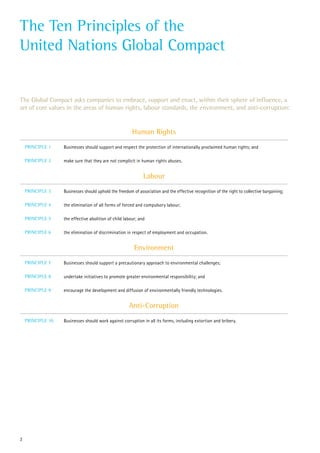
Human Rights
PRINCIPLE 1 Businesses should support and respect the protection of internationally proclaimed human rights; and
PRINCIPLE 2 make sure that they are not complicit in human rights abuses.
Labour
PRINCIPLE 3 Businesses should uphold the freedom of association and the effective recognition of the right to collective bargaining;
PRINCIPLE 4 the elimination of all forms of forced and compulsory labour;
PRINCIPLE 5 the effective abolition of child labour; and
PRINCIPLE 6 the elimination of discrimination in respect of employment and occupation.
Environment
PRINCIPLE 7 Businesses should support a precautionary approach to environmental challenges;
PRINCIPLE 8 undertake initiatives to promote greater environmental responsibility; and
PRINCIPLE 9 encourage the development and diffusion of environmentally friendly technologies.
Anti-Corruption
PRINCIPLE 10 Businesses should work against corruption in all its forms, including extortion and bribery.
The Ten Principles of the
United Nations Global Compact
The Global Compact asks companies to embrace, support and enact, within their sphere of influence, a
set of core values in the areas of human rights, labour standards, the environment, and anti-corruption:
4
Foreword
We gather at this year’s National Convention of the Global Compact in a challenging as
well as an exciting time for the Indian Sustainability scene. We are now witnessing the
slow process of recovery from the economic downturn. In such a scenario the relevance
of the Global Compact and the principles espoused by it assume even more significance.
Over the past ten years since its inception in 2003, Global Compact Network India
has helped spread the message of the United Nations Global Compact to Corporate
India and has created a platform that offers a bouquet of services to its members to
facilitate better understanding and subsequent inclusion of the Ten Principles into their
work culture and corporate governance structures. The peer group learning and sharing
meetings organized by GCNI provides members access to tried and tested knowledge on
which to model sustainable practices and has emerged as a potent tool toward capacity
building of companies and institutions through networking.
This is the first time that we have managed to replicate the UNGC Accenture Global
Study in India. The 2013 Global study is third in the series that seeks perspectives of
CEOs across the world. It is interesting to see how on some levels the thoughts on
Indian CEOs completely resonate with the Global Outlook, whereas there are also stark
contrasts on some issues.
The sustainability agenda has always been addressed by Corporate India; either in the
form of corporate philanthropy or community services. This study for India reinforces
this commitment by highlighting that Indian Businesses and their efforts revolve around
betterment of communities, managing resource efficiency and compliance. From a
global perspective, these practices correspond well with initial stage of a sustainability
curve and are reflective of issues and challenges that India faces.
Indian CEO’s are completely aware of the need to embed sustainability into business
strategy and are positioning it on a trajectory where it is maturing from the
philanthropy and compliance agenda to a holistic sustainability effort. Indian business
leaders possess the vision to transform the manner in which sustainability has been
traditionally practised and are poised to push it forward on the sustainability curve
aggressively. What needs to follow is a unique approach to blend the rapid growth of
this sustainability agenda with the social and economic imperatives of India. Indian
companies realise that it may not be possible to climb-up the sustainability curve by
aping practices adopted by developed Nations, due to the unique circumstances and
challenges that we face. Therefore, they are exploring various options and tailoring
global best practices to fit Indian contexts to find their own unique path toward
achieving inclusive growth through the sustainability agenda.
We are hopeful that this rich, authentic, first-hand ‘voice-of-business’ presented in
this study will help articulate a new set of priorities, and engage companies and key
stakeholders in an architecture that aligns business with sustainable development
priorities leading up to 2015 and beyond.
Sudhir Vasudeva,
Chairman and Managing director,
Oil and Natural Gas Corporation, and
President, Global Compact Network India
5
Introduction
Peter Lacy
CEO Study Lead
Managing Director, Accenture Strategy
& Sustainability,
Asia Pacific
Sanjay Dawar
Managing Director and India Lead
Accenture Strategy
India
Sanjay Jain
Managing Director
Accenture Strategy
India
This year marks the beginning of our association with the Global Compact Network
India (GCNI), and our first CEO Study for India. With record participation in this year’s
CEO Study from business leaders in one of the world’s fastest-growing economies,
the time is right to reflect on sustainability in India. As we partner for the GCNI’s 9th
National Convention, on the theme of ‘Transformational Leadership’, the Study is a
unique opportunity to capture the insights of member CEOs on what it will take to
accelerate progress on sustainability.
Over the course of our three studies, during which we have been fortunate enough to
conduct one-to-one interviews with more than 200 CEOs from some of the world’s
largest companies, and collect the views of a further 2,000 through our online surveys,
much has changed. There is reason to be optimistic: since our first study in 2007, the
Global Compact has grown to include nearly 8,000 companies globally, demonstrating an
unprecedented broadening of commitment among companies worldwide; sustainability
has become firmly established on the leadership agenda of almost every leading business;
and in the advances of the leaders we can see bright spots of real, transformational
innovation that are allowing business to create value while having an ever-greater impact
on global challenges.
But there is also reason for caution. Evidence suggests that the global economy is not
on track to meet the needs of a growing population with planetary boundaries, and our
interviews this year suggest that business may collectively have reached a plateau in
the advancement of sustainability. Without radical, structural change to markets and
systems, CEOs believe, business may be unable to lead the way toward the peak of a
sustainable economy.
In compiling this year’s UN Global Compact-Accenture CEO Study in India, we followed
two principal strands of research. First, we conducted in-depth interviews with key
Indian business leaders. This included CEOs, chairpersons and presidents of Global
Compact companies representing a broad spectrum of industry perspectives. Second,
we conducted an online survey of CEOs of companies participating in the Global
Compact. While we must note that their views—from Global Compact participants,
who freely gave their time to participate—may not be representative of the majority
of businesses in India, our approach has assembled a rich and diverse set of insights,
allowing us to explore, test and refine emerging themes and ideas.
We would like to acknowledge the extraordinary contributions of the Global Compact
sponsors and project leads Georg Kell, Sudhir Vasudeva, S. P. S. Bakshi, Uddesh Kohli and
Pooran Chandra Pandey. We also recognize the leadership of the Accenture co-author
team, in particular lead authors Vishvesh Prabhakar, Serge Younes and Pankhuri Bajpai.
There have been many further contributions from colleagues in Accenture too numerous
to mention here, but without whom our analysis would not be as compelling—in
particular the project sponsors Bruno Berthon and Avinash Vashistha.
Last—and most importantly—on behalf of the United Nations Global Compact, Global
Compact Network India and Accenture, we would like to express our sincere thanks to
the CEOs and chairpersons, business leaders and other stakeholders who participated
in the study. The project team has endeavoured to understand and interpret their many
ideas, reflections and case study examples in conducting the study and delivering this
report. Any insights are theirs, while any errors are our own.
This study is a unique opportunity to take stock as we stand at a crossroads in the
global economy. Sustainability in India is evolving and Indian business leaders are
committed to leading the way. But this transformation will require greater ambition and
wider support as we work to align sustainability impact with value creation, and global
markets with sustainable development outcomes.
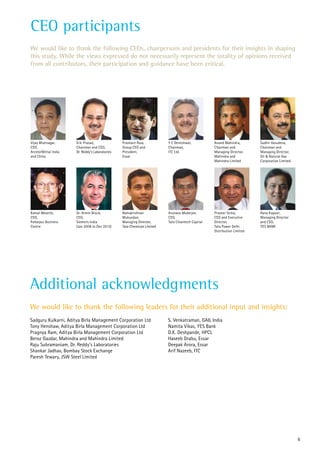
CEO participants
Anand Mahindra,	
Chairman and
Managing Director,	
Mahindra and
Mahindra Limited
Vijay Bhatnagar,
CEO,
ArcelorMittal India
and China
G.V. Prasad,	
Chairman and CEO,
Dr. Reddy’s Laboratories
Prashant Ruia,	
Group CEO and
President,
Essar
Praveer Sinha,	
CEO and Executive
Director,
Tata Power Delhi
Distribution Limited
Kamal Meattle,	
CEO,
Paharpur Business
Centre
Ramakrishnan
Mukundan,
Managing Director,
Tata Chemicals Limited
Arunavo Mukerjee,
CEO,
Tata Cleantech Capital
Sudhir Vasudeva,
Chairman and
Managing Director,
Oil & Natural Gas
Corporation Limited.
We would like to thank the following CEOs, chairpersons and presidents for their insights in shaping
this study. While the views expressed do not necessarily represent the totality of opinions received
from all contributors, their participation and guidance have been critical.
Additional acknowledgments
Sadguru Kulkarni, Aditya Birla Management Corporation Ltd
Tony Henshaw, Aditya Birla Management Corporation Ltd
Pragnya Ram, Aditya Birla Management Corporation Ltd
Beroz Gazdar, Mahindra and Mahindra Limited
Raju Subramaniam, Dr. Reddy’s Laboratories
Shankar Jadhav, Bombay Stock Exchange
Paresh Tewary, JSW Steel Limited
S. Venkatraman, GAIL India
Namita Vikas, YES Bank
D.K. Deshpande, HPCL
Haseeb Drabu, Essar
Deepak Arora, Essar
Arif Nazeeb, ITC
We would like to thank the following leaders for their additional input and insights:
Rana Kapoor	,
Managing Director
and CEO,
YES BANK
Y C Deveshwar,
Chairman,
ITC Ltd.
Dr. Armin Bruck,
CEO,
Siemens India
(Jan 2008 to Dec 2013)
6
Executive summary
The UN Global Compact-Accenture CEO Study on Sustainability
2013 presents findings from the world’s largest CEO study on
sustainability to date. More than 1,000 top executives from
27 industries across 103 countries assess the past, present and
future of sustainable business; discuss a new global architecture
to unlock the full potential of business in contributing to global
priorities; and reveal how leading companies are adopting
innovative strategies to combine impact and value creation.
Global Compact and Accenture, in association with the Global
Compact Network India (GCNI), has delved deeper into the
insights from our conversations in India as part of our efforts
to dive deeper into the Asian context for sustainability in the
eyes of CEOs. In this report, we examine in greater detail the
forces shaping companies’ approach to sustainability in India,
the motivations influencing business leaders and the potential
for transformation for a fast growing economy like India.
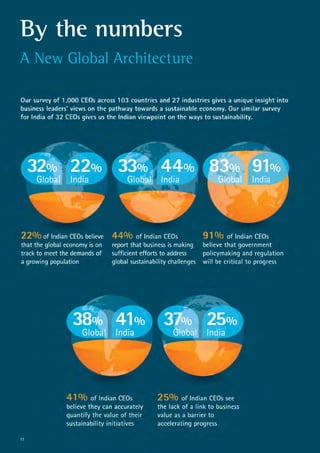
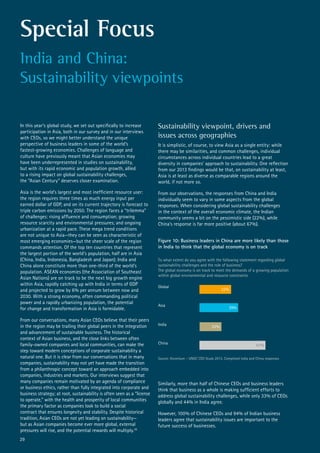
In sync with the global view, in fact even more pessimistic, only
22% of the Indian CEO respondents feel that the global economy
is on track to meet the demands of a growing population within
global environmental and resource constraints. But that is where
the similarities tend to end. Indian CEOs personal belief and
conviction aligns more strongly about what they are doing and the
effectiveness of it. Around 44% of the business leaders believe that
business as a whole is making sufficient efforts to address global
sustainability challenges, higher than the global average by 11%.
India’s challenge: balancing growth and
sustainable development
India’s GDP is expected to grow around 4.9%–5.6% between
this fiscal year and the next one.1
However, India still has a lot
of developmental gaps that pose a challenge to overall growth.
The Indian context of sustainability is also quite different
from the global situation in that India is a growing economy
but lags behind in the basics, and it is socially and culturally
very different from the developed world. The motivations
and challenges that drive India are unique to its situation.
Indian businesses need to balance a rapid growth with various
socioeconomic gaps posing a threat to overall development.
Businesses cannot remain alienated from their surroundings.
India as a country, although being a growing economy and a
booming market, is also struggling with poverty, over-population,
illiteracy, health issues and unemployment. Most businesses
operate in an environment where socio-economic challenges,
issues arising due to policies or lack of them have a major impact
on the way they operate.
Sustainability is firmly on the CEO
agenda - but many are struggling
to make the business case for action
Indian CEOs are of the view that the economic climate is not on
track but they expect sustainability to transform their industry
within five years. Two-thirds, 66%, report that sustainability
issues will be “very important” to their future success, a figure
above the global 45%, and still over the 52% in Asia. Most
CEOs also informed us that they have started to incorporate
environmental, social and corporate governance issues into their
company’s core strategy more than five years ago.
CEOs remain convinced that sustainability will transform their
industries; that leadership can bring competitive advantage; and
that sustainability can be a route to new waves of growth and
innovation. But beneath this commitment, frustration is clearly
evident: business leaders are in many cases unable to locate
and quantify the business value of sustainability; are struggling
to deliver the business case for action at scale; and see market
failure hindering business efforts to tackle global challenges.
CEOs see business caught in a cycle of “pilot paralysis”—
individual, small-scale projects, programs and business units with
an incremental impact on sustainability metrics—and while they
see a role for business in promoting sustainable development,
their responsibilities to the more traditional fundamentals
of business success, and to the expectations of markets and
stakeholders, are preventing greater scale, speed and impact.
Local communities and government
are driving action on sustainability
Throughout our interviews and survey, one thought that kept
resonating was the importance Indian businesses place on
community development and inclusion. Approximately 63% of
Indian CEOs believe that communities will have the greatest impact
on the way they manage societal expectations. Globally, 28% of
CEOs thought of community as the greatest stakeholder; in China,
it is far less, at 7%. Most sustainability efforts in India are driven
by the need to build trust and provide for the communities in which
the business operates. This also is a reflection of the inclusive
nature of Indian culture which percolates into the corporate DNA.
Another recurring theme in our conversations with CEOs has
been the role of governments and policymakers in establishing
the enabling environment for business to effectively scale
sustainability. Some 91% of respondents in India believe that
government policymaking and regulation will be critical to
progress. There is strong and vocal support among CEOs for
governments to play a leading role in shaping the landscape for
sustainability at global, national and local levels.
7
While communities and governments play a key role as stakeholders
for pushing sustainability in businesses, consumers and investors in
India seem to be more passive. Although CEOs rated consumers to
be second most important stakeholder, consumer demand features
quite low in priority as drivers of sustainability. Similarly, though
CEOs see investors gaining importance as stakeholders five years
down the line, as of now, investors have a little role to play in
pushing the sustainability agenda into businesses.
CEOs identify challenges to accelerating
progress on sustainability, within their
organizations and beyond
From our interviews and survey, we were able to analyze the
challenges that companies in India face. Difficulty due to
operating environment was rated as the most important barrier
to sustainability implementation by Indian CEOs (63%); only
30% of global CEOs and 32% of Asian CEOs considered that the
most important barrier. Business environment in India is quite
challenging due to the hassles of bureaucratic and administrative
processes involved at every stage of doing a business. Obtaining
permits, arranging for credit, registering property, etc. are
difficult and time consuming procedures.
There are also challenges related to creation of growth and
employment, lack of clarity on policies and lack of an integrated
reporting platform as barriers to implementation. Most CEOs
have mentioned that the existing regulatory policies in India
are extremely complex, and there is a lack of clear incentives
from the financial community. CEOs believe that governmental
and relevant agencies still need to develop regulations to help
sustainability gain momentum in India. Similarly, lack of clarity
in reporting and standards is a key issue related to the whole
process of sustainability monitoring in India.
Delving further, there are internal challenges such as building a
business case for sustainability, scaling up and institutionalizing
the sustainability agenda that pose as barriers. Building a business
case for sustainability has become more difficult in the current
economic climate. Most business leaders agree that a sustainability
mind-set is best tested in an environment like the current situation.
Most business leaders have work around the tradeoff between
rapid growth and social disharmony or slower but inclusive growth.
Our conversations suggest that sustainability continues to
be pigeonholed as a marginal issue, still regarded by many
companies as an extra cost to be cut in the face of short-term
financial pressures, rather than as a core part of strategies
to generate value through revenue growth, cost reduction or
brand impact. Mainstreaming sustainability is also an issue
that businesses in India face, especially conglomerates with
companies spread over multiple industry sectors. To scale up
sustainability and institutionalize it across the organization is
a challenge that most companies in India are struggling with.
Sustainability initiatives in India are
currently centered on community projects,
energy and reporting
Through their sustainability teams, most companies try to
provide for the community and their betterment. Community
initiatives such as livelihood generation, education, health and
provision of basic services take center stage for the businesses.
Communities being the most important stakeholders, as pointed
out by CEOs, tend to drive the initiatives by corporate India.
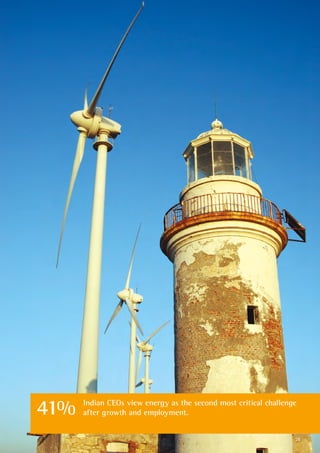
Energy is another focus of the initiatives carried out by Indian
companies. Energy efficiency, renewable energy and other energy
management activities seem to be the major agenda for Indian
businesses. In this study, energy came out as the second most
important issue (41%), and climate change (38%) was a close
third. Rising costs of energy and regulatory mechanisms are
the main drivers for companies to focus on energy issues. Most
business leaders in India seem optimistic about solar power;
indeed, solar energy is what they believe will drive the future
of energy in India.
Sustainability reporting forms the third pillar of the initiatives.
Driven by compliance or comparative ease of implementation
and the visibility it provides, the number of companies taking up
Global Reporting Initiative reporting has been increasing notably
since 2008. The increasing trend in voluntary sustainability
reporting by businesses can be taken as a serious indication of
their dedication toward evolving into sustainable enterprises.
The agenda for action:
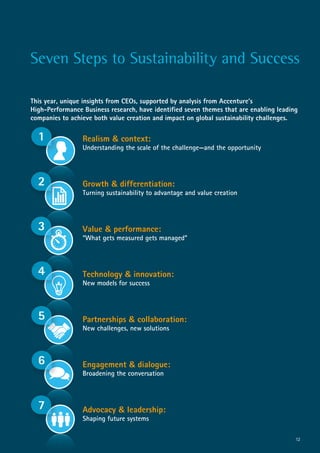
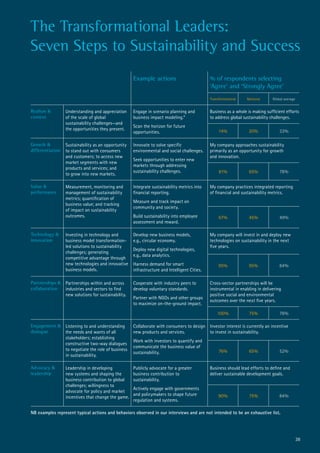
Seven steps to sustainability and success
Leading companies at the global level are not waiting for
policymakers to act. These may provide real lessons for India
and Indian business leaders on how to turn sustainable and
responsible business to genuine advantage. Our conversations
with CEOs suggest that in the absence of government
intervention, some are beginning to harness the potential of
sustainability: moving from a reactive approach of responding
to societal expectations and regulatory demands, leading
companies are now driving sustainability as an engine for
innovation and growth. The advances of these leading companies
and their adoption of large-scale, collaborative projects targeted
directly at value creation through addressing the priorities of
global sustainable development can be a demonstration for
Indian CEOs as to how business impact can be scaled beyond
incremental advances and efficiency gains.
This year, the Global Compact and Accenture study team set
out to investigate the links between CEOs’ attitudes and the
performance of their companies against traditional business
performance metrics and sustainability leadership indicators.
To our knowledge, this is the first time that this has been
undertaken with a CEO-level group. While extensive work
has been done on the correlations between a commitment to
sustainability and traditional metrics of business performance,
the CEO Study presents a unique opportunity to examine how
business leaders’ beliefs, attitudes and behaviors influence their
strategies and investments, as well as set the trajectory of their
companies in driving advantage through sustainability.
An examination of survey responses from those companies
covered by this year’s study and by Accenture’s long-term
High-Performance Business research program produces the
early indications of a potentially striking conclusion. It was
evident that CEOs of companies that combine externally-
recognized sustainability leadership with market-leading business
performance, approach sustainability in markedly different
ways. While none of the Indian companies featured in this set
of transformation leaders, this is a learning opportunity for
Indian business leaders to adopt and prioritize for investment,
innovation and action.
8
Transformational Leaders are approaching
sustainability differently, providing a model
for greater impact and value creation
Together with the insights from our in-depth conversations with
CEOs globally, our findings may begin to lay the foundations of a
deeper understanding of how companies can drive sustainability
to competitive advantage. At its heart is a different approach,
moving beyond reactive, incremental responses to external
pressures and toward a new understanding of sustainability
as an opportunity for innovation, competitive advantage,
differentiation and growth. Leading CEOs are already uncovering
strategies for sustainability that allow them to deliver both value
creation for their companies and impact on global challenges;
they are not waiting for others to act, but are actively creating
real value for consumers, investors and society. From our
research, CEOs see seven key themes that can guide their own
thinking and actions, as well as transforming their companies’
strategies, business models, value chains and industries in order
to achieve sustainability leadership and high performance.
In our illustration of the seven themes, though we are yet to see
any Indian company showing signs of transformational leadership,
we do see some examples that exhibit these characteristics that
could be scaled up to drive transformational change.
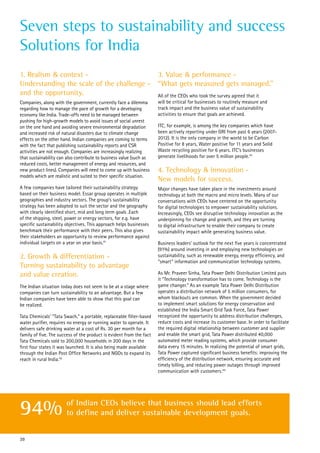
1. Realism & context
Understanding the scale of the challenge—and the opportunity.
Throughout our interviews, it was clear that companies taking the
most ambitious action on sustainability were also the most realistic
about the scale of the challenge—and are more likely to admit that
business is not doing enough. Understanding the challenge also
allows these companies to appreciate the opportunity for future
growth in providing solutions to sustainability issues and to target
strategies to achieve it. For example, the Essar group operating in
multiple geographies and industry sectors adapts its sustainability
strategy to suit the sector and the geography with clearly
identified short, mid and long term goals.
2. Growth & differentiation
Turning sustainability to advantage and value creation.
One of the clearest insights from this year’s study is the emergence
of a two-speed world in sustainability, between hose companies
still reacting to external expectations on sustainability and focusing
on incremental mitigation, and those that see sustainability through
the lens of growth and differentiation. For leading companies, many
CEOs told us that the urgency of global challenges provides an
opportunity to differentiate their products and services; to access
new market segments; and to grow into new regions, countries and
areas where their products can meet a pressing need. Tata Swach’,
a portable filter-based water purifier ideal for Indian conditions sold
200,000 filters in 200 days of launch.
3. Value & performance
“What gets measured gets managed.”
From carbon emissions to water footprints, tracking environmental
measures is now commonplace across industries. Our research
suggests that, for companies seeking to go beyond incremental
change and tackle global sustainability issues, the challenge is
two-fold: not just to measure and manage metrics of reduction and
mitigation, but also to quantify the value of sustainability initiatives
and more sustainable business models to the company, and to
track their impact on the communities in which they operate. ITC,
actively reporting under GRI is the only company in the world to be
carbon, water and solid waste recycling positive for many years.
4. Technology & innovation
New models for success.
Our data suggests that leading companies are turning to innovation
and technology. Environmental and resource constraints, and
growing social pressures, are acting as a stimulus for innovation.
From investment in renewables, to intelligent infrastructure
enabled by machine-to-machine communications technology, to
new closed-loop business models, leading companies are securing
business advantage through innovative R&D and the deployment
of technologies ranging from cloud computing to analytics.
Tata Power improved the efficiency of the distribution network,
ensured accurate and timely billing, and reduced power outages
by installing 40,000 automated meter reading systems.
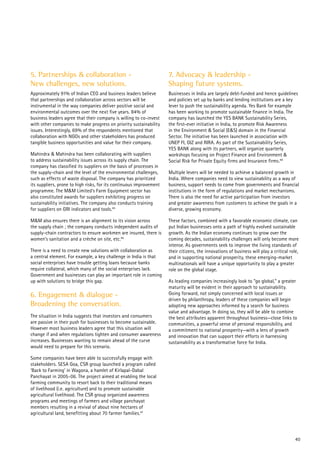
5. Partnerships & collaboration
New challenges, new solutions.
We have seen a growing confidence from CEOs over the last
decade that business can provide solutions to tackle global
challenges. This year, in the context of intensifying pressures
and flagging efforts, CEOs more readily acknowledge the role
of collaboration and partnerships in meeting their ambitions on
sustainability. Business can lead the way, they believe, and can
maximize companies’ impact through close partnerships with
governments, policymakers, industry peers, consumers and NGOs.
Mahindra & Mahindra has been collaborating with suppliers to
address sustainability issues across its supply chain.
6. Engagement & dialogue
Broadening the conversation.
Business leaders are increasingly conscious of the need to
establish a constructive, two-way dialogue with consumers and
local communities; regulators and policy makers; investors and
shareholders; employees and labor unions. Rather than simply acting
and then communicating, CEOs are actively engaging stakeholders to
negotiate the role of their business in addressing global challenges.
SESA Goa’s ‘Back to Farming’ initiative enables the local farming
community to resort back to their traditional means of livelihood
resulting in a revival of about 9 hectares of agricultural land.
7. Advocacy & leadership
Shaping future systems.
Leading CEOs are clear that business efforts are not sufficient
to set the global economy on track—but believe strongly that
business should lead the way toward defining and delivering a
sustainable global economy, not least through the post-2015
development agenda. They are realistic that individually they
can only have so much impact, but recognize a need to play
a part in collaborative solutions with governments and other
stakeholders. Business leaders’ advocacy and public commitment
will be integral to further progress. YES BANK has launched
‘Sustainability Series’, to promote Risk Awareness in the
Environment & Social (E&S) domain in the Financial Sector.
India is following a different sustainability growth path than the
developed world, and its trajectory has to be unique to India’s
economic growth, the nature of Indian businesses and the need
to address social inclusion. Going forward, transformational
leadership will require multiple levers to attain a consistent and
relevant sustainable development. Indian business leaders will
need to develop an innovative yet drastic approach to tackle the
immediate challenges while adopting a holistic sustainability
agenda. By designing unique business models, offering
differentiated products and services, using disruptive technology
and leveraging stakeholder collaboration, the advantageous
position that India enjoys being a growth economy can be
supplemented with a sustainable business environment.
9
10
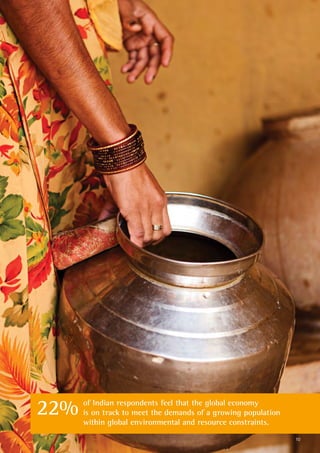
of Indian respondents feel that the global economy
is on track to meet the demands of a growing population
within global environmental and resource constraints.
22%
By the numbers
A New Global Architecture
11
Growth & differentiation:
Turning sustainability to advantage and value creation
Value & performance:
“What gets measured gets managed”
Technology & innovation:
New models for success
Partnerships & collaboration:
New challenges, new solutions
Engagement & dialogue:
Broadening the conversation
Realism & context:
Understanding the scale of the challenge—and the opportunity
Advocacy & leadership:
Shaping future systems
This year, unique insights from CEOs, supported by analysis from Accenture's
High-Performance Business research, have identified seven themes that are enabling leading
companies to achieve both value creation and impact on global sustainability challenges.companies
1
2
3
4
5
6
7
Seven Steps to Sustainability and Success
12
Chapter 1
Sustainability in India:
Stakeholders and drivers
Sustainability: The scale of the challenge
India is a country of 1.2 billion people—16% of the world’s
population—and makes up 2.4% of the world’s land.2
As per IMF,
the Indian GDP is poised to reach $2.128 trillion in 2014.3
India’s
economic performance has been impressive, averaging nearly
5% income growth a year from 1990 to 2012.4
However, more than six decades after independence, India
continues to struggle to achieve food, water, livelihood,
and sociocultural security for its people. Both official and
independent assessments of India’s socioeconomic indicators
point to persistent poverty; shortages of food, water and
energy; unemployment and underemployment; social
discrimination; and other problems that hinder achievement
of the United Nations Millennium Development Goals (MDGs)
as well as other goals India has set for itself.5
Population and population growth: As per the UN statistics
division, the annual population growth rate of India between
2010 and 2015 is estimated to be 1.3%. Though this rate has
been decreasing over the years, for a country that already has
the second-largest population in the world, it is still high.
Also, currently more than a third of India’s population resides
in urban areas. In a resource-starved nation, this concentration
of population, compounded by the projected growth, is expected
to create severe shortages of basic necessities.6
Life Expectancy: The life expectancy of a newborn in India
is lower than that of a child born in war-torn Iraq. The infant
mortality rate in India in 2012 was 44 per 1000 live-births.7
Literacy: As of 2012, the adult literacy rate in India is 63%,
with women’s literacy pegged at 51%.6
There is also a great
disparity of literacy among various regions and states with
regard to literacy in India.
Income: India’s per capita income is still low, estimated around
$1,200 in 2013.8
To improve living standards, it will need further
growth, since it is difficult to achieve much poverty reduction
through redistribution alone. Additionally, there is increasing
evidence of the growing chasm between rich and poor.
India’s rank in the Human Development Index (HDI), essentially
a composite measure of health, education and income,
stands at 136. The average annual HDI growth, even over a
longer period (between 2000 and 2012) was 1.50 per cent,
lower than the neighboring Pakistan’s (1.74 per cent).4
In addition, even on the ‘Environmental Performance Index
by Yale’, India ranked 155 in 2014;9
the limited targets
set under MDG7 on ensuring environmental sustainability
have also not been met.5
The growing population also
places pressure on the limited resources. There is rapid
and widespread environmental degradation.2
Major challenges in India include creating employment
opportunities for a 500 million–strong workforce 30 years
from now, pulling 400 million people out of poverty and
providing sanitation facilities to almost a billion people.10
With challenges like these, coupled with the growing need to be
environmentally conscious, sustainability is no longer a “good-
to-have.” Companies are not isolated from these challenges in
the environment in which they are working. As Ramakrishnan
Mukundan, managing director of Tata Chemicals Limited put
it, “There is no choice for businesses but to get on the road
to sustainability—it is unsustainable to be unsustainable.”
Sustainability in a challenging
economic environment
Global Compact and Accenture, in association with the Global
Compact Network India, have delved deeper into the insights
from our conversations in Asia Pacific in the global study. In
this report, we examine in greater detail the forces shaping
companies’ approach to sustainability in India, the motivations
influencing business leaders, and the potential for transformation
in a fast-growing economy like India.
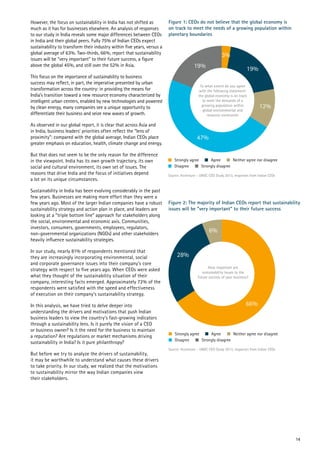
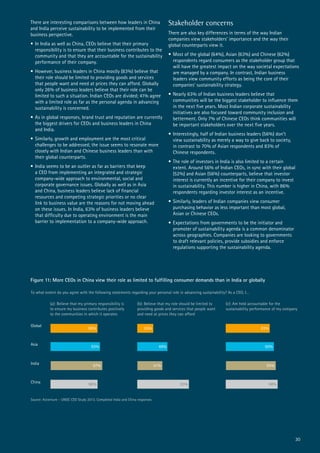
In sync with the global view and a bit more pessimistic, only
22% of our Indian respondents feel that the global economy is
on track to meet the demands of a growing population within
global environmental and resource constraints. Also, 44% of
business leaders believe that business as a whole is making
sufficient efforts to address global sustainability challenges.
13
However, the focus on sustainability in India has not shifted as
much as it has for businesses elsewhere. An analysis of responses
to our study in India reveals some major differences between CEOs
in India and their global peers. Fully 75% of Indian CEOs expect
sustainability to transform their industry within five years, versus a
global average of 63%. Two-thirds, 66%, report that sustainability
issues will be “very important” to their future success, a figure
above the global 45%, and still over the 52% in Asia.
This focus on the importance of sustainability to business
success may reflect, in part, the imperative presented by urban
transformation across the country: in providing the means for
India’s transition toward a new resource economy characterized by
intelligent urban centers, enabled by new technologies and powered
by clean energy, many companies see a unique opportunity to
differentiate their business and seize new waves of growth.
As observed in our global report, it is clear that across Asia and
in India, business leaders’ priorities often reflect the “lens of
proximity”: compared with the global average, Indian CEOs place
greater emphasis on education, health, climate change and energy.
But that does not seem to be the only reason for the difference
in the viewpoint. India has its own growth trajectory, its own
social and cultural environment, its own set of issues. The
reasons that drive India and the focus of initiatives depend
a lot on its unique circumstances.
Sustainability in India has been evolving considerably in the past
few years. Businesses are making more effort than they were a
few years ago. Most of the larger Indian companies have a robust
sustainability strategy and action plan in place, and leaders are
looking at a “triple bottom line” approach for stakeholders along
the social, environmental and economic axis. Communities,
investors, consumers, governments, employees, regulators,
non-governmental organizations (NGOs) and other stakeholders
heavily influence sustainability strategies.
In our study, nearly 81% of respondents mentioned that
they are increasingly incorporating environmental, social
and corporate governance issues into their company’s core
strategy with respect to five years ago. When CEOs were asked
what they thought of the sustainability situation of their
company, interesting facts emerged. Approximately 72% of the
respondents were satisfied with the speed and effectiveness
of execution on their company’s sustainability strategy.
In this analysis, we have tried to delve deeper into
understanding the drivers and motivations that push Indian
business leaders to view the country’s fast-growing indicators
through a sustainability lens. Is it purely the vision of a CEO
or business owner? Is it the need for the business to maintain
a reputation? Are regulations or market mechanisms driving
sustainability in India? Is it pure philanthropy?
But before we try to analyze the drivers of sustainability,
it may be worthwhile to understand what causes these drivers
to take priority. In our study, we realized that the motivations
to sustainability mirror the way Indian companies view
their stakeholders.
Figure 1: CEOs do not believe that the global economy is
on track to meet the needs of a growing population within
planetary boundaries
Figure 2: The majority of Indian CEOs report that sustainability
issues will be “very important” to their future success
6%
66%
28%
Source: Accenture – UNGC CEO Study 2013, responses from Indian CEOs
How important are
sustainability issues to the
future success of your business?
Strongly agree
Disagree Strongly disagree
Neither agree nor disagreeAgree
3%
19%
12%
47%
19%
Source: Accenture – UNGC CEO Study 2013, responses from Indian CEOs
To what extent do you agree
with the following statement:
the global economy is on track
to meet the demands of a
growing population within
global environmental and
resource constraints
Strongly agree
Disagree Strongly disagree
Neither agree nor disagreeAgree
14
Community at the core: Emergence
of communities as key stakeholders
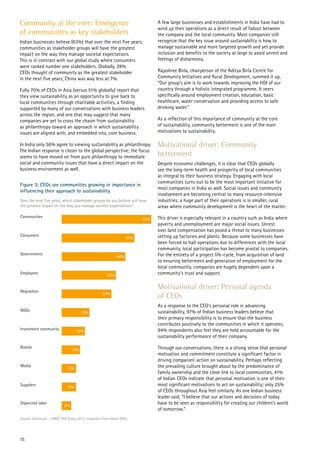
Indian businesses believe (63%) that over the next five years,
communities as stakeholder groups will have the greatest
impact on the way they manage societal expectations.
This is in contrast with our global study where consumers
were ranked number one stakeholders. Globally, 28%
CEOs thought of community as the greatest stakeholder
in the next five years; China was way less at 7%.
Fully 70% of CEOs in Asia (versus 51% globally) report that
they view sustainability as an opportunity to give back to
local communities through charitable activities, a finding
supported by many of our conversations with business leaders
across the region, and one that may suggest that many
companies are yet to cross the chasm from sustainability
as philanthropy toward an approach in which sustainability
issues are aligned with, and embedded into, core business.
In India only 56% agree to viewing sustainability as philanthropy.
The Indian response is closer to the global perspective; the focus
seems to have moved on from pure philanthropy to immediate
social and community issues that have a direct impact on the
business environment as well.
Figure 3: CEOs see communities growing in importance in
influencing their approach to sustainability
Communities
63%
Consumers
50%
Governments
44%
Employees 38%
Regulators
34%
NGOs 19%
Investment community 16%
Boards
13%
Media
9%
Suppliers 9%
Organized labor
6%
Source: Accenture – UNGC CEO Study 2013, responses from Indian CEOs
Over the next five years, which stakeholder groups do you believe will have
the greatest impact on the way you manage societal expectations?
A few large businesses and establishments in India have had to
wind up their operations as a direct result of fallout between
the company and the local community. Most companies still
recognize that the key issue around sustainability is how to
manage sustainable and more targeted growth and yet provide
inclusion and benefits to the society at large to avoid unrest and
feelings of disharmony.
Rajashree Birla, chairperson of the Aditya Birla Centre for
Community Initiatives and Rural Development, summed it up,
“Our group’s aim is to work towards improving the HDI of our
country through a holistic integrated programme. It veers
specifically around employment creation, education, basic
healthcare, water conservation and providing access to safe
drinking water.”
As a reflection of this importance of community at the core
of sustainability, community betterment is one of the main
motivations to sustainability.
Motivational driver: Community
betterment
Despite economic challenges, it is clear that CEOs globally
see the long-term health and prosperity of local communities
as integral to their business strategy. Engaging with local
communities turns out to be the most important initiative for
most companies in India as well. Social issues and community
involvement are becoming central to many resource-intensive
industries; a huge part of their operations is in smaller, rural
areas where community development is the heart of the matter.
This driver is especially relevant in a country such as India where
poverty and unemployment are major social issues. Unrest
over land compensation has posed a threat to many businesses
setting up factories and plants. Because some businesses have
been forced to halt operations due to differences with the local
community, local participation has become pivotal to companies.
For the entirety of a project life-cycle, from acquisition of land
to ensuring betterment and generation of employment for the
local community, companies are hugely dependent upon a
community’s trust and support.
Motivational driver: Personal agenda
of CEOs
As a response to the CEO’s personal role in advancing
sustainability, 97% of Indian business leaders believe that
their primary responsibility is to ensure that the business
contributes positively to the communities in which it operates;
94% respondents also feel they are held accountable for the
sustainability performance of their company.
Through our conversations, there is a strong sense that personal
motivation and commitment constitute a significant factor in
driving companies’ action on sustainability. Perhaps reflecting
the prevailing culture brought about by the predominance of
family ownership and the close link to local communities, 41%
of Indian CEOs indicate that personal motivation is one of their
most significant motivations to act on sustainability; only 25%
of CEOs throughout Asia feel similarly. As one Indian business
leader said, “I believe that our actions and decisions of today
have to be seen as responsibility for creating our children’s world
of tomorrow.”
15
Consumers as stakeholders
Our study respondents strongly believe that their sustainability
performance and reputation are key factors in shaping
consumer and customer demand. CEOs in India report
that both the reputation and brand of their company on
sustainability (75%) and the sustainability performance of
products and services (72%) are important in their consumers’
and customers’ purchasing decisions. CEOs are clear that
sustainability is becoming an expectation, and that their
company’s reputation on social, environmental and ethical
issues can make or break its brand—and the company itself.
From our conversations with business leaders, we realize
that a big pull seems to emerge from companies with large
business-to-business (B2B) global clients. These companies
are now looking at sustainability from a perspective of
meeting regulations and standards expected by their B2B
customers. Nearly 81% of respondents agree that their
company is looking to innovate new products and services to
help consumers and customers address sustainability issues.
Adoption of the sustainability agenda into a company’s
strategy immediately signals to concerned stakeholders a
commitment to sustainability and its long-term inclusion
in the company’s priorities. Companies need to build their
brand, trust and reputation to create a positive impression
on communities, their major stakeholders. A company’s
adoption of the sustainability agenda into its strategy only
slightly affects investors and consumers directly, but even
at this early stage, it does aid the company’s reputation.
Motivational driver: Brand, trust and
reputation
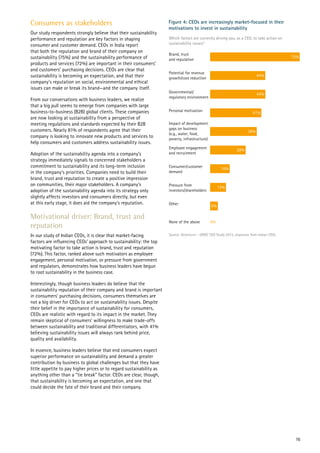
In our study of Indian CEOs, it is clear that market-facing
factors are influencing CEOs’ approach to sustainability: the top
motivating factor to take action is brand, trust and reputation
(72%). This factor, ranked above such motivators as employee
engagement, personal motivation, or pressure from government
and regulators, demonstrates how business leaders have begun
to root sustainability in the business case.
Interestingly, though business leaders do believe that the
sustainability reputation of their company and brand is important
in consumers’ purchasing decisions, consumers themselves are
not a big driver for CEOs to act on sustainability issues. Despite
their belief in the importance of sustainability for consumers,
CEOs are realistic with regard to its impact in the market. They
remain skeptical of consumers’ willingness to make trade-offs
between sustainability and traditional differentiators, with 41%
believing sustainability issues will always rank behind price,
quality and availability.
In essence, business leaders believe that end consumers expect
superior performance on sustainability and demand a greater
contribution by business to global challenges but that they have
little appetite to pay higher prices or to regard sustainability as
anything other than a “tie break” factor. CEOs are clear, though,
that sustainability is becoming an expectation, and one that
could decide the fate of their brand and their company.
Figure 4: CEOs are increasingly market-focused in their
motivations to invest in sustainability
Brand, trust
and reputation
72%
Potential for revenue
growth/cost reduction
44%
Personal motivation
44%Governmental/
regulatory environment
41%
Impact of development
gaps on business
(e.g., water, food,
poverty, infrastructure)
38%
Employee engagement
and recruitment
28%
16%Consumer/customer
demand
13%Pressure from
investors/shareholders
6%Other
0%None of the above
Source: Accenture – UNGC CEO Study 2013, responses from Indian CEOs
Which factors are currently driving you, as a CEO, to take action on
sustainability issues?
16
Governments as stakeholders
A recurring theme in our conversations with CEOs has been
the role of governments and policymakers in establishing
the enabling environment for business to effectively
scale sustainability. The 2013 study demonstrates the
importance of governments in influencing companies’
approach to sustainability, with 44% of Indian CEOs
factoring them among their most important stakeholders.
Business leaders see the actions of governments and
policymakers as both a barrier and an enabler to sustainability.
More than half, 56%, of the CEOs surveyed reported that
recent developments in national and international policy on
sustainability have created new business opportunities, and only
3% reported these developments as having been a hindrance to
embedding sustainability within their company.
Additionally, it is clear that internalizing sustainability into
markets through sometimes volatile and uncertain policy
measures has created an impact on business profitability, with
44% of CEOs believing that these developments had increased
their company’s compliance costs and other expenditures.
While costs of compliance are to be expected in adapting to
new regulation, CEOs believe that clearer and more predictable
actions could reduce additional costs and provide a clearer
pathway for companies to plan their investments. From our
conversations, it is clear that business leaders see governments
and policymakers, for better and for worse, wielding a greater
influence over the strategies for sustainability. But in our
study, just 9% of CEOs believe that governments have made
good progress in the past three years in actively encouraging
sustainability—suggesting that greater efforts will be required
if governments and policymakers are to play a leading role in
establishing a new global architecture for sustainable business.
Specifically, CEOs believe that government intervention and
regulation will be essential to provide an enabling environment
for business action. From our research, there is strong and vocal
support among CEOs for governments to play a leading role in
shaping the landscape for sustainability: 97% of respondents
expect government policy to promote economic development
within the planetary boundaries of environmental and resource
constraints, governments and policymakers to increase efforts
to provide an enabling environment for the private sector, and
governments to provide stronger support and market signals to
support green growth.
Business leaders see a role for governments to support
sustainability through international cooperation (94% of CEOs
see international consensus on sustainable development priorities
as essential to progress) and through binding regulation (84%
report that clear global agreements and international regulation
on climate change would help them accelerate their own efforts).
Business leaders believe that only with greater government
intervention—at global, national and local levels—can
sustainability move from sporadic, incremental advances
to a collective and transformative impact enabled by a new
global architecture.
National Action Plan on Climate
Change (NAPCC)
The Prime Minister’s Council on Climate Change released the NAPCC focusing attention on
eight priority national missions, including enhanced energy efficiency, sustainable habitat,
solar energy, conserving water, “Green India” and sustainable agriculture.11
National Voluntary Guidelines The Ministry of Corporate Affairs issued the National Voluntary Guidelines to encourage
reporting on environment, social and governance issues.12
PAT (Perform, Achieve and Trade)
Scheme
The Bureau of Energy Efficiency has ordered more than 500 industrial plants in India to adopt
energy-efficiency targets and establish a trading scheme for energy-efficiency credits.13
Business Responsibility Reports The Securities and Exchange Board in November 2011 mandated inclusion of Business
Responsibility Reports as part of annual reports for the top 100 listed companies in the
Bombay and National stock exchanges.14
GREENEX and CARBONEX The BSE launched two thematic indexes to compare companies on their current energy-
efficiency, carbon performance and future reduction targets.15
2% CSR Spend for Public
Sector Undertakings
The Department of Public Enterprises mandated public sector undertakings to spend up to
2% of profit after tax on corporate social responsibility (CSR) and sustainability initiatives.16
New Companies Bill The 2013 Companies Bill requires all profit-making corporations, public and private, with net
worth of INR 500 crore or more, turnover of INR 1,000 crore or more, or net profit of INR 5
crore or more to spend 2% of their profit after tax on CSR and sustainability initiatives.17
Existing regulatory mechanisms in India
17
Motivational driver: Regulatory controls
Regulatory controls, especially around environmental issues,
have gotten tighter in the past few years. From our study,
44% of Indian business leaders agree that governmental and
regulatory environment is a major factor in driving sustainability
in India. This is in contrast to the global study, in which only 27%
of business leaders believe that regulatory control is a motivation.
Corporations in India are very conscious about this aspect
and understand most of the requirements and needs. As of
now, the regulations are not very stringent, but businesses
understand that these regulations and requirements will
undoubtedly become more stringent in the future. Most
business leaders believe that the government and financial
institutions can put in place more mechanisms to embed
sustainability into the overall business strategy.
More than 91% of Indian business leaders believe that
governments’ actively encouraging sustainability through
policymaking and regulation will become an important
condition to harness sustainability as a transformative force
in the global economy in the next three to five years.
A direct impact of controls in India is visible from the way
sustainability reporting has grown. KPMG’s Survey of Corporate
Responsibility Reporting 2013 mentioned that since the last
survey two years earlier, the number of top 100 companies
preparing sustainability reports has increased most dramatically
by 53%.18
Role played by investors as stakeholders
Investors are an important category of stakeholders;
however, currently just 13% of respondents regard investor
pressure as among their chief motivators on sustainability,
and only 16% see investors as important stakeholders from
a sustainability perspective.
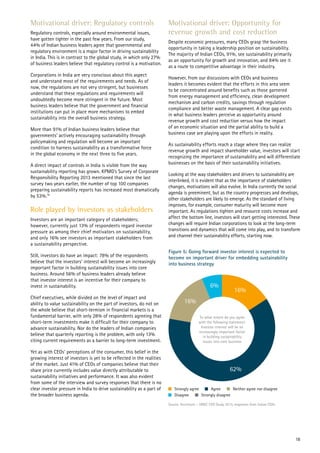
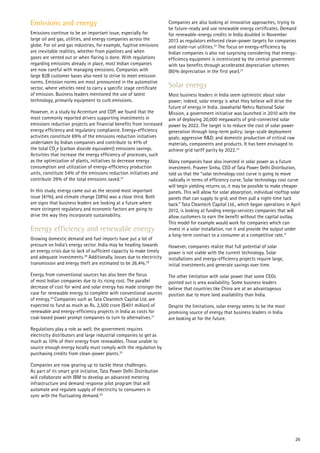
Still, investors do have an impact: 78% of the respondents
believe that the investors’ interest will become an increasingly
important factor in building sustainability issues into core
business. Around 56% of business leaders already believe
that investor interest is an incentive for their company to
invest in sustainability.
Chief executives, while divided on the level of impact and
ability to value sustainability on the part of investors, do not on
the whole believe that short-termism in financial markets is a
fundamental barrier, with only 28% of respondents agreeing that
short-term investments make it difficult for their company to
advance sustainability. Nor do the leaders of Indian companies
believe that quarterly reporting is the problem, with only 13%
citing current requirements as a barrier to long-term investment.
Yet as with CEOs’ perceptions of the consumer, this belief in the
growing interest of investors is yet to be reflected in the realities
of the market. Just 41% of CEOs of companies believe that their
share price currently includes value directly attributable to
sustainability initiatives and performance. It was also evident
from some of the interview and survey responses that there is no
clear investor pressure in India to drive sustainability as a part of
the broader business agenda.
Figure 5: Going forward investor interest is expected to
become on important driver for embedding sustainability
into business strategy
Motivational driver: Opportunity for
revenue growth and cost reduction
Despite economic pressures, many CEOs grasp the business
opportunity in taking a leadership position on sustainability.
The majority of Indian CEOs, 91%, see sustainability primarily
as an opportunity for growth and innovation, and 84% see it
as a route to competitive advantage in their industry.
However, from our discussions with CEOs and business
leaders it becomes evident that the efforts in this area seem
to be concentrated around benefits such as those garnered
from energy management and efficiency, clean development
mechanism and carbon credits, savings through regulation
compliance and better waste management. A clear gap exists
in what business leaders perceive as opportunity around
revenue growth and cost reduction versus how the impact
of an economic situation and the partial ability to build a
business case are playing upon the efforts in reality.
As sustainability efforts reach a stage where they can realize
revenue growth and impact shareholder value, investors will start
recognizing the importance of sustainability and will differentiate
businesses on the basis of their sustainability initiatives.
Looking at the way stakeholders and drivers to sustainability are
interlinked, it is evident that as the importance of stakeholders
changes, motivations will also evolve. In India currently the social
agenda is preeminent, but as the country progresses and develops,
other stakeholders are likely to emerge. As the standard of living
improves, for example, consumer maturity will become more
important. As regulations tighten and resource costs increase and
affect the bottom line, investors will start getting interested. These
changes will require Indian corporations to look at the long-term
transitions and dynamics that will come into play, and to transform
and channel their sustainability efforts, starting now.
16%
62%
16%
6%
Source: Accenture – UNGC CEO Study 2013, responses from Indian CEOs
To what extent do you agree
with the following statement:
Investor interest will be an
increasingly important factor
in building sustainability
issues into core business
Strongly agree
Disagree Strongly disagree
Neither agree nor disagreeAgree
18
Chapter 2
Sustainable Business: Issues and
challenges for corporate India
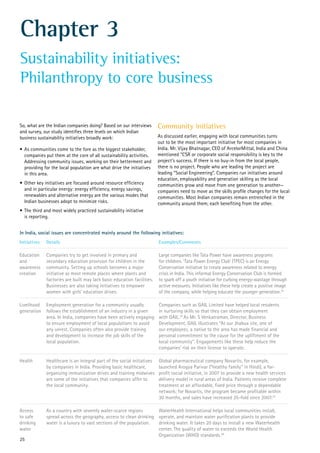
Sustainability means different things to different people—
this seems to be the feeling across most corporations in India.
The issues and challenges faced by businesses depend upon the
industry and sector in which they operate. In our interviews and
survey, we came across some thoughts that have occupied the
sustainability agenda of most decision makers. In a nutshell,
major challenges and issues faced by Indian companies are
focused around the following strong themes:
Difficulty due to operating environment
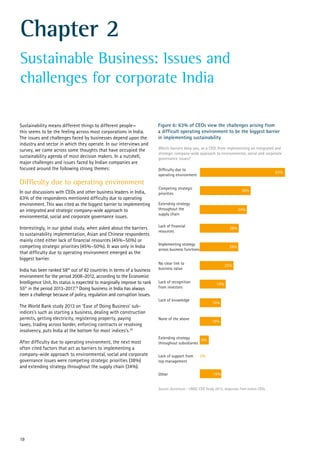
In our discussions with CEOs and other business leaders in India,
63% of the respondents mentioned difficulty due to operating
environment. This was cited as the biggest barrier to implementing
an integrated and strategic company-wide approach to
environmental, social and corporate governance issues.
Interestingly, in our global study, when asked about the barriers
to sustainability implementation, Asian and Chinese respondents
mainly cited either lack of financial resources (45%–50%) or
competing strategic priorities (45%–50%). It was only in India
that difficulty due to operating environment emerged as the
biggest barrier.
India has been ranked 58th
out of 82 countries in terms of a business
environment for the period 2008–2012, according to the Economist
Intelligence Unit. Its status is expected to marginally improve to rank
55th
in the period 2013–2017.19
Doing business in India has always
been a challenge because of policy, regulation and corruption issues.
The World Bank study 2013 on ‘Ease of Doing Business’ sub-
indices’s such as starting a business, dealing with construction
permits, getting electricity, registering property, paying
taxes, trading across border, enforcing contracts or resolving
insolvency, puts India at the bottom for most indices’s.20
After difficulty due to operating environment, the next most
often cited factors that act as barriers to implementing a
company-wide approach to environmental, social and corporate
governance issues were competing strategic priorities (38%)
and extending strategy throughout the supply chain (34%).
Figure 6: 63% of CEOs view the challenges arising from
a difficult operating environment to be the biggest barrier
in implementing sustainability
Difficulty due to
operating environment
38%
63%
Competing strategic
priorities
Extending strategy
throughout the
supply chain
34%
Lack of financial
resources
28%
Implementing strategy
across business functions
28%
No clear link to
business value
25%
Lack of recognition
from investors
19%
Lack of knowledge
16%
None of the above
16%
Extending strategy
throughout subsidiaries
6%
Lack of support from
top management
Other
0%
Source: Accenture – UNGC CEO Study 2013, responses from Indian CEOs
Which barriers keep you, as a CEO, from implementing an integrated and
strategic company-wide approach to environmental, social and corporate
governance issues?
16%
19
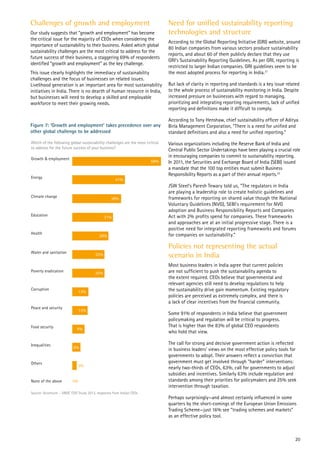
Challenges of growth and employment
Our study suggests that “growth and employment” has become
the critical issue for the majority of CEOs when considering the
importance of sustainability to their business. Asked which global
sustainability challenges are the most critical to address for the
future success of their business, a staggering 69% of respondents
identified “growth and employment” as the key challenge.
This issue clearly highlights the immediacy of sustainability
challenges and the focus of businesses on related issues.
Livelihood generation is an important area for most sustainability
initiatives in India. There is no dearth of human resource in India,
but businesses will need to develop a skilled and employable
workforce to meet their growing needs.
Growth & employment
41%
69%
Energy
Climate change 38%
Education 31%
Health
28%
Water and sanitation 25%
Poverty eradication 25%
Corruption
13%
Peace and security
13%
Food security 9%
Inequalities
Others
0%
Source: Accenture – UNGC CEO Study 2013, responses from Indian CEOs
Which of the following global sustainability challenges are the most critical
to address for the future success of your business?
3%
None of the above
6%
Figure 7: ‘Growth and employment’ takes precedence over any
other global challenge to be addressed
Need for unified sustainability reporting
technologies and structure
According to the Global Reporting Initiative (GRI) website, around
80 Indian companies from various sectors produce sustainability
reports, and about 60 of them publicly declare that they use
GRI’s Sustainability Reporting Guidelines. As per GRI, reporting is
restricted to larger Indian companies. GRI guidelines seem to be
the most adopted process for reporting in India.21
But lack of clarity in reporting and standards is a key issue related
to the whole process of sustainability monitoring in India. Despite
increased pressure on businesses with regard to managing,
prioritizing and integrating reporting requirements, lack of unified
reporting and definitions make it difficult to comply.
According to Tony Henshaw, chief sustainability officer of Aditya
Birla Management Corporation, “There is a need for unified and
standard definitions and also a need for unified reporting.”
Various organizations including the Reserve Bank of India and
Central Public Sector Undertakings have been playing a crucial role
in encouraging companies to commit to sustainability reporting.
In 2011, the Securities and Exchange Board of India (SEBI) issued
a mandate that the 100 top entities must submit Business
Responsibility Reports as a part of their annual reports.22
JSW Steel’s Paresh Tewary told us, “The regulators in India
are playing a leadership role to create holistic guidelines and
frameworks for reporting on shared value though the National
Voluntary Guidelines (NVG), SEBI’s requirement for NVG
adoption and Business Responsibility Reports and Companies
Act with 2% profits spend for companies. These frameworks
and approaches are at an initial progressive stage. There is a
positive need for integrated reporting frameworks and forums
for companies on sustainability.”
Policies not representing the actual
scenario in India
Most business leaders in India agree that current policies
are not sufficient to push the sustainability agenda to
the extent required. CEOs believe that governmental and
relevant agencies still need to develop regulations to help
the sustainability drive gain momentum. Existing regulatory
policies are perceived as extremely complex, and there is
a lack of clear incentives from the financial community.
Some 91% of respondents in India believe that government
policymaking and regulation will be critical to progress.
That is higher than the 83% of global CEO respondents
who hold that view.
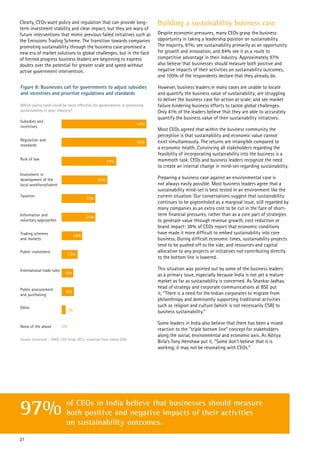
The call for strong and decisive government action is reflected
in business leaders’ views on the most effective policy tools for
governments to adopt. Their answers reflect a conviction that
government must get involved through “harder” interventions:
nearly two-thirds of CEOs, 63%, call for governments to adjust
subsidies and incentives. Similarly 63% include regulation and
standards among their priorities for policymakers and 25% seek
intervention through taxation.
Perhaps surprisingly—and almost certainly influenced in some
quarters by the short-comings of the European Union Emissions
Trading Scheme—just 16% see “trading schemes and markets”
as an effective policy tool.
20
Building a sustainability business case
Despite economic pressures, many CEOs grasp the business
opportunity in taking a leadership position on sustainability.
The majority, 91%, see sustainability primarily as an opportunity
for growth and innovation, and 84% see it as a route to
competitive advantage in their industry. Approximately 97%
also believe that businesses should measure both positive and
negative impacts of their activities on sustainability outcomes,
and 100% of the respondents declare that they already do.
However, business leaders in many cases are unable to locate
and quantify the business value of sustainability; are struggling
to deliver the business case for action at scale; and see market
failure hindering business efforts to tackle global challenges.
Only 41% of the leaders believe that they are able to accurately
quantify the business value of their sustainability initiatives.
Most CEOs agreed that within the business community the
perception is that sustainability and economic value cannot
exist simultaneously. The returns are intangible compared to
a economic health. Convincing all stakeholders regarding the
feasibility of incorporating sustainability into the business is a
mammoth task. CEOs and business leaders recognize the need
to create an internal change in mind-set regarding sustainability.
Preparing a business case against an environmental case is
not always easily possible. Most business leaders agree that a
sustainability mind-set is best tested in an environment like the
current situation. Our conversations suggest that sustainability
continues to be pigeonholed as a marginal issue, still regarded by
many companies as an extra cost to be cut in the face of short-
term financial pressures, rather than as a core part of strategies
to generate value through revenue growth, cost reduction or
brand impact: 38% of CEOs report that economic conditions
have made it more difficult to embed sustainability into core
business. During difficult economic times, sustainability projects
tend to be pushed off to the side, and resources and capital
allocation to any projects or initiatives not contributing directly
to the bottom line is lowered.
This situation was pointed out by some of the business leaders
as a primary issue, especially because India is not yet a mature
market as far as sustainability is concerned. As Shankar Jadhav,
head of strategy and corporate communications at BSE put
it, “There is a need for the Indian corporates to migrate from
philanthropy and dominantly supporting traditional activities
such as religion and culture (which is not necessarily CSR) to
business sustainability.”
Some leaders in India also believe that there has been a mixed
reaction to the “triple bottom line” concept for stakeholders
along the social, environmental and economic axis. As Aditya
Birla’s Tony Henshaw put it, “Some don’t believe that it is
working; it may not be resonating with CEOs.”
Subsidies and
incentives
Regulation and
standards
Rule of law 41%
Investment in
development of the
local workforce/talent
34%
Taxation
25%
Information and
voluntary approaches
25%
Trading schemes
and markets
16%
Public investment
13%
International trade rules
9%
Public procurement
and purchasing
9%
Other
Source: Accenture – UNGC CEO Study 2013, responses from Indian CEOs
Which policy tools could be most effective for governments in promoting
sustainability in your industry?
0%None of the above
3%
63%
63%
Figure 8: Businesses call for governments to adjust subsidies
and incentives and prioritize regulations and standards
Clearly, CEOs want policy and regulation that can provide long-
term investment stability and clear impact, but they are wary of
future interventions that mimic previous failed initiatives such as
the Emissions Trading Scheme. The transition towards companies
promoting sustainability through the business case promised a
new era of market solutions to global challenges, but in the face
of limited progress business leaders are beginning to express
doubts over the potential for greater scale and speed without
active government intervention.
21
of CEOs in India believe that businesses should measure
both positive and negative impacts of their activities
on sustainability outcomes.
97%
Challenges for Indian companies
to institutionalize sustainability
The traditional approach to sustainability or any other form
such as CSR has been to establish a separate entity within the
organization to manage the sustainability agenda. In the current
scenario, a key challenge exists in scaling sustainability and
institutionalizing it across the company.
“In India, one of the early approaches by companies has been
to start their own foundations to channelize their profits into
“CSR” activities, but both the foundations and companies are
very different kinds of entities and continue to bring about issues
around corporate governance and lack of transparency.“ BSE’s
Jadhav told us.
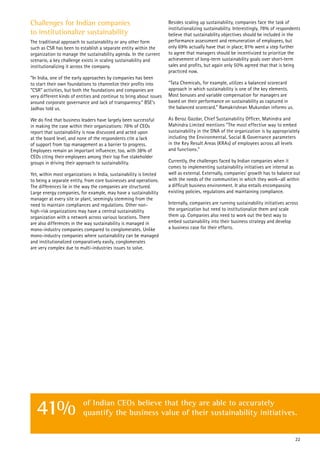
We do find that business leaders have largely been successful
in making the case within their organizations: 78% of CEOs
report that sustainability is now discussed and acted upon
at the board level, and none of the respondents cite a lack
of support from top management as a barrier to progress.
Employees remain an important influencer, too, with 38% of
CEOs citing their employees among their top five stakeholder
groups in driving their approach to sustainability.
Yet, within most organizations in India, sustainability is limited
to being a separate entity, from core businesses and operations.
The differences lie in the way the companies are structured.
Large energy companies, for example, may have a sustainability
manager at every site or plant, seemingly stemming from the
need to maintain compliances and regulations. Other non-
high-risk organizations may have a central sustainability
organization with a network across various locations. There
are also differences in the way sustainability is managed in
mono-industry companies compared to conglomerates. Unlike
mono-industry companies where sustainability can be managed
and institutionalized comparatively easily, conglomerates
are very complex due to multi-industries issues to solve.
Besides scaling up sustainability, companies face the task of
institutionalizing sustainability. Interestingly, 78% of respondents
believe that sustainability objectives should be included in the
performance assessment and remuneration of employees, but
only 69% actually have that in place; 81% went a step further
to agree that managers should be incentivized to prioritize the
achievement of long-term sustainability goals over short-term
sales and profits, but again only 50% agreed that that is being
practiced now.
“Tata Chemicals, for example, utilizes a balanced scorecard
approach in which sustainability is one of the key elements.
Most bonuses and variable compensation for managers are
based on their performance on sustainability as captured in
the balanced scorecard.” Ramakrishnan Mukundan informs us.
As Beroz Gazdar, Chief Sustainability Officer, Mahindra and
Mahindra Limited mentions “The most effective way to embed
sustainability in the DNA of the organization is by appropriately
including the Environmental, Social & Governance parameters
in the Key Result Areas (KRAs) of employees across all levels
and functions.”
Currently, the challenges faced by Indian companies when it
comes to implementing sustainability initiatives are internal as
well as external. Externally, companies’ growth has to balance out
with the needs of the communities in which they work—all within
a difficult business environment. It also entails encompassing
existing policies, regulations and maintaining compliance.
Internally, companies are running sustainability initiatives across
the organization but need to institutionalize them and scale
them up. Companies also need to work out the best way to
embed sustainability into their business strategy and develop
a business case for their efforts.
22
of Indian CEOs believe that they are able to accurately
quantify the business value of their sustainability initiatives.41%
"Our challenge is to keep up with
our past and push the envelope
on sustainable business to
maintain our leadership position."
Arunavo Mukerjee, CEO, Tata Cleantech Capital Ltd.
"Environmental and social
concerns are now being addressed
as boundary conditions and are
integral to all our initiatives. They
are no longer thought of as issues
to be addressed post facto."
G.V. Prasad, Dr. Reddy’s Laboratories
"There is no choice
for businesses but
to get on the road
to sustainability–
it is unsustainable
to be unsustainable."
Ramakrishnan Mukundan, Tata
Chemicals Limited
CEOs on sustainability
"I firmly believe that the
innovative energies of business
can bring about transformational
change to create a more secure,
sustainable and inclusive future."
Y C Deveshwar, ITC Limited
“Today, a sound programme encompasses responsible business strategy and
innovative business solutions along with a sustainable business model that not
only serves the company’s interests but the interests of society at large.”
Sudhir Vasudeva, Oil & Natural Gas Corporation Limited
"Today, there is no distinction between what
you do for profit and how you drive positive
change. The more you drive positive change,
the more enhanced your business model."
Anand Mahindra, Mahindra and Mahindra Limited
“Sustainability ought to be based on the collective
strength of synergy… of sowing the seeds of
innovation and nurturing the saplings together.
Being leaders in the field, Essar is continually forging
partnerships to innovate solutions that last.”
Prashant Ruia, Essar
"Organizations today are greatly aware of the impact of their
decisions and actions on the wider stakeholder spectrum,
and YES BANK remains committed to adopting inclusive and
equitable business practices that maximise positive outcomes
for India’s economic and social development agenda."
Rana Kapoor, YES BANK
“There is a need for market incentives
as well as regulatory and financial
instruments to drive sustainability.”
Prashant Ruia, Essar
"Technology transformation has to come.
Technology is the game changer."
Praveer Sinha, Tata Power Delhi Distribution Limited
"There is a direct link between
energy and water and you can’t
solve one without the other."
Kamal Meattle, Paharpur Business Centre
23
of Indian CEOs indicate that personal motivation is one of
their most significant motivations to act on sustainability.41%
24
Chapter 3
Sustainability initiatives:
Philanthropy to core business
So, what are the Indian companies doing? Based on our interviews
and survey, our study identifies three levels on which Indian
business sustainability initiatives broadly work:
•	As communities come to the fore as the biggest stakeholder,
companies put them at the core of all sustainability activities.
Addressing community issues, working on their betterment and
providing for the local population are what drive the initiatives
in this area.
•	Other key initiatives are focused around resource efficiency
and in particular energy: energy efficiency, energy savings,
renewables and alternative energy are the various modes that
Indian businesses adopt to minimize risks.
•	The third and most widely practiced sustainability initiative
is reporting.
Community initiatives
As discussed earlier, engaging with local communities turns
out to be the most important initiative for most companies in
India. Mr. Vijay Bhatnagar, CEO of ArcelorMittal, India and China
mentioned “CSR or corporate social responsibility is key to the
project’s success. If there is no buy-in from the local people,
there is no project. People who are leading the project are
leading “Social Engineering”. Companies run initiatives around
education, employability and generation skilling as the local
communities grow and move from one generation to another—
companies need to move as the skills profile changes for the local
communities. Most Indian companies remain entrenched in the
community around them; each benefiting from the other.
Initiatives Details Examples/Comments
Education
and
awareness
creation
Companies try to get involved in primary and
secondary education provision for children in the
community. Setting up schools becomes a major
initiative as most remote places where plants and
factories are built may lack basic education facilities.
Businesses are also taking initiatives to empower
women with girls’ education drives.
Large companies like Tata Power have awareness programs
for children. ‘Tata Power Energy Club’ (TPEC) is an Energy
Conservation initiative to create awareness related to energy
crisis in India. This informal Energy Conservation Club is formed
to spark off a youth initiative for curbing energy-wastage through
active measures. Initiatives like these help create a positive image
of the company, while helping educate the younger generation.23
Livelihood
generation
Employment generation for a community usually
follows the establishment of an industry in a given
area. In India, companies have been actively engaging
to ensure employment of local populations to avoid
any unrest. Companies often also provide training
and development to increase the job skills of the
local population.
Companies such as GAIL Limited have helped local residents
in nurturing skills so that they can obtain employment
with GAIL.24
As Mr. S Venkatraman, Director, Business
Development, GAIL illustrates “At our Jhabua site, one of
our employees, a native to the area has made financial and
personal commitment to the cause for the upliftment of the
local community”. Engagements like these help reduce the
companies’ risk on their license to operate.
Health Healthcare is an integral part of the social initiatives
by companies in India. Providing basic healthcare,
organizing immunization drives and training midwives
are some of the initiatives that companies offer to
the local community.
Global pharmaceutical company Novartis, for example,
launched Arogya Parivar (“healthy family” in Hindi), a for-
profit social initiative, in 2007 to provide a new health services
delivery model in rural areas of India. Patients receive complete
treatment at an affordable, fixed price through a dependable
network; for Novartis, the program became profitable within
30 months, and sales have increased 25-fold since 2007.25
Access
to safe
drinking
water
As a country with severely water-scarce regions
spread across the geography, access to clean drinking
water is a luxury to vast sections of the population.
WaterHealth International helps local communities install,
operate, and maintain water purification plants to provide
drinking water. It takes 20 days to install a new Waterhealth
center. The quality of water to exceeds the World Health
Organization (WHO) standards.26
In India, social issues are concentrated mainly around the following initiatives:
25
Emissions and energy
Emissions continue to be an important issue, especially for
large oil and gas, utilities, and energy companies across the
globe. For oil and gas industries, for example, fugitive emissions
are inevitable realities, whether from pipelines and when
gases are vented out or when flaring is done. With regulations
regarding emissions already in place, most Indian companies
are now careful with managing emissions. Companies with
large B2B customer bases also need to strive to meet emission
norms. Emission norms are most pronounced in the automotive
sector, where vehicles need to carry a specific stage certificate
of emission. Business leaders mentioned the use of latest
technology, primarily equipment to curb emissions.
However, in a study by Accenture and CDP, we found that the
most commonly reported drivers supporting investments in
emissions reduction projects are financial benefits from increased
energy efficiency and regulatory compliance. Energy-efficiency
activities constitute 69% of the emissions reduction initiatives
undertaken by Indian companies and contribute to 41% of
the total CO2
e (carbon dioxide equivalent) emissions savings.
Activities that increase the energy efficiency of processes, such
as the optimization of plants, initiatives to decrease energy
consumption and utilization of energy-efficiency production
units, constitute 54% of the emissions reduction initiatives and
contribute 39% of the total emissions saved.27
In this study, energy came out as the second most important
issue (41%), and climate change (38%) was a close third. Both
are signs that business leaders are looking at a future where
more stringent regulatory and economic factors are going to
drive the way they incorporate sustainability.
Energy efficiency and renewable energy
Growing domestic demand and fuel imports have put a lot of
pressure on India’s energy sector. India may be heading towards
an energy crisis due to lack of sufficient capacity to make timely
and adequate investments.28
Additionally, losses due to electricity
transmission and energy theft are estimated to be 26.4%.29
Energy from conventional sources has also been the focus
of most Indian companies due to its rising cost. The parallel
decrease of cost for wind and solar energy has made stronger the
case for renewable energy to complete with conventional sources
of energy.30
Companies such as Tata Cleantech Capital Ltd. are
expected to fund as much as Rs. 2,500 crore ($401 million) of
renewable and energy-efficiency projects in India as costs for
coal-based power prompt companies to turn to alternatives.31
Regulations play a role as well; the government requires
electricity distributors and large industrial companies to get as
much as 10% of their energy from renewables. Those unable to
source enough energy locally must comply with the regulation by
purchasing credits from clean-power plants.32
Companies are now gearing up to tackle these challenges.
As part of its smart grid initiative, Tata Power Delhi Distribution
will collaborate with IBM to develop an advanced metering
infrastructure and demand response pilot program that will
automate and regulate supply of electricity to consumers in
sync with the fluctuating demand.29
Companies are also looking at innovative approaches, trying to
be future-ready and use renewable energy certificates. Demand
for renewable-energy credits in India doubled in November
2013 as regulators enforced clean-power targets for companies
and state-run utilities.32
The focus on energy-efficiency by
Indian companies is also not surprising considering that energy-
efficiency equipment is incentivized by the central government
with tax benefits through accelerated depreciation schemes
(80% depreciation in the first year).27
Solar energy
Most business leaders in India seem optimistic about solar
power; indeed, solar energy is what they believe will drive the
future of energy in India. Jawaharlal Nehru National Solar
Mission, a government initiative was launched in 2010 with the
aim of deploying 20,000 megawatts of grid-connected solar
power by 2022. The target is to reduce the cost of solar power
generation through long-term policy; large-scale deployment
goals; aggressive R&D; and domestic production of critical raw
materials, components and products. It has been envisaged to
achieve grid tariff parity by 2022.33
Many companies have also invested in solar power as a future
investment. Praveer Sinha, CEO of Tata Power Delhi Distribution,
told us that the “solar technology cost curve is going to move
radically in terms of efficiency curve. Solar technology cost curve
will begin yielding returns so, it may be possible to make cheaper
panels. This will allow for solar absorption, individual rooftop solar
panels that can supply to grid, and then pull a night-time tack
back.” Tata Cleantech Capital Ltd., which began operations in April
2012, is looking at funding energy-services companies that will
allow customers to earn the benefit without the capital outlay.
This model for example would work for companies which can
invest in a solar installation, run it and provide the output under
a long-term contract to a consumer at a competitive rate.31
However, companies realize that full potential of solar
power is not viable with the current technology. Solar
installations and energy-efficiency projects require large,
initial investments and generate savings over time.
The other limitation with solar power that some CEOs
pointed out is area availability. Some business leaders
believe that countries like China are at an advantageous
position due to more land availability than India.
Despite the limitations, solar energy seems to be the most
promising source of energy that business leaders in India
are looking at for the future.
26
Sustainability reporting
Business leaders in India highlighted lack of reporting guidelines
as a challenge, despite this, companies are increasing their
reporting initiatives. In the Carbon Disclosure Project, there was
a 35% increase in the reporting from Indian companies from
2007 to 2011. Over the same period, the GRI received 88% more
sustainability disclosures from Indian businesses.36
The increasing
trend in voluntary sustainability reporting by businesses can be
taken as a serious indication of their dedication toward evolving
into sustainable enterprises.
GRI lists India as the country with the most comprehensive use
of GRI’s Guidelines. Application level checks confirmed that 74%
Throughout our conversations with CEOs and other business
leaders, the issue of water scarcity was often mentioned.
Though the key focus area for most businesses seems to be
energy, water is the new entrant on most companies’ list of
sustainability initiatives.
Industries tend to get the least priority for allocation of water
in case of severe scarcity; the priority shifts to water for
domestic use, followed by agriculture and then industry. Going
forward water could be a huge business risk to companies
operating in water-scarce and water-stressed areas, and also
increase the vulnerability of ecosystems and the people in it.
Additional risks, other than water scarcity, are increasing costs
of water access and treatment, and reputation and license
to operate. The key is to recognize that basins, which sustain
lives, livelihoods and environment, all have a shared risk.
Therefore, getting the response right is as much a business
imperative as it is a social and ecological one.34
Tata Chemicals’ Mithapur plant in Gujarat recently received
the FICCI Chemical and Petrochemical Award for Efficiency
in Water Usage in the Chemical Sector. Mithapur has an
arid climate and is a water stressed region. Tata chemicals,
operating in the region has revamped its technology to enable
conservation of freshwater, substitution of freshwater with
seawater and re-using the same water for different purposes.
The company has been able to eliminate its dependence on
groundwater and optimize the use of water by re-cycling.35
A lot of companies are looking into ways to optimize water usage
by investing in such technologies as water optimization programs
and water harvesting techniques. Most CEOs realize that
although there is no price to water as of now, water scarcity may
be the biggest challenge India businesses will face going forward.
Waste management has also started to show up in the
sustainability initiatives of many organizations. Waste
management initiatives in India include primarily waste
reduction and waste-to-energy plants. Initiatives differ
across industries and sectors. Though still at a nascent
stage, waste management is also gaining importance
on the CEO’s priority list for sustainability initiatives.
Water and Waste: Need for bolder action
Figure 9: The majority of Indian CEOs think that companies
should practice integrated reporting of financial and
sustainability metrics
of GRI sustainability reports from India covered the maximum
amount of standard disclosures and were externally assured,
compared with just 32% globally.
The numbers of companies reporting has steadily increased since
the base year 1999, and the comprehensive use of GRI’s reporting
guidelines has been notable since 2008, largely because of a
significant shift in the policy paradigm and awareness on the
importance of sustainability.
The key Indian sectors reporting under GRI were conglomerates, mining,
metal products and chemicals, followed by energy, construction,
automotive and commercial services. In 2012, 69% of reporting under
GRI was done by private companies, and the remaining 31% was done
by state-owned companies, subsidiaries and public institutions.37
India has become one of the first countries to prescribe
expenditure for (qualifying) companies toward CSR with the
Companies Act 2013. The new bill mandates companies to
adopt a CSR policy, constitute a board-level CSR committee for
oversight and implementation, and disclose their activities.38
Legislative levers and regulatory mechanisms are playing a key
role in ensuring more and more companies take up sustainability
reporting. In 2012, the Securities and Exchange Board of India
mandated the largest listed entities in India to publish their
Business Responsibility Reports. Around 100 companies fell into
this category which were required to do so in 2013. About half of
these were doing the reporting for the first time.38
From our study it is quite apparent that sustainability efforts
are concentrated mainly around community betterment, energy
efficiency and sustainability reporting. Indian companies for now
are focusing on the low-hanging fruit, largely because of the
environment in which they operate. Unlike in the developed world,
where the socio-economic situation is better and the crunch on
resources such as water is lesser, Indian businesses cannot remain
alienated from the people and the environment in which they
operate. As large-scale development occurs, the standard of living
improves and mechanisms to optimize resources are put in place,
sustainability efforts by companies will also start maturing.
28%
60%
6%
6%
To what extent do you agree that
companies should practice
integrated reporting of financial
and sustainability metrics?
Source: Accenture – UNGC CEO Study 2013, responses from Indian CEOs
Strongly agree
Disagree Strongly disagree
Neither agree nor disagreeAgree
27
Indian CEOs view energy as the second most critical challenge
after growth and employment.41%
28
Special Focus
India and China:
Sustainability viewpoints
In this year’s global study, we set out specifically to increase
participation in Asia, both in our survey and in our interviews
with CEOs, so we might better understand the unique
perspective of business leaders in some of the world’s
fastest-growing economies. Challenges of language and
culture have previously meant that Asian economies may
have been underrepresented in studies on sustainability,
but with its rapid economic and population growth, allied
to a rising impact on global sustainability challenges,
the “Asian Century” deserves closer examination.
Asia is the world’s largest and most inefficient resource user:
the region requires three times as much energy input per
earned dollar of GDP, and on its current trajectory is forecast to
triple carbon emissions by 2050. The region faces a “trilemma”
of challenges: rising affluence and consumption; growing
resource scarcity and environmental pressures; and ongoing
urbanization at a rapid pace. These mega trend conditions
are not unique to Asia—they can be seen as characteristic of
most emerging economies—but the sheer scale of the region
commands attention. Of the top ten countries that represent
the largest portion of the world’s population, half are in Asia
(China, India, Indonesia, Bangladesh and Japan); India and
China alone constitute more than one-third of the world’s
population. ASEAN economies (the Association of Southeast
Asian Nations) are on track to be the next big growth engine
within Asia, rapidly catching up with India in terms of GDP
and projected to grow by 6% per annum between now and
2030. With a strong economy, often commanding political
power and a rapidly urbanizing population, the potential
for change and transformation in Asia is formidable.
From our conversations, many Asian CEOs believe that their peers
in the region may be trailing their global peers in the integration
and advancement of sustainable business. The historical
context of Asian business, and the close links between often
family-owned companies and local communities, can make the
step toward modern conceptions of corporate sustainability a
natural one. But it is clear from our conversations that in many
companies, sustainability may not yet have made the transition
from a philanthropic concept toward an approach embedded into
companies, industries and markets. Our interviews suggest that
many companies remain motivated by an agenda of compliance
or business ethics, rather than fully integrated into corporate and
business strategy; at root, sustainability is often seen as a “license
to operate,” with the health and prosperity of local communities
the primary factor as companies look to build a social
contract that ensures longevity and stability. Despite historical
tradition, Asian CEOs are not yet leading on sustainability—
but as Asian companies become ever more global, external
pressures will rise, and the potential rewards will multiply.39
Global
39%
32%
Asia
India 22%
China 67%
To what extent do you agree with the following statement regarding global
sustainability challenges and the role of business?
The global economy is on track to meet the demands of a growing population
within global environmental and resource constraints
Source: Accenture – UNGC CEO Study 2013. Completed India and China responses
Figure 10: Business leaders in China are more likely than those
in India to think that the global economy is on track
Sustainability viewpoint, drivers and
issues across geographies
It is simplistic, of course, to view Asia as a single entity: while
there may be similarities, and common challenges, individual
circumstances across individual countries lead to a great
diversity in companies’ approach to sustainability. One reflection
from our 2013 findings would be that, on sustainability at least,
Asia is at least as diverse as comparable regions around the
world, if not more so.
From our observations, the responses from China and India
individually seem to vary in some aspects from the global
responses. When considering global sustainability challenges
in the context of the overall economic climate, the Indian
community seems a bit on the pessimistic side (22%), while
China’s response is far more positive (about 67%).
Similarly, more than half of Chinese CEOs and business leaders
think that business as a whole is making sufficient efforts to
address global sustainability challenges, while only 33% of CEOs
globally and 44% in India agree.
However, 100% of Chinese CEOs and 94% of Indian business
leaders agree that sustainability issues are important to the
future success of businesses.
29
There are interesting comparisons between how leaders in China
and India perceive sustainability to be implemented from their
business perspective.
•	In India as well as China, CEOs believe that their primary
responsibility is to ensure that their business contributes to the
community and that they are accountable for the sustainability
performance of their company.
•	However, business leaders in China mostly (83%) believe that
their role should be limited to providing goods and services
that people want and need at prices they can afford. Globally
only 26% of business leaders believe that their role can be
limited to such a situation. Indian CEOs are divided; 41% agree
with a limited role as far as the personal agenda in advancing
sustainability is concerned.
•	As in global responses, brand trust and reputation are currently
the biggest drivers for CEOs and business leaders in China
and India.
•	Similarly, growth and employment are the most critical
challenges to be addressed; the issue seems to resonate more
closely with Indian and Chinese business leaders than with
their global counterparts.
•	India seems to be an outlier as far as barriers that keep
a CEO from implementing an integrated and strategic
company-wide approach to environmental, social and
corporate governance issues. Globally as well as in Asia
and China, business leaders believe lack of financial
resources and competing strategic priorities or no clear
link to business value are the reasons for not moving ahead
on these issues. In India, 63% of business leaders believe
that difficulty due to operating environment is the main
barrier to implementation to a company-wide approach.
Stakeholder concerns
There are also key differences in terms of the way Indian
companies view stakeholders’ importance and the way their
global counterparts view it.
•	Most of the global (64%), Asian (63%) and Chinese (62%)
respondents regard consumers as the stakeholder group that
will have the greatest impact on the way societal expectations
are managed by a company. In contrast, Indian business
leaders view community efforts as being the core of their
companies’ sustainability strategy.
•	Nearly 63% of Indian business leaders believe that
communities will be the biggest stakeholder to influence them
in the next five years. Most Indian corporate sustainability
initiatives are also focused toward community inclusion and
betterment. Only 7% of Chinese CEOs think communities will
be important stakeholders over the next five years.
•	Interestingly, half of Indian business leaders (56%) don’t
view sustainability as merely a way to give back to society,
in contrast to 70% of Asian respondents and 83% of
Chinese respondents.
•	The role of investors in India is also limited to a certain
extent. Around 56% of Indian CEOs, in sync with their global
(52%) and Asian (56%) counterparts, believe that investor
interest is currently an incentive for their company to invest
in sustainability. This number is higher in China, with 86%
respondents regarding investor interest as an incentive.
•	Similarly, leaders of Indian companies view consumer
purchasing behavior as less important than most global,
Asian or Chinese CEOs.
•	Expectations from governments to be the initiator and
promoter of sustainability agenda is a common denominator
across geographies. Companies are looking to governments
to draft relevant policies, provide subsidies and enforce
regulations supporting the sustainability agenda.
Global
Asia
India
China
To what extent do you agree with the following statements regarding your personal role in advancing sustainability? As a CEO, I…
93%
88%
97%
88%
(a): Believe that my primary responsibility is
to ensure my business contributes positively
to the communities in which it operates
49%
26%
41%
83%
(b): Believe that my role should be limited to
providing goods and services that people want
and need at prices they can afford
(c): Am held accountable for the
sustainability performance of my company
90%
83%
94%
98%
Source: Accenture – UNGC CEO Study 2013. Completed India and China responses
Figure 11: More CEOs in China view their role as limited to fulfilling consumer demands than in India or globally
30
Figure 12: CEOs and business leaders in China seemed more confident about their sustainability strategy as a part of core business
How are companies across Asian
geographies responding?
Overall, in sync with the global CEOs, business leaders in India and
China also agree that more is being done to incorporate sustainability
into business strategy now than five years ago. Interestingly, CEOs
and business leaders in China seemed more confident than their
Indian and global counterparts that a focus on sustainability will
increasingly be embedded into company strategy. CEOs in China
were comparatively also more confident regarding the speed and
effectiveness of execution on their company’s sustainability strategy.
Although the Indian business leaders think the economic climate is
not conducive to businesses, half of them, more aligned to the Asian
responses, mentioned that the economic downturn has prompted
their company to increase its focus on embedding sustainability into
its core business. Compared with the global and Chinese business
leaders, however, Indian CEOs were the least satisfied with the
speed and effectiveness of execution of their sustainability strategy.
There are differences in responses in China and India surrounding
the overall incorporation of sustainability as well as motivations
and stakeholders.
•	While China’s response to the overall climate and the way
sustainability is progressing in the country is more optimistic,
the response in India takes a cautious tone.
•	Similarly, in India, personal motivation of CEOs and
involvement of communities rank higher than in China as
factors to drive sustainability. In China, consumer demand is
seen as an important driver to sustainability, and consumers
and employees figure as major stakeholders.
Though both are part of Asia’s fastest-growing economies, India
and China have mixed responses to sustainability. The two Asian
giants are different from a social, cultural and governance point
of view, and that seems to play a major role in how sustainability
is taking shape in business scenarios.
The economic downturn prompted my company to increase its focus on
embedding sustainability into core business
The economic downturn has made it more difficult to embed sustainability
into core business
As CEO, I am satisfied with the speed and effectiveness of execution
on my company’s sustainability strategy
Global IndiaAsia China
As CEO, to what extent do you agree with the following statements regarding sustainability in your company?
76%
78%
72%
93%
40%
37%
38%
26%
39%
58%
56%
95%
Source: Accenture – UNGC CEO Study 2013. Completed India and China responses
31
of Indian CEOs don’t view sustainability as a way to give back
to society, in contrast to 70% of Asian respondents and 83%
of Chinese respondents.
56%
32
Chapter 4
Looking into the future:
Lessons from high performers
The agenda for action: Seven steps
to sustainability and success39
Leading companies are not waiting for policymakers to act.
Our conversations with CEOs globally suggest that in the
absence of government intervention, some are beginning to
harness the potential of sustainability: moving from a reactive
approach of responding to societal expectations and regulatory
demands, leading companies are now driving sustainability
as an engine for innovation and growth. The advances of
these leading companies, and their adoption of large-scale,
collaborative projects targeted directly at value creation through
addressing the priorities of global sustainable development,
are beginning to demonstrate how business impact can be
scaled beyond incremental advances and efficiency gains.
This year, the Global Compact and Accenture study team set
out to investigate the links between CEOs’ attitudes and the
performance of their companies against traditional business
performance metrics and sustainability leadership indicators.
To our knowledge, this is the first time that this has been
undertaken with a CEO-level group. While extensive work
has been done on the correlations between a commitment
to sustainability and traditional metrics of business
performance, the CEO Study across countries, presents
a unique opportunity to examine how business leaders’
beliefs, attitudes and behaviors influence their strategies
and investments, as well as set the trajectory of their
companies in driving advantage through sustainability.
An examination of survey responses from those companies
covered by this year’s study and by Accenture’s long-term
High-Performance Business research program produces the
early indications of a potentially striking conclusion. CEOs of
companies that combine externally-recognized sustainability
leadership with market-leading business performance, as
measured by traditional metrics including revenue growth,
profitability and shareholder returns, approach sustainability in
markedly different ways to those who are failing to achieve this
distinction—with different motivations, different influencers and
different areas prioritized for investment, innovation and action.
The Global Compact Network India (GCNI) works toward
mainstreaming the ten universally acceptable principles
in business activities around the world, catalyzing action
in support of broader UN goals, such as the Millennium
Development Goals, and setting the tone for the post-2015
development agenda within the Indian context.
At present, the India network ranks among the top three of
the 101 local networks in the world, and it has emerged as
the largest corporate citizenship and social responsibility
organization in the country with a pan-Indian membership.
With a membership of 151 renowned organizations as GCNI
pivotal signatories, the local India network has created a
strong niche for itself in the past nine years.40
Indian CEOs and business leaders had specific thoughts in
mind around how the Global Compact can help achieve
sustainable development and balanced growth.
Nearly 63% of business leaders feel that developing platforms
for collective action is foremost. Business leaders expect the
Global Compact to help broaden the horizons for a number of
Indian businesses, to provide opportunities for global leaders
to share best practices and help in knowledge transfer around
sustainability. They also mentioned the Global Compact to act
as an innovation center and create an environment for
companies to learn new solutions that will help them tackle
various sustainability issues.
Of the business leaders, 53% think that developing and
recommending tools and guidance materials are one way that
the Global Compact can help address sustainability issues for
companies. Companies are also looking at the organization
for support with technology, especially in areas such as solar
energy. Businesses expect that in India, the Confederation of
Indian Industry, GRI and Global Compact could work together
on advancing sustainability issues in Indian businesses.
The Indian business community, as is evident from our
interviews, expects the Global Compact to collaborate, assist
and provide a platform for pushing the sustainability agenda
deeper into Indian business models.
Role of the Global Compact
33
of business leaders agreed that their companies plan to employ
circular economy business models over the next five years.41%
34
Our analysis compares the business and sustainability
performance of 77 of the largest companies that responded to
the 2013 global survey. Using Accenture’s methodology to assess
high-performing companies, based on eight metrics of current
performance and future positioning, and an aggregate of the four
leading sustainability indices, we isolated four distinct segments
among companies’ approach to sustainability as a route to
impact and value creation.
The 77 companies in our sample were assessed first against
Accenture’s 2012 analysis of 2,000 companies across
40 industry sectors, using Accenture’s High-Performance
Business methodology to score corporate performance against
metrics of historical and current financial performance and
future positioning. Companies were scored across three-
and seven-year time horizons on shareholder performance;
profitability; revenue growth; consistency in value creation;
and assessed against future market expectations; market
differentiation; market position; and fuel for growth.
On the basis of this analysis, our sample was divided into
two groups, those underperforming and outperforming their
respective industries, and then checked for inclusion as a
recognized sustainability leader in one or more of the four “most
credible” sustainability indices, as ranked by SustainAbility’s
“Rate the Raters” analysis: DJSI (RobecoSAM), the Carbon
Disclosure Project Leadership Index, the FTSE4Good Index Series
and the Global 100 Most Sustainable Corporations. The results
allowed us to position each company in one of four quadrants:
Businessperformance
Sustainability leadership
Notional
Underperforming industry peers on sustainability
and on traditional business metrics of success
Vulnerable
Externally recognized sustainability leader, but
efforts may not be rewarded through superior
business performance
Transactional
Outperforming industry peers; ad hoc efforts on
sustainability motivated by short-term financial case
Transformational
Combining market-leading financial performance
with sustainability leadership; turning sustainability
to business advantage
Figure 13: Transformational Leaders are combining sustainability leadership with superior market performance
Special Focus39
High performance and
sustainability leadership
35
“Notional”: companies regarded as neither high-performing
businesses nor sustainability leaders, underperforming their
industry peer group and not regarded as a sustainability leader
by any of the four leading indices; these companies may be
struggling to devote resources to sustainability or may not have
constructed the business case for action and are making largely
notional efforts.
“Transactional”: high-performing businesses not regarded as
sustainability leaders; action on sustainability may be prompted
by a short-term, quantifiable business case, but leaders may be
unwilling to go beyond a transactional approach with immediate
and discernible payback.
“Vulnerable”: sustainability leaders underperforming their
peers on traditional business metrics; leadership position in
sustainability may be vulnerable without turning leadership into
business advantage and value creation.
“Transformational”: companies regarded as sustainability
leaders that are also outperforming their industry peers on
traditional business metrics; these companies may be finding
ways to monetize sustainability and link action directly with a
quantifiable business case, turning sustainability to competitive
advantage through potentially transformational new approaches.
The “Transformational” quadrant gives 21 companies in our
sample that are managing to combine externally recognized
sustainability leadership with market outperformance in their
industry. The companies are distributed across 14 countries in
every major region; across industries including consumer goods,
shipping, insurance, mining, chemicals and pharmaceuticals; and
represent more than $900 billion in combined annual revenue.
An analysis of responses from the companies within this
segment, the “Transformational Leaders,” highlights several
observations that may give an early indication of the leadership
beliefs, attributes and behaviors that are shaping those
companies able to drive business value through sustainability.
Indications from the data suggest that Transformational Leaders
are more likely to:
Regard environmental and social issues as important to the
success of their business: Leading CEOs are more likely to
prioritize issues such as climate change and water security, to
which they attach greater importance than any other sector
in our analysis. The global survey suggests that “growth and
employment” has become the critical issue for the majority
of CEOs when considering the importance of sustainability
to their business. But just 38% of CEOs of transformational
companies ranked growth and employment among their top
three priorities—compared with 64% globally and fully 70% of
companies making apparently “notional” efforts on sustainability.
Reject traditional perceptions of sustainability as philanthropy:
Just 5% of CEOs in the “transformational” segment—versus 51%
globally—believe that sustainability is primarily an opportunity
to give back to local communities through charitable activities.
Similarly, 81% see sustainability as an opportunity for growth
and innovation, an approach taken by just 65% of CEOs at
“notional” companies.
Engage investors on sustainability: 76% of transformational
CEOs (compared with 52% globally and 36% among those taking
a “transactional” approach) see investor interest as an incentive
to invest in sustainability, and 52% believe that their company’s
share price already includes value directly attributable to
sustainability initiatives—a belief shared by just 25% of CEOs in
the “notional” segment.
Believe in the transformational potential of partnerships with
NGOs and others: 100% of CEOs of transformational companies
(versus 78% globally) believe that cross-sector partnerships will
be instrumental in enabling their company to deliver positive
social and environmental outcomes over the next five years. And
a third see NGOs as one of their most important stakeholders,
a view shared by CEOs at just 10% of “notional” companies and
15% globally.
Measure and reward sustainability in employee performance
assessments and remuneration: CEOs of companies driving
performance through sustainability share a strong belief that
these priorities should be reflected through the performance
and remuneration mechanisms of their employees. Fully 86%
believe sustainability should be integrated into these discussions,
and 67% report that they already do; among companies in the
notional segment, 60% believe they should and just 55% report
that they already do.
36
From our research, we see seven key themes emerging that are
enabling these transformational leaders to achieve both value
creation for their companies and impact on global challenges.
1. Realism & context: Understanding the scale
of the challenge—and the opportunity
Throughout our interviews, it was clear that those companies
taking the most ambitious action on sustainability were also the
most realistic about the scale of the challenge. Our survey data
suggests that companies combining sustainability leadership
with market-leading business performance are more likely to
acknowledge that the world is not on track to meet the needs of
a growing population—and are more likely to admit that business
is not doing enough. Understanding the challenge also allows
these companies to appreciate the opportunity and for future
growth in providing solutions to sustainability issues and to
target strategies to achieve it.
2. Growth & differentiation: Turning sustainability
to advantage and value creation
With wide disparities in the ability of different industries to
monetize sustainability in the short term, one of the clearest
insights from this year’s study is the emergence of a two-
speed world in sustainability, between those companies
still reacting to external expectations on sustainability and
focusing on incremental mitigation, and those that see
sustainability through the lens of growth and differentiation.
For leading companies, the urgency of global challenges
provides an opportunity to differentiate their products and
services, through superior performance on environmental
or social measures, such as lower energy consumption or
the generation of local employment; to access new market
segments, through the development of new products designed
to tackle the sustainability priorities of their customers and
consumers; and to grow into new regions, countries and
areas where their products can meet a pressing need.
3. Value & performance: “What gets measured
gets managed”
The past decade has seen an unprecedented rise in companies
measuring and reporting sustainability metrics: from carbon
emissions to water footprints, tracking environmental measures
is now commonplace across industries. For companies seeking to
go beyond incremental change and tackle global sustainability
issues, the challenge is two-fold: not just to measure and
manage metrics of reduction and mitigation, but also to
quantify the value of sustainability to the company and to
track their impact on the communities in which they operate.
4. Technology & innovation: New models
for success
As ever-greater challenges demand ever-greater solutions,
our data suggests that leading companies are turning to
innovation and technology to provide the tools with which
to address sustainability challenges and secure business
advantage. Environmental and resource constraints, and
growing social pressures, are acting as a stimulus for
innovation: from investment in renewables, to intelligent
infrastructure enabled by machine-to-machine communications
technology, to new closed-loop business models, leading
companies are securing business advantage through
innovative R&D and deployment of technologies ranging from
industrial solutions to “smart” information communication
technology such as cloud computing and analytics.
5. Partnerships & collaboration: New challenges,
new solutions
As sustainability issues have risen up the corporate agenda
and business leaders have seen these issues playing an ever-
greater role in determining prospects for future success,
we have seen a growing confidence that business can
provide solutions to tackle global challenges. This year, in
the context of intensifying pressures and flagging efforts,
CEOs more readily acknowledge the role of collaboration and
partnerships in meeting their ambitions on sustainability.
Business can lead the way, they believe, and can maximize
companies’ impact through close partnerships with
governments, policymakers, consumers and NGOs.
6. Engagement & dialogue: Broadening
the conversation
As the conversation on sustainability widens, and expectations
on business grow, leading companies are increasingly set
apart by their understanding of and responsiveness to
stakeholders, often as they manage complex and competing
interests. Business leaders are more conscious of the need to
establish a constructive, two-way dialogue with consumers
and local communities; regulators and policymakers;
investors and shareholders; employees and labor unions.
Rather than simply acting and then communicating, CEOs
are actively engaging stakeholders to negotiate the role
of their business in addressing global challenges.
7. Advocacy & leadership: Shaping future systems
Leading CEOs are clear that business efforts are not sufficient
to set the global economy on track—but believe strongly that
business should lead the way toward defining and delivering
a sustainable global economy, not least through the post-
2015 development agenda. They are realistic that individually
they can have only so much impact, but recognize a need to
play a part in collaborative solutions with governments and
other stakeholders. Companies positioning for success in an
era where sustainability performance will play a greater role
in determining industry winners and losers are committed
to shaping future systems—and are vocal in advocating for
and leading the business contribution to the development of
a sustainable economy. From developing new measures of
success, to engaging with public policymakers and leading
calls for free and open markets, business leaders’ advocacy
and public commitment are integral to further progress.
37
Example actions % of respondents selecting
‘Agree’ and ‘Strongly Agree’
Transformational Notional Global average
Realism &
context
Understanding and appreciation
of the scale of global
sustainability challenges—and
the opportunities they present.
Engage in scenario planning and
business impact modeling.*
Scan the horizon for future
opportunities.
Business as a whole is making sufficient efforts
to address global sustainability challenges.
14% 20% 33%
Growth &
differentiation
Sustainability as an opportunity
to stand out with consumers
and customers; to access new
market segments with new
products and services; and
to grow into new markets.
Innovate to solve specific
environmental and social challenges.
Seek opportunities to enter new
markets through addressing
sustainability challenges.
My company approaches sustainability
primarily as an opportunity for growth
and innovation.
81% 65% 78%
Value &
performance
Measurement, monitoring and
management of sustainability
metrics; quantification of
business value; and tracking
of impact on sustainability
outcomes.
Integrate sustainability metrics into
financial reporting.
Measure and track impact on
community and society.
Build sustainability into employee
assessment and reward.
My company practices integrated reporting
of financial and sustainability metrics.
67% 45% 49%
Technology &
innovation
Investing in technology and
business model transformation-
led solutions to sustainability
challenges; generating
competitive advantage through
new technologies and innovative
business models.
Develop new business models,
e.g., circular economy.
Deploy new digital technologies,
e.g., data analytics.
Harness demand for smart
infrastructure and Intelligent Cities.
My company will invest in and deploy new
technologies on sustainability in the next
five years.
95% 95% 84%
Partnerships &
collaboration
Partnerships within and across
industries and sectors to find
new solutions for sustainability.
Cooperate with industry peers to
develop voluntary standards.
Partner with NGOs and other groups
to maximize on-the-ground impact.
Cross-sector partnerships will be
instrumental in enabling in delivering
positive social and environmental
outcomes over the next five years.
100% 75% 78%
Engagement &
dialogue
Listening to and understanding
the needs and wants of all
stakeholders; establishing
constructive two-way dialogues
to negotiate the role of business
in sustainability.
Collaborate with consumers to design
new products and services.
Work with investors to quantify and
communicate the business value of
sustainability.
Investor interest is currently an incentive
to invest in sustainability.
76% 65% 52%
Advocacy &
leadership
Leadership in developing
new systems and shaping the
business contribution to global
challenges; willingness to
advocate for policy and market
incentives that change the game.
Publicly advocate for a greater
business contribution to
sustainability.
Actively engage with governments
and policymakers to shape future
regulation and systems.
Business should lead efforts to define and
deliver sustainable development goals.
90% 75% 84%
NB examples represent typical actions and behaviors observed in our interviews and are not intended to be an exhaustive list.
The Transformational Leaders:
Seven Steps to Sustainability and Success
38
1. Realism & context -
Understanding the scale of the challenge -
and the opportunity.
Companies, along with the government, currently face a dilemma
regarding how to manage the pace of growth for a developing
economy like India. Trade-offs need to be managed between
pushing for high-growth models to avoid issues of social unrest
on the one hand and avoiding severe environmental degradation
and increased risk of natural disasters due to climate change
effects on the other hand. Indian companies are coming to terms
with the fact that publishing sustainability reports and CSR
activities are not enough. Companies are increasingly realizing
that sustainability can also contribute to business value (such as
reduced costs, better management of energy and resources, and
new product lines). Companies will need to come up with business
models which are realistic and suited to their specific situation.
A few companies have tailored their sustainability strategy
based on their business model. Essar group operates in multiple
geographies and industry sectors. The group’s sustainability
strategy has been adopted to suit the sector and the geography
with clearly identified short, mid and long term goals .Each
of the shipping, steel, power or energy sectors, for e.g. have
specific sustainability objectives. This approach helps businesses
benchmark their performance with their peers. This also gives
their stakeholders an opportunity to review performance against
individual targets on a year on year basis.41
2. Growth & differentiation -
Turning sustainability to advantage
and value creation.
The Indian situation today does not seem to be at a stage where
companies can turn sustainability to an advantage. But a few
Indian companies have been able to show that this goal can
be realized.
Tata Chemicals’ “Tata Swach,” a portable, replaceable filter-based
water purifier, requires no energy or running water to operate. It
delivers safe drinking water at a cost of Rs. 30 per month for a
family of five. The success of the product is evident from the fact
Tata Chemicals sold to 200,000 households in 200 days in the
first four states it was launched. It is also being made available
through the Indian Post Office Networks and NGOs to expand its
reach in rural India.42
3. Value & performance -
“What gets measured gets managed.”
All of the CEOs who took the survey agreed that it
will be critical for businesses to routinely measure and
track impact and the business value of sustainability
activities to ensure that goals are achieved.
ITC, for example, is among the key companies which have
been actively reporting under GRI from past 6 years (2007-
2012). It is the only company in the world to be Carbon
Positive for 8 years, Water positive for 11 years and Solid
Waste recycling positive for 6 years. ITC’s businesses
generate livelihoods for over 5 million people.43
4. Technology & innovation -
New models for success.
Major changes have taken place in the investments around
technology at both the macro and micro levels. Many of our
conversations with CEOs have centered on the opportunity
for digital technologies to empower sustainability solutions.
Increasingly, CEOs see disruptive technology innovation as the
underpinning for change and growth, and they are turning
to digital infrastructure to enable their company to create
sustainability impact while generating business value.
Business leaders’ outlook for the next five years is concentrated
(91%) around investing in and employing new technologies on
sustainability, such as renewable energy, energy efficiency, and
“smart” information and communication technology systems.
As Mr. Praveer Sinha, Tata Power Delhi Distribution Limited puts
it “Technology transformation has to come. Technology is the
game changer.” As an example Tata Power Delhi Distribution
operates a distribution network of 5 million consumers, for
whom blackouts are common. When the government decided
to implement smart solutions for energy conservation and
established the India Smart Grid Task Force, Tata Power
recognized the opportunity to address distribution challenges,
reduce costs and increase its customer base. In order to facilitate
the required digital relationship between customer and supplier
and enable the smart grid, Tata Power distributed 40,000
automated meter reading systems, which provide consumer
data every 15 minutes. In realizing the potential of smart grids,
Tata Power captured significant business benefits: improving the
efficiency of the distribution network, ensuring accurate and
timely billing, and reducing power outages through improved
communication with customers.44
Seven steps to sustainability and success
Solutions for India
39
of Indian CEOs believe that business should lead efforts
to define and deliver sustainable development goals.94%
5. Partnerships & collaboration -
New challenges, new solutions.
Approximately 91% of Indian CEO and business leaders believe
that partnerships and collaboration across sectors will be
instrumental in the way companies deliver positive social and
environmental outcomes over the next five years. 84% of
business leaders agree that their company is willing to co-invest
with other companies to make progress on priority sustainability
issues. Interestingly, 69% of the respondents mentioned that
collaboration with NGOs and other stakeholders has produced
tangible business opportunities and value for their company.
Mahindra & Mahindra has been collaborating with suppliers
to address sustainability issues across its supply chain. The
company has classified its suppliers on the basis of processes in
the supply-chain and the level of the environmental challenges,
such as effects of waste disposal. The company has prioritized
its suppliers, prone to high risks, for its continuous improvement
programme. The M&M Limited’s Farm Equipment sector has
also constituted awards for suppliers exhibiting progress on
sustainability initiatives. The company also conducts training
for suppliers on GRI indicators and tools.45
M&M also ensures there is an alignment to its vision across
the supply chain ; the company conducts independent audits of
supply-chain contractors to ensure workmen are insured, there is
women’s sanitation and a crèche on site, etc.46
There is a need to create new solutions with collaboration as
a central element. For example, a key challenge in India is that
social enterprises have trouble getting loans because banks
require collateral, which many of the social enterprises lack.
Government and businesses can play an important role in coming
up with solutions to bridge this gap. 		
6. Engagement & dialogue -
Broadening the conversation.
The situation in India suggests that investors and consumers
are passive in their push for businesses to become sustainable.
However most business leaders agree that this situation will
change if and when regulations tighten and consumer awareness
increases. Businesses wanting to remain ahead of the curve
would need to prepare for this scenario.
Some companies have been able to successfully engage with
stakeholders. SESA Goa, CSR group launched a program called
‘Back to Farming’ in Wagona, a hamlet of Kirlapal-Dabal
Panchayat in 2005-06. The project aimed at enabling the local
farming community to resort back to their traditional means
of livelihood (i.e. agriculture) and to promote sustainable
agricultural livelihood. The CSR group organized awareness
programs and meetings of farmers and village panchayat
members resulting in a revival of about nine hectares of
agricultural land, benefitting about 70 farmer families.47
7. Advocacy & leadership -
Shaping future systems.
Businesses in India are largely debt-funded and hence guidelines
and policies set up by banks and lending institutions are a key
lever to push the sustainability agenda. Yes Bank for example
has been working to promote sustainable finance in India. The
company has launched the YES BANK Sustainability Series,
the first-ever initiative in India, to promote Risk Awareness
in the Environment & Social (E&S) domain in the Financial
Sector. The initiative has been launched in association with
UNEP FI, GIZ and RIRA. As part of the Sustainability Series,
YES BANK along with its partners, will organize quarterly
workshops focusing on Project Finance and Environment &
Social Risk for Private Equity firms and Insurance firms.48
Multiple levers will be needed to achieve a balanced growth in
India. Where companies need to view sustainability as a way of
business, support needs to come from governments and financial
institutions in the form of regulations and market mechanisms.
There is also the need for active participation from investors
and greater awareness from customers to achieve the goals in a
diverse, growing economy.
These factors, combined with a favorable economic climate, can
put Indian businesses onto a path of highly evolved sustainable
growth. As the Indian economy continues to grow over the
coming decades, sustainability challenges will only become more
intense. As governments seek to improve the living standards of
their citizens, the innovations of business will play a critical role,
and in supporting national prosperity, these emerging-market
multinationals will have a unique opportunity to play a greater
role on the global stage.
As leading companies increasingly look to “go global,” a greater
maturity will be evident in their approach to sustainability.
Going forward, not simply concerned with local issues or
driven by philanthropy, leaders of these companies will begin
adopting new approaches informed by a search for business
value and advantage. In doing so, they will be able to combine
the best attributes apparent throughout business—close links to
communities, a powerful sense of personal responsibility, and
a commitment to national prosperity—with a lens of growth
and innovation that can support their efforts in harnessing
sustainability as a transformative force for India.
40
References
1.	 The Economic Times, India Ratings pegs GDP at 4.9%;
projects improvement in FY’15, accessed on Jan 14, 2014,
http://articles.economictimes.indiatimes.com/2014-01-14/
news/46185565_1_india-ratings-growth-rate-sector-growth
2.	 Foundation for Sustainable development, accessed on Jan 19, 2014,
www.fsdinternational.org/country/india/envissues
3.	 International Monetary Fund (2013), World Economic Outlook Database,
accessed on Jan 21, 2014
4.	 UNDP (2013), Human Development Report
5.	 K. Ashish (2013), Development and Ecological Sustainability in India:
Possibilities for the Post-2015 Framework, commissioned by Oxfam India
6.	 United Nation Statistics Division, accessed on Jan 19, 2014
7.	 World Bank Data (2012),
http://data.worldbank.org/indicator/SP.DYN.IMRT.IN
8.	 Ministry of Statistics and Programme Implementation,
Government of India, accessed on Jan 21, 2014, http://mospi.nic.in
9.	 Environmental Performance Index (2014), Yale University,
http://epi.yale.edu/epi
10.	CII-ITC Centre of Excellence for Sustainable Development (2013),
How India Innovates – The promise of sustainable and inclusive innovation,
http://www.giz.de/en/downloads/giz2013-en-india-innovates.pdf
11.	National Action Plan on Climate Change (2008),
Government of India,Prime Minister’s Council on Climate Change,
http://pmindia.nic.in/Pg01-52.pdf
12.	Ministry of Corporate Affairs (2011), National Voluntary Guidelines
on Social,Environmental and Economic Responsibilities of Business,
http://www.mca.gov.in/Ministry/latestnews/National_Voluntary_
Guidelines_2011_12jul2011.pdf
13.	Press Information Bureau, Government of India (2012), Union Power
Minister Launches “PAT“ Scheme under NMEEE Energy Intensive Industries
to Benefit by Trading ESCerts Energy Saving of 6.6 million tonnes oil
equivalent by 2014-15,accessed on Jan 21, 2014,
http://www.pib.nic.in/newsite/erelease.aspx?relid=85182
14.	India CSR (2012), SEBI Mandates Business Responsibility Reports
for Listed Companies, accessed on Jan 21, 2014, www.indiacsr.in
15.	Bombay Stock Exchange (BSE), S&P BSE GREENEX, S&P BSE CARBONEX,
www.bse.in
16.	Department of Public Enterprises (2010), Guidelines on Corporate
Social Responsibility for CPSES Issued,
http://pib.nic.in/newsite/erelease.aspx?relid=68604
17.	The Times of India (2013), Companies Bill receives President’s assent,
last accessed on Jan 21, 2014
18.	KPMG (2013), The KPMG survey of Corporate Responsibility
Reporting,accessed on Jan 21, 2014, http://www.kpmg.com/global/en/
issuesandinsights/articlespublications/corporate-responsibility/pages/
default.aspx
19.	The Economist Intelligence Unit, India accessed on 27 Jan 2014,
http://country.eiu.com/article.aspx?articleid=520909636&Country=India&topic
=Business&subtopic=Business+environment&subsubtopic=Rankings+overview
20.	Business Standard, Why is India slipping in ease of doing business
rankings?, accessed on Feb 6, 2014, http://www.business-standard.
com/article/opinion/why-is-india-slipping-in-ease-of-doing-business-
rankings-113111000706_1.html
21.	News and Press Centre Global Reporting Initiative (2012), New report
shows only large companies use sustainability reporting guidance in India,
accessed on Feb 5, 2014, https://www.globalreporting.org/information/
news-and-press-center/Pages/New-report-shows-only-large-companies-
use-sustainability-reporting-guidance-in-India.aspx
22.	Circular by Securities and Exchange Board of India (2012), Business
Responsibility Reports, http://www.sebi.gov.in/cms/sebi_data/
attachdocs/1344915990072.pdf
23.	Tata Power, School Energy Conservation, accessed on Jan 21, 2014,
http://www.tatapower.com/school-energy-conservation.aspx
24.	Accenture Interview (2013), S Venkatraman, Director, Business
Development, GAIL
25.	Novartis (2011), Connecting with patients, http://www.novartis.com/
downloads/newsroom/product-related-info-center/connecting-with-
patients.pdf; Novartis (2013), Improving health in rural India, http://www.
novartis.com/downloads/corporate-responsibility/arogya-factsheet.pdf
26.	WaterHealth, everyday impact, accessed on Feb 5, 2014,
http://www.waterhealth.com/everyday-impact
27.	India 200 Climate Change Report (2013), Energy efficiency:
Driving the climate change response in Indian high performing companies,
https://www.cdp.net/CDPResults/CDP-India-200-Climate-Change-
Report-2013.pdf
28.	International Energy Agency (2012), Understanding Energy Challenges
in India Policies, Players and Issues, http://www.iea.org/publications/
freepublications/publication/India_study_FINAL_WEB.pdf
29.	IBM Newsroom (2013), IBM and Tata Power Delhi Distribution Collaborate
to Accelerate Smart Grid Deployment in India, accessed on
Feb 5, 2014, http://www-03.ibm.com/press/in/en/pressrelease/42127.wss
30.	CleanBiz.Asia, Tata Cleantech to back Indian renewable energy services
firms, accessed on Dec 10, 2014, http://www.cleanbiz.asia/news/tata-
cleantech-back-indian-renewable-energy-services-firms
31.	Power & Energy e-newsletter (2013), Tata Cleantech Capital Ltd to fund
Rs 2,500 crore towards renewable energy projects in India, accessed on
Feb 5, 2014, http://powerenergyindia.com/content/tata-cleantech-capital-
ltd-fund-rs-2500-crore-towards-renewable-energy-projects-india
32.	Bloomberg News (2013), Demand for India Renewable Credits Doubles
in November, accessed on Jan 21, 2014, http://www.bloomberg.com/
news/2013-11-28/demand-for-india-renewable-credits-doubles-in-
november.html
33.	Solar Energy Corporation of India, Major Government initiatives,
accessed on Jan 21, 2014, http://seci.gov.in/content/govt_initiatives.php
34.	WWF-Accenture (2013), Water stewardship for industries -the need for a
paradigm shift in India, http://www.indiaenvironmentportal.org.in/files/file/
water%20stewardship%20for%20industries_0.pdf
35.	Tata Chemicals, Tata Chemicals’ Mithapur plant wins FICCI award for
efficiency in water usage in the chemical sector, accessed on Jan 26, 2014
http://www.tata.in/article/inside/SC1sLSKx7fA=/TLYVr3YPkMU=
36.	CXOtoday (2013), The sustainability factor in Indian businesses, accessed
on Feb 5, 2014, http://www.cxotoday.com/story/the-sustainability-factor-
in-indian-businesses/
37.	Global Reporting Initiative, www.globalreporting.org
38.	TriplePundit (2013), Business Case for Sustainability Reporting in India,
accessed on Feb 5, 2014, http://www.triplepundit.com/2013/10/business-
case-sustainability-reporting-india/
39.	UNGC – Accenture CEO Study (2013)
40.	GCN India (2013), About us, http://globalcompact.in/about-us/about-
gcn-india/
41.	Essar (2013), Value creation through Sustainability - Part I, accessed on
Feb 5,2014, http://www.essar.com/article.aspx?cont_id=72B9Gwi0wP0%3D
42.	Tata Chemicals (2011), Water for all, accessed on Dec 10, 2013,
http://www.tata.in/article/inside/9tnCZQe8keE=/TLYVr3YPkMU=
43.	ITC CSR Booklet, Transforming lives and landscape,
http://www.itcportal.com/sustainability/images/ITC-CSR-Booklet-PDF.pdf
44.	Business world (2013), Awaiting A Power Shift, accessed on Dec 10, 2013,
http://www.businessworld.in/news/null/awaiting-a-power-shift/725154/
page-1.html
45.	TERI-BCSD-CSO (2012), Operationalizing Sustainability in Value Chain,
Knowledge Paper, http://bcsd.teri.res.in/pdf/reports/Operationalising_Value_
Chain.pdf
46.	The Economic Times (2012), How Mahindra & Mahindra is championing
sustainability, accessed on Feb 5, 2014, http://articles.economictimes.
indiatimes.com/2012-12-6/news/35647732_1_sustainability-report-water-
conservationwater-audit
47.	Sesagoa case studies, Back to Farming, http://www.sesagoa.com/index.
php?option=com_content&view=article&id=82&Itemid=89
48.	Yes Bank (2013), YES BANK launches Sustainability Series to promote
Sustainable Finance in India, accessed on Jan 14, 2014,
http://www.yesbank.in/media-centre/press-releases/fy-2013-14/yes-bank-
launches-sustainability-series-to-promote-sustainable-finance-in-india.html
41
Acknowledgments
Global Sustainability Lead
Bruno Berthon
Sponsors
Sanjay Dawar
Sanjay Jain
Global and India Study Lead
Peter Lacy
India Study Lead Authors
Vishvesh Prabhakar
Serge Younes
Pankhuri Bajpai
Supporting Authors
Pranshu Gupta
Rob Hayward
Sundeep Singh
Abhishek Srivastava
Contributors
Priyanka Abbi
Reshma Kulkarni
The authors would like to thank the following
people for their insights and assistance
Pooran Chandra Pandey, Maria J. Aramburu, Pietra Bianchi,
Joydeep Bhaduri, Sohini Bhanja, Sandeep Biswas, Maria Laura
Brusco, Javier Cortina, Jhumki Dutta, Bruce Guan, Anish Gupta,
Puja Gupta, Roma Khatri, Marcia Kramer, Jennifer Lee, Joris
Van Malderen, Deepak Malkani, Matthew McGuinness, Jubin
Mishra, George Murray, Suzanne Rozier, Tina A. Senior, Giri
Subramaniyam, Stijn Vanderdonckt, Meenu Vimal, Fanny Zhang.
For further information please contact:
Vishvesh Prabhakar
Managing Director
India Operations and Sustainability Lead
vishvesh.prabhakar@accenture.com
Dr. Serge Younes
Director
India Sustainability Lead
serge.younes@accenture.com
Pooran Chandra Pandey
Executive Director
Global Compact Network India
pooran.gcn@gmail.com
42
About the UN Global Compact
The UN Global Compact is a call to companies everywhere
to voluntarily align their operations and strategies with ten
universally accepted principles in the areas of human rights,
labor, environment and anti-corruption, and to take action in
support of UN goals and issues. By doing so, business can help
ensure that markets, commerce, technology and finance advance
in ways that benefit economies and societies everywhere.
Endorsed by chief executives, the UN Global Compact is a leadership
platform for the development, implementation and disclosure of
responsible corporate policies and practices. Launched in 2000,
it is the largest corporate sustainability initiative in the world—
with over 12,000 signatories from business and key stakeholder
groups in 145 countries, and more than 100 Local Networks.
For more information, visit www.unglobalcompact.org.
About the Global Compact Network India
Global Compact Network India (GCNI) was formed in November
2003 and was registered as a non-profit society to function as
the Indian local network of the United Nations Global Compact
programme, the largest corporate responsibility initiative in the
world. It is the first local network in the world to be established
with full legal recognition. GCNI is a country level platform for
businesses, civil society organizations, public sector and aids
in aligning stakeholders’ practices towards the Ten Universally
Accepted Principles of UNGC in the areas of Human Rights,
Labour, Environment and Anti–corruption. At present, the India
network ranks among the top 3, out of the 101 local networks in
the world, and has emerged as the largest corporate citizenship
and social responsibility organization in the country with a pan
India membership of 164 organizations, who have strengthened
their commitment to the UN’s Global Compact Principles by
becoming proud signatories of the local network, GCNI.
For more details please visit www.globalcompact.in
About Accenture
Accenture is a global management consulting, technology services
and outsourcing company, with approximately 281,000 people
serving clients in more than 120 countries. Combining unparalleled
experience, comprehensive capabilities across all industries and
business functions, and extensive research on the world’s most
successful companies, Accenture collaborates with clients to help
them become high-performance businesses and governments. The
company generated net revenues of US$28.6 billion for the fiscal
year ended Aug. 31, 2013. Its home page is www.accenture.com.
This report has been prepared with the assistance of the
Accenture Institute for High Performance, which leads Accenture’s
sustainability research agenda. The Institute develops and publishes
practical insights into critical management issues and global
economic trends. Its worldwide team of researchers connects
with Accenture’s consulting, technology and outsourcing leaders
to demonstrate, through original, rigorous research and analysis,
how organizations become and remain high performers.
For more information, visit www.accenture.com/institute.
About Accenture Sustainability Services
Accenture Sustainability Services helps organizations achieve
substantial improvement in performance and value for their
stakeholders. We help clients leverage their assets and capabilities
to drive innovation and profitable growth, while striving for a
positive economic, environmental and social impact. We work with
clients across industries and geographies to integrate sustainability
approaches into their business strategies, operating models and
critical processes. Our holistic approach encompasses strategy,
design and execution to increase revenue, reduce cost, manage
risk and enhance brand, reputation and intangible assets. We
also help clients develop deep insights into sustainability issues
based on our on-going investments in research, including recent
studies on consumer expectations and global executive opinion
on corporate sustainability and climate change. To find out more
about how Accenture can help you meet your sustainability
imperatives and chart a course toward high performance,
visit www.accenture.com/sustainability. Please also join our
ongoing conversation about sustainability, business and policy
by following us on Twitter @ActSustainably and on Facebook
at www.facebook.com/accenturesustainabilityservices.
Disclaimer: This report has been published for information and illustrative
purposes only and is not intended to serve as advice of any nature whatsoever.
The information contained and the references made in this report are in good
faith, neither Accenture nor any its directors, agents or employees give any
warranty of accuracy (whether expressed or implied), nor accepts any liability
as a result of reliance upon the content. This report also contains certain
information available in public domain, created and maintained by private and
public organizations. Accenture does not control or guarantee the accuracy,
relevance, timelines or completeness of such information. Accenture does not
warrant or solicit any kind of act or omission based on this Report. Accenture
owns the copyright in this report. In the event any part of the report is to be
used by a third party in any manner whatsoever they would need to obtain
permission of Accenture prior to use of the material from the report.
Copyright © 2014 Accenture
All rights reserved.
Accenture, its logo, and
High Performance Delivered
are trademarks of Accenture. 14-1057 / 02-8117

India Report: The UN Global Compact-Accenture CEO Study on Sustainability 2013

  • 1.
    The UN GlobalCompact-Accenture CEO Study on Sustainability 2013 Insights from CEOs in the Global Compact Network India
  • 2.
    1 Contents Foreword 4 Introduction 5 CEOparticipants 6 Additional acknowledgments 6 Executive summary 7 By the numbers 11 Chapter 1: Sustainability in India: Stakeholders and drivers 13 Chapter 2: Sustainable Business: Issues and challenges for corporate India 19 Chapter 3: Sustainability initiatives: Philanthropy to core business 25 Special Focus: India and China: Sustainability viewpoints 29 Chapter 4: Looking into the future: Lessons from high performers 33 References 41 Acknowledgments 42
  • 3.
    2 February 2014 The UNGlobal Compact-Accenture CEO Study on Sustainability 2013 Insights from CEOs in the Global Compact Network India
  • 4.
    3 Human Rights PRINCIPLE 1Businesses should support and respect the protection of internationally proclaimed human rights; and PRINCIPLE 2 make sure that they are not complicit in human rights abuses. Labour PRINCIPLE 3 Businesses should uphold the freedom of association and the effective recognition of the right to collective bargaining; PRINCIPLE 4 the elimination of all forms of forced and compulsory labour; PRINCIPLE 5 the effective abolition of child labour; and PRINCIPLE 6 the elimination of discrimination in respect of employment and occupation. Environment PRINCIPLE 7 Businesses should support a precautionary approach to environmental challenges; PRINCIPLE 8 undertake initiatives to promote greater environmental responsibility; and PRINCIPLE 9 encourage the development and diffusion of environmentally friendly technologies. Anti-Corruption PRINCIPLE 10 Businesses should work against corruption in all its forms, including extortion and bribery. The Ten Principles of the United Nations Global Compact The Global Compact asks companies to embrace, support and enact, within their sphere of influence, a set of core values in the areas of human rights, labour standards, the environment, and anti-corruption:
  • 5.
    4 Foreword We gather atthis year’s National Convention of the Global Compact in a challenging as well as an exciting time for the Indian Sustainability scene. We are now witnessing the slow process of recovery from the economic downturn. In such a scenario the relevance of the Global Compact and the principles espoused by it assume even more significance. Over the past ten years since its inception in 2003, Global Compact Network India has helped spread the message of the United Nations Global Compact to Corporate India and has created a platform that offers a bouquet of services to its members to facilitate better understanding and subsequent inclusion of the Ten Principles into their work culture and corporate governance structures. The peer group learning and sharing meetings organized by GCNI provides members access to tried and tested knowledge on which to model sustainable practices and has emerged as a potent tool toward capacity building of companies and institutions through networking. This is the first time that we have managed to replicate the UNGC Accenture Global Study in India. The 2013 Global study is third in the series that seeks perspectives of CEOs across the world. It is interesting to see how on some levels the thoughts on Indian CEOs completely resonate with the Global Outlook, whereas there are also stark contrasts on some issues. The sustainability agenda has always been addressed by Corporate India; either in the form of corporate philanthropy or community services. This study for India reinforces this commitment by highlighting that Indian Businesses and their efforts revolve around betterment of communities, managing resource efficiency and compliance. From a global perspective, these practices correspond well with initial stage of a sustainability curve and are reflective of issues and challenges that India faces. Indian CEO’s are completely aware of the need to embed sustainability into business strategy and are positioning it on a trajectory where it is maturing from the philanthropy and compliance agenda to a holistic sustainability effort. Indian business leaders possess the vision to transform the manner in which sustainability has been traditionally practised and are poised to push it forward on the sustainability curve aggressively. What needs to follow is a unique approach to blend the rapid growth of this sustainability agenda with the social and economic imperatives of India. Indian companies realise that it may not be possible to climb-up the sustainability curve by aping practices adopted by developed Nations, due to the unique circumstances and challenges that we face. Therefore, they are exploring various options and tailoring global best practices to fit Indian contexts to find their own unique path toward achieving inclusive growth through the sustainability agenda. We are hopeful that this rich, authentic, first-hand ‘voice-of-business’ presented in this study will help articulate a new set of priorities, and engage companies and key stakeholders in an architecture that aligns business with sustainable development priorities leading up to 2015 and beyond. Sudhir Vasudeva, Chairman and Managing director, Oil and Natural Gas Corporation, and President, Global Compact Network India
  • 6.
    5 Introduction Peter Lacy CEO StudyLead Managing Director, Accenture Strategy & Sustainability, Asia Pacific Sanjay Dawar Managing Director and India Lead Accenture Strategy India Sanjay Jain Managing Director Accenture Strategy India This year marks the beginning of our association with the Global Compact Network India (GCNI), and our first CEO Study for India. With record participation in this year’s CEO Study from business leaders in one of the world’s fastest-growing economies, the time is right to reflect on sustainability in India. As we partner for the GCNI’s 9th National Convention, on the theme of ‘Transformational Leadership’, the Study is a unique opportunity to capture the insights of member CEOs on what it will take to accelerate progress on sustainability. Over the course of our three studies, during which we have been fortunate enough to conduct one-to-one interviews with more than 200 CEOs from some of the world’s largest companies, and collect the views of a further 2,000 through our online surveys, much has changed. There is reason to be optimistic: since our first study in 2007, the Global Compact has grown to include nearly 8,000 companies globally, demonstrating an unprecedented broadening of commitment among companies worldwide; sustainability has become firmly established on the leadership agenda of almost every leading business; and in the advances of the leaders we can see bright spots of real, transformational innovation that are allowing business to create value while having an ever-greater impact on global challenges. But there is also reason for caution. Evidence suggests that the global economy is not on track to meet the needs of a growing population with planetary boundaries, and our interviews this year suggest that business may collectively have reached a plateau in the advancement of sustainability. Without radical, structural change to markets and systems, CEOs believe, business may be unable to lead the way toward the peak of a sustainable economy. In compiling this year’s UN Global Compact-Accenture CEO Study in India, we followed two principal strands of research. First, we conducted in-depth interviews with key Indian business leaders. This included CEOs, chairpersons and presidents of Global Compact companies representing a broad spectrum of industry perspectives. Second, we conducted an online survey of CEOs of companies participating in the Global Compact. While we must note that their views—from Global Compact participants, who freely gave their time to participate—may not be representative of the majority of businesses in India, our approach has assembled a rich and diverse set of insights, allowing us to explore, test and refine emerging themes and ideas. We would like to acknowledge the extraordinary contributions of the Global Compact sponsors and project leads Georg Kell, Sudhir Vasudeva, S. P. S. Bakshi, Uddesh Kohli and Pooran Chandra Pandey. We also recognize the leadership of the Accenture co-author team, in particular lead authors Vishvesh Prabhakar, Serge Younes and Pankhuri Bajpai. There have been many further contributions from colleagues in Accenture too numerous to mention here, but without whom our analysis would not be as compelling—in particular the project sponsors Bruno Berthon and Avinash Vashistha. Last—and most importantly—on behalf of the United Nations Global Compact, Global Compact Network India and Accenture, we would like to express our sincere thanks to the CEOs and chairpersons, business leaders and other stakeholders who participated in the study. The project team has endeavoured to understand and interpret their many ideas, reflections and case study examples in conducting the study and delivering this report. Any insights are theirs, while any errors are our own. This study is a unique opportunity to take stock as we stand at a crossroads in the global economy. Sustainability in India is evolving and Indian business leaders are committed to leading the way. But this transformation will require greater ambition and wider support as we work to align sustainability impact with value creation, and global markets with sustainable development outcomes.
  • 7.
    CEO participants Anand Mahindra, Chairmanand Managing Director, Mahindra and Mahindra Limited Vijay Bhatnagar, CEO, ArcelorMittal India and China G.V. Prasad, Chairman and CEO, Dr. Reddy’s Laboratories Prashant Ruia, Group CEO and President, Essar Praveer Sinha, CEO and Executive Director, Tata Power Delhi Distribution Limited Kamal Meattle, CEO, Paharpur Business Centre Ramakrishnan Mukundan, Managing Director, Tata Chemicals Limited Arunavo Mukerjee, CEO, Tata Cleantech Capital Sudhir Vasudeva, Chairman and Managing Director, Oil & Natural Gas Corporation Limited. We would like to thank the following CEOs, chairpersons and presidents for their insights in shaping this study. While the views expressed do not necessarily represent the totality of opinions received from all contributors, their participation and guidance have been critical. Additional acknowledgments Sadguru Kulkarni, Aditya Birla Management Corporation Ltd Tony Henshaw, Aditya Birla Management Corporation Ltd Pragnya Ram, Aditya Birla Management Corporation Ltd Beroz Gazdar, Mahindra and Mahindra Limited Raju Subramaniam, Dr. Reddy’s Laboratories Shankar Jadhav, Bombay Stock Exchange Paresh Tewary, JSW Steel Limited S. Venkatraman, GAIL India Namita Vikas, YES Bank D.K. Deshpande, HPCL Haseeb Drabu, Essar Deepak Arora, Essar Arif Nazeeb, ITC We would like to thank the following leaders for their additional input and insights: Rana Kapoor , Managing Director and CEO, YES BANK Y C Deveshwar, Chairman, ITC Ltd. Dr. Armin Bruck, CEO, Siemens India (Jan 2008 to Dec 2013) 6
  • 8.
    Executive summary The UNGlobal Compact-Accenture CEO Study on Sustainability 2013 presents findings from the world’s largest CEO study on sustainability to date. More than 1,000 top executives from 27 industries across 103 countries assess the past, present and future of sustainable business; discuss a new global architecture to unlock the full potential of business in contributing to global priorities; and reveal how leading companies are adopting innovative strategies to combine impact and value creation. Global Compact and Accenture, in association with the Global Compact Network India (GCNI), has delved deeper into the insights from our conversations in India as part of our efforts to dive deeper into the Asian context for sustainability in the eyes of CEOs. In this report, we examine in greater detail the forces shaping companies’ approach to sustainability in India, the motivations influencing business leaders and the potential for transformation for a fast growing economy like India. In sync with the global view, in fact even more pessimistic, only 22% of the Indian CEO respondents feel that the global economy is on track to meet the demands of a growing population within global environmental and resource constraints. But that is where the similarities tend to end. Indian CEOs personal belief and conviction aligns more strongly about what they are doing and the effectiveness of it. Around 44% of the business leaders believe that business as a whole is making sufficient efforts to address global sustainability challenges, higher than the global average by 11%. India’s challenge: balancing growth and sustainable development India’s GDP is expected to grow around 4.9%–5.6% between this fiscal year and the next one.1 However, India still has a lot of developmental gaps that pose a challenge to overall growth. The Indian context of sustainability is also quite different from the global situation in that India is a growing economy but lags behind in the basics, and it is socially and culturally very different from the developed world. The motivations and challenges that drive India are unique to its situation. Indian businesses need to balance a rapid growth with various socioeconomic gaps posing a threat to overall development. Businesses cannot remain alienated from their surroundings. India as a country, although being a growing economy and a booming market, is also struggling with poverty, over-population, illiteracy, health issues and unemployment. Most businesses operate in an environment where socio-economic challenges, issues arising due to policies or lack of them have a major impact on the way they operate. Sustainability is firmly on the CEO agenda - but many are struggling to make the business case for action Indian CEOs are of the view that the economic climate is not on track but they expect sustainability to transform their industry within five years. Two-thirds, 66%, report that sustainability issues will be “very important” to their future success, a figure above the global 45%, and still over the 52% in Asia. Most CEOs also informed us that they have started to incorporate environmental, social and corporate governance issues into their company’s core strategy more than five years ago. CEOs remain convinced that sustainability will transform their industries; that leadership can bring competitive advantage; and that sustainability can be a route to new waves of growth and innovation. But beneath this commitment, frustration is clearly evident: business leaders are in many cases unable to locate and quantify the business value of sustainability; are struggling to deliver the business case for action at scale; and see market failure hindering business efforts to tackle global challenges. CEOs see business caught in a cycle of “pilot paralysis”— individual, small-scale projects, programs and business units with an incremental impact on sustainability metrics—and while they see a role for business in promoting sustainable development, their responsibilities to the more traditional fundamentals of business success, and to the expectations of markets and stakeholders, are preventing greater scale, speed and impact. Local communities and government are driving action on sustainability Throughout our interviews and survey, one thought that kept resonating was the importance Indian businesses place on community development and inclusion. Approximately 63% of Indian CEOs believe that communities will have the greatest impact on the way they manage societal expectations. Globally, 28% of CEOs thought of community as the greatest stakeholder; in China, it is far less, at 7%. Most sustainability efforts in India are driven by the need to build trust and provide for the communities in which the business operates. This also is a reflection of the inclusive nature of Indian culture which percolates into the corporate DNA. Another recurring theme in our conversations with CEOs has been the role of governments and policymakers in establishing the enabling environment for business to effectively scale sustainability. Some 91% of respondents in India believe that government policymaking and regulation will be critical to progress. There is strong and vocal support among CEOs for governments to play a leading role in shaping the landscape for sustainability at global, national and local levels. 7
  • 9.
    While communities andgovernments play a key role as stakeholders for pushing sustainability in businesses, consumers and investors in India seem to be more passive. Although CEOs rated consumers to be second most important stakeholder, consumer demand features quite low in priority as drivers of sustainability. Similarly, though CEOs see investors gaining importance as stakeholders five years down the line, as of now, investors have a little role to play in pushing the sustainability agenda into businesses. CEOs identify challenges to accelerating progress on sustainability, within their organizations and beyond From our interviews and survey, we were able to analyze the challenges that companies in India face. Difficulty due to operating environment was rated as the most important barrier to sustainability implementation by Indian CEOs (63%); only 30% of global CEOs and 32% of Asian CEOs considered that the most important barrier. Business environment in India is quite challenging due to the hassles of bureaucratic and administrative processes involved at every stage of doing a business. Obtaining permits, arranging for credit, registering property, etc. are difficult and time consuming procedures. There are also challenges related to creation of growth and employment, lack of clarity on policies and lack of an integrated reporting platform as barriers to implementation. Most CEOs have mentioned that the existing regulatory policies in India are extremely complex, and there is a lack of clear incentives from the financial community. CEOs believe that governmental and relevant agencies still need to develop regulations to help sustainability gain momentum in India. Similarly, lack of clarity in reporting and standards is a key issue related to the whole process of sustainability monitoring in India. Delving further, there are internal challenges such as building a business case for sustainability, scaling up and institutionalizing the sustainability agenda that pose as barriers. Building a business case for sustainability has become more difficult in the current economic climate. Most business leaders agree that a sustainability mind-set is best tested in an environment like the current situation. Most business leaders have work around the tradeoff between rapid growth and social disharmony or slower but inclusive growth. Our conversations suggest that sustainability continues to be pigeonholed as a marginal issue, still regarded by many companies as an extra cost to be cut in the face of short-term financial pressures, rather than as a core part of strategies to generate value through revenue growth, cost reduction or brand impact. Mainstreaming sustainability is also an issue that businesses in India face, especially conglomerates with companies spread over multiple industry sectors. To scale up sustainability and institutionalize it across the organization is a challenge that most companies in India are struggling with. Sustainability initiatives in India are currently centered on community projects, energy and reporting Through their sustainability teams, most companies try to provide for the community and their betterment. Community initiatives such as livelihood generation, education, health and provision of basic services take center stage for the businesses. Communities being the most important stakeholders, as pointed out by CEOs, tend to drive the initiatives by corporate India. Energy is another focus of the initiatives carried out by Indian companies. Energy efficiency, renewable energy and other energy management activities seem to be the major agenda for Indian businesses. In this study, energy came out as the second most important issue (41%), and climate change (38%) was a close third. Rising costs of energy and regulatory mechanisms are the main drivers for companies to focus on energy issues. Most business leaders in India seem optimistic about solar power; indeed, solar energy is what they believe will drive the future of energy in India. Sustainability reporting forms the third pillar of the initiatives. Driven by compliance or comparative ease of implementation and the visibility it provides, the number of companies taking up Global Reporting Initiative reporting has been increasing notably since 2008. The increasing trend in voluntary sustainability reporting by businesses can be taken as a serious indication of their dedication toward evolving into sustainable enterprises. The agenda for action: Seven steps to sustainability and success Leading companies at the global level are not waiting for policymakers to act. These may provide real lessons for India and Indian business leaders on how to turn sustainable and responsible business to genuine advantage. Our conversations with CEOs suggest that in the absence of government intervention, some are beginning to harness the potential of sustainability: moving from a reactive approach of responding to societal expectations and regulatory demands, leading companies are now driving sustainability as an engine for innovation and growth. The advances of these leading companies and their adoption of large-scale, collaborative projects targeted directly at value creation through addressing the priorities of global sustainable development can be a demonstration for Indian CEOs as to how business impact can be scaled beyond incremental advances and efficiency gains. This year, the Global Compact and Accenture study team set out to investigate the links between CEOs’ attitudes and the performance of their companies against traditional business performance metrics and sustainability leadership indicators. To our knowledge, this is the first time that this has been undertaken with a CEO-level group. While extensive work has been done on the correlations between a commitment to sustainability and traditional metrics of business performance, the CEO Study presents a unique opportunity to examine how business leaders’ beliefs, attitudes and behaviors influence their strategies and investments, as well as set the trajectory of their companies in driving advantage through sustainability. An examination of survey responses from those companies covered by this year’s study and by Accenture’s long-term High-Performance Business research program produces the early indications of a potentially striking conclusion. It was evident that CEOs of companies that combine externally- recognized sustainability leadership with market-leading business performance, approach sustainability in markedly different ways. While none of the Indian companies featured in this set of transformation leaders, this is a learning opportunity for Indian business leaders to adopt and prioritize for investment, innovation and action. 8
  • 10.
    Transformational Leaders areapproaching sustainability differently, providing a model for greater impact and value creation Together with the insights from our in-depth conversations with CEOs globally, our findings may begin to lay the foundations of a deeper understanding of how companies can drive sustainability to competitive advantage. At its heart is a different approach, moving beyond reactive, incremental responses to external pressures and toward a new understanding of sustainability as an opportunity for innovation, competitive advantage, differentiation and growth. Leading CEOs are already uncovering strategies for sustainability that allow them to deliver both value creation for their companies and impact on global challenges; they are not waiting for others to act, but are actively creating real value for consumers, investors and society. From our research, CEOs see seven key themes that can guide their own thinking and actions, as well as transforming their companies’ strategies, business models, value chains and industries in order to achieve sustainability leadership and high performance. In our illustration of the seven themes, though we are yet to see any Indian company showing signs of transformational leadership, we do see some examples that exhibit these characteristics that could be scaled up to drive transformational change. 1. Realism & context Understanding the scale of the challenge—and the opportunity. Throughout our interviews, it was clear that companies taking the most ambitious action on sustainability were also the most realistic about the scale of the challenge—and are more likely to admit that business is not doing enough. Understanding the challenge also allows these companies to appreciate the opportunity for future growth in providing solutions to sustainability issues and to target strategies to achieve it. For example, the Essar group operating in multiple geographies and industry sectors adapts its sustainability strategy to suit the sector and the geography with clearly identified short, mid and long term goals. 2. Growth & differentiation Turning sustainability to advantage and value creation. One of the clearest insights from this year’s study is the emergence of a two-speed world in sustainability, between hose companies still reacting to external expectations on sustainability and focusing on incremental mitigation, and those that see sustainability through the lens of growth and differentiation. For leading companies, many CEOs told us that the urgency of global challenges provides an opportunity to differentiate their products and services; to access new market segments; and to grow into new regions, countries and areas where their products can meet a pressing need. Tata Swach’, a portable filter-based water purifier ideal for Indian conditions sold 200,000 filters in 200 days of launch. 3. Value & performance “What gets measured gets managed.” From carbon emissions to water footprints, tracking environmental measures is now commonplace across industries. Our research suggests that, for companies seeking to go beyond incremental change and tackle global sustainability issues, the challenge is two-fold: not just to measure and manage metrics of reduction and mitigation, but also to quantify the value of sustainability initiatives and more sustainable business models to the company, and to track their impact on the communities in which they operate. ITC, actively reporting under GRI is the only company in the world to be carbon, water and solid waste recycling positive for many years. 4. Technology & innovation New models for success. Our data suggests that leading companies are turning to innovation and technology. Environmental and resource constraints, and growing social pressures, are acting as a stimulus for innovation. From investment in renewables, to intelligent infrastructure enabled by machine-to-machine communications technology, to new closed-loop business models, leading companies are securing business advantage through innovative R&D and the deployment of technologies ranging from cloud computing to analytics. Tata Power improved the efficiency of the distribution network, ensured accurate and timely billing, and reduced power outages by installing 40,000 automated meter reading systems. 5. Partnerships & collaboration New challenges, new solutions. We have seen a growing confidence from CEOs over the last decade that business can provide solutions to tackle global challenges. This year, in the context of intensifying pressures and flagging efforts, CEOs more readily acknowledge the role of collaboration and partnerships in meeting their ambitions on sustainability. Business can lead the way, they believe, and can maximize companies’ impact through close partnerships with governments, policymakers, industry peers, consumers and NGOs. Mahindra & Mahindra has been collaborating with suppliers to address sustainability issues across its supply chain. 6. Engagement & dialogue Broadening the conversation. Business leaders are increasingly conscious of the need to establish a constructive, two-way dialogue with consumers and local communities; regulators and policy makers; investors and shareholders; employees and labor unions. Rather than simply acting and then communicating, CEOs are actively engaging stakeholders to negotiate the role of their business in addressing global challenges. SESA Goa’s ‘Back to Farming’ initiative enables the local farming community to resort back to their traditional means of livelihood resulting in a revival of about 9 hectares of agricultural land. 7. Advocacy & leadership Shaping future systems. Leading CEOs are clear that business efforts are not sufficient to set the global economy on track—but believe strongly that business should lead the way toward defining and delivering a sustainable global economy, not least through the post-2015 development agenda. They are realistic that individually they can only have so much impact, but recognize a need to play a part in collaborative solutions with governments and other stakeholders. Business leaders’ advocacy and public commitment will be integral to further progress. YES BANK has launched ‘Sustainability Series’, to promote Risk Awareness in the Environment & Social (E&S) domain in the Financial Sector. India is following a different sustainability growth path than the developed world, and its trajectory has to be unique to India’s economic growth, the nature of Indian businesses and the need to address social inclusion. Going forward, transformational leadership will require multiple levers to attain a consistent and relevant sustainable development. Indian business leaders will need to develop an innovative yet drastic approach to tackle the immediate challenges while adopting a holistic sustainability agenda. By designing unique business models, offering differentiated products and services, using disruptive technology and leveraging stakeholder collaboration, the advantageous position that India enjoys being a growth economy can be supplemented with a sustainable business environment. 9
  • 11.
    10 of Indian respondentsfeel that the global economy is on track to meet the demands of a growing population within global environmental and resource constraints. 22%
  • 12.
    By the numbers ANew Global Architecture 11
  • 13.
    Growth & differentiation: Turningsustainability to advantage and value creation Value & performance: “What gets measured gets managed” Technology & innovation: New models for success Partnerships & collaboration: New challenges, new solutions Engagement & dialogue: Broadening the conversation Realism & context: Understanding the scale of the challenge—and the opportunity Advocacy & leadership: Shaping future systems This year, unique insights from CEOs, supported by analysis from Accenture's High-Performance Business research, have identified seven themes that are enabling leading companies to achieve both value creation and impact on global sustainability challenges.companies 1 2 3 4 5 6 7 Seven Steps to Sustainability and Success 12
  • 14.
    Chapter 1 Sustainability inIndia: Stakeholders and drivers Sustainability: The scale of the challenge India is a country of 1.2 billion people—16% of the world’s population—and makes up 2.4% of the world’s land.2 As per IMF, the Indian GDP is poised to reach $2.128 trillion in 2014.3 India’s economic performance has been impressive, averaging nearly 5% income growth a year from 1990 to 2012.4 However, more than six decades after independence, India continues to struggle to achieve food, water, livelihood, and sociocultural security for its people. Both official and independent assessments of India’s socioeconomic indicators point to persistent poverty; shortages of food, water and energy; unemployment and underemployment; social discrimination; and other problems that hinder achievement of the United Nations Millennium Development Goals (MDGs) as well as other goals India has set for itself.5 Population and population growth: As per the UN statistics division, the annual population growth rate of India between 2010 and 2015 is estimated to be 1.3%. Though this rate has been decreasing over the years, for a country that already has the second-largest population in the world, it is still high. Also, currently more than a third of India’s population resides in urban areas. In a resource-starved nation, this concentration of population, compounded by the projected growth, is expected to create severe shortages of basic necessities.6 Life Expectancy: The life expectancy of a newborn in India is lower than that of a child born in war-torn Iraq. The infant mortality rate in India in 2012 was 44 per 1000 live-births.7 Literacy: As of 2012, the adult literacy rate in India is 63%, with women’s literacy pegged at 51%.6 There is also a great disparity of literacy among various regions and states with regard to literacy in India. Income: India’s per capita income is still low, estimated around $1,200 in 2013.8 To improve living standards, it will need further growth, since it is difficult to achieve much poverty reduction through redistribution alone. Additionally, there is increasing evidence of the growing chasm between rich and poor. India’s rank in the Human Development Index (HDI), essentially a composite measure of health, education and income, stands at 136. The average annual HDI growth, even over a longer period (between 2000 and 2012) was 1.50 per cent, lower than the neighboring Pakistan’s (1.74 per cent).4 In addition, even on the ‘Environmental Performance Index by Yale’, India ranked 155 in 2014;9 the limited targets set under MDG7 on ensuring environmental sustainability have also not been met.5 The growing population also places pressure on the limited resources. There is rapid and widespread environmental degradation.2 Major challenges in India include creating employment opportunities for a 500 million–strong workforce 30 years from now, pulling 400 million people out of poverty and providing sanitation facilities to almost a billion people.10 With challenges like these, coupled with the growing need to be environmentally conscious, sustainability is no longer a “good- to-have.” Companies are not isolated from these challenges in the environment in which they are working. As Ramakrishnan Mukundan, managing director of Tata Chemicals Limited put it, “There is no choice for businesses but to get on the road to sustainability—it is unsustainable to be unsustainable.” Sustainability in a challenging economic environment Global Compact and Accenture, in association with the Global Compact Network India, have delved deeper into the insights from our conversations in Asia Pacific in the global study. In this report, we examine in greater detail the forces shaping companies’ approach to sustainability in India, the motivations influencing business leaders, and the potential for transformation in a fast-growing economy like India. In sync with the global view and a bit more pessimistic, only 22% of our Indian respondents feel that the global economy is on track to meet the demands of a growing population within global environmental and resource constraints. Also, 44% of business leaders believe that business as a whole is making sufficient efforts to address global sustainability challenges. 13
  • 15.
    However, the focuson sustainability in India has not shifted as much as it has for businesses elsewhere. An analysis of responses to our study in India reveals some major differences between CEOs in India and their global peers. Fully 75% of Indian CEOs expect sustainability to transform their industry within five years, versus a global average of 63%. Two-thirds, 66%, report that sustainability issues will be “very important” to their future success, a figure above the global 45%, and still over the 52% in Asia. This focus on the importance of sustainability to business success may reflect, in part, the imperative presented by urban transformation across the country: in providing the means for India’s transition toward a new resource economy characterized by intelligent urban centers, enabled by new technologies and powered by clean energy, many companies see a unique opportunity to differentiate their business and seize new waves of growth. As observed in our global report, it is clear that across Asia and in India, business leaders’ priorities often reflect the “lens of proximity”: compared with the global average, Indian CEOs place greater emphasis on education, health, climate change and energy. But that does not seem to be the only reason for the difference in the viewpoint. India has its own growth trajectory, its own social and cultural environment, its own set of issues. The reasons that drive India and the focus of initiatives depend a lot on its unique circumstances. Sustainability in India has been evolving considerably in the past few years. Businesses are making more effort than they were a few years ago. Most of the larger Indian companies have a robust sustainability strategy and action plan in place, and leaders are looking at a “triple bottom line” approach for stakeholders along the social, environmental and economic axis. Communities, investors, consumers, governments, employees, regulators, non-governmental organizations (NGOs) and other stakeholders heavily influence sustainability strategies. In our study, nearly 81% of respondents mentioned that they are increasingly incorporating environmental, social and corporate governance issues into their company’s core strategy with respect to five years ago. When CEOs were asked what they thought of the sustainability situation of their company, interesting facts emerged. Approximately 72% of the respondents were satisfied with the speed and effectiveness of execution on their company’s sustainability strategy. In this analysis, we have tried to delve deeper into understanding the drivers and motivations that push Indian business leaders to view the country’s fast-growing indicators through a sustainability lens. Is it purely the vision of a CEO or business owner? Is it the need for the business to maintain a reputation? Are regulations or market mechanisms driving sustainability in India? Is it pure philanthropy? But before we try to analyze the drivers of sustainability, it may be worthwhile to understand what causes these drivers to take priority. In our study, we realized that the motivations to sustainability mirror the way Indian companies view their stakeholders. Figure 1: CEOs do not believe that the global economy is on track to meet the needs of a growing population within planetary boundaries Figure 2: The majority of Indian CEOs report that sustainability issues will be “very important” to their future success 6% 66% 28% Source: Accenture – UNGC CEO Study 2013, responses from Indian CEOs How important are sustainability issues to the future success of your business? Strongly agree Disagree Strongly disagree Neither agree nor disagreeAgree 3% 19% 12% 47% 19% Source: Accenture – UNGC CEO Study 2013, responses from Indian CEOs To what extent do you agree with the following statement: the global economy is on track to meet the demands of a growing population within global environmental and resource constraints Strongly agree Disagree Strongly disagree Neither agree nor disagreeAgree 14
  • 16.
    Community at thecore: Emergence of communities as key stakeholders Indian businesses believe (63%) that over the next five years, communities as stakeholder groups will have the greatest impact on the way they manage societal expectations. This is in contrast with our global study where consumers were ranked number one stakeholders. Globally, 28% CEOs thought of community as the greatest stakeholder in the next five years; China was way less at 7%. Fully 70% of CEOs in Asia (versus 51% globally) report that they view sustainability as an opportunity to give back to local communities through charitable activities, a finding supported by many of our conversations with business leaders across the region, and one that may suggest that many companies are yet to cross the chasm from sustainability as philanthropy toward an approach in which sustainability issues are aligned with, and embedded into, core business. In India only 56% agree to viewing sustainability as philanthropy. The Indian response is closer to the global perspective; the focus seems to have moved on from pure philanthropy to immediate social and community issues that have a direct impact on the business environment as well. Figure 3: CEOs see communities growing in importance in influencing their approach to sustainability Communities 63% Consumers 50% Governments 44% Employees 38% Regulators 34% NGOs 19% Investment community 16% Boards 13% Media 9% Suppliers 9% Organized labor 6% Source: Accenture – UNGC CEO Study 2013, responses from Indian CEOs Over the next five years, which stakeholder groups do you believe will have the greatest impact on the way you manage societal expectations? A few large businesses and establishments in India have had to wind up their operations as a direct result of fallout between the company and the local community. Most companies still recognize that the key issue around sustainability is how to manage sustainable and more targeted growth and yet provide inclusion and benefits to the society at large to avoid unrest and feelings of disharmony. Rajashree Birla, chairperson of the Aditya Birla Centre for Community Initiatives and Rural Development, summed it up, “Our group’s aim is to work towards improving the HDI of our country through a holistic integrated programme. It veers specifically around employment creation, education, basic healthcare, water conservation and providing access to safe drinking water.” As a reflection of this importance of community at the core of sustainability, community betterment is one of the main motivations to sustainability. Motivational driver: Community betterment Despite economic challenges, it is clear that CEOs globally see the long-term health and prosperity of local communities as integral to their business strategy. Engaging with local communities turns out to be the most important initiative for most companies in India as well. Social issues and community involvement are becoming central to many resource-intensive industries; a huge part of their operations is in smaller, rural areas where community development is the heart of the matter. This driver is especially relevant in a country such as India where poverty and unemployment are major social issues. Unrest over land compensation has posed a threat to many businesses setting up factories and plants. Because some businesses have been forced to halt operations due to differences with the local community, local participation has become pivotal to companies. For the entirety of a project life-cycle, from acquisition of land to ensuring betterment and generation of employment for the local community, companies are hugely dependent upon a community’s trust and support. Motivational driver: Personal agenda of CEOs As a response to the CEO’s personal role in advancing sustainability, 97% of Indian business leaders believe that their primary responsibility is to ensure that the business contributes positively to the communities in which it operates; 94% respondents also feel they are held accountable for the sustainability performance of their company. Through our conversations, there is a strong sense that personal motivation and commitment constitute a significant factor in driving companies’ action on sustainability. Perhaps reflecting the prevailing culture brought about by the predominance of family ownership and the close link to local communities, 41% of Indian CEOs indicate that personal motivation is one of their most significant motivations to act on sustainability; only 25% of CEOs throughout Asia feel similarly. As one Indian business leader said, “I believe that our actions and decisions of today have to be seen as responsibility for creating our children’s world of tomorrow.” 15
  • 17.
    Consumers as stakeholders Ourstudy respondents strongly believe that their sustainability performance and reputation are key factors in shaping consumer and customer demand. CEOs in India report that both the reputation and brand of their company on sustainability (75%) and the sustainability performance of products and services (72%) are important in their consumers’ and customers’ purchasing decisions. CEOs are clear that sustainability is becoming an expectation, and that their company’s reputation on social, environmental and ethical issues can make or break its brand—and the company itself. From our conversations with business leaders, we realize that a big pull seems to emerge from companies with large business-to-business (B2B) global clients. These companies are now looking at sustainability from a perspective of meeting regulations and standards expected by their B2B customers. Nearly 81% of respondents agree that their company is looking to innovate new products and services to help consumers and customers address sustainability issues. Adoption of the sustainability agenda into a company’s strategy immediately signals to concerned stakeholders a commitment to sustainability and its long-term inclusion in the company’s priorities. Companies need to build their brand, trust and reputation to create a positive impression on communities, their major stakeholders. A company’s adoption of the sustainability agenda into its strategy only slightly affects investors and consumers directly, but even at this early stage, it does aid the company’s reputation. Motivational driver: Brand, trust and reputation In our study of Indian CEOs, it is clear that market-facing factors are influencing CEOs’ approach to sustainability: the top motivating factor to take action is brand, trust and reputation (72%). This factor, ranked above such motivators as employee engagement, personal motivation, or pressure from government and regulators, demonstrates how business leaders have begun to root sustainability in the business case. Interestingly, though business leaders do believe that the sustainability reputation of their company and brand is important in consumers’ purchasing decisions, consumers themselves are not a big driver for CEOs to act on sustainability issues. Despite their belief in the importance of sustainability for consumers, CEOs are realistic with regard to its impact in the market. They remain skeptical of consumers’ willingness to make trade-offs between sustainability and traditional differentiators, with 41% believing sustainability issues will always rank behind price, quality and availability. In essence, business leaders believe that end consumers expect superior performance on sustainability and demand a greater contribution by business to global challenges but that they have little appetite to pay higher prices or to regard sustainability as anything other than a “tie break” factor. CEOs are clear, though, that sustainability is becoming an expectation, and one that could decide the fate of their brand and their company. Figure 4: CEOs are increasingly market-focused in their motivations to invest in sustainability Brand, trust and reputation 72% Potential for revenue growth/cost reduction 44% Personal motivation 44%Governmental/ regulatory environment 41% Impact of development gaps on business (e.g., water, food, poverty, infrastructure) 38% Employee engagement and recruitment 28% 16%Consumer/customer demand 13%Pressure from investors/shareholders 6%Other 0%None of the above Source: Accenture – UNGC CEO Study 2013, responses from Indian CEOs Which factors are currently driving you, as a CEO, to take action on sustainability issues? 16
  • 18.
    Governments as stakeholders Arecurring theme in our conversations with CEOs has been the role of governments and policymakers in establishing the enabling environment for business to effectively scale sustainability. The 2013 study demonstrates the importance of governments in influencing companies’ approach to sustainability, with 44% of Indian CEOs factoring them among their most important stakeholders. Business leaders see the actions of governments and policymakers as both a barrier and an enabler to sustainability. More than half, 56%, of the CEOs surveyed reported that recent developments in national and international policy on sustainability have created new business opportunities, and only 3% reported these developments as having been a hindrance to embedding sustainability within their company. Additionally, it is clear that internalizing sustainability into markets through sometimes volatile and uncertain policy measures has created an impact on business profitability, with 44% of CEOs believing that these developments had increased their company’s compliance costs and other expenditures. While costs of compliance are to be expected in adapting to new regulation, CEOs believe that clearer and more predictable actions could reduce additional costs and provide a clearer pathway for companies to plan their investments. From our conversations, it is clear that business leaders see governments and policymakers, for better and for worse, wielding a greater influence over the strategies for sustainability. But in our study, just 9% of CEOs believe that governments have made good progress in the past three years in actively encouraging sustainability—suggesting that greater efforts will be required if governments and policymakers are to play a leading role in establishing a new global architecture for sustainable business. Specifically, CEOs believe that government intervention and regulation will be essential to provide an enabling environment for business action. From our research, there is strong and vocal support among CEOs for governments to play a leading role in shaping the landscape for sustainability: 97% of respondents expect government policy to promote economic development within the planetary boundaries of environmental and resource constraints, governments and policymakers to increase efforts to provide an enabling environment for the private sector, and governments to provide stronger support and market signals to support green growth. Business leaders see a role for governments to support sustainability through international cooperation (94% of CEOs see international consensus on sustainable development priorities as essential to progress) and through binding regulation (84% report that clear global agreements and international regulation on climate change would help them accelerate their own efforts). Business leaders believe that only with greater government intervention—at global, national and local levels—can sustainability move from sporadic, incremental advances to a collective and transformative impact enabled by a new global architecture. National Action Plan on Climate Change (NAPCC) The Prime Minister’s Council on Climate Change released the NAPCC focusing attention on eight priority national missions, including enhanced energy efficiency, sustainable habitat, solar energy, conserving water, “Green India” and sustainable agriculture.11 National Voluntary Guidelines The Ministry of Corporate Affairs issued the National Voluntary Guidelines to encourage reporting on environment, social and governance issues.12 PAT (Perform, Achieve and Trade) Scheme The Bureau of Energy Efficiency has ordered more than 500 industrial plants in India to adopt energy-efficiency targets and establish a trading scheme for energy-efficiency credits.13 Business Responsibility Reports The Securities and Exchange Board in November 2011 mandated inclusion of Business Responsibility Reports as part of annual reports for the top 100 listed companies in the Bombay and National stock exchanges.14 GREENEX and CARBONEX The BSE launched two thematic indexes to compare companies on their current energy- efficiency, carbon performance and future reduction targets.15 2% CSR Spend for Public Sector Undertakings The Department of Public Enterprises mandated public sector undertakings to spend up to 2% of profit after tax on corporate social responsibility (CSR) and sustainability initiatives.16 New Companies Bill The 2013 Companies Bill requires all profit-making corporations, public and private, with net worth of INR 500 crore or more, turnover of INR 1,000 crore or more, or net profit of INR 5 crore or more to spend 2% of their profit after tax on CSR and sustainability initiatives.17 Existing regulatory mechanisms in India 17
  • 19.
    Motivational driver: Regulatorycontrols Regulatory controls, especially around environmental issues, have gotten tighter in the past few years. From our study, 44% of Indian business leaders agree that governmental and regulatory environment is a major factor in driving sustainability in India. This is in contrast to the global study, in which only 27% of business leaders believe that regulatory control is a motivation. Corporations in India are very conscious about this aspect and understand most of the requirements and needs. As of now, the regulations are not very stringent, but businesses understand that these regulations and requirements will undoubtedly become more stringent in the future. Most business leaders believe that the government and financial institutions can put in place more mechanisms to embed sustainability into the overall business strategy. More than 91% of Indian business leaders believe that governments’ actively encouraging sustainability through policymaking and regulation will become an important condition to harness sustainability as a transformative force in the global economy in the next three to five years. A direct impact of controls in India is visible from the way sustainability reporting has grown. KPMG’s Survey of Corporate Responsibility Reporting 2013 mentioned that since the last survey two years earlier, the number of top 100 companies preparing sustainability reports has increased most dramatically by 53%.18 Role played by investors as stakeholders Investors are an important category of stakeholders; however, currently just 13% of respondents regard investor pressure as among their chief motivators on sustainability, and only 16% see investors as important stakeholders from a sustainability perspective. Still, investors do have an impact: 78% of the respondents believe that the investors’ interest will become an increasingly important factor in building sustainability issues into core business. Around 56% of business leaders already believe that investor interest is an incentive for their company to invest in sustainability. Chief executives, while divided on the level of impact and ability to value sustainability on the part of investors, do not on the whole believe that short-termism in financial markets is a fundamental barrier, with only 28% of respondents agreeing that short-term investments make it difficult for their company to advance sustainability. Nor do the leaders of Indian companies believe that quarterly reporting is the problem, with only 13% citing current requirements as a barrier to long-term investment. Yet as with CEOs’ perceptions of the consumer, this belief in the growing interest of investors is yet to be reflected in the realities of the market. Just 41% of CEOs of companies believe that their share price currently includes value directly attributable to sustainability initiatives and performance. It was also evident from some of the interview and survey responses that there is no clear investor pressure in India to drive sustainability as a part of the broader business agenda. Figure 5: Going forward investor interest is expected to become on important driver for embedding sustainability into business strategy Motivational driver: Opportunity for revenue growth and cost reduction Despite economic pressures, many CEOs grasp the business opportunity in taking a leadership position on sustainability. The majority of Indian CEOs, 91%, see sustainability primarily as an opportunity for growth and innovation, and 84% see it as a route to competitive advantage in their industry. However, from our discussions with CEOs and business leaders it becomes evident that the efforts in this area seem to be concentrated around benefits such as those garnered from energy management and efficiency, clean development mechanism and carbon credits, savings through regulation compliance and better waste management. A clear gap exists in what business leaders perceive as opportunity around revenue growth and cost reduction versus how the impact of an economic situation and the partial ability to build a business case are playing upon the efforts in reality. As sustainability efforts reach a stage where they can realize revenue growth and impact shareholder value, investors will start recognizing the importance of sustainability and will differentiate businesses on the basis of their sustainability initiatives. Looking at the way stakeholders and drivers to sustainability are interlinked, it is evident that as the importance of stakeholders changes, motivations will also evolve. In India currently the social agenda is preeminent, but as the country progresses and develops, other stakeholders are likely to emerge. As the standard of living improves, for example, consumer maturity will become more important. As regulations tighten and resource costs increase and affect the bottom line, investors will start getting interested. These changes will require Indian corporations to look at the long-term transitions and dynamics that will come into play, and to transform and channel their sustainability efforts, starting now. 16% 62% 16% 6% Source: Accenture – UNGC CEO Study 2013, responses from Indian CEOs To what extent do you agree with the following statement: Investor interest will be an increasingly important factor in building sustainability issues into core business Strongly agree Disagree Strongly disagree Neither agree nor disagreeAgree 18
  • 20.
    Chapter 2 Sustainable Business:Issues and challenges for corporate India Sustainability means different things to different people— this seems to be the feeling across most corporations in India. The issues and challenges faced by businesses depend upon the industry and sector in which they operate. In our interviews and survey, we came across some thoughts that have occupied the sustainability agenda of most decision makers. In a nutshell, major challenges and issues faced by Indian companies are focused around the following strong themes: Difficulty due to operating environment In our discussions with CEOs and other business leaders in India, 63% of the respondents mentioned difficulty due to operating environment. This was cited as the biggest barrier to implementing an integrated and strategic company-wide approach to environmental, social and corporate governance issues. Interestingly, in our global study, when asked about the barriers to sustainability implementation, Asian and Chinese respondents mainly cited either lack of financial resources (45%–50%) or competing strategic priorities (45%–50%). It was only in India that difficulty due to operating environment emerged as the biggest barrier. India has been ranked 58th out of 82 countries in terms of a business environment for the period 2008–2012, according to the Economist Intelligence Unit. Its status is expected to marginally improve to rank 55th in the period 2013–2017.19 Doing business in India has always been a challenge because of policy, regulation and corruption issues. The World Bank study 2013 on ‘Ease of Doing Business’ sub- indices’s such as starting a business, dealing with construction permits, getting electricity, registering property, paying taxes, trading across border, enforcing contracts or resolving insolvency, puts India at the bottom for most indices’s.20 After difficulty due to operating environment, the next most often cited factors that act as barriers to implementing a company-wide approach to environmental, social and corporate governance issues were competing strategic priorities (38%) and extending strategy throughout the supply chain (34%). Figure 6: 63% of CEOs view the challenges arising from a difficult operating environment to be the biggest barrier in implementing sustainability Difficulty due to operating environment 38% 63% Competing strategic priorities Extending strategy throughout the supply chain 34% Lack of financial resources 28% Implementing strategy across business functions 28% No clear link to business value 25% Lack of recognition from investors 19% Lack of knowledge 16% None of the above 16% Extending strategy throughout subsidiaries 6% Lack of support from top management Other 0% Source: Accenture – UNGC CEO Study 2013, responses from Indian CEOs Which barriers keep you, as a CEO, from implementing an integrated and strategic company-wide approach to environmental, social and corporate governance issues? 16% 19
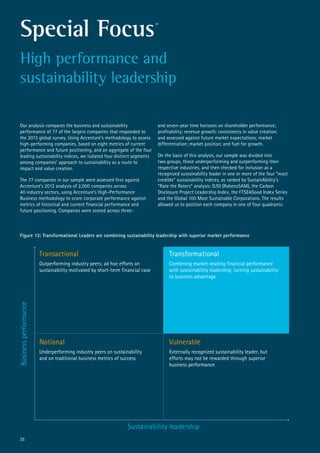
  • 21.
    Challenges of growthand employment Our study suggests that “growth and employment” has become the critical issue for the majority of CEOs when considering the importance of sustainability to their business. Asked which global sustainability challenges are the most critical to address for the future success of their business, a staggering 69% of respondents identified “growth and employment” as the key challenge. This issue clearly highlights the immediacy of sustainability challenges and the focus of businesses on related issues. Livelihood generation is an important area for most sustainability initiatives in India. There is no dearth of human resource in India, but businesses will need to develop a skilled and employable workforce to meet their growing needs. Growth & employment 41% 69% Energy Climate change 38% Education 31% Health 28% Water and sanitation 25% Poverty eradication 25% Corruption 13% Peace and security 13% Food security 9% Inequalities Others 0% Source: Accenture – UNGC CEO Study 2013, responses from Indian CEOs Which of the following global sustainability challenges are the most critical to address for the future success of your business? 3% None of the above 6% Figure 7: ‘Growth and employment’ takes precedence over any other global challenge to be addressed Need for unified sustainability reporting technologies and structure According to the Global Reporting Initiative (GRI) website, around 80 Indian companies from various sectors produce sustainability reports, and about 60 of them publicly declare that they use GRI’s Sustainability Reporting Guidelines. As per GRI, reporting is restricted to larger Indian companies. GRI guidelines seem to be the most adopted process for reporting in India.21 But lack of clarity in reporting and standards is a key issue related to the whole process of sustainability monitoring in India. Despite increased pressure on businesses with regard to managing, prioritizing and integrating reporting requirements, lack of unified reporting and definitions make it difficult to comply. According to Tony Henshaw, chief sustainability officer of Aditya Birla Management Corporation, “There is a need for unified and standard definitions and also a need for unified reporting.” Various organizations including the Reserve Bank of India and Central Public Sector Undertakings have been playing a crucial role in encouraging companies to commit to sustainability reporting. In 2011, the Securities and Exchange Board of India (SEBI) issued a mandate that the 100 top entities must submit Business Responsibility Reports as a part of their annual reports.22 JSW Steel’s Paresh Tewary told us, “The regulators in India are playing a leadership role to create holistic guidelines and frameworks for reporting on shared value though the National Voluntary Guidelines (NVG), SEBI’s requirement for NVG adoption and Business Responsibility Reports and Companies Act with 2% profits spend for companies. These frameworks and approaches are at an initial progressive stage. There is a positive need for integrated reporting frameworks and forums for companies on sustainability.” Policies not representing the actual scenario in India Most business leaders in India agree that current policies are not sufficient to push the sustainability agenda to the extent required. CEOs believe that governmental and relevant agencies still need to develop regulations to help the sustainability drive gain momentum. Existing regulatory policies are perceived as extremely complex, and there is a lack of clear incentives from the financial community. Some 91% of respondents in India believe that government policymaking and regulation will be critical to progress. That is higher than the 83% of global CEO respondents who hold that view. The call for strong and decisive government action is reflected in business leaders’ views on the most effective policy tools for governments to adopt. Their answers reflect a conviction that government must get involved through “harder” interventions: nearly two-thirds of CEOs, 63%, call for governments to adjust subsidies and incentives. Similarly 63% include regulation and standards among their priorities for policymakers and 25% seek intervention through taxation. Perhaps surprisingly—and almost certainly influenced in some quarters by the short-comings of the European Union Emissions Trading Scheme—just 16% see “trading schemes and markets” as an effective policy tool. 20
  • 22.
    Building a sustainabilitybusiness case Despite economic pressures, many CEOs grasp the business opportunity in taking a leadership position on sustainability. The majority, 91%, see sustainability primarily as an opportunity for growth and innovation, and 84% see it as a route to competitive advantage in their industry. Approximately 97% also believe that businesses should measure both positive and negative impacts of their activities on sustainability outcomes, and 100% of the respondents declare that they already do. However, business leaders in many cases are unable to locate and quantify the business value of sustainability; are struggling to deliver the business case for action at scale; and see market failure hindering business efforts to tackle global challenges. Only 41% of the leaders believe that they are able to accurately quantify the business value of their sustainability initiatives. Most CEOs agreed that within the business community the perception is that sustainability and economic value cannot exist simultaneously. The returns are intangible compared to a economic health. Convincing all stakeholders regarding the feasibility of incorporating sustainability into the business is a mammoth task. CEOs and business leaders recognize the need to create an internal change in mind-set regarding sustainability. Preparing a business case against an environmental case is not always easily possible. Most business leaders agree that a sustainability mind-set is best tested in an environment like the current situation. Our conversations suggest that sustainability continues to be pigeonholed as a marginal issue, still regarded by many companies as an extra cost to be cut in the face of short- term financial pressures, rather than as a core part of strategies to generate value through revenue growth, cost reduction or brand impact: 38% of CEOs report that economic conditions have made it more difficult to embed sustainability into core business. During difficult economic times, sustainability projects tend to be pushed off to the side, and resources and capital allocation to any projects or initiatives not contributing directly to the bottom line is lowered. This situation was pointed out by some of the business leaders as a primary issue, especially because India is not yet a mature market as far as sustainability is concerned. As Shankar Jadhav, head of strategy and corporate communications at BSE put it, “There is a need for the Indian corporates to migrate from philanthropy and dominantly supporting traditional activities such as religion and culture (which is not necessarily CSR) to business sustainability.” Some leaders in India also believe that there has been a mixed reaction to the “triple bottom line” concept for stakeholders along the social, environmental and economic axis. As Aditya Birla’s Tony Henshaw put it, “Some don’t believe that it is working; it may not be resonating with CEOs.” Subsidies and incentives Regulation and standards Rule of law 41% Investment in development of the local workforce/talent 34% Taxation 25% Information and voluntary approaches 25% Trading schemes and markets 16% Public investment 13% International trade rules 9% Public procurement and purchasing 9% Other Source: Accenture – UNGC CEO Study 2013, responses from Indian CEOs Which policy tools could be most effective for governments in promoting sustainability in your industry? 0%None of the above 3% 63% 63% Figure 8: Businesses call for governments to adjust subsidies and incentives and prioritize regulations and standards Clearly, CEOs want policy and regulation that can provide long- term investment stability and clear impact, but they are wary of future interventions that mimic previous failed initiatives such as the Emissions Trading Scheme. The transition towards companies promoting sustainability through the business case promised a new era of market solutions to global challenges, but in the face of limited progress business leaders are beginning to express doubts over the potential for greater scale and speed without active government intervention. 21 of CEOs in India believe that businesses should measure both positive and negative impacts of their activities on sustainability outcomes. 97%
  • 23.
    Challenges for Indiancompanies to institutionalize sustainability The traditional approach to sustainability or any other form such as CSR has been to establish a separate entity within the organization to manage the sustainability agenda. In the current scenario, a key challenge exists in scaling sustainability and institutionalizing it across the company. “In India, one of the early approaches by companies has been to start their own foundations to channelize their profits into “CSR” activities, but both the foundations and companies are very different kinds of entities and continue to bring about issues around corporate governance and lack of transparency.“ BSE’s Jadhav told us. We do find that business leaders have largely been successful in making the case within their organizations: 78% of CEOs report that sustainability is now discussed and acted upon at the board level, and none of the respondents cite a lack of support from top management as a barrier to progress. Employees remain an important influencer, too, with 38% of CEOs citing their employees among their top five stakeholder groups in driving their approach to sustainability. Yet, within most organizations in India, sustainability is limited to being a separate entity, from core businesses and operations. The differences lie in the way the companies are structured. Large energy companies, for example, may have a sustainability manager at every site or plant, seemingly stemming from the need to maintain compliances and regulations. Other non- high-risk organizations may have a central sustainability organization with a network across various locations. There are also differences in the way sustainability is managed in mono-industry companies compared to conglomerates. Unlike mono-industry companies where sustainability can be managed and institutionalized comparatively easily, conglomerates are very complex due to multi-industries issues to solve. Besides scaling up sustainability, companies face the task of institutionalizing sustainability. Interestingly, 78% of respondents believe that sustainability objectives should be included in the performance assessment and remuneration of employees, but only 69% actually have that in place; 81% went a step further to agree that managers should be incentivized to prioritize the achievement of long-term sustainability goals over short-term sales and profits, but again only 50% agreed that that is being practiced now. “Tata Chemicals, for example, utilizes a balanced scorecard approach in which sustainability is one of the key elements. Most bonuses and variable compensation for managers are based on their performance on sustainability as captured in the balanced scorecard.” Ramakrishnan Mukundan informs us. As Beroz Gazdar, Chief Sustainability Officer, Mahindra and Mahindra Limited mentions “The most effective way to embed sustainability in the DNA of the organization is by appropriately including the Environmental, Social & Governance parameters in the Key Result Areas (KRAs) of employees across all levels and functions.” Currently, the challenges faced by Indian companies when it comes to implementing sustainability initiatives are internal as well as external. Externally, companies’ growth has to balance out with the needs of the communities in which they work—all within a difficult business environment. It also entails encompassing existing policies, regulations and maintaining compliance. Internally, companies are running sustainability initiatives across the organization but need to institutionalize them and scale them up. Companies also need to work out the best way to embed sustainability into their business strategy and develop a business case for their efforts. 22 of Indian CEOs believe that they are able to accurately quantify the business value of their sustainability initiatives.41%
  • 24.
    "Our challenge isto keep up with our past and push the envelope on sustainable business to maintain our leadership position." Arunavo Mukerjee, CEO, Tata Cleantech Capital Ltd. "Environmental and social concerns are now being addressed as boundary conditions and are integral to all our initiatives. They are no longer thought of as issues to be addressed post facto." G.V. Prasad, Dr. Reddy’s Laboratories "There is no choice for businesses but to get on the road to sustainability– it is unsustainable to be unsustainable." Ramakrishnan Mukundan, Tata Chemicals Limited CEOs on sustainability "I firmly believe that the innovative energies of business can bring about transformational change to create a more secure, sustainable and inclusive future." Y C Deveshwar, ITC Limited “Today, a sound programme encompasses responsible business strategy and innovative business solutions along with a sustainable business model that not only serves the company’s interests but the interests of society at large.” Sudhir Vasudeva, Oil & Natural Gas Corporation Limited "Today, there is no distinction between what you do for profit and how you drive positive change. The more you drive positive change, the more enhanced your business model." Anand Mahindra, Mahindra and Mahindra Limited “Sustainability ought to be based on the collective strength of synergy… of sowing the seeds of innovation and nurturing the saplings together. Being leaders in the field, Essar is continually forging partnerships to innovate solutions that last.” Prashant Ruia, Essar "Organizations today are greatly aware of the impact of their decisions and actions on the wider stakeholder spectrum, and YES BANK remains committed to adopting inclusive and equitable business practices that maximise positive outcomes for India’s economic and social development agenda." Rana Kapoor, YES BANK “There is a need for market incentives as well as regulatory and financial instruments to drive sustainability.” Prashant Ruia, Essar "Technology transformation has to come. Technology is the game changer." Praveer Sinha, Tata Power Delhi Distribution Limited "There is a direct link between energy and water and you can’t solve one without the other." Kamal Meattle, Paharpur Business Centre 23
  • 25.
    of Indian CEOsindicate that personal motivation is one of their most significant motivations to act on sustainability.41% 24
  • 26.
    Chapter 3 Sustainability initiatives: Philanthropyto core business So, what are the Indian companies doing? Based on our interviews and survey, our study identifies three levels on which Indian business sustainability initiatives broadly work: • As communities come to the fore as the biggest stakeholder, companies put them at the core of all sustainability activities. Addressing community issues, working on their betterment and providing for the local population are what drive the initiatives in this area. • Other key initiatives are focused around resource efficiency and in particular energy: energy efficiency, energy savings, renewables and alternative energy are the various modes that Indian businesses adopt to minimize risks. • The third and most widely practiced sustainability initiative is reporting. Community initiatives As discussed earlier, engaging with local communities turns out to be the most important initiative for most companies in India. Mr. Vijay Bhatnagar, CEO of ArcelorMittal, India and China mentioned “CSR or corporate social responsibility is key to the project’s success. If there is no buy-in from the local people, there is no project. People who are leading the project are leading “Social Engineering”. Companies run initiatives around education, employability and generation skilling as the local communities grow and move from one generation to another— companies need to move as the skills profile changes for the local communities. Most Indian companies remain entrenched in the community around them; each benefiting from the other. Initiatives Details Examples/Comments Education and awareness creation Companies try to get involved in primary and secondary education provision for children in the community. Setting up schools becomes a major initiative as most remote places where plants and factories are built may lack basic education facilities. Businesses are also taking initiatives to empower women with girls’ education drives. Large companies like Tata Power have awareness programs for children. ‘Tata Power Energy Club’ (TPEC) is an Energy Conservation initiative to create awareness related to energy crisis in India. This informal Energy Conservation Club is formed to spark off a youth initiative for curbing energy-wastage through active measures. Initiatives like these help create a positive image of the company, while helping educate the younger generation.23 Livelihood generation Employment generation for a community usually follows the establishment of an industry in a given area. In India, companies have been actively engaging to ensure employment of local populations to avoid any unrest. Companies often also provide training and development to increase the job skills of the local population. Companies such as GAIL Limited have helped local residents in nurturing skills so that they can obtain employment with GAIL.24 As Mr. S Venkatraman, Director, Business Development, GAIL illustrates “At our Jhabua site, one of our employees, a native to the area has made financial and personal commitment to the cause for the upliftment of the local community”. Engagements like these help reduce the companies’ risk on their license to operate. Health Healthcare is an integral part of the social initiatives by companies in India. Providing basic healthcare, organizing immunization drives and training midwives are some of the initiatives that companies offer to the local community. Global pharmaceutical company Novartis, for example, launched Arogya Parivar (“healthy family” in Hindi), a for- profit social initiative, in 2007 to provide a new health services delivery model in rural areas of India. Patients receive complete treatment at an affordable, fixed price through a dependable network; for Novartis, the program became profitable within 30 months, and sales have increased 25-fold since 2007.25 Access to safe drinking water As a country with severely water-scarce regions spread across the geography, access to clean drinking water is a luxury to vast sections of the population. WaterHealth International helps local communities install, operate, and maintain water purification plants to provide drinking water. It takes 20 days to install a new Waterhealth center. The quality of water to exceeds the World Health Organization (WHO) standards.26 In India, social issues are concentrated mainly around the following initiatives: 25
  • 27.
    Emissions and energy Emissionscontinue to be an important issue, especially for large oil and gas, utilities, and energy companies across the globe. For oil and gas industries, for example, fugitive emissions are inevitable realities, whether from pipelines and when gases are vented out or when flaring is done. With regulations regarding emissions already in place, most Indian companies are now careful with managing emissions. Companies with large B2B customer bases also need to strive to meet emission norms. Emission norms are most pronounced in the automotive sector, where vehicles need to carry a specific stage certificate of emission. Business leaders mentioned the use of latest technology, primarily equipment to curb emissions. However, in a study by Accenture and CDP, we found that the most commonly reported drivers supporting investments in emissions reduction projects are financial benefits from increased energy efficiency and regulatory compliance. Energy-efficiency activities constitute 69% of the emissions reduction initiatives undertaken by Indian companies and contribute to 41% of the total CO2 e (carbon dioxide equivalent) emissions savings. Activities that increase the energy efficiency of processes, such as the optimization of plants, initiatives to decrease energy consumption and utilization of energy-efficiency production units, constitute 54% of the emissions reduction initiatives and contribute 39% of the total emissions saved.27 In this study, energy came out as the second most important issue (41%), and climate change (38%) was a close third. Both are signs that business leaders are looking at a future where more stringent regulatory and economic factors are going to drive the way they incorporate sustainability. Energy efficiency and renewable energy Growing domestic demand and fuel imports have put a lot of pressure on India’s energy sector. India may be heading towards an energy crisis due to lack of sufficient capacity to make timely and adequate investments.28 Additionally, losses due to electricity transmission and energy theft are estimated to be 26.4%.29 Energy from conventional sources has also been the focus of most Indian companies due to its rising cost. The parallel decrease of cost for wind and solar energy has made stronger the case for renewable energy to complete with conventional sources of energy.30 Companies such as Tata Cleantech Capital Ltd. are expected to fund as much as Rs. 2,500 crore ($401 million) of renewable and energy-efficiency projects in India as costs for coal-based power prompt companies to turn to alternatives.31 Regulations play a role as well; the government requires electricity distributors and large industrial companies to get as much as 10% of their energy from renewables. Those unable to source enough energy locally must comply with the regulation by purchasing credits from clean-power plants.32 Companies are now gearing up to tackle these challenges. As part of its smart grid initiative, Tata Power Delhi Distribution will collaborate with IBM to develop an advanced metering infrastructure and demand response pilot program that will automate and regulate supply of electricity to consumers in sync with the fluctuating demand.29 Companies are also looking at innovative approaches, trying to be future-ready and use renewable energy certificates. Demand for renewable-energy credits in India doubled in November 2013 as regulators enforced clean-power targets for companies and state-run utilities.32 The focus on energy-efficiency by Indian companies is also not surprising considering that energy- efficiency equipment is incentivized by the central government with tax benefits through accelerated depreciation schemes (80% depreciation in the first year).27 Solar energy Most business leaders in India seem optimistic about solar power; indeed, solar energy is what they believe will drive the future of energy in India. Jawaharlal Nehru National Solar Mission, a government initiative was launched in 2010 with the aim of deploying 20,000 megawatts of grid-connected solar power by 2022. The target is to reduce the cost of solar power generation through long-term policy; large-scale deployment goals; aggressive R&D; and domestic production of critical raw materials, components and products. It has been envisaged to achieve grid tariff parity by 2022.33 Many companies have also invested in solar power as a future investment. Praveer Sinha, CEO of Tata Power Delhi Distribution, told us that the “solar technology cost curve is going to move radically in terms of efficiency curve. Solar technology cost curve will begin yielding returns so, it may be possible to make cheaper panels. This will allow for solar absorption, individual rooftop solar panels that can supply to grid, and then pull a night-time tack back.” Tata Cleantech Capital Ltd., which began operations in April 2012, is looking at funding energy-services companies that will allow customers to earn the benefit without the capital outlay. This model for example would work for companies which can invest in a solar installation, run it and provide the output under a long-term contract to a consumer at a competitive rate.31 However, companies realize that full potential of solar power is not viable with the current technology. Solar installations and energy-efficiency projects require large, initial investments and generate savings over time. The other limitation with solar power that some CEOs pointed out is area availability. Some business leaders believe that countries like China are at an advantageous position due to more land availability than India. Despite the limitations, solar energy seems to be the most promising source of energy that business leaders in India are looking at for the future. 26
  • 28.
    Sustainability reporting Business leadersin India highlighted lack of reporting guidelines as a challenge, despite this, companies are increasing their reporting initiatives. In the Carbon Disclosure Project, there was a 35% increase in the reporting from Indian companies from 2007 to 2011. Over the same period, the GRI received 88% more sustainability disclosures from Indian businesses.36 The increasing trend in voluntary sustainability reporting by businesses can be taken as a serious indication of their dedication toward evolving into sustainable enterprises. GRI lists India as the country with the most comprehensive use of GRI’s Guidelines. Application level checks confirmed that 74% Throughout our conversations with CEOs and other business leaders, the issue of water scarcity was often mentioned. Though the key focus area for most businesses seems to be energy, water is the new entrant on most companies’ list of sustainability initiatives. Industries tend to get the least priority for allocation of water in case of severe scarcity; the priority shifts to water for domestic use, followed by agriculture and then industry. Going forward water could be a huge business risk to companies operating in water-scarce and water-stressed areas, and also increase the vulnerability of ecosystems and the people in it. Additional risks, other than water scarcity, are increasing costs of water access and treatment, and reputation and license to operate. The key is to recognize that basins, which sustain lives, livelihoods and environment, all have a shared risk. Therefore, getting the response right is as much a business imperative as it is a social and ecological one.34 Tata Chemicals’ Mithapur plant in Gujarat recently received the FICCI Chemical and Petrochemical Award for Efficiency in Water Usage in the Chemical Sector. Mithapur has an arid climate and is a water stressed region. Tata chemicals, operating in the region has revamped its technology to enable conservation of freshwater, substitution of freshwater with seawater and re-using the same water for different purposes. The company has been able to eliminate its dependence on groundwater and optimize the use of water by re-cycling.35 A lot of companies are looking into ways to optimize water usage by investing in such technologies as water optimization programs and water harvesting techniques. Most CEOs realize that although there is no price to water as of now, water scarcity may be the biggest challenge India businesses will face going forward. Waste management has also started to show up in the sustainability initiatives of many organizations. Waste management initiatives in India include primarily waste reduction and waste-to-energy plants. Initiatives differ across industries and sectors. Though still at a nascent stage, waste management is also gaining importance on the CEO’s priority list for sustainability initiatives. Water and Waste: Need for bolder action Figure 9: The majority of Indian CEOs think that companies should practice integrated reporting of financial and sustainability metrics of GRI sustainability reports from India covered the maximum amount of standard disclosures and were externally assured, compared with just 32% globally. The numbers of companies reporting has steadily increased since the base year 1999, and the comprehensive use of GRI’s reporting guidelines has been notable since 2008, largely because of a significant shift in the policy paradigm and awareness on the importance of sustainability. The key Indian sectors reporting under GRI were conglomerates, mining, metal products and chemicals, followed by energy, construction, automotive and commercial services. In 2012, 69% of reporting under GRI was done by private companies, and the remaining 31% was done by state-owned companies, subsidiaries and public institutions.37 India has become one of the first countries to prescribe expenditure for (qualifying) companies toward CSR with the Companies Act 2013. The new bill mandates companies to adopt a CSR policy, constitute a board-level CSR committee for oversight and implementation, and disclose their activities.38 Legislative levers and regulatory mechanisms are playing a key role in ensuring more and more companies take up sustainability reporting. In 2012, the Securities and Exchange Board of India mandated the largest listed entities in India to publish their Business Responsibility Reports. Around 100 companies fell into this category which were required to do so in 2013. About half of these were doing the reporting for the first time.38 From our study it is quite apparent that sustainability efforts are concentrated mainly around community betterment, energy efficiency and sustainability reporting. Indian companies for now are focusing on the low-hanging fruit, largely because of the environment in which they operate. Unlike in the developed world, where the socio-economic situation is better and the crunch on resources such as water is lesser, Indian businesses cannot remain alienated from the people and the environment in which they operate. As large-scale development occurs, the standard of living improves and mechanisms to optimize resources are put in place, sustainability efforts by companies will also start maturing. 28% 60% 6% 6% To what extent do you agree that companies should practice integrated reporting of financial and sustainability metrics? Source: Accenture – UNGC CEO Study 2013, responses from Indian CEOs Strongly agree Disagree Strongly disagree Neither agree nor disagreeAgree 27
  • 29.
    Indian CEOs viewenergy as the second most critical challenge after growth and employment.41% 28
  • 30.
    Special Focus India andChina: Sustainability viewpoints In this year’s global study, we set out specifically to increase participation in Asia, both in our survey and in our interviews with CEOs, so we might better understand the unique perspective of business leaders in some of the world’s fastest-growing economies. Challenges of language and culture have previously meant that Asian economies may have been underrepresented in studies on sustainability, but with its rapid economic and population growth, allied to a rising impact on global sustainability challenges, the “Asian Century” deserves closer examination. Asia is the world’s largest and most inefficient resource user: the region requires three times as much energy input per earned dollar of GDP, and on its current trajectory is forecast to triple carbon emissions by 2050. The region faces a “trilemma” of challenges: rising affluence and consumption; growing resource scarcity and environmental pressures; and ongoing urbanization at a rapid pace. These mega trend conditions are not unique to Asia—they can be seen as characteristic of most emerging economies—but the sheer scale of the region commands attention. Of the top ten countries that represent the largest portion of the world’s population, half are in Asia (China, India, Indonesia, Bangladesh and Japan); India and China alone constitute more than one-third of the world’s population. ASEAN economies (the Association of Southeast Asian Nations) are on track to be the next big growth engine within Asia, rapidly catching up with India in terms of GDP and projected to grow by 6% per annum between now and 2030. With a strong economy, often commanding political power and a rapidly urbanizing population, the potential for change and transformation in Asia is formidable. From our conversations, many Asian CEOs believe that their peers in the region may be trailing their global peers in the integration and advancement of sustainable business. The historical context of Asian business, and the close links between often family-owned companies and local communities, can make the step toward modern conceptions of corporate sustainability a natural one. But it is clear from our conversations that in many companies, sustainability may not yet have made the transition from a philanthropic concept toward an approach embedded into companies, industries and markets. Our interviews suggest that many companies remain motivated by an agenda of compliance or business ethics, rather than fully integrated into corporate and business strategy; at root, sustainability is often seen as a “license to operate,” with the health and prosperity of local communities the primary factor as companies look to build a social contract that ensures longevity and stability. Despite historical tradition, Asian CEOs are not yet leading on sustainability— but as Asian companies become ever more global, external pressures will rise, and the potential rewards will multiply.39 Global 39% 32% Asia India 22% China 67% To what extent do you agree with the following statement regarding global sustainability challenges and the role of business? The global economy is on track to meet the demands of a growing population within global environmental and resource constraints Source: Accenture – UNGC CEO Study 2013. Completed India and China responses Figure 10: Business leaders in China are more likely than those in India to think that the global economy is on track Sustainability viewpoint, drivers and issues across geographies It is simplistic, of course, to view Asia as a single entity: while there may be similarities, and common challenges, individual circumstances across individual countries lead to a great diversity in companies’ approach to sustainability. One reflection from our 2013 findings would be that, on sustainability at least, Asia is at least as diverse as comparable regions around the world, if not more so. From our observations, the responses from China and India individually seem to vary in some aspects from the global responses. When considering global sustainability challenges in the context of the overall economic climate, the Indian community seems a bit on the pessimistic side (22%), while China’s response is far more positive (about 67%). Similarly, more than half of Chinese CEOs and business leaders think that business as a whole is making sufficient efforts to address global sustainability challenges, while only 33% of CEOs globally and 44% in India agree. However, 100% of Chinese CEOs and 94% of Indian business leaders agree that sustainability issues are important to the future success of businesses. 29
  • 31.
    There are interestingcomparisons between how leaders in China and India perceive sustainability to be implemented from their business perspective. • In India as well as China, CEOs believe that their primary responsibility is to ensure that their business contributes to the community and that they are accountable for the sustainability performance of their company. • However, business leaders in China mostly (83%) believe that their role should be limited to providing goods and services that people want and need at prices they can afford. Globally only 26% of business leaders believe that their role can be limited to such a situation. Indian CEOs are divided; 41% agree with a limited role as far as the personal agenda in advancing sustainability is concerned. • As in global responses, brand trust and reputation are currently the biggest drivers for CEOs and business leaders in China and India. • Similarly, growth and employment are the most critical challenges to be addressed; the issue seems to resonate more closely with Indian and Chinese business leaders than with their global counterparts. • India seems to be an outlier as far as barriers that keep a CEO from implementing an integrated and strategic company-wide approach to environmental, social and corporate governance issues. Globally as well as in Asia and China, business leaders believe lack of financial resources and competing strategic priorities or no clear link to business value are the reasons for not moving ahead on these issues. In India, 63% of business leaders believe that difficulty due to operating environment is the main barrier to implementation to a company-wide approach. Stakeholder concerns There are also key differences in terms of the way Indian companies view stakeholders’ importance and the way their global counterparts view it. • Most of the global (64%), Asian (63%) and Chinese (62%) respondents regard consumers as the stakeholder group that will have the greatest impact on the way societal expectations are managed by a company. In contrast, Indian business leaders view community efforts as being the core of their companies’ sustainability strategy. • Nearly 63% of Indian business leaders believe that communities will be the biggest stakeholder to influence them in the next five years. Most Indian corporate sustainability initiatives are also focused toward community inclusion and betterment. Only 7% of Chinese CEOs think communities will be important stakeholders over the next five years. • Interestingly, half of Indian business leaders (56%) don’t view sustainability as merely a way to give back to society, in contrast to 70% of Asian respondents and 83% of Chinese respondents. • The role of investors in India is also limited to a certain extent. Around 56% of Indian CEOs, in sync with their global (52%) and Asian (56%) counterparts, believe that investor interest is currently an incentive for their company to invest in sustainability. This number is higher in China, with 86% respondents regarding investor interest as an incentive. • Similarly, leaders of Indian companies view consumer purchasing behavior as less important than most global, Asian or Chinese CEOs. • Expectations from governments to be the initiator and promoter of sustainability agenda is a common denominator across geographies. Companies are looking to governments to draft relevant policies, provide subsidies and enforce regulations supporting the sustainability agenda. Global Asia India China To what extent do you agree with the following statements regarding your personal role in advancing sustainability? As a CEO, I… 93% 88% 97% 88% (a): Believe that my primary responsibility is to ensure my business contributes positively to the communities in which it operates 49% 26% 41% 83% (b): Believe that my role should be limited to providing goods and services that people want and need at prices they can afford (c): Am held accountable for the sustainability performance of my company 90% 83% 94% 98% Source: Accenture – UNGC CEO Study 2013. Completed India and China responses Figure 11: More CEOs in China view their role as limited to fulfilling consumer demands than in India or globally 30
  • 32.
    Figure 12: CEOsand business leaders in China seemed more confident about their sustainability strategy as a part of core business How are companies across Asian geographies responding? Overall, in sync with the global CEOs, business leaders in India and China also agree that more is being done to incorporate sustainability into business strategy now than five years ago. Interestingly, CEOs and business leaders in China seemed more confident than their Indian and global counterparts that a focus on sustainability will increasingly be embedded into company strategy. CEOs in China were comparatively also more confident regarding the speed and effectiveness of execution on their company’s sustainability strategy. Although the Indian business leaders think the economic climate is not conducive to businesses, half of them, more aligned to the Asian responses, mentioned that the economic downturn has prompted their company to increase its focus on embedding sustainability into its core business. Compared with the global and Chinese business leaders, however, Indian CEOs were the least satisfied with the speed and effectiveness of execution of their sustainability strategy. There are differences in responses in China and India surrounding the overall incorporation of sustainability as well as motivations and stakeholders. • While China’s response to the overall climate and the way sustainability is progressing in the country is more optimistic, the response in India takes a cautious tone. • Similarly, in India, personal motivation of CEOs and involvement of communities rank higher than in China as factors to drive sustainability. In China, consumer demand is seen as an important driver to sustainability, and consumers and employees figure as major stakeholders. Though both are part of Asia’s fastest-growing economies, India and China have mixed responses to sustainability. The two Asian giants are different from a social, cultural and governance point of view, and that seems to play a major role in how sustainability is taking shape in business scenarios. The economic downturn prompted my company to increase its focus on embedding sustainability into core business The economic downturn has made it more difficult to embed sustainability into core business As CEO, I am satisfied with the speed and effectiveness of execution on my company’s sustainability strategy Global IndiaAsia China As CEO, to what extent do you agree with the following statements regarding sustainability in your company? 76% 78% 72% 93% 40% 37% 38% 26% 39% 58% 56% 95% Source: Accenture – UNGC CEO Study 2013. Completed India and China responses 31
  • 33.
    of Indian CEOsdon’t view sustainability as a way to give back to society, in contrast to 70% of Asian respondents and 83% of Chinese respondents. 56% 32
  • 34.
    Chapter 4 Looking intothe future: Lessons from high performers The agenda for action: Seven steps to sustainability and success39 Leading companies are not waiting for policymakers to act. Our conversations with CEOs globally suggest that in the absence of government intervention, some are beginning to harness the potential of sustainability: moving from a reactive approach of responding to societal expectations and regulatory demands, leading companies are now driving sustainability as an engine for innovation and growth. The advances of these leading companies, and their adoption of large-scale, collaborative projects targeted directly at value creation through addressing the priorities of global sustainable development, are beginning to demonstrate how business impact can be scaled beyond incremental advances and efficiency gains. This year, the Global Compact and Accenture study team set out to investigate the links between CEOs’ attitudes and the performance of their companies against traditional business performance metrics and sustainability leadership indicators. To our knowledge, this is the first time that this has been undertaken with a CEO-level group. While extensive work has been done on the correlations between a commitment to sustainability and traditional metrics of business performance, the CEO Study across countries, presents a unique opportunity to examine how business leaders’ beliefs, attitudes and behaviors influence their strategies and investments, as well as set the trajectory of their companies in driving advantage through sustainability. An examination of survey responses from those companies covered by this year’s study and by Accenture’s long-term High-Performance Business research program produces the early indications of a potentially striking conclusion. CEOs of companies that combine externally-recognized sustainability leadership with market-leading business performance, as measured by traditional metrics including revenue growth, profitability and shareholder returns, approach sustainability in markedly different ways to those who are failing to achieve this distinction—with different motivations, different influencers and different areas prioritized for investment, innovation and action. The Global Compact Network India (GCNI) works toward mainstreaming the ten universally acceptable principles in business activities around the world, catalyzing action in support of broader UN goals, such as the Millennium Development Goals, and setting the tone for the post-2015 development agenda within the Indian context. At present, the India network ranks among the top three of the 101 local networks in the world, and it has emerged as the largest corporate citizenship and social responsibility organization in the country with a pan-Indian membership. With a membership of 151 renowned organizations as GCNI pivotal signatories, the local India network has created a strong niche for itself in the past nine years.40 Indian CEOs and business leaders had specific thoughts in mind around how the Global Compact can help achieve sustainable development and balanced growth. Nearly 63% of business leaders feel that developing platforms for collective action is foremost. Business leaders expect the Global Compact to help broaden the horizons for a number of Indian businesses, to provide opportunities for global leaders to share best practices and help in knowledge transfer around sustainability. They also mentioned the Global Compact to act as an innovation center and create an environment for companies to learn new solutions that will help them tackle various sustainability issues. Of the business leaders, 53% think that developing and recommending tools and guidance materials are one way that the Global Compact can help address sustainability issues for companies. Companies are also looking at the organization for support with technology, especially in areas such as solar energy. Businesses expect that in India, the Confederation of Indian Industry, GRI and Global Compact could work together on advancing sustainability issues in Indian businesses. The Indian business community, as is evident from our interviews, expects the Global Compact to collaborate, assist and provide a platform for pushing the sustainability agenda deeper into Indian business models. Role of the Global Compact 33
  • 35.
    of business leadersagreed that their companies plan to employ circular economy business models over the next five years.41% 34
  • 36.
    Our analysis comparesthe business and sustainability performance of 77 of the largest companies that responded to the 2013 global survey. Using Accenture’s methodology to assess high-performing companies, based on eight metrics of current performance and future positioning, and an aggregate of the four leading sustainability indices, we isolated four distinct segments among companies’ approach to sustainability as a route to impact and value creation. The 77 companies in our sample were assessed first against Accenture’s 2012 analysis of 2,000 companies across 40 industry sectors, using Accenture’s High-Performance Business methodology to score corporate performance against metrics of historical and current financial performance and future positioning. Companies were scored across three- and seven-year time horizons on shareholder performance; profitability; revenue growth; consistency in value creation; and assessed against future market expectations; market differentiation; market position; and fuel for growth. On the basis of this analysis, our sample was divided into two groups, those underperforming and outperforming their respective industries, and then checked for inclusion as a recognized sustainability leader in one or more of the four “most credible” sustainability indices, as ranked by SustainAbility’s “Rate the Raters” analysis: DJSI (RobecoSAM), the Carbon Disclosure Project Leadership Index, the FTSE4Good Index Series and the Global 100 Most Sustainable Corporations. The results allowed us to position each company in one of four quadrants: Businessperformance Sustainability leadership Notional Underperforming industry peers on sustainability and on traditional business metrics of success Vulnerable Externally recognized sustainability leader, but efforts may not be rewarded through superior business performance Transactional Outperforming industry peers; ad hoc efforts on sustainability motivated by short-term financial case Transformational Combining market-leading financial performance with sustainability leadership; turning sustainability to business advantage Figure 13: Transformational Leaders are combining sustainability leadership with superior market performance Special Focus39 High performance and sustainability leadership 35
  • 37.
    “Notional”: companies regardedas neither high-performing businesses nor sustainability leaders, underperforming their industry peer group and not regarded as a sustainability leader by any of the four leading indices; these companies may be struggling to devote resources to sustainability or may not have constructed the business case for action and are making largely notional efforts. “Transactional”: high-performing businesses not regarded as sustainability leaders; action on sustainability may be prompted by a short-term, quantifiable business case, but leaders may be unwilling to go beyond a transactional approach with immediate and discernible payback. “Vulnerable”: sustainability leaders underperforming their peers on traditional business metrics; leadership position in sustainability may be vulnerable without turning leadership into business advantage and value creation. “Transformational”: companies regarded as sustainability leaders that are also outperforming their industry peers on traditional business metrics; these companies may be finding ways to monetize sustainability and link action directly with a quantifiable business case, turning sustainability to competitive advantage through potentially transformational new approaches. The “Transformational” quadrant gives 21 companies in our sample that are managing to combine externally recognized sustainability leadership with market outperformance in their industry. The companies are distributed across 14 countries in every major region; across industries including consumer goods, shipping, insurance, mining, chemicals and pharmaceuticals; and represent more than $900 billion in combined annual revenue. An analysis of responses from the companies within this segment, the “Transformational Leaders,” highlights several observations that may give an early indication of the leadership beliefs, attributes and behaviors that are shaping those companies able to drive business value through sustainability. Indications from the data suggest that Transformational Leaders are more likely to: Regard environmental and social issues as important to the success of their business: Leading CEOs are more likely to prioritize issues such as climate change and water security, to which they attach greater importance than any other sector in our analysis. The global survey suggests that “growth and employment” has become the critical issue for the majority of CEOs when considering the importance of sustainability to their business. But just 38% of CEOs of transformational companies ranked growth and employment among their top three priorities—compared with 64% globally and fully 70% of companies making apparently “notional” efforts on sustainability. Reject traditional perceptions of sustainability as philanthropy: Just 5% of CEOs in the “transformational” segment—versus 51% globally—believe that sustainability is primarily an opportunity to give back to local communities through charitable activities. Similarly, 81% see sustainability as an opportunity for growth and innovation, an approach taken by just 65% of CEOs at “notional” companies. Engage investors on sustainability: 76% of transformational CEOs (compared with 52% globally and 36% among those taking a “transactional” approach) see investor interest as an incentive to invest in sustainability, and 52% believe that their company’s share price already includes value directly attributable to sustainability initiatives—a belief shared by just 25% of CEOs in the “notional” segment. Believe in the transformational potential of partnerships with NGOs and others: 100% of CEOs of transformational companies (versus 78% globally) believe that cross-sector partnerships will be instrumental in enabling their company to deliver positive social and environmental outcomes over the next five years. And a third see NGOs as one of their most important stakeholders, a view shared by CEOs at just 10% of “notional” companies and 15% globally. Measure and reward sustainability in employee performance assessments and remuneration: CEOs of companies driving performance through sustainability share a strong belief that these priorities should be reflected through the performance and remuneration mechanisms of their employees. Fully 86% believe sustainability should be integrated into these discussions, and 67% report that they already do; among companies in the notional segment, 60% believe they should and just 55% report that they already do. 36
  • 38.
    From our research,we see seven key themes emerging that are enabling these transformational leaders to achieve both value creation for their companies and impact on global challenges. 1. Realism & context: Understanding the scale of the challenge—and the opportunity Throughout our interviews, it was clear that those companies taking the most ambitious action on sustainability were also the most realistic about the scale of the challenge. Our survey data suggests that companies combining sustainability leadership with market-leading business performance are more likely to acknowledge that the world is not on track to meet the needs of a growing population—and are more likely to admit that business is not doing enough. Understanding the challenge also allows these companies to appreciate the opportunity and for future growth in providing solutions to sustainability issues and to target strategies to achieve it. 2. Growth & differentiation: Turning sustainability to advantage and value creation With wide disparities in the ability of different industries to monetize sustainability in the short term, one of the clearest insights from this year’s study is the emergence of a two- speed world in sustainability, between those companies still reacting to external expectations on sustainability and focusing on incremental mitigation, and those that see sustainability through the lens of growth and differentiation. For leading companies, the urgency of global challenges provides an opportunity to differentiate their products and services, through superior performance on environmental or social measures, such as lower energy consumption or the generation of local employment; to access new market segments, through the development of new products designed to tackle the sustainability priorities of their customers and consumers; and to grow into new regions, countries and areas where their products can meet a pressing need. 3. Value & performance: “What gets measured gets managed” The past decade has seen an unprecedented rise in companies measuring and reporting sustainability metrics: from carbon emissions to water footprints, tracking environmental measures is now commonplace across industries. For companies seeking to go beyond incremental change and tackle global sustainability issues, the challenge is two-fold: not just to measure and manage metrics of reduction and mitigation, but also to quantify the value of sustainability to the company and to track their impact on the communities in which they operate. 4. Technology & innovation: New models for success As ever-greater challenges demand ever-greater solutions, our data suggests that leading companies are turning to innovation and technology to provide the tools with which to address sustainability challenges and secure business advantage. Environmental and resource constraints, and growing social pressures, are acting as a stimulus for innovation: from investment in renewables, to intelligent infrastructure enabled by machine-to-machine communications technology, to new closed-loop business models, leading companies are securing business advantage through innovative R&D and deployment of technologies ranging from industrial solutions to “smart” information communication technology such as cloud computing and analytics. 5. Partnerships & collaboration: New challenges, new solutions As sustainability issues have risen up the corporate agenda and business leaders have seen these issues playing an ever- greater role in determining prospects for future success, we have seen a growing confidence that business can provide solutions to tackle global challenges. This year, in the context of intensifying pressures and flagging efforts, CEOs more readily acknowledge the role of collaboration and partnerships in meeting their ambitions on sustainability. Business can lead the way, they believe, and can maximize companies’ impact through close partnerships with governments, policymakers, consumers and NGOs. 6. Engagement & dialogue: Broadening the conversation As the conversation on sustainability widens, and expectations on business grow, leading companies are increasingly set apart by their understanding of and responsiveness to stakeholders, often as they manage complex and competing interests. Business leaders are more conscious of the need to establish a constructive, two-way dialogue with consumers and local communities; regulators and policymakers; investors and shareholders; employees and labor unions. Rather than simply acting and then communicating, CEOs are actively engaging stakeholders to negotiate the role of their business in addressing global challenges. 7. Advocacy & leadership: Shaping future systems Leading CEOs are clear that business efforts are not sufficient to set the global economy on track—but believe strongly that business should lead the way toward defining and delivering a sustainable global economy, not least through the post- 2015 development agenda. They are realistic that individually they can have only so much impact, but recognize a need to play a part in collaborative solutions with governments and other stakeholders. Companies positioning for success in an era where sustainability performance will play a greater role in determining industry winners and losers are committed to shaping future systems—and are vocal in advocating for and leading the business contribution to the development of a sustainable economy. From developing new measures of success, to engaging with public policymakers and leading calls for free and open markets, business leaders’ advocacy and public commitment are integral to further progress. 37
  • 39.
    Example actions %of respondents selecting ‘Agree’ and ‘Strongly Agree’ Transformational Notional Global average Realism & context Understanding and appreciation of the scale of global sustainability challenges—and the opportunities they present. Engage in scenario planning and business impact modeling.* Scan the horizon for future opportunities. Business as a whole is making sufficient efforts to address global sustainability challenges. 14% 20% 33% Growth & differentiation Sustainability as an opportunity to stand out with consumers and customers; to access new market segments with new products and services; and to grow into new markets. Innovate to solve specific environmental and social challenges. Seek opportunities to enter new markets through addressing sustainability challenges. My company approaches sustainability primarily as an opportunity for growth and innovation. 81% 65% 78% Value & performance Measurement, monitoring and management of sustainability metrics; quantification of business value; and tracking of impact on sustainability outcomes. Integrate sustainability metrics into financial reporting. Measure and track impact on community and society. Build sustainability into employee assessment and reward. My company practices integrated reporting of financial and sustainability metrics. 67% 45% 49% Technology & innovation Investing in technology and business model transformation- led solutions to sustainability challenges; generating competitive advantage through new technologies and innovative business models. Develop new business models, e.g., circular economy. Deploy new digital technologies, e.g., data analytics. Harness demand for smart infrastructure and Intelligent Cities. My company will invest in and deploy new technologies on sustainability in the next five years. 95% 95% 84% Partnerships & collaboration Partnerships within and across industries and sectors to find new solutions for sustainability. Cooperate with industry peers to develop voluntary standards. Partner with NGOs and other groups to maximize on-the-ground impact. Cross-sector partnerships will be instrumental in enabling in delivering positive social and environmental outcomes over the next five years. 100% 75% 78% Engagement & dialogue Listening to and understanding the needs and wants of all stakeholders; establishing constructive two-way dialogues to negotiate the role of business in sustainability. Collaborate with consumers to design new products and services. Work with investors to quantify and communicate the business value of sustainability. Investor interest is currently an incentive to invest in sustainability. 76% 65% 52% Advocacy & leadership Leadership in developing new systems and shaping the business contribution to global challenges; willingness to advocate for policy and market incentives that change the game. Publicly advocate for a greater business contribution to sustainability. Actively engage with governments and policymakers to shape future regulation and systems. Business should lead efforts to define and deliver sustainable development goals. 90% 75% 84% NB examples represent typical actions and behaviors observed in our interviews and are not intended to be an exhaustive list. The Transformational Leaders: Seven Steps to Sustainability and Success 38
  • 40.
    1. Realism &context - Understanding the scale of the challenge - and the opportunity. Companies, along with the government, currently face a dilemma regarding how to manage the pace of growth for a developing economy like India. Trade-offs need to be managed between pushing for high-growth models to avoid issues of social unrest on the one hand and avoiding severe environmental degradation and increased risk of natural disasters due to climate change effects on the other hand. Indian companies are coming to terms with the fact that publishing sustainability reports and CSR activities are not enough. Companies are increasingly realizing that sustainability can also contribute to business value (such as reduced costs, better management of energy and resources, and new product lines). Companies will need to come up with business models which are realistic and suited to their specific situation. A few companies have tailored their sustainability strategy based on their business model. Essar group operates in multiple geographies and industry sectors. The group’s sustainability strategy has been adopted to suit the sector and the geography with clearly identified short, mid and long term goals .Each of the shipping, steel, power or energy sectors, for e.g. have specific sustainability objectives. This approach helps businesses benchmark their performance with their peers. This also gives their stakeholders an opportunity to review performance against individual targets on a year on year basis.41 2. Growth & differentiation - Turning sustainability to advantage and value creation. The Indian situation today does not seem to be at a stage where companies can turn sustainability to an advantage. But a few Indian companies have been able to show that this goal can be realized. Tata Chemicals’ “Tata Swach,” a portable, replaceable filter-based water purifier, requires no energy or running water to operate. It delivers safe drinking water at a cost of Rs. 30 per month for a family of five. The success of the product is evident from the fact Tata Chemicals sold to 200,000 households in 200 days in the first four states it was launched. It is also being made available through the Indian Post Office Networks and NGOs to expand its reach in rural India.42 3. Value & performance - “What gets measured gets managed.” All of the CEOs who took the survey agreed that it will be critical for businesses to routinely measure and track impact and the business value of sustainability activities to ensure that goals are achieved. ITC, for example, is among the key companies which have been actively reporting under GRI from past 6 years (2007- 2012). It is the only company in the world to be Carbon Positive for 8 years, Water positive for 11 years and Solid Waste recycling positive for 6 years. ITC’s businesses generate livelihoods for over 5 million people.43 4. Technology & innovation - New models for success. Major changes have taken place in the investments around technology at both the macro and micro levels. Many of our conversations with CEOs have centered on the opportunity for digital technologies to empower sustainability solutions. Increasingly, CEOs see disruptive technology innovation as the underpinning for change and growth, and they are turning to digital infrastructure to enable their company to create sustainability impact while generating business value. Business leaders’ outlook for the next five years is concentrated (91%) around investing in and employing new technologies on sustainability, such as renewable energy, energy efficiency, and “smart” information and communication technology systems. As Mr. Praveer Sinha, Tata Power Delhi Distribution Limited puts it “Technology transformation has to come. Technology is the game changer.” As an example Tata Power Delhi Distribution operates a distribution network of 5 million consumers, for whom blackouts are common. When the government decided to implement smart solutions for energy conservation and established the India Smart Grid Task Force, Tata Power recognized the opportunity to address distribution challenges, reduce costs and increase its customer base. In order to facilitate the required digital relationship between customer and supplier and enable the smart grid, Tata Power distributed 40,000 automated meter reading systems, which provide consumer data every 15 minutes. In realizing the potential of smart grids, Tata Power captured significant business benefits: improving the efficiency of the distribution network, ensuring accurate and timely billing, and reducing power outages through improved communication with customers.44 Seven steps to sustainability and success Solutions for India 39 of Indian CEOs believe that business should lead efforts to define and deliver sustainable development goals.94%
  • 41.
    5. Partnerships &collaboration - New challenges, new solutions. Approximately 91% of Indian CEO and business leaders believe that partnerships and collaboration across sectors will be instrumental in the way companies deliver positive social and environmental outcomes over the next five years. 84% of business leaders agree that their company is willing to co-invest with other companies to make progress on priority sustainability issues. Interestingly, 69% of the respondents mentioned that collaboration with NGOs and other stakeholders has produced tangible business opportunities and value for their company. Mahindra & Mahindra has been collaborating with suppliers to address sustainability issues across its supply chain. The company has classified its suppliers on the basis of processes in the supply-chain and the level of the environmental challenges, such as effects of waste disposal. The company has prioritized its suppliers, prone to high risks, for its continuous improvement programme. The M&M Limited’s Farm Equipment sector has also constituted awards for suppliers exhibiting progress on sustainability initiatives. The company also conducts training for suppliers on GRI indicators and tools.45 M&M also ensures there is an alignment to its vision across the supply chain ; the company conducts independent audits of supply-chain contractors to ensure workmen are insured, there is women’s sanitation and a crèche on site, etc.46 There is a need to create new solutions with collaboration as a central element. For example, a key challenge in India is that social enterprises have trouble getting loans because banks require collateral, which many of the social enterprises lack. Government and businesses can play an important role in coming up with solutions to bridge this gap. 6. Engagement & dialogue - Broadening the conversation. The situation in India suggests that investors and consumers are passive in their push for businesses to become sustainable. However most business leaders agree that this situation will change if and when regulations tighten and consumer awareness increases. Businesses wanting to remain ahead of the curve would need to prepare for this scenario. Some companies have been able to successfully engage with stakeholders. SESA Goa, CSR group launched a program called ‘Back to Farming’ in Wagona, a hamlet of Kirlapal-Dabal Panchayat in 2005-06. The project aimed at enabling the local farming community to resort back to their traditional means of livelihood (i.e. agriculture) and to promote sustainable agricultural livelihood. The CSR group organized awareness programs and meetings of farmers and village panchayat members resulting in a revival of about nine hectares of agricultural land, benefitting about 70 farmer families.47 7. Advocacy & leadership - Shaping future systems. Businesses in India are largely debt-funded and hence guidelines and policies set up by banks and lending institutions are a key lever to push the sustainability agenda. Yes Bank for example has been working to promote sustainable finance in India. The company has launched the YES BANK Sustainability Series, the first-ever initiative in India, to promote Risk Awareness in the Environment & Social (E&S) domain in the Financial Sector. The initiative has been launched in association with UNEP FI, GIZ and RIRA. As part of the Sustainability Series, YES BANK along with its partners, will organize quarterly workshops focusing on Project Finance and Environment & Social Risk for Private Equity firms and Insurance firms.48 Multiple levers will be needed to achieve a balanced growth in India. Where companies need to view sustainability as a way of business, support needs to come from governments and financial institutions in the form of regulations and market mechanisms. There is also the need for active participation from investors and greater awareness from customers to achieve the goals in a diverse, growing economy. These factors, combined with a favorable economic climate, can put Indian businesses onto a path of highly evolved sustainable growth. As the Indian economy continues to grow over the coming decades, sustainability challenges will only become more intense. As governments seek to improve the living standards of their citizens, the innovations of business will play a critical role, and in supporting national prosperity, these emerging-market multinationals will have a unique opportunity to play a greater role on the global stage. As leading companies increasingly look to “go global,” a greater maturity will be evident in their approach to sustainability. Going forward, not simply concerned with local issues or driven by philanthropy, leaders of these companies will begin adopting new approaches informed by a search for business value and advantage. In doing so, they will be able to combine the best attributes apparent throughout business—close links to communities, a powerful sense of personal responsibility, and a commitment to national prosperity—with a lens of growth and innovation that can support their efforts in harnessing sustainability as a transformative force for India. 40
  • 42.
    References 1. The EconomicTimes, India Ratings pegs GDP at 4.9%; projects improvement in FY’15, accessed on Jan 14, 2014, http://articles.economictimes.indiatimes.com/2014-01-14/ news/46185565_1_india-ratings-growth-rate-sector-growth 2. Foundation for Sustainable development, accessed on Jan 19, 2014, www.fsdinternational.org/country/india/envissues 3. International Monetary Fund (2013), World Economic Outlook Database, accessed on Jan 21, 2014 4. UNDP (2013), Human Development Report 5. K. Ashish (2013), Development and Ecological Sustainability in India: Possibilities for the Post-2015 Framework, commissioned by Oxfam India 6. United Nation Statistics Division, accessed on Jan 19, 2014 7. World Bank Data (2012), http://data.worldbank.org/indicator/SP.DYN.IMRT.IN 8. Ministry of Statistics and Programme Implementation, Government of India, accessed on Jan 21, 2014, http://mospi.nic.in 9. Environmental Performance Index (2014), Yale University, http://epi.yale.edu/epi 10. CII-ITC Centre of Excellence for Sustainable Development (2013), How India Innovates – The promise of sustainable and inclusive innovation, http://www.giz.de/en/downloads/giz2013-en-india-innovates.pdf 11. National Action Plan on Climate Change (2008), Government of India,Prime Minister’s Council on Climate Change, http://pmindia.nic.in/Pg01-52.pdf 12. Ministry of Corporate Affairs (2011), National Voluntary Guidelines on Social,Environmental and Economic Responsibilities of Business, http://www.mca.gov.in/Ministry/latestnews/National_Voluntary_ Guidelines_2011_12jul2011.pdf 13. Press Information Bureau, Government of India (2012), Union Power Minister Launches “PAT“ Scheme under NMEEE Energy Intensive Industries to Benefit by Trading ESCerts Energy Saving of 6.6 million tonnes oil equivalent by 2014-15,accessed on Jan 21, 2014, http://www.pib.nic.in/newsite/erelease.aspx?relid=85182 14. India CSR (2012), SEBI Mandates Business Responsibility Reports for Listed Companies, accessed on Jan 21, 2014, www.indiacsr.in 15. Bombay Stock Exchange (BSE), S&P BSE GREENEX, S&P BSE CARBONEX, www.bse.in 16. Department of Public Enterprises (2010), Guidelines on Corporate Social Responsibility for CPSES Issued, http://pib.nic.in/newsite/erelease.aspx?relid=68604 17. The Times of India (2013), Companies Bill receives President’s assent, last accessed on Jan 21, 2014 18. KPMG (2013), The KPMG survey of Corporate Responsibility Reporting,accessed on Jan 21, 2014, http://www.kpmg.com/global/en/ issuesandinsights/articlespublications/corporate-responsibility/pages/ default.aspx 19. The Economist Intelligence Unit, India accessed on 27 Jan 2014, http://country.eiu.com/article.aspx?articleid=520909636&Country=India&topic =Business&subtopic=Business+environment&subsubtopic=Rankings+overview 20. Business Standard, Why is India slipping in ease of doing business rankings?, accessed on Feb 6, 2014, http://www.business-standard. com/article/opinion/why-is-india-slipping-in-ease-of-doing-business- rankings-113111000706_1.html 21. News and Press Centre Global Reporting Initiative (2012), New report shows only large companies use sustainability reporting guidance in India, accessed on Feb 5, 2014, https://www.globalreporting.org/information/ news-and-press-center/Pages/New-report-shows-only-large-companies- use-sustainability-reporting-guidance-in-India.aspx 22. Circular by Securities and Exchange Board of India (2012), Business Responsibility Reports, http://www.sebi.gov.in/cms/sebi_data/ attachdocs/1344915990072.pdf 23. Tata Power, School Energy Conservation, accessed on Jan 21, 2014, http://www.tatapower.com/school-energy-conservation.aspx 24. Accenture Interview (2013), S Venkatraman, Director, Business Development, GAIL 25. Novartis (2011), Connecting with patients, http://www.novartis.com/ downloads/newsroom/product-related-info-center/connecting-with- patients.pdf; Novartis (2013), Improving health in rural India, http://www. novartis.com/downloads/corporate-responsibility/arogya-factsheet.pdf 26. WaterHealth, everyday impact, accessed on Feb 5, 2014, http://www.waterhealth.com/everyday-impact 27. India 200 Climate Change Report (2013), Energy efficiency: Driving the climate change response in Indian high performing companies, https://www.cdp.net/CDPResults/CDP-India-200-Climate-Change- Report-2013.pdf 28. International Energy Agency (2012), Understanding Energy Challenges in India Policies, Players and Issues, http://www.iea.org/publications/ freepublications/publication/India_study_FINAL_WEB.pdf 29. IBM Newsroom (2013), IBM and Tata Power Delhi Distribution Collaborate to Accelerate Smart Grid Deployment in India, accessed on Feb 5, 2014, http://www-03.ibm.com/press/in/en/pressrelease/42127.wss 30. CleanBiz.Asia, Tata Cleantech to back Indian renewable energy services firms, accessed on Dec 10, 2014, http://www.cleanbiz.asia/news/tata- cleantech-back-indian-renewable-energy-services-firms 31. Power & Energy e-newsletter (2013), Tata Cleantech Capital Ltd to fund Rs 2,500 crore towards renewable energy projects in India, accessed on Feb 5, 2014, http://powerenergyindia.com/content/tata-cleantech-capital- ltd-fund-rs-2500-crore-towards-renewable-energy-projects-india 32. Bloomberg News (2013), Demand for India Renewable Credits Doubles in November, accessed on Jan 21, 2014, http://www.bloomberg.com/ news/2013-11-28/demand-for-india-renewable-credits-doubles-in- november.html 33. Solar Energy Corporation of India, Major Government initiatives, accessed on Jan 21, 2014, http://seci.gov.in/content/govt_initiatives.php 34. WWF-Accenture (2013), Water stewardship for industries -the need for a paradigm shift in India, http://www.indiaenvironmentportal.org.in/files/file/ water%20stewardship%20for%20industries_0.pdf 35. Tata Chemicals, Tata Chemicals’ Mithapur plant wins FICCI award for efficiency in water usage in the chemical sector, accessed on Jan 26, 2014 http://www.tata.in/article/inside/SC1sLSKx7fA=/TLYVr3YPkMU= 36. CXOtoday (2013), The sustainability factor in Indian businesses, accessed on Feb 5, 2014, http://www.cxotoday.com/story/the-sustainability-factor- in-indian-businesses/ 37. Global Reporting Initiative, www.globalreporting.org 38. TriplePundit (2013), Business Case for Sustainability Reporting in India, accessed on Feb 5, 2014, http://www.triplepundit.com/2013/10/business- case-sustainability-reporting-india/ 39. UNGC – Accenture CEO Study (2013) 40. GCN India (2013), About us, http://globalcompact.in/about-us/about- gcn-india/ 41. Essar (2013), Value creation through Sustainability - Part I, accessed on Feb 5,2014, http://www.essar.com/article.aspx?cont_id=72B9Gwi0wP0%3D 42. Tata Chemicals (2011), Water for all, accessed on Dec 10, 2013, http://www.tata.in/article/inside/9tnCZQe8keE=/TLYVr3YPkMU= 43. ITC CSR Booklet, Transforming lives and landscape, http://www.itcportal.com/sustainability/images/ITC-CSR-Booklet-PDF.pdf 44. Business world (2013), Awaiting A Power Shift, accessed on Dec 10, 2013, http://www.businessworld.in/news/null/awaiting-a-power-shift/725154/ page-1.html 45. TERI-BCSD-CSO (2012), Operationalizing Sustainability in Value Chain, Knowledge Paper, http://bcsd.teri.res.in/pdf/reports/Operationalising_Value_ Chain.pdf 46. The Economic Times (2012), How Mahindra & Mahindra is championing sustainability, accessed on Feb 5, 2014, http://articles.economictimes. indiatimes.com/2012-12-6/news/35647732_1_sustainability-report-water- conservationwater-audit 47. Sesagoa case studies, Back to Farming, http://www.sesagoa.com/index. php?option=com_content&view=article&id=82&Itemid=89 48. Yes Bank (2013), YES BANK launches Sustainability Series to promote Sustainable Finance in India, accessed on Jan 14, 2014, http://www.yesbank.in/media-centre/press-releases/fy-2013-14/yes-bank- launches-sustainability-series-to-promote-sustainable-finance-in-india.html 41
  • 43.
    Acknowledgments Global Sustainability Lead BrunoBerthon Sponsors Sanjay Dawar Sanjay Jain Global and India Study Lead Peter Lacy India Study Lead Authors Vishvesh Prabhakar Serge Younes Pankhuri Bajpai Supporting Authors Pranshu Gupta Rob Hayward Sundeep Singh Abhishek Srivastava Contributors Priyanka Abbi Reshma Kulkarni The authors would like to thank the following people for their insights and assistance Pooran Chandra Pandey, Maria J. Aramburu, Pietra Bianchi, Joydeep Bhaduri, Sohini Bhanja, Sandeep Biswas, Maria Laura Brusco, Javier Cortina, Jhumki Dutta, Bruce Guan, Anish Gupta, Puja Gupta, Roma Khatri, Marcia Kramer, Jennifer Lee, Joris Van Malderen, Deepak Malkani, Matthew McGuinness, Jubin Mishra, George Murray, Suzanne Rozier, Tina A. Senior, Giri Subramaniyam, Stijn Vanderdonckt, Meenu Vimal, Fanny Zhang. For further information please contact: Vishvesh Prabhakar Managing Director India Operations and Sustainability Lead vishvesh.prabhakar@accenture.com Dr. Serge Younes Director India Sustainability Lead serge.younes@accenture.com Pooran Chandra Pandey Executive Director Global Compact Network India pooran.gcn@gmail.com 42
  • 44.
    About the UNGlobal Compact The UN Global Compact is a call to companies everywhere to voluntarily align their operations and strategies with ten universally accepted principles in the areas of human rights, labor, environment and anti-corruption, and to take action in support of UN goals and issues. By doing so, business can help ensure that markets, commerce, technology and finance advance in ways that benefit economies and societies everywhere. Endorsed by chief executives, the UN Global Compact is a leadership platform for the development, implementation and disclosure of responsible corporate policies and practices. Launched in 2000, it is the largest corporate sustainability initiative in the world— with over 12,000 signatories from business and key stakeholder groups in 145 countries, and more than 100 Local Networks. For more information, visit www.unglobalcompact.org. About the Global Compact Network India Global Compact Network India (GCNI) was formed in November 2003 and was registered as a non-profit society to function as the Indian local network of the United Nations Global Compact programme, the largest corporate responsibility initiative in the world. It is the first local network in the world to be established with full legal recognition. GCNI is a country level platform for businesses, civil society organizations, public sector and aids in aligning stakeholders’ practices towards the Ten Universally Accepted Principles of UNGC in the areas of Human Rights, Labour, Environment and Anti–corruption. At present, the India network ranks among the top 3, out of the 101 local networks in the world, and has emerged as the largest corporate citizenship and social responsibility organization in the country with a pan India membership of 164 organizations, who have strengthened their commitment to the UN’s Global Compact Principles by becoming proud signatories of the local network, GCNI. For more details please visit www.globalcompact.in About Accenture Accenture is a global management consulting, technology services and outsourcing company, with approximately 281,000 people serving clients in more than 120 countries. Combining unparalleled experience, comprehensive capabilities across all industries and business functions, and extensive research on the world’s most successful companies, Accenture collaborates with clients to help them become high-performance businesses and governments. The company generated net revenues of US$28.6 billion for the fiscal year ended Aug. 31, 2013. Its home page is www.accenture.com. This report has been prepared with the assistance of the Accenture Institute for High Performance, which leads Accenture’s sustainability research agenda. The Institute develops and publishes practical insights into critical management issues and global economic trends. Its worldwide team of researchers connects with Accenture’s consulting, technology and outsourcing leaders to demonstrate, through original, rigorous research and analysis, how organizations become and remain high performers. For more information, visit www.accenture.com/institute. About Accenture Sustainability Services Accenture Sustainability Services helps organizations achieve substantial improvement in performance and value for their stakeholders. We help clients leverage their assets and capabilities to drive innovation and profitable growth, while striving for a positive economic, environmental and social impact. We work with clients across industries and geographies to integrate sustainability approaches into their business strategies, operating models and critical processes. Our holistic approach encompasses strategy, design and execution to increase revenue, reduce cost, manage risk and enhance brand, reputation and intangible assets. We also help clients develop deep insights into sustainability issues based on our on-going investments in research, including recent studies on consumer expectations and global executive opinion on corporate sustainability and climate change. To find out more about how Accenture can help you meet your sustainability imperatives and chart a course toward high performance, visit www.accenture.com/sustainability. Please also join our ongoing conversation about sustainability, business and policy by following us on Twitter @ActSustainably and on Facebook at www.facebook.com/accenturesustainabilityservices. Disclaimer: This report has been published for information and illustrative purposes only and is not intended to serve as advice of any nature whatsoever. The information contained and the references made in this report are in good faith, neither Accenture nor any its directors, agents or employees give any warranty of accuracy (whether expressed or implied), nor accepts any liability as a result of reliance upon the content. This report also contains certain information available in public domain, created and maintained by private and public organizations. Accenture does not control or guarantee the accuracy, relevance, timelines or completeness of such information. Accenture does not warrant or solicit any kind of act or omission based on this Report. Accenture owns the copyright in this report. In the event any part of the report is to be used by a third party in any manner whatsoever they would need to obtain permission of Accenture prior to use of the material from the report. Copyright © 2014 Accenture All rights reserved. Accenture, its logo, and High Performance Delivered are trademarks of Accenture. 14-1057 / 02-8117