COMBINING  THE  STRENGTHS  OF  
      ERLANG  AND  RUBY
      erlounge  Berlin  February  2012  –  Mar4n  Rehfeld
Game  Server  for  Upcoming  Wooga  Game

What  is  a  game  server?
• provide  HTTP  API  to  actual  game  („client“)
• validate  API  calls  against  current  state  &  game  logic
  • API  calls  will  modify  the  game  state
• make  game  state  persistent
Game  Server  for  Upcoming  Wooga  Game

It  will  be  a  stateful  game  server
• one  process  per  ac4ve  user  gaming  session
   • the  process  holds  the  current  state  and  is  the  only  one  that  can  modify  it  
       (strong  encapsula:on)
   • the  process  handles  all  API  calls  for  the  given  user  one  a=er  the  other  
       (concurrency  control  through  actor  model)
   • the  process  loads  the  game  state  from  storage  and  writes  it  back  
       periodically  and  on  process  termina:on  (:meout  =  user  stopped  playing)
Game  Server  for  Upcoming  Wooga  Game

Details  on  the  basic  idea:
Awesome  presenta4on  on  the
Magic  Land  game  server  by
@knu4n  &  @hungryblank
hZp://www.slideshare.net/wooga/from-­‐0-­‐to-­‐1000000-­‐daily-­‐users-­‐with-­‐erlang
Our  Goals

• Get  most  of  the  benefits  from  wooga’s  pure-­‐erlang  game  
  server  (Magic  Land)
  • especially  func:onal  approach  for  game  state  
     encapsula:on  and  transforma:on  +  concurrency  control
• But:  Keep  Object-­‐Oriented  approach  for  modelling  the  
  game  logic
Expected  OO-­‐Benefits

• Rapid  development
• concise  &  expressive  syntax
• leverage  exis4ng  know  how
• but:  keep  the  OO  part  stateless  and  side-­‐effect  free
  to  avoid  the  usual  traps  &  pidalls
Target  Architecture
                                                                                             Authority for:
                             Load Balancer
                                                                                  "What app server is responsible for
                                                                                          current session?"


           App Server Node                     App Server Node                              App Server Node


               Erlang VM                         Erlang VM                                    Erlang VM


                                                                            ...


      Ruby     Ruby       Ruby          Ruby      Ruby       Ruby                   Ruby       Ruby       Ruby
                      ...                                ...                                          ...
      Worker   Worker     Worker        Worker    Worker     Worker                 Worker     Worker     Worker


                                                   Shared Storage

                              for game state snapshots and for storing cold game sessions
Example  Game  Ac4on  in  Ruby
       URL

game_action '/:actor/fruit_tree/self/shake',
            :affects => [:fruit_trees, :user] do |response|

  x, y = params[:x], params[:y]
  fruit_trees[x, y].shake                      affected  parts  of
end
                                                the  game  state
• DSL-­‐like  defini4on  of  game  ac4on
• skinny  as  controllers  should  be  8-­‐)
Example  Model  in  Ruby
                                 Inheritance
class FruitTree < Tree
  property :last_shake_time, :type => Integer, :default => 0              DSL-­‐like  defini4on
  property :collectable_fruit_count, :type => Integer, :default => 0
                                                                          of  persistent  state
  def shake
    raise Error::Validation, "FruitTree at (#{x}, #{y}) has no fruit" unless carries_fruit?

    session.user.xp += 1
    session.user.energy -= 1
    self.last_shake_time = game_time
    self.collectable_fruit_count = config.fruit_count
  end
  # ...
end

• easily  unit  testable
• minimal  amount  of  code
erlang  talking  to  Ruby

Some  op4ons
• erlectricity  hZps://github.com/mojombo/erlectricity:
  Can  talk  erlang  binary  protocol  to  Ruby  processes  through  erlang  
  ports
• ernie  hZps://github.com/mojombo/ernie:
  Remote  func4on  call  using  the  BERT-­‐RPC  protocol  to  either  Ruby  or  
  na4ve  erlang  processes
• ZeroMQ  <hZp://www.zeromq.org/>:
  awesome  brokerless  queue  transport  layer,  connects  30+  languages
ZeroMQ

Pro                                    Con
• loose  coupling  of  erlang  and     • yet  another  layer
  Ruby  through  queues
  • easily  deploy  new  Ruby  
      code  without  touching  
      erlang
• allows  flexible  transports,  
  even  accross  machines
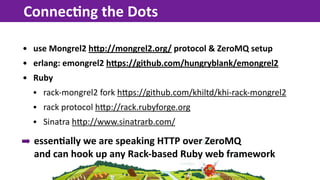
Connec4ng  the  Dots

• use  Mongrel2  hZp://mongrel2.org/  protocol  &  ZeroMQ  setup
• erlang:  emongrel2  hZps://github.com/hungryblank/emongrel2
• Ruby
  • rack-­‐mongrel2  fork  hEps://github.com/khiltd/khi-­‐rack-­‐mongrel2
  • rack  protocol  hEp://rack.rubyforge.org
  • Sinatra  hEp://www.sinatrarb.com/

➡ essen4ally  we  are  speaking  HTTP  over  ZeroMQ
  and  can  hook  up  any  Rack-­‐based  Ruby  web  framework
Setup  Overview


                 server                                 worker


       session                                          worker
                          sender     Push/Pull  Queue


                                        1:n             worker

       session
                                                        worker
        ...               receiver    Pub/Sub  Queue


                                        m:n              ...
       session
                                                        worker
How  does  the  game  state  look  like?

• Has  many  parts,  each  part  has  a  name  (e.g.  fruit_trees)  and  some  
   content
   • this  is  a  performance  op:miza:on,  so  that  we  don't  need  to  send  the  
      complete  state  back  and  forth  for  every  call
• erlang  does  not  care  about  the  content  (binary  data)
• actually  the  content  contains  serialized  objects  (e.g.  a  
   MapObjectCollection  containing  FruitTree  members)

• erlang  does  need  to  know,  what  game  ac4on  needs  what  state  parts
Looking  back  at  the  Game  Ac4on
game_action '/:actor/fruit_tree/self/shake',
            :affects => [:fruit_trees, :user] do |response|

  x, y = params[:x], params[:y]
  fruit_trees[x, y].shake                       affected  parts  of
end
                                                 the  game  state


• Ruby  knows  the  mapping  of  game  ac4ons  to  affected  state  parts
• pushes  the  mapping  on  startup  &  makes  it  available  on  request
Aside:  Efficient  Game  State  Access

• considered  different  serializa4on  formats  (e.g.  JSON,  
   MessagePack)
• especially  for  large  collec4ons  of  objects  we  wanted  to  avoid  
   parsing  everything  to  extract  a  single  object
• chose  TNetstrings  hZp://tnetstrings.org/  as  a  serializa4on  
   format  (length  prefix  helps  searching/lazy  parsing)
• built  a  lazy  parser/encoder  for  it    in  C  for  speed  :-­‐)
   hZps://github.com/wooga/lazy_tnetstring
Q  &  A

Mar4n  Rehfeld
 @klickmich

Combining the Strengths or Erlang and Ruby

  • 1.
    COMBINING  THE  STRENGTHS OF   ERLANG  AND  RUBY erlounge  Berlin  February  2012  –  Mar4n  Rehfeld
  • 2.
    Game  Server  for Upcoming  Wooga  Game What  is  a  game  server? • provide  HTTP  API  to  actual  game  („client“) • validate  API  calls  against  current  state  &  game  logic • API  calls  will  modify  the  game  state • make  game  state  persistent
  • 3.
    Game  Server  for Upcoming  Wooga  Game It  will  be  a  stateful  game  server • one  process  per  ac4ve  user  gaming  session • the  process  holds  the  current  state  and  is  the  only  one  that  can  modify  it   (strong  encapsula:on) • the  process  handles  all  API  calls  for  the  given  user  one  a=er  the  other   (concurrency  control  through  actor  model) • the  process  loads  the  game  state  from  storage  and  writes  it  back   periodically  and  on  process  termina:on  (:meout  =  user  stopped  playing)
  • 4.
    Game  Server  for Upcoming  Wooga  Game Details  on  the  basic  idea: Awesome  presenta4on  on  the Magic  Land  game  server  by @knu4n  &  @hungryblank hZp://www.slideshare.net/wooga/from-­‐0-­‐to-­‐1000000-­‐daily-­‐users-­‐with-­‐erlang
  • 5.
    Our  Goals • Get most  of  the  benefits  from  wooga’s  pure-­‐erlang  game   server  (Magic  Land) • especially  func:onal  approach  for  game  state   encapsula:on  and  transforma:on  +  concurrency  control • But:  Keep  Object-­‐Oriented  approach  for  modelling  the   game  logic
  • 6.
    Expected  OO-­‐Benefits • Rapid development • concise  &  expressive  syntax • leverage  exis4ng  know  how • but:  keep  the  OO  part  stateless  and  side-­‐effect  free to  avoid  the  usual  traps  &  pidalls
  • 7.
    Target  Architecture Authority for: Load Balancer "What app server is responsible for current session?" App Server Node App Server Node App Server Node Erlang VM Erlang VM Erlang VM ... Ruby Ruby Ruby Ruby Ruby Ruby Ruby Ruby Ruby ... ... ... Worker Worker Worker Worker Worker Worker Worker Worker Worker Shared Storage for game state snapshots and for storing cold game sessions
  • 8.
    Example  Game  Ac4on in  Ruby URL game_action '/:actor/fruit_tree/self/shake', :affects => [:fruit_trees, :user] do |response| x, y = params[:x], params[:y] fruit_trees[x, y].shake affected  parts  of end the  game  state • DSL-­‐like  defini4on  of  game  ac4on • skinny  as  controllers  should  be  8-­‐)
  • 9.
    Example  Model  in Ruby Inheritance class FruitTree < Tree property :last_shake_time, :type => Integer, :default => 0 DSL-­‐like  defini4on property :collectable_fruit_count, :type => Integer, :default => 0 of  persistent  state def shake raise Error::Validation, "FruitTree at (#{x}, #{y}) has no fruit" unless carries_fruit? session.user.xp += 1 session.user.energy -= 1 self.last_shake_time = game_time self.collectable_fruit_count = config.fruit_count end # ... end • easily  unit  testable • minimal  amount  of  code
  • 10.
    erlang  talking  to Ruby Some  op4ons • erlectricity  hZps://github.com/mojombo/erlectricity: Can  talk  erlang  binary  protocol  to  Ruby  processes  through  erlang   ports • ernie  hZps://github.com/mojombo/ernie: Remote  func4on  call  using  the  BERT-­‐RPC  protocol  to  either  Ruby  or   na4ve  erlang  processes • ZeroMQ  <hZp://www.zeromq.org/>: awesome  brokerless  queue  transport  layer,  connects  30+  languages
  • 11.
    ZeroMQ Pro Con • loose  coupling  of  erlang  and   • yet  another  layer Ruby  through  queues • easily  deploy  new  Ruby   code  without  touching   erlang • allows  flexible  transports,   even  accross  machines
  • 12.
    Connec4ng  the  Dots •use  Mongrel2  hZp://mongrel2.org/  protocol  &  ZeroMQ  setup • erlang:  emongrel2  hZps://github.com/hungryblank/emongrel2 • Ruby • rack-­‐mongrel2  fork  hEps://github.com/khiltd/khi-­‐rack-­‐mongrel2 • rack  protocol  hEp://rack.rubyforge.org • Sinatra  hEp://www.sinatrarb.com/ ➡ essen4ally  we  are  speaking  HTTP  over  ZeroMQ and  can  hook  up  any  Rack-­‐based  Ruby  web  framework
  • 13.
    Setup  Overview server worker session worker sender Push/Pull  Queue 1:n worker session worker ... receiver Pub/Sub  Queue m:n ... session worker
  • 14.
    How  does  the game  state  look  like? • Has  many  parts,  each  part  has  a  name  (e.g.  fruit_trees)  and  some   content • this  is  a  performance  op:miza:on,  so  that  we  don't  need  to  send  the   complete  state  back  and  forth  for  every  call • erlang  does  not  care  about  the  content  (binary  data) • actually  the  content  contains  serialized  objects  (e.g.  a   MapObjectCollection  containing  FruitTree  members) • erlang  does  need  to  know,  what  game  ac4on  needs  what  state  parts
  • 15.
    Looking  back  at the  Game  Ac4on game_action '/:actor/fruit_tree/self/shake', :affects => [:fruit_trees, :user] do |response| x, y = params[:x], params[:y] fruit_trees[x, y].shake affected  parts  of end the  game  state • Ruby  knows  the  mapping  of  game  ac4ons  to  affected  state  parts • pushes  the  mapping  on  startup  &  makes  it  available  on  request
  • 16.
    Aside:  Efficient  Game State  Access • considered  different  serializa4on  formats  (e.g.  JSON,   MessagePack) • especially  for  large  collec4ons  of  objects  we  wanted  to  avoid   parsing  everything  to  extract  a  single  object • chose  TNetstrings  hZp://tnetstrings.org/  as  a  serializa4on   format  (length  prefix  helps  searching/lazy  parsing) • built  a  lazy  parser/encoder  for  it    in  C  for  speed  :-­‐) hZps://github.com/wooga/lazy_tnetstring
  • 17.
    Q  &  A Mar4n Rehfeld @klickmich