COLUMN CHROMATOGRAPHY
Presented By-
Dip Roy
BSc Student
Department of Chemistry
University of Barishal,Bangladesh
Column chromatography was devoloped by the American chemist D.T Day in
1900 .M.S. Tswett, the Polish botanist, in 1906 used adsorption columns in
his investigations of plant pigments.
COLUMN CHROMATOGRAPHY
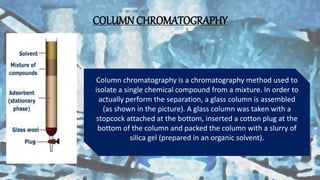
Column chromatography is a chromatography method used to
isolate a single chemical compound from a mixture. In order to
actually perform the separation, a glass column is assembled
(as shown in the picture). A glass column was taken with a
stopcock attached at the bottom, inserted a cotton plug at the
bottom of the column and packed the column with a slurry of
silica gel (prepared in an organic solvent).
COLUMN CHROMATOGRAPHY
Once the column was packed, poured the
reaction mixture over the bed of silica from the
top of the column carefully, with the aid of a glass
pipette. Then the stopcock was opened and let
the solvent run slowly through the column and
constantly kept adding solvent from the top of the
glass column.
COLUMN CHROMATOGRAPHY
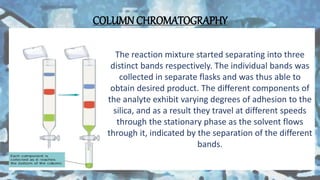
The reaction mixture started separating into three
distinct bands respectively. The individual bands was
collected in separate flasks and was thus able to
obtain desired product. The different components of
the analyte exhibit varying degrees of adhesion to the
silica, and as a result they travel at different speeds
through the stationary phase as the solvent flows
through it, indicated by the separation of the different
bands.
COLUMN CHROMATOGRAPHY
Higher the adsorption to the
stationary phase, the slower the
molecule will move through the
column. Higher the solubility in the
mobile phase, the faster the molecule
will move through the column.
THANK YOU

Column Chromatography technique presentation.pptx

  • 1.
    COLUMN CHROMATOGRAPHY Presented By- DipRoy BSc Student Department of Chemistry University of Barishal,Bangladesh
  • 2.
    Column chromatography wasdevoloped by the American chemist D.T Day in 1900 .M.S. Tswett, the Polish botanist, in 1906 used adsorption columns in his investigations of plant pigments.
  • 3.
    COLUMN CHROMATOGRAPHY Column chromatographyis a chromatography method used to isolate a single chemical compound from a mixture. In order to actually perform the separation, a glass column is assembled (as shown in the picture). A glass column was taken with a stopcock attached at the bottom, inserted a cotton plug at the bottom of the column and packed the column with a slurry of silica gel (prepared in an organic solvent).
  • 4.
    COLUMN CHROMATOGRAPHY Once thecolumn was packed, poured the reaction mixture over the bed of silica from the top of the column carefully, with the aid of a glass pipette. Then the stopcock was opened and let the solvent run slowly through the column and constantly kept adding solvent from the top of the glass column.
  • 5.
    COLUMN CHROMATOGRAPHY The reactionmixture started separating into three distinct bands respectively. The individual bands was collected in separate flasks and was thus able to obtain desired product. The different components of the analyte exhibit varying degrees of adhesion to the silica, and as a result they travel at different speeds through the stationary phase as the solvent flows through it, indicated by the separation of the different bands.
  • 6.
    COLUMN CHROMATOGRAPHY Higher theadsorption to the stationary phase, the slower the molecule will move through the column. Higher the solubility in the mobile phase, the faster the molecule will move through the column.
  • 7.