SOIL COLLOIDS
Dr. Kiran Karthik Raj
Assistant Professor
COA,Vellayani
2
Soil Colloids
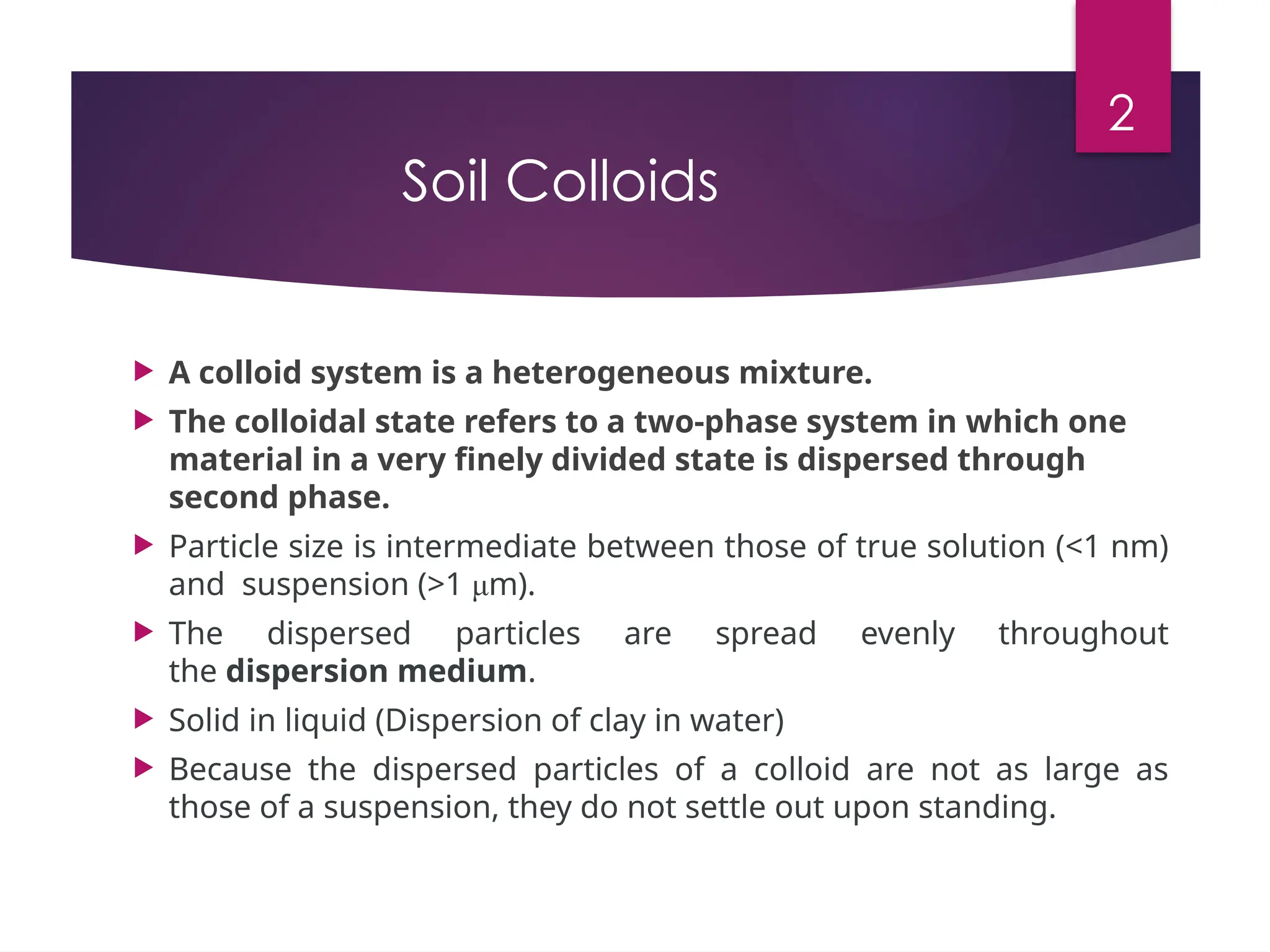
 A colloid system is a heterogeneous mixture.
 The colloidal state refers to a two-phase system in which one
material in a very finely divided state is dispersed through
second phase.
 Particle size is intermediate between those of true solution (<1 nm)
and suspension (>1 μm).
 The dispersed particles are spread evenly throughout
the dispersion medium.
 Solid in liquid (Dispersion of clay in water)
 Because the dispersed particles of a colloid are not as large as
those of a suspension, they do not settle out upon standing.
3
Types of Soil Colloids
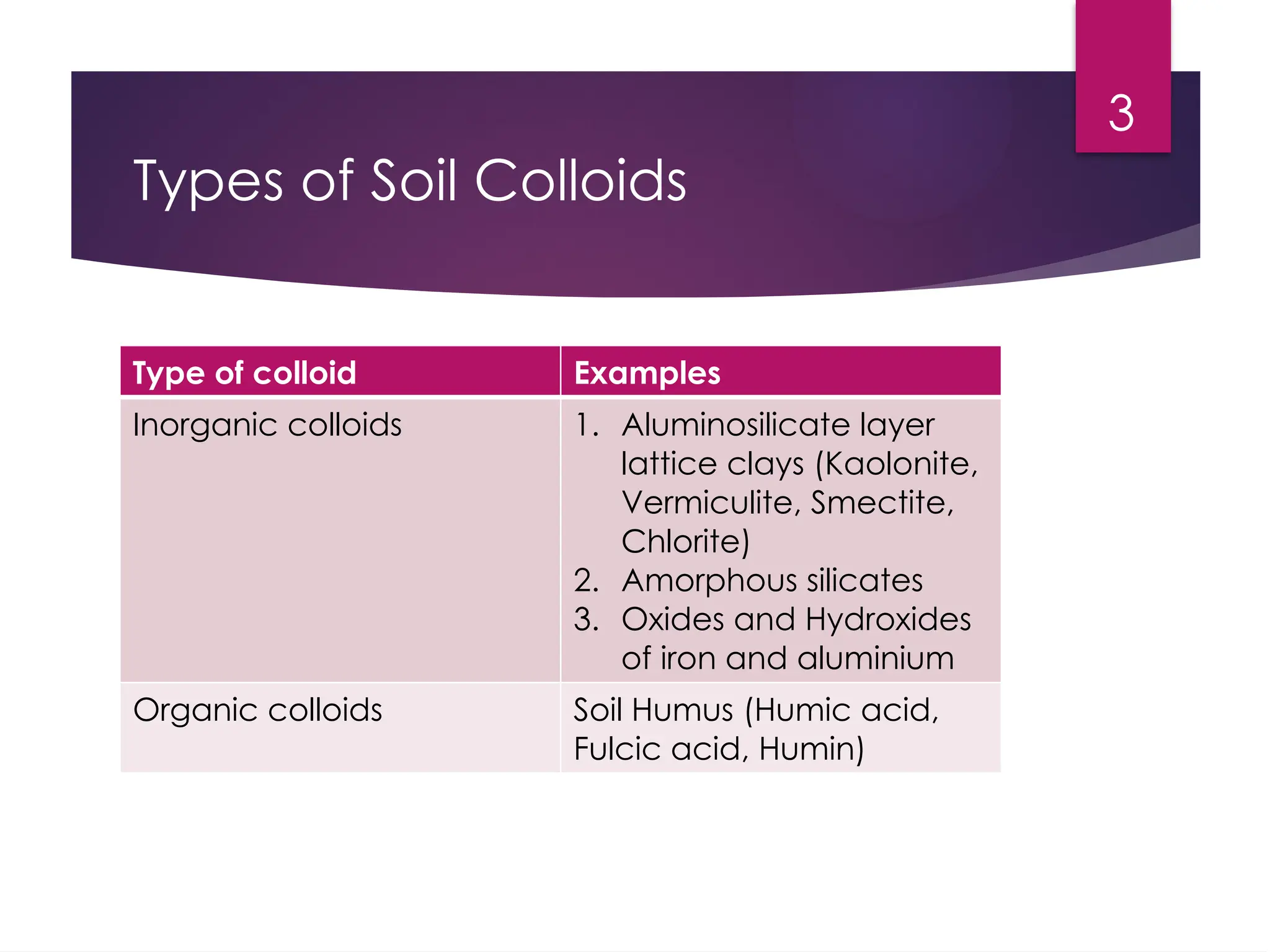
Type of colloid Examples
Inorganic colloids 1. Aluminosilicate layer
lattice clays (Kaolonite,
Vermiculite, Smectite,
Chlorite)
2. Amorphous silicates
3. Oxides and Hydroxides
of iron and aluminium
Organic colloids Soil Humus (Humic acid,
Fulcic acid, Humin)
4
Properties
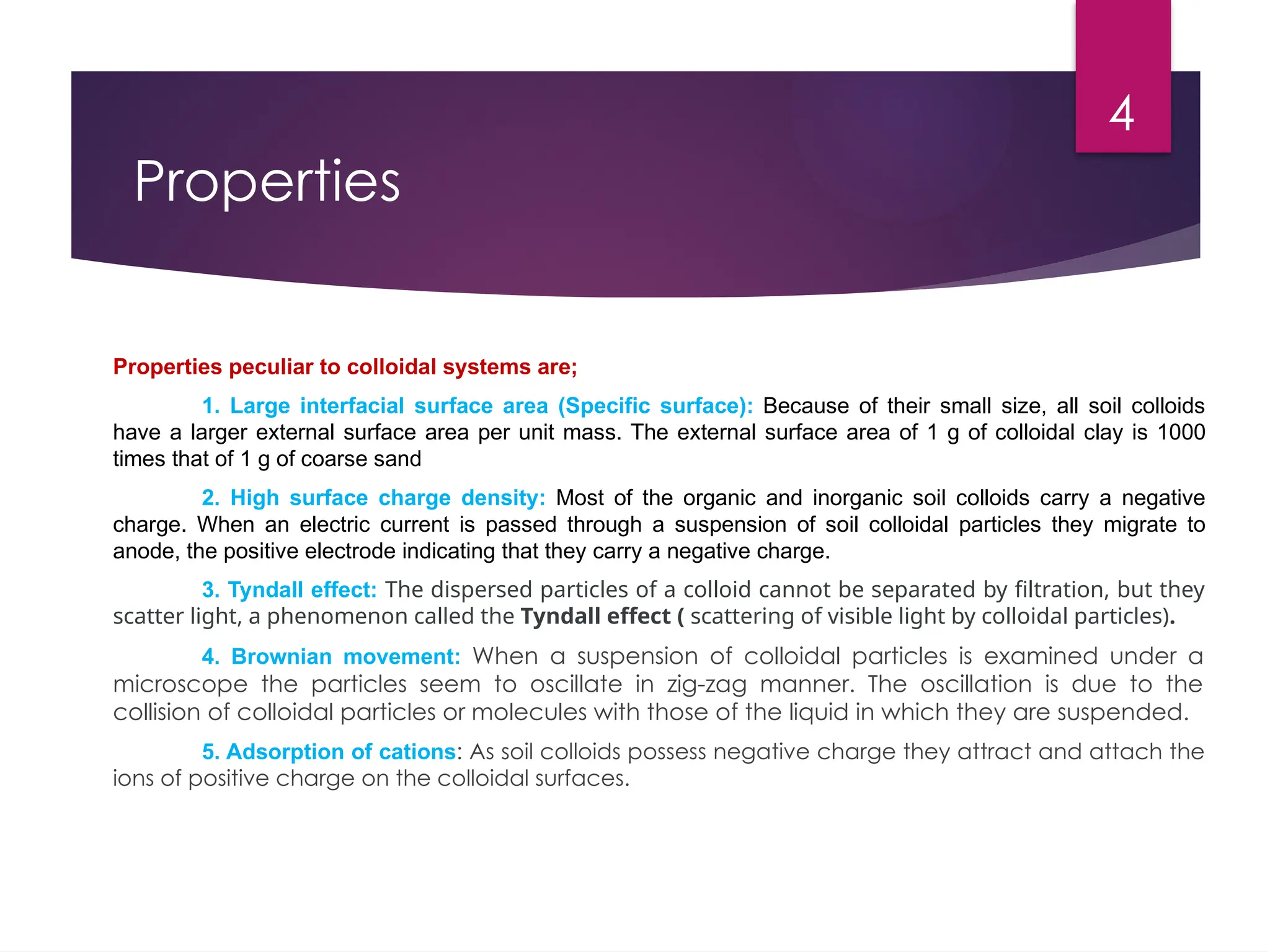
Properties peculiar to colloidal systems are;
1. Large interfacial surface area (Specific surface): Because of their small size, all soil colloids
have a larger external surface area per unit mass. The external surface area of 1 g of colloidal clay is 1000
times that of 1 g of coarse sand
2. High surface charge density: Most of the organic and inorganic soil colloids carry a negative
charge. When an electric current is passed through a suspension of soil colloidal particles they migrate to
anode, the positive electrode indicating that they carry a negative charge.
3. Tyndall effect: The dispersed particles of a colloid cannot be separated by filtration, but they
scatter light, a phenomenon called the Tyndall effect ( scattering of visible light by colloidal particles).
4. Brownian movement: When a suspension of colloidal particles is examined under a
microscope the particles seem to oscillate in zig-zag manner. The oscillation is due to the
collision of colloidal particles or molecules with those of the liquid in which they are suspended.
5. Adsorption of cations: As soil colloids possess negative charge they attract and attach the
ions of positive charge on the colloidal surfaces.
5
Properties
6. Swelling and shrinkage: Some soil clay colloids belonging to
smectite group like Montmorillonite swell when wet and shrink when
dry.
7. Dispersion and flocculation: As long as the colloidal particles remain
negatively charged, they repel each other and the suspension remains
stable. If on any account they loose their charge, or if the magnitude
of the charge is reduced, the particles coalesce, form flock and settle
down (flocculation). The reverse process of the breaking up of flocks
into individual particles is known is called deflocculation (~dispersion of
clay particles apart).
6
Importance of Soil Colloids in
Soil Fertility
 Site of importance processes
 Govern Ion Exchange Reactions (Cations and Anions)
 Nutrient Availability and Fixation
 Influence on soil physical properties
 Soil structure, water holding capacity, hydraulic conductivity
7
Zeta potential (ξ-potential)
 Zeta potential is the electric potential in
the interfacial diffused double layer at the
location of the slipping plane relative to a
point in the bulk fluid away from the
interface. Zeta potential is the electrical
potential between fixed layer and freely
mobile layer.
 The zeta potential is an important and
readily measurable indicator of the
stability of colloidal dispersions. The
magnitude of the zeta potential indicates
the degree of electrostatic repulsion
between adjacent, similarly charged
particles in a dispersion.
8
Flocculation
 As long as the colloidal particles remain negatively charged, they
repel each other and the suspension remains stable.
 If on any account they loose their charge, or if the magnitude of
the charge is reduced, the particles coalesce, form flock and
settle down (flocculation).
 colloids with low zeta potentials tend to coagulate or flocculate
9
Deflocculation
 For molecules and particles that are small enough, a high
zeta potential will confer stability, i.e., the solution or
dispersion will resist aggregation.
 colloids with high zeta potential (negative or positive) are
electrically stabilized

Colloidal properties of Soil and soil colloids

  • 1.
    SOIL COLLOIDS Dr. KiranKarthik Raj Assistant Professor COA,Vellayani
  • 2.
    2 Soil Colloids  Acolloid system is a heterogeneous mixture.  The colloidal state refers to a two-phase system in which one material in a very finely divided state is dispersed through second phase.  Particle size is intermediate between those of true solution (<1 nm) and suspension (>1 μm).  The dispersed particles are spread evenly throughout the dispersion medium.  Solid in liquid (Dispersion of clay in water)  Because the dispersed particles of a colloid are not as large as those of a suspension, they do not settle out upon standing.
  • 3.
    3 Types of SoilColloids Type of colloid Examples Inorganic colloids 1. Aluminosilicate layer lattice clays (Kaolonite, Vermiculite, Smectite, Chlorite) 2. Amorphous silicates 3. Oxides and Hydroxides of iron and aluminium Organic colloids Soil Humus (Humic acid, Fulcic acid, Humin)
  • 4.
    4 Properties Properties peculiar tocolloidal systems are; 1. Large interfacial surface area (Specific surface): Because of their small size, all soil colloids have a larger external surface area per unit mass. The external surface area of 1 g of colloidal clay is 1000 times that of 1 g of coarse sand 2. High surface charge density: Most of the organic and inorganic soil colloids carry a negative charge. When an electric current is passed through a suspension of soil colloidal particles they migrate to anode, the positive electrode indicating that they carry a negative charge. 3. Tyndall effect: The dispersed particles of a colloid cannot be separated by filtration, but they scatter light, a phenomenon called the Tyndall effect ( scattering of visible light by colloidal particles). 4. Brownian movement: When a suspension of colloidal particles is examined under a microscope the particles seem to oscillate in zig-zag manner. The oscillation is due to the collision of colloidal particles or molecules with those of the liquid in which they are suspended. 5. Adsorption of cations: As soil colloids possess negative charge they attract and attach the ions of positive charge on the colloidal surfaces.
  • 5.
    5 Properties 6. Swelling andshrinkage: Some soil clay colloids belonging to smectite group like Montmorillonite swell when wet and shrink when dry. 7. Dispersion and flocculation: As long as the colloidal particles remain negatively charged, they repel each other and the suspension remains stable. If on any account they loose their charge, or if the magnitude of the charge is reduced, the particles coalesce, form flock and settle down (flocculation). The reverse process of the breaking up of flocks into individual particles is known is called deflocculation (~dispersion of clay particles apart).
  • 6.
    6 Importance of SoilColloids in Soil Fertility  Site of importance processes  Govern Ion Exchange Reactions (Cations and Anions)  Nutrient Availability and Fixation  Influence on soil physical properties  Soil structure, water holding capacity, hydraulic conductivity
  • 7.
    7 Zeta potential (ξ-potential) Zeta potential is the electric potential in the interfacial diffused double layer at the location of the slipping plane relative to a point in the bulk fluid away from the interface. Zeta potential is the electrical potential between fixed layer and freely mobile layer.  The zeta potential is an important and readily measurable indicator of the stability of colloidal dispersions. The magnitude of the zeta potential indicates the degree of electrostatic repulsion between adjacent, similarly charged particles in a dispersion.
  • 8.
    8 Flocculation  As longas the colloidal particles remain negatively charged, they repel each other and the suspension remains stable.  If on any account they loose their charge, or if the magnitude of the charge is reduced, the particles coalesce, form flock and settle down (flocculation).  colloids with low zeta potentials tend to coagulate or flocculate
  • 9.
    9 Deflocculation  For moleculesand particles that are small enough, a high zeta potential will confer stability, i.e., the solution or dispersion will resist aggregation.  colloids with high zeta potential (negative or positive) are electrically stabilized