Business Programs – Military Crosswalk

                  Frank Alaniz
       Missouri Workforce Regional Liaison


                                             1
How can I interpret military resumes
   to hire the best candidates?
• Research
  – Most military resumes are filled to the brim with
    abbreviations and titles, which will be unfamiliar
    to most civilian hiring managers; take some time
    to research what these terms mean.
  – Know the difference between the military ranks so
    you can hire great veteran candidates with
    transferable skills.
  – Avoid discriminatory questions. While a vet may
    elaborate about their military experience be
    careful about probing too far. The veteran may
    feel you are trying to find out about hidden
    disabilities.


                                                     2
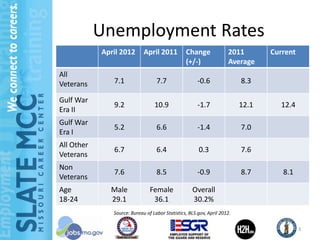
Unemployment Rates
            April 2012       April 2011          Change              2011        Current
                                                 (+/-)               Average
All
Veterans       7.1                 7.7                 -0.6               8.3

Gulf War
               9.2                10.9                 -1.7               12.1     12.4
Era II
Gulf War
               5.2                 6.6                 -1.4               7.0
Era I
All Other
               6.7                 6.4                 0.3                7.6
Veterans
Non
               7.6                 8.5                 -0.9               8.7       8.1
Veterans
Age           Male              Female              Overall
18-24         29.1               36.1               30.2%
               Source: Bureau of Labor Statistics, BLS.gov, April 2012.


                                                                                           3
Veterans Offer a Unique Set of
              Skills
• Leadership Experience
• Strong Personal Integrity
• Ability to Work as a Team Member and
  Team Leader
• Performance under Pressure
• Possession of a Valid Security Clearance
• Strong Work Ethic
• Specialized Advanced Training & Technical
  Skills

                                              4
•   Flexibility and Adaptability
•   Discipline
•   Attention to Detail
•   Ability to Work Efficiently & Diligently in a Fast-
    Paced Environment
•   Commitment to Excellence & History of Meeting
    Standards of Quality
•   Ability to Conform to Rules and Structure
•   Initiative & Self-Direction
•   Respect for Procedures and Accountability
•   Strong Sense of Health, Personal Safety, and
    Property Standards
•   Ability to Give and Follow Directions
                                                      5
• Hands-on Experience with Technology and
  Globalization
• Systematic Planning and Organizational Skills
• Accelerated Learning Curve with New Skills and
  Concepts
• Diversity in Action and Strong Interpersonal Skills
• Emphasis on Safety in the Workplace
• High Levels of Maturity and Responsibility
• Motivation, Dedication, and Professionalism
• Triumphant over Adversity
• Write Clearly and Concisely
• Work with Computers/Technology

                                                   6
Top Ten Skills Identified by Employers
1. Self-Discipline
2. Teamwork
3. Respect
4. Follow Detailed Orders
5. Confidence
6. Attention to Detail
7. Calm Under Stress
8. Readiness to Accept a Challenge
9. Meet Deadlines
10. Problem Solving
               Monster.Com Veterans Talent Index May 2012


                                                            7
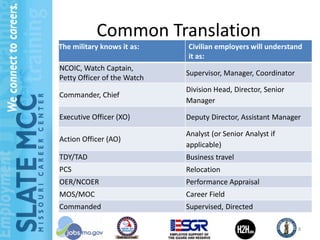
Common Translation
The military knows it as:    Civilian employers will understand
                             it as:
NCOIC, Watch Captain,
                             Supervisor, Manager, Coordinator
Petty Officer of the Watch
                             Division Head, Director, Senior
Commander, Chief
                             Manager

Executive Officer (XO)       Deputy Director, Assistant Manager

                             Analyst (or Senior Analyst if
Action Officer (AO)
                             applicable)
TDY/TAD                      Business travel
PCS                          Relocation
OER/NCOER                    Performance Appraisal
MOS/MOC                      Career Field
Commanded                    Supervised, Directed

                                                                8
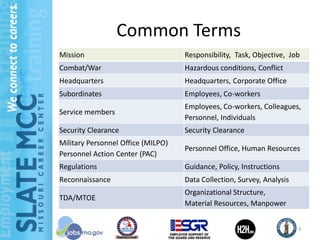
Common Terms
Mission                             Responsibility, Task, Objective, Job
Combat/War                          Hazardous conditions, Conflict
Headquarters                        Headquarters, Corporate Office
Subordinates                        Employees, Co-workers
                                    Employees, Co-workers, Colleagues,
Service members
                                    Personnel, Individuals
Security Clearance                  Security Clearance
Military Personnel Office (MILPO)
                                    Personnel Office, Human Resources
Personnel Action Center (PAC)
Regulations                         Guidance, Policy, Instructions
Reconnaissance                      Data Collection, Survey, Analysis
                                    Organizational Structure,
TDA/MTOE
                                    Material Resources, Manpower


                                                                        9
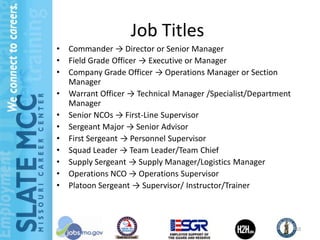
Job Titles
•   Commander → Director or Senior Manager
•   Field Grade Officer → Executive or Manager
•   Company Grade Officer → Operations Manager or Section
    Manager
•   Warrant Officer → Technical Manager /Specialist/Department
    Manager
•   Senior NCOs → First-Line Supervisor
•   Sergeant Major → Senior Advisor
•   First Sergeant → Personnel Supervisor
•   Squad Leader → Team Leader/Team Chief
•   Supply Sergeant → Supply Manager/Logistics Manager
•   Operations NCO → Operations Supervisor
•   Platoon Sergeant → Supervisor/ Instructor/Trainer


                                                                 10
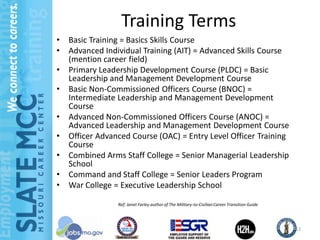
Training Terms
•   Basic Training = Basics Skills Course
•   Advanced Individual Training (AIT) = Advanced Skills Course
    (mention career field)
•   Primary Leadership Development Course (PLDC) = Basic
    Leadership and Management Development Course
•   Basic Non-Commissioned Officers Course (BNOC) =
    Intermediate Leadership and Management Development
    Course
•   Advanced Non-Commissioned Officers Course (ANOC) =
    Advanced Leadership and Management Development Course
•   Officer Advanced Course (OAC) = Entry Level Officer Training
    Course
•   Combined Arms Staff College = Senior Managerial Leadership
    School
•   Command and Staff College = Senior Leaders Program
•   War College = Executive Leadership School

                 Ref: Janet Farley author of The Military-to-Civilian Career Transition Guide


                                                                                                11
Existing Skill Translators Fall Short
• A more effective approach to skill translation would
  recognize that even a junior infantryman has typically
  obtained a set of skills and experiences through his
  military service, and these skills directly correspond to the
  skills required for many civilian jobs, including:
    – The ability to plan and execute tasks in high-stress,
      unstructured, frequently changing environments;
    – Demonstrated commitment to safety;
    – Dynamic risk management skills;
    – Experience securing, using and maintaining equipment
      worth several million dollars;
    – Proven effectiveness completing complicated tasks and
      solving problems independently and in groups; and
    – Communication skills effective at various levels of the
      organization.


                                                                12
Existing Skill Translators Fall Short
• The value of the information provided by skill translators
  varies for different occupations.
    – For example, a translation for another common Army
      occupation, 25B information systems operator- analyst,
      indicates that this occupation is transferable directly into
      the rapidly growing computer industry and provides a
      wealth of information and results on pursuing a career after
      the military.
• Although civilian employment in this field may require
  additional training and certification, the 25B MOS
  establishes a base knowledge of computer technology.
• Most online MOS translator produces links to
  occupational profiles and potential certifications a soldier
  may possess.


                                                                 13
Correlating Military Jobs to
             Civilian Jobs
• The military has over 7,000 jobs across more than 100
  functional areas. The vast majority of these jobs have a
  direct civilian job equivalent. Understanding the job
  design and the knowledge, skills and abilities (KSAs)
  required for each function within your own organization is
  the starting point for the process of identifying the closest
  military equivalent.

• The following exercise translates military skills to roles
  within your business. Many organizations make it a regular
  practice to formally correlate the KSAs for each job to
  MOS and to brief anyone who could be a part of the
  interview team before they meet with a military applicant.
  This process also facilitates job redesign if job sharing,
  transfers, relocations or flexibility needs arise.


                                                              14
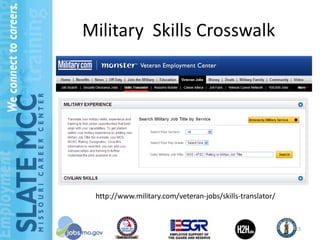
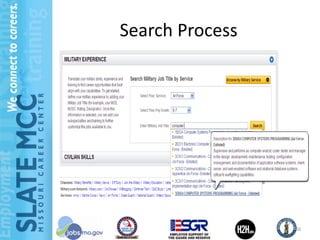
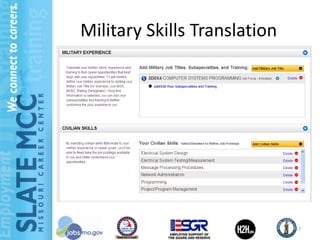
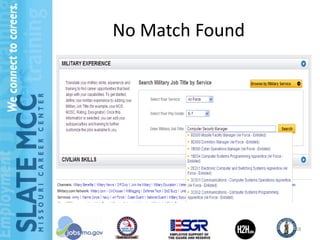
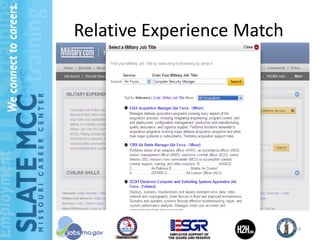
Military Skills Crosswalk


 http://www.military.com/veteran-jobs/skills-translator/


                                                           15
Search Process


                 16
Military Skills Translation


                              17
No Match Found


                 18
Relative Experience Match


                            19
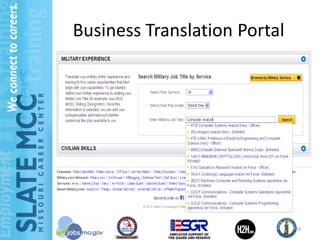
Business Translation Portal


                              20
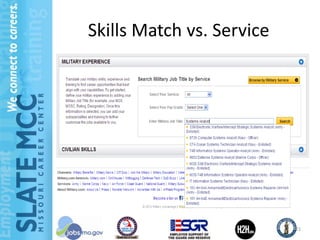
Skills Match vs. Service


                           21
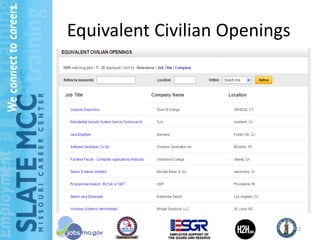
Equivalent Civilian Openings


                               22
Recommendations for Employers

• Understand Basic Military Culture
• Use Military Language in Job
  Descriptions
• Make Your Job Description Specific
• Add a MOS/MOC to your Job
  Requisitions

                                       23
Questions?


SLATEMCC                                   @SLATE_MCC                                 SLATEMCC
    &                                          &
MoEcoDevo                                  @MoEcoDevo


Special thanks and appreciation to Cheryl Wilkinson, Missouri ESGR Area 3 Chair for her hard work and
                                      dedication to this project.


                                                                                                        24

Business programs military crosswalk (esgr)

  • 1.
    Business Programs –Military Crosswalk Frank Alaniz Missouri Workforce Regional Liaison 1
  • 2.
    How can Iinterpret military resumes to hire the best candidates? • Research – Most military resumes are filled to the brim with abbreviations and titles, which will be unfamiliar to most civilian hiring managers; take some time to research what these terms mean. – Know the difference between the military ranks so you can hire great veteran candidates with transferable skills. – Avoid discriminatory questions. While a vet may elaborate about their military experience be careful about probing too far. The veteran may feel you are trying to find out about hidden disabilities. 2
  • 3.
    Unemployment Rates April 2012 April 2011 Change 2011 Current (+/-) Average All Veterans 7.1 7.7 -0.6 8.3 Gulf War 9.2 10.9 -1.7 12.1 12.4 Era II Gulf War 5.2 6.6 -1.4 7.0 Era I All Other 6.7 6.4 0.3 7.6 Veterans Non 7.6 8.5 -0.9 8.7 8.1 Veterans Age Male Female Overall 18-24 29.1 36.1 30.2% Source: Bureau of Labor Statistics, BLS.gov, April 2012. 3
  • 4.
    Veterans Offer aUnique Set of Skills • Leadership Experience • Strong Personal Integrity • Ability to Work as a Team Member and Team Leader • Performance under Pressure • Possession of a Valid Security Clearance • Strong Work Ethic • Specialized Advanced Training & Technical Skills 4
  • 5.
    • Flexibility and Adaptability • Discipline • Attention to Detail • Ability to Work Efficiently & Diligently in a Fast- Paced Environment • Commitment to Excellence & History of Meeting Standards of Quality • Ability to Conform to Rules and Structure • Initiative & Self-Direction • Respect for Procedures and Accountability • Strong Sense of Health, Personal Safety, and Property Standards • Ability to Give and Follow Directions 5
  • 6.
    • Hands-on Experiencewith Technology and Globalization • Systematic Planning and Organizational Skills • Accelerated Learning Curve with New Skills and Concepts • Diversity in Action and Strong Interpersonal Skills • Emphasis on Safety in the Workplace • High Levels of Maturity and Responsibility • Motivation, Dedication, and Professionalism • Triumphant over Adversity • Write Clearly and Concisely • Work with Computers/Technology 6
  • 7.
    Top Ten SkillsIdentified by Employers 1. Self-Discipline 2. Teamwork 3. Respect 4. Follow Detailed Orders 5. Confidence 6. Attention to Detail 7. Calm Under Stress 8. Readiness to Accept a Challenge 9. Meet Deadlines 10. Problem Solving Monster.Com Veterans Talent Index May 2012 7
  • 8.
    Common Translation The militaryknows it as: Civilian employers will understand it as: NCOIC, Watch Captain, Supervisor, Manager, Coordinator Petty Officer of the Watch Division Head, Director, Senior Commander, Chief Manager Executive Officer (XO) Deputy Director, Assistant Manager Analyst (or Senior Analyst if Action Officer (AO) applicable) TDY/TAD Business travel PCS Relocation OER/NCOER Performance Appraisal MOS/MOC Career Field Commanded Supervised, Directed 8
  • 9.
    Common Terms Mission Responsibility, Task, Objective, Job Combat/War Hazardous conditions, Conflict Headquarters Headquarters, Corporate Office Subordinates Employees, Co-workers Employees, Co-workers, Colleagues, Service members Personnel, Individuals Security Clearance Security Clearance Military Personnel Office (MILPO) Personnel Office, Human Resources Personnel Action Center (PAC) Regulations Guidance, Policy, Instructions Reconnaissance Data Collection, Survey, Analysis Organizational Structure, TDA/MTOE Material Resources, Manpower 9
  • 10.
    Job Titles • Commander → Director or Senior Manager • Field Grade Officer → Executive or Manager • Company Grade Officer → Operations Manager or Section Manager • Warrant Officer → Technical Manager /Specialist/Department Manager • Senior NCOs → First-Line Supervisor • Sergeant Major → Senior Advisor • First Sergeant → Personnel Supervisor • Squad Leader → Team Leader/Team Chief • Supply Sergeant → Supply Manager/Logistics Manager • Operations NCO → Operations Supervisor • Platoon Sergeant → Supervisor/ Instructor/Trainer 10
  • 11.
    Training Terms • Basic Training = Basics Skills Course • Advanced Individual Training (AIT) = Advanced Skills Course (mention career field) • Primary Leadership Development Course (PLDC) = Basic Leadership and Management Development Course • Basic Non-Commissioned Officers Course (BNOC) = Intermediate Leadership and Management Development Course • Advanced Non-Commissioned Officers Course (ANOC) = Advanced Leadership and Management Development Course • Officer Advanced Course (OAC) = Entry Level Officer Training Course • Combined Arms Staff College = Senior Managerial Leadership School • Command and Staff College = Senior Leaders Program • War College = Executive Leadership School Ref: Janet Farley author of The Military-to-Civilian Career Transition Guide 11
  • 12.
    Existing Skill TranslatorsFall Short • A more effective approach to skill translation would recognize that even a junior infantryman has typically obtained a set of skills and experiences through his military service, and these skills directly correspond to the skills required for many civilian jobs, including: – The ability to plan and execute tasks in high-stress, unstructured, frequently changing environments; – Demonstrated commitment to safety; – Dynamic risk management skills; – Experience securing, using and maintaining equipment worth several million dollars; – Proven effectiveness completing complicated tasks and solving problems independently and in groups; and – Communication skills effective at various levels of the organization. 12
  • 13.
    Existing Skill TranslatorsFall Short • The value of the information provided by skill translators varies for different occupations. – For example, a translation for another common Army occupation, 25B information systems operator- analyst, indicates that this occupation is transferable directly into the rapidly growing computer industry and provides a wealth of information and results on pursuing a career after the military. • Although civilian employment in this field may require additional training and certification, the 25B MOS establishes a base knowledge of computer technology. • Most online MOS translator produces links to occupational profiles and potential certifications a soldier may possess. 13
  • 14.
    Correlating Military Jobsto Civilian Jobs • The military has over 7,000 jobs across more than 100 functional areas. The vast majority of these jobs have a direct civilian job equivalent. Understanding the job design and the knowledge, skills and abilities (KSAs) required for each function within your own organization is the starting point for the process of identifying the closest military equivalent. • The following exercise translates military skills to roles within your business. Many organizations make it a regular practice to formally correlate the KSAs for each job to MOS and to brief anyone who could be a part of the interview team before they meet with a military applicant. This process also facilitates job redesign if job sharing, transfers, relocations or flexibility needs arise. 14
  • 15.
    Military Skills Crosswalk http://www.military.com/veteran-jobs/skills-translator/ 15
  • 16.
  • 17.
  • 18.
  • 19.
  • 20.
  • 21.
    Skills Match vs.Service 21
  • 22.
  • 23.
    Recommendations for Employers •Understand Basic Military Culture • Use Military Language in Job Descriptions • Make Your Job Description Specific • Add a MOS/MOC to your Job Requisitions 23
  • 24.
    Questions? SLATEMCC @SLATE_MCC SLATEMCC & & MoEcoDevo @MoEcoDevo Special thanks and appreciation to Cheryl Wilkinson, Missouri ESGR Area 3 Chair for her hard work and dedication to this project. 24