Bags
Chapter 1

Copyright ©2012 by Pearson Education, Inc. All rights reserved
Contents
• The Bag
 A Bag’s Behaviors

• Specifying a Bag
 An Interface

• Using the ADT Bag
• Using an ADT Is Like Using a Vending
Machine

Copyright ©2012 by Pearson Education, Inc. All rights reserved
Objectives
• Describe the concept of abstract data type
(ADT)
• Describe ADT bag
• Use ADT bag in Java program

Copyright ©2012 by Pearson Education, Inc. All rights reserved
Definition: Bag
• A finite collection of objects
• In no particular order
• May contain duplicate items

Copyright ©2012 by Pearson Education, Inc. All rights reserved
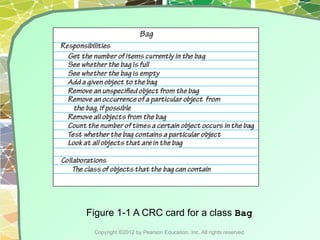
Behaviors
• Determine how many objects in bag
 Full?
 Empty?

•
•
•
•

Add, remove objects
Count duplicates
Test for specific object
View all objects
Copyright ©2012 by Pearson Education, Inc. All rights reserved
Figure 1-1 A CRC card for a class Bag
Copyright ©2012 by Pearson Education, Inc. All rights reserved
Specifying a Bag
• Describe data
• Specify methods for bag’s behaviors
 Name methods
 Choose parameters
 Decide return types
 Write comments

Copyright ©2012 by Pearson Education, Inc. All rights reserved
Figure 1-2 UML notation for the class Bag
Copyright ©2012 by Pearson Education, Inc. All rights reserved
Design Decisions
• What should the method add do when it
cannot add a new entry?
 Nothing?
 Leave bag unchanged, signal client of

condition?

Copyright ©2012 by Pearson Education, Inc. All rights reserved
Design Decisions
• What should happen when an unusual
condition occurs?
 Assume invalid never happens?
 Ignore invalid event?
 Guess at client’s intention?
 Return flag value?
 Return boolean value – success/failure?
 Throw exception?
Copyright ©2012 by Pearson Education, Inc. All rights reserved
Interface
• Write Java headers
• Organize into interface
• Note items in bag are of same type
 Generic type <T>
• View Listing 1-1
Note: Code listing files
must be in same
must be in same
folder
folder
as PowerPoint files
as PowerPoint files
for links to work
for links to work

Copyright ©2012 by Pearson Education, Inc. All rights reserved
Using ADT Bag
• Implementation done from specifications
 User needs know what ADT does, not how

• Type of object in bag specified by program
using the ADT
• Example of Bag for online shopping
Listing 1-2

Copyright ©2012 by Pearson Education, Inc. All rights reserved
Using ADT Bag
• Example of Bag for class of piggy banks
Listing 1-3
• Demonstration of class PiggyBank
Listing 1-4

Copyright ©2012 by Pearson Education, Inc. All rights reserved
Figure 1-3 A Vending Machine
Copyright ©2012 by Pearson Education, Inc. All rights reserved
Vending Machine Like An ADT
•
•
•
•

Perform only available tasks
User must understand the tasks
Cannot access inside of mechanism
Usable without knowing inside
implementation
• New inside implementation unknown to
users
Copyright ©2012 by Pearson Education, Inc. All rights reserved
Class Library
• The interface Set
public
public
public
public
public
public
public

boolean add(T newEntry)
boolean remove(Object anEntry)
void clear()
boolean contains(Object anEntry)
boolean isEmpty()
int size()
Object[] toArray()

Copyright ©2012 by Pearson Education, Inc. All rights reserved
End
Chapter 1

Copyright ©2012 by Pearson Education, Inc. All rights reserved

Chapter01 bags

  • 1.
    Bags Chapter 1 Copyright ©2012by Pearson Education, Inc. All rights reserved
  • 2.
    Contents • The Bag A Bag’s Behaviors • Specifying a Bag  An Interface • Using the ADT Bag • Using an ADT Is Like Using a Vending Machine Copyright ©2012 by Pearson Education, Inc. All rights reserved
  • 3.
    Objectives • Describe theconcept of abstract data type (ADT) • Describe ADT bag • Use ADT bag in Java program Copyright ©2012 by Pearson Education, Inc. All rights reserved
  • 4.
    Definition: Bag • Afinite collection of objects • In no particular order • May contain duplicate items Copyright ©2012 by Pearson Education, Inc. All rights reserved
  • 5.
    Behaviors • Determine howmany objects in bag  Full?  Empty? • • • • Add, remove objects Count duplicates Test for specific object View all objects Copyright ©2012 by Pearson Education, Inc. All rights reserved
  • 6.
    Figure 1-1 ACRC card for a class Bag Copyright ©2012 by Pearson Education, Inc. All rights reserved
  • 7.
    Specifying a Bag •Describe data • Specify methods for bag’s behaviors  Name methods  Choose parameters  Decide return types  Write comments Copyright ©2012 by Pearson Education, Inc. All rights reserved
  • 8.
    Figure 1-2 UMLnotation for the class Bag Copyright ©2012 by Pearson Education, Inc. All rights reserved
  • 9.
    Design Decisions • Whatshould the method add do when it cannot add a new entry?  Nothing?  Leave bag unchanged, signal client of condition? Copyright ©2012 by Pearson Education, Inc. All rights reserved
  • 10.
    Design Decisions • Whatshould happen when an unusual condition occurs?  Assume invalid never happens?  Ignore invalid event?  Guess at client’s intention?  Return flag value?  Return boolean value – success/failure?  Throw exception? Copyright ©2012 by Pearson Education, Inc. All rights reserved
  • 11.
    Interface • Write Javaheaders • Organize into interface • Note items in bag are of same type  Generic type <T> • View Listing 1-1 Note: Code listing files Note: Code listing files must be in same must be in same folder folder as PowerPoint files as PowerPoint files for links to work for links to work Copyright ©2012 by Pearson Education, Inc. All rights reserved
  • 12.
    Using ADT Bag •Implementation done from specifications  User needs know what ADT does, not how • Type of object in bag specified by program using the ADT • Example of Bag for online shopping Listing 1-2 Copyright ©2012 by Pearson Education, Inc. All rights reserved
  • 13.
    Using ADT Bag •Example of Bag for class of piggy banks Listing 1-3 • Demonstration of class PiggyBank Listing 1-4 Copyright ©2012 by Pearson Education, Inc. All rights reserved
  • 14.
    Figure 1-3 AVending Machine Copyright ©2012 by Pearson Education, Inc. All rights reserved
  • 15.
    Vending Machine LikeAn ADT • • • • Perform only available tasks User must understand the tasks Cannot access inside of mechanism Usable without knowing inside implementation • New inside implementation unknown to users Copyright ©2012 by Pearson Education, Inc. All rights reserved
  • 16.
    Class Library • Theinterface Set public public public public public public public boolean add(T newEntry) boolean remove(Object anEntry) void clear() boolean contains(Object anEntry) boolean isEmpty() int size() Object[] toArray() Copyright ©2012 by Pearson Education, Inc. All rights reserved
  • 17.
    End Chapter 1 Copyright ©2012by Pearson Education, Inc. All rights reserved