Collecting Cultures
Grants for strategic collecting
projects
The aims of Collecting Cultures are to:

• support the development of collections and their
use through strategic acquisition programmes,
related research and public programmes,
• enhance the professional knowledge and skills of
staff working in museums, libraries and archives,

• use strategic collecting programmes to support
the funded museums, libraries and archives to
increase resilience as an organisation.
Who can apply?

• Museums – same as first programme
• Archives – including film and sound archives

• Libraries with specialist heritage collections, eg
cathedral, university and some public libraries
Eligibility

• collections acquired need to be held in public
ownership for the long term.
• we ask you to demonstrate that you can meet the
standards of governance, collections care and
access as outlined in museum accreditation and
archives accreditation.
• if you are not within an accreditation scheme then
you should supply policies which show you are
meeting these standards.
Essence of the programme

We give grants for projects that:
• develop collections strategically over time, through
programmes of targeted acquisition.
• develop the skills of staff through increasing
collections knowledge and experience of acquisition.
• promote the use of the collection by engaging new
and existing audiences through activities and events
• build organisational resilience through new
partnerships and networks
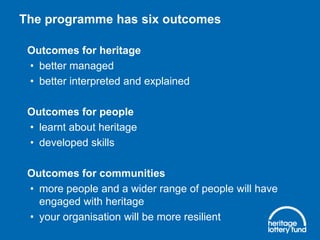
The programme has six outcomes
Outcomes for heritage
• better managed
• better interpreted and explained
Outcomes for people
• learnt about heritage
• developed skills
Outcomes for communities
• more people and a wider range of people will have
engaged with heritage
• your organisation will be more resilient
Key features of Collecting Cultures

•
•
•
•
•
•
•

one off, single round programme
£5 million budget
spread across museums, libraries and archives
minimum grant £50,000
maximum grant £500,000
50% of grant must be spent on acquisition
projects of up to 5 years

Deadline for applications – 2 May 2014
What we could fund
• acquisition costs including fees for purchase and
valuation
• essential conservation or cataloguing costs for newly
acquired items
• skills development costs for staff
• activity costs for engaging audiences
• exhibition costs
Collecting Cultures is not for you if:
• your project doesn’t focus on acquiring portable
heritage
• you only want to acquire a small number of one-off
items
• the acquired items do not fill a strategic gap in your
collections
• you are not planning activities to help people engage
with and learn about the collections
Previous experience of acquisition is not
needed
• cohort of Collecting Cultures projects provides
support – regular cohort meetings and plans for an
online community
• we can provide lessons learnt from the first Collecting
Cultures programme
Making an application
Summary
You submit two main documents to us:

• pre-application form (before 3 March)
• an application form (before 2 May)
–
–
–
–
–

your plans for acquisition
an activity plan detailing skills development and engagement
how you will meet the programme outcomes
firm budget
how you will develop your plans for acquisition once you
receive your grant
The programme has six outcomes
Outcomes for heritage
• better managed
• better interpreted and explained
Outcomes for people
• learnt about heritage
• developed skills
Outcomes for communities
• more people and a wider range of people will have
engaged with heritage
• your organisation will be more resilient
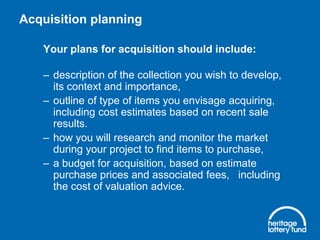
Acquisition planning
Your plans for acquisition should include:

– description of the collection you wish to develop,
its context and importance,
– outline of type of items you envisage acquiring,
including cost estimates based on recent sale
results.
– how you will research and monitor the market
during your project to find items to purchase,
– a budget for acquisition, based on estimate
purchase prices and associated fees, including
the cost of valuation advice.
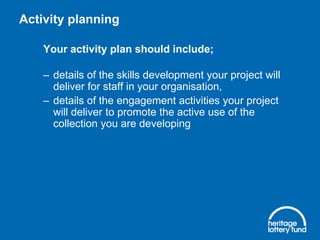
Activity planning
Your activity plan should include;

– details of the skills development your project will
deliver for staff in your organisation,
– details of the engagement activities your project
will deliver to promote the active use of the
collection you are developing
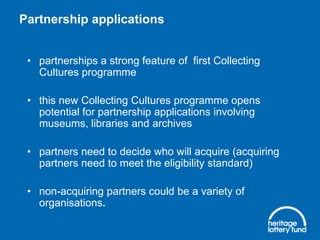
Partnership applications
• partnerships a strong feature of first Collecting
Cultures programme

• this new Collecting Cultures programme opens
potential for partnership applications involving
museums, libraries and archives
• partners need to decide who will acquire (acquiring
partners need to meet the eligibility standard)
• non-acquiring partners could be a variety of
organisations.
Learning from others
First Collecting Cultures
programme
First Collecting Cultures programme
– 22 projects supported across UK

– total of £3.14m awarded
– grants up to £200,000

– targeted at museums
Collecting Cultures first programme example
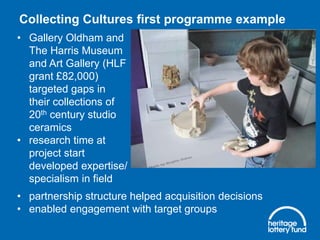
• Gallery Oldham and
The Harris Museum
and Art Gallery (HLF
grant £82,000)
targeted gaps in
their collections of
20th century studio
ceramics
• research time at
project start
developed expertise/
specialism in field
• partnership structure helped acquisition decisions
• enabled engagement with target groups
Collecting Cultures first programme example
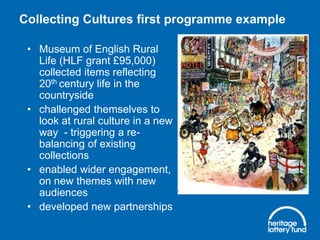
• Museum of English Rural
Life (HLF grant £95,000)
collected items reflecting
20th century life in the
countryside
• challenged themselves to
look at rural culture in a new
way - triggering a rebalancing of existing
collections
• enabled wider engagement,
on new themes with new
audiences
• developed new partnerships
Collecting Cultures first programme example
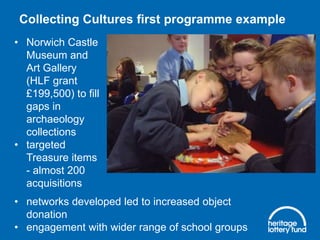
• Norwich Castle
Museum and
Art Gallery
(HLF grant
£199,500) to fill
gaps in
archaeology
collections
• targeted
Treasure items
- almost 200
acquisitions
• networks developed led to increased object
donation
• engagement with wider range of school groups
Collecting Cultures first programme example
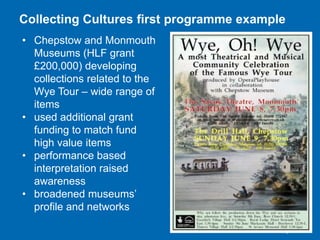
• Chepstow and Monmouth
Museums (HLF grant
£200,000) developing
collections related to the
Wye Tour – wide range of
items
• used additional grant
funding to match fund
high value items
• performance based
interpretation raised
awareness
• broadened museums’
profile and networks
Collecting Cultures new programme timetable
– Deadline for applications: 2 May 2014

– HLF Board makes decisions: 30 September
2014
– Projects begin: October 2014
– Projects complete: October 2019
For more information
Visit the Collecting Cultures page on our website
to find application guidance and an evaluation of
the first Collecting Cultures programme:
http://www.hlf.org.uk/HowToApply/programmes/
Pages/CollectingCultures.aspx
Queries & Advice in Scotland

Megan Braithwaite – Development Officer
megan.braithwaite@hlf.org.uk
0131 240 1586
@HLFScotland

Collecting cultures presentation 13th Jan, Edinburgh

  • 1.
    Collecting Cultures Grants forstrategic collecting projects
  • 2.
    The aims ofCollecting Cultures are to: • support the development of collections and their use through strategic acquisition programmes, related research and public programmes, • enhance the professional knowledge and skills of staff working in museums, libraries and archives, • use strategic collecting programmes to support the funded museums, libraries and archives to increase resilience as an organisation.
  • 3.
    Who can apply? •Museums – same as first programme • Archives – including film and sound archives • Libraries with specialist heritage collections, eg cathedral, university and some public libraries
  • 4.
    Eligibility • collections acquiredneed to be held in public ownership for the long term. • we ask you to demonstrate that you can meet the standards of governance, collections care and access as outlined in museum accreditation and archives accreditation. • if you are not within an accreditation scheme then you should supply policies which show you are meeting these standards.
  • 5.
    Essence of theprogramme We give grants for projects that: • develop collections strategically over time, through programmes of targeted acquisition. • develop the skills of staff through increasing collections knowledge and experience of acquisition. • promote the use of the collection by engaging new and existing audiences through activities and events • build organisational resilience through new partnerships and networks
  • 6.
    The programme hassix outcomes Outcomes for heritage • better managed • better interpreted and explained Outcomes for people • learnt about heritage • developed skills Outcomes for communities • more people and a wider range of people will have engaged with heritage • your organisation will be more resilient
  • 7.
    Key features ofCollecting Cultures • • • • • • • one off, single round programme £5 million budget spread across museums, libraries and archives minimum grant £50,000 maximum grant £500,000 50% of grant must be spent on acquisition projects of up to 5 years Deadline for applications – 2 May 2014
  • 8.
    What we couldfund • acquisition costs including fees for purchase and valuation • essential conservation or cataloguing costs for newly acquired items • skills development costs for staff • activity costs for engaging audiences • exhibition costs
  • 9.
    Collecting Cultures isnot for you if: • your project doesn’t focus on acquiring portable heritage • you only want to acquire a small number of one-off items • the acquired items do not fill a strategic gap in your collections • you are not planning activities to help people engage with and learn about the collections
  • 10.
    Previous experience ofacquisition is not needed • cohort of Collecting Cultures projects provides support – regular cohort meetings and plans for an online community • we can provide lessons learnt from the first Collecting Cultures programme
  • 11.
  • 12.
    Summary You submit twomain documents to us: • pre-application form (before 3 March) • an application form (before 2 May) – – – – – your plans for acquisition an activity plan detailing skills development and engagement how you will meet the programme outcomes firm budget how you will develop your plans for acquisition once you receive your grant
  • 13.
    The programme hassix outcomes Outcomes for heritage • better managed • better interpreted and explained Outcomes for people • learnt about heritage • developed skills Outcomes for communities • more people and a wider range of people will have engaged with heritage • your organisation will be more resilient
  • 14.
    Acquisition planning Your plansfor acquisition should include: – description of the collection you wish to develop, its context and importance, – outline of type of items you envisage acquiring, including cost estimates based on recent sale results. – how you will research and monitor the market during your project to find items to purchase, – a budget for acquisition, based on estimate purchase prices and associated fees, including the cost of valuation advice.
  • 15.
    Activity planning Your activityplan should include; – details of the skills development your project will deliver for staff in your organisation, – details of the engagement activities your project will deliver to promote the active use of the collection you are developing
  • 16.
    Partnership applications • partnershipsa strong feature of first Collecting Cultures programme • this new Collecting Cultures programme opens potential for partnership applications involving museums, libraries and archives • partners need to decide who will acquire (acquiring partners need to meet the eligibility standard) • non-acquiring partners could be a variety of organisations.
  • 17.
    Learning from others FirstCollecting Cultures programme
  • 18.
    First Collecting Culturesprogramme – 22 projects supported across UK – total of £3.14m awarded – grants up to £200,000 – targeted at museums
  • 19.
    Collecting Cultures firstprogramme example • Gallery Oldham and The Harris Museum and Art Gallery (HLF grant £82,000) targeted gaps in their collections of 20th century studio ceramics • research time at project start developed expertise/ specialism in field • partnership structure helped acquisition decisions • enabled engagement with target groups
  • 20.
    Collecting Cultures firstprogramme example • Museum of English Rural Life (HLF grant £95,000) collected items reflecting 20th century life in the countryside • challenged themselves to look at rural culture in a new way - triggering a rebalancing of existing collections • enabled wider engagement, on new themes with new audiences • developed new partnerships
  • 21.
    Collecting Cultures firstprogramme example • Norwich Castle Museum and Art Gallery (HLF grant £199,500) to fill gaps in archaeology collections • targeted Treasure items - almost 200 acquisitions • networks developed led to increased object donation • engagement with wider range of school groups
  • 22.
    Collecting Cultures firstprogramme example • Chepstow and Monmouth Museums (HLF grant £200,000) developing collections related to the Wye Tour – wide range of items • used additional grant funding to match fund high value items • performance based interpretation raised awareness • broadened museums’ profile and networks
  • 23.
    Collecting Cultures newprogramme timetable – Deadline for applications: 2 May 2014 – HLF Board makes decisions: 30 September 2014 – Projects begin: October 2014 – Projects complete: October 2019
  • 24.
    For more information Visitthe Collecting Cultures page on our website to find application guidance and an evaluation of the first Collecting Cultures programme: http://www.hlf.org.uk/HowToApply/programmes/ Pages/CollectingCultures.aspx Queries & Advice in Scotland Megan Braithwaite – Development Officer megan.braithwaite@hlf.org.uk 0131 240 1586 @HLFScotland

Editor's Notes

  • #3 Strategic collecting - The programme is about MLAs developing their collections through targeted acquisitions so simply it is about acquiring collections over a period of time rather than one off acquisitions. The strategic element refers to what the MLA will collect – we want our funding to be used for MLAs to identify the gaps in their collections so we’re asking them to tell us why the area they wish to collect in is important and what types of objects they would be looking to acquire – we do not need to know in advance all the objects they will be acquiring Examples from first CC programmeVery focused – Tain Silver for the Tain and District MuseumWider – Enlightenment across three Derbyshire museums, Jurassic Coast fossilsAdding depth – the Whitworth Art Gallery project to fills gaps and develop its wallpaper collectionsEmphasize that the use of collections has equal weight – key focus is engagement Also staff skills – emphasis here about embedding that knowledge within the organisation Resilience in this context very much about the new potential for engagement and partnerships that the collections development project will bring – cultural capital. Egs from first CC – this was a strong feature of the success of first programme.
  • #7 Run through outcomes – will look at these again in more detail later when we look at the process of making an application.
  • #8 Budget reflects the extension of the programme to archives and libraries and also the increase in market prices since the first programme.Max grant is increased from £200,000 for the first programme – this responds to demand for this in consultation and also allows for projects in more expensive collecting areas (eg fine art). Although with programme budget of £5m we do not expect to make many awards at the max grant level.Important to note that a minimum of 50% of our grant must be spent on acquisition – this is to ensure that the programme achieves its core aim of supporting collecting development through acquisition. Project duration of 5 years – reflects the experience of the previous programme where many projects which planned a shorter duration found that they actually needed this max time – due to intial planning time needed to develop knowledge of the market or due to time waiting for suitable items to become available. Highlight pre-application enquiry deadline is 3 MarchPartnership funding - grants up to £100,000 don’t need to make cash contribution, above £100,000, 5% partnership funding
  • #9 We count costs associated with acquisition eg auction house premiums and valuation costs, as part of the acquisition cost (and part of the 50% min)Some conservation work can be included – but really only essential works to get an object into a steady state. Cataloguing also can be included – aware this may be a considerable cost for some archival acquisitions.
  • #13 Pre-application form simply asks for headline details of your idea for a project – so that we can give constructive feedback to help you plan your application. Important to go onto our website and submit a pre-application form before the deadline of 3 March – you must have done this in order to then move on to submit an application.The deadline for applications is 2 April, these are the key areas of detail that you will need to provide with your application. NB your plans for acquisition do not need to detail specific objects, simply a collection area and types of object. We also ask that you tell us how you plan to develop this planning through research when your project starts, in order to find and select specific objects to acquire.
  • #14 The application guidance gives detailed descriptions of what you can use to show that your project will meet each outcome – refer.