THE NUTS AND BOLTS OF CI/CD
WITH A LARGE XPAGES AND
REST APP
IT'S... TECHNICALLY DOABLE
JESSE
GALLAGHER
CTO - I KNOW SOME GUYS
IP MANAGER - OPENNTF
HTTPS://FROSTILLIC.US
@GIDGERBY
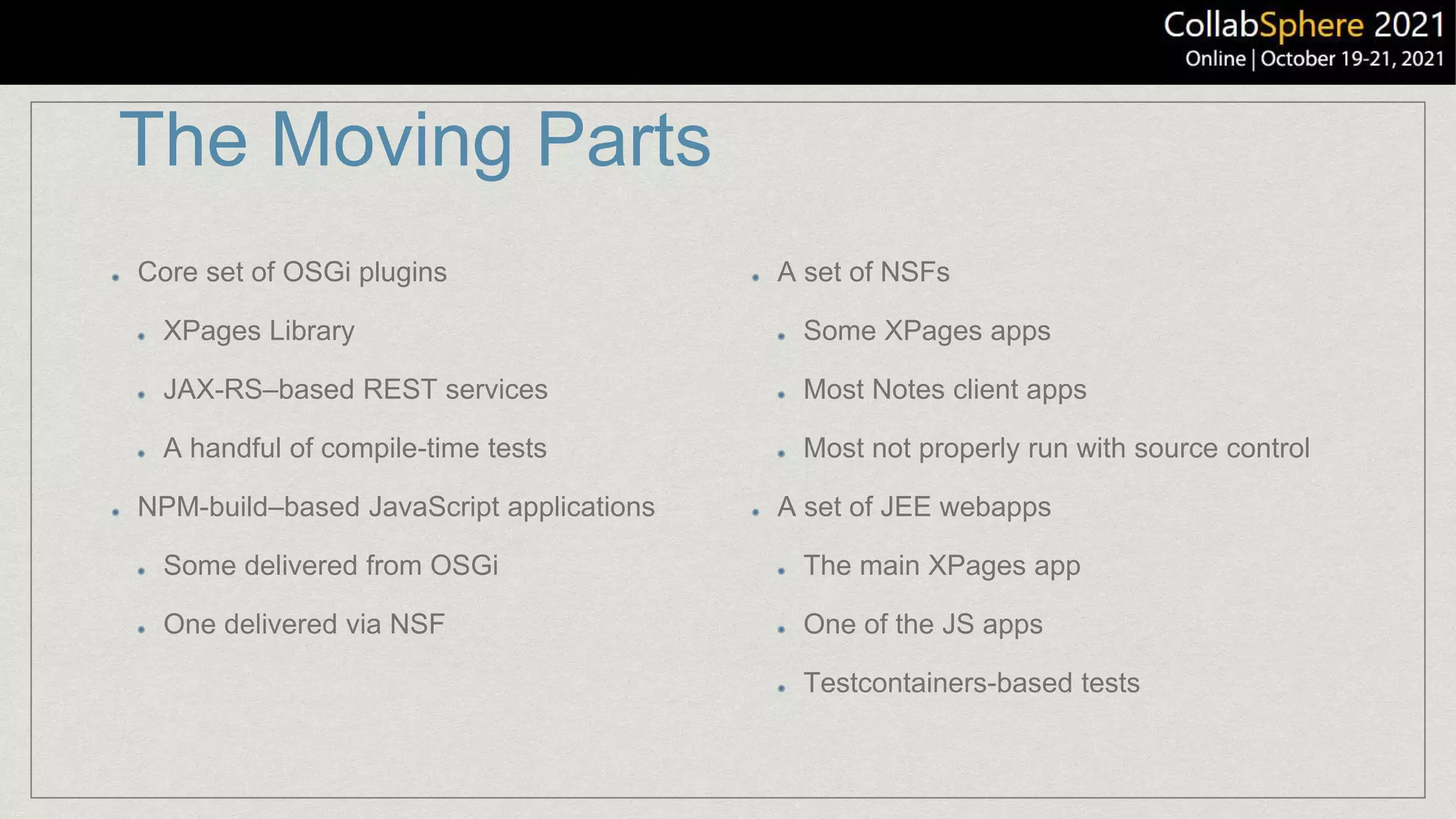
The Moving Parts
Core set of OSGi plugins
XPages Library
JAX-RS–based REST services
A handful of compile-time tests
NPM-build–based JavaScript applications
Some delivered from OSGi
One delivered via NSF
A set of NSFs
Some XPages apps
Most Notes client apps
Most not properly run with source control
A set of JEE webapps
The main XPages app
One of the JS apps
Testcontainers-based tests
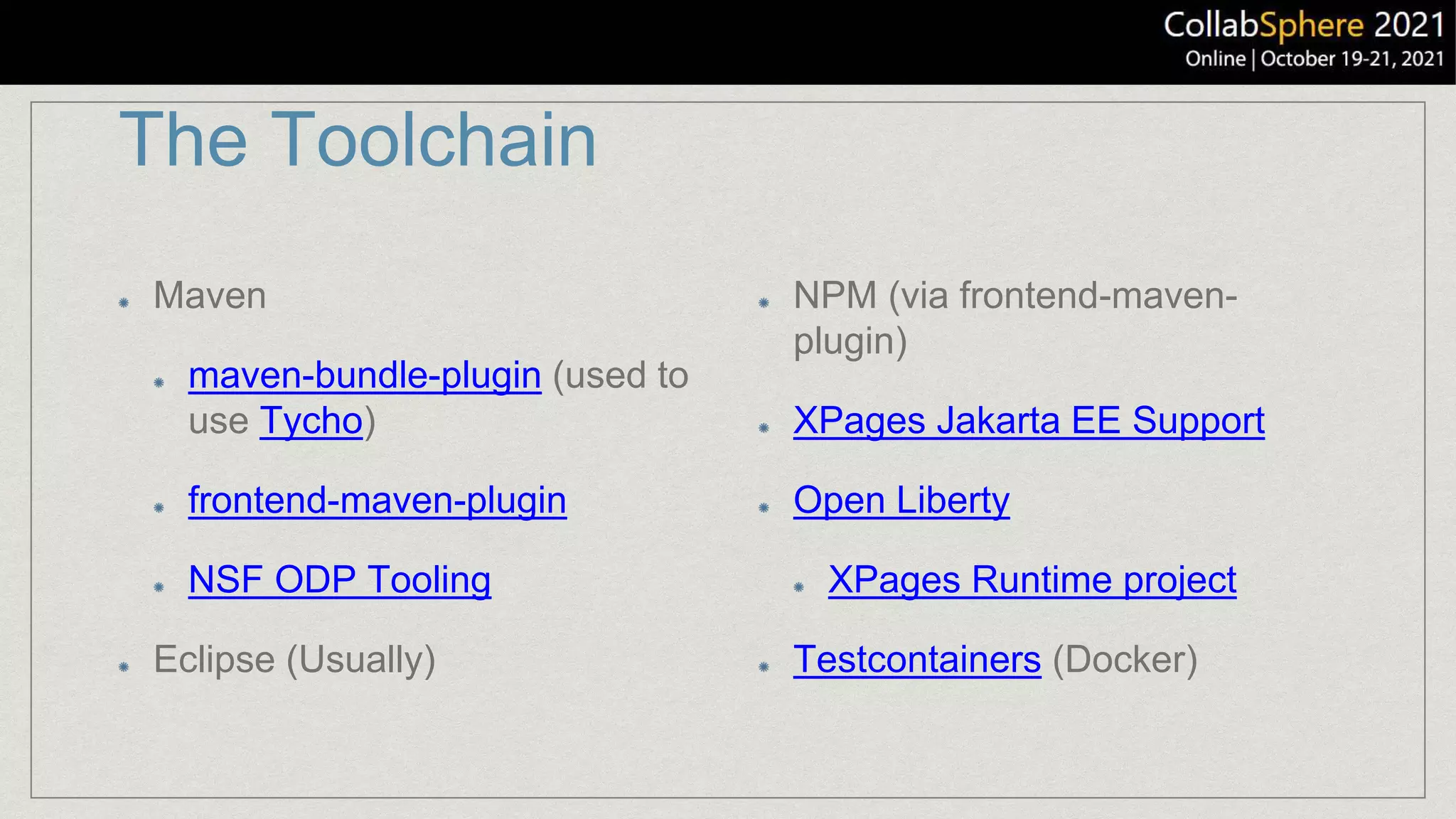
The Toolchain
Maven
maven-bundle-plugin (used to
use Tycho)
frontend-maven-plugin
NSF ODP Tooling
Eclipse (Usually)
NPM (via frontend-maven-
plugin)
XPages Jakarta EE Support
Open Liberty
XPages Runtime project
Testcontainers (Docker)
Opening Caveat
Every explanation in this presentation comes with an implicit "...but it
gets more complicated in practice"
MAVEN
Brief Aside: Maven
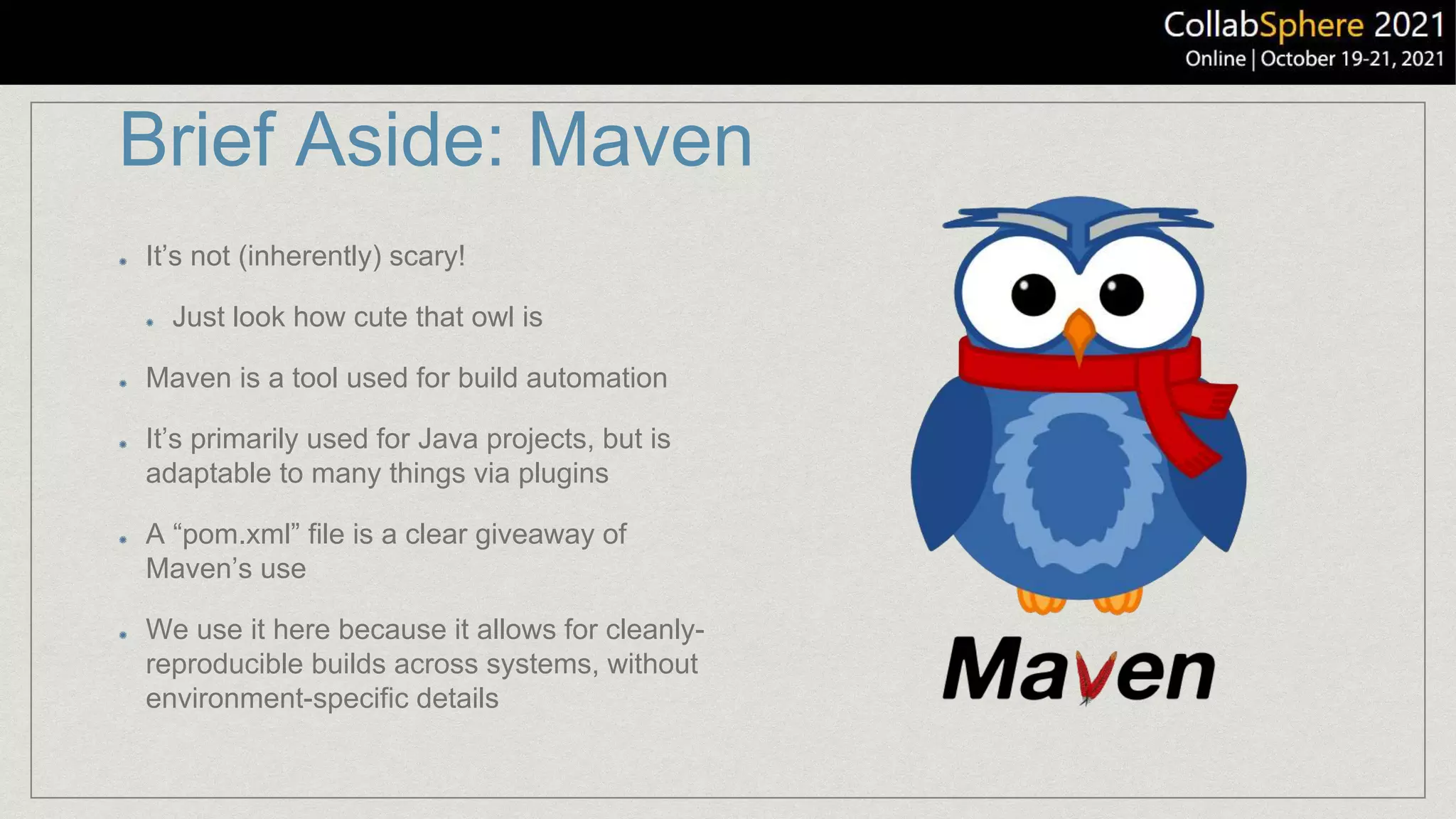
It’s not (inherently) scary!
Just look how cute that owl is
Maven is a tool used for build automation
It’s primarily used for Java projects, but is
adaptable to many things via plugins
A “pom.xml” file is a clear giveaway of
Maven’s use
We use it here because it allows for cleanly-
reproducible builds across systems, without
environment-specific details
Tycho vs. MBP
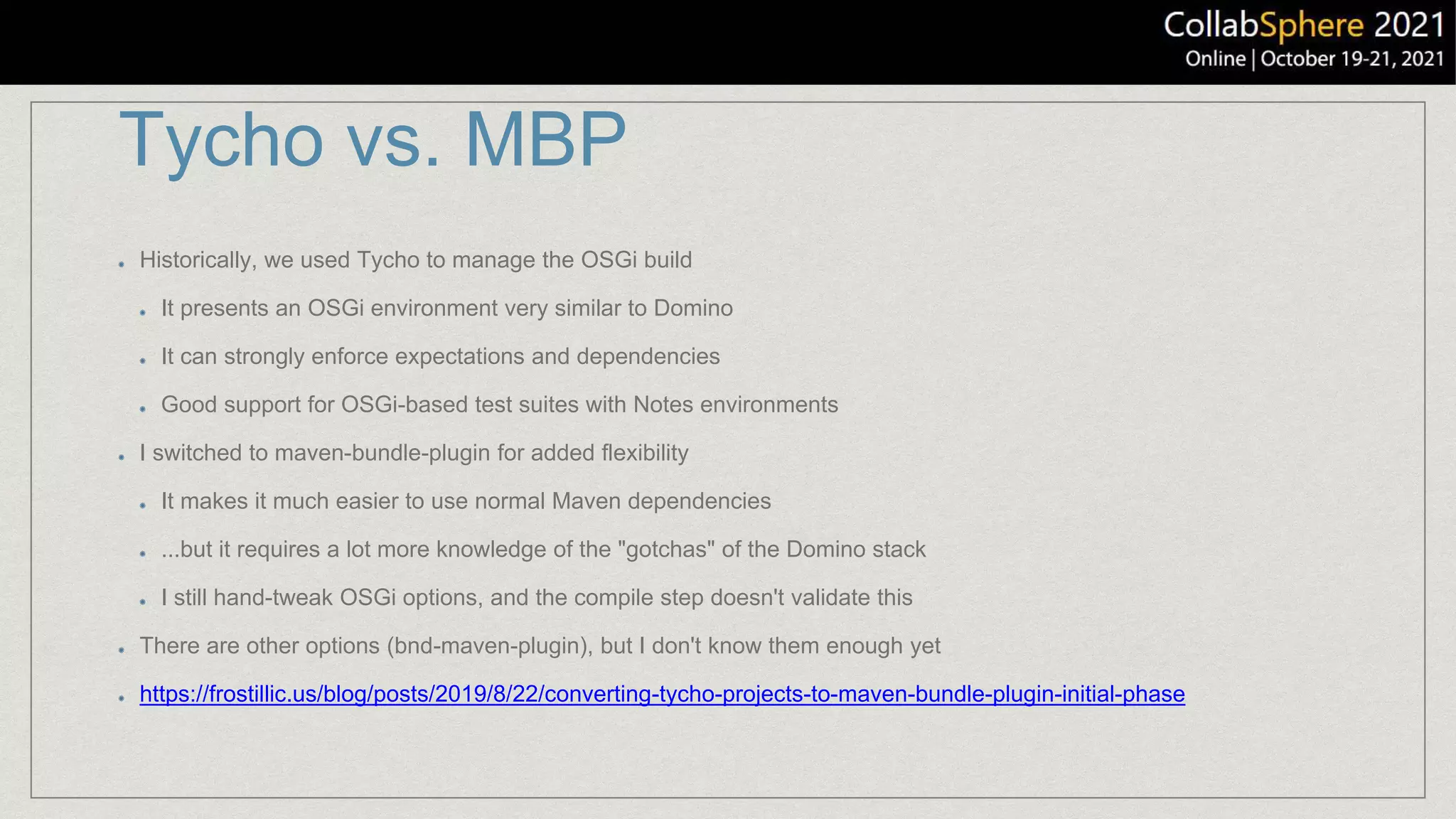
Historically, we used Tycho to manage the OSGi build
It presents an OSGi environment very similar to Domino
It can strongly enforce expectations and dependencies
Good support for OSGi-based test suites with Notes environments
I switched to maven-bundle-plugin for added flexibility
It makes it much easier to use normal Maven dependencies
...but it requires a lot more knowledge of the "gotchas" of the Domino stack
I still hand-tweak OSGi options, and the compile step doesn't validate this
There are other options (bnd-maven-plugin), but I don't know them enough yet
https://frostillic.us/blog/posts/2019/8/22/converting-tycho-projects-to-maven-bundle-plugin-initial-phase
OpenAPI Generation
<plugin>
<groupId>io.openapitools.swagger</groupId>
<artifactId>swagger-maven-plugin</artifactId>
<version>2.1.5</version>
<executions>
<execution>
<id>generate-openapi</id>
<goals>
<goal>generate</goal>
</goals>
</execution>
</executions>
</plugin>
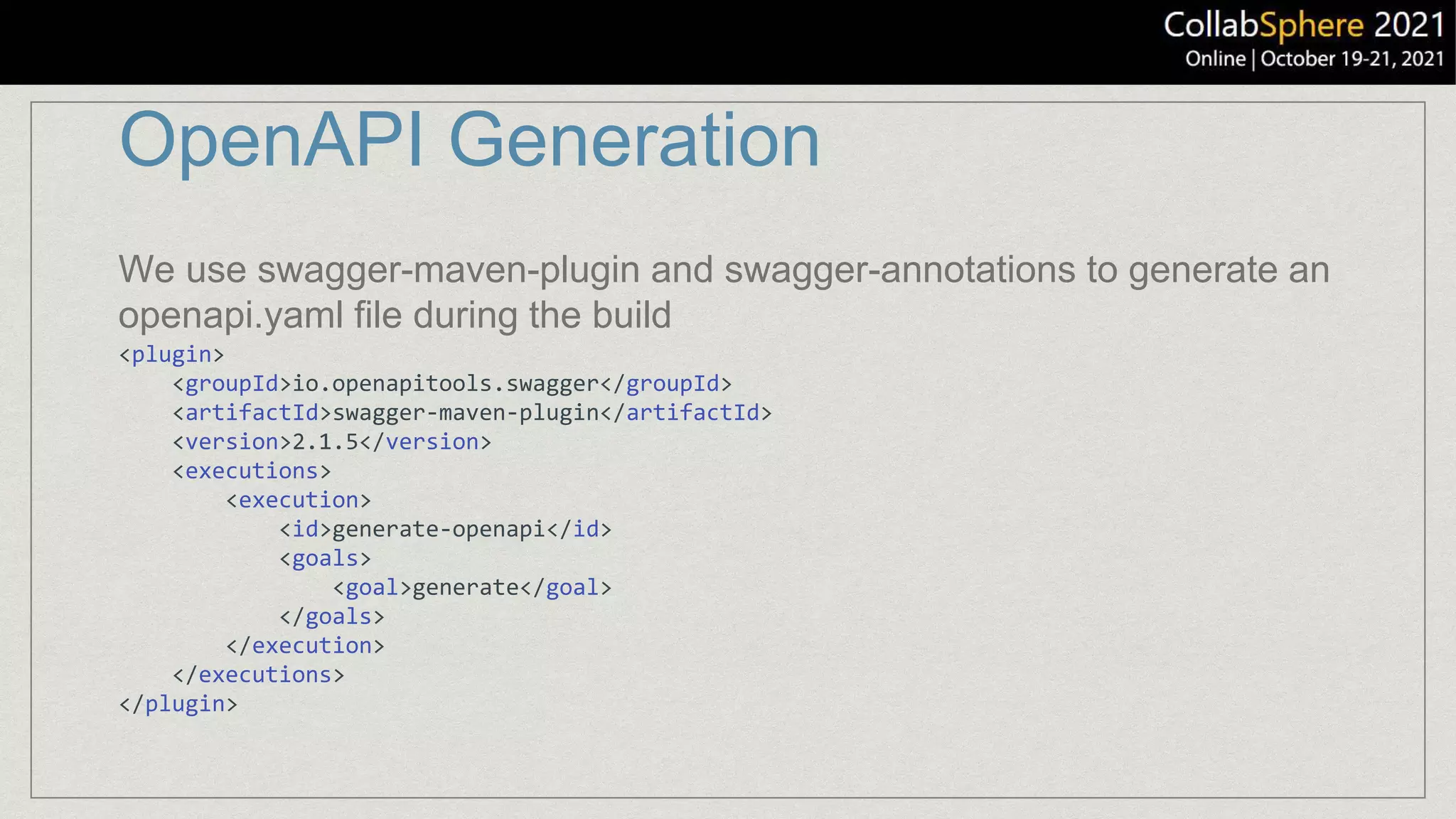
We use swagger-maven-plugin and swagger-annotations to generate an
openapi.yaml file during the build
RUNTIME-INDEPENDENT CORE
Runtime Independence
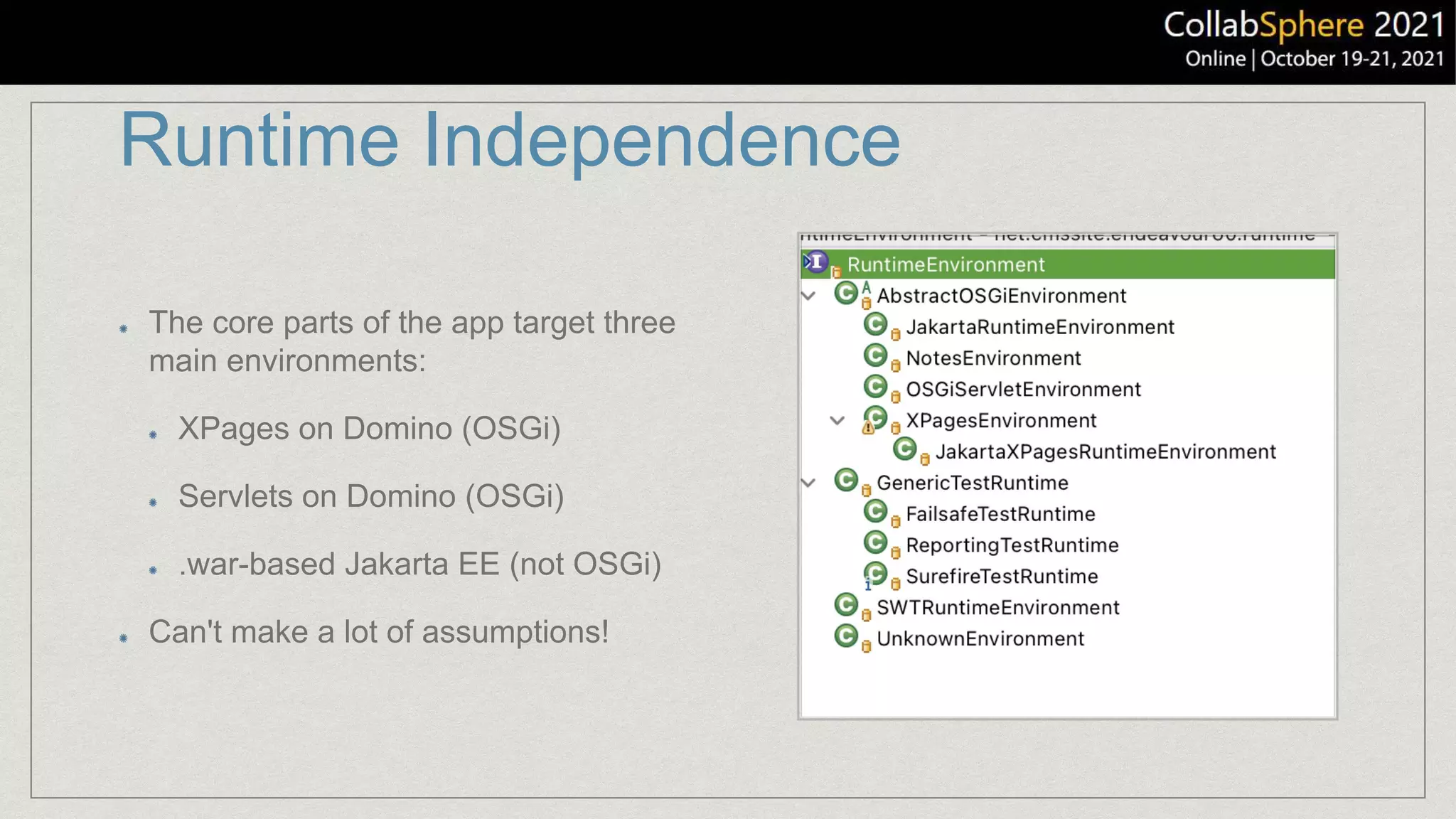
The core parts of the app target three
main environments:
XPages on Domino (OSGi)
Servlets on Domino (OSGi)
.war-based Jakarta EE (not OSGi)
Can't make a lot of assumptions!
RuntimeEnvironment Idiom
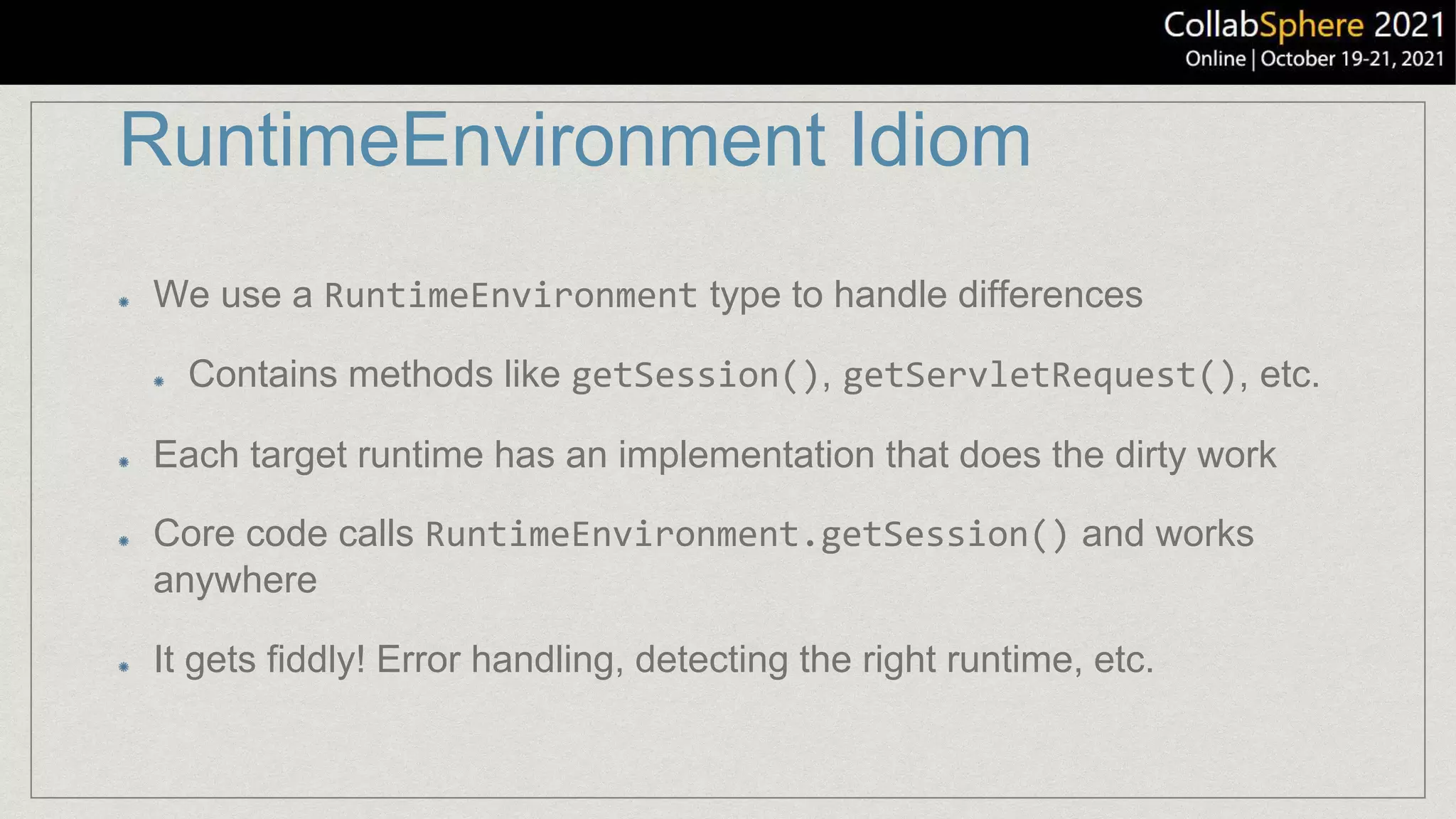
We use a RuntimeEnvironment type to handle differences
Contains methods like getSession(), getServletRequest(), etc.
Each target runtime has an implementation that does the dirty work
Core code calls RuntimeEnvironment.getSession() and works
anywhere
It gets fiddly! Error handling, detecting the right runtime, etc.
Balancing Dependencies
maven-bundle-plugin makes third-party dependencies easier
...but Domino still makes it hard
Some dependencies need to be re-packaged for Domino's OSGi
environment
Some are safest to avoid due to Domino's polluted classpath (Guava)
RuntimeEnvironment Links
https://frostillic.us/blog/posts/2020/6/18/the-runtimeenvironment-idiom
NPM-BASED BUILDS IN MAVEN
frontend-maven-plugin
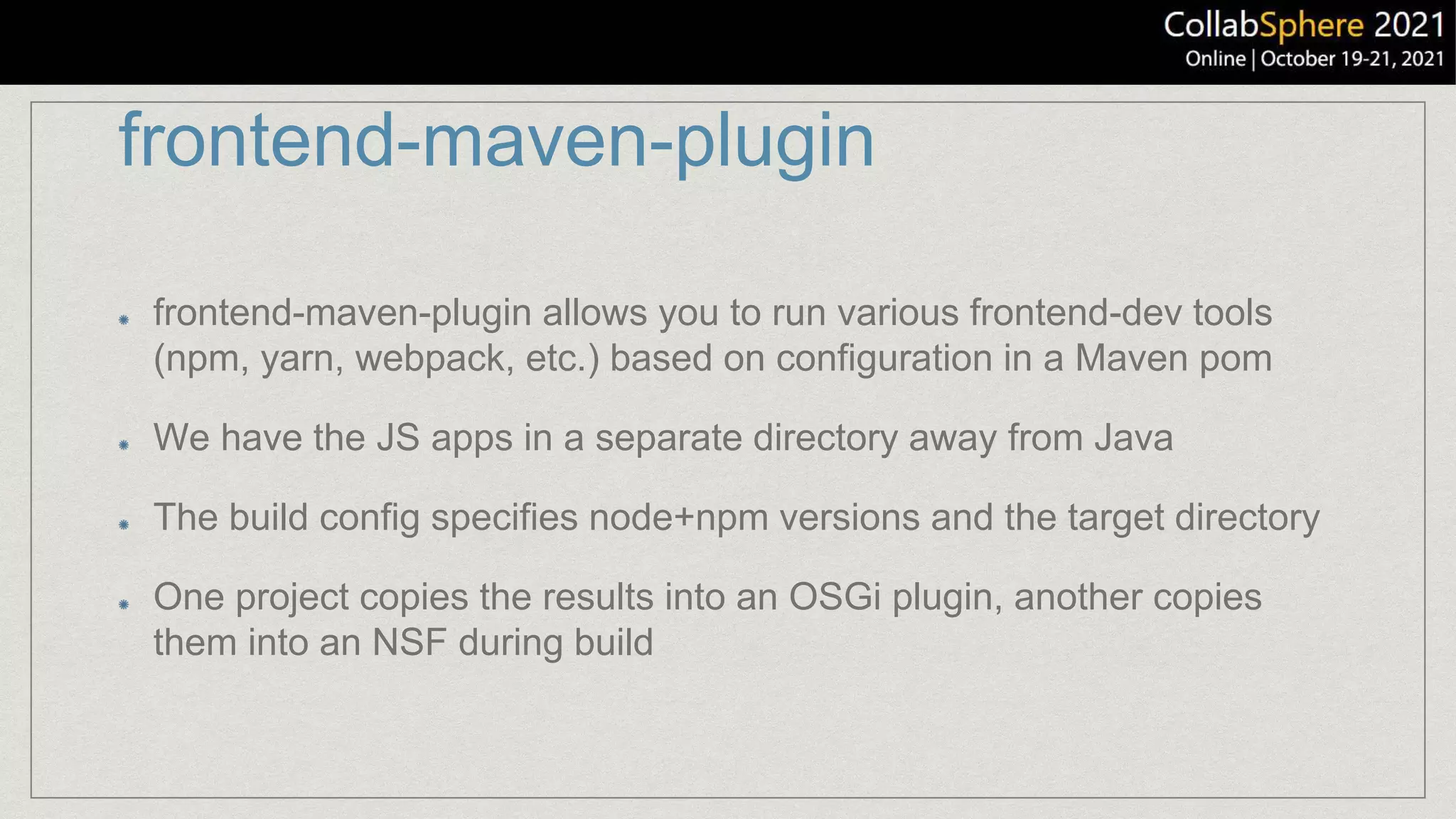
frontend-maven-plugin allows you to run various frontend-dev tools
(npm, yarn, webpack, etc.) based on configuration in a Maven pom
We have the JS apps in a separate directory away from Java
The build config specifies node+npm versions and the target directory
One project copies the results into an OSGi plugin, another copies
them into an NSF during build
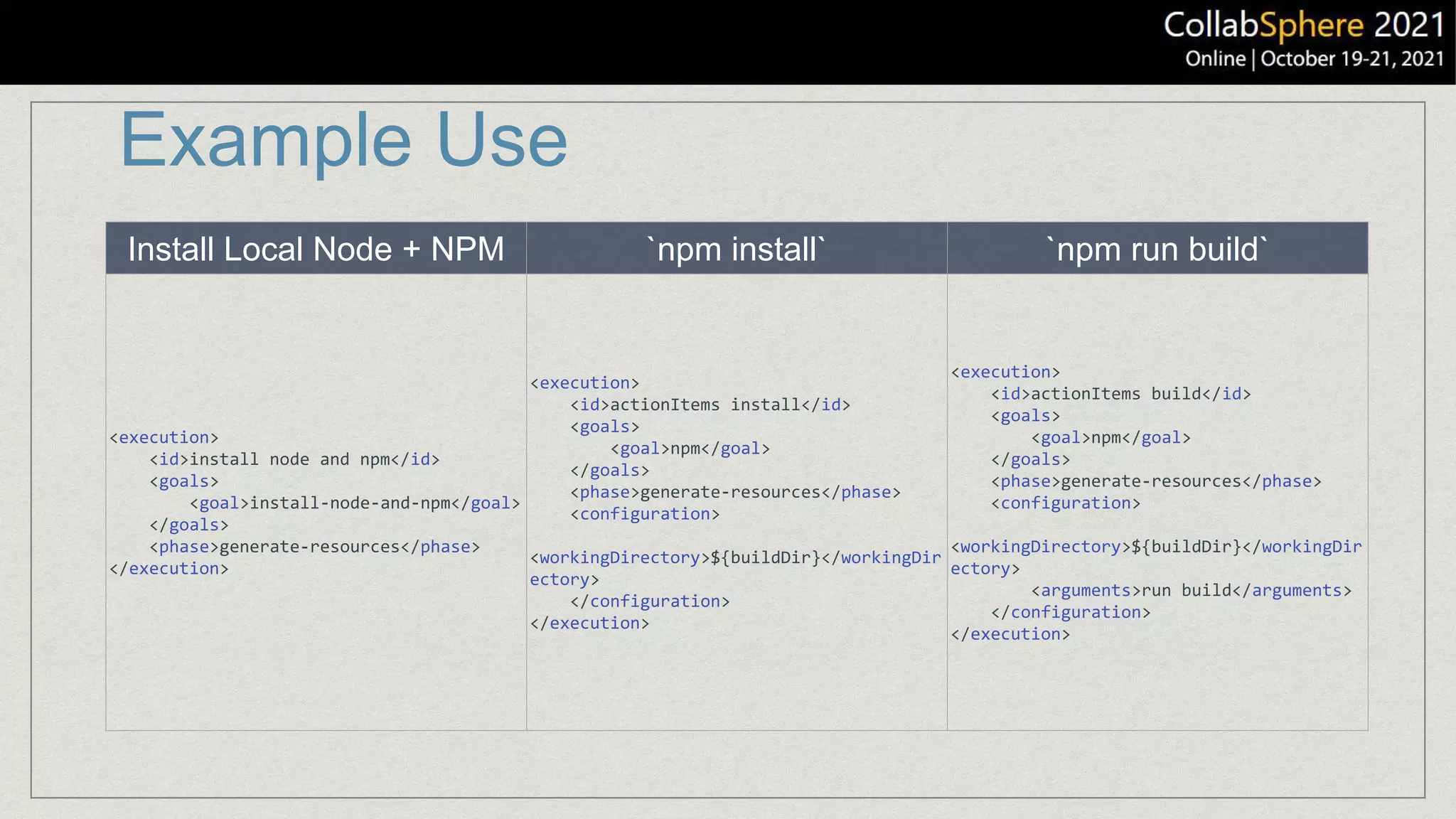
Example Use
Install Local Node + NPM `npm install` `npm run build`
<execution>
<id>install node and npm</id>
<goals>
<goal>install-node-and-npm</goal>
</goals>
<phase>generate-resources</phase>
</execution>
<execution>
<id>actionItems install</id>
<goals>
<goal>npm</goal>
</goals>
<phase>generate-resources</phase>
<configuration>
<workingDirectory>${buildDir}</workingDir
ectory>
</configuration>
</execution>
<execution>
<id>actionItems build</id>
<goals>
<goal>npm</goal>
</goals>
<phase>generate-resources</phase>
<configuration>
<workingDirectory>${buildDir}</workingDir
ectory>
<arguments>run build</arguments>
</configuration>
</execution>
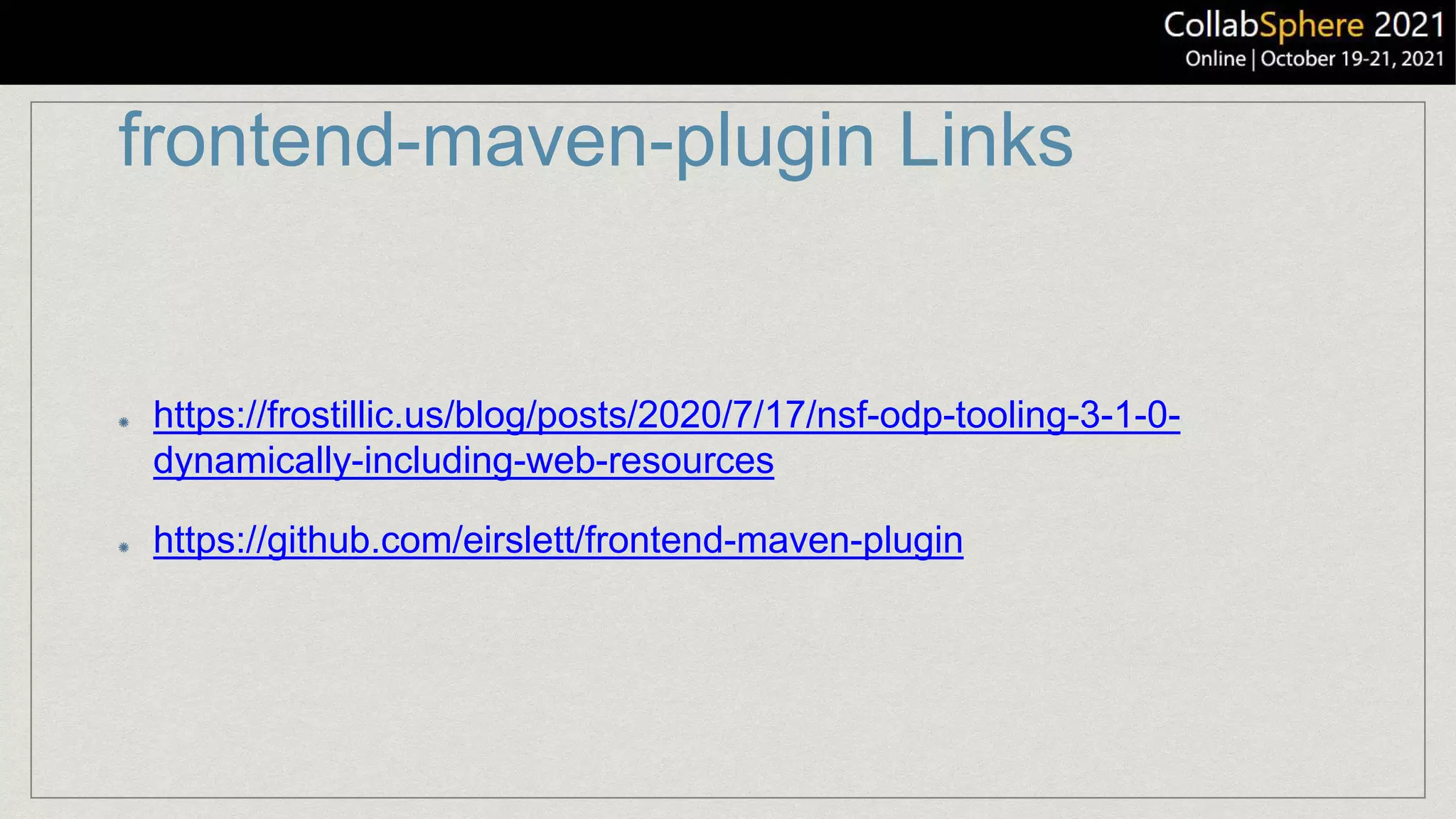
frontend-maven-plugin Links
https://frostillic.us/blog/posts/2020/7/17/nsf-odp-tooling-3-1-0-
dynamically-including-web-resources
https://github.com/eirslett/frontend-maven-plugin
NSF ODP TOOLING
NSF ODP Tooling
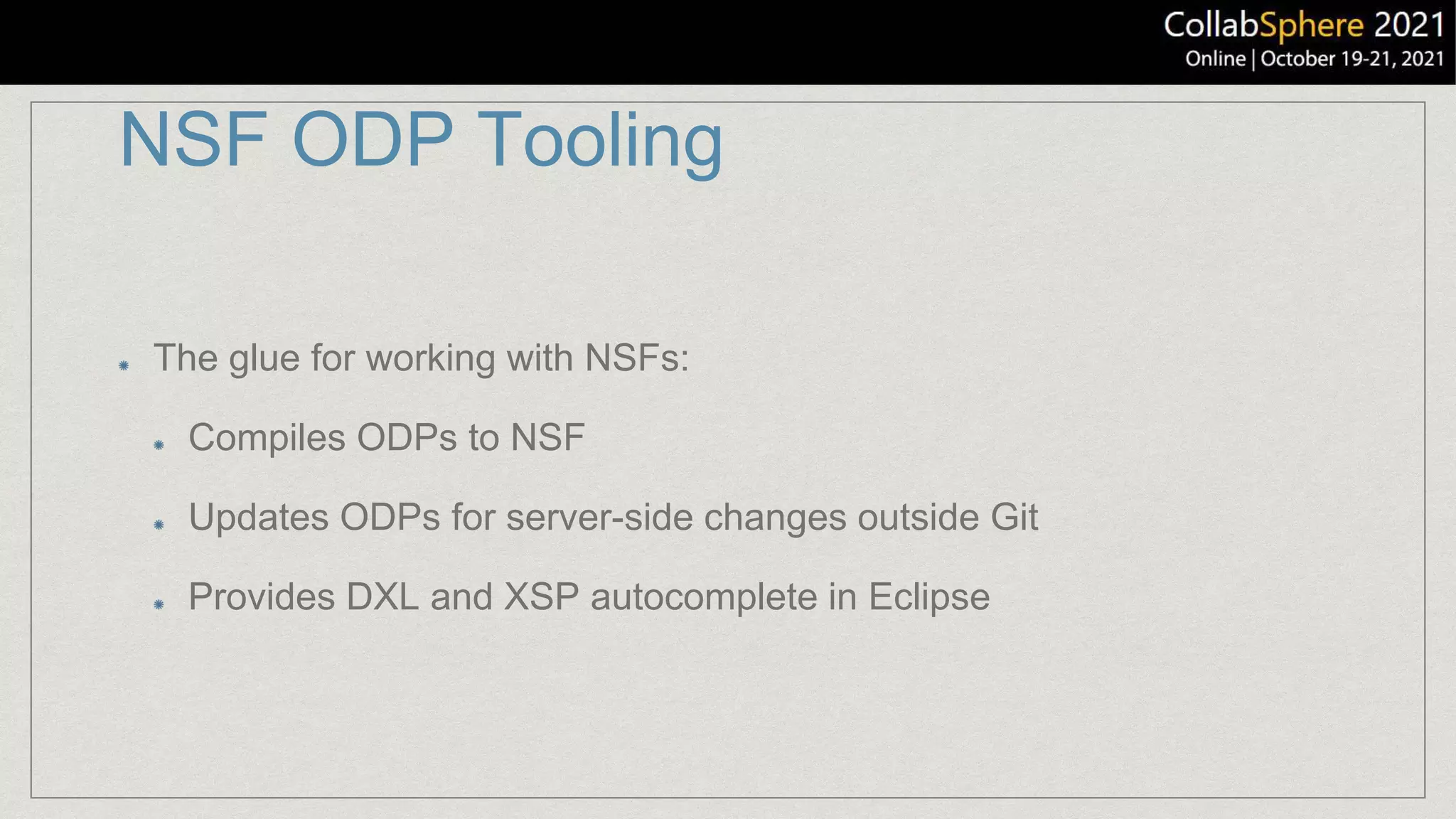
The glue for working with NSFs:
Compiles ODPs to NSF
Updates ODPs for server-side changes outside Git
Provides DXL and XSP autocomplete in Eclipse
Compilation
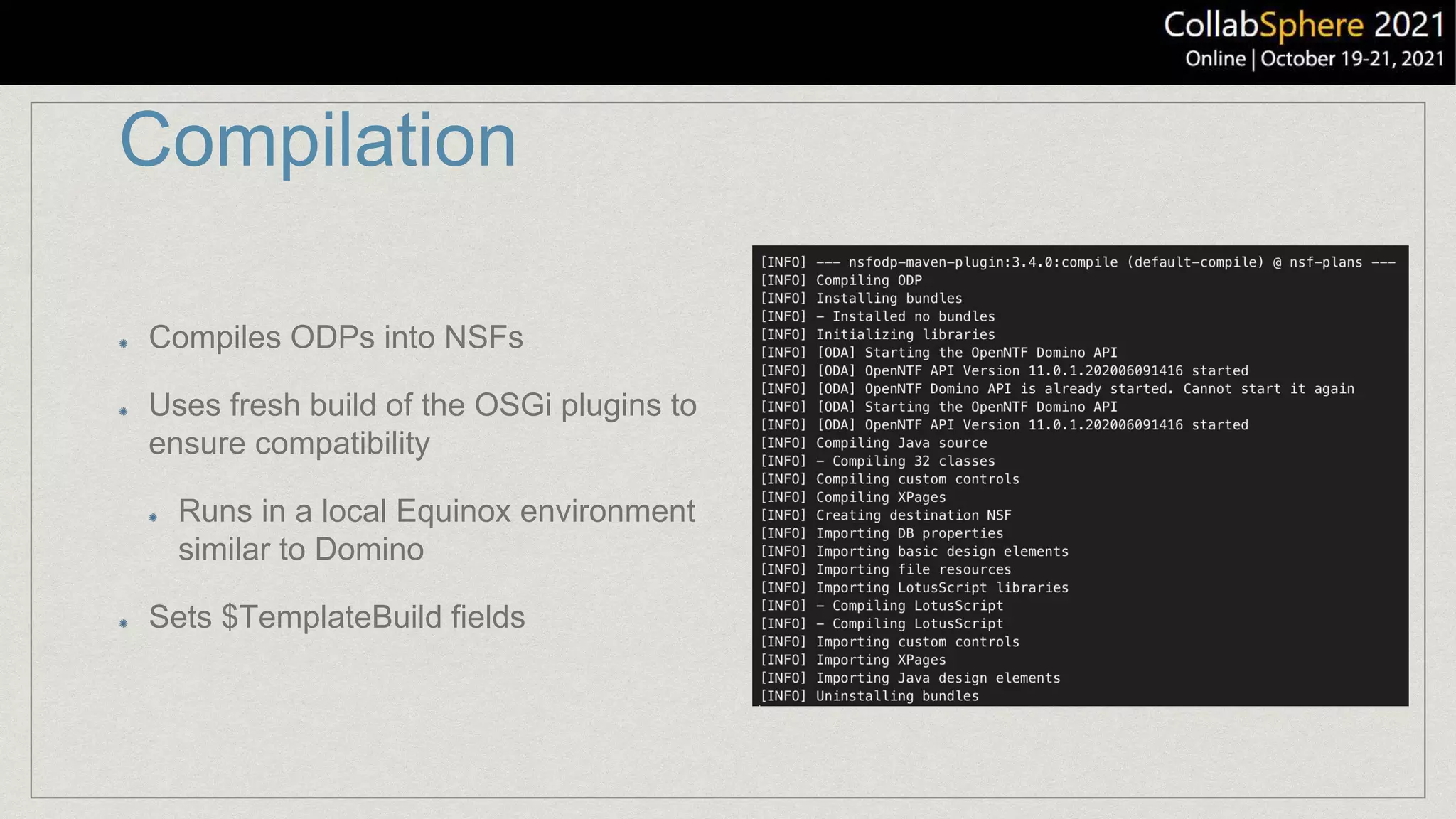
Compiles ODPs into NSFs
Uses fresh build of the OSGi plugins to
ensure compatibility
Runs in a local Equinox environment
similar to Domino
Sets $TemplateBuild fields
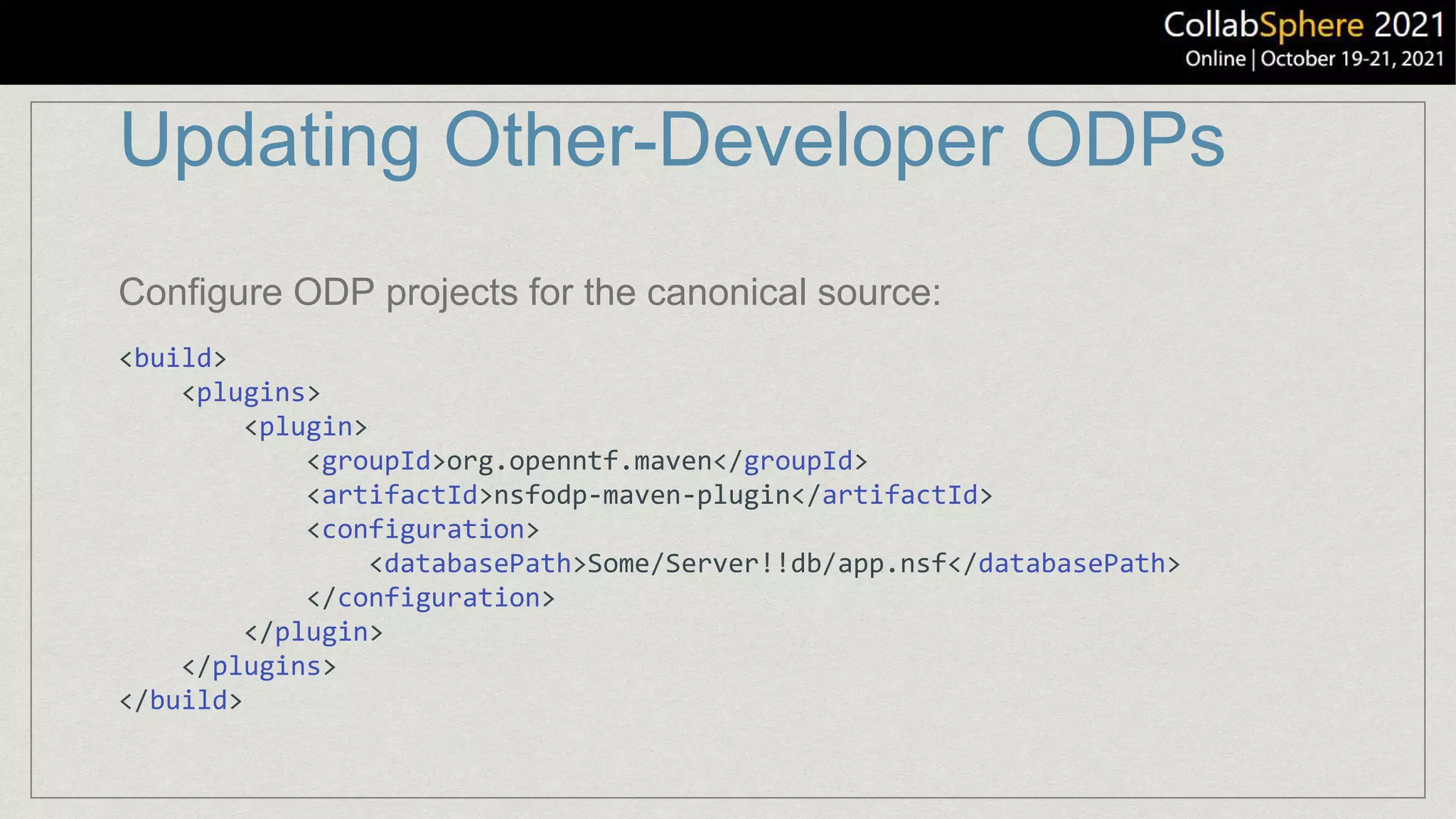
Updating Other-Developer ODPs
<build>
<plugins>
<plugin>
<groupId>org.openntf.maven</groupId>
<artifactId>nsfodp-maven-plugin</artifactId>
<configuration>
<databasePath>Some/Server!!db/app.nsf</databasePath>
</configuration>
</plugin>
</plugins>
</build>
Configure ODP projects for the canonical source:
Updating Other-Developer ODPs
#!/usr/bin/env bash
set -e
REPO_DIR="$( cd "$( dirname "${BASH_SOURCE[0]}" )" && pwd )/.."
find $REPO_DIR/osgi-plugin/nsfs/ -name pom.xml 
-not -path */nsf-dashboard/pom.xml 
-not -path */nsf-plans/pom.xml 
-print0 | xargs -0 -n 1 sh -c 'mvn org.openntf.maven:nsfodp-maven-
plugin:3.5.0:generate-odp -X -f $0 || exit 255'
Update ODPs for projects other than those properly done in Git:
XML Autocomplete
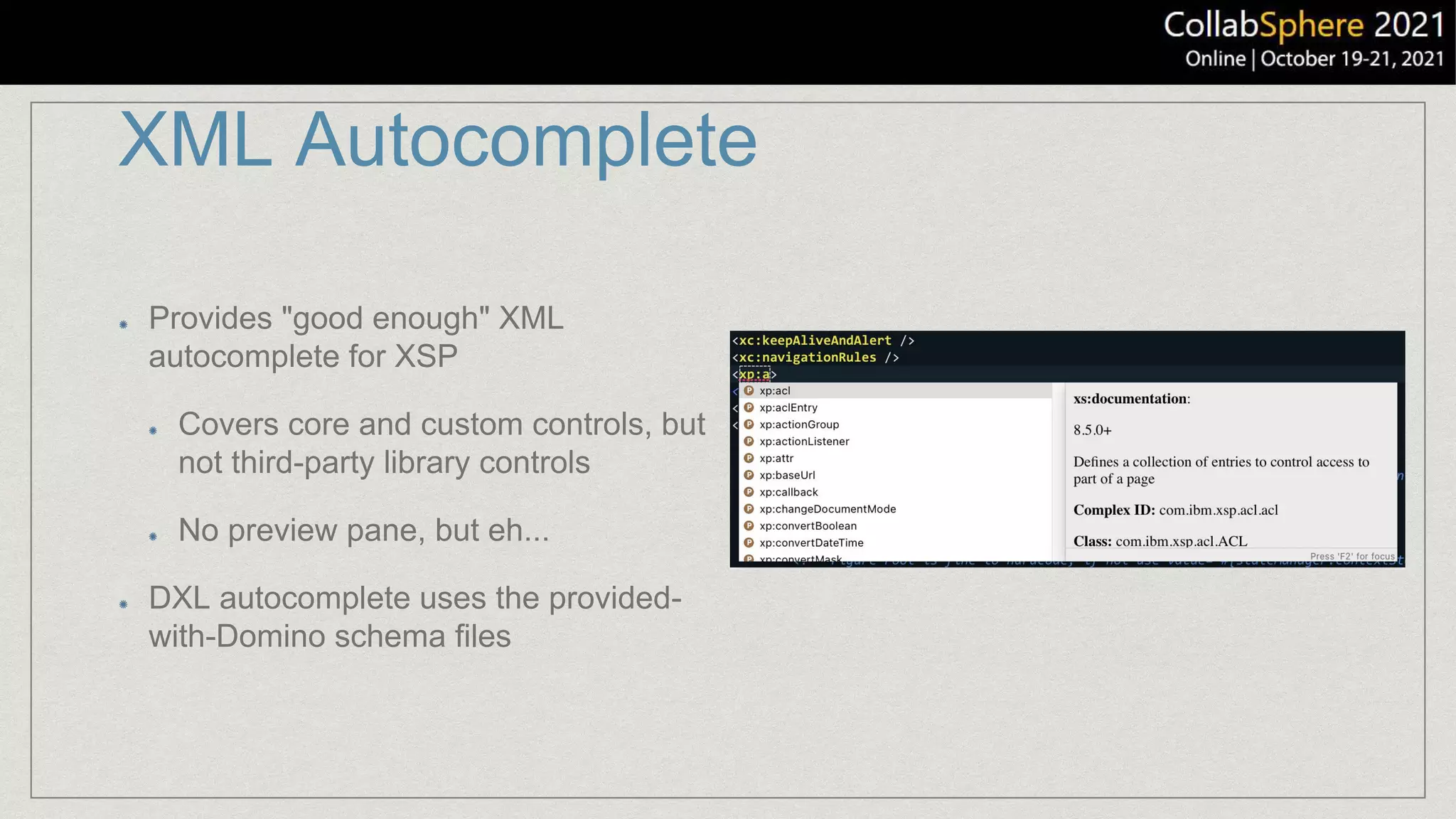
Provides "good enough" XML
autocomplete for XSP
Covers core and custom controls, but
not third-party library controls
No preview pane, but eh...
DXL autocomplete uses the provided-
with-Domino schema files
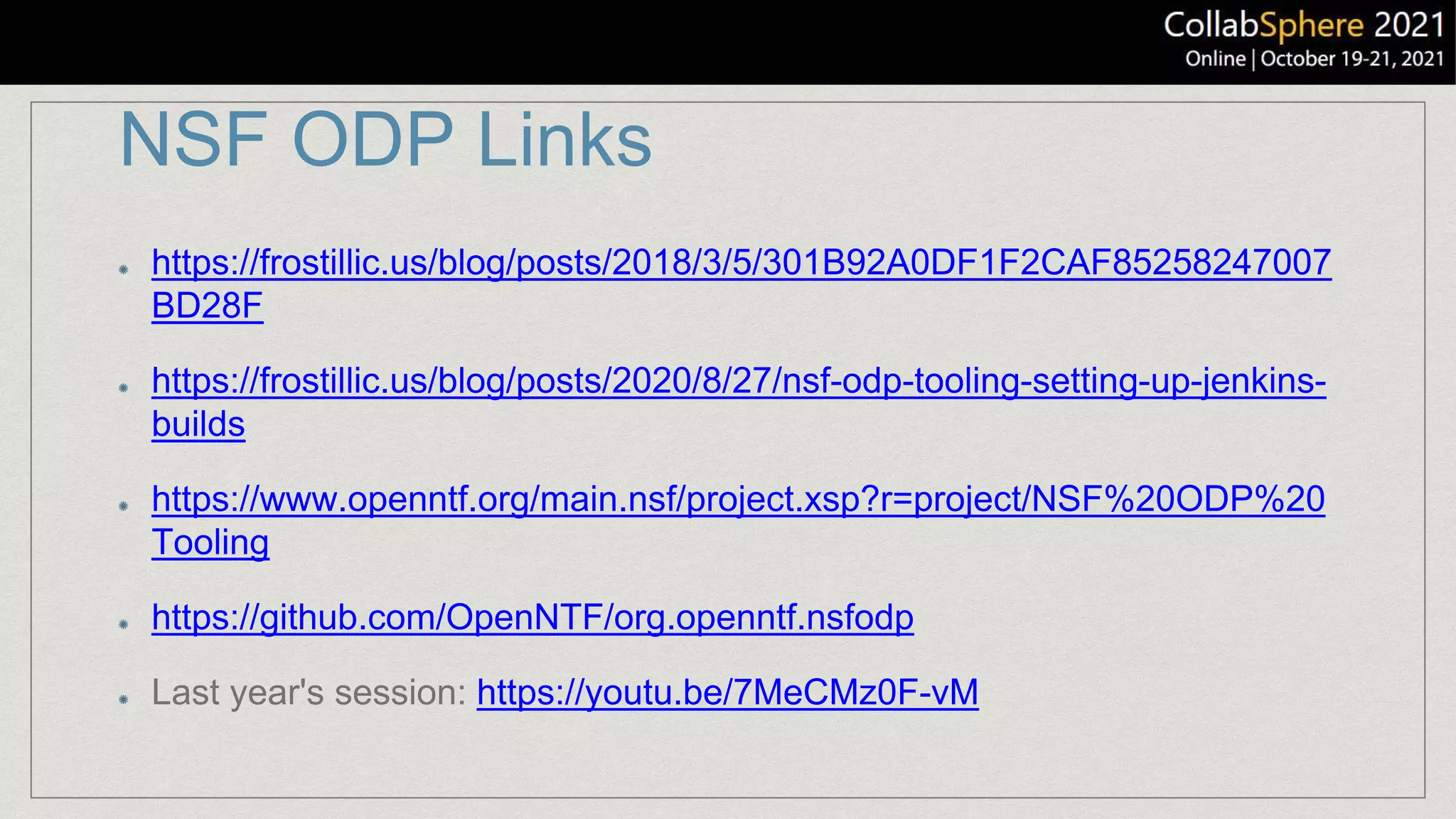
NSF ODP Links
https://frostillic.us/blog/posts/2018/3/5/301B92A0DF1F2CAF85258247007
BD28F
https://frostillic.us/blog/posts/2020/8/27/nsf-odp-tooling-setting-up-jenkins-
builds
https://www.openntf.org/main.nsf/project.xsp?r=project/NSF%20ODP%20
Tooling
https://github.com/OpenNTF/org.openntf.nsfodp
Last year's session: https://youtu.be/7MeCMz0F-vM
XPAGES JAKARTA EE SUPPORT
XPages Jakarta EE Support
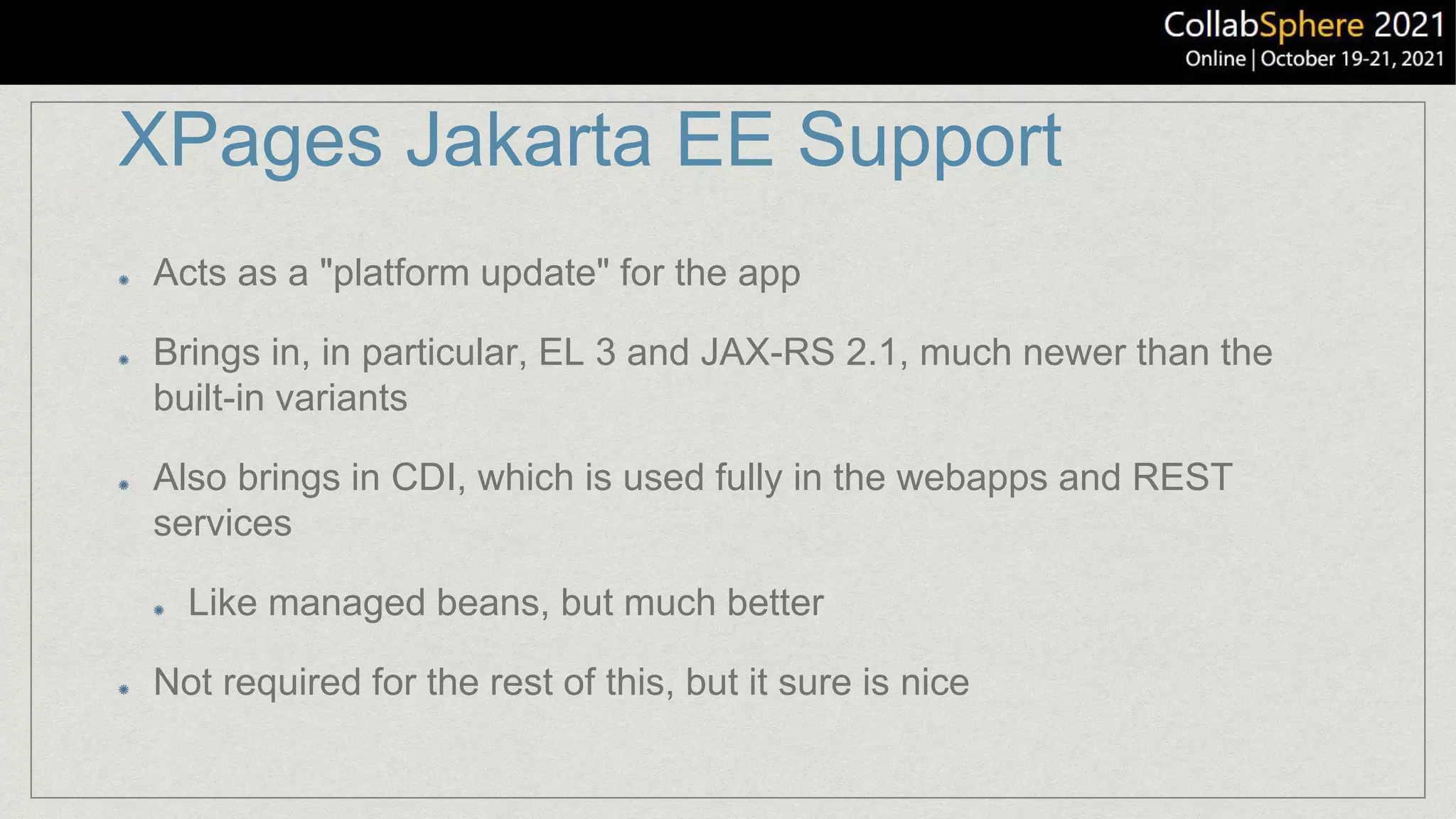
Acts as a "platform update" for the app
Brings in, in particular, EL 3 and JAX-RS 2.1, much newer than the
built-in variants
Also brings in CDI, which is used fully in the webapps and REST
services
Like managed beans, but much better
Not required for the rest of this, but it sure is nice
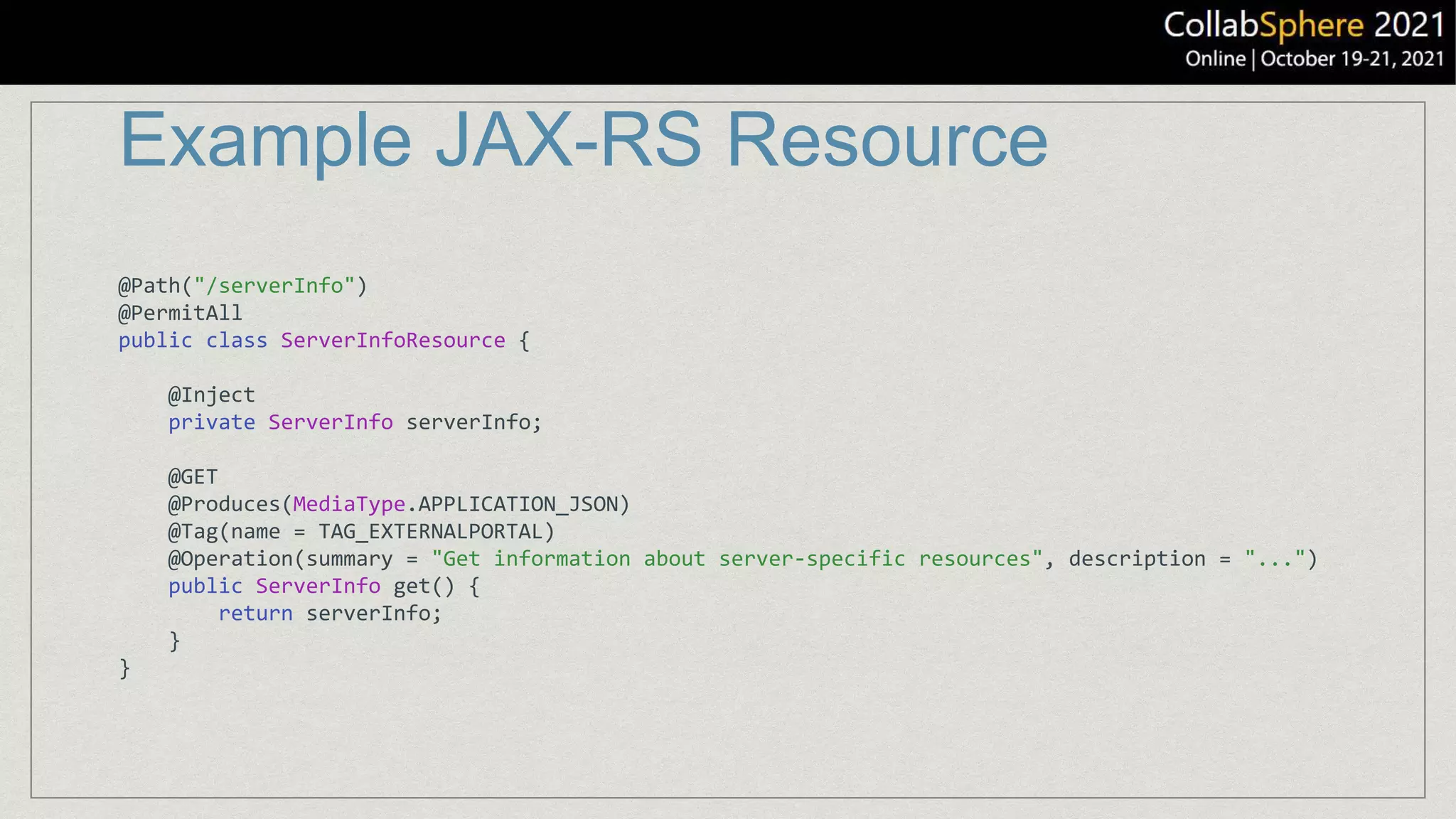
Example JAX-RS Resource
@Path("/serverInfo")
@PermitAll
public class ServerInfoResource {
@Inject
private ServerInfo serverInfo;
@GET
@Produces(MediaType.APPLICATION_JSON)
@Tag(name = TAG_EXTERNALPORTAL)
@Operation(summary = "Get information about server-specific resources", description = "...")
public ServerInfo get() {
return serverInfo;
}
}
XPages Jakarta EE Links
https://frostillic.us/blog/posts/2018/6/3/6AC99D0B866A92AA852582A
1006C2FA6
https://www.openntf.org/main.nsf/project.xsp?r=project/XPages%20Ja
karta%20EE%20Support
https://github.com/OpenNTF/org.openntf.xsp.jakartaee
XPAGES OUTSIDE DOMINO
XPages Runtime
Open-Source project that allows running XPages in a normal Servlet
container
I've only run it in Liberty, but others should work
Turns out all the stuff from pre-OSGi is still in there
Requires some tweaks with third-party libraries, and code has to not
assume it's in OSGi
This enables CI deployment servers and full automated tests
XPages Runtime
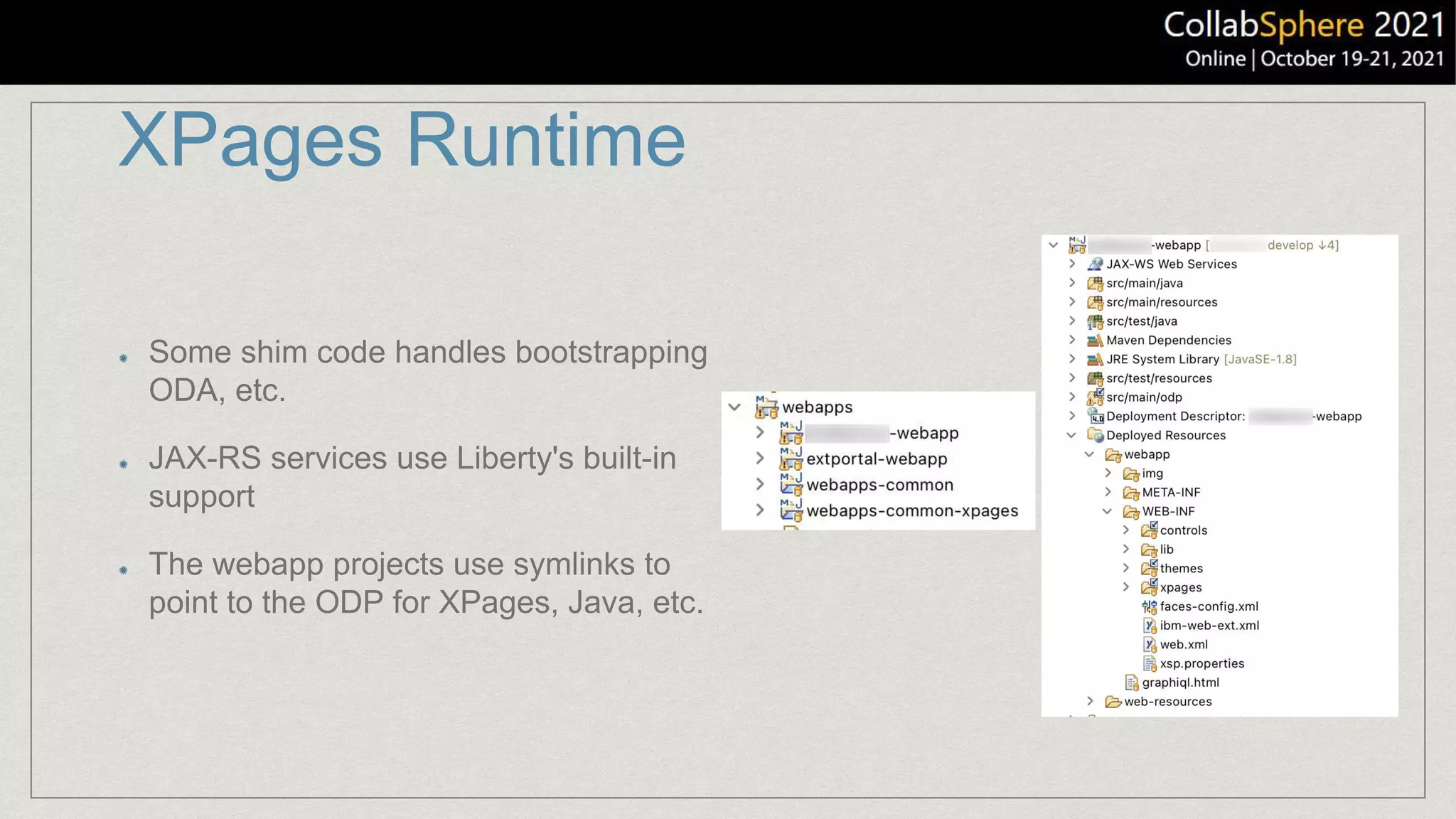
Some shim code handles bootstrapping
ODA, etc.
JAX-RS services use Liberty's built-in
support
The webapp projects use symlinks to
point to the ODP for XPages, Java, etc.
XPages Runtime - Tweaks
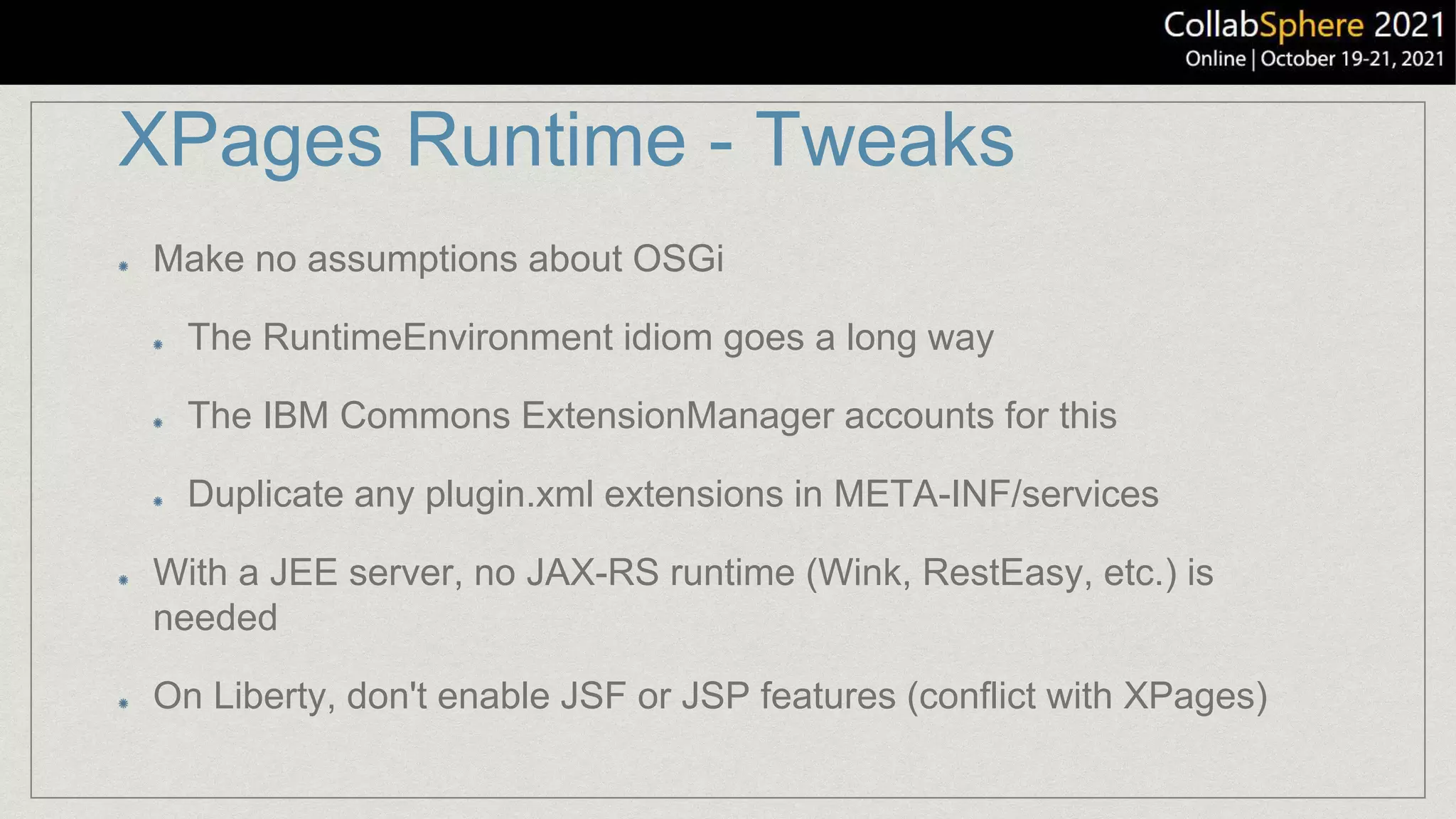
Make no assumptions about OSGi
The RuntimeEnvironment idiom goes a long way
The IBM Commons ExtensionManager accounts for this
Duplicate any plugin.xml extensions in META-INF/services
With a JEE server, no JAX-RS runtime (Wink, RestEasy, etc.) is
needed
On Liberty, don't enable JSF or JSP features (conflict with XPages)
XPages Runtime - Tweaks
@Override
public void doFilter(ServletRequest request, ServletResponse response, FilterChain chain) throws IOException, ServletException {
NotesThread.sinitThread();
Set<Long> handles = new HashSet<>();
if(!Factory.isInitialized()) {
Factory.initThread(new Factory.ThreadConfig(new Fixes[0], AutoMime.WRAP_32K, true));
}
if(sessions.get() == null) {
sessions.set(createSession((HttpServletRequest)request, handles));
sessionsAsSigner.set(createNativeSession());
sessionsFull.set(createNativeSession());
if(StringUtil.isEmpty(expectedDbPath)) {
throw new IllegalStateException(ENV_DBPATH + " environment variable should be set to the Domino API path to the context database");
}
try {
databases.set(sessions.get().getDatabase(expectedDbPath));
} catch(Throwable e) {
}
if(!checkAccess(databases.get())) {
databases.set(null);
}
}
// ...
}
Use a @WebFilter to provide context sessions/database
(There's a lot more to this in practice)
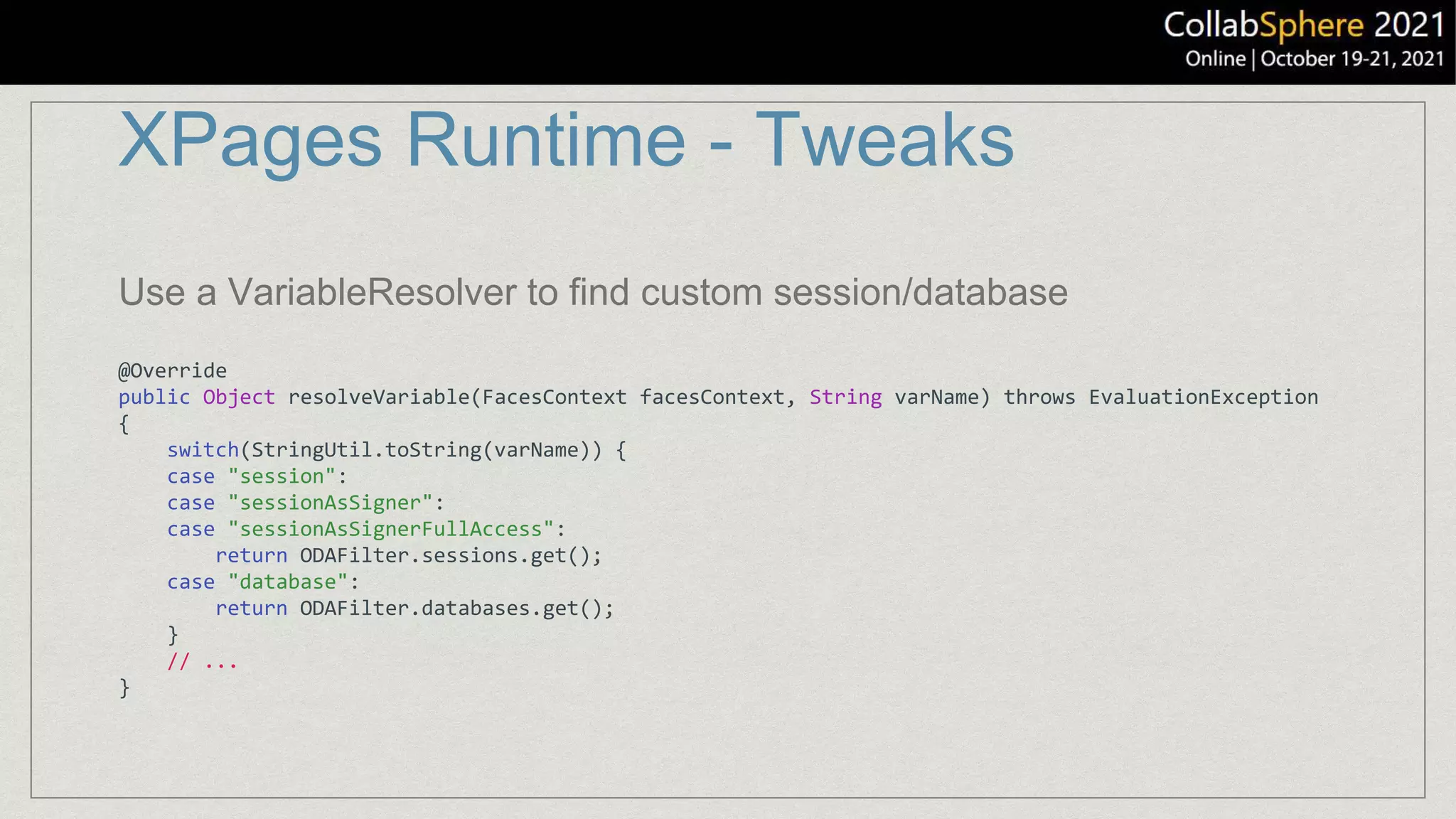
XPages Runtime - Tweaks
@Override
public Object resolveVariable(FacesContext facesContext, String varName) throws EvaluationException
{
switch(StringUtil.toString(varName)) {
case "session":
case "sessionAsSigner":
case "sessionAsSignerFullAccess":
return ODAFilter.sessions.get();
case "database":
return ODAFilter.databases.get();
}
// ...
}
Use a VariableResolver to find custom session/database
XPages Runtime Links
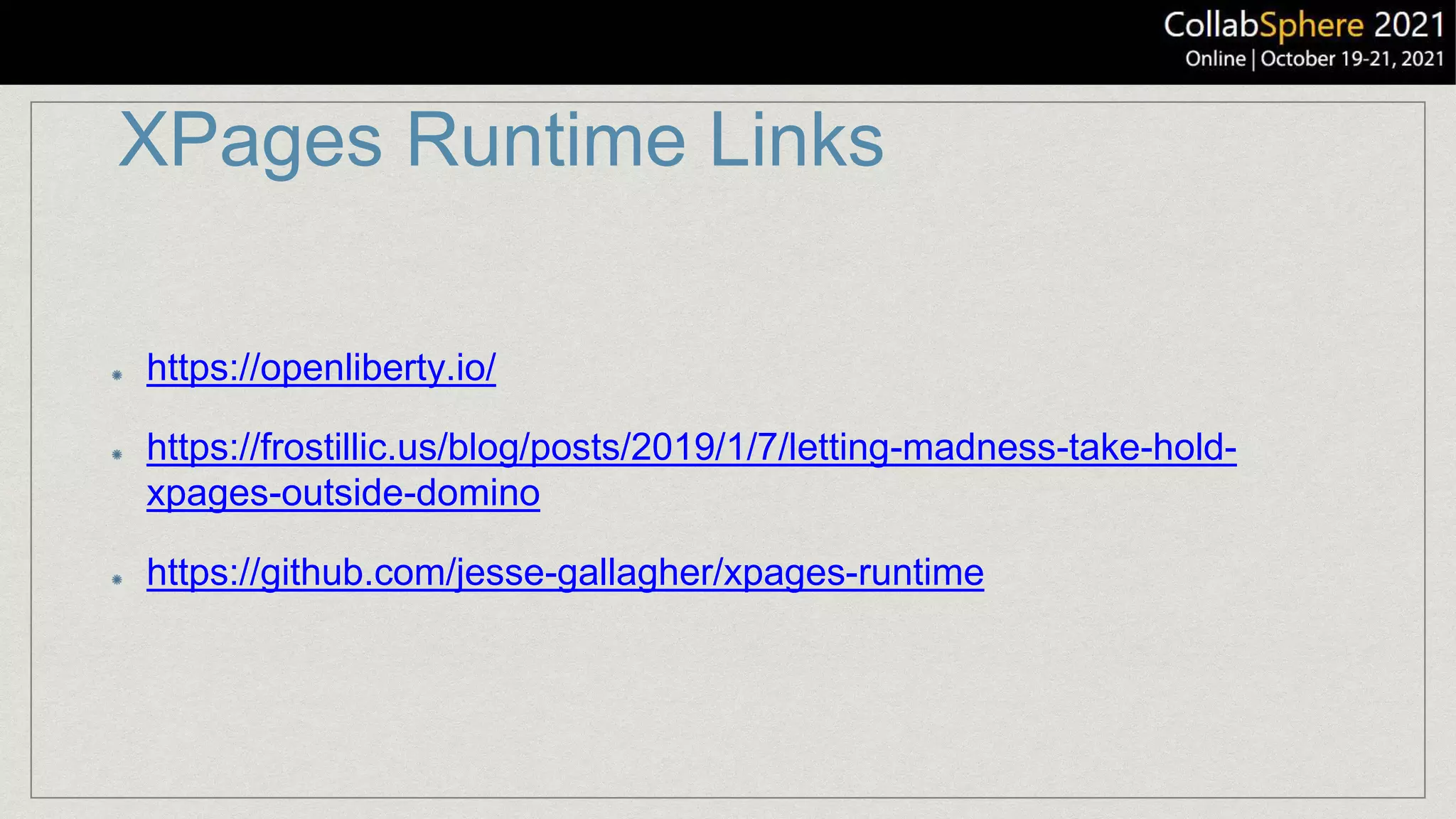
https://openliberty.io/
https://frostillic.us/blog/posts/2019/1/7/letting-madness-take-hold-
xpages-outside-domino
https://github.com/jesse-gallagher/xpages-runtime
CONTAINERIZED XPAGES APPS
Dockerized XPages Apps
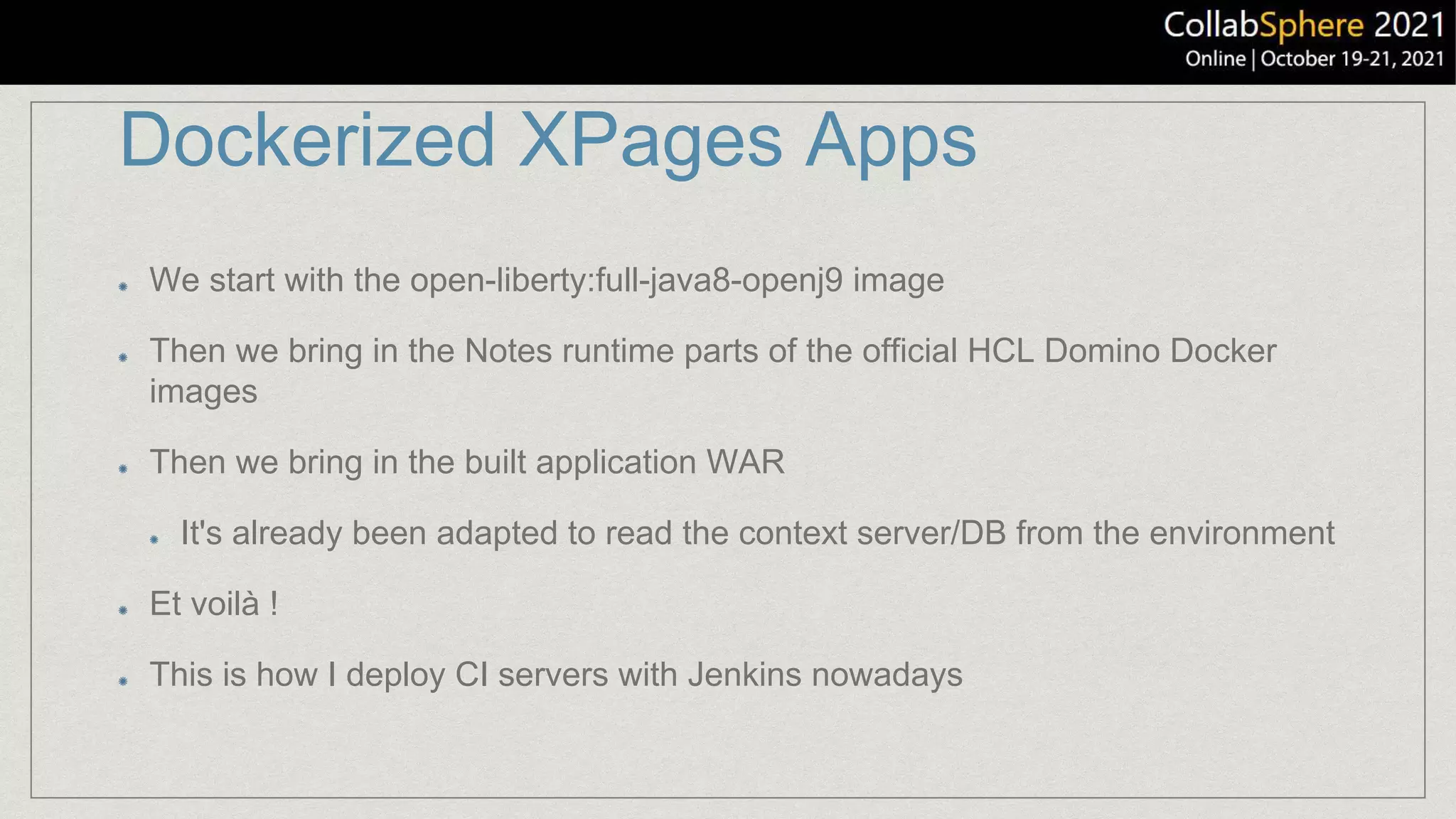
We start with the open-liberty:full-java8-openj9 image
Then we bring in the Notes runtime parts of the official HCL Domino Docker
images
Then we bring in the built application WAR
It's already been adapted to read the context server/DB from the environment
Et voilà !
This is how I deploy CI servers with Jenkins nowadays
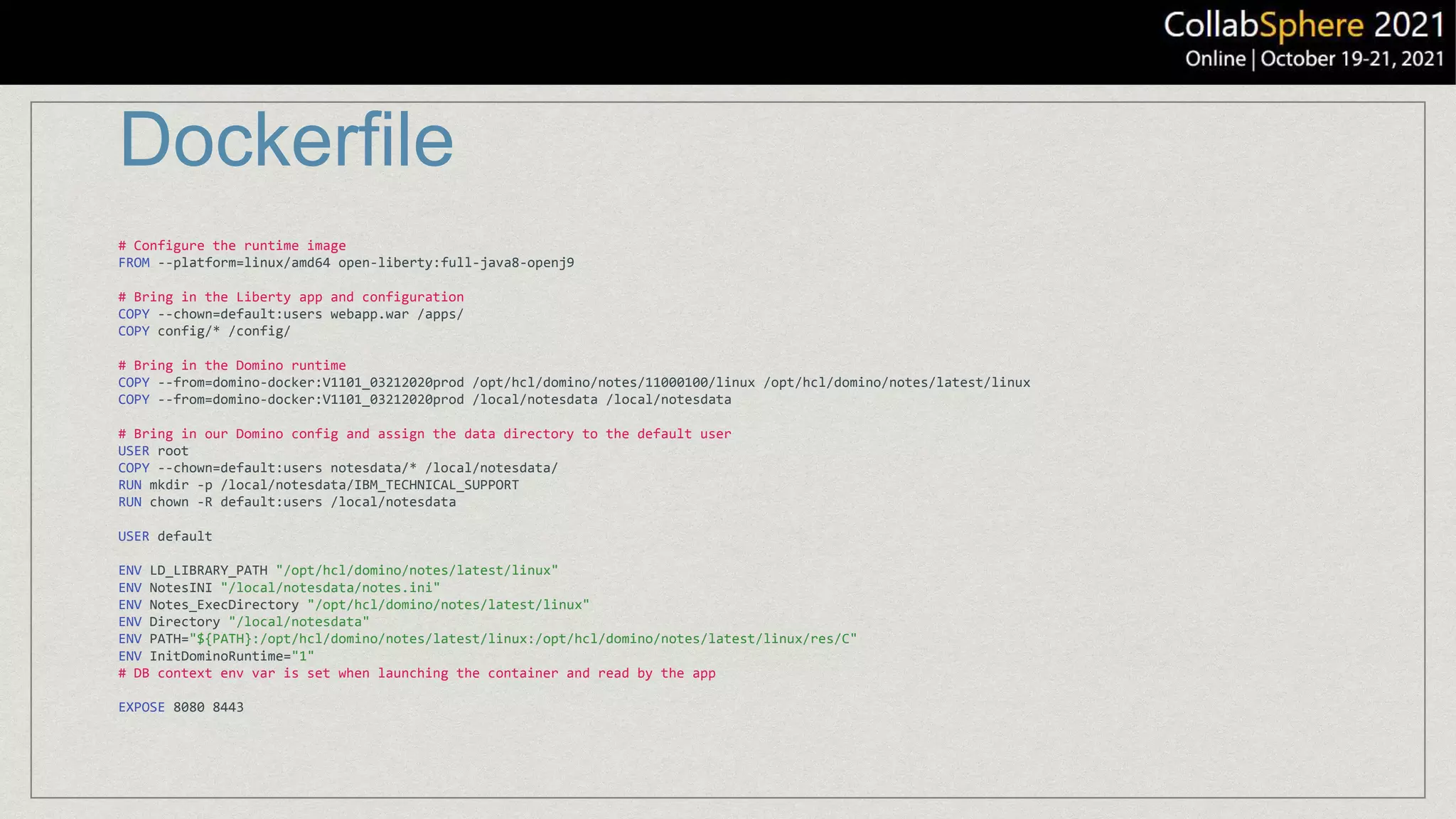
Dockerfile
# Configure the runtime image
FROM --platform=linux/amd64 open-liberty:full-java8-openj9
# Bring in the Liberty app and configuration
COPY --chown=default:users webapp.war /apps/
COPY config/* /config/
# Bring in the Domino runtime
COPY --from=domino-docker:V1101_03212020prod /opt/hcl/domino/notes/11000100/linux /opt/hcl/domino/notes/latest/linux
COPY --from=domino-docker:V1101_03212020prod /local/notesdata /local/notesdata
# Bring in our Domino config and assign the data directory to the default user
USER root
COPY --chown=default:users notesdata/* /local/notesdata/
RUN mkdir -p /local/notesdata/IBM_TECHNICAL_SUPPORT
RUN chown -R default:users /local/notesdata
USER default
ENV LD_LIBRARY_PATH "/opt/hcl/domino/notes/latest/linux"
ENV NotesINI "/local/notesdata/notes.ini"
ENV Notes_ExecDirectory "/opt/hcl/domino/notes/latest/linux"
ENV Directory "/local/notesdata"
ENV PATH="${PATH}:/opt/hcl/domino/notes/latest/linux:/opt/hcl/domino/notes/latest/linux/res/C"
ENV InitDominoRuntime="1"
# DB context env var is set when launching the container and read by the app
EXPOSE 8080 8443
Containerized XPages Apps Links
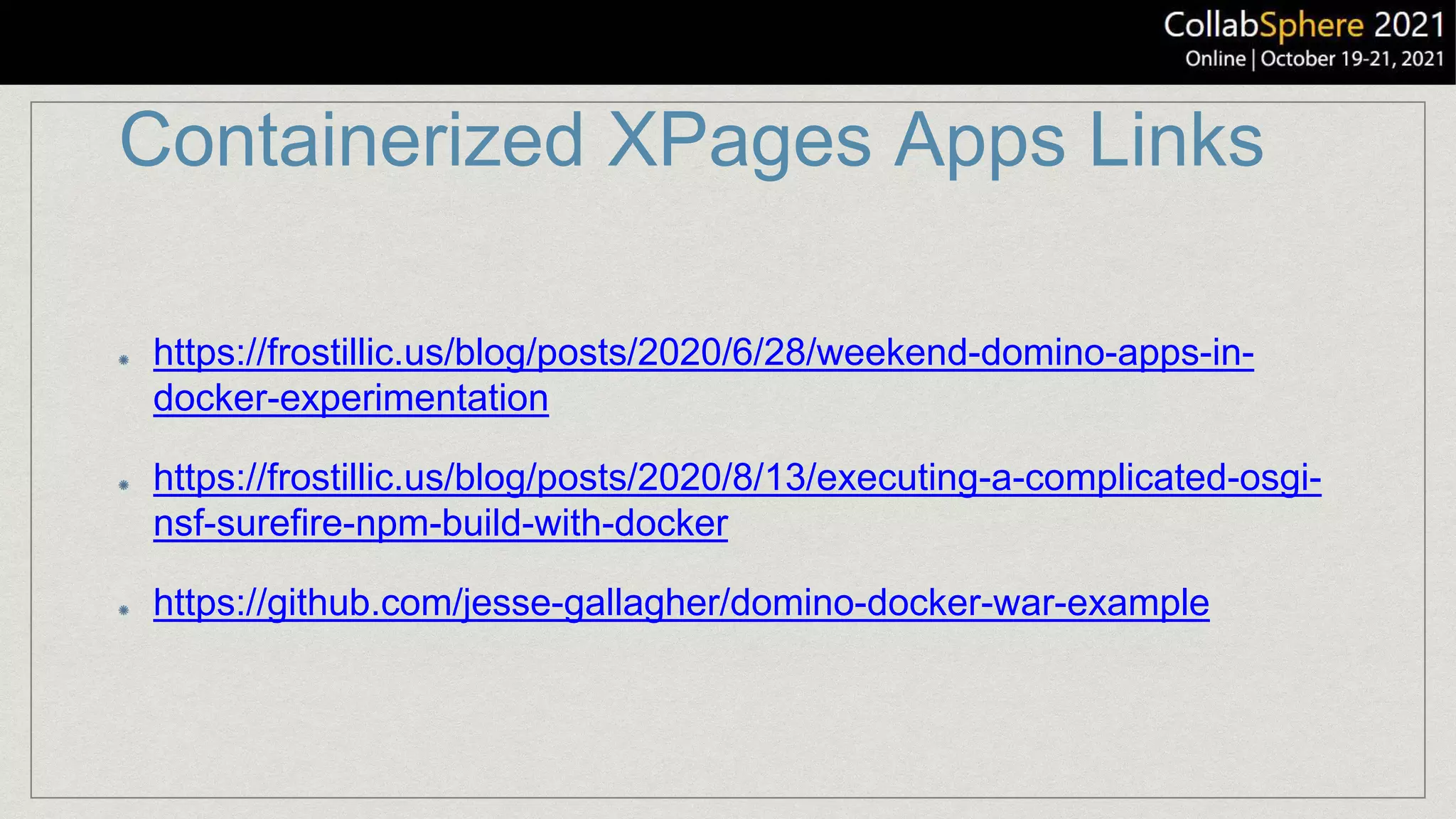
https://frostillic.us/blog/posts/2020/6/28/weekend-domino-apps-in-
docker-experimentation
https://frostillic.us/blog/posts/2020/8/13/executing-a-complicated-osgi-
nsf-surefire-npm-build-with-docker
https://github.com/jesse-gallagher/domino-docker-war-example
TESTCONTAINERS
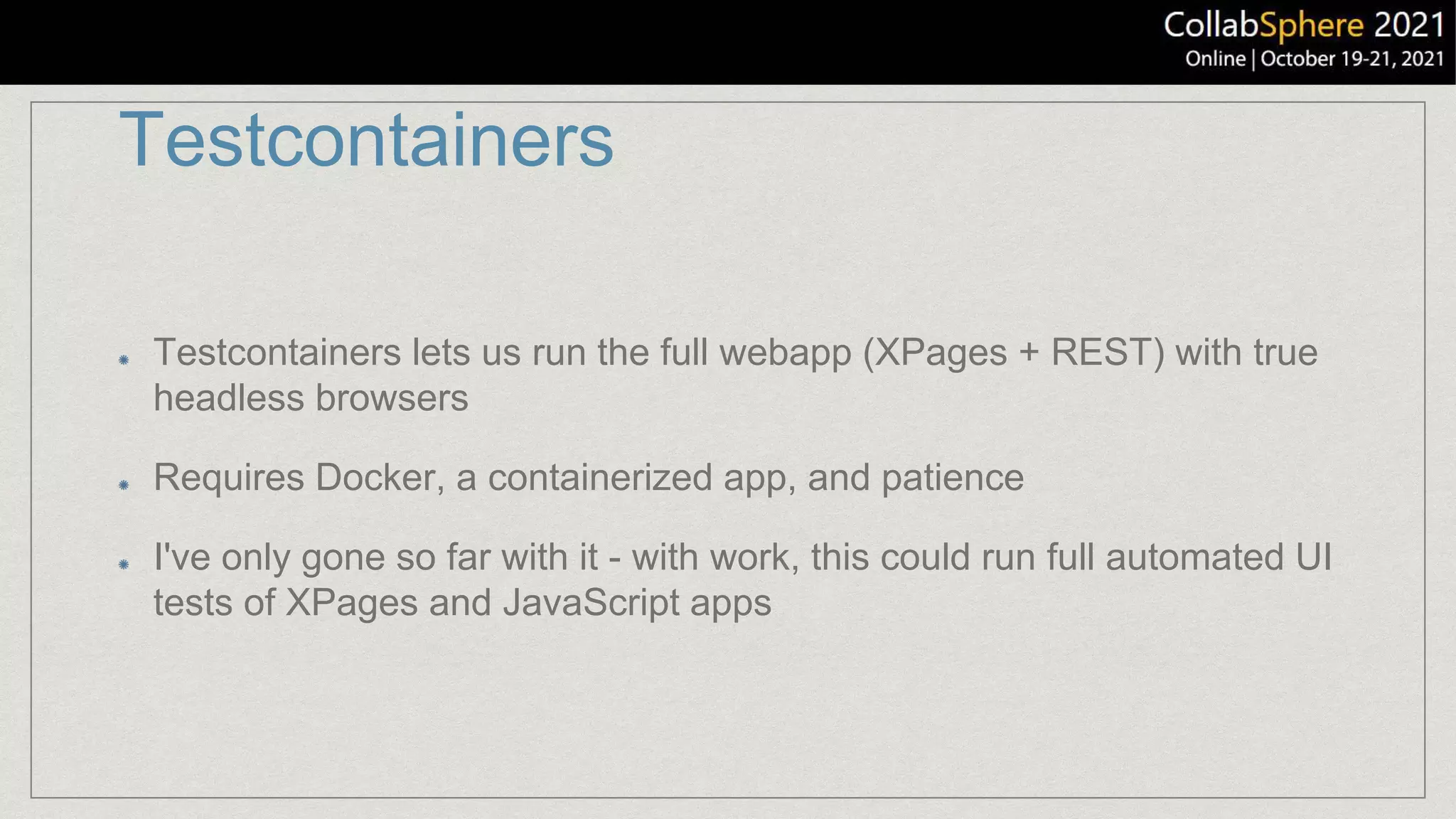
Testcontainers
Testcontainers lets us run the full webapp (XPages + REST) with true
headless browsers
Requires Docker, a containerized app, and patience
I've only gone so far with it - with work, this could run full automated UI
tests of XPages and JavaScript apps
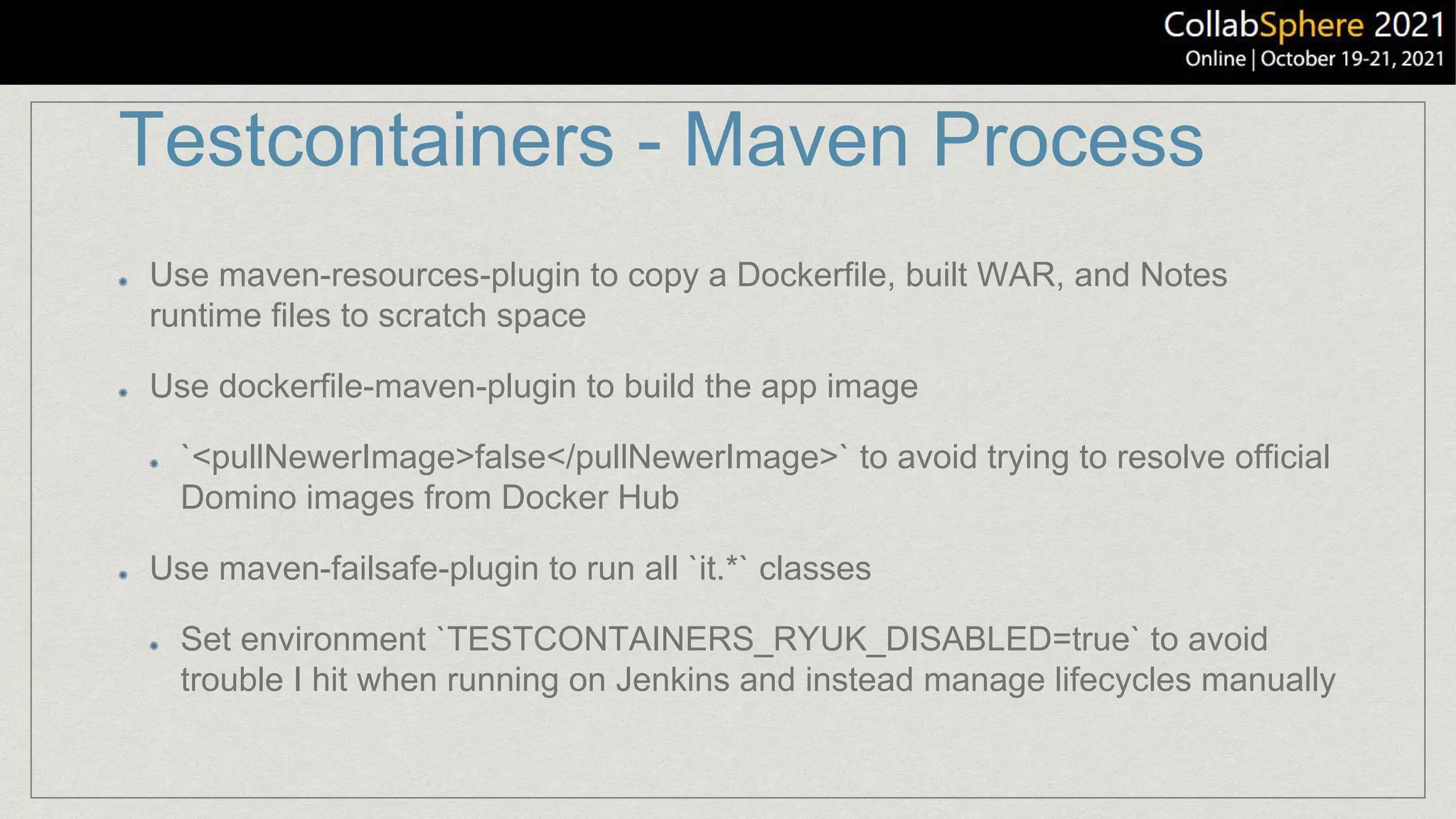
Testcontainers - Maven Process
Use maven-resources-plugin to copy a Dockerfile, built WAR, and Notes
runtime files to scratch space
Use dockerfile-maven-plugin to build the app image
`<pullNewerImage>false</pullNewerImage>` to avoid trying to resolve official
Domino images from Docker Hub
Use maven-failsafe-plugin to run all `it.*` classes
Set environment `TESTCONTAINERS_RYUK_DISABLED=true` to avoid
trouble I hit when running on Jenkins and instead manage lifecycles manually
Testcontainers - Example Code
driver.get(getContainerRootUrl() + "index.xsp");
assertEquals("Expected Page Title", driver.getTitle());
// Test all CSS and JS to make sure there's no 404s
URI rootUri = URI.create(getRootUrl());
driver.findElements(By.xpath("//link[@rel='stylesheet']"))
.stream()
.map(link -> link.getAttribute("href"))
.map(href -> rootUri.resolve(href))
.map(this::decontainerize) // etc.
.forEach(uri -> checkUrlWorks(uri, client));
driver.findElements(By.xpath("//script[@href]"))
// etc.
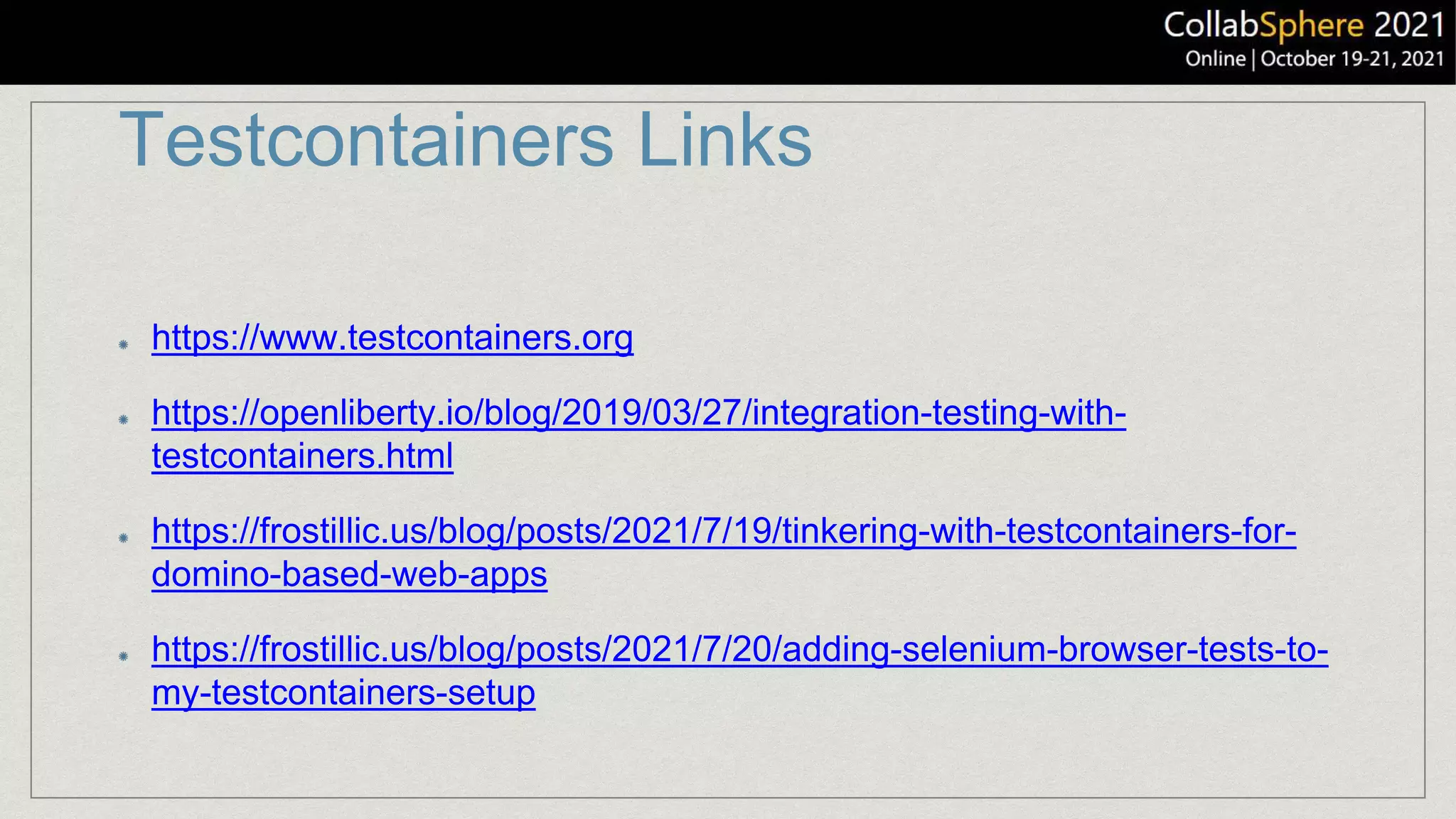
Testcontainers Links
https://www.testcontainers.org
https://openliberty.io/blog/2019/03/27/integration-testing-with-
testcontainers.html
https://frostillic.us/blog/posts/2021/7/19/tinkering-with-testcontainers-for-
domino-based-web-apps
https://frostillic.us/blog/posts/2021/7/20/adding-selenium-browser-tests-to-
my-testcontainers-setup
QUESTIONS

CollabSphere 2021 - DEV114 - The Nuts and Bolts of CI/CD With a Large XPages And REST App