20.10.2015 | Fachbereich Informatik | Ubiquitous Knowledge Processing (UKP) Lab | Christian M. Meyer | 1
Collaborative
Multilingual Dictionaries
Christian M. Meyer
Lexicografía multilingüe en rede (MULTILEX).
October 20–21, 2015. Santiago de Compostela, Spain.
20.10.2015 | Fachbereich Informatik | Ubiquitous Knowledge Processing (UKP) Lab | Christian M. Meyer | 2
Outline
Collaborative Multilingual Dictionaries
20.10.2015 | Fachbereich Informatik | Ubiquitous Knowledge Processing (UKP) Lab | Christian M. Meyer | 3
Outline
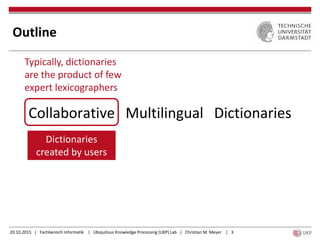
Collaborative Multilingual Dictionaries
Dictionaries
created by users
Typically, dictionaries
are the product of few
expert lexicographers
20.10.2015 | Fachbereich Informatik | Ubiquitous Knowledge Processing (UKP) Lab | Christian M. Meyer | 4
Outline
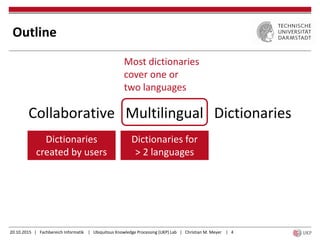
Collaborative Multilingual Dictionaries
Dictionaries for
> 2 languages
Dictionaries
created by users
Most dictionaries
cover one or
two languages
20.10.2015 | Fachbereich Informatik | Ubiquitous Knowledge Processing (UKP) Lab | Christian M. Meyer | 5
Outline
Collaborative Multilingual Dictionaries
Dictionaries for
> 2 languages
Dictionaries
created by users
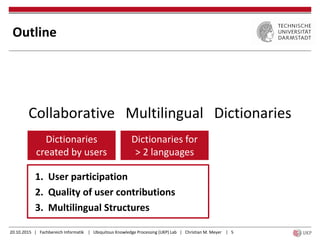
1. User participation
2. Quality of user contributions
3. Multilingual Structures
20.10.2015 | Fachbereich Informatik | Ubiquitous Knowledge Processing (UKP) Lab | Christian M. Meyer | 6
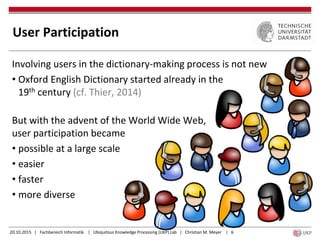
Involving users in the dictionary-making process is not new
• Oxford English Dictionary started already in the
19th century (cf. Thier, 2014)
But with the advent of the World Wide Web,
user participation became
• possible at a large scale
• easier
• faster
• more diverse
User Participation
20.10.2015 | Fachbereich Informatik | Ubiquitous Knowledge Processing (UKP) Lab | Christian M. Meyer | 7
1. Direct User Contributions
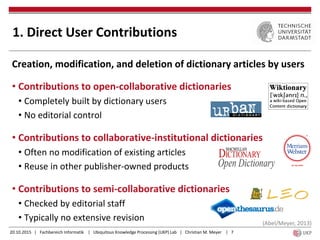
Creation, modification, and deletion of dictionary articles by users
• Contributions to open-collaborative dictionaries
• Completely built by dictionary users
• No editorial control
• Contributions to collaborative-institutional dictionaries
• Often no modification of existing articles
• Reuse in other publisher-owned products
• Contributions to semi-collaborative dictionaries
• Checked by editorial staff
• Typically no extensive revision (Abel/Meyer, 2013)
20.10.2015 | Fachbereich Informatik | Ubiquitous Knowledge Processing (UKP) Lab | Christian M. Meyer | 8
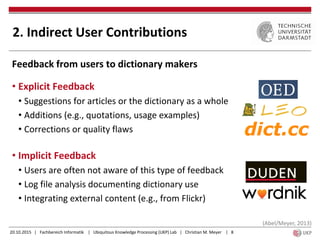
Feedback from users to dictionary makers
• Explicit Feedback
• Suggestions for articles or the dictionary as a whole
• Additions (e.g., quotations, usage examples)
• Corrections or quality flaws
• Implicit Feedback
• Users are often not aware of this type of feedback
• Log file analysis documenting dictionary use
• Integrating external content (e.g., from Flickr)
2. Indirect User Contributions
(Abel/Meyer, 2013)
20.10.2015 | Fachbereich Informatik | Ubiquitous Knowledge Processing (UKP) Lab | Christian M. Meyer | 9
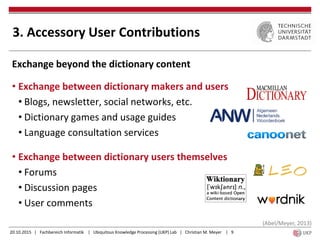
Exchange beyond the dictionary content
• Exchange between dictionary makers and users
• Blogs, newsletter, social networks, etc.
• Dictionary games and usage guides
• Language consultation services
• Exchange between dictionary users themselves
• Forums
• Discussion pages
• User comments
3. Accessory User Contributions
(Abel/Meyer, 2013)
20.10.2015 | Fachbereich Informatik | Ubiquitous Knowledge Processing (UKP) Lab | Christian M. Meyer | 10
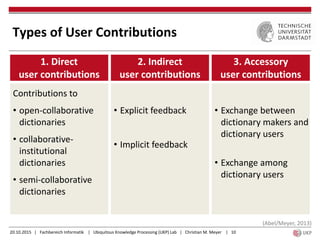
Types of User Contributions
1. Direct
user contributions
2. Indirect
user contributions
3. Accessory
user contributions
Contributions to
• open-collaborative
dictionaries
• collaborative-
institutional
dictionaries
• semi-collaborative
dictionaries
• Explicit feedback
• Implicit feedback
• Exchange between
dictionary makers and
dictionary users
• Exchange among
dictionary users
(Abel/Meyer, 2013)
20.10.2015 | Fachbereich Informatik | Ubiquitous Knowledge Processing (UKP) Lab | Christian M. Meyer | 11
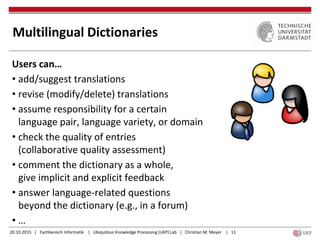
Multilingual Dictionaries
Users can…
• add/suggest translations
• revise (modify/delete) translations
• assume responsibility for a certain
language pair, language variety, or domain
• check the quality of entries
(collaborative quality assessment)
• comment the dictionary as a whole,
give implicit and explicit feedback
• answer language-related questions
beyond the dictionary (e.g., in a forum)
• …
20.10.2015 | Fachbereich Informatik | Ubiquitous Knowledge Processing (UKP) Lab | Christian M. Meyer | 12
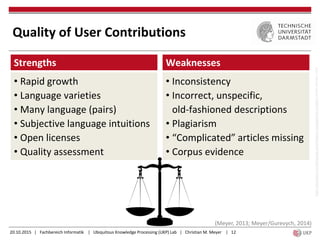
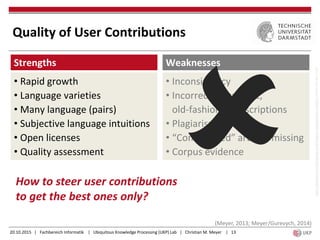
Strengths
• Rapid growth
• Language varieties
• Many language (pairs)
• Subjective language intuitions
• Open licenses
• Quality assessment
Weaknesses
• Inconsistency
• Incorrect, unspecific,
old-fashioned descriptions
• Plagiarism
• “Complicated” articles missing
• Corpus evidence
https://pixabay.com/de/waage-gerechtigkeit-ausgeglichen-310962/(publicdomain,CC0)
(Meyer, 2013; Meyer/Gurevych, 2014)
Quality of User Contributions
20.10.2015 | Fachbereich Informatik | Ubiquitous Knowledge Processing (UKP) Lab | Christian M. Meyer | 13
Strengths
• Rapid growth
• Language varieties
• Many language (pairs)
• Subjective language intuitions
• Open licenses
• Quality assessment
Weaknesses
• Inconsistency
• Incorrect, unspecific,
old-fashioned descriptions
• Plagiarism
• “Complicated” articles missing
• Corpus evidence
https://pixabay.com/de/waage-gerechtigkeit-ausgeglichen-310962/(publicdomain,CC0)
(Meyer, 2013; Meyer/Gurevych, 2014)
Quality of User Contributions
How to steer user contributions
to get the best ones only?
20.10.2015 | Fachbereich Informatik | Ubiquitous Knowledge Processing (UKP) Lab | Christian M. Meyer | 14
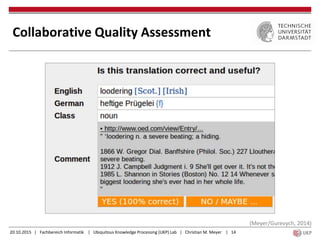
Collaborative Quality Assessment
(Meyer/Gurevych, 2014)
20.10.2015 | Fachbereich Informatik | Ubiquitous Knowledge Processing (UKP) Lab | Christian M. Meyer | 15
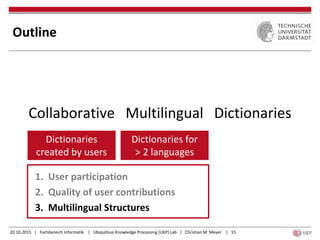
Outline
Collaborative Multilingual Dictionaries
Dictionaries for
> 2 languages
Dictionaries
created by users
1. User participation
2. Quality of user contributions
3. Multilingual Structures
20.10.2015 | Fachbereich Informatik | Ubiquitous Knowledge Processing (UKP) Lab | Christian M. Meyer | 16
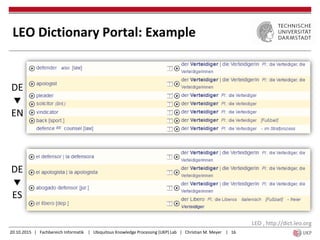
LEO Dictionary Portal: Example
DE

EN
DE

ES
LEO , http://dict.leo.org
20.10.2015 | Fachbereich Informatik | Ubiquitous Knowledge Processing (UKP) Lab | Christian M. Meyer | 17
Bilingual Translation Tables
DE

EN
DE

ES
Verteidiger | Verteidigerin defender [law]
Verteidiger | Verteidigerin apologist
Verteidiger [Fußball] back [sport.]
Verteidiger | Verteidigerin el defensor | la defensora
Verteidiger | Verteidigerin el apologista | la apologista
Libero [Fußball] el líbero [dep.]
?• Sense distinctions and usage comments?
• Translation shifts?
• Multilingual queries difficult (e.g., EN  ES)
LEO , http://dict.leo.org
20.10.2015 | Fachbereich Informatik | Ubiquitous Knowledge Processing (UKP) Lab | Christian M. Meyer | 18
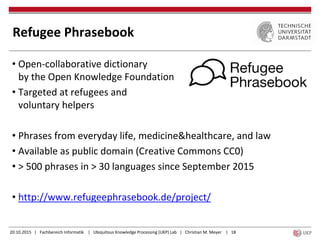
Refugee Phrasebook
• Open-collaborative dictionary
by the Open Knowledge Foundation
• Targeted at refugees and
voluntary helpers
• Phrases from everyday life, medicine&healthcare, and law
• Available as public domain (Creative Commons CC0)
• > 500 phrases in > 30 languages since September 2015
• http://www.refugeephrasebook.de/project/
20.10.2015 | Fachbereich Informatik | Ubiquitous Knowledge Processing (UKP) Lab | Christian M. Meyer | 19
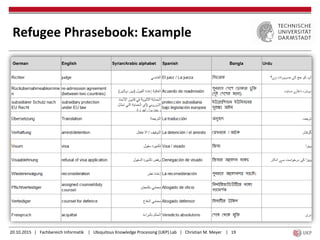
Refugee Phrasebook: Example
20.10.2015 | Fachbereich Informatik | Ubiquitous Knowledge Processing (UKP) Lab | Christian M. Meyer | 20
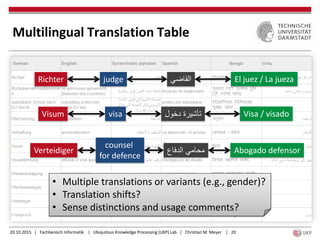
Multilingual Translation Table
Richter ‫القاضي‬
Visum ‫دخول‬ ‫تأشيرة‬
judge
visa
El juez / La jueza
Visa / visado
• Multiple translations or variants (e.g., gender)?
• Translation shifts?
• Sense distinctions and usage comments?
Verteidiger ‫الدفاع‬ ‫محامي‬
counsel
for defence
Abogado defensor
20.10.2015 | Fachbereich Informatik | Ubiquitous Knowledge Processing (UKP) Lab | Christian M. Meyer | 21
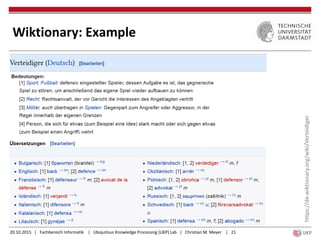
Wiktionary: Example
https://de.wiktionary.org/wiki/Verteidiger
20.10.2015 | Fachbereich Informatik | Ubiquitous Knowledge Processing (UKP) Lab | Christian M. Meyer | 22
https://de.wiktionary.org/wiki/Verteidiger
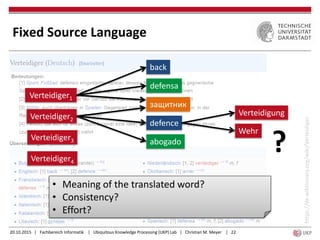
Fixed Source Language
Verteidiger1
защитник
back
• Meaning of the translated word?
• Consistency?
• Effort?
Verteidiger2
Verteidiger3
Verteidiger4
defence
defensa
abogado
Verteidigung
Wehr
?
20.10.2015 | Fachbereich Informatik | Ubiquitous Knowledge Processing (UKP) Lab | Christian M. Meyer | 23
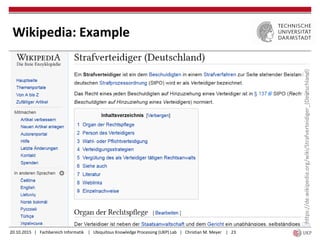
Wikipedia: Example
https://de.wikipedia.org/wiki/Strafverteidiger_(Deutschland)
20.10.2015 | Fachbereich Informatik | Ubiquitous Knowledge Processing (UKP) Lab | Christian M. Meyer | 24
https://de.wikipedia.org/wiki/Strafverteidiger_(Deutschland)
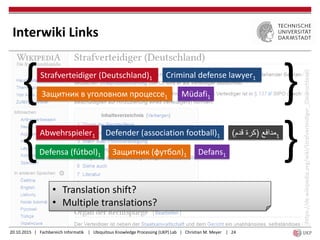
• Translation shift?
• Multiple translations?
Müdafi1
Strafverteidiger (Deutschland)1
Защитник в уголовном процессе1
Criminal defense lawyer1
{ }
Abwehrspieler1
Защитник (футбол)1
Defender (association football)1
Defensa (fútbol)1{ }
Interwiki Links
Defans1
‫مدافع‬(‫كرة‬‫قدم‬) 1
20.10.2015 | Fachbereich Informatik | Ubiquitous Knowledge Processing (UKP) Lab | Christian M. Meyer | 25
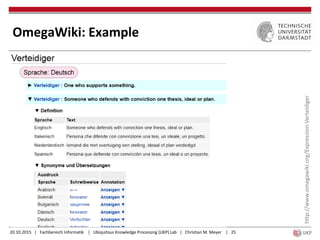
OmegaWiki: Example
http://www.omegawiki.org/Expression:Verteidiger
20.10.2015 | Fachbereich Informatik | Ubiquitous Knowledge Processing (UKP) Lab | Christian M. Meyer | 26
http://www.omegawiki.org/Expression:Verteidiger
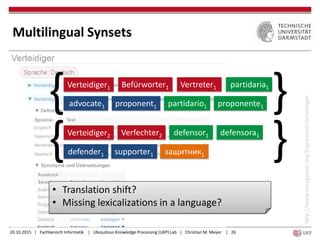
Multilingual Synsets
Verteidiger1
advocate1
• Translation shift?
• Missing lexicalizations in a language?
Befürworter1 Vertreter1 partidaria1
{ proponent1 }
Verteidiger2
защитник1defender1
Verfechter2 defensor1 defensora1
{ supporter1 }
partidario1 proponente1
20.10.2015 | Fachbereich Informatik | Ubiquitous Knowledge Processing (UKP) Lab | Christian M. Meyer | 27
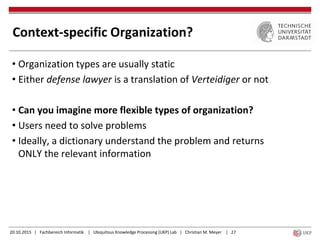
Context-specific Organization?
• Organization types are usually static
• Either defense lawyer is a translation of Verteidiger or not
• Can you imagine more flexible types of organization?
• Users need to solve problems
• Ideally, a dictionary understand the problem and returns
ONLY the relevant information
20.10.2015 | Fachbereich Informatik | Ubiquitous Knowledge Processing (UKP) Lab | Christian M. Meyer | 28
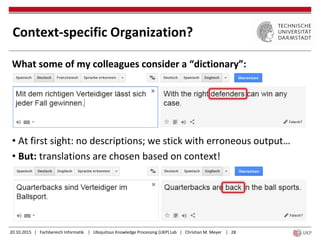
Context-specific Organization?
What some of my colleagues consider a “dictionary”:
• At first sight: no descriptions; we stick with erroneous output…
• But: translations are chosen based on context!
20.10.2015 | Fachbereich Informatik | Ubiquitous Knowledge Processing (UKP) Lab | Christian M. Meyer | 29
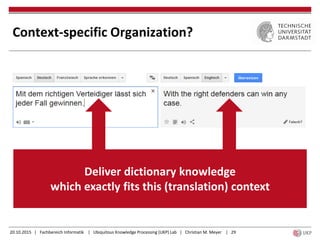
Context-specific Organization?
Deliver dictionary knowledge
which exactly fits this (translation) context
20.10.2015 | Fachbereich Informatik | Ubiquitous Knowledge Processing (UKP) Lab | Christian M. Meyer | 30
Take-Home Message
Diverse forms of user participation
• Direct, indirect, accessory contributions
• Strengths and weaknesses
A variety of multilingual structures
• Bilingual and multilingual tables
• Fixed source language
• Interwiki links and multilingual synsets
• Context-specific organization
• More flexible structures?
• Lexicographers–users cooperation?
https://pixabay.com/en/hand-leave-pen-paper-thank-you-226358/(CC0PublicDomain)
20.10.2015 | Fachbereich Informatik | Ubiquitous Knowledge Processing (UKP) Lab | Christian M. Meyer | 31
Further Readings
Ch.M. Meyer/A. Abel: User Contribution in the Era of the Internet, chapter 27 in P.A. Fuertes Olivera
(Ed.): The Routledge Handbook of Lexicography, London: Routledge, (in preparation).
Ch.M. Meyer, I. Gurevych: Methoden bei kollaborativen Wörterbüchern, Lexicographica
30(1): 187–212, 2014.
Ch.M. Meyer: Wiktionary: The Metalexicographic and the Natural Language Processing
Perspective (= tuprints 3654). Dissertation, Darmstadt: Technische Universität Darmstadt 2013.
http://tuprints.ulb.tu-darmstadt.de/3654/
A. Abel, Ch.M. Meyer: The dynamics outside the paper: user contributions to online dictionaries,
in: Proceedings of the 3rd eLex conference ‘Electronic lexicography in the 21st century: thinking
outside the paper’, pp. 179–194, 2013. Tallinn, Estland.
M. Matuschek, Ch.M. Meyer, I. Gurevych: Multilingual Knowledge in Aligned Wiktionary and
OmegaWiki for Translation Applications, Translation: Computation, Corpora, Cognition – Special
Issue “Language Technology for a Multilingual Europe” 3(1):87–118, 2013.
I. Gurevych, J. Eckle-Kohler, S. Hartmann, M. Matuschek, Ch.M. Meyer, C. Wirth: UBY – A Large-Scale
Unified Lexical-Semantic Resource Based on LMF, in: Proceedings of the 13th Conference of the
European Chapter of the Association for Computational Linguistics (EACL), pp. 580–590, April 2012.
Avignon, France.
Ch.M. Meyer, I. Gurevych: Wiktionary: a new rival for expert-built lexicons? Exploring the
possibilities of collaborative lexicography. chapter 13 in S. Granger, M. Paquot (Hrsg.): Electronic
Lexicography, pp. 259–291, Oxford: Oxford University Press, November 2012.
20.10.2015 | Fachbereich Informatik | Ubiquitous Knowledge Processing (UKP) Lab | Christian M. Meyer | 32
Kontakt / Contact
Christian M. Meyer
Technische Universität Darmstadt
Ubiquitous Knowledge Processing Lab
 Hochschulstr. 10, 64289 Darmstadt, Germany
 +49 (0)6151 16–5386
 +49 (0)6151 16–5455
 meyer (at) ukp.informatik.tu-darmstadt.de
Rechtliche Hinweise
Die Folien sind für den persönlichen Gebrauch der Vortragsteilnehmer
gedacht. Im Vortrag verwendete Photographien, Illustrationen, Wort- und
Bildmarken sind Eigentum der jeweiligen Rechteinhaber oder Lizenzgeber. Um
Missverständnisse zu vermeiden, wäre eine kurze Kontaktaufnahme vor
Weitergabe oder -nutzung der Vortragsmaterialien empfehlenswert. Sofern Sie
Ihre Rechte verletzt sehen, bitte ich ebenfalls um Kontaktaufnahme zur
Klärung der Sachlage.
Legal Issues
The slides are intended for personal use by the audience of the talk.
Photographies, illustrations, tradedmarks, or logos are property of the holder of
rights. To avoid any misconceptions, I would strongly recommend to get in
touch before reusing or redistributing the slides or any additional material of the
talk. The same applies if you consider your rights infringed – please let me
know to initiate further clarification.

Collaborative Multilingual Dictionaries

  • 1.
    20.10.2015 | FachbereichInformatik | Ubiquitous Knowledge Processing (UKP) Lab | Christian M. Meyer | 1 Collaborative Multilingual Dictionaries Christian M. Meyer Lexicografía multilingüe en rede (MULTILEX). October 20–21, 2015. Santiago de Compostela, Spain.
  • 2.
    20.10.2015 | FachbereichInformatik | Ubiquitous Knowledge Processing (UKP) Lab | Christian M. Meyer | 2 Outline Collaborative Multilingual Dictionaries
  • 3.
    20.10.2015 | FachbereichInformatik | Ubiquitous Knowledge Processing (UKP) Lab | Christian M. Meyer | 3 Outline Collaborative Multilingual Dictionaries Dictionaries created by users Typically, dictionaries are the product of few expert lexicographers
  • 4.
    20.10.2015 | FachbereichInformatik | Ubiquitous Knowledge Processing (UKP) Lab | Christian M. Meyer | 4 Outline Collaborative Multilingual Dictionaries Dictionaries for > 2 languages Dictionaries created by users Most dictionaries cover one or two languages
  • 5.
    20.10.2015 | FachbereichInformatik | Ubiquitous Knowledge Processing (UKP) Lab | Christian M. Meyer | 5 Outline Collaborative Multilingual Dictionaries Dictionaries for > 2 languages Dictionaries created by users 1. User participation 2. Quality of user contributions 3. Multilingual Structures
  • 6.
    20.10.2015 | FachbereichInformatik | Ubiquitous Knowledge Processing (UKP) Lab | Christian M. Meyer | 6 Involving users in the dictionary-making process is not new • Oxford English Dictionary started already in the 19th century (cf. Thier, 2014) But with the advent of the World Wide Web, user participation became • possible at a large scale • easier • faster • more diverse User Participation
  • 7.
    20.10.2015 | FachbereichInformatik | Ubiquitous Knowledge Processing (UKP) Lab | Christian M. Meyer | 7 1. Direct User Contributions Creation, modification, and deletion of dictionary articles by users • Contributions to open-collaborative dictionaries • Completely built by dictionary users • No editorial control • Contributions to collaborative-institutional dictionaries • Often no modification of existing articles • Reuse in other publisher-owned products • Contributions to semi-collaborative dictionaries • Checked by editorial staff • Typically no extensive revision (Abel/Meyer, 2013)
  • 8.
    20.10.2015 | FachbereichInformatik | Ubiquitous Knowledge Processing (UKP) Lab | Christian M. Meyer | 8 Feedback from users to dictionary makers • Explicit Feedback • Suggestions for articles or the dictionary as a whole • Additions (e.g., quotations, usage examples) • Corrections or quality flaws • Implicit Feedback • Users are often not aware of this type of feedback • Log file analysis documenting dictionary use • Integrating external content (e.g., from Flickr) 2. Indirect User Contributions (Abel/Meyer, 2013)
  • 9.
    20.10.2015 | FachbereichInformatik | Ubiquitous Knowledge Processing (UKP) Lab | Christian M. Meyer | 9 Exchange beyond the dictionary content • Exchange between dictionary makers and users • Blogs, newsletter, social networks, etc. • Dictionary games and usage guides • Language consultation services • Exchange between dictionary users themselves • Forums • Discussion pages • User comments 3. Accessory User Contributions (Abel/Meyer, 2013)
  • 10.
    20.10.2015 | FachbereichInformatik | Ubiquitous Knowledge Processing (UKP) Lab | Christian M. Meyer | 10 Types of User Contributions 1. Direct user contributions 2. Indirect user contributions 3. Accessory user contributions Contributions to • open-collaborative dictionaries • collaborative- institutional dictionaries • semi-collaborative dictionaries • Explicit feedback • Implicit feedback • Exchange between dictionary makers and dictionary users • Exchange among dictionary users (Abel/Meyer, 2013)
  • 11.
    20.10.2015 | FachbereichInformatik | Ubiquitous Knowledge Processing (UKP) Lab | Christian M. Meyer | 11 Multilingual Dictionaries Users can… • add/suggest translations • revise (modify/delete) translations • assume responsibility for a certain language pair, language variety, or domain • check the quality of entries (collaborative quality assessment) • comment the dictionary as a whole, give implicit and explicit feedback • answer language-related questions beyond the dictionary (e.g., in a forum) • …
  • 12.
    20.10.2015 | FachbereichInformatik | Ubiquitous Knowledge Processing (UKP) Lab | Christian M. Meyer | 12 Strengths • Rapid growth • Language varieties • Many language (pairs) • Subjective language intuitions • Open licenses • Quality assessment Weaknesses • Inconsistency • Incorrect, unspecific, old-fashioned descriptions • Plagiarism • “Complicated” articles missing • Corpus evidence https://pixabay.com/de/waage-gerechtigkeit-ausgeglichen-310962/(publicdomain,CC0) (Meyer, 2013; Meyer/Gurevych, 2014) Quality of User Contributions
  • 13.
    20.10.2015 | FachbereichInformatik | Ubiquitous Knowledge Processing (UKP) Lab | Christian M. Meyer | 13 Strengths • Rapid growth • Language varieties • Many language (pairs) • Subjective language intuitions • Open licenses • Quality assessment Weaknesses • Inconsistency • Incorrect, unspecific, old-fashioned descriptions • Plagiarism • “Complicated” articles missing • Corpus evidence https://pixabay.com/de/waage-gerechtigkeit-ausgeglichen-310962/(publicdomain,CC0) (Meyer, 2013; Meyer/Gurevych, 2014) Quality of User Contributions How to steer user contributions to get the best ones only?
  • 14.
    20.10.2015 | FachbereichInformatik | Ubiquitous Knowledge Processing (UKP) Lab | Christian M. Meyer | 14 Collaborative Quality Assessment (Meyer/Gurevych, 2014)
  • 15.
    20.10.2015 | FachbereichInformatik | Ubiquitous Knowledge Processing (UKP) Lab | Christian M. Meyer | 15 Outline Collaborative Multilingual Dictionaries Dictionaries for > 2 languages Dictionaries created by users 1. User participation 2. Quality of user contributions 3. Multilingual Structures
  • 16.
    20.10.2015 | FachbereichInformatik | Ubiquitous Knowledge Processing (UKP) Lab | Christian M. Meyer | 16 LEO Dictionary Portal: Example DE  EN DE  ES LEO , http://dict.leo.org
  • 17.
    20.10.2015 | FachbereichInformatik | Ubiquitous Knowledge Processing (UKP) Lab | Christian M. Meyer | 17 Bilingual Translation Tables DE  EN DE  ES Verteidiger | Verteidigerin defender [law] Verteidiger | Verteidigerin apologist Verteidiger [Fußball] back [sport.] Verteidiger | Verteidigerin el defensor | la defensora Verteidiger | Verteidigerin el apologista | la apologista Libero [Fußball] el líbero [dep.] ?• Sense distinctions and usage comments? • Translation shifts? • Multilingual queries difficult (e.g., EN  ES) LEO , http://dict.leo.org
  • 18.
    20.10.2015 | FachbereichInformatik | Ubiquitous Knowledge Processing (UKP) Lab | Christian M. Meyer | 18 Refugee Phrasebook • Open-collaborative dictionary by the Open Knowledge Foundation • Targeted at refugees and voluntary helpers • Phrases from everyday life, medicine&healthcare, and law • Available as public domain (Creative Commons CC0) • > 500 phrases in > 30 languages since September 2015 • http://www.refugeephrasebook.de/project/
  • 19.
    20.10.2015 | FachbereichInformatik | Ubiquitous Knowledge Processing (UKP) Lab | Christian M. Meyer | 19 Refugee Phrasebook: Example
  • 20.
    20.10.2015 | FachbereichInformatik | Ubiquitous Knowledge Processing (UKP) Lab | Christian M. Meyer | 20 Multilingual Translation Table Richter ‫القاضي‬ Visum ‫دخول‬ ‫تأشيرة‬ judge visa El juez / La jueza Visa / visado • Multiple translations or variants (e.g., gender)? • Translation shifts? • Sense distinctions and usage comments? Verteidiger ‫الدفاع‬ ‫محامي‬ counsel for defence Abogado defensor
  • 21.
    20.10.2015 | FachbereichInformatik | Ubiquitous Knowledge Processing (UKP) Lab | Christian M. Meyer | 21 Wiktionary: Example https://de.wiktionary.org/wiki/Verteidiger
  • 22.
    20.10.2015 | FachbereichInformatik | Ubiquitous Knowledge Processing (UKP) Lab | Christian M. Meyer | 22 https://de.wiktionary.org/wiki/Verteidiger Fixed Source Language Verteidiger1 защитник back • Meaning of the translated word? • Consistency? • Effort? Verteidiger2 Verteidiger3 Verteidiger4 defence defensa abogado Verteidigung Wehr ?
  • 23.
    20.10.2015 | FachbereichInformatik | Ubiquitous Knowledge Processing (UKP) Lab | Christian M. Meyer | 23 Wikipedia: Example https://de.wikipedia.org/wiki/Strafverteidiger_(Deutschland)
  • 24.
    20.10.2015 | FachbereichInformatik | Ubiquitous Knowledge Processing (UKP) Lab | Christian M. Meyer | 24 https://de.wikipedia.org/wiki/Strafverteidiger_(Deutschland) • Translation shift? • Multiple translations? Müdafi1 Strafverteidiger (Deutschland)1 Защитник в уголовном процессе1 Criminal defense lawyer1 { } Abwehrspieler1 Защитник (футбол)1 Defender (association football)1 Defensa (fútbol)1{ } Interwiki Links Defans1 ‫مدافع‬(‫كرة‬‫قدم‬) 1
  • 25.
    20.10.2015 | FachbereichInformatik | Ubiquitous Knowledge Processing (UKP) Lab | Christian M. Meyer | 25 OmegaWiki: Example http://www.omegawiki.org/Expression:Verteidiger
  • 26.
    20.10.2015 | FachbereichInformatik | Ubiquitous Knowledge Processing (UKP) Lab | Christian M. Meyer | 26 http://www.omegawiki.org/Expression:Verteidiger Multilingual Synsets Verteidiger1 advocate1 • Translation shift? • Missing lexicalizations in a language? Befürworter1 Vertreter1 partidaria1 { proponent1 } Verteidiger2 защитник1defender1 Verfechter2 defensor1 defensora1 { supporter1 } partidario1 proponente1
  • 27.
    20.10.2015 | FachbereichInformatik | Ubiquitous Knowledge Processing (UKP) Lab | Christian M. Meyer | 27 Context-specific Organization? • Organization types are usually static • Either defense lawyer is a translation of Verteidiger or not • Can you imagine more flexible types of organization? • Users need to solve problems • Ideally, a dictionary understand the problem and returns ONLY the relevant information
  • 28.
    20.10.2015 | FachbereichInformatik | Ubiquitous Knowledge Processing (UKP) Lab | Christian M. Meyer | 28 Context-specific Organization? What some of my colleagues consider a “dictionary”: • At first sight: no descriptions; we stick with erroneous output… • But: translations are chosen based on context!
  • 29.
    20.10.2015 | FachbereichInformatik | Ubiquitous Knowledge Processing (UKP) Lab | Christian M. Meyer | 29 Context-specific Organization? Deliver dictionary knowledge which exactly fits this (translation) context
  • 30.
    20.10.2015 | FachbereichInformatik | Ubiquitous Knowledge Processing (UKP) Lab | Christian M. Meyer | 30 Take-Home Message Diverse forms of user participation • Direct, indirect, accessory contributions • Strengths and weaknesses A variety of multilingual structures • Bilingual and multilingual tables • Fixed source language • Interwiki links and multilingual synsets • Context-specific organization • More flexible structures? • Lexicographers–users cooperation? https://pixabay.com/en/hand-leave-pen-paper-thank-you-226358/(CC0PublicDomain)
  • 31.
    20.10.2015 | FachbereichInformatik | Ubiquitous Knowledge Processing (UKP) Lab | Christian M. Meyer | 31 Further Readings Ch.M. Meyer/A. Abel: User Contribution in the Era of the Internet, chapter 27 in P.A. Fuertes Olivera (Ed.): The Routledge Handbook of Lexicography, London: Routledge, (in preparation). Ch.M. Meyer, I. Gurevych: Methoden bei kollaborativen Wörterbüchern, Lexicographica 30(1): 187–212, 2014. Ch.M. Meyer: Wiktionary: The Metalexicographic and the Natural Language Processing Perspective (= tuprints 3654). Dissertation, Darmstadt: Technische Universität Darmstadt 2013. http://tuprints.ulb.tu-darmstadt.de/3654/ A. Abel, Ch.M. Meyer: The dynamics outside the paper: user contributions to online dictionaries, in: Proceedings of the 3rd eLex conference ‘Electronic lexicography in the 21st century: thinking outside the paper’, pp. 179–194, 2013. Tallinn, Estland. M. Matuschek, Ch.M. Meyer, I. Gurevych: Multilingual Knowledge in Aligned Wiktionary and OmegaWiki for Translation Applications, Translation: Computation, Corpora, Cognition – Special Issue “Language Technology for a Multilingual Europe” 3(1):87–118, 2013. I. Gurevych, J. Eckle-Kohler, S. Hartmann, M. Matuschek, Ch.M. Meyer, C. Wirth: UBY – A Large-Scale Unified Lexical-Semantic Resource Based on LMF, in: Proceedings of the 13th Conference of the European Chapter of the Association for Computational Linguistics (EACL), pp. 580–590, April 2012. Avignon, France. Ch.M. Meyer, I. Gurevych: Wiktionary: a new rival for expert-built lexicons? Exploring the possibilities of collaborative lexicography. chapter 13 in S. Granger, M. Paquot (Hrsg.): Electronic Lexicography, pp. 259–291, Oxford: Oxford University Press, November 2012.
  • 32.
    20.10.2015 | FachbereichInformatik | Ubiquitous Knowledge Processing (UKP) Lab | Christian M. Meyer | 32 Kontakt / Contact Christian M. Meyer Technische Universität Darmstadt Ubiquitous Knowledge Processing Lab  Hochschulstr. 10, 64289 Darmstadt, Germany  +49 (0)6151 16–5386  +49 (0)6151 16–5455  meyer (at) ukp.informatik.tu-darmstadt.de Rechtliche Hinweise Die Folien sind für den persönlichen Gebrauch der Vortragsteilnehmer gedacht. Im Vortrag verwendete Photographien, Illustrationen, Wort- und Bildmarken sind Eigentum der jeweiligen Rechteinhaber oder Lizenzgeber. Um Missverständnisse zu vermeiden, wäre eine kurze Kontaktaufnahme vor Weitergabe oder -nutzung der Vortragsmaterialien empfehlenswert. Sofern Sie Ihre Rechte verletzt sehen, bitte ich ebenfalls um Kontaktaufnahme zur Klärung der Sachlage. Legal Issues The slides are intended for personal use by the audience of the talk. Photographies, illustrations, tradedmarks, or logos are property of the holder of rights. To avoid any misconceptions, I would strongly recommend to get in touch before reusing or redistributing the slides or any additional material of the talk. The same applies if you consider your rights infringed – please let me know to initiate further clarification.