International Journal of Evaluation and Research in Education (IJERE)
Vol. 13, No. 1, February 2024, pp. 559~569
ISSN: 2252-8822, DOI: 10.11591/ijere.v13i1.26840  559
Journal homepage: http://ijere.iaescore.com
Collaborative mind mapping in RICOSRE learning model to
improve students’ information literacy
Liah Badriah1,2
, Susriyati Mahanal1
, Betty Lukiati1
, Murni Sapta Sari1
1
Department of Biology, Faculty of Mathematics and Natural Sciences, Universitas Negeri Malang, Malang, Indonesia
2
Department of Biology Education, Faculty of Teacher Training and Education, Universitas Siliwangi, Tasikmalaya, Indonesia
Article Info ABSTRACT
Article history:
Received Feb 14, 2023
Revised Nov 17, 2023
Accepted Nov 28, 2023
This research aimed to determine how the reading, identifying problem,
constructing solution, solving problem, reviewing and extending problem
solution (RICOSRE) learning model integration with collaborative mind
mapping affects students’ information literacy in higher education
institutions. This quasi-experimental study used a pretest-posttest non-
equivalent control group design. There were 40 multiple-choice questions
selected to assess student information literacy. All instruments have been
validated and are reliable. The data were collected from 100 participants who
were college students enrolled in the environmental pollution course of the
biology education degree program at Siliwangi University, Indonesia. To
analyze the research data, analysis of covariance (ANCOVA) was used at a
5% level of significance, followed by the least significance difference (LSD)
test. The ANCOVA results showed that the RICOSRE-CMM learning model
impacted students’ information literacy. LSD scores were significantly
different in terms of students’ information literacy. It can be concluded that
the RICOSRE-CMM model could enhance each component of information
literacy as these components have been integrated into the learning model
syntax, which involves a series of information discovery and analysis
processes during group work to find a solution to a problem.
Keywords:
Collaborative mind mapping
Environmental pollution course
Information literacy
Preservice biology teachers
RICOSRE learning model
This is an open access article under the CC BY-SA license.
Corresponding Author:
Susriyati Mahanal
Department of Biology, Faculty of Mathematics and Natural Sciences, Universitas Negeri Malang
Semarang street no. 5, Malang 65145, Indonesia
Email: susriyati.mahanal.fmipa@um.ac.id
1. INTRODUCTION
In the 21st century education, information literacy is crucial. Information literacy helps students
become more self-assured and autonomous so they can carefully achieve their objectives in learning [1].
Literature reviews are essential in scientific investigations and thus highly valued in the academic world when
it comes to problem-solving exercises, particularly in biology learning [2]. This set of exercises also aids
students in formulating theories related to biology learning, particularly those pertaining to the use of data to
address various instances of environmental pollution. Because information literacy skills have a significant
impact on learning, students need to acquire these skills [3].
Information literacy is a key factor for lifelong learning [4], [5]. It is useful for obtaining reliable and
accurate information to solve various problems. Information literacy includes the integration of skills when
information is needed, finding information, using information effectively, and critically evaluating information
and its sources [6]. Information literacy has been broadly defined in various literatures. The Association of
College and Research Libraries (ACRL) describes information literacy as the ability to recognize when
information is required, as well as how to locate, evaluate, and use it responsibly [5]. Information literacy helps
 ISSN: 2252-8822
Int J Eval & Res Educ, Vol. 13, No. 1, February 2024: 559-569
560
students at universities in the process of knowledge reconstruction [7]. Information literacy strengthens
students’ ability to use various information as a knowledge product. Technological developments provide great
opportunities to obtain plentiful information, hence college students need to be equipped with information
literacy to minimize errors in information selection. Information literacy is a must in higher education because
it supports learning activities, fosters students’ critical thinking, and improves their academic performance.
Information literacy assists college students in accomplishing various learning tasks that ultimately affect the
success of their studies at the university [8] .
The development of information literacy among college students is a fundamental necessity as it can
enhance learning goals and has implications for future success. Unfortunately, several studies have reported
that students are often unprepared for the complexities of academic research and experience many challenges
in finding and evaluating information sources [9]. College students also lack sufficient skills to seek appropriate
academic resources. In conclusion, college students’ information literacy is still relatively poor, particularly
concerning accessing information [10]. In general, college students in Indonesia perform poorly in information
literacy, especially in accessing the required information [11].
Teachers need to implement appropriate pedagogical strategies to support the development of
information literacy among students in higher education institutions [12]. A holistic view of the information-
seeking process suggests that problem-based learning integrated with inquiry activities can improve students’
information literacy. Past studies indicate that teacher education programs must incorporate a process-oriented
approach to information literacy instruction to effectively meet students' information needs [13], [14]. Previous
research indicates that teacher education programs should incorporate a process-oriented approach in teaching
information literacy to meet the information needs of college students. Learning that focuses on problem-
solving and requires college students to design authentic problem solutions can promote literacy development
and create a positive learning atmosphere. This positive learning atmosphere can stimulate students’ curiosity,
motivating them to organize information [15]. Problem-based learning strategies can assist college students in
gathering information and deciding the right course of action to solve the intended problem [16].
An example of active, problem-solving-oriented learning is the reading, identifying the problem,
constructing solution, solving problem, reviewing and extending problem solution (RICOSRE) learning model.
The RICOSRE learning model prioritizes group performance in systematic and structured problem-solving
exercises [17]. Several previous studies reported that implementing RICOSRE in the classroom can support
the development of various skills. Compared to traditional learning, RICOSRE can significantly improve the
problem-solving skills of high school students in the city of Malang, Indonesia [18]. Furthermore, the
RICOSRE learning model is more successful in increasing science literacy than inquiry-based learning
strategies [19]. RICOSRE, like other problem-based learning models, can present a conducive learning
environment and turn students into independent learners. Each phase of the RICOSRE learning model
encourages college students to engage with information needs. Therefore, it is hoped that RICOSRE can
develop the information literacy of every individual in tertiary institutions.
However, problem-based teaching alone will not be able to shape the systematic understanding of
learning content among college students [20]. Thus, instructors need to add techniques that can help students
visualize abstract problems into concrete ones and simplify complex problems by connecting fragmented
knowledge in collaboration, so this technique can be used as an effective tool to support the implementation of
the RICOSRE learning model. Such learning techniques can be a good complement to the RICOSRE learning
model. Collaborative mind mapping is an alternative technique that can be used to help students systematically
visualize ideas, brainstorm and work together to solve problems [21]. Collaborative mind mapping also
facilitates reflection in the learning process.
The collaborative mind mapping (CMM) technique begins with creating a mind map, either manually
or digitally. This technique helps students associate ideas, think creatively, and make possible connections
[21]. The use of software offers a more sophisticated way of organizing information in a mind map. CMM is
a groupware application that includes a collaborative power to connect visuals synchronously and
asynchronously, make shared edits, and save edit history for viewing [22]. Learning in the 21st century often
presents the technology, collaboration, and visualization as interconnected components.
The utilization of CMM in the learning process triggers student participation and interest. CMM also
helps students sort information, acquire knowledge, and create meaningful learning experiences by generating
ideas on topics covered in the classroom [23]. Several related studies report that CMM positively affects group
learning dynamics, idea organization, learning achievement, and learning efficiency. College students are
satisfied with the use of CMM in the classroom because it can bridge student discussions and help students
reconstruct new knowledge [24].
The integration of RICOSRE and CMM aims to encourage student participation in improving
information literacy in problem-solving. Linking information and ideas when creating a CMM is a creative
task that requires deep thought and excessive focus [24]. Universities must be able to integrate technology-
Int J Eval & Res Educ ISSN: 2252-8822 
Collaborative mind mapping in RICOSRE learning model to improve students’ … (Liah Badriah)
561
based learning tools to respond to technological developments and create an interactive learning environment.
The use of technology in learning, supported by the ease of collaboration, can increase students’ motivation to
learn and make the learning process more meaningful [25]. Another advantage of CMM is that they can be
saved in pdf and jpg format. CMM can be easily shared with the lecturer and other students, making the process
of collaboration, assessment and reflection of learning easier.
This combination of RICOSRE and CMM, referred to as RICOSRE-CMM, will be used in the
Environmental Pollution course. Students studying biology will learn about different initiatives to address
environmental pollution issues in this course on environmental pollution. Common and severe environmental
pollution issues in Indonesia include garbage on roads and in rivers, poor air quality in cities, heavy metal
pollution in water, high rates of deforestation that result in significant greenhouse gas emissions, soil erosion,
soil pollution, air pollution from smoke and haze, loss of biodiversity, and some other issues [26]. The lack of
environmental awareness and general information about the natural environment is the main issue causing the
significant environmental damage that has taken place in Indonesia. Today’s environmental harm is also
influenced by human activity [27].
It is anticipated that students possess the ability to examine the ramifications of environmental
pollution on living organisms and devise more efficient resolutions to associated issues. The course aims to
investigate diverse environmental issues, and it is presumed that these objectives align with the RICOSRE-
CMM educational framework. Thus, it is hoped that the instructional approach will support learners in
resolving challenges encountered throughout educational endeavors. Collaborative mind mapping facilitates
problem-solving by enhancing focus and organizing problems systematically, thereby enabling students to
identify solutions with greater ease. Based on the above explanations, this study aimed to identify differences
in information literacy between college students supported with the RICOSRE-CMM learning model and
college students supported with RICOSRE or conventional learning model.
2. RESEARCH METHOD
2.1. Research design
This study employed a quasi-experimental method. Table 1 shows the pretest-posttest non-equivalent
control group design used in this study. The independent variable of this study was the learning model, while
the dependent variable was information literacy. The current study involved three treatment groups, namely
RICOSRE-CMM, RICOSRE, and conventional.
Table.1 Research design
Pretest Treatment group Number of students Posttest
O1 RICOSRE-CMM 40 O2
O3 RICOSRE 35 O4
O5 Conventional 25 O6
2.2. Research subjects
The population of this study consisted of second-year students attending courses on environmental
Pollution in the Biology Education program of study, Faculty of Teaching and Education, Siliwangi University,
Tasikmalaya, West Java, Indonesia. In addition, this study included 100 preservice biology teachers, including
83 female and 17 male preservice teachers. The participants came from the age group between 19 and 21 years.
Participants were randomly selected from three different classes. The research participants consisted of 40
students in RICOSRE-CMM class, 35 students in RICOSRE class, and 25 students in the conventional class.
2.3. Research instrument
The research instrument used to assess participants’ information literacy consisted of 40 multiple-
choice questions. These questions were developed based on the information literacy framework proposed by
the Association of College and Research Libraries as adopted in the research by Podgornik et al. [28]. The
structure of the multiple-choice test includes five information literacy criteria, which consist of: i) determining
the nature and extent of the information needed; ii) accessing needed information effectively and efficiently;
iii) evaluating information and its sources critically and incorporating selected information into his or her
knowledge base and value system; iv) uses information effectively to accomplish a specific purpose; and
v) understands many of the economic, legal, and social issues surrounding the use of information and accesses
and uses information ethically and legally.
The information literacy test was reviewed by two experts. The learning instrument expert was invited
to do the rational validation, while the expert on environmental science was invited to perform content validity.
 ISSN: 2252-8822
Int J Eval & Res Educ, Vol. 13, No. 1, February 2024: 559-569
562
The empirical validity and reliability of the instrument were evaluated by a tryout on students who were not
part of the study sample. The empirical study was conducted at Siliwangi University, Indonesia. The test
validity was conducted using the Pearson product moment analysis. The analysis showed scores between
0.201-0.488 for the test items. The reliability test using Cronbach’s Alpha showed a score of 0.799, meaning
the test was reliable.
2.4. Research procedure
This study began with participants receiving a pretest before treatment. The aim of conducting the
pretest was to obtain initial data on the information literacy of the students from the entire treatment group. At
the end of the learning session, a posttest was conducted following the research treatment. In addition, the
learning model was implemented in twelve sessions in the environmental pollution class. Environmental
Pollution is a course aimed at increasing college students’ environmental awareness and higher-order thinking
skills as well as improving their ability to explore information and assess problems. The environmental
pollution course also provides college students with environmental problem-solving experience.
The learning activities conducted in the RICOSRE-CMM (experimental) class consisted of i) reading;
ii) identifying the problems with the CMM; iii) constructing the solution with CMM; iv) solving the problems
with CMM; and v) reviewing and extending the solutions with CMM. The learning stages in the RICOSRE
experimental class were almost the same as the learning stages in the RICOSRE-CMM. However, RICOSRE-
CMM involved the use of CMM in its syntax. The learning process in the RICOSRE classes went through the
following phases: i) reading; ii) identifying problems; iii) constructing the solution; iv) solving the problems,
and v) reviewing and extending the solutions to problems. Meanwhile, conventional learning consisted of the
following phases: i) motivating students to learn; ii) dividing the students into small groups; iii) asking the
students to present the results of the group discussions on the topics discussed. In the final phase of the study,
the data obtained were analyzed and interpreted to conclude.
2.5. Data analysis
The data from this study were analyzed using ANCOVA followed by the least significance difference
(LSD) test. The inferential statistical analysis began with the analysis of the research assumptions in the form
of data normality and homogeneity of variance. The one-sample Kolmogorov-Smirnov test was used to
determine the normality of the data, while Levene’s test was used to analyze the homogeneity of variance. The
post-test data were analyzed using ANCOVA, where the pretest scores were used as the covariate. ANCOVA
was done to investigate the difference in information literacy between the RICOSRE-CMM, RICOSRE, and
conventional students. If the analysis results showed a significant value, ANCOVA was followed by the LSD
test to find out the difference in mean scores between all treatment groups.
3. RESULTS
3.1. Participants’ score on each information literacy standard
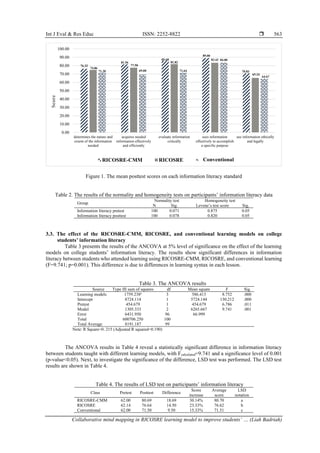
Participants’ information literacy scores were calculated from their post-test results. There were five
standards assessed in the information literacy test given to the participants. Figure 1 compares the information
literacy scores of participants from the RICOSRE-CMM, RICOSRE, and conventional groups.
3.2. Results of the normality and homogeneity tests on participants’ information literacy data
Before testing the hypothesis, data normality and homogeneity of variance were examined. The
normality of the research data was examined using the Kolmogorov-Smirnov test, while the homogeneity of
variance was examined using Levene’s test p>0.05). Table 2 displays the results of the normality and
homogeneity tests. Based on Table 2, it is known that the research data were distributed normally and sourced
from homogeneous variance. Then, hypothesis testing was conducted to study the effect of the learning models
on participants’ information literacy. The hypothesis was tested using ANCOVA (at 0.05 significance level),
with the pretest scores as the covariate. If the analysis results showed a significant value, ANCOVA was
followed by the LSD test to find out the difference in mean scores among the three treatment groups.
Int J Eval & Res Educ ISSN: 2252-8822 
Collaborative mind mapping in RICOSRE learning model to improve students’ … (Liah Badriah)
563
Figure 1. The mean posttest scores on each information literacy standard
Table 2. The results of the normality and homogeneity tests on participants’ information literacy data
Group
Normality test Homogeneity test
N Sig. Levene’s test score Sig.
Information literacy pretest 100 0.071 0.875 0.05
Information literacy posttest 100 0.078 0.820 0.05
3.3. The effect of the RICOSRE-CMM, RICOSRE, and conventional learning models on college
students’ information literacy
Table 3 presents the results of the ANCOVA at 5% level of significance on the effect of the learning
models on college students’ information literacy. The results show significant differences in information
literacy between students who attended learning using RICOSRE-CMM, RICOSRE, and conventional learning
(F=9.741; p=0.001). This difference is due to differences in learning syntax in each lesson.
Table 3. The ANCOVA results
Source Type III sum of squares df Mean square F Sig.
Learning models 1759.238a
3 586.413 8.752 .000
Intercept 8724.114 1 5724.144 130.212 .000
Pretest 454.679 1 454.679 6.786 .011
Model 1305.333 2 6265.667 9.741 .001
Error 6431.950 96 66.999
Total 600706.250 100
Total Average 8191.187 99
Note: R Square=0. 215 (Adjusted R squared=0.190)
The ANCOVA results in Table 4 reveal a statistically significant difference in information literacy
between students taught with different learning models, with Fcalculated=9.741 and a significance level of 0.001
(p-value<0.05). Next, to investigate the significance of the difference, LSD test was performed. The LSD test
results are shown in Table 4.
Table 4. The results of LSD test on participants’ information literacy
Class Pretest Posttest Difference
Score
increase
Average
score
LSD
notation
RICOSRE-CMM 62.00 80.69 18.69 30.14% 80.70 a
RICOSRE 62.14 76.64 14.50 23.33% 76.62 b
Conventional 62.00 71.50 9.50 15.33% 71.51 c
76.22
81.56
85.68
89.00
70.83
74.86
77.50
81.82
83.43
65.24
71.20 69.00 71.64
84.00
64.67
0.00
10.00
20.00
30.00
40.00
50.00
60.00
70.00
80.00
90.00
100.00
determines the nature and
extent of the information
needed
acquires needed
information effectively
and efficiently
evaluate information
critically
uses information
effectively to accomplish
a specific purpose
use information ethically
and legally
Score
RICOSRE-CMM RICOSRE Konvensional
Conventional
 ISSN: 2252-8822
Int J Eval & Res Educ, Vol. 13, No. 1, February 2024: 559-569
564
Table 4 shows the results of the LSD test to determine the most effective learning method for
increasing students' information literacy. It was found that the mean score of students in the RICOSRE-CMM
group (80.70) for information literacy was higher than that achieved by the RICOSRE group (76.62) or by the
conventional group (71.51). The RICOSRE-CMM group obtained the highest increase (from the pretest score
to the posttest) (30.14%), followed by the RICOSRE group (23.33%), and the conventional group (15.33 %).
Below are some sample information literacy test questions along with student responses from the
RICOSRE-CMM and conventional classes. The students of the RICOSRE-CMM class understood that if they
wanted to find a plant species, they had to perform valid investigation steps. These steps included using an
identification key, matching the species being studied to the herbarium species identified by researchers,
matching the species being studied to pictures in a monograph book, or requesting a plant expert directly. In
contrast, students in conventional classes were more likely to ask other students about these plants. Therefore,
the conventional class students presented difficulties in determining valid steps related to the plant
identification problem.
When the lecturer asked students conducted observations to identify species of aquatic plants that commonly
cause blooms in aquatic ecosystems, it turns out they are finding a plant species that has never been identified
before. To identify these types of plants, the valid investigative steps that students should NOT perform are as
follows …
A. Use a determination key
B. Ask other students about the plant
C. Match the plant species with the herbarium specimens that have been identified
D. Match the species being studied to pictures in a monograph book.
E. Ask the identity of the plant to someone who we consider a plant expert and who we think can provide an
answer to the question.
(The correct answer is B)
4. DISCUSSION
The difference in the mean scores that students achieved in the conventional class, RICOSRE, and
RICOSRE-CMM in each information literacy standard can be attributed to the different phases of the activity
or set of tasks completed in the classroom. The students in the RICOSRE-CMM class achieved higher
information literacy scores than other students from other treatment groups because the students in the
RICOSRE-CMM class went through learning phases that increased their literature awareness and allowed them
to search for a complete bibliography. In the RICOSRE-CMM class, the students were supported with the
CMM activity that can enhance their information literacy. This CMM activity produced an end product capable
of describing the flow of information and finding solutions, which can strengthen decision-making in
discussions. The CMM activity was a good example of collaborative activities between students in small
groups. The ultimate goal of creating CMMs in the RICOSRE-CMM class was to help students visualize and
organize ideas and information gained from problem-solving activities to find effective solutions to problems.
An example of a mind map created by students from the RICOSRE-CMM group is shown in Figure 2.
Figure 2 is an example of a mind map created collaboratively by students in the RICOSRE-CMM
class. Students mapped the problem in the middle of the CMM as the focal point. Next, students made outward
ramifications that include the factors causing this problem, the impact of the problem on the environment, and
several alternative solutions to the problem. From these branches, the most appropriate solution to solve the
environmental problem was then highlighted. Problem-based learning encourages college students to explore
different theories, examine empirical data, and use critical thinking skills in evaluating information during the
problem-solving process [29]. A series of science activities and the creation of a collaborative mind mapping
can strengthen students’ information literacy.
The RIOCSRE-CMM, RICOSRE, and conventional learning models can improve information literacy
in college students. Implementation of learning generally requires access to information. However, some expert
opinions and research indicate that problem-based learning is more effective in promoting information literacy
in the classroom [29]. The results of this study showed that the RICOSRE-CMM learning model had a positive
effect on college students’ information literacy. The RICOSRE-CMM learning stages contributed the greatest
to the development of students’ information literacy as each standard was trained from the beginning to the
end of the lesson.
Int J Eval & Res Educ ISSN: 2252-8822 
Collaborative mind mapping in RICOSRE learning model to improve students’ … (Liah Badriah)
565
Figure 2. Collaborative mind mapping of environmental pollution
The first syntax of RICOSRE-CMM is reading. At this stage, students were asked to read relevant
references to find as much information as possible to build knowledge that would be acquired during the
learning process. Reading can train higher thinking skills as it involves active intellectual abilities to derive
meaning and purpose from reading sources [17]. Reading leads college students to seek information about the
type and amount of information needed (standard 1). The results of this study showed that the RICOSRE-CMM
class achieved the highest information literacy score (76.22), followed by the RICOSRE class (74.86) and the
conventional class (71.20). Reading is relevant to academic needs. It improves students’ ability to find
information and increases their information literacy. Reading skills cannot be adequately trained in
conventional classes that are geared toward lecturer-centered activities [30].
The second phase in RICOSRE-CMM is identifying the problem using Collaborative Mind Mapping
(CMM). In this phase, college students were asked to identify environmental problems based on topics that
have been identified and written on student worksheets. Identifying contextual issues can initiate an
information search that begins with determining what information is needed. It also trains the ability to access
information effectively (standard 2) [31]. In this study, participants in the RICOSRE-CMM class received the
highest score (81.56) for the ability to access needed information effectively and efficiently, followed by the
RICOSRE class (77.50) and the conventional class (69.00). Higher education students need to develop the
ability to access information, as this ability enables them to find the information they need amidst a wealth of
information. Mastery of this information literacy standard is characterized by the ability to use information
search strategies via search engines and use multiple keywords and specific codes according to computer
language [32].
In this phase, the students also developed a mind map together. Collaborative Mind Mapping helped
these students organize information and ideas they had gathered from relevant references. CMM also supported
the students in generating associations of ideas and encouraged them to think outside the box [33].
Environmental pollution topics such as water pollution, soil pollution, and air pollution discussed in class
motivated the students to explore important information. Students who can identify problems demonstrate a
higher level of information literacy [29].
The third syntax of RICOSRE-CMM is constructing the solution. When constructing problem
solutions, students were encouraged to think creatively. In addition, students were motivated to develop skills
to critically evaluate information and use theoretical foundations and scientific laws to construct reasonable
alternative solutions. The results of this study confirmed that students in the RICOSRE-CMM class (85.68)
were better than the RICOSRE (81.82) and the conventional students (71.64) in evaluating information
6.04-6.76
5.5-6.3 mg/L
5.5-6.3 mg/L
6-624 mg/L
 ISSN: 2252-8822
Int J Eval & Res Educ, Vol. 13, No. 1, February 2024: 559-569
566
(standard 3). This finding relates to the use of authentic and actual problems in problem-based learning.
Problem-based learning has been shown to provide students with a broad learning experience and improve
their ability to evaluate information, which is one of the indicators of information literacy [16], [29]. Evaluating
information critically means examining the relevance and usefulness of the information and using the latest
technology to access the information [34]. The information assessment phase encourages students to make
careful decisions about what information to look for or what information products to create. When constructing
alternative solutions, students discussed in groups to visualize problem-solving through collaborative mind
mapping. Each group member could systematically see the solution that the group considered the most
appropriate. Related studies have previously found that CMM has a high degree of flexibility, simplifies the
complexity of information, and can clarify and link key ideas to solve specific problems [35].
The fourth syntax in RICOSRE-CMM is solving the problem. After exploring and developing several
alternative solutions, students were trained to determine the most appropriate solution to the problem in this
phase. Students were asked to rate the accuracy of the strategies and methods chosen to solve the problem at
hand. In this fourth phase, accuracy in evaluating information and determining strategy adequacy is key [17].
Therefore, CMM plays an important part in this stage.
Collaborative Mind Mapping helps students gather important information during problem-solving
activities. CMM also helps students remember, regulate, express relationships between information, and add
recent information [36], [37]. Collaborative mind mapping can be used to present the results of the discussion
more interestingly. Previous studies stated that collaboratively mind mapping can help users think flexibly and
systematically. A systematic mindset makes it easier for someone to solve problems. A set of cognitive
processes and information literacy skills help find appropriate solutions to complex problems commonly
encountered in everyday life [38].
After going through the fourth RICOSRE-CMM syntax, participants developed one of the information
literacy standards namely uses information effectively to accomplish a specific purpose (standard 4). The
results of the current study showed that the RICOSRE-CMM students (89.00) scored higher than the RICOSRE
students (83.43) or the conventional students (84.00) in using the information to achieve specific goals. This
finding is consistent with the fact that these students were able to apply new information and previous
information to find solutions to the problems at hand. They were also able to effectively communicate the
results of their investigations to other students in the classroom discussion forums. When asked about solutions
to water pollution in their area, the students could explain the newly gained knowledge about the localization
of household waste and phosphate substitution in detergents to solve eutrophication problems in water bodies.
Another empirical finding also states that every student must have the ability to use the information to achieve
specific goals [38].
The fourth syntax of the RICOSRE-CMM learning model can also strengthen students’ skills in
understanding the ethical and legal use of information (standard 5). In turn, the RICOSRE-CMM students
(70.83), the RICOSRE class (65.24), and the conventional class (64.67) showed a poor understanding of ethics
and laws of information use. This can be caused by the student's lack of knowledge of how to cite appropriate
information sources. In addition, other research has revealed that knowing how to write appropriate sources of
information can avoid fraud in information claims and minimize plagiarism in information writing [25].
The fifth syntax of RICOSRE-CMM is to review and extend the solution. In this phase, the students
reviewed the results of the discussions which had been incorporated into their CMM. Students were then asked
to communicate their investigation results to the whole class to receive feedback and additional information
from other students [39]. This stage also encourages students to validate the accuracy of the problem-solving
strategies used in the previous phase. Reviewing the solution also sharpens students’ understanding of the
material. This phase was then followed by extending the solution, in which students were encouraged to expand
their perspectives on alternative efficient solutions to the same problems that will arise in the future [17].
The issue raised in this study is environmental pollution. During the lessons, students were asked to
organize important information through a series of problem-solving activities and collaborative mind mapping.
The integrated collaborative mind mapping into a problem-solving process helps students find solutions faster
because the information received is more directed and structured [24]. CMM in problem-based learning also
promotes information literacy in the classroom. In the fifth phase of RICOSRE-CMM, reviewing and extending
the solution, students re-evaluate the solution so they can be sure that the information used to solve the problem
is accurate [40].
Compared to the RICOSRE and RICOSRE-CMM students, students in conventional classrooms had
very little opportunity to develop information literacy. This can happen because students only act as recipients
of information through lectures. Traditional learning methods failed to provide college students with the
experience of organizing information and solving contextual problems [30]. Even in some university courses,
professors are more likely to teach broad academic content but ignore the process by which students achieve
learning objectives.
Int J Eval & Res Educ ISSN: 2252-8822 
Collaborative mind mapping in RICOSRE learning model to improve students’ … (Liah Badriah)
567
To be successful in studying environmental pollution, students need information literacy to develop
scientific methods. Traditional learning cannot provide opportunities for students to engage in scientific work
processes, such as recognizing and investigating problems, constructing solutions and solving problems [41].
In conventional classes, students typically learn alone with minimal collaboration. Students often complete
tasks independently; group work is found only in presentation tasks. Learning activities like these fail to
develop the information literacy of college students. The RICOSRE and RICOSRE-CMM learning models
require students to collaborate in examining problems and evaluating and testing problem-solving techniques
and strategies. Problem-oriented learning activities that involve active student participation at every stage of
the learning process can enhance information literacy and promote engaging and meaningful learning
experiences [15].
5. CONCLUSION
This study provides empirical evidence that the RICOSRE-CMM, RICOSRE, and traditional learning
models differed significantly with the development of information literacy in college students. Among the
three, RICOSRE-CMM learning is most effective in developing students’ information literacy in higher
education institutions. This research also demonstrates that incorporating collaborative mind mapping into the
RICOSRE model effectively develops students’ ability to integrate and organize knowledge systematically.
RICOSRE-CMM is also able to stimulate students’ higher-level thinking skills required to solve various
problems related to modern biology. The results of this study explain that RICOSRE-CMM contains a learning
process that promotes knowledge of biology through a range of problem-solving activities. The RICOSRE-
CMM model prepares students to become literate individuals capable of organizing information effectively.
This study has important limitations. The sample size was small and future studies should aim for larger
participants. Further research is suggested to examine the potential of the RICOSRE-CMM in a wider research
area. In addition, it is possible to integrate the learning model into other biology topics or test its effectiveness
on other 21st-century skills.
ACKNOWLEDGEMENTS
The Ministry of Education, Culture, Research and Technology provided funding for the present work
through a doctoral dissertation grant scheme (project number 092/E5/PG.02.00.PT/2022). The authors
gratefully acknowledge the support of all students who consent to participate in this study.
REFERENCES
[1] C. L. Al-Qallaf, “Information literacy assessment of incoming students in an information studies graduate program,” Global
Knowledge, Memory and Communication, vol. 68, no. 3, pp. 223–241, Apr. 2019, doi: 10.1108/GKMC-07-2018-0062.
[2] T. Tsunekage, C. R. Bishop, C. M. Long, and I. I. Levin, “Integrating information literacy training into an inquiry-based introductory
biology laboratory,” Journal of Biological Education, vol. 54, no. 4, pp. 396–403, 2020, doi: 10.1080/00219266.2019.1600569.
[3] T. Svensson, J. Wilk, and K. Gustafsson Åman, “Information literacy skills and learning gaps-students’ experiences and teachers’
perceptions in interdisciplinary environmental science,” Journal of Academic Librarianship, vol. 48, no. 1, pp. 1–9, 2022, doi:
10.1016/j.acalib.2021.102465.
[4] I. Kozikoglu and Z. Onur, “Predictors of lifelong learning: Information literacy and academic self-efficacy,” Cypriot Journal of
Educational Sciences, vol. 14, no. 4, pp. 492–506, 2019, doi: 10.18844/cjes.v11i4.3460.
[5] L. Seifi, M. Habibi, and M. Ayati, “The effect of information literacy instruction on lifelong learning readiness,” IFLA Journal,
vol. 46, no. 3, pp. 259–270, Oct. 2020, doi: 10.1177/0340035220931879.
[6] J. T. Boruff and P. Harrison, “Assessment of knowledge and skills in information literacy instruction for rehabilitation sciences
students: a scoping review,” Journal of the Medical Library Association, vol. 106, no. 1, pp. 15–37, Jan. 2018, doi:
10.5195/jmla.2018.227.
[7] D. Morris, “A review of information literacy programmes in higher education: The effects of face-to-face, online and blended
formats on student perception,” Journal of Information Literacy, vol. 14, no. 1, pp. 19–40, 2020, doi: 10.11645/14.1.2668.
[8] S. Lanning and J. Mallek, “Factors influencing information literacy competency of college students,” Journal of Academic
Librarianship, vol. 43, no. 5, pp. 443–450, Sep. 2017, doi: 10.1016/j.acalib.2017.07.005.
[9] H. Subekti, A. R. Purnomo, H. Susilo, I. Ibrohim, and H. Suwono, “Analysis of preservice science teacher information literacy
towards research skills,” Journal of Physics: Conference Series, vol. 1006, no. 1, pp. 1–6, 2018, doi: 10.1088/1742-
6596/1006/1/012009.
[10] J. Hammons, “Teaching information literacy: Developing an online course for faculty,” College & Research Libraries News, vol.
81, no. 7, pp. 337–349, 2020, doi: 10.5860/crln.81.7.337.
[11] C. A. Dewi, M. Muhali, Y. Kurniasih, D. Lukitasari, and A. Sakban, “The impact of google classroom to increase students’
information literacy,” International Journal of Evaluation and Research in Education (IJERE), vol. 11, no. 2, pp. 1005–1014, Jun.
2022, doi: 10.11591/ijere.v11i2.22237.
[12] C. Sun, J. Liu, L. Razmerita, Y. Xu, and J. Qi, “Higher education to support sustainable development: The influence of information
literacy and online learning process on Chinese postgraduates’ innovation performance,” Sustainability, vol. 14, no. 13, p. 7789,
Jun. 2022, doi: 10.3390/su14137789.
[13] C. Chlomoudis, A. Konstantinou, P. Kostagiolas, and P. Pallis, “Information needs and information-seeking behaviour of maritime
students: a systematic literature review using the PRISMA method,” Library Management, vol. 43, no. 5, pp. 353–369, Apr. 2022,
 ISSN: 2252-8822
Int J Eval & Res Educ, Vol. 13, No. 1, February 2024: 559-569
568
doi: 10.1108/LM-11-2021-0105.
[14] I. Schiffl, “How information literate are junior and senior class biology students?” Research in Science Education, vol. 50, no. 2,
pp. 773–789, 2020, doi: 10.1007/s11165-018-9710-2.
[15] A. Walsh, “Playful learning for information literacy development,” IFLA Journal, vol. 46, no. 2, pp. 143–150, Jun. 2020, doi:
10.1177/0340035219874083.
[16] S. A. Vong and W. Kaewurai, “Instructional model development to enhance critical thinking and critical thinking teaching ability
of trainee students at regional teaching training center in Takeo province, Cambodia,” Kasetsart Journal of Social Sciences, vol.
38, no. 1, pp. 88–95, Jan. 2017, doi: 10.1016/j.kjss.2016.05.002.
[17] S. Mahanal, S. Zubaidah, D. Setiawan, H. Maghfiroh, and F. G. Muhaimin, “Empowering college students’ problem-solving skills
through RICOSRE,” Education Sciences, vol. 12, no. 3, pp. 1–17, 2022, doi: 10.3390/educsci12030196.
[18] T. Manisa, S. Mahanal, and R. Fatchur, “Empowering problem-solving skills through RICOSRE learning model,” Jurnal
Pendidikan Sains, vol. 8, no. 1, pp. 12–15, 2020, doi: http://dx.doi.org/10.17977/jps.v8i1.13658.
[19] K. Mawaddah, S. Mahanal, A. Gofur, D. Setiawan, and S. Zubaidah, “RICOSRE: An innovative learning model to promote
scientific literacy,” in AIP Conference Proceedings, 2021, p. 030042, doi: 10.1063/5.0043303.
[20] Z.-W. Xu et al., “Application of symptom-based mind mapping combined with PBL teaching method in emergency trauma
standardized resident training in MDT model,” Medicine (Baltimore)., vol. 101, no. 38, p.30822, 2022, doi:
10.1097/md.0000000000030822.
[21] R. Arajuo and G. Gadanidis, “Online collaborative mind mapping in a mathematics teacher education program: A study on student
interaction and knowledge construction,” ZDM – Mathematics Education, vol. 52, no. 5, pp. 943–958, 2020, doi: 10.1007/s11858-
019-01125-w.
[22] X. Zheng, T. E. Johnson, and C. Zhou, “A pilot study examining the impact of collaborative mind mapping strategy in a flipped
classroom: Learning achievement, self-efficacy, motivation, and students’ acceptance,” Educational Technology Research and
Development, vol. 68, no. 6, pp. 3527–3545, 2020, doi: 10.1007/s11423-020-09868-0.
[23] A. P. Kurniawan, A. Rahmawati, E. I. Faihatunnisa, A. P. Trisna Paramita, and L. Khodriyah, “The effectiveness of collaborative
mind mapping to develop writing skills at MTsN 4 Mojokerto,” Proceedings of the International Conference on English Language
Teaching (ICONELT 2019), vol. 434, no. Iconelt 2019, 2020, pp. 148–152, doi: 10.2991/assehr.k.200427.030.
[24] D. Fung and T. Liang, “The effectiveness of collaborative mind mapping in Hong Kong primary science classrooms,” International
Journal of Science and Mathematics Education, vol. 21, pp. 899–922, 2022, doi: 10.1007/s10763-022-10279-1.
[25] R. Michalak, M. Rysavy, K. Hunt, B. Smith, and J. Worden, “Faculty perceptions of plagiarism: Insight for librarians’ information
literacy programs,” College & Research Libraries, vol. 79, no. 6, pp. 747–767, 2018, doi: 10.5860/crl.79.6.747.
[26] P. Vriend et al., “Plastic pollution research in Indonesia: State of science and future research directions to reduce impacts,” Frontiers
in Environmental Science, vol. 9, pp 1-12, Jun. 2021, doi: 10.3389/fenvs.2021.692907.
[27] A. A. Bachri and E. Normelani, “FDI, income, and environmental pollution in Indonesia,” International Journal of Energy
Economics and Policy, vol. 10, no. 6, pp. 383–389, Oct. 2020, doi: 10.32479/ijeep.10537.
[28] B. Boh Podgornik, D. Dolničar, A. Šorgo, and T. Bartol, “Development, testing, and validation of an Information Literacy Test
(ILT) for higher education,” Journal of the Association for Information Science and Technology, vol. 67, no. 10, pp. 2420–2436,
Oct. 2016, doi: 10.1002/asi.23586.
[29] N. Kim, C. Vicentini, and B. Belland, “Influence of scaffolding on information literacy and argumentation skills in virtual field trips
and problem-based learning for scientific problem solving,” International Journal of Science and Mathematics Education, vol. 20,
no. 2, pp. 215–236, 2022, doi: 10.1007/s10763-020-10145-y.
[30] S. Alneyadi, E. Abulibdeh, and Y. Wardat, “The impact of digital environment vs. traditional method on literacy skills; reading and
writing of Emirati fourth graders,” Sustainability, vol. 15, no. 4, p. 3418, Feb. 2023, doi: 10.3390/su15043418.
[31] S. Santharooban and P. G. Premadasa, “Development of an information literacy model for problem based learning,” Annals of
Library and Information Studies, vol. 62, no. 3, pp. 138–144, 2015, doi: 10.56042/alis.v62i3.8472.
[32] W. M. Bramer, G. B. De Jonge, M. L. Rethlefsen, F. Mast, and J. Kleijnen, “A systematic approach to searching: An efficient and
complete method to develop literature searches,” Journal of the Medical Library Association, vol. 106, no. 4, pp. 531–541, Oct.
2018, doi: 10.5195/jmla.2018.283.
[33] M. Kalyanasundaram et al., “Effectiveness of mind mapping technique in information retrieval among medical college students in
Puducherry - a pilot study,” Indian Journal of Community Medicine, vol. 42, no. 1, pp. 19–23, 2017, doi: 10.4103/0970-
0218.199793.
[34] M. Flierl, E. Bonem, C. Maybee, and R. Fundator, “Information literacy supporting student motivation and performance: Course-
level analyses,” Library and Information Science Research, vol. 40, no. 1, pp. 30–37, Jan. 2018, doi: 10.1016/j.lisr.2018.03.001.
[35] K. Y. Alderbashi and M. K. Moussa, “Effectiveness of employing the e-mind mapping strategy in scientific Courses: Adopting the
blended learning approach at Emirati private preparatory schools,” Journal of Curriculum and Teaching, vol. 11, no. 4, p. 159, May
2022, doi: 10.5430/jct.v11n4p159.
[36] I. W. Widiana and I. N. Jampel, “Improving students’ creative thinking and achievement through the implementation of multiple
intelligence approach with mind mapping,” International Journal of Evaluation and Research in Education (IJERE), vol. 5, no. 3,
pp. 246–254, Sep. 2016, doi: 10.11591/ijere.v5i3.4546.
[37] S. Sukaesih, S. Zubaidah, S. Mahanal, and D. Listyorini, “Enhancing students’ nature of science understanding through project-
based learning and mind mapping,” International Journal of Evaluation and Research in Education (IJERE), vol. 11, no. 4,
pp. 1704–1713, 2022, doi: 10.11591/ijere.v11i4.22282.
[38] M. Goodsett, “Best practices for teaching and assessing critical thinking in information literacy online learning objects,” Journal of
Academic Librarianship, vol. 46, no. 5, pp. 1–7, Sep. 2020, doi: 10.1016/j.acalib.2020.102163.
[39] L. C. Wilkinson, A. L. Bailey, and C. A. Maher, “Students’ mathematical reasoning, communication, and language representations:
A video-narrative analysis,” ECNU Review of Education, vol. 1, no. 3, pp. 1–22, Sep. 2018, doi: 10.30926/ecnuroe2018010301.
[40] S. Mahanal, S. Zubaidah, I. D. Sumiati, T. M. Sari, and N. Ismirawati, “RICOSRE: A learning model to develop critical thinking
skills for students with different academic abilities,” International Journal of Instruction, vol. 12, no. 2, pp. 417–434, 2019, doi:
10.29333/iji.2019.12227a.
[41] F. Eshetu and S. Assefa, “Effects of context-based instructional approaches on students’ problem-solving skills in rotational
motion,” Eurasia Journal of Mathematics, Science and Technology Education, vol. 15, no. 2, pp. 1–13, Dec. 2018, doi:
10.29333/ejmste/102283.
Int J Eval & Res Educ ISSN: 2252-8822 
Collaborative mind mapping in RICOSRE learning model to improve students’ … (Liah Badriah)
569
BIOGRAPHIES OF AUTHORS
Liah Badriah is a Ph.D. Candidate, Department of Biology, Faculty of
Mathematics and Natural Sciences, Universitas Negeri Malang, Malang, Indonesia. She is
a lecturer of Universitas Siliwangi, Tasikmalaya, Indonesia. Her research interests include
Biology education, critical thinking skills, literacy information, problem-solving skill, and
environmental education. She can be contacted at email: liahbadriah@unsil.ac.id.
Susriyati Mahanal is a Professor at the Department of Biology, Faculty of
Mathematics and Natural Sciences, State University of Malang, Indonesia. Her research
areas: biology education, metacognitive skills, critical and creative thinking skills, 21st
century learning and environmental education. She can be contacted at email:
susriyati.mahanal.fmipa@um.ac.id.
Betty Lukiati is a lecturer at the Department of Biology, Faculty of Mathematics
and Natural Sciences, State University of Malang, Malang, Indonesia. Her research areas: are
plant structure, development and physiology, bioinformatics, herbal medicine, and biology
education. She can be contacted at email: betty.lukiati.fmipa@um.ac.id.
Murni Sapta Sari is a lecturer at the Department of Biology, Faculty of
Mathematics and Natural Sciences, State University of Malang, Malang, Indonesia. Her
research areas: are biology learning assessment, 21st century skills, the structure of plant
development, and biology education. She can be contacted at email:
murni.sapta.fmipa@um.ac.id.

Collaborative mind mapping in RICOSRE learning model to improve students’ information literacy

  • 1.
    International Journal ofEvaluation and Research in Education (IJERE) Vol. 13, No. 1, February 2024, pp. 559~569 ISSN: 2252-8822, DOI: 10.11591/ijere.v13i1.26840  559 Journal homepage: http://ijere.iaescore.com Collaborative mind mapping in RICOSRE learning model to improve students’ information literacy Liah Badriah1,2 , Susriyati Mahanal1 , Betty Lukiati1 , Murni Sapta Sari1 1 Department of Biology, Faculty of Mathematics and Natural Sciences, Universitas Negeri Malang, Malang, Indonesia 2 Department of Biology Education, Faculty of Teacher Training and Education, Universitas Siliwangi, Tasikmalaya, Indonesia Article Info ABSTRACT Article history: Received Feb 14, 2023 Revised Nov 17, 2023 Accepted Nov 28, 2023 This research aimed to determine how the reading, identifying problem, constructing solution, solving problem, reviewing and extending problem solution (RICOSRE) learning model integration with collaborative mind mapping affects students’ information literacy in higher education institutions. This quasi-experimental study used a pretest-posttest non- equivalent control group design. There were 40 multiple-choice questions selected to assess student information literacy. All instruments have been validated and are reliable. The data were collected from 100 participants who were college students enrolled in the environmental pollution course of the biology education degree program at Siliwangi University, Indonesia. To analyze the research data, analysis of covariance (ANCOVA) was used at a 5% level of significance, followed by the least significance difference (LSD) test. The ANCOVA results showed that the RICOSRE-CMM learning model impacted students’ information literacy. LSD scores were significantly different in terms of students’ information literacy. It can be concluded that the RICOSRE-CMM model could enhance each component of information literacy as these components have been integrated into the learning model syntax, which involves a series of information discovery and analysis processes during group work to find a solution to a problem. Keywords: Collaborative mind mapping Environmental pollution course Information literacy Preservice biology teachers RICOSRE learning model This is an open access article under the CC BY-SA license. Corresponding Author: Susriyati Mahanal Department of Biology, Faculty of Mathematics and Natural Sciences, Universitas Negeri Malang Semarang street no. 5, Malang 65145, Indonesia Email: susriyati.mahanal.fmipa@um.ac.id 1. INTRODUCTION In the 21st century education, information literacy is crucial. Information literacy helps students become more self-assured and autonomous so they can carefully achieve their objectives in learning [1]. Literature reviews are essential in scientific investigations and thus highly valued in the academic world when it comes to problem-solving exercises, particularly in biology learning [2]. This set of exercises also aids students in formulating theories related to biology learning, particularly those pertaining to the use of data to address various instances of environmental pollution. Because information literacy skills have a significant impact on learning, students need to acquire these skills [3]. Information literacy is a key factor for lifelong learning [4], [5]. It is useful for obtaining reliable and accurate information to solve various problems. Information literacy includes the integration of skills when information is needed, finding information, using information effectively, and critically evaluating information and its sources [6]. Information literacy has been broadly defined in various literatures. The Association of College and Research Libraries (ACRL) describes information literacy as the ability to recognize when information is required, as well as how to locate, evaluate, and use it responsibly [5]. Information literacy helps
  • 2.
     ISSN: 2252-8822 IntJ Eval & Res Educ, Vol. 13, No. 1, February 2024: 559-569 560 students at universities in the process of knowledge reconstruction [7]. Information literacy strengthens students’ ability to use various information as a knowledge product. Technological developments provide great opportunities to obtain plentiful information, hence college students need to be equipped with information literacy to minimize errors in information selection. Information literacy is a must in higher education because it supports learning activities, fosters students’ critical thinking, and improves their academic performance. Information literacy assists college students in accomplishing various learning tasks that ultimately affect the success of their studies at the university [8] . The development of information literacy among college students is a fundamental necessity as it can enhance learning goals and has implications for future success. Unfortunately, several studies have reported that students are often unprepared for the complexities of academic research and experience many challenges in finding and evaluating information sources [9]. College students also lack sufficient skills to seek appropriate academic resources. In conclusion, college students’ information literacy is still relatively poor, particularly concerning accessing information [10]. In general, college students in Indonesia perform poorly in information literacy, especially in accessing the required information [11]. Teachers need to implement appropriate pedagogical strategies to support the development of information literacy among students in higher education institutions [12]. A holistic view of the information- seeking process suggests that problem-based learning integrated with inquiry activities can improve students’ information literacy. Past studies indicate that teacher education programs must incorporate a process-oriented approach to information literacy instruction to effectively meet students' information needs [13], [14]. Previous research indicates that teacher education programs should incorporate a process-oriented approach in teaching information literacy to meet the information needs of college students. Learning that focuses on problem- solving and requires college students to design authentic problem solutions can promote literacy development and create a positive learning atmosphere. This positive learning atmosphere can stimulate students’ curiosity, motivating them to organize information [15]. Problem-based learning strategies can assist college students in gathering information and deciding the right course of action to solve the intended problem [16]. An example of active, problem-solving-oriented learning is the reading, identifying the problem, constructing solution, solving problem, reviewing and extending problem solution (RICOSRE) learning model. The RICOSRE learning model prioritizes group performance in systematic and structured problem-solving exercises [17]. Several previous studies reported that implementing RICOSRE in the classroom can support the development of various skills. Compared to traditional learning, RICOSRE can significantly improve the problem-solving skills of high school students in the city of Malang, Indonesia [18]. Furthermore, the RICOSRE learning model is more successful in increasing science literacy than inquiry-based learning strategies [19]. RICOSRE, like other problem-based learning models, can present a conducive learning environment and turn students into independent learners. Each phase of the RICOSRE learning model encourages college students to engage with information needs. Therefore, it is hoped that RICOSRE can develop the information literacy of every individual in tertiary institutions. However, problem-based teaching alone will not be able to shape the systematic understanding of learning content among college students [20]. Thus, instructors need to add techniques that can help students visualize abstract problems into concrete ones and simplify complex problems by connecting fragmented knowledge in collaboration, so this technique can be used as an effective tool to support the implementation of the RICOSRE learning model. Such learning techniques can be a good complement to the RICOSRE learning model. Collaborative mind mapping is an alternative technique that can be used to help students systematically visualize ideas, brainstorm and work together to solve problems [21]. Collaborative mind mapping also facilitates reflection in the learning process. The collaborative mind mapping (CMM) technique begins with creating a mind map, either manually or digitally. This technique helps students associate ideas, think creatively, and make possible connections [21]. The use of software offers a more sophisticated way of organizing information in a mind map. CMM is a groupware application that includes a collaborative power to connect visuals synchronously and asynchronously, make shared edits, and save edit history for viewing [22]. Learning in the 21st century often presents the technology, collaboration, and visualization as interconnected components. The utilization of CMM in the learning process triggers student participation and interest. CMM also helps students sort information, acquire knowledge, and create meaningful learning experiences by generating ideas on topics covered in the classroom [23]. Several related studies report that CMM positively affects group learning dynamics, idea organization, learning achievement, and learning efficiency. College students are satisfied with the use of CMM in the classroom because it can bridge student discussions and help students reconstruct new knowledge [24]. The integration of RICOSRE and CMM aims to encourage student participation in improving information literacy in problem-solving. Linking information and ideas when creating a CMM is a creative task that requires deep thought and excessive focus [24]. Universities must be able to integrate technology-
  • 3.
    Int J Eval& Res Educ ISSN: 2252-8822  Collaborative mind mapping in RICOSRE learning model to improve students’ … (Liah Badriah) 561 based learning tools to respond to technological developments and create an interactive learning environment. The use of technology in learning, supported by the ease of collaboration, can increase students’ motivation to learn and make the learning process more meaningful [25]. Another advantage of CMM is that they can be saved in pdf and jpg format. CMM can be easily shared with the lecturer and other students, making the process of collaboration, assessment and reflection of learning easier. This combination of RICOSRE and CMM, referred to as RICOSRE-CMM, will be used in the Environmental Pollution course. Students studying biology will learn about different initiatives to address environmental pollution issues in this course on environmental pollution. Common and severe environmental pollution issues in Indonesia include garbage on roads and in rivers, poor air quality in cities, heavy metal pollution in water, high rates of deforestation that result in significant greenhouse gas emissions, soil erosion, soil pollution, air pollution from smoke and haze, loss of biodiversity, and some other issues [26]. The lack of environmental awareness and general information about the natural environment is the main issue causing the significant environmental damage that has taken place in Indonesia. Today’s environmental harm is also influenced by human activity [27]. It is anticipated that students possess the ability to examine the ramifications of environmental pollution on living organisms and devise more efficient resolutions to associated issues. The course aims to investigate diverse environmental issues, and it is presumed that these objectives align with the RICOSRE- CMM educational framework. Thus, it is hoped that the instructional approach will support learners in resolving challenges encountered throughout educational endeavors. Collaborative mind mapping facilitates problem-solving by enhancing focus and organizing problems systematically, thereby enabling students to identify solutions with greater ease. Based on the above explanations, this study aimed to identify differences in information literacy between college students supported with the RICOSRE-CMM learning model and college students supported with RICOSRE or conventional learning model. 2. RESEARCH METHOD 2.1. Research design This study employed a quasi-experimental method. Table 1 shows the pretest-posttest non-equivalent control group design used in this study. The independent variable of this study was the learning model, while the dependent variable was information literacy. The current study involved three treatment groups, namely RICOSRE-CMM, RICOSRE, and conventional. Table.1 Research design Pretest Treatment group Number of students Posttest O1 RICOSRE-CMM 40 O2 O3 RICOSRE 35 O4 O5 Conventional 25 O6 2.2. Research subjects The population of this study consisted of second-year students attending courses on environmental Pollution in the Biology Education program of study, Faculty of Teaching and Education, Siliwangi University, Tasikmalaya, West Java, Indonesia. In addition, this study included 100 preservice biology teachers, including 83 female and 17 male preservice teachers. The participants came from the age group between 19 and 21 years. Participants were randomly selected from three different classes. The research participants consisted of 40 students in RICOSRE-CMM class, 35 students in RICOSRE class, and 25 students in the conventional class. 2.3. Research instrument The research instrument used to assess participants’ information literacy consisted of 40 multiple- choice questions. These questions were developed based on the information literacy framework proposed by the Association of College and Research Libraries as adopted in the research by Podgornik et al. [28]. The structure of the multiple-choice test includes five information literacy criteria, which consist of: i) determining the nature and extent of the information needed; ii) accessing needed information effectively and efficiently; iii) evaluating information and its sources critically and incorporating selected information into his or her knowledge base and value system; iv) uses information effectively to accomplish a specific purpose; and v) understands many of the economic, legal, and social issues surrounding the use of information and accesses and uses information ethically and legally. The information literacy test was reviewed by two experts. The learning instrument expert was invited to do the rational validation, while the expert on environmental science was invited to perform content validity.
  • 4.
     ISSN: 2252-8822 IntJ Eval & Res Educ, Vol. 13, No. 1, February 2024: 559-569 562 The empirical validity and reliability of the instrument were evaluated by a tryout on students who were not part of the study sample. The empirical study was conducted at Siliwangi University, Indonesia. The test validity was conducted using the Pearson product moment analysis. The analysis showed scores between 0.201-0.488 for the test items. The reliability test using Cronbach’s Alpha showed a score of 0.799, meaning the test was reliable. 2.4. Research procedure This study began with participants receiving a pretest before treatment. The aim of conducting the pretest was to obtain initial data on the information literacy of the students from the entire treatment group. At the end of the learning session, a posttest was conducted following the research treatment. In addition, the learning model was implemented in twelve sessions in the environmental pollution class. Environmental Pollution is a course aimed at increasing college students’ environmental awareness and higher-order thinking skills as well as improving their ability to explore information and assess problems. The environmental pollution course also provides college students with environmental problem-solving experience. The learning activities conducted in the RICOSRE-CMM (experimental) class consisted of i) reading; ii) identifying the problems with the CMM; iii) constructing the solution with CMM; iv) solving the problems with CMM; and v) reviewing and extending the solutions with CMM. The learning stages in the RICOSRE experimental class were almost the same as the learning stages in the RICOSRE-CMM. However, RICOSRE- CMM involved the use of CMM in its syntax. The learning process in the RICOSRE classes went through the following phases: i) reading; ii) identifying problems; iii) constructing the solution; iv) solving the problems, and v) reviewing and extending the solutions to problems. Meanwhile, conventional learning consisted of the following phases: i) motivating students to learn; ii) dividing the students into small groups; iii) asking the students to present the results of the group discussions on the topics discussed. In the final phase of the study, the data obtained were analyzed and interpreted to conclude. 2.5. Data analysis The data from this study were analyzed using ANCOVA followed by the least significance difference (LSD) test. The inferential statistical analysis began with the analysis of the research assumptions in the form of data normality and homogeneity of variance. The one-sample Kolmogorov-Smirnov test was used to determine the normality of the data, while Levene’s test was used to analyze the homogeneity of variance. The post-test data were analyzed using ANCOVA, where the pretest scores were used as the covariate. ANCOVA was done to investigate the difference in information literacy between the RICOSRE-CMM, RICOSRE, and conventional students. If the analysis results showed a significant value, ANCOVA was followed by the LSD test to find out the difference in mean scores between all treatment groups. 3. RESULTS 3.1. Participants’ score on each information literacy standard Participants’ information literacy scores were calculated from their post-test results. There were five standards assessed in the information literacy test given to the participants. Figure 1 compares the information literacy scores of participants from the RICOSRE-CMM, RICOSRE, and conventional groups. 3.2. Results of the normality and homogeneity tests on participants’ information literacy data Before testing the hypothesis, data normality and homogeneity of variance were examined. The normality of the research data was examined using the Kolmogorov-Smirnov test, while the homogeneity of variance was examined using Levene’s test p>0.05). Table 2 displays the results of the normality and homogeneity tests. Based on Table 2, it is known that the research data were distributed normally and sourced from homogeneous variance. Then, hypothesis testing was conducted to study the effect of the learning models on participants’ information literacy. The hypothesis was tested using ANCOVA (at 0.05 significance level), with the pretest scores as the covariate. If the analysis results showed a significant value, ANCOVA was followed by the LSD test to find out the difference in mean scores among the three treatment groups.
  • 5.
    Int J Eval& Res Educ ISSN: 2252-8822  Collaborative mind mapping in RICOSRE learning model to improve students’ … (Liah Badriah) 563 Figure 1. The mean posttest scores on each information literacy standard Table 2. The results of the normality and homogeneity tests on participants’ information literacy data Group Normality test Homogeneity test N Sig. Levene’s test score Sig. Information literacy pretest 100 0.071 0.875 0.05 Information literacy posttest 100 0.078 0.820 0.05 3.3. The effect of the RICOSRE-CMM, RICOSRE, and conventional learning models on college students’ information literacy Table 3 presents the results of the ANCOVA at 5% level of significance on the effect of the learning models on college students’ information literacy. The results show significant differences in information literacy between students who attended learning using RICOSRE-CMM, RICOSRE, and conventional learning (F=9.741; p=0.001). This difference is due to differences in learning syntax in each lesson. Table 3. The ANCOVA results Source Type III sum of squares df Mean square F Sig. Learning models 1759.238a 3 586.413 8.752 .000 Intercept 8724.114 1 5724.144 130.212 .000 Pretest 454.679 1 454.679 6.786 .011 Model 1305.333 2 6265.667 9.741 .001 Error 6431.950 96 66.999 Total 600706.250 100 Total Average 8191.187 99 Note: R Square=0. 215 (Adjusted R squared=0.190) The ANCOVA results in Table 4 reveal a statistically significant difference in information literacy between students taught with different learning models, with Fcalculated=9.741 and a significance level of 0.001 (p-value<0.05). Next, to investigate the significance of the difference, LSD test was performed. The LSD test results are shown in Table 4. Table 4. The results of LSD test on participants’ information literacy Class Pretest Posttest Difference Score increase Average score LSD notation RICOSRE-CMM 62.00 80.69 18.69 30.14% 80.70 a RICOSRE 62.14 76.64 14.50 23.33% 76.62 b Conventional 62.00 71.50 9.50 15.33% 71.51 c 76.22 81.56 85.68 89.00 70.83 74.86 77.50 81.82 83.43 65.24 71.20 69.00 71.64 84.00 64.67 0.00 10.00 20.00 30.00 40.00 50.00 60.00 70.00 80.00 90.00 100.00 determines the nature and extent of the information needed acquires needed information effectively and efficiently evaluate information critically uses information effectively to accomplish a specific purpose use information ethically and legally Score RICOSRE-CMM RICOSRE Konvensional Conventional
  • 6.
     ISSN: 2252-8822 IntJ Eval & Res Educ, Vol. 13, No. 1, February 2024: 559-569 564 Table 4 shows the results of the LSD test to determine the most effective learning method for increasing students' information literacy. It was found that the mean score of students in the RICOSRE-CMM group (80.70) for information literacy was higher than that achieved by the RICOSRE group (76.62) or by the conventional group (71.51). The RICOSRE-CMM group obtained the highest increase (from the pretest score to the posttest) (30.14%), followed by the RICOSRE group (23.33%), and the conventional group (15.33 %). Below are some sample information literacy test questions along with student responses from the RICOSRE-CMM and conventional classes. The students of the RICOSRE-CMM class understood that if they wanted to find a plant species, they had to perform valid investigation steps. These steps included using an identification key, matching the species being studied to the herbarium species identified by researchers, matching the species being studied to pictures in a monograph book, or requesting a plant expert directly. In contrast, students in conventional classes were more likely to ask other students about these plants. Therefore, the conventional class students presented difficulties in determining valid steps related to the plant identification problem. When the lecturer asked students conducted observations to identify species of aquatic plants that commonly cause blooms in aquatic ecosystems, it turns out they are finding a plant species that has never been identified before. To identify these types of plants, the valid investigative steps that students should NOT perform are as follows … A. Use a determination key B. Ask other students about the plant C. Match the plant species with the herbarium specimens that have been identified D. Match the species being studied to pictures in a monograph book. E. Ask the identity of the plant to someone who we consider a plant expert and who we think can provide an answer to the question. (The correct answer is B) 4. DISCUSSION The difference in the mean scores that students achieved in the conventional class, RICOSRE, and RICOSRE-CMM in each information literacy standard can be attributed to the different phases of the activity or set of tasks completed in the classroom. The students in the RICOSRE-CMM class achieved higher information literacy scores than other students from other treatment groups because the students in the RICOSRE-CMM class went through learning phases that increased their literature awareness and allowed them to search for a complete bibliography. In the RICOSRE-CMM class, the students were supported with the CMM activity that can enhance their information literacy. This CMM activity produced an end product capable of describing the flow of information and finding solutions, which can strengthen decision-making in discussions. The CMM activity was a good example of collaborative activities between students in small groups. The ultimate goal of creating CMMs in the RICOSRE-CMM class was to help students visualize and organize ideas and information gained from problem-solving activities to find effective solutions to problems. An example of a mind map created by students from the RICOSRE-CMM group is shown in Figure 2. Figure 2 is an example of a mind map created collaboratively by students in the RICOSRE-CMM class. Students mapped the problem in the middle of the CMM as the focal point. Next, students made outward ramifications that include the factors causing this problem, the impact of the problem on the environment, and several alternative solutions to the problem. From these branches, the most appropriate solution to solve the environmental problem was then highlighted. Problem-based learning encourages college students to explore different theories, examine empirical data, and use critical thinking skills in evaluating information during the problem-solving process [29]. A series of science activities and the creation of a collaborative mind mapping can strengthen students’ information literacy. The RIOCSRE-CMM, RICOSRE, and conventional learning models can improve information literacy in college students. Implementation of learning generally requires access to information. However, some expert opinions and research indicate that problem-based learning is more effective in promoting information literacy in the classroom [29]. The results of this study showed that the RICOSRE-CMM learning model had a positive effect on college students’ information literacy. The RICOSRE-CMM learning stages contributed the greatest to the development of students’ information literacy as each standard was trained from the beginning to the end of the lesson.
  • 7.
    Int J Eval& Res Educ ISSN: 2252-8822  Collaborative mind mapping in RICOSRE learning model to improve students’ … (Liah Badriah) 565 Figure 2. Collaborative mind mapping of environmental pollution The first syntax of RICOSRE-CMM is reading. At this stage, students were asked to read relevant references to find as much information as possible to build knowledge that would be acquired during the learning process. Reading can train higher thinking skills as it involves active intellectual abilities to derive meaning and purpose from reading sources [17]. Reading leads college students to seek information about the type and amount of information needed (standard 1). The results of this study showed that the RICOSRE-CMM class achieved the highest information literacy score (76.22), followed by the RICOSRE class (74.86) and the conventional class (71.20). Reading is relevant to academic needs. It improves students’ ability to find information and increases their information literacy. Reading skills cannot be adequately trained in conventional classes that are geared toward lecturer-centered activities [30]. The second phase in RICOSRE-CMM is identifying the problem using Collaborative Mind Mapping (CMM). In this phase, college students were asked to identify environmental problems based on topics that have been identified and written on student worksheets. Identifying contextual issues can initiate an information search that begins with determining what information is needed. It also trains the ability to access information effectively (standard 2) [31]. In this study, participants in the RICOSRE-CMM class received the highest score (81.56) for the ability to access needed information effectively and efficiently, followed by the RICOSRE class (77.50) and the conventional class (69.00). Higher education students need to develop the ability to access information, as this ability enables them to find the information they need amidst a wealth of information. Mastery of this information literacy standard is characterized by the ability to use information search strategies via search engines and use multiple keywords and specific codes according to computer language [32]. In this phase, the students also developed a mind map together. Collaborative Mind Mapping helped these students organize information and ideas they had gathered from relevant references. CMM also supported the students in generating associations of ideas and encouraged them to think outside the box [33]. Environmental pollution topics such as water pollution, soil pollution, and air pollution discussed in class motivated the students to explore important information. Students who can identify problems demonstrate a higher level of information literacy [29]. The third syntax of RICOSRE-CMM is constructing the solution. When constructing problem solutions, students were encouraged to think creatively. In addition, students were motivated to develop skills to critically evaluate information and use theoretical foundations and scientific laws to construct reasonable alternative solutions. The results of this study confirmed that students in the RICOSRE-CMM class (85.68) were better than the RICOSRE (81.82) and the conventional students (71.64) in evaluating information 6.04-6.76 5.5-6.3 mg/L 5.5-6.3 mg/L 6-624 mg/L
  • 8.
     ISSN: 2252-8822 IntJ Eval & Res Educ, Vol. 13, No. 1, February 2024: 559-569 566 (standard 3). This finding relates to the use of authentic and actual problems in problem-based learning. Problem-based learning has been shown to provide students with a broad learning experience and improve their ability to evaluate information, which is one of the indicators of information literacy [16], [29]. Evaluating information critically means examining the relevance and usefulness of the information and using the latest technology to access the information [34]. The information assessment phase encourages students to make careful decisions about what information to look for or what information products to create. When constructing alternative solutions, students discussed in groups to visualize problem-solving through collaborative mind mapping. Each group member could systematically see the solution that the group considered the most appropriate. Related studies have previously found that CMM has a high degree of flexibility, simplifies the complexity of information, and can clarify and link key ideas to solve specific problems [35]. The fourth syntax in RICOSRE-CMM is solving the problem. After exploring and developing several alternative solutions, students were trained to determine the most appropriate solution to the problem in this phase. Students were asked to rate the accuracy of the strategies and methods chosen to solve the problem at hand. In this fourth phase, accuracy in evaluating information and determining strategy adequacy is key [17]. Therefore, CMM plays an important part in this stage. Collaborative Mind Mapping helps students gather important information during problem-solving activities. CMM also helps students remember, regulate, express relationships between information, and add recent information [36], [37]. Collaborative mind mapping can be used to present the results of the discussion more interestingly. Previous studies stated that collaboratively mind mapping can help users think flexibly and systematically. A systematic mindset makes it easier for someone to solve problems. A set of cognitive processes and information literacy skills help find appropriate solutions to complex problems commonly encountered in everyday life [38]. After going through the fourth RICOSRE-CMM syntax, participants developed one of the information literacy standards namely uses information effectively to accomplish a specific purpose (standard 4). The results of the current study showed that the RICOSRE-CMM students (89.00) scored higher than the RICOSRE students (83.43) or the conventional students (84.00) in using the information to achieve specific goals. This finding is consistent with the fact that these students were able to apply new information and previous information to find solutions to the problems at hand. They were also able to effectively communicate the results of their investigations to other students in the classroom discussion forums. When asked about solutions to water pollution in their area, the students could explain the newly gained knowledge about the localization of household waste and phosphate substitution in detergents to solve eutrophication problems in water bodies. Another empirical finding also states that every student must have the ability to use the information to achieve specific goals [38]. The fourth syntax of the RICOSRE-CMM learning model can also strengthen students’ skills in understanding the ethical and legal use of information (standard 5). In turn, the RICOSRE-CMM students (70.83), the RICOSRE class (65.24), and the conventional class (64.67) showed a poor understanding of ethics and laws of information use. This can be caused by the student's lack of knowledge of how to cite appropriate information sources. In addition, other research has revealed that knowing how to write appropriate sources of information can avoid fraud in information claims and minimize plagiarism in information writing [25]. The fifth syntax of RICOSRE-CMM is to review and extend the solution. In this phase, the students reviewed the results of the discussions which had been incorporated into their CMM. Students were then asked to communicate their investigation results to the whole class to receive feedback and additional information from other students [39]. This stage also encourages students to validate the accuracy of the problem-solving strategies used in the previous phase. Reviewing the solution also sharpens students’ understanding of the material. This phase was then followed by extending the solution, in which students were encouraged to expand their perspectives on alternative efficient solutions to the same problems that will arise in the future [17]. The issue raised in this study is environmental pollution. During the lessons, students were asked to organize important information through a series of problem-solving activities and collaborative mind mapping. The integrated collaborative mind mapping into a problem-solving process helps students find solutions faster because the information received is more directed and structured [24]. CMM in problem-based learning also promotes information literacy in the classroom. In the fifth phase of RICOSRE-CMM, reviewing and extending the solution, students re-evaluate the solution so they can be sure that the information used to solve the problem is accurate [40]. Compared to the RICOSRE and RICOSRE-CMM students, students in conventional classrooms had very little opportunity to develop information literacy. This can happen because students only act as recipients of information through lectures. Traditional learning methods failed to provide college students with the experience of organizing information and solving contextual problems [30]. Even in some university courses, professors are more likely to teach broad academic content but ignore the process by which students achieve learning objectives.
  • 9.
    Int J Eval& Res Educ ISSN: 2252-8822  Collaborative mind mapping in RICOSRE learning model to improve students’ … (Liah Badriah) 567 To be successful in studying environmental pollution, students need information literacy to develop scientific methods. Traditional learning cannot provide opportunities for students to engage in scientific work processes, such as recognizing and investigating problems, constructing solutions and solving problems [41]. In conventional classes, students typically learn alone with minimal collaboration. Students often complete tasks independently; group work is found only in presentation tasks. Learning activities like these fail to develop the information literacy of college students. The RICOSRE and RICOSRE-CMM learning models require students to collaborate in examining problems and evaluating and testing problem-solving techniques and strategies. Problem-oriented learning activities that involve active student participation at every stage of the learning process can enhance information literacy and promote engaging and meaningful learning experiences [15]. 5. CONCLUSION This study provides empirical evidence that the RICOSRE-CMM, RICOSRE, and traditional learning models differed significantly with the development of information literacy in college students. Among the three, RICOSRE-CMM learning is most effective in developing students’ information literacy in higher education institutions. This research also demonstrates that incorporating collaborative mind mapping into the RICOSRE model effectively develops students’ ability to integrate and organize knowledge systematically. RICOSRE-CMM is also able to stimulate students’ higher-level thinking skills required to solve various problems related to modern biology. The results of this study explain that RICOSRE-CMM contains a learning process that promotes knowledge of biology through a range of problem-solving activities. The RICOSRE- CMM model prepares students to become literate individuals capable of organizing information effectively. This study has important limitations. The sample size was small and future studies should aim for larger participants. Further research is suggested to examine the potential of the RICOSRE-CMM in a wider research area. In addition, it is possible to integrate the learning model into other biology topics or test its effectiveness on other 21st-century skills. ACKNOWLEDGEMENTS The Ministry of Education, Culture, Research and Technology provided funding for the present work through a doctoral dissertation grant scheme (project number 092/E5/PG.02.00.PT/2022). The authors gratefully acknowledge the support of all students who consent to participate in this study. REFERENCES [1] C. L. Al-Qallaf, “Information literacy assessment of incoming students in an information studies graduate program,” Global Knowledge, Memory and Communication, vol. 68, no. 3, pp. 223–241, Apr. 2019, doi: 10.1108/GKMC-07-2018-0062. [2] T. Tsunekage, C. R. Bishop, C. M. Long, and I. I. Levin, “Integrating information literacy training into an inquiry-based introductory biology laboratory,” Journal of Biological Education, vol. 54, no. 4, pp. 396–403, 2020, doi: 10.1080/00219266.2019.1600569. [3] T. Svensson, J. Wilk, and K. Gustafsson Åman, “Information literacy skills and learning gaps-students’ experiences and teachers’ perceptions in interdisciplinary environmental science,” Journal of Academic Librarianship, vol. 48, no. 1, pp. 1–9, 2022, doi: 10.1016/j.acalib.2021.102465. [4] I. Kozikoglu and Z. Onur, “Predictors of lifelong learning: Information literacy and academic self-efficacy,” Cypriot Journal of Educational Sciences, vol. 14, no. 4, pp. 492–506, 2019, doi: 10.18844/cjes.v11i4.3460. [5] L. Seifi, M. Habibi, and M. Ayati, “The effect of information literacy instruction on lifelong learning readiness,” IFLA Journal, vol. 46, no. 3, pp. 259–270, Oct. 2020, doi: 10.1177/0340035220931879. [6] J. T. Boruff and P. Harrison, “Assessment of knowledge and skills in information literacy instruction for rehabilitation sciences students: a scoping review,” Journal of the Medical Library Association, vol. 106, no. 1, pp. 15–37, Jan. 2018, doi: 10.5195/jmla.2018.227. [7] D. Morris, “A review of information literacy programmes in higher education: The effects of face-to-face, online and blended formats on student perception,” Journal of Information Literacy, vol. 14, no. 1, pp. 19–40, 2020, doi: 10.11645/14.1.2668. [8] S. Lanning and J. Mallek, “Factors influencing information literacy competency of college students,” Journal of Academic Librarianship, vol. 43, no. 5, pp. 443–450, Sep. 2017, doi: 10.1016/j.acalib.2017.07.005. [9] H. Subekti, A. R. Purnomo, H. Susilo, I. Ibrohim, and H. Suwono, “Analysis of preservice science teacher information literacy towards research skills,” Journal of Physics: Conference Series, vol. 1006, no. 1, pp. 1–6, 2018, doi: 10.1088/1742- 6596/1006/1/012009. [10] J. Hammons, “Teaching information literacy: Developing an online course for faculty,” College & Research Libraries News, vol. 81, no. 7, pp. 337–349, 2020, doi: 10.5860/crln.81.7.337. [11] C. A. Dewi, M. Muhali, Y. Kurniasih, D. Lukitasari, and A. Sakban, “The impact of google classroom to increase students’ information literacy,” International Journal of Evaluation and Research in Education (IJERE), vol. 11, no. 2, pp. 1005–1014, Jun. 2022, doi: 10.11591/ijere.v11i2.22237. [12] C. Sun, J. Liu, L. Razmerita, Y. Xu, and J. Qi, “Higher education to support sustainable development: The influence of information literacy and online learning process on Chinese postgraduates’ innovation performance,” Sustainability, vol. 14, no. 13, p. 7789, Jun. 2022, doi: 10.3390/su14137789. [13] C. Chlomoudis, A. Konstantinou, P. Kostagiolas, and P. Pallis, “Information needs and information-seeking behaviour of maritime students: a systematic literature review using the PRISMA method,” Library Management, vol. 43, no. 5, pp. 353–369, Apr. 2022,
  • 10.
     ISSN: 2252-8822 IntJ Eval & Res Educ, Vol. 13, No. 1, February 2024: 559-569 568 doi: 10.1108/LM-11-2021-0105. [14] I. Schiffl, “How information literate are junior and senior class biology students?” Research in Science Education, vol. 50, no. 2, pp. 773–789, 2020, doi: 10.1007/s11165-018-9710-2. [15] A. Walsh, “Playful learning for information literacy development,” IFLA Journal, vol. 46, no. 2, pp. 143–150, Jun. 2020, doi: 10.1177/0340035219874083. [16] S. A. Vong and W. Kaewurai, “Instructional model development to enhance critical thinking and critical thinking teaching ability of trainee students at regional teaching training center in Takeo province, Cambodia,” Kasetsart Journal of Social Sciences, vol. 38, no. 1, pp. 88–95, Jan. 2017, doi: 10.1016/j.kjss.2016.05.002. [17] S. Mahanal, S. Zubaidah, D. Setiawan, H. Maghfiroh, and F. G. Muhaimin, “Empowering college students’ problem-solving skills through RICOSRE,” Education Sciences, vol. 12, no. 3, pp. 1–17, 2022, doi: 10.3390/educsci12030196. [18] T. Manisa, S. Mahanal, and R. Fatchur, “Empowering problem-solving skills through RICOSRE learning model,” Jurnal Pendidikan Sains, vol. 8, no. 1, pp. 12–15, 2020, doi: http://dx.doi.org/10.17977/jps.v8i1.13658. [19] K. Mawaddah, S. Mahanal, A. Gofur, D. Setiawan, and S. Zubaidah, “RICOSRE: An innovative learning model to promote scientific literacy,” in AIP Conference Proceedings, 2021, p. 030042, doi: 10.1063/5.0043303. [20] Z.-W. Xu et al., “Application of symptom-based mind mapping combined with PBL teaching method in emergency trauma standardized resident training in MDT model,” Medicine (Baltimore)., vol. 101, no. 38, p.30822, 2022, doi: 10.1097/md.0000000000030822. [21] R. Arajuo and G. Gadanidis, “Online collaborative mind mapping in a mathematics teacher education program: A study on student interaction and knowledge construction,” ZDM – Mathematics Education, vol. 52, no. 5, pp. 943–958, 2020, doi: 10.1007/s11858- 019-01125-w. [22] X. Zheng, T. E. Johnson, and C. Zhou, “A pilot study examining the impact of collaborative mind mapping strategy in a flipped classroom: Learning achievement, self-efficacy, motivation, and students’ acceptance,” Educational Technology Research and Development, vol. 68, no. 6, pp. 3527–3545, 2020, doi: 10.1007/s11423-020-09868-0. [23] A. P. Kurniawan, A. Rahmawati, E. I. Faihatunnisa, A. P. Trisna Paramita, and L. Khodriyah, “The effectiveness of collaborative mind mapping to develop writing skills at MTsN 4 Mojokerto,” Proceedings of the International Conference on English Language Teaching (ICONELT 2019), vol. 434, no. Iconelt 2019, 2020, pp. 148–152, doi: 10.2991/assehr.k.200427.030. [24] D. Fung and T. Liang, “The effectiveness of collaborative mind mapping in Hong Kong primary science classrooms,” International Journal of Science and Mathematics Education, vol. 21, pp. 899–922, 2022, doi: 10.1007/s10763-022-10279-1. [25] R. Michalak, M. Rysavy, K. Hunt, B. Smith, and J. Worden, “Faculty perceptions of plagiarism: Insight for librarians’ information literacy programs,” College & Research Libraries, vol. 79, no. 6, pp. 747–767, 2018, doi: 10.5860/crl.79.6.747. [26] P. Vriend et al., “Plastic pollution research in Indonesia: State of science and future research directions to reduce impacts,” Frontiers in Environmental Science, vol. 9, pp 1-12, Jun. 2021, doi: 10.3389/fenvs.2021.692907. [27] A. A. Bachri and E. Normelani, “FDI, income, and environmental pollution in Indonesia,” International Journal of Energy Economics and Policy, vol. 10, no. 6, pp. 383–389, Oct. 2020, doi: 10.32479/ijeep.10537. [28] B. Boh Podgornik, D. Dolničar, A. Šorgo, and T. Bartol, “Development, testing, and validation of an Information Literacy Test (ILT) for higher education,” Journal of the Association for Information Science and Technology, vol. 67, no. 10, pp. 2420–2436, Oct. 2016, doi: 10.1002/asi.23586. [29] N. Kim, C. Vicentini, and B. Belland, “Influence of scaffolding on information literacy and argumentation skills in virtual field trips and problem-based learning for scientific problem solving,” International Journal of Science and Mathematics Education, vol. 20, no. 2, pp. 215–236, 2022, doi: 10.1007/s10763-020-10145-y. [30] S. Alneyadi, E. Abulibdeh, and Y. Wardat, “The impact of digital environment vs. traditional method on literacy skills; reading and writing of Emirati fourth graders,” Sustainability, vol. 15, no. 4, p. 3418, Feb. 2023, doi: 10.3390/su15043418. [31] S. Santharooban and P. G. Premadasa, “Development of an information literacy model for problem based learning,” Annals of Library and Information Studies, vol. 62, no. 3, pp. 138–144, 2015, doi: 10.56042/alis.v62i3.8472. [32] W. M. Bramer, G. B. De Jonge, M. L. Rethlefsen, F. Mast, and J. Kleijnen, “A systematic approach to searching: An efficient and complete method to develop literature searches,” Journal of the Medical Library Association, vol. 106, no. 4, pp. 531–541, Oct. 2018, doi: 10.5195/jmla.2018.283. [33] M. Kalyanasundaram et al., “Effectiveness of mind mapping technique in information retrieval among medical college students in Puducherry - a pilot study,” Indian Journal of Community Medicine, vol. 42, no. 1, pp. 19–23, 2017, doi: 10.4103/0970- 0218.199793. [34] M. Flierl, E. Bonem, C. Maybee, and R. Fundator, “Information literacy supporting student motivation and performance: Course- level analyses,” Library and Information Science Research, vol. 40, no. 1, pp. 30–37, Jan. 2018, doi: 10.1016/j.lisr.2018.03.001. [35] K. Y. Alderbashi and M. K. Moussa, “Effectiveness of employing the e-mind mapping strategy in scientific Courses: Adopting the blended learning approach at Emirati private preparatory schools,” Journal of Curriculum and Teaching, vol. 11, no. 4, p. 159, May 2022, doi: 10.5430/jct.v11n4p159. [36] I. W. Widiana and I. N. Jampel, “Improving students’ creative thinking and achievement through the implementation of multiple intelligence approach with mind mapping,” International Journal of Evaluation and Research in Education (IJERE), vol. 5, no. 3, pp. 246–254, Sep. 2016, doi: 10.11591/ijere.v5i3.4546. [37] S. Sukaesih, S. Zubaidah, S. Mahanal, and D. Listyorini, “Enhancing students’ nature of science understanding through project- based learning and mind mapping,” International Journal of Evaluation and Research in Education (IJERE), vol. 11, no. 4, pp. 1704–1713, 2022, doi: 10.11591/ijere.v11i4.22282. [38] M. Goodsett, “Best practices for teaching and assessing critical thinking in information literacy online learning objects,” Journal of Academic Librarianship, vol. 46, no. 5, pp. 1–7, Sep. 2020, doi: 10.1016/j.acalib.2020.102163. [39] L. C. Wilkinson, A. L. Bailey, and C. A. Maher, “Students’ mathematical reasoning, communication, and language representations: A video-narrative analysis,” ECNU Review of Education, vol. 1, no. 3, pp. 1–22, Sep. 2018, doi: 10.30926/ecnuroe2018010301. [40] S. Mahanal, S. Zubaidah, I. D. Sumiati, T. M. Sari, and N. Ismirawati, “RICOSRE: A learning model to develop critical thinking skills for students with different academic abilities,” International Journal of Instruction, vol. 12, no. 2, pp. 417–434, 2019, doi: 10.29333/iji.2019.12227a. [41] F. Eshetu and S. Assefa, “Effects of context-based instructional approaches on students’ problem-solving skills in rotational motion,” Eurasia Journal of Mathematics, Science and Technology Education, vol. 15, no. 2, pp. 1–13, Dec. 2018, doi: 10.29333/ejmste/102283.
  • 11.
    Int J Eval& Res Educ ISSN: 2252-8822  Collaborative mind mapping in RICOSRE learning model to improve students’ … (Liah Badriah) 569 BIOGRAPHIES OF AUTHORS Liah Badriah is a Ph.D. Candidate, Department of Biology, Faculty of Mathematics and Natural Sciences, Universitas Negeri Malang, Malang, Indonesia. She is a lecturer of Universitas Siliwangi, Tasikmalaya, Indonesia. Her research interests include Biology education, critical thinking skills, literacy information, problem-solving skill, and environmental education. She can be contacted at email: liahbadriah@unsil.ac.id. Susriyati Mahanal is a Professor at the Department of Biology, Faculty of Mathematics and Natural Sciences, State University of Malang, Indonesia. Her research areas: biology education, metacognitive skills, critical and creative thinking skills, 21st century learning and environmental education. She can be contacted at email: susriyati.mahanal.fmipa@um.ac.id. Betty Lukiati is a lecturer at the Department of Biology, Faculty of Mathematics and Natural Sciences, State University of Malang, Malang, Indonesia. Her research areas: are plant structure, development and physiology, bioinformatics, herbal medicine, and biology education. She can be contacted at email: betty.lukiati.fmipa@um.ac.id. Murni Sapta Sari is a lecturer at the Department of Biology, Faculty of Mathematics and Natural Sciences, State University of Malang, Malang, Indonesia. Her research areas: are biology learning assessment, 21st century skills, the structure of plant development, and biology education. She can be contacted at email: murni.sapta.fmipa@um.ac.id.