Cognitive Process Associated with Language
Name
Psycho 640
Date
Professor
Running head: COGNITIVE PROCESS ASSOCIATED WITH
LANGUAGE
1
COGNITIVE PROCESS ASSOCIATED WITH LANGUAGE
2
Attention and Language
Linguistics is the study of natural languages, which is
distinctively different from psychology. Linguistic research is
extremely important and has contributed greatly to field of
psychology of language. Comparatively, linguistics creates
rules that address both productivity and the regularity of natural
language. An examination of grammar reveals that there are
three rules that require attention in language (syntactic (words
and inflection), semantic (meaning of sentences), and
phonological (sound or auditory). Pashler (1998), asked the
question “how much visual information can we take in at one
time?” What can we do with this information, and do we
recognize objects one at a time, or can we recognize a large
number simultaneously?” These questions came from the
thought of analyzing divided attention.
It should be noted attention has been researched for more then
twenty-five years. When a child is born and they become
conscious, they may not know that they almost immediately
begin to pay attention. Throughout life one cannot do more
than one thing at a time unless they are conscious of it.
According to Anderson (2010), “attention, like consciousness,
is a unitary system.” Pashler (1995) suggest that attention is
multifaceted, and uses the example that people unconsciously
move their eyes, which seems to have merit. Where was the last
place the eye was focused on? It is important to know that
auditory attention is different than visual attention, and the way
a person perceives information received in the cognitive state
will determine the response. When there are several things
going on, a person sometimes gets overloaded with data, thus
creating a bottleneck in their attention. At that time focusing or
concentrating on one thing is appropriate. Both visual and
auditory attention take time to fully incorporate into one’s
cognitive domain, but as one matures and gain experience it
becomes easier allocate resources to process information.
Conclusion
The neurological regions that deal with the processing and
understanding of language include Broca’s area in the left
hemisphere of the brain, as well as Wernicke’s area in the rear
of the left hemisphere of the brain. Broca’s area is the central
learning area of the brain, whereas Wernicke’s area that
processes language. Language is a highly complicated process
that includes not only speech, but body language, and sign
language for those who are speech impaired (Anderson, 2010).
Since the aspects of cognitive psychology include problem
solving, decision making, learning, and speaking, to name a
few, all correlate to language and language processing. Thus,
language and all of it’s processing can be explained, examined,
and researched through the scientific procedures of cognitive
psychology.
Some question whether language is dependent on thought or if
thought is dependent on language (Pimsleur, 2014). The mind
can perceive the smallest of details even without the individual
being aware. Small children see these details and incorporate
them in their study of language and how to speak. Adults do
the same but not as intensely as the foundation of language has
been laid in the formative years but details still emerge that are
of interest to the mind and are used to enhance the mind of the
observer. Language allows for greater learning, fellowship with
friends and family. Language provides humans the ability to
display expressions of love and dislike, sharing of memories,
and teaching to those important and unimportant. Without
language, the world as we know it would be very still and
silent.
References
Anderson, J. R. (2010). Cognitive psychology and its
implications (7th ed.). New York, NY:
Worth Publishers.
Berens, L. & Nardi, D. (2013). Understanding Yourself and
Others. Myers Briggs Corporation
Clarkson, J., Coleman, R., Hosking, I., Waller, S. (2012).
Inclusive design toolkit: Thinking. University of Cambridge.
Myers, D. G. (2007). Psychology (8th ed.). New York, NY:
Worth Publishers.
Pashler, H. (1988). Familiarity and visual change detection.
Perception and Psychophysics 44,
369-378
Pimsleur, B. (2014). How language is processed in the brain.
Retrieved from
http://www.pimsleurapproach.com/resources/language-
research/language/how-language-is-processed-in-the-brain/
Six Sigma Project Charter Template
Product or Service Impacted Expected Project Savings ($)
Black Belt or Green Belt Business Unit
Champion Phone Number for Belt
Master Black Belt Email for Belt
Start Date Target Completion Date
Element Description Team Charter
1. Process: The process in which
opportunity exists.
2. Project Description: what is the
“Practical Problem”
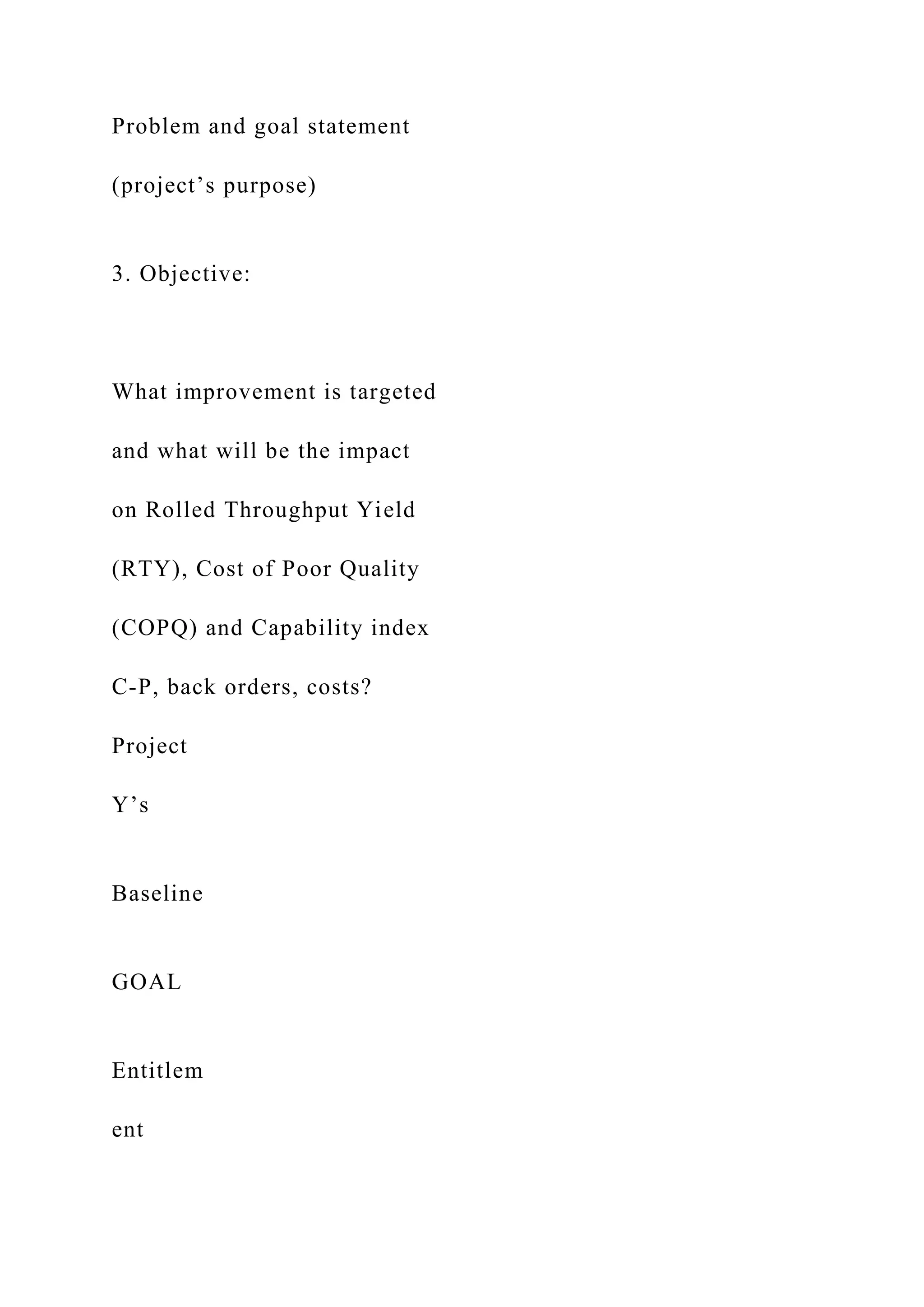
Problem and goal statement
(project’s purpose)
3. Objective:
What improvement is targeted
and what will be the impact
on Rolled Throughput Yield
(RTY), Cost of Poor Quality
(COPQ) and Capability index
C-P, back orders, costs?
Project
Y’s
Baseline
GOAL
Entitlem
ent
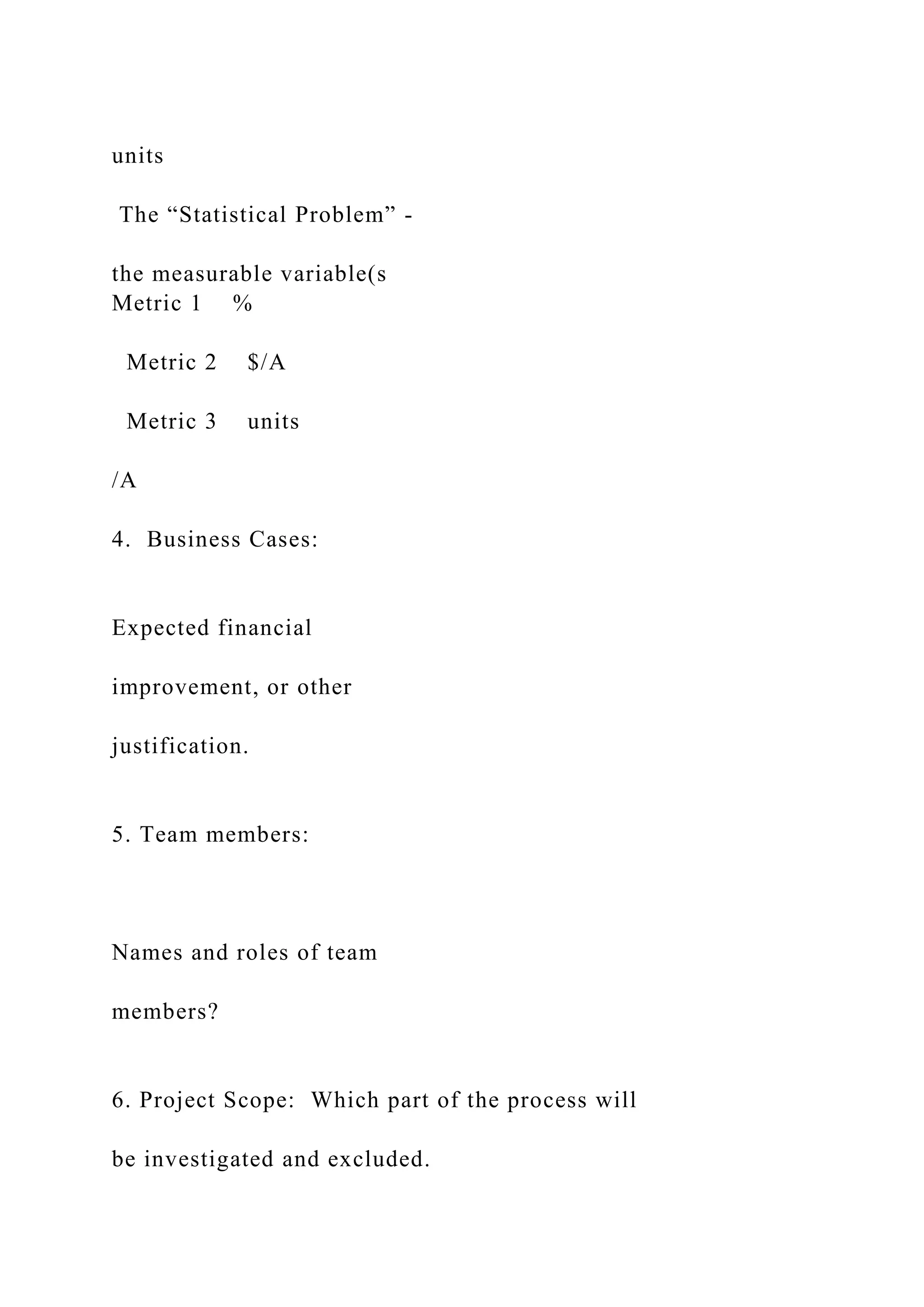
units
The “Statistical Problem” -
the measurable variable(s
Metric 1 %
Metric 2 $/A
Metric 3 units
/A
4. Business Cases:
Expected financial
improvement, or other
justification.
5. Team members:
Names and roles of team
members?
6. Project Scope: Which part of the process will
be investigated and excluded.
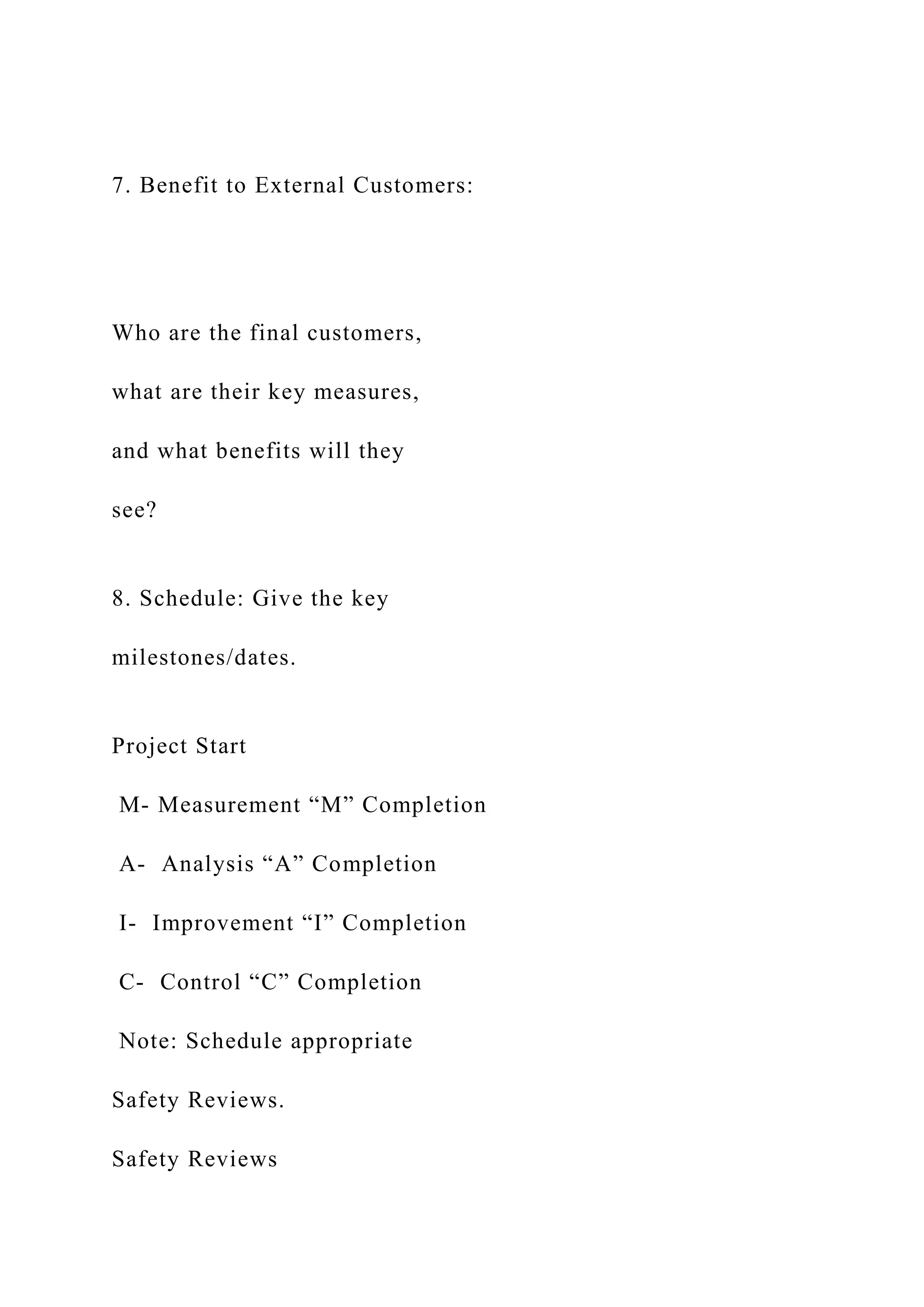
7. Benefit to External Customers:
Who are the final customers,
what are their key measures,
and what benefits will they
see?
8. Schedule: Give the key
milestones/dates.
Project Start
M- Measurement “M” Completion
A- Analysis “A” Completion
I- Improvement “I” Completion
C- Control “C” Completion
Note: Schedule appropriate
Safety Reviews.
Safety Reviews
Project Completion
9. Support Required: Will any special capabilities,
hardware, trials, etc be
needed?

Cognitive Process Associated with LanguageNamePsycho.docx

  • 1.
    Cognitive Process Associatedwith Language Name Psycho 640 Date Professor Running head: COGNITIVE PROCESS ASSOCIATED WITH LANGUAGE 1 COGNITIVE PROCESS ASSOCIATED WITH LANGUAGE 2 Attention and Language Linguistics is the study of natural languages, which is distinctively different from psychology. Linguistic research is extremely important and has contributed greatly to field of psychology of language. Comparatively, linguistics creates rules that address both productivity and the regularity of natural language. An examination of grammar reveals that there are three rules that require attention in language (syntactic (words and inflection), semantic (meaning of sentences), and phonological (sound or auditory). Pashler (1998), asked the question “how much visual information can we take in at one time?” What can we do with this information, and do we recognize objects one at a time, or can we recognize a large
  • 2.
    number simultaneously?” Thesequestions came from the thought of analyzing divided attention. It should be noted attention has been researched for more then twenty-five years. When a child is born and they become conscious, they may not know that they almost immediately begin to pay attention. Throughout life one cannot do more than one thing at a time unless they are conscious of it. According to Anderson (2010), “attention, like consciousness, is a unitary system.” Pashler (1995) suggest that attention is multifaceted, and uses the example that people unconsciously move their eyes, which seems to have merit. Where was the last place the eye was focused on? It is important to know that auditory attention is different than visual attention, and the way a person perceives information received in the cognitive state will determine the response. When there are several things going on, a person sometimes gets overloaded with data, thus creating a bottleneck in their attention. At that time focusing or concentrating on one thing is appropriate. Both visual and auditory attention take time to fully incorporate into one’s cognitive domain, but as one matures and gain experience it becomes easier allocate resources to process information. Conclusion The neurological regions that deal with the processing and understanding of language include Broca’s area in the left hemisphere of the brain, as well as Wernicke’s area in the rear of the left hemisphere of the brain. Broca’s area is the central learning area of the brain, whereas Wernicke’s area that processes language. Language is a highly complicated process that includes not only speech, but body language, and sign language for those who are speech impaired (Anderson, 2010). Since the aspects of cognitive psychology include problem solving, decision making, learning, and speaking, to name a few, all correlate to language and language processing. Thus, language and all of it’s processing can be explained, examined, and researched through the scientific procedures of cognitive psychology.
  • 3.
    Some question whetherlanguage is dependent on thought or if thought is dependent on language (Pimsleur, 2014). The mind can perceive the smallest of details even without the individual being aware. Small children see these details and incorporate them in their study of language and how to speak. Adults do the same but not as intensely as the foundation of language has been laid in the formative years but details still emerge that are of interest to the mind and are used to enhance the mind of the observer. Language allows for greater learning, fellowship with friends and family. Language provides humans the ability to display expressions of love and dislike, sharing of memories, and teaching to those important and unimportant. Without language, the world as we know it would be very still and silent. References Anderson, J. R. (2010). Cognitive psychology and its implications (7th ed.). New York, NY: Worth Publishers. Berens, L. & Nardi, D. (2013). Understanding Yourself and Others. Myers Briggs Corporation Clarkson, J., Coleman, R., Hosking, I., Waller, S. (2012). Inclusive design toolkit: Thinking. University of Cambridge.
  • 4.
    Myers, D. G.(2007). Psychology (8th ed.). New York, NY: Worth Publishers. Pashler, H. (1988). Familiarity and visual change detection. Perception and Psychophysics 44, 369-378 Pimsleur, B. (2014). How language is processed in the brain. Retrieved from http://www.pimsleurapproach.com/resources/language- research/language/how-language-is-processed-in-the-brain/ Six Sigma Project Charter Template Product or Service Impacted Expected Project Savings ($) Black Belt or Green Belt Business Unit Champion Phone Number for Belt Master Black Belt Email for Belt Start Date Target Completion Date Element Description Team Charter 1. Process: The process in which opportunity exists. 2. Project Description: what is the “Practical Problem”
  • 5.
    Problem and goalstatement (project’s purpose) 3. Objective: What improvement is targeted and what will be the impact on Rolled Throughput Yield (RTY), Cost of Poor Quality (COPQ) and Capability index C-P, back orders, costs? Project Y’s Baseline GOAL Entitlem ent
  • 6.
    units The “Statistical Problem”- the measurable variable(s Metric 1 % Metric 2 $/A Metric 3 units /A 4. Business Cases: Expected financial improvement, or other justification. 5. Team members: Names and roles of team members? 6. Project Scope: Which part of the process will be investigated and excluded.
  • 7.
    7. Benefit toExternal Customers: Who are the final customers, what are their key measures, and what benefits will they see? 8. Schedule: Give the key milestones/dates. Project Start M- Measurement “M” Completion A- Analysis “A” Completion I- Improvement “I” Completion C- Control “C” Completion Note: Schedule appropriate Safety Reviews. Safety Reviews
  • 8.
    Project Completion 9. SupportRequired: Will any special capabilities, hardware, trials, etc be needed?