I AM BRILLIANT!
Are you a passive learner?
Are you an active learner?
HOW TO ACQUIRE INTELLIGENCE?
COGNITIVE DEVELOPMENT THEORY
by JEAN PIAGET
LEARNING OUTCOMES:
Within 40-minute discussion with the use of power point
presentation, the College of Teacher Education BSED, BPED and
BSNED first year students with 80% accuracy shall have done the
following:
• identify the different stages of cognitive development theory;
• determine the major characteristics and developmental stages in
each ages in accordance with the theory;
• explain the significance of learning this theory in the educational
setting.
Jean Piaget's theory of cognitive development suggests
that children move through four different stages of learning.
His theory focuses not only on understanding how children
acquire knowledge, but also on understanding the nature of
intelligence.
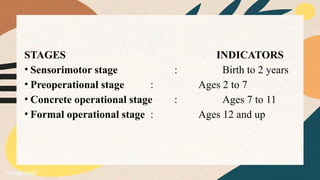
STAGES INDICATORS
• Sensorimotor stage : Birth to 2 years
• Preoperational stage : Ages 2 to 7
• Concrete operational stage : Ages 7 to 11
• Formal operational stage : Ages 12 and up
History of Piaget's Theory of Cognitive
Development
Piaget was born in Switzerland in the late 1800s and was
a precocious student, publishing his first scientific paper when
he was just 11 years old. His early exposure to the intellectual
development of children came when he worked as an assistant
to Alfred Binet and Theodore Simon as they worked to
standardize their famous IQ test.
Piaget proposed that intelligence grows and develops
through a series of stages. Older children do not just think
more quickly than younger children. Instead, there are both
qualitative and quantitative differences between the thinking of
young children versus older children.
Based on his observations, he concluded that children
were not less intelligent than adults—they simply think
differently. Albert Einstein called Piaget's discovery "so simple
only a genius could have thought of it."
Piaget's stage theory describes the cognitive development
of children. Cognitive development involves changes in
cognitive process and abilities. In Piaget's view, early cognitive
development involves processes based upon actions and later
progresses to changes in mental operations.

The Sensorimotor Stage of Cognitive
Development
During this earliest stage of cognitive development,
infants and toddlers acquire knowledge through sensory
experiences and manipulating objects. A child's entire
experience at the earliest period of this stage occurs through
basic reflexes, senses, and motor responses.
Major characteristics and developmental changes during this
stage:
• Know the world through movements and sensations
• Learn about the world through basic actions such as sucking,
grasping, looking, and listening
• Learn that things continue to exist even when they cannot be
seen (object permanence).
• Realize that they are separate beings from the people and
objects around them
• Realize that their actions can cause things to happen in the
world around them
During the sensorimotor stage, children go through a
period of dramatic growth and learning. As kids interact with
their environment, they continually make new discoveries
about how the world works.
The Preoperational Stage of Cognitive
Development
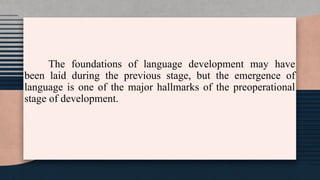
The foundations of language development may have
been laid during the previous stage, but the emergence of
language is one of the major hallmarks of the preoperational
stage of development.
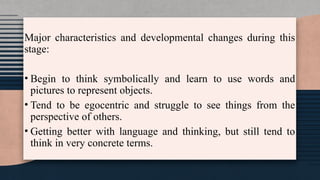
Major characteristics and developmental changes during this
stage:
• Begin to think symbolically and learn to use words and
pictures to represent objects.
• Tend to be egocentric and struggle to see things from the
perspective of others.
• Getting better with language and thinking, but still tend to
think in very concrete terms.
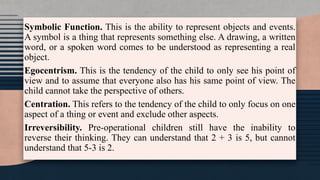
Symbolic Function. This is the ability to represent objects and events.
A symbol is a thing that represents something else. A drawing, a written
word, or a spoken word comes to be understood as representing a real
object.
Egocentrism. This is the tendency of the child to only see his point of
view and to assume that everyone also has his same point of view. The
child cannot take the perspective of others.
Centration. This refers to the tendency of the child to only focus on one
aspect of a thing or event and exclude other aspects.
Irreversibility. Pre-operational children still have the inability to
reverse their thinking. They can understand that 2 + 3 is 5, but cannot
understand that 5-3 is 2.
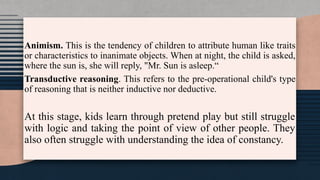
Animism. This is the tendency of children to attribute human like traits
or characteristics to inanimate objects. When at night, the child is asked,
where the sun is, she will reply, "Mr. Sun is asleep.“
Transductive reasoning. This refers to the pre-operational child's type
of reasoning that is neither inductive nor deductive.
At this stage, kids learn through pretend play but still struggle
with logic and taking the point of view of other people. They
also often struggle with understanding the idea of constancy.
The Concrete Operational Stage of Cognitive Development
While children are still very concrete and literal in their
thinking at this point in development, they become much more
adept at using logic. The egocentrism of the previous stage
begins to disappear as kids become better at thinking about
how other people might view a situation.
Major characteristics and developmental changes during this stage:
• Begin to think logically about concrete events
• Begin to understand the concept of conservation; that the amount of
liquid in a short, wide cup is equal to that in a tall, skinny glass, for
example
• Thinking becomes more logical and organized, but still very concrete
• Begin using inductive logic, or reasoning from specific information to
a general principle
Decentering. This refers to the ability of the child to perceive the
different features of objects and situations. No longer is the child
focused or limited to one aspect or dimension. This allows the child to
be more logical when dealing with concrete objects and situations.
Reversibility. During the stage of concrete operations, the child can
now follow that certain operations can be in reverse. For example, they
can already comprehend the commutative property of addition, and that
subtraction is reverse of addition. They can also understand that a ball
clay shaped into a dinosaur can again be rolled back into ball of clay.
Conservation. This is the ability to know that certain properties of
objects like number, mass, volume, or area do not change even if there
is a change in appearance.
• Seriation. This refers to the ability to order or arrange things
in a series based on one dimension such as weight, volume or
size.
While thinking becomes much more logical during the
concrete operational state, it can also be very rigid. Kids at this
point in development tend to struggle with abstract and
hypothetical concepts.
The Formal Operational Stage of
Cognitive Development
The final stage of Piaget's theory involves an increase in
logic, the ability to use deductive reasoning, and an
understanding of abstract ideas. At this point, adolescents and
young adults become capable of seeing multiple potential
solutions to problems and think more scientifically about the
world around them.
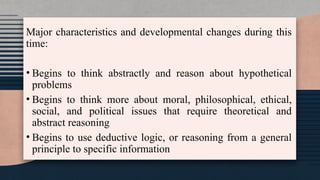
Major characteristics and developmental changes during this
time:
• Begins to think abstractly and reason about hypothetical
problems
• Begins to think more about moral, philosophical, ethical,
social, and political issues that require theoretical and
abstract reasoning
• Begins to use deductive logic, or reasoning from a general
principle to specific information
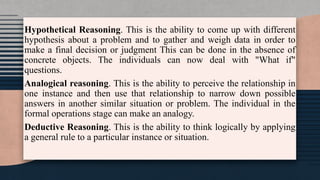
Hypothetical Reasoning. This is the ability to come up with different
hypothesis about a problem and to gather and weigh data in order to
make a final decision or judgment This can be done in the absence of
concrete objects. The individuals can now deal with "What if"
questions.
Analogical reasoning. This is the ability to perceive the relationship in
one instance and then use that relationship to narrow down possible
answers in another similar situation or problem. The individual in the
formal operations stage can make an analogy.
Deductive Reasoning. This is the ability to think logically by applying
a general rule to a particular instance or situation.
THANK YOU FOR LISTENING
FUTURE EDUCATORS AND
GOOD LUCK FOR YOUR
MIDTERM EXAMINATION

COGNITIVE DEVELOPMENT THEORY BY JEAN PIAGET

  • 1.
  • 2.
    Are you apassive learner?
  • 3.
    Are you anactive learner?
  • 4.
    HOW TO ACQUIREINTELLIGENCE?
  • 5.
  • 6.
    LEARNING OUTCOMES: Within 40-minutediscussion with the use of power point presentation, the College of Teacher Education BSED, BPED and BSNED first year students with 80% accuracy shall have done the following: • identify the different stages of cognitive development theory; • determine the major characteristics and developmental stages in each ages in accordance with the theory; • explain the significance of learning this theory in the educational setting.
  • 7.
    Jean Piaget's theoryof cognitive development suggests that children move through four different stages of learning. His theory focuses not only on understanding how children acquire knowledge, but also on understanding the nature of intelligence.
  • 8.
    STAGES INDICATORS • Sensorimotorstage : Birth to 2 years • Preoperational stage : Ages 2 to 7 • Concrete operational stage : Ages 7 to 11 • Formal operational stage : Ages 12 and up
  • 9.
    History of Piaget'sTheory of Cognitive Development Piaget was born in Switzerland in the late 1800s and was a precocious student, publishing his first scientific paper when he was just 11 years old. His early exposure to the intellectual development of children came when he worked as an assistant to Alfred Binet and Theodore Simon as they worked to standardize their famous IQ test.
  • 10.
    Piaget proposed thatintelligence grows and develops through a series of stages. Older children do not just think more quickly than younger children. Instead, there are both qualitative and quantitative differences between the thinking of young children versus older children.
  • 11.
    Based on hisobservations, he concluded that children were not less intelligent than adults—they simply think differently. Albert Einstein called Piaget's discovery "so simple only a genius could have thought of it."
  • 12.
    Piaget's stage theorydescribes the cognitive development of children. Cognitive development involves changes in cognitive process and abilities. In Piaget's view, early cognitive development involves processes based upon actions and later progresses to changes in mental operations.
  • 13.
    The Sensorimotor Stageof Cognitive Development
  • 14.
    During this earlieststage of cognitive development, infants and toddlers acquire knowledge through sensory experiences and manipulating objects. A child's entire experience at the earliest period of this stage occurs through basic reflexes, senses, and motor responses.
  • 15.
    Major characteristics anddevelopmental changes during this stage: • Know the world through movements and sensations • Learn about the world through basic actions such as sucking, grasping, looking, and listening • Learn that things continue to exist even when they cannot be seen (object permanence). • Realize that they are separate beings from the people and objects around them • Realize that their actions can cause things to happen in the world around them
  • 16.
    During the sensorimotorstage, children go through a period of dramatic growth and learning. As kids interact with their environment, they continually make new discoveries about how the world works.
  • 17.
    The Preoperational Stageof Cognitive Development
  • 18.
    The foundations oflanguage development may have been laid during the previous stage, but the emergence of language is one of the major hallmarks of the preoperational stage of development.
  • 19.
    Major characteristics anddevelopmental changes during this stage: • Begin to think symbolically and learn to use words and pictures to represent objects. • Tend to be egocentric and struggle to see things from the perspective of others. • Getting better with language and thinking, but still tend to think in very concrete terms.
  • 20.
    Symbolic Function. Thisis the ability to represent objects and events. A symbol is a thing that represents something else. A drawing, a written word, or a spoken word comes to be understood as representing a real object. Egocentrism. This is the tendency of the child to only see his point of view and to assume that everyone also has his same point of view. The child cannot take the perspective of others. Centration. This refers to the tendency of the child to only focus on one aspect of a thing or event and exclude other aspects. Irreversibility. Pre-operational children still have the inability to reverse their thinking. They can understand that 2 + 3 is 5, but cannot understand that 5-3 is 2.
  • 21.
    Animism. This isthe tendency of children to attribute human like traits or characteristics to inanimate objects. When at night, the child is asked, where the sun is, she will reply, "Mr. Sun is asleep.“ Transductive reasoning. This refers to the pre-operational child's type of reasoning that is neither inductive nor deductive. At this stage, kids learn through pretend play but still struggle with logic and taking the point of view of other people. They also often struggle with understanding the idea of constancy.
  • 22.
    The Concrete OperationalStage of Cognitive Development
  • 23.
    While children arestill very concrete and literal in their thinking at this point in development, they become much more adept at using logic. The egocentrism of the previous stage begins to disappear as kids become better at thinking about how other people might view a situation.
  • 24.
    Major characteristics anddevelopmental changes during this stage: • Begin to think logically about concrete events • Begin to understand the concept of conservation; that the amount of liquid in a short, wide cup is equal to that in a tall, skinny glass, for example • Thinking becomes more logical and organized, but still very concrete • Begin using inductive logic, or reasoning from specific information to a general principle
  • 25.
    Decentering. This refersto the ability of the child to perceive the different features of objects and situations. No longer is the child focused or limited to one aspect or dimension. This allows the child to be more logical when dealing with concrete objects and situations. Reversibility. During the stage of concrete operations, the child can now follow that certain operations can be in reverse. For example, they can already comprehend the commutative property of addition, and that subtraction is reverse of addition. They can also understand that a ball clay shaped into a dinosaur can again be rolled back into ball of clay. Conservation. This is the ability to know that certain properties of objects like number, mass, volume, or area do not change even if there is a change in appearance.
  • 26.
    • Seriation. Thisrefers to the ability to order or arrange things in a series based on one dimension such as weight, volume or size.
  • 27.
    While thinking becomesmuch more logical during the concrete operational state, it can also be very rigid. Kids at this point in development tend to struggle with abstract and hypothetical concepts.
  • 28.
    The Formal OperationalStage of Cognitive Development
  • 29.
    The final stageof Piaget's theory involves an increase in logic, the ability to use deductive reasoning, and an understanding of abstract ideas. At this point, adolescents and young adults become capable of seeing multiple potential solutions to problems and think more scientifically about the world around them.
  • 30.
    Major characteristics anddevelopmental changes during this time: • Begins to think abstractly and reason about hypothetical problems • Begins to think more about moral, philosophical, ethical, social, and political issues that require theoretical and abstract reasoning • Begins to use deductive logic, or reasoning from a general principle to specific information
  • 31.
    Hypothetical Reasoning. Thisis the ability to come up with different hypothesis about a problem and to gather and weigh data in order to make a final decision or judgment This can be done in the absence of concrete objects. The individuals can now deal with "What if" questions. Analogical reasoning. This is the ability to perceive the relationship in one instance and then use that relationship to narrow down possible answers in another similar situation or problem. The individual in the formal operations stage can make an analogy. Deductive Reasoning. This is the ability to think logically by applying a general rule to a particular instance or situation.
  • 32.
    THANK YOU FORLISTENING FUTURE EDUCATORS AND GOOD LUCK FOR YOUR MIDTERM EXAMINATION