© 2014 IBM Corporation
Cognitive Assistants:
Opportunities and
Challenges
Hamid R. Motahari Nezhad
IBM Almaden Research Center,
San Jose, CA, USA
With Inputs and Contributions from:
Jim Spohrer, IBM Research
Frank Stein, IBM Analytics CTO
© 2013 IBM Corporation
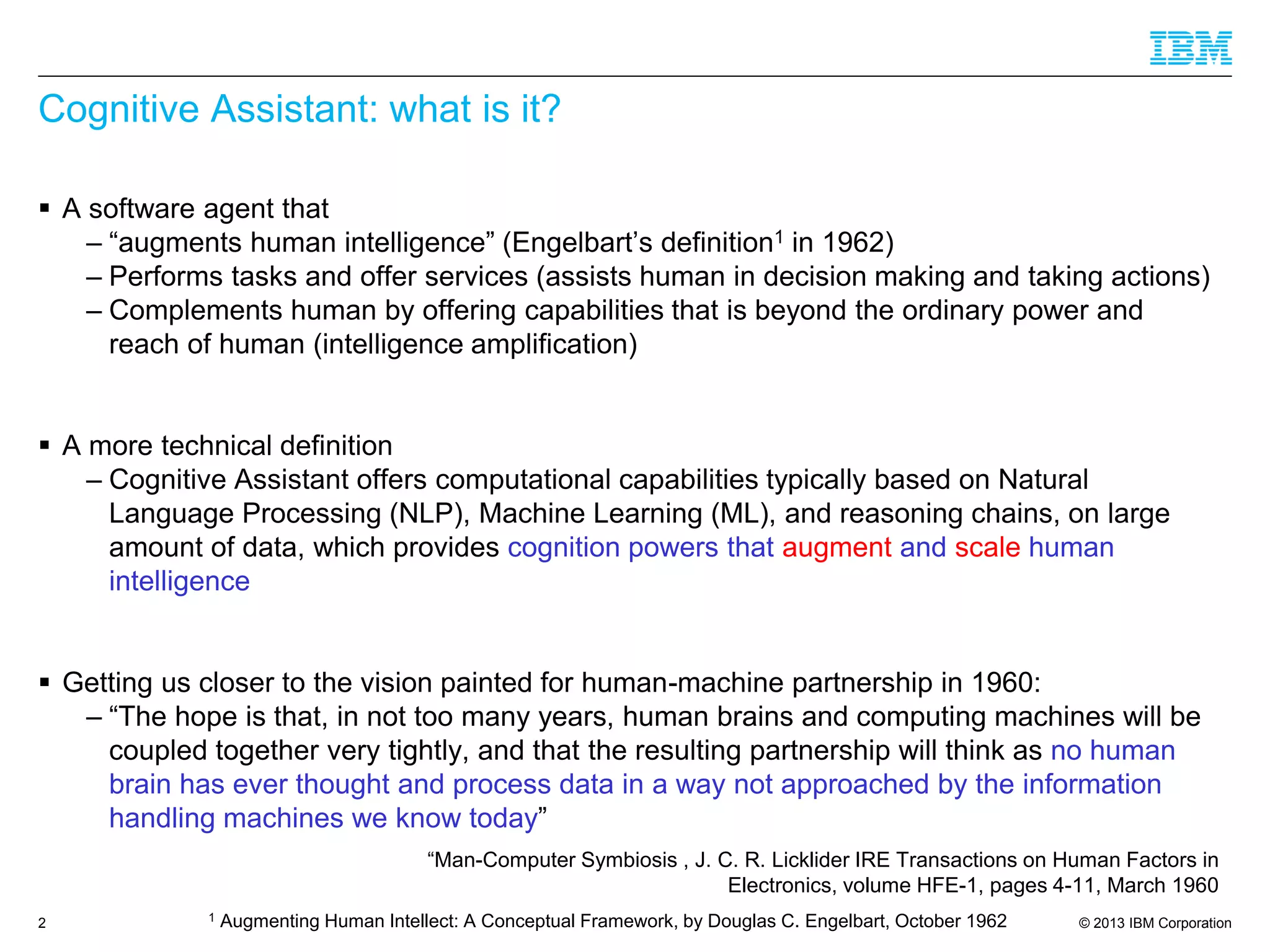
Cognitive Assistant: what is it?
 A software agent that
– “augments human intelligence” (Engelbart’s definition1 in 1962)
– Performs tasks and offer services (assists human in decision making and taking actions)
– Complements human by offering capabilities that is beyond the ordinary power and
reach of human (intelligence amplification)
 A more technical definition
– Cognitive Assistant offers computational capabilities typically based on Natural
Language Processing (NLP), Machine Learning (ML), and reasoning chains, on large
amount of data, which provides cognition powers that augment and scale human
intelligence
 Getting us closer to the vision painted for human-machine partnership in 1960:
– “The hope is that, in not too many years, human brains and computing machines will be
coupled together very tightly, and that the resulting partnership will think as no human
brain has ever thought and process data in a way not approached by the information
handling machines we know today”
“Man-Computer Symbiosis , J. C. R. Licklider IRE Transactions on Human Factors in
Electronics, volume HFE-1, pages 4-11, March 1960
2 1 Augmenting Human Intellect: A Conceptual Framework, by Douglas C. Engelbart, October 1962
© 2013 IBM Corporation
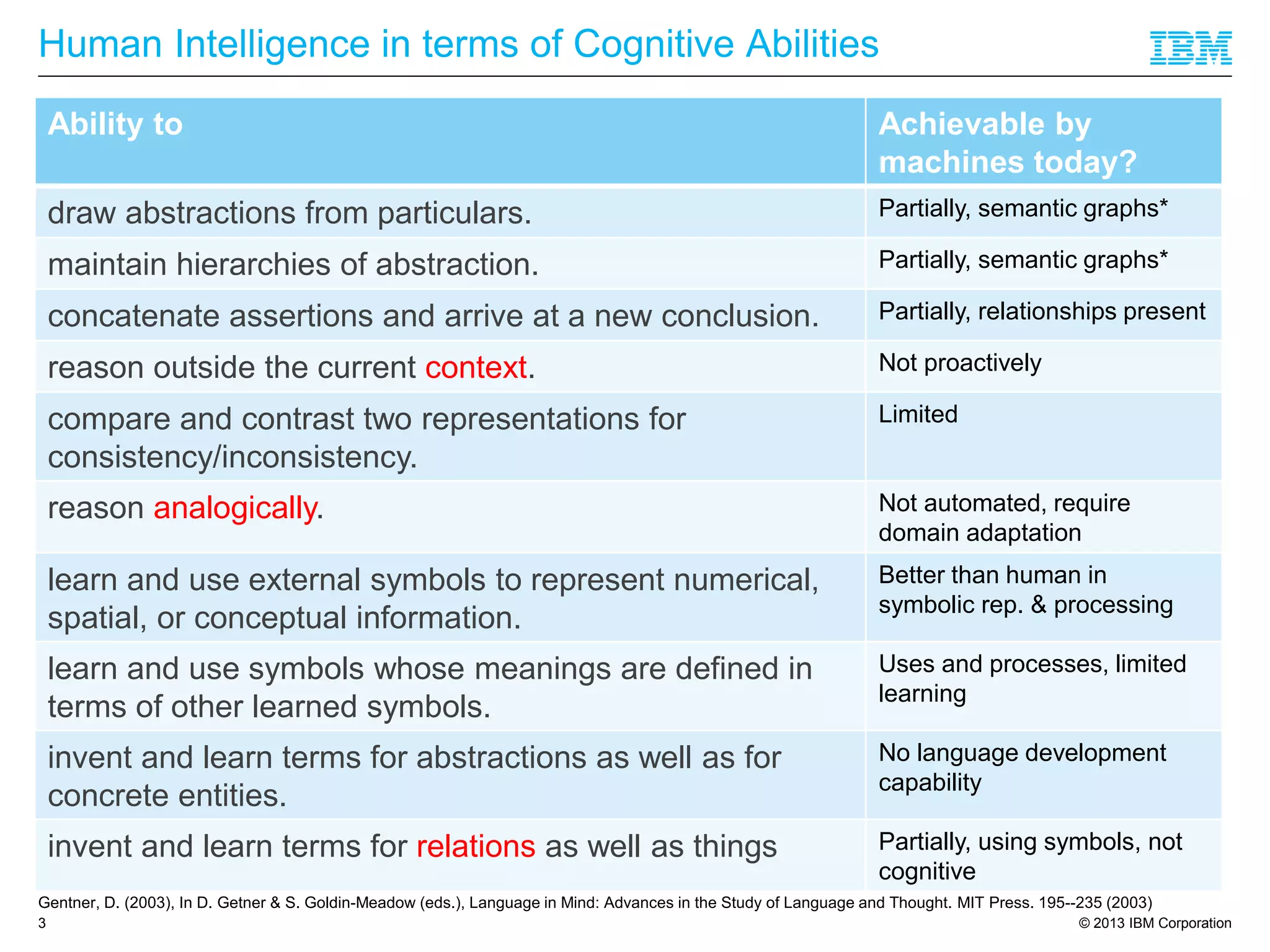
Human Intelligence in terms of Cognitive Abilities
3
Ability to Achievable by
machines today?
draw abstractions from particulars. Partially, semantic graphs*
maintain hierarchies of abstraction. Partially, semantic graphs*
concatenate assertions and arrive at a new conclusion. Partially, relationships present
reason outside the current context. Not proactively
compare and contrast two representations for
consistency/inconsistency.
Limited
reason analogically. Not automated, require
domain adaptation
learn and use external symbols to represent numerical,
spatial, or conceptual information.
Better than human in
symbolic rep. & processing
learn and use symbols whose meanings are defined in
terms of other learned symbols.
Uses and processes, limited
learning
invent and learn terms for abstractions as well as for
concrete entities.
No language development
capability
invent and learn terms for relations as well as things Partially, using symbols, not
cognitive
Gentner, D. (2003), In D. Getner & S. Goldin-Meadow (eds.), Language in Mind: Advances in the Study of Language and Thought. MIT Press. 195--235 (2003)
© 2013 IBM Corporation
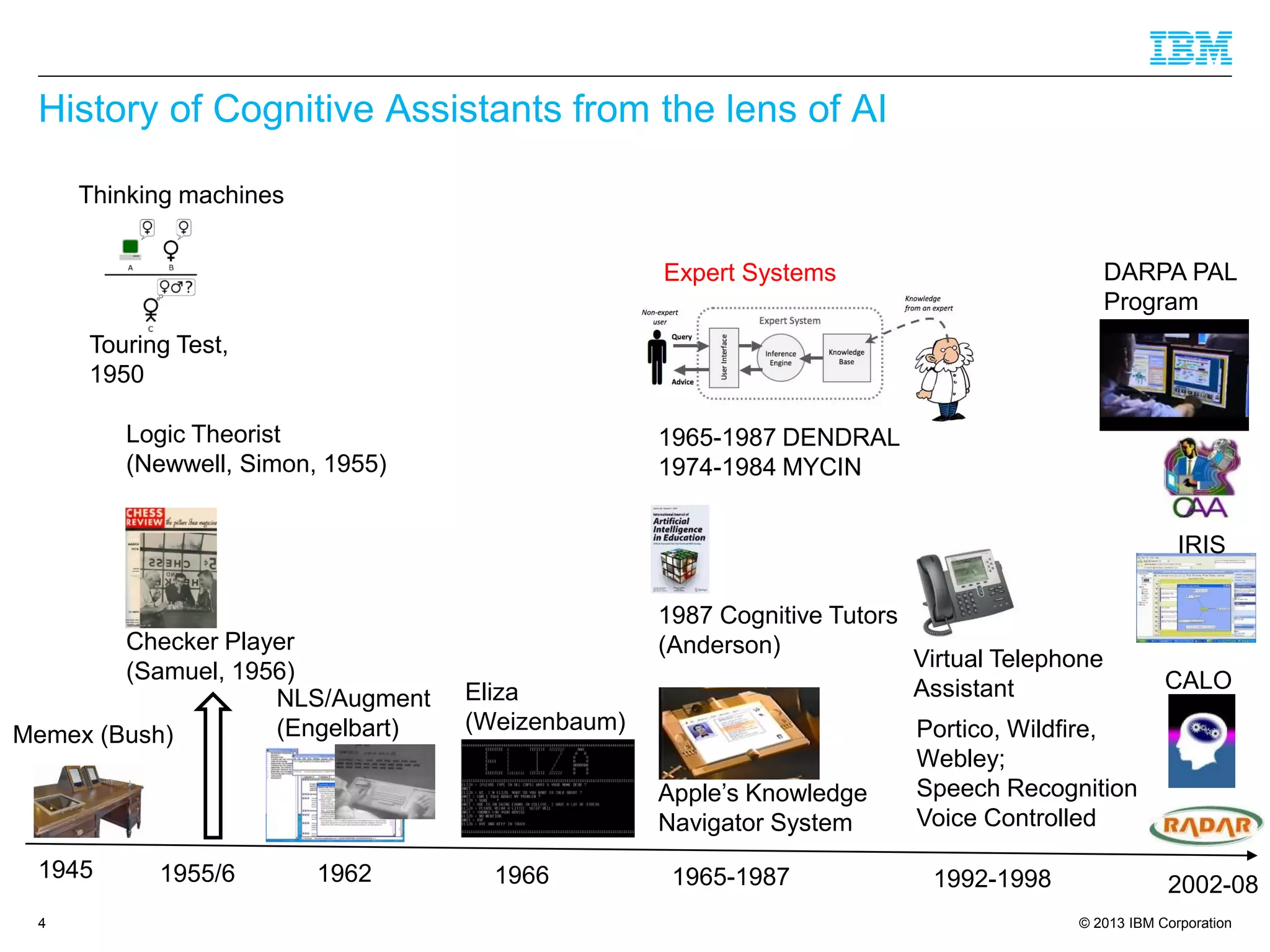
History of Cognitive Assistants from the lens of AI
4
1945
Memex (Bush)
1962
NLS/Augment
(Engelbart)
1955/6
Logic Theorist
(Newwell, Simon, 1955)
Checker Player
(Samuel, 1956)
Touring Test,
1950
Thinking machines
1966
Eliza
(Weizenbaum)
1965-1987 DENDRAL
1974-1984 MYCIN
1987 Cognitive Tutors
(Anderson)
Apple’s Knowledge
Navigator System
Expert Systems
1965-1987 1992-1998
Virtual Telephone
Assistant
Portico, Wildfire,
Webley;
Speech Recognition
Voice Controlled
2002-08
DARPA PAL
Program
CALO
IRIS
© 2013 IBM Corporation
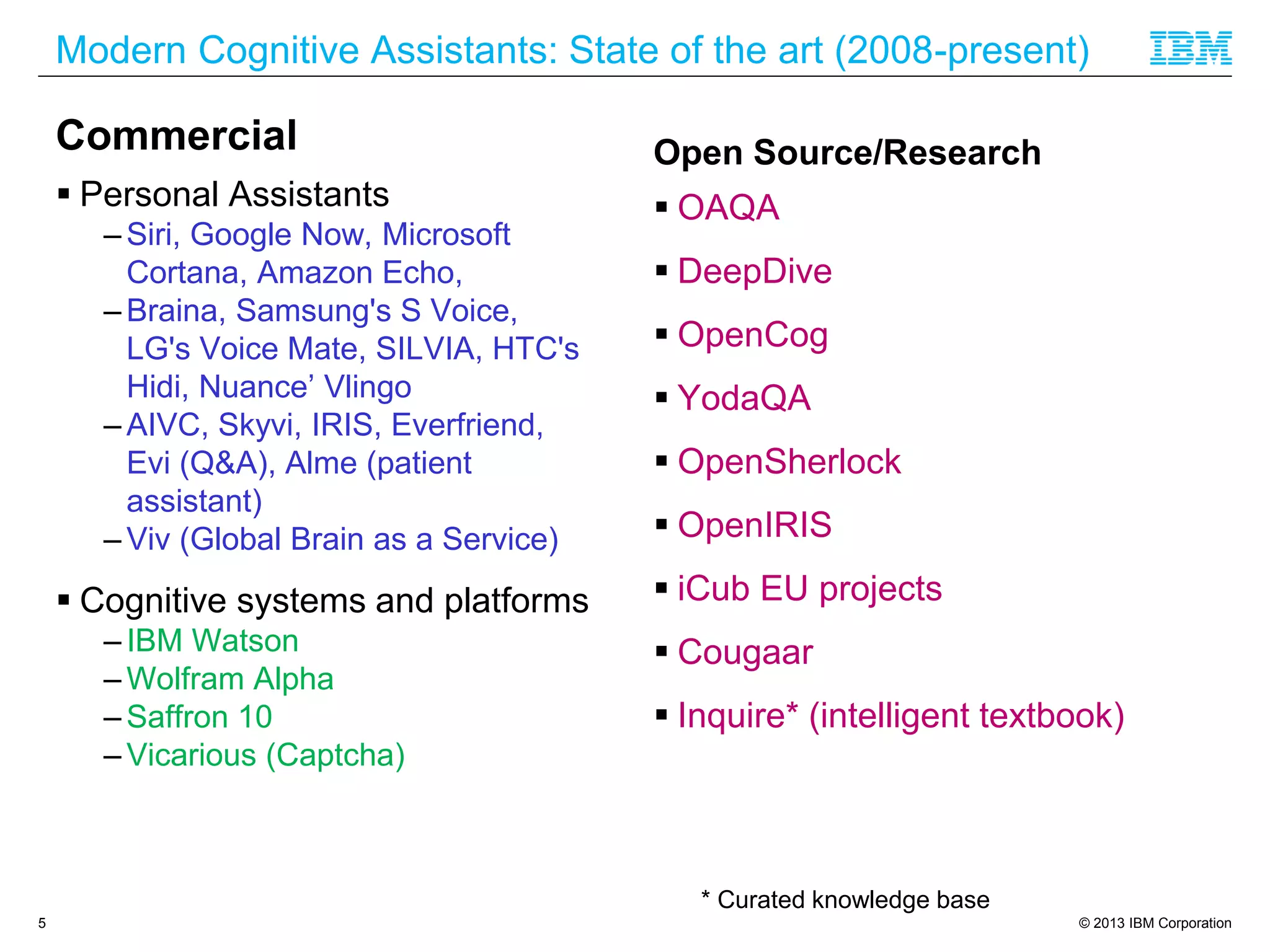
Modern Cognitive Assistants: State of the art (2008-present)
Commercial
 Personal Assistants
– Siri, Google Now, Microsoft
Cortana, Amazon Echo,
– Braina, Samsung's S Voice,
LG's Voice Mate, SILVIA, HTC's
Hidi, Nuance’ Vlingo
– AIVC, Skyvi, IRIS, Everfriend,
Evi (Q&A), Alme (patient
assistant)
– Viv (Global Brain as a Service)
 Cognitive systems and platforms
– IBM Watson
– Wolfram Alpha
– Saffron 10
– Vicarious (Captcha)
Open Source/Research
 OAQA
 DeepDive
 OpenCog
 YodaQA
 OpenSherlock
 OpenIRIS
 iCub EU projects
 Cougaar
 Inquire* (intelligent textbook)
5
* Curated knowledge base
© 2013 IBM Corporation
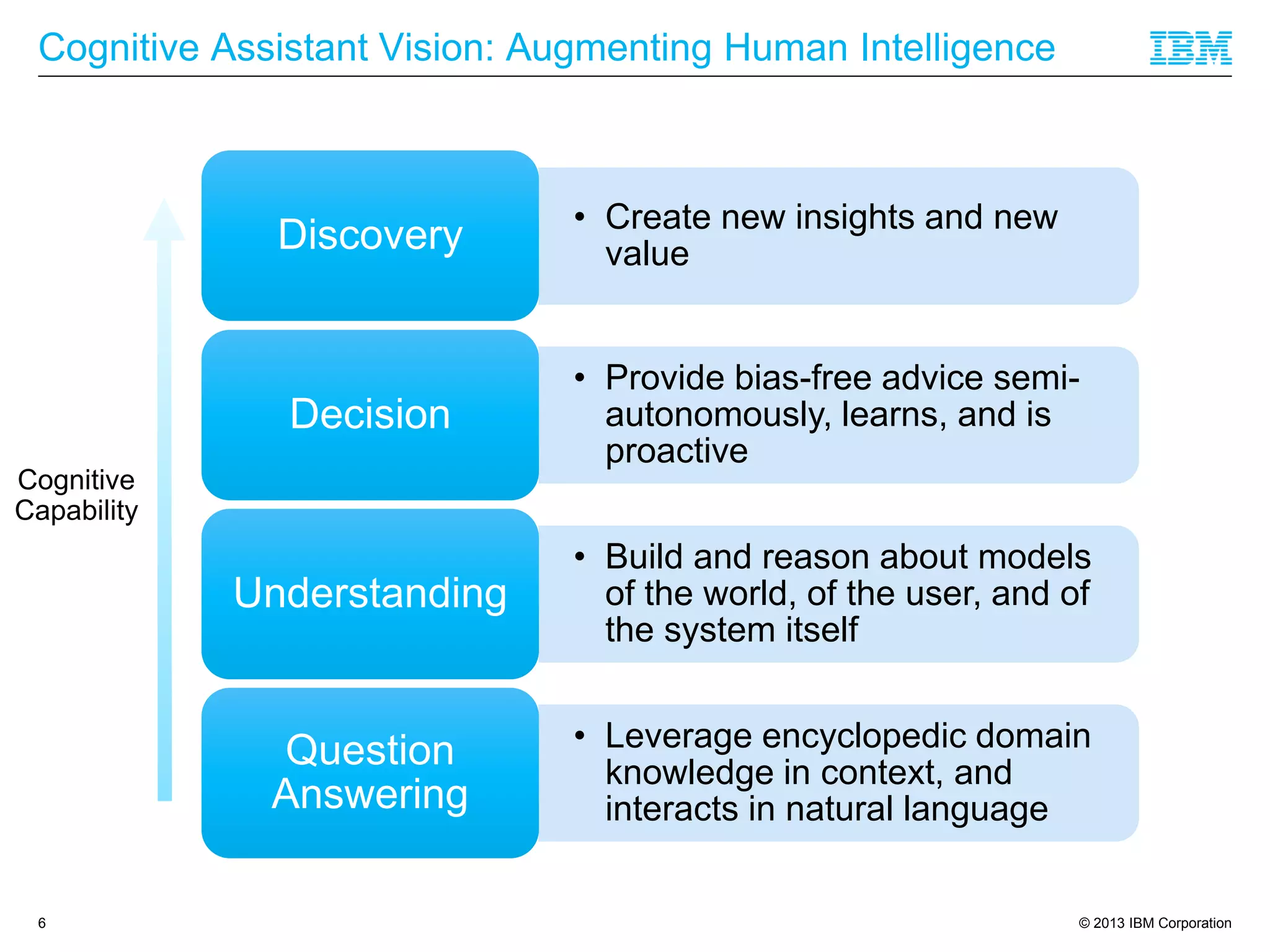
Cognitive Assistant Vision: Augmenting Human Intelligence
6
Cognitive
Capability
• Create new insights and new
valueDiscovery
• Provide bias-free advice semi-
autonomously, learns, and is
proactive
Decision
• Build and reason about models
of the world, of the user, and of
the system itself
Understanding
• Leverage encyclopedic domain
knowledge in context, and
interacts in natural language
Question
Answering
© 2013 IBM Corporation
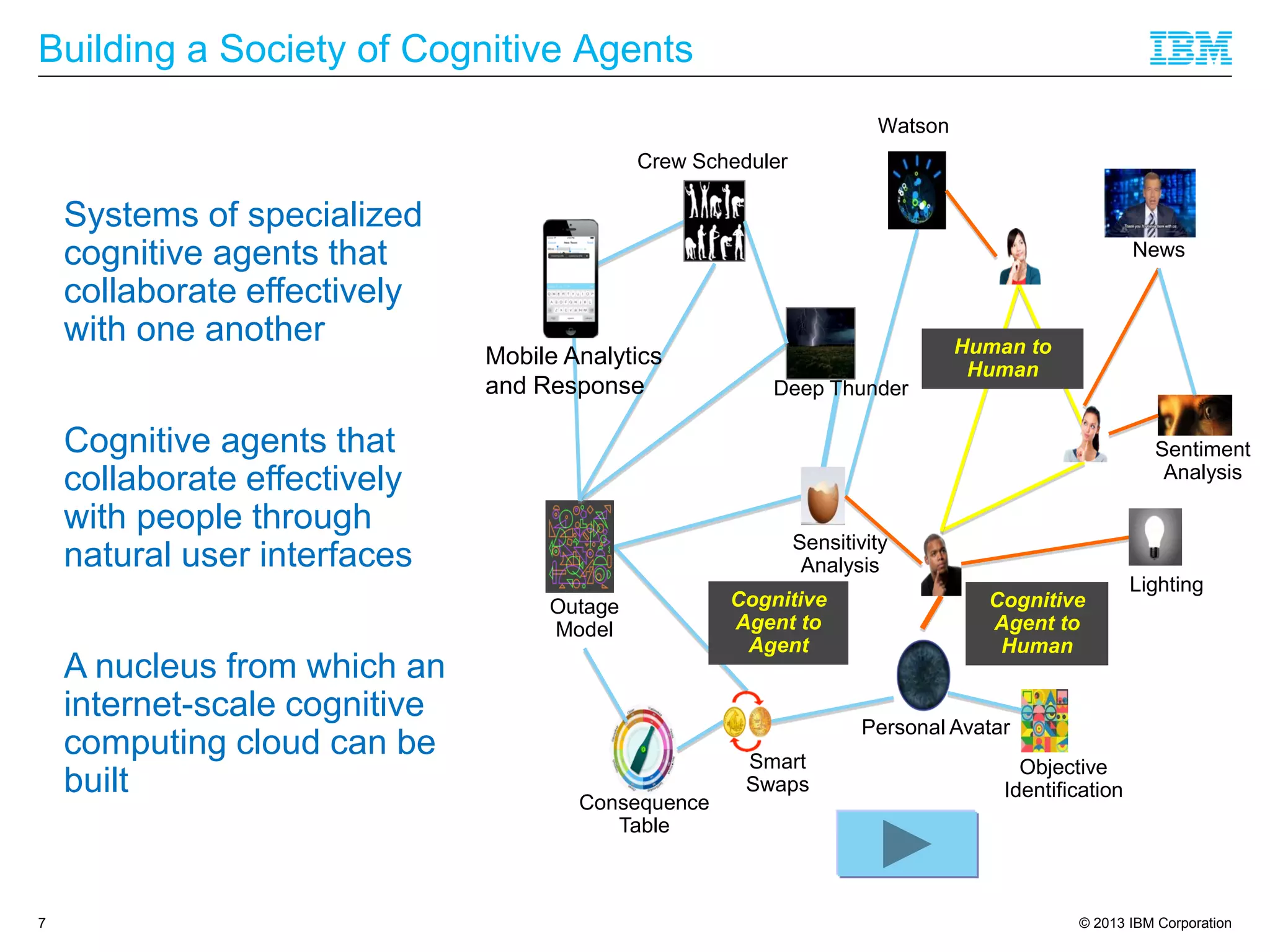
Building a Society of Cognitive Agents
7
Cognitive
Agent to
Agent
Outage
Model
Consequence
Table
Smart
Swaps
Lighting
Objective
Identification
Sensitivity
Analysis
Sentiment
Analysis
Systems of specialized
cognitive agents that
collaborate effectively
with one another
Cognitive agents that
collaborate effectively
with people through
natural user interfaces
A nucleus from which an
internet-scale cognitive
computing cloud can be
built
Personal Avatar
Deep Thunder
Crew Scheduler
News
Human to
Human
Cognitive
Agent to
Human
Watson
Mobile Analytics
and Response
© 2013 IBM Corporation
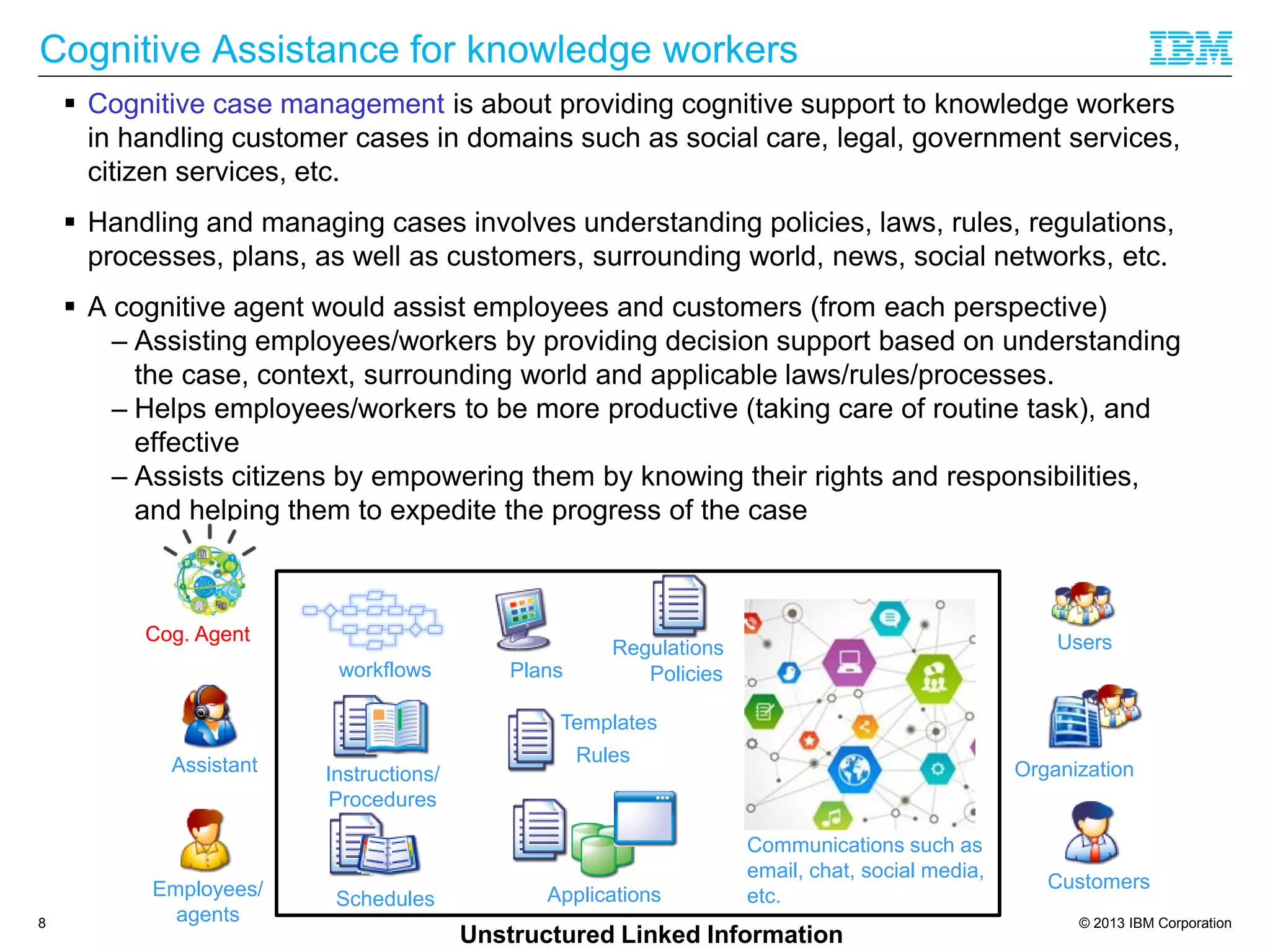
Cognitive Assistance for knowledge workers
 Cognitive case management is about providing cognitive support to knowledge workers
in handling customer cases in domains such as social care, legal, government services,
citizen services, etc.
 Handling and managing cases involves understanding policies, laws, rules, regulations,
processes, plans, as well as customers, surrounding world, news, social networks, etc.
 A cognitive agent would assist employees and customers (from each perspective)
– Assisting employees/workers by providing decision support based on understanding
the case, context, surrounding world and applicable laws/rules/processes.
– Helps employees/workers to be more productive (taking care of routine task), and
effective
– Assists citizens by empowering them by knowing their rights and responsibilities,
and helping them to expedite the progress of the case
8
Users
Assistant
CustomersEmployees/
agents
Plansworkflows
Rules
Policies
Regulations
Templates
Instructions/
Procedures
ApplicationsSchedules
Communications such as
email, chat, social media,
etc.
Organization
Cog. Agent
Unstructured Linked Information
© 2013 IBM Corporation
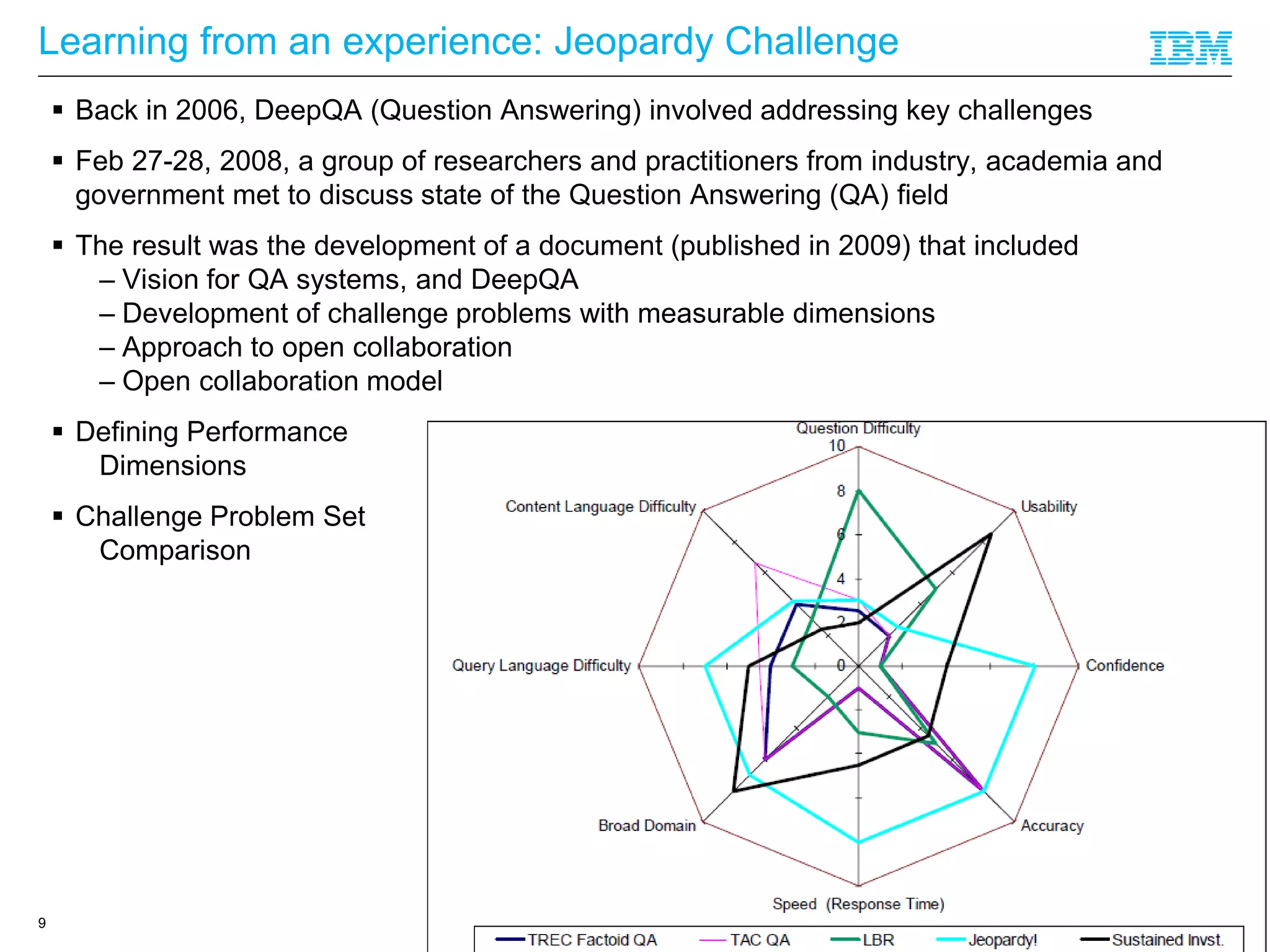
Learning from an experience: Jeopardy Challenge
 Back in 2006, DeepQA (Question Answering) involved addressing key challenges
 Feb 27-28, 2008, a group of researchers and practitioners from industry, academia and
government met to discuss state of the Question Answering (QA) field
 The result was the development of a document (published in 2009) that included
– Vision for QA systems, and DeepQA
– Development of challenge problems with measurable dimensions
– Approach to open collaboration
– Open collaboration model
 Defining Performance
Dimensions
 Challenge Problem Set
Comparison
9
© 2013 IBM Corporation
Lesson Learned from Jeopardy in Watson (1)
 “The Watson program is already a breakthrough technology in AI. For many years it had
been largely assumed that for a computer to go beyond search and really be able to perform
complex human language tasks it needed to do one of two things: either it would
“understand” the texts using some kind of deep “knowledge representation,” or it would have
a complex statistical model based on millions of texts.”
– James Hendler, Watson goes to college: How the world’s smartest PC will revolutionize AI, GigaOm, 3/2/2013
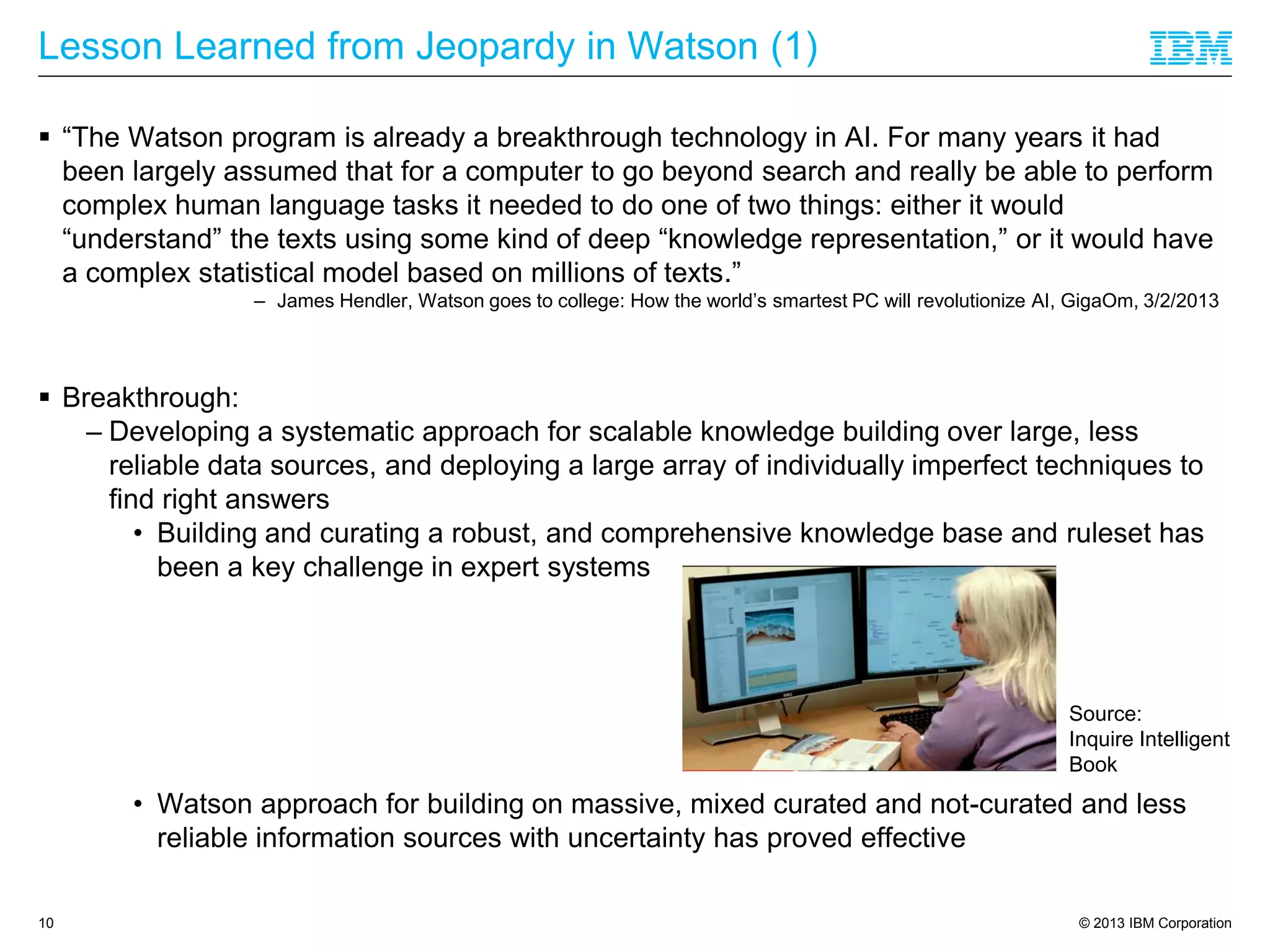
 Breakthrough:
– Developing a systematic approach for scalable knowledge building over large, less
reliable data sources, and deploying a large array of individually imperfect techniques to
find right answers
• Building and curating a robust, and comprehensive knowledge base and ruleset has
been a key challenge in expert systems
• Watson approach for building on massive, mixed curated and not-curated and less
reliable information sources with uncertainty has proved effective
10
Source:
Inquire Intelligent
Book
© 2013 IBM Corporation
Lesson Learned from Jeopardy in Watson (2)
11
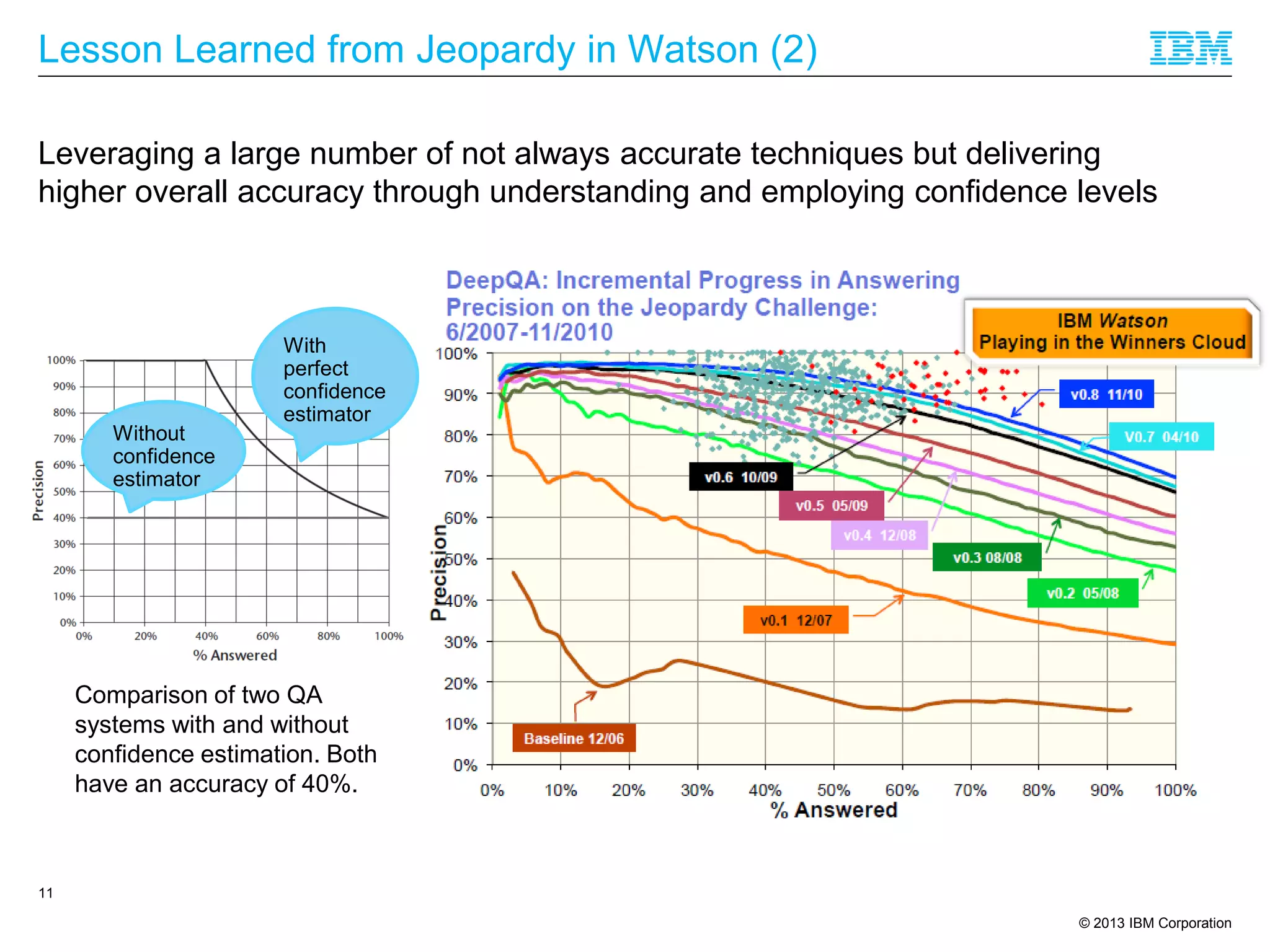
Comparison of two QA
systems with and without
confidence estimation. Both
have an accuracy of 40%.
With
perfect
confidence
estimator
Without
confidence
estimator
Leveraging a large number of not always accurate techniques but delivering
higher overall accuracy through understanding and employing confidence levels
© 2013 IBM Corporation
Opportunity assessment (1): building knowledge from data
12
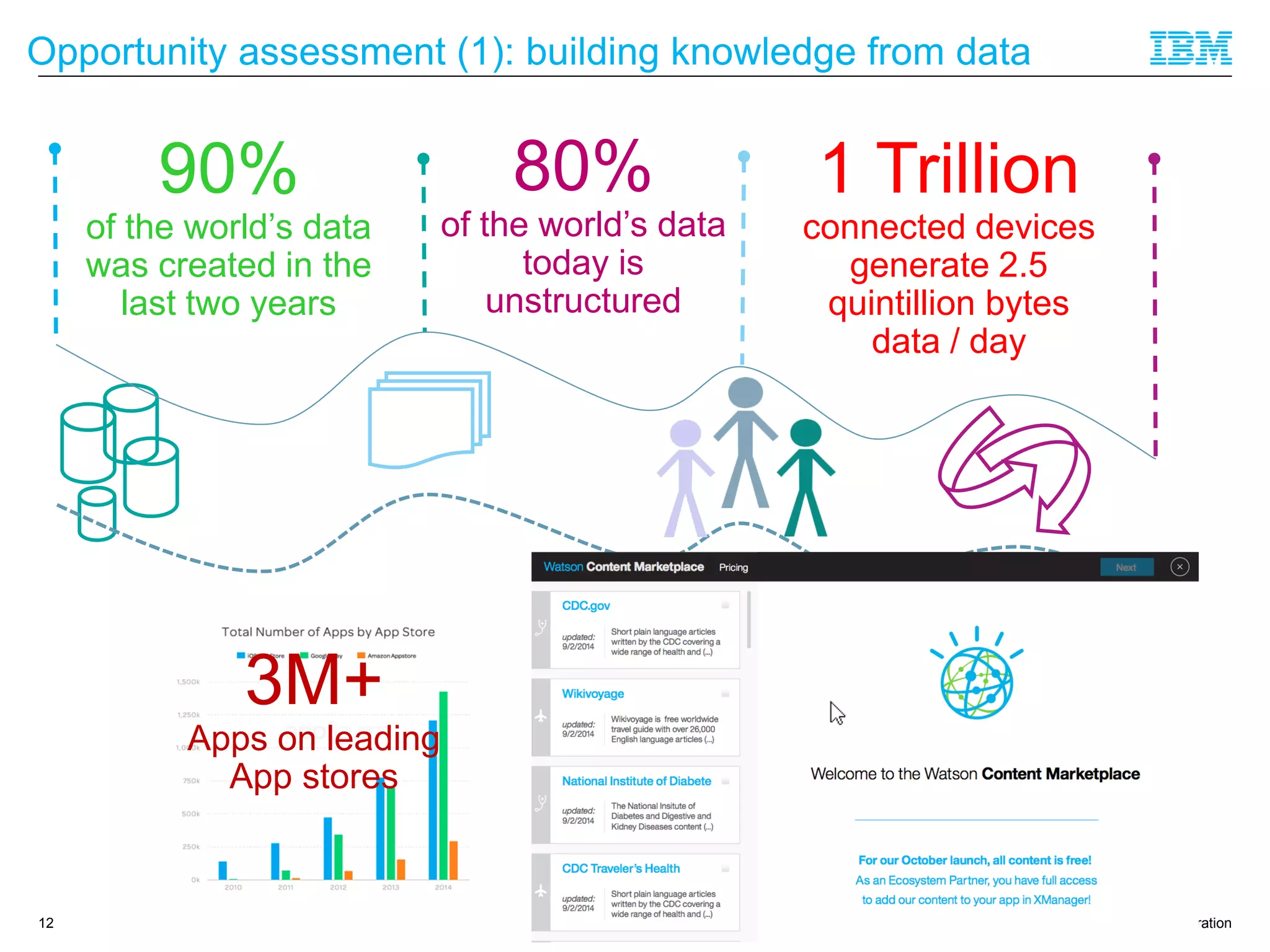
80%
of the world’s data
today is
unstructured
90%
of the world’s data
was created in the
last two years
1 Trillion
connected devices
generate 2.5
quintillion bytes
data / day
3M+
Apps on leading
App stores
© 2013 IBM Corporation
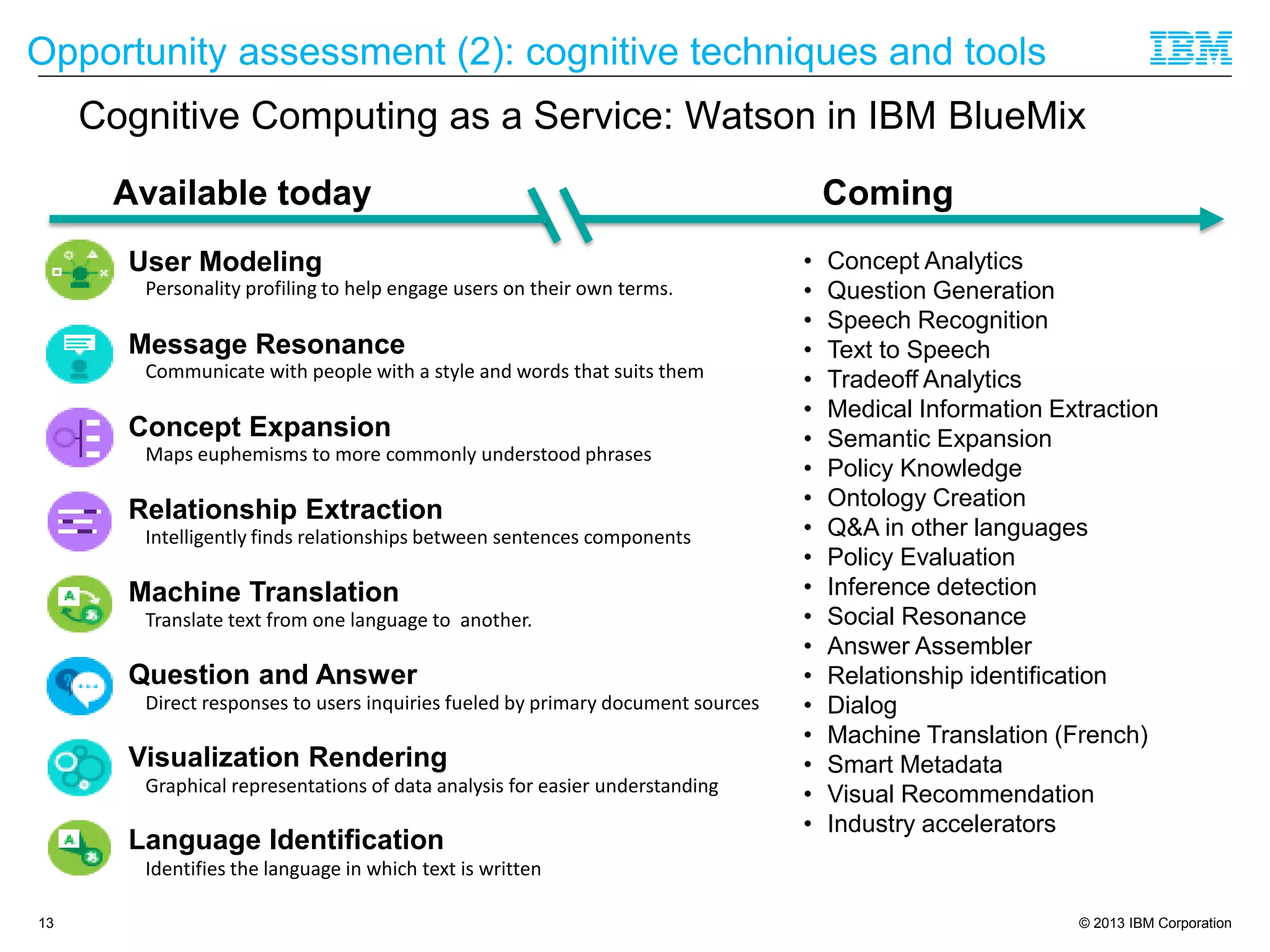
Cognitive Computing as a Service: Watson in IBM BlueMix
13
Visualization Rendering
Graphical representations of data analysis for easier understanding
User Modeling
Personality profiling to help engage users on their own terms.
Language Identification
Identifies the language in which text is written
Machine Translation
Translate text from one language to another.
Concept Expansion
Maps euphemisms to more commonly understood phrases
Message Resonance
Communicate with people with a style and words that suits them
Question and Answer
Direct responses to users inquiries fueled by primary document sources
Relationship Extraction
Intelligently finds relationships between sentences components
Coming
• Concept Analytics
• Question Generation
• Speech Recognition
• Text to Speech
• Tradeoff Analytics
• Medical Information Extraction
• Semantic Expansion
• Policy Knowledge
• Ontology Creation
• Q&A in other languages
• Policy Evaluation
• Inference detection
• Social Resonance
• Answer Assembler
• Relationship identification
• Dialog
• Machine Translation (French)
• Smart Metadata
• Visual Recommendation
• Industry accelerators
Available today
Opportunity assessment (2): cognitive techniques and tools
© 2013 IBM Corporation
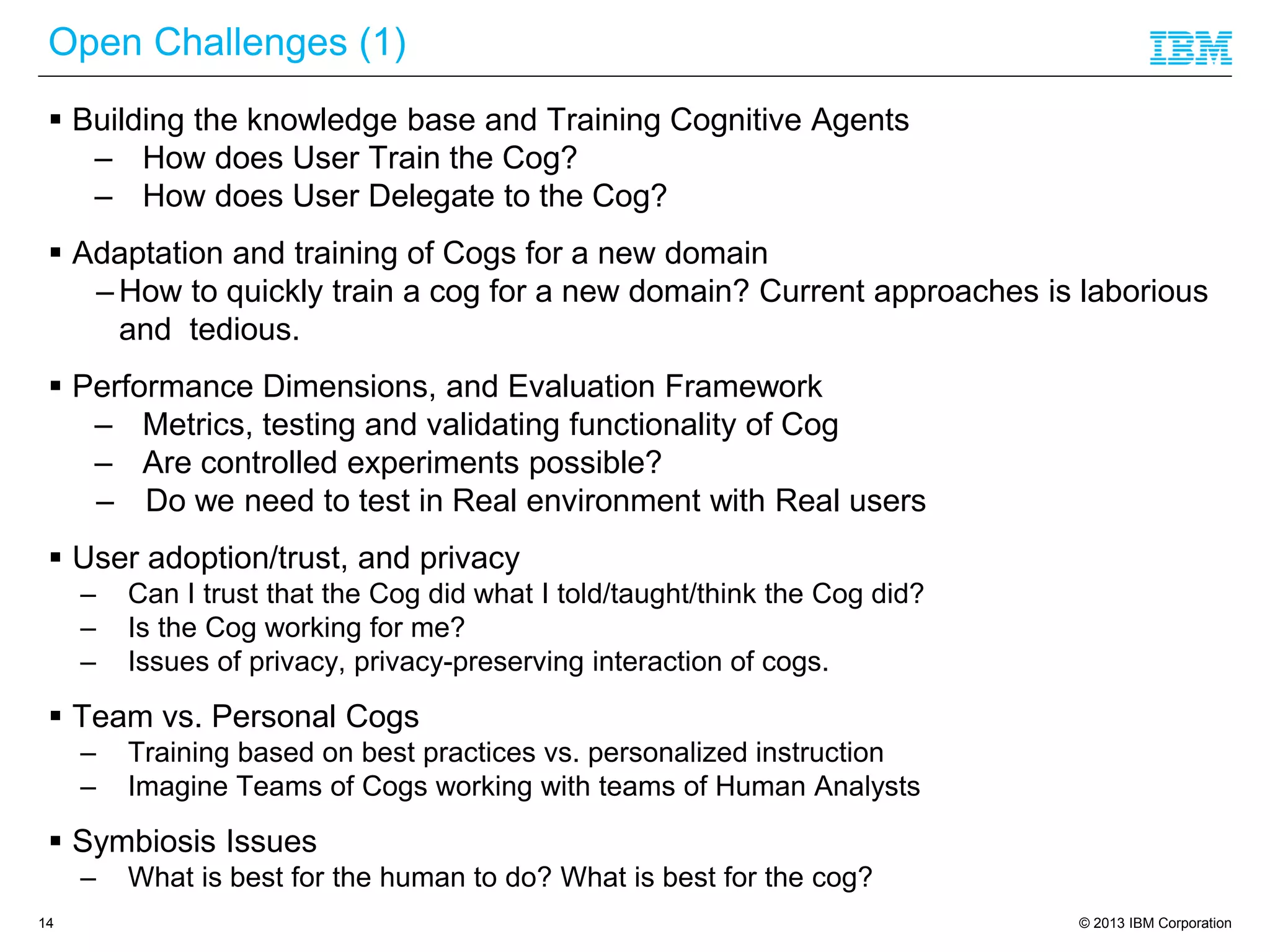
Open Challenges (1)
14
 Building the knowledge base and Training Cognitive Agents
– How does User Train the Cog?
– How does User Delegate to the Cog?
 Adaptation and training of Cogs for a new domain
– How to quickly train a cog for a new domain? Current approaches is laborious
and tedious.
 Performance Dimensions, and Evaluation Framework
– Metrics, testing and validating functionality of Cog
– Are controlled experiments possible?
– Do we need to test in Real environment with Real users
 User adoption/trust, and privacy
– Can I trust that the Cog did what I told/taught/think the Cog did?
– Is the Cog working for me?
– Issues of privacy, privacy-preserving interaction of cogs.
 Team vs. Personal Cogs
– Training based on best practices vs. personalized instruction
– Imagine Teams of Cogs working with teams of Human Analysts
 Symbiosis Issues
– What is best for the human to do? What is best for the cog?
© 2013 IBM Corporation
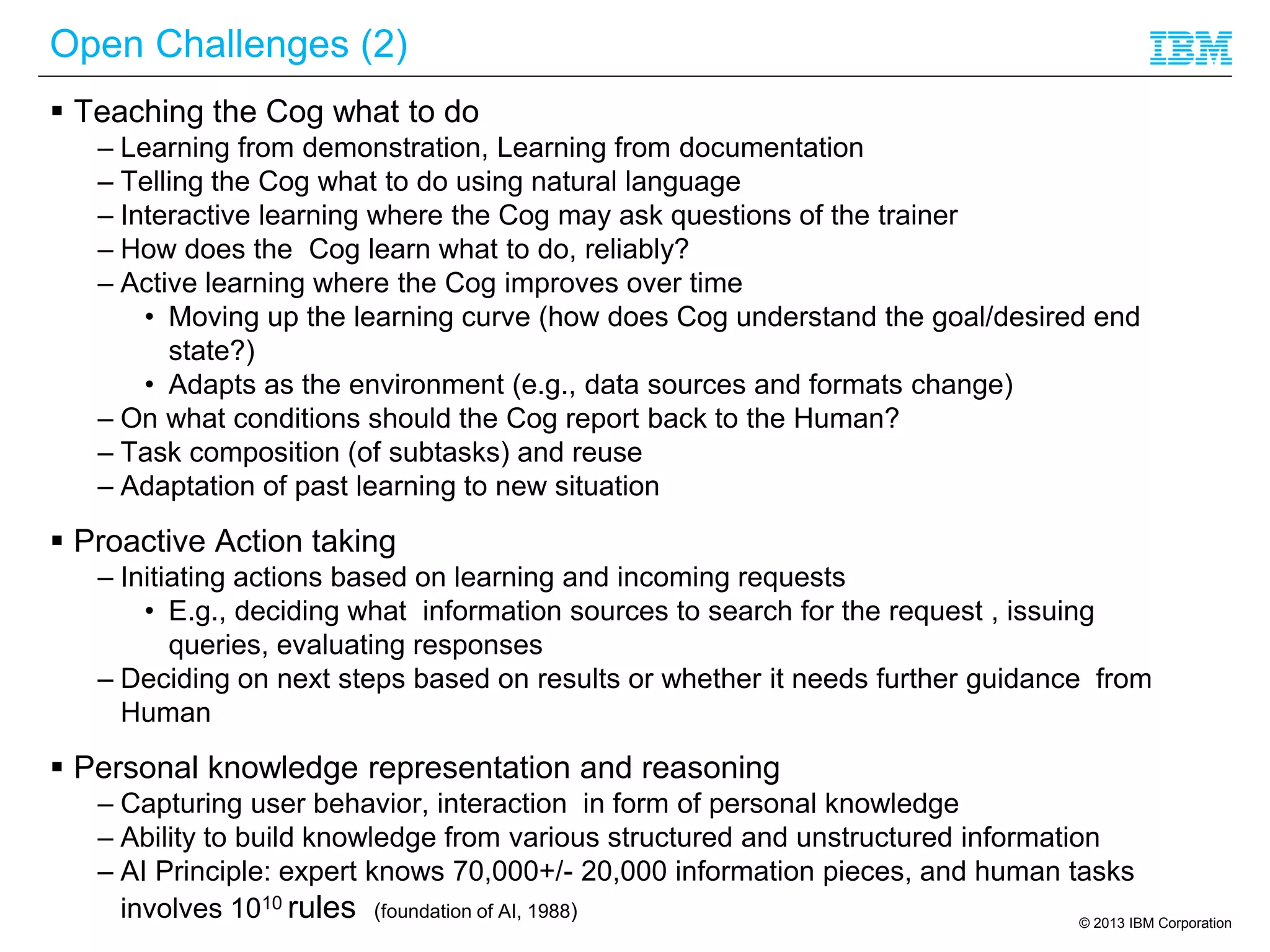
Open Challenges (2)
 Teaching the Cog what to do
– Learning from demonstration, Learning from documentation
– Telling the Cog what to do using natural language
– Interactive learning where the Cog may ask questions of the trainer
– How does the Cog learn what to do, reliably?
– Active learning where the Cog improves over time
• Moving up the learning curve (how does Cog understand the goal/desired end
state?)
• Adapts as the environment (e.g., data sources and formats change)
– On what conditions should the Cog report back to the Human?
– Task composition (of subtasks) and reuse
– Adaptation of past learning to new situation
 Proactive Action taking
– Initiating actions based on learning and incoming requests
• E.g., deciding what information sources to search for the request , issuing
queries, evaluating responses
– Deciding on next steps based on results or whether it needs further guidance from
Human
 Personal knowledge representation and reasoning
– Capturing user behavior, interaction in form of personal knowledge
– Ability to build knowledge from various structured and unstructured information
– AI Principle: expert knows 70,000+/- 20,000 information pieces, and human tasks
involves 1010 rules (foundation of AI, 1988)
© 2013 IBM Corporation
Open Challenges (3)
 Context understanding, and context-aware interaction
– Modeling the world of the person serving, including all context around the
work/task, and being able to use the contextual and environmental awareness
to proactively and reactively act on behalf of the user
 Learning to understand the task and plan to do it
– Understanding the meaning of tasks, and coming up with a response (e.g..
How many people replied to an invite over email, accepting the offer, without
asking the Cog to do so), or suggestions on how to achieve it (based on any
new information discovered by the Cog)
 Cognitive Speech recognition, or other human-computer interfaces for communicating with
Cogs
– Improving the speech-to-text techniques, and personalized, semantic-enriched
speech understanding
– Non-speech based approaches for communicating with humans
© 2013 IBM Corporation
THANK YOU!
Questions?
17

Cognitive Assistants - Opportunities and Challenges - slides

  • 1.
    © 2014 IBMCorporation Cognitive Assistants: Opportunities and Challenges Hamid R. Motahari Nezhad IBM Almaden Research Center, San Jose, CA, USA With Inputs and Contributions from: Jim Spohrer, IBM Research Frank Stein, IBM Analytics CTO
  • 2.
    © 2013 IBMCorporation Cognitive Assistant: what is it?  A software agent that – “augments human intelligence” (Engelbart’s definition1 in 1962) – Performs tasks and offer services (assists human in decision making and taking actions) – Complements human by offering capabilities that is beyond the ordinary power and reach of human (intelligence amplification)  A more technical definition – Cognitive Assistant offers computational capabilities typically based on Natural Language Processing (NLP), Machine Learning (ML), and reasoning chains, on large amount of data, which provides cognition powers that augment and scale human intelligence  Getting us closer to the vision painted for human-machine partnership in 1960: – “The hope is that, in not too many years, human brains and computing machines will be coupled together very tightly, and that the resulting partnership will think as no human brain has ever thought and process data in a way not approached by the information handling machines we know today” “Man-Computer Symbiosis , J. C. R. Licklider IRE Transactions on Human Factors in Electronics, volume HFE-1, pages 4-11, March 1960 2 1 Augmenting Human Intellect: A Conceptual Framework, by Douglas C. Engelbart, October 1962
  • 3.
    © 2013 IBMCorporation Human Intelligence in terms of Cognitive Abilities 3 Ability to Achievable by machines today? draw abstractions from particulars. Partially, semantic graphs* maintain hierarchies of abstraction. Partially, semantic graphs* concatenate assertions and arrive at a new conclusion. Partially, relationships present reason outside the current context. Not proactively compare and contrast two representations for consistency/inconsistency. Limited reason analogically. Not automated, require domain adaptation learn and use external symbols to represent numerical, spatial, or conceptual information. Better than human in symbolic rep. & processing learn and use symbols whose meanings are defined in terms of other learned symbols. Uses and processes, limited learning invent and learn terms for abstractions as well as for concrete entities. No language development capability invent and learn terms for relations as well as things Partially, using symbols, not cognitive Gentner, D. (2003), In D. Getner & S. Goldin-Meadow (eds.), Language in Mind: Advances in the Study of Language and Thought. MIT Press. 195--235 (2003)
  • 4.
    © 2013 IBMCorporation History of Cognitive Assistants from the lens of AI 4 1945 Memex (Bush) 1962 NLS/Augment (Engelbart) 1955/6 Logic Theorist (Newwell, Simon, 1955) Checker Player (Samuel, 1956) Touring Test, 1950 Thinking machines 1966 Eliza (Weizenbaum) 1965-1987 DENDRAL 1974-1984 MYCIN 1987 Cognitive Tutors (Anderson) Apple’s Knowledge Navigator System Expert Systems 1965-1987 1992-1998 Virtual Telephone Assistant Portico, Wildfire, Webley; Speech Recognition Voice Controlled 2002-08 DARPA PAL Program CALO IRIS
  • 5.
    © 2013 IBMCorporation Modern Cognitive Assistants: State of the art (2008-present) Commercial  Personal Assistants – Siri, Google Now, Microsoft Cortana, Amazon Echo, – Braina, Samsung's S Voice, LG's Voice Mate, SILVIA, HTC's Hidi, Nuance’ Vlingo – AIVC, Skyvi, IRIS, Everfriend, Evi (Q&A), Alme (patient assistant) – Viv (Global Brain as a Service)  Cognitive systems and platforms – IBM Watson – Wolfram Alpha – Saffron 10 – Vicarious (Captcha) Open Source/Research  OAQA  DeepDive  OpenCog  YodaQA  OpenSherlock  OpenIRIS  iCub EU projects  Cougaar  Inquire* (intelligent textbook) 5 * Curated knowledge base
  • 6.
    © 2013 IBMCorporation Cognitive Assistant Vision: Augmenting Human Intelligence 6 Cognitive Capability • Create new insights and new valueDiscovery • Provide bias-free advice semi- autonomously, learns, and is proactive Decision • Build and reason about models of the world, of the user, and of the system itself Understanding • Leverage encyclopedic domain knowledge in context, and interacts in natural language Question Answering
  • 7.
    © 2013 IBMCorporation Building a Society of Cognitive Agents 7 Cognitive Agent to Agent Outage Model Consequence Table Smart Swaps Lighting Objective Identification Sensitivity Analysis Sentiment Analysis Systems of specialized cognitive agents that collaborate effectively with one another Cognitive agents that collaborate effectively with people through natural user interfaces A nucleus from which an internet-scale cognitive computing cloud can be built Personal Avatar Deep Thunder Crew Scheduler News Human to Human Cognitive Agent to Human Watson Mobile Analytics and Response
  • 8.
    © 2013 IBMCorporation Cognitive Assistance for knowledge workers  Cognitive case management is about providing cognitive support to knowledge workers in handling customer cases in domains such as social care, legal, government services, citizen services, etc.  Handling and managing cases involves understanding policies, laws, rules, regulations, processes, plans, as well as customers, surrounding world, news, social networks, etc.  A cognitive agent would assist employees and customers (from each perspective) – Assisting employees/workers by providing decision support based on understanding the case, context, surrounding world and applicable laws/rules/processes. – Helps employees/workers to be more productive (taking care of routine task), and effective – Assists citizens by empowering them by knowing their rights and responsibilities, and helping them to expedite the progress of the case 8 Users Assistant CustomersEmployees/ agents Plansworkflows Rules Policies Regulations Templates Instructions/ Procedures ApplicationsSchedules Communications such as email, chat, social media, etc. Organization Cog. Agent Unstructured Linked Information
  • 9.
    © 2013 IBMCorporation Learning from an experience: Jeopardy Challenge  Back in 2006, DeepQA (Question Answering) involved addressing key challenges  Feb 27-28, 2008, a group of researchers and practitioners from industry, academia and government met to discuss state of the Question Answering (QA) field  The result was the development of a document (published in 2009) that included – Vision for QA systems, and DeepQA – Development of challenge problems with measurable dimensions – Approach to open collaboration – Open collaboration model  Defining Performance Dimensions  Challenge Problem Set Comparison 9
  • 10.
    © 2013 IBMCorporation Lesson Learned from Jeopardy in Watson (1)  “The Watson program is already a breakthrough technology in AI. For many years it had been largely assumed that for a computer to go beyond search and really be able to perform complex human language tasks it needed to do one of two things: either it would “understand” the texts using some kind of deep “knowledge representation,” or it would have a complex statistical model based on millions of texts.” – James Hendler, Watson goes to college: How the world’s smartest PC will revolutionize AI, GigaOm, 3/2/2013  Breakthrough: – Developing a systematic approach for scalable knowledge building over large, less reliable data sources, and deploying a large array of individually imperfect techniques to find right answers • Building and curating a robust, and comprehensive knowledge base and ruleset has been a key challenge in expert systems • Watson approach for building on massive, mixed curated and not-curated and less reliable information sources with uncertainty has proved effective 10 Source: Inquire Intelligent Book
  • 11.
    © 2013 IBMCorporation Lesson Learned from Jeopardy in Watson (2) 11 Comparison of two QA systems with and without confidence estimation. Both have an accuracy of 40%. With perfect confidence estimator Without confidence estimator Leveraging a large number of not always accurate techniques but delivering higher overall accuracy through understanding and employing confidence levels
  • 12.
    © 2013 IBMCorporation Opportunity assessment (1): building knowledge from data 12 80% of the world’s data today is unstructured 90% of the world’s data was created in the last two years 1 Trillion connected devices generate 2.5 quintillion bytes data / day 3M+ Apps on leading App stores
  • 13.
    © 2013 IBMCorporation Cognitive Computing as a Service: Watson in IBM BlueMix 13 Visualization Rendering Graphical representations of data analysis for easier understanding User Modeling Personality profiling to help engage users on their own terms. Language Identification Identifies the language in which text is written Machine Translation Translate text from one language to another. Concept Expansion Maps euphemisms to more commonly understood phrases Message Resonance Communicate with people with a style and words that suits them Question and Answer Direct responses to users inquiries fueled by primary document sources Relationship Extraction Intelligently finds relationships between sentences components Coming • Concept Analytics • Question Generation • Speech Recognition • Text to Speech • Tradeoff Analytics • Medical Information Extraction • Semantic Expansion • Policy Knowledge • Ontology Creation • Q&A in other languages • Policy Evaluation • Inference detection • Social Resonance • Answer Assembler • Relationship identification • Dialog • Machine Translation (French) • Smart Metadata • Visual Recommendation • Industry accelerators Available today Opportunity assessment (2): cognitive techniques and tools
  • 14.
    © 2013 IBMCorporation Open Challenges (1) 14  Building the knowledge base and Training Cognitive Agents – How does User Train the Cog? – How does User Delegate to the Cog?  Adaptation and training of Cogs for a new domain – How to quickly train a cog for a new domain? Current approaches is laborious and tedious.  Performance Dimensions, and Evaluation Framework – Metrics, testing and validating functionality of Cog – Are controlled experiments possible? – Do we need to test in Real environment with Real users  User adoption/trust, and privacy – Can I trust that the Cog did what I told/taught/think the Cog did? – Is the Cog working for me? – Issues of privacy, privacy-preserving interaction of cogs.  Team vs. Personal Cogs – Training based on best practices vs. personalized instruction – Imagine Teams of Cogs working with teams of Human Analysts  Symbiosis Issues – What is best for the human to do? What is best for the cog?
  • 15.
    © 2013 IBMCorporation Open Challenges (2)  Teaching the Cog what to do – Learning from demonstration, Learning from documentation – Telling the Cog what to do using natural language – Interactive learning where the Cog may ask questions of the trainer – How does the Cog learn what to do, reliably? – Active learning where the Cog improves over time • Moving up the learning curve (how does Cog understand the goal/desired end state?) • Adapts as the environment (e.g., data sources and formats change) – On what conditions should the Cog report back to the Human? – Task composition (of subtasks) and reuse – Adaptation of past learning to new situation  Proactive Action taking – Initiating actions based on learning and incoming requests • E.g., deciding what information sources to search for the request , issuing queries, evaluating responses – Deciding on next steps based on results or whether it needs further guidance from Human  Personal knowledge representation and reasoning – Capturing user behavior, interaction in form of personal knowledge – Ability to build knowledge from various structured and unstructured information – AI Principle: expert knows 70,000+/- 20,000 information pieces, and human tasks involves 1010 rules (foundation of AI, 1988)
  • 16.
    © 2013 IBMCorporation Open Challenges (3)  Context understanding, and context-aware interaction – Modeling the world of the person serving, including all context around the work/task, and being able to use the contextual and environmental awareness to proactively and reactively act on behalf of the user  Learning to understand the task and plan to do it – Understanding the meaning of tasks, and coming up with a response (e.g.. How many people replied to an invite over email, accepting the offer, without asking the Cog to do so), or suggestions on how to achieve it (based on any new information discovered by the Cog)  Cognitive Speech recognition, or other human-computer interfaces for communicating with Cogs – Improving the speech-to-text techniques, and personalized, semantic-enriched speech understanding – Non-speech based approaches for communicating with humans
  • 17.
    © 2013 IBMCorporation THANK YOU! Questions? 17