© 2014 IBM Corporation 
TowardsCognitive BPMas a Platform for Smart Process Support over Unstructured Big Data 
Hamid R. MotahariNezhad 
IBM AlmadenResearch Center, USA 
Leveraging information and analytics for smarter process decisions
© 2013 IBM Corporation 
Processes in our life 
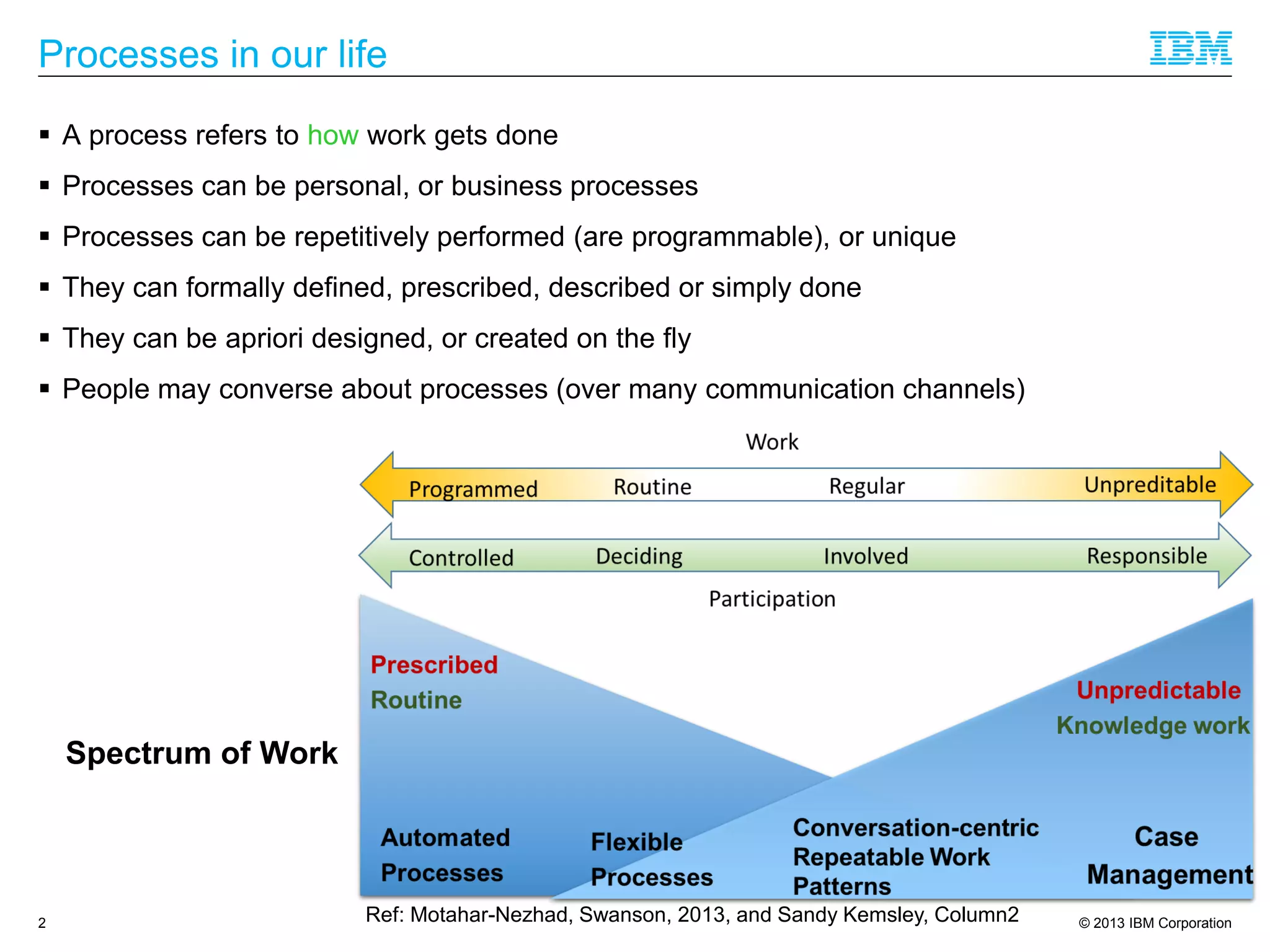
A process refers to howwork gets done 
Processes can be personal, or business processes 
Processes can be repetitively performed (are programmable), or unique 
They can formally defined, prescribed, described or simply done 
They can be aprioridesigned, or created on the fly 
People may converse about processes (over many communication channels) 
2 
Ref: Motahar-Nezhad, Swanson, 2013, and Sandy Kemsley, Column2 
Spectrum of Work
© 2013 IBM Corporation 
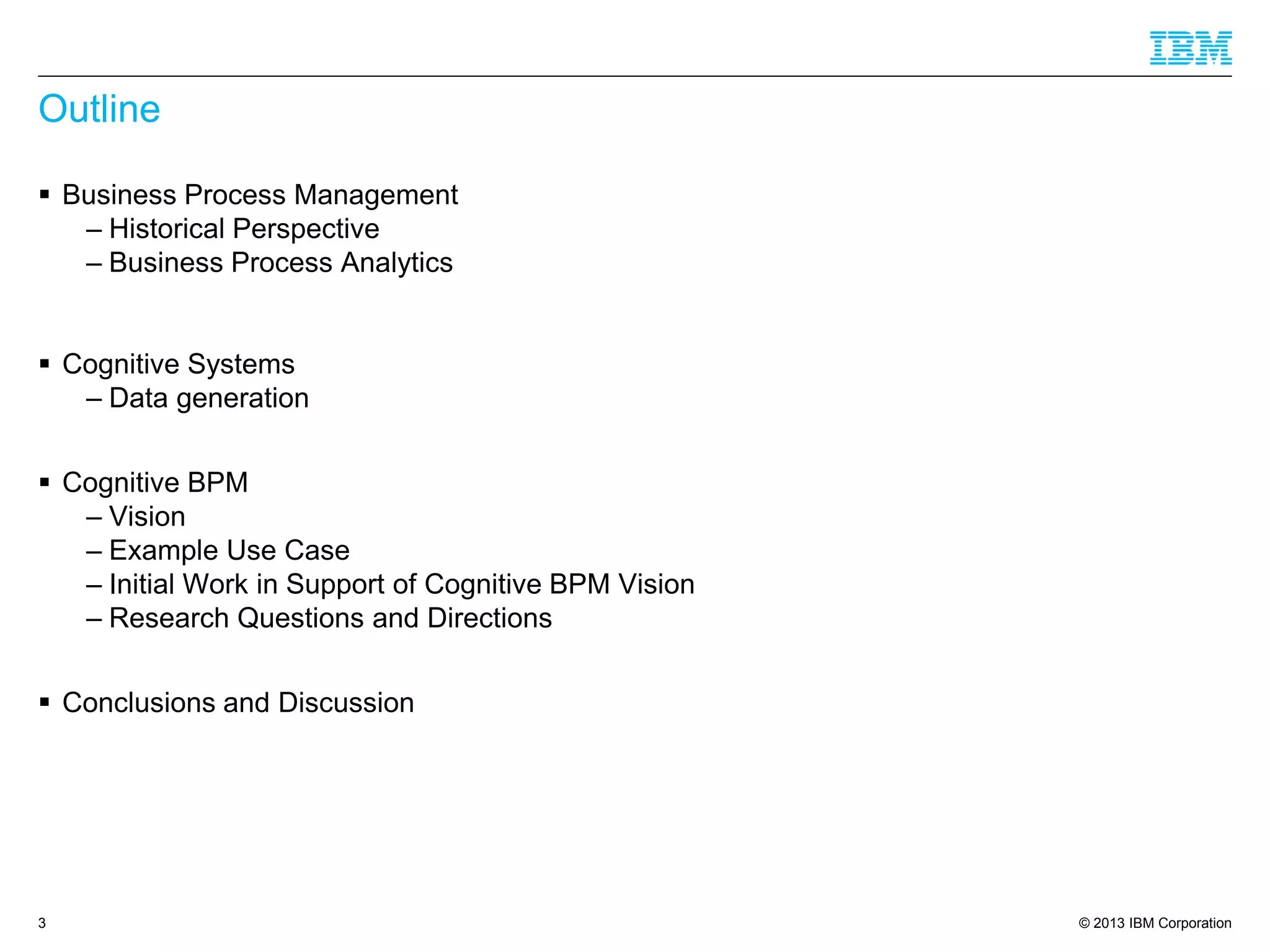
Outline 
Business Process Management 
–Historical Perspective 
–Business Process Analytics 
Cognitive Systems 
–Data generation 
Cognitive BPM 
–Vision 
–Example Use Case 
–Initial Work in Support of Cognitive BPM Vision 
–Research Questions and Directions 
Conclusions and Discussion 
3
© 2013 IBM Corporation 
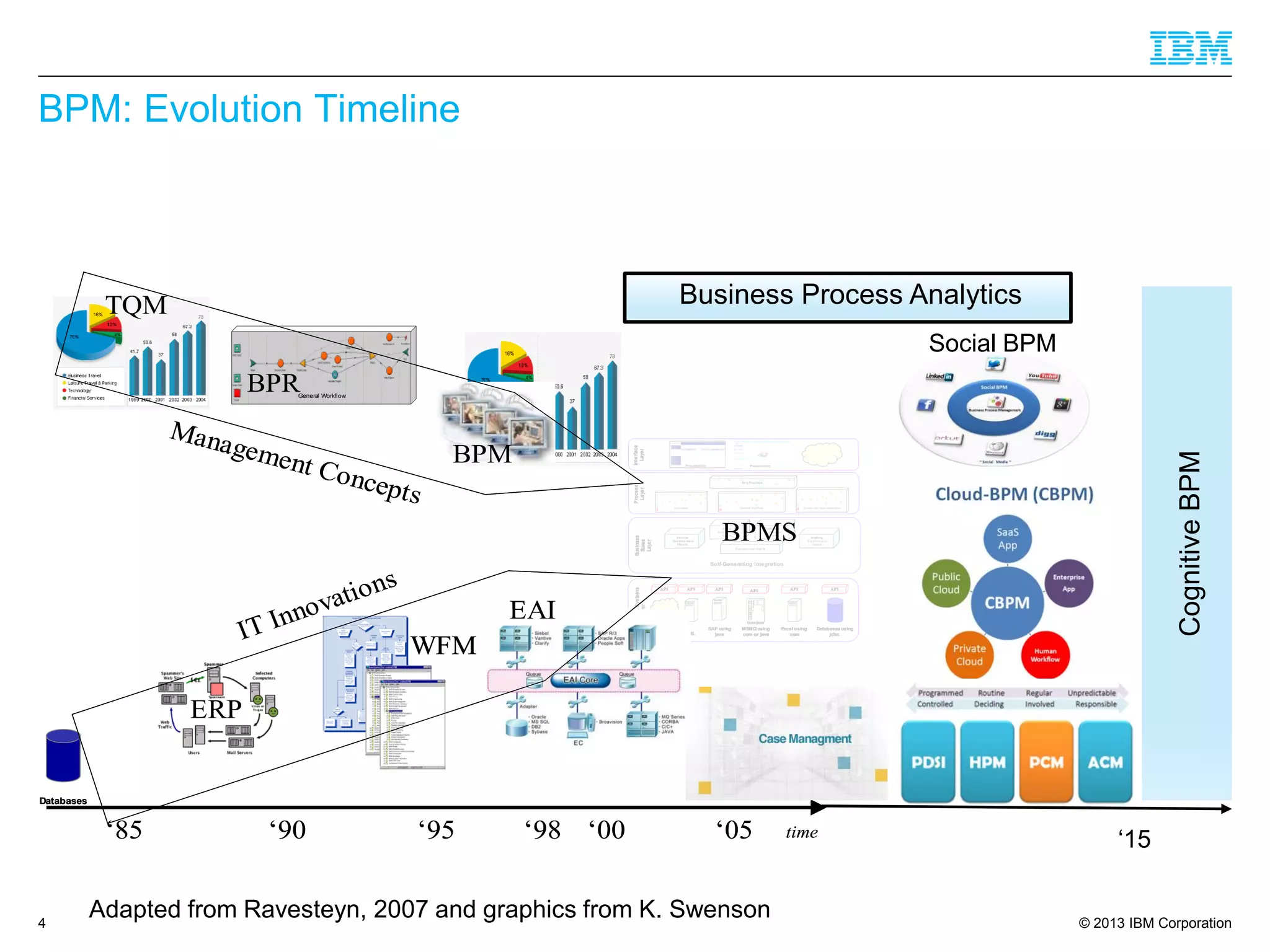
BPM: Evolution Timeline 
4 
Databases 
Back end  Systems 
Layer 
Self-Generating Integration 
SAP using 
java 
API 
Web 
Service 
API 
Excel using 
com 
API 
MSMQ using 
com or java 
API 
Databases using 
jdbc 
API 
Business 
Rules 
Layer 
Production 
Business Level 
Objects 
Business Level Objects 
Inv oices 
Business Lev el 
Obj ects 
AFE’s 
Business Level 
Objects 
Anything 
Business Level 
Objects 
Process 
Layer 
Any Process 
Calculation General Workflow System and User Interactions 
Interface 
Layer 
Web 
Service 
Presentation Presentation 
XML 
API 
BPMS 
TQM 
General Workflow BPR 
BPM 
time 
ERP 
WFM 
EAI 
‘85 ‘90 ‘95 ‘98 ‘00 ‘05 
IT Innovations 
Management Concepts 
Adapted from Ravesteyn, 2007 and graphics from K. Swenson 
‘15 
Social BPM 
Business Process Analytics 
Cognitive BPM
© 2013 IBM Corporation 
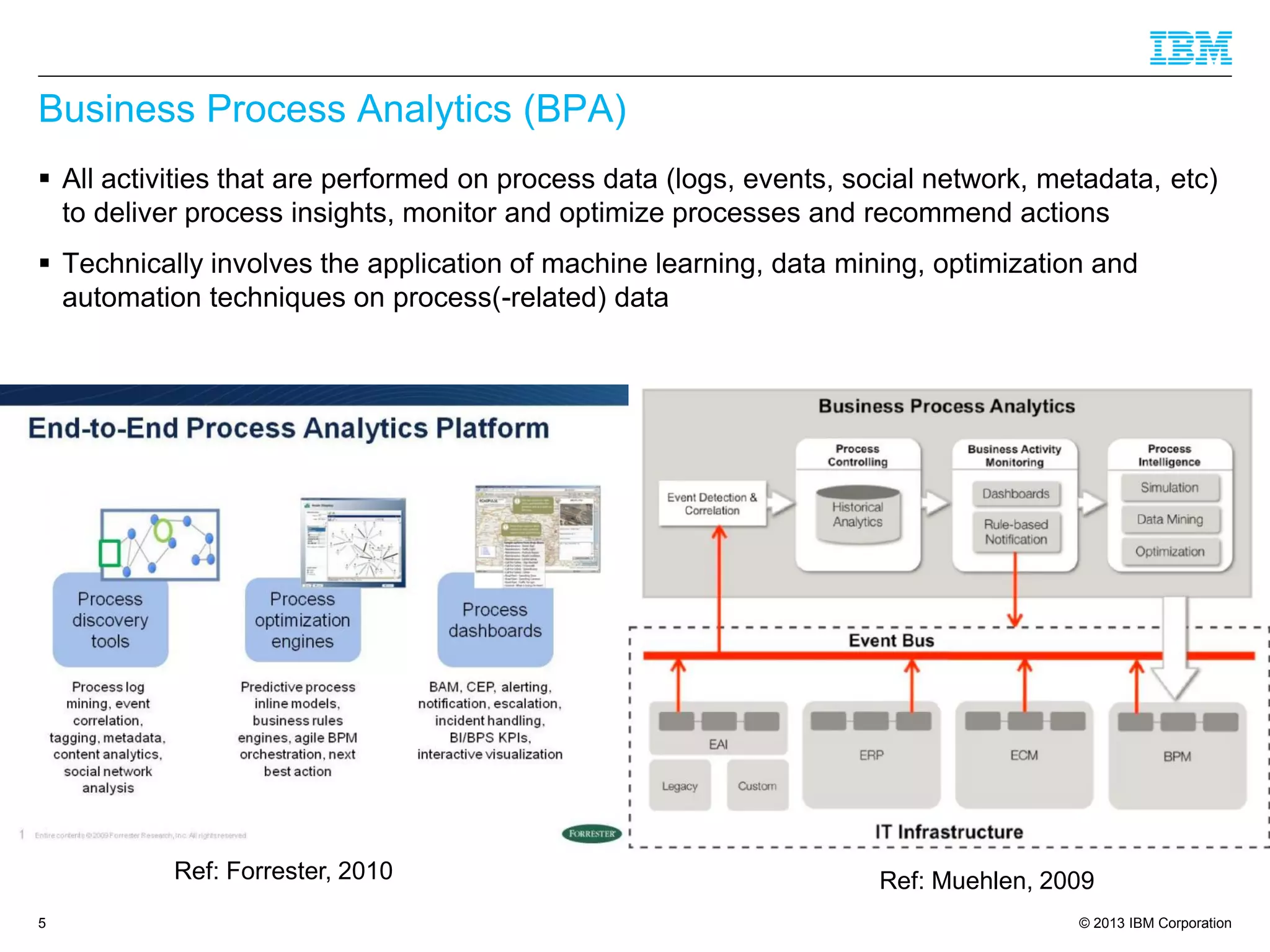
Business Process Analytics (BPA) 
All activities that are performed on process data (logs, events, social network, metadata, etc) to deliver process insights, monitor and optimize processes and recommend actions 
Technically involves the application of machine learning, data mining, optimization and automation techniques on process(-related) data 
5 
Ref: Muehlen, 2009 
Ref: Forrester, 2010
© 2013 IBM Corporation 
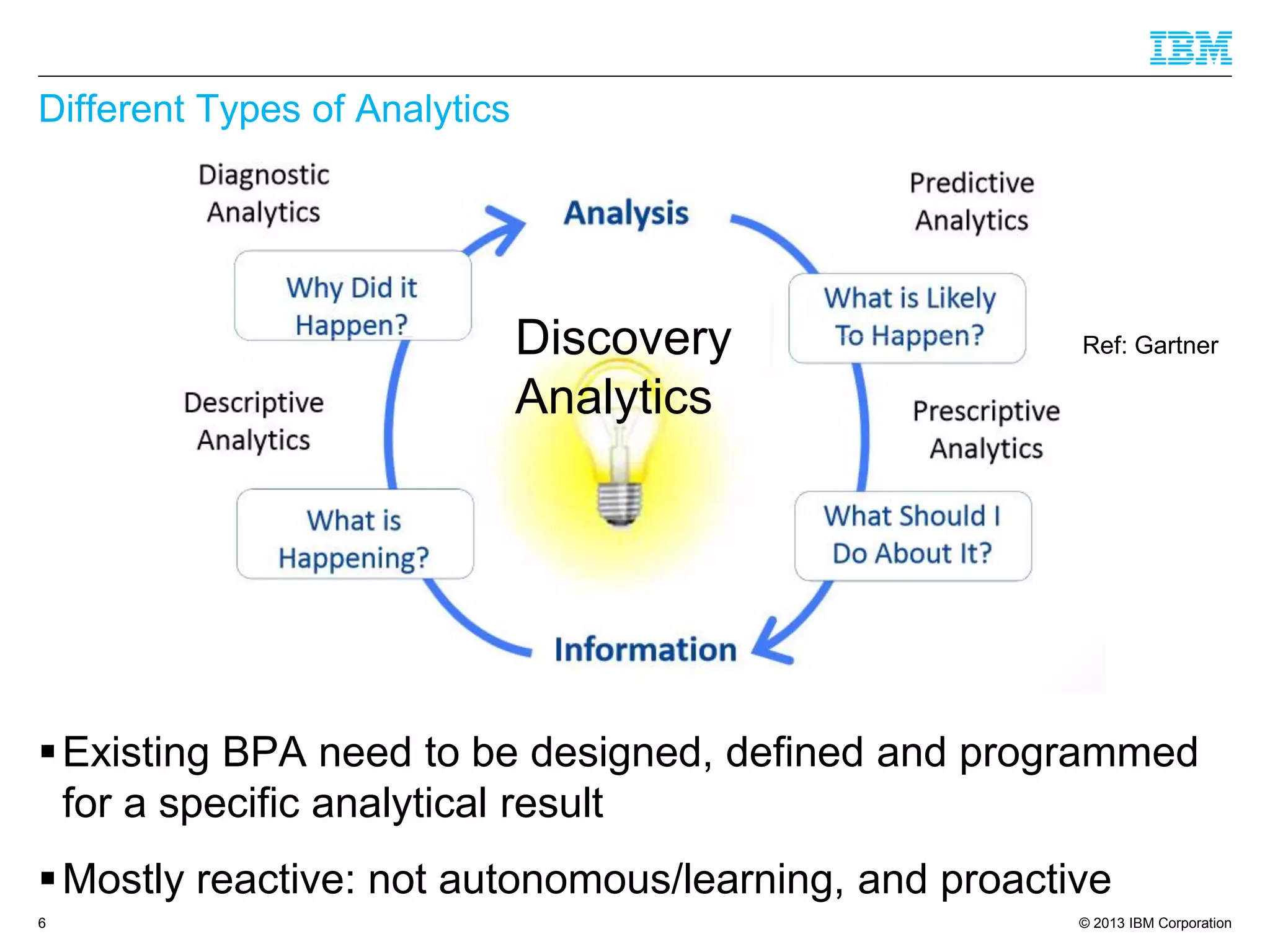
Different Types of Analytics 
Existing BPA need to be designed, defined and programmed for a specific analytical result 
Mostly reactive: not autonomous/learning, and proactive 
6 
Discovery 
Analytics 
Ref: Gartner
© 2013 IBM Corporation 
COGNITIVE SYSTEMS 
7
© 2012 International Business Machines Corporation 
8 
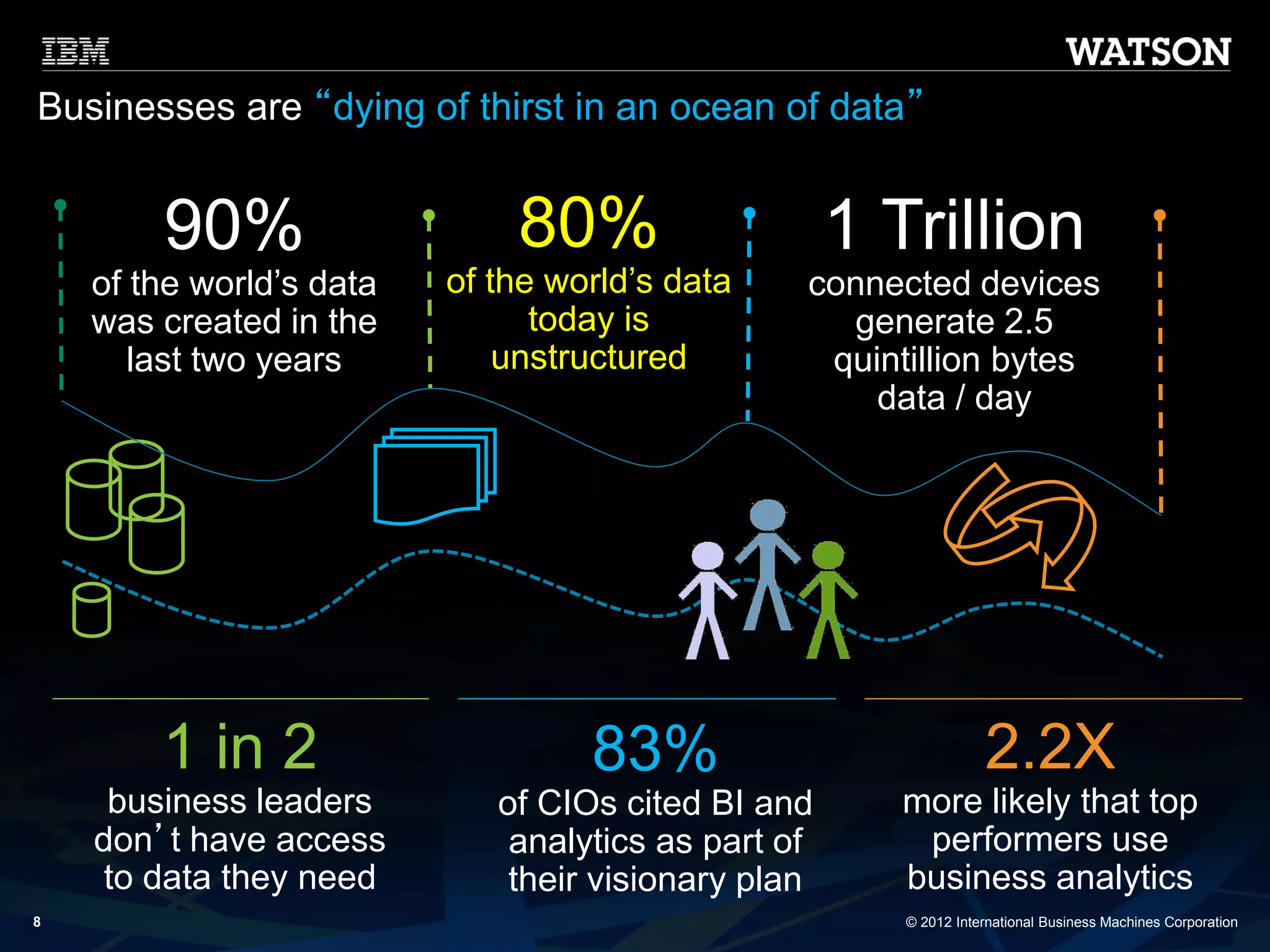
Businesses are“dying of thirst in an ocean of data” 
1 in 2 
business leaders don’t have access to data they need 
83% 
of CIOs cited BI and analytics as part of their visionary plan 
2.2X 
more likely that top performers use business analytics 
80% 
of the world’s data today is unstructured 
90% 
of the world’s data was created in the last two years 
1 Trillion 
connected devices generate 2.5 quintillion bytes data / day
© 2012 International Business Machines Corporation 
9 
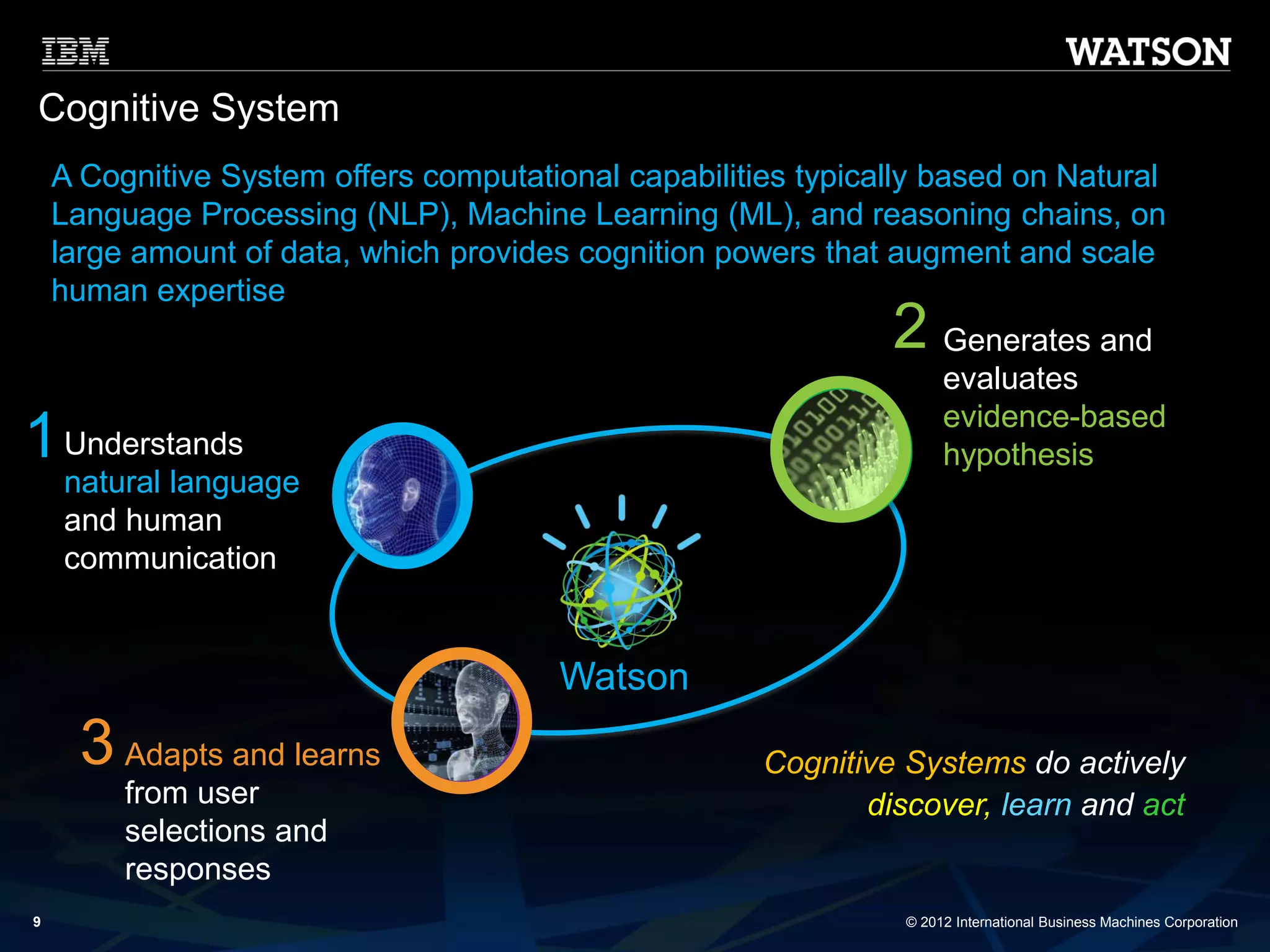
Understands natural language and human communication 
Adapts and learnsfrom user selections and responses 
Generates and evaluatesevidence-based hypothesis 
Cognitive System 
1 
2 
3 
Cognitive Systemsdo actively discover, learnand act 
A Cognitive System offers computational capabilities typically based on Natural Language Processing (NLP), Machine Learning (ML), and reasoning chains, on large amount of data, which provides cognition powers that augment and scale human expertise 
Watson
© 2013 IBM Corporation 
COGNITIVE BPM 
10
© 2013 IBM Corporation 
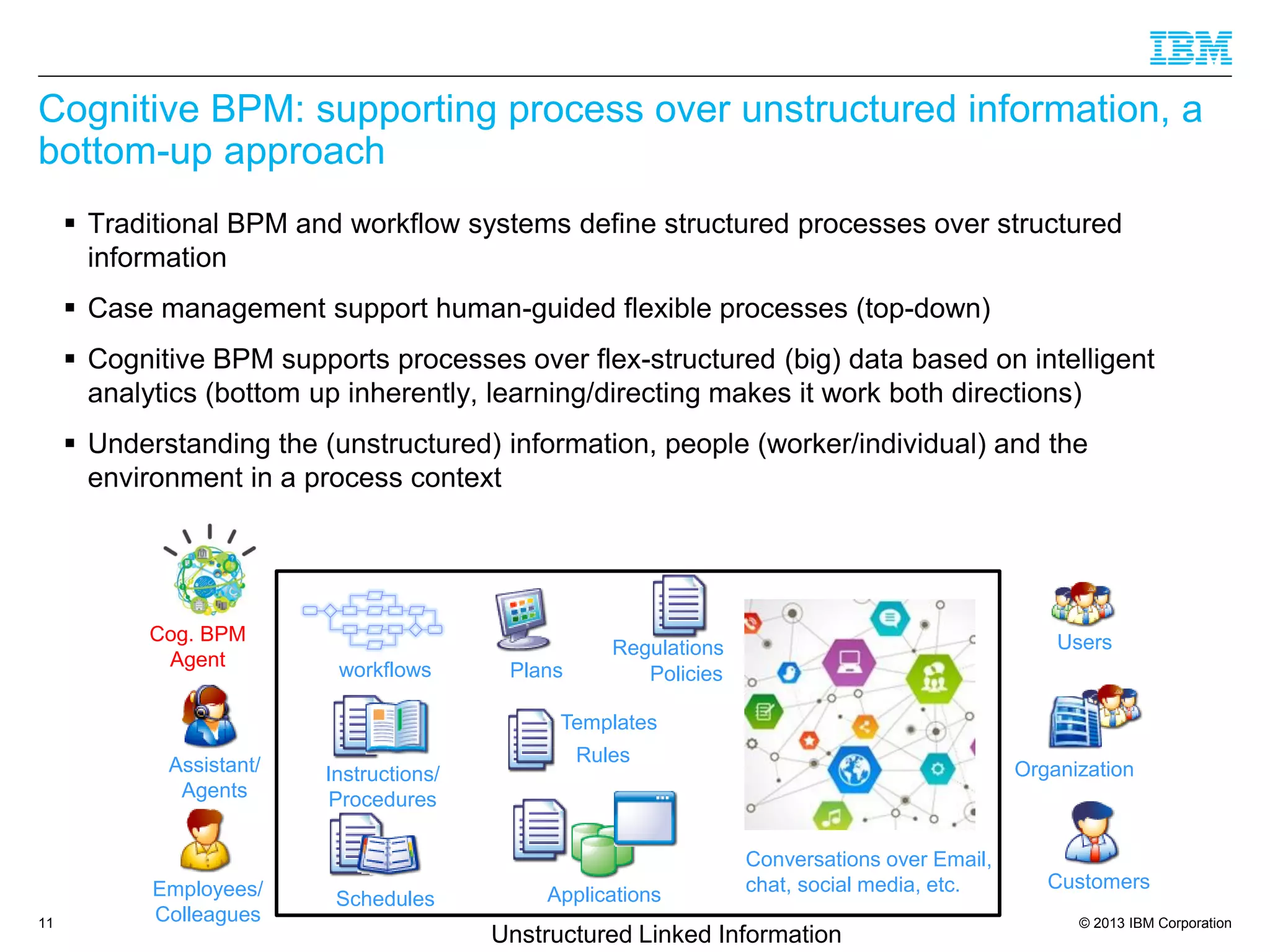
Cognitive BPM: supporting process over unstructured information, a bottom-up approach 
Traditional BPM and workflow systems define structured processes over structured information 
Case management support human-guided flexible processes (top-down) 
Cognitive BPM supports processes over flex-structured (big) data based on intelligent analytics (bottom up inherently, learning/directing makes it work both directions) 
Understanding the (unstructured) information, people (worker/individual) and the environment in a process context 
11 
Users 
Assistant/ 
Agents 
Customers 
Employees/ 
Colleagues 
Plans 
workflows 
Rules 
Policies 
Regulations 
Templates 
Instructions/ 
Procedures 
Applications 
Schedules 
Conversations over Email, 
chat, social media, etc. 
Organization 
Cog. BPM Agent 
Unstructured Linked Information
© 2013 IBM Corporation 
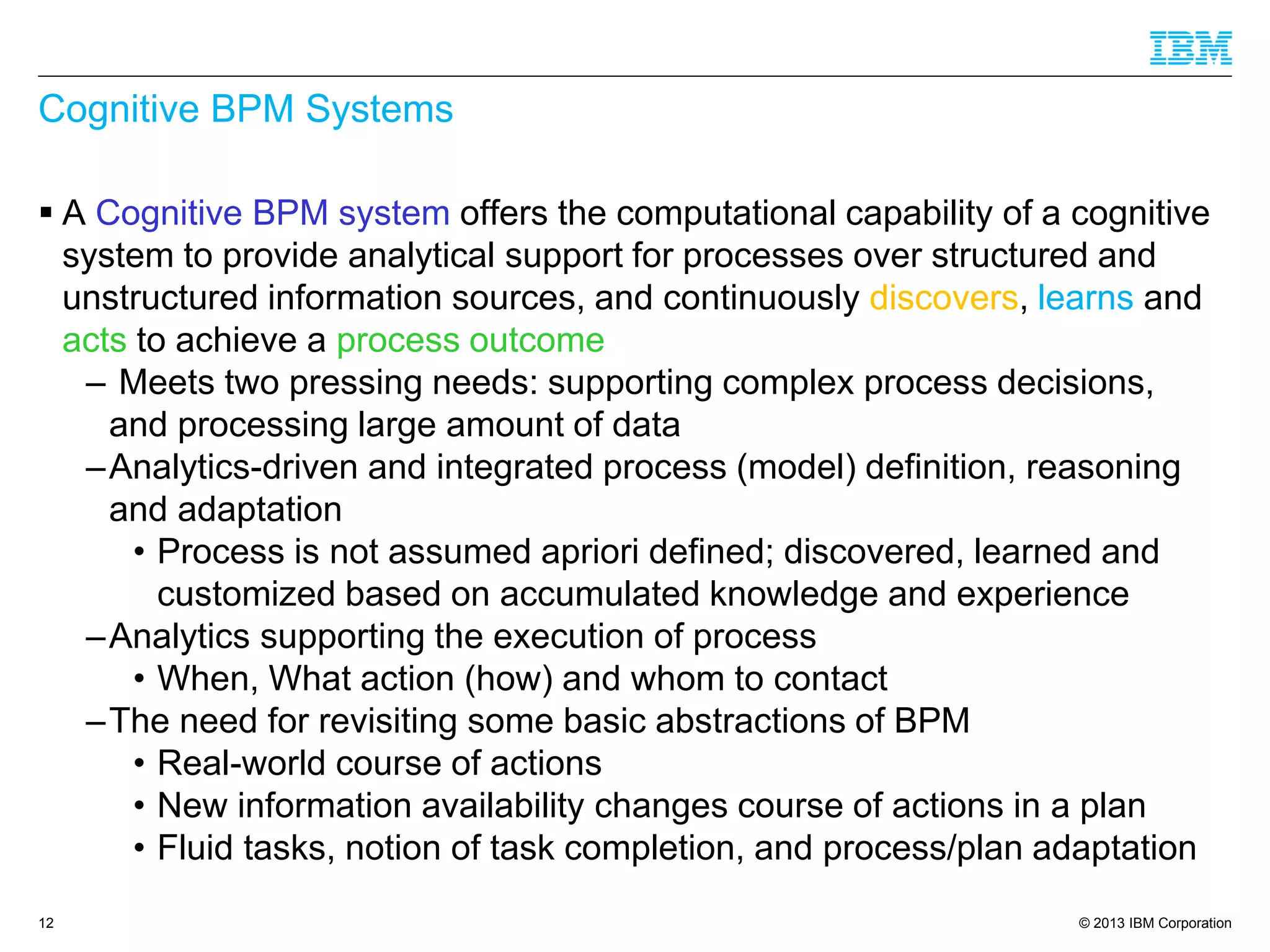
Cognitive BPM Systems 
A Cognitive BPM systemoffers the computational capability of a cognitive system to provide analytical support for processes over structured and unstructured information sources, and continuously discovers, learnsand actsto achieve a process outcome 
–Meets two pressing needs: supporting complex process decisions, and processing large amount of data 
–Analytics-driven and integrated process (model) definition, reasoning and adaptation 
•Process is not assumed aprioridefined; discovered, learned and customized based on accumulated knowledge and experience 
–Analytics supporting the execution of process 
•When, What action (how) and whom to contact 
–The need for revisiting some basic abstractions of BPM 
•Real-world course of actions 
•New information availability changes course of actions in a plan 
•Fluid tasks, notion of task completion, and process/plan adaptation 
12
© 2013 IBM Corporation 
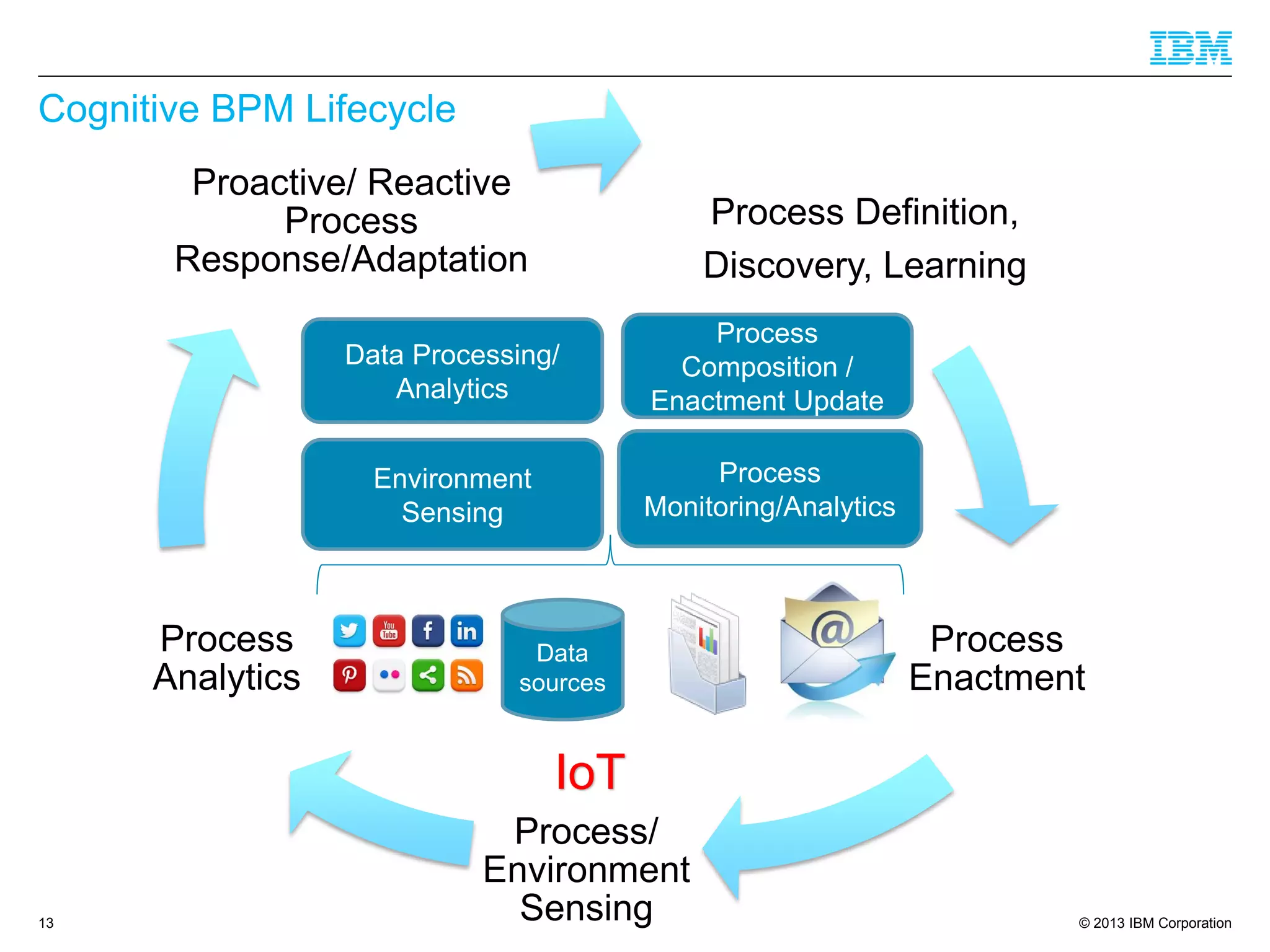
Process Definition, 
Discovery, Learning 
Process Enactment 
Process/ Environment Sensing 
Process Analytics 
Proactive/ Reactive Process Response/Adaptation 
Cognitive BPM Lifecycle 
13 
Environment Sensing 
Data sources 
Data Processing/ Analytics 
Process Composition / Enactment Update 
Process Monitoring/AnalyticsIoT
© 2013 IBM Corporation 
Use Case 1: Knowledge-intensive Enterprise Processes 
Human-Centric, knowledge-instensiveProcesses in IT Services Provider Environments (Sales Management Processes) 
–Reference, descriptive processes are available, no (WFM) system supporting the process 
–The need for a business-aware automation solution for human-centric processes 
–Conversational, multiple interactions and facts impacting process decisions 
–Inbox used a work management system, in addition to phone, chat and records in databases 
–Changes to process guidelines and templates are commonplace and communicated through email 
Cognitive BPM 
–Providing automation support, and analytics over process 
–Ability to process and link process information from unstructured sources over multiple channels 
–Putting the business first (outcome), not the process 
•Process should support more sales, through employing all analytics type: diagnostic, predictive, prescriptive 
14
© 2013 IBM Corporation 
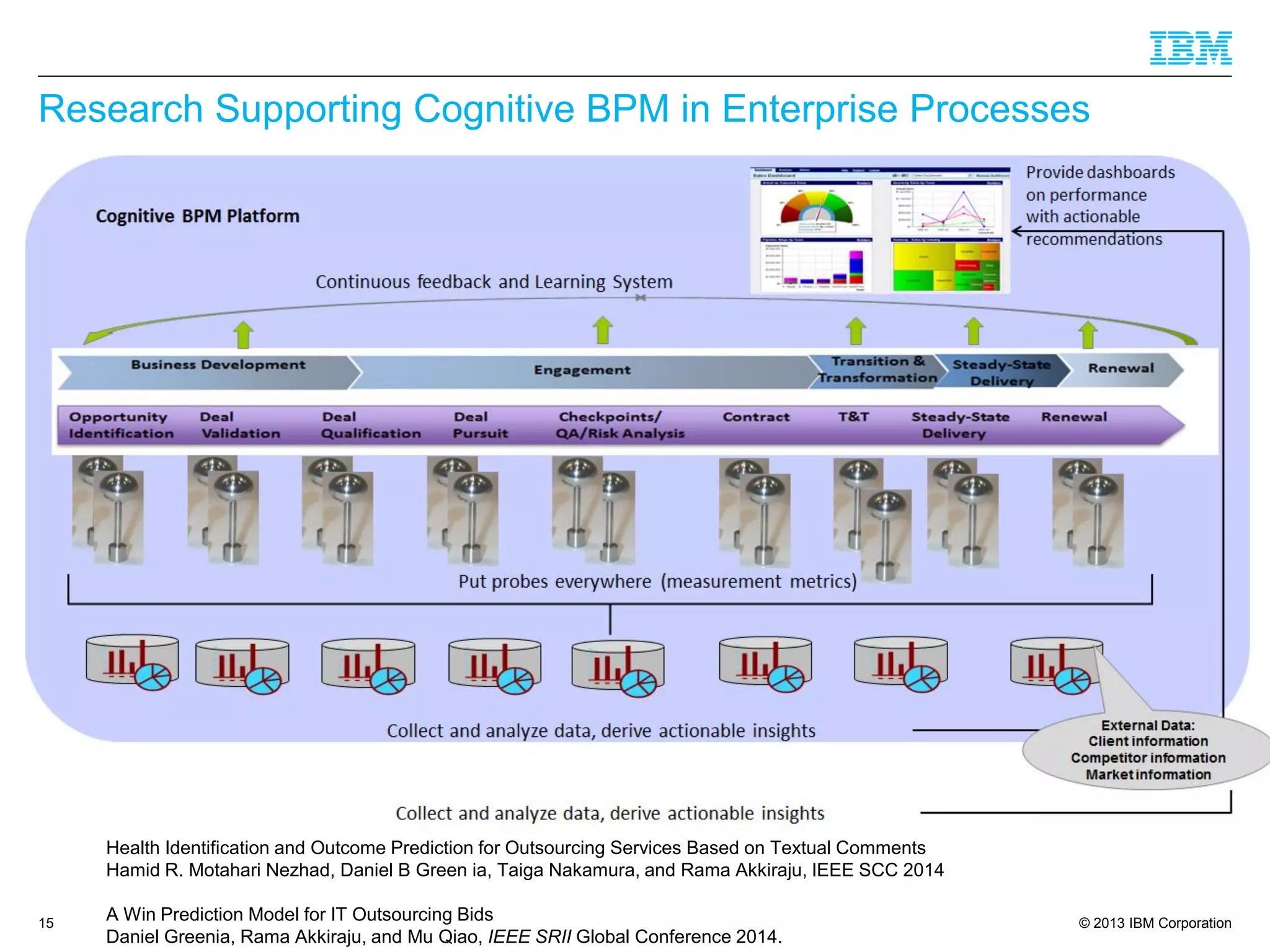
Research Supporting Cognitive BPM in Enterprise Processes 
15 
Health Identification and Outcome Prediction for Outsourcing Services Based on Textual Comments 
Hamid R. MotahariNezhad, Daniel B Green ia, Taiga Nakamura, and Rama Akkiraju, IEEE SCC 2014 
A Win Prediction Model for IT Outsourcing Bids 
Daniel Greenia, Rama Akkiraju, and Mu Qiao, IEEE SRII Global Conference 2014.
© 2013 IBM Corporation 
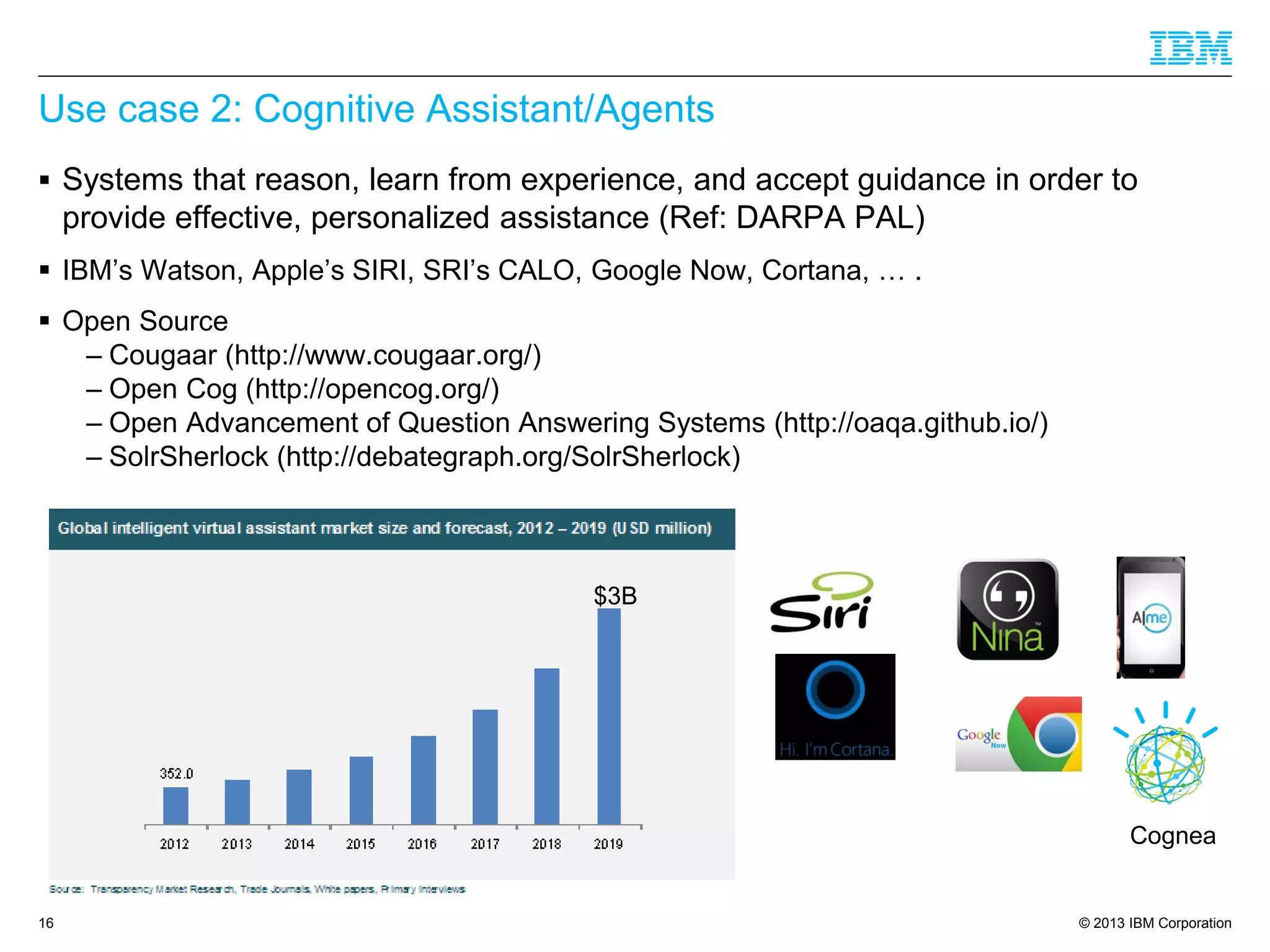
Use case 2: Cognitive Assistant/Agents 
Systems that reason, learn from experience, and accept guidance in order to provide effective, personalized assistance (Ref: DARPA PAL) 
IBM’s Watson, Apple’s SIRI, SRI’s CALO, Google Now, Cortana, … . 
Open Source 
–Cougaar(http://www.cougaar.org/) 
–Open Cog (http://opencog.org/) 
–Open Advancement of Question Answering Systems (http://oaqa.github.io/) 
–SolrSherlock(http://debategraph.org/SolrSherlock) 
16 
$3B 
Cognea
© 2013 IBM Corporation 
Cognitive BPM in Cognitive Assistants/Agents 
Goals 
–Increasing worker’s productivity, efficiency, and creativity (serendipity) 
Current cognitive assistants are focused on personal space or virtual conversational agents 
Cognitive Work Agent 
–Isprocess and work aware 
–Monitorsworker’s input channels and interactions (emails, chats, social connections, external and internal environment, knows rules, policies and processes) 
–Proactively acts on worker’s behalfand reacts to requests: becomes a copy of you in work environment 
•Commands/requests-Responds to simple requests intelligently 
•Situational awareness–monitors the environments to overcome information overloading (selective). 
•Deep QA: process questions, how-tos, previous successful process experience 
–Organizesand assists your work 
•Extract tasks/commitments, promises, commitments 
•Managed to-dos: status updates, over-dues, plans 
•Manages calendar, schedules, social contacts 
•Finds and present prior related interactions to a particular conversation 17 
Related article to Personal Assistants in work environments: 
Erickson et al, Assistance: The Work Practices of Human Administrative Assistants and their Implications for IT and Organizations, CSCW 2008.
© 2013 IBM Corporation 
Use Case 3: Work Assistant Example 
Assume an executive admin is managing an event organization process for their department 
–Step 1: sending invite to an event to employees in their department, through email and requests for RSVP 
•Cognitive BPM (1): Q&A ability for the admin: How many have confirmed, how many pending, how many not answered 
•Cognitive BPM (2): Predictive analytics: how many will eventually RSVP? 
•Cognitive BPM (3): Diagnostic analytics: why some not accepted (customers in case of marketing case)? 
–Step 2: Ordering place, food, transportation, etc 
•Cognitive BPM (1): tracking of the process steps, which vendor have replied, which ones pending, have questions, etc. 
•Cognitive BPM (2): keeping track of synchronization and consistency (dates, amounts, numbers, etc.) among different steps 
–Step 3: Pre-event steps 
•Reminding people who have RSVPed 
•Compiling and sending logistic information (from different steps) 18
© 2013 IBM Corporation 
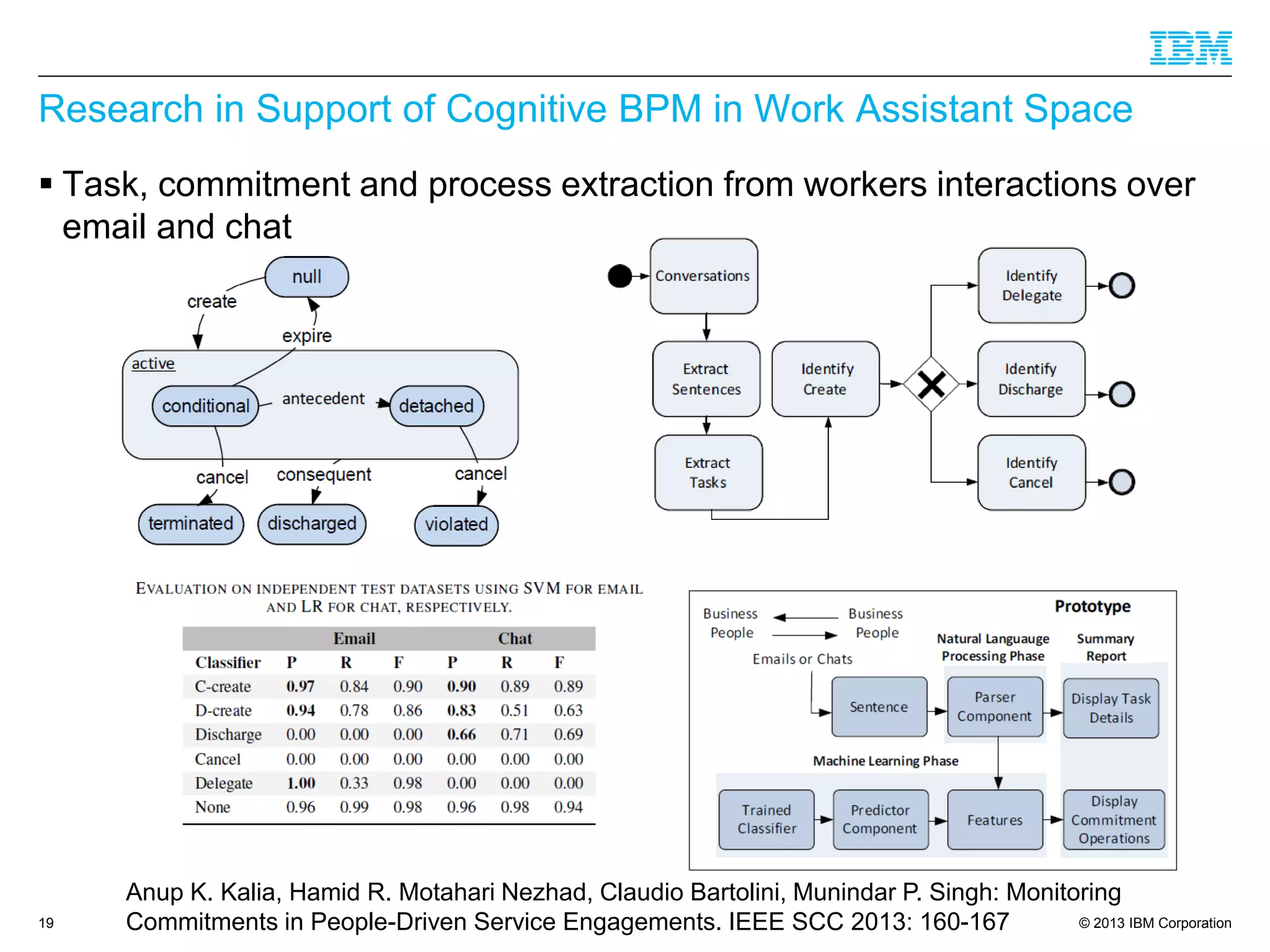
Research in Support of Cognitive BPM in Work Assistant Space 
Task, commitment and process extraction from workers interactions over email and chat 
19 
Anup K. Kalia, Hamid R. MotahariNezhad, Claudio Bartolini, MunindarP. Singh: Monitoring Commitments in People-Driven Service Engagements. IEEE SCC 2013: 160-167
© 2013 IBM Corporation 
Research Directions 
Abstractions and models for Cognitive Processes 
Cognitive Process Management System 
–Analytics on unstructured information to support process understanding 
–Analytics to support process adaptation, customization and configuration 
–Proactive process adaptation 
Cognitive Work Assistants 
–Cognitive augmentation of workers in work environments, and in process management 
Teaching processes to cognitive agents 
–Interactive learning where cognitive agents ask process questions 
–Gradual learning through experience, and process improvement 
20
© 2013 IBM Corporation 
Conclusions and Discussions 
We are in the beginning of a profound transformation of assisting workers with intelligent agents/assistant, and the BPM field, in general, enabled by advances in AI and Cognitive Computing 
Major advances in business process analytics work so far, however, systems need prescriptions by humans 
The vision of Cognitive BPM supports a self-learning, adaptive and analytics BPM systems that focuses on process outcome 
–Analytics-driven, learning, and proactive adaptation 
–Enabling systems and human work together to achieve better results 
21
© 2013 IBM Corporation 
QUESTIONS? 
Thank You! 
22 
COGNITIVE BPM: SMART PROCESS SUPPORT OVER UNSTRUCTURED BIG DATA

Towards Cognitive BPM as a Platform for Smart Process Support over Unstructured Big Data

  • 1.
    © 2014 IBMCorporation TowardsCognitive BPMas a Platform for Smart Process Support over Unstructured Big Data Hamid R. MotahariNezhad IBM AlmadenResearch Center, USA Leveraging information and analytics for smarter process decisions
  • 2.
    © 2013 IBMCorporation Processes in our life A process refers to howwork gets done Processes can be personal, or business processes Processes can be repetitively performed (are programmable), or unique They can formally defined, prescribed, described or simply done They can be aprioridesigned, or created on the fly People may converse about processes (over many communication channels) 2 Ref: Motahar-Nezhad, Swanson, 2013, and Sandy Kemsley, Column2 Spectrum of Work
  • 3.
    © 2013 IBMCorporation Outline Business Process Management –Historical Perspective –Business Process Analytics Cognitive Systems –Data generation Cognitive BPM –Vision –Example Use Case –Initial Work in Support of Cognitive BPM Vision –Research Questions and Directions Conclusions and Discussion 3
  • 4.
    © 2013 IBMCorporation BPM: Evolution Timeline 4 Databases Back end Systems Layer Self-Generating Integration SAP using java API Web Service API Excel using com API MSMQ using com or java API Databases using jdbc API Business Rules Layer Production Business Level Objects Business Level Objects Inv oices Business Lev el Obj ects AFE’s Business Level Objects Anything Business Level Objects Process Layer Any Process Calculation General Workflow System and User Interactions Interface Layer Web Service Presentation Presentation XML API BPMS TQM General Workflow BPR BPM time ERP WFM EAI ‘85 ‘90 ‘95 ‘98 ‘00 ‘05 IT Innovations Management Concepts Adapted from Ravesteyn, 2007 and graphics from K. Swenson ‘15 Social BPM Business Process Analytics Cognitive BPM
  • 5.
    © 2013 IBMCorporation Business Process Analytics (BPA) All activities that are performed on process data (logs, events, social network, metadata, etc) to deliver process insights, monitor and optimize processes and recommend actions Technically involves the application of machine learning, data mining, optimization and automation techniques on process(-related) data 5 Ref: Muehlen, 2009 Ref: Forrester, 2010
  • 6.
    © 2013 IBMCorporation Different Types of Analytics Existing BPA need to be designed, defined and programmed for a specific analytical result Mostly reactive: not autonomous/learning, and proactive 6 Discovery Analytics Ref: Gartner
  • 7.
    © 2013 IBMCorporation COGNITIVE SYSTEMS 7
  • 8.
    © 2012 InternationalBusiness Machines Corporation 8 Businesses are“dying of thirst in an ocean of data” 1 in 2 business leaders don’t have access to data they need 83% of CIOs cited BI and analytics as part of their visionary plan 2.2X more likely that top performers use business analytics 80% of the world’s data today is unstructured 90% of the world’s data was created in the last two years 1 Trillion connected devices generate 2.5 quintillion bytes data / day
  • 9.
    © 2012 InternationalBusiness Machines Corporation 9 Understands natural language and human communication Adapts and learnsfrom user selections and responses Generates and evaluatesevidence-based hypothesis Cognitive System 1 2 3 Cognitive Systemsdo actively discover, learnand act A Cognitive System offers computational capabilities typically based on Natural Language Processing (NLP), Machine Learning (ML), and reasoning chains, on large amount of data, which provides cognition powers that augment and scale human expertise Watson
  • 10.
    © 2013 IBMCorporation COGNITIVE BPM 10
  • 11.
    © 2013 IBMCorporation Cognitive BPM: supporting process over unstructured information, a bottom-up approach Traditional BPM and workflow systems define structured processes over structured information Case management support human-guided flexible processes (top-down) Cognitive BPM supports processes over flex-structured (big) data based on intelligent analytics (bottom up inherently, learning/directing makes it work both directions) Understanding the (unstructured) information, people (worker/individual) and the environment in a process context 11 Users Assistant/ Agents Customers Employees/ Colleagues Plans workflows Rules Policies Regulations Templates Instructions/ Procedures Applications Schedules Conversations over Email, chat, social media, etc. Organization Cog. BPM Agent Unstructured Linked Information
  • 12.
    © 2013 IBMCorporation Cognitive BPM Systems A Cognitive BPM systemoffers the computational capability of a cognitive system to provide analytical support for processes over structured and unstructured information sources, and continuously discovers, learnsand actsto achieve a process outcome –Meets two pressing needs: supporting complex process decisions, and processing large amount of data –Analytics-driven and integrated process (model) definition, reasoning and adaptation •Process is not assumed aprioridefined; discovered, learned and customized based on accumulated knowledge and experience –Analytics supporting the execution of process •When, What action (how) and whom to contact –The need for revisiting some basic abstractions of BPM •Real-world course of actions •New information availability changes course of actions in a plan •Fluid tasks, notion of task completion, and process/plan adaptation 12
  • 13.
    © 2013 IBMCorporation Process Definition, Discovery, Learning Process Enactment Process/ Environment Sensing Process Analytics Proactive/ Reactive Process Response/Adaptation Cognitive BPM Lifecycle 13 Environment Sensing Data sources Data Processing/ Analytics Process Composition / Enactment Update Process Monitoring/AnalyticsIoT
  • 14.
    © 2013 IBMCorporation Use Case 1: Knowledge-intensive Enterprise Processes Human-Centric, knowledge-instensiveProcesses in IT Services Provider Environments (Sales Management Processes) –Reference, descriptive processes are available, no (WFM) system supporting the process –The need for a business-aware automation solution for human-centric processes –Conversational, multiple interactions and facts impacting process decisions –Inbox used a work management system, in addition to phone, chat and records in databases –Changes to process guidelines and templates are commonplace and communicated through email Cognitive BPM –Providing automation support, and analytics over process –Ability to process and link process information from unstructured sources over multiple channels –Putting the business first (outcome), not the process •Process should support more sales, through employing all analytics type: diagnostic, predictive, prescriptive 14
  • 15.
    © 2013 IBMCorporation Research Supporting Cognitive BPM in Enterprise Processes 15 Health Identification and Outcome Prediction for Outsourcing Services Based on Textual Comments Hamid R. MotahariNezhad, Daniel B Green ia, Taiga Nakamura, and Rama Akkiraju, IEEE SCC 2014 A Win Prediction Model for IT Outsourcing Bids Daniel Greenia, Rama Akkiraju, and Mu Qiao, IEEE SRII Global Conference 2014.
  • 16.
    © 2013 IBMCorporation Use case 2: Cognitive Assistant/Agents Systems that reason, learn from experience, and accept guidance in order to provide effective, personalized assistance (Ref: DARPA PAL) IBM’s Watson, Apple’s SIRI, SRI’s CALO, Google Now, Cortana, … . Open Source –Cougaar(http://www.cougaar.org/) –Open Cog (http://opencog.org/) –Open Advancement of Question Answering Systems (http://oaqa.github.io/) –SolrSherlock(http://debategraph.org/SolrSherlock) 16 $3B Cognea
  • 17.
    © 2013 IBMCorporation Cognitive BPM in Cognitive Assistants/Agents Goals –Increasing worker’s productivity, efficiency, and creativity (serendipity) Current cognitive assistants are focused on personal space or virtual conversational agents Cognitive Work Agent –Isprocess and work aware –Monitorsworker’s input channels and interactions (emails, chats, social connections, external and internal environment, knows rules, policies and processes) –Proactively acts on worker’s behalfand reacts to requests: becomes a copy of you in work environment •Commands/requests-Responds to simple requests intelligently •Situational awareness–monitors the environments to overcome information overloading (selective). •Deep QA: process questions, how-tos, previous successful process experience –Organizesand assists your work •Extract tasks/commitments, promises, commitments •Managed to-dos: status updates, over-dues, plans •Manages calendar, schedules, social contacts •Finds and present prior related interactions to a particular conversation 17 Related article to Personal Assistants in work environments: Erickson et al, Assistance: The Work Practices of Human Administrative Assistants and their Implications for IT and Organizations, CSCW 2008.
  • 18.
    © 2013 IBMCorporation Use Case 3: Work Assistant Example Assume an executive admin is managing an event organization process for their department –Step 1: sending invite to an event to employees in their department, through email and requests for RSVP •Cognitive BPM (1): Q&A ability for the admin: How many have confirmed, how many pending, how many not answered •Cognitive BPM (2): Predictive analytics: how many will eventually RSVP? •Cognitive BPM (3): Diagnostic analytics: why some not accepted (customers in case of marketing case)? –Step 2: Ordering place, food, transportation, etc •Cognitive BPM (1): tracking of the process steps, which vendor have replied, which ones pending, have questions, etc. •Cognitive BPM (2): keeping track of synchronization and consistency (dates, amounts, numbers, etc.) among different steps –Step 3: Pre-event steps •Reminding people who have RSVPed •Compiling and sending logistic information (from different steps) 18
  • 19.
    © 2013 IBMCorporation Research in Support of Cognitive BPM in Work Assistant Space Task, commitment and process extraction from workers interactions over email and chat 19 Anup K. Kalia, Hamid R. MotahariNezhad, Claudio Bartolini, MunindarP. Singh: Monitoring Commitments in People-Driven Service Engagements. IEEE SCC 2013: 160-167
  • 20.
    © 2013 IBMCorporation Research Directions Abstractions and models for Cognitive Processes Cognitive Process Management System –Analytics on unstructured information to support process understanding –Analytics to support process adaptation, customization and configuration –Proactive process adaptation Cognitive Work Assistants –Cognitive augmentation of workers in work environments, and in process management Teaching processes to cognitive agents –Interactive learning where cognitive agents ask process questions –Gradual learning through experience, and process improvement 20
  • 21.
    © 2013 IBMCorporation Conclusions and Discussions We are in the beginning of a profound transformation of assisting workers with intelligent agents/assistant, and the BPM field, in general, enabled by advances in AI and Cognitive Computing Major advances in business process analytics work so far, however, systems need prescriptions by humans The vision of Cognitive BPM supports a self-learning, adaptive and analytics BPM systems that focuses on process outcome –Analytics-driven, learning, and proactive adaptation –Enabling systems and human work together to achieve better results 21
  • 22.
    © 2013 IBMCorporation QUESTIONS? Thank You! 22 COGNITIVE BPM: SMART PROCESS SUPPORT OVER UNSTRUCTURED BIG DATA