TCP/IP & RoutingProtocols
Deep dive into Data Transmission, Routing Logic, and Network Structure
2.
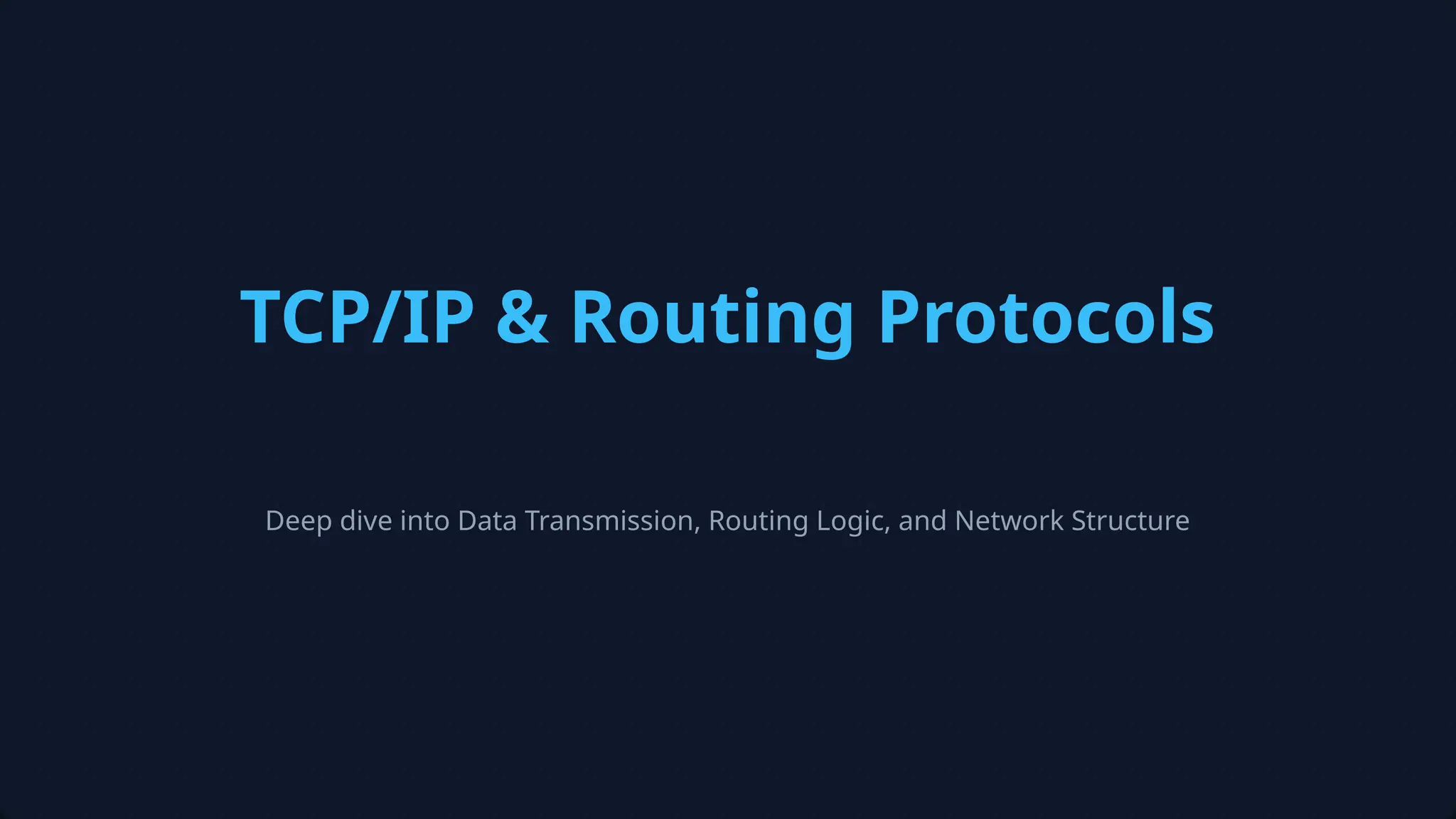
The Concept: theInternet Protocol (IP) is like a
massive transcontinental subway system.
The Passengers: Data packets act like passengers
trying to get from a starting station (Source) to a final
stop (Destination).
The Mechanism: IP is responsible for forwarding
these packets between nodes (stations) until they
reach their journey's end.
The Subway Analogy
3.
Reliability: TCP vs.IP
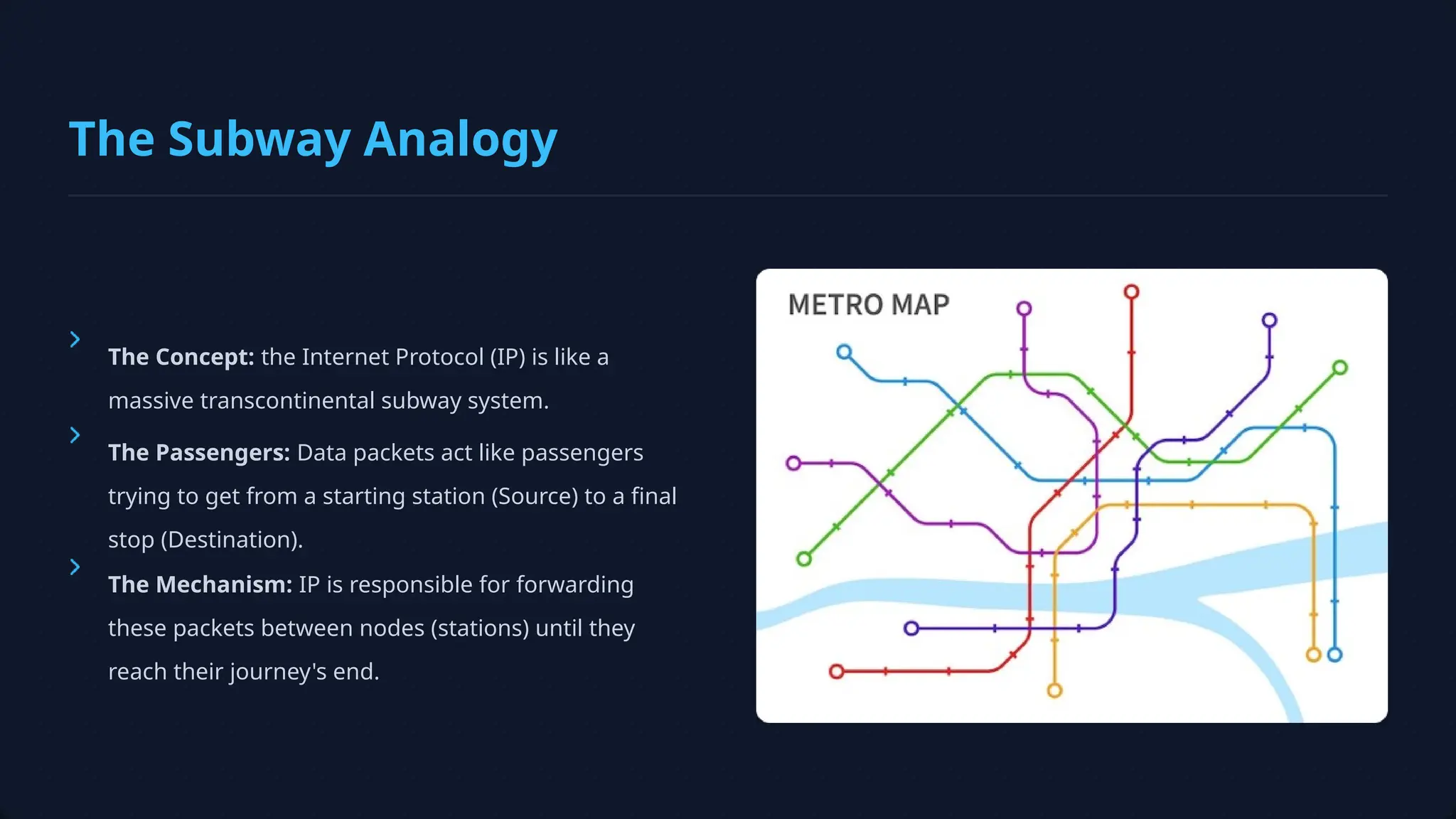
"Best Effort" Delivery
IP is a "best effort" service. It tries to deliver packets
but makes no guarantees.
The TCP Guarantee
If reliability is required, we rely on the Transmission
Control Protocol (TCP). TCP sits on top of IP layer and
guarantees that if a packet is dropped, it is resent,
guaranteeing the data arrives intact.
4.
Independent Packets
In apacket-switched network, every single packet
is treated as an individual traveler. Even if they are
part of the same file download, they are routed
separately.
Dynamic Pathing
A router makes a fresh decision for every packet.
If the direct path to is blocked, the router might
send the next packet via another instead.
The Routing Decision
5.
Distance Vector Protocol
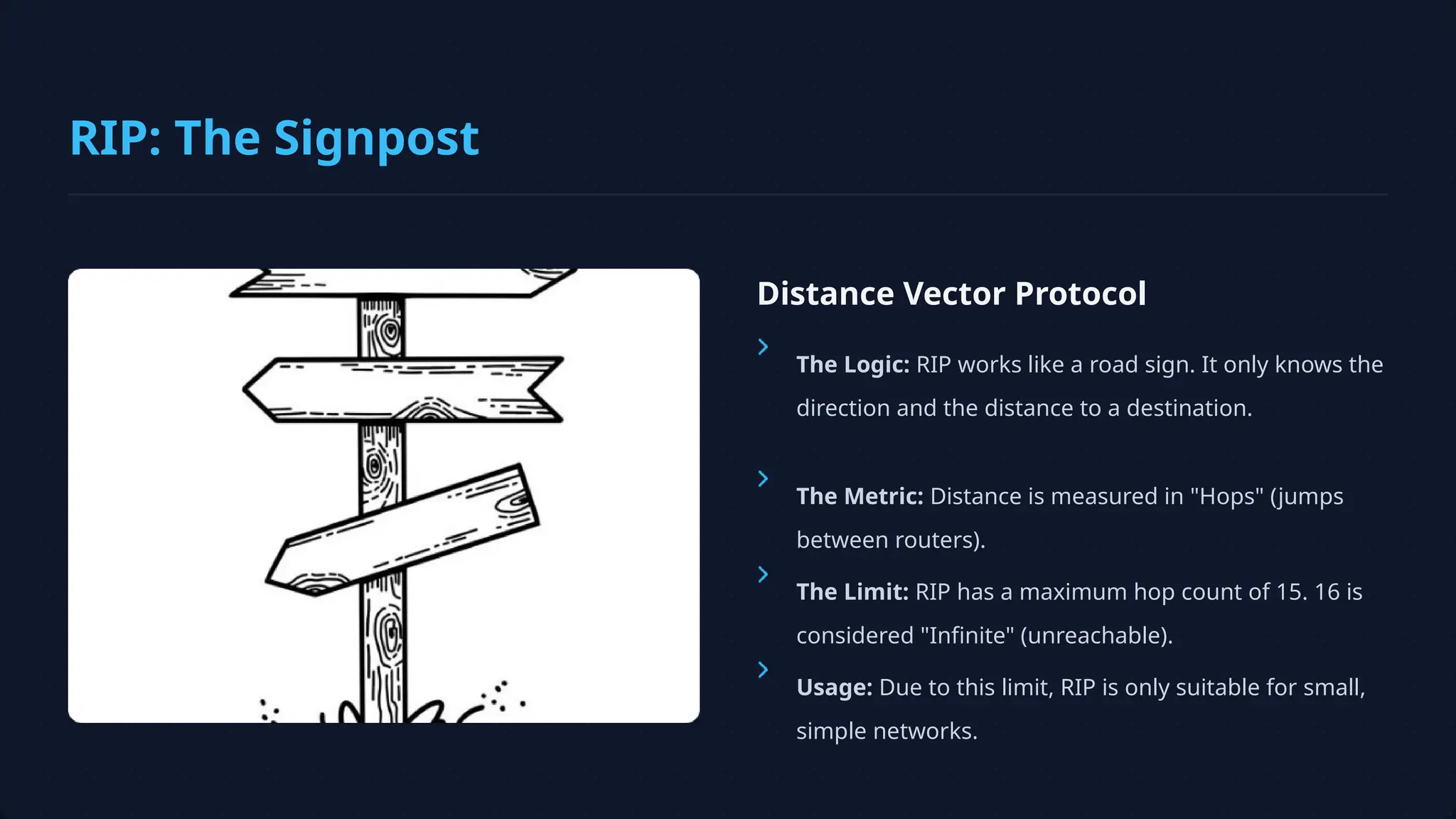
TheLogic: RIP works like a road sign. It only knows the
direction and the distance to a destination.
The Metric: Distance is measured in "Hops" (jumps
between routers).
The Limit: RIP has a maximum hop count of 15. 16 is
considered "Infinite" (unreachable).
Usage: Due to this limit, RIP is only suitable for small,
simple networks.
RIP: The Signpost
6.
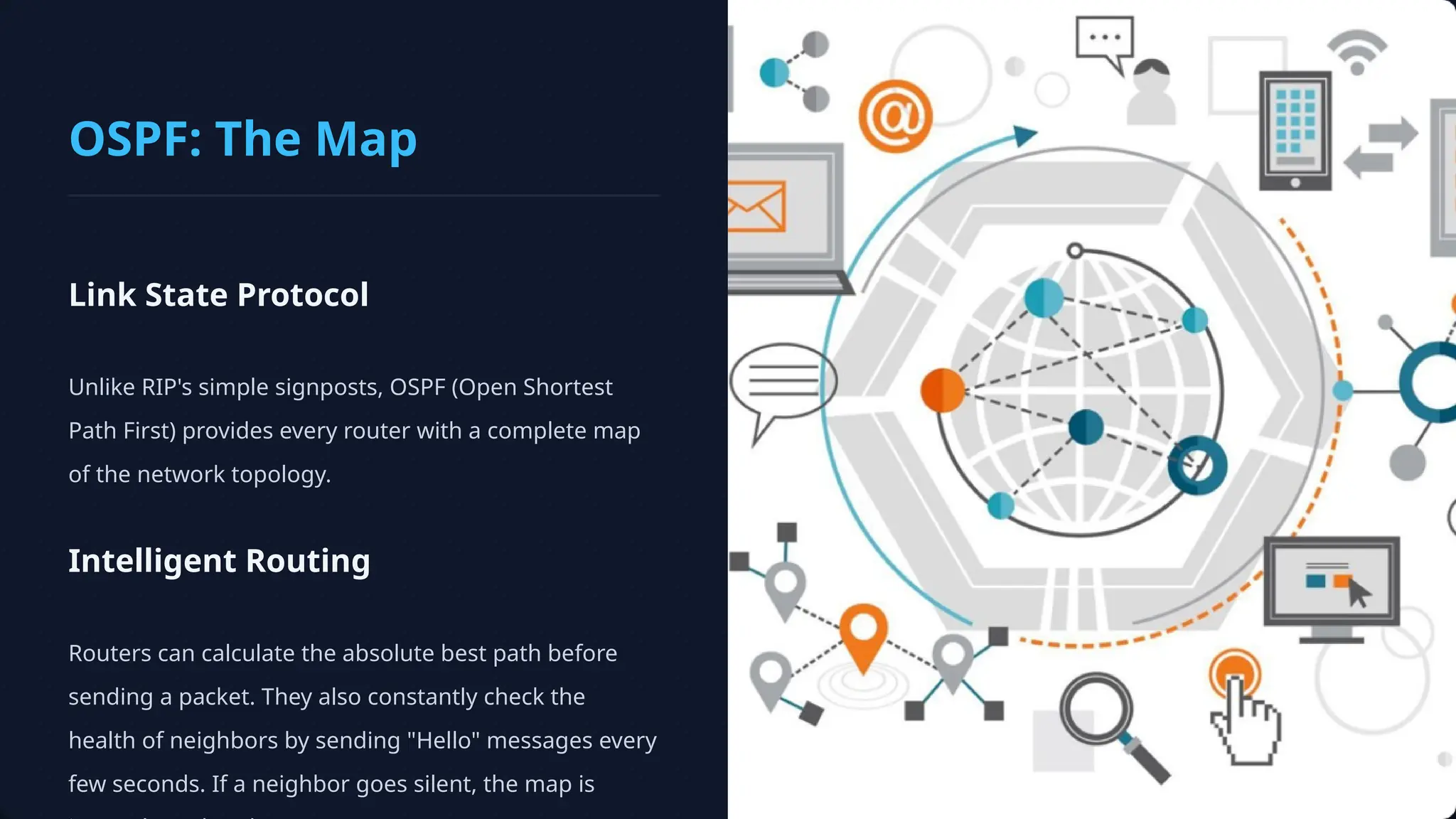
OSPF: The Map
LinkState Protocol
Unlike RIP's simple signposts, OSPF (Open Shortest
Path First) provides every router with a complete map
of the network topology.
Intelligent Routing
Routers can calculate the absolute best path before
sending a packet. They also constantly check the
health of neighbors by sending "Hello" messages every
few seconds. If a neighbor goes silent, the map is
7.
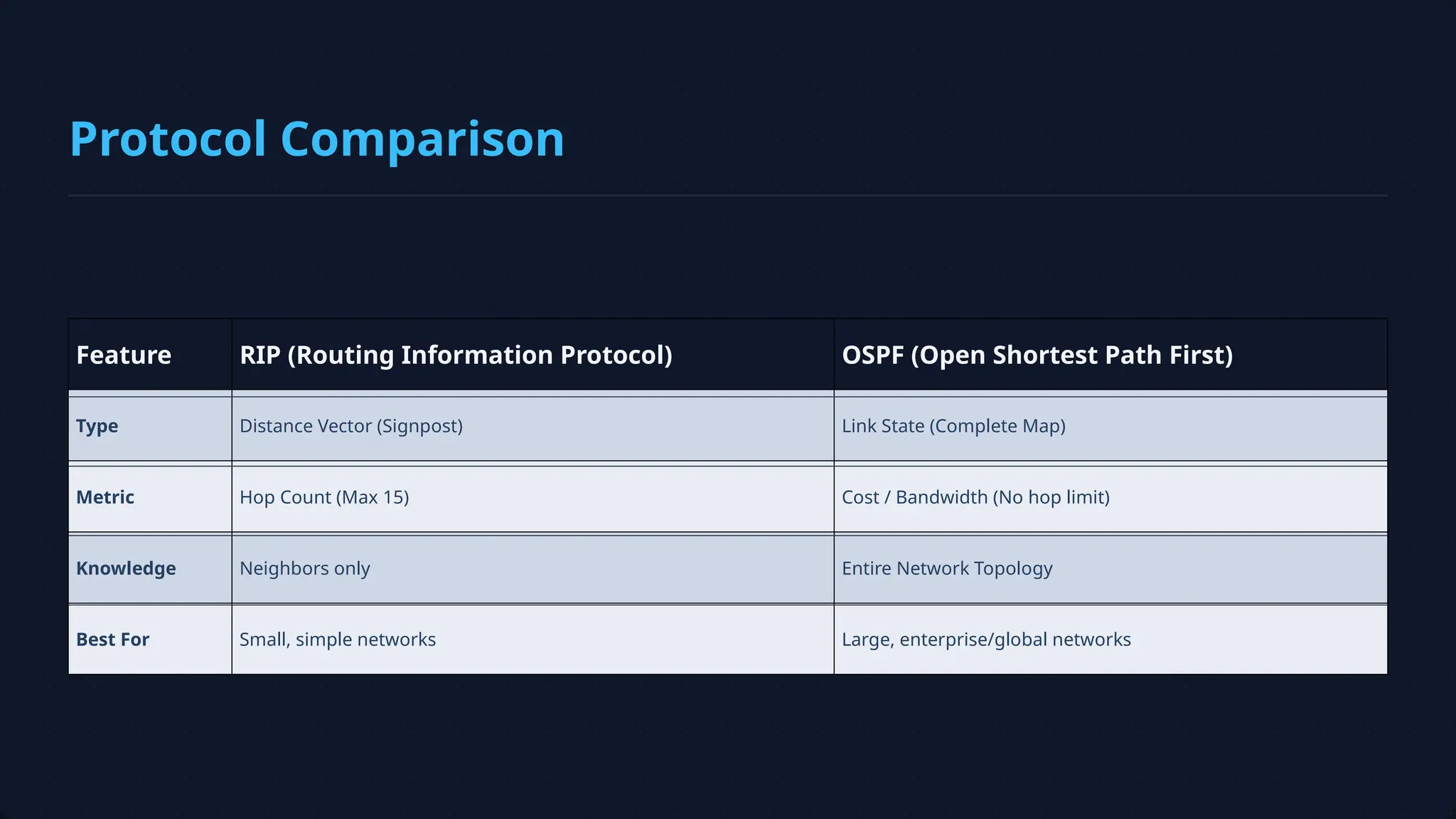
Feature RIP (RoutingInformation Protocol) OSPF (Open Shortest Path First)
Type Distance Vector (Signpost) Link State (Complete Map)
Metric Hop Count (Max 15) Cost / Bandwidth (No hop limit)
Knowledge Neighbors only Entire Network Topology
Best For Small, simple networks Large, enterprise/global networks
Protocol Comparison
8.
A Network ofNetworks
It is an collection of many smaller, independent networks
known as Autonomous Systems (AS).
Each AS is controlled by a separate administrative entity.
These systems interconnect to form the global internet we
use today.
Network Structure: Autonomous Systems


![[DSC Europe 25] Bassam Maharmeh - Artificial Intelligence: Opportunities and ...](https://cdn.slidesharecdn.com/ss_thumbnails/thhfmr2fqpawzj7hsjpg-5-251211083048-2c23204f-thumbnail.jpg?width=640&height=640&fit=bounds)
![[DSC Europe 25] Miodrag Pesovic & Vladislav Radonjic - Federated Data Archite...](https://cdn.slidesharecdn.com/ss_thumbnails/gsbe3y5it5uhndi4e08e-1-251212103249-f1008e0c-thumbnail.jpg?width=640&height=640&fit=bounds)
![[DSC Europe 25] Branko Urosevic -Rethinking Financial Talent: Integrating Cod...](https://cdn.slidesharecdn.com/ss_thumbnails/8jjrus8ttko6qj64f58f-3-251212103250-642c6374-thumbnail.jpg?width=640&height=640&fit=bounds)
![[DSC Europe 25] Kaja Kandare - LLM as a judge.pptx](https://cdn.slidesharecdn.com/ss_thumbnails/arxyccaxsdsd1ba99wjw-7-251212104007-2b4e3f64-thumbnail.jpg?width=640&height=640&fit=bounds)


![[DSC Europe 25] Marko Krstic - Understanding the AI Threat Landscape - Risks,...](https://cdn.slidesharecdn.com/ss_thumbnails/tiyim1ins5jvbrvzpzla-2-251209104645-c69d3553-thumbnail.jpg?width=640&height=640&fit=bounds)


![[DSC Europe 25] Jon Dajci - Bridging TradFi and DeFi: Building the Future of ...](https://cdn.slidesharecdn.com/ss_thumbnails/fqmhfvlbqhkihjvqvhmu-7-251211083849-6af7e325-thumbnail.jpg?width=640&height=640&fit=bounds)
![[DSC Europe 25] Debmalya Biswas - Agentification: the art of transforming man...](https://cdn.slidesharecdn.com/ss_thumbnails/r5azlggvtqiaiiusrqdr-4-251212103249-5a12c89b-thumbnail.jpg?width=640&height=640&fit=bounds)
![[DSC Europe 25] Jovan Bogicevic - Legacy to AI-Driven Defense: Transforming D...](https://cdn.slidesharecdn.com/ss_thumbnails/rsarluadt563hntyfc8q-3-251211083849-3e7bc4c0-thumbnail.jpg?width=640&height=640&fit=bounds)
![[DSC Europe 25] Hans Kleinsman - The Compliance Gearbox: How Tax Tech Mediate...](https://cdn.slidesharecdn.com/ss_thumbnails/dxdytie1toel0hr90bjs-2-251212103250-174fdbe7-thumbnail.jpg?width=640&height=640&fit=bounds)


![[DSC Europe 25] Nikolay Burlutskiy - Best Practices for Building Enterprise M...](https://cdn.slidesharecdn.com/ss_thumbnails/uirvaiuvq8y1w8hzd9tx-7-251212103249-2619edb4-thumbnail.jpg?width=640&height=640&fit=bounds)
![[DSC Europe 25] Ivan Peric - Intelligence Swarm Logic and Techno-Functional M...](https://cdn.slidesharecdn.com/ss_thumbnails/7my7c97fsduiccadgavw-2-251212103249-5a03f7c6-thumbnail.jpg?width=640&height=640&fit=bounds)