COGNITION IN
ROBOTICS
What’s COGNITION
“COGNITION” is a noun
word.
“It is process of acquiring
knowledge and
understanding through
thoughts, experiences and
senses
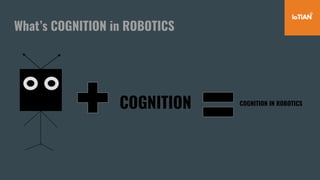
What’s COGNITION in ROBOTICS
COGNITION COGNITION IN ROBOTICS
Learning Techniques in
COGNITIVE ROBOTICS
A. Motor babble
B. Imitation
C. Knowledge Acquisition
A. Motor Babble
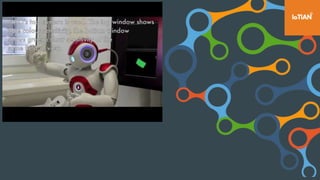
The motor babbling learning technique
involves correlating pseudo-random complex
motor movements by the robot with resulting
visual and/or auditory feedback such that the
robot may begin to expect a pattern of
sensory feedback given a pattern of motor
output
This is thought to be analogous to how a baby
learns to reach for objects or learns to
produce speech sounds.
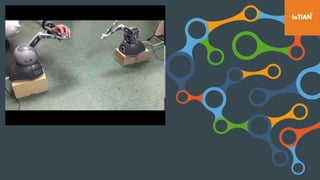
B. Imitation
In this learning technique The robot monitors
the performance of another agent and then
the robot tries to imitate that agent. It is often
a challenge to transform imitation
information from a complex scene into a
desired motor result for the robot. Note that
imitation is a high-level form of cognitive
behavior and imitation is not necessarily
required in a basic model of embodied animal
cognition.
C. Knowledge Acquisition
In knowledge acquisition A more complex
learning approach is "autonomous knowledge
acquisition":
A somewhat more directed mode of
exploration can be achieved by "curiosity"
algorithms These algorithms generally
involve breaking sensory input into a finite
number of categories and assigning some sort
of prediction system (such as an Artificial
Neural Network) to each.
ThankYou

Cognition in robotics

  • 1.
  • 2.
    What’s COGNITION “COGNITION” isa noun word. “It is process of acquiring knowledge and understanding through thoughts, experiences and senses
  • 3.
    What’s COGNITION inROBOTICS COGNITION COGNITION IN ROBOTICS
  • 4.
    Learning Techniques in COGNITIVEROBOTICS A. Motor babble B. Imitation C. Knowledge Acquisition
  • 5.
    A. Motor Babble Themotor babbling learning technique involves correlating pseudo-random complex motor movements by the robot with resulting visual and/or auditory feedback such that the robot may begin to expect a pattern of sensory feedback given a pattern of motor output This is thought to be analogous to how a baby learns to reach for objects or learns to produce speech sounds.
  • 7.
    B. Imitation In thislearning technique The robot monitors the performance of another agent and then the robot tries to imitate that agent. It is often a challenge to transform imitation information from a complex scene into a desired motor result for the robot. Note that imitation is a high-level form of cognitive behavior and imitation is not necessarily required in a basic model of embodied animal cognition.
  • 9.
    C. Knowledge Acquisition Inknowledge acquisition A more complex learning approach is "autonomous knowledge acquisition": A somewhat more directed mode of exploration can be achieved by "curiosity" algorithms These algorithms generally involve breaking sensory input into a finite number of categories and assigning some sort of prediction system (such as an Artificial Neural Network) to each.
  • 10.

Editor's Notes

  • #2 So, for formallity my name is ANkit Birla