© 2010 by W. W. Norton & Co., Inc.
Visual Knowledge
Chapter 10
Lecture Outline
Chapter 10: Visual Knowledge
 Lecture Outline
 Visual Imagery
 Long-Term Visual Memory
 The Diversity of Knowledge
Visual Imagery
 A variety of day-to-day problems seem to
require the use of visual imagery
 How many windows are in your apartment?
 Was David in class yesterday?
 Will this sweater look good with your blue
pants?
 What is the nature of these mental
images?
Visual Imagery
 Francis Galton (1883)
 Introspection to study mental imagery
 Self-reports suggested they could inspect mental images
as pictures
 The participants also differed widely in the amount of
detail their mental images seemed to contain. (Or were
these differences in self-reporting style?)
 Studies of visual imagery in the last 50
years have avoided introspection and
instead asked participants to do
something with their images—to read
information off them or manipulate them in
some way.
© 2010 by W. W. Norton &
Co., Inc.
5
Visual Imagery
 Chronometric studies
 Ask participants to manipulate the mental
images
 Observe how long these manipulations take
Visual Imagery
 Kosslyn (1976) asked participants to answer
yes/no questions about their mental images.
 Imagined cat, confirm that cats have heads faster
compared to confirming that cats have claws (mental
imagery)
 The reverse was true if the participants were asked to
think about cats, not to imagine them (propositional
knowledge)
 This suggests that as the mode of representation
changes, so does the pattern of information
availability
Visual Imagery
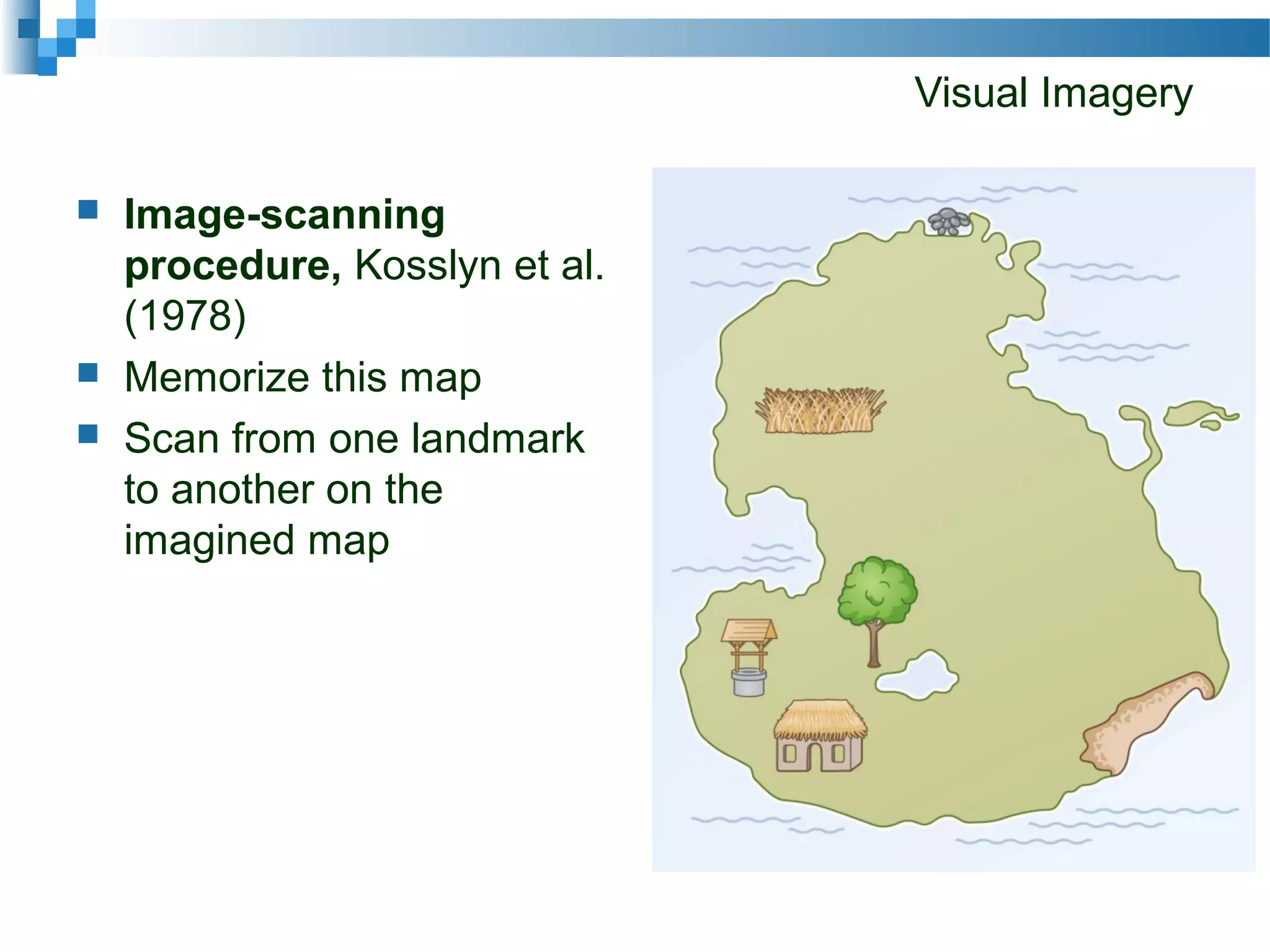
 Image-scanning
procedure, Kosslyn et al.
(1978)
 Memorize this map
 Scan from one landmark
to another on the
imagined map
Visual Imagery
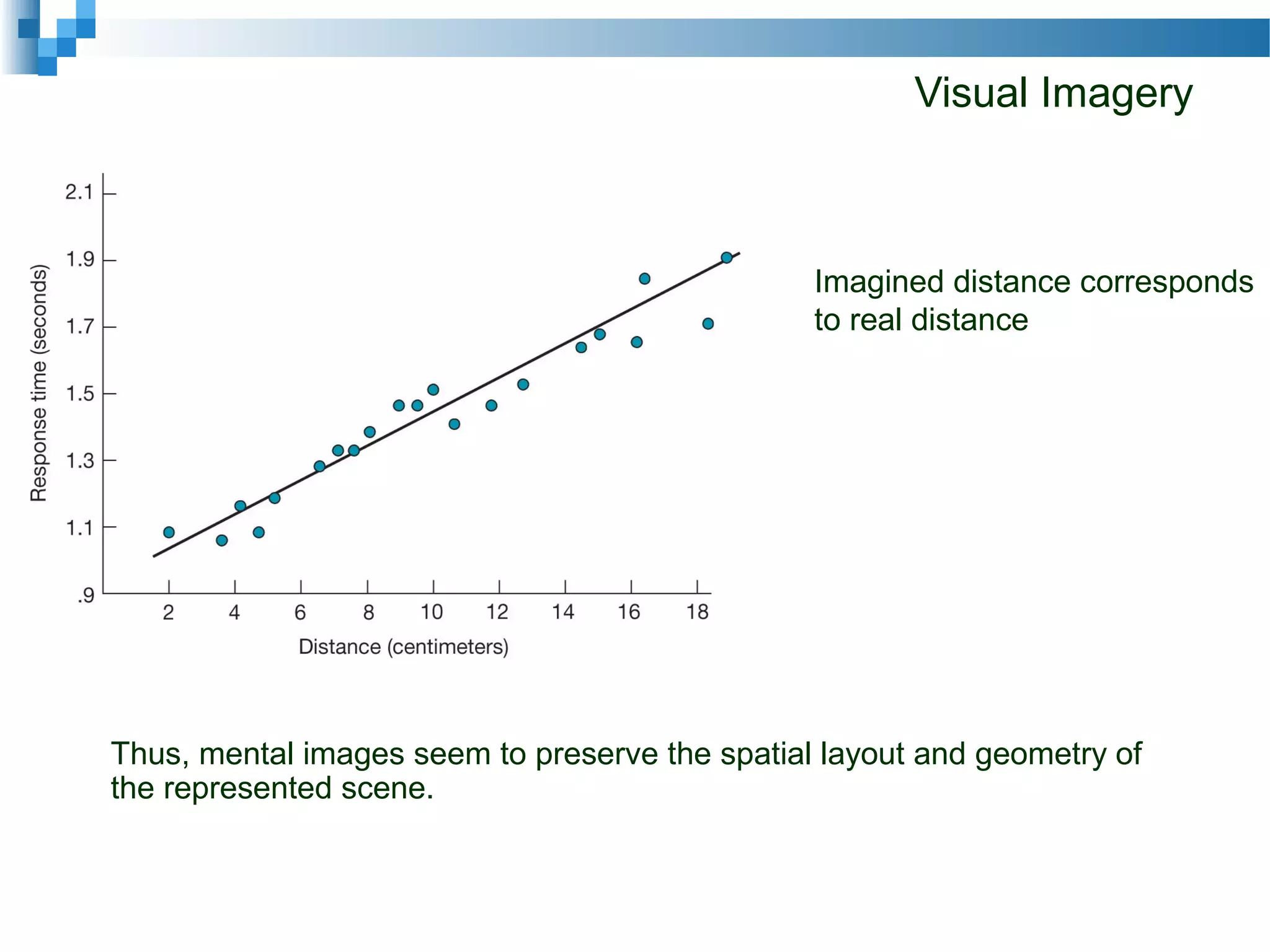
Imagined distance corresponds
to real distance
Thus, mental images seem to preserve the spatial layout and geometry of
the represented scene.
Visual Imagery
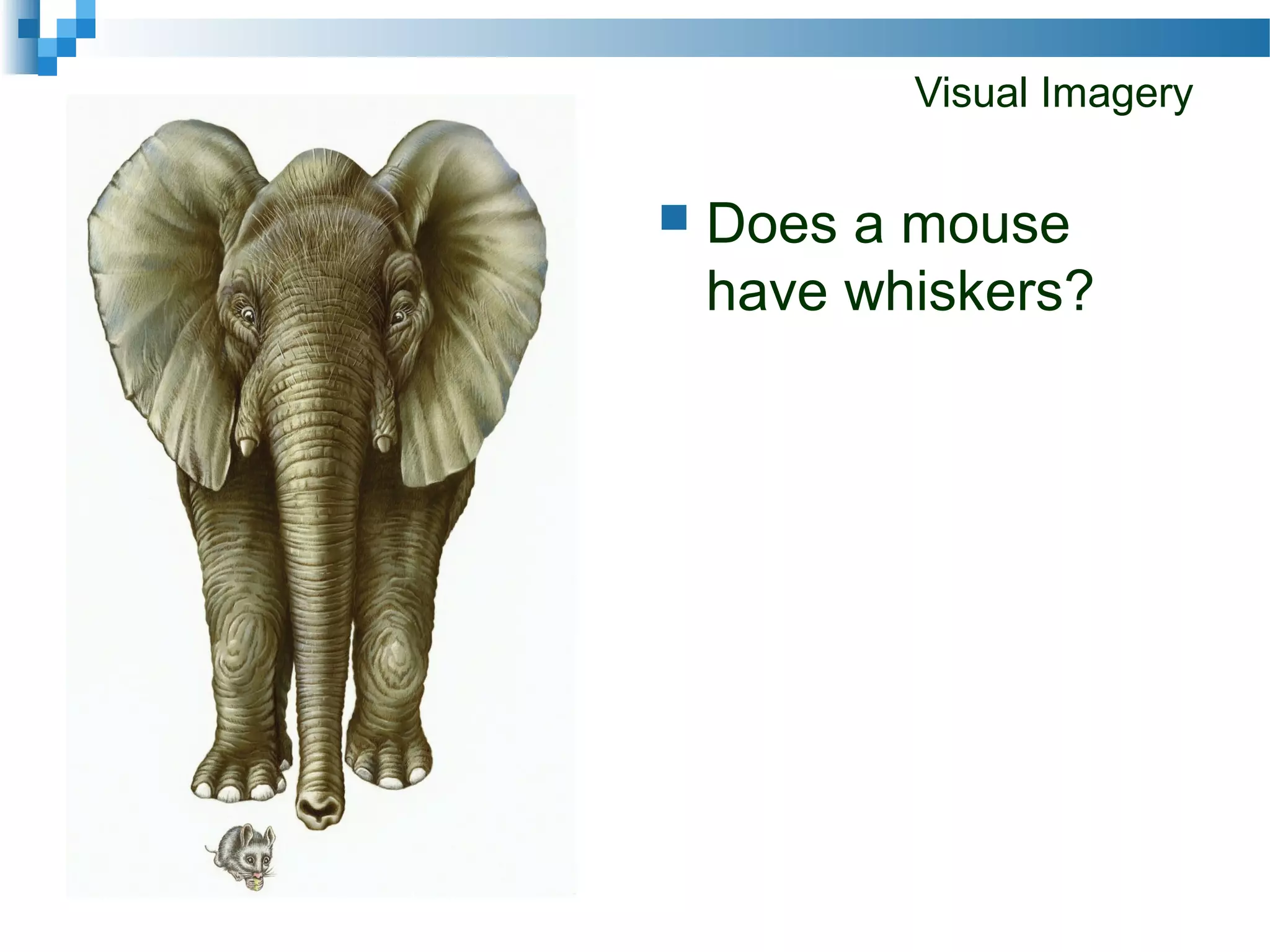
 Does a mouse
have whiskers?
Visual Imagery
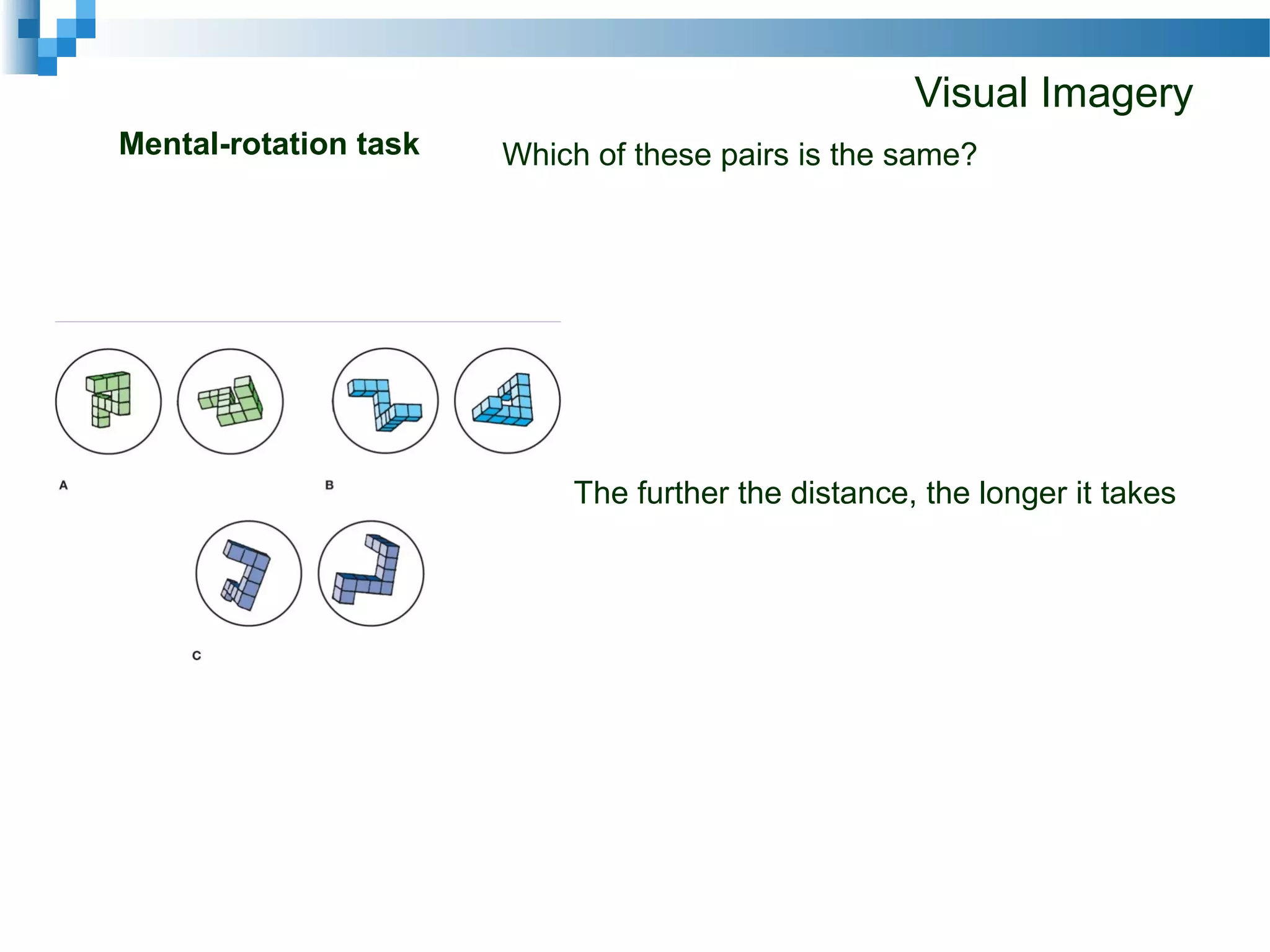
Mental-rotation task Which of these pairs is the same?
The further the distance, the longer it takes
Visual Imagery
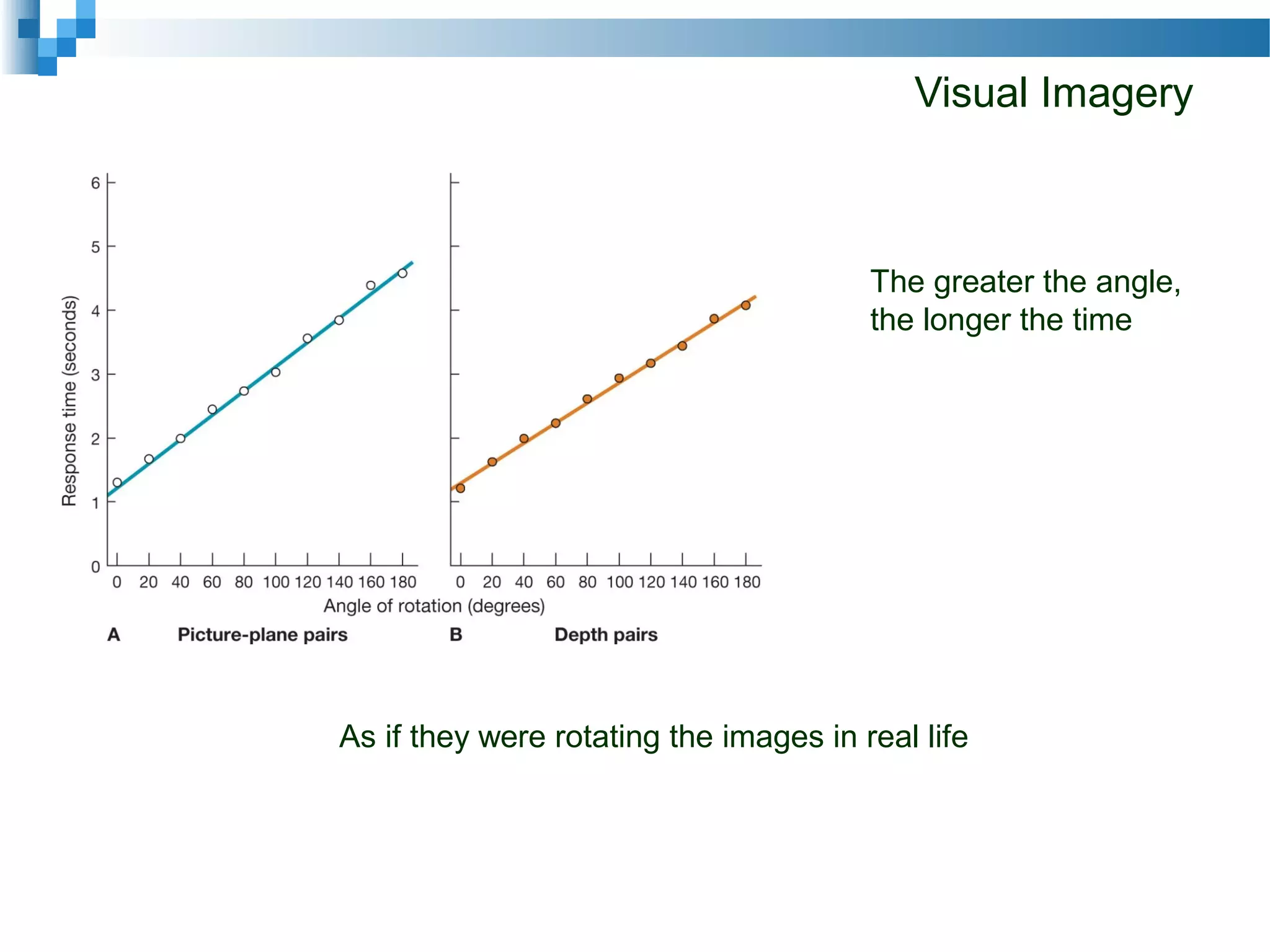
The greater the angle,
the longer the time
As if they were rotating the images in real life
Visual Imagery
 Demand character
 Did image-scanning and mental-rotation
experimenters somehow cue people?
 Even without instruction, participants still form
images
Visual Imagery
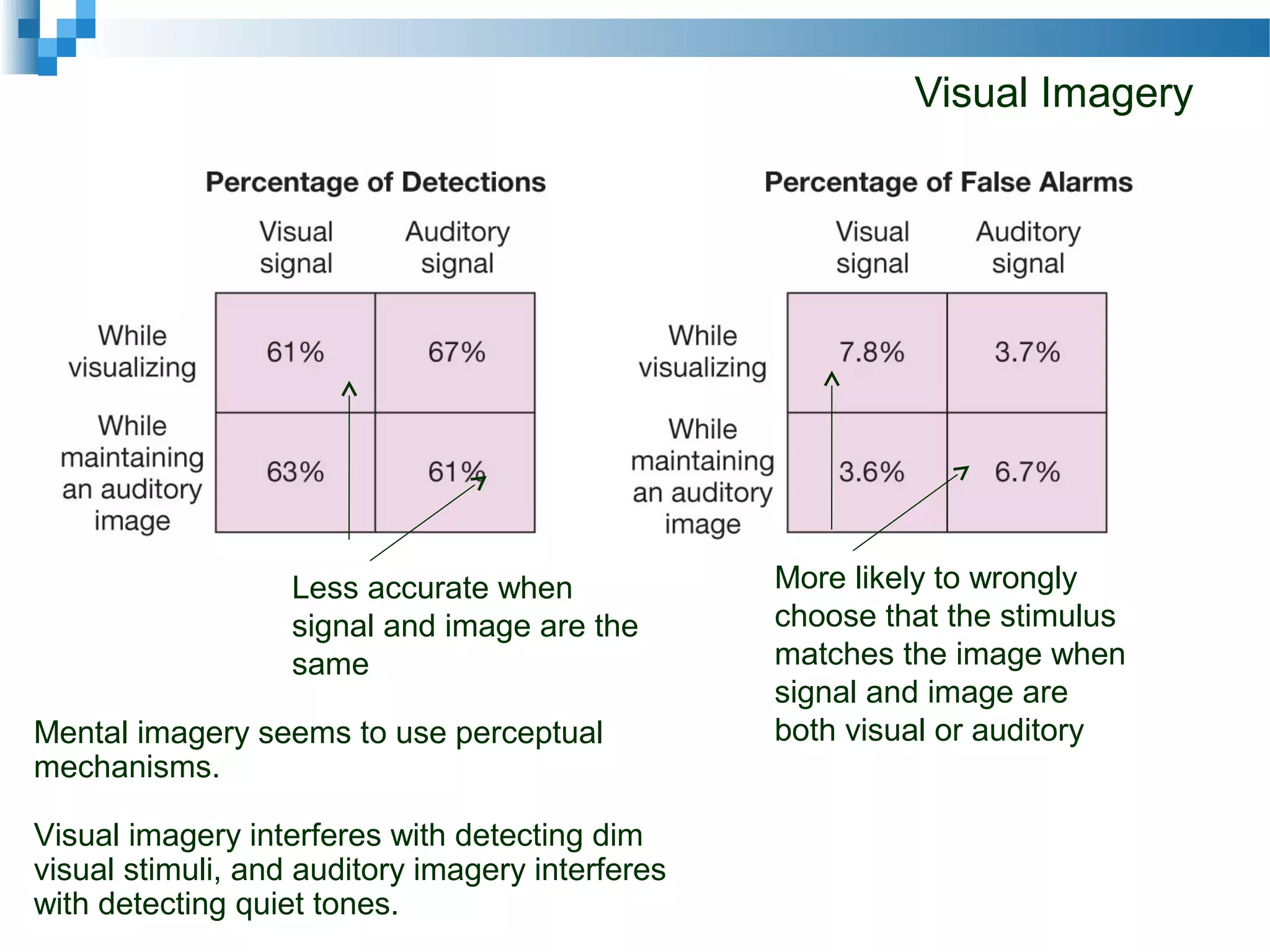
Less accurate when
signal and image are the
same
More likely to wrongly
choose that the stimulus
matches the image when
signal and image are
both visual or auditoryMental imagery seems to use perceptual
mechanisms.
Visual imagery interferes with detecting dim
visual stimuli, and auditory imagery interferes
with detecting quiet tones.
Visual Imagery
 However, if we are imagining a stimulus
related to the one we are about to
perceive, facilitation occurs.
 Imagery
 Can interfere with perception (mismatching)
 Can facilitate perception (matching)
Visual Imagery
 Occipital areas used for early visual
processing
 Active during visual imagery
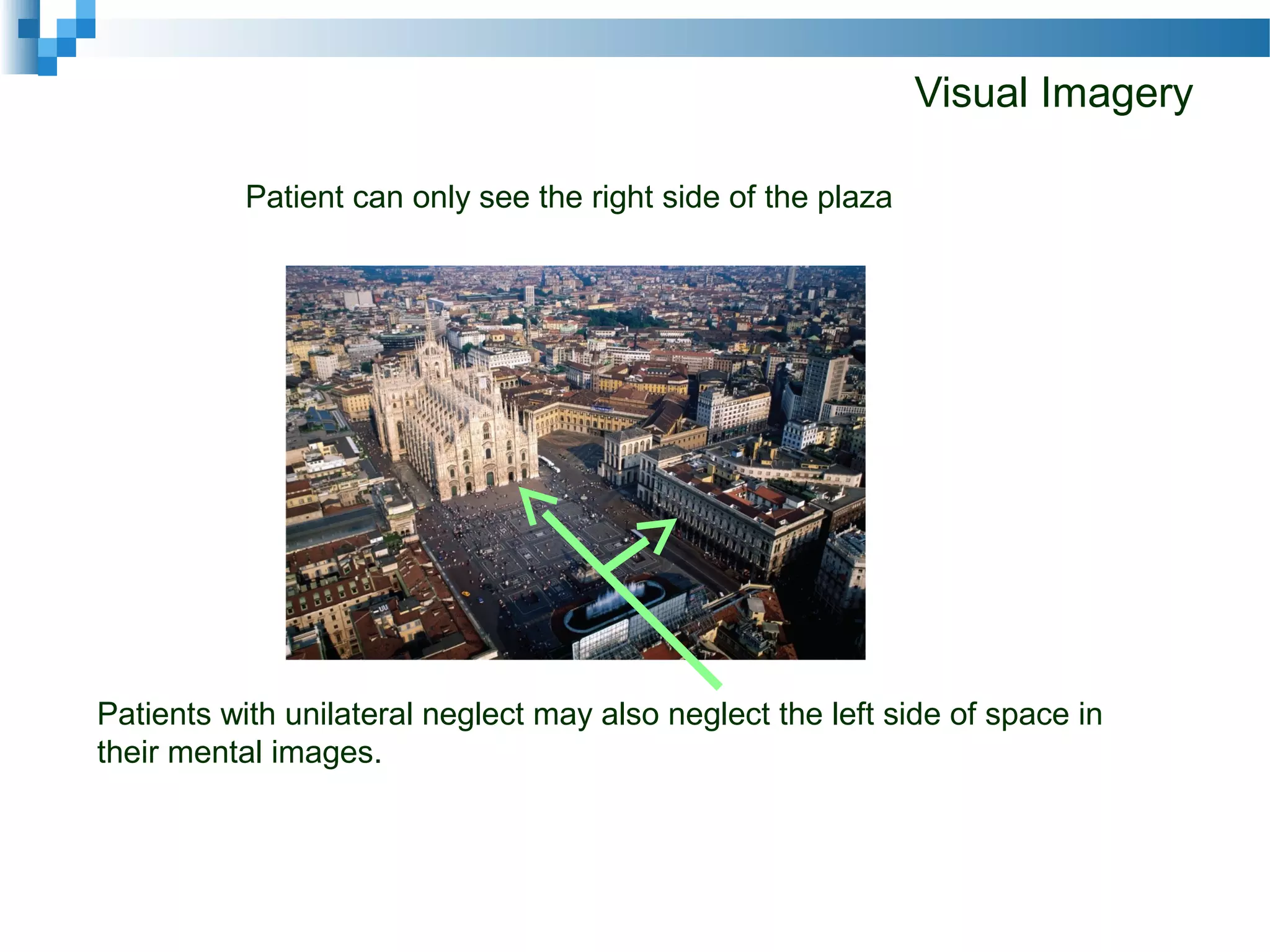
 Patients with unilateral neglect may also
neglect the left side of space in their mental
images
 Transcranial magnetic stimulation (TMS)
disrupts mental imagery
Visual Imagery
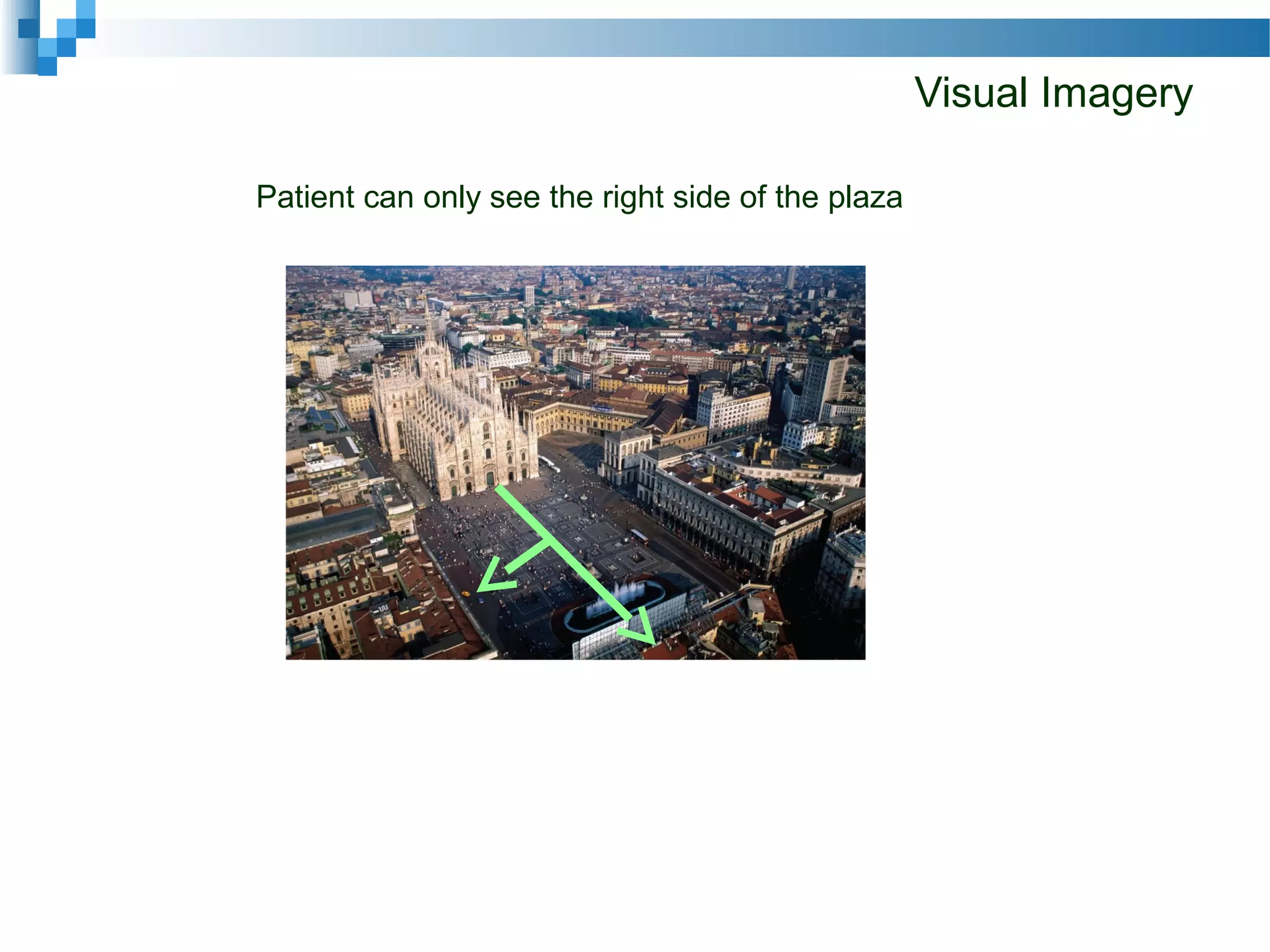
Patient can only see the right side of the plaza
Patients with unilateral neglect may also neglect the left side of space in
their mental images.
Visual Imagery
Patient can only see the right side of the plaza
Visual Imagery
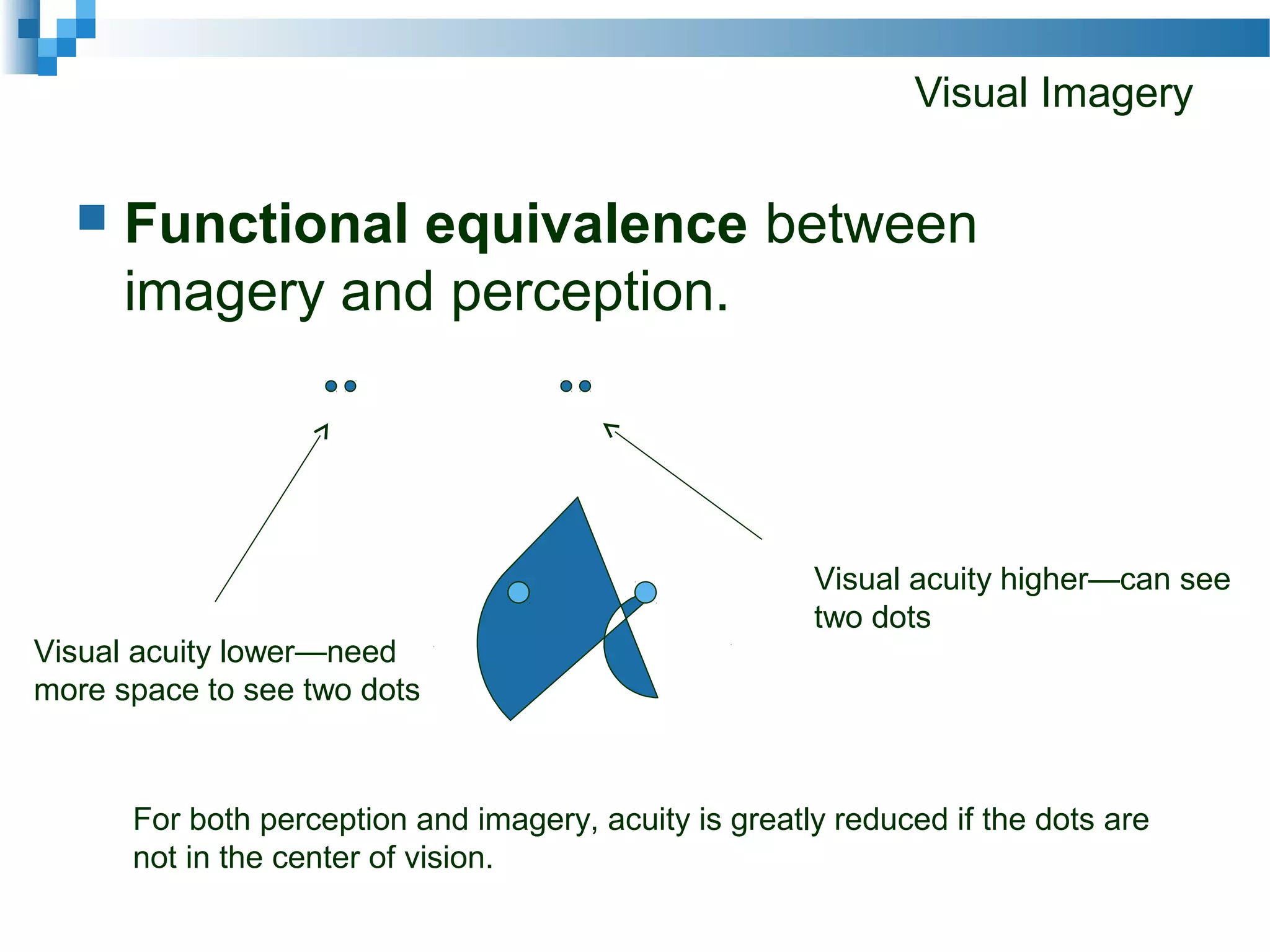
 Functional equivalence between
imagery and perception.
Visual acuity higher—can see
two dots
Visual acuity lower—need
more space to see two dots
For both perception and imagery, acuity is greatly reduced if the dots are
not in the center of vision.
Visual Imagery
 People who have been blind since birth
also demonstrate the same effects in
mental-rotation or image-scanning tasks,
with response time being proportional to
the distance traveled
 Thus, we need to distinguish between
visual imagery and spatial imagery
 Spatial imagery may be based in
movement or body imagery, or it may be
abstract and not tied to any one sense
Visual Imagery
 Vivid imagers versus non-imagers
 Report seeing images better
 Self-reported “vivid imagers” perform no
differently than “non-imagers” on tasks that
depend on spatial imagery.
 Vivid imagers better for visual imagery
Visual Imagery
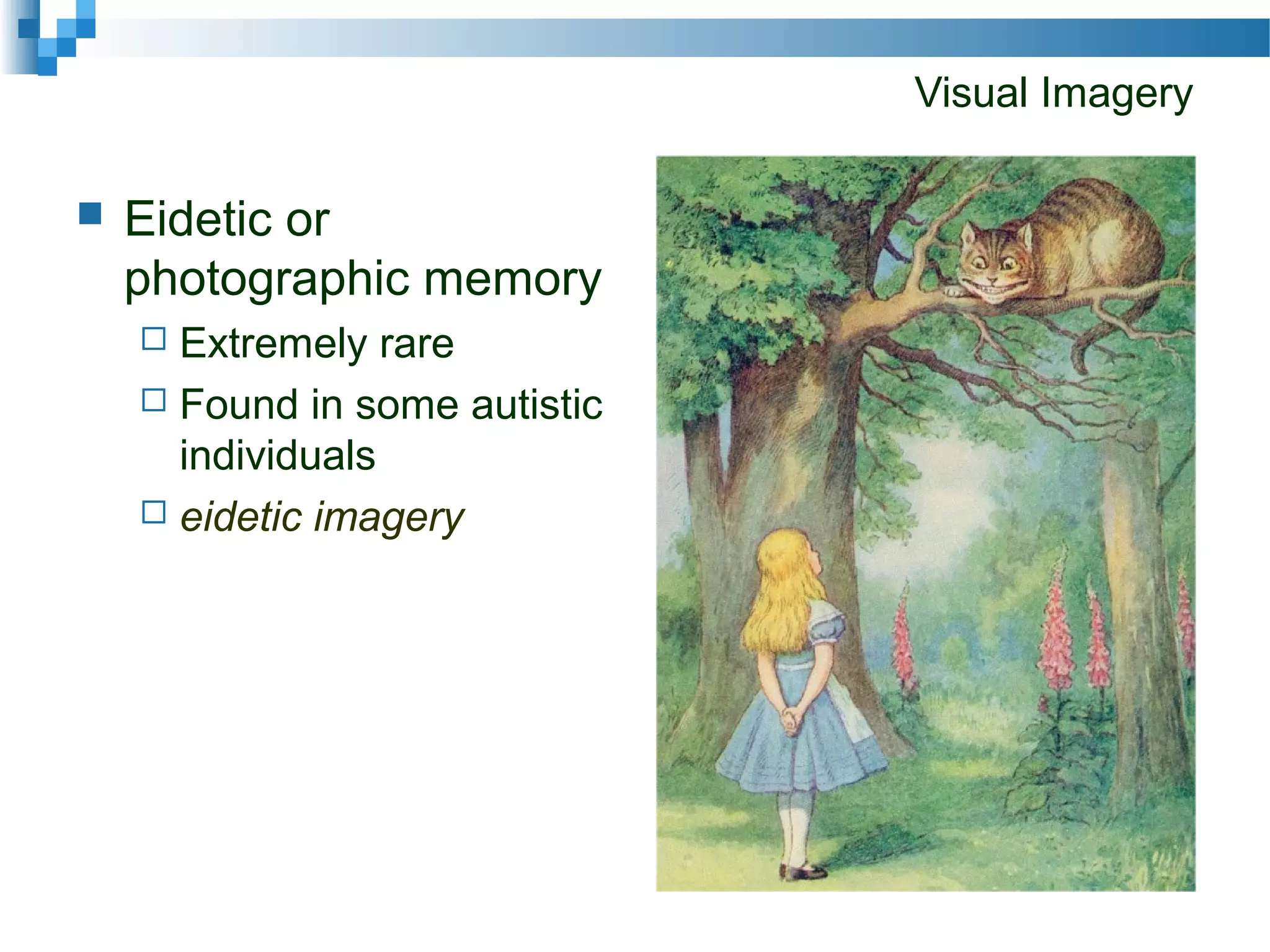
 Eidetic or
photographic memory
 Extremely rare
 Found in some autistic
individuals
 eidetic imagery
Visual Imagery
 Mental images different from pictures
 Perception is not neutral and goes beyond the
information given
 Interpretations are present in images
Visual Imagery
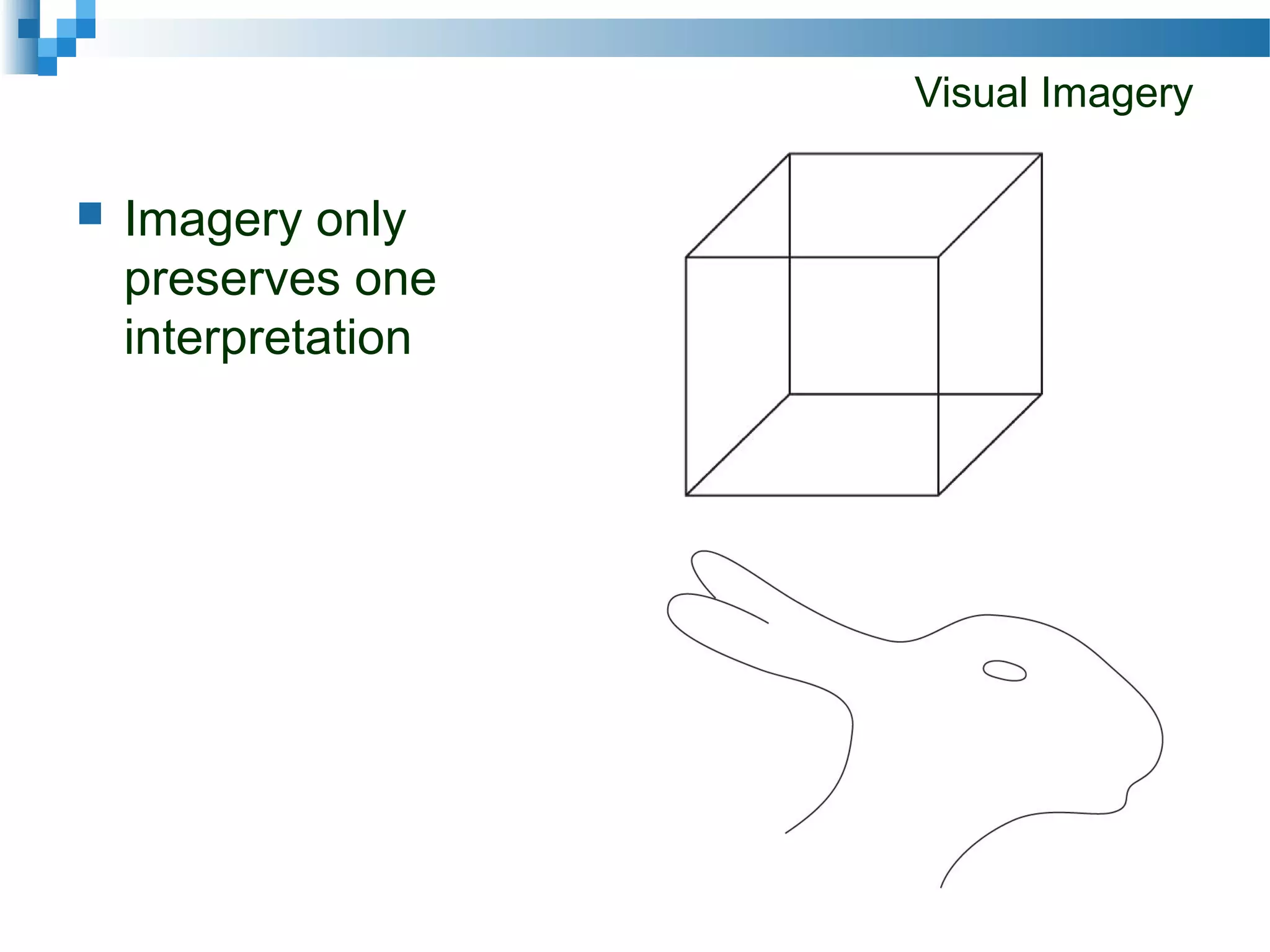
 Imagery only
preserves one
interpretation
Visual Imagery
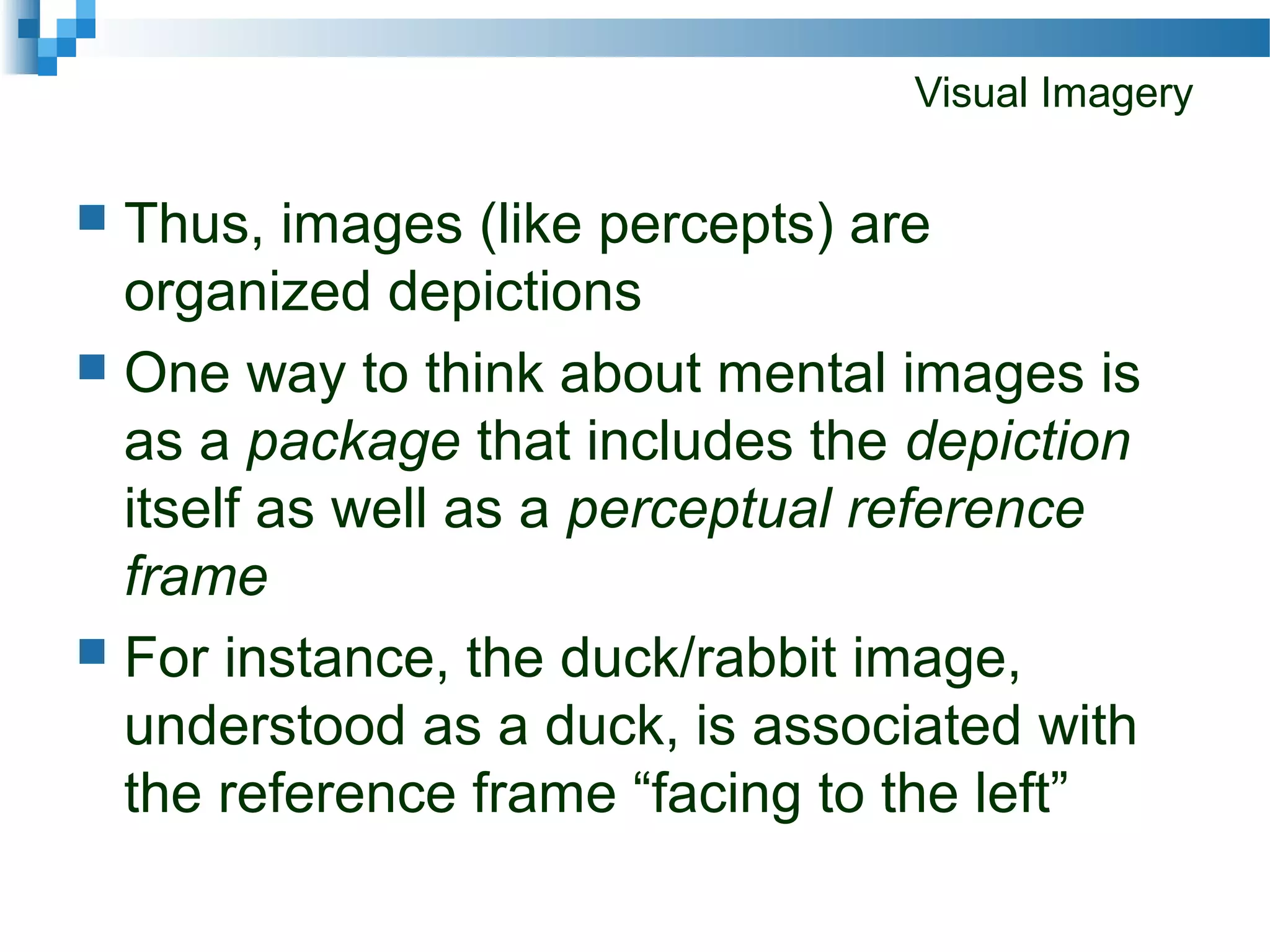
 Thus, images (like percepts) are
organized depictions
 One way to think about mental images is
as a package that includes the depiction
itself as well as a perceptual reference
frame
 For instance, the duck/rabbit image,
understood as a duck, is associated with
the reference frame “facing to the left”
Visual Imagery
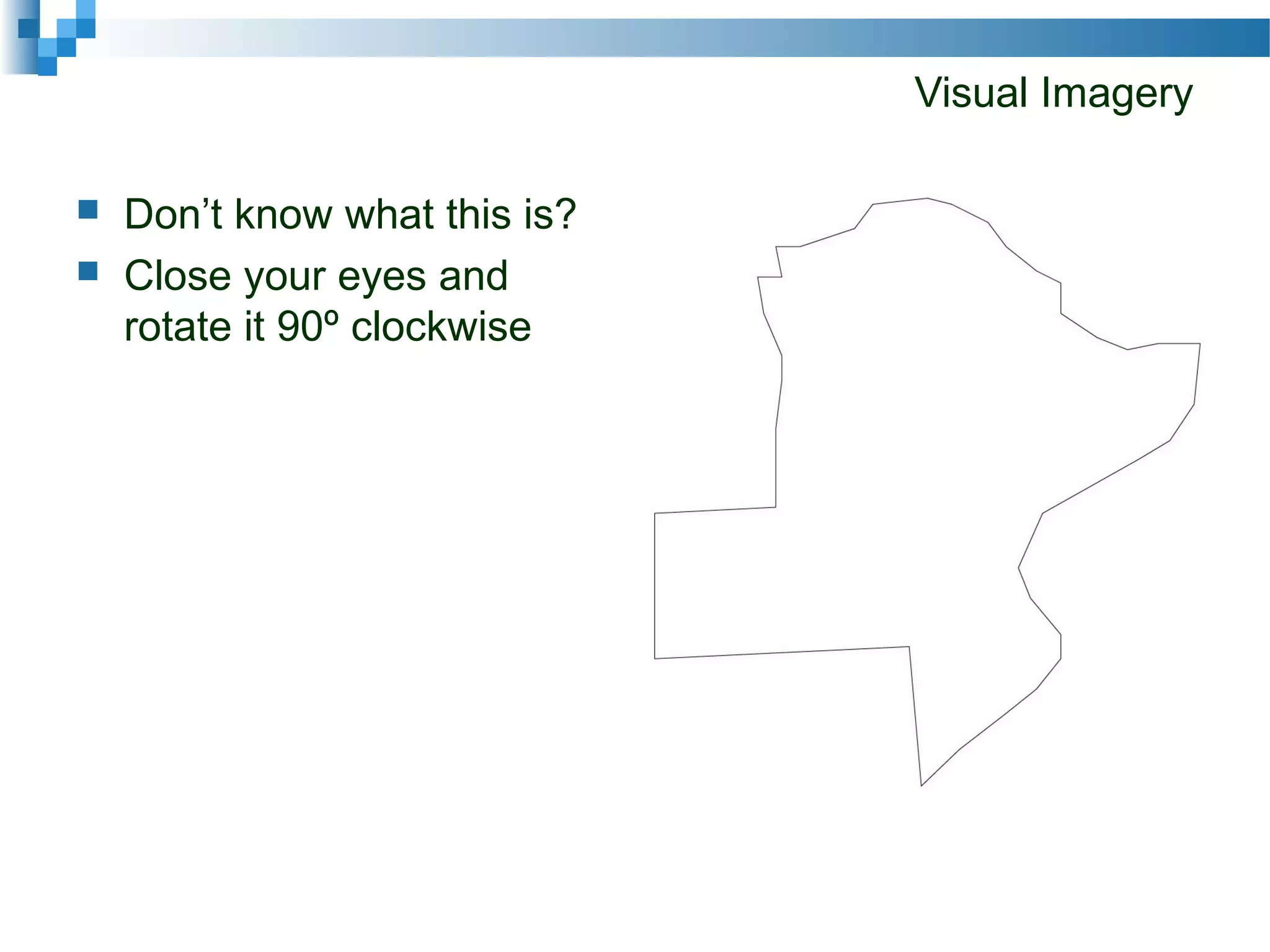
 Don’t know what this is?
 Close your eyes and
rotate it 90º clockwise
Visual Imagery
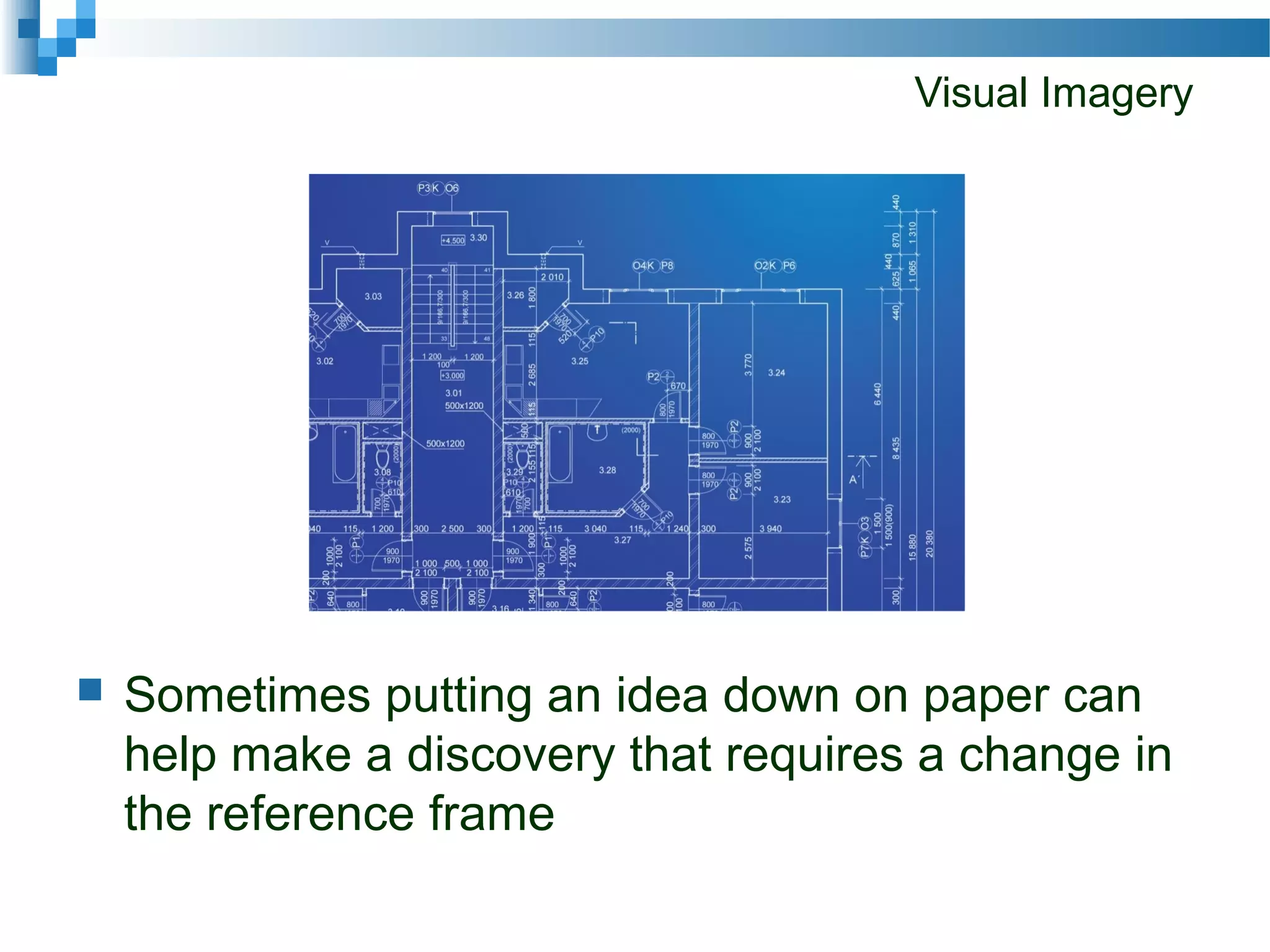
 Sometimes putting an idea down on paper can
help make a discovery that requires a change in
the reference frame
Visual Imagery
 Mental images
 Alternative to verbal description
 Spatial layout and geometry are preserved
 Reflect perceptual interpretation and are
associated with reference frames
Long-Term Visual Memory
 What is the nature of visual imagery taken
from long-term memory?
Long-Term Visual Memory
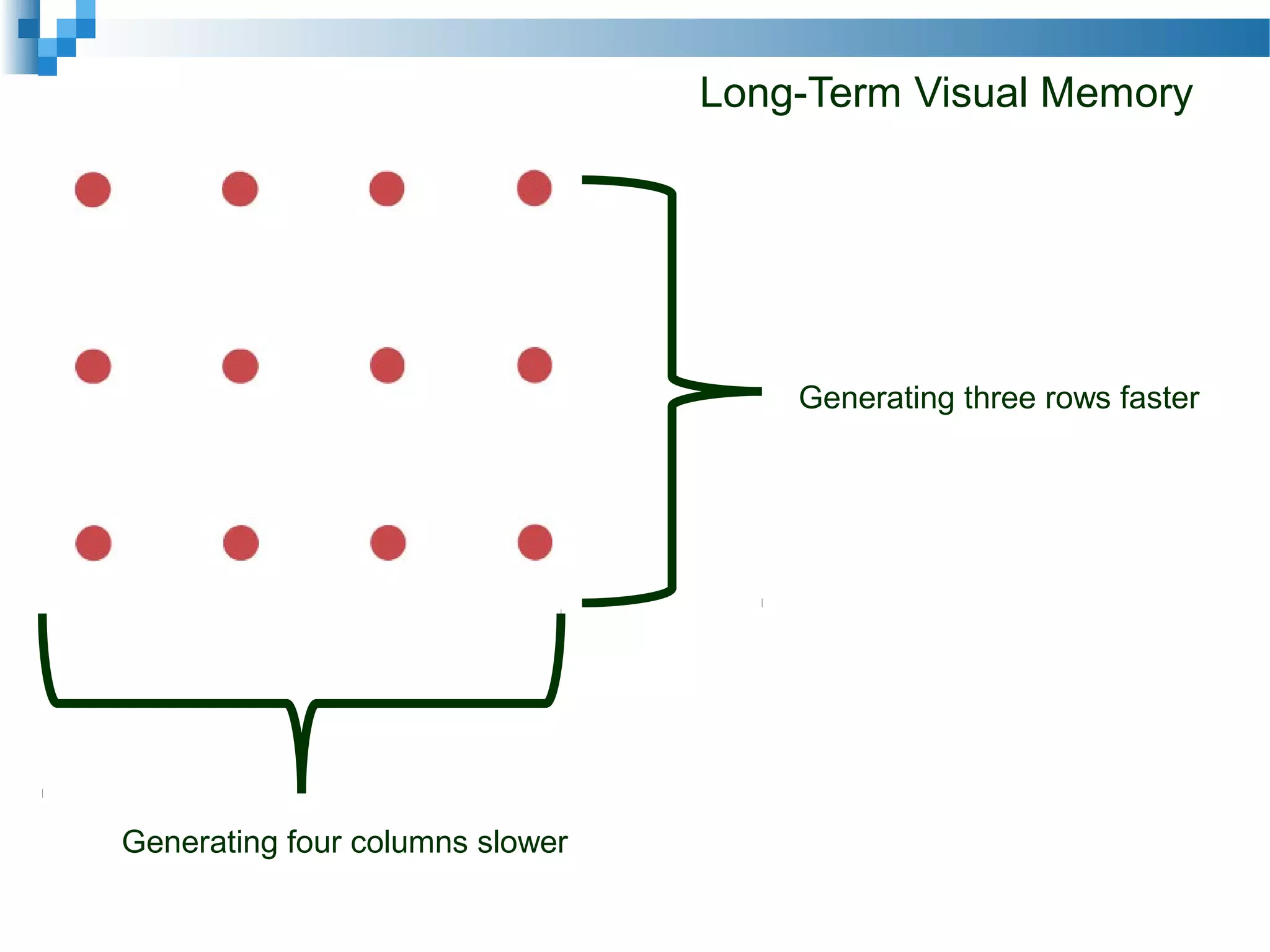
 Images in long-term memory
 Stored in a piecemeal fashion
 Must activate representation of image frame
 Elaborate on this frame
 Images that have more parts or detail take
longer to create
Long-Term Visual Memory
Generating three rows faster
Generating four columns slower
Long-Term Visual Memory
 Long-term visual memory
 Image files
 Recipes or instructions for how to construct an
active mental image of the object or shape
 May represent visual information in terms of
propositions, or verbal labels
Long-Term Visual Memory
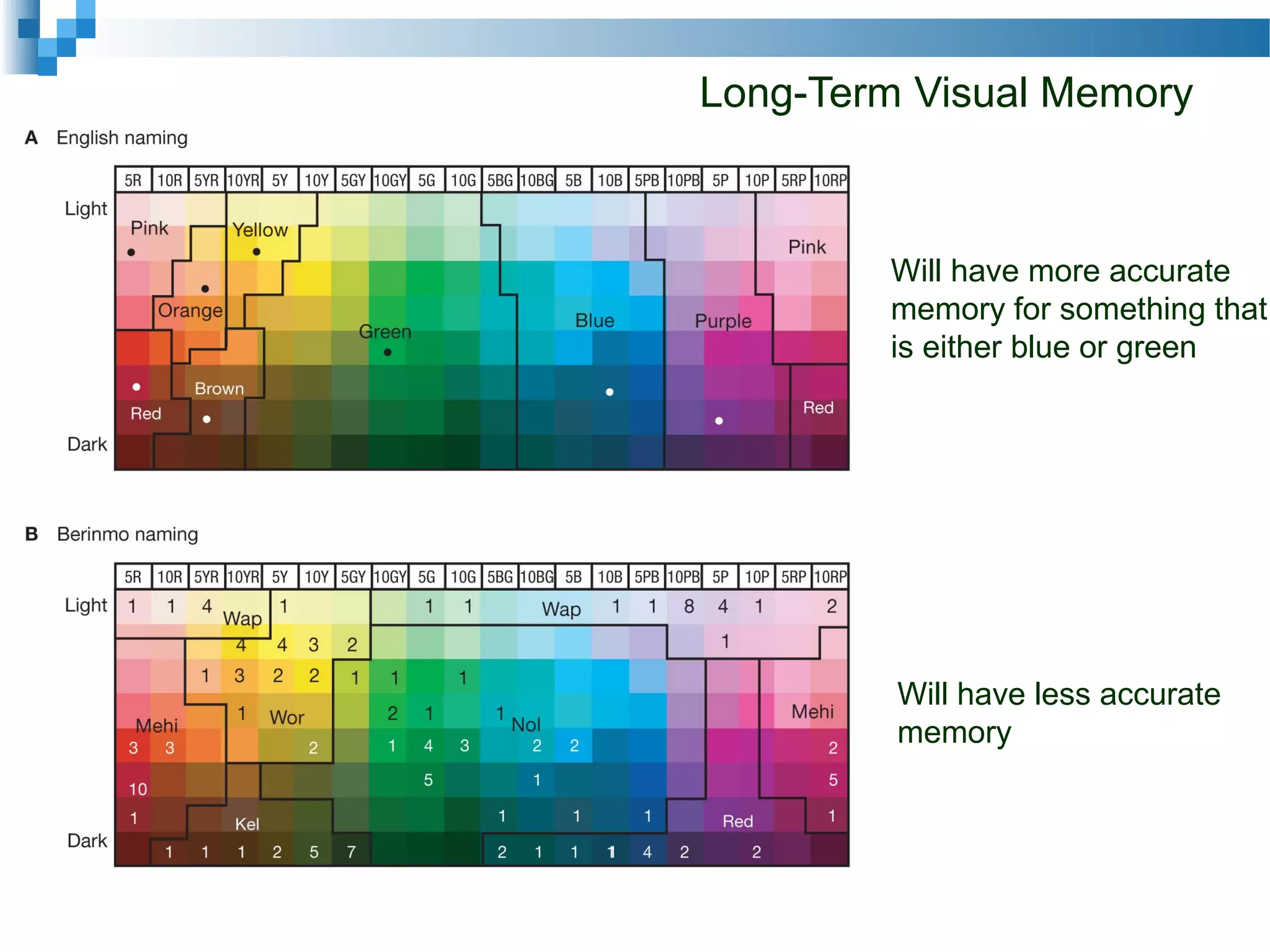
Will have more accurate
memory for something that
is either blue or green
Will have less accurate
memory
Long-Term Visual Memory
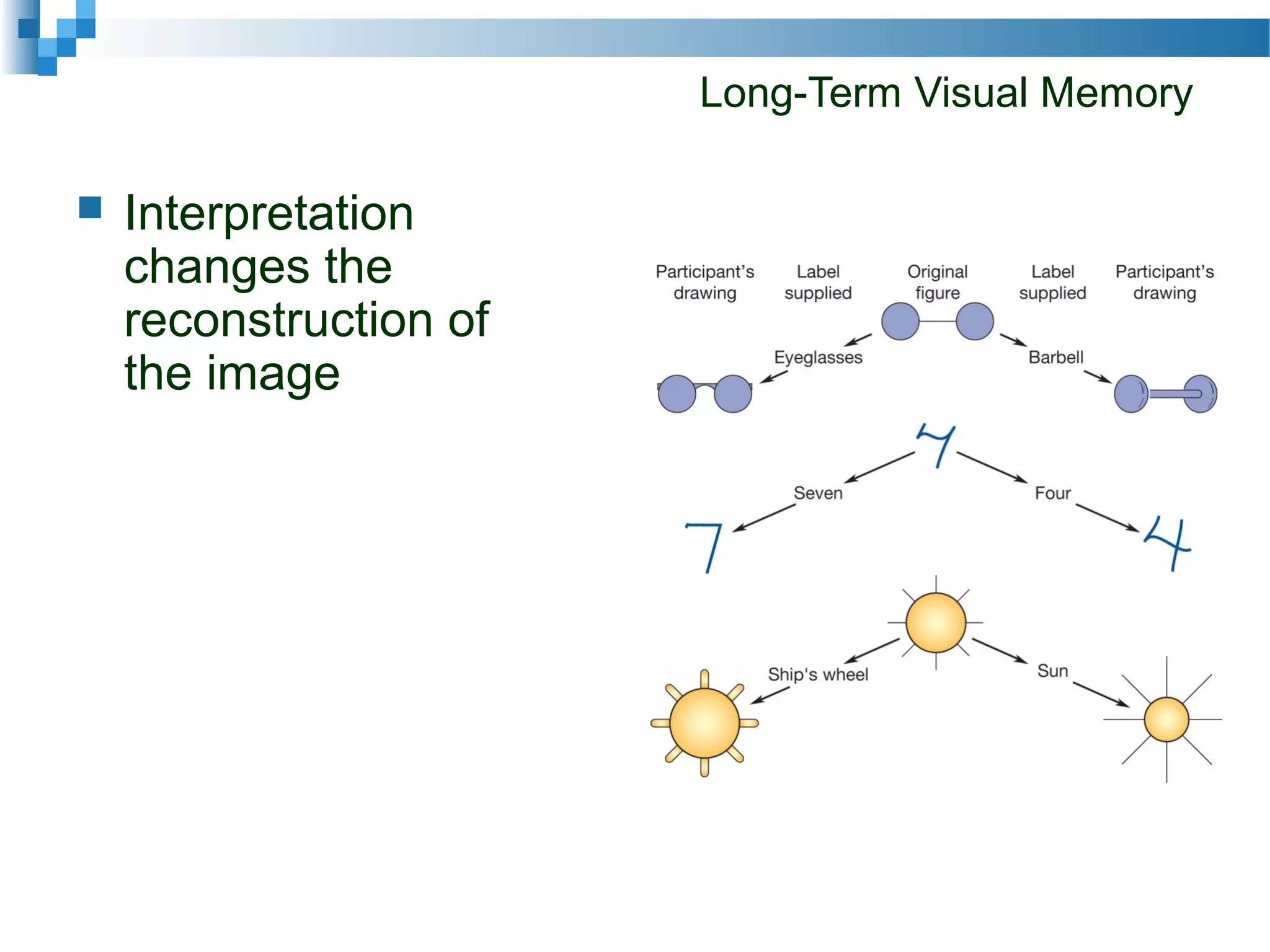
 Interpretation
changes the
reconstruction of
the image
Long-Term Visual Memory
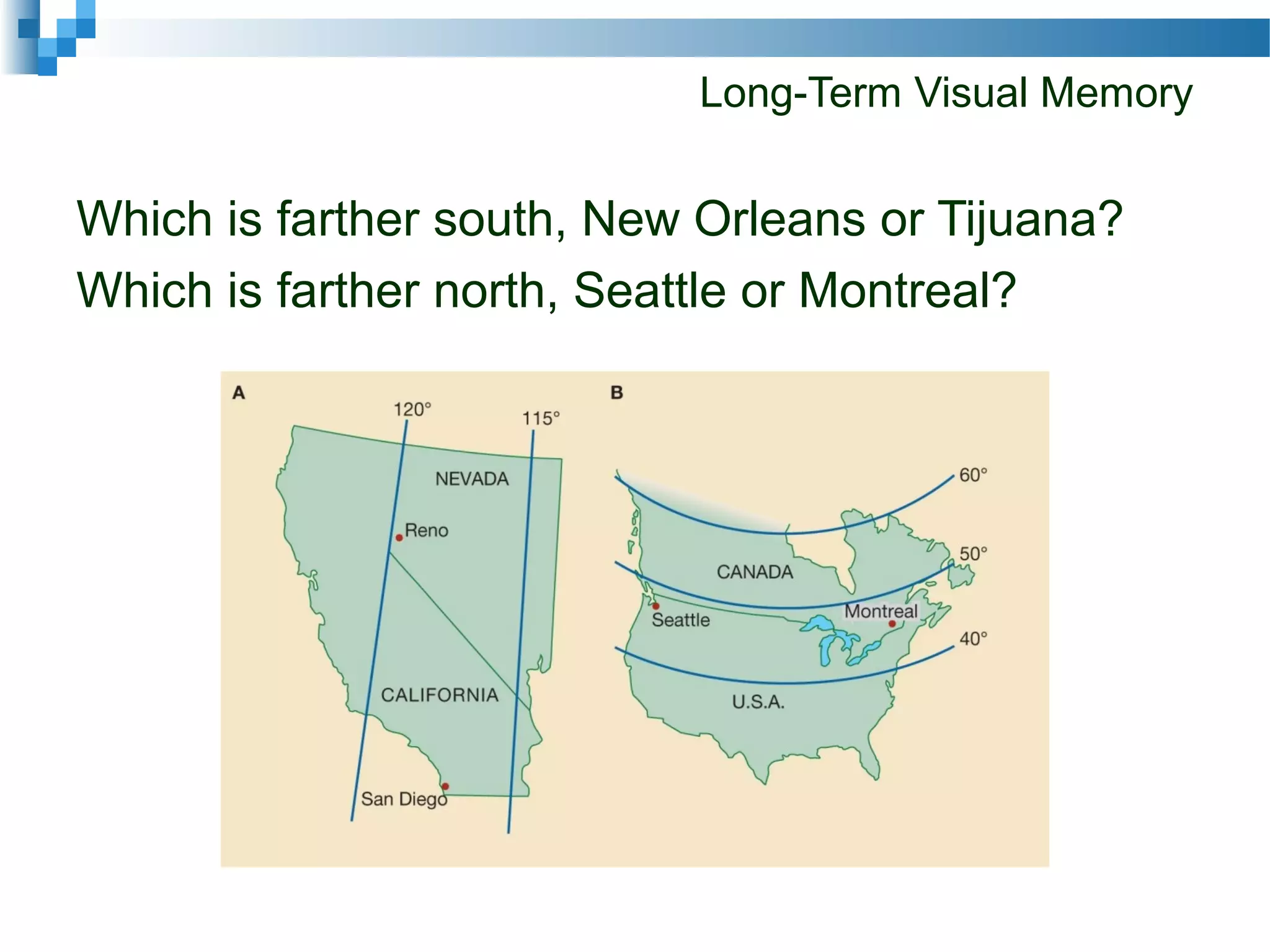
Which is farther south, New Orleans or Tijuana?
Which is farther north, Seattle or Montreal?
Long-Term Visual Memory
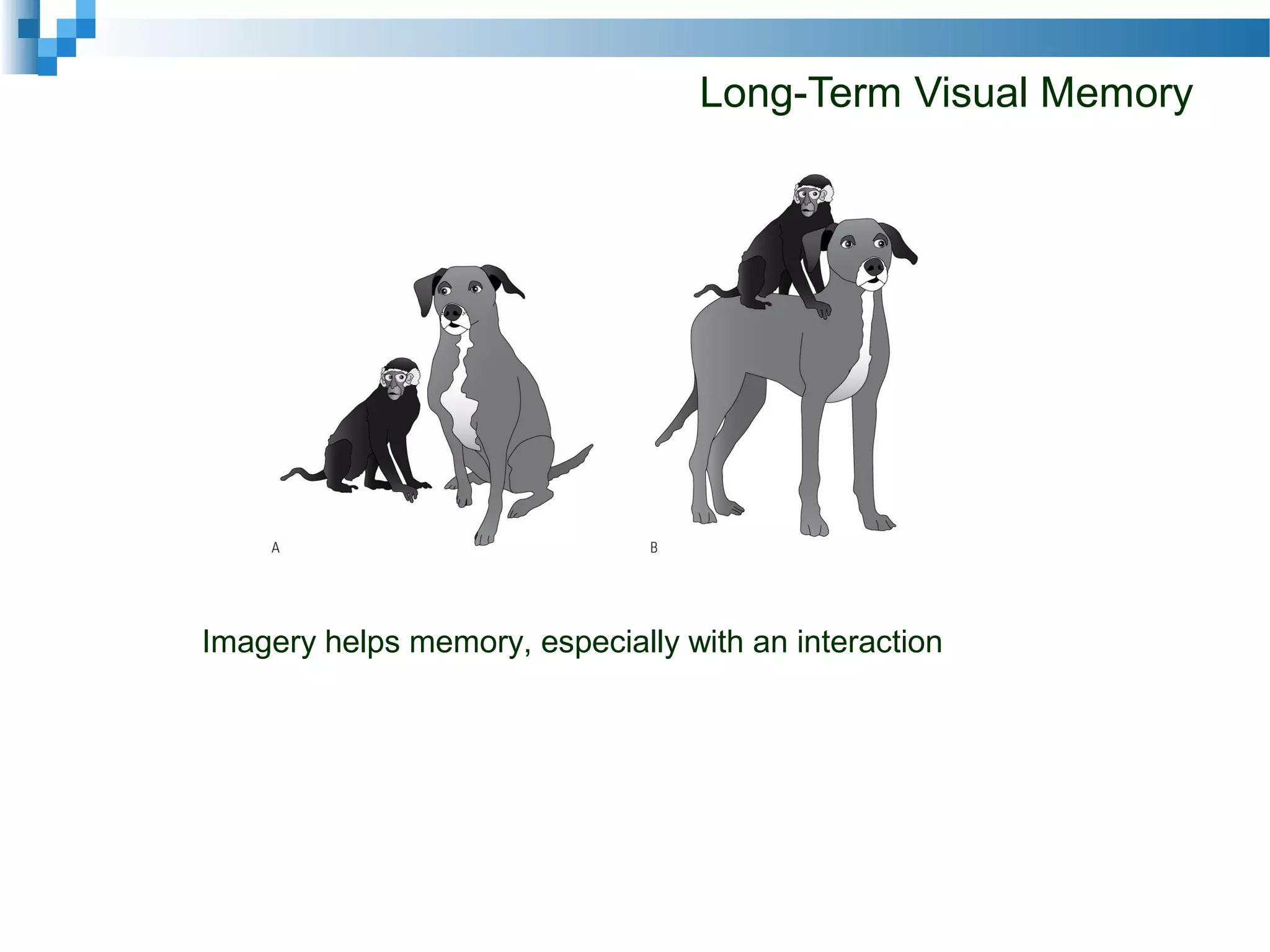
Imagery helps memory, especially with an interaction
Long-Term Visual Memory
 Dual coding
 High-imagery words, for instance, can be
coded as both word and image
 Low-imagery words only have a verbal code
Long-Term Visual Memory
 Studies of memory for pictures illustrate
ways in which long-term visual memory
reflects general principles of memory,
such as
 Primacy and recency
 Encoding specificity
 Schemata or generic knowledge
 Spreading activation and priming
 Familiarity and source memory
Long-Term Visual Memory
 Schematic retrieval
 (Friedman, 1979) found that participants
failed to notice differences between previously
seen and new pictures if both were consistent
with a schema (e.g., a kitchen or barnyard)
 Pictures that contained violations of a schema
(e.g., kitchen with a fireplace) were readily
noticed
Long-Term Visual Memory
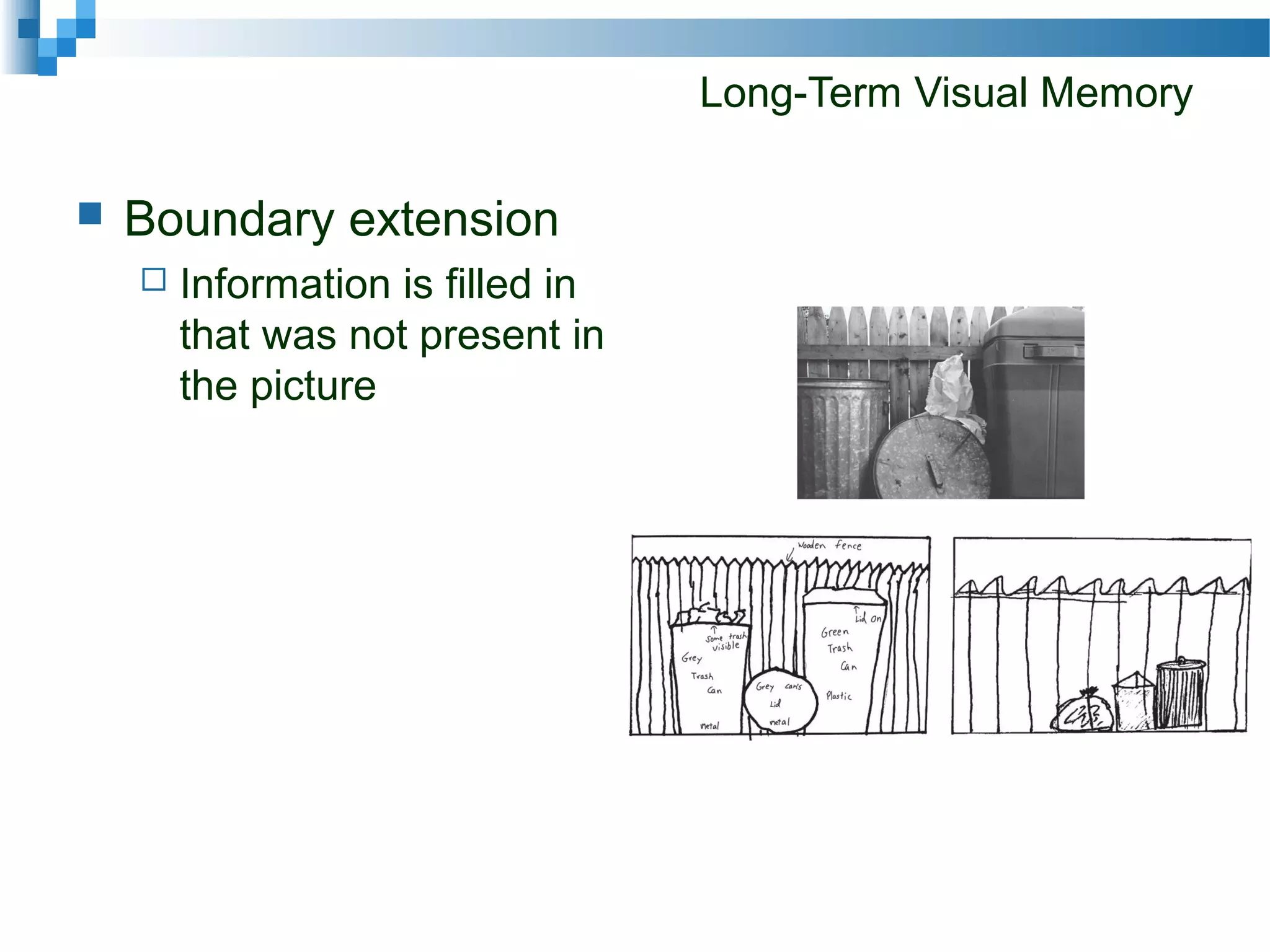
 Boundary extension
 Information is filled in
that was not present in
the picture
The Diversity of Knowledge
 Visual working memory is based in imagery and
uses perceptual, spatial representations
 Image scanning, rotation, zooming
 Visual long-term memory is based on
propositional knowledge and shares many
representational principles with other forms of
long-term memory
 Spreading activation, priming, schematic knowledge
Chapter 10 Questions
1. Based on image-zooming experiments,
which of the following would participants
be slowest to identify in a mental image?
a) the whiskers of a cat standing alone
b) the ears of a rhinoceros positioned next
to a squirrel
c) the whiskers of a cat positioned next to an
ant
d) the wings of a butterfly positioned next to
a hippopotamus
2. Participants answering questions about
geography might erroneously claim that San
Diego, California, is farther west than Reno,
Nevada, when in fact Reno is farther west.
This example suggests that spatial
information is sometimes
a) stored in long-term memory as propositions.
b) stored in short-term memory as propositions.
c) stored in long-term memory using a
perceptual code.
d) stored in short-term memory using a
perceptual code.
3. Which of the following is evidence that the
brain areas involved in perception and
mental imagery are similar?
a) using TMS to disrupt Area V1 results in
parallel problems in vision and visual
imagery
b) a patient suffering from neglect syndrome
may neglect the left half of imagined
scenes
c) stroke patients who lose the ability to see
color also lose the ability to imagine color
d) all of the above
4. What is the worst description of individual
differences in imagery ability?
a) Most people are able to form images.
b) Some people are good at visual imagery,
and others are good at spatial imagery.
c) Within visual imagery and spatial
imagery, most people have some
strengths and some weaknesses.
d) Imagery ability is fairly uniform from one
person to another.
5. Which of the following is evidence that some
forms of imagery are spatial and not visual?
a) Blind people can complete mental-rotation
experiments as quickly and accurately as
sighted people.
b) There is no interference when people are
asked to judge the brightness of a light while
making a mental-rotation decision.
c) Patients such as L.H. may perform well on
spatial imagery tasks but fail on visual
imagery tasks.
d) all of the above
6. Participants are asked to form mental
images of ambiguous pictures that were
viewed earlier. When asked to ___ the
image and then reinterpret it, they
succeed.
a) imagine
b) hear the sound of
c) imagine interacting with
d) draw
7. Which of the following mental-image
reinterpretations would be the
HARDEST?
a) The sought-after discovery is compatible with the
image’s depiction but not its reference frame.
b) The sought-after discovery is compatible with the
image’s reference frame but not its depiction.
c) The sought-after discovery is compatible with both the
image’s depiction and its reference frame.
d) The sought-after discovery is compatible with neither the
image’s depiction nor its reference frame.

Cog5 lecppt chapter10

  • 1.
    © 2010 byW. W. Norton & Co., Inc. Visual Knowledge Chapter 10 Lecture Outline
  • 2.
    Chapter 10: VisualKnowledge  Lecture Outline  Visual Imagery  Long-Term Visual Memory  The Diversity of Knowledge
  • 3.
    Visual Imagery  Avariety of day-to-day problems seem to require the use of visual imagery  How many windows are in your apartment?  Was David in class yesterday?  Will this sweater look good with your blue pants?  What is the nature of these mental images?
  • 4.
    Visual Imagery  FrancisGalton (1883)  Introspection to study mental imagery  Self-reports suggested they could inspect mental images as pictures  The participants also differed widely in the amount of detail their mental images seemed to contain. (Or were these differences in self-reporting style?)
  • 5.
     Studies ofvisual imagery in the last 50 years have avoided introspection and instead asked participants to do something with their images—to read information off them or manipulate them in some way. © 2010 by W. W. Norton & Co., Inc. 5
  • 6.
    Visual Imagery  Chronometricstudies  Ask participants to manipulate the mental images  Observe how long these manipulations take
  • 7.
    Visual Imagery  Kosslyn(1976) asked participants to answer yes/no questions about their mental images.  Imagined cat, confirm that cats have heads faster compared to confirming that cats have claws (mental imagery)  The reverse was true if the participants were asked to think about cats, not to imagine them (propositional knowledge)  This suggests that as the mode of representation changes, so does the pattern of information availability
  • 8.
    Visual Imagery  Image-scanning procedure,Kosslyn et al. (1978)  Memorize this map  Scan from one landmark to another on the imagined map
  • 9.
    Visual Imagery Imagined distancecorresponds to real distance Thus, mental images seem to preserve the spatial layout and geometry of the represented scene.
  • 10.
    Visual Imagery  Doesa mouse have whiskers?
  • 11.
    Visual Imagery Mental-rotation taskWhich of these pairs is the same? The further the distance, the longer it takes
  • 12.
    Visual Imagery The greaterthe angle, the longer the time As if they were rotating the images in real life
  • 13.
    Visual Imagery  Demandcharacter  Did image-scanning and mental-rotation experimenters somehow cue people?  Even without instruction, participants still form images
  • 14.
    Visual Imagery Less accuratewhen signal and image are the same More likely to wrongly choose that the stimulus matches the image when signal and image are both visual or auditoryMental imagery seems to use perceptual mechanisms. Visual imagery interferes with detecting dim visual stimuli, and auditory imagery interferes with detecting quiet tones.
  • 15.
    Visual Imagery  However,if we are imagining a stimulus related to the one we are about to perceive, facilitation occurs.  Imagery  Can interfere with perception (mismatching)  Can facilitate perception (matching)
  • 16.
    Visual Imagery  Occipitalareas used for early visual processing  Active during visual imagery  Patients with unilateral neglect may also neglect the left side of space in their mental images  Transcranial magnetic stimulation (TMS) disrupts mental imagery
  • 17.
    Visual Imagery Patient canonly see the right side of the plaza Patients with unilateral neglect may also neglect the left side of space in their mental images.
  • 18.
    Visual Imagery Patient canonly see the right side of the plaza
  • 19.
    Visual Imagery  Functionalequivalence between imagery and perception. Visual acuity higher—can see two dots Visual acuity lower—need more space to see two dots For both perception and imagery, acuity is greatly reduced if the dots are not in the center of vision.
  • 20.
    Visual Imagery  Peoplewho have been blind since birth also demonstrate the same effects in mental-rotation or image-scanning tasks, with response time being proportional to the distance traveled  Thus, we need to distinguish between visual imagery and spatial imagery  Spatial imagery may be based in movement or body imagery, or it may be abstract and not tied to any one sense
  • 21.
    Visual Imagery  Vividimagers versus non-imagers  Report seeing images better  Self-reported “vivid imagers” perform no differently than “non-imagers” on tasks that depend on spatial imagery.  Vivid imagers better for visual imagery
  • 22.
    Visual Imagery  Eideticor photographic memory  Extremely rare  Found in some autistic individuals  eidetic imagery
  • 23.
    Visual Imagery  Mentalimages different from pictures  Perception is not neutral and goes beyond the information given  Interpretations are present in images
  • 24.
    Visual Imagery  Imageryonly preserves one interpretation
  • 25.
    Visual Imagery  Thus,images (like percepts) are organized depictions  One way to think about mental images is as a package that includes the depiction itself as well as a perceptual reference frame  For instance, the duck/rabbit image, understood as a duck, is associated with the reference frame “facing to the left”
  • 26.
    Visual Imagery  Don’tknow what this is?  Close your eyes and rotate it 90º clockwise
  • 27.
    Visual Imagery  Sometimesputting an idea down on paper can help make a discovery that requires a change in the reference frame
  • 28.
    Visual Imagery  Mentalimages  Alternative to verbal description  Spatial layout and geometry are preserved  Reflect perceptual interpretation and are associated with reference frames
  • 29.
    Long-Term Visual Memory What is the nature of visual imagery taken from long-term memory?
  • 30.
    Long-Term Visual Memory Images in long-term memory  Stored in a piecemeal fashion  Must activate representation of image frame  Elaborate on this frame  Images that have more parts or detail take longer to create
  • 31.
    Long-Term Visual Memory Generatingthree rows faster Generating four columns slower
  • 32.
    Long-Term Visual Memory Long-term visual memory  Image files  Recipes or instructions for how to construct an active mental image of the object or shape  May represent visual information in terms of propositions, or verbal labels
  • 33.
    Long-Term Visual Memory Willhave more accurate memory for something that is either blue or green Will have less accurate memory
  • 34.
    Long-Term Visual Memory Interpretation changes the reconstruction of the image
  • 35.
    Long-Term Visual Memory Whichis farther south, New Orleans or Tijuana? Which is farther north, Seattle or Montreal?
  • 36.
    Long-Term Visual Memory Imageryhelps memory, especially with an interaction
  • 37.
    Long-Term Visual Memory Dual coding  High-imagery words, for instance, can be coded as both word and image  Low-imagery words only have a verbal code
  • 38.
    Long-Term Visual Memory Studies of memory for pictures illustrate ways in which long-term visual memory reflects general principles of memory, such as  Primacy and recency  Encoding specificity  Schemata or generic knowledge  Spreading activation and priming  Familiarity and source memory
  • 39.
    Long-Term Visual Memory Schematic retrieval  (Friedman, 1979) found that participants failed to notice differences between previously seen and new pictures if both were consistent with a schema (e.g., a kitchen or barnyard)  Pictures that contained violations of a schema (e.g., kitchen with a fireplace) were readily noticed
  • 40.
    Long-Term Visual Memory Boundary extension  Information is filled in that was not present in the picture
  • 41.
    The Diversity ofKnowledge  Visual working memory is based in imagery and uses perceptual, spatial representations  Image scanning, rotation, zooming  Visual long-term memory is based on propositional knowledge and shares many representational principles with other forms of long-term memory  Spreading activation, priming, schematic knowledge
  • 42.
  • 43.
    1. Based onimage-zooming experiments, which of the following would participants be slowest to identify in a mental image? a) the whiskers of a cat standing alone b) the ears of a rhinoceros positioned next to a squirrel c) the whiskers of a cat positioned next to an ant d) the wings of a butterfly positioned next to a hippopotamus
  • 44.
    2. Participants answeringquestions about geography might erroneously claim that San Diego, California, is farther west than Reno, Nevada, when in fact Reno is farther west. This example suggests that spatial information is sometimes a) stored in long-term memory as propositions. b) stored in short-term memory as propositions. c) stored in long-term memory using a perceptual code. d) stored in short-term memory using a perceptual code.
  • 45.
    3. Which ofthe following is evidence that the brain areas involved in perception and mental imagery are similar? a) using TMS to disrupt Area V1 results in parallel problems in vision and visual imagery b) a patient suffering from neglect syndrome may neglect the left half of imagined scenes c) stroke patients who lose the ability to see color also lose the ability to imagine color d) all of the above
  • 46.
    4. What isthe worst description of individual differences in imagery ability? a) Most people are able to form images. b) Some people are good at visual imagery, and others are good at spatial imagery. c) Within visual imagery and spatial imagery, most people have some strengths and some weaknesses. d) Imagery ability is fairly uniform from one person to another.
  • 47.
    5. Which ofthe following is evidence that some forms of imagery are spatial and not visual? a) Blind people can complete mental-rotation experiments as quickly and accurately as sighted people. b) There is no interference when people are asked to judge the brightness of a light while making a mental-rotation decision. c) Patients such as L.H. may perform well on spatial imagery tasks but fail on visual imagery tasks. d) all of the above
  • 48.
    6. Participants areasked to form mental images of ambiguous pictures that were viewed earlier. When asked to ___ the image and then reinterpret it, they succeed. a) imagine b) hear the sound of c) imagine interacting with d) draw
  • 49.
    7. Which ofthe following mental-image reinterpretations would be the HARDEST? a) The sought-after discovery is compatible with the image’s depiction but not its reference frame. b) The sought-after discovery is compatible with the image’s reference frame but not its depiction. c) The sought-after discovery is compatible with both the image’s depiction and its reference frame. d) The sought-after discovery is compatible with neither the image’s depiction nor its reference frame.

Editor's Notes

  • #44 Correct answer: d Feedback: Scanning is hardest when the target image is placed next to an image that is much larger. This makes the person zoom out.
  • #45 Correct answer: a Feedback: Rather than having an image, people store a “California is west of Nevada” type of memory. Hence, the map of each city is reconstructed with the verbal description rather than with an actual map.
  • #46 Correct answer: d Feedback: All of the statements are true.
  • #47 Correct answer: d Feedback: People vary in their ability for both spatial and visual imagery. However, everyone can perform both forms of imagery. Hence, it is not uniform.
  • #48 Correct answer: d Feedback: All of the above are correct statements.
  • #49 Correct answer: d Feedback: Drawing an item leads to the ability to change the frame of reference, which in turn leads them to be able to reinterpret it.
  • #50 Correct answer: d Feedback: When depiction and reference frame do not match, it is harder to reinterpret it.