1
Coding Practice and Problem-solving Skills in IT Students: A Quantitative Analysis at Davao Del Norte
State College.
Añasco, Emil Gee D. 1
, Caberto, Ephraim Gabriel V. 2
, Gascon, Zyrah Faith 3
, Mandras, Art John K. 4
,
Panogalon, Greendee Roper B. 5
, Sala, Jhonry D. 6
.
Student, Bachelor of Science in Information Technology, Davao del Norte State College
Faculty, Davao del Norte State College
ABSTRACT
This quantitative analysis seeks to assess
the coding experience and problem-solving
abilities of Davao Del Norte State College IT
students. The study uses data-driven techniques to
evaluate students' coding skills and problem-
solving capabilities. The research aims to discover
potential areas for improvement in the college's
existing status of IT education by performing a
thorough analysis. The results of this study will
play a significant role in raising the standard of IT
education and preparing students for the difficulties
presented by the fast-changing technological
environment.
Keywords: Abilities of IT students
1. INTRODUCTION
1.1 Background of the Study
The background of the study revolves
around the coding practice and problem-solving
skills of IT students at Davao Del Norte State
College. It suggests that there is an interest in
evaluating and improving the existing status of IT
education at the college. The background may also
include the importance of coding skills and
problem-solving abilities in the field of IT, as well
as the need to adapt to the fast-changing
technological environment.
In recent years, the field of Information
Technology (IT) has experienced rapid
advancements, making it crucial for educational
institutions to ensure that IT students are adequately
prepared to meet the demands of the ever-changing
technological landscape. Like many other
educational institutions, Davao Del Norte State
College faces the challenge of equipping its IT
students with the necessary coding skills and
problem-solving abilities. This study aims to assess
the current state of coding experience and problem-
solving capabilities among IT students at the
college.
1.2 Theoretical framework
Constructivism:
According to this philosophy, learning is a
process where students actively build knowledge via
experience. By actively participating in coding
assignments and overcoming obstacles, students
develop their skills in the context of problem-
solving and coding.
This framework, known as Bloom's
Taxonomy, can be used to group the many degrees
of cognitive abilities necessary for coding and
problem-solving, from lower-order abilities like
remembering and understanding to higher-order
abilities like applying, analyzing, evaluating, and
inventing.
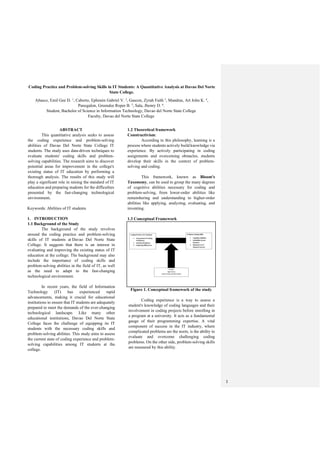
1.3 Conceptual Framework
Figure 1. Conceptual framework of the study
Coding experience is a way to assess a
student's knowledge of coding languages and their
involvement in coding projects before enrolling in
a program at a university. It acts as a fundamental
gauge of their programming expertise. A vital
component of success in the IT industry, where
complicated problems are the norm, is the ability to
evaluate and overcome challenging coding
problems. On the other side, problem-solving skills
are measured by this ability.
2
Colleges utilize educational initiatives to
strengthen students' coding and problem-solving
skills in response to the dynamic technology world.
These interventions cover a range of initiatives and
methods designed to provide students with the
adaptability they need to stay up with the rapidly
changing IT environment. These interventions
ensure that graduates are well-prepared to negotiate
the problems of the contemporary IT sector, where
creativity and agility are crucial, by bridging the gap
between their early coding experience and the
industry's requirements.
1.4 Research Questions
The main research questions that guided this
research study are:
RQ1: Which of the following factors is most likely
to influence a student's coding experience:
1.1 Age
1.2 Gender
1.3 Type of Area Rural/Urban
RQ2: What is the level of Coding Experience in
terms of:
2.1 Assessment of Coding Proficiency
2.2 Industry Readiness
2.3 Exploring Differences
RQ3: What is the level of Coding Problem-Solving
in terms of:
3.1 Cognitive Abilities
3.2 Variability Across Students
3.3 Relevance to IT Industry Success
RQ4: Is there a significant difference in the level of
Coding Practice when grouped according to:
4.1 Age
4.2 Gender
4.3 Type of Area Rural/Urban
RQ5: Is there a significant difference in their
Problem-Solving Skills when grouped according to:
5.1 Gender
5.2 Age Group
5.3 Type of area Rural/Urban
RQ6: Is there a significant relationship between the
level of Coding Experience and the level of
Problem-Solving Skills Satisfaction?
1.5 Null Hypothesis
Ho1: There is no significant difference in the level
of Coding Practice when grouped according to:
a. Gender
b. Age Group
c. Type of Area Rural/Urban
Ho2: There is no significant difference in the level
of Coding Practice Satisfaction when grouped
according to:
a. Gender
b. Age Group
c. Type of Area Rural/Urban
Ho3: There is no significant relationship between
the level of Coding Experience and the level of
Problem-Solving Skills Satisfaction.
2. Methodology
2.1 Research Design
In the pursuit of examining the coding practice
and problem-solving skills of IT students at Davao
Del Norte State College, this research adopts a
correlational research design. This design is
particularly suitable for investigating the
relationships between variables without introducing
experimental manipulations. The primary objective
is to discern the potential correlations between the
coding experience and problem-solving abilities of
IT students. Through the implementation of this
design, the study endeavors to explore whether there
exists a significant and systematic relationship
between the level of coding experience and the
proficiency in problem-solving skills among the
participants. Utilizing quantitative methods, such as
the Pearson correlation coefficient, will enable a
rigorous statistical analysis of the strength and
direction of these relationships. By selecting the
correlational research design, this study aims to
provide a nuanced and quantitative understanding of
how variations in coding experience may be
associated with changes in coding problem-solving
3
abilities, contributing valuable insights to the field
of IT education at Davao Del Norte State College.
2.2 Participants of the Study
The study included participants from the
current enrollment of Davao del Norte State College
(DNSC) in the Philippines. Specifically,
participants were randomly selected from the 1st-
year students pursuing a Bachelor of Science in
Information Technology (BSIT) program. This
random sampling approach ensures a diverse
representation of students from the entire institution,
enhancing the generalizability of the study's
findings. All participants were DNSC students
enrolled in the first year of the BSIT program at the
time of the study.
2.3 Sampling Techniques
There are a lot of different types of sampling
techniques for quantitative research. Some of them
are a few commonly used sampling techniques like
stratified sampling, cluster sampling, and
convenience sampling. However, for this study, the
researchers chose quota. Quota sampling involves
selecting participants based on predetermined
criteria to ensure a representative sample.
Quota sampling, in contrast to random
sampling, allows for a targeted and deliberate
inclusion of participants who meet specific
characteristics relevant to the study. In our case, the
researchers will establish quotas based on key
parameters such as academic performance, coding
proficiency, and problem-solving skills within the
1st-year college student population at Davao del
Norte State College.
By using quota sampling, the research team
can ensure proportional representation of important
subgroups within the population, leading to a more
nuanced understanding of the coding practices and
problem-solving skills among IT students. This
method is particularly beneficial when specific
demographic or skill-related factors are crucial to
the study's objectives.
Quota sampling promotes transparency and
objectivity in participant selection, as researchers
set clear criteria for inclusion. This approach
minimizes potential biases associated with
subjective preferences, offering a balance between
controlled selection and representation of diverse
perspectives within the target population.
The utilization of quota sampling enhances
the external validity of the study by allowing for
broader generalizability of findings to 1st-year
college students at Davao del Norte State College.
This technique is valued in quantitative research for
its ability to provide valuable insights into specific
subgroups while maintaining a structured and
systematic approach to participant selection.
2.4 Statistical Treatments
Data are coded, totaled, and tabulated for
better presentation and comprehension of the results
after being collected by the researchers from
participants using the questionnaire and processed
using various statistical procedures. Along with the
data, the researchers also consider the percentage of
gender and academic level. The following statistical
methods were used to interpret the data gathered
from the participants in the study.
ANOVA (Analysis of Variance):
The statistical test known as ANOVA is
used to compare the means of three or more groups
or samples. By analyzing the variance both within
and between groups, it reveals whether there are any
statistically significant differences in the group
means. The F-value is calculated using the ANOVA
formula: F = (between-group variance) / (within- 5
group variance). To evaluate statistical significance,
the F-value is then compared to a critical value taken
from the F-distribution.
Pearson R (Pearson correlation coefficient):
The linear relationship between two
continuous variables is quantified by the Pearson
correlation coefficient, sometimes referred to as
Pearson's R. The degree and direction of the
relationship between two variables are quantified.
Standard deviation is a measure of how
spread out or clustered data points are around the
average. Think of it to understand how much
individual data points deviate from the overall
average. A higher standard deviation means the data
points are more spread out, while a lower standard
deviation suggests that most of the data points are
close to the average.
Commented [PIA1]: 1st year lng ba inyung gi consider ani
na research?
Commented [gz2R1]: Opo ma'am first year lang po
4
2.5 Data Collection Procedure
The data collection procedure for the study
titled "Coding Practice and Problem-solving Skills
in IT Students." involved the utilization of printed
survey questionnaires. The researchers distributed
these questionnaires to a representative sample of
college students at Davao del Norte State College.
The questionnaires were carefully designed to
capture relevant information regarding the
participants' internet usage and their academic
performance. Participants were given the assurance
that their responses would be kept private and that
their identities would be preserved to maintain
confidentiality and anonymity. The questionnaires
were administered in a structured format with clear
and concise questions that facilitated accurate and
reliable data collection.
The researchers followed ethical guidelines
throughout the data collection process and took
measures to ensure the participants' comfort and
willingness to provide accurate responses. By
employing printed and online survey questionnaires,
the researchers were able to gather valuable data for
A Quantitative Analysis at Davao Del Norte State
College.
2.6 Research Instrument
The research instrument aims to observe the
coding experience and performance in machine
learning at Davao Del Norte State College. All the
questions that are implemented are for their
experience of what the capabilities of Machine
learning are and basic or Introduction of
programming. These questions are allied form
existing research conducted by Garcia, M. P., and
Santos, A. B. Titled “IT Student Coding and
Machine Learning Skills Assessment”. This survey
emphasizes the leanings of the students on how they
pursue their education, capabilities, performance,
and skills in their field course. Disclose any
conflicts of interest and adhere to relevant laws and
regulations.
2.7 Ethical Considerations
In researching coding experience and
machine learning among IT students at Davao Del
Norte State College, it is imperative to uphold a set
of ethical principles. To minimize harm, consider
the potential emotional and psychological risks
associated with the study and provide appropriate
support.
3. RESULTS AND DISCUSSIONS
Table 1. Demographic Profile of the
Respondents
Characteristic Frequency Percentage
Gender
Male
Female
16
34
0.32
0.68
Year and Set
1st
Year Set A
1st
Year Set B
1st
Year Set C
1st
Year Set D
1st
Year Set E
15
22
8
4
1
0.3
0.44
0.16
0.08
0.02
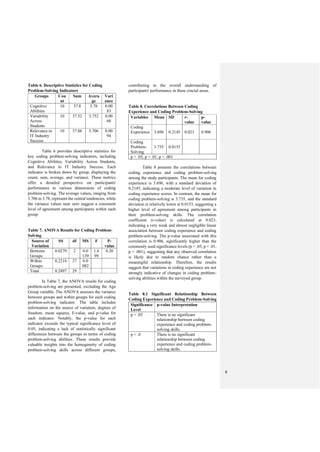
As shown in Table 1. The distribution of
gender indicates a slightly higher representation of
males, constituting 68% of the respondents, while
females account for 32%. Regarding the academic
sets, Set B has the highest participation with 44%,
followed by Set A with 30%. Set C, Set D, and Set
E have progressively lower involvement,
representing 16%, 8%, and 2%, respectively. These
findings provide an overview of the gender and
academic set distribution within the respondent
pool, laying the foundation for a comprehensive
analysis of coding experience and problem-solving
skills among different demographic groups.
Table 2. Level Of Coding Experience
Indicators N Mean
Standard
Deviation
Assessment of
Coding
Proficiency
50 3.444 0.640
Industry
Readiness
50 3.852 0.673
Exploring
Differences
50 3.792 0.665
Table 2 outlines the coding experience
level of the 50 respondents across three indicators:
Assessment of Coding Proficiency, Industry
Readiness, and Exploring Differences. The mean
scores for these indicators are 3.444, 3.852, and
3.792, respectively. These means represent the
average responses of the participants. The standard
deviation values (0.640, 0.673, and 0.665) indicate
5
how much individual responses vary from the
mean. Lower standard deviations suggest more
agreement among respondents, while higher values
imply greater diversity in perceptions. Overall,
these indicators provide insights into the consensus
and variability in the participants' views on coding
proficiency, industry readiness, and experiences in
different settings.
Table 3. Level of Coding Problem-Solving
Indicators N Mean
Standard
Deviation
Cognitive
Abilities
50 3.738 0.661
Variability Across
Students
50 3.752 0.656
Relevance to IT
Industry Success
50 3.716 0.687
Table 3 details the level of coding problem-
solving among the 50 respondents, focusing on three
key indicators: Cognitive Abilities, Variability
Across Students, and Relevance to IT Industry
Success. The mean scores for Cognitive Abilities,
Variability Across Students, and Relevance to IT
Industry Success are 3.738, 3.752, and 3.716,
respectively. These means serve as central
measures, reflecting the average responses across
the participants. The corresponding standard
deviation values (0.661, 0.656, and 0.687) signify
the extent of variation or dispersion in individual
responses. Lower standard deviations suggest closer
agreement among respondents, while higher values
indicate greater diversity in perspectives. These
indicators shed light on the consensus and
variability in participants' views on cognitive
abilities, variability across students, and the
relevance of problem-solving skills to success in the
IT industry.
Table 4. Descriptive Statistics for Coding
Experience Indicators
Groups Cou
nt
Sum Avera
ge
Vari
ance
Assessment
of Coding
Proficiency
10 38.3 3.83 0.014
Industry
Readiness
10 38.52 3.852 0.003
Exploring
Differences
10 37.92 3.792 0.005
The table 4 presents the results of an
ANOVA analysis conducted on three key
indicators—Assessment of Coding Proficiency,
Industry Readiness, and Exploring Differences—
while excluding Age Group as a factor. Each
indicator was assessed across different groups based
on Gender and Type of Area (Rural/Urban), with 10
participants in each group.
The average scores for Assessment of
Coding Proficiency, Industry Readiness, and
Exploring Differences were 3.83, 3.852, and 3.792,
respectively. The variance in these scores was
minimal, with values of 0.014, 0.003, and 0.005 for
each indicator, suggesting overall agreement among
participants within each group. The ANOVA results
indicated no statistically significant differences in
mean scores among the groups for Assessment of
Coding Proficiency, Industry Readiness, and
Exploring Differences. The F-statistic values were
1.153 for all three indicators, and the associated p-
values were 0.33. These non-significant p-values
suggest that any observed variations in mean scores
among different groups are likely due to random
chance rather than meaningful differences.
Table 5. ANOVA Results for Coding Experience
Indicators
Source of
Variation
SS df MS F P-
value
Between
Groups
0.0184 2 0.0
092
1.1
53
0.33
Within
Groups
0.2157 27 0.0
079
Total 0.2341 29
In summary, the ANOVA analysis,
supports the conclusion that there is no significant
difference in coding experience across various
groups based on Gender and Type of Area. The
findings suggest that any observed differences in
mean scores are not statistically meaningful,
reinforcing the notion that coding experience is
generally consistent among the specified groups.
6
Table 6. Descriptive Statistics for Coding
Problem-Solving Indicators
Groups Cou
nt
Sum Avera
ge
Vari
ance
Cognitive
Abilities
10 37.8 3.78 0.00
83
Variability
Across
Students
10 37.52 3.752 0.00
68
Relevance to
IT Industry
Success
10 37.06 3.706 0.00
94
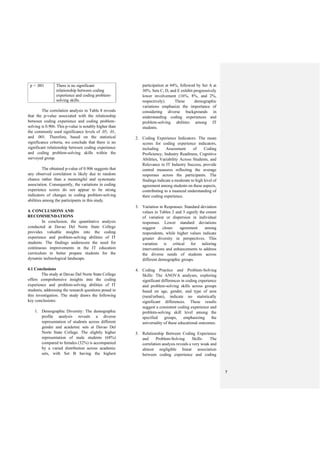
Table 6 provides descriptive statistics for
key coding problem-solving indicators, including
Cognitive Abilities, Variability Across Students,
and Relevance to IT Industry Success. Each
indicator is broken down by group, displaying the
count, sum, average, and variance. These metrics
offer a detailed perspective on participants'
performance in various dimensions of coding
problem-solving. The average values, ranging from
3.706 to 3.78, represent the central tendencies, while
the variance values near zero suggest a consistent
level of agreement among participants within each
group.
Table 7. ANOVA Results for Coding Problem-
Solving
Source of
Variation
SS df MS F P-
value
Between
Groups
0.0279 2 0.0
139
1.6
99
0.20
Within
Groups
0.2218 27 0.0
082
Total 0.2497 29
In Table 7, the ANOVA results for coding
problem-solving are presented, excluding the Age
Group variable. The ANOVA assesses the variance
between groups and within groups for each coding
problem-solving indicator. The table includes
information on the source of variation, degrees of
freedom, mean squares, F-value, and p-value for
each indicator. Notably, the p-value for each
indicator exceeds the typical significance level of
0.05, indicating a lack of statistically significant
differences between the groups in terms of coding
problem-solving abilities. These results provide
valuable insights into the homogeneity of coding
problem-solving skills across different groups,
contributing to the overall understanding of
participants' performance in these crucial areas.
Table 8. Correlations Between Coding
Experience and Coding Problem-Solving
Variables Mean SD r-
value
p-
value
Coding
Experience 3.696 0.2145 0.023 0.906
Coding
Problem-
Solving
3.735 0.0153
p < .05, p < .01, p < .001
Table 8 presents the correlations between
coding experience and coding problem-solving
among the study participants. The mean for coding
experience is 3.696, with a standard deviation of
0.2145, indicating a moderate level of variation in
coding experience scores. In contrast, the mean for
coding problem-solving is 3.735, and the standard
deviation is relatively lower at 0.0153, suggesting a
higher level of agreement among participants in
their problem-solving skills. The correlation
coefficient (r-value) is calculated at 0.023,
indicating a very weak and almost negligible linear
association between coding experience and coding
problem-solving. The p-value associated with this
correlation is 0.906, significantly higher than the
commonly used significance levels (p < .05, p < .01,
p < .001), suggesting that any observed correlation
is likely due to random chance rather than a
meaningful relationship. Therefore, the results
suggest that variations in coding experience are not
strongly indicative of changes in coding problem-
solving abilities within the surveyed group.
Table 8.1 Significant Relationship Between
Coding Experience and Coding Problem-Solving
Significance
Level
p-value Interpretation
p < .05 There is no significant
relationship between coding
experience and coding problem-
solving skills.
p < .0 There is no significant
relationship between coding
experience and coding problem-
solving skills.
7
p < .001 There is no significant
relationship between coding
experience and coding problem-
solving skills.
The correlation analysis in Table 8 reveals
that the p-value associated with the relationship
between coding experience and coding problem-
solving is 0.906. This p-value is notably higher than
the commonly used significance levels of .05, .01,
and .001. Therefore, based on the statistical
significance criteria, we conclude that there is no
significant relationship between coding experience
and coding problem-solving skills within the
surveyed group.
The obtained p-value of 0.906 suggests that
any observed correlation is likely due to random
chance rather than a meaningful and systematic
association. Consequently, the variations in coding
experience scores do not appear to be strong
indicators of changes in coding problem-solving
abilities among the participants in this study.
4. CONCLUSIONS AND
RECOMMENDATIONS
In conclusion, the quantitative analysis
conducted at Davao Del Norte State College
provides valuable insights into the coding
experience and problem-solving abilities of IT
students. The findings underscore the need for
continuous improvements in the IT education
curriculum to better prepare students for the
dynamic technological landscape.
4.1 Conclusions
The study at Davao Del Norte State College
offers comprehensive insights into the coding
experience and problem-solving abilities of IT
students, addressing the research questions posed in
this investigation. The study draws the following
key conclusions:
1. Demographic Diversity: The demographic
profile analysis reveals a diverse
representation of students across different
gender and academic sets at Davao Del
Norte State College. The slightly higher
representation of male students (68%)
compared to females (32%) is accompanied
by a varied distribution across academic
sets, with Set B having the highest
participation at 44%, followed by Set A at
30%. Sets C, D, and E exhibit progressively
lower involvement (16%, 8%, and 2%,
respectively). These demographic
variations emphasize the importance of
considering diverse backgrounds in
understanding coding experiences and
problem-solving abilities among IT
students.
2. Coding Experience Indicators: The mean
scores for coding experience indicators,
including Assessment of Coding
Proficiency, Industry Readiness, Cognitive
Abilities, Variability Across Students, and
Relevance to IT Industry Success, provide
central measures reflecting the average
responses across the participants. The
findings indicate a moderate to high level of
agreement among students on these aspects,
contributing to a nuanced understanding of
their coding experience.
3. Variation in Responses: Standard deviation
values in Tables 2 and 3 signify the extent
of variation or dispersion in individual
responses. Lower standard deviations
suggest closer agreement among
respondents, while higher values indicate
greater diversity in perspectives. This
variation is critical for tailoring
interventions and enhancements to address
the diverse needs of students across
different demographic groups.
4. Coding Practice and Problem-Solving
Skills: The ANOVA analyses, exploring
significant differences in coding experience
and problem-solving skills across groups
based on age, gender, and type of area
(rural/urban), indicate no statistically
significant differences. These results
suggest a consistent coding experience and
problem-solving skill level among the
specified groups, emphasizing the
universality of these educational outcomes.
5. Relationship Between Coding Experience
and Problem-Solving Skills: The
correlation analysis reveals a very weak and
almost negligible linear association
between coding experience and coding
8
problem-solving. The p-value suggests that
any observed correlation is likely due to
random chance rather than a meaningful
relationship. Therefore, variations in coding
experience scores do not strongly indicate
changes in coding problem-solving abilities
among the surveyed group.
4.2 Recommendations
Based on the conclusions drawn from the
study, the following recommendations are proposed
for the enhancement of IT education at Davao Del
Norte State College:
1. Curriculum Enhancement: Continuously
review and update the IT education
curriculum to align with industry standards
and technological advancements. Ensure
that students are equipped with the latest
skills and knowledge needed for a dynamic
technological landscape.
2. Targeted Interventions: Implement targeted
interventions to address variations in coding
experience and problem-solving abilities
among students. Tailor educational
initiatives to meet the diverse needs of
students across different academic sets,
fostering a supportive learning environment
for all.
3. Inclusive Coding Culture: Foster a more
inclusive and diverse coding culture that
values and supports students from different
backgrounds. Encourage collaboration and
mutual support among students to create a
conducive and enriching learning
environment.
4. Support Services: Provide additional
support services to enhance problem-
solving skills and cognitive abilities in
coding assignments. This may include
workshops, tutoring services, or additional
resources to assist students in overcoming
challenges and further developing their
skills.
5. Industry Collaborations: Strengthen
collaborations with industry partners to
offer real-world experiences, internships,
and insights. This integration with the
industry will provide students with practical
exposure, enhancing their readiness for the
IT workforce.
ACKNOWLEDGEMENT
The Researchers express sincere gratitude
to the participants and Davao Del Norte State
College for their collaborative engagement and
substantive contributions to this study. Active
cooperation and involvement from both participants
and the academic institution have been integral to
the successful execution of this research project.
The Researchers acknowledge the valuable insights
derived from the collective efforts, enhancing the
depth and quality of the research.
REFERENCES
[1] B. Klaus and P. Horn, Robot Vision. Cambridge,
MA: MIT Press, 1986.
[2] J. U. Duncombe, "Infrared navigation - Part I: An
assessment of feasibility," IEEE Trans. Electron.
Devices, vol. ED-11, pp. 34-39, Jan. 1959.
[3] L. Liu and H. Miao, "A specification-based
approach to testing polymorphic attributes," in
Formal Methods and Software Engineering:
Proceedings of the 6th International Conference
on Formal Engineering Methods, ICFEM 2004,
Seattle, WA, USA, November 812, 2004, J.
Davies, W. Schulte, M. Barnett, Eds. Berlin:
Springer, 2004. pp. 306-1
[4] Duncombe, J. U. (Year of Publication). "Infrared
navigation - Part I: An assessment of feasibility."
IEEE Trans. Electron. Devices, vol. ED-11, pp.
34-39, Jan. 1959.
[5] Liu, L., & Miao, H. (Year of Publication). "A
specification-based approach to testing
polymorphic attributes." In Formal Methods and
Software Engineering: Proceedings of the 6th
International Conference on Formal Engineering
Methods, ICFEM 2004, Seattle, WA, USA,
9
November 8-12, 2004, J. Davies, W. Schulte, M.
Barnett, Eds. Berlin: Springer, 2004. pp. 306-1.

Coding-Practice-and-Problem-Solving-Skills-in-IT-Students-A-Quantitative-Analysis-at-Davao-del-Norte-State-College.pdf

  • 1.
    1 Coding Practice andProblem-solving Skills in IT Students: A Quantitative Analysis at Davao Del Norte State College. Añasco, Emil Gee D. 1 , Caberto, Ephraim Gabriel V. 2 , Gascon, Zyrah Faith 3 , Mandras, Art John K. 4 , Panogalon, Greendee Roper B. 5 , Sala, Jhonry D. 6 . Student, Bachelor of Science in Information Technology, Davao del Norte State College Faculty, Davao del Norte State College ABSTRACT This quantitative analysis seeks to assess the coding experience and problem-solving abilities of Davao Del Norte State College IT students. The study uses data-driven techniques to evaluate students' coding skills and problem- solving capabilities. The research aims to discover potential areas for improvement in the college's existing status of IT education by performing a thorough analysis. The results of this study will play a significant role in raising the standard of IT education and preparing students for the difficulties presented by the fast-changing technological environment. Keywords: Abilities of IT students 1. INTRODUCTION 1.1 Background of the Study The background of the study revolves around the coding practice and problem-solving skills of IT students at Davao Del Norte State College. It suggests that there is an interest in evaluating and improving the existing status of IT education at the college. The background may also include the importance of coding skills and problem-solving abilities in the field of IT, as well as the need to adapt to the fast-changing technological environment. In recent years, the field of Information Technology (IT) has experienced rapid advancements, making it crucial for educational institutions to ensure that IT students are adequately prepared to meet the demands of the ever-changing technological landscape. Like many other educational institutions, Davao Del Norte State College faces the challenge of equipping its IT students with the necessary coding skills and problem-solving abilities. This study aims to assess the current state of coding experience and problem- solving capabilities among IT students at the college. 1.2 Theoretical framework Constructivism: According to this philosophy, learning is a process where students actively build knowledge via experience. By actively participating in coding assignments and overcoming obstacles, students develop their skills in the context of problem- solving and coding. This framework, known as Bloom's Taxonomy, can be used to group the many degrees of cognitive abilities necessary for coding and problem-solving, from lower-order abilities like remembering and understanding to higher-order abilities like applying, analyzing, evaluating, and inventing. 1.3 Conceptual Framework Figure 1. Conceptual framework of the study Coding experience is a way to assess a student's knowledge of coding languages and their involvement in coding projects before enrolling in a program at a university. It acts as a fundamental gauge of their programming expertise. A vital component of success in the IT industry, where complicated problems are the norm, is the ability to evaluate and overcome challenging coding problems. On the other side, problem-solving skills are measured by this ability.
  • 2.
    2 Colleges utilize educationalinitiatives to strengthen students' coding and problem-solving skills in response to the dynamic technology world. These interventions cover a range of initiatives and methods designed to provide students with the adaptability they need to stay up with the rapidly changing IT environment. These interventions ensure that graduates are well-prepared to negotiate the problems of the contemporary IT sector, where creativity and agility are crucial, by bridging the gap between their early coding experience and the industry's requirements. 1.4 Research Questions The main research questions that guided this research study are: RQ1: Which of the following factors is most likely to influence a student's coding experience: 1.1 Age 1.2 Gender 1.3 Type of Area Rural/Urban RQ2: What is the level of Coding Experience in terms of: 2.1 Assessment of Coding Proficiency 2.2 Industry Readiness 2.3 Exploring Differences RQ3: What is the level of Coding Problem-Solving in terms of: 3.1 Cognitive Abilities 3.2 Variability Across Students 3.3 Relevance to IT Industry Success RQ4: Is there a significant difference in the level of Coding Practice when grouped according to: 4.1 Age 4.2 Gender 4.3 Type of Area Rural/Urban RQ5: Is there a significant difference in their Problem-Solving Skills when grouped according to: 5.1 Gender 5.2 Age Group 5.3 Type of area Rural/Urban RQ6: Is there a significant relationship between the level of Coding Experience and the level of Problem-Solving Skills Satisfaction? 1.5 Null Hypothesis Ho1: There is no significant difference in the level of Coding Practice when grouped according to: a. Gender b. Age Group c. Type of Area Rural/Urban Ho2: There is no significant difference in the level of Coding Practice Satisfaction when grouped according to: a. Gender b. Age Group c. Type of Area Rural/Urban Ho3: There is no significant relationship between the level of Coding Experience and the level of Problem-Solving Skills Satisfaction. 2. Methodology 2.1 Research Design In the pursuit of examining the coding practice and problem-solving skills of IT students at Davao Del Norte State College, this research adopts a correlational research design. This design is particularly suitable for investigating the relationships between variables without introducing experimental manipulations. The primary objective is to discern the potential correlations between the coding experience and problem-solving abilities of IT students. Through the implementation of this design, the study endeavors to explore whether there exists a significant and systematic relationship between the level of coding experience and the proficiency in problem-solving skills among the participants. Utilizing quantitative methods, such as the Pearson correlation coefficient, will enable a rigorous statistical analysis of the strength and direction of these relationships. By selecting the correlational research design, this study aims to provide a nuanced and quantitative understanding of how variations in coding experience may be associated with changes in coding problem-solving
  • 3.
    3 abilities, contributing valuableinsights to the field of IT education at Davao Del Norte State College. 2.2 Participants of the Study The study included participants from the current enrollment of Davao del Norte State College (DNSC) in the Philippines. Specifically, participants were randomly selected from the 1st- year students pursuing a Bachelor of Science in Information Technology (BSIT) program. This random sampling approach ensures a diverse representation of students from the entire institution, enhancing the generalizability of the study's findings. All participants were DNSC students enrolled in the first year of the BSIT program at the time of the study. 2.3 Sampling Techniques There are a lot of different types of sampling techniques for quantitative research. Some of them are a few commonly used sampling techniques like stratified sampling, cluster sampling, and convenience sampling. However, for this study, the researchers chose quota. Quota sampling involves selecting participants based on predetermined criteria to ensure a representative sample. Quota sampling, in contrast to random sampling, allows for a targeted and deliberate inclusion of participants who meet specific characteristics relevant to the study. In our case, the researchers will establish quotas based on key parameters such as academic performance, coding proficiency, and problem-solving skills within the 1st-year college student population at Davao del Norte State College. By using quota sampling, the research team can ensure proportional representation of important subgroups within the population, leading to a more nuanced understanding of the coding practices and problem-solving skills among IT students. This method is particularly beneficial when specific demographic or skill-related factors are crucial to the study's objectives. Quota sampling promotes transparency and objectivity in participant selection, as researchers set clear criteria for inclusion. This approach minimizes potential biases associated with subjective preferences, offering a balance between controlled selection and representation of diverse perspectives within the target population. The utilization of quota sampling enhances the external validity of the study by allowing for broader generalizability of findings to 1st-year college students at Davao del Norte State College. This technique is valued in quantitative research for its ability to provide valuable insights into specific subgroups while maintaining a structured and systematic approach to participant selection. 2.4 Statistical Treatments Data are coded, totaled, and tabulated for better presentation and comprehension of the results after being collected by the researchers from participants using the questionnaire and processed using various statistical procedures. Along with the data, the researchers also consider the percentage of gender and academic level. The following statistical methods were used to interpret the data gathered from the participants in the study. ANOVA (Analysis of Variance): The statistical test known as ANOVA is used to compare the means of three or more groups or samples. By analyzing the variance both within and between groups, it reveals whether there are any statistically significant differences in the group means. The F-value is calculated using the ANOVA formula: F = (between-group variance) / (within- 5 group variance). To evaluate statistical significance, the F-value is then compared to a critical value taken from the F-distribution. Pearson R (Pearson correlation coefficient): The linear relationship between two continuous variables is quantified by the Pearson correlation coefficient, sometimes referred to as Pearson's R. The degree and direction of the relationship between two variables are quantified. Standard deviation is a measure of how spread out or clustered data points are around the average. Think of it to understand how much individual data points deviate from the overall average. A higher standard deviation means the data points are more spread out, while a lower standard deviation suggests that most of the data points are close to the average. Commented [PIA1]: 1st year lng ba inyung gi consider ani na research? Commented [gz2R1]: Opo ma'am first year lang po
  • 4.
    4 2.5 Data CollectionProcedure The data collection procedure for the study titled "Coding Practice and Problem-solving Skills in IT Students." involved the utilization of printed survey questionnaires. The researchers distributed these questionnaires to a representative sample of college students at Davao del Norte State College. The questionnaires were carefully designed to capture relevant information regarding the participants' internet usage and their academic performance. Participants were given the assurance that their responses would be kept private and that their identities would be preserved to maintain confidentiality and anonymity. The questionnaires were administered in a structured format with clear and concise questions that facilitated accurate and reliable data collection. The researchers followed ethical guidelines throughout the data collection process and took measures to ensure the participants' comfort and willingness to provide accurate responses. By employing printed and online survey questionnaires, the researchers were able to gather valuable data for A Quantitative Analysis at Davao Del Norte State College. 2.6 Research Instrument The research instrument aims to observe the coding experience and performance in machine learning at Davao Del Norte State College. All the questions that are implemented are for their experience of what the capabilities of Machine learning are and basic or Introduction of programming. These questions are allied form existing research conducted by Garcia, M. P., and Santos, A. B. Titled “IT Student Coding and Machine Learning Skills Assessment”. This survey emphasizes the leanings of the students on how they pursue their education, capabilities, performance, and skills in their field course. Disclose any conflicts of interest and adhere to relevant laws and regulations. 2.7 Ethical Considerations In researching coding experience and machine learning among IT students at Davao Del Norte State College, it is imperative to uphold a set of ethical principles. To minimize harm, consider the potential emotional and psychological risks associated with the study and provide appropriate support. 3. RESULTS AND DISCUSSIONS Table 1. Demographic Profile of the Respondents Characteristic Frequency Percentage Gender Male Female 16 34 0.32 0.68 Year and Set 1st Year Set A 1st Year Set B 1st Year Set C 1st Year Set D 1st Year Set E 15 22 8 4 1 0.3 0.44 0.16 0.08 0.02 As shown in Table 1. The distribution of gender indicates a slightly higher representation of males, constituting 68% of the respondents, while females account for 32%. Regarding the academic sets, Set B has the highest participation with 44%, followed by Set A with 30%. Set C, Set D, and Set E have progressively lower involvement, representing 16%, 8%, and 2%, respectively. These findings provide an overview of the gender and academic set distribution within the respondent pool, laying the foundation for a comprehensive analysis of coding experience and problem-solving skills among different demographic groups. Table 2. Level Of Coding Experience Indicators N Mean Standard Deviation Assessment of Coding Proficiency 50 3.444 0.640 Industry Readiness 50 3.852 0.673 Exploring Differences 50 3.792 0.665 Table 2 outlines the coding experience level of the 50 respondents across three indicators: Assessment of Coding Proficiency, Industry Readiness, and Exploring Differences. The mean scores for these indicators are 3.444, 3.852, and 3.792, respectively. These means represent the average responses of the participants. The standard deviation values (0.640, 0.673, and 0.665) indicate
  • 5.
    5 how much individualresponses vary from the mean. Lower standard deviations suggest more agreement among respondents, while higher values imply greater diversity in perceptions. Overall, these indicators provide insights into the consensus and variability in the participants' views on coding proficiency, industry readiness, and experiences in different settings. Table 3. Level of Coding Problem-Solving Indicators N Mean Standard Deviation Cognitive Abilities 50 3.738 0.661 Variability Across Students 50 3.752 0.656 Relevance to IT Industry Success 50 3.716 0.687 Table 3 details the level of coding problem- solving among the 50 respondents, focusing on three key indicators: Cognitive Abilities, Variability Across Students, and Relevance to IT Industry Success. The mean scores for Cognitive Abilities, Variability Across Students, and Relevance to IT Industry Success are 3.738, 3.752, and 3.716, respectively. These means serve as central measures, reflecting the average responses across the participants. The corresponding standard deviation values (0.661, 0.656, and 0.687) signify the extent of variation or dispersion in individual responses. Lower standard deviations suggest closer agreement among respondents, while higher values indicate greater diversity in perspectives. These indicators shed light on the consensus and variability in participants' views on cognitive abilities, variability across students, and the relevance of problem-solving skills to success in the IT industry. Table 4. Descriptive Statistics for Coding Experience Indicators Groups Cou nt Sum Avera ge Vari ance Assessment of Coding Proficiency 10 38.3 3.83 0.014 Industry Readiness 10 38.52 3.852 0.003 Exploring Differences 10 37.92 3.792 0.005 The table 4 presents the results of an ANOVA analysis conducted on three key indicators—Assessment of Coding Proficiency, Industry Readiness, and Exploring Differences— while excluding Age Group as a factor. Each indicator was assessed across different groups based on Gender and Type of Area (Rural/Urban), with 10 participants in each group. The average scores for Assessment of Coding Proficiency, Industry Readiness, and Exploring Differences were 3.83, 3.852, and 3.792, respectively. The variance in these scores was minimal, with values of 0.014, 0.003, and 0.005 for each indicator, suggesting overall agreement among participants within each group. The ANOVA results indicated no statistically significant differences in mean scores among the groups for Assessment of Coding Proficiency, Industry Readiness, and Exploring Differences. The F-statistic values were 1.153 for all three indicators, and the associated p- values were 0.33. These non-significant p-values suggest that any observed variations in mean scores among different groups are likely due to random chance rather than meaningful differences. Table 5. ANOVA Results for Coding Experience Indicators Source of Variation SS df MS F P- value Between Groups 0.0184 2 0.0 092 1.1 53 0.33 Within Groups 0.2157 27 0.0 079 Total 0.2341 29 In summary, the ANOVA analysis, supports the conclusion that there is no significant difference in coding experience across various groups based on Gender and Type of Area. The findings suggest that any observed differences in mean scores are not statistically meaningful, reinforcing the notion that coding experience is generally consistent among the specified groups.
  • 6.
    6 Table 6. DescriptiveStatistics for Coding Problem-Solving Indicators Groups Cou nt Sum Avera ge Vari ance Cognitive Abilities 10 37.8 3.78 0.00 83 Variability Across Students 10 37.52 3.752 0.00 68 Relevance to IT Industry Success 10 37.06 3.706 0.00 94 Table 6 provides descriptive statistics for key coding problem-solving indicators, including Cognitive Abilities, Variability Across Students, and Relevance to IT Industry Success. Each indicator is broken down by group, displaying the count, sum, average, and variance. These metrics offer a detailed perspective on participants' performance in various dimensions of coding problem-solving. The average values, ranging from 3.706 to 3.78, represent the central tendencies, while the variance values near zero suggest a consistent level of agreement among participants within each group. Table 7. ANOVA Results for Coding Problem- Solving Source of Variation SS df MS F P- value Between Groups 0.0279 2 0.0 139 1.6 99 0.20 Within Groups 0.2218 27 0.0 082 Total 0.2497 29 In Table 7, the ANOVA results for coding problem-solving are presented, excluding the Age Group variable. The ANOVA assesses the variance between groups and within groups for each coding problem-solving indicator. The table includes information on the source of variation, degrees of freedom, mean squares, F-value, and p-value for each indicator. Notably, the p-value for each indicator exceeds the typical significance level of 0.05, indicating a lack of statistically significant differences between the groups in terms of coding problem-solving abilities. These results provide valuable insights into the homogeneity of coding problem-solving skills across different groups, contributing to the overall understanding of participants' performance in these crucial areas. Table 8. Correlations Between Coding Experience and Coding Problem-Solving Variables Mean SD r- value p- value Coding Experience 3.696 0.2145 0.023 0.906 Coding Problem- Solving 3.735 0.0153 p < .05, p < .01, p < .001 Table 8 presents the correlations between coding experience and coding problem-solving among the study participants. The mean for coding experience is 3.696, with a standard deviation of 0.2145, indicating a moderate level of variation in coding experience scores. In contrast, the mean for coding problem-solving is 3.735, and the standard deviation is relatively lower at 0.0153, suggesting a higher level of agreement among participants in their problem-solving skills. The correlation coefficient (r-value) is calculated at 0.023, indicating a very weak and almost negligible linear association between coding experience and coding problem-solving. The p-value associated with this correlation is 0.906, significantly higher than the commonly used significance levels (p < .05, p < .01, p < .001), suggesting that any observed correlation is likely due to random chance rather than a meaningful relationship. Therefore, the results suggest that variations in coding experience are not strongly indicative of changes in coding problem- solving abilities within the surveyed group. Table 8.1 Significant Relationship Between Coding Experience and Coding Problem-Solving Significance Level p-value Interpretation p < .05 There is no significant relationship between coding experience and coding problem- solving skills. p < .0 There is no significant relationship between coding experience and coding problem- solving skills.
  • 7.
    7 p < .001There is no significant relationship between coding experience and coding problem- solving skills. The correlation analysis in Table 8 reveals that the p-value associated with the relationship between coding experience and coding problem- solving is 0.906. This p-value is notably higher than the commonly used significance levels of .05, .01, and .001. Therefore, based on the statistical significance criteria, we conclude that there is no significant relationship between coding experience and coding problem-solving skills within the surveyed group. The obtained p-value of 0.906 suggests that any observed correlation is likely due to random chance rather than a meaningful and systematic association. Consequently, the variations in coding experience scores do not appear to be strong indicators of changes in coding problem-solving abilities among the participants in this study. 4. CONCLUSIONS AND RECOMMENDATIONS In conclusion, the quantitative analysis conducted at Davao Del Norte State College provides valuable insights into the coding experience and problem-solving abilities of IT students. The findings underscore the need for continuous improvements in the IT education curriculum to better prepare students for the dynamic technological landscape. 4.1 Conclusions The study at Davao Del Norte State College offers comprehensive insights into the coding experience and problem-solving abilities of IT students, addressing the research questions posed in this investigation. The study draws the following key conclusions: 1. Demographic Diversity: The demographic profile analysis reveals a diverse representation of students across different gender and academic sets at Davao Del Norte State College. The slightly higher representation of male students (68%) compared to females (32%) is accompanied by a varied distribution across academic sets, with Set B having the highest participation at 44%, followed by Set A at 30%. Sets C, D, and E exhibit progressively lower involvement (16%, 8%, and 2%, respectively). These demographic variations emphasize the importance of considering diverse backgrounds in understanding coding experiences and problem-solving abilities among IT students. 2. Coding Experience Indicators: The mean scores for coding experience indicators, including Assessment of Coding Proficiency, Industry Readiness, Cognitive Abilities, Variability Across Students, and Relevance to IT Industry Success, provide central measures reflecting the average responses across the participants. The findings indicate a moderate to high level of agreement among students on these aspects, contributing to a nuanced understanding of their coding experience. 3. Variation in Responses: Standard deviation values in Tables 2 and 3 signify the extent of variation or dispersion in individual responses. Lower standard deviations suggest closer agreement among respondents, while higher values indicate greater diversity in perspectives. This variation is critical for tailoring interventions and enhancements to address the diverse needs of students across different demographic groups. 4. Coding Practice and Problem-Solving Skills: The ANOVA analyses, exploring significant differences in coding experience and problem-solving skills across groups based on age, gender, and type of area (rural/urban), indicate no statistically significant differences. These results suggest a consistent coding experience and problem-solving skill level among the specified groups, emphasizing the universality of these educational outcomes. 5. Relationship Between Coding Experience and Problem-Solving Skills: The correlation analysis reveals a very weak and almost negligible linear association between coding experience and coding
  • 8.
    8 problem-solving. The p-valuesuggests that any observed correlation is likely due to random chance rather than a meaningful relationship. Therefore, variations in coding experience scores do not strongly indicate changes in coding problem-solving abilities among the surveyed group. 4.2 Recommendations Based on the conclusions drawn from the study, the following recommendations are proposed for the enhancement of IT education at Davao Del Norte State College: 1. Curriculum Enhancement: Continuously review and update the IT education curriculum to align with industry standards and technological advancements. Ensure that students are equipped with the latest skills and knowledge needed for a dynamic technological landscape. 2. Targeted Interventions: Implement targeted interventions to address variations in coding experience and problem-solving abilities among students. Tailor educational initiatives to meet the diverse needs of students across different academic sets, fostering a supportive learning environment for all. 3. Inclusive Coding Culture: Foster a more inclusive and diverse coding culture that values and supports students from different backgrounds. Encourage collaboration and mutual support among students to create a conducive and enriching learning environment. 4. Support Services: Provide additional support services to enhance problem- solving skills and cognitive abilities in coding assignments. This may include workshops, tutoring services, or additional resources to assist students in overcoming challenges and further developing their skills. 5. Industry Collaborations: Strengthen collaborations with industry partners to offer real-world experiences, internships, and insights. This integration with the industry will provide students with practical exposure, enhancing their readiness for the IT workforce. ACKNOWLEDGEMENT The Researchers express sincere gratitude to the participants and Davao Del Norte State College for their collaborative engagement and substantive contributions to this study. Active cooperation and involvement from both participants and the academic institution have been integral to the successful execution of this research project. The Researchers acknowledge the valuable insights derived from the collective efforts, enhancing the depth and quality of the research. REFERENCES [1] B. Klaus and P. Horn, Robot Vision. Cambridge, MA: MIT Press, 1986. [2] J. U. Duncombe, "Infrared navigation - Part I: An assessment of feasibility," IEEE Trans. Electron. Devices, vol. ED-11, pp. 34-39, Jan. 1959. [3] L. Liu and H. Miao, "A specification-based approach to testing polymorphic attributes," in Formal Methods and Software Engineering: Proceedings of the 6th International Conference on Formal Engineering Methods, ICFEM 2004, Seattle, WA, USA, November 812, 2004, J. Davies, W. Schulte, M. Barnett, Eds. Berlin: Springer, 2004. pp. 306-1 [4] Duncombe, J. U. (Year of Publication). "Infrared navigation - Part I: An assessment of feasibility." IEEE Trans. Electron. Devices, vol. ED-11, pp. 34-39, Jan. 1959. [5] Liu, L., & Miao, H. (Year of Publication). "A specification-based approach to testing polymorphic attributes." In Formal Methods and Software Engineering: Proceedings of the 6th International Conference on Formal Engineering Methods, ICFEM 2004, Seattle, WA, USA,
  • 9.
    9 November 8-12, 2004,J. Davies, W. Schulte, M. Barnett, Eds. Berlin: Springer, 2004. pp. 306-1.