Coding with Counting Songs:
“Ten Green Bottles” 

in Python
Steve Battle
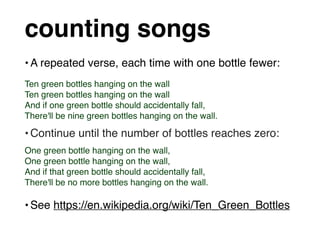
counting songs
•A repeated verse, each time with one bottle fewer:
Ten green bottles hanging on the wall
And if one green bottle should accidentally fall,
There'll be nine green bottles hanging on the wall.
•Continue until the number of bottles reaches zero:
One green bottle hanging on the wall,
And if that green bottle should accidentally fall,
There'll be no more bottles hanging on the wall.
•See https://en.wikipedia.org/wiki/Ten_Green_Bottles
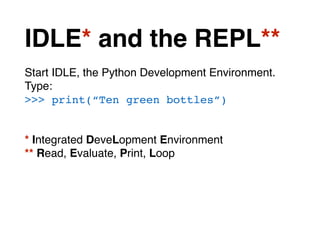
IDLE* and the REPL**
Start IDLE, the Python Development Environment.

Type:
>>> print(“Ten green bottles”)
* Integrated DeveLopment Environment
** Read, Evaluate, Print, Loop
programs and strings
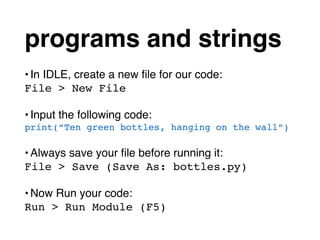
•In IDLE, create a new file for our code:
File > New File
•Input the following code:
print(“Ten green bottles, hanging on the wall”)
•Always save your file before running it:
File > Save (Save As: bottles.py)
•Now Run your code:
Run > Run Module (F5)
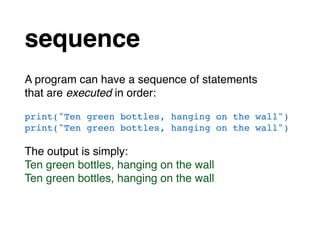
sequence
A program can have a sequence of statements 

that are executed in order:
print("Ten green bottles, hanging on the wall")
The output is simply:
Ten green bottles, hanging on the wall
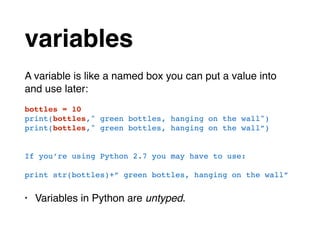
variables
A variable is like a named box you can put a value into 

and use later:
bottles = 10
print(bottles," green bottles, hanging on the wall")
print(bottles," green bottles, hanging on the wall”)
If you’re using Python 2.7 you may have to use:
print str(bottles)+” green bottles, hanging on the wall”
• Variables in Python are untyped.
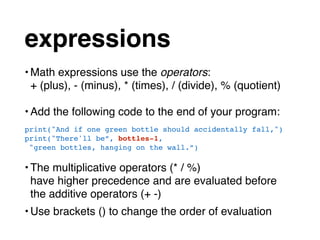
expressions
• Math expressions use the operators: 

+ (plus), - (minus), * (times), / (divide), % (quotient)
• Add the following code to the end of your program:
print("And if one green bottle should accidentally fall,")
print("There'll be”, bottles-1,
"green bottles, hanging on the wall.”)
• The multiplicative operators (* / %) 

have higher precedence and are evaluated before 

the additive operators (+ -)
• Use brackets () to change the order of evaluation
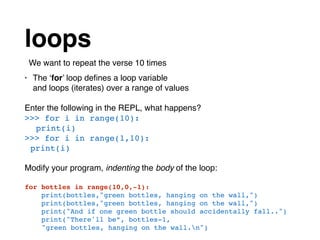
loops
We want to repeat the verse 10 times
• The ‘for’ loop defines a loop variable 

and loops (iterates) over a range of values
Enter the following in the REPL, what happens?
>>> for i in range(10):
print(i)
>>> for i in range(1,10):
print(i)
Modify your program, indenting the body of the loop:
for bottles in range(10,0,-1):
print(bottles,"green bottles, hanging on the wall,")
print("And if one green bottle should accidentally fall..")
print("There'll be”, bottles-1,
"green bottles, hanging on the wall.n")
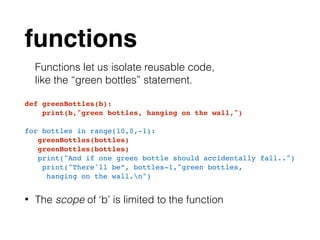
functions
Functions let us isolate reusable code,

like the “green bottles” statement.
def greenBottles(b):
print(b,"green bottles, hanging on the wall,")
for bottles in range(10,0,-1):
greenBottles(bottles)
print("And if one green bottle should accidentally fall..")
print("There'll be”, bottles-1,"green bottles,
hanging on the wall.n")
• The scope of ‘b’ is limited to the function
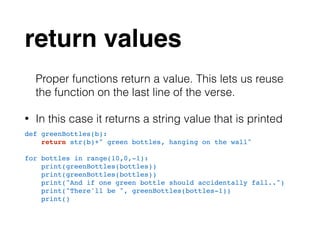
return values
Proper functions return a value. This lets us reuse
the function on the last line of the verse.
• In this case it returns a string value that is printed
def greenBottles(b):
return str(b)+" green bottles, hanging on the wall"
for bottles in range(10,0,-1):
print(greenBottles(bottles))
print("And if one green bottle should accidentally fall..")
print("There'll be ", greenBottles(bottles-1))
print()
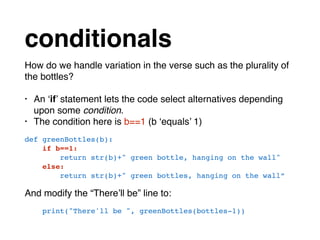
conditionals
How do we handle variation in the verse such as the plurality of
the bottles?
• An ‘if’ statement lets the code select alternatives depending
upon some condition.
• The condition here is b==1 (b ‘equals’ 1)
def greenBottles(b):
if b==1:
return str(b)+" green bottle, hanging on the wall"
else:
return str(b)+" green bottles, hanging on the wall”
And modify the “There’ll be” line to:
print("There'll be ", greenBottles(bottles-1))
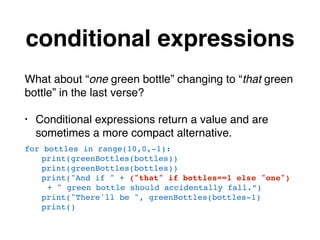
conditional expressions
What about “one green bottle” changing to “that green
bottle” in the last verse?
• Conditional expressions return a value and are
sometimes a more compact alternative.
for bottles in range(10,0,-1):
print(greenBottles(bottles))
print("And if " + ("that" if bottles==1 else "one")
+ " green bottle should accidentally fall.”)
print("There'll be ", greenBottles(bottles-1)
print()
data structures
We want to use written numerals, “ten”, “nine”,…
• Tuples are sequences of symbols.
numerals = ('no','one','two','three','four','five',
'six','seven','eight','nine','ten')
def bottle(b):
if b==1:
return numerals[b] + " green bottle, hanging on the wall"
else:
return numerals[b] + " green bottles, hanging on the wall"
• Like strings, tuples are immutable.
slicing
Finally, we need to properly capitalise every line of the verse.
• We need to be able to slice up a string, converting only the first letter to upper-case.
At the REPL type:
>>> "one".upper()
>>> “one”[0:1]
>>> “one"[0:1].upper()
>>> "one"[0:1].upper() + "one"[1:]
Add the following function:
def caps(s):
return s[:1].upper() + s[1:]
And call the function in the following two lines:
print(caps(greenBottles(bottles)))
•Slicing works on all types of sequence.
Ten Green Bottles
# Ten Green Bottles
numerals = ('no','one','two','three','four','five','six','seven','eight','nine','ten')
def greenBottles(b):
if b==1:
return numerals[b] + " green bottle, hanging on the wall"
else:
return numerals[b] + " green bottles, hanging on the wall"
def caps(s):
return s[:1].upper() + s[1:]
for bottles in range(10,0,-1):
print(caps(greenBottles(bottles)))
print("And if " + ("that" if bottles==1 else "one") + " green bottle 
should accidentally fall,")
print("There'll be "+greenBottles(bottles-1)+".")
print()
conclusion
While we’ve covered a range of Python features,
the three main features of programs are:
• Sequence
• Loops
• Conditionals
With these, we can write programs that can do
anything (computable).

Coding with Counting Songs: “Ten Green Bottles” in Python

  • 1.
    Coding with CountingSongs: “Ten Green Bottles” 
 in Python Steve Battle
  • 2.
    counting songs •A repeatedverse, each time with one bottle fewer: Ten green bottles hanging on the wall Ten green bottles hanging on the wall And if one green bottle should accidentally fall, There'll be nine green bottles hanging on the wall. •Continue until the number of bottles reaches zero: One green bottle hanging on the wall, One green bottle hanging on the wall, And if that green bottle should accidentally fall, There'll be no more bottles hanging on the wall. •See https://en.wikipedia.org/wiki/Ten_Green_Bottles
  • 3.
    IDLE* and theREPL** Start IDLE, the Python Development Environment.
 Type: >>> print(“Ten green bottles”) * Integrated DeveLopment Environment ** Read, Evaluate, Print, Loop
  • 4.
    programs and strings •InIDLE, create a new file for our code: File > New File •Input the following code: print(“Ten green bottles, hanging on the wall”) •Always save your file before running it: File > Save (Save As: bottles.py) •Now Run your code: Run > Run Module (F5)
  • 5.
    sequence A program canhave a sequence of statements 
 that are executed in order: print("Ten green bottles, hanging on the wall") print("Ten green bottles, hanging on the wall") The output is simply: Ten green bottles, hanging on the wall Ten green bottles, hanging on the wall
  • 6.
    variables A variable islike a named box you can put a value into 
 and use later: bottles = 10 print(bottles," green bottles, hanging on the wall") print(bottles," green bottles, hanging on the wall”) If you’re using Python 2.7 you may have to use: print str(bottles)+” green bottles, hanging on the wall” • Variables in Python are untyped.
  • 7.
    expressions • Math expressionsuse the operators: 
 + (plus), - (minus), * (times), / (divide), % (quotient) • Add the following code to the end of your program: print("And if one green bottle should accidentally fall,") print("There'll be”, bottles-1, "green bottles, hanging on the wall.”) • The multiplicative operators (* / %) 
 have higher precedence and are evaluated before 
 the additive operators (+ -) • Use brackets () to change the order of evaluation
  • 8.
    loops We want torepeat the verse 10 times • The ‘for’ loop defines a loop variable 
 and loops (iterates) over a range of values Enter the following in the REPL, what happens? >>> for i in range(10): print(i) >>> for i in range(1,10): print(i) Modify your program, indenting the body of the loop: for bottles in range(10,0,-1): print(bottles,"green bottles, hanging on the wall,") print(bottles,"green bottles, hanging on the wall,") print("And if one green bottle should accidentally fall..") print("There'll be”, bottles-1, "green bottles, hanging on the wall.n")
  • 9.
    functions Functions let usisolate reusable code,
 like the “green bottles” statement. def greenBottles(b): print(b,"green bottles, hanging on the wall,") for bottles in range(10,0,-1): greenBottles(bottles) greenBottles(bottles) print("And if one green bottle should accidentally fall..") print("There'll be”, bottles-1,"green bottles, hanging on the wall.n") • The scope of ‘b’ is limited to the function
  • 10.
    return values Proper functionsreturn a value. This lets us reuse the function on the last line of the verse. • In this case it returns a string value that is printed def greenBottles(b): return str(b)+" green bottles, hanging on the wall" for bottles in range(10,0,-1): print(greenBottles(bottles)) print(greenBottles(bottles)) print("And if one green bottle should accidentally fall..") print("There'll be ", greenBottles(bottles-1)) print()
  • 11.
    conditionals How do wehandle variation in the verse such as the plurality of the bottles? • An ‘if’ statement lets the code select alternatives depending upon some condition. • The condition here is b==1 (b ‘equals’ 1) def greenBottles(b): if b==1: return str(b)+" green bottle, hanging on the wall" else: return str(b)+" green bottles, hanging on the wall” And modify the “There’ll be” line to: print("There'll be ", greenBottles(bottles-1))
  • 12.
    conditional expressions What about“one green bottle” changing to “that green bottle” in the last verse? • Conditional expressions return a value and are sometimes a more compact alternative. for bottles in range(10,0,-1): print(greenBottles(bottles)) print(greenBottles(bottles)) print("And if " + ("that" if bottles==1 else "one") + " green bottle should accidentally fall.”) print("There'll be ", greenBottles(bottles-1) print()
  • 13.
    data structures We wantto use written numerals, “ten”, “nine”,… • Tuples are sequences of symbols. numerals = ('no','one','two','three','four','five', 'six','seven','eight','nine','ten') def bottle(b): if b==1: return numerals[b] + " green bottle, hanging on the wall" else: return numerals[b] + " green bottles, hanging on the wall" • Like strings, tuples are immutable.
  • 14.
    slicing Finally, we needto properly capitalise every line of the verse. • We need to be able to slice up a string, converting only the first letter to upper-case. At the REPL type: >>> "one".upper() >>> “one”[0:1] >>> “one"[0:1].upper() >>> "one"[0:1].upper() + "one"[1:] Add the following function: def caps(s): return s[:1].upper() + s[1:] And call the function in the following two lines: print(caps(greenBottles(bottles))) print(caps(greenBottles(bottles))) •Slicing works on all types of sequence.
  • 15.
    Ten Green Bottles #Ten Green Bottles numerals = ('no','one','two','three','four','five','six','seven','eight','nine','ten') def greenBottles(b): if b==1: return numerals[b] + " green bottle, hanging on the wall" else: return numerals[b] + " green bottles, hanging on the wall" def caps(s): return s[:1].upper() + s[1:] for bottles in range(10,0,-1): print(caps(greenBottles(bottles))) print(caps(greenBottles(bottles))) print("And if " + ("that" if bottles==1 else "one") + " green bottle should accidentally fall,") print("There'll be "+greenBottles(bottles-1)+".") print()
  • 16.
    conclusion While we’ve covereda range of Python features, the three main features of programs are: • Sequence • Loops • Conditionals With these, we can write programs that can do anything (computable).