
Coderetreat
Matteo Baglini
Freelance Software Developer (and so on...)
Coders TUG & DotNetToscana Co-Founder
@matteobaglini
matteo.baglini@gmail.com
by Coders TUG
Coders Tuscany User Group è una
community di sviluppatori
appassionati che credono nel
collaborative learning.
Il nostro obiettivo è creare un network
di coders che desiderino alimentare la
propria passione condividendo le proprie
Learning Through Sharing
Conosciamoci
Come ti chiami?
Da dove vieni?
Che lavoro fai?
Obiettivi della giornata?
Test-Driven
Development
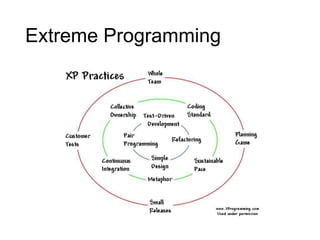
Extreme Programming
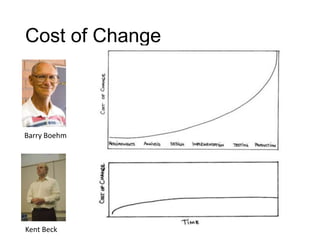
Cost of Change
Barry Boehm
Kent Beck
Clean code that works
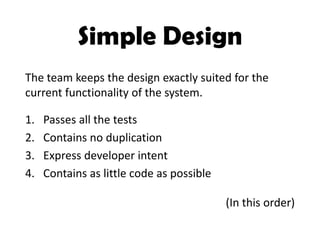
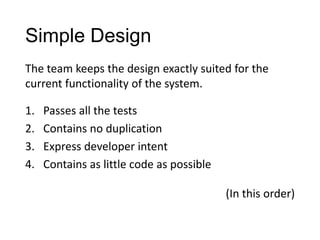
Simple Design
1. Passes all the tests
2. Contains no duplication
3. Express developer intent
4. Contains as little code as possible
The team keeps the design exactly suited for the
current functionality of the system.
(In this order)
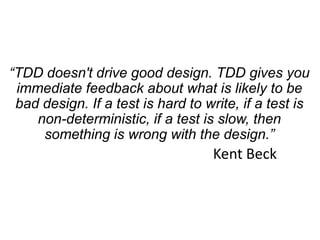
“TDD doesn't drive good design. TDD gives you
immediate feedback about what is likely to be
bad design. If a test is hard to write, if a test is
non-deterministic, if a test is slow, then
something is wrong with the design.”
Kent Beck
Mechanics
TDD Rules
• Write new code only if an automated test has failed
• Eliminate duplication
TDD Phases
1. Write a test.
2. Make it compile.
3. Run it to see that it
fails.
4. Make it run.
5. Remove duplication.
The different phases have different purposes. They
call for different styles of solution, different
aesthetic viewpoints. The first three phases need to
go by quickly, so we get to a known state with the
new functionality. We can commit any number of
sins to get there, because speed trumps design, just
for that brief moment.
Now I'm worried. I've given you a license to abandon
all the principles of good design. [cut] The cycle is
not complete. A four-legged Aeron chair falls over.
The first four steps of the cycle won't work without
the fifth. Good design at good times. Make it
run, make it right.
There, I feel better. Now I'm sure you won't show
anyone except your partner your code until you've
removed the duplication.
Kent Beck, Test-Driven Development by Example
Clean code that works
Make it run, make it right
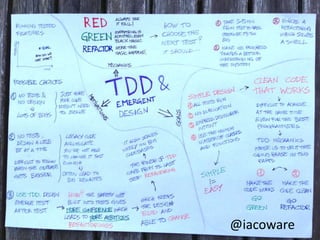
@iacoware
Learn TDD
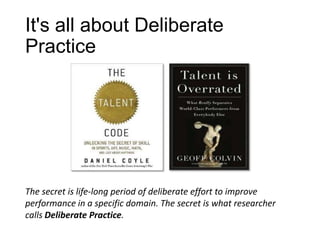
It's all about Deliberate
Practice
The secret is life-long period of deliberate effort to improve
performance in a specific domain. The secret is what researcher
calls Deliberate Practice.
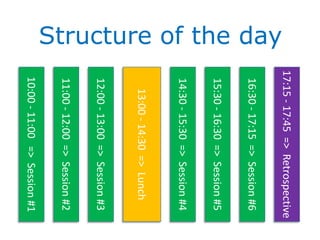
Structure of the day
10:00-11:00=>Session#1
11:00-12:00=>Session#2
12:00-13:00=>Session#3
13:00-14:30=>Lunch
14:30-15:30=>Session#4
15:30-16:30=>Session#5
16:30-17:15=>Session#6
17:15-17:45=>Retrospective
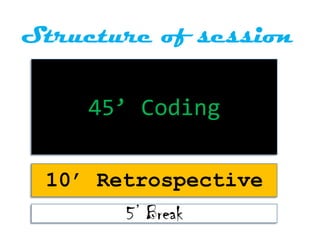
Structure of session
45’ Coding
10’ Retrospective
5’ Break
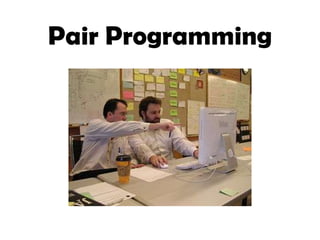
Pair Programming
Test-Driven Development
Simple Design
1. Passes all the tests
2. Contains no duplication
3. Express developer intent
4. Contains as little code as possible
The team keeps the design exactly suited for the
current functionality of the system.
(In this order)
Change Partner
Delete Your Code
The Game of Life
The Game of Life is a cellular
automaton devised by the
British mathematician John
Conway in 1970.
It’s a zero-player game.
You create an initial state
and watch how it evolves.
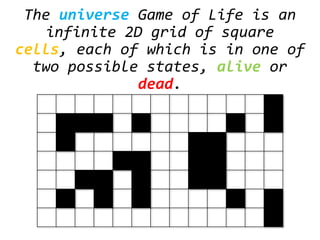
The universe Game of Life is an
infinite 2D grid of square
cells, each of which is in one of
two possible states, alive or
dead.
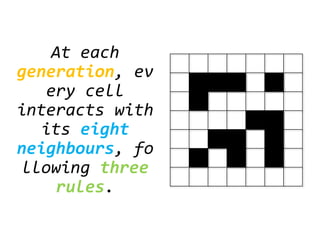
At each
generation, ev
ery cell
interacts with
its eight
neighbours, fo
llowing three
rules.
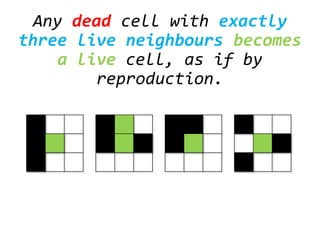
Any dead cell with exactly
three live neighbours becomes
a live cell, as if by
reproduction.
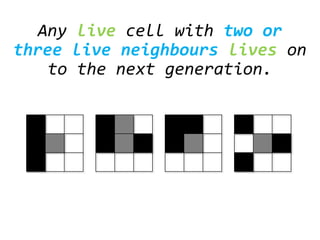
Any live cell with two or
three live neighbours lives on
to the next generation.
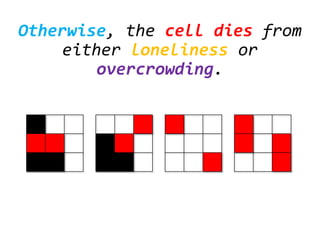
Otherwise, the cell dies from
either loneliness or
overcrowding.
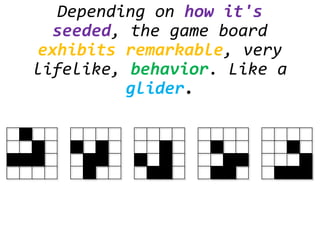
Depending on how it's
seeded, the game board
exhibits remarkable, very
lifelike, behavior. Like a
glider.
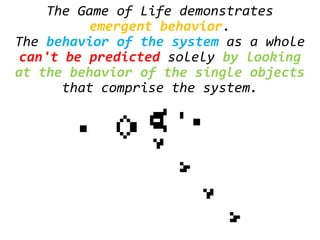
The Game of Life demonstrates
emergent behavior.
The behavior of the system as a whole
can't be predicted solely by looking
at the behavior of the single objects
that comprise the system.
Coderetreat @ CodersTUG

Coderetreat @ CodersTUG

  • 1.
    Coderetreat Matteo Baglini Freelance SoftwareDeveloper (and so on...) Coders TUG & DotNetToscana Co-Founder @matteobaglini matteo.baglini@gmail.com by Coders TUG
  • 2.
    Coders Tuscany UserGroup è una community di sviluppatori appassionati che credono nel collaborative learning. Il nostro obiettivo è creare un network di coders che desiderino alimentare la propria passione condividendo le proprie Learning Through Sharing
  • 3.
    Conosciamoci Come ti chiami? Dadove vieni? Che lavoro fai? Obiettivi della giornata?
  • 4.
  • 5.
  • 6.
    Cost of Change BarryBoehm Kent Beck
  • 7.
  • 8.
    Simple Design 1. Passesall the tests 2. Contains no duplication 3. Express developer intent 4. Contains as little code as possible The team keeps the design exactly suited for the current functionality of the system. (In this order)
  • 9.
    “TDD doesn't drivegood design. TDD gives you immediate feedback about what is likely to be bad design. If a test is hard to write, if a test is non-deterministic, if a test is slow, then something is wrong with the design.” Kent Beck
  • 10.
  • 11.
    TDD Rules • Writenew code only if an automated test has failed • Eliminate duplication
  • 12.
    TDD Phases 1. Writea test. 2. Make it compile. 3. Run it to see that it fails. 4. Make it run. 5. Remove duplication. The different phases have different purposes. They call for different styles of solution, different aesthetic viewpoints. The first three phases need to go by quickly, so we get to a known state with the new functionality. We can commit any number of sins to get there, because speed trumps design, just for that brief moment. Now I'm worried. I've given you a license to abandon all the principles of good design. [cut] The cycle is not complete. A four-legged Aeron chair falls over. The first four steps of the cycle won't work without the fifth. Good design at good times. Make it run, make it right. There, I feel better. Now I'm sure you won't show anyone except your partner your code until you've removed the duplication. Kent Beck, Test-Driven Development by Example
  • 13.
    Clean code thatworks Make it run, make it right
  • 14.
  • 15.
  • 19.
    It's all aboutDeliberate Practice The secret is life-long period of deliberate effort to improve performance in a specific domain. The secret is what researcher calls Deliberate Practice.
  • 25.
    Structure of theday 10:00-11:00=>Session#1 11:00-12:00=>Session#2 12:00-13:00=>Session#3 13:00-14:30=>Lunch 14:30-15:30=>Session#4 15:30-16:30=>Session#5 16:30-17:15=>Session#6 17:15-17:45=>Retrospective
  • 26.
    Structure of session 45’Coding 10’ Retrospective 5’ Break
  • 28.
  • 29.
  • 30.
    Simple Design 1. Passesall the tests 2. Contains no duplication 3. Express developer intent 4. Contains as little code as possible The team keeps the design exactly suited for the current functionality of the system. (In this order)
  • 31.
  • 32.
  • 33.
  • 34.
    The Game ofLife is a cellular automaton devised by the British mathematician John Conway in 1970. It’s a zero-player game. You create an initial state and watch how it evolves.
  • 35.
    The universe Gameof Life is an infinite 2D grid of square cells, each of which is in one of two possible states, alive or dead.
  • 36.
    At each generation, ev erycell interacts with its eight neighbours, fo llowing three rules.
  • 37.
    Any dead cellwith exactly three live neighbours becomes a live cell, as if by reproduction.
  • 38.
    Any live cellwith two or three live neighbours lives on to the next generation.
  • 39.
    Otherwise, the celldies from either loneliness or overcrowding.
  • 40.
    Depending on howit's seeded, the game board exhibits remarkable, very lifelike, behavior. Like a glider.
  • 41.
    The Game ofLife demonstrates emergent behavior. The behavior of the system as a whole can't be predicted solely by looking at the behavior of the single objects that comprise the system.