Test-driven Design/Development
TDD First agile practice to become mainstream Chrysler Comprehensive Compensation system They needed something different BUFP wasn’t working How to deal with change instead of fighting it?
Lean - Dealing with Change Planning Incremental frequent Small features releases
Agile - Dealing with Change Plan driven vs Planning Driven Revise the plan weekly reflect reality make appropriate decisions
Lean Manufacturing View the problem as a Software Delivery System Programmers, testers, designers, managers, BBAA. Input: Feature request Output: Let’s decide...
Lean: “The Goal”- Eliyahu Goldratt Alex run a manufacturing plant soon to be closed He knows a consultant (Jonah)!! He learns a systems approach to manufacturing and its evaluation This new system is counterintuitive: Not seeking 100% machine utilization
Lean Basics: The Goal Increase the throughput Decrease operating expenses Decrease inventory
Lean: Throughput How much potential revenue the system can create Emphasis in deliver real software to real customers. It is only paid if it is used. Running Tested Features per time unit RFT/month
Lean: Operating expenses Computers Electricity Rent Insurance Wages ...
Lean:Inventory Grocery Store What is in the shelve I bet I can sell it on time It is not providing value (value = money)
Inventory in Software? Unused Features: Building a feature nobody is using [no payments] Unreleased features in source control Unnecessary complexity:  A developer adds complexity in anticipation of a future feature
Inventory & Machine Utilization Machine spits out parts at 100% utilization Only 25% ended up ordered 8 hour shift: 200 sold and 600 stacking up on the floor Walk around parts, new warehouse! Operating expenses increased! Don’t use it at 100%
Inventory: Unnecessary Complexity Developer adds complexity in anticipation Developer will have to walk around these parts from now on [we have spoiled customers!!] Developers are slowed down More complexity Probably adding duplication
Inventory: Unnecessary Complexity The more unnecessary complexity The more difficult to change The harder to maintain Marginal costs of features goes up The harder to maintain a system The more expensive the feature
TDD’s goal is to reduce Inventory Keeping the cost of adding a feature as low as we can by keeping the design simple
Lean Basics: The Goal Increase the throughput (RTF/month) Decrease operating expenses, - precedence Decrease inventory Reduce unnecessary complexity Reduce unused features Reduce unreleased features
YAGNI - Decrease Unneeded Complexity  Design only what I need to solve the problem I have now :-( I design what I need now in such a way that is ready for  any  change :-) Example: Personal defense failure
YAGNI - Decrease Unneeded Complexity Design in a way that prevents attacks from any direction Follow few principles to keep the design simple so the cost of implementing any new feature is reasonably low Example: Personal defense Principles
TDD Principles Design is simple if it passes the test minimizes duplication maximizes clarity  is small 1. is assumed and 4. is a by-product
TDD Principle: Reduce Duplication “ I’m doing the same thing in five places, I have to change all five of them [Put rationalized justification] so I copied and pasted in four places, I forgot the fifth one” ⇒ bug
TDD Principle: Fix Bad Names By naming accurately It is easier to understand how the code works we may detect smells (name too weird?)
TDD Principle: Maximize Clarity Fix bad names name variables after what they represent name methods after what they do name classes what they are name interfaces after what the role they play
TDD Principle: Fix Bad Names Smell: too long with connectors like: “and”, “then”, “but”. That block of code  is doing too much work too many responsibilities it duplicates responsibilities with another part of the system
TDD Principles Design is simple if it minimizes duplication maximizes clarity  Claim: IF WE FOLLOW THESE PRINCIPLES WE REDUCE INVENTORY CREATED BY UNNECESSARY COMPLEXITY
TDD: Recfatoring Improving the design of existing code [book] Systematic approach to improve the design without throwing a piece a way while rewritten it.
Refactoring: Systematic Approach Work in very small steps steps are reversible I can stop if I want to Keep the code working at every step I have tests (behavioral spec) that tells me if a structural change breaks behavior
Traditional Design We design something that meets a large number of requirements at once [cascade] Done by architects, handed off to developers Caveat with high level design ideas: high levels ideas right most of the time low level detail wrong most of the time
Evolutionary Design The act of writing the code give us information wether the design works or not, without that information, we can’t design effectively. Write code in a way that allows us to start with the low level detail and use some basic principles to make sure the high level ideal designs ideas work well
Evolutionary Design by TDD Test drives the design. A test articulates a goal so I know when to stop
Evolutionary Design: TDD cycle Write a failing test  Articulates a goal: “I need a little piece of software to does this” Make the test pass: Don’t write any production code if there isn’t a failing test that requires it [no inventory]. Failing test evidence of need
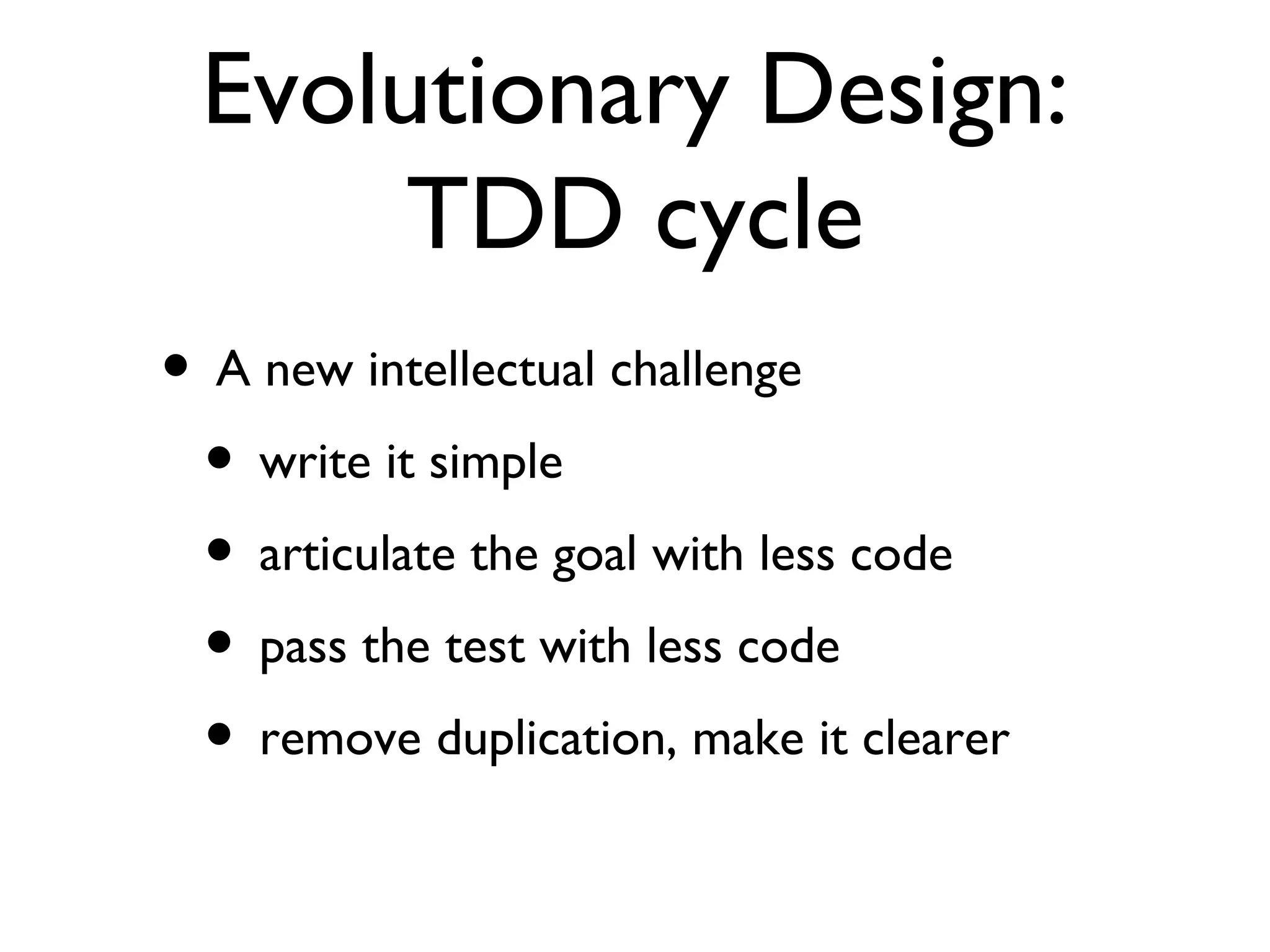
Evolutionary Design: TDD cycle A new intellectual challenge write it simple articulate the goal with less code pass the test with less code remove duplication, make it clearer

Test-Driven Design - ¿Porqué?

  • 1.
  • 2.
    TDD First agilepractice to become mainstream Chrysler Comprehensive Compensation system They needed something different BUFP wasn’t working How to deal with change instead of fighting it?
  • 3.
    Lean - Dealingwith Change Planning Incremental frequent Small features releases
  • 4.
    Agile - Dealingwith Change Plan driven vs Planning Driven Revise the plan weekly reflect reality make appropriate decisions
  • 5.
    Lean Manufacturing Viewthe problem as a Software Delivery System Programmers, testers, designers, managers, BBAA. Input: Feature request Output: Let’s decide...
  • 6.
    Lean: “The Goal”-Eliyahu Goldratt Alex run a manufacturing plant soon to be closed He knows a consultant (Jonah)!! He learns a systems approach to manufacturing and its evaluation This new system is counterintuitive: Not seeking 100% machine utilization
  • 7.
    Lean Basics: TheGoal Increase the throughput Decrease operating expenses Decrease inventory
  • 8.
    Lean: Throughput Howmuch potential revenue the system can create Emphasis in deliver real software to real customers. It is only paid if it is used. Running Tested Features per time unit RFT/month
  • 9.
    Lean: Operating expensesComputers Electricity Rent Insurance Wages ...
  • 10.
    Lean:Inventory Grocery StoreWhat is in the shelve I bet I can sell it on time It is not providing value (value = money)
  • 11.
    Inventory in Software?Unused Features: Building a feature nobody is using [no payments] Unreleased features in source control Unnecessary complexity: A developer adds complexity in anticipation of a future feature
  • 12.
    Inventory & MachineUtilization Machine spits out parts at 100% utilization Only 25% ended up ordered 8 hour shift: 200 sold and 600 stacking up on the floor Walk around parts, new warehouse! Operating expenses increased! Don’t use it at 100%
  • 13.
    Inventory: Unnecessary ComplexityDeveloper adds complexity in anticipation Developer will have to walk around these parts from now on [we have spoiled customers!!] Developers are slowed down More complexity Probably adding duplication
  • 14.
    Inventory: Unnecessary ComplexityThe more unnecessary complexity The more difficult to change The harder to maintain Marginal costs of features goes up The harder to maintain a system The more expensive the feature
  • 15.
    TDD’s goal isto reduce Inventory Keeping the cost of adding a feature as low as we can by keeping the design simple
  • 16.
    Lean Basics: TheGoal Increase the throughput (RTF/month) Decrease operating expenses, - precedence Decrease inventory Reduce unnecessary complexity Reduce unused features Reduce unreleased features
  • 17.
    YAGNI - DecreaseUnneeded Complexity Design only what I need to solve the problem I have now :-( I design what I need now in such a way that is ready for any change :-) Example: Personal defense failure
  • 18.
    YAGNI - DecreaseUnneeded Complexity Design in a way that prevents attacks from any direction Follow few principles to keep the design simple so the cost of implementing any new feature is reasonably low Example: Personal defense Principles
  • 19.
    TDD Principles Designis simple if it passes the test minimizes duplication maximizes clarity is small 1. is assumed and 4. is a by-product
  • 20.
    TDD Principle: ReduceDuplication “ I’m doing the same thing in five places, I have to change all five of them [Put rationalized justification] so I copied and pasted in four places, I forgot the fifth one” ⇒ bug
  • 21.
    TDD Principle: FixBad Names By naming accurately It is easier to understand how the code works we may detect smells (name too weird?)
  • 22.
    TDD Principle: MaximizeClarity Fix bad names name variables after what they represent name methods after what they do name classes what they are name interfaces after what the role they play
  • 23.
    TDD Principle: FixBad Names Smell: too long with connectors like: “and”, “then”, “but”. That block of code is doing too much work too many responsibilities it duplicates responsibilities with another part of the system
  • 24.
    TDD Principles Designis simple if it minimizes duplication maximizes clarity Claim: IF WE FOLLOW THESE PRINCIPLES WE REDUCE INVENTORY CREATED BY UNNECESSARY COMPLEXITY
  • 25.
    TDD: Recfatoring Improvingthe design of existing code [book] Systematic approach to improve the design without throwing a piece a way while rewritten it.
  • 26.
    Refactoring: Systematic ApproachWork in very small steps steps are reversible I can stop if I want to Keep the code working at every step I have tests (behavioral spec) that tells me if a structural change breaks behavior
  • 27.
    Traditional Design Wedesign something that meets a large number of requirements at once [cascade] Done by architects, handed off to developers Caveat with high level design ideas: high levels ideas right most of the time low level detail wrong most of the time
  • 28.
    Evolutionary Design Theact of writing the code give us information wether the design works or not, without that information, we can’t design effectively. Write code in a way that allows us to start with the low level detail and use some basic principles to make sure the high level ideal designs ideas work well
  • 29.
    Evolutionary Design byTDD Test drives the design. A test articulates a goal so I know when to stop
  • 30.
    Evolutionary Design: TDDcycle Write a failing test Articulates a goal: “I need a little piece of software to does this” Make the test pass: Don’t write any production code if there isn’t a failing test that requires it [no inventory]. Failing test evidence of need
  • 31.
    Evolutionary Design: TDDcycle A new intellectual challenge write it simple articulate the goal with less code pass the test with less code remove duplication, make it clearer