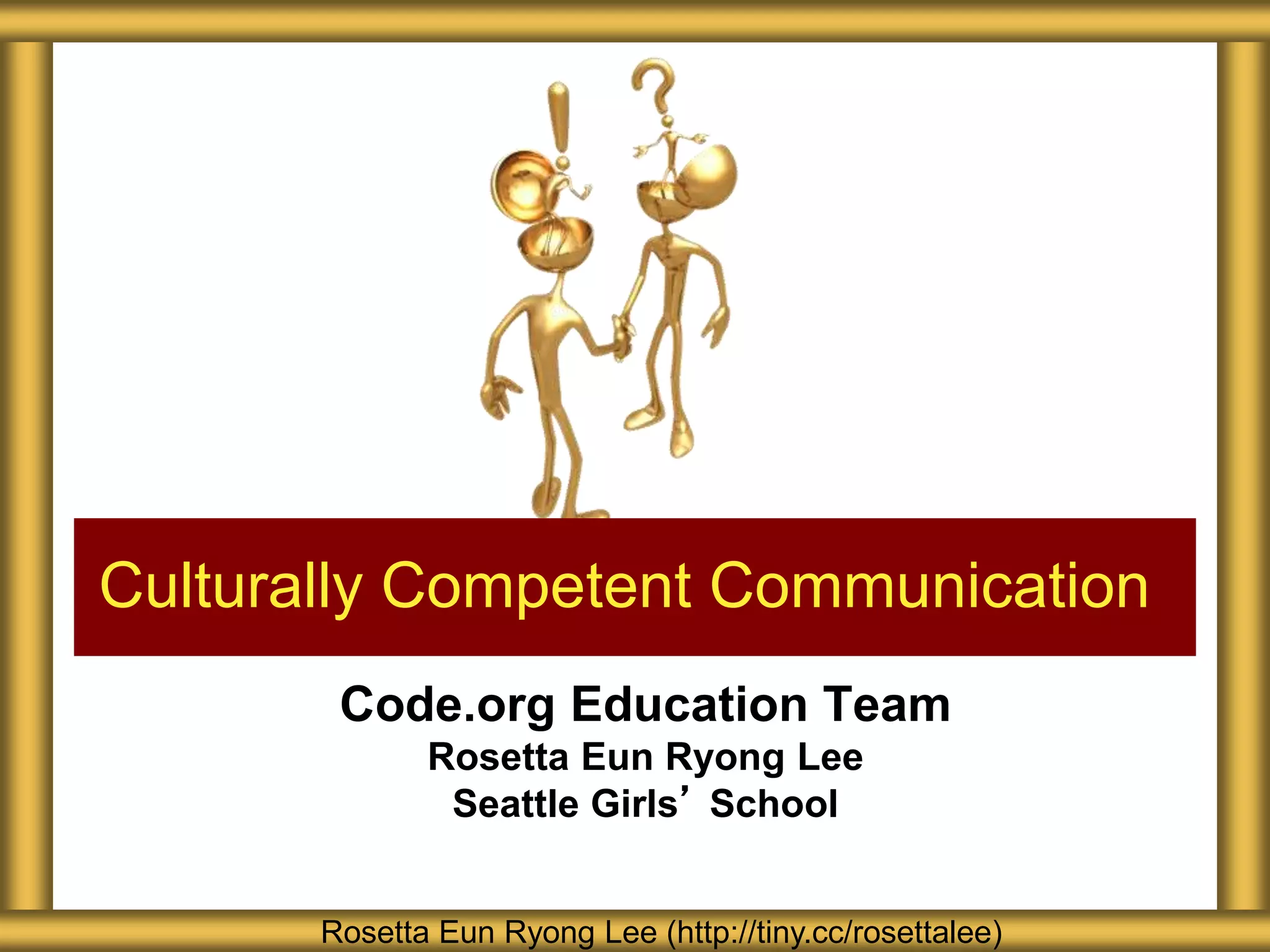
Code.org Education Team
Rosetta Eun Ryong Lee
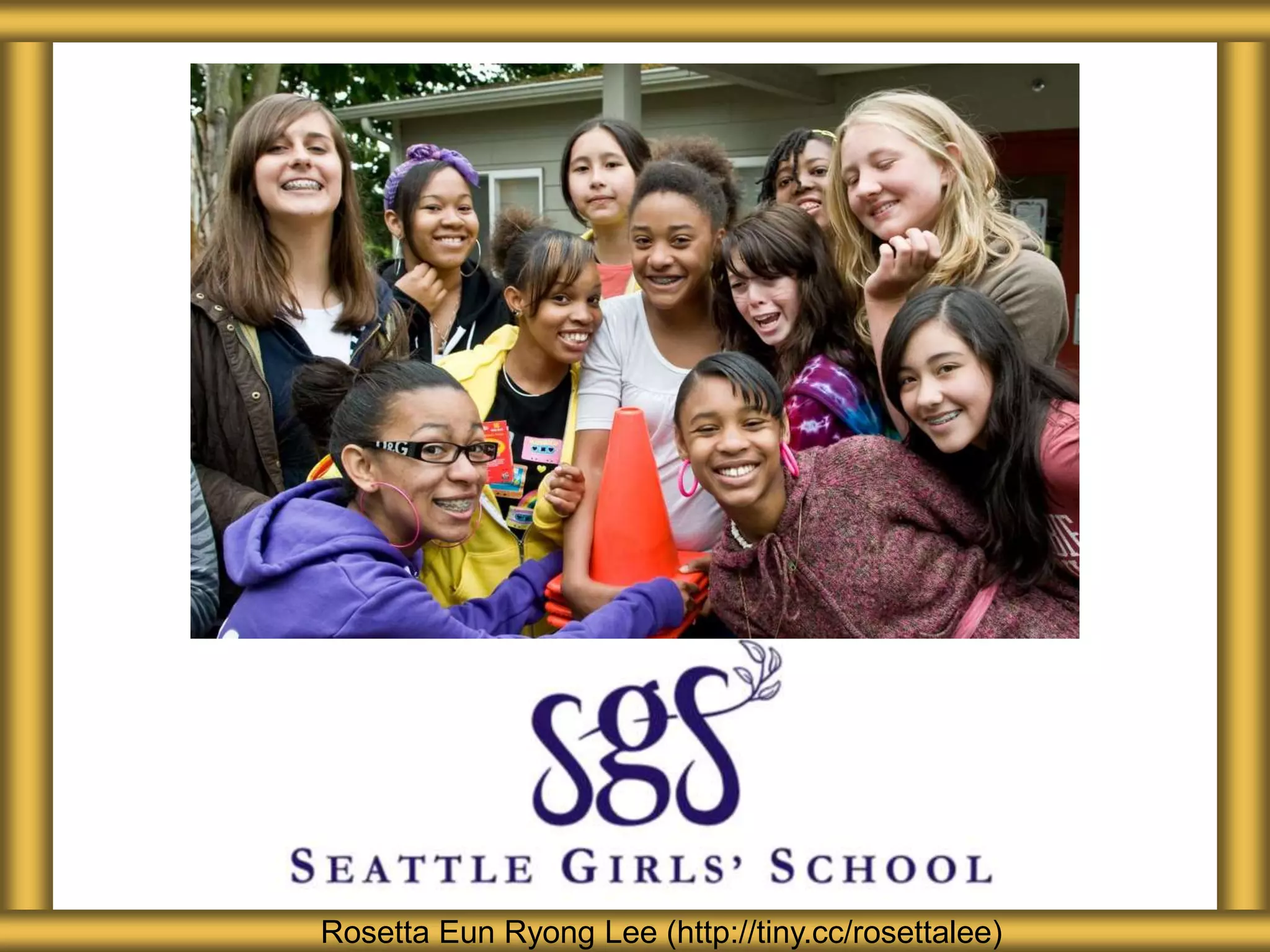
Seattle Girls’ School
Culturally Competent Communication
Rosetta Eun Ryong Lee (http://tiny.cc/rosettalee)
About Seattle Girls’ School
Rosetta Eun Ryong Lee (http://tiny.cc/rosettalee)
Agenda
 Cross Cultural Communication
 Communication Across Power
 Navigating Microaggressions
Rosetta Eun Ryong Lee (http://tiny.cc/rosettalee)
Culture [consists] primarily of the
symbolic, ideational, and intangible
aspects of human societies… It is the
values, symbols, interpretations, and
perspectives that distinguish one
people from another.
James A. Banks
What is Culture?
Rosetta Eun Ryong Lee (http://tiny.cc/rosettalee)
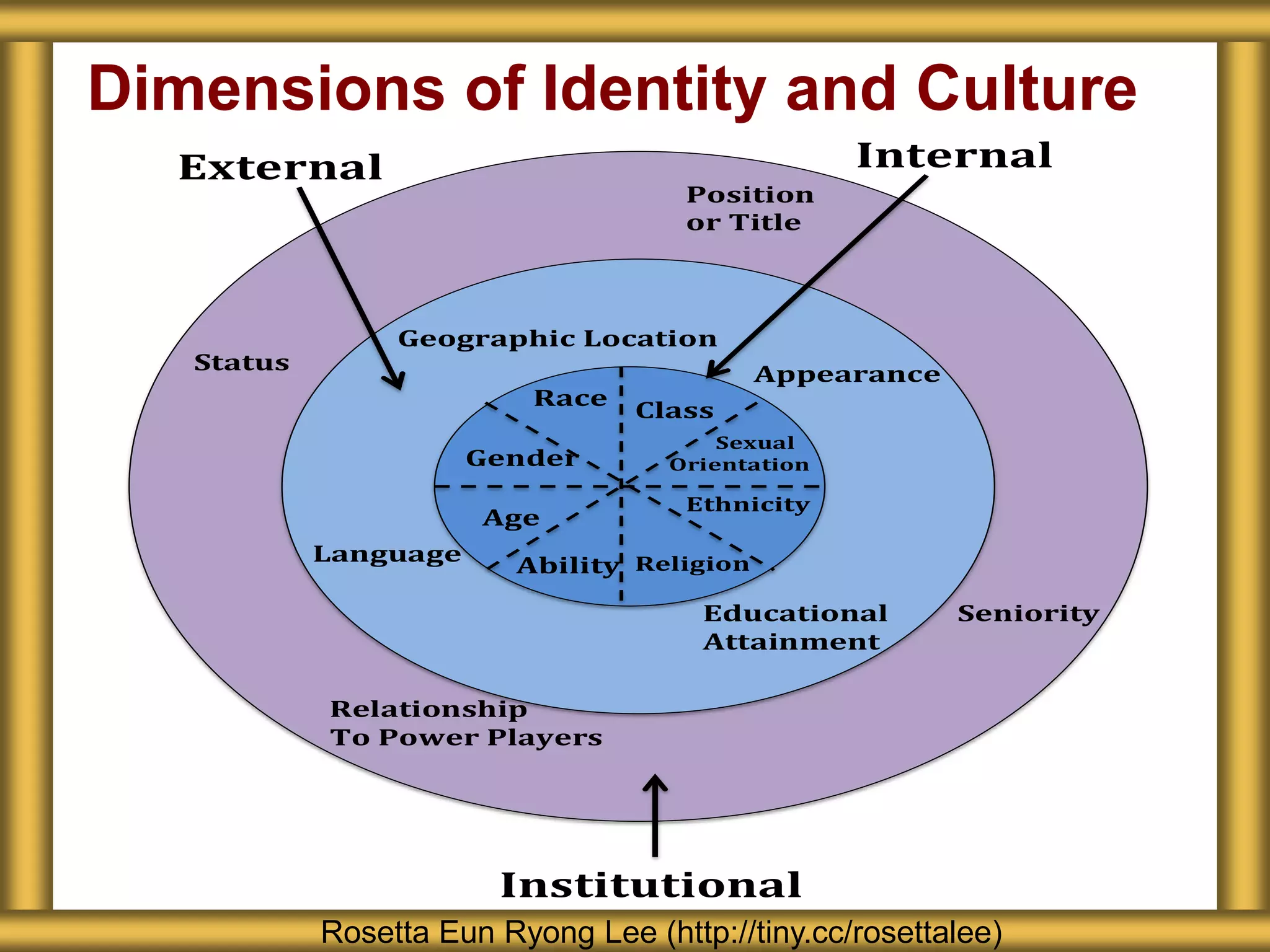
Race
Religion
Class
Gender
Sexual
Orientation
Ability
Age
Ethnicity
Geographic Location
Language
Educational
Attainment
Appearance
Seniority
Position
or Title
Status
Relationship
To Power Players
InternalExternal
Institutional
Dimensions of Identity and Culture
Rosetta Eun Ryong Lee (http://tiny.cc/rosettalee)
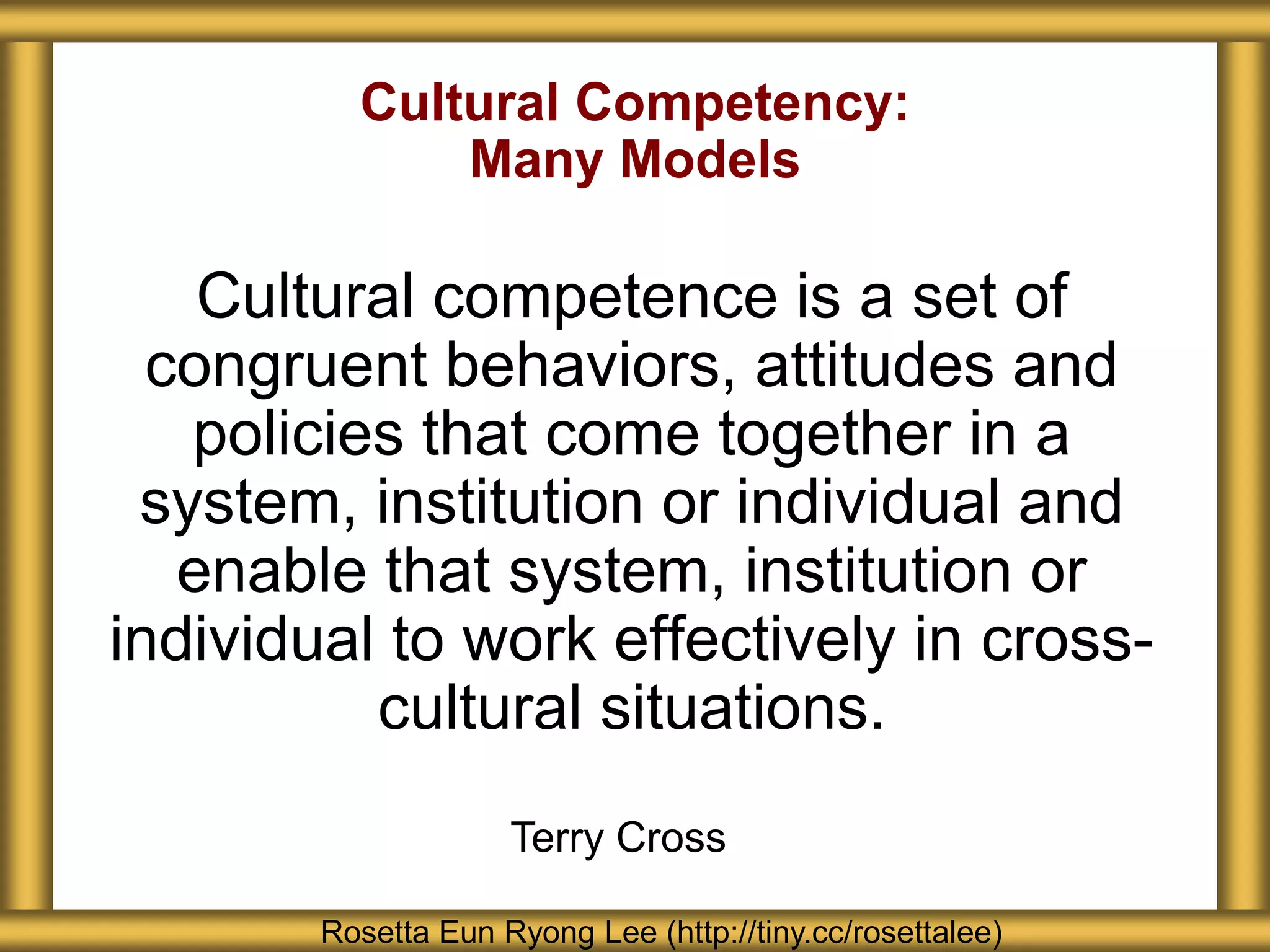
Cultural Competency:
Many Models
Cultural competence is a set of
congruent behaviors, attitudes and
policies that come together in a
system, institution or individual and
enable that system, institution or
individual to work effectively in cross-
cultural situations.
Rosetta Eun Ryong Lee (http://tiny.cc/rosettalee)
Terry Cross
Rosetta Eun Ryong Lee (http://tiny.cc/rosettalee)
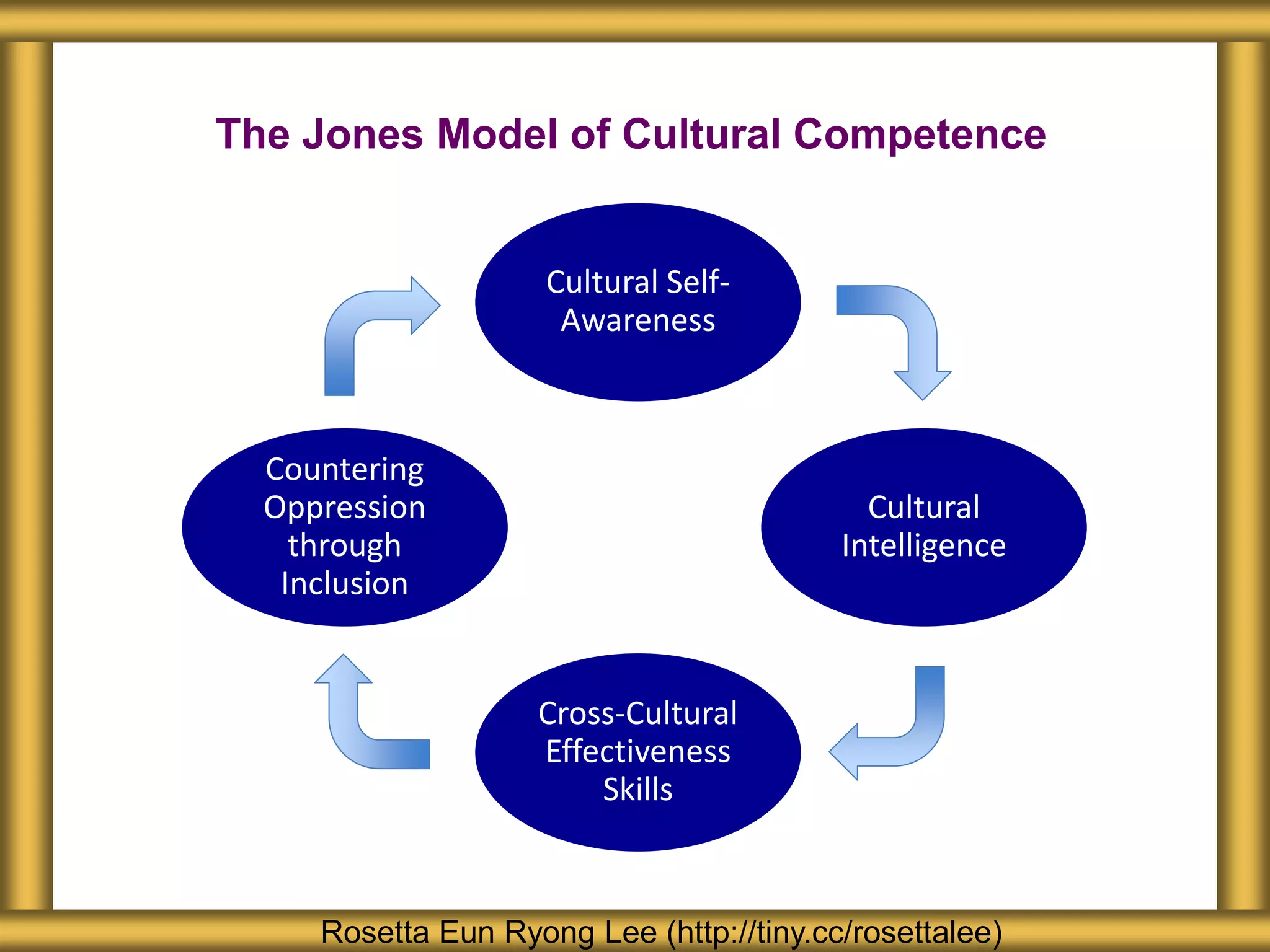
The Jones Model of Cultural Competence
Cultural Self-
Awareness
Cultural
Intelligence
Cross-Cultural
Effectiveness
Skills
Countering
Oppression
through
Inclusion
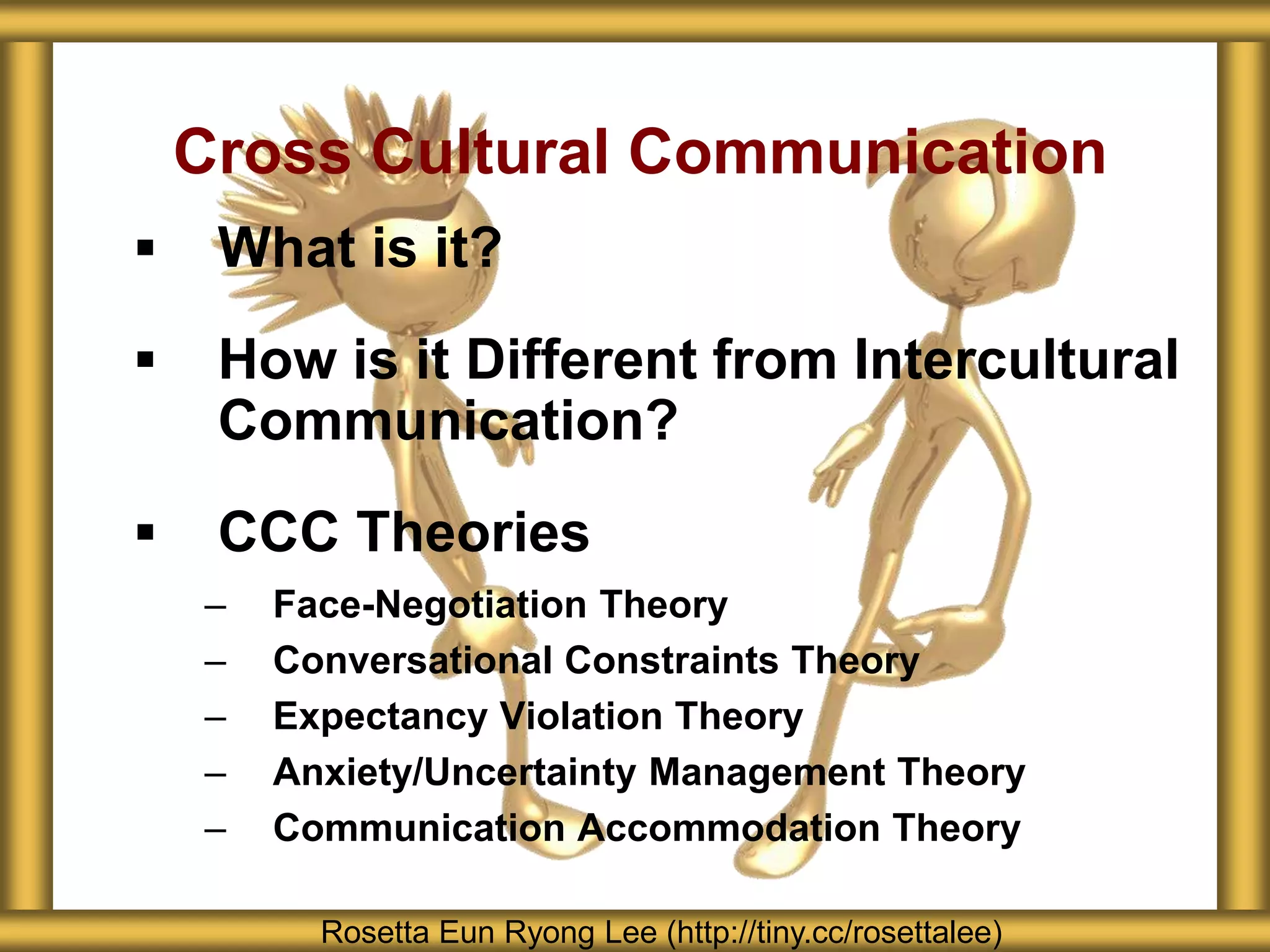
 What is it?
 How is it Different from Intercultural
Communication?
 CCC Theories
– Face-Negotiation Theory
– Conversational Constraints Theory
– Expectancy Violation Theory
– Anxiety/Uncertainty Management Theory
– Communication Accommodation Theory
Cross Cultural Communication
Rosetta Eun Ryong Lee (http://tiny.cc/rosettalee)
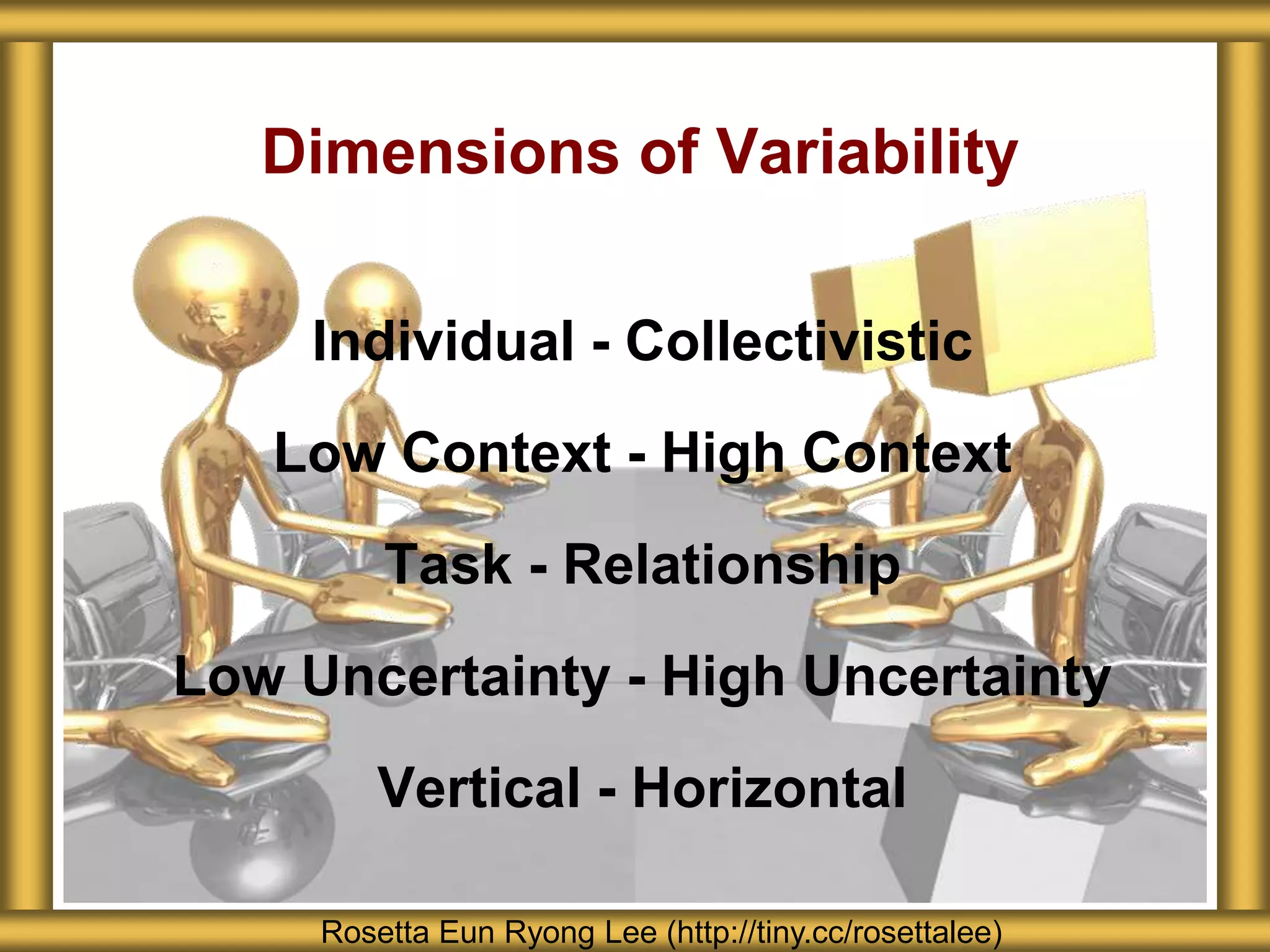
Individual - Collectivistic
Low Context - High Context
Task - Relationship
Low Uncertainty - High Uncertainty
Vertical - Horizontal
Dimensions of Variability
Rosetta Eun Ryong Lee (http://tiny.cc/rosettalee)
 Personality Orientation
 Individual Values
- Allocentric
- Idiocentric
 Self Construal
- Independent
- Interdependent
 Individual Socialization
 Cultural Norms and Rules
Factors that Influence
Rosetta Eun Ryong Lee (http://tiny.cc/rosettalee)
Discussion: My Style
In hearing about
communication
differences, what would
you describe as your
cultural communication
style? Have you noticed
stark differences
compared to others?
Rosetta Eun Ryong Lee (http://tiny.cc/rosettalee)
Cultural Values
Norms, and Rules
 Values
 Value Priorities
 Norms of Behavior
 Non-Verbal
Communication
Rosetta Eun Ryong Lee (http://tiny.cc/rosettalee)
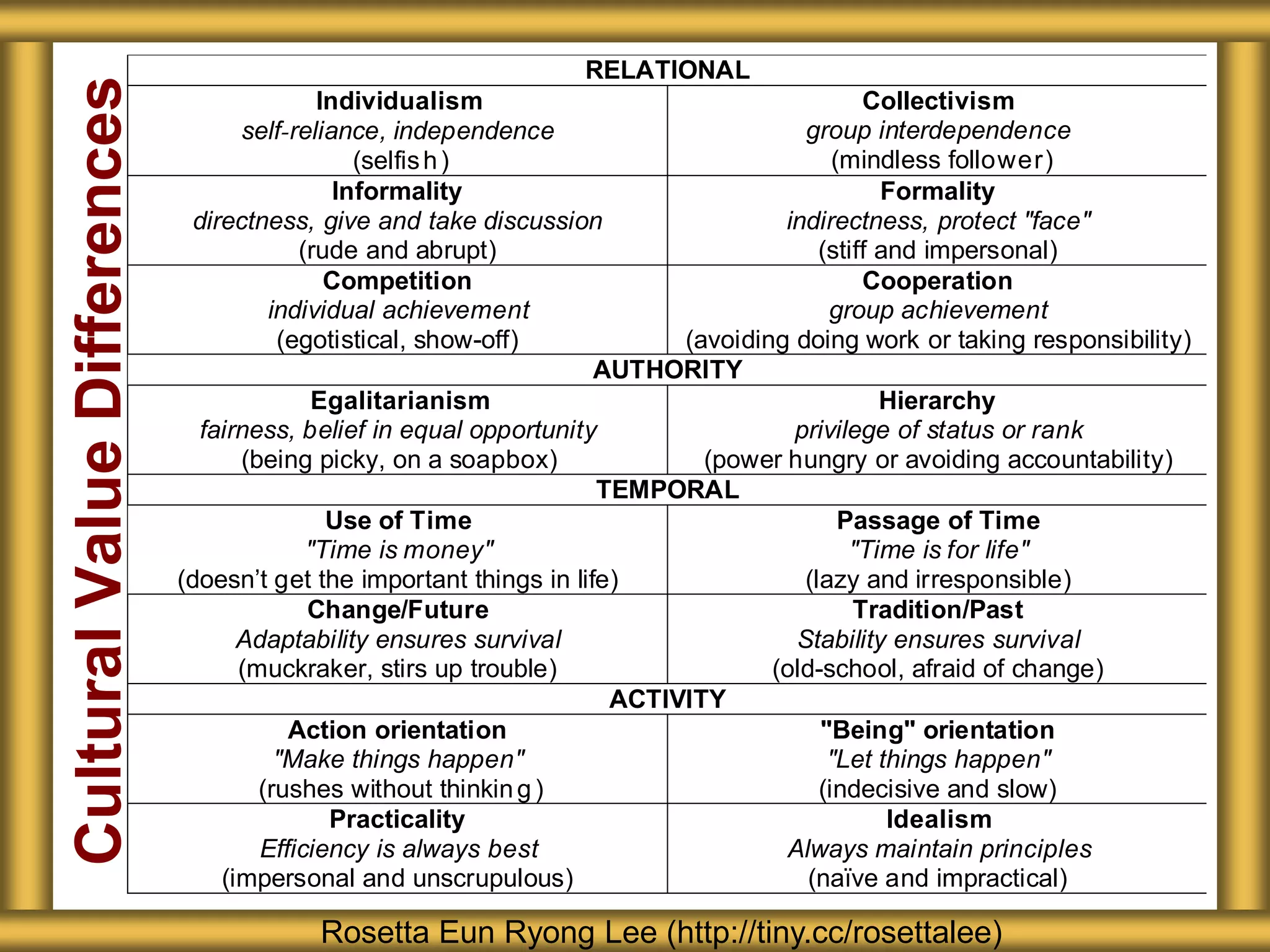
CulturalValueDifferences
RELATIONAL
Individualism
self-reliance, independence
(selfish)
Collectivism
group interdependence
(mindless follower)
Informality
directness, give and take discussion
(rude and abrupt)
Formality
indirectness, protect "face"
(stiff and impersonal)
Competition
individual achievement
(egotistical, show-off)
Cooperation
group achievement
(avoiding doing work or taking responsibility)
AUTHORITY
Egalitarianism
fairness, belief in equal opportunity
(being picky, on a soapbox)
Hierarchy
privilege of status or rank
(power hungry or avoiding accountability)
TEMPORAL
Use of Time
"Time is money"
(doesn’t get the important things in life)
Passage of Time
"Time is for life"
(lazy and irresponsible)
Change/Future
Adaptability ensures survival
(muckraker, stirs up trouble)
Tradition/Past
Stability ensures survival
(old-school, afraid of change)
ACTIVITY
Action orientation
"Make things happen"
(rushes without thinking)
"Being" orientation
"Let things happen"
(indecisive and slow)
Practicality
Efficiency is always best
(impersonal and unscrupulous)
Idealism
Always maintain principles
(naïve and impractical)
Rosetta Eun Ryong Lee (http://tiny.cc/rosettalee)
Break
Rosetta Eun Ryong Lee (http://tiny.cc/rosettalee)
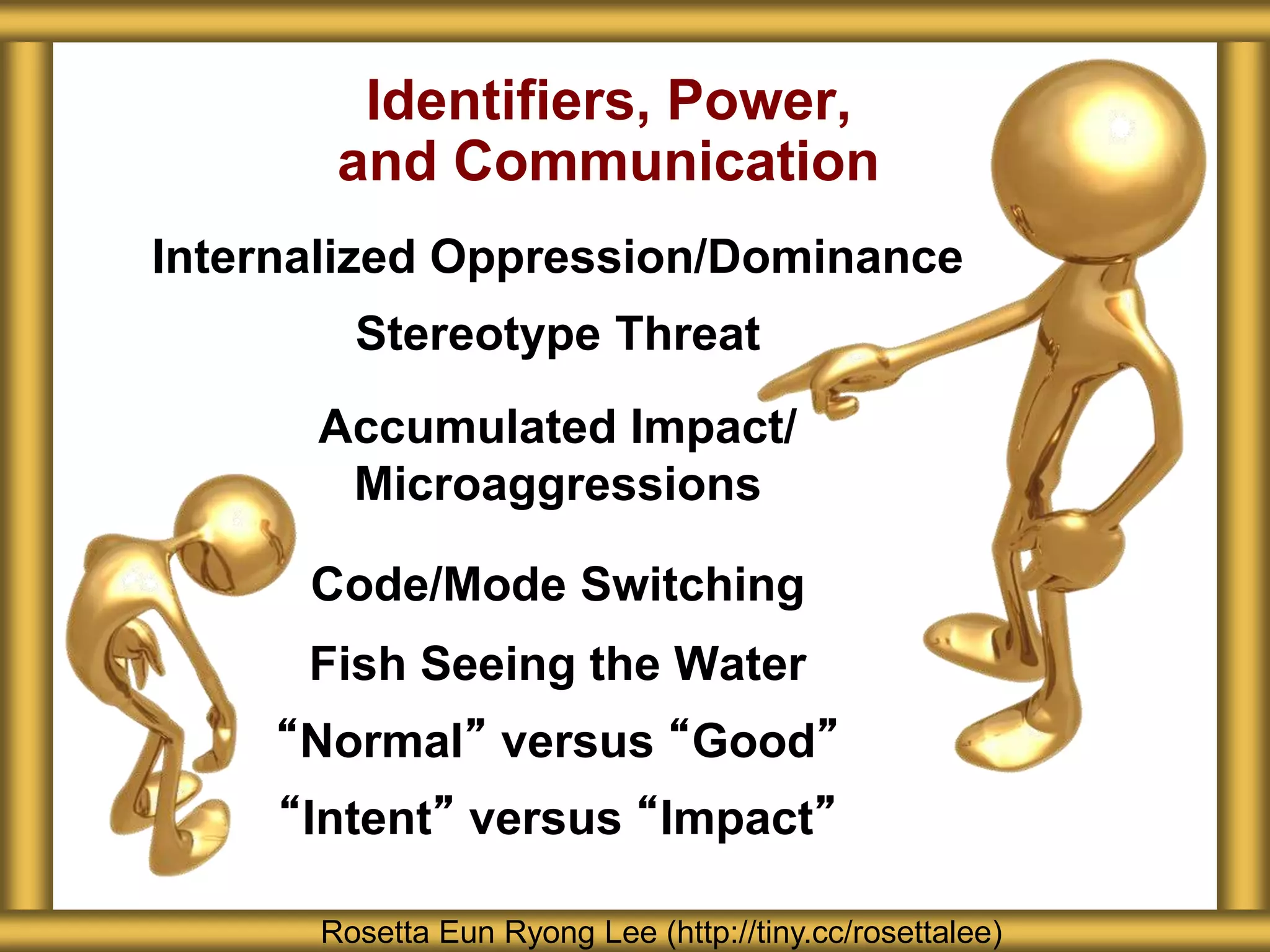
Identifiers, Power,
and Communication
Internalized Oppression/Dominance
Stereotype Threat
Accumulated Impact/
Microaggressions
Code/Mode Switching
Fish Seeing the Water
“Normal” versus “Good”
“Intent” versus “Impact”
Rosetta Eun Ryong Lee (http://tiny.cc/rosettalee)
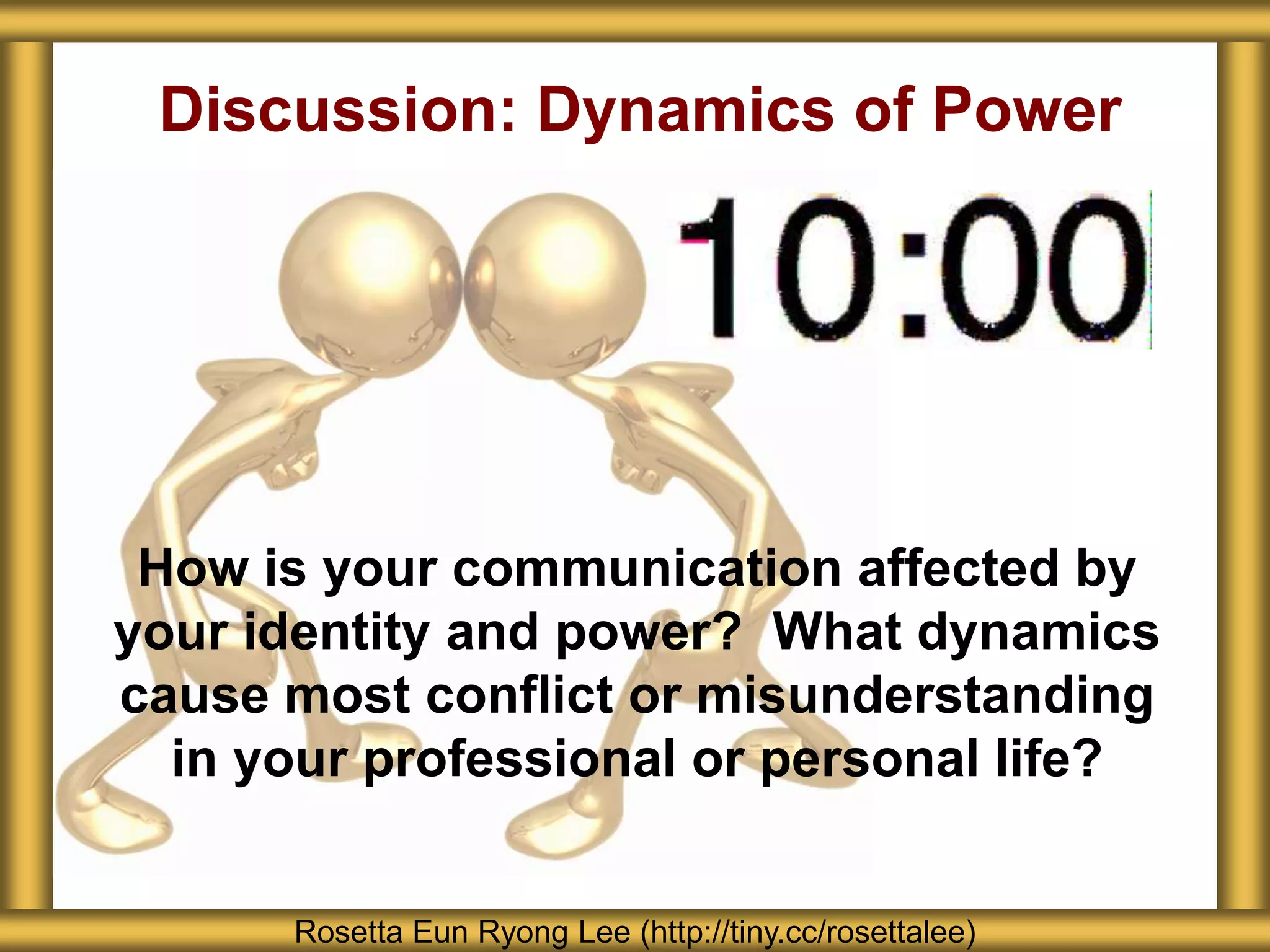
Discussion: Dynamics of Power
How is your communication affected by
your identity and power? What dynamics
cause most conflict or misunderstanding
in your professional or personal life?
Rosetta Eun Ryong Lee (http://tiny.cc/rosettalee)
So What? Now What?
Rosetta Eun Ryong Lee (http://tiny.cc/rosettalee)
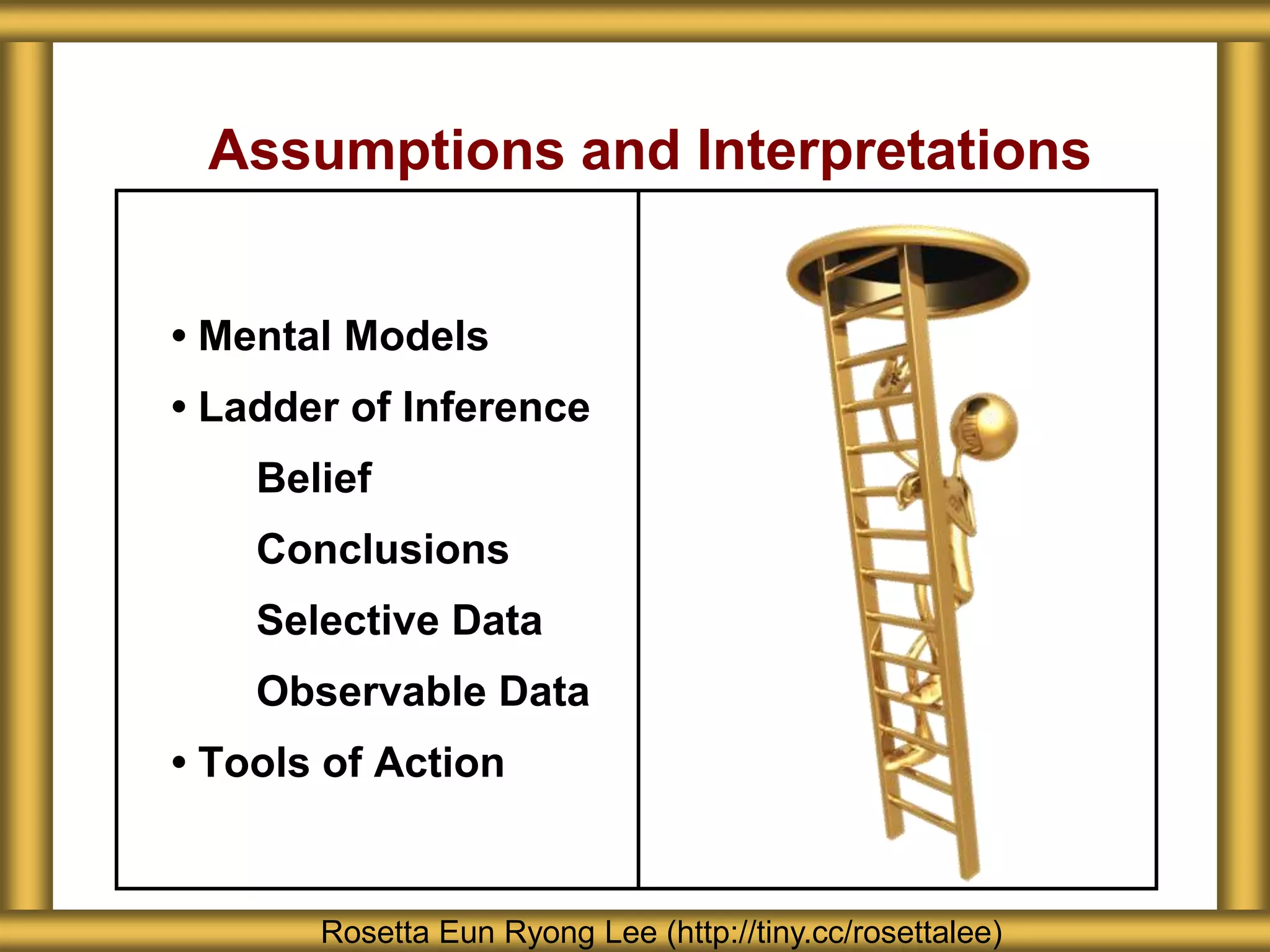
Assumptions and Interpretations
• Mental Models
• Ladder of Inference
Belief
Conclusions
Selective Data
Observable Data
• Tools of Action
Rosetta Eun Ryong Lee (http://tiny.cc/rosettalee)
1. What did you see/hear (raw data)?
2. What are your personal filters (cultural
values, norms, and identifiers)?
3. What was your interpretation of what you
saw/heard (inference)?
4. How did you feel as a result?
5. What do you want?
Checking Assumptions and
Interpretations: Steps to Analyze
Rosetta Eun Ryong Lee (http://tiny.cc/rosettalee)
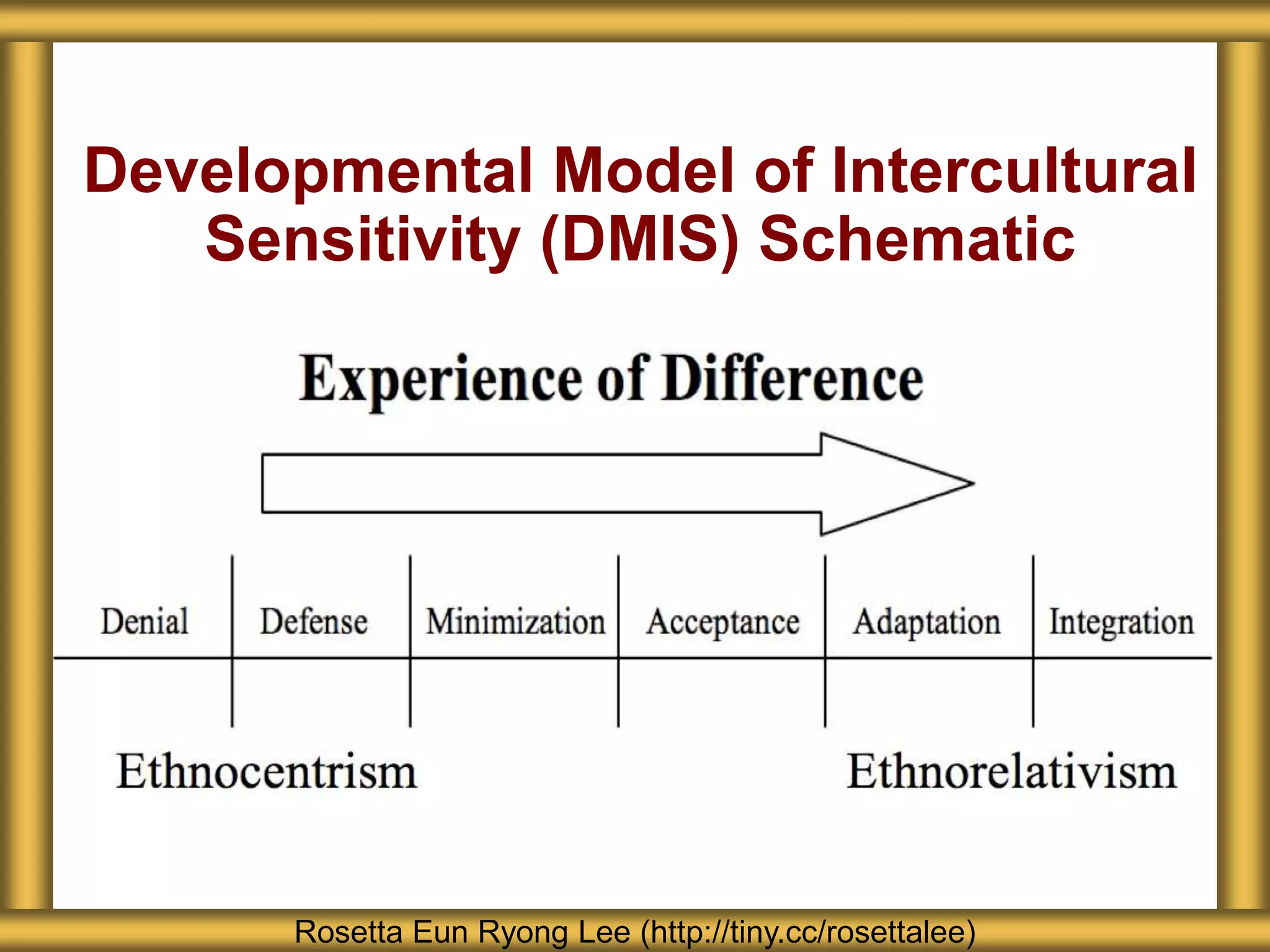
Developmental Model of Intercultural
Sensitivity (DMIS) Schematic
Rosetta Eun Ryong Lee (http://tiny.cc/rosettalee)
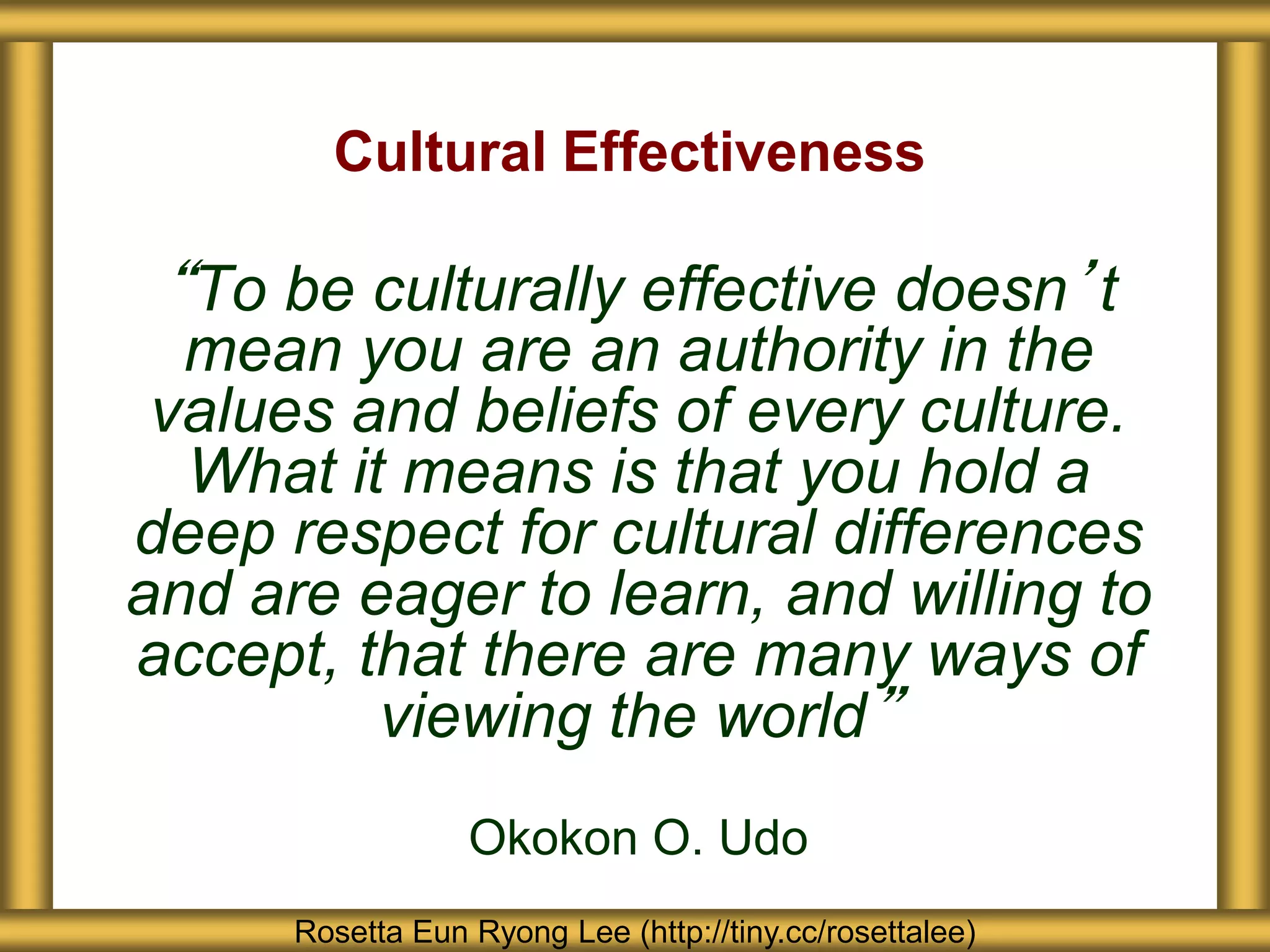
“To be culturally effective doesn’t
mean you are an authority in the
values and beliefs of every culture.
What it means is that you hold a
deep respect for cultural differences
and are eager to learn, and willing to
accept, that there are many ways of
viewing the world”
Okokon O. Udo
Cultural Effectiveness
Rosetta Eun Ryong Lee (http://tiny.cc/rosettalee)
Break
Rosetta Eun Ryong Lee (http://tiny.cc/rosettalee)
Navigating Microaggressions
Rosetta Eun Ryong Lee (http://tiny.cc/rosettalee)
Debunking Some Myths
Rosetta Eun Ryong Lee (http://tiny.cc/rosettalee)
 All or None
 Mistakes
 Apologies
 “Tonsils” Theory
 Vulnerability
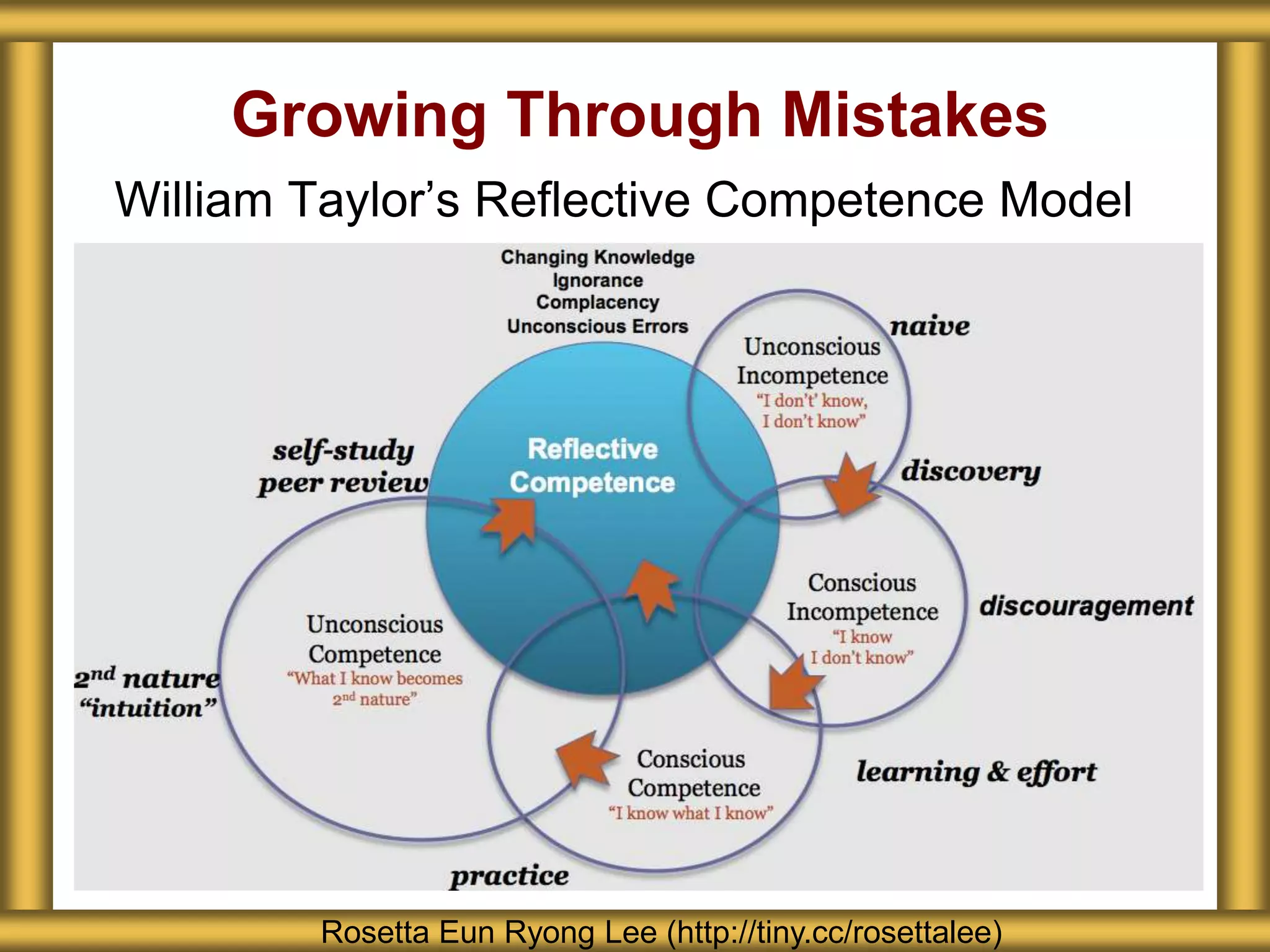
Growing Through Mistakes
William Taylor’s Reflective Competence Model
Rosetta Eun Ryong Lee (http://tiny.cc/rosettalee)
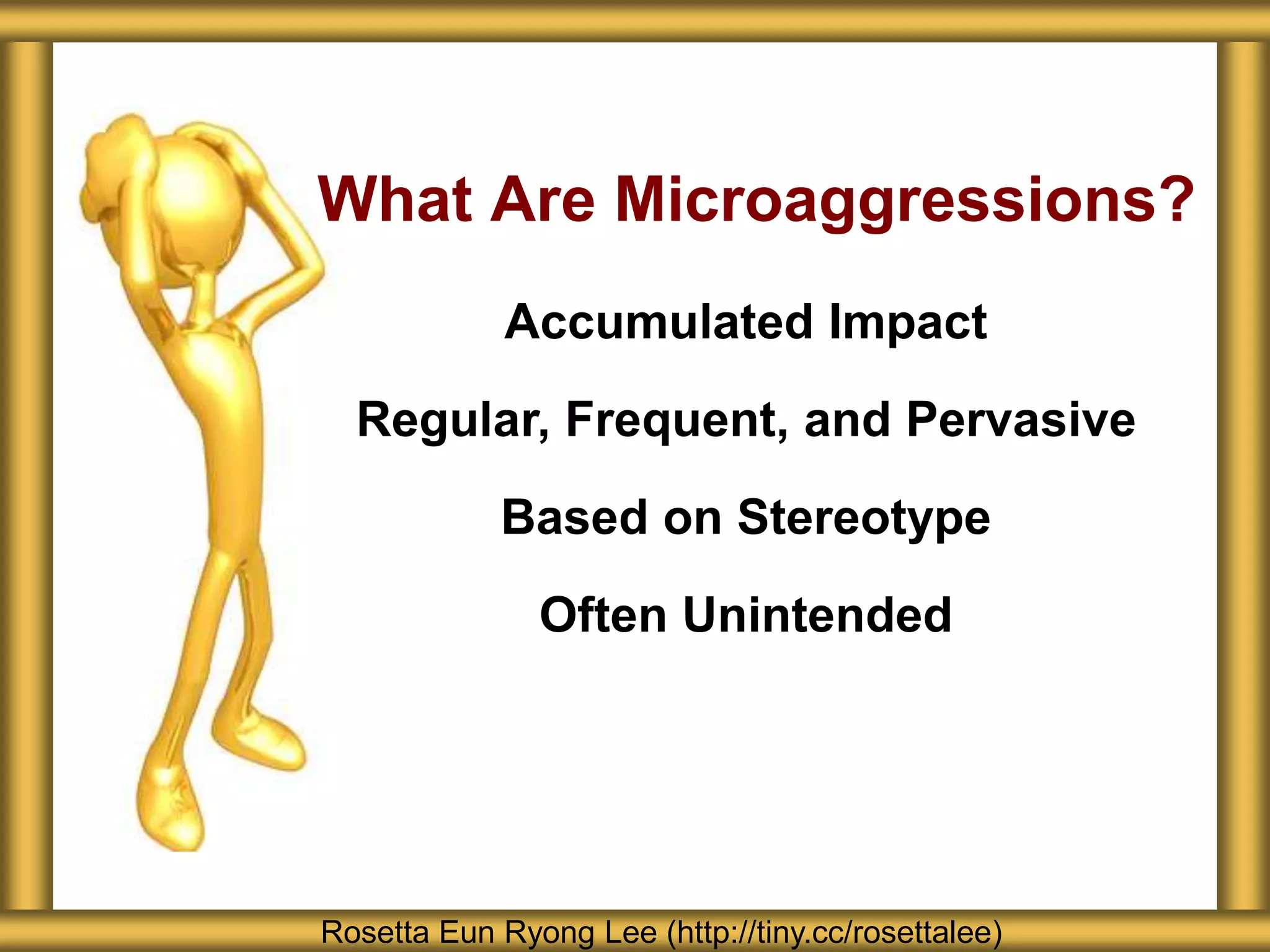
What Are Microaggressions?
Rosetta Eun Ryong Lee (http://tiny.cc/rosettalee)
Accumulated Impact
Regular, Frequent, and Pervasive
Based on Stereotype
Often Unintended
Speaking From the Heart
Rosetta Eun Ryong Lee (http://tiny.cc/rosettalee)
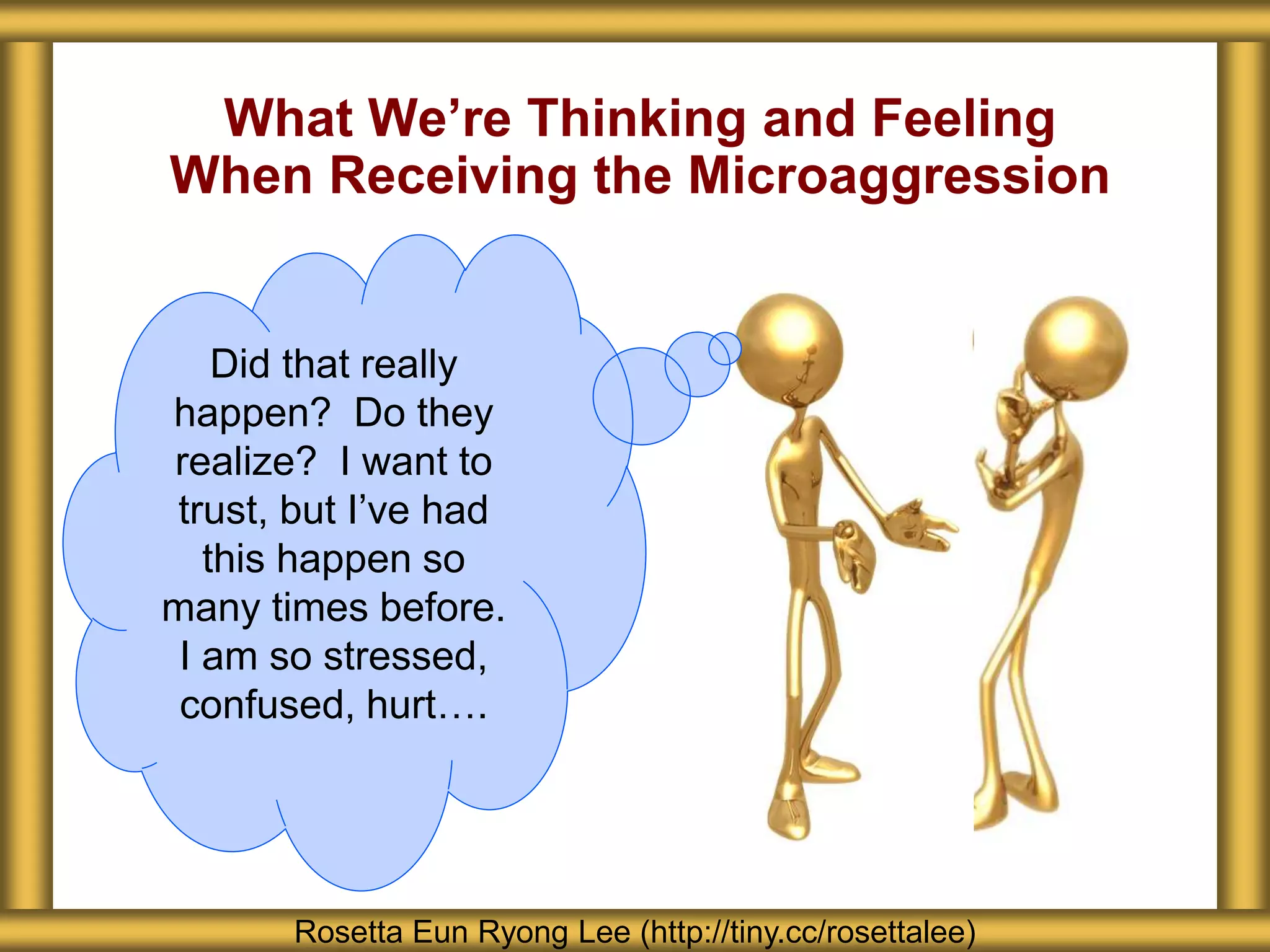
What We’re Thinking and Feeling
When Receiving the Microaggression
Rosetta Eun Ryong Lee (http://tiny.cc/rosettalee)
Did that really
happen? Do they
realize? I want to
trust, but I’ve had
this happen so
many times before.
I am so stressed,
confused, hurt….
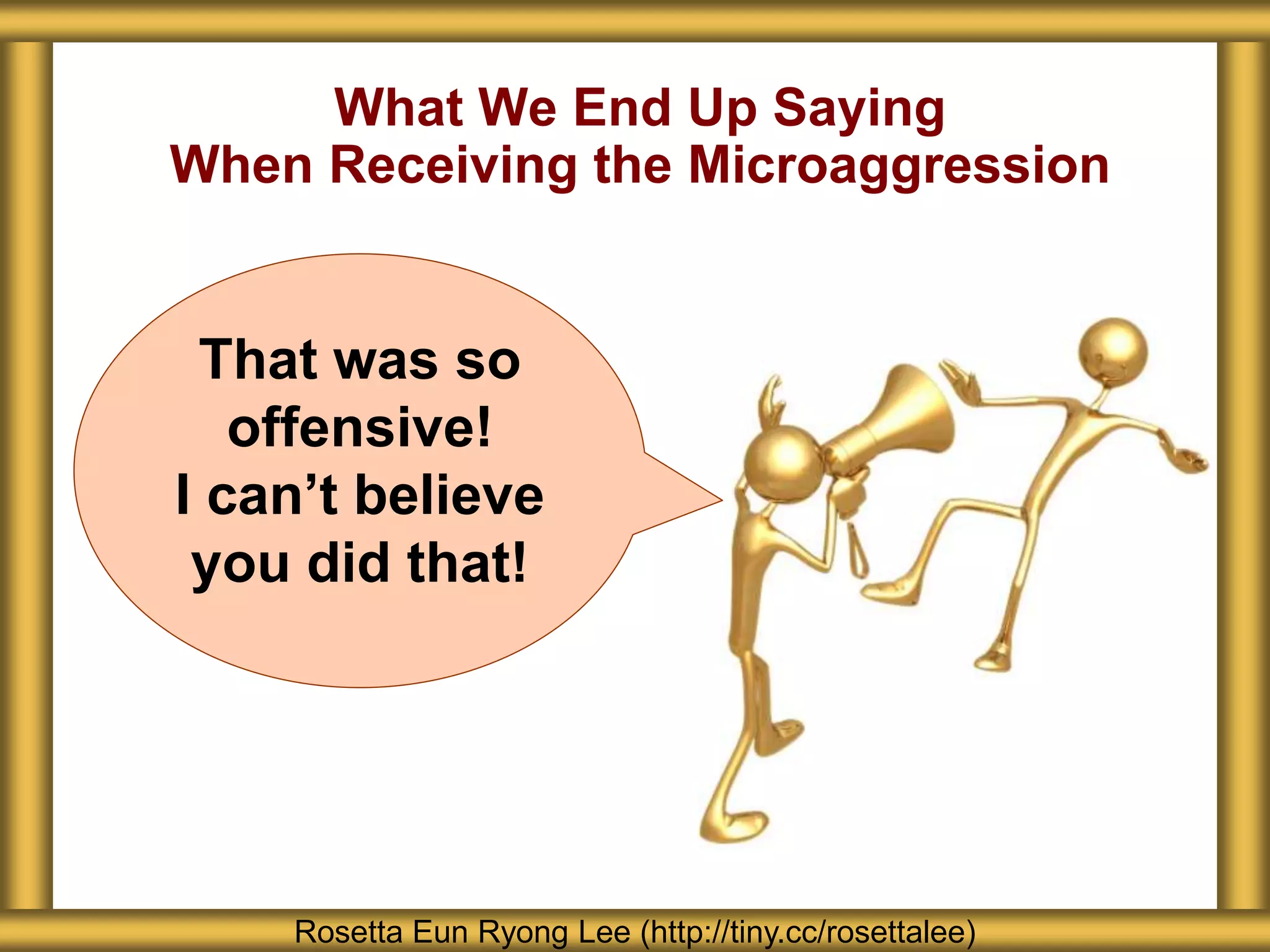
What We End Up Saying
When Receiving the Microaggression
Rosetta Eun Ryong Lee (http://tiny.cc/rosettalee)
That was so
offensive!
I can’t believe
you did that!
Be A DEAR….
Rosetta Eun Ryong Lee (http://tiny.cc/rosettalee)
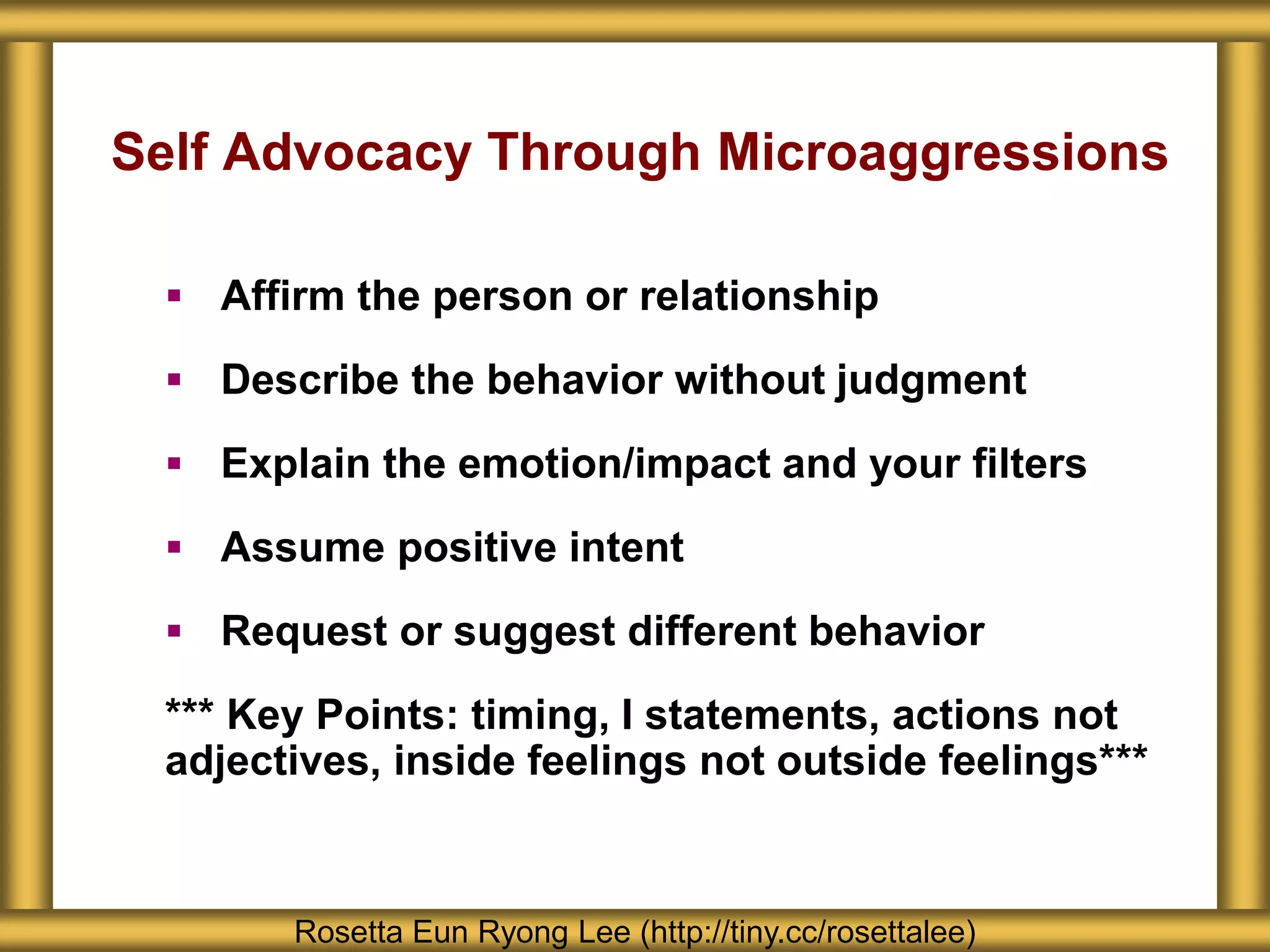
Self Advocacy Through Microaggressions
 Affirm the person or relationship
 Describe the behavior without judgment
 Explain the emotion/impact and your filters
 Assume positive intent
 Request or suggest different behavior
*** Key Points: timing, I statements, actions not
adjectives, inside feelings not outside feelings***
Rosetta Eun Ryong Lee (http://tiny.cc/rosettalee)
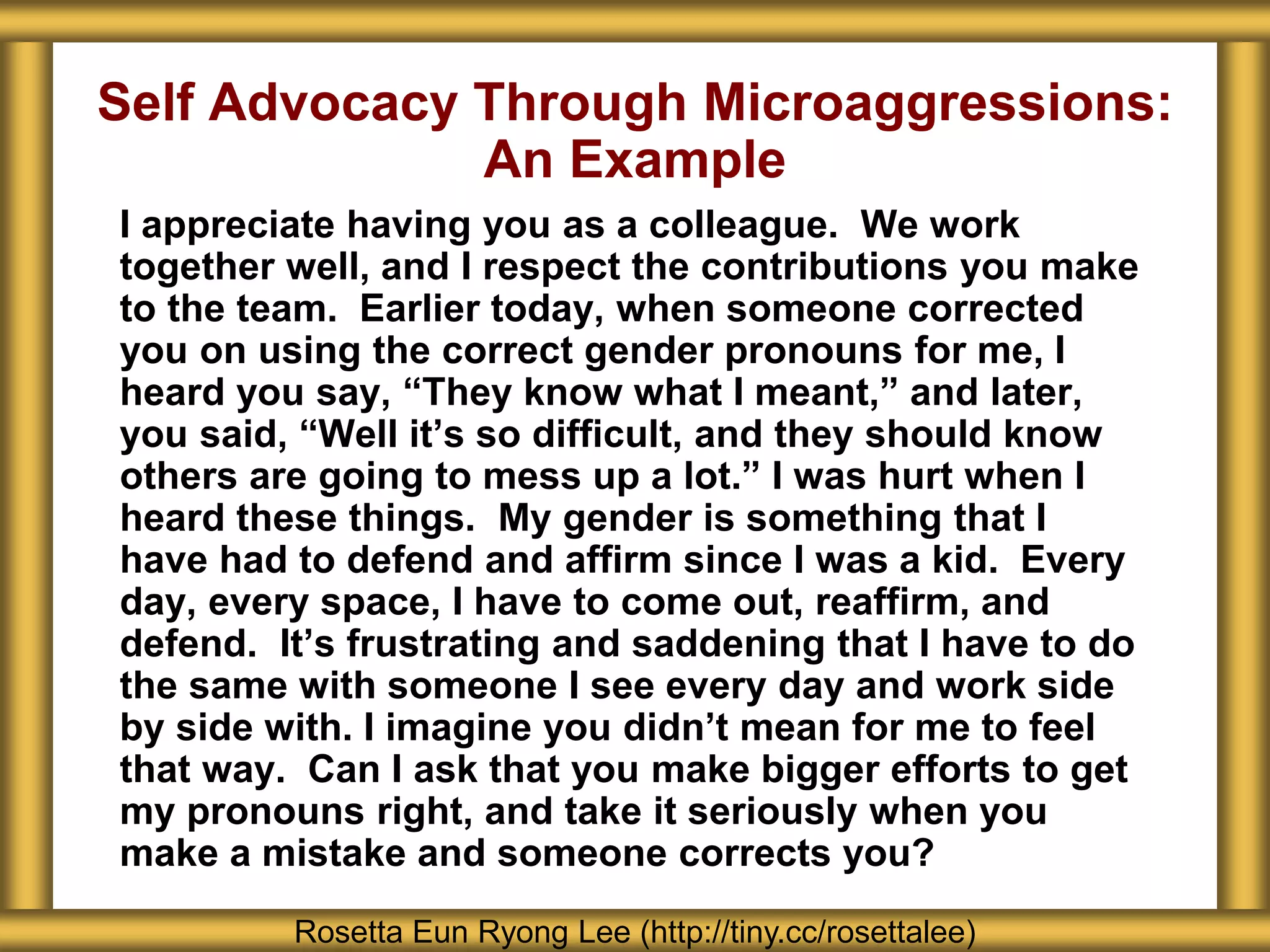
Self Advocacy Through Microaggressions:
An Example
I appreciate having you as a colleague. We work
together well, and I respect the contributions you make
to the team. Earlier today, when someone corrected
you on using the correct gender pronouns for me, I
heard you say, “They know what I meant,” and later,
you said, “Well it’s so difficult, and they should know
others are going to mess up a lot.” I was hurt when I
heard these things. My gender is something that I
have had to defend and affirm since I was a kid. Every
day, every space, I have to come out, reaffirm, and
defend. It’s frustrating and saddening that I have to do
the same with someone I see every day and work side
by side with. I imagine you didn’t mean for me to feel
that way. Can I ask that you make bigger efforts to get
my pronouns right, and take it seriously when you
make a mistake and someone corrects you?
Rosetta Eun Ryong Lee (http://tiny.cc/rosettalee)
Being A Witness
Rosetta Eun Ryong Lee (http://tiny.cc/rosettalee)
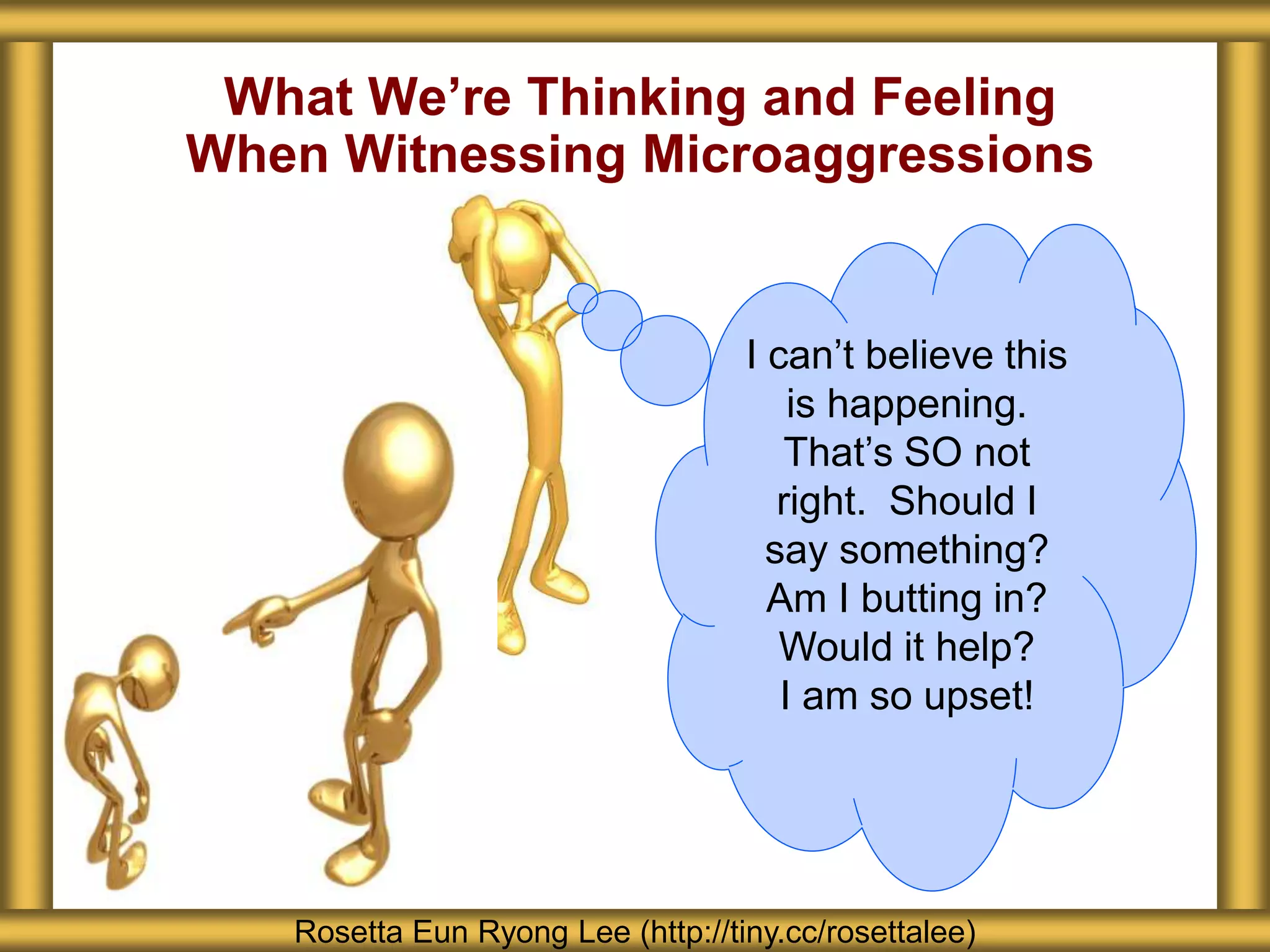
What We’re Thinking and Feeling
When Witnessing Microaggressions
Rosetta Eun Ryong Lee (http://tiny.cc/rosettalee)
I can’t believe this
is happening.
That’s SO not
right. Should I
say something?
Am I butting in?
Would it help?
I am so upset!
What We End Up Saying
When Witnessing Microaggressions
Rosetta Eun Ryong Lee (http://tiny.cc/rosettalee)
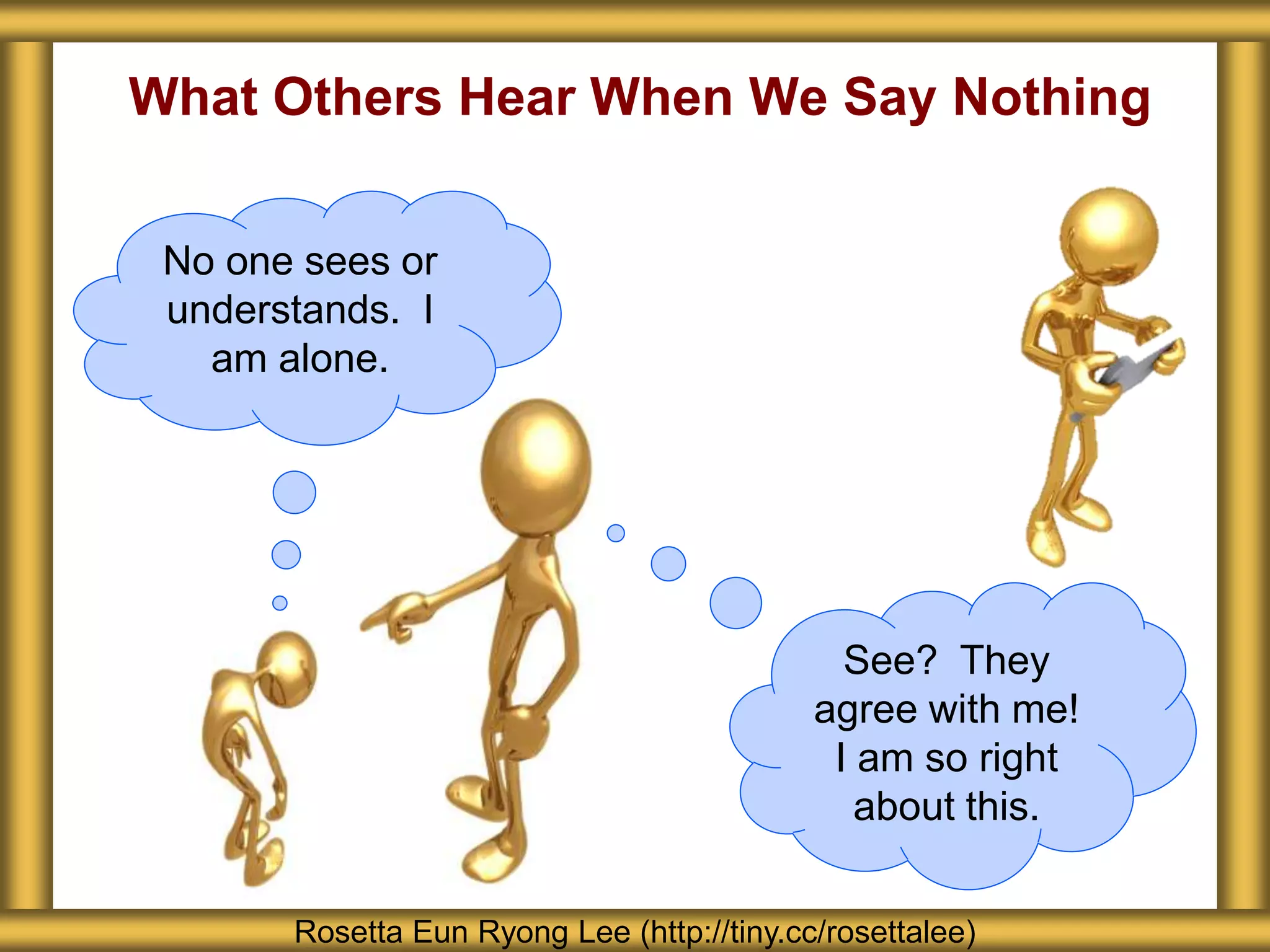
What Others Hear When We Say Nothing
Rosetta Eun Ryong Lee (http://tiny.cc/rosettalee)
See? They
agree with me!
I am so right
about this.
No one sees or
understands. I
am alone.
They were born
innocent…
Rosetta Eun Ryong Lee (http://tiny.cc/rosettalee)
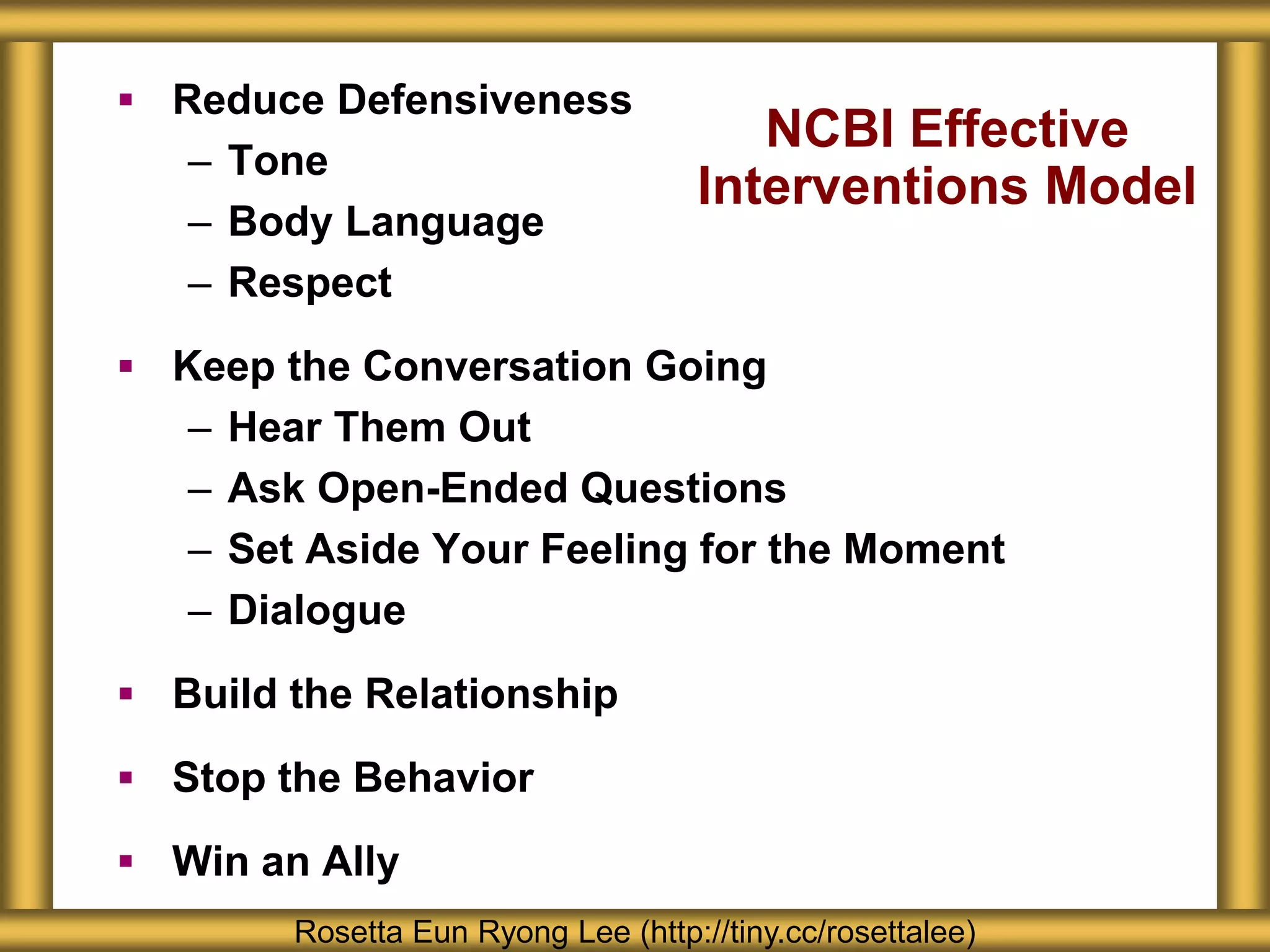
NCBI Effective
Interventions Model
 Reduce Defensiveness
– Tone
– Body Language
– Respect
 Keep the Conversation Going
– Hear Them Out
– Ask Open-Ended Questions
– Set Aside Your Feeling for the Moment
– Dialogue
 Build the Relationship
 Stop the Behavior
 Win an Ally
Rosetta Eun Ryong Lee (http://tiny.cc/rosettalee)
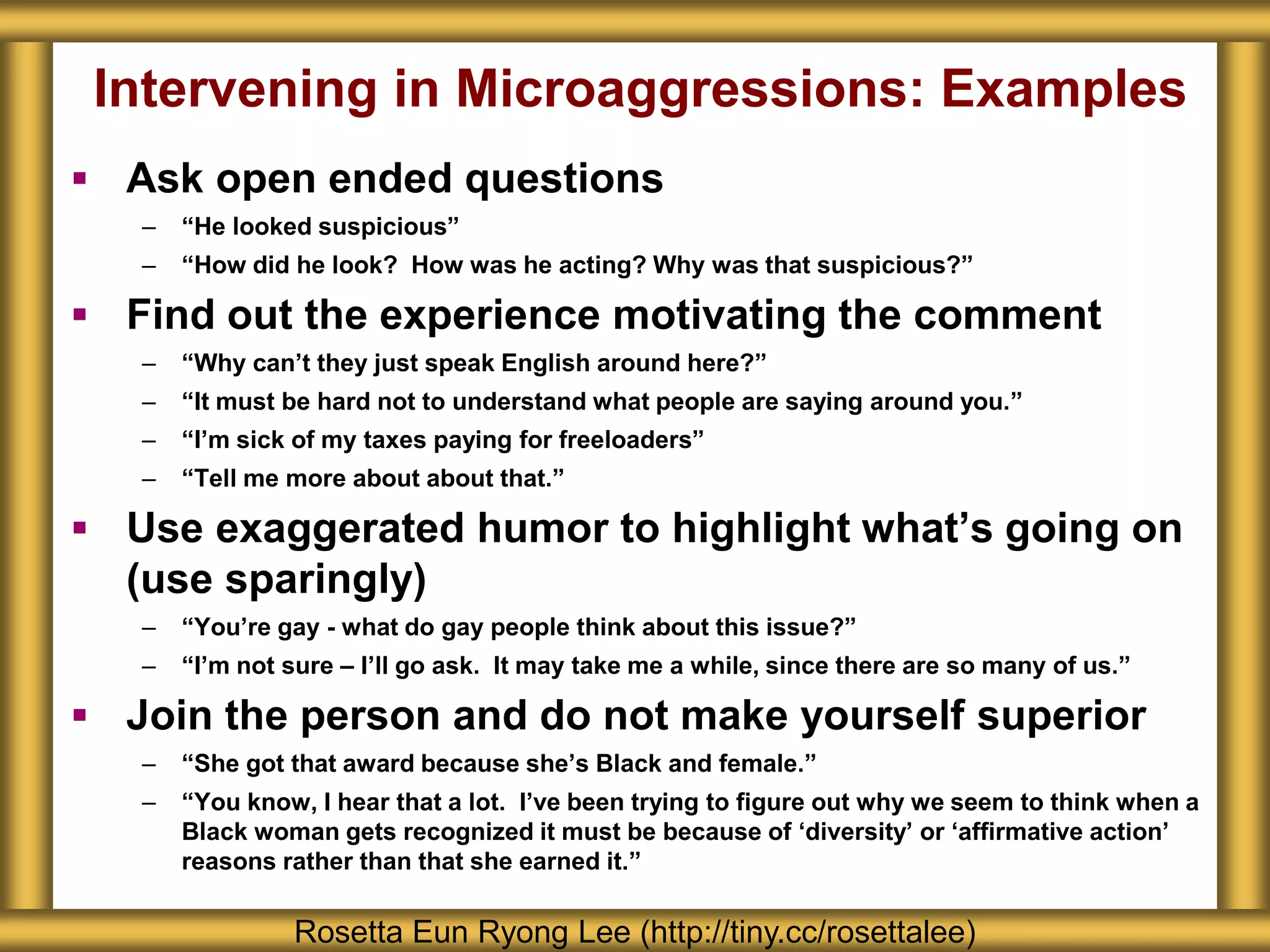
Intervening in Microaggressions: Examples
 Ask open ended questions
– “He looked suspicious”
– “How did he look? How was he acting? Why was that suspicious?”
 Find out the experience motivating the comment
– “Why can’t they just speak English around here?”
– “It must be hard not to understand what people are saying around you.”
– “I’m sick of my taxes paying for freeloaders”
– “Tell me more about about that.”
 Use exaggerated humor to highlight what’s going on
(use sparingly)
– “You’re gay - what do gay people think about this issue?”
– “I’m not sure – I’ll go ask. It may take me a while, since there are so many of us.”
 Join the person and do not make yourself superior
– “She got that award because she’s Black and female.”
– “You know, I hear that a lot. I’ve been trying to figure out why we seem to think when a
Black woman gets recognized it must be because of ‘diversity’ or ‘affirmative action’
reasons rather than that she earned it.”
Rosetta Eun Ryong Lee (http://tiny.cc/rosettalee)
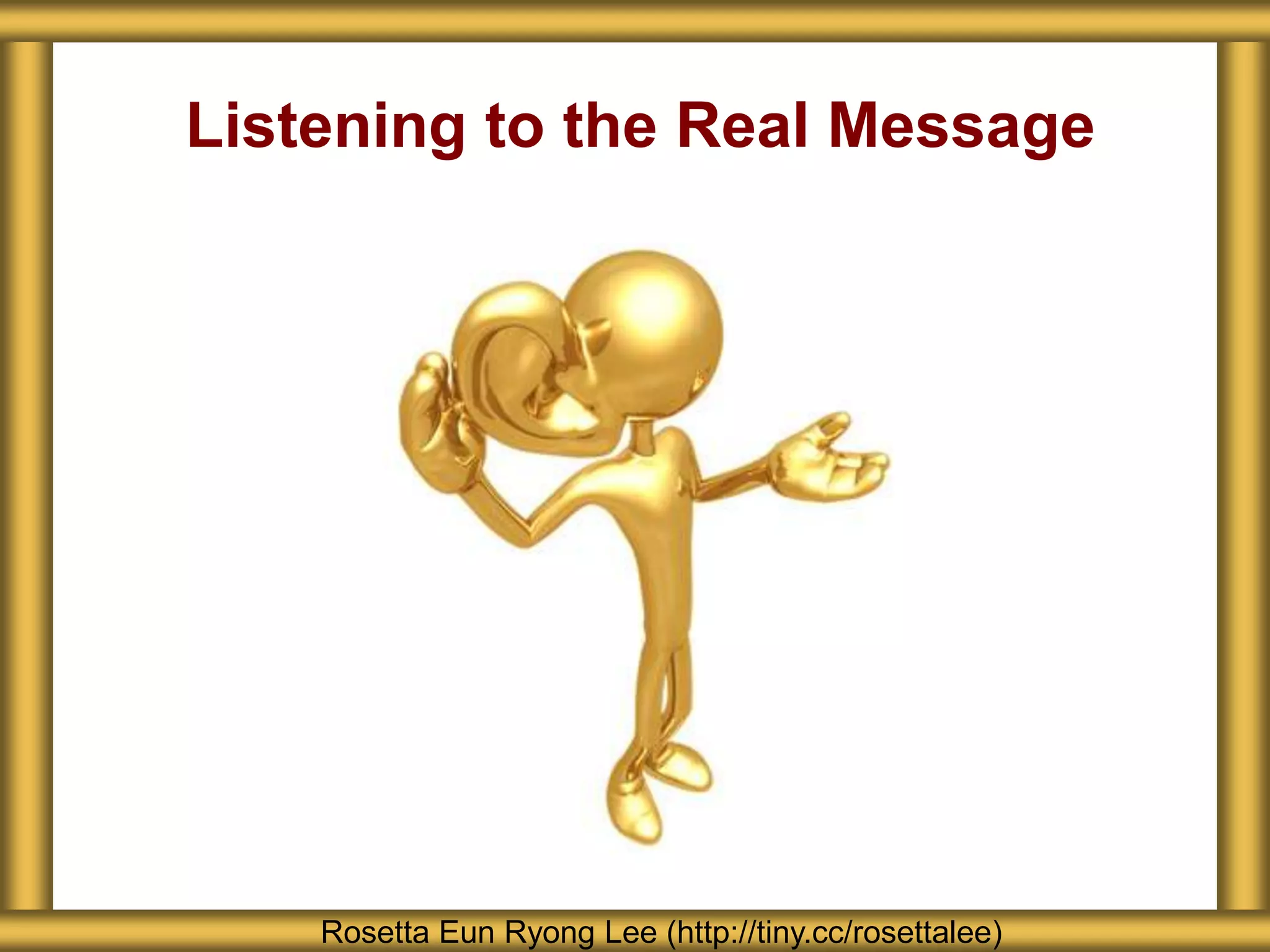
Listening to the Real Message
Rosetta Eun Ryong Lee (http://tiny.cc/rosettalee)
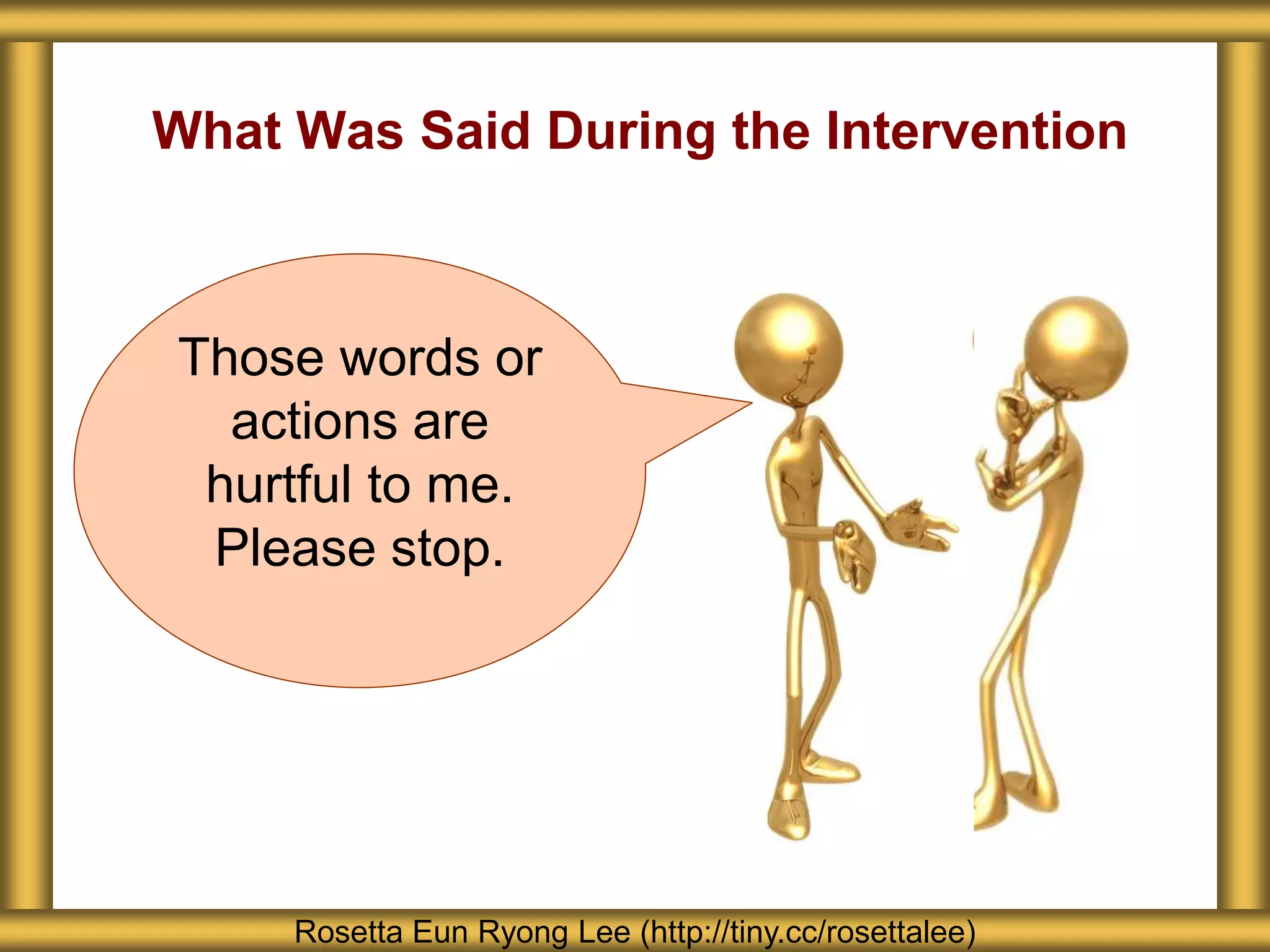
What Was Said During the Intervention
Rosetta Eun Ryong Lee (http://tiny.cc/rosettalee)
Those words or
actions are
hurtful to me.
Please stop.
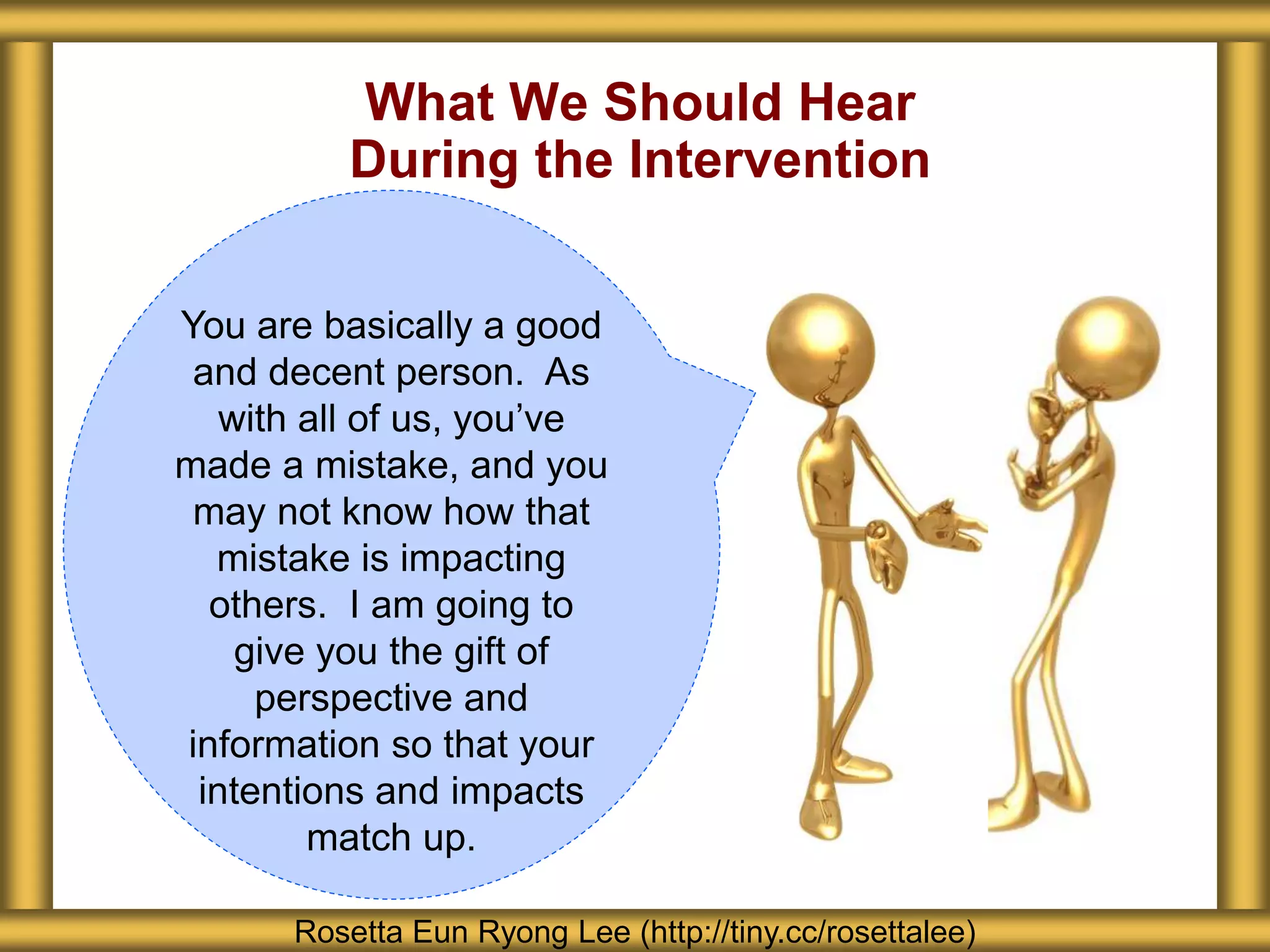
What We Hear During the Intervention
Rosetta Eun Ryong Lee (http://tiny.cc/rosettalee)
You are a
bad, bad
person, and I
hate you!
What We Should Hear
During the Intervention
Rosetta Eun Ryong Lee (http://tiny.cc/rosettalee)
You are basically a good
and decent person. As
with all of us, you’ve
made a mistake, and you
may not know how that
mistake is impacting
others. I am going to
give you the gift of
perspective and
information so that your
intentions and impacts
match up.
It’s a gift…
Rosetta Eun Ryong Lee (http://tiny.cc/rosettalee)
When You’re Told About
Microaggressive Impact You Created
 Listen with full attention
 Don’t try to defend or respond right away
– Take deep breaths
– Acknowledge your feelings
 Your mistakes don’t define you
– Be worthy of their trust and gift
 Prioritize the Impact over Intent
– Apologize for real
*** Moving through these moments with grace is
called shame resilience. It’s a vital skill***
Rosetta Eun Ryong Lee (http://tiny.cc/rosettalee)
When You’re Told About
Microaggressive Impact You Created:
Examples
Rosetta Eun Ryong Lee (http://tiny.cc/rosettalee)
 “I really appreciate your telling me this.”
 “I’m so embarrassed that I did that.”
 “I’m so sorry my words and actions made you feel
that way. No matter what I intended, it hurt you.”
 “I’m pretty overwhelmed right now, and I don’t
want to respond in a way I’d regret. Do you think
you can help me come up with a better way to
handle that situation after I take a few minutes?”
 “I wanted to go back to a moment I don’t think I
handled very well… Can we talk?”
Process Break
What is interesting,
surprising, or thought
provoking about what you
have learned so far?
How might you use this
learning in your everyday
interactions?
Rosetta Eun Ryong Lee (http://tiny.cc/rosettalee)
Final Words of Advice:
Recognize Your Triggers
Rosetta Eun Ryong Lee (http://tiny.cc/rosettalee)
Find Your Bucket People
Rosetta Eun Ryong Lee (http://tiny.cc/rosettalee)
Practice Makes
Less Freeze-Ups
Rosetta Eun Ryong Lee (http://tiny.cc/rosettalee)
If You Messed Up and You Know It,
Don’t Wait for the Intervention –
Just Apologize
Rosetta Eun Ryong Lee (http://tiny.cc/rosettalee)
If You’re Really Sorry,
Work to Improve
Rosetta Eun Ryong Lee (http://tiny.cc/rosettalee)
Build Authentic Relationships
Rosetta Eun Ryong Lee (http://tiny.cc/rosettalee)
Inclusive Communities
Rosetta Eun Ryong Lee (http://tiny.cc/rosettalee)
Presenter Information
Rosetta Eun Ryong Lee
6th Faculty and
Professional Outreach
Seattle Girls’ School
2706 S Jackson Street
Seattle WA 98144
(206) 805-6562
rlee@seattlegirlsschool.org
http://tiny.cc/rosettalee
Rosetta Eun Ryong Lee (http://tiny.cc/rosettalee)
Communication Resources
• “Stereotype Threat” by Joshua Aronson
• Brenda J. Allen, Difference Matters: Communicating
Social Identity
• William Gudykunst, Cross-Cultural and Intercultural
Comunication
• Milton Bennett, PhD, Intercultural Communication
Institute www.intercultural.org
• “Non-Verbal Communication Across Cultures” by Erica
Hagen, Intercultural Communication Resources
• Thiagi.com
• Thrive! Team Dynamics
• http://www.analytictech.com/mb021/action_science_
history.htm
Rosetta Eun Ryong Lee (http://tiny.cc/rosettalee)
Miscellaneous Resources
• Karen Bradberry and Johnnie Foreman, “Privilege and
Power,” Summer Diversity Institute, National Association
of Independent Schools, 2009
• Po Bronson and Ashley Merryman, Nurture Shock
• Kevin Jennings, GLSEN (Gay Lesbian and Straight Education
Network) www.glsen.org
• Allan G. Johnson, Privilege, Power, and Difference
• Johnnie McKinley, “Leveling the Playing Field and Raising
African American Students’ Achievement in Twenty-nine
Urban Classrooms,” New Horizons for Learning,
http://www.newhorizons.org/strategies/differentiated/
mckinley.htm
Michael J Nakkula and Eric Toshalis, Understanding Youth.
Rosetta Eun Ryong Lee (http://tiny.cc/rosettalee)

Code.org Culturally Competent Communication

  • 1.
    Code.org Education Team RosettaEun Ryong Lee Seattle Girls’ School Culturally Competent Communication Rosetta Eun Ryong Lee (http://tiny.cc/rosettalee)
  • 2.
    About Seattle Girls’School Rosetta Eun Ryong Lee (http://tiny.cc/rosettalee)
  • 3.
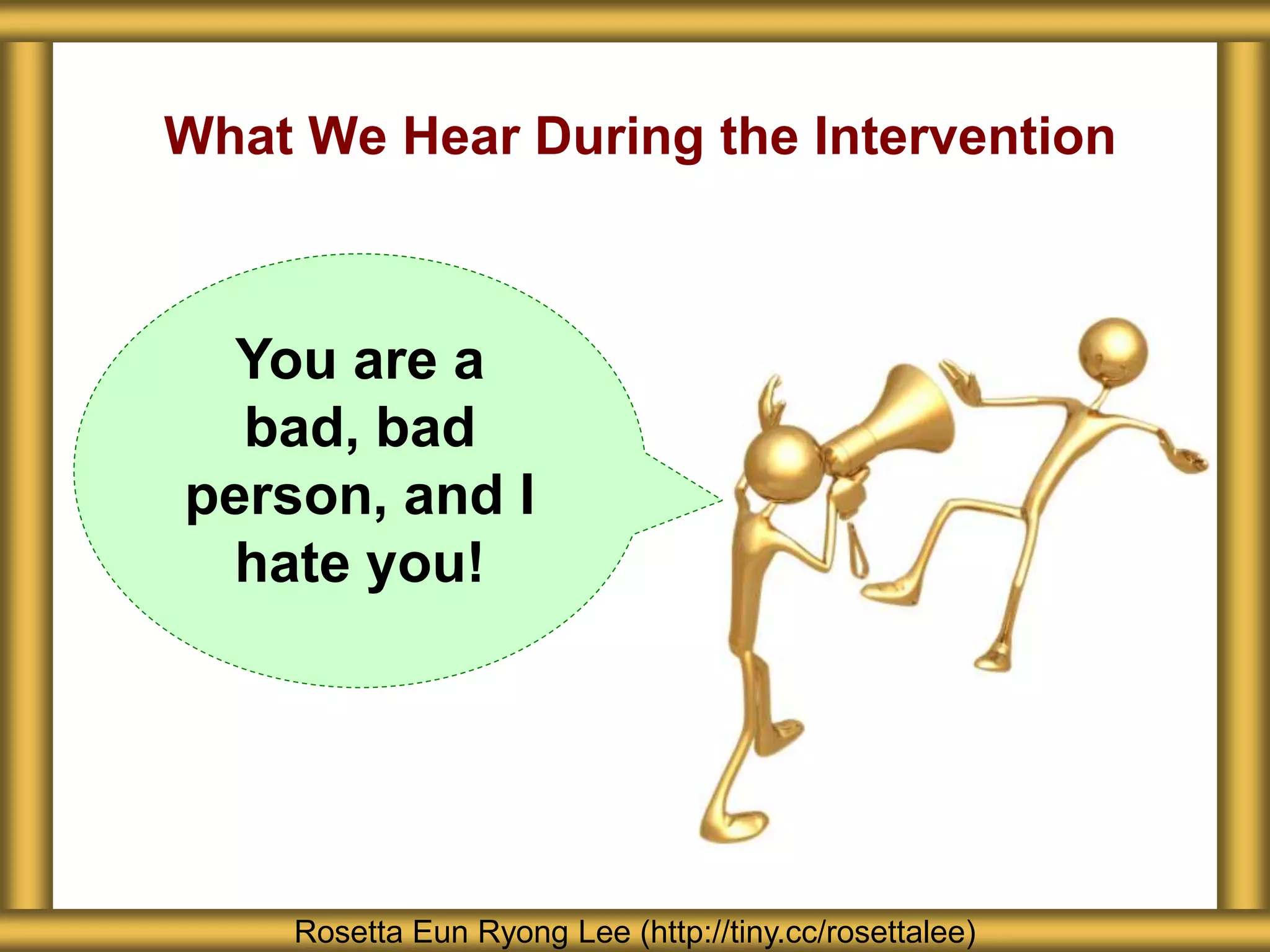
    Agenda  Cross CulturalCommunication  Communication Across Power  Navigating Microaggressions Rosetta Eun Ryong Lee (http://tiny.cc/rosettalee)
  • 4.
    Culture [consists] primarilyof the symbolic, ideational, and intangible aspects of human societies… It is the values, symbols, interpretations, and perspectives that distinguish one people from another. James A. Banks What is Culture? Rosetta Eun Ryong Lee (http://tiny.cc/rosettalee)
  • 5.
    Race Religion Class Gender Sexual Orientation Ability Age Ethnicity Geographic Location Language Educational Attainment Appearance Seniority Position or Title Status Relationship ToPower Players InternalExternal Institutional Dimensions of Identity and Culture Rosetta Eun Ryong Lee (http://tiny.cc/rosettalee)
  • 6.
    Cultural Competency: Many Models Culturalcompetence is a set of congruent behaviors, attitudes and policies that come together in a system, institution or individual and enable that system, institution or individual to work effectively in cross- cultural situations. Rosetta Eun Ryong Lee (http://tiny.cc/rosettalee) Terry Cross
  • 7.
    Rosetta Eun RyongLee (http://tiny.cc/rosettalee) The Jones Model of Cultural Competence Cultural Self- Awareness Cultural Intelligence Cross-Cultural Effectiveness Skills Countering Oppression through Inclusion
  • 8.
     What isit?  How is it Different from Intercultural Communication?  CCC Theories – Face-Negotiation Theory – Conversational Constraints Theory – Expectancy Violation Theory – Anxiety/Uncertainty Management Theory – Communication Accommodation Theory Cross Cultural Communication Rosetta Eun Ryong Lee (http://tiny.cc/rosettalee)
  • 9.
    Individual - Collectivistic LowContext - High Context Task - Relationship Low Uncertainty - High Uncertainty Vertical - Horizontal Dimensions of Variability Rosetta Eun Ryong Lee (http://tiny.cc/rosettalee)
  • 10.
     Personality Orientation Individual Values - Allocentric - Idiocentric  Self Construal - Independent - Interdependent  Individual Socialization  Cultural Norms and Rules Factors that Influence Rosetta Eun Ryong Lee (http://tiny.cc/rosettalee)
  • 11.
    Discussion: My Style Inhearing about communication differences, what would you describe as your cultural communication style? Have you noticed stark differences compared to others? Rosetta Eun Ryong Lee (http://tiny.cc/rosettalee)
  • 12.
    Cultural Values Norms, andRules  Values  Value Priorities  Norms of Behavior  Non-Verbal Communication Rosetta Eun Ryong Lee (http://tiny.cc/rosettalee)
  • 13.
    CulturalValueDifferences RELATIONAL Individualism self-reliance, independence (selfish) Collectivism group interdependence (mindlessfollower) Informality directness, give and take discussion (rude and abrupt) Formality indirectness, protect "face" (stiff and impersonal) Competition individual achievement (egotistical, show-off) Cooperation group achievement (avoiding doing work or taking responsibility) AUTHORITY Egalitarianism fairness, belief in equal opportunity (being picky, on a soapbox) Hierarchy privilege of status or rank (power hungry or avoiding accountability) TEMPORAL Use of Time "Time is money" (doesn’t get the important things in life) Passage of Time "Time is for life" (lazy and irresponsible) Change/Future Adaptability ensures survival (muckraker, stirs up trouble) Tradition/Past Stability ensures survival (old-school, afraid of change) ACTIVITY Action orientation "Make things happen" (rushes without thinking) "Being" orientation "Let things happen" (indecisive and slow) Practicality Efficiency is always best (impersonal and unscrupulous) Idealism Always maintain principles (naïve and impractical) Rosetta Eun Ryong Lee (http://tiny.cc/rosettalee)
  • 14.
    Break Rosetta Eun RyongLee (http://tiny.cc/rosettalee)
  • 15.
    Identifiers, Power, and Communication InternalizedOppression/Dominance Stereotype Threat Accumulated Impact/ Microaggressions Code/Mode Switching Fish Seeing the Water “Normal” versus “Good” “Intent” versus “Impact” Rosetta Eun Ryong Lee (http://tiny.cc/rosettalee)
  • 16.
    Discussion: Dynamics ofPower How is your communication affected by your identity and power? What dynamics cause most conflict or misunderstanding in your professional or personal life? Rosetta Eun Ryong Lee (http://tiny.cc/rosettalee)
  • 17.
    So What? NowWhat? Rosetta Eun Ryong Lee (http://tiny.cc/rosettalee)
  • 18.
    Assumptions and Interpretations •Mental Models • Ladder of Inference Belief Conclusions Selective Data Observable Data • Tools of Action Rosetta Eun Ryong Lee (http://tiny.cc/rosettalee)
  • 19.
    1. What didyou see/hear (raw data)? 2. What are your personal filters (cultural values, norms, and identifiers)? 3. What was your interpretation of what you saw/heard (inference)? 4. How did you feel as a result? 5. What do you want? Checking Assumptions and Interpretations: Steps to Analyze Rosetta Eun Ryong Lee (http://tiny.cc/rosettalee)
  • 20.
    Developmental Model ofIntercultural Sensitivity (DMIS) Schematic Rosetta Eun Ryong Lee (http://tiny.cc/rosettalee)
  • 21.
    “To be culturallyeffective doesn’t mean you are an authority in the values and beliefs of every culture. What it means is that you hold a deep respect for cultural differences and are eager to learn, and willing to accept, that there are many ways of viewing the world” Okokon O. Udo Cultural Effectiveness Rosetta Eun Ryong Lee (http://tiny.cc/rosettalee)
  • 22.
    Break Rosetta Eun RyongLee (http://tiny.cc/rosettalee)
  • 23.
    Navigating Microaggressions Rosetta EunRyong Lee (http://tiny.cc/rosettalee)
  • 24.
    Debunking Some Myths RosettaEun Ryong Lee (http://tiny.cc/rosettalee)  All or None  Mistakes  Apologies  “Tonsils” Theory  Vulnerability
  • 25.
    Growing Through Mistakes WilliamTaylor’s Reflective Competence Model Rosetta Eun Ryong Lee (http://tiny.cc/rosettalee)
  • 26.
    What Are Microaggressions? RosettaEun Ryong Lee (http://tiny.cc/rosettalee) Accumulated Impact Regular, Frequent, and Pervasive Based on Stereotype Often Unintended
  • 27.
    Speaking From theHeart Rosetta Eun Ryong Lee (http://tiny.cc/rosettalee)
  • 28.
    What We’re Thinkingand Feeling When Receiving the Microaggression Rosetta Eun Ryong Lee (http://tiny.cc/rosettalee) Did that really happen? Do they realize? I want to trust, but I’ve had this happen so many times before. I am so stressed, confused, hurt….
  • 29.
    What We EndUp Saying When Receiving the Microaggression Rosetta Eun Ryong Lee (http://tiny.cc/rosettalee) That was so offensive! I can’t believe you did that!
  • 30.
    Be A DEAR…. RosettaEun Ryong Lee (http://tiny.cc/rosettalee)
  • 31.
    Self Advocacy ThroughMicroaggressions  Affirm the person or relationship  Describe the behavior without judgment  Explain the emotion/impact and your filters  Assume positive intent  Request or suggest different behavior *** Key Points: timing, I statements, actions not adjectives, inside feelings not outside feelings*** Rosetta Eun Ryong Lee (http://tiny.cc/rosettalee)
  • 32.
    Self Advocacy ThroughMicroaggressions: An Example I appreciate having you as a colleague. We work together well, and I respect the contributions you make to the team. Earlier today, when someone corrected you on using the correct gender pronouns for me, I heard you say, “They know what I meant,” and later, you said, “Well it’s so difficult, and they should know others are going to mess up a lot.” I was hurt when I heard these things. My gender is something that I have had to defend and affirm since I was a kid. Every day, every space, I have to come out, reaffirm, and defend. It’s frustrating and saddening that I have to do the same with someone I see every day and work side by side with. I imagine you didn’t mean for me to feel that way. Can I ask that you make bigger efforts to get my pronouns right, and take it seriously when you make a mistake and someone corrects you? Rosetta Eun Ryong Lee (http://tiny.cc/rosettalee)
  • 33.
    Being A Witness RosettaEun Ryong Lee (http://tiny.cc/rosettalee)
  • 34.
    What We’re Thinkingand Feeling When Witnessing Microaggressions Rosetta Eun Ryong Lee (http://tiny.cc/rosettalee) I can’t believe this is happening. That’s SO not right. Should I say something? Am I butting in? Would it help? I am so upset!
  • 35.
    What We EndUp Saying When Witnessing Microaggressions Rosetta Eun Ryong Lee (http://tiny.cc/rosettalee)
  • 36.
    What Others HearWhen We Say Nothing Rosetta Eun Ryong Lee (http://tiny.cc/rosettalee) See? They agree with me! I am so right about this. No one sees or understands. I am alone.
  • 37.
    They were born innocent… RosettaEun Ryong Lee (http://tiny.cc/rosettalee)
  • 38.
    NCBI Effective Interventions Model Reduce Defensiveness – Tone – Body Language – Respect  Keep the Conversation Going – Hear Them Out – Ask Open-Ended Questions – Set Aside Your Feeling for the Moment – Dialogue  Build the Relationship  Stop the Behavior  Win an Ally Rosetta Eun Ryong Lee (http://tiny.cc/rosettalee)
  • 39.
    Intervening in Microaggressions:Examples  Ask open ended questions – “He looked suspicious” – “How did he look? How was he acting? Why was that suspicious?”  Find out the experience motivating the comment – “Why can’t they just speak English around here?” – “It must be hard not to understand what people are saying around you.” – “I’m sick of my taxes paying for freeloaders” – “Tell me more about about that.”  Use exaggerated humor to highlight what’s going on (use sparingly) – “You’re gay - what do gay people think about this issue?” – “I’m not sure – I’ll go ask. It may take me a while, since there are so many of us.”  Join the person and do not make yourself superior – “She got that award because she’s Black and female.” – “You know, I hear that a lot. I’ve been trying to figure out why we seem to think when a Black woman gets recognized it must be because of ‘diversity’ or ‘affirmative action’ reasons rather than that she earned it.” Rosetta Eun Ryong Lee (http://tiny.cc/rosettalee)
  • 40.
    Listening to theReal Message Rosetta Eun Ryong Lee (http://tiny.cc/rosettalee)
  • 41.
    What Was SaidDuring the Intervention Rosetta Eun Ryong Lee (http://tiny.cc/rosettalee) Those words or actions are hurtful to me. Please stop.
  • 42.
    What We HearDuring the Intervention Rosetta Eun Ryong Lee (http://tiny.cc/rosettalee) You are a bad, bad person, and I hate you!
  • 43.
    What We ShouldHear During the Intervention Rosetta Eun Ryong Lee (http://tiny.cc/rosettalee) You are basically a good and decent person. As with all of us, you’ve made a mistake, and you may not know how that mistake is impacting others. I am going to give you the gift of perspective and information so that your intentions and impacts match up.
  • 44.
    It’s a gift… RosettaEun Ryong Lee (http://tiny.cc/rosettalee)
  • 45.
    When You’re ToldAbout Microaggressive Impact You Created  Listen with full attention  Don’t try to defend or respond right away – Take deep breaths – Acknowledge your feelings  Your mistakes don’t define you – Be worthy of their trust and gift  Prioritize the Impact over Intent – Apologize for real *** Moving through these moments with grace is called shame resilience. It’s a vital skill*** Rosetta Eun Ryong Lee (http://tiny.cc/rosettalee)
  • 46.
    When You’re ToldAbout Microaggressive Impact You Created: Examples Rosetta Eun Ryong Lee (http://tiny.cc/rosettalee)  “I really appreciate your telling me this.”  “I’m so embarrassed that I did that.”  “I’m so sorry my words and actions made you feel that way. No matter what I intended, it hurt you.”  “I’m pretty overwhelmed right now, and I don’t want to respond in a way I’d regret. Do you think you can help me come up with a better way to handle that situation after I take a few minutes?”  “I wanted to go back to a moment I don’t think I handled very well… Can we talk?”
  • 47.
    Process Break What isinteresting, surprising, or thought provoking about what you have learned so far? How might you use this learning in your everyday interactions? Rosetta Eun Ryong Lee (http://tiny.cc/rosettalee)
  • 48.
    Final Words ofAdvice: Recognize Your Triggers Rosetta Eun Ryong Lee (http://tiny.cc/rosettalee)
  • 49.
    Find Your BucketPeople Rosetta Eun Ryong Lee (http://tiny.cc/rosettalee)
  • 50.
    Practice Makes Less Freeze-Ups RosettaEun Ryong Lee (http://tiny.cc/rosettalee)
  • 51.
    If You MessedUp and You Know It, Don’t Wait for the Intervention – Just Apologize Rosetta Eun Ryong Lee (http://tiny.cc/rosettalee)
  • 52.
    If You’re ReallySorry, Work to Improve Rosetta Eun Ryong Lee (http://tiny.cc/rosettalee)
  • 53.
    Build Authentic Relationships RosettaEun Ryong Lee (http://tiny.cc/rosettalee)
  • 54.
    Inclusive Communities Rosetta EunRyong Lee (http://tiny.cc/rosettalee)
  • 55.
    Presenter Information Rosetta EunRyong Lee 6th Faculty and Professional Outreach Seattle Girls’ School 2706 S Jackson Street Seattle WA 98144 (206) 805-6562 rlee@seattlegirlsschool.org http://tiny.cc/rosettalee Rosetta Eun Ryong Lee (http://tiny.cc/rosettalee)
  • 56.
    Communication Resources • “StereotypeThreat” by Joshua Aronson • Brenda J. Allen, Difference Matters: Communicating Social Identity • William Gudykunst, Cross-Cultural and Intercultural Comunication • Milton Bennett, PhD, Intercultural Communication Institute www.intercultural.org • “Non-Verbal Communication Across Cultures” by Erica Hagen, Intercultural Communication Resources • Thiagi.com • Thrive! Team Dynamics • http://www.analytictech.com/mb021/action_science_ history.htm Rosetta Eun Ryong Lee (http://tiny.cc/rosettalee)
  • 57.
    Miscellaneous Resources • KarenBradberry and Johnnie Foreman, “Privilege and Power,” Summer Diversity Institute, National Association of Independent Schools, 2009 • Po Bronson and Ashley Merryman, Nurture Shock • Kevin Jennings, GLSEN (Gay Lesbian and Straight Education Network) www.glsen.org • Allan G. Johnson, Privilege, Power, and Difference • Johnnie McKinley, “Leveling the Playing Field and Raising African American Students’ Achievement in Twenty-nine Urban Classrooms,” New Horizons for Learning, http://www.newhorizons.org/strategies/differentiated/ mckinley.htm Michael J Nakkula and Eric Toshalis, Understanding Youth. Rosetta Eun Ryong Lee (http://tiny.cc/rosettalee)