UNIVERSITY OF CENTRAL PUNJAB
SUBMITTED TO: - SIR.FAROOQ
SUBMITTED BY: - MUNTAHA MAQBOOL (0001)
Alina Khalid (0024)
Noor-e-amina (0082)
Aqsa Khalid (0085)
Department: - business studies
Section: - bba 3a
Final Project report
17-7-2018 Page 2
Acknowledgement
‘‘In the name of ALLAH, the most merciful and the beneficent’’ The Almighty who bestowed
knowledge, health, vigor, to complete this report.
A person is not perfect. He has a limited mind and thinking approaches. It is the guidance from
the great ALLAH that shows the persons, light in the darkness and the person finds his way in
this light. Person is nothing without the helping lights but a helpless creature.
“Life is a learning experience”. We have learned the validity of this statement time and time
again. Every time we think we know something, we look back a year later and realize how little
we know and how much we have learned. This Report has convinced us again, not in the
learning but also in terms of the vast team of talented people that take part in creating this report.
We believe each person plays a piece of a puzzle to make the complete picture, some pieces are
bigger than others, but without anyone piece the picture would not be completed.
We feel great pleasure and honor to express our gratitude from the citadel of our hearts to the
people whom we met, for their cooperation. Their sympathetic behavior has an ever-lasting
impression on the pages of our memory.
We want to pay tribute to our worthy teachers who are the main source of enlightenment for our
minds. We all students are thankful to them as they prepared us for looking at the matters of life
widely with open minds. This project is one of the sources of knowledge about the “Organization
Behavior of Business” for us. We are especially thankful to our honorable teacher Sir. Farooq
provided us guidance, inspiration, suggestions and encouragement that helped us in all the time
of research for and writing of this project.
We are especially thankful to Muhammad Talha (RSM: Regional Sales Manager of
Company)who provide us necessary information.
We are also thankful to the all that person whose cooperation makes us unable to complete the
project. Who helped us in giving information to us for completing this project the end we would
like to thank UCP for allowing us the course which helped us in building our minds to the right
track towards professionalism.
Final Project report
17-7-2018 Page 3
PREFACE
Department of Commerce, The University of Central Punjab has always been admirable in its
efforts to equip the future executives with arms of creativity, flexibility and adaptability to meet
the challenges offered by fast changing business environment.
To achieve the above goals the department is providing both text and practical knowledge to its
students with its available resources.
Text knowledge is very well transferred to the students within the premises of the department;
Practical knowledge requires the kind co-operation of various business organization of the
country.
Faculty members are always trying their best to ask the students to explore the market by
assigning these different field activities.
This report has been made on
“Coca-Cola”
The key function of our work was to analyze organizational behavior of company.
We have done our best efforts to complete this report efficiently and effectively with all abilities.
We hope this report fulfills the criteria and expectations of Department of Commerce. We have
tried our best to make it analytical as well as informative.
Final Project report
17-7-2018 Page 4
Table of Contents
 Meet Our Company: - .............................................................................................................. 8
 What we Do: -.......................................................................................................................... 9
 Why is our role Important?...................................................................................................... 9
 Mission, Vision & Values: - .................................................................................................. 10
 Our Mission: - .................................................................................................................... 10
 Our Vision: - ...................................................................................................................... 11
 Our Values: -...................................................................................................................... 11
 Coca Cola Goals and Objectives: - ........................................................................................ 12
 How strongly they believe in OB?......................................................................................... 13
 Do they believe in Individual differences? ............................................................................ 13
 Criteria of judging Job satisfaction of an employee: -........................................................... 14
 How they establish values among employees of diverse Culture?........................................ 14
 What is the current management philosophy about how employee perceive about their job,
reward teams, culture etc. and impact on their performance and satisfaction? ............................ 15
 What learning theories or approaches does your organization apply for the learning and
development for its employees?.................................................................................................... 17
 How Coca-Cola motivate their employees? .......................................................................... 18
 Encouraging Open Communication................................................................................... 18
 Rewarding and Developing Employees............................................................................. 18
 Financial Rewards.............................................................................................................. 18
 Energizing Environment .................................................................................................... 18
 How do you relate motivation of employees with their performance and satisfaction? ....... 19
 Employee satisfaction........................................................................................................ 19
Final Project report
17-7-2018 Page 5
 How do you relate rewards with motivation of employees? ................................................. 20
 Incentive............................................................................................................................. 20
 Advantages..................................................................................................................... 20
 Disadvantages................................................................................................................. 20
 Does Coca - Cola believe in team effectiveness? What are the criteria of developing team
into Coca – Cola?.......................................................................................................................... 21
 How you improve the performance of teams..................................................................... 21
 What is the process of communication within the team members and how it could affect
team effectiveness? ....................................................................................................................... 23
 Characteristics:................................................................................................................... 23
 Effects: ............................................................................................................................... 23
 Training:............................................................................................................................. 23
 Types:................................................................................................................................. 23
 Warnings:........................................................................................................................... 24
 How much top management allow team members for taking decisions? ............................. 24
 What is decision Making process in team, and who leads them? ...................................... 24
 There are four basic decision-making styles that leaders can use:................................. 25
 How management encourage teams for creative thinking for team performance and
achieving targets?.......................................................................................................................... 26
 Talent. ................................................................................................................................ 26
 Healthy relationships are at the heart of collaboration. ..................................................... 26
 A guiding vision and clarity of purpose are key to collaboration. ..................................... 26
 Provide a clear mission objective....................................................................................... 26
 Connect the project with big picture company objectives. ................................................ 26
 Create an atmosphere of safety, trust and respect. ............................................................. 26
 Make your ideas visible and tangible by: .......................................................................... 26
Final Project report
17-7-2018 Page 6
 Provide an infrastructure and resources:............................................................................ 27
 Provide great leadership..................................................................................................... 27
 Use coaching to reinforce a collaborative culture.............................................................. 27
 Normally what kind of conflicts generate in Coca Cola at different levels among employee
and management? How conflict effects the performance of employees and objectives of
organization?................................................................................................................................. 27
 Relationship conflict:......................................................................................................... 27
 Task conflict....................................................................................................................... 28
 Process conflict:................................................................................................................. 28
 How conflict effects the performance of employees and objectives of organization? .......... 28
 Mental Health Concerns: ................................................................................................... 28
 Decrease in Productivity:................................................................................................... 29
 Members Leave Organization:........................................................................................... 29
 Violence:............................................................................................................................ 29
 Inspire Creativity: .............................................................................................................. 30
 Share and Respect Opinions: ............................................................................................. 30
 Improve Future Communication:....................................................................................... 30
 Identify New Members: ..................................................................................................... 30
 How much Coca Cola believes in collaboration among employees, teams, departments etc.?
31
 Ability to make a difference: being part of a company that creates value & makes a
difference everywhere we engage. ............................................................................................ 31
 Growing from Within: ....................................................................................................... 31
 Be part of a diverse team: .................................................................................................. 31
 A unique culture... where people convert their passion into action:.................................. 31
 Do you believe that your organization has the leaders that can really take their organization
to the leading position in market?................................................................................................. 32
 Normally what kind of traits does your organization find in their leaders? .......................... 33
Final Project report
17-7-2018 Page 7
 Think like an Immigrant .................................................................................................... 34
 Employ a Circular Vision .................................................................................................. 34
 Unleash Passionate Pursuits............................................................................................... 34
 Which leadership theory does your management follow and why? ...................................... 34
 Behavioral Theory with Reference to Coca Cola Company.............................................. 35
 Trait Theory with Reference to Coca Cola Company ....................................................... 35
 Participative Leadership Theory ........................................................................................ 35
 Do you think organizational culture shape the employee attitude and behavior? ................. 36
 What type of culture does management develop in this organization to introduce the
dynamic challenges and innovation to compete the market?........................................................ 37
 Coca-Cola System wide Performance................................................................................ 37
 Bottling Investments Group................................................................................................... 38
 What is the process of goal setting in your organization? Does goals are dedicated or
mutually shared with employees at different levels? .................................................................... 38
 Be sure your goals are YOUR goals .................................................................................. 38
 Put your goals in writing.................................................................................................... 39
 Challenging but attainable ................................................................................................. 39
 Major goals must be compatible ........................................................................................ 39
 Revision & Change ............................................................................................................ 39
 Specific tasks, measurable achievements........................................................................... 40
 Target dates........................................................................................................................ 40
 Prioritize............................................................................................................................. 40
 Put up reminder signs......................................................................................................... 40
 Goals and beyond goals ..................................................................................................... 41
 Does management use latest technology for designing structure and strategies? If yes, then
how much? .................................................................................................................................... 41
 Social Networking.............................................................................................................. 41
 Online Advertising............................................................................................................. 42
 Information gathering ........................................................................................................ 42
 References………………………………………………………………………………..42
Final Project report
17-7-2018 Page 8
Brief overview
Meet Our Company: -
The coca cola company is the world’s largest beverage company. We operate in more than 200
countries and market a portfolio of more than 3000 beverages products including sparkling
drinks and still beverages such as waters, juices and juice drinks and still beverages such as
waters, juice and juice drinks, teas, coffees, sports drinks and energy drinks.
Who we are: -
Final Project report
17-7-2018 Page 9
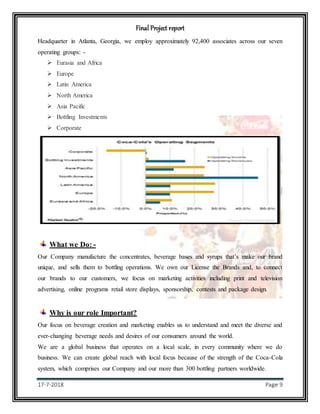
Headquarter in Atlanta, Georgia, we employ approximately 92,400 associates across our seven
operating groups: -
 Eurasia and Africa
 Europe
 Latin America
 North America
 Asia Pacific
 Bottling Investments
 Corporate
What we Do: -
Our Company manufacture the concentrates, beverage bases and syrups that’s make our brand
unique, and sells them to bottling operations. We own our License the Brands and, to connect
our brands to our customers, we focus on marketing activities including print and television
advertising, online programs retail store displays, sponsorship, contests and package design.
Why is our role Important?
Our focus on beverage creation and marketing enables us to understand and meet the diverse and
ever-changing beverage needs and desires of our consumers around the world.
We are a global business that operates on a local scale, in every community where we do
business. We can create global reach with local focus because of the strength of the Coca-Cola
system, which comprises our Company and our more than 300 bottling partners worldwide.
Final Project report
17-7-2018 Page 10
While many views our Company as simply "Coca-Cola," our system operates through multiple
local channels. Our Company manufactures and sells concentrates, beverage bases and syrups to
bottling operations, owns the brands and is responsible for consumer brand marketing initiatives.
Our bottling partners manufacture, package, merchandise and distribute the final branded
beverages to our customers and vending partners, who then sell our products to consumers.
All bottling partners work closely with customers -- grocery stores, restaurants, street vendors,
convenience stores, movie theaters and amusement parks, among many others -- to execute
localized strategies developed in partnership with our Company. Customers then sell our
products to consumers at a rate of 1.6 billion servings a day. (The Coca cola company website)
The company’s large advertising budget provides competitive advantages such as:
 helping to introduce new products to the market
 promoting the brand
 informing consumers about the product’s features
 communicating brand’s message to the public
 Increasing sales.
Mission, Vision &Values: -
The world is changing all around us. To continue to thrive as a business over the next ten years
and beyond, we must look ahead, understand the trends and forces that will shape our business in
the future and move swiftly to prepare for what's to come. We must get ready for tomorrow
today. That's what our 2020 Vision is all about. It creates a long-term destination for our
business and provides us with a "Roadmap" for winning together with our bottling partners.
 Our Mission: -
Our Roadmap starts with our mission, which is enduring. It declares our purpose as a
company and serves as the standard against which we weigh our actions and decisions.
The mission statement of the Coca Cola Company is:
 To refresh the world in mind, body and spirit
 To inspire moments of optimism through our brands and actions
 To create value and make a difference everywhere we engage.
Final Project report
17-7-2018 Page 11
 Our Vision: -
Our vision serves as the framework for our Roadmap and guides every aspect of our business
by describing what we need to accomplish to continue achieving sustainable, quality growth. The
Coca-Cola Company and its bottling partners developed a 2020 Vision in 2009. This vision is a
roadmap to doubling their global system revenues in the next 10 years by focusing on six key
areas: profit, people, portfolio, partners, planet, and productivity.
 People:
Be a great place to work where people are inspired to be the best they can be.
 Portfolio:
Bring to the world a portfolio of quality beverage brands that anticipate and satisfy
people's desires and needs.
 Partners:
Nurture a winning network of customers and suppliers, together we create mutual,
enduring value.
 Planet:
Be a responsible citizen that makes a difference by helping build and support sustainable
communities.
 Profit:
Maximize long-term return to shareowners while being mindful of our overall
responsibilities.
Productivity: Be a highly effective, lean and fast-moving organization.
 Our Values: -
Our values serve as a compass for our actions and describe how we behave in the world.
 Leadership: The courage to shape a better future
 Collaboration: Leverage collective genius
Final Project report
17-7-2018 Page 12
 Integrity: Be real
 Accountability: If it is to be, it's up to me
 Passion: Committed in heart and mind
Coca Cola Goals and Objectives: -
The Coca-Cola Company is a leader in the beverage industry with a reputable brand and strong
global presence
According to the Coca-Cola Company’s mission statement and 2020 Vision, some of its goals
include:
 Increase profit by cutting down costs through productive and efficient production
facilities
 Focus on environment friendly bottling production and enforce sustainability
 Continue to diversify its portfolio through innovations and partnerships, keeping
consumer demands in mind
 Increase annual operating income by 6-8% to double their revenue by 2020
Final Project report
17-7-2018 Page 13
“Job Satisfaction”
How strongly they believe in OB?
All officers in management are qualified. We are aware of the importance of OB thus we
strongly believe in OB. Our company is built around two core assets, its brands and its people.
That's what makes working here so special. We believe that work is more than a place you go
every day. It should be a place of exploration, creativity, professional growth and interpersonal
relationships. It's about being inspired and motivated to achieve extraordinary things. We want
our people to take pride in their work and in building brands others love. After all, it's the
combined talents, skills, knowledge, experience and passion of our people that make us who we
are.
Do they believe in Individual differences?
Yes, we believe in individual difference and upon our individual capabilities we are assigned
different tasks. Every person has different task depending upon his experience, knowledge,
mental approach, skills and competencies.
The Coca-Cola Company leverages a worldwide team that is rich in diverse people, talent and
ideas. As a global business, our ability to understand, embrace and operate in a multicultural
world, both in the marketplace and in the workplace is critical to our sustainability. Our diversity
workplace strategy includes programs to attract, retain, and develop diverse talent; provide
support systems for groups with diverse backgrounds; and educate all associates so that we
master the skills to achieve sustainable growth.
We work hard to ensure an inclusive and fair work environment for our associates, all of whom
undergo diversity training on a regular basis. We find ongoing dialogue leads to better
understanding of our colleagues, our suppliers, our customers, our stakeholders, and ultimately,
to greater success in the marketplace.
Final Project report
17-7-2018 Page 14
Criteria of judging Job satisfaction of an employee: -
Satisfaction criteria vary from dept to dept. In general, we judge an employee by considering the
targets achieved by him, by the positive responses to their managers and the feedback from their
immediate seniors
In production dept, a big factor to satisfaction is the decrement of downtime of production
Management handles these by giving incentives on achieving the targets
The behavioral direction of employee is measured by the degree an employee chooses to perform
on the slated task assigned within the organization; the degree of performance of an employee on
a given assign task measured the level of effort and when an employee faced a challenge or an
obstacle what determines his persistence is whether the employee gave up or continue.
Motivation is a significant factor that enhances the level of persistence of an employee.
Motivated employee is highly needed in organization, in a highly competitive global marketplace
motivated employee are more productive and will contribute to the effectiveness of the
organization. These are some of the reasons why effective managers are expected to identify
what motivate their employees within the context of their various task. Management handles
these by giving incentives on achieving the targets.
How they establish values among employees of diverse Culture?
An organizational culture describes the norms and values of the organization in its dealings with
both internal and external subordinates. The Coca-Cola Company also based its culture on
enhancing and empowering its employee, this is so because the company consider employee as
its most asset.
Motivated employee is often the engine drive in moving an organization forward, the Coca-Cola
Company often organize its employee into teams in carrying out their operations. This makes the
employee feel valuable within the team by contributing different ideas on proposed operations at
the same time by being innovative. The company by this strategy creates a friendly and
innovative culture, which made it possible for the company to depend on its workforce in
maintaining it brand reputation globally. Furthermore, trust is being established as part of its
culture.
Final Project report
17-7-2018 Page 15
“Employee Motivation”
What is the current managementphilosophy about how employee perceive
about their job, reward teams, culture etc. and impact on their
performance and satisfaction?
The Coca-Cola Co. sees itself not as a global organization, but as a multi-local enterprise. That’s
because its global strategy is to allow its businesses in more than 200 countries to act according
to local needs, local laws and local cultures.
For this reason, the Atlanta-based soft-drink giant’s philosophy toward staffing is to employ as
many nationals in its international businesses as possible. “We strive to have a limited number of
international people [in the field] because generally local people are better equipped to do
business at their home locations,” explains Jeff Peters, currently director of HR for corporate
finance and human resources in Atlanta, previously HR director for Coca-Cola’s Northwest
European division.
Final Project report
17-7-2018 Page 16
However, there’s still a need for expatriates in the system for two main reasons. One is to fill a
need for a specific set of skills that may not exist at a location. For example, when Coca-Cola
started up operations in an Eastern European country, it had to bring in an expatriate from
Chicago—who is of Polish decent—to fill the position of finance manager.
The second reason that the company will relocate workers to foreign locales is for the
employee’s own development. “Before you take on serious senior managerial responsibility in
the company, you should have had an international exposure,” Peters says.
Coca-Cola associates do that by being part of the company’s global service program, a system
that focuses on the development of a core group of workers for international mobility (see, “The
Philosophy Behind Coca-Cola’s International Service Program,” this page). Currently,
approximately 500 high-level professionals and managers are part of the program. Says Michael
J. Semrau, assistant vice president and director for international HR: “The cost of the program is
significant, so we tend to focus on people who have knowledge of their particular field plus
knowledge of the company, and who can do two things in an international location. One is
adding value by the expertise that they bring to each assignment and two is enhance their
contribution to the company by having that international experience.”
Of the 500 people in the program, approximately 200 move each year. The typical duration of an
international assignment is three to five years, although that can vary based on need.
The workers in this program are supported by an international service program group that
manages their compensation. The specialists in this group have responsibility for one of five
international groups. They work with local division HR people or regional HR people to
coordinate the transfer of the international service people and to ensure that the appropriate
compensation elements are in place and provided on a timely basis.
“We try to set up our compensation programs so that we can transfer talent around the world
without having significant compensation barriers for international service employees,” says Carl
Presley, director of compensation. The company has done this by giving the international service
workers a U.S.-based compensation package. In other words, they’re paid according to U.S.
benchmarks rather than changing salaries for each move they make.
Final Project report
17-7-2018 Page 17
The workers’ pay hypothetical income taxes based on a calculation of what they’d pay if they
were working in the United States. The company, then, pays their foreign taxes, taking any tax
credits that the employee may get. “Many of the elements are the same so that there isn’t
preferential treatment for going into one part of the world for international service vs. another,”
Presley says.
The international workers’ compensation packages also include such compensation-related
benefits as housing allowances, cost-of-living differentials and education costs. If an expat is in a
particularly difficult area, he or she might receive an environmental allowance that recognizes
the difficulties of that location. And expats in the program may receive home leave, which
allows them to return home if they choose to for a certain period to renew their ties with their
homeland.
To further ensure equity within the international ranks, the company also has a worldwide job
evaluation system. The program evaluates the same positions in different parts of the world on
the same internal value.
What learning theories or approaches does your organization apply for
the learning and development for its employees?
Traditional learning had been the practice of the past when the peer team leader primarily acts as
a disseminator of information responsible for ensuring learning, solely. On the other hand, team
learning means to empower the team members giving them the opportunity to think, plan and
act, enhancing their abilities to perform. According to the researches by various institutes
including Stanford University and University of Michigan etc., team-based learning is an
important evaluator for effectiveness of employees (team members). Sharing of information
among team members and flexibility to perform and cooperate within teams is essential to the
completion of any task on a regular basis. Through team learning, members freely and easily
recognize their shared and individual roles and responsibilities in an effective way.
Team Learning Effectiveness is a proven and practical diagnostic tool for assessing team
effectiveness and improving work group performance in any organization especially for a new
restructured one like this.
Final Project report
17-7-2018 Page 18
How Coca-Cola motivate their employees?
 Encouraging Open Communication
To encourage a work environment of open communication and to effectively solicit and leverage
innovative ideas, we engage in frequent dialogue with our associates around the world. Such
dialogue provides us with valuable information, increases awareness, promotes business
strategies, shares successes and opportunities, and solicits employee opinions.
 Rewarding and Developing Employees
Our compensation and benefits packages are among the best in the world, benchmarked against
other global, high-performing employers. We also offer a variety of developmental opportunities
for our associates, including Coca-Cola University, a learning program for high performers.
 Financial Rewards
Coca-Cola also offers financial rewards to motivate employees to reach greater pinnacles.
Compensation is competitive. Every year, employees have performance reviews that give them a
chance to receive merit raises. A Coca-Cola Red Tag program rewards employee with travel and
merchandise to recognize exceptional performance. Employees also get tuition reimbursement,
and their children can qualify for scholarship funds. Car discounts, free parking and employee
discount programs are also offered.
 Energizing Environment
Coca-Cola also strives to offer an energizing environment that will motivate employees every
day. On site, employees have access to a cafeteria, dry cleaning, a credit union, a store and free
parking. Different Coca-Cola work sites offer different perks. In the UK, the Coca-Cola
headquarters includes free drinks and fruit, special hours during the summer and an on-site gym.
Final Project report
17-7-2018 Page 19
How do you relate motivation of employees with their performance and
satisfaction?
Motivation: Motivation is the word derived from the word ‘motive’ which means needs, desires,
wants or drives within the persons. It is the process of inspiring people to actions to achieve the
goals. In the work goal background, the psychological factors motivating the people’s behavior
can be-
 Job-Satisfaction
 Achievement
 Term Work, etc.
 Need for Money
 Respect
One of the most important functions of management is to create enthusiasm amongst the
employees to execute in the best of their abilities. Therefore, the role of a leader is to arouse
interest in presentation of employees in their jobs. The process of motivation consists of 3 stages:
1. A felt need or oblige
2. A incentive in which needs must be aroused
3. When needs are satisfied, the satisfaction or achievement of goals.
 Employee satisfaction
Whether employees are happy and satisfied and pleasing their desires & need sat work. Many
measures claim that employee satisfaction is a factor in employee motivation, employee goal.
Achievement and positive employee confidence in the workplace. Employee satisfaction, while
normally a positive in your organization, can also be a disappointment if ordinary employees
continue because they are satisfied with your work environment.
Final Project report
17-7-2018 Page 20
How do you relate rewards with motivation of employees?
Companies reward their employees with both tangible goods, as well as praise. For example, a
sales department may offer a monthly bonus to the highest earner. Not all tangible rewards come
in the form of money. Some companies host free lunches or give away company gear to good
workers. Many managers choose to reward their best employees by simply praising them for a
job well done, or by recognizing the hard work they put in to a project. That reward motivates
employees and they get more loyal towards the company
 Incentive
Employees must know that hard work and a high level of achievement will be rewarded
financially. According to Microsoft's Business website, a policy that offers incentives in
exchange for achievement can motivate all employees to prove their worth. When worker
productivity goes up, the bottom line often increases far more than the monetary rewards
distributed.
 Advantages
By using positive reinforcement to motivate employees, a manager may build a good
relationship with his employee that fosters a sense of trust. In a good manager-subordinate
relationship, employees may feel respected and comfortable in their working environment.
Providing rewards, both tangible and in the form of praise, can make employees happier.
Happier employees often perform better at work.
 Disadvantages
Using negative enforcement as a form of motivation could cause employees to become
dissatisfied with their jobs. Unhappy workers typically produce less quality work, become
sluggish or fail entirely to meet deadlines. Applying too much motivation or offering too many
rewards can also have a negative effect. Employees can become over-confident. They may feel
that they are the bosses' favorite workers, even if they start to slack off on their projects or test
the limits of their working relationship with their supervisors.
Final Project report
17-7-2018 Page 21
“TEAM COLLABORATION”
Does Coca -Cola believe in team effectiveness? What are the criteria of
developing team into Coca – Cola?
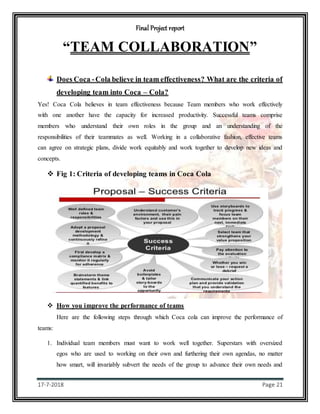
Yes! Coca Cola believes in team effectiveness because Team members who work effectively
with one another have the capacity for increased productivity. Successful teams comprise
members who understand their own roles in the group and an understanding of the
responsibilities of their teammates as well. Working in a collaborative fashion, effective teams
can agree on strategic plans, divide work equitably and work together to develop new ideas and
concepts.
 Fig 1: Criteria of developing teams in Coca Cola
 How you improve the performance of teams
Here are the following steps through which Coca cola can improve the performance of
teams:
1. Individual team members must want to work well together. Superstars with oversized
egos who are used to working on their own and furthering their own agendas, no matter
how smart, will invariably subvert the needs of the group to advance their own needs and
Final Project report
17-7-2018 Page 22
desires. Therefore, Coca cola really must hire well and choose people who not only like
working in a team, but also have a track record of doing it well.
2. Establish group norms or a code of conduct. Once again, engaging in a conversation
about the behaviors and attitudes team members want to abide by helps corral and focus
their energy and builds trust.
3. People need to be able to fail and make mistakes in front of others to be able to take risks.
One executive who headed up a research organization of a bio-tech company rightly
noted that if Coca Cola want to be creative they must allow for failure.
4. Once the team decides on a plan of action, everyone must support it. Debate the issues
beforehand and once the team decides to go with a plan… no one should passive
aggressively or overtly subvert the plan.
5. Expect that everyone on the team should and will act like a leader. On high performing
teams, team members don't wait for their boss or other team members to speak up. People
offer their opinions, challenge each other, hold each other accountable, and, most
importantly, praise each other.
6. Strive for continuous improvement. Periodically convene the team and ask, “What do we
need to be doing more of, differently and stop doing to close the gap from where we are
to where we want to be?” Top teams don’t rest on their laurels. There is always room for
growth.
7. Laugh together. High performing teams enjoy each other and frequently kid each other,
banter and crack jokes. This happens most often in teams where the team members have
trust in each other, can be vulnerable and generally like each other.
8. Productivity is increased when team members have all the skills they need to succeed.
Part of innovation and enhanced productivity comes from fine tuning existing processes
and roles. Ask your team for their thoughts on ways to streamline processes and
encourage brainstorming around process alignment.
Final Project report
17-7-2018 Page 23
What is the process ofcommunication within the team members and how it
could affect team effectiveness?
 Characteristics:
To have effective communication in the work place, team members mustkeep an open
mind, engage in active listening and have a clear understanding of project goals and
requirements. Active listening is perhaps the most important of these. Active listening
involves note taking, asking relevant questions and repeating what the other person says to
verify clarity.
 Effects:
Effective communication determines the success or failure of projects requiring
teamwork, and ultimately, the business itself. When team members communicate with open
minds, and by asking questions rather than making assumptions, they build trust and
harmony in the working environment. These elements work together to create a business
culture of camaraderie and success.
 Training:
Companies interested in ensuring that their employees know how to communicate
effectively can purchase training materials through various business consulting companies
that specialize in interpersonal communication. Alternatively, local organizations may offer
training seminars taught by experts that employees can attend. Here they can engage in role-
playing activities and communication games to enforce newly learned skills and techniques.
 Types:
Employees at every level of a Coca Cola must communicate with others in a variety of
ways. Types of communications include e-mail, traditional letter writing, phone conversation and
face-to-face exchange of ideas. Each platform has its own set of etiquette rules and skill sets.
With proper training in communication skills and techniques, employees often improve their
effectiveness across all communication platforms.
Final Project report
17-7-2018 Page 24
 Warnings:
Managers must have an awareness of the signs of poor communication among
employees. Missed project deadlines and slow progress toward problem solving can indicate
communication issues. Teams that spend too much time discussing strategies rather than
implementing them could be lacking the communication skills necessary to delegate tasks and
get the job done. Other indications of poor communication skills include no clear team direction
or focus, team dissension and arguing among team members. Taking steps to train employees to
communicate and work as a team can change the working environment in a positive way,
increasing productivity and revenue.
How much top management allow team members for taking decisions?
Coca Cola managers believe in Participative decision-making (PDM) is the extent to which
employers allow or encourage employees to share or participate in organizational decision-
making. PDM is one of many ways in which an organization can make decisions. The leader
must think of the best possible style that will allow the organization to achieve the best results.
There are many benefits of involving employees in the decision making of your company or
department. Based on data analysis from employee satisfaction surveys, the following are six of
the most important benefits:
1. The associates feel they are a valued part of the team.
2. The associates can make better day-to-day decisions because they have accurate
information regarding the direction of the company or department.
3. The associates feel a stronger bond of responsibility for making the decision.
4. The associates will focus more of their energy on future-oriented problem solving rather
than blaming their current problems on management.
5. Morale and motivation is higher in organizations where associates are involved in the
department/company’s decision making.
6. It frees up a manager’s time to contribute to the department’s success in other areas.
 What is decision Making process in team, and who leads them?
Business leaders are faced with dozens of decisions that need to be made every day. As our
organizations grow, the decisions generally become more frequent, more complicated, and have
Final Project report
17-7-2018 Page 25
more serious ramifications. Sometimes it’s not about making the right decision, but just deciding
at all.
The best leaders, however, know when they need input from the team. Good leaders surround
themselves with trusted advisors and subject matter experts, so that they can access a constant
flow of data to make better decisions.
 There are four basic decision-making styles that leaders can use:
Command:
Command decision-making is where leaders make decisions without consulting their teams. This
is an effective style, especially when things are moving quickly, and the team is looking for
immediate guidance.
Collaborative:
Collaborative decision-making is just what it sounds like. Leaders gather their teams and request
feedback and insight. The leader still makes the final call but is armed with the proper data to
make a more informed decision.
Consensus:
Consensus-based decision-making is done more like a democratic vote. Leaders gather their
teams, and everyone votes. Majority rules. This process can work well when the outcome of the
decision affects the entire team, and generally won’t immediately affect the bottom line.
Convenience:
When surrounded by trusted peers, sometimes the best decision a leader can make is to not be the
one to make a certain decision. Complete delegation (convenience decision-making) has many
benefits including measuring the decision-making abilities of your managers, empowering your
team, and maintaining your own sanity! By handing over some decision-making responsibilities,
leaders are also building a better management team and giving them the confidence, they need as
their responsibilities increase.
Final Project report
17-7-2018 Page 26
How management encourage teams for creative thinking for team
performance and achieving targets?
Enhance creativity and collaboration in teams using these principles and practices:
 Talent.
It’s crucial to have the right people on your team capable of adding their brilliance to the
project. Collaboration works best when team members have complimentary skill sets required to
complete the project.
 Healthy relationships are at the heart of collaboration.
Appreciating others, engaging in purposeful conversations and the ability to resolve
conflicts are essential ingredients for collaboration.
 A guiding vision and clarity of purpose are key to collaboration.
Warren Bennis said “Great Groups think they are on a mission from God… Their clear,
collective purpose makes everything they do seem meaningful and valuable.” Use storytelling
and imagery to engage the hearts and minds of your team.
 Provide a clear mission objective.
Team members jointly prepare a written purpose statement for their collaboration and
define rules of engagement which include goals, roles, responsibilities, and deliverables.
Communicate how decisions are made.
 Connect the project with big picture company objectives.
Create meaning and value for the organization and customers.
 Create an atmosphere of safety, trust and respect.
Encourage multiple perspectives, diverse viewpoints, and creativity. Keep members
energized through stimulating, quality discussions around cutting edge issues.
 Make your ideas visible and tangible by:
Building prototypes or drawing diagrams so everyone can see what you mean.
Final Project report
17-7-2018 Page 27
 Provide an infrastructure and resources:
That enable learning, communication and collaboration. Address cultural issues that
defeat collaboration.
 Provide great leadership.
Nurture the brilliance of your people and do everything you can to remove barriers to
high performance. Avoid being too autocratic and allow time for the team to weigh in on
decisions. Help build team connections across the organization. Give credit where credit is
due and recognize team performance as well as individuals.
 Use coaching to reinforce a collaborative culture.
Coaching for improved teamwork, emotional intelligence, and navigating difficult
conversations can produce dramatic improvements to the group. Ask open-ended questions
like why? What if? What else? And, how might we? To open dialogue and tap into creativity.
Normally what kind of conflicts generate in Coca Cola at different levels
among employee and management? How conflict effects the performance
of employees and objectives of organization?
The incidence of conflict, especially among employees and groups is inevitable in business
organizations. If well managed, conflict can augment and enhance employees’ performance.
However, its effect can be devastating if it stirs hostilities among individuals or groups. Evidence
from related literature is mixed with regards to the effect of conflict on the performance of
business enterprises.
Conflict can be categorized into three types — interpersonal, task, and
process conflict.
 Relationship conflict:
This type of conflict can be defined as tensions, annoyances, disagreements and personal
incompatibilities over matters such as beliefs, values, habits, and personalities. This form of
conflict involves personal issues such as dislike among group members and feelings such as
annoyance, frustration, and irritation. This definition is consistent with past categorizations of
Final Project report
17-7-2018 Page 28
conflict that distinguish between affective and cognitive conflict. Interpersonal conflict can
antagonize productivity since it arouses hostility among group members.
 Task conflict
It can be defined as differences in viewpoints and opinions pertaining to a group task.
Like cognitive conflict, it pertains to conflict about ideas and differences of opinion about the
task. Task conflicts may coincide with animated discussions and personal excitement but, by
definition, are void of the intense interpersonal negative emotions that are more commonly
associated with relationship conflict. This form of conflict can enhance productivity by
improving quality of thinking and decision-making processes.
 Process conflict:
It is defined as controversies about aspects of how task accomplishment will proceed.
More specifically, process conflict pertains to issues of duty and resource delegation, such as
who should do what and how much responsibility different people should get. For example,
when group members disagree about whose responsibility it is to complete a specific duty, they
are experiencing process conflict. This type of conflict normally occurs when the procedure(s)
for the task is not clearly defined by the supervisor or the person in charge.
How conflict effects the performance of employees and objectives of
organization?
As organizations strive to achieve their goals, they are often met with challenges they must
overcome as a team. Challenges leave room for conflict between members, other organizations,
communities and other parties involved in the organization’s mission. While “conflict” often has
a negative connotation, the effects of conflict within an organization can be positive and
negative.
 Mental Health Concerns:
Final Project report
17-7-2018 Page 29
Conflict within an organization can cause members to become frustrated if they feel as if
there’s no solution in sight, or if they feel that their opinions go unrecognized by other group
members. As a result, members become stressed, which adversely affects their professional and
personal lives. Organization members may have problems sleeping, loss of appetite or
overeating, headaches and become unapproachable. In some instances, organization members
may avoid meetings to prevent themselves from experiencing stress and stress-related symptoms.
 Decrease in Productivity:
When an organization spends much of its time dealing with conflict, members take time
away from focusing on the core goals they are tasked with achieving. Conflict causes members
to focus less on the project at hand and more on gossiping about conflict or venting about
frustrations. As a result, organizations can lose money, donors and access to essential resources.
 Members Leave Organization:
Organization members who are increasingly frustrated with the level of conflict within an
organization may decide to end their membership. This is especially detrimental when members
are a part of the executive board or heads of committees. Once members begin to leave, the
organization must recruit new members and appoint acting board members. In extreme cases,
where several members leave or an executive board steps down, organizations risk dissolution.
 Violence:
When conflict escalates without mediation, intense situations may arise between
organization members. It’s unfortunate, but organizational conflicts may cause violence among
members, resulting in legal problems for members and possibly the organization.
Final Project report
17-7-2018 Page 30
 Inspire Creativity:
Fortunately, some organization members view conflict as an opportunity for finding
creative solutions to solve problems. Conflict can inspire members to brainstorm ideas, while
examining problems from various perspectives.
 Share and Respect Opinions:
As organization members work together to solve conflict, they are more willing to share
their opinions with the group. Conflict can also cause members to actively listen to each as they
work to accomplish the organizations’ goals.
 Improve Future Communication:
Conflict can bring group members together and help them learn more about each other.
From learning each other’s’ opinions on topics relevant to the organization’s growth to
understanding each member’s preferred communication style, conflict within an organization can
give members the tools necessary to easily solve conflicts in the future.
 Identify New Members:
Within organizations members actively participate in each meeting, enjoy serving on
multiple committees and have an opinion on each topic the group discusses. There are also
members who seemingly contribute little to the group and observe more than talk. Conflict
within an organization can inspire typically silent members to step up and demonstrate their
leadership skills by offering meaningful solutions to the problem the group is facing
Final Project report
17-7-2018 Page 31
How much Coca Cola believes in collaboration among employees, teams,
departments etc.?
There's something special about The Coca-Cola Company. There's a sense of pride that comes
from building brands people love and making the most of ourselves as a company and as
individuals.
 Ability to make a difference: being part of a company that creates value
& makes a difference everywhere we engage.
The Coca-Cola Company is a place where you can make a positive mark on the world.
Whether through our sustainability initiatives, human rights work or the ripple economic
impact each person creates by simply doing their job well, there are endless opportunities to
build shareholder value and make an impactful contribution to many communities.
 Growing from Within:
The success of The Coca-Cola Company depends on every employee in the organization.
Ultimately in our business, it is people who make the magic happen-with consumers, customers,
our bottling partners, and the communities in which we work.
 Be part of a diverse team:
We believe our company should be as diverse as the markets we serve and as inclusive as
our brands. This diversity allows us to understand and connect to the needs of our consumers and
our customers everywhere we operate and to continue to innovate in everything we do. At Coca-
Cola you can work on teams with people who have different backgrounds and ideas and who
work in offices across the globe. We are all unified by our love for the Company and desire to
add value and make a difference.
 A unique culture... where people convert their passion into action:
Being a great place to work where people are inspired to be the best they can be.From
day one, you'll notice a culture where our people are truly dedicated to living our values. We
consider The Coca-Cola Company to be a local business on a global scale. The Coca-Cola brand
represents qualities such as caring, sharing, connecting, integrity and excellence. Our culture
mirrors those attributes. To put it simply: we are the brand.
Final Project report
17-7-2018 Page 32
“LEADERSHIP & CULTURE”
Do you believe that your organization has the leaders that can really take
their organization to the leading position in market?
Since 1886, we’ve brought the world the unique, refreshing taste of Coca-Cola. And as the times
have changed, so have we. Today, we’re the world’s largest beverage company, offering over
500 brands to people in more than 200 countries. Together with our bottling partners, we depend
on over 700,000 Coca-Cola system associates to reach the world.
But even with this storied past, we aren’t standing still. As consumers’ tastes and preferences
change, we’re rapidly evolving our business to bring them a wide range of new and different
drinks, while also reducing sugar and adding more nutrition and benefits wherever we can. As
always, we’re firmly committed to creating lasting value for our associates, bottling partners,
customers, shareowners, and the communities we call home. Led by President and CEO James
Quincey, our company’s senior leadership team is investing in a future that promises to be even
more exciting than our past.
"We are moving quickly to structure our organization for faster growth and to ensure we can
respond to the fast-changing needs of our consumers," said Quincey in a statement.
Final Project report
17-7-2018 Page 33
Coke also announced three executives would depart the company as part of the senior leadership
shakeup. The most notable of those exits was the decision by chief marketing officer Marcos de
Quinto to retire after a 35-year career at Coke. He helped steer the "Taste the Feeling" campaign
and at last year's Beverage Digest conference, lauded Quincey as a leader, saying he was "not
only probably the best professional we can have in this moment. As a person – he is fantastic."
Observers say the leadership changes at Coke imply that Quincey and his newly formed team
will focus more on innovation to better position the beverage giant for growth. "By including
three new direct reports to the CEO role focused on growth, innovation, and digital, Quincey's
priorities are clear: to reaccelerate growth in [Coke] through new products and better
engagement with customers and consumers," wrote Wells Fargo analyst Bonnie Herzog in an
analyst report. She added the company appears poised to continue to transform the portfolio to
place bigger bets on juices, waters, energy drinks, and plant-based/dairy offerings.
"In the end, what are we aiming for as a company? We're aiming to grow faster than our
industry," Quincey said at CAGNY, an industry event held in February. He explained some of
the actions Coke planned to pursue in that hunt for growth include reformulation that lessens the
amount of sugar found in Coke's beverages as consumers say they want to consume less of it.
Coke also wants to increased focus on selling smaller packs, which have been successful in the
market.
Normally what kind of traits does your organization find in their leaders?
In today’s fiercely competitive global marketplace, many companies and brands need a new
enlightened form of leadership. As a Cuban-American,I’ve leveraged my Hispanic culturalvalues
to lead more effectively and authentically.
The characteristics I’ve cultivated—and the lessons I’ve learned along the way—can be applied
to anyone looking to think, act and innovate like a leader. The following six traits that will
be crucial for any 21st century leader and serve as a roadmap for success in the workplace.
Final Project report
17-7-2018 Page 34
 Think like an Immigrant
As an immigrant, I’ve been able to recognize that opportunity is the true mother of
success. For others, it’s important to recognize it’s all about capitalizing on opportunities and
making the most of those that cross your path.
 Employ a Circular Vision
If you see opportunity in everything, you’ll have a wide-angle vision that helps anticipate
crisis and manage change proficiently. This circular vision broadens observation and allows you
to see around, beneath and beyond the obvious.
 Unleash Passionate Pursuits
When you put your passion into everything you do, it gives you the power to become a
potent pioneer. A passionate pursuit of excellence will open new doors of opportunity. A great
leader’s passion is infectious and creates endless possibilities for those who can see the
opportunities.
Along with these, other leadership qualities which Coca-Cola has are:
 Seeing your leadership position as a privilege, not a right
 Serving as activist-in-chief for your constituents
 Operating in a time frame longer than tenure
 Believing in and relying on partnerships
 Feeding constructive discontent
Which leadership theory does your management follow and why?
Leadership theories are widely spread around us with their roots emerging from different
practical examples and real time implications from numerous organizations. The basic aim for
the evaluation of leadership theories is to provoke an environment of successful management and
maintain the smooth running of the management with management and leadership qualities.
Following leadership theories are quoted from Coca Cola Company, how the company has
gained such phenomenal success and a word from CEO. Coca cola Company mainly sees these
theories to build the leadership qualities among their employees.
Final Project report
17-7-2018 Page 35
 Behavioral Theory with Reference to Coca Cola Company
The developers of behavioral theory suggest that leaders can be made, they are not
always born. They believe in the fact that leadership qualities can be learned over a period and
they are not merely innate traits, but they are successful behaviors of describable and explainable
actions present in the behavior itself. These actions are easier to be learnt rather than adopting
numerous different traits.
CEO of Coca Cola Company persuades and ensures that the employees are given a chance to
learn and develop leadership skills monitoring the improvement from time to time followed by
selecting those employees who possess successful leadership skills. Developing a behavioral
theory is comparatively easier assessing leaders and leadership success actions. Here CEO can
recognize behavior use which raises to failure there it added a second layer of understanding.
 Trait Theory with Reference to Coca Cola Company
Trait theory suggests that successful leadership is an amalgamation of traits that defines
leadership skills and qualities. Companies like coca cola assess the employees on psychological
traits focusing on unique qualities. CEO of Coca Cola Company evaluates the employees based
on their behaviors and work structures. Trait theory suggests the possession of the following
qualities and skills confirms successful goal leaders and Coca Cola Company focuses on
retention of them.
 Participative Leadership Theory
This theory aims at developing an understanding to decision making in different
scenarios. The theory suggests that people working in teams must be more collaborative and less
competitive. Team based decision making is better and more committed than individual persons.
Coca Cola Company uses this theory and focuses on the development of teams for more focused
and cooperative decision making rather than being alone. Leaders are selected for individual
teams based on qualities as commitment, collaboration, cooperation, motivation friendly
behavior etc. different programs are arranged so that the team member can participate and
develop those leadership traits. Coca Cola Company effectively inculcates this process.
Final Project report
17-7-2018 Page 36
Do you think organizational culture shape the employee attitude and
behavior?
Organizational culture is the set of beliefs, values and norms, together with symbols like
dramatized events and personalities that represents the unique character of an organization and
provides the context for action in it and by it.
‘Beliefs and values’ are words that will come up frequently in other definitions and ‘norms’
might be best understood as traditions, structure of authority or routines. In a working
environment, this culture is made up of all the life experiences that the each one of the
employees would bring to the organization.
People in organizations, work together to accomplish goals. When goals become more specific,
organizations tend to take on a life of their own and gain beliefs, values, develop practices, often
affecting the organization’s success or failure. Management distinguished these belief systems
which they often refer to as organizational or corporate cultures.
Culture is a behavior that results in when a group comes together – generally unspoken and
unwritten – rules for working together. It can be best understood as “the way we do things
around here” and forms the context within which people judge the appropriateness of their
behavior. There are many practices within the organization that tend to keep a culture alive
between itself and its employees.
Using the approach of performance appraisal, training, and career development organization
could reinforce the culture. Organizational beliefs can influence the work communication
practices, and philosophical stances of employees.
Organizational process called ‘socialization’ can help adapt new employees to the organization’s
culture. If employees do not adapt well, it could increase pressure from supervisors and from co-
workers who are better acculturated. They might stay and fight, stay and become isolated, or
leave the organization, voluntarily or involuntarily, and look for a different organization whose
culture may fit better for them.
It is therefore true that an organization’s culture can unquestionably influence human behavior
and consequently the employee performance at work.
Final Project report
17-7-2018 Page 37
What type of culture does management develop in this organization to
introduce the dynamic challenges and innovation to compete the market?
We are a global business that operates on a local scale, in every community where we do
business. We can create global reach with local focus because of the strength of the Coca-Cola
system, which comprises our Company and our more than 250 bottling partners worldwide.
The Coca-Cola system is not a single entity from a legal or managerial perspective, and the
Company does not own or control all our bottling partners.
While many views our Company as simply "Coca-Cola," our system operates through multiple
local channels. Our Company manufactures and sells concentrates, beverage bases and syrups to
bottling operations, owns the brands and is responsible for consumer brand marketing initiatives.
Our bottling partners manufacture, package, merchandise and distribute the final branded
beverages to our customers and vending partners, who then sell our products to consumers.
All bottling partners work closely with customers -- grocery stores, restaurants, street vendors,
convenience stores, movie theaters and amusement parks, among many others -- to execute
localized strategies developed in partnership with our Company. Customers then sell our
products to consumers at a rate of more than 1.9 billion servings a day.
In January 2006, our Company-owned bottling operations were brought together to form the
Bottling Investments operating group, now the second-largest bottling partner in the Coca-Cola
system in terms of unit case volume.
 Coca-Cola System wide Performance
In April 2007, associates from The Coca-Cola Company and several of our largest
bottling partners met for the first time to discuss the development of a core set of performance
indicators for the Coca-Cola system. Working groups of Company associates and representatives
from our bottling partners have been formed to determine the feasibility -- due to the legal and
management complexity of the Coca-Cola system -- of collecting and consolidating economic
and social data in addition to the environmental data already collected. Many of our bottling
partners produce their own corporate responsibility reports which can be viewed in the
Sustainability Reports section.
Final Project report
17-7-2018 Page 38
 Bottling Investments Group
The Coca-Cola Company’s core is the production, marketing, and selling of many of the
world’s most beloved beverages. Historically, for the bottling of our beverages, Coca-Cola has
relied on independent bottling franchises, and this system has served us well.
For a variety of reasons, circumstances arise where bottling franchises find they need help that is
beyond their capability. The Bottling Investments Group (BIG) was created to ensure those
bottling operations remain a part of our system and receive the appropriate investments and
expertise to ensure their long-term success.
Eleven years ago, BIG started the process of strategically investing in select bottling operations,
temporarily taking them under Coca-Cola’s ownership. Utilizing the leadership and resources of
The Coca-Cola Company, BIG can drive long-term growth in critical markets and affect major
structural or investment challenges.
When an operation is stable and thriving, BIG’s goals are to find a qualified bottler to assume
operations and continue to grow the business. By treating each operation as if it will be owned by
Coca-Cola forever, BIG has established a standard of excellence that extends to each of the 17
countries in which it currently functions.
What is the process of goal setting in your organization? Does goals are
dedicated or mutually shared with employees at different levels?
 Be sure your goals are YOUR goals
If a goal is set by you and is something you really want to achieve, the chances for
success are immensely improved. You know the forces that would set goals FOR you—
employee motivation, family expectations, government regulations. This does not mean you
should be stubborn and refuse any advice on what your direction should be. Friends, relatives,
and employers can all be helpful with ideas. But the reluctance and compromise of setting
someone else’s goal for yourself will weaken your motivation to achieve it. The force within
YOU will follow the course YOU set.
Final Project report
17-7-2018 Page 39
 Put your goals in writing
First, writing a goal helps you clarify and develop what it is you want. The process of
writing in detail helps you more carefully imagine your goal. Most of us don’t have the capacity
to flesh out a goal in our heads the way we can in writing. And, by nature, thoughts fade more
quickly than ink. The second reason for writing goals is to increase your personal commitment.
Through writing, you bring the imagined achievement into the physical reality of language on
paper (or on the computer screen). You’ve made yourself accountable to the exact goal you have
in mind because you’ve made a record. And you can use this record to continually re-imagine the
goal.
 Challenging but attainable
Good goals cause you to stretch and grow. Setting ones that will require little energy will
likely inspire little motivation. At the other extreme, saying you will reach impossible dreams
also results in little or no motivation. Identify those goals that will require meaningful attention
but that you feel you can truly achieve. Deciding if a goal is attainable is a very personal
decision, but if you think you can, YOU CAN. Go after it!
 Major goals must be compatible
Going after competing goals—where the attainment of one means short-changing the
other—is an easy trap to fall into. For example, you’ve committed to a very expensive vacation
AND you’d like to save toward building your dream house. Or, you want to excel in tennis and
golf, but you don’t have enough leisure time to practice them both. Incompatible goals can lead
you to put serious effort into several seemingly worthwhile projects and yet finish none of them.
Or, worse, your divided energy produces unsatisfactory results that you’re stuck with. So, after
you decide on your major goals, check them for compatibility.
 Revision & Change
As a growing human being, your wants will be forever changing and evolving. Don’t
think of your goals as carved in stone. Periodically review, update, and revise them.
Final Project report
17-7-2018 Page 40
 Specific tasks, measurable achievements
You’ve written your goal; now break it down into the specific steps to its
accomplishment. (Remember how one eats an elephant.) Then create a plan for measuring
progress. For example, you have written a major goal to redecorate your home. Along the way,
check off the individual projects—living room window treatment, kitchen floor, bedroom
furniture—as each is completed. As for goals like “I want to be a better person,” follow Ben
Franklin’s example. He chose one virtue at a time—forgiveness, charity, etc.—to work on. I
recommend you choose a specific trait and assign a scale—0 to 4 or 1 to 10—on which to
measure progress.
 Target dates
Consider you have set your goal only after you have attached a timeline for its
accomplishment. Just like the power of writing it down, the time component helps you create the
goal in your physical reality. Without timetables, goals are as elusive as daydreams. In
conjunction with the process of identifying specific tasks, set target dates for each task or, as it
may be called, a sub goal. In creating your schedule, allow time for figuring out unforeseen
problems, errors, personnel changes, etc.
 Prioritize
Ever feel you are spending your time doing second things first? Well, that’s one way to
make sure that you’re most important goals WON’T be realized. To control this tendency, list
your goals (with the items on your schedule for the day, if necessary) and then rank them in
order of importance.
How you set priorities is a matter of personal choice, and if one system doesn’t work, don’t give
up. Try something else. Some people list their goals and then select the two or three most
important. Others rank them all in order of importance.
 Put up reminder signs
Focusing on goals can get lost when you’re busy doing something else (and you even feel
good because there’s so much activity). A well-placed reminder sign can bring you back. Design
a sign for your desk, the dashboard of your car (with a picture for extra impact), or, set regular
reminders on your phone’s calendar—anything that works for you.
Final Project report
17-7-2018 Page 41
 Goals and beyond goals
Remember your overall satisfaction with life is not ultimately driven by achievement of
this year’s goals. Be formulating goals beyond the ones you are working so hard to achieve at
any moment. With nothing further to imagine, your subconscious may sabotage completion of a
goal. We’re sometimes funny that way.
Does management use latest technology for designing structure and
strategies? If yes, then how much?
While it's mainly thought of as a simple soft drink company, other businesses could take a page
from the Coca-Cola handbook when it comes to using technology for innovation. As a company,
Coca-Cola constantly changes, rebrands, advertises for and presents their products to keep sales
consistently high. Since the dawn of social networking, the green movement and the ability to
stay constant connected to the Internet, Coca-Cola has continually harnessed new technology in a
variety of ways to further the brand.
From high tech developments to creative ideas, today's technology is constantly improving and
has a definite impact on management. Internally management strategies are changed due to
advances in technology and externally technology has forced management to create different
marketing strategies. When looking at the Coca-Cola Company there are not many options in
upgrading their product with technology. Considering they produce drinking products
technology can only do so much, so managers must use technology to create ways to keep
consumers purchasing their product. A new idea that the Coca-Cola Company has put into effect
is the Coke rewards program. With this program management has developed a way to use
technology to help reward people and keep them buying their products.
 Social Networking
Coca-Cola maintains a visible appearance on Facebook and other social networking sites
such as Twitter. With over 34 million fans as of 2011, Coca-Cola harnesses the power of social
networking to spread the word concerning new products, test advertorial campaigns, invite users
to play games and associate Coca-Cola products with positive feelings. Using social networking
technology enables a brand to stay young, fresh and current.
Final Project report
17-7-2018 Page 42
 Online Advertising
Coca-Cola uses subtle yet effective online advertising to make you feel like you want its
products. Targeted advertisements on websites mean that Coca-Cola has greater control over
who sees their ads and when they see them. For instance, when you're perusing the online menu
of a local eatery, Coke ads may appear, making you associate that restaurant with a tall, icy
glass. Or, when you're researching local beaches, you may see an ad for Coca-Cola products,
thereby associating heat with the refreshment of Coke.
 Information gathering
To gather market data company using technology for good use, they are doing market
research with the help of technology and gathering information about the target market
References
 http://www.workforce.com/1994/11/01/coca-colas-staffing-philosophy-supports-its-
global-strategy/
 https://www.ukessays.com/essays/business/behavioral-theory-with-reference-to-coca-
cola-company-business-essay.php
 https://www.decision-wise.com/employee-satisfaction-vs-motivation-and-employee-
engagement/
 http://smallbusiness.chron.com/role-reward-employee-motivation-18814.html
 http://smallbusiness.chron.com/employee-motivation-reward-systems-15978.html
 https://www.talkdesk.com/blog/20-ways-to-increase-employee-motivation-using-rewards
 http://fortune.com/2017/03/23/coke-new-ceo-leadership/
 https://www.skipprichard.com/5-leadership-traits-for-high-performance/
 https://www.ukessays.com/essays/business/behavioral-theory-with-reference-to-coca-
cola-company-business-essay.php
 https://www.linkedin.com/pulse/20140809231713-40057959-does-organizational-
culture-influence-employee-behavior-at-work
 http://www.coca-colacompany.com/our-company/the-coca-cola-system
 http://www.jpa-international.com/how-coca-cola-executives-achieve-their-goals/
 http://www.coca-colacompany.com/stories/five-strategic-actions
 http://smallbusiness.chron.com/cocacola-use-technology-gain-advantage-27339.html

Cocacola

  • 1.
    UNIVERSITY OF CENTRALPUNJAB SUBMITTED TO: - SIR.FAROOQ SUBMITTED BY: - MUNTAHA MAQBOOL (0001) Alina Khalid (0024) Noor-e-amina (0082) Aqsa Khalid (0085) Department: - business studies Section: - bba 3a
  • 2.
    Final Project report 17-7-2018Page 2 Acknowledgement ‘‘In the name of ALLAH, the most merciful and the beneficent’’ The Almighty who bestowed knowledge, health, vigor, to complete this report. A person is not perfect. He has a limited mind and thinking approaches. It is the guidance from the great ALLAH that shows the persons, light in the darkness and the person finds his way in this light. Person is nothing without the helping lights but a helpless creature. “Life is a learning experience”. We have learned the validity of this statement time and time again. Every time we think we know something, we look back a year later and realize how little we know and how much we have learned. This Report has convinced us again, not in the learning but also in terms of the vast team of talented people that take part in creating this report. We believe each person plays a piece of a puzzle to make the complete picture, some pieces are bigger than others, but without anyone piece the picture would not be completed. We feel great pleasure and honor to express our gratitude from the citadel of our hearts to the people whom we met, for their cooperation. Their sympathetic behavior has an ever-lasting impression on the pages of our memory. We want to pay tribute to our worthy teachers who are the main source of enlightenment for our minds. We all students are thankful to them as they prepared us for looking at the matters of life widely with open minds. This project is one of the sources of knowledge about the “Organization Behavior of Business” for us. We are especially thankful to our honorable teacher Sir. Farooq provided us guidance, inspiration, suggestions and encouragement that helped us in all the time of research for and writing of this project. We are especially thankful to Muhammad Talha (RSM: Regional Sales Manager of Company)who provide us necessary information. We are also thankful to the all that person whose cooperation makes us unable to complete the project. Who helped us in giving information to us for completing this project the end we would like to thank UCP for allowing us the course which helped us in building our minds to the right track towards professionalism.
  • 3.
    Final Project report 17-7-2018Page 3 PREFACE Department of Commerce, The University of Central Punjab has always been admirable in its efforts to equip the future executives with arms of creativity, flexibility and adaptability to meet the challenges offered by fast changing business environment. To achieve the above goals the department is providing both text and practical knowledge to its students with its available resources. Text knowledge is very well transferred to the students within the premises of the department; Practical knowledge requires the kind co-operation of various business organization of the country. Faculty members are always trying their best to ask the students to explore the market by assigning these different field activities. This report has been made on “Coca-Cola” The key function of our work was to analyze organizational behavior of company. We have done our best efforts to complete this report efficiently and effectively with all abilities. We hope this report fulfills the criteria and expectations of Department of Commerce. We have tried our best to make it analytical as well as informative.
  • 4.
    Final Project report 17-7-2018Page 4 Table of Contents  Meet Our Company: - .............................................................................................................. 8  What we Do: -.......................................................................................................................... 9  Why is our role Important?...................................................................................................... 9  Mission, Vision & Values: - .................................................................................................. 10  Our Mission: - .................................................................................................................... 10  Our Vision: - ...................................................................................................................... 11  Our Values: -...................................................................................................................... 11  Coca Cola Goals and Objectives: - ........................................................................................ 12  How strongly they believe in OB?......................................................................................... 13  Do they believe in Individual differences? ............................................................................ 13  Criteria of judging Job satisfaction of an employee: -........................................................... 14  How they establish values among employees of diverse Culture?........................................ 14  What is the current management philosophy about how employee perceive about their job, reward teams, culture etc. and impact on their performance and satisfaction? ............................ 15  What learning theories or approaches does your organization apply for the learning and development for its employees?.................................................................................................... 17  How Coca-Cola motivate their employees? .......................................................................... 18  Encouraging Open Communication................................................................................... 18  Rewarding and Developing Employees............................................................................. 18  Financial Rewards.............................................................................................................. 18  Energizing Environment .................................................................................................... 18  How do you relate motivation of employees with their performance and satisfaction? ....... 19  Employee satisfaction........................................................................................................ 19
  • 5.
    Final Project report 17-7-2018Page 5  How do you relate rewards with motivation of employees? ................................................. 20  Incentive............................................................................................................................. 20  Advantages..................................................................................................................... 20  Disadvantages................................................................................................................. 20  Does Coca - Cola believe in team effectiveness? What are the criteria of developing team into Coca – Cola?.......................................................................................................................... 21  How you improve the performance of teams..................................................................... 21  What is the process of communication within the team members and how it could affect team effectiveness? ....................................................................................................................... 23  Characteristics:................................................................................................................... 23  Effects: ............................................................................................................................... 23  Training:............................................................................................................................. 23  Types:................................................................................................................................. 23  Warnings:........................................................................................................................... 24  How much top management allow team members for taking decisions? ............................. 24  What is decision Making process in team, and who leads them? ...................................... 24  There are four basic decision-making styles that leaders can use:................................. 25  How management encourage teams for creative thinking for team performance and achieving targets?.......................................................................................................................... 26  Talent. ................................................................................................................................ 26  Healthy relationships are at the heart of collaboration. ..................................................... 26  A guiding vision and clarity of purpose are key to collaboration. ..................................... 26  Provide a clear mission objective....................................................................................... 26  Connect the project with big picture company objectives. ................................................ 26  Create an atmosphere of safety, trust and respect. ............................................................. 26  Make your ideas visible and tangible by: .......................................................................... 26
  • 6.
    Final Project report 17-7-2018Page 6  Provide an infrastructure and resources:............................................................................ 27  Provide great leadership..................................................................................................... 27  Use coaching to reinforce a collaborative culture.............................................................. 27  Normally what kind of conflicts generate in Coca Cola at different levels among employee and management? How conflict effects the performance of employees and objectives of organization?................................................................................................................................. 27  Relationship conflict:......................................................................................................... 27  Task conflict....................................................................................................................... 28  Process conflict:................................................................................................................. 28  How conflict effects the performance of employees and objectives of organization? .......... 28  Mental Health Concerns: ................................................................................................... 28  Decrease in Productivity:................................................................................................... 29  Members Leave Organization:........................................................................................... 29  Violence:............................................................................................................................ 29  Inspire Creativity: .............................................................................................................. 30  Share and Respect Opinions: ............................................................................................. 30  Improve Future Communication:....................................................................................... 30  Identify New Members: ..................................................................................................... 30  How much Coca Cola believes in collaboration among employees, teams, departments etc.? 31  Ability to make a difference: being part of a company that creates value & makes a difference everywhere we engage. ............................................................................................ 31  Growing from Within: ....................................................................................................... 31  Be part of a diverse team: .................................................................................................. 31  A unique culture... where people convert their passion into action:.................................. 31  Do you believe that your organization has the leaders that can really take their organization to the leading position in market?................................................................................................. 32  Normally what kind of traits does your organization find in their leaders? .......................... 33
  • 7.
    Final Project report 17-7-2018Page 7  Think like an Immigrant .................................................................................................... 34  Employ a Circular Vision .................................................................................................. 34  Unleash Passionate Pursuits............................................................................................... 34  Which leadership theory does your management follow and why? ...................................... 34  Behavioral Theory with Reference to Coca Cola Company.............................................. 35  Trait Theory with Reference to Coca Cola Company ....................................................... 35  Participative Leadership Theory ........................................................................................ 35  Do you think organizational culture shape the employee attitude and behavior? ................. 36  What type of culture does management develop in this organization to introduce the dynamic challenges and innovation to compete the market?........................................................ 37  Coca-Cola System wide Performance................................................................................ 37  Bottling Investments Group................................................................................................... 38  What is the process of goal setting in your organization? Does goals are dedicated or mutually shared with employees at different levels? .................................................................... 38  Be sure your goals are YOUR goals .................................................................................. 38  Put your goals in writing.................................................................................................... 39  Challenging but attainable ................................................................................................. 39  Major goals must be compatible ........................................................................................ 39  Revision & Change ............................................................................................................ 39  Specific tasks, measurable achievements........................................................................... 40  Target dates........................................................................................................................ 40  Prioritize............................................................................................................................. 40  Put up reminder signs......................................................................................................... 40  Goals and beyond goals ..................................................................................................... 41  Does management use latest technology for designing structure and strategies? If yes, then how much? .................................................................................................................................... 41  Social Networking.............................................................................................................. 41  Online Advertising............................................................................................................. 42  Information gathering ........................................................................................................ 42  References………………………………………………………………………………..42
  • 8.
    Final Project report 17-7-2018Page 8 Brief overview Meet Our Company: - The coca cola company is the world’s largest beverage company. We operate in more than 200 countries and market a portfolio of more than 3000 beverages products including sparkling drinks and still beverages such as waters, juices and juice drinks and still beverages such as waters, juice and juice drinks, teas, coffees, sports drinks and energy drinks. Who we are: -
  • 9.
    Final Project report 17-7-2018Page 9 Headquarter in Atlanta, Georgia, we employ approximately 92,400 associates across our seven operating groups: -  Eurasia and Africa  Europe  Latin America  North America  Asia Pacific  Bottling Investments  Corporate What we Do: - Our Company manufacture the concentrates, beverage bases and syrups that’s make our brand unique, and sells them to bottling operations. We own our License the Brands and, to connect our brands to our customers, we focus on marketing activities including print and television advertising, online programs retail store displays, sponsorship, contests and package design. Why is our role Important? Our focus on beverage creation and marketing enables us to understand and meet the diverse and ever-changing beverage needs and desires of our consumers around the world. We are a global business that operates on a local scale, in every community where we do business. We can create global reach with local focus because of the strength of the Coca-Cola system, which comprises our Company and our more than 300 bottling partners worldwide.
  • 10.
    Final Project report 17-7-2018Page 10 While many views our Company as simply "Coca-Cola," our system operates through multiple local channels. Our Company manufactures and sells concentrates, beverage bases and syrups to bottling operations, owns the brands and is responsible for consumer brand marketing initiatives. Our bottling partners manufacture, package, merchandise and distribute the final branded beverages to our customers and vending partners, who then sell our products to consumers. All bottling partners work closely with customers -- grocery stores, restaurants, street vendors, convenience stores, movie theaters and amusement parks, among many others -- to execute localized strategies developed in partnership with our Company. Customers then sell our products to consumers at a rate of 1.6 billion servings a day. (The Coca cola company website) The company’s large advertising budget provides competitive advantages such as:  helping to introduce new products to the market  promoting the brand  informing consumers about the product’s features  communicating brand’s message to the public  Increasing sales. Mission, Vision &Values: - The world is changing all around us. To continue to thrive as a business over the next ten years and beyond, we must look ahead, understand the trends and forces that will shape our business in the future and move swiftly to prepare for what's to come. We must get ready for tomorrow today. That's what our 2020 Vision is all about. It creates a long-term destination for our business and provides us with a "Roadmap" for winning together with our bottling partners.  Our Mission: - Our Roadmap starts with our mission, which is enduring. It declares our purpose as a company and serves as the standard against which we weigh our actions and decisions. The mission statement of the Coca Cola Company is:  To refresh the world in mind, body and spirit  To inspire moments of optimism through our brands and actions  To create value and make a difference everywhere we engage.
  • 11.
    Final Project report 17-7-2018Page 11  Our Vision: - Our vision serves as the framework for our Roadmap and guides every aspect of our business by describing what we need to accomplish to continue achieving sustainable, quality growth. The Coca-Cola Company and its bottling partners developed a 2020 Vision in 2009. This vision is a roadmap to doubling their global system revenues in the next 10 years by focusing on six key areas: profit, people, portfolio, partners, planet, and productivity.  People: Be a great place to work where people are inspired to be the best they can be.  Portfolio: Bring to the world a portfolio of quality beverage brands that anticipate and satisfy people's desires and needs.  Partners: Nurture a winning network of customers and suppliers, together we create mutual, enduring value.  Planet: Be a responsible citizen that makes a difference by helping build and support sustainable communities.  Profit: Maximize long-term return to shareowners while being mindful of our overall responsibilities. Productivity: Be a highly effective, lean and fast-moving organization.  Our Values: - Our values serve as a compass for our actions and describe how we behave in the world.  Leadership: The courage to shape a better future  Collaboration: Leverage collective genius
  • 12.
    Final Project report 17-7-2018Page 12  Integrity: Be real  Accountability: If it is to be, it's up to me  Passion: Committed in heart and mind Coca Cola Goals and Objectives: - The Coca-Cola Company is a leader in the beverage industry with a reputable brand and strong global presence According to the Coca-Cola Company’s mission statement and 2020 Vision, some of its goals include:  Increase profit by cutting down costs through productive and efficient production facilities  Focus on environment friendly bottling production and enforce sustainability  Continue to diversify its portfolio through innovations and partnerships, keeping consumer demands in mind  Increase annual operating income by 6-8% to double their revenue by 2020
  • 13.
    Final Project report 17-7-2018Page 13 “Job Satisfaction” How strongly they believe in OB? All officers in management are qualified. We are aware of the importance of OB thus we strongly believe in OB. Our company is built around two core assets, its brands and its people. That's what makes working here so special. We believe that work is more than a place you go every day. It should be a place of exploration, creativity, professional growth and interpersonal relationships. It's about being inspired and motivated to achieve extraordinary things. We want our people to take pride in their work and in building brands others love. After all, it's the combined talents, skills, knowledge, experience and passion of our people that make us who we are. Do they believe in Individual differences? Yes, we believe in individual difference and upon our individual capabilities we are assigned different tasks. Every person has different task depending upon his experience, knowledge, mental approach, skills and competencies. The Coca-Cola Company leverages a worldwide team that is rich in diverse people, talent and ideas. As a global business, our ability to understand, embrace and operate in a multicultural world, both in the marketplace and in the workplace is critical to our sustainability. Our diversity workplace strategy includes programs to attract, retain, and develop diverse talent; provide support systems for groups with diverse backgrounds; and educate all associates so that we master the skills to achieve sustainable growth. We work hard to ensure an inclusive and fair work environment for our associates, all of whom undergo diversity training on a regular basis. We find ongoing dialogue leads to better understanding of our colleagues, our suppliers, our customers, our stakeholders, and ultimately, to greater success in the marketplace.
  • 14.
    Final Project report 17-7-2018Page 14 Criteria of judging Job satisfaction of an employee: - Satisfaction criteria vary from dept to dept. In general, we judge an employee by considering the targets achieved by him, by the positive responses to their managers and the feedback from their immediate seniors In production dept, a big factor to satisfaction is the decrement of downtime of production Management handles these by giving incentives on achieving the targets The behavioral direction of employee is measured by the degree an employee chooses to perform on the slated task assigned within the organization; the degree of performance of an employee on a given assign task measured the level of effort and when an employee faced a challenge or an obstacle what determines his persistence is whether the employee gave up or continue. Motivation is a significant factor that enhances the level of persistence of an employee. Motivated employee is highly needed in organization, in a highly competitive global marketplace motivated employee are more productive and will contribute to the effectiveness of the organization. These are some of the reasons why effective managers are expected to identify what motivate their employees within the context of their various task. Management handles these by giving incentives on achieving the targets. How they establish values among employees of diverse Culture? An organizational culture describes the norms and values of the organization in its dealings with both internal and external subordinates. The Coca-Cola Company also based its culture on enhancing and empowering its employee, this is so because the company consider employee as its most asset. Motivated employee is often the engine drive in moving an organization forward, the Coca-Cola Company often organize its employee into teams in carrying out their operations. This makes the employee feel valuable within the team by contributing different ideas on proposed operations at the same time by being innovative. The company by this strategy creates a friendly and innovative culture, which made it possible for the company to depend on its workforce in maintaining it brand reputation globally. Furthermore, trust is being established as part of its culture.
  • 15.
    Final Project report 17-7-2018Page 15 “Employee Motivation” What is the current managementphilosophy about how employee perceive about their job, reward teams, culture etc. and impact on their performance and satisfaction? The Coca-Cola Co. sees itself not as a global organization, but as a multi-local enterprise. That’s because its global strategy is to allow its businesses in more than 200 countries to act according to local needs, local laws and local cultures. For this reason, the Atlanta-based soft-drink giant’s philosophy toward staffing is to employ as many nationals in its international businesses as possible. “We strive to have a limited number of international people [in the field] because generally local people are better equipped to do business at their home locations,” explains Jeff Peters, currently director of HR for corporate finance and human resources in Atlanta, previously HR director for Coca-Cola’s Northwest European division.
  • 16.
    Final Project report 17-7-2018Page 16 However, there’s still a need for expatriates in the system for two main reasons. One is to fill a need for a specific set of skills that may not exist at a location. For example, when Coca-Cola started up operations in an Eastern European country, it had to bring in an expatriate from Chicago—who is of Polish decent—to fill the position of finance manager. The second reason that the company will relocate workers to foreign locales is for the employee’s own development. “Before you take on serious senior managerial responsibility in the company, you should have had an international exposure,” Peters says. Coca-Cola associates do that by being part of the company’s global service program, a system that focuses on the development of a core group of workers for international mobility (see, “The Philosophy Behind Coca-Cola’s International Service Program,” this page). Currently, approximately 500 high-level professionals and managers are part of the program. Says Michael J. Semrau, assistant vice president and director for international HR: “The cost of the program is significant, so we tend to focus on people who have knowledge of their particular field plus knowledge of the company, and who can do two things in an international location. One is adding value by the expertise that they bring to each assignment and two is enhance their contribution to the company by having that international experience.” Of the 500 people in the program, approximately 200 move each year. The typical duration of an international assignment is three to five years, although that can vary based on need. The workers in this program are supported by an international service program group that manages their compensation. The specialists in this group have responsibility for one of five international groups. They work with local division HR people or regional HR people to coordinate the transfer of the international service people and to ensure that the appropriate compensation elements are in place and provided on a timely basis. “We try to set up our compensation programs so that we can transfer talent around the world without having significant compensation barriers for international service employees,” says Carl Presley, director of compensation. The company has done this by giving the international service workers a U.S.-based compensation package. In other words, they’re paid according to U.S. benchmarks rather than changing salaries for each move they make.
  • 17.
    Final Project report 17-7-2018Page 17 The workers’ pay hypothetical income taxes based on a calculation of what they’d pay if they were working in the United States. The company, then, pays their foreign taxes, taking any tax credits that the employee may get. “Many of the elements are the same so that there isn’t preferential treatment for going into one part of the world for international service vs. another,” Presley says. The international workers’ compensation packages also include such compensation-related benefits as housing allowances, cost-of-living differentials and education costs. If an expat is in a particularly difficult area, he or she might receive an environmental allowance that recognizes the difficulties of that location. And expats in the program may receive home leave, which allows them to return home if they choose to for a certain period to renew their ties with their homeland. To further ensure equity within the international ranks, the company also has a worldwide job evaluation system. The program evaluates the same positions in different parts of the world on the same internal value. What learning theories or approaches does your organization apply for the learning and development for its employees? Traditional learning had been the practice of the past when the peer team leader primarily acts as a disseminator of information responsible for ensuring learning, solely. On the other hand, team learning means to empower the team members giving them the opportunity to think, plan and act, enhancing their abilities to perform. According to the researches by various institutes including Stanford University and University of Michigan etc., team-based learning is an important evaluator for effectiveness of employees (team members). Sharing of information among team members and flexibility to perform and cooperate within teams is essential to the completion of any task on a regular basis. Through team learning, members freely and easily recognize their shared and individual roles and responsibilities in an effective way. Team Learning Effectiveness is a proven and practical diagnostic tool for assessing team effectiveness and improving work group performance in any organization especially for a new restructured one like this.
  • 18.
    Final Project report 17-7-2018Page 18 How Coca-Cola motivate their employees?  Encouraging Open Communication To encourage a work environment of open communication and to effectively solicit and leverage innovative ideas, we engage in frequent dialogue with our associates around the world. Such dialogue provides us with valuable information, increases awareness, promotes business strategies, shares successes and opportunities, and solicits employee opinions.  Rewarding and Developing Employees Our compensation and benefits packages are among the best in the world, benchmarked against other global, high-performing employers. We also offer a variety of developmental opportunities for our associates, including Coca-Cola University, a learning program for high performers.  Financial Rewards Coca-Cola also offers financial rewards to motivate employees to reach greater pinnacles. Compensation is competitive. Every year, employees have performance reviews that give them a chance to receive merit raises. A Coca-Cola Red Tag program rewards employee with travel and merchandise to recognize exceptional performance. Employees also get tuition reimbursement, and their children can qualify for scholarship funds. Car discounts, free parking and employee discount programs are also offered.  Energizing Environment Coca-Cola also strives to offer an energizing environment that will motivate employees every day. On site, employees have access to a cafeteria, dry cleaning, a credit union, a store and free parking. Different Coca-Cola work sites offer different perks. In the UK, the Coca-Cola headquarters includes free drinks and fruit, special hours during the summer and an on-site gym.
  • 19.
    Final Project report 17-7-2018Page 19 How do you relate motivation of employees with their performance and satisfaction? Motivation: Motivation is the word derived from the word ‘motive’ which means needs, desires, wants or drives within the persons. It is the process of inspiring people to actions to achieve the goals. In the work goal background, the psychological factors motivating the people’s behavior can be-  Job-Satisfaction  Achievement  Term Work, etc.  Need for Money  Respect One of the most important functions of management is to create enthusiasm amongst the employees to execute in the best of their abilities. Therefore, the role of a leader is to arouse interest in presentation of employees in their jobs. The process of motivation consists of 3 stages: 1. A felt need or oblige 2. A incentive in which needs must be aroused 3. When needs are satisfied, the satisfaction or achievement of goals.  Employee satisfaction Whether employees are happy and satisfied and pleasing their desires & need sat work. Many measures claim that employee satisfaction is a factor in employee motivation, employee goal. Achievement and positive employee confidence in the workplace. Employee satisfaction, while normally a positive in your organization, can also be a disappointment if ordinary employees continue because they are satisfied with your work environment.
  • 20.
    Final Project report 17-7-2018Page 20 How do you relate rewards with motivation of employees? Companies reward their employees with both tangible goods, as well as praise. For example, a sales department may offer a monthly bonus to the highest earner. Not all tangible rewards come in the form of money. Some companies host free lunches or give away company gear to good workers. Many managers choose to reward their best employees by simply praising them for a job well done, or by recognizing the hard work they put in to a project. That reward motivates employees and they get more loyal towards the company  Incentive Employees must know that hard work and a high level of achievement will be rewarded financially. According to Microsoft's Business website, a policy that offers incentives in exchange for achievement can motivate all employees to prove their worth. When worker productivity goes up, the bottom line often increases far more than the monetary rewards distributed.  Advantages By using positive reinforcement to motivate employees, a manager may build a good relationship with his employee that fosters a sense of trust. In a good manager-subordinate relationship, employees may feel respected and comfortable in their working environment. Providing rewards, both tangible and in the form of praise, can make employees happier. Happier employees often perform better at work.  Disadvantages Using negative enforcement as a form of motivation could cause employees to become dissatisfied with their jobs. Unhappy workers typically produce less quality work, become sluggish or fail entirely to meet deadlines. Applying too much motivation or offering too many rewards can also have a negative effect. Employees can become over-confident. They may feel that they are the bosses' favorite workers, even if they start to slack off on their projects or test the limits of their working relationship with their supervisors.
  • 21.
    Final Project report 17-7-2018Page 21 “TEAM COLLABORATION” Does Coca -Cola believe in team effectiveness? What are the criteria of developing team into Coca – Cola? Yes! Coca Cola believes in team effectiveness because Team members who work effectively with one another have the capacity for increased productivity. Successful teams comprise members who understand their own roles in the group and an understanding of the responsibilities of their teammates as well. Working in a collaborative fashion, effective teams can agree on strategic plans, divide work equitably and work together to develop new ideas and concepts.  Fig 1: Criteria of developing teams in Coca Cola  How you improve the performance of teams Here are the following steps through which Coca cola can improve the performance of teams: 1. Individual team members must want to work well together. Superstars with oversized egos who are used to working on their own and furthering their own agendas, no matter how smart, will invariably subvert the needs of the group to advance their own needs and
  • 22.
    Final Project report 17-7-2018Page 22 desires. Therefore, Coca cola really must hire well and choose people who not only like working in a team, but also have a track record of doing it well. 2. Establish group norms or a code of conduct. Once again, engaging in a conversation about the behaviors and attitudes team members want to abide by helps corral and focus their energy and builds trust. 3. People need to be able to fail and make mistakes in front of others to be able to take risks. One executive who headed up a research organization of a bio-tech company rightly noted that if Coca Cola want to be creative they must allow for failure. 4. Once the team decides on a plan of action, everyone must support it. Debate the issues beforehand and once the team decides to go with a plan… no one should passive aggressively or overtly subvert the plan. 5. Expect that everyone on the team should and will act like a leader. On high performing teams, team members don't wait for their boss or other team members to speak up. People offer their opinions, challenge each other, hold each other accountable, and, most importantly, praise each other. 6. Strive for continuous improvement. Periodically convene the team and ask, “What do we need to be doing more of, differently and stop doing to close the gap from where we are to where we want to be?” Top teams don’t rest on their laurels. There is always room for growth. 7. Laugh together. High performing teams enjoy each other and frequently kid each other, banter and crack jokes. This happens most often in teams where the team members have trust in each other, can be vulnerable and generally like each other. 8. Productivity is increased when team members have all the skills they need to succeed. Part of innovation and enhanced productivity comes from fine tuning existing processes and roles. Ask your team for their thoughts on ways to streamline processes and encourage brainstorming around process alignment.
  • 23.
    Final Project report 17-7-2018Page 23 What is the process ofcommunication within the team members and how it could affect team effectiveness?  Characteristics: To have effective communication in the work place, team members mustkeep an open mind, engage in active listening and have a clear understanding of project goals and requirements. Active listening is perhaps the most important of these. Active listening involves note taking, asking relevant questions and repeating what the other person says to verify clarity.  Effects: Effective communication determines the success or failure of projects requiring teamwork, and ultimately, the business itself. When team members communicate with open minds, and by asking questions rather than making assumptions, they build trust and harmony in the working environment. These elements work together to create a business culture of camaraderie and success.  Training: Companies interested in ensuring that their employees know how to communicate effectively can purchase training materials through various business consulting companies that specialize in interpersonal communication. Alternatively, local organizations may offer training seminars taught by experts that employees can attend. Here they can engage in role- playing activities and communication games to enforce newly learned skills and techniques.  Types: Employees at every level of a Coca Cola must communicate with others in a variety of ways. Types of communications include e-mail, traditional letter writing, phone conversation and face-to-face exchange of ideas. Each platform has its own set of etiquette rules and skill sets. With proper training in communication skills and techniques, employees often improve their effectiveness across all communication platforms.
  • 24.
    Final Project report 17-7-2018Page 24  Warnings: Managers must have an awareness of the signs of poor communication among employees. Missed project deadlines and slow progress toward problem solving can indicate communication issues. Teams that spend too much time discussing strategies rather than implementing them could be lacking the communication skills necessary to delegate tasks and get the job done. Other indications of poor communication skills include no clear team direction or focus, team dissension and arguing among team members. Taking steps to train employees to communicate and work as a team can change the working environment in a positive way, increasing productivity and revenue. How much top management allow team members for taking decisions? Coca Cola managers believe in Participative decision-making (PDM) is the extent to which employers allow or encourage employees to share or participate in organizational decision- making. PDM is one of many ways in which an organization can make decisions. The leader must think of the best possible style that will allow the organization to achieve the best results. There are many benefits of involving employees in the decision making of your company or department. Based on data analysis from employee satisfaction surveys, the following are six of the most important benefits: 1. The associates feel they are a valued part of the team. 2. The associates can make better day-to-day decisions because they have accurate information regarding the direction of the company or department. 3. The associates feel a stronger bond of responsibility for making the decision. 4. The associates will focus more of their energy on future-oriented problem solving rather than blaming their current problems on management. 5. Morale and motivation is higher in organizations where associates are involved in the department/company’s decision making. 6. It frees up a manager’s time to contribute to the department’s success in other areas.  What is decision Making process in team, and who leads them? Business leaders are faced with dozens of decisions that need to be made every day. As our organizations grow, the decisions generally become more frequent, more complicated, and have
  • 25.
    Final Project report 17-7-2018Page 25 more serious ramifications. Sometimes it’s not about making the right decision, but just deciding at all. The best leaders, however, know when they need input from the team. Good leaders surround themselves with trusted advisors and subject matter experts, so that they can access a constant flow of data to make better decisions.  There are four basic decision-making styles that leaders can use: Command: Command decision-making is where leaders make decisions without consulting their teams. This is an effective style, especially when things are moving quickly, and the team is looking for immediate guidance. Collaborative: Collaborative decision-making is just what it sounds like. Leaders gather their teams and request feedback and insight. The leader still makes the final call but is armed with the proper data to make a more informed decision. Consensus: Consensus-based decision-making is done more like a democratic vote. Leaders gather their teams, and everyone votes. Majority rules. This process can work well when the outcome of the decision affects the entire team, and generally won’t immediately affect the bottom line. Convenience: When surrounded by trusted peers, sometimes the best decision a leader can make is to not be the one to make a certain decision. Complete delegation (convenience decision-making) has many benefits including measuring the decision-making abilities of your managers, empowering your team, and maintaining your own sanity! By handing over some decision-making responsibilities, leaders are also building a better management team and giving them the confidence, they need as their responsibilities increase.
  • 26.
    Final Project report 17-7-2018Page 26 How management encourage teams for creative thinking for team performance and achieving targets? Enhance creativity and collaboration in teams using these principles and practices:  Talent. It’s crucial to have the right people on your team capable of adding their brilliance to the project. Collaboration works best when team members have complimentary skill sets required to complete the project.  Healthy relationships are at the heart of collaboration. Appreciating others, engaging in purposeful conversations and the ability to resolve conflicts are essential ingredients for collaboration.  A guiding vision and clarity of purpose are key to collaboration. Warren Bennis said “Great Groups think they are on a mission from God… Their clear, collective purpose makes everything they do seem meaningful and valuable.” Use storytelling and imagery to engage the hearts and minds of your team.  Provide a clear mission objective. Team members jointly prepare a written purpose statement for their collaboration and define rules of engagement which include goals, roles, responsibilities, and deliverables. Communicate how decisions are made.  Connect the project with big picture company objectives. Create meaning and value for the organization and customers.  Create an atmosphere of safety, trust and respect. Encourage multiple perspectives, diverse viewpoints, and creativity. Keep members energized through stimulating, quality discussions around cutting edge issues.  Make your ideas visible and tangible by: Building prototypes or drawing diagrams so everyone can see what you mean.
  • 27.
    Final Project report 17-7-2018Page 27  Provide an infrastructure and resources: That enable learning, communication and collaboration. Address cultural issues that defeat collaboration.  Provide great leadership. Nurture the brilliance of your people and do everything you can to remove barriers to high performance. Avoid being too autocratic and allow time for the team to weigh in on decisions. Help build team connections across the organization. Give credit where credit is due and recognize team performance as well as individuals.  Use coaching to reinforce a collaborative culture. Coaching for improved teamwork, emotional intelligence, and navigating difficult conversations can produce dramatic improvements to the group. Ask open-ended questions like why? What if? What else? And, how might we? To open dialogue and tap into creativity. Normally what kind of conflicts generate in Coca Cola at different levels among employee and management? How conflict effects the performance of employees and objectives of organization? The incidence of conflict, especially among employees and groups is inevitable in business organizations. If well managed, conflict can augment and enhance employees’ performance. However, its effect can be devastating if it stirs hostilities among individuals or groups. Evidence from related literature is mixed with regards to the effect of conflict on the performance of business enterprises. Conflict can be categorized into three types — interpersonal, task, and process conflict.  Relationship conflict: This type of conflict can be defined as tensions, annoyances, disagreements and personal incompatibilities over matters such as beliefs, values, habits, and personalities. This form of conflict involves personal issues such as dislike among group members and feelings such as annoyance, frustration, and irritation. This definition is consistent with past categorizations of
  • 28.
    Final Project report 17-7-2018Page 28 conflict that distinguish between affective and cognitive conflict. Interpersonal conflict can antagonize productivity since it arouses hostility among group members.  Task conflict It can be defined as differences in viewpoints and opinions pertaining to a group task. Like cognitive conflict, it pertains to conflict about ideas and differences of opinion about the task. Task conflicts may coincide with animated discussions and personal excitement but, by definition, are void of the intense interpersonal negative emotions that are more commonly associated with relationship conflict. This form of conflict can enhance productivity by improving quality of thinking and decision-making processes.  Process conflict: It is defined as controversies about aspects of how task accomplishment will proceed. More specifically, process conflict pertains to issues of duty and resource delegation, such as who should do what and how much responsibility different people should get. For example, when group members disagree about whose responsibility it is to complete a specific duty, they are experiencing process conflict. This type of conflict normally occurs when the procedure(s) for the task is not clearly defined by the supervisor or the person in charge. How conflict effects the performance of employees and objectives of organization? As organizations strive to achieve their goals, they are often met with challenges they must overcome as a team. Challenges leave room for conflict between members, other organizations, communities and other parties involved in the organization’s mission. While “conflict” often has a negative connotation, the effects of conflict within an organization can be positive and negative.  Mental Health Concerns:
  • 29.
    Final Project report 17-7-2018Page 29 Conflict within an organization can cause members to become frustrated if they feel as if there’s no solution in sight, or if they feel that their opinions go unrecognized by other group members. As a result, members become stressed, which adversely affects their professional and personal lives. Organization members may have problems sleeping, loss of appetite or overeating, headaches and become unapproachable. In some instances, organization members may avoid meetings to prevent themselves from experiencing stress and stress-related symptoms.  Decrease in Productivity: When an organization spends much of its time dealing with conflict, members take time away from focusing on the core goals they are tasked with achieving. Conflict causes members to focus less on the project at hand and more on gossiping about conflict or venting about frustrations. As a result, organizations can lose money, donors and access to essential resources.  Members Leave Organization: Organization members who are increasingly frustrated with the level of conflict within an organization may decide to end their membership. This is especially detrimental when members are a part of the executive board or heads of committees. Once members begin to leave, the organization must recruit new members and appoint acting board members. In extreme cases, where several members leave or an executive board steps down, organizations risk dissolution.  Violence: When conflict escalates without mediation, intense situations may arise between organization members. It’s unfortunate, but organizational conflicts may cause violence among members, resulting in legal problems for members and possibly the organization.
  • 30.
    Final Project report 17-7-2018Page 30  Inspire Creativity: Fortunately, some organization members view conflict as an opportunity for finding creative solutions to solve problems. Conflict can inspire members to brainstorm ideas, while examining problems from various perspectives.  Share and Respect Opinions: As organization members work together to solve conflict, they are more willing to share their opinions with the group. Conflict can also cause members to actively listen to each as they work to accomplish the organizations’ goals.  Improve Future Communication: Conflict can bring group members together and help them learn more about each other. From learning each other’s’ opinions on topics relevant to the organization’s growth to understanding each member’s preferred communication style, conflict within an organization can give members the tools necessary to easily solve conflicts in the future.  Identify New Members: Within organizations members actively participate in each meeting, enjoy serving on multiple committees and have an opinion on each topic the group discusses. There are also members who seemingly contribute little to the group and observe more than talk. Conflict within an organization can inspire typically silent members to step up and demonstrate their leadership skills by offering meaningful solutions to the problem the group is facing
  • 31.
    Final Project report 17-7-2018Page 31 How much Coca Cola believes in collaboration among employees, teams, departments etc.? There's something special about The Coca-Cola Company. There's a sense of pride that comes from building brands people love and making the most of ourselves as a company and as individuals.  Ability to make a difference: being part of a company that creates value & makes a difference everywhere we engage. The Coca-Cola Company is a place where you can make a positive mark on the world. Whether through our sustainability initiatives, human rights work or the ripple economic impact each person creates by simply doing their job well, there are endless opportunities to build shareholder value and make an impactful contribution to many communities.  Growing from Within: The success of The Coca-Cola Company depends on every employee in the organization. Ultimately in our business, it is people who make the magic happen-with consumers, customers, our bottling partners, and the communities in which we work.  Be part of a diverse team: We believe our company should be as diverse as the markets we serve and as inclusive as our brands. This diversity allows us to understand and connect to the needs of our consumers and our customers everywhere we operate and to continue to innovate in everything we do. At Coca- Cola you can work on teams with people who have different backgrounds and ideas and who work in offices across the globe. We are all unified by our love for the Company and desire to add value and make a difference.  A unique culture... where people convert their passion into action: Being a great place to work where people are inspired to be the best they can be.From day one, you'll notice a culture where our people are truly dedicated to living our values. We consider The Coca-Cola Company to be a local business on a global scale. The Coca-Cola brand represents qualities such as caring, sharing, connecting, integrity and excellence. Our culture mirrors those attributes. To put it simply: we are the brand.
  • 32.
    Final Project report 17-7-2018Page 32 “LEADERSHIP & CULTURE” Do you believe that your organization has the leaders that can really take their organization to the leading position in market? Since 1886, we’ve brought the world the unique, refreshing taste of Coca-Cola. And as the times have changed, so have we. Today, we’re the world’s largest beverage company, offering over 500 brands to people in more than 200 countries. Together with our bottling partners, we depend on over 700,000 Coca-Cola system associates to reach the world. But even with this storied past, we aren’t standing still. As consumers’ tastes and preferences change, we’re rapidly evolving our business to bring them a wide range of new and different drinks, while also reducing sugar and adding more nutrition and benefits wherever we can. As always, we’re firmly committed to creating lasting value for our associates, bottling partners, customers, shareowners, and the communities we call home. Led by President and CEO James Quincey, our company’s senior leadership team is investing in a future that promises to be even more exciting than our past. "We are moving quickly to structure our organization for faster growth and to ensure we can respond to the fast-changing needs of our consumers," said Quincey in a statement.
  • 33.
    Final Project report 17-7-2018Page 33 Coke also announced three executives would depart the company as part of the senior leadership shakeup. The most notable of those exits was the decision by chief marketing officer Marcos de Quinto to retire after a 35-year career at Coke. He helped steer the "Taste the Feeling" campaign and at last year's Beverage Digest conference, lauded Quincey as a leader, saying he was "not only probably the best professional we can have in this moment. As a person – he is fantastic." Observers say the leadership changes at Coke imply that Quincey and his newly formed team will focus more on innovation to better position the beverage giant for growth. "By including three new direct reports to the CEO role focused on growth, innovation, and digital, Quincey's priorities are clear: to reaccelerate growth in [Coke] through new products and better engagement with customers and consumers," wrote Wells Fargo analyst Bonnie Herzog in an analyst report. She added the company appears poised to continue to transform the portfolio to place bigger bets on juices, waters, energy drinks, and plant-based/dairy offerings. "In the end, what are we aiming for as a company? We're aiming to grow faster than our industry," Quincey said at CAGNY, an industry event held in February. He explained some of the actions Coke planned to pursue in that hunt for growth include reformulation that lessens the amount of sugar found in Coke's beverages as consumers say they want to consume less of it. Coke also wants to increased focus on selling smaller packs, which have been successful in the market. Normally what kind of traits does your organization find in their leaders? In today’s fiercely competitive global marketplace, many companies and brands need a new enlightened form of leadership. As a Cuban-American,I’ve leveraged my Hispanic culturalvalues to lead more effectively and authentically. The characteristics I’ve cultivated—and the lessons I’ve learned along the way—can be applied to anyone looking to think, act and innovate like a leader. The following six traits that will be crucial for any 21st century leader and serve as a roadmap for success in the workplace.
  • 34.
    Final Project report 17-7-2018Page 34  Think like an Immigrant As an immigrant, I’ve been able to recognize that opportunity is the true mother of success. For others, it’s important to recognize it’s all about capitalizing on opportunities and making the most of those that cross your path.  Employ a Circular Vision If you see opportunity in everything, you’ll have a wide-angle vision that helps anticipate crisis and manage change proficiently. This circular vision broadens observation and allows you to see around, beneath and beyond the obvious.  Unleash Passionate Pursuits When you put your passion into everything you do, it gives you the power to become a potent pioneer. A passionate pursuit of excellence will open new doors of opportunity. A great leader’s passion is infectious and creates endless possibilities for those who can see the opportunities. Along with these, other leadership qualities which Coca-Cola has are:  Seeing your leadership position as a privilege, not a right  Serving as activist-in-chief for your constituents  Operating in a time frame longer than tenure  Believing in and relying on partnerships  Feeding constructive discontent Which leadership theory does your management follow and why? Leadership theories are widely spread around us with their roots emerging from different practical examples and real time implications from numerous organizations. The basic aim for the evaluation of leadership theories is to provoke an environment of successful management and maintain the smooth running of the management with management and leadership qualities. Following leadership theories are quoted from Coca Cola Company, how the company has gained such phenomenal success and a word from CEO. Coca cola Company mainly sees these theories to build the leadership qualities among their employees.
  • 35.
    Final Project report 17-7-2018Page 35  Behavioral Theory with Reference to Coca Cola Company The developers of behavioral theory suggest that leaders can be made, they are not always born. They believe in the fact that leadership qualities can be learned over a period and they are not merely innate traits, but they are successful behaviors of describable and explainable actions present in the behavior itself. These actions are easier to be learnt rather than adopting numerous different traits. CEO of Coca Cola Company persuades and ensures that the employees are given a chance to learn and develop leadership skills monitoring the improvement from time to time followed by selecting those employees who possess successful leadership skills. Developing a behavioral theory is comparatively easier assessing leaders and leadership success actions. Here CEO can recognize behavior use which raises to failure there it added a second layer of understanding.  Trait Theory with Reference to Coca Cola Company Trait theory suggests that successful leadership is an amalgamation of traits that defines leadership skills and qualities. Companies like coca cola assess the employees on psychological traits focusing on unique qualities. CEO of Coca Cola Company evaluates the employees based on their behaviors and work structures. Trait theory suggests the possession of the following qualities and skills confirms successful goal leaders and Coca Cola Company focuses on retention of them.  Participative Leadership Theory This theory aims at developing an understanding to decision making in different scenarios. The theory suggests that people working in teams must be more collaborative and less competitive. Team based decision making is better and more committed than individual persons. Coca Cola Company uses this theory and focuses on the development of teams for more focused and cooperative decision making rather than being alone. Leaders are selected for individual teams based on qualities as commitment, collaboration, cooperation, motivation friendly behavior etc. different programs are arranged so that the team member can participate and develop those leadership traits. Coca Cola Company effectively inculcates this process.
  • 36.
    Final Project report 17-7-2018Page 36 Do you think organizational culture shape the employee attitude and behavior? Organizational culture is the set of beliefs, values and norms, together with symbols like dramatized events and personalities that represents the unique character of an organization and provides the context for action in it and by it. ‘Beliefs and values’ are words that will come up frequently in other definitions and ‘norms’ might be best understood as traditions, structure of authority or routines. In a working environment, this culture is made up of all the life experiences that the each one of the employees would bring to the organization. People in organizations, work together to accomplish goals. When goals become more specific, organizations tend to take on a life of their own and gain beliefs, values, develop practices, often affecting the organization’s success or failure. Management distinguished these belief systems which they often refer to as organizational or corporate cultures. Culture is a behavior that results in when a group comes together – generally unspoken and unwritten – rules for working together. It can be best understood as “the way we do things around here” and forms the context within which people judge the appropriateness of their behavior. There are many practices within the organization that tend to keep a culture alive between itself and its employees. Using the approach of performance appraisal, training, and career development organization could reinforce the culture. Organizational beliefs can influence the work communication practices, and philosophical stances of employees. Organizational process called ‘socialization’ can help adapt new employees to the organization’s culture. If employees do not adapt well, it could increase pressure from supervisors and from co- workers who are better acculturated. They might stay and fight, stay and become isolated, or leave the organization, voluntarily or involuntarily, and look for a different organization whose culture may fit better for them. It is therefore true that an organization’s culture can unquestionably influence human behavior and consequently the employee performance at work.
  • 37.
    Final Project report 17-7-2018Page 37 What type of culture does management develop in this organization to introduce the dynamic challenges and innovation to compete the market? We are a global business that operates on a local scale, in every community where we do business. We can create global reach with local focus because of the strength of the Coca-Cola system, which comprises our Company and our more than 250 bottling partners worldwide. The Coca-Cola system is not a single entity from a legal or managerial perspective, and the Company does not own or control all our bottling partners. While many views our Company as simply "Coca-Cola," our system operates through multiple local channels. Our Company manufactures and sells concentrates, beverage bases and syrups to bottling operations, owns the brands and is responsible for consumer brand marketing initiatives. Our bottling partners manufacture, package, merchandise and distribute the final branded beverages to our customers and vending partners, who then sell our products to consumers. All bottling partners work closely with customers -- grocery stores, restaurants, street vendors, convenience stores, movie theaters and amusement parks, among many others -- to execute localized strategies developed in partnership with our Company. Customers then sell our products to consumers at a rate of more than 1.9 billion servings a day. In January 2006, our Company-owned bottling operations were brought together to form the Bottling Investments operating group, now the second-largest bottling partner in the Coca-Cola system in terms of unit case volume.  Coca-Cola System wide Performance In April 2007, associates from The Coca-Cola Company and several of our largest bottling partners met for the first time to discuss the development of a core set of performance indicators for the Coca-Cola system. Working groups of Company associates and representatives from our bottling partners have been formed to determine the feasibility -- due to the legal and management complexity of the Coca-Cola system -- of collecting and consolidating economic and social data in addition to the environmental data already collected. Many of our bottling partners produce their own corporate responsibility reports which can be viewed in the Sustainability Reports section.
  • 38.
    Final Project report 17-7-2018Page 38  Bottling Investments Group The Coca-Cola Company’s core is the production, marketing, and selling of many of the world’s most beloved beverages. Historically, for the bottling of our beverages, Coca-Cola has relied on independent bottling franchises, and this system has served us well. For a variety of reasons, circumstances arise where bottling franchises find they need help that is beyond their capability. The Bottling Investments Group (BIG) was created to ensure those bottling operations remain a part of our system and receive the appropriate investments and expertise to ensure their long-term success. Eleven years ago, BIG started the process of strategically investing in select bottling operations, temporarily taking them under Coca-Cola’s ownership. Utilizing the leadership and resources of The Coca-Cola Company, BIG can drive long-term growth in critical markets and affect major structural or investment challenges. When an operation is stable and thriving, BIG’s goals are to find a qualified bottler to assume operations and continue to grow the business. By treating each operation as if it will be owned by Coca-Cola forever, BIG has established a standard of excellence that extends to each of the 17 countries in which it currently functions. What is the process of goal setting in your organization? Does goals are dedicated or mutually shared with employees at different levels?  Be sure your goals are YOUR goals If a goal is set by you and is something you really want to achieve, the chances for success are immensely improved. You know the forces that would set goals FOR you— employee motivation, family expectations, government regulations. This does not mean you should be stubborn and refuse any advice on what your direction should be. Friends, relatives, and employers can all be helpful with ideas. But the reluctance and compromise of setting someone else’s goal for yourself will weaken your motivation to achieve it. The force within YOU will follow the course YOU set.
  • 39.
    Final Project report 17-7-2018Page 39  Put your goals in writing First, writing a goal helps you clarify and develop what it is you want. The process of writing in detail helps you more carefully imagine your goal. Most of us don’t have the capacity to flesh out a goal in our heads the way we can in writing. And, by nature, thoughts fade more quickly than ink. The second reason for writing goals is to increase your personal commitment. Through writing, you bring the imagined achievement into the physical reality of language on paper (or on the computer screen). You’ve made yourself accountable to the exact goal you have in mind because you’ve made a record. And you can use this record to continually re-imagine the goal.  Challenging but attainable Good goals cause you to stretch and grow. Setting ones that will require little energy will likely inspire little motivation. At the other extreme, saying you will reach impossible dreams also results in little or no motivation. Identify those goals that will require meaningful attention but that you feel you can truly achieve. Deciding if a goal is attainable is a very personal decision, but if you think you can, YOU CAN. Go after it!  Major goals must be compatible Going after competing goals—where the attainment of one means short-changing the other—is an easy trap to fall into. For example, you’ve committed to a very expensive vacation AND you’d like to save toward building your dream house. Or, you want to excel in tennis and golf, but you don’t have enough leisure time to practice them both. Incompatible goals can lead you to put serious effort into several seemingly worthwhile projects and yet finish none of them. Or, worse, your divided energy produces unsatisfactory results that you’re stuck with. So, after you decide on your major goals, check them for compatibility.  Revision & Change As a growing human being, your wants will be forever changing and evolving. Don’t think of your goals as carved in stone. Periodically review, update, and revise them.
  • 40.
    Final Project report 17-7-2018Page 40  Specific tasks, measurable achievements You’ve written your goal; now break it down into the specific steps to its accomplishment. (Remember how one eats an elephant.) Then create a plan for measuring progress. For example, you have written a major goal to redecorate your home. Along the way, check off the individual projects—living room window treatment, kitchen floor, bedroom furniture—as each is completed. As for goals like “I want to be a better person,” follow Ben Franklin’s example. He chose one virtue at a time—forgiveness, charity, etc.—to work on. I recommend you choose a specific trait and assign a scale—0 to 4 or 1 to 10—on which to measure progress.  Target dates Consider you have set your goal only after you have attached a timeline for its accomplishment. Just like the power of writing it down, the time component helps you create the goal in your physical reality. Without timetables, goals are as elusive as daydreams. In conjunction with the process of identifying specific tasks, set target dates for each task or, as it may be called, a sub goal. In creating your schedule, allow time for figuring out unforeseen problems, errors, personnel changes, etc.  Prioritize Ever feel you are spending your time doing second things first? Well, that’s one way to make sure that you’re most important goals WON’T be realized. To control this tendency, list your goals (with the items on your schedule for the day, if necessary) and then rank them in order of importance. How you set priorities is a matter of personal choice, and if one system doesn’t work, don’t give up. Try something else. Some people list their goals and then select the two or three most important. Others rank them all in order of importance.  Put up reminder signs Focusing on goals can get lost when you’re busy doing something else (and you even feel good because there’s so much activity). A well-placed reminder sign can bring you back. Design a sign for your desk, the dashboard of your car (with a picture for extra impact), or, set regular reminders on your phone’s calendar—anything that works for you.
  • 41.
    Final Project report 17-7-2018Page 41  Goals and beyond goals Remember your overall satisfaction with life is not ultimately driven by achievement of this year’s goals. Be formulating goals beyond the ones you are working so hard to achieve at any moment. With nothing further to imagine, your subconscious may sabotage completion of a goal. We’re sometimes funny that way. Does management use latest technology for designing structure and strategies? If yes, then how much? While it's mainly thought of as a simple soft drink company, other businesses could take a page from the Coca-Cola handbook when it comes to using technology for innovation. As a company, Coca-Cola constantly changes, rebrands, advertises for and presents their products to keep sales consistently high. Since the dawn of social networking, the green movement and the ability to stay constant connected to the Internet, Coca-Cola has continually harnessed new technology in a variety of ways to further the brand. From high tech developments to creative ideas, today's technology is constantly improving and has a definite impact on management. Internally management strategies are changed due to advances in technology and externally technology has forced management to create different marketing strategies. When looking at the Coca-Cola Company there are not many options in upgrading their product with technology. Considering they produce drinking products technology can only do so much, so managers must use technology to create ways to keep consumers purchasing their product. A new idea that the Coca-Cola Company has put into effect is the Coke rewards program. With this program management has developed a way to use technology to help reward people and keep them buying their products.  Social Networking Coca-Cola maintains a visible appearance on Facebook and other social networking sites such as Twitter. With over 34 million fans as of 2011, Coca-Cola harnesses the power of social networking to spread the word concerning new products, test advertorial campaigns, invite users to play games and associate Coca-Cola products with positive feelings. Using social networking technology enables a brand to stay young, fresh and current.
  • 42.
    Final Project report 17-7-2018Page 42  Online Advertising Coca-Cola uses subtle yet effective online advertising to make you feel like you want its products. Targeted advertisements on websites mean that Coca-Cola has greater control over who sees their ads and when they see them. For instance, when you're perusing the online menu of a local eatery, Coke ads may appear, making you associate that restaurant with a tall, icy glass. Or, when you're researching local beaches, you may see an ad for Coca-Cola products, thereby associating heat with the refreshment of Coke.  Information gathering To gather market data company using technology for good use, they are doing market research with the help of technology and gathering information about the target market References  http://www.workforce.com/1994/11/01/coca-colas-staffing-philosophy-supports-its- global-strategy/  https://www.ukessays.com/essays/business/behavioral-theory-with-reference-to-coca- cola-company-business-essay.php  https://www.decision-wise.com/employee-satisfaction-vs-motivation-and-employee- engagement/  http://smallbusiness.chron.com/role-reward-employee-motivation-18814.html  http://smallbusiness.chron.com/employee-motivation-reward-systems-15978.html  https://www.talkdesk.com/blog/20-ways-to-increase-employee-motivation-using-rewards  http://fortune.com/2017/03/23/coke-new-ceo-leadership/  https://www.skipprichard.com/5-leadership-traits-for-high-performance/  https://www.ukessays.com/essays/business/behavioral-theory-with-reference-to-coca- cola-company-business-essay.php  https://www.linkedin.com/pulse/20140809231713-40057959-does-organizational- culture-influence-employee-behavior-at-work  http://www.coca-colacompany.com/our-company/the-coca-cola-system  http://www.jpa-international.com/how-coca-cola-executives-achieve-their-goals/  http://www.coca-colacompany.com/stories/five-strategic-actions  http://smallbusiness.chron.com/cocacola-use-technology-gain-advantage-27339.html