This Compliance Overview is not intended to be exhaustive nor should any discussion or
opinions be construed as legal advice. Readers should contact legal counsel for legal advice.
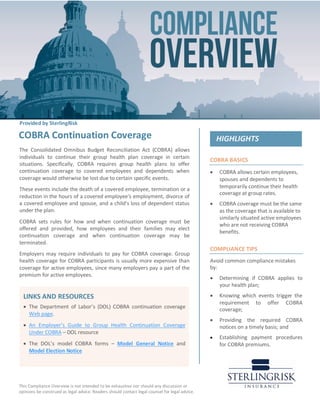
COBRA BASICS
• COBRA allows certain employees,
spouses and dependents to
temporarily continue their health
coverage at group rates.
• COBRA coverage must be the same
as the coverage that is available to
similarly situated active employees
who are not receiving COBRA
benefits.
COMPLIANCE TIPS
Avoid common compliance mistakes
by:
• Determining if COBRA applies to
your health plan;
• Knowing which events trigger the
requirement to offer COBRA
coverage;
• Providing the required COBRA
notices on a timely basis; and
• Establishing payment procedures
for COBRA premiums.
COBRA Continuation Coverage
LINKS AND RESOURCES
• The Department of Labor’s (DOL) COBRA continuation coverage
Web page.
• An Employer’s Guide to Group Health Continuation Coverage
Under COBRA – DOL resource
• The DOL’s model COBRA forms – Model General Notice and
Model Election Notice
Provided by SterlingRisk
The Consolidated Omnibus Budget Reconciliation Act (COBRA) allows
individuals to continue their group health plan coverage in certain
situations. Specifically, COBRA requires group health plans to offer
continuation coverage to covered employees and dependents when
coverage would otherwise be lost due to certain specific events.
These events include the death of a covered employee, termination or a
reduction in the hours of a covered employee's employment, divorce of
a covered employee and spouse, and a child's loss of dependent status
under the plan.
COBRA sets rules for how and when continuation coverage must be
offered and provided, how employees and their families may elect
continuation coverage and when continuation coverage may be
terminated.
Employers may require individuals to pay for COBRA coverage. Group
health coverage for COBRA participants is usually more expensive than
coverage for active employees, since many employers pay a part of the
premium for active employees.
2
This Compliance Overview is not intended to be exhaustive nor should any discussion or opinions be construed as legal advice.
Readers should contact legal counsel for legal advice.
© 2016 Zywave, Inc. All rights reserved.
WHEN DOES COBRA APPLY?
Most private-sector employers that maintain group health plans for their employees must comply with
COBRA’s continuation coverage requirements. This includes, for example, corporations, partnerships
and tax-exempt organizations. However, COBRA does not apply to group health plans maintained by
small employers. A “small employer” means an employer that had fewer than 20 employees on typical
business days during the preceding calendar year.
COBRA also applies to plans sponsored by state and local governments. It does not apply, however, to
plans sponsored by the federal Government or by churches and certain church-related organizations.
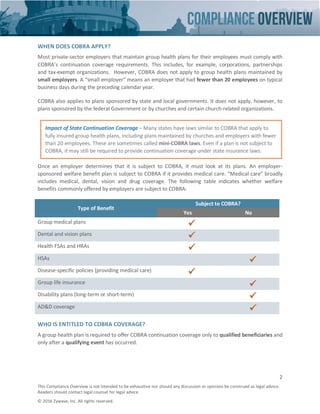
Once an employer determines that it is subject to COBRA, it must look at its plans. An employer-
sponsored welfare benefit plan is subject to COBRA if it provides medical care. “Medical care” broadly
includes medical, dental, vision and drug coverage. The following table indicates whether welfare
benefits commonly offered by employers are subject to COBRA:
Type of Benefit
Subject to COBRA?
Yes No
Group medical plans

Dental and vision plans

Health FSAs and HRAs

HSAs

Disease-specific policies (providing medical care)

Group life insurance

Disability plans (long-term or short-term)

AD&D coverage

WHO IS ENTITLED TO COBRA COVERAGE?
A group health plan is required to offer COBRA continuation coverage only to qualified beneficiaries and
only after a qualifying event has occurred.
Impact of State Continuation Coverage – Many states have laws similar to COBRA that apply to
fully insured group health plans, including plans maintained by churches and employers with fewer
than 20 employees. These are sometimes called mini-COBRA laws. Even if a plan is not subject to
COBRA, it may still be required to provide continuation coverage under state insurance laws.
3
This Compliance Overview is not intended to be exhaustive nor should any discussion or opinions be construed as legal advice.
Readers should contact legal counsel for legal advice.
© 2016 Zywave, Inc. All rights reserved.
Qualified Beneficiaries
A qualified beneficiary is an individual who was covered by a group health plan on the day before a
qualifying event occurred and who is an employee, an employee's spouse or former spouse, or an
employee's dependent child. In addition, any child born to or placed for adoption with a covered
employee during a period of continuation coverage is automatically considered a qualified beneficiary.
Qualifying Events
An employer must offer COBRA coverage only when group health plan coverage ends (or would end)
due to a qualifying event. Not all losses of health coverage are caused by qualifying events. For example,
a cancellation of health plan coverage—whether at the employee’s request or because of the
employee’s failure to pay premiums—is not, by itself, a qualifying event that triggers the requirement to
offer COBRA coverage.
The period of COBRA coverage offered to qualifying beneficiaries is known as the “maximum coverage
period.” The length of the maximum coverage period depends on the type of qualifying event that has
occurred. There are situations where the maximum coverage period can be extended (due to disability
or a second qualifying event) or terminated early (for example, when COBRA premiums are not paid).
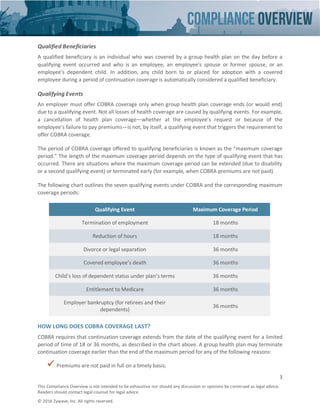
The following chart outlines the seven qualifying events under COBRA and the corresponding maximum
coverage periods:
Qualifying Event Maximum Coverage Period
Termination of employment 18 months
Reduction of hours 18 months
Divorce or legal separation 36 months
Covered employee’s death 36 months
Child’s loss of dependent status under plan’s terms 36 months
Entitlement to Medicare 36 months
Employer bankruptcy (for retirees and their
dependents)
36 months
HOW LONG DOES COBRA COVERAGE LAST?
COBRA requires that continuation coverage extends from the date of the qualifying event for a limited
period of time of 18 or 36 months, as described in the chart above. A group health plan may terminate
continuation coverage earlier than the end of the maximum period for any of the following reasons:
 Premiums are not paid in full on a timely basis;
4
This Compliance Overview is not intended to be exhaustive nor should any discussion or opinions be construed as legal advice.
Readers should contact legal counsel for legal advice.
© 2016 Zywave, Inc. All rights reserved.
 The employer ceases to maintain any group health plan;
 A qualified beneficiary begins coverage under another group health plan after electing
continuation coverage;
 A qualified beneficiary becomes entitled to Medicare benefits after electing continuation
coverage; or
 A qualified beneficiary engages in conduct that would justify the plan in terminating coverage of
a similarly situated participant or beneficiary not receiving continuation coverage (such as
fraud).
If continuation coverage is terminated early, the plan must provide the qualified beneficiary with an
early termination notice.
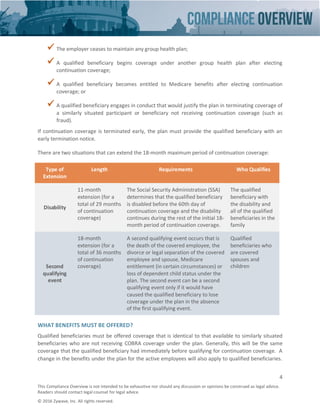
There are two situations that can extend the 18-month maximum period of continuation coverage:
Type of
Extension
Length Requirements Who Qualifies
Disability
11-month
extension (for a
total of 29 months
of continuation
coverage)
The Social Security Administration (SSA)
determines that the qualified beneficiary
is disabled before the 60th day of
continuation coverage and the disability
continues during the rest of the initial 18-
month period of continuation coverage.
The qualified
beneficiary with
the disability and
all of the qualified
beneficiaries in the
family
Second
qualifying
event
18-month
extension (for a
total of 36 months
of continuation
coverage)
A second qualifying event occurs that is
the death of the covered employee, the
divorce or legal separation of the covered
employee and spouse, Medicare
entitlement (in certain circumstances) or
loss of dependent child status under the
plan. The second event can be a second
qualifying event only if it would have
caused the qualified beneficiary to lose
coverage under the plan in the absence
of the first qualifying event.
Qualified
beneficiaries who
are covered
spouses and
children
WHAT BENEFITS MUST BE OFFERED?
Qualified beneficiaries must be offered coverage that is identical to that available to similarly situated
beneficiaries who are not receiving COBRA coverage under the plan. Generally, this will be the same
coverage that the qualified beneficiary had immediately before qualifying for continuation coverage. A
change in the benefits under the plan for the active employees will also apply to qualified beneficiaries.
5
This Compliance Overview is not intended to be exhaustive nor should any discussion or opinions be construed as legal advice.
Readers should contact legal counsel for legal advice.
© 2016 Zywave, Inc. All rights reserved.
Qualified beneficiaries must be allowed to make the same choices given to non-COBRA beneficiaries
under the plan, such as during periods of open enrollment by the plan.
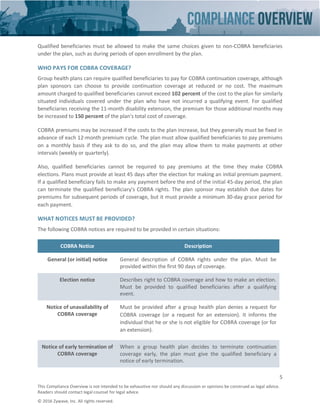
WHO PAYS FOR COBRA COVERAGE?
Group health plans can require qualified beneficiaries to pay for COBRA continuation coverage, although
plan sponsors can choose to provide continuation coverage at reduced or no cost. The maximum
amount charged to qualified beneficiaries cannot exceed 102 percent of the cost to the plan for similarly
situated individuals covered under the plan who have not incurred a qualifying event. For qualified
beneficiaries receiving the 11-month disability extension, the premium for those additional months may
be increased to 150 percent of the plan's total cost of coverage.
COBRA premiums may be increased if the costs to the plan increase, but they generally must be fixed in
advance of each 12-month premium cycle. The plan must allow qualified beneficiaries to pay premiums
on a monthly basis if they ask to do so, and the plan may allow them to make payments at other
intervals (weekly or quarterly).
Also, qualified beneficiaries cannot be required to pay premiums at the time they make COBRA
elections. Plans must provide at least 45 days after the election for making an initial premium payment.
If a qualified beneficiary fails to make any payment before the end of the initial 45-day period, the plan
can terminate the qualified beneficiary's COBRA rights. The plan sponsor may establish due dates for
premiums for subsequent periods of coverage, but it must provide a minimum 30-day grace period for
each payment.
WHAT NOTICES MUST BE PROVIDED?
The following COBRA notices are required to be provided in certain situations:
COBRA Notice Description
General (or initial) notice General description of COBRA rights under the plan. Must be
provided within the first 90 days of coverage.
Election notice Describes right to COBRA coverage and how to make an election.
Must be provided to qualified beneficiaries after a qualifying
event.
Notice of unavailability of
COBRA coverage
Must be provided after a group health plan denies a request for
COBRA coverage (or a request for an extension). It informs the
individual that he or she is not eligible for COBRA coverage (or for
an extension).
Notice of early termination of
COBRA coverage
When a group health plan decides to terminate continuation
coverage early, the plan must give the qualified beneficiary a
notice of early termination.
6
This Compliance Overview is not intended to be exhaustive nor should any discussion or opinions be construed as legal advice.
Readers should contact legal counsel for legal advice.
© 2016 Zywave, Inc. All rights reserved.
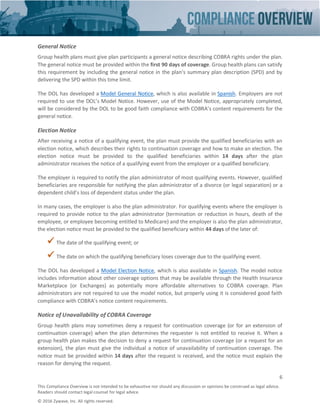
General Notice
Group health plans must give plan participants a general notice describing COBRA rights under the plan.
The general notice must be provided within the first 90 days of coverage. Group health plans can satisfy
this requirement by including the general notice in the plan's summary plan description (SPD) and by
delivering the SPD within this time limit.
The DOL has developed a Model General Notice, which is also available in Spanish. Employers are not
required to use the DOL’s Model Notice. However, use of the Model Notice, appropriately completed,
will be considered by the DOL to be good faith compliance with COBRA’s content requirements for the
general notice.
Election Notice
After receiving a notice of a qualifying event, the plan must provide the qualified beneficiaries with an
election notice, which describes their rights to continuation coverage and how to make an election. The
election notice must be provided to the qualified beneficiaries within 14 days after the plan
administrator receives the notice of a qualifying event from the employer or a qualified beneficiary.
The employer is required to notify the plan administrator of most qualifying events. However, qualified
beneficiaries are responsible for notifying the plan administrator of a divorce (or legal separation) or a
dependent child’s loss of dependent status under the plan.
In many cases, the employer is also the plan administrator. For qualifying events where the employer is
required to provide notice to the plan administrator (termination or reduction in hours, death of the
employee, or employee becoming entitled to Medicare) and the employer is also the plan administrator,
the election notice must be provided to the qualified beneficiary within 44 days of the later of:
 The date of the qualifying event; or
 The date on which the qualifying beneficiary loses coverage due to the qualifying event.
The DOL has developed a Model Election Notice, which is also available in Spanish. The model notice
includes information about other coverage options that may be available through the Health Insurance
Marketplace (or Exchanges) as potentially more affordable alternatives to COBRA coverage. Plan
administrators are not required to use the model notice, but properly using it is considered good faith
compliance with COBRA’s notice content requirements.
Notice of Unavailability of COBRA Coverage
Group health plans may sometimes deny a request for continuation coverage (or for an extension of
continuation coverage) when the plan determines the requester is not entitled to receive it. When a
group health plan makes the decision to deny a request for continuation coverage (or a request for an
extension), the plan must give the individual a notice of unavailability of continuation coverage. The
notice must be provided within 14 days after the request is received, and the notice must explain the
reason for denying the request.
7
This Compliance Overview is not intended to be exhaustive nor should any discussion or opinions be construed as legal advice.
Readers should contact legal counsel for legal advice.
© 2016 Zywave, Inc. All rights reserved.
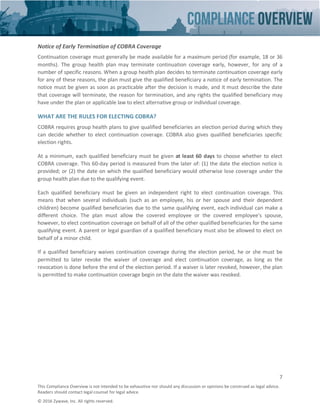
Notice of Early Termination of COBRA Coverage
Continuation coverage must generally be made available for a maximum period (for example, 18 or 36
months). The group health plan may terminate continuation coverage early, however, for any of a
number of specific reasons. When a group health plan decides to terminate continuation coverage early
for any of these reasons, the plan must give the qualified beneficiary a notice of early termination. The
notice must be given as soon as practicable after the decision is made, and it must describe the date
that coverage will terminate, the reason for termination, and any rights the qualified beneficiary may
have under the plan or applicable law to elect alternative group or individual coverage.
WHAT ARE THE RULES FOR ELECTING COBRA?
COBRA requires group health plans to give qualified beneficiaries an election period during which they
can decide whether to elect continuation coverage. COBRA also gives qualified beneficiaries specific
election rights.
At a minimum, each qualified beneficiary must be given at least 60 days to choose whether to elect
COBRA coverage. This 60-day period is measured from the later of: (1) the date the election notice is
provided; or (2) the date on which the qualified beneficiary would otherwise lose coverage under the
group health plan due to the qualifying event.
Each qualified beneficiary must be given an independent right to elect continuation coverage. This
means that when several individuals (such as an employee, his or her spouse and their dependent
children) become qualified beneficiaries due to the same qualifying event, each individual can make a
different choice. The plan must allow the covered employee or the covered employee's spouse,
however, to elect continuation coverage on behalf of all of the other qualified beneficiaries for the same
qualifying event. A parent or legal guardian of a qualified beneficiary must also be allowed to elect on
behalf of a minor child.
If a qualified beneficiary waives continuation coverage during the election period, he or she must be
permitted to later revoke the waiver of coverage and elect continuation coverage, as long as the
revocation is done before the end of the election period. If a waiver is later revoked, however, the plan
is permitted to make continuation coverage begin on the date the waiver was revoked.

COBRA Continuation Coverage

  • 1.
    This Compliance Overviewis not intended to be exhaustive nor should any discussion or opinions be construed as legal advice. Readers should contact legal counsel for legal advice. COBRA BASICS • COBRA allows certain employees, spouses and dependents to temporarily continue their health coverage at group rates. • COBRA coverage must be the same as the coverage that is available to similarly situated active employees who are not receiving COBRA benefits. COMPLIANCE TIPS Avoid common compliance mistakes by: • Determining if COBRA applies to your health plan; • Knowing which events trigger the requirement to offer COBRA coverage; • Providing the required COBRA notices on a timely basis; and • Establishing payment procedures for COBRA premiums. COBRA Continuation Coverage LINKS AND RESOURCES • The Department of Labor’s (DOL) COBRA continuation coverage Web page. • An Employer’s Guide to Group Health Continuation Coverage Under COBRA – DOL resource • The DOL’s model COBRA forms – Model General Notice and Model Election Notice Provided by SterlingRisk The Consolidated Omnibus Budget Reconciliation Act (COBRA) allows individuals to continue their group health plan coverage in certain situations. Specifically, COBRA requires group health plans to offer continuation coverage to covered employees and dependents when coverage would otherwise be lost due to certain specific events. These events include the death of a covered employee, termination or a reduction in the hours of a covered employee's employment, divorce of a covered employee and spouse, and a child's loss of dependent status under the plan. COBRA sets rules for how and when continuation coverage must be offered and provided, how employees and their families may elect continuation coverage and when continuation coverage may be terminated. Employers may require individuals to pay for COBRA coverage. Group health coverage for COBRA participants is usually more expensive than coverage for active employees, since many employers pay a part of the premium for active employees.
  • 2.
    2 This Compliance Overviewis not intended to be exhaustive nor should any discussion or opinions be construed as legal advice. Readers should contact legal counsel for legal advice. © 2016 Zywave, Inc. All rights reserved. WHEN DOES COBRA APPLY? Most private-sector employers that maintain group health plans for their employees must comply with COBRA’s continuation coverage requirements. This includes, for example, corporations, partnerships and tax-exempt organizations. However, COBRA does not apply to group health plans maintained by small employers. A “small employer” means an employer that had fewer than 20 employees on typical business days during the preceding calendar year. COBRA also applies to plans sponsored by state and local governments. It does not apply, however, to plans sponsored by the federal Government or by churches and certain church-related organizations. Once an employer determines that it is subject to COBRA, it must look at its plans. An employer- sponsored welfare benefit plan is subject to COBRA if it provides medical care. “Medical care” broadly includes medical, dental, vision and drug coverage. The following table indicates whether welfare benefits commonly offered by employers are subject to COBRA: Type of Benefit Subject to COBRA? Yes No Group medical plans  Dental and vision plans  Health FSAs and HRAs  HSAs  Disease-specific policies (providing medical care)  Group life insurance  Disability plans (long-term or short-term)  AD&D coverage  WHO IS ENTITLED TO COBRA COVERAGE? A group health plan is required to offer COBRA continuation coverage only to qualified beneficiaries and only after a qualifying event has occurred. Impact of State Continuation Coverage – Many states have laws similar to COBRA that apply to fully insured group health plans, including plans maintained by churches and employers with fewer than 20 employees. These are sometimes called mini-COBRA laws. Even if a plan is not subject to COBRA, it may still be required to provide continuation coverage under state insurance laws.
  • 3.
    3 This Compliance Overviewis not intended to be exhaustive nor should any discussion or opinions be construed as legal advice. Readers should contact legal counsel for legal advice. © 2016 Zywave, Inc. All rights reserved. Qualified Beneficiaries A qualified beneficiary is an individual who was covered by a group health plan on the day before a qualifying event occurred and who is an employee, an employee's spouse or former spouse, or an employee's dependent child. In addition, any child born to or placed for adoption with a covered employee during a period of continuation coverage is automatically considered a qualified beneficiary. Qualifying Events An employer must offer COBRA coverage only when group health plan coverage ends (or would end) due to a qualifying event. Not all losses of health coverage are caused by qualifying events. For example, a cancellation of health plan coverage—whether at the employee’s request or because of the employee’s failure to pay premiums—is not, by itself, a qualifying event that triggers the requirement to offer COBRA coverage. The period of COBRA coverage offered to qualifying beneficiaries is known as the “maximum coverage period.” The length of the maximum coverage period depends on the type of qualifying event that has occurred. There are situations where the maximum coverage period can be extended (due to disability or a second qualifying event) or terminated early (for example, when COBRA premiums are not paid). The following chart outlines the seven qualifying events under COBRA and the corresponding maximum coverage periods: Qualifying Event Maximum Coverage Period Termination of employment 18 months Reduction of hours 18 months Divorce or legal separation 36 months Covered employee’s death 36 months Child’s loss of dependent status under plan’s terms 36 months Entitlement to Medicare 36 months Employer bankruptcy (for retirees and their dependents) 36 months HOW LONG DOES COBRA COVERAGE LAST? COBRA requires that continuation coverage extends from the date of the qualifying event for a limited period of time of 18 or 36 months, as described in the chart above. A group health plan may terminate continuation coverage earlier than the end of the maximum period for any of the following reasons:  Premiums are not paid in full on a timely basis;
  • 4.
    4 This Compliance Overviewis not intended to be exhaustive nor should any discussion or opinions be construed as legal advice. Readers should contact legal counsel for legal advice. © 2016 Zywave, Inc. All rights reserved.  The employer ceases to maintain any group health plan;  A qualified beneficiary begins coverage under another group health plan after electing continuation coverage;  A qualified beneficiary becomes entitled to Medicare benefits after electing continuation coverage; or  A qualified beneficiary engages in conduct that would justify the plan in terminating coverage of a similarly situated participant or beneficiary not receiving continuation coverage (such as fraud). If continuation coverage is terminated early, the plan must provide the qualified beneficiary with an early termination notice. There are two situations that can extend the 18-month maximum period of continuation coverage: Type of Extension Length Requirements Who Qualifies Disability 11-month extension (for a total of 29 months of continuation coverage) The Social Security Administration (SSA) determines that the qualified beneficiary is disabled before the 60th day of continuation coverage and the disability continues during the rest of the initial 18- month period of continuation coverage. The qualified beneficiary with the disability and all of the qualified beneficiaries in the family Second qualifying event 18-month extension (for a total of 36 months of continuation coverage) A second qualifying event occurs that is the death of the covered employee, the divorce or legal separation of the covered employee and spouse, Medicare entitlement (in certain circumstances) or loss of dependent child status under the plan. The second event can be a second qualifying event only if it would have caused the qualified beneficiary to lose coverage under the plan in the absence of the first qualifying event. Qualified beneficiaries who are covered spouses and children WHAT BENEFITS MUST BE OFFERED? Qualified beneficiaries must be offered coverage that is identical to that available to similarly situated beneficiaries who are not receiving COBRA coverage under the plan. Generally, this will be the same coverage that the qualified beneficiary had immediately before qualifying for continuation coverage. A change in the benefits under the plan for the active employees will also apply to qualified beneficiaries.
  • 5.
    5 This Compliance Overviewis not intended to be exhaustive nor should any discussion or opinions be construed as legal advice. Readers should contact legal counsel for legal advice. © 2016 Zywave, Inc. All rights reserved. Qualified beneficiaries must be allowed to make the same choices given to non-COBRA beneficiaries under the plan, such as during periods of open enrollment by the plan. WHO PAYS FOR COBRA COVERAGE? Group health plans can require qualified beneficiaries to pay for COBRA continuation coverage, although plan sponsors can choose to provide continuation coverage at reduced or no cost. The maximum amount charged to qualified beneficiaries cannot exceed 102 percent of the cost to the plan for similarly situated individuals covered under the plan who have not incurred a qualifying event. For qualified beneficiaries receiving the 11-month disability extension, the premium for those additional months may be increased to 150 percent of the plan's total cost of coverage. COBRA premiums may be increased if the costs to the plan increase, but they generally must be fixed in advance of each 12-month premium cycle. The plan must allow qualified beneficiaries to pay premiums on a monthly basis if they ask to do so, and the plan may allow them to make payments at other intervals (weekly or quarterly). Also, qualified beneficiaries cannot be required to pay premiums at the time they make COBRA elections. Plans must provide at least 45 days after the election for making an initial premium payment. If a qualified beneficiary fails to make any payment before the end of the initial 45-day period, the plan can terminate the qualified beneficiary's COBRA rights. The plan sponsor may establish due dates for premiums for subsequent periods of coverage, but it must provide a minimum 30-day grace period for each payment. WHAT NOTICES MUST BE PROVIDED? The following COBRA notices are required to be provided in certain situations: COBRA Notice Description General (or initial) notice General description of COBRA rights under the plan. Must be provided within the first 90 days of coverage. Election notice Describes right to COBRA coverage and how to make an election. Must be provided to qualified beneficiaries after a qualifying event. Notice of unavailability of COBRA coverage Must be provided after a group health plan denies a request for COBRA coverage (or a request for an extension). It informs the individual that he or she is not eligible for COBRA coverage (or for an extension). Notice of early termination of COBRA coverage When a group health plan decides to terminate continuation coverage early, the plan must give the qualified beneficiary a notice of early termination.
  • 6.
    6 This Compliance Overviewis not intended to be exhaustive nor should any discussion or opinions be construed as legal advice. Readers should contact legal counsel for legal advice. © 2016 Zywave, Inc. All rights reserved. General Notice Group health plans must give plan participants a general notice describing COBRA rights under the plan. The general notice must be provided within the first 90 days of coverage. Group health plans can satisfy this requirement by including the general notice in the plan's summary plan description (SPD) and by delivering the SPD within this time limit. The DOL has developed a Model General Notice, which is also available in Spanish. Employers are not required to use the DOL’s Model Notice. However, use of the Model Notice, appropriately completed, will be considered by the DOL to be good faith compliance with COBRA’s content requirements for the general notice. Election Notice After receiving a notice of a qualifying event, the plan must provide the qualified beneficiaries with an election notice, which describes their rights to continuation coverage and how to make an election. The election notice must be provided to the qualified beneficiaries within 14 days after the plan administrator receives the notice of a qualifying event from the employer or a qualified beneficiary. The employer is required to notify the plan administrator of most qualifying events. However, qualified beneficiaries are responsible for notifying the plan administrator of a divorce (or legal separation) or a dependent child’s loss of dependent status under the plan. In many cases, the employer is also the plan administrator. For qualifying events where the employer is required to provide notice to the plan administrator (termination or reduction in hours, death of the employee, or employee becoming entitled to Medicare) and the employer is also the plan administrator, the election notice must be provided to the qualified beneficiary within 44 days of the later of:  The date of the qualifying event; or  The date on which the qualifying beneficiary loses coverage due to the qualifying event. The DOL has developed a Model Election Notice, which is also available in Spanish. The model notice includes information about other coverage options that may be available through the Health Insurance Marketplace (or Exchanges) as potentially more affordable alternatives to COBRA coverage. Plan administrators are not required to use the model notice, but properly using it is considered good faith compliance with COBRA’s notice content requirements. Notice of Unavailability of COBRA Coverage Group health plans may sometimes deny a request for continuation coverage (or for an extension of continuation coverage) when the plan determines the requester is not entitled to receive it. When a group health plan makes the decision to deny a request for continuation coverage (or a request for an extension), the plan must give the individual a notice of unavailability of continuation coverage. The notice must be provided within 14 days after the request is received, and the notice must explain the reason for denying the request.
  • 7.
    7 This Compliance Overviewis not intended to be exhaustive nor should any discussion or opinions be construed as legal advice. Readers should contact legal counsel for legal advice. © 2016 Zywave, Inc. All rights reserved. Notice of Early Termination of COBRA Coverage Continuation coverage must generally be made available for a maximum period (for example, 18 or 36 months). The group health plan may terminate continuation coverage early, however, for any of a number of specific reasons. When a group health plan decides to terminate continuation coverage early for any of these reasons, the plan must give the qualified beneficiary a notice of early termination. The notice must be given as soon as practicable after the decision is made, and it must describe the date that coverage will terminate, the reason for termination, and any rights the qualified beneficiary may have under the plan or applicable law to elect alternative group or individual coverage. WHAT ARE THE RULES FOR ELECTING COBRA? COBRA requires group health plans to give qualified beneficiaries an election period during which they can decide whether to elect continuation coverage. COBRA also gives qualified beneficiaries specific election rights. At a minimum, each qualified beneficiary must be given at least 60 days to choose whether to elect COBRA coverage. This 60-day period is measured from the later of: (1) the date the election notice is provided; or (2) the date on which the qualified beneficiary would otherwise lose coverage under the group health plan due to the qualifying event. Each qualified beneficiary must be given an independent right to elect continuation coverage. This means that when several individuals (such as an employee, his or her spouse and their dependent children) become qualified beneficiaries due to the same qualifying event, each individual can make a different choice. The plan must allow the covered employee or the covered employee's spouse, however, to elect continuation coverage on behalf of all of the other qualified beneficiaries for the same qualifying event. A parent or legal guardian of a qualified beneficiary must also be allowed to elect on behalf of a minor child. If a qualified beneficiary waives continuation coverage during the election period, he or she must be permitted to later revoke the waiver of coverage and elect continuation coverage, as long as the revocation is done before the end of the election period. If a waiver is later revoked, however, the plan is permitted to make continuation coverage begin on the date the waiver was revoked.