This Compliance Overview is not intended to be exhaustive nor should any discussion or
opinions be construed as legal advice. Readers should contact legal counsel for legal advice.
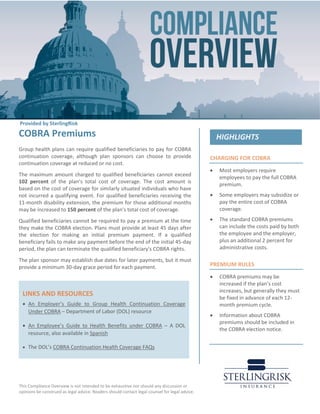
CHARGING FOR COBRA
• Most employers require
employees to pay the full COBRA
premium.
• Some employers may subsidize or
pay the entire cost of COBRA
coverage.
• The standard COBRA premiums
can include the costs paid by both
the employee and the employer,
plus an additional 2 percent for
administrative costs.
PREMIUM RULES
• COBRA premiums may be
increased if the plan’s cost
increases, but generally they must
be fixed in advance of each 12-
month premium cycle.
• Information about COBRA
premiums should be included in
the COBRA election notice.
COBRA Premiums
Group health plans can require qualified beneficiaries to pay for COBRA
continuation coverage, although plan sponsors can choose to provide
continuation coverage at reduced or no cost.
The maximum amount charged to qualified beneficiaries cannot exceed
102 percent of the plan’s total cost of coverage. The cost amount is
based on the cost of coverage for similarly situated individuals who have
not incurred a qualifying event. For qualified beneficiaries receiving the
11-month disability extension, the premium for those additional months
may be increased to 150 percent of the plan's total cost of coverage.
Qualified beneficiaries cannot be required to pay a premium at the time
they make the COBRA election. Plans must provide at least 45 days after
the election for making an initial premium payment. If a qualified
beneficiary fails to make any payment before the end of the initial 45-day
period, the plan can terminate the qualified beneficiary's COBRA rights.
The plan sponsor may establish due dates for later payments, but it must
provide a minimum 30-day grace period for each payment.
LINKS AND RESOURCES
• An Employer’s Guide to Group Health Continuation Coverage
Under COBRA – Department of Labor (DOL) resource
• An Employee’s Guide to Health Benefits under COBRA – A DOL
resource, also available in Spanish
• The DOL’s COBRA Continuation Health Coverage FAQs
Provided by SterlingRisk
2
This Compliance Overview is not intended to be exhaustive nor should any discussion or opinions be construed as legal advice.
Readers should contact legal counsel for legal advice.
© 2016 Zywave, Inc. All rights reserved.
COBRA PREMIUMS
Group health plans can require qualified beneficiaries to pay for COBRA continuation coverage. The
maximum amount charged to qualified beneficiaries for COBRA coverage cannot exceed 102 percent of
the cost to the plan for similarly situated individuals covered under the plan who have not incurred a
qualifying event. In calculating premiums for continuation coverage, a plan can include the costs paid by
both the employee and the employer, plus an additional 2 percent for administrative costs.
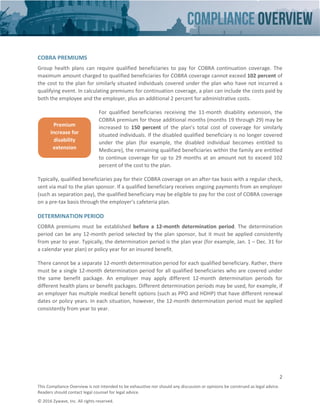
For qualified beneficiaries receiving the 11-month disability extension, the
COBRA premium for those additional months (months 19 through 29) may be
increased to 150 percent of the plan’s total cost of coverage for similarly
situated individuals. If the disabled qualified beneficiary is no longer covered
under the plan (for example, the disabled individual becomes entitled to
Medicare), the remaining qualified beneficiaries within the family are entitled
to continue coverage for up to 29 months at an amount not to exceed 102
percent of the cost to the plan.
Typically, qualified beneficiaries pay for their COBRA coverage on an after-tax basis with a regular check,
sent via mail to the plan sponsor. If a qualified beneficiary receives ongoing payments from an employer
(such as separation pay), the qualified beneficiary may be eligible to pay for the cost of COBRA coverage
on a pre-tax basis through the employer’s cafeteria plan.
DETERMINATION PERIOD
COBRA premiums must be established before a 12-month determination period. The determination
period can be any 12-month period selected by the plan sponsor, but it must be applied consistently
from year to year. Typically, the determination period is the plan year (for example, Jan. 1 – Dec. 31 for
a calendar year plan) or policy year for an insured benefit.
There cannot be a separate 12-month determination period for each qualified beneficiary. Rather, there
must be a single 12-month determination period for all qualified beneficiaries who are covered under
the same benefit package. An employer may apply different 12-month determination periods for
different health plans or benefit packages. Different determination periods may be used, for example, if
an employer has multiple medical benefit options (such as PPO and HDHP) that have different renewal
dates or policy years. In each situation, however, the 12-month determination period must be applied
consistently from year to year.
Premium
increase for
disability
extension
3
This Compliance Overview is not intended to be exhaustive nor should any discussion or opinions be construed as legal advice.
Readers should contact legal counsel for legal advice.
© 2016 Zywave, Inc. All rights reserved.
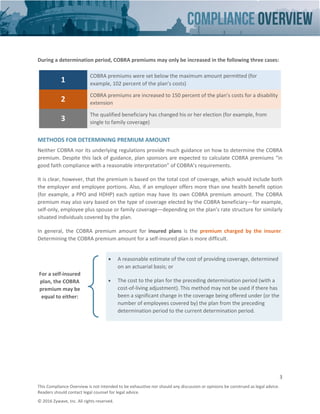
During a determination period, COBRA premiums may only be increased in the following three cases:
1
COBRA premiums were set below the maximum amount permitted (for
example, 102 percent of the plan’s costs)
2
COBRA premiums are increased to 150 percent of the plan’s costs for a disability
extension
3
The qualified beneficiary has changed his or her election (for example, from
single to family coverage)
METHODS FOR DETERMINING PREMIUM AMOUNT
Neither COBRA nor its underlying regulations provide much guidance on how to determine the COBRA
premium. Despite this lack of guidance, plan sponsors are expected to calculate COBRA premiums “in
good faith compliance with a reasonable interpretation” of COBRA’s requirements.
It is clear, however, that the premium is based on the total cost of coverage, which would include both
the employer and employee portions. Also, if an employer offers more than one health benefit option
(for example, a PPO and HDHP) each option may have its own COBRA premium amount. The COBRA
premium may also vary based on the type of coverage elected by the COBRA beneficiary—for example,
self-only, employee plus spouse or family coverage—depending on the plan’s rate structure for similarly
situated individuals covered by the plan.
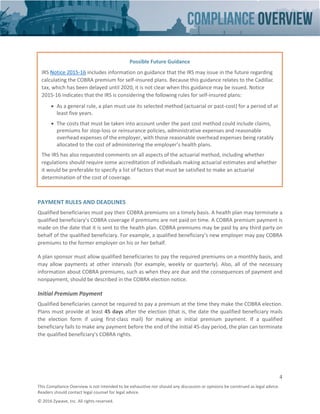
In general, the COBRA premium amount for insured plans is the premium charged by the insurer.
Determining the COBRA premium amount for a self-insured plan is more difficult.
For a self-insured
plan, the COBRA
premium may be
equal to either:
• A reasonable estimate of the cost of providing coverage, determined
on an actuarial basis; or
• The cost to the plan for the preceding determination period (with a
cost-of-living adjustment). This method may not be used if there has
been a significant change in the coverage being offered under (or the
number of employees covered by) the plan from the preceding
determination period to the current determination period.
4
This Compliance Overview is not intended to be exhaustive nor should any discussion or opinions be construed as legal advice.
Readers should contact legal counsel for legal advice.
© 2016 Zywave, Inc. All rights reserved.
PAYMENT RULES AND DEADLINES
Qualified beneficiaries must pay their COBRA premiums on a timely basis. A health plan may terminate a
qualified beneficiary’s COBRA coverage if premiums are not paid on time. A COBRA premium payment is
made on the date that it is sent to the health plan. COBRA premiums may be paid by any third party on
behalf of the qualified beneficiary. For example, a qualified beneficiary’s new employer may pay COBRA
premiums to the former employer on his or her behalf.
A plan sponsor must allow qualified beneficiaries to pay the required premiums on a monthly basis, and
may allow payments at other intervals (for example, weekly or quarterly). Also, all of the necessary
information about COBRA premiums, such as when they are due and the consequences of payment and
nonpayment, should be described in the COBRA election notice.
Initial Premium Payment
Qualified beneficiaries cannot be required to pay a premium at the time they make the COBRA election.
Plans must provide at least 45 days after the election (that is, the date the qualified beneficiary mails
the election form if using first-class mail) for making an initial premium payment. If a qualified
beneficiary fails to make any payment before the end of the initial 45-day period, the plan can terminate
the qualified beneficiary's COBRA rights.
Possible Future Guidance
IRS Notice 2015-16 includes information on guidance that the IRS may issue in the future regarding
calculating the COBRA premium for self-insured plans. Because this guidance relates to the Cadillac
tax, which has been delayed until 2020, it is not clear when this guidance may be issued. Notice
2015-16 indicates that the IRS is considering the following rules for self-insured plans:
• As a general rule, a plan must use its selected method (actuarial or past-cost) for a period of at
least five years.
• The costs that must be taken into account under the past cost method could include claims,
premiums for stop-loss or reinsurance policies, administrative expenses and reasonable
overhead expenses of the employer, with those reasonable overhead expenses being ratably
allocated to the cost of administering the employer’s health plans.
The IRS has also requested comments on all aspects of the actuarial method, including whether
regulations should require some accreditation of individuals making actuarial estimates and whether
it would be preferable to specify a list of factors that must be satisfied to make an actuarial
determination of the cost of coverage.
5
This Compliance Overview is not intended to be exhaustive nor should any discussion or opinions be construed as legal advice.
Readers should contact legal counsel for legal advice.
© 2016 Zywave, Inc. All rights reserved.
The initial premium payment may be applied to the period of coverage beginning immediately after the
date that coverage would have been lost. Also, plans can require that the initial premium cover more
than one month of COBRA coverage. However, if the initial COBRA premium applies to multiple periods
of COBRA coverage, plans need to make sure they are complying with the 30-day grace period rule
described below.
Subsequent Premiums
Health plans may establish due dates for premiums after the initial premium payment. Typically, the due
date for subsequent premiums is the first day of the month for a particular period of coverage (for
example, June 1 for coverage during the month of June). Plans, however, must provide a minimum 30-
day grace period for each payment. A premium payment does not need to be made until the end of the
30-day grace period.
A COBRA premium payment that is made at a later date is also considered timely if:
 Under the terms of the plan, covered employees or qualified beneficiaries are allowed until
that later date to pay for their coverage for the period; or
 Under the terms of the arrangement with the insurance company, HMO or other entity that
it pays for coverage, the employer is allowed until that later date to pay for coverage of
similarly situated non-COBRA beneficiaries for the period.
Plans are permitted to terminate continuation coverage if full payment is not received before the end of
a grace period. However, see below regarding a special rule that applies when premium payments are
short by an insignificant amount. Also, a health plan is not obligated to send monthly premium notices,
but it is required to provide a notice of early termination if continuation coverage is terminated early
due to failure to make a timely payment.
Premium Shortfalls
A special rule applies if a qualified beneficiary makes a timely premium payment that is not “significantly
less” than the amount that the health plan requires for a period of COBRA coverage.
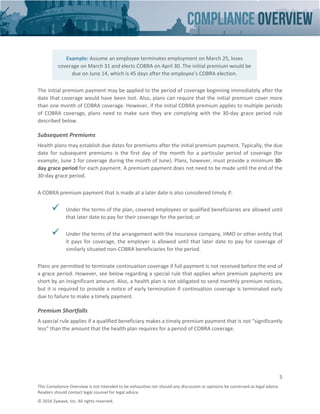
Example: Assume an employee terminates employment on March 25, loses
coverage on March 31 and elects COBRA on April 30. The initial premium would be
due on June 14, which is 45 days after the employee’s COBRA election.
6
This Compliance Overview is not intended to be exhaustive nor should any discussion or opinions be construed as legal advice.
Readers should contact legal counsel for legal advice.
© 2016 Zywave, Inc. All rights reserved.
A premium payment that is short by an insignificant amount will be deemed to satisfy the qualified
beneficiary’s payment obligation unless the plan notifies the qualified beneficiary of the shortfall and
grants a reasonable amount of time to correct the deficiency. For this purpose, 30 days after the notice
is provided is considered a reasonable amount of time.
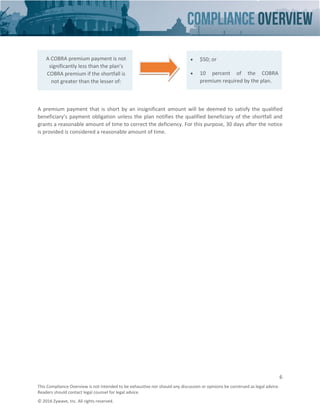
• $50; or
• 10 percent of the COBRA
premium required by the plan.
A COBRA premium payment is not
significantly less than the plan’s
COBRA premium if the shortfall is
not greater than the lesser of:

Cobra Premiums

  • 1.
    This Compliance Overviewis not intended to be exhaustive nor should any discussion or opinions be construed as legal advice. Readers should contact legal counsel for legal advice. CHARGING FOR COBRA • Most employers require employees to pay the full COBRA premium. • Some employers may subsidize or pay the entire cost of COBRA coverage. • The standard COBRA premiums can include the costs paid by both the employee and the employer, plus an additional 2 percent for administrative costs. PREMIUM RULES • COBRA premiums may be increased if the plan’s cost increases, but generally they must be fixed in advance of each 12- month premium cycle. • Information about COBRA premiums should be included in the COBRA election notice. COBRA Premiums Group health plans can require qualified beneficiaries to pay for COBRA continuation coverage, although plan sponsors can choose to provide continuation coverage at reduced or no cost. The maximum amount charged to qualified beneficiaries cannot exceed 102 percent of the plan’s total cost of coverage. The cost amount is based on the cost of coverage for similarly situated individuals who have not incurred a qualifying event. For qualified beneficiaries receiving the 11-month disability extension, the premium for those additional months may be increased to 150 percent of the plan's total cost of coverage. Qualified beneficiaries cannot be required to pay a premium at the time they make the COBRA election. Plans must provide at least 45 days after the election for making an initial premium payment. If a qualified beneficiary fails to make any payment before the end of the initial 45-day period, the plan can terminate the qualified beneficiary's COBRA rights. The plan sponsor may establish due dates for later payments, but it must provide a minimum 30-day grace period for each payment. LINKS AND RESOURCES • An Employer’s Guide to Group Health Continuation Coverage Under COBRA – Department of Labor (DOL) resource • An Employee’s Guide to Health Benefits under COBRA – A DOL resource, also available in Spanish • The DOL’s COBRA Continuation Health Coverage FAQs Provided by SterlingRisk
  • 2.
    2 This Compliance Overviewis not intended to be exhaustive nor should any discussion or opinions be construed as legal advice. Readers should contact legal counsel for legal advice. © 2016 Zywave, Inc. All rights reserved. COBRA PREMIUMS Group health plans can require qualified beneficiaries to pay for COBRA continuation coverage. The maximum amount charged to qualified beneficiaries for COBRA coverage cannot exceed 102 percent of the cost to the plan for similarly situated individuals covered under the plan who have not incurred a qualifying event. In calculating premiums for continuation coverage, a plan can include the costs paid by both the employee and the employer, plus an additional 2 percent for administrative costs. For qualified beneficiaries receiving the 11-month disability extension, the COBRA premium for those additional months (months 19 through 29) may be increased to 150 percent of the plan’s total cost of coverage for similarly situated individuals. If the disabled qualified beneficiary is no longer covered under the plan (for example, the disabled individual becomes entitled to Medicare), the remaining qualified beneficiaries within the family are entitled to continue coverage for up to 29 months at an amount not to exceed 102 percent of the cost to the plan. Typically, qualified beneficiaries pay for their COBRA coverage on an after-tax basis with a regular check, sent via mail to the plan sponsor. If a qualified beneficiary receives ongoing payments from an employer (such as separation pay), the qualified beneficiary may be eligible to pay for the cost of COBRA coverage on a pre-tax basis through the employer’s cafeteria plan. DETERMINATION PERIOD COBRA premiums must be established before a 12-month determination period. The determination period can be any 12-month period selected by the plan sponsor, but it must be applied consistently from year to year. Typically, the determination period is the plan year (for example, Jan. 1 – Dec. 31 for a calendar year plan) or policy year for an insured benefit. There cannot be a separate 12-month determination period for each qualified beneficiary. Rather, there must be a single 12-month determination period for all qualified beneficiaries who are covered under the same benefit package. An employer may apply different 12-month determination periods for different health plans or benefit packages. Different determination periods may be used, for example, if an employer has multiple medical benefit options (such as PPO and HDHP) that have different renewal dates or policy years. In each situation, however, the 12-month determination period must be applied consistently from year to year. Premium increase for disability extension
  • 3.
    3 This Compliance Overviewis not intended to be exhaustive nor should any discussion or opinions be construed as legal advice. Readers should contact legal counsel for legal advice. © 2016 Zywave, Inc. All rights reserved. During a determination period, COBRA premiums may only be increased in the following three cases: 1 COBRA premiums were set below the maximum amount permitted (for example, 102 percent of the plan’s costs) 2 COBRA premiums are increased to 150 percent of the plan’s costs for a disability extension 3 The qualified beneficiary has changed his or her election (for example, from single to family coverage) METHODS FOR DETERMINING PREMIUM AMOUNT Neither COBRA nor its underlying regulations provide much guidance on how to determine the COBRA premium. Despite this lack of guidance, plan sponsors are expected to calculate COBRA premiums “in good faith compliance with a reasonable interpretation” of COBRA’s requirements. It is clear, however, that the premium is based on the total cost of coverage, which would include both the employer and employee portions. Also, if an employer offers more than one health benefit option (for example, a PPO and HDHP) each option may have its own COBRA premium amount. The COBRA premium may also vary based on the type of coverage elected by the COBRA beneficiary—for example, self-only, employee plus spouse or family coverage—depending on the plan’s rate structure for similarly situated individuals covered by the plan. In general, the COBRA premium amount for insured plans is the premium charged by the insurer. Determining the COBRA premium amount for a self-insured plan is more difficult. For a self-insured plan, the COBRA premium may be equal to either: • A reasonable estimate of the cost of providing coverage, determined on an actuarial basis; or • The cost to the plan for the preceding determination period (with a cost-of-living adjustment). This method may not be used if there has been a significant change in the coverage being offered under (or the number of employees covered by) the plan from the preceding determination period to the current determination period.
  • 4.
    4 This Compliance Overviewis not intended to be exhaustive nor should any discussion or opinions be construed as legal advice. Readers should contact legal counsel for legal advice. © 2016 Zywave, Inc. All rights reserved. PAYMENT RULES AND DEADLINES Qualified beneficiaries must pay their COBRA premiums on a timely basis. A health plan may terminate a qualified beneficiary’s COBRA coverage if premiums are not paid on time. A COBRA premium payment is made on the date that it is sent to the health plan. COBRA premiums may be paid by any third party on behalf of the qualified beneficiary. For example, a qualified beneficiary’s new employer may pay COBRA premiums to the former employer on his or her behalf. A plan sponsor must allow qualified beneficiaries to pay the required premiums on a monthly basis, and may allow payments at other intervals (for example, weekly or quarterly). Also, all of the necessary information about COBRA premiums, such as when they are due and the consequences of payment and nonpayment, should be described in the COBRA election notice. Initial Premium Payment Qualified beneficiaries cannot be required to pay a premium at the time they make the COBRA election. Plans must provide at least 45 days after the election (that is, the date the qualified beneficiary mails the election form if using first-class mail) for making an initial premium payment. If a qualified beneficiary fails to make any payment before the end of the initial 45-day period, the plan can terminate the qualified beneficiary's COBRA rights. Possible Future Guidance IRS Notice 2015-16 includes information on guidance that the IRS may issue in the future regarding calculating the COBRA premium for self-insured plans. Because this guidance relates to the Cadillac tax, which has been delayed until 2020, it is not clear when this guidance may be issued. Notice 2015-16 indicates that the IRS is considering the following rules for self-insured plans: • As a general rule, a plan must use its selected method (actuarial or past-cost) for a period of at least five years. • The costs that must be taken into account under the past cost method could include claims, premiums for stop-loss or reinsurance policies, administrative expenses and reasonable overhead expenses of the employer, with those reasonable overhead expenses being ratably allocated to the cost of administering the employer’s health plans. The IRS has also requested comments on all aspects of the actuarial method, including whether regulations should require some accreditation of individuals making actuarial estimates and whether it would be preferable to specify a list of factors that must be satisfied to make an actuarial determination of the cost of coverage.
  • 5.
    5 This Compliance Overviewis not intended to be exhaustive nor should any discussion or opinions be construed as legal advice. Readers should contact legal counsel for legal advice. © 2016 Zywave, Inc. All rights reserved. The initial premium payment may be applied to the period of coverage beginning immediately after the date that coverage would have been lost. Also, plans can require that the initial premium cover more than one month of COBRA coverage. However, if the initial COBRA premium applies to multiple periods of COBRA coverage, plans need to make sure they are complying with the 30-day grace period rule described below. Subsequent Premiums Health plans may establish due dates for premiums after the initial premium payment. Typically, the due date for subsequent premiums is the first day of the month for a particular period of coverage (for example, June 1 for coverage during the month of June). Plans, however, must provide a minimum 30- day grace period for each payment. A premium payment does not need to be made until the end of the 30-day grace period. A COBRA premium payment that is made at a later date is also considered timely if:  Under the terms of the plan, covered employees or qualified beneficiaries are allowed until that later date to pay for their coverage for the period; or  Under the terms of the arrangement with the insurance company, HMO or other entity that it pays for coverage, the employer is allowed until that later date to pay for coverage of similarly situated non-COBRA beneficiaries for the period. Plans are permitted to terminate continuation coverage if full payment is not received before the end of a grace period. However, see below regarding a special rule that applies when premium payments are short by an insignificant amount. Also, a health plan is not obligated to send monthly premium notices, but it is required to provide a notice of early termination if continuation coverage is terminated early due to failure to make a timely payment. Premium Shortfalls A special rule applies if a qualified beneficiary makes a timely premium payment that is not “significantly less” than the amount that the health plan requires for a period of COBRA coverage. Example: Assume an employee terminates employment on March 25, loses coverage on March 31 and elects COBRA on April 30. The initial premium would be due on June 14, which is 45 days after the employee’s COBRA election.
  • 6.
    6 This Compliance Overviewis not intended to be exhaustive nor should any discussion or opinions be construed as legal advice. Readers should contact legal counsel for legal advice. © 2016 Zywave, Inc. All rights reserved. A premium payment that is short by an insignificant amount will be deemed to satisfy the qualified beneficiary’s payment obligation unless the plan notifies the qualified beneficiary of the shortfall and grants a reasonable amount of time to correct the deficiency. For this purpose, 30 days after the notice is provided is considered a reasonable amount of time. • $50; or • 10 percent of the COBRA premium required by the plan. A COBRA premium payment is not significantly less than the plan’s COBRA premium if the shortfall is not greater than the lesser of: