


How Does Obamacare Impact Your
      Business Planning?
          July 17, 2012
Agenda

            Today’s Speakers

Impact of Reform on Employers, Employees,
           Insurers and Government
             Kimberly Hollis, REBC
         Employee Benefit Consultant, Tilson

                   Break

         How Reform Impacts
      Employer Provided Healthcare
                Brent Tilson
              President, Tilson
Today

 Our goal today is to review the
  requirements and provide you tools for
  planning your future budgets and
  business strategies.
 Due to the size and scope of this new
  law we have not addressed all areas
  and complexities.

 Disclaimer: This should be used for informational
  purposes only. Please seek professional guidance
  from your attorneys and CPAs.
Part 1   Compliance
Part 1

•   Historical Update
•   Upcoming Requirements
•   Exchanges
•   Employee Counts
Changes since March 23, 2010

• CLASS Act will not be implemented
• Cuts to Medicare Payments to Physicians
  delayed
• Increase in 1099 requirements repealed
• Free Choice Vouchers repealed
• Enforcement of non-discrimination rules
  delayed
• Auto enrollment for companies with more
  than 200 employees delayed until after 2014
  pending release of regulations
Implemented since March 23, 2010

• Guaranteed coverage for uninsured with
    pre-existing conditions (after 6 months)
• Prohibition against lifetime limits and rescissions
• Patient Protections (appeals, emergency
  services)
• Guaranteed issue under age 19
• Dependent coverage to age 26
• Preventive care coverage required
• MLR (80% for individual and small group/85% for
  large group)
• Salary caps for carrier executives
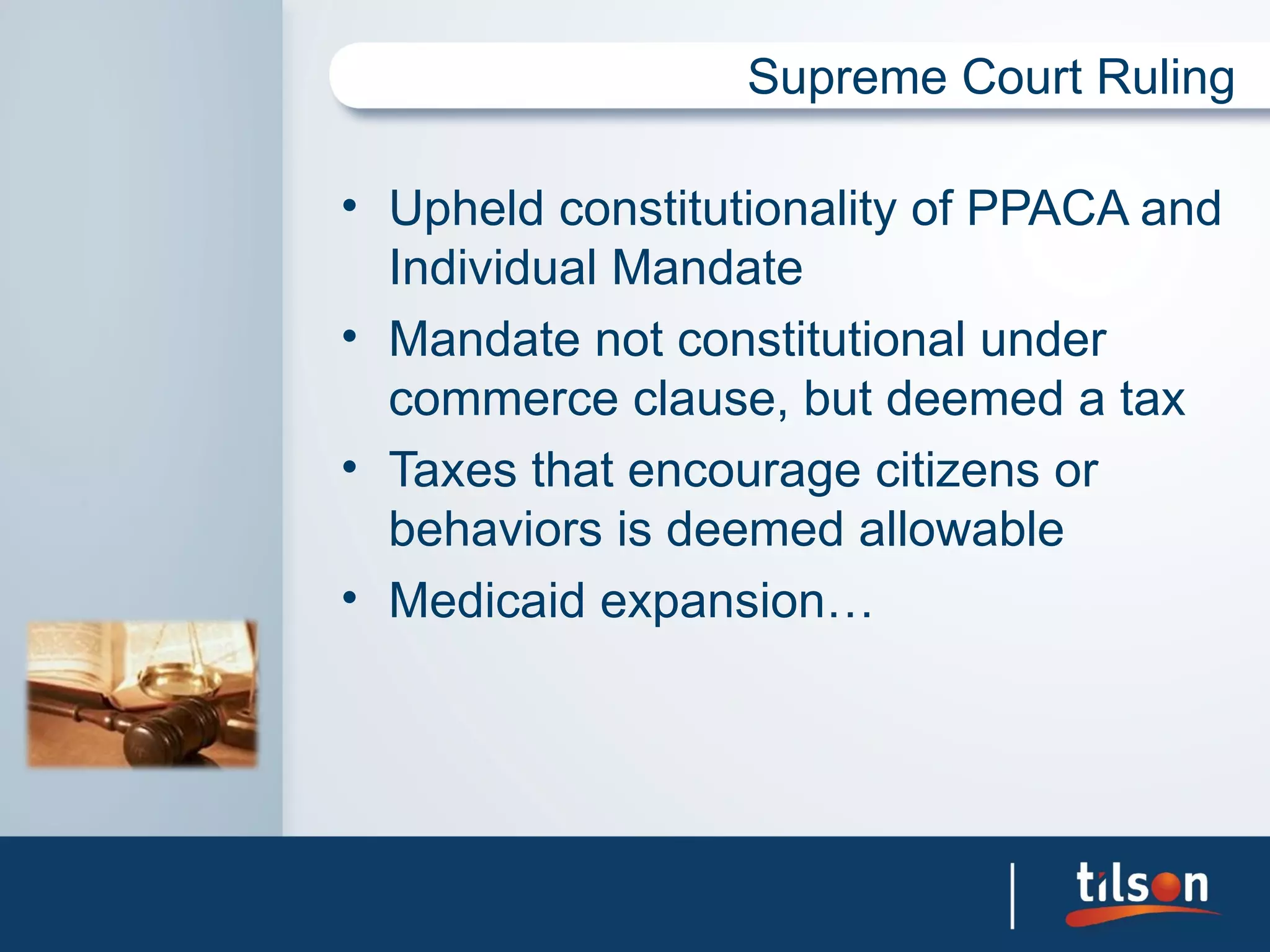
Supreme Court Ruling

• Upheld constitutionality of PPACA and
  Individual Mandate
• Mandate not constitutional under
  commerce clause, but deemed a tax
• Taxes that encourage citizens or
  behaviors is deemed allowable
• Medicaid expansion…
Employer Requirements

If you don’t offer coverage, you still have to
    meet most of the requirements outlined here.


Determining whether you will continue to
  offer group coverage will be addressed
  later.
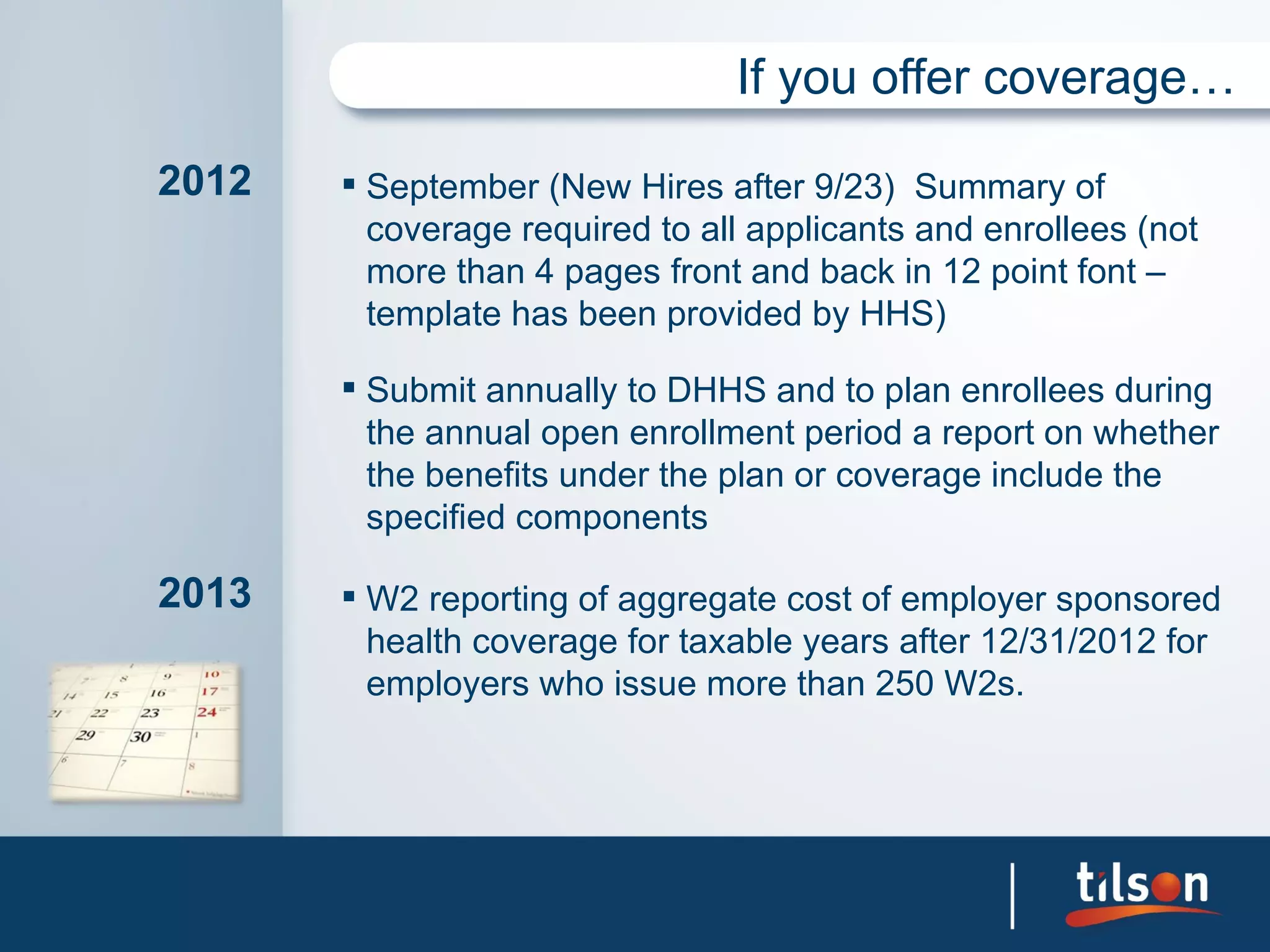
If you offer coverage…

2012    September (New Hires after 9/23) Summary of
         coverage required to all applicants and enrollees (not
         more than 4 pages front and back in 12 point font –
         template has been provided by HHS)

        Submit annually to DHHS and to plan enrollees during
         the annual open enrollment period a report on whether
         the benefits under the plan or coverage include the
         specified components

2013    W2 reporting of aggregate cost of employer sponsored
         health coverage for taxable years after 12/31/2012 for
         employers who issue more than 250 W2s.
If you offer coverage…

2014    Waiting periods not to exceed 90 days for employer
         sponsored health coverage
Whether you offer coverage or not…

2013    January: Collect Employee Medicare payroll tax
         increase of 0.9% for earnings over $200,000 for
         individuals and $250,000 for joint filers
        March: Provide notice to employees informing them of
         the existence of an Exchange, the availability of
         premium assistance if the actuarial value of the
         employer’s plan is below 60% in the upcoming plan
         year (2014)
2014
        (Date TBD) State required to offer premium assistance
         to Medicaid beneficiaries for employer sponsored
         coverage
        Penalties for employers with 50+ full-time equivalent
         employees who have one or more employees receiving
         the tax credit
Whether you offer coverage or not…

2014    Coverage documentation (by employee) reported to
         both individuals and to the IRS, including the following:
           – Whether the employer offers minimum essential
             coverage to full-time employees;
           – Any waiting period for health coverage;
           – The monthly premium for the lowest cost option in each
             enrollment category under the plan;
           – The employer’s share of the total allowed cost of
             benefits provided under the plan;
           – The number of full-time employees during each month;
           – The name, address and taxpayer ID (SSN) of each full-
             time employee, and the months each employee was
             covered under the employer’s plan, and;
           – Other information to be determine by HHS Secretary in
             regulations.
Benefit Changes

2013    Flexible Spending Account deferrals will be limited to
         $2,500 beginning in 2013.
        Additional preventive care benefits, including birth
         control covered at 100% with no cost share.
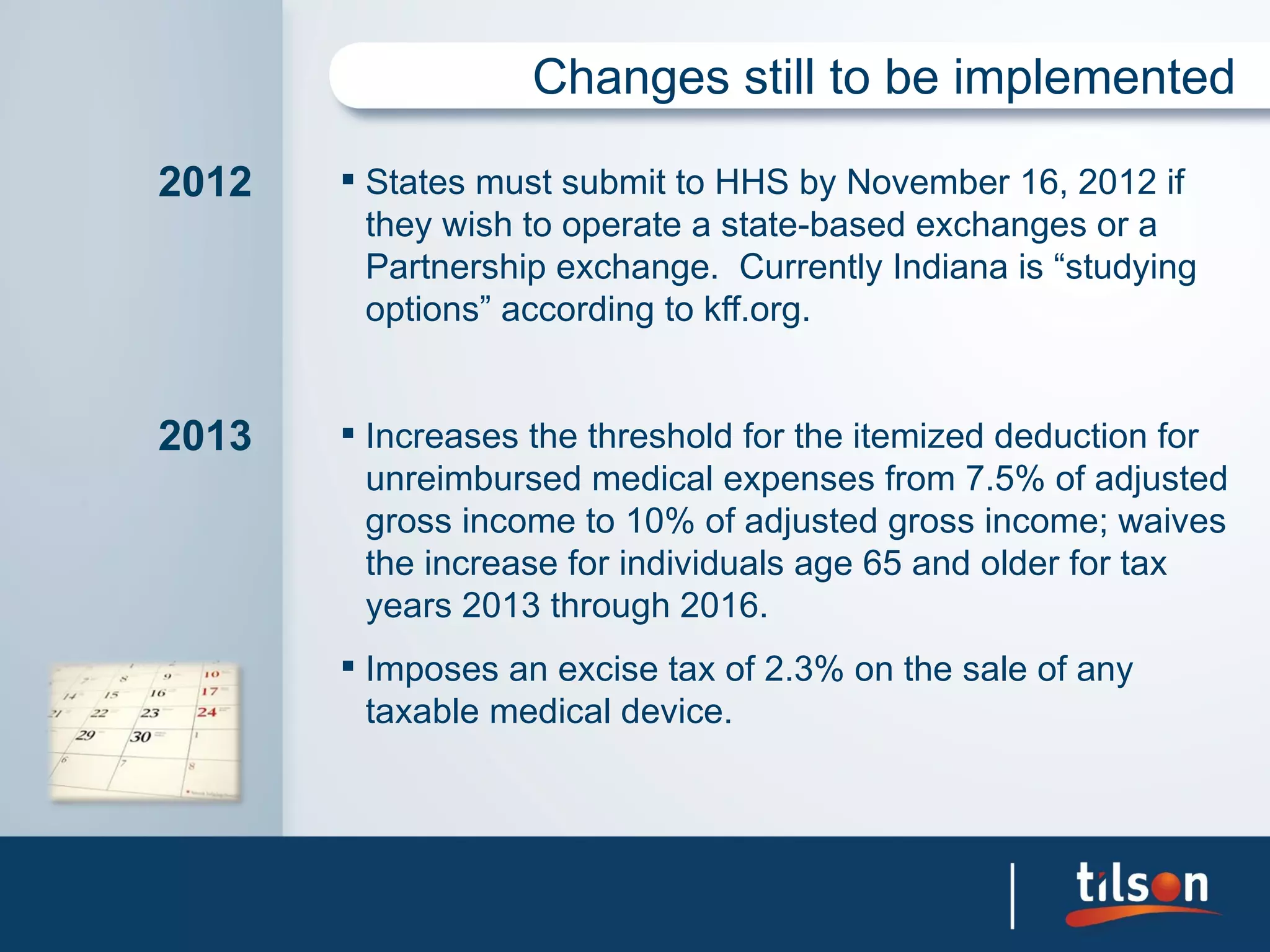
Changes still to be implemented

2012    States must submit to HHS by November 16, 2012 if
         they wish to operate a state-based exchanges or a
         Partnership exchange. Currently Indiana is “studying
         options” according to kff.org.


2013    Increases the threshold for the itemized deduction for
         unreimbursed medical expenses from 7.5% of adjusted
         gross income to 10% of adjusted gross income; waives
         the increase for individuals age 65 and older for tax
         years 2013 through 2016.
        Imposes an excise tax of 2.3% on the sale of any
         taxable medical device.
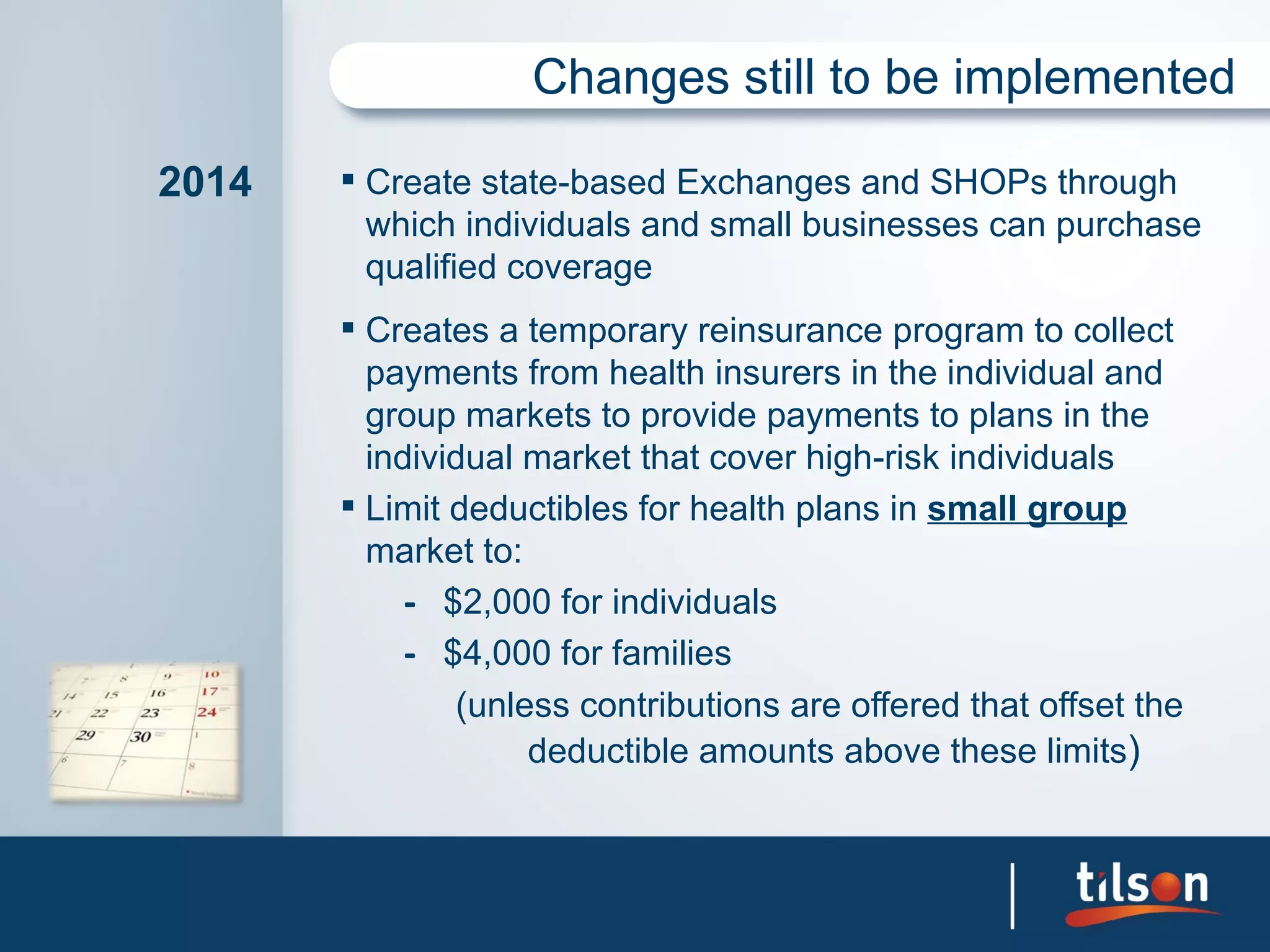
Changes still to be implemented

2014    Create state-based Exchanges and SHOPs through
         which individuals and small businesses can purchase
         qualified coverage
        Creates a temporary reinsurance program to collect
         payments from health insurers in the individual and
         group markets to provide payments to plans in the
         individual market that cover high-risk individuals
        Limit deductibles for health plans in small group
         market to:
            – $2,000 for individuals
            – $4,000 for families
               (unless contributions are offered that offset the
                    deductible amounts above these limits)
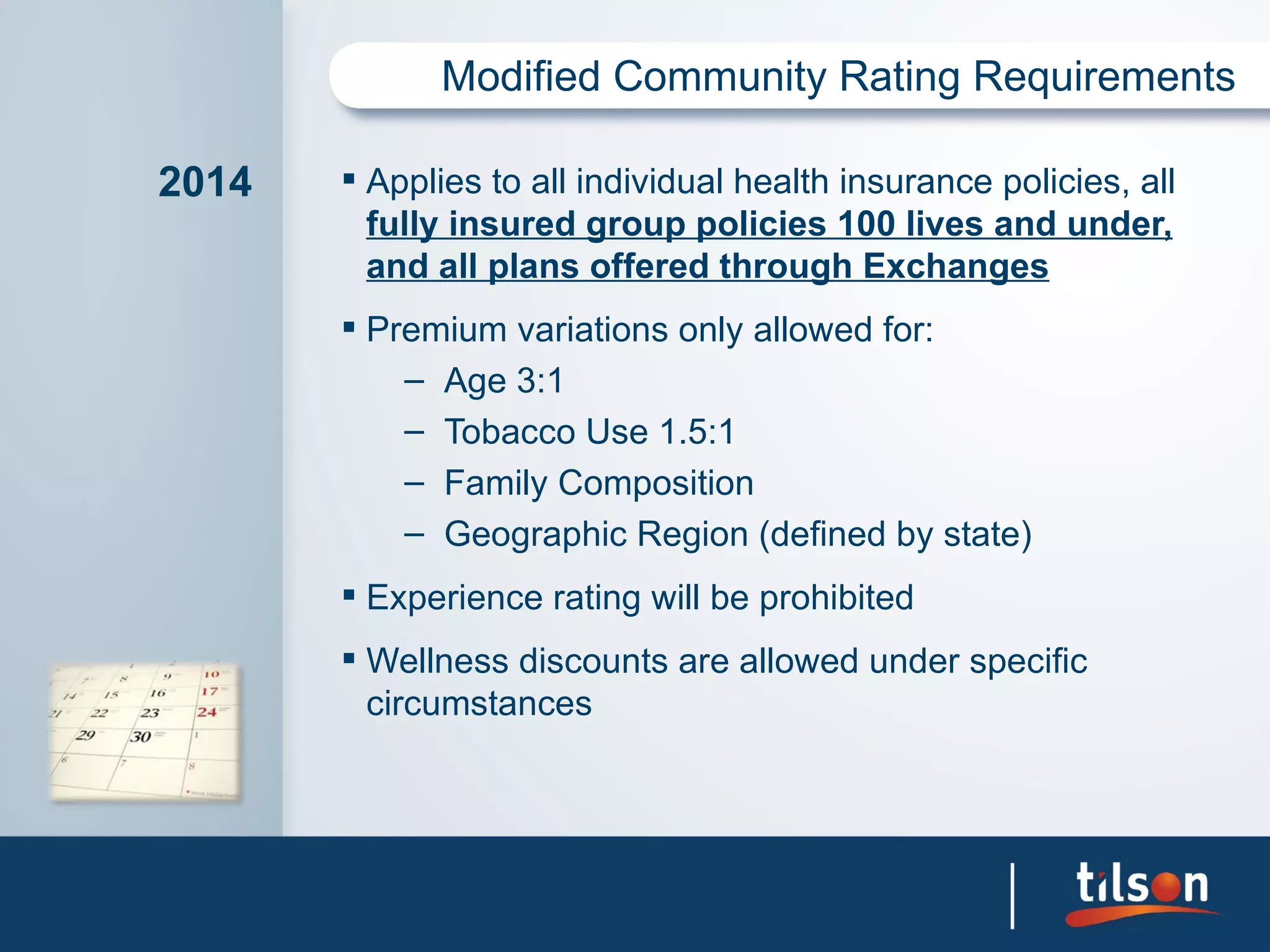
Modified Community Rating Requirements

2014    Applies to all individual health insurance policies, all
         fully insured group policies 100 lives and under,
         and all plans offered through Exchanges
        Premium variations only allowed for:
           – Age 3:1
           – Tobacco Use 1.5:1
           – Family Composition
           – Geographic Region (defined by state)
        Experience rating will be prohibited
        Wellness discounts are allowed under specific
         circumstances
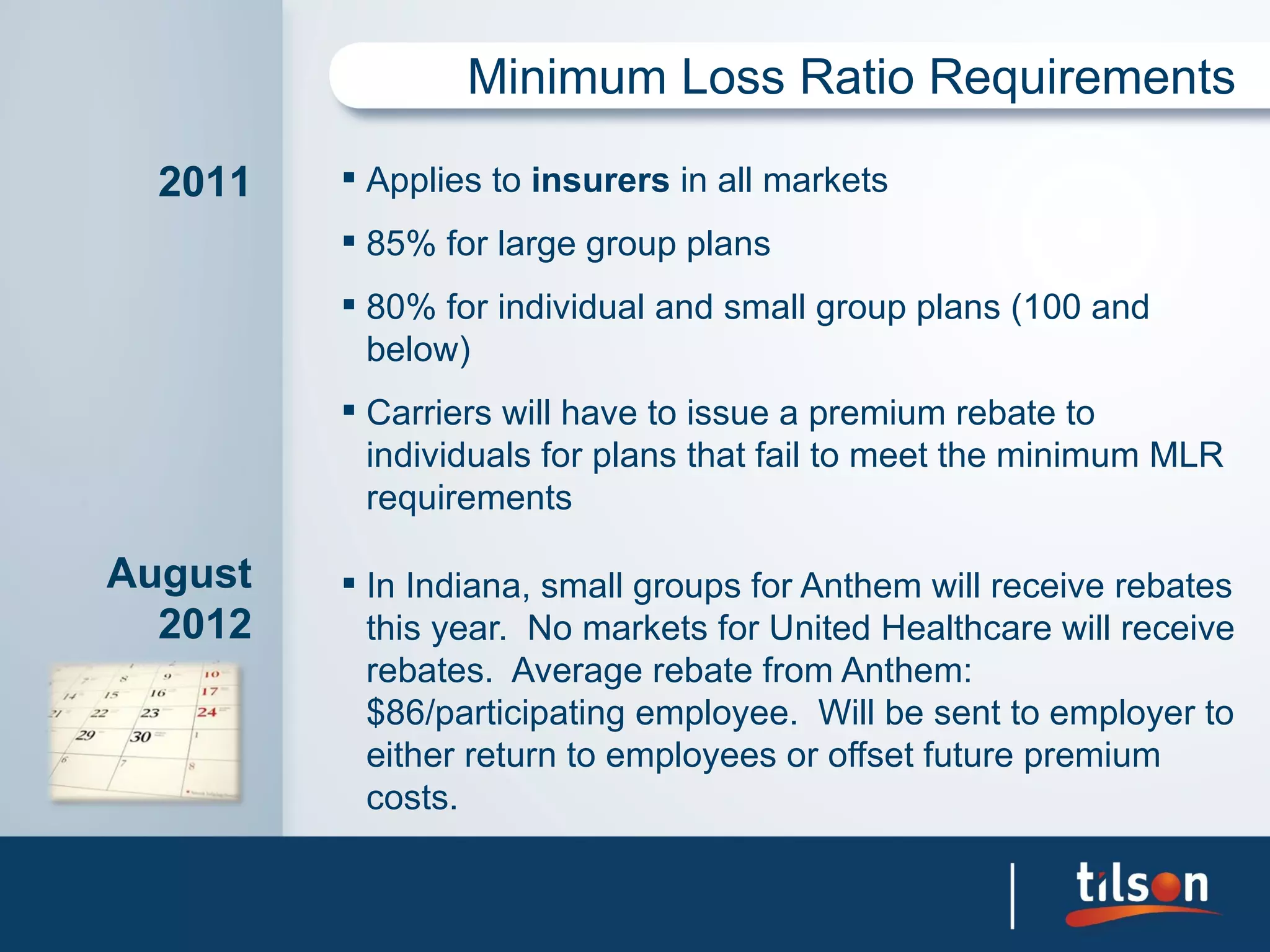
Minimum Loss Ratio Requirements

  2011    Applies to insurers in all markets
          85% for large group plans
          80% for individual and small group plans (100 and
           below)
          Carriers will have to issue a premium rebate to
           individuals for plans that fail to meet the minimum MLR
           requirements

August    In Indiana, small groups for Anthem will receive rebates
  2012     this year. No markets for United Healthcare will receive
           rebates. Average rebate from Anthem:
           $86/participating employee. Will be sent to employer to
           either return to employees or offset future premium
           costs.
Employee Requirements

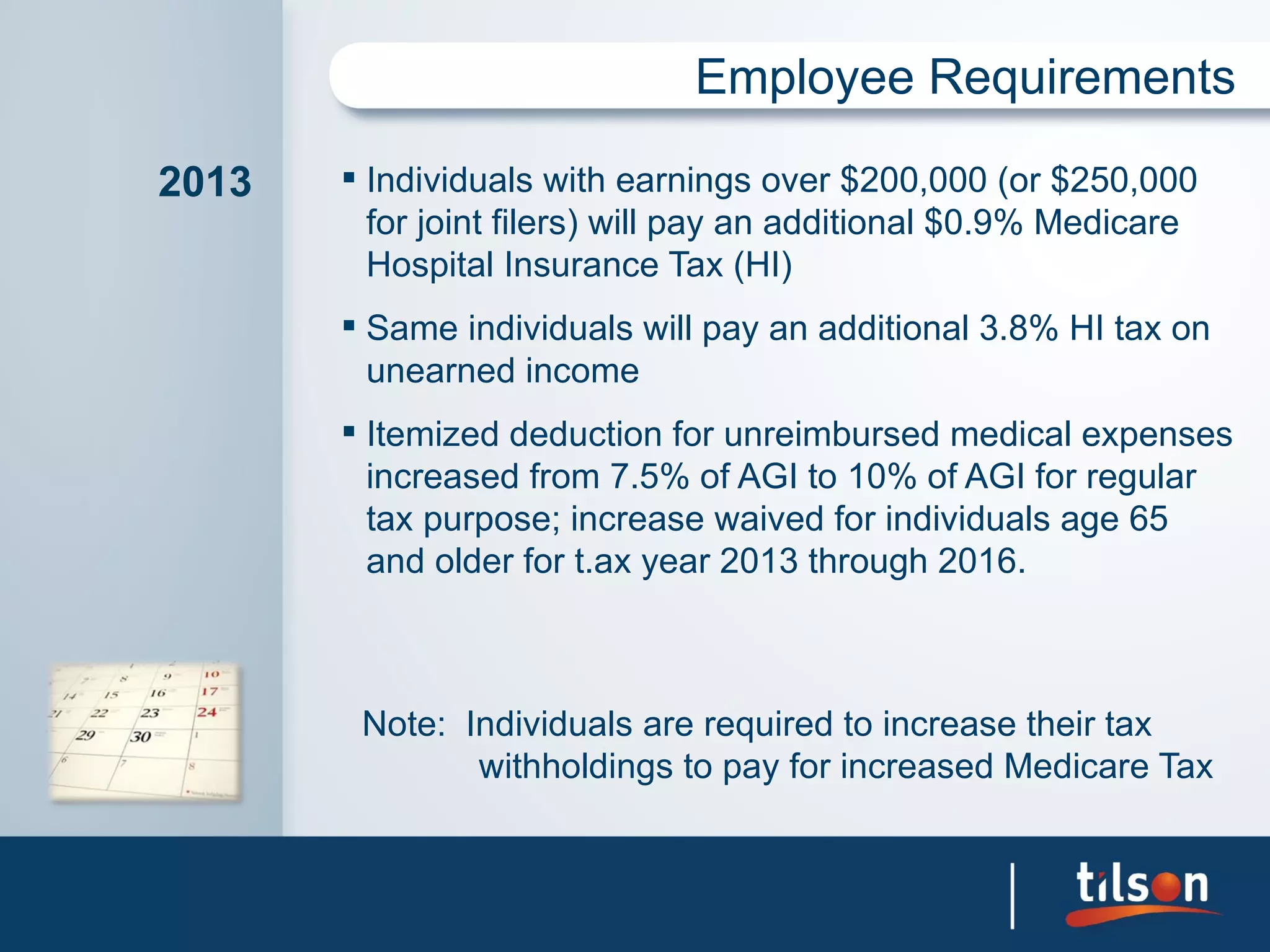
2013    Individuals with earnings over $200,000 (or $250,000
         for joint filers) will pay an additional $0.9% Medicare
         Hospital Insurance Tax (HI)
        Same individuals will pay an additional 3.8% HI tax on
         unearned income
        Itemized deduction for unreimbursed medical expenses
         increased from 7.5% of AGI to 10% of AGI for regular
         tax purpose; increase waived for individuals age 65
         and older for t.ax year 2013 through 2016.


        Note: Individuals are required to increase their tax
               withholdings to pay for increased Medicare Tax
Employee Requirements

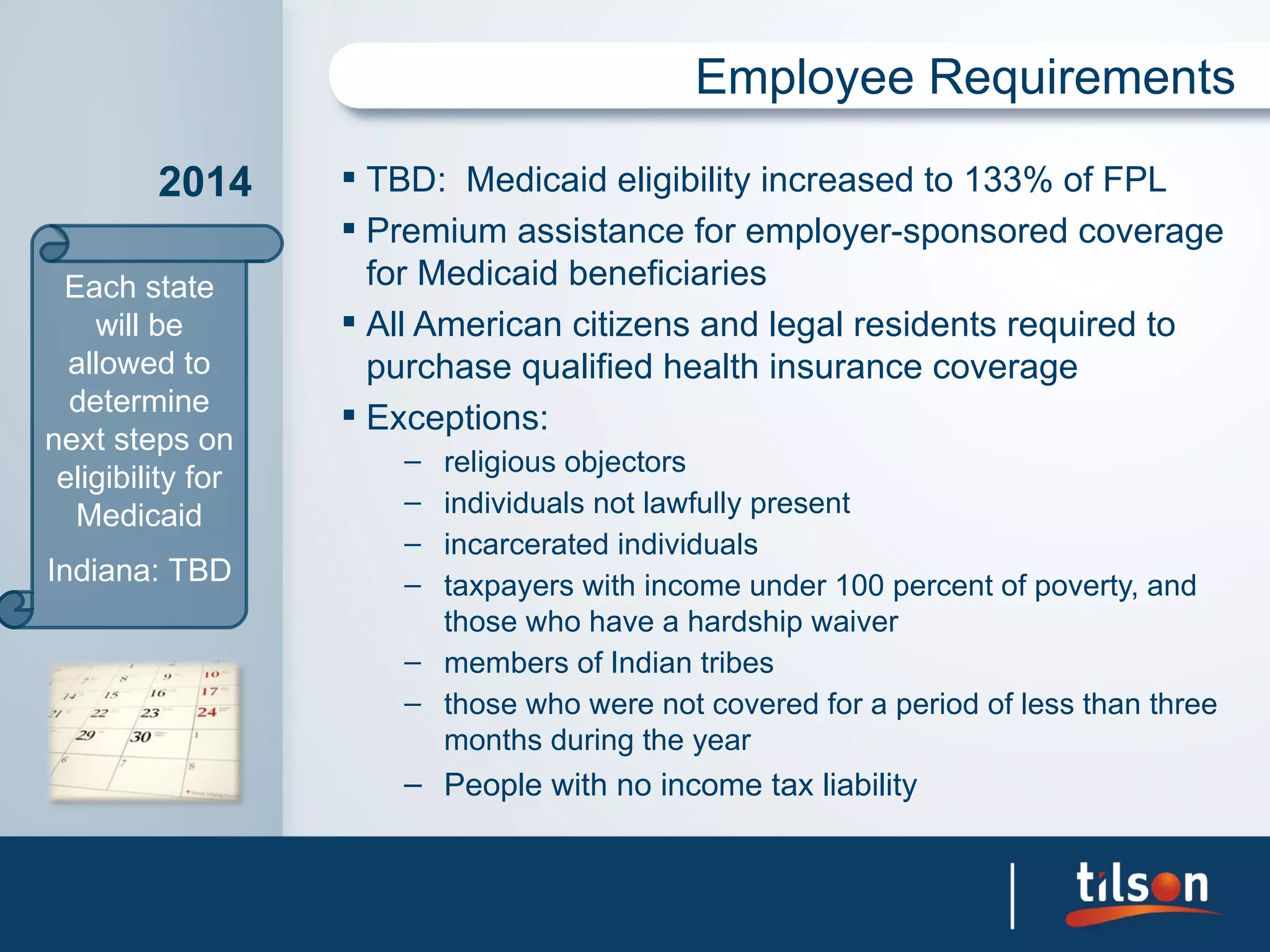
         2014       TBD: Medicaid eligibility increased to 133% of FPL
                    Premium assistance for employer-sponsored coverage
 Each state          for Medicaid beneficiaries
    will be         All American citizens and legal residents required to
  allowed to         purchase qualified health insurance coverage
  determine         Exceptions:
next steps on
                      – religious objectors
 eligibility for
  Medicaid            – individuals not lawfully present
                      – incarcerated individuals
Indiana: TBD          – taxpayers with income under 100 percent of poverty, and
                        those who have a hardship waiver
                      – members of Indian tribes
                      – those who were not covered for a period of less than three
                        months during the year
                      – People with no income tax liability
Requirements to Buy Coverage

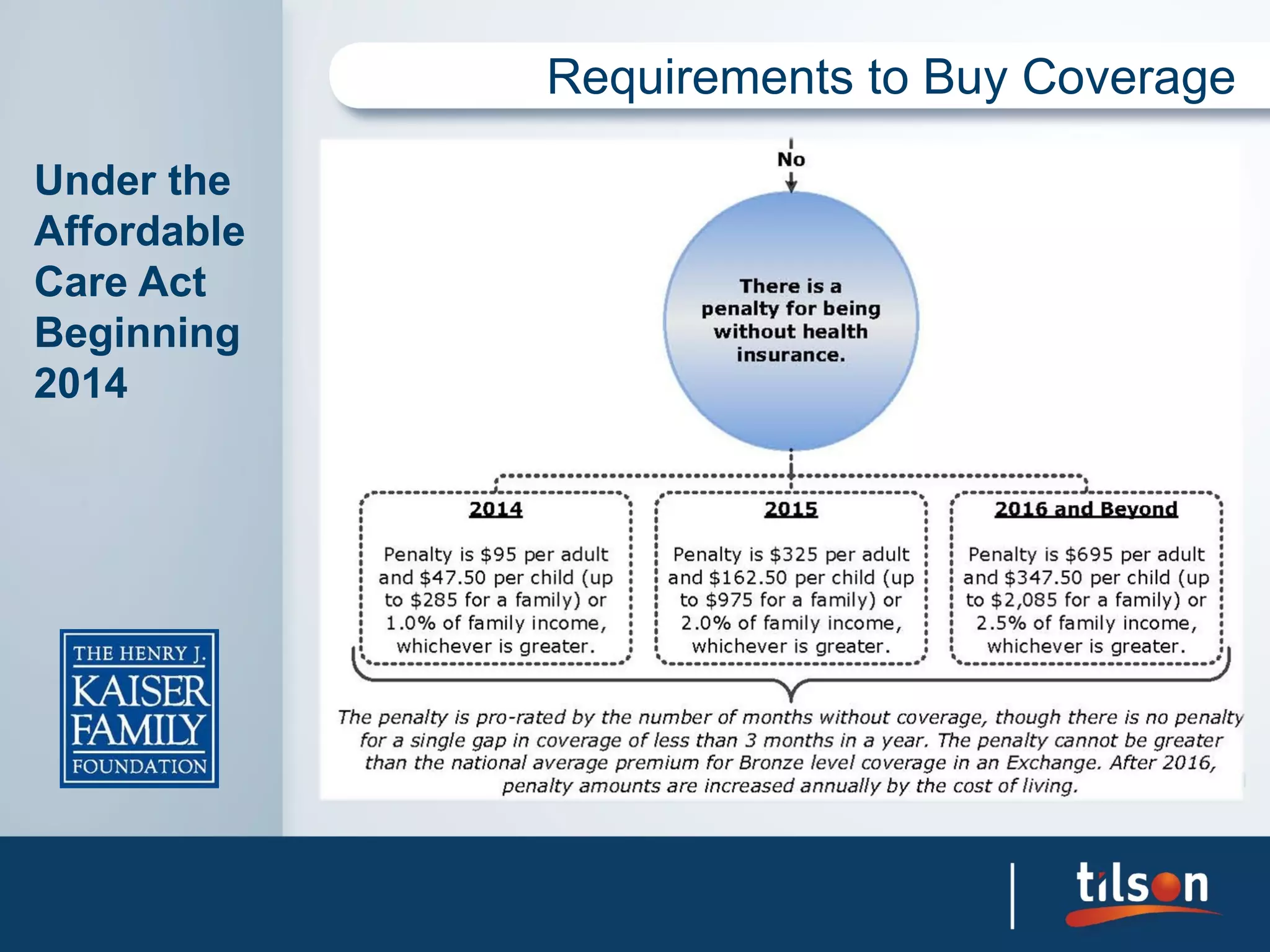
Under the
Affordable
Care Act
Beginning
2014
Requirements to Buy Coverage

Under the
Affordable
Care Act
Beginning
2014
Requirements to Buy Coverage

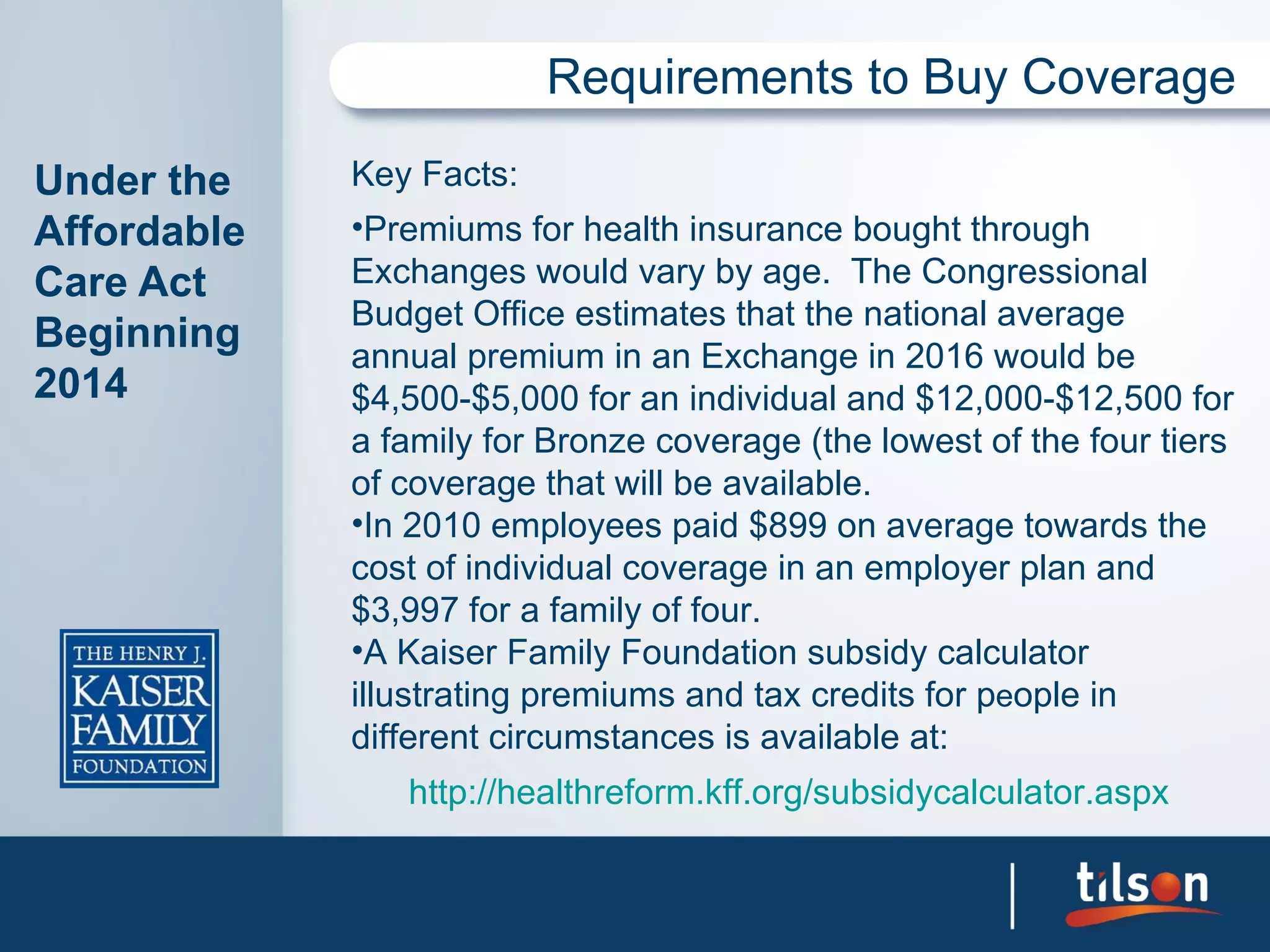
Under the    Key Facts:
Affordable   •Premiums for health insurance bought through
Care Act     Exchanges would vary by age. The Congressional
             Budget Office estimates that the national average
Beginning    annual premium in an Exchange in 2016 would be
2014         $4,500-$5,000 for an individual and $12,000-$12,500 for
             a family for Bronze coverage (the lowest of the four tiers
             of coverage that will be available.
             •In 2010 employees paid $899 on average towards the
             cost of individual coverage in an employer plan and
             $3,997 for a family of four.
             •A Kaiser Family Foundation subsidy calculator
             illustrating premiums and tax credits for people in
             different circumstances is available at:
                http://healthreform.kff.org/subsidycalculator.aspx
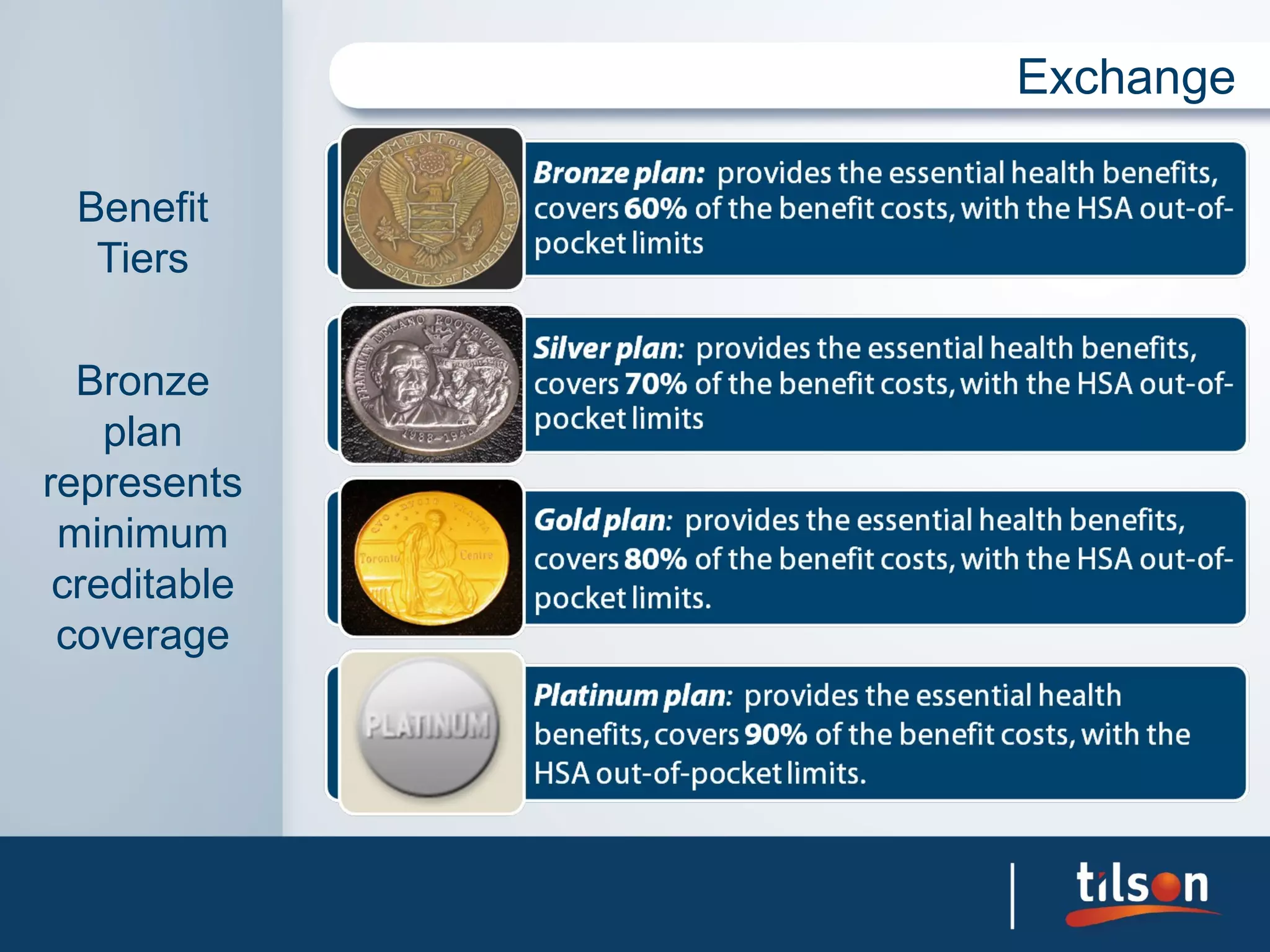
Exchange

 Benefit
  Tiers

  Bronze
    plan
represents
 minimum
 creditable
 coverage
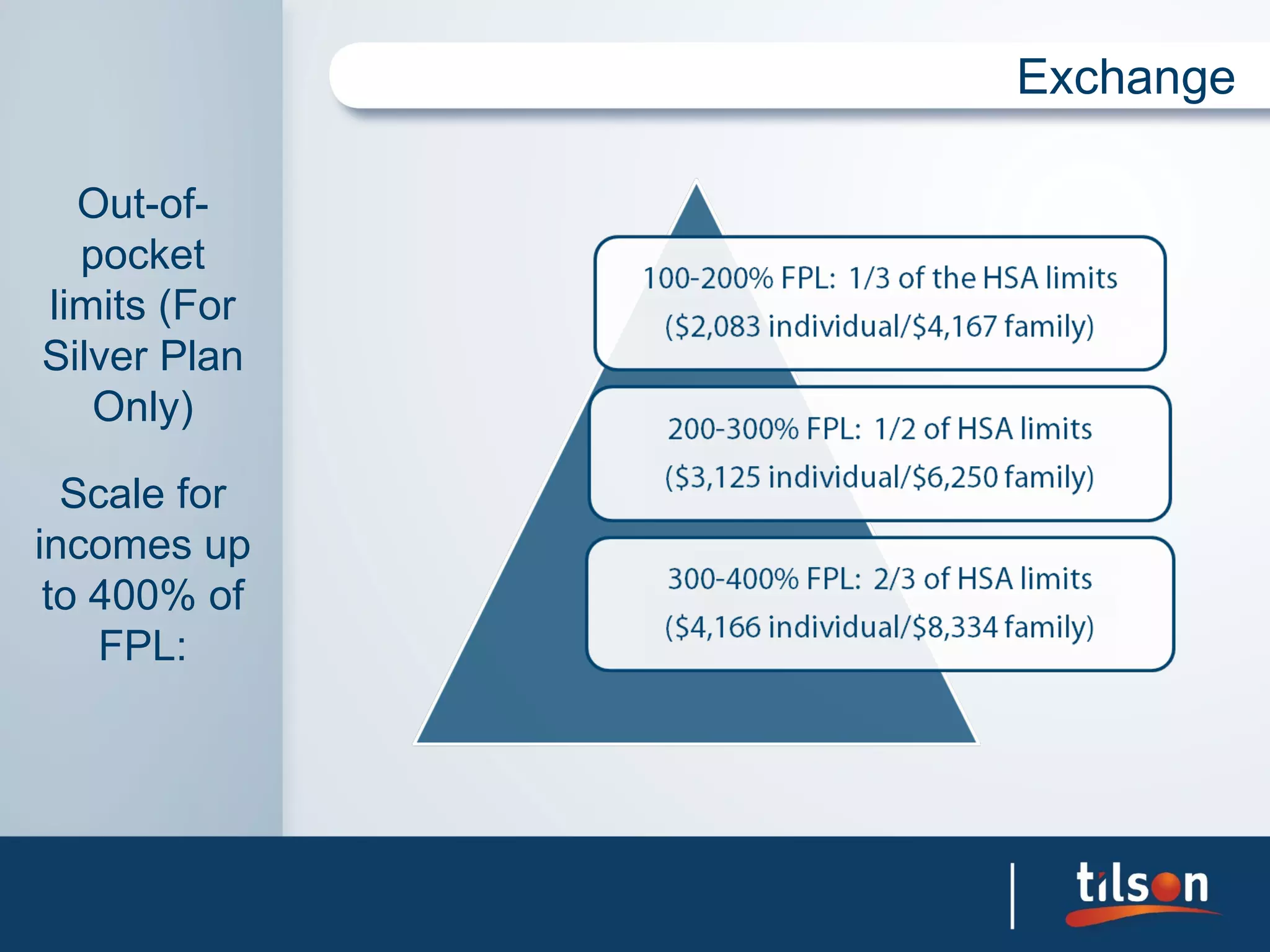
Exchange

  Out-of-
  pocket
limits (For
Silver Plan
   Only)

  Scale for
incomes up
 to 400% of
    FPL:
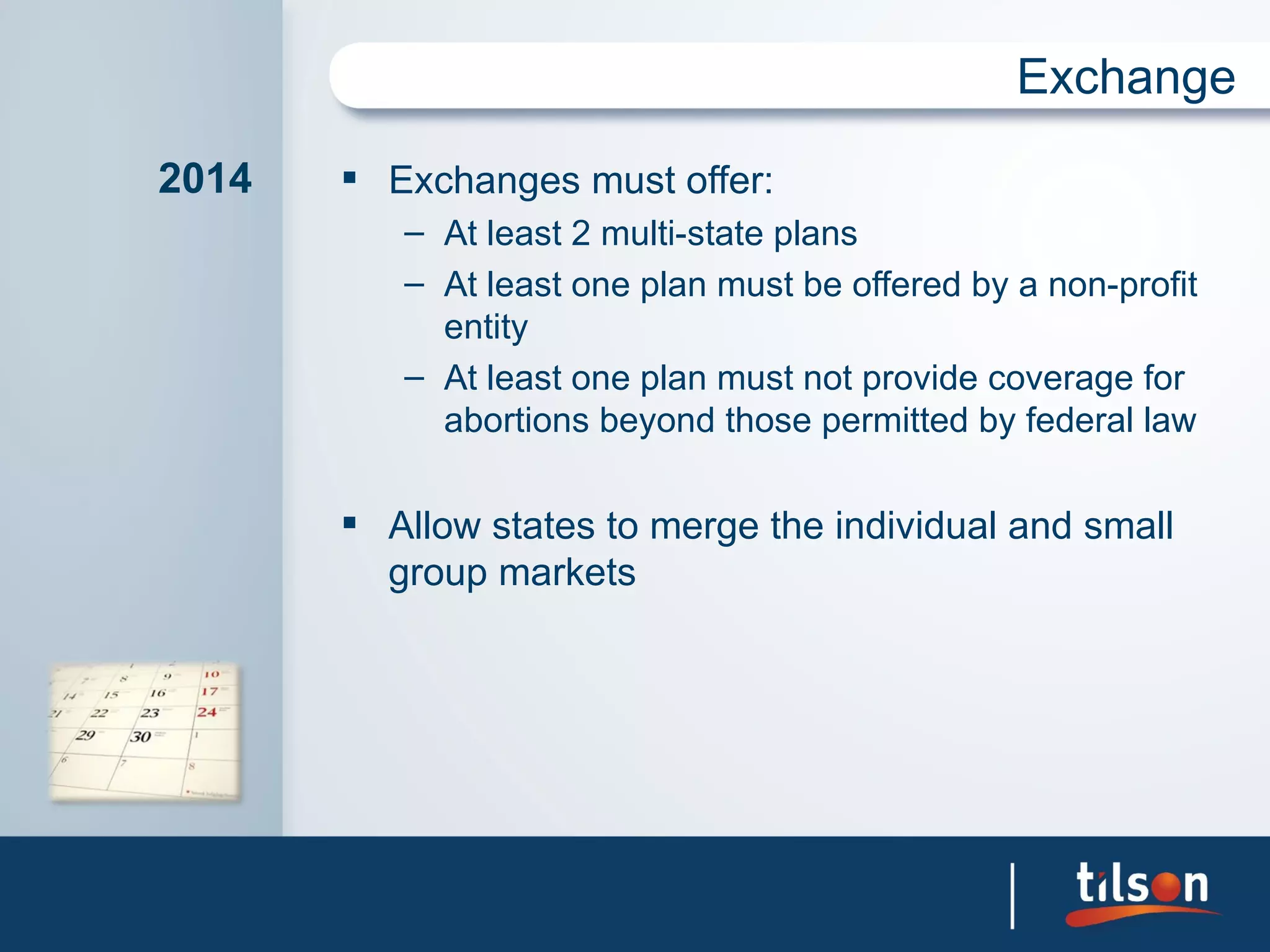
Exchange

2014    Exchanges must offer:
          – At least 2 multi-state plans
          – At least one plan must be offered by a non-profit
            entity
          – At least one plan must not provide coverage for
            abortions beyond those permitted by federal law

        Allow states to merge the individual and small
         group markets
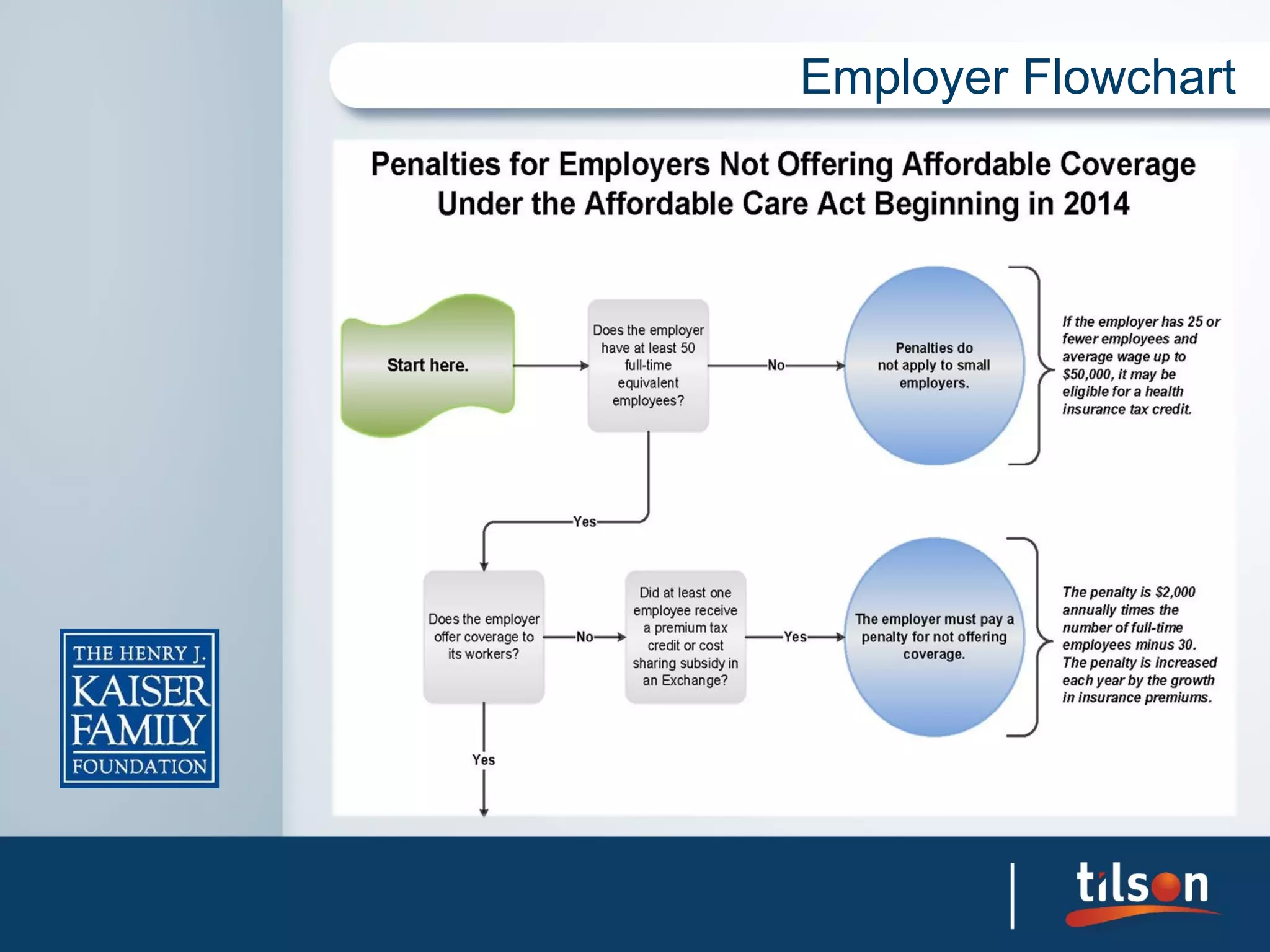
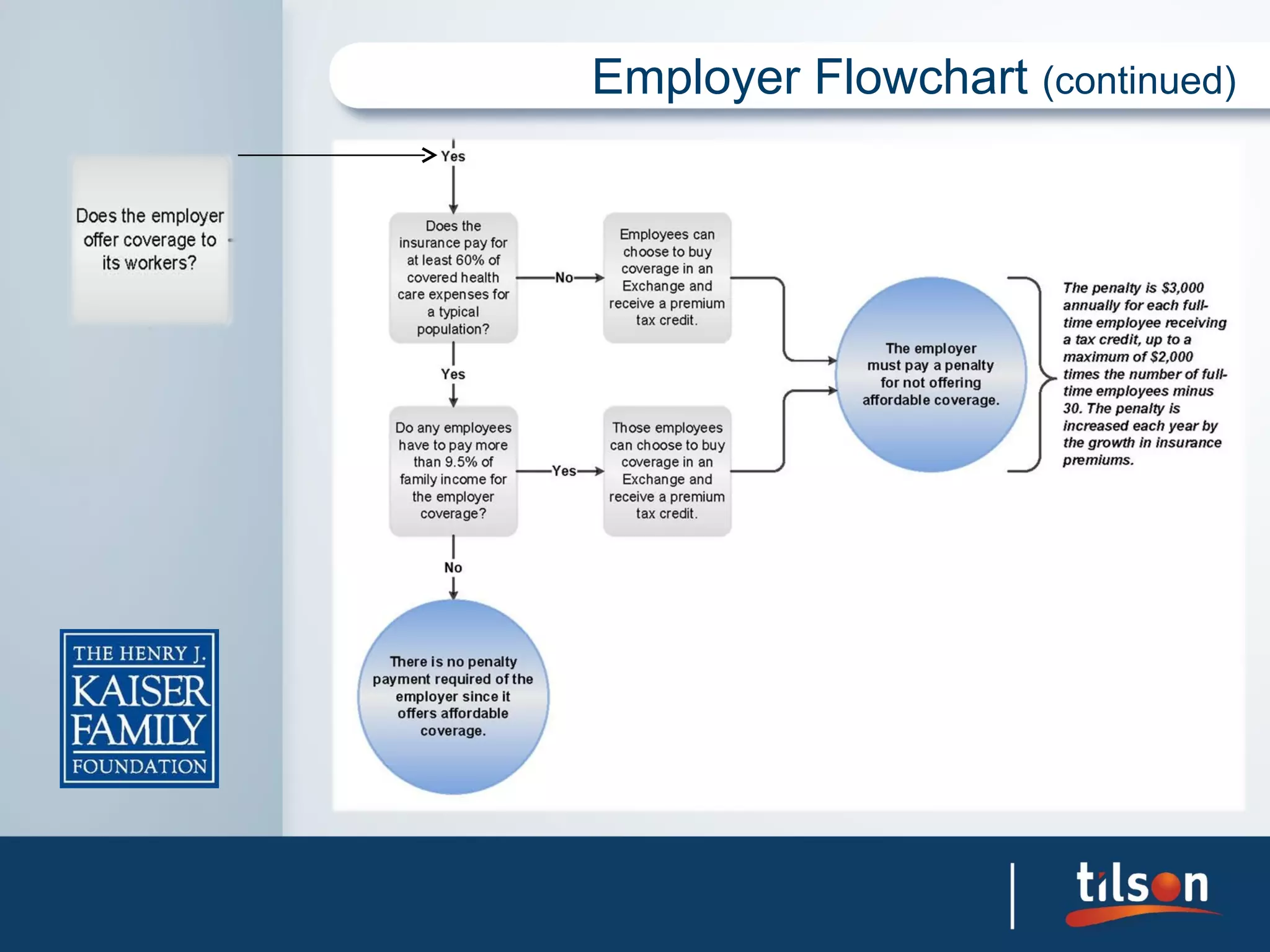
Employer Flowchart
Employer Flowchart (continued)
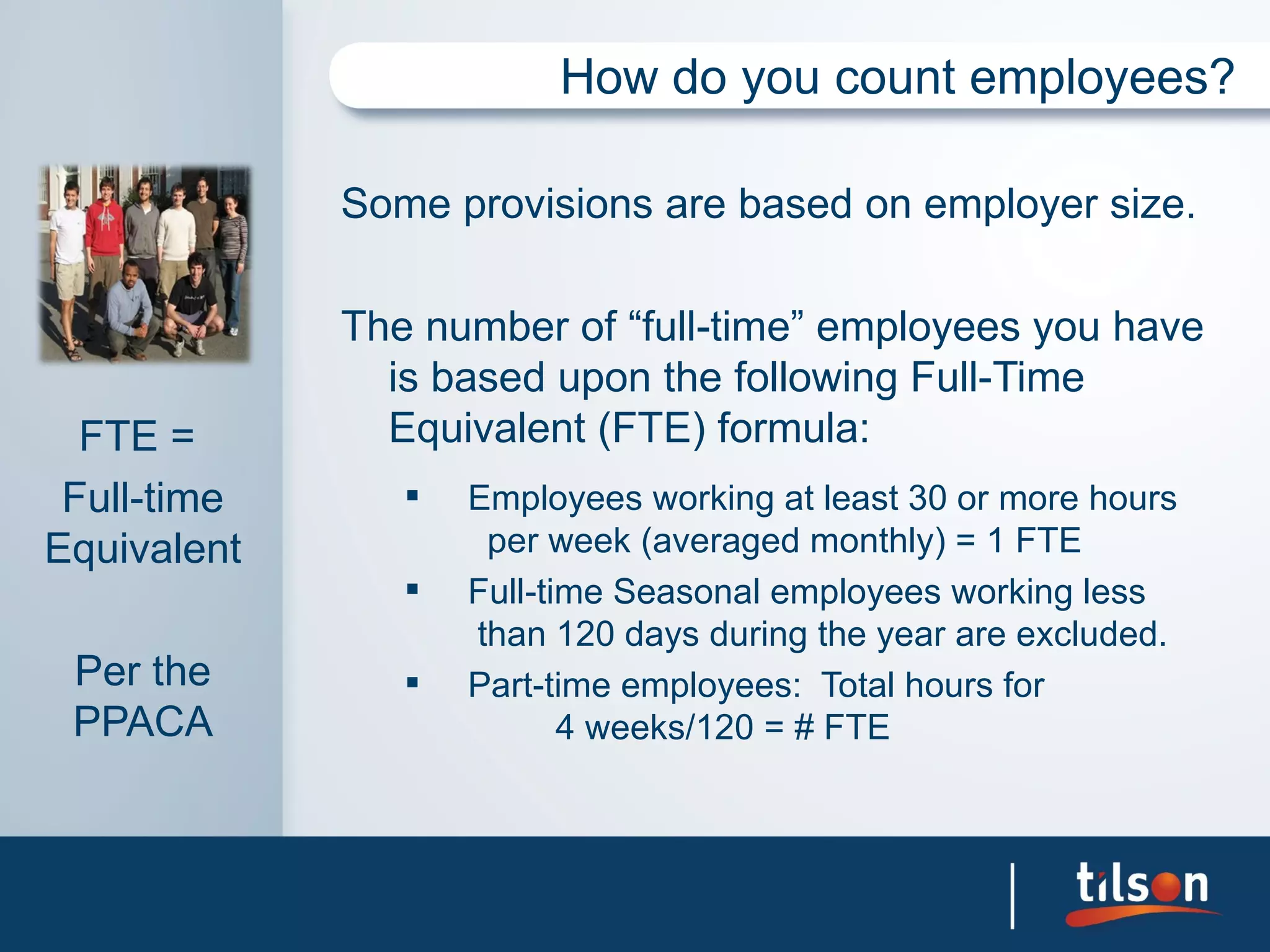
How do you count employees?

             Some provisions are based on employer size.

             The number of “full-time” employees you have
               is based upon the following Full-Time
  FTE =        Equivalent (FTE) formula:
 Full-time         Employees working at least 30 or more hours
Equivalent           per week (averaged monthly) = 1 FTE
                   Full-time Seasonal employees working less
                    than 120 days during the year are excluded.
 Per the           Part-time employees: Total hours for
 PPACA                     4 weeks/120 = # FTE
Part 2   How the Reform Impacts
         Employer Provided
         Healthcare
7 Step Process

• Step 1 – Prepare employee census and cost
                     analysis
• Step 2 – Identify future coverage options
• Step 3 – Calculate and project estimated
  cost                      from each option
• Step 4 – Analyze the cost of offering
  healthcare                      or not
• Step 5 – Conduct analysis of workforce
• Step 6 – Compare cost analysis against
                     workforce dynamics
• Step 7 – Make decision
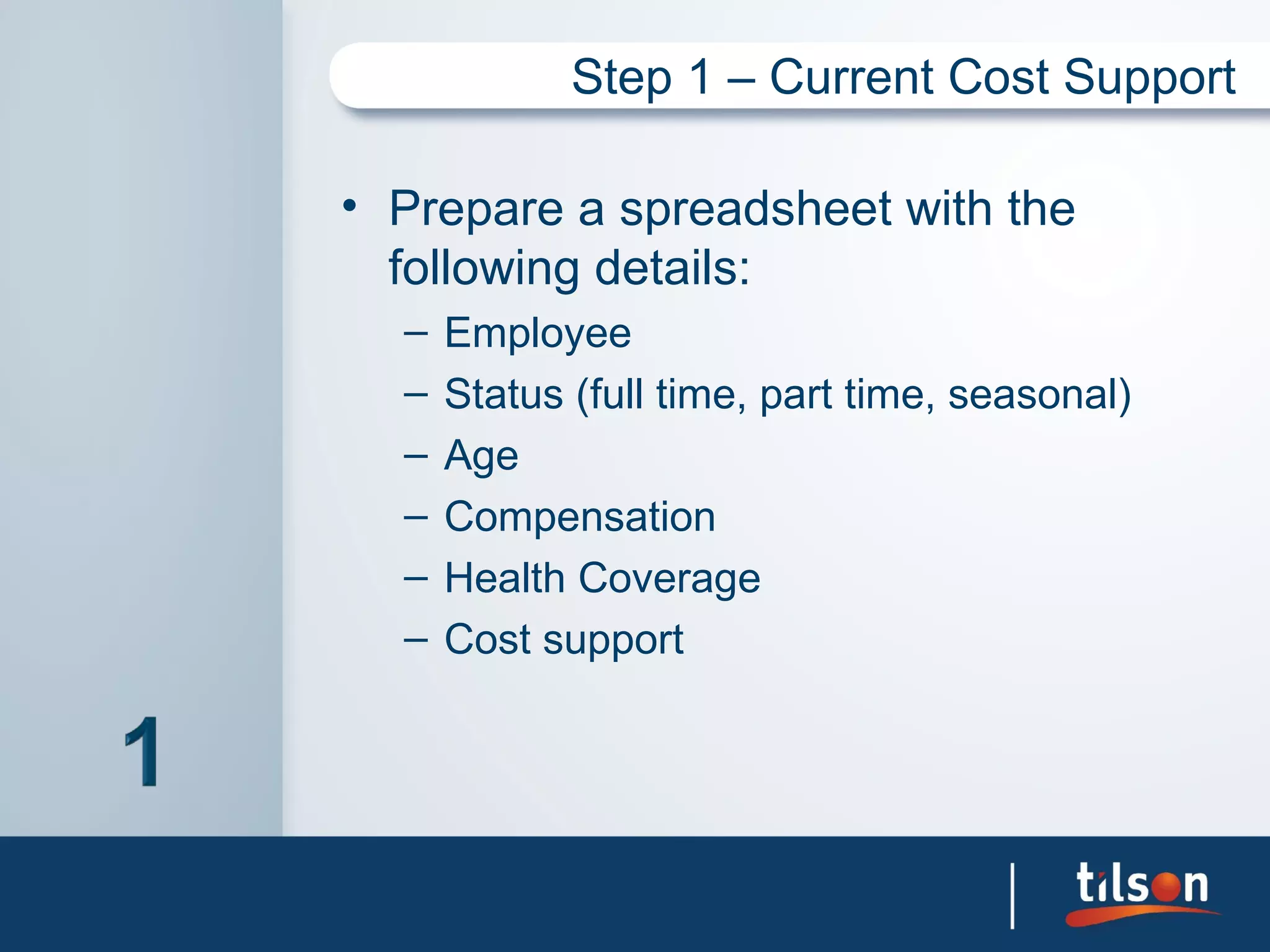
Step 1 – Current Cost Support

• Prepare a spreadsheet with the
  following details:
  –   Employee
  –   Status (full time, part time, seasonal)
  –   Age
  –   Compensation
  –   Health Coverage
  –   Cost support
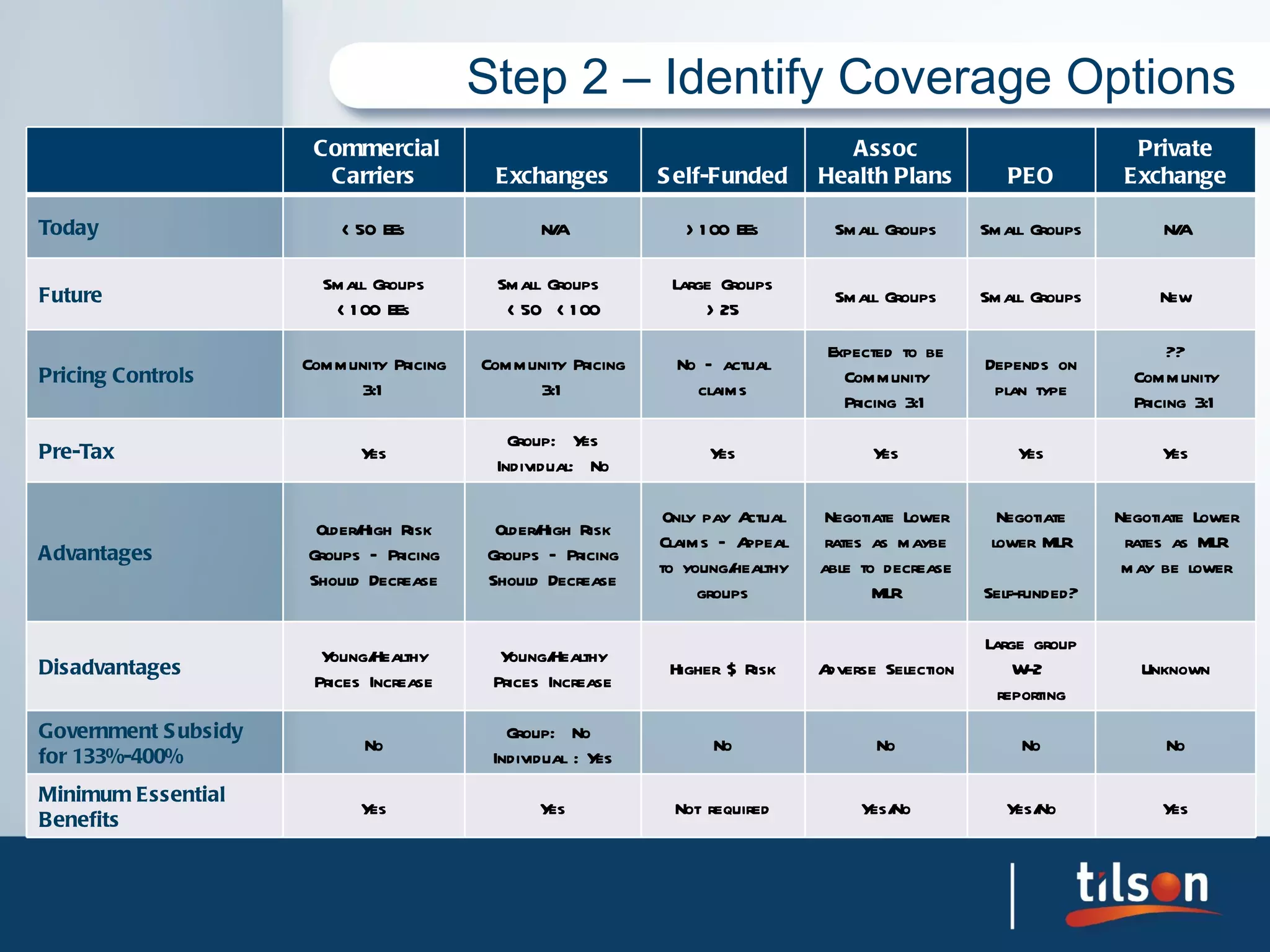
Step 2 – Identify Coverage Options
                      Commercial                                            Assoc                       Private
                       Carriers         Exchanges         Self-Funded     Health Plans      PEO        Exchange
                                                                                            Small
Today                   <50 EEs              N/A           >100 EEs       Small Groups                    N/A
                                                                                           Groups
                     Small Groups      Small Groups       Large Groups                      Small
Future                                                                    Small Groups                    New
                      <100 EEs          <50 <100              >25                          Groups
                                                                           Expected to    Depends          ??
                       Community         Community         No – actual
Pricing Controls                                                          be Community    on plan      Community
                       Pricing 3:1       Pricing 3:1         claims
                                                                            Pricing 3:1     type       Pricing 3:1
                                        Group: Yes
Pre-Tax                   Yes                                 Yes             Yes            Yes          Yes
                                       Individual: No
                                                                            Negotiate
                                                            Only pay                       Negotiate    Negotiate
                     Older/High Risk   Older/High Risk                     Lower rates
                                                          Actual Claims                   lower MLR    Lower rates
                        Groups –          Groups –                          as maybe
Advantages                                                 – Appeal to                                 as MLR may
                     Pricing Should    Pricing Should                        able to
                                                          young/healthy                      Self-       be lower
                        Decrease          Decrease                          decrease
                                                             groups                        funded?
                                                                              MLR
                                                                                            Large
                     Young/Healthy     Young/Healthy                        Adverse
Disadvantages                                             Higher $ Risk                   group W-2     Unknown
                     Prices Increase   Prices Increase                      Selection
                                                                                           reporting
Government Subsidy                       Group: No
                           No                                  No              No            No            No
for 133%-400%                          Individual : Yes
Minimum Essential
                          Yes               Yes           Not required       Yes/No        Yes/No         Yes
Benefits
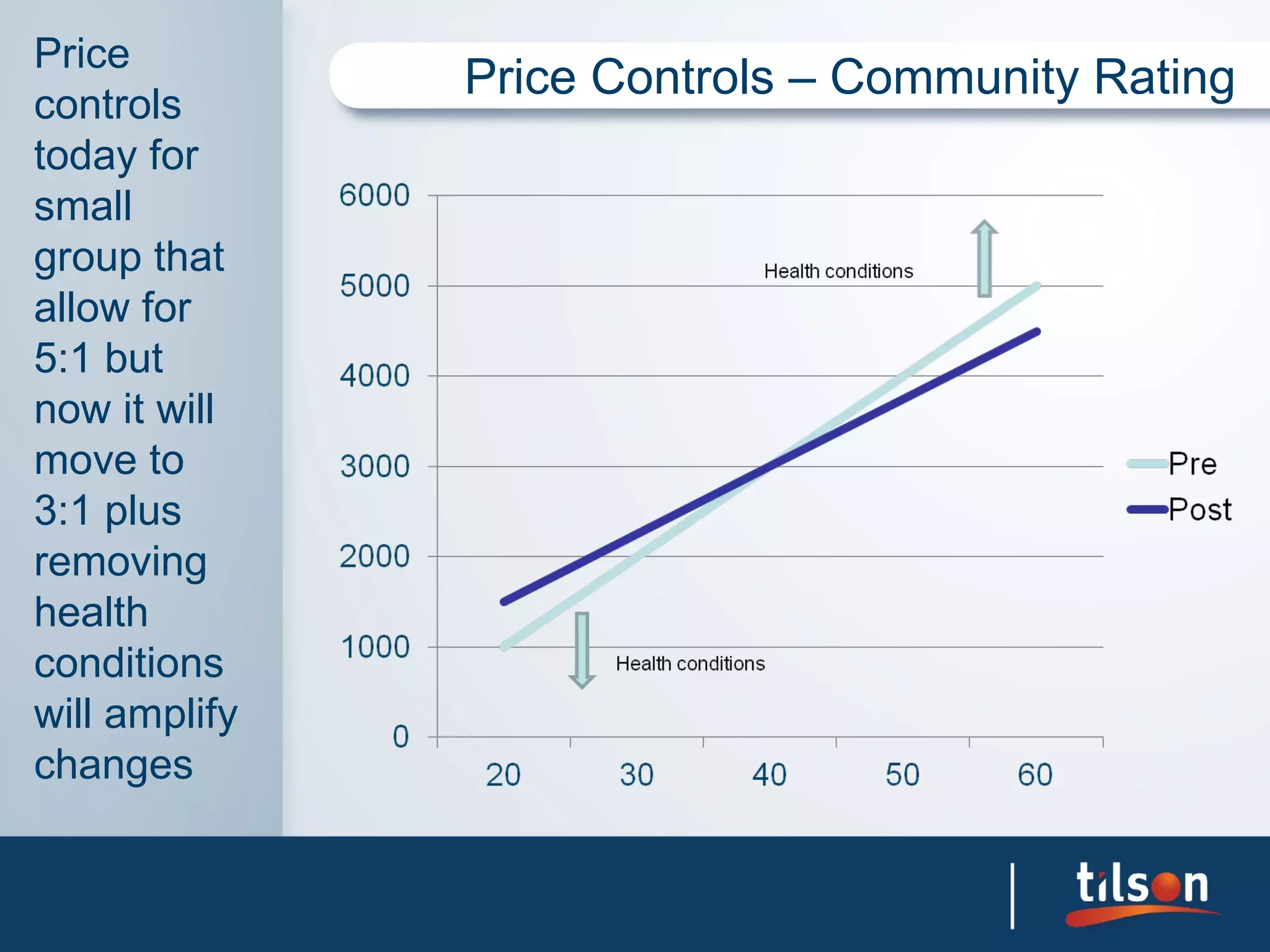
Price
               Price Controls – Community Rating
controls
today for
small
group that
allow for
5:1 but
now it will
move to
3:1 plus
removing
health
conditions
will amplify
changes
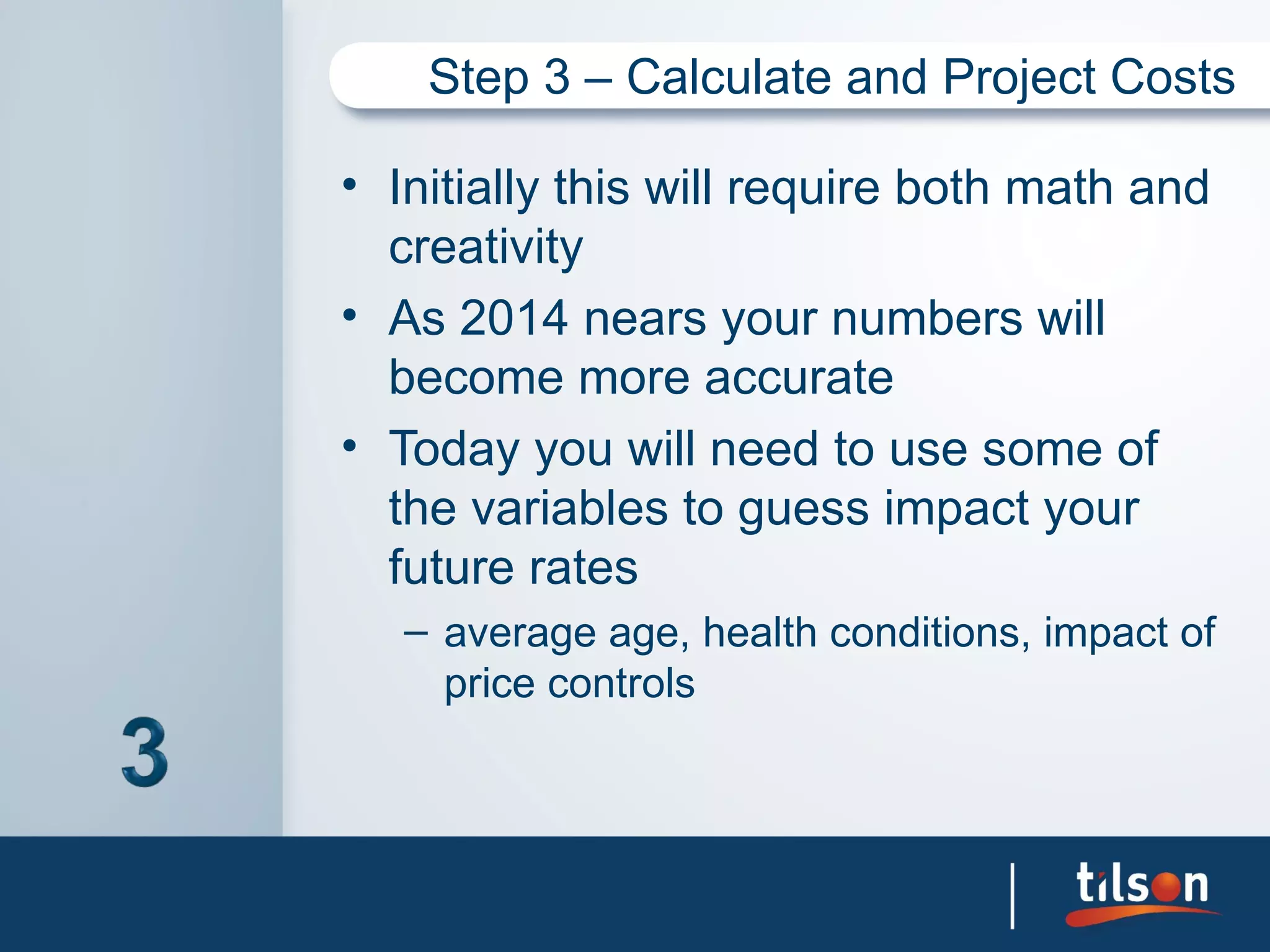
Step 3 – Calculate and Project Costs

• Initially this will require both math and
  creativity
• As 2014 nears your numbers will
  become more accurate
• Today you will need to use some of
  the variables to guess impact your
  future rates
   – average age, health conditions, impact of
     price controls
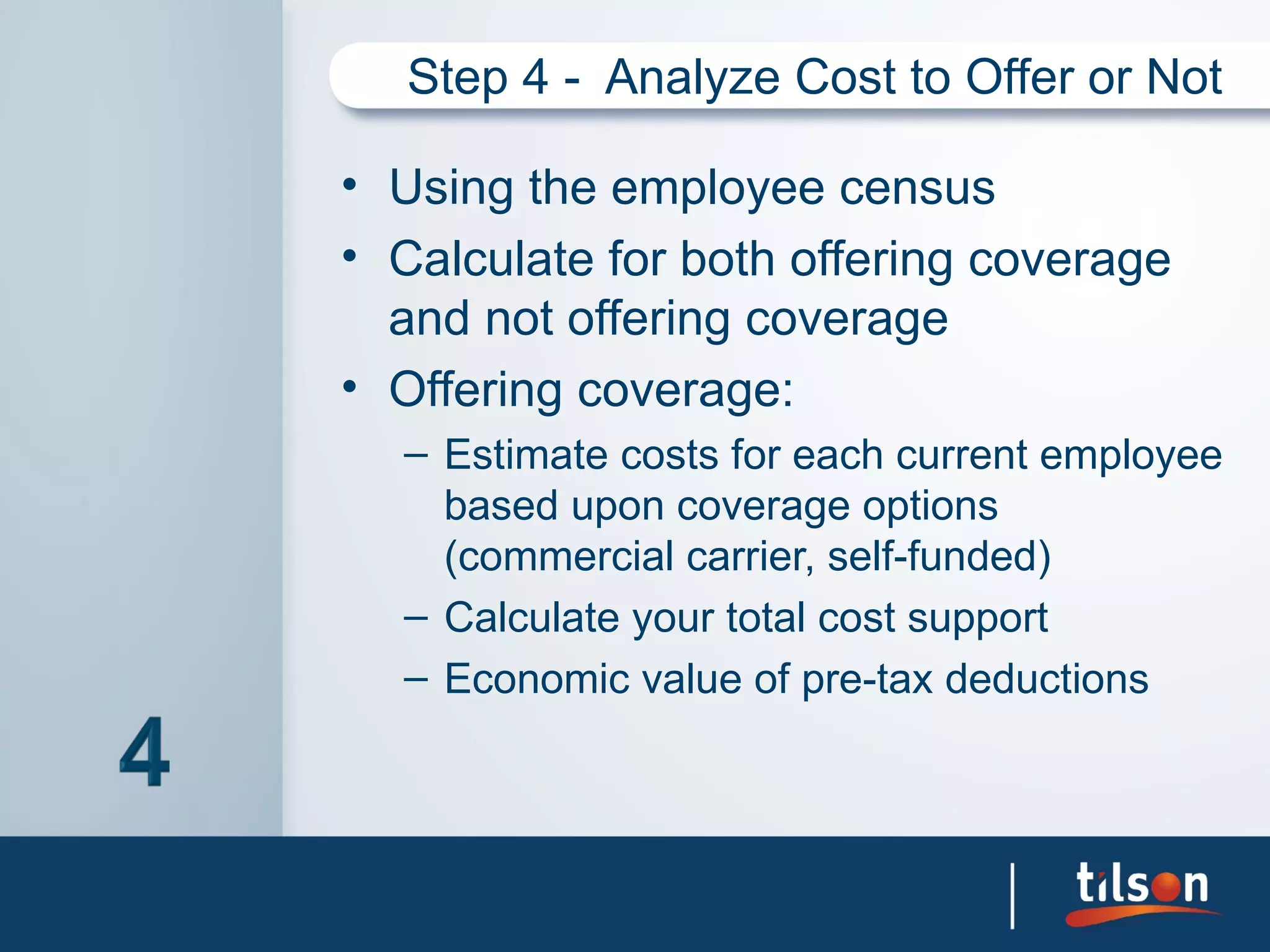
Step 4 - Analyze Cost to Offer or Not

• Using the employee census
• Calculate for both offering coverage
  and not offering coverage
• Offering coverage:
  – Estimate costs for each current employee
    based upon coverage options
    (commercial carrier, self-funded)
  – Calculate your total cost support
  – Economic value of pre-tax deductions
Step 4 - Continued

• Not offering coverage:
  – Calculate compensation increase to
    adjust for economic equality
  – Calculate ER penalties if applicable
  – Based upon compensation calculate
    government subsidies per employee (this
    is problematic to know family income)
  – Economic disadvantage of post-tax

• Determine total with our without
Step 5 – Workforce Analysis

•   Size of your company
•   Growth plans
•   Average wage
•   Sophistication
•   Culture
•   Competition for employees
•   Retention
•   Competition
Step 6 – Weigh Costs vs. Workforce

• Will you need to increase pay to retain
  employees?
• Will competition for employees force
  you to keep employees?
• Are your insurance costs so high and
  workforce demographics encourage
  dropping coverage?
• Can you find a more competitive and
  affordable solution?
Step 7 – Make the Decision

• This should provide you with the major
  components to make an informed
  decision….

• The challenge is now employees will
  be also viewing their employment
  opportunities differently….
Lets Discuss the Employee’s Perspective

•   Age
•   Wage
•   Family health
•   Geographic location (states)
•   Employer provided health or
    compensation subsidized
In Summary

• Regulatory and reporting challenges
• Coverage options
• Alignment of workforce and
  economics
• Decisions, decisions, decisions
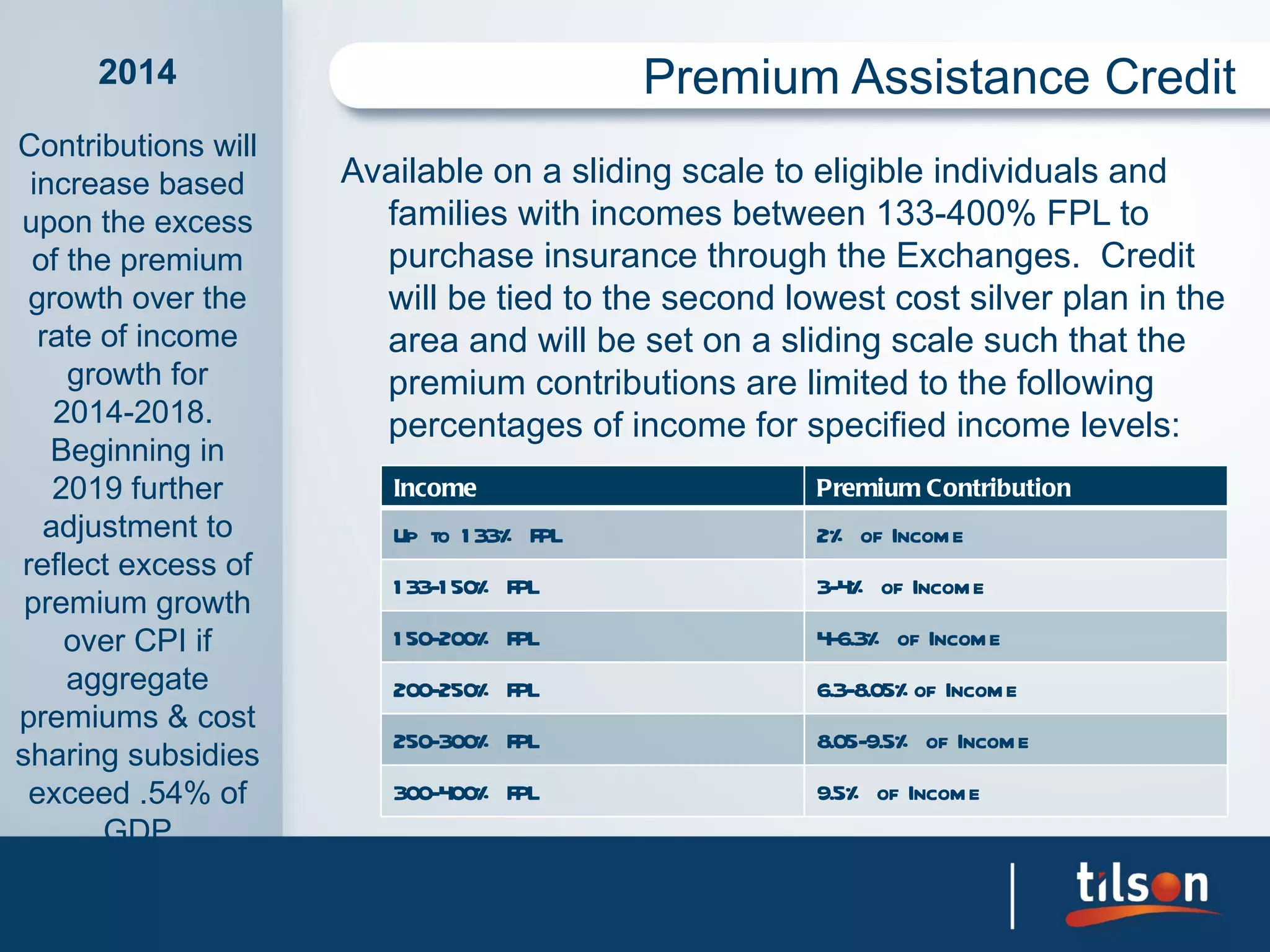
2014                               Premium Assistance Credit
Contributions will
 increase based      Available on a sliding scale to eligible individuals and
upon the excess        families with incomes between 133-400% FPL to
 of the premium        purchase insurance through the Exchanges. Credit
 growth over the       will be tied to the second lowest cost silver plan in the
  rate of income       area and will be set on a sliding scale such that the
     growth for        premium contributions are limited to the following
    2014-2018.         percentages of income for specified income levels:
   Beginning in
    2019 further        Income                      Premium Contribution
   adjustment to        Up to 133% FPL              2% of Income
reflect excess of
                        133-150% FPL                3-4% of Income
 premium growth
     over CPI if        150-200% FPL                4-6.3% of Income
     aggregate          200-250% FPL                6.3-8.05%of Income
premiums & cost
                        250-300% FPL                8.05-9.5% of Income
sharing subsidies
 exceed .54% of         300-400% FPL                9.5% of Income
       GDP
THA Y
   NK OU

How Does Obamacare Impact Your Business Planning?

  • 1.
    How Does ObamacareImpact Your Business Planning? July 17, 2012
  • 2.
    Agenda Today’s Speakers Impact of Reform on Employers, Employees, Insurers and Government Kimberly Hollis, REBC Employee Benefit Consultant, Tilson Break How Reform Impacts Employer Provided Healthcare Brent Tilson President, Tilson
  • 3.
    Today  Our goaltoday is to review the requirements and provide you tools for planning your future budgets and business strategies.  Due to the size and scope of this new law we have not addressed all areas and complexities.  Disclaimer: This should be used for informational purposes only. Please seek professional guidance from your attorneys and CPAs.
  • 4.
    Part 1 Compliance
  • 5.
    Part 1 • Historical Update • Upcoming Requirements • Exchanges • Employee Counts
  • 6.
    Changes since March23, 2010 • CLASS Act will not be implemented • Cuts to Medicare Payments to Physicians delayed • Increase in 1099 requirements repealed • Free Choice Vouchers repealed • Enforcement of non-discrimination rules delayed • Auto enrollment for companies with more than 200 employees delayed until after 2014 pending release of regulations
  • 7.
    Implemented since March23, 2010 • Guaranteed coverage for uninsured with pre-existing conditions (after 6 months) • Prohibition against lifetime limits and rescissions • Patient Protections (appeals, emergency services) • Guaranteed issue under age 19 • Dependent coverage to age 26 • Preventive care coverage required • MLR (80% for individual and small group/85% for large group) • Salary caps for carrier executives
  • 8.
    Supreme Court Ruling •Upheld constitutionality of PPACA and Individual Mandate • Mandate not constitutional under commerce clause, but deemed a tax • Taxes that encourage citizens or behaviors is deemed allowable • Medicaid expansion…
  • 9.
    Employer Requirements If youdon’t offer coverage, you still have to meet most of the requirements outlined here. Determining whether you will continue to offer group coverage will be addressed later.
  • 10.
    If you offercoverage… 2012  September (New Hires after 9/23) Summary of coverage required to all applicants and enrollees (not more than 4 pages front and back in 12 point font – template has been provided by HHS)  Submit annually to DHHS and to plan enrollees during the annual open enrollment period a report on whether the benefits under the plan or coverage include the specified components 2013  W2 reporting of aggregate cost of employer sponsored health coverage for taxable years after 12/31/2012 for employers who issue more than 250 W2s.
  • 11.
    If you offercoverage… 2014  Waiting periods not to exceed 90 days for employer sponsored health coverage
  • 12.
    Whether you offercoverage or not… 2013  January: Collect Employee Medicare payroll tax increase of 0.9% for earnings over $200,000 for individuals and $250,000 for joint filers  March: Provide notice to employees informing them of the existence of an Exchange, the availability of premium assistance if the actuarial value of the employer’s plan is below 60% in the upcoming plan year (2014) 2014  (Date TBD) State required to offer premium assistance to Medicaid beneficiaries for employer sponsored coverage  Penalties for employers with 50+ full-time equivalent employees who have one or more employees receiving the tax credit
  • 13.
    Whether you offercoverage or not… 2014  Coverage documentation (by employee) reported to both individuals and to the IRS, including the following: – Whether the employer offers minimum essential coverage to full-time employees; – Any waiting period for health coverage; – The monthly premium for the lowest cost option in each enrollment category under the plan; – The employer’s share of the total allowed cost of benefits provided under the plan; – The number of full-time employees during each month; – The name, address and taxpayer ID (SSN) of each full- time employee, and the months each employee was covered under the employer’s plan, and; – Other information to be determine by HHS Secretary in regulations.
  • 14.
    Benefit Changes 2013  Flexible Spending Account deferrals will be limited to $2,500 beginning in 2013.  Additional preventive care benefits, including birth control covered at 100% with no cost share.
  • 15.
    Changes still tobe implemented 2012  States must submit to HHS by November 16, 2012 if they wish to operate a state-based exchanges or a Partnership exchange. Currently Indiana is “studying options” according to kff.org. 2013  Increases the threshold for the itemized deduction for unreimbursed medical expenses from 7.5% of adjusted gross income to 10% of adjusted gross income; waives the increase for individuals age 65 and older for tax years 2013 through 2016.  Imposes an excise tax of 2.3% on the sale of any taxable medical device.
  • 16.
    Changes still tobe implemented 2014  Create state-based Exchanges and SHOPs through which individuals and small businesses can purchase qualified coverage  Creates a temporary reinsurance program to collect payments from health insurers in the individual and group markets to provide payments to plans in the individual market that cover high-risk individuals  Limit deductibles for health plans in small group market to: – $2,000 for individuals – $4,000 for families (unless contributions are offered that offset the deductible amounts above these limits)
  • 17.
    Modified Community RatingRequirements 2014  Applies to all individual health insurance policies, all fully insured group policies 100 lives and under, and all plans offered through Exchanges  Premium variations only allowed for: – Age 3:1 – Tobacco Use 1.5:1 – Family Composition – Geographic Region (defined by state)  Experience rating will be prohibited  Wellness discounts are allowed under specific circumstances
  • 18.
    Minimum Loss RatioRequirements 2011  Applies to insurers in all markets  85% for large group plans  80% for individual and small group plans (100 and below)  Carriers will have to issue a premium rebate to individuals for plans that fail to meet the minimum MLR requirements August  In Indiana, small groups for Anthem will receive rebates 2012 this year. No markets for United Healthcare will receive rebates. Average rebate from Anthem: $86/participating employee. Will be sent to employer to either return to employees or offset future premium costs.
  • 19.
    Employee Requirements 2013  Individuals with earnings over $200,000 (or $250,000 for joint filers) will pay an additional $0.9% Medicare Hospital Insurance Tax (HI)  Same individuals will pay an additional 3.8% HI tax on unearned income  Itemized deduction for unreimbursed medical expenses increased from 7.5% of AGI to 10% of AGI for regular tax purpose; increase waived for individuals age 65 and older for t.ax year 2013 through 2016. Note: Individuals are required to increase their tax withholdings to pay for increased Medicare Tax
  • 20.
    Employee Requirements 2014  TBD: Medicaid eligibility increased to 133% of FPL  Premium assistance for employer-sponsored coverage Each state for Medicaid beneficiaries will be  All American citizens and legal residents required to allowed to purchase qualified health insurance coverage determine  Exceptions: next steps on – religious objectors eligibility for Medicaid – individuals not lawfully present – incarcerated individuals Indiana: TBD – taxpayers with income under 100 percent of poverty, and those who have a hardship waiver – members of Indian tribes – those who were not covered for a period of less than three months during the year – People with no income tax liability
  • 21.
    Requirements to BuyCoverage Under the Affordable Care Act Beginning 2014
  • 22.
    Requirements to BuyCoverage Under the Affordable Care Act Beginning 2014
  • 23.
    Requirements to BuyCoverage Under the Key Facts: Affordable •Premiums for health insurance bought through Care Act Exchanges would vary by age. The Congressional Budget Office estimates that the national average Beginning annual premium in an Exchange in 2016 would be 2014 $4,500-$5,000 for an individual and $12,000-$12,500 for a family for Bronze coverage (the lowest of the four tiers of coverage that will be available. •In 2010 employees paid $899 on average towards the cost of individual coverage in an employer plan and $3,997 for a family of four. •A Kaiser Family Foundation subsidy calculator illustrating premiums and tax credits for people in different circumstances is available at: http://healthreform.kff.org/subsidycalculator.aspx
  • 24.
    Exchange Benefit Tiers Bronze plan represents minimum creditable coverage
  • 25.
    Exchange Out-of- pocket limits (For Silver Plan Only) Scale for incomes up to 400% of FPL:
  • 26.
    Exchange 2014  Exchanges must offer: – At least 2 multi-state plans – At least one plan must be offered by a non-profit entity – At least one plan must not provide coverage for abortions beyond those permitted by federal law  Allow states to merge the individual and small group markets
  • 27.
  • 28.
  • 29.
    How do youcount employees? Some provisions are based on employer size. The number of “full-time” employees you have is based upon the following Full-Time FTE = Equivalent (FTE) formula: Full-time  Employees working at least 30 or more hours Equivalent per week (averaged monthly) = 1 FTE  Full-time Seasonal employees working less than 120 days during the year are excluded. Per the  Part-time employees: Total hours for PPACA 4 weeks/120 = # FTE
  • 30.
    Part 2 How the Reform Impacts Employer Provided Healthcare
  • 31.
    7 Step Process •Step 1 – Prepare employee census and cost analysis • Step 2 – Identify future coverage options • Step 3 – Calculate and project estimated cost from each option • Step 4 – Analyze the cost of offering healthcare or not • Step 5 – Conduct analysis of workforce • Step 6 – Compare cost analysis against workforce dynamics • Step 7 – Make decision
  • 32.
    Step 1 –Current Cost Support • Prepare a spreadsheet with the following details: – Employee – Status (full time, part time, seasonal) – Age – Compensation – Health Coverage – Cost support
  • 33.
    Step 2 –Identify Coverage Options Commercial Assoc Private Carriers Exchanges Self-Funded Health Plans PEO Exchange Small Today <50 EEs N/A >100 EEs Small Groups N/A Groups Small Groups Small Groups Large Groups Small Future Small Groups New <100 EEs <50 <100 >25 Groups Expected to Depends ?? Community Community No – actual Pricing Controls be Community on plan Community Pricing 3:1 Pricing 3:1 claims Pricing 3:1 type Pricing 3:1 Group: Yes Pre-Tax Yes Yes Yes Yes Yes Individual: No Negotiate Only pay Negotiate Negotiate Older/High Risk Older/High Risk Lower rates Actual Claims lower MLR Lower rates Groups – Groups – as maybe Advantages – Appeal to as MLR may Pricing Should Pricing Should able to young/healthy Self- be lower Decrease Decrease decrease groups funded? MLR Large Young/Healthy Young/Healthy Adverse Disadvantages Higher $ Risk group W-2 Unknown Prices Increase Prices Increase Selection reporting Government Subsidy Group: No No No No No No for 133%-400% Individual : Yes Minimum Essential Yes Yes Not required Yes/No Yes/No Yes Benefits
  • 34.
    Price Price Controls – Community Rating controls today for small group that allow for 5:1 but now it will move to 3:1 plus removing health conditions will amplify changes
  • 35.
    Step 3 –Calculate and Project Costs • Initially this will require both math and creativity • As 2014 nears your numbers will become more accurate • Today you will need to use some of the variables to guess impact your future rates – average age, health conditions, impact of price controls
  • 36.
    Step 4 -Analyze Cost to Offer or Not • Using the employee census • Calculate for both offering coverage and not offering coverage • Offering coverage: – Estimate costs for each current employee based upon coverage options (commercial carrier, self-funded) – Calculate your total cost support – Economic value of pre-tax deductions
  • 37.
    Step 4 -Continued • Not offering coverage: – Calculate compensation increase to adjust for economic equality – Calculate ER penalties if applicable – Based upon compensation calculate government subsidies per employee (this is problematic to know family income) – Economic disadvantage of post-tax • Determine total with our without
  • 38.
    Step 5 –Workforce Analysis • Size of your company • Growth plans • Average wage • Sophistication • Culture • Competition for employees • Retention • Competition
  • 39.
    Step 6 –Weigh Costs vs. Workforce • Will you need to increase pay to retain employees? • Will competition for employees force you to keep employees? • Are your insurance costs so high and workforce demographics encourage dropping coverage? • Can you find a more competitive and affordable solution?
  • 40.
    Step 7 –Make the Decision • This should provide you with the major components to make an informed decision…. • The challenge is now employees will be also viewing their employment opportunities differently….
  • 41.
    Lets Discuss theEmployee’s Perspective • Age • Wage • Family health • Geographic location (states) • Employer provided health or compensation subsidized
  • 42.
    In Summary • Regulatoryand reporting challenges • Coverage options • Alignment of workforce and economics • Decisions, decisions, decisions
  • 43.
    2014 Premium Assistance Credit Contributions will increase based Available on a sliding scale to eligible individuals and upon the excess families with incomes between 133-400% FPL to of the premium purchase insurance through the Exchanges. Credit growth over the will be tied to the second lowest cost silver plan in the rate of income area and will be set on a sliding scale such that the growth for premium contributions are limited to the following 2014-2018. percentages of income for specified income levels: Beginning in 2019 further Income Premium Contribution adjustment to Up to 133% FPL 2% of Income reflect excess of 133-150% FPL 3-4% of Income premium growth over CPI if 150-200% FPL 4-6.3% of Income aggregate 200-250% FPL 6.3-8.05%of Income premiums & cost 250-300% FPL 8.05-9.5% of Income sharing subsidies exceed .54% of 300-400% FPL 9.5% of Income GDP
  • 45.
    THA Y NK OU

Editor's Notes

  • #21 Are slides 24 and 25 necessary after adding slides 26 thru 28?
  • #24 I retyped the last page of the “Requirements to Buy Coverage” instead of pasting the last section…I think it looks better. I also think we need to add a citation to the study this information came from…BBH