Slate Magazine
Politics, Business, Technology and the Arts
Morgan Smith, Peter Williams, Emma Brant
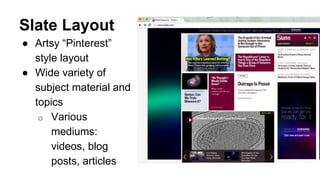
Slate Layout
● Artsy “Pinterest”
style layout
● Wide variety of
subject material and
topics
o Various
mediums:
videos, blog
posts, articles
Arts Section
● Dedicated Arts Section covering film, books, culture,
movies, music, and television
● Variety of blogs on the website about the arts
o Screening Room: Movie Class without the Homework, Browbeat:
Slate’s Culture Blog, Behold: the Photography Blog
● Sidebar links to other arts publications
o ex. New York Magazine, Wired, Huffington Post
Browbeat: Slate’s Culture Blog
● The movie criticism section covers award shows,
reviews recent releases, and explores the controversy
around contested films
● The music section reflects on upcoming artists, the
curse of popularity, and the pitfalls of the music industry
● The book section reviews new alternative literature,
debates the merit of genres, and occasionally provides
retrospectives on classics
Analyze
Browbeat: a Cultural Blog
● The Browbeat section offers arts criticism of popular culture,
including film, television, books, and music. Predominantly
television.
● Criticism is less of the art itself, but of the industry and
circumstances surrounding it. For example, the “Blurred Lines”
article focuses more on the music industry than the music itself.
● The purest criticism comes from book reviews, like Katy Waldman’s
2-page review of Helen MacDonald’s H is for Hawk
Analyze
Behold: A Photo Journalism blog
● Behold features the works of a number of different Photographers,
whose topics can range from people covered in honey, to the
survivors of gun violence.
● The majority of the work focuses on photos that would interest the
average reader, like “Porn Stars from the Neck Up”
o Few are of things that could be considered “High Art.”
● There are a few examples of more serious photography, like
Japanese art reflecting on the 3/11 natural disaster that serve to
separate “Behold” from your average pinterest feed.
Analyze
Use of Video Segments
● A common ploy of Slate is the inclusion of outside video clips
with a brief commentary written by a Slate journalist to lure in
readers
● Slate often reposts these videos to showcase various
successful arts and humanities sites from around the web
● Typical topics include the history of Friday the 13th, TV criticism,
or cultural commentary or criticism
● This technique is effective for serving enthusiasts as it exposes
them to new sources or perspectives from around the web
Criticism Overview
● Film criticism: “How Leonard Nimoy Left Us
with the Best Scene in Star Trek”
● Humanities criticism: “A History of
Misunderstanding”
● Film criticism: “Why a Movie Starring
Jennifer Lawrence and Bradley Cooper
Didn’t Make it to Theaters”
How Leonard Nimoy Left Us With the Best
Scene in Star Trek
● This article examines a pivotal scene in the early Star
Trek franchise in response to the actor’s recent death
● It addresses enthusiasts by examining the character
depth and relationships amongst characters exposed in
this telling sequence
● The article focuses on the character development of
Spock and his position as an important pivotal figure
throughout the later seasons
A History of Misunderstanding
● Emily Bazelon and Ruth Margalit’s article discusses Palestinian
and Israeli textbooks and why they need to be reformed.
● This is a perfect standard for humanities criticism. The article
reveals truths about the ineffectiveness of Middle-Eastern
textbooks and how that ineffectiveness stems from religious and
political differences.
● Serves as a muckraking article, trying to expose political
wrongdoings affecting education.
● This article is representative of humanities criticism on the
website, which generally focuses on international political
issues.
Why a Movie Starring Jennifer Lawrence and Bradley
Cooper Didn’t Make it to Theaters
● Very surface depth level article about movie production
and why the movie failed
● More information about Actor’s and director than on the
movie itself
● Was an adequate summary of the movie production,
allowed readers a more in depth understanding of the
entire movie than would be afforded by simply watching
the movie
● Focuses on causal factors and miscues
Works Cited
● Bazelon, Emily. "Are Palestinian Textbooks Actually Any Worse Than Israeli Textbooks?" Web. 14 Mar. 2015.
● "Behold." Slate Magazine. Slate. Web. 14 Mar. 2015. <http://www.slate.com/blogs/behold.html>.
● Kal Raustiala and Christopher Jon Sprigman. "Legally and Musically, the “Blurred Lines” Decision Is a Disaster." Slate Magazine. 12
Mar. 2015. Web. 14 Mar. 2015.
● Liu, Lowen. "How Leonard Nimoy Left Us With the Best Scene in Star Trek." Slate Magazine. 27 Feb. 2015. Web. 14 Mar. 2015.
● Sternbergh, Adam. "Why a Movie Starring Jennifer Lawrence and Bradley Cooper Didn’t Make It to Theaters." Slate Magazine. 12 Mar.
2015. Web. 13 Mar. 2015.
● McCarthy, Chris. "Why a U.S. Vet Wrote a Novel About Insider Attacks from an Afghan Soldier's Perspective." Slate Magazine. 5 Mar.
2015. Web. 14 Mar. 2015.
● “Slate Homepage.” Slate Magazine, n.d.. Screenshot. March 12 2015.
● Stewart, Rachel. "What’s So Bad About Friday the 13th, Anyway?" Slate Magazine. 13 Mar. 2015. Web. 13 Mar. 2015.
● Teicher, Jordan. "Porn Stars From the Neck Up." Slate Magazine. 13 Mar. 2015. Web. 13 Mar. 2015.
● Teicher, Jordan. "Stirring Images From Japanese Photographers Reflecting on the National Tragedy of 3/11." Slate Magazine. 11 Mar.
2015. Web. 13 Mar. 2015.
● Wade, Chris. "Every Shot on House of Cards Looks the Same." Slate Magazine. 1 Mar. 2015. Web. 13 Mar. 2015.
● Waldman, Katy. "H Is for Hawk Is Like No Book I’ve Ever Read Before." Slate Magazine. 6 Mar. 2015. Web. 14 Mar. 2015.

CO301a Presentation

  • 1.
    Slate Magazine Politics, Business,Technology and the Arts Morgan Smith, Peter Williams, Emma Brant
  • 2.
    Slate Layout ● Artsy“Pinterest” style layout ● Wide variety of subject material and topics o Various mediums: videos, blog posts, articles
  • 3.
    Arts Section ● DedicatedArts Section covering film, books, culture, movies, music, and television ● Variety of blogs on the website about the arts o Screening Room: Movie Class without the Homework, Browbeat: Slate’s Culture Blog, Behold: the Photography Blog ● Sidebar links to other arts publications o ex. New York Magazine, Wired, Huffington Post
  • 4.
    Browbeat: Slate’s CultureBlog ● The movie criticism section covers award shows, reviews recent releases, and explores the controversy around contested films ● The music section reflects on upcoming artists, the curse of popularity, and the pitfalls of the music industry ● The book section reviews new alternative literature, debates the merit of genres, and occasionally provides retrospectives on classics
  • 5.
    Analyze Browbeat: a CulturalBlog ● The Browbeat section offers arts criticism of popular culture, including film, television, books, and music. Predominantly television. ● Criticism is less of the art itself, but of the industry and circumstances surrounding it. For example, the “Blurred Lines” article focuses more on the music industry than the music itself. ● The purest criticism comes from book reviews, like Katy Waldman’s 2-page review of Helen MacDonald’s H is for Hawk
  • 6.
    Analyze Behold: A PhotoJournalism blog ● Behold features the works of a number of different Photographers, whose topics can range from people covered in honey, to the survivors of gun violence. ● The majority of the work focuses on photos that would interest the average reader, like “Porn Stars from the Neck Up” o Few are of things that could be considered “High Art.” ● There are a few examples of more serious photography, like Japanese art reflecting on the 3/11 natural disaster that serve to separate “Behold” from your average pinterest feed.
  • 7.
    Analyze Use of VideoSegments ● A common ploy of Slate is the inclusion of outside video clips with a brief commentary written by a Slate journalist to lure in readers ● Slate often reposts these videos to showcase various successful arts and humanities sites from around the web ● Typical topics include the history of Friday the 13th, TV criticism, or cultural commentary or criticism ● This technique is effective for serving enthusiasts as it exposes them to new sources or perspectives from around the web
  • 8.
    Criticism Overview ● Filmcriticism: “How Leonard Nimoy Left Us with the Best Scene in Star Trek” ● Humanities criticism: “A History of Misunderstanding” ● Film criticism: “Why a Movie Starring Jennifer Lawrence and Bradley Cooper Didn’t Make it to Theaters”
  • 9.
    How Leonard NimoyLeft Us With the Best Scene in Star Trek ● This article examines a pivotal scene in the early Star Trek franchise in response to the actor’s recent death ● It addresses enthusiasts by examining the character depth and relationships amongst characters exposed in this telling sequence ● The article focuses on the character development of Spock and his position as an important pivotal figure throughout the later seasons
  • 10.
    A History ofMisunderstanding ● Emily Bazelon and Ruth Margalit’s article discusses Palestinian and Israeli textbooks and why they need to be reformed. ● This is a perfect standard for humanities criticism. The article reveals truths about the ineffectiveness of Middle-Eastern textbooks and how that ineffectiveness stems from religious and political differences. ● Serves as a muckraking article, trying to expose political wrongdoings affecting education. ● This article is representative of humanities criticism on the website, which generally focuses on international political issues.
  • 11.
    Why a MovieStarring Jennifer Lawrence and Bradley Cooper Didn’t Make it to Theaters ● Very surface depth level article about movie production and why the movie failed ● More information about Actor’s and director than on the movie itself ● Was an adequate summary of the movie production, allowed readers a more in depth understanding of the entire movie than would be afforded by simply watching the movie ● Focuses on causal factors and miscues
  • 12.
    Works Cited ● Bazelon,Emily. "Are Palestinian Textbooks Actually Any Worse Than Israeli Textbooks?" Web. 14 Mar. 2015. ● "Behold." Slate Magazine. Slate. Web. 14 Mar. 2015. <http://www.slate.com/blogs/behold.html>. ● Kal Raustiala and Christopher Jon Sprigman. "Legally and Musically, the “Blurred Lines” Decision Is a Disaster." Slate Magazine. 12 Mar. 2015. Web. 14 Mar. 2015. ● Liu, Lowen. "How Leonard Nimoy Left Us With the Best Scene in Star Trek." Slate Magazine. 27 Feb. 2015. Web. 14 Mar. 2015. ● Sternbergh, Adam. "Why a Movie Starring Jennifer Lawrence and Bradley Cooper Didn’t Make It to Theaters." Slate Magazine. 12 Mar. 2015. Web. 13 Mar. 2015. ● McCarthy, Chris. "Why a U.S. Vet Wrote a Novel About Insider Attacks from an Afghan Soldier's Perspective." Slate Magazine. 5 Mar. 2015. Web. 14 Mar. 2015. ● “Slate Homepage.” Slate Magazine, n.d.. Screenshot. March 12 2015. ● Stewart, Rachel. "What’s So Bad About Friday the 13th, Anyway?" Slate Magazine. 13 Mar. 2015. Web. 13 Mar. 2015. ● Teicher, Jordan. "Porn Stars From the Neck Up." Slate Magazine. 13 Mar. 2015. Web. 13 Mar. 2015. ● Teicher, Jordan. "Stirring Images From Japanese Photographers Reflecting on the National Tragedy of 3/11." Slate Magazine. 11 Mar. 2015. Web. 13 Mar. 2015. ● Wade, Chris. "Every Shot on House of Cards Looks the Same." Slate Magazine. 1 Mar. 2015. Web. 13 Mar. 2015. ● Waldman, Katy. "H Is for Hawk Is Like No Book I’ve Ever Read Before." Slate Magazine. 6 Mar. 2015. Web. 14 Mar. 2015.