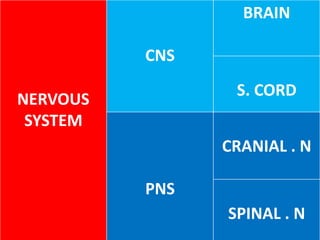
NERVOUS
SYSTEM
CNS
BRAIN
S. CORD
PNS
CRANIAL . N
SPINAL . N
PNS
CRANIAL . N
AUTONOMIC
SOMATIC
SPINAL . N
AUTONOMIC
SOMATIC
BRAIN
CEREBRUM
FRONTAL. L
PARIETAL.L
TEMPORAL.L
OCCIPITAL.L
DIENCEPHALON
THALAMUS
HYPOTHALAMUS
PINEAL GLANDS
BRAINSTEM
MEDULLA
PONS
MIDBRAIN
CEREBELLUM
VERMIS
CEREBELLAR .H
VENTRICULAR SYSTEM
Ventricular system
*The system comprises four ventricles:
lateral ventricles right and left (one for each hemisphere)
third ventricle
fourth ventricle
*There are several foramina, openings acting as channels, that
connect the ventricles.
*The interventricular foramina (also called the foramina of Monro)
connect the lateral ventricles to the third ventricle through which
the cerebrospinal fluid can flow.
1. Lateral ventricle
2. Interventricular foramen
3. Third ventricle
4. Cerebral aqueduct
5. Fourth ventricle
6a. M. aperture6b. L . aperture 6c. Central canal
7. Subarachnoid space
8. Arachnoid villi
9. Dural sinuses
Name From To
Interventricular
foramina (Monro)
lateral ventricles Third ventricle
Cerebral aqueduct
(Sylvius)
Third ventricle Fourth ventricle
Median aperture
(Magendie)
Fourth ventricle
Subarachnoid space
via the cisterna magna
Right and left lateral
aperture (Luschka)
Fourth ventricle
Subarachnoid space
via the cistern of great
cerebral vein
Arterial blood supply of the brain
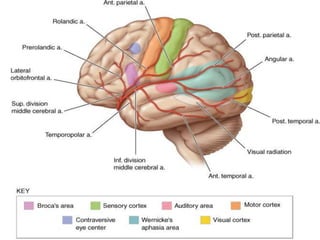
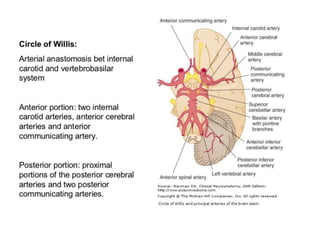
*Brain is supplied by pairs of internal carotid artery and vetebral
artery.
*Internal carotid artery: branch from common carotid artery,
enters brain from carotid canal, splits into middle and anterior
cerebral artery
*Vertebral artery, branch from the subclavian artery, joins
together to form the basilar artery. The latter artery splits into
posterior cerebral arteries.
DURAL SINUS
Venous sinuses
Internal capsule(I C)
*IC is a white matter structure situated in the inferomedial part of
each cerebral hemisphere of brain.
*IC is one of the subcortical structures of the brain.
Types of fibers
*Anterior limb: frontopontine fibers (frontal cortex to pons),
thalamocortical fibers (thalamus to frontal lobe).
*Genu (angle): corticobulbar fibers (cortex to brainstem).
*Posterior limb: corticospinal fibers (cortex to spine), sensory fibers
Structure
*I C is V-shaped:
1- The bend in the V is called the genu.
2- The anterior limb is the part in front of the genu, between the
head of the caudate nucleus and the lenticular nucleus.
3- The posterior limb is the part behind the genu, between the
thalamus and lenticular nucleus.
*Above the basal ganglia the corticospinal tract is a part of the corona
radiata, below the basal ganglia the tract is called crus cerebri (a part
of the cerebral peduncle) and below the pons it is referred to as the
corticospinal tract.
Blood Supply
*Mainly fed by the lenticulostriate branches of middle cerebral artery
(MCA), less often branches of anterior cerebral artery (ACA).
*The lenticulostriate arteries are small penetrating blood vessels that
supply blood flow to most of the subcortical structures.
sensory system
*A sensory system is a part of the nervous system responsible for processing sensory
information.
*A sensory system consists of sensory receptors, neural pathways, and parts of the brain
involved in sensory perception.
* Commonly recognized sensory systems are those for vision, auditory (hearing), somatic
sensation (touch), gustatory (taste), olfaction (smell) and vestibular (balance/movement).
*In short, senses are transducers from the physical world to the realm of the mind where
we interpret the information, creating our perception of the world around us.
*Lesions affecting the primary somatosensory cortex produce characteristic symptoms
including: agraphesthesia, astereognosia, hemihypesthesia, and loss of vibration,
proprioception and fine touch (because the third-order neuron of the medial-lemniscal
pathway cannot synapse in the cortex).
*It can also produce hemineglect, if it affects the non-dominant hemisphere.
*Destruction of brodmann area 3, 1, and 2 results in contralateral hemihypesthesia and
astereognosis.
*It could also reduce nociception, thermoception, and crude touch, but, since
information from the spinothalamic tract is interpreted mainly by other areas of the brain
(see insular cortex and cingulate gyrus), it is not as relevant as the other
symptoms[citation needed].
Nonspecific Ascending Pathway
• Include the lateral and anterior
spinothalamic tracts
• Lateral: transmits impulses
concerned with pain and temp.
to opposite side of brain
• Anterior: transmits impulses
concerned with crude touch and
pressure to opposite side of brain
• 1st order neuron: sensory neuron
• 2nd order neuron: interneurons
of dorsal horn; synapse with 3rd
order neuron in thalamus
• 3rd order neuron: carry impulse
from thalamus to postcentral
gyrus
Specific and Posterior Spinocerebellar Tracts
• Dorsal Column Tract
1. AKA Medial lemniscal pathway
2. Fibers run only in dorsal column
3. Transmit impulses from receptors in
skin and joints
4. Detect discriminative touch and
body position sense =proprioception
• 1st order neuron - a sensory neuron
• synapses with 2nd order neuron in
nucleus gracilis and nucleus
cuneatus of medulla
• 2nd order neuron.- an interneuron
• decussate and ascend to thalamus
where it synapses with 3rd order
neuron
• 3rd-order (thalamic neurons)
•transmits impulse to somato-
sensory cortex (postcentral gyrus)
Spinocerebellar Tract
• Transmit info. about trunk and lower
limb muscles and tendons to cerebellum
• No conscious sensation
MOTOR SYSTEM
Motor system
*The motor system is the part of the central nervous system that is involved with
movement.
*It consists of the pyramidal and extrapyramidal system .
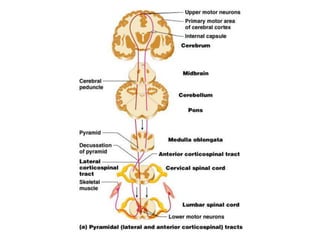
*The pyramidal motor system, also called the pyramidal tract or the corticospinal tract,
start in the motor center of the cerebral cortex.
*There are upper and lower motor neurons in the corticospinal tract.
*The motor impulses originates in the giant pyramidal cells or Betz cells of the motor
area; i.e., precentral gyrus of cerebral cortex.
*These are the upper motor neurons (UMN) of the corticospinal tract.
*The axons of these cells pass in the depth of the cerebral cortex to the corona radiata
and then to the internal capsule passing through the posterior branch of internal capsule
and continue to descend in the midbrain and the medulla oblongata.
* In the lower part of Medulla oblongata 80 to 85% of these fibers decussate (pass to the
opposite side) and descend in the white matter of the lateral funiculus of the spinal cord
on the opposite side.
*The remaining 15 to 20% pass to the same side.
*Fibers for the extremities (limbs) pass 100% to the opposite side.
*The fibers of the corticospinal tract terminate at different levels in the anterior horn of
the grey matter of the spinal cord.
*Here the lower motor neurons (LMN) of the corticospinal cord are located.
•Peripheral motor nerves carry the motor impulses from the anterior horn to the
voluntary muscles.
Extrapyramidal system
*The extrapyramidal system is a neural network that is part of the motor system that
causes involuntary reflexes and movement, and modulation of movement (i.e.
coordination).
*The system is called "extrapyramidal" to distinguish it from the tracts of the motor cortex
that reach their targets by traveling through the "pyramids" of the medulla.
*The pyramidal pathways (corticospinal and some corticobulbar tracts) may directly
innervate motor neurons of the spinal cord or brainstem (anterior (ventral) horn cells or
certain cranial nerve nuclei), whereas the extrapyramidal system centers on the modulation
and regulation (indirect control) of anterior (ventral) horn cells.
*Extrapyramidal tracts are chiefly found in the reticular formation of the pons and medulla,
and target neurons in the spinal cord involved in reflexes, locomotion, complex
movements, and postural control.
*These tracts are in turn modulated by various parts of the central nervous system,
including the nigrostriatal pathway, the basal ganglia, the cerebellum, the vestibular nuclei,
and different sensory areas of the cerebral cortex.
*All of these regulatory components can be considered part of the extrapyramidal system,
in that they modulate motor activity without directly innervating motor neurons.
*The extrapyramidal tracts include parts of the following:
rubrospinal tract
pontine reticulospinal tract
medullary reticulospinal tract
lateral vestibulospinal tract
tectospinal tractthe extrapyramidal system
Extrapyramidal Motor Tracts
• Includes all motor pathways not part of the pyramidal system
• Upper motor neuron (UMN) originates in nuclei deep in cerebrum (not in
cerebral cortex)
• UMN does not pass through the pyramids!
• LMN is an anterior horn motor neuron
• This system includes
– Rubrospinal
– Vestibulospinal
– Reticulospinal
– Tectospinal tracts
• Regulate:
– Axial muscles that maintain balance and posture
– Muscles controlling coarse movements of the proximal portions of limbs
– Head, neck, and eye movement
Spinal Cord
Spinal Cord
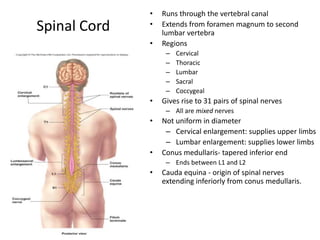
• Runs through the vertebral canal
• Extends from foramen magnum to second
lumbar vertebra
• Regions
– Cervical
– Thoracic
– Lumbar
– Sacral
– Coccygeal
• Gives rise to 31 pairs of spinal nerves
– All are mixed nerves
• Not uniform in diameter
– Cervical enlargement: supplies upper limbs
– Lumbar enlargement: supplies lower limbs
• Conus medullaris- tapered inferior end
– Ends between L1 and L2
• Cauda equina - origin of spinal nerves
extending inferiorly from conus medullaris.
Meninges
• Connective tissue membranes
– Dura mater: outermost layer; continuous with
epineurium of the spinal nerves
– Arachnoid mater: thin and wispy
– Pia mater: bound tightly to surface
• Forms the filum terminale
– anchors spinal cord to coccyx
• Forms the denticulate ligaments that attach the
spinal cord to the dura
• Spaces
– Epidural: external to the dura
• Anesthestics injected here
• Fat-fill
– Subdural space: serous fluid
– Subarachnoid: between pia and arachnoid
• Filled with CSF
Cross Section
of Spinal Cord
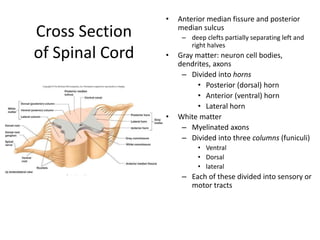
• Anterior median fissure and posterior
median sulcus
– deep clefts partially separating left and
right halves
• Gray matter: neuron cell bodies,
dendrites, axons
– Divided into horns
• Posterior (dorsal) horn
• Anterior (ventral) horn
• Lateral horn
• White matter
– Myelinated axons
– Divided into three columns (funiculi)
• Ventral
• Dorsal
• lateral
– Each of these divided into sensory or
motor tracts
Cross section of Spinal Cord
• Commissures: connections between left
and right halves
– Gray with central canal in the center
– White
• Roots
– Spinal nerves arise as rootlets then
combine to form dorsal and ventral
roots
– Dorsal and ventral roots merge
laterally and form the spinal nerve

Cns

  • 1.
  • 2.
  • 3.
  • 7.
  • 8.
    Ventricular system *The systemcomprises four ventricles: lateral ventricles right and left (one for each hemisphere) third ventricle fourth ventricle *There are several foramina, openings acting as channels, that connect the ventricles. *The interventricular foramina (also called the foramina of Monro) connect the lateral ventricles to the third ventricle through which the cerebrospinal fluid can flow.
  • 9.
    1. Lateral ventricle 2.Interventricular foramen 3. Third ventricle 4. Cerebral aqueduct 5. Fourth ventricle 6a. M. aperture6b. L . aperture 6c. Central canal 7. Subarachnoid space 8. Arachnoid villi 9. Dural sinuses
  • 10.
    Name From To Interventricular foramina(Monro) lateral ventricles Third ventricle Cerebral aqueduct (Sylvius) Third ventricle Fourth ventricle Median aperture (Magendie) Fourth ventricle Subarachnoid space via the cisterna magna Right and left lateral aperture (Luschka) Fourth ventricle Subarachnoid space via the cistern of great cerebral vein
  • 13.
  • 14.
    Arterial blood supplyof the brain *Brain is supplied by pairs of internal carotid artery and vetebral artery. *Internal carotid artery: branch from common carotid artery, enters brain from carotid canal, splits into middle and anterior cerebral artery *Vertebral artery, branch from the subclavian artery, joins together to form the basilar artery. The latter artery splits into posterior cerebral arteries.
  • 17.
  • 18.
  • 19.
  • 20.
    Internal capsule(I C) *ICis a white matter structure situated in the inferomedial part of each cerebral hemisphere of brain. *IC is one of the subcortical structures of the brain. Types of fibers *Anterior limb: frontopontine fibers (frontal cortex to pons), thalamocortical fibers (thalamus to frontal lobe). *Genu (angle): corticobulbar fibers (cortex to brainstem). *Posterior limb: corticospinal fibers (cortex to spine), sensory fibers
  • 21.
    Structure *I C isV-shaped: 1- The bend in the V is called the genu. 2- The anterior limb is the part in front of the genu, between the head of the caudate nucleus and the lenticular nucleus. 3- The posterior limb is the part behind the genu, between the thalamus and lenticular nucleus.
  • 22.
    *Above the basalganglia the corticospinal tract is a part of the corona radiata, below the basal ganglia the tract is called crus cerebri (a part of the cerebral peduncle) and below the pons it is referred to as the corticospinal tract. Blood Supply *Mainly fed by the lenticulostriate branches of middle cerebral artery (MCA), less often branches of anterior cerebral artery (ACA). *The lenticulostriate arteries are small penetrating blood vessels that supply blood flow to most of the subcortical structures.
  • 23.
    sensory system *A sensorysystem is a part of the nervous system responsible for processing sensory information. *A sensory system consists of sensory receptors, neural pathways, and parts of the brain involved in sensory perception. * Commonly recognized sensory systems are those for vision, auditory (hearing), somatic sensation (touch), gustatory (taste), olfaction (smell) and vestibular (balance/movement). *In short, senses are transducers from the physical world to the realm of the mind where we interpret the information, creating our perception of the world around us. *Lesions affecting the primary somatosensory cortex produce characteristic symptoms including: agraphesthesia, astereognosia, hemihypesthesia, and loss of vibration, proprioception and fine touch (because the third-order neuron of the medial-lemniscal pathway cannot synapse in the cortex). *It can also produce hemineglect, if it affects the non-dominant hemisphere.
  • 24.
    *Destruction of brodmannarea 3, 1, and 2 results in contralateral hemihypesthesia and astereognosis. *It could also reduce nociception, thermoception, and crude touch, but, since information from the spinothalamic tract is interpreted mainly by other areas of the brain (see insular cortex and cingulate gyrus), it is not as relevant as the other symptoms[citation needed].
  • 25.
    Nonspecific Ascending Pathway •Include the lateral and anterior spinothalamic tracts • Lateral: transmits impulses concerned with pain and temp. to opposite side of brain • Anterior: transmits impulses concerned with crude touch and pressure to opposite side of brain • 1st order neuron: sensory neuron • 2nd order neuron: interneurons of dorsal horn; synapse with 3rd order neuron in thalamus • 3rd order neuron: carry impulse from thalamus to postcentral gyrus
  • 26.
    Specific and PosteriorSpinocerebellar Tracts • Dorsal Column Tract 1. AKA Medial lemniscal pathway 2. Fibers run only in dorsal column 3. Transmit impulses from receptors in skin and joints 4. Detect discriminative touch and body position sense =proprioception • 1st order neuron - a sensory neuron • synapses with 2nd order neuron in nucleus gracilis and nucleus cuneatus of medulla • 2nd order neuron.- an interneuron • decussate and ascend to thalamus where it synapses with 3rd order neuron • 3rd-order (thalamic neurons) •transmits impulse to somato- sensory cortex (postcentral gyrus) Spinocerebellar Tract • Transmit info. about trunk and lower limb muscles and tendons to cerebellum • No conscious sensation
  • 27.
  • 28.
    Motor system *The motorsystem is the part of the central nervous system that is involved with movement. *It consists of the pyramidal and extrapyramidal system . *The pyramidal motor system, also called the pyramidal tract or the corticospinal tract, start in the motor center of the cerebral cortex. *There are upper and lower motor neurons in the corticospinal tract. *The motor impulses originates in the giant pyramidal cells or Betz cells of the motor area; i.e., precentral gyrus of cerebral cortex. *These are the upper motor neurons (UMN) of the corticospinal tract. *The axons of these cells pass in the depth of the cerebral cortex to the corona radiata and then to the internal capsule passing through the posterior branch of internal capsule and continue to descend in the midbrain and the medulla oblongata. * In the lower part of Medulla oblongata 80 to 85% of these fibers decussate (pass to the opposite side) and descend in the white matter of the lateral funiculus of the spinal cord on the opposite side.
  • 29.
    *The remaining 15to 20% pass to the same side. *Fibers for the extremities (limbs) pass 100% to the opposite side. *The fibers of the corticospinal tract terminate at different levels in the anterior horn of the grey matter of the spinal cord. *Here the lower motor neurons (LMN) of the corticospinal cord are located. •Peripheral motor nerves carry the motor impulses from the anterior horn to the voluntary muscles.
  • 31.
    Extrapyramidal system *The extrapyramidalsystem is a neural network that is part of the motor system that causes involuntary reflexes and movement, and modulation of movement (i.e. coordination). *The system is called "extrapyramidal" to distinguish it from the tracts of the motor cortex that reach their targets by traveling through the "pyramids" of the medulla. *The pyramidal pathways (corticospinal and some corticobulbar tracts) may directly innervate motor neurons of the spinal cord or brainstem (anterior (ventral) horn cells or certain cranial nerve nuclei), whereas the extrapyramidal system centers on the modulation and regulation (indirect control) of anterior (ventral) horn cells. *Extrapyramidal tracts are chiefly found in the reticular formation of the pons and medulla, and target neurons in the spinal cord involved in reflexes, locomotion, complex movements, and postural control. *These tracts are in turn modulated by various parts of the central nervous system, including the nigrostriatal pathway, the basal ganglia, the cerebellum, the vestibular nuclei, and different sensory areas of the cerebral cortex.
  • 32.
    *All of theseregulatory components can be considered part of the extrapyramidal system, in that they modulate motor activity without directly innervating motor neurons. *The extrapyramidal tracts include parts of the following: rubrospinal tract pontine reticulospinal tract medullary reticulospinal tract lateral vestibulospinal tract tectospinal tractthe extrapyramidal system
  • 33.
    Extrapyramidal Motor Tracts •Includes all motor pathways not part of the pyramidal system • Upper motor neuron (UMN) originates in nuclei deep in cerebrum (not in cerebral cortex) • UMN does not pass through the pyramids! • LMN is an anterior horn motor neuron • This system includes – Rubrospinal – Vestibulospinal – Reticulospinal – Tectospinal tracts • Regulate: – Axial muscles that maintain balance and posture – Muscles controlling coarse movements of the proximal portions of limbs – Head, neck, and eye movement
  • 35.
  • 36.
    Spinal Cord • Runsthrough the vertebral canal • Extends from foramen magnum to second lumbar vertebra • Regions – Cervical – Thoracic – Lumbar – Sacral – Coccygeal • Gives rise to 31 pairs of spinal nerves – All are mixed nerves • Not uniform in diameter – Cervical enlargement: supplies upper limbs – Lumbar enlargement: supplies lower limbs • Conus medullaris- tapered inferior end – Ends between L1 and L2 • Cauda equina - origin of spinal nerves extending inferiorly from conus medullaris.
  • 37.
    Meninges • Connective tissuemembranes – Dura mater: outermost layer; continuous with epineurium of the spinal nerves – Arachnoid mater: thin and wispy – Pia mater: bound tightly to surface • Forms the filum terminale – anchors spinal cord to coccyx • Forms the denticulate ligaments that attach the spinal cord to the dura • Spaces – Epidural: external to the dura • Anesthestics injected here • Fat-fill – Subdural space: serous fluid – Subarachnoid: between pia and arachnoid • Filled with CSF
  • 38.
    Cross Section of SpinalCord • Anterior median fissure and posterior median sulcus – deep clefts partially separating left and right halves • Gray matter: neuron cell bodies, dendrites, axons – Divided into horns • Posterior (dorsal) horn • Anterior (ventral) horn • Lateral horn • White matter – Myelinated axons – Divided into three columns (funiculi) • Ventral • Dorsal • lateral – Each of these divided into sensory or motor tracts
  • 39.
    Cross section ofSpinal Cord • Commissures: connections between left and right halves – Gray with central canal in the center – White • Roots – Spinal nerves arise as rootlets then combine to form dorsal and ventral roots – Dorsal and ventral roots merge laterally and form the spinal nerve