NHE Share of Gross Domestic Product (GDP), 1965-2017 Source: S. Keehan et al., “Health Spending Projections Through 2017,” Health Affairs 27 (2008): w145 – w155 (published online 26 February 2008).
Health Spending Projections Through 2017 Sean Keehan, Andrea Sisko, Christopher Truffer, Sheila Smith, Cathy Cowan, John Poisal, M. Kent Clemens, Kevin Lyons, and Jonathan Cylus Office of the Actuary Centers for Medicare and Medicaid Services February 25, 2008
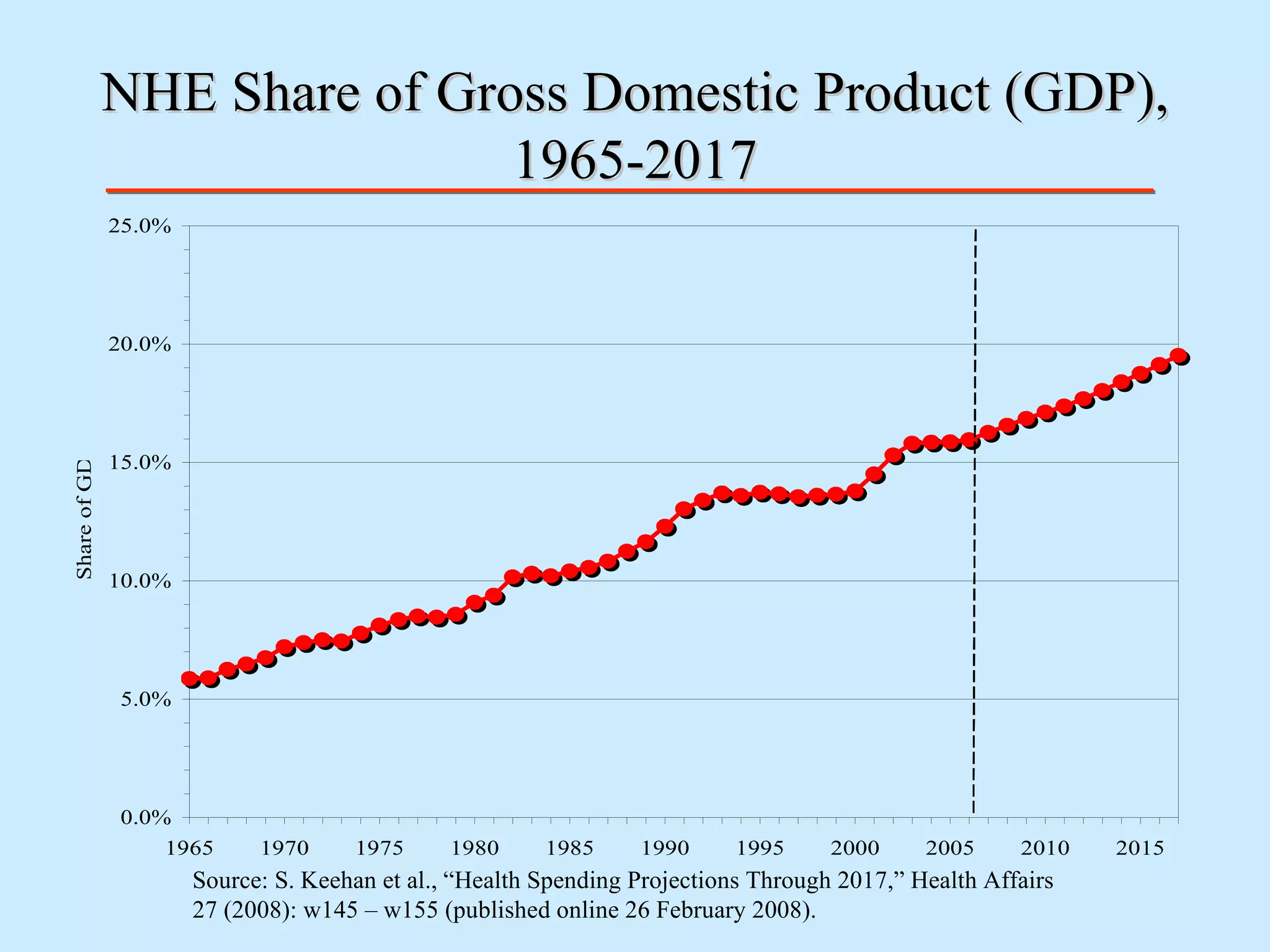
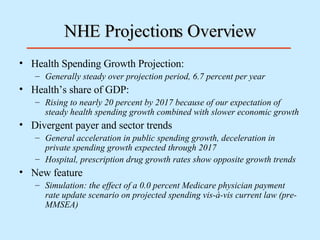
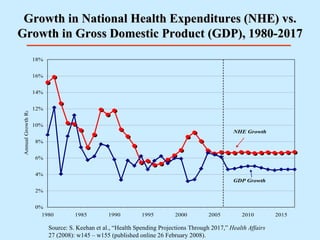
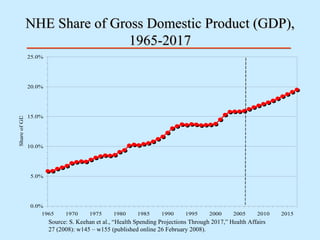
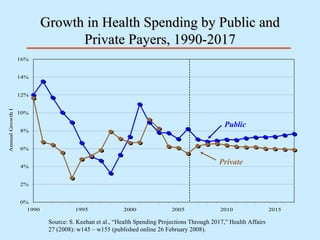
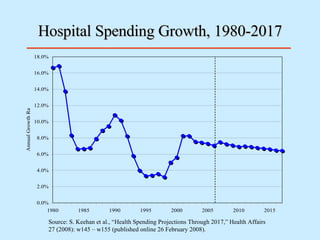
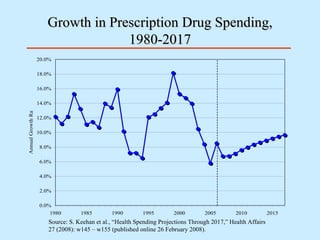
Health Spending Growth Projection:  Generally steady over projection period, 6.7 percent per year Health’s share of GDP: Rising to nearly 20 percent by 2017 because of our expectation of steady health spending growth combined with slower economic growth Divergent payer and sector trends General acceleration in public spending growth, deceleration in private spending growth expected through 2017 Hospital, prescription drug growth rates show opposite growth trends  New feature Simulation: the effect of a 0.0 percent Medicare physician payment rate update scenario on projected spending vis-à-vis current law (pre-MMSEA) NHE Projections Overview
Growth in National Health Expenditures (NHE) vs. Growth in Gross Domestic Product (GDP), 1980-2017 Source: S. Keehan et al., “Health Spending Projections Through 2017,”  Health Affairs  27 (2008): w145 – w155 (published online 26 February 2008).
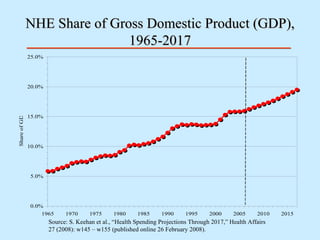
NHE Share of Gross Domestic Product (GDP), 1965-2017 Source: S. Keehan et al., “Health Spending Projections Through 2017,” Health Affairs 27 (2008): w145 – w155 (published online 26 February 2008).
Growth in Health Spending by Public and Private Payers, 1990-2017 Public  Private Source: S. Keehan et al., “Health Spending Projections Through 2017,” Health Affairs 27 (2008): w145 – w155 (published online 26 February 2008).
Hospital Spending Growth, 1980-2017 Source: S. Keehan et al., “Health Spending Projections Through 2017,” Health Affairs 27 (2008): w145 – w155 (published online 26 February 2008).
Growth in Prescription Drug Spending, 1980-2017 Source: S. Keehan et al., “Health Spending Projections Through 2017,” Health Affairs 27 (2008): w145 – w155 (published online 26 February 2008).
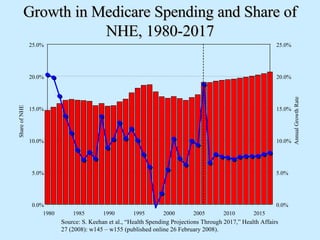
Growth in Medicare Spending and Share of NHE, 1980-2017 Source: S. Keehan et al., “Health Spending Projections Through 2017,” Health Affairs 27 (2008): w145 – w155 (published online 26 February 2008). 0.0% 5.0% 10.0% 15.0% 20.0% 25.0% 1980 1985 1990 1995 2000 2005 2010 2015 Share of NHE 0.0% 5.0% 10.0% 15.0% 20.0% 25.0% Annual Growth Rate
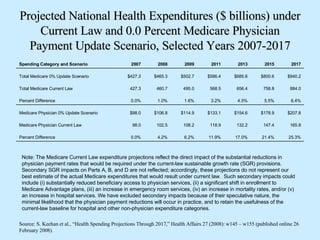
Projected National Health Expenditures ($ billions) under Current Law and 0.0 Percent Medicare Physician Payment Update Scenario, Selected Years 2007-2017 Source: S. Keehan et al., “Health Spending Projections Through 2017,” Health Affairs 27 (2008): w145 – w155 (published online 26 February 2008). Note: The Medicare Current Law expenditure projections reflect the direct impact of the substantial reductions in physician payment rates that would be required under the current-law sustainable growth rate (SGR) provisions.  Secondary SGR impacts on Parts A, B, and D are not reflected; accordingly, these projections do not represent our best estimate of the actual Medicare expenditures that would result under current law.  Such secondary impacts could include (i) substantially reduced beneficiary access to physician services, (ii) a significant shift in enrollment to Medicare Advantage plans, (iii) an increase in emergency room services, (iv) an increase in mortality rates, and/or (v) an increase in hospital services. We have excluded secondary impacts because of their speculative nature, the minimal likelihood that the physician payment reductions will occur in practice, and to retain the usefulness of the current-law baseline for hospital and other non-physician expenditure categories. 25.3% 21.4% 17.0% 11.9% 6.2% 4.2% 0.0% Percent Difference 165.8 147.4 132.2 118.9 108.2 102.5 98.0 Medicare Physician Current Law  $207.8 $178.9 $154.6 $133.1 $114.9 $106.8 $98.0 Medicare Physician 0% Update Scenario 6.4% 5.5% 4.5% 3.2% 1.6% 1.0% 0.0% Percent Difference 884.0 758.8 656.4 568.5 495.0 460.7 427.3 Total Medicare Current Law  $940.2 $800.6 $685.6 $586.4 $502.7 $465.3 $427.3 Total Medicare 0% Update Scenario 2017 2015 2013 2011 2009 2008 2007 Spending Category and Scenario
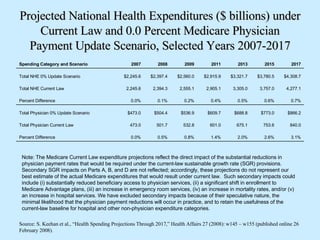
Projected National Health Expenditures ($ billions) under Current Law and 0.0 Percent Medicare Physician Payment Update Scenario, Selected Years 2007-2017 Source: S. Keehan et al., “Health Spending Projections Through 2017,” Health Affairs 27 (2008): w145 – w155 (published online 26 February 2008). Note: The Medicare Current Law expenditure projections reflect the direct impact of the substantial reductions in physician payment rates that would be required under the current-law sustainable growth rate (SGR) provisions.  Secondary SGR impacts on Parts A, B, and D are not reflected; accordingly, these projections do not represent our best estimate of the actual Medicare expenditures that would result under current law.  Such secondary impacts could include (i) substantially reduced beneficiary access to physician services, (ii) a significant shift in enrollment to Medicare Advantage plans, (iii) an increase in emergency room services, (iv) an increase in mortality rates, and/or (v) an increase in hospital services. We have excluded secondary impacts because of their speculative nature, the minimal likelihood that the physician payment reductions will occur in practice, and to retain the usefulness of the current-law baseline for hospital and other non-physician expenditure categories. 3.1% 2.6% 2.0% 1.4% 0.8% 0.5% 0.0% Percent Difference 840.0 753.6 675.1 601.0 532.8 501.7 473.0 Total Physician Current Law  $866.2 $773.0 $688.8 $609.7 $536.9 $504.4 $473.0 Total Physician 0% Update Scenario 0.7% 0.6% 0.5% 0.4% 0.2% 0.1% 0.0% Percent Difference 4,277.1 3,757.0 3,305.0 2,905.1 2,555.1 2,394.3 2,245.6 Total NHE Current Law  $4,308.7 $3,780.5 $3,321.7 $2,915.9 $2,560.0 $2,397.4 $2,245.6 Total NHE 0% Update Scenario 2017 2015 2013 2011 2009 2008 2007 Spending Category and Scenario
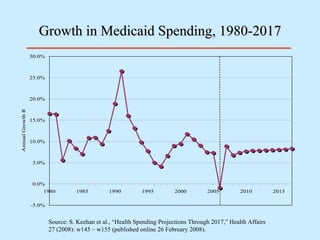
Growth in Medicaid Spending, 1980-2017 Source: S. Keehan et al., “Health Spending Projections Through 2017,” Health Affairs 27 (2008): w145 – w155 (published online 26 February 2008).
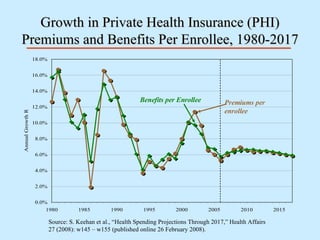
Growth in Private Health Insurance (PHI) Premiums and Benefits Per Enrollee, 1980-2017 Source: S. Keehan et al., “Health Spending Projections Through 2017,” Health Affairs 27 (2008): w145 – w155 (published online 26 February 2008). Premiums per enrollee Benefits per Enrollee
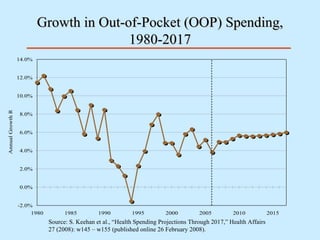
Growth in Out-of-Pocket (OOP) Spending, 1980-2017 Source: S. Keehan et al., “Health Spending Projections Through 2017,” Health Affairs 27 (2008): w145 – w155 (published online 26 February 2008).
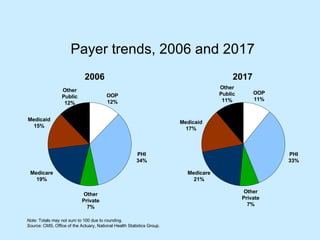
Payer trends, 2006 and 2017 2017 2006 OOP 11% PHI 33% OOP 12% PHI 34% Other Private 7% Medicare 19% Medicaid 15% Other Public 12% Note:  Totals may not sum to 100 due to rounding. Source:  CMS, Office of the Actuary, National Health Statistics Group. Other Private 7% Medicare 21% Medicaid 17% Other Public 11%
Conclusions Health spending growth expected to remain steady in 2007 (6.7 percent) and average 6.7 percent per year through 2017. By 2017, nearly twenty cents of every dollar expected to be spent on health care, as health spending growth is projected to remain steady while economic growth is projected to slow. Spending growth for public sources of funding is generally expected to accelerate over the projection period, private growth generally expected to slow; divergent sector trends (especially hospital and prescription drugs) also anticipated. A 0.0 percent Medicare physician payment update is projected to increase total NHE by 0.7 percentage points by 2017 relative to projected current law estimates.

Cms Hcspending

  • 1.
    NHE Share ofGross Domestic Product (GDP), 1965-2017 Source: S. Keehan et al., “Health Spending Projections Through 2017,” Health Affairs 27 (2008): w145 – w155 (published online 26 February 2008).
  • 2.
    Health Spending ProjectionsThrough 2017 Sean Keehan, Andrea Sisko, Christopher Truffer, Sheila Smith, Cathy Cowan, John Poisal, M. Kent Clemens, Kevin Lyons, and Jonathan Cylus Office of the Actuary Centers for Medicare and Medicaid Services February 25, 2008
  • 3.
    Health Spending GrowthProjection: Generally steady over projection period, 6.7 percent per year Health’s share of GDP: Rising to nearly 20 percent by 2017 because of our expectation of steady health spending growth combined with slower economic growth Divergent payer and sector trends General acceleration in public spending growth, deceleration in private spending growth expected through 2017 Hospital, prescription drug growth rates show opposite growth trends New feature Simulation: the effect of a 0.0 percent Medicare physician payment rate update scenario on projected spending vis-à-vis current law (pre-MMSEA) NHE Projections Overview
  • 4.
    Growth in NationalHealth Expenditures (NHE) vs. Growth in Gross Domestic Product (GDP), 1980-2017 Source: S. Keehan et al., “Health Spending Projections Through 2017,” Health Affairs 27 (2008): w145 – w155 (published online 26 February 2008).
  • 5.
    NHE Share ofGross Domestic Product (GDP), 1965-2017 Source: S. Keehan et al., “Health Spending Projections Through 2017,” Health Affairs 27 (2008): w145 – w155 (published online 26 February 2008).
  • 6.
    Growth in HealthSpending by Public and Private Payers, 1990-2017 Public Private Source: S. Keehan et al., “Health Spending Projections Through 2017,” Health Affairs 27 (2008): w145 – w155 (published online 26 February 2008).
  • 7.
    Hospital Spending Growth,1980-2017 Source: S. Keehan et al., “Health Spending Projections Through 2017,” Health Affairs 27 (2008): w145 – w155 (published online 26 February 2008).
  • 8.
    Growth in PrescriptionDrug Spending, 1980-2017 Source: S. Keehan et al., “Health Spending Projections Through 2017,” Health Affairs 27 (2008): w145 – w155 (published online 26 February 2008).
  • 9.
    Growth in MedicareSpending and Share of NHE, 1980-2017 Source: S. Keehan et al., “Health Spending Projections Through 2017,” Health Affairs 27 (2008): w145 – w155 (published online 26 February 2008). 0.0% 5.0% 10.0% 15.0% 20.0% 25.0% 1980 1985 1990 1995 2000 2005 2010 2015 Share of NHE 0.0% 5.0% 10.0% 15.0% 20.0% 25.0% Annual Growth Rate
  • 10.
    Projected National HealthExpenditures ($ billions) under Current Law and 0.0 Percent Medicare Physician Payment Update Scenario, Selected Years 2007-2017 Source: S. Keehan et al., “Health Spending Projections Through 2017,” Health Affairs 27 (2008): w145 – w155 (published online 26 February 2008). Note: The Medicare Current Law expenditure projections reflect the direct impact of the substantial reductions in physician payment rates that would be required under the current-law sustainable growth rate (SGR) provisions. Secondary SGR impacts on Parts A, B, and D are not reflected; accordingly, these projections do not represent our best estimate of the actual Medicare expenditures that would result under current law.  Such secondary impacts could include (i) substantially reduced beneficiary access to physician services, (ii) a significant shift in enrollment to Medicare Advantage plans, (iii) an increase in emergency room services, (iv) an increase in mortality rates, and/or (v) an increase in hospital services. We have excluded secondary impacts because of their speculative nature, the minimal likelihood that the physician payment reductions will occur in practice, and to retain the usefulness of the current-law baseline for hospital and other non-physician expenditure categories. 25.3% 21.4% 17.0% 11.9% 6.2% 4.2% 0.0% Percent Difference 165.8 147.4 132.2 118.9 108.2 102.5 98.0 Medicare Physician Current Law $207.8 $178.9 $154.6 $133.1 $114.9 $106.8 $98.0 Medicare Physician 0% Update Scenario 6.4% 5.5% 4.5% 3.2% 1.6% 1.0% 0.0% Percent Difference 884.0 758.8 656.4 568.5 495.0 460.7 427.3 Total Medicare Current Law $940.2 $800.6 $685.6 $586.4 $502.7 $465.3 $427.3 Total Medicare 0% Update Scenario 2017 2015 2013 2011 2009 2008 2007 Spending Category and Scenario
  • 11.
    Projected National HealthExpenditures ($ billions) under Current Law and 0.0 Percent Medicare Physician Payment Update Scenario, Selected Years 2007-2017 Source: S. Keehan et al., “Health Spending Projections Through 2017,” Health Affairs 27 (2008): w145 – w155 (published online 26 February 2008). Note: The Medicare Current Law expenditure projections reflect the direct impact of the substantial reductions in physician payment rates that would be required under the current-law sustainable growth rate (SGR) provisions. Secondary SGR impacts on Parts A, B, and D are not reflected; accordingly, these projections do not represent our best estimate of the actual Medicare expenditures that would result under current law.  Such secondary impacts could include (i) substantially reduced beneficiary access to physician services, (ii) a significant shift in enrollment to Medicare Advantage plans, (iii) an increase in emergency room services, (iv) an increase in mortality rates, and/or (v) an increase in hospital services. We have excluded secondary impacts because of their speculative nature, the minimal likelihood that the physician payment reductions will occur in practice, and to retain the usefulness of the current-law baseline for hospital and other non-physician expenditure categories. 3.1% 2.6% 2.0% 1.4% 0.8% 0.5% 0.0% Percent Difference 840.0 753.6 675.1 601.0 532.8 501.7 473.0 Total Physician Current Law $866.2 $773.0 $688.8 $609.7 $536.9 $504.4 $473.0 Total Physician 0% Update Scenario 0.7% 0.6% 0.5% 0.4% 0.2% 0.1% 0.0% Percent Difference 4,277.1 3,757.0 3,305.0 2,905.1 2,555.1 2,394.3 2,245.6 Total NHE Current Law $4,308.7 $3,780.5 $3,321.7 $2,915.9 $2,560.0 $2,397.4 $2,245.6 Total NHE 0% Update Scenario 2017 2015 2013 2011 2009 2008 2007 Spending Category and Scenario
  • 12.
    Growth in MedicaidSpending, 1980-2017 Source: S. Keehan et al., “Health Spending Projections Through 2017,” Health Affairs 27 (2008): w145 – w155 (published online 26 February 2008).
  • 13.
    Growth in PrivateHealth Insurance (PHI) Premiums and Benefits Per Enrollee, 1980-2017 Source: S. Keehan et al., “Health Spending Projections Through 2017,” Health Affairs 27 (2008): w145 – w155 (published online 26 February 2008). Premiums per enrollee Benefits per Enrollee
  • 14.
    Growth in Out-of-Pocket(OOP) Spending, 1980-2017 Source: S. Keehan et al., “Health Spending Projections Through 2017,” Health Affairs 27 (2008): w145 – w155 (published online 26 February 2008).
  • 15.
    Payer trends, 2006and 2017 2017 2006 OOP 11% PHI 33% OOP 12% PHI 34% Other Private 7% Medicare 19% Medicaid 15% Other Public 12% Note: Totals may not sum to 100 due to rounding. Source: CMS, Office of the Actuary, National Health Statistics Group. Other Private 7% Medicare 21% Medicaid 17% Other Public 11%
  • 16.
    Conclusions Health spendinggrowth expected to remain steady in 2007 (6.7 percent) and average 6.7 percent per year through 2017. By 2017, nearly twenty cents of every dollar expected to be spent on health care, as health spending growth is projected to remain steady while economic growth is projected to slow. Spending growth for public sources of funding is generally expected to accelerate over the projection period, private growth generally expected to slow; divergent sector trends (especially hospital and prescription drugs) also anticipated. A 0.0 percent Medicare physician payment update is projected to increase total NHE by 0.7 percentage points by 2017 relative to projected current law estimates.