COMPUTER MEDIATED INTERCULTURAL COMMUNICATION CMIC 2010 ProjectGroup 1:Georgina Metcalfe & Verena Schmidt &AjdaRogelj
Why did wedecideto participate and what were our expectations?Reasons:New experienceGettoknowpeoplefromother countriesLearnmoreaboutother countries (Slovenia, England and Germany): theculture, thehistory, thebeliefs, thevalues etc.Learntocommunicatewithpeoplefromother countries in EnglishOvercomeprejudicesLearntocommunicatewithpeopleonlywithtoolswhichthecomputeroffers (facebook, msn, etc.)Become a competentinterculturalcommunicatorBecome a competentcommunicator  in theinternet
Chosen word = FAMILYWhy did we choose the word “family”?We have chosen theword family, because we are sure that itrepresents one of the most important values of a societyThe familyis an importantpartofourlivesThe familyhas a greatinfluence on us (ourdevelopment, values, behaviour, beliefs etc.)Itis a subject that enables a good discussion (we think we will find some similarities and differences between the family concepts in our countries. )Weare all familiar with it
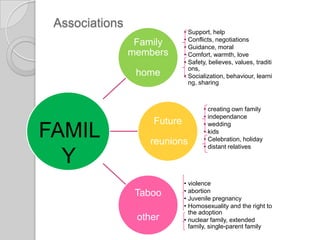
AssociationsFAMILY
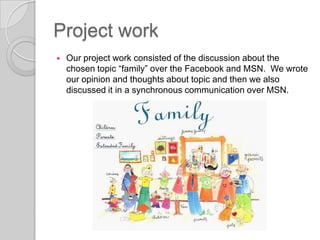
Project workOur project work consisted of the discussion about the chosen topic “family” over the Facebook and MSN.  We wrote our opinion and thoughts about topic and then we also discussed it in a synchronous communication over MSN.
Joint reflectionsWe have found many similarities and only little differences between the familyconcepts in our countries. In our discussion we have realised that the concept of family has changed a lot through out history. When our grandparents grew up it was normal that a family had a lot of children. When our parents grew up it was normal that a family consisted of parents and three or four children. When we grew up the typical family consisted of parents and two children. Nowadays there are a lot of couples who decide not to get any children and there are couples who only have one child. Besides that there is a new phenomenon called “blended families”.      As wecansee, there has always been some kind of »typical« family with mother and father and kidsthrough out history. But, »perfect family” does not exist – it is only an illusion!      Not onlydoestheconceptoffamilychangethrough out history also therelationshiptoyourfamilychangewhenyouaregettingolder. Whenyouareyoungyouspend a lotof time withyourfamily but whenyouaregettingolderyouspendmore time withyourfriends (andboyfriend). So friendsstarttoreplacethefamilymembers in somewaybecausewe also learn a lotfromthemandwespendmostofour time withthem. But ourfamily still remainsimportantforus!
Joint reflectionsMost of the time, there are always conflicts of different kinds, but wethink thatthis is also a good thing, because we – as rising persons – learn how to articulate our wishes and demands. The conflictshelpustobecomemoreindependent. Therefore, family (and home) is a place of primary socialization, where we learn to speak, read andexpress our feelings. In additiontothatwelearnthetraditions, beliefs, values and morals of the society mainly from our family.Family is very important for every person. It starts with primary, and then secondary socialization. Based on what we are taught at home/family, we behave and react in society. Although it gives us many positive things, such as love, support, safety, helpandthe feeling of belonging etc. it is also a place of many dreadful things, which normally stays beyond four walls – like violence. In the 21st century,  thereare still sometaboos  such asfamilyviolenceandpaedophilia  in oursociety. But nowadaystherearemorepossibilitiestogethelpandthesocietyisbecomingmore open to talk aboutthesetopics.The bottom line really is that you know your family will always be there for you. The familyisalwaystheretohelpandsupportyouandhomeis a placewhereyoucanfeelcomfortableandsecure.
List of resources-Family and thesocializationhttp://www.delmar.edu/socsci/rlong/intro/social.htm   -Why Families are important http://www.relate.org.nz/Family/Whatisfamily/WhyFamiliesareimportant.aspx-Is the Decline of the Traditional Family a National Crisis? http://www.youtube.com/watch?v=y9-aC9OR9dc-The Impact of Family Socialization Practices on Children's Socialization in China http://findarticles.com/p/articles/mi_hb1439/is_1_14/ai_n28745193/http://family.jrank.org/pages/496/Family-Relational-Rules-How-Rules-Affect-Behavior-Attitudes.html     -Family Theory & Types of Familieshttp://family.jrank.org/collection/24/Family-Theory-Types-Families.html

Cmic2010bb

  • 1.
    COMPUTER MEDIATED INTERCULTURALCOMMUNICATION CMIC 2010 ProjectGroup 1:Georgina Metcalfe & Verena Schmidt &AjdaRogelj
  • 2.
    Why did wedecidetoparticipate and what were our expectations?Reasons:New experienceGettoknowpeoplefromother countriesLearnmoreaboutother countries (Slovenia, England and Germany): theculture, thehistory, thebeliefs, thevalues etc.Learntocommunicatewithpeoplefromother countries in EnglishOvercomeprejudicesLearntocommunicatewithpeopleonlywithtoolswhichthecomputeroffers (facebook, msn, etc.)Become a competentinterculturalcommunicatorBecome a competentcommunicator in theinternet
  • 3.
    Chosen word =FAMILYWhy did we choose the word “family”?We have chosen theword family, because we are sure that itrepresents one of the most important values of a societyThe familyis an importantpartofourlivesThe familyhas a greatinfluence on us (ourdevelopment, values, behaviour, beliefs etc.)Itis a subject that enables a good discussion (we think we will find some similarities and differences between the family concepts in our countries. )Weare all familiar with it
  • 4.
  • 5.
    Project workOur projectwork consisted of the discussion about the chosen topic “family” over the Facebook and MSN. We wrote our opinion and thoughts about topic and then we also discussed it in a synchronous communication over MSN.
  • 6.
    Joint reflectionsWe havefound many similarities and only little differences between the familyconcepts in our countries. In our discussion we have realised that the concept of family has changed a lot through out history. When our grandparents grew up it was normal that a family had a lot of children. When our parents grew up it was normal that a family consisted of parents and three or four children. When we grew up the typical family consisted of parents and two children. Nowadays there are a lot of couples who decide not to get any children and there are couples who only have one child. Besides that there is a new phenomenon called “blended families”. As wecansee, there has always been some kind of »typical« family with mother and father and kidsthrough out history. But, »perfect family” does not exist – it is only an illusion! Not onlydoestheconceptoffamilychangethrough out history also therelationshiptoyourfamilychangewhenyouaregettingolder. Whenyouareyoungyouspend a lotof time withyourfamily but whenyouaregettingolderyouspendmore time withyourfriends (andboyfriend). So friendsstarttoreplacethefamilymembers in somewaybecausewe also learn a lotfromthemandwespendmostofour time withthem. But ourfamily still remainsimportantforus!
  • 7.
    Joint reflectionsMost ofthe time, there are always conflicts of different kinds, but wethink thatthis is also a good thing, because we – as rising persons – learn how to articulate our wishes and demands. The conflictshelpustobecomemoreindependent. Therefore, family (and home) is a place of primary socialization, where we learn to speak, read andexpress our feelings. In additiontothatwelearnthetraditions, beliefs, values and morals of the society mainly from our family.Family is very important for every person. It starts with primary, and then secondary socialization. Based on what we are taught at home/family, we behave and react in society. Although it gives us many positive things, such as love, support, safety, helpandthe feeling of belonging etc. it is also a place of many dreadful things, which normally stays beyond four walls – like violence. In the 21st century, thereare still sometaboos such asfamilyviolenceandpaedophilia in oursociety. But nowadaystherearemorepossibilitiestogethelpandthesocietyisbecomingmore open to talk aboutthesetopics.The bottom line really is that you know your family will always be there for you. The familyisalwaystheretohelpandsupportyouandhomeis a placewhereyoucanfeelcomfortableandsecure.
  • 8.
    List of resources-Familyand thesocializationhttp://www.delmar.edu/socsci/rlong/intro/social.htm   -Why Families are important http://www.relate.org.nz/Family/Whatisfamily/WhyFamiliesareimportant.aspx-Is the Decline of the Traditional Family a National Crisis? http://www.youtube.com/watch?v=y9-aC9OR9dc-The Impact of Family Socialization Practices on Children's Socialization in China http://findarticles.com/p/articles/mi_hb1439/is_1_14/ai_n28745193/http://family.jrank.org/pages/496/Family-Relational-Rules-How-Rules-Affect-Behavior-Attitudes.html     -Family Theory & Types of Familieshttp://family.jrank.org/collection/24/Family-Theory-Types-Families.html