1


 CME COALITION:
A CALL TO ACTION
RESPONSE TO THE PROPOSED
RULE ON THE SUNSHINE ACT
Background
                           2

 On December 19, HHS issued a proposed rule for the
  Physician Payment Sunshine Act.
 The Act’s stated intent is to shed light on direct
  payments from product manufacturers to physicians
  and other medical practitioners.
 As drafted, the Act protected CME by excluding
  coverage of indirect payments to “covered recipients”
  by “applicable manufacturers,” such as industry
  contributions to continuing education programs or
  presentations.
The Proposed Rule
                                    3

 Unexpectedly, HHS declared in the rule that it would rely
  upon a “catch-all” provision in the Act to require
  additional reporting, including from CME providers,
  professional medical associations, patient advocacy
  groups and other non-profit organizations.
 These organizations may now become responsible for
  reporting all payments to covered recipients.
 This would create a significant new reporting burden on
  CME providers and supporters that is neither good
  public policy nor consistent with the intent of Congress.
    It will be close to impossible for any CME provider to accurately
     track every dollar provided by a CME supporting entity who helps
     underwrite a given CME program.
Proposed Rule and Third Parties
                                  4

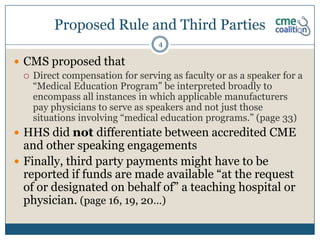
 CMS proposed that
   Direct compensation for serving as faculty or as a speaker for a
    “Medical Education Program” be interpreted broadly to
    encompass all instances in which applicable manufacturers
    pay physicians to serve as speakers and not just those
    situations involving “medical education programs.” (page 33)
 HHS did not differentiate between accredited CME
  and other speaking engagements
 Finally, third party payments might have to be
  reported if funds are made available “at the request
  of or designated on behalf of” a teaching hospital or
  physician. (page 16, 19, 20…)
Proposed Rule and Third Parties
                                    5

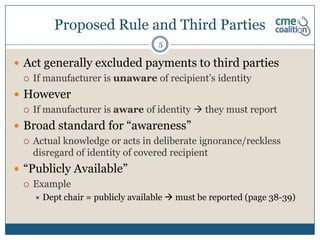
 Act generally excluded payments to third parties
   If manufacturer is unaware of recipient’s identity

 However
   If manufacturer is aware of identity  they must report

 Broad standard for “awareness”
   Actual knowledge or acts in deliberate ignorance/reckless
    disregard of identity of covered recipient
 “Publicly Available”
   Example
       Dept chair = publicly available  must be reported (page 38-39)
Certified CME Is Different
                                 6

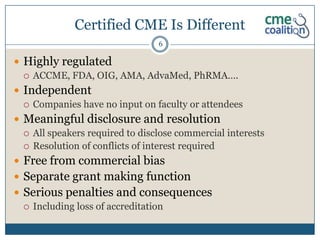
 Highly regulated
   ACCME, FDA, OIG, AMA, AdvaMed, PhRMA….

 Independent
   Companies have no input on faculty or attendees

 Meaningful disclosure and resolution
   All speakers required to disclose commercial interests
   Resolution of conflicts of interest required

 Free from commercial bias
 Separate grant making function
 Serious penalties and consequences
   Including loss of accreditation
Impact on CME Providers
                                        7

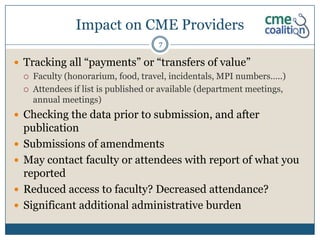
 Tracking all “payments” or “transfers of value”
       Faculty (honorarium, food, travel, incidentals, MPI numbers…..)
       Attendees if list is published or available (department meetings,
        annual meetings)
 Checking the data prior to submission, and after
    publication
   Submissions of amendments
   May contact faculty or attendees with report of what you
    reported
   Reduced access to faculty? Decreased attendance?
   Significant additional administrative burden
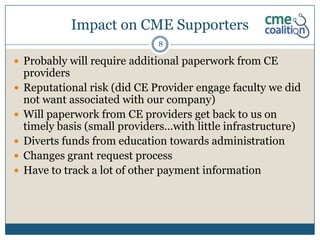
Impact on CME Supporters
                               8

 Probably will require additional paperwork from CE
    providers
   Reputational risk (did CE Provider engage faculty we did
    not want associated with our company)
   Will paperwork from CE providers get back to us on
    timely basis (small providers…with little infrastructure)
   Diverts funds from education towards administration
   Changes grant request process
   Have to track a lot of other payment information
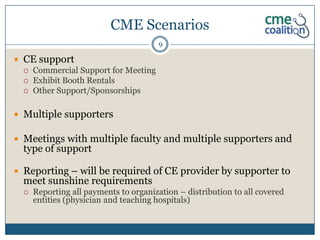
CME Scenarios
                                        9

 CE support
   Commercial Support for Meeting
   Exhibit Booth Rentals
   Other Support/Sponsorships


 Multiple supporters

 Meetings with multiple faculty and multiple supporters and
  type of support

 Reporting – will be required of CE provider by supporter to
  meet sunshine requirements
     Reporting all payments to organization – distribution to all covered
      entities (physician and teaching hospitals)
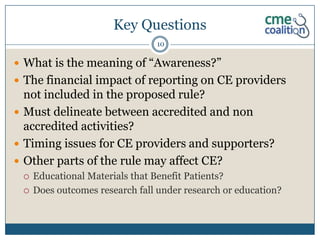
Key Questions
                                10

 What is the meaning of “Awareness?”
 The financial impact of reporting on CE providers
  not included in the proposed rule?
 Must delineate between accredited and non
  accredited activities?
 Timing issues for CE providers and supporters?
 Other parts of the rule may affect CE?
    Educational Materials that Benefit Patients?
    Does outcomes research fall under research or education?
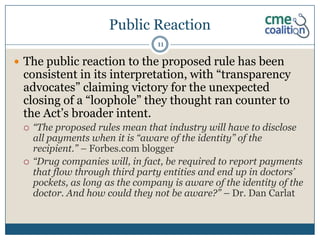
Public Reaction
                                  11

 The public reaction to the proposed rule has been
 consistent in its interpretation, with “transparency
 advocates” claiming victory for the unexpected
 closing of a “loophole” they thought ran counter to
 the Act’s broader intent.
    “The proposed rules mean that industry will have to disclose
     all payments when it is “aware of the identity” of the
     recipient.” – Forbes.com blogger
    “Drug companies will, in fact, be required to report payments
     that flow through third party entities and end up in doctors’
     pockets, as long as the company is aware of the identity of the
     doctor. And how could they not be aware?” – Dr. Dan Carlat
Next Steps
                                    12

 CME Coalition is launching an aggressive campaign to
 roll back the proposed rule, including the following steps:
    Draft comments for submission to HHS on behalf of CME Coalition
     (Due February 17)
    Meetings with HHS officials to share our concerns for the rule.
    Meetings with select members of Congress and their staff to lodge
     our concerns and seek their engagement with HHS on this issue.
    Host Group Leadership strategy call (January 9)
    Nationwide grassroots call of CME supporters to explain the
     implications of the rule and encourage participation via
     congressional advocacy and direct commenting to HHS (January 11)
    Briefing on the Sunshine Act proposed rules at the Alliance for CME
     Annual Conference in Orlando. (January 23)
Call to Action
                                 13

 If this proposed rule is to be challenged before the
 final rules are implemented in 2013, the CME
 community must work together and speak with one
 voice to provide a strong and effective rebuttal to
 decision makers in Washington. We urge you to
 consider doing three things:
    Submit comments on the proposed rule to HHS before their
     February 17 deadline.
    Reach out to your congressional delegation to explain the
     potential impact of this rule on CME and your organization.
    Join the CME Coalition!
Why Join the CME Coalition?
                                 14

 Participation in all Steering Committee decisions related to
    the priorities, direction and activity of the Coalition.
   Participation in bi-weekly Steering Committee calls with the
    Coalition’s Washington-based consultants.
   Analysis of important health care policy and access to a
    weekly written health policy update.
   Access to key informational material about regulatory and
    legislative policies impacting CME.
   Real-time updates and action alerts about important issues
    such as congressional hearings and legislation.
   Unfettered and unrestricted access to analysis, advice and
    information from the Coalition’s Washington-based health
    policy government relations firm, Thorn Run Partners.
Thank you
                         15

Chris Lamond, Executive Director
 clamond@thornrun.com
 (202) 688-0222
Andrew Rosenberg, Senior Strategist
 (202) 247-6301
 arosenberg@thornrun.com

CME Coalition
www.cmecoalition.org

CME Coalition Sunshine Grassroots Presentation 1-11-12

  • 1.
    1 CME COALITION: ACALL TO ACTION RESPONSE TO THE PROPOSED RULE ON THE SUNSHINE ACT
  • 2.
    Background 2  On December 19, HHS issued a proposed rule for the Physician Payment Sunshine Act.  The Act’s stated intent is to shed light on direct payments from product manufacturers to physicians and other medical practitioners.  As drafted, the Act protected CME by excluding coverage of indirect payments to “covered recipients” by “applicable manufacturers,” such as industry contributions to continuing education programs or presentations.
  • 3.
    The Proposed Rule 3  Unexpectedly, HHS declared in the rule that it would rely upon a “catch-all” provision in the Act to require additional reporting, including from CME providers, professional medical associations, patient advocacy groups and other non-profit organizations.  These organizations may now become responsible for reporting all payments to covered recipients.  This would create a significant new reporting burden on CME providers and supporters that is neither good public policy nor consistent with the intent of Congress.  It will be close to impossible for any CME provider to accurately track every dollar provided by a CME supporting entity who helps underwrite a given CME program.
  • 4.
    Proposed Rule andThird Parties 4  CMS proposed that  Direct compensation for serving as faculty or as a speaker for a “Medical Education Program” be interpreted broadly to encompass all instances in which applicable manufacturers pay physicians to serve as speakers and not just those situations involving “medical education programs.” (page 33)  HHS did not differentiate between accredited CME and other speaking engagements  Finally, third party payments might have to be reported if funds are made available “at the request of or designated on behalf of” a teaching hospital or physician. (page 16, 19, 20…)
  • 5.
    Proposed Rule andThird Parties 5  Act generally excluded payments to third parties  If manufacturer is unaware of recipient’s identity  However  If manufacturer is aware of identity  they must report  Broad standard for “awareness”  Actual knowledge or acts in deliberate ignorance/reckless disregard of identity of covered recipient  “Publicly Available”  Example  Dept chair = publicly available  must be reported (page 38-39)
  • 6.
    Certified CME IsDifferent 6  Highly regulated  ACCME, FDA, OIG, AMA, AdvaMed, PhRMA….  Independent  Companies have no input on faculty or attendees  Meaningful disclosure and resolution  All speakers required to disclose commercial interests  Resolution of conflicts of interest required  Free from commercial bias  Separate grant making function  Serious penalties and consequences  Including loss of accreditation
  • 7.
    Impact on CMEProviders 7  Tracking all “payments” or “transfers of value”  Faculty (honorarium, food, travel, incidentals, MPI numbers…..)  Attendees if list is published or available (department meetings, annual meetings)  Checking the data prior to submission, and after publication  Submissions of amendments  May contact faculty or attendees with report of what you reported  Reduced access to faculty? Decreased attendance?  Significant additional administrative burden
  • 8.
    Impact on CMESupporters 8  Probably will require additional paperwork from CE providers  Reputational risk (did CE Provider engage faculty we did not want associated with our company)  Will paperwork from CE providers get back to us on timely basis (small providers…with little infrastructure)  Diverts funds from education towards administration  Changes grant request process  Have to track a lot of other payment information
  • 9.
    CME Scenarios 9  CE support  Commercial Support for Meeting  Exhibit Booth Rentals  Other Support/Sponsorships  Multiple supporters  Meetings with multiple faculty and multiple supporters and type of support  Reporting – will be required of CE provider by supporter to meet sunshine requirements  Reporting all payments to organization – distribution to all covered entities (physician and teaching hospitals)
  • 10.
    Key Questions 10  What is the meaning of “Awareness?”  The financial impact of reporting on CE providers not included in the proposed rule?  Must delineate between accredited and non accredited activities?  Timing issues for CE providers and supporters?  Other parts of the rule may affect CE?  Educational Materials that Benefit Patients?  Does outcomes research fall under research or education?
  • 11.
    Public Reaction 11  The public reaction to the proposed rule has been consistent in its interpretation, with “transparency advocates” claiming victory for the unexpected closing of a “loophole” they thought ran counter to the Act’s broader intent.  “The proposed rules mean that industry will have to disclose all payments when it is “aware of the identity” of the recipient.” – Forbes.com blogger  “Drug companies will, in fact, be required to report payments that flow through third party entities and end up in doctors’ pockets, as long as the company is aware of the identity of the doctor. And how could they not be aware?” – Dr. Dan Carlat
  • 12.
    Next Steps 12  CME Coalition is launching an aggressive campaign to roll back the proposed rule, including the following steps:  Draft comments for submission to HHS on behalf of CME Coalition (Due February 17)  Meetings with HHS officials to share our concerns for the rule.  Meetings with select members of Congress and their staff to lodge our concerns and seek their engagement with HHS on this issue.  Host Group Leadership strategy call (January 9)  Nationwide grassroots call of CME supporters to explain the implications of the rule and encourage participation via congressional advocacy and direct commenting to HHS (January 11)  Briefing on the Sunshine Act proposed rules at the Alliance for CME Annual Conference in Orlando. (January 23)
  • 13.
    Call to Action 13  If this proposed rule is to be challenged before the final rules are implemented in 2013, the CME community must work together and speak with one voice to provide a strong and effective rebuttal to decision makers in Washington. We urge you to consider doing three things:  Submit comments on the proposed rule to HHS before their February 17 deadline.  Reach out to your congressional delegation to explain the potential impact of this rule on CME and your organization.  Join the CME Coalition!
  • 14.
    Why Join theCME Coalition? 14  Participation in all Steering Committee decisions related to the priorities, direction and activity of the Coalition.  Participation in bi-weekly Steering Committee calls with the Coalition’s Washington-based consultants.  Analysis of important health care policy and access to a weekly written health policy update.  Access to key informational material about regulatory and legislative policies impacting CME.  Real-time updates and action alerts about important issues such as congressional hearings and legislation.  Unfettered and unrestricted access to analysis, advice and information from the Coalition’s Washington-based health policy government relations firm, Thorn Run Partners.
  • 15.
    Thank you 15 Chris Lamond, Executive Director clamond@thornrun.com (202) 688-0222 Andrew Rosenberg, Senior Strategist (202) 247-6301 arosenberg@thornrun.com CME Coalition www.cmecoalition.org