Asthma/copd
Asthma
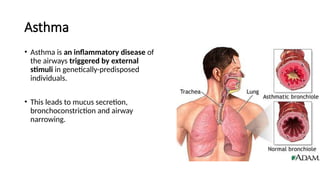
• Asthma is an inflammatory disease of
the airways triggered by external
stimuli in genetically-predisposed
individuals.
• This leads to mucus secretion,
bronchoconstriction and airway
narrowing.
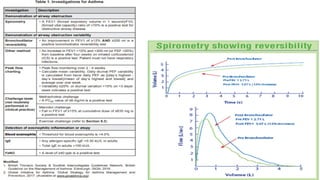
Diagnosis
There is no gold standard diagnostic clinical test in diagnosing asthma.
Asthma diagnosis is based on a combination of:
• History
○ wheeze
○ cough
○ chest tightness
○ shortness of breath
• Presence of obstructive airflow reversibility
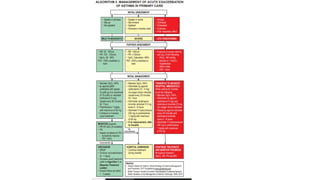
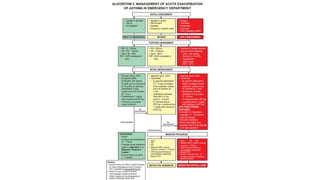
Acute exacerbation of asthma
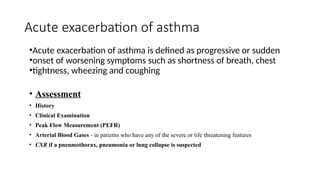
•Acute exacerbation of asthma is defined as progressive or sudden
•onset of worsening symptoms such as shortness of breath, chest
•tightness, wheezing and coughing
• Assessment
• History
• Clinical Examination
• Peak Flow Measurement (PEFR)
• Arterial Blood Gases - in patients who have any of the severe or life threatening features
• CXR if a pneumothorax, pneumonia or lung collapse is suspected
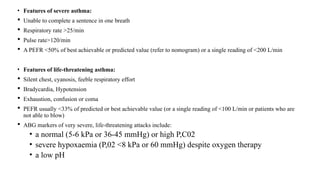
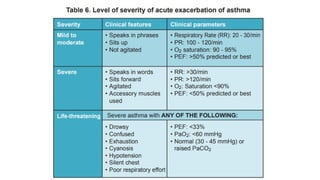
• Features of severe asthma:
 Unable to complete a sentence in one breath
 Respiratory rate >25/min
 Pulse rate>120/min
 A PEFR <50% of best achievable or predicted value (refer to nomogram) or a single reading of <200 L/min
• Features of life-threatening asthma:
 Silent chest, cyanosis, feeble respiratory effort
 Bradycardia, Hypotension
 Exhaustion, confusion or coma
 PEFR usually <33% of predicted or best achievable value (or a single reading of <100 L/min or patients who are
not able to blow)
 ABG markers of very severe, life-threatening attacks include:
• a normal (5-6 kPa or 36-45 mmHg) or high P,C02
• severe hypoxaemia (P,02 <8 kPa or 60 mmHg) despite oxygen therapy
• a low pH
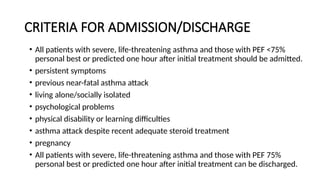
CRITERIA FOR ADMISSION/DISCHARGE
• All patients with severe, life-threatening asthma and those with PEF <75%
personal best or predicted one hour after initial treatment should be admitted.
• persistent symptoms
• previous near-fatal asthma attack
• living alone/socially isolated
• psychological problems
• physical disability or learning difficulties
• asthma attack despite recent adequate steroid treatment
• pregnancy
• All patients with severe, life-threatening asthma and those with PEF 75%
personal best or predicted one hour after initial treatment can be discharged.
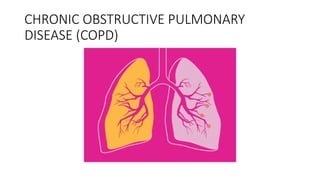
CHRONIC OBSTRUCTIVE PULMONARY
DISEASE (COPD)
INTRODUCTION
• GOLD Definition:
• COPD is a disease state characterized by airflow limitation that is not
fully reversible. The airflow limitation is usually both progressive and
associated with an abnormal inflammatory response of the lungs to
noxious particles or gases and associated with systemic
manifestations.
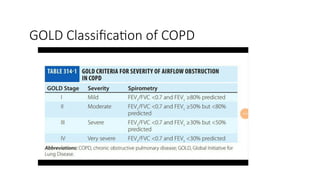
GOLD Classification of COPD
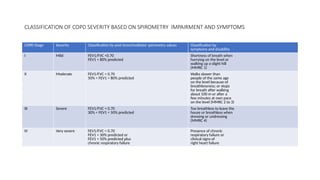
CLASSIFICATION OF COPD SEVERITY BASED ON SPIROMETRY IMPAIRMENT AND SYMPTOMS
COPD Stage Severity Classification by post bronchodilator spirometry values Classification by
symptoms and disability
I Mild FEV1/FVC <0.70
FEV1 > 80% predicted
Shortness of breath when
hurrying on the level or
walking up a slight hill
(MMRC 1)
II Moderate FEV1/FVC < 0.70
50% < FEV1 < 80% predicted
Walks slower than
people of the same age
on the level because of
breathlessness; or stops
for breath after walking
about 100 m or after a
few minutes at own pace
on the level (MMRC 2 to 3)
III Severe FEV1/FVC < 0.70
30% < FEV1 < 50% predicted
Too breathless to leave the
house or breathless when
dressing or undressing
(MMRC 4)
IV Very severe FEV1/FVC < 0.70
FEV1 < 30% predicted or
FEV1 < 50% predicted plus
chronic respiratory failure
Presence of chronic
respiratory failure or
clinical signs of
right heart failure
RISK FACTORS
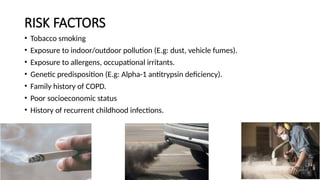
• Tobacco smoking
• Exposure to indoor/outdoor pollution (E.g: dust, vehicle fumes).
• Exposure to allergens, occupational irritants.
• Genetic predisposition (E.g: Alpha-1 antitrypsin deficiency).
• Family history of COPD.
• Poor socioeconomic status
• History of recurrent childhood infections.
ACUTE EXACERBATIONS OF COPD
• Acute worsening of respiratory symptoms associated with increased airway inflammation,
increased mucus production and marked gas trapping.
• Associated with increased mortality rate, accelerated decline in lung function and impaired quality
of life.
• 3 cardinal symptoms of exacerbation:
- Increased shortness of breath
- Increased cough
- Increased sputum volume/purulence
Other symptoms during exacerbation:
- Upper respiratory tract infection symptoms (E.g Runny nose, sore throat).
- Increased wheezing
- Chest tightness
- Reduced effort tolerance
- Increased fatigue
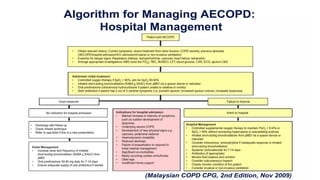
Management of Severe but Not Life-threatening Exacerbations of
COPD in the Emergency Department or the Hospital - Summary of
treatment (Adapted from GOLD 2007)
 Assess severity of symptoms, blood gases, chest X-ray
 Administer controlled oxygen therapy and repeat arterial blood gas
measurement after 30-60 mins
 Bronchodilators: Increase doses and/or frequency
 Combine B-agonists and anticholinergics - Use spacers or air-driven
nebulizers
 Consider adding intravenous methylxanthines (aminophylline), if needed
 Add oral or IV corticosteroids
 Consider antibiotics (oral or occasionally IV) in the presence of signs of
bacterial infection
 Consider non-invasive mechanical ventilation
COMPLICATIONS
• Respiratory failure (either type 1 or type 2)
• Cor pulmonale (Right ventricular failure secondary to chronic hypoxia)
• Acute exacerbations (infective or non-infective)
• Secondary polycythaemia
CME ASTHMA & COPD EMERGENCY MANAGEMENT GUIDELINES

CME ASTHMA & COPD EMERGENCY MANAGEMENT GUIDELINES

  • 1.
  • 2.
    Asthma • Asthma isan inflammatory disease of the airways triggered by external stimuli in genetically-predisposed individuals. • This leads to mucus secretion, bronchoconstriction and airway narrowing.
  • 3.
    Diagnosis There is nogold standard diagnostic clinical test in diagnosing asthma. Asthma diagnosis is based on a combination of: • History ○ wheeze ○ cough ○ chest tightness ○ shortness of breath • Presence of obstructive airflow reversibility
  • 6.
    Acute exacerbation ofasthma •Acute exacerbation of asthma is defined as progressive or sudden •onset of worsening symptoms such as shortness of breath, chest •tightness, wheezing and coughing • Assessment • History • Clinical Examination • Peak Flow Measurement (PEFR) • Arterial Blood Gases - in patients who have any of the severe or life threatening features • CXR if a pneumothorax, pneumonia or lung collapse is suspected
  • 7.
    • Features ofsevere asthma:  Unable to complete a sentence in one breath  Respiratory rate >25/min  Pulse rate>120/min  A PEFR <50% of best achievable or predicted value (refer to nomogram) or a single reading of <200 L/min • Features of life-threatening asthma:  Silent chest, cyanosis, feeble respiratory effort  Bradycardia, Hypotension  Exhaustion, confusion or coma  PEFR usually <33% of predicted or best achievable value (or a single reading of <100 L/min or patients who are not able to blow)  ABG markers of very severe, life-threatening attacks include: • a normal (5-6 kPa or 36-45 mmHg) or high P,C02 • severe hypoxaemia (P,02 <8 kPa or 60 mmHg) despite oxygen therapy • a low pH
  • 11.
    CRITERIA FOR ADMISSION/DISCHARGE •All patients with severe, life-threatening asthma and those with PEF <75% personal best or predicted one hour after initial treatment should be admitted. • persistent symptoms • previous near-fatal asthma attack • living alone/socially isolated • psychological problems • physical disability or learning difficulties • asthma attack despite recent adequate steroid treatment • pregnancy • All patients with severe, life-threatening asthma and those with PEF 75% personal best or predicted one hour after initial treatment can be discharged.
  • 13.
  • 14.
    INTRODUCTION • GOLD Definition: •COPD is a disease state characterized by airflow limitation that is not fully reversible. The airflow limitation is usually both progressive and associated with an abnormal inflammatory response of the lungs to noxious particles or gases and associated with systemic manifestations.
  • 15.
  • 16.
    CLASSIFICATION OF COPDSEVERITY BASED ON SPIROMETRY IMPAIRMENT AND SYMPTOMS COPD Stage Severity Classification by post bronchodilator spirometry values Classification by symptoms and disability I Mild FEV1/FVC <0.70 FEV1 > 80% predicted Shortness of breath when hurrying on the level or walking up a slight hill (MMRC 1) II Moderate FEV1/FVC < 0.70 50% < FEV1 < 80% predicted Walks slower than people of the same age on the level because of breathlessness; or stops for breath after walking about 100 m or after a few minutes at own pace on the level (MMRC 2 to 3) III Severe FEV1/FVC < 0.70 30% < FEV1 < 50% predicted Too breathless to leave the house or breathless when dressing or undressing (MMRC 4) IV Very severe FEV1/FVC < 0.70 FEV1 < 30% predicted or FEV1 < 50% predicted plus chronic respiratory failure Presence of chronic respiratory failure or clinical signs of right heart failure
  • 17.
    RISK FACTORS • Tobaccosmoking • Exposure to indoor/outdoor pollution (E.g: dust, vehicle fumes). • Exposure to allergens, occupational irritants. • Genetic predisposition (E.g: Alpha-1 antitrypsin deficiency). • Family history of COPD. • Poor socioeconomic status • History of recurrent childhood infections.
  • 18.
    ACUTE EXACERBATIONS OFCOPD • Acute worsening of respiratory symptoms associated with increased airway inflammation, increased mucus production and marked gas trapping. • Associated with increased mortality rate, accelerated decline in lung function and impaired quality of life. • 3 cardinal symptoms of exacerbation: - Increased shortness of breath - Increased cough - Increased sputum volume/purulence Other symptoms during exacerbation: - Upper respiratory tract infection symptoms (E.g Runny nose, sore throat). - Increased wheezing - Chest tightness - Reduced effort tolerance - Increased fatigue
  • 19.
    Management of Severebut Not Life-threatening Exacerbations of COPD in the Emergency Department or the Hospital - Summary of treatment (Adapted from GOLD 2007)  Assess severity of symptoms, blood gases, chest X-ray  Administer controlled oxygen therapy and repeat arterial blood gas measurement after 30-60 mins  Bronchodilators: Increase doses and/or frequency  Combine B-agonists and anticholinergics - Use spacers or air-driven nebulizers  Consider adding intravenous methylxanthines (aminophylline), if needed  Add oral or IV corticosteroids  Consider antibiotics (oral or occasionally IV) in the presence of signs of bacterial infection  Consider non-invasive mechanical ventilation
  • 20.
    COMPLICATIONS • Respiratory failure(either type 1 or type 2) • Cor pulmonale (Right ventricular failure secondary to chronic hypoxia) • Acute exacerbations (infective or non-infective) • Secondary polycythaemia

Editor's Notes

  • #2 The most common symptom of asthma is chronic cough. Due to the absence of typical wheezing and marked breathlessness in some patients, asthma is frequently misdiagnosed or underdiagnosed. This causes persistent airway inflammation, airway remodelling and subsequently fixed airway obstruction over time.
  • #16 A diagnosis should be made to any individual with symptoms of chronic cough, sputum production, dyspnoea and history of exposure to risk factors. A diagnosis is confirmed via spirometry showing a post bronchodilator FEV1/FVC ratio of <70%. The severity of COPD should be assessed on severity of spirometry abnormality, symptoms, exercise capacity, complications and presence of co-morbidities.
  • #18 Respiratory: Cough, shortness of breath, wheezing, chest tightness, URTI symptoms, barrel chest Systemic: Lethargy, weight loss, anorexia Comorbidities associated with COPD: Ischemic heart disease Osteopenia, osteoporosis, bone fractures Normochromic normocytic anaemia Malnutrition - Skeletal muscle wasting and peripheral muscle dysfunction
  • #19 Other symptoms during exacerbation: Upper respiratory tract infection symptoms (E.g Runny nose, sore throat). Increased wheezing Chest tightness Reduced effort tolerance Increased fatigue