Cloud’s future runs
through Sovereign DBaaS
June 8 @ 11am EST live webinar
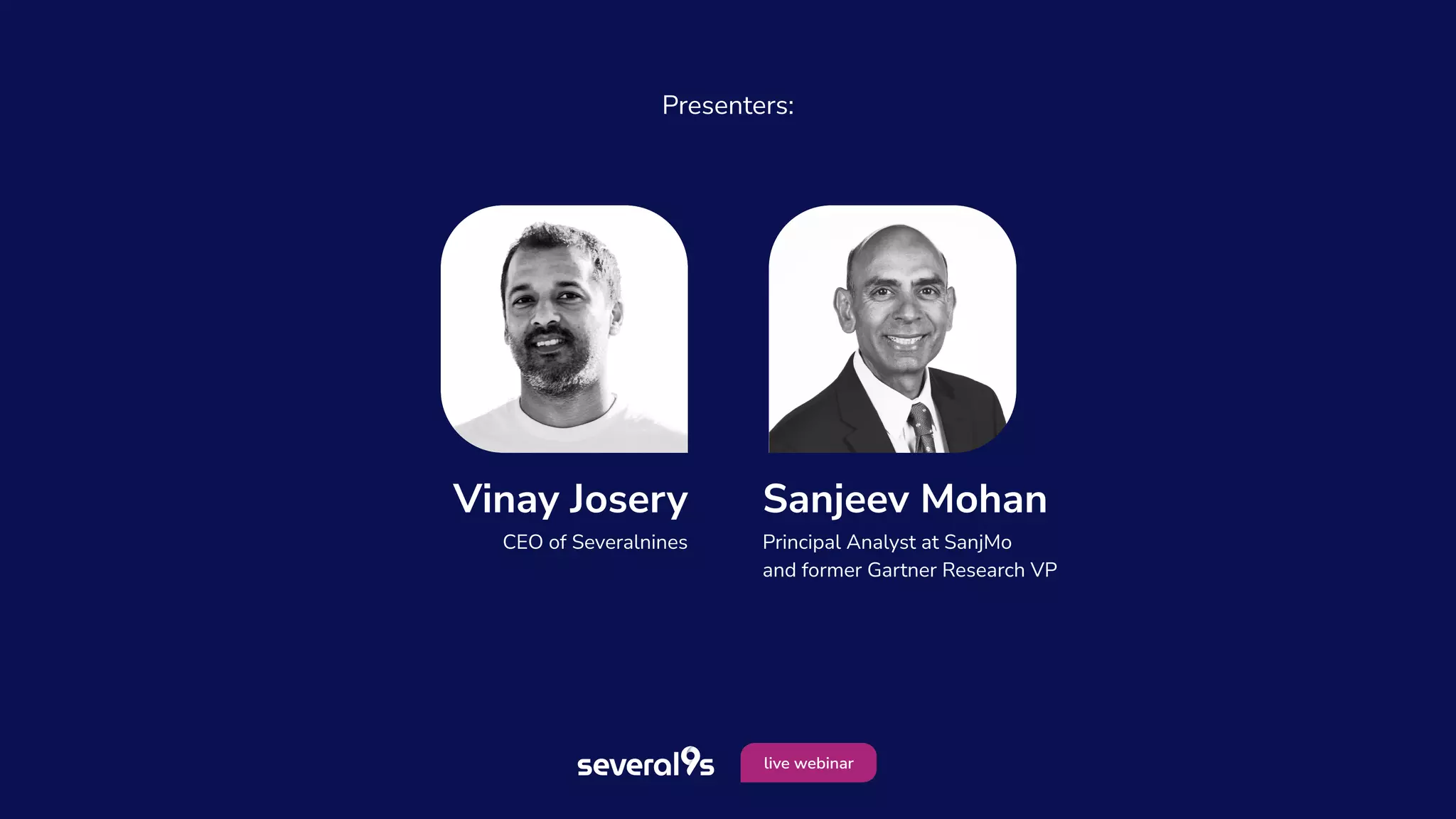
Vinay Josery
CEO of Severalnines
Sanjeev Mohan
Principal Analyst at SanjMo
and former Gartner Research VP
Presenters:
live webinar
3
live webinar
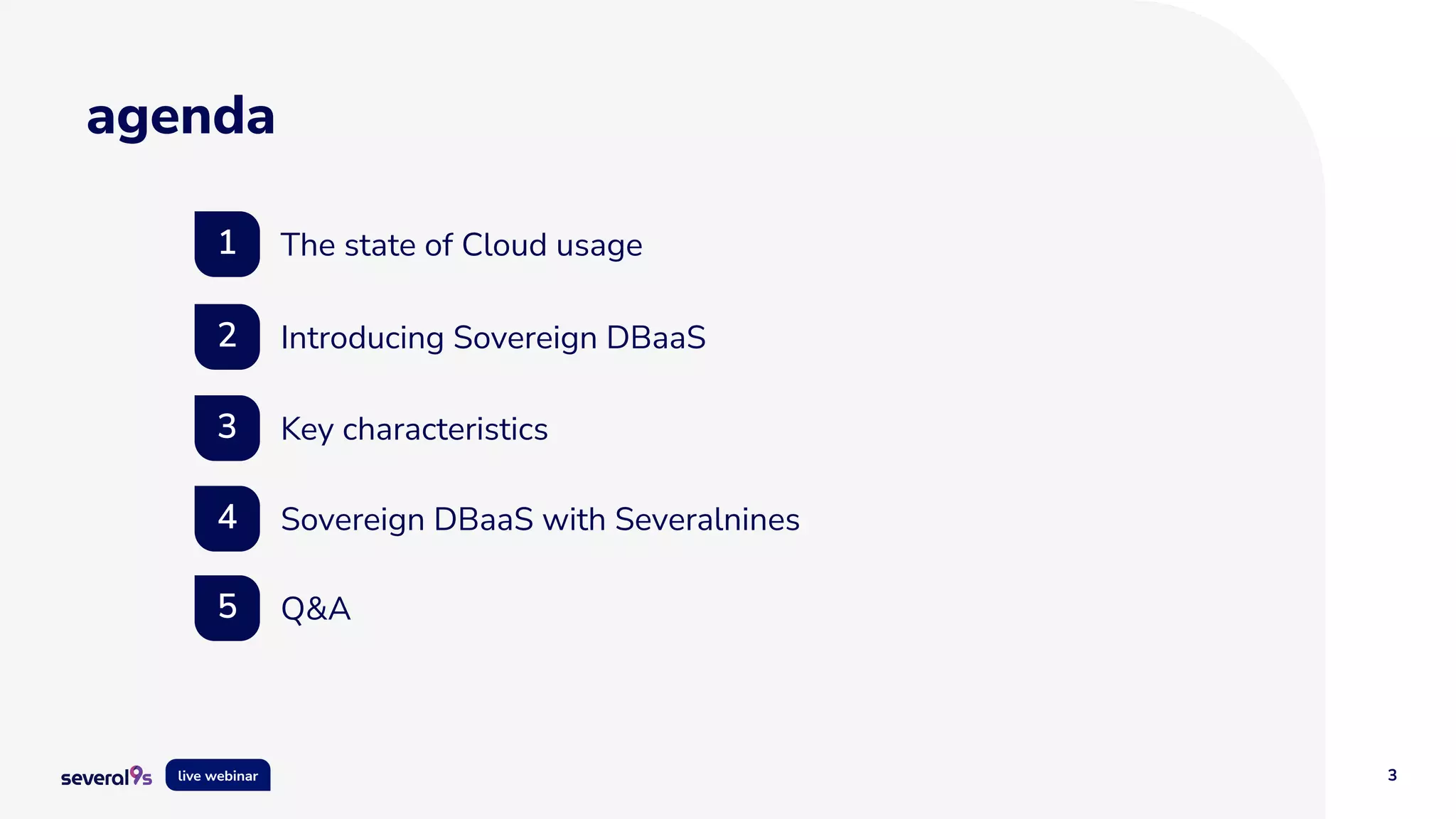
agenda
1 The state of Cloud usage
2 Introducing Sovereign DBaaS
3 Key characteristics
4 Sovereign DBaaS with Severalnines
5 Q&A
The state of Cloud usage
1
Introducing Sovereign DBaaS
2
Key characteristics
3
5
live webinar
The state of Cloud usage
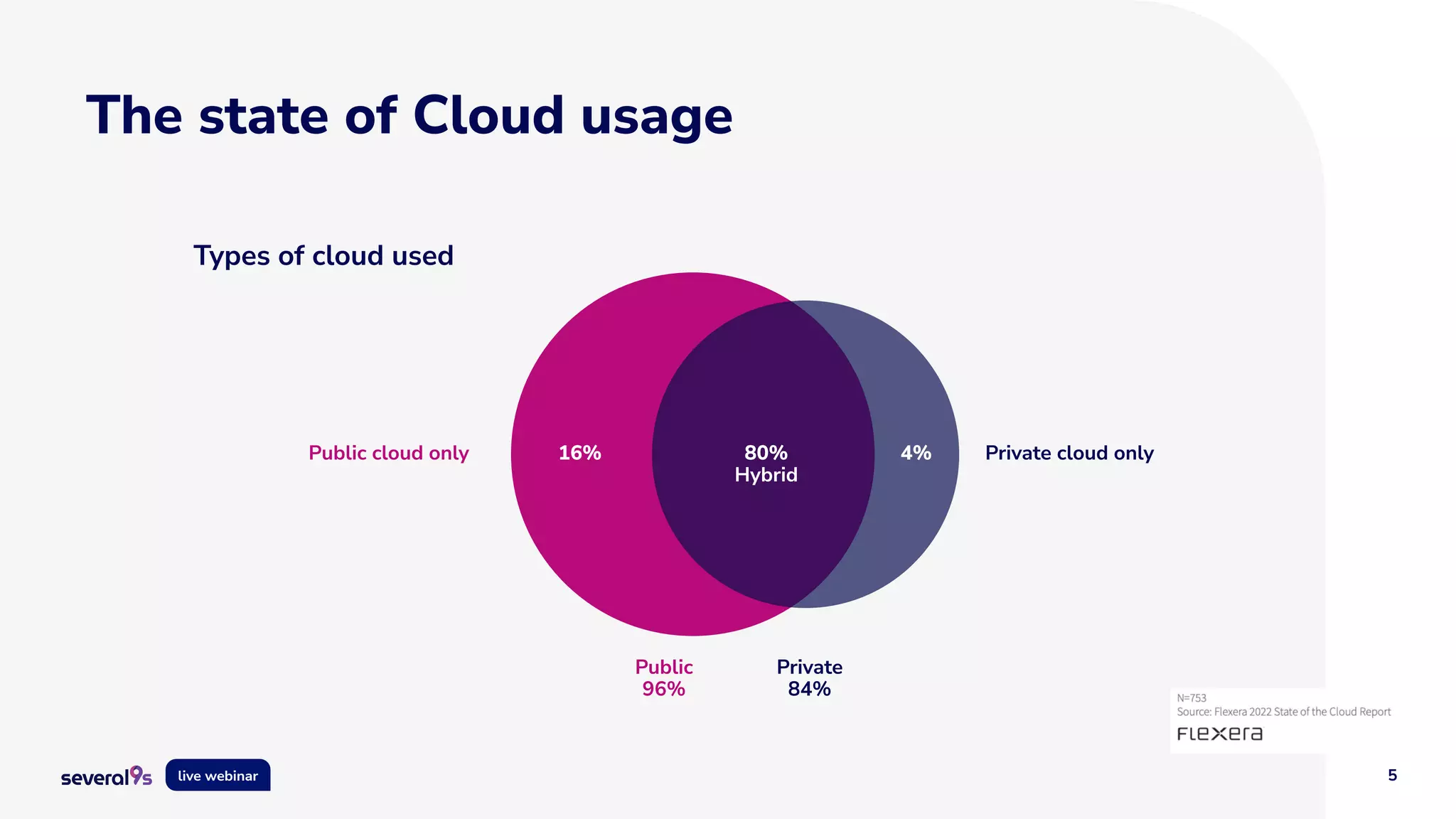
Types of cloud used
Public cloud only 16% 80%
Hybrid
4% Private cloud only
Public
96%
Private
84%
6
live webinar
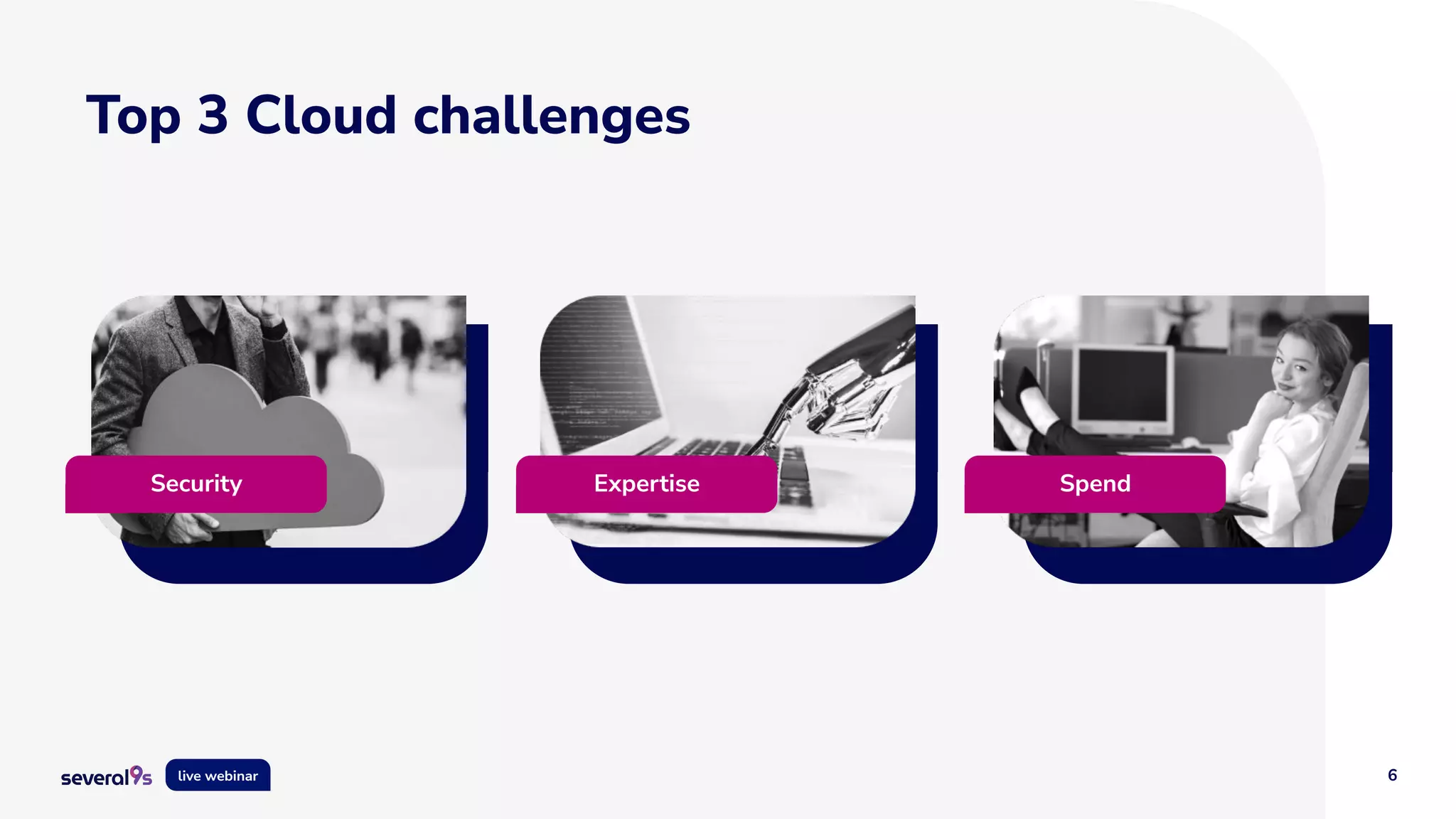
Top 3 Cloud challenges
Security Expertise Spend
7
live webinar
All cloud challenges
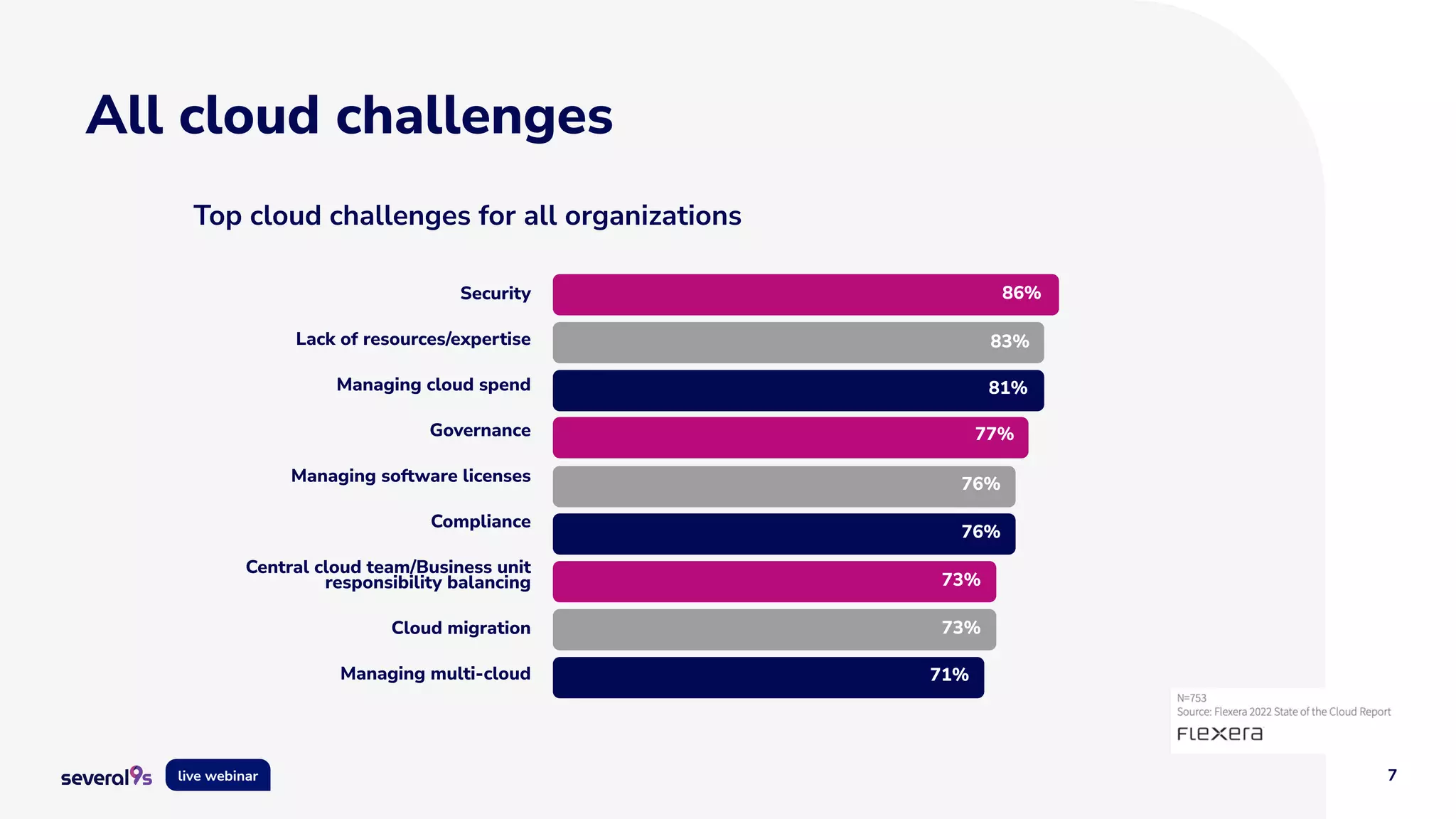
Top cloud challenges for all organizations
Security
Lack of resources/expertise
Managing cloud spend
Governance
Managing software licenses
Compliance
Central cloud team/Business unit
responsibility balancing
Cloud migration
Managing multi-cloud
86%
83%
81%
77%
76%
76%
73%
73%
71%
8
live webinar
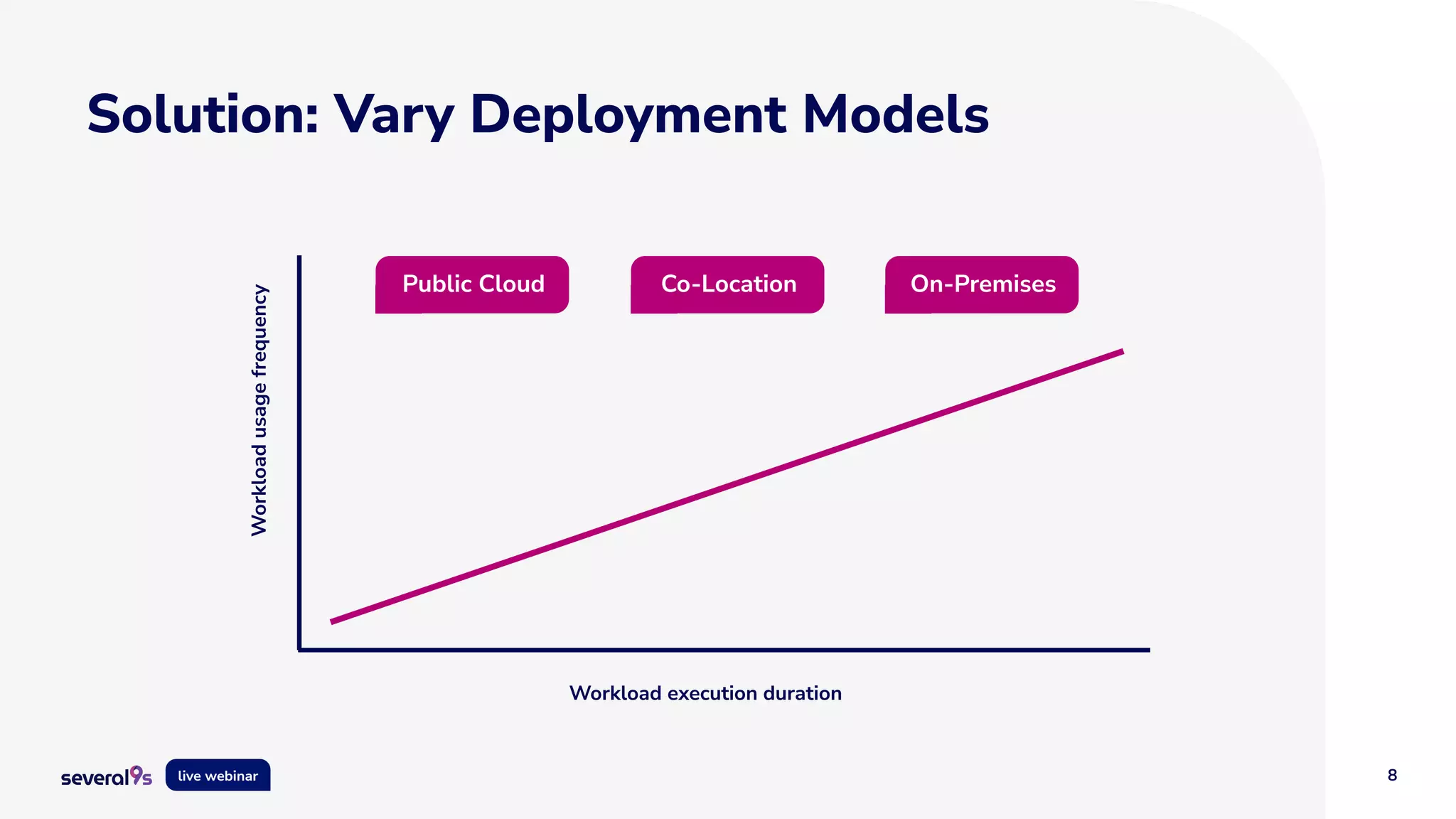
Solution: Vary Deployment Models
Workload
usage
frequency
Workload execution duration
Public Cloud Co-Location On-Premises
Introducing Sovereign DBaaS
2
The state of Cloud usage
1
Key characteristics
3
10
live webinar
Introducing Sovereign DBaaS
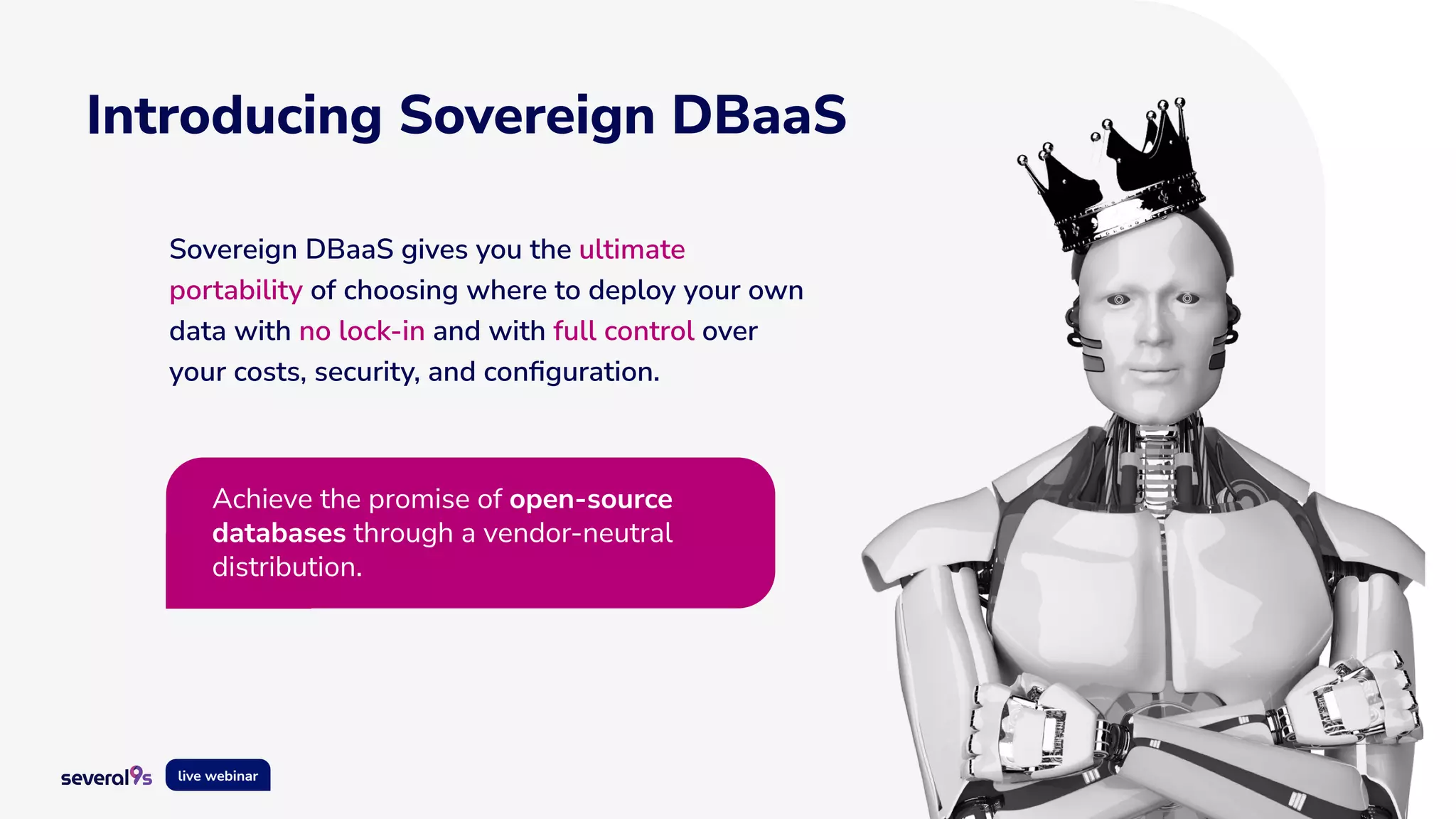
Sovereign DBaaS gives you the ultimate
portability of choosing where to deploy your own
data with no lock-in and with full control over
your costs, security, and configuration.
Achieve the promise of open-source
databases through a vendor-neutral
distribution.
11
live webinar
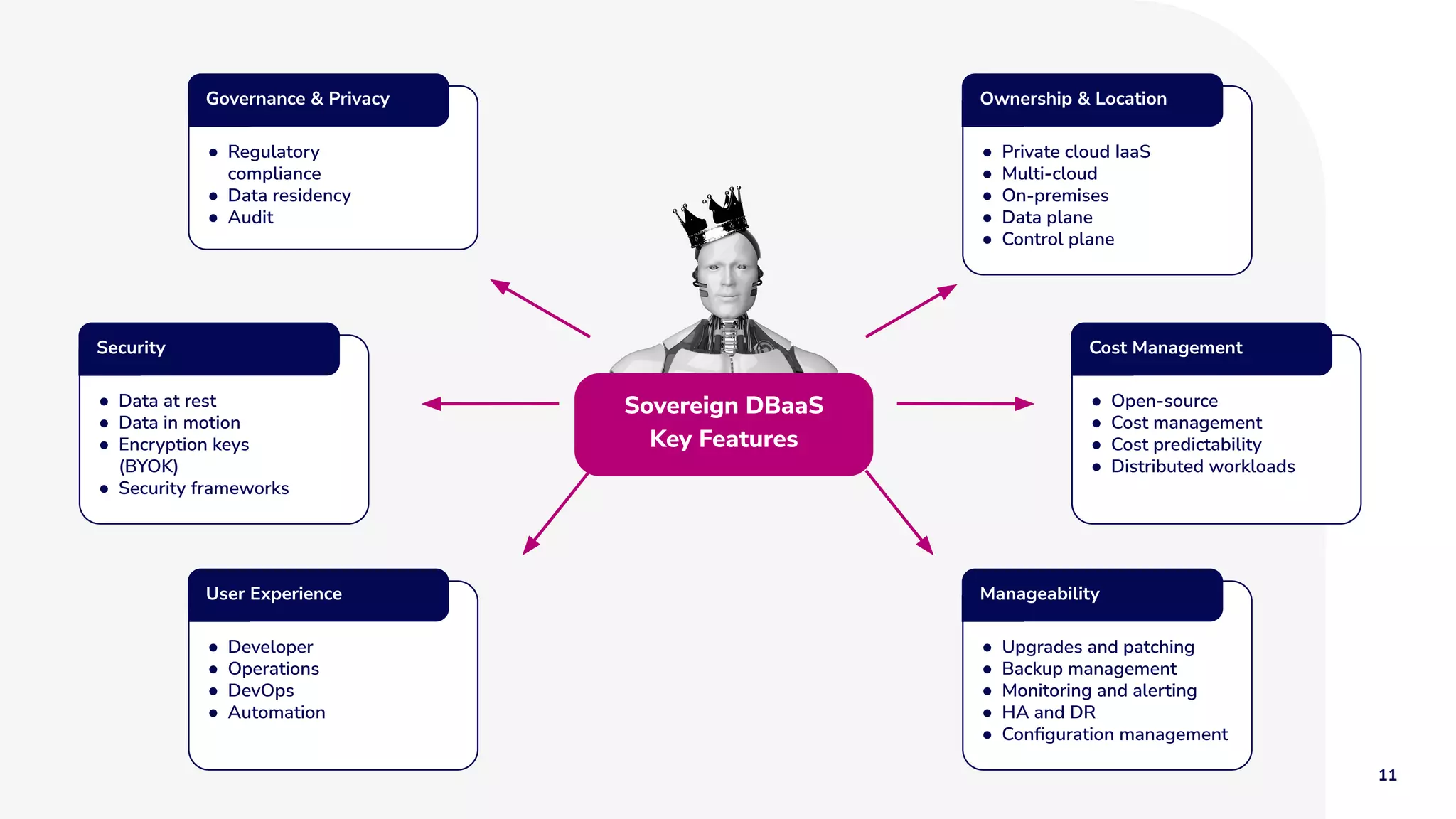
Sovereign DBaaS
Key Features
Ownership & Location
● Private cloud IaaS
● Multi-cloud
● On-premises
● Data plane
● Control plane
Cost Management
● Open-source
● Cost management
● Cost predictability
● Distributed workloads
Manageability
● Upgrades and patching
● Backup management
● Monitoring and alerting
● HA and DR
● Configuration management
Governance & Privacy
● Regulatory
compliance
● Data residency
● Audit
Security
● Data at rest
● Data in motion
● Encryption keys
(BYOK)
● Security frameworks
User Experience
● Developer
● Operations
● DevOps
● Automation
12
live webinar
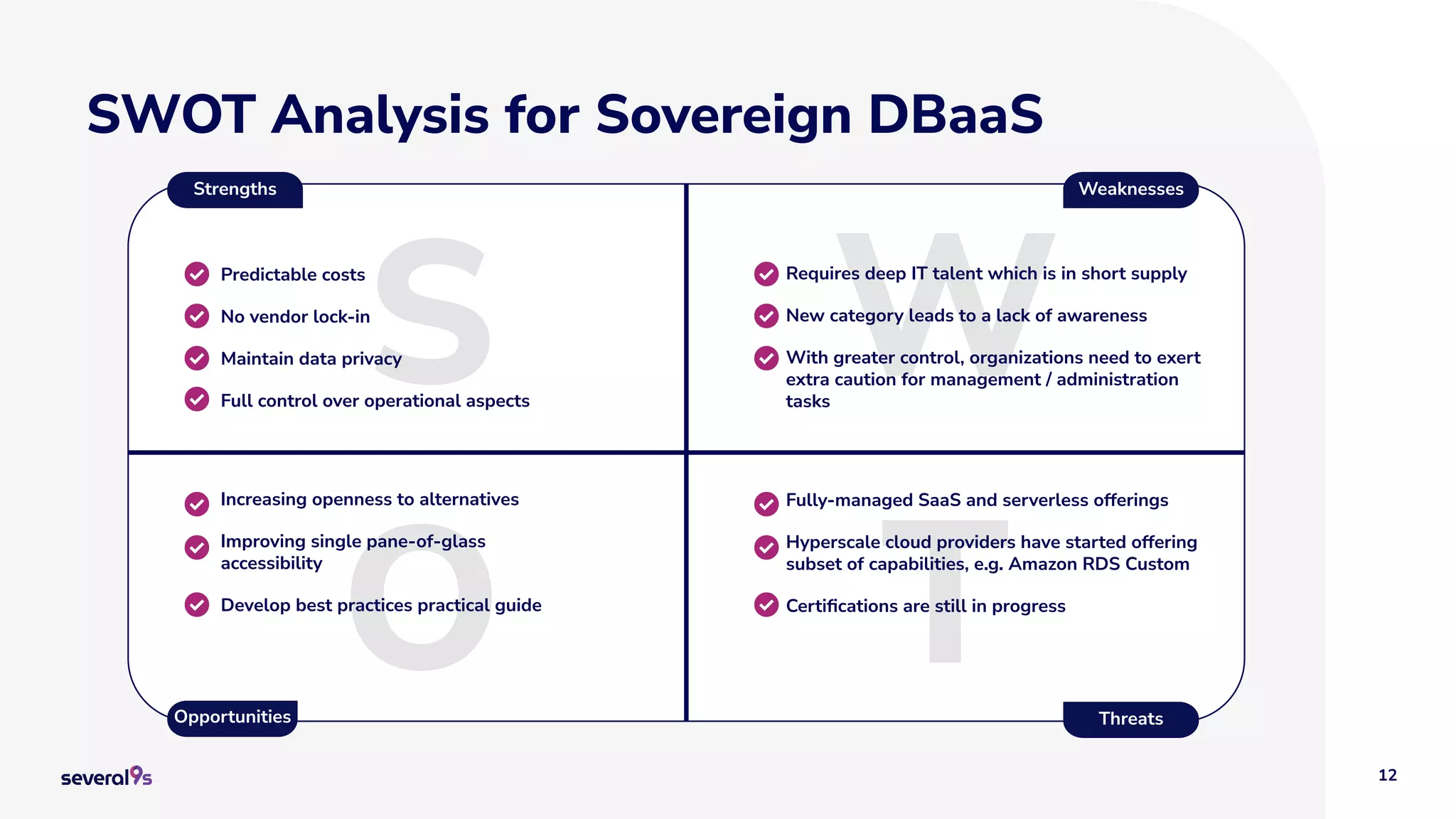
SWOT Analysis for Sovereign DBaaS
S W
O T
Strengths
Requires deep IT talent which is in short supply
New category leads to a lack of awareness
With greater control, organizations need to exert
extra caution for management / administration
tasks
Predictable costs
No vendor lock-in
Maintain data privacy
Full control over operational aspects
Fully-managed SaaS and serverless offerings
Hyperscale cloud providers have started offering
subset of capabilities, e.g. Amazon RDS Custom
Certifications are still in progress
Increasing openness to alternatives
Improving single pane-of-glass
accessibility
Develop best practices practical guide
Opportunities
Weaknesses
Threats
Key characteristics
3
Introducing Sovereign DBaaS
2
Sovereign DBaaS with Severalnines
4
14
live webinar
Open-source DBaaS Options
Single
AWS, Azure and GCP
Multi-cloud
Aiven, Instaclustr (NetApp)
Multiple
● Software-only, Severalnines
● H/W and S/W - Nutanix, VMWare
Single
Amazon RDS on Outposts, Azure Arc,
GCP Anthos
Public cloud only Hybrid
Sovereign DBaaS with Severalnines
4
Key characteristics
3
Q&A
5
16
live webinar
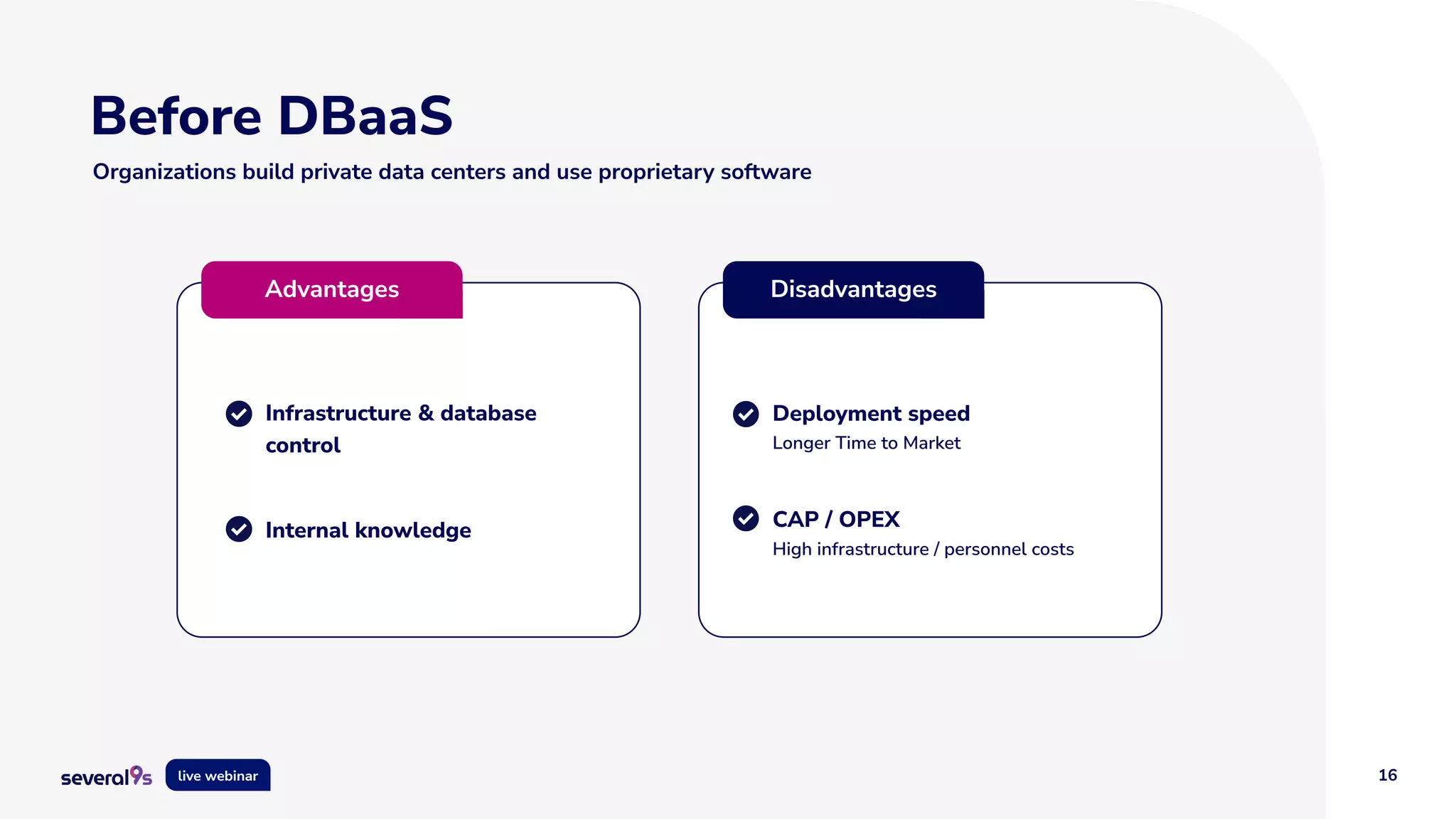
Before DBaaS
Infrastructure & database
control
Deployment speed
Longer Time to Market
Internal knowledge CAP / OPEX
High infrastructure / personnel costs
image here
Organizations build private data centers and use proprietary software
Advantages Disadvantages
17
live webinar
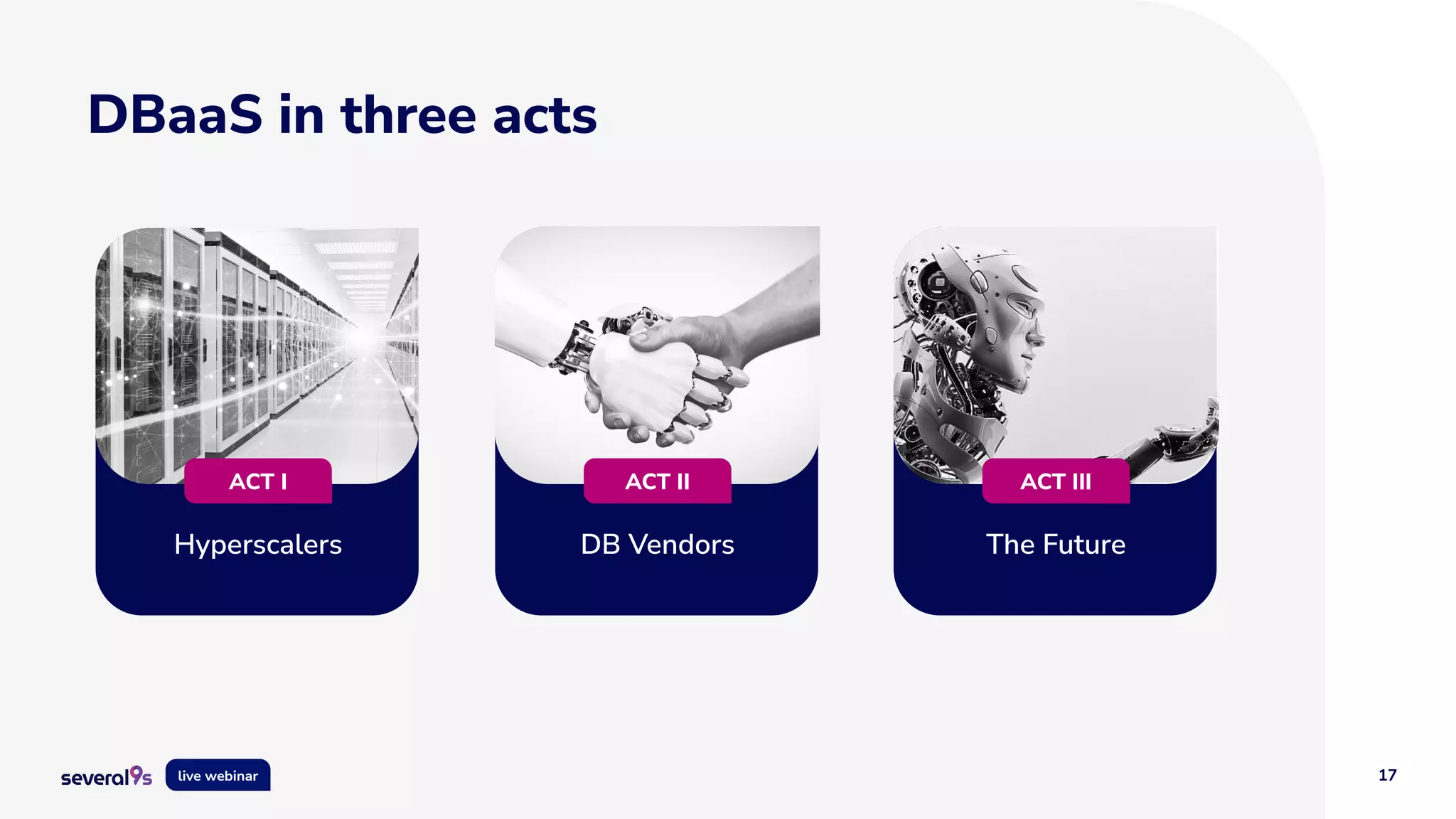
Hyperscalers
DBaaS in three acts
DB Vendors The Future
ACT II ACT III
ACT I
18
live webinar
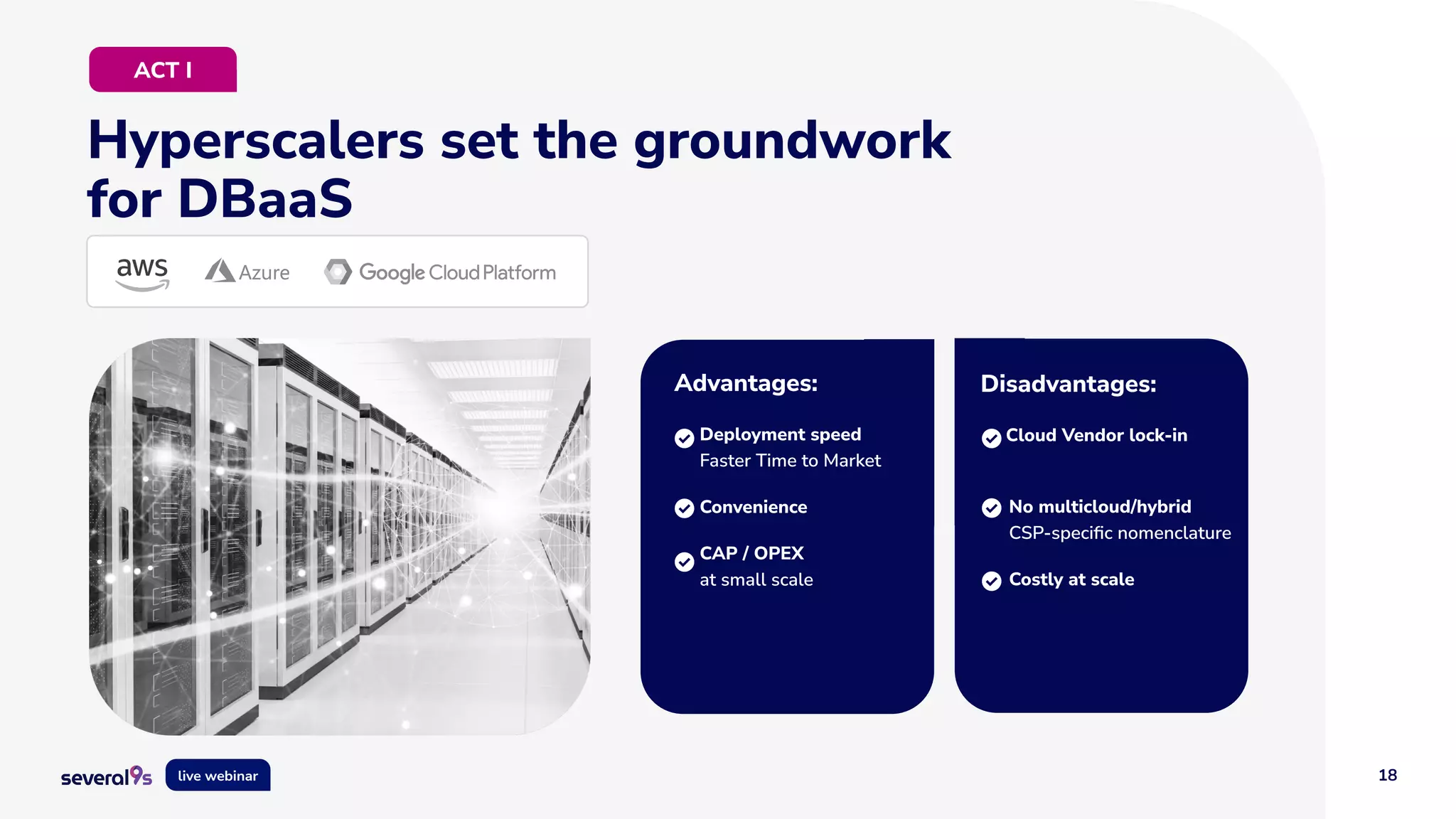
Hyperscalers set the groundwork
for DBaaS
ACT I
Advantages:
Deployment speed
Faster Time to Market
Convenience
CAP / OPEX
at small scale
Disadvantages:
Cloud Vendor lock-in
No multicloud/hybrid
CSP-specific nomenclature & tooling
Costly at scale
19
live webinar
Multiple
databases*
on one
cloud
* no MongoDB, Elasticsearch,
Neo4j, CockroachDB…
20
live webinar
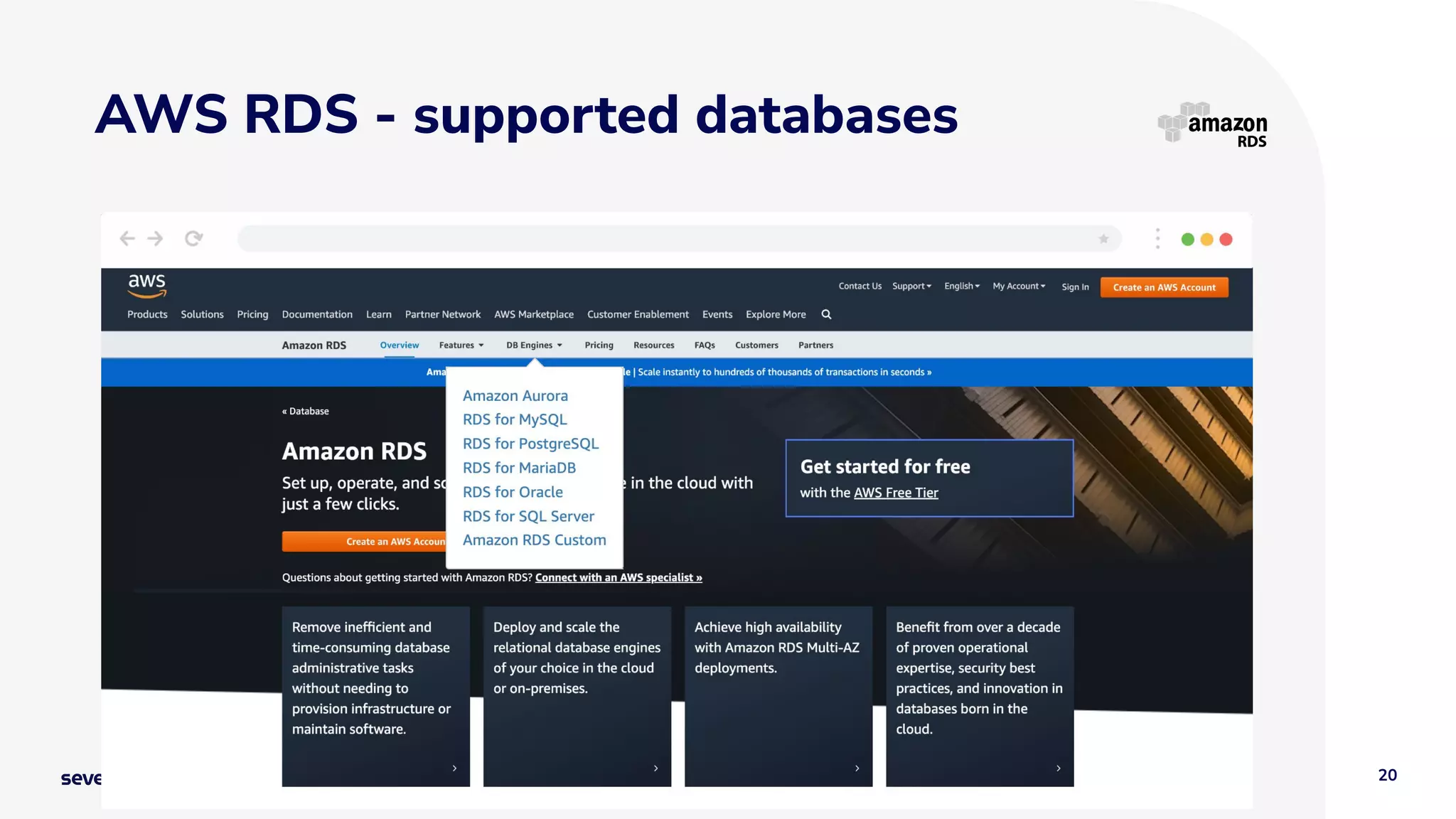
AWS RDS - supported databases
21
live webinar
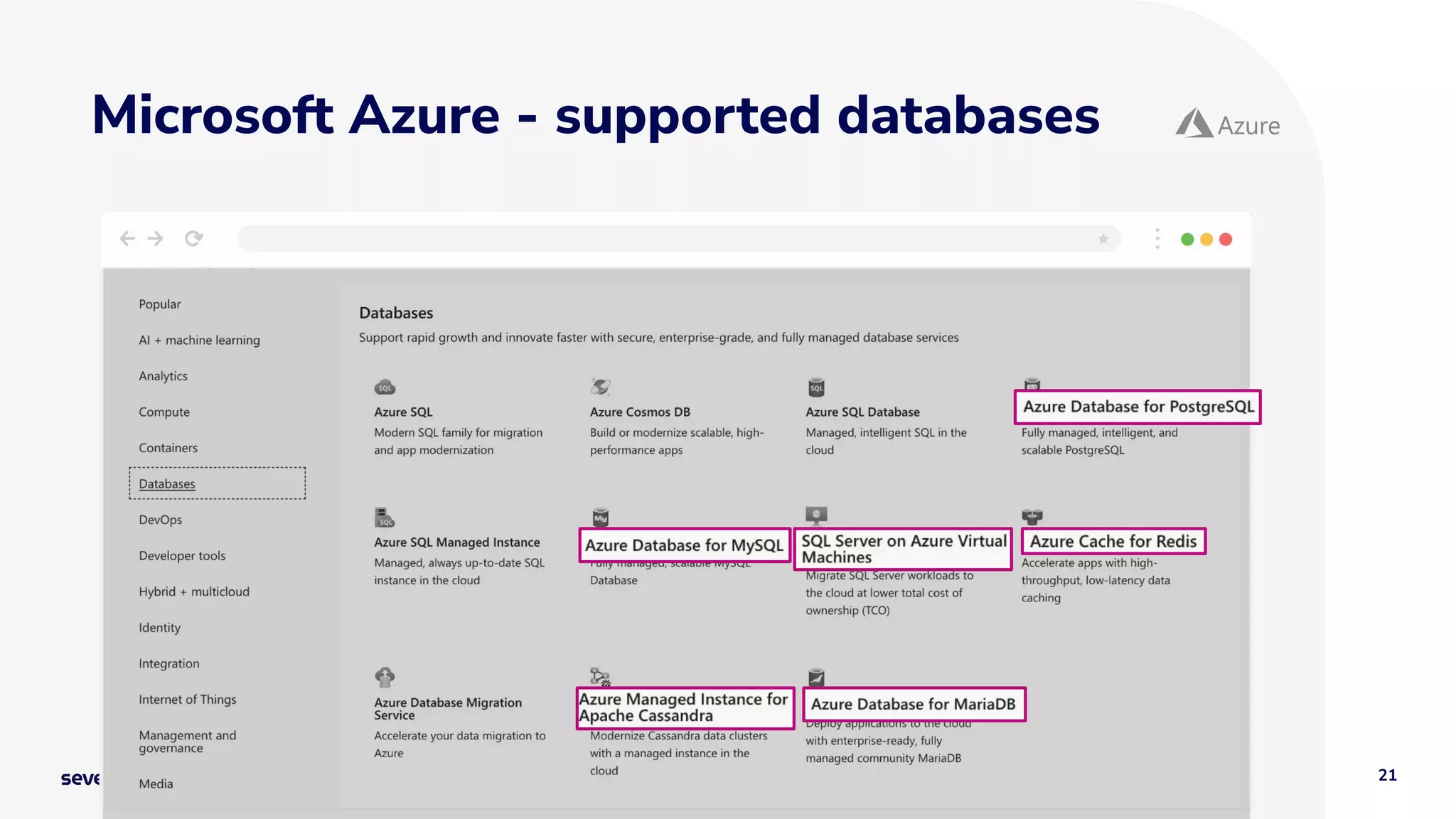
Microsoft Azure - supported databases
22
live webinar
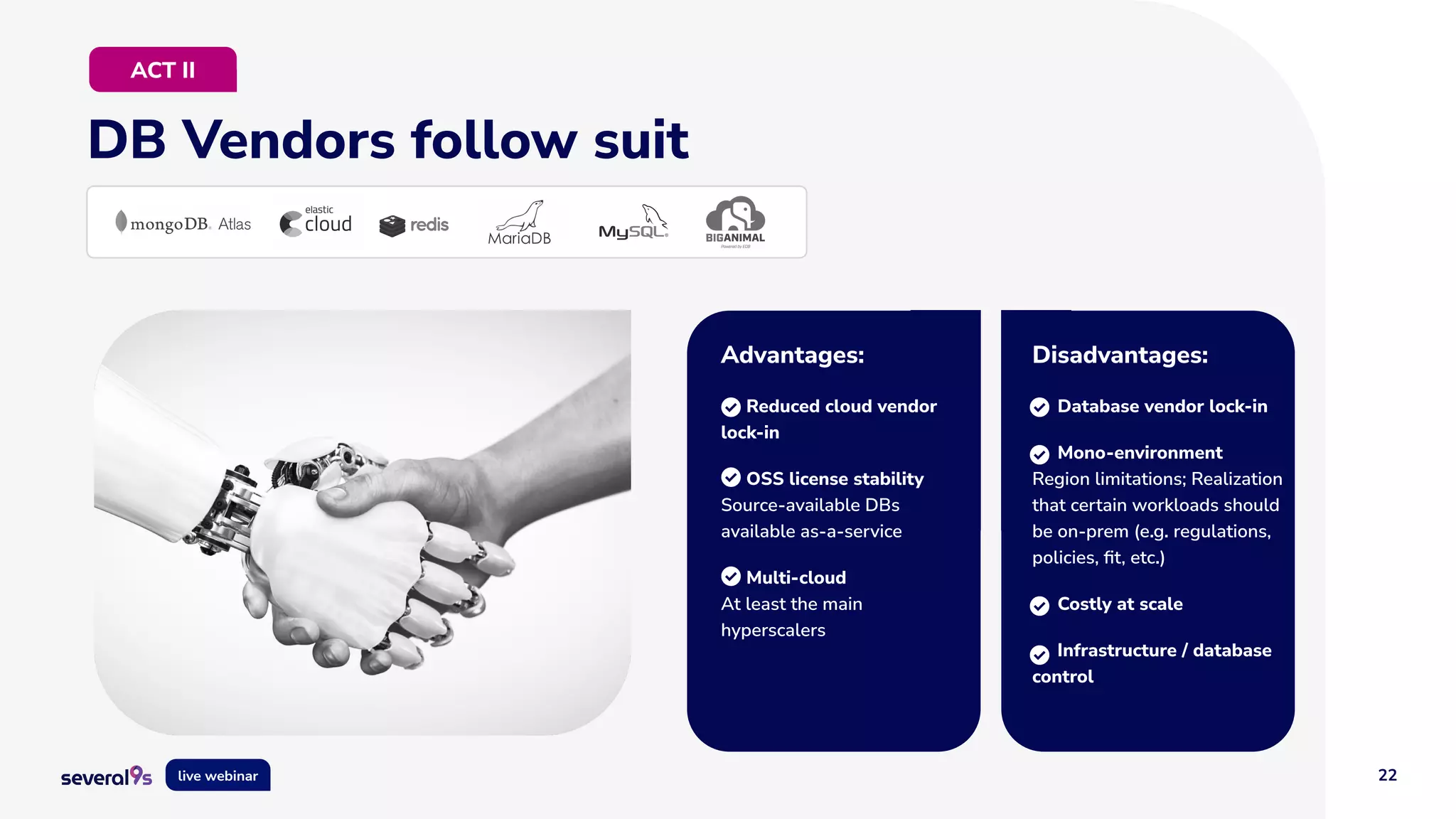
DB Vendors follow suit
ACT II
Advantages:
Reduced cloud vendor
lock-in
OSS license stability
Source-available DBs
available as-a-service
Multi-cloud
At least the main
hyperscalers
Disadvantages:
Database vendor lock-in
Mono-environment
Region limitations; Realization
that certain workloads should
be on-prem (e.g. regulations,
policies, fit, etc.)
Costly at scale
Infrastructure / database
control
23
live webinar
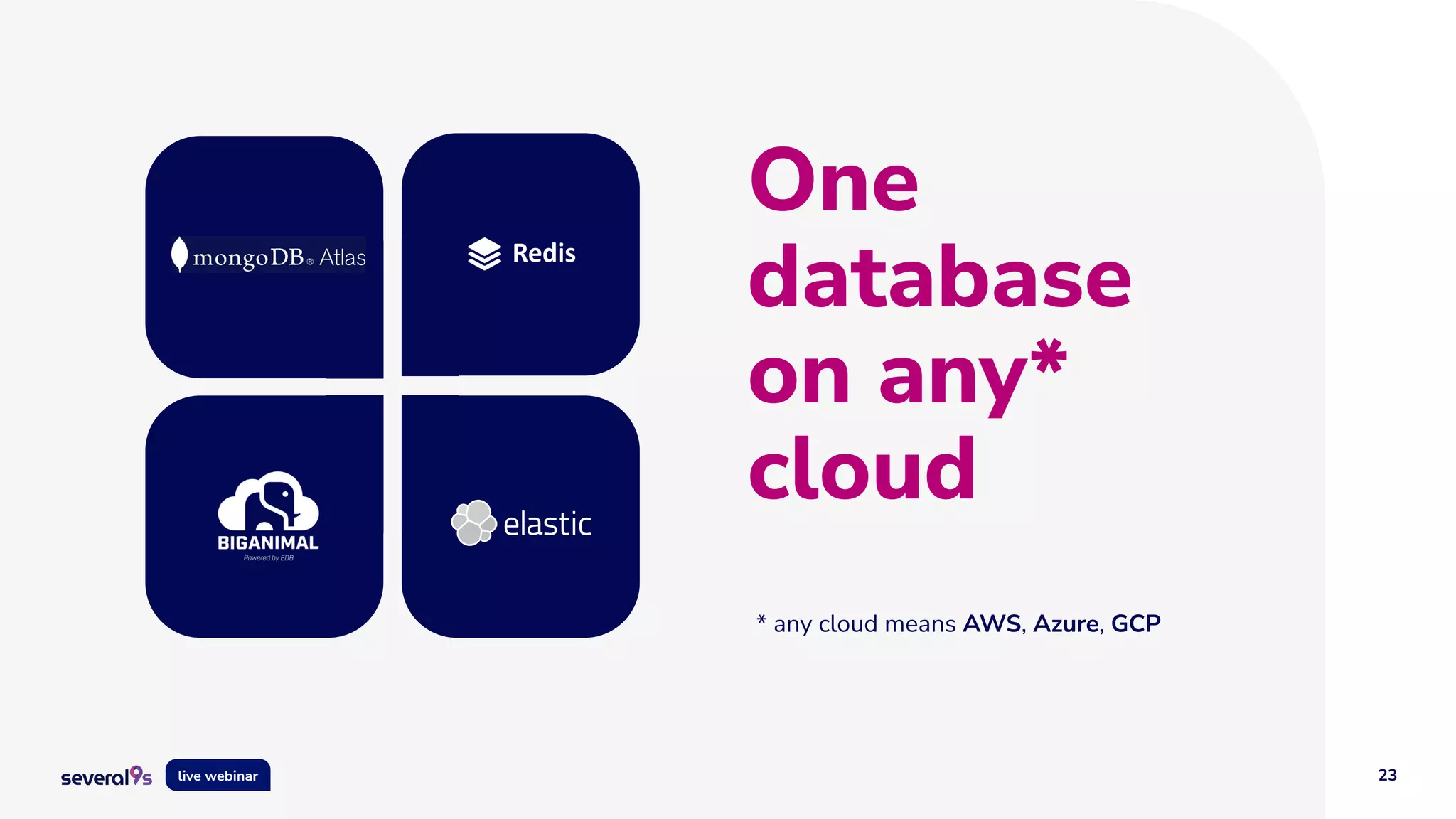
One
database
on any*
cloud
* any cloud means AWS, Azure, GCP
24
live webinar
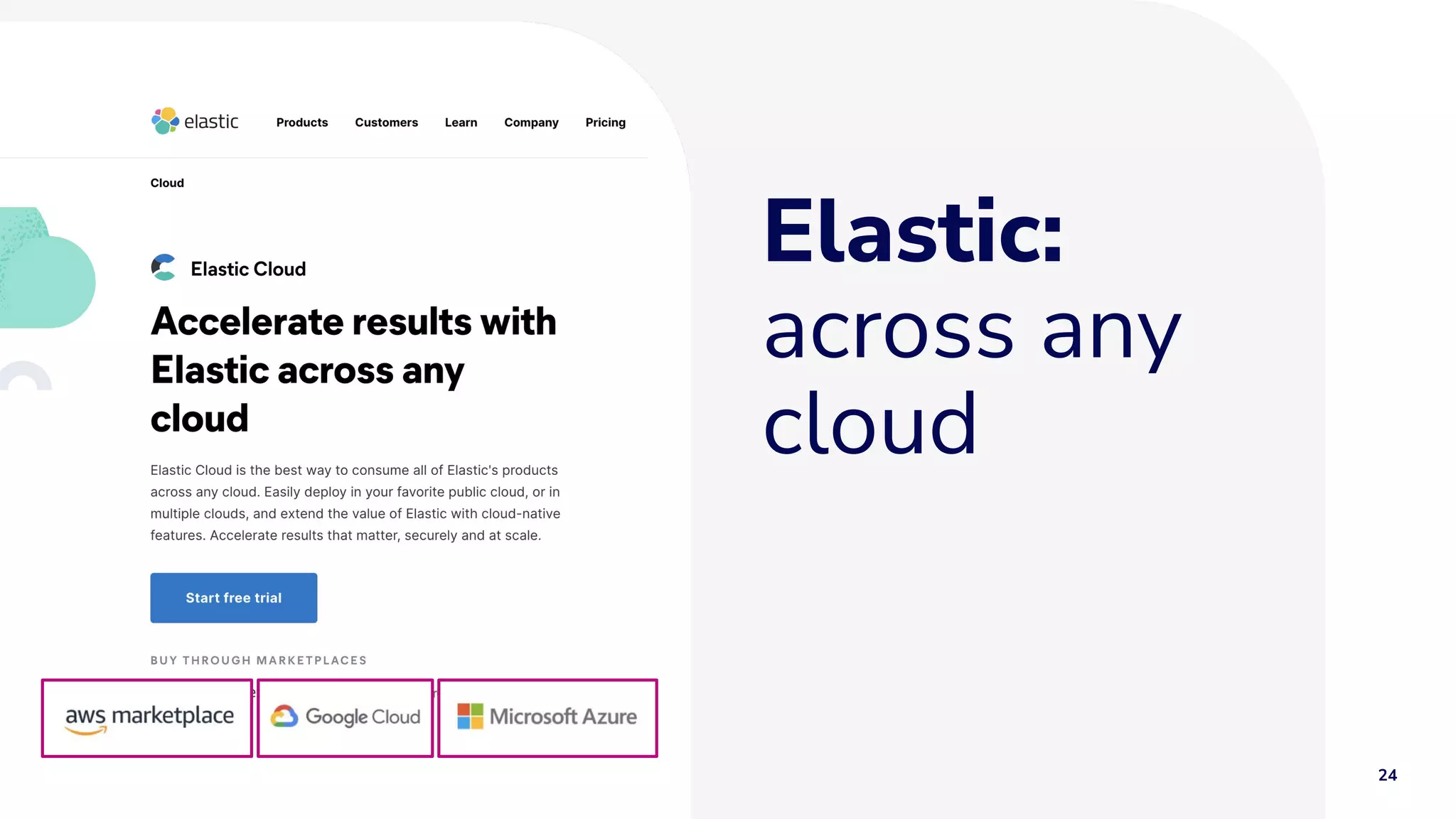
Elastic:
across any
cloud
25
live webinar
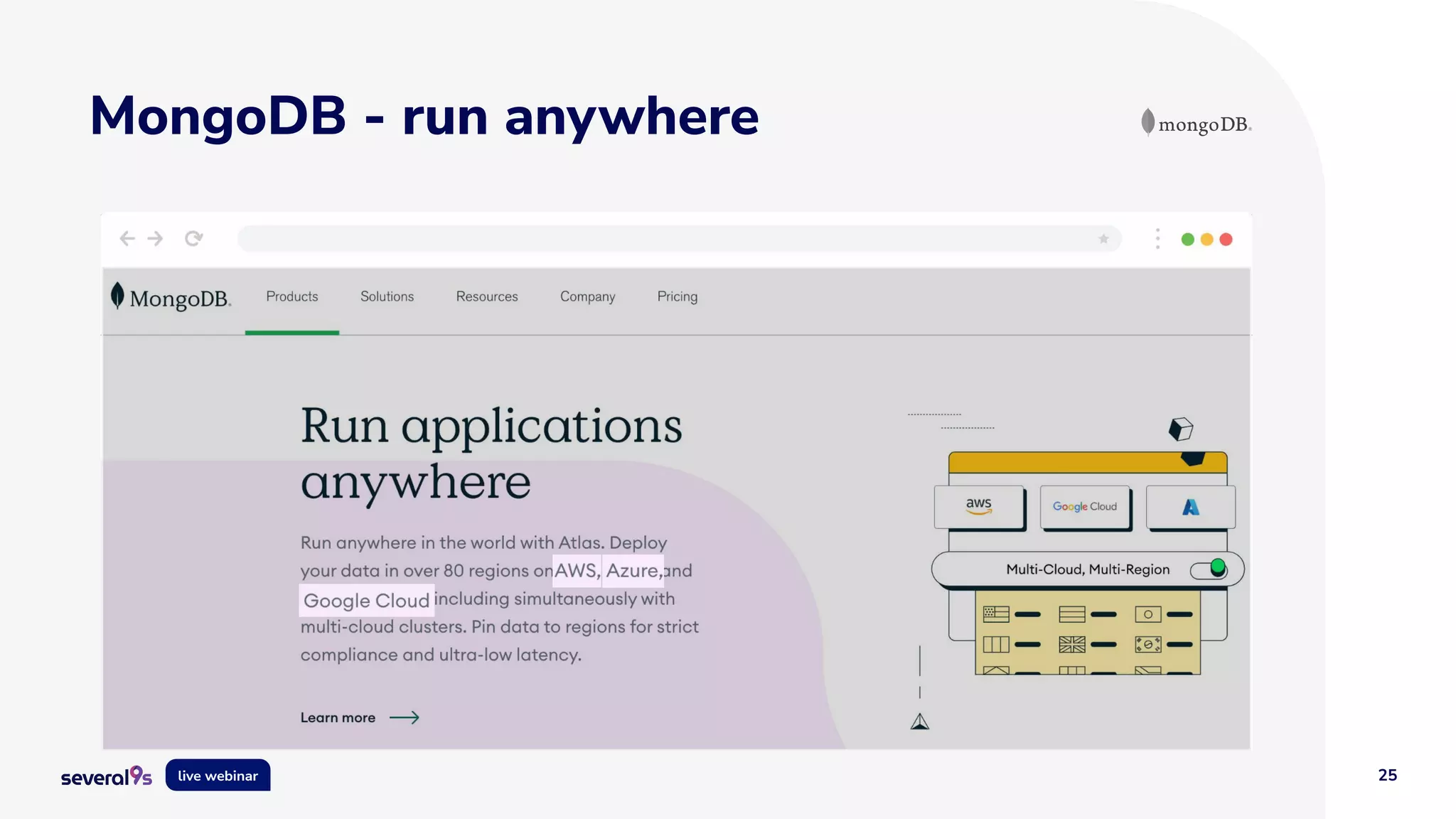
MongoDB - run anywhere
26
live webinar
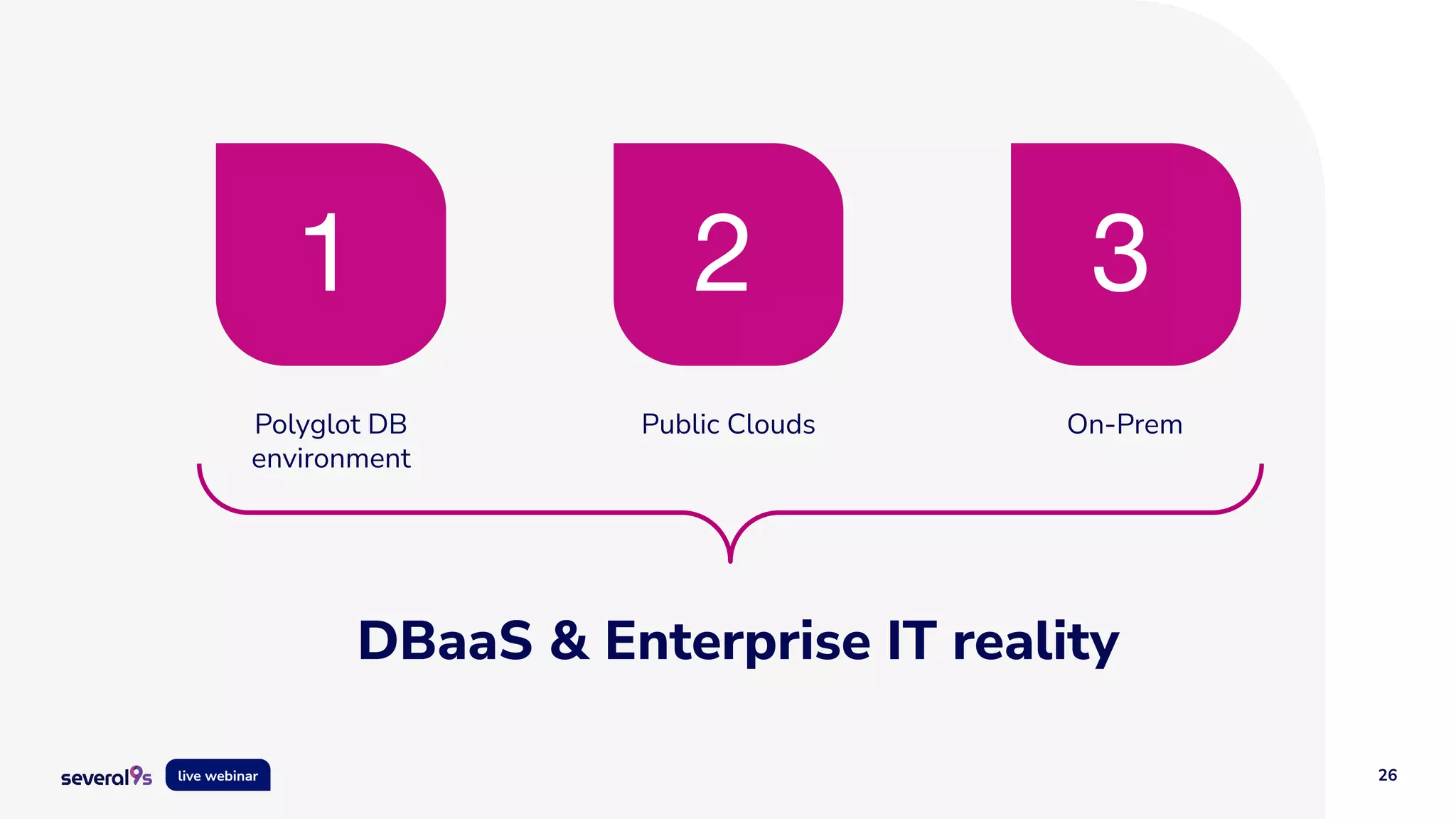
Polyglot DB
environment
On-Prem
Public Clouds
1 2 3
DBaaS & Enterprise IT reality
27
live webinar
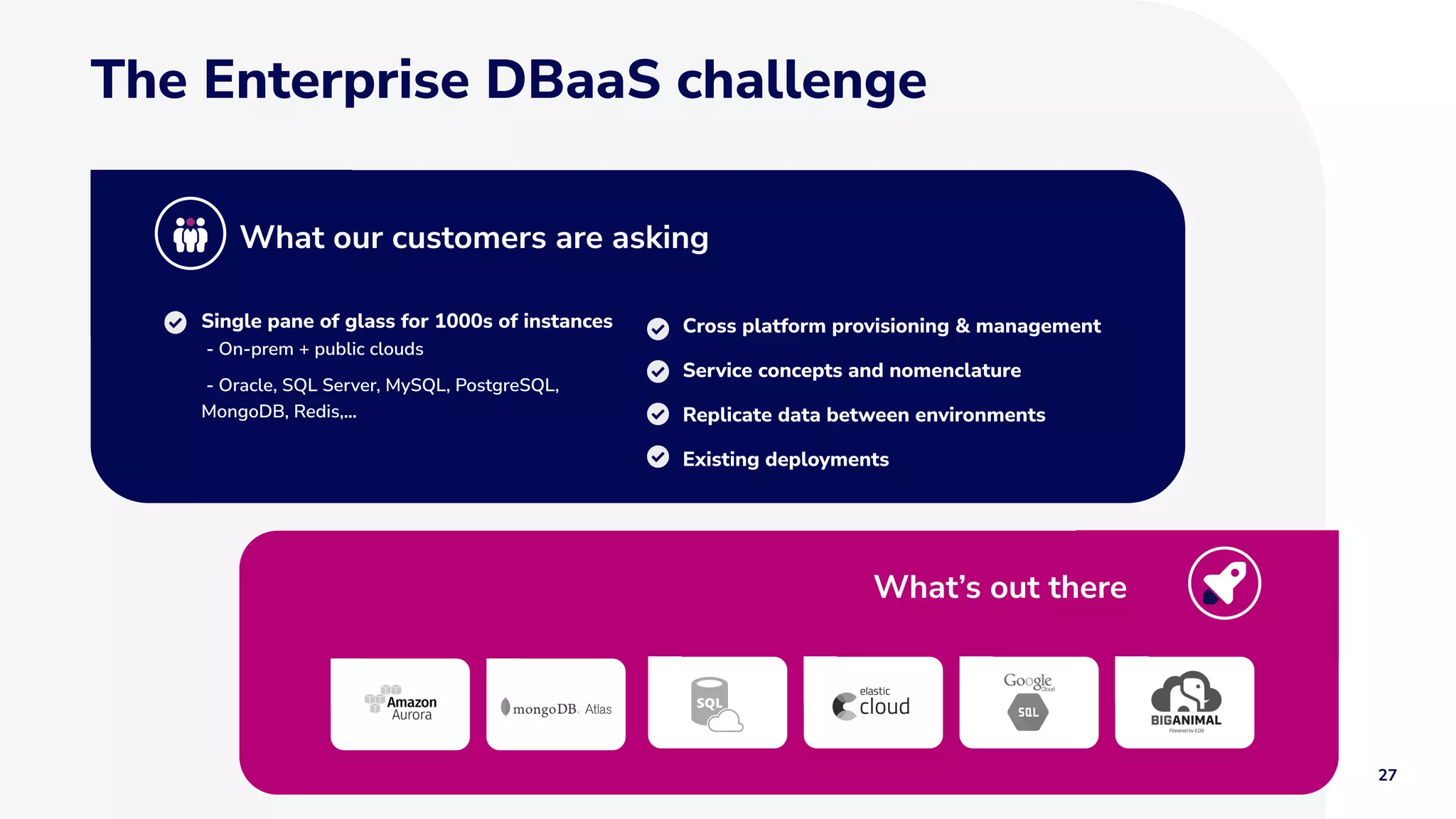
The Enterprise DBaaS challenge
What our customers are asking
Single pane of glass for 1000s of instances
- On-prem + public clouds
- Oracle, SQL Server, MySQL, PostgreSQL,
MongoDB, Redis,...
Cross platform provisioning & management
Service concepts and nomenclature
Replicate data between environments
Existing deployments
What’s out there
28
live webinar
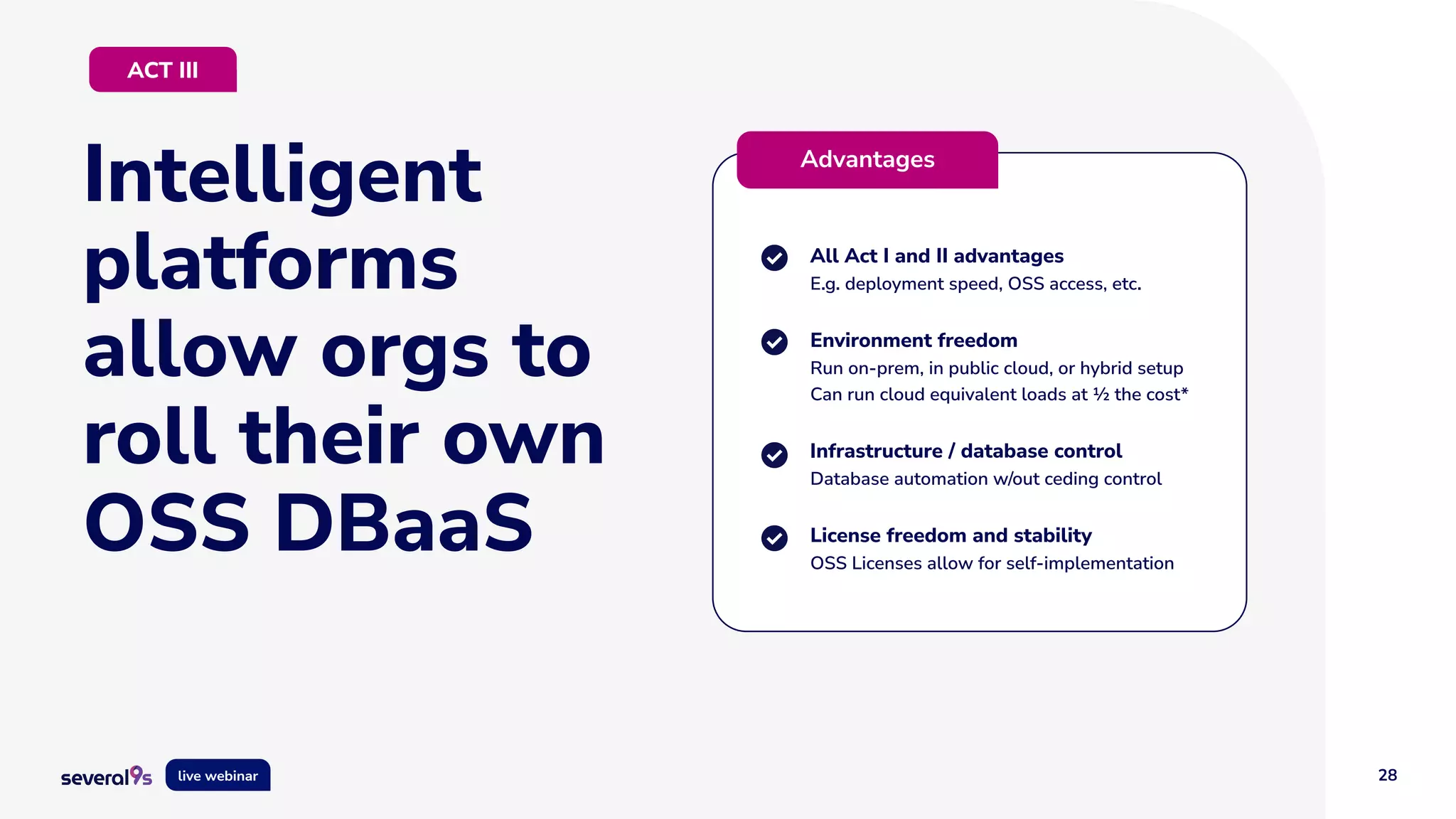
Intelligent
platforms
allow orgs to
roll their own
OSS DBaaS
All Act I and II advantages
E.g. deployment speed, OSS access, etc.
Environment freedom
Run on-prem, in public cloud, or hybrid setup
Can run cloud equivalent loads at ½ the cost*
Infrastructure / database control
Database automation w/out ceding control
License freedom and stability
OSS Licenses allow for self-implementation
Advantages
ACT III
Building your own DBaaS
30
live webinar
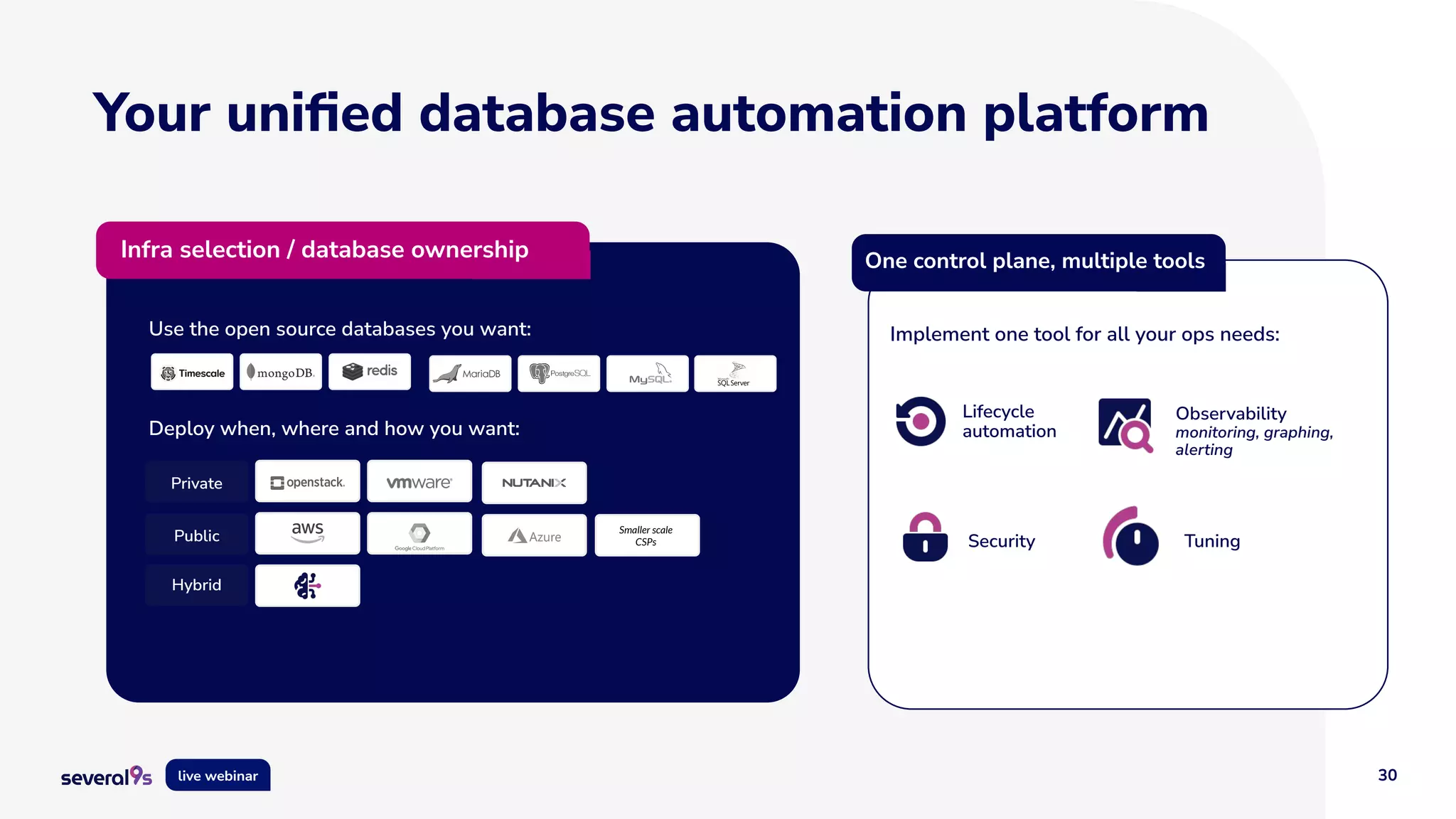
Your unified database automation platform
Infra selection / database ownership
Use the open source databases you want:
Private
Public
Hybrid
Smaller scale
CSPs
z z z z z z z
Deploy when, where and how you want:
One control plane, multiple tools
Lifecycle
automation
Observability
monitoring, graphing,
alerting
Security Tuning
Implement one tool for all your ops needs:
31
live webinar
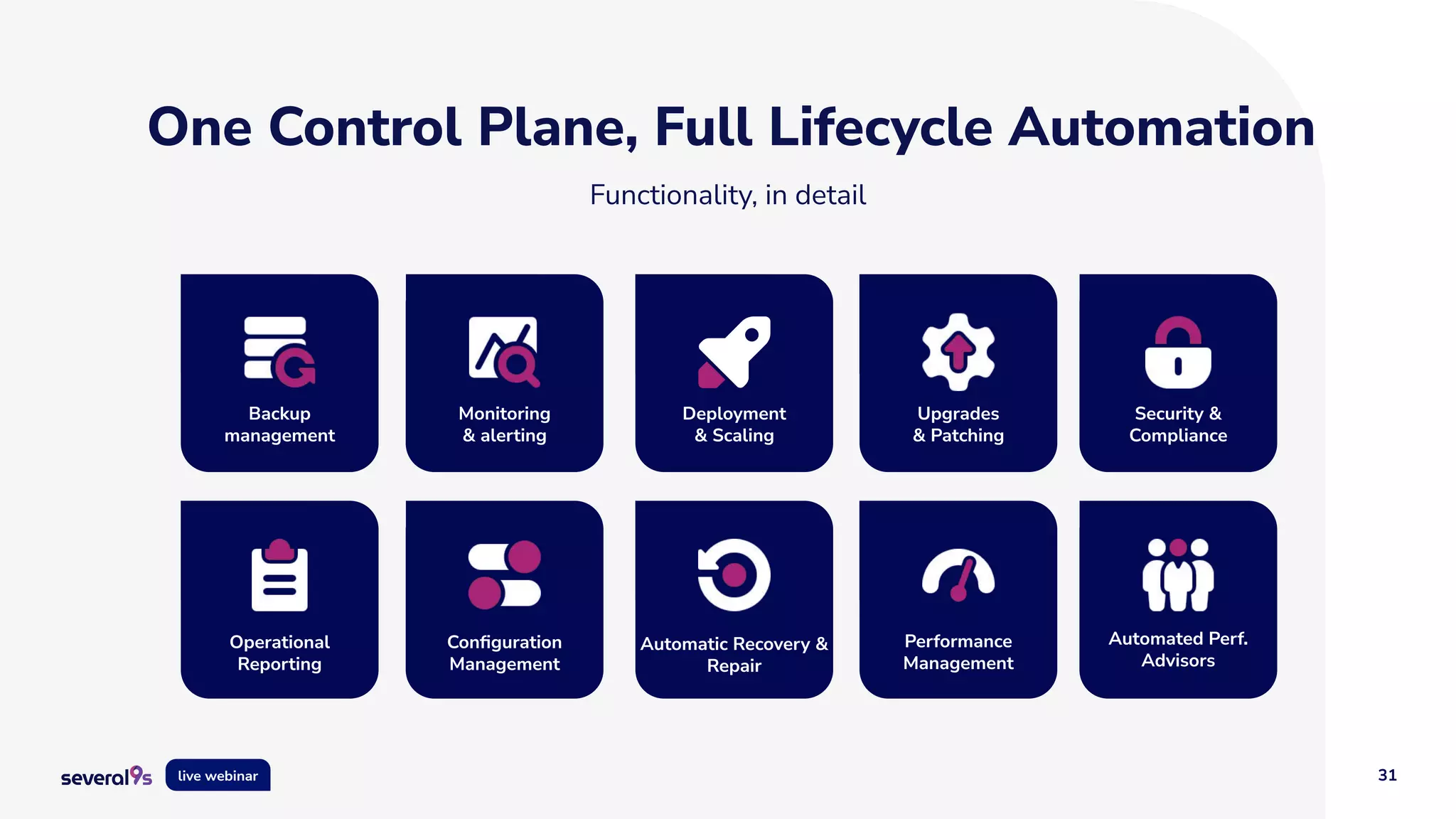
Functionality, in detail
Backup
management
Monitoring
& alerting
Deployment
& Scaling
Upgrades
& Patching
Security &
Compliance
Operational
Reporting
Configuration
Management
Automatic Recovery &
Repair
Performance
Management
Automated Perf.
Advisors
One Control Plane, Full Lifecycle Automation
32
live webinar
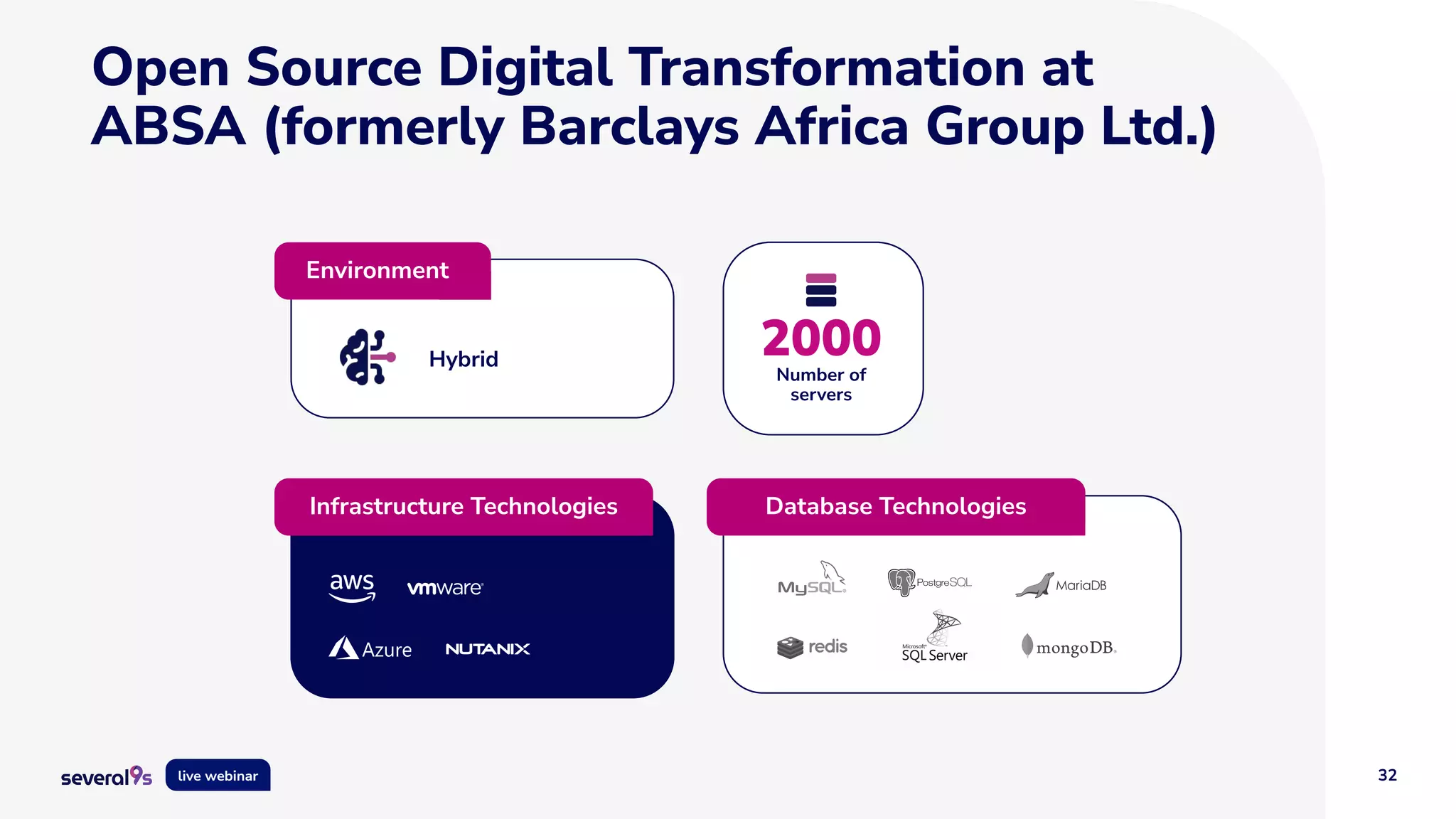
Open Source Digital Transformation at
ABSA (formerly Barclays Africa Group Ltd.)
Environment
Hybrid
Infrastructure Technologies
Number of
servers
2000
Database Technologies
33
live webinar
Our customers say:
“Severalnines enabled us to build automation
around our database platform for self-service
provisioning while being able to consistently
determine deployment patterns without DBA
involvement.”
200 customers
and counting
Q&A
5
Sovereign DBaaS with Severalnines
4
Thank you
title style
Bold text 9px
Regular text 9px
Bold text 12px
Regular text 12px
Bold text 14px
Regular text 14px
Baloon title blue
highlight text sit amet,
consectetur adipiscing elit
Bold text 10px
Regular text 10px
Baloon title pink

Cloud's future runs through Sovereign DBaaS

  • 1.
    Cloud’s future runs throughSovereign DBaaS June 8 @ 11am EST live webinar
  • 2.
    Vinay Josery CEO ofSeveralnines Sanjeev Mohan Principal Analyst at SanjMo and former Gartner Research VP Presenters: live webinar
  • 3.
    3 live webinar agenda 1 Thestate of Cloud usage 2 Introducing Sovereign DBaaS 3 Key characteristics 4 Sovereign DBaaS with Severalnines 5 Q&A
  • 4.
    The state ofCloud usage 1 Introducing Sovereign DBaaS 2 Key characteristics 3
  • 5.
    5 live webinar The stateof Cloud usage Types of cloud used Public cloud only 16% 80% Hybrid 4% Private cloud only Public 96% Private 84%
  • 6.
    6 live webinar Top 3Cloud challenges Security Expertise Spend
  • 7.
    7 live webinar All cloudchallenges Top cloud challenges for all organizations Security Lack of resources/expertise Managing cloud spend Governance Managing software licenses Compliance Central cloud team/Business unit responsibility balancing Cloud migration Managing multi-cloud 86% 83% 81% 77% 76% 76% 73% 73% 71%
  • 8.
    8 live webinar Solution: VaryDeployment Models Workload usage frequency Workload execution duration Public Cloud Co-Location On-Premises
  • 9.
    Introducing Sovereign DBaaS 2 Thestate of Cloud usage 1 Key characteristics 3
  • 10.
    10 live webinar Introducing SovereignDBaaS Sovereign DBaaS gives you the ultimate portability of choosing where to deploy your own data with no lock-in and with full control over your costs, security, and configuration. Achieve the promise of open-source databases through a vendor-neutral distribution.
  • 11.
    11 live webinar Sovereign DBaaS KeyFeatures Ownership & Location ● Private cloud IaaS ● Multi-cloud ● On-premises ● Data plane ● Control plane Cost Management ● Open-source ● Cost management ● Cost predictability ● Distributed workloads Manageability ● Upgrades and patching ● Backup management ● Monitoring and alerting ● HA and DR ● Configuration management Governance & Privacy ● Regulatory compliance ● Data residency ● Audit Security ● Data at rest ● Data in motion ● Encryption keys (BYOK) ● Security frameworks User Experience ● Developer ● Operations ● DevOps ● Automation
  • 12.
    12 live webinar SWOT Analysisfor Sovereign DBaaS S W O T Strengths Requires deep IT talent which is in short supply New category leads to a lack of awareness With greater control, organizations need to exert extra caution for management / administration tasks Predictable costs No vendor lock-in Maintain data privacy Full control over operational aspects Fully-managed SaaS and serverless offerings Hyperscale cloud providers have started offering subset of capabilities, e.g. Amazon RDS Custom Certifications are still in progress Increasing openness to alternatives Improving single pane-of-glass accessibility Develop best practices practical guide Opportunities Weaknesses Threats
  • 13.
    Key characteristics 3 Introducing SovereignDBaaS 2 Sovereign DBaaS with Severalnines 4
  • 14.
    14 live webinar Open-source DBaaSOptions Single AWS, Azure and GCP Multi-cloud Aiven, Instaclustr (NetApp) Multiple ● Software-only, Severalnines ● H/W and S/W - Nutanix, VMWare Single Amazon RDS on Outposts, Azure Arc, GCP Anthos Public cloud only Hybrid
  • 15.
    Sovereign DBaaS withSeveralnines 4 Key characteristics 3 Q&A 5
  • 16.
    16 live webinar Before DBaaS Infrastructure& database control Deployment speed Longer Time to Market Internal knowledge CAP / OPEX High infrastructure / personnel costs image here Organizations build private data centers and use proprietary software Advantages Disadvantages
  • 17.
    17 live webinar Hyperscalers DBaaS inthree acts DB Vendors The Future ACT II ACT III ACT I
  • 18.
    18 live webinar Hyperscalers setthe groundwork for DBaaS ACT I Advantages: Deployment speed Faster Time to Market Convenience CAP / OPEX at small scale Disadvantages: Cloud Vendor lock-in No multicloud/hybrid CSP-specific nomenclature & tooling Costly at scale
  • 19.
    19 live webinar Multiple databases* on one cloud *no MongoDB, Elasticsearch, Neo4j, CockroachDB…
  • 20.
    20 live webinar AWS RDS- supported databases
  • 21.
    21 live webinar Microsoft Azure- supported databases
  • 22.
    22 live webinar DB Vendorsfollow suit ACT II Advantages: Reduced cloud vendor lock-in OSS license stability Source-available DBs available as-a-service Multi-cloud At least the main hyperscalers Disadvantages: Database vendor lock-in Mono-environment Region limitations; Realization that certain workloads should be on-prem (e.g. regulations, policies, fit, etc.) Costly at scale Infrastructure / database control
  • 23.
    23 live webinar One database on any* cloud *any cloud means AWS, Azure, GCP
  • 24.
  • 25.
  • 26.
    26 live webinar Polyglot DB environment On-Prem PublicClouds 1 2 3 DBaaS & Enterprise IT reality
  • 27.
    27 live webinar The EnterpriseDBaaS challenge What our customers are asking Single pane of glass for 1000s of instances - On-prem + public clouds - Oracle, SQL Server, MySQL, PostgreSQL, MongoDB, Redis,... Cross platform provisioning & management Service concepts and nomenclature Replicate data between environments Existing deployments What’s out there
  • 28.
    28 live webinar Intelligent platforms allow orgsto roll their own OSS DBaaS All Act I and II advantages E.g. deployment speed, OSS access, etc. Environment freedom Run on-prem, in public cloud, or hybrid setup Can run cloud equivalent loads at ½ the cost* Infrastructure / database control Database automation w/out ceding control License freedom and stability OSS Licenses allow for self-implementation Advantages ACT III
  • 29.
  • 30.
    30 live webinar Your unifieddatabase automation platform Infra selection / database ownership Use the open source databases you want: Private Public Hybrid Smaller scale CSPs z z z z z z z Deploy when, where and how you want: One control plane, multiple tools Lifecycle automation Observability monitoring, graphing, alerting Security Tuning Implement one tool for all your ops needs:
  • 31.
    31 live webinar Functionality, indetail Backup management Monitoring & alerting Deployment & Scaling Upgrades & Patching Security & Compliance Operational Reporting Configuration Management Automatic Recovery & Repair Performance Management Automated Perf. Advisors One Control Plane, Full Lifecycle Automation
  • 32.
    32 live webinar Open SourceDigital Transformation at ABSA (formerly Barclays Africa Group Ltd.) Environment Hybrid Infrastructure Technologies Number of servers 2000 Database Technologies
  • 33.
    33 live webinar Our customerssay: “Severalnines enabled us to build automation around our database platform for self-service provisioning while being able to consistently determine deployment patterns without DBA involvement.” 200 customers and counting
  • 34.
  • 35.
  • 36.
    title style Bold text9px Regular text 9px Bold text 12px Regular text 12px Bold text 14px Regular text 14px Baloon title blue highlight text sit amet, consectetur adipiscing elit Bold text 10px Regular text 10px Baloon title pink