Cloud Services on the
Internet
Yasiru Bandara
HND/DT/PN/2024/B3/27
Introduction to Cloud Services
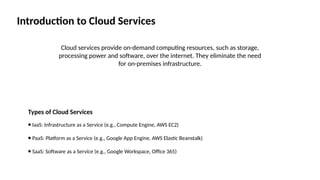
Cloud services provide on-demand computing resources, such as storage,
processing power and software, over the internet. They eliminate the need
for on-premises infrastructure.
Types of Cloud Services
⦁ IaaS: Infrastructure as a Service (e.g., Compute Engine, AWS EC2)
⦁ PaaS: Platform as a Service (e.g., Google App Engine, AWS Elastic Beanstalk)
⦁ SaaS: Software as a Service (e.g., Google Workspace, Office 365)
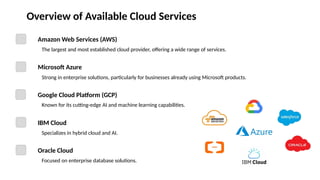
Overview of Available Cloud Services
Amazon Web Services (AWS)
Microsoft Azure
Google Cloud Platform (GCP)
IBM Cloud
Oracle Cloud
The largest and most established cloud provider, offering a wide range of services.
Strong in enterprise solutions, particularly for businesses already using Microsoft products.
Known for its cutting-edge AI and machine learning capabilities.
Specializes in hybrid cloud and AI.
Focused on enterprise database solutions.
Features of Leading Cloud Providers
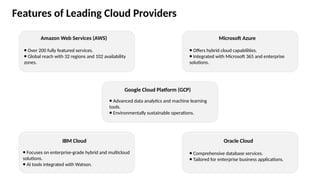
Amazon Web Services (AWS)
⦁ Over 200 fully featured services.
⦁ Global reach with 32 regions and 102 availability
zones.
Microsoft Azure
⦁ Offers hybrid cloud capabilities.
⦁ Integrated with Microsoft 365 and enterprise
solutions.
Google Cloud Platform (GCP)
⦁ Advanced data analytics and machine learning
tools.
⦁ Environmentally sustainable operations.
IBM Cloud
⦁ Focuses on enterprise-grade hybrid and multicloud
solutions.
⦁ AI tools integrated with Watson.
Oracle Cloud
⦁ Comprehensive database services.
⦁ Tailored for enterprise business applications.
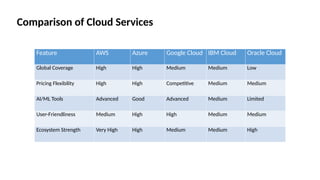
Comparison of Cloud Services
Feature AWS Azure Google Cloud IBM Cloud Oracle Cloud
Global Coverage High High Medium Medium Low
Pricing Flexibility High High Competitive Medium Medium
AI/ML Tools Advanced Good Advanced Medium Limited
User-Friendliness Medium High High Medium Medium
Ecosystem Strength Very High High Medium Medium High
Amazon Web Services
1 2
3 4
5
Market Leader Comprehensive Service Range
Global Availability Community Support
Security
AWS has the largest global
presence and the most mature
ecosystem.
Includes compute, storage,
databases, AI/ML, and more.
Data centers in 32 regions
ensure low latency.
Security is paramount, with robust
security features and compliance
certifications.
Extensive documentation, active
developer forums, and a large
ecosystem of third-party tools.
Why AWS is Selected:
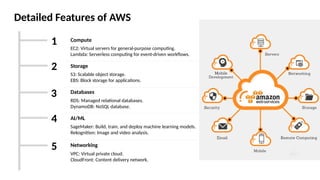
Detailed Features of AWS
Compute
EC2: Virtual servers for general-purpose computing.
Lambda: Serverless computing for event-driven workflows.
Storage
S3: Scalable object storage.
EBS: Block storage for applications.
Databases
RDS: Managed relational databases.
DynamoDB: NoSQL database.
AI/ML
SageMaker: Build, train, and deploy machine learning models.
Rekognition: Image and video analysis.
Networking
VPC: Virtual private cloud.
CloudFront: Content delivery network.
1
2
3
4
5
Benefits of Using AWS for the Project
Scalability
Security
Cost-Efficiency
Machine Learning Integration
Global Availability
Supports dynamic growth as more devices are added.
Robust tools to secure data and devices.
Pay-as-you-go model keeps costs manageable.
Easy deployment of predictive analytics and AI-based recommendations.
Ensures consistent performance worldwide.
1
2
3
4
5
Conclusion
Cloud services, particularly AWS, provide a powerful and
cost-effective solution for modern businesses. By leveraging
its extensive services and features, organizations can achieve
greater scalability, security, and cost efficiency. The future of
computing lies in the cloud, and AWS is at the forefront of
this revolution.
Thank You!

Cloud Services on the Internet (Unit 6 presentation 1).pptx

  • 1.
    Cloud Services onthe Internet Yasiru Bandara HND/DT/PN/2024/B3/27
  • 2.
    Introduction to CloudServices Cloud services provide on-demand computing resources, such as storage, processing power and software, over the internet. They eliminate the need for on-premises infrastructure. Types of Cloud Services ⦁ IaaS: Infrastructure as a Service (e.g., Compute Engine, AWS EC2) ⦁ PaaS: Platform as a Service (e.g., Google App Engine, AWS Elastic Beanstalk) ⦁ SaaS: Software as a Service (e.g., Google Workspace, Office 365)
  • 3.
    Overview of AvailableCloud Services Amazon Web Services (AWS) Microsoft Azure Google Cloud Platform (GCP) IBM Cloud Oracle Cloud The largest and most established cloud provider, offering a wide range of services. Strong in enterprise solutions, particularly for businesses already using Microsoft products. Known for its cutting-edge AI and machine learning capabilities. Specializes in hybrid cloud and AI. Focused on enterprise database solutions.
  • 4.
    Features of LeadingCloud Providers Amazon Web Services (AWS) ⦁ Over 200 fully featured services. ⦁ Global reach with 32 regions and 102 availability zones. Microsoft Azure ⦁ Offers hybrid cloud capabilities. ⦁ Integrated with Microsoft 365 and enterprise solutions. Google Cloud Platform (GCP) ⦁ Advanced data analytics and machine learning tools. ⦁ Environmentally sustainable operations. IBM Cloud ⦁ Focuses on enterprise-grade hybrid and multicloud solutions. ⦁ AI tools integrated with Watson. Oracle Cloud ⦁ Comprehensive database services. ⦁ Tailored for enterprise business applications.
  • 5.
    Comparison of CloudServices Feature AWS Azure Google Cloud IBM Cloud Oracle Cloud Global Coverage High High Medium Medium Low Pricing Flexibility High High Competitive Medium Medium AI/ML Tools Advanced Good Advanced Medium Limited User-Friendliness Medium High High Medium Medium Ecosystem Strength Very High High Medium Medium High
  • 6.
    Amazon Web Services 12 3 4 5 Market Leader Comprehensive Service Range Global Availability Community Support Security AWS has the largest global presence and the most mature ecosystem. Includes compute, storage, databases, AI/ML, and more. Data centers in 32 regions ensure low latency. Security is paramount, with robust security features and compliance certifications. Extensive documentation, active developer forums, and a large ecosystem of third-party tools. Why AWS is Selected:
  • 7.
    Detailed Features ofAWS Compute EC2: Virtual servers for general-purpose computing. Lambda: Serverless computing for event-driven workflows. Storage S3: Scalable object storage. EBS: Block storage for applications. Databases RDS: Managed relational databases. DynamoDB: NoSQL database. AI/ML SageMaker: Build, train, and deploy machine learning models. Rekognition: Image and video analysis. Networking VPC: Virtual private cloud. CloudFront: Content delivery network. 1 2 3 4 5
  • 8.
    Benefits of UsingAWS for the Project Scalability Security Cost-Efficiency Machine Learning Integration Global Availability Supports dynamic growth as more devices are added. Robust tools to secure data and devices. Pay-as-you-go model keeps costs manageable. Easy deployment of predictive analytics and AI-based recommendations. Ensures consistent performance worldwide. 1 2 3 4 5
  • 9.
    Conclusion Cloud services, particularlyAWS, provide a powerful and cost-effective solution for modern businesses. By leveraging its extensive services and features, organizations can achieve greater scalability, security, and cost efficiency. The future of computing lies in the cloud, and AWS is at the forefront of this revolution.
  • 10.