Cloud Platforms in
Industry
Introduction to Cloud Platforms
In today’s digital era, cloud computing plays a crucial role
in transforming businesses by providing scalable, cost-
effective, and flexible solutions. Cloud platforms enable
organizations to store data, run applications, and manage IT
infrastructure over the Internet without the need for
physical hardware.
Major cloud providers:-
• Amazon Web Services (AWS),
• Microsoft Azure,
• Google Cloud,
Amazon Web Services (AWS)
What is AWS?
Amazon Web Services (AWS) is a cloud computing platform
provided by Amazon.
It offers on-demand computing services such as storage,
networking, databases, and machine learning.
• Launched in 2006, AWS is now the largest cloud provider globally.
Features of AWS
1.Scalability – Easily scales up or down based on demand.
2.Security – Strong security measures with IAM (Identity
and Access Management), encryption, and compliance
certifications.
3.Cost-Effective – Pay-as-you-go pricing with free-tier
services available.
4.Flexible & Reliable – Supports multiple programming
languages and operating systems.
5.Global Reach – AWS provides low-latency access across
the world.
6.Automation & Monitoring – Services like AWS
CloudFormation, CloudWatch help in automating and
monitoring resources.
Overview of Google App
Engine
Automatic Scaling
Dynamically scales up or down
based on demand.
Multi-Language Support
Supports Python, Java, Go, PHP, and
other languages.
Overview of Microsoft Azure
1 Compute
Virtual Machines, Azure Functions (Serverless Computing).
2 Storage
Blob Storage, Azure Files (Managed File Share), Disk
Storage.
3 Databases
Azure SQL Database, Cosmos DB (Globally Distributed
NoSQL Database).
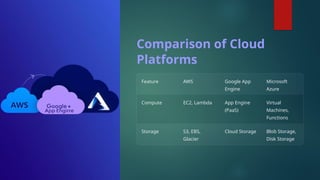
Comparison of Cloud
Platforms
Feature AWS Google App
Engine
Microsoft
Azure
Compute EC2, Lambda App Engine
(PaaS)
Virtual
Machines,
Functions
Storage S3, EBS,
Glacier
Cloud Storage Blob Storage,
Disk Storage
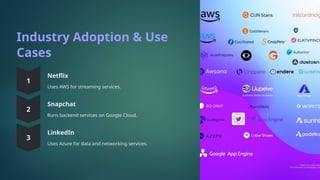
Industry Adoption & Use
Cases
Netflix
Uses AWS for streaming services.
Snapchat
Runs backend services on Google Cloud.
LinkedIn
Uses Azure for data and networking services.
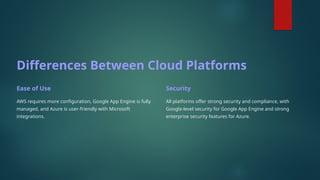
Differences Between Cloud Platforms
Ease of Use
AWS requires more configuration, Google App Engine is fully
managed, and Azure is user-friendly with Microsoft
integrations.
Security
All platforms offer strong security and compliance, with
Google-level security for Google App Engine and strong
enterprise security features for Azure.
Conclusion
The choice of cloud platform depends on business needs, industry
requirements, and scalability demands. AWS is best for enterprises and
startups, Google App Engine is best for developers, and Microsoft Azure is
best for businesses using Microsoft products.
Cloud-Platforms-in-Industry.Cloud-Platforms-in-Industry.Cloud-Platforms-in-Industry.

Cloud-Platforms-in-Industry.Cloud-Platforms-in-Industry.Cloud-Platforms-in-Industry.

  • 1.
  • 2.
    Introduction to CloudPlatforms In today’s digital era, cloud computing plays a crucial role in transforming businesses by providing scalable, cost- effective, and flexible solutions. Cloud platforms enable organizations to store data, run applications, and manage IT infrastructure over the Internet without the need for physical hardware. Major cloud providers:- • Amazon Web Services (AWS), • Microsoft Azure, • Google Cloud,
  • 3.
    Amazon Web Services(AWS) What is AWS? Amazon Web Services (AWS) is a cloud computing platform provided by Amazon. It offers on-demand computing services such as storage, networking, databases, and machine learning. • Launched in 2006, AWS is now the largest cloud provider globally.
  • 4.
    Features of AWS 1.Scalability– Easily scales up or down based on demand. 2.Security – Strong security measures with IAM (Identity and Access Management), encryption, and compliance certifications. 3.Cost-Effective – Pay-as-you-go pricing with free-tier services available. 4.Flexible & Reliable – Supports multiple programming languages and operating systems. 5.Global Reach – AWS provides low-latency access across the world. 6.Automation & Monitoring – Services like AWS CloudFormation, CloudWatch help in automating and monitoring resources.
  • 5.
    Overview of GoogleApp Engine Automatic Scaling Dynamically scales up or down based on demand. Multi-Language Support Supports Python, Java, Go, PHP, and other languages.
  • 6.
    Overview of MicrosoftAzure 1 Compute Virtual Machines, Azure Functions (Serverless Computing). 2 Storage Blob Storage, Azure Files (Managed File Share), Disk Storage. 3 Databases Azure SQL Database, Cosmos DB (Globally Distributed NoSQL Database).
  • 7.
    Comparison of Cloud Platforms FeatureAWS Google App Engine Microsoft Azure Compute EC2, Lambda App Engine (PaaS) Virtual Machines, Functions Storage S3, EBS, Glacier Cloud Storage Blob Storage, Disk Storage
  • 8.
    Industry Adoption &Use Cases Netflix Uses AWS for streaming services. Snapchat Runs backend services on Google Cloud. LinkedIn Uses Azure for data and networking services.
  • 9.
    Differences Between CloudPlatforms Ease of Use AWS requires more configuration, Google App Engine is fully managed, and Azure is user-friendly with Microsoft integrations. Security All platforms offer strong security and compliance, with Google-level security for Google App Engine and strong enterprise security features for Azure.
  • 10.
    Conclusion The choice ofcloud platform depends on business needs, industry requirements, and scalability demands. AWS is best for enterprises and startups, Google App Engine is best for developers, and Microsoft Azure is best for businesses using Microsoft products.