McGinniss, Iain (2014) Theoretical and practical aspects of 
typestate. PhD thesis. 
Glasgow Theses Service 
http://theses.gla.ac.uk/ 
theses@gla.ac.uk 
http://theses.gla.ac.uk/5244/ 
Reproduced under license CC-BY-NC-ND 
Copyright and moral rights for this thesis are retained by the author 
A copy can be downloaded for personal non-commercial research or 
study, without prior permission or charge 
The content must not be changed in any way or sold commercially in any 
format or medium without the formal permission of the Author 
When referring to this work, full bibliographic details including the 
author, title, awarding institution and date of the thesis must be given
THEORETICAL AND PRACTICAL ASPECTS 
OF TYPESTATE 
IAIN MCGINNISS 
SUBMITTED IN FULFILMENT OF THE REQUIREMENTS FOR THE DEGREE OF 
Doctor of Philosophy 
SCHOOL OF COMPUTING SCIENCE 
COLLEGE OF SCIENCE AND ENGINEERING 
UNIVERSITY OF GLASGOW 
AUGUST 2013 
© IAIN MCGINNISS
Abstract 
The modelling and enforcement of typestate constraints in object oriented languages has 
the potential to eliminate a variety of common and difficult to diagnose errors. While the 
theoretical foundations of typestate are well established in the literature, less attention has 
been paid to the practical aspects: is the additional complexity justifiable? Can typestate be 
reasoned about effectively by “real” programmers? To what extent can typestate constraints 
be inferred, to reduce the burden of large type annotations? This thesis aims to answer these 
questions and provide a holistic treatment of the subject, with original contributions to both 
the theorical and practical aspects of typestate.
Acknowledgements 
Scientists are made, not born, and I am grateful for the contribution of many to my forging. 
I would like to thank Dr. Simon Gay and Prof. Joe Sventek of the University of Glasgow, 
and Dr. David Aspinall of the University of Edinburgh for their supervision, support and 
patience throughout my time as a PhD student. Without their guidance and encouragement, 
it is unlikely that this document would exist. 
Dr. Aspinall and Prof. Donald Sanella provided an excellent opportunity for me to apply 
my early research efforts in a practical setting for their business, Contemplate Ltd. The 
prototyping of a static and dynamic analysis for the Hanoi language (defined in Chapter 3) 
at Contemplate proved to be very influential on my subsequent research. Their patronage is 
deeply appreciated. 
Dr. Jonathan Aldrich’s invitation to join his research group at Carnegie Mellon University 
over the summer of 2011 proved essential to the development of the ideas contained in this 
thesis. I am grateful for the interest he took in my research, and the experiences of visiting 
a prestigious academic institution which he facilitated. The excursion was financially sup-ported 
by the College of Science and Engineering at the University of Glasgow, who have 
generally provided an excellent environment in which to learn and conduct research. 
The funding for this PhD has been provided by the Scottish Informatics and Computing Sci-ence 
Alliance. SICSA provided much more than just financial support; their yearly student 
conferences and summer schools have provided additional perspective on my work, and the 
opportunity to network with students and established academics throughout Scotland. With-out 
SICSA, my life as a student would have been much less interesting. 
Finally, the unconditional support of my family and friends provided me the strength to 
complete what has become the greatest intellectual challenge of my life. I would like to 
thank my parents, John and Edraine McGinniss, for instilling a burning desire to question 
everything in me. My partner Sarah Brozio deserves recognition for tolerating my frequent 
emotional outbursts while writing; without her stabilising influence, I would not have been 
capable of providing the best possible account of my work.
The journey is the reward. —Chinese Proverb
Table of Contents 
1 Introduction 1 
1.1 Save us from ourselves . . . . . . . . . . . . . . . . . . . . . . . . . . . . . . . 2 
1.2 Thesis outline . . . . . . . . . . . . . . . . . . . . . . . . . . . . . . . . . . . . . 4 
1.3 Thesis statement . . . . . . . . . . . . . . . . . . . . . . . . . . . . . . . . . . . 5 
2 Literature Review 6 
2.1 Typestate systems . . . . . . . . . . . . . . . . . . . . . . . . . . . . . . . . . . 8 
2.1.1 Plural . . . . . . . . . . . . . . . . . . . . . . . . . . . . . . . . . . . . . 9 
2.1.2 Plaid . . . . . . . . . . . . . . . . . . . . . . . . . . . . . . . . . . . . . 12 
2.1.3 Fugue . . . . . . . . . . . . . . . . . . . . . . . . . . . . . . . . . . . . . 14 
2.2 Session types . . . . . . . . . . . . . . . . . . . . . . . . . . . . . . . . . . . . . 17 
2.2.1 Sessions for objects . . . . . . . . . . . . . . . . . . . . . . . . . . . . . 20 
2.3 Dependent types . . . . . . . . . . . . . . . . . . . . . . . . . . . . . . . . . . . 23 
2.3.1 Encoding typestate in dependent types . . . . . . . . . . . . . . . . . . 25 
2.3.2 Effects in Idris . . . . . . . . . . . . . . . . . . . . . . . . . . . . . . . . 26 
2.3.3 Dependent typestate . . . . . . . . . . . . . . . . . . . . . . . . . . . . 27 
2.4 Alias control . . . . . . . . . . . . . . . . . . . . . . . . . . . . . . . . . . . . . 28 
2.4.1 Linear and uniqueness types . . . . . . . . . . . . . . . . . . . . . . . . 28 
2.4.2 Fractional permissions . . . . . . . . . . . . . . . . . . . . . . . . . . . 30 
2.4.3 Reference roles . . . . . . . . . . . . . . . . . . . . . . . . . . . . . . . 32 
2.5 Tracematches . . . . . . . . . . . . . . . . . . . . . . . . . . . . . . . . . . . . . 34 
2.5.1 Clara . . . . . . . . . . . . . . . . . . . . . . . . . . . . . . . . . . . . . 35 
2.5.2 Protocols involving multiple objects . . . . . . . . . . . . . . . . . . . 35
2.6 Contracts . . . . . . . . . . . . . . . . . . . . . . . . . . . . . . . . . . . . . . . 37 
2.7 Typestate inference . . . . . . . . . . . . . . . . . . . . . . . . . . . . . . . . . . 40 
2.7.1 Typestate model inference . . . . . . . . . . . . . . . . . . . . . . . . . 40 
2.7.2 Requirement and effect inference using constraints . . . . . . . . . . . 41 
2.8 Language usability & human factors . . . . . . . . . . . . . . . . . . . . . . . . 43 
3 Representing Typestate Constraints 47 
3.1 A minimal feature set for typestate modelling . . . . . . . . . . . . . . . . . . 48 
3.2 Aspects of typestate modelling languages . . . . . . . . . . . . . . . . . . . . . 51 
3.3 The Hanoi language . . . . . . . . . . . . . . . . . . . . . . . . . . . . . . . . . 52 
3.4 An Introduction to Hanoi state machines . . . . . . . . . . . . . . . . . . . . . 53 
3.4.1 Hanoi Annotations . . . . . . . . . . . . . . . . . . . . . . . . . . . . . 55 
3.4.2 Representing common patterns in Hanoi . . . . . . . . . . . . . . . . . 57 
3.5 Semantics . . . . . . . . . . . . . . . . . . . . . . . . . . . . . . . . . . . . . . . 61 
3.5.1 Formal definition . . . . . . . . . . . . . . . . . . . . . . . . . . . . . . 65 
3.5.2 Producing state machines from Hanoi models . . . . . . . . . . . . . . 68 
3.5.3 Behavioural subtyping in Java . . . . . . . . . . . . . . . . . . . . . . . 77 
3.6 A Cognitive Dimensions analysis of Hanoi . . . . . . . . . . . . . . . . . . . . 77 
3.6.1 Hidden/Explicit Dependencies . . . . . . . . . . . . . . . . . . . . . . 78 
3.6.2 Viscosity . . . . . . . . . . . . . . . . . . . . . . . . . . . . . . . . . . . 79 
3.6.3 Premature commitment . . . . . . . . . . . . . . . . . . . . . . . . . . . 80 
3.6.4 Role-expressiveness . . . . . . . . . . . . . . . . . . . . . . . . . . . . 80 
3.6.5 Hard Mental Operations . . . . . . . . . . . . . . . . . . . . . . . . . . 80 
3.7 Conclusion . . . . . . . . . . . . . . . . . . . . . . . . . . . . . . . . . . . . . . 81 
4 Dynamic Checking of Hanoi Models for Java 83 
4.1 The requirements of a practical dynamic checker . . . . . . . . . . . . . . . . 86 
4.2 Methods of dynamic checking . . . . . . . . . . . . . . . . . . . . . . . . . . . 87 
4.2.1 Wrapper generation . . . . . . . . . . . . . . . . . . . . . . . . . . . . . 87 
4.2.2 Dynamic proxies . . . . . . . . . . . . . . . . . . . . . . . . . . . . . . 88 
4.2.3 AspectJ based solutions . . . . . . . . . . . . . . . . . . . . . . . . . . 90
4.2.4 Other AspectJ possibilities . . . . . . . . . . . . . . . . . . . . . . . . . 101 
4.3 Evaluating the overhead of dynamic checking . . . . . . . . . . . . . . . . . . 105 
4.4 Conclusion . . . . . . . . . . . . . . . . . . . . . . . . . . . . . . . . . . . . . . 112 
5 Can programmers reason about typestate? 115 
5.1 Experiments considered . . . . . . . . . . . . . . . . . . . . . . . . . . . . . . . 116 
5.2 Experimental design . . . . . . . . . . . . . . . . . . . . . . . . . . . . . . . . . 119 
5.2.1 Null hypotheses . . . . . . . . . . . . . . . . . . . . . . . . . . . . . . . 121 
5.3 Experiment questions . . . . . . . . . . . . . . . . . . . . . . . . . . . . . . . . 122 
5.3.1 Model 1 — DistributedWorkQueue . . . . . . . . . . . . . . . . . . . . 122 
5.3.2 Model 2 — Calculator . . . . . . . . . . . . . . . . . . . . . . . . . . . 128 
5.3.3 Model 3 — GearControl . . . . . . . . . . . . . . . . . . . . . . . . . . 133 
5.3.4 Model 4 — Iterator . . . . . . . . . . . . . . . . . . . . . . . . . . . . . 140 
5.3.5 Survey . . . . . . . . . . . . . . . . . . . . . . . . . . . . . . . . . . . . 144 
5.4 Results . . . . . . . . . . . . . . . . . . . . . . . . . . . . . . . . . . . . . . . . . 145 
5.4.1 Statistical tests & measures used . . . . . . . . . . . . . . . . . . . . . 145 
5.5 Participant demographics . . . . . . . . . . . . . . . . . . . . . . . . . . . . . . 151 
5.5.1 Scores . . . . . . . . . . . . . . . . . . . . . . . . . . . . . . . . . . . . 154 
5.5.2 Reading times . . . . . . . . . . . . . . . . . . . . . . . . . . . . . . . . 155 
5.5.3 Answer times . . . . . . . . . . . . . . . . . . . . . . . . . . . . . . . . 157 
5.5.4 Qualitative results . . . . . . . . . . . . . . . . . . . . . . . . . . . . . . 160 
5.5.5 Survey . . . . . . . . . . . . . . . . . . . . . . . . . . . . . . . . . . . . 161 
5.6 Conclusion . . . . . . . . . . . . . . . . . . . . . . . . . . . . . . . . . . . . . . 166 
6 Typestate Inference in an Imperative First-Order Calculus 168 
6.1 A minimal typestate interaction formalism . . . . . . . . . . . . . . . . . . . . 171 
6.2 TS - an imperative calculus with typestate . . . . . . . . . . . . . . . . . . . . 172 
6.2.1 Notational conventions . . . . . . . . . . . . . . . . . . . . . . . . . . . 172 
6.2.2 Values . . . . . . . . . . . . . . . . . . . . . . . . . . . . . . . . . . . . 174 
6.2.3 Term evaluation . . . . . . . . . . . . . . . . . . . . . . . . . . . . . . . 176 
6.3 Types . . . . . . . . . . . . . . . . . . . . . . . . . . . . . . . . . . . . . . . . . . 177
6.3.1 Extra notational conventions for objects . . . . . . . . . . . . . . . . . 179 
6.3.2 Subtyping . . . . . . . . . . . . . . . . . . . . . . . . . . . . . . . . . . 180 
6.3.3 Join and meet . . . . . . . . . . . . . . . . . . . . . . . . . . . . . . . . 182 
6.3.4 Effect types . . . . . . . . . . . . . . . . . . . . . . . . . . . . . . . . . 186 
6.3.5 Strong and weak update . . . . . . . . . . . . . . . . . . . . . . . . . . 190 
6.3.6 Meet and join for effects . . . . . . . . . . . . . . . . . . . . . . . . . . 192 
6.3.7 Effect combinators . . . . . . . . . . . . . . . . . . . . . . . . . . . . . 193 
6.4 Type system . . . . . . . . . . . . . . . . . . . . . . . . . . . . . . . . . . . . . . 196 
6.4.1 While loops . . . . . . . . . . . . . . . . . . . . . . . . . . . . . . . . . 201 
6.4.2 Soundness . . . . . . . . . . . . . . . . . . . . . . . . . . . . . . . . . . 203 
6.4.3 Properties of typings . . . . . . . . . . . . . . . . . . . . . . . . . . . . 204 
6.5 Principal typings and typing schemes . . . . . . . . . . . . . . . . . . . . . . . 205 
6.5.1 Introducing – for principal typings . . . . . . . . . . . . . . . . . . . . 208 
6.6 Type inference . . . . . . . . . . . . . . . . . . . . . . . . . . . . . . . . . . . . 208 
6.6.1 Correctness . . . . . . . . . . . . . . . . . . . . . . . . . . . . . . . . . 214 
6.6.2 Constraint typing simplification . . . . . . . . . . . . . . . . . . . . . . 215 
6.6.3 Constraint solving . . . . . . . . . . . . . . . . . . . . . . . . . . . . . . 217 
6.7 Implementation . . . . . . . . . . . . . . . . . . . . . . . . . . . . . . . . . . . . 218 
6.8 Conclusion . . . . . . . . . . . . . . . . . . . . . . . . . . . . . . . . . . . . . . 221 
7 Challenges for a typestate-oriented future 222 
7.1 Desirable features for a typestate oriented language . . . . . . . . . . . . . . . 223 
7.1.1 Type system . . . . . . . . . . . . . . . . . . . . . . . . . . . . . . . . . 224 
7.1.2 Lightweight syntax . . . . . . . . . . . . . . . . . . . . . . . . . . . . . 225 
7.1.3 Parallel and distributed systems . . . . . . . . . . . . . . . . . . . . . . 229 
7.2 The Chimera language . . . . . . . . . . . . . . . . . . . . . . . . . . . . . . . . 230 
7.2.1 Chimera types . . . . . . . . . . . . . . . . . . . . . . . . . . . . . . . . 230 
7.2.2 Methods and functions . . . . . . . . . . . . . . . . . . . . . . . . . . . 231 
7.2.3 Function literals . . . . . . . . . . . . . . . . . . . . . . . . . . . . . . . 233 
7.2.4 Defining object types and classes . . . . . . . . . . . . . . . . . . . . . 235 
7.2.5 Type parameters . . . . . . . . . . . . . . . . . . . . . . . . . . . . . . . 237
7.2.6 Public fields and global objects . . . . . . . . . . . . . . . . . . . . . . 237 
7.2.7 Field overriding . . . . . . . . . . . . . . . . . . . . . . . . . . . . . . . 238 
7.2.8 Inheritance . . . . . . . . . . . . . . . . . . . . . . . . . . . . . . . . . . 240 
7.2.9 Dynamic state tests . . . . . . . . . . . . . . . . . . . . . . . . . . . . . 240 
7.2.10 Processes and channels . . . . . . . . . . . . . . . . . . . . . . . . . . . 242 
7.3 Theoretical challenges and opportunities . . . . . . . . . . . . . . . . . . . . . 245 
7.3.1 Mutable collections . . . . . . . . . . . . . . . . . . . . . . . . . . . . . 246 
7.3.2 Borrow and steal for return values . . . . . . . . . . . . . . . . . . . . 246 
7.3.3 Function literals with implicit binding . . . . . . . . . . . . . . . . . . 250 
7.3.4 Implicit effects . . . . . . . . . . . . . . . . . . . . . . . . . . . . . . . 251 
7.4 Conclusion . . . . . . . . . . . . . . . . . . . . . . . . . . . . . . . . . . . . . . 255 
8 Conclusion 256 
8.1 Limitations . . . . . . . . . . . . . . . . . . . . . . . . . . . . . . . . . . . . . . 257 
8.2 Future Work . . . . . . . . . . . . . . . . . . . . . . . . . . . . . . . . . . . . . . 258 
8.3 Availability of code . . . . . . . . . . . . . . . . . . . . . . . . . . . . . . . . . 261 
8.4 Closing remarks . . . . . . . . . . . . . . . . . . . . . . . . . . . . . . . . . . . 261 
A TS language proofs 262 
A.1 Soundness . . . . . . . . . . . . . . . . . . . . . . . . . . . . . . . . . . . . . . . 262 
A.2 Constraint typing correctness . . . . . . . . . . . . . . . . . . . . . . . . . . . . 271 
A.3 Properties of contexts . . . . . . . . . . . . . . . . . . . . . . . . . . . . . . . . 275 
A.4 Properties of object and flow effect traces . . . . . . . . . . . . . . . . . . . . . 278 
A.5 Properties of the subtyping relation . . . . . . . . . . . . . . . . . . . . . . . . 281 
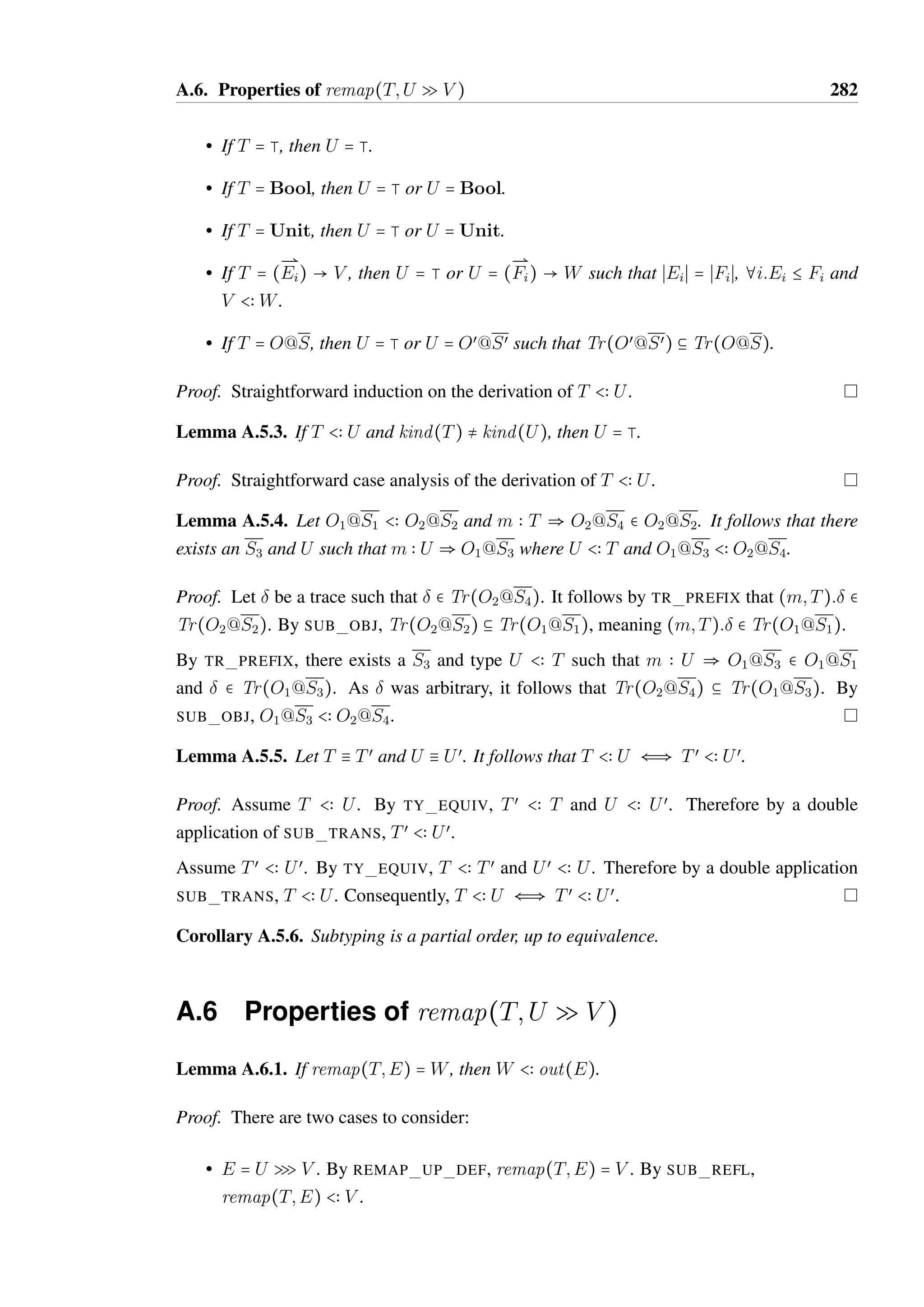
A.6 Properties of remap(T;U Q V ) . . . . . . . . . . . . . . . . . . . . . . . . . . 282 
A.7 Properties of extracted effects . . . . . . . . . . . . . . . . . . . . . . . . . . . . 283 
A.8 Properties of the sub-effect relation . . . . . . . . . . . . . . . . . . . . . . . . 287 
A.9 Properties of join and meet . . . . . . . . . . . . . . . . . . . . . . . . . . . . . 289 
A.10 Properties of typings . . . . . . . . . . . . . . . . . . . . . . . . . . . . . . . . . 300 
A.10.1 Flow effect specific properties . . . . . . . . . . . . . . . . . . . . . . . 303 
A.10.2 Upgrade effect specific properties . . . . . . . . . . . . . . . . . . . . . 304
Bibliography 305
List of Figures 
2.1 An infinite state machine for a stack data structure . . . . . . . . . . . . . . . . 28 
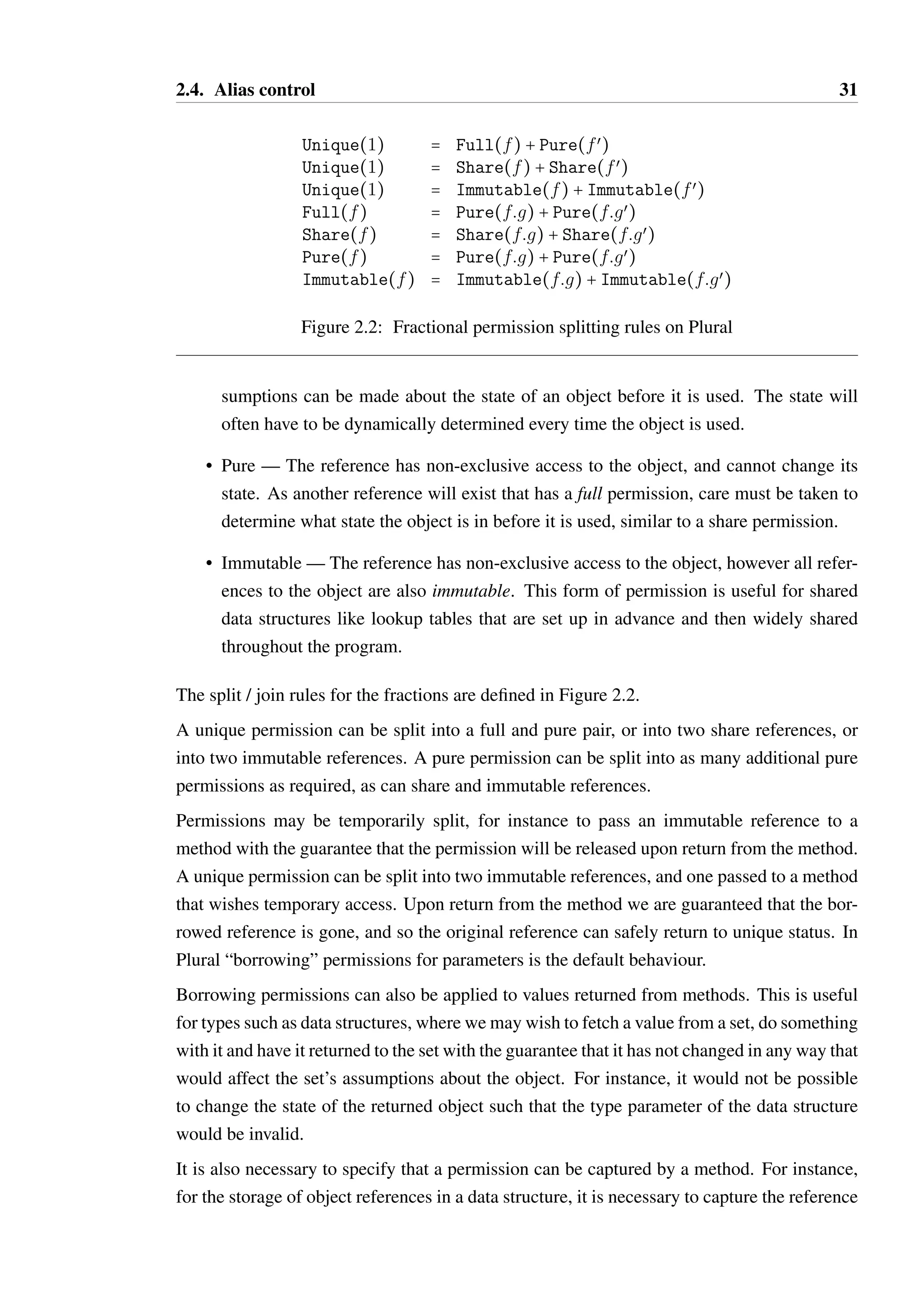
2.2 Fractional permission splitting rules on Plural . . . . . . . . . . . . . . . . . . 31 
3.1 The grammar of the Hanoi language . . . . . . . . . . . . . . . . . . . . . . . . 56 
3.2 Formalisation of the Hanoi model of the Iterator type . . . . . . . . . . . . . . 67 
4.1 A regular grammar which captures violations of Listing 4.6 . . . . . . . . . . 92 
4.2 An implementation of fold in Java, with its Hanoi model . . . . . . . . . . . . 108 
4.3 Observed overhead for the dynamic proxy based checker . . . . . . . . . . . 109 
4.4 Benchmark times for matrix multiplication . . . . . . . . . . . . . . . . . . . . 110 
5.1 Java puzzles used to test comprehension of Java’s semantics . . . . . . . . . . 120 
5.2 Raw participant demographic information . . . . . . . . . . . . . . . . . . . . 152 
5.3 Choices and scores . . . . . . . . . . . . . . . . . . . . . . . . . . . . . . . . . . 153 
5.4 Self-rated proficiencies against final score . . . . . . . . . . . . . . . . . . . . 155 
5.5 Experience vs. Score . . . . . . . . . . . . . . . . . . . . . . . . . . . . . . . . . 156 
5.6 Question reading times, per participant . . . . . . . . . . . . . . . . . . . . . . 156 
5.7 Scatter plot of question reading times . . . . . . . . . . . . . . . . . . . . . . . 157 
5.8 Question answer timings . . . . . . . . . . . . . . . . . . . . . . . . . . . . . . 158 
5.9 Scatter plot of question answer times . . . . . . . . . . . . . . . . . . . . . . . 159 
5.10 Frequencies of responses to survey questions and statistical analysis . . . . . 162 
5.11 Participant responses to survey questions (Page 1 of 3) . . . . . . . . . . . . . 163 
5.11 Participant responses to survey questions (Page 2 of 3) . . . . . . . . . . . . . 164 
5.11 Participant responses to survey questions (Page 3 of 3) . . . . . . . . . . . . . 165 
6.1 Example of type inference for an unannotated function. . . . . . . . . . . . . 169
6.2 Grammar of TS . . . . . . . . . . . . . . . . . . . . . . . . . . . . . . . . . . . . 173 
6.3 An example program in TS . . . . . . . . . . . . . . . . . . . . . . . . . . . . . 176 
6.4 Operational semantics . . . . . . . . . . . . . . . . . . . . . . . . . . . . . . . . 178 
6.5 Example of a statically indeterminate object state . . . . . . . . . . . . . . . . 179 
6.6 Subtyping and equivalence rules . . . . . . . . . . . . . . . . . . . . . . . . . . 181 
6.7 Definition of type join . . . . . . . . . . . . . . . . . . . . . . . . . . . . . . . . 184 
6.8 Definition of type meet . . . . . . . . . . . . . . . . . . . . . . . . . . . . . . . 185 
6.9 Definition of flow and update effect properties . . . . . . . . . . . . . . . . . . 188 
6.10 Definition of trace operations . . . . . . . . . . . . . . . . . . . . . . . . . . . . 189 
6.11 A simple object protocol . . . . . . . . . . . . . . . . . . . . . . . . . . . . . . 189 
6.12 Definition of join and meet for effect types . . . . . . . . . . . . . . . . . . . . 192 
6.13 Example applications of the effect combinators . . . . . . . . . . . . . . . . . 194 
6.14 Ordering and equivalance for contexts and typings . . . . . . . . . . . . . . . 197 
6.15 Type rules . . . . . . . . . . . . . . . . . . . . . . . . . . . . . . . . . . . . . . . 199 
6.16 Type rule variants for update effects . . . . . . . . . . . . . . . . . . . . . . . . 200 
6.17 Definition of extract operation . . . . . . . . . . . . . . . . . . . . . . . . . . . 200 
6.18 Store typing judgements . . . . . . . . . . . . . . . . . . . . . . . . . . . . . . . 203 
6.19 Definition of store update and context update compatibility relation,    . . 203 
6.20 Possible types for x in function f . . . . . . . . . . . . . . . . . . . . . . . . . 206 
6.21 Grammar for typing schemes, constraints, type and effect expressions . . . . 210 
6.22 Definition of type variable substitution . . . . . . . . . . . . . . . . . . . . . . 211 
6.23 The constraint satisfaction judgement,  Ø C . . . . . . . . . . . . . . . . . . 211 
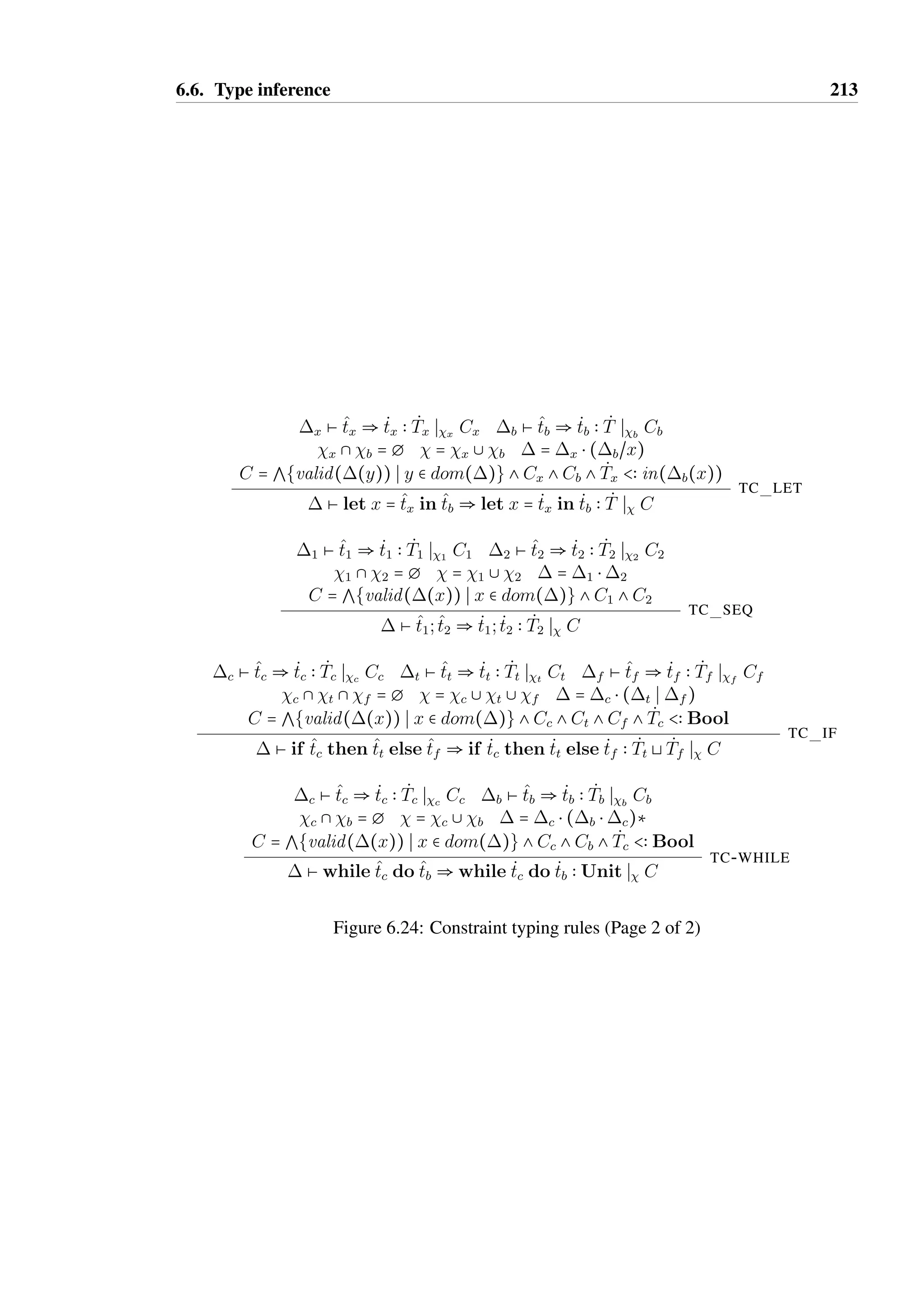
6.24 Constraint typing rules (Page 1 of 2) . . . . . . . . . . . . . . . . . . . . . . . . 212 
6.24 Constraint typing rules (Page 2 of 2) . . . . . . . . . . . . . . . . . . . . . . . . 213 
6.25 Example of type checking output in the TS implementation . . . . . . . . . . 219 
6.26 Example of constraint typing generation in the TS implementation . . . . . . 220 
7.1 Calculating the average age of all males in a collection, in various languages 228 
7.2 The client session type for a simple ATM, with an analogous Chimera chan-nel 
type . . . . . . . . . . . . . . . . . . . . . . . . . . . . . . . . . . . . . . . . 244
Listings 
2.1 A class which allows alternate calls to a() and b() . . . . . . . . . . . . . . . . 10 
2.2 Plural annotated form of Listing 2.1 . . . . . . . . . . . . . . . . . . . . . . . . 11 
2.3 Definition of an option type in Plaid . . . . . . . . . . . . . . . . . . . . . . . . 13 
2.4 Loss of type information in Plaid . . . . . . . . . . . . . . . . . . . . . . . . . . 15 
2.5 Fugue specification for a network socket . . . . . . . . . . . . . . . . . . . . . 16 
2.6 The definition of an ATM process, which communicates with a user process 
and bank process through sessions, written in the session language of Honda 
et al. , defined in [71] . . . . . . . . . . . . . . . . . . . . . . . . . . . . . . . . 19 
2.7 Session typing and link types as found in Bica, a Java language variant de-fined 
in the work of Gay et al. [58] . . . . . . . . . . . . . . . . . . . . . . . . 22 
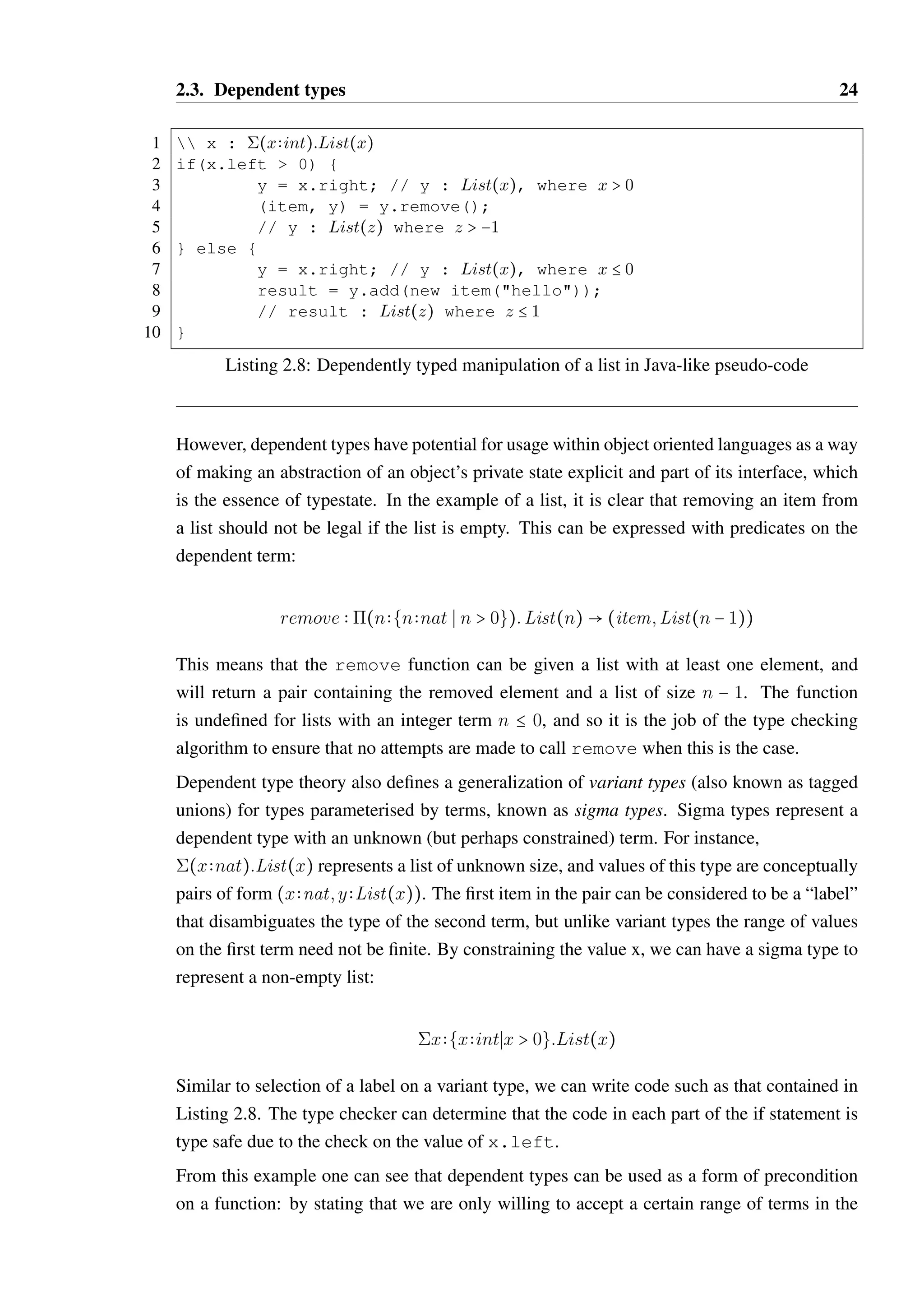
2.8 Dependently typed manipulation of a list in Java-like pseudo-code . . . . . . 24 
2.9 Safe manipulation of a list without checks in Java-like pseudo-code . . . . . 25 
2.10 Dependently typed version of an iterator . . . . . . . . . . . . . . . . . . . . . 25 
2.11 Better form of the iterator type with sample usage, in Java-like pseudo-code 26 
2.12 Idris effect DSL code for annotating a tree with unique labels . . . . . . . . . 27 
2.13 Wadler’s linear types in an ml-like language . . . . . . . . . . . . . . . . . . . 29 
2.14 A pair type with views . . . . . . . . . . . . . . . . . . . . . . . . . . . . . . . . 33 
2.15 A Clara aspect that monitors for attempts to write to closed connections . . . 36 
2.16 Code Contracts form of an Iterator . . . . . . . . . . . . . . . . . . . . . . . . . 39 
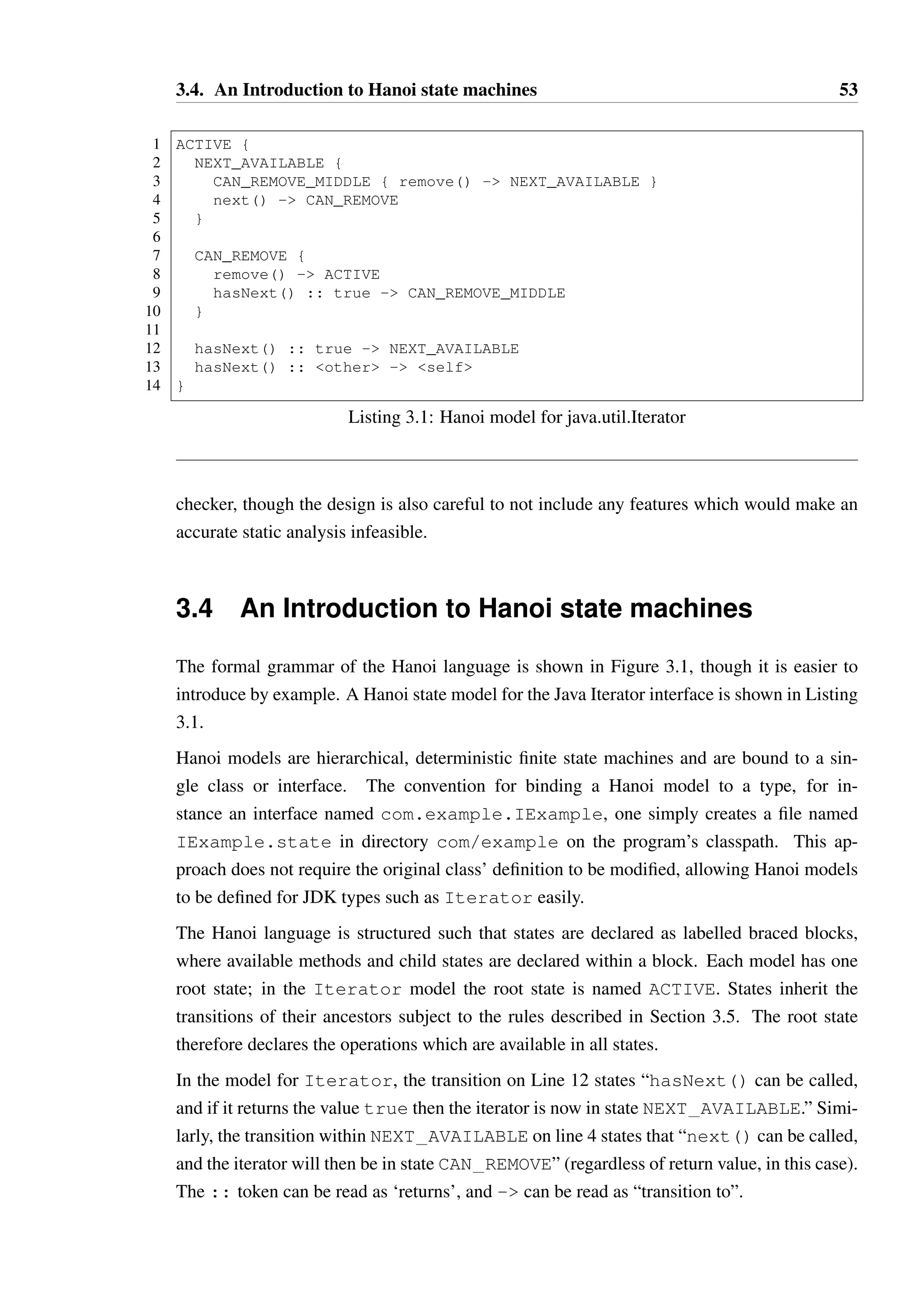
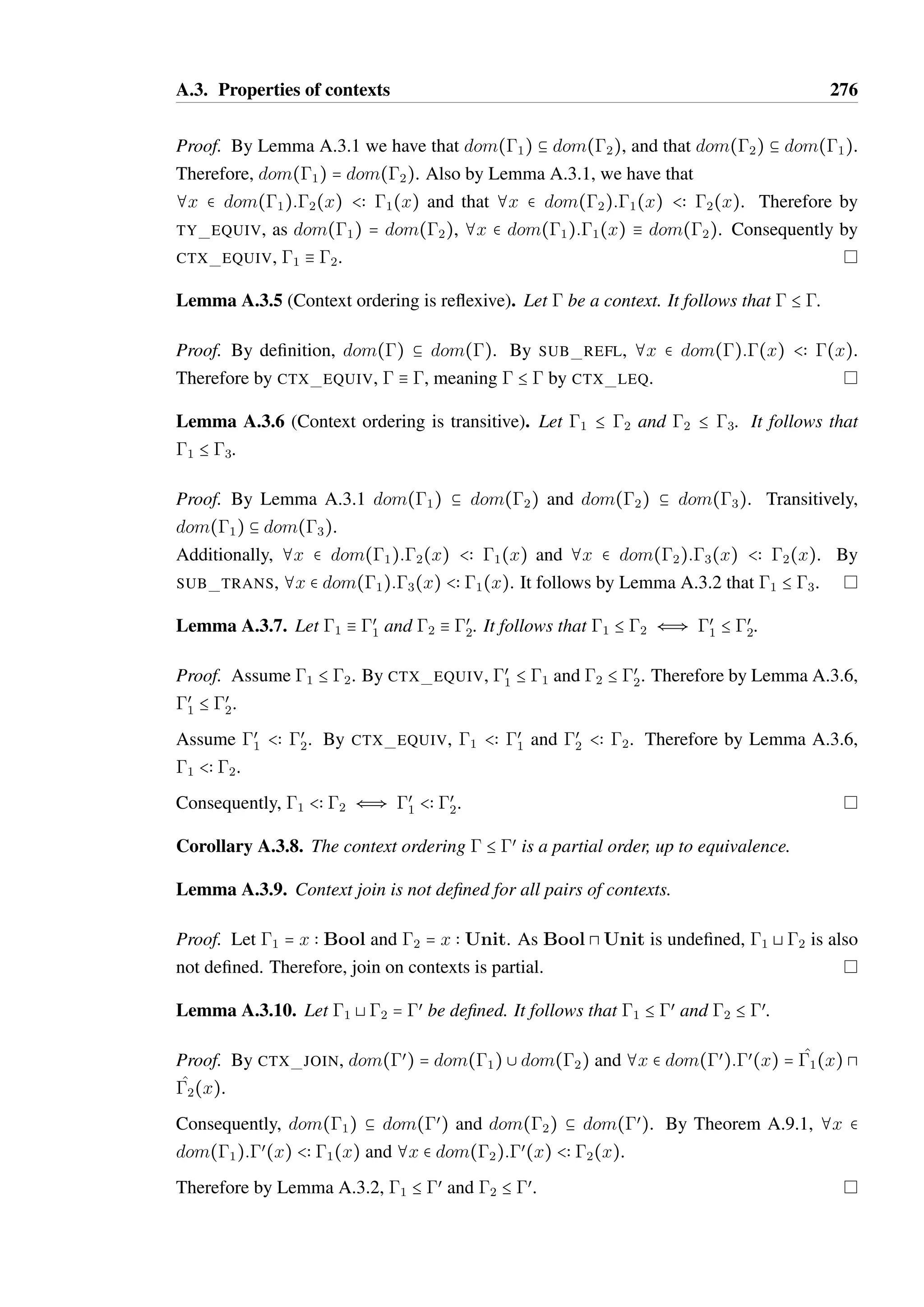
3.1 Hanoi model for java.util.Iterator . . . . . . . . . . . . . . . . . . . . . . . . . . 53 
3.2 Method which removes the middle elements of a collection . . . . . . . . . . 54 
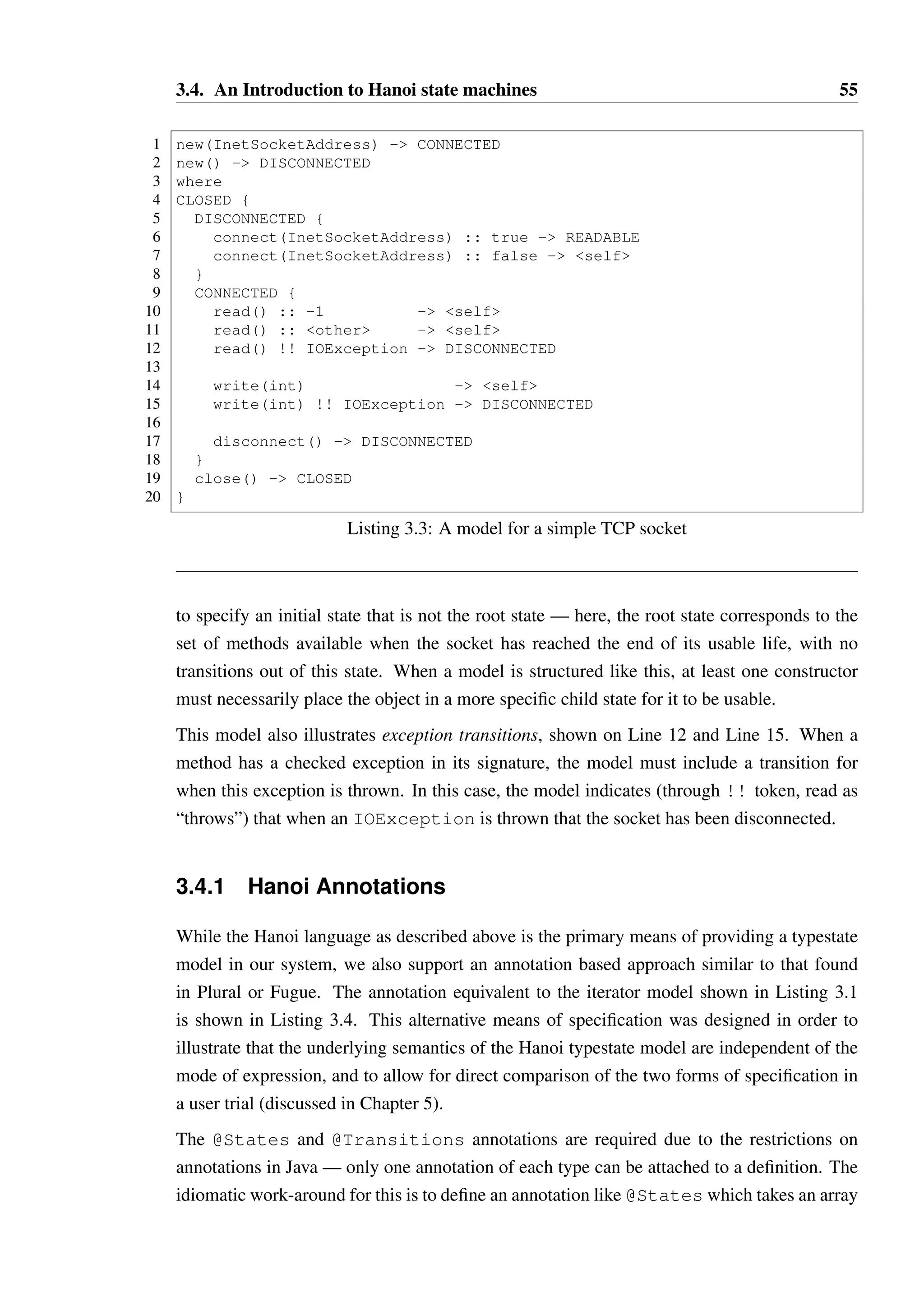
3.3 A model for a simple TCP socket . . . . . . . . . . . . . . . . . . . . . . . . . 55 
3.4 The iterator model expressed using Hanoi annotations . . . . . . . . . . . . . 56 
3.5 An Illegal Hanoi model . . . . . . . . . . . . . . . . . . . . . . . . . . . . . . . 63
3.6 A Hanoi model with legal transition overriding . . . . . . . . . . . . . . . . . . 64 
3.7 The Standard ML data types for representing a Hanoi model and the produc-tion 
of  and  relations . . . . . . . . . . . . . . . . . . . . . . . . . . . . . . 69 
3.8 A Map interface with a transaction subtype . . . . . . . . . . . . . . . . . . . . 77 
3.9 Hanoi model for TransactionalMap type in Listing 3.8 . . . . . . . . . . . . . 78 
4.1 Manual enforcement of Iterator constraints . . . . . . . . . . . . . . . . . . . . 84 
4.2 Invalid usage of a generic type in Java . . . . . . . . . . . . . . . . . . . . . . 85 
4.3 Example of using a potentially typestate-constrained object via reflection . . 87 
4.4 A generated wrapper for the Iterator interface . . . . . . . . . . . . . . . . . . 89 
4.5 Usage of the Hanoi API for dynamic proxies . . . . . . . . . . . . . . . . . . . 90 
4.6 A type with boundary checks for a and b . . . . . . . . . . . . . . . . . . . . . 92 
4.7 Tracematch for illegal usage of Listing 4.6 . . . . . . . . . . . . . . . . . . . . 93 
4.8 A bounded queue data structure . . . . . . . . . . . . . . . . . . . . . . . . . . 94 
4.9 The Hanoi model for BoundedQueue . . . . . . . . . . . . . . . . . . . . . . . 95 
4.10 The simplified and flattened Hanoi model for BoundedQueue . . . . . . . . . 96 
4.11 Enabling or disabling Hanoi dynamic checking using AspectJ . . . . . . . . . 98 
4.12 Part of the aspect generated for BoundedQueue . . . . . . . . . . . . . . . . . 99 
4.13 Part of the abstract aspect . . . . . . . . . . . . . . . . . . . . . . . . . . . . . . 102 
4.14 Using inter-type declarations to inject state tracking fields into objects . . . . 103 
4.15 Monitoring method calls using separate before and after advice . . . . . . . . 104 
4.16 Partial implementation of monitoring aspect generation using Meta-AspectJ . 106 
4.17 Output from the foldLeft benchmark . . . . . . . . . . . . . . . . . . . . . 107 
4.18 The simplest dynamic proxy possible . . . . . . . . . . . . . . . . . . . . . . . 110 
4.19 Matrix multiplication implemented using Iterator to access elements . . . . . 112 
4.20 A fragment of an “optimal” hand-written wrapper for Iterator to check its 
typestate constraints . . . . . . . . . . . . . . . . . . . . . . . . . . . . . . . . . 113 
6.1 Example of strong update . . . . . . . . . . . . . . . . . . . . . . . . . . . . . . 191 
7.1 Option types in Chimera . . . . . . . . . . . . . . . . . . . . . . . . . . . . . . . 226 
7.2 An example of redundant type annotations in Java . . . . . . . . . . . . . . . . 227 
7.3 Method definition in Chimera . . . . . . . . . . . . . . . . . . . . . . . . . . . . 233 
7.4 Example function literals . . . . . . . . . . . . . . . . . . . . . . . . . . . . . . 234
7.5 A Hanoi-like syntax for specifying and implementing an iterator . . . . . . . 236 
7.6 Example of virtual fields . . . . . . . . . . . . . . . . . . . . . . . . . . . . . . 238 
7.7 Example of state entry methods . . . . . . . . . . . . . . . . . . . . . . . . . . 239 
7.8 An example of refining the type of a parent state’s field . . . . . . . . . . . . . 241 
7.9 An example of single inheritance in Chimera . . . . . . . . . . . . . . . . . . . 242 
7.10 Iterator-like behaviour without the need for a hasNext method or condi-tional 
transitions . . . . . . . . . . . . . . . . . . . . . . . . . . . . . . . . . . . 243 
7.11 A mutable linked list . . . . . . . . . . . . . . . . . . . . . . . . . . . . . . . . . 247 
7.12 Temporary state change of borrowed return values . . . . . . . . . . . . . . . . 248 
7.13 An example of using peek . . . . . . . . . . . . . . . . . . . . . . . . . . . . . . 249 
7.14 A more complex example of scope analysis concerning the parameter f . . . 252 
7.15 An example of modifying an implicitly bound parameter . . . . . . . . . . . . 253
1 
Chapter 1 
Introduction 
The primary goal of a type system in a programming language is to detect and prevent errors 
in code. A well designed type system should detect the most common and critical errors, 
based upon the expected usage of the programming language. This requires that the designer 
of the language be aware of the intended use cases for the language, the knowledge and skill 
set of the programmers who will be using it, and whether the restrictions imposed by the 
type system provide sufficient value to be justifiable. 
The programming language research community pursue and devise ever more complex type 
systems with the goal of preventing a wide variety of errors. Many of these type systems 
are built without maintaining awareness of the practical aspects of the language: the type 
systems becomes harder to understand and interact with as they increase in complexity. A 
successful type system must balance the desire to statically detect common and critical errors 
with the ability of programmers to comprehend and fix the errors reported. For instance, 
statically detecting one of the most common forms of programmer error, undeclared or mis-spelled 
variable usage, can be presented in a manner that is easy to understand and can save 
a programmer a significant amount of time. 
The cost of a program failing is an implicit part of the decision making process in selecting 
the language to be used for a project. For many web applications, if the application fails, 
refreshing the page is often enough to fix it. While it is still desirable to reduce the frequency 
at which such transient errors occur, these failures are rarely critical and often easy to mit-igate 
— restarting the process and repeating the request can often be done without the end 
user ever realising a failure occurred. 
As such, a complex, strongly typed language such as Agda [23] is unlikely to be chosen for 
building a typical web application. With careful use of such a language much greater confi-dence 
in a program can be derived. However the cost of failure does not justify the additional 
time, effort and therefore expense involved in satisfying the type checker. Agda may, how-ever, 
be an excellent choice for building a safety critical system, where the cost of failure is
1.1. Save us from ourselves 2 
significantly higher. Mitigating failure through process restarts in the control systems of an 
aircraft or robotic surgical equipment is less likely to be a viable option compared to a web 
content delivery system. 
Between throw-away scripts and safety critical systems is a spectrum of software with an 
increasing and non-trivial cost of failure, where using a language with a stronger type system 
is justified. In this middle ground, engineers with a formal education in computer science 
build systems where failure is highly undesirable if not catastrophic. Such engineers desire 
tool support which can provide confidence in (but not necessarily proof of) the correctness 
of their software, particularly in “core” components. 
1.1 Save us from ourselves 
In object oriented languages such as Java and C#, there are many common errors that are 
not dealt with adequately by the static component of the type system. Perhaps the most 
common source of error in such languages is dereferencing null — Hoare described the 
introduction of the null value for references in the ALGOLWlanguage and the consequent 
replication of this feature in the languages it inspired as his “billion dollar mistake” [68]. The 
runtime systems of both Java and C# will halt a program immediately when a null value is 
dereferenced, rather than allow a program to continue with undefined behaviour (as may 
occur in C), but at the expense of additional runtime checks. 
The situation is avoidable through the use of an option type in place of null, requiring that 
all references be to a valid location in memory. This eliminates the risk of runtime fail-ure, 
but programmers are forced to explicitly handle the null equivalent. Interacting with 
option types is straightforward in a functional programming language due to pattern match-ing, 
higher order functions and closures, as demonstrated by utility functions for the Maybe 
monad in Haskell [114, Chapter 14] or the Option type in OCaml [98, Chapter 7]. Java 
7 currently lacks these features, making interaction with option-like types cumbersome. A 
more sophisticated language such as Scala [111] makes handling option types easier [151]; 
as such it uses option types pervasively instead of null. Scala’s additional complexity 
makes this possible, but this additional complexity is a barrier to wider adoption. 
Another very common pattern of errors in object oriented programs arises from the misuse 
of mutable private state. Types such as the Iterator interface in Java place stateful re-strictions 
on their usage — the method next() may only be called on an iterator when 
another element is available, otherwise an unchecked NoSuchElementException will 
be thrown. This exception is an indication of programmer error rather than some unexpected, 
potentially resolvable error in the system like a network connection being severed. It is the
1.1. Save us from ourselves 3 
obligation of the client of an Iterator to call hasNext() and ensure it returns true 
before calling next(). 
While an alternative design for the Iterator interface may avoid this problem by return-ing 
an option type on next, this simply moves the fundamental problem — the iterator is 
depleted, and the client code must respond to this situation appropriately. 
When combined with reference aliasing, the problem is exacerbated. State changes that 
occur in one context may not be observable in another, resulting in one alias depleting 
an iterator while another still believes the iterator has a value through a previous call to 
hasNext(). Such bugs are particularly insidious because the cause of the failure is sepa-rated 
from the point of detection by the runtime system in both space and time — the stack 
trace emitted for the failure provides no information on other calls that have been made re-cently 
on the object, or why the local assumptions about the state of the object are incorrect. 
Bugs of this type are so common that a backlash against mutable state is occurring in ob-ject 
oriented programming communities. Programmers are recommended to write and use 
immutable object types and persistent data structures wherever possible [18, Chapter 4], 
specifically to avoid the issues of interacting with objects that have private mutable state in a 
shared environment. 
Immutability runs contrary to what objects were intended to be — objects in their most 
fundamental form can be viewed as entities with private state and a protocol, that specifies the 
messages an entity will respond to. An immutable object, meaning an object with constant 
private state and a stateless protocol, has much more in common with a type constructor in a 
functional language. 
A mutable object may have a very simple protocol, where the set of messages (or equiva-lently, 
method calls) it is willing to accept is constant throughout its lifecycle—this is what 
the type system of programming languages such as Java can express. This is insufficient to 
correctly model an object’s behaviour in many cases, as the set of messages to which that 
object can correctly respond is dependent upon its private state. State change is typically 
synchronous, in response to message receipt, and safety requires that any message sent to 
an object is within the set that can be received for the current state. The private state can 
often be abstracted such that restrictions on sequences of messages can be expressed as a 
deterministic finite state machine. 
Describing the allowed sequence of messages which a class of objects can receive, their type-state 
[140], produces significantly more complex type signatures than in an object oriented 
language without typestate constraints. Functions which take objects as parameters must de-scribe 
the type of object they accept, in which state, and what state transformation can occur. 
This type annotation burden is particularly heavy in a language with function literals, which 
must be succinct in order to be practical.
1.2. Thesis outline 4 
1.2 Thesis outline 
The theory behind defining and checking typestate constraints is now well-established for 
object oriented languages with nominal subtyping such as Java, however little work has been 
done to investigate whether such type system extensions fulfil the following important prac-tical 
criteria: Can typestate be understood by “real” programmers? How should typestate 
constraints be expressed in the source code and documentation of a program? Can the an-notation 
burden be reduced, or eliminated, through type inference? How should typestate 
errors be presented to the user, to facilitate diagnosis and resolution? 
This thesis attempts to answer all of these questions, considering both the theoretical and 
practical aspects of this promising branch of object oriented type theory. The work presented 
herein specifically attempts to answer the following questions: 
1. What essential features of a typestate constrained object must be modelled in order 
to accurately capture its protocol? What options exists for expressing typestate con-straints? 
What are the strengths and weaknesses of the options for expressing type-state 
constraints? These questions are studied in more detail in Chapter 3, where a 
new method of expressing typestate constraints for Java is presented and compared to 
existing typestate constraint modelling methods. 
2. Can a lightweight dynamic checker for typestate constraints be provided for Java-like 
languages, without significant modification of the language? This question is studied 
in detail in Chapter 4, which evaluates multiple options for providing dynamic enforce-ment 
of typestate constraints in Java, and provides a proof-of-concept implementation 
of the two most promising options. 
3. Can programmers reason effectively about typestate-constrained objects? Does the 
method of expressing typestate constraints influence the ability for programmers to 
reason effectively about typestate? These questions are studied in detail in Chapter 
5, where a user study comparing two methods of expressing typestate constraints is 
analysed. 
4. Is type inference feasible for code which interacts with typestate-constrained objects? 
This question is explored in detail in Chapter 6, where the TS language is defined and 
studied with the express purpose of determining what type information can and cannot 
be reasonably inferred. 
5. What theoretical challenges still remain for future typestate oriented languages? Chap-ter 
7 outlines a hypothetical language based upon Scala, and describes the potential 
utility of such a language in addition to the many unanswered questions that the inter-actions 
between closures, alias control and effects present.
1.3. Thesis statement 5 
Overall, this thesis attempts to examine typestate in a holistic manner, and determine whether 
typestate is practical, useful and worthy of further study by the research community. 
1.3 Thesis statement 
Typestate is a practical and useful extension to the semantics of modern object oriented lan-guages. 
Typestate constraints can be understood by real software engineers, and dynamic 
checking of typestate for existing languages provides useful safeguards and diagnostic infor-mation 
in both production and test environments. The primary barrier to typestate adoption, 
cumbersome type annotations, can be overcome through the use of type inference.
6 
Chapter 2 
Literature Review 
Strom and Yemini first defined the term typestate [140] to capture the concept of a reference 
having both a type and an associated state that changes during the execution of a program. 
The original presentation was concerned with the state of references in a simple impera-tive 
language: a reference was either uninitialised or initialised. Reference state transitions 
would occur in response to explicit allocation and free operations, and dereferencing in the 
null state is undefined. As such, the state of a reference could be represented as a Moore 
automaton [101]. 
The fundamental goal of this formalism is to prevent the execution of undefined operations. 
This requires that the state of a reference can be accurately tracked, which was achieved 
through a data flow analysis [61]. Critically, references could not be copied: 
Languages that allow unrestricted pointer assignment do not support track-ing 
typestate at compile-time because the mapping between variable names and 
execution-time objects is not one-to-one. As a result, a typestate change result-ing 
from applying an operation to an object under one name will not be reflected 
in the typestate of the other variable names referring to the same object. 
It was also required that procedures declare the effect they have on their parameters, in order 
to allow for a modular analysis. Strom and Yemini had therefore identified the core technical 
challenges associated with typestate, which persist to this day. 
Typestate has many synonyms in the literature. Some refer to the restrictions on operations 
in relation to the state as temporal constraints, often referring to the need to do an operation 
before or after another. 
The typestate concept generalises readily to more complex finite automata, which can be 
used to model state transitions and usage restrictions of objects. The type of a value would
7 
then define the full set of capabilities of the referenced value, while the state places restric-tions 
on which of those capabilities may be used. This idea was independently described by 
Nierstrasz [110], using the term active objects to describe objects which have an interface 
which could be described as a regular language. Typestate restrictions are common in object 
oriented APIs [13], and typestate violations are a common source of difficult-to-diagnose 
issues [78]. It would seem, therefore, that programmers would derive benefit from types-tate 
modelling and enforcement, if this can be provided in a manner which does not overly 
burden the programmer or runtime system. 
Literature review outline 
Systems which attempt to provide typestate modelling and enforcement for popular object 
oriented languages are reviewed in Section 2.1. 
A related area to typestate is in the enforcement of communication protocols in distributed 
systems, through the use of session types, which are reviewed in Section 2.2. 
Typestate in an object oriented language essentially externalises an abstraction of the private 
state of an object, of which a client must be aware in order to decide whether an operation is 
safe or not. This is somewhat related to the concept of dependent types, which are reviewed 
in Section 2.3. 
In a typical object oriented language such as Java or C#, aliasing is both common and es-sential. 
In order for typestate enforcement to be practical in such languages, a mechanism is 
required by which aliasing information can be tracked and interpreted. The theory of alias 
control is reviewed in Section 2.4. 
The ability to monitor and react to sequences of operations, an essential component of track-ing 
state changes in typestate, can be generally useful. Tracematches provide a mechanism 
to do this in aspect oriented programming, and are covered in Section 2.5. 
The expression and enforcement of contracts between components in a software system is 
also somewhat related, and some contract languages can be used to encode typestate con-straints. 
These are covered in Section 2.6. 
The specification of both contracts and typestate models for software can be a time consum-ing 
and error prone task. As such, investigations into the possibility of the inference of such 
contracts and models to make this process easier is an active area of research. This is covered 
in Section 2.7. 
Early attempts to study the human factors of programming languages and the psychology of 
programming are covered in Section 2.8.
2.1. Typestate systems 8 
2.1 Typestate systems 
The integration of typestate into existing type systems has been widely studied for imperative 
and object oriented languages, where the problems of mutable state are most obvious and a 
system to help uncover bugs related to typestate violation is potentially valuable. The three 
most common issues which these systems have attemped to address are: 
1. Invalid operations. Functions and methods often carry a set of informally documented 
assumptions on the state of the entities they interact with that the programmer must 
satisfy in order to avoid error. Very common errors involve invoking an operation too 
many times, or out of order. 
2. Consistent view of state. Where mutability and aliasing are permitted in a language, 
inconsistent views of an entity’s state is a common problem. 
3. Resource disposal. In a language without garbage collection and dynamic memory 
allocation, memory leaks are common and difficult to diagnose. Less seriously, in a 
system with garbage collection if a resource (such as a GUI window handle) is not 
explicitly disposed of this may tie up other low-level or scarce resources until the 
garbage collector is invoked after an indeterminate period of time. 
Systems described in the literature either attempt to extend an existing language in a man-ner 
which is compatible with legacy code in the host language, extend a language in an 
incompatible way, or create an entirely new language in which to express typestate. The 
SLAM system [8] attempts to provide typestate verification for legacy C code, which places 
restrictions on what the analysis can conclude without the additional programmer support 
that a system such as Vault [36] relies on. Vault does not consider legacy code , allowing 
for sound reasoning about code at the cost of requiring significantly more guidance from 
the programmer. Plaid [2] takes a more radical approach in designing an entirely new lan-guage 
in which to explore deep integration of typestate into a language, where host language 
semantic choices are not an issue. 
In this section, Plural and Fugue shall be explored in detail as they are recent examples of 
typestate systems which have usable implementations for popular languages. Each provides 
subtly different semantics for their typestate models and alias control strategy. Plural pri-marily 
was used as a vehicle to explore flexible typestate modelling and alias control, and so 
provides a rich environment in which to explore these topics. Fugue is notionally a successor 
to Vault and attempts to tackle resource disposal directly, with a simpler typestate model and 
alias control technique. The similarity of the semantics of the host languages for these sys-tems 
(Java and C#, respectively) allows for direct comparison between the chosen typestate 
semantics and alias control strategies of each.
2.1. Typestate systems 9 
Plaid is also considered in more detail due to its novel presentation as a gradually typed 
programming language designed with deeply integrated support for typestate modelling and 
enforcement. Its hybrid object-functional nature also presents some interesting possibilities 
and challenges which do not exist for Plural and Fugue. 
2.1.1 Plural 
Aldrich et al. investigated typestate verification for Java using data flow analysis in their 
system known as Plural [3, 12, 16]. The work of Aldrich’s group is interesting for a number 
of reasons: 
• The data flow analysis is modular, meaning it should scale to large, component-oriented 
software systems, unlike whole program analyses. 
• Sophisticated alias control techniques based on Boyland’s fractional permissions [24] 
are employed, allowing stateful objects to be shared in a controlled manner. 
• States within the machine can be “refined” — that is, the state machine includes a 
form of state subtyping. This can be useful in reducing the number of declarations 
required to define a model, by grouping together states based on common properties 
and restrictions. 
• Java annotations are used to define the state machine associated with an object. This 
is necessary to facilitate the modular analysis and declare the fractional permission 
requirements of a particular method. 
Plural covers many important aspects of defining state-based preconditions in real systems, 
but the method of expression in the form of annotations is not ideal — annotations are con-venient 
for attaching arbitrary extra information to types that can be consumed by tools, but 
the syntactic restrictions make the expression of complex concepts difficult. 
Plural’s semantics are complex, and no contextual information is given in typestate violation 
warnings produced by its static analysis that would help the programmer understand what is 
wrong and how to fix it. With even the simplest code, many typestate violations will be found 
that are subtly related and often fixed as a group by small changes to the code or typestate 
annotations. 
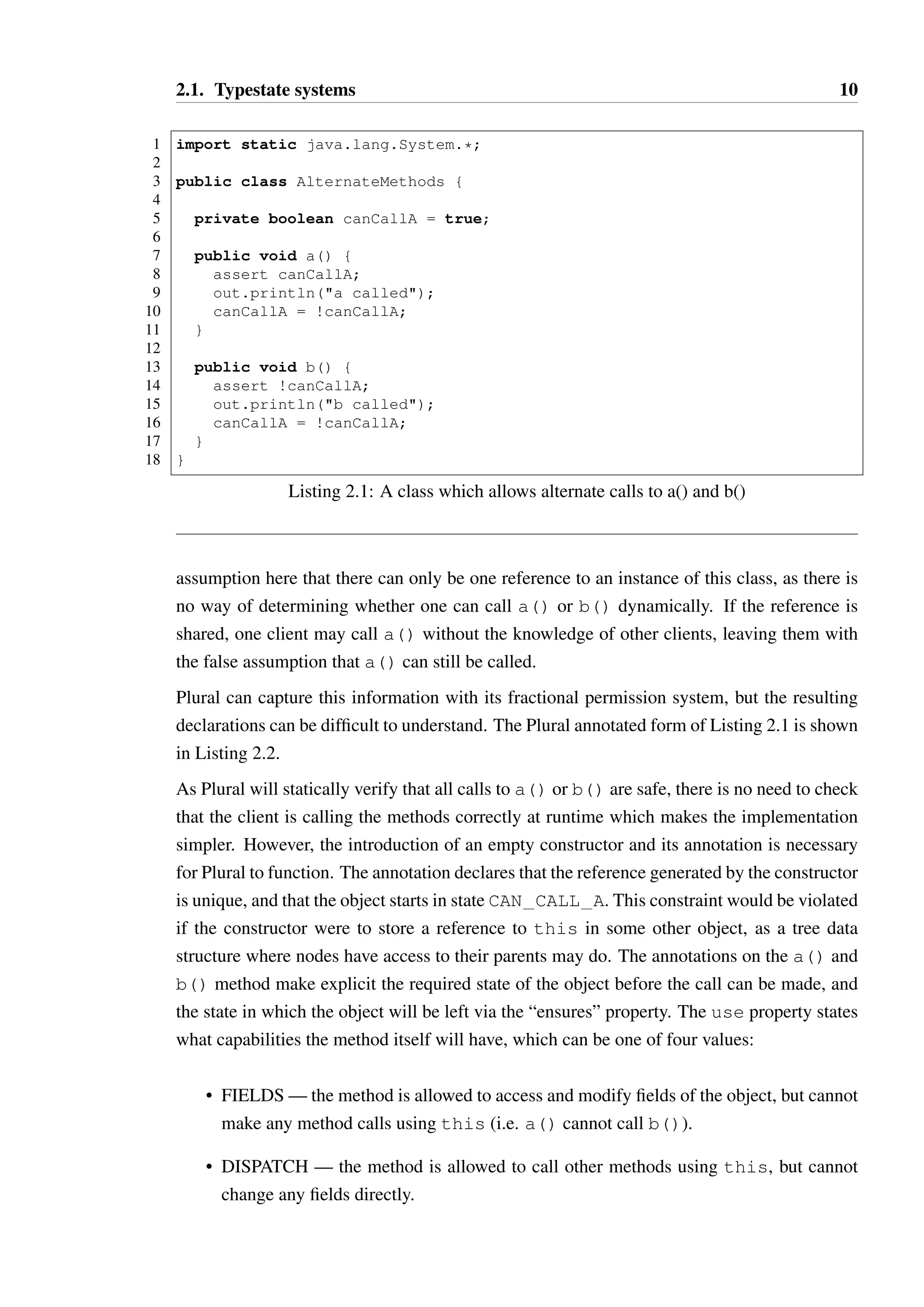
As an example, consider a simple class which allows alternate calls to methods a() and 
b(). A skeleton implementation of such a class without any Plural annotations is shown 
in Listing 2.1. There are 4 lines of overhead to enforce the state restrictions at runtime (all 
pertaining to the maintenance and checking of the variable canCallA). There is an implicit
2.1. Typestate systems 10 
1 import static java.lang.System.*; 
23 
public class AlternateMethods { 
45 
private boolean canCallA = true; 
67 
public void a() { 
8 assert canCallA; 
9 out.println(a called); 
10 canCallA = !canCallA; 
11 } 
12 
13 public void b() { 
14 assert !canCallA; 
15 out.println(b called); 
16 canCallA = !canCallA; 
17 } 
18 } 
Listing 2.1: A class which allows alternate calls to a() and b() 
assumption here that there can only be one reference to an instance of this class, as there is 
no way of determining whether one can call a() or b() dynamically. If the reference is 
shared, one client may call a() without the knowledge of other clients, leaving them with 
the false assumption that a() can still be called. 
Plural can capture this information with its fractional permission system, but the resulting 
declarations can be difficult to understand. The Plural annotated form of Listing 2.1 is shown 
in Listing 2.2. 
As Plural will statically verify that all calls to a() or b() are safe, there is no need to check 
that the client is calling the methods correctly at runtime which makes the implementation 
simpler. However, the introduction of an empty constructor and its annotation is necessary 
for Plural to function. The annotation declares that the reference generated by the constructor 
is unique, and that the object starts in state CAN CALL A. This constraint would be violated 
if the constructor were to store a reference to this in some other object, as a tree data 
structure where nodes have access to their parents may do. The annotations on the a() and 
b() method make explicit the required state of the object before the call can be made, and 
the state in which the object will be left via the “ensures” property. The use property states 
what capabilities the method itself will have, which can be one of four values: 
• FIELDS—the method is allowed to access and modify fields of the object, but cannot 
make any method calls using this (i.e. a() cannot call b()). 
• DISPATCH — the method is allowed to call other methods using this, but cannot 
change any fields directly.
2.1. Typestate systems 11 
1 import static java.lang.System.*; 
2 import edu.cmu.cs.plural.annot.*; 
34 
@States({CAN_CALL_A, CAN_CALL_B}) 
5 public class AlternateMethods { 
67 
@Perm(ensures=unique(this!fr) in CAN_CALL_A) 
8 public AlternateMethods() {} 
9 
10 @Unique(use=Use.FIELDS, 
11 requires=CAN_CALL_A, 
12 ensures=CAN_CALL_B) 
13 public void a() { 
14 out.println(a called); 
15 } 
16 
17 @Unique(use=Use.FIELDS, 
18 requires=CAN_CALL_B, 
19 ensures=CAN_CALL_A) 
20 public void b() { 
21 out.println(b called); 
22 } 
23 } 
Listing 2.2: Plural annotated form of Listing 2.1 
• DISP FIELDS — the method may both modify fields and call other methods using 
this. 
• NONE—the method cannot access fields or call other methods. This is the default, if 
no value is provided for the use property. 
Specifying the least use requirement possible makes Plural’s analysis more precise, particu-larly 
when the type in question has subtypes. It can be challenging to reason effectively about 
such requirements, especially when the tool can only verify that a choice is sound without 
providing any guidance as to whether a weaker use requirement is possible. Plural’s choice 
of safe defaults, such as NONE for the use property, result in subtle and initially counter-intuitive 
warnings. In Listing 2.2, if the use properties are not set to FIELDS, warnings are 
raised that the “ensures” clause of the methods cannot be honoured, as the methods cannot 
change the state of the object. This is counter-intuitive as the methods do not in fact access 
or modify any fields explicitly. However, Plural may be reasoning that with a use value of 
NONE, the methods cannot reasonably have side-effects and therefore no state transition can 
take place. The state in this example is purely virtual, but in a more realistic class the state 
of an object will be an abstraction of the actual private state of the object. A state transi-tion 
in this case would involve changing a private field, which would require a use value 
of FIELDS at a minimum. Plural appears to be enforcing this even when it is not required, 
which is counter-intuitive when the state is virtual.
2.1. Typestate systems 12 
The Plural system does not alter the runtime representation of classes in any way — as a 
result, code which retrieves an object of type AlternateMethods and interacts with it 
through runtime reflection will be able to violate the constraints of the object. Static analysis 
of the form provided by Plural is useful for demonstrating the absence of a class of bugs 
in well-behaved code, but dynamic checking is often still required for systems that include 
components that are not entirely trusted. Generation of the additional code found in Listing 
2.1 from the Plural annotations is possible, and desirable in a language which supports both 
typestate and reflection. 
2.1.2 Plaid 
To date, the only comprehensive attempt at designing and implementing a full general pur-pose 
programming language from scratch which draws together the state of the art in the 
theory of typestate is the Plaid language [2, 141]. I participated in the development of this 
language while working under the supervision of Jonathan Aldrich at Carnegie Mellon Uni-versity 
in 2011. 
Plaid is a gradually typed [136, 137, 153] language, meaning that it is a dynamically typed 
language in which type requirements and guarantees can be specified and statically checked 
in a selective manner. This technique largely mitigates the cost to the programmer of large 
type annotations, as they are optional, with the trade-off that method availability must be 
checked on every method call which adds a significant runtime overhead. 
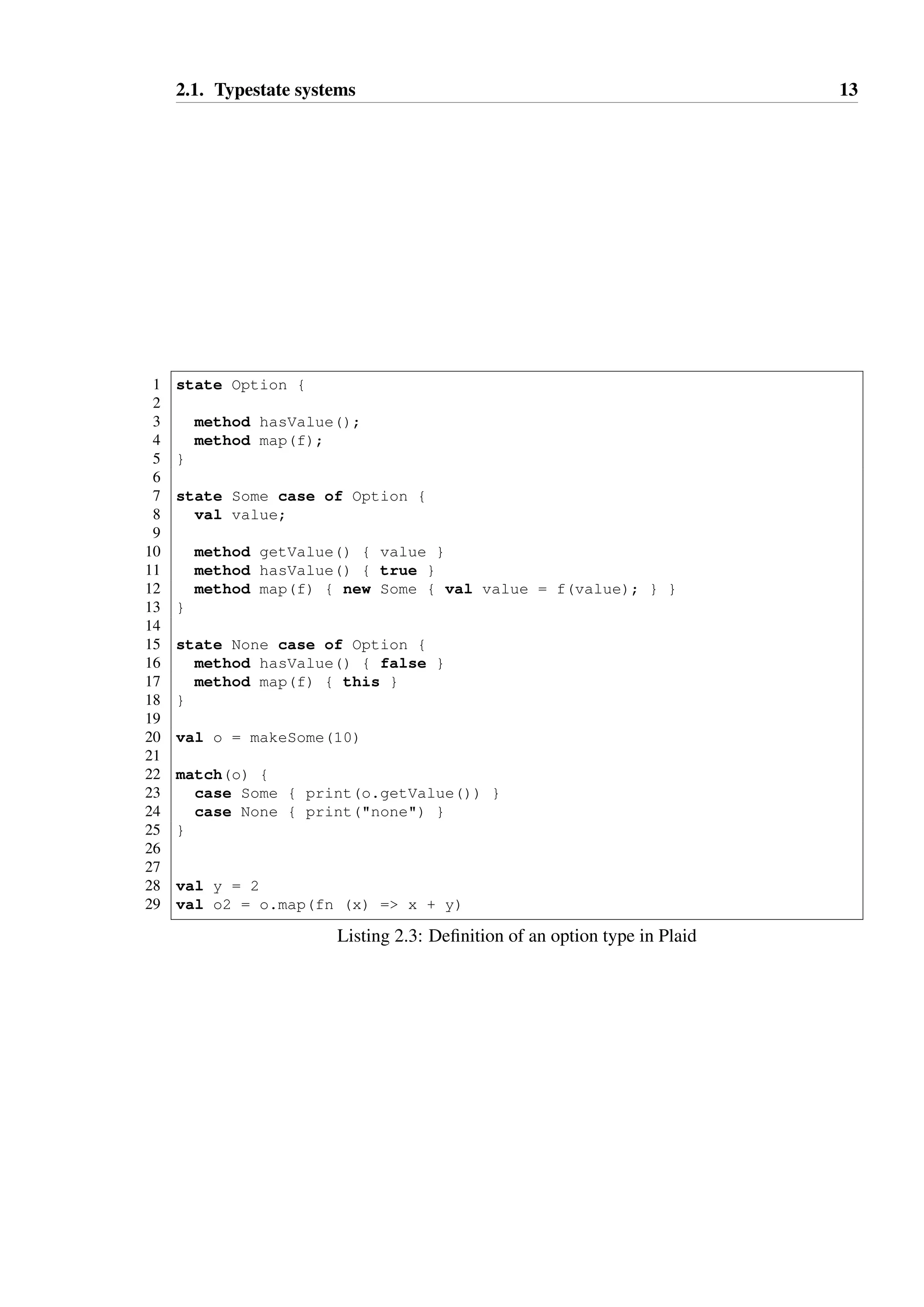
Plaid defines objects as a collection of related state declarations that define a hierarchical, 
parallel finite state machine. The state hierarchy is defined explicitly by declaring one state 
to be a sub-state of another; Listing 2.3 demonstrates this through the definition of an option 
type. Explicitly defined constructors are not necessary in Plaid — instead, a default con-structor 
exists for each defined state that initialises all fields and methods that are defined 
with an initial value. Other fields can be initialised through the use of an associated code 
block as shown on Line 12 of Listing 2.3, where an object is instantiated in state Some with 
the value field initialised to the result of f(value). 
Plaid does not support parametric polymorphism for states, meaning that we cannot annotate 
the Option type with a type parameter and insist that the field value be of this type 
statically. As the language is dynamically typed this is of little practical consequence, but is 
a major limitation for the static analysis. 
Plaid obviates the need for dynamic state test methods by allowing pattern matching on an 
object’s type, as shown on Line 22. The hasValue method is defined for option values, 
but exists purely for programmer convenience rather than as a necessary part of the object’s 
protocol.
2.1. Typestate systems 13 
1 state Option { 
23 
method hasValue(); 
4 method map(f); 
5 } 
67 
state Some case of Option { 
8 val value; 
9 
10 method getValue() { value } 
11 method hasValue() { true } 
12 method map(f) { new Some { val value = f(value); } } 
13 } 
14 
15 state None case of Option { 
16 method hasValue() { false } 
17 method map(f) { this } 
18 } 
19 
20 val o = makeSome(10) 
21 
22 match(o) { 
23 case Some { print(o.getValue()) } 
24 case None { print(none) } 
25 } 
26 
27 
28 val y = 2 
29 val o2 = o.map(fn (x) = x + y) 
Listing 2.3: Definition of an option type in Plaid
2.1. Typestate systems 14 
The example also demonstrates that Plaid supports higher order functions, and function lit-erals 
with implicit binding, as shown on Line 29. This powerful feature is made practical by 
Plaid’s dynamic typing—if the language required the full type of each function literal to be 
specified, they would be significantly more verbose and ruin readability. Dynamic typing al-lows 
the literals to be kept compact, as the expense of additional runtime checks and weaker 
static guarantees of safety. If type inference of the requirements and effect of the function 
literals were possible, then additional static guarantees could be provided, but Plaid does not 
presently explore this option. 
The example in Listing 2.4 shows some types and methods with fully-specified typing in-formation 
that can be statically checked. The method callDoX on Line 21 shows an effect 
type for the parameter a, specifying that the method requires a unique reference to a value of 
type A and will transform this reference to a unique reference of type B. Plaid utilises the 
same alias control annotations as Plural for references. 
The method declaration on Line 2 specifies that the method requires a unique reference to be 
invoked, and will transform that reference (known as this in the scope of the method) to a 
unique reference of type B. State changes are enacted imperatively using the - operator. 
Effects are interpreted literally in Plaid, allowing a method to wilfully discard type infor-mation 
if desired, as shown by the method discard on Line 25. Given any input which 
satisfies the precondition specified by the effect type, the type system will assume the value 
is exactly the type specified after the call. 
In this example, a value of type D  A is passed as a parameter to the method callDoX, 
which has effect A Q B, which is compatible with its body which simply calls doX. After 
the call x will be treated as though it is of type B. One may have hoped the type system 
would have been able to derive that x must in fact be of type C, as doX is the only possible 
method that callDoX could invoke to change the type of the parameter from A to B, and 
that in state D this results in a transition to C. 
Even though the static checker cannot be satisfied that the call to onlyC is safe, this can be 
tested at runtime. This idea will be revisited in Chapter 6, where such re-interpretation of 
effects for subtypes is a key part of the TS language defined in that chapter. 
Plaid’s semantics and static type system have not yet been formally defined or proven to be 
sound, though its runtime semantics have been formalised in the work of Sunshine [141]. 
The static type system is likely to be built upon the theoretical foundations of Plural. 
2.1.3 Fugue 
Fugue [37, 38] is a system for annotating code in .NET based languages with typestate re-strictions, 
and ensures that resources are correctly disposed of. This is achieved through type
2.1. Typestate systems 15 
1 state A { 
2 method doX() [unique A  unique B] { 
3 this - B 
4 } 
5 } 
67 
state B case of A { /* ... */ } 
89 
state C case of B { 
10 method onlyC() [unique C  unique B] { 
11 this - B 
12 } 
13 } 
14 
15 state D case of A { 
16 method doX() [unique D  unique C] { 
17 this - C 
18 } 
19 } 
20 
21 method callDoX(unique A  unique B a) { 
22 a.doX(); 
23 } 
24 
25 method discard(unique A  none A a) {} 
26 
27 method main() { 
28 val unique D x = new D; 
29 callDoX(x); 
30 // not statically safe 
31 x.onlyC(); 
32 } 
Listing 2.4: Loss of type information in Plaid
2.1. Typestate systems 16 
1 [WithProtocol(raw, bound, connected, down)] 
2 class Socket { 
3 [Creates(raw)] 
4 public Socket(...); 
56 
[ChangesState(raw, bound)] 
7 public void Bind (EndPoint localEP); 
89 
[ 
10 ChangesState(raw, connected), 
11 ChangesState(bound, connected) 
12 ] 
13 public void Connect (EndPoint remoteEP); 
14 
15 [InState(connected)] 
16 public int Send(...); 
17 
18 [InState(connected)] 
19 public int Receive(...); 
20 
21 [ChangesState(connected, down)] 
22 public void Shutdown (SocketShutdown how); 
23 
24 [Disposes(State.Any)] 
25 public void Close (); 
26 } 
Listing 2.5: Fugue specification for a network socket 
and method annotations that declare the set of states for an object, state transitions enacted 
by a method, and restrictions on method calls based on the current state. Fugue calls the state 
machine on an object a “protocol”, drawing on the similarities with stateful communication 
in distributed systems (which is also the basis of session types, as described in Section 2.2). 
An example of a Fugue specification for a network socket in C#, taken from [38], is given in 
Listing 2.5. 
The WithProtocol annotation declares the set of states on a type. Creates, 
ChangesState and InState all declare the pre- and post-conditions for the methods 
in a type. Methods may have multiple annotations to cover their usage under different cir-cumstances, 
as shown by the Connect() method, which can either be used after the socket 
is bound to a known local port, or directly from its raw state in which case an ephemeral 
local port will be assigned. 
Fugue’s most interesting feature compared to other typestate systems is that it ensures an 
object reaches the end state (through a call to a method with the Disposes annotation) 
before it is dereferenced and eligible for garbage collection. This is a subtle and common 
cause of bugs that garbage collection only partially alleviates — while a Socket object 
may no longer be referenced, it is unpredictable how long it will survive before it is garbage 
collected and the connection is closed by a finalizer, allowing the connection to continue to
2.2. Session types 17 
waste network resources (data can still be received) and CPU time (processing of incoming 
data may still occur despite it not being consumed in any meaningful way). Thus, Fugue can 
ensure that programmers correctly dispose of objects which are tied to other resources which 
must be explicitly disposed of. 
Fugue deals with the aliasing problem by explicitly annotating parameters and fields with 
NotAliased, MayBeAliased, and Escaping. If a field or parameter is marked with 
MayBeAliased and Escaping, the reference can be duplicated and passed as a pa-rameter 
to another method freely. If a parameter is marked as MayBeAliased but not 
Escaping, then it can be used and passed as a parameter in a way that the alias will not 
be permanently duplicated—it can be “borrowed” for the duration of a method call, but not 
stored in another field. Finally, if a field is marked as NotAliased, it can be used locally on 
the containing object and passed as a parameter to other methods marked as NotAliased, 
or MayBeAliased and not Escaping, allowing it to be borrowed. NotAliased is es-sentially 
a form of linear typing, with relaxed semantics with regards to parameter passing. 
If an annotation is not specified on a field, then it is assumed to be MayBeAliased, and 
unannotated parameters are assumed to be MayBeAliased and Escaping. 
Objects can only change state when they are NotAliased, which is quite a strong restric-tion 
and more restrictive than Plural’s fractional permissions system. 
Fugue implements the checking of typestate and alias control as a data flow analysis over 
the compiled .NET CLI assemblies. Due to the annotation based approach, similar to Plural, 
the analysis is modular and fast for large code bases—mscorlib.dll, containing 13385 
methods, can be checked in under one minute on a Pentium 4 processor in 2004 according 
to DeLine [38]. 
2.2 Session types 
Session types model communication protocols between processes in distributed systems [71, 
143]. A session type defines the flow of typed messages on a bi-directional channel between 
two processes, and enables static checking of channel usage to ensure that a peer sends and 
receives messages in the order dictated by the session type. 
Session types are formalised as a type system for Milner’s -calculus [97], which provides a 
foundation for the description of parallel computation. The -calculus, in its simplest form, 
is untyped and Turing complete, and has provided an excellent context in which to formalise 
process equivalence (defined in terms of a bi-simulation relation) and study the variety of 
possible failure modes in distributed systems. 
One fundamental class of communication error is for one process to send an unexpected
2.2. Session types 18 
message to another process. A simple type may be associated with a communication channel 
in order to prevent this, but then a higher-level problem becomes apparent—communication 
between processes is typically structured, with an expected order to the flow of messages. 
Messages typically contain different content at different times, and therefore cannot really 
be considered to be of one type. Session types provide the mechanism to enforce both the 
order of communication, and the types of the messages that may be sent. Each end of the 
channel has a session type which is the “mirror image” or dual of the other, which is to say 
that if the session type for one process dictates that it may only send an integer, then the 
other party may only receive an integer. A simple example of session types adapted from 
Honda’s work [71] is shown in Listing 2.6 (it is modified for clarity), which demonstrates the 
definition of an ATM process which communicates with a user process and a bank process. 
In this example, a user process initiates a session with an ATM, sends its user id, and is 
then presented with four options: it may deposit cash, withdraw cash, check its balance or 
quit the session. When attempting to withdraw, if sufficient funds are available then the user 
is informed that the requested amount has been successfully withdrawn. If, however, the 
requested amount would exceed the available balance, then the user will be informed that 
the requested amount would result in their account being overdrawn. After completing any 
transaction other than quit, the user may request any of these four options again. 
ATM(user2atm, atm2bank) defines the behaviour of the ATM process in terms of two 
channel sources, user2atm and atm2bank, which are shared with the user process(es) 
and the bank process(es) respectively. 
A user process would initiate communication with an ATM process through an expression 
of form request user2atm(c) in P, which creates a channel to a receiving ATM 
process which is bound to the variable c in the successor process P. The ATM accepts a 
process though an expression of form accept user2atm(c) in P. The roles of the 
parties are determined from this point such that if one wishes to send, the other must be 
prepared to receive, and this duality is enforced by the session type of the channel on each 
end. 
Messages may be sent or received on channels through the expressions c![a, b, ..., 
n]; P and c?(a, b, ..., n) in P respectively. In the case of receiving, the names 
specified in parentheses are bound in the successor process P. A process may offer a choice 
in behaviour through the channel with an expression of form c - f a : Pa, ..., 
n : Pn g, where a through n are the labels of the options. A process may select an 
option with an expression of form c - label; P. 
The channel sources user2atm and atm2bank are typed with a pair of session types — 
the type of user2atm is shown where X is the dual of Xœ. The initiator of the channel 
will be given a channel of type X while the receiver will be given a channel of type Xœ.
2.2. Session types 19 
1 ATM(user2atm, atm2bank) = 
2 accept user2atm(uchan) in 
3 uchan?(userId); 
4 Actions[user2atm, atm2bank, userId, uchan] 
56 
Actions(user2atm, atm2bank, userId, uchan) = 
7 uchan - { 
8 deposit : request atm2bank(bchan) in 
9 uchan?(amount) in 
10 bchan - deposit; 
11 bchan![userId, amount]; 
12 Actions[user2atm, atm2bank] 
13 
14 withdraw : request atm2bank(bchan) in 
15 uchan?(amount) in 
16 bchan - withdraw; 
17 bchan![userId, amount]; 
18 bchan - { 
19 success: uchan - dispense; 
20 uchan![amount]; 
21 Actions[user2atm, atm2bank] 
22 
23 failure: uchan - overdraft; 
24 Actions[user2atm,atm2bank] 
25 } 
26 
27 balance : request atm2bank(bchan) in 
28 bchan - balance; 
29 bchan?(amount) in 
30 uchan![amount]; 
31 Actions[user2atm, atm2bank] 
32 
33 quit : ATM(user2atm, atm2bank) 
34 } 
35 
36 user2atm : X, X’ where 
37 X’ = ?nat.Y 
38 Y =  { 
39 deposit : ?nat.Y ; 
40 withdraw : ?nat.+ { dispense : ?nat.Y ; overdraft : Y } 
41 balance : !nat.Y 
42 quit : exit 
43 } 
Listing 2.6: The definition of an ATM process, which communicates with a user process 
and bank process through sessions, written in the session language of Honda et al. , defined 
in [71]
2.2. Session types 20 
Therefore, the type of uchan is Xœ. 
Channel endpoints such as uchan are linear —they must be used to exhaustion and cannot 
be duplicated. Channel delegation is possible, where a channel endpoint can be sent through 
a channel to another process which is responsible for exhausting the channel from that point. 
Session types ensure that a well-typed program cannot send (or receive) a message of the 
wrong type to (or from) a channel, and allow messages of different types to be sent at differ-ent 
points in the program, unlike in simpler -calculus based type systems, which must use 
a chain of separate channels and results in a much more fragmented description of the same 
fundamental communication between two parties. 
The expression of session types in functional programming languages has been studied [57], 
and two implementations for the Haskell language exist [107, 124]. Object oriented lan-guages 
have been designed with support for communication channels between threads or 
processes with statically enforced session types [29, 40–42, 103], though perhaps the most 
notable is the Session Java (SJ) language [73,74] which extends Java and provides both syn-chronous 
and event-driven support for session types, and allows for efficient and type-safe 
implementations of common distributed algorithms [108]. 
Session types have also been extended to model communication between multiple parties 
[15, 22, 39, 72, 159], which allows for the modelling and enforcement of communication 
protocols between groups of processes. The Scribble modelling language [70] provides a 
practical method of specifying such protocols, where processes are assigned roles. An im-plementation 
of a suite of tools to check Scribble protocol definitions for deadlock and live-lock 
exists [69], with future plans to allow for the static analysis of code for conformance to 
such protocols. 
2.2.1 Sessions for objects 
In a pure object oriented language, all entities are objects and communication between enti-ties 
takes the form of messages, or equivalently method calls. Unlike the -calculus, control 
flow is typically sequential, carried with the message and back again when a response is gen-erated. 
However, there are fundamental similarities between offering a choice in a session 
type and the specified set of methods on the interface of an object: the labels of session types 
are effectively method names, and any sequence of sends after choosing a label could be 
regarded as the parameters of that method, with the following sequence of responses as the 
return values. Callbacks are typically offered by providing the receiver of a method call with 
a handle to the initiator, or a proxy to it with a more appropriate interface. 
When Java interfaces are viewed as session types, they offer a uniform choice after each 
completed transaction, though as already discussed this is often an over-simplification of
2.2. Session types 21 
the true behaviour of the object. By treating interfaces as session types, a more dynamic 
interface is possible. 
Session Java does not attempt to extend its support for the tracking and modification of a 
channel’s type to object interfaces in general. This was attempted by Gay and Vasconcelos 
[58], where objects with interfaces that are governed by session types are known as non-uniform 
objects. This term is derived from the work of Ravara [129, 130], which studies 
typestate-like restrictions in an actor-model extension of the -calculus known as TyCO. A 
related set of work based on Nierstrasz’ active objects was undertaken by Puntigam [125, 
126]. 
An example of a non-uniform object specification for an Iterator adapted from Gay and 
Vasconcelos’ work is shown in Listing 2.7. The session type declares four states which 
enforce the standard set of rules for an iterator: 
• S: we do not know if there is another item, and must call hasNext() to determine if 
we do. 
• T: we have a new item, and can call next(). 
• U: we have taken an item from the iterator, and can either call remove() to remove 
it, or hasNext() to see if there is another item. 
• V: we have taken an item from the iterator, and we know there is another item available. 
So, at this point we can call both remove() and next(). 
In short, these rules state that hasNext() can always be called, next() can be called after 
hasNext() returns true, and remove() can be called once for each call to next(). 
One of the primary contributions in Gay and Vasconcelos’ work is the link type, which 
associates the return value of a method which represents an internal choice, such as the 
method hasNext makes. When hasNext is called on iter, the returned value is of 
type boolean link iter, while iter’s type becomes a tagged union false : 
Iterator[S] ; true : Iterator[T]. When the return value is tested, the link 
to iter allows us to resolve the actual type of iter. Until this is done iter cannot be 
used, though testing the return value need not be performed immediately. 
Another major contribution of this work is that an object with a session need not be wholly 
consumed within a method — it can be passed as a parameter to other methods, and stored 
as a field. The reference cannot be copied or shared however, to ensure that the state of the 
object can be accurately tracked.
2.2. Session types 22 
1 interface Iterator { 
2 session S where 
3 S = { hasNext : false: S, true: T }, 
4 T = { hasNext : false: S, true: T, 
5 next : U 
6 }, 
7 U = { hasNext : false: S, true: V, 
8 remove : S 
9 }, 
10 V = { hasNext : false: S, true: V, 
11 next: U, 
12 remove: S 
13 }; 
14 boolean hasNext(); 
15 Object next(); 
16 void remove(); 
17 } 
18 
19 Iterator[S] iter = ... ; 
20 boolean moreLeft = iter.hasNext(); 
21 
22 // iter : false: Iterator[S], true: Iterator[T] 
23 // moreLeft : boolean link iter 
24 
25 while(moreLeft == true) { 
26 // iter : Iterator[T] 
27 Object o = iter.next(); 
28 // iter : Iterator[U] 
29 
30 System.out.println(o); 
31 
32 iter.remove(); 
33 // iter : Iterator[S] 
34 
35 moreLeft = iter.hasNext(); 
36 } 
37 
38 // iter : Iterator[S] 
Listing 2.7: Session typing and link types as found in Bica, a Java language variant defined 
in the work of Gay et al. [58]
2.3. Dependent types 23 
2.3 Dependent types 
Dependent types are types which are parameterised by terms [119, Chapter 2], and represent 
one axis of Barendregt’s Lambda Cube [9] which enumerates the means through which terms 
and types can be related. Dependent types allow for types such as List(4), which can be 
chosen to mean a list with exactly 4 elements in it. Here, the type List is dependent on a 
term of type nat, meaning it is of kind nat  ‡. 
Singleton types can also be constructed in dependent types, for instance SNat(5), which can 
be chosen to mean a type with only one value, which is constructed from the nat value 5. 
Functions can be defined in a dependently typed language such that they make explicit the 
actions of the code they contain in a way that is not otherwise possible. For instance, the 
type of the prepend function for a list could be: 
prepend  (nnat): item  List(n)  List(n + 1) 
This means that the function takes an item and a list of size n, and returns a list of size n+1. 
 is used to indicate a term dependency for a type in the same way that  indicates a term 
dependency for a term: x:(x + 1) is a term which adds the value 1 to a dependent term x, 
for instance. 
Dependently typed lists and arrays which declare their size eliminate the need for runtime 
bounds checking [157], by declaring the get function for an array to only accept indices 
which are less than the size of the array: 
get  (size nat):i {i int S 0 B i , i  size}:Int(i)  List(size)  item 
In general, the term parameters in types can be anything, but as the complexity of the terms 
allowed by a language increases it becomes increasingly difficult to distinguish between 
compilation and execution of the program. However, by constraining the allowable structure 
of terms to simple forms, such as values of an enumeration or natural numbers with simple 
addition, we can reason about the changes to these terms in a static way and so retain the 
separation between compilation and execution. 
While the practical utility of dependent types has been explored in functional programming 
languages [6, 23, 92, 156], less work has been done in an imperative space [106, 155], and 
none in object oriented languages. This is due to the danger that updating a value may 
inadvertently change the type of another value, in ways which are difficult to reason about. 
Mixing subtyping, a core feature of object orientation, with dependent types is likely to 
produce a very complex or overly restrictive type system.
2.3. Dependent types 24 
1  x : (xint):List(x) 
2 if(x.left  0) { 
3 y = x.right; // y : List(x), where x  0 
4 (item, y) = y.remove(); 
5 // y : List(z) where z  −1 
6 } else { 
7 y = x.right; // y : List(x), where x B 0 
8 result = y.add(new item(hello)); 
9 // result : List(z) where z B 1 
10 } 
Listing 2.8: Dependently typed manipulation of a list in Java-like pseudo-code 
However, dependent types have potential for usage within object oriented languages as a way 
of making an abstraction of an object’s private state explicit and part of its interface, which 
is the essence of typestate. In the example of a list, it is clear that removing an item from 
a list should not be legal if the list is empty. This can be expressed with predicates on the 
dependent term: 
remove  (n{nnat S n  0}): List(n)  (item; List(n − 1)) 
This means that the remove function can be given a list with at least one element, and 
will return a pair containing the removed element and a list of size n − 1. The function 
is undefined for lists with an integer term n B 0, and so it is the job of the type checking 
algorithm to ensure that no attempts are made to call remove when this is the case. 
Dependent type theory also defines a generalization of variant types (also known as tagged 
unions) for types parameterised by terms, known as sigma types. Sigma types represent a 
dependent type with an unknown (but perhaps constrained) term. For instance, 
(xnat):List(x) represents a list of unknown size, and values of this type are conceptually 
pairs of form (xnat; y List(x)). The first item in the pair can be considered to be a “label” 
that disambiguates the type of the second term, but unlike variant types the range of values 
on the first term need not be finite. By constraining the value x, we can have a sigma type to 
represent a non-empty list: 
x{xintSx  0}:List(x) 
Similar to selection of a label on a variant type, we can write code such as that contained in 
Listing 2.8. The type checker can determine that the code in each part of the if statement is 
type safe due to the check on the value of x.left. 
From this example one can see that dependent types can be used as a form of precondition 
on a function: by stating that we are only willing to accept a certain range of terms in the
2.3. Dependent types 25 
1 myList = createList(); 
2 // myList : List(0) 
3 
4 myList = myList.add(new item(hello)); // : List(1) 
5 myList = myList.add(new item(world)); // : List(2) 
6 (item1, myList) = myList.remove(); // List(1) 
7 (item2, myList) = myList.remove(); // List(0) 
Listing 2.9: Safe manipulation of a list without checks in Java-like pseudo-code 
1 IterState = {S; T;U; V } 
2 Iterator :: IterState  ‡ 
3 hasNext : st{S;U}: Iterator(st)  newSt {S; T; V }:Iterator(newSt) 
4 next : st{T; V }: Iterator(st)  newSt {S;U}:Iterator(newSt) 
5 remove : st{U; V }: Iterator(st)  newSt {S;U}:Iterator(newSt) 
Listing 2.10: Dependently typed version of an iterator 
dependent type, we can control the legal values that can be provided to the function as a 
parameter. We can also provide more information about the return value than previously 
possible, giving guarantees that the sequence of calls in Listing 2.9 is safe. This can be 
viewed as a form of postcondition. 
2.3.1 Encoding typestate in dependent types 
The list example illustrates one simple case where dependent types can give us static guar-antees 
where a simpler type system cannot. Typestate-like constraints can also be encoded 
into dependent types by defining the states we desire as an enumeration, and then restriction 
function availability to certain states. 
Given an enumeration IterState composed of the state labels in Listing 2.7, a set of func-tions 
for the Iterator type as shown in Listing 2.10. The acceptable set of input states 
can be explicitly declared, and by returning sigma types we can indicate uncertainty in the 
return type that must be disambiguated by a switch statement. One important capability we 
have lost compared to session types is that we cannot explicitly declare the transitions be-tween 
states in this form. However, if instead we use the form shown in Listing 2.11 which 
uses two booleans to represent whether next() and remove() can be called, the sigma 
types can be removed with the exception of the return type of hasNext(), which is where 
we would want a sigma type to exist. The example code contained in Listing 2.11 demon-strates 
that we can program in a familiar way, with type safety guarantees that we cannot 
call next() or remove() at invalid points in the program. This alternative approach is 
particularly interesting, as the boolean dependent terms of the type are like capability bits, 
representing the available methods.
2.3. Dependent types 26 
1 Iterator :: bool  bool  ‡ 
2 hasNext : abool:bbool:Iterator(a; b)  xbool:Iterator(x; b) 
3 next : atrue:bbool:Iterator(a; b)  (item; Iterator(false; true)) 
4 remove : abool:btrue:Iterator(a; b)  Iterator(a; false) 
56 
// i : Iterator(false,false) 
7 var hasNextResult = hasNext(i); 
8 while(hasNextResult.left == true) { 
9 i = hasNextResult.right; 
10 
11 // i : Iterator(true,false) 
12 var nextResult = i.next(); 
13 print(nextResult.left); 
14 
15 // nextResult.right : Iterator(false,true) 
16 i = nextResult.right; 
17 
18 hasNextResult = hasNext(i); 
19 canRead = hasNextResult(i); 
20 } 
21 
22 // i : Iterator(false,false) or Iterator(false,true) 
Listing 2.11: Better form of the iterator type with sample usage, in Java-like pseudo-code 
2.3.2 Effects in Idris 
The Idris language [25] is a dependently typed functional programming language with sup-port 
for embedded domain specific languages (eDSLs). Very recent work in Idris has ex-plored 
the possibility of providing a domain specific language for the composition of ef-fectful 
operations using algebraic effects [26]. The goal of this DSL was to provide easier 
composition than is possible with monads, which are the primary mechanism of controlling 
side-effects in pure functional languages such as Haskell. 
Idris’ Effect DSL leverages dependent types to control and track effects on fine grained 
mutable resources. The simplest effect, analogous to the State monad in Haskell, allows 
for a mutable reference to be retrieved and modified through the course of an imperative 
program. The canonical example provided in Brady’s work [26] is to store an integer counter, 
and use this to provide unique identifiers to each node in a tree, and is shown in Listing 2.12. 
In this example, tag is a function which takes a tree and returns an effect program which 
requires access to a STATE Int resource which is labelled Tag, and should exist in the 
computation context m. The value in Tag is extracted using the function get on Line 8, 
incremented by one and injected back into Tag using put on Line 9. 
The effect program generated by tag can be converted into a pure function where the tags 
inserted into the tree nodes start at i using the runPure function to which a (pure) envi-ronment 
is provided along with the effect program. Environments constructed from monads
2.3. Dependent types 27 
1 data Tree a = Leaf 
2 | Node (Tree a) a (Tree a) 
34 
tag : Tree a - Eff m [Tag ::: STATE Int] (Tree (Int, a)) 
5 tag Leaf = return Leaf 
6 tag (Node l x r) 
7 = do l’ - tag l 
8 lbl - Tag :- get 
9 Tag :- put (lbl + 1) 
10 r’ - tag r 
11 return (Node l’ (lbl, x) r’) 
12 
13 tagPure : Int - Tree a - Tree (Int, a) 
14 tagPure i t = runPure [ Tag := i ] (tag t) 
Listing 2.12: Idris effect DSL code for annotating a tree with unique labels 
representing I/O or other impure entities can be used via a different function, runWith. 
Generally, an environment could contain a labelled entity which provides operations condi-tionally, 
based upon its current state. An example from Brady’s work [26] demonstrates this 
for file handles, which are either readable or writeable, and thus functions which manipulate 
file handles are conditionally available based upon this parameter of the file type. 
The primary drawback of this work is that effects are not inferred, and must be fully spec-ified. 
Additionally, the type errors generated when a constraint is violated are difficult to 
understand, due to the translations that occur between the DSL and the base Idris language. 
The system shows promise and is a significant step forward for the practical application of 
dependent types, but the inherent complexity of dependent types may present a significant 
barrier to uptake. 
2.3.3 Dependent typestate 
Dependent types, through the use of natural numbers as dependent terms, can model certain 
typestate restrictions in ways that finite state machines cannot. The relationship between 
the push and pop methods of an unbounded stack data structure (where we cannot call 
pop if the stack is empty) cannot be encoded directly into a finite state machine without the 
help of a dynamic state test method such as isEmpty. However with a natural number to 
represent the size of the stack as part of the type, we can express the stack protocol without 
isEmpty. The dependent values could be thought of as being attached to the state rather 
than the type, allowing different sets of labelled dependent values to be used as necessary. 
This is shown in Figure 2.1 for a stack, where the EMPTY state has no dependent values 
whereas the NOT EMPTY state has a natural number representing the number of elements in 
the stack. More complex types could be imagined with more state labels and a wider variety
2.4. Alias control 28 
push push push 
EMPTY NOT_EMPTY 
(n = 1) 
NOT_EMPTY 
(n = 2) ... 
pop pop pop 
Figure 2.1: An infinite state machine for a stack data structure 
of dependent values. 
Generally, dependent types make it possible to support protocols which are not regular gram-mars. 
This is alluded to in DeLine’s work [37] which calls this concept dependent typestate. 
This comes at the cost of a vastly more complex type system, but opens new possibilities 
for directly specifying some very natural protocols, such as an integer prefix indicating the 
number of messages of a certain type that are expected to follow. 
2.4 Alias control 
If multiple references exist to a typestate-constrained value, then care must be taken to ensure 
that the references have a consistent view of the state of that value. In general, state changes 
which do not monotonically increase the capabilities of an object can only be permitted on 
a unique reference. A method of ensuring that a reference is unique is therefore essential to 
typestate enforcement. 
The simplest option is to prevent aliasing entirely, as in the original Strom and Yemini paper 
on typestate. In a language with procedures and call-by-reference semantics, this requires 
that a variable cannot be used as a parameter twice, as in Reynold’s syntactic control of 
interference [131, 132]. 
2.4.1 Linear and uniqueness types 
Linear types, an adaptation of the rules of Girard’s linear logic [59], can provide the same 
uniqueness guarantee that is necessary to allow safe state changes. Linear logic is a variant of 
classical logic in which contraction and weakening are not permitted. In linear type systems 
this means that a linear value must be used exactly once; it cannot be discarded or duplicated. 
InWadler’s seminal work [148], mutable array references are permitted without interference 
by using a linear type—updating or reading from the array notionally produces a new array 
reference, with the old reference consumed. Array references cannot be duplicated, and must 
be explicitly discarded. An example of this adapted fromWadler’s work [148] in an ML-like 
language is shown in Listing 2.13. Atomic types such as Int which are prefixed with ‘¡’
2.4. Alias control 29 
1 alloc : ¡Array 
2 lookup : Int  ¡Arr  Int X ¡Array 
3 update : Int  Int  ¡Array  Int X ¡Array 
4 dealloc : Int X ¡Array  Int 
56 
let arr = alloc in 
7 let (x, arr) = lookup 0 arr in 
8 let (y, arr) = lookup 1 arr in 
9 let arr = update 2 (x + y) arr in 
10 dealloc (2, arr) 
Listing 2.13: Wadler’s linear types in an ml-like language 
are linear, T X U is a linear pair type, and T h U is a linear function. Any data structure 
which contains a linear reference must itself be linear, and any closure which captures a 
linear reference must be linear. 
The primary criticism of this approach is that the “threading” of the arr reference is cum-bersome. 
Additionally, for non-destructive operations such as lookup, linearity is overly 
restrictive. Wadler resolves this second point by introducing a variant of let-binding which 
allows a linear reference to be duplicated temporarily, but it may only be used in a read-only 
manner. Systems which relax linear typing in this fashion are highly sought after for object 
oriented systems where aliasing is required to express many common patterns. 
Linear types have been exploited to support session types in both functional [57] and object 
oriented languages [58, 147]. 
Morrisett’s L3 language [102] exploits linearly typed references to support strong update, 
which allows a memory cell to hold values of unrelated types at different points in the ex-ecution 
of a program. The ability for a reference to change type is essential to the idea of 
typestate. 
The Clean language offers uniqueness types [122], which offer essentially the same charac-teristics 
as linear types without the need for explicit “threading”. 
The Vault system [36] uses linear resource keys to control access to tracked types such as files 
and explicitly managed blocks of memory in an imperative language. The distinguishing 
feature of Vault is that the key to access a resource is separate from the resource; this allows 
the references to the resource to be duplicated, while the key is tracked separately in a key 
set which is carried around with the logical thread of control. 
Where disposal is not of concern, such as when a garbage collector is in use, affine types may 
be used — affine logic permits contraction but not weakening. Affine types have been used 
in the Alms language [145, 146] for typestate, providing the uniqueness guarantee required 
for safe state change, without the need to also explicitly release a value.
2.4. Alias control 30 
2.4.2 Fractional permissions 
Plural and Plaid implement an alias control scheme which is based on Boyland’s fractional 
permissions [24]. Each reference has an associated fraction, which is conceptually a rational 
number between 0 and 1. A whole permission, with value 1, allows full read and write access 
to the memory cell to which the reference points, while a fraction f  (0; 1) only permits 
read-only access. Permissions may be split into pieces; the relative size of the pieces is 
unimportant, as long as nothing is lost in the process: 
0  g B gœ g + gœ = 1 
f = f:g + f:gœ 
f:g and f:gœ are complementary fractions. Knowledge of whether two permissions f1 and f2 
can be recombined requires proof that they are complementary. If the fractions were reified 
in the runtime system in some manner, this may be checked with no assumptions, and would 
allow temporary joining of permissions, but would greatly increase the cost of references in 
the runtime system. When checking statically, it must be possible to derive that two fractions 
are complements, or that this is an assumption that can be satisfied elsewhere in the program 
(i.e. as a precondition of a function for two parameters, placing the burden of proof on the 
invoker). 
Boyland used this system to statically ensure the absence of interference in parallel execution 
in a simple, first-order language. A term “captures” the fractions for references it requires to 
execute safely, and all terms that are run in parallel (through the parallel execution term t = 
t’ | t’’) must use complementary fractions. A term such as y := *x + 1 | z := 
*z - *x is safe, as neither term writes to a variable that the other reads. The term x := 
*x + 1 | y := *x is not safe, as the left term writes to x while the right reads from it. 
Plural’s alias control system refines this concept by creating permission types, which are 
formalised independently from typestate in the recent work of Naden et al. [104]. While the 
same fraction split / join rules are still present, complementary fractions are tagged with a 
type that grants different capabilities through the reference: 
• Unique — The reference is the only reference to the object, and so no restrictions on 
the manipulation of the object are necessary. 
• Full — The reference has exclusive control over changing the object’s state. There 
may be other read-only references, which are all pure. 
• Share—The reference has the non-exclusive ability to change the object’s state. This 
requires careful cooperation between the references, and often means very few as-
2.4. Alias control 31 
Unique(1) = Full(f) + Pure(fœ) 
Unique(1) = Share(f) + Share(fœ) 
Unique(1) = Immutable(f) + Immutable(fœ) 
Full(f) = Pure(f:g) + Pure(f:gœ) 
Share(f) = Share(f:g) + Share(f:gœ) 
Pure(f) = Pure(f:g) + Pure(f:gœ) 
Immutable(f) = Immutable(f:g) + Immutable(f:gœ) 
Figure 2.2: Fractional permission splitting rules on Plural 
sumptions can be made about the state of an object before it is used. The state will 
often have to be dynamically determined every time the object is used. 
• Pure — The reference has non-exclusive access to the object, and cannot change its 
state. As another reference will exist that has a full permission, care must be taken to 
determine what state the object is in before it is used, similar to a share permission. 
• Immutable—The reference has non-exclusive access to the object, however all refer-ences 
to the object are also immutable. This form of permission is useful for shared 
data structures like lookup tables that are set up in advance and then widely shared 
throughout the program. 
The split / join rules for the fractions are defined in Figure 2.2. 
A unique permission can be split into a full and pure pair, or into two share references, or 
into two immutable references. A pure permission can be split into as many additional pure 
permissions as required, as can share and immutable references. 
Permissions may be temporarily split, for instance to pass an immutable reference to a 
method with the guarantee that the permission will be released upon return from the method. 
A unique permission can be split into two immutable references, and one passed to a method 
that wishes temporary access. Upon return from the method we are guaranteed that the bor-rowed 
reference is gone, and so the original reference can safely return to unique status. In 
Plural “borrowing” permissions for parameters is the default behaviour. 
Borrowing permissions can also be applied to values returned from methods. This is useful 
for types such as data structures, where we may wish to fetch a value from a set, do something 
with it and have it returned to the set with the guarantee that it has not changed in any way that 
would affect the set’s assumptions about the object. For instance, it would not be possible 
to change the state of the returned object such that the type parameter of the data structure 
would be invalid. 
It is also necessary to specify that a permission can be captured by a method. For instance, 
for the storage of object references in a data structure, it is necessary to capture the reference
2.4. Alias control 32 
in order to allow that reference to be useful to the program at a later point. 
2.4.3 Reference roles 
Plural also contains an interesting feature known as “dimensions”, where an object can have 
more than one orthogonal state. This allows for behaviour in the object to be partitioned into 
these dimensions, and different permission types to be given and split in those dimensions. A 
use case for dimensions would be in a queue data structure: the structure notionally supports 
two separate forms of interaction from a “producer”, which inserts elements into the queue, 
and a “consumer” which removes elements from the queue. 
Milit˜ao provides a similar mechanism which provides a more flexible user-defined splitting 
mechanism than Plural’s fractions, named views [96]. An example of a pair with views taken 
from Milit˜ao’s work [96] is shown in Listing 2.14. A Pair type is declared to be composed 
of two views, Left and Right, while an EmptyPair is composed of a EmptyLeft and 
EmptyRight. The field sets of each are disjoint, ensuring that the views cannot interfere, 
though overlapping field sets are possible where those in the intersection are read-only. When 
an EmptyPair is instantiated it is also implicitly of type EmptyLeft * EmptyRight 
by the defined equivalence. 
The declaration of setLeft on Line 11 indicates that the method may only be called on a 
EmptyLeft reference, and that it will change this reference to a Left reference. The value 
x must be of type L and will be consumed by the method—the original reference becomes of 
type none, on which only effectively static methods such as auto init could be invoked. 
We may invoke setLeft with a reference of type EmptyPair, as the EmptyLeft view 
can be extracted, modified and re-inserted into the type. The init method on Line 19 
demonstrates that a reference can be safely aliased where it is split along distinct view 
lines. The this reference is split into three pieces, one of type EmptyLeft, one of type 
EmptyRight, and one of type none used for the invocation of auto init. 
Unbounded splitting of views is permitted if this is explicitly declared for a view by provid-ing 
an exclamation mark suffix to a view name: for instance Integer!, where Integer is 
effectively an immutable type. 
Milit˜ao’s views provide a less rigid system of permission splitting than in Plural or Plaid, 
allowing the programmer to specify the intended usage of a type more clearly. The sys-tem 
relies heavily on annotations just as Plural does, which may still present a barrier to 
acceptance.
2.4. Alias control 33 
1 class EmptyPair { 
2 view EmptyLeft { none l; } 
3 view EmptyRight { none r; } 
4 view Pair { L l; R r; } 
5 view Left { L l; } 
6 view Right { R r; } 
78 
EmptyPair = EmptyLeft * EmptyRight; 
9 Pair = Left * Right; 
10 
11 none setLeft(Lnone x) [EmptyLeft  Left] { 
12 this.l = x; 
13 } 
14 
15 none setRight(Rnone x) [EmptyRight  Right] { 
16 this.r = x; 
17 } 
18 
19 none init() [EmptyPair  Pair] { 
20 this.auto_init(this, this); 
21 } 
22 
23 none auto_init(EmptyLeft  Left l, EmptyRight  Right r) 
24 [none  none] { 
25 l.setLeft(new L()); 
26 r.setRight(new R()); 
27 } 
28 } 
29 
30 var p = new EmptyPair(); // p : EmptyLeft * EmptyRight 
31 val l = new L(); // l : L 
32 p.setLeft(new L()); // p : Left * EmptyRight, l : none 
Listing 2.14: A pair type with views
2.5. Tracematches 34 
2.5 Tracematches 
Aspect oriented programming allows for the injection of code into a program as a secondary 
compile pass or at runtime through bytecode manipulation, at specially identified points 
called “join points” [82]. Two common and useful join points are entry to and exit from a 
method. This allows one to do various useful tasks, such as dynamically checking method 
pre- and postconditions declared as annotations on the method. An extension of this idea 
related to state based preconditions is known as a “tracematch”. Tracematches define a 
sequence of methods on one or more related objects that, when the sequence occurs, the 
aspect is to be executed. While this can be generally useful, it has been identified as a means 
of capturing illegal sequences of method calls and throwing an exception in the aspect to 
prevent the illegal pattern, or to log its occurrence. 
Na¨ıve implementation of tracematches can be devastating to performance [7]. Every method 
invocation associated with an object referenced by a tracematch is considered a “potential 
point of failure” (PPF), and must be wrapped with additional dynamic checks. Static analysis 
can be employed to reduce the list of such PPFs where the tracematch may execute. By 
doing this, runtime checking overhead can be reduced to acceptable levels, but not entirely 
eliminated [19]. 
Tracematches, via their aspect oriented roots, have the distinct advantage of not requiring any 
changes to the host language. However, this forces any static analysis of tracematches to deal 
with aliasing without any annotation support; as a result, tracematch analyses are typically 
whole-program and imprecise. The analyses are sound, in that they will not eliminate a PPF 
unless absolutely certain it cannot fail, but unnecessary dynamic checks will still potentially 
be performed. 
Due to the computational cost of whole program analysis and processing of aliasing, many 
analyses are incremental, starting with cheap context-insensitive and flow-insensitive anal-yses 
to eliminate as many potential points of failure as possible before proceeding with a 
more expensive context-sensitive and flow-sensitive analysis [19]. This greatly increases the 
precision of the analysis, in the case of Fink’s work [48] eliminating 93% of PPFs on average 
in the code they surveyed. 
One disadvantage of current tracematch definitions is that they are insensitive to method 
return values. A typical tracematch looks much like a regular expression on methods only, 
so a pattern like (hasNext next)* next against the Iterator interface in Java would 
express illegally calling next() without calling hasNext() first. This pattern does not 
capture the fact that if hasNext() returns false, then the call to next is also illegal, 
and so will potentially miss illegal sequences of method calls as defined in the interface’s 
documentation.
2.5. Tracematches 35 
By expressing illegal behaviour in the form of a regular expression, tracematches are not an 
ideal means of documenting the intended behaviour and behavioural restrictions of a stateful 
interface. However, it should be possible to generate the set of tracematches required to 
ensure the safe usage of a stateful interface from an alternative notation, meaning that the 
approach is still useful for verification. 
2.5.1 Clara 
The Clara framework [21] provides the ability to define tracematch-like runtime monitoring 
which can be partially checked through static analysis, and inject runtime checks where the 
analysis fails. Clara uses a flat finite state machine DSL to declare the available methods in 
each state, and the effect the method call has. An example of this adapted from Bodden’s 
work [21] is shown in Listing 2.15, which declares the state machine for a Connection 
object as a dependent state machine between lines Line 2 and Line 10. The rest of the code 
declares the behaviour of a runtime monitor which maintains a list of closed connections 
which have not been garbage collected, and raises an error if an attempt is made to write to a 
closed connection. The final state of the declared state machine is where a meaningful action 
(in this case, the error) would occur — the static analysis attempts to find all places where a 
transition to s2 would occur. 
Tracematches can be converted into Clara dependent state machines, if desired, though I 
believe Clara dependent state machines are clearer than tracematches for all but the simplest 
of models. Clara lacks the ability to specify conditional transitions in its state machines, 
therefore cannot provide any additional modelling precision over tracematches. 
2.5.2 Protocols involving multiple objects 
Tracematches are able to track sequences of method calls that occur in groups of related 
objects [60,105], something which a system such as Plural cannot. One example of the utility 
of this feature is in monitoring the relationship between an Iterator and the collection it 
is iterating over. In Java, an iterator over a collection c cannot be used if c is modified — 
any operation which modifies c effectively invalidates the iterator. Any calls to an iterator 
after the modification occurs may throw a ConcurrentModificationException. 
Similarly, one cannot change an object that has been added to a HashSet in a way that 
would change its hash code without first removing it from the collection. Such relationships 
can be quite complex, and Bodden’s PhD thesis [19] provides many examples. 
Such multi-object constraints are similar to multi-party session types, and present a signif-icant 
challenge to typestate models which focus on individual objects. Static analysis of
2.5. Tracematches 36 
1 aspect ConnectionClosed { 
2 dependency { 
3 close, write, reconnect; 
45 
initial s0: write - s0, 
6 reconnect - s0, 
7 close - s1; 
8 s1: close - s1, 
9 write - s2; 
10 final s2: write - s2; 
11 } 
12 
13 Set closed = new WeakIdentityHashSet(); 
14 
15 dependent after close(Connection c) returning: 
16 call(* Connection.close())  target(c) { 
17 closed.add(c); 
18 } 
19 
20 dependent after reconnect(Connection c) returning: 
21 call(* Connection.reconnect())  target(c) { 
22 closed.remove(c); 
23 } 
24 
25 dependent after write(Connection c) returning: 
26 call(* Connection.write(..))  target(c) { 
27 if(closed.contains(c)) 
28 error(May not write to  + c + as it is closed); 
29 } 
30 } 
Listing 2.15: A Clara aspect that monitors for attempts to write to closed connections
2.6. Contracts 37 
inter-object dependencies in the context of object oriented frameworks such as Spring have 
been studied by Jaspan [79]. 
2.6 Contracts 
The interfaces we define in order to achieve modularity, encapsulation and reuse can be 
thought of as a form of contract between a client and an implementation. The contract speci-fies 
what is required of both parties: what the client can request, and what the implementation 
must provide. 
Interface declarations in most object oriented languages are very weak contracts — they 
specify only what methods are available, the number of parameters to those methods, the 
types of those parameters and the type of the return value. Stronger contracts are often de-sired 
but a lack of support for the desired constraints results in many of these constraints 
being documented informally on the contract. Both the client and the implementation must 
then rely on this informal agreement being honoured, or write defensive code to detect con-tract 
violations. 
The constraints which are typically documented informally in Java fall into the following 
categories: 
• Parameter requirements — a method may require that a parameter is not null, or that 
it is strictly positive. A language may support the specification of such restrictions 
through scalar subtypes, such as in Ada [142], but often more complex composite 
constraints which express relationships between parameters are often required. For 
example, the subList(from, to) method of the List type in Java requires that 
0 B from B to  length(). 
• Return guarantees — a method may guarantee that a return value will be non-null, or 
that a return value will be related to a parameter in some way. 
• Aliasing restrictions. For instance, if an element is added to a HashSet in Java, it 
is expected that the value returned by hashCode() on that object should remain 
constant. In practice this translates into a requirement that the client ceases to use the 
object — the HashSet claims exclusive ownership of the object. 
• Externalised state — A method such as length() may provide some information 
which provides bounds for the parameters of other methods, or be used to express 
typestate-like constraints on method availability.
2.6. Contracts 38 
Such constraints can typically be expressed as pre- and post-conditions, the theoretical foun-dations 
of which were established in Floyd-Hoare logic [49, 67]. Eiffel [94] pioneered the 
concept of formal pre- and post-condition based contracts in APIs, with combined static and 
dynamic analysis for enforcement. 
Extensions and external tools have been developed for popular languages such as Java and 
C# which do not directly support contracts. These tools typically provide their own contract 
languages in the form of embedded DSLs or APIs which are interpreted by static or dynamic 
analyses. Code Contracts in .NET 4 [47,95] and ESC/Java2 [30] are two notable tools which 
provide pre- and post-condition based specification of contracts. Both can be used to express 
some primitive typestate-like constraints. 
Code Contracts are the direct descendant of the Spec# research language [10, 11] which 
aimed to provide statically enforced API contracts. Spec# extended the C# language, while 
Code Contracts are provided as an API in order to allow straightforward integration with 
legacy code, and can be used in a variety of .NET Common Language Runtime (CLR) lan-guages 
such as C#, F# and Visual Basic. Code contracts can be easily enforced at runtime, 
though static analysis of code contracts has also been studied [46]. 
Code Contracts in .NET 4 allow the specification of pre-conditions on methods that require 
another pure method must return a certain value. A pure method is one which does not mod-ify 
its associated object in any way. Dependencies on pure methods are useful for specifying 
that the parameter to get on an indexed collection must be within the legal index range. 
However, it may also be used to express typestate constraints through the use of dynamic 
state test methods, such as isEmpty() or isOpen(). 
The limitation to using “pure” methods in such contract definitions is important: The value 
of a pure method can be derived without changing the state of the object. 
An example of this is shown in Listing 2.16, which demonstrates a code contract definition 
of an iterator. Pre- and post-conditions are specified as method calls within the body of the 
associated method; as interfaces do not carry implementations, a surrogate abstract class is 
used (IIContract). 
Not all stateful behaviour patterns can be correctly captured by this style of specification. 
The inability to express any dependency on a method having already been called in the client 
code and that it returned a particular value forces the introduction of new pure methods that 
would not normally exist in the interface. For example, the methods hasCalledNext() 
and hasCalledRemove() could be added to an iterator interface so that the precondition 
hasCalledNext() , ¬hasCalledRemove() can be specified on the remove() method. 
This places an additional burden on the implementer to provide these methods and correctly 
implement them.
2.6. Contracts 39 
1 [ContractClass(typeof(IIContract))] 
2 interface IntegerIterator { 
3 [Pure] boolean hasNext(); 
4 [Pure] boolean hasCalledNext(); 
5 [Pure] boolean hasCalledRemove(); 
6 int next(); 
7 void remove(); 
8 } 
9 
10 [ContractClassFor(typeof(IntegerIterator))] 
11 abstract class IIContract : IntegerIterator { 
12 boolean hasNext() { 
13 Contract.Ensures(false == hasCalledNext()); 
14 } 
15 
16 boolean hasCalledNext() {} 
17 boolean hasCalledRemove() {} 
18 
19 int next() { 
20 Contract.Requires(true == hasNext()); 
21 Contract.Ensures(true == hasCalledNext()); 
22 Contract.Ensures(false == hasCalledRemove()); 
23 } 
24 
25 void remove() { 
26 Contract.Requires(true == hasCalledNext()); 
27 Contract.Requires(false == hasCalledRemove()); 
28 Contract.Ensures(true == hasCalledRemove()); 
29 } 
30 } 
Listing 2.16: Code Contracts form of an Iterator
2.7. Typestate inference 40 
In contrast, the Java Modelling Language [84] allows for the specification of model fields 
and ghost fields [85, Section 2.2] which exist only within the model’s abstraction of the 
type. This would allow for a field to be used to represent the typestate of an object and for 
methods to specify state requirements and guarantees in terms of this field. It is then the 
responsibility of enforcement strategy to maintain an accurate view of this model. A JML 
model of the Iterator interface is described in Cok’s work [33], along with a discussion 
of ESC/Java2’s ability to dynamically and statically enforce the defined contract. 
2.7 Typestate inference 
In order for a modular typestate analysis to be possible, it is necessary to precisely specify 
the effect that methods and functions have on their parameters, particularly in languages with 
dynamic dispatch where the real implementation of a method is difficult to derive statically. 
Type inference may offer the possibility to reduce the burden on the programmer. 
There are two complementary typestate inference problems: inferring the state model of a 
type from its implementation, and inferring the requirements and effect of an expression 
which uses typestate-constrained values. Each is discussed separately below. 
2.7.1 Typestate model inference 
Writing contracts for interfaces and concrete types can be laborious and difficult to do, espe-cially 
within a large legacy system—the expense of retrofitting such systems with contracts 
and typestate specifications is difficult to justify. 
In a corpus of code in which the usage of an interface is widespread, it is possible to extract 
sequences for each usage and attempt to derive which sequences are the most common, 
which Ramanathan [128] refers to as sequence mining. Given a sufficiently large collection 
of such observed sequences a confidence heuristic can be used to decide when a sequence 
should be treated as a requirement of the protocol — for instance, in observing usage of an 
Iterator we may see hasNext preceding a call to next in the vast majority of code, 
and therefore conclude that this is part of the protocol description. Ramanathan recommends 
this approach as it allows protocols to be inferred in code bases with bugs: a sequence which 
does not fit the pattern of the majority may be a bug. Code in which next is called repeatedly 
without checking hasNext can be legitimate if the programmer is using some other piece 
of related information to control iteration, such as the length of the collection. Outliers such 
as this may give the false impression that next and hasNext are independent in general; a 
user-set confidence threshold allows for experimentation and identification of such outliers, 
and for the programmer to apply judgement with the assistance of the tool.
2.7. Typestate inference 41 
Logical pre- and post-conditions can also be mined during the same analysis, in order to 
determine whether parameters should be positive or related in some manner, by observing 
defensive code in clients and implementations. 
Empirical results of this approach were encouraging — the generated contracts against the 
242 library procedures in OpenSSH were 77% accurate using a confidence threshold of 100% 
in their algorithm. This figure is based on manual inspection of the generated contracts and 
comparing them to the informal documentation and comments in the code. The remaining 
23% of incorrect specifications were composed of 5% false positives (contracts which are 
overly restrictive), 14% false negatives (contracts did not include restrictions that were spec-ified 
in the documentation) and 4% unverifiable (procedures were not documented, so the 
intent of the authors could not be determined). 
This positive result also demonstrates that while much can be inferred automatically, a pro-grammer 
must still evaluate the result. The ability of the approach to draw attention to 
specific outliers helps considerably. Adding domain specific knowledge and heuristics to the 
analysis, such as in Kremenek’s work [83], can further improve the initial accuracy of the 
analysis. 
A broader set of sequences can be derived for such an analysis by observing a program’s 
execution at runtime, as seen in the work of Ernst [45] and Yang [158]. Such analyses 
also benefit from the availability of additional information that can be very difficult to infer 
statically, such as exact parameter values, infrequently visited branches of conditional code, 
and the interaction of threads in concurrent code. 
2.7.2 Requirement and effect inference using constraints 
Given an expression which interacts with a potentially typestate-constrained object, we may 
wish to infer what the expression demands of the object. This is the essence of type inference, 
wherein we wish to derive some principal type for the expression. If no assumptions are 
made about the environment in which the term is evaluated, then what we desire is a principal 
typing [80, 149], if one exists. 
Damas-Milner type inference [35], and algorithm W for the ML family of languages in 
particular, have provided the foundation for most theoretical work on type inference. This 
approach is fundamentally oriented around constraint generation based on the semantics of 
terms in a host language, followed by constraint solving. Types in ML are either atomic, 
such as Bool or Unit, or structural, meaning they are composed of other types. Types are 
equal if they are structurally equivalent, meaning meaning T = V  W only if T = X  Y 
where X = V and W = Y .
2.7. Typestate inference 42 
The constraints generated for ML-like languages are equalities between type expressions 
which include type variables. As equality entails structural equivalence in ML, such con-straints 
are solved by first order unification which builds equivalence classes of variables 
and detects violations of structural equivalence (i.e.  = Bool ,  =
). 
The first algorithm for first-order unification is attributed to Robinson [133], with alterna-tives 
later derived which were concerned with efficiency through the use of trees of multi-equations 
[91]. Rather than representing the constraint 1 = 2 , 1 = 3  4 as a set of 
binary equivalences, one can represent it as a set of equivalence classes using a data structure 
optimised for fast union of classes and determining to which class an element belongs (the 
find operation). An efficient union-find data structure [53] is key to the efficient implemen-tation 
of first-order unification, with the most common union-find structure and algorithm 
attributed to Tarjan [144]. 
In languages with subtyping, the constraints generated are inequalities rather than equalities. 
Solving such constraints involves deriving type bounds on variables. The ability to solve 
such constraints is determined by the nature of the subtyping relation. 
Object oriented languages typically employ either structural or nominal subtyping, though 
both can co-exist in a language [88]. Structural subtying is where T  U only if T and U 
have the same shape (e.g. are both functions of the same arity) and their sub-components are 
also in the subtyping relation, in either a co- or contra-variant manner. 
In function types, this typically entails that the functions have the same number of arguments, 
that the arguments types are contra-variant and the return types are covariant, such that T1  
U1  T2  U2 only if T2  T1 and U1  U2. For objects, O1  O2 only if the method set of 
O2 is a subset of O1 and the methods are related in a covariant fashion. 
Nominal subtyping is where the subtyping relation is explicitly defined by the programmer, 
typically through declarations such as T extends U or T implements U. Nominal subtyping 
entails structural subtyping in Java-like languages. 
The first algorithm for type inference in a language with atomic subtyping is attributed to 
Mitchell [99], which he later extended to structural subtyping [100], concurrently with Fuh 
and Mishra [50, 51]. These algorithms require that types are of finite depth, which excludes 
recursive types. Simonet later provided a more efficient solver [138] which is within a factor 
of three slower than good first-order unification algorithms; this was measured by defining 
subtyping to be structural equivalence in an ML-like language: T  U 
 T = U. 
Subtyping is defined for session types in terms of a simulation relation [56], and typestate can 
be viewed in fundamentally the same way. Type inference has been applied to session types 
in the MOOSE language [41], where sessions are linear and subtyping is not considered. 
An algorithm for session type inference in a linearly typed language which exploits the con-
2.8. Language usability  human factors 43 
trol structure of a term was presented by Collingbourne [34]. This algorithm is presented 
without proof and is known to fail if procedures are introduced. 
No work exists where a constraint generation and solving approach has been used to infer 
principal types in a language with typestate. The Anek tool [14] infers the requirements of 
terms in Plural using probabilistic and heuristic techniques, but does not constitute a formal 
type inference algorithm. 
2.8 Language usability  human factors 
Programming languages should fundamentally be about the programmer rather than the 
computer. Programming language designers, however, often appear to be oblivious to this 
basic requirement. Language designers frequently make claims about a feature of their lan-guage 
being desirable and an improvement over existing work, but rarely provide anything 
other than anecdotal evidence to support such claims, as illustrated in a rather scathing survey 
of language claims by Markstrum [90]: 
One aspect of the studied papers was consistent. The designers believe that their 
own opinions weigh as much as, if not more than, any rigorous survey or user 
study. 
The psychology of programming is an active research area, though this encompasses a great 
deal of scope: software process research, the impact of working environments and culture, 
tools such as integrated development environments, how people learn to program, methods 
of teaching programming, and so on. 
Work which focuses specifically on the impact of syntax and specific language features is 
rare. Green’s cognitive dimensions of notations [63] attempts to define a method by which 
a syntax should be evaluated. An algorithm can be expressed in many ways, even within 
one language, but the notation strongly determines the ease with which a concept can be 
expressed. A notation can be measured in terms of a set of properties, or dimensions. Un-fortunately, 
defining orthogonal dimensions for measuring notations is difficult, such that 
independent choices about notation design could be made along each dimension. 
Greene also asserts that design is redesign, which is to say that design is an iterative process 
by which a model is progressively refined. Designers are opportunistic, approaching a design 
problem from the most convenient angle to make some progress and then perhaps changing 
tack entirely based upon an idea or realisation triggered by this refinement. 
As such, notations for expressing designs should be built with the awareness that frequent 
change and refinement is a necessary part of the process. A notation which expects perfect
2.8. Language usability  human factors 44 
expression of a concept in one step, or in which making changes is difficult, is not fit-for-purpose. 
Greene identified the following dimensions, among others, for design notations: 
• Viscosity—in what ways does a notation resist or expedite change? This is clearly task 
dependent. A language which permits global variables strongly resists the renaming of 
those variables: changes must be made in multiple locations, and care must be taken by 
the programmer to only change the correct variables if variable names can be reused. 
Introducing a new function in an imperative language is relatively painless, in contrast. 
• Premature commitment — in what ways does a notation force a programmer to make 
decisions before they are relevant? Early languages which required explicit line num-bering 
forced a programmer to guess how likely they were to change a section of a 
program, with a costly (viscous) change required if they guessed wrong. A less ex-treme 
example that exists in Java is requiring a programmer to decide on the type of a 
variable as soon as they declare it. When initially sketching out the body of a method, 
they may prefer to leave variables types unspecified. 
• Role-expressiveness — does the notation employed clearly distinguish different com-ponents? 
Programmers require “beacons” [28] which allow them to quickly navigate 
a notation, determining where one expression ends and another begins. Appropriate 
use of delimiting whitespace, keywords and typographical conventions all help in this 
goal. 
Greene analyzed the Smalltalk-80 language in terms of these dimensions, in which he finds 
that the method of defining inheritance is viscous and forces premature commitment, and that 
the ability for methods and fields to have the same name can lead to poor role-expressivity. 
This does not necessarily entail that either decision is wrong; this would require careful 
consideration of the alternatives, or indicate areas where language-aware tool support will 
help. Using a different font weight or colour to distinguish method names from variables, 
for instance, can improve role-expressivity. 
Attempting to assess a notation against such dimensions for the most common and critical 
tasks that a user is likely to perform can help clarify the impact of design decisions in a 
notation. The idea of cognitive dimensions has been used to assess visual programming 
languages [64], theorem proving assistants [81], and the C# language during its initial design 
[32]. 
Brooks attempted to devise a theory of the process by which programmers approach a pro-gramming 
task [27] and derive the meaning of existing code [28]. Brook’s concept of
2.8. Language usability  human factors 45 
“beacons” has led to further work in understanding how programmers locate concepts in 
code [127], and how tools can be devised to help in this process. 
The difficulties in demonstrating, empirically, the impact of a particular notational choice is 
summarised by Brooks as follows: 
Even among programmers of very similar experience levels, differences of as 
much as 100 to 1 were found across programmers in the time taken to write a 
given program. Additionally, across problems constructed to be of similar diffi-culty, 
an individual programmer often displayed a six-fold difference in writing 
time. 
As such, quantitative studies of programmer behaviour are very difficult to interpret. Such 
studies are often very time consuming, as even small programming problems can take min-utes 
to hours to complete. 
Attempts have however been made to empirically study the effects of notation, with Gan-non 
[55] studying such choices in an early imperative language, TOPPS. In this study, nine 
changes were made to the definition of the language, where these changes ranged from rules 
concerning semi-colon usage to evaluation order. The original language and the modified 
languages were directly compared. 
The study identified the difficulty in compensating for the learning effect — programmers 
improve with experience, even over very short periods of time. The paper identified the 
common problem of confusing := (assignment) and = (equality). In Green’s model, symbols 
which are very similar in this manner with radically different meaning constitute both a 
discriminability and an action slips problem — they are both easy to mis-read, and easy 
to mis-type. A simple solution is to use a different symbol entirely (Gannon proposed - 
for assignment) or to disallow assignment in expressions. This problem persists even in 
contemporary languages, highlighting that language designers are slow to learn from the 
mistakes of the past. 
There is disappointingly little work to be found in the literature that attempts to perform 
experiments similar to Gannon’s work on TOPPS for contemporary languages, and none in 
the area of typestate modelling. 
Recent work by Parnin has attempted to apply advances in cognitive neuroscience to under-standing 
the challenges programmers face [115]. Perhaps unsurprisingly, and also identified 
by Brooks, the efficacy of our short- and long-term memory is very important to program-ming, 
and frequent interruptions are very damaging to our ability to retain a model of a 
program in short term memory. Few recommendations are offered from this nascent work 
that would influence language design, instead its focus is directed on tools and processes 
which help programmers to retain focus and augment their memory.
2.8. Language usability  human factors 46 
Parnin rather poignantly summarises the state of usability research in programming lan-guages: 
Nearly 40 years have passed since some of the earliest cognitive models of pro-grammers 
have been proposed. Both the programming landscape and our under-standing 
of the human brain have dramatically changed. Unfortunately, in the 
time since, the impact on practising programmers has been negligible; the pre-dictive 
power nearly non-existent; and, our understanding of the mind furthered 
little beyond common sense.
47 
Chapter 3 
Representing Typestate Constraints 
Like the representation of any other formal set of rules, there are many different ways in 
which typestate constraints can be represented. Visual representations related to Harel’s 
statecharts [66] are popular for the abstract representation of state machines, such as in the 
Unified Modelling Language [134, Chapter 6]. 
Graphical languages are not however “obviously” superior to a textual languages [62, 152]. 
Graphical models can be just as overwhelming as textual models — Both require careful 
use of “secondary notation” [117]. The positioning of symbols in a graphical model (such 
as a Harel statechart) can strongly influence the ability to understand it, especially if the 
positioning does not match the user’s expectations. For instance, if the graph “flows” from 
right-to-left or bottom-to-top, this may confuse users who expect the reverse. From my own 
experience of working with graphical models of state machines, a significant amount of time 
can be spent attempting to find a workable layout for a state machine, and choices of good 
layouts is at least as subjective as the formatting of code. 
In systems such as Plural and Fugue, the designers sought a way to easily integrate the formal 
representation of typestate constraints into the existing grammar of Java and C# respectively, 
using the support for arbitrary annotations. These property set based annotations have a very 
restrictive syntax, but are already supported by the integrated development environments and 
tools available for these languages. This pragmatic choice is suitable while experimenting 
but the syntactic restrictions arguably make models difficult to read and present a barrier to 
wider adoption. 
A variety of different feature sets have also been tried in the design and implementation of 
typestate systems, though evaluation of which features end up being useful and justified is 
rarely considered. A holistic approach to the design of a typestate modelling language that 
can satisfy all of the following criteria would represent a novel and useful contribution: 
• The underlying semantics of the language should have a feature set that is simultane-
3.1. A minimal feature set for typestate modelling 48 
ously large enough to model the most important and common typestate constraints, 
but small enough so as to be easy to learn. 
• The language should be easy to adapt such that it can be integrated with commonly 
used object oriented languages such as Java or C#. 
• It must be possible to implement a dynamic checker for the constraints the language 
can represent, without significant runtime overhead. 
• It should at least be possible that the constraints can be statically checked. 
The language devised to fit these criteria, named Hanoi, is presented in this chapter, with the 
implementation of a dynamic checker in Java presented in Chapter 4 and a user study of the 
usability of the language presented in Chapter 5. 
3.1 A minimal feature set for typestate modelling 
Thanks to the empirical study conducted by Beckman and Kim [13], common categories of 
typestate constraints that exist in real Java code have now been enumerated, and can be used 
as guidance in selecting what semantic features are truly necessary in a typestate modelling 
language. 
Beckman’s study involved the construction of a static analysis that inspected methods for 
defensive checks of field values that throw exceptions. Every defensive check found in this 
manner is recorded as a protocol candidates for manual inspection. By running the analysis 
over 16 open source applications which collectively defined 15000 classes, 2920 protocol 
candidates were found, from which 648 were found to be evidence of typestate constraints. 
These were further analysed for similarity and associated informal documentation in com-ments 
to devise a set of categories into which the majority of the typestate constraints fell. 
In order of frequency of occurrence, the categories identified were: 
• Initialisation: A method (or sequence of methods) must be called before the main set of 
capabilities of the object are made available. Activation of the main set of capabilities 
may be conditional upon a return value, or the absence of an exception being thrown. 
initialisation is typically monotonic. 
• Deactivation: Calling a particular method will effectively disable the object, removing 
the ability to use most or all of its capabilities. Methods such as dispose on Abstract 
Window Toolkit (AWT) widgets fit this pattern, as does the close method on IO 
streams.
3.1. A minimal feature set for typestate modelling 49 
• Type Qualifier: It is a common pattern for object types to be overly general, and dy-namically 
specialised in response to the constructor used to initialise them. This is 
related to the initialisation pattern but specifically concerns constructors, and once the 
object is created the subset of methods made available from the general interface is 
fixed. 
• Dynamic preparation: In order to call any method in method setm, another methodmœ 
must be called first. While related to initialisation, the methods in m may not be made 
available permanently — repeated reinitialisation may be necessary. The remove 
method on iterator is an example of this pattern, where the next method must be 
called to enable it, and calling remove immediately disables this capability again. 
• Boundary: A method m may only be invoked based on evidence derived from another 
methodmœ. Iterator is the most common example of this pattern, where hasNext 
is used to determine whether next can be called. pop on a stack type, or get on a 
list type (where the size must be known) are also examples. 
• Redundant operation: A method m may only be called once. This is related to 
initialisation and deactivation, but specifically identifies the case where a method 
is self-disabling and not idempotent. The method getResultSet on the JDBC 
Statement object, used for interacting with an SQL database in Java, fits this pat-tern. 
• Domain mode: The interface of an object has several sets of methods that are related to 
particular modes of operation. These modes can be enabled and disabled at will. This 
is typical for UI widgets, where input and focus can be enabled and disabled which 
consequently enables or disables methods relating to requesting focus or modifying 
the data bound to the widget. 
• Alternating: Methods m and n must be called in an alternating fashion. 
A related (and earlier) attempt at classifying typestate-like restrictions was undertaken by 
Dwyer, Avrunin and Corbett [44], which focused on events and event ordering rather than 
methods and objects. The most common pattern discovered by Dywer et al. was the response 
pattern, where one event must occur after another event within a specified scope—initialis-ing 
and disposing of resources is a common example of such a pattern in languages without 
garbage collection and finalizers. 
Common amongst many of these patterns is that return values and exceptions are important 
and unavoidable parts of the contract. The object moves to a new state synchronously in 
response to calling a method, but which state is often determined by the return value or the 
type of exception thrown. Booleans and enumerations are the most common return types
3.1. A minimal feature set for typestate modelling 50 
used to determine which state is reached, followed by integer types. Where integers are used 
as a return value to indicate the state of an object, this would often be better represented 
using a boolean or enumeration, but integers are used for legacy or traditional presentation 
reasons. As an example, size() = 0 may indicate the object is in one state, while size()  0 
indicates another state. This is equivalent to isEmpty on many APIs, and programmers 
will often use the two interchangeably. It is important to be able to support either usage for 
this reason. 
As the return value determines the successor state, this has consequences for the formal 
modelling of the object’s semantics. Between the beginning of a method call and its return, 
the receiving object is effectively in an indeterminate state — consequently, defining the 
semantics of self calls and mutual recursion is problematic. One option is to simply ignore 
typestate constraints for self calls, and rely on an alias control strategy to ensure that “self” 
can always be distinguished from other references. 
Constructors are clearly important in that they often determine the initial state of the ob-ject. 
Occasionally the exact values of the parameters passed to the constructor may also be 
relevant, as in the type qualifier category of behaviour. It is more common, however, for sep-arate 
constructors to be used to distinguish initial state, or for explicit initialisation methods 
post-construction (the initialisation category) to be used for this purpose. 
Additionally, it is often the case that a method or method set is enabled temporarily, without 
disabling any of the other methods which were already available. This provides a justifica-tion 
for the use of hierarchical finite state machines in modelling — duplicate definition of 
available methods and transitions can be avoided through the use of nested states. Concur-rently 
available state machines are also potentially justified, where the object’s behaviour has 
clear partitions and each part behaves independently, such as the ResultSet type in Java’s 
SQL interface, studied in detail by Bierhoff [16]. However, in my experience such clear 
separation is rare, and parallel state machines can be encoded into a single state machine 
using superposition. 
There are some notable examples of constraints which cannot be directly represented using 
a finite state machine (or, equivalently, be considered to be regular grammars). This is most 
commonly seen in the boundary category of behaviours. However, in all cases I have ob-served 
the interface of such types also includes a way to dynamically test what the current 
state of the object is, which allows the interface to be represented as a finite state machine. 
Interfaces which are not representable in this form are very inconvenient to work with in 
practice — interactions with the object must be very carefully controlled and aliasing is 
particularly difficult to reason about in such circumstances. 
From the above, it is clear that a modelling language capable of handling the majority of 
typestate patterns, without being overly restrictive or verbose, should have the following
3.2. Aspects of typestate modelling languages 51 
features: 
• Initial state selection based on constructor invocation should be part of the model. 
• It should be possible to model transitions which are conditional upon return value, for 
the most common return value types used to indicate the successor state. 
• Exceptions are just as important as return values to the correct expression of typestate, 
and so should have a similar level of support. 
• Support for a hierarchical definition is justified, as in most cases a large subset of 
methods on an interface are always available. 
While alias control is important for static analysis of typestate specifications, it is not nec-essarily 
something which is innately part of the typestate constraints on an object. The 
only methods which can be safely invoked when an object is shared are those which do not 
change the state of the object, or monotonically increase the size of the available method 
set. Milit˜ao’s work on view-based typestate [96] provides the best approach I have seen for 
modelling typestate in a shared object context, where the interface of an object is explicitly 
partitioned based on the view (or role) that a client has of the object. This view partitioning 
can be emulated through objects with restricted view-like interfaces that indirectly interact 
with the shared, hidden intermediary. 
As such, it was not deemed that modelling aliasing as part of the typestate constraints is 
strictly necessary — the majority of use cases can be handled without this. 
3.2 Aspects of typestate modelling languages 
In my opinion, there are fundamentally three aspects to the expression of typestate con-straints: 
1. The states in the model can be explicit or implicit. The names of the states themselves 
are not important to the underlying semantics of the model, but they often serve a 
useful purpose in adding a descriptive aspect to the model that helps a user to under-stand 
the purpose of each state (in much the same way as names assigned to interfaces 
are useful, but not strictly necessary, in an object oriented language with structural 
subtyping). 
In regular expression styles of specification, such as when tracematches are used, the 
states are implicit. Here, the individual states are not relevant to the model. Report-ing 
of errors with such models typically requires that the tool is able to present a full
3.3. The Hanoi language 52 
sequence of method calls and highlight the point at which this diverged from the speci-fication. 
In contrast, an explicit state model can simply report that an attempted method 
invocation is not possible in a named state. 
2. Where a model has explicit state it can be state oriented or method oriented. The 
distinction between the two is in how the typestate constraints are grouped: if all 
constraints pertaining to an individual state are grouped together, the model is state 
oriented. If all constraints pertaining to an individual method are grouped together, 
then the model is method oriented. 
Each presentation potentially has advantages and disadvantages based on the task a 
programmer is performing. Where the programmer wishes to understand the overall 
structure of the model, a state oriented presentation is likely preferable. Where a pro-grammer 
simply wishes to know whether a method can be called in a given state, a 
method oriented presentation is likely preferable—the programmer need not read the 
entire model to find the declaration of transitions related to a particular method, they 
can instead seek out the grouping of declarations for that method. 
3. A model can be positive or negative in focus — it can focus on what is legal or what 
is illegal, respectively. In a typestate model where the majority of the methods in the 
interface are legal with few exceptions, a model which only explicitly describes illegal 
usage may be much more concise. 
Based on these characterisations, both Plural and Fugue have explicit state, are method ori-ented 
and are positive. Plaid has explicit state, is state oriented and positive. Tracematches 
have implicit state and are negative. 
3.3 The Hanoi language 
Hanoi is a domain specific language designed to support the minimum feature set described 
in Section 3.1, and is intended primarily to work with Java’s object model. Based on the 
characterisation of typestate modelling languages in Section 3.2, Hanoi has explicit states, is 
state oriented and positive. 
There were a number of considerations that influenced the design of the language. Defini-tions 
should, first and foremost, be easy to read and understand as a single unit. Definitions 
should also be easy to create and modify, so as to encourage the usage of the system and 
iterative refinement of models. Using Hanoi should not require any changes to the Java lan-guage 
and it should be possible to retroactively define models for existing code, such as the 
Java SE APIs. Hanoi is primarily designed to allow for the implementation of a dynamic
3.4. An Introduction to Hanoi state machines 53 
1 ACTIVE { 
2 NEXT_AVAILABLE { 
3 CAN_REMOVE_MIDDLE { remove() - NEXT_AVAILABLE } 
4 next() - CAN_REMOVE 
5 } 
67 
CAN_REMOVE { 
8 remove() - ACTIVE 
9 hasNext() :: true - CAN_REMOVE_MIDDLE 
10 } 
11 
12 hasNext() :: true - NEXT_AVAILABLE 
13 hasNext() :: other - self 
14 } 
Listing 3.1: Hanoi model for java.util.Iterator 
checker, though the design is also careful to not include any features which would make an 
accurate static analysis infeasible. 
3.4 An Introduction to Hanoi state machines 
The formal grammar of the Hanoi language is shown in Figure 3.1, though it is easier to 
introduce by example. A Hanoi state model for the Java Iterator interface is shown in Listing 
3.1. 
Hanoi models are hierarchical, deterministic finite state machines and are bound to a sin-gle 
class or interface. The convention for binding a Hanoi model to a type, for in-stance 
an interface named com.example.IExample, one simply creates a file named 
IExample.state in directory com/example on the program’s classpath. This ap-proach 
does not require the original class’ definition to be modified, allowing Hanoi models 
to be defined for JDK types such as Iterator easily. 
The Hanoi language is structured such that states are declared as labelled braced blocks, 
where available methods and child states are declared within a block. Each model has one 
root state; in the Iterator model the root state is named ACTIVE. States inherit the 
transitions of their ancestors subject to the rules described in Section 3.5. The root state 
therefore declares the operations which are available in all states. 
In the model for Iterator, the transition on Line 12 states “hasNext() can be called, 
and if it returns the value true then the iterator is now in state NEXT AVAILABLE.” Simi-larly, 
the transition within NEXT AVAILABLE on line 4 states that “next() can be called, 
and the iterator will then be in state CAN REMOVE” (regardless of return value, in this case). 
The :: token can be read as ‘returns’, and - can be read as “transition to”.
3.4. An Introduction to Hanoi state machines 54 
Line 13 demonstrates two special tokens, other and self. The condition type 
other states that if all other conditions specified for the method call do not match the 
returned value, then this condition will match and the associated transition will take place. 
This is similar to the “default” branch on switches in Java. 
A transition to self means that the object will remain in the same state. On Line 13, 
the transition can be read as “if hasNext() returns a value which has not been matched, 
then stay in the same state”. There is a subtle difference between this and hasNext() :: 
other - ACTIVE — if one were to call hasNext() in the CAN REMOVE state and it 
were to return false, the definition on Line 13 would leave the object in state CAN REMOVE 
while the alternative will trigger a transition to ACTIVE, which is undesirable as it prevents 
a legal call to remove(). 
In Hanoi, the convention is that if no condition is specified then we assume the condition is 
other. The transition, however, must always be specified. Values of boxed and unboxed 
primitives (booleans and numbers) may be used for conditions, as well as enumerations and 
the value null. 
In addition to inheriting the transitions of a parent state, a child may also override these 
transitions subject to some restrictions. An example of overriding is shown on Line 9, where 
the transition for hasNext() defined on Line 12 is changed such that the result state will 
be CAN REMOVE MIDDLE instead of NEXT AVAILABLE. This override exists to ensure 
that we do not lose the ability to call remove() if a call to hasNext() is made, for 
instance to ensure the simple method shown in Listing 3.2 is legal. 
1 void removeCenter(Iterator it) { 
2 boolean first = true; 
3 while(it.hasNext()) { 
4 it.next(); 
5 if(!first  it.hasNext()) it.remove(); 
6 first = false; 
7 } 
8 } 
Listing 3.2: Method which removes the middle elements of a collection 
Listing 3.3 demonstrates some additional aspects of the Hanoi language. Where the type 
being modelled is a class rather than an interface, constructor transitions are specified that 
indicate the initial state of the object, as shown on Line 1 and Line 2. As constructors are 
fundamentally different to methods, in that calling a constructor creates an object rather than 
mutates an existing object, it was decided that constructor transitions should not appear in 
the bodies of the state declarations. Instead, they exist outside the state hierarchy, referring 
to it through a “where” clause. A constructor transition must be specified for each public 
constructor declared on a class. As shown in the model, it often makes sense for constructors
3.4. An Introduction to Hanoi state machines 55 
1 new(InetSocketAddress) - CONNECTED 
2 new() - DISCONNECTED 
3 where 
4 CLOSED { 
5 DISCONNECTED { 
6 connect(InetSocketAddress) :: true - READABLE 
7 connect(InetSocketAddress) :: false - self 
8 } 
9 CONNECTED { 
10 read() :: -1 - self 
11 read() :: other - self 
12 read() !! IOException - DISCONNECTED 
13 
14 write(int) - self 
15 write(int) !! IOException - DISCONNECTED 
16 
17 disconnect() - DISCONNECTED 
18 } 
19 close() - CLOSED 
20 } 
Listing 3.3: A model for a simple TCP socket 
to specify an initial state that is not the root state — here, the root state corresponds to the 
set of methods available when the socket has reached the end of its usable life, with no 
transitions out of this state. When a model is structured like this, at least one constructor 
must necessarily place the object in a more specific child state for it to be usable. 
This model also illustrates exception transitions, shown on Line 12 and Line 15. When a 
method has a checked exception in its signature, the model must include a transition for 
when this exception is thrown. In this case, the model indicates (through !! token, read as 
“throws”) that when an IOException is thrown that the socket has been disconnected. 
3.4.1 Hanoi Annotations 
While the Hanoi language as described above is the primary means of providing a typestate 
model in our system, we also support an annotation based approach similar to that found 
in Plural or Fugue. The annotation equivalent to the iterator model shown in Listing 3.1 
is shown in Listing 3.4. This alternative means of specification was designed in order to 
illustrate that the underlying semantics of the Hanoi typestate model are independent of the 
mode of expression, and to allow for direct comparison of the two forms of specification in 
a user trial (discussed in Chapter 5). 
The @States and @Transitions annotations are required due to the restrictions on 
annotations in Java — only one annotation of each type can be attached to a definition. The 
idiomatic work-around for this is to define an annotation like @States which takes an array
3.4. An Introduction to Hanoi state machines 56 
`modele ::= [ `ctranse+ ‘where’ ] `statee 
`ctranse ::= ‘new’ ‘(’ `paramse ‘)’ ‘-’ ID 
`statee ::= ID ‘f’ `statee* `methode* ‘g’ 
`methode ::= ID ‘(’ [ params ] ‘)’ `transe? 
`paramse ::= `typee ( ‘,’ `typee )* 
`typee ::= ID (‘.’ ID)* 
`transe ::= `conditione? ‘-’ `targete 
`conditione ::= ‘::’ `terme j ‘!!’ ID 
`terme ::= [ `numope ] NUMBER j [ ‘=’ ] ID j ‘other’ 
`numope ::= ‘=’ j ‘’ j ‘=’ j ‘=’ j ‘’ 
`targete ::= ID j ‘self’ 
Figure 3.1: The grammar of the Hanoi language 
1 @States({ 
2 @State(name=ACTIVE), 
3 @State(name=NEXT_AVAILABLE, parent=ACTIVE), 
4 @State(name=CAN_REMOVE_MIDDLE, parent=NEXT_AVAILABLE), 
5 @State(name=CAN_REMOVE, parent=ACTIVE) 
6 }) 
7 public interface IteratorT { 
89 
@Transitions({ 
10 @Transition(from=CAN_REMOVE, to=CAN_REMOVE_MIDDLE, 
11 whenResult=true), 
12 @Transition(from=ACTIVE, to=NEXT_AVAILABLE, 
13 whenResult=true), 
14 @Transition(from=ACTIVE, to=self, 
15 whenResult=false) 
16 }) 
17 boolean hasNext(); 
18 
19 @Transition(from=NEXT_AVAILABLE, to=CAN_REMOVE) 
20 T next(); 
21 
22 @Transitions({ 
23 @Transition(from=CAN_REMOVE, to=ACTIVE), 
24 @Transition(from=CAN_REMOVE_MIDDLE, to=NEXT_AVAILABLE) 
25 }) 
26 void remove(); 
27 } 
Listing 3.4: The iterator model expressed using Hanoi annotations
3.4. An Introduction to Hanoi state machines 57 
of @State annotations as the default parameter. 
This syntax is somewhat cumbersome, and optimised for the convenience of tools that would 
consume the annotations rather than that of the programmer. An alternative would have been 
to use annotations that contain strings using a custom grammar: 
1 @Transitions({ 
2 ACTIVE - NEXT_AVAILABLE :: true, 
3 ACTIVE - self :: other, 
4 CAN_REMOVE - CAN_REMOVE_MIDDLE :: true 
5 }) 
6 boolean hasNext(); 
This is a closer match to the main Hanoi language, and arguably easier to read and work with 
as a programmer. However, this style was not adopted so as to allow for a comparison to be 
made between the Hanoi domain specific language and the style of specification in Plural / 
Fugue in Chapter 5. 
3.4.2 Representing common patterns in Hanoi 
The typestate patterns identified in Beckman’s work [13] are easily represented in Hanoi 
models, with abstract examples for each pattern shown below: 
Initialisation 
This is easily expressed by allowing the initialisation and deactivation method(s) in the root 
state, with the initialised functionality of the object represented by a child state. If initialisa-tion 
is an idempotent operation, the transition should be overridden to target self in the 
initialised state. 
1 ROOT { 
2 initA() - INITIALISED 
3 initB(int) :: true - INITIALISED 
4 initB(int) :: other - self 
5 
6 INITIALISED { 
7 initA() - self 
8 initB(int) - self 
9 
10 m() - self 
11 // ... 
12 } 
13 }
3.4. An Introduction to Hanoi state machines 58 
If multiple method calls are required to initialise, then this pattern can be modified using 
additional states to introduce the extra initialisation methods. 
Deactivation 
Similar to initialisation, the deactivation method(s) will typically be present in the root state, 
which only contains the methods which a deactivated object is capable of: 
1 INACTIVE { 
2 deactivate() - INACTIVE 
3 n() - self 
4 
5 ACTIVE { 
6 m() - self 
7 // ... 
8 } 
9 } 
If the deactivation method(s) are not intended to be invoked more than once, then the model 
can be restructured as follows: 
1 ROOT { 
2 ACTIVE { 
3 deactivate() - INACTIVE 
4 m() - self 
5 } 
6 
7 INACTIVE { /* deliberately empty */ } 
8 
9 n() - self 
10 } 
Type Qualifier 
Hanoi cannot capture type qualification based on the value of a parameter, but it can capture 
qualification based on the use of different constructors. this pattern is represented through the 
constructors of the object initialising the object into different initial states. Shared methods 
can easily be placed in a root state or parent state: 
1 new(List) - A 
2 new(Set) - B 
3 ROOT { 
4 shared1() - self 
5 shared2() - self
3.4. An Introduction to Hanoi state machines 59 
6 
7 A { 
8 m() - self 
9 } 
10 
11 B { 
12 n() - self 
13 } 
14 } 
Dynamic preparation 
This is demonstrated in the restrictions on remove in Iterator, shown in Listing 3.1. 
Boundary 
This is demonstrated in the relationship between hasNext and next in Listing 3.1. In 
addition to boundary checks based on boolean return values, Hanoi’s support for numeric 
return values is also useful for capturing boundary checks based on methods such as size: 
1 ROOT { 
2 NOT_EMPTY { 
3 pop() - MAYBE_EMPTY 
4 } 
5 
6 MAYBE_EMPTY { } 
7 
8 push(X) - NOT_EMPTY 
9 
10 size() :: 0 - NOT_EMPTY 
11 size() :: other - MAYBE_EMPTY 
12 } 
Redundant operation 
The operation which cannot be invoked more than once can be placed in its own state, as 
shown in the following example where re-initialisation is disallowed: 
1 new() - NOT_INITIALISED 
2 where 
3 ROOT { 
4 NOT_INITIALISED { 
5 initA() - INITIALISED
3.4. An Introduction to Hanoi state machines 60 
6 initB() :: true - INITIALISED 
7 initB() :: other - self 
8 } 
9 
10 INITIALISED { 
11 m() - self 
12 // ... 
13 } 
14 } 
Domain mode 
The methods controlling the selection of a mode can be placed in the root state, with tran-sitions 
to substates containing the appropriate method sets. Where multiple modes can be 
active, the transition overriding rules of Hanoi unfortunately require some duplication in the 
model, as shown for states A AND B and B AND A in the following model: 
1 ROOT { 
2 enableA() - A 
3 enableB() - B 
4 enableC() - C 
5 
6 A { 
7 A_AND_B { 
8 doY() - self 
9 disableB() - A 
10 disableA() - B 
11 } 
12 
13 doX() - self 
14 enableB() - B_AND_A 
15 disableA() - ROOT 
16 } 
17 
18 B { 
19 B_AND_A { 
20 doX() - self 
21 disableA() - B 
22 disableB() - A 
23 } 
24 
25 enableA() - A_AND_B 
26 doY() - self 
27 disableB() - ROOT 
28 }
3.5. Semantics 61 
29 
30 C { 
31 doZ() - self 
32 disableC() - ROOT 
33 } 
34 } 
States A AND B and B AND A are effectively equivalent, but must be duplicated as the 
overrides of enableB() and enableA() must be covariant to the original target states. 
A more complex multiple inheritance based semantics for states would eliminate this but at 
the cost of losing the tree structured presentation of the model, and additional complexity 
which is not needed in most cases. 
Alternating 
This pattern is easily expressed with two states: 
1 new() - A 
2 where 
3 ROOT { 
4 A { 
5 m() - B 
6 } 
7 
8 B { 
9 n() - A 
10 } 
11 } 
As demonstrated, Hanoi can represent most patterns without difficulty. Conditional transi-tions 
based upon passed parameters are not possible in the current model. Conceptually this 
would not be difficult to add, but I have observed very few circumstances under which this 
is essential for correctly modelling a type. 
3.5 Semantics 
A state S1 is a substate of another state S2, written S1 r S2 if S1 = S2 or S1 is a descendant 
of S2. 
States inherit the transitions of their ancestors, which ensures that a state’s available method 
set is a superset of its ancestor’s method sets. Where transitions are overridden, it is required 
that the target state of the override is a substate of all the target states of the transitions that
3.5. Semantics 62 
are overridden. As this implies, it is possible for a child transition to override multiple 
parent transitions simultaneously: 
1 PARENT { 
2 a() :: = 0 - PARENT 
3 a() ::  0 - CHILD 
4 
5 CHILD { 
6 a() :: = 0 - GCHILD 
7 
8 GCHILD { ... } 
9 } 
10 } 
In this example, the transition override defined in state CHILD overrides both parent transi-tion 
definitions, as it overlaps with the first transition condition on value 0 and with the entire 
range of the second transition. The override is legal in this case, as the new target GCHILD 
is a substate of the original targets, PARENT and CHILD. 
The transition override restriction exist to ensure safe substitution of states for their ancestors, 
a property which is discussed further and proven in Section 3.5.1. 
A transition may override more than one parent transition—for instance, a parent state may 
define two transitions for a size method for return values less than 0 
The conditions specified on Hanoi models can be easily translated into either numeric inter-vals 
(i.e. “[0,10)”) or finite sets of values from the return type of the method. If the return 
type is numeric (i.e. one of byte, char, int, long, float, double and the boxed 
object types thereof) then the legal set of condition operators are , =, =,  and =. 
If the return type is a boolean, an enumeration or an object type which is not a boxed primi-tive, 
the only legal condition operator is =. For object types, the special value null may be 
matched against. The default operator is ‘=’, such that “x() :: 0 - Y” is equivalent 
to “x() :: =0 - Y”. 
When a set of transitions is defined for a method, all possible return values must be covered 
by the conditions on those transitions. This includes the declared checked exceptions on a 
method — if a method throws an IOException, a transition must be declared for when 
this exception type is thrown. A transition declared for an exception type X also applies 
to all subtypes of X. For example, “x() !! IOException - Y” would trigger a 
transition to Y if a SocketException were thrown, as SocketException is a subtype 
of IOException. 
Exception transitions need not be declared for unchecked exception types (those which are 
subtypes of RuntimeException or Error in Java)—these are automatically treated as 
transitions to the root state. This design decision was made based upon the premise that if an
3.5. Semantics 63 
1 ROOT { 
2 X { a() - Y } 
3 Y { n() :: 0 - X } 
4 a() - X 
5 m() :: = 0 - X 
6 m() :: = 0 - Y 
7 } 
Listing 3.5: An Illegal Hanoi model 
unchecked exception is thrown from an object then either a programmer error has occurred, 
or some serious or fatal system error has occurred that has likely not been handled within the 
object. Therefore the object is likely not in a consistent state, and the root state of the object 
provides the weakest guarantee on what the object is capable of. For this reason, it is often 
desirable to define models such that the root state is empty, where it is possible that an object 
could become disabled by such a failure. This default transition for unchecked exceptions 
can be overridden like any other transition, if this default behaviour is unsuitable. 
Declared transitions cannot ‘overlap’, meaning that the set of return values matched by one 
transition must be disjoint from the set of return values matched by any other transition, 
unless one transition matches values which are all subtypes of the values matched by the 
other transition. These rules have some important consequences. The model shown in Listing 
3.5 is illegal for a number of reasons: 
• The transitions defined for method m() overlap on the value 0. If method m() were 
to return 0, it would be unclear whether the object should be in state X or state Y. 
• The transition set for method n() is incomplete in state Y. If n returns an integer, it 
would be unclear what state the object is in if the method returns a value v B 0. While 
the documentation may indicate that method n() will never return such a value, Hanoi 
has no way of determining this through inspecting the return type of the method. If the 
Java language allowed the definition of scalar subtypes, the method could be formally 
specified as returning values in a specific range and the Hanoi model could exploit this 
additional information. 
• The transition defined for method a() on Line 2 conflicts with the parent definition 
on Line 4: the target state Y is not a substate of state X. This, in turn, means that state 
X could not be safely substituted for the ROOT state, as the successor states after a 
call to a() offer inconsistent sets of methods. 
Listing 3.6 demonstrates some legal instances of transition overriding: 
• The transition override of method a() on line 4 is legal, as state Y is a substate of 
state X (as targeted on line 10).
3.5. Semantics 64 
1 ROOT { 
2 X { 
3 Y { b() - X } 
4 a() - Y 
5 b() - ROOT 
6 m() :: 0 - Y 
7 c() :: =0 - Y 
8 c() !! Throwable - Y 
9 } 
10 a() - X 
11 m() - self 
12 c() :: 0 - X 
13 c() :: = 0 - ROOT 
14 c() !! IOException - ROOT 
15 c() !! EOFException - self 
16 } 
Listing 3.6: A Hanoi model with legal transition overriding 
• The transition override of method b() on line 3 is legal, as state X is a substate of the 
ROOT state (as targeted on line 5). 
• The transition override of method m() on line 6 is legal. The parent definition on line 
10 has a transition to self, which is state X within the context of the definition on 
line 12. State Y is a substate of state X, therefore the definition is legal. 
• The transition override of method c() on line 7 is legal. This transition overrides both 
of the transitions defined in the parent. The target state, Y, is a substate of both X and 
ROOT, therefore the override is legal. 
• The exception transitions for method c() on lines 14 and 15 are legal, as 
EOFException is a subtype of IOException and the target state for when 
an EOFException is thrown is a substate of the target state for when an 
IOException is thrown. 
• The exception transition for method c() declared on line 8 is legal as the target state 
Y is a substate of all the target states for thrown exceptions of type Throwable 
declared explicitly and implicitly in the parent state. Throwable is the supertype of 
all exception types, therefore the target state Y must be a substate of ROOT, which is 
the target state for thrown unchecked exceptions (implicitly) and IOException. Y 
must also be a substate of self which is the target state for when EOFException 
is thrown. In this context, self is X.
3.5. Semantics 65 
3.5.1 Formal definition 
In order to formalise the semantics of Hanoi, a flat finite state machine formalism with a 
translation from hierarchical to flat models is sufficient. 
Some simplifications are required in order to keep the formalisation of Hanoi concise. In 
the presentation of conditional transitions, we shall only consider types which can be easily 
mapped to integers — floating point values in particular shall not be considered further in 
this formalisation. Handling floating point numbers requires a more complex representation 
of conditions as bounded ranges. Bounded ranges are also more efficient, and so are used 
in the actual implementation of Hanoi — more details can be found on this approach by 
studying the source code. 
Boundary value and condition translation 
V shall denote the finite set of integer values in the Java language. Booleans, reference 
values, enums and void can trivially be mapped to V : 
Original Translated 
Enum value x x.ordinal() 
false or null reference 0 
true or non-null refernce 1 
void 0 
Conditions involving booleans, references and enums are rewritten as follows: 
Original Translated 
m() :: true - X m() :: =0 - X 
m() :: false - X m() :: =1 - X 
m() :: null - X m() :: =0 - X 
m() :: E.x - X m() :: =n - X where n = x:ordinal 
A state machine formalism for typestate in Java 
A typestate model for a Java class O is defined as the tuple FO = `C;M;R;;;;e, 
where: 
• C is the set of constructor signatures in type O. 
• M is the set of method signatures in type O.
3.5. Semantics 66 
• R  M  P(V ) is a total function which provides the set of possible return values for 
a method. 
•  is the set of states in the model. 
•  b C ×  is the relation which determines the initial state for a given constructor. An 
initial state function init(C) may be extracted from  such that init(C) = S when 
(c;S)  . This requires that the initial state be deterministic (formalised below). 
•  b  × M × V ×  is a relation which defines the state transitions in response 
method calls. A transition function next(S; m; v) may be produced from  such that 
(S; m; v) = Sœ when (S; m; v;Sœ)  . This requires that transitions are deterministic 
(formalised below). 
•  b ×M×E× is a relation which defines the state transitions in response to thrown 
exceptions. The set of exception types E is a tree, with a greatest element —E (in Java, 
this is Throwable) and a parent relation PE b E × E such that (e; eœ)  PE when e is a 
child of eœ. The subtyping relation for exceptions, e B e, is the reflexive and transitive 
closure of PE. 
An exception transition function errnext(S; m; e) may be produced from  such that 
errnext(S; m; e) = Sœ when (S; m; e;Sœ)  . This requires that exception transitions 
are deterministic (formalised below). 
For convenience, we may define the function methods(FO;S) which derives the set of meth-ods 
available in state S: 
methods(S) = {m S §v;Sœ:(S; m; v;Sœ)  } 
In order for FO to be considered a valid typestate model, the following conditions must be 
met: 
• There must be a defined initial state for every constructor: 
¦c  C:§S   such that (C;S)  . 
• If a method m is available in state S, then all possible return values of m must have a 
transition defined: m  methods(S) Ô ¦v  R(m):§Sœ such that (S; m; v;Sœ)  
. 
• An exception transition for —E must be defined for all methods which are legal in a 
state: m  methods(S) Ô §Sœ:(S; m; —E;Sœ)  dom().
3.5. Semantics 67 
C = g M = {h; n; r}  = {A;NA;CR;CRM} 
R(h) = {0; 1} R(n) = {0; 1} R(r) = {0} 
 = {(A; h; 0;A); (A; h; 1;NA)} 
8 {(NA; h; v;NA) S v  R(h)} 
8 {(NA; n; v;CR) S v  R(n)} 
8 {(CR; h; 0;CR); (CR; h; 1;CRM)} 
8 {(CR; r; v;A) S v  R(r)} 
8 {(CRM; h; v;CRM) S v  R(h)} 
8 {(CRM; n; v;CR) S v  R(n)} 
8 {(CRM; r; v;NA) S v  R(r)} 
 = {(S; m; —E;A) S S  ;m  methods(S)} 
Figure 3.2: The formalisation of the Hanoi model of Iterator. For brevity, method 
signatures are abbreviated such that h = hasNext(), n = next() and r = remove(), 
while for the state labels are abbreviated such that A = ACTIVE, NA = NEXT AVAILABLE, 
CR = CAN REMOVE and CRM = CAN REMOVE MIDDLE. 
• The initial state for a constructor must be deterministic: (C;S)   , (C;Sœ)   Ô 
S = Sœ. 
• Transitions must be deterministic: (S; m; v;Sœ)  ,(S; m; v;Sœœ)   Ô Sœ = Sœœ. 
• Exception transitions must be deterministic: (S; m; e;Sœ)   , (S; m; e;Sœœ)   Ô 
Sœ = Sœœ. 
The satisfaction of these conditions shall be represented by the predicate valid f (FO). State 
machines which satisfy validf correspond to a simplified form of Hanoi without inheritance. 
An example of a state machine for Iterator is shown in Figure 3.2. 
Subtyping in typestate 
Given an class A whose behaviour is defined by FA = `CA;MA;RA;A;A;A;Ae, a 
value of of this class is necessarily in a defined state at any point in time: a  A@S where 
S  A is the current state of the object. We shall refer to A@S as the typestate, or simply 
type of a. 
If we have an object value a1 of type A@S1, we say that it can be safely substituted for 
another value a2 of type A@S2 if any valid usage of a2 is also a valid usage of a1. In order 
for a1 to be safely substitutable for a2, we require that A@S1 be a behavioural subtype of 
A@S2.
3.5. Semantics 68 
We require a formal definition of subtyping. Informally, a behavioural subtype is capable of 
being used in any way that the parent type can be. As usage is controlled by a finite state 
machine, this essentially means language inclusion — whatever sequence of method calls 
the parent type would accept, the subtype must also accept. As return values are also relevant 
in our model, the strings in the language are in fact sequences of pairs of method labels and 
return values. These are formalised as interaction traces: 
Definition 3.5.1 (Interaction Traces). Let I b M × (V 8E) be the set of interactions, which 
are method calls and the values they can return for an object type O. The set of interaction 
traces of O@S, referred to as Tr(O@S), is defined inductively as: 
  Tr(O@S) 
TR EMPTY 
(S; m; v;Sœ)     Tr(O@Sœ) 
(m; v):  Tr(O@S) 
TR PREFIX-A 
(S; m; e;Sœ)     Tr(O@Sœ) 
(m; e):  Tr(O@S) 
TR PREFIX-B 
É 
The length of an interaction trace (written len()) is the number of interactions it contains, 
where len() = 0 and len( (m; v):œ ) = 1 + len(œ). 
We can define behavioural subtyping in terms of trace inclusion, as follows: 
Definition 3.5.2 (Behavioural Subtyping). Let O2 be a nominal subtype of O1 in the Java 
type system. If Tr(O1@S1) b Tr(O2@S2) then O2@S2 is a behavioural subtype of O1@S1, 
written as O2@S2 n O1@S1. É 
Where a state machine FA is derived from a Hanoi model for type A, we wish to prove that 
A@S1  A@S2 when S1 r S2. First, we must define how FA is derived from the Hanoi 
model. 
3.5.2 Producing state machines from Hanoi models 
Producing a state machine FO = `C;M;R;;;;e from a Hanoi model of type O requires 
defining how to produce the ,  and  relations from the model. The sets C, M, R are 
derived directly from the O, while the set  is simply the set of state labels in the Hanoi 
model of O. 
The original model, as provided by the program, is first transformed to use numeric return 
values for all methods, and other conditions are made explicit by converting them into 
one or more conditions such that the entire return value range of the associated method is
3.5. Semantics 69 
1 type method_sig = string 
2 type state_label = string 
3 type java_ex = string 
45 
type java_info = { 
6 topEx : java_ex, 
7 parentExOf : java_ex - (java_ex option) 
8 } 
9 
10 datatype condition = LT | LTEQ | EQ | GTEQ | GT 
11 datatype target = SELF | FIXED of state_label 
12 
13 type transition = { 
14 meth : string, 
15 cond : condition, 
16 bound : int, 
17 target : target 
18 } 
19 
20 type ex_transition = { 
21 meth : string, 
22 ex : java_ex, 
23 target : target 
24 } 
25 
26 type state = { 
27 label : state_label, 
28 transitions : transition list, 
29 exTransitions : ex_transition list 
30 } 
31 
32 type method = { 
33 name : method_sig, 
34 retValues : int list 
35 } 
36 
37 type model = { 
38 states : state list, 
39 methods : method list, 
40 root : state_label, 
41 parentOf : state_label - (state_label option) 
42 } 
43 
44 type call = method_sig * int 
45 type gamma = (call * target) list 
46 type delta = (state_label * call * state_label) list 
47 
48 type ex_call = method_sig * java_ex 
49 type psi = (ex_call * target) list 
50 type chi = (state_label * ex_call * state_label) list 
Listing 3.7: The Standard ML data types for representing a Hanoi model and the production 
of  and  relations
3.5. Semantics 70 
covered. This step is not presented here as it is straightforward and primarily involves the 
manipulation of Java types. 
The  relation can also be derived trivially from the Hanoi model, and checked to ensure 
that it includes a transition for every constructor as required. The derivation of  and  is 
more complex — both involve multiple steps, which shall be both informally described and 
formally defined as Standard ML functions. The Hanoi model shall be represented in SML 
as a value of type model, defined in Listing 3.7: 
Producing a  relation for a Hanoi model 
A  relation will be represented by the type delta in Listing 3.7. In order to produce a 
delta, we first first construct a precursor relation 
 b M × V ×  (where  =   ) for 
each state in the model, represented as type gamma. 
A 
 relation is essentially a  relation for which transition targets have not yet been fixed. 
The “call” (a method signature and return value) is paired with a function    which acts 
as a placeholder for the target state, primarily designed to abstract self transitions until 
later in the translation process. The placeholder function can either be the identity function 
(x:x), used for self transitions, or a constant function (s:sœ), used for fixed targets. 
The construction of a 
 relation for a state can be achieved by concatenating 
 relation 
fragments produced for each defined transition on a state. Producing a 
 fragment for a 
transition is defined by gammaForTransition: 
1 fun conditionFilter condition bound = 
2 case condition 
3 of LT = (fn n = n  bound) 
4 | LTEQ = (fn n = n = bound) 
5 | EQ = (fn n = n = bound) 
6 | GTEQ = (fn n = n = bound) 
7 | GT = (fn n = n  bound) 
8 
9 fun rangeOf methodName ({methods, ...} : model) = 
10 case List.find (fn {name, ...} = name = methodName) methods 
11 of SOME {retValues, ...} = retValues 
12 | NONE = raise InvalidModel method undefined 
13 
14 fun conditionMatches model {meth, cond, bound, target} = 
15 case List.filter (conditionFilter cond bound) (rangeOf meth model) 
16 of nil = raise InvalidModel condition matches no values 
17 | xs = xs 
18 
19 fun gammaForTransition model transition = 
20 let
3.5. Semantics 71 
21 val returnValues = conditionMatches model transition 
22 val {meth, target, ...} = transition 
23 in 
24 map (fn v = ((meth, v), target)) returnValues 
25 end 
The function gammaForTransition extracts the set of return values that the transition 
condition matches (using conditionMatches), and associates each of these to the target 
placeholder for the transition. 
Concatenating these fragments is defined by gammaForState: 
1 fun isDeterministic nil = true 
2 | isDeterministic ((call,_) :: gamma) = 
3 not (isSome (List.find (fn (c,_) = c = call) gamma)) 
4 andalso isDeterministic gamma 
5 
6 fun gammaForState model ({transitions=ts, ...} : state) = 
7 let val gamma = List.concat (map (gammaForTransition model) ts) 
8 in 
9 if isDeterministic gamma 
10 then gamma 
11 else raise InvalidModel non-deterministic transition 
12 end 
Multiple targets the same call are detected by isDeterministic and the model rejected 
if they are found. 
The 
 relation produced by gammaForState is incomplete, as it does not include any 
transitions defined by its ancestors. We must “overlay” the child 
 on the complete 
p of its 
parent in order to produce the complete 
œ for the child. Overlaying involves replacing all 
mappings in the parent where a target is defined in the child for the same call. Additionally, 
in order to ensure safe state substitution, it must be confirmed that the child’s target will 
always be a substate of the parent’s target. Any transitions defined in the parent for which 
there is no override in the child are included in the output 
œ without modification. This step 
is defined by overlayGamma: 
1 (* targetFor : gamma - call - target option *) 
2 (* isSubstate : model - state_label - state_label - bool *) 
3 
4 fun applyTarget SELF s = s 
5 | applyTarget (FIXED s2) s = s2 
6 
7 fun overrideTarget model ({label, ...} : state) origTarget newTarget = 
8 let 
9 val origStateLabel = applyTarget origTarget label
3.5. Semantics 72 
10 val newStateLabel = applyTarget newTarget label 
11 in 
12 if isSubstate model origStateLabel newStateLabel 
13 then newTarget 
14 else raise InvalidModel invalid override 
15 end 
16 
17 fun overrideMapping model currentState ((call, target), gamma) = 
18 let 
19 val baseTarget = getOpt (targetFor gamma call, target) 
20 val t = overrideTarget model currentState baseTarget target 
21 val gammaMinusCall = List.filter (fn (c,_) = c  call) gamma 
22 in 
23 (call,target) :: gammaMinusCall 
24 end 
25 
26 fun overlayGamma model currentState base overrides = 
27 foldl (overrideMapping model currentState) base overrides 
In order to produce the complete 
 for each state, we “bubble up” the 
 produced by 
gammaForState, overlaying it on the 
 for each parent state to the root. This step is 
defined by the recursive function extractGammas: 
1 (* childrenOf : model - state - state list *) 
2 
3 fun extractGammas model state = 
4 let 
5 val children = childrenOf model state 
6 val childGammas = List.concat (map (extractGammas model) children) 
7 val gamma = gammaForState model state 
8 fun overlay (ch, g) = (ch, overlayGamma model state gamma g) 
9 in 
10 (#label state, gamma) :: (map overlay childGammas) 
11 end 
Each complete 
 can then be checked for “gaps” — method calls for which one or more 
possible return values have no defined target. If any gaps exist, the model is invalid, as 
determined by checkGamma: 
1 (* methodDomain : gamma - method_sig list *) 
2 (* callsOf : model - method_sig - call list *) 
3 
4 fun findGaps model gamma = 
5 let 
6 val methods = methodDomain gamma 
7 val allCalls = List.concat (map (callsOf model) methods)
3.5. Semantics 73 
8 fun hasNoTarget call = not (isSome (targetFor gamma call)) 
9 in 
10 List.filter hasNoTarget allCalls 
11 end 
12 
13 fun checkGamma model (stateLabel, gamma) = 
14 if (findGaps model gamma) = nil 
15 then (stateLabel, gamma) 
16 else raise InvalidModel gaps in gamma 
A complete 
 with no gaps can then be translated to a  relation fragment by applying the 
target placeholder function to the state the 
 is produced for. These  fragments are then 
concatenated to produce the complete  relation for the model: 
1 fun gammaToDelta (stateLabel, gamma) = 
2 map (fn (c,t) = (stateLabel, c, applyTarget t stateLabel)) gamma 
3 
4 fun extractDelta model : delta = 
5 let 
6 val gammasByState = extractGammas model (rootStateOf model) 
7 val checkedGammas = map (checkGamma model) gammasByState 
8 in 
9 List.concat (map gammaToDelta checkedGammas) 
10 end 
Producing a  relation from a Hanoi model 
The production of a  relation follows a similar process to the production of a  relation 
for a Hanoi model: A precursor relation   b M × E ×  is built for each state in isolation, 
checking that only one target is defined for each method and exception pair. 
The   for each state is overlaid on the complete  p for its parent to produce the complete 
  for each state. The process of overlaying a partial   from a child on the complete  p for 
a parent is more complex than for overlaying  fragments, as it must take into account the 
subtyping relation for exceptions. 
First, the two   relations are combined into an intermediate form ! b {0; 1} × M × E × 
, where transitions are tagged with their “source” — 1 for transitions from  p and 0 for 
transitions from  . 
Given two entries t1 = (v; m; e; ) and t2 = (vœ;mœ; eœ; œ) from !, we can order these such 
that:
3.5. Semantics 74 
m  mœ Ô t1  t2 
m = mœ , e ‡ eœ Ô t1  t2 
m = mœ , e = eœ , v  vœ Ô t1  t2 
The ordering on method signatures can be arbitrary, and the ordering ‡ on exceptions can 
be any linear extension of the parent relation for exceptions. The ordering of targets is 
irrelevant as we are guaranteed by checking for non-deterministic transitions in each   that 
(v; m; e; )  ! , (v; m; e; œ)  ! Ô  = œ. As such, t  tœ is a total ordering. Let t B tœ 
be the reflexive, transitive closure of this ordering. 
The ! relation is processed from greatest element to least element according to this total 
ordering, in order to check and override the targets as necessary. 
Let !œ be a processed fragment of ! and tn = (v; m; e; )  ! be the next transition to be 
processed, in order to produce a new processed fragment !œœ. We search !œ for a least upper 
bound tœ of t where tœ applies to the same method: tœ = (vœ;mœ; eœ; œ) such that m = mœ, 
e B‡ eœ and ¦tœœ  !œ:tn B tœœ Ô tœ B tœœ. If tœ does not exist, then tn does not override any 
transitions and !œœ = !œ + tn. If tœ exists, then there are three cases to consider: 
• e = eœ and v  vœ, meaning tn is a direct override of tœ. If (S) r œ(S), then the 
override is valid and !œœ = !œ −tœ +tn (in order to avoid introducing a non-deterministic 
transition for a call to method m throwing exception e). Otherwise, the override is 
invalid. 
• e  eœ and v B vœ, meaning tn is an indirect override of tœ. If (S) r œ(S), then the 
override is valid and !œœ = !œ + tn. Otherwise, the override is invalid. 
• e  eœ and vœ  v. This case is more difficult to interpret — t is a parent transition that 
may override the transition tœ from the child: 
– If (S) r œ(S), the parent defines a more specific target than the child, and 
!œœ = !œ + tn. 
– If œ(s) r (S), the child defines a more specific target than the parent, but for a 
less specific exception type. This is a form of indirect overriding that is permitted 
for Hanoi. The transition tn is simply ignored in this case, such that !œœ = !œ. 
An example of this behaviour can be seen in the following hypothetical model: 
1 X { 
2 m() - Y 
3 m() !! E1 - X 
4 m() !! E3 - Y 
5
3.5. Semantics 75 
6 Y { 
7 m() !! E2 - Z 
8 Z {} 
9 } 
10 } 
Let E3  E2  E1. If an object is in state Y and method m is called with ex-ception 
E3 thrown, the target state is Z and not Y. An exception of type E3 is 
also an exception of type E2 through subsumption, so it is important that safe 
substitutability also apply to exception values in the interpretation of the model. 
– If neither case applies, then the parent and child transitions are incompatible, and 
the override is invalid. 
This logic is expressed by overlayExTrans and overlayExTransKnown, while the 
overall process of overlaying   on  p is expressed by overlayPsi: 
1 fun removeTrans omega meth ex = 
2 List.filter (fn (_,(c,_)) = c  (meth,ex)) omega 
3 
4 fun overlayExTransKnown model sLabel t t’ omega’ = 
5 let 
6 val (v,((m,e),phi)) = t 
7 val (v’,((m’,e’),phi’)) = t’ 
8 val tapp = applyTarget phi sLabel 
9 val tapp’ = applyTarget phi’ sLabel 
10 val childSub = isSubstate model tapp’ tapp 
11 val parentSub = isSubstate model tapp tapp’ 
12 in 
13 case (e = e’, v = v’, childSub, parentSub) 
14 of (true, true, true, _ ) = t :: (removeTrans omega’ m’ e’) 
15 | (false, true, true, _ ) = t :: omega’ 
16 | (false, false, true, _ ) = t :: omega’ 
17 | (false, false, false, true) = omega’ 
18 | _ = raise InvalidModel bad override 
19 end 
20 
21 fun overlayExTrans model javaInfo sLabel (t as (_,((m,e),_)), omega’) = 
22 case omegaTransFor omega’ javaInfo m e 
23 of NONE = t :: omega’ 
24 | SOME t’ = overlayExTransKnown model sLabel t t’ omega’ 
25 
26 fun overlayPsi model javaInfo csLabel parentPsi childPsi = 
27 let 
28 val omega = buildOmega parentPsi childPsi 
29 val omega’ = foldl (overlayExTrans model javaInfo csLabel) nil omega
3.5. Semantics 76 
30 fun omegaToPsi omega = map (fn (_,t) = t) omega 
31 in 
32 omegaToPsi omega’ 
33 end 
By “bubbling up” each constructed   in the same manner as performed for 
, we can con-struct 
the almost-complete  : 
1 fun extractPsis model javaInfo (state : state) = 
2 let 
3 val cs = childrenOf model state 
4 val cPsis = List.concat (map (extractPsis model javaInfo) cs) 
5 val psi = psiForState state 
6 fun overlay (csLabel, childPsi) = 
7 (csLabel, overlayPsi model javaInfo csLabel psi childPsi) 
8 in 
9 (#label state, psi) :: (map overlay cPsis) 
10 end 
In Hanoi, if no exception transition is specified for a method m then the transition m() 
!! Throwable = ROOT is introduced. This behaviour can be included in the model 
by creating a “default”   which includes a transition for all methods to the root state for 
exception —E, and overlaying all the   relations generated in the previous step onto this. 
Finally, the   relations can be converted into  fragments and concatenated, as expressed in 
extractChi: 
1 fun buildDefaultPsi (model : model) (javaInfo : java_info) = 
2 let 
3 val methodNames = map #name (#methods model) 
4 val rootEx = #topEx javaInfo 
5 val rootState = #root model 
6 in 
7 map (fn m = ((m, rootEx), FIXED rootState)) methodNames 
8 end 
9 
10 fun psiToChi (sLabel, psi) = 
11 map (fn ((m,e),t) = (sLabel, (m, e), applyTarget t sLabel)) psi 
12 
13 fun extractChi model (jvInfo : java_info) : chi = 
14 let 
15 val rootState = rootStateOf model 
16 val psisByState = extractPsis model jvInfo rootState 
17 val defaultPsi = buildDefaultPsi model jvInfo 
18 fun finalizer (s,psi) = (s, overlayPsi model jvInfo s defaultPsi psi) 
19 val finalPsis = map finalizer psisByState 
20 in
3.6. A Cognitive Dimensions analysis of Hanoi 77 
1 public class TransactionalMapK,V 
2 implements Transaction, MapK,V { 
3 public TransactionalMap() {/*...*/} 
4 // methods from Transaction: 
5 public void start() {/*...*/} 
6 public void commit() {/*...*/} 
7 public void rollback() {/*...*/} 
8 // methods from Map 
9 public V get(K key) {/*...*/} 
10 public V put(K key) {/*...*/} 
11 public void remove(K key) {/*...*/} 
12 } 
Listing 3.8: A Map interface with a transaction subtype 
21 List.concat (map psiToChi finalPsis) 
22 end 
3.5.3 Behavioural subtyping in Java 
To illustrate behavioural subtyping in Java, consider a simple transactional data structure 
such as TransactionalMap shown in Listing 3.8. The interface Map allows any or-dering 
of calls on its methods, while TransactionalMap has restrictions as defined in 
Listing 3.9: a transaction must be started before the map can be manipulated. Our intu-ition 
here should be that TransactionalMap@TRANSACTION n Map@—, which is true as the 
state TRANSACTION allows all possible sequences of calls allowed by — in Map. However, 
neither ACTIVE or NO TRANSACTION satisfy this property. This reflects the intuition 
that if we have a method that expects a Map as a parameter, we can only safely give it 
a TransactionalMap instance if it is in state TRANSACTION, as otherwise an illegal 
method may be invoked. 
3.6 A Cognitive Dimensions analysis of Hanoi 
Green’s cognitive dimensions, discussion in Section 2.8, present a useful framework in which 
to analyse the notational choices made in the Hanoi language. Each dimension presented in 
Green’s seminal work [63] is considered separately below, comparing the DSL and anno-tations 
based approaches. The conclusions of this analysis are subjective and potentially 
biased by my own opinion of the two notations. An impartial evaluation of the dimensions 
could be derived by presenting Blackwell’s cognitive dimensions questionnaire [17] to end 
users.
3.6. A Cognitive Dimensions analysis of Hanoi 78 
1 new() - NO_TRANSACTION 
2 where 
3 ACTIVE { 
4 NO_TRANSACTION { 
5 start() - TRANSACTION 
6 } 
7 TRANSACTION { 
8 get(K) - self 
9 put(K) - self 
10 remove(K) - self 
11 commit() - NO_TRANSACTION 
12 rollback() - NO_TRANSACTION 
13 } 
14 } 
Listing 3.9: Hanoi model for TransactionalMap type in Listing 3.8 
3.6.1 Hidden/Explicit Dependencies 
In DSL models, dependencies between a state and its ancestors is only partially explicit — 
consistent indentation of the states can make the relationship apparent, similar to the nesting 
of blocks in C-like languages. This indicates that perhaps the indentation should be part of 
the syntax, demanding consistent application from the user to aid future readability. Such a 
choice would increase the viscosity of the state hierarchy. 
Method overriding in both models is largely implicit: there is no notation to distinguish a 
fresh declaration of a transition from one which overrides a transition in a parent. In deeply 
nested hierarchies the override may be especially difficult to see. 
Children implicitly inherit the legal transition set from their ancestors. This introduces a 
similar issue to OO languages where a small subclass can be deceptively simple. Implicit 
inheritance of transitions keeps the models small, but a deeply nested hierarchy may be 
difficult to interpret. 
As DSL models are contained in a separate file from the class that is modelled, there is 
an implicit dependency on the type declarations of methods in the main class definition. 
Parameter types are made explicit in the DSL to distinguish overloading of methods, however 
return types are implicit. This may affect the user’s ability to correctly specify return type 
conditions, as they will have to either remember the return types (putting a load on working 
memory) or look at the class definition (a change of context that may be disruptive). 
In the annotation model, the transitivity of state inheritance is more implicit, as transitions 
are not structurally affiliated with the states they belong to. Additionally, no visual cues are 
given to indicate the relationship between states, requiring the user to build a mental model of 
this from pair-wise declarations of inheritance. The declaration of an @States annotation
3.6. A Cognitive Dimensions analysis of Hanoi 79 
could be indented in a manner similar to the DSL to provide such visual cues, but this cannot 
be enforced within the Java grammar for annotations. 
The spatial separation between the declaration of a state name and where it is used by a 
transition in an annotation model makes the purpose of a state more implicit. This may 
weaken the ability of the user to determine what as state is for, i.e. how it is distinguished 
from its parent states. Descriptive state names helps with this, but cannot be enforced either 
notation. 
The existence of transition overrides is more explicit in annotation models, however the or-dering 
of the overrides is implicit, requiring that the user remember the inheritance hierarchy. 
Ordering the declared transitions such that overrides appear after the overridden transition 
may help, but is not enforced by the notation. 
3.6.2 Viscosity 
In DSL models, the inheritance hierarchy of states is viscous, in a similar fashion to the 
nesting of control flow in methods. Changing the parent state requires the declaring block to 
be cut from inside the parent state declaration and moved into the new parent. The implicit 
inheritance of transitions from a parent complicates this process — it may be necessary to 
“pull down” inherited transitions into the state before moving it. This process is highly 
related to the viscosity of inheritance in Java. Refactoring tools can help with the process. 
In the annotation model, the inheritance hierarchy is somewhat less viscous than in DSL 
models, as changing the parent of a state does not require structural changes. However, 
implicit inheritance of transitions can still introduce unintended consequences, and the sep-aration 
of the state hierarchy’s declaration from that of the transitions is likely to make this 
operation more viscous in an annotation model in practice. 
The introduction of new child states in both models is fluid - the introduction of a child state 
does not change the parent’s behaviour, so this can be done freely. 
Changing transitions in a state is fluid when it has no overrides. However when this is not 
true, the operation is viscous, as the behaviour of child states may also need to be altered. 
The implicit nature of transition overriding complicates this process — a user must scan the 
definition of every child state for overrides, and decide on a case-by-case basis whether it 
must be altered. 
When a class has a Hanoi model, adding methods to the class is more viscous. In addition to 
adding the method, the user must remember to add a transition for the method in at least one 
state of the model. The user may initially add a self-transition to the root state for the method, 
which is a low impact and fluid change, but represents a form of premature commitment.
3.6. A Cognitive Dimensions analysis of Hanoi 80 
3.6.3 Premature commitment 
If the user does not define a Hanoi model for a type, this is equivalent to a fully-permissive 
model being defined. So, Hanoi does not present an immediate barrier to implementing code 
as the user would normally do. It can be introduced after the fact, when the requirements 
are better understood. Constructor transitions need not be specified in either notation - by 
default, an object is assumed to be in the root state after construction. 
One slightly irritating aspect of the semantics of annotations in Java is the rule that more 
than one annotation of the same type cannot be attached to an entity (class, method, field 
or parameter). If more than one of the same type is required, then an aggregate annotation, 
such as @Transitions to hold an array of @Transition annotations, is required. This 
requires that the user guess how many transitions they are likely to need (i.e. is one enough), 
or prematurely commit to using an @Transitions annotation, which is syntactically ugly. 
3.6.4 Role-expressiveness 
The special case transition target of self is notationally distinguished from other user-declared 
states by the arrow brackets, which clarifies that “self” is not a user-defined state 
name. 
In DSL models, the structure of the declaration of a transition as opposed to a state makes 
the distinction between these two concepts very explicit. Adopting a convention such as 
using all-caps names for states distinguishes them further from method names, but this is not 
enforced by the notation. Return value conditions and exception transitions are distinguished 
by different notation (:: for return value, !! for exception). The symbols are different enough 
to express the role clearly, though a user may forget the relative meaning. On most latin 
alphabet keyboards the symbols are sufficiently separated that mis-typing one for the other 
is unlikely, so they are not likely to be a source of action-slips errors. 
In annotation models, The declarations of states and transitions are strongly distinguished by 
their position within the source code, as state declarations are annotations on the class body 
while transitions are annotations on the individual methods. The different transition types are 
distinguished by the annotation type (@ExceptionTransition and @Transition). 
3.6.5 Hard Mental Operations 
In both notations, deciding whether the space of possible return values is fully covered by 
a condition is difficult. As the return type is not part of the declaration in the DSL model, 
it is unclear whether a transition for null will be required without looking at the class or
3.7. Conclusion 81 
interface declaration. The proximity of this declaration in the annotation model makes this 
slightly easier. The use of numeric ranges is expressive, but their independent declaration 
makes gaps implicit. 
Generally, deciding which transition applies when a method is called may be a difficult 
operation due to transition overriding, particularly when conditional transitions are used. The 
grouping of transitions around methods in the annotation model reduces the work required 
in finding overrides, but requires that the user remember the hierarchy. Conversely, the DSL 
model makes the task of determining hierarchy easy, but finding overrides more complex. 
Until a user has some experience of modelling common patterns (alternating legal methods, 
dynamic tests, etc) it may not be particularly obvious how to encode a particular constraint in 
either model. This is not fundamentally different to any other programming task, however— 
programmers often rely on examples and existing code to determine the template for solving 
a problem. 
In annotation models, determining the full set of methods available in a state requires that 
the user read the annotations of all methods, filtering irrelevant declarations to find those that 
match the current state. This also involves a knowledge of the inheritance hierarchy. This 
task is potentially easier in the DSL model, as structural beacons indicate the inheritance 
hierarchy and there is less syntactic clutter from the overhead of annotations. 
3.7 Conclusion 
The Hanoi language provides a simple, expressive means of defining typestate constraints 
for the Java language, and could be easily adapted for use in other similar languages. It has 
been demonstrated that Hanoi has a sufficient feature set to to express the most common 
and important typestate patterns observed in Java code as determined by Beckman [13]. The 
semantics of Hanoi’s hierarchical finite state machine have been formalised and it has been 
proven that substates are substitutable for their ancestors, as one may intuitively expect. 
The language does have limitations, however. Firstly, it does not attempt to model aliasing 
constraints on methods or parameters. Superficially, it may seem sufficient that a transition 
to self on a method would be enough to indicate that an object does not change state in 
response to a method call, and therefore would be safe to invoke through a shared reference. 
Behavioural subtyping and subsumption invalidate this assumption. For example, consider 
the following model for a class O: 
1 A { m() - A } 
2 B { m() - A n() - B }
3.7. Conclusion 82 
An object of type O@B is a subtype of O@A, so subsumption would allow it to be passed 
into a context requiring O@A. Within such a context, one may erroneously assume that m 
does not change the state of the object, when in fact it will, from B to A, removing the 
ability to invoke n() in the future. As such, a mechanism to denote no actual state change in 
response to a method call is required. A variant of self which is defined such that state 
transitions are disallowed in any subtype. This would have the advantage of maintaining 
orthogonality between the typestate model and any alias control system. Such a separation 
requires further investigation to determine the impact on the semantics of the model and its 
practical utility compared to including a permissions system as part of the model. 
An additional limitation is that Hanoi does not attempt to represent state change on param-eters 
to methods. This is essential for the static enforcement of Hanoi models — as the 
implementation of the method is opaque, it is necessary to describe what the method may do 
its parameters, particularly where they are typestate constrained objects, in a manner that the 
type system can interpret as part of the method invocation. 
Finally, as identified in Section 3.4.2, Hanoi cannot directly represent the “type qualifica-tion” 
pattern where an object’s initial state after construction is determined by the value of 
a parameter passed to the constructor. The generalisation of this is to allow all transitions 
to be conditional on the values of parameters, such as defining different behaviour when a 
boolean flag or enum is passed as a parameter, resulting in significantly different behaviour 
during the execution of the method. Adding this capability would increase the complexity of 
 relation for a model, and should be possible to support in a dynamic hanoi checker. The 
utility of such a change would need to be investigated in more detail, as it would introduce 
significant additional complexity. 
The limitations of Hanoi in relation to the rest of the thesis are discussed in Section 8.1.
83 
Chapter 4 
Dynamic Checking of Hanoi Models 
for Java 
One of the considerations in the design of the Hanoi typestate modelling language was to 
allow for a practical dynamic checker to be implemented. When enforcing typestate con-straints 
without language or tool support, additional code must be written which can ob-fuscate 
the real behaviour of methods and classes. As an example, consider the partial im-plementation 
of Iterator for an array in Listing 4.1 — the first four lines of the next 
method manually check whether the end of the array has been reached, and throws an ap-propriate 
exception (as documented in the contract for Iterator) if this is the case. Simi-larly, 
a boolean flag is maintained by next and remove to determine whether the remove 
method should be permitted or not. If the protocol for Iterator is obeyed by a client, then 
such checks are unnecessary and the bodies of next and remove would contain only the 
code that is necessary to provide the required functionality. 
In more complex cases where much larger sets of methods are enabled and disabled in re-sponse 
to state changes, such checks are duplicated throughout the program code. Unless 
the externally relevant state of the object is stored as an enumeration, it must be inferred 
through inspection of the fields of the object as is done in our example, but with potentially 
many more fields and more complex conditions over them. Where interfaces have many 
implementations (such as Iterator), such checks must be duplicated through all of the 
implementations. 
This is of course assuming a programmer even writes such defensive code — the overhead 
of implementing and testing the enforcement of constraints is both tedious and expensive, 
and is a cost that is repeatedly paid during maintenance of the software. 
Regardless of the cost, the enforcement of typestate constraints can be important to the in-tegrity 
of the entire system. Static checking of constraints is often preferable, if meaningful
84 
1 class IntArrayIterator extends IteratorInteger { 
23 
private int[] array; 
4 private int pos = 0; 
5 private boolean removeEnabled = false; 
67 
public IntArrayIterator(int[] array) { 
8 this.array = array; 
9 } 
10 
11 public boolean hasNext() { return pos  array.length } 
12 
13 public Integer next() { 
14 if(pos = array.length) { 
15 throw new NoSuchElementException(reached the end of the array); 
16 } 
17 
18 removeEnabled = true; 
19 return array[pos++]; 
20 } 
21 
22 public void remove() { 
23 if(!removeEnabled) { 
24 throw new IllegalStateException(remove is not enabled); 
25 } 
26 
27 removeEnabled = false; 
28 // ... 
29 } 
30 } 
Listing 4.1: Manual enforcement of Iterator constraints
85 
1 void addInt(List l) { 
2 l.add(1); // raw type treats type parameter as Object 
3 } 
45 
void main() { 
6 ListString ls = new ArrayListString(); 
7 addInt(ls); 
8 String s = ls.get(0); 
9 // ClassCastException is thrown 
10 } 
Listing 4.2: Invalid usage of a generic type in Java 
error messages can be provided, as it gives the earliest possible warning of errors. How-ever 
static analysis is often not sufficient to ensure safety in runtime systems which permit 
dynamic loading and reflection — it is possible for code to be dynamically linked which 
interacts with a typestate constrained object in an illegal manner. The relationship between 
the client code and implementation cannot necessarily be derived by static analysis. This 
problem is well known in Java where type parameters are not reified, meaning they are not 
stored in the runtime representation of a parameterised type. As a result, constraints relating 
to the type parameters cannot be enforced at runtime, which would allow an Integer to be 
added to a ListString, as shown in Listing 4.2. 
This code will compile, albeit with a warning on Line 1 due to the use of a “raw” generic 
type. Raw types treat their generic parameter as Object, which allows an integer to be 
inserted into a List of any type on Line 2. As a result, the attempt to extract the value 
as a String on Line 8 will fail at runtime with a ClassCastException. If the type 
parameter were reified and enforced, the attempt to add the value 1 to the collection on Line 
2 would be rejected at runtime. The program would have therefore failed at the appropriate 
point, which would help the programmer to diagnose the issue. 
The situation with unenforced typestate constraints is similar, in that the point at which a 
failure is detected is often not the same as the point at which the violation occurs. An object 
may operate in a state where its internal invariants are violated for some time before a more 
critical problem is detected by the runtime system. 
In a language such as Java, static enforcement of typestate constraints (even as performed by 
an advanced system such as Plural) is likely to produce many false positives, to the point that 
the static analysis becomes an unacceptable source of noise for the programmer. Comple-mentary 
static and dynamic analysis, as employed by recent efforts at the implementation of 
tracematches [19, 48], can provide better value for programmers in that “obvious” errors are 
caught early by the static analysis, while dynamic checking can be used to check potential 
errors the static analysis is less certain of, or to ensure safety generally.
4.1. The requirements of a practical dynamic checker 86 
4.1 The requirements of a practical dynamic checker 
In order for a dynamic checker for Hanoi to be practical, it must meet the following require-ments: 
• The implementation of the dynamic checker cannot require any changes to the Java 
language. Changing the language may be acceptable for research projects, but pre-vents 
widespread adoption unless very carefully managed, as with the introduction of 
generics to Java 5 based on the ideas of Pizza [113]. 
Finding a means to implement a dynamic checker for Hanoi that does not require 
changes to the compiler, runtime system or standard library will ensure that experi-mentation 
with existing code and systems is possible, rather than dealing exclusively 
with small artificial examples. 
• It should be possible to integrate the dynamic analysis with minimal changes to the 
configuration of a system. As an example, requiring that modules be pre-processed in 
some way before loading into the runtime system, especially if this is not automatic, 
is likely to add friction to the process and be a barrier to adoption. 
• The ability to configure the analysis to control which objects are monitored and which 
are not is desirable, if the analysis adds significant runtime overhead. This is particu-larly 
useful for testing and diagnosis. 
• The ability to configure the analysis to control the type of enforcement is desirable. It 
may not be possible to perfectly model existing classes, especially if they cannot be 
modelled using a finite state machine. Reporting warnings to the log for possible viola-tions 
is preferable to throwing runtime exceptions, where the model cannot accurately 
represent all legal usage. 
• The analysis should not require the explicit cooperation of code which uses a typestate 
constrained object. Due to reflection in Java, it is possible for code to interact with 
objects it has no explicit knowledge of beyond some basic type information. Such 
code, especially code written prior to the introduction of Hanoi, is unlikely to have any 
knowledge of the typestate constraints on an object used through reflection. As such, 
the constraints must be enforced in a defensive manner, from the perspective of the 
typestate constrained object only. 
As an example, consider Listing 4.3, where an object is constructed using only a string 
representing a class name. When this object is used as a Queue, there is the potential 
on Line 6 that the call to dequeue could violate a typestate constraint. If the typestate
4.2. Methods of dynamic checking 87 
1 String queueImplClass = ...; 
2 Class? cls = Class.forName(queueImplClass); 
3 Object queueObj = cls.newInstance(); 
4 if(queueObj instanceof Queue) { 
5 Queue queue = (Queue) cls.newInstance(); 
6 Object o = queue.dequeue(); 
7 } 
Listing 4.3: Example of using a potentially typestate-constrained object via reflection 
implementation strategy relied on injecting the constraint checks at the call site, it may 
not be able to determine whether this call should be verified. 
4.2 Methods of dynamic checking 
A number of options were considered and tested in the search for a practical means of dynam-ically 
checking Hanoi models. Each is described below, with advantages and disadvantages 
discussed. 
4.2.1 Wrapper generation 
Where a Hanoi model is provided for a Java interface, it is possible to generate code for a 
wrapper which implements this interface. This wrapper would take a “real” implementation 
as a parameter to the constructor, and potentially a known initial state. Invoking a method on 
the wrapper would then involve the following: 
• Checking that the object is in an appropriate state. If so, invoke the method on the 
wrapped object. If not, take appropriate remedial action (typically, logging the error 
and / or throwing an exception). 
• If an exception is thrown, change the known state based on the appropriate declared 
exception transition, then re-throw the exception. 
• If a value is returned, change the known state based on the appropriate declared tran-sition, 
and return the value. 
Part of a wrapper for the Iterator interface is shown in Listing 4.4. The states from 
the Hanoi model are encoded as an enumeration type with a substateOf method (the 
implementation of which is omitted but straightforward) which would return true for 
CAN REMOVE MIDDLE.substateOf(NEXT AVAILABLE) or
4.2. Methods of dynamic checking 88 
CAN REMOVE.substateOf(ACTIVE) as expected. The body of next demonstrates 
the pattern of checking a state pre-condition, and the body of hasNext demonstrates the 
pattern of conditionally interpreting the return value. Both show the default handling of 
thrown exceptions, as the model does not declare any more specific handling. 
Wrapper generation does not rate favourably against our criteria for a practical approach to 
dynamic checking: 
• The explicit cooperation of client code is required — “real” implementations must be 
wrapped manually and then only the wrapped reference used. 
• Types must be processed to generate the wrappers, and the wrapper code will become 
increasingly complicated as more useful diagnostic features are introduced beyond the 
bare minimum represented in Listing 4.4. This adds additional weight to the deploy-ment 
in terms of the amount of generated code that must be included. 
• Generation of wrappers against classes, rather than interfaces, is not possible in all cir-cumstances. 
Wrappers for classes extend the class itself, which requires the introduc-tion 
of object factories into the architecture of the system to make selective wrapping 
possible. Where the class in question has public final methods (i.e. those which cannot 
be overridden) the wrapper cannot be produced through conventional means. 
Despite these disadvantages, wrapper generation can provide a relatively lightweight option 
for the enforcement of typestate constraints in a very selective way, which can be useful for 
debugging. There are other options with this advantage and fewer disadvantages, however. 
4.2.2 Dynamic proxies 
Java’s runtime system makes it possible to implement an interface dynamically through the 
use of a dynamic proxy, which is an object that can handle method calls for a type which is 
unknown at compile time through the use of reflection. 
Similar to wrapper generation, a “real” implementation of an interface can be passed to 
a dynamic proxy along with code that will be invoked on each method call. This can be 
leveraged to enforce the state pre-conditions for a Hanoi model, handle thrown exceptions 
and interpret return values for state transitions. 
A simple API that uses dynamic proxies to enforce Hanoi models was implemented, and 
code using this API to check the usage of an Iterator is shown in Listing 4.5. The 
StateInspectorFactory can create a dynamic proxy for any interface through the 
create method, which takes the real implementation as the first argument and the class
4.2. Methods of dynamic checking 89 
1 public class IteratorEnforcerT implements IteratorT { 
23 
private static enum State { 
4 ACTIVE, NEXT_AVAILABLE, CAN_REMOVE, CAN_REMOVE_MIDDLE; 
5 public boolean substateOf(State s) { /* ... */ } 
6 } 
78 
private State state; 
9 private IteratorT wrapped; 
10 
11 public IteratorEnforcer(IteratorT iter) { 
12 wrapped = iter; 
13 state = State.ACTIVE; 
14 } 
15 
16 public boolean hasNext() { 
17 try { 
18 boolean result = wrapped.hasNext(); 
19 if(result == true) { 
20 if(state.substateOf(State.CAN_REMOVE)) 
21 state = State.CAN_REMOVE_MIDDLE; 
22 else if(state.substateOf(State.ACTIVE)) 
23 state = State.NEXT_AVAILABLE; 
24 } 
25 
26 return result; 
27 } catch(Throwable t) { 
28 state = State.ACTIVE; 
29 throw t; 
30 } 
31 } 
32 
33 public T next() { 
34 if(!state.substateOf(State.NEXT_AVAILABLE)) 
35 throw new IllegalStateException( 
36 cannot invoke next() in state  + state); 
37 
38 try { 
39 T result = wrapped.next(); 
40 state = State.CAN_REMOVE; 
41 return result; 
42 } catch(Throwable t) { 
43 state = State.ACTIVE; 
44 throw t; 
45 } 
46 } 
47 
48 public void remove() { /* ... */ } 
49 } 
Listing 4.4: A generated wrapper for the Iterator interface
4.2. Methods of dynamic checking 90 
1 ListString list = createList(); 
23 
StateInspectorFactory factory = new StateInspectorFactory(); 
4 IteratorString iterator 
5 = factory.create(list.iterator(), Iterator.class); 
67 
while(iterator.hasNext()) { 
8 Object value = iterator.next(); 
9 // this would be an illegal second call to next, if uncommented 
10 // iterator.next(); 
11 iterator.remove(); 
12 } 
Listing 4.5: Usage of the Hanoi API for dynamic proxies 
object of the interface as the second argument. It can search for a Hanoi DSL model in an 
adjacent file or read an annotation based model directly out of the interface’s bytecode. If no 
model is found, the object is left uninstrumented. 
The created proxy dynamically interprets the Hanoi model against each call. This process is 
generally more expensive than the generated wrappers, as it is based entirely on reflection 
rather than on bespoke code for each interface. This additional runtime cost is a tradeoff 
against a more compact representation — the same code is used to implement the proxy for 
all types, and no processing of types is required prior to running the code. 
Dynamic proxies are, overall, a better option than generated wrappers, but suffer the same 
primary drawbacks: explicit cooperation is required by code that uses types in constructing 
and using the wrappers, and working with concrete classes rather than interfaces is problem-atic. 
They are however very lightweight, do not require changes to the runtime system, and 
are easy to inject into specific modules of code where this is desirable — they are ideal for 
use on the boundaries between modules where strict enforcement of contracts is essential to 
the stability and security of a system. 
4.2.3 AspectJ based solutions 
AspectJ provides a powerful Aspect Oriented Programming (AOP) infrastructure for the Java 
programming language [82]. AOP involves the creation of advice (code fragments), which 
are woven into pre-existing code based on defined join points. The most common join points 
are entry to and exit from methods, either within the definition of the method itself or at the 
location from where the invocation occurs. 
As AspectJ manipulates bytecode directly, it has a great deal of freedom in manipulating 
existing classes in a way that cannot be achieved using regular source code. The weaving 
process, where advice is injected into the bytecode of existing classes, can either be per-formed 
as a preprocessing step before the code is executed, or it can be done dynamically
4.2. Methods of dynamic checking 91 
using a specialised class loader. The official Java Virtual Machine allows for the overriding 
of the standard class loader in this way, making it very easy to integrate AspectJ into the 
runtime infrastructure of a system. 
This makes the use of AspectJ especially appealing in meeting the requirements set out in 
Section 4.1, particularly in that it may allow for the enforcement of typestate constraints 
without the explicit cooperation of client code. 
AspectJ Tracematches 
Tracematches are a special form of join-point that allow advice to be executed when a se-quence 
of calls matching a regular expression is detected [4]. Significant effort has already 
been directed at optimising the execution of tracematches [7, 19]. Leveraging this work is 
attractive for performance reasons — where pre-processing of the source of an application 
before deployment is practical, the overhead of dynamic checking of typestate can be signif-icantly 
reduced through the use of whole program static analysis. 
Utilising tracematches to enforce Hanoi constraints requires that a Hanoi model be converted 
into a regular grammar where final calls are illegal, and that this grammar is then used to 
generate a regular expression. 
As an example, consider a type with a boundary typestate pattern captured in the Hanoi 
model shown in Listing 4.6. Here a method a() can only be called once after enableA() 
has been called, after which it is disabled again. The same restriction applies to b() and 
enableB(). Both may be enabled at the same time. 
A grammar which captures illegal uses of this type is shown in Figure 4.1. This can then 
be used to generate a regular expression for a tracematch, shown in Listing 4.7. Conversion 
between a finite state machine and a regular expression can, in the worst case, involve an 
exponential increase in size, as even a small grammar such as this demonstrates. The regular 
expression generated has a “legal prefix” repeated component from Line 15 to Line 30, which 
corresponds to all legal sequences which start and end in the INACTIVE state. This is 
followed by an “illegal suffix” from Line 31 to Line 46, which corresponds to all sequences 
which end with an illegal call to a or b. The longest part of this, from Line 35 to Line 45 
contains all the legal sequences that repeatedly revisit the BOTH state before ending in an 
illegal repeated call to either a or b. 
One disadvantage to this approach is that limited information is available for generating a 
useful error message to help with diagnosing the typestate violation. With a regular expres-sion 
that captures all possible illegal sequences, we cannot isolate which particular pattern 
was detected. A collection of complementary regular expressions could be used which each
4.2. Methods of dynamic checking 92 
`INACTIVEe ::= enableA `Ae 
j enableB `Be 
j a 
j b 
`Ae ::= enableA `Ae 
j enableB `BOTHe 
j a `INACTIVEe 
j b 
`Be ::= enableA `BOTHe 
j enableB `Be 
j a 
j b `INACTIVEe 
`BOTHe ::= enableA `BOTHe 
j enableB `BOTHe 
j a `Be 
j b `Ae 
Figure 4.1: A regular grammar which captures violations of Listing 4.6 
1 new() - INACTIVE 
2 where 
3 ROOT { 
4 INACTIVE { 
5 enableA() - A 
6 enableB() - B 
7 } 
89 
A { 
10 a() - INACTIVE 
11 enableA() - self 
12 enableB() - BOTH 
13 } 
14 
15 B { 
16 b() - INACTIVE 
17 enableA() - BOTH 
18 enableB() - self 
19 } 
20 
21 BOTH { 
22 a() - B 
23 b() - A 
24 enableA() - self 
25 enableB() - self 
26 } 
27 } 
Listing 4.6: A type with boundary checks for a and b
4.2. Methods of dynamic checking 93 
1 tracematch(BoundaryCheck bc) { 
2 sym enableA before: 
3 call( * BoundaryCheck.enableA()) 
4  target(bc); 
5 sym enableB before: 
6 call( * BoundaryCheck.enableB()) 
7  target(bc); 
8 sym a before: 
9 call( * BoundaryCheck.a()) 
10  target(bc); 
11 sym b before: 
12 call( * BoundaryCheck.b()) 
13  target(bc) 
14 
15 ( enableA+ a 
16 | enableB+ b 
17 | ( 
18 enableA+ enableB 
19 | enableB+ enableA 
20 ) 
21 ( enableB 
22 | enableA 
23 | b enableA* enableB 
24 | a enableB* enableA 
25 )* 
26 ( 
27 b enableA* a 
28 | a enableB* b 
29 ) 
30 )* 
31 ( b 
32 | a 
33 | enableA+ b 
34 | enableB+ a 
35 | ( enableA+ enableB 
36 | enableB+ enableA 
37 ) 
38 ( enableB 
39 | enableA 
40 | b enableA* enableB 
41 | a enableB* enableA 
42 )* 
43 ( b enableA* b 
44 | a enableB* a 
45 ) 
46 ) 
47 
48 { // the advice to be executed 
49 throw new IllegalStateException(...) 
50 } 
51 } 
Listing 4.7: Tracematch for illegal usage of Listing 4.6
4.2. Methods of dynamic checking 94 
1 public class BoundedQueueE { 
2 public BoundedQueue(int size) {/*...*/} 
3 public BoundedQueue(E[] buf) {/*...*/} 
45 
public boolean isEmpty() {/*...*/} 
6 public boolean isFull() {/*...*/} 
7 public E dequeue() {/*...*/} 
8 public void enqueue(E elem) {/*...*/} 
9 public E[] flush() {/*...*/} 
10 } 
Listing 4.8: A bounded queue data structure 
identify a different illegal pattern — by generating separate regular expressions which cor-respond 
to reaching a particular state in the Hanoi model followed by an illegal method call, 
we could regain the ability to report an error like “attempt to call a in state B”. This would 
add additional runtime overhead however, as multiple tracematches must be checked against 
each typestate constrained object. 
Another serious disadvantage is that the join-points used to define the symbols (between 
Line 2 and Line 13) used in the regular expressions cannot test the return value of methods. 
Consequently, Hanoi models with conditional transitions cannot be converted correctly into 
tracematches. The model may be approximated in some cases to provide incomplete but still 
potentially useful enforcement of constraints. As an example, consider the BoundedQueue 
type shown in Listing 4.8, with its Hanoi model shown in Listing 4.9. This type allows 
elements to be enqueue’d when it is not full, and dequeue’d when it is not empty. Similar 
to an Iterator, client code must check that the isEmpty or isFull methods return 
false before elements can be removed or added respectively. 
With such a model, we can at least ensure that client code is calling isEmpty before calling 
dequeue or isFull before calling enqueue. The simplified model that enforces this 
constraint is shown in Listing 4.10. The generation of such a model can be achieved by 
creating a new state with an available method set equal to the union of the sets of each 
conditional target. This is likely to be very imprecise in general, but it may at least capture 
some obvious typestate violations. The tracematch generated for this simplified model is 
similar to that in Listing 4.7, with some added complexity due to the flush method. 
Overall, the inability of tracematches to accurately capture the full semantics of Hanoi makes 
their use impractical in most cases—conditional transitions are very common and essential 
to the enforcement of typestate constraints.
4.2. Methods of dynamic checking 95 
1 new(int) - ACTIVE 
2 new(E[]) - NOT_EMPTY 
3 where 
4 ACTIVE { 
5 NOT_EMPTY { 
6 NOT_EMPTY_NOT_FULL { enqueue(E) - NOT_EMPTY } 
78 
dequeue() - NOT_FULL 
9 isFull() :: false - NOT_FULL_NOT_EMPTY 
10 } 
11 NOT_FULL { 
12 NOT_FULL_NOT_EMPTY { dequeue() - NOT_FULL } 
13 
14 enqueue(E) - NOT_EMPTY 
15 isEmpty() :: false - NOT_EMPTY_NOT_FULL 
16 } 
17 
18 isEmpty() :: false - NOT_EMPTY 
19 isEmpty() - self 
20 
21 isFull() :: false - NOT_FULL 
22 isFull() - self 
23 
24 flush() - ACTIVE 
25 } 
Listing 4.9: The Hanoi model for BoundedQueue 
Generation of monitoring aspects 
Given that tracematches proved to be unsuitable, a more direct approach was attempted 
where aspect code would be generated from Hanoi models. This generator takes a set of 
JAR files as input and scans them for types which have associated Hanoi models in either 
DSL or annotation forms. An aspect is generated for each type with a model that will inter-cept 
all calls to constructors and public methods of that type. The aspect behaves in a similar 
fashion to the dynamic proxies described in Section 4.2.2 — calls are checked for legality 
against the currently known state and rejected if they are illegal. 
Consider a Java program which is compiled (without AspectJ) into a single JAR file, named 
main.jar, with a main class com.example.Main. The standard mechanism for exe-cuting 
this program is shown on Line 43 of Listing 4.11 — this will execute the program 
without any dynamic checking of typestate constraints. In order to enable dynamic check-ing, 
the generated aspects are compiled and placed into a separate JAR file, which is added 
to the classpath of the program to be monitored. The standard Oracle JVM provides a 
means to execute additional code prior to the normal start sequence of the program using 
the javaagent flag — AspectJ provides a “load-time weaving agent” which can be used 
in this manner and weaves applicable advice into all loaded classes. The JVM invocation 
starting on line Line 38 of Listing 4.11 demonstrates this, where the compiled aspects are
4.2. Methods of dynamic checking 96 
1 new(int) - ACTIVE 
2 new(E[]) - NOT_EMPTY 
3 where 
4 ROOT { 
56 
ACTIVE { 
7 isEmpty() - NOT_EMPTY 
8 isFull() - NOT_FULL 
9 flush() - ACTIVE 
10 } 
11 
12 NOT_EMPTY { 
13 isEmpty() - self 
14 isFull() - NOT_EMPTY_NOT_FULL 
15 dequeue() - ACTIVE 
16 flush() - ACTIVE 
17 } 
18 
19 NOT_FULL { 
20 isEmpty() - NOT_EMPTY_NOT_FULL 
21 isFull() - self 
22 enqueue() - ACTIVE 
23 flush() - ACTIVE 
24 } 
25 
26 NOT_EMPTY_NOT_FULL { 
27 isEmpty() - self 
28 isFull() - self 
29 enqueue() - NOT_EMPTY 
30 dequeue() - NOT_FULL 
31 flush() - ACTIVE 
32 } 
33 } 
Listing 4.10: The simplified and flattened Hanoi model for BoundedQueue
4.2. Methods of dynamic checking 97 
contained in hanoi aspects.jar. The entire script provides a straightforward means 
to enable or disable dynamic checking using a command line flag (-d or --dyncheck). 
Listing 4.12 shows a fragment of the generated aspect for the BoundedQueue type. The 
aspect stores a map of the known states of all objects of this type, and a re-entrant lock is 
used to ensure that this map can be updated safely in the presence of concurrency. Advice is 
generated for each public method in the type, such that the advice is executed immediately 
prior to the call to a BoundedQueue method. 
Aspects can work with concrete types as they inject code directly into the existing imple-mentation 
rather than wrapping it, therefore the explicit cooperation of client code is not 
required. Self calls are ignored (i.e. if a BoundedQueue instance were to invoke a method 
on itself) with the conditional on Line 13. The legality of the method call is checked on Line 
20 against the current known state — if it is illegal, an exception is thrown, otherwise the 
method call is allowed to proceed on Line 31. The return value is then processed to deter-mine 
what the new state of the object is after the call, before returning to the normal flow of 
execution. 
Two separate exception handlers are required for RuntimeException and Error, which 
are the supertypes of all unchecked exceptions. It is not possible to unify these into a single 
handler for Throwable (the common supertype of both) as exceptions of this type cannot 
be rethrown safely — checked exceptions are descendants of Throwable, so this may 
represent an attempt to throw a checked exception which is not expected in the context where 
the advice is executing. 
Instead of using a call based join point, the aspects could use an execution join point, which 
would mean that the advice would be injected into the implementation of the method itself 
rather than at the site of the call in the client code. This approach is better suited to concrete 
types and would avoid the need for a global state map as in the aspect below. Instead, a sep-arate 
aspect instance could be created for each BoundedQueue instance to store the local 
state for that object. With load time weaving and a program which does not use reflection, 
the two approaches are equivalent. Where reflection is potentially used, an execution based 
join point is the better choice. 
Generating aspects for modelled types and using AspectJ load time weaving provides the 
best fit to our requirements amongst all the options evaluated: 
• This approach requires no changes to the language or runtime. The AspectJ project, 
with its strong emphasis on practicality, has ensured that aspects can be used in a 
very straightforward manner with a standard Java virtual machine. The additional 
configuration required to enable load time weaving is minimal, as shown in Listing 
4.11.
4.2. Methods of dynamic checking 98 
1 #!/bin/sh 
2 # 
3 # Runs com.example.Main with dynamic checking if the 
4 # -d/--dyncheck flag is set. Arguments to be passed to 
5 # com.example.Main should be provided after a -- 
6 # argument separator. 
7 # 
8 # Run without monitoring and no args: 
9 #  run.sh 
10 # Run without monitoring and passing argument -x: 
11 #  run.sh -- -x 
12 # Run with monitoring and passing argument -x: 
13 #  run.sh -d -- -x 
14 #  run.sh --dyncheck -- -x 
15 
16 # whether or not to use dynamic checking 
17 dyncheck=0 
18 
19 # use gnu-getopt to validate and sanitize arguments 
20 ARGS=‘gnu-getopt --long dyncheck --options d -- $@‘ 
21 if [ $? -ne 0 ]; then 
22 echo Invalid argument(s) 2 
23 exit 2 
24 fi 
25 eval set -- $ARGS 
26 
27 # process the arguments 
28 while [ $# -gt 0 ]; do 
29 case $1 in 
30 -d | --dyncheck) dyncheck=1;; 
31 --) shift; break;; 
32 esac 
33 shift 
34 done 
35 
36 if [ $dyncheck -eq 1 ]; then 
37 # run with monitoring 
38 java -javaagent:aspectjweaver.jar  
39 -cp main.jar:hanoi.jar:hanoi_aspects.jar  
40 com.example.Main $@ 
41 else 
42 # run without monitoring 
43 java -cp main.jar com.example.Main $@ 
44 fi 
Listing 4.11: Enabling or disabling Hanoi dynamic checking using AspectJ
4.2. Methods of dynamic checking 99 
1 public aspect BoundedQueueUsageMonitor issingleton() { 
23 
private final Logger log = // ... 
4 private final WeakHashMapObject, IState currentStates = // ... 
5 private final ReentrantReadWriteLock currentStatesLock = // ... 
6 private final StateModelRepository repo = // ... 
78 
boolean around(): call(public boolean isEmpty())  target(BoundedQueue 
Ç ) { 
9 
10 Object thisObj = thisJoinPoint.getThis(); 
11 Object target = thisJoinPoint.getTarget(); 
12 
13 if(thisObj == target) { 
14 return proceed(); 
15 } 
16 
17 IState currentState = getState(target); 
18 Method m = BoundedQueue.class.getMethod(isEmpty); 
19 
20 if(!currentState.isLegalCall(m)) { 
21 throw new IllegalStateException( 
22 Attempt to call method  + 
23 ErrorUtils.buildSignature(m) + 
24  on object of type  + 
25 target.getClass().getCanonicalName() + 
26  in illegal state  + 
27 currentState.getName()); 
28 } 
29 
30 try { 
31 boolean result = proceed(); 
32 processOutcome(target, m, result); 
33 return result; 
34 } catch(java.lang.RuntimeException e) { 
35 processOutcome(target, m, new ThrownExceptionWrapper(e)); 
36 throw e; 
37 } catch(java.lang.Error e) { 
38 processOutcome(target, m, new ThrownExceptionWrapper(e)); 
39 throw e; 
40 } 
41 } 
42 
43 // ... monitoring for other methods ... 
44 } 
Listing 4.12: Part of the aspect generated for BoundedQueue
4.2. Methods of dynamic checking 100 
• It is feasible to control the type of enforcement through configuration. The proto-type 
implementation of the aspect generator creates aspects which enforce fail fast 
behaviour by throwing an exception when an illegal method call is detected. It would 
not take significant additional effort to make this behaviour customisable, or config-urable 
through properties passed to the program at startup. 
• Models can be enforced without changes to the implementation or client code that 
interacts with a class or interface, due to the bytecode manipulation managed by As-pectJ. 
• The performance of the analysis is likely to be better than that of dynamic proxies, due 
to the approach not relying on reflection and instead on generated code which can be 
optimised by the virtual machine. Unfortunately, the performance is likely to be worse 
than the tracematch based approach, as tracematches can leverage static analysis of the 
code to avoid monitoring usage that can be proven to be safe. However, the generated 
aspects can enforce all of Hanoi’s semantics, including conditional transitions, which 
the tracematch based approach cannot. 
The primary disadvantage of this approach is that Hanoi modelled types must be pre-processed 
to generate and compile the aspects, and that the JAR containing these aspects 
must be added to the classpath. This requirement is not overly restrictive, but a solution 
without this step would be preferable. 
Unified monitoring aspect 
The generated aspects for each modelled type are structurally very similar. An attempt was 
made to determine whether a unified aspect could be defined which could monitor all mod-elled 
types, while retaining the practical properties of the individually generated aspects. 
The product of this effort is shown in Listing 4.13. The key difference with this aspect from 
that shown in Listing 4.12 is that it relies upon an abstract pointcut which must be defined 
in a sub-aspect. This may be defined as target(BoundedQueue) to make the aspect 
effectively equivalent to Listing 4.12. The defined advice will apply to all public methods on 
a type it matches. 
This approach poses some additional challenges: 
• As previously discussed, the handling of exceptions thrown by the invoked method 
in an abstract manner is not possible through conventional means. A possible work-around 
when the code is being executed using the standard Sun/Oracle Java Virtual 
Machine is to obtain an instance of sun.misc.Unsafe, which contains the method
4.2. Methods of dynamic checking 101 
throwException. This method allows exceptions of any type to be thrown, re-gardless 
of the declared set of exceptions in the context where it is called. Access 
to sun.misc.Unsafe requires the use of a deliberately convoluted process, and 
can be disabled entirely via a JVM’s security policy configuration as it offers many 
dangerous, low-level operations. 
• There is no single pointcut that can be defined for hanoiType that will work for all 
Hanoi types. One option is to target all types which have a special annotation: the 
pointcut @target(HanoiModelled) will match all types which have the annota-tion 
@HanoiModelled. This is acceptable for new types, but for code which cannot 
be modified to add this annotation a different approach is required. 
For standard library types, a pointcut which lists all the modelled types is possible: 
target(Iterator) || target(InputStream) || ... . 
This approach could be adopted for all libraries for which Hanoi models are desired 
but the original code cannot be modified. 
The unified monitoring aspect is promising, but the need to define multiple sub-aspects to 
handle special cases means that it does not fully achieve the goal of a generic, configuration-less 
approach — The sub-aspects must still be compiled and added to the runtime environ-ment 
in the same way as the generated aspects. 
4.2.4 Other AspectJ possibilities 
AspectJ allows a number of alternative strategies to the implementation of monitoring as-pects, 
which were not used in the current implementation but are mentioned here for com-pleteness. 
Inter-type declarations 
The global map of objects to object states on Line 4 of Listing 4.12 is a potential perfor-mance 
bottleneck when a large set of monitored objects exists and multiple threads are in 
contention to read from or write to the map. This map can be eliminated by injecting fields 
to represent the current state into the monitored objects themselves, using AspectJ inter-type 
declarations. Inter-type declarations can only rely on static information however in deciding 
whether to weave the additional fields into a class — as such, inter-type declarations cannot 
be used to add a state field to types which have been modeled using Hanoi DSLs. One can 
however use an annotation (such as @States) as the trigger for inter-type declarations, as 
shown in Listing 4.14, where all types annotated with @States are modified to implement
4.2. Methods of dynamic checking 102 
1 public abstract aspect AbstractHanoiAspect { 
23 
abstract pointcut hanoiType(); 
45 
Object around(): 
6 hanoiType()  call(public * *(..)) 
7  !within(AbstractHanoiAspect+) { 
89 
MethodSignature msig = (MethodSignature) thisJoinPoint. 
Ç getSignature(); 
10 Method methodCalled = msig.getMethod(); 
11 Object target = thisJoinPoint.getTarget(); 
12 IState currentState = getState(target); 
13 
14 if(!currentState.isLegalCall(methodCalled)) { 
15 // process failure 
16 } 
17 
18 try { 
19 Object result = proceed(); 
20 processOutcome(target, methodCalled, result); 
21 return result; 
22 } catch(Throwable t) { 
23 ThrownExceptionWrapper wrapper = 
24 new ThrownExceptionWrapper(re); 
25 currentStates.put(target, 
26 currentState.getNextState(methodCalled, wrapper)); 
27 getUnsafe().throwException(t); 
28 
29 return null; // will not be reached 
30 } 
31 } 
32 
33 private sun.misc.Unsafe getUnsafe() 
34 { 
35 try { 
36 Field field = sun.misc.Unsafe.class.getDeclaredField( 
Ç theUnsafe); 
37 field.setAccessible(true); 
38 return (sun.misc.Unsafe)field.get(null); 
39 } catch (Exception ex) { 
40 throw new RuntimeException(can’t get Unsafe instance, ex); 
41 } 
42 } 
43 
44 // ... 
45 } 
Listing 4.13: Part of the abstract aspect
4.2. Methods of dynamic checking 103 
1 interface StateTracking {} 
23 
public aspect InjectState { 
45 
declare parents: (@States *) implements StateTracking; 
67 
IState StateTracking.currentState; 
8 } 
Listing 4.14: Using inter-type declarations to inject state tracking fields into objects 
the new interface type StateTracking, and all implementations of StateTracking 
are given an additional field currentState. 
A tempting alternative solution would be to add a currentState field to all objects in 
Java, by using an inter-type declaration bound to the Object type. However, the Object 
type cannot be modified by AspectJ — a more specific subtype is required and therefore 
there is no mechanism to add a field to all objects regardless of type. 
A better solution would be to augment the aspect generator to generate an additional 
aspect which modifies all types with Hanoi DSL models such that they implement 
StateTracking. Once this is done, the aspect in Listing 4.14 would then be able to 
inject the currentState field on all tracked objects. 
Control-flow pointcuts 
The self-call exclusion on Line 4 of Listing 4.12 cannot deal with indirect call loops, 
such as one might see with mutual recursion between two objects. A potential alter-native 
is to use a control flow (cflow) based pointcut, which is sensitive to the entire 
call stack. Control flow pointcuts can be used to match all pointcuts which occur during 
another pointcut: for example, cflow(call(public boolean isEmpty())  
target(Iterator)) will match a call to isEmpty() and all other pointcuts which 
occur while this method is executing. A cflowbelow pointcut will instead match the same 
set of pointcuts, minus the pointcut for the call to isEmpty itself. 
By negating a cflowbelow pointcut, we can exclude all pointcuts that occur during another 
pointcut: around(Iterator i): target(i)  
call(public boolean hasNext())  
!cflowbelow(call(public boolean hasNext())) will match any call to 
hasNext which has not itself been triggered, directly or indirectly, by any other method 
named hasNext. A more useful pointcut would be 
around(Iterator i): target(i)  
call(public boolean hasNext())  !cflowbelow(target(i))
4.2. Methods of dynamic checking 104 
1 public aspect BeforeAfterAspect { 
23 
pointcut isEmpty(BoundedQueue b): 
4 call(public boolean isEmpty())  target(b); 
56 
before(BoundedQueue b): isEmpty(b) { 
7 IState currentState = getState(b); 
8 Method m = BoundedQueue.class.getMethod(isEmpty); 
9 
10 if(!currentState.isLegalCall(m)) { 
11 // throw IllegalStateException ... 
12 } 
13 } 
14 
15 after(BoundedQueue b) returning (boolean result): isEmpty(b) { 
16 Method m = BoundedQueue.class.getMethod(isEmpty); 
17 processOutcome(b, m, result); 
18 } 
19 
20 after(BoundedQueue b) throwing (Throwable t): isEmpty(b) { 
21 Method m = BoundedQueue.class.getMethod(isEmpty); 
22 processOutcome(b, m, new ThrownExceptionWrapper(t)); 
23 } 
24 } 
Listing 4.15: Monitoring method calls using separate before and after advice 
which would match all calls to hasNext which have not been invoked as a result of some 
other call to the same Iterator instance. This pointcut is not valid however: pointcuts 
which use negation cannot contain variables. The control-flow restriction 
!cflowbelow(target(Iterator)) is valid, however it is often too restrictive as it 
is insensitive to the specific instance — it will exclude direct and indirect recursive calls as 
desired, but it will also exclude a call to iterator i as a result of some other iterator j. 
Another possibility is to exclude all pointcuts reached as part of executing the monitoring 
advice, through the pointcut 
!cflow(adviceexecution()  within(IteratorUsageMonitor)). This 
too is overly restrictive for the same reason — it is insensitive to the identity of the objects 
and so would exclude monitoring a call to an Iterator instance from another instance. 
Before and after pointcuts 
Rather than intercepting and completely handling a method call using around() advice, 
another possibility is to split the handling into two related before() and after() han-dlers. 
This has the specific advantage of allowing the handling of thrown exceptions and 
normal return separately, as demonstrated in Listing 4.15, which is an adaptation of the orig-inal 
generated aspect shown in Listing 4.12.
4.3. Evaluating the overhead of dynamic checking 105 
This presentation is cleaner, as the after() advice does not need to rethrow the exception 
or process specific types of exception. 
Aspect generation using MetaAspectJ 
The current implementation of aspect generation manipulates string templates — a more 
maintainable approach would be to use Meta-AspectJ (MAJ) [160], which provides a mech-anism 
for generating aspects in a flexible, type safe manner. MAJ provides a minimal 
extension to the syntax of Java to provide a convenient and type-safe syntax for meta-programming. 
A partial implementation of monitoring aspect generation is shown in Listing 
4.16. 
In Meta-AspectJ, fragments of code are embedded in generating expressions of form ‘[ 
code ], which produce abstract syntax tree (AST) fragments that are typically assigned 
to variables of an “inferred” type, as seen on Line 9 and Line 37. AST fragments can be 
composed, typically by including a fragment in a larger fragment as seen on Line 15 — the 
fragment is referred to by its field name, prefixed by “#”. 
The Meta-AspectJ compiler is capable of determining the AST node type of generating ex-pressions, 
and can statically enforce syntactically correct composition of aspects, which reg-ular 
parameterised string templates cannot. As such, Meta-AspectJ is a better option for the 
implementation of any future production-ready version of the monitoring aspect generator. 
4.3 Evaluating the overhead of dynamic checking 
The overhead of the implemented dynamic checkers for Hanoi is important to the assessment 
of their practicality. Both the dynamic proxy based implementation and the AspectJ based 
implementation work by instrumenting every method call to a monitored object type, so it is 
desirable to determine the per-call overhead. 
In order to do this, a simple benchmark was constructed using a type which implements the 
common left fold (also known as reduce) operation over a list of values. The code for this 
type and its Hanoi model is shown in Figure 4.2 — an artificial typestate restriction was 
added such that foldLeft must be called before getResult can be called. foldLeft 
is O(n) in the size of the list when the binary operation applied is O(1). The aim of the 
benchmark is to measure the time taken for each call to foldLeft with and without dy-namic 
checking, to measure the relative overhead. 
The test machine used was a 2012 Retina Macbook Pro with a 2.3 GHz Intel Core i7 proces-sor 
and 8GB of DDR3-1600 RAM, running Mac OS X 10.8.3 with the Oracle Java Virtual 
Machine, version 1.7.0 06.
4.3. Evaluating the overhead of dynamic checking 106 
1 public String buildMonitoringAspectFor(Class? c) { 
2 String pack = c.getPackage().getName(); 
3 String aspectName = c.getName() + UsageMonitor; 
4 Import[] imports = buildImports(); 
5 AspectMember[] aspectFields = buildFields(c); 
6 AspectMember[] constructorAdvice = buildConstructorAdvice(c); 
7 AspectMember[] methodAdvice = buildMethodAdvice(c); 
89 
infer hanoiAspect = ‘[ 
10 package #pack; 
11 
12 #imports 
13 
14 public aspect #aspectName issingleton() { 
15 #aspectFields 
16 #constructorAdvice 
17 #methodAdvice 
18 } 
19 ]; 
20 
21 return hanoiAspect.unparse(); 
22 } 
23 
24 private AspectMember[] buildMethodAdvice(Class? c) { 
25 ArrayListAspectMember allAdvice = new ArrayListAspectMember(); 
26 for(Method m : c.getMethods()) { 
27 // ignore all standard Object methods and non-public methods 
28 if (m.getDeclaringClass().equals(Object.class)) continue; 
29 if (!Modifier.isPublic(m.getModifiers())) continue; 
30 allAdvice.add(buildMethodAdvice(c, m)); 
31 } 
32 
33 return allAdvice.toArray(new AspectMember[allAdvice.size()]); 
34 } 
35 
36 private AspectMember buildMethodAdvice(Class? c, Method m) { 
37 infer returnType = ‘[ m.getReturnType().getCanonicalName() ]; 
38 return ‘[ 
39 #returnType around(): 
40 target(#[c.getName()])  
41 call(public #returnType #[m.getName()]) { 
42 
43 IState currentState = getState(thisJoinPoint.getTarget()); 
44 /* ... */ 
45 } 
46 ]; 
47 } 
Listing 4.16: Partial implementation of monitoring aspect generation using Meta-AspectJ
4.3. Evaluating the overhead of dynamic checking 107 
1 $ java -jar perftest.jar 200 
2 WARMUP 
3 done (7025194 iterations) 
4 MAIN RUN 
5 done (42519079 iterations) 
6 array size: 200 
7 dynamic checking: false 
8 end-to-end time: 59999.877 ms 
9 num iterations: 42519079 
10 approximate mean per iteration: 1411ns 
Listing 4.17: Output from the foldLeft benchmark 
The System.nanoTime() method returns the elapsed time of the program using the 
highest precision timer available in the system. With the test machine, the timer is accurate 
to the nearest microsecond. The speed of the machine and the precision of the clock are such 
that directly measuring the time taken for each iteration is not possible — for lists of length 
n  200, it was found that the system would often measure no elapsed time for the operation, 
indicating the clock is too coarse for measuring the time elapsed for operations of this size. 
An alternative approach is to invoke foldLeft millions of times and measure the total time 
taken. Dividing this time by the number of iterations gives an approximation of the time per 
call to foldLeft. 
The benchmark program takes the array size as a parameter, allowing for the overhead to be 
determined relative to some known amount of operations. The benchmark first “warms up” 
the Java Virtual Machine by repeatedly invoking foldLeft for 10 seconds — this is nec-essary 
as the JVM performs a number of tasks from class loading to just-in-time compilation 
and optimisation based on observed patterns of execution. After warming up, foldLeft is 
repeatedly invoked for 60 seconds and the number of invocations counted, then divided by 
the total invocation count to produce an approximation of the call time. This approximation 
includes some additional overheads such as the evaluation of a loop condition to determine 
whether the 60 second run time is complete, and the incrementing of the counter, though 
such operations are inexpensive and necessary regardless of whether dynamic checking is 
enabled or not. As such, this should not impact the results derived in any meaningful way. 
The benchmark results are printed to the terminal in the form shown in Listing 4.17. The ap-proximate 
mean value was collected for lists of exponentially increasing size from 3 to 800 
and are plotted in Figure 4.3, with linear lines of best fit. The observed overhead of Hanoi 
checking using a dynamic proxy is approximately 58 nanoseconds, which is roughly equiv-alent 
to the amount of work undertaken by the body of foldLeft with a multiplication 
BinOp and a list of size 3. 
This can be quantified more precisely, in terms of the number of method calls and basic
4.3. Evaluating the overhead of dynamic checking 108 
1 public class ArrayListFolderT,U { 
23 
private T lastResult; 
45 
public void foldLeft(T initVal, ArrayListU arr, BinOpT,U op) { 
6 lastResult = initVal; 
78 
for(U u : arr) { 
9 lastResult = op.apply(lastResult, u); 
10 } 
11 } 
12 
13 public T getResult() { 
14 return lastResult; 
15 } 
16 } 
17 
18 public interface BinOpT, U { 
19 T apply(T t, U u); 
20 } 
21 
22 public class Multiply implements BinOpInteger, Integer { 
23 @Override public Integer apply(Integer t, Integer u) { 
24 return t * u; 
25 } 
26 } 
1 ROOT { 
2 GET { 
3 getResult() - ROOT 
4 } 
56 
foldLeft(T,C,BinOp) - GET 
7 } 
Figure 4.2: An implementation of fold in Java, with its Hanoi model
4.3. Evaluating the overhead of dynamic checking 109 
Overhead of Hanoi Dynamic Checking 
No Checking 
No Checking Fit (y = 7x + 25.4) 
Dynamic Proxy 
Dynamic Proxy Fit (y = 7x + 83.9) 
6400 
3200 
1600 
foldLeft call time (ns) 
800 
400 
200 
100 
3 6 12 25 50 100 200 400 800 
List size 
Figure 4.3: Observed overhead for the dynamic proxy based checker 
operations undertaken in the implementation of foldLeft. The for loop syntactic sugar 
used on Line 8 of the implementation of ArrayListFolder is equivalent to a while loop 
using an Iterator. As such, the cost of foldLeft with a list of size n is equivalent to: 
• one call to iterator() on ArrayList 
• n + 1 calls to hasNext() 
• n calls to next() 
• n calls to apply on the provided BinOp 
• n + 1 assignments to lastResult 
• n assignments to u, the temporary variable used to hold the values of the list 
For a list of size 3, this amounts to 10 method calls, 4 assignments and 3 multiplications. 
An unavoidable component of the overhead for a dynamic proxy based checker is the cost 
of the dynamic proxy itself. The overhead of a dynamic proxy which does nothing more 
than invoke the wrapped object (shown in Listing 4.18) was measured to be approximately 
9ns per call, or approximately 15% of the total cost of a proxy which also enforces a Hanoi 
model. This overhead can be potentially eliminated by the AspectJ based approach, but both 
implementations use the same logic for tracking the state of an object and therefore at a 
minimum Hanoi would introduce approximately 50 nanoseconds of overhead for every call 
that is monitored. This overhead increases where the return value must also be processed— 
in the example above, the transition in the state model is not sensitive to the return value.
4.3. Evaluating the overhead of dynamic checking 110 
1 public class DoNothingInvocationHandler implements InvocationHandler { 
23 
private Object wrappedObject; 
45 
public DoNothingInvocationHandler(Object o) { 
6 this.wrappedObject = o; 
7 } 
89 
public Object invoke(Object proxy, Method method, Object[] args) 
10 throws Throwable { 
11 return method.invoke(wrappedObject, args); 
12 } 
13 } 
Listing 4.18: The simplest dynamic proxy possible 
Checking mode Time Factor of uninstrumented 
Uninstrumented 0.7s 1x 
Optimal wrapper 1.1s 1.6x 
Proxy from Listing 4.18 33s 47x 
Hanoi Dynamic Proxy 61s 87x 
Figure 4.4: Benchmark times for matrix multiplication 
It is clear from the results in Figure 4.3 that if the body of a method is complex, the over-head 
of dynamic checking is insignificant. If the body is trivial, however, the overhead is 
substantial. This is the case for the implementation of Iterator for most data structures 
—implementing hasNext and next involves little more than the maintenance of a pointer 
or an index, and so is very inexpensive compared to the cost of the dynamic checking. This 
is clearly demonstrated in another benchmark devised to generate a significant volume of 
calls to Iterator. The scenario of this second benchmark was involved multiplying large 
matrices, where matrices are represented as lists of lists and access to elements is performed 
using Iterator exclusively. 
Given two matrices A and B such that C = A × B, the code used to derive the value of Cij 
(where i is the row and j the column) is shown in Listing 4.19. This code was executed with 
matrices A and B of size 30 × 30, requiring that this method be invoked once for each of the 
900 cells of C. By instrumenting the code to count the number of invocations of Iterator 
methods, it was determined that 487350 calls are made to hasNext and 486450 calls are 
made to next for each matrix multiplication operation. A benchmark was constructed using 
1000 matrix multiplication operations, recording the total time to carry out all multiplications 
(after a warmup period of 100 such multiplications). The times recorded are presented in 
Figure 4.4. 
The overhead recorded in this benchmark for using dynamic proxies is substantial — the 
dynamic proxy based checker is almost two orders of magnitude slower than the uninstru-
4.3. Evaluating the overhead of dynamic checking 111 
mented program. At least half of this overhead is due to the cost of using a dynamic proxy, 
as seen in the time taken using the “do nothing” proxy from Listing 4.18. 
Some overhead is obviously unavoidable if we wish to enforce the typestate constraints in a 
Hanoi model. In order to measure what one could argue would be the minimum overhead 
possible using a wrapper-based approach, a simple hand-crafted checker was produced. A 
fragment of this is shown in Listing 4.20. The checking performed is similar in structure 
to the code for the advice in Listing 4.13. This implementation avoids some unnecessary 
checks: hasNext is available in all states, therefore the current state need not be checked 
before performing the real call. The return value for next need not be processed as the 
transition for next is unconditional. The manipulation of primitive booleans to represent 
the state of the object is likely to be significantly cheaper than using an object to represent 
the state, as the Hanoi implementation presently does. 
The overhead observed for such a simple checker in the matrix multiplication benchmark is 
approximately 60%. A more sophisticated implementation of the aspect generator may be 
able to produce code as efficient as this for checking Hanoi models. This still represents a 
significant overhead compared to the uninstrumented program, though the scenario is rather 
extreme—the execution time of the program is dominated by the cost of calls to Iterator 
instances, which is unlikely to be the case in a more realistic program. 
The lesson that can be derived from these observations is that the current implementation 
of Hanoi is suitable for use in checking typestate constrained interfaces in the following 
circumstances: 
• When safety is more important than performance—this is likely to be the case where 
the interface in question controls communication with other modules in a system or 
with external systems. 
• When the calls are infrequent, and therefore unlikely to seriously impact the perfor-mance 
of the program. 
• When the calls are complex, and therefore the overhead introduced by dynamic check-ing 
is insignificant next to the complexity of the call itself. 
• During testing, where performance is less of a concern than finding potential bugs. 
With further optimisation, it may be possible to bring the overhead of the AspectJ based ap-proach 
down to within an order of magnitude of the uninstrumented run time of the matrix 
multiplication benchmark. At this level of overhead, it may be acceptable to use this moni-toring 
approach in production code. The overheads of using dynamic, interpreted languages 
such as Python compared to Java are routinely accepted for the convenience derived — ac-cording 
to the Computer Programming Language Benchmark Game [52], Python 3 code is
4.4. Conclusion 112 
1 int getValue(int row, int col) { 
2 int value = 0; 
3 IteratorInteger aRowIter = getNth(a.rows.iterator(), row); 
4 IteratorListInteger bRowsIter = b.rows.iterator(); 
56 
while(aRowIter.hasNext()) { 
7 int aValue = aRowIter.next(); 
89 
if(!bRowsIter.hasNext()) throw new IllegalArgumentException(); 
10 ListInteger bRow = bRowsIter.next(); 
11 
12 int bValue = getNth(bRow.iterator(), col); 
13 
14 value += aValue * bValue; 
15 } 
16 
17 return value; 
18 } 
19 
20 int getNth(IteratorInteger iter, int n) { 
21 int pos = 0; 
22 int last = null; 
23 while(pos = n) { 
24 if(!iter.hasNext()) throw new IllegalArgumentException(); 
25 last = iter.next(); 
26 pos++; 
27 } 
28 
29 return last; 
30 } 
Listing 4.19: Matrix multiplication implemented using Iterator to access elements 
typically a factor of 40 slower than Java code (while Java code is typically a factor of 2 
slower than C code). As such, an order of magnitude slowdown for the convenience of not 
having to write defensive code to enforce typestate constraints may be acceptable in some 
circumstances. 
4.4 Conclusion 
A number of approaches have been evaluated and tested for the dynamic checking of Hanoi 
models, with an emphasis on approaches which are likely to be practical for deployment 
outside of a research project environment. An AspectJ based approach was found to provide 
the most practical solution, against the criteria laid out in Section 4.1: no language changes 
are required, the checker can be enabled with minimal configuration, explicit cooperation 
of client code is not required for checking to be enforced, and the prototype implementation 
could be further augmented to allow for selective monitoring within specific regions of a code 
base. The current implementation of the AspectJ approach is suitable for use during testing
4.4. Conclusion 113 
1 public class OptimalCheckIteratorE implements IteratorE { 
23 
private IteratorE realIter; 
45 
private boolean nextAvailable; 
6 private boolean canRemove; 
78 
public OptimalCheckIterator(IteratorE iter) { 
9 this.realIter = iter; 
10 resetState(); 
11 } 
12 
13 @Override 
14 public boolean hasNext() { 
15 try { 
16 boolean result = realIter.hasNext(); 
17 if(result) nextAvailable = true; 
18 return result; 
19 } catch(RuntimeException e) { 
20 resetState(); 
21 throw e; 
22 } catch(Error e) { 
23 resetState(); 
24 throw e; 
25 } 
26 } 
27 
28 @Override 
29 public E next() { 
30 if(!nextAvailable) throw new IllegalStateException(); 
31 
32 try { 
33 E result = realIter.next(); 
34 nextAvailable = false; 
35 canRemove = true; 
36 
37 return result; 
38 } catch(RuntimeException e) { 
39 resetState(); 
40 throw e; 
41 } catch(Error e) { 
42 resetState(); 
43 throw e; 
44 } 
45 } 
46 
47 private void resetState() { 
48 nextAvailable = false; 
49 canRemove = false; 
50 } 
51 
52 /* ... */ 
53 } 
Listing 4.20: A fragment of an “optimal” hand-written wrapper for Iterator to check its 
typestate constraints
4.4. Conclusion 114 
or to monitor interfaces for which performance is not important. With further optimisation, 
it may be possible to bring the overhead of this approach down to a level which would be 
acceptable for use in production code. 
The matrix multiplication micro-benchmark provides an estimate of the worst-case overhead 
that Hanoi can introduce: the performance of the program is strongly determined by the 
cost of calling Iterator methods, and the dynamic checking in this example results in 
such calls costing two orders of magnitude more than when they are uninstrumented. This 
overhead is similar to what one would experience when using a profiler which collects de-tailed 
statistics on every method call made by a program — while useful, this overhead is 
not acceptable for a program running in a production environment. 
However, if instead one were to limit monitoring to methods which are not performance 
critical in a program, the overhead would be negligible. Monitoring the state of IO channels 
or interactions with graphical user interface elements and remote services would typically fall 
into this category — calls are infrequent or expensive, such that the total cost of checking 
and updating typestate information is a small fraction of the other work being undertaken by 
the program. 
Characterising the overhead in the “general” case is difficult due to the variety of differ-ent 
behaviours exhibited in programs, and the options available in selecting which classes 
are monitored. The selection of what constitutes an important typestate constraint is very 
program-specific, and is a trade-off between the value the monitoring provides versus the 
acceptable overhead for the program in question.
115 
Chapter 5 
Can programmers reason about 
typestate? 
Programming language designers are often accused of inventing new programming con-structs 
without having any notion of how well suited such techniques are to industrial soft-ware 
development. While they may be able to show small, pedagogical examples of how a 
new technique can counter a class of bugs, or allow a more compact expression of a particu-lar 
concept, this is rarely supported by a study which demonstrates that the technique fits the 
following important criteria: 
• Worth learning — the overall productivity gains made possible by the new feature 
outweigh the effort of learning the new feature, and any overheads associated with its 
use. 
• Clearly expressed—the particular syntactic elements used in the expression of the new 
feature are the best that could be found, or equivalent to other evaluated possibilities. 
• Justified—the increase in complexity of the language due to the addition of the feature 
is justifiable, in that the feature is of greater general utility than some other feature that 
could be added. All languages have a notional “complexity budget” that cannot be 
exceeded without causing confusion and misuse. The feature set of a language must 
be chosen carefully to provide the greatest overall utility within that budget for the 
domain in which the language is expected to be used. 
The introduction of typestate to a language should be evaluated against these criteria as well. 
Can a competent programmer learn what typestate is, identify where it should be used, and 
reason about code which interacts with objects that have typestate constraints? There are 
many aspects of this problem that are difficult to quantify:
5.1. Experiments considered 116 
• What qualifies a programmer as “competent”? In other words, what is the expected 
or required knowledge that a programmer must have for typestate to be a worthwhile 
addition to a language? 
• What constitutes effective reasoning? Building an accurate mental model of what 
code does is notoriously difficult and a source of many bugs—despite the best efforts 
of a type system, mistakes are likely. In the case of typestate, assessing whether a 
programmer can reason about state transitions most of the time, such that they are 
not constantly surprised by a static analysis tool disagreeing with their mental model, 
should be sufficient. 
• How can we quantify whether a feature is of more value than another? Such a question 
is subjective. The features of a programming language interact in non-trivial ways such 
that swapping one feature for another is not always possible; assessing the impact of 
such a change is likely to be difficult. 
Given the complexity in answering the above questions, it is understandable that applied 
programming language research is rarely accompanied by user studies that justify the utility 
of a particular type system feature or static analysis tool. 
Regardless, assessing the utility of typestate through experimentation is likely to be essential 
in convincing those outwith the research community that it has value, and should be included 
in contemporary programming languages. 
This chapter assesses the practicality of the Hanoi modelling language, and directly com-pares 
the DSL and annotation based model types. The annotation model type is a good ap-proximation 
of the syntax used to express the typestate specific features of Plural and Vault, 
and therefore should contribute some evidence as to the practicality of the relevant subset of 
such tools as well. By comparing the DSL and annotation model types, we may be able to 
determine whether the difference in presentation of the model has any noticeable impact on 
a programmer’s ability to understand a typestate model. 
5.1 Experiments considered 
In order to evaluate the practicality of the Hanoi language for typestate modelling, an exper-imental 
design was desired with the aim of evaluating the following research questions: 
• Can programmers reason effectively about the semantics of Hanoi? 
• Is the effectiveness with which a programmer can reason about a Hanoi model influ-enced 
by the presentation of the model?
5.1. Experiments considered 117 
• Will programmers prefer either the DSL or annotation model types? 
These questions should be evaluated in the context of one or more of the following tasks: 
• Deciding whether a Hanoi model is semantically valid. 
• Writing code that does not violate constraints in a Hanoi model. 
• Producing a semantically valid Hanoi model against an informal specification. 
• Identifying whether code violates constraints in a Hanoi model. 
Different experimental designs were considered, oriented around questions related to these 
tasks, before settling on a final experimental design. 
Can programmers find semantic errors in Hanoi specifications? An experiment 
could be devised where participants are presented with Hanoi models of varying complexity, 
and asked to identify whether any of the transitions specified are invalid. While such a study 
should provide a clear answer as to whether participants understand the rules, and which 
rules or rule interactions cause the most difficulty, presenting the models in isolation from 
model usage is unlikely to provide a useful assessment of the practicality of the model. 
Not only must the model be semantically correct, it should match the intended behavioural 
restrictions of a class. This semantic relationship dictates the structure of the model and often 
allows for intuitive deduction of when a particular constraint is nonsensical, rather than from 
first principles. 
It was decided that conducting a study exclusively of this form would not provide sufficient 
insight to evaluate the hypotheses, though it could be useful to pose questions of this form 
as part of a larger study. 
Can programmers write code that conforms to a Hanoi model? An experiment 
could be devised where a programmer is asked to write code to solve problems, using an 
API with typestate restrictions modelled using Hanoi. Such an experiment would provide a 
realistic setting, but it is not clear how the user’s performance should be evaluated. The code 
could be scored automatically based on whether it passes a set of unit tests, and whether the 
code violates any typestate constraints. With such an experiment, the user’s performance is 
primarily determined by their ability to code a working solution, with the typestate violations 
as a secondary concern. Therefore, determining the impact of typestate on the programmer’s 
ability to solve a problem is likely to be difficult without a large study.
5.1. Experiments considered 118 
A qualitative approach may prove better for a small study, however the results are likely 
to be similarly indirect and therefore unlikely to adequately evaluate the hypotheses. The 
best option for a study of this form may be to assess the performance of a small group of 
programmers over a long period of time, writing significantly more code against an API 
composed of multiple typestate constrained interfaces, and then interview the participants 
about their experiences of using the API and tools that provided static and dynamic analysis 
of the API. Unfortunately, such a study is far too ambitious given the limited time available, 
and would constitute a PhD in itself. 
Can programmers write correct Hanoi models? An experiment to answer this 
question could provide participants with the implementation of a class, or an interface with 
an informal description of the desired typestate constraints. From this, a user would be asked 
to construct a Hanoi model. Such a model could be automatically checked and scored, by 
testing whether it would allow or disallow sequences of method calls as desired. Ultimately, 
such a model could be checked as to whether it is directly equivalent to a correct model, by 
ensuring they are both simulations of each other. 
A pilot experiment of this form was conducted with three participants. The time taken for 
participants to produce two models was measured, along with a score from 0-10 derived by 
automated analysis of the models as described — 5 points for rejecting illegal sequences 
of method calls (the exact sequences were not revealed to the participants), and 5 points 
for providing a model which was directly equivalent to a correct model. Participants were 
assigned to groups, with group A to provide the first model in annotation form and the 
second in DSL form, while group B were to do the inverse (this is commonly known as a 
within group counter-balanced study). 
While the pilot provided useful insight into how participants attempted to construct typestate 
models and whether they were correct, it was determined that running a larger scale version 
of such a study would take more time and resource than could be reasonably allocated — 
times observed for the production of one model, for a small class whose typestate constraints 
could be expressed with a 10 line DSL model, were up to 45 minutes. Two models seemed 
inadequate to provide enough quantitative or qualitative information to evaluate the hypothe-ses, 
therefore additional models would be required and a more detailed scoring system would 
have to be devised. 
It was desired to conduct a study where the maximum amount of information could be de-rived 
in a 90 minute period (which would include a short tutorial on Hanoi), therefore a study 
of this form was unlikely to be a good fit.
5.2. Experimental design 119 
Can programmers identify typestate violations in existing code? An experi-ment 
to answer this question could ask the user to play the role of a static analysis tool, 
inspecting a fragment of code for typestate violations, given a Hanoi model. By choosing 
realistic models and realistic code using those models, such an experiment may give useful 
insight into the performance of programmers in a practical setting. Reading code is at least 
as important as writing it, therefore testing that the programmers ability to reason about ex-isting 
code that interacts with Hanoi modelled classes is an essential part of assessing the 
practicality of Hanoi. 
A pilot experiment of this form was conducted with the same three participants from the 
model writing experiment. Participants were able to answer questions based on existing 
code quickly, typically in under 5 minutes. As such, it seemed likely an experiment of this 
form would provide useful data to evaluate the hypotheses, and could be conducted with the 
time and resource available. 
5.2 Experimental design 
Based on experiences from the two pilots conducted, it was decided that the experiment 
should last at most 90 minutes per participant, and that each participant would be individ-ually 
assessed. Participants (n = 10) were selected on the basis of their experience with 
the Java programming language and their ability to pass a simple test (see Figure 5.1) of 
their knowledge of the inheritance and overriding rules of Java. Participants were paid the 
standard hourly rate of the institution at which the experiment was conducted. 
The primary objective of the experiment was to compare the DSL and annotation forms of 
Hanoi, in order to determine whether the presentation of the model had a noticeable impact 
on performance, or whether users preferred either style of presentation. 
The experiment began with a 20 minute tutorial on the conceptual background of typestate, 
and then of the syntax and semantics of Hanoi using a motivating example presented ini-tially 
as a state chart. Both the DSL and annotation forms of this model were demonstrated 
simultaneously, and their semantic equivalence emphasised. 
Four typestate models were devised that represented realistic typestate constrained inter-faces, 
and four multiple choice questions were chosen for each model to test the ability of 
a participant to reason about them effectively. Participants were asked to read a model, and 
only proceed to the questions on that model once they felt they had correctly understood the 
restrictions the model described, in an attempt to provide data to distinguish reading times 
between the two model types. The time taken for a participant to answer a question related 
to a model was similarly recorded. Participants were instructed not to guess, with the option
5.2. Experimental design 120 
Java Question 1 What does the following code output? 
Options: byte, short, int, long 
1 class A { 
2 public void x(byte b) { System.out.println(byte); } 
3 public void x(long l) { System.out.println(long); } 
4 } 
56 
class B extends A { 
7 public void x(short s) { System.out.println(short); } 
8 public void x(int i) { System.out.println(int); } 
9 } 
10 
11 class Main { 
12 public static void main(String[] args) { 
13 A a = new B(); 
14 a.x((short)5); 
15 } 
16 } 
Java Question 2 What does the following code output? 
Correct response: 6 4 2 (with newline separators) 
1 import java.util.*; 
23 
import static java.util.Arrays.*; 
4 import static java.lang.System.*; 
56 
class Main { 
7 public static void main(String[] args) { 
8 ListInteger list = asList(1, 2, 3, 4, 5, 6); 
9 StackInteger filtered = new StackInteger(); 
10 IteratorInteger it = list.iterator(); 
11 while(it.hasNext()) { 
12 int val = it.next(); 
13 if(val % 2 == 0) { 
14 filtered.push(val); 
15 } 
16 } 
17 
18 while(!filtered.isEmpty()) out.println(filtered.pop()); 
19 } 
20 } 
Figure 5.1: Java puzzles used to test comprehension of Java’s semantics
5.2. Experimental design 121 
to skip a question (providing no specific answer) if they were unable to determine the correct 
answer. 
It was felt that testing each participant on only one of the two forms of model would not pro-vide 
reliable information for comparing the two approaches. With four questions, it would 
be possible to give two models of each type to each participant, in an effort to compensate 
for the likely differences in innate ability between the participants. 
It was also anticipated that a learning effect would be present in the experiment (i.e. the 
speed and accuracy of answering questions would improve with experience, even over the 
short period of time involved in this experiment), therefore it would be undesirable to show 
the annotation models first and then the DSL models, or vice versa. Instead, models were 
shown alternately, with participants randomly divided between two groups, A and B. Group 
A were shown annotation models for questions 1 and 3, and DSL models for questions 2 and 
4. Group B were shown the inverse. 
During the course of the experiment, all participants were asked to think aloud while an-swering 
the questions, and were recorded with consent, with the aim of collecting qualitative 
information on their thought processes, and aspects of the question and models which caused 
them difficulty. 
Finally, participants would receive one point for each correctly answered question, for a total 
of 16 points over the entire experiment. 
After answering all questions, anticipated to take roughly 45 minutes, the participants an-swered 
a short survey rating their preference for either the DSL or annotation models, inde-pendent 
of their performance. Responses were recorded using a standard five point Likert 
scale, with care taken to ensure that acquiescence bias (the tendency to agree with a state-ment 
as presented) would not favour either of the two models—questions alternated between 
statements phrased as “I find it easier to . . . with a DSL model” and those phrased as “I find 
it easier to . . . with an Annotation model”. 
5.2.1 Null hypotheses 
Formally, the following null hypotheses were evaluated during this experiment: 
1. The time taken for a participant to read and answer a question related to a Hanoi model 
is independent of the model type. 
2. The time taken for a participant to read and understand a model is independent of the 
Hanoi model type.
5.3. Experiment questions 122 
3. Participant performance in answering questions related to the semantics of a Hanoi 
model is independent of the model type. 
4. Participant performance is independent of their self-rated level of experience with ob-ject 
oriented programming, functional programming or formal methods. 
5. Participant performance is independent of their number of years experience as a pro-grammer. 
6. Participants express no preference for either Hanoi model type. 
5.3 Experiment questions 
The description of each Hanoi model and questions related to a model posed to the partic-ipants, 
along with a discussion of their intended goal in evaluating the hypotheses, is pre-sented 
below. Statechart representations are provided for illustrative purposes, however these 
were not shown to the experiment participants. Otherwise, the descriptions of the models and 
questions are exactly as presented to the participants during the experiment. 
5.3.1 Model 1 — DistributedWorkQueue 
A DistributedWorkQueue represents the local handle to a queue of work to be done in 
a distributed system. Workers signal they are ready to work by calling join() and signal 
they are no longer available to do work by calling leave(). While working, the methods 
takeInput() and produceOutput() are used to consume and produce data. 
Java interface: 
1 public interface DistributedWorkQueueT,U { 
2 void join(); 
3 void leave(); 
4 T takeInput(); 
5 void produceOutput(U u); 
6 } 
Hanoi DSL model: 
1 UNKNOWN { 
2 WORKING { 
3 PENDING_OUTPUT { 
4 produceOutput(U) - PENDING_INPUT 
5 } 
6
5.3. Experiment questions 123 
7 CAN_STOP { 
8 PENDING_INPUT { 
9 takeInput() :: null - CAN_STOP 
10 takeInput() :: other - PENDING_OUTPUT 
11 } 
12 
13 leave() - DORMANT 
14 } 
15 } 
16 
17 DORMANT { 
18 join() - PENDING_INPUT 
19 } 
20 } 
Hanoi annotation model: 
1 @States({ 
2 @State(name=UNKNOWN), 
3 @State(name=WORKING, parent=UNKNOWN), 
4 @State(name=PENDING_OUTPUT, parent=WORKING), 
5 @State(name=CAN_STOP, parent=WORKING), 
6 @State(name=PENDING_INPUT, parent=CAN_STOP), 
7 @State(name=DORMANT, parent=UNKNOWN) 
8 }) 
9 public interface DistributedWorkQueueT,U { 
10 
11 @Transition(from=DORMANT, to=PENDING_INPUT) 
12 void join(); 
13 
14 @Transition(from=CAN_STOP, to=DORMANT) 
15 void leave(); 
16 
17 @Transitions({ 
18 @Transition(from=PENDING_INPUT, 
19 to=CAN_STOP, 
20 whenResult=null), 
21 @Transition(from=PENDING_INPUT, 
22 to=PENDING_OUTPUT, 
23 whenResult=other) 
24 }) 
25 T takeInput(); 
26 
27 @Transition(from=PENDING_OUTPUT, 
28 to=PENDING_INPUT) 
29 void produceOutput(U u); 
30 }
5.3. Experiment questions 124 
State chart: 
UNKNOWN 
WORKING DORMANT 
PENDING_OUTPUT 
CAN_STOP 
PENDING_INPUT 
produceOutput 
takeInput :: other 
takeInput :: null 
leave 
join 
Discussion This model exhibits the common alternating behaviour pattern between 
takeInput and produceOutput, but with a conditional transition based upon the return 
value of takeInput (intended to indicate that no more work is available in the queue). 
Client code must take care to correctly check the return value. Additionally, the client may 
only call leave when it has not taken a pending work item or there is no more work. The 
WORKING and DORMANT states are purely descriptive, as they define no transitions of their 
own. 
Due to the depth of the hierarchy, it was speculated that this model may be easier to work 
with in the DSL form than in the annotation form, as the structure of the hierarchy and the 
inherited transitions (in particular, the ability to call leave from PENDING INPUT) may 
be more readily apparent. 
Question 1A 
Consider the method doPrimeWork, which computes whether numbers provided through 
the DistributedWorkQueue handle are prime numbers or not. 
1 public void doPrimeWork(DistributedWorkQueueBigInteger,Boolean 
Ç workHandle, int numIters) { 
2 workHandle.join(); 
3 for(int i=0; i  numIters; i++) { 
4 BigInteger input = workHandle.takeInput(); 
5 workHandle.produceOutput(isPrime(input)); 
6 } 
7 workHandle.leave();
5.3. Experiment questions 125 
8 } 
9 
10 private boolean isPrime(BigInteger i) { /*...*/ } 
A DistributedWorkQueue instance in state DORMANT will be passed into the method. 
Will a typestate constraint be violated? If so, please indicate on which line the violation will 
occur. If not, choose “no violation”. 
Options: (A) line 2, (B) line 4, (C) line 5, (D) line 7, (E) no violation 
Discussion The call to join on Line 2 results in a state transition to PENDING INPUT. 
If numIters B 0 then leave on line 7 will be called, resulting in a transition back to 
DORMANT (as this transition is inherited from the definition of CAN STOP. 
If numIters  0 then the body of the loop will be executed. The transition triggered by 
the call to takeInput on line 4 is conditional upon the return value, which is stored 
in input. This value is not inspected and therefore workHandle is either in state 
PENDING OUTPUT or CAN STOP. The call to produceOutput on line 5 is not legal in 
state CAN STOP, therefore a typestate violation can result from this call. 
Correctly answering this question requires that the participant can reason about conditional 
transitions, and what can be done with an object in an indeterminate state. 
Question 1B 
Consider the doSearchWork method, which attempts to count the number of matches of 
a regular expression within a large corpus of data shared by each node. This operation can 
fail, resulting in an IOException being thrown. 
1 public void doSearchWork(DistributedWorkQueueString,Integer workHandle) 
Ç throws IOException { 
2 workHandle.join(); 
3 String regex = workHandle.takeInput(); 
4 try { 
5 if(regex != null) { 
6 findOccurrences(regex); 
7 } 
8 } catch(IOException e) { 
9 workHandle.produceOutput(null); 
10 } 
11 workHandle.leave(); 
12 } 
13 
14 public int findOccurrences(String regex) throws IOException
5.3. Experiment questions 126 
15 { /* ... */ } 
If doSearchWork is run and an IOException is thrown by findOccurrences on 
line 6, what state is the workHandle instance in on line 11 prior to the call to leave? 
Options: (A) UNKNOWN, (B) WORKING, (C) PENDING OUTPUT, (D) CAN STOP, 
(E) PENDING INPUT, (F) DORMANT 
Discussion The calls to join and takeInput (with a non-null value, as checked 
on line 5) result in a transition to state PENDING OUTPUT. If an IOException is 
thrown as indicated, produceOutput will be called, resulting in a transition to state 
PENDING INPUT, prior to the call to leave. 
Correctly answering this question requires that the participant be able to reason about the 
impact of exception control flow. In this particular scenario, it was not expected that this 
combination of exceptions with typestate would prove particularly taxing, but nonetheless 
such an assumption was worth checking. 
Question 1C 
Consider the fetchResources method, which retrieves the String content of a URL 
through an HTTP request. 
1 public void fetchResources(DistributedWorkListURL, String workHandle) { 
2 workHandle.join(); 
3 try { 
4 URL resLoc = workHandle.takeInput(); 
5 if(resLoc != null) { 
6 workHandle.produceOutput(fetchPage(url)); 
7 } 
8 } finally { 
9 workHandle.leave(); 
10 } 
11 } 
12 
13 public String fetchPage(URL url) throws IOException { /* ... */} 
A DistributedWorkQueue instance in state DORMANT will be passed into the method. 
Will a typestate constraint be violated? If so, please indicate on which line the violation will 
occur. If not, choose “no violation”. 
Options: (A) line 2, (B) line 4, (C) line 6, (D) line 9, (E) no violation
5.3. Experiment questions 127 
Discussion The initial call to join results in a transition to PENDING INPUT. 
If the call to takeInput on line 4 returns a null value, this results in a transition to 
CAN STOP and execution skips to line 9. The call to leave then results in a transition 
to DORMANT. 
If the call to takeInput returns a non-null value, this results in a transition to 
PENDING OUTPUT and execution of line 6 occurs. 
If an exception is not thrown by fetchPage, then the call to produceOutput will result 
in a transition to PENDING INPUT, followed by the call to leave resulting in a transition 
to state DORMANT. 
If an exception is thrown by fetchPage, then execution skips to line 9 with workHandle 
still in state PENDING OUTPUT. The call to leave is not legal in this state. Therefore, a 
typestate violation may occur on line 9. 
Correctly answering this question requires that the participant be able to reason about the 
impact of exception control flow, in a more complex scenario than in the previous question. 
There are multiple paths to the leave call and all must be considered for legality; in partic-ular, 
the user must be aware of the fact that fetchPage may throw an exception, and that 
this will result in produceOutput not being called. 
Question 1D 
Consider the method identityWorkStep: 
1 public void identityWorkStep(DistributedWorkListT,T workHandle) { 
2 workHandle.produceOutput(workHandle.takeInput()); 
3 } 
A DistributedWorkQueue instance in state PENDING INPUT will be passed into the 
method. Will a typestate constraint be violated? If so, please indicate which method will 
cause the violation. If no violation will occur, choose “no violation”. 
Options: (A) produceOutput, (B) takeInput, (C) no violation 
Discussion As workHandle is already in state PENDING INPUT, the call to 
takeInput will result in a transition to CAN STOP if a null value is returned, or to 
PENDING OUTPUT otherwise. In the first case, the call to produceOutput is not per-mitted. 
Similar to Question 1, this requires that the user be able to reason about conditional tran-sitions, 
and pay attention to the case where null may be returned. Additionally, it breaks
5.3. Experiment questions 128 
from the pattern of the previous questions of starting in state DORMANT, to test that they can 
reason about interacting with the object from a different start state than they might expect. 
5.3.2 Model 2 — Calculator 
A Calculator instance represents a simple event driven calculator, which responds to 
input from a user interface. Rules govern the order in which symbols may be entered in 
order to produce valid expressions, so the UI code must ensure that it only enables the correct 
buttons at each stage. The Calculator interface is defined as follows: 
Java interface: 
1 public interface Calculator { 
2 public void begin(); 
3 public void onNum(int num); 
4 public void onPlus(); 
5 public void onMinus(); 
6 public int onEquals(); 
7 } 
Hanoi DSL model: 
1 TOP { 
2 ARG { 
3 RESULT_PRODUCING_ARG { onNum(int) - RESULT_AVAILABLE } 
4 onNum(int) - OP 
5 } 
6 
7 OP { 
8 RESULT_AVAILABLE { onEquals() - END } 
9 onPlus() - RESULT_PRODUCING_ARG 
10 onMinus() - RESULT_PRODUCING_ARG 
11 } 
12 
13 END {} 
14 
15 begin() - ARG 
16 } 
Hanoi annotation model: 
1 @States({ 
2 @State(name=TOP), 
3 @State(name=ARG, parent=TOP), 
4 @State(name=OP, parent=TOP), 
5 @State(name=END, parent=TOP),
5.3. Experiment questions 129 
6 @State(name=RESULT_PRODUCING_ARG, parent=ARG), 
7 @State(name=RESULT_AVAILABLE, parent=OP) 
8 }) 
9 public interface ICalculator { 
10 
11 @Transition(from=TOP, to=ARG) 
12 public void begin(); 
13 
14 @Transitions({ 
15 @Transition(from=ARG, to=OP), 
16 @Transition(from=RESULT_PRODUCING_ARG, to=RESULT_AVAILABLE) 
17 }) 
18 public void onNum(int num); 
19 
20 @Transition(from=OP, to=RESULT_PRODUCING_ARG), 
21 public void onPlus(); 
22 
23 @Transition(from=OP, to=RESULT_PRODUCING_ARG) 
24 public void onMinus(); 
25 
26 @Transition(from=RESULT_AVAILABLE, to=END) 
27 public int onEquals(); 
28 } 
State chart: 
TOP 
ARG OP 
RESULT 
PRODUCING 
ARG 
RESULT 
AVAILABLE 
END 
onMinus 
onNum 
onNum 
end 
begin 
onPlus 
Discussion This model is intended to provide an example of a stateful event-driven in-terface, 
as would likely be found in user interface toolkits or SEDA1 networking toolkits like 
Netty [86]. 
1Staged Event Driven Architecture [150]
5.3. Experiment questions 130 
The interface exhibits alternating behaviour, expecting calls to onNum and onPlus / 
onMinus. Upon entering a full binary operator expression, the onEquals method is en-abled. 
At any point, begin can be called to reset the state of the object, as this is in the TOP 
state—this is intended to be analogous to the all clear button (AC) on a calculator. The END 
state serves no purpose other than documentation, as it does not modify or add any behaviour 
to the TOP state. 
While conditional transitions are not present in this model (in contrast to Model 1), 
inheritance and overriding are present and essential to understanding this model. It 
was expected that the syntactic relationship between parent and child states in the DSL 
model would make overriding more obvious, particularly in the case of onNum in 
RESULT PRODUCING ARG. 
Question 2A 
Consider the following test code: 
1 public int twoPlusTwo(Calculator calc) { 
2 calc.begin(); 
3 calc.onNum(2); 
4 calc.onPlus(); 
5 calc.onNum(2); 
6 return calc.onEquals(); 
7 } 
A Calculator instance in state END will be passed into the method. Will a typestate 
constraint be violated? If so, please indicate on which line the violation will occur. If no 
violation will occur, choose “no violation”. 
Options: (A) line 2, (B) line 3, (C) line 4, (D) line 5, (E) line 6, (F) no violation 
Discussion The sequence of transitions is as follows: 
Line State prior to call Method 
1 END begin  
2 ARG onNum  
3 OP onPlus  
5 RESULT PRODUCING ARG onNum  
6 RESULT AVAILABLE onEquals  
— END 
Deriving the correct answer for this question requires that the participant be able to cor-rectly 
identify that begin is available in the END state, and that the second call to
5.3. Experiment questions 131 
onNum results in a transition to a different state from the first due to the override in 
RESULT PRODUCING ARG. 
It was not expected that this question would be more difficult to answer given either model as 
each transition (with the exception of the begin call) is explicitly declared for each relevant 
source state. 
Question 2B 
Which of the following methods is not available in the OP state? 
Options: (A) onEquals, (B) begin, (C) onPlus, (D) onMinus 
Discussion The OP state explicitly permits onPlus and onMinus, and inherits a tran-sition 
for begin from TOP. As a result, the only method that is not permitted is onEquals. 
This simple question specifically tests the participant’s ability to understand the inheritance 
of the begin method, in isolation from any other concern. It was expected that this should 
be marginally easier to identify using the DSL model. 
Question 2C 
Consider the following sequence of method calls, produced from a user interacting with the 
calculator: 
1 calc.begin(); 
2 calc.onNum(2); 
3 calc.onMinus(); 
4 calc.begin(); 
5 calc.onNum(2); 
6 calc.onPlus(); 
7 calc.onNum(5); 
8 calc.onMinus(); 
What state is the calc instance in at the end of this sequence? 
Options: (A) TOP, (B) ARG, (C) RESULT PRODUCING ARG, (D) OP, 
(E) RESULT AVAILABLE, (F) END 
Discussion The sequence of transitions is as follows:
5.3. Experiment questions 132 
Line State prior to call Method 
1 ??? begin  
2 ARG onNum  
3 OP onMinus  
4 RESULT PRODUCING ARG begin  
5 ARG onNum  
6 OP onPlus  
7 RESULT PRODUCING ARG onNum  
8 RESULT AVAILABLE onMinus  
— RESULT PRODUCING ARG 
This question is intended to test the user’s ability to trace longer sequences of transitions than 
in prior questions. They are not provided with an initial state, but should correctly identify 
that this is irrelevant as the begin method may be called in any state due to inheritance. 
Question 2D 
Consider the multiply method, which implements multiplication using a Calculator 
instance. 
1 public int multiply(Calculator calc, int a, int b) { 
2 calc.begin(); 
3 calc.onNum(0); 
4 for(int i=0; i  Math.abs(b); i++) { 
5 if(b  0) { 
6 calc.onMinus(); 
7 } else { 
8 calc.onPlus(); 
9 } 
10 calc.onNum(a); 
11 } 
12 return calc.onEquals(); 
13 } 
A Calculator instance in state TOP will be passed into the method. Will a typestate 
constraint be violated? If so, please indicate on which line the violation will occur. If no 
violation will occur, choose “no violation”. 
Options: (A) line 2, (B) line 3, (C) line 6, (D) line 8, (E) line 10, (F) line 12, (G) no violation. 
Discussion If the body of the loop is executed (i.e. abs(b)  0) then there is no violation. 
However, if b = 0, then the call to onEquals occurs when the object is in state OP:
5.3. Experiment questions 133 
Line State prior to call Method 
2 TOP begin  
3 ARG onNum  
12 OP onEquals × 
onEquals is not permitted in this state, therefore a typestate violation may occur on line 
12 if b = 0. 
Deriving the correct answer for this question relies on the user being able to correctly identify 
all possible paths through the code, and either trace the state of the object in each case 
separately or reason about all of them simultaneously, by determining the set of states that 
the object may be in prior to each method call. 
5.3.3 Model 3 — GearControl 
Consider the following type: 
1 public interface GearControl { 
2 Gear currentGear(); 
3 void shiftUp(); 
4 void shiftDown(); 
5 void neutral(); 
6 void declutch(); 
7 void clutch(); 
8 boolean isDeclutched(); 
9 } 
10 
11 enum Gear { NEUTRAL, ONE, TWO } 
GearControl represents the sequential gear box and clutch of an automobile controlled 
by an engine management unit. The car has two gears and a neutral position represented by 
the Gear enum. 
Hanoi DSL model: 
1 TOP { 
2 DECLUTCHED { 
3 DC_GEAR_N { 
4 shiftUp() - DC_GEAR_1 
5 clutch() - C_GEAR_N 
6 } 
7 DC_GEAR_1 { 
8 shiftUp() - DC_GEAR_2 
9 shiftDown() - DC_GEAR_N 
10 clutch() - C_GEAR_1
5.3. Experiment questions 134 
11 } 
12 DC_GEAR_2 { 
13 shiftDown() - DC_GEAR_1 
14 clutch() - C_GEAR_2 
15 } 
16 
17 currentGear() :: NEUTRAL - DC_GEAR_N 
18 currentGear() :: ONE - DC_GEAR_1 
19 currentGear() :: TWO - DC_GEAR_2 
20 
21 clutch() - CLUTCHED 
22 neutral() - DC_GEAR_N 
23 isDeclutched() :: true - self 
24 } 
25 
26 CLUTCHED { 
27 C_GEAR_N { declutch() - DC_GEAR_N } 
28 C_GEAR_1 { declutch() - DC_GEAR_1 } 
29 C_GEAR_2 { declutch() - DC_GEAR_2 } 
30 
31 declutch() - DECLUTCHED 
32 
33 currentGear() :: NEUTRAL - C_GEAR_N 
34 currentGear() :: ONE - C_GEAR_1 
35 currentGear() :: TWO - C_GEAR_2 
36 
37 isDeclutched() :: false - self 
38 } 
39 
40 isDeclutched() :: true - DECLUTCHED 
41 isDeclutched() :: false - CLUTCHED 
42 } 
Hanoi annotation model: 
1 @States({ 
2 @State(name=TOP), 
3 @State(name=DECLUTCHED, parent=TOP), 
4 @State(name=DC_GEAR_N, parent=DECLUTCHED), 
5 @State(name=DC_GEAR_1, parent=DECLUTCHED), 
6 @State(name=DC_GEAR_2, parent=DECLUTCHED), 
7 @State(name=CLUTCHED, parent=TOP), 
8 @State(name=C_GEAR_N, parent=CLUTCHED), 
9 @State(name=C_GEAR_1, parent=CLUTCHED), 
10 @State(name=C_GEAR_2, parent=CLUTHCED) 
11 }) 
12 public interface GearControl {
5.3. Experiment questions 135 
13 @Transitions({ 
14 @Transition(from=DECLUTCHED, to=DC_GEAR_N, whenResult=NEUTRAL), 
15 @Transition(from=DECLUTCHED, to=DC_GEAR_1, whenResult=ONE), 
16 @Transition(from=DECLUTCHED, to=DC_GEAR_2, whenResult=TWO), 
17 @Transition(from=CLUTCHED, to=C_GEAR_N, whenResult=NEUTRAL), 
18 @Transition(from=CLUTCHED, to=C_GEAR_1, whenResult=ONE), 
19 @Transition(from=CLUTCHED, to=C_GEAR_2, whenResult=TWO) 
20 }) 
21 Gear currentGear(); 
22 
23 @Transitions({ 
24 @Transition(from=DC_GEAR_N, to=DC_GEAR_1), 
25 @Transition(from=DC_GEAR_1, to=DC_GEAR_2) 
26 }) 
27 void shiftUp(); 
28 
29 @Transitions({ 
30 @Transition(from=DC_GEAR_1, to=DC_GEAR_N), 
31 @Transition(from=DC_GEAR_2, to=DC_GEAR_1) 
32 }) 
33 void shiftDown(); 
34 
35 @Transitions({ 
36 @Transition(from=DECLUTCHED, to=DC_GEAR_N) 
37 }) 
38 void neutral(); 
39 
40 @Transitions({ 
41 @Transition(from=CLUTCHED, to=DECLUTCHED), 
42 @Transition(from=C_GEAR_N, to=DC_GEAR_N), 
43 @Transition(from=C_GEAR_1, to=DC_GEAR_1), 
44 @Transition(from=C_GEAR_2, to=DC_GEAR_2) 
45 }) 
46 void declutch(); 
47 
48 @Transitions({ 
49 @Transition(from=DECLUTCHED, to=CLUTCHED), 
50 @Transition(from=DC_GEAR_N, to=C_GEAR_N), 
51 @Transition(from=DC_GEAR_1, to=C_GEAR_1), 
52 @Transition(from=DC_GEAR_2, to=C_GEAR_2) 
53 }) 
54 void clutch(); 
55 
56 @Transitions({ 
57 @Transition(from=TOP, to=DECLUTCHED, whenResult=true), 
58 @Transition(from=TOP, to=CLUTCHED, whenResult=false),
5.3. Experiment questions 136 
59 @Transition(from=DECLUTCHED, to=self, whenResult=true), 
60 @Transition(from=CLUTCHED, to=self, whenResult=false) 
61 }) 
62 boolean isDeclutched(); 
63 } 
State chart (excluding self transitions): 
TOP 
neutral 
DECLUTCHED CLUTCHED 
DC_GEAR_N C_GEAR_N 
shiftUp shiftDown 
DC_GEAR_1 
DC_GEAR_2 
C_GEAR_1 
C_GEAR_2 
clutch 
declutch 
clutch 
declutch 
clutch 
declutch 
shiftDown 
shiftUp 
declutch 
clutch 
currentGear 
:: NEUTRAL 
currentGear 
:: ONE 
currentGear 
:: TWO 
currentGear 
:: NEUTRAL 
currentGear 
:: ONE 
currentGear 
:: TWO 
isDeclutched :: true isDeclutched :: false 
Discussion This model has substantially more states and transitions than any of the other 
models in the experiment, and exhibits the interaction of all the main features of Hanoi: 
inheritance, overriding, conditional transitions and self transitions. Despite this, it has a very 
regular, predictable structure, which should help a participant to quickly build a working 
mental model of its behaviour. 
Neither model is significantly shorter or neater than the other, though it was expected that 
the presentation in the DSL model would make the regular structure more apparent. 
Question 3A 
After an accident, the event log from the automobile ended with the following sequence of 
method calls: 
1 declutch(); 
2 shiftUp(); 
3 clutch();
5.3. Experiment questions 137 
4 declutch(); 
5 shiftUp(); 
The final call to shiftUp resulted in a typestate violation. What state must the GearBox 
instance have been in at the start of the sequence? 
Options: (A) TOP, (B) DECLUTCHED, (C) DC GEAR N, (D) DC GEAR 1, 
(E) DC GEAR 2, (F) CLUTCHED, (G) C GEAR N, (H) C GEAR 1, 
(I) C GEAR 2. 
Discussion This question is unique in the experiment in that it asks participants to reason 
about a sequence of method calls, knowing that it causes a typestate violation but without 
any knowledge of the start or end states. This is similar to the kind of diagnostic abstract 
reasoning an engineer may be expected to undertake in response to a bug report. 
A possible approach to solving this issue is to first identify all states in which shiftUp 
is not permitted — DC GEAR 2 and its parents, CLUTCHED and its children. The call 
to declutch on line 5 was permitted, and this method is only permitted in CLUTCHED 
and its children, and guarantees that the object will be in one of the DECLUTCHED states. 
Therefore, the object must have been in state DC GEAR 2 prior to the call to shiftUp on 
line 6. 
The calls can be traced back from there: 
Line Method State prior to call 
5 — DC GEAR 2 
4 declutch C GEAR 2 
3 clutch DC GEAR 2 
2 shiftUp DC GEAR 1 
1 declutch C GEAR 1 
It was expected that participants would find this question difficult, and that their method of 
deriving an answer would provide some useful insight into their mental model of typestate 
generally. 
Question 3B 
Consider the method safeReset, which is intended to take a GearBox in any state and 
safely put it into state C GEAR N: 
1 public void safeReset(GearBox gb) { 
2 if(!gb.isDeclutched()) {
5.3. Experiment questions 138 
3 gb.declutch(); 
4 } 
5 gb.neutral(); 
6 gb.clutch(); 
7 } 
Could a typestate violation occur? If so, please indicate on which line the violation will 
occur. If no violation will occur, choose “no violation”. 
Options: (A) Line 2, (B) Line 3, (C) Line 5, (D) Line 6, (E) No violation 
Discussion The method isDeclutched is permitted in the root state, and therefore 
in all states through inheritance. If it returns true, then the object is at least in one of the 
DECLUTCHED states, otherwise it is in one of the CLUTCHED states. In the latter case, the 
call to declutch on line 3 will transition the object to one of the DECLUTCHED states. 
Therefore, prior to the call on neutral on line 5, we are guaranteed that the object is in 
one of the DECLUTCHED states, all of which permit a call to neutral as this is inherited 
from the definition on state DECLUTCHED. This will result in a transition to DC GEAR N 
specifically regardless of which DECLUTCHED state the object is in, as there are no overrides 
of this transition. The final call to clutch on line 6 will result in a transition to C GEAR N. 
Therefore, no typestate violation will occur. 
Line State prior to call Method 
2 X  TOP isDeclutched  
3 X  CLUTCHED declutch  
5 X  DECLUTCHED neutral  
6 DC GEAR N clutch  
— C GEAR N 
Deriving the correct answer for this question relies on the participant’s ability to reason 
about inheritance and overriding of transitions correctly, where the state of the object is not 
accurately known. The regular structure of the model and relationship between the method 
and state names should make the task manageable. 
Question 3C 
Consider the method topGear, which is intended to take a GearBox in any state and put 
it into state C GEAR 2: 
1 public void topGear(GearBox gb) { 
2 if(!gb.isDeclutched()) {
5.3. Experiment questions 139 
3 gb.declutch(); 
4 } 
5 
6 switch(gb.currentGear()) { 
7 case NEUTRAL: gb.shiftUp(); 
8 case ONE: gb.shiftUp(); 
9 } 
10 
11 gb.clutch(); 
12 } 
Will this method always result in the GearBox instance reaching state C GEAR 2? 
Options: (A) Yes, (B) No 
Discussion Similar to the previous question, the participant must be able to reason ef-fectively 
about inheritance and overriding. One added complexity is the fall-through in the 
control flow of the switch statement from the NEUTRAL case to the ONE case. 
Line State prior to call Method 
2 X  TOP isDeclutched  
3 X  CLUTCHED declutch  
6 X  DECLUTCHED currentGear  
7 DC GEAR N shiftUp  
8 DC GEAR 1 shiftUp  
11 DC GEAR 2 clutch  
— C GEAR 2 
Question 3D 
Which method is not available in the DC GEAR 1 state? 
Options: (A) shiftUp, (B) shiftDown, (C) neutral, (D) clutch, (E) declutch, (F) isDeclutched, 
(G) currentGear 
Discussion The DC GEAR 1 state explicitly permits the methods shiftUp, 
shiftDown and clutch. It inherits transitions for currentGear and neutral from 
DECLUTCHED, and transitions for isDeclutched from TOP. Therefore, the method 
declutch is the only method not permitted in this state.
5.3. Experiment questions 140 
5.3.4 Model 4 — Iterator 
An Iterator is a simple abstraction of a means of traversing and filtering a data structure 
in a sequential fashion. In Java, its interface definition is given by: 
1 public interface IteratorT { 
2 T next(); 
3 boolean hasNext(); 
4 void remove(); 
5 } 
Hanoi DSL model: 
1 CHECK_NEXT { 
2 NEXT_AVAILABLE { 
3 CAN_REMOVE_MIDDLE { remove() - NEXT_AVAILABLE } 
4 next() - CAN_REMOVE 
5 } 
6 
7 CAN_REMOVE { 
8 hasNext() :: true - CAN_REMOVE_MIDDLE 
9 remove() - CHECK_NEXT 
10 } 
11 
12 hasNext() :: true - NEXT_AVAILABLE 
13 hasNext() :: false - self 
14 } 
Hanoi annotation model: 
1 @StateModel({ 
2 @State(name=CHECK_NEXT), 
3 @State(name=NEXT_AVAILABLE, parent=CHECK_NEXT), 
4 @State(name=CAN_REMOVE_MIDDLE, parent=NEXT_AVAILABLE), 
5 @State(name=CAN_REMOVE, parent=CHECK_NEXT) 
6 }) 
7 public interface IteratorT { 
8 
9 @Transitions({ 
10 @Transition(from=CHECK_NEXT, 
11 to=NEXT_AVAILABLE, whenResult=true), 
12 @Transition(from=CAN_REMOVE, 
13 to=CAN_REMOVE_MIDDLE, whenResult=true), 
14 @Transition(from=CHECK_NEXT, to=self, whenResult=false) 
15 }) 
16 boolean hasNext(); 
17 
18 @Transitions({
5.3. Experiment questions 141 
19 @Transition(from=NEXT_AVAILABLE, to=CAN_REMOVE) 
20 }) 
21 T next(); 
22 
23 @Transitions({ 
24 @Transition(from=CAN_REMOVE, to=CHECK_NEXT), 
25 @Transition(from=CAN_REMOVE_MIDDLE, to=NEXT_AVAILABLE) 
26 }) 
27 void remove(); 
28 } 
State chart (excluding self transitions): 
CHECK_NEXT 
NEXT_AVAILABLE 
CAN_REMOVE 
CAN_REMOVE_MIDDLE 
hasNext :: true 
next 
hasNext :: true 
remove 
remove 
Discussion This final model is the classic Iterator interface from Java. While com-pact, 
this interface contains some subtle restrictions that Java programmers are often not 
aware of. The single-use enabling of the remove method in response to a call to next is 
often a source of confusion, where programmers occasionally expect that remove is idem-potent. 
This model was included in the experiment as it provides an opportunity to see whether 
programmers still explicitly check the model or base their decisions on their intuitive under-standing 
of the interface, even when this is potentially incorrect. 
Question 4A 
Consider the method printAll: 
1 void printAll(IteratorT iter) { 
2 while(iter.hasNext()) { 
3 System.out.println(iter.next()); 
4 } 
5 }
5.3. Experiment questions 142 
An Iterator instance in state CHECK NEXT will be passed into the method. Will a 
typestate constraint be violated? If so, please indicate on which line the violation will occur. 
If no violation will occur, choose “no violation”. 
Options: (A) Line 2, (B) Line 3, (C) No violation 
Discussion This question is a straightforward and intuitively correct with the under-standing 
that most Java programmers have of the Iterator interface. Alternate calls to 
hasNext and next are permitted when hasNext returns true. 
Question 4B 
Which method is not available in the CAN REMOVE state? 
Options: (A) hasNext, (B) next, (C) remove 
Discussion The CAN REMOVE state explicitly permits the remove method and 
hasNext method. The next method is the only method that is not permitted. 
Question 4C 
Consider the method removeMiddle, which will remove all elements from a collection 
which are not the first or last. 
1 void removeMiddle(IteratorT iter) { 
2 if(!iter.hasNext()) { 
3 return; 
4 } 
5 
6 iter.next(); 
7 while(iter.hasNext()) { 
8 iter.next(); 
9 if(iter.hasNext()) { 
10 iter.remove(); 
11 } 
12 } 
13 } 
An Iterator instance in state CHECK NEXT will be passed into the method. Will a 
typestate constraint be violated? If so, please indicate on which line the violation will occur. 
If no violation will occur, choose “no violation”. 
Options: (A) Line 2, (B) Line 6, (C) Line 7, (D) Line 8, (E) Line 9, (F) Line 10, (G) No 
violation
5.3. Experiment questions 143 
Discussion The points of interest are the conditional behaviour on lines 2, 7 and 9. There 
are four scenarios to consider: 
• If there are no elements available in the iterator, the method exits early on line 3. 
• If there is only one element available, the body of the loop does not execute and the 
object is left in state CAN REMOVE. 
• If there are two elements available, the body of the loop executes but the call to 
remove does not occur, the loop does not execute a second time and the object is 
left in state CAN REMOVE. 
• If there are three or more elements, the body of the loop executes and after the first 
execution the object is in state NEXT AVAILABLE. The call to hasNext will result 
in no transition, leaving the object in the same state on line 8 as on the first execution 
of the loop. 
No typestate violation will occur. 
To derive the correct answer, the participant must correctly reason about the conditional 
behaviour in this manner, tracing the multiple paths through the code. 
Question 4D 
Consider the method removeLast, which will remove the last element from a collection. 
1 void removeLast(IteratorT iter) { 
2 while(iter.hasNext()) { 
3 iter.next(); 
4 } 
5 iter.remove(); 
6 } 
An Iterator instance in state CHECK NEXT will be passed into the method. Will a 
typestate constraint be violated? If so, please indicate on which line the violation will occur. 
If no violation will occur, choose “no violation”. 
Options: (A) Line 2, (B) Line 3, (C) Line 5, (D) No violation 
Discussion If the iterator contains no elements (i.e. the first call to hasNext returns 
false), then the iterator will be in state CHECK NEXT prior to the call to remove, which is 
not permitted in this state. Therefore, a typestate violation can occur on line 5.
5.3. Experiment questions 144 
5.3.5 Survey 
In the survey at the end of the experiment, the participants were asked to state their level of 
agreement with the following questions, on a standard five point Likert scale labelled from 
strongly disagree through neutral to strongly agree: 
1. I write code that interacts with typestate constraint interfaces. This question was 
included as a way to gauge whether the participants believed that typestate, regardless 
of whether it was formally presented or not in the language they used, was something 
that they regularly had to take into account. 
2. I write classes which have typestate constraints of their own. With language features 
such as generics in Java, a programmer is much more frequently going to act as a 
consumer of generic types than as a producer — the feature is mostly applicable for 
collection types and frameworks, but the number of programmers responsible for writ-ing 
such APIs is very small compared to the number who use them. Typestate may or 
may not fit the same usage pattern as generics, and this question was intended to de-termine 
whether participants felt they were both producers and consumers of typestate 
by comparing answers to this question to the previous one. 
3. The inheritance rules of Hanoi are easy to understand. After an hour of working with 
Hanoi, determining whether participants felt that the inheritance rules (arguably the 
most complex part of the semantics of Hanoi) were easy to work with would provide 
information on whether or not the complexity is justified by the brevity of expression 
it affords compared to a flat state machine model. 
4. I find it easier to determine whether a method is legal in a state in the annotation 
form. It was anticipated that, as the state tree is less readily apparent in the annotation 
model, determining whether a method is legal or not in a given state would be harder 
in the annotation form than in the DSL form. As such, it was expected that participants 
would lean towards the disagree end of the spectrum for this question. 
5. I find it easier to determine what state the object will be in after calling a method in 
the DSL form. It was anticipated that the visual hierarchical presentation of transition 
overrides in the DSL form would make it easier for participants to identify which 
transition is relevant for a given state, and therefore to determine the correct target 
state after a method call. As such, it was expected that participants would lean towards 
the agree end of the spectrum for this question. 
6. I find it easier to visualise the state tree with a model defined in the annotation form. 
It was anticipated that the hierarchy should be much more readily apparent in the DSL
5.4. Results 145 
form than in the annotation form, for all but the most trivial hierarchies. As such, it 
was expected that participants would lean towards the disagree end of the spectrum for 
this question. 
7. I find it easier to determine whether code conforms to the specification with the DSL 
form. This very broad question was intended to determine the participant’s overall 
view of the two notations, for the primary task presented in this experiment of assess-ing 
the correctness of code against a model. 
8. I find it easier to determine which legal methods are inherited by a state in the an-notation 
form. This question specifically evaluates whether the participants felt that 
inherited method sets are easier to determine using the annotation or DSL forms. It 
was anticipated that the visual hierarchical presentation of inheritance in the DSL form 
would make this particular task much easier. As such, it was expected that participants 
would lean towards the disagree end of the spectrum for this question. 
5.4 Results 
Sourcing suitably qualified candidates (those with sufficient programming experience, gen-erally 
excluding undergraduate students) proved difficult, hence the experiment was only 
conducted with 10 participants, all of whom were either masters degree students or PhD 
students in Computer Science from Carnegie Mellon University or Glasgow University. 
5.4.1 Statistical tests  measures used 
The alternatives to the null hypotheses presented in Section 5.2.1 in which we are interested 
are non-directional. When the null hypothesis states that there will be no difference in per-formance 
based on the Hanoi model type provided to the participant, the alternative is that 
some difference in performance will be observed, and not specificially that the DSL model 
group will perform better than the annotation model group. The former is non-directional, 
while the latter is directional. Statistical tests for non-directional alternative hypotheses are 
known as two-tailed tests. 
Analysis of ordinal data samples 
With a small sample size and no prior knowledge of the expected form of the results which 
will be collected, it is desirable to use non-parametric statistical tests — those which do not 
require that the data fit a particular probability distribution. The Mann-Whitney U test [89]
5.4. Results 146 
is a reliable non-parametric statistic that can be used for the ordinal data collected in the 
experiment, and is easy to calculate for small sample sizes. 
Given two groups a and b of size na and nb, such that samples derived from the members 
of each group are independent, we can calculate a statistic U such that 0 B U B na × nb. 
For example, consider groups such that na = nb = 5 and the samples collected are times in 
seconds to complete a task: 
Time: 72 73 91 125 136 247 302 327 337 343 
Group: A B B B B A A A B A 
U can be calculated by the following procedure: 
1. Sort the samples. The above table is already sorted. 
2. For each sample ai from group a, count the number of samples which are less than 
it that belong to group B. If samples exist which are equal to ai from group b, count 
these as 0:5. Refer to this sum as aœ 
i. 
i=1aœ 
3. Add the counts together: Ua = na 
i. 
Ub can be similarly calculated, however the test is defined such that Ua + Ub = na × nb. The 
statistic U = min(Ua;Ub). 
From the sample data above, we would derive that U = 8, as Ua = 17 and Ub = 8: 
Time: 72 73 91 125 136 247 302 327 337 343 
Group: A B B B B A A A B A 
aœ 
i: 0 4 4 4 5 
bœ 
i: 1 1 1 1 4 
The value of U which would indicate that the null hypothesis is false is determined by the 
group sizes. For small group sizes (n B 20), such as those found in this experiment, a lookup 
table is used to determine the two-tailed significance threshold corresponding to a type I 
error rate of  = 0:05 — this is the probability of incorrectly rejecting the null hypothesis 
based on the observed data. We shall represent the threshold value as U‡ wherever the U test 
statistic is discussed. For na = nb = 5, the threshold is U‡ = 2. 
A corresponding measure of the relation between the samples of the two groups can be easily 
calculated using the formula a = Ua~(na×nb).  gives a value on a fixed range while U does 
not, therefore it can be useful for determining the relation between two groups at a glance. 
A value of a = 0:5 indicates perfect overlap (the groups are effectively indistinguishable),
5.4. Results 147 
while a = 0 indicates perfect separation, with all of group a preceding group b (with a = 1 
meaning group b precedes group a). There is no fixed  value for significance, therefore it it 
not a meaningful statistic on its own — for example, if na = nb = 10, then the significance 
threshold for  would be 0:23 as U‡ = 23 for such a sample size. If na = 20, nb = 4 then 
 B 0:175 indicates significance as U‡ = 14. 
Values such as the mean, median and standard deviation values for reading or question an-swer 
times for each group shall be presented where appropriate. Generally, a subscript of D 
denotes the DSL group (those who were presented a DSL based model), while a subscript of 
A denotes the annotation group (those who were presented an annotation based model). The 
symbols tA and tD are used to denote mean times, ~tA and ~tD denote the median times, while 
A and D denote the standard deviations. 
Analysis of contingency tables 
In analysing results for a correlation between model type and performance in answering 
individual questions, Fisher’s exact test is suitable due to the small sample size and the 
categorical structure of the data. The data can be arranged as a 2x2 contingency table, relating 
the model type shown to the number of correct / incorrect answers observed against that 
model type. 
For instance, consider the following contingency table which relates groups A and B to some 
measured binary variable v: 
Contigency Table A 
v = 0 v = 1 
Group A m n 
Group B o p 
The sizes of the groups are given by na = m+ n and nb = o + p. The total number of samples 
where v = 0 is given by v0 = m+ o, and similarly v1 = n + p. 
Fisher’s exact test determines the probability of observing such data under the null hypothe-sis, 
that groups A and B are the same: 
p(A) = 
‰na 
mމnb 
o Ž 
‰na+nb 
v0 
Ž 
In order to derive a significance level which can be used to decide whether to reject the null 
hypothesis, the Fisher test requires that we must also consider all other tables which are at 
least as extreme as the observed table. Consider the following table:
5.4. Results 148 
Contigency Table B 
v = 0 v = 1 
Group A q r 
Group B s t 
This table is at least as extreme as the previous table if the following conditions hold: 
m+ o = q + s n + p = r + t 
m+ n = q + r o + p = s + t 
p(B) B p(A) 
The significance value for the observed data is the sum of the probabilities of all tables at 
least as extreme as the observed table: p = {p(T) S p(T) B p(A)}. The threshold used 
for rejecting the null hypothesis where the Fisher test is used in the following analysis is 
p B 0:05. 
The Fisher test can be used for samples of any size. It is better suited to smaller sample sizes 
due to the exponential growth of the binomial terms involved in the calculation of p(T) — 
for large values in the contingency table, the accurate calculation of p becomes prohibitively 
expensive. 
The Pearson 2 test 
Another common test used for categorical data is the Pearson 2 test [116]. This test assigns 
an expected value Ei for each cell in the contingency table based on the null hypothesis, 
while Oi denotes the observed value for each cell in the table (which contains n cells). From 
this, the statistic 2 is calculated using the formula 
2 = ni 
=1 
(Oi − Ei)2 
Ei 
This value is then compared to the standard 2 
k probability distribution, where k is the number 
of degrees of freedom in the data — for a 2x2 contingency table where the size of the two 
groups are fixed, there is one degree of freedom: knowing the value of one cell in the table is 
sufficient to derive the values of all other cells. Similarly for a fixed sample size of responses 
against a five-point Likert scale, there are 4 degrees of freedom: if we know the number of 
responses for four of the columns, the value of the final column can be derived. 
Let CDF(2 
k; x) be a function which provides the probability of observing a value between 
k probability distribution function. Then p(x) = 1 − CDF(2 
k; x) gives the 
0 and x for the 2 
probability of observing a value between x and inf. p(2) therefore provides the significance
5.4. Results 149 
value for an observed 2 statistic under the null hypothesis—if p(2)  0:05, we may reject 
the null hypothesis. 
The Pearson 2 test is known to be potentially inaccurate for small sample sizes, particularly 
if any Ei is smaller than 5. This is unfortunately the case for the majority of the results in 
this experiment, as such the Fisher test is better suited to the analysis of 2x2 contingency 
tables while another approach is used for the analysis of survey results, discussed below. 
Analysis of survey results 
The survey results collected are a form of multinomial data—the responses that participants 
provide to questions are based on a five point Likert scale, which is a a form of categorical 
(ordinal, but arguably not interval) data. Participants are not distinguished by which group 
they were assigned to for this analysis; they are treated as a single group as it was believed 
this would be an irrelevant detail for the questions presented. 
The responses are analysed on a per-question basis, against an expected distribution consis-tent 
with the null hypothesis: we expect participants to consistently choose values closer to 
neutral than the extreme ends of the scale (responses to Likert scale questions suffer from 
a central tendency bias, where participants avoid extreme responses), with an equal dis-tribution 
of agree and disagree responses. A categorical probability distribution such that 
we expect 10% of participants to choose strongly disagree, 25% to choose disagree, 30% 
to choose neutral, 25% to choose agree and 10% to choose strongly agree is a reasonable 
formulation of this. 
Due to the small sample size, Pearson’s chi-square test of goodness-of-fit is not directly 
suitable, as the expected frequencies for all of the responses are below 5. A randomization 
test of goodness-of-fit is used instead to derive a probability that the observed distribution 
of responses fits the expected distribution. First, the 2 value is derived for the observed 
data, and then thousands of samples of the same sample size are randomly drawn from 
the expected categorical probability distribution. The observed fraction of these randomly 
drawn samples which have a 2 value greater than that observed in the real data provides 
the significance value for the data. The more random samples generated, the greater the 
confidence that the derived p-value is correct. 
As an example, consider the following responses to a Likert scale question, with the expected 
distribution also displayed: 
Strongly Disagree Disagree Neutral Agree Strongly Agree 
Observed: 1 1 1 5 2 
Expected %: 10% 25% 30% 25% 10%
5.4. Results 150 
The 2 value for the above data is 5:733. By generating 10000 random samples from the 
expected distribution, and calculating the fraction of those which have a 2 C 5:733, we may 
derive the significance value of p = 0:22. 
The significance of p  0:05 will be used to reject the null hypothesis, therefore in the above 
example the null hypothesis could not be rejected. 
Computational support 
The R project for statistical computing [76, 77] provides a straightforward means of com-puting 
the statistics described above. Firstly, the Mann-Whitney U test (also known as the 
Wilcoxon-Mann-Whitney test) can be computed for the sample data for groups a and b used 
in the discussion using the following commands: 
1  a = c(72, 247, 302, 327, 343) 
2  b = c(73, 91, 125, 136, 337) 
3  U_a = wilcox.test(a, b, alternative=two.sided)$statistic 
4  U_b = wilcox.test(b, a, alternative=two.sided)$statistic 
5  min(ua, ub) 
6 [1] 8 
7 
8  wilcox.test(a, b, alternative=two.sided)$p.value 
9 [1] 0.4206349 
As demonstrated, the significance value can be directly derived for the data in addition to the 
U value. 
Fisher exact test To calculate the Fisher exact test for a 2x2 contingency table, the 
following command can be used: 
1  table = rbind(c(6,4),c(1,9)) 
2  table 
3 [,1] [,2] 
4 [1,] 6 4 
5 [2,] 1 9 
6 
7  fisher.test(table, alternative=two.sided)$p.value 
8 [1] 0.05728
5.5. Participant demographics 151 
Randomization test To calculate the significance value for survey results, R provides a 
randomization test of goodness-of-fit using the Pearson chi-square test, following the same 
approach as described previously. This can be used as follows: 
1  responses = c(1, 1, 1, 5, 2) 
2  expected_p = c(0.1, 0.25, 0.3, 0.25, 0.1) 
3  chisq.test(responses, 
4 p = expected_p, 
5 simulate.p.value = TRUE, 
6 B = 100000) 
7 
8 Chi-squared test for given probabilities with simulated 
9 p-value (based on 1e+05 replicates) 
10 
11 data: responses 
12 X-squared = 5.7333, df = NA, p-value = 0.2188 
5.5 Participant demographics 
At the start of the experiment, participants were asked to state the number of years of ex-perience 
they have had as a programmer (professionally or otherwise), and their proficiency 
(one of low, medium or high) with object oriented programming, functional programming 
and formal methods. Their responses are displayed in Figure 5.2. 
The demographic groupings were as follows: 
• 70% of participants rated themselves as of “medium” proficiency with object oriented 
programming, while 30% rated themselves as of “high” proficiency. This is as ex-pected, 
as candidates for the experiment were filtered based on their ability to reason 
about non-trivial aspects of the Java programming language. 
• 40% of participants rated themselves as of “low” proficiency with functional program-ming, 
while 60% rated themselves as of “medium” proficiency. 
• 30% of participants rated themselves as of “low” proficiency with formal method re-lated 
tools, while 70% rated themselves as of “medium” proficiency. 
An analysis of whether self-rated proficiency and experience are correlated with overall score 
is presented in Section 5.5.1.
5.5. Participant demographics 152 
PID Prog. Experience (Years) OOP Prof. FP Prof. FM Prof. 
1 6 Medium Medium Medium 
2 4 Medium Medium Medium 
3 3 Medium Low Medium 
4 12 High Medium Medium 
5 12 Medium Medium Medium 
6 5 High Low Medium 
7 12 Medium Low Low 
8 3 Medium Low Low 
9 7 High Medium Low 
10 5 Medium Medium Medium 
Figure 5.2: Raw participant demographic information
5.5. Participant demographics 153 
PID Q1A Q1B Q1C Q1D Q2A Q2B Q2C Q2D Q3A Q3B Q3C Q3D Q4A Q4B Q4C Q4D TOTAL 
2 (A) E E D A F A C G G E A E C B G C 13 (81%) 
4 (A) C E D A F A C F H E A E C B G C 16 (100%) 
6 (A) B C E C F B C G F E A E C B C C 8 (50%) 
8 (A) C C E A F A C G H E A E C B G C 14 (88%) 
10 (A) C E D A F A C F H E A E C B G C 16 (100%) 
1 (B) C D E B A B C G H E A E C B G C 10 (63%) 
3 (B) D D D A F A C G H E A E C B G — 11 (69%) 
5 (B) C E E A F A C G H E B E C B G C 13 (81%) 
7 (B) D E D A F A C G H E A — C B D C 12 (75%) 
9 (B) C E D A F A C G H E B E C B G C 14 (88%) 
p: 1 1 1 1 1 1 1 0.4 0.4 1 0.4 1 1 1 1 1 0.69 
Figure 5.3: Choices and scores. Incorrect answers are highlighted with a black background. Questions correctly answered against a DSL model 
are highlighted with a grey background. The p row indicates the probability that the model type and accuracy with which participants answers 
questions are independent variables.
5.5. Participant demographics 154 
5.5.1 Scores 
The responses to questions from each participant are shown in Figure 5.3. The outcome of 
the experiment was generally positive, with a mean score of 76% and a median score of 81%, 
with the lowest observed score at 50%. This provides evidence that participants were able 
to reason effectively about the models after only a 20 minute tutorial. Participants began to 
answer questions with greater accuracy towards the end of the experiment, with the majority 
of incorrect answers occurring in the questions relating to the first two models. 
There is no evidence that the model type presented to a participant is correlated with their 
accuracy in answering questions related to that model. All but three questions had answer 
accuracy statistics that were entirely consistent with the null hypothesis: 
• 2D—only two participants answered correctly, and both were presented an annotation 
model. These two participants (PIDs 4 and 10) were also the highest performing across 
all participants , for whom the model type presented had no impact on their accuracy. 
All other participants answered incorrectly in the same way, missing the possibility 
that the loop body in this question may not execute and therefore missing the potential 
violation on the final line of the method. 
• 3A — two participants answered incorrectly, and both were presented with a DSL 
model. 
• 3C—two participants answered incorrectly, and both were presented with an annota-tion 
model. This is the reverse of the situation for question 3A. 
In all three cases, the significance value for the observed data pattern was p = 0:4, which 
is insufficient to reject the null hypothesis. In the case of 2D, it does not seem likely that 
the ability to answer this question correctly was influenced by the model, but instead on the 
participant’s ability to reason about control flow. The results of 3A and 3C contradict each 
other, providing further evidence that the results are due to chance rather than any meaningful 
correlation between performance and model type. 
The relationship between the model type shown and the accuracy of response across all 
questions is as follows: 
Correct Incorrect 
DSL 62 18 
Annotation 65 15 
Using the Fisher exact test, p = 0:69 that this data distribution would be observed under 
the null hypothesis, therefore the results as a whole provide no evidence for a correlation 
between model type and accuracy.
5.5. Participant demographics 155 
Score (%) 
100 
90 
80 
70 
60 
50 
Low Medium 
FP Proficiency 
100 
90 
80 
70 
60 
50 
Medium High 
OO Proficiency 
100 
90 
80 
70 
60 
50 
Low Medium 
FM Proficiency 
Proficiency vs Score 
Figure 5.4: Scatter plot of self-rated proficiencies against score. 
Proficiency vs. score Scatter plots of experience and proficiency against score are 
shown in Figure 5.5 and Figure 5.4 respectively. 
There is no evidence of any correlation between experience and score, and no evidence of 
a correlation between object oriented programming proficiency and score (U = 12, U‡ = 1, 
 = 0:48) or formal methods knowledge and score (U = 8, U‡ = 1,  = 0:32). There is a weak 
signal of correlation between functional programming proficiency and score (U = 5, U‡ = 2, 
 = 0:2), but still not at a statistically significant level. 
5.5.2 Reading times 
The time taken for each participant to read the models is shown in Figure 5.6, with a scatter 
plot of these values shown in Figure 5.7. 
There is no evidence of a correlation between model type and time spent reading a model. 
A large difference in mean time to read all questions between groups A and B is apparent, 
with group A being significantly faster on average. This unfortunate random allocation of 
participants to groups results in faster mean reading times for the DSL model type for models 
1 and 3, and faster mean reading times for the annotation model type for models 2 and 4. 
The difference in reading times on a per person basis is attributable to the different ap-proaches 
participants took in attempting to gain an understanding of the model. The slowest 
participants would often trace through every transition of the model, and draw out statechart-like 
diagrams to aid their understanding. The faster participants would often do little more
5.5. Participant demographics 156 
Score (%) 
100 
90 
80 
70 
60 
50 
Experience vs Score 
2 3 4 5 6 7 8 9 10 11 12 13 
Programming Experience (Years) 
Figure 5.5: Comparison of programmer’s stated experience as a programmer and their per-formance 
in the test, with a line of best fit. 
PID Q1 Q2 Q3 Q4 TOTAL 
1 5:02 3:33 6:39 2:41 17:55 
2 5:37 0:07 0:04 1:53 07:41 
3 4:07 7:21 5:54 4:13 21:35 
4 2:16 2:43 4:05 2:17 11:21 
5 5:43 4:48 6:20 3:14 20:05 
6 1:13 0:31 0:44 0:58 03:26 
7 5:27 2:14 2:20 1:34 11:35 
8 2:05 2:18 1:12 0:49 06:24 
9 1:12 1:18 1:51 0:45 05:06 
10 1:31 1:11 1:14 0:45 05:05 
t : 3:25 2:38 3:02 1:54 
: 1:56 2:05 2:23 1:11 
~t: 3:11 2:18 2:20 1:43 
U: 8 5 2 6 
U‡: 2 1 1 2 
D: 0.32 0.75 0.1 0.76 
Figure 5.6: Question reading times, per participant. Times against models provided in DSL 
form are highlighted with a grey background. In two cases, participant 2 failed to follow 
instructions resulting in abnormally low reading times — these results were discarded from 
the analysis.
5.5. Participant demographics 157 
Time (s) 
400 
300 
200 
100 
0 
Reading times by model 
1D 1A 2D 2A 3D 3A 4D 4A 
Question and Model Type 
Figure 5.7: Scatter plot of question reading times. Grey dots (labelled with subscript D on 
the x-axis) show times recorded for participants given a DSL model. White dots (labelled 
with a subscript A on the x-axis) show times for those given an annotation based model. 
than skim the model before moving on to the questions. Participant 2 was a particularly ex-treme 
example — after being the second slowest participant in reading the first model, they 
changed strategy and spent less than 10 seconds reading models 2 and 3. The participant 
justified this behaviour by stating that they preferred to read the models in the context of a 
specific question, rather than attempting to read and understand them in isolation as directed. 
Consequently, the reading times do not appear to be particularly useful in determining the 
difference between the models, as the individual reading styles of the participants are likely 
to dominate any smaller effect that the models themselves have. 
5.5.3 Answer times 
The time taken for each participant to read and answer the questions related to each model 
is shown in Figure 5.8, with a scatter plot of these values shown in Figure 5.9.
5.5. Participant demographics 158 
PID Q1A Q1B Q1C Q1D Q2A Q2B Q2C Q2D Q3A Q3B Q3C Q3D Q4A Q4B Q4C Q4D ALL 
2 (A) 5:38 4:02 4:55 1:16 2:43 3:05 3:09 2:36 9:09 2:11 1:35 1:02 2:00 1:58 5:41 4:10 55:10 
4 (A) 3:51 3:35 2:27 2:08 1:47 0:35 1:48 2:01 3:40 4:02 4:03 0:56 3:47 0:47 8:17 1:38 45:22 
6 (A) 1:59 1:44 1:27 1:04 2:00 0:43 2:40 1:45 0:40 1:16 1:47 0:39 1:19 0:26 1:23 0:26 21:18 
8 (A) 2:30 2:46 1:34 1:14 1:48 1:35 2:39 3:12 3:39 2:30 3:19 0:51 2:15 0:56 5:29 1:12 37:29 
10 (A) 1:10 1:44 2:10 1:16 1:11 0:48 1:51 1:38 2:45 2:23 2:05 0:57 1:59 0:35 3:38 0:46 26:56 
1 (B) 5:45 2:19 1:47 1:56 1:55 0:22 2:43 1:26 3:19 2:20 3:46 1:07 2:17 0:28 3:35 2:00 37:05 
3 (B) 7:28 2:32 4:18 1:53 1:47 1:29 1:43 2:11 3:55 4:11 2:27 2:14 1:59 1:45 6:21 0:07 46:13 
5 (B) 5:28 7:18 3:32 2:31 1:23 1:43 1:59 3:39 1:35 1:16 1:51 1:31 1:34 0:19 3:12 1:23 40:14 
7 (B) 1:59 2:52 2:29 1:21 1:31 2:06 2:41 1:34 6:14 3:50 4:51 0:59 2:26 0:33 5:26 1:19 42:11 
9 (B) 4:54 2:49 1:52 0:50 2:25 1:00 2:00 3:00 4:04 1:58 1:44 0:48 1:10 0:36 2:22 1:01 32:33 
t: 4:04 3:10 2:39 1:33 1:51 1:21 2:19 2:18 3:54 2:36 2:45 1:06 2:05 0:50 4:32 1:33 38:27 
: 2:05 1:37 1:12 0:32 0:27 0:50 0:30 0:46 2:22 1:04 1:10 0:27 0:44 0:34 2:04 1:05 09:50 
~t: 4:23 2:48 2:19 1:19 1:48 1:15 2:20 2:06 3:40 2:22 2:16 0:58 2:00 0:36 4:32 1:19 38:52 
tA: 5:07 3:34 2:48 1:42 1:54 1:21 2:25 2:14 3:49 2:43 2:56 1:20 2:16 0:56 4:54 1:38 — 
A: 2:00 2:06 1:06 0:38 0:33 1:03 0:35 0:39 1:40 1:15 1:21 0:34 0:55 0:36 2:34 1:29 — 
~tA: 5:28 2:49 2:29 1:53 1:48 0:48 2:39 2:01 3:55 2:20 2:27 1:07 2:00 0:47 5:29 1:12 — 
tD: 3:02 2:46 2:31 1:24 1:48 1:20 2:13 2:22 3:59 2:28 2:34 0:53 1:53 0:44 4:11 1:26 — 
D: 1:45 1:03 1:24 0:25 0:24 0:40 0:27 0:57 3:08 0:60 1:04 0:09 0:31 0:35 1:39 0:25 — 
~tD: 2:20 2:46 2:10 1:16 1:47 1:29 2:00 2:11 3:39 2:23 2:05 0:56 1:59 0:33 3:35 1:12 — 
U: 5 10 9 8 10 11 12 12 10 12 10 5 11 8 9 12 — 
D: 0.2 0.4 0.36 0.32 0.4 0.56 0.48 0.48 0.4 0.52 0.4 0.2 0.44 0.32 0.36 0.48 — 
Figure 5.8: Question answer timings and statistical analysis. Times against models provided in DSL form are highlighted with a grey background. 
Times for incorrect answers are highlighted with a black background. U‡ = 2 for each question.
5.5. Participant demographics 159 
Time (s) 
500 
400 
300 
200 
100 
0 
Q1AD Q1AA Q1BD Q1BA Q1CD Q1CA Q1DD Q1DA 
Time (s) 
200 
150 
100 
50 
0 
Q2AD Q2AA Q2BD Q2BA Q2CD Q2CA Q2DD Q2DA 
Time (s) 
600 
500 
400 
300 
200 
100 
0 
Q3AD Q3AA Q3BD Q3BA Q3CD Q3CA Q3DD Q3DA 
Time (s) 
500 
400 
300 
200 
100 
0 
Q4AD Q4AA Q4BD Q4BA Q4CD Q4CA Q4DD Q4DA 
Figure 5.9: Scatter plot of question answer times. Grey markers (labelled with a subscript D on the x-axis) show times recorded for participants 
given a DSL model. White markers (labelled with a subscript A on the x-axis) show times for those given an annotation based model. Circular 
markers indicate correct answers while diamonds are incorrect answers.
5.5. Participant demographics 160 
There is no evidence of a correlation between the model type and the time spent answering 
questions pertaining to the model. 
Unlike with the model reading times, there is no discernible difference in the mean answer-ing 
times between groups A and B over all questions, as such the data was more likely to 
provide meaningful results. There is however still a great deal of variance in the time taken to 
answer each individual question between the participants. This is partly accounted for by the 
variance in the amount each participant said while thinking aloud, though differences in the 
strategy employed to answer a question and hesitance in committing to an answer dominated 
this: Some participants were confident with the first answer they reached and would imme-diately 
commit, while others would double- or triple-check their answer before committing 
to it. 
In general, the mean answer times for the DSL group are faster than those for the annotation 
group, but this performance difference is not statistically significant. The answer times for 
Q1A and Q3D came the closest to a statistically significant difference between the model 
types to reject the null hypothesis (U = 5), but still not beyond the critical value of U‡ = 2. 
Additional participants would be required for a definitive result, but based on the current 
results it does not appear that any statistically significant difference between the model types 
is likely. 
5.5.4 Qualitative results 
Qualitative data was collected in the form of notes taken during observation of participants 
undertaking the experiment, and recordings of their interaction with the experiment and state-ments 
made while thinking aloud. The recordings were later reviewed for the emergence of 
themes in the actions and statements of the participants. The qualitative data added a layer 
of insight to the quantitative results that helped to interpret the results of the experiment. 
The following themes were observed: 
• Most participants commented that the annotation form of presenting the model was 
“ugly” and typically larger than the DSL form—consequently, they found it harder to 
find specific declarations they were interested in. 
• When exposed to the annotation form, participants complained that more steps were 
involved in determining whether one state was a descendant of another; consequently, 
more steps were involved in determining whether a transition was inherited by a state, 
compared to the other DSL models they were exposed to. 
• Participants were adept at reasoning correctly about state transitions, but often failed to 
reach a correct answer by missing other possible paths through the code (i.e. missing
5.5. Participant demographics 161 
the possibility that the body of a conditional might never be executed, or a loop body 
may be executed more than once). It was unclear whether such mistakes were made as 
a result of the additional cognitive load that reasoning about typestate added, or if such 
mistakes would also have been made regardless in similar situations without typestate. 
Overall, the participants seemed more confident while interpreting the DSL model than the 
annotation model, and while this did not translate into a statistically significant increase in 
performance, this does align with a preference for the DSL model as observed in the survey 
results. 
5.5.5 Survey 
The frequency table of responses to the survey questions with statistical analysis is shown in 
Figure 5.10, and frequency diagrams for each question are shown in Figure 5.11. 
The survey results are the most definitive from the whole experiment — in general, partici-pants 
preferred to work with the DSL model type over the annotation model type. 
1. I write code that interacts with typestate constrained interfaces — The null hypoth-esis 
cannot be rejected (p = 0:22), though the data weakly supports the notion that 
most participants believe they write code that interacts with typestate, with 70% of 
participants choosing to agree with the statement, and 20% disagreeing. 
2. I write classes which have typestate constraints of their own — The null hypothesis 
cannot be rejected (p = 0:42). Support for the statement is weaker than the previous 
statement, due to the higher incidence of neutral or disagree responses. This provides 
some evidence that users believe they are more likely to interact with code that has 
typestate constraints than write code that has typestate constraints, consistent with the 
usage pattern of a feature like Java generics. 
3. The inheritance rules of Hanoi are easy to understand — The null hypothesis can be 
rejected (p = 0:001). Participants all agreed with the statement, with an equal split 
between agree and strongly agree. 
4. I find it easier to determine whether a method is legal in a state in the annotation form 
— The null hypothesis cannot be rejected (p = 0:25). 60% of participants disagreed 
with the statement, indicating weak support for it being easier to determine whether a 
method is legal in a given state with the DSL model type. 
5. I find it easier to determine what state the object will be in after calling a method in the 
DSL form — The null hypothesis cannot be rejected (p = 0:12). Weak support exists 
for the statement, with 70% of participants agreeing.
5.5. Participant demographics 162 
Response Q1 Q2 Q3 Q4 Q5 Q6 Q7 Q8 Meta: 
Str. Disagree (1): 1 0 0 3 0 3 0 5 0 
Disagree (2): 1 2 0 3 1 5 2 2 8 
Neutral (3): 1 2 0 2 2 1 3 1 9 
Agree (4): 5 5 5 2 4 1 4 2 18 
Str. Agree (5): 2 1 5 0 3 0 1 0 15 
Median: 4 4 4.5 2 4 2 3.5 1.5 4 
Mode: 4 4 4, 5 1, 2 4 2 4 1 4 
p (H0): 0.22 0.42 0.001 0.25 0.12 0.04 0.78 0.01 0 
Figure 5.10: Frequencies of responses to survey questions and statistical analysis 
6. I find it easier to visualise the state tree with a model defined in the annotation form 
— The null hypothesis can be rejected (p = 0:04). 80% of respondents disagreed with 
the statement, representing a strong preference for the DSL form in this case. 
7. I find it easier to determine whether code conforms to the specification with the DSL 
form — The null hypothesis cannot be rejected (p = 0:78) — indeed, the data indi-cates 
there may be no overall preference for either the DSL or annotation form for the 
general problem of checking the correctness, with only a slight lean towards the DSL 
form. 
8. I find it easier to determine which legal methods are inherited by a state in the an-notation 
form — The null hypothesis can be rejected (p = 0:01). 70% of participants 
disagreed with the statement, with a median response of “strongly disagree”. This 
provides strong support for the DSL form being preferred for this task. 
Meta analysis 
Questions 4 through 8 all compare the DSL and annotation forms. By composing the re-sponses 
of these questions it may be possible to provide an overall indication of whether 
participants preferred one model type to the other. 
This can be done by inverting the responses to questions 4, 6 and 8 such that “agree” re-sponses 
become “disagree”, and summing all the responses from each category over all the 
questions. This shown in the “Meta” column of Figure 5.10, and the null hypothesis (that no 
overall preference is shown) can be rejected (p = 0). The meta-analysis strongly supports a 
preference towards the DSL model across all the tasks.
5.5. Participant demographics 163 
Num Responses 
5 
4 
3 
2 
1 
0 
Q1: I write code that interacts with typestate constrained 
interfaces regularly 
1 2 3 4 5 
Response 
Num. Respondents 
5 
4 
3 
2 
1 
0 
Q2: I write classes which have typestate constraints of their own 
1 2 3 4 5 
Response 
Num. Responses 
5 
4 
3 
2 
1 
0 
Q3: The inheritance rules of Hanoi are easy to understand 
1 2 3 4 5 
Response 
Figure 5.11: Participant responses to survey questions (Page 1 of 3)
5.5. Participant demographics 164 
Num. Respondents 
3 
2 
1 
0 
Q4: I find it easier to determine whether a method 
is legal in a state in the annotation form 
1 2 3 4 5 
Response 
Num. Responses 
4 
3 
2 
1 
0 
Q5: I find it easier to determine what state the object will be in after 
calling a method in the DSL form 
1 2 3 4 5 
Response 
5 
4 
Num. Responses 0 
3 
2 
1 
I find it easier to visualise the state tree with a model 
defined in the annotation form 
1 2 3 4 5 
Response 
Figure 5.11: Participant responses to survey questions (Page 2 of 3)
5.5. Participant demographics 165 
Num. Responses 
4 
3 
2 
1 
0 
Q7: I find it easier to determine whether code conforms to the 
specification with the DSL form 
1 2 3 4 5 
Response 
Num. Responses 
5 
4 
3 
2 
1 
0 
Q8: I find it easier to determine which legal methods are inherited by 
a state in the annotation form 
1 2 3 4 5 
Response 
Expected Frequency (%) 
30 
20 
10 
0 
Null hypothesis distribution 
1 2 3 4 5 
Response 
Figure 5.11: Participant responses to survey questions (Page 3 of 3)
5.6. Conclusion 166 
5.6 Conclusion 
The main results derived from this experiment were as follows: 
• After 20 minutes of training on both model presentation types, participants answered 
76% of questions correctly on average, with a standard deviation of 15%. 
• A statistically significant, strong preference for the DSL presentation of Hanoi models 
over the annotation presentation was shown. 
• No statistically significant correlation between presentation type and completion time 
or performance was found. 
Based on the observations made during the experiment, the ability for a participant to read 
and correctly reason about Hanoi models with minimal training is confirmed, for models of 
the size and type present in this study. Such a result is promising, as it indicates that users 
are likely to be able to work with existing typestate models as may be found in a standard 
library. The experiment does not, however, say anything about how effectively users can 
write or modify models, another important aspect of designing such typestate models. 
The experiment participants generally expressed frustration with the awkward annotation 
syntax and structure of the information presented as compared to the DSL model type. While 
the model type does not appear to affect performance directly, an irritating syntax is likely to 
have indirect consequences, such as influencing the willingness of a programmer to adopt a 
particular language for frequent use. 
The main caveat to these results is the small sample size of 10 participants limits the strength 
of any claims which can be made. With additional data, we may discover that a statistically 
significant difference in performance between the presentation types would emerge, or that 
the preference for the DSL presentation would be weakened. The data gathered in this small 
experiment cannot provide any indication as to how likely any of these outcomes are. 
The results are also quite specific to both the Java language and the model types used — 
one cannot make strong claims that these experimental results could be generalised to other 
typestate models, or even similar typestate models in other languages with sufficiently dif-ferent 
semantics (e.g. a Hanoi typestate model for OCaml). Additionally, the experiment 
does not provide any specific guidance as to whether further optimal syntax variants exist— 
specific syntactic issues may only be found through a lengthier qualitative study performed 
with significantly more participants. 
However, I believe that due to the similarity of Hanoi annotations to the Plural language, one 
may reasonably infer that a variant of the Hanoi DSL with support for the additional features
5.6. Conclusion 167 
of Plural is likely to be preferable to the existing Plural mechanism for defining typestate 
models. Providing support for Plural’s fractional permission model and state dimensions 
presents a new, interesting syntax design challenge. There are many possibilities for doing 
this, which could be evaluated with similar experiments to that conducted here for Hanoi. 
Regardless of the specificity of such experiments, conducting them to evaluate language 
design decisions adds scientific rigor to the process, substituting conjecture for real data. The 
study overall demonstrates the value of exploring different methods of encoding typestate 
rules and evaluating them with the target audience — assumptions about what will affect 
performance and what users will prefer can be evaluated with meaningful, reproduceable 
results. Such experiments are certainly not straightforward to design or execute but the 
observations made can be useful in challenging language design assumptions, and better 
serving the user.
168 
Chapter 6 
Typestate Inference in an Imperative 
First-Order Calculus 
Often it is apparent from a code fragment what demands it makes of the entities it interacts 
with, and what effect it will have on those entities. Consider the pseudo-code in Figure 6.1a, 
which defines a function f. For such a function to be able to execute without failure at 
runtime, we may reasonably assume that the following properties must hold for parameters 
a and b given the semantics of a Java-like language: 
• It must be possible to invoke methods m, p and q on parameter a. Similarly, it must be 
possible to invoke methods n and o on b. 
• Method m must be invokable with a single integer parameter. All other methods must 
be invokable with no parameters. 
• Method m must return a value which can be treated as a Boolean. Method q must 
return a value which can be treated as an Integer. 
In a language with integrated typestate, it would also be desirable to infer the following: 
• Method m must be invokable on a. If this returns false, then p must be invokable, after 
which q must be invokable. If m returns true, then q must be invokable. 
• Either method n or method o must be invokable on b. 
State machines which conform to these typestate constraints are shown in Figure 6.1b. In-finitely 
many state machines exist which would permit the usage of parameters a and b in 
function f, however we are interested in those which capture just the essential information.
169 
1 def f(a, b) : Integer = { 
2 if( a.m(1) ) { 
3 b.n() 
4 } else { 
5 b.o() 
6 a.p() 
7 } 
89 
return a.q() 
10 } 
(a) Example function with unspecified parameter effects 
Parameter b 
Not Principal 
Parameter a 
m(Int) :: false 
S₁ S₂ 
S₃ 
p( ) :: * 
m(Int) :: true 
S₄ 
q( ) :: Int 
Principal 
S₁ 
S₃ 
n( ) :: * 
o( ) :: * 
S₁ 
n( ) :: * 
o( ) :: * 
S₂ 
(b) Possible types for parameters a and b 
1 type AType = { 
2 S1 { m(Integer) : Bool = S2 } 
3 S2 { p() : Top = S3 } 
4 S3 { q() : Int = S4 } 
5 S4 { } 
6 } 
78 
type BType = { 
9 S1 { 
10 n : Top = S2 
11 o : Top = S2 
12 } 
13 S2 { } 
14 } 
15 
16 def f(a : AType@S1  AType@S4, b : BType@S1  BType@S2) : Integer = ... 
(c) All necessary type declarations and annotations for function f 
Figure 6.1: Example of type inference for an unannotated function.
170 
The state machine shown for parameter a allows the behaviour required of a in f and nothing 
more (it is principal), and does this with the minimum number of states (it is minimal). 
The state machine on the left for b is principal but not minimal (states S2 and S3 could be 
collapsed into one state), while the state machine on the right is neither—it allows repeated 
calls to n and o, which represents much more than what is actually required. 
Two very important assumptions have been made in the inference of these constraints: a 
and b are not references to the same object, and the references are unique. If it is possible 
that a and b are references to the same object, then rather different state machines must be 
constructed based upon the semantics of interacting with shared references. A reasonable 
choice for such semantics would be that only methods that do not trigger a state change 
could be invoked, and therefore we may infer that all methods invoked on a and b in f must 
be of this form—essentially, treat the object as though no typestate constraints exist for the 
methods used. 
If we can guarantee that a and b are references to different objects, but that the references 
are potentially not unique, then a variety of other options for inference may be available — 
we may allow state changes for the observed methods, but insist that the object be in the 
same state at the end of the function as it was at the start. This however would not be valid 
in a language with support for concurrency: even temporary state change is unsafe in such a 
setting without explicit synchronization [12]. 
Regardless of these challenges, it is clear that if a typestate inference algorithm can be de-vised 
that would allow f to be typed without the addition of any annotations, this is likely to 
provide a significant usability and productivity gain for programmers over existing systems 
such as Plural, which require parameter effects to be specified manually. The explicit type 
definitions for a and b are shown in Figure 6.1c, and require an additional 13 lines of code 
that the programmer would have to manually specify if type inference were unavailable. 
If f were part of some public API, documenting its requirements and effect as shown is good 
practice, and would be significantly easier with tool support that could be provided with a 
type inference algorithm. AType and BType could be generated and then modified as the 
programmer desired, rather constructing them from scratch, where the type checker only 
provides basic support in the form of correctness checking. 
In this chapter, the semantics of a minimal imperative language with typestate-constrained 
values is described and its properties explored. A typestate inference algorithm for this 
language is also presented, though some aspects of it are left unproven and must be tackled 
in future work.
6.1. A minimal typestate interaction formalism 171 
6.1 A minimal typestate interaction formalism 
The language which is to be formalised and explored in this chapter focuses on interac-tions 
with typestate constrained objects, and avoids defining a full object-oriented calculus 
as might be found in Featherweight Java [75] or the work of Abadi and Cardelli [1]. Formal-ising 
the definition of typestate constrained objects with fields and method implementations 
involves checking that objects support their defined interface — this is a complex topic in 
its own right, requiring model checking, explicit state invariant annotations (as in Plural), or 
both. Model checking involves exploring the full state space of the object to ensure that no 
errors would arise from a method call sequence that is declared to be legal. Explicit invariants 
require that the type system check that fields match the stated invariants for whatever state 
they indicate the object should be in after invocation — this is easier to check and less com-putationally 
expensive than model checking, but requires the programmer to do significantly 
more work in return. 
A first-order imperative language with simple object values is sufficient to explore the in-ference 
of typestate constraints of the form presented in the introduction to this chapter. As 
discussed in Chapter 3, a deterministic finite state machine is adequate to model the most 
common typestate constraint patterns. The state machine explicitly describes the states of 
the object, the methods which can be called in each state and the transition triggered by 
a method call in a specific state. Object fields do not exist in the language, but could be 
simulated by paired get / set method calls as is common with Java Beans, or in Abadi and 
Cardelli’s formal treatment of objects [1]. 
For the sake of simplicity and clarity, the language will be based upon a simplified version 
of the typestate model in Hanoi: 
• The state machine used to represent the capabilities of an object will be flat. As has 
already been demonstrated (see Section 3.5.1) a valid hierarchical state machine can be 
transformed into a flat state machine. This allows for a simpler formalism without loss 
of expressivity, at the cost of additional duplication in the state machine definitions. 
• Conditional transitions based on return values will not be considered. While the ad-ditional 
syntax and semantic rules to support conditional transitions may be straight-forward 
to add to the type system, it may significantly complicate the type inference 
process. 
• Method parameters shall not be included in the formalism. Hanoi does not consider 
method parameters in the definition of method transitions, as there are very few use 
cases where the values of parameters are important to state transition decisions.
6.2. TS - an imperative calculus with typestate 172 
As a consequence, method overloading is not included in the formalism either. Over-loading 
is essentially a trick that allows different methods to have the same name, but 
be otherwise unrelated (i.e. different parameter list lengths, different parameter types) 
— this is convenient for the programmer, but adds additional unnecessary complexity 
to the formalism. 
An object value at any point in time may be described as the combination of a finite state 
transition system (which we will refer to as the object protocol) and a state from within that 
machine. We write this as O@S, which can be read as “protocol O in state S”. 
Formally, an object protocol O is defined as a triple (M;;) where M is the set of all 
method names available in the object,  is the set of state labels for the object and  b 
 ×M × T ×  is the state transition relation, where T is the set of all types in the language. 
If (S; m; T;Sœ)   then method m is available in state S, and invoking it will return a value 
of type T and change the state of the object to Sœ. Transitions for a given state and method 
must be unique, to guarantee that the protocol is deterministic, such that: 
(S; m; T;Sœ)   Ô (S; m; Tœ;Sœœ)   Ô T = Tœ , Sœ = Sœœ 
6.2 TS - an imperative calculus with typestate 
TS is a small imperative language which models interactions with typestate-constrained ob-jects, 
supports function literals without implicit capture, and employs a form of structural 
subtyping. The grammar of the language is shown in Figure 6.2, with operational seman-tics 
in Figure 6.4 and typing rules in Figure 6.15. The language uses a technique similar to 
Reynold’s syntactic control of interference [131] to avoid the issue of alias control entirely - 
there is no means within the language to produce an alias to an object. This focuses attention 
on the fundamentals of typestate and typestate inference. 
6.2.1 Notational conventions 
Definition 6.2.1 (Sets). The notation xi indicates a set of elements, where each element is 
assigned a subscript to distinguish it from the others. The subscript does not imply any order. 
If the elements need not be distinguished from each other, the subscript is omitted, as in x. 
The size (or cardinality) of a set is denoted SxS. 
Sets are often used to represent mappings from keys to values, using the notation xi  yi or 
xi ( yi, where xi is the key and yi is the value for xi. É
6.2. TS - an imperative calculus with typestate 173 
t = v value 
S let x = tx in tb let bind 
S ta ; tb sequencing 
S x(Ð@xi) function call 
S x:m method call 
S if tc then tt else tf conditional 
S while tc do tb repetition 
v = unit unit literal 
S true boolean true 
S false boolean false 
S Si{mij = (vij ;Sij)}@S object literal 
S ( 
ÐÐÐ@ 
xi  Ei):T function literal 
E = T Q U flow effect 
S T SU update effect 
S T sugar for T Q T 
T;U; V = — top type 
S Unit unit type 
S Bool boolean type 
S šSi{mij  Tij  Sij}Ÿ@S object type 
S ( 
Ð@ 
Ei)  V function type 
Figure 6.2: Grammar of TS
6.2. TS - an imperative calculus with typestate 174 
Definition 6.2.2 (Vectors). The notation Ð@xi is an ordered set or vector of elements, where 
the subscript distinguishes the elements and also implies their order: x0 precedes x1, and 
so on. The length of a vector is denoted TÐ@x 
T. Vectors are used in the language to describe 
parameter and argument lists, and ordered mappings using the notation ÐÐÐ@ xi  yi. É 
6.2.2 Values 
The language has the following values: 
• unit, the sole value of the Unit type, which is used for terms which have no mean-ingful 
result. 
• true and false, of type Bool, which are used for decisions in conditional evaluation. 
The language contains no operations for manipulating booleans, to keep the calculus 
small, however such operations would be straightforward to add. 
• Function literals of form ( 
ÐÐÐ@ 
xi  Ei):t, where t is the body of the function and 
ÐÐÐ@ 
xi  Ei 
is a vector of parameters where each xi must be unique. Each Ei is an effect type 
which declares what is required of a parameter and how it will be changed as part of 
applying the function. The formal definition and interpretation of effects, particularly 
in the presence of subtyping, is described in Section 6.3.4. 
Parameters are passed by reference. Function literals do not allow for implicit capture 
of variables into their scopes — every free variable of the body must be bound by 
a parameter. Defining and interpreting effects for implicitly captured references is 
not well understood in the current literature, and is a problem worthy of futher study. 
Requiring that all references be explicitly passed to the function allows for all effects 
to be explicitly declared. 
The explicitly declared effects on function literals exist only for the benefit of the type 
system. The primary objective of a type inference algorithm for TS would be to allow 
effect declarations to be omitted. 
• Object literals of form o@S, where o = Si{mij = (vij ;Sij)} is the object protocol, 
and S is the current state (where S  Si). The object protocol contains a set of distinct 
state labels Si, within which is a set of methods mij that can be called in that state. 
The actual behaviour of methods is abstracted to just returning a single value of a fixed 
type, rather than evaluating some term with a handle to the object. Method evaluation 
in a more realistic language often produces a range of values; this could be simulated 
in TS by specifying a set of return values for a method and allowing the operational 
semantics to return one of these randomly. This does not otherwise affect the semantics
6.2. TS - an imperative calculus with typestate 175 
of the language, and could be useful for simulating “external choice” for conditional 
transitions. 
The language has the following terms: 
• Conditionals of form if tc then tt else tf , which evaluates tc first to a boolean result 
which decides which of tt (the “true” branch) or tf (the “false” branch) is evaluated. 
• Function calls of form x(Ð@xi), which extract the function literal stored in x and apply it 
to the vector of parameters Ð@xi , which must match the declared parameter types. Each 
xi must be a distinct variable, and is passed by reference, allowing the typestate of xi 
to be changed as a result of the function application. 
• Method invocations on objects of form x:m. A method call is only valid when the 
method is available in the current state of the object stored in x. After a valid invoca-tion, 
the state of the object will have changed as specified by the object’s protocol. 
• A let-bind construct let x = tx in tb, which creates a new variable x within the scope of 
the body term tb, which is a reference to the value derived from the term tx. Rebinding 
a variable name is not allowed. 
• Sequencing of form t ; tœ, which evaluates t, discards the result value and then evaluates 
tœ. A sequence t ; tœ is effectively equivalent to let x = t in tœ, where x is a fresh 
variable name that does not occur in tœ. 
• While loops of form while tc do tb, which evaluate the condition tc and if true, 
execute the body tb. This is repeated until tc evaluates to false. 
While variables are references to a value, there is no construct which can duplicate a refer-ence. 
This very simple mechanism ensures that references are unique, allowing us to focus 
our attention on the typestate properties of objects without the added complication of alias 
control annotations in the types. The restriction that each variable passed to a function be 
unique is for this reason, to prevent implicit duplication by passing the same variable more 
than once to the same function. 
The example in Figure 6.3 shows a short TS program that emulates the usage of a file handle. 
The object file provides a simple contract where a file handle can only be read if the file 
is open. The object console is effectively stateless, allowing the method print to be 
called without restriction. 
The function f interacts with the file, opening it and while read continues to return true 
it will invoke print on the console, before closing it.
6.2. TS - an imperative calculus with typestate 176 
1 let file = 
2 [ 
3 CLOSED { open = (true,OPEN) } 
4 OPEN { 
5 read = (true,OPEN) ; 
6 close = (unit,CLOSED) 
7 } 
8 ]@CLOSED 
9 in 
10 let console = [S { print = (unit,S) }]@S 
11 in 
12 let f = (fh,c).( 
13 fh.open; 
14 while fh.read do console.print; 
15 fh.close 
16 ) 
17 in 
18 f(file, console); 
Figure 6.3: An example program in TS 
As the effects on parameters fh and c are not specified for the function literal assigned to 
f, the term is not typeable as is. One would hope that the effect on these parameters could 
be inferred, and therefore be able to tell whether file and console would in fact be used 
safely by f. If type inference is not possible, then a type would need to be explicitly declared. 
The definitions of file and console specify fixed return values for their methods; as 
such the evaluation of the while loop in f would be non-terminating as read will always 
return true. Consequently the language is very limited in terms of its ability to perform 
meaningful computation. This practical limitation has few consequences for the study of 
typestate inference in the language however, where the exact values returned by methods are 
irrelevant — the structure of a term is much more important, as the control flow of a term 
which interacts with an object is strongly tied to what is required of that object. 
6.2.3 Term evaluation 
As all variables are references, terms are evaluated in the context of a store: 
Definition 6.2.3 (Stores). A store is a set of unique variable names mapped to values:  = 
xi ( vi. A store location is created (or overwritten) upon entry to the body of a let-binding, 
written as [x ( v], which is defined as follows: 
 = xi ( vi x ¶ xi 
[x ( v] = ; x ( v 
 = xi ( vi; x ( vœ 
[x ( v] = xi ( vi; x ( v 
É
6.3. Types 177 
The mechanism for evaluating terms is described using the relation t S  Ð tœ S œ, 
which can be read as “the term t and store  can be reduced to the term tœ and store œ ”. 
This relation defines the small step operational semantics of the language, and is defined 
inductively in Figure 6.4. 
As there is no way for a reference to be duplicated, the mapping from variable names to store 
locations is injective and therefore we have no need for explicit “location values” as in the 
typical treatment of languages with references (such as in [118, Chapter 13]). There is no 
need for a separate store typing, as a well-typed store can be defined directly in relation to a 
context as in Figure 6.18. A well-typed store may contain mappings for variables which are 
not in the context as shown in rule ST EXTRA. Such mappings are candidates for garbage 
collection, or an explicit deallocation instruction could be injected after the evaluation of the 
body of a let-binding. 
There are three ways the evaluation of a term can become “stuck”: 
• An attempt is made to use a variable which does not exist in the store 
(R FUN CALL, R METH CALL). 
• The value derived for the condition of an if-then-else or while loop expression is not a 
boolean (R IF TRUE, R IF FALSE). 
• An attempt is made to call a method on a variable which is not an object, or where the 
method is not available in the current state (R METH CALL). 
We wish to design a type system that will prevent the expression of stuck terms of the above 
kinds. First, the types of the language and their properties shall be defined, before describing 
the typing relation in Section 6.4. 
6.3 Types 
There are four kinds of type in TS, corresponding to the four kinds of values: Boolean, 
Unit, object types and function types. The boolean, unit and function types are referred to 
collectively as the primitive types. Function types of form ( 
Ð@ 
Ei)  T specify the effect Ei that 
a function will have on each passed parameter; these include a requirement and guarantee 
component, such that a passed parameter must be a subtype of the requirement, and that 
after the evaluation of the function the parameter will be of some type determined by the 
guarantee. Effects are the main source of complexity in the TS language, and are described 
in more detail in Section 6.3.4.
6.3. Types 178 
tœ S  Ð tœœ S  
let x = tœ in t S  Ð let x = tœœ in t S œ R LET TERM 
let x = v in t S  Ð t S [x ( v] 
R LET VALUE 
t S  Ð tœœ S œ 
t ; tœ S  Ð tœœ ; tœ S œ R SEQ LEFT TERM 
v ; t S  Ð t S  
R SEQ LEFT VALUE 
(x) = ( 
ÐÐÐ@ 
yi  Ei):t 
x(Ð@xi) S  Ð t{xi~yi} S  
R FUN CALL 
O = [: : :S{: : :m = (v;Sœ) : : :} : : :] 
x:m S ; x ( O@S Ð v S ; x ( O@Sœ R METH CALL 
tc S  Ð tœ 
c S œ 
c then tt else tf S œ R IF TERM 
if tc then tt else tf S  Ð if tœ 
if true then tt else tf S  Ð tt S  
R IF TRUE 
if false then tt else tf S  Ð tf S  
R IF FALSE 
while tc do tb S  Ð if tc then (tb ; while tc do tb) else unit S  
R WHILE 
Figure 6.4: Operational semantics
6.3. Types 179 
m : Bool 
n 
S₃ 
o 
n 
S₂ 
if x.m then unit else (while x.n do x.o) 
S₁₁ 
Figure 6.5: The variable x, starting in state S1, can be in state S1, S2 or S3 after the evaluation 
of the example term. 
Object types in TS are the combination of an object protocol and a set of states, rather than 
an individual state. This allows for the convenient description of the statically indeterminate 
state of an object after the evaluation of conditionals and loops — depending upon which 
branch of a conditional is executed, or how many times the body of a loop is executed, an 
object may be in a variety of different states. We can represent this ambiguity with a set of 
all possible states the object may be in, which in the worst case is the full set of states defined 
in the object protocol. 
Consider the term and object protocol in Figure 6.5. If x starts in state S1, then depending 
upon the exact return values of m and n, the object will be in state S1, S2 or S3 after eval-uation. 
The object is of type O@{S1} before evaluation, and after evaluation it is of type 
O@{S1;S2;S3}. In general, we may express the type of an object as O@S where S is some 
non-empty set of states, where the specific state labels are not relevant to the discussion at 
hand. The type O@{S}, where the exact state of the object is known, can be abbreviated as 
O@S. 
Intuitively, the only methods that can be safely called on an object of type O@S are those 
which are available in all of the states in S. Formally, O@S is equivalent to *{O@Sœ S 
Sœ  S}, where T @ Tœ is the least upper bound (or join) of T and Tœ. The join (and meet) 
operations for types are formally defined in Section 6.3.3. 
6.3.1 Extra notational conventions for objects 
Given an object type O@S, to save referring to the state set , method set M and transition 
relation  that formally define O the following notational conventions shall be used: 
• S  O is the state existence predicate asserting S is a state of O. This is equivalent to 
S  .
6.3. Types 180 
• m  T  Sœ  O@S is the method existence predicate asserting the existence of method 
m with return type T in state S, which triggers a transition to state Sœ when called 
(where both S  O and Sœ  O). This is equivalent to (S; m; T;Sœ)  . 
• m  T  Sœ  O@S is the extension of the method existence predicate to state 
sets, meaning that for all S  S there exists a state Sœ  Sœ and type Tœ where 
(S; m; Tœ;Sœ)  . T is defined as *SS{Tœ S §Sœ: (S; m; Tœ;Sœ)  } and Sœ is 
defined as {Sœ S §Tœ: (S; m; Tœ;Sœ)  }. 
This may also be written as m  T  U  V , which is to be interpreted as U = O@Sœ 
and V = O@S such that m  T  Sœ  O@S, for some object protocol O and state sets 
S and Sœ, where the specifics of the object protocol and state sets are either irrelevant 
or obvious from the context where this is used. 
6.3.2 Subtyping 
Subtyping in TS is intended to be implicit—it is not necessary for a programmer to declare 
that one type is a subtype of another; this can be decided automatically based upon the 
definition of the types. Such decisions are made when necessary by the type system, such as 
when applying a function. Subtyping is defined by the rules in Figure 6.6. 
The subtyping relation in TS exhibits some of the characteristics of structural subtyping — 
the decision as to whether A  B is based upon the shape of the types, and the relation 
between their sub-components in the same “position”. For instance, ()  Unit  (E)  
Unit is false as the types have a different shape: the number of parameters do not match. 
However (E)  W  (Eœ)  Wœ may be true as the types have the same shape, but it must 
be the case that E is a sub-effect of Eœ and that W  Wœ (rule SUB FN). The sub-effect 
relation is defined later in Section 6.3.4. 
Object subtyping in TS is defined in a similar manner to Hanoi, using trace inclusion. A 
type O1@S1 is a subtype of O2@S2 if Tr(O2@S2) b Tr(O1@S1) (rule SUB OBJ). Unlike 
the description of traces in Hanoi, an interaction is the combination of a method and its 
return type, rather than the returned value: (m; T). The set of traces for a type is inductively 
defined using rules TR EMPTY and TR PREFIX. The definition of TR PREFIX ensures that 
covariance of the return types of methods is enforced. Let O1@S1 and O2@S2 both have a 
method m available, such that m  Tœ  S3  O1@S1 and m  T  S4  O2@S2. In order for 
O1@S1  O2@S2 to hold, it must be the case that Tœ  T, as otherwise (m; T) will not be 
an interaction available to O1@S1. 
TS includes a greatest type, Top, which is a super-type of all other types. This type is 
written as Top in program text but the conventional symbol, —, is often used in the discussion 
of the type system. TS does not include a least (–, or Bot) type. The consequences of
6.3. Types 181 
T  — SUB TOP 
T  T 
SUB REFL T  U U  V 
T  V 
SUB TRANS 
Ð@ 
EiU = U 
U 
Ð@ 
Eœ 
i U ¦i:Ei B Eœ 
i V  V œ 
( 
Ð@ 
Eœ 
Ð@ 
Ei)  V  ( 
i)  V œ 
SUB FN Tr(Oœ@Sœ) b Tr(O@S) 
O@S  Oœ@Sœ 
SUB OBJ 
T  U ¬(U  T) 
T P U 
SUB STRICT T  U U  T 
T  U 
TY EQUIV 
  Tr(T) 
TR EMPTY 
m  Tœ  Sœ  O@S Tœ  T   Tr(O@Sœ) 
(m; T):  Tr(O@S) 
TR PREFIX 
Figure 6.6: Subtyping and equivalence rules. It should be noted that while the parameter 
effects on functions are covariant, the sub-effect relation E B Eœ is contravariant on the effect 
input type as expected. 
including – were not considered in detail when designing the type system — it is an open 
question whether – can be introduced to the type system while retaining soundness, and 
whether the type serves any useful purpose, such as simplifying definitions or proofs, or 
permitting the introduction of exceptions to the language in a more straightforward manner. 
A (hypothetical) value of type – should be usable in any context, in particular it should be 
possible to pass it as a parameter to any function, or use it as a function to which other 
variables are supplied as arguments. Consequently, it would be necessary to define what the 
application of an effect to – would be, and what effect – has on its parameters. While it is 
speculated later (in Section 6.5.1) whether – would be beneficial for type inference, no work 
has yet been done to fully assess its impact in the formalism. 
Type equivalence 
As object types are formalised as finite state transition systems, there are often multiple ways 
to represent the same object type. Object types O1@S1 and O2@S2 are considered equivalent, 
written O1@S1  O2@S2, if they are subtypes of each other. Equivalence extends to all other 
types, such that T  U if T  U and U  T (defined as rule TY EQUIV in Figure 6.6). 
The subtyping relation is a pre-order, as reflexivity and transitivity are provided directly by 
the SUB REFL and SUB TRANS rules. The subtyping relation is also a partial order up to 
equivalance, which is proven in Lemma A.5.5.
6.3. Types 182 
6.3.3 Join and meet 
It is often necessary to calculate the least upper bound or greatest lower bound of two or 
more types. 
Definition 6.3.1 (Type bounds). An upper bound U of two types T1 and T2 is a type such 
that T1  U and T2  U. A lower bound L of T1 and T2 is a type such that L  T1 and 
L  T2. 
As — is a supertype of all types, an upper bound exists for any arbitrary pair of types. How-ever, 
a lower bound does not always exist for any arbitrary pair of types. É 
Definition 6.3.2 (Join). The least upper bound or join of two types, written T1 @ T2 = U, is 
an upper bound such that for any other upper bound Uœ, U  Uœ. Formally: 
T1 @ T2 = U Ô ¦Uœ: T1  Uœ , T2  Uœ Ô U  Uœ 
The join of a set of types Ti is written as *Ti. É 
Definition 6.3.3 (Meet). The greatest lower bound or meet of two types, written T1 AT2 = L, 
is a lower bound such that for any other lower bound Lœ, Lœ  L. Formally: 
T1 A T2 = L Ô ¦Lœ: Lœ  T1 , Lœ  T2 Ô Lœ  L 
The meet of a set of types Ti is written (Ti. É 
The join and meet operators for types are defined in Figure 6.7 and Figure 6.8 respectively. 
The join of two types is always defined (see Lemma A.9.2), while the meet of two types is 
not always defined (e.g. Bool A Unit). 
Deriving the join of two object types (rule TY JOIN OBJ) involves constructing the inter-section 
of the state transition systems for each object type. Similarly, deriving the meet 
(rule TY MEET OBJ) involves construction the union of the state transition systems in a 
similar fashion. As a special case, if we wish to compute the join of two object types with 
the same protocol, i.e. O@S @ O@Sœ, it is sufficient to compute the union of the state sets: 
O@S @ O@Sœ = O@Sœœ where Sœœ = S 8 Sœ. 
The definition of the union and intersection of the state transition systems requires the ability 
to produce fresh state labels with respect to the state label sets of the input state machines. 
For this, we define the label composition function L(S;Sœ) and transposition function Lt(S): 
Definition 6.3.4 (State label composition). The function L(1;2;S1;S2) produces a new 
state label by combining two state labels from two state sets. It has the following properties:
6.3. Types 183 
• The function output is defined when the state labels exist in their respective state sets: 
S1  1 Ô S2  2 Ô §S3: L(1;2;S1;S2) = S3. 
• Produced labels are fresh relative to the original state sets: 
¦S1  1;S2  2: L(1;S1;2;S2) ¶ 1 8 2. 
• The function is injective with respect to the input state pair: 
L(1;2;S1;S2) = L(1;2;S3;S4) 
 S1 = S3 , S2 = S4. 
The exact definition of L is irrelevant as long as these properties hold; there are many possible 
definitions that could optimise for human readability or simplicity. 
Where the identity of 1 and 2 are obvious from the context in which L is used (typically 
in relation to object types with the same subscript), L(S1;S2) = L(1;2;S1;S2) is used as 
an abbreviation. É 
Definition 6.3.5 (State label transposition). The function Lt(1;2;S) produces a new state 
label. It has the following properties: 
• It is defined for all state labels in 2: S  2 Ô §Sœ:Lt(1;2;S) = Sœ. 
• It is injective: Lt(1;2;S) = Lt(1;2;Sœ) 
 S = Sœ. 
• Labels are guaranteed to be distinct from those in 1: S  2 Ô Lt(1;2;S) ¶ 
1. 
Similar to the label composition function L, the exact definition of Lt is irrelevant as long as 
these properties hold. 
Where the identity of 1 and 2 are obvious from the context in which Lt is used (typically 
in relation to object types with the same subscript), Lt(S) = Lt(1;2;S) is used as an 
abbreviation. É 
The meet of two object types may not be defined, due to the covariant treatment of return 
types on methods. Consider the two object types {S {m  Unit  S}}@S and {S {m  
Bool  S}}@S. The meet of these two types would require that m return a value that is 
a subtype of both Unit or Bool, but no such type exists. Therefore, the meet of these two 
object types is undefined. The join of two object types is always an object type, even if it is 
simply equivalent to the empty object, {S{}}@S, due to the two joined object types having 
no methods in common in their current states. 
The join (or meet) of two function types of the same arity is defined as the pair-wise join 
(or meet) of each effect and the join (or meet) of the return types (rules TY JOIN FUN and
6.3. Types 184 
T @ T = T 
TY JOIN REFL 
U 
Ð@ 
EiU = U 
Ð@ 
FiU ¦i:Ei @ Fi = Gi T @ U = V 
Ð@ 
Ei)  T @ ( 
( 
Ð@ 
Fi)  U = ( 
Ð@ 
Gi)  V 
TY JOIN FUN 
O1 = (M1;1;1) O2 = (M2;2;2) 
M3 = M1 8M2 3 = 1 @2 
3 = {L(S1;S2) S S1  1; S2  2} S3 = L(S1;S2) 
O1@S1 @ O2@S2 = O3@S3 
TY JOIN OBJ 
1 @2 = œ(L(S1;S2);m1; T1 @ T2;L(Sœ1 
;Sœ2 
)) S (S1; m; T1;Sœ1 
)  1; 
(S2; m; T2;Sœ2 
)  2 
¡ 
TRANS JOIN 
kind(—) = 0 kind(Unit) = 1 
kind(Bool) = 2 kind(( 
Ð@ 
Ei)  U) = 3 
kind(O@S) = 4 
kind(T) x kind(U) 
T @ U = — TY JOIN KIND DIFF 
Ð@ 
EiU x U 
U 
Ð@ 
Fj U 
( 
Ð@ 
Ei)  T @ ( 
Ð@ 
Fj)  U = — 
TY JOIN FUN DIFF ARITY 
Ð@ 
EiU = U 
U 
Ð@ 
FiU §n: En @ Fn is unde
ned 
( 
Ð@ 
Ei)  T @ ( 
Ð@ 
Fi)  U = — 
TY JOIN FUN DIFF EFF 
Figure 6.7: Definition of type join. The label composition function L(S1;S2) is described 
in Definition 6.3.4.
6.3. Types 185 
T A T = T 
TY MEET REFL 
T A — = — A T = T 
TY MEET TOP 
TEiT = TFiT V = T A U Gi = Ei A Fi 
( 
Ð@ 
Ei)  T A ( 
Ð@ 
Fi)  U = ( 
Ð@ 
Gi)  V 
TY MEET FUN 
O1 = (M1;1;1) O2 = (M2;2;2) O3 = (M3;3;3) 
M3 = M1 8M2 œ 
2 = {Lt(S) S S  2} 
3 = 1 8 œ 
2 8 R(1;2;S1;S2) S3 = L(S1;S2) 
3 = left(1) 8 right(2) 8 mid(1;2;S1;S2) 
O1@S1 A O2@S2 = O3@S3 
TY MEET OBJ 
(S1; m; T1;Sœ1 
)  1 (S1; m; T2;Sœ2 
)  2 
S = L(S1;Lt(S2)) S  R(1;2;Sa;Sb) 
Sœ = L(Sœ1 
;Lt(Sœ2 
)) T1 A T2 = T 
(S; m; T;Sœ)  mid(1;2;Sa;Sb) 
TRANS MEET MID 
(S1;S2)  R(1;2;Sa;Sb) 
(S1; m; T;Sœ1 
)  1 
¨U;Sœ2 
such that (S2; m;U;Sœ2 
)  2 
S = L(S1;Lt(S2)) 
(S; m; T;Sœ1 
)  mid(1;2;Sa;Sb) 
TRANS MEET LEFT 
(S1;S2)  R(1;2;Sa;Sb) 
(S2; m; T;Sœ2 
)  2 
¨U;Sœ1 
such that (S1; m;U;Sœ1 
)  1 
S = L(S1;Lt(S2)) 
(S; m; T;Sœ2 
)  mid(1;2;Sa;Sb) 
TRANS MEET RIGHT 
(S1; m; T;Sœ1 
)  1 
(S1; m; T;Sœ1 
)  left(1) 
TRANS MEET COPY L 
(S2; m; T;Sœ2 
)  2 S = Lt(S2) Sœ = Lt(Sœ2 
) 
(S; m; T;Sœ)  right(2) 
TRANS MEET COPY R 
L(S1;Lt(S2))  R(1;2;S1;S2) 
REACH REFL 
(Sa; m; Ta;Sœa 
)  1 (Sb; m; Tb;Sœb 
)  2 
L(Sa;Lt(Sb))  R(1;2;S1;S2) S  R(1;2;Sœa 
;Sœb 
) 
S  R(1;2;S1;S2) 
REACH ADJ 
Figure 6.8: Definition of type meet. The label composition function L(S1;S2) is described 
in Definition 6.3.4, and the label transposition function Lt(S1) are described in Definition 
6.3.5.
6.3. Types 186 
TY MEET FUN, respectively). Join and meet for effect types shall be defined later, once 
the full semantics of effects have been described, though it should be noted at this point that 
neither is always defined. Consequently, (E)  T @ (Eœ)  T = — when E @ Eœ is not 
defined. In the case of the meet of two function types, if any effect type meet is undefined 
then the meet of the two functions is undefined. 
6.3.4 Effect types 
An effect type describes how the type of a variable may change in response to evaluating a 
term, and is an important part of abstracting the behaviour of a function to allow for modular 
type checking. 
For the TS language, we explore the semantics of two different kinds of effect: update effects 
(T SU) and flow effects (T Q U). In both cases, the type T is referred to as the input type 
or requirement, and U as the output type or guarantee. For notational convenience, the 
functions in(E) and out(E) shall provide the requirement and guarantee of an effect E 
respectively. 
Given a function f = (x  E):t and a variable y  T such that we wish to evaluate f(y), we 
must define what the relationship between T and E should be, such that we may decide what 
the type of y should be after applying the function. 
The semantics of effects can be defined in terms of the following functions and relations: 
• valid(E) — a predicate that asserts the requirement and guarantee are compatible, 
such that the effect is meaningful. 
• E B Eœ — a sub-effect relationship. This is necessary to define function subtyping, 
such that (x  E)  T  (x  Eœ)  T when E B Eœ. This makes effects covariant 
to function subtyping, but as shall be described for both update and flow effects, the 
effect requirement is contravariant to function subtyping as one might expect. Where 
E B Eœ, we say that Eœ is a wider effect than E, or conversely that E is a narrower 
effect that Eœ. 
• remap(T;E) — a function which defines the type transformation that occurs when 
applying effect E to type T. This is typically used to describe the type of a passed 
parameter after applying a function, i.e. the type of parameter y after evaluating f(y). 
The sub-effect relationship and remap must be related such that the following property holds: 
Definition 6.3.6 (Effect output covariance). Let valid(E), valid(Eœ), and E B Eœ. If 
remap(T;Eœ) is defined, then remap(T;E) is also defined such that remap(T;E)  
remap(T;Eœ). É
6.3. Types 187 
This property is necessary to ensure that a function fœ which is a subtype of f can be safely 
substituted for f: anything that can be done with y after evaluating f(y) must also be possible 
after evaluating fœ(y). This is proven in Lemma A.8.7. 
The definitions of valid , E B Eœ and remap are shown in Figure 6.9, with explanations of 
the differences between flow and update effects below. 
Update effects 
For an update effect T S U, the requirement T and guarantee U need not be related: 
valid(T S U) is vacuously true for any T and U (rule VALID UP EFF). The sub-effect 
relationship is structural: T SU B V SW if V  T and U  W. Finally, for any Tœ  T, 
the application of an update effect is defined such that remap(Tœ; T SU) = U. 
Update effects match the semantics used for effects in other typestate systems such as Plural 
and Plaid. Update effects are simpler but provide less information on how a value is likely 
to be used during the evaluation of a term — they simply state what the term requires, and 
what behaviour is guaranteed to be safe after the evaluation of the term. 
The definition of remap(Tœ; T SU) for update effects is insensitive to the additional type 
information that Tœ may contain over T. As shall be demonstrated later, fewer terms are 
typeable when update effects are used as compared to flow effects for this reason. 
Flow effects 
Flow effects are written as T 
Q 
U, and represent a set of possible interactions with a value, 
represented by the set , which is a non-empty subset of the full set of permissible interaction 
traces for T (represented by Tr(T)). 
The type T represents a requirement and U represents a guarantee as for update effects, 
however U is defined directly from the values of T and . Given a value v of type T and an 
interaction trace   , the function trmap(T; t) (defined in Figure 6.10) specifies the type of 
v after invoking the sequence of methods that the interaction trace represents. The type U, 
therefore, is the join of all such resultant types: U = *{trmap(T; ) S   }. 
For any valid flow effect T 
Q 
U, it is required that  b Tr(T). Flow effects with Tr(T) `  
are invalid as any trace  ¶ Tr(T) would contain at least one method call which is not 
permitted at the point of the call. This is encapsulated in rule VALID FL EFF in Figure 6.9. 
For notational convenience,  may be omitted such that T Q U = T 
Q 
U where  represents 
the largest set of traces that would result in a transformation from T to U. The rules for 
defining this largest set, Tr(T Q U), are shown in Figure 6.9, which is proven to be a subset
6.3. Types 188 
valid(T SU) 
VALID UP EFF 
V  T U  W 
T SU B V SW 
SUB UP EFF 
g `  b Tr(T) U = {trmap(T; ) S   } 
valid(T 
Q 
U) 
VALID FL EFF 
valid(T 
1 Q U) valid(V 
2 Q W) V  T 1 b 2 
T Q U B V Q W 
SUB FL EFF 
E1 B E2 E2 B E3 
E1 B E3 
SUB EFF TRANS 
E1 B E2 E2 B E3 
E1  E2 
EFF EQUIV 
T  U 
remap(T;U SV ) = V 
REMAP UP DEF 
T  U valid(U 
Q 
V ) 
remap(T;U 
Q 
V ) = *{trmap(T; ) S   } 
REMAP FL DEF 
  Tr(T Q T) 
TR EFF EMPTY 
m  Tœ  Sœœ  O@S   Tr(O@Sœœ Q O@Sœ) Tœ  T 
(m; T):  Tr(O@S Q O@Sœ) 
TR EFF PREFIX 
  Tr(T Q U) valid(T Q V ) 
  Tr(T Q U @ V ) 
TR EFF BRANCH 
Figure 6.9: Definition of flow and update effect properties 
of Tr(T) in Lemma A.7.1. We can demonstrate that for any valid flow effect T 
Q 
U that 
 b Tr(T Q U) (Lemma A.7.3). For primitive types T, Tr(T) = {} and therefore the only 
valid flow effect is T 
QT with  = {} (Lemma A.4.7). 
The sub-effect relationship for flow effects is defined in terms of effect trace inclusion and 
a contra-variant subtyping relation between the input types (rule SUB FL EFF). As such, if 
T Q U B V Q W, then T Q U is more specific about what interactions may occur. 
Finally, remap(Tœ; T 
Q 
U) can be defined simply as the application of all traces in  to the 
type Tœ (rule REMAP FL DEF in Figure 6.9). This is more sensitive to the extra information 
provided by Tœ than for update effects: we are guaranteed that remap(Tœ; T 
Q 
U)  U 
(Lemma A.6.1), and preserves all information on the object protocol of Tœ in the case of 
object types.
6.3. Types 189 
T = trmap(T; ) 
TR MAP EMPTY 
m  Uœ  Sœ  O@S Uœ  U O@Sœœ = trmap(O@Sœ; ) 
O@Sœœ = trmap(O@S; (m;U):) 
TR MAP PREFIX 
 +  =  
TR PLUS EMPTY  + œ = œœ 
(m; V ): + œ = (m; V ):œœ TR PLUS PREFIX 
len() = 0 
LEN EMPTY 
len(œ) = n 
len((m; V ):œ) = n + 1 
LEN PREFIX 
Figure 6.10: Definition of trace operations 
Object protocol O₁ 
b : Unit 
B 
C 
a : Unit 
c : () ! Unit 
a : Bool 
A D 
b : Bool 
Figure 6.11: A simple object protocol
6.3. Types 190 
As an example, consider the object protocol in Figure 6.11, which we shall refer to as O1, and 
let O2 = {S1{a  —  S2}S2{}}. If we have a function f of type (O2@S1 SO2@S2)  — 
and a function fœ of type (O2@S1 Q O2@S2)  —, intuitively it should be safe to pass a 
value x with type O1@A as a parameter to either function. 
By definition, remap(O1@A;O2@S1 SO2@S2) = O2@S2. This would indicate that eval-uating 
f(x) ; x:b is potentially unsafe. In contrast, remap(O1@A;O2@S1 Q O2@S2) = 
O1@B, meaning that we may reasonably expect to be able to type fœ(x) ; x:b. 
The remap function over flow effects has a number of useful properties, which fit the intu-ition 
we may desire for the application of effects: 
• remap(T; T Q U) = U (proven in Lemma A.7.5). 
• remap(T;U Q V )  V (proven in Lemma A.6.1). 
• If Tœ  T, then remap(Tœ;U Q V )  remap(T;U Q V ) (proven in Lemma A.6.2). 
These properties demonstrate that in many ways flow effects are more precise than update 
effects, and generally offer stronger guarantees for the type of a value after function applica-tion. 
However, as the sub-effect relationship is not structural, T Q U B V Q W cannot be 
decided by comparing T and V or U and W in isolation. Consequently, function subtyping 
is no longer structural, which introduces complications to the type inference strategy, as shall 
be discussed later. 
Finally, a consequence of the definition the sub-effect relation for flow effects is that — Q — 
can be used to describe the effect on a variable which is not used in a term, as 
remap(T; — Q —) = T for all T (proven in Lemma A.6.3). This is particularly useful for 
unused parameters to functions, where no type information is lost in applying the function 
to variables which will not be used in this manner. There is no equivalent for update ef-fects; 
there is no meaningful guarantee we can use which will preserve type information 
in this manner without parametric polymorphism (i.e. the ability to define an update effect 
¦T: T ST). 
6.3.5 Strong and weak update 
In the TS language, once a variable has been bound to a particular value by either a let-bind 
or as a parameter to a function, it cannot be changed. Objects values can change state in 
response to method calls, but a reference always points to the same object. 
As such, there is no facility in the language to overwrite or update the contents of a reference; 
it would however be relatively easy to add support for this.
6.3. Types 191 
1  o = [ S { m = (true, S2) } 
2  S2 { n = (unit,S) } 
3  S3 { p = (unit,S3) } ] 
4  
5  O1 = { S { m : Bool = S2 } 
6  S2 { n : Unit = S3 } 
7  S3 { p : Unit = S3 } } 
8  
9  p = [ A { m = (false, B) } 
10  B { n = (unit, B) ; p = (unit, B) } ] 
11  
12  O2 = { A { m : Bool = B } 
13  B { n : Unit = B ; p : Unit = B } } 
14 
15 let f = (x : O1@S  O1@S3).( 
16 x.m ; 
17 x := o@S3 
18 ) in 
19 let y = p@A in f(y) 
Listing 6.1: Example of strong update 
Weak update of a reference means replacing the contents of a reference with another value of 
the same type, while strong update means replacing the contents of a reference with another 
of an arbitrary type. The latter is disallowed in most languages as it may be dangerous if 
the reference is aliased. However, if the reference is known to be unique then the operation 
should be safe. 
Supporting either weak or strong update in the TS language has consequences for the effects 
that can be ascribed to terms in the language. As an example, consider the code in Listing 
6.1 which uses a hypothetical strong update operator := to change the value of reference x. 
The function f is declared with an update effect for the parameter x. As can be observed, 
O2@A  O1@S and therefore the application of f using y should be safe. After the applica-tion, 
the type of y will be remap(O2@S;O1@SSO1@S3) = O1@S3. 
One may question whether the flow effect O1@S Q O1@S3 could be used for the parameter 
x. In this case, remap(O2@A;O1@S Q O@S3) = O2@B which is problematic as the body 
of f replaces x with a new value o@S3  O@S3. Due to the pass by reference semantics 
of TS, this new value would be visible through the variable y after the call, where we may 
incorrectly assume it would be safe to invoke method n after evaluating f(y). 
Flow effects may only be used where we can be guaranteed that the identity of the value in 
a reference does not change, such that all operations (in particular, method calls) occur on 
the same instance. As such, flow effects may not be used to describe the effect on variables 
which are updated, whether the update is strong or weak. If the reference is not overwritten, 
then either a flow effect or an update effect may be used, though flow effects are preferred 
due to the additional precision they offer.
6.3. Types 192 
T = T1 A T2 U = U1 @ U2 
T1SU1 @ T2SU2 = T SU 
EFF JOIN UP 
T = T1 @ T2 U = U1 A U2 
T1SU1 A T2SU2 = T SU 
EFF MEET UP 
T = T1 A T2  = 1 8 2 U = {trmap(T; ) S   } 
T1 
1 Q U1 @ T2 
2 Q U2 = T 
Q 
U 
EFF JOIN FL 
T = T1 @ T2  = 1 9 2  x g U = *{trmap(T; ) S   } 
T1 
1 Q U1 A T2 
2 Q U2 = T 
Q 
U 
EFF MEET FL 
Figure 6.12: Definition of join and meet for effect types 
This intuition, that flow effects are more precise than update effects, could be formalised as 
part of the sub-effect relationship: if valid(T Q U), then it could be said that T Q U B T S 
U. This would allow flow effects to be treated as update effects when necessary, allowing 
subsumption for function types such that (T Q U)  V  (T SU)  V . 
Despite the apparent possibility that strong and weak update could be added to the TS lan-guage 
and for flow and update effects to co-exist within the type system, this possibility was 
not considered further due to time constraints and has been left for future work. 
6.3.6 Meet and join for effects 
The join and meet of effect types is formally defined in Figure 6.12, and their basic properties 
proven in Section A.8. 
As the sub-effect relationship for update effects is structural, the join and meet of two update 
effects is straightforward to define (rules EFF JOIN UP and EFF MEET UP respectively). 
The join of two update effects being defined is contingent on the meet of the requirement 
(input) types being defined, while the meet is dependent on the meet of the guarantee (output) 
types being defined. Therefore, both join and meet on update effects is partial. 
The join of two flow effects Q 1 T1 
U1 @ 2 T2 
Q U2 = T 
Q 
U, defined in rule EFF JOIN FL, is 
such that T = T1AT2 and  = 182. The meet of two flow effects is similarly structured such 
that T1 
Q 1 2 U1 A T2 
Q U2 = T 
Q 
U where T = T1 @ T2 and  = 1 9 2, where this intersection 
must not be empty. 
Where the effects concern object types, such as in O1@S1 Q O1@Sœ1 
@ O2@S2 Q O2@Sœ2 
, 
we may observe that each effect represents a finite state machine with defined entry and exit
6.3. Types 193 
states. The join is similar to the standard intersection operation on finite state machines, 
while the meet is similar to the union. 
6.3.7 Effect combinators 
Effects formalise the possible state changes that may occur on a variable in response to 
evaluating a term. A term such as ta ; tb composes two sub-terms which each have a separate 
effect on the variables they use. It is therefore natural to think of combining effects in ways 
that match the structure and evaluation order of such terms. Combinators for update effects 
are not very interesting, as the effects do not describe how a term is used. As such, we shall 
focus on combinators for flow effects. 
Three basic combinators are required for effects in the TS language, which correspond to the 
basic combinators for regular languages: concatenation, union and Kleene star. Examples 
of their application to flow effects are shown in Figure 6.13, and each is discussed in more 
detail below. 
Effect concatenation 
E  Eœ is referred to as the concatenation of the effects E and Eœ. Effect concatenation is 
defined to be left-associative. 
The effect E = E1  E2, if defined, represents a value which can be used in a way that is 
compatible with the effect E1, then be used in a way that is compatible with the effect E2. 
Therefore, it must be the case that in(E)  in(E1) and remap(in(E);E1)  in(E2). 
Concatenation for update effects is therefore defined such that T SU  V SW = T SW 
when U  V , otherwise the concatenation is not defined. For flow effects over primitive 
types, T Q T  U Q U = V Q V where V = T A U. 
Concatenation for flow effects over object types can be defined using the standard algorithm 
for state machine concatenation [135, Chapter 1, Section 2.3]. In Figure 6.13, the effect 
E1  E2 is derived using this algorithm. The ambiguity in the end state of E1 and the overlap 
of the method a between the state S1 in O1 and state S2 in O2 are the source of the complexity 
in E1  E2. The traces t1 = , t2 = (a;A1): and t3 = (a;A1):(c;C1): are all members of 
Tr(E1), after which the only trace of E2, t4 = (a;A2):(b;B2): must be permitted. 
As the state machine must be deterministic, we cannot distinguish between t1 + t4 and t2 + t4 
in the initial state of E1  E2. As such, the method a must return a value which can be used 
as an A1 or an A2, i.e it is required that a returns a value of type A1 A A2. If this type does 
not exist, then the concatenation of E1 and E2 is not defined. 
Flow effect concatenation has the following properties:
6.3. Types 194 
E₁ = O₁@S₁ ≫ O₁@{S₁, S₂} 
E₂ = O₂@S₁ ≫ O₂@S₃ 
a : A₂ b : B₂ 
S₁ S₂ S₃ 
E₃ = O₃@S₁ ≫ O₁@S₃ 
a : A₃ 
b : B₃ 
S₁ S₂ 
S₃ 
c : C₃ 
S₁ 
a : A₁ 
S₂ 
c : C₁ 
a : A₁ ⊓ A₂ 
E₁ ∣ E₃ 
a : A₁ ⊓ A₃ 
S₄ 
b : B₂ 
S₅ 
S₁ S₃ 
a : A₁ 
b : B₃ 
S₂ 
c : C₁ 
S₄ 
c : C₁ ⊓ C₃ 
a : A₁ 
S₇ 
c : C₁ 
a : A₃ 
b : B₃ 
S₈ S₆ 
S₉ 
c : C₃ 
E₄ = O₄@S₁ ≫ O₄@S₂ 
S₁ S₂ 
a : A₄ b : B₄ a : A₅ 
E₁ ⋅ E₂ 
S₁ S₂ 
S₃ 
c : C₁ 
a : A₁ ⊓ A₂ 
S₅ 
a : A₂ 
b : B₂ 
S₆ 
c : C₁ 
a : A₂ 
E₄* 
a : A₄ b : B₄ 
S₂ 
b : B₄ 
a : A₄ ⊓ A₅ 
S₁₁ 
Figure 6.13: Example applications of the effect combinators
6.3. Types 195 
• The effect — Q — is the identity element for flow effect concatenation — — Q —  T Q 
U = T Q U and T Q U  — Q — = T Q U. 
• T Q U  U Q V = T Q V . 
• If X Q Y = T Q U  V Q W is defined, then T Q U B X Q Z and V Q W B Z Q Y 
where Z = remap(X; T Q U). 
Effect union 
E = E1 S E2 is referred to as the union of the effects E1 and E2. E1 S E2, if defined, 
would allow a value to be used in a way that is compatible with effect E1 or E2. Therefore, 
we require that in(E)  in(E1), in(E)  in(E2) and out(E)  remap(in(E);E1) @ 
remap(in(E);E2). Effect union must be commutative and associative. 
For update effects, union is equivalent to the meet of the two update effect types: T SU S 
V SW = (T A V ) S (U @W). 
For flow effects over primitive types, T Q T S U Q U = V Q V where V = T A U. This is 
coincidentally the same definition as for effect concatenation. 
Union for flow effects over objects types can be defined using the standard algorithm for state 
machine union. In Figure 6.13, the effect E1 S E3 is derived using this algorithm. Similar 
to the effect concatenation case, the ambiguity in the end state of E1 results in a significant 
number of possible end states in E1 S E3. The initial state of E1 S E3 is the union of the initial 
states in E1 and E3, therefore both methods a and c are available, and a must return A1 AA3. 
State S3 in E1 S E3 is the union of S1 from E1 and S2 from E3, therefore the method c in this 
state must return C1 A C3. If either of these are undefined, then E1 S E3 is undefined. 
Flow effect union has the following properties: 
• — Q — S T Q U = T Q (T @ U) — the union of the effect — Q — with any other effect 
is equivalent to that effect being applied zero or one times. 
• T Q U S T Q V = T Q (U @ V ). 
• If X Q Y = T Q U S V Q W, then T Q U B X Q Y1 and V Q W B X Q Y2 where 
Y1 = remap(X; T Q U) and Y2 = remap(X; V Q W) such that Y1 @ Y2 = Y . 
The union of a flow effect and an update effect is less straightforward than for concatentation. 
We must treat the union of these effects as an update effect, such that T Q U A V SW = 
(T A V )S(U @W), if defined. Without knowing which of the two effects will be applied, 
it is safer to treat T Q U as its update effect equivalent, T SU.
6.4. Type system 196 
Effect repetition 
Eœ = E‡ is referred to as the Kleene star or repetition of the effect T Q U. If defined, Eœ 
would allow a value to be used in a way that is compatible with E zero or more times, in 
sequence. Therefore, we require that in(Eœ)  in(E), out(Eœ)  in(E) and out(Eœ)  
in(Eœ). 
For update effects, (T S U)‡ = T S (T @ U) when U  T, otherwise it is not defined. 
For flow effects over primitive types, (T Q T)‡ = T Q T. 
For flow effects over object types, the repetition of an effect can be generated using the 
standard algorithm for deriving the Kleene star of a finite state machine. In Figure 6.13, the 
Kleene star of the effect E4 is generated. The existence of the method a on both the input 
and output states of E4 requires that the method return A4 AA5 after the first call to b. If this 
undefined, then E4‡ is also undefined. 
6.4 Type system 
^We shall  
consider two closely related type systems for the TS language: one which uses 
update effects exclusively for functions, and other which uses flow effects exclusively. As 
shall be demonstrated, the typing rules are identical with the exception of the typing rule for 
function definitions, though the system with flow effects allows more terms to be typed and 
stronger properties can be proven. 
As variables are references to values that can change type, it is necessary for the type system 
to express changes to the execution context. We must then be able to demonstrate that the 
changes in the context correspond to the changes in the store during evaluation. 
Definition 6.4.1 (Contexts). A context is a set of unique variable names mapped to types: 
 = xi  Ti. It is often convenient to treat  as a partial function from variable names to types, 
such that dom() = xi and (xi) = Ti, where xi  dom(). A total function variant (xi) is 
defined such that ^ 
(x) = (x) when x  dom(), otherwise ^ 
(x) = —. É 
An ordering is defined on contexts in Figure 6.14, such that when  B œ, we say that  is 
less specific than œ.  = g is the smallest (least specific) element. This ordering is a partial 
order up to equivalence (proof in Section A.3). 
Partial join and total meet operators (up to equivalence) are also defined in Figure 6.14, 
which are used in the typing rule for conditionals. The proof that these operators have the 
expected properties is given in Section A.3. 
Given a definition of a context, we can define typings for the terms of the language:
6.4. Type system 197 
dom() ` dom(œ) ¦x  dom(): œ(x)  (x) 
  œ CTX LT A 
dom() = dom(œ) ¦x  dom(): œ(x)  (x) 
§x  dom(): œ(x) P (x) 
  œ CTX LT B 
dom() = dom(œ) ¦x  dom(): œ(x)  (x) 
  œ CTX EQUIV 
  œ -   œ 
 B œ CTX LEQ 
xi = dom() 8 dom(œ) T(x) = ^ 
(x) A ^ œ(x) 
 @ œ = { x  T(x) S x  xi } 
CTX JOIN 
xi = dom() 9 dom(œ) T(x) = (x) @ œ(x) 
 A œ = { x  T(x) S x  xi } 
CTX MEET 
2  1 
1)  (2; T2;œ 
2) TY LT 1 2  1 T2 P T1 
(1; T1;œ 
1)  (2; T2;œ 
2) TY LT 2 
(1; T1;œ 
2  1 T2  T1 œ 
1  œ 
2 
1)  (2; T2;œ 
2) TY LT 3 
(1; T1;œ 
1  2 T1  T2 œ 
1  œ 
1 
(1; T1;œ 
1)  (2; T2;œ 
2) 
TY EQUIV 
   œ -    œ 
 B  œ TY LEQ 
Figure 6.14: Ordering and equivalance for contexts and typings
6.4. Type system 198 
Definition 6.4.2 (Typings). A typing judgement Pt  T Rœ defines a member of the typing 
relation. This may be interpreted as “ given context , the result of evaluating the term t may 
be considered to be of type T, after which the context will have changed to œ ”. 
In the terminology of Jim [80] and Wells [149], if  P t  T R œ can be derived then 
 = (; T;œ) is a typing of the term t. É 
The typing judgements for each kind of term are defined in Figure 6.15, and may be inter-preted 
as follows: 
• T UNIT, T TRUE and T FALSE are trivial—the evaluation of a unit or boolean literal 
does not change the context, and evaluation does not require anything specific of the 
context. As a result, these terms are typeable with any input context (Lemma A.10.4). 
• T FUN FL DEF requires that the body of a function literal is typeable using an input 
context built from the defined parameters, and that the types of the variables in the out-put 
context of this typing correspond to those declared on the effect for each variable. 
This rule forbids implicit binding of variables from the input context, as the body of the 
function must be typeable without any reference to the input context. Consequently, 
function literals can be typed with any input context, and the context is not changed by 
evaluation. 
T FUN FL DEF defines the derivation for a function which describes the usage of 
parameters with flow effects, while T FUN UP DEF defines the equivalent derivation 
for update effects. By omitting T FUN FL DEF or T FUN UP DEF, we produce 
the two variants of the type system for TS we are interested in studying. 
• T OBJECT requires that the values used for the return values of each method are ty-peable 
using an empty context, which forbids implicit binding of variables from the 
context in a similar manner to function literals. Implicit in this rule is the requirement 
that state labels be unique, and that each method within a state be unique, ensuring that 
the protocol is deterministic. 
• T SEQ requires that in order to type ta ; tb, that there must exist a typing of ta and tb 
such that the output context of the typing of ta is the input context of tb. The typing of 
the overall statement uses the input context of ta and the type and output context of tb. 
• T LET is fundamentally similar to T SEQ— for a term let x = tx in tb, typings must 
exist for tx and tb such that the output context of tx, with the addition of a binding of 
x to the type assigned to tx, is the input context of tb. 
• T FUN CALL requires that in order to type x(Ð@xi), that the type of x and the types of 
each xi must align such that:
6.4. Type system 199 
Ptrue  BoolR 
T TRUE 
Pfalse  BoolR 
T FALSE 
Punit  UnitR 
T UNIT 
xi  Ti Pt  V Rxi  Ui 
P( 
ÐÐÐÐÐÐÐ@ 
xi  Ti Q Ui):t  ( 
ÐÐÐÐ@ 
Ti Q Ui)  V R 
T FUN FL DEF 
¦i; j: gPvij  Tij Rg 
PSi{mij = (vij ;Sij)}@S  šSi{mij  Tij  Sij}Ÿ@S R 
T OBJECT 
x ¶ dom() Ptx  Tx Rœ œ; x  Tx Ptb  T Rœœ; x  Tœx 
Plet x = tx in tb  T Rœœ T LET 
Pta  Ta Rœ œ Ptb  T Rœœ 
Pta ; tb  T Rœœ T SEQ 
Ð@ 
Ei)  V ¦i: Ti  in(Ei) 
(x) = ( 
; xi  Ti Px(Ð@xi)  V R; xi  remap(Ti;Ei) 
T FUN CALL 
m  T  Sœ  O@S 
; x  O@S Px:m  T R; x  O@Sœ 
T METH CALL 
Ptc  BoolR1 
1 Ptt  Tt R2 1 Ptf  Tf R3 
Pif tc then tt else tf  Tt @ Tf R2 A 3 
T IF 
1 Ptc  BoolR2 3 Ptb  Tb R4 
Ec(x) = extract(x;1;2) Eb(x) = extract(x;3;4) 
œ = {x  remap((x);Ec(x)  (Eb(x)  Ec(x))‡) S x  dom()} 
Pwhile tc do tb  UnitRœ T WHILE A 
Pt  Tœ Rœ Tœ  T 
Pt  T Rœ T SUB 
; x  T Pt  U Rœ; x  V T Q V B Tœ Q V œ 
; x  Tœ Pt  U Rœ; x  V œ T WIDEN FL EFF 
Figure 6.15: Type rules
6.4. Type system 200 
xi  Ti Pt  V Rxi  Ui 
ÐÐÐÐÐÐÐ@ 
xi  TiSUi):t  ( 
P( 
ÐÐÐÐÐ@ 
TiSUi)  V R 
T FUN UP DEF 
Ptc  BoolRœ œ Ptb  T R 
Pwhile tc do tb  UnitRœ T WHILE B 
; x  T Pt  U Rœ; x  V T SV B TœSV œ 
; x  Tœ Pt  U Rœ; x  V œ T WIDEN UP EFF 
Figure 6.16: Type rule variants for update effects 
for flow effects: 
extract(x;1;2) = œ 1(x) Q 2(x) if x  dom(1) 
— Q — otherwise 
¡ 
for update effects: 
extract(x;1;2) = œ 1(x)S2(x) if x  dom(1) 
—S— otherwise 
¡ 
Figure 6.17: Definition of extract operation 
– The correct number of parameters are passed. 
– The known type for each xi in the input context must be a subtype of the required 
type specified in the function type of x. 
The type of each xi after the function call is defined by remap, which is dependent 
upon the effect type used. 
• T METH CALL requires that in order to type x:m, x must have an type O@S such 
that the method m is available in all of the states S  S. The type of the term and the 
type of x after the call are both derived directly from the definition of the protocol. 
• T IF is somewhat similar to T SEQ— the output context used to type the condition 
must be usable as the input context for typings of both the true and false branches. The 
output context for the entire conditional is the meet of the contexts for the true and 
false branches. 
• T SUB is the standard subsumption rule — if t can be typed with type T, and T  U, 
then t can also be typed with U. 
• T WIDEN FL EFF provides a means to modify a typing built using the flow effect 
rules such that a particular variable has a wider effect. An effect T Q V extracted 
from a typing ; x  T P t  U R œ; x  V expresses the type tranformation that may
6.4. Type system 201 
occur on x by evaluating the term t. We may safely replace the effect with one that 
represents a larger set of possible interactions: T Q V B Tœ Q V œ. 
The equivalent for the type system using update effects is given by rule 
T WIDEN UP EFF. The definition of the sub-effect relationship for update effects 
is such that this rule allows the equivalent of subsumption in the output context, and a 
more precise type to be used in the input context. 
For both T WIDEN FL EFF and T WIDEN UP EFF, we are guaranteed that Tœ  T, 
therefore we are guaranteed that Tœ may be used in any way that T could be used. 
6.4.1 While loops 
The rule T WHILE A provides typings for while loops and is the most complex rule in the 
type system, requiring a much more in depth explanation. Given typings of the terms tc and 
tb, we require that the observed effects in these typings (Ec(x) and Eb(x) respectively) can 
be composed into a larger effect Ec(x)  (Eb(x) Ec(x))‡ which represents the evaluation of 
the loop condition, followed by zero or more evaluations of the loop body and loop condition. 
Given an input context , a typing may be derived if remap may be applied to each variable 
of  using the extracted effects. 
The extract(x;;œ) function, defined in Figure 6.17, is used to extract the observed effects 
for the variable x from an input context  and an output context œ. This function has two 
alternate definitions to produce either flow or update effects as required by the type system 
in use. Where a variable does not occur in both contexts, the effect — Q — is produced to 
represent the fact that the variable is not required for the typing. 
The T WHILE A rule is perhaps not ideal as it is not algorithmic — the rule does not use 
 or œ in the typings of the condition or body sub-terms. As such, a type checker cannot 
necessarily derive a typing for a while loop in a straightforward manner using this rule. 
One may expect that the simpler algorithmic rule T WHILE B (shown in Figure 6.16) would 
have been sufficient. Such a rule certainly works for update effects, but not for flow effects. 
A crucial property of the type system is that if a term t may be typed such that ; x  T Pt  
U R œ; x  V , and we have some type Tœ  T, then a typing must exist for t given input 
context ; x  Tœ. This property, referred to as upgrading and defined formally in Section 
6.4.3, cannot be supported by the above rule. Consider the term t = while x:m do x:n, and 
the object protocols shown below:
6.4. Type system 202 
O₁ O₂ 
m : Bool 
A B 
n : ⊤ 
p : ⊤ 
m : Bool 
n : ⊤ 
C D E 
m : Bool 
o : Unit 
It is clear that we can type t with  = x  O1@A and œ = x  O1@B using the proposed rule. 
It can also be observed that O2@C  O1@A, therefore we might expect to find a typing for 
t with  = x  O2@C. The sub-terms may be typed such that x  O2@C P x:m  Bool R x  
O2@D and x  O2@D Px:n  —Rx  O2@E, but there is no way to modify this latter typing 
such that x  O2@D Px:n  —Rx  O2@C. 
Other algorithmic rules have been tried, such as a rule which allows the output context of the 
body typing to be such that every variable is a subtype of the input context condition typing 
— this will not work for our example types either, as O2@E is not a subtype of O2@C. 
The following adaptation of T WHILE A also does not work: 
Ptc  BoolRœ œ Ptb  Tb Rœœ 
Ec(x) = extract(x;;œ) Eb(x) = extract(x;œ;œœ) 
œœœ = {x  remap((x);Ec(x)  (Eb(x)  Ec(x))‡) S x  dom()} 
Pwhile tc do tb  UnitRœœœ 
The reason for this is that the effects extracted for the condition and body often describe more 
than what is actually required—the effect on x extracted from the typing x  O2@C Px:m  
Bool Rx  O2@D implies that when evaluating the condition, either m or p may be called. 
The effect combinator Ec  (Eb Ec)‡ will generally demand much more from a type than the 
while loop actually requires. 
In reality, we know only m will be called in evaluating the condition but there is no way to 
represent this as an effect in the object protocol O2 without changing it. The object protocol 
O1 actually represents the minimum requirement for x to type while x:m do x:n — if the 
typings for the condition and body are used based on O1 and with the rule T WHILE A, 
then any subtype of O1@A may be used as the type of x in the input to this while loop and a 
typing will exist. Of course, the selection of O1 as the minimal object protocol to represent 
the requirements of the loop is a type inference problem, which is specifically looking for a 
principal typing for the condition and body terms. Principal typings are defined and studied 
later in Section 6.5.
6.4. Type system 203 
g Ø g ST EMPTY 
¦i:gPvi  Ti Rg 
xi  Ti Ø xi ( vi 
ST-VARS  Ø  xi ¶ dom() 
 Ø ; xi ( vi 
ST-EXTRA 
Figure 6.18: Store typing judgements 
id  Id 
gPv  T Rg 
replace(x; v)  Replace(x; T) call(x;m)  Call(x;m) 
Figure 6.19: Definition of store update and context update compatibility relation,    
6.4.2 Soundness 
In order to demonstrate that this type system prevents the expression of terms which may 
become stuck, it is necessary to relate contexts to stores. The well-typed store relation  Ø  
(see Figure 6.18) dictates when a context is a valid abstraction of a store. 
For each reduction rule, we also require a way to relate changes to a store to changes in a 
context which preserves the well-typed store property. For each reduction rule we may derive 
a store update function for each reduction rule which describes the relationship between  
and œ. Store update functions are denoted by the meta-variable . There are three kinds of 
store update function: 
• id — the identity function: id() = . 
• replace(x; v)—replaces the mapping of x in a store to the value v: replace(x; v)() = 
[x ( v]. 
• call(x;m) — calls the method m on the object mapped to x in the store. Unlike id 
and replace(x; v) this context update function places specific demands on the existing 
contents of . In order for call(x;m)() to be defined, it must be the case that method 
m is available in (x). If (x) = o@S where o = [: : :S{: : : ;m = (v;Sœ); : : :}], then 
call(x;m)() = [x ( o@Sœ]. 
For each  there are corresponding context update functions, which are denoted by the meta-variable 
: Id, Replace(x; T) and Call(x;m). Where  Ø  and () Ø (), we say that 
 and  are compatible, written    — this relationship is defined in Figure 6.19. 
We can now state the soundness property for the TS language: 
Theorem (Progress and Preservation). Given a non-value term t such that Pt  T Rœ and 
a store  such that  Ø , then: 
1. There exists a term tœ and store update function  such that t S  Ð tœ S ().
6.4. Type system 204 
2. There exists an  such that   , and that () Ø (). 
3. There exists a œœ C œ such that ()Ptœ  T Rœœ. 
This soundness property is proven for the flow effect variant of the type system in Theorem 
A.1.1, and for update effects in Theorem A.1.2. Intuitively, this soundness property means 
that given a typing of a term with a corresponding well-typed store: 
• The term will not become stuck during evaluation. 
• The store will remain well-typed during evaluation. 
• Both the type of the term and the types of the variables in the output context will 
monotonically increase in precision. 
6.4.3 Properties of typings 
Multiple typings are likely to exist for a term, and it is desirable to be able to state whether 
one typing is stronger than another: informally, which has weaker requirements in the input 
context, and given this input context derives a stronger result type and provides stronger 
guarantees in the output context. A stronger typing has less extraneous details, and provides 
a more precise description of the requirements and behaviour of a term. 
We may define this formally using a lexicographic ordering of the components of the typing. 
The rules ordering rules for contexts and typings are defined in Figure 6.14, which provide 
the means to define what the “strongest” typing may be for a particular term. 
Definition 6.4.3 (Context ordering).  is less specific than œ, written   œ, if rule 
CTX LT A or CTX LT B is satisfied.  is equivalent to œ, written   œ, if the rule 
CTX EQUIV is satisfied. Naturally, if either   œ or   œ, then  B œ (rule CTX LEQ). 
É 
The context ordering is a partial order up to equivalence, as proven in Lemma A.3.6 and 
Lemma A.3.7. Given this partial ordering over contexts and the subtyping relation we can 
define a partial ordering over typings as a lexicographic ordering: 
Definition 6.4.4 (Typing ordering). 1 = (1; T1;œ 
1) is weaker than 2 = (2; T2;œ 
2), written 
1  2, if any of the following conditions hold: 
• 2  1 (rule TY LT 1) 
• 2  1 , T1 P T2 (rule TY LT 2)
6.5. Principal typings and typing schemes 205 
1  œ 
• 2  1 , T1  T2 , œ 
2 (rule TY LT 3) 
1 is equal to 2 if each component is equal (rule TY EQUIV). The satisfaction of either 
provides the partial order 1 B 2 (up to equivalence, defined by rule TY LEQ). É 
One important property that should exist for the type system is that if we can derive a typing 
1 P t  T R 3, and we have a more specific input context 2 C 1, it should be possible to 
derive a new typing using 2 as the input: 
Lemma (Upgrading). Let 1 B 2 and t be a term such that 1 Pt  U R3. It follows that 
there exists a 4 C 3 such that 2 Pt  U R4. 
This is proven for flow effects as Lemma A.10.6, and for upgrade effects as Lemma A.10.7. 
The flow effect proof does in fact provide the exact definition of 4. This lemma fits the 
intuition that a more specific input context, where at least one variable has a more precise 
type, should produce a more specific output context for the same term. Such typings are 
weaker, based on the defined partial ordering for typings. 
6.5 Principal typings and typing schemes 
Out of all the possible typings for a term, it is useful to know if any captures the essence of 
the behaviour of the term. This typing is the principal typing: 
Definition 6.5.1 (Principal typings). Let  by the set of all typings of t. The principal typing 
(up to equivalence)  œ of t is the strongest typing of t, if one exists: ¦   :  B  œ. 
If  œ = (; T;œ) is the principal typing of a term t, then  is the principal input context 
for t. Given , T is the principal type of t and œ is the principal output context. The type 
of a variable x  dom() shall be referred to as a principal variable input type of x in t. 
Similarly, the type of x  dom(œ) shall be referred to as the principal variable output type 
of x in t. É 
The intuition behind this definition of a principal typing is that it is a typing which has the 
weakest possible requirements in the input context, and from this derives the most specific 
possible type and strongest guarantees in the output context. 
A straightforward observation about principal typings is that the domains of the principal 
input and output contexts must be equal, and contain only the free variables of t. Where flow 
effects are used, the effect extract(x;;œ) is the principal effect of x for t. This is defined 
such that if x is not free in t, then — Q — is the principal effect of x in t, which is to say the 
term has no effect on x.
6.5. Principal typings and typing schemes 206 
Function f 
b : ⊤ 
O₁ - not principal 
O₂ - principal, not minimal 
C 
A B 
F 
b : ⊤ z : ⊤ 
D 
G 
E 
H 
a : ⊤ 
a : ⊤ 
m : ⊤ 
n : ⊤ z : ⊤ 
O₃ - principal, minimal 
A B 
C 
D 
z : ⊤ 
E F 
a : ⊤ 
a : ⊤ 
b : ⊤ 
m : ⊤ 
n : ⊤ 
(x, y).( 
x.a; 
if y then ( x.a; x.b ) 
else ( x.m; x.n ); 
x.z 
) 
B 
a : ⊤ 
C 
a : ⊤ 
m : ⊤ 
D 
n : Unit 
z : ⊤ 
A 
Figure 6.20: Possible types for x in function f
6.5. Principal typings and typing schemes 207 
Given a term t which interacts with an object variable o, the principal effect of o in t has 
the smallest possible trace set, permitting only those sequences of methods calls that could 
occur in t, with the least specific return types on methods that would allow t to be typeable. 
Consider the body term of example function f shown in Figure 6.20. It is clear from the 
usage of y that its principal variable input type must be Bool as demanded by the type 
judgement of an if-then-else statement, while x is an object. We could ascribe any of the 
object types O1@A, O2@A and O3@A to the variable x, and after evaluation the object types 
would be O1@A, O2@{E;H} and O2@F respectively. O1@A is not a principal variable in-put 
type for x as it will permit many more sequences of method calls than is strictly required, 
and also has a lesser return type for the method n than is necessary. O2@A is the principal 
variable input type for x, as is the type O3@A, which is isomorphic. It is arguable that O3@A 
is a preferable solution to O2@A, as it has a minimal object protocol. However as they are 
equivalent it is of little consequence which is chosen, and if the latter is preferable for display 
to a user it can be computed on demand. 
The principal typing of the body of function f is x  O3@A; y  BoolPt  —Rx  O3@F; y  
Bool. From this, it follows that the principal type of f itself is (O3@A Q O3@F;Bool Q 
Bool)  —. 
Unfortunately, principal typings do not exist for all typeable terms in TS, regardless of 
whether update or flow effects are used. 
Theorem 6.5.1. Principal typings do not exist for all terms. 
Proof. by contradiction. 
Let t = f(x). Assume a principal typing 1 = (1; T1;œ 
1) exists for t. 
Let 2 = {f  (Bool Q Bool)  —; x  Bool} and 3 = {f  (Unit Q Unit)  —; x  
Unit}. It can be observed that 2 = (2; —;2) and 3 = (3; —;3) are typings of t. 
As 1 is the principal typing of t, it follows that 2 B 1 and 3 B 1, meaning 1 B 2 and 
1 B 3. 
The minimal domain of 1 is {f; x} as the term t cannot be typed without both f and x in 
the input context by rule T FUN CALL. It follows that we must have 2(f)  1(f) and 
3(f)  1(f). 
By SUB FN, it must be the case that 1(f) = (U Q V )  W such that Bool Q Bool B 
U Q V and Unit Q Unit B U Q V . 
By the definition of the sub-effect relation it must be the case that U  Bool and U  Unit. 
Therefore, U  Bool A Unit. The meet of Bool and Unit is undefined, therefore the 
existence of 3 is a contradiction — there is no principal typing for t.
6.6. Type inference 208 
Generally, free variables used as functions pose a problem: given a function known to have 
i  0 parameters, the principal type ( 
ÐÐÐÐ@ 
Ti Q Ui)  V can only exist if a lower bound exists for 
each Ti. Lower bounds for each Ti only exist where all parameters are bound variables, such 
as in let x = true in f(x), which has a principal input type for f of (BoolS—)  — or 
(Bool Q Bool)  — depending on which kind of effects are used. 
It is believed that principal typings do exist for all terms which have no free variables that 
are used as functions: 
Hypothesis. Let t be a term with a set of free variables xi, and that there does not exist a 
sub-term of t of form y(Ð@zi ) where y  xi. A principal typing exists for t. 
No attempt has yet been made to prove this hypothesis. 
6.5.1 Introducing – for principal typings 
If a least element can be introduced for the set of all types, principal typings may be possible 
for all terms. This can be achieved where update effects are used exclusively by introducing 
a Bottom (or –) type to the language: ¦T: –  T. This would make the set of all update 
effects a lattice, up to equivalence, with –S— as the greatest element and —S– as the least 
element. A function type (–ÐÐSÐ@—)  — of arity n is then an upper bound for all functions 
of the same arity, meaning f(x) has a principal typing (; —;) where  = f  (–S—)  
—; x  –. Arguably, such a principal typing is of little value, as it describes an impossible 
requirement for the variable x — there should be no values of type –. Additionally, no 
attempt has yet been made to determine whether the language is still sound when a – type is 
included. 
With flow effects, no least effect type can exist as such a least effect would need to contain 
no traces, but then could not be considered valid. As such, the addition of – does not affect 
the existence of principal typings where flow effects are used. 
6.6 Type inference 
The lack of principal types in general for the TS language means that an alternative approach 
is required for capturing the essential requirements and effects of all terms. By using type 
variables to represent types for which we have incomplete information, it may be possible 
to capture a minimal representation of the requirements and effect of a term. 
A notational convention is adopted from this point forward where a previously defined meta-variable 
with a dot above it indicates that it may contain type variables. For example, _T
6.6. Type inference 209 
ÐÐÐÐ@ 
i Q œi 
is a type expression that may contain a type variable, such as ( 
)  Bool. The dot 
distinguishes this from T, which must be a concrete type with no type variables. 
Using type variables, we can define typing schemes, adapting the definition and notation used 
by Simonet [138]: 
Definition 6.6.1 (Typing schemes). A typing scheme  = ¦[C]:_ is a typing _ with a 
universally quantified set  of type variables and a constraint C over those variables. É 
Figure 6.21 defines the grammar for typing schemes, constraints and type expressions. Given 
a type variable substitution  = i ( _T 
i (with the application of a substitution defined in 
Figure 6.22) for each variable in  which satisfies a constraint C generated by the constraint 
typing rules defined in Figure 6.24, applying the substitution to _ produces a normal typing 
 . The judgement  Ø C defines what it means for a substitution to satisfy a constraint, and 
is defined in Figure 6.23. 
Finally, if a substitution  satisfies the constraint of a typing, and provides a substitution for 
every universally quantified variable, we say that  satisfies the scheme: 
 b dom()  Ø C 
 Ø ¦[C]:_ 
SAT SCHEME 
It remains to show that an appropriate typing scheme can be generated for all terms t, such 
that all satisfying substitutions produce valid typings — this is the correctness property. It 
would also be desirable to show that all typings of a term t are weaker than a typing which 
could be produced by a satisfying substitution – this is the completeness property. 
The grammar for the TS language, as defined in Figure 6.2, includes fixed effect type annota-tions 
for function values which must be supplied by the programmer. We define two variants 
of this term language, ^t in which there are no type annotations on function values (they are 
of form (Ð@xi):t), and _ t in which function values have type expressions that may contain 
variables (they are of form ( 
ÐÐÐ@ 
xi  _E 
):). Terms from the original grammar shall be referred to 
as annotated terms, while ^t terms are bare terms and _ t terms are inferred terms. The function 
strip(t) = ^t removes all type annotations from a normal term to produce a typeless term: 
strip(( 
ÐÐÐ@ 
xi  Ei):t) = (Ð@xi):t. 
Given a bare term, we generate an inferred term with an associated typing scheme using 
constraint typing judgements of form  Ø ^t  _ t  _T 
S C, adapted from the style of Pierce 
[118, Chapter 22]. Where ^t is syntactically unmodified in a judgement, we omit the _ t part 
of the judgement, such that  Ø ^t  _T 
S C, is equivalent to  Ø t^ t^ST_ C. 
The constraint typing judgements are defined in Figure 6.24. The components of this judge-ment 
besides the term are as follows:
6.6. Type inference 210 
 = ¦[C]:_ typing scheme 
_  = (_; _T 
; _ 
) typing with variables 
_ 
= xi  _T 
i context with type variables 
 = xi  _E 
i effect context 
C = type constraint 
true 
S _T 
 _U 
subtype constraint 
S valid( _E 
) effect validity 
S C , Cœ conjunction 
_T 
; _U 
; _V 
= type expression 
_— top type 
E 
@S Unit unit type 
S Bool boolean type 
ÐS ( 
i)  _T 
function type 
S ›Si{mij  _T 
ij  Sij} @S object type 
S _T 
@ _U 
join 
S _T 
A _U 
meet 
S remap( _T 
; _U 
Q _V 
) remap application 
S  type variable 
_E 
; _F 
= effect expression 
_T 
Q _Uflow effect 
S _T 
S _U 
update effect 
S _Tsugar for _T 
Q _T 
S _E 
 _F 
effect concatenation 
S _E 
S _F 
effect choice 
S _E 
‡ effect repeat 
Figure 6.21: Grammar for typing schemes, constraints, type and effect expressions
6.6. Type inference 211 
_E 
(—@) = — 
(Unit) = Unit 
(Bool) = Bool 
Ð(( 
i)  _V 
) = ( 
ÐÐÐ@ 
( _E 
i))  ( _V 
) 
({Si{mij  _T 
ij  Sij}}@S) = {Si{mij  ( _T 
ij)  Sij}}@S 
( _T 
@ _U 
) = ( _T 
) @ ( _U 
) 
( _T 
A _U 
) = ( _T 
) A ( _U 
) 
(remap( _T 
; _E 
)) = remap(( _T 
); ( _E 
)) 
( _T 
Q _U 
) = ( _T 
) Q ( _U 
) 
( _T 
S _U 
) = ( _T 
)S( _U 
) 
() = œ 
_T 
 ( _T 
  
 otherwise 
¡ 
Figure 6.22: Definition of type variable substitution 
 Ø true 
SAT TRUE 
 Ø C  Ø Cœ 
 Ø C , Cœ SAT CONJ 
( _T 
) = T ( _U 
) = U T  U 
 Ø _T 
 _U 
SAT SUB 
( _T 
) = T ( _U 
) = U VALID FL EFFTU 
 Ø valid( _T 
Q _U 
) 
SAT VALID FL 
( _U 
_T 
) = T ( ) = U 
 Ø valid( S _U 
_) 
T 
SAT VALID UP 
Figure 6.23: The constraint satisfaction judgement,  Ø C
6.6. Type inference 212 
g Ø true  Bool Sg true 
TC TRUE 
g Ø false  Bool Sg true 
TC FALSE 
g Ø unit  Unit Sg true 
TC UNIT 
 Ø ^t  _ t  _T 
S C dom() b xi 
g Ø (Ð@xi):^t  ( 
ÐÐÐÐÐ@ 
xi  (xi)): _ t  ( 
ÐÐÐ@ 
(xi))  _T 
S C 
TC FUN 
¦i; j:g Ø v^ij  v_ij  _T 
ij Sij Cij (ij) = g  = (ij) C = (Cij) 
^o = Si{mij = (^vij ;Sij)} o_ = Si{mij = (v_ij ;Sij)} 
g Ø o^@S  o_@S  ›Si{mij  _T 
ij  Sij} @S S C 
TC OBJ 
 = {} O = {S{m    Sœ}Sœ{}} 
x  O@S Q O@Sœ Ø x:m   S true 
TC METH 
 = i;œi 
;œœ 
i ;  = xi  _E 
i; x  ( 
ÐÐÐÐ@ 
i Q œi 
)   
_E 
i = œœ 
i Q remap(œœ 
i ;i Q œi 
) C = (valid(i Q œi 
) , œœ 
i  i) 
 Ø x(Ð@xi)   S C 
TC CALL FL 
C = (œœ 
i  i)  = i;œi 
;œœ 
i ; 
 = xi  œœ 
i Sœi 
ÐÐÐÐÐ@ 
iSœi 
; x  ( 
)   
 Ø x(Ð@xi)   S C 
TC CALL UP 
Figure 6.24: Constraint typing rules (Page 1 of 2) 
•  = xi  _E 
i is an effect context which defines the effect on each variable used in t.  
•  =  is the set of type variables generated. 
• _T 
is the type of the term, which is potentially a type variable. 
• C is a constraint, or conjunction of constraints on the type variables in . 
It is often convenient to treat an effect context as if it is a total function from variables 
to effects: (x) = — Q — if an explicit effect mapping is not defined for x in . Input 
and output contexts can be extracted from an effect context  = xi  _E 
i using the functions 
in() = xi  in( _E 
i) and out() = xi  out( _E 
i). Where it is necessary to describe removing 
an effect for variable x from an effect context, the notation ~x is used, defined as follows: 
~x = 
¢¨¨¦¨¨¤ 
 when x ¶ dom() 
œ when  = œ; x  _E 
£¨¨§¨¨¥
6.6. Type inference 213 
x Ø ^tx  _ tx  _T 
x Sx Cx b Ø ^tb  _ tb  _T 
Sb Cb 
x 9 b = g  = x 8 b  = x  (b~x) 
C = {valid((y)) S y  dom()} , Cx , Cb , _T 
x  in(b(x)) 
 Ø let x = ^tx in ^tb  let x = _ tx in _ tb  _T 
S C 
TC LET 
1 Ø ^t1  _ t1  _T 
1 S1 C1 2 Ø ^t2  _ t2  _T 
2 S2 C2 
1 9 2 = g  = 1 8 2  = 1 2 
C = {valid((x)) S x  dom()} , C1 , C2 
 Ø ^t1; ^t2  _ t1; _ t2  _T 
2 S C 
TC SEQ 
c Ø ^tc  _ tc  _T 
c Sc Cc t Ø ^tt  _ tt  _T 
t St Ct f Ø ^tf  _ tf  _T 
f Sf Cf 
c 9 t 9 f = g  = c 8 t 8 f  = c  (t S f ) 
C = {valid((x)) S x  dom()} , Cc , Ct , Cf , _T 
c  Bool 
 Ø if ^tc then ^tt else ^tf  if _ tc then _ tt else _ tf  _T 
t @ _T 
f S C 
TC IF 
c Ø ^tc  _ tc  _T 
c Sc Cc b Ø ^tb  _ tb  _T 
b Sb Cb 
c 9 b = g  = c 8 b  = c  (b c)‡ 
C = {valid((x)) S x  dom()} , Cc , Cb , _T 
c  Bool 
 Ø while ^tc do ^tb  while _ tc do _ tb  Unit S C 
TC-WHILE 
Figure 6.24: Constraint typing rules (Page 2 of 2)
6.6. Type inference 214 
The constraint typing derivations are algorithmic and compositional, through the use of effect 
combinators. Similar to the typing judgements for the type system of TS, we must choose to 
interpret function definitions as generating either flow or update effects for their parameters, 
and use either TC CALL FL or TC CALL UP to generate constraint typings for function 
calls. Similarly, with rule TC FUN any effects that are extracted from the function body can 
be subsumed to be update effects if desired. 
A typing scheme can be constructed directly from a constraint typing: for a constraint typing 
 Ø _ t  _T 
S C where  = i, we may derive the typing scheme ¦i[C]: (in(); _T 
; out()). 
As an example, let us consider again the term f(x). By rule TC CALL FL, the constraint 
typing for this term is: 
 Ø f(x)  3 S C where 
 = f  (1 Q 2)  3; x  4 Q remap(4;1 Q 2) 
 = {1;2;3;4} and C = valid(1 Q 2) , 4  1 
One substitution which satisfies the constraint C is: 
 = {1 ( —;2 ( —;3 ( Bool;4 ( Unit} 
From this, we may derive the typing: 
Pf(x)  BoolR 
where  = {f  (— Q —)  Bool; x  Unit} 
Similarly, if rule TC CALL UP were used, we could derive the constraint typing: 
 Ø f(x)  3 S C where 
 = f  (1S2)  3; x  4S2 
 = {1;2;3;4} and C = 4  1 
6.6.1 Correctness 
The correctness property for constraint typings is as follows: 
Theorem (Constraint typing correctness). Let  Ø ^t  _ t  _T 
S C and  be a substitution 
such that  Ø C and  b dom(). It follows that in(())P( _ t)  ( _T 
)Rout(()). 
This is proven as Theorem A.2.1, meaning all satisfying substitutions for typing schemes 
generated this way produce valid typings.
6.6. Type inference 215 
No attempt has yet been made to prove the completeness of constraint typing, which would 
be phrased as follows: 
Hypothesis (Constraint typing completeness). Let  P t  T R œ, strip(t) = ^t and 
 Ø ^t  _ t ST_ C. There exists a satisfying substitution  such that (; T;œ) B 
(in(()); ( _T 
); out(())). 
6.6.2 Constraint typing simplification 
Effect expressions are the main source of complexity in deciding whether a particular typing 
scheme can be satisfied. The production of a valid type for a type expression containing 
variables requires that a substitution  provides types that ensure type expressions such as 
_T 
A _U 
or remap( _T 
; _U 
Q _V 
) are defined after substitution. In analysing the structure of such 
type expressions, we may derive additional subtyping constraints over the type variables, 
that may allow an equivalent but simpler typing scheme to be derived. 
Simplifying meet expressions 
Meet type expressions are typically generated as a consequence of function type joins, where 
the effect input type is contravariant. Meet type expressions are conditionally defined, and 
therefore their satisfaction places some strong constraints on the satisfiability of the typing 
scheme. 
Consider the expression T A. In order for a valid type to be generated from this expression, 
it must be the case that either  = —, or  is structurally similar to T. 
Where T = Bool or T = Unit, we may infer that T   as Bool and Unit do not have any 
subtypes. Consequently, T A  = T regardless of the choice of . 
If T = ( 
ÐÐÐÐ@ 
Ui Q Vi)  W, then for fresh i, œi 
and œ we know that ( 
ÐÐÐÐ@ 
i Q œi 
)  œ   such 
that Ui Q Vi @ i Q œi 
must be defined, and W A œ must be defined. This provides less 
direct information than in the case of Bool or Unit, though further analysis of the meet ex-pressions 
it generates for effect inputs and return type may allow for further simplifications. 
If T is an object type, then little extra information can be extracted in a general way. If T 
allows a method call to m returning a value of type U, then if the substitution for  also 
allows a call to m returning a value of type V , then U A V must also be defined. 
In general, O1@S1 A O2@S2 will require all methods along the shared method sequences of 
O1@S1 and O2@S2 to have return types for which a meet exists. 
Definition 6.6.2 (Method sequences). A method sequence is an interaction trace with the 
return types omitted. The set of method sequences seq(T) of a type T are given by the 
following rules:
6.6. Type inference 216 
  seq(T) 
s  seq(Tœ) m  V  Tœ  T 
m:s  seq(T) 
The shared method sequences of two types T and Tœ are therefore given by seq(T)9seq(Tœ). 
É 
There is no straightforward way to extract or represent all the additional sub-constraints for 
O@S A  as the structure of  is unknown, therefore seq() is unknown. 
Simplifying effect expressions 
The predicate  Ø valid( _E 
) requires that: 
• All constituent type expressions produce valid types after substitution 
• The effect expression can then be collapsed into a single effect of form ( _E) = T Q U 
or T SU 
• The resulting effect is valid: valid(( _E 
)). 
_Effect combinator expressions can often be readily simplified, U 
_T 
_U 
_T 
particularly where they do 
not contain variable effects, i.e. those of form  Q œ or  S œ. Based upon the rules 
for effect combinators in Section 6.3.7, we can decide whether two effects can be composed 
based upon their structure. This will produce an effect of form Q or S which will 
often contain type expressions that provide further constraints by analysing any produced 
meet expressions. 
Expressions involving update effects With an effect concatenation expression where 
at least one of the two effects is an update effect, we may simplify the effect expression and 
extract additional constraints in the following ways, regardless of whether either effect is a 
variable effect: 
• _T 
S _U 
 _VS _W 
= _T 
S _W 
when _U 
 _V 
, otherwise it is undefined. 
• _T 
S _U _V 
Q _W 
may be simplified to _T 
S remap( _U 
; _V 
Q _W 
) when _U 
 _V 
. It 
may be tempting to simplify this further to _T 
S _W 
, as remap(U; V Q W)  W by 
_Lemma A.6.1, but this potentially loses type information. 
• Q  S may be simplified to S when U 
_W 
_T 
_W 
_V 
_U 
_T 
 _V 
. Any extra information 
that would be derived by applying _T 
Q _U 
to some input type is irrelevant as it will be 
lost by the subsequent application of _V 
S _W 
.
6.6. Type inference 217 
With an effect choice expression where at least one of the two effects is an update effect, we 
may perform the following simplifications: 
• _T 
S _U 
S _V 
S _W 
= ( _T 
A _V 
) S ( _U 
@ _W 
). It may be possible to further sim-plify 
the meet expression on the input of this effect, with the generation of additional 
constraints. 
• _T 
S _U 
S _V 
Q _W 
(or the inverse, as choice is commutative) could be simplified to 
( A )_T 
S( @ _V 
_) as in the previous case, but T 
this may result in the loss of some type 
information when the effect is applied: given input type T  A , remap(T; S 
_W 
_U 
_V 
_T 
_U 
S _V 
Q _W 
) = remap(T; _T 
S _U 
) @ remap(T; _V 
Q _W 
), which is equivalent to 
_U 
@ remap(T; _V 
Q _W 
). This is guaranteed to be a subtype of _U 
@ _W 
. 
As such, it is preferable to avoid directly simplifying effect choice expressions that 
mix update and flow effects. Where such a choice effect expression appears in a more 
complex expression involving concatenation, such as in E1  (E2 S E3), the expression 
can be rewritten as (E1  E2) S (E1  E3). Where E1 is an update effect, this will allow 
simplification without loss of type information, as E1  E2 and E1  E3 will simplify to 
update effects if defined. 
The same rewrite can also occur where the effect expression occurs on the left of the 
concatenation: (E1 S E2)  E3 = (E1  E3) S (E2  E3). 
The Kleene star of an update effect _T 
S _U 
is straightforward to simplify: ( _T 
S _U 
)‡ = 
_T 
S( _T 
@ _U 
) when _U 
 _T 
. 
Flow effects With flow effect concatenation or choice, we may simplify effect expres-sions 
_where one of the two effects is known W 
_W 
_V 
_U 
to be a primitive flow effect. Let be a primi-tive 
type expression. _T 
_T 
Concatenation may be simplified such that Q  Q = _T 
Q where _W 
= _T 
A _U 
when _U 
= _V. The same is true of choice: _T 
Q _T 
S _U 
Q _V 
= _W 
Q _W 
. For 
Kleene star, ( _T 
Q _T 
)‡ = _TQ _T 
. 
For the expressions E   Q œ and E S  Q œ where E is not a primitive flow effect, no 
simplification can be performed. Similarly, the kleene star of a variable flow effect ( Q 
œ)‡ cannot be simplified. 
6.6.3 Constraint solving 
Once a typing scheme has been simplified as far as possible, it remains to determine whether 
the constraint of the typing scheme has a solution. Where the constraint is a conjunction
6.7. Implementation 218 
of subtyping inequalities, and the types are structural, Simonet’s Dalton solver [138] can be 
used to determine whether the constraint is satisfiable. 
When update effects are used, the validity constraints for effects are all trivially satisfied 
and may be removed from the constraint, leaving only inequalities. Object types may be 
treated as atomic for the purposes of Dalton, with join and meet expressions involving object 
types resolved outwith the main algorithm. Where simplifying such join or meet expressions 
produces additional constraints, these can be added to the constraint set for the algorithm. 
Once no more constraints are generated in this manner, Dalton will indicate whether the 
constraint is satisfiable or not. If it is, the algorithm provides a type variable substitution 
which produces a minimal equivalent constraint, eliminating any variables which have only 
one type expression as a solution. 
This approach has been implemented, and has been found to be successful in all cases tried, 
though no proof has yet been attempted to show that simplified typing schemes are equivalent 
to those generated, and that the use of Dalton with objects treated as atoms is sound. 
Flow effect constraint solving 
When flow effects are used, the type expressions generated are not structural, and therefore 
Dalton may not be reliably used: constraints such as remap(1;2 Q 3)  4 can be gen-erated 
when free function variables exist in the term. Such constraints cannot be structurally 
decomposed or simplified without a substitution for 2 and 3, and therefore Simonet’s al-gorithm 
cannot be used. 
The additional complexity that variable flow effects introduce poses a challenge for con-straint 
solving which has not yet been studied in detail. 
6.7 Implementation 
Experimenting with implementing the type checker and various approaches to type infer-ence 
proved to be very important to the process of understanding the problem space. The 
implementation is approximately 10000 lines of Scala code, half of which is a port of the Si-monet’s 
Dalton constraint solver [138] from ML to Scala, and a further quarter implements 
the necessary state machine operations: union, intersection, building simulation relations, 
and remap for flow effects. 
A read-eval-print-loop (REPL) was implemented using the Kiama library [139], into which 
a term can be entered and the state of the type checker can be printed in a legible manner, as 
shown in Figure 6.25. Each sub-term is given a unique numeric identifier, with the root term 
labelled 1, and the typing for each term printed as
6.7. Implementation 219 
Figure 6.25: Example of type checking output in the TS implementation 
xi  Ti Ø t  U Ú xi  Vi 
The Ø and Ú symbols are used in place of P and R as they render more consistently in a 
terminal. Where the input context is unaltered in a typing of a term, the output context is 
rendered as no change to save printing redundant information. Where the type of a variable 
changes as part of a typing, the variable in each context is rendered in a different colour. 
A trace of generated constraint typings can also be represented, as shown in Figure 6.26. This 
output shows the constraint typing generated for the root term, and the constraint typings for 
each sub-term from which this is generated. The constraint set of these constraint typings 
can then be passed to the port of the Dalton solver to check a solution exists.
6.7. Implementation 220 
Figure 6.26: Example of constraint typing generation in the TS implementation
6.8. Conclusion 221 
6.8 Conclusion 
This chapter has demonstrated a small, convenient type system in which to explore the inher-ent 
complexity of typestate and typestate inference. Flow effects represent an advancement 
of the state of the art, allowing more precise interpretation of function effects where we can 
be guaranteed that the identity and uniqueness of a parameter is preserved, and it appears 
that flow effects and update effects can co-exist in a type system, though this idea was not 
pursued any further in the type systems of TS, where either flow effects or update effects 
were used exclusively for function types. 
The absence of principal types in the TS language, particularly where flow effects are used, 
demonstrates a fundamental limit to the representation of the requirements and effect of 
terms without type variables. Typing schemes serve this purpose better, and the algorithm 
presented for generating typing schemes is sound but not yet known to be complete. The 
constraint generated for such typing schemes where update effects are used can be solved 
using a structural subtyping solver, and the Scala implementation demonstrates that this ap-proach 
is promising though not yet proven. Where flow effects are used, the constraints are 
not structural and therefore require a different approach to solving, which has not yet been 
investigated. 
Overall, type inference for typestate languages does not appear to be impossible; indeed, 
significant progress has been made in the context of the TS language. While the constraint 
solving aspect of the algorithm is not proven, the implementation and lack of any specific 
counter-examples to the approach provide confidence that, with further work, the approach 
can be fully formalised and proven. It is not known how well the techniques presented in 
this chapter will generalise to a larger, more practical language, but the initial results are 
encouraging, and represent a useful contribution to the theory of typestate.
222 
Chapter 7 
Challenges for a typestate-oriented 
future 
The expression and enforcement of typestate constraints are both complex topics, which are 
made more complex in the context of a legacy language’s syntax and semantics. Attempting 
to provide a practical implementation of typestate in an existing language is difficult primar-ily 
due to the need to interact with legacy code, and working within the constraints of a type 
system which was not designed with typestate in mind. 
Extracting the necessary information on aliasing requirements and effects in legacy code is 
intractable in a practical setting — at best, only partial information can be derived through 
expensive whole program analyses. As a compromise, dynamic checking can be used to 
enforce requirements on the boundaries between the legacy code and new code which is 
written with typestate in mind. Even with such a compromise, the lack of type inference, 
and the differences between subtyping with and without typestate, make it unlikely that any 
such hybrid system would be accepted as a practical solution which provides sufficient value. 
With a clean slate, the essence of typestate can be more clearly articulated. This chapter 
attempts to explore the opportunities and challenges that remain in defining a full general 
purpose language with deeply integrated support for typestate and alias control. This consti-tutes 
a manifesto for such future research, with motivating examples throughout, rather than 
a formal treatment of a language as in Chapter 6. A hypothetical language Chimera, based 
upon the syntax of Scala, shall be partially defined in order to produce concrete examples, 
and the challenges for defining its semantics formally shall be explored.
7.1. Desirable features for a typestate oriented language 223 
7.1 Desirable features for a typestate oriented lan-guage 
I believe a new typestate-oriented language should attempt to achieve the following goals: 
• Be statically typed, with a type system that will not prove overly restrictive or frustrat-ing 
to competent software engineers. 
• Provide a lightweight syntax inspired by the best features of other successful, contem-porary 
programming languages. 
• Provide a coherent strategy for writing parallel code to exploit multi-core processors, 
and in general for writing distributed systems. 
A language which could perhaps be augmented to satisfy these requirements is OCaml. The 
strict functional ML core provides a straightforward syntax and semantics which can be 
exploited to write concise, parallel code, while the object sub-language and reference types 
provide the scope to explore the challenges of typestate and alias permissions. 
While OCaml is popular, it has failed to achieve the widespread popularity of languages 
like Java or C#. The Scala language, with a syntax that is more familiar to users of such 
languages and with easier integration with legacy Java/C#, is more popular for this reason 
and would also serve as a viable basis for a future typestate oriented language. The type 
system of Scala is however much more complex and less widely studied than that of OCaml 
(and other ML flavours). 
I am unaware of any other languages which come closer to satisfying the requirements as 
specified, or which could provide a better foundation to work with. Given the additional 
challenge of addressing contemporary requirements for parallel and distributed systems, a 
new language which borrows heavily from the syntax and semantics of other successful 
languages may be the best approach to realising the goals of a typestate oriented language, 
much as Scala succeeded in its goals of producing a viable object-functional language by 
borrowing from both Java and Odersky’s knowledge of functional languages. 
I am hopeful that as the construction of parallel and distributed systems become a standard 
and essential skill set in industry, that more attention will be paid to the concept and benefits 
of typestate in such a setting, and as a result future languages will be invented or augmented 
to support it. Such languages may not be statically typed, and instead take the approach 
of Plaid where typestate is enforced dynamically to lower the impact of the type system’s 
complexity. 
Each of the specific requirements listed above shall be discussed in more detail below.
7.1. Desirable features for a typestate oriented language 224 
7.1.1 Type system 
The complexity of the type system of a language is strongly tied to its practicality for pro-grammers 
at a certain level of experience or education. Most complexity is unavoidable if 
certain features such as subtyping or parametric polymorphism are desired. Some complex-ity, 
however, derives from attempts to expose runtime performance concerns directly through 
the type system, resulting in special cases in the treatment of some terms or values in a lan-guage. 
Java’s differentiation of primitive types such as integers or arrays from object types 
is an example of such a special case — this exists for performance reasons, as objects carry 
a significant overhead in memory usage compared to primitive types. 
This early choice in the design of Java had consequences when parametric polymorphism 
was introduced. The designers of Java decided, for the purposes of backwards compatibility, 
that type parameters would be erased after the type checking of a program. As such, a 
consistent way of handling values of the erased type is required, which is problematic as 
primitive type fields and object references are handled differently. The decision was made 
therefore to only allow object types to be used for type parameters, disallowing a type such as 
Listint. Instead, each primitive (or unboxed) type has a boxed alternative, which is its 
object type equivalent, and implicit conversion is provided between the boxed and unboxed 
forms. This “auto-boxing” and “auto-unboxing” has a runtime cost, for the creation of an 
object or an indirect field lookup respectively. Had the primitive types never existed, the 
compiler may have been able to make more intelligent decisions about how to handle this 
situation, cleanly separating the concerns of the type system from that of code optimisation. 
Javascript provides a good case study for avoiding premature optimisation — the language 
has a relatively simple specification, and is not overly concerned with performance as it was 
designed to be easy to interpret, rather than easy to compile into efficient native code. Given 
the same program written in both C and Javascript, the execution time of the Javascript on a 
traditional interpreter compared to the C program compiled with a good optimising compiler 
was several orders of magnitude slower. However, good just-in-time compilers for Javascript 
which perform complex whole-program analyses are now standard and produce code that is 
roughly a factor of three slower than the optimised C program [52]. By comparison, Java 
programs running on the standard Oracle JVM are typically a factor of two slower than C. 
Pure object oriented languages require all values to be objects, and treat such values con-sistently. 
Such languages are experiencing a resurgence in popularity, with Ruby and Scala 
as the most recent widely-used examples. Both languages inherit ideas from early pure OO 
languages such as Eiffel and Smalltalk. The consistent treatment of values simplifies the type 
system, and also means that built in and user-defined types are not fundamentally different.
7.1. Desirable features for a typestate oriented language 225 
Structural subtyping I believe that structural subtyping is preferable to nominal sub-typing 
in an object oriented language. For one type to nominally be a subtype of another in a 
language such as Java, it must also be a structural subtype—it must have the same available 
methods, with parameters and return types fitting the necessary contra- and co-variant rela-tionship 
to the parent, and so on. Nominal subtyping is typically required for performance 
reasons, as the explicit relationship allows the compiler to ensure that objects instances have 
the same memory layout for fast lookup of field and method pointer locations. Other lan-guages 
such as Google Go [121] and OCaml offer structural subtyping without a significant 
performance hit. 
As discussed in Chapter 6, a form of structural subtyping is possible in the presence of 
typestate and further reduces the burden to explicitly declare the relationship between types, 
as is required by the nominal subtyping in Java. Bounded parametric polymorphism for 
object interfaces is also clearly important to reuse and accurate specification, especially in a 
statically typed language. 
No null references In Scala null references are supported as it was designed to interop-erate 
with Java, but the use of null is strongly discouraged, in favour of option types. Null 
values can be convenient but are dangerous — null is a value which does not provide any of 
the guarantees that other values of the type do. 
In new languages where backwards compatibility with previous poor language choices is 
not necessary, null should be avoided entirely in favour of real union or option types. In a 
typestate language, option types can be provided as a type with two states, SOME and NONE, 
where the get() method to extract the real value can only be called when the object is 
known to be in the SOME state. A hypothetical type expressed in a Hanoi-like syntax is 
shown in Listing 7.1, where NONE is represented by the root state. 
With suitable language support, option types can be straightforward to work with and ensure 
that false assumptions about references are not made, with static enforcement. Where such 
static guarantees about freedom from null dereferencing can be provided, there is no need 
for a runtime check before every dereference as is required in languages like Java. 
7.1.2 Lightweight syntax 
Current popular object oriented languages have all made efforts to reduce the syntactic bur-den 
on the programmer. This is typically achieved in two ways: by providing more useful 
syntactic sugar for common tasks, and eliminating syntax that exists only for the benefit of 
the compiler.
7.1. Desirable features for a typestate oriented language 226 
1 type Option[T] { 
23 
def isSome() : Bool 
4 :: true - SOME 
5 :: false - ROOT 
67 
state SOME { 
8 def get() : T 
9 } 
10 } 
Listing 7.1: Option types in Chimera 
Syntactic Sugar and DSLs 
Over two decades of experience in working with object oriented code has led to the identifi-cation 
of common, low-level patterns. Providing direct support for expressing such patterns 
in a language reduces the amount that a programmer must type, and often clarifies the in-tent 
of the code, making the language more pleasant to work with. As an example, iterating 
over and manipulating data structures is a very common task, and was typically conducted 
in imperative code using loop constructs and local variables. An example of code with this 
structure is shown in Figure 7.1, where the function derives the average age of all males in a 
collection of people. 
The Java code, written in a style which was common in Java 1.4, uses an iterator to visit and 
process each node. Java 1.5 introduced a specialisation of the for loop to make this pattern 
more compact: for(Person p : list) f ... g. 
Python’s list comprehensions go much further, providing a mechanism to simultaneously 
filter and transform a collection into another collection, as demonstrated in the definition of 
the maleAges variable. 
The Language Integrated Query (LINQ) syntactic sugar in C# [93] is even more powerful, 
providing an SQL-like syntax for performing combined filter, map and reduce operations on 
collections of data, as shown in the definition of the averageAgeByGender variable. C# 
makes use of higher order functions as part of LINQ —the Average method on the group 
g is an example of this in the code above, as it takes a function literal which extracts the age 
from each Person object in a group. 
The Scala code leverages higher order functions and a convenient syntax for function literals 
to filter, map and reduce the collection to derive the result. 
The rigid syntax in most languages prevents the programmer from adding their own syntactic 
sugar for operations they perform frequently. Research into supporting the embedding of 
programmer-defined domain specific languages into general purpose languages has become 
a very active area. Scala aimed to demonstrate that higher order functions combined with a
7.1. Desirable features for a typestate oriented language 227 
1 public CollectionString extractEmptyStrings(CollectionString strs) { 
2 ArrayListString nonEmptyStrs = new ArrayListString(); 
3 IteratorString iter = strs.iterator(); 
4 while(iter.hasNext()) { 
5 String str = iter.next(); 
6 if(str.length() == 0) continue; 
7 nonEmptyStrs.add(str); 
8 } 
9 
10 return nonEmptyStrs; 
11 } 
Listing 7.2: An example of redundant type annotations in Java 
flexible syntax for method invocation could provide a means to support programmer-defined 
DSLs. This has allowed libraries to provide convenient mechanisms for data-parallelism and 
actor based concurrency, without any changes to the core language. 
I believe that Scala’s successes in this area, and the syntactic convenience that can be derived 
from them, indicate that higher order functions and closures which allow implicit capture are 
essential features for any new language. 
Unnecessary syntax 
Many languages require programmers to write code which is “obvious” in most situations. 
The simplest example of this is the semi-colon in imperative languages derived from C. In the 
vast majority of cases, the end of one statement and the beginning of another is completely 
obvious to the programmer. The semicolon exists for the sake of the parser, which often 
has only fixed look-ahead and no ability to backtrack and attempt alternative interpretations 
of a collection of tokens. This may have been justifiable in an era of limited memory and 
processing power, but with the several orders of magnitude increase in both over the last two 
decades this is no longer the case. Regardless, reasonable conventions involving the use of 
whitespace that match the behaviour of programmers in structuring their own code, as found 
in Python and Scala, work well in practice and do not require a complex parser. 
A much more important class of unhelpful syntax, in some contexts, is that of type annota-tions. 
These are a common source of frustration for programmers in many languages — in 
Java, for instance, it is very common to have to write code in a manner where type informa-tion 
is repeated frequently, as shown in Listing 7.2. 
The verbosity of Java is what has driven many programmers to other Java-compatible lan-guages 
that do not require so many type annotations. Groovy is a prominent example of a 
dynamically typed language for the JVM, while Scala is perhaps the most popular statically 
typed alternative to Java on the JVM.
7.1. Desirable features for a typestate oriented language 228 
Java: 
1 public float getAverageMaleAge(ListPerson list) { 
2 IteratorPerson iter = list.iterator(); 
3 int totalMen = 0; 
4 int totalAge = 0; 
5 while(iter.hasNext()) { 
6 Person p = iter.next(); 
7 if(p.male) { 
8 totalMen++; 
9 totalAge += p.age; 
10 } 
11 } 
12 
13 if(totalMen == 0) return -1; 
14 return ((float)totalAge) / totalMen; 
15 } 
Python: 
1 def getAverageMaleAge(list): 
2 maleAges = [p.age for p in list if p.male] 
3 if maleAges: 
4 return sum(maleAges) / len(maleAges) 
5 else: 
6 return -1 
C#: 
1 public float getAverageMaleAge(ListPerson list) { 
2 var averageAgeByGender = 
3 from p in list 
4 group p by p.isMale() into g 
5 select new { 
6 male = g.Key(), 
7 avg = g.Average(p = (float)p.getAge()) 
8 }; 
9 
10 return averageAgeByGender.ToDictionary(x = x.male)[true] 
11 } 
Scala: 
1 def getAverageMaleAge(people : Seq[Person]) : Double = { 
2 val maleAges = people.filter(_.male).map(_.age) 
3 if(maleAges.isEmpty) return -1 
4 return maleAges.reduce(_ + _) / (maleAges.length.toDouble) 
5 } 
Figure 7.1: Calculating the average age of all males in a collection, in various languages
7.1. Desirable features for a typestate oriented language 229 
Dynamically typed languages eliminate type annotations entirely at the expense of runtime 
overhead and practically no compile-time checking of whether code is correct. Gradual 
typing [136, 137] allows for some compile-time guarantees to be provided for code where 
type annotations are provided — the Plaid language relies upon this strategy. In a statically 
typed language, the only option to eliminate type annotations is to use type inference, if an 
appropriate algorithm exists for the type system. Scala provides a contemporary example 
of this, and uses a local type inference algorithm [120] to eliminate type annotations in the 
majority of cases where they would be required. 
It is often possible to write code in Scala that is reminiscent of Python or Ruby in its lack 
of type annotations, with the additional static safety guarantees that Scala provides. As the 
discussion of type inference for the TS language in Chapter 6 entails, type inference may be 
feasible for a typestate-oriented language with a feature set approximating that of Java, or 
perhaps even Scala. 
7.1.3 Parallel and distributed systems 
Concurrency, parallelism and distributed systems generally should also be considered seri-ously 
in the design of any new language. More than just low-level primitives such as threads 
and atomic compare-and-swap operations are required; programmers require higher level 
concepts and tools in order to exploit the capabilities of many-core processors and large 
distributed systems. 
Functional programming has become recognised as a possible means of abstracting data-parallel 
operations, through the pervasive use of parallel implementations of map and 
reduce. Scala provides data structures optimised for data-parallel operations. Such op-erations 
look identical to their sequential counterparts — they are simply different imple-mentations 
of the same interface. These are convenient, and I believe any future language 
should include a similar mechanism for providing easy data-parallelism. 
The Actor model for distributed systems has become popular as a result of the successes 
of the Erlang language, with implementations built around this idea appearing for many 
popular languages. The use of named mailboxes in the Actor model, where any actor with 
a handle to a mailbox can send a message to it, is more coarse than the duplex channels of 
-calculus inspired languages. A channel, where the endpoints are linearly controlled, could 
allow for session-type-like protocol definitions. If the endpoints are permitted to be aliased, 
however, then a mailbox-like protocol where messages of a fixed type may only be sent in 
one direction can be permitted. Given that it should be possible to send a channel endpoint 
over a channel (classic delegation in session types), it should be possible to establish a two-party 
restricted channel through a mailbox. As such, in a language which integrates alias
7.2. The Chimera language 230 
control and typestate, it should be possible to provide a system that is flexible, type safe, and 
offers the best of both the actor model and channels. 
7.2 The Chimera language 
Chimera is a hypothetical typestate-oriented language inspired by Scala which aims to serve 
the requirements outlined above, and provide context for the discussion of the theoretical 
challenges in formally defining such a language. 
The syntax of Chimera will not be formally specified, but instead introduced by example 
amongst the discussion of the language’s features. Some ambiguity is necessary in places 
where the theoretical underpinnings of the language are not fully defined or known to be 
sound. 
The Chimera language is a pure object oriented language — all values are objects, and all 
variables are references to objects which are allocated on a heap. There is no null value 
in Chimera. Every object value has an associated object protocol and a current state. Every 
reference has an associated aliasing annotation which defines whether it is unique or not. 
Functions and methods on objects have effects on their parameters which are interpreted in 
the same manner as in the TS language. Subtyping in Chimera is behavioural, using the same 
definition based on traces as the TS language. 
The object protocols in Chimera are hierarchical finite state machines in the same manner as 
Hanoi, where the root state is given the standard name ROOT. 
7.2.1 Chimera types 
The type of a reference in Chimera is a triple composed of the object protocol of the refer-enced 
value, the set of possible states that the value is guaranteed to be in, and the permission 
to the object through the reference. 
It is my belief that the system of fractional permission types used in Plural and Plaid is overly 
complex. A simpler system where a reference can be unique, shared or opaque is likely to 
be sufficient. An opaque reference is one which points to something, but cannot be used in 
any way. 
In this system, methods can be annotated with the level of permission that is required, much 
as in Plural. State changes are only permitted on methods which require a unique permission. 
Unique and shared references can be conceptually split into multiple shared references. This 
is effectively the alias control system used in Fugue.
7.2. The Chimera language 231 
I do not believe the addition of full and pure references or immutable references as in Plural 
adds sufficient value for the additional complexity it brings; if more types of permission were 
needed, then a programmer-defined mechanism inspired by Milit˜ao’s views [96] would be 
preferable. 
Let Int be the object protocol for integer values. As in most languages, we may dictate 
that integer values are immutable, therefore the protocol only has a single state: ROOT, and 
all methods on integers are defined in this state. If we have a unique reference to an integer 
value, then the type of this reference is written as !Int@ROOT — the ! indicates that the 
reference is unique, while  indicates that the reference is shared, and # indicates a reference 
is opaque. This compact syntax is employed in an effort to reduce the amount of typing, and 
space, that type annotations will take when they are required. 
Stating that an object is in the root state provides very little information — the methods 
available in the root state are available in all states. As such, Chimera adopts the convention 
that if the state set is not specified as part of a type annotation, then object is effectively in 
state {ROOT}. As such, Int is equivalent to Int@ROOT. 
Methods must be annotated with their requirements — as integer values are intended to be 
immutable, all methods on Int would be annotated to indicate they can be invoked through 
a shared reference, while a state-changing method such as next on an Iterator would 
be annotated to require a unique reference. 
Methods which can be invoked through a shared reference can of course be invoked through 
a unique reference, therefore the set of methods available in O@S through a shared reference 
is a subset of the methods available through a unique reference. Therefore, !O@S  O@S. 
7.2.2 Methods and functions 
Chimera supports object-functional programming in the style of Scala. Functions may be 
passed as parameters, be partially applied, and may implicitly capture references from the 
context in which they are defined. Functions are essentially objects with a single method, 
apply(...), and have private fields for each implicitly captured reference. As such, all 
function calls in Chimera are in fact method calls, and all code is executed in the context of 
an object. Any object which defines an apply method may be considered to be a function. 
Method definitions can be annotated with their permission requirement in the same way as 
reference types, with a symbol prefix to their name: !next would be a method which re-quires 
a unique permission, while getName() is a method which only requires a shared 
reference. A convention is adopted in Chimera that if the permission annotation is not pro-vided, 
then one of two defaults are adopted:
7.2. The Chimera language 232 
1. If the method does not change the state of the object, then the method will be treated 
as requiring a shared reference. 
2. If the method may could the state of the object, then the method will be treated as 
requiring a unique reference. 
Parameters on methods may be annotated to declare how they change the properties of an 
alias, in addition to any state change the method applies to the object value the method is 
associated with. A method can either borrow or steal a parameter reference. A borrowed 
reference may be used temporarily but it cannot be stored in a field of the object, or passed to 
any other method which may steal the reference. A stolen reference may be stored or passed 
to another method which steals the reference. In the latter case, the stolen reference may no 
longer be used in the original context. 
For instance, consider the behaviour of a method which adds an element to a collection: 
the reference provided to the method is stored in the data structure. It follows that such a 
function must steal the reference it is provided. However, such a data structure may only 
require a shared reference. In the context where the method is called, the original reference 
can conceptually be split into two parts, and one part provided to method. The consequence 
of this is that if the original reference were unique, then it becomes shared; if the original 
reference were shared, then it remains shared. If however the function were specified to steal 
a unique reference, then the original reference becomes an opaque reference. 
Function objects 
A simple example of a class whose instances may be treated as a functions is shown in 
Listing 7.3. The apply method is defined to take a shared reference to an Integer i as a 
parameter, will not change the state of this parameter and will return a value of type Unit. 
Additionally, the function promises not to make a copy of the reference to i through the 
borrow annotation on the parameter. 
The body of apply demonstrates syntactic sugar for method invocation — the expression 
acc + i is an invocation of the method ‘+’ on the acc field: acc.+(i). 
The full signature of apply has been specified in this example, but much of what has been 
written can be potentially inferred or be provided by implied defaults. Where the state of a 
parameter does not change, the effect may be omitted such that t  T Q T is equivalent to 
t  T. As the state of the parameter i does not change, we may specify it as borrow i : 
Int. 
Finally, it may be inferred that the parameter i is borrowed by observing its usage—it is not 
stored in any fields, and not passed to any other functions which would copy the reference.
7.2. The Chimera language 233 
1 type Int { 
2 def +(borrow other : Int) : Int 
3 def -(borrow other : Int) : Int 
4 // ... 
5 } 
67 
class Accumulator { 
8 private var acc : Int = 0 
9 
10 def apply(borrow i : Int  Int) : Unit = { 
11 acc = acc + i 
12 } 
13 
14 def getTotal() : Int = acc 
15 } 
16 
17 // ... 
18 
19 val acc = new Accumulator() 
20 acc(1) 
21 acc(2) 
22 println(acc.getTotal()) 
Listing 7.3: Method definition in Chimera 
Similarly, the requirements of the method + would have also provided the required type for 
i. As such, the signature of the method apply could simply have been 
def apply(i) = .... For the purposes of documentation however, we may wish to 
preserve at least the type, permission and reference copying requirements for i. 
7.2.3 Function literals 
Function literals are syntactic sugar for creating objects with apply methods, and function 
types are similarly sugar for object types. Listing 7.4 shows some examples of function 
literals. A function literal defines the names of its parameters between brackets, optionally 
declaring the effect type for those parameters, and follows this with an expression body. 
The function literal assigned to returnsConstant implicitly captures the reference x 
into the context of the body expression. For such a simple function and reference type this is 
of little consequence, though permitting this in general is a complex topic which is discussed 
in Section 7.3.3. 
The function literal assigned to closeIfOpen takes a single parameter of an unspecified 
type. We may hope to be able to infer what the type of s may be in this situation, using 
similar techniques to those in the TS language. This may indeed be possible, though there 
are two rather different answers that may be derived depending on whether s is a unique or 
shared reference. If s is unique, then we may derive the following typing scheme:
7.2. The Chimera language 234 
1 val x = 1 
2 val returnsConstant = () = x 
34 
val closeIfOpen = (s) = if(s.isOpen()) s.close() else unit 
56 
// invalid 
7 val addBroken = (x, y) = x.add(y) 
89 
// addWorking : [T](O@S  O@S’, Int) - T 
10 // where O = { S { add : Int - T = S’ } S’ {} } 
11 val addWorking = (x, y : Int) = x.add(y) 
12 
13 val factorial = (x) = { 
14 var tot = 1 
15 var last = x 
16 while(last  1) { 
17 tot = tot * last 
18 last = last - 1 
19 } 
20 
21 tot 
22 } 
Listing 7.4: Example function literals 
closeIfOpen  ¦:(!O@S1 Q!O@{S2;S3})  ( @ Unit) where 
O = {S1{isOpen  ()  Bool  S2}S2{close  ()    S3}S3{}} 
However, if s is a shared reference, then s cannot change state. In this case, we may derive 
the following typing scheme: 
closeIfOpen  ¦: O  ( @ Unit) where 
O = {isOpen  ()  Bool  ROOT; close  ()    ROOT} 
Given any choice for the type , the type of closeIfOpen where s is unique is always 
a subtype of the case where s is shared. A legitimate choice may be to always assume a 
reference is shared if this is not specified, as a unique reference can always be passed when a 
shared reference is requested. However the types place such radically different requirements 
on s that it would seem prudent to require the programmer to specify which of the two they 
desire explicitly, through a type annotation. 
The function literal assigned to addBroken takes two parameters, x and y, and invokes the 
method add on the x, using y as an argument. Inferring the type of such a trivial function is 
not straightforward. It is clear that x is an object which must have the method add available 
in the current state, and that y must be a subtype of the required type of the first parameter 
to x. As is the case with functions in the TS language, insufficient information is provided 
to decide what the effect type of the method add should be. Furthermore, it is also unclear
7.2. The Chimera language 235 
whether add is likely to copy the reference to y, or simply use it temporarily. 
If, however, y was defined to be a shared reference which is borrowed, this would provide 
sufficient information to know that add may not change the state of y, eliminating the am-biguity 
in the possible effects that add may have. This is shown in addWorking, where 
an additional type annotation on y provides sufficient information to infer all that we need to 
know about x. 
7.2.4 Defining object types and classes 
The state-oriented syntactic structure of Hanoi can be adapted to provide more than just the 
specification of typestate constraints — implementations can be provided within the struc-ture. 
In Chimera, state labels for an object type are fully capitalised, for example EMPTY or 
CAN READ. 
Consider the Iterator type defined and implemented in Listing 7.5. A type declaration 
gives a name to an object protocol, and is effectively an interface specification. Both fields 
and methods may be defined on types. A class declaration provides an implementation of an 
ad-hoc type. An object instance produced from a class’ constructor has an object protocol 
derived from the class’ definition and a state as defined on the constructor signature. An 
object value may be considered to be of any type which it is compatible with. 
The type Iterator[T] specifies the interface for iterator-like objects, with four states in 
a hierarchy: ROOT, NEXT AVAIL, MIDDLE and CAN REMOVE. Conditional transitions 
can be specified using essentially the same syntax as Hanoi, but as annotations directly on 
the declaration of a method. Such method declarations could be overridden in natural ways, 
such as in the case of hasNext on Line 13, where the return type and irrelevant transitions 
need not be respecified. 
More interestingly, methods are declared in the scope of the state they should exist in, and 
method implementations can be overridden in child states. This design should provide a very 
intuitive relationship between states and their available methods — methods that cannot be 
called simply do not exist in the state in question, unlike in Hanoi where the methods do 
exist at all times on the object, but are enabled and disabled in accordance with the typestate 
constraints. It is also conceivable that states could have their own fields, or override parent 
fields in a similar manner. 
It is not necessary to explicitly specify that ArrayIterator is an Iterator, or the 
mapping between the state labels. The type system can derive on demand that 
ArrayIterator[T]@N is a subtype of Iterator[T]@NEXT AVAIL.
7.2. The Chimera language 236 
1 type Iterator[+T] { 
2 def hasNext() : Bool 
3 :: true - NEXT_AVAIL 
4 :: false - self 
56 
state NEXT_AVAIL { 
7 def next() : T - CAN_REMOVE 
8 state MIDDLE { def remove() : Unit - NEXT_AVAIL } 
9 } 
10 
11 state CAN_REMOVE { 
12 def remove() : Unit - ROOT 
13 def hasNext() :: true - MIDDLE 
14 } 
15 } 
16 
17 class ArrayIterator[+T] { 
18 private var values : Array[T] 
19 private var position : Int 
20 
21 new(arr) - ROOT = { 
22 this.values = arr 
23 this.position = 0 
24 } 
25 
26 def hasNext() 
27 :: true - N 
28 :: false - self 
29 = position  (values.size - 1) 
30 
31 state N { 
32 def next() - ROOT = { 
33 val nextVal = values.get(position) 
34 position += 1 
35 return nextVal 
36 } 
37 
38 state M { 
39 def remove() - N = values.removeIndex(position - 1) 
40 } 
41 } 
42 
43 state R { 
44 def hasNext() :: true - M 
45 def remove() - ROOT = values.removeIndex(position - 1) 
46 } 
47 } 
Listing 7.5: A Hanoi-like syntax for specifying and implementing an iterator
7.2. The Chimera language 237 
7.2.5 Type parameters 
As the Iterator example demonstrates, both types and classes can be parameterised by 
other reference types, and a variance annotation is included. +T indicates the type parameter 
is covariant, −T indicates it is contravariant, and no annotation indicates it is invariant. Let 
Uœ  U, and ¬(U  Uœ). Then the following table demonstrates the subtyping relationship 
between T[U] and T[Uœ]: 
Type parameter T[Uœ]  T[U] T[U]  T[Uœ] 
+ Yes No 
− No Yes 
None No No 
The reference type used as a parameter includes the permission to the type, therefore 
T[!O@S] and T[O@S] are different types. This is useful as it allows for a collection 
of unique references to be differentiated from a collection of shared references, which en-ables 
some interesting possibilities for mutable collections, discussed in Section 7.3.1. If a 
specifically unique or reference type is required, the parameter may be specified with the 
necessary prefix: type O[!T]. 
It is also likely that methods may wish to return parameterised types with the aliasing annota-tion 
modified, such as returning a shared reference to a value stored in a data structure: def 
get(key : K) : V. While it would be possible for a collection with type parameter 
T to specify that a method returns a !T, implementing such a method would require some 
means of generating a !T which is not always possible. 
One scenario where this may be possible is if the type parameter T provides a method which 
returns a !T, such as through a clone() method which creates a deep copy of the value. 
In order for a type to require that values of a specified type parameter offers such a method, 
a type bound would be required: type O[T : Cloneable[T]]. The ability to 
specify such type bounds is standard in Java and Scala, and Chimera would require such a 
feature to satisfy the modelling needs of programmers. 
7.2.6 Public fields and global objects 
Allowing public mutable fields on an object is not generally considered good design, as it 
breaches the encapsulation of the object. It is particularly problematic in a language with 
alias control, as a public field is implicitly shared by all contexts that have access to the 
field’s containing object. Public immutable fields, in contrast, are relatively harmless and are 
effectively constants.
7.2. The Chimera language 238 
1 type Person { 
2 def name : String 
3 def age : Int 
4 def age_= : Int 
5 } 
67 
def makeOlder(p : Person) : Unit = { p.age = p.age + 1 } 
8 def isAdult(p : Person) : Bool = p.age  18 
Listing 7.6: Example of virtual fields 
In Scala, a package is effectively an object, which allows other types, objects and functions 
(which are actually fields and methods of the package object) to be defined without the need 
for any special semantics. Packages are singleton objects, and Scala also provides a con-venient 
syntax for defining singleton objects generally. Singletons are both architecturally 
useful and dangerous, and unarguably common in real software systems. 
As such, it is important that Chimera has a sound strategy for providing singletons, and it 
is likely that in order to provide pure object semantics that any package system for Chimera 
would need to be based on singleton objects, as it is in Scala. 
Public fields could be disallowed in Chimera in favour of properties, which are a pair of get 
and set methods. Syntactic sugar for properties is provided in Scala, which allows methods 
to be declared which take no parameters, and do not require parentheses to be invoked. C# 
provides similar syntactic sugar. 
Chimera could adopt Scala’s convention for properties. Consider the following example in 
Listing 7.6, which shows a Person type with two properties: name and age. The age 
property allows overwriting through the method age =, which is Scala’s convention for 
defining a method which writes to a property, while the name property is immutable. Both 
name and age can be used as though they were fields in the methods makeOlder and 
isAdult. 
Though in principle reading or writing a property could change the state of an object, in order 
to avoid confusion it would be safer to insist that property methods cannot change the state of 
the object, such that their semantics are as close to that of real fields as possible. Regardless, 
properties on shared objects such as packages could only be accessed if the property methods 
do not change the state of the object. 
7.2.7 Field overriding 
One interesting possibility for Chimera would be to allow the set of fields, and the type 
properties of these fields, to vary by state just as methods do. The main source of complexity 
in allowing this is in defining how the fields of a state should be initialised as part of a state
7.2. The Chimera language 239 
1 class MutableOption[T] { 
23 
new() - ROOT = {} 
4 new(steal t : T) - SOME(t) = { } 
56 
def isSome() : Bool = false 
7 def set(steal t : T) : Unit - SOME = { } 
89 
state SOME { 
10 private val t : T 
11 
12 entry(steal t : T) = { 
13 this.t = T 
14 } 
15 
16 def isSome() = true 
17 def get() : T = t 
18 def clear() - ROOT = { } 
19 } 
20 } 
Listing 7.7: Example of state entry methods 
transition. One possibility would be to define entry methods for each state, which would 
be responsible for correctly initialising all of the fields related to a state. The entry method 
for a state is invoked after the evaluation of a method that declares a transition. If the entry 
method takes parameters, then these parameters must be specified as part of the transition 
declaration, and may be taken from the set of variables in the output context of the body of 
the function. The entry methods cannot be directly invoked—this is to avoid confusion over 
allowing an object to temporarily transition between states during a method call. 
An example of this is shown in Listing 7.7, which demonstrates an implementation of a 
mutable Option type. The SOME state contains a field for storing the value of the option 
type; this field could not be declared in the root of the object as the field must have a value, 
and null does not exist in the language (see Section 7.1.1). The methods set and clear 
transition the instance between the ROOT and SOME states, with the entry method of SOME 
simply assigning a provided value of type T into the field. 
A likely scenario is that common fields will be defined in a parent state and that child states 
will wish to refine the type information of their parent’s fields. The example in Listing 7.8 
demonstrates with an implementation of an iterator-like stream for reading from a random-access 
binary file handle. The ROOT state of FileStream wraps a potentially closed file 
handle, while in the OPEN and READABLE states the file handle is known to definitely be 
open. The methods reopen, close and next change the state of the FileStream 
instance. 
The reopen method is potentially controversial — the type system would need to be sen-
7.2. The Chimera language 240 
sitive to the control flow in the method in order to determine that when the method returns 
true the file instance is in fact open. 
In general, a child state must override the type of a parent’s field with a subtype. Allowing 
arbitrary overriding of a field’s type would violate the invariants that inherited methods would 
expect — reopen expects the file variable to be at least a !FileHandle@ROOT, and 
changing this to a !String in a child state would result in undefined behaviour when this 
method is executed. 
7.2.8 Inheritance 
Inheritance and subtyping are orthogonal features of object oriented languages; we may de-fine 
subtyping structurally, and allow inheritance purely for code reuse. Java avoids the issue 
of diamonds [87] (also known as fork-join inheritance) by only permitting single inheritance, 
while Scala uses linearised mix-in inheritance. In both, subtyping is nominal. Google Go, 
which uses structural subtyping, provides no mechanism for inheritance at all. Go mandates 
the use of composition for code reuse rather than inheritance, which is the recommended 
approach in Gamma et al. ’s seminal work on design patterns [54]. 
It is unclear what inheritance option would work well for Chimera. If a mix-in based ap-proach 
were adopted, and mix-ins were allowed to define their own state machines, then 
it is unclear how the state machines of each mix-in should be composed. If mix-ins were 
restricted to be stateless, then each state of class could be permitted to select its own set of 
mix-ins. Without further investigation, it is unclear if this is particularly useful. 
Chimera could forego inheritance altogether as Go has; compositional reuse of code can 
work well in practice, and would avoid adding additional complexity to what is already 
likely to be a very complex language. However, single inheritance may be a viable option, 
which would provide some means of implicit reuse. Inheriting from another class would also 
inherit its state hierarchy. An abstract example of this is shown in Listing 7.9. The class B 
extends A, and adds a new state Y which is a sub-state of X. The method x() is overridden 
in X and Y. This is not conceptually difficult, and the overriding rules for transitions adopted 
from Hanoi ensure that B@X is still a subtype of A@X, as is B@Y. 
7.2.9 Dynamic state tests 
As the typestate of an object in a language such as Java is virtual and only discernible through 
dynamic state test methods such as hasNext, it was necessary to model conditional transi-tions 
in Hanoi and for an analysis to be sensitive to the return values of methods. In a new 
language with the freedom to define any necessary constructs, it may be better to provide
7.2. The Chimera language 241 
1 type FileHandle { 
2 def isOpen() : Bool 
3 :: true - OPEN 
4 :: false - ROOT 
56 
def close() : Bool - ROOT 
78 
state OPEN { 
9 def length() : Int 
10 def read(index : Int) : Int 
11 } 
12 } 
13 
14 class FileStream { 
15 private val file : !FileHandle@ROOT 
16 
17 new(file : !FileHandle@ROOT) - ROOT(file) = {} 
18 new(file : !FileHandle@OPEN) - READABLE(file) = {} 
19 entry(steal file : !FileHandle@ROOT) = { this.file = file } 
20 
21 def reopen() : Bool 
22 :: true - OPEN(file) 
23 :: false - ROOT(file) = { 
24 if(file.isOpen()) { 
25 file.rewind() 
26 return true 
27 } 
28 
29 return false 
30 } 
31 
32 def close() : Bool - ROOT = file.close() 
33 
34 state OPEN { 
35 private val file : !FileHandle@OPEN 
36 private var index : Int 
37 
38 entry(file : FileHandle@OPEN) = { 
39 this.file = file 
40 this.index = 0 
41 } 
42 
43 def hasNext() : Bool = index  file.length() 
44 
45 state READABLE { 
46 def next() : Int - OPEN(file) = { 
47 val nextVal = file.read(index) 
48 index += 1 
49 return nextVal 
50 } 
51 } 
52 } 
53 } 
Listing 7.8: An example of refining the type of a parent state’s field
7.2. The Chimera language 242 
12 
class A { 
3 def a() : !A = new A() 
45 
state X { 
6 def x() : Int = 0 
7 } 
8 } 
9 
10 class B extends A { 
11 state X { 
12 
13 def x() - Y : Int = 1 
14 
15 state Y { 
16 def x() - X = 0 
17 def y() - X : String = hello 
18 } 
19 } 
20 } 
Listing 7.9: An example of single inheritance in Chimera 
dynamic state testing as a fundamental operation, akin to pattern matching in functional lan-guages, 
or an equivalent of the instanceof operator in Java. The hasNext operation on 
Iterator could be removed and instead code iteration could be written in the recursive 
form shown in Listing 7.10. 
While this may be more convenient in some scenarios, it is likely to have at an unpredictable 
runtime cost due to structural subtyping, with some unintuitive properties. A type which is 
a subtype of !Iterator[Int]@ROOT can be passed into sum and a simulation relation 
must be built to determine which of the Iterator states it could be considered to be in. 
There may be more than one state which is a simulation of any given state in Iterator, 
and therefore the cases in the stateOf construct must be considered in order and the first 
match accepted. This has the consequence that if the cases in sum were reversed, the method 
would always return 0, as ROOT has no methods and all object types are a simulation of an 
empty state. 
7.2.10 Processes and channels 
Synchronous duplex directional channels such as those found in the -calculus [97] are a 
good fit for a language like Chimera — a program consists of one or more sequential pro-cesses 
which communicate via channels with protocols. The two endpoints of a channel can 
be represented by objects that exist in the context of each process. 
Session types provide a foundation for the theory of typed communication over such chan-
7.2. The Chimera language 243 
1 type Iterator[+T] { 
2 state HAS_NEXT { 
3 next() : T - ROOT 
4 } 
5 } 
67 
def sum(iter : !Iterator[Int]@ROOT) : Int = { 
8 stateOf(iter) { 
9 case HAS_NEXT = { 
10 val i = iter.next() 
11 return i + sum(iter) 
12 } 
13 case ROOT = 0 
14 } 
15 } 
Listing 7.10: Iterator-like behaviour without the need for a hasNext method or conditional 
transitions 
nels. Consider the session type in Figure 7.2 which defines the protocol that an automated 
teller machine (ATM) may have with a bank. The card details and the pin entered by the 
user are first sent, to which the bank can respond with either welcome or error (the curly 
braces represent external choice), with a string describing the problem (incorrect details, un-known 
account, etc.) in the latter case. If the login is successful, then the user can request the 
account balance or withdraw some funds (with angle brackets representing internal choice). 
Withdrawing funds can fail in a similar manner to the login procedure if an attempt is made 
to withdraw more funds than are available, but this error does not terminate the session — 
this must be done explicitly by sending a logout request. 
This protocol can be represented using a typestate-constrained object in a straightforward 
manner, and a possible encoding of this in Chimera is also shown in Figure 7.2. The 
sendCredentials method takes the card details and pin as parameters, and the return 
value indicates the success or failure of this request. Scala-like case classes are used like the 
possible values of an enumeration, but with the added benefit that they can carry the data that 
is associated with outcome easily. The methods available in the ACTIVE state are equivalent 
to the labelled choices that are available in the session type at this point. 
A channel’s definition is independent of whether the processes exist on the same machine, or 
on different machines across a network. Channels are inherently unreliable — the protocol 
defines what should happen, but failures can occur for a number of reasons: 
• The receiving process has crashed, due to an unhandled exception of some form, and 
therefore would never respond to the message. 
• The transport used to implement the channel has failed, e.g. a TCP connection which 
could not be re-established within a reasonable period of time.
7.2. The Chimera language 244 
Session type: 
1 LOGIN = !String . !String . { 
2 welcome : ACTIVE, 
3 error : ?String . exit 
4 } 
5 ACTIVE =  
6 balance : ?Int . ACTIVE, 
7 withdraw : !Int . { 
8 ok : ACTIVE, 
9 error : ?String . ACTIVE 
10 } 
11 logout : exit 
12  
Chimera Channel type: 
1 sealed abstract class LoginResponse 
2 case object LoginWelcome extends LoginResponse 
3 case class LoginFailure(msg : String) extends LoginResponse 
45 
sealed abstract class WithdrawResponse 
6 case object WithdrawOK extends WithdrawResponse 
7 case class WithdrawError(msg : String) extends WithdrawResponse 
89 
type BankChannel { 
10 state LOGIN { 
11 def sendCredentials(cardInfo : String, pin : String) 
12 : LoginResponse 
13 :: LoginWelcome - ACTIVE 
14 :: LoginFailure - END 
15 } 
16 
17 state ACTIVE { 
18 def requestBalance() : Int 
19 def withdraw(amount : Int) : WithdrawResponse - ACTIVE 
20 def logout() : Unit - END 
21 } 
22 
23 state END {} 
24 } 
Figure 7.2: The client session type for a simple ATM, with an analogous Chimera channel 
type
7.3. Theoretical challenges and opportunities 245 
• The remote process has gone rogue, sending invalid data for the current expected state 
of the channel. 
All of these exceptional circumstances are best represented as thrown exceptions, which the 
process can handle and attempt to recover from if possible (i.e. attempt to set up a new 
channel, potentially to a replacement process). Whether those exceptions should result in 
a state change in the object is unclear — if a state change were specified, then the alias 
control semantics of Chimera would require a unique reference be used to interact with the 
channel. This may prove overly restrictive in practice; there may be some situations where a 
protocol is desired that is effectively stateless, which would allow more than one component 
in a process is able to use the channel. If exceptions do not trigger state transitions, then the 
channel’s state will not be a faithfully represented by the protocol — an exception is thrown 
to indicate the channel is broken, but the state of the object would still allow methods to be 
called. 
Some careful consideration of the memory model for Chimera is also required. The simplest 
option would be to require that each Chimera process exist in a separate memory space—no 
shared data would exist between processes. Passing data over a channel, when both processes 
are local, could be implemented as a deep copy of the object and a passing of a reference to 
the copy. If the type were in fact immutable, such as an Int, then the object need not even 
be copied. Analysis of user-defined types to determine when they are effectively immutable 
in this manner could be used to allow this optimisation for arbitrary types. 
7.3 Theoretical challenges and opportunities 
Formalising a language like Chimera poses significant theoretical challenges, as it mixes 
structural subtyping, parametric polymorphism, alias control and typestate. Attempts have 
been made to provide a formal core for the Scala language [5,112], though much of the com-plexity 
in such formalisms is as a result of path-dependent types, which allow a restricted 
form of dependent typing and are necessary for mix-in inheritance and parametric polymor-phism. 
As I am not proposing that Chimera attempt to provide mix-in inheritance, such a 
formalism may be a poor choice as a basis for the definition of Chimera. 
It may be possible to formalise a language such as Chimera using Abadi and Cardelli’s 
seminal work [1] as a foundation. 
Beyond this, there are many interesting things that one could potentially do in a language 
with deeply integrated support for aliasing and typestate, and also some cases which will 
require careful consideration in the theoretical work to retain soundness; each of these are 
covered separately below.
7.3. Theoretical challenges and opportunities 246 
7.3.1 Mutable collections 
The ability to determine whether a reference is unique or not offers the interesting possibility 
of allowing the type parameter of an object to change in response to a method call, in addition 
to the object’s state. This is particularly interesting in the case of collection types—a higher 
order function like map could be permitted to change the type parameter. An example of this 
for a mutable linked list node is shown in Listing 7.11. Here, the map function can take a 
function which mutates the element type to some new type U, and consequently changes the 
type parameter of the node to U. This must be performed along the entire chain, as shown in 
the override of map for the PREFIX state. 
In order for this to occur, a unique reference is required to the node type in order to allow the 
type parameter to be safely changed. This raises the question as to whether we also need to 
specify a separate map function for when f  T = T — if the function does not change the 
type parameter, then map can be permitted through a shared reference as it does not change 
the type parameter. 
The ability to do either offers the possibility of efficient operations on data structures which 
do not require a deep copies, much as linear types in functional languages permit. Of course, 
deep copy based implementations can be permitted, but they would at least be optional. 
Allowing the type parameter to change does not appear to be any different to allowing the 
state to change — both require uniqueness, and would likely be handled in the same way 
in the type system. Nonetheless, further investigation is required to determine whether any 
unanticipated complexities exist in allowing this to occur. 
7.3.2 Borrow and steal for return values 
The borrow and steal annotations on parameters are an essential part of making the alias 
control system in Chimera practical — shared references are very restrictive and without 
the ability to borrow unique references, they can never leave the local scope of a method or 
object, even temporarily. 
Return values pose a challenge in a similar manner. Consider a Chimera type which repre-sents 
an array: 
1 type Array[T] { 
2 def set(index : Int, t : T) : Unit 
3 def get(index : Int) : T 
4 def length() : Int 
5 }
7.3. Theoretical challenges and opportunities 247 
1 class Node[T] { 
2 private var t : T 
34 
new(t : T) = { this.t = t } 
5 entry(t : T) = { this.t = t } 
67 
def !map[U](f : T = U) : Unit - ROOT[U](u) = { 
8 val u = f(t) 
9 } 
10 
11 def !prefix(tail : !Node[T]) - PREFIX(t, tail) = { } 
12 
13 state PREFIX { 
14 private var tail : !Node[T] 
15 
16 entry(head : T, tail : !Node[T]) { 
17 super(head) 
18 this.tail = tail 
19 } 
20 
21 def !map(f : T = U) - PREFIX[U](u, uTail) = { 
22 val u = f(u) 
23 val uTail = tail.map(f) 
24 } 
25 } 
26 } 
Listing 7.11: A mutable linked list 
An implementation of Array will store a value of type T for each valid index. The return 
values of get pose a problem—if we have an instance of Array[!String], if the value 
returned by get is stored in another field or passed to a function which steals it, then the 
invariant of the array instance will have been violated. 
As such, different semantics for get are required dependent upon whether the returned value 
is borrowed or stolen. In the case of an !Array[!String] where a return value is stolen, 
the array would effectively become an !Array[String] or !Array[#String], de-pending 
on whether the the full permission is stolen or not. It is unclear whether such an 
automatic transformation of type parameters could realistically be achieved, or is even desir-able 
due to the confusion it may cause. 
There is also the issue of whether state change should be permitted on the borrowed refer-ence: 
if we have an instance of !Array[!Stack[Int]@NOT EMPTY], retrieve one 
of the references in the array and invoke pop() which would change the state of the refer-ence. 
It is unclear whether this state change could be reintegrated into the type parameter of 
the array instance, or when this should occur. Consider the example in Listing 7.12, which 
demonstrates this in a function which pops the top element off of the first stack, and the 
pushes this onto all of the stacks. The firstStack reference ceases to be relevant af-ter 
the call to pop on Line 4. After this call, the stack would be in state ROOT as it may
7.3. Theoretical challenges and opportunities 248 
1 def copyFirstToAll(borrow a : !Array[!Stack[Int]@NOT_EMPTY]) : Unit = { 
2 if(a.length()  1) return; 
3 val firstStack = a.get(0) 
4 val topElem = firstStack.pop() 
5 var i = 0 
6 while(i  a.length()) { 
7 val stack = a.get(i); 
8 stack.push(topElem); 
9 i = i + 1; 
10 } 
11 } 
Listing 7.12: Temporary state change of borrowed return values 
be potentially empty. The best type we could assign to the array at this point would be 
!Array[!Stack[Int]@ROOT]. 
After this, the calls to push on each stack on Line 7 would not change the type of the 
array, as changing the state of one stack from ROOT to NOT EMPTY does not change the 
upper bound on the state of the stacks which the type parameter represents. This may be 
disappointing, as to a programmer it is clear that push will be invoked on every element 
of the array and therefore one may reasonably expect that the type of the array should be 
!Array[!Stack[Int]@NOT EMPTY] again after the completion of the loop. Such 
reasoning is unlikely to be possible in general. 
As such, the type on the parameter a is actually invalid, as the type parameter on a is not 
accurate. 
An additional problem exists in the code: the variables firstStack and stack are aliases 
of one another during the first iteration of the loop, but it is unlikely that the type system 
would be able to derive this association. As such, if the firstStack variable were to be 
used again during or after the loop, it would be possible for the two references to have an 
inconsistent view of the state of the same object, as both references would be believed to be 
unique. 
Given the above difficulties, the only sound option may be to require that return values are 
explicitly annotated as offering a borrowed or stolen reference, and that the state of borrowed 
references cannot be changed. In the case of Array, variants of the get method could be 
provided to cater for each possible scenario: 
1 def peek(borrow index : Int) : borrow T 
2 def share(borrow index : Int) : steal T - ROOT[T] 
3 def take(borrow index : Int) : steal T - ROOT[#T] 
The peek method would allow the client to use the value from a given index temporarily, 
and in a manner which does not change its state. The share method copies the reference in 
the array such that it will become shared, resulting in a change in the type parameter of the
7.3. Theoretical challenges and opportunities 249 
1 def countMinors(borrow people : !Array[!Person]) : Int = { 
2 var i = 0 
3 var minorCount = 0 
4 while(i  people.length()) { 
5 if(people.peek(i).getAge()  ADULT_AGE) { 
6 minorCount += 1 
7 } 
8 } 
9 
10 return minorCount 
11 } 
Listing 7.13: An example of using peek 
array. The take method consumes the reference in the array entirely, which would allow 
a unique reference to be extracted from an array in a permanent fashion. Both share and 
take would require a unique reference to be invoked, as they change the type of the array. 
The share method is of little consequence if the type T is already a shared reference type, 
and this is perhaps the mostly likely scenario for the use of such a data structure. The peek 
method is particularly useful for collections of unique references, where a value is extracted 
only for temporary use, such as in the countMinors method shown in Listing 7.13. 
The take method is much more destructive and unlikely to be useful in general, as taking 
the value at a single index requires that all other indices be treated as opaque references, 
making them useless. This is potentially symptomatic of a poor design—an alternative data 
structure with potentially better characteristics is a partial map: 
1 type PartialMap[K, V] { 
2 def swap(steal k : K, steal v : V) : steal Option[V] 
3 def peek(borrow k : K) : borrow Option[V] 
4 def take(borrow k : K) : steal Option[V] 
5 } 
The semantics of this partial map would be such that take would remove the mapping for 
the value k, if it exists, returning an Option@NONE if the mapping is undefined. If the value 
does exist, then the mapping can be stolen without any need change to the type of the map. 
The impact of borrow and steal annotations on return values will require further investigation 
in order to decide what can realistically be achieved, and also what is necessary. Alternative 
interface designs for traditional data structures may be more usable in a typestate-oriented 
language; it is important to not just attempt to produce APIs that fit the preconceptions 
that programmers may have, but instead to design the best possible APIs for the chosen 
characteristics of the language.
7.3. Theoretical challenges and opportunities 250 
7.3.3 Function literals with implicit binding 
Function literals, combined with higher order functions, are incredibly useful and make the 
concise expression of complex logic possible. The ability to pass a function as a parameter 
is not particularly new, and can be emulated in languages which do not directly support this 
by passing method objects — objects which contain the one function intended to be called. 
The Callable interface in Java is a class example of this. 
Many object oriented languages offer convenient syntax to define function literals which 
implicitly bind values from the context of their definition. In Scala we may define a function 
which adds a number to every element in a sequence by exploiting this feature: 
1 def addX(x : Int, vals : Seq[Int]) : Seq[Int] = vals.map(_ + x) 
In this code, + x defines a function literal which takes one parameter, inferred to be of 
type Int. This may be written more explicitly as (y  Int) = y + x. The value of x is 
implicitly bound into the scope of this function — it is not passed explicitly as a parameter 
to the function on every invocation. 
The ability to implicitly bind values is incredibly useful, especially when defining such small 
function literals for use with higher order functions such as map. 
Implicit binding does not add significant complexity to the type system of a language which 
is not concerned with alias control or state change. A typestate-oriented language is however 
concerned with these things, and there are two important aspects of implicit binding that 
must be formalised and studied: 
• Is it possible to distinguish between borrowing and stealing an implicitly bound refer-ence? 
• Can effects on implicitly bound references be tracked and interpreted? 
Each of these questions are discussed in more detail below. 
Borrow / Steal for implicit bindings 
As described earlier, function literals are syntactic sugar for the creation of objects with 
apply methods, and implicitly bound references become private fields on such objects. A 
safe choice would be to treat such references as stolen, but this is often overly restrictive, 
particularly where a unique reference is implicitly bound. 
Function literals can be considered to be short lived or long lived. Short lived function literals 
are those which exist to fulfil a temporary function before the reference to it is lost and it is
7.3. Theoretical challenges and opportunities 251 
eligible for garbage collection. Long lived function literals are those which escape the scope 
of their definition, and as such the implicitly bound references they carry also escape. 
The vast majority of function literals are short lived, such as in list.map( + 1) or 
list.reduce( * ). A short lived function may capture a unique reference and use 
it in a manner which changes its state, but after the function has ceased to serve a purpose a 
programmer may expect that the original reference should still be unique. For instance, we 
may implement copying a list as follows: 
1 type List[T] { 
2 ... 
3 def foreach(borrow f : T = Unit) : Unit 
4 } 
5 
6 def copy(borrow from : List[Int]) : !List[Int] = { 
7 val l = new List[Int]() 
8 from.foreach(x = l.add(x)) 
9 return l 
10 } 
The reference l starts as a unique reference, which is then implicitly bound into the function 
literal x = l.add(x). The foreach function is defined such that it borrows the func-tion 
literal, therefore we may infer that l will not escape the scope of copy as part of the 
function literal. As the function literal is no longer used after the call to foreach, it is not 
unreasonable to expect that l is still a unique reference when it is returned as the result of the 
function. 
This reasoning represents an extension of the proposed inference of borrow and steal anno-tations 
for method parameters, though it is unclear how far this can or should be generalised. 
For instance, consider the example in Listing 7.14 which splits a list into two pieces. The 
function partition borrows the parameter f, which is a unique reference to a function. 
This function is provided to the constructor of Partitioner, which steals the reference, 
storing it in a private field. However the Partitioner reference is short-lived, existing 
only locally within the partition method after which it would be garbage collected. The 
parameter f is only temporarily an opaque reference, but it may be reasonable to assume 
that it can be treated as a unique reference after the return of partition. This reasoning 
is more complex than in the previous example, and further investigation would be required 
in order to determine whether this can be proven sound in general. 
7.3.4 Implicit effects 
As in the description of functions in the TS language, the application of a function may have 
an effect on its bound variables. The same is potentially true of an implicitly bound variable,
7.3. Theoretical challenges and opportunities 252 
1 class Partitioner[T] { 
2 private val f : (T = Bool) 
3 private val trueVals : #List[T] 
4 private val falseVals : #List[T] 
56 
new Partitioner(steal f : (T = Bool)) = ACTIVE = { 
7 this.f = f 
8 trueVals = new List[T]() 
9 falseVals = new List[T]() 
10 } 
11 
12 state ACTIVE { 
13 private val trueVals : !List[T] 
14 private val falseVals : !List[T] 
15 
16 def add(t : T) : Unit = 
17 if(f(t)) trueVals.add(t) else falseVals.add(t) 
18 
19 def extractResult() : !Pair[!List[T], !List[T]] = ROOT = { 
20 return new Pair(trueVals, falseVals) 
21 } 
22 } 
23 } 
24 
25 def partition(borrow list : List[T], borrow f : !(T = Bool)) 
26 : !Pair[!List[Int], !List[Int]] = { 
27 
28 val partitioner = new Partitioner(f) 
29 list.foreach(x = partitioner.add(f)) 
30 return partitioner.extractResult() 
31 } 
Listing 7.14: A more complex example of scope analysis concerning the parameter f
7.3. Theoretical challenges and opportunities 253 
1 type Stack[T] { 
23 
def push(t : T) : Unit - NOT_EMPTY 
45 
def isEmpty() : Bool 
6 :: true - ROOT 
7 :: false - NOT_EMPTY 
89 
state NOT_EMPTY { 
10 def pop() : T - ROOT 
11 } 
12 } 
13 
14 type List[T] { 
15 def foreach(!f : T = Unit) : Unit 
16 } 
17 
18 def addAll(s : !Stack[Int]@ROOT, l : List[Int]) = 
19 l.foreach(elem = s.push(elem)) 
Listing 7.15: An example of modifying an implicitly bound parameter 
but it not obvious how the effect should be represented or interpreted. Consider the example 
in Listing 7.15, which defines a protocol for an unbounded stack and a method which adds 
all the elements of a list to a stack. 
The stack is defined such that the method push is always available and ensures that the 
stack is in state NOT EMPTY, and method pop is available only in the NOT EMPTY state 
and returns the top element of the stack and returns the object to state ROOT. 
The function addAll takes a unique reference to a stack and a shared reference to a list. 
Through implicit binding, the function literal elem = s.push(elem) adds each ele-ment 
of the list to the stack. Intuitively, we know that if the list is non-empty then the stack 
will be in state NOT EMPTY after addAll executes. If the list is empty, then the stack will 
remain unchanged. 
However, the process by which the type system could derive this is unclear. The effect on s 
occurs within the function literal, and the code as presented provides no direct information 
as to what this effect is. Furthermore, it is also not apparent that the function literal will be 
invoked, or how many times it may be invoked. This information is required in order for 
the effect on s to be derived, and applied to the context as part of interpreting the effect of 
calling the method l. 
One way to do this would be to abstract the implicit effects of invoking a function with a 
variable. The augmented notation for a function type (Ti Q Ui)  Ð V could mean the same 
as in the TS language, but with the addition of an implicit effect represented by . The 
method foreach could then be specified as having type:
7.3. Theoretical challenges and opportunities 254 
foreach  (T 
 Ð Unit) ‡ Ð Unit 
Which specifies that the implicit effect of the function parameter will be applied zero or more 
times (the Kleene star of the effect). The exact nature of that implicit effect is irrelevant to 
the implementation of foreach; it is only relevant to the context where the function literal 
is created. 
In the example of Listing 7.15, it can be inferred that the implicit effect of the function literal 
passed to foreach is 
 = {s  Stack[Int]@ROOT Q Stack[Int]@NOT EMPTY } 
elem = s:push(elem)  Int 
 Ð Unit 
There we could derive that the implicit effect of applying the function foreach is 
‡ = {s  Stack[Int]@ROOT Q Stack[Int]@{ROOT;NOT EMPTY }} 
As NOT EMPTY is a descendant state of ROOT, it follows that 
Stack[Int]@{ROOT;NOT EMPTY } = Stack[Int]@ROOT. We would therefore in 
theory be able to correctly derive the state change applied to s, despite those state changes 
occurring in a separate context. 
The composition of such implicit effects would rely on the same effect combinators as in 
the TS language, providing regular language approximations of the implicit effects of higher 
order functions such as foreach or more complex functions which have multiple function 
parameters. For example, conditional execution could in fact be implemented as a method 
branch on boolean values: 
Ð ) Sœ 
branch  ¦:(()  Ð ; () œ 
ÐÐÐ  
It is unclear how likely this approach will work in general. The notation used above is in-spired 
by Nielson’s treatment of type and effect systems [109], though the effects in Nielson’s 
analyses are typically concerned with behavioural aspects of the program that are orthogonal 
to the context and term type, and are useful for the runtime system — memory allocation 
information, variable usage, binding time and so on. In the work of Wright [154], effect in-ference 
is used to determine the possible type of values in mutable ML references, showing 
in principle that effect analyses can be used for purposes which are not completely orthog-onal 
to the typing of terms. Through further investigation and experimentation, it may be 
possible to devise a mechanism which allows for state change on implicitly bound variables.
7.4. Conclusion 255 
7.4 Conclusion 
This chapter has presented some of the open questions and challenges for a practical, 
statically-typed language with support for typestate and contemporary features. Through 
further research it may be discovered that some features, such as functions with implicit 
capture, do not mix well with typestate. This would help to clearly define the limitations of 
typestate, which is just as important as defining its strengths. 
The exploration of using alias control and the ability to express type change for more than 
just classic typestate problems, such as in the representation of mutable collections, demon-strates 
that the techniques required to support static typestate checking may also have wider 
applications. Clearly demonstrating the utility of these other features may help to promote 
the adoption of languages with typestate, as the additional complexity required supports 
more than just one use case. 
Overall, this chapter demonstrates that while a strong case is developing for typestate as 
an essential feature for contemporary object oriented languages, and that hope exists for 
typestate to co-exist with the features that are now expected in contemporary languages such 
as Scala, a significant amount of research remains to be done in order to present a fully 
convincing case for this.
256 
Chapter 8 
Conclusion 
The goals of this thesis were broad; it attempted to provide a rare combination of theory, prac-tice 
and empirical evaluation that is so often absent from programming language research. 
As I hope this work has demonstrated, typestate has great potential as a realistic foundation 
for the theory of object oriented programming, capable of being truly representative of the 
kinds of constraints that exist in real software systems. 
Typestate modelling simply formalises the kinds of constraints that already exist in object 
oriented software, and such models make the prospect of automated enforcement of typestate 
constraints possible. The Hanoi language presented in Chapter 3 was demonstrated to be 
capable of modelling the most common typestate constraints, and Chapter 4 demonstrated 
that many options exist for the implementation of dynamic checking of Hanoi models in 
existing languages. 
The user study in Chapter 5 has demonstrated through a rarely conducted empirical study 
that programmers are able to comprehend typestate models. Additionally, it demonstrated 
that Hanoi’s state-oriented notation was preferable to method-oriented approach, which is 
used in the seminal work of Aldrich et al. on Plural. I believe this study demonstrated the 
value in user studies which compare notations, despite the inherent difficulties involved. As 
a research community, I feel we should postulate less and measure more, and this was my 
attempt to honour this sentiment. 
The theoretical work in Chapter 6 aimed to provide a simple setting in which the fundamen-tal 
problem of typestate inference could be studied. The remap mechanism for interpreting 
effects in the presence of subtyping is novel, and proved to be important component of con-structing 
a type system which is not overly restrictive. Additionally, the presentation of 
principal types in this language isolates the fundamental requirement that the effect of a 
function on its parameter must be known, and that it is possible to define and infer principal 
typing schemes. The language, while not practical, provides a useful theoretical foundation
8.1. Limitations 257 
in which future experimentation with alias control, implicit effects and other such challenges 
can be considered. 
Finally, Chapter 7 outlined the possibilities for a statically typed, expressive typestate lan-guage 
inspired by Scala. While this presentation is light on technical details, I believe it 
does present a useful discourse on why such a language might be desirable, and the technical 
challenges which must be overcome in order to make this possible. The unification of the 
ideas of session types and typestate has potential to providing a safe, flexible environment 
for the construction of parallel and distributed systems. 
8.1 Limitations 
There are a number of limitations to the research presented herein. Firstly, the work on the 
Hanoi language has not yet been connected to the theoretical work on the TS language. The 
Hanoi language is focused on syntactic convenience for describing real typestate constraints. 
In Section 3.5.2 a method of reducing Hanoi models to flat finite state machines is presented, 
which provides the means to relate Hanoi models to TS object protocols. The primary dif-ference 
between the finite state machines in Hanoi and those in TS object protocols is that 
TS does not represent or support conditional transitions, either based on return values or ex-ceptions, 
which are vitally important to the representation of real world typestate constraints. 
A simplified form of Hanoi without conditional transitions can be used to represent TS ob-ject 
protocols, which would benefit the readability of the type annotations for TS and allow 
de-duplication of common transitions using state hierarchies. However, TS itself must be ex-tended 
to support conditional transitions and exceptions in order for the connection between 
Hanoi and TS to be meaningful. 
Both Hanoi and TS also side-step the issue of alias control by requiring unique references. 
This is convenient for the theoretical work but problematic in practice — at a minimum, it 
must be possible to specify which methods can be safely invoked through a shared refer-ence. 
This is very likely to add a significant amount of complexity to the type system. The 
nascent type inference algorithm presented as part of the TS language requires further study, 
particularly to determine whether inference is still feasible when conditional transitions and 
aliasing annotations are included in the formalism. Without the ability to accomodate both, 
the practical utility of the type inference algorithm is greatly diminished. 
The TS language studies the “interface” perspective of interacting with stateful objects, and 
omits the “implementation” aspect of defining objects with real functionality. Doing so 
requires the ability to verify that objects conform to their defined protocols, and preferably a 
mechanism to infer the protocol of an object from its implementation. Studying this problem
8.2. Future Work 258 
in detail, and finding an approach which is compatible with the existing work on the TS 
language, will be an essential step towards providing a more complete and realistic language. 
Finally, the user study conducted on Hanoi has a variety of limitations. It was not conducted 
with enough participants to gain statistically significant results on a number of its hypothe-ses, 
diminishing the ability to make any firm claims based on its results. It is also not clear 
whether the results can be generalised — can it really be said whether a state-oriented ap-proach 
would be preferable to users in any language other than Hanoi? Does evidence of the 
ability of programmers to understand Hanoi models in the context of short code examples 
predict the ability to understand typestate in real programs? A broader study of typestate 
would be required to provide a more definitive answer to this question. Such a study should 
also attempt to study programmers as they actually use the language, and build a body of 
qualitative evidence over a much longer period of time on the attitudes and experiences of 
programmers using typestate. 
8.2 Future Work 
This thesis has uncovered many possible directions for further research. 
Typestate modelling While the Hanoi language has been demonstrated to be capable 
of modelling the most common typestate constraints, there are still some areas for potential 
improvement: 
• The ability to specify conditions based on parameter values, while rarely required, 
would generalise the mechanism for expressing conditional transitions. In particular, 
the pattern of passing boolean flags to methods to select behaviour is common in some 
APIs, and may have an impact on the selection of successor states. 
• Modelling “views” on an object, as presented by Milit˜ao [96] , is likely to be valuable 
when modelling objects which support communication and sharing between compo-nents 
in a system, and provide better opportunities for customising the semantics of 
such sharing than the parallel state machines of Plural or Plaid. 
Implementing views requires much deeper integration into the type system and runtime 
system of a language — “splitting” a reference is not typically an explicit operation, 
and the runtime system of Java or C# does not typically store the additional meta-data 
on each reference that would be required to distinguish which view a reference relates 
to.
8.2. Future Work 259 
Synthesis of typestate and session types In Section 7.2.10 the idea of using type-state 
constrained objects to represent the endpoints of a channel within a hypothetical lan-guage 
was investigated. Without further work to formalise such a language and use it to try 
and build real distributed systems, it will not be known where the tradeoffs are in represent-ing 
session types in such a manner. 
With the increasing popularity of functional programming languages as a possible solution 
to efficient and safe parallelism and concurrency in many-core and distributed systems, the 
broader utility of typestate in representing stateful contracts to mutable objects may yet be-come 
irrelevant. Much like garbage collection has replaced manual memory management in 
many software systems, it may yet prove simply more convenient to allow a sophisticated 
runtime system to optimise away the notional inefficiencies of immutable data types where 
possible, providing a simpler and easier to work with language semantics that unburdens 
the programmer. If such functional languages were to replace object oriented languages in 
mainstream programming, then session types would ultimately become the enduring rep-resentation 
of stateful communication, and typestate a footnote in the development of the 
topic. 
However, given the continuing prevalence of object oriented and imperative languages in 
mainstream industrial programming, I believe such a transition to pure functional languages 
is not yet within sight. It may never happen for cultural reasons — the decision as to which 
language is taught to new students is typically made based on pragmatism and the desire to 
equip students with immediately useful skills [43]. As such, imperative and object oriented 
languages remain the most popular choices [65], which only serves to reinforce the use 
of such languages. Additionally, there is not yet any functional language which has the 
explicit backing and marketing might of a major commercial entity, which is often required 
for disruptive change in the mix of languages used in industry: Microsoft pushing C# as the 
primary language of the .NET Framework and its subsequent demand in the jobs market is 
evidence of this [123]. 
As such, I believe imperative and object oriented languages will continue to dominate, and 
slowly adopt useful features and patterns from functional languages identified in the literature 
as Scala has done. Efforts are still being made to advance the state of the art in imperative 
languages such as Go and object-functional languages like Scala. With the focus on many-core 
and distributed systems, the introduction of typestate-like mechanisms for representing 
and controlling state is a natural fit for such impure languages and provides more flexibility 
to define constraints on objects which are not just communication channels. For this reason, 
I believe typestate will “win” over session types in the mainstream, though session types will 
continue to be useful for the study of the formal underpinnings of distributed systems, and 
be influential on the evolution of typestate.
8.2. Future Work 260 
Dynamic Checking The dynamic checker for Hanoi has not been profiled or perfor-mance 
optimised, and therefore there are likely to be many ways in which its runtime over-head 
could be reduced. The use of static analysis to aid the dynamic analysis, such as pe-formed 
for tracematches, could also provide a substantial performance improvement. 
If sensitivity to method return values could be added to tracematches (and the respective 
dynamic and static aspects of their implementations), then they would provide sufficient 
expressivity to enforce the majority of typestate constraints. Furthermore, Hanoi models 
could be translated into tracematches, in order to directly leverage the extensive performance 
optimisation research [7, 19–21, 31, 48] that has occurred in this area. 
User study The user study presented in Chapter 5 provided some important information 
on the practicality of typestate and the relative usability of the DSL and annotation model 
variants. However, statistical significance could not be established for a number of the quan-titative 
aspects of the experiment due to the small sample size used. It is also likely that the 
think-aloud aspect of the experiment interfered with the timing data collected. As such, a 
follow-up study which focuses purely on the quantitative aspects, with a greater sample size, 
would provide more confidence in the results of the experiment. 
Effectively the same experiment, in terms of the models and questions presented and the 
quantitative metrics gathered, could be repeated in an unsupervised setting with a much 
larger sample size. This could be conducted over the Internet with at least 50 participants. 
The risk in conducting such an unsupervised experiment is that the timing data is likely to be 
less reliable, as participants may be distracted or interrupted during the experiment in ways 
that cannot be controlled for. The large sample size may help to mitigate the impact of such 
disruptions. 
A user study focused on writing Hanoi models, specifically the qualitative aspects of this 
task, may provide useful insight. While writing models is likely to be less frequent than 
reading and interpreting them, it is still important to determine whether an adequately trained 
engineer can construct correct models, and what the most common errors they make during 
this process are. This could guide modifications to the language, or provide ideas for tools 
that would help with the construction of typestate models. 
Typestate inference The formalism and typestate inference algorithm presented in 
Chapter 6 provides a foundation for future work on typestate inference. Alias control must 
be added to the language and experimented with to determine the practicality of some of the 
features presented in the Chimera language. Exploring the limitations of type inference with 
implicit binding is also an important area worthy of further research.
8.3. Availability of code 261 
A number of important proofs to provide confidence that the type inference approach pre-sented 
for the TS language remain to be completed. Where flow effects are concerned, fur-ther 
work remains to determine whether a safe approach can be found to solving constraints 
with variable flow effects, or whether a different representation for constraints is possible 
which makes solving easier. 
Adding the ability to clone and overwrite a reference in the TS language would help to 
make it more representative of a typical imperative language, and would force aliasing to 
be considered in the type system. Investigating type inference in the presence of aliasing 
information represents the next significant challenge for this work. Finally, allowing for 
the definition of objects with fields and method implementations would result in a language 
which could provide a foundation for the study of the features described for the Chimera 
language. 
8.3 Availability of code 
The Java implementation of Hanoi, which includes support for dynamic proxies and the 
aspect generator, can be found at https://bitbucket.org/iainmcgin/hanoi. 
The Scala implementation of the TS language type checker and type inference algorithm can 
be found at http://github.com/iainmcgin/ts-lang. 
8.4 Closing remarks 
This thesis has demonstrated through the review of existing work and new contributions that 
typestate can be practical, and that it is a justifiable addition to object oriented languages 
used for producing systems with non-trivial cost of failure. Value can be added to exist-ing 
languages through practical dynamic checking based upon the techniques presented in 
Chapter 4. Such techniques will ensure programs fail immediately upon typestate violations 
with meaningful, contextual error messages that are likely to prove useful in diagnosing and 
fixing bugs of this nature. 
If a language like Chimera were to be formalised and implemented, then the safety guar-antees 
of static checking could be realised for typestate without a significant burden on the 
programmer. There are still many open questions and obstacles to be overcome, but they 
do not seem insurmountable based on the results presented in this thesis. Typestate has a 
promising future, and I look forward to seeing it unfold.
262 
Appendix A 
TS language proofs 
A.1 Soundness 
Theorem A.1.1 (Progress and preservation, using flow effects). Given a non-value term t 
such that Pt  T Rœ and a store  such that  Ø , then: 
1. There exists a term tœ and store update function  such that t S  Ð tœ S (). 
2. There exists an  such that   , and that () Ø (). 
3. There exists a œœ C œ such that ()Ptœ  T Rœœ. 
Proof. by induction on the typing derivation of t. As t is not a value,  P t  T R œ must 
have been derived by one of the following rules: 
• T LET. It follows that: 
t = (let x = tv in tb) Ptv  Tv R1 1; x  Tv Ptb  T Rœ; x  Tœ 
v 
There are two cases to consider: 
– tv is a value. Let tœ = tb,  = replace(x; tv) and  = Replace(x; Tv). By 
definition,    and () Ø (). Reduction can occur by R LET VALUE such 
that t S  Ð tœ S (). By Lemma A.10.3,  = 1, therefore by Lemma A.1.3, 
() = 1; x  Tv. Let œœ = œ; x  Tœ 
v. Trivially, œœ C œ and ()Ptb  T Rœœ. 
v, ,  and œ 
– tv is not a value. By induction there exists a tœ 
1 such that: 
v S ()    () Ø () œ 
tv S  Ð tœ 
v  Tv Rœ 
1 C 1 ()Ptœ 
1 
Let tœ = (let x = tœ 
v in tb). Reduction can occur by R LET TERM such that 
t S  Ð tœ S (). As œ 
1 C 1, by the upgrade lemma (A.10.6) there exists a 
v  Tœ 
v. such that œ 
œœ C œ and Tœœ 
1; x  Tv Ptb  T Rœœ; x  Tœœ 
v . 
By T LET, ()Ptœ  T Rœœ.
A.1. Soundness 263 
• T SEQ. It follows that t = (tl ; tr) where  P tl  Tl R mid and mid P tr  T R œ. 
There are two cases to consider: 
– tl is a value. Let tœ = tr,  = id and  = Id. By definition,    and () Ø 
(). Reduction can occur by R SEQ LEFT VALUE such that t S  Ð tœ S 
(). 
By Lemma A.10.3,  = mid. Let œœ = œ. Trivially, () P tœ  T R œœ and 
œœ C œ. 
– If tl is not a value. By induction there exists a tœ 
v, ,  and œ 
mid such that: 
tl S  Ð tœl 
S ()    () Ø () œ 
mid C mid 
()Ptœl 
 Tv Rœ 
mid 
Let tœ = tœl 
; tr. Reduction can occur by R SEQ LEFT TERM such that t S  Ð 
tœ S (œ). By the upgrade lemma (A.10.6) , there exists a œœ C œ such that 
œ 
mid Ptr  T Rœœ. By T SEQ, ()Ptœ  T Rœœ. 
ÐÐÐÐ@ 
Ui Q Vi)  T, 
• T FUN CALL. It follows that t = x(Ð@xi),  = 1; xi  Ti, (x) = ( 
¦i: Ti  Ui and œ = 1; xi  remap(Ti;Ui Q Vi). 
As  Ø , it follows that g P (x)  (x) R g. It therefore must be the case that 
(x) = ( 
ÐÐÐÐÐÐÐ@ 
xi  Uœ 
i Q V œ 
ÐÐÐÐ@ 
Ui Q Vi)  T Rg. 
i ):tb such that gP(x)  ( 
By Lemma A.10.1, Uœ 
i B Ui Q Vi for each i and yi  Uœ 
i Q V œ 
i Ptb  T Ryi  V œ 
i . 
Let tœ = tb{xi~yi},  = id and  = Id. By definition,    and () Ø (). Reduction 
can occur by R FUN CALL such that t S  Ð tœ S (). By the substitution lemma 
(A.10.5), xi  Uœ 
i Ptœ  T Rxi  V œ 
i . 
By repeated application of T WIDEN FL EFF, xi  Ui P tœ  T R xi  Vi. Let œœ = 
1; xi  V œ 
i . By the weakening lemma (A.1.5) , Ptœ  T Rœœ, which is equivalent to 
()Ptœ  T Rœœ. By Lemma A.8.7, ¦i:remap(Ti;Uœ 
i Q V œ 
i )  remap(Ti;Ui Q Vi). 
Therefore, œœ C œ. 
• T METH CALL. It follows that t = x:m with  = 1; x  O1@S1 and 
œ = 1; x  O1@S2, where m  T  S2  O1@S2. 
As  Ø , we must have (x) = o@S, where o = [: : :S{: : :m = (v;Sœ)}Sœ{: : :}] such 
that gP(x)  O@SRg, where O@S  O1@S1. Additionally, gPv  TœRg, where 
Tœ  T by SUB OBJ. 
Let tœ = v,  = call(x;m),  = Call(x;m) and œœ = œ. By definition,   , () and 
() = œ. Reduction can occur by R METH CALL such that t S  Ð tœ S (). By 
the weakening lemma (A.1.5) and T SUB, ()Pv  T Rœœ. Reflexively, œœ C œ.
A.1. Soundness 264 
• T IF. It follows that t = if tc then tt else tf with  P tc  Bool R 1 and 1 P tt  
Tt R2 and 1 Ptf  Tf R3 where œ = 2 A 3 and T = Tt @ Tf . 
There are three possibilities for reduction: 
– tc = true. Let tœ = tt,  = id and  = Id. By definition,   , () =  and 
() = . Reduction can occur by R IF TRUE such that t S  Ð tœ S (). 
Trivially, () Ø (). 
By Lemma A.10.3, () = 1. Let œœ = 2. Directly, () P tœ  T R œœ. By 
Lemma A.3.15, œœ C œ. 
– tc = false. Let tœ = tf and  = id ,  = Id and œœ = 3. By similar reasoning to 
the case for tc = true, t S  Ð tœ S œ where () Ø () and 
()Ptœ  T Rœœ. 
– tc is not a value. By induction there exists a tœ 
c, ,  and œ 
1 such that: 
c S ()    () Ø () œ 
tc S  Ð tœ 
c  BoolRœ 
1 C 1 ()Ptœ 
1 
By the upgrade lemma (A.10.6) , there exists a œ 
2 C 2 such that œ 
1Ptt  TtRœ 
2 
and a œ 
3 C 3 such that œ 
1 Ptf  Tf Rœ 
3. 
Let tœ = if tœ 
c then tt else tf . By R IF TERM, t S  Ð tœ S (). Let 
œœ = œ 
2 A œ 
3. By Lemma A.3.19, œœ C œ. By T IF, ()Ptœ  T Rœœ. 
• T WHILE A. It follows that t = while tc do tb. Contexts 1 through 4 exist where 
dom(1) = dom(2) and dom(3) = dom(4), and there exists a type Tb such that 
1 Ptc  BoolR2 and 3 Ptb  Tb R4. 
Let Ec(x) = extract(x;1;2) and Eb(x) = extract(x;3;4). 
Finally, œ = {x  remap((x);Ec(x)(Eb(x)Ec(x))‡) S x  dom()} and U = Unit. 
Let tt = tb ; t, tf = unit, and tœ = (if tc then tt else tf ). Let  = id and  = Id. 
By definition, () =  and () = . By R WHILE, t S  Ð tœ S (). Trivially, 
() Ø (). 
By definition, œ(x) = remap((x);Ec(x)  (Eb(x)  Ec(x))‡). Let 
f(x) = remap((x);Ec(x)). By the asserted properties of effect combinators in Def-inition 
A.10.1, œ(x) = remap(f(x); (Eb(x)  Ec(x))‡). 
Let g(x) = remap(f(x);Eb(x)  Ec(x)). Also by Definition A.10.1, 
œ(x) = f(x) @ remap(g(x); (Eb(x)  Ec(x))‡). By Theorem A.9.1, f(x)  œ(x). 
In order for f(x) to be defined for each x  dom(1), it must be the case that  C 1. 
By the upgrade lemma (A.10.6) , it follows that there exists a 5 C 2 such that Ptc  
BoolR5, and that ¦x  dom(2): 5(x)  f(x).
A.1. Soundness 265 
In order for g(x) to be defined, it must be the case that f(x)  3(x). Transi-tively, 
5(x)  3(x), therefore 5 C 3. Additionally, as f(x)  œ(x), transitively 
5(x)  œ(x). Therefore, 5 C œ. 
By the upgrade lemma (A.10.6) , it follows that there exists a 6 C 4 such that 5Ptb  
Tb R 6, and that ¦x  dom(4): 6(x)  remap(5(x);Eb(x)). By Lemma A.6.2, 
remap(5(x);Eb(x) Q)  g(x). Transitively, 6(x)  g(x). 
Let 7 = {x  remap(6(x);Ec(x)  (Eb(x)  Ec(x))‡)}. 
By Lemma A.6.2, 7(x)  remap(g(x);Ec(x)  (Eb(x)  Ec(x))‡). Transitively, 
7(x)  œ(x). Therefore 7 C œ. 
By T SEQ, 5 Ptt  UnitR7. By Lemma A.10.4, 5 Ptf  UnitR5. 
Let œœ = 5 A 7. By T IF, ()Ptœ  UnitRœœ. 
As œ B 5 and œ B 7, it follows by Lemma A.3.16 that œ B œœ, which is equivalent 
to œœ C œ. 
• T SUB. It follows that there exists a Tœ  T such that  P t  Tœ R œ. By induction, 
there exists a tœ,  and  such that t S  Ð tœ S (),   , () Ø () and there 
exists a œœ C œ such that ()Ptœ  Tœ Rœœ. By T SUB, ()Ptœ  T Rœœ. 
• T WIDEN FL EFF. 
 = 1; x  Uœ œ = 2; x  V œ œ 
1 = 1; x  U œ 
2 = 2; x  V 
œ 
1 Pt  T Rœ 
2 U Q V B Uœ Q V œ 
As  Ø  and  C œ 
1, it follows that œ 
1 Ø . 
By induction, there exists a tœ, ,  and œ 
3 such that: 
t S  Ð tœ S ()    (œ 
1) Ø () œ 
3 C œ 
2 (œ 
1)Ptœ  T Rœ 
3 
By Lemma A.1.4 as  C œ 
1 and (œ 
1) Ø (œ), it follows that () Ø (œ). By 
Lemma A.1.3, () C (œ 
1). By the upgrade lemma (A.10.6) , it follows that ()P 
tœ  T R œœ, where œœ = {remap(()(x);(œ 
1)(x) Q œ 
3(x)) S x  dom(œ 
3)} and 
œœ C œ 
3. 
As œœ C œ 
3, it follows that there exists a 4 and 3 such that œœ = 4; x  V œœ and 
œ 
3 = 3; x  V3 where 4 C 3 and V œœ  V3. Transitively, 4 C 2. 
Let (œ 
1)(x) = W and ()(x) = Wœ. As x was an existing variable in œ 
1, we can 
observe that either  = id or  = Call(y;m) for some y and m — the only situation 
in which  = Replace(y;m) is where y ¶ dom() (see the reasoning for the T LET 
rule). Therefore there are two cases to consider: 
–  = id or  = Call(y;m) where y x x. Consequently, W = U, Wœ = Uœ 
and V œœ = remap(Uœ;U Q V ). As U Q V B Uœ Q V œ, By Lemma A.8.7,
A.1. Soundness 266 
remap(Uœ;U Q V )  remap(Uœ;Uœ Q V œ). By Lemma A.7.5, remap(Uœ;Uœ Q 
V œ) = V œ, therefore V œœ  V . 
–  = call(x;m) such that there exists an m, X and Xœ where m  X  W  U 
and m  Xœ  Wœ  Uœ. As Uœ  U, by Lemma A.5.4 it follows that Xœ  X. 
In this case, the set of all possible traces that may have been executed on U 
(represented by U Q V ) is potentially reduced by the selection of m as a method 
to call. The traces which may be invoked after m are represented by W Q V3. 
The set of traces {(m; Y ): S X  Y;   Tr(W Q V3)} is necessarily a subset of 
Tr(U Q V3), which is in turn a subset of Tr(U Q V ). 
The same reasoning applies to the selection of m as the method to call on Uœ: 
the traces which may be invoked after m are represented by Wœ Q V œœ, and the 
set of traces {(m; Y œ): S Xœ  Y œ;   Tr(Wœ Q V œœ)} is necessarily a subset 
of Tr(Uœ Q V œœ), which is in turn a subset of Tr(Uœ Q V œ). Consequently, 
Uœ Q V œœ B Uœ Q V œ. 
By Lemma A.7.5 and Lemma A.8.8, 
V œœ = remap(Uœ;Uœ Q V œœ)  remap(Uœ;Uœ Q V œ) = V œ. 
As 4 C 3 and V œœ  V , it follows that œœ C œ. 
Theorem A.1.2 (Progress and preservation, using update effects). Given a non-value term t 
such that Pt  T Rœ and a store  such that  Ø , then: 
1. There exists a term tœ and store update function  such that t S  Ð tœ S (). 
2. There exists an  such that   , and that () Ø (). 
3. There exists a œœ C œ such that ()Ptœ  T Rœœ. 
Proof. by induction on the typing derivation of t. The proof is very similar to that of The-orem 
A.1.1, using Lemma A.10.7 instead of Lemma A.10.6 for upgrading derived typings. 
The following proof steps are notably different: 
ÐÐÐÐÐ@ 
UiSVi)  T, 
• T FUN CALL. It follows that t = x(Ð@xi),  = 1; xi  Ti, (x) = ( 
¦i: Ti  Ui and œ = 1; xi  remap(Ti;UiSVi). 
By REMAP UP DEF, as Ti  Ui, remap(Ti;Ui S Vi) = Vi for each i. Therefore, 
œ = 1; xi  Vi. 
As  Ø , it follows that g P (x)  (x) R g. It therefore must be the case that 
(x) = ( 
ÐÐÐÐÐÐÐÐ@ 
xi  Uœ 
i SV œ 
i ):tb such that gP(x)  ( 
ÐÐÐÐÐ@ 
UiSVi)  T Rg.
A.1. Soundness 267 
By Lemma A.10.1, Uœ 
i SV œ 
i B UiSVi for each i. Therefore tb is typeable such that 
yi  Uœ 
i Ptb  T Ryi  V œ 
i . 
Let tœ = tb{xi~yi},  = id and  = Id. By definition,    and () Ø (). 
Reduction can occur by R FUN CALL such that t S  Ð tœ S (). By Lemma 
A.10.5, xi  Uœ 
i Ptœ  T Rxi  V œ 
i . 
By SUB UP EFF, Ui  Uœ 
i for each i. Therefore by SUB TRANS, Ti  Uœ 
i , meaning 
that xi  Ti C xi  Uœ 
i . By the upgrade lemma (A.10.7) there exists a 2 C xi  V œ 
i such 
that xi  Ti Ptœ  T R2. 
Let œœ = 1;2. By the weakening lemma (A.1.5) , Ptœ  T Rœœ, which is equivalent 
to ()Ptœ  T Rœœ. 
By SUB UP EFF, V œ 
i  Vi. As 2 C xi  V œ 
i , by SUB TRANS 2 C xi  Vi. Therefore, 
œœ C œ. 
• T WHILE A. It follows that t = while tc do tb. Contexts 1 through 4 exist where 
dom(1) = dom(2) and dom(3) = dom(4), and there exists a type Tb such that 
1 Ptc  BoolR2 and 3 Ptb  Tb R4. 
Let Ec(x) = extract(x;1;2) and Eb(x) = extract(x;3;4), which are both update 
effects. Let E(x) = Ec(x)  (Eb(x)  Ec(x))‡. Finally, œ = {x  remap((x);E(x)) S 
x  dom()} and U = Unit. 
Let tt = tb ; t, tf = unit, and tœ = (if tc then tt else tf ). Let  = id and  = Id. By 
definition, () =  and () = . By R WHILE, t S  Ð tœ S () (1). Trivially, 
() Ø () (2). 
As œ is defined, E(xi) is defined for each xi  dom(). The inner concatena-tion 
expression simplifies such that Eb(xi)  Ec(xi) = in(Eb(xi)) S out(Ec(xi)) 
and out(()Eb(xi))  in(Ec(xi)). The Kleene star expression simplifies such that 
(Eb(xi) Ec(xi))‡ = in(Eb(xi))S(in(Eb(xi)) @ out(Ec(xi))). The outer concate-nation 
simplifies such that E(x) = in(Ec(xi))S(in(Eb(xi)) @ out(Ec(xi))). and 
out(Ec(xi))  in(Eb(xi)). This final subtyping relation provides one final simplifi-cation, 
such that E(x)  in(Ec(xi))Sout(Ec(xi)). 
As œ is defined, it follows that (xi)  in(E(xi)) for all xi  dom(), and œ(xi) = 
out(E(xi))  out(Ec(xi)). Therefore  C 1. 
By the upgrade lemma (A.10.7) , there exists a 5 C 2 such that Ptc  BoolR5. 
As out(Ec(xi))  in(Eb(xi)), 2 C 3. Transitively, 5 C 3. Therefore by the 
upgrade lemma (A.10.7) , there exists a 6 C 4 such that 5 Ptb  Tb R6. 
As out(()Eb(xi))  in(Ec(xi)), 4 C 1. Transitively, 6 C 1. It follows by 
T WHILE A that 6 Pt  UnitRœ.
A.1. Soundness 268 
By T UNIT, 5 Ptf  UnitR5. As œ(xi) = out(Ec(xi)) for each xi  dom(), it 
follows that 5 C œ. By T WIDEN UP EFF, 5 Ptf  UnitRœ. 
Therefore by T IF, Ptœ  UnitRœ, which is equivalent to ()Ptœ  UnitRœ. 
Reflexively, œ C œ (3). 
• T WHILE B. It follows that t = while tc do tb and T = Unit, and there exists a 
1 C  such that Ptc  BoolRœ and œ Ptb  Tb R1. 
Let tt = tb ; t, tf = unit, and tœ = (if tc then tt else tf ). Let  = id and  = Id. 
By definition, () =  and () = . By R WHILE, t S  Ð tœ S (). Trivially, 
() Ø (). 
As 1 C , by the upgrade lemma (A.10.7) it follows that there exists a 2 C œ such 
that 1 Pt  UnitR2. 
By T SEQ, œ Ptt  UnitR2. By T UNIT, œ Ptf  UnitRœ. 
Let œœ = œ. Reflexively, œœ C œ. As 2 C œ, it follows that 2 A œ = œ. Therefore 
by T IF, Ptœ  UnitRœ, which is equivalent to ()Ptœ  UnitRœœ. 
• T WIDEN UP EFF. 
 = 1; x  Uœ œ = 2; x  V œ œ 
1 = 1; x  U œ 
2 = 2; x  V 
œ 
1 Pt  T Rœ 
2 U SV B UœSV œ 
As  Ø  and  C œ 
1, it follows that œ 
1 Ø . 
By induction, there exists a tœ, ,  and œ 
3 such that: 
t S  Ð tœ S ()    (œ 
1) Ø () œ 
3 C œ 
2 (œ 
1)Ptœ  T Rœ 
3 
By Lemma A.1.4 as  C œ 
1 and (œ 
1) Ø (œ), it follows that () Ø (œ). By 
Lemma A.1.3, () C (œ 
1). It follows by the upgrade lemma (A.10.7) that there 
exists a œœ C œ 
3 such that ()Ptœ  T Rœœ. 
As œœ C œ 
3, it follows that œœ = 4; x  V œœ such that 4 C 3 and V œœ  V . Transitively, 
4 C 2. 
By SUB UP EFF, as U S V B Uœ S V œ it follows that V  V œ. Transitively, 
V œœ  V œ. Therefore, œœ C œ. 
Lemma A.1.3. Let  be a context update function and œ C . If () is defined, then 
(œ) C (). 
Proof. By case analysis of : 
•  = Id. It follows that () =  and (œ) = œ. Trivially, (œ) C ().
A.1. Soundness 269 
•  = Replace(x; T). It follows that () = [x ( T] and (œ) = œ[x ( T]. 
Trivially, (œ) C (). 
•  = Call(x;m). It follows that  = 1; x  T such that m  V  U  T and that 
() = 1; x  U. As œ C , it follows that œ = œ 
1; x  Tœ where œ 
1 C 1 and Tœ  T. 
By Lemma A.5.4, there exists a V œ  V and Uœ  U such that m  V œ  Uœ  Tœ. 
Consequently, (œ) = œ 
1; x  Uœ, meaning (œ) C (). 
Lemma A.1.4. Let  be a store update function and  be a context update function such 
that   . If œ Ø , œ C  and () Ø (), then (œ) Ø (). 
Proof. By case analysis of the context update function : 
•  = id . It follows that () =  and (œ) = œ. Therefore, œ Ø  is equivalent to 
(œ) Ø (). 
•  = replace(x; v). It follows that () = [x ( v]. and that () = [x ( T] where 
gPv  T Rg. As œ Ø , it follows that (œ) Ø (). 
•  = call(x;m). As () is defined, it follows that  = 1; x ( o1@S where o1 = 
[: : :S{: : :m = (v;Sœ) : : :} : : :], and that œ = 1; x ( o@Sœ. 
As () Ø (), it follows that  = 1; x  T and () = 1; x  V such that 1 Ø 1, 
gPo1@Sœ  V Rg and m  U  V  T. Therefore, gPo1@S  T Rg 
As œ C , it follows that œ = œ 
1; x  Tœ such that and Tœ  T. Therefore, there exists 
a Uœ  U and V œ  V such that m  Uœ  V œ  Tœ. As œ Ø , it follows that œ 
1 Ø 1 
and that gPo1@S  Tœ Rg. 
By definition, (œ) = œ 
1; x  V œ and gPo1@Sœ  V œ Rg. Therefore, (œ) Ø (). 
Lemma A.1.5 (Weakening). If Pt  T Rœ, then for all œœ such that 
dom() 9 dom(œœ) = g, it follows that ;œœ Pt  T Rœ;œœ. 
Proof. By Lemma A.10.2, dom() = dom(œ), meaning dom(œ) 9 dom(œœ) = g. 
We proceed induction on the typing derivation of t. 
• derived by one of T UNIT, T TRUE, T FALSE, T OBJECT or T FUN FL DEF, 
meaning t is a value and  = œ. By Lemma A.10.4 it follows that ;œœPt  TRœ;œœ.
A.1. Soundness 270 
• derived by T LET. It follows that t = let x = tœ in tœœ and there exists 1;2; Tœ; Tœœ 
such that Ptœ  Tœ R1 and 1; x  Tœ Ptœœ  T Rœ; x  Tœœ. 
By induction, tœ can be typed such that ;œœ P tœ  Tœ R 1;œœ, and tœœ can be typed 
such that 1;œœ; x  Tœ P tœœ  T R œ;œœ; x  Tœœ. We can assume by Barendregt’s 
convention that x can be made distinct from any variable names in œœ by relabeling x. 
Therefore by rule T LET, ;œœ Pt  T Rœ;œœ. 
• derived by T FUN CALL. It follows that there exists a 1; T; Ti and Tœ 
i such that 
 = 1; x  T; xi  Ti and that œ = 1; x  T; xi  Tœ 
i . As 1 can be arbitrary in the rule 
T FUN CALL, it follows that we can extend the input and output contexts such that 
;œœ Pt  T Rœ;œœ. 
• derived by T METH CALL. It follows that there exists a 1 such that  = 1; x  O@S 
and that œ = 1; x  O@S. As 1 can be arbitrary in rule T METH CALL, it follows 
that we can extend the input and out contexts such that ;œœ Px:m  T Rœ;œœ. 
• derived by T SEQ. Therefore t = tœ; tœœ and there exists 1 and Tœ such that 
Ptœ  Tœ R1 and 1 Ptœœ  T Rœ. By Lemma A.10.2 it follows that 
dom(œ) = dom(1) = dom(). By induction ;œœ Ptœ  Tœ R1;œœ and 
1;œœ Ptœœ  T Rœ;œœ. Therefore by T SEQ, ;œœ Pt  T R1;œœ. 
• derived by T IF. Therefore t = if tc then tt else tf and there exists 1, 2, 3, Tt and 
Tf where T = Tt @ Tf and œ = 2 A 3 such that: 
Ptc  BoolR1 1 Ptt  Tt R2 1 Ptf  Tf R3 
By Lemma A.10.2, the domains of all the contexts are the same. By induction: 
;œœ Ptc  BoolR1;œœ 1;œœ Ptt  Tt R2;œœ 1;œœ Ptf  Tf R2;œœ 
Therefore by T IF, ;œœ Pt  T Rœ;œœ. 
• derived by T WHILE A. It follows that t = while tc do tb. Contexts 1 through 4 
and type Tb exist such that 1 P tc  Bool R 2 and 3 P tb  Tb R 4. By definition 
œ = {x  remap((x);Ec(x)  (Eb(x)  Ec(x))‡) S x  dom(1)} and T = Unit, 
where Ec(x) = extract(x;1;2) and Eb(x) = extract(x;3;4). 
As dom(œœ) 9 dom() = g, it follows that Ec(x)  (Eb(x)  Ec(x))‡ = — Q — for all 
x  dom(œœ). By Lemma A.6.3, remap(œœ(x); — Q —) = œœ(x) for all x  dom(œœ). 
Therefore, by T WHILE A, ;œœ Pwhile tc do tb  UnitRœ;œœ.
A.2. Constraint typing correctness 271 
• derived by T WHILE B. It follows that t = while tc do tb and T = Unit, with 
Ptc  BoolRœ and œ Ptb  Tb R. 
By Lemma A.10.2, dom(œ) = dom(), therefore dom(œ) 9 dom(œœ) = g. By 
induction, ;œœ P tc  Bool R œ;œœ and œ;œœ P tb  Tb R ;œœ. Therefore by 
T WHILE B, ;œœ Pt  T Rœ;œœ. 
• derived by T SUB. It follows that Pt  TœRœ for Tœ  T. By induction, ;œœPt  
Tœ Rœ;œœ. Therefore by rule T SUB, ;œœ Pt  T Rœ;œœ. 
• derived by T WIDEN FL EFF or T WIDEN UP EFF. It follows that there exists 
effects E and Eœ such that E B Eœ, 1; x  in(E)Pt  T R2; x  out(E) and 
1; x  in(Eœ)Pt  T R2; x  out(Eœ) where  = 1; x  in(Eœ) and 
œ = 2; x  in(Eœ). 
By induction, 1; x  in(E);œœ P t  T R 2; x  out(E);œœ. By T WIDEN FL EFF 
or T WIDEN UP EFF, ;œœ Pt  T Rœ;œœ. 
A.2 Constraint typing correctness 
Theorem A.2.1 (Constraint typing correctness with flow effects). Let  Ø ^t  _ t  _T 
S C 
and  be a substitution such that  Ø C and  b dom(). It follows that 
in(())P( _ t)  ( _T 
)Rout(()). 
Proof. By induction on the derivation of the constraint typing  Ø ^t  _ t ST_ C: 
_• Derived T 
by TC UNIT, TC TRUE or TC FALSE. Trivially by rules T UNIT, T TRUE 
or T FALSE respectively, in(())P( t_ )  ( )Rout(()). 
• Derived by TC FUN. It follows that: 
^t = (Ð@xi):^tœ œ Ø ^tœ  _ tœ  _T 
œ S C _ t = ( 
ÐÐÐÐÐÐ@ 
xi  œ(xi)): _ tœ 
dom(œ) b xi  = g _T 
= ( 
ÐÐÐ@ 
œ(xi))  _T 
œ 
Let œœ = (œ). As  Ø C and  b dom(), it follows by induction that 
in(œœ)P( _ tœ)  ( _T 
œ)Rout(œœ). By the weakening lemma (A.1.5) , we can extend 
the typing of _ tœ to xi  in(œœ(xi)) P (tœ)  ( _T 
œ) R xi  out(œœ(xi)). By definition, 
valid(œœ(xi)) for each xi. Therefore by rule T FUN FL DEF, in(()) P ( _ t)  
( _T 
)Rout(()).
A.2. Constraint typing correctness 272 
• Derived by TC OBJ. It follows that: 
¦i; j: g Ø v^ij  v_ij  _T 
ij Sij Cij 
^t = Si{mij = (^vij ;Sij)}@S _ t = Si{mij = (v_ij ;Sij)}@S 
_T 
= ›Si{mij  _T 
ij  Sij} @S  = g C = Cij  = ij 
_T 
_T 
As  Ø C and  b dom(), it follows that  Ø Cij and ij b dom() for each i and j. 
By induction, gP(v_)  ( )Rg ijijfor each i and j. 
Therefore by rule T OBJECT, in(())P( t_ )  ( )Rout(()). 
• Derived by TC METH. It follows that: 
^t = _ t = x:m  = {}  = {x  O@S Q O@Sœ} _T 
=  C = true 
O = { S{m    Sœ } Sœ{} } 
Trivially by rule T METH CALL, in(())P _ t  ( _T 
)Rout(()). 
• Derived by TC CALL FL. It follows that: 
^t = _ t = x(Ð@xi)  = xi  _E 
i; x  ( 
ÐÐÐÐ@ 
i Q œi 
i = œœ 
)   _E 
i Q remap(œœ 
i ;i Q œi 
) 
 = i;œi 
;œœ 
i ; C = valid(i Q œi 
) , œœ 
i  i 
As  Ø C, it follows that  Ø valid(i Q œi) and  Ø œœ 
i  i for all i. Therefore, 
remap((œœ 
i ); (i) Q (œi 
)) is defined for each i. 
Therefore by rule T FUN CALL, in(())P( _ t)  ()Rout(()). 
• Derived by TC SEQ. It follows that: 
a Ø ^ta  _ ta  _T 
a Sa Ca b Ø ^tb  _ tb  _T 
Sb Cb 
^t = ^ta ; ^tb _ t = _ ta ; _ tb  = a 8 b  = a b 
C = {valid((x)) S x  dom()} , Ca , Cb 
As  Ø C, it follows that  Ø Ca and  Ø Cb. As  b dom(), it follows that a b 
dom() and b b dom(). Therefore by induction in(œ 
a)P( _ ta)  ( _T 
a)Rout(œ 
a) 
and in(œ 
b)P( _ tb)  ( _T 
)Rout(œ 
a = (a) and œ 
b) where œ 
b = (b). 
Let dom() = xi. As  Ø valid((xi)) for each xi, it follows that 
valid(œ 
a(xi) œ 
b(xi)) for each xi  dom(). 
Let œ = (). By Definition A.10.1, œ = xi  Ti Q Vi such that œ 
a(xi) B Ti Q Ui 
and œ 
b(xi) B Ui Q Vi where Ui = remap(Ti;œ 
a(xi)). By repeated application of
A.2. Constraint typing correctness 273 
T WIDEN FL EFF and the weakening lemma (A.1.5) , xi  TiP( ta_ )  ( )aRxi  Ui 
and xi  Ui P( tb_ )  ( )Rxi  Vi. 
_T 
_T 
Therefore by T SEQ, in(œ)P( _ t)  ( _T 
)Rout(œ). 
• Derived by TC LET. It follows that: 
x Ø ^tx  _ tx  _T 
x Sx Cx b Ø ^tb  _ tx  _T 
Sb Cb 
_T 
t ^= let x = tx ^in tb ^t _ = let x = tx _ in tb _  = x  (b~x)  = x 8 b 
C = {valid((y)) S y  dom()} , Cx , Cb ,  x in(b(x)) 
As  Ø C, it follows that  Ø Cx and  Ø Cb. As  = x 8 b, it follows that 
x b dom() and b b dom(). Therefore by induction in(œ 
x) P ( _ tx)  ( _T 
x) R 
x) and in(œ 
out(œ 
b)P( _ tb)  ( _T 
)Rout(œ 
x = (x) and œ 
b) where œ 
b = (b). 
Let dom() = xi. As  Ø valid((xi)) for each xi, it follows that valid(œ 
x(xi)  
œ 
b(xi)) for each xi  dom(). 
By Definition A.10.1,  = xi  Ti Q Vi such that œ 
x(xi) B Ti Q Ui and œ 
b(xi) B Ui Q 
x(xi)). Let Tx = ( _T 
Vi where Ui = remap(Ti;œ 
x). As  Ø _T 
x  b(x), 
Ux = remap(Tx;œ 
b(x)) is defined. By Lemma A.7.6, œ 
b(x) B Tx Q Ux. 
_T 
By repeated application of T WIDEN FL EFF and the weakening lemma (A.1.5) , 
xi  Ti P( tx_ )  ( )xRxi  Ui and 
xi  Ui; x  Tx P( tb_ )  ( )Rxi  Vi; x  remap(Tx;œ 
_T 
b(x)). 
By T LET, xi  Ti P( _ t)  ( _T 
)Rxi  Vi, which is equivalent to 
in(())P( _ t)  ( _T 
)Rout(()) 
• Derived by TC IF. It follows that: 
c Ø ^tc  _ tc  _T 
c Sc Cc t Ø ^tt  _ tt  _T 
t St Ct 
f Ø ^tf  _ tf  _T 
f Sf Cf 
^t = if ^tc then ^tt else ^tf _ t = if _ tc then _ tt else _ tf 
 = c  (t S f )  = c 8 t 8 f 
C = {valid((x)) S x  dom()} , Cc , Ct , Cf , _T 
c  Bool 
As  Ø C, it follows that  Ø Cc,  Ø Ct and  Ø Cf . As  b dom(), it follows that 
c b dom(), t b dom() and f b dom(). Therefore by induction: 
c)P( _ tc)  ( _T 
in(œ 
c)Rout(œ 
c) whereœ 
c = (c) 
in(œ 
t)Rout(œ 
t)P( _ tt)  ( _T 
t) whereœ 
t = (t) 
in(œ 
f )Rout(œ 
f )P( _ tf )  ( _T 
f ) whereœ 
f = (f )
A.2. Constraint typing correctness 274 
As  Ø _T 
c  Bool and the only subtype of Bool is itself by SUB REFL, it follows 
that ( _T 
c) = Bool. 
Let dom() = xi. As  Ø valid((xi)) for each xi it follows that 
valid(œ 
c(xi)  (œ 
t(xi) S œ 
f (xi))). 
Let œ = (). Let xi  œ. By Definition A.10.1, œ(xi) = Ti Q Vi for some 
Ti and Vi such that œ 
t(xi) S œ 
c(xi) B Ti Q Ui and (œ 
f (xi)) B Ui Q Vi where 
Ui = remap(Ti;œ 
c(xi) Q). 
t(xi) B Ui Q Vi and œ 
Also by Definition A.10.1, œ 
f (xi) B Ui Q Vi. 
By repeated application of T WIDEN FL EFF and the weakening lemma (A.1.5) : 
xi  Ti P( _ tc)  BoolRxi  Ui 
xi  Ui P( _ tt)  ( _T 
t)Rxi  Vi 
xi  Ui P( _ tf )  ( _T 
f )Rxi  Vi 
By T IF, (in())P( _ t)  ( _T 
t @ _T 
f )R(out()). 
• Derived by TC WHILE. It follows that: 
c Ø ^tc  _ tc  Tc Sc Cc b Ø ^tb  _ tb  Tb Sb Cb 
^t = while ^tc do ^tb _ t = while _ tc do _ tb 
 = c  (b c)‡  = c 8 b 
C = {valid((x)) S x  dom()} , Cc , Cb , Tc  Bool 
As  Ø C it follows that  Ø Cc and  Ø Cb. As  b dom(), it follows that c b 
dom() and b b dom(). Therefore by induction: 
in(œ 
c)P(tc)  (Tc)Rout(œ 
c) whereœ 
c = (c) 
in(œ 
b)P(tb)  (Tb)Rout(œ 
b) whereœ 
b = (b) 
As  Ø _T 
c  Bool and the only subtype of Bool is itself by SUB REFL, it follows 
that ( _T 
c) = Bool. 
Let dom() = xi. As  Ø valid((xi)) for each xi, it follows that 
valid(œ 
c(xi)  (œ 
b(xi) œ 
c(xi))‡). 
c(xi)(œ 
Let œ = (), and x  dom(œ). By definition, œ(xi) = œ 
b(xi)œ 
c(xi))‡, 
c(xi)  (œ 
therefore out(œ(xi)) = remap(in(œ(xi));œ 
b(xi) œ 
c(xi))‡) by Lemma 
A.7.5. 
By rule T WHILE A, (in())P(t)  ( _T 
t @ _T 
f )R(out())
A.3. Properties of contexts 275 
A.3 Properties of contexts 
Lemma A.3.1. Let 1 B 2. It follows that dom(1) b dom(2) and 
¦x  dom(1):2(x)  1(x). 
Proof. By CTX LEQ, there are two possibilities: 
• 1  2, derived by CTX EQUIV. It follows that dom(1) = dom(2) and that 
¦x  dom(1):2(x)  1(x). Trivially, dom(1) b dom(2). 
By TY EQUIV, ¦x  dom(1):2(x)  1(x). 
• 1  2, derived by CTX LT A or CTX LT B. Directly, dom(1) b dom(2) and 
¦x  dom(1):2(x)  1(x). 
Lemma A.3.2. Let 1 and 2 be contexts such that dom(1) b dom(2) and 
¦x  dom(1):2(x)  1(x). It follows that 1 B 2. 
Proof. There are three cases to consider: 
• dom(1) ` dom(2). By CTX LT A, 1  2, therefore by CTX LEQ, 1 B 2. 
• dom(1) = dom(2) and there exists an x  dom(1) such that 3(x) P 1(x), then 
1  3 by CTX LT B, meaning that by CTX LEQ, 1 B 3. 
• dom(1) = dom(2) and there does not exist an x  dom(1) such that 3(x) P 
1(x). This is equivalent to ¦x  dom(1):¬(3(x) P 1(x)). 
Let y  dom(1). We know that 3(y)  1(y), and that ¬(3(y) P 1(y)). By 
SUB STRICT, the latter is equivalent to ¬(3(y)  1(y) , ¬(1(y)  3(y))). In 
turn this is equivalent to ¬(3(y)  1(y)) - ¬(¬(1(y) B 3(y))). It follows that 
1(y) B 3(y). Therefore by TY EQUIV, 3(y)  1(y). 
As y was arbitrary in dom(1), it follows that ¦x  dom(1):3(x)  1(x), therefore 
by CTX EQUIV, 1  3. Consequently by CTX LEQ, 1 B 3. 
Corollary A.3.3. 1 B 2 if and only if dom(1) b dom(2) and ¦x  dom(1):2(x)  
1(x). 
Lemma A.3.4. Let 1 B 2 and 2 B 1. It follows that 1  2.
A.3. Properties of contexts 276 
Proof. By Lemma A.3.1 we have that dom(1) b dom(2), and that dom(2) b dom(1). 
Therefore, dom(1) = dom(2). Also by Lemma A.3.1, we have that 
¦x  dom(1):2(x)  1(x) and that ¦x  dom(2):1(x)  2(x). Therefore by 
TY EQUIV, as dom(1) = dom(2), ¦x  dom(1):1(x)  dom(2). Consequently by 
CTX EQUIV, 1  2. 
Lemma A.3.5 (Context ordering is reflexive). Let  be a context. It follows that  B . 
Proof. By definition, dom() b dom(). By SUB REFL, ¦x  dom():(x)  (x). 
Therefore by CTX EQUIV,   , meaning  B  by CTX LEQ. 
Lemma A.3.6 (Context ordering is transitive). Let 1 B 2 and 2 B 3. It follows that 
1 B 3. 
Proof. By Lemma A.3.1 dom(1) b dom(2) and dom(2) b dom(3). Transitively, 
dom(1) b dom(3). 
Additionally, ¦x  dom(1):2(x)  1(x) and ¦x  dom(2):3(x)  2(x). By 
SUB TRANS, ¦x  dom(1):3(x)  1(x). It follows by Lemma A.3.2 that 1 B 3. 
Lemma A.3.7. Let 1  œ 
1 and 2  œ 
2. It follows that 1 B 2 
 œ 
1 B œ 
2. 
Proof. Assume 1 B 2. By CTX EQUIV, œ 
1 B 1 and 2 B œ 
2. Therefore by Lemma A.3.6, 
œ 
1 B œ 
2. 
Assume œ 
1  œ 
2. By CTX EQUIV, 1  œ 
1 and œ 
2  2. Therefore by Lemma A.3.6, 
1  2. 
Consequently, 1  2 
 œ 
1  œ 
2. 
Corollary A.3.8. The context ordering  B œ is a partial order, up to equivalence. 
Lemma A.3.9. Context join is not defined for all pairs of contexts. 
Proof. Let 1 = x  Bool and 2 = x  Unit. As Bool A Unit is undefined, 1 @ 2 is also 
not defined. Therefore, join on contexts is partial. 
Lemma A.3.10. Let 1 @ 2 = œ be defined. It follows that 1 B œ and 2 B œ. 
Proof. By CTX JOIN, dom(œ) = dom(1) 8 dom(2) and ¦x  dom(œ):œ(x) = ^1(x) A 
^2(x). 
Consequently, dom(1) b dom(œ) and dom(2) b dom(œ). By Theorem A.9.1, ¦x  
dom(1):œ(x)  1(x) and ¦x  dom(2):œ(x)  2(x). 
Therefore by Lemma A.3.2, 1 B œ and 2 B œ.
A.3. Properties of contexts 277 
Lemma A.3.11. Let 1, 2, 3 be contexts such that 1 B 3 and 2 B 3. It follows that 
1 @ 2 B 3. 
Proof. Let 1, 2, 3 be contexts such that 1 B 3 and 2 B 3. Let œ = 1 @ 2. 
By CTX JOIN, dom(œ) = dom(1) @ dom(2) and ¦x  dom(œ):œ(x)  ^1(x) A ^2(x). 
As 1 B 3 and 2 B 3, it follows by Lemma A.3.1 that dom(1) b dom(3) and 
dom(2) b dom(3). Consequently, dom(1) 8 dom(2) b dom(3). Therefore 
dom(œ) b dom(3). 
As 1 B 3 and 2 B 3, it follows by Lemma A.3.1 that ¦x  dom(1):3(x)  1(x) and 
¦x  dom(2):3(x)  2(x). Let x  dom(œ). It follows that 3(x)  ^1(x), as either 
x  dom(1) and ^1(x) = 1(x) where 3(x)  1(x) is already known, or x ¶ dom(1) 
and ^1(x) = — with 3(x)  — by SUB TOP. By similar reasoning, 3(x)  ^2(x). There-fore 
by Theorem A.9.1, it follows that 3(x)  ^1(x) @ ^2(x), meaning 3(x)  œ(x). As 
x was arbitrary within dom(œ), it follows that ¦x  dom(œ):3(x)  œ(x). 
By Lemma A.3.2, œ B 3. 
Lemma A.3.12. Let 1, 2 and 3 be contexts such that 1 B 3 and 2 B 3. 
If 3 B 1 @ 2, then 3  1 @ 2. 
Proof. Let 3 B 1 @ 2. As 1 B 3 and 2 B 3, it follows by Lemma A.3.11 that 
1 @ 2 B 3. By Lemma A.3.4, it follows that œ  3. 
Corollary A.3.13.  @ œ is a partial join operator, up to equivalence. 
Lemma A.3.14. Context meet is defined for any arbitrary pair of contexts. 
Proof. Let 1 and 2 be arbitrary contexts. By definition, dom(1) 9 dom(2) is always 
defined. Let x  dom(1)9dom(2). By Lemma A.9.2, 1(x)@2(x) is always defined. 
Lemma A.3.15. Let 1 A 2 = œ. It follows that œ B 1 and œ B 2. 
Proof. Let 1 and 2 be contexts such that œ = 1 A 2. By CTX MEET, 
dom(œ) = dom(1) 9 dom(2) and ¦x  dom(œ): œ(x) = 1(x) @ 2(x). By definition, 
dom(œ) b dom(1) and dom(œ) b dom(2). By Theorem A.9.1, 
¦x  dom(œ): 1(x)  œ(x). and ¦x  dom(œ): 2(x)  œ(x). Therefore by Lemma 
A.3.2, œ B 1 and œ B 2. 
Lemma A.3.16. Let 1, 2, 3 be contexts such that 1 B 2 and 1 B 3. It follows that 
1 B 2 A 3.
A.4. Properties of object and flow effect traces 278 
Proof. Let œ = 2 A 3. By CTX MEET, dom(œ) = dom(2) 9 dom(3) and ¦x  
dom(œ):œ(x) = 2(x) @ 3(x). 
As 1 B 2 and 1 B 3, it follows by Lemma A.3.1 that dom(1) b dom(2) and 
dom(1) b dom(3). Consequently, dom(1) b dom(2) 9 dom(3). 
Also by Lemma A.3.1, it follows that ¦x  dom(1):2(x)  1(x) and 
¦x  dom(1):3(x)  1(x). By Theorem A.9.1, ¦x  dom(1):2(x) @ 3(x)  1(x), 
meaning ¦x  dom(1):œ(x)  1(x). Therefore by Lemma A.3.2, 1 B œ. 
Lemma A.3.17. Let 1, 2 and 3 be contexts such that 1 B 2 and 1 B 3. If 2A3 B 1, 
then 2 A 3  1. 
Proof. Let œ = 2 A 3. Let œ B 1. As 1 B 2 and 1 B 3, it follows by Lemma A.3.16 
that 1 B œ. By Lemma A.3.4, 1  œ. 
Corollary A.3.18. 1 A 2 is a total meet operator, up to equivalence. 
Lemma A.3.19. Let 1 B œ 
1 and 2 B œ 
2. It follows that 1 A 2 B œ 
1 A œ 
2. 
Proof. Let  = 1 A 2 and œ = œ 
1 A œ 
2. 
By Lemma A.3.1, dom(1) b dom(œ 
1) and dom(2) b dom(œ 
2). 
By CTX MEET, dom() = dom(1) A dom(2) and dom(œ) = dom(œ 
1) A dom(œ 
2). 
Let x  dom(). It follows that x  dom(1) and x  dom(2). Therefore, x  dom(œ 
1) 
and x  dom(œ 
2), meaning x  dom(œ). As x was arbitrary within dom(), dom() b 
dom(œ). 
By Lemma A.3.1, ¦x  dom(1):œ 
1(x)  1(x) and ¦x  dom(2):œ 
2(x)  2(x). 
By CTX MEET, ¦x  dom():(x) = 1(x) @ 2(x) and ¦x  dom(œ):œ(x) = œ 
1(x) @ 
œ 
2(x). 
Let x  dom(). As dom() b dom(œ), it follows that x  dom(œ). Therefore, (x) = 
1(x) @ 2(x) and œ(x) = œ 
1(x) @ œ 
2(x). By Theorem A.9.1, œ(x)  (x). As x was 
arbitrary within dom(), ¦x  dom():œ(x)  (x). By Lemma A.3.2,  B œ. 
A.4 Properties of object and flow effect traces 
Lemma A.4.1. Let T  U. It follows that Tr(U) b Tr(T). 
Proof. by case analysis of the type U.
A.4. Properties of object and flow effect traces 279 
• U is not an object type. The only trace in Tr(U) is , by TR EMPTY. Also by 
TR EMPTY,   Tr(T). 
• U is an object type, therefore T must be an object type. By SUB OBJ, Tr(U) b 
Tr(T). 
Lemma A.4.2. For all   Tr(T) and œ  Tr(U), if trmap(T; )  U then  + œ  Tr(T). 
Proof. We proceed by induction on the derivation of   Tr(T): 
• by TR EMPTY. It follows that  = . By TR MAP EMPTY, trmap(T; ) = T. By 
Lemma A.4.1, Tr(T) b Tr(T). Therefore, œ  Tr(T). By TR PLUS EMPTY, 
 + œ = œ, meaning  + œ  Tr(T). 
• by TR PREFIX. It follows that  = (m; V ):œœ such that m  V œ  W  T where 
V œ  V and œœ  Tr(W). 
By TR MAP PREFIX, trmap(T; ) = trmap(W; œœ). Consequently, 
trmap(W; œœ)  U. By induction, œœ + œ  Tr(W). By TR PREFIX, 
(m; V ):œœ + œ  Tr(T). By TR PLUS PREFIX,  + œ = (m; V ):œœ + œ. 
Therefore,  + œ  Tr(T). 
Lemma A.4.3. If valid(T 
Q 
U),    and œ  Tr(U), then then  + œ  Tr(T). 
Proof. By VALID FL EFF, U = *{trmap(T; ) S   }. Therefore, trmap(T; )  U. By 
Lemma A.4.2,  + œ  Tr(T). 
Lemma A.4.4. Let  be a trace of length n. For all T and œ, if  + œ  Tr(T) then 
œ  Tr(trmap(T; )). 
Proof. by induction on n. Let  + œ  Tr(T). 
• n = 0. It must be the case that  = . By TR PLUS EMPTY,  + œ = œ. By 
TR MAP EMPTY, trmap(T; ) = T. Therefore, œ  Tr(trmap(T; )). 
• n = nœ + 1. It must be the case that  = (m; V ):œœ where len(œœ) = nœ. By 
TR PLUS PREFIX,  + œ = (m; V ):(œœ + œ). By TR PREFIX, T = O@S, m  V œ  
Sœ  O@S where V œ  V and œœ + œ  Tr(O@Sœ). 
By induction, œ  Tr(trmap(O@Sœ; œœ)). By TR MAP PREFIX, trmap(O@S; ) = 
trmap(O@Sœ; œœ). Therefore, œ  Tr(trmap(T; )).
A.4. Properties of object and flow effect traces 280 
Lemma A.4.5. If   Tr(T), then   Tr(T Q trmap(T; )). 
Proof. by induction on the length n of the trace   Tr(T). 
• n = 0. It must be the case that  = . By TR MAP EMPTY, trmap(T; ) = T. By 
TR EFF EMPTY,   Tr(T Q T). 
• n = nœ + 1. It must be the case that  = (m; V ):œ where len(œ) = nœ. By TR PREFIX, 
T = O@S, m  V œ  Sœ  T where V œ  V and œ  Tr(O@Sœ). 
By induction, œ  Tr(O@Sœ Q trmap(O@Sœ; œ)). By TR MAP PREFIX, 
trmap(O@Sœ; œ) = trmap(O@S; ). Therefore by TR EFF PREFIX,   Tr(O@S Q 
trmap(O@S; t)). 
Lemma A.4.6. Let  be a trace of length n. For all T and U such that T  U and   Tr(U), 
trmap(T; )  trmap(U; ). 
Proof. by induction on n. 
• n = 0. It must be the case that  = . By TR MAP EMPTY, trmap(T; ) = T and 
trmap(U; ) = U. Trivially, trmap(T; )  trmap(U; ). 
• n = nœ + 1. It must be the case that  = (m; V )œ where len(œ) = nœ. By TR PREFIX, 
U = O1@S1, m  V œ  S2  O1@S1 where V œ  V and œ  Tr(O1@S2). 
By Lemma A.4.1,   Tr(T), therefore by TR PREFIX T = O2@S3, m  V œœ  S4  
O2@S3 where V œœ  V and œ  Tr(O2@S4). 
By induction, trmap(O2@S4; œ)  trmap(O1@S2; œ). By TR MAP PREFIX, 
trmap(T; ) = trmap(O2@S4; œ) and trmap(U; ) = trmap(O1@S3; ). Therefore, 
trmap(T; )  trmap(U; ). 
Lemma A.4.7. Let valid(T 
Q 
U) where T is not an object type. It follows that  = {} and 
T = U. 
Proof. By VALID FL EFF, g `  b Tr(T). The only trace that exists in Tr(T) is , by 
TR EMPTY. Consequently,  = {}, which also means that U = trmap(T; ). Therefore, 
T = U by TR MAP EMPTY.
A.5. Properties of the subtyping relation 281 
Lemma A.4.8. For all T,  and œ such that   Tr(T) and œ  Tr(trmap(T; )), it follows 
that trmap(T;  + œ) = trmap(trmap(T; ); œ). 
Proof. By induction on the derivation of   Tr(T). 
• by TR EMPTY. It follows that  = . By TR PLUS EMPTY,  + œ = œ. 
By TR MAP EMPTY, trmap(T; ) = T. 
Directly, trmap(T; œ) = trmap(trmap(T; ); œ), which is equivalent to 
trmap(T;  + œ) = trmap(trmap(T; ); œ). 
• by TR PREFIX. It follows that  = (m; V ):œœ for some m, V and œœ such that 
len(œœ) = nœ. 
By TR PREFIX, there exists a U such that m  V œ  U  T where V œ  V and 
œœ  Tr(U). By TR MAP PREFIX, trmap(T; ) = trmap(U; œœ), therefore œ  
trmap(U; œœ). 
By induction, trmap(U; œœ + œ) = trmap(trmap(U; œœ); œ), which is equivalent to 
trmap(U; œœ + œ) = trmap(trmap(T; ); œ). 
By TR PLUS PREFIX,  + œ = (m; V ):(œœ + œ). By TR PREFIX, trmap(T;  + œ) = 
trmap(U; (m; v):(œœ+œ)). Consequently, trmap(T; +œ) = trmap(trmap(T; ); œ). 
A.5 Properties of the subtyping relation 
Lemma A.5.1. For all T and U such that T  U, 
• If U = Bool, then T = Bool. 
• If U = Unit, then T = Unit. 
• If U = ( 
Ð@ 
Ei)  V , then there exists a 
Ð@ 
Fi and W such that T = ( 
Ð@ 
Fi)  W, SFiS = SEiS, 
and ¦i:Fi B Ei and W  V . 
• If U = O@S, then there exists an Oœ and Sœ such that T = Oœ@Sœ and 
Tr(O@S) b Tr(Oœ@Sœ). 
Proof. Straightforward induction on the derivation of T  U. 
Lemma A.5.2. For all T and U such that T  U,
A.6. Properties of remap(T;U Q V ) 282 
• If T = —, then U = —. 
• If T = Bool, then U = — or U = Bool. 
• If T = Unit, then U = — or U = Unit. 
• If T = ( 
Ð@ 
Ei)  V , then U = — or U = ( 
Ð@ 
Fi)  W such that SEiS = SFiS, ¦i:Ei B Fi and 
V  W. 
• If T = O@S, then U = — or U = Oœ@Sœ such that Tr(Oœ@Sœ) b Tr(O@S). 
Proof. Straightforward induction on the derivation of T  U. 
Lemma A.5.3. If T  U and kind(T) x kind(U), then U = —. 
Proof. Straightforward case analysis of the derivation of T  U. 
Lemma A.5.4. Let O1@S1  O2@S2 and m  T  O2@S4  O2@S2. It follows that there 
exists an S3 and U such that m  U  O1@S3 where U  T and O1@S3  O2@S4. 
Proof. Let  be a trace such that   Tr(O2@S4). It follows by TR PREFIX that (m; T):  
Tr(O2@S2). By SUB OBJ, Tr(O2@S2) b Tr(O1@S1), meaning (m; T):  Tr(O1@S1). 
By TR PREFIX, there exists a S3 and type U  T such that m  U  O1@S3  O1@S1 
and   Tr(O1@S3). As  was arbitrary, it follows that Tr(O2@S4) b Tr(O1@S3). By 
SUB OBJ, O1@S3  O2@S4. 
Lemma A.5.5. Let T  Tœ and U  Uœ. It follows that T  U 
 Tœ  Uœ. 
Proof. Assume T  U. By TY EQUIV, Tœ  T and U  Uœ. Therefore by a double 
application of SUB TRANS, Tœ  Uœ. 
Assume Tœ  Uœ. By TY EQUIV, T  Tœ and Uœ  U. Therefore by a double application 
SUB TRANS, T  U. Consequently, T  U 
 Tœ  Uœ. 
Corollary A.5.6. Subtyping is a partial order, up to equivalence. 
A.6 Properties of remap(T;U Q V ) 
Lemma A.6.1. If remap(T;E) = W, then W  out(E). 
Proof. There are two cases to consider: 
• E = U SV . By REMAP UP DEF, remap(T;E) = V . By SUB REFL, 
remap(T;E)  V .
A.7. Properties of extracted effects 283 
• E = U 
Q 
V . By REMAP FL DEF, T  U and W = *{trmap(T; ) S   }. 
Let    and œ  Tr(V ). By Lemma A.4.3,  + œ  Tr(U). By SUB OBJ,  + œ  
Tr(T). By Lemma A.4.4, œ  Tr(trmap(T; t)). As  was arbitrary, œ  Tr(W). As 
œ was arbitrary, Tr(V ) b Tr(W). Therefore, W  V by SUB OBJ. 
Lemma A.6.2. Let valid(E) and Tœ  T  in(E). It follows that remap(Tœ;E)  
remap(T;E). 
Proof. There are two cases to consider: 
• E = U S V . By REMAP UP DEF, remap(Tœ;E) = V and remap(T;E) = V . By 
SUB FL EFF, remap(Tœ;E)  remap(T;E). 
• E = U 
Q 
V such that g `  b Tr(U). Let W1 = {trmap(T; ) S   } and 
W2 = {trmap(Tœ; ) S   }. By REMAP FL DEF, remap(T;E) = *W1 and 
remap(T;Eœ Q=)*W2. 
Let   . By VALID FL EFF,   Tr(U). By SUB OBJ, Tr(U) b Tr(T) b Tr(Tœ), 
meaning   Tr(T) and   Tr(Tœ). By Lemma A.4.6, trmap(Tœ; )  trmap(T; ). 
Consequently, *W1  *W2, meaning remap(Tœ;U 
Q 
V )  remap(T;U 
Q 
V ). 
Lemma A.6.3. Let T  U, where U is not an object type. It follows that 
T = remap(T;U Q U). 
Proof. By definition, remap(T;U Q U) = *{trmap(T; ) S   Tr(U Q U)}. As U is not 
an object type, the only trace in Tr(U Q U) is . By TR MAP EMPTY, trmap(T; ) = T. 
Therefore, remap(T;U Q U) = T. 
A.7 Properties of extracted effects 
Lemma A.7.1. For all T and U, Tr(T Q U) b Tr(T). 
Proof. Let   Tr(T Q U). It must be shown that   Tr(T). We proceed by induction on 
the derivation of   Tr(T Q U). 
• derived by TR EFF EMPTY. It follows that  = . By TR EMPTY,   Tr(T).
A.7. Properties of extracted effects 284 
• derived by TR EFF PREFIX. It follows that  = (m; V ):œ, T = O@S, m  V œ  
O@Sœ  O@S where V œ  V and œ  Tr(O@Sœ Q U). 
By induction, œ  Tr(O@Sœ). By TR PREFIX,   Tr(T). 
• derived by TR EFF BRANCH. It follows that there exists a U1, U2 and œ such that 
  Tr(T Q U1) and œ  Tr(T Q U2) such that U1@U2 = U. By induction,   Tr(T). 
Lemma A.7.2. Let T  U. It follows that Tr(U Q V ) b Tr(T). 
Proof. By Lemma A.7.1, Tr(U Q V ) b Tr(U). By Lemma A.4.1 Tr(U) b Tr(T). Tran-sitively, 
Tr(U Q V ) b Tr(T). 
Lemma A.7.3. Let valid(T 
Q 
U). It follows that  b Tr(T Q U). 
Proof. By VALID FL EFF, U = *{trmap(T; ) S   }. It follows that trmap(T; )  U 
for each . 
Let   . By repeated application of TR EFF BRANCH using all other œ  , 
  Tr(T Q U). 
Lemma A.7.4. For all types T and U, if   Tr(T Q U), then there exists a set of traces 
 b Tr(T Q U) where    such that *{trmap(T; ) S   } = U. 
Proof. We proceed by induction on the derivation of   Tr(T Q U): 
• derived by TR EFF EMPTY. By TR MAP EMPTY, trmap(T; ) = U. Let  = {}. 
By definition, *{trmap(T; ) S   } = U. 
• derived by TR EFF PREFIX. It follows that  = (m; V ):2 such that m  V œ  W  T 
where V œ  V and 2  Tr(W Q U). 
By induction, there exists a set 2 b Tr(W Q U) where 2  2 such that 
*{trmap(W; œ) S œ  3} = U. Let  = {(m; V ):œ S œ  3}. It follows that 
  . By TR MAP PREFIX, trmap(T; ) = trmap(W; œ) for all   . Therefore, 
*{trmap(T; ) S   } = U. 
• derived by TR EFF BRANCH. It follows that   Tr(T Q U1) and that there exists a 
2  Tr(T Q U2) such that U1 @ U2 = U. 
By induction, there exists a set œ b Tr(T Q U1) where   œ such that 
*{trmap(T; œ) S œ  œ} = U1. Also, there exists a set œœ  Tr(T Q U2) where 2  œœ 
such that *{trmap(T; œœ) S œœ  œœ} = U2.
A.7. Properties of extracted effects 285 
Let  = œ 8 œœ. Trivially,   . By definition, 
*{trmap(T; ) S   } = (*{trmap(T; ) S   œ}) @ (*{trmap(T; ) S   œœ}). 
Therefore *{trmap(T; ) S   } = U. By TR EFF BRANCH,  b Tr(T Q U). 
Lemma A.7.5. Let valid(T Q U). It follows that remap(T; T Q U) = U. 
Proof. By definition, remap(T; T Q U) = *{trmap(T; ) S   Tr(T Q U)}. By Lemma 
A.7.4, for each i  Tr(T Q U) there exists a i b Tr(T Q U) where i  i such that 
*{trmap(T; i) S i  i} = U. Let f(i) = i. By definition, f(i) = Tr(T Q U). Finally, 
it may be observed that 
remap(T; T Q U) = *{trmap(T; ) S   Tr(T Q U)} = *š*f(i)Ÿ = U. 
Lemma A.7.6. Let valid(T Q U) and Tœ  T. It follows that T Q U B Tœ Q Uœ, where 
Uœ = remap(Tœ; T Q U). 
Proof. By REMAP FL DEF, Uœ = *{trmap(Tœ; t) S   Tr(T Q U)}. By VALID FL EFF, 
Tr(T Q U) x g. 
Let   Tr(T Q U). By Lemma A.7.1 and Lemma A.4.5,   Tr(Tœ Q trmap(Tœ; )). By 
repeated application of TR EFF BRANCH,   Tr(Tœ Q Uœ). As there is at least one such 
, it follows that valid(Tœ Q Uœ). As  was arbitrary, Tr(T Q U) b Tr(Tœ Q Uœ). 
By SUB FL EFF, T Q U B Tœ Q Uœ. 
Corollary A.7.7. Let T and U by types such that valid(T Q U). Let Tœ  T and Uœ = 
remap(Tœ; T Q U). It follows that valid(Tœ Q Uœ). 
Lemma A.7.8. Let T be a type. It follows that valid(T Q T). 
Proof. By TR EFF EMPTY,   Tr(T Q T), therefore Tr(T Q T) x g. 
By VALID FL EFF, valid(T Q T). 
Lemma A.7.9. Let T, U and V be types such that valid(T Q U) and valid(U Q V ). It 
follows that valid(T Q V ). 
Proof. By VALID FL EFF, Tr(T Q U) x g and Tr(U Q V ) x g. Let   Tr(T Q U) and 
œ  Tr(U Q V ). By Lemma A.7.10,  + œ  Tr(T Q V ), meaning Tr(T Q V ) x g. By 
VALID FL EFF, valid(T Q V ). 
Lemma A.7.10. If 1  Tr(T Q U) and 2  Tr(U Q V ) then 1 + 2  Tr(T Q V ).
A.7. Properties of extracted effects 286 
Proof. Let 2  Tr(U Q V ). We proceed by induction on the derivation of 1  Tr(T Q U). 
• derived by TR EFF EMPTY, meaning 1 =  and T = U. Therefore, 2  Tr(T Q V ). 
By TR PLUS EMPTY, 1 + 2 = 2, therefore 1 + 2  Tr(T Q V ). 
• derived by TR EFF PREFIX, meaning 1 = (m; V ):3, T = O@S,m  V œ  Sœ  O@S 
where V œ  V and 3  Tr(O@Sœ Q U). 
Let 4 = 3 + 2. By induction, 4  Tr(O@Sœ Q V ). By TR PLUS PREFIX, 1 + 2 = 
(m; V ):4. By TR EFF PREFIX, 1 + 2  Tr(T Q V ). 
• derived by TR EFF BRANCH, meaning that there exists a U1, U2 and œ1 
such that 
œ2 
1  Tr(T Q U1) and 3  Tr(T Q U2) where U1 @ U2 = U. 
If T is not an object type, then by Lemma A.4.7, T = U1 = U2 = V and 1 = 2 = . 
Trivially, U1 @ U2 = U 1 + 2  Tr(T Q V ). 
If T is an object type, then by definition U1 and U2 are also an object types with the 
same object protocol. Let T = O@S1, U1 = O@Sand U2 = O@Sœœ 
. By definition, 
2 U = O@S2 where S2 = Sœ2 
8 Sœœ 
2 . By definition, V has the same object protocol such 
that V = O@S3 for some S3. 
By Lemma A.7.11, there exists a Sœ3 
, Sœœ 
3 where S3 = Sœ38 Sœœ 
3 and œ2 
such that 2  
Tr(O@Sœ2 
Q O@Sœ3 
) and œ2 
 Tr(O@Sœœ 
2 Q O@Sœœ 
3 ). 
By induction, 1 +2  Tr(O@S1 Q O@Sœ3 
). Also by induction, œ1 
+œ2 
 Tr(O@S1 Q 
O@Sœœ 
3 ). 
By TR EFF BRANCH, 1 + 2  Tr(O@S1 Q O@S3), which is equivalent to 1 + 2  
Tr(T Q V ). 
Lemma A.7.11. Let   Tr(O@S1 Q O@S2). For all Sœ1 
and Sœœ 
1 such that S1 = Sœ1 
8 Sœœ 
1 , 
there exists a Sœ2 
, Sœœ 
2 where S2 = Sœ2 
8 Sœœ 
2 and œ such that   Tr(O@Sœ1 
Q O@Sœ2 
) and 
œ  Tr(O@Sœœ 
1 Q O@Sœœ 
2 ). 
Proof. By induction on the derivation of   Tr(O@S1 Q O@S2). 
œ2 
œ1 
œ2 
• derived by TR EFF EMPTY. It follows that  =  and that O@S1 = O@S2. 
Let S= Sand Sœœ 
= Sœœ 
. Trivially, = S8 Sœœ 
. 
2 1 S2 2 Let œ = . Trivially,   Tr(O@Sœ1 
Q O@Sœ2 
) and œ  Tr(O@Sœœ 
1 Q O@Sœœ 
2 ).
A.8. Properties of the sub-effect relation 287 
• derived by TR EFF PREFIX. It follows that  = (m; T):œ, m  V  S  O@S1 where 
V  T and œ  Tr(OS Q O@S2). 
The method existence predicate is defined such that m  V  S  O@S1 holds when, 
for each Si  S1, m  Vi  Sœ 
i  O@Si. V and S are defined such that V = *Vi and 
S = Sœ 
i . 
As S1 = Sœ1 
8 Sœœ 
1 , it follows that two related method existence predicates hold: m  
V œ  Sœ  O@Sœ1 
and m  V œœ  Sœœ  O@Sœœ 
1 such that V = V œ @ V œœ and S = Sœ 8 Sœœ. 
By induction, there exists a Sœ2 
, Sœœ 
2 and œœ such that œ  Tr(O@Sœ Q Sœ2 
) and œœ  
Tr(O@Sœœ Q Sœœ 
2 ) where S2 = Sœ2 
8 Sœœ 
2 . 
By TR EFF PREFIX,   Tr(O@Sœ1 
Q O@Sœ2 
) and (m; V4):œœ  Tr(O@Sœœ 
1 Q O@Sœœ 
2 ). 
• derived by TR EFF BRANCH. It follows that there exists a S2a, S2b and 2 such that 
  Tr(O@S1 Q S2a) and 2  Tr(O@S1 Q S2b) where S2 = S2a 8 S2b. 
By induction, there exists a Sœ 2a, Sœœ 
2a and 3 such that   Tr(O@Sœ1 
Q O@Sœ 2a) and 
3  Tr(O@Sœœ 
1 Q O@Sœœ 
2a) where S2a = Sœ 2a 8 Sœœ 
2a. 
Also by induction, there exists a Sœ 2b, Sœœ 
2b and 4 such that 2  Tr(O@Sœ1 
Q O@Sœ 2b) 
and 4  Tr(O@Sœœ 
1 Q O@Sœœ 
2b) where S2b = Sœ 2b 8 Sœœ 
2b. 
Let Sœ2 
= Sœ2 
a 8 Sœ 2b and Sœœ 
2 = Sœœ 
2a 8 Sœœ 
2b. 
By TR EFF BRANCH,   Tr(O@Sœ1 
Q O@Sœ2 
). Let œ = 3. By TR EFF BRANCH, 
œ  Tr(O@Sœœ 
1 Q O@Sœœ 
2 ). 
A.8 Properties of the sub-effect relation 
Lemma A.8.1. For all E and F such that E B F, 
• F = T2 
2 Q U2 if and only if E = T1 
1 Q U1 such that T2  T1 and 1 b 2. 
• F = T1SU1 if and only if E = T2SU2 such that T2  T1 and U2  U1. 
Proof. Straightforward induction on the derivation of E B F. 
Lemma A.8.2. Let E be an effect type such that valid(E). It follows that E B E. 
Proof. By case analysis of the effect type E:
A.8. Properties of the sub-effect relation 288 
• E = T SU for some types T and U. By SUB REFL, T  T and U  U. Therefore, 
by SUB UP EFF, E B E. 
• E = T Q U for some types T and U. By SUB REFL, T  T. Trivially, Tr(T Q U) b 
Tr(T Q U). Therefore by SUB FL EFF, T Q U B T Q U. 
Corollary A.8.3. The sub-effect relation is reflexive. 
Lemma A.8.4. Let E  Eœ and F  Fœ. It follows that E B F 
 Eœ B Fœ. 
Proof. Assume E B F. By EFF EQUIV, Eœ B E and F B Fœ. By double application of 
SUB EFF TRANS, Eœ B Fœ. 
Assume Eœ B Fœ. By EFF EQUIV, E B Eœ and Fœ B F. By double application of 
SUB EFF TRANS, E B F. 
Corollary A.8.5. The sub-effect relation is a partial order, up to equivalence. 
Lemma A.8.6. Let (Q 1 ) and (2 validT 
UvalidT 
Q V ). It follows that valid(T 
Q 
U @ V ) 
where  = 1 8 2. 
Proof. By VALID FL EFF: 
g ` 1 b Tr(T) U = *{trmap(T; t) S   1} 
g ` 2 b Tr(T) V = *{trmap(T; t) S   2} 
It follows that 1 8 2 b Tr(T). Let W = *{trmap(T; t) S   }. It follows that W = U @ V , 
and that valid(T 
Q 
W) by VALID FL EFF. 
Lemma A.8.7. Let E B Eœ and remap(T;Eœ) be defined. It follows that remap(T;E)  
remap(T;Eœ). 
Proof. There are two cases to consider: 
• Eœ = T2SU2 for some T2 and U2. By Lemma A.8.1, E = T1SU1 for some T1 and 
U1 such that T2  T1 and U1  U2. 
By REMAP UP DEF, T  T2 and remap(T;Eœ) = U2. By SUB TRANS, T  T1 and 
therefore remap(T;E) = U1 by REMAP UP DEF. Consequently, remap(T;E)  
remap(T;Eœ).
A.9. Properties of join and meet 289 
• Eœ = T2 
2 Q U2 for some T2, U2 and 2. By Lemma A.8.1, E = T1 
1 Q U1 such that 
T2  T1 and 1 b 2, and that both effects are valid. By REMAP FL DEF, T  T2. 
Let  = 2 − 1. Let W = *{trmap(T; ) S   1} and Wœ = *{trmap(T; ) S   }. 
By REMAP FL DEF, remap(T;E) = W and remap(T;Eœ) = W @Wœ. It follows that 
remap(T;E)  remap(T;Eœ). 
Lemma A.8.8. Let U 
Q 
V B Uœ œQ 
V œ, T  Uœ, W = remap(T;U 
Q 
V ) and 
Wœ = remap(T;Uœ œQ 
V œ). It follows that T 
Q 
W B T 
œQ 
Wœ and W  Wœ. 
Proof. By SUB OBJ, Tr(Uœ) b Tr(T). By SUB FL EFF, valid(U 
Q 
V ), valid(Uœ œQ 
V œ) 
and  b œ, By VALID FL EFF, g `  b Tr(U) and g ` œ b Tr(Uœ). Transitively, 
 b Tr(T) and œ b Tr(T). 
Consequently by VALID FL EFF, valid(T 
Q 
W) and valid(T 
œQ 
Wœ). As  b œ, 
T 
Q 
W B T 
œQ 
Wœ by SUB FL EFF. 
A.9 Properties of join and meet 
Theorem A.9.1. For all type and effect expressions of form P lQ = R: 
1. If P is a type and l = @, it follows that Q and R are also types such that: 
(a) R is an upper bound of P and Q: P  R and Q  R. 
(b) R is a lower bound of any other upper bound of P and Q: P  Rœ,Q  Rœ Ô 
R  Rœ. 
2. If P is a type and l = A, it follows that Q and R are also types such that: 
(a) R is a lower bound of P and Q: R  P and R  Q. 
(b) R is an upper bound of any other lower bound of P and Q: Rœ  P , Rœ  
Q Ô Rœ  R. 
3. If P is an effect and l = @, it follows that Q and R are also effects such that: 
(a) R is an upper bound of P and Q: P B R and Q B R. 
(b) R is a lower bound of any other upper bound of P and Q: P B Rœ ,Q B Rœ Ô 
R B Rœ.
A.9. Properties of join and meet 290 
4. If P is an effect and l = A, it follow that Q and R are also effects such that: 
(a) R is a lower bound of P and Q: R B P and R B Q. 
(b) R is an upper bound of any other lower bound of P and Q: Rœ B P ,Rœ B Q Ô 
Rœ B R. 
Proof. By induction on the derivation of the expression P lQ = R: 
• derived by TY JOIN REFL. It follows that P is a type and l = @ such that P = Q = R. 
By SUB REFL, P  R and Q  R, satisfying (1a). Let Rœ be some other type such 
that P  Rœ and Q  Rœ. As P = R, trivially R  Rœ, satisfying (1b). 
• derived by TY JOIN FUN. It follows that P is a type and l = @ such that P = ( 
Ð@ 
Ei)  
Ð@ 
Fi)  Y where U 
X, Q = ( 
Ð@ 
EiU = U 
Ð@ 
FiU and R = ( 
Ð@ 
Gi)  Z such that ¦i: Ei @ Fi = Gi and 
X @ Y = Z. 
By induction, ¦i: Ei B Gi , Fi B Gi and ¦i;Gœ 
i: Ei B Gœ 
i , Fi B Gœ 
i Ô Gi B Gœ 
i. Also 
by induction, X  Z, Y  Z and ¦Zœ: X  Zœ , Y  Zœ Ô Z  Zœ. 
It follows by SUB FN that P  R and Q  R, satisfying (1a). 
Let Rœ be a type such that P  Rœ and Q  Rœ. By Lemma A.5.1, it follows that 
Rœ = — or Rœ = ( 
Ð@ 
Hi)  A such that U 
Ð@ 
EiU = U 
Ð@ 
FiU = U 
Ð@ 
HiU, ¦i: Ei B Hi , Fi B Hi, X  A 
and Y  A. 
– If Rœ = —, trivially R  Rœ by SUB TOP, satisfying (1b). 
Ð@ 
– If Rœ = ( 
Hi)  A, as ¦i: Ei B Hi , Fi B Hi and ¦i;Gœ 
i: Ei B Gœ 
i , Fi B Gœ 
i Ô 
Gi B Gœ 
i, it follows that ¦i: Gi B Hi. As X  A, Y  A and ¦Zœ: X  Zœ , Y  
Zœ Ô Z  Zœ, it follows that Z  A. Therefore by SUB FN, R  Rœ, 
satisfying (1b). 
• derived by TY JOIN OBJ. It follows that P is a type and l = @, such that P = O1@S1 
and Q = O2@S2 where O1 = (M1;1;1) and O2 = (M2;2;2). R is defined to be 
O3@S3 such that O3 = (M3;3;3) where M3 = M1 8M2, 
3 = {L(S1;S2) S S1  2; S2  2}, 3 = 1 @2 and S3 = L(S1;S2). 
It must be shown that O1@S1  O3@S3 and O2@S2  O3@S3, which requires that 
Tr(O3@S3) b Tr(O1@S1) and Tr(O3@S3) b Tr(O2@S2). In order to do this, we 
prove the following sub-lemma: 
For all Sa  1, Sb  2 such that S = L(Sa;Sb), if   Tr(O3@S) then   
Tr(O1@Sa) and   Tr(O2@Sb). 
We prove this by induction on the length of the trace :
A.9. Properties of join and meet 291 
œ3 
œ3 
– len() = 0, meaning  = . By TR EMPTY,   Tr(O1@S1) and   Tr(O2@S2). 
– len() = n + 1, meaning  = (m; T):œ such that len(œ) = n. By TR PREFIX, 
(S3; m; Tœ;S)  3 with Tœ  T and œ  Tr(O3@S). Therefore, by 
TRANS JOIN, (S1; m; T1;Sœ1 
)  1 and (S2; m; T2;Sœ2 
)  2 where T1 @ T2 = Tœ 
and Sœ3 
= L(Sœ1 
;Sœ2 
). 
By induction, œ  Tr(O1@Sœ1 
) and œ  Tr(O2@Sœ2 
). By induction on the 
derivation of T1 @ T2 = Tœ, T1  Tœ and T2  Tœ. Therefore by TR PREFIX, 
(m; T):œ  Tr(O1@S1) and (m; T):œ  Tr(O2@S2). 
As  is arbitrary, Tr(O3@S) b Tr(O1@Sa) and Tr(O3@S) b Tr(O1@Sb). By 
SUB OBJ, O1@Sa  O3@S and O2@Sb  O3@S. 
Therefore, P  R and Q  R, satisfying (1a). 
Let Rœ be a type such that P  Rœ and Q  Rœ. By Lemma A.5.1, Rœ = — or Rœ = 
O4@S4 such that Tr(Rœ) b Tr(P) and Tr(Rœ) b Tr(Q). 
If Rœ = —, by SUB TOPR  Rœ, trivially satisfying (1b). 
If Rœ = O4@S4 for some O4 and S4, it must be shown that Tr(Rœ) b Tr(R). By 
definition, Rœ is equivalent to O5@S5 = *{O4@S S S  S4} such that Tr(O5@S5) = 
Tr(Rœ). Let O5 = (M5;5;5). 
By showing Tr(O5@S5) b Tr(R), we can establish that Tr(Rœ) b Tr(R). In order to 
do this, we prove the following sub-lemma: 
For all states Sa  1, Sb  2, Sc = L(Sa;Sb) and Sd  5 such that O1@Sa  O5@Sd 
and O2@Sb  O5@Sd, it follows that if   Tr(O5@Sd) then   Tr(O3@Sc). 
We proceed by induction on the length of t: 
œd 
œd 
œd 
œd 
œd 
œd 
– len() = 0, meaning  = . It follows by TR EMPTY that   Tr(O3@Sc). 
– len() = n + 1, meaning  = (m; Td):œ such that len(œ) = n. By TR PREFIX, 
(Sd; m; T;S)  5 for some Tand Ssuch that œ  Tr(O5@S) and T Td. 
œa 
As O1œa 
@Sa  O5@Sd and O2@Sb  O5@Sd, it follows by SUB OBJ that   
Tr(O1@Sa) and   Tr(O2@Sb). By TR PREFIX, (Sa; m; T;S)  1 and 
(Sb; m; Tœ 
b ;Sœb 
)  2 for some Tœa 
, Sœa 
, Tœ 
b and Sœb 
such that Tœa 
 Tœd 
, Tœ 
b  Tœd 
, 
œ  Tr(O1@Sœa 
), œ  Tr(O2@Sœb 
), O1@Sœa 
 O5@Sœd 
and O2@Sœb 
 O5@Sœd 
. By 
TRANS JOIN, (Sc; m; Tœ;Sœc 
)  3 such that Tœa 
@ Tœ 
b = Tœ and Sœc 
= L(Sœa 
;Sœb 
). 
By induction, œ  Tr(O3@Sœc 
) where Sœc 
= L(Sœa 
;Sœb 
). By induction on the deriva-tion 
of Tœa 
@ Tœ 
b = Tœ, as Tœa 
 Tœd 
and Tœ 
b  Tœd 
it follows that Tœ  Tœd 
. By 
TR PREFIX,   Tr(O3@Sc).
A.9. Properties of join and meet 292 
As  is arbitrary, it follows that Tr(O5@Sd)  Tr(O3@Sc), meaning O3@Sc  
O5@Sd by SUB OBJ. Consequently R  Rœ, satisfying (1b). 
• derived by TY JOIN KIND DIFF. It follows that P is a type and l = @ such that 
kind(T) x kind(U) and R = —. 
By SUB TOP, P  R and Q  R, satisfying (1a). Let Rœ be some other type such that 
P  Rœ and Q  Rœ. 
It is not possible for kind(Rœ) to be equal to both kind(P) and kind(Q), as that would 
imply that kind(P) = kind(Q), which is a contradiction. Therefore one (or both) of 
kind(P) x kind(Rœ) and kind(Q) x kind(Rœ) hold. By Lemma A.5.3, Rœ = —, 
meaning that by SUB REFL, R  Rœ, satisfying (1b). 
• derived by TY JOIN FUN DIFF ARITY. It follows that P is a type and l = @ such 
that P = ( 
Ð@ 
Ei)  T, Q = ( 
Ð@ 
Fj)  U and R = — where U 
Ð@ 
EiU x U 
Ð@ 
Fj U. 
By SUB TOP, P  R and Q  R, satisfying (1a). 
Let Rœ be some other type such that P  Rœ and Q  Rœ. As P  Rœ, by Lemma 
A.5.1 either Rœ = — or Rœ = ( 
Ð@ 
Gk)  V such that U 
Ð@ 
EiU = U 
Ð@ 
GkU, ¦i: Ei B Gi and T  V . 
If Rœ = ( 
Ð@ 
Gk)  V , then U 
Ð@ 
Fj U x U 
Ð@ 
GkU meaning that Q  Rœ cannot hold, which is a 
contradiction. Therefore, Rœ = —. By SUB REFL, R  Rœ, satisfying (1b). 
• derived by TY JOIN FUN DIFF EFF. It follows that P is a type and l = @, such that 
P = ( 
Ð@ 
Ei)  T, Q = ( 
Ð@ 
Fi)  U and R = — where U 
Ð@ 
EiU = U 
Ð@ 
FiU and there exists an n such 
that En @ Fn is undefined. 
By SUB TOP, P  R and Q  R, satisfying (1a). Let Rœ be some other type such that 
P  Rœ and Q  Rœ. As P  Rœ, by Lemma A.5.1 either Rœ = — or Rœ = ( 
Ð@ 
Gi)  V 
such that U 
Ð@ 
EiU = U 
Ð@ 
GiU, ¦i: Ei B Gi and T  V . Similarly, as Q  Rœ, by Lemma A.5.1 
if Rœ = ( 
Ð@ 
Gi)  V then U 
Ð@ 
FiU = U 
Ð@ 
GiU, ¦i: Fi B Go and U  V . 
Assume Rœ = ( 
Ð@ 
Gi)  V . Consequently, En B Gn and Fn B Gn. As En @ Fn is unde-fined, 
by Lemma A.9.4 there exists no upper bound for En and Fn. This contradicts 
the existence of Gn. Consequently, Rœ = —. By SUB REFL, R  Rœ, satisfying (1b). 
• derived by TY MEET REFL, meaning P is a type and l = A such that P = Q = R. By 
SUB REFL, R  P and R  Q, satisfying (2a). 
Let Rœ  P and Rœ  Q. By SUB REFL, P  R, meaning that by SUB TRANS, 
Rœ  R, satisfying (2b). 
• derived by TY MEET TOP, meaning P is a type and l = A such that P = R and 
Q = — (or vice versa for P and Q). By SUB REFL, R  P, and by SUB TOP, R  Q, 
satisfying (2a).
A.9. Properties of join and meet 293 
Let Rœ  P and Rœ  Q. By SUB REFL, P  R, therefore by SUB TRANS Rœ  R, 
satisfying (2b). 
• derived by TY MEET FUN, meaning P is a type and l = A, such that P = ( 
Ð@ 
Ei)  X, 
Q = ( 
Ð@ 
Fi)  Y where U 
Ð@ 
EiU = U 
Ð@ 
FiU and R = ( 
Ð@ 
Gi)  Z such that ¦i: Ei A Fi = Gi and 
X A Y = Z. 
By induction on the derivation of X A Y = Z, it follows that Z  X, Z  Y and 
¦Zœ: Zœ  X , Zœ  Y Ô Zœ  Z. 
For each i, by induction on the derivation of Ei A Fi = Gi, it follows that Gi B Ei, 
Gi B Fi and ¦Gœ 
i: Gœ 
i B Ei , Gœ 
i B Fi Ô Gœ 
i B Gi. 
Consequently by SUB FN, R  P and R  Q, satisfying (2a). 
Let Rœ by a type such that Rœ  P and Rœ  Q. By Lemma A.5.1 it follows that 
Rœ = ( 
Ð@ 
Hi)  A for some set of effects 
Ð@ 
Hi and type A such that A  X, A  Y , 
Ð@ 
HiU = U 
U 
Ð@ 
EiU = U 
Ð@ 
FiU, and for each i, Hi B Ei and Hi B Fi. 
As ¦Zœ: Zœ  X , Zœ  Y Ô Zœ  Z, it follows that A  Z. 
As ¦i;Gœ 
i: Gœ 
i B Ei , Gœ 
i B Fi Ô Gœ 
i B Gi, it follows that ¦i: Hi B Gi. 
Consequently by SUB FN, Rœ  R, satisfying (2b). 
• derived by TY MEET OBJ, meaning P is a type and l = A such that P = O1@S1 
where O1 = (M1;1;1) and S1  1, Q = O2@S2 where O2 = (M2;2;2) and 
S2  2. R is defined to be O@S such that O = (M;;) where M = M1 8 M2, 
 = 1 8 2 8 {L(S1;Lt(S2)) S S1  1; S2  2},  = left(1) 8 right(2) 8 
mid(1;2;S1;S2 and S = L(S1;Lt(S2)). 
It must be shown that O@S  O1@S1 and O@S  O1@S2, which is equivalent to 
Tr(O1@S1) b Tr(O@S) and Tr(O2@S2) b Tr(O@S). In order to do this, we prove 
the following sub-lemma: 
For all Sa  1, Sb  2 and Sc = L(Sa;Lt(Sb)) such that Sc  R(1;2;S1;S2), if 
  Tr(O1@Sa) then   Tr(O@Sc). 
We shall prove this by induction on len(): 
– len() = 0. By TR EMPTY,   Tr(O@Sc). 
– len() = n + 1, meaning  = (m; Ta):tœ where len(œ) = n, (Sa; m; Tœa 
;Sœa 
)  1 
for some Tœa 
 Ta and Sœa 
 1 with œ  Tr(O@Sœa 
). 
œb 
There are two cases to consider: 
* There exists a Tœ 
and Sb such that (Sb; m; Tœ 
b ;Sœb 
)  2. 
By TRANS MEET MID, (Sc; m; Tœ 
c ;Sœc 
)   where Tœ 
c = Tœa 
A Tœ 
b and Sœc 
= 
L(Sœa 
;Lt(Sœb 
)).
A.9. Properties of join and meet 294 
By REACH REFL, Sœc 
 R(1;2;Sœa 
;Sœb 
). By REACH ADJ, 
Sœc 
 R(1;2;S1;S2). By induction, œ  Tr(O@Sœc 
). By induction on the 
derivation of Tœa 
ATœ 
b = Tœ 
c , it follows that Tœ 
c  Tœa 
. Therefore by TR PREFIX, 
  Tr(O@Sc). 
* There does not exist any Tœ 
b or Sœb 
such that (Sb; m; Tœ 
b ;Sœb 
)  2. 
By TRANS MEET LEFT, (Sc; m; Tœa 
;Sœa 
)  . By definition, O@Sœa 
 
O1@Sœa 
as all transitions are copied verbatim by TRANS MEET COPY L, 
therefore œ  Tr(O@Sœa 
). By TR PREFIX,   Tr(O@Sc). 
As  is arbitrary within O1@Sa, it follows that Tr(O1@Sa) b Tr(O@Sc). By SUB OBJ, 
O@Sc  O1@Sa. Therefore, O@S  O1@S1. 
By very similar reasoning (involving TRANS MEET RIGHT where a transition for m 
does not exist in the relevant state in O1), O@S  O2@S2, satisfying (2a). 
Let Rœ  O1@S1 and Rœ  O2@S2. It follows that Rœ = O4@S4 for some O4 = 
(M4;4;4) and S4  4. It must be shown that Rœ  O@S. In order to do this, we 
shall prove the following sub-lemma: 
For all Sa  1, Sb  2 and Sc = L(S1;Lt(S2)) and Sd  4 such that O4@Sd  
O1@Sa, O4@Sd  O4@Sb and Sc  R(1;2;S1;S2), if   Tr(O@Sc) then   
Tr(O4@Sd). 
We shall prove this by induction on the length of the trace : 
– len() = 0, meaning  = . By TR EMPTY,   Tr(O4@Sd). 
– len() = n + 1, meaning  = (m; Tc):œ such that len(œ) = n, (Sc; m; Tœ 
c ;Sœc 
)   
c  Tc and œ  Tr(O@Sœc 
where Tœ 
). 
There are three possible derivations of (Sc; m; Tœ 
c ;Sœc 
)  : 
* by TRANS MEET LEFT, such that (Sa; m; Tœ 
c ;Sœc 
)  1 and there does not 
exist a Tb or Sœbsuch that (Sb; m; Tb;Sœb 
)  2. By definition, O@Sœc 
 O1@Sœc 
as all transitions are copied verbatim by TRANS MEET COPY L. There-fore 
œ  Tr(O1@Sœc 
). By TR PREFIX,   Tr(O1@Sa). As O4@Sd  
O1@Sa, by SUB OBJ,   Tr(O4@Sd). 
* by TRANS MEET RIGHT. By very similar reasoning to the 
TRANS MEET LEFT case,   Tr(O4@Sd). 
* by TRANS MEET MID, such that there exists types Ta and Tb and states 
Sœa 
and Sœb 
such that (Sa; m; Ta;Sœa 
)  1 and (Sb; m; Tb;Sœb 
)  2 where 
Ta A Tb = Tœ 
c and Sœc 
= L(Sœa 
;Lt(Sœb 
)). 
By REACH REFL, Sœc 
 R(1;2;Sœa 
;Sœb 
). 
By REACH ADJ, Sœc 
 R(1;2;S1;S2).
A.9. Properties of join and meet 295 
œa 
œd 
œd 
As O4@Sd  O1@Sa, it follows by Lemma A.5.4 that there exists a Td and 
Ssuch that (Sd; m; Td;S)  4, Td  Ta and O4@S O1@S. 
œd 
œb 
œd 
As O4@Sd  O2@Sb, it follows by Lemma A.5.4 that Td  Tb and 
O4@S O2@S. 
By induction, œ  Tr(O4@Sœd 
). 
By induction on the derivation of Ta A Tb = Tœ 
c , it follows that 
¦Tœ: Tœ  Ta , TœTb Ô Tœ  Tœ 
c . Therefore, Td  Tœ 
c . By SUB TRANS, 
Td  Tc. Therefore by TR PREFIX,   Tr(O4@Sd). 
Therefore, Tr(O@Sc) b Tr(O4@Sd), meaning O4@Sd  O@Sc by SUB OBJ. 
Consequently, O4@S4  O@S, satisfying (2b). 
• derived by EFF JOIN UP, meaning P is an effect and l = @, such that P = T1SU1, 
Q = T2SU2 and R = T SU where T1 A T2 = T and U1 @ U2 = U. 
By induction on the derivation of T1 A T2 = T, it follows that T  T1, T  T2 and 
¦Tœ: Tœ  T1 , Tœ  T2 Ô Tœ  T. By induction on the derivation of U1 @ U2 = U, 
it follows that U1  U, U2  U and ¦Uœ: U1  Uœ , U2  Uœ Ô U  Uœ. 
Consequently by SUB UP EFF, P B R and Q B R, satisfying property (3a). 
Let Rœ be an effect such that P B Rœ and Q B Rœ. By Lemma A.8.1, Rœ = T3SU3 for 
some T3 and U3 such that T3  T1, T3  T2, U1  U3 and U2  U3. 
As ¦Tœ: Tœ  T1 , Tœ  T2 Ô Tœ  T, it follows that T3  T. 
As ¦Uœ: U1  Uœ , U2  Uœ Ô U  Uœ, it follows that U  U3. 
Therefore by SUB UP EFF, R  Rœ, satisfying (3b). 
• derived by EFF JOIN FL, meaning P is an effect and l = @, such that P = T1 
1 Q U1, 
Q = T2 
2 Q U2 and R = T 
Q 
U such that T = T1 A T2,  = 1 8 2 and 
U = *{trmap(T; ) S   }. 
By induction on the derivation of T1 A T2 = T, it follows that T  T1, T  T2 and 
¦Tœ: Tœ  T1 , Tœ  T2 Ô Tœ  T. Trivially, 1 b  and 2 b . Therefore, P B R 
and Q B R, satisfying (3a). 
Let Rœ be an effect such that P B Rœ and Q B Rœ. By Lemma A.8.1 it follows that 
Rœ = Q 3 T3 
U3 such that T3  T1, T3  T2, 1 b 3 and 2 b 3. Consequently, T3  T 
and 1 8 2 b 3. Therefore by SUB FL EFF, Rœ B R, satisfying (3b). 
• derived by EFF MEET UP, meaning P is an effect and l = A, such that P = T1SU1, 
Q = T2SU2 and R = T SU where T1 @ T2 = T and U1 A U2 = U. 
By induction on the derivation of T1 @ T2 = T, it follows that T1  T, T2  T and 
¦Tœ: T1  Tœ , T2  Tœ Ô T  Tœ.
A.9. Properties of join and meet 296 
By induction on the derivation of U1 A U2 = U, it follows that U  U1, U  U2 and 
¦Uœ: Uœ  U1 , Uœ  U2 Ô Uœ  U. 
By SUB UP EFF, R B P and R B Q, satisfying (4a). 
Let Rœ be an effect such that Rœ B P and Rœ B Q. By Lemma A.8.1, Rœ = T3 S U3 
such that T1  T3, T2  T3, U3  U1 and U3  U2. 
As ¦Tœ: T1  Tœ , T2  Tœ Ô T  Tœ, it follows that T  T3. As ¦Uœ: Uœ  
U1 , Uœ  U2 Ô Uœ  U, it follows that U3  U. Consequently by SUB UP EFF, 
Rœ B R, satisfying (4b). 
• derived by EFF MEET FL, meaning P is an effect and l = @, such that P = T1 
1 Q U1 
and Q = T2 
2 Q U2 and R = T 
Q 
U such that T1 @ T2 = T,  = 1 9 2 a g and 
U = *{trmap(T; ) S   }. 
By induction on the derivation of T1 @ T2 = T, it follows that T1  T, T2  T and 
¦Tœ: T1  Tœ , T2  Tœ Ô T  Tœ. 
By definition,  ` 1 and  ` 2. Consequently by SUB FL EFF, R B P and R B Q, 
satisfying (4a). 
Let Rœ B 3 P and Rœ B Q. By Lemma A.8.1, R = T3 
Q U3 such that T1  T3, T2  T3, 
3 b 1 and 3 b 2, meaning 3 b 1 9 2. Consequently, T  T3 and 3 b , meaning 
Rœ B R by SUB FL EFF, satisfying (4b). 
Lemma A.9.2. For all types T and U, T @ U is defined. 
Proof. If T = U, then T @U = T by TY JOIN REFL. If T x U, we proceed induction on the 
structure of T: 
• T = —. As T x U, it follows that kind(T) x kind(U) and T @ U = — by 
TY JOIN KIND DIFF. 
• T = Unit. As T x U, it follows that kind(T) x kind(U) and T @ U = — by 
TY JOIN KIND DIFF. 
• T = Bool. As T x U, it follows that kind(T) x kind(U) and T @ U = — by 
TY JOIN KIND DIFF. 
• T = ( 
Ð@ 
Ei)  V for some 
Ð@ 
Ei and V . If U is not a function type, then kind(T) x kind(U) 
and T @U = — by TY JOIN KIND DIFF. If U = ( 
Ð@ 
Fj)  W for some 
Ð@ 
Fj and W, there 
are three possibilities:
A.9. Properties of join and meet 297 
Ð@ 
EiU x U 
– U 
Ð@ 
Fj U. It follows that T @ U = — by TY JOIN FUN DIFF ARITY. 
Ð@ 
EiU = U 
– U 
Ð@ 
Fj U, but there exists an n such that Ei @ Fi is undefined. It follows that 
T @ U = — by TY JOIN FUN DIFF EFF. 
Ð@ 
– U 
EiU = U 
Ð@ 
FiU and Ei @ Fi = Gi is defined for all i. By induction, V @ W = X is 
defined. It follows by TY JOIN FUN that T @ U = ( 
Ð@ 
Gi)  X. 
• T = O1@S1, where O1 = (M1;1;1) and S1  1. If U is not an object type, then 
kind(T) x kind(U) and T @ U = — by TY JOIN KIND DIFF. Let U = O2@S2 where 
O2 = (M2;2;2) and S2  2. 
Let (Sa; m; Ta;Sœa 
)  1 and (Sb; m; Tb;Sœb 
)  2. By induction, Ta @ Tb is defined. As 
the transitions were arbitrary, 3 = 1 @2 is defined. It follows that O1@S1 @O2@S2 
is defined. 
In the case where T = O@S, by definition, O@S = *{O@S S S  S}, which by 
repeated induction is defined such that O@S = Oœ@Sœ. Therefore, T @U is defined for 
object types with state sets. 
Lemma A.9.3. For all P and Q such that P AQ is undefined, there exists no lower bound of 
P and Q. 
Proof. Let R be a lower bound of P and Q. We proceed by induction on the structure of P. 
• P = Unit or P = Bool. By Lemma A.5.1, it follows that R = P. By Lemma A.5.2, 
either Q = P or Q = — by SUB REFL or SUB TOP. If Q = P, then P A Q is defined 
by TY MEET REFL, which is a contradiction. If Q = —, then P A Q is defined by 
TY MEET TOP, which is a contradiction. 
• P = ( 
Ð@ 
Ei)  R. By Lemma A.5.1, R = ( 
Ð@ 
Fi)  W such that R  W and ¦i:Fi B Ei. 
Ð@ 
Gi)  X such that R  X and ¦i:Fi B Gi. If 
By Lemma A.5.2, Q = — or Q = ( 
Q = —, then P A Q is defined by TY MEET TOP, which is a contradiction. Therefore 
Q = ( 
Ð@ 
Gi)  X. 
As P AQ is undefined, it follows that eitherWAX is undefined or EiAGi is undefined. 
By induction, if W A X is undefined then there exists no lower bound of W and X, 
which contradicts the existence of R. By Lemma A.9.3 if Ei A Gi is undefined then 
there exists no lower bound of Ei and Gi, which contradicts the existence of Fi and R.
A.9. Properties of join and meet 298 
• P = O1@S1. By Lemma A.5.1, R = O@S such that Tr(P) b Tr(R). By Lemma 
A.5.2, Q = — or Q = O2@S2 such that Tr(Q) b Tr(R). If Q = — then P AQ is defined 
by TY MEET TOP, which is a contradiction. Therefore, Q = O2@S2. 
Let O1 = (M1;1;1) O2 = (M2;2;2), and O = (M;;). 
As P AQ is undefined, there exists some reachable state Sœ  R(1;2;S1;S2) where 
Sœ = L(Sa;Lt(Sb)) for Sa  1 and Sb  2 such that there exists two transitions 
(Sa; m;W1;Sœa 
)  1 and (Sb; m;W2;Sœb 
)  2 where W1 A W2 is undefined. By 
induction, there is no lower bound for W1 and W2. 
By Lemma A.9.5, there exists a trace  such that trmap(P; ) = O1@Sa and 
trmap(Q; ) = O2@Sb. As R  P,   Tr(R) and therefore trmap(P; ) = O@Sœ for 
some Sœ. By Lemma A.4.6, O@Sœ  O1@Sa and O@Sœ  O2@Sb. 
Let 1  Tr(O1@Sœa 
) and 2  Tr(O2@Sœb 
). By TR PREFIX, (m;W1):1  Tr(O1@Sa) 
and (m;W2):2  Tr(O2@Sb). By SUB OBJ, both traces must also be contained in 
Tr(O@Sœ), meaning there exists some W and Sœœ such that (Sœ; m;W;Sœœ)   where 
W  W1 and W  W2. This is a contradiction, as there is no lower bound of W1 and 
W2. 
• P = T1 S U1. Consequently, Q = T2 S U2 and R = T S U such that T1  T, 
T2  T, U  U1 and U  U2. 
In order for P A Q to be undefined, it must be the case that T1 @ T2 is undefined or 
U1 AU2 is undefined. By Lemma A.9.2, T1 @ T2 is always defined, therefore U1 AU2 is 
undefined. 
By induction, there is no lower bound of U1 and U2, which contradicts the existence of 
U. 
• P = T1 
Q 1 U1. Consequently, = 2 Q T2 
Q U2 and R = T 
Q 
U such that T1  T, T2  T, 
g `  b 2 and g `  b 1. Consequently, g `  b 1 9 2. 
In order for P AQ to be undefined, T1 @T2 is undefined or 1 92 is empty. By Lemma 
A.9.2, T1 @ T2 is always defined, therefore 1 9 2 is empty, which is a contradiction. 
Lemma A.9.4. Let E and F be effects such that E @ F is not defined. It follows that there 
exists no upper bound for E and F. 
Proof. by contradiction. Let G be an effect such that E B G and F B G. By Lemma A.8.1, 
there are two cases to consider:
A.9. Properties of join and meet 299 
• E = T1 
1 Q U1, F = T2 
2 Q U2 and G = T3 
3 Q U3 such that T3  T1, T3  T2, 1 b 3 and 
2 b 3. 
As E @ F is undefined, it follows that T1 A T2 is undefined. By Lemma A.9.3, there 
exists no lower bound of T1 and T2, which contradicts the existence of T3 and G. 
• E = T1 Q U2, F = T2 Q U2 and G = T3 Q U3 such that T3  T1, T3  T2, U1  U3 
and U2  U3. 
As E @ F is undefined, it follows that T1 A T2 is undefined or U1 @ U2 is undefined. By 
Lemma A.9.2, U1 @ U2 is always defined. Therefore T1 A T2 is undefined. By Lemma 
A.9.3, there exists no lower bound of T1 and T2, which contradicts the existence of T3 
and G. 
Lemma A.9.5. For all O1@S1 and O2@S2 such that L(Sœ1 
;Lt(Sœ2 
))  R(1;2;S1;S2), 
there exists a trace  such that trmap(O1@S1; ) = O1@Sœ1 
and trmap(O2@S2; ) = O2@Sœ2 
. 
Proof. By induction on the derivation of L(Sœ1 
;Lt(Sœ2 
))  R(1;2;S1;S2): 
• by REACH REFL. It follows that S1 = Sœ1 
and S2 = Sœ2 
. Let  = . By TR MAP EMPTY, 
trmap(O1@S1; ) = O1@Sœ1 
and trmap(O2@S2; ) = O2@Sœ2 
. 
• by REACH ADJ. It follows that there exists two transitions (Sa; m; Ta;Sœa 
)  1 and 
(Sb; m; Tb;Sœb 
)  2 such that L(Sa;Lt(Sb))  R(1;2;S1;S2) and L(S1;Lt(Sœ2 
))  
R(1;2;Sœa 
;Sœb 
). 
By induction, there exists a trace l such that trmap(O1@S1; l) = O1@Sa and 
trmap(O2@S2; l) = O2@Sb. Also by induction, there exists a trace r such that 
trmap(O1@Sœa 
; r) = O1@Sœ1and trmap(O2@Sœb 
; r) = O2@Sœ2 
. 
Let œr 
= (m; —):r. By TR MAP PREFIX, trmap(O1@Sa; œr 
) = O1@Sœ1 
and 
trmap(O2@Sb; œœ) = O2@Sœ2 
. 
Let  = l + œr. By Lemma A.4.8, trmap(O1@S1; ) = trmap(trmap(O1@S1; l); œr 
), 
which is equivalent to trmap(O1@S1; ) = O1@Sœ1 
. Similarly, trmap(O2@S2; ) = 
O2@Sœ2.
A.10. Properties of typings 300 
A.10 Properties of typings 
Lemma A.10.1. Let v = ( 
Ð@ 
Eœ 
ÐÐÐ@ 
xi  Ei):t and T = ( 
i)  V such that gPv  T Rg. It follows 
that ¦i: Ei B Eœ 
i , and that xi  in(Eœ 
i)Pt  V Rxi  out(Eœ 
i). 
Proof. By induction on the derivation of the typing of v: 
• Derived by T FUN FL DEF, meaning xi  in(Ei)Pt  V Rxi  out(Ei) and ¦i:Ei = 
Eœ 
i . By Lemma A.8.2, ¦i: Ei B Eœ 
i . Directly, xi  in(Eœ 
i)Pt  V Rxi  out(Ei). 
• Derived by T SUB. It follows that there exists a Tœ  T such that g P v  Tœ R g. 
Ð@ 
By Lemma A.5.1, Tœ = ( 
Eœœ 
i )  V œœ such that ¦i: Eœœ 
i B Eœ 
i and V œœ  V . By in-duction, 
¦i: Ei B Eœœ 
i and xi  in(Eœœ 
i ) P t  V œœ R xi  out(Eœœ 
i ). By application of 
T SUBand repeated application of T WIDEN FL EFFor T WIDEN UP EFFas ap-propriate, 
xi  in(Eœ 
i)Pt  V Rxi  out(Ei). By SUB EFF TRANS, ¦i: Ei B Eœ 
i . 
Lemma A.10.2. For any judgement Pt  T Rœ, dom() = dom(œ). 
Proof. Straightforward induction on the typing derivation of t. 
Lemma A.10.3. Let v be a value. It follows that for any typing Pv  T Rœ that  = œ. 
Proof. By induction on the typing derivation. 
• v is typed by one of T UNIT, T TRUE, T FALSE, T OBJECT or T FUN FL DEF. 
Directly,  = œ. 
• v is typed by T SUB. It follows that there Pt  U Rœ where U  T. By induction, 
 = œ. 
Lemma A.10.4. Let v be a value such that Pv  T Rœ. Let œœ be an arbitrary context. It 
follows that œœ Pv  T Rœœ. 
Proof. As v is a value, it can be typed by one of T TRUE, T FALSE, T UNIT, 
T FUN FL DEF, T FUN UP DEF or T OBJECT. In each of these rules, the only require-ment 
of  and œ is that they are equal. Therefore, œœ P t  T R œœ is a valid typing by one 
of these rules.
A.10. Properties of typings 301 
Lemma A.10.5 (Substitution). If  P t  T R œ, then {xi~yi} P t{xi~yi}  T R œ{xi~yi} 
where each xi and yi is distinct, and xi 9 yi = g. 
Proof. by induction on the typing derivation of t. Pt  T Rœ must have been derived by 
one of the following rules: 
• T UNIT, T TRUE, T FALSE, T OBJECT, T FUN FL DEF or T FUN UP DEF. 
For each of these rules,  = œ. Therefore, {xi~yi} = œ{xi~yi}. and substitution has no 
effect on the value. The rule used for derivation has no specific requirements of either 
 or œ other than that they are equal. Therefore, {xi~yi}Pv{xi~yi}  T Rœ{xi~yi}. 
• T LET. It follows that t = let x = tv in tb. Substitution is defined on this term such 
that 
t{xi~yi}  let x = (tv{xi~yi}) in (tb{xj ~yj}) , where yj = yi − {x}. 
By rule T LET, it follows that there exists Tv; Tœ 
v;1 such that Ptv  TvR1 and that 
1; x  Tv Ptb  T Rœ; x  Tœ 
v. Additionally, x ¶ dom(). 
By induction, tv can be substituted such that {xi~yi} P tv{xi~yi}  Tv R 1{xi~yi}. 
Additionally, tb can be substituted such that (1{xj ~yj}); x  Tv P tb{xj ~yj}  T R 
{(xj~yj}œ); x  Tœ 
v as it is guaranteed that x ¶ yj . As dom(œ) = dom(), and that 
x ¶ dom(), it follows that 1{xi~yi} = (1{xj ~yj}) and that xi~yi}œ = xj~yj}œ. 
Therefore, the requirements of T LETare satisfied such that {xi~yi}Pt{xi~yi}  T R 
œ{xi~yi}. 
• T SEQ. It follows that t = tl; tr, and there exists œœ; Tœ such that  P tl  Tœ R œœ 
and œœ P tr  T R œ. Substitution is defined on this term such that (tl; tr){xi~yi}  
tl{xi~yi}; tr{xi~yi}. 
By induction, tl and tr can be typed such that {xi~yi}Ptl{xi~yi}  TœRœœ{xi~yi} and 
œœ{xi~yi}Ptr{xi~yi}  T Rœ{xi~yi}. 
Therefore, t can by typed using T SEQsuch that {xi~yi}Pt{xi~yi}  T Rœ{xi~yi}. 
• T FUN CALL. It follows that t = z(Ð@zk) and that  = 1; zk  Tk, œ = 1; zk  Tœk 
where 
1(z) = ( 
Ð@ 
Ek)  T with for each k, Tk  Uk and Tœk 
= remap(Tk;Ek). Each variable 
in zk 8 {z} is distinct. 
Substitution is defined on this term such that z(Ð@zk){xi~yi}  zœ( 
Ð@ 
zœk 
) where zœ = z if 
z ¶ yi or z = xi for the xi such that z = yi, and similarly for all zi. 
The uniqueness of each substitution pair ensures that no variable will be passed twice 
as part of the function call. Therefore, the conditions of T FUN CALLare satisfied 
such that 
{xi~yi}Pt{xi~yi}  T Rœ{xi~yi}.
A.10. Properties of typings 302 
• T METH CALL. It follows that t = x:m with  = 1; x  O@S and œ = 1; x  O@Sœ 
such that m  T  Sœ  O@S. 
Substitution is defined on this term such that x:m{xi~yi}  z:m where z = xj if x = yj 
for some yj  yi. Otherwise, z = x. 
The conditions of T METH CALL are satisfied such that {xi~yi} P t{xi~yi}  T R 
œ{xi~yi}. 
• T IF. It follows that t = if tc then tt else tf , where there exists 1, 2, 3, Tt, Tf 
such that Ptc  BoolR1 and that 1Ptt  TtR2 and that 1Ptf  Tf R3 where 
œ = 2 A 3 and T = Tt @ Tf . 
Substitution is defined on this term such that 
(if tc then tt else tf){xi~yi}  if tc{xi~yi} then tt{xi~yi} else tf{xi~yi}. 
By induction substitution can be performed on tc, tt and tf such that {xi~yi} P 
tc{xi~yi}  Bool R 1{xi~yi} and that 1{xi~yi} P tt{xi~yi}  Tt R 2{xi~yi} and 
1{xi~yi} P tf{xi~yi}  Tf R 3{xi~yi}. By the definition of substitution on contexts, 
2{xi~yi} A 3{xi~yi} = œ{xi~yi}. 
The conditions of the rule T IF are satisfied such that 
{xi~yi}Pif tc then tt else tf{xi~yi}  T Rœ{xi~yi}. 
• T WHILE A. It follows that t = while tc do tb. Contexts 1 through 4 exist where 
dom(1) = dom(2) and dom(3) = dom(4), and there exists a type Tb such that 
1 Ptc  BoolR2 and 3 Ptb  Tb R4. 
Let Ec(x) = extract(x;1;2) and Eb(x) = extract(x;3;4). 
Finally, œ = {x  remap((x);Ec(x)  (Eb(x)  Ec(x))‡) S x  dom(1)} and T = 
Unit. 
Substitution is defined on this term such that 
(while tc do tb){xi~yi}  while tc{xi~yi} do tb{xi~yi}. 
Let œ 
1 = 1{xi~yi}, œ 
2 = 2{xi~yi}, œ 
3 = 3{xi~yi} and œ 
4 = 4{xi~yi}. 
By induction, tc and tb can by typed such that œ 
1 P tc{xi~yi}  Bool R œ 
2 and that 
œ 
3 Ptb{xi~yi}  Tb Rœ 
4. 
Let œ 
5 = {xi~yi}. Let Eœc 
(x) = extract(x;œ 
1;œ 
2) and Eœb 
(x) = extract(x;œ 
3;œ 
4). Let 
œ 
6 = {x  remap((x);Eœc 
(x)  (Eœb 
(x) Eœc 
(x))‡) S x  dom(œ 
5)}, which is equivalent 
to œ{xi~yi}. 
By T WHILE A, œ 
5 P while tc do tb{xi~yi}  T R œ 
6, which is equivalent to 
{xi~yi}Pwhile tc do tb{xi~yi}  T Rœ{xi~yi}.
A.10. Properties of typings 303 
• T WHILE B. It follows that t = while tc do tb and there exists a œœ C  such that 
Ptc  BoolRœ and œ Ptb  T Rœœ. 
By induction, tc and tb can be typed such that {xi~yi}Ptc{xi~yi}  BoolRœ{xi~yi} 
and œ{xi~yi}Ptc{xi~yi}  BoolRœœ{xi~yi}. 
Therefore by T WHILE B, {xi~yi}Pt  UnitRœ{xi~yi}. 
• T SUB. It follows that  P t  Tœ R œ for some Tœ  T. By induction, {xi~yi} P 
t{xi~yi}  Tœ Rœ{xi~yi}. By rule T SUB, {xi~yi}Pt{xi~yi}  T Rœ{xi~yi}. 
• T WIDEN FL EFF. It follows that  = 1; x  U and œ = 2; x  V and there exists 
a Uœ and V œ such that 1; x  Uœ P t  T R 2; x  V œ and Uœ Q V œ B U Q V . 
By induction, 1; x  Uœ{xi~yi} P t  T R 2; x  V œ{xi~yi}. By T WIDEN FL EFF, 
1; x  U{xi~yi}Pt  T R2; x  V {xi~yi}. 
• T WIDEN UP EFF— similar reasoning to T WIDEN FL EFF. 
A.10.1 Flow effect specific properties 
Definition A.10.1 (Required properties of effect combinators). The following properties of 
effect combinators are required and asserted due to the lack of a formal definition: 
• If T Q U  V Q W = X Q Y , and remap(X; T Q U) = Z, then T Q U B X Q Z and 
V Q W B Z Q Y . 
• If T Q U S V Q W = X Q Y , then T Q U B X Q Y and V Q W B X Q Y . 
• remap(T; (U Q V )‡) = T @ remap(W; (U Q V )‡) where W = remap(T;U Q V ). 
• remap(T;E  F)  remap(remap(T;E);F). 
É 
Lemma A.10.6 (Upgrading, with flow effects). Let t be a term such that 1 P t  U R 3. 
If 2 C 1, then for 4 = {remap(2(x);1(x) Q 3(x)) S x  dom(3)} 8 {2(x) S x ¶ 
dom(3)}, it follows that 2Pt  UR4. Additionally, 4 C 3 and ¦x  dom(3):1(x) Q 
3(x) B 2(x) Q 4(x).
A.10. Properties of typings 304 
2 such that 2 = œ 
Proof. As 2 C 1, there exists a œ 
2; xi  Ti where dom(œ 
2) = dom(1) 
and ¦x  dom(1):œ 
2(x)  œ 
1(x). The set xi  Ti may be empty. 
By Lemma A.6.1, ¦x  dom(3):remap(2(x);1(x) Q 3x)  3(x), which is equiva-lent 
to ¦x  dom(3):4(x)  3(x). Therefore, 4 C 3. 
By Lemma A.7.6, ¦x  dom(3):1(x) Q 3(x) B 2(x) Q 4(x). 
By Lemma A.10.2, dom(1) = dom(3). By repeated application of T WIDEN FL EFF 
and the weakening lemma (A.1.5) , 2 Pt  U R4. 
A.10.2 Upgrade effect specific properties 
Lemma A.10.7 (Upgrading, with update effects). Let 1 B 2. Let t be a term such that 
1 Pt  U R3. It follows that there exists a 4 such that 3 B 4 and 2 Pt  Uœ R4. 
Proof. As 1 B 2, it follows that there exists a 5 and xi  Ti (which is potentially empty) 
such that 2 = 5; xi  Ti where dom(5) = dom(1) and ¦x  dom(1): 5(x)  1(x). 
Let 4 = 3; xi  Ti. By T WIDEN UP EFF, 5 P t  U R 3. By the weakening lemma 
(A.1.5) , 2 Pt  U R4.
BIBLIOGRAPHY 305 
Bibliography 
[1] ABADI, M., AND CARDELLI, L. A Theory of Objects. Springer, 1996. 
[2] ALDRICH, J., ET AL. The Plaid language. URL: http://www.cs.cmu.edu/ 
˜aldrich/plaid. 
[3] ALDRICH, J., SUNSHINE, J., SAINI, D., AND SPARKS, Z. Typestate-oriented pro-gramming. 
In OOPSLA 2009, ACM. doi:10.1145/1639950.1640073. 
[4] ALLAN, C., AVGUSTINOV, P., CHRISTENSEN, A. S., ET AL. Adding trace match-ing 
with free variables to AspectJ. In OOPSLA 2005, ACM. doi:10.1145/ 
1094811.1094839. 
[5] AMIN, N., MOORS, A., AND ODERSKY, M. Dependent object types. In Workshop 
on Foundations of Object-Oriented Languages (FOOL) 2012. 
[6] AUGUSTSSON, L., AND CARLSSON, M. An exercise in dependent types: A well-typed 
interpreter. In Workshop on Dependent Types in Programming, Gothenburg 
(1999). 
[7] AVGUSTINOV, P., TIBBLE, J., AND DE MOOR, O. Making trace monitors feasi-ble. 
ACM SIGPLAN Notices 42, 10 (Oct. 2007), 589. doi:10.1145/1297105. 
1297070. 
[8] BALL, T., AND RAJAMANI, S. K. Automatically validating temporal safety proper-ties 
of interfaces. In Proceedings of the 8th international SPIN workshop on Model 
checking of software (2001), Springer-Verlag New York, Inc., pp. 103–122. 
[9] BARENDREGT, H. Introduction to Generalized Type Systems. Journal of Functional 
Programming 1, 2 (1991), 125–154. 
[10] BARNETT, M., F¨A 
HNDRICH, M., LEINO, K. R. M., ET AL. Specification and verifi-cation: 
the Spec# experience. Communications of the ACM 54, 6 (June 2011), 81–91. 
doi:10.1145/1953122.1953145.
Bibliography 306 
[11] BARNETT, M., LEINO, K. R. M., AND SCHULTE, W. The Spec# Programming 
System : An Overview. Lecture Notes in Computer Science 3362 (2005), 49–69. 
doi:10.1007/978-3-540-30569-9_3. 
[12] BECKMAN, N., BIERHOFF, K., AND ALDRICH, J. Verifying correct usage of 
atomic blocks and typestate. In OOPSLA 2008, ACM. doi:10.1145/1449955. 
1449783. 
[13] BECKMAN, N. E., KIM, D., AND ALDRICH, J. An empirical study of ob-ject 
protocols in the wild. In ECOOP 2011, Springer. doi:10.1007/ 
978-3-642-22655-7_2. 
[14] BECKMAN, N. E., AND NORI, A. V. Probabilistic, modular and scalable infer-ence 
of typestate specifications. In PLDI 2011, ACM. doi:10.1145/1993316. 
1993524. 
[15] BETTINI, L., COPPO, M., DANTONI, L., DE LUCA, M., DEZANI-CIANCAGLINI, 
M., AND YOSHIDA, N. Global progress in dynamically interleaved multiparty ses-sions. 
In CONCUR 2008. Springer. doi:10.1007/978-3-540-85361-9_33. 
[16] BIERHOFF, K., BECKMAN, N., AND ALDRICH, J. Practical API protocol check-ing 
with access permissions. In ECOOP 2009, Springer. doi:10.1007/ 
978-3-642-03013-0_10. 
[17] BLACKWELL, A. F., AND GREEN, T. R. A cognitive dimensions questionnaire opti-mised 
for users. In The Psychology of Programming Interest Group (PPIG) Workshop 
(2000). 
[18] BLOCH, J. Effect Java, Second Edition. Addison-Wesley, 2008. 
[19] BODDEN, E. Verifying finite-state properties of large-scale programs. PhD thesis, 
McGill University, 2009. 
[20] BODDEN, E., HENDREN, L., AND LHOT´A 
K, O. A staged static program analysis to 
improve the performance of runtime monitoring. In ECOOP 2007–Object-Oriented 
Programming. Springer, 2007, pp. 525–549. 
[21] BODDEN, E., LAM, P., AND HENDREN, L. Clara: a framework for statically eval-uating 
finite-state runtime monitors. In Runtime Verification (RV) 2010, Springer. 
doi:10.1007/978-3-642-16612-9_15. 
[22] BONELLI, E., AND COMPAGNONI, A. Multipoint session types for a distributed 
calculus. In Trustworthy Global Computing. Springer, 2008. doi:10.1007/ 
978-3-540-78663-4_17.
Bibliography 307 
[23] BOVE, A., DYBJER, P., AND NORELL, U. A brief overview of Agda — a func-tional 
language with dependent types. In TPHOLs 2009. Springer. doi:10.1007/ 
978-3-642-03359-9_6. 
[24] BOYLAND, J. Checking interference with fractional permissions. In SAS 2003, 
Springer. doi:10.1007/3-540-44898-5_4. 
[25] BRADY, E. C. Idris: systems programming meets full dependent types. In PLPV 
2011, ACM. doi:10.1145/1929529.1929536. 
[26] BRADY, E. C. Programming and reasoning with algebraic effects and dependent 
types. In ICFP 2013 (to appear). 
[27] BROOKS, R. Towards a theory of the cognitive processes in computer program-ming. 
International Journal of Man-Machine Studies 9, 6 (1977), 737–751. doi: 
10.1016/S0020-7373(77)80039-4. 
[28] BROOKS, R. Towards a theory of the comprehension of computer programs. Inter-national 
journal of man-machine studies 18, 6 (1983), 543–554. doi:10.1016/ 
S0020-7373(83)80031-5. 
[29] CAPECCHI, S., COPPO, M., DEZANI-CIANCAGLINI, M., DROSSOPOULOU, S., 
AND GIACHINO, E. Amalgamating sessions and methods in object-oriented lan-guages 
with generics. Theoretical Computer Science 410, 2 (2009), 142–167. doi: 
10.1016/j.tcs.2008.09.016. 
[30] CHALIN, P., KINIRY, J., LEAVENS, G., AND POLL, E. Beyond assertions: advanced 
specification and verification with JML and ESC/Java2. In FMCO 2006, Springer. 
doi:10.1007/11804192_16. 
[31] CHEN, F., AND ROS¸U, G. Mop: an efficient and generic runtime verification frame-work. 
In ACM SIGPLAN Notices (2007), vol. 42, ACM, pp. 569–588. 
[32] CLARKE, S. Evaluating a new programming language. In The Psychology of Pro-gramming 
Interest Group (PPIG) Workshop (2001). 
[33] COK, D. R. Specifying java iterators with JML and ESC/Java2. In SAVCBS 2006, 
ACM. doi:10.1145/1181195.1181210. 
[34] COLLINGBOURNE, P., AND KELLY, P. H. Inference of session types from control 
flow. In FESCA 2008, Elsevier. doi:10.1016/j.entcs.2010.06.003. 
[35] DAMAS, L., AND MILNER, R. Principal type-schemes for functional programs. In 
POPL 1982, ACM. doi:10.1145/582153.582176.
Bibliography 308 
[36] DELINE, R., AND F¨A 
HNDRICH, M. Enforcing high-level protocols in low-level 
software. In PLDI 2001, ACM. doi:10.1145/378795.378811. 
[37] DELINE, R., AND F¨A 
HNDRICH, M. Typestates for objects. In ECOOP 2004, 
Springer. doi:10.1007/978-3-540-24851-4_21. 
[38] DELINE, R., AND F¨A 
HNDRICH, M. The Fugue protocol checker: Is your software 
baroque. Tech. Rep. MSR-TR-2004-07, Microsoft Research, 2004. 
[39] DENI´E 
LOU, P.-M., AND YOSHIDA, N. Multiparty session types meet 
communicating automata. In ETAPS 2012. Springer. doi:10.1007/ 
978-3-642-28869-2_10. 
[40] DEZANI-CIANCAGLINI, M., GIACHINO, E., DROSSOPOULOU, S., AND YOSHIDA, 
N. Bounded session types for object oriented languages. In FMCO 2006, Springer. 
doi:10.1007/978-3-540-74792-5_10. 
[41] DEZANI-CIANCAGLINI, M., MOSTROUS, D., YOSHIDA, N., AND 
DROSSOPOULOU, S. Session types for object-oriented languages. In ECOOP 
2006. Springer. doi:10.1007/11785477_20. 
[42] DEZANI-CIANCAGLINI, M., YOSHIDA, N., AHERN, A., AND DROSSOPOULOU, 
S. A distributed object-oriented language with session types. In Trustworthy Global 
Computing. Springer, 2005. doi:10.1007/11580850_16. 
[43] DUKE, R., SALZMAN, E., BURMEISTER, J., POON, J., AND MURRAY, L. Teaching 
programming to beginners-choosing the language is just the first step. In Proceedings 
of the Australasian conference on Computing education (2000), ACM, pp. 79–86. 
[44] DWYER, M. B., AVRUNIN, G. S., AND CORBETT, J. C. Patterns in property spec-ifications 
for finite-state verification. ICSE ’99 (1999), 411–420. doi:10.1145/ 
302405.302672. 
[45] ERNST, M. D., COCKRELL, J., GRISWOLD, W. G., AND NOTKIN, D. Dynamically 
discovering likely program invariants to support program evolution. IEEE Transac-tions 
on Software Engineering 27, 2 (2001), 99–123. doi:10.1109/32.908957. 
[46] F¨A 
HNDRICH, M. Static verification for code contracts. In SAS 2010. Springer. doi: 
10.1007/978-3-642-15769-1_2. 
[47] F¨A 
HNDRICH, M., BARNETT, M., AND LOGOZZO, F. Embedded contract languages. 
In SAC 2010, ACM. doi:10.1145/1774088.1774531.
Bibliography 309 
[48] FINK, S. J., YAHAV, E., DOR, N., RAMALINGAM, G., AND GEAY, E. Effective 
typestate verification in the presence of aliasing. ACM Trans. Softw. Eng. Methodol. 
17, 2 (2008), 1–34. doi:10.1145/1348250.1348255. 
[49] FLOYD, R. W. Assigning meaning to programs. In Mathematical aspects of computer 
science, vol. 19. American Mathematical Society, 1967. 
[50] FUH, Y.-C., AND MISHRA, P. Polymorphic subtype inference: Closing the theory-practice 
gap. In TAPSOFT 1989, Springer. doi:10.1007/3-540-50940-2_ 
35. 
[51] FUH, Y.-C., AND MISHRA, P. Type inference with subtypes. In ESOP 1988, 
Springer. doi:10.1007/3-540-19027-9_7. 
[52] FULGHAM, B., BAGLEY, D., ET AL. The computer language benchmarks game. 
URL: http://benchmarksgame.alioth.debian.org/. 
[53] GALIL, Z., AND ITALIANO, G. F. Data structures and algorithms for disjoint set 
union problems. ACM Computing Surveys (CSUR) 23, 3 (1991), 319–344. doi: 
10.1145/116873.116878. 
[54] GAMMA, E., HELM, R., JOHNSON, R., AND VLISSIDES, J. M. Design Patterns: 
Elements of Reusable Object-Oriented Software. Addison-Wesley Professional, 1994. 
[55] GANNON, J. D., AND HORNING, J. J. The impact of language design on the 
production of reliable software. ACM SIGPLAN Notices 10, 6 (1975), 10. doi: 
10.1145/390016.808420. 
[56] GAY, S., AND HOLE, M. Subtyping for session types in the pi calculus. Acta Infor-matica 
42, 2-3 (2005), 191–225. doi:10.1007/s00236-005-0177-z. 
[57] GAY, S. J., AND VASCONCELOS, V. T. Linear type theory for asynchronous session 
types. Journal of Functional Programming 20, 01 (2010), 19–50. doi:10.1017/ 
S0956796809990268. 
[58] GAY, S. J., VASCONCELOS, V. T., RAVARA, A., GESBERT, N., AND CALDEIRA, 
A. Z. Modular session types for distributed object-oriented programming. In POPL 
2010. doi:10.1145/1706299.1706335. 
[59] GIRARD, J.-Y. Linear logic. Theoretical Computer Science 50, 1 (1987), 1–101. 
doi:10.1016/0304-3975(87)90045-4. 
[60] GOPINATHAN, M., AND RAJAMANI, S. K. Enforcing object protocols by combin-ing 
static and runtime analysis. In OOPSLA 2008. doi:10.1145/1449764. 
1449784.
Bibliography 310 
[61] GRAHAM, S. L., AND WEGMAN, M. A fast and usually linear algorithm for global 
flow analysis. Journal of the ACM (JACM) 23, 1 (1976), 172–202. doi:10.1145/ 
321921.321939. 
[62] GREEN, T., PETRE, M., AND BELLAMY, R. Comprehensibility of visual and textual 
programs: A test of superlativism against thematch-mismatchconjecture. ESP 91, 743 
(1991), 121–146. 
[63] GREEN, T. R. G. Cognitive dimensions of notations. In People and Computers V 
(1989), pp. 443–460. 
[64] GREEN, T. R. G., AND PETRE, M. Usability analysis of visual programming en-vironments: 
a ‘cognitive dimensions’ framework. Journal of Visual Languages  
Computing 7, 2 (1996), 131–174. doi:10.1006/jvlc.1996.0009. 
[65] GUPTA, D. What is a good first programming language? Crossroads 10, 4 (2004), 
7–7. 
[66] HAREL, D. Statecharts: A visual formalism for complex systems. Science of 
Computer Programming 8, 3 (1987), 231–274. doi:10.1016/0167-6423(87) 
90035-9. 
[67] HOARE, C. A. R. An axiomatic basis for computer programming. Communications 
of the ACM 12, 10 (Oct. 1969), 576–580. doi:10.1145/363235.363259. 
[68] HOARE, C. A. R. Null references: The billion dollar mistake. Pre-sented 
at QCon London. URL: http://www.infoq.com/presentations/ 
Null-References-The-Billion-Dollar-Mistake-Tony-Hoare. 
[69] HONDA, K., AND BROWN, G. The Scribble language. URL: http://www. 
jboss.org/scribble. 
[70] HONDA, K., MUKHAMEDOV, A., BROWN, G., CHEN, T.-C., AND YOSHIDA, N. 
Scribbling interactions with a formal foundation. In The 7th International Conference 
on Distributed Computing and Internet Technology (ICDIT). Springer, 2011. doi: 
10.1007/978-3-642-19056-8_4. 
[71] HONDA, K., VASCONCELOS, V., AND KUBO, M. Language primitives and type dis-cipline 
for structured communication-based programming. In ESOP 1998, Springer. 
doi:10.1007/BFb0053567. 
[72] HONDA, K., YOSHIDA, N., AND CARBONE, M. Multiparty asynchronous session 
types. In POPL 2008, ACM. doi:10.1145/1328438.1328472.
Bibliography 311 
[73] HU, R., KOUZAPAS, D., PERNET, O., YOSHIDA, N., AND HONDA, K. Type-safe 
eventful sessions in Java. In ECOOP 2010. Springer. doi:10.1007/ 
978-3-642-14107-2_16. 
[74] HU, R., YOSHIDA, N., AND HONDA, K. Session-based distributed programming in 
java. In ECOOP 2008. Springer, 2008. doi:10.1007/978-3-540-70592-5_ 
22. 
[75] IGARASHI, A., PIERCE, B. C., AND WADLER, P. Featherweight java: a minimal 
core calculus for java and gj. ACM Transactions on Programming Languages and 
Systems (TOPLAS) 23, 3 (2001), 396–450. doi:10.1145/503502.503505. 
[76] IHAKA, R., AND GENTLEMAN, R. R: A language for data analysis and graphics. 
Journal of computational and graphical statistics 5, 3 (1996), 299–314. doi:10. 
1080/10618600.1996.10474713. 
[77] IHAKA, R., GENTLEMAN, R., ET AL. The R project for statistical computing. URL: 
http://www.r-project.org/. 
[78] JASPAN, C., AND ALDRICH, J. Are object protocols burdensome?: an empirical 
study of developer forums. In PLATEAU 2011, ACM. doi:10.1145/2089155. 
2089168. 
[79] JASPAN, C., AND ALDRICH, J. Checking framework interactions with relationships. 
In ECOOP 2009, Springer. doi:10.1007/978-3-642-03013-0_3. 
[80] JIM, T. What are principal typings and what are they good for? In POPL 1996, ACM. 
doi:10.1145/237721.237728. 
[81] KADODA, G. A cognitive dimensions view of the differences between designers 
and users of theorem proving assistants. In The Psychology of Programming Interest 
Group (PPIG) Workshop (2000). 
[82] KICZALES, G., HILSDALE, E., HUGUNIN, J., KERSTEN, M., PALM, J., AND 
GRISWOLD, W. G. An overview of AspectJ. In ECOOP 2001, Springer. doi: 
10.1007/3-540-45337-7_18. 
[83] KREMENEK, T., TWOHEY, P., BACK, G., NG, A., AND ENGLER, D. From uncer-tainty 
to belief: Inferring the specification within. In OSDI 2006, USENIX Associa-tion, 
pp. 161–176. 
[84] LEAVENS, G. T., BAKER, A. L., AND RUBY, C. JML: A Java modeling language. 
In Formal Underpinnings of Java Workshop at OOPSLA 1998.
Bibliography 312 
[85] LEAVENS, G. T., POLL, E., CLIFTON, C., CHEON, Y., RUBY, C., COK, D., 
M¨U 
LLER, P., KINIRY, J., CHALIN, P., AND ZIMMERMAN, D. M. JML Reference 
Manual. 2009. 
[86] LEE, T., ET AL. The Netty Project. URL: http://netty.io/. 
[87] MALAYERI, D., AND ALDRICH, J. CZ: multiple inheritance without diamonds. In 
OOPSLA 2009, ACM. doi:10.1145/1640089.1640092. 
[88] MALAYERI, D., AND ALDRICH, J. Integrating nominal and structural subtyping. In 
ECOOP 2008. Springer. doi:10.1007/978-3-540-70592-5_12. 
[89] MANN, H. B., AND WHITNEY, D. R. On a test of whether one of two random 
variables is stochastically larger than the other. The Annals of Mathematical Statistics 
18, 1 (1947), 50–60. doi:10.1214/aoms/1177730491. 
[90] MARKSTRUM, S. Staking claims: a history of programming language design claims 
and evidence: a positional work in progress. In PLATEAU 2010, ACM. doi:10. 
1145/1937117.1937124. 
[91] MARTELLI, A., AND MONTANARI, U. An efficient unification algorithm. ACM 
Transactions on Programming Languages and Systems (TOPLAS) 4, 2 (1982), 258– 
282. doi:10.1145/357162.357169. 
[92] MCBRIDE, C., AND PATERSON, R. Applicative programming with effects. 
Journal of Functional Programming 18, 01 (2007), 1–13. doi:10.1017/ 
S0956796807006326. 
[93] MEIJER, E., BECKMAN, B., AND BIERMAN, G. LINQ: reconciling object, rela-tions 
and XML in the .NET framework. In SIGMOD 2006, ACM. doi:10.1145/ 
1142473.1142552. 
[94] MEYER, B. Eiffel: A language and environment for software engineering. Jour-nal 
of Systems and Software 8, 3 (June 1988), 199–246. doi:10.1016/ 
0164-1212(88)90022-2. 
[95] MICROSOFT. Code Contracts. URL: http://research.microsoft.com/ 
en-us/projects/contracts/. 
[96] MILIT˜A 
O, F., ALDRICH, J., AND CAIRES, L. Aliasing control with view-based 
typestate. In FTFJP 2010, ACM. doi:10.1145/1924520.1924527. 
[97] MILNER, R. Communicating and mobile systems: the pi calculus. Cambridge Uni-versity 
Press, 1999.
Bibliography 313 
[98] MINSKY, Y., MADHAVAPEDDY, A., AND MINSKY, Y. Real World OCaml. O’Reilly 
Media, Inc., 2013. 
[99] MITCHELL, J. C. Coercion and type inference. In POPL 1984, ACM. doi:10. 
1145/800017.800529. 
[100] MITCHELL, J. C. Type inference with simple subtypes. Journal of functional pro-gramming 
1, 03 (1991), 245–285. doi:10.1017/S0956796800000113. 
[101] MOORE, E. F. Gedanken-experiments on sequential machines. Automata studies 34, 
129–153. 
[102] MORRISETT, G. L3: A linear language with locations. Typed Lambda Calculi and 
Applications (2005), 293–307. doi:10.1007/11417170_22. 
[103] MOSTROUS, D., AND YOSHIDA, N. A session object calculus for structured com-munication 
based-programming. Tech. rep., University of Lisbon, 2008. 
[104] NADEN, K., BOCCHINO, R., ALDRICH, J., AND BIERHOFF, K. A type system 
for borrowing permissions. In POPL 2012, ACM. doi:10.1145/2103656. 
2103722. 
[105] NAEEM, N. A., AND LHOTAK, O. Typestate-like analysis of multiple interacting 
objects. In OOPSLA 2008, ACM. doi:10.1145/1449764.1449792. 
[106] NANEVSKI, A., MORRISETT, G., SHINNAR, A., GOVEREAU, P., AND BIRKEDAL, 
L. Ynot: dependent types for imperative programs. In ICFP 2008, ACM. doi: 
10.1145/1411204.1411237. 
[107] NEUBAUER, M., AND THIEMANN, P. An implementation of session types. In Prac-tical 
Aspects of Declarative Languages (PADL) 2004. Springer. doi:10.1007/ 
978-3-540-24836-1_5. 
[108] NG, N., YOSHIDA, N., PERNET, O., HU, R., AND KRYFTIS, Y. Safe parallel pro-gramming 
with session java. In Coordination Models and Languages (COORDINA-TION) 
2011, Springer. doi:10.1007/978-3-642-21464-6_8. 
[109] NIELSON, F., AND NIELSON, H. R. Type and effect systems. In Correct System 
Design. Springer, 1999. doi:10.1007/3-540-48092-7_6. 
[110] NIERSTRASZ, O. Regular types for active objects. In OOPSLA 1993, ACM. doi: 
10.1145/165854.167976.
Bibliography 314 
[111] ODERSKY, M., ALTHERR, P., CREMET, V., EMIR, B., MANETH, S., MICHELOUD, 
S., MIHAYLOV, N., SCHINZ, M., STENMAN, E., AND ZENGER, M. An overview 
of the Scala programming language. Tech. rep., 2004. 
[112] ODERSKY, M., CREMET, V., R¨O 
CKL, C., AND ZENGER, M. A nominal theory 
of objects with dependent types. In ECOOP 2003, Springer. doi:10.1007/ 
978-3-540-45070-2_10. 
[113] ODERSKY, M., AND WADLER, P. Pizza into Java: Translating theory into practice. 
In POPL 1997 (1997), ACM. doi:10.1145/263699.263715. 
[114] O’SULLIVAN, B., GOERZEN, J., AND STEWART, D. B. Real World Haskell. 
O’Reilly Media, Inc., 2008. 
[115] PARNIN, C. A cognitive neuroscience perspective on memory for programming tasks. 
In The Psychology of Programming Interest Group (PPIG) Workshop (2010). 
[116] PEARSON, K. On the criterion that a given system of deviations from the probable 
in the case of a correlated system of variables is such that it can be reasonably sup-posed 
to have arisen from random sampling. Philosophical Magazine Series 5 50, 302 
(1900), 157–175. doi:10.1080/14786440009463897. 
[117] PETRE, M. Why looking isn’t always seeing: Readership skills and graphical pro-gramming. 
Commun. ACM 38, 6 (June 1995), 33–44. URL: http://doi.acm. 
org/10.1145/203241.203251, doi:10.1145/203241.203251. 
[118] PIERCE, B. C. Types and Programming Languages. The MIT Press, 2002. 
[119] PIERCE, B. C. Advanced topics in types and programming languages. The MIT 
Press, 2005. 
[120] PIERCE, B. C., AND TURNER, D. N. Local type inference. ACM Transactions 
on Programming Languages and Systems (TOPLAS) 22, 1 (2000), 1–44. doi:10. 
1145/345099.345100. 
[121] PIKE, R., GRIESEMER, R., THOMPSON, K., ET AL. The Go language. URL: http: 
//golang.org/. 
[122] PLASMEIJER, R., AND EEKELEN, M. V. Keep it clean: a unique approach to 
functional programming. ACM SIGPLAN Notices 34, 6 (1999), 23–31. doi: 
10.1145/606666.606670. 
[123] PRABHAKAR, B., LITECKY, C. R., AND ARNETT, K. It skills in a tough job market. 
Communications of the ACM 48, 10 (2005), 91–94.
Bibliography 315 
[124] PUCELLA, R., AND TOV, J. A. Haskell session types with (almost) no class. ACM 
SIGPLAN Notices 44, 2 (2009), 25–36. doi:10.1145/1543134.1411290. 
[125] PUNTIGAM, F. Coordination requirements expressed in types for active objects. In 
ECOOP 1997, Springer. doi:10.1007/BFb0053387. 
[126] PUNTIGAM, F. Synchronization expressed in types of communication channels. In 
Proceedings of the European Conference on Parallel Processing (Euro-Par) (1996), 
Springer. doi:10.1007/3-540-61626-8_99. 
[127] RAJLICH, V., AND WILDE, N. The role of concepts in program comprehension. In 
The 10th International Workshop on Program Comprehension (2002), IEEE. doi: 
10.1109/WPC.2002.1021348. 
[128] RAMANATHAN, M. K., GRAMA, A., AND JAGANNATHAN, S. Static specification 
inference using predicate mining. In PLDI 2007, ACM. doi:10.1145/1250734. 
1250749. 
[129] RAVARA, A. Typing Non-Uniform Concurrent Objects. PhD thesis, University of 
Lisbon, 2000. 
[130] RAVARA, A., AND VASCONCELOS, V. T. Typing non-uniform concurrent objects. 
In CONCUR 2000, Springer. doi:10.1007/3-540-44618-4_34. 
[131] REYNOLDS, J. C. Syntactic control of interference. In POPL 1978, ACM. doi: 
10.1145/512760.512766. 
[132] REYNOLDS, J. C. Syntactic control of interference part 2. In Automata, Languages 
and Programming. Springer, 1989. doi:10.1007/BFb0035793. 
[133] ROBINSON, J. A. A machine-oriented logic based on the resolution principle. Journal 
of the ACM 12, 1 (1965), 23–41. doi:10.1145/321250.321253. 
[134] RUMBAUGH, J., JACOBSON, I., AND BOOCH, G. The Unified Modeling Language 
Reference Manual. Pearson Higher Education, 2004. 
[135] SAKAROVITCH, J. Elements of automata theory. Cambridge University Press, 2009. 
[136] SIEK, J., AND TAHA, W. Gradual typing for objects. In ECOOP 2007. Springer. 
doi:10.1007/978-3-540-73589-2_2. 
[137] SIEK, J. G., AND TAHA, W. Gradual typing for functional languages. In Scheme and 
Functional Programming Workshop (2006), vol. 6, pp. 81–92.

2013McGinnissPhD

  • 1.
    McGinniss, Iain (2014)Theoretical and practical aspects of typestate. PhD thesis. Glasgow Theses Service http://theses.gla.ac.uk/ theses@gla.ac.uk http://theses.gla.ac.uk/5244/ Reproduced under license CC-BY-NC-ND Copyright and moral rights for this thesis are retained by the author A copy can be downloaded for personal non-commercial research or study, without prior permission or charge The content must not be changed in any way or sold commercially in any format or medium without the formal permission of the Author When referring to this work, full bibliographic details including the author, title, awarding institution and date of the thesis must be given
  • 2.
    THEORETICAL AND PRACTICALASPECTS OF TYPESTATE IAIN MCGINNISS SUBMITTED IN FULFILMENT OF THE REQUIREMENTS FOR THE DEGREE OF Doctor of Philosophy SCHOOL OF COMPUTING SCIENCE COLLEGE OF SCIENCE AND ENGINEERING UNIVERSITY OF GLASGOW AUGUST 2013 © IAIN MCGINNISS
  • 3.
    Abstract The modellingand enforcement of typestate constraints in object oriented languages has the potential to eliminate a variety of common and difficult to diagnose errors. While the theoretical foundations of typestate are well established in the literature, less attention has been paid to the practical aspects: is the additional complexity justifiable? Can typestate be reasoned about effectively by “real” programmers? To what extent can typestate constraints be inferred, to reduce the burden of large type annotations? This thesis aims to answer these questions and provide a holistic treatment of the subject, with original contributions to both the theorical and practical aspects of typestate.
  • 4.
    Acknowledgements Scientists aremade, not born, and I am grateful for the contribution of many to my forging. I would like to thank Dr. Simon Gay and Prof. Joe Sventek of the University of Glasgow, and Dr. David Aspinall of the University of Edinburgh for their supervision, support and patience throughout my time as a PhD student. Without their guidance and encouragement, it is unlikely that this document would exist. Dr. Aspinall and Prof. Donald Sanella provided an excellent opportunity for me to apply my early research efforts in a practical setting for their business, Contemplate Ltd. The prototyping of a static and dynamic analysis for the Hanoi language (defined in Chapter 3) at Contemplate proved to be very influential on my subsequent research. Their patronage is deeply appreciated. Dr. Jonathan Aldrich’s invitation to join his research group at Carnegie Mellon University over the summer of 2011 proved essential to the development of the ideas contained in this thesis. I am grateful for the interest he took in my research, and the experiences of visiting a prestigious academic institution which he facilitated. The excursion was financially sup-ported by the College of Science and Engineering at the University of Glasgow, who have generally provided an excellent environment in which to learn and conduct research. The funding for this PhD has been provided by the Scottish Informatics and Computing Sci-ence Alliance. SICSA provided much more than just financial support; their yearly student conferences and summer schools have provided additional perspective on my work, and the opportunity to network with students and established academics throughout Scotland. With-out SICSA, my life as a student would have been much less interesting. Finally, the unconditional support of my family and friends provided me the strength to complete what has become the greatest intellectual challenge of my life. I would like to thank my parents, John and Edraine McGinniss, for instilling a burning desire to question everything in me. My partner Sarah Brozio deserves recognition for tolerating my frequent emotional outbursts while writing; without her stabilising influence, I would not have been capable of providing the best possible account of my work.
  • 5.
    The journey isthe reward. —Chinese Proverb
  • 6.
    Table of Contents 1 Introduction 1 1.1 Save us from ourselves . . . . . . . . . . . . . . . . . . . . . . . . . . . . . . . 2 1.2 Thesis outline . . . . . . . . . . . . . . . . . . . . . . . . . . . . . . . . . . . . . 4 1.3 Thesis statement . . . . . . . . . . . . . . . . . . . . . . . . . . . . . . . . . . . 5 2 Literature Review 6 2.1 Typestate systems . . . . . . . . . . . . . . . . . . . . . . . . . . . . . . . . . . 8 2.1.1 Plural . . . . . . . . . . . . . . . . . . . . . . . . . . . . . . . . . . . . . 9 2.1.2 Plaid . . . . . . . . . . . . . . . . . . . . . . . . . . . . . . . . . . . . . 12 2.1.3 Fugue . . . . . . . . . . . . . . . . . . . . . . . . . . . . . . . . . . . . . 14 2.2 Session types . . . . . . . . . . . . . . . . . . . . . . . . . . . . . . . . . . . . . 17 2.2.1 Sessions for objects . . . . . . . . . . . . . . . . . . . . . . . . . . . . . 20 2.3 Dependent types . . . . . . . . . . . . . . . . . . . . . . . . . . . . . . . . . . . 23 2.3.1 Encoding typestate in dependent types . . . . . . . . . . . . . . . . . . 25 2.3.2 Effects in Idris . . . . . . . . . . . . . . . . . . . . . . . . . . . . . . . . 26 2.3.3 Dependent typestate . . . . . . . . . . . . . . . . . . . . . . . . . . . . 27 2.4 Alias control . . . . . . . . . . . . . . . . . . . . . . . . . . . . . . . . . . . . . 28 2.4.1 Linear and uniqueness types . . . . . . . . . . . . . . . . . . . . . . . . 28 2.4.2 Fractional permissions . . . . . . . . . . . . . . . . . . . . . . . . . . . 30 2.4.3 Reference roles . . . . . . . . . . . . . . . . . . . . . . . . . . . . . . . 32 2.5 Tracematches . . . . . . . . . . . . . . . . . . . . . . . . . . . . . . . . . . . . . 34 2.5.1 Clara . . . . . . . . . . . . . . . . . . . . . . . . . . . . . . . . . . . . . 35 2.5.2 Protocols involving multiple objects . . . . . . . . . . . . . . . . . . . 35
  • 7.
    2.6 Contracts .. . . . . . . . . . . . . . . . . . . . . . . . . . . . . . . . . . . . . . 37 2.7 Typestate inference . . . . . . . . . . . . . . . . . . . . . . . . . . . . . . . . . . 40 2.7.1 Typestate model inference . . . . . . . . . . . . . . . . . . . . . . . . . 40 2.7.2 Requirement and effect inference using constraints . . . . . . . . . . . 41 2.8 Language usability & human factors . . . . . . . . . . . . . . . . . . . . . . . . 43 3 Representing Typestate Constraints 47 3.1 A minimal feature set for typestate modelling . . . . . . . . . . . . . . . . . . 48 3.2 Aspects of typestate modelling languages . . . . . . . . . . . . . . . . . . . . . 51 3.3 The Hanoi language . . . . . . . . . . . . . . . . . . . . . . . . . . . . . . . . . 52 3.4 An Introduction to Hanoi state machines . . . . . . . . . . . . . . . . . . . . . 53 3.4.1 Hanoi Annotations . . . . . . . . . . . . . . . . . . . . . . . . . . . . . 55 3.4.2 Representing common patterns in Hanoi . . . . . . . . . . . . . . . . . 57 3.5 Semantics . . . . . . . . . . . . . . . . . . . . . . . . . . . . . . . . . . . . . . . 61 3.5.1 Formal definition . . . . . . . . . . . . . . . . . . . . . . . . . . . . . . 65 3.5.2 Producing state machines from Hanoi models . . . . . . . . . . . . . . 68 3.5.3 Behavioural subtyping in Java . . . . . . . . . . . . . . . . . . . . . . . 77 3.6 A Cognitive Dimensions analysis of Hanoi . . . . . . . . . . . . . . . . . . . . 77 3.6.1 Hidden/Explicit Dependencies . . . . . . . . . . . . . . . . . . . . . . 78 3.6.2 Viscosity . . . . . . . . . . . . . . . . . . . . . . . . . . . . . . . . . . . 79 3.6.3 Premature commitment . . . . . . . . . . . . . . . . . . . . . . . . . . . 80 3.6.4 Role-expressiveness . . . . . . . . . . . . . . . . . . . . . . . . . . . . 80 3.6.5 Hard Mental Operations . . . . . . . . . . . . . . . . . . . . . . . . . . 80 3.7 Conclusion . . . . . . . . . . . . . . . . . . . . . . . . . . . . . . . . . . . . . . 81 4 Dynamic Checking of Hanoi Models for Java 83 4.1 The requirements of a practical dynamic checker . . . . . . . . . . . . . . . . 86 4.2 Methods of dynamic checking . . . . . . . . . . . . . . . . . . . . . . . . . . . 87 4.2.1 Wrapper generation . . . . . . . . . . . . . . . . . . . . . . . . . . . . . 87 4.2.2 Dynamic proxies . . . . . . . . . . . . . . . . . . . . . . . . . . . . . . 88 4.2.3 AspectJ based solutions . . . . . . . . . . . . . . . . . . . . . . . . . . 90
  • 8.
    4.2.4 Other AspectJpossibilities . . . . . . . . . . . . . . . . . . . . . . . . . 101 4.3 Evaluating the overhead of dynamic checking . . . . . . . . . . . . . . . . . . 105 4.4 Conclusion . . . . . . . . . . . . . . . . . . . . . . . . . . . . . . . . . . . . . . 112 5 Can programmers reason about typestate? 115 5.1 Experiments considered . . . . . . . . . . . . . . . . . . . . . . . . . . . . . . . 116 5.2 Experimental design . . . . . . . . . . . . . . . . . . . . . . . . . . . . . . . . . 119 5.2.1 Null hypotheses . . . . . . . . . . . . . . . . . . . . . . . . . . . . . . . 121 5.3 Experiment questions . . . . . . . . . . . . . . . . . . . . . . . . . . . . . . . . 122 5.3.1 Model 1 — DistributedWorkQueue . . . . . . . . . . . . . . . . . . . . 122 5.3.2 Model 2 — Calculator . . . . . . . . . . . . . . . . . . . . . . . . . . . 128 5.3.3 Model 3 — GearControl . . . . . . . . . . . . . . . . . . . . . . . . . . 133 5.3.4 Model 4 — Iterator . . . . . . . . . . . . . . . . . . . . . . . . . . . . . 140 5.3.5 Survey . . . . . . . . . . . . . . . . . . . . . . . . . . . . . . . . . . . . 144 5.4 Results . . . . . . . . . . . . . . . . . . . . . . . . . . . . . . . . . . . . . . . . . 145 5.4.1 Statistical tests & measures used . . . . . . . . . . . . . . . . . . . . . 145 5.5 Participant demographics . . . . . . . . . . . . . . . . . . . . . . . . . . . . . . 151 5.5.1 Scores . . . . . . . . . . . . . . . . . . . . . . . . . . . . . . . . . . . . 154 5.5.2 Reading times . . . . . . . . . . . . . . . . . . . . . . . . . . . . . . . . 155 5.5.3 Answer times . . . . . . . . . . . . . . . . . . . . . . . . . . . . . . . . 157 5.5.4 Qualitative results . . . . . . . . . . . . . . . . . . . . . . . . . . . . . . 160 5.5.5 Survey . . . . . . . . . . . . . . . . . . . . . . . . . . . . . . . . . . . . 161 5.6 Conclusion . . . . . . . . . . . . . . . . . . . . . . . . . . . . . . . . . . . . . . 166 6 Typestate Inference in an Imperative First-Order Calculus 168 6.1 A minimal typestate interaction formalism . . . . . . . . . . . . . . . . . . . . 171 6.2 TS - an imperative calculus with typestate . . . . . . . . . . . . . . . . . . . . 172 6.2.1 Notational conventions . . . . . . . . . . . . . . . . . . . . . . . . . . . 172 6.2.2 Values . . . . . . . . . . . . . . . . . . . . . . . . . . . . . . . . . . . . 174 6.2.3 Term evaluation . . . . . . . . . . . . . . . . . . . . . . . . . . . . . . . 176 6.3 Types . . . . . . . . . . . . . . . . . . . . . . . . . . . . . . . . . . . . . . . . . . 177
  • 9.
    6.3.1 Extra notationalconventions for objects . . . . . . . . . . . . . . . . . 179 6.3.2 Subtyping . . . . . . . . . . . . . . . . . . . . . . . . . . . . . . . . . . 180 6.3.3 Join and meet . . . . . . . . . . . . . . . . . . . . . . . . . . . . . . . . 182 6.3.4 Effect types . . . . . . . . . . . . . . . . . . . . . . . . . . . . . . . . . 186 6.3.5 Strong and weak update . . . . . . . . . . . . . . . . . . . . . . . . . . 190 6.3.6 Meet and join for effects . . . . . . . . . . . . . . . . . . . . . . . . . . 192 6.3.7 Effect combinators . . . . . . . . . . . . . . . . . . . . . . . . . . . . . 193 6.4 Type system . . . . . . . . . . . . . . . . . . . . . . . . . . . . . . . . . . . . . . 196 6.4.1 While loops . . . . . . . . . . . . . . . . . . . . . . . . . . . . . . . . . 201 6.4.2 Soundness . . . . . . . . . . . . . . . . . . . . . . . . . . . . . . . . . . 203 6.4.3 Properties of typings . . . . . . . . . . . . . . . . . . . . . . . . . . . . 204 6.5 Principal typings and typing schemes . . . . . . . . . . . . . . . . . . . . . . . 205 6.5.1 Introducing – for principal typings . . . . . . . . . . . . . . . . . . . . 208 6.6 Type inference . . . . . . . . . . . . . . . . . . . . . . . . . . . . . . . . . . . . 208 6.6.1 Correctness . . . . . . . . . . . . . . . . . . . . . . . . . . . . . . . . . 214 6.6.2 Constraint typing simplification . . . . . . . . . . . . . . . . . . . . . . 215 6.6.3 Constraint solving . . . . . . . . . . . . . . . . . . . . . . . . . . . . . . 217 6.7 Implementation . . . . . . . . . . . . . . . . . . . . . . . . . . . . . . . . . . . . 218 6.8 Conclusion . . . . . . . . . . . . . . . . . . . . . . . . . . . . . . . . . . . . . . 221 7 Challenges for a typestate-oriented future 222 7.1 Desirable features for a typestate oriented language . . . . . . . . . . . . . . . 223 7.1.1 Type system . . . . . . . . . . . . . . . . . . . . . . . . . . . . . . . . . 224 7.1.2 Lightweight syntax . . . . . . . . . . . . . . . . . . . . . . . . . . . . . 225 7.1.3 Parallel and distributed systems . . . . . . . . . . . . . . . . . . . . . . 229 7.2 The Chimera language . . . . . . . . . . . . . . . . . . . . . . . . . . . . . . . . 230 7.2.1 Chimera types . . . . . . . . . . . . . . . . . . . . . . . . . . . . . . . . 230 7.2.2 Methods and functions . . . . . . . . . . . . . . . . . . . . . . . . . . . 231 7.2.3 Function literals . . . . . . . . . . . . . . . . . . . . . . . . . . . . . . . 233 7.2.4 Defining object types and classes . . . . . . . . . . . . . . . . . . . . . 235 7.2.5 Type parameters . . . . . . . . . . . . . . . . . . . . . . . . . . . . . . . 237
  • 10.
    7.2.6 Public fieldsand global objects . . . . . . . . . . . . . . . . . . . . . . 237 7.2.7 Field overriding . . . . . . . . . . . . . . . . . . . . . . . . . . . . . . . 238 7.2.8 Inheritance . . . . . . . . . . . . . . . . . . . . . . . . . . . . . . . . . . 240 7.2.9 Dynamic state tests . . . . . . . . . . . . . . . . . . . . . . . . . . . . . 240 7.2.10 Processes and channels . . . . . . . . . . . . . . . . . . . . . . . . . . . 242 7.3 Theoretical challenges and opportunities . . . . . . . . . . . . . . . . . . . . . 245 7.3.1 Mutable collections . . . . . . . . . . . . . . . . . . . . . . . . . . . . . 246 7.3.2 Borrow and steal for return values . . . . . . . . . . . . . . . . . . . . 246 7.3.3 Function literals with implicit binding . . . . . . . . . . . . . . . . . . 250 7.3.4 Implicit effects . . . . . . . . . . . . . . . . . . . . . . . . . . . . . . . 251 7.4 Conclusion . . . . . . . . . . . . . . . . . . . . . . . . . . . . . . . . . . . . . . 255 8 Conclusion 256 8.1 Limitations . . . . . . . . . . . . . . . . . . . . . . . . . . . . . . . . . . . . . . 257 8.2 Future Work . . . . . . . . . . . . . . . . . . . . . . . . . . . . . . . . . . . . . . 258 8.3 Availability of code . . . . . . . . . . . . . . . . . . . . . . . . . . . . . . . . . 261 8.4 Closing remarks . . . . . . . . . . . . . . . . . . . . . . . . . . . . . . . . . . . 261 A TS language proofs 262 A.1 Soundness . . . . . . . . . . . . . . . . . . . . . . . . . . . . . . . . . . . . . . . 262 A.2 Constraint typing correctness . . . . . . . . . . . . . . . . . . . . . . . . . . . . 271 A.3 Properties of contexts . . . . . . . . . . . . . . . . . . . . . . . . . . . . . . . . 275 A.4 Properties of object and flow effect traces . . . . . . . . . . . . . . . . . . . . . 278 A.5 Properties of the subtyping relation . . . . . . . . . . . . . . . . . . . . . . . . 281 A.6 Properties of remap(T;U Q V ) . . . . . . . . . . . . . . . . . . . . . . . . . . 282 A.7 Properties of extracted effects . . . . . . . . . . . . . . . . . . . . . . . . . . . . 283 A.8 Properties of the sub-effect relation . . . . . . . . . . . . . . . . . . . . . . . . 287 A.9 Properties of join and meet . . . . . . . . . . . . . . . . . . . . . . . . . . . . . 289 A.10 Properties of typings . . . . . . . . . . . . . . . . . . . . . . . . . . . . . . . . . 300 A.10.1 Flow effect specific properties . . . . . . . . . . . . . . . . . . . . . . . 303 A.10.2 Upgrade effect specific properties . . . . . . . . . . . . . . . . . . . . . 304
  • 11.
  • 12.
    List of Figures 2.1 An infinite state machine for a stack data structure . . . . . . . . . . . . . . . . 28 2.2 Fractional permission splitting rules on Plural . . . . . . . . . . . . . . . . . . 31 3.1 The grammar of the Hanoi language . . . . . . . . . . . . . . . . . . . . . . . . 56 3.2 Formalisation of the Hanoi model of the Iterator type . . . . . . . . . . . . . . 67 4.1 A regular grammar which captures violations of Listing 4.6 . . . . . . . . . . 92 4.2 An implementation of fold in Java, with its Hanoi model . . . . . . . . . . . . 108 4.3 Observed overhead for the dynamic proxy based checker . . . . . . . . . . . 109 4.4 Benchmark times for matrix multiplication . . . . . . . . . . . . . . . . . . . . 110 5.1 Java puzzles used to test comprehension of Java’s semantics . . . . . . . . . . 120 5.2 Raw participant demographic information . . . . . . . . . . . . . . . . . . . . 152 5.3 Choices and scores . . . . . . . . . . . . . . . . . . . . . . . . . . . . . . . . . . 153 5.4 Self-rated proficiencies against final score . . . . . . . . . . . . . . . . . . . . 155 5.5 Experience vs. Score . . . . . . . . . . . . . . . . . . . . . . . . . . . . . . . . . 156 5.6 Question reading times, per participant . . . . . . . . . . . . . . . . . . . . . . 156 5.7 Scatter plot of question reading times . . . . . . . . . . . . . . . . . . . . . . . 157 5.8 Question answer timings . . . . . . . . . . . . . . . . . . . . . . . . . . . . . . 158 5.9 Scatter plot of question answer times . . . . . . . . . . . . . . . . . . . . . . . 159 5.10 Frequencies of responses to survey questions and statistical analysis . . . . . 162 5.11 Participant responses to survey questions (Page 1 of 3) . . . . . . . . . . . . . 163 5.11 Participant responses to survey questions (Page 2 of 3) . . . . . . . . . . . . . 164 5.11 Participant responses to survey questions (Page 3 of 3) . . . . . . . . . . . . . 165 6.1 Example of type inference for an unannotated function. . . . . . . . . . . . . 169
  • 13.
    6.2 Grammar ofTS . . . . . . . . . . . . . . . . . . . . . . . . . . . . . . . . . . . . 173 6.3 An example program in TS . . . . . . . . . . . . . . . . . . . . . . . . . . . . . 176 6.4 Operational semantics . . . . . . . . . . . . . . . . . . . . . . . . . . . . . . . . 178 6.5 Example of a statically indeterminate object state . . . . . . . . . . . . . . . . 179 6.6 Subtyping and equivalence rules . . . . . . . . . . . . . . . . . . . . . . . . . . 181 6.7 Definition of type join . . . . . . . . . . . . . . . . . . . . . . . . . . . . . . . . 184 6.8 Definition of type meet . . . . . . . . . . . . . . . . . . . . . . . . . . . . . . . 185 6.9 Definition of flow and update effect properties . . . . . . . . . . . . . . . . . . 188 6.10 Definition of trace operations . . . . . . . . . . . . . . . . . . . . . . . . . . . . 189 6.11 A simple object protocol . . . . . . . . . . . . . . . . . . . . . . . . . . . . . . 189 6.12 Definition of join and meet for effect types . . . . . . . . . . . . . . . . . . . . 192 6.13 Example applications of the effect combinators . . . . . . . . . . . . . . . . . 194 6.14 Ordering and equivalance for contexts and typings . . . . . . . . . . . . . . . 197 6.15 Type rules . . . . . . . . . . . . . . . . . . . . . . . . . . . . . . . . . . . . . . . 199 6.16 Type rule variants for update effects . . . . . . . . . . . . . . . . . . . . . . . . 200 6.17 Definition of extract operation . . . . . . . . . . . . . . . . . . . . . . . . . . . 200 6.18 Store typing judgements . . . . . . . . . . . . . . . . . . . . . . . . . . . . . . . 203 6.19 Definition of store update and context update compatibility relation, . . 203 6.20 Possible types for x in function f . . . . . . . . . . . . . . . . . . . . . . . . . 206 6.21 Grammar for typing schemes, constraints, type and effect expressions . . . . 210 6.22 Definition of type variable substitution . . . . . . . . . . . . . . . . . . . . . . 211 6.23 The constraint satisfaction judgement, Ø C . . . . . . . . . . . . . . . . . . 211 6.24 Constraint typing rules (Page 1 of 2) . . . . . . . . . . . . . . . . . . . . . . . . 212 6.24 Constraint typing rules (Page 2 of 2) . . . . . . . . . . . . . . . . . . . . . . . . 213 6.25 Example of type checking output in the TS implementation . . . . . . . . . . 219 6.26 Example of constraint typing generation in the TS implementation . . . . . . 220 7.1 Calculating the average age of all males in a collection, in various languages 228 7.2 The client session type for a simple ATM, with an analogous Chimera chan-nel type . . . . . . . . . . . . . . . . . . . . . . . . . . . . . . . . . . . . . . . . 244
  • 14.
    Listings 2.1 Aclass which allows alternate calls to a() and b() . . . . . . . . . . . . . . . . 10 2.2 Plural annotated form of Listing 2.1 . . . . . . . . . . . . . . . . . . . . . . . . 11 2.3 Definition of an option type in Plaid . . . . . . . . . . . . . . . . . . . . . . . . 13 2.4 Loss of type information in Plaid . . . . . . . . . . . . . . . . . . . . . . . . . . 15 2.5 Fugue specification for a network socket . . . . . . . . . . . . . . . . . . . . . 16 2.6 The definition of an ATM process, which communicates with a user process and bank process through sessions, written in the session language of Honda et al. , defined in [71] . . . . . . . . . . . . . . . . . . . . . . . . . . . . . . . . 19 2.7 Session typing and link types as found in Bica, a Java language variant de-fined in the work of Gay et al. [58] . . . . . . . . . . . . . . . . . . . . . . . . 22 2.8 Dependently typed manipulation of a list in Java-like pseudo-code . . . . . . 24 2.9 Safe manipulation of a list without checks in Java-like pseudo-code . . . . . 25 2.10 Dependently typed version of an iterator . . . . . . . . . . . . . . . . . . . . . 25 2.11 Better form of the iterator type with sample usage, in Java-like pseudo-code 26 2.12 Idris effect DSL code for annotating a tree with unique labels . . . . . . . . . 27 2.13 Wadler’s linear types in an ml-like language . . . . . . . . . . . . . . . . . . . 29 2.14 A pair type with views . . . . . . . . . . . . . . . . . . . . . . . . . . . . . . . . 33 2.15 A Clara aspect that monitors for attempts to write to closed connections . . . 36 2.16 Code Contracts form of an Iterator . . . . . . . . . . . . . . . . . . . . . . . . . 39 3.1 Hanoi model for java.util.Iterator . . . . . . . . . . . . . . . . . . . . . . . . . . 53 3.2 Method which removes the middle elements of a collection . . . . . . . . . . 54 3.3 A model for a simple TCP socket . . . . . . . . . . . . . . . . . . . . . . . . . 55 3.4 The iterator model expressed using Hanoi annotations . . . . . . . . . . . . . 56 3.5 An Illegal Hanoi model . . . . . . . . . . . . . . . . . . . . . . . . . . . . . . . 63
  • 15.
    3.6 A Hanoimodel with legal transition overriding . . . . . . . . . . . . . . . . . . 64 3.7 The Standard ML data types for representing a Hanoi model and the produc-tion of and relations . . . . . . . . . . . . . . . . . . . . . . . . . . . . . . 69 3.8 A Map interface with a transaction subtype . . . . . . . . . . . . . . . . . . . . 77 3.9 Hanoi model for TransactionalMap type in Listing 3.8 . . . . . . . . . . . . . 78 4.1 Manual enforcement of Iterator constraints . . . . . . . . . . . . . . . . . . . . 84 4.2 Invalid usage of a generic type in Java . . . . . . . . . . . . . . . . . . . . . . 85 4.3 Example of using a potentially typestate-constrained object via reflection . . 87 4.4 A generated wrapper for the Iterator interface . . . . . . . . . . . . . . . . . . 89 4.5 Usage of the Hanoi API for dynamic proxies . . . . . . . . . . . . . . . . . . . 90 4.6 A type with boundary checks for a and b . . . . . . . . . . . . . . . . . . . . . 92 4.7 Tracematch for illegal usage of Listing 4.6 . . . . . . . . . . . . . . . . . . . . 93 4.8 A bounded queue data structure . . . . . . . . . . . . . . . . . . . . . . . . . . 94 4.9 The Hanoi model for BoundedQueue . . . . . . . . . . . . . . . . . . . . . . . 95 4.10 The simplified and flattened Hanoi model for BoundedQueue . . . . . . . . . 96 4.11 Enabling or disabling Hanoi dynamic checking using AspectJ . . . . . . . . . 98 4.12 Part of the aspect generated for BoundedQueue . . . . . . . . . . . . . . . . . 99 4.13 Part of the abstract aspect . . . . . . . . . . . . . . . . . . . . . . . . . . . . . . 102 4.14 Using inter-type declarations to inject state tracking fields into objects . . . . 103 4.15 Monitoring method calls using separate before and after advice . . . . . . . . 104 4.16 Partial implementation of monitoring aspect generation using Meta-AspectJ . 106 4.17 Output from the foldLeft benchmark . . . . . . . . . . . . . . . . . . . . . 107 4.18 The simplest dynamic proxy possible . . . . . . . . . . . . . . . . . . . . . . . 110 4.19 Matrix multiplication implemented using Iterator to access elements . . . . . 112 4.20 A fragment of an “optimal” hand-written wrapper for Iterator to check its typestate constraints . . . . . . . . . . . . . . . . . . . . . . . . . . . . . . . . . 113 6.1 Example of strong update . . . . . . . . . . . . . . . . . . . . . . . . . . . . . . 191 7.1 Option types in Chimera . . . . . . . . . . . . . . . . . . . . . . . . . . . . . . . 226 7.2 An example of redundant type annotations in Java . . . . . . . . . . . . . . . . 227 7.3 Method definition in Chimera . . . . . . . . . . . . . . . . . . . . . . . . . . . . 233 7.4 Example function literals . . . . . . . . . . . . . . . . . . . . . . . . . . . . . . 234
  • 16.
    7.5 A Hanoi-likesyntax for specifying and implementing an iterator . . . . . . . 236 7.6 Example of virtual fields . . . . . . . . . . . . . . . . . . . . . . . . . . . . . . 238 7.7 Example of state entry methods . . . . . . . . . . . . . . . . . . . . . . . . . . 239 7.8 An example of refining the type of a parent state’s field . . . . . . . . . . . . . 241 7.9 An example of single inheritance in Chimera . . . . . . . . . . . . . . . . . . . 242 7.10 Iterator-like behaviour without the need for a hasNext method or condi-tional transitions . . . . . . . . . . . . . . . . . . . . . . . . . . . . . . . . . . . 243 7.11 A mutable linked list . . . . . . . . . . . . . . . . . . . . . . . . . . . . . . . . . 247 7.12 Temporary state change of borrowed return values . . . . . . . . . . . . . . . . 248 7.13 An example of using peek . . . . . . . . . . . . . . . . . . . . . . . . . . . . . . 249 7.14 A more complex example of scope analysis concerning the parameter f . . . 252 7.15 An example of modifying an implicitly bound parameter . . . . . . . . . . . . 253
  • 17.
    1 Chapter 1 Introduction The primary goal of a type system in a programming language is to detect and prevent errors in code. A well designed type system should detect the most common and critical errors, based upon the expected usage of the programming language. This requires that the designer of the language be aware of the intended use cases for the language, the knowledge and skill set of the programmers who will be using it, and whether the restrictions imposed by the type system provide sufficient value to be justifiable. The programming language research community pursue and devise ever more complex type systems with the goal of preventing a wide variety of errors. Many of these type systems are built without maintaining awareness of the practical aspects of the language: the type systems becomes harder to understand and interact with as they increase in complexity. A successful type system must balance the desire to statically detect common and critical errors with the ability of programmers to comprehend and fix the errors reported. For instance, statically detecting one of the most common forms of programmer error, undeclared or mis-spelled variable usage, can be presented in a manner that is easy to understand and can save a programmer a significant amount of time. The cost of a program failing is an implicit part of the decision making process in selecting the language to be used for a project. For many web applications, if the application fails, refreshing the page is often enough to fix it. While it is still desirable to reduce the frequency at which such transient errors occur, these failures are rarely critical and often easy to mit-igate — restarting the process and repeating the request can often be done without the end user ever realising a failure occurred. As such, a complex, strongly typed language such as Agda [23] is unlikely to be chosen for building a typical web application. With careful use of such a language much greater confi-dence in a program can be derived. However the cost of failure does not justify the additional time, effort and therefore expense involved in satisfying the type checker. Agda may, how-ever, be an excellent choice for building a safety critical system, where the cost of failure is
  • 18.
    1.1. Save usfrom ourselves 2 significantly higher. Mitigating failure through process restarts in the control systems of an aircraft or robotic surgical equipment is less likely to be a viable option compared to a web content delivery system. Between throw-away scripts and safety critical systems is a spectrum of software with an increasing and non-trivial cost of failure, where using a language with a stronger type system is justified. In this middle ground, engineers with a formal education in computer science build systems where failure is highly undesirable if not catastrophic. Such engineers desire tool support which can provide confidence in (but not necessarily proof of) the correctness of their software, particularly in “core” components. 1.1 Save us from ourselves In object oriented languages such as Java and C#, there are many common errors that are not dealt with adequately by the static component of the type system. Perhaps the most common source of error in such languages is dereferencing null — Hoare described the introduction of the null value for references in the ALGOLWlanguage and the consequent replication of this feature in the languages it inspired as his “billion dollar mistake” [68]. The runtime systems of both Java and C# will halt a program immediately when a null value is dereferenced, rather than allow a program to continue with undefined behaviour (as may occur in C), but at the expense of additional runtime checks. The situation is avoidable through the use of an option type in place of null, requiring that all references be to a valid location in memory. This eliminates the risk of runtime fail-ure, but programmers are forced to explicitly handle the null equivalent. Interacting with option types is straightforward in a functional programming language due to pattern match-ing, higher order functions and closures, as demonstrated by utility functions for the Maybe monad in Haskell [114, Chapter 14] or the Option type in OCaml [98, Chapter 7]. Java 7 currently lacks these features, making interaction with option-like types cumbersome. A more sophisticated language such as Scala [111] makes handling option types easier [151]; as such it uses option types pervasively instead of null. Scala’s additional complexity makes this possible, but this additional complexity is a barrier to wider adoption. Another very common pattern of errors in object oriented programs arises from the misuse of mutable private state. Types such as the Iterator interface in Java place stateful re-strictions on their usage — the method next() may only be called on an iterator when another element is available, otherwise an unchecked NoSuchElementException will be thrown. This exception is an indication of programmer error rather than some unexpected, potentially resolvable error in the system like a network connection being severed. It is the
  • 19.
    1.1. Save usfrom ourselves 3 obligation of the client of an Iterator to call hasNext() and ensure it returns true before calling next(). While an alternative design for the Iterator interface may avoid this problem by return-ing an option type on next, this simply moves the fundamental problem — the iterator is depleted, and the client code must respond to this situation appropriately. When combined with reference aliasing, the problem is exacerbated. State changes that occur in one context may not be observable in another, resulting in one alias depleting an iterator while another still believes the iterator has a value through a previous call to hasNext(). Such bugs are particularly insidious because the cause of the failure is sepa-rated from the point of detection by the runtime system in both space and time — the stack trace emitted for the failure provides no information on other calls that have been made re-cently on the object, or why the local assumptions about the state of the object are incorrect. Bugs of this type are so common that a backlash against mutable state is occurring in ob-ject oriented programming communities. Programmers are recommended to write and use immutable object types and persistent data structures wherever possible [18, Chapter 4], specifically to avoid the issues of interacting with objects that have private mutable state in a shared environment. Immutability runs contrary to what objects were intended to be — objects in their most fundamental form can be viewed as entities with private state and a protocol, that specifies the messages an entity will respond to. An immutable object, meaning an object with constant private state and a stateless protocol, has much more in common with a type constructor in a functional language. A mutable object may have a very simple protocol, where the set of messages (or equiva-lently, method calls) it is willing to accept is constant throughout its lifecycle—this is what the type system of programming languages such as Java can express. This is insufficient to correctly model an object’s behaviour in many cases, as the set of messages to which that object can correctly respond is dependent upon its private state. State change is typically synchronous, in response to message receipt, and safety requires that any message sent to an object is within the set that can be received for the current state. The private state can often be abstracted such that restrictions on sequences of messages can be expressed as a deterministic finite state machine. Describing the allowed sequence of messages which a class of objects can receive, their type-state [140], produces significantly more complex type signatures than in an object oriented language without typestate constraints. Functions which take objects as parameters must de-scribe the type of object they accept, in which state, and what state transformation can occur. This type annotation burden is particularly heavy in a language with function literals, which must be succinct in order to be practical.
  • 20.
    1.2. Thesis outline4 1.2 Thesis outline The theory behind defining and checking typestate constraints is now well-established for object oriented languages with nominal subtyping such as Java, however little work has been done to investigate whether such type system extensions fulfil the following important prac-tical criteria: Can typestate be understood by “real” programmers? How should typestate constraints be expressed in the source code and documentation of a program? Can the an-notation burden be reduced, or eliminated, through type inference? How should typestate errors be presented to the user, to facilitate diagnosis and resolution? This thesis attempts to answer all of these questions, considering both the theoretical and practical aspects of this promising branch of object oriented type theory. The work presented herein specifically attempts to answer the following questions: 1. What essential features of a typestate constrained object must be modelled in order to accurately capture its protocol? What options exists for expressing typestate con-straints? What are the strengths and weaknesses of the options for expressing type-state constraints? These questions are studied in more detail in Chapter 3, where a new method of expressing typestate constraints for Java is presented and compared to existing typestate constraint modelling methods. 2. Can a lightweight dynamic checker for typestate constraints be provided for Java-like languages, without significant modification of the language? This question is studied in detail in Chapter 4, which evaluates multiple options for providing dynamic enforce-ment of typestate constraints in Java, and provides a proof-of-concept implementation of the two most promising options. 3. Can programmers reason effectively about typestate-constrained objects? Does the method of expressing typestate constraints influence the ability for programmers to reason effectively about typestate? These questions are studied in detail in Chapter 5, where a user study comparing two methods of expressing typestate constraints is analysed. 4. Is type inference feasible for code which interacts with typestate-constrained objects? This question is explored in detail in Chapter 6, where the TS language is defined and studied with the express purpose of determining what type information can and cannot be reasonably inferred. 5. What theoretical challenges still remain for future typestate oriented languages? Chap-ter 7 outlines a hypothetical language based upon Scala, and describes the potential utility of such a language in addition to the many unanswered questions that the inter-actions between closures, alias control and effects present.
  • 21.
    1.3. Thesis statement5 Overall, this thesis attempts to examine typestate in a holistic manner, and determine whether typestate is practical, useful and worthy of further study by the research community. 1.3 Thesis statement Typestate is a practical and useful extension to the semantics of modern object oriented lan-guages. Typestate constraints can be understood by real software engineers, and dynamic checking of typestate for existing languages provides useful safeguards and diagnostic infor-mation in both production and test environments. The primary barrier to typestate adoption, cumbersome type annotations, can be overcome through the use of type inference.
  • 22.
    6 Chapter 2 Literature Review Strom and Yemini first defined the term typestate [140] to capture the concept of a reference having both a type and an associated state that changes during the execution of a program. The original presentation was concerned with the state of references in a simple impera-tive language: a reference was either uninitialised or initialised. Reference state transitions would occur in response to explicit allocation and free operations, and dereferencing in the null state is undefined. As such, the state of a reference could be represented as a Moore automaton [101]. The fundamental goal of this formalism is to prevent the execution of undefined operations. This requires that the state of a reference can be accurately tracked, which was achieved through a data flow analysis [61]. Critically, references could not be copied: Languages that allow unrestricted pointer assignment do not support track-ing typestate at compile-time because the mapping between variable names and execution-time objects is not one-to-one. As a result, a typestate change result-ing from applying an operation to an object under one name will not be reflected in the typestate of the other variable names referring to the same object. It was also required that procedures declare the effect they have on their parameters, in order to allow for a modular analysis. Strom and Yemini had therefore identified the core technical challenges associated with typestate, which persist to this day. Typestate has many synonyms in the literature. Some refer to the restrictions on operations in relation to the state as temporal constraints, often referring to the need to do an operation before or after another. The typestate concept generalises readily to more complex finite automata, which can be used to model state transitions and usage restrictions of objects. The type of a value would
  • 23.
    7 then definethe full set of capabilities of the referenced value, while the state places restric-tions on which of those capabilities may be used. This idea was independently described by Nierstrasz [110], using the term active objects to describe objects which have an interface which could be described as a regular language. Typestate restrictions are common in object oriented APIs [13], and typestate violations are a common source of difficult-to-diagnose issues [78]. It would seem, therefore, that programmers would derive benefit from types-tate modelling and enforcement, if this can be provided in a manner which does not overly burden the programmer or runtime system. Literature review outline Systems which attempt to provide typestate modelling and enforcement for popular object oriented languages are reviewed in Section 2.1. A related area to typestate is in the enforcement of communication protocols in distributed systems, through the use of session types, which are reviewed in Section 2.2. Typestate in an object oriented language essentially externalises an abstraction of the private state of an object, of which a client must be aware in order to decide whether an operation is safe or not. This is somewhat related to the concept of dependent types, which are reviewed in Section 2.3. In a typical object oriented language such as Java or C#, aliasing is both common and es-sential. In order for typestate enforcement to be practical in such languages, a mechanism is required by which aliasing information can be tracked and interpreted. The theory of alias control is reviewed in Section 2.4. The ability to monitor and react to sequences of operations, an essential component of track-ing state changes in typestate, can be generally useful. Tracematches provide a mechanism to do this in aspect oriented programming, and are covered in Section 2.5. The expression and enforcement of contracts between components in a software system is also somewhat related, and some contract languages can be used to encode typestate con-straints. These are covered in Section 2.6. The specification of both contracts and typestate models for software can be a time consum-ing and error prone task. As such, investigations into the possibility of the inference of such contracts and models to make this process easier is an active area of research. This is covered in Section 2.7. Early attempts to study the human factors of programming languages and the psychology of programming are covered in Section 2.8.
  • 24.
    2.1. Typestate systems8 2.1 Typestate systems The integration of typestate into existing type systems has been widely studied for imperative and object oriented languages, where the problems of mutable state are most obvious and a system to help uncover bugs related to typestate violation is potentially valuable. The three most common issues which these systems have attemped to address are: 1. Invalid operations. Functions and methods often carry a set of informally documented assumptions on the state of the entities they interact with that the programmer must satisfy in order to avoid error. Very common errors involve invoking an operation too many times, or out of order. 2. Consistent view of state. Where mutability and aliasing are permitted in a language, inconsistent views of an entity’s state is a common problem. 3. Resource disposal. In a language without garbage collection and dynamic memory allocation, memory leaks are common and difficult to diagnose. Less seriously, in a system with garbage collection if a resource (such as a GUI window handle) is not explicitly disposed of this may tie up other low-level or scarce resources until the garbage collector is invoked after an indeterminate period of time. Systems described in the literature either attempt to extend an existing language in a man-ner which is compatible with legacy code in the host language, extend a language in an incompatible way, or create an entirely new language in which to express typestate. The SLAM system [8] attempts to provide typestate verification for legacy C code, which places restrictions on what the analysis can conclude without the additional programmer support that a system such as Vault [36] relies on. Vault does not consider legacy code , allowing for sound reasoning about code at the cost of requiring significantly more guidance from the programmer. Plaid [2] takes a more radical approach in designing an entirely new lan-guage in which to explore deep integration of typestate into a language, where host language semantic choices are not an issue. In this section, Plural and Fugue shall be explored in detail as they are recent examples of typestate systems which have usable implementations for popular languages. Each provides subtly different semantics for their typestate models and alias control strategy. Plural pri-marily was used as a vehicle to explore flexible typestate modelling and alias control, and so provides a rich environment in which to explore these topics. Fugue is notionally a successor to Vault and attempts to tackle resource disposal directly, with a simpler typestate model and alias control technique. The similarity of the semantics of the host languages for these sys-tems (Java and C#, respectively) allows for direct comparison between the chosen typestate semantics and alias control strategies of each.
  • 25.
    2.1. Typestate systems9 Plaid is also considered in more detail due to its novel presentation as a gradually typed programming language designed with deeply integrated support for typestate modelling and enforcement. Its hybrid object-functional nature also presents some interesting possibilities and challenges which do not exist for Plural and Fugue. 2.1.1 Plural Aldrich et al. investigated typestate verification for Java using data flow analysis in their system known as Plural [3, 12, 16]. The work of Aldrich’s group is interesting for a number of reasons: • The data flow analysis is modular, meaning it should scale to large, component-oriented software systems, unlike whole program analyses. • Sophisticated alias control techniques based on Boyland’s fractional permissions [24] are employed, allowing stateful objects to be shared in a controlled manner. • States within the machine can be “refined” — that is, the state machine includes a form of state subtyping. This can be useful in reducing the number of declarations required to define a model, by grouping together states based on common properties and restrictions. • Java annotations are used to define the state machine associated with an object. This is necessary to facilitate the modular analysis and declare the fractional permission requirements of a particular method. Plural covers many important aspects of defining state-based preconditions in real systems, but the method of expression in the form of annotations is not ideal — annotations are con-venient for attaching arbitrary extra information to types that can be consumed by tools, but the syntactic restrictions make the expression of complex concepts difficult. Plural’s semantics are complex, and no contextual information is given in typestate violation warnings produced by its static analysis that would help the programmer understand what is wrong and how to fix it. With even the simplest code, many typestate violations will be found that are subtly related and often fixed as a group by small changes to the code or typestate annotations. As an example, consider a simple class which allows alternate calls to methods a() and b(). A skeleton implementation of such a class without any Plural annotations is shown in Listing 2.1. There are 4 lines of overhead to enforce the state restrictions at runtime (all pertaining to the maintenance and checking of the variable canCallA). There is an implicit
  • 26.
    2.1. Typestate systems10 1 import static java.lang.System.*; 23 public class AlternateMethods { 45 private boolean canCallA = true; 67 public void a() { 8 assert canCallA; 9 out.println(a called); 10 canCallA = !canCallA; 11 } 12 13 public void b() { 14 assert !canCallA; 15 out.println(b called); 16 canCallA = !canCallA; 17 } 18 } Listing 2.1: A class which allows alternate calls to a() and b() assumption here that there can only be one reference to an instance of this class, as there is no way of determining whether one can call a() or b() dynamically. If the reference is shared, one client may call a() without the knowledge of other clients, leaving them with the false assumption that a() can still be called. Plural can capture this information with its fractional permission system, but the resulting declarations can be difficult to understand. The Plural annotated form of Listing 2.1 is shown in Listing 2.2. As Plural will statically verify that all calls to a() or b() are safe, there is no need to check that the client is calling the methods correctly at runtime which makes the implementation simpler. However, the introduction of an empty constructor and its annotation is necessary for Plural to function. The annotation declares that the reference generated by the constructor is unique, and that the object starts in state CAN CALL A. This constraint would be violated if the constructor were to store a reference to this in some other object, as a tree data structure where nodes have access to their parents may do. The annotations on the a() and b() method make explicit the required state of the object before the call can be made, and the state in which the object will be left via the “ensures” property. The use property states what capabilities the method itself will have, which can be one of four values: • FIELDS—the method is allowed to access and modify fields of the object, but cannot make any method calls using this (i.e. a() cannot call b()). • DISPATCH — the method is allowed to call other methods using this, but cannot change any fields directly.
  • 27.
    2.1. Typestate systems11 1 import static java.lang.System.*; 2 import edu.cmu.cs.plural.annot.*; 34 @States({CAN_CALL_A, CAN_CALL_B}) 5 public class AlternateMethods { 67 @Perm(ensures=unique(this!fr) in CAN_CALL_A) 8 public AlternateMethods() {} 9 10 @Unique(use=Use.FIELDS, 11 requires=CAN_CALL_A, 12 ensures=CAN_CALL_B) 13 public void a() { 14 out.println(a called); 15 } 16 17 @Unique(use=Use.FIELDS, 18 requires=CAN_CALL_B, 19 ensures=CAN_CALL_A) 20 public void b() { 21 out.println(b called); 22 } 23 } Listing 2.2: Plural annotated form of Listing 2.1 • DISP FIELDS — the method may both modify fields and call other methods using this. • NONE—the method cannot access fields or call other methods. This is the default, if no value is provided for the use property. Specifying the least use requirement possible makes Plural’s analysis more precise, particu-larly when the type in question has subtypes. It can be challenging to reason effectively about such requirements, especially when the tool can only verify that a choice is sound without providing any guidance as to whether a weaker use requirement is possible. Plural’s choice of safe defaults, such as NONE for the use property, result in subtle and initially counter-intuitive warnings. In Listing 2.2, if the use properties are not set to FIELDS, warnings are raised that the “ensures” clause of the methods cannot be honoured, as the methods cannot change the state of the object. This is counter-intuitive as the methods do not in fact access or modify any fields explicitly. However, Plural may be reasoning that with a use value of NONE, the methods cannot reasonably have side-effects and therefore no state transition can take place. The state in this example is purely virtual, but in a more realistic class the state of an object will be an abstraction of the actual private state of the object. A state transi-tion in this case would involve changing a private field, which would require a use value of FIELDS at a minimum. Plural appears to be enforcing this even when it is not required, which is counter-intuitive when the state is virtual.
  • 28.
    2.1. Typestate systems12 The Plural system does not alter the runtime representation of classes in any way — as a result, code which retrieves an object of type AlternateMethods and interacts with it through runtime reflection will be able to violate the constraints of the object. Static analysis of the form provided by Plural is useful for demonstrating the absence of a class of bugs in well-behaved code, but dynamic checking is often still required for systems that include components that are not entirely trusted. Generation of the additional code found in Listing 2.1 from the Plural annotations is possible, and desirable in a language which supports both typestate and reflection. 2.1.2 Plaid To date, the only comprehensive attempt at designing and implementing a full general pur-pose programming language from scratch which draws together the state of the art in the theory of typestate is the Plaid language [2, 141]. I participated in the development of this language while working under the supervision of Jonathan Aldrich at Carnegie Mellon Uni-versity in 2011. Plaid is a gradually typed [136, 137, 153] language, meaning that it is a dynamically typed language in which type requirements and guarantees can be specified and statically checked in a selective manner. This technique largely mitigates the cost to the programmer of large type annotations, as they are optional, with the trade-off that method availability must be checked on every method call which adds a significant runtime overhead. Plaid defines objects as a collection of related state declarations that define a hierarchical, parallel finite state machine. The state hierarchy is defined explicitly by declaring one state to be a sub-state of another; Listing 2.3 demonstrates this through the definition of an option type. Explicitly defined constructors are not necessary in Plaid — instead, a default con-structor exists for each defined state that initialises all fields and methods that are defined with an initial value. Other fields can be initialised through the use of an associated code block as shown on Line 12 of Listing 2.3, where an object is instantiated in state Some with the value field initialised to the result of f(value). Plaid does not support parametric polymorphism for states, meaning that we cannot annotate the Option type with a type parameter and insist that the field value be of this type statically. As the language is dynamically typed this is of little practical consequence, but is a major limitation for the static analysis. Plaid obviates the need for dynamic state test methods by allowing pattern matching on an object’s type, as shown on Line 22. The hasValue method is defined for option values, but exists purely for programmer convenience rather than as a necessary part of the object’s protocol.
  • 29.
    2.1. Typestate systems13 1 state Option { 23 method hasValue(); 4 method map(f); 5 } 67 state Some case of Option { 8 val value; 9 10 method getValue() { value } 11 method hasValue() { true } 12 method map(f) { new Some { val value = f(value); } } 13 } 14 15 state None case of Option { 16 method hasValue() { false } 17 method map(f) { this } 18 } 19 20 val o = makeSome(10) 21 22 match(o) { 23 case Some { print(o.getValue()) } 24 case None { print(none) } 25 } 26 27 28 val y = 2 29 val o2 = o.map(fn (x) = x + y) Listing 2.3: Definition of an option type in Plaid
  • 30.
    2.1. Typestate systems14 The example also demonstrates that Plaid supports higher order functions, and function lit-erals with implicit binding, as shown on Line 29. This powerful feature is made practical by Plaid’s dynamic typing—if the language required the full type of each function literal to be specified, they would be significantly more verbose and ruin readability. Dynamic typing al-lows the literals to be kept compact, as the expense of additional runtime checks and weaker static guarantees of safety. If type inference of the requirements and effect of the function literals were possible, then additional static guarantees could be provided, but Plaid does not presently explore this option. The example in Listing 2.4 shows some types and methods with fully-specified typing in-formation that can be statically checked. The method callDoX on Line 21 shows an effect type for the parameter a, specifying that the method requires a unique reference to a value of type A and will transform this reference to a unique reference of type B. Plaid utilises the same alias control annotations as Plural for references. The method declaration on Line 2 specifies that the method requires a unique reference to be invoked, and will transform that reference (known as this in the scope of the method) to a unique reference of type B. State changes are enacted imperatively using the - operator. Effects are interpreted literally in Plaid, allowing a method to wilfully discard type infor-mation if desired, as shown by the method discard on Line 25. Given any input which satisfies the precondition specified by the effect type, the type system will assume the value is exactly the type specified after the call. In this example, a value of type D A is passed as a parameter to the method callDoX, which has effect A Q B, which is compatible with its body which simply calls doX. After the call x will be treated as though it is of type B. One may have hoped the type system would have been able to derive that x must in fact be of type C, as doX is the only possible method that callDoX could invoke to change the type of the parameter from A to B, and that in state D this results in a transition to C. Even though the static checker cannot be satisfied that the call to onlyC is safe, this can be tested at runtime. This idea will be revisited in Chapter 6, where such re-interpretation of effects for subtypes is a key part of the TS language defined in that chapter. Plaid’s semantics and static type system have not yet been formally defined or proven to be sound, though its runtime semantics have been formalised in the work of Sunshine [141]. The static type system is likely to be built upon the theoretical foundations of Plural. 2.1.3 Fugue Fugue [37, 38] is a system for annotating code in .NET based languages with typestate re-strictions, and ensures that resources are correctly disposed of. This is achieved through type
  • 31.
    2.1. Typestate systems15 1 state A { 2 method doX() [unique A unique B] { 3 this - B 4 } 5 } 67 state B case of A { /* ... */ } 89 state C case of B { 10 method onlyC() [unique C unique B] { 11 this - B 12 } 13 } 14 15 state D case of A { 16 method doX() [unique D unique C] { 17 this - C 18 } 19 } 20 21 method callDoX(unique A unique B a) { 22 a.doX(); 23 } 24 25 method discard(unique A none A a) {} 26 27 method main() { 28 val unique D x = new D; 29 callDoX(x); 30 // not statically safe 31 x.onlyC(); 32 } Listing 2.4: Loss of type information in Plaid
  • 32.
    2.1. Typestate systems16 1 [WithProtocol(raw, bound, connected, down)] 2 class Socket { 3 [Creates(raw)] 4 public Socket(...); 56 [ChangesState(raw, bound)] 7 public void Bind (EndPoint localEP); 89 [ 10 ChangesState(raw, connected), 11 ChangesState(bound, connected) 12 ] 13 public void Connect (EndPoint remoteEP); 14 15 [InState(connected)] 16 public int Send(...); 17 18 [InState(connected)] 19 public int Receive(...); 20 21 [ChangesState(connected, down)] 22 public void Shutdown (SocketShutdown how); 23 24 [Disposes(State.Any)] 25 public void Close (); 26 } Listing 2.5: Fugue specification for a network socket and method annotations that declare the set of states for an object, state transitions enacted by a method, and restrictions on method calls based on the current state. Fugue calls the state machine on an object a “protocol”, drawing on the similarities with stateful communication in distributed systems (which is also the basis of session types, as described in Section 2.2). An example of a Fugue specification for a network socket in C#, taken from [38], is given in Listing 2.5. The WithProtocol annotation declares the set of states on a type. Creates, ChangesState and InState all declare the pre- and post-conditions for the methods in a type. Methods may have multiple annotations to cover their usage under different cir-cumstances, as shown by the Connect() method, which can either be used after the socket is bound to a known local port, or directly from its raw state in which case an ephemeral local port will be assigned. Fugue’s most interesting feature compared to other typestate systems is that it ensures an object reaches the end state (through a call to a method with the Disposes annotation) before it is dereferenced and eligible for garbage collection. This is a subtle and common cause of bugs that garbage collection only partially alleviates — while a Socket object may no longer be referenced, it is unpredictable how long it will survive before it is garbage collected and the connection is closed by a finalizer, allowing the connection to continue to
  • 33.
    2.2. Session types17 waste network resources (data can still be received) and CPU time (processing of incoming data may still occur despite it not being consumed in any meaningful way). Thus, Fugue can ensure that programmers correctly dispose of objects which are tied to other resources which must be explicitly disposed of. Fugue deals with the aliasing problem by explicitly annotating parameters and fields with NotAliased, MayBeAliased, and Escaping. If a field or parameter is marked with MayBeAliased and Escaping, the reference can be duplicated and passed as a pa-rameter to another method freely. If a parameter is marked as MayBeAliased but not Escaping, then it can be used and passed as a parameter in a way that the alias will not be permanently duplicated—it can be “borrowed” for the duration of a method call, but not stored in another field. Finally, if a field is marked as NotAliased, it can be used locally on the containing object and passed as a parameter to other methods marked as NotAliased, or MayBeAliased and not Escaping, allowing it to be borrowed. NotAliased is es-sentially a form of linear typing, with relaxed semantics with regards to parameter passing. If an annotation is not specified on a field, then it is assumed to be MayBeAliased, and unannotated parameters are assumed to be MayBeAliased and Escaping. Objects can only change state when they are NotAliased, which is quite a strong restric-tion and more restrictive than Plural’s fractional permissions system. Fugue implements the checking of typestate and alias control as a data flow analysis over the compiled .NET CLI assemblies. Due to the annotation based approach, similar to Plural, the analysis is modular and fast for large code bases—mscorlib.dll, containing 13385 methods, can be checked in under one minute on a Pentium 4 processor in 2004 according to DeLine [38]. 2.2 Session types Session types model communication protocols between processes in distributed systems [71, 143]. A session type defines the flow of typed messages on a bi-directional channel between two processes, and enables static checking of channel usage to ensure that a peer sends and receives messages in the order dictated by the session type. Session types are formalised as a type system for Milner’s -calculus [97], which provides a foundation for the description of parallel computation. The -calculus, in its simplest form, is untyped and Turing complete, and has provided an excellent context in which to formalise process equivalence (defined in terms of a bi-simulation relation) and study the variety of possible failure modes in distributed systems. One fundamental class of communication error is for one process to send an unexpected
  • 34.
    2.2. Session types18 message to another process. A simple type may be associated with a communication channel in order to prevent this, but then a higher-level problem becomes apparent—communication between processes is typically structured, with an expected order to the flow of messages. Messages typically contain different content at different times, and therefore cannot really be considered to be of one type. Session types provide the mechanism to enforce both the order of communication, and the types of the messages that may be sent. Each end of the channel has a session type which is the “mirror image” or dual of the other, which is to say that if the session type for one process dictates that it may only send an integer, then the other party may only receive an integer. A simple example of session types adapted from Honda’s work [71] is shown in Listing 2.6 (it is modified for clarity), which demonstrates the definition of an ATM process which communicates with a user process and a bank process. In this example, a user process initiates a session with an ATM, sends its user id, and is then presented with four options: it may deposit cash, withdraw cash, check its balance or quit the session. When attempting to withdraw, if sufficient funds are available then the user is informed that the requested amount has been successfully withdrawn. If, however, the requested amount would exceed the available balance, then the user will be informed that the requested amount would result in their account being overdrawn. After completing any transaction other than quit, the user may request any of these four options again. ATM(user2atm, atm2bank) defines the behaviour of the ATM process in terms of two channel sources, user2atm and atm2bank, which are shared with the user process(es) and the bank process(es) respectively. A user process would initiate communication with an ATM process through an expression of form request user2atm(c) in P, which creates a channel to a receiving ATM process which is bound to the variable c in the successor process P. The ATM accepts a process though an expression of form accept user2atm(c) in P. The roles of the parties are determined from this point such that if one wishes to send, the other must be prepared to receive, and this duality is enforced by the session type of the channel on each end. Messages may be sent or received on channels through the expressions c![a, b, ..., n]; P and c?(a, b, ..., n) in P respectively. In the case of receiving, the names specified in parentheses are bound in the successor process P. A process may offer a choice in behaviour through the channel with an expression of form c - f a : Pa, ..., n : Pn g, where a through n are the labels of the options. A process may select an option with an expression of form c - label; P. The channel sources user2atm and atm2bank are typed with a pair of session types — the type of user2atm is shown where X is the dual of Xœ. The initiator of the channel will be given a channel of type X while the receiver will be given a channel of type Xœ.
  • 35.
    2.2. Session types19 1 ATM(user2atm, atm2bank) = 2 accept user2atm(uchan) in 3 uchan?(userId); 4 Actions[user2atm, atm2bank, userId, uchan] 56 Actions(user2atm, atm2bank, userId, uchan) = 7 uchan - { 8 deposit : request atm2bank(bchan) in 9 uchan?(amount) in 10 bchan - deposit; 11 bchan![userId, amount]; 12 Actions[user2atm, atm2bank] 13 14 withdraw : request atm2bank(bchan) in 15 uchan?(amount) in 16 bchan - withdraw; 17 bchan![userId, amount]; 18 bchan - { 19 success: uchan - dispense; 20 uchan![amount]; 21 Actions[user2atm, atm2bank] 22 23 failure: uchan - overdraft; 24 Actions[user2atm,atm2bank] 25 } 26 27 balance : request atm2bank(bchan) in 28 bchan - balance; 29 bchan?(amount) in 30 uchan![amount]; 31 Actions[user2atm, atm2bank] 32 33 quit : ATM(user2atm, atm2bank) 34 } 35 36 user2atm : X, X’ where 37 X’ = ?nat.Y 38 Y = { 39 deposit : ?nat.Y ; 40 withdraw : ?nat.+ { dispense : ?nat.Y ; overdraft : Y } 41 balance : !nat.Y 42 quit : exit 43 } Listing 2.6: The definition of an ATM process, which communicates with a user process and bank process through sessions, written in the session language of Honda et al. , defined in [71]
  • 36.
    2.2. Session types20 Therefore, the type of uchan is Xœ. Channel endpoints such as uchan are linear —they must be used to exhaustion and cannot be duplicated. Channel delegation is possible, where a channel endpoint can be sent through a channel to another process which is responsible for exhausting the channel from that point. Session types ensure that a well-typed program cannot send (or receive) a message of the wrong type to (or from) a channel, and allow messages of different types to be sent at differ-ent points in the program, unlike in simpler -calculus based type systems, which must use a chain of separate channels and results in a much more fragmented description of the same fundamental communication between two parties. The expression of session types in functional programming languages has been studied [57], and two implementations for the Haskell language exist [107, 124]. Object oriented lan-guages have been designed with support for communication channels between threads or processes with statically enforced session types [29, 40–42, 103], though perhaps the most notable is the Session Java (SJ) language [73,74] which extends Java and provides both syn-chronous and event-driven support for session types, and allows for efficient and type-safe implementations of common distributed algorithms [108]. Session types have also been extended to model communication between multiple parties [15, 22, 39, 72, 159], which allows for the modelling and enforcement of communication protocols between groups of processes. The Scribble modelling language [70] provides a practical method of specifying such protocols, where processes are assigned roles. An im-plementation of a suite of tools to check Scribble protocol definitions for deadlock and live-lock exists [69], with future plans to allow for the static analysis of code for conformance to such protocols. 2.2.1 Sessions for objects In a pure object oriented language, all entities are objects and communication between enti-ties takes the form of messages, or equivalently method calls. Unlike the -calculus, control flow is typically sequential, carried with the message and back again when a response is gen-erated. However, there are fundamental similarities between offering a choice in a session type and the specified set of methods on the interface of an object: the labels of session types are effectively method names, and any sequence of sends after choosing a label could be regarded as the parameters of that method, with the following sequence of responses as the return values. Callbacks are typically offered by providing the receiver of a method call with a handle to the initiator, or a proxy to it with a more appropriate interface. When Java interfaces are viewed as session types, they offer a uniform choice after each completed transaction, though as already discussed this is often an over-simplification of
  • 37.
    2.2. Session types21 the true behaviour of the object. By treating interfaces as session types, a more dynamic interface is possible. Session Java does not attempt to extend its support for the tracking and modification of a channel’s type to object interfaces in general. This was attempted by Gay and Vasconcelos [58], where objects with interfaces that are governed by session types are known as non-uniform objects. This term is derived from the work of Ravara [129, 130], which studies typestate-like restrictions in an actor-model extension of the -calculus known as TyCO. A related set of work based on Nierstrasz’ active objects was undertaken by Puntigam [125, 126]. An example of a non-uniform object specification for an Iterator adapted from Gay and Vasconcelos’ work is shown in Listing 2.7. The session type declares four states which enforce the standard set of rules for an iterator: • S: we do not know if there is another item, and must call hasNext() to determine if we do. • T: we have a new item, and can call next(). • U: we have taken an item from the iterator, and can either call remove() to remove it, or hasNext() to see if there is another item. • V: we have taken an item from the iterator, and we know there is another item available. So, at this point we can call both remove() and next(). In short, these rules state that hasNext() can always be called, next() can be called after hasNext() returns true, and remove() can be called once for each call to next(). One of the primary contributions in Gay and Vasconcelos’ work is the link type, which associates the return value of a method which represents an internal choice, such as the method hasNext makes. When hasNext is called on iter, the returned value is of type boolean link iter, while iter’s type becomes a tagged union false : Iterator[S] ; true : Iterator[T]. When the return value is tested, the link to iter allows us to resolve the actual type of iter. Until this is done iter cannot be used, though testing the return value need not be performed immediately. Another major contribution of this work is that an object with a session need not be wholly consumed within a method — it can be passed as a parameter to other methods, and stored as a field. The reference cannot be copied or shared however, to ensure that the state of the object can be accurately tracked.
  • 38.
    2.2. Session types22 1 interface Iterator { 2 session S where 3 S = { hasNext : false: S, true: T }, 4 T = { hasNext : false: S, true: T, 5 next : U 6 }, 7 U = { hasNext : false: S, true: V, 8 remove : S 9 }, 10 V = { hasNext : false: S, true: V, 11 next: U, 12 remove: S 13 }; 14 boolean hasNext(); 15 Object next(); 16 void remove(); 17 } 18 19 Iterator[S] iter = ... ; 20 boolean moreLeft = iter.hasNext(); 21 22 // iter : false: Iterator[S], true: Iterator[T] 23 // moreLeft : boolean link iter 24 25 while(moreLeft == true) { 26 // iter : Iterator[T] 27 Object o = iter.next(); 28 // iter : Iterator[U] 29 30 System.out.println(o); 31 32 iter.remove(); 33 // iter : Iterator[S] 34 35 moreLeft = iter.hasNext(); 36 } 37 38 // iter : Iterator[S] Listing 2.7: Session typing and link types as found in Bica, a Java language variant defined in the work of Gay et al. [58]
  • 39.
    2.3. Dependent types23 2.3 Dependent types Dependent types are types which are parameterised by terms [119, Chapter 2], and represent one axis of Barendregt’s Lambda Cube [9] which enumerates the means through which terms and types can be related. Dependent types allow for types such as List(4), which can be chosen to mean a list with exactly 4 elements in it. Here, the type List is dependent on a term of type nat, meaning it is of kind nat ‡. Singleton types can also be constructed in dependent types, for instance SNat(5), which can be chosen to mean a type with only one value, which is constructed from the nat value 5. Functions can be defined in a dependently typed language such that they make explicit the actions of the code they contain in a way that is not otherwise possible. For instance, the type of the prepend function for a list could be: prepend (nnat): item List(n) List(n + 1) This means that the function takes an item and a list of size n, and returns a list of size n+1. is used to indicate a term dependency for a type in the same way that indicates a term dependency for a term: x:(x + 1) is a term which adds the value 1 to a dependent term x, for instance. Dependently typed lists and arrays which declare their size eliminate the need for runtime bounds checking [157], by declaring the get function for an array to only accept indices which are less than the size of the array: get (size nat):i {i int S 0 B i , i size}:Int(i) List(size) item In general, the term parameters in types can be anything, but as the complexity of the terms allowed by a language increases it becomes increasingly difficult to distinguish between compilation and execution of the program. However, by constraining the allowable structure of terms to simple forms, such as values of an enumeration or natural numbers with simple addition, we can reason about the changes to these terms in a static way and so retain the separation between compilation and execution. While the practical utility of dependent types has been explored in functional programming languages [6, 23, 92, 156], less work has been done in an imperative space [106, 155], and none in object oriented languages. This is due to the danger that updating a value may inadvertently change the type of another value, in ways which are difficult to reason about. Mixing subtyping, a core feature of object orientation, with dependent types is likely to produce a very complex or overly restrictive type system.
  • 40.
    2.3. Dependent types24 1 x : (xint):List(x) 2 if(x.left 0) { 3 y = x.right; // y : List(x), where x 0 4 (item, y) = y.remove(); 5 // y : List(z) where z −1 6 } else { 7 y = x.right; // y : List(x), where x B 0 8 result = y.add(new item(hello)); 9 // result : List(z) where z B 1 10 } Listing 2.8: Dependently typed manipulation of a list in Java-like pseudo-code However, dependent types have potential for usage within object oriented languages as a way of making an abstraction of an object’s private state explicit and part of its interface, which is the essence of typestate. In the example of a list, it is clear that removing an item from a list should not be legal if the list is empty. This can be expressed with predicates on the dependent term: remove (n{nnat S n 0}): List(n) (item; List(n − 1)) This means that the remove function can be given a list with at least one element, and will return a pair containing the removed element and a list of size n − 1. The function is undefined for lists with an integer term n B 0, and so it is the job of the type checking algorithm to ensure that no attempts are made to call remove when this is the case. Dependent type theory also defines a generalization of variant types (also known as tagged unions) for types parameterised by terms, known as sigma types. Sigma types represent a dependent type with an unknown (but perhaps constrained) term. For instance, (xnat):List(x) represents a list of unknown size, and values of this type are conceptually pairs of form (xnat; y List(x)). The first item in the pair can be considered to be a “label” that disambiguates the type of the second term, but unlike variant types the range of values on the first term need not be finite. By constraining the value x, we can have a sigma type to represent a non-empty list: x{xintSx 0}:List(x) Similar to selection of a label on a variant type, we can write code such as that contained in Listing 2.8. The type checker can determine that the code in each part of the if statement is type safe due to the check on the value of x.left. From this example one can see that dependent types can be used as a form of precondition on a function: by stating that we are only willing to accept a certain range of terms in the
  • 41.
    2.3. Dependent types25 1 myList = createList(); 2 // myList : List(0) 3 4 myList = myList.add(new item(hello)); // : List(1) 5 myList = myList.add(new item(world)); // : List(2) 6 (item1, myList) = myList.remove(); // List(1) 7 (item2, myList) = myList.remove(); // List(0) Listing 2.9: Safe manipulation of a list without checks in Java-like pseudo-code 1 IterState = {S; T;U; V } 2 Iterator :: IterState ‡ 3 hasNext : st{S;U}: Iterator(st) newSt {S; T; V }:Iterator(newSt) 4 next : st{T; V }: Iterator(st) newSt {S;U}:Iterator(newSt) 5 remove : st{U; V }: Iterator(st) newSt {S;U}:Iterator(newSt) Listing 2.10: Dependently typed version of an iterator dependent type, we can control the legal values that can be provided to the function as a parameter. We can also provide more information about the return value than previously possible, giving guarantees that the sequence of calls in Listing 2.9 is safe. This can be viewed as a form of postcondition. 2.3.1 Encoding typestate in dependent types The list example illustrates one simple case where dependent types can give us static guar-antees where a simpler type system cannot. Typestate-like constraints can also be encoded into dependent types by defining the states we desire as an enumeration, and then restriction function availability to certain states. Given an enumeration IterState composed of the state labels in Listing 2.7, a set of func-tions for the Iterator type as shown in Listing 2.10. The acceptable set of input states can be explicitly declared, and by returning sigma types we can indicate uncertainty in the return type that must be disambiguated by a switch statement. One important capability we have lost compared to session types is that we cannot explicitly declare the transitions be-tween states in this form. However, if instead we use the form shown in Listing 2.11 which uses two booleans to represent whether next() and remove() can be called, the sigma types can be removed with the exception of the return type of hasNext(), which is where we would want a sigma type to exist. The example code contained in Listing 2.11 demon-strates that we can program in a familiar way, with type safety guarantees that we cannot call next() or remove() at invalid points in the program. This alternative approach is particularly interesting, as the boolean dependent terms of the type are like capability bits, representing the available methods.
  • 42.
    2.3. Dependent types26 1 Iterator :: bool bool ‡ 2 hasNext : abool:bbool:Iterator(a; b) xbool:Iterator(x; b) 3 next : atrue:bbool:Iterator(a; b) (item; Iterator(false; true)) 4 remove : abool:btrue:Iterator(a; b) Iterator(a; false) 56 // i : Iterator(false,false) 7 var hasNextResult = hasNext(i); 8 while(hasNextResult.left == true) { 9 i = hasNextResult.right; 10 11 // i : Iterator(true,false) 12 var nextResult = i.next(); 13 print(nextResult.left); 14 15 // nextResult.right : Iterator(false,true) 16 i = nextResult.right; 17 18 hasNextResult = hasNext(i); 19 canRead = hasNextResult(i); 20 } 21 22 // i : Iterator(false,false) or Iterator(false,true) Listing 2.11: Better form of the iterator type with sample usage, in Java-like pseudo-code 2.3.2 Effects in Idris The Idris language [25] is a dependently typed functional programming language with sup-port for embedded domain specific languages (eDSLs). Very recent work in Idris has ex-plored the possibility of providing a domain specific language for the composition of ef-fectful operations using algebraic effects [26]. The goal of this DSL was to provide easier composition than is possible with monads, which are the primary mechanism of controlling side-effects in pure functional languages such as Haskell. Idris’ Effect DSL leverages dependent types to control and track effects on fine grained mutable resources. The simplest effect, analogous to the State monad in Haskell, allows for a mutable reference to be retrieved and modified through the course of an imperative program. The canonical example provided in Brady’s work [26] is to store an integer counter, and use this to provide unique identifiers to each node in a tree, and is shown in Listing 2.12. In this example, tag is a function which takes a tree and returns an effect program which requires access to a STATE Int resource which is labelled Tag, and should exist in the computation context m. The value in Tag is extracted using the function get on Line 8, incremented by one and injected back into Tag using put on Line 9. The effect program generated by tag can be converted into a pure function where the tags inserted into the tree nodes start at i using the runPure function to which a (pure) envi-ronment is provided along with the effect program. Environments constructed from monads
  • 43.
    2.3. Dependent types27 1 data Tree a = Leaf 2 | Node (Tree a) a (Tree a) 34 tag : Tree a - Eff m [Tag ::: STATE Int] (Tree (Int, a)) 5 tag Leaf = return Leaf 6 tag (Node l x r) 7 = do l’ - tag l 8 lbl - Tag :- get 9 Tag :- put (lbl + 1) 10 r’ - tag r 11 return (Node l’ (lbl, x) r’) 12 13 tagPure : Int - Tree a - Tree (Int, a) 14 tagPure i t = runPure [ Tag := i ] (tag t) Listing 2.12: Idris effect DSL code for annotating a tree with unique labels representing I/O or other impure entities can be used via a different function, runWith. Generally, an environment could contain a labelled entity which provides operations condi-tionally, based upon its current state. An example from Brady’s work [26] demonstrates this for file handles, which are either readable or writeable, and thus functions which manipulate file handles are conditionally available based upon this parameter of the file type. The primary drawback of this work is that effects are not inferred, and must be fully spec-ified. Additionally, the type errors generated when a constraint is violated are difficult to understand, due to the translations that occur between the DSL and the base Idris language. The system shows promise and is a significant step forward for the practical application of dependent types, but the inherent complexity of dependent types may present a significant barrier to uptake. 2.3.3 Dependent typestate Dependent types, through the use of natural numbers as dependent terms, can model certain typestate restrictions in ways that finite state machines cannot. The relationship between the push and pop methods of an unbounded stack data structure (where we cannot call pop if the stack is empty) cannot be encoded directly into a finite state machine without the help of a dynamic state test method such as isEmpty. However with a natural number to represent the size of the stack as part of the type, we can express the stack protocol without isEmpty. The dependent values could be thought of as being attached to the state rather than the type, allowing different sets of labelled dependent values to be used as necessary. This is shown in Figure 2.1 for a stack, where the EMPTY state has no dependent values whereas the NOT EMPTY state has a natural number representing the number of elements in the stack. More complex types could be imagined with more state labels and a wider variety
  • 44.
    2.4. Alias control28 push push push EMPTY NOT_EMPTY (n = 1) NOT_EMPTY (n = 2) ... pop pop pop Figure 2.1: An infinite state machine for a stack data structure of dependent values. Generally, dependent types make it possible to support protocols which are not regular gram-mars. This is alluded to in DeLine’s work [37] which calls this concept dependent typestate. This comes at the cost of a vastly more complex type system, but opens new possibilities for directly specifying some very natural protocols, such as an integer prefix indicating the number of messages of a certain type that are expected to follow. 2.4 Alias control If multiple references exist to a typestate-constrained value, then care must be taken to ensure that the references have a consistent view of the state of that value. In general, state changes which do not monotonically increase the capabilities of an object can only be permitted on a unique reference. A method of ensuring that a reference is unique is therefore essential to typestate enforcement. The simplest option is to prevent aliasing entirely, as in the original Strom and Yemini paper on typestate. In a language with procedures and call-by-reference semantics, this requires that a variable cannot be used as a parameter twice, as in Reynold’s syntactic control of interference [131, 132]. 2.4.1 Linear and uniqueness types Linear types, an adaptation of the rules of Girard’s linear logic [59], can provide the same uniqueness guarantee that is necessary to allow safe state changes. Linear logic is a variant of classical logic in which contraction and weakening are not permitted. In linear type systems this means that a linear value must be used exactly once; it cannot be discarded or duplicated. InWadler’s seminal work [148], mutable array references are permitted without interference by using a linear type—updating or reading from the array notionally produces a new array reference, with the old reference consumed. Array references cannot be duplicated, and must be explicitly discarded. An example of this adapted fromWadler’s work [148] in an ML-like language is shown in Listing 2.13. Atomic types such as Int which are prefixed with ‘¡’
  • 45.
    2.4. Alias control29 1 alloc : ¡Array 2 lookup : Int ¡Arr Int X ¡Array 3 update : Int Int ¡Array Int X ¡Array 4 dealloc : Int X ¡Array Int 56 let arr = alloc in 7 let (x, arr) = lookup 0 arr in 8 let (y, arr) = lookup 1 arr in 9 let arr = update 2 (x + y) arr in 10 dealloc (2, arr) Listing 2.13: Wadler’s linear types in an ml-like language are linear, T X U is a linear pair type, and T h U is a linear function. Any data structure which contains a linear reference must itself be linear, and any closure which captures a linear reference must be linear. The primary criticism of this approach is that the “threading” of the arr reference is cum-bersome. Additionally, for non-destructive operations such as lookup, linearity is overly restrictive. Wadler resolves this second point by introducing a variant of let-binding which allows a linear reference to be duplicated temporarily, but it may only be used in a read-only manner. Systems which relax linear typing in this fashion are highly sought after for object oriented systems where aliasing is required to express many common patterns. Linear types have been exploited to support session types in both functional [57] and object oriented languages [58, 147]. Morrisett’s L3 language [102] exploits linearly typed references to support strong update, which allows a memory cell to hold values of unrelated types at different points in the ex-ecution of a program. The ability for a reference to change type is essential to the idea of typestate. The Clean language offers uniqueness types [122], which offer essentially the same charac-teristics as linear types without the need for explicit “threading”. The Vault system [36] uses linear resource keys to control access to tracked types such as files and explicitly managed blocks of memory in an imperative language. The distinguishing feature of Vault is that the key to access a resource is separate from the resource; this allows the references to the resource to be duplicated, while the key is tracked separately in a key set which is carried around with the logical thread of control. Where disposal is not of concern, such as when a garbage collector is in use, affine types may be used — affine logic permits contraction but not weakening. Affine types have been used in the Alms language [145, 146] for typestate, providing the uniqueness guarantee required for safe state change, without the need to also explicitly release a value.
  • 46.
    2.4. Alias control30 2.4.2 Fractional permissions Plural and Plaid implement an alias control scheme which is based on Boyland’s fractional permissions [24]. Each reference has an associated fraction, which is conceptually a rational number between 0 and 1. A whole permission, with value 1, allows full read and write access to the memory cell to which the reference points, while a fraction f (0; 1) only permits read-only access. Permissions may be split into pieces; the relative size of the pieces is unimportant, as long as nothing is lost in the process: 0 g B gœ g + gœ = 1 f = f:g + f:gœ f:g and f:gœ are complementary fractions. Knowledge of whether two permissions f1 and f2 can be recombined requires proof that they are complementary. If the fractions were reified in the runtime system in some manner, this may be checked with no assumptions, and would allow temporary joining of permissions, but would greatly increase the cost of references in the runtime system. When checking statically, it must be possible to derive that two fractions are complements, or that this is an assumption that can be satisfied elsewhere in the program (i.e. as a precondition of a function for two parameters, placing the burden of proof on the invoker). Boyland used this system to statically ensure the absence of interference in parallel execution in a simple, first-order language. A term “captures” the fractions for references it requires to execute safely, and all terms that are run in parallel (through the parallel execution term t = t’ | t’’) must use complementary fractions. A term such as y := *x + 1 | z := *z - *x is safe, as neither term writes to a variable that the other reads. The term x := *x + 1 | y := *x is not safe, as the left term writes to x while the right reads from it. Plural’s alias control system refines this concept by creating permission types, which are formalised independently from typestate in the recent work of Naden et al. [104]. While the same fraction split / join rules are still present, complementary fractions are tagged with a type that grants different capabilities through the reference: • Unique — The reference is the only reference to the object, and so no restrictions on the manipulation of the object are necessary. • Full — The reference has exclusive control over changing the object’s state. There may be other read-only references, which are all pure. • Share—The reference has the non-exclusive ability to change the object’s state. This requires careful cooperation between the references, and often means very few as-
  • 47.
    2.4. Alias control31 Unique(1) = Full(f) + Pure(fœ) Unique(1) = Share(f) + Share(fœ) Unique(1) = Immutable(f) + Immutable(fœ) Full(f) = Pure(f:g) + Pure(f:gœ) Share(f) = Share(f:g) + Share(f:gœ) Pure(f) = Pure(f:g) + Pure(f:gœ) Immutable(f) = Immutable(f:g) + Immutable(f:gœ) Figure 2.2: Fractional permission splitting rules on Plural sumptions can be made about the state of an object before it is used. The state will often have to be dynamically determined every time the object is used. • Pure — The reference has non-exclusive access to the object, and cannot change its state. As another reference will exist that has a full permission, care must be taken to determine what state the object is in before it is used, similar to a share permission. • Immutable—The reference has non-exclusive access to the object, however all refer-ences to the object are also immutable. This form of permission is useful for shared data structures like lookup tables that are set up in advance and then widely shared throughout the program. The split / join rules for the fractions are defined in Figure 2.2. A unique permission can be split into a full and pure pair, or into two share references, or into two immutable references. A pure permission can be split into as many additional pure permissions as required, as can share and immutable references. Permissions may be temporarily split, for instance to pass an immutable reference to a method with the guarantee that the permission will be released upon return from the method. A unique permission can be split into two immutable references, and one passed to a method that wishes temporary access. Upon return from the method we are guaranteed that the bor-rowed reference is gone, and so the original reference can safely return to unique status. In Plural “borrowing” permissions for parameters is the default behaviour. Borrowing permissions can also be applied to values returned from methods. This is useful for types such as data structures, where we may wish to fetch a value from a set, do something with it and have it returned to the set with the guarantee that it has not changed in any way that would affect the set’s assumptions about the object. For instance, it would not be possible to change the state of the returned object such that the type parameter of the data structure would be invalid. It is also necessary to specify that a permission can be captured by a method. For instance, for the storage of object references in a data structure, it is necessary to capture the reference
  • 48.
    2.4. Alias control32 in order to allow that reference to be useful to the program at a later point. 2.4.3 Reference roles Plural also contains an interesting feature known as “dimensions”, where an object can have more than one orthogonal state. This allows for behaviour in the object to be partitioned into these dimensions, and different permission types to be given and split in those dimensions. A use case for dimensions would be in a queue data structure: the structure notionally supports two separate forms of interaction from a “producer”, which inserts elements into the queue, and a “consumer” which removes elements from the queue. Milit˜ao provides a similar mechanism which provides a more flexible user-defined splitting mechanism than Plural’s fractions, named views [96]. An example of a pair with views taken from Milit˜ao’s work [96] is shown in Listing 2.14. A Pair type is declared to be composed of two views, Left and Right, while an EmptyPair is composed of a EmptyLeft and EmptyRight. The field sets of each are disjoint, ensuring that the views cannot interfere, though overlapping field sets are possible where those in the intersection are read-only. When an EmptyPair is instantiated it is also implicitly of type EmptyLeft * EmptyRight by the defined equivalence. The declaration of setLeft on Line 11 indicates that the method may only be called on a EmptyLeft reference, and that it will change this reference to a Left reference. The value x must be of type L and will be consumed by the method—the original reference becomes of type none, on which only effectively static methods such as auto init could be invoked. We may invoke setLeft with a reference of type EmptyPair, as the EmptyLeft view can be extracted, modified and re-inserted into the type. The init method on Line 19 demonstrates that a reference can be safely aliased where it is split along distinct view lines. The this reference is split into three pieces, one of type EmptyLeft, one of type EmptyRight, and one of type none used for the invocation of auto init. Unbounded splitting of views is permitted if this is explicitly declared for a view by provid-ing an exclamation mark suffix to a view name: for instance Integer!, where Integer is effectively an immutable type. Milit˜ao’s views provide a less rigid system of permission splitting than in Plural or Plaid, allowing the programmer to specify the intended usage of a type more clearly. The sys-tem relies heavily on annotations just as Plural does, which may still present a barrier to acceptance.
  • 49.
    2.4. Alias control33 1 class EmptyPair { 2 view EmptyLeft { none l; } 3 view EmptyRight { none r; } 4 view Pair { L l; R r; } 5 view Left { L l; } 6 view Right { R r; } 78 EmptyPair = EmptyLeft * EmptyRight; 9 Pair = Left * Right; 10 11 none setLeft(Lnone x) [EmptyLeft Left] { 12 this.l = x; 13 } 14 15 none setRight(Rnone x) [EmptyRight Right] { 16 this.r = x; 17 } 18 19 none init() [EmptyPair Pair] { 20 this.auto_init(this, this); 21 } 22 23 none auto_init(EmptyLeft Left l, EmptyRight Right r) 24 [none none] { 25 l.setLeft(new L()); 26 r.setRight(new R()); 27 } 28 } 29 30 var p = new EmptyPair(); // p : EmptyLeft * EmptyRight 31 val l = new L(); // l : L 32 p.setLeft(new L()); // p : Left * EmptyRight, l : none Listing 2.14: A pair type with views
  • 50.
    2.5. Tracematches 34 2.5 Tracematches Aspect oriented programming allows for the injection of code into a program as a secondary compile pass or at runtime through bytecode manipulation, at specially identified points called “join points” [82]. Two common and useful join points are entry to and exit from a method. This allows one to do various useful tasks, such as dynamically checking method pre- and postconditions declared as annotations on the method. An extension of this idea related to state based preconditions is known as a “tracematch”. Tracematches define a sequence of methods on one or more related objects that, when the sequence occurs, the aspect is to be executed. While this can be generally useful, it has been identified as a means of capturing illegal sequences of method calls and throwing an exception in the aspect to prevent the illegal pattern, or to log its occurrence. Na¨ıve implementation of tracematches can be devastating to performance [7]. Every method invocation associated with an object referenced by a tracematch is considered a “potential point of failure” (PPF), and must be wrapped with additional dynamic checks. Static analysis can be employed to reduce the list of such PPFs where the tracematch may execute. By doing this, runtime checking overhead can be reduced to acceptable levels, but not entirely eliminated [19]. Tracematches, via their aspect oriented roots, have the distinct advantage of not requiring any changes to the host language. However, this forces any static analysis of tracematches to deal with aliasing without any annotation support; as a result, tracematch analyses are typically whole-program and imprecise. The analyses are sound, in that they will not eliminate a PPF unless absolutely certain it cannot fail, but unnecessary dynamic checks will still potentially be performed. Due to the computational cost of whole program analysis and processing of aliasing, many analyses are incremental, starting with cheap context-insensitive and flow-insensitive anal-yses to eliminate as many potential points of failure as possible before proceeding with a more expensive context-sensitive and flow-sensitive analysis [19]. This greatly increases the precision of the analysis, in the case of Fink’s work [48] eliminating 93% of PPFs on average in the code they surveyed. One disadvantage of current tracematch definitions is that they are insensitive to method return values. A typical tracematch looks much like a regular expression on methods only, so a pattern like (hasNext next)* next against the Iterator interface in Java would express illegally calling next() without calling hasNext() first. This pattern does not capture the fact that if hasNext() returns false, then the call to next is also illegal, and so will potentially miss illegal sequences of method calls as defined in the interface’s documentation.
  • 51.
    2.5. Tracematches 35 By expressing illegal behaviour in the form of a regular expression, tracematches are not an ideal means of documenting the intended behaviour and behavioural restrictions of a stateful interface. However, it should be possible to generate the set of tracematches required to ensure the safe usage of a stateful interface from an alternative notation, meaning that the approach is still useful for verification. 2.5.1 Clara The Clara framework [21] provides the ability to define tracematch-like runtime monitoring which can be partially checked through static analysis, and inject runtime checks where the analysis fails. Clara uses a flat finite state machine DSL to declare the available methods in each state, and the effect the method call has. An example of this adapted from Bodden’s work [21] is shown in Listing 2.15, which declares the state machine for a Connection object as a dependent state machine between lines Line 2 and Line 10. The rest of the code declares the behaviour of a runtime monitor which maintains a list of closed connections which have not been garbage collected, and raises an error if an attempt is made to write to a closed connection. The final state of the declared state machine is where a meaningful action (in this case, the error) would occur — the static analysis attempts to find all places where a transition to s2 would occur. Tracematches can be converted into Clara dependent state machines, if desired, though I believe Clara dependent state machines are clearer than tracematches for all but the simplest of models. Clara lacks the ability to specify conditional transitions in its state machines, therefore cannot provide any additional modelling precision over tracematches. 2.5.2 Protocols involving multiple objects Tracematches are able to track sequences of method calls that occur in groups of related objects [60,105], something which a system such as Plural cannot. One example of the utility of this feature is in monitoring the relationship between an Iterator and the collection it is iterating over. In Java, an iterator over a collection c cannot be used if c is modified — any operation which modifies c effectively invalidates the iterator. Any calls to an iterator after the modification occurs may throw a ConcurrentModificationException. Similarly, one cannot change an object that has been added to a HashSet in a way that would change its hash code without first removing it from the collection. Such relationships can be quite complex, and Bodden’s PhD thesis [19] provides many examples. Such multi-object constraints are similar to multi-party session types, and present a signif-icant challenge to typestate models which focus on individual objects. Static analysis of
  • 52.
    2.5. Tracematches 36 1 aspect ConnectionClosed { 2 dependency { 3 close, write, reconnect; 45 initial s0: write - s0, 6 reconnect - s0, 7 close - s1; 8 s1: close - s1, 9 write - s2; 10 final s2: write - s2; 11 } 12 13 Set closed = new WeakIdentityHashSet(); 14 15 dependent after close(Connection c) returning: 16 call(* Connection.close()) target(c) { 17 closed.add(c); 18 } 19 20 dependent after reconnect(Connection c) returning: 21 call(* Connection.reconnect()) target(c) { 22 closed.remove(c); 23 } 24 25 dependent after write(Connection c) returning: 26 call(* Connection.write(..)) target(c) { 27 if(closed.contains(c)) 28 error(May not write to + c + as it is closed); 29 } 30 } Listing 2.15: A Clara aspect that monitors for attempts to write to closed connections
  • 53.
    2.6. Contracts 37 inter-object dependencies in the context of object oriented frameworks such as Spring have been studied by Jaspan [79]. 2.6 Contracts The interfaces we define in order to achieve modularity, encapsulation and reuse can be thought of as a form of contract between a client and an implementation. The contract speci-fies what is required of both parties: what the client can request, and what the implementation must provide. Interface declarations in most object oriented languages are very weak contracts — they specify only what methods are available, the number of parameters to those methods, the types of those parameters and the type of the return value. Stronger contracts are often de-sired but a lack of support for the desired constraints results in many of these constraints being documented informally on the contract. Both the client and the implementation must then rely on this informal agreement being honoured, or write defensive code to detect con-tract violations. The constraints which are typically documented informally in Java fall into the following categories: • Parameter requirements — a method may require that a parameter is not null, or that it is strictly positive. A language may support the specification of such restrictions through scalar subtypes, such as in Ada [142], but often more complex composite constraints which express relationships between parameters are often required. For example, the subList(from, to) method of the List type in Java requires that 0 B from B to length(). • Return guarantees — a method may guarantee that a return value will be non-null, or that a return value will be related to a parameter in some way. • Aliasing restrictions. For instance, if an element is added to a HashSet in Java, it is expected that the value returned by hashCode() on that object should remain constant. In practice this translates into a requirement that the client ceases to use the object — the HashSet claims exclusive ownership of the object. • Externalised state — A method such as length() may provide some information which provides bounds for the parameters of other methods, or be used to express typestate-like constraints on method availability.
  • 54.
    2.6. Contracts 38 Such constraints can typically be expressed as pre- and post-conditions, the theoretical foun-dations of which were established in Floyd-Hoare logic [49, 67]. Eiffel [94] pioneered the concept of formal pre- and post-condition based contracts in APIs, with combined static and dynamic analysis for enforcement. Extensions and external tools have been developed for popular languages such as Java and C# which do not directly support contracts. These tools typically provide their own contract languages in the form of embedded DSLs or APIs which are interpreted by static or dynamic analyses. Code Contracts in .NET 4 [47,95] and ESC/Java2 [30] are two notable tools which provide pre- and post-condition based specification of contracts. Both can be used to express some primitive typestate-like constraints. Code Contracts are the direct descendant of the Spec# research language [10, 11] which aimed to provide statically enforced API contracts. Spec# extended the C# language, while Code Contracts are provided as an API in order to allow straightforward integration with legacy code, and can be used in a variety of .NET Common Language Runtime (CLR) lan-guages such as C#, F# and Visual Basic. Code contracts can be easily enforced at runtime, though static analysis of code contracts has also been studied [46]. Code Contracts in .NET 4 allow the specification of pre-conditions on methods that require another pure method must return a certain value. A pure method is one which does not mod-ify its associated object in any way. Dependencies on pure methods are useful for specifying that the parameter to get on an indexed collection must be within the legal index range. However, it may also be used to express typestate constraints through the use of dynamic state test methods, such as isEmpty() or isOpen(). The limitation to using “pure” methods in such contract definitions is important: The value of a pure method can be derived without changing the state of the object. An example of this is shown in Listing 2.16, which demonstrates a code contract definition of an iterator. Pre- and post-conditions are specified as method calls within the body of the associated method; as interfaces do not carry implementations, a surrogate abstract class is used (IIContract). Not all stateful behaviour patterns can be correctly captured by this style of specification. The inability to express any dependency on a method having already been called in the client code and that it returned a particular value forces the introduction of new pure methods that would not normally exist in the interface. For example, the methods hasCalledNext() and hasCalledRemove() could be added to an iterator interface so that the precondition hasCalledNext() , ¬hasCalledRemove() can be specified on the remove() method. This places an additional burden on the implementer to provide these methods and correctly implement them.
  • 55.
    2.6. Contracts 39 1 [ContractClass(typeof(IIContract))] 2 interface IntegerIterator { 3 [Pure] boolean hasNext(); 4 [Pure] boolean hasCalledNext(); 5 [Pure] boolean hasCalledRemove(); 6 int next(); 7 void remove(); 8 } 9 10 [ContractClassFor(typeof(IntegerIterator))] 11 abstract class IIContract : IntegerIterator { 12 boolean hasNext() { 13 Contract.Ensures(false == hasCalledNext()); 14 } 15 16 boolean hasCalledNext() {} 17 boolean hasCalledRemove() {} 18 19 int next() { 20 Contract.Requires(true == hasNext()); 21 Contract.Ensures(true == hasCalledNext()); 22 Contract.Ensures(false == hasCalledRemove()); 23 } 24 25 void remove() { 26 Contract.Requires(true == hasCalledNext()); 27 Contract.Requires(false == hasCalledRemove()); 28 Contract.Ensures(true == hasCalledRemove()); 29 } 30 } Listing 2.16: Code Contracts form of an Iterator
  • 56.
    2.7. Typestate inference40 In contrast, the Java Modelling Language [84] allows for the specification of model fields and ghost fields [85, Section 2.2] which exist only within the model’s abstraction of the type. This would allow for a field to be used to represent the typestate of an object and for methods to specify state requirements and guarantees in terms of this field. It is then the responsibility of enforcement strategy to maintain an accurate view of this model. A JML model of the Iterator interface is described in Cok’s work [33], along with a discussion of ESC/Java2’s ability to dynamically and statically enforce the defined contract. 2.7 Typestate inference In order for a modular typestate analysis to be possible, it is necessary to precisely specify the effect that methods and functions have on their parameters, particularly in languages with dynamic dispatch where the real implementation of a method is difficult to derive statically. Type inference may offer the possibility to reduce the burden on the programmer. There are two complementary typestate inference problems: inferring the state model of a type from its implementation, and inferring the requirements and effect of an expression which uses typestate-constrained values. Each is discussed separately below. 2.7.1 Typestate model inference Writing contracts for interfaces and concrete types can be laborious and difficult to do, espe-cially within a large legacy system—the expense of retrofitting such systems with contracts and typestate specifications is difficult to justify. In a corpus of code in which the usage of an interface is widespread, it is possible to extract sequences for each usage and attempt to derive which sequences are the most common, which Ramanathan [128] refers to as sequence mining. Given a sufficiently large collection of such observed sequences a confidence heuristic can be used to decide when a sequence should be treated as a requirement of the protocol — for instance, in observing usage of an Iterator we may see hasNext preceding a call to next in the vast majority of code, and therefore conclude that this is part of the protocol description. Ramanathan recommends this approach as it allows protocols to be inferred in code bases with bugs: a sequence which does not fit the pattern of the majority may be a bug. Code in which next is called repeatedly without checking hasNext can be legitimate if the programmer is using some other piece of related information to control iteration, such as the length of the collection. Outliers such as this may give the false impression that next and hasNext are independent in general; a user-set confidence threshold allows for experimentation and identification of such outliers, and for the programmer to apply judgement with the assistance of the tool.
  • 57.
    2.7. Typestate inference41 Logical pre- and post-conditions can also be mined during the same analysis, in order to determine whether parameters should be positive or related in some manner, by observing defensive code in clients and implementations. Empirical results of this approach were encouraging — the generated contracts against the 242 library procedures in OpenSSH were 77% accurate using a confidence threshold of 100% in their algorithm. This figure is based on manual inspection of the generated contracts and comparing them to the informal documentation and comments in the code. The remaining 23% of incorrect specifications were composed of 5% false positives (contracts which are overly restrictive), 14% false negatives (contracts did not include restrictions that were spec-ified in the documentation) and 4% unverifiable (procedures were not documented, so the intent of the authors could not be determined). This positive result also demonstrates that while much can be inferred automatically, a pro-grammer must still evaluate the result. The ability of the approach to draw attention to specific outliers helps considerably. Adding domain specific knowledge and heuristics to the analysis, such as in Kremenek’s work [83], can further improve the initial accuracy of the analysis. A broader set of sequences can be derived for such an analysis by observing a program’s execution at runtime, as seen in the work of Ernst [45] and Yang [158]. Such analyses also benefit from the availability of additional information that can be very difficult to infer statically, such as exact parameter values, infrequently visited branches of conditional code, and the interaction of threads in concurrent code. 2.7.2 Requirement and effect inference using constraints Given an expression which interacts with a potentially typestate-constrained object, we may wish to infer what the expression demands of the object. This is the essence of type inference, wherein we wish to derive some principal type for the expression. If no assumptions are made about the environment in which the term is evaluated, then what we desire is a principal typing [80, 149], if one exists. Damas-Milner type inference [35], and algorithm W for the ML family of languages in particular, have provided the foundation for most theoretical work on type inference. This approach is fundamentally oriented around constraint generation based on the semantics of terms in a host language, followed by constraint solving. Types in ML are either atomic, such as Bool or Unit, or structural, meaning they are composed of other types. Types are equal if they are structurally equivalent, meaning meaning T = V W only if T = X Y where X = V and W = Y .
  • 58.
    2.7. Typestate inference42 The constraints generated for ML-like languages are equalities between type expressions which include type variables. As equality entails structural equivalence in ML, such con-straints are solved by first order unification which builds equivalence classes of variables and detects violations of structural equivalence (i.e. = Bool , =
  • 59.
    ). The firstalgorithm for first-order unification is attributed to Robinson [133], with alterna-tives later derived which were concerned with efficiency through the use of trees of multi-equations [91]. Rather than representing the constraint 1 = 2 , 1 = 3 4 as a set of binary equivalences, one can represent it as a set of equivalence classes using a data structure optimised for fast union of classes and determining to which class an element belongs (the find operation). An efficient union-find data structure [53] is key to the efficient implemen-tation of first-order unification, with the most common union-find structure and algorithm attributed to Tarjan [144]. In languages with subtyping, the constraints generated are inequalities rather than equalities. Solving such constraints involves deriving type bounds on variables. The ability to solve such constraints is determined by the nature of the subtyping relation. Object oriented languages typically employ either structural or nominal subtyping, though both can co-exist in a language [88]. Structural subtying is where T U only if T and U have the same shape (e.g. are both functions of the same arity) and their sub-components are also in the subtyping relation, in either a co- or contra-variant manner. In function types, this typically entails that the functions have the same number of arguments, that the arguments types are contra-variant and the return types are covariant, such that T1 U1 T2 U2 only if T2 T1 and U1 U2. For objects, O1 O2 only if the method set of O2 is a subset of O1 and the methods are related in a covariant fashion. Nominal subtyping is where the subtyping relation is explicitly defined by the programmer, typically through declarations such as T extends U or T implements U. Nominal subtyping entails structural subtyping in Java-like languages. The first algorithm for type inference in a language with atomic subtyping is attributed to Mitchell [99], which he later extended to structural subtyping [100], concurrently with Fuh and Mishra [50, 51]. These algorithms require that types are of finite depth, which excludes recursive types. Simonet later provided a more efficient solver [138] which is within a factor of three slower than good first-order unification algorithms; this was measured by defining subtyping to be structural equivalence in an ML-like language: T U T = U. Subtyping is defined for session types in terms of a simulation relation [56], and typestate can be viewed in fundamentally the same way. Type inference has been applied to session types in the MOOSE language [41], where sessions are linear and subtyping is not considered. An algorithm for session type inference in a linearly typed language which exploits the con-
  • 60.
    2.8. Language usability human factors 43 trol structure of a term was presented by Collingbourne [34]. This algorithm is presented without proof and is known to fail if procedures are introduced. No work exists where a constraint generation and solving approach has been used to infer principal types in a language with typestate. The Anek tool [14] infers the requirements of terms in Plural using probabilistic and heuristic techniques, but does not constitute a formal type inference algorithm. 2.8 Language usability human factors Programming languages should fundamentally be about the programmer rather than the computer. Programming language designers, however, often appear to be oblivious to this basic requirement. Language designers frequently make claims about a feature of their lan-guage being desirable and an improvement over existing work, but rarely provide anything other than anecdotal evidence to support such claims, as illustrated in a rather scathing survey of language claims by Markstrum [90]: One aspect of the studied papers was consistent. The designers believe that their own opinions weigh as much as, if not more than, any rigorous survey or user study. The psychology of programming is an active research area, though this encompasses a great deal of scope: software process research, the impact of working environments and culture, tools such as integrated development environments, how people learn to program, methods of teaching programming, and so on. Work which focuses specifically on the impact of syntax and specific language features is rare. Green’s cognitive dimensions of notations [63] attempts to define a method by which a syntax should be evaluated. An algorithm can be expressed in many ways, even within one language, but the notation strongly determines the ease with which a concept can be expressed. A notation can be measured in terms of a set of properties, or dimensions. Un-fortunately, defining orthogonal dimensions for measuring notations is difficult, such that independent choices about notation design could be made along each dimension. Greene also asserts that design is redesign, which is to say that design is an iterative process by which a model is progressively refined. Designers are opportunistic, approaching a design problem from the most convenient angle to make some progress and then perhaps changing tack entirely based upon an idea or realisation triggered by this refinement. As such, notations for expressing designs should be built with the awareness that frequent change and refinement is a necessary part of the process. A notation which expects perfect
  • 61.
    2.8. Language usability human factors 44 expression of a concept in one step, or in which making changes is difficult, is not fit-for-purpose. Greene identified the following dimensions, among others, for design notations: • Viscosity—in what ways does a notation resist or expedite change? This is clearly task dependent. A language which permits global variables strongly resists the renaming of those variables: changes must be made in multiple locations, and care must be taken by the programmer to only change the correct variables if variable names can be reused. Introducing a new function in an imperative language is relatively painless, in contrast. • Premature commitment — in what ways does a notation force a programmer to make decisions before they are relevant? Early languages which required explicit line num-bering forced a programmer to guess how likely they were to change a section of a program, with a costly (viscous) change required if they guessed wrong. A less ex-treme example that exists in Java is requiring a programmer to decide on the type of a variable as soon as they declare it. When initially sketching out the body of a method, they may prefer to leave variables types unspecified. • Role-expressiveness — does the notation employed clearly distinguish different com-ponents? Programmers require “beacons” [28] which allow them to quickly navigate a notation, determining where one expression ends and another begins. Appropriate use of delimiting whitespace, keywords and typographical conventions all help in this goal. Greene analyzed the Smalltalk-80 language in terms of these dimensions, in which he finds that the method of defining inheritance is viscous and forces premature commitment, and that the ability for methods and fields to have the same name can lead to poor role-expressivity. This does not necessarily entail that either decision is wrong; this would require careful consideration of the alternatives, or indicate areas where language-aware tool support will help. Using a different font weight or colour to distinguish method names from variables, for instance, can improve role-expressivity. Attempting to assess a notation against such dimensions for the most common and critical tasks that a user is likely to perform can help clarify the impact of design decisions in a notation. The idea of cognitive dimensions has been used to assess visual programming languages [64], theorem proving assistants [81], and the C# language during its initial design [32]. Brooks attempted to devise a theory of the process by which programmers approach a pro-gramming task [27] and derive the meaning of existing code [28]. Brook’s concept of
  • 62.
    2.8. Language usability human factors 45 “beacons” has led to further work in understanding how programmers locate concepts in code [127], and how tools can be devised to help in this process. The difficulties in demonstrating, empirically, the impact of a particular notational choice is summarised by Brooks as follows: Even among programmers of very similar experience levels, differences of as much as 100 to 1 were found across programmers in the time taken to write a given program. Additionally, across problems constructed to be of similar diffi-culty, an individual programmer often displayed a six-fold difference in writing time. As such, quantitative studies of programmer behaviour are very difficult to interpret. Such studies are often very time consuming, as even small programming problems can take min-utes to hours to complete. Attempts have however been made to empirically study the effects of notation, with Gan-non [55] studying such choices in an early imperative language, TOPPS. In this study, nine changes were made to the definition of the language, where these changes ranged from rules concerning semi-colon usage to evaluation order. The original language and the modified languages were directly compared. The study identified the difficulty in compensating for the learning effect — programmers improve with experience, even over very short periods of time. The paper identified the common problem of confusing := (assignment) and = (equality). In Green’s model, symbols which are very similar in this manner with radically different meaning constitute both a discriminability and an action slips problem — they are both easy to mis-read, and easy to mis-type. A simple solution is to use a different symbol entirely (Gannon proposed - for assignment) or to disallow assignment in expressions. This problem persists even in contemporary languages, highlighting that language designers are slow to learn from the mistakes of the past. There is disappointingly little work to be found in the literature that attempts to perform experiments similar to Gannon’s work on TOPPS for contemporary languages, and none in the area of typestate modelling. Recent work by Parnin has attempted to apply advances in cognitive neuroscience to under-standing the challenges programmers face [115]. Perhaps unsurprisingly, and also identified by Brooks, the efficacy of our short- and long-term memory is very important to program-ming, and frequent interruptions are very damaging to our ability to retain a model of a program in short term memory. Few recommendations are offered from this nascent work that would influence language design, instead its focus is directed on tools and processes which help programmers to retain focus and augment their memory.
  • 63.
    2.8. Language usability human factors 46 Parnin rather poignantly summarises the state of usability research in programming lan-guages: Nearly 40 years have passed since some of the earliest cognitive models of pro-grammers have been proposed. Both the programming landscape and our under-standing of the human brain have dramatically changed. Unfortunately, in the time since, the impact on practising programmers has been negligible; the pre-dictive power nearly non-existent; and, our understanding of the mind furthered little beyond common sense.
  • 64.
    47 Chapter 3 Representing Typestate Constraints Like the representation of any other formal set of rules, there are many different ways in which typestate constraints can be represented. Visual representations related to Harel’s statecharts [66] are popular for the abstract representation of state machines, such as in the Unified Modelling Language [134, Chapter 6]. Graphical languages are not however “obviously” superior to a textual languages [62, 152]. Graphical models can be just as overwhelming as textual models — Both require careful use of “secondary notation” [117]. The positioning of symbols in a graphical model (such as a Harel statechart) can strongly influence the ability to understand it, especially if the positioning does not match the user’s expectations. For instance, if the graph “flows” from right-to-left or bottom-to-top, this may confuse users who expect the reverse. From my own experience of working with graphical models of state machines, a significant amount of time can be spent attempting to find a workable layout for a state machine, and choices of good layouts is at least as subjective as the formatting of code. In systems such as Plural and Fugue, the designers sought a way to easily integrate the formal representation of typestate constraints into the existing grammar of Java and C# respectively, using the support for arbitrary annotations. These property set based annotations have a very restrictive syntax, but are already supported by the integrated development environments and tools available for these languages. This pragmatic choice is suitable while experimenting but the syntactic restrictions arguably make models difficult to read and present a barrier to wider adoption. A variety of different feature sets have also been tried in the design and implementation of typestate systems, though evaluation of which features end up being useful and justified is rarely considered. A holistic approach to the design of a typestate modelling language that can satisfy all of the following criteria would represent a novel and useful contribution: • The underlying semantics of the language should have a feature set that is simultane-
  • 65.
    3.1. A minimalfeature set for typestate modelling 48 ously large enough to model the most important and common typestate constraints, but small enough so as to be easy to learn. • The language should be easy to adapt such that it can be integrated with commonly used object oriented languages such as Java or C#. • It must be possible to implement a dynamic checker for the constraints the language can represent, without significant runtime overhead. • It should at least be possible that the constraints can be statically checked. The language devised to fit these criteria, named Hanoi, is presented in this chapter, with the implementation of a dynamic checker in Java presented in Chapter 4 and a user study of the usability of the language presented in Chapter 5. 3.1 A minimal feature set for typestate modelling Thanks to the empirical study conducted by Beckman and Kim [13], common categories of typestate constraints that exist in real Java code have now been enumerated, and can be used as guidance in selecting what semantic features are truly necessary in a typestate modelling language. Beckman’s study involved the construction of a static analysis that inspected methods for defensive checks of field values that throw exceptions. Every defensive check found in this manner is recorded as a protocol candidates for manual inspection. By running the analysis over 16 open source applications which collectively defined 15000 classes, 2920 protocol candidates were found, from which 648 were found to be evidence of typestate constraints. These were further analysed for similarity and associated informal documentation in com-ments to devise a set of categories into which the majority of the typestate constraints fell. In order of frequency of occurrence, the categories identified were: • Initialisation: A method (or sequence of methods) must be called before the main set of capabilities of the object are made available. Activation of the main set of capabilities may be conditional upon a return value, or the absence of an exception being thrown. initialisation is typically monotonic. • Deactivation: Calling a particular method will effectively disable the object, removing the ability to use most or all of its capabilities. Methods such as dispose on Abstract Window Toolkit (AWT) widgets fit this pattern, as does the close method on IO streams.
  • 66.
    3.1. A minimalfeature set for typestate modelling 49 • Type Qualifier: It is a common pattern for object types to be overly general, and dy-namically specialised in response to the constructor used to initialise them. This is related to the initialisation pattern but specifically concerns constructors, and once the object is created the subset of methods made available from the general interface is fixed. • Dynamic preparation: In order to call any method in method setm, another methodmœ must be called first. While related to initialisation, the methods in m may not be made available permanently — repeated reinitialisation may be necessary. The remove method on iterator is an example of this pattern, where the next method must be called to enable it, and calling remove immediately disables this capability again. • Boundary: A method m may only be invoked based on evidence derived from another methodmœ. Iterator is the most common example of this pattern, where hasNext is used to determine whether next can be called. pop on a stack type, or get on a list type (where the size must be known) are also examples. • Redundant operation: A method m may only be called once. This is related to initialisation and deactivation, but specifically identifies the case where a method is self-disabling and not idempotent. The method getResultSet on the JDBC Statement object, used for interacting with an SQL database in Java, fits this pat-tern. • Domain mode: The interface of an object has several sets of methods that are related to particular modes of operation. These modes can be enabled and disabled at will. This is typical for UI widgets, where input and focus can be enabled and disabled which consequently enables or disables methods relating to requesting focus or modifying the data bound to the widget. • Alternating: Methods m and n must be called in an alternating fashion. A related (and earlier) attempt at classifying typestate-like restrictions was undertaken by Dwyer, Avrunin and Corbett [44], which focused on events and event ordering rather than methods and objects. The most common pattern discovered by Dywer et al. was the response pattern, where one event must occur after another event within a specified scope—initialis-ing and disposing of resources is a common example of such a pattern in languages without garbage collection and finalizers. Common amongst many of these patterns is that return values and exceptions are important and unavoidable parts of the contract. The object moves to a new state synchronously in response to calling a method, but which state is often determined by the return value or the type of exception thrown. Booleans and enumerations are the most common return types
  • 67.
    3.1. A minimalfeature set for typestate modelling 50 used to determine which state is reached, followed by integer types. Where integers are used as a return value to indicate the state of an object, this would often be better represented using a boolean or enumeration, but integers are used for legacy or traditional presentation reasons. As an example, size() = 0 may indicate the object is in one state, while size() 0 indicates another state. This is equivalent to isEmpty on many APIs, and programmers will often use the two interchangeably. It is important to be able to support either usage for this reason. As the return value determines the successor state, this has consequences for the formal modelling of the object’s semantics. Between the beginning of a method call and its return, the receiving object is effectively in an indeterminate state — consequently, defining the semantics of self calls and mutual recursion is problematic. One option is to simply ignore typestate constraints for self calls, and rely on an alias control strategy to ensure that “self” can always be distinguished from other references. Constructors are clearly important in that they often determine the initial state of the ob-ject. Occasionally the exact values of the parameters passed to the constructor may also be relevant, as in the type qualifier category of behaviour. It is more common, however, for sep-arate constructors to be used to distinguish initial state, or for explicit initialisation methods post-construction (the initialisation category) to be used for this purpose. Additionally, it is often the case that a method or method set is enabled temporarily, without disabling any of the other methods which were already available. This provides a justifica-tion for the use of hierarchical finite state machines in modelling — duplicate definition of available methods and transitions can be avoided through the use of nested states. Concur-rently available state machines are also potentially justified, where the object’s behaviour has clear partitions and each part behaves independently, such as the ResultSet type in Java’s SQL interface, studied in detail by Bierhoff [16]. However, in my experience such clear separation is rare, and parallel state machines can be encoded into a single state machine using superposition. There are some notable examples of constraints which cannot be directly represented using a finite state machine (or, equivalently, be considered to be regular grammars). This is most commonly seen in the boundary category of behaviours. However, in all cases I have ob-served the interface of such types also includes a way to dynamically test what the current state of the object is, which allows the interface to be represented as a finite state machine. Interfaces which are not representable in this form are very inconvenient to work with in practice — interactions with the object must be very carefully controlled and aliasing is particularly difficult to reason about in such circumstances. From the above, it is clear that a modelling language capable of handling the majority of typestate patterns, without being overly restrictive or verbose, should have the following
  • 68.
    3.2. Aspects oftypestate modelling languages 51 features: • Initial state selection based on constructor invocation should be part of the model. • It should be possible to model transitions which are conditional upon return value, for the most common return value types used to indicate the successor state. • Exceptions are just as important as return values to the correct expression of typestate, and so should have a similar level of support. • Support for a hierarchical definition is justified, as in most cases a large subset of methods on an interface are always available. While alias control is important for static analysis of typestate specifications, it is not nec-essarily something which is innately part of the typestate constraints on an object. The only methods which can be safely invoked when an object is shared are those which do not change the state of the object, or monotonically increase the size of the available method set. Milit˜ao’s work on view-based typestate [96] provides the best approach I have seen for modelling typestate in a shared object context, where the interface of an object is explicitly partitioned based on the view (or role) that a client has of the object. This view partitioning can be emulated through objects with restricted view-like interfaces that indirectly interact with the shared, hidden intermediary. As such, it was not deemed that modelling aliasing as part of the typestate constraints is strictly necessary — the majority of use cases can be handled without this. 3.2 Aspects of typestate modelling languages In my opinion, there are fundamentally three aspects to the expression of typestate con-straints: 1. The states in the model can be explicit or implicit. The names of the states themselves are not important to the underlying semantics of the model, but they often serve a useful purpose in adding a descriptive aspect to the model that helps a user to under-stand the purpose of each state (in much the same way as names assigned to interfaces are useful, but not strictly necessary, in an object oriented language with structural subtyping). In regular expression styles of specification, such as when tracematches are used, the states are implicit. Here, the individual states are not relevant to the model. Report-ing of errors with such models typically requires that the tool is able to present a full
  • 69.
    3.3. The Hanoilanguage 52 sequence of method calls and highlight the point at which this diverged from the speci-fication. In contrast, an explicit state model can simply report that an attempted method invocation is not possible in a named state. 2. Where a model has explicit state it can be state oriented or method oriented. The distinction between the two is in how the typestate constraints are grouped: if all constraints pertaining to an individual state are grouped together, the model is state oriented. If all constraints pertaining to an individual method are grouped together, then the model is method oriented. Each presentation potentially has advantages and disadvantages based on the task a programmer is performing. Where the programmer wishes to understand the overall structure of the model, a state oriented presentation is likely preferable. Where a pro-grammer simply wishes to know whether a method can be called in a given state, a method oriented presentation is likely preferable—the programmer need not read the entire model to find the declaration of transitions related to a particular method, they can instead seek out the grouping of declarations for that method. 3. A model can be positive or negative in focus — it can focus on what is legal or what is illegal, respectively. In a typestate model where the majority of the methods in the interface are legal with few exceptions, a model which only explicitly describes illegal usage may be much more concise. Based on these characterisations, both Plural and Fugue have explicit state, are method ori-ented and are positive. Plaid has explicit state, is state oriented and positive. Tracematches have implicit state and are negative. 3.3 The Hanoi language Hanoi is a domain specific language designed to support the minimum feature set described in Section 3.1, and is intended primarily to work with Java’s object model. Based on the characterisation of typestate modelling languages in Section 3.2, Hanoi has explicit states, is state oriented and positive. There were a number of considerations that influenced the design of the language. Defini-tions should, first and foremost, be easy to read and understand as a single unit. Definitions should also be easy to create and modify, so as to encourage the usage of the system and iterative refinement of models. Using Hanoi should not require any changes to the Java lan-guage and it should be possible to retroactively define models for existing code, such as the Java SE APIs. Hanoi is primarily designed to allow for the implementation of a dynamic
  • 70.
    3.4. An Introductionto Hanoi state machines 53 1 ACTIVE { 2 NEXT_AVAILABLE { 3 CAN_REMOVE_MIDDLE { remove() - NEXT_AVAILABLE } 4 next() - CAN_REMOVE 5 } 67 CAN_REMOVE { 8 remove() - ACTIVE 9 hasNext() :: true - CAN_REMOVE_MIDDLE 10 } 11 12 hasNext() :: true - NEXT_AVAILABLE 13 hasNext() :: other - self 14 } Listing 3.1: Hanoi model for java.util.Iterator checker, though the design is also careful to not include any features which would make an accurate static analysis infeasible. 3.4 An Introduction to Hanoi state machines The formal grammar of the Hanoi language is shown in Figure 3.1, though it is easier to introduce by example. A Hanoi state model for the Java Iterator interface is shown in Listing 3.1. Hanoi models are hierarchical, deterministic finite state machines and are bound to a sin-gle class or interface. The convention for binding a Hanoi model to a type, for in-stance an interface named com.example.IExample, one simply creates a file named IExample.state in directory com/example on the program’s classpath. This ap-proach does not require the original class’ definition to be modified, allowing Hanoi models to be defined for JDK types such as Iterator easily. The Hanoi language is structured such that states are declared as labelled braced blocks, where available methods and child states are declared within a block. Each model has one root state; in the Iterator model the root state is named ACTIVE. States inherit the transitions of their ancestors subject to the rules described in Section 3.5. The root state therefore declares the operations which are available in all states. In the model for Iterator, the transition on Line 12 states “hasNext() can be called, and if it returns the value true then the iterator is now in state NEXT AVAILABLE.” Simi-larly, the transition within NEXT AVAILABLE on line 4 states that “next() can be called, and the iterator will then be in state CAN REMOVE” (regardless of return value, in this case). The :: token can be read as ‘returns’, and - can be read as “transition to”.
  • 71.
    3.4. An Introductionto Hanoi state machines 54 Line 13 demonstrates two special tokens, other and self. The condition type other states that if all other conditions specified for the method call do not match the returned value, then this condition will match and the associated transition will take place. This is similar to the “default” branch on switches in Java. A transition to self means that the object will remain in the same state. On Line 13, the transition can be read as “if hasNext() returns a value which has not been matched, then stay in the same state”. There is a subtle difference between this and hasNext() :: other - ACTIVE — if one were to call hasNext() in the CAN REMOVE state and it were to return false, the definition on Line 13 would leave the object in state CAN REMOVE while the alternative will trigger a transition to ACTIVE, which is undesirable as it prevents a legal call to remove(). In Hanoi, the convention is that if no condition is specified then we assume the condition is other. The transition, however, must always be specified. Values of boxed and unboxed primitives (booleans and numbers) may be used for conditions, as well as enumerations and the value null. In addition to inheriting the transitions of a parent state, a child may also override these transitions subject to some restrictions. An example of overriding is shown on Line 9, where the transition for hasNext() defined on Line 12 is changed such that the result state will be CAN REMOVE MIDDLE instead of NEXT AVAILABLE. This override exists to ensure that we do not lose the ability to call remove() if a call to hasNext() is made, for instance to ensure the simple method shown in Listing 3.2 is legal. 1 void removeCenter(Iterator it) { 2 boolean first = true; 3 while(it.hasNext()) { 4 it.next(); 5 if(!first it.hasNext()) it.remove(); 6 first = false; 7 } 8 } Listing 3.2: Method which removes the middle elements of a collection Listing 3.3 demonstrates some additional aspects of the Hanoi language. Where the type being modelled is a class rather than an interface, constructor transitions are specified that indicate the initial state of the object, as shown on Line 1 and Line 2. As constructors are fundamentally different to methods, in that calling a constructor creates an object rather than mutates an existing object, it was decided that constructor transitions should not appear in the bodies of the state declarations. Instead, they exist outside the state hierarchy, referring to it through a “where” clause. A constructor transition must be specified for each public constructor declared on a class. As shown in the model, it often makes sense for constructors
  • 72.
    3.4. An Introductionto Hanoi state machines 55 1 new(InetSocketAddress) - CONNECTED 2 new() - DISCONNECTED 3 where 4 CLOSED { 5 DISCONNECTED { 6 connect(InetSocketAddress) :: true - READABLE 7 connect(InetSocketAddress) :: false - self 8 } 9 CONNECTED { 10 read() :: -1 - self 11 read() :: other - self 12 read() !! IOException - DISCONNECTED 13 14 write(int) - self 15 write(int) !! IOException - DISCONNECTED 16 17 disconnect() - DISCONNECTED 18 } 19 close() - CLOSED 20 } Listing 3.3: A model for a simple TCP socket to specify an initial state that is not the root state — here, the root state corresponds to the set of methods available when the socket has reached the end of its usable life, with no transitions out of this state. When a model is structured like this, at least one constructor must necessarily place the object in a more specific child state for it to be usable. This model also illustrates exception transitions, shown on Line 12 and Line 15. When a method has a checked exception in its signature, the model must include a transition for when this exception is thrown. In this case, the model indicates (through !! token, read as “throws”) that when an IOException is thrown that the socket has been disconnected. 3.4.1 Hanoi Annotations While the Hanoi language as described above is the primary means of providing a typestate model in our system, we also support an annotation based approach similar to that found in Plural or Fugue. The annotation equivalent to the iterator model shown in Listing 3.1 is shown in Listing 3.4. This alternative means of specification was designed in order to illustrate that the underlying semantics of the Hanoi typestate model are independent of the mode of expression, and to allow for direct comparison of the two forms of specification in a user trial (discussed in Chapter 5). The @States and @Transitions annotations are required due to the restrictions on annotations in Java — only one annotation of each type can be attached to a definition. The idiomatic work-around for this is to define an annotation like @States which takes an array
  • 73.
    3.4. An Introductionto Hanoi state machines 56 `modele ::= [ `ctranse+ ‘where’ ] `statee `ctranse ::= ‘new’ ‘(’ `paramse ‘)’ ‘-’ ID `statee ::= ID ‘f’ `statee* `methode* ‘g’ `methode ::= ID ‘(’ [ params ] ‘)’ `transe? `paramse ::= `typee ( ‘,’ `typee )* `typee ::= ID (‘.’ ID)* `transe ::= `conditione? ‘-’ `targete `conditione ::= ‘::’ `terme j ‘!!’ ID `terme ::= [ `numope ] NUMBER j [ ‘=’ ] ID j ‘other’ `numope ::= ‘=’ j ‘’ j ‘=’ j ‘=’ j ‘’ `targete ::= ID j ‘self’ Figure 3.1: The grammar of the Hanoi language 1 @States({ 2 @State(name=ACTIVE), 3 @State(name=NEXT_AVAILABLE, parent=ACTIVE), 4 @State(name=CAN_REMOVE_MIDDLE, parent=NEXT_AVAILABLE), 5 @State(name=CAN_REMOVE, parent=ACTIVE) 6 }) 7 public interface IteratorT { 89 @Transitions({ 10 @Transition(from=CAN_REMOVE, to=CAN_REMOVE_MIDDLE, 11 whenResult=true), 12 @Transition(from=ACTIVE, to=NEXT_AVAILABLE, 13 whenResult=true), 14 @Transition(from=ACTIVE, to=self, 15 whenResult=false) 16 }) 17 boolean hasNext(); 18 19 @Transition(from=NEXT_AVAILABLE, to=CAN_REMOVE) 20 T next(); 21 22 @Transitions({ 23 @Transition(from=CAN_REMOVE, to=ACTIVE), 24 @Transition(from=CAN_REMOVE_MIDDLE, to=NEXT_AVAILABLE) 25 }) 26 void remove(); 27 } Listing 3.4: The iterator model expressed using Hanoi annotations
  • 74.
    3.4. An Introductionto Hanoi state machines 57 of @State annotations as the default parameter. This syntax is somewhat cumbersome, and optimised for the convenience of tools that would consume the annotations rather than that of the programmer. An alternative would have been to use annotations that contain strings using a custom grammar: 1 @Transitions({ 2 ACTIVE - NEXT_AVAILABLE :: true, 3 ACTIVE - self :: other, 4 CAN_REMOVE - CAN_REMOVE_MIDDLE :: true 5 }) 6 boolean hasNext(); This is a closer match to the main Hanoi language, and arguably easier to read and work with as a programmer. However, this style was not adopted so as to allow for a comparison to be made between the Hanoi domain specific language and the style of specification in Plural / Fugue in Chapter 5. 3.4.2 Representing common patterns in Hanoi The typestate patterns identified in Beckman’s work [13] are easily represented in Hanoi models, with abstract examples for each pattern shown below: Initialisation This is easily expressed by allowing the initialisation and deactivation method(s) in the root state, with the initialised functionality of the object represented by a child state. If initialisa-tion is an idempotent operation, the transition should be overridden to target self in the initialised state. 1 ROOT { 2 initA() - INITIALISED 3 initB(int) :: true - INITIALISED 4 initB(int) :: other - self 5 6 INITIALISED { 7 initA() - self 8 initB(int) - self 9 10 m() - self 11 // ... 12 } 13 }
  • 75.
    3.4. An Introductionto Hanoi state machines 58 If multiple method calls are required to initialise, then this pattern can be modified using additional states to introduce the extra initialisation methods. Deactivation Similar to initialisation, the deactivation method(s) will typically be present in the root state, which only contains the methods which a deactivated object is capable of: 1 INACTIVE { 2 deactivate() - INACTIVE 3 n() - self 4 5 ACTIVE { 6 m() - self 7 // ... 8 } 9 } If the deactivation method(s) are not intended to be invoked more than once, then the model can be restructured as follows: 1 ROOT { 2 ACTIVE { 3 deactivate() - INACTIVE 4 m() - self 5 } 6 7 INACTIVE { /* deliberately empty */ } 8 9 n() - self 10 } Type Qualifier Hanoi cannot capture type qualification based on the value of a parameter, but it can capture qualification based on the use of different constructors. this pattern is represented through the constructors of the object initialising the object into different initial states. Shared methods can easily be placed in a root state or parent state: 1 new(List) - A 2 new(Set) - B 3 ROOT { 4 shared1() - self 5 shared2() - self
  • 76.
    3.4. An Introductionto Hanoi state machines 59 6 7 A { 8 m() - self 9 } 10 11 B { 12 n() - self 13 } 14 } Dynamic preparation This is demonstrated in the restrictions on remove in Iterator, shown in Listing 3.1. Boundary This is demonstrated in the relationship between hasNext and next in Listing 3.1. In addition to boundary checks based on boolean return values, Hanoi’s support for numeric return values is also useful for capturing boundary checks based on methods such as size: 1 ROOT { 2 NOT_EMPTY { 3 pop() - MAYBE_EMPTY 4 } 5 6 MAYBE_EMPTY { } 7 8 push(X) - NOT_EMPTY 9 10 size() :: 0 - NOT_EMPTY 11 size() :: other - MAYBE_EMPTY 12 } Redundant operation The operation which cannot be invoked more than once can be placed in its own state, as shown in the following example where re-initialisation is disallowed: 1 new() - NOT_INITIALISED 2 where 3 ROOT { 4 NOT_INITIALISED { 5 initA() - INITIALISED
  • 77.
    3.4. An Introductionto Hanoi state machines 60 6 initB() :: true - INITIALISED 7 initB() :: other - self 8 } 9 10 INITIALISED { 11 m() - self 12 // ... 13 } 14 } Domain mode The methods controlling the selection of a mode can be placed in the root state, with tran-sitions to substates containing the appropriate method sets. Where multiple modes can be active, the transition overriding rules of Hanoi unfortunately require some duplication in the model, as shown for states A AND B and B AND A in the following model: 1 ROOT { 2 enableA() - A 3 enableB() - B 4 enableC() - C 5 6 A { 7 A_AND_B { 8 doY() - self 9 disableB() - A 10 disableA() - B 11 } 12 13 doX() - self 14 enableB() - B_AND_A 15 disableA() - ROOT 16 } 17 18 B { 19 B_AND_A { 20 doX() - self 21 disableA() - B 22 disableB() - A 23 } 24 25 enableA() - A_AND_B 26 doY() - self 27 disableB() - ROOT 28 }
  • 78.
    3.5. Semantics 61 29 30 C { 31 doZ() - self 32 disableC() - ROOT 33 } 34 } States A AND B and B AND A are effectively equivalent, but must be duplicated as the overrides of enableB() and enableA() must be covariant to the original target states. A more complex multiple inheritance based semantics for states would eliminate this but at the cost of losing the tree structured presentation of the model, and additional complexity which is not needed in most cases. Alternating This pattern is easily expressed with two states: 1 new() - A 2 where 3 ROOT { 4 A { 5 m() - B 6 } 7 8 B { 9 n() - A 10 } 11 } As demonstrated, Hanoi can represent most patterns without difficulty. Conditional transi-tions based upon passed parameters are not possible in the current model. Conceptually this would not be difficult to add, but I have observed very few circumstances under which this is essential for correctly modelling a type. 3.5 Semantics A state S1 is a substate of another state S2, written S1 r S2 if S1 = S2 or S1 is a descendant of S2. States inherit the transitions of their ancestors, which ensures that a state’s available method set is a superset of its ancestor’s method sets. Where transitions are overridden, it is required that the target state of the override is a substate of all the target states of the transitions that
  • 79.
    3.5. Semantics 62 are overridden. As this implies, it is possible for a child transition to override multiple parent transitions simultaneously: 1 PARENT { 2 a() :: = 0 - PARENT 3 a() :: 0 - CHILD 4 5 CHILD { 6 a() :: = 0 - GCHILD 7 8 GCHILD { ... } 9 } 10 } In this example, the transition override defined in state CHILD overrides both parent transi-tion definitions, as it overlaps with the first transition condition on value 0 and with the entire range of the second transition. The override is legal in this case, as the new target GCHILD is a substate of the original targets, PARENT and CHILD. The transition override restriction exist to ensure safe substitution of states for their ancestors, a property which is discussed further and proven in Section 3.5.1. A transition may override more than one parent transition—for instance, a parent state may define two transitions for a size method for return values less than 0 The conditions specified on Hanoi models can be easily translated into either numeric inter-vals (i.e. “[0,10)”) or finite sets of values from the return type of the method. If the return type is numeric (i.e. one of byte, char, int, long, float, double and the boxed object types thereof) then the legal set of condition operators are , =, =, and =. If the return type is a boolean, an enumeration or an object type which is not a boxed primi-tive, the only legal condition operator is =. For object types, the special value null may be matched against. The default operator is ‘=’, such that “x() :: 0 - Y” is equivalent to “x() :: =0 - Y”. When a set of transitions is defined for a method, all possible return values must be covered by the conditions on those transitions. This includes the declared checked exceptions on a method — if a method throws an IOException, a transition must be declared for when this exception type is thrown. A transition declared for an exception type X also applies to all subtypes of X. For example, “x() !! IOException - Y” would trigger a transition to Y if a SocketException were thrown, as SocketException is a subtype of IOException. Exception transitions need not be declared for unchecked exception types (those which are subtypes of RuntimeException or Error in Java)—these are automatically treated as transitions to the root state. This design decision was made based upon the premise that if an
  • 80.
    3.5. Semantics 63 1 ROOT { 2 X { a() - Y } 3 Y { n() :: 0 - X } 4 a() - X 5 m() :: = 0 - X 6 m() :: = 0 - Y 7 } Listing 3.5: An Illegal Hanoi model unchecked exception is thrown from an object then either a programmer error has occurred, or some serious or fatal system error has occurred that has likely not been handled within the object. Therefore the object is likely not in a consistent state, and the root state of the object provides the weakest guarantee on what the object is capable of. For this reason, it is often desirable to define models such that the root state is empty, where it is possible that an object could become disabled by such a failure. This default transition for unchecked exceptions can be overridden like any other transition, if this default behaviour is unsuitable. Declared transitions cannot ‘overlap’, meaning that the set of return values matched by one transition must be disjoint from the set of return values matched by any other transition, unless one transition matches values which are all subtypes of the values matched by the other transition. These rules have some important consequences. The model shown in Listing 3.5 is illegal for a number of reasons: • The transitions defined for method m() overlap on the value 0. If method m() were to return 0, it would be unclear whether the object should be in state X or state Y. • The transition set for method n() is incomplete in state Y. If n returns an integer, it would be unclear what state the object is in if the method returns a value v B 0. While the documentation may indicate that method n() will never return such a value, Hanoi has no way of determining this through inspecting the return type of the method. If the Java language allowed the definition of scalar subtypes, the method could be formally specified as returning values in a specific range and the Hanoi model could exploit this additional information. • The transition defined for method a() on Line 2 conflicts with the parent definition on Line 4: the target state Y is not a substate of state X. This, in turn, means that state X could not be safely substituted for the ROOT state, as the successor states after a call to a() offer inconsistent sets of methods. Listing 3.6 demonstrates some legal instances of transition overriding: • The transition override of method a() on line 4 is legal, as state Y is a substate of state X (as targeted on line 10).
  • 81.
    3.5. Semantics 64 1 ROOT { 2 X { 3 Y { b() - X } 4 a() - Y 5 b() - ROOT 6 m() :: 0 - Y 7 c() :: =0 - Y 8 c() !! Throwable - Y 9 } 10 a() - X 11 m() - self 12 c() :: 0 - X 13 c() :: = 0 - ROOT 14 c() !! IOException - ROOT 15 c() !! EOFException - self 16 } Listing 3.6: A Hanoi model with legal transition overriding • The transition override of method b() on line 3 is legal, as state X is a substate of the ROOT state (as targeted on line 5). • The transition override of method m() on line 6 is legal. The parent definition on line 10 has a transition to self, which is state X within the context of the definition on line 12. State Y is a substate of state X, therefore the definition is legal. • The transition override of method c() on line 7 is legal. This transition overrides both of the transitions defined in the parent. The target state, Y, is a substate of both X and ROOT, therefore the override is legal. • The exception transitions for method c() on lines 14 and 15 are legal, as EOFException is a subtype of IOException and the target state for when an EOFException is thrown is a substate of the target state for when an IOException is thrown. • The exception transition for method c() declared on line 8 is legal as the target state Y is a substate of all the target states for thrown exceptions of type Throwable declared explicitly and implicitly in the parent state. Throwable is the supertype of all exception types, therefore the target state Y must be a substate of ROOT, which is the target state for thrown unchecked exceptions (implicitly) and IOException. Y must also be a substate of self which is the target state for when EOFException is thrown. In this context, self is X.
  • 82.
    3.5. Semantics 65 3.5.1 Formal definition In order to formalise the semantics of Hanoi, a flat finite state machine formalism with a translation from hierarchical to flat models is sufficient. Some simplifications are required in order to keep the formalisation of Hanoi concise. In the presentation of conditional transitions, we shall only consider types which can be easily mapped to integers — floating point values in particular shall not be considered further in this formalisation. Handling floating point numbers requires a more complex representation of conditions as bounded ranges. Bounded ranges are also more efficient, and so are used in the actual implementation of Hanoi — more details can be found on this approach by studying the source code. Boundary value and condition translation V shall denote the finite set of integer values in the Java language. Booleans, reference values, enums and void can trivially be mapped to V : Original Translated Enum value x x.ordinal() false or null reference 0 true or non-null refernce 1 void 0 Conditions involving booleans, references and enums are rewritten as follows: Original Translated m() :: true - X m() :: =0 - X m() :: false - X m() :: =1 - X m() :: null - X m() :: =0 - X m() :: E.x - X m() :: =n - X where n = x:ordinal A state machine formalism for typestate in Java A typestate model for a Java class O is defined as the tuple FO = `C;M;R;;;;e, where: • C is the set of constructor signatures in type O. • M is the set of method signatures in type O.
  • 83.
    3.5. Semantics 66 • R M P(V ) is a total function which provides the set of possible return values for a method. • is the set of states in the model. • b C × is the relation which determines the initial state for a given constructor. An initial state function init(C) may be extracted from such that init(C) = S when (c;S) . This requires that the initial state be deterministic (formalised below). • b × M × V × is a relation which defines the state transitions in response method calls. A transition function next(S; m; v) may be produced from such that (S; m; v) = Sœ when (S; m; v;Sœ) . This requires that transitions are deterministic (formalised below). • b ×M×E× is a relation which defines the state transitions in response to thrown exceptions. The set of exception types E is a tree, with a greatest element —E (in Java, this is Throwable) and a parent relation PE b E × E such that (e; eœ) PE when e is a child of eœ. The subtyping relation for exceptions, e B e, is the reflexive and transitive closure of PE. An exception transition function errnext(S; m; e) may be produced from such that errnext(S; m; e) = Sœ when (S; m; e;Sœ) . This requires that exception transitions are deterministic (formalised below). For convenience, we may define the function methods(FO;S) which derives the set of meth-ods available in state S: methods(S) = {m S §v;Sœ:(S; m; v;Sœ) } In order for FO to be considered a valid typestate model, the following conditions must be met: • There must be a defined initial state for every constructor: ¦c C:§S such that (C;S) . • If a method m is available in state S, then all possible return values of m must have a transition defined: m methods(S) Ô ¦v R(m):§Sœ such that (S; m; v;Sœ) . • An exception transition for —E must be defined for all methods which are legal in a state: m methods(S) Ô §Sœ:(S; m; —E;Sœ) dom().
  • 84.
    3.5. Semantics 67 C = g M = {h; n; r} = {A;NA;CR;CRM} R(h) = {0; 1} R(n) = {0; 1} R(r) = {0} = {(A; h; 0;A); (A; h; 1;NA)} 8 {(NA; h; v;NA) S v R(h)} 8 {(NA; n; v;CR) S v R(n)} 8 {(CR; h; 0;CR); (CR; h; 1;CRM)} 8 {(CR; r; v;A) S v R(r)} 8 {(CRM; h; v;CRM) S v R(h)} 8 {(CRM; n; v;CR) S v R(n)} 8 {(CRM; r; v;NA) S v R(r)} = {(S; m; —E;A) S S ;m methods(S)} Figure 3.2: The formalisation of the Hanoi model of Iterator. For brevity, method signatures are abbreviated such that h = hasNext(), n = next() and r = remove(), while for the state labels are abbreviated such that A = ACTIVE, NA = NEXT AVAILABLE, CR = CAN REMOVE and CRM = CAN REMOVE MIDDLE. • The initial state for a constructor must be deterministic: (C;S) , (C;Sœ) Ô S = Sœ. • Transitions must be deterministic: (S; m; v;Sœ) ,(S; m; v;Sœœ) Ô Sœ = Sœœ. • Exception transitions must be deterministic: (S; m; e;Sœ) , (S; m; e;Sœœ) Ô Sœ = Sœœ. The satisfaction of these conditions shall be represented by the predicate valid f (FO). State machines which satisfy validf correspond to a simplified form of Hanoi without inheritance. An example of a state machine for Iterator is shown in Figure 3.2. Subtyping in typestate Given an class A whose behaviour is defined by FA = `CA;MA;RA;A;A;A;Ae, a value of of this class is necessarily in a defined state at any point in time: a A@S where S A is the current state of the object. We shall refer to A@S as the typestate, or simply type of a. If we have an object value a1 of type A@S1, we say that it can be safely substituted for another value a2 of type A@S2 if any valid usage of a2 is also a valid usage of a1. In order for a1 to be safely substitutable for a2, we require that A@S1 be a behavioural subtype of A@S2.
  • 85.
    3.5. Semantics 68 We require a formal definition of subtyping. Informally, a behavioural subtype is capable of being used in any way that the parent type can be. As usage is controlled by a finite state machine, this essentially means language inclusion — whatever sequence of method calls the parent type would accept, the subtype must also accept. As return values are also relevant in our model, the strings in the language are in fact sequences of pairs of method labels and return values. These are formalised as interaction traces: Definition 3.5.1 (Interaction Traces). Let I b M × (V 8E) be the set of interactions, which are method calls and the values they can return for an object type O. The set of interaction traces of O@S, referred to as Tr(O@S), is defined inductively as: Tr(O@S) TR EMPTY (S; m; v;Sœ) Tr(O@Sœ) (m; v): Tr(O@S) TR PREFIX-A (S; m; e;Sœ) Tr(O@Sœ) (m; e): Tr(O@S) TR PREFIX-B É The length of an interaction trace (written len()) is the number of interactions it contains, where len() = 0 and len( (m; v):œ ) = 1 + len(œ). We can define behavioural subtyping in terms of trace inclusion, as follows: Definition 3.5.2 (Behavioural Subtyping). Let O2 be a nominal subtype of O1 in the Java type system. If Tr(O1@S1) b Tr(O2@S2) then O2@S2 is a behavioural subtype of O1@S1, written as O2@S2 n O1@S1. É Where a state machine FA is derived from a Hanoi model for type A, we wish to prove that A@S1 A@S2 when S1 r S2. First, we must define how FA is derived from the Hanoi model. 3.5.2 Producing state machines from Hanoi models Producing a state machine FO = `C;M;R;;;;e from a Hanoi model of type O requires defining how to produce the , and relations from the model. The sets C, M, R are derived directly from the O, while the set is simply the set of state labels in the Hanoi model of O. The original model, as provided by the program, is first transformed to use numeric return values for all methods, and other conditions are made explicit by converting them into one or more conditions such that the entire return value range of the associated method is
  • 86.
    3.5. Semantics 69 1 type method_sig = string 2 type state_label = string 3 type java_ex = string 45 type java_info = { 6 topEx : java_ex, 7 parentExOf : java_ex - (java_ex option) 8 } 9 10 datatype condition = LT | LTEQ | EQ | GTEQ | GT 11 datatype target = SELF | FIXED of state_label 12 13 type transition = { 14 meth : string, 15 cond : condition, 16 bound : int, 17 target : target 18 } 19 20 type ex_transition = { 21 meth : string, 22 ex : java_ex, 23 target : target 24 } 25 26 type state = { 27 label : state_label, 28 transitions : transition list, 29 exTransitions : ex_transition list 30 } 31 32 type method = { 33 name : method_sig, 34 retValues : int list 35 } 36 37 type model = { 38 states : state list, 39 methods : method list, 40 root : state_label, 41 parentOf : state_label - (state_label option) 42 } 43 44 type call = method_sig * int 45 type gamma = (call * target) list 46 type delta = (state_label * call * state_label) list 47 48 type ex_call = method_sig * java_ex 49 type psi = (ex_call * target) list 50 type chi = (state_label * ex_call * state_label) list Listing 3.7: The Standard ML data types for representing a Hanoi model and the production of and relations
  • 87.
    3.5. Semantics 70 covered. This step is not presented here as it is straightforward and primarily involves the manipulation of Java types. The relation can also be derived trivially from the Hanoi model, and checked to ensure that it includes a transition for every constructor as required. The derivation of and is more complex — both involve multiple steps, which shall be both informally described and formally defined as Standard ML functions. The Hanoi model shall be represented in SML as a value of type model, defined in Listing 3.7: Producing a relation for a Hanoi model A relation will be represented by the type delta in Listing 3.7. In order to produce a delta, we first first construct a precursor relation b M × V × (where = ) for each state in the model, represented as type gamma. A relation is essentially a relation for which transition targets have not yet been fixed. The “call” (a method signature and return value) is paired with a function which acts as a placeholder for the target state, primarily designed to abstract self transitions until later in the translation process. The placeholder function can either be the identity function (x:x), used for self transitions, or a constant function (s:sœ), used for fixed targets. The construction of a relation for a state can be achieved by concatenating relation fragments produced for each defined transition on a state. Producing a fragment for a transition is defined by gammaForTransition: 1 fun conditionFilter condition bound = 2 case condition 3 of LT = (fn n = n bound) 4 | LTEQ = (fn n = n = bound) 5 | EQ = (fn n = n = bound) 6 | GTEQ = (fn n = n = bound) 7 | GT = (fn n = n bound) 8 9 fun rangeOf methodName ({methods, ...} : model) = 10 case List.find (fn {name, ...} = name = methodName) methods 11 of SOME {retValues, ...} = retValues 12 | NONE = raise InvalidModel method undefined 13 14 fun conditionMatches model {meth, cond, bound, target} = 15 case List.filter (conditionFilter cond bound) (rangeOf meth model) 16 of nil = raise InvalidModel condition matches no values 17 | xs = xs 18 19 fun gammaForTransition model transition = 20 let
  • 88.
    3.5. Semantics 71 21 val returnValues = conditionMatches model transition 22 val {meth, target, ...} = transition 23 in 24 map (fn v = ((meth, v), target)) returnValues 25 end The function gammaForTransition extracts the set of return values that the transition condition matches (using conditionMatches), and associates each of these to the target placeholder for the transition. Concatenating these fragments is defined by gammaForState: 1 fun isDeterministic nil = true 2 | isDeterministic ((call,_) :: gamma) = 3 not (isSome (List.find (fn (c,_) = c = call) gamma)) 4 andalso isDeterministic gamma 5 6 fun gammaForState model ({transitions=ts, ...} : state) = 7 let val gamma = List.concat (map (gammaForTransition model) ts) 8 in 9 if isDeterministic gamma 10 then gamma 11 else raise InvalidModel non-deterministic transition 12 end Multiple targets the same call are detected by isDeterministic and the model rejected if they are found. The relation produced by gammaForState is incomplete, as it does not include any transitions defined by its ancestors. We must “overlay” the child on the complete p of its parent in order to produce the complete œ for the child. Overlaying involves replacing all mappings in the parent where a target is defined in the child for the same call. Additionally, in order to ensure safe state substitution, it must be confirmed that the child’s target will always be a substate of the parent’s target. Any transitions defined in the parent for which there is no override in the child are included in the output œ without modification. This step is defined by overlayGamma: 1 (* targetFor : gamma - call - target option *) 2 (* isSubstate : model - state_label - state_label - bool *) 3 4 fun applyTarget SELF s = s 5 | applyTarget (FIXED s2) s = s2 6 7 fun overrideTarget model ({label, ...} : state) origTarget newTarget = 8 let 9 val origStateLabel = applyTarget origTarget label
  • 89.
    3.5. Semantics 72 10 val newStateLabel = applyTarget newTarget label 11 in 12 if isSubstate model origStateLabel newStateLabel 13 then newTarget 14 else raise InvalidModel invalid override 15 end 16 17 fun overrideMapping model currentState ((call, target), gamma) = 18 let 19 val baseTarget = getOpt (targetFor gamma call, target) 20 val t = overrideTarget model currentState baseTarget target 21 val gammaMinusCall = List.filter (fn (c,_) = c call) gamma 22 in 23 (call,target) :: gammaMinusCall 24 end 25 26 fun overlayGamma model currentState base overrides = 27 foldl (overrideMapping model currentState) base overrides In order to produce the complete for each state, we “bubble up” the produced by gammaForState, overlaying it on the for each parent state to the root. This step is defined by the recursive function extractGammas: 1 (* childrenOf : model - state - state list *) 2 3 fun extractGammas model state = 4 let 5 val children = childrenOf model state 6 val childGammas = List.concat (map (extractGammas model) children) 7 val gamma = gammaForState model state 8 fun overlay (ch, g) = (ch, overlayGamma model state gamma g) 9 in 10 (#label state, gamma) :: (map overlay childGammas) 11 end Each complete can then be checked for “gaps” — method calls for which one or more possible return values have no defined target. If any gaps exist, the model is invalid, as determined by checkGamma: 1 (* methodDomain : gamma - method_sig list *) 2 (* callsOf : model - method_sig - call list *) 3 4 fun findGaps model gamma = 5 let 6 val methods = methodDomain gamma 7 val allCalls = List.concat (map (callsOf model) methods)
  • 90.
    3.5. Semantics 73 8 fun hasNoTarget call = not (isSome (targetFor gamma call)) 9 in 10 List.filter hasNoTarget allCalls 11 end 12 13 fun checkGamma model (stateLabel, gamma) = 14 if (findGaps model gamma) = nil 15 then (stateLabel, gamma) 16 else raise InvalidModel gaps in gamma A complete with no gaps can then be translated to a relation fragment by applying the target placeholder function to the state the is produced for. These fragments are then concatenated to produce the complete relation for the model: 1 fun gammaToDelta (stateLabel, gamma) = 2 map (fn (c,t) = (stateLabel, c, applyTarget t stateLabel)) gamma 3 4 fun extractDelta model : delta = 5 let 6 val gammasByState = extractGammas model (rootStateOf model) 7 val checkedGammas = map (checkGamma model) gammasByState 8 in 9 List.concat (map gammaToDelta checkedGammas) 10 end Producing a relation from a Hanoi model The production of a relation follows a similar process to the production of a relation for a Hanoi model: A precursor relation b M × E × is built for each state in isolation, checking that only one target is defined for each method and exception pair. The for each state is overlaid on the complete p for its parent to produce the complete for each state. The process of overlaying a partial from a child on the complete p for a parent is more complex than for overlaying fragments, as it must take into account the subtyping relation for exceptions. First, the two relations are combined into an intermediate form ! b {0; 1} × M × E × , where transitions are tagged with their “source” — 1 for transitions from p and 0 for transitions from . Given two entries t1 = (v; m; e; ) and t2 = (vœ;mœ; eœ; œ) from !, we can order these such that:
  • 91.
    3.5. Semantics 74 m mœ Ô t1 t2 m = mœ , e ‡ eœ Ô t1 t2 m = mœ , e = eœ , v vœ Ô t1 t2 The ordering on method signatures can be arbitrary, and the ordering ‡ on exceptions can be any linear extension of the parent relation for exceptions. The ordering of targets is irrelevant as we are guaranteed by checking for non-deterministic transitions in each that (v; m; e; ) ! , (v; m; e; œ) ! Ô = œ. As such, t tœ is a total ordering. Let t B tœ be the reflexive, transitive closure of this ordering. The ! relation is processed from greatest element to least element according to this total ordering, in order to check and override the targets as necessary. Let !œ be a processed fragment of ! and tn = (v; m; e; ) ! be the next transition to be processed, in order to produce a new processed fragment !œœ. We search !œ for a least upper bound tœ of t where tœ applies to the same method: tœ = (vœ;mœ; eœ; œ) such that m = mœ, e B‡ eœ and ¦tœœ !œ:tn B tœœ Ô tœ B tœœ. If tœ does not exist, then tn does not override any transitions and !œœ = !œ + tn. If tœ exists, then there are three cases to consider: • e = eœ and v vœ, meaning tn is a direct override of tœ. If (S) r œ(S), then the override is valid and !œœ = !œ −tœ +tn (in order to avoid introducing a non-deterministic transition for a call to method m throwing exception e). Otherwise, the override is invalid. • e eœ and v B vœ, meaning tn is an indirect override of tœ. If (S) r œ(S), then the override is valid and !œœ = !œ + tn. Otherwise, the override is invalid. • e eœ and vœ v. This case is more difficult to interpret — t is a parent transition that may override the transition tœ from the child: – If (S) r œ(S), the parent defines a more specific target than the child, and !œœ = !œ + tn. – If œ(s) r (S), the child defines a more specific target than the parent, but for a less specific exception type. This is a form of indirect overriding that is permitted for Hanoi. The transition tn is simply ignored in this case, such that !œœ = !œ. An example of this behaviour can be seen in the following hypothetical model: 1 X { 2 m() - Y 3 m() !! E1 - X 4 m() !! E3 - Y 5
  • 92.
    3.5. Semantics 75 6 Y { 7 m() !! E2 - Z 8 Z {} 9 } 10 } Let E3 E2 E1. If an object is in state Y and method m is called with ex-ception E3 thrown, the target state is Z and not Y. An exception of type E3 is also an exception of type E2 through subsumption, so it is important that safe substitutability also apply to exception values in the interpretation of the model. – If neither case applies, then the parent and child transitions are incompatible, and the override is invalid. This logic is expressed by overlayExTrans and overlayExTransKnown, while the overall process of overlaying on p is expressed by overlayPsi: 1 fun removeTrans omega meth ex = 2 List.filter (fn (_,(c,_)) = c (meth,ex)) omega 3 4 fun overlayExTransKnown model sLabel t t’ omega’ = 5 let 6 val (v,((m,e),phi)) = t 7 val (v’,((m’,e’),phi’)) = t’ 8 val tapp = applyTarget phi sLabel 9 val tapp’ = applyTarget phi’ sLabel 10 val childSub = isSubstate model tapp’ tapp 11 val parentSub = isSubstate model tapp tapp’ 12 in 13 case (e = e’, v = v’, childSub, parentSub) 14 of (true, true, true, _ ) = t :: (removeTrans omega’ m’ e’) 15 | (false, true, true, _ ) = t :: omega’ 16 | (false, false, true, _ ) = t :: omega’ 17 | (false, false, false, true) = omega’ 18 | _ = raise InvalidModel bad override 19 end 20 21 fun overlayExTrans model javaInfo sLabel (t as (_,((m,e),_)), omega’) = 22 case omegaTransFor omega’ javaInfo m e 23 of NONE = t :: omega’ 24 | SOME t’ = overlayExTransKnown model sLabel t t’ omega’ 25 26 fun overlayPsi model javaInfo csLabel parentPsi childPsi = 27 let 28 val omega = buildOmega parentPsi childPsi 29 val omega’ = foldl (overlayExTrans model javaInfo csLabel) nil omega
  • 93.
    3.5. Semantics 76 30 fun omegaToPsi omega = map (fn (_,t) = t) omega 31 in 32 omegaToPsi omega’ 33 end By “bubbling up” each constructed in the same manner as performed for , we can con-struct the almost-complete : 1 fun extractPsis model javaInfo (state : state) = 2 let 3 val cs = childrenOf model state 4 val cPsis = List.concat (map (extractPsis model javaInfo) cs) 5 val psi = psiForState state 6 fun overlay (csLabel, childPsi) = 7 (csLabel, overlayPsi model javaInfo csLabel psi childPsi) 8 in 9 (#label state, psi) :: (map overlay cPsis) 10 end In Hanoi, if no exception transition is specified for a method m then the transition m() !! Throwable = ROOT is introduced. This behaviour can be included in the model by creating a “default” which includes a transition for all methods to the root state for exception —E, and overlaying all the relations generated in the previous step onto this. Finally, the relations can be converted into fragments and concatenated, as expressed in extractChi: 1 fun buildDefaultPsi (model : model) (javaInfo : java_info) = 2 let 3 val methodNames = map #name (#methods model) 4 val rootEx = #topEx javaInfo 5 val rootState = #root model 6 in 7 map (fn m = ((m, rootEx), FIXED rootState)) methodNames 8 end 9 10 fun psiToChi (sLabel, psi) = 11 map (fn ((m,e),t) = (sLabel, (m, e), applyTarget t sLabel)) psi 12 13 fun extractChi model (jvInfo : java_info) : chi = 14 let 15 val rootState = rootStateOf model 16 val psisByState = extractPsis model jvInfo rootState 17 val defaultPsi = buildDefaultPsi model jvInfo 18 fun finalizer (s,psi) = (s, overlayPsi model jvInfo s defaultPsi psi) 19 val finalPsis = map finalizer psisByState 20 in
  • 94.
    3.6. A CognitiveDimensions analysis of Hanoi 77 1 public class TransactionalMapK,V 2 implements Transaction, MapK,V { 3 public TransactionalMap() {/*...*/} 4 // methods from Transaction: 5 public void start() {/*...*/} 6 public void commit() {/*...*/} 7 public void rollback() {/*...*/} 8 // methods from Map 9 public V get(K key) {/*...*/} 10 public V put(K key) {/*...*/} 11 public void remove(K key) {/*...*/} 12 } Listing 3.8: A Map interface with a transaction subtype 21 List.concat (map psiToChi finalPsis) 22 end 3.5.3 Behavioural subtyping in Java To illustrate behavioural subtyping in Java, consider a simple transactional data structure such as TransactionalMap shown in Listing 3.8. The interface Map allows any or-dering of calls on its methods, while TransactionalMap has restrictions as defined in Listing 3.9: a transaction must be started before the map can be manipulated. Our intu-ition here should be that TransactionalMap@TRANSACTION n Map@—, which is true as the state TRANSACTION allows all possible sequences of calls allowed by — in Map. However, neither ACTIVE or NO TRANSACTION satisfy this property. This reflects the intuition that if we have a method that expects a Map as a parameter, we can only safely give it a TransactionalMap instance if it is in state TRANSACTION, as otherwise an illegal method may be invoked. 3.6 A Cognitive Dimensions analysis of Hanoi Green’s cognitive dimensions, discussion in Section 2.8, present a useful framework in which to analyse the notational choices made in the Hanoi language. Each dimension presented in Green’s seminal work [63] is considered separately below, comparing the DSL and anno-tations based approaches. The conclusions of this analysis are subjective and potentially biased by my own opinion of the two notations. An impartial evaluation of the dimensions could be derived by presenting Blackwell’s cognitive dimensions questionnaire [17] to end users.
  • 95.
    3.6. A CognitiveDimensions analysis of Hanoi 78 1 new() - NO_TRANSACTION 2 where 3 ACTIVE { 4 NO_TRANSACTION { 5 start() - TRANSACTION 6 } 7 TRANSACTION { 8 get(K) - self 9 put(K) - self 10 remove(K) - self 11 commit() - NO_TRANSACTION 12 rollback() - NO_TRANSACTION 13 } 14 } Listing 3.9: Hanoi model for TransactionalMap type in Listing 3.8 3.6.1 Hidden/Explicit Dependencies In DSL models, dependencies between a state and its ancestors is only partially explicit — consistent indentation of the states can make the relationship apparent, similar to the nesting of blocks in C-like languages. This indicates that perhaps the indentation should be part of the syntax, demanding consistent application from the user to aid future readability. Such a choice would increase the viscosity of the state hierarchy. Method overriding in both models is largely implicit: there is no notation to distinguish a fresh declaration of a transition from one which overrides a transition in a parent. In deeply nested hierarchies the override may be especially difficult to see. Children implicitly inherit the legal transition set from their ancestors. This introduces a similar issue to OO languages where a small subclass can be deceptively simple. Implicit inheritance of transitions keeps the models small, but a deeply nested hierarchy may be difficult to interpret. As DSL models are contained in a separate file from the class that is modelled, there is an implicit dependency on the type declarations of methods in the main class definition. Parameter types are made explicit in the DSL to distinguish overloading of methods, however return types are implicit. This may affect the user’s ability to correctly specify return type conditions, as they will have to either remember the return types (putting a load on working memory) or look at the class definition (a change of context that may be disruptive). In the annotation model, the transitivity of state inheritance is more implicit, as transitions are not structurally affiliated with the states they belong to. Additionally, no visual cues are given to indicate the relationship between states, requiring the user to build a mental model of this from pair-wise declarations of inheritance. The declaration of an @States annotation
  • 96.
    3.6. A CognitiveDimensions analysis of Hanoi 79 could be indented in a manner similar to the DSL to provide such visual cues, but this cannot be enforced within the Java grammar for annotations. The spatial separation between the declaration of a state name and where it is used by a transition in an annotation model makes the purpose of a state more implicit. This may weaken the ability of the user to determine what as state is for, i.e. how it is distinguished from its parent states. Descriptive state names helps with this, but cannot be enforced either notation. The existence of transition overrides is more explicit in annotation models, however the or-dering of the overrides is implicit, requiring that the user remember the inheritance hierarchy. Ordering the declared transitions such that overrides appear after the overridden transition may help, but is not enforced by the notation. 3.6.2 Viscosity In DSL models, the inheritance hierarchy of states is viscous, in a similar fashion to the nesting of control flow in methods. Changing the parent state requires the declaring block to be cut from inside the parent state declaration and moved into the new parent. The implicit inheritance of transitions from a parent complicates this process — it may be necessary to “pull down” inherited transitions into the state before moving it. This process is highly related to the viscosity of inheritance in Java. Refactoring tools can help with the process. In the annotation model, the inheritance hierarchy is somewhat less viscous than in DSL models, as changing the parent of a state does not require structural changes. However, implicit inheritance of transitions can still introduce unintended consequences, and the sep-aration of the state hierarchy’s declaration from that of the transitions is likely to make this operation more viscous in an annotation model in practice. The introduction of new child states in both models is fluid - the introduction of a child state does not change the parent’s behaviour, so this can be done freely. Changing transitions in a state is fluid when it has no overrides. However when this is not true, the operation is viscous, as the behaviour of child states may also need to be altered. The implicit nature of transition overriding complicates this process — a user must scan the definition of every child state for overrides, and decide on a case-by-case basis whether it must be altered. When a class has a Hanoi model, adding methods to the class is more viscous. In addition to adding the method, the user must remember to add a transition for the method in at least one state of the model. The user may initially add a self-transition to the root state for the method, which is a low impact and fluid change, but represents a form of premature commitment.
  • 97.
    3.6. A CognitiveDimensions analysis of Hanoi 80 3.6.3 Premature commitment If the user does not define a Hanoi model for a type, this is equivalent to a fully-permissive model being defined. So, Hanoi does not present an immediate barrier to implementing code as the user would normally do. It can be introduced after the fact, when the requirements are better understood. Constructor transitions need not be specified in either notation - by default, an object is assumed to be in the root state after construction. One slightly irritating aspect of the semantics of annotations in Java is the rule that more than one annotation of the same type cannot be attached to an entity (class, method, field or parameter). If more than one of the same type is required, then an aggregate annotation, such as @Transitions to hold an array of @Transition annotations, is required. This requires that the user guess how many transitions they are likely to need (i.e. is one enough), or prematurely commit to using an @Transitions annotation, which is syntactically ugly. 3.6.4 Role-expressiveness The special case transition target of self is notationally distinguished from other user-declared states by the arrow brackets, which clarifies that “self” is not a user-defined state name. In DSL models, the structure of the declaration of a transition as opposed to a state makes the distinction between these two concepts very explicit. Adopting a convention such as using all-caps names for states distinguishes them further from method names, but this is not enforced by the notation. Return value conditions and exception transitions are distinguished by different notation (:: for return value, !! for exception). The symbols are different enough to express the role clearly, though a user may forget the relative meaning. On most latin alphabet keyboards the symbols are sufficiently separated that mis-typing one for the other is unlikely, so they are not likely to be a source of action-slips errors. In annotation models, The declarations of states and transitions are strongly distinguished by their position within the source code, as state declarations are annotations on the class body while transitions are annotations on the individual methods. The different transition types are distinguished by the annotation type (@ExceptionTransition and @Transition). 3.6.5 Hard Mental Operations In both notations, deciding whether the space of possible return values is fully covered by a condition is difficult. As the return type is not part of the declaration in the DSL model, it is unclear whether a transition for null will be required without looking at the class or
  • 98.
    3.7. Conclusion 81 interface declaration. The proximity of this declaration in the annotation model makes this slightly easier. The use of numeric ranges is expressive, but their independent declaration makes gaps implicit. Generally, deciding which transition applies when a method is called may be a difficult operation due to transition overriding, particularly when conditional transitions are used. The grouping of transitions around methods in the annotation model reduces the work required in finding overrides, but requires that the user remember the hierarchy. Conversely, the DSL model makes the task of determining hierarchy easy, but finding overrides more complex. Until a user has some experience of modelling common patterns (alternating legal methods, dynamic tests, etc) it may not be particularly obvious how to encode a particular constraint in either model. This is not fundamentally different to any other programming task, however— programmers often rely on examples and existing code to determine the template for solving a problem. In annotation models, determining the full set of methods available in a state requires that the user read the annotations of all methods, filtering irrelevant declarations to find those that match the current state. This also involves a knowledge of the inheritance hierarchy. This task is potentially easier in the DSL model, as structural beacons indicate the inheritance hierarchy and there is less syntactic clutter from the overhead of annotations. 3.7 Conclusion The Hanoi language provides a simple, expressive means of defining typestate constraints for the Java language, and could be easily adapted for use in other similar languages. It has been demonstrated that Hanoi has a sufficient feature set to to express the most common and important typestate patterns observed in Java code as determined by Beckman [13]. The semantics of Hanoi’s hierarchical finite state machine have been formalised and it has been proven that substates are substitutable for their ancestors, as one may intuitively expect. The language does have limitations, however. Firstly, it does not attempt to model aliasing constraints on methods or parameters. Superficially, it may seem sufficient that a transition to self on a method would be enough to indicate that an object does not change state in response to a method call, and therefore would be safe to invoke through a shared reference. Behavioural subtyping and subsumption invalidate this assumption. For example, consider the following model for a class O: 1 A { m() - A } 2 B { m() - A n() - B }
  • 99.
    3.7. Conclusion 82 An object of type O@B is a subtype of O@A, so subsumption would allow it to be passed into a context requiring O@A. Within such a context, one may erroneously assume that m does not change the state of the object, when in fact it will, from B to A, removing the ability to invoke n() in the future. As such, a mechanism to denote no actual state change in response to a method call is required. A variant of self which is defined such that state transitions are disallowed in any subtype. This would have the advantage of maintaining orthogonality between the typestate model and any alias control system. Such a separation requires further investigation to determine the impact on the semantics of the model and its practical utility compared to including a permissions system as part of the model. An additional limitation is that Hanoi does not attempt to represent state change on param-eters to methods. This is essential for the static enforcement of Hanoi models — as the implementation of the method is opaque, it is necessary to describe what the method may do its parameters, particularly where they are typestate constrained objects, in a manner that the type system can interpret as part of the method invocation. Finally, as identified in Section 3.4.2, Hanoi cannot directly represent the “type qualifica-tion” pattern where an object’s initial state after construction is determined by the value of a parameter passed to the constructor. The generalisation of this is to allow all transitions to be conditional on the values of parameters, such as defining different behaviour when a boolean flag or enum is passed as a parameter, resulting in significantly different behaviour during the execution of the method. Adding this capability would increase the complexity of relation for a model, and should be possible to support in a dynamic hanoi checker. The utility of such a change would need to be investigated in more detail, as it would introduce significant additional complexity. The limitations of Hanoi in relation to the rest of the thesis are discussed in Section 8.1.
  • 100.
    83 Chapter 4 Dynamic Checking of Hanoi Models for Java One of the considerations in the design of the Hanoi typestate modelling language was to allow for a practical dynamic checker to be implemented. When enforcing typestate con-straints without language or tool support, additional code must be written which can ob-fuscate the real behaviour of methods and classes. As an example, consider the partial im-plementation of Iterator for an array in Listing 4.1 — the first four lines of the next method manually check whether the end of the array has been reached, and throws an ap-propriate exception (as documented in the contract for Iterator) if this is the case. Simi-larly, a boolean flag is maintained by next and remove to determine whether the remove method should be permitted or not. If the protocol for Iterator is obeyed by a client, then such checks are unnecessary and the bodies of next and remove would contain only the code that is necessary to provide the required functionality. In more complex cases where much larger sets of methods are enabled and disabled in re-sponse to state changes, such checks are duplicated throughout the program code. Unless the externally relevant state of the object is stored as an enumeration, it must be inferred through inspection of the fields of the object as is done in our example, but with potentially many more fields and more complex conditions over them. Where interfaces have many implementations (such as Iterator), such checks must be duplicated through all of the implementations. This is of course assuming a programmer even writes such defensive code — the overhead of implementing and testing the enforcement of constraints is both tedious and expensive, and is a cost that is repeatedly paid during maintenance of the software. Regardless of the cost, the enforcement of typestate constraints can be important to the in-tegrity of the entire system. Static checking of constraints is often preferable, if meaningful
  • 101.
    84 1 classIntArrayIterator extends IteratorInteger { 23 private int[] array; 4 private int pos = 0; 5 private boolean removeEnabled = false; 67 public IntArrayIterator(int[] array) { 8 this.array = array; 9 } 10 11 public boolean hasNext() { return pos array.length } 12 13 public Integer next() { 14 if(pos = array.length) { 15 throw new NoSuchElementException(reached the end of the array); 16 } 17 18 removeEnabled = true; 19 return array[pos++]; 20 } 21 22 public void remove() { 23 if(!removeEnabled) { 24 throw new IllegalStateException(remove is not enabled); 25 } 26 27 removeEnabled = false; 28 // ... 29 } 30 } Listing 4.1: Manual enforcement of Iterator constraints
  • 102.
    85 1 voidaddInt(List l) { 2 l.add(1); // raw type treats type parameter as Object 3 } 45 void main() { 6 ListString ls = new ArrayListString(); 7 addInt(ls); 8 String s = ls.get(0); 9 // ClassCastException is thrown 10 } Listing 4.2: Invalid usage of a generic type in Java error messages can be provided, as it gives the earliest possible warning of errors. How-ever static analysis is often not sufficient to ensure safety in runtime systems which permit dynamic loading and reflection — it is possible for code to be dynamically linked which interacts with a typestate constrained object in an illegal manner. The relationship between the client code and implementation cannot necessarily be derived by static analysis. This problem is well known in Java where type parameters are not reified, meaning they are not stored in the runtime representation of a parameterised type. As a result, constraints relating to the type parameters cannot be enforced at runtime, which would allow an Integer to be added to a ListString, as shown in Listing 4.2. This code will compile, albeit with a warning on Line 1 due to the use of a “raw” generic type. Raw types treat their generic parameter as Object, which allows an integer to be inserted into a List of any type on Line 2. As a result, the attempt to extract the value as a String on Line 8 will fail at runtime with a ClassCastException. If the type parameter were reified and enforced, the attempt to add the value 1 to the collection on Line 2 would be rejected at runtime. The program would have therefore failed at the appropriate point, which would help the programmer to diagnose the issue. The situation with unenforced typestate constraints is similar, in that the point at which a failure is detected is often not the same as the point at which the violation occurs. An object may operate in a state where its internal invariants are violated for some time before a more critical problem is detected by the runtime system. In a language such as Java, static enforcement of typestate constraints (even as performed by an advanced system such as Plural) is likely to produce many false positives, to the point that the static analysis becomes an unacceptable source of noise for the programmer. Comple-mentary static and dynamic analysis, as employed by recent efforts at the implementation of tracematches [19, 48], can provide better value for programmers in that “obvious” errors are caught early by the static analysis, while dynamic checking can be used to check potential errors the static analysis is less certain of, or to ensure safety generally.
  • 103.
    4.1. The requirementsof a practical dynamic checker 86 4.1 The requirements of a practical dynamic checker In order for a dynamic checker for Hanoi to be practical, it must meet the following require-ments: • The implementation of the dynamic checker cannot require any changes to the Java language. Changing the language may be acceptable for research projects, but pre-vents widespread adoption unless very carefully managed, as with the introduction of generics to Java 5 based on the ideas of Pizza [113]. Finding a means to implement a dynamic checker for Hanoi that does not require changes to the compiler, runtime system or standard library will ensure that experi-mentation with existing code and systems is possible, rather than dealing exclusively with small artificial examples. • It should be possible to integrate the dynamic analysis with minimal changes to the configuration of a system. As an example, requiring that modules be pre-processed in some way before loading into the runtime system, especially if this is not automatic, is likely to add friction to the process and be a barrier to adoption. • The ability to configure the analysis to control which objects are monitored and which are not is desirable, if the analysis adds significant runtime overhead. This is particu-larly useful for testing and diagnosis. • The ability to configure the analysis to control the type of enforcement is desirable. It may not be possible to perfectly model existing classes, especially if they cannot be modelled using a finite state machine. Reporting warnings to the log for possible viola-tions is preferable to throwing runtime exceptions, where the model cannot accurately represent all legal usage. • The analysis should not require the explicit cooperation of code which uses a typestate constrained object. Due to reflection in Java, it is possible for code to interact with objects it has no explicit knowledge of beyond some basic type information. Such code, especially code written prior to the introduction of Hanoi, is unlikely to have any knowledge of the typestate constraints on an object used through reflection. As such, the constraints must be enforced in a defensive manner, from the perspective of the typestate constrained object only. As an example, consider Listing 4.3, where an object is constructed using only a string representing a class name. When this object is used as a Queue, there is the potential on Line 6 that the call to dequeue could violate a typestate constraint. If the typestate
  • 104.
    4.2. Methods ofdynamic checking 87 1 String queueImplClass = ...; 2 Class? cls = Class.forName(queueImplClass); 3 Object queueObj = cls.newInstance(); 4 if(queueObj instanceof Queue) { 5 Queue queue = (Queue) cls.newInstance(); 6 Object o = queue.dequeue(); 7 } Listing 4.3: Example of using a potentially typestate-constrained object via reflection implementation strategy relied on injecting the constraint checks at the call site, it may not be able to determine whether this call should be verified. 4.2 Methods of dynamic checking A number of options were considered and tested in the search for a practical means of dynam-ically checking Hanoi models. Each is described below, with advantages and disadvantages discussed. 4.2.1 Wrapper generation Where a Hanoi model is provided for a Java interface, it is possible to generate code for a wrapper which implements this interface. This wrapper would take a “real” implementation as a parameter to the constructor, and potentially a known initial state. Invoking a method on the wrapper would then involve the following: • Checking that the object is in an appropriate state. If so, invoke the method on the wrapped object. If not, take appropriate remedial action (typically, logging the error and / or throwing an exception). • If an exception is thrown, change the known state based on the appropriate declared exception transition, then re-throw the exception. • If a value is returned, change the known state based on the appropriate declared tran-sition, and return the value. Part of a wrapper for the Iterator interface is shown in Listing 4.4. The states from the Hanoi model are encoded as an enumeration type with a substateOf method (the implementation of which is omitted but straightforward) which would return true for CAN REMOVE MIDDLE.substateOf(NEXT AVAILABLE) or
  • 105.
    4.2. Methods ofdynamic checking 88 CAN REMOVE.substateOf(ACTIVE) as expected. The body of next demonstrates the pattern of checking a state pre-condition, and the body of hasNext demonstrates the pattern of conditionally interpreting the return value. Both show the default handling of thrown exceptions, as the model does not declare any more specific handling. Wrapper generation does not rate favourably against our criteria for a practical approach to dynamic checking: • The explicit cooperation of client code is required — “real” implementations must be wrapped manually and then only the wrapped reference used. • Types must be processed to generate the wrappers, and the wrapper code will become increasingly complicated as more useful diagnostic features are introduced beyond the bare minimum represented in Listing 4.4. This adds additional weight to the deploy-ment in terms of the amount of generated code that must be included. • Generation of wrappers against classes, rather than interfaces, is not possible in all cir-cumstances. Wrappers for classes extend the class itself, which requires the introduc-tion of object factories into the architecture of the system to make selective wrapping possible. Where the class in question has public final methods (i.e. those which cannot be overridden) the wrapper cannot be produced through conventional means. Despite these disadvantages, wrapper generation can provide a relatively lightweight option for the enforcement of typestate constraints in a very selective way, which can be useful for debugging. There are other options with this advantage and fewer disadvantages, however. 4.2.2 Dynamic proxies Java’s runtime system makes it possible to implement an interface dynamically through the use of a dynamic proxy, which is an object that can handle method calls for a type which is unknown at compile time through the use of reflection. Similar to wrapper generation, a “real” implementation of an interface can be passed to a dynamic proxy along with code that will be invoked on each method call. This can be leveraged to enforce the state pre-conditions for a Hanoi model, handle thrown exceptions and interpret return values for state transitions. A simple API that uses dynamic proxies to enforce Hanoi models was implemented, and code using this API to check the usage of an Iterator is shown in Listing 4.5. The StateInspectorFactory can create a dynamic proxy for any interface through the create method, which takes the real implementation as the first argument and the class
  • 106.
    4.2. Methods ofdynamic checking 89 1 public class IteratorEnforcerT implements IteratorT { 23 private static enum State { 4 ACTIVE, NEXT_AVAILABLE, CAN_REMOVE, CAN_REMOVE_MIDDLE; 5 public boolean substateOf(State s) { /* ... */ } 6 } 78 private State state; 9 private IteratorT wrapped; 10 11 public IteratorEnforcer(IteratorT iter) { 12 wrapped = iter; 13 state = State.ACTIVE; 14 } 15 16 public boolean hasNext() { 17 try { 18 boolean result = wrapped.hasNext(); 19 if(result == true) { 20 if(state.substateOf(State.CAN_REMOVE)) 21 state = State.CAN_REMOVE_MIDDLE; 22 else if(state.substateOf(State.ACTIVE)) 23 state = State.NEXT_AVAILABLE; 24 } 25 26 return result; 27 } catch(Throwable t) { 28 state = State.ACTIVE; 29 throw t; 30 } 31 } 32 33 public T next() { 34 if(!state.substateOf(State.NEXT_AVAILABLE)) 35 throw new IllegalStateException( 36 cannot invoke next() in state + state); 37 38 try { 39 T result = wrapped.next(); 40 state = State.CAN_REMOVE; 41 return result; 42 } catch(Throwable t) { 43 state = State.ACTIVE; 44 throw t; 45 } 46 } 47 48 public void remove() { /* ... */ } 49 } Listing 4.4: A generated wrapper for the Iterator interface
  • 107.
    4.2. Methods ofdynamic checking 90 1 ListString list = createList(); 23 StateInspectorFactory factory = new StateInspectorFactory(); 4 IteratorString iterator 5 = factory.create(list.iterator(), Iterator.class); 67 while(iterator.hasNext()) { 8 Object value = iterator.next(); 9 // this would be an illegal second call to next, if uncommented 10 // iterator.next(); 11 iterator.remove(); 12 } Listing 4.5: Usage of the Hanoi API for dynamic proxies object of the interface as the second argument. It can search for a Hanoi DSL model in an adjacent file or read an annotation based model directly out of the interface’s bytecode. If no model is found, the object is left uninstrumented. The created proxy dynamically interprets the Hanoi model against each call. This process is generally more expensive than the generated wrappers, as it is based entirely on reflection rather than on bespoke code for each interface. This additional runtime cost is a tradeoff against a more compact representation — the same code is used to implement the proxy for all types, and no processing of types is required prior to running the code. Dynamic proxies are, overall, a better option than generated wrappers, but suffer the same primary drawbacks: explicit cooperation is required by code that uses types in constructing and using the wrappers, and working with concrete classes rather than interfaces is problem-atic. They are however very lightweight, do not require changes to the runtime system, and are easy to inject into specific modules of code where this is desirable — they are ideal for use on the boundaries between modules where strict enforcement of contracts is essential to the stability and security of a system. 4.2.3 AspectJ based solutions AspectJ provides a powerful Aspect Oriented Programming (AOP) infrastructure for the Java programming language [82]. AOP involves the creation of advice (code fragments), which are woven into pre-existing code based on defined join points. The most common join points are entry to and exit from methods, either within the definition of the method itself or at the location from where the invocation occurs. As AspectJ manipulates bytecode directly, it has a great deal of freedom in manipulating existing classes in a way that cannot be achieved using regular source code. The weaving process, where advice is injected into the bytecode of existing classes, can either be per-formed as a preprocessing step before the code is executed, or it can be done dynamically
  • 108.
    4.2. Methods ofdynamic checking 91 using a specialised class loader. The official Java Virtual Machine allows for the overriding of the standard class loader in this way, making it very easy to integrate AspectJ into the runtime infrastructure of a system. This makes the use of AspectJ especially appealing in meeting the requirements set out in Section 4.1, particularly in that it may allow for the enforcement of typestate constraints without the explicit cooperation of client code. AspectJ Tracematches Tracematches are a special form of join-point that allow advice to be executed when a se-quence of calls matching a regular expression is detected [4]. Significant effort has already been directed at optimising the execution of tracematches [7, 19]. Leveraging this work is attractive for performance reasons — where pre-processing of the source of an application before deployment is practical, the overhead of dynamic checking of typestate can be signif-icantly reduced through the use of whole program static analysis. Utilising tracematches to enforce Hanoi constraints requires that a Hanoi model be converted into a regular grammar where final calls are illegal, and that this grammar is then used to generate a regular expression. As an example, consider a type with a boundary typestate pattern captured in the Hanoi model shown in Listing 4.6. Here a method a() can only be called once after enableA() has been called, after which it is disabled again. The same restriction applies to b() and enableB(). Both may be enabled at the same time. A grammar which captures illegal uses of this type is shown in Figure 4.1. This can then be used to generate a regular expression for a tracematch, shown in Listing 4.7. Conversion between a finite state machine and a regular expression can, in the worst case, involve an exponential increase in size, as even a small grammar such as this demonstrates. The regular expression generated has a “legal prefix” repeated component from Line 15 to Line 30, which corresponds to all legal sequences which start and end in the INACTIVE state. This is followed by an “illegal suffix” from Line 31 to Line 46, which corresponds to all sequences which end with an illegal call to a or b. The longest part of this, from Line 35 to Line 45 contains all the legal sequences that repeatedly revisit the BOTH state before ending in an illegal repeated call to either a or b. One disadvantage to this approach is that limited information is available for generating a useful error message to help with diagnosing the typestate violation. With a regular expres-sion that captures all possible illegal sequences, we cannot isolate which particular pattern was detected. A collection of complementary regular expressions could be used which each
  • 109.
    4.2. Methods ofdynamic checking 92 `INACTIVEe ::= enableA `Ae j enableB `Be j a j b `Ae ::= enableA `Ae j enableB `BOTHe j a `INACTIVEe j b `Be ::= enableA `BOTHe j enableB `Be j a j b `INACTIVEe `BOTHe ::= enableA `BOTHe j enableB `BOTHe j a `Be j b `Ae Figure 4.1: A regular grammar which captures violations of Listing 4.6 1 new() - INACTIVE 2 where 3 ROOT { 4 INACTIVE { 5 enableA() - A 6 enableB() - B 7 } 89 A { 10 a() - INACTIVE 11 enableA() - self 12 enableB() - BOTH 13 } 14 15 B { 16 b() - INACTIVE 17 enableA() - BOTH 18 enableB() - self 19 } 20 21 BOTH { 22 a() - B 23 b() - A 24 enableA() - self 25 enableB() - self 26 } 27 } Listing 4.6: A type with boundary checks for a and b
  • 110.
    4.2. Methods ofdynamic checking 93 1 tracematch(BoundaryCheck bc) { 2 sym enableA before: 3 call( * BoundaryCheck.enableA()) 4 target(bc); 5 sym enableB before: 6 call( * BoundaryCheck.enableB()) 7 target(bc); 8 sym a before: 9 call( * BoundaryCheck.a()) 10 target(bc); 11 sym b before: 12 call( * BoundaryCheck.b()) 13 target(bc) 14 15 ( enableA+ a 16 | enableB+ b 17 | ( 18 enableA+ enableB 19 | enableB+ enableA 20 ) 21 ( enableB 22 | enableA 23 | b enableA* enableB 24 | a enableB* enableA 25 )* 26 ( 27 b enableA* a 28 | a enableB* b 29 ) 30 )* 31 ( b 32 | a 33 | enableA+ b 34 | enableB+ a 35 | ( enableA+ enableB 36 | enableB+ enableA 37 ) 38 ( enableB 39 | enableA 40 | b enableA* enableB 41 | a enableB* enableA 42 )* 43 ( b enableA* b 44 | a enableB* a 45 ) 46 ) 47 48 { // the advice to be executed 49 throw new IllegalStateException(...) 50 } 51 } Listing 4.7: Tracematch for illegal usage of Listing 4.6
  • 111.
    4.2. Methods ofdynamic checking 94 1 public class BoundedQueueE { 2 public BoundedQueue(int size) {/*...*/} 3 public BoundedQueue(E[] buf) {/*...*/} 45 public boolean isEmpty() {/*...*/} 6 public boolean isFull() {/*...*/} 7 public E dequeue() {/*...*/} 8 public void enqueue(E elem) {/*...*/} 9 public E[] flush() {/*...*/} 10 } Listing 4.8: A bounded queue data structure identify a different illegal pattern — by generating separate regular expressions which cor-respond to reaching a particular state in the Hanoi model followed by an illegal method call, we could regain the ability to report an error like “attempt to call a in state B”. This would add additional runtime overhead however, as multiple tracematches must be checked against each typestate constrained object. Another serious disadvantage is that the join-points used to define the symbols (between Line 2 and Line 13) used in the regular expressions cannot test the return value of methods. Consequently, Hanoi models with conditional transitions cannot be converted correctly into tracematches. The model may be approximated in some cases to provide incomplete but still potentially useful enforcement of constraints. As an example, consider the BoundedQueue type shown in Listing 4.8, with its Hanoi model shown in Listing 4.9. This type allows elements to be enqueue’d when it is not full, and dequeue’d when it is not empty. Similar to an Iterator, client code must check that the isEmpty or isFull methods return false before elements can be removed or added respectively. With such a model, we can at least ensure that client code is calling isEmpty before calling dequeue or isFull before calling enqueue. The simplified model that enforces this constraint is shown in Listing 4.10. The generation of such a model can be achieved by creating a new state with an available method set equal to the union of the sets of each conditional target. This is likely to be very imprecise in general, but it may at least capture some obvious typestate violations. The tracematch generated for this simplified model is similar to that in Listing 4.7, with some added complexity due to the flush method. Overall, the inability of tracematches to accurately capture the full semantics of Hanoi makes their use impractical in most cases—conditional transitions are very common and essential to the enforcement of typestate constraints.
  • 112.
    4.2. Methods ofdynamic checking 95 1 new(int) - ACTIVE 2 new(E[]) - NOT_EMPTY 3 where 4 ACTIVE { 5 NOT_EMPTY { 6 NOT_EMPTY_NOT_FULL { enqueue(E) - NOT_EMPTY } 78 dequeue() - NOT_FULL 9 isFull() :: false - NOT_FULL_NOT_EMPTY 10 } 11 NOT_FULL { 12 NOT_FULL_NOT_EMPTY { dequeue() - NOT_FULL } 13 14 enqueue(E) - NOT_EMPTY 15 isEmpty() :: false - NOT_EMPTY_NOT_FULL 16 } 17 18 isEmpty() :: false - NOT_EMPTY 19 isEmpty() - self 20 21 isFull() :: false - NOT_FULL 22 isFull() - self 23 24 flush() - ACTIVE 25 } Listing 4.9: The Hanoi model for BoundedQueue Generation of monitoring aspects Given that tracematches proved to be unsuitable, a more direct approach was attempted where aspect code would be generated from Hanoi models. This generator takes a set of JAR files as input and scans them for types which have associated Hanoi models in either DSL or annotation forms. An aspect is generated for each type with a model that will inter-cept all calls to constructors and public methods of that type. The aspect behaves in a similar fashion to the dynamic proxies described in Section 4.2.2 — calls are checked for legality against the currently known state and rejected if they are illegal. Consider a Java program which is compiled (without AspectJ) into a single JAR file, named main.jar, with a main class com.example.Main. The standard mechanism for exe-cuting this program is shown on Line 43 of Listing 4.11 — this will execute the program without any dynamic checking of typestate constraints. In order to enable dynamic check-ing, the generated aspects are compiled and placed into a separate JAR file, which is added to the classpath of the program to be monitored. The standard Oracle JVM provides a means to execute additional code prior to the normal start sequence of the program using the javaagent flag — AspectJ provides a “load-time weaving agent” which can be used in this manner and weaves applicable advice into all loaded classes. The JVM invocation starting on line Line 38 of Listing 4.11 demonstrates this, where the compiled aspects are
  • 113.
    4.2. Methods ofdynamic checking 96 1 new(int) - ACTIVE 2 new(E[]) - NOT_EMPTY 3 where 4 ROOT { 56 ACTIVE { 7 isEmpty() - NOT_EMPTY 8 isFull() - NOT_FULL 9 flush() - ACTIVE 10 } 11 12 NOT_EMPTY { 13 isEmpty() - self 14 isFull() - NOT_EMPTY_NOT_FULL 15 dequeue() - ACTIVE 16 flush() - ACTIVE 17 } 18 19 NOT_FULL { 20 isEmpty() - NOT_EMPTY_NOT_FULL 21 isFull() - self 22 enqueue() - ACTIVE 23 flush() - ACTIVE 24 } 25 26 NOT_EMPTY_NOT_FULL { 27 isEmpty() - self 28 isFull() - self 29 enqueue() - NOT_EMPTY 30 dequeue() - NOT_FULL 31 flush() - ACTIVE 32 } 33 } Listing 4.10: The simplified and flattened Hanoi model for BoundedQueue
  • 114.
    4.2. Methods ofdynamic checking 97 contained in hanoi aspects.jar. The entire script provides a straightforward means to enable or disable dynamic checking using a command line flag (-d or --dyncheck). Listing 4.12 shows a fragment of the generated aspect for the BoundedQueue type. The aspect stores a map of the known states of all objects of this type, and a re-entrant lock is used to ensure that this map can be updated safely in the presence of concurrency. Advice is generated for each public method in the type, such that the advice is executed immediately prior to the call to a BoundedQueue method. Aspects can work with concrete types as they inject code directly into the existing imple-mentation rather than wrapping it, therefore the explicit cooperation of client code is not required. Self calls are ignored (i.e. if a BoundedQueue instance were to invoke a method on itself) with the conditional on Line 13. The legality of the method call is checked on Line 20 against the current known state — if it is illegal, an exception is thrown, otherwise the method call is allowed to proceed on Line 31. The return value is then processed to deter-mine what the new state of the object is after the call, before returning to the normal flow of execution. Two separate exception handlers are required for RuntimeException and Error, which are the supertypes of all unchecked exceptions. It is not possible to unify these into a single handler for Throwable (the common supertype of both) as exceptions of this type cannot be rethrown safely — checked exceptions are descendants of Throwable, so this may represent an attempt to throw a checked exception which is not expected in the context where the advice is executing. Instead of using a call based join point, the aspects could use an execution join point, which would mean that the advice would be injected into the implementation of the method itself rather than at the site of the call in the client code. This approach is better suited to concrete types and would avoid the need for a global state map as in the aspect below. Instead, a sep-arate aspect instance could be created for each BoundedQueue instance to store the local state for that object. With load time weaving and a program which does not use reflection, the two approaches are equivalent. Where reflection is potentially used, an execution based join point is the better choice. Generating aspects for modelled types and using AspectJ load time weaving provides the best fit to our requirements amongst all the options evaluated: • This approach requires no changes to the language or runtime. The AspectJ project, with its strong emphasis on practicality, has ensured that aspects can be used in a very straightforward manner with a standard Java virtual machine. The additional configuration required to enable load time weaving is minimal, as shown in Listing 4.11.
  • 115.
    4.2. Methods ofdynamic checking 98 1 #!/bin/sh 2 # 3 # Runs com.example.Main with dynamic checking if the 4 # -d/--dyncheck flag is set. Arguments to be passed to 5 # com.example.Main should be provided after a -- 6 # argument separator. 7 # 8 # Run without monitoring and no args: 9 # run.sh 10 # Run without monitoring and passing argument -x: 11 # run.sh -- -x 12 # Run with monitoring and passing argument -x: 13 # run.sh -d -- -x 14 # run.sh --dyncheck -- -x 15 16 # whether or not to use dynamic checking 17 dyncheck=0 18 19 # use gnu-getopt to validate and sanitize arguments 20 ARGS=‘gnu-getopt --long dyncheck --options d -- $@‘ 21 if [ $? -ne 0 ]; then 22 echo Invalid argument(s) 2 23 exit 2 24 fi 25 eval set -- $ARGS 26 27 # process the arguments 28 while [ $# -gt 0 ]; do 29 case $1 in 30 -d | --dyncheck) dyncheck=1;; 31 --) shift; break;; 32 esac 33 shift 34 done 35 36 if [ $dyncheck -eq 1 ]; then 37 # run with monitoring 38 java -javaagent:aspectjweaver.jar 39 -cp main.jar:hanoi.jar:hanoi_aspects.jar 40 com.example.Main $@ 41 else 42 # run without monitoring 43 java -cp main.jar com.example.Main $@ 44 fi Listing 4.11: Enabling or disabling Hanoi dynamic checking using AspectJ
  • 116.
    4.2. Methods ofdynamic checking 99 1 public aspect BoundedQueueUsageMonitor issingleton() { 23 private final Logger log = // ... 4 private final WeakHashMapObject, IState currentStates = // ... 5 private final ReentrantReadWriteLock currentStatesLock = // ... 6 private final StateModelRepository repo = // ... 78 boolean around(): call(public boolean isEmpty()) target(BoundedQueue Ç ) { 9 10 Object thisObj = thisJoinPoint.getThis(); 11 Object target = thisJoinPoint.getTarget(); 12 13 if(thisObj == target) { 14 return proceed(); 15 } 16 17 IState currentState = getState(target); 18 Method m = BoundedQueue.class.getMethod(isEmpty); 19 20 if(!currentState.isLegalCall(m)) { 21 throw new IllegalStateException( 22 Attempt to call method + 23 ErrorUtils.buildSignature(m) + 24 on object of type + 25 target.getClass().getCanonicalName() + 26 in illegal state + 27 currentState.getName()); 28 } 29 30 try { 31 boolean result = proceed(); 32 processOutcome(target, m, result); 33 return result; 34 } catch(java.lang.RuntimeException e) { 35 processOutcome(target, m, new ThrownExceptionWrapper(e)); 36 throw e; 37 } catch(java.lang.Error e) { 38 processOutcome(target, m, new ThrownExceptionWrapper(e)); 39 throw e; 40 } 41 } 42 43 // ... monitoring for other methods ... 44 } Listing 4.12: Part of the aspect generated for BoundedQueue
  • 117.
    4.2. Methods ofdynamic checking 100 • It is feasible to control the type of enforcement through configuration. The proto-type implementation of the aspect generator creates aspects which enforce fail fast behaviour by throwing an exception when an illegal method call is detected. It would not take significant additional effort to make this behaviour customisable, or config-urable through properties passed to the program at startup. • Models can be enforced without changes to the implementation or client code that interacts with a class or interface, due to the bytecode manipulation managed by As-pectJ. • The performance of the analysis is likely to be better than that of dynamic proxies, due to the approach not relying on reflection and instead on generated code which can be optimised by the virtual machine. Unfortunately, the performance is likely to be worse than the tracematch based approach, as tracematches can leverage static analysis of the code to avoid monitoring usage that can be proven to be safe. However, the generated aspects can enforce all of Hanoi’s semantics, including conditional transitions, which the tracematch based approach cannot. The primary disadvantage of this approach is that Hanoi modelled types must be pre-processed to generate and compile the aspects, and that the JAR containing these aspects must be added to the classpath. This requirement is not overly restrictive, but a solution without this step would be preferable. Unified monitoring aspect The generated aspects for each modelled type are structurally very similar. An attempt was made to determine whether a unified aspect could be defined which could monitor all mod-elled types, while retaining the practical properties of the individually generated aspects. The product of this effort is shown in Listing 4.13. The key difference with this aspect from that shown in Listing 4.12 is that it relies upon an abstract pointcut which must be defined in a sub-aspect. This may be defined as target(BoundedQueue) to make the aspect effectively equivalent to Listing 4.12. The defined advice will apply to all public methods on a type it matches. This approach poses some additional challenges: • As previously discussed, the handling of exceptions thrown by the invoked method in an abstract manner is not possible through conventional means. A possible work-around when the code is being executed using the standard Sun/Oracle Java Virtual Machine is to obtain an instance of sun.misc.Unsafe, which contains the method
  • 118.
    4.2. Methods ofdynamic checking 101 throwException. This method allows exceptions of any type to be thrown, re-gardless of the declared set of exceptions in the context where it is called. Access to sun.misc.Unsafe requires the use of a deliberately convoluted process, and can be disabled entirely via a JVM’s security policy configuration as it offers many dangerous, low-level operations. • There is no single pointcut that can be defined for hanoiType that will work for all Hanoi types. One option is to target all types which have a special annotation: the pointcut @target(HanoiModelled) will match all types which have the annota-tion @HanoiModelled. This is acceptable for new types, but for code which cannot be modified to add this annotation a different approach is required. For standard library types, a pointcut which lists all the modelled types is possible: target(Iterator) || target(InputStream) || ... . This approach could be adopted for all libraries for which Hanoi models are desired but the original code cannot be modified. The unified monitoring aspect is promising, but the need to define multiple sub-aspects to handle special cases means that it does not fully achieve the goal of a generic, configuration-less approach — The sub-aspects must still be compiled and added to the runtime environ-ment in the same way as the generated aspects. 4.2.4 Other AspectJ possibilities AspectJ allows a number of alternative strategies to the implementation of monitoring as-pects, which were not used in the current implementation but are mentioned here for com-pleteness. Inter-type declarations The global map of objects to object states on Line 4 of Listing 4.12 is a potential perfor-mance bottleneck when a large set of monitored objects exists and multiple threads are in contention to read from or write to the map. This map can be eliminated by injecting fields to represent the current state into the monitored objects themselves, using AspectJ inter-type declarations. Inter-type declarations can only rely on static information however in deciding whether to weave the additional fields into a class — as such, inter-type declarations cannot be used to add a state field to types which have been modeled using Hanoi DSLs. One can however use an annotation (such as @States) as the trigger for inter-type declarations, as shown in Listing 4.14, where all types annotated with @States are modified to implement
  • 119.
    4.2. Methods ofdynamic checking 102 1 public abstract aspect AbstractHanoiAspect { 23 abstract pointcut hanoiType(); 45 Object around(): 6 hanoiType() call(public * *(..)) 7 !within(AbstractHanoiAspect+) { 89 MethodSignature msig = (MethodSignature) thisJoinPoint. Ç getSignature(); 10 Method methodCalled = msig.getMethod(); 11 Object target = thisJoinPoint.getTarget(); 12 IState currentState = getState(target); 13 14 if(!currentState.isLegalCall(methodCalled)) { 15 // process failure 16 } 17 18 try { 19 Object result = proceed(); 20 processOutcome(target, methodCalled, result); 21 return result; 22 } catch(Throwable t) { 23 ThrownExceptionWrapper wrapper = 24 new ThrownExceptionWrapper(re); 25 currentStates.put(target, 26 currentState.getNextState(methodCalled, wrapper)); 27 getUnsafe().throwException(t); 28 29 return null; // will not be reached 30 } 31 } 32 33 private sun.misc.Unsafe getUnsafe() 34 { 35 try { 36 Field field = sun.misc.Unsafe.class.getDeclaredField( Ç theUnsafe); 37 field.setAccessible(true); 38 return (sun.misc.Unsafe)field.get(null); 39 } catch (Exception ex) { 40 throw new RuntimeException(can’t get Unsafe instance, ex); 41 } 42 } 43 44 // ... 45 } Listing 4.13: Part of the abstract aspect
  • 120.
    4.2. Methods ofdynamic checking 103 1 interface StateTracking {} 23 public aspect InjectState { 45 declare parents: (@States *) implements StateTracking; 67 IState StateTracking.currentState; 8 } Listing 4.14: Using inter-type declarations to inject state tracking fields into objects the new interface type StateTracking, and all implementations of StateTracking are given an additional field currentState. A tempting alternative solution would be to add a currentState field to all objects in Java, by using an inter-type declaration bound to the Object type. However, the Object type cannot be modified by AspectJ — a more specific subtype is required and therefore there is no mechanism to add a field to all objects regardless of type. A better solution would be to augment the aspect generator to generate an additional aspect which modifies all types with Hanoi DSL models such that they implement StateTracking. Once this is done, the aspect in Listing 4.14 would then be able to inject the currentState field on all tracked objects. Control-flow pointcuts The self-call exclusion on Line 4 of Listing 4.12 cannot deal with indirect call loops, such as one might see with mutual recursion between two objects. A potential alter-native is to use a control flow (cflow) based pointcut, which is sensitive to the entire call stack. Control flow pointcuts can be used to match all pointcuts which occur during another pointcut: for example, cflow(call(public boolean isEmpty()) target(Iterator)) will match a call to isEmpty() and all other pointcuts which occur while this method is executing. A cflowbelow pointcut will instead match the same set of pointcuts, minus the pointcut for the call to isEmpty itself. By negating a cflowbelow pointcut, we can exclude all pointcuts that occur during another pointcut: around(Iterator i): target(i) call(public boolean hasNext()) !cflowbelow(call(public boolean hasNext())) will match any call to hasNext which has not itself been triggered, directly or indirectly, by any other method named hasNext. A more useful pointcut would be around(Iterator i): target(i) call(public boolean hasNext()) !cflowbelow(target(i))
  • 121.
    4.2. Methods ofdynamic checking 104 1 public aspect BeforeAfterAspect { 23 pointcut isEmpty(BoundedQueue b): 4 call(public boolean isEmpty()) target(b); 56 before(BoundedQueue b): isEmpty(b) { 7 IState currentState = getState(b); 8 Method m = BoundedQueue.class.getMethod(isEmpty); 9 10 if(!currentState.isLegalCall(m)) { 11 // throw IllegalStateException ... 12 } 13 } 14 15 after(BoundedQueue b) returning (boolean result): isEmpty(b) { 16 Method m = BoundedQueue.class.getMethod(isEmpty); 17 processOutcome(b, m, result); 18 } 19 20 after(BoundedQueue b) throwing (Throwable t): isEmpty(b) { 21 Method m = BoundedQueue.class.getMethod(isEmpty); 22 processOutcome(b, m, new ThrownExceptionWrapper(t)); 23 } 24 } Listing 4.15: Monitoring method calls using separate before and after advice which would match all calls to hasNext which have not been invoked as a result of some other call to the same Iterator instance. This pointcut is not valid however: pointcuts which use negation cannot contain variables. The control-flow restriction !cflowbelow(target(Iterator)) is valid, however it is often too restrictive as it is insensitive to the specific instance — it will exclude direct and indirect recursive calls as desired, but it will also exclude a call to iterator i as a result of some other iterator j. Another possibility is to exclude all pointcuts reached as part of executing the monitoring advice, through the pointcut !cflow(adviceexecution() within(IteratorUsageMonitor)). This too is overly restrictive for the same reason — it is insensitive to the identity of the objects and so would exclude monitoring a call to an Iterator instance from another instance. Before and after pointcuts Rather than intercepting and completely handling a method call using around() advice, another possibility is to split the handling into two related before() and after() han-dlers. This has the specific advantage of allowing the handling of thrown exceptions and normal return separately, as demonstrated in Listing 4.15, which is an adaptation of the orig-inal generated aspect shown in Listing 4.12.
  • 122.
    4.3. Evaluating theoverhead of dynamic checking 105 This presentation is cleaner, as the after() advice does not need to rethrow the exception or process specific types of exception. Aspect generation using MetaAspectJ The current implementation of aspect generation manipulates string templates — a more maintainable approach would be to use Meta-AspectJ (MAJ) [160], which provides a mech-anism for generating aspects in a flexible, type safe manner. MAJ provides a minimal extension to the syntax of Java to provide a convenient and type-safe syntax for meta-programming. A partial implementation of monitoring aspect generation is shown in Listing 4.16. In Meta-AspectJ, fragments of code are embedded in generating expressions of form ‘[ code ], which produce abstract syntax tree (AST) fragments that are typically assigned to variables of an “inferred” type, as seen on Line 9 and Line 37. AST fragments can be composed, typically by including a fragment in a larger fragment as seen on Line 15 — the fragment is referred to by its field name, prefixed by “#”. The Meta-AspectJ compiler is capable of determining the AST node type of generating ex-pressions, and can statically enforce syntactically correct composition of aspects, which reg-ular parameterised string templates cannot. As such, Meta-AspectJ is a better option for the implementation of any future production-ready version of the monitoring aspect generator. 4.3 Evaluating the overhead of dynamic checking The overhead of the implemented dynamic checkers for Hanoi is important to the assessment of their practicality. Both the dynamic proxy based implementation and the AspectJ based implementation work by instrumenting every method call to a monitored object type, so it is desirable to determine the per-call overhead. In order to do this, a simple benchmark was constructed using a type which implements the common left fold (also known as reduce) operation over a list of values. The code for this type and its Hanoi model is shown in Figure 4.2 — an artificial typestate restriction was added such that foldLeft must be called before getResult can be called. foldLeft is O(n) in the size of the list when the binary operation applied is O(1). The aim of the benchmark is to measure the time taken for each call to foldLeft with and without dy-namic checking, to measure the relative overhead. The test machine used was a 2012 Retina Macbook Pro with a 2.3 GHz Intel Core i7 proces-sor and 8GB of DDR3-1600 RAM, running Mac OS X 10.8.3 with the Oracle Java Virtual Machine, version 1.7.0 06.
  • 123.
    4.3. Evaluating theoverhead of dynamic checking 106 1 public String buildMonitoringAspectFor(Class? c) { 2 String pack = c.getPackage().getName(); 3 String aspectName = c.getName() + UsageMonitor; 4 Import[] imports = buildImports(); 5 AspectMember[] aspectFields = buildFields(c); 6 AspectMember[] constructorAdvice = buildConstructorAdvice(c); 7 AspectMember[] methodAdvice = buildMethodAdvice(c); 89 infer hanoiAspect = ‘[ 10 package #pack; 11 12 #imports 13 14 public aspect #aspectName issingleton() { 15 #aspectFields 16 #constructorAdvice 17 #methodAdvice 18 } 19 ]; 20 21 return hanoiAspect.unparse(); 22 } 23 24 private AspectMember[] buildMethodAdvice(Class? c) { 25 ArrayListAspectMember allAdvice = new ArrayListAspectMember(); 26 for(Method m : c.getMethods()) { 27 // ignore all standard Object methods and non-public methods 28 if (m.getDeclaringClass().equals(Object.class)) continue; 29 if (!Modifier.isPublic(m.getModifiers())) continue; 30 allAdvice.add(buildMethodAdvice(c, m)); 31 } 32 33 return allAdvice.toArray(new AspectMember[allAdvice.size()]); 34 } 35 36 private AspectMember buildMethodAdvice(Class? c, Method m) { 37 infer returnType = ‘[ m.getReturnType().getCanonicalName() ]; 38 return ‘[ 39 #returnType around(): 40 target(#[c.getName()]) 41 call(public #returnType #[m.getName()]) { 42 43 IState currentState = getState(thisJoinPoint.getTarget()); 44 /* ... */ 45 } 46 ]; 47 } Listing 4.16: Partial implementation of monitoring aspect generation using Meta-AspectJ
  • 124.
    4.3. Evaluating theoverhead of dynamic checking 107 1 $ java -jar perftest.jar 200 2 WARMUP 3 done (7025194 iterations) 4 MAIN RUN 5 done (42519079 iterations) 6 array size: 200 7 dynamic checking: false 8 end-to-end time: 59999.877 ms 9 num iterations: 42519079 10 approximate mean per iteration: 1411ns Listing 4.17: Output from the foldLeft benchmark The System.nanoTime() method returns the elapsed time of the program using the highest precision timer available in the system. With the test machine, the timer is accurate to the nearest microsecond. The speed of the machine and the precision of the clock are such that directly measuring the time taken for each iteration is not possible — for lists of length n 200, it was found that the system would often measure no elapsed time for the operation, indicating the clock is too coarse for measuring the time elapsed for operations of this size. An alternative approach is to invoke foldLeft millions of times and measure the total time taken. Dividing this time by the number of iterations gives an approximation of the time per call to foldLeft. The benchmark program takes the array size as a parameter, allowing for the overhead to be determined relative to some known amount of operations. The benchmark first “warms up” the Java Virtual Machine by repeatedly invoking foldLeft for 10 seconds — this is nec-essary as the JVM performs a number of tasks from class loading to just-in-time compilation and optimisation based on observed patterns of execution. After warming up, foldLeft is repeatedly invoked for 60 seconds and the number of invocations counted, then divided by the total invocation count to produce an approximation of the call time. This approximation includes some additional overheads such as the evaluation of a loop condition to determine whether the 60 second run time is complete, and the incrementing of the counter, though such operations are inexpensive and necessary regardless of whether dynamic checking is enabled or not. As such, this should not impact the results derived in any meaningful way. The benchmark results are printed to the terminal in the form shown in Listing 4.17. The ap-proximate mean value was collected for lists of exponentially increasing size from 3 to 800 and are plotted in Figure 4.3, with linear lines of best fit. The observed overhead of Hanoi checking using a dynamic proxy is approximately 58 nanoseconds, which is roughly equiv-alent to the amount of work undertaken by the body of foldLeft with a multiplication BinOp and a list of size 3. This can be quantified more precisely, in terms of the number of method calls and basic
  • 125.
    4.3. Evaluating theoverhead of dynamic checking 108 1 public class ArrayListFolderT,U { 23 private T lastResult; 45 public void foldLeft(T initVal, ArrayListU arr, BinOpT,U op) { 6 lastResult = initVal; 78 for(U u : arr) { 9 lastResult = op.apply(lastResult, u); 10 } 11 } 12 13 public T getResult() { 14 return lastResult; 15 } 16 } 17 18 public interface BinOpT, U { 19 T apply(T t, U u); 20 } 21 22 public class Multiply implements BinOpInteger, Integer { 23 @Override public Integer apply(Integer t, Integer u) { 24 return t * u; 25 } 26 } 1 ROOT { 2 GET { 3 getResult() - ROOT 4 } 56 foldLeft(T,C,BinOp) - GET 7 } Figure 4.2: An implementation of fold in Java, with its Hanoi model
  • 126.
    4.3. Evaluating theoverhead of dynamic checking 109 Overhead of Hanoi Dynamic Checking No Checking No Checking Fit (y = 7x + 25.4) Dynamic Proxy Dynamic Proxy Fit (y = 7x + 83.9) 6400 3200 1600 foldLeft call time (ns) 800 400 200 100 3 6 12 25 50 100 200 400 800 List size Figure 4.3: Observed overhead for the dynamic proxy based checker operations undertaken in the implementation of foldLeft. The for loop syntactic sugar used on Line 8 of the implementation of ArrayListFolder is equivalent to a while loop using an Iterator. As such, the cost of foldLeft with a list of size n is equivalent to: • one call to iterator() on ArrayList • n + 1 calls to hasNext() • n calls to next() • n calls to apply on the provided BinOp • n + 1 assignments to lastResult • n assignments to u, the temporary variable used to hold the values of the list For a list of size 3, this amounts to 10 method calls, 4 assignments and 3 multiplications. An unavoidable component of the overhead for a dynamic proxy based checker is the cost of the dynamic proxy itself. The overhead of a dynamic proxy which does nothing more than invoke the wrapped object (shown in Listing 4.18) was measured to be approximately 9ns per call, or approximately 15% of the total cost of a proxy which also enforces a Hanoi model. This overhead can be potentially eliminated by the AspectJ based approach, but both implementations use the same logic for tracking the state of an object and therefore at a minimum Hanoi would introduce approximately 50 nanoseconds of overhead for every call that is monitored. This overhead increases where the return value must also be processed— in the example above, the transition in the state model is not sensitive to the return value.
  • 127.
    4.3. Evaluating theoverhead of dynamic checking 110 1 public class DoNothingInvocationHandler implements InvocationHandler { 23 private Object wrappedObject; 45 public DoNothingInvocationHandler(Object o) { 6 this.wrappedObject = o; 7 } 89 public Object invoke(Object proxy, Method method, Object[] args) 10 throws Throwable { 11 return method.invoke(wrappedObject, args); 12 } 13 } Listing 4.18: The simplest dynamic proxy possible Checking mode Time Factor of uninstrumented Uninstrumented 0.7s 1x Optimal wrapper 1.1s 1.6x Proxy from Listing 4.18 33s 47x Hanoi Dynamic Proxy 61s 87x Figure 4.4: Benchmark times for matrix multiplication It is clear from the results in Figure 4.3 that if the body of a method is complex, the over-head of dynamic checking is insignificant. If the body is trivial, however, the overhead is substantial. This is the case for the implementation of Iterator for most data structures —implementing hasNext and next involves little more than the maintenance of a pointer or an index, and so is very inexpensive compared to the cost of the dynamic checking. This is clearly demonstrated in another benchmark devised to generate a significant volume of calls to Iterator. The scenario of this second benchmark was involved multiplying large matrices, where matrices are represented as lists of lists and access to elements is performed using Iterator exclusively. Given two matrices A and B such that C = A × B, the code used to derive the value of Cij (where i is the row and j the column) is shown in Listing 4.19. This code was executed with matrices A and B of size 30 × 30, requiring that this method be invoked once for each of the 900 cells of C. By instrumenting the code to count the number of invocations of Iterator methods, it was determined that 487350 calls are made to hasNext and 486450 calls are made to next for each matrix multiplication operation. A benchmark was constructed using 1000 matrix multiplication operations, recording the total time to carry out all multiplications (after a warmup period of 100 such multiplications). The times recorded are presented in Figure 4.4. The overhead recorded in this benchmark for using dynamic proxies is substantial — the dynamic proxy based checker is almost two orders of magnitude slower than the uninstru-
  • 128.
    4.3. Evaluating theoverhead of dynamic checking 111 mented program. At least half of this overhead is due to the cost of using a dynamic proxy, as seen in the time taken using the “do nothing” proxy from Listing 4.18. Some overhead is obviously unavoidable if we wish to enforce the typestate constraints in a Hanoi model. In order to measure what one could argue would be the minimum overhead possible using a wrapper-based approach, a simple hand-crafted checker was produced. A fragment of this is shown in Listing 4.20. The checking performed is similar in structure to the code for the advice in Listing 4.13. This implementation avoids some unnecessary checks: hasNext is available in all states, therefore the current state need not be checked before performing the real call. The return value for next need not be processed as the transition for next is unconditional. The manipulation of primitive booleans to represent the state of the object is likely to be significantly cheaper than using an object to represent the state, as the Hanoi implementation presently does. The overhead observed for such a simple checker in the matrix multiplication benchmark is approximately 60%. A more sophisticated implementation of the aspect generator may be able to produce code as efficient as this for checking Hanoi models. This still represents a significant overhead compared to the uninstrumented program, though the scenario is rather extreme—the execution time of the program is dominated by the cost of calls to Iterator instances, which is unlikely to be the case in a more realistic program. The lesson that can be derived from these observations is that the current implementation of Hanoi is suitable for use in checking typestate constrained interfaces in the following circumstances: • When safety is more important than performance—this is likely to be the case where the interface in question controls communication with other modules in a system or with external systems. • When the calls are infrequent, and therefore unlikely to seriously impact the perfor-mance of the program. • When the calls are complex, and therefore the overhead introduced by dynamic check-ing is insignificant next to the complexity of the call itself. • During testing, where performance is less of a concern than finding potential bugs. With further optimisation, it may be possible to bring the overhead of the AspectJ based ap-proach down to within an order of magnitude of the uninstrumented run time of the matrix multiplication benchmark. At this level of overhead, it may be acceptable to use this moni-toring approach in production code. The overheads of using dynamic, interpreted languages such as Python compared to Java are routinely accepted for the convenience derived — ac-cording to the Computer Programming Language Benchmark Game [52], Python 3 code is
  • 129.
    4.4. Conclusion 112 1 int getValue(int row, int col) { 2 int value = 0; 3 IteratorInteger aRowIter = getNth(a.rows.iterator(), row); 4 IteratorListInteger bRowsIter = b.rows.iterator(); 56 while(aRowIter.hasNext()) { 7 int aValue = aRowIter.next(); 89 if(!bRowsIter.hasNext()) throw new IllegalArgumentException(); 10 ListInteger bRow = bRowsIter.next(); 11 12 int bValue = getNth(bRow.iterator(), col); 13 14 value += aValue * bValue; 15 } 16 17 return value; 18 } 19 20 int getNth(IteratorInteger iter, int n) { 21 int pos = 0; 22 int last = null; 23 while(pos = n) { 24 if(!iter.hasNext()) throw new IllegalArgumentException(); 25 last = iter.next(); 26 pos++; 27 } 28 29 return last; 30 } Listing 4.19: Matrix multiplication implemented using Iterator to access elements typically a factor of 40 slower than Java code (while Java code is typically a factor of 2 slower than C code). As such, an order of magnitude slowdown for the convenience of not having to write defensive code to enforce typestate constraints may be acceptable in some circumstances. 4.4 Conclusion A number of approaches have been evaluated and tested for the dynamic checking of Hanoi models, with an emphasis on approaches which are likely to be practical for deployment outside of a research project environment. An AspectJ based approach was found to provide the most practical solution, against the criteria laid out in Section 4.1: no language changes are required, the checker can be enabled with minimal configuration, explicit cooperation of client code is not required for checking to be enforced, and the prototype implementation could be further augmented to allow for selective monitoring within specific regions of a code base. The current implementation of the AspectJ approach is suitable for use during testing
  • 130.
    4.4. Conclusion 113 1 public class OptimalCheckIteratorE implements IteratorE { 23 private IteratorE realIter; 45 private boolean nextAvailable; 6 private boolean canRemove; 78 public OptimalCheckIterator(IteratorE iter) { 9 this.realIter = iter; 10 resetState(); 11 } 12 13 @Override 14 public boolean hasNext() { 15 try { 16 boolean result = realIter.hasNext(); 17 if(result) nextAvailable = true; 18 return result; 19 } catch(RuntimeException e) { 20 resetState(); 21 throw e; 22 } catch(Error e) { 23 resetState(); 24 throw e; 25 } 26 } 27 28 @Override 29 public E next() { 30 if(!nextAvailable) throw new IllegalStateException(); 31 32 try { 33 E result = realIter.next(); 34 nextAvailable = false; 35 canRemove = true; 36 37 return result; 38 } catch(RuntimeException e) { 39 resetState(); 40 throw e; 41 } catch(Error e) { 42 resetState(); 43 throw e; 44 } 45 } 46 47 private void resetState() { 48 nextAvailable = false; 49 canRemove = false; 50 } 51 52 /* ... */ 53 } Listing 4.20: A fragment of an “optimal” hand-written wrapper for Iterator to check its typestate constraints
  • 131.
    4.4. Conclusion 114 or to monitor interfaces for which performance is not important. With further optimisation, it may be possible to bring the overhead of this approach down to a level which would be acceptable for use in production code. The matrix multiplication micro-benchmark provides an estimate of the worst-case overhead that Hanoi can introduce: the performance of the program is strongly determined by the cost of calling Iterator methods, and the dynamic checking in this example results in such calls costing two orders of magnitude more than when they are uninstrumented. This overhead is similar to what one would experience when using a profiler which collects de-tailed statistics on every method call made by a program — while useful, this overhead is not acceptable for a program running in a production environment. However, if instead one were to limit monitoring to methods which are not performance critical in a program, the overhead would be negligible. Monitoring the state of IO channels or interactions with graphical user interface elements and remote services would typically fall into this category — calls are infrequent or expensive, such that the total cost of checking and updating typestate information is a small fraction of the other work being undertaken by the program. Characterising the overhead in the “general” case is difficult due to the variety of differ-ent behaviours exhibited in programs, and the options available in selecting which classes are monitored. The selection of what constitutes an important typestate constraint is very program-specific, and is a trade-off between the value the monitoring provides versus the acceptable overhead for the program in question.
  • 132.
    115 Chapter 5 Can programmers reason about typestate? Programming language designers are often accused of inventing new programming con-structs without having any notion of how well suited such techniques are to industrial soft-ware development. While they may be able to show small, pedagogical examples of how a new technique can counter a class of bugs, or allow a more compact expression of a particu-lar concept, this is rarely supported by a study which demonstrates that the technique fits the following important criteria: • Worth learning — the overall productivity gains made possible by the new feature outweigh the effort of learning the new feature, and any overheads associated with its use. • Clearly expressed—the particular syntactic elements used in the expression of the new feature are the best that could be found, or equivalent to other evaluated possibilities. • Justified—the increase in complexity of the language due to the addition of the feature is justifiable, in that the feature is of greater general utility than some other feature that could be added. All languages have a notional “complexity budget” that cannot be exceeded without causing confusion and misuse. The feature set of a language must be chosen carefully to provide the greatest overall utility within that budget for the domain in which the language is expected to be used. The introduction of typestate to a language should be evaluated against these criteria as well. Can a competent programmer learn what typestate is, identify where it should be used, and reason about code which interacts with objects that have typestate constraints? There are many aspects of this problem that are difficult to quantify:
  • 133.
    5.1. Experiments considered116 • What qualifies a programmer as “competent”? In other words, what is the expected or required knowledge that a programmer must have for typestate to be a worthwhile addition to a language? • What constitutes effective reasoning? Building an accurate mental model of what code does is notoriously difficult and a source of many bugs—despite the best efforts of a type system, mistakes are likely. In the case of typestate, assessing whether a programmer can reason about state transitions most of the time, such that they are not constantly surprised by a static analysis tool disagreeing with their mental model, should be sufficient. • How can we quantify whether a feature is of more value than another? Such a question is subjective. The features of a programming language interact in non-trivial ways such that swapping one feature for another is not always possible; assessing the impact of such a change is likely to be difficult. Given the complexity in answering the above questions, it is understandable that applied programming language research is rarely accompanied by user studies that justify the utility of a particular type system feature or static analysis tool. Regardless, assessing the utility of typestate through experimentation is likely to be essential in convincing those outwith the research community that it has value, and should be included in contemporary programming languages. This chapter assesses the practicality of the Hanoi modelling language, and directly com-pares the DSL and annotation based model types. The annotation model type is a good ap-proximation of the syntax used to express the typestate specific features of Plural and Vault, and therefore should contribute some evidence as to the practicality of the relevant subset of such tools as well. By comparing the DSL and annotation model types, we may be able to determine whether the difference in presentation of the model has any noticeable impact on a programmer’s ability to understand a typestate model. 5.1 Experiments considered In order to evaluate the practicality of the Hanoi language for typestate modelling, an exper-imental design was desired with the aim of evaluating the following research questions: • Can programmers reason effectively about the semantics of Hanoi? • Is the effectiveness with which a programmer can reason about a Hanoi model influ-enced by the presentation of the model?
  • 134.
    5.1. Experiments considered117 • Will programmers prefer either the DSL or annotation model types? These questions should be evaluated in the context of one or more of the following tasks: • Deciding whether a Hanoi model is semantically valid. • Writing code that does not violate constraints in a Hanoi model. • Producing a semantically valid Hanoi model against an informal specification. • Identifying whether code violates constraints in a Hanoi model. Different experimental designs were considered, oriented around questions related to these tasks, before settling on a final experimental design. Can programmers find semantic errors in Hanoi specifications? An experiment could be devised where participants are presented with Hanoi models of varying complexity, and asked to identify whether any of the transitions specified are invalid. While such a study should provide a clear answer as to whether participants understand the rules, and which rules or rule interactions cause the most difficulty, presenting the models in isolation from model usage is unlikely to provide a useful assessment of the practicality of the model. Not only must the model be semantically correct, it should match the intended behavioural restrictions of a class. This semantic relationship dictates the structure of the model and often allows for intuitive deduction of when a particular constraint is nonsensical, rather than from first principles. It was decided that conducting a study exclusively of this form would not provide sufficient insight to evaluate the hypotheses, though it could be useful to pose questions of this form as part of a larger study. Can programmers write code that conforms to a Hanoi model? An experiment could be devised where a programmer is asked to write code to solve problems, using an API with typestate restrictions modelled using Hanoi. Such an experiment would provide a realistic setting, but it is not clear how the user’s performance should be evaluated. The code could be scored automatically based on whether it passes a set of unit tests, and whether the code violates any typestate constraints. With such an experiment, the user’s performance is primarily determined by their ability to code a working solution, with the typestate violations as a secondary concern. Therefore, determining the impact of typestate on the programmer’s ability to solve a problem is likely to be difficult without a large study.
  • 135.
    5.1. Experiments considered118 A qualitative approach may prove better for a small study, however the results are likely to be similarly indirect and therefore unlikely to adequately evaluate the hypotheses. The best option for a study of this form may be to assess the performance of a small group of programmers over a long period of time, writing significantly more code against an API composed of multiple typestate constrained interfaces, and then interview the participants about their experiences of using the API and tools that provided static and dynamic analysis of the API. Unfortunately, such a study is far too ambitious given the limited time available, and would constitute a PhD in itself. Can programmers write correct Hanoi models? An experiment to answer this question could provide participants with the implementation of a class, or an interface with an informal description of the desired typestate constraints. From this, a user would be asked to construct a Hanoi model. Such a model could be automatically checked and scored, by testing whether it would allow or disallow sequences of method calls as desired. Ultimately, such a model could be checked as to whether it is directly equivalent to a correct model, by ensuring they are both simulations of each other. A pilot experiment of this form was conducted with three participants. The time taken for participants to produce two models was measured, along with a score from 0-10 derived by automated analysis of the models as described — 5 points for rejecting illegal sequences of method calls (the exact sequences were not revealed to the participants), and 5 points for providing a model which was directly equivalent to a correct model. Participants were assigned to groups, with group A to provide the first model in annotation form and the second in DSL form, while group B were to do the inverse (this is commonly known as a within group counter-balanced study). While the pilot provided useful insight into how participants attempted to construct typestate models and whether they were correct, it was determined that running a larger scale version of such a study would take more time and resource than could be reasonably allocated — times observed for the production of one model, for a small class whose typestate constraints could be expressed with a 10 line DSL model, were up to 45 minutes. Two models seemed inadequate to provide enough quantitative or qualitative information to evaluate the hypothe-ses, therefore additional models would be required and a more detailed scoring system would have to be devised. It was desired to conduct a study where the maximum amount of information could be de-rived in a 90 minute period (which would include a short tutorial on Hanoi), therefore a study of this form was unlikely to be a good fit.
  • 136.
    5.2. Experimental design119 Can programmers identify typestate violations in existing code? An experi-ment to answer this question could ask the user to play the role of a static analysis tool, inspecting a fragment of code for typestate violations, given a Hanoi model. By choosing realistic models and realistic code using those models, such an experiment may give useful insight into the performance of programmers in a practical setting. Reading code is at least as important as writing it, therefore testing that the programmers ability to reason about ex-isting code that interacts with Hanoi modelled classes is an essential part of assessing the practicality of Hanoi. A pilot experiment of this form was conducted with the same three participants from the model writing experiment. Participants were able to answer questions based on existing code quickly, typically in under 5 minutes. As such, it seemed likely an experiment of this form would provide useful data to evaluate the hypotheses, and could be conducted with the time and resource available. 5.2 Experimental design Based on experiences from the two pilots conducted, it was decided that the experiment should last at most 90 minutes per participant, and that each participant would be individ-ually assessed. Participants (n = 10) were selected on the basis of their experience with the Java programming language and their ability to pass a simple test (see Figure 5.1) of their knowledge of the inheritance and overriding rules of Java. Participants were paid the standard hourly rate of the institution at which the experiment was conducted. The primary objective of the experiment was to compare the DSL and annotation forms of Hanoi, in order to determine whether the presentation of the model had a noticeable impact on performance, or whether users preferred either style of presentation. The experiment began with a 20 minute tutorial on the conceptual background of typestate, and then of the syntax and semantics of Hanoi using a motivating example presented ini-tially as a state chart. Both the DSL and annotation forms of this model were demonstrated simultaneously, and their semantic equivalence emphasised. Four typestate models were devised that represented realistic typestate constrained inter-faces, and four multiple choice questions were chosen for each model to test the ability of a participant to reason about them effectively. Participants were asked to read a model, and only proceed to the questions on that model once they felt they had correctly understood the restrictions the model described, in an attempt to provide data to distinguish reading times between the two model types. The time taken for a participant to answer a question related to a model was similarly recorded. Participants were instructed not to guess, with the option
  • 137.
    5.2. Experimental design120 Java Question 1 What does the following code output? Options: byte, short, int, long 1 class A { 2 public void x(byte b) { System.out.println(byte); } 3 public void x(long l) { System.out.println(long); } 4 } 56 class B extends A { 7 public void x(short s) { System.out.println(short); } 8 public void x(int i) { System.out.println(int); } 9 } 10 11 class Main { 12 public static void main(String[] args) { 13 A a = new B(); 14 a.x((short)5); 15 } 16 } Java Question 2 What does the following code output? Correct response: 6 4 2 (with newline separators) 1 import java.util.*; 23 import static java.util.Arrays.*; 4 import static java.lang.System.*; 56 class Main { 7 public static void main(String[] args) { 8 ListInteger list = asList(1, 2, 3, 4, 5, 6); 9 StackInteger filtered = new StackInteger(); 10 IteratorInteger it = list.iterator(); 11 while(it.hasNext()) { 12 int val = it.next(); 13 if(val % 2 == 0) { 14 filtered.push(val); 15 } 16 } 17 18 while(!filtered.isEmpty()) out.println(filtered.pop()); 19 } 20 } Figure 5.1: Java puzzles used to test comprehension of Java’s semantics
  • 138.
    5.2. Experimental design121 to skip a question (providing no specific answer) if they were unable to determine the correct answer. It was felt that testing each participant on only one of the two forms of model would not pro-vide reliable information for comparing the two approaches. With four questions, it would be possible to give two models of each type to each participant, in an effort to compensate for the likely differences in innate ability between the participants. It was also anticipated that a learning effect would be present in the experiment (i.e. the speed and accuracy of answering questions would improve with experience, even over the short period of time involved in this experiment), therefore it would be undesirable to show the annotation models first and then the DSL models, or vice versa. Instead, models were shown alternately, with participants randomly divided between two groups, A and B. Group A were shown annotation models for questions 1 and 3, and DSL models for questions 2 and 4. Group B were shown the inverse. During the course of the experiment, all participants were asked to think aloud while an-swering the questions, and were recorded with consent, with the aim of collecting qualitative information on their thought processes, and aspects of the question and models which caused them difficulty. Finally, participants would receive one point for each correctly answered question, for a total of 16 points over the entire experiment. After answering all questions, anticipated to take roughly 45 minutes, the participants an-swered a short survey rating their preference for either the DSL or annotation models, inde-pendent of their performance. Responses were recorded using a standard five point Likert scale, with care taken to ensure that acquiescence bias (the tendency to agree with a state-ment as presented) would not favour either of the two models—questions alternated between statements phrased as “I find it easier to . . . with a DSL model” and those phrased as “I find it easier to . . . with an Annotation model”. 5.2.1 Null hypotheses Formally, the following null hypotheses were evaluated during this experiment: 1. The time taken for a participant to read and answer a question related to a Hanoi model is independent of the model type. 2. The time taken for a participant to read and understand a model is independent of the Hanoi model type.
  • 139.
    5.3. Experiment questions122 3. Participant performance in answering questions related to the semantics of a Hanoi model is independent of the model type. 4. Participant performance is independent of their self-rated level of experience with ob-ject oriented programming, functional programming or formal methods. 5. Participant performance is independent of their number of years experience as a pro-grammer. 6. Participants express no preference for either Hanoi model type. 5.3 Experiment questions The description of each Hanoi model and questions related to a model posed to the partic-ipants, along with a discussion of their intended goal in evaluating the hypotheses, is pre-sented below. Statechart representations are provided for illustrative purposes, however these were not shown to the experiment participants. Otherwise, the descriptions of the models and questions are exactly as presented to the participants during the experiment. 5.3.1 Model 1 — DistributedWorkQueue A DistributedWorkQueue represents the local handle to a queue of work to be done in a distributed system. Workers signal they are ready to work by calling join() and signal they are no longer available to do work by calling leave(). While working, the methods takeInput() and produceOutput() are used to consume and produce data. Java interface: 1 public interface DistributedWorkQueueT,U { 2 void join(); 3 void leave(); 4 T takeInput(); 5 void produceOutput(U u); 6 } Hanoi DSL model: 1 UNKNOWN { 2 WORKING { 3 PENDING_OUTPUT { 4 produceOutput(U) - PENDING_INPUT 5 } 6
  • 140.
    5.3. Experiment questions123 7 CAN_STOP { 8 PENDING_INPUT { 9 takeInput() :: null - CAN_STOP 10 takeInput() :: other - PENDING_OUTPUT 11 } 12 13 leave() - DORMANT 14 } 15 } 16 17 DORMANT { 18 join() - PENDING_INPUT 19 } 20 } Hanoi annotation model: 1 @States({ 2 @State(name=UNKNOWN), 3 @State(name=WORKING, parent=UNKNOWN), 4 @State(name=PENDING_OUTPUT, parent=WORKING), 5 @State(name=CAN_STOP, parent=WORKING), 6 @State(name=PENDING_INPUT, parent=CAN_STOP), 7 @State(name=DORMANT, parent=UNKNOWN) 8 }) 9 public interface DistributedWorkQueueT,U { 10 11 @Transition(from=DORMANT, to=PENDING_INPUT) 12 void join(); 13 14 @Transition(from=CAN_STOP, to=DORMANT) 15 void leave(); 16 17 @Transitions({ 18 @Transition(from=PENDING_INPUT, 19 to=CAN_STOP, 20 whenResult=null), 21 @Transition(from=PENDING_INPUT, 22 to=PENDING_OUTPUT, 23 whenResult=other) 24 }) 25 T takeInput(); 26 27 @Transition(from=PENDING_OUTPUT, 28 to=PENDING_INPUT) 29 void produceOutput(U u); 30 }
  • 141.
    5.3. Experiment questions124 State chart: UNKNOWN WORKING DORMANT PENDING_OUTPUT CAN_STOP PENDING_INPUT produceOutput takeInput :: other takeInput :: null leave join Discussion This model exhibits the common alternating behaviour pattern between takeInput and produceOutput, but with a conditional transition based upon the return value of takeInput (intended to indicate that no more work is available in the queue). Client code must take care to correctly check the return value. Additionally, the client may only call leave when it has not taken a pending work item or there is no more work. The WORKING and DORMANT states are purely descriptive, as they define no transitions of their own. Due to the depth of the hierarchy, it was speculated that this model may be easier to work with in the DSL form than in the annotation form, as the structure of the hierarchy and the inherited transitions (in particular, the ability to call leave from PENDING INPUT) may be more readily apparent. Question 1A Consider the method doPrimeWork, which computes whether numbers provided through the DistributedWorkQueue handle are prime numbers or not. 1 public void doPrimeWork(DistributedWorkQueueBigInteger,Boolean Ç workHandle, int numIters) { 2 workHandle.join(); 3 for(int i=0; i numIters; i++) { 4 BigInteger input = workHandle.takeInput(); 5 workHandle.produceOutput(isPrime(input)); 6 } 7 workHandle.leave();
  • 142.
    5.3. Experiment questions125 8 } 9 10 private boolean isPrime(BigInteger i) { /*...*/ } A DistributedWorkQueue instance in state DORMANT will be passed into the method. Will a typestate constraint be violated? If so, please indicate on which line the violation will occur. If not, choose “no violation”. Options: (A) line 2, (B) line 4, (C) line 5, (D) line 7, (E) no violation Discussion The call to join on Line 2 results in a state transition to PENDING INPUT. If numIters B 0 then leave on line 7 will be called, resulting in a transition back to DORMANT (as this transition is inherited from the definition of CAN STOP. If numIters 0 then the body of the loop will be executed. The transition triggered by the call to takeInput on line 4 is conditional upon the return value, which is stored in input. This value is not inspected and therefore workHandle is either in state PENDING OUTPUT or CAN STOP. The call to produceOutput on line 5 is not legal in state CAN STOP, therefore a typestate violation can result from this call. Correctly answering this question requires that the participant can reason about conditional transitions, and what can be done with an object in an indeterminate state. Question 1B Consider the doSearchWork method, which attempts to count the number of matches of a regular expression within a large corpus of data shared by each node. This operation can fail, resulting in an IOException being thrown. 1 public void doSearchWork(DistributedWorkQueueString,Integer workHandle) Ç throws IOException { 2 workHandle.join(); 3 String regex = workHandle.takeInput(); 4 try { 5 if(regex != null) { 6 findOccurrences(regex); 7 } 8 } catch(IOException e) { 9 workHandle.produceOutput(null); 10 } 11 workHandle.leave(); 12 } 13 14 public int findOccurrences(String regex) throws IOException
  • 143.
    5.3. Experiment questions126 15 { /* ... */ } If doSearchWork is run and an IOException is thrown by findOccurrences on line 6, what state is the workHandle instance in on line 11 prior to the call to leave? Options: (A) UNKNOWN, (B) WORKING, (C) PENDING OUTPUT, (D) CAN STOP, (E) PENDING INPUT, (F) DORMANT Discussion The calls to join and takeInput (with a non-null value, as checked on line 5) result in a transition to state PENDING OUTPUT. If an IOException is thrown as indicated, produceOutput will be called, resulting in a transition to state PENDING INPUT, prior to the call to leave. Correctly answering this question requires that the participant be able to reason about the impact of exception control flow. In this particular scenario, it was not expected that this combination of exceptions with typestate would prove particularly taxing, but nonetheless such an assumption was worth checking. Question 1C Consider the fetchResources method, which retrieves the String content of a URL through an HTTP request. 1 public void fetchResources(DistributedWorkListURL, String workHandle) { 2 workHandle.join(); 3 try { 4 URL resLoc = workHandle.takeInput(); 5 if(resLoc != null) { 6 workHandle.produceOutput(fetchPage(url)); 7 } 8 } finally { 9 workHandle.leave(); 10 } 11 } 12 13 public String fetchPage(URL url) throws IOException { /* ... */} A DistributedWorkQueue instance in state DORMANT will be passed into the method. Will a typestate constraint be violated? If so, please indicate on which line the violation will occur. If not, choose “no violation”. Options: (A) line 2, (B) line 4, (C) line 6, (D) line 9, (E) no violation
  • 144.
    5.3. Experiment questions127 Discussion The initial call to join results in a transition to PENDING INPUT. If the call to takeInput on line 4 returns a null value, this results in a transition to CAN STOP and execution skips to line 9. The call to leave then results in a transition to DORMANT. If the call to takeInput returns a non-null value, this results in a transition to PENDING OUTPUT and execution of line 6 occurs. If an exception is not thrown by fetchPage, then the call to produceOutput will result in a transition to PENDING INPUT, followed by the call to leave resulting in a transition to state DORMANT. If an exception is thrown by fetchPage, then execution skips to line 9 with workHandle still in state PENDING OUTPUT. The call to leave is not legal in this state. Therefore, a typestate violation may occur on line 9. Correctly answering this question requires that the participant be able to reason about the impact of exception control flow, in a more complex scenario than in the previous question. There are multiple paths to the leave call and all must be considered for legality; in partic-ular, the user must be aware of the fact that fetchPage may throw an exception, and that this will result in produceOutput not being called. Question 1D Consider the method identityWorkStep: 1 public void identityWorkStep(DistributedWorkListT,T workHandle) { 2 workHandle.produceOutput(workHandle.takeInput()); 3 } A DistributedWorkQueue instance in state PENDING INPUT will be passed into the method. Will a typestate constraint be violated? If so, please indicate which method will cause the violation. If no violation will occur, choose “no violation”. Options: (A) produceOutput, (B) takeInput, (C) no violation Discussion As workHandle is already in state PENDING INPUT, the call to takeInput will result in a transition to CAN STOP if a null value is returned, or to PENDING OUTPUT otherwise. In the first case, the call to produceOutput is not per-mitted. Similar to Question 1, this requires that the user be able to reason about conditional tran-sitions, and pay attention to the case where null may be returned. Additionally, it breaks
  • 145.
    5.3. Experiment questions128 from the pattern of the previous questions of starting in state DORMANT, to test that they can reason about interacting with the object from a different start state than they might expect. 5.3.2 Model 2 — Calculator A Calculator instance represents a simple event driven calculator, which responds to input from a user interface. Rules govern the order in which symbols may be entered in order to produce valid expressions, so the UI code must ensure that it only enables the correct buttons at each stage. The Calculator interface is defined as follows: Java interface: 1 public interface Calculator { 2 public void begin(); 3 public void onNum(int num); 4 public void onPlus(); 5 public void onMinus(); 6 public int onEquals(); 7 } Hanoi DSL model: 1 TOP { 2 ARG { 3 RESULT_PRODUCING_ARG { onNum(int) - RESULT_AVAILABLE } 4 onNum(int) - OP 5 } 6 7 OP { 8 RESULT_AVAILABLE { onEquals() - END } 9 onPlus() - RESULT_PRODUCING_ARG 10 onMinus() - RESULT_PRODUCING_ARG 11 } 12 13 END {} 14 15 begin() - ARG 16 } Hanoi annotation model: 1 @States({ 2 @State(name=TOP), 3 @State(name=ARG, parent=TOP), 4 @State(name=OP, parent=TOP), 5 @State(name=END, parent=TOP),
  • 146.
    5.3. Experiment questions129 6 @State(name=RESULT_PRODUCING_ARG, parent=ARG), 7 @State(name=RESULT_AVAILABLE, parent=OP) 8 }) 9 public interface ICalculator { 10 11 @Transition(from=TOP, to=ARG) 12 public void begin(); 13 14 @Transitions({ 15 @Transition(from=ARG, to=OP), 16 @Transition(from=RESULT_PRODUCING_ARG, to=RESULT_AVAILABLE) 17 }) 18 public void onNum(int num); 19 20 @Transition(from=OP, to=RESULT_PRODUCING_ARG), 21 public void onPlus(); 22 23 @Transition(from=OP, to=RESULT_PRODUCING_ARG) 24 public void onMinus(); 25 26 @Transition(from=RESULT_AVAILABLE, to=END) 27 public int onEquals(); 28 } State chart: TOP ARG OP RESULT PRODUCING ARG RESULT AVAILABLE END onMinus onNum onNum end begin onPlus Discussion This model is intended to provide an example of a stateful event-driven in-terface, as would likely be found in user interface toolkits or SEDA1 networking toolkits like Netty [86]. 1Staged Event Driven Architecture [150]
  • 147.
    5.3. Experiment questions130 The interface exhibits alternating behaviour, expecting calls to onNum and onPlus / onMinus. Upon entering a full binary operator expression, the onEquals method is en-abled. At any point, begin can be called to reset the state of the object, as this is in the TOP state—this is intended to be analogous to the all clear button (AC) on a calculator. The END state serves no purpose other than documentation, as it does not modify or add any behaviour to the TOP state. While conditional transitions are not present in this model (in contrast to Model 1), inheritance and overriding are present and essential to understanding this model. It was expected that the syntactic relationship between parent and child states in the DSL model would make overriding more obvious, particularly in the case of onNum in RESULT PRODUCING ARG. Question 2A Consider the following test code: 1 public int twoPlusTwo(Calculator calc) { 2 calc.begin(); 3 calc.onNum(2); 4 calc.onPlus(); 5 calc.onNum(2); 6 return calc.onEquals(); 7 } A Calculator instance in state END will be passed into the method. Will a typestate constraint be violated? If so, please indicate on which line the violation will occur. If no violation will occur, choose “no violation”. Options: (A) line 2, (B) line 3, (C) line 4, (D) line 5, (E) line 6, (F) no violation Discussion The sequence of transitions is as follows: Line State prior to call Method 1 END begin 2 ARG onNum 3 OP onPlus 5 RESULT PRODUCING ARG onNum 6 RESULT AVAILABLE onEquals — END Deriving the correct answer for this question requires that the participant be able to cor-rectly identify that begin is available in the END state, and that the second call to
  • 148.
    5.3. Experiment questions131 onNum results in a transition to a different state from the first due to the override in RESULT PRODUCING ARG. It was not expected that this question would be more difficult to answer given either model as each transition (with the exception of the begin call) is explicitly declared for each relevant source state. Question 2B Which of the following methods is not available in the OP state? Options: (A) onEquals, (B) begin, (C) onPlus, (D) onMinus Discussion The OP state explicitly permits onPlus and onMinus, and inherits a tran-sition for begin from TOP. As a result, the only method that is not permitted is onEquals. This simple question specifically tests the participant’s ability to understand the inheritance of the begin method, in isolation from any other concern. It was expected that this should be marginally easier to identify using the DSL model. Question 2C Consider the following sequence of method calls, produced from a user interacting with the calculator: 1 calc.begin(); 2 calc.onNum(2); 3 calc.onMinus(); 4 calc.begin(); 5 calc.onNum(2); 6 calc.onPlus(); 7 calc.onNum(5); 8 calc.onMinus(); What state is the calc instance in at the end of this sequence? Options: (A) TOP, (B) ARG, (C) RESULT PRODUCING ARG, (D) OP, (E) RESULT AVAILABLE, (F) END Discussion The sequence of transitions is as follows:
  • 149.
    5.3. Experiment questions132 Line State prior to call Method 1 ??? begin 2 ARG onNum 3 OP onMinus 4 RESULT PRODUCING ARG begin 5 ARG onNum 6 OP onPlus 7 RESULT PRODUCING ARG onNum 8 RESULT AVAILABLE onMinus — RESULT PRODUCING ARG This question is intended to test the user’s ability to trace longer sequences of transitions than in prior questions. They are not provided with an initial state, but should correctly identify that this is irrelevant as the begin method may be called in any state due to inheritance. Question 2D Consider the multiply method, which implements multiplication using a Calculator instance. 1 public int multiply(Calculator calc, int a, int b) { 2 calc.begin(); 3 calc.onNum(0); 4 for(int i=0; i Math.abs(b); i++) { 5 if(b 0) { 6 calc.onMinus(); 7 } else { 8 calc.onPlus(); 9 } 10 calc.onNum(a); 11 } 12 return calc.onEquals(); 13 } A Calculator instance in state TOP will be passed into the method. Will a typestate constraint be violated? If so, please indicate on which line the violation will occur. If no violation will occur, choose “no violation”. Options: (A) line 2, (B) line 3, (C) line 6, (D) line 8, (E) line 10, (F) line 12, (G) no violation. Discussion If the body of the loop is executed (i.e. abs(b) 0) then there is no violation. However, if b = 0, then the call to onEquals occurs when the object is in state OP:
  • 150.
    5.3. Experiment questions133 Line State prior to call Method 2 TOP begin 3 ARG onNum 12 OP onEquals × onEquals is not permitted in this state, therefore a typestate violation may occur on line 12 if b = 0. Deriving the correct answer for this question relies on the user being able to correctly identify all possible paths through the code, and either trace the state of the object in each case separately or reason about all of them simultaneously, by determining the set of states that the object may be in prior to each method call. 5.3.3 Model 3 — GearControl Consider the following type: 1 public interface GearControl { 2 Gear currentGear(); 3 void shiftUp(); 4 void shiftDown(); 5 void neutral(); 6 void declutch(); 7 void clutch(); 8 boolean isDeclutched(); 9 } 10 11 enum Gear { NEUTRAL, ONE, TWO } GearControl represents the sequential gear box and clutch of an automobile controlled by an engine management unit. The car has two gears and a neutral position represented by the Gear enum. Hanoi DSL model: 1 TOP { 2 DECLUTCHED { 3 DC_GEAR_N { 4 shiftUp() - DC_GEAR_1 5 clutch() - C_GEAR_N 6 } 7 DC_GEAR_1 { 8 shiftUp() - DC_GEAR_2 9 shiftDown() - DC_GEAR_N 10 clutch() - C_GEAR_1
  • 151.
    5.3. Experiment questions134 11 } 12 DC_GEAR_2 { 13 shiftDown() - DC_GEAR_1 14 clutch() - C_GEAR_2 15 } 16 17 currentGear() :: NEUTRAL - DC_GEAR_N 18 currentGear() :: ONE - DC_GEAR_1 19 currentGear() :: TWO - DC_GEAR_2 20 21 clutch() - CLUTCHED 22 neutral() - DC_GEAR_N 23 isDeclutched() :: true - self 24 } 25 26 CLUTCHED { 27 C_GEAR_N { declutch() - DC_GEAR_N } 28 C_GEAR_1 { declutch() - DC_GEAR_1 } 29 C_GEAR_2 { declutch() - DC_GEAR_2 } 30 31 declutch() - DECLUTCHED 32 33 currentGear() :: NEUTRAL - C_GEAR_N 34 currentGear() :: ONE - C_GEAR_1 35 currentGear() :: TWO - C_GEAR_2 36 37 isDeclutched() :: false - self 38 } 39 40 isDeclutched() :: true - DECLUTCHED 41 isDeclutched() :: false - CLUTCHED 42 } Hanoi annotation model: 1 @States({ 2 @State(name=TOP), 3 @State(name=DECLUTCHED, parent=TOP), 4 @State(name=DC_GEAR_N, parent=DECLUTCHED), 5 @State(name=DC_GEAR_1, parent=DECLUTCHED), 6 @State(name=DC_GEAR_2, parent=DECLUTCHED), 7 @State(name=CLUTCHED, parent=TOP), 8 @State(name=C_GEAR_N, parent=CLUTCHED), 9 @State(name=C_GEAR_1, parent=CLUTCHED), 10 @State(name=C_GEAR_2, parent=CLUTHCED) 11 }) 12 public interface GearControl {
  • 152.
    5.3. Experiment questions135 13 @Transitions({ 14 @Transition(from=DECLUTCHED, to=DC_GEAR_N, whenResult=NEUTRAL), 15 @Transition(from=DECLUTCHED, to=DC_GEAR_1, whenResult=ONE), 16 @Transition(from=DECLUTCHED, to=DC_GEAR_2, whenResult=TWO), 17 @Transition(from=CLUTCHED, to=C_GEAR_N, whenResult=NEUTRAL), 18 @Transition(from=CLUTCHED, to=C_GEAR_1, whenResult=ONE), 19 @Transition(from=CLUTCHED, to=C_GEAR_2, whenResult=TWO) 20 }) 21 Gear currentGear(); 22 23 @Transitions({ 24 @Transition(from=DC_GEAR_N, to=DC_GEAR_1), 25 @Transition(from=DC_GEAR_1, to=DC_GEAR_2) 26 }) 27 void shiftUp(); 28 29 @Transitions({ 30 @Transition(from=DC_GEAR_1, to=DC_GEAR_N), 31 @Transition(from=DC_GEAR_2, to=DC_GEAR_1) 32 }) 33 void shiftDown(); 34 35 @Transitions({ 36 @Transition(from=DECLUTCHED, to=DC_GEAR_N) 37 }) 38 void neutral(); 39 40 @Transitions({ 41 @Transition(from=CLUTCHED, to=DECLUTCHED), 42 @Transition(from=C_GEAR_N, to=DC_GEAR_N), 43 @Transition(from=C_GEAR_1, to=DC_GEAR_1), 44 @Transition(from=C_GEAR_2, to=DC_GEAR_2) 45 }) 46 void declutch(); 47 48 @Transitions({ 49 @Transition(from=DECLUTCHED, to=CLUTCHED), 50 @Transition(from=DC_GEAR_N, to=C_GEAR_N), 51 @Transition(from=DC_GEAR_1, to=C_GEAR_1), 52 @Transition(from=DC_GEAR_2, to=C_GEAR_2) 53 }) 54 void clutch(); 55 56 @Transitions({ 57 @Transition(from=TOP, to=DECLUTCHED, whenResult=true), 58 @Transition(from=TOP, to=CLUTCHED, whenResult=false),
  • 153.
    5.3. Experiment questions136 59 @Transition(from=DECLUTCHED, to=self, whenResult=true), 60 @Transition(from=CLUTCHED, to=self, whenResult=false) 61 }) 62 boolean isDeclutched(); 63 } State chart (excluding self transitions): TOP neutral DECLUTCHED CLUTCHED DC_GEAR_N C_GEAR_N shiftUp shiftDown DC_GEAR_1 DC_GEAR_2 C_GEAR_1 C_GEAR_2 clutch declutch clutch declutch clutch declutch shiftDown shiftUp declutch clutch currentGear :: NEUTRAL currentGear :: ONE currentGear :: TWO currentGear :: NEUTRAL currentGear :: ONE currentGear :: TWO isDeclutched :: true isDeclutched :: false Discussion This model has substantially more states and transitions than any of the other models in the experiment, and exhibits the interaction of all the main features of Hanoi: inheritance, overriding, conditional transitions and self transitions. Despite this, it has a very regular, predictable structure, which should help a participant to quickly build a working mental model of its behaviour. Neither model is significantly shorter or neater than the other, though it was expected that the presentation in the DSL model would make the regular structure more apparent. Question 3A After an accident, the event log from the automobile ended with the following sequence of method calls: 1 declutch(); 2 shiftUp(); 3 clutch();
  • 154.
    5.3. Experiment questions137 4 declutch(); 5 shiftUp(); The final call to shiftUp resulted in a typestate violation. What state must the GearBox instance have been in at the start of the sequence? Options: (A) TOP, (B) DECLUTCHED, (C) DC GEAR N, (D) DC GEAR 1, (E) DC GEAR 2, (F) CLUTCHED, (G) C GEAR N, (H) C GEAR 1, (I) C GEAR 2. Discussion This question is unique in the experiment in that it asks participants to reason about a sequence of method calls, knowing that it causes a typestate violation but without any knowledge of the start or end states. This is similar to the kind of diagnostic abstract reasoning an engineer may be expected to undertake in response to a bug report. A possible approach to solving this issue is to first identify all states in which shiftUp is not permitted — DC GEAR 2 and its parents, CLUTCHED and its children. The call to declutch on line 5 was permitted, and this method is only permitted in CLUTCHED and its children, and guarantees that the object will be in one of the DECLUTCHED states. Therefore, the object must have been in state DC GEAR 2 prior to the call to shiftUp on line 6. The calls can be traced back from there: Line Method State prior to call 5 — DC GEAR 2 4 declutch C GEAR 2 3 clutch DC GEAR 2 2 shiftUp DC GEAR 1 1 declutch C GEAR 1 It was expected that participants would find this question difficult, and that their method of deriving an answer would provide some useful insight into their mental model of typestate generally. Question 3B Consider the method safeReset, which is intended to take a GearBox in any state and safely put it into state C GEAR N: 1 public void safeReset(GearBox gb) { 2 if(!gb.isDeclutched()) {
  • 155.
    5.3. Experiment questions138 3 gb.declutch(); 4 } 5 gb.neutral(); 6 gb.clutch(); 7 } Could a typestate violation occur? If so, please indicate on which line the violation will occur. If no violation will occur, choose “no violation”. Options: (A) Line 2, (B) Line 3, (C) Line 5, (D) Line 6, (E) No violation Discussion The method isDeclutched is permitted in the root state, and therefore in all states through inheritance. If it returns true, then the object is at least in one of the DECLUTCHED states, otherwise it is in one of the CLUTCHED states. In the latter case, the call to declutch on line 3 will transition the object to one of the DECLUTCHED states. Therefore, prior to the call on neutral on line 5, we are guaranteed that the object is in one of the DECLUTCHED states, all of which permit a call to neutral as this is inherited from the definition on state DECLUTCHED. This will result in a transition to DC GEAR N specifically regardless of which DECLUTCHED state the object is in, as there are no overrides of this transition. The final call to clutch on line 6 will result in a transition to C GEAR N. Therefore, no typestate violation will occur. Line State prior to call Method 2 X TOP isDeclutched 3 X CLUTCHED declutch 5 X DECLUTCHED neutral 6 DC GEAR N clutch — C GEAR N Deriving the correct answer for this question relies on the participant’s ability to reason about inheritance and overriding of transitions correctly, where the state of the object is not accurately known. The regular structure of the model and relationship between the method and state names should make the task manageable. Question 3C Consider the method topGear, which is intended to take a GearBox in any state and put it into state C GEAR 2: 1 public void topGear(GearBox gb) { 2 if(!gb.isDeclutched()) {
  • 156.
    5.3. Experiment questions139 3 gb.declutch(); 4 } 5 6 switch(gb.currentGear()) { 7 case NEUTRAL: gb.shiftUp(); 8 case ONE: gb.shiftUp(); 9 } 10 11 gb.clutch(); 12 } Will this method always result in the GearBox instance reaching state C GEAR 2? Options: (A) Yes, (B) No Discussion Similar to the previous question, the participant must be able to reason ef-fectively about inheritance and overriding. One added complexity is the fall-through in the control flow of the switch statement from the NEUTRAL case to the ONE case. Line State prior to call Method 2 X TOP isDeclutched 3 X CLUTCHED declutch 6 X DECLUTCHED currentGear 7 DC GEAR N shiftUp 8 DC GEAR 1 shiftUp 11 DC GEAR 2 clutch — C GEAR 2 Question 3D Which method is not available in the DC GEAR 1 state? Options: (A) shiftUp, (B) shiftDown, (C) neutral, (D) clutch, (E) declutch, (F) isDeclutched, (G) currentGear Discussion The DC GEAR 1 state explicitly permits the methods shiftUp, shiftDown and clutch. It inherits transitions for currentGear and neutral from DECLUTCHED, and transitions for isDeclutched from TOP. Therefore, the method declutch is the only method not permitted in this state.
  • 157.
    5.3. Experiment questions140 5.3.4 Model 4 — Iterator An Iterator is a simple abstraction of a means of traversing and filtering a data structure in a sequential fashion. In Java, its interface definition is given by: 1 public interface IteratorT { 2 T next(); 3 boolean hasNext(); 4 void remove(); 5 } Hanoi DSL model: 1 CHECK_NEXT { 2 NEXT_AVAILABLE { 3 CAN_REMOVE_MIDDLE { remove() - NEXT_AVAILABLE } 4 next() - CAN_REMOVE 5 } 6 7 CAN_REMOVE { 8 hasNext() :: true - CAN_REMOVE_MIDDLE 9 remove() - CHECK_NEXT 10 } 11 12 hasNext() :: true - NEXT_AVAILABLE 13 hasNext() :: false - self 14 } Hanoi annotation model: 1 @StateModel({ 2 @State(name=CHECK_NEXT), 3 @State(name=NEXT_AVAILABLE, parent=CHECK_NEXT), 4 @State(name=CAN_REMOVE_MIDDLE, parent=NEXT_AVAILABLE), 5 @State(name=CAN_REMOVE, parent=CHECK_NEXT) 6 }) 7 public interface IteratorT { 8 9 @Transitions({ 10 @Transition(from=CHECK_NEXT, 11 to=NEXT_AVAILABLE, whenResult=true), 12 @Transition(from=CAN_REMOVE, 13 to=CAN_REMOVE_MIDDLE, whenResult=true), 14 @Transition(from=CHECK_NEXT, to=self, whenResult=false) 15 }) 16 boolean hasNext(); 17 18 @Transitions({
  • 158.
    5.3. Experiment questions141 19 @Transition(from=NEXT_AVAILABLE, to=CAN_REMOVE) 20 }) 21 T next(); 22 23 @Transitions({ 24 @Transition(from=CAN_REMOVE, to=CHECK_NEXT), 25 @Transition(from=CAN_REMOVE_MIDDLE, to=NEXT_AVAILABLE) 26 }) 27 void remove(); 28 } State chart (excluding self transitions): CHECK_NEXT NEXT_AVAILABLE CAN_REMOVE CAN_REMOVE_MIDDLE hasNext :: true next hasNext :: true remove remove Discussion This final model is the classic Iterator interface from Java. While com-pact, this interface contains some subtle restrictions that Java programmers are often not aware of. The single-use enabling of the remove method in response to a call to next is often a source of confusion, where programmers occasionally expect that remove is idem-potent. This model was included in the experiment as it provides an opportunity to see whether programmers still explicitly check the model or base their decisions on their intuitive under-standing of the interface, even when this is potentially incorrect. Question 4A Consider the method printAll: 1 void printAll(IteratorT iter) { 2 while(iter.hasNext()) { 3 System.out.println(iter.next()); 4 } 5 }
  • 159.
    5.3. Experiment questions142 An Iterator instance in state CHECK NEXT will be passed into the method. Will a typestate constraint be violated? If so, please indicate on which line the violation will occur. If no violation will occur, choose “no violation”. Options: (A) Line 2, (B) Line 3, (C) No violation Discussion This question is a straightforward and intuitively correct with the under-standing that most Java programmers have of the Iterator interface. Alternate calls to hasNext and next are permitted when hasNext returns true. Question 4B Which method is not available in the CAN REMOVE state? Options: (A) hasNext, (B) next, (C) remove Discussion The CAN REMOVE state explicitly permits the remove method and hasNext method. The next method is the only method that is not permitted. Question 4C Consider the method removeMiddle, which will remove all elements from a collection which are not the first or last. 1 void removeMiddle(IteratorT iter) { 2 if(!iter.hasNext()) { 3 return; 4 } 5 6 iter.next(); 7 while(iter.hasNext()) { 8 iter.next(); 9 if(iter.hasNext()) { 10 iter.remove(); 11 } 12 } 13 } An Iterator instance in state CHECK NEXT will be passed into the method. Will a typestate constraint be violated? If so, please indicate on which line the violation will occur. If no violation will occur, choose “no violation”. Options: (A) Line 2, (B) Line 6, (C) Line 7, (D) Line 8, (E) Line 9, (F) Line 10, (G) No violation
  • 160.
    5.3. Experiment questions143 Discussion The points of interest are the conditional behaviour on lines 2, 7 and 9. There are four scenarios to consider: • If there are no elements available in the iterator, the method exits early on line 3. • If there is only one element available, the body of the loop does not execute and the object is left in state CAN REMOVE. • If there are two elements available, the body of the loop executes but the call to remove does not occur, the loop does not execute a second time and the object is left in state CAN REMOVE. • If there are three or more elements, the body of the loop executes and after the first execution the object is in state NEXT AVAILABLE. The call to hasNext will result in no transition, leaving the object in the same state on line 8 as on the first execution of the loop. No typestate violation will occur. To derive the correct answer, the participant must correctly reason about the conditional behaviour in this manner, tracing the multiple paths through the code. Question 4D Consider the method removeLast, which will remove the last element from a collection. 1 void removeLast(IteratorT iter) { 2 while(iter.hasNext()) { 3 iter.next(); 4 } 5 iter.remove(); 6 } An Iterator instance in state CHECK NEXT will be passed into the method. Will a typestate constraint be violated? If so, please indicate on which line the violation will occur. If no violation will occur, choose “no violation”. Options: (A) Line 2, (B) Line 3, (C) Line 5, (D) No violation Discussion If the iterator contains no elements (i.e. the first call to hasNext returns false), then the iterator will be in state CHECK NEXT prior to the call to remove, which is not permitted in this state. Therefore, a typestate violation can occur on line 5.
  • 161.
    5.3. Experiment questions144 5.3.5 Survey In the survey at the end of the experiment, the participants were asked to state their level of agreement with the following questions, on a standard five point Likert scale labelled from strongly disagree through neutral to strongly agree: 1. I write code that interacts with typestate constraint interfaces. This question was included as a way to gauge whether the participants believed that typestate, regardless of whether it was formally presented or not in the language they used, was something that they regularly had to take into account. 2. I write classes which have typestate constraints of their own. With language features such as generics in Java, a programmer is much more frequently going to act as a consumer of generic types than as a producer — the feature is mostly applicable for collection types and frameworks, but the number of programmers responsible for writ-ing such APIs is very small compared to the number who use them. Typestate may or may not fit the same usage pattern as generics, and this question was intended to de-termine whether participants felt they were both producers and consumers of typestate by comparing answers to this question to the previous one. 3. The inheritance rules of Hanoi are easy to understand. After an hour of working with Hanoi, determining whether participants felt that the inheritance rules (arguably the most complex part of the semantics of Hanoi) were easy to work with would provide information on whether or not the complexity is justified by the brevity of expression it affords compared to a flat state machine model. 4. I find it easier to determine whether a method is legal in a state in the annotation form. It was anticipated that, as the state tree is less readily apparent in the annotation model, determining whether a method is legal or not in a given state would be harder in the annotation form than in the DSL form. As such, it was expected that participants would lean towards the disagree end of the spectrum for this question. 5. I find it easier to determine what state the object will be in after calling a method in the DSL form. It was anticipated that the visual hierarchical presentation of transition overrides in the DSL form would make it easier for participants to identify which transition is relevant for a given state, and therefore to determine the correct target state after a method call. As such, it was expected that participants would lean towards the agree end of the spectrum for this question. 6. I find it easier to visualise the state tree with a model defined in the annotation form. It was anticipated that the hierarchy should be much more readily apparent in the DSL
  • 162.
    5.4. Results 145 form than in the annotation form, for all but the most trivial hierarchies. As such, it was expected that participants would lean towards the disagree end of the spectrum for this question. 7. I find it easier to determine whether code conforms to the specification with the DSL form. This very broad question was intended to determine the participant’s overall view of the two notations, for the primary task presented in this experiment of assess-ing the correctness of code against a model. 8. I find it easier to determine which legal methods are inherited by a state in the an-notation form. This question specifically evaluates whether the participants felt that inherited method sets are easier to determine using the annotation or DSL forms. It was anticipated that the visual hierarchical presentation of inheritance in the DSL form would make this particular task much easier. As such, it was expected that participants would lean towards the disagree end of the spectrum for this question. 5.4 Results Sourcing suitably qualified candidates (those with sufficient programming experience, gen-erally excluding undergraduate students) proved difficult, hence the experiment was only conducted with 10 participants, all of whom were either masters degree students or PhD students in Computer Science from Carnegie Mellon University or Glasgow University. 5.4.1 Statistical tests measures used The alternatives to the null hypotheses presented in Section 5.2.1 in which we are interested are non-directional. When the null hypothesis states that there will be no difference in per-formance based on the Hanoi model type provided to the participant, the alternative is that some difference in performance will be observed, and not specificially that the DSL model group will perform better than the annotation model group. The former is non-directional, while the latter is directional. Statistical tests for non-directional alternative hypotheses are known as two-tailed tests. Analysis of ordinal data samples With a small sample size and no prior knowledge of the expected form of the results which will be collected, it is desirable to use non-parametric statistical tests — those which do not require that the data fit a particular probability distribution. The Mann-Whitney U test [89]
  • 163.
    5.4. Results 146 is a reliable non-parametric statistic that can be used for the ordinal data collected in the experiment, and is easy to calculate for small sample sizes. Given two groups a and b of size na and nb, such that samples derived from the members of each group are independent, we can calculate a statistic U such that 0 B U B na × nb. For example, consider groups such that na = nb = 5 and the samples collected are times in seconds to complete a task: Time: 72 73 91 125 136 247 302 327 337 343 Group: A B B B B A A A B A U can be calculated by the following procedure: 1. Sort the samples. The above table is already sorted. 2. For each sample ai from group a, count the number of samples which are less than it that belong to group B. If samples exist which are equal to ai from group b, count these as 0:5. Refer to this sum as aœ i. i=1aœ 3. Add the counts together: Ua = na i. Ub can be similarly calculated, however the test is defined such that Ua + Ub = na × nb. The statistic U = min(Ua;Ub). From the sample data above, we would derive that U = 8, as Ua = 17 and Ub = 8: Time: 72 73 91 125 136 247 302 327 337 343 Group: A B B B B A A A B A aœ i: 0 4 4 4 5 bœ i: 1 1 1 1 4 The value of U which would indicate that the null hypothesis is false is determined by the group sizes. For small group sizes (n B 20), such as those found in this experiment, a lookup table is used to determine the two-tailed significance threshold corresponding to a type I error rate of = 0:05 — this is the probability of incorrectly rejecting the null hypothesis based on the observed data. We shall represent the threshold value as U‡ wherever the U test statistic is discussed. For na = nb = 5, the threshold is U‡ = 2. A corresponding measure of the relation between the samples of the two groups can be easily calculated using the formula a = Ua~(na×nb). gives a value on a fixed range while U does not, therefore it can be useful for determining the relation between two groups at a glance. A value of a = 0:5 indicates perfect overlap (the groups are effectively indistinguishable),
  • 164.
    5.4. Results 147 while a = 0 indicates perfect separation, with all of group a preceding group b (with a = 1 meaning group b precedes group a). There is no fixed value for significance, therefore it it not a meaningful statistic on its own — for example, if na = nb = 10, then the significance threshold for would be 0:23 as U‡ = 23 for such a sample size. If na = 20, nb = 4 then B 0:175 indicates significance as U‡ = 14. Values such as the mean, median and standard deviation values for reading or question an-swer times for each group shall be presented where appropriate. Generally, a subscript of D denotes the DSL group (those who were presented a DSL based model), while a subscript of A denotes the annotation group (those who were presented an annotation based model). The symbols tA and tD are used to denote mean times, ~tA and ~tD denote the median times, while A and D denote the standard deviations. Analysis of contingency tables In analysing results for a correlation between model type and performance in answering individual questions, Fisher’s exact test is suitable due to the small sample size and the categorical structure of the data. The data can be arranged as a 2x2 contingency table, relating the model type shown to the number of correct / incorrect answers observed against that model type. For instance, consider the following contingency table which relates groups A and B to some measured binary variable v: Contigency Table A v = 0 v = 1 Group A m n Group B o p The sizes of the groups are given by na = m+ n and nb = o + p. The total number of samples where v = 0 is given by v0 = m+ o, and similarly v1 = n + p. Fisher’s exact test determines the probability of observing such data under the null hypothe-sis, that groups A and B are the same: p(A) = ‰na mމnb o Ž ‰na+nb v0 Ž In order to derive a significance level which can be used to decide whether to reject the null hypothesis, the Fisher test requires that we must also consider all other tables which are at least as extreme as the observed table. Consider the following table:
  • 165.
    5.4. Results 148 Contigency Table B v = 0 v = 1 Group A q r Group B s t This table is at least as extreme as the previous table if the following conditions hold: m+ o = q + s n + p = r + t m+ n = q + r o + p = s + t p(B) B p(A) The significance value for the observed data is the sum of the probabilities of all tables at least as extreme as the observed table: p = {p(T) S p(T) B p(A)}. The threshold used for rejecting the null hypothesis where the Fisher test is used in the following analysis is p B 0:05. The Fisher test can be used for samples of any size. It is better suited to smaller sample sizes due to the exponential growth of the binomial terms involved in the calculation of p(T) — for large values in the contingency table, the accurate calculation of p becomes prohibitively expensive. The Pearson 2 test Another common test used for categorical data is the Pearson 2 test [116]. This test assigns an expected value Ei for each cell in the contingency table based on the null hypothesis, while Oi denotes the observed value for each cell in the table (which contains n cells). From this, the statistic 2 is calculated using the formula 2 = ni =1 (Oi − Ei)2 Ei This value is then compared to the standard 2 k probability distribution, where k is the number of degrees of freedom in the data — for a 2x2 contingency table where the size of the two groups are fixed, there is one degree of freedom: knowing the value of one cell in the table is sufficient to derive the values of all other cells. Similarly for a fixed sample size of responses against a five-point Likert scale, there are 4 degrees of freedom: if we know the number of responses for four of the columns, the value of the final column can be derived. Let CDF(2 k; x) be a function which provides the probability of observing a value between k probability distribution function. Then p(x) = 1 − CDF(2 k; x) gives the 0 and x for the 2 probability of observing a value between x and inf. p(2) therefore provides the significance
  • 166.
    5.4. Results 149 value for an observed 2 statistic under the null hypothesis—if p(2) 0:05, we may reject the null hypothesis. The Pearson 2 test is known to be potentially inaccurate for small sample sizes, particularly if any Ei is smaller than 5. This is unfortunately the case for the majority of the results in this experiment, as such the Fisher test is better suited to the analysis of 2x2 contingency tables while another approach is used for the analysis of survey results, discussed below. Analysis of survey results The survey results collected are a form of multinomial data—the responses that participants provide to questions are based on a five point Likert scale, which is a a form of categorical (ordinal, but arguably not interval) data. Participants are not distinguished by which group they were assigned to for this analysis; they are treated as a single group as it was believed this would be an irrelevant detail for the questions presented. The responses are analysed on a per-question basis, against an expected distribution consis-tent with the null hypothesis: we expect participants to consistently choose values closer to neutral than the extreme ends of the scale (responses to Likert scale questions suffer from a central tendency bias, where participants avoid extreme responses), with an equal dis-tribution of agree and disagree responses. A categorical probability distribution such that we expect 10% of participants to choose strongly disagree, 25% to choose disagree, 30% to choose neutral, 25% to choose agree and 10% to choose strongly agree is a reasonable formulation of this. Due to the small sample size, Pearson’s chi-square test of goodness-of-fit is not directly suitable, as the expected frequencies for all of the responses are below 5. A randomization test of goodness-of-fit is used instead to derive a probability that the observed distribution of responses fits the expected distribution. First, the 2 value is derived for the observed data, and then thousands of samples of the same sample size are randomly drawn from the expected categorical probability distribution. The observed fraction of these randomly drawn samples which have a 2 value greater than that observed in the real data provides the significance value for the data. The more random samples generated, the greater the confidence that the derived p-value is correct. As an example, consider the following responses to a Likert scale question, with the expected distribution also displayed: Strongly Disagree Disagree Neutral Agree Strongly Agree Observed: 1 1 1 5 2 Expected %: 10% 25% 30% 25% 10%
  • 167.
    5.4. Results 150 The 2 value for the above data is 5:733. By generating 10000 random samples from the expected distribution, and calculating the fraction of those which have a 2 C 5:733, we may derive the significance value of p = 0:22. The significance of p 0:05 will be used to reject the null hypothesis, therefore in the above example the null hypothesis could not be rejected. Computational support The R project for statistical computing [76, 77] provides a straightforward means of com-puting the statistics described above. Firstly, the Mann-Whitney U test (also known as the Wilcoxon-Mann-Whitney test) can be computed for the sample data for groups a and b used in the discussion using the following commands: 1 a = c(72, 247, 302, 327, 343) 2 b = c(73, 91, 125, 136, 337) 3 U_a = wilcox.test(a, b, alternative=two.sided)$statistic 4 U_b = wilcox.test(b, a, alternative=two.sided)$statistic 5 min(ua, ub) 6 [1] 8 7 8 wilcox.test(a, b, alternative=two.sided)$p.value 9 [1] 0.4206349 As demonstrated, the significance value can be directly derived for the data in addition to the U value. Fisher exact test To calculate the Fisher exact test for a 2x2 contingency table, the following command can be used: 1 table = rbind(c(6,4),c(1,9)) 2 table 3 [,1] [,2] 4 [1,] 6 4 5 [2,] 1 9 6 7 fisher.test(table, alternative=two.sided)$p.value 8 [1] 0.05728
  • 168.
    5.5. Participant demographics151 Randomization test To calculate the significance value for survey results, R provides a randomization test of goodness-of-fit using the Pearson chi-square test, following the same approach as described previously. This can be used as follows: 1 responses = c(1, 1, 1, 5, 2) 2 expected_p = c(0.1, 0.25, 0.3, 0.25, 0.1) 3 chisq.test(responses, 4 p = expected_p, 5 simulate.p.value = TRUE, 6 B = 100000) 7 8 Chi-squared test for given probabilities with simulated 9 p-value (based on 1e+05 replicates) 10 11 data: responses 12 X-squared = 5.7333, df = NA, p-value = 0.2188 5.5 Participant demographics At the start of the experiment, participants were asked to state the number of years of ex-perience they have had as a programmer (professionally or otherwise), and their proficiency (one of low, medium or high) with object oriented programming, functional programming and formal methods. Their responses are displayed in Figure 5.2. The demographic groupings were as follows: • 70% of participants rated themselves as of “medium” proficiency with object oriented programming, while 30% rated themselves as of “high” proficiency. This is as ex-pected, as candidates for the experiment were filtered based on their ability to reason about non-trivial aspects of the Java programming language. • 40% of participants rated themselves as of “low” proficiency with functional program-ming, while 60% rated themselves as of “medium” proficiency. • 30% of participants rated themselves as of “low” proficiency with formal method re-lated tools, while 70% rated themselves as of “medium” proficiency. An analysis of whether self-rated proficiency and experience are correlated with overall score is presented in Section 5.5.1.
  • 169.
    5.5. Participant demographics152 PID Prog. Experience (Years) OOP Prof. FP Prof. FM Prof. 1 6 Medium Medium Medium 2 4 Medium Medium Medium 3 3 Medium Low Medium 4 12 High Medium Medium 5 12 Medium Medium Medium 6 5 High Low Medium 7 12 Medium Low Low 8 3 Medium Low Low 9 7 High Medium Low 10 5 Medium Medium Medium Figure 5.2: Raw participant demographic information
  • 170.
    5.5. Participant demographics153 PID Q1A Q1B Q1C Q1D Q2A Q2B Q2C Q2D Q3A Q3B Q3C Q3D Q4A Q4B Q4C Q4D TOTAL 2 (A) E E D A F A C G G E A E C B G C 13 (81%) 4 (A) C E D A F A C F H E A E C B G C 16 (100%) 6 (A) B C E C F B C G F E A E C B C C 8 (50%) 8 (A) C C E A F A C G H E A E C B G C 14 (88%) 10 (A) C E D A F A C F H E A E C B G C 16 (100%) 1 (B) C D E B A B C G H E A E C B G C 10 (63%) 3 (B) D D D A F A C G H E A E C B G — 11 (69%) 5 (B) C E E A F A C G H E B E C B G C 13 (81%) 7 (B) D E D A F A C G H E A — C B D C 12 (75%) 9 (B) C E D A F A C G H E B E C B G C 14 (88%) p: 1 1 1 1 1 1 1 0.4 0.4 1 0.4 1 1 1 1 1 0.69 Figure 5.3: Choices and scores. Incorrect answers are highlighted with a black background. Questions correctly answered against a DSL model are highlighted with a grey background. The p row indicates the probability that the model type and accuracy with which participants answers questions are independent variables.
  • 171.
    5.5. Participant demographics154 5.5.1 Scores The responses to questions from each participant are shown in Figure 5.3. The outcome of the experiment was generally positive, with a mean score of 76% and a median score of 81%, with the lowest observed score at 50%. This provides evidence that participants were able to reason effectively about the models after only a 20 minute tutorial. Participants began to answer questions with greater accuracy towards the end of the experiment, with the majority of incorrect answers occurring in the questions relating to the first two models. There is no evidence that the model type presented to a participant is correlated with their accuracy in answering questions related to that model. All but three questions had answer accuracy statistics that were entirely consistent with the null hypothesis: • 2D—only two participants answered correctly, and both were presented an annotation model. These two participants (PIDs 4 and 10) were also the highest performing across all participants , for whom the model type presented had no impact on their accuracy. All other participants answered incorrectly in the same way, missing the possibility that the loop body in this question may not execute and therefore missing the potential violation on the final line of the method. • 3A — two participants answered incorrectly, and both were presented with a DSL model. • 3C—two participants answered incorrectly, and both were presented with an annota-tion model. This is the reverse of the situation for question 3A. In all three cases, the significance value for the observed data pattern was p = 0:4, which is insufficient to reject the null hypothesis. In the case of 2D, it does not seem likely that the ability to answer this question correctly was influenced by the model, but instead on the participant’s ability to reason about control flow. The results of 3A and 3C contradict each other, providing further evidence that the results are due to chance rather than any meaningful correlation between performance and model type. The relationship between the model type shown and the accuracy of response across all questions is as follows: Correct Incorrect DSL 62 18 Annotation 65 15 Using the Fisher exact test, p = 0:69 that this data distribution would be observed under the null hypothesis, therefore the results as a whole provide no evidence for a correlation between model type and accuracy.
  • 172.
    5.5. Participant demographics155 Score (%) 100 90 80 70 60 50 Low Medium FP Proficiency 100 90 80 70 60 50 Medium High OO Proficiency 100 90 80 70 60 50 Low Medium FM Proficiency Proficiency vs Score Figure 5.4: Scatter plot of self-rated proficiencies against score. Proficiency vs. score Scatter plots of experience and proficiency against score are shown in Figure 5.5 and Figure 5.4 respectively. There is no evidence of any correlation between experience and score, and no evidence of a correlation between object oriented programming proficiency and score (U = 12, U‡ = 1, = 0:48) or formal methods knowledge and score (U = 8, U‡ = 1, = 0:32). There is a weak signal of correlation between functional programming proficiency and score (U = 5, U‡ = 2, = 0:2), but still not at a statistically significant level. 5.5.2 Reading times The time taken for each participant to read the models is shown in Figure 5.6, with a scatter plot of these values shown in Figure 5.7. There is no evidence of a correlation between model type and time spent reading a model. A large difference in mean time to read all questions between groups A and B is apparent, with group A being significantly faster on average. This unfortunate random allocation of participants to groups results in faster mean reading times for the DSL model type for models 1 and 3, and faster mean reading times for the annotation model type for models 2 and 4. The difference in reading times on a per person basis is attributable to the different ap-proaches participants took in attempting to gain an understanding of the model. The slowest participants would often trace through every transition of the model, and draw out statechart-like diagrams to aid their understanding. The faster participants would often do little more
  • 173.
    5.5. Participant demographics156 Score (%) 100 90 80 70 60 50 Experience vs Score 2 3 4 5 6 7 8 9 10 11 12 13 Programming Experience (Years) Figure 5.5: Comparison of programmer’s stated experience as a programmer and their per-formance in the test, with a line of best fit. PID Q1 Q2 Q3 Q4 TOTAL 1 5:02 3:33 6:39 2:41 17:55 2 5:37 0:07 0:04 1:53 07:41 3 4:07 7:21 5:54 4:13 21:35 4 2:16 2:43 4:05 2:17 11:21 5 5:43 4:48 6:20 3:14 20:05 6 1:13 0:31 0:44 0:58 03:26 7 5:27 2:14 2:20 1:34 11:35 8 2:05 2:18 1:12 0:49 06:24 9 1:12 1:18 1:51 0:45 05:06 10 1:31 1:11 1:14 0:45 05:05 t : 3:25 2:38 3:02 1:54 : 1:56 2:05 2:23 1:11 ~t: 3:11 2:18 2:20 1:43 U: 8 5 2 6 U‡: 2 1 1 2 D: 0.32 0.75 0.1 0.76 Figure 5.6: Question reading times, per participant. Times against models provided in DSL form are highlighted with a grey background. In two cases, participant 2 failed to follow instructions resulting in abnormally low reading times — these results were discarded from the analysis.
  • 174.
    5.5. Participant demographics157 Time (s) 400 300 200 100 0 Reading times by model 1D 1A 2D 2A 3D 3A 4D 4A Question and Model Type Figure 5.7: Scatter plot of question reading times. Grey dots (labelled with subscript D on the x-axis) show times recorded for participants given a DSL model. White dots (labelled with a subscript A on the x-axis) show times for those given an annotation based model. than skim the model before moving on to the questions. Participant 2 was a particularly ex-treme example — after being the second slowest participant in reading the first model, they changed strategy and spent less than 10 seconds reading models 2 and 3. The participant justified this behaviour by stating that they preferred to read the models in the context of a specific question, rather than attempting to read and understand them in isolation as directed. Consequently, the reading times do not appear to be particularly useful in determining the difference between the models, as the individual reading styles of the participants are likely to dominate any smaller effect that the models themselves have. 5.5.3 Answer times The time taken for each participant to read and answer the questions related to each model is shown in Figure 5.8, with a scatter plot of these values shown in Figure 5.9.
  • 175.
    5.5. Participant demographics158 PID Q1A Q1B Q1C Q1D Q2A Q2B Q2C Q2D Q3A Q3B Q3C Q3D Q4A Q4B Q4C Q4D ALL 2 (A) 5:38 4:02 4:55 1:16 2:43 3:05 3:09 2:36 9:09 2:11 1:35 1:02 2:00 1:58 5:41 4:10 55:10 4 (A) 3:51 3:35 2:27 2:08 1:47 0:35 1:48 2:01 3:40 4:02 4:03 0:56 3:47 0:47 8:17 1:38 45:22 6 (A) 1:59 1:44 1:27 1:04 2:00 0:43 2:40 1:45 0:40 1:16 1:47 0:39 1:19 0:26 1:23 0:26 21:18 8 (A) 2:30 2:46 1:34 1:14 1:48 1:35 2:39 3:12 3:39 2:30 3:19 0:51 2:15 0:56 5:29 1:12 37:29 10 (A) 1:10 1:44 2:10 1:16 1:11 0:48 1:51 1:38 2:45 2:23 2:05 0:57 1:59 0:35 3:38 0:46 26:56 1 (B) 5:45 2:19 1:47 1:56 1:55 0:22 2:43 1:26 3:19 2:20 3:46 1:07 2:17 0:28 3:35 2:00 37:05 3 (B) 7:28 2:32 4:18 1:53 1:47 1:29 1:43 2:11 3:55 4:11 2:27 2:14 1:59 1:45 6:21 0:07 46:13 5 (B) 5:28 7:18 3:32 2:31 1:23 1:43 1:59 3:39 1:35 1:16 1:51 1:31 1:34 0:19 3:12 1:23 40:14 7 (B) 1:59 2:52 2:29 1:21 1:31 2:06 2:41 1:34 6:14 3:50 4:51 0:59 2:26 0:33 5:26 1:19 42:11 9 (B) 4:54 2:49 1:52 0:50 2:25 1:00 2:00 3:00 4:04 1:58 1:44 0:48 1:10 0:36 2:22 1:01 32:33 t: 4:04 3:10 2:39 1:33 1:51 1:21 2:19 2:18 3:54 2:36 2:45 1:06 2:05 0:50 4:32 1:33 38:27 : 2:05 1:37 1:12 0:32 0:27 0:50 0:30 0:46 2:22 1:04 1:10 0:27 0:44 0:34 2:04 1:05 09:50 ~t: 4:23 2:48 2:19 1:19 1:48 1:15 2:20 2:06 3:40 2:22 2:16 0:58 2:00 0:36 4:32 1:19 38:52 tA: 5:07 3:34 2:48 1:42 1:54 1:21 2:25 2:14 3:49 2:43 2:56 1:20 2:16 0:56 4:54 1:38 — A: 2:00 2:06 1:06 0:38 0:33 1:03 0:35 0:39 1:40 1:15 1:21 0:34 0:55 0:36 2:34 1:29 — ~tA: 5:28 2:49 2:29 1:53 1:48 0:48 2:39 2:01 3:55 2:20 2:27 1:07 2:00 0:47 5:29 1:12 — tD: 3:02 2:46 2:31 1:24 1:48 1:20 2:13 2:22 3:59 2:28 2:34 0:53 1:53 0:44 4:11 1:26 — D: 1:45 1:03 1:24 0:25 0:24 0:40 0:27 0:57 3:08 0:60 1:04 0:09 0:31 0:35 1:39 0:25 — ~tD: 2:20 2:46 2:10 1:16 1:47 1:29 2:00 2:11 3:39 2:23 2:05 0:56 1:59 0:33 3:35 1:12 — U: 5 10 9 8 10 11 12 12 10 12 10 5 11 8 9 12 — D: 0.2 0.4 0.36 0.32 0.4 0.56 0.48 0.48 0.4 0.52 0.4 0.2 0.44 0.32 0.36 0.48 — Figure 5.8: Question answer timings and statistical analysis. Times against models provided in DSL form are highlighted with a grey background. Times for incorrect answers are highlighted with a black background. U‡ = 2 for each question.
  • 176.
    5.5. Participant demographics159 Time (s) 500 400 300 200 100 0 Q1AD Q1AA Q1BD Q1BA Q1CD Q1CA Q1DD Q1DA Time (s) 200 150 100 50 0 Q2AD Q2AA Q2BD Q2BA Q2CD Q2CA Q2DD Q2DA Time (s) 600 500 400 300 200 100 0 Q3AD Q3AA Q3BD Q3BA Q3CD Q3CA Q3DD Q3DA Time (s) 500 400 300 200 100 0 Q4AD Q4AA Q4BD Q4BA Q4CD Q4CA Q4DD Q4DA Figure 5.9: Scatter plot of question answer times. Grey markers (labelled with a subscript D on the x-axis) show times recorded for participants given a DSL model. White markers (labelled with a subscript A on the x-axis) show times for those given an annotation based model. Circular markers indicate correct answers while diamonds are incorrect answers.
  • 177.
    5.5. Participant demographics160 There is no evidence of a correlation between the model type and the time spent answering questions pertaining to the model. Unlike with the model reading times, there is no discernible difference in the mean answer-ing times between groups A and B over all questions, as such the data was more likely to provide meaningful results. There is however still a great deal of variance in the time taken to answer each individual question between the participants. This is partly accounted for by the variance in the amount each participant said while thinking aloud, though differences in the strategy employed to answer a question and hesitance in committing to an answer dominated this: Some participants were confident with the first answer they reached and would imme-diately commit, while others would double- or triple-check their answer before committing to it. In general, the mean answer times for the DSL group are faster than those for the annotation group, but this performance difference is not statistically significant. The answer times for Q1A and Q3D came the closest to a statistically significant difference between the model types to reject the null hypothesis (U = 5), but still not beyond the critical value of U‡ = 2. Additional participants would be required for a definitive result, but based on the current results it does not appear that any statistically significant difference between the model types is likely. 5.5.4 Qualitative results Qualitative data was collected in the form of notes taken during observation of participants undertaking the experiment, and recordings of their interaction with the experiment and state-ments made while thinking aloud. The recordings were later reviewed for the emergence of themes in the actions and statements of the participants. The qualitative data added a layer of insight to the quantitative results that helped to interpret the results of the experiment. The following themes were observed: • Most participants commented that the annotation form of presenting the model was “ugly” and typically larger than the DSL form—consequently, they found it harder to find specific declarations they were interested in. • When exposed to the annotation form, participants complained that more steps were involved in determining whether one state was a descendant of another; consequently, more steps were involved in determining whether a transition was inherited by a state, compared to the other DSL models they were exposed to. • Participants were adept at reasoning correctly about state transitions, but often failed to reach a correct answer by missing other possible paths through the code (i.e. missing
  • 178.
    5.5. Participant demographics161 the possibility that the body of a conditional might never be executed, or a loop body may be executed more than once). It was unclear whether such mistakes were made as a result of the additional cognitive load that reasoning about typestate added, or if such mistakes would also have been made regardless in similar situations without typestate. Overall, the participants seemed more confident while interpreting the DSL model than the annotation model, and while this did not translate into a statistically significant increase in performance, this does align with a preference for the DSL model as observed in the survey results. 5.5.5 Survey The frequency table of responses to the survey questions with statistical analysis is shown in Figure 5.10, and frequency diagrams for each question are shown in Figure 5.11. The survey results are the most definitive from the whole experiment — in general, partici-pants preferred to work with the DSL model type over the annotation model type. 1. I write code that interacts with typestate constrained interfaces — The null hypoth-esis cannot be rejected (p = 0:22), though the data weakly supports the notion that most participants believe they write code that interacts with typestate, with 70% of participants choosing to agree with the statement, and 20% disagreeing. 2. I write classes which have typestate constraints of their own — The null hypothesis cannot be rejected (p = 0:42). Support for the statement is weaker than the previous statement, due to the higher incidence of neutral or disagree responses. This provides some evidence that users believe they are more likely to interact with code that has typestate constraints than write code that has typestate constraints, consistent with the usage pattern of a feature like Java generics. 3. The inheritance rules of Hanoi are easy to understand — The null hypothesis can be rejected (p = 0:001). Participants all agreed with the statement, with an equal split between agree and strongly agree. 4. I find it easier to determine whether a method is legal in a state in the annotation form — The null hypothesis cannot be rejected (p = 0:25). 60% of participants disagreed with the statement, indicating weak support for it being easier to determine whether a method is legal in a given state with the DSL model type. 5. I find it easier to determine what state the object will be in after calling a method in the DSL form — The null hypothesis cannot be rejected (p = 0:12). Weak support exists for the statement, with 70% of participants agreeing.
  • 179.
    5.5. Participant demographics162 Response Q1 Q2 Q3 Q4 Q5 Q6 Q7 Q8 Meta: Str. Disagree (1): 1 0 0 3 0 3 0 5 0 Disagree (2): 1 2 0 3 1 5 2 2 8 Neutral (3): 1 2 0 2 2 1 3 1 9 Agree (4): 5 5 5 2 4 1 4 2 18 Str. Agree (5): 2 1 5 0 3 0 1 0 15 Median: 4 4 4.5 2 4 2 3.5 1.5 4 Mode: 4 4 4, 5 1, 2 4 2 4 1 4 p (H0): 0.22 0.42 0.001 0.25 0.12 0.04 0.78 0.01 0 Figure 5.10: Frequencies of responses to survey questions and statistical analysis 6. I find it easier to visualise the state tree with a model defined in the annotation form — The null hypothesis can be rejected (p = 0:04). 80% of respondents disagreed with the statement, representing a strong preference for the DSL form in this case. 7. I find it easier to determine whether code conforms to the specification with the DSL form — The null hypothesis cannot be rejected (p = 0:78) — indeed, the data indi-cates there may be no overall preference for either the DSL or annotation form for the general problem of checking the correctness, with only a slight lean towards the DSL form. 8. I find it easier to determine which legal methods are inherited by a state in the an-notation form — The null hypothesis can be rejected (p = 0:01). 70% of participants disagreed with the statement, with a median response of “strongly disagree”. This provides strong support for the DSL form being preferred for this task. Meta analysis Questions 4 through 8 all compare the DSL and annotation forms. By composing the re-sponses of these questions it may be possible to provide an overall indication of whether participants preferred one model type to the other. This can be done by inverting the responses to questions 4, 6 and 8 such that “agree” re-sponses become “disagree”, and summing all the responses from each category over all the questions. This shown in the “Meta” column of Figure 5.10, and the null hypothesis (that no overall preference is shown) can be rejected (p = 0). The meta-analysis strongly supports a preference towards the DSL model across all the tasks.
  • 180.
    5.5. Participant demographics163 Num Responses 5 4 3 2 1 0 Q1: I write code that interacts with typestate constrained interfaces regularly 1 2 3 4 5 Response Num. Respondents 5 4 3 2 1 0 Q2: I write classes which have typestate constraints of their own 1 2 3 4 5 Response Num. Responses 5 4 3 2 1 0 Q3: The inheritance rules of Hanoi are easy to understand 1 2 3 4 5 Response Figure 5.11: Participant responses to survey questions (Page 1 of 3)
  • 181.
    5.5. Participant demographics164 Num. Respondents 3 2 1 0 Q4: I find it easier to determine whether a method is legal in a state in the annotation form 1 2 3 4 5 Response Num. Responses 4 3 2 1 0 Q5: I find it easier to determine what state the object will be in after calling a method in the DSL form 1 2 3 4 5 Response 5 4 Num. Responses 0 3 2 1 I find it easier to visualise the state tree with a model defined in the annotation form 1 2 3 4 5 Response Figure 5.11: Participant responses to survey questions (Page 2 of 3)
  • 182.
    5.5. Participant demographics165 Num. Responses 4 3 2 1 0 Q7: I find it easier to determine whether code conforms to the specification with the DSL form 1 2 3 4 5 Response Num. Responses 5 4 3 2 1 0 Q8: I find it easier to determine which legal methods are inherited by a state in the annotation form 1 2 3 4 5 Response Expected Frequency (%) 30 20 10 0 Null hypothesis distribution 1 2 3 4 5 Response Figure 5.11: Participant responses to survey questions (Page 3 of 3)
  • 183.
    5.6. Conclusion 166 5.6 Conclusion The main results derived from this experiment were as follows: • After 20 minutes of training on both model presentation types, participants answered 76% of questions correctly on average, with a standard deviation of 15%. • A statistically significant, strong preference for the DSL presentation of Hanoi models over the annotation presentation was shown. • No statistically significant correlation between presentation type and completion time or performance was found. Based on the observations made during the experiment, the ability for a participant to read and correctly reason about Hanoi models with minimal training is confirmed, for models of the size and type present in this study. Such a result is promising, as it indicates that users are likely to be able to work with existing typestate models as may be found in a standard library. The experiment does not, however, say anything about how effectively users can write or modify models, another important aspect of designing such typestate models. The experiment participants generally expressed frustration with the awkward annotation syntax and structure of the information presented as compared to the DSL model type. While the model type does not appear to affect performance directly, an irritating syntax is likely to have indirect consequences, such as influencing the willingness of a programmer to adopt a particular language for frequent use. The main caveat to these results is the small sample size of 10 participants limits the strength of any claims which can be made. With additional data, we may discover that a statistically significant difference in performance between the presentation types would emerge, or that the preference for the DSL presentation would be weakened. The data gathered in this small experiment cannot provide any indication as to how likely any of these outcomes are. The results are also quite specific to both the Java language and the model types used — one cannot make strong claims that these experimental results could be generalised to other typestate models, or even similar typestate models in other languages with sufficiently dif-ferent semantics (e.g. a Hanoi typestate model for OCaml). Additionally, the experiment does not provide any specific guidance as to whether further optimal syntax variants exist— specific syntactic issues may only be found through a lengthier qualitative study performed with significantly more participants. However, I believe that due to the similarity of Hanoi annotations to the Plural language, one may reasonably infer that a variant of the Hanoi DSL with support for the additional features
  • 184.
    5.6. Conclusion 167 of Plural is likely to be preferable to the existing Plural mechanism for defining typestate models. Providing support for Plural’s fractional permission model and state dimensions presents a new, interesting syntax design challenge. There are many possibilities for doing this, which could be evaluated with similar experiments to that conducted here for Hanoi. Regardless of the specificity of such experiments, conducting them to evaluate language design decisions adds scientific rigor to the process, substituting conjecture for real data. The study overall demonstrates the value of exploring different methods of encoding typestate rules and evaluating them with the target audience — assumptions about what will affect performance and what users will prefer can be evaluated with meaningful, reproduceable results. Such experiments are certainly not straightforward to design or execute but the observations made can be useful in challenging language design assumptions, and better serving the user.
  • 185.
    168 Chapter 6 Typestate Inference in an Imperative First-Order Calculus Often it is apparent from a code fragment what demands it makes of the entities it interacts with, and what effect it will have on those entities. Consider the pseudo-code in Figure 6.1a, which defines a function f. For such a function to be able to execute without failure at runtime, we may reasonably assume that the following properties must hold for parameters a and b given the semantics of a Java-like language: • It must be possible to invoke methods m, p and q on parameter a. Similarly, it must be possible to invoke methods n and o on b. • Method m must be invokable with a single integer parameter. All other methods must be invokable with no parameters. • Method m must return a value which can be treated as a Boolean. Method q must return a value which can be treated as an Integer. In a language with integrated typestate, it would also be desirable to infer the following: • Method m must be invokable on a. If this returns false, then p must be invokable, after which q must be invokable. If m returns true, then q must be invokable. • Either method n or method o must be invokable on b. State machines which conform to these typestate constraints are shown in Figure 6.1b. In-finitely many state machines exist which would permit the usage of parameters a and b in function f, however we are interested in those which capture just the essential information.
  • 186.
    169 1 deff(a, b) : Integer = { 2 if( a.m(1) ) { 3 b.n() 4 } else { 5 b.o() 6 a.p() 7 } 89 return a.q() 10 } (a) Example function with unspecified parameter effects Parameter b Not Principal Parameter a m(Int) :: false S₁ S₂ S₃ p( ) :: * m(Int) :: true S₄ q( ) :: Int Principal S₁ S₃ n( ) :: * o( ) :: * S₁ n( ) :: * o( ) :: * S₂ (b) Possible types for parameters a and b 1 type AType = { 2 S1 { m(Integer) : Bool = S2 } 3 S2 { p() : Top = S3 } 4 S3 { q() : Int = S4 } 5 S4 { } 6 } 78 type BType = { 9 S1 { 10 n : Top = S2 11 o : Top = S2 12 } 13 S2 { } 14 } 15 16 def f(a : AType@S1 AType@S4, b : BType@S1 BType@S2) : Integer = ... (c) All necessary type declarations and annotations for function f Figure 6.1: Example of type inference for an unannotated function.
  • 187.
    170 The statemachine shown for parameter a allows the behaviour required of a in f and nothing more (it is principal), and does this with the minimum number of states (it is minimal). The state machine on the left for b is principal but not minimal (states S2 and S3 could be collapsed into one state), while the state machine on the right is neither—it allows repeated calls to n and o, which represents much more than what is actually required. Two very important assumptions have been made in the inference of these constraints: a and b are not references to the same object, and the references are unique. If it is possible that a and b are references to the same object, then rather different state machines must be constructed based upon the semantics of interacting with shared references. A reasonable choice for such semantics would be that only methods that do not trigger a state change could be invoked, and therefore we may infer that all methods invoked on a and b in f must be of this form—essentially, treat the object as though no typestate constraints exist for the methods used. If we can guarantee that a and b are references to different objects, but that the references are potentially not unique, then a variety of other options for inference may be available — we may allow state changes for the observed methods, but insist that the object be in the same state at the end of the function as it was at the start. This however would not be valid in a language with support for concurrency: even temporary state change is unsafe in such a setting without explicit synchronization [12]. Regardless of these challenges, it is clear that if a typestate inference algorithm can be de-vised that would allow f to be typed without the addition of any annotations, this is likely to provide a significant usability and productivity gain for programmers over existing systems such as Plural, which require parameter effects to be specified manually. The explicit type definitions for a and b are shown in Figure 6.1c, and require an additional 13 lines of code that the programmer would have to manually specify if type inference were unavailable. If f were part of some public API, documenting its requirements and effect as shown is good practice, and would be significantly easier with tool support that could be provided with a type inference algorithm. AType and BType could be generated and then modified as the programmer desired, rather constructing them from scratch, where the type checker only provides basic support in the form of correctness checking. In this chapter, the semantics of a minimal imperative language with typestate-constrained values is described and its properties explored. A typestate inference algorithm for this language is also presented, though some aspects of it are left unproven and must be tackled in future work.
  • 188.
    6.1. A minimaltypestate interaction formalism 171 6.1 A minimal typestate interaction formalism The language which is to be formalised and explored in this chapter focuses on interac-tions with typestate constrained objects, and avoids defining a full object-oriented calculus as might be found in Featherweight Java [75] or the work of Abadi and Cardelli [1]. Formal-ising the definition of typestate constrained objects with fields and method implementations involves checking that objects support their defined interface — this is a complex topic in its own right, requiring model checking, explicit state invariant annotations (as in Plural), or both. Model checking involves exploring the full state space of the object to ensure that no errors would arise from a method call sequence that is declared to be legal. Explicit invariants require that the type system check that fields match the stated invariants for whatever state they indicate the object should be in after invocation — this is easier to check and less com-putationally expensive than model checking, but requires the programmer to do significantly more work in return. A first-order imperative language with simple object values is sufficient to explore the in-ference of typestate constraints of the form presented in the introduction to this chapter. As discussed in Chapter 3, a deterministic finite state machine is adequate to model the most common typestate constraint patterns. The state machine explicitly describes the states of the object, the methods which can be called in each state and the transition triggered by a method call in a specific state. Object fields do not exist in the language, but could be simulated by paired get / set method calls as is common with Java Beans, or in Abadi and Cardelli’s formal treatment of objects [1]. For the sake of simplicity and clarity, the language will be based upon a simplified version of the typestate model in Hanoi: • The state machine used to represent the capabilities of an object will be flat. As has already been demonstrated (see Section 3.5.1) a valid hierarchical state machine can be transformed into a flat state machine. This allows for a simpler formalism without loss of expressivity, at the cost of additional duplication in the state machine definitions. • Conditional transitions based on return values will not be considered. While the ad-ditional syntax and semantic rules to support conditional transitions may be straight-forward to add to the type system, it may significantly complicate the type inference process. • Method parameters shall not be included in the formalism. Hanoi does not consider method parameters in the definition of method transitions, as there are very few use cases where the values of parameters are important to state transition decisions.
  • 189.
    6.2. TS -an imperative calculus with typestate 172 As a consequence, method overloading is not included in the formalism either. Over-loading is essentially a trick that allows different methods to have the same name, but be otherwise unrelated (i.e. different parameter list lengths, different parameter types) — this is convenient for the programmer, but adds additional unnecessary complexity to the formalism. An object value at any point in time may be described as the combination of a finite state transition system (which we will refer to as the object protocol) and a state from within that machine. We write this as O@S, which can be read as “protocol O in state S”. Formally, an object protocol O is defined as a triple (M;;) where M is the set of all method names available in the object, is the set of state labels for the object and b ×M × T × is the state transition relation, where T is the set of all types in the language. If (S; m; T;Sœ) then method m is available in state S, and invoking it will return a value of type T and change the state of the object to Sœ. Transitions for a given state and method must be unique, to guarantee that the protocol is deterministic, such that: (S; m; T;Sœ) Ô (S; m; Tœ;Sœœ) Ô T = Tœ , Sœ = Sœœ 6.2 TS - an imperative calculus with typestate TS is a small imperative language which models interactions with typestate-constrained ob-jects, supports function literals without implicit capture, and employs a form of structural subtyping. The grammar of the language is shown in Figure 6.2, with operational seman-tics in Figure 6.4 and typing rules in Figure 6.15. The language uses a technique similar to Reynold’s syntactic control of interference [131] to avoid the issue of alias control entirely - there is no means within the language to produce an alias to an object. This focuses attention on the fundamentals of typestate and typestate inference. 6.2.1 Notational conventions Definition 6.2.1 (Sets). The notation xi indicates a set of elements, where each element is assigned a subscript to distinguish it from the others. The subscript does not imply any order. If the elements need not be distinguished from each other, the subscript is omitted, as in x. The size (or cardinality) of a set is denoted SxS. Sets are often used to represent mappings from keys to values, using the notation xi yi or xi ( yi, where xi is the key and yi is the value for xi. É
  • 190.
    6.2. TS -an imperative calculus with typestate 173 t = v value S let x = tx in tb let bind S ta ; tb sequencing S x(Ð@xi) function call S x:m method call S if tc then tt else tf conditional S while tc do tb repetition v = unit unit literal S true boolean true S false boolean false S Si{mij = (vij ;Sij)}@S object literal S ( ÐÐÐ@ xi Ei):T function literal E = T Q U flow effect S T SU update effect S T sugar for T Q T T;U; V = — top type S Unit unit type S Bool boolean type S šSi{mij Tij Sij}Ÿ@S object type S ( Ð@ Ei) V function type Figure 6.2: Grammar of TS
  • 191.
    6.2. TS -an imperative calculus with typestate 174 Definition 6.2.2 (Vectors). The notation Ð@xi is an ordered set or vector of elements, where the subscript distinguishes the elements and also implies their order: x0 precedes x1, and so on. The length of a vector is denoted TÐ@x T. Vectors are used in the language to describe parameter and argument lists, and ordered mappings using the notation ÐÐÐ@ xi yi. É 6.2.2 Values The language has the following values: • unit, the sole value of the Unit type, which is used for terms which have no mean-ingful result. • true and false, of type Bool, which are used for decisions in conditional evaluation. The language contains no operations for manipulating booleans, to keep the calculus small, however such operations would be straightforward to add. • Function literals of form ( ÐÐÐ@ xi Ei):t, where t is the body of the function and ÐÐÐ@ xi Ei is a vector of parameters where each xi must be unique. Each Ei is an effect type which declares what is required of a parameter and how it will be changed as part of applying the function. The formal definition and interpretation of effects, particularly in the presence of subtyping, is described in Section 6.3.4. Parameters are passed by reference. Function literals do not allow for implicit capture of variables into their scopes — every free variable of the body must be bound by a parameter. Defining and interpreting effects for implicitly captured references is not well understood in the current literature, and is a problem worthy of futher study. Requiring that all references be explicitly passed to the function allows for all effects to be explicitly declared. The explicitly declared effects on function literals exist only for the benefit of the type system. The primary objective of a type inference algorithm for TS would be to allow effect declarations to be omitted. • Object literals of form o@S, where o = Si{mij = (vij ;Sij)} is the object protocol, and S is the current state (where S Si). The object protocol contains a set of distinct state labels Si, within which is a set of methods mij that can be called in that state. The actual behaviour of methods is abstracted to just returning a single value of a fixed type, rather than evaluating some term with a handle to the object. Method evaluation in a more realistic language often produces a range of values; this could be simulated in TS by specifying a set of return values for a method and allowing the operational semantics to return one of these randomly. This does not otherwise affect the semantics
  • 192.
    6.2. TS -an imperative calculus with typestate 175 of the language, and could be useful for simulating “external choice” for conditional transitions. The language has the following terms: • Conditionals of form if tc then tt else tf , which evaluates tc first to a boolean result which decides which of tt (the “true” branch) or tf (the “false” branch) is evaluated. • Function calls of form x(Ð@xi), which extract the function literal stored in x and apply it to the vector of parameters Ð@xi , which must match the declared parameter types. Each xi must be a distinct variable, and is passed by reference, allowing the typestate of xi to be changed as a result of the function application. • Method invocations on objects of form x:m. A method call is only valid when the method is available in the current state of the object stored in x. After a valid invoca-tion, the state of the object will have changed as specified by the object’s protocol. • A let-bind construct let x = tx in tb, which creates a new variable x within the scope of the body term tb, which is a reference to the value derived from the term tx. Rebinding a variable name is not allowed. • Sequencing of form t ; tœ, which evaluates t, discards the result value and then evaluates tœ. A sequence t ; tœ is effectively equivalent to let x = t in tœ, where x is a fresh variable name that does not occur in tœ. • While loops of form while tc do tb, which evaluate the condition tc and if true, execute the body tb. This is repeated until tc evaluates to false. While variables are references to a value, there is no construct which can duplicate a refer-ence. This very simple mechanism ensures that references are unique, allowing us to focus our attention on the typestate properties of objects without the added complication of alias control annotations in the types. The restriction that each variable passed to a function be unique is for this reason, to prevent implicit duplication by passing the same variable more than once to the same function. The example in Figure 6.3 shows a short TS program that emulates the usage of a file handle. The object file provides a simple contract where a file handle can only be read if the file is open. The object console is effectively stateless, allowing the method print to be called without restriction. The function f interacts with the file, opening it and while read continues to return true it will invoke print on the console, before closing it.
  • 193.
    6.2. TS -an imperative calculus with typestate 176 1 let file = 2 [ 3 CLOSED { open = (true,OPEN) } 4 OPEN { 5 read = (true,OPEN) ; 6 close = (unit,CLOSED) 7 } 8 ]@CLOSED 9 in 10 let console = [S { print = (unit,S) }]@S 11 in 12 let f = (fh,c).( 13 fh.open; 14 while fh.read do console.print; 15 fh.close 16 ) 17 in 18 f(file, console); Figure 6.3: An example program in TS As the effects on parameters fh and c are not specified for the function literal assigned to f, the term is not typeable as is. One would hope that the effect on these parameters could be inferred, and therefore be able to tell whether file and console would in fact be used safely by f. If type inference is not possible, then a type would need to be explicitly declared. The definitions of file and console specify fixed return values for their methods; as such the evaluation of the while loop in f would be non-terminating as read will always return true. Consequently the language is very limited in terms of its ability to perform meaningful computation. This practical limitation has few consequences for the study of typestate inference in the language however, where the exact values returned by methods are irrelevant — the structure of a term is much more important, as the control flow of a term which interacts with an object is strongly tied to what is required of that object. 6.2.3 Term evaluation As all variables are references, terms are evaluated in the context of a store: Definition 6.2.3 (Stores). A store is a set of unique variable names mapped to values: = xi ( vi. A store location is created (or overwritten) upon entry to the body of a let-binding, written as [x ( v], which is defined as follows: = xi ( vi x ¶ xi [x ( v] = ; x ( v = xi ( vi; x ( vœ [x ( v] = xi ( vi; x ( v É
  • 194.
    6.3. Types 177 The mechanism for evaluating terms is described using the relation t S Ð tœ S œ, which can be read as “the term t and store can be reduced to the term tœ and store œ ”. This relation defines the small step operational semantics of the language, and is defined inductively in Figure 6.4. As there is no way for a reference to be duplicated, the mapping from variable names to store locations is injective and therefore we have no need for explicit “location values” as in the typical treatment of languages with references (such as in [118, Chapter 13]). There is no need for a separate store typing, as a well-typed store can be defined directly in relation to a context as in Figure 6.18. A well-typed store may contain mappings for variables which are not in the context as shown in rule ST EXTRA. Such mappings are candidates for garbage collection, or an explicit deallocation instruction could be injected after the evaluation of the body of a let-binding. There are three ways the evaluation of a term can become “stuck”: • An attempt is made to use a variable which does not exist in the store (R FUN CALL, R METH CALL). • The value derived for the condition of an if-then-else or while loop expression is not a boolean (R IF TRUE, R IF FALSE). • An attempt is made to call a method on a variable which is not an object, or where the method is not available in the current state (R METH CALL). We wish to design a type system that will prevent the expression of stuck terms of the above kinds. First, the types of the language and their properties shall be defined, before describing the typing relation in Section 6.4. 6.3 Types There are four kinds of type in TS, corresponding to the four kinds of values: Boolean, Unit, object types and function types. The boolean, unit and function types are referred to collectively as the primitive types. Function types of form ( Ð@ Ei) T specify the effect Ei that a function will have on each passed parameter; these include a requirement and guarantee component, such that a passed parameter must be a subtype of the requirement, and that after the evaluation of the function the parameter will be of some type determined by the guarantee. Effects are the main source of complexity in the TS language, and are described in more detail in Section 6.3.4.
  • 195.
    6.3. Types 178 tœ S Ð tœœ S let x = tœ in t S Ð let x = tœœ in t S œ R LET TERM let x = v in t S Ð t S [x ( v] R LET VALUE t S Ð tœœ S œ t ; tœ S Ð tœœ ; tœ S œ R SEQ LEFT TERM v ; t S Ð t S R SEQ LEFT VALUE (x) = ( ÐÐÐ@ yi Ei):t x(Ð@xi) S Ð t{xi~yi} S R FUN CALL O = [: : :S{: : :m = (v;Sœ) : : :} : : :] x:m S ; x ( O@S Ð v S ; x ( O@Sœ R METH CALL tc S Ð tœ c S œ c then tt else tf S œ R IF TERM if tc then tt else tf S Ð if tœ if true then tt else tf S Ð tt S R IF TRUE if false then tt else tf S Ð tf S R IF FALSE while tc do tb S Ð if tc then (tb ; while tc do tb) else unit S R WHILE Figure 6.4: Operational semantics
  • 196.
    6.3. Types 179 m : Bool n S₃ o n S₂ if x.m then unit else (while x.n do x.o) S₁₁ Figure 6.5: The variable x, starting in state S1, can be in state S1, S2 or S3 after the evaluation of the example term. Object types in TS are the combination of an object protocol and a set of states, rather than an individual state. This allows for the convenient description of the statically indeterminate state of an object after the evaluation of conditionals and loops — depending upon which branch of a conditional is executed, or how many times the body of a loop is executed, an object may be in a variety of different states. We can represent this ambiguity with a set of all possible states the object may be in, which in the worst case is the full set of states defined in the object protocol. Consider the term and object protocol in Figure 6.5. If x starts in state S1, then depending upon the exact return values of m and n, the object will be in state S1, S2 or S3 after eval-uation. The object is of type O@{S1} before evaluation, and after evaluation it is of type O@{S1;S2;S3}. In general, we may express the type of an object as O@S where S is some non-empty set of states, where the specific state labels are not relevant to the discussion at hand. The type O@{S}, where the exact state of the object is known, can be abbreviated as O@S. Intuitively, the only methods that can be safely called on an object of type O@S are those which are available in all of the states in S. Formally, O@S is equivalent to *{O@Sœ S Sœ S}, where T @ Tœ is the least upper bound (or join) of T and Tœ. The join (and meet) operations for types are formally defined in Section 6.3.3. 6.3.1 Extra notational conventions for objects Given an object type O@S, to save referring to the state set , method set M and transition relation that formally define O the following notational conventions shall be used: • S O is the state existence predicate asserting S is a state of O. This is equivalent to S .
  • 197.
    6.3. Types 180 • m T Sœ O@S is the method existence predicate asserting the existence of method m with return type T in state S, which triggers a transition to state Sœ when called (where both S O and Sœ O). This is equivalent to (S; m; T;Sœ) . • m T Sœ O@S is the extension of the method existence predicate to state sets, meaning that for all S S there exists a state Sœ Sœ and type Tœ where (S; m; Tœ;Sœ) . T is defined as *SS{Tœ S §Sœ: (S; m; Tœ;Sœ) } and Sœ is defined as {Sœ S §Tœ: (S; m; Tœ;Sœ) }. This may also be written as m T U V , which is to be interpreted as U = O@Sœ and V = O@S such that m T Sœ O@S, for some object protocol O and state sets S and Sœ, where the specifics of the object protocol and state sets are either irrelevant or obvious from the context where this is used. 6.3.2 Subtyping Subtyping in TS is intended to be implicit—it is not necessary for a programmer to declare that one type is a subtype of another; this can be decided automatically based upon the definition of the types. Such decisions are made when necessary by the type system, such as when applying a function. Subtyping is defined by the rules in Figure 6.6. The subtyping relation in TS exhibits some of the characteristics of structural subtyping — the decision as to whether A B is based upon the shape of the types, and the relation between their sub-components in the same “position”. For instance, () Unit (E) Unit is false as the types have a different shape: the number of parameters do not match. However (E) W (Eœ) Wœ may be true as the types have the same shape, but it must be the case that E is a sub-effect of Eœ and that W Wœ (rule SUB FN). The sub-effect relation is defined later in Section 6.3.4. Object subtyping in TS is defined in a similar manner to Hanoi, using trace inclusion. A type O1@S1 is a subtype of O2@S2 if Tr(O2@S2) b Tr(O1@S1) (rule SUB OBJ). Unlike the description of traces in Hanoi, an interaction is the combination of a method and its return type, rather than the returned value: (m; T). The set of traces for a type is inductively defined using rules TR EMPTY and TR PREFIX. The definition of TR PREFIX ensures that covariance of the return types of methods is enforced. Let O1@S1 and O2@S2 both have a method m available, such that m Tœ S3 O1@S1 and m T S4 O2@S2. In order for O1@S1 O2@S2 to hold, it must be the case that Tœ T, as otherwise (m; T) will not be an interaction available to O1@S1. TS includes a greatest type, Top, which is a super-type of all other types. This type is written as Top in program text but the conventional symbol, —, is often used in the discussion of the type system. TS does not include a least (–, or Bot) type. The consequences of
  • 198.
    6.3. Types 181 T — SUB TOP T T SUB REFL T U U V T V SUB TRANS Ð@ EiU = U U Ð@ Eœ i U ¦i:Ei B Eœ i V V œ ( Ð@ Eœ Ð@ Ei) V ( i) V œ SUB FN Tr(Oœ@Sœ) b Tr(O@S) O@S Oœ@Sœ SUB OBJ T U ¬(U T) T P U SUB STRICT T U U T T U TY EQUIV Tr(T) TR EMPTY m Tœ Sœ O@S Tœ T Tr(O@Sœ) (m; T): Tr(O@S) TR PREFIX Figure 6.6: Subtyping and equivalence rules. It should be noted that while the parameter effects on functions are covariant, the sub-effect relation E B Eœ is contravariant on the effect input type as expected. including – were not considered in detail when designing the type system — it is an open question whether – can be introduced to the type system while retaining soundness, and whether the type serves any useful purpose, such as simplifying definitions or proofs, or permitting the introduction of exceptions to the language in a more straightforward manner. A (hypothetical) value of type – should be usable in any context, in particular it should be possible to pass it as a parameter to any function, or use it as a function to which other variables are supplied as arguments. Consequently, it would be necessary to define what the application of an effect to – would be, and what effect – has on its parameters. While it is speculated later (in Section 6.5.1) whether – would be beneficial for type inference, no work has yet been done to fully assess its impact in the formalism. Type equivalence As object types are formalised as finite state transition systems, there are often multiple ways to represent the same object type. Object types O1@S1 and O2@S2 are considered equivalent, written O1@S1 O2@S2, if they are subtypes of each other. Equivalence extends to all other types, such that T U if T U and U T (defined as rule TY EQUIV in Figure 6.6). The subtyping relation is a pre-order, as reflexivity and transitivity are provided directly by the SUB REFL and SUB TRANS rules. The subtyping relation is also a partial order up to equivalance, which is proven in Lemma A.5.5.
  • 199.
    6.3. Types 182 6.3.3 Join and meet It is often necessary to calculate the least upper bound or greatest lower bound of two or more types. Definition 6.3.1 (Type bounds). An upper bound U of two types T1 and T2 is a type such that T1 U and T2 U. A lower bound L of T1 and T2 is a type such that L T1 and L T2. As — is a supertype of all types, an upper bound exists for any arbitrary pair of types. How-ever, a lower bound does not always exist for any arbitrary pair of types. É Definition 6.3.2 (Join). The least upper bound or join of two types, written T1 @ T2 = U, is an upper bound such that for any other upper bound Uœ, U Uœ. Formally: T1 @ T2 = U Ô ¦Uœ: T1 Uœ , T2 Uœ Ô U Uœ The join of a set of types Ti is written as *Ti. É Definition 6.3.3 (Meet). The greatest lower bound or meet of two types, written T1 AT2 = L, is a lower bound such that for any other lower bound Lœ, Lœ L. Formally: T1 A T2 = L Ô ¦Lœ: Lœ T1 , Lœ T2 Ô Lœ L The meet of a set of types Ti is written (Ti. É The join and meet operators for types are defined in Figure 6.7 and Figure 6.8 respectively. The join of two types is always defined (see Lemma A.9.2), while the meet of two types is not always defined (e.g. Bool A Unit). Deriving the join of two object types (rule TY JOIN OBJ) involves constructing the inter-section of the state transition systems for each object type. Similarly, deriving the meet (rule TY MEET OBJ) involves construction the union of the state transition systems in a similar fashion. As a special case, if we wish to compute the join of two object types with the same protocol, i.e. O@S @ O@Sœ, it is sufficient to compute the union of the state sets: O@S @ O@Sœ = O@Sœœ where Sœœ = S 8 Sœ. The definition of the union and intersection of the state transition systems requires the ability to produce fresh state labels with respect to the state label sets of the input state machines. For this, we define the label composition function L(S;Sœ) and transposition function Lt(S): Definition 6.3.4 (State label composition). The function L(1;2;S1;S2) produces a new state label by combining two state labels from two state sets. It has the following properties:
  • 200.
    6.3. Types 183 • The function output is defined when the state labels exist in their respective state sets: S1 1 Ô S2 2 Ô §S3: L(1;2;S1;S2) = S3. • Produced labels are fresh relative to the original state sets: ¦S1 1;S2 2: L(1;S1;2;S2) ¶ 1 8 2. • The function is injective with respect to the input state pair: L(1;2;S1;S2) = L(1;2;S3;S4) S1 = S3 , S2 = S4. The exact definition of L is irrelevant as long as these properties hold; there are many possible definitions that could optimise for human readability or simplicity. Where the identity of 1 and 2 are obvious from the context in which L is used (typically in relation to object types with the same subscript), L(S1;S2) = L(1;2;S1;S2) is used as an abbreviation. É Definition 6.3.5 (State label transposition). The function Lt(1;2;S) produces a new state label. It has the following properties: • It is defined for all state labels in 2: S 2 Ô §Sœ:Lt(1;2;S) = Sœ. • It is injective: Lt(1;2;S) = Lt(1;2;Sœ) S = Sœ. • Labels are guaranteed to be distinct from those in 1: S 2 Ô Lt(1;2;S) ¶ 1. Similar to the label composition function L, the exact definition of Lt is irrelevant as long as these properties hold. Where the identity of 1 and 2 are obvious from the context in which Lt is used (typically in relation to object types with the same subscript), Lt(S) = Lt(1;2;S) is used as an abbreviation. É The meet of two object types may not be defined, due to the covariant treatment of return types on methods. Consider the two object types {S {m Unit S}}@S and {S {m Bool S}}@S. The meet of these two types would require that m return a value that is a subtype of both Unit or Bool, but no such type exists. Therefore, the meet of these two object types is undefined. The join of two object types is always an object type, even if it is simply equivalent to the empty object, {S{}}@S, due to the two joined object types having no methods in common in their current states. The join (or meet) of two function types of the same arity is defined as the pair-wise join (or meet) of each effect and the join (or meet) of the return types (rules TY JOIN FUN and
  • 201.
    6.3. Types 184 T @ T = T TY JOIN REFL U Ð@ EiU = U Ð@ FiU ¦i:Ei @ Fi = Gi T @ U = V Ð@ Ei) T @ ( ( Ð@ Fi) U = ( Ð@ Gi) V TY JOIN FUN O1 = (M1;1;1) O2 = (M2;2;2) M3 = M1 8M2 3 = 1 @2 3 = {L(S1;S2) S S1 1; S2 2} S3 = L(S1;S2) O1@S1 @ O2@S2 = O3@S3 TY JOIN OBJ 1 @2 = œ(L(S1;S2);m1; T1 @ T2;L(Sœ1 ;Sœ2 )) S (S1; m; T1;Sœ1 ) 1; (S2; m; T2;Sœ2 ) 2 ¡ TRANS JOIN kind(—) = 0 kind(Unit) = 1 kind(Bool) = 2 kind(( Ð@ Ei) U) = 3 kind(O@S) = 4 kind(T) x kind(U) T @ U = — TY JOIN KIND DIFF Ð@ EiU x U U Ð@ Fj U ( Ð@ Ei) T @ ( Ð@ Fj) U = — TY JOIN FUN DIFF ARITY Ð@ EiU = U U Ð@ FiU §n: En @ Fn is unde
  • 202.
    ned ( Ð@ Ei) T @ ( Ð@ Fi) U = — TY JOIN FUN DIFF EFF Figure 6.7: Definition of type join. The label composition function L(S1;S2) is described in Definition 6.3.4.
  • 203.
    6.3. Types 185 T A T = T TY MEET REFL T A — = — A T = T TY MEET TOP TEiT = TFiT V = T A U Gi = Ei A Fi ( Ð@ Ei) T A ( Ð@ Fi) U = ( Ð@ Gi) V TY MEET FUN O1 = (M1;1;1) O2 = (M2;2;2) O3 = (M3;3;3) M3 = M1 8M2 œ 2 = {Lt(S) S S 2} 3 = 1 8 œ 2 8 R(1;2;S1;S2) S3 = L(S1;S2) 3 = left(1) 8 right(2) 8 mid(1;2;S1;S2) O1@S1 A O2@S2 = O3@S3 TY MEET OBJ (S1; m; T1;Sœ1 ) 1 (S1; m; T2;Sœ2 ) 2 S = L(S1;Lt(S2)) S R(1;2;Sa;Sb) Sœ = L(Sœ1 ;Lt(Sœ2 )) T1 A T2 = T (S; m; T;Sœ) mid(1;2;Sa;Sb) TRANS MEET MID (S1;S2) R(1;2;Sa;Sb) (S1; m; T;Sœ1 ) 1 ¨U;Sœ2 such that (S2; m;U;Sœ2 ) 2 S = L(S1;Lt(S2)) (S; m; T;Sœ1 ) mid(1;2;Sa;Sb) TRANS MEET LEFT (S1;S2) R(1;2;Sa;Sb) (S2; m; T;Sœ2 ) 2 ¨U;Sœ1 such that (S1; m;U;Sœ1 ) 1 S = L(S1;Lt(S2)) (S; m; T;Sœ2 ) mid(1;2;Sa;Sb) TRANS MEET RIGHT (S1; m; T;Sœ1 ) 1 (S1; m; T;Sœ1 ) left(1) TRANS MEET COPY L (S2; m; T;Sœ2 ) 2 S = Lt(S2) Sœ = Lt(Sœ2 ) (S; m; T;Sœ) right(2) TRANS MEET COPY R L(S1;Lt(S2)) R(1;2;S1;S2) REACH REFL (Sa; m; Ta;Sœa ) 1 (Sb; m; Tb;Sœb ) 2 L(Sa;Lt(Sb)) R(1;2;S1;S2) S R(1;2;Sœa ;Sœb ) S R(1;2;S1;S2) REACH ADJ Figure 6.8: Definition of type meet. The label composition function L(S1;S2) is described in Definition 6.3.4, and the label transposition function Lt(S1) are described in Definition 6.3.5.
  • 204.
    6.3. Types 186 TY MEET FUN, respectively). Join and meet for effect types shall be defined later, once the full semantics of effects have been described, though it should be noted at this point that neither is always defined. Consequently, (E) T @ (Eœ) T = — when E @ Eœ is not defined. In the case of the meet of two function types, if any effect type meet is undefined then the meet of the two functions is undefined. 6.3.4 Effect types An effect type describes how the type of a variable may change in response to evaluating a term, and is an important part of abstracting the behaviour of a function to allow for modular type checking. For the TS language, we explore the semantics of two different kinds of effect: update effects (T SU) and flow effects (T Q U). In both cases, the type T is referred to as the input type or requirement, and U as the output type or guarantee. For notational convenience, the functions in(E) and out(E) shall provide the requirement and guarantee of an effect E respectively. Given a function f = (x E):t and a variable y T such that we wish to evaluate f(y), we must define what the relationship between T and E should be, such that we may decide what the type of y should be after applying the function. The semantics of effects can be defined in terms of the following functions and relations: • valid(E) — a predicate that asserts the requirement and guarantee are compatible, such that the effect is meaningful. • E B Eœ — a sub-effect relationship. This is necessary to define function subtyping, such that (x E) T (x Eœ) T when E B Eœ. This makes effects covariant to function subtyping, but as shall be described for both update and flow effects, the effect requirement is contravariant to function subtyping as one might expect. Where E B Eœ, we say that Eœ is a wider effect than E, or conversely that E is a narrower effect that Eœ. • remap(T;E) — a function which defines the type transformation that occurs when applying effect E to type T. This is typically used to describe the type of a passed parameter after applying a function, i.e. the type of parameter y after evaluating f(y). The sub-effect relationship and remap must be related such that the following property holds: Definition 6.3.6 (Effect output covariance). Let valid(E), valid(Eœ), and E B Eœ. If remap(T;Eœ) is defined, then remap(T;E) is also defined such that remap(T;E) remap(T;Eœ). É
  • 205.
    6.3. Types 187 This property is necessary to ensure that a function fœ which is a subtype of f can be safely substituted for f: anything that can be done with y after evaluating f(y) must also be possible after evaluating fœ(y). This is proven in Lemma A.8.7. The definitions of valid , E B Eœ and remap are shown in Figure 6.9, with explanations of the differences between flow and update effects below. Update effects For an update effect T S U, the requirement T and guarantee U need not be related: valid(T S U) is vacuously true for any T and U (rule VALID UP EFF). The sub-effect relationship is structural: T SU B V SW if V T and U W. Finally, for any Tœ T, the application of an update effect is defined such that remap(Tœ; T SU) = U. Update effects match the semantics used for effects in other typestate systems such as Plural and Plaid. Update effects are simpler but provide less information on how a value is likely to be used during the evaluation of a term — they simply state what the term requires, and what behaviour is guaranteed to be safe after the evaluation of the term. The definition of remap(Tœ; T SU) for update effects is insensitive to the additional type information that Tœ may contain over T. As shall be demonstrated later, fewer terms are typeable when update effects are used as compared to flow effects for this reason. Flow effects Flow effects are written as T Q U, and represent a set of possible interactions with a value, represented by the set , which is a non-empty subset of the full set of permissible interaction traces for T (represented by Tr(T)). The type T represents a requirement and U represents a guarantee as for update effects, however U is defined directly from the values of T and . Given a value v of type T and an interaction trace , the function trmap(T; t) (defined in Figure 6.10) specifies the type of v after invoking the sequence of methods that the interaction trace represents. The type U, therefore, is the join of all such resultant types: U = *{trmap(T; ) S }. For any valid flow effect T Q U, it is required that b Tr(T). Flow effects with Tr(T) ` are invalid as any trace ¶ Tr(T) would contain at least one method call which is not permitted at the point of the call. This is encapsulated in rule VALID FL EFF in Figure 6.9. For notational convenience, may be omitted such that T Q U = T Q U where represents the largest set of traces that would result in a transformation from T to U. The rules for defining this largest set, Tr(T Q U), are shown in Figure 6.9, which is proven to be a subset
  • 206.
    6.3. Types 188 valid(T SU) VALID UP EFF V T U W T SU B V SW SUB UP EFF g ` b Tr(T) U = {trmap(T; ) S } valid(T Q U) VALID FL EFF valid(T 1 Q U) valid(V 2 Q W) V T 1 b 2 T Q U B V Q W SUB FL EFF E1 B E2 E2 B E3 E1 B E3 SUB EFF TRANS E1 B E2 E2 B E3 E1 E2 EFF EQUIV T U remap(T;U SV ) = V REMAP UP DEF T U valid(U Q V ) remap(T;U Q V ) = *{trmap(T; ) S } REMAP FL DEF Tr(T Q T) TR EFF EMPTY m Tœ Sœœ O@S Tr(O@Sœœ Q O@Sœ) Tœ T (m; T): Tr(O@S Q O@Sœ) TR EFF PREFIX Tr(T Q U) valid(T Q V ) Tr(T Q U @ V ) TR EFF BRANCH Figure 6.9: Definition of flow and update effect properties of Tr(T) in Lemma A.7.1. We can demonstrate that for any valid flow effect T Q U that b Tr(T Q U) (Lemma A.7.3). For primitive types T, Tr(T) = {} and therefore the only valid flow effect is T QT with = {} (Lemma A.4.7). The sub-effect relationship for flow effects is defined in terms of effect trace inclusion and a contra-variant subtyping relation between the input types (rule SUB FL EFF). As such, if T Q U B V Q W, then T Q U is more specific about what interactions may occur. Finally, remap(Tœ; T Q U) can be defined simply as the application of all traces in to the type Tœ (rule REMAP FL DEF in Figure 6.9). This is more sensitive to the extra information provided by Tœ than for update effects: we are guaranteed that remap(Tœ; T Q U) U (Lemma A.6.1), and preserves all information on the object protocol of Tœ in the case of object types.
  • 207.
    6.3. Types 189 T = trmap(T; ) TR MAP EMPTY m Uœ Sœ O@S Uœ U O@Sœœ = trmap(O@Sœ; ) O@Sœœ = trmap(O@S; (m;U):) TR MAP PREFIX + = TR PLUS EMPTY + œ = œœ (m; V ): + œ = (m; V ):œœ TR PLUS PREFIX len() = 0 LEN EMPTY len(œ) = n len((m; V ):œ) = n + 1 LEN PREFIX Figure 6.10: Definition of trace operations Object protocol O₁ b : Unit B C a : Unit c : () ! Unit a : Bool A D b : Bool Figure 6.11: A simple object protocol
  • 208.
    6.3. Types 190 As an example, consider the object protocol in Figure 6.11, which we shall refer to as O1, and let O2 = {S1{a — S2}S2{}}. If we have a function f of type (O2@S1 SO2@S2) — and a function fœ of type (O2@S1 Q O2@S2) —, intuitively it should be safe to pass a value x with type O1@A as a parameter to either function. By definition, remap(O1@A;O2@S1 SO2@S2) = O2@S2. This would indicate that eval-uating f(x) ; x:b is potentially unsafe. In contrast, remap(O1@A;O2@S1 Q O2@S2) = O1@B, meaning that we may reasonably expect to be able to type fœ(x) ; x:b. The remap function over flow effects has a number of useful properties, which fit the intu-ition we may desire for the application of effects: • remap(T; T Q U) = U (proven in Lemma A.7.5). • remap(T;U Q V ) V (proven in Lemma A.6.1). • If Tœ T, then remap(Tœ;U Q V ) remap(T;U Q V ) (proven in Lemma A.6.2). These properties demonstrate that in many ways flow effects are more precise than update effects, and generally offer stronger guarantees for the type of a value after function applica-tion. However, as the sub-effect relationship is not structural, T Q U B V Q W cannot be decided by comparing T and V or U and W in isolation. Consequently, function subtyping is no longer structural, which introduces complications to the type inference strategy, as shall be discussed later. Finally, a consequence of the definition the sub-effect relation for flow effects is that — Q — can be used to describe the effect on a variable which is not used in a term, as remap(T; — Q —) = T for all T (proven in Lemma A.6.3). This is particularly useful for unused parameters to functions, where no type information is lost in applying the function to variables which will not be used in this manner. There is no equivalent for update ef-fects; there is no meaningful guarantee we can use which will preserve type information in this manner without parametric polymorphism (i.e. the ability to define an update effect ¦T: T ST). 6.3.5 Strong and weak update In the TS language, once a variable has been bound to a particular value by either a let-bind or as a parameter to a function, it cannot be changed. Objects values can change state in response to method calls, but a reference always points to the same object. As such, there is no facility in the language to overwrite or update the contents of a reference; it would however be relatively easy to add support for this.
  • 209.
    6.3. Types 191 1 o = [ S { m = (true, S2) } 2 S2 { n = (unit,S) } 3 S3 { p = (unit,S3) } ] 4 5 O1 = { S { m : Bool = S2 } 6 S2 { n : Unit = S3 } 7 S3 { p : Unit = S3 } } 8 9 p = [ A { m = (false, B) } 10 B { n = (unit, B) ; p = (unit, B) } ] 11 12 O2 = { A { m : Bool = B } 13 B { n : Unit = B ; p : Unit = B } } 14 15 let f = (x : O1@S O1@S3).( 16 x.m ; 17 x := o@S3 18 ) in 19 let y = p@A in f(y) Listing 6.1: Example of strong update Weak update of a reference means replacing the contents of a reference with another value of the same type, while strong update means replacing the contents of a reference with another of an arbitrary type. The latter is disallowed in most languages as it may be dangerous if the reference is aliased. However, if the reference is known to be unique then the operation should be safe. Supporting either weak or strong update in the TS language has consequences for the effects that can be ascribed to terms in the language. As an example, consider the code in Listing 6.1 which uses a hypothetical strong update operator := to change the value of reference x. The function f is declared with an update effect for the parameter x. As can be observed, O2@A O1@S and therefore the application of f using y should be safe. After the applica-tion, the type of y will be remap(O2@S;O1@SSO1@S3) = O1@S3. One may question whether the flow effect O1@S Q O1@S3 could be used for the parameter x. In this case, remap(O2@A;O1@S Q O@S3) = O2@B which is problematic as the body of f replaces x with a new value o@S3 O@S3. Due to the pass by reference semantics of TS, this new value would be visible through the variable y after the call, where we may incorrectly assume it would be safe to invoke method n after evaluating f(y). Flow effects may only be used where we can be guaranteed that the identity of the value in a reference does not change, such that all operations (in particular, method calls) occur on the same instance. As such, flow effects may not be used to describe the effect on variables which are updated, whether the update is strong or weak. If the reference is not overwritten, then either a flow effect or an update effect may be used, though flow effects are preferred due to the additional precision they offer.
  • 210.
    6.3. Types 192 T = T1 A T2 U = U1 @ U2 T1SU1 @ T2SU2 = T SU EFF JOIN UP T = T1 @ T2 U = U1 A U2 T1SU1 A T2SU2 = T SU EFF MEET UP T = T1 A T2 = 1 8 2 U = {trmap(T; ) S } T1 1 Q U1 @ T2 2 Q U2 = T Q U EFF JOIN FL T = T1 @ T2 = 1 9 2 x g U = *{trmap(T; ) S } T1 1 Q U1 A T2 2 Q U2 = T Q U EFF MEET FL Figure 6.12: Definition of join and meet for effect types This intuition, that flow effects are more precise than update effects, could be formalised as part of the sub-effect relationship: if valid(T Q U), then it could be said that T Q U B T S U. This would allow flow effects to be treated as update effects when necessary, allowing subsumption for function types such that (T Q U) V (T SU) V . Despite the apparent possibility that strong and weak update could be added to the TS lan-guage and for flow and update effects to co-exist within the type system, this possibility was not considered further due to time constraints and has been left for future work. 6.3.6 Meet and join for effects The join and meet of effect types is formally defined in Figure 6.12, and their basic properties proven in Section A.8. As the sub-effect relationship for update effects is structural, the join and meet of two update effects is straightforward to define (rules EFF JOIN UP and EFF MEET UP respectively). The join of two update effects being defined is contingent on the meet of the requirement (input) types being defined, while the meet is dependent on the meet of the guarantee (output) types being defined. Therefore, both join and meet on update effects is partial. The join of two flow effects Q 1 T1 U1 @ 2 T2 Q U2 = T Q U, defined in rule EFF JOIN FL, is such that T = T1AT2 and = 182. The meet of two flow effects is similarly structured such that T1 Q 1 2 U1 A T2 Q U2 = T Q U where T = T1 @ T2 and = 1 9 2, where this intersection must not be empty. Where the effects concern object types, such as in O1@S1 Q O1@Sœ1 @ O2@S2 Q O2@Sœ2 , we may observe that each effect represents a finite state machine with defined entry and exit
  • 211.
    6.3. Types 193 states. The join is similar to the standard intersection operation on finite state machines, while the meet is similar to the union. 6.3.7 Effect combinators Effects formalise the possible state changes that may occur on a variable in response to evaluating a term. A term such as ta ; tb composes two sub-terms which each have a separate effect on the variables they use. It is therefore natural to think of combining effects in ways that match the structure and evaluation order of such terms. Combinators for update effects are not very interesting, as the effects do not describe how a term is used. As such, we shall focus on combinators for flow effects. Three basic combinators are required for effects in the TS language, which correspond to the basic combinators for regular languages: concatenation, union and Kleene star. Examples of their application to flow effects are shown in Figure 6.13, and each is discussed in more detail below. Effect concatenation E Eœ is referred to as the concatenation of the effects E and Eœ. Effect concatenation is defined to be left-associative. The effect E = E1 E2, if defined, represents a value which can be used in a way that is compatible with the effect E1, then be used in a way that is compatible with the effect E2. Therefore, it must be the case that in(E) in(E1) and remap(in(E);E1) in(E2). Concatenation for update effects is therefore defined such that T SU V SW = T SW when U V , otherwise the concatenation is not defined. For flow effects over primitive types, T Q T U Q U = V Q V where V = T A U. Concatenation for flow effects over object types can be defined using the standard algorithm for state machine concatenation [135, Chapter 1, Section 2.3]. In Figure 6.13, the effect E1 E2 is derived using this algorithm. The ambiguity in the end state of E1 and the overlap of the method a between the state S1 in O1 and state S2 in O2 are the source of the complexity in E1 E2. The traces t1 = , t2 = (a;A1): and t3 = (a;A1):(c;C1): are all members of Tr(E1), after which the only trace of E2, t4 = (a;A2):(b;B2): must be permitted. As the state machine must be deterministic, we cannot distinguish between t1 + t4 and t2 + t4 in the initial state of E1 E2. As such, the method a must return a value which can be used as an A1 or an A2, i.e it is required that a returns a value of type A1 A A2. If this type does not exist, then the concatenation of E1 and E2 is not defined. Flow effect concatenation has the following properties:
  • 212.
    6.3. Types 194 E₁ = O₁@S₁ ≫ O₁@{S₁, S₂} E₂ = O₂@S₁ ≫ O₂@S₃ a : A₂ b : B₂ S₁ S₂ S₃ E₃ = O₃@S₁ ≫ O₁@S₃ a : A₃ b : B₃ S₁ S₂ S₃ c : C₃ S₁ a : A₁ S₂ c : C₁ a : A₁ ⊓ A₂ E₁ ∣ E₃ a : A₁ ⊓ A₃ S₄ b : B₂ S₅ S₁ S₃ a : A₁ b : B₃ S₂ c : C₁ S₄ c : C₁ ⊓ C₃ a : A₁ S₇ c : C₁ a : A₃ b : B₃ S₈ S₆ S₉ c : C₃ E₄ = O₄@S₁ ≫ O₄@S₂ S₁ S₂ a : A₄ b : B₄ a : A₅ E₁ ⋅ E₂ S₁ S₂ S₃ c : C₁ a : A₁ ⊓ A₂ S₅ a : A₂ b : B₂ S₆ c : C₁ a : A₂ E₄* a : A₄ b : B₄ S₂ b : B₄ a : A₄ ⊓ A₅ S₁₁ Figure 6.13: Example applications of the effect combinators
  • 213.
    6.3. Types 195 • The effect — Q — is the identity element for flow effect concatenation — — Q — T Q U = T Q U and T Q U — Q — = T Q U. • T Q U U Q V = T Q V . • If X Q Y = T Q U V Q W is defined, then T Q U B X Q Z and V Q W B Z Q Y where Z = remap(X; T Q U). Effect union E = E1 S E2 is referred to as the union of the effects E1 and E2. E1 S E2, if defined, would allow a value to be used in a way that is compatible with effect E1 or E2. Therefore, we require that in(E) in(E1), in(E) in(E2) and out(E) remap(in(E);E1) @ remap(in(E);E2). Effect union must be commutative and associative. For update effects, union is equivalent to the meet of the two update effect types: T SU S V SW = (T A V ) S (U @W). For flow effects over primitive types, T Q T S U Q U = V Q V where V = T A U. This is coincidentally the same definition as for effect concatenation. Union for flow effects over objects types can be defined using the standard algorithm for state machine union. In Figure 6.13, the effect E1 S E3 is derived using this algorithm. Similar to the effect concatenation case, the ambiguity in the end state of E1 results in a significant number of possible end states in E1 S E3. The initial state of E1 S E3 is the union of the initial states in E1 and E3, therefore both methods a and c are available, and a must return A1 AA3. State S3 in E1 S E3 is the union of S1 from E1 and S2 from E3, therefore the method c in this state must return C1 A C3. If either of these are undefined, then E1 S E3 is undefined. Flow effect union has the following properties: • — Q — S T Q U = T Q (T @ U) — the union of the effect — Q — with any other effect is equivalent to that effect being applied zero or one times. • T Q U S T Q V = T Q (U @ V ). • If X Q Y = T Q U S V Q W, then T Q U B X Q Y1 and V Q W B X Q Y2 where Y1 = remap(X; T Q U) and Y2 = remap(X; V Q W) such that Y1 @ Y2 = Y . The union of a flow effect and an update effect is less straightforward than for concatentation. We must treat the union of these effects as an update effect, such that T Q U A V SW = (T A V )S(U @W), if defined. Without knowing which of the two effects will be applied, it is safer to treat T Q U as its update effect equivalent, T SU.
  • 214.
    6.4. Type system196 Effect repetition Eœ = E‡ is referred to as the Kleene star or repetition of the effect T Q U. If defined, Eœ would allow a value to be used in a way that is compatible with E zero or more times, in sequence. Therefore, we require that in(Eœ) in(E), out(Eœ) in(E) and out(Eœ) in(Eœ). For update effects, (T S U)‡ = T S (T @ U) when U T, otherwise it is not defined. For flow effects over primitive types, (T Q T)‡ = T Q T. For flow effects over object types, the repetition of an effect can be generated using the standard algorithm for deriving the Kleene star of a finite state machine. In Figure 6.13, the Kleene star of the effect E4 is generated. The existence of the method a on both the input and output states of E4 requires that the method return A4 AA5 after the first call to b. If this undefined, then E4‡ is also undefined. 6.4 Type system ^We shall consider two closely related type systems for the TS language: one which uses update effects exclusively for functions, and other which uses flow effects exclusively. As shall be demonstrated, the typing rules are identical with the exception of the typing rule for function definitions, though the system with flow effects allows more terms to be typed and stronger properties can be proven. As variables are references to values that can change type, it is necessary for the type system to express changes to the execution context. We must then be able to demonstrate that the changes in the context correspond to the changes in the store during evaluation. Definition 6.4.1 (Contexts). A context is a set of unique variable names mapped to types: = xi Ti. It is often convenient to treat as a partial function from variable names to types, such that dom() = xi and (xi) = Ti, where xi dom(). A total function variant (xi) is defined such that ^ (x) = (x) when x dom(), otherwise ^ (x) = —. É An ordering is defined on contexts in Figure 6.14, such that when B œ, we say that is less specific than œ. = g is the smallest (least specific) element. This ordering is a partial order up to equivalence (proof in Section A.3). Partial join and total meet operators (up to equivalence) are also defined in Figure 6.14, which are used in the typing rule for conditionals. The proof that these operators have the expected properties is given in Section A.3. Given a definition of a context, we can define typings for the terms of the language:
  • 215.
    6.4. Type system197 dom() ` dom(œ) ¦x dom(): œ(x) (x) œ CTX LT A dom() = dom(œ) ¦x dom(): œ(x) (x) §x dom(): œ(x) P (x) œ CTX LT B dom() = dom(œ) ¦x dom(): œ(x) (x) œ CTX EQUIV œ - œ B œ CTX LEQ xi = dom() 8 dom(œ) T(x) = ^ (x) A ^ œ(x) @ œ = { x T(x) S x xi } CTX JOIN xi = dom() 9 dom(œ) T(x) = (x) @ œ(x) A œ = { x T(x) S x xi } CTX MEET 2 1 1) (2; T2;œ 2) TY LT 1 2 1 T2 P T1 (1; T1;œ 1) (2; T2;œ 2) TY LT 2 (1; T1;œ 2 1 T2 T1 œ 1 œ 2 1) (2; T2;œ 2) TY LT 3 (1; T1;œ 1 2 T1 T2 œ 1 œ 1 (1; T1;œ 1) (2; T2;œ 2) TY EQUIV œ - œ B œ TY LEQ Figure 6.14: Ordering and equivalance for contexts and typings
  • 216.
    6.4. Type system198 Definition 6.4.2 (Typings). A typing judgement Pt T Rœ defines a member of the typing relation. This may be interpreted as “ given context , the result of evaluating the term t may be considered to be of type T, after which the context will have changed to œ ”. In the terminology of Jim [80] and Wells [149], if P t T R œ can be derived then = (; T;œ) is a typing of the term t. É The typing judgements for each kind of term are defined in Figure 6.15, and may be inter-preted as follows: • T UNIT, T TRUE and T FALSE are trivial—the evaluation of a unit or boolean literal does not change the context, and evaluation does not require anything specific of the context. As a result, these terms are typeable with any input context (Lemma A.10.4). • T FUN FL DEF requires that the body of a function literal is typeable using an input context built from the defined parameters, and that the types of the variables in the out-put context of this typing correspond to those declared on the effect for each variable. This rule forbids implicit binding of variables from the input context, as the body of the function must be typeable without any reference to the input context. Consequently, function literals can be typed with any input context, and the context is not changed by evaluation. T FUN FL DEF defines the derivation for a function which describes the usage of parameters with flow effects, while T FUN UP DEF defines the equivalent derivation for update effects. By omitting T FUN FL DEF or T FUN UP DEF, we produce the two variants of the type system for TS we are interested in studying. • T OBJECT requires that the values used for the return values of each method are ty-peable using an empty context, which forbids implicit binding of variables from the context in a similar manner to function literals. Implicit in this rule is the requirement that state labels be unique, and that each method within a state be unique, ensuring that the protocol is deterministic. • T SEQ requires that in order to type ta ; tb, that there must exist a typing of ta and tb such that the output context of the typing of ta is the input context of tb. The typing of the overall statement uses the input context of ta and the type and output context of tb. • T LET is fundamentally similar to T SEQ— for a term let x = tx in tb, typings must exist for tx and tb such that the output context of tx, with the addition of a binding of x to the type assigned to tx, is the input context of tb. • T FUN CALL requires that in order to type x(Ð@xi), that the type of x and the types of each xi must align such that:
  • 217.
    6.4. Type system199 Ptrue BoolR T TRUE Pfalse BoolR T FALSE Punit UnitR T UNIT xi Ti Pt V Rxi Ui P( ÐÐÐÐÐÐÐ@ xi Ti Q Ui):t ( ÐÐÐÐ@ Ti Q Ui) V R T FUN FL DEF ¦i; j: gPvij Tij Rg PSi{mij = (vij ;Sij)}@S šSi{mij Tij Sij}Ÿ@S R T OBJECT x ¶ dom() Ptx Tx Rœ œ; x Tx Ptb T Rœœ; x Tœx Plet x = tx in tb T Rœœ T LET Pta Ta Rœ œ Ptb T Rœœ Pta ; tb T Rœœ T SEQ Ð@ Ei) V ¦i: Ti in(Ei) (x) = ( ; xi Ti Px(Ð@xi) V R; xi remap(Ti;Ei) T FUN CALL m T Sœ O@S ; x O@S Px:m T R; x O@Sœ T METH CALL Ptc BoolR1 1 Ptt Tt R2 1 Ptf Tf R3 Pif tc then tt else tf Tt @ Tf R2 A 3 T IF 1 Ptc BoolR2 3 Ptb Tb R4 Ec(x) = extract(x;1;2) Eb(x) = extract(x;3;4) œ = {x remap((x);Ec(x) (Eb(x) Ec(x))‡) S x dom()} Pwhile tc do tb UnitRœ T WHILE A Pt Tœ Rœ Tœ T Pt T Rœ T SUB ; x T Pt U Rœ; x V T Q V B Tœ Q V œ ; x Tœ Pt U Rœ; x V œ T WIDEN FL EFF Figure 6.15: Type rules
  • 218.
    6.4. Type system200 xi Ti Pt V Rxi Ui ÐÐÐÐÐÐÐ@ xi TiSUi):t ( P( ÐÐÐÐÐ@ TiSUi) V R T FUN UP DEF Ptc BoolRœ œ Ptb T R Pwhile tc do tb UnitRœ T WHILE B ; x T Pt U Rœ; x V T SV B TœSV œ ; x Tœ Pt U Rœ; x V œ T WIDEN UP EFF Figure 6.16: Type rule variants for update effects for flow effects: extract(x;1;2) = œ 1(x) Q 2(x) if x dom(1) — Q — otherwise ¡ for update effects: extract(x;1;2) = œ 1(x)S2(x) if x dom(1) —S— otherwise ¡ Figure 6.17: Definition of extract operation – The correct number of parameters are passed. – The known type for each xi in the input context must be a subtype of the required type specified in the function type of x. The type of each xi after the function call is defined by remap, which is dependent upon the effect type used. • T METH CALL requires that in order to type x:m, x must have an type O@S such that the method m is available in all of the states S S. The type of the term and the type of x after the call are both derived directly from the definition of the protocol. • T IF is somewhat similar to T SEQ— the output context used to type the condition must be usable as the input context for typings of both the true and false branches. The output context for the entire conditional is the meet of the contexts for the true and false branches. • T SUB is the standard subsumption rule — if t can be typed with type T, and T U, then t can also be typed with U. • T WIDEN FL EFF provides a means to modify a typing built using the flow effect rules such that a particular variable has a wider effect. An effect T Q V extracted from a typing ; x T P t U R œ; x V expresses the type tranformation that may
  • 219.
    6.4. Type system201 occur on x by evaluating the term t. We may safely replace the effect with one that represents a larger set of possible interactions: T Q V B Tœ Q V œ. The equivalent for the type system using update effects is given by rule T WIDEN UP EFF. The definition of the sub-effect relationship for update effects is such that this rule allows the equivalent of subsumption in the output context, and a more precise type to be used in the input context. For both T WIDEN FL EFF and T WIDEN UP EFF, we are guaranteed that Tœ T, therefore we are guaranteed that Tœ may be used in any way that T could be used. 6.4.1 While loops The rule T WHILE A provides typings for while loops and is the most complex rule in the type system, requiring a much more in depth explanation. Given typings of the terms tc and tb, we require that the observed effects in these typings (Ec(x) and Eb(x) respectively) can be composed into a larger effect Ec(x) (Eb(x) Ec(x))‡ which represents the evaluation of the loop condition, followed by zero or more evaluations of the loop body and loop condition. Given an input context , a typing may be derived if remap may be applied to each variable of using the extracted effects. The extract(x;;œ) function, defined in Figure 6.17, is used to extract the observed effects for the variable x from an input context and an output context œ. This function has two alternate definitions to produce either flow or update effects as required by the type system in use. Where a variable does not occur in both contexts, the effect — Q — is produced to represent the fact that the variable is not required for the typing. The T WHILE A rule is perhaps not ideal as it is not algorithmic — the rule does not use or œ in the typings of the condition or body sub-terms. As such, a type checker cannot necessarily derive a typing for a while loop in a straightforward manner using this rule. One may expect that the simpler algorithmic rule T WHILE B (shown in Figure 6.16) would have been sufficient. Such a rule certainly works for update effects, but not for flow effects. A crucial property of the type system is that if a term t may be typed such that ; x T Pt U R œ; x V , and we have some type Tœ T, then a typing must exist for t given input context ; x Tœ. This property, referred to as upgrading and defined formally in Section 6.4.3, cannot be supported by the above rule. Consider the term t = while x:m do x:n, and the object protocols shown below:
  • 220.
    6.4. Type system202 O₁ O₂ m : Bool A B n : ⊤ p : ⊤ m : Bool n : ⊤ C D E m : Bool o : Unit It is clear that we can type t with = x O1@A and œ = x O1@B using the proposed rule. It can also be observed that O2@C O1@A, therefore we might expect to find a typing for t with = x O2@C. The sub-terms may be typed such that x O2@C P x:m Bool R x O2@D and x O2@D Px:n —Rx O2@E, but there is no way to modify this latter typing such that x O2@D Px:n —Rx O2@C. Other algorithmic rules have been tried, such as a rule which allows the output context of the body typing to be such that every variable is a subtype of the input context condition typing — this will not work for our example types either, as O2@E is not a subtype of O2@C. The following adaptation of T WHILE A also does not work: Ptc BoolRœ œ Ptb Tb Rœœ Ec(x) = extract(x;;œ) Eb(x) = extract(x;œ;œœ) œœœ = {x remap((x);Ec(x) (Eb(x) Ec(x))‡) S x dom()} Pwhile tc do tb UnitRœœœ The reason for this is that the effects extracted for the condition and body often describe more than what is actually required—the effect on x extracted from the typing x O2@C Px:m Bool Rx O2@D implies that when evaluating the condition, either m or p may be called. The effect combinator Ec (Eb Ec)‡ will generally demand much more from a type than the while loop actually requires. In reality, we know only m will be called in evaluating the condition but there is no way to represent this as an effect in the object protocol O2 without changing it. The object protocol O1 actually represents the minimum requirement for x to type while x:m do x:n — if the typings for the condition and body are used based on O1 and with the rule T WHILE A, then any subtype of O1@A may be used as the type of x in the input to this while loop and a typing will exist. Of course, the selection of O1 as the minimal object protocol to represent the requirements of the loop is a type inference problem, which is specifically looking for a principal typing for the condition and body terms. Principal typings are defined and studied later in Section 6.5.
  • 221.
    6.4. Type system203 g Ø g ST EMPTY ¦i:gPvi Ti Rg xi Ti Ø xi ( vi ST-VARS Ø xi ¶ dom() Ø ; xi ( vi ST-EXTRA Figure 6.18: Store typing judgements id Id gPv T Rg replace(x; v) Replace(x; T) call(x;m) Call(x;m) Figure 6.19: Definition of store update and context update compatibility relation, 6.4.2 Soundness In order to demonstrate that this type system prevents the expression of terms which may become stuck, it is necessary to relate contexts to stores. The well-typed store relation Ø (see Figure 6.18) dictates when a context is a valid abstraction of a store. For each reduction rule, we also require a way to relate changes to a store to changes in a context which preserves the well-typed store property. For each reduction rule we may derive a store update function for each reduction rule which describes the relationship between and œ. Store update functions are denoted by the meta-variable . There are three kinds of store update function: • id — the identity function: id() = . • replace(x; v)—replaces the mapping of x in a store to the value v: replace(x; v)() = [x ( v]. • call(x;m) — calls the method m on the object mapped to x in the store. Unlike id and replace(x; v) this context update function places specific demands on the existing contents of . In order for call(x;m)() to be defined, it must be the case that method m is available in (x). If (x) = o@S where o = [: : :S{: : : ;m = (v;Sœ); : : :}], then call(x;m)() = [x ( o@Sœ]. For each there are corresponding context update functions, which are denoted by the meta-variable : Id, Replace(x; T) and Call(x;m). Where Ø and () Ø (), we say that and are compatible, written — this relationship is defined in Figure 6.19. We can now state the soundness property for the TS language: Theorem (Progress and Preservation). Given a non-value term t such that Pt T Rœ and a store such that Ø , then: 1. There exists a term tœ and store update function such that t S Ð tœ S ().
  • 222.
    6.4. Type system204 2. There exists an such that , and that () Ø (). 3. There exists a œœ C œ such that ()Ptœ T Rœœ. This soundness property is proven for the flow effect variant of the type system in Theorem A.1.1, and for update effects in Theorem A.1.2. Intuitively, this soundness property means that given a typing of a term with a corresponding well-typed store: • The term will not become stuck during evaluation. • The store will remain well-typed during evaluation. • Both the type of the term and the types of the variables in the output context will monotonically increase in precision. 6.4.3 Properties of typings Multiple typings are likely to exist for a term, and it is desirable to be able to state whether one typing is stronger than another: informally, which has weaker requirements in the input context, and given this input context derives a stronger result type and provides stronger guarantees in the output context. A stronger typing has less extraneous details, and provides a more precise description of the requirements and behaviour of a term. We may define this formally using a lexicographic ordering of the components of the typing. The rules ordering rules for contexts and typings are defined in Figure 6.14, which provide the means to define what the “strongest” typing may be for a particular term. Definition 6.4.3 (Context ordering). is less specific than œ, written œ, if rule CTX LT A or CTX LT B is satisfied. is equivalent to œ, written œ, if the rule CTX EQUIV is satisfied. Naturally, if either œ or œ, then B œ (rule CTX LEQ). É The context ordering is a partial order up to equivalence, as proven in Lemma A.3.6 and Lemma A.3.7. Given this partial ordering over contexts and the subtyping relation we can define a partial ordering over typings as a lexicographic ordering: Definition 6.4.4 (Typing ordering). 1 = (1; T1;œ 1) is weaker than 2 = (2; T2;œ 2), written 1 2, if any of the following conditions hold: • 2 1 (rule TY LT 1) • 2 1 , T1 P T2 (rule TY LT 2)
  • 223.
    6.5. Principal typingsand typing schemes 205 1 œ • 2 1 , T1 T2 , œ 2 (rule TY LT 3) 1 is equal to 2 if each component is equal (rule TY EQUIV). The satisfaction of either provides the partial order 1 B 2 (up to equivalence, defined by rule TY LEQ). É One important property that should exist for the type system is that if we can derive a typing 1 P t T R 3, and we have a more specific input context 2 C 1, it should be possible to derive a new typing using 2 as the input: Lemma (Upgrading). Let 1 B 2 and t be a term such that 1 Pt U R3. It follows that there exists a 4 C 3 such that 2 Pt U R4. This is proven for flow effects as Lemma A.10.6, and for upgrade effects as Lemma A.10.7. The flow effect proof does in fact provide the exact definition of 4. This lemma fits the intuition that a more specific input context, where at least one variable has a more precise type, should produce a more specific output context for the same term. Such typings are weaker, based on the defined partial ordering for typings. 6.5 Principal typings and typing schemes Out of all the possible typings for a term, it is useful to know if any captures the essence of the behaviour of the term. This typing is the principal typing: Definition 6.5.1 (Principal typings). Let by the set of all typings of t. The principal typing (up to equivalence) œ of t is the strongest typing of t, if one exists: ¦ : B œ. If œ = (; T;œ) is the principal typing of a term t, then is the principal input context for t. Given , T is the principal type of t and œ is the principal output context. The type of a variable x dom() shall be referred to as a principal variable input type of x in t. Similarly, the type of x dom(œ) shall be referred to as the principal variable output type of x in t. É The intuition behind this definition of a principal typing is that it is a typing which has the weakest possible requirements in the input context, and from this derives the most specific possible type and strongest guarantees in the output context. A straightforward observation about principal typings is that the domains of the principal input and output contexts must be equal, and contain only the free variables of t. Where flow effects are used, the effect extract(x;;œ) is the principal effect of x for t. This is defined such that if x is not free in t, then — Q — is the principal effect of x in t, which is to say the term has no effect on x.
  • 224.
    6.5. Principal typingsand typing schemes 206 Function f b : ⊤ O₁ - not principal O₂ - principal, not minimal C A B F b : ⊤ z : ⊤ D G E H a : ⊤ a : ⊤ m : ⊤ n : ⊤ z : ⊤ O₃ - principal, minimal A B C D z : ⊤ E F a : ⊤ a : ⊤ b : ⊤ m : ⊤ n : ⊤ (x, y).( x.a; if y then ( x.a; x.b ) else ( x.m; x.n ); x.z ) B a : ⊤ C a : ⊤ m : ⊤ D n : Unit z : ⊤ A Figure 6.20: Possible types for x in function f
  • 225.
    6.5. Principal typingsand typing schemes 207 Given a term t which interacts with an object variable o, the principal effect of o in t has the smallest possible trace set, permitting only those sequences of methods calls that could occur in t, with the least specific return types on methods that would allow t to be typeable. Consider the body term of example function f shown in Figure 6.20. It is clear from the usage of y that its principal variable input type must be Bool as demanded by the type judgement of an if-then-else statement, while x is an object. We could ascribe any of the object types O1@A, O2@A and O3@A to the variable x, and after evaluation the object types would be O1@A, O2@{E;H} and O2@F respectively. O1@A is not a principal variable in-put type for x as it will permit many more sequences of method calls than is strictly required, and also has a lesser return type for the method n than is necessary. O2@A is the principal variable input type for x, as is the type O3@A, which is isomorphic. It is arguable that O3@A is a preferable solution to O2@A, as it has a minimal object protocol. However as they are equivalent it is of little consequence which is chosen, and if the latter is preferable for display to a user it can be computed on demand. The principal typing of the body of function f is x O3@A; y BoolPt —Rx O3@F; y Bool. From this, it follows that the principal type of f itself is (O3@A Q O3@F;Bool Q Bool) —. Unfortunately, principal typings do not exist for all typeable terms in TS, regardless of whether update or flow effects are used. Theorem 6.5.1. Principal typings do not exist for all terms. Proof. by contradiction. Let t = f(x). Assume a principal typing 1 = (1; T1;œ 1) exists for t. Let 2 = {f (Bool Q Bool) —; x Bool} and 3 = {f (Unit Q Unit) —; x Unit}. It can be observed that 2 = (2; —;2) and 3 = (3; —;3) are typings of t. As 1 is the principal typing of t, it follows that 2 B 1 and 3 B 1, meaning 1 B 2 and 1 B 3. The minimal domain of 1 is {f; x} as the term t cannot be typed without both f and x in the input context by rule T FUN CALL. It follows that we must have 2(f) 1(f) and 3(f) 1(f). By SUB FN, it must be the case that 1(f) = (U Q V ) W such that Bool Q Bool B U Q V and Unit Q Unit B U Q V . By the definition of the sub-effect relation it must be the case that U Bool and U Unit. Therefore, U Bool A Unit. The meet of Bool and Unit is undefined, therefore the existence of 3 is a contradiction — there is no principal typing for t.
  • 226.
    6.6. Type inference208 Generally, free variables used as functions pose a problem: given a function known to have i 0 parameters, the principal type ( ÐÐÐÐ@ Ti Q Ui) V can only exist if a lower bound exists for each Ti. Lower bounds for each Ti only exist where all parameters are bound variables, such as in let x = true in f(x), which has a principal input type for f of (BoolS—) — or (Bool Q Bool) — depending on which kind of effects are used. It is believed that principal typings do exist for all terms which have no free variables that are used as functions: Hypothesis. Let t be a term with a set of free variables xi, and that there does not exist a sub-term of t of form y(Ð@zi ) where y xi. A principal typing exists for t. No attempt has yet been made to prove this hypothesis. 6.5.1 Introducing – for principal typings If a least element can be introduced for the set of all types, principal typings may be possible for all terms. This can be achieved where update effects are used exclusively by introducing a Bottom (or –) type to the language: ¦T: – T. This would make the set of all update effects a lattice, up to equivalence, with –S— as the greatest element and —S– as the least element. A function type (–ÐÐSÐ@—) — of arity n is then an upper bound for all functions of the same arity, meaning f(x) has a principal typing (; —;) where = f (–S—) —; x –. Arguably, such a principal typing is of little value, as it describes an impossible requirement for the variable x — there should be no values of type –. Additionally, no attempt has yet been made to determine whether the language is still sound when a – type is included. With flow effects, no least effect type can exist as such a least effect would need to contain no traces, but then could not be considered valid. As such, the addition of – does not affect the existence of principal typings where flow effects are used. 6.6 Type inference The lack of principal types in general for the TS language means that an alternative approach is required for capturing the essential requirements and effects of all terms. By using type variables to represent types for which we have incomplete information, it may be possible to capture a minimal representation of the requirements and effect of a term. A notational convention is adopted from this point forward where a previously defined meta-variable with a dot above it indicates that it may contain type variables. For example, _T
  • 227.
    6.6. Type inference209 ÐÐÐÐ@ i Q œi is a type expression that may contain a type variable, such as ( ) Bool. The dot distinguishes this from T, which must be a concrete type with no type variables. Using type variables, we can define typing schemes, adapting the definition and notation used by Simonet [138]: Definition 6.6.1 (Typing schemes). A typing scheme = ¦[C]:_ is a typing _ with a universally quantified set of type variables and a constraint C over those variables. É Figure 6.21 defines the grammar for typing schemes, constraints and type expressions. Given a type variable substitution = i ( _T i (with the application of a substitution defined in Figure 6.22) for each variable in which satisfies a constraint C generated by the constraint typing rules defined in Figure 6.24, applying the substitution to _ produces a normal typing . The judgement Ø C defines what it means for a substitution to satisfy a constraint, and is defined in Figure 6.23. Finally, if a substitution satisfies the constraint of a typing, and provides a substitution for every universally quantified variable, we say that satisfies the scheme: b dom() Ø C Ø ¦[C]:_ SAT SCHEME It remains to show that an appropriate typing scheme can be generated for all terms t, such that all satisfying substitutions produce valid typings — this is the correctness property. It would also be desirable to show that all typings of a term t are weaker than a typing which could be produced by a satisfying substitution – this is the completeness property. The grammar for the TS language, as defined in Figure 6.2, includes fixed effect type annota-tions for function values which must be supplied by the programmer. We define two variants of this term language, ^t in which there are no type annotations on function values (they are of form (Ð@xi):t), and _ t in which function values have type expressions that may contain variables (they are of form ( ÐÐÐ@ xi _E ):). Terms from the original grammar shall be referred to as annotated terms, while ^t terms are bare terms and _ t terms are inferred terms. The function strip(t) = ^t removes all type annotations from a normal term to produce a typeless term: strip(( ÐÐÐ@ xi Ei):t) = (Ð@xi):t. Given a bare term, we generate an inferred term with an associated typing scheme using constraint typing judgements of form Ø ^t _ t _T S C, adapted from the style of Pierce [118, Chapter 22]. Where ^t is syntactically unmodified in a judgement, we omit the _ t part of the judgement, such that Ø ^t _T S C, is equivalent to Ø t^ t^ST_ C. The constraint typing judgements are defined in Figure 6.24. The components of this judge-ment besides the term are as follows:
  • 228.
    6.6. Type inference210 = ¦[C]:_ typing scheme _ = (_; _T ; _ ) typing with variables _ = xi _T i context with type variables = xi _E i effect context C = type constraint true S _T _U subtype constraint S valid( _E ) effect validity S C , Cœ conjunction _T ; _U ; _V = type expression _— top type E @S Unit unit type S Bool boolean type ÐS ( i) _T function type S ›Si{mij _T ij Sij} @S object type S _T @ _U join S _T A _U meet S remap( _T ; _U Q _V ) remap application S type variable _E ; _F = effect expression _T Q _Uflow effect S _T S _U update effect S _Tsugar for _T Q _T S _E _F effect concatenation S _E S _F effect choice S _E ‡ effect repeat Figure 6.21: Grammar for typing schemes, constraints, type and effect expressions
  • 229.
    6.6. Type inference211 _E (—@) = — (Unit) = Unit (Bool) = Bool Ð(( i) _V ) = ( ÐÐÐ@ ( _E i)) ( _V ) ({Si{mij _T ij Sij}}@S) = {Si{mij ( _T ij) Sij}}@S ( _T @ _U ) = ( _T ) @ ( _U ) ( _T A _U ) = ( _T ) A ( _U ) (remap( _T ; _E )) = remap(( _T ); ( _E )) ( _T Q _U ) = ( _T ) Q ( _U ) ( _T S _U ) = ( _T )S( _U ) () = œ _T ( _T otherwise ¡ Figure 6.22: Definition of type variable substitution Ø true SAT TRUE Ø C Ø Cœ Ø C , Cœ SAT CONJ ( _T ) = T ( _U ) = U T U Ø _T _U SAT SUB ( _T ) = T ( _U ) = U VALID FL EFFTU Ø valid( _T Q _U ) SAT VALID FL ( _U _T ) = T ( ) = U Ø valid( S _U _) T SAT VALID UP Figure 6.23: The constraint satisfaction judgement, Ø C
  • 230.
    6.6. Type inference212 g Ø true Bool Sg true TC TRUE g Ø false Bool Sg true TC FALSE g Ø unit Unit Sg true TC UNIT Ø ^t _ t _T S C dom() b xi g Ø (Ð@xi):^t ( ÐÐÐÐÐ@ xi (xi)): _ t ( ÐÐÐ@ (xi)) _T S C TC FUN ¦i; j:g Ø v^ij v_ij _T ij Sij Cij (ij) = g = (ij) C = (Cij) ^o = Si{mij = (^vij ;Sij)} o_ = Si{mij = (v_ij ;Sij)} g Ø o^@S o_@S ›Si{mij _T ij Sij} @S S C TC OBJ = {} O = {S{m Sœ}Sœ{}} x O@S Q O@Sœ Ø x:m S true TC METH = i;œi ;œœ i ; = xi _E i; x ( ÐÐÐÐ@ i Q œi ) _E i = œœ i Q remap(œœ i ;i Q œi ) C = (valid(i Q œi ) , œœ i i) Ø x(Ð@xi) S C TC CALL FL C = (œœ i i) = i;œi ;œœ i ; = xi œœ i Sœi ÐÐÐÐÐ@ iSœi ; x ( ) Ø x(Ð@xi) S C TC CALL UP Figure 6.24: Constraint typing rules (Page 1 of 2) • = xi _E i is an effect context which defines the effect on each variable used in t. • = is the set of type variables generated. • _T is the type of the term, which is potentially a type variable. • C is a constraint, or conjunction of constraints on the type variables in . It is often convenient to treat an effect context as if it is a total function from variables to effects: (x) = — Q — if an explicit effect mapping is not defined for x in . Input and output contexts can be extracted from an effect context = xi _E i using the functions in() = xi in( _E i) and out() = xi out( _E i). Where it is necessary to describe removing an effect for variable x from an effect context, the notation ~x is used, defined as follows: ~x = ¢¨¨¦¨¨¤ when x ¶ dom() œ when = œ; x _E £¨¨§¨¨¥
  • 231.
    6.6. Type inference213 x Ø ^tx _ tx _T x Sx Cx b Ø ^tb _ tb _T Sb Cb x 9 b = g = x 8 b = x (b~x) C = {valid((y)) S y dom()} , Cx , Cb , _T x in(b(x)) Ø let x = ^tx in ^tb let x = _ tx in _ tb _T S C TC LET 1 Ø ^t1 _ t1 _T 1 S1 C1 2 Ø ^t2 _ t2 _T 2 S2 C2 1 9 2 = g = 1 8 2 = 1 2 C = {valid((x)) S x dom()} , C1 , C2 Ø ^t1; ^t2 _ t1; _ t2 _T 2 S C TC SEQ c Ø ^tc _ tc _T c Sc Cc t Ø ^tt _ tt _T t St Ct f Ø ^tf _ tf _T f Sf Cf c 9 t 9 f = g = c 8 t 8 f = c (t S f ) C = {valid((x)) S x dom()} , Cc , Ct , Cf , _T c Bool Ø if ^tc then ^tt else ^tf if _ tc then _ tt else _ tf _T t @ _T f S C TC IF c Ø ^tc _ tc _T c Sc Cc b Ø ^tb _ tb _T b Sb Cb c 9 b = g = c 8 b = c (b c)‡ C = {valid((x)) S x dom()} , Cc , Cb , _T c Bool Ø while ^tc do ^tb while _ tc do _ tb Unit S C TC-WHILE Figure 6.24: Constraint typing rules (Page 2 of 2)
  • 232.
    6.6. Type inference214 The constraint typing derivations are algorithmic and compositional, through the use of effect combinators. Similar to the typing judgements for the type system of TS, we must choose to interpret function definitions as generating either flow or update effects for their parameters, and use either TC CALL FL or TC CALL UP to generate constraint typings for function calls. Similarly, with rule TC FUN any effects that are extracted from the function body can be subsumed to be update effects if desired. A typing scheme can be constructed directly from a constraint typing: for a constraint typing Ø _ t _T S C where = i, we may derive the typing scheme ¦i[C]: (in(); _T ; out()). As an example, let us consider again the term f(x). By rule TC CALL FL, the constraint typing for this term is: Ø f(x) 3 S C where = f (1 Q 2) 3; x 4 Q remap(4;1 Q 2) = {1;2;3;4} and C = valid(1 Q 2) , 4 1 One substitution which satisfies the constraint C is: = {1 ( —;2 ( —;3 ( Bool;4 ( Unit} From this, we may derive the typing: Pf(x) BoolR where = {f (— Q —) Bool; x Unit} Similarly, if rule TC CALL UP were used, we could derive the constraint typing: Ø f(x) 3 S C where = f (1S2) 3; x 4S2 = {1;2;3;4} and C = 4 1 6.6.1 Correctness The correctness property for constraint typings is as follows: Theorem (Constraint typing correctness). Let Ø ^t _ t _T S C and be a substitution such that Ø C and b dom(). It follows that in(())P( _ t) ( _T )Rout(()). This is proven as Theorem A.2.1, meaning all satisfying substitutions for typing schemes generated this way produce valid typings.
  • 233.
    6.6. Type inference215 No attempt has yet been made to prove the completeness of constraint typing, which would be phrased as follows: Hypothesis (Constraint typing completeness). Let P t T R œ, strip(t) = ^t and Ø ^t _ t ST_ C. There exists a satisfying substitution such that (; T;œ) B (in(()); ( _T ); out(())). 6.6.2 Constraint typing simplification Effect expressions are the main source of complexity in deciding whether a particular typing scheme can be satisfied. The production of a valid type for a type expression containing variables requires that a substitution provides types that ensure type expressions such as _T A _U or remap( _T ; _U Q _V ) are defined after substitution. In analysing the structure of such type expressions, we may derive additional subtyping constraints over the type variables, that may allow an equivalent but simpler typing scheme to be derived. Simplifying meet expressions Meet type expressions are typically generated as a consequence of function type joins, where the effect input type is contravariant. Meet type expressions are conditionally defined, and therefore their satisfaction places some strong constraints on the satisfiability of the typing scheme. Consider the expression T A. In order for a valid type to be generated from this expression, it must be the case that either = —, or is structurally similar to T. Where T = Bool or T = Unit, we may infer that T as Bool and Unit do not have any subtypes. Consequently, T A = T regardless of the choice of . If T = ( ÐÐÐÐ@ Ui Q Vi) W, then for fresh i, œi and œ we know that ( ÐÐÐÐ@ i Q œi ) œ such that Ui Q Vi @ i Q œi must be defined, and W A œ must be defined. This provides less direct information than in the case of Bool or Unit, though further analysis of the meet ex-pressions it generates for effect inputs and return type may allow for further simplifications. If T is an object type, then little extra information can be extracted in a general way. If T allows a method call to m returning a value of type U, then if the substitution for also allows a call to m returning a value of type V , then U A V must also be defined. In general, O1@S1 A O2@S2 will require all methods along the shared method sequences of O1@S1 and O2@S2 to have return types for which a meet exists. Definition 6.6.2 (Method sequences). A method sequence is an interaction trace with the return types omitted. The set of method sequences seq(T) of a type T are given by the following rules:
  • 234.
    6.6. Type inference216 seq(T) s seq(Tœ) m V Tœ T m:s seq(T) The shared method sequences of two types T and Tœ are therefore given by seq(T)9seq(Tœ). É There is no straightforward way to extract or represent all the additional sub-constraints for O@S A as the structure of is unknown, therefore seq() is unknown. Simplifying effect expressions The predicate Ø valid( _E ) requires that: • All constituent type expressions produce valid types after substitution • The effect expression can then be collapsed into a single effect of form ( _E) = T Q U or T SU • The resulting effect is valid: valid(( _E )). _Effect combinator expressions can often be readily simplified, U _T _U _T particularly where they do not contain variable effects, i.e. those of form Q œ or S œ. Based upon the rules for effect combinators in Section 6.3.7, we can decide whether two effects can be composed based upon their structure. This will produce an effect of form Q or S which will often contain type expressions that provide further constraints by analysing any produced meet expressions. Expressions involving update effects With an effect concatenation expression where at least one of the two effects is an update effect, we may simplify the effect expression and extract additional constraints in the following ways, regardless of whether either effect is a variable effect: • _T S _U _VS _W = _T S _W when _U _V , otherwise it is undefined. • _T S _U _V Q _W may be simplified to _T S remap( _U ; _V Q _W ) when _U _V . It may be tempting to simplify this further to _T S _W , as remap(U; V Q W) W by _Lemma A.6.1, but this potentially loses type information. • Q S may be simplified to S when U _W _T _W _V _U _T _V . Any extra information that would be derived by applying _T Q _U to some input type is irrelevant as it will be lost by the subsequent application of _V S _W .
  • 235.
    6.6. Type inference217 With an effect choice expression where at least one of the two effects is an update effect, we may perform the following simplifications: • _T S _U S _V S _W = ( _T A _V ) S ( _U @ _W ). It may be possible to further sim-plify the meet expression on the input of this effect, with the generation of additional constraints. • _T S _U S _V Q _W (or the inverse, as choice is commutative) could be simplified to ( A )_T S( @ _V _) as in the previous case, but T this may result in the loss of some type information when the effect is applied: given input type T A , remap(T; S _W _U _V _T _U S _V Q _W ) = remap(T; _T S _U ) @ remap(T; _V Q _W ), which is equivalent to _U @ remap(T; _V Q _W ). This is guaranteed to be a subtype of _U @ _W . As such, it is preferable to avoid directly simplifying effect choice expressions that mix update and flow effects. Where such a choice effect expression appears in a more complex expression involving concatenation, such as in E1 (E2 S E3), the expression can be rewritten as (E1 E2) S (E1 E3). Where E1 is an update effect, this will allow simplification without loss of type information, as E1 E2 and E1 E3 will simplify to update effects if defined. The same rewrite can also occur where the effect expression occurs on the left of the concatenation: (E1 S E2) E3 = (E1 E3) S (E2 E3). The Kleene star of an update effect _T S _U is straightforward to simplify: ( _T S _U )‡ = _T S( _T @ _U ) when _U _T . Flow effects With flow effect concatenation or choice, we may simplify effect expres-sions _where one of the two effects is known W _W _V _U to be a primitive flow effect. Let be a primi-tive type expression. _T _T Concatenation may be simplified such that Q Q = _T Q where _W = _T A _U when _U = _V. The same is true of choice: _T Q _T S _U Q _V = _W Q _W . For Kleene star, ( _T Q _T )‡ = _TQ _T . For the expressions E Q œ and E S Q œ where E is not a primitive flow effect, no simplification can be performed. Similarly, the kleene star of a variable flow effect ( Q œ)‡ cannot be simplified. 6.6.3 Constraint solving Once a typing scheme has been simplified as far as possible, it remains to determine whether the constraint of the typing scheme has a solution. Where the constraint is a conjunction
  • 236.
    6.7. Implementation 218 of subtyping inequalities, and the types are structural, Simonet’s Dalton solver [138] can be used to determine whether the constraint is satisfiable. When update effects are used, the validity constraints for effects are all trivially satisfied and may be removed from the constraint, leaving only inequalities. Object types may be treated as atomic for the purposes of Dalton, with join and meet expressions involving object types resolved outwith the main algorithm. Where simplifying such join or meet expressions produces additional constraints, these can be added to the constraint set for the algorithm. Once no more constraints are generated in this manner, Dalton will indicate whether the constraint is satisfiable or not. If it is, the algorithm provides a type variable substitution which produces a minimal equivalent constraint, eliminating any variables which have only one type expression as a solution. This approach has been implemented, and has been found to be successful in all cases tried, though no proof has yet been attempted to show that simplified typing schemes are equivalent to those generated, and that the use of Dalton with objects treated as atoms is sound. Flow effect constraint solving When flow effects are used, the type expressions generated are not structural, and therefore Dalton may not be reliably used: constraints such as remap(1;2 Q 3) 4 can be gen-erated when free function variables exist in the term. Such constraints cannot be structurally decomposed or simplified without a substitution for 2 and 3, and therefore Simonet’s al-gorithm cannot be used. The additional complexity that variable flow effects introduce poses a challenge for con-straint solving which has not yet been studied in detail. 6.7 Implementation Experimenting with implementing the type checker and various approaches to type infer-ence proved to be very important to the process of understanding the problem space. The implementation is approximately 10000 lines of Scala code, half of which is a port of the Si-monet’s Dalton constraint solver [138] from ML to Scala, and a further quarter implements the necessary state machine operations: union, intersection, building simulation relations, and remap for flow effects. A read-eval-print-loop (REPL) was implemented using the Kiama library [139], into which a term can be entered and the state of the type checker can be printed in a legible manner, as shown in Figure 6.25. Each sub-term is given a unique numeric identifier, with the root term labelled 1, and the typing for each term printed as
  • 237.
    6.7. Implementation 219 Figure 6.25: Example of type checking output in the TS implementation xi Ti Ø t U Ú xi Vi The Ø and Ú symbols are used in place of P and R as they render more consistently in a terminal. Where the input context is unaltered in a typing of a term, the output context is rendered as no change to save printing redundant information. Where the type of a variable changes as part of a typing, the variable in each context is rendered in a different colour. A trace of generated constraint typings can also be represented, as shown in Figure 6.26. This output shows the constraint typing generated for the root term, and the constraint typings for each sub-term from which this is generated. The constraint set of these constraint typings can then be passed to the port of the Dalton solver to check a solution exists.
  • 238.
    6.7. Implementation 220 Figure 6.26: Example of constraint typing generation in the TS implementation
  • 239.
    6.8. Conclusion 221 6.8 Conclusion This chapter has demonstrated a small, convenient type system in which to explore the inher-ent complexity of typestate and typestate inference. Flow effects represent an advancement of the state of the art, allowing more precise interpretation of function effects where we can be guaranteed that the identity and uniqueness of a parameter is preserved, and it appears that flow effects and update effects can co-exist in a type system, though this idea was not pursued any further in the type systems of TS, where either flow effects or update effects were used exclusively for function types. The absence of principal types in the TS language, particularly where flow effects are used, demonstrates a fundamental limit to the representation of the requirements and effect of terms without type variables. Typing schemes serve this purpose better, and the algorithm presented for generating typing schemes is sound but not yet known to be complete. The constraint generated for such typing schemes where update effects are used can be solved using a structural subtyping solver, and the Scala implementation demonstrates that this ap-proach is promising though not yet proven. Where flow effects are used, the constraints are not structural and therefore require a different approach to solving, which has not yet been investigated. Overall, type inference for typestate languages does not appear to be impossible; indeed, significant progress has been made in the context of the TS language. While the constraint solving aspect of the algorithm is not proven, the implementation and lack of any specific counter-examples to the approach provide confidence that, with further work, the approach can be fully formalised and proven. It is not known how well the techniques presented in this chapter will generalise to a larger, more practical language, but the initial results are encouraging, and represent a useful contribution to the theory of typestate.
  • 240.
    222 Chapter 7 Challenges for a typestate-oriented future The expression and enforcement of typestate constraints are both complex topics, which are made more complex in the context of a legacy language’s syntax and semantics. Attempting to provide a practical implementation of typestate in an existing language is difficult primar-ily due to the need to interact with legacy code, and working within the constraints of a type system which was not designed with typestate in mind. Extracting the necessary information on aliasing requirements and effects in legacy code is intractable in a practical setting — at best, only partial information can be derived through expensive whole program analyses. As a compromise, dynamic checking can be used to enforce requirements on the boundaries between the legacy code and new code which is written with typestate in mind. Even with such a compromise, the lack of type inference, and the differences between subtyping with and without typestate, make it unlikely that any such hybrid system would be accepted as a practical solution which provides sufficient value. With a clean slate, the essence of typestate can be more clearly articulated. This chapter attempts to explore the opportunities and challenges that remain in defining a full general purpose language with deeply integrated support for typestate and alias control. This consti-tutes a manifesto for such future research, with motivating examples throughout, rather than a formal treatment of a language as in Chapter 6. A hypothetical language Chimera, based upon the syntax of Scala, shall be partially defined in order to produce concrete examples, and the challenges for defining its semantics formally shall be explored.
  • 241.
    7.1. Desirable featuresfor a typestate oriented language 223 7.1 Desirable features for a typestate oriented lan-guage I believe a new typestate-oriented language should attempt to achieve the following goals: • Be statically typed, with a type system that will not prove overly restrictive or frustrat-ing to competent software engineers. • Provide a lightweight syntax inspired by the best features of other successful, contem-porary programming languages. • Provide a coherent strategy for writing parallel code to exploit multi-core processors, and in general for writing distributed systems. A language which could perhaps be augmented to satisfy these requirements is OCaml. The strict functional ML core provides a straightforward syntax and semantics which can be exploited to write concise, parallel code, while the object sub-language and reference types provide the scope to explore the challenges of typestate and alias permissions. While OCaml is popular, it has failed to achieve the widespread popularity of languages like Java or C#. The Scala language, with a syntax that is more familiar to users of such languages and with easier integration with legacy Java/C#, is more popular for this reason and would also serve as a viable basis for a future typestate oriented language. The type system of Scala is however much more complex and less widely studied than that of OCaml (and other ML flavours). I am unaware of any other languages which come closer to satisfying the requirements as specified, or which could provide a better foundation to work with. Given the additional challenge of addressing contemporary requirements for parallel and distributed systems, a new language which borrows heavily from the syntax and semantics of other successful languages may be the best approach to realising the goals of a typestate oriented language, much as Scala succeeded in its goals of producing a viable object-functional language by borrowing from both Java and Odersky’s knowledge of functional languages. I am hopeful that as the construction of parallel and distributed systems become a standard and essential skill set in industry, that more attention will be paid to the concept and benefits of typestate in such a setting, and as a result future languages will be invented or augmented to support it. Such languages may not be statically typed, and instead take the approach of Plaid where typestate is enforced dynamically to lower the impact of the type system’s complexity. Each of the specific requirements listed above shall be discussed in more detail below.
  • 242.
    7.1. Desirable featuresfor a typestate oriented language 224 7.1.1 Type system The complexity of the type system of a language is strongly tied to its practicality for pro-grammers at a certain level of experience or education. Most complexity is unavoidable if certain features such as subtyping or parametric polymorphism are desired. Some complex-ity, however, derives from attempts to expose runtime performance concerns directly through the type system, resulting in special cases in the treatment of some terms or values in a lan-guage. Java’s differentiation of primitive types such as integers or arrays from object types is an example of such a special case — this exists for performance reasons, as objects carry a significant overhead in memory usage compared to primitive types. This early choice in the design of Java had consequences when parametric polymorphism was introduced. The designers of Java decided, for the purposes of backwards compatibility, that type parameters would be erased after the type checking of a program. As such, a consistent way of handling values of the erased type is required, which is problematic as primitive type fields and object references are handled differently. The decision was made therefore to only allow object types to be used for type parameters, disallowing a type such as Listint. Instead, each primitive (or unboxed) type has a boxed alternative, which is its object type equivalent, and implicit conversion is provided between the boxed and unboxed forms. This “auto-boxing” and “auto-unboxing” has a runtime cost, for the creation of an object or an indirect field lookup respectively. Had the primitive types never existed, the compiler may have been able to make more intelligent decisions about how to handle this situation, cleanly separating the concerns of the type system from that of code optimisation. Javascript provides a good case study for avoiding premature optimisation — the language has a relatively simple specification, and is not overly concerned with performance as it was designed to be easy to interpret, rather than easy to compile into efficient native code. Given the same program written in both C and Javascript, the execution time of the Javascript on a traditional interpreter compared to the C program compiled with a good optimising compiler was several orders of magnitude slower. However, good just-in-time compilers for Javascript which perform complex whole-program analyses are now standard and produce code that is roughly a factor of three slower than the optimised C program [52]. By comparison, Java programs running on the standard Oracle JVM are typically a factor of two slower than C. Pure object oriented languages require all values to be objects, and treat such values con-sistently. Such languages are experiencing a resurgence in popularity, with Ruby and Scala as the most recent widely-used examples. Both languages inherit ideas from early pure OO languages such as Eiffel and Smalltalk. The consistent treatment of values simplifies the type system, and also means that built in and user-defined types are not fundamentally different.
  • 243.
    7.1. Desirable featuresfor a typestate oriented language 225 Structural subtyping I believe that structural subtyping is preferable to nominal sub-typing in an object oriented language. For one type to nominally be a subtype of another in a language such as Java, it must also be a structural subtype—it must have the same available methods, with parameters and return types fitting the necessary contra- and co-variant rela-tionship to the parent, and so on. Nominal subtyping is typically required for performance reasons, as the explicit relationship allows the compiler to ensure that objects instances have the same memory layout for fast lookup of field and method pointer locations. Other lan-guages such as Google Go [121] and OCaml offer structural subtyping without a significant performance hit. As discussed in Chapter 6, a form of structural subtyping is possible in the presence of typestate and further reduces the burden to explicitly declare the relationship between types, as is required by the nominal subtyping in Java. Bounded parametric polymorphism for object interfaces is also clearly important to reuse and accurate specification, especially in a statically typed language. No null references In Scala null references are supported as it was designed to interop-erate with Java, but the use of null is strongly discouraged, in favour of option types. Null values can be convenient but are dangerous — null is a value which does not provide any of the guarantees that other values of the type do. In new languages where backwards compatibility with previous poor language choices is not necessary, null should be avoided entirely in favour of real union or option types. In a typestate language, option types can be provided as a type with two states, SOME and NONE, where the get() method to extract the real value can only be called when the object is known to be in the SOME state. A hypothetical type expressed in a Hanoi-like syntax is shown in Listing 7.1, where NONE is represented by the root state. With suitable language support, option types can be straightforward to work with and ensure that false assumptions about references are not made, with static enforcement. Where such static guarantees about freedom from null dereferencing can be provided, there is no need for a runtime check before every dereference as is required in languages like Java. 7.1.2 Lightweight syntax Current popular object oriented languages have all made efforts to reduce the syntactic bur-den on the programmer. This is typically achieved in two ways: by providing more useful syntactic sugar for common tasks, and eliminating syntax that exists only for the benefit of the compiler.
  • 244.
    7.1. Desirable featuresfor a typestate oriented language 226 1 type Option[T] { 23 def isSome() : Bool 4 :: true - SOME 5 :: false - ROOT 67 state SOME { 8 def get() : T 9 } 10 } Listing 7.1: Option types in Chimera Syntactic Sugar and DSLs Over two decades of experience in working with object oriented code has led to the identifi-cation of common, low-level patterns. Providing direct support for expressing such patterns in a language reduces the amount that a programmer must type, and often clarifies the in-tent of the code, making the language more pleasant to work with. As an example, iterating over and manipulating data structures is a very common task, and was typically conducted in imperative code using loop constructs and local variables. An example of code with this structure is shown in Figure 7.1, where the function derives the average age of all males in a collection of people. The Java code, written in a style which was common in Java 1.4, uses an iterator to visit and process each node. Java 1.5 introduced a specialisation of the for loop to make this pattern more compact: for(Person p : list) f ... g. Python’s list comprehensions go much further, providing a mechanism to simultaneously filter and transform a collection into another collection, as demonstrated in the definition of the maleAges variable. The Language Integrated Query (LINQ) syntactic sugar in C# [93] is even more powerful, providing an SQL-like syntax for performing combined filter, map and reduce operations on collections of data, as shown in the definition of the averageAgeByGender variable. C# makes use of higher order functions as part of LINQ —the Average method on the group g is an example of this in the code above, as it takes a function literal which extracts the age from each Person object in a group. The Scala code leverages higher order functions and a convenient syntax for function literals to filter, map and reduce the collection to derive the result. The rigid syntax in most languages prevents the programmer from adding their own syntactic sugar for operations they perform frequently. Research into supporting the embedding of programmer-defined domain specific languages into general purpose languages has become a very active area. Scala aimed to demonstrate that higher order functions combined with a
  • 245.
    7.1. Desirable featuresfor a typestate oriented language 227 1 public CollectionString extractEmptyStrings(CollectionString strs) { 2 ArrayListString nonEmptyStrs = new ArrayListString(); 3 IteratorString iter = strs.iterator(); 4 while(iter.hasNext()) { 5 String str = iter.next(); 6 if(str.length() == 0) continue; 7 nonEmptyStrs.add(str); 8 } 9 10 return nonEmptyStrs; 11 } Listing 7.2: An example of redundant type annotations in Java flexible syntax for method invocation could provide a means to support programmer-defined DSLs. This has allowed libraries to provide convenient mechanisms for data-parallelism and actor based concurrency, without any changes to the core language. I believe that Scala’s successes in this area, and the syntactic convenience that can be derived from them, indicate that higher order functions and closures which allow implicit capture are essential features for any new language. Unnecessary syntax Many languages require programmers to write code which is “obvious” in most situations. The simplest example of this is the semi-colon in imperative languages derived from C. In the vast majority of cases, the end of one statement and the beginning of another is completely obvious to the programmer. The semicolon exists for the sake of the parser, which often has only fixed look-ahead and no ability to backtrack and attempt alternative interpretations of a collection of tokens. This may have been justifiable in an era of limited memory and processing power, but with the several orders of magnitude increase in both over the last two decades this is no longer the case. Regardless, reasonable conventions involving the use of whitespace that match the behaviour of programmers in structuring their own code, as found in Python and Scala, work well in practice and do not require a complex parser. A much more important class of unhelpful syntax, in some contexts, is that of type annota-tions. These are a common source of frustration for programmers in many languages — in Java, for instance, it is very common to have to write code in a manner where type informa-tion is repeated frequently, as shown in Listing 7.2. The verbosity of Java is what has driven many programmers to other Java-compatible lan-guages that do not require so many type annotations. Groovy is a prominent example of a dynamically typed language for the JVM, while Scala is perhaps the most popular statically typed alternative to Java on the JVM.
  • 246.
    7.1. Desirable featuresfor a typestate oriented language 228 Java: 1 public float getAverageMaleAge(ListPerson list) { 2 IteratorPerson iter = list.iterator(); 3 int totalMen = 0; 4 int totalAge = 0; 5 while(iter.hasNext()) { 6 Person p = iter.next(); 7 if(p.male) { 8 totalMen++; 9 totalAge += p.age; 10 } 11 } 12 13 if(totalMen == 0) return -1; 14 return ((float)totalAge) / totalMen; 15 } Python: 1 def getAverageMaleAge(list): 2 maleAges = [p.age for p in list if p.male] 3 if maleAges: 4 return sum(maleAges) / len(maleAges) 5 else: 6 return -1 C#: 1 public float getAverageMaleAge(ListPerson list) { 2 var averageAgeByGender = 3 from p in list 4 group p by p.isMale() into g 5 select new { 6 male = g.Key(), 7 avg = g.Average(p = (float)p.getAge()) 8 }; 9 10 return averageAgeByGender.ToDictionary(x = x.male)[true] 11 } Scala: 1 def getAverageMaleAge(people : Seq[Person]) : Double = { 2 val maleAges = people.filter(_.male).map(_.age) 3 if(maleAges.isEmpty) return -1 4 return maleAges.reduce(_ + _) / (maleAges.length.toDouble) 5 } Figure 7.1: Calculating the average age of all males in a collection, in various languages
  • 247.
    7.1. Desirable featuresfor a typestate oriented language 229 Dynamically typed languages eliminate type annotations entirely at the expense of runtime overhead and practically no compile-time checking of whether code is correct. Gradual typing [136, 137] allows for some compile-time guarantees to be provided for code where type annotations are provided — the Plaid language relies upon this strategy. In a statically typed language, the only option to eliminate type annotations is to use type inference, if an appropriate algorithm exists for the type system. Scala provides a contemporary example of this, and uses a local type inference algorithm [120] to eliminate type annotations in the majority of cases where they would be required. It is often possible to write code in Scala that is reminiscent of Python or Ruby in its lack of type annotations, with the additional static safety guarantees that Scala provides. As the discussion of type inference for the TS language in Chapter 6 entails, type inference may be feasible for a typestate-oriented language with a feature set approximating that of Java, or perhaps even Scala. 7.1.3 Parallel and distributed systems Concurrency, parallelism and distributed systems generally should also be considered seri-ously in the design of any new language. More than just low-level primitives such as threads and atomic compare-and-swap operations are required; programmers require higher level concepts and tools in order to exploit the capabilities of many-core processors and large distributed systems. Functional programming has become recognised as a possible means of abstracting data-parallel operations, through the pervasive use of parallel implementations of map and reduce. Scala provides data structures optimised for data-parallel operations. Such op-erations look identical to their sequential counterparts — they are simply different imple-mentations of the same interface. These are convenient, and I believe any future language should include a similar mechanism for providing easy data-parallelism. The Actor model for distributed systems has become popular as a result of the successes of the Erlang language, with implementations built around this idea appearing for many popular languages. The use of named mailboxes in the Actor model, where any actor with a handle to a mailbox can send a message to it, is more coarse than the duplex channels of -calculus inspired languages. A channel, where the endpoints are linearly controlled, could allow for session-type-like protocol definitions. If the endpoints are permitted to be aliased, however, then a mailbox-like protocol where messages of a fixed type may only be sent in one direction can be permitted. Given that it should be possible to send a channel endpoint over a channel (classic delegation in session types), it should be possible to establish a two-party restricted channel through a mailbox. As such, in a language which integrates alias
  • 248.
    7.2. The Chimeralanguage 230 control and typestate, it should be possible to provide a system that is flexible, type safe, and offers the best of both the actor model and channels. 7.2 The Chimera language Chimera is a hypothetical typestate-oriented language inspired by Scala which aims to serve the requirements outlined above, and provide context for the discussion of the theoretical challenges in formally defining such a language. The syntax of Chimera will not be formally specified, but instead introduced by example amongst the discussion of the language’s features. Some ambiguity is necessary in places where the theoretical underpinnings of the language are not fully defined or known to be sound. The Chimera language is a pure object oriented language — all values are objects, and all variables are references to objects which are allocated on a heap. There is no null value in Chimera. Every object value has an associated object protocol and a current state. Every reference has an associated aliasing annotation which defines whether it is unique or not. Functions and methods on objects have effects on their parameters which are interpreted in the same manner as in the TS language. Subtyping in Chimera is behavioural, using the same definition based on traces as the TS language. The object protocols in Chimera are hierarchical finite state machines in the same manner as Hanoi, where the root state is given the standard name ROOT. 7.2.1 Chimera types The type of a reference in Chimera is a triple composed of the object protocol of the refer-enced value, the set of possible states that the value is guaranteed to be in, and the permission to the object through the reference. It is my belief that the system of fractional permission types used in Plural and Plaid is overly complex. A simpler system where a reference can be unique, shared or opaque is likely to be sufficient. An opaque reference is one which points to something, but cannot be used in any way. In this system, methods can be annotated with the level of permission that is required, much as in Plural. State changes are only permitted on methods which require a unique permission. Unique and shared references can be conceptually split into multiple shared references. This is effectively the alias control system used in Fugue.
  • 249.
    7.2. The Chimeralanguage 231 I do not believe the addition of full and pure references or immutable references as in Plural adds sufficient value for the additional complexity it brings; if more types of permission were needed, then a programmer-defined mechanism inspired by Milit˜ao’s views [96] would be preferable. Let Int be the object protocol for integer values. As in most languages, we may dictate that integer values are immutable, therefore the protocol only has a single state: ROOT, and all methods on integers are defined in this state. If we have a unique reference to an integer value, then the type of this reference is written as !Int@ROOT — the ! indicates that the reference is unique, while indicates that the reference is shared, and # indicates a reference is opaque. This compact syntax is employed in an effort to reduce the amount of typing, and space, that type annotations will take when they are required. Stating that an object is in the root state provides very little information — the methods available in the root state are available in all states. As such, Chimera adopts the convention that if the state set is not specified as part of a type annotation, then object is effectively in state {ROOT}. As such, Int is equivalent to Int@ROOT. Methods must be annotated with their requirements — as integer values are intended to be immutable, all methods on Int would be annotated to indicate they can be invoked through a shared reference, while a state-changing method such as next on an Iterator would be annotated to require a unique reference. Methods which can be invoked through a shared reference can of course be invoked through a unique reference, therefore the set of methods available in O@S through a shared reference is a subset of the methods available through a unique reference. Therefore, !O@S O@S. 7.2.2 Methods and functions Chimera supports object-functional programming in the style of Scala. Functions may be passed as parameters, be partially applied, and may implicitly capture references from the context in which they are defined. Functions are essentially objects with a single method, apply(...), and have private fields for each implicitly captured reference. As such, all function calls in Chimera are in fact method calls, and all code is executed in the context of an object. Any object which defines an apply method may be considered to be a function. Method definitions can be annotated with their permission requirement in the same way as reference types, with a symbol prefix to their name: !next would be a method which re-quires a unique permission, while getName() is a method which only requires a shared reference. A convention is adopted in Chimera that if the permission annotation is not pro-vided, then one of two defaults are adopted:
  • 250.
    7.2. The Chimeralanguage 232 1. If the method does not change the state of the object, then the method will be treated as requiring a shared reference. 2. If the method may could the state of the object, then the method will be treated as requiring a unique reference. Parameters on methods may be annotated to declare how they change the properties of an alias, in addition to any state change the method applies to the object value the method is associated with. A method can either borrow or steal a parameter reference. A borrowed reference may be used temporarily but it cannot be stored in a field of the object, or passed to any other method which may steal the reference. A stolen reference may be stored or passed to another method which steals the reference. In the latter case, the stolen reference may no longer be used in the original context. For instance, consider the behaviour of a method which adds an element to a collection: the reference provided to the method is stored in the data structure. It follows that such a function must steal the reference it is provided. However, such a data structure may only require a shared reference. In the context where the method is called, the original reference can conceptually be split into two parts, and one part provided to method. The consequence of this is that if the original reference were unique, then it becomes shared; if the original reference were shared, then it remains shared. If however the function were specified to steal a unique reference, then the original reference becomes an opaque reference. Function objects A simple example of a class whose instances may be treated as a functions is shown in Listing 7.3. The apply method is defined to take a shared reference to an Integer i as a parameter, will not change the state of this parameter and will return a value of type Unit. Additionally, the function promises not to make a copy of the reference to i through the borrow annotation on the parameter. The body of apply demonstrates syntactic sugar for method invocation — the expression acc + i is an invocation of the method ‘+’ on the acc field: acc.+(i). The full signature of apply has been specified in this example, but much of what has been written can be potentially inferred or be provided by implied defaults. Where the state of a parameter does not change, the effect may be omitted such that t T Q T is equivalent to t T. As the state of the parameter i does not change, we may specify it as borrow i : Int. Finally, it may be inferred that the parameter i is borrowed by observing its usage—it is not stored in any fields, and not passed to any other functions which would copy the reference.
  • 251.
    7.2. The Chimeralanguage 233 1 type Int { 2 def +(borrow other : Int) : Int 3 def -(borrow other : Int) : Int 4 // ... 5 } 67 class Accumulator { 8 private var acc : Int = 0 9 10 def apply(borrow i : Int Int) : Unit = { 11 acc = acc + i 12 } 13 14 def getTotal() : Int = acc 15 } 16 17 // ... 18 19 val acc = new Accumulator() 20 acc(1) 21 acc(2) 22 println(acc.getTotal()) Listing 7.3: Method definition in Chimera Similarly, the requirements of the method + would have also provided the required type for i. As such, the signature of the method apply could simply have been def apply(i) = .... For the purposes of documentation however, we may wish to preserve at least the type, permission and reference copying requirements for i. 7.2.3 Function literals Function literals are syntactic sugar for creating objects with apply methods, and function types are similarly sugar for object types. Listing 7.4 shows some examples of function literals. A function literal defines the names of its parameters between brackets, optionally declaring the effect type for those parameters, and follows this with an expression body. The function literal assigned to returnsConstant implicitly captures the reference x into the context of the body expression. For such a simple function and reference type this is of little consequence, though permitting this in general is a complex topic which is discussed in Section 7.3.3. The function literal assigned to closeIfOpen takes a single parameter of an unspecified type. We may hope to be able to infer what the type of s may be in this situation, using similar techniques to those in the TS language. This may indeed be possible, though there are two rather different answers that may be derived depending on whether s is a unique or shared reference. If s is unique, then we may derive the following typing scheme:
  • 252.
    7.2. The Chimeralanguage 234 1 val x = 1 2 val returnsConstant = () = x 34 val closeIfOpen = (s) = if(s.isOpen()) s.close() else unit 56 // invalid 7 val addBroken = (x, y) = x.add(y) 89 // addWorking : [T](O@S O@S’, Int) - T 10 // where O = { S { add : Int - T = S’ } S’ {} } 11 val addWorking = (x, y : Int) = x.add(y) 12 13 val factorial = (x) = { 14 var tot = 1 15 var last = x 16 while(last 1) { 17 tot = tot * last 18 last = last - 1 19 } 20 21 tot 22 } Listing 7.4: Example function literals closeIfOpen ¦:(!O@S1 Q!O@{S2;S3}) ( @ Unit) where O = {S1{isOpen () Bool S2}S2{close () S3}S3{}} However, if s is a shared reference, then s cannot change state. In this case, we may derive the following typing scheme: closeIfOpen ¦: O ( @ Unit) where O = {isOpen () Bool ROOT; close () ROOT} Given any choice for the type , the type of closeIfOpen where s is unique is always a subtype of the case where s is shared. A legitimate choice may be to always assume a reference is shared if this is not specified, as a unique reference can always be passed when a shared reference is requested. However the types place such radically different requirements on s that it would seem prudent to require the programmer to specify which of the two they desire explicitly, through a type annotation. The function literal assigned to addBroken takes two parameters, x and y, and invokes the method add on the x, using y as an argument. Inferring the type of such a trivial function is not straightforward. It is clear that x is an object which must have the method add available in the current state, and that y must be a subtype of the required type of the first parameter to x. As is the case with functions in the TS language, insufficient information is provided to decide what the effect type of the method add should be. Furthermore, it is also unclear
  • 253.
    7.2. The Chimeralanguage 235 whether add is likely to copy the reference to y, or simply use it temporarily. If, however, y was defined to be a shared reference which is borrowed, this would provide sufficient information to know that add may not change the state of y, eliminating the am-biguity in the possible effects that add may have. This is shown in addWorking, where an additional type annotation on y provides sufficient information to infer all that we need to know about x. 7.2.4 Defining object types and classes The state-oriented syntactic structure of Hanoi can be adapted to provide more than just the specification of typestate constraints — implementations can be provided within the struc-ture. In Chimera, state labels for an object type are fully capitalised, for example EMPTY or CAN READ. Consider the Iterator type defined and implemented in Listing 7.5. A type declaration gives a name to an object protocol, and is effectively an interface specification. Both fields and methods may be defined on types. A class declaration provides an implementation of an ad-hoc type. An object instance produced from a class’ constructor has an object protocol derived from the class’ definition and a state as defined on the constructor signature. An object value may be considered to be of any type which it is compatible with. The type Iterator[T] specifies the interface for iterator-like objects, with four states in a hierarchy: ROOT, NEXT AVAIL, MIDDLE and CAN REMOVE. Conditional transitions can be specified using essentially the same syntax as Hanoi, but as annotations directly on the declaration of a method. Such method declarations could be overridden in natural ways, such as in the case of hasNext on Line 13, where the return type and irrelevant transitions need not be respecified. More interestingly, methods are declared in the scope of the state they should exist in, and method implementations can be overridden in child states. This design should provide a very intuitive relationship between states and their available methods — methods that cannot be called simply do not exist in the state in question, unlike in Hanoi where the methods do exist at all times on the object, but are enabled and disabled in accordance with the typestate constraints. It is also conceivable that states could have their own fields, or override parent fields in a similar manner. It is not necessary to explicitly specify that ArrayIterator is an Iterator, or the mapping between the state labels. The type system can derive on demand that ArrayIterator[T]@N is a subtype of Iterator[T]@NEXT AVAIL.
  • 254.
    7.2. The Chimeralanguage 236 1 type Iterator[+T] { 2 def hasNext() : Bool 3 :: true - NEXT_AVAIL 4 :: false - self 56 state NEXT_AVAIL { 7 def next() : T - CAN_REMOVE 8 state MIDDLE { def remove() : Unit - NEXT_AVAIL } 9 } 10 11 state CAN_REMOVE { 12 def remove() : Unit - ROOT 13 def hasNext() :: true - MIDDLE 14 } 15 } 16 17 class ArrayIterator[+T] { 18 private var values : Array[T] 19 private var position : Int 20 21 new(arr) - ROOT = { 22 this.values = arr 23 this.position = 0 24 } 25 26 def hasNext() 27 :: true - N 28 :: false - self 29 = position (values.size - 1) 30 31 state N { 32 def next() - ROOT = { 33 val nextVal = values.get(position) 34 position += 1 35 return nextVal 36 } 37 38 state M { 39 def remove() - N = values.removeIndex(position - 1) 40 } 41 } 42 43 state R { 44 def hasNext() :: true - M 45 def remove() - ROOT = values.removeIndex(position - 1) 46 } 47 } Listing 7.5: A Hanoi-like syntax for specifying and implementing an iterator
  • 255.
    7.2. The Chimeralanguage 237 7.2.5 Type parameters As the Iterator example demonstrates, both types and classes can be parameterised by other reference types, and a variance annotation is included. +T indicates the type parameter is covariant, −T indicates it is contravariant, and no annotation indicates it is invariant. Let Uœ U, and ¬(U Uœ). Then the following table demonstrates the subtyping relationship between T[U] and T[Uœ]: Type parameter T[Uœ] T[U] T[U] T[Uœ] + Yes No − No Yes None No No The reference type used as a parameter includes the permission to the type, therefore T[!O@S] and T[O@S] are different types. This is useful as it allows for a collection of unique references to be differentiated from a collection of shared references, which en-ables some interesting possibilities for mutable collections, discussed in Section 7.3.1. If a specifically unique or reference type is required, the parameter may be specified with the necessary prefix: type O[!T]. It is also likely that methods may wish to return parameterised types with the aliasing annota-tion modified, such as returning a shared reference to a value stored in a data structure: def get(key : K) : V. While it would be possible for a collection with type parameter T to specify that a method returns a !T, implementing such a method would require some means of generating a !T which is not always possible. One scenario where this may be possible is if the type parameter T provides a method which returns a !T, such as through a clone() method which creates a deep copy of the value. In order for a type to require that values of a specified type parameter offers such a method, a type bound would be required: type O[T : Cloneable[T]]. The ability to specify such type bounds is standard in Java and Scala, and Chimera would require such a feature to satisfy the modelling needs of programmers. 7.2.6 Public fields and global objects Allowing public mutable fields on an object is not generally considered good design, as it breaches the encapsulation of the object. It is particularly problematic in a language with alias control, as a public field is implicitly shared by all contexts that have access to the field’s containing object. Public immutable fields, in contrast, are relatively harmless and are effectively constants.
  • 256.
    7.2. The Chimeralanguage 238 1 type Person { 2 def name : String 3 def age : Int 4 def age_= : Int 5 } 67 def makeOlder(p : Person) : Unit = { p.age = p.age + 1 } 8 def isAdult(p : Person) : Bool = p.age 18 Listing 7.6: Example of virtual fields In Scala, a package is effectively an object, which allows other types, objects and functions (which are actually fields and methods of the package object) to be defined without the need for any special semantics. Packages are singleton objects, and Scala also provides a con-venient syntax for defining singleton objects generally. Singletons are both architecturally useful and dangerous, and unarguably common in real software systems. As such, it is important that Chimera has a sound strategy for providing singletons, and it is likely that in order to provide pure object semantics that any package system for Chimera would need to be based on singleton objects, as it is in Scala. Public fields could be disallowed in Chimera in favour of properties, which are a pair of get and set methods. Syntactic sugar for properties is provided in Scala, which allows methods to be declared which take no parameters, and do not require parentheses to be invoked. C# provides similar syntactic sugar. Chimera could adopt Scala’s convention for properties. Consider the following example in Listing 7.6, which shows a Person type with two properties: name and age. The age property allows overwriting through the method age =, which is Scala’s convention for defining a method which writes to a property, while the name property is immutable. Both name and age can be used as though they were fields in the methods makeOlder and isAdult. Though in principle reading or writing a property could change the state of an object, in order to avoid confusion it would be safer to insist that property methods cannot change the state of the object, such that their semantics are as close to that of real fields as possible. Regardless, properties on shared objects such as packages could only be accessed if the property methods do not change the state of the object. 7.2.7 Field overriding One interesting possibility for Chimera would be to allow the set of fields, and the type properties of these fields, to vary by state just as methods do. The main source of complexity in allowing this is in defining how the fields of a state should be initialised as part of a state
  • 257.
    7.2. The Chimeralanguage 239 1 class MutableOption[T] { 23 new() - ROOT = {} 4 new(steal t : T) - SOME(t) = { } 56 def isSome() : Bool = false 7 def set(steal t : T) : Unit - SOME = { } 89 state SOME { 10 private val t : T 11 12 entry(steal t : T) = { 13 this.t = T 14 } 15 16 def isSome() = true 17 def get() : T = t 18 def clear() - ROOT = { } 19 } 20 } Listing 7.7: Example of state entry methods transition. One possibility would be to define entry methods for each state, which would be responsible for correctly initialising all of the fields related to a state. The entry method for a state is invoked after the evaluation of a method that declares a transition. If the entry method takes parameters, then these parameters must be specified as part of the transition declaration, and may be taken from the set of variables in the output context of the body of the function. The entry methods cannot be directly invoked—this is to avoid confusion over allowing an object to temporarily transition between states during a method call. An example of this is shown in Listing 7.7, which demonstrates an implementation of a mutable Option type. The SOME state contains a field for storing the value of the option type; this field could not be declared in the root of the object as the field must have a value, and null does not exist in the language (see Section 7.1.1). The methods set and clear transition the instance between the ROOT and SOME states, with the entry method of SOME simply assigning a provided value of type T into the field. A likely scenario is that common fields will be defined in a parent state and that child states will wish to refine the type information of their parent’s fields. The example in Listing 7.8 demonstrates with an implementation of an iterator-like stream for reading from a random-access binary file handle. The ROOT state of FileStream wraps a potentially closed file handle, while in the OPEN and READABLE states the file handle is known to definitely be open. The methods reopen, close and next change the state of the FileStream instance. The reopen method is potentially controversial — the type system would need to be sen-
  • 258.
    7.2. The Chimeralanguage 240 sitive to the control flow in the method in order to determine that when the method returns true the file instance is in fact open. In general, a child state must override the type of a parent’s field with a subtype. Allowing arbitrary overriding of a field’s type would violate the invariants that inherited methods would expect — reopen expects the file variable to be at least a !FileHandle@ROOT, and changing this to a !String in a child state would result in undefined behaviour when this method is executed. 7.2.8 Inheritance Inheritance and subtyping are orthogonal features of object oriented languages; we may de-fine subtyping structurally, and allow inheritance purely for code reuse. Java avoids the issue of diamonds [87] (also known as fork-join inheritance) by only permitting single inheritance, while Scala uses linearised mix-in inheritance. In both, subtyping is nominal. Google Go, which uses structural subtyping, provides no mechanism for inheritance at all. Go mandates the use of composition for code reuse rather than inheritance, which is the recommended approach in Gamma et al. ’s seminal work on design patterns [54]. It is unclear what inheritance option would work well for Chimera. If a mix-in based ap-proach were adopted, and mix-ins were allowed to define their own state machines, then it is unclear how the state machines of each mix-in should be composed. If mix-ins were restricted to be stateless, then each state of class could be permitted to select its own set of mix-ins. Without further investigation, it is unclear if this is particularly useful. Chimera could forego inheritance altogether as Go has; compositional reuse of code can work well in practice, and would avoid adding additional complexity to what is already likely to be a very complex language. However, single inheritance may be a viable option, which would provide some means of implicit reuse. Inheriting from another class would also inherit its state hierarchy. An abstract example of this is shown in Listing 7.9. The class B extends A, and adds a new state Y which is a sub-state of X. The method x() is overridden in X and Y. This is not conceptually difficult, and the overriding rules for transitions adopted from Hanoi ensure that B@X is still a subtype of A@X, as is B@Y. 7.2.9 Dynamic state tests As the typestate of an object in a language such as Java is virtual and only discernible through dynamic state test methods such as hasNext, it was necessary to model conditional transi-tions in Hanoi and for an analysis to be sensitive to the return values of methods. In a new language with the freedom to define any necessary constructs, it may be better to provide
  • 259.
    7.2. The Chimeralanguage 241 1 type FileHandle { 2 def isOpen() : Bool 3 :: true - OPEN 4 :: false - ROOT 56 def close() : Bool - ROOT 78 state OPEN { 9 def length() : Int 10 def read(index : Int) : Int 11 } 12 } 13 14 class FileStream { 15 private val file : !FileHandle@ROOT 16 17 new(file : !FileHandle@ROOT) - ROOT(file) = {} 18 new(file : !FileHandle@OPEN) - READABLE(file) = {} 19 entry(steal file : !FileHandle@ROOT) = { this.file = file } 20 21 def reopen() : Bool 22 :: true - OPEN(file) 23 :: false - ROOT(file) = { 24 if(file.isOpen()) { 25 file.rewind() 26 return true 27 } 28 29 return false 30 } 31 32 def close() : Bool - ROOT = file.close() 33 34 state OPEN { 35 private val file : !FileHandle@OPEN 36 private var index : Int 37 38 entry(file : FileHandle@OPEN) = { 39 this.file = file 40 this.index = 0 41 } 42 43 def hasNext() : Bool = index file.length() 44 45 state READABLE { 46 def next() : Int - OPEN(file) = { 47 val nextVal = file.read(index) 48 index += 1 49 return nextVal 50 } 51 } 52 } 53 } Listing 7.8: An example of refining the type of a parent state’s field
  • 260.
    7.2. The Chimeralanguage 242 12 class A { 3 def a() : !A = new A() 45 state X { 6 def x() : Int = 0 7 } 8 } 9 10 class B extends A { 11 state X { 12 13 def x() - Y : Int = 1 14 15 state Y { 16 def x() - X = 0 17 def y() - X : String = hello 18 } 19 } 20 } Listing 7.9: An example of single inheritance in Chimera dynamic state testing as a fundamental operation, akin to pattern matching in functional lan-guages, or an equivalent of the instanceof operator in Java. The hasNext operation on Iterator could be removed and instead code iteration could be written in the recursive form shown in Listing 7.10. While this may be more convenient in some scenarios, it is likely to have at an unpredictable runtime cost due to structural subtyping, with some unintuitive properties. A type which is a subtype of !Iterator[Int]@ROOT can be passed into sum and a simulation relation must be built to determine which of the Iterator states it could be considered to be in. There may be more than one state which is a simulation of any given state in Iterator, and therefore the cases in the stateOf construct must be considered in order and the first match accepted. This has the consequence that if the cases in sum were reversed, the method would always return 0, as ROOT has no methods and all object types are a simulation of an empty state. 7.2.10 Processes and channels Synchronous duplex directional channels such as those found in the -calculus [97] are a good fit for a language like Chimera — a program consists of one or more sequential pro-cesses which communicate via channels with protocols. The two endpoints of a channel can be represented by objects that exist in the context of each process. Session types provide a foundation for the theory of typed communication over such chan-
  • 261.
    7.2. The Chimeralanguage 243 1 type Iterator[+T] { 2 state HAS_NEXT { 3 next() : T - ROOT 4 } 5 } 67 def sum(iter : !Iterator[Int]@ROOT) : Int = { 8 stateOf(iter) { 9 case HAS_NEXT = { 10 val i = iter.next() 11 return i + sum(iter) 12 } 13 case ROOT = 0 14 } 15 } Listing 7.10: Iterator-like behaviour without the need for a hasNext method or conditional transitions nels. Consider the session type in Figure 7.2 which defines the protocol that an automated teller machine (ATM) may have with a bank. The card details and the pin entered by the user are first sent, to which the bank can respond with either welcome or error (the curly braces represent external choice), with a string describing the problem (incorrect details, un-known account, etc.) in the latter case. If the login is successful, then the user can request the account balance or withdraw some funds (with angle brackets representing internal choice). Withdrawing funds can fail in a similar manner to the login procedure if an attempt is made to withdraw more funds than are available, but this error does not terminate the session — this must be done explicitly by sending a logout request. This protocol can be represented using a typestate-constrained object in a straightforward manner, and a possible encoding of this in Chimera is also shown in Figure 7.2. The sendCredentials method takes the card details and pin as parameters, and the return value indicates the success or failure of this request. Scala-like case classes are used like the possible values of an enumeration, but with the added benefit that they can carry the data that is associated with outcome easily. The methods available in the ACTIVE state are equivalent to the labelled choices that are available in the session type at this point. A channel’s definition is independent of whether the processes exist on the same machine, or on different machines across a network. Channels are inherently unreliable — the protocol defines what should happen, but failures can occur for a number of reasons: • The receiving process has crashed, due to an unhandled exception of some form, and therefore would never respond to the message. • The transport used to implement the channel has failed, e.g. a TCP connection which could not be re-established within a reasonable period of time.
  • 262.
    7.2. The Chimeralanguage 244 Session type: 1 LOGIN = !String . !String . { 2 welcome : ACTIVE, 3 error : ?String . exit 4 } 5 ACTIVE = 6 balance : ?Int . ACTIVE, 7 withdraw : !Int . { 8 ok : ACTIVE, 9 error : ?String . ACTIVE 10 } 11 logout : exit 12 Chimera Channel type: 1 sealed abstract class LoginResponse 2 case object LoginWelcome extends LoginResponse 3 case class LoginFailure(msg : String) extends LoginResponse 45 sealed abstract class WithdrawResponse 6 case object WithdrawOK extends WithdrawResponse 7 case class WithdrawError(msg : String) extends WithdrawResponse 89 type BankChannel { 10 state LOGIN { 11 def sendCredentials(cardInfo : String, pin : String) 12 : LoginResponse 13 :: LoginWelcome - ACTIVE 14 :: LoginFailure - END 15 } 16 17 state ACTIVE { 18 def requestBalance() : Int 19 def withdraw(amount : Int) : WithdrawResponse - ACTIVE 20 def logout() : Unit - END 21 } 22 23 state END {} 24 } Figure 7.2: The client session type for a simple ATM, with an analogous Chimera channel type
  • 263.
    7.3. Theoretical challengesand opportunities 245 • The remote process has gone rogue, sending invalid data for the current expected state of the channel. All of these exceptional circumstances are best represented as thrown exceptions, which the process can handle and attempt to recover from if possible (i.e. attempt to set up a new channel, potentially to a replacement process). Whether those exceptions should result in a state change in the object is unclear — if a state change were specified, then the alias control semantics of Chimera would require a unique reference be used to interact with the channel. This may prove overly restrictive in practice; there may be some situations where a protocol is desired that is effectively stateless, which would allow more than one component in a process is able to use the channel. If exceptions do not trigger state transitions, then the channel’s state will not be a faithfully represented by the protocol — an exception is thrown to indicate the channel is broken, but the state of the object would still allow methods to be called. Some careful consideration of the memory model for Chimera is also required. The simplest option would be to require that each Chimera process exist in a separate memory space—no shared data would exist between processes. Passing data over a channel, when both processes are local, could be implemented as a deep copy of the object and a passing of a reference to the copy. If the type were in fact immutable, such as an Int, then the object need not even be copied. Analysis of user-defined types to determine when they are effectively immutable in this manner could be used to allow this optimisation for arbitrary types. 7.3 Theoretical challenges and opportunities Formalising a language like Chimera poses significant theoretical challenges, as it mixes structural subtyping, parametric polymorphism, alias control and typestate. Attempts have been made to provide a formal core for the Scala language [5,112], though much of the com-plexity in such formalisms is as a result of path-dependent types, which allow a restricted form of dependent typing and are necessary for mix-in inheritance and parametric polymor-phism. As I am not proposing that Chimera attempt to provide mix-in inheritance, such a formalism may be a poor choice as a basis for the definition of Chimera. It may be possible to formalise a language such as Chimera using Abadi and Cardelli’s seminal work [1] as a foundation. Beyond this, there are many interesting things that one could potentially do in a language with deeply integrated support for aliasing and typestate, and also some cases which will require careful consideration in the theoretical work to retain soundness; each of these are covered separately below.
  • 264.
    7.3. Theoretical challengesand opportunities 246 7.3.1 Mutable collections The ability to determine whether a reference is unique or not offers the interesting possibility of allowing the type parameter of an object to change in response to a method call, in addition to the object’s state. This is particularly interesting in the case of collection types—a higher order function like map could be permitted to change the type parameter. An example of this for a mutable linked list node is shown in Listing 7.11. Here, the map function can take a function which mutates the element type to some new type U, and consequently changes the type parameter of the node to U. This must be performed along the entire chain, as shown in the override of map for the PREFIX state. In order for this to occur, a unique reference is required to the node type in order to allow the type parameter to be safely changed. This raises the question as to whether we also need to specify a separate map function for when f T = T — if the function does not change the type parameter, then map can be permitted through a shared reference as it does not change the type parameter. The ability to do either offers the possibility of efficient operations on data structures which do not require a deep copies, much as linear types in functional languages permit. Of course, deep copy based implementations can be permitted, but they would at least be optional. Allowing the type parameter to change does not appear to be any different to allowing the state to change — both require uniqueness, and would likely be handled in the same way in the type system. Nonetheless, further investigation is required to determine whether any unanticipated complexities exist in allowing this to occur. 7.3.2 Borrow and steal for return values The borrow and steal annotations on parameters are an essential part of making the alias control system in Chimera practical — shared references are very restrictive and without the ability to borrow unique references, they can never leave the local scope of a method or object, even temporarily. Return values pose a challenge in a similar manner. Consider a Chimera type which repre-sents an array: 1 type Array[T] { 2 def set(index : Int, t : T) : Unit 3 def get(index : Int) : T 4 def length() : Int 5 }
  • 265.
    7.3. Theoretical challengesand opportunities 247 1 class Node[T] { 2 private var t : T 34 new(t : T) = { this.t = t } 5 entry(t : T) = { this.t = t } 67 def !map[U](f : T = U) : Unit - ROOT[U](u) = { 8 val u = f(t) 9 } 10 11 def !prefix(tail : !Node[T]) - PREFIX(t, tail) = { } 12 13 state PREFIX { 14 private var tail : !Node[T] 15 16 entry(head : T, tail : !Node[T]) { 17 super(head) 18 this.tail = tail 19 } 20 21 def !map(f : T = U) - PREFIX[U](u, uTail) = { 22 val u = f(u) 23 val uTail = tail.map(f) 24 } 25 } 26 } Listing 7.11: A mutable linked list An implementation of Array will store a value of type T for each valid index. The return values of get pose a problem—if we have an instance of Array[!String], if the value returned by get is stored in another field or passed to a function which steals it, then the invariant of the array instance will have been violated. As such, different semantics for get are required dependent upon whether the returned value is borrowed or stolen. In the case of an !Array[!String] where a return value is stolen, the array would effectively become an !Array[String] or !Array[#String], de-pending on whether the the full permission is stolen or not. It is unclear whether such an automatic transformation of type parameters could realistically be achieved, or is even desir-able due to the confusion it may cause. There is also the issue of whether state change should be permitted on the borrowed refer-ence: if we have an instance of !Array[!Stack[Int]@NOT EMPTY], retrieve one of the references in the array and invoke pop() which would change the state of the refer-ence. It is unclear whether this state change could be reintegrated into the type parameter of the array instance, or when this should occur. Consider the example in Listing 7.12, which demonstrates this in a function which pops the top element off of the first stack, and the pushes this onto all of the stacks. The firstStack reference ceases to be relevant af-ter the call to pop on Line 4. After this call, the stack would be in state ROOT as it may
  • 266.
    7.3. Theoretical challengesand opportunities 248 1 def copyFirstToAll(borrow a : !Array[!Stack[Int]@NOT_EMPTY]) : Unit = { 2 if(a.length() 1) return; 3 val firstStack = a.get(0) 4 val topElem = firstStack.pop() 5 var i = 0 6 while(i a.length()) { 7 val stack = a.get(i); 8 stack.push(topElem); 9 i = i + 1; 10 } 11 } Listing 7.12: Temporary state change of borrowed return values be potentially empty. The best type we could assign to the array at this point would be !Array[!Stack[Int]@ROOT]. After this, the calls to push on each stack on Line 7 would not change the type of the array, as changing the state of one stack from ROOT to NOT EMPTY does not change the upper bound on the state of the stacks which the type parameter represents. This may be disappointing, as to a programmer it is clear that push will be invoked on every element of the array and therefore one may reasonably expect that the type of the array should be !Array[!Stack[Int]@NOT EMPTY] again after the completion of the loop. Such reasoning is unlikely to be possible in general. As such, the type on the parameter a is actually invalid, as the type parameter on a is not accurate. An additional problem exists in the code: the variables firstStack and stack are aliases of one another during the first iteration of the loop, but it is unlikely that the type system would be able to derive this association. As such, if the firstStack variable were to be used again during or after the loop, it would be possible for the two references to have an inconsistent view of the state of the same object, as both references would be believed to be unique. Given the above difficulties, the only sound option may be to require that return values are explicitly annotated as offering a borrowed or stolen reference, and that the state of borrowed references cannot be changed. In the case of Array, variants of the get method could be provided to cater for each possible scenario: 1 def peek(borrow index : Int) : borrow T 2 def share(borrow index : Int) : steal T - ROOT[T] 3 def take(borrow index : Int) : steal T - ROOT[#T] The peek method would allow the client to use the value from a given index temporarily, and in a manner which does not change its state. The share method copies the reference in the array such that it will become shared, resulting in a change in the type parameter of the
  • 267.
    7.3. Theoretical challengesand opportunities 249 1 def countMinors(borrow people : !Array[!Person]) : Int = { 2 var i = 0 3 var minorCount = 0 4 while(i people.length()) { 5 if(people.peek(i).getAge() ADULT_AGE) { 6 minorCount += 1 7 } 8 } 9 10 return minorCount 11 } Listing 7.13: An example of using peek array. The take method consumes the reference in the array entirely, which would allow a unique reference to be extracted from an array in a permanent fashion. Both share and take would require a unique reference to be invoked, as they change the type of the array. The share method is of little consequence if the type T is already a shared reference type, and this is perhaps the mostly likely scenario for the use of such a data structure. The peek method is particularly useful for collections of unique references, where a value is extracted only for temporary use, such as in the countMinors method shown in Listing 7.13. The take method is much more destructive and unlikely to be useful in general, as taking the value at a single index requires that all other indices be treated as opaque references, making them useless. This is potentially symptomatic of a poor design—an alternative data structure with potentially better characteristics is a partial map: 1 type PartialMap[K, V] { 2 def swap(steal k : K, steal v : V) : steal Option[V] 3 def peek(borrow k : K) : borrow Option[V] 4 def take(borrow k : K) : steal Option[V] 5 } The semantics of this partial map would be such that take would remove the mapping for the value k, if it exists, returning an Option@NONE if the mapping is undefined. If the value does exist, then the mapping can be stolen without any need change to the type of the map. The impact of borrow and steal annotations on return values will require further investigation in order to decide what can realistically be achieved, and also what is necessary. Alternative interface designs for traditional data structures may be more usable in a typestate-oriented language; it is important to not just attempt to produce APIs that fit the preconceptions that programmers may have, but instead to design the best possible APIs for the chosen characteristics of the language.
  • 268.
    7.3. Theoretical challengesand opportunities 250 7.3.3 Function literals with implicit binding Function literals, combined with higher order functions, are incredibly useful and make the concise expression of complex logic possible. The ability to pass a function as a parameter is not particularly new, and can be emulated in languages which do not directly support this by passing method objects — objects which contain the one function intended to be called. The Callable interface in Java is a class example of this. Many object oriented languages offer convenient syntax to define function literals which implicitly bind values from the context of their definition. In Scala we may define a function which adds a number to every element in a sequence by exploiting this feature: 1 def addX(x : Int, vals : Seq[Int]) : Seq[Int] = vals.map(_ + x) In this code, + x defines a function literal which takes one parameter, inferred to be of type Int. This may be written more explicitly as (y Int) = y + x. The value of x is implicitly bound into the scope of this function — it is not passed explicitly as a parameter to the function on every invocation. The ability to implicitly bind values is incredibly useful, especially when defining such small function literals for use with higher order functions such as map. Implicit binding does not add significant complexity to the type system of a language which is not concerned with alias control or state change. A typestate-oriented language is however concerned with these things, and there are two important aspects of implicit binding that must be formalised and studied: • Is it possible to distinguish between borrowing and stealing an implicitly bound refer-ence? • Can effects on implicitly bound references be tracked and interpreted? Each of these questions are discussed in more detail below. Borrow / Steal for implicit bindings As described earlier, function literals are syntactic sugar for the creation of objects with apply methods, and implicitly bound references become private fields on such objects. A safe choice would be to treat such references as stolen, but this is often overly restrictive, particularly where a unique reference is implicitly bound. Function literals can be considered to be short lived or long lived. Short lived function literals are those which exist to fulfil a temporary function before the reference to it is lost and it is
  • 269.
    7.3. Theoretical challengesand opportunities 251 eligible for garbage collection. Long lived function literals are those which escape the scope of their definition, and as such the implicitly bound references they carry also escape. The vast majority of function literals are short lived, such as in list.map( + 1) or list.reduce( * ). A short lived function may capture a unique reference and use it in a manner which changes its state, but after the function has ceased to serve a purpose a programmer may expect that the original reference should still be unique. For instance, we may implement copying a list as follows: 1 type List[T] { 2 ... 3 def foreach(borrow f : T = Unit) : Unit 4 } 5 6 def copy(borrow from : List[Int]) : !List[Int] = { 7 val l = new List[Int]() 8 from.foreach(x = l.add(x)) 9 return l 10 } The reference l starts as a unique reference, which is then implicitly bound into the function literal x = l.add(x). The foreach function is defined such that it borrows the func-tion literal, therefore we may infer that l will not escape the scope of copy as part of the function literal. As the function literal is no longer used after the call to foreach, it is not unreasonable to expect that l is still a unique reference when it is returned as the result of the function. This reasoning represents an extension of the proposed inference of borrow and steal anno-tations for method parameters, though it is unclear how far this can or should be generalised. For instance, consider the example in Listing 7.14 which splits a list into two pieces. The function partition borrows the parameter f, which is a unique reference to a function. This function is provided to the constructor of Partitioner, which steals the reference, storing it in a private field. However the Partitioner reference is short-lived, existing only locally within the partition method after which it would be garbage collected. The parameter f is only temporarily an opaque reference, but it may be reasonable to assume that it can be treated as a unique reference after the return of partition. This reasoning is more complex than in the previous example, and further investigation would be required in order to determine whether this can be proven sound in general. 7.3.4 Implicit effects As in the description of functions in the TS language, the application of a function may have an effect on its bound variables. The same is potentially true of an implicitly bound variable,
  • 270.
    7.3. Theoretical challengesand opportunities 252 1 class Partitioner[T] { 2 private val f : (T = Bool) 3 private val trueVals : #List[T] 4 private val falseVals : #List[T] 56 new Partitioner(steal f : (T = Bool)) = ACTIVE = { 7 this.f = f 8 trueVals = new List[T]() 9 falseVals = new List[T]() 10 } 11 12 state ACTIVE { 13 private val trueVals : !List[T] 14 private val falseVals : !List[T] 15 16 def add(t : T) : Unit = 17 if(f(t)) trueVals.add(t) else falseVals.add(t) 18 19 def extractResult() : !Pair[!List[T], !List[T]] = ROOT = { 20 return new Pair(trueVals, falseVals) 21 } 22 } 23 } 24 25 def partition(borrow list : List[T], borrow f : !(T = Bool)) 26 : !Pair[!List[Int], !List[Int]] = { 27 28 val partitioner = new Partitioner(f) 29 list.foreach(x = partitioner.add(f)) 30 return partitioner.extractResult() 31 } Listing 7.14: A more complex example of scope analysis concerning the parameter f
  • 271.
    7.3. Theoretical challengesand opportunities 253 1 type Stack[T] { 23 def push(t : T) : Unit - NOT_EMPTY 45 def isEmpty() : Bool 6 :: true - ROOT 7 :: false - NOT_EMPTY 89 state NOT_EMPTY { 10 def pop() : T - ROOT 11 } 12 } 13 14 type List[T] { 15 def foreach(!f : T = Unit) : Unit 16 } 17 18 def addAll(s : !Stack[Int]@ROOT, l : List[Int]) = 19 l.foreach(elem = s.push(elem)) Listing 7.15: An example of modifying an implicitly bound parameter but it not obvious how the effect should be represented or interpreted. Consider the example in Listing 7.15, which defines a protocol for an unbounded stack and a method which adds all the elements of a list to a stack. The stack is defined such that the method push is always available and ensures that the stack is in state NOT EMPTY, and method pop is available only in the NOT EMPTY state and returns the top element of the stack and returns the object to state ROOT. The function addAll takes a unique reference to a stack and a shared reference to a list. Through implicit binding, the function literal elem = s.push(elem) adds each ele-ment of the list to the stack. Intuitively, we know that if the list is non-empty then the stack will be in state NOT EMPTY after addAll executes. If the list is empty, then the stack will remain unchanged. However, the process by which the type system could derive this is unclear. The effect on s occurs within the function literal, and the code as presented provides no direct information as to what this effect is. Furthermore, it is also not apparent that the function literal will be invoked, or how many times it may be invoked. This information is required in order for the effect on s to be derived, and applied to the context as part of interpreting the effect of calling the method l. One way to do this would be to abstract the implicit effects of invoking a function with a variable. The augmented notation for a function type (Ti Q Ui) Ð V could mean the same as in the TS language, but with the addition of an implicit effect represented by . The method foreach could then be specified as having type:
  • 272.
    7.3. Theoretical challengesand opportunities 254 foreach (T Ð Unit) ‡ Ð Unit Which specifies that the implicit effect of the function parameter will be applied zero or more times (the Kleene star of the effect). The exact nature of that implicit effect is irrelevant to the implementation of foreach; it is only relevant to the context where the function literal is created. In the example of Listing 7.15, it can be inferred that the implicit effect of the function literal passed to foreach is = {s Stack[Int]@ROOT Q Stack[Int]@NOT EMPTY } elem = s:push(elem) Int Ð Unit There we could derive that the implicit effect of applying the function foreach is ‡ = {s Stack[Int]@ROOT Q Stack[Int]@{ROOT;NOT EMPTY }} As NOT EMPTY is a descendant state of ROOT, it follows that Stack[Int]@{ROOT;NOT EMPTY } = Stack[Int]@ROOT. We would therefore in theory be able to correctly derive the state change applied to s, despite those state changes occurring in a separate context. The composition of such implicit effects would rely on the same effect combinators as in the TS language, providing regular language approximations of the implicit effects of higher order functions such as foreach or more complex functions which have multiple function parameters. For example, conditional execution could in fact be implemented as a method branch on boolean values: Ð ) Sœ branch ¦:(() Ð ; () œ ÐÐÐ It is unclear how likely this approach will work in general. The notation used above is in-spired by Nielson’s treatment of type and effect systems [109], though the effects in Nielson’s analyses are typically concerned with behavioural aspects of the program that are orthogonal to the context and term type, and are useful for the runtime system — memory allocation information, variable usage, binding time and so on. In the work of Wright [154], effect in-ference is used to determine the possible type of values in mutable ML references, showing in principle that effect analyses can be used for purposes which are not completely orthog-onal to the typing of terms. Through further investigation and experimentation, it may be possible to devise a mechanism which allows for state change on implicitly bound variables.
  • 273.
    7.4. Conclusion 255 7.4 Conclusion This chapter has presented some of the open questions and challenges for a practical, statically-typed language with support for typestate and contemporary features. Through further research it may be discovered that some features, such as functions with implicit capture, do not mix well with typestate. This would help to clearly define the limitations of typestate, which is just as important as defining its strengths. The exploration of using alias control and the ability to express type change for more than just classic typestate problems, such as in the representation of mutable collections, demon-strates that the techniques required to support static typestate checking may also have wider applications. Clearly demonstrating the utility of these other features may help to promote the adoption of languages with typestate, as the additional complexity required supports more than just one use case. Overall, this chapter demonstrates that while a strong case is developing for typestate as an essential feature for contemporary object oriented languages, and that hope exists for typestate to co-exist with the features that are now expected in contemporary languages such as Scala, a significant amount of research remains to be done in order to present a fully convincing case for this.
  • 274.
    256 Chapter 8 Conclusion The goals of this thesis were broad; it attempted to provide a rare combination of theory, prac-tice and empirical evaluation that is so often absent from programming language research. As I hope this work has demonstrated, typestate has great potential as a realistic foundation for the theory of object oriented programming, capable of being truly representative of the kinds of constraints that exist in real software systems. Typestate modelling simply formalises the kinds of constraints that already exist in object oriented software, and such models make the prospect of automated enforcement of typestate constraints possible. The Hanoi language presented in Chapter 3 was demonstrated to be capable of modelling the most common typestate constraints, and Chapter 4 demonstrated that many options exist for the implementation of dynamic checking of Hanoi models in existing languages. The user study in Chapter 5 has demonstrated through a rarely conducted empirical study that programmers are able to comprehend typestate models. Additionally, it demonstrated that Hanoi’s state-oriented notation was preferable to method-oriented approach, which is used in the seminal work of Aldrich et al. on Plural. I believe this study demonstrated the value in user studies which compare notations, despite the inherent difficulties involved. As a research community, I feel we should postulate less and measure more, and this was my attempt to honour this sentiment. The theoretical work in Chapter 6 aimed to provide a simple setting in which the fundamen-tal problem of typestate inference could be studied. The remap mechanism for interpreting effects in the presence of subtyping is novel, and proved to be important component of con-structing a type system which is not overly restrictive. Additionally, the presentation of principal types in this language isolates the fundamental requirement that the effect of a function on its parameter must be known, and that it is possible to define and infer principal typing schemes. The language, while not practical, provides a useful theoretical foundation
  • 275.
    8.1. Limitations 257 in which future experimentation with alias control, implicit effects and other such challenges can be considered. Finally, Chapter 7 outlined the possibilities for a statically typed, expressive typestate lan-guage inspired by Scala. While this presentation is light on technical details, I believe it does present a useful discourse on why such a language might be desirable, and the technical challenges which must be overcome in order to make this possible. The unification of the ideas of session types and typestate has potential to providing a safe, flexible environment for the construction of parallel and distributed systems. 8.1 Limitations There are a number of limitations to the research presented herein. Firstly, the work on the Hanoi language has not yet been connected to the theoretical work on the TS language. The Hanoi language is focused on syntactic convenience for describing real typestate constraints. In Section 3.5.2 a method of reducing Hanoi models to flat finite state machines is presented, which provides the means to relate Hanoi models to TS object protocols. The primary dif-ference between the finite state machines in Hanoi and those in TS object protocols is that TS does not represent or support conditional transitions, either based on return values or ex-ceptions, which are vitally important to the representation of real world typestate constraints. A simplified form of Hanoi without conditional transitions can be used to represent TS ob-ject protocols, which would benefit the readability of the type annotations for TS and allow de-duplication of common transitions using state hierarchies. However, TS itself must be ex-tended to support conditional transitions and exceptions in order for the connection between Hanoi and TS to be meaningful. Both Hanoi and TS also side-step the issue of alias control by requiring unique references. This is convenient for the theoretical work but problematic in practice — at a minimum, it must be possible to specify which methods can be safely invoked through a shared refer-ence. This is very likely to add a significant amount of complexity to the type system. The nascent type inference algorithm presented as part of the TS language requires further study, particularly to determine whether inference is still feasible when conditional transitions and aliasing annotations are included in the formalism. Without the ability to accomodate both, the practical utility of the type inference algorithm is greatly diminished. The TS language studies the “interface” perspective of interacting with stateful objects, and omits the “implementation” aspect of defining objects with real functionality. Doing so requires the ability to verify that objects conform to their defined protocols, and preferably a mechanism to infer the protocol of an object from its implementation. Studying this problem
  • 276.
    8.2. Future Work258 in detail, and finding an approach which is compatible with the existing work on the TS language, will be an essential step towards providing a more complete and realistic language. Finally, the user study conducted on Hanoi has a variety of limitations. It was not conducted with enough participants to gain statistically significant results on a number of its hypothe-ses, diminishing the ability to make any firm claims based on its results. It is also not clear whether the results can be generalised — can it really be said whether a state-oriented ap-proach would be preferable to users in any language other than Hanoi? Does evidence of the ability of programmers to understand Hanoi models in the context of short code examples predict the ability to understand typestate in real programs? A broader study of typestate would be required to provide a more definitive answer to this question. Such a study should also attempt to study programmers as they actually use the language, and build a body of qualitative evidence over a much longer period of time on the attitudes and experiences of programmers using typestate. 8.2 Future Work This thesis has uncovered many possible directions for further research. Typestate modelling While the Hanoi language has been demonstrated to be capable of modelling the most common typestate constraints, there are still some areas for potential improvement: • The ability to specify conditions based on parameter values, while rarely required, would generalise the mechanism for expressing conditional transitions. In particular, the pattern of passing boolean flags to methods to select behaviour is common in some APIs, and may have an impact on the selection of successor states. • Modelling “views” on an object, as presented by Milit˜ao [96] , is likely to be valuable when modelling objects which support communication and sharing between compo-nents in a system, and provide better opportunities for customising the semantics of such sharing than the parallel state machines of Plural or Plaid. Implementing views requires much deeper integration into the type system and runtime system of a language — “splitting” a reference is not typically an explicit operation, and the runtime system of Java or C# does not typically store the additional meta-data on each reference that would be required to distinguish which view a reference relates to.
  • 277.
    8.2. Future Work259 Synthesis of typestate and session types In Section 7.2.10 the idea of using type-state constrained objects to represent the endpoints of a channel within a hypothetical lan-guage was investigated. Without further work to formalise such a language and use it to try and build real distributed systems, it will not be known where the tradeoffs are in represent-ing session types in such a manner. With the increasing popularity of functional programming languages as a possible solution to efficient and safe parallelism and concurrency in many-core and distributed systems, the broader utility of typestate in representing stateful contracts to mutable objects may yet be-come irrelevant. Much like garbage collection has replaced manual memory management in many software systems, it may yet prove simply more convenient to allow a sophisticated runtime system to optimise away the notional inefficiencies of immutable data types where possible, providing a simpler and easier to work with language semantics that unburdens the programmer. If such functional languages were to replace object oriented languages in mainstream programming, then session types would ultimately become the enduring rep-resentation of stateful communication, and typestate a footnote in the development of the topic. However, given the continuing prevalence of object oriented and imperative languages in mainstream industrial programming, I believe such a transition to pure functional languages is not yet within sight. It may never happen for cultural reasons — the decision as to which language is taught to new students is typically made based on pragmatism and the desire to equip students with immediately useful skills [43]. As such, imperative and object oriented languages remain the most popular choices [65], which only serves to reinforce the use of such languages. Additionally, there is not yet any functional language which has the explicit backing and marketing might of a major commercial entity, which is often required for disruptive change in the mix of languages used in industry: Microsoft pushing C# as the primary language of the .NET Framework and its subsequent demand in the jobs market is evidence of this [123]. As such, I believe imperative and object oriented languages will continue to dominate, and slowly adopt useful features and patterns from functional languages identified in the literature as Scala has done. Efforts are still being made to advance the state of the art in imperative languages such as Go and object-functional languages like Scala. With the focus on many-core and distributed systems, the introduction of typestate-like mechanisms for representing and controlling state is a natural fit for such impure languages and provides more flexibility to define constraints on objects which are not just communication channels. For this reason, I believe typestate will “win” over session types in the mainstream, though session types will continue to be useful for the study of the formal underpinnings of distributed systems, and be influential on the evolution of typestate.
  • 278.
    8.2. Future Work260 Dynamic Checking The dynamic checker for Hanoi has not been profiled or perfor-mance optimised, and therefore there are likely to be many ways in which its runtime over-head could be reduced. The use of static analysis to aid the dynamic analysis, such as pe-formed for tracematches, could also provide a substantial performance improvement. If sensitivity to method return values could be added to tracematches (and the respective dynamic and static aspects of their implementations), then they would provide sufficient expressivity to enforce the majority of typestate constraints. Furthermore, Hanoi models could be translated into tracematches, in order to directly leverage the extensive performance optimisation research [7, 19–21, 31, 48] that has occurred in this area. User study The user study presented in Chapter 5 provided some important information on the practicality of typestate and the relative usability of the DSL and annotation model variants. However, statistical significance could not be established for a number of the quan-titative aspects of the experiment due to the small sample size used. It is also likely that the think-aloud aspect of the experiment interfered with the timing data collected. As such, a follow-up study which focuses purely on the quantitative aspects, with a greater sample size, would provide more confidence in the results of the experiment. Effectively the same experiment, in terms of the models and questions presented and the quantitative metrics gathered, could be repeated in an unsupervised setting with a much larger sample size. This could be conducted over the Internet with at least 50 participants. The risk in conducting such an unsupervised experiment is that the timing data is likely to be less reliable, as participants may be distracted or interrupted during the experiment in ways that cannot be controlled for. The large sample size may help to mitigate the impact of such disruptions. A user study focused on writing Hanoi models, specifically the qualitative aspects of this task, may provide useful insight. While writing models is likely to be less frequent than reading and interpreting them, it is still important to determine whether an adequately trained engineer can construct correct models, and what the most common errors they make during this process are. This could guide modifications to the language, or provide ideas for tools that would help with the construction of typestate models. Typestate inference The formalism and typestate inference algorithm presented in Chapter 6 provides a foundation for future work on typestate inference. Alias control must be added to the language and experimented with to determine the practicality of some of the features presented in the Chimera language. Exploring the limitations of type inference with implicit binding is also an important area worthy of further research.
  • 279.
    8.3. Availability ofcode 261 A number of important proofs to provide confidence that the type inference approach pre-sented for the TS language remain to be completed. Where flow effects are concerned, fur-ther work remains to determine whether a safe approach can be found to solving constraints with variable flow effects, or whether a different representation for constraints is possible which makes solving easier. Adding the ability to clone and overwrite a reference in the TS language would help to make it more representative of a typical imperative language, and would force aliasing to be considered in the type system. Investigating type inference in the presence of aliasing information represents the next significant challenge for this work. Finally, allowing for the definition of objects with fields and method implementations would result in a language which could provide a foundation for the study of the features described for the Chimera language. 8.3 Availability of code The Java implementation of Hanoi, which includes support for dynamic proxies and the aspect generator, can be found at https://bitbucket.org/iainmcgin/hanoi. The Scala implementation of the TS language type checker and type inference algorithm can be found at http://github.com/iainmcgin/ts-lang. 8.4 Closing remarks This thesis has demonstrated through the review of existing work and new contributions that typestate can be practical, and that it is a justifiable addition to object oriented languages used for producing systems with non-trivial cost of failure. Value can be added to exist-ing languages through practical dynamic checking based upon the techniques presented in Chapter 4. Such techniques will ensure programs fail immediately upon typestate violations with meaningful, contextual error messages that are likely to prove useful in diagnosing and fixing bugs of this nature. If a language like Chimera were to be formalised and implemented, then the safety guar-antees of static checking could be realised for typestate without a significant burden on the programmer. There are still many open questions and obstacles to be overcome, but they do not seem insurmountable based on the results presented in this thesis. Typestate has a promising future, and I look forward to seeing it unfold.
  • 280.
    262 Appendix A TS language proofs A.1 Soundness Theorem A.1.1 (Progress and preservation, using flow effects). Given a non-value term t such that Pt T Rœ and a store such that Ø , then: 1. There exists a term tœ and store update function such that t S Ð tœ S (). 2. There exists an such that , and that () Ø (). 3. There exists a œœ C œ such that ()Ptœ T Rœœ. Proof. by induction on the typing derivation of t. As t is not a value, P t T R œ must have been derived by one of the following rules: • T LET. It follows that: t = (let x = tv in tb) Ptv Tv R1 1; x Tv Ptb T Rœ; x Tœ v There are two cases to consider: – tv is a value. Let tœ = tb, = replace(x; tv) and = Replace(x; Tv). By definition, and () Ø (). Reduction can occur by R LET VALUE such that t S Ð tœ S (). By Lemma A.10.3, = 1, therefore by Lemma A.1.3, () = 1; x Tv. Let œœ = œ; x Tœ v. Trivially, œœ C œ and ()Ptb T Rœœ. v, , and œ – tv is not a value. By induction there exists a tœ 1 such that: v S () () Ø () œ tv S Ð tœ v Tv Rœ 1 C 1 ()Ptœ 1 Let tœ = (let x = tœ v in tb). Reduction can occur by R LET TERM such that t S Ð tœ S (). As œ 1 C 1, by the upgrade lemma (A.10.6) there exists a v Tœ v. such that œ œœ C œ and Tœœ 1; x Tv Ptb T Rœœ; x Tœœ v . By T LET, ()Ptœ T Rœœ.
  • 281.
    A.1. Soundness 263 • T SEQ. It follows that t = (tl ; tr) where P tl Tl R mid and mid P tr T R œ. There are two cases to consider: – tl is a value. Let tœ = tr, = id and = Id. By definition, and () Ø (). Reduction can occur by R SEQ LEFT VALUE such that t S Ð tœ S (). By Lemma A.10.3, = mid. Let œœ = œ. Trivially, () P tœ T R œœ and œœ C œ. – If tl is not a value. By induction there exists a tœ v, , and œ mid such that: tl S Ð tœl S () () Ø () œ mid C mid ()Ptœl Tv Rœ mid Let tœ = tœl ; tr. Reduction can occur by R SEQ LEFT TERM such that t S Ð tœ S (œ). By the upgrade lemma (A.10.6) , there exists a œœ C œ such that œ mid Ptr T Rœœ. By T SEQ, ()Ptœ T Rœœ. ÐÐÐÐ@ Ui Q Vi) T, • T FUN CALL. It follows that t = x(Ð@xi), = 1; xi Ti, (x) = ( ¦i: Ti Ui and œ = 1; xi remap(Ti;Ui Q Vi). As Ø , it follows that g P (x) (x) R g. It therefore must be the case that (x) = ( ÐÐÐÐÐÐÐ@ xi Uœ i Q V œ ÐÐÐÐ@ Ui Q Vi) T Rg. i ):tb such that gP(x) ( By Lemma A.10.1, Uœ i B Ui Q Vi for each i and yi Uœ i Q V œ i Ptb T Ryi V œ i . Let tœ = tb{xi~yi}, = id and = Id. By definition, and () Ø (). Reduction can occur by R FUN CALL such that t S Ð tœ S (). By the substitution lemma (A.10.5), xi Uœ i Ptœ T Rxi V œ i . By repeated application of T WIDEN FL EFF, xi Ui P tœ T R xi Vi. Let œœ = 1; xi V œ i . By the weakening lemma (A.1.5) , Ptœ T Rœœ, which is equivalent to ()Ptœ T Rœœ. By Lemma A.8.7, ¦i:remap(Ti;Uœ i Q V œ i ) remap(Ti;Ui Q Vi). Therefore, œœ C œ. • T METH CALL. It follows that t = x:m with = 1; x O1@S1 and œ = 1; x O1@S2, where m T S2 O1@S2. As Ø , we must have (x) = o@S, where o = [: : :S{: : :m = (v;Sœ)}Sœ{: : :}] such that gP(x) O@SRg, where O@S O1@S1. Additionally, gPv TœRg, where Tœ T by SUB OBJ. Let tœ = v, = call(x;m), = Call(x;m) and œœ = œ. By definition, , () and () = œ. Reduction can occur by R METH CALL such that t S Ð tœ S (). By the weakening lemma (A.1.5) and T SUB, ()Pv T Rœœ. Reflexively, œœ C œ.
  • 282.
    A.1. Soundness 264 • T IF. It follows that t = if tc then tt else tf with P tc Bool R 1 and 1 P tt Tt R2 and 1 Ptf Tf R3 where œ = 2 A 3 and T = Tt @ Tf . There are three possibilities for reduction: – tc = true. Let tœ = tt, = id and = Id. By definition, , () = and () = . Reduction can occur by R IF TRUE such that t S Ð tœ S (). Trivially, () Ø (). By Lemma A.10.3, () = 1. Let œœ = 2. Directly, () P tœ T R œœ. By Lemma A.3.15, œœ C œ. – tc = false. Let tœ = tf and = id , = Id and œœ = 3. By similar reasoning to the case for tc = true, t S Ð tœ S œ where () Ø () and ()Ptœ T Rœœ. – tc is not a value. By induction there exists a tœ c, , and œ 1 such that: c S () () Ø () œ tc S Ð tœ c BoolRœ 1 C 1 ()Ptœ 1 By the upgrade lemma (A.10.6) , there exists a œ 2 C 2 such that œ 1Ptt TtRœ 2 and a œ 3 C 3 such that œ 1 Ptf Tf Rœ 3. Let tœ = if tœ c then tt else tf . By R IF TERM, t S Ð tœ S (). Let œœ = œ 2 A œ 3. By Lemma A.3.19, œœ C œ. By T IF, ()Ptœ T Rœœ. • T WHILE A. It follows that t = while tc do tb. Contexts 1 through 4 exist where dom(1) = dom(2) and dom(3) = dom(4), and there exists a type Tb such that 1 Ptc BoolR2 and 3 Ptb Tb R4. Let Ec(x) = extract(x;1;2) and Eb(x) = extract(x;3;4). Finally, œ = {x remap((x);Ec(x)(Eb(x)Ec(x))‡) S x dom()} and U = Unit. Let tt = tb ; t, tf = unit, and tœ = (if tc then tt else tf ). Let = id and = Id. By definition, () = and () = . By R WHILE, t S Ð tœ S (). Trivially, () Ø (). By definition, œ(x) = remap((x);Ec(x) (Eb(x) Ec(x))‡). Let f(x) = remap((x);Ec(x)). By the asserted properties of effect combinators in Def-inition A.10.1, œ(x) = remap(f(x); (Eb(x) Ec(x))‡). Let g(x) = remap(f(x);Eb(x) Ec(x)). Also by Definition A.10.1, œ(x) = f(x) @ remap(g(x); (Eb(x) Ec(x))‡). By Theorem A.9.1, f(x) œ(x). In order for f(x) to be defined for each x dom(1), it must be the case that C 1. By the upgrade lemma (A.10.6) , it follows that there exists a 5 C 2 such that Ptc BoolR5, and that ¦x dom(2): 5(x) f(x).
  • 283.
    A.1. Soundness 265 In order for g(x) to be defined, it must be the case that f(x) 3(x). Transi-tively, 5(x) 3(x), therefore 5 C 3. Additionally, as f(x) œ(x), transitively 5(x) œ(x). Therefore, 5 C œ. By the upgrade lemma (A.10.6) , it follows that there exists a 6 C 4 such that 5Ptb Tb R 6, and that ¦x dom(4): 6(x) remap(5(x);Eb(x)). By Lemma A.6.2, remap(5(x);Eb(x) Q) g(x). Transitively, 6(x) g(x). Let 7 = {x remap(6(x);Ec(x) (Eb(x) Ec(x))‡)}. By Lemma A.6.2, 7(x) remap(g(x);Ec(x) (Eb(x) Ec(x))‡). Transitively, 7(x) œ(x). Therefore 7 C œ. By T SEQ, 5 Ptt UnitR7. By Lemma A.10.4, 5 Ptf UnitR5. Let œœ = 5 A 7. By T IF, ()Ptœ UnitRœœ. As œ B 5 and œ B 7, it follows by Lemma A.3.16 that œ B œœ, which is equivalent to œœ C œ. • T SUB. It follows that there exists a Tœ T such that P t Tœ R œ. By induction, there exists a tœ, and such that t S Ð tœ S (), , () Ø () and there exists a œœ C œ such that ()Ptœ Tœ Rœœ. By T SUB, ()Ptœ T Rœœ. • T WIDEN FL EFF. = 1; x Uœ œ = 2; x V œ œ 1 = 1; x U œ 2 = 2; x V œ 1 Pt T Rœ 2 U Q V B Uœ Q V œ As Ø and C œ 1, it follows that œ 1 Ø . By induction, there exists a tœ, , and œ 3 such that: t S Ð tœ S () (œ 1) Ø () œ 3 C œ 2 (œ 1)Ptœ T Rœ 3 By Lemma A.1.4 as C œ 1 and (œ 1) Ø (œ), it follows that () Ø (œ). By Lemma A.1.3, () C (œ 1). By the upgrade lemma (A.10.6) , it follows that ()P tœ T R œœ, where œœ = {remap(()(x);(œ 1)(x) Q œ 3(x)) S x dom(œ 3)} and œœ C œ 3. As œœ C œ 3, it follows that there exists a 4 and 3 such that œœ = 4; x V œœ and œ 3 = 3; x V3 where 4 C 3 and V œœ V3. Transitively, 4 C 2. Let (œ 1)(x) = W and ()(x) = Wœ. As x was an existing variable in œ 1, we can observe that either = id or = Call(y;m) for some y and m — the only situation in which = Replace(y;m) is where y ¶ dom() (see the reasoning for the T LET rule). Therefore there are two cases to consider: – = id or = Call(y;m) where y x x. Consequently, W = U, Wœ = Uœ and V œœ = remap(Uœ;U Q V ). As U Q V B Uœ Q V œ, By Lemma A.8.7,
  • 284.
    A.1. Soundness 266 remap(Uœ;U Q V ) remap(Uœ;Uœ Q V œ). By Lemma A.7.5, remap(Uœ;Uœ Q V œ) = V œ, therefore V œœ V . – = call(x;m) such that there exists an m, X and Xœ where m X W U and m Xœ Wœ Uœ. As Uœ U, by Lemma A.5.4 it follows that Xœ X. In this case, the set of all possible traces that may have been executed on U (represented by U Q V ) is potentially reduced by the selection of m as a method to call. The traces which may be invoked after m are represented by W Q V3. The set of traces {(m; Y ): S X Y; Tr(W Q V3)} is necessarily a subset of Tr(U Q V3), which is in turn a subset of Tr(U Q V ). The same reasoning applies to the selection of m as the method to call on Uœ: the traces which may be invoked after m are represented by Wœ Q V œœ, and the set of traces {(m; Y œ): S Xœ Y œ; Tr(Wœ Q V œœ)} is necessarily a subset of Tr(Uœ Q V œœ), which is in turn a subset of Tr(Uœ Q V œ). Consequently, Uœ Q V œœ B Uœ Q V œ. By Lemma A.7.5 and Lemma A.8.8, V œœ = remap(Uœ;Uœ Q V œœ) remap(Uœ;Uœ Q V œ) = V œ. As 4 C 3 and V œœ V , it follows that œœ C œ. Theorem A.1.2 (Progress and preservation, using update effects). Given a non-value term t such that Pt T Rœ and a store such that Ø , then: 1. There exists a term tœ and store update function such that t S Ð tœ S (). 2. There exists an such that , and that () Ø (). 3. There exists a œœ C œ such that ()Ptœ T Rœœ. Proof. by induction on the typing derivation of t. The proof is very similar to that of The-orem A.1.1, using Lemma A.10.7 instead of Lemma A.10.6 for upgrading derived typings. The following proof steps are notably different: ÐÐÐÐÐ@ UiSVi) T, • T FUN CALL. It follows that t = x(Ð@xi), = 1; xi Ti, (x) = ( ¦i: Ti Ui and œ = 1; xi remap(Ti;UiSVi). By REMAP UP DEF, as Ti Ui, remap(Ti;Ui S Vi) = Vi for each i. Therefore, œ = 1; xi Vi. As Ø , it follows that g P (x) (x) R g. It therefore must be the case that (x) = ( ÐÐÐÐÐÐÐÐ@ xi Uœ i SV œ i ):tb such that gP(x) ( ÐÐÐÐÐ@ UiSVi) T Rg.
  • 285.
    A.1. Soundness 267 By Lemma A.10.1, Uœ i SV œ i B UiSVi for each i. Therefore tb is typeable such that yi Uœ i Ptb T Ryi V œ i . Let tœ = tb{xi~yi}, = id and = Id. By definition, and () Ø (). Reduction can occur by R FUN CALL such that t S Ð tœ S (). By Lemma A.10.5, xi Uœ i Ptœ T Rxi V œ i . By SUB UP EFF, Ui Uœ i for each i. Therefore by SUB TRANS, Ti Uœ i , meaning that xi Ti C xi Uœ i . By the upgrade lemma (A.10.7) there exists a 2 C xi V œ i such that xi Ti Ptœ T R2. Let œœ = 1;2. By the weakening lemma (A.1.5) , Ptœ T Rœœ, which is equivalent to ()Ptœ T Rœœ. By SUB UP EFF, V œ i Vi. As 2 C xi V œ i , by SUB TRANS 2 C xi Vi. Therefore, œœ C œ. • T WHILE A. It follows that t = while tc do tb. Contexts 1 through 4 exist where dom(1) = dom(2) and dom(3) = dom(4), and there exists a type Tb such that 1 Ptc BoolR2 and 3 Ptb Tb R4. Let Ec(x) = extract(x;1;2) and Eb(x) = extract(x;3;4), which are both update effects. Let E(x) = Ec(x) (Eb(x) Ec(x))‡. Finally, œ = {x remap((x);E(x)) S x dom()} and U = Unit. Let tt = tb ; t, tf = unit, and tœ = (if tc then tt else tf ). Let = id and = Id. By definition, () = and () = . By R WHILE, t S Ð tœ S () (1). Trivially, () Ø () (2). As œ is defined, E(xi) is defined for each xi dom(). The inner concatena-tion expression simplifies such that Eb(xi) Ec(xi) = in(Eb(xi)) S out(Ec(xi)) and out(()Eb(xi)) in(Ec(xi)). The Kleene star expression simplifies such that (Eb(xi) Ec(xi))‡ = in(Eb(xi))S(in(Eb(xi)) @ out(Ec(xi))). The outer concate-nation simplifies such that E(x) = in(Ec(xi))S(in(Eb(xi)) @ out(Ec(xi))). and out(Ec(xi)) in(Eb(xi)). This final subtyping relation provides one final simplifi-cation, such that E(x) in(Ec(xi))Sout(Ec(xi)). As œ is defined, it follows that (xi) in(E(xi)) for all xi dom(), and œ(xi) = out(E(xi)) out(Ec(xi)). Therefore C 1. By the upgrade lemma (A.10.7) , there exists a 5 C 2 such that Ptc BoolR5. As out(Ec(xi)) in(Eb(xi)), 2 C 3. Transitively, 5 C 3. Therefore by the upgrade lemma (A.10.7) , there exists a 6 C 4 such that 5 Ptb Tb R6. As out(()Eb(xi)) in(Ec(xi)), 4 C 1. Transitively, 6 C 1. It follows by T WHILE A that 6 Pt UnitRœ.
  • 286.
    A.1. Soundness 268 By T UNIT, 5 Ptf UnitR5. As œ(xi) = out(Ec(xi)) for each xi dom(), it follows that 5 C œ. By T WIDEN UP EFF, 5 Ptf UnitRœ. Therefore by T IF, Ptœ UnitRœ, which is equivalent to ()Ptœ UnitRœ. Reflexively, œ C œ (3). • T WHILE B. It follows that t = while tc do tb and T = Unit, and there exists a 1 C such that Ptc BoolRœ and œ Ptb Tb R1. Let tt = tb ; t, tf = unit, and tœ = (if tc then tt else tf ). Let = id and = Id. By definition, () = and () = . By R WHILE, t S Ð tœ S (). Trivially, () Ø (). As 1 C , by the upgrade lemma (A.10.7) it follows that there exists a 2 C œ such that 1 Pt UnitR2. By T SEQ, œ Ptt UnitR2. By T UNIT, œ Ptf UnitRœ. Let œœ = œ. Reflexively, œœ C œ. As 2 C œ, it follows that 2 A œ = œ. Therefore by T IF, Ptœ UnitRœ, which is equivalent to ()Ptœ UnitRœœ. • T WIDEN UP EFF. = 1; x Uœ œ = 2; x V œ œ 1 = 1; x U œ 2 = 2; x V œ 1 Pt T Rœ 2 U SV B UœSV œ As Ø and C œ 1, it follows that œ 1 Ø . By induction, there exists a tœ, , and œ 3 such that: t S Ð tœ S () (œ 1) Ø () œ 3 C œ 2 (œ 1)Ptœ T Rœ 3 By Lemma A.1.4 as C œ 1 and (œ 1) Ø (œ), it follows that () Ø (œ). By Lemma A.1.3, () C (œ 1). It follows by the upgrade lemma (A.10.7) that there exists a œœ C œ 3 such that ()Ptœ T Rœœ. As œœ C œ 3, it follows that œœ = 4; x V œœ such that 4 C 3 and V œœ V . Transitively, 4 C 2. By SUB UP EFF, as U S V B Uœ S V œ it follows that V V œ. Transitively, V œœ V œ. Therefore, œœ C œ. Lemma A.1.3. Let be a context update function and œ C . If () is defined, then (œ) C (). Proof. By case analysis of : • = Id. It follows that () = and (œ) = œ. Trivially, (œ) C ().
  • 287.
    A.1. Soundness 269 • = Replace(x; T). It follows that () = [x ( T] and (œ) = œ[x ( T]. Trivially, (œ) C (). • = Call(x;m). It follows that = 1; x T such that m V U T and that () = 1; x U. As œ C , it follows that œ = œ 1; x Tœ where œ 1 C 1 and Tœ T. By Lemma A.5.4, there exists a V œ V and Uœ U such that m V œ Uœ Tœ. Consequently, (œ) = œ 1; x Uœ, meaning (œ) C (). Lemma A.1.4. Let be a store update function and be a context update function such that . If œ Ø , œ C and () Ø (), then (œ) Ø (). Proof. By case analysis of the context update function : • = id . It follows that () = and (œ) = œ. Therefore, œ Ø is equivalent to (œ) Ø (). • = replace(x; v). It follows that () = [x ( v]. and that () = [x ( T] where gPv T Rg. As œ Ø , it follows that (œ) Ø (). • = call(x;m). As () is defined, it follows that = 1; x ( o1@S where o1 = [: : :S{: : :m = (v;Sœ) : : :} : : :], and that œ = 1; x ( o@Sœ. As () Ø (), it follows that = 1; x T and () = 1; x V such that 1 Ø 1, gPo1@Sœ V Rg and m U V T. Therefore, gPo1@S T Rg As œ C , it follows that œ = œ 1; x Tœ such that and Tœ T. Therefore, there exists a Uœ U and V œ V such that m Uœ V œ Tœ. As œ Ø , it follows that œ 1 Ø 1 and that gPo1@S Tœ Rg. By definition, (œ) = œ 1; x V œ and gPo1@Sœ V œ Rg. Therefore, (œ) Ø (). Lemma A.1.5 (Weakening). If Pt T Rœ, then for all œœ such that dom() 9 dom(œœ) = g, it follows that ;œœ Pt T Rœ;œœ. Proof. By Lemma A.10.2, dom() = dom(œ), meaning dom(œ) 9 dom(œœ) = g. We proceed induction on the typing derivation of t. • derived by one of T UNIT, T TRUE, T FALSE, T OBJECT or T FUN FL DEF, meaning t is a value and = œ. By Lemma A.10.4 it follows that ;œœPt TRœ;œœ.
  • 288.
    A.1. Soundness 270 • derived by T LET. It follows that t = let x = tœ in tœœ and there exists 1;2; Tœ; Tœœ such that Ptœ Tœ R1 and 1; x Tœ Ptœœ T Rœ; x Tœœ. By induction, tœ can be typed such that ;œœ P tœ Tœ R 1;œœ, and tœœ can be typed such that 1;œœ; x Tœ P tœœ T R œ;œœ; x Tœœ. We can assume by Barendregt’s convention that x can be made distinct from any variable names in œœ by relabeling x. Therefore by rule T LET, ;œœ Pt T Rœ;œœ. • derived by T FUN CALL. It follows that there exists a 1; T; Ti and Tœ i such that = 1; x T; xi Ti and that œ = 1; x T; xi Tœ i . As 1 can be arbitrary in the rule T FUN CALL, it follows that we can extend the input and output contexts such that ;œœ Pt T Rœ;œœ. • derived by T METH CALL. It follows that there exists a 1 such that = 1; x O@S and that œ = 1; x O@S. As 1 can be arbitrary in rule T METH CALL, it follows that we can extend the input and out contexts such that ;œœ Px:m T Rœ;œœ. • derived by T SEQ. Therefore t = tœ; tœœ and there exists 1 and Tœ such that Ptœ Tœ R1 and 1 Ptœœ T Rœ. By Lemma A.10.2 it follows that dom(œ) = dom(1) = dom(). By induction ;œœ Ptœ Tœ R1;œœ and 1;œœ Ptœœ T Rœ;œœ. Therefore by T SEQ, ;œœ Pt T R1;œœ. • derived by T IF. Therefore t = if tc then tt else tf and there exists 1, 2, 3, Tt and Tf where T = Tt @ Tf and œ = 2 A 3 such that: Ptc BoolR1 1 Ptt Tt R2 1 Ptf Tf R3 By Lemma A.10.2, the domains of all the contexts are the same. By induction: ;œœ Ptc BoolR1;œœ 1;œœ Ptt Tt R2;œœ 1;œœ Ptf Tf R2;œœ Therefore by T IF, ;œœ Pt T Rœ;œœ. • derived by T WHILE A. It follows that t = while tc do tb. Contexts 1 through 4 and type Tb exist such that 1 P tc Bool R 2 and 3 P tb Tb R 4. By definition œ = {x remap((x);Ec(x) (Eb(x) Ec(x))‡) S x dom(1)} and T = Unit, where Ec(x) = extract(x;1;2) and Eb(x) = extract(x;3;4). As dom(œœ) 9 dom() = g, it follows that Ec(x) (Eb(x) Ec(x))‡ = — Q — for all x dom(œœ). By Lemma A.6.3, remap(œœ(x); — Q —) = œœ(x) for all x dom(œœ). Therefore, by T WHILE A, ;œœ Pwhile tc do tb UnitRœ;œœ.
  • 289.
    A.2. Constraint typingcorrectness 271 • derived by T WHILE B. It follows that t = while tc do tb and T = Unit, with Ptc BoolRœ and œ Ptb Tb R. By Lemma A.10.2, dom(œ) = dom(), therefore dom(œ) 9 dom(œœ) = g. By induction, ;œœ P tc Bool R œ;œœ and œ;œœ P tb Tb R ;œœ. Therefore by T WHILE B, ;œœ Pt T Rœ;œœ. • derived by T SUB. It follows that Pt TœRœ for Tœ T. By induction, ;œœPt Tœ Rœ;œœ. Therefore by rule T SUB, ;œœ Pt T Rœ;œœ. • derived by T WIDEN FL EFF or T WIDEN UP EFF. It follows that there exists effects E and Eœ such that E B Eœ, 1; x in(E)Pt T R2; x out(E) and 1; x in(Eœ)Pt T R2; x out(Eœ) where = 1; x in(Eœ) and œ = 2; x in(Eœ). By induction, 1; x in(E);œœ P t T R 2; x out(E);œœ. By T WIDEN FL EFF or T WIDEN UP EFF, ;œœ Pt T Rœ;œœ. A.2 Constraint typing correctness Theorem A.2.1 (Constraint typing correctness with flow effects). Let Ø ^t _ t _T S C and be a substitution such that Ø C and b dom(). It follows that in(())P( _ t) ( _T )Rout(()). Proof. By induction on the derivation of the constraint typing Ø ^t _ t ST_ C: _• Derived T by TC UNIT, TC TRUE or TC FALSE. Trivially by rules T UNIT, T TRUE or T FALSE respectively, in(())P( t_ ) ( )Rout(()). • Derived by TC FUN. It follows that: ^t = (Ð@xi):^tœ œ Ø ^tœ _ tœ _T œ S C _ t = ( ÐÐÐÐÐÐ@ xi œ(xi)): _ tœ dom(œ) b xi = g _T = ( ÐÐÐ@ œ(xi)) _T œ Let œœ = (œ). As Ø C and b dom(), it follows by induction that in(œœ)P( _ tœ) ( _T œ)Rout(œœ). By the weakening lemma (A.1.5) , we can extend the typing of _ tœ to xi in(œœ(xi)) P (tœ) ( _T œ) R xi out(œœ(xi)). By definition, valid(œœ(xi)) for each xi. Therefore by rule T FUN FL DEF, in(()) P ( _ t) ( _T )Rout(()).
  • 290.
    A.2. Constraint typingcorrectness 272 • Derived by TC OBJ. It follows that: ¦i; j: g Ø v^ij v_ij _T ij Sij Cij ^t = Si{mij = (^vij ;Sij)}@S _ t = Si{mij = (v_ij ;Sij)}@S _T = ›Si{mij _T ij Sij} @S = g C = Cij = ij _T _T As Ø C and b dom(), it follows that Ø Cij and ij b dom() for each i and j. By induction, gP(v_) ( )Rg ijijfor each i and j. Therefore by rule T OBJECT, in(())P( t_ ) ( )Rout(()). • Derived by TC METH. It follows that: ^t = _ t = x:m = {} = {x O@S Q O@Sœ} _T = C = true O = { S{m Sœ } Sœ{} } Trivially by rule T METH CALL, in(())P _ t ( _T )Rout(()). • Derived by TC CALL FL. It follows that: ^t = _ t = x(Ð@xi) = xi _E i; x ( ÐÐÐÐ@ i Q œi i = œœ ) _E i Q remap(œœ i ;i Q œi ) = i;œi ;œœ i ; C = valid(i Q œi ) , œœ i i As Ø C, it follows that Ø valid(i Q œi) and Ø œœ i i for all i. Therefore, remap((œœ i ); (i) Q (œi )) is defined for each i. Therefore by rule T FUN CALL, in(())P( _ t) ()Rout(()). • Derived by TC SEQ. It follows that: a Ø ^ta _ ta _T a Sa Ca b Ø ^tb _ tb _T Sb Cb ^t = ^ta ; ^tb _ t = _ ta ; _ tb = a 8 b = a b C = {valid((x)) S x dom()} , Ca , Cb As Ø C, it follows that Ø Ca and Ø Cb. As b dom(), it follows that a b dom() and b b dom(). Therefore by induction in(œ a)P( _ ta) ( _T a)Rout(œ a) and in(œ b)P( _ tb) ( _T )Rout(œ a = (a) and œ b) where œ b = (b). Let dom() = xi. As Ø valid((xi)) for each xi, it follows that valid(œ a(xi) œ b(xi)) for each xi dom(). Let œ = (). By Definition A.10.1, œ = xi Ti Q Vi such that œ a(xi) B Ti Q Ui and œ b(xi) B Ui Q Vi where Ui = remap(Ti;œ a(xi)). By repeated application of
  • 291.
    A.2. Constraint typingcorrectness 273 T WIDEN FL EFF and the weakening lemma (A.1.5) , xi TiP( ta_ ) ( )aRxi Ui and xi Ui P( tb_ ) ( )Rxi Vi. _T _T Therefore by T SEQ, in(œ)P( _ t) ( _T )Rout(œ). • Derived by TC LET. It follows that: x Ø ^tx _ tx _T x Sx Cx b Ø ^tb _ tx _T Sb Cb _T t ^= let x = tx ^in tb ^t _ = let x = tx _ in tb _ = x (b~x) = x 8 b C = {valid((y)) S y dom()} , Cx , Cb , x in(b(x)) As Ø C, it follows that Ø Cx and Ø Cb. As = x 8 b, it follows that x b dom() and b b dom(). Therefore by induction in(œ x) P ( _ tx) ( _T x) R x) and in(œ out(œ b)P( _ tb) ( _T )Rout(œ x = (x) and œ b) where œ b = (b). Let dom() = xi. As Ø valid((xi)) for each xi, it follows that valid(œ x(xi) œ b(xi)) for each xi dom(). By Definition A.10.1, = xi Ti Q Vi such that œ x(xi) B Ti Q Ui and œ b(xi) B Ui Q x(xi)). Let Tx = ( _T Vi where Ui = remap(Ti;œ x). As Ø _T x b(x), Ux = remap(Tx;œ b(x)) is defined. By Lemma A.7.6, œ b(x) B Tx Q Ux. _T By repeated application of T WIDEN FL EFF and the weakening lemma (A.1.5) , xi Ti P( tx_ ) ( )xRxi Ui and xi Ui; x Tx P( tb_ ) ( )Rxi Vi; x remap(Tx;œ _T b(x)). By T LET, xi Ti P( _ t) ( _T )Rxi Vi, which is equivalent to in(())P( _ t) ( _T )Rout(()) • Derived by TC IF. It follows that: c Ø ^tc _ tc _T c Sc Cc t Ø ^tt _ tt _T t St Ct f Ø ^tf _ tf _T f Sf Cf ^t = if ^tc then ^tt else ^tf _ t = if _ tc then _ tt else _ tf = c (t S f ) = c 8 t 8 f C = {valid((x)) S x dom()} , Cc , Ct , Cf , _T c Bool As Ø C, it follows that Ø Cc, Ø Ct and Ø Cf . As b dom(), it follows that c b dom(), t b dom() and f b dom(). Therefore by induction: c)P( _ tc) ( _T in(œ c)Rout(œ c) whereœ c = (c) in(œ t)Rout(œ t)P( _ tt) ( _T t) whereœ t = (t) in(œ f )Rout(œ f )P( _ tf ) ( _T f ) whereœ f = (f )
  • 292.
    A.2. Constraint typingcorrectness 274 As Ø _T c Bool and the only subtype of Bool is itself by SUB REFL, it follows that ( _T c) = Bool. Let dom() = xi. As Ø valid((xi)) for each xi it follows that valid(œ c(xi) (œ t(xi) S œ f (xi))). Let œ = (). Let xi œ. By Definition A.10.1, œ(xi) = Ti Q Vi for some Ti and Vi such that œ t(xi) S œ c(xi) B Ti Q Ui and (œ f (xi)) B Ui Q Vi where Ui = remap(Ti;œ c(xi) Q). t(xi) B Ui Q Vi and œ Also by Definition A.10.1, œ f (xi) B Ui Q Vi. By repeated application of T WIDEN FL EFF and the weakening lemma (A.1.5) : xi Ti P( _ tc) BoolRxi Ui xi Ui P( _ tt) ( _T t)Rxi Vi xi Ui P( _ tf ) ( _T f )Rxi Vi By T IF, (in())P( _ t) ( _T t @ _T f )R(out()). • Derived by TC WHILE. It follows that: c Ø ^tc _ tc Tc Sc Cc b Ø ^tb _ tb Tb Sb Cb ^t = while ^tc do ^tb _ t = while _ tc do _ tb = c (b c)‡ = c 8 b C = {valid((x)) S x dom()} , Cc , Cb , Tc Bool As Ø C it follows that Ø Cc and Ø Cb. As b dom(), it follows that c b dom() and b b dom(). Therefore by induction: in(œ c)P(tc) (Tc)Rout(œ c) whereœ c = (c) in(œ b)P(tb) (Tb)Rout(œ b) whereœ b = (b) As Ø _T c Bool and the only subtype of Bool is itself by SUB REFL, it follows that ( _T c) = Bool. Let dom() = xi. As Ø valid((xi)) for each xi, it follows that valid(œ c(xi) (œ b(xi) œ c(xi))‡). c(xi)(œ Let œ = (), and x dom(œ). By definition, œ(xi) = œ b(xi)œ c(xi))‡, c(xi) (œ therefore out(œ(xi)) = remap(in(œ(xi));œ b(xi) œ c(xi))‡) by Lemma A.7.5. By rule T WHILE A, (in())P(t) ( _T t @ _T f )R(out())
  • 293.
    A.3. Properties ofcontexts 275 A.3 Properties of contexts Lemma A.3.1. Let 1 B 2. It follows that dom(1) b dom(2) and ¦x dom(1):2(x) 1(x). Proof. By CTX LEQ, there are two possibilities: • 1 2, derived by CTX EQUIV. It follows that dom(1) = dom(2) and that ¦x dom(1):2(x) 1(x). Trivially, dom(1) b dom(2). By TY EQUIV, ¦x dom(1):2(x) 1(x). • 1 2, derived by CTX LT A or CTX LT B. Directly, dom(1) b dom(2) and ¦x dom(1):2(x) 1(x). Lemma A.3.2. Let 1 and 2 be contexts such that dom(1) b dom(2) and ¦x dom(1):2(x) 1(x). It follows that 1 B 2. Proof. There are three cases to consider: • dom(1) ` dom(2). By CTX LT A, 1 2, therefore by CTX LEQ, 1 B 2. • dom(1) = dom(2) and there exists an x dom(1) such that 3(x) P 1(x), then 1 3 by CTX LT B, meaning that by CTX LEQ, 1 B 3. • dom(1) = dom(2) and there does not exist an x dom(1) such that 3(x) P 1(x). This is equivalent to ¦x dom(1):¬(3(x) P 1(x)). Let y dom(1). We know that 3(y) 1(y), and that ¬(3(y) P 1(y)). By SUB STRICT, the latter is equivalent to ¬(3(y) 1(y) , ¬(1(y) 3(y))). In turn this is equivalent to ¬(3(y) 1(y)) - ¬(¬(1(y) B 3(y))). It follows that 1(y) B 3(y). Therefore by TY EQUIV, 3(y) 1(y). As y was arbitrary in dom(1), it follows that ¦x dom(1):3(x) 1(x), therefore by CTX EQUIV, 1 3. Consequently by CTX LEQ, 1 B 3. Corollary A.3.3. 1 B 2 if and only if dom(1) b dom(2) and ¦x dom(1):2(x) 1(x). Lemma A.3.4. Let 1 B 2 and 2 B 1. It follows that 1 2.
  • 294.
    A.3. Properties ofcontexts 276 Proof. By Lemma A.3.1 we have that dom(1) b dom(2), and that dom(2) b dom(1). Therefore, dom(1) = dom(2). Also by Lemma A.3.1, we have that ¦x dom(1):2(x) 1(x) and that ¦x dom(2):1(x) 2(x). Therefore by TY EQUIV, as dom(1) = dom(2), ¦x dom(1):1(x) dom(2). Consequently by CTX EQUIV, 1 2. Lemma A.3.5 (Context ordering is reflexive). Let be a context. It follows that B . Proof. By definition, dom() b dom(). By SUB REFL, ¦x dom():(x) (x). Therefore by CTX EQUIV, , meaning B by CTX LEQ. Lemma A.3.6 (Context ordering is transitive). Let 1 B 2 and 2 B 3. It follows that 1 B 3. Proof. By Lemma A.3.1 dom(1) b dom(2) and dom(2) b dom(3). Transitively, dom(1) b dom(3). Additionally, ¦x dom(1):2(x) 1(x) and ¦x dom(2):3(x) 2(x). By SUB TRANS, ¦x dom(1):3(x) 1(x). It follows by Lemma A.3.2 that 1 B 3. Lemma A.3.7. Let 1 œ 1 and 2 œ 2. It follows that 1 B 2 œ 1 B œ 2. Proof. Assume 1 B 2. By CTX EQUIV, œ 1 B 1 and 2 B œ 2. Therefore by Lemma A.3.6, œ 1 B œ 2. Assume œ 1 œ 2. By CTX EQUIV, 1 œ 1 and œ 2 2. Therefore by Lemma A.3.6, 1 2. Consequently, 1 2 œ 1 œ 2. Corollary A.3.8. The context ordering B œ is a partial order, up to equivalence. Lemma A.3.9. Context join is not defined for all pairs of contexts. Proof. Let 1 = x Bool and 2 = x Unit. As Bool A Unit is undefined, 1 @ 2 is also not defined. Therefore, join on contexts is partial. Lemma A.3.10. Let 1 @ 2 = œ be defined. It follows that 1 B œ and 2 B œ. Proof. By CTX JOIN, dom(œ) = dom(1) 8 dom(2) and ¦x dom(œ):œ(x) = ^1(x) A ^2(x). Consequently, dom(1) b dom(œ) and dom(2) b dom(œ). By Theorem A.9.1, ¦x dom(1):œ(x) 1(x) and ¦x dom(2):œ(x) 2(x). Therefore by Lemma A.3.2, 1 B œ and 2 B œ.
  • 295.
    A.3. Properties ofcontexts 277 Lemma A.3.11. Let 1, 2, 3 be contexts such that 1 B 3 and 2 B 3. It follows that 1 @ 2 B 3. Proof. Let 1, 2, 3 be contexts such that 1 B 3 and 2 B 3. Let œ = 1 @ 2. By CTX JOIN, dom(œ) = dom(1) @ dom(2) and ¦x dom(œ):œ(x) ^1(x) A ^2(x). As 1 B 3 and 2 B 3, it follows by Lemma A.3.1 that dom(1) b dom(3) and dom(2) b dom(3). Consequently, dom(1) 8 dom(2) b dom(3). Therefore dom(œ) b dom(3). As 1 B 3 and 2 B 3, it follows by Lemma A.3.1 that ¦x dom(1):3(x) 1(x) and ¦x dom(2):3(x) 2(x). Let x dom(œ). It follows that 3(x) ^1(x), as either x dom(1) and ^1(x) = 1(x) where 3(x) 1(x) is already known, or x ¶ dom(1) and ^1(x) = — with 3(x) — by SUB TOP. By similar reasoning, 3(x) ^2(x). There-fore by Theorem A.9.1, it follows that 3(x) ^1(x) @ ^2(x), meaning 3(x) œ(x). As x was arbitrary within dom(œ), it follows that ¦x dom(œ):3(x) œ(x). By Lemma A.3.2, œ B 3. Lemma A.3.12. Let 1, 2 and 3 be contexts such that 1 B 3 and 2 B 3. If 3 B 1 @ 2, then 3 1 @ 2. Proof. Let 3 B 1 @ 2. As 1 B 3 and 2 B 3, it follows by Lemma A.3.11 that 1 @ 2 B 3. By Lemma A.3.4, it follows that œ 3. Corollary A.3.13. @ œ is a partial join operator, up to equivalence. Lemma A.3.14. Context meet is defined for any arbitrary pair of contexts. Proof. Let 1 and 2 be arbitrary contexts. By definition, dom(1) 9 dom(2) is always defined. Let x dom(1)9dom(2). By Lemma A.9.2, 1(x)@2(x) is always defined. Lemma A.3.15. Let 1 A 2 = œ. It follows that œ B 1 and œ B 2. Proof. Let 1 and 2 be contexts such that œ = 1 A 2. By CTX MEET, dom(œ) = dom(1) 9 dom(2) and ¦x dom(œ): œ(x) = 1(x) @ 2(x). By definition, dom(œ) b dom(1) and dom(œ) b dom(2). By Theorem A.9.1, ¦x dom(œ): 1(x) œ(x). and ¦x dom(œ): 2(x) œ(x). Therefore by Lemma A.3.2, œ B 1 and œ B 2. Lemma A.3.16. Let 1, 2, 3 be contexts such that 1 B 2 and 1 B 3. It follows that 1 B 2 A 3.
  • 296.
    A.4. Properties ofobject and flow effect traces 278 Proof. Let œ = 2 A 3. By CTX MEET, dom(œ) = dom(2) 9 dom(3) and ¦x dom(œ):œ(x) = 2(x) @ 3(x). As 1 B 2 and 1 B 3, it follows by Lemma A.3.1 that dom(1) b dom(2) and dom(1) b dom(3). Consequently, dom(1) b dom(2) 9 dom(3). Also by Lemma A.3.1, it follows that ¦x dom(1):2(x) 1(x) and ¦x dom(1):3(x) 1(x). By Theorem A.9.1, ¦x dom(1):2(x) @ 3(x) 1(x), meaning ¦x dom(1):œ(x) 1(x). Therefore by Lemma A.3.2, 1 B œ. Lemma A.3.17. Let 1, 2 and 3 be contexts such that 1 B 2 and 1 B 3. If 2A3 B 1, then 2 A 3 1. Proof. Let œ = 2 A 3. Let œ B 1. As 1 B 2 and 1 B 3, it follows by Lemma A.3.16 that 1 B œ. By Lemma A.3.4, 1 œ. Corollary A.3.18. 1 A 2 is a total meet operator, up to equivalence. Lemma A.3.19. Let 1 B œ 1 and 2 B œ 2. It follows that 1 A 2 B œ 1 A œ 2. Proof. Let = 1 A 2 and œ = œ 1 A œ 2. By Lemma A.3.1, dom(1) b dom(œ 1) and dom(2) b dom(œ 2). By CTX MEET, dom() = dom(1) A dom(2) and dom(œ) = dom(œ 1) A dom(œ 2). Let x dom(). It follows that x dom(1) and x dom(2). Therefore, x dom(œ 1) and x dom(œ 2), meaning x dom(œ). As x was arbitrary within dom(), dom() b dom(œ). By Lemma A.3.1, ¦x dom(1):œ 1(x) 1(x) and ¦x dom(2):œ 2(x) 2(x). By CTX MEET, ¦x dom():(x) = 1(x) @ 2(x) and ¦x dom(œ):œ(x) = œ 1(x) @ œ 2(x). Let x dom(). As dom() b dom(œ), it follows that x dom(œ). Therefore, (x) = 1(x) @ 2(x) and œ(x) = œ 1(x) @ œ 2(x). By Theorem A.9.1, œ(x) (x). As x was arbitrary within dom(), ¦x dom():œ(x) (x). By Lemma A.3.2, B œ. A.4 Properties of object and flow effect traces Lemma A.4.1. Let T U. It follows that Tr(U) b Tr(T). Proof. by case analysis of the type U.
  • 297.
    A.4. Properties ofobject and flow effect traces 279 • U is not an object type. The only trace in Tr(U) is , by TR EMPTY. Also by TR EMPTY, Tr(T). • U is an object type, therefore T must be an object type. By SUB OBJ, Tr(U) b Tr(T). Lemma A.4.2. For all Tr(T) and œ Tr(U), if trmap(T; ) U then + œ Tr(T). Proof. We proceed by induction on the derivation of Tr(T): • by TR EMPTY. It follows that = . By TR MAP EMPTY, trmap(T; ) = T. By Lemma A.4.1, Tr(T) b Tr(T). Therefore, œ Tr(T). By TR PLUS EMPTY, + œ = œ, meaning + œ Tr(T). • by TR PREFIX. It follows that = (m; V ):œœ such that m V œ W T where V œ V and œœ Tr(W). By TR MAP PREFIX, trmap(T; ) = trmap(W; œœ). Consequently, trmap(W; œœ) U. By induction, œœ + œ Tr(W). By TR PREFIX, (m; V ):œœ + œ Tr(T). By TR PLUS PREFIX, + œ = (m; V ):œœ + œ. Therefore, + œ Tr(T). Lemma A.4.3. If valid(T Q U), and œ Tr(U), then then + œ Tr(T). Proof. By VALID FL EFF, U = *{trmap(T; ) S }. Therefore, trmap(T; ) U. By Lemma A.4.2, + œ Tr(T). Lemma A.4.4. Let be a trace of length n. For all T and œ, if + œ Tr(T) then œ Tr(trmap(T; )). Proof. by induction on n. Let + œ Tr(T). • n = 0. It must be the case that = . By TR PLUS EMPTY, + œ = œ. By TR MAP EMPTY, trmap(T; ) = T. Therefore, œ Tr(trmap(T; )). • n = nœ + 1. It must be the case that = (m; V ):œœ where len(œœ) = nœ. By TR PLUS PREFIX, + œ = (m; V ):(œœ + œ). By TR PREFIX, T = O@S, m V œ Sœ O@S where V œ V and œœ + œ Tr(O@Sœ). By induction, œ Tr(trmap(O@Sœ; œœ)). By TR MAP PREFIX, trmap(O@S; ) = trmap(O@Sœ; œœ). Therefore, œ Tr(trmap(T; )).
  • 298.
    A.4. Properties ofobject and flow effect traces 280 Lemma A.4.5. If Tr(T), then Tr(T Q trmap(T; )). Proof. by induction on the length n of the trace Tr(T). • n = 0. It must be the case that = . By TR MAP EMPTY, trmap(T; ) = T. By TR EFF EMPTY, Tr(T Q T). • n = nœ + 1. It must be the case that = (m; V ):œ where len(œ) = nœ. By TR PREFIX, T = O@S, m V œ Sœ T where V œ V and œ Tr(O@Sœ). By induction, œ Tr(O@Sœ Q trmap(O@Sœ; œ)). By TR MAP PREFIX, trmap(O@Sœ; œ) = trmap(O@S; ). Therefore by TR EFF PREFIX, Tr(O@S Q trmap(O@S; t)). Lemma A.4.6. Let be a trace of length n. For all T and U such that T U and Tr(U), trmap(T; ) trmap(U; ). Proof. by induction on n. • n = 0. It must be the case that = . By TR MAP EMPTY, trmap(T; ) = T and trmap(U; ) = U. Trivially, trmap(T; ) trmap(U; ). • n = nœ + 1. It must be the case that = (m; V )œ where len(œ) = nœ. By TR PREFIX, U = O1@S1, m V œ S2 O1@S1 where V œ V and œ Tr(O1@S2). By Lemma A.4.1, Tr(T), therefore by TR PREFIX T = O2@S3, m V œœ S4 O2@S3 where V œœ V and œ Tr(O2@S4). By induction, trmap(O2@S4; œ) trmap(O1@S2; œ). By TR MAP PREFIX, trmap(T; ) = trmap(O2@S4; œ) and trmap(U; ) = trmap(O1@S3; ). Therefore, trmap(T; ) trmap(U; ). Lemma A.4.7. Let valid(T Q U) where T is not an object type. It follows that = {} and T = U. Proof. By VALID FL EFF, g ` b Tr(T). The only trace that exists in Tr(T) is , by TR EMPTY. Consequently, = {}, which also means that U = trmap(T; ). Therefore, T = U by TR MAP EMPTY.
  • 299.
    A.5. Properties ofthe subtyping relation 281 Lemma A.4.8. For all T, and œ such that Tr(T) and œ Tr(trmap(T; )), it follows that trmap(T; + œ) = trmap(trmap(T; ); œ). Proof. By induction on the derivation of Tr(T). • by TR EMPTY. It follows that = . By TR PLUS EMPTY, + œ = œ. By TR MAP EMPTY, trmap(T; ) = T. Directly, trmap(T; œ) = trmap(trmap(T; ); œ), which is equivalent to trmap(T; + œ) = trmap(trmap(T; ); œ). • by TR PREFIX. It follows that = (m; V ):œœ for some m, V and œœ such that len(œœ) = nœ. By TR PREFIX, there exists a U such that m V œ U T where V œ V and œœ Tr(U). By TR MAP PREFIX, trmap(T; ) = trmap(U; œœ), therefore œ trmap(U; œœ). By induction, trmap(U; œœ + œ) = trmap(trmap(U; œœ); œ), which is equivalent to trmap(U; œœ + œ) = trmap(trmap(T; ); œ). By TR PLUS PREFIX, + œ = (m; V ):(œœ + œ). By TR PREFIX, trmap(T; + œ) = trmap(U; (m; v):(œœ+œ)). Consequently, trmap(T; +œ) = trmap(trmap(T; ); œ). A.5 Properties of the subtyping relation Lemma A.5.1. For all T and U such that T U, • If U = Bool, then T = Bool. • If U = Unit, then T = Unit. • If U = ( Ð@ Ei) V , then there exists a Ð@ Fi and W such that T = ( Ð@ Fi) W, SFiS = SEiS, and ¦i:Fi B Ei and W V . • If U = O@S, then there exists an Oœ and Sœ such that T = Oœ@Sœ and Tr(O@S) b Tr(Oœ@Sœ). Proof. Straightforward induction on the derivation of T U. Lemma A.5.2. For all T and U such that T U,
  • 300.
    A.6. Properties ofremap(T;U Q V ) 282 • If T = —, then U = —. • If T = Bool, then U = — or U = Bool. • If T = Unit, then U = — or U = Unit. • If T = ( Ð@ Ei) V , then U = — or U = ( Ð@ Fi) W such that SEiS = SFiS, ¦i:Ei B Fi and V W. • If T = O@S, then U = — or U = Oœ@Sœ such that Tr(Oœ@Sœ) b Tr(O@S). Proof. Straightforward induction on the derivation of T U. Lemma A.5.3. If T U and kind(T) x kind(U), then U = —. Proof. Straightforward case analysis of the derivation of T U. Lemma A.5.4. Let O1@S1 O2@S2 and m T O2@S4 O2@S2. It follows that there exists an S3 and U such that m U O1@S3 where U T and O1@S3 O2@S4. Proof. Let be a trace such that Tr(O2@S4). It follows by TR PREFIX that (m; T): Tr(O2@S2). By SUB OBJ, Tr(O2@S2) b Tr(O1@S1), meaning (m; T): Tr(O1@S1). By TR PREFIX, there exists a S3 and type U T such that m U O1@S3 O1@S1 and Tr(O1@S3). As was arbitrary, it follows that Tr(O2@S4) b Tr(O1@S3). By SUB OBJ, O1@S3 O2@S4. Lemma A.5.5. Let T Tœ and U Uœ. It follows that T U Tœ Uœ. Proof. Assume T U. By TY EQUIV, Tœ T and U Uœ. Therefore by a double application of SUB TRANS, Tœ Uœ. Assume Tœ Uœ. By TY EQUIV, T Tœ and Uœ U. Therefore by a double application SUB TRANS, T U. Consequently, T U Tœ Uœ. Corollary A.5.6. Subtyping is a partial order, up to equivalence. A.6 Properties of remap(T;U Q V ) Lemma A.6.1. If remap(T;E) = W, then W out(E). Proof. There are two cases to consider: • E = U SV . By REMAP UP DEF, remap(T;E) = V . By SUB REFL, remap(T;E) V .
  • 301.
    A.7. Properties ofextracted effects 283 • E = U Q V . By REMAP FL DEF, T U and W = *{trmap(T; ) S }. Let and œ Tr(V ). By Lemma A.4.3, + œ Tr(U). By SUB OBJ, + œ Tr(T). By Lemma A.4.4, œ Tr(trmap(T; t)). As was arbitrary, œ Tr(W). As œ was arbitrary, Tr(V ) b Tr(W). Therefore, W V by SUB OBJ. Lemma A.6.2. Let valid(E) and Tœ T in(E). It follows that remap(Tœ;E) remap(T;E). Proof. There are two cases to consider: • E = U S V . By REMAP UP DEF, remap(Tœ;E) = V and remap(T;E) = V . By SUB FL EFF, remap(Tœ;E) remap(T;E). • E = U Q V such that g ` b Tr(U). Let W1 = {trmap(T; ) S } and W2 = {trmap(Tœ; ) S }. By REMAP FL DEF, remap(T;E) = *W1 and remap(T;Eœ Q=)*W2. Let . By VALID FL EFF, Tr(U). By SUB OBJ, Tr(U) b Tr(T) b Tr(Tœ), meaning Tr(T) and Tr(Tœ). By Lemma A.4.6, trmap(Tœ; ) trmap(T; ). Consequently, *W1 *W2, meaning remap(Tœ;U Q V ) remap(T;U Q V ). Lemma A.6.3. Let T U, where U is not an object type. It follows that T = remap(T;U Q U). Proof. By definition, remap(T;U Q U) = *{trmap(T; ) S Tr(U Q U)}. As U is not an object type, the only trace in Tr(U Q U) is . By TR MAP EMPTY, trmap(T; ) = T. Therefore, remap(T;U Q U) = T. A.7 Properties of extracted effects Lemma A.7.1. For all T and U, Tr(T Q U) b Tr(T). Proof. Let Tr(T Q U). It must be shown that Tr(T). We proceed by induction on the derivation of Tr(T Q U). • derived by TR EFF EMPTY. It follows that = . By TR EMPTY, Tr(T).
  • 302.
    A.7. Properties ofextracted effects 284 • derived by TR EFF PREFIX. It follows that = (m; V ):œ, T = O@S, m V œ O@Sœ O@S where V œ V and œ Tr(O@Sœ Q U). By induction, œ Tr(O@Sœ). By TR PREFIX, Tr(T). • derived by TR EFF BRANCH. It follows that there exists a U1, U2 and œ such that Tr(T Q U1) and œ Tr(T Q U2) such that U1@U2 = U. By induction, Tr(T). Lemma A.7.2. Let T U. It follows that Tr(U Q V ) b Tr(T). Proof. By Lemma A.7.1, Tr(U Q V ) b Tr(U). By Lemma A.4.1 Tr(U) b Tr(T). Tran-sitively, Tr(U Q V ) b Tr(T). Lemma A.7.3. Let valid(T Q U). It follows that b Tr(T Q U). Proof. By VALID FL EFF, U = *{trmap(T; ) S }. It follows that trmap(T; ) U for each . Let . By repeated application of TR EFF BRANCH using all other œ , Tr(T Q U). Lemma A.7.4. For all types T and U, if Tr(T Q U), then there exists a set of traces b Tr(T Q U) where such that *{trmap(T; ) S } = U. Proof. We proceed by induction on the derivation of Tr(T Q U): • derived by TR EFF EMPTY. By TR MAP EMPTY, trmap(T; ) = U. Let = {}. By definition, *{trmap(T; ) S } = U. • derived by TR EFF PREFIX. It follows that = (m; V ):2 such that m V œ W T where V œ V and 2 Tr(W Q U). By induction, there exists a set 2 b Tr(W Q U) where 2 2 such that *{trmap(W; œ) S œ 3} = U. Let = {(m; V ):œ S œ 3}. It follows that . By TR MAP PREFIX, trmap(T; ) = trmap(W; œ) for all . Therefore, *{trmap(T; ) S } = U. • derived by TR EFF BRANCH. It follows that Tr(T Q U1) and that there exists a 2 Tr(T Q U2) such that U1 @ U2 = U. By induction, there exists a set œ b Tr(T Q U1) where œ such that *{trmap(T; œ) S œ œ} = U1. Also, there exists a set œœ Tr(T Q U2) where 2 œœ such that *{trmap(T; œœ) S œœ œœ} = U2.
  • 303.
    A.7. Properties ofextracted effects 285 Let = œ 8 œœ. Trivially, . By definition, *{trmap(T; ) S } = (*{trmap(T; ) S œ}) @ (*{trmap(T; ) S œœ}). Therefore *{trmap(T; ) S } = U. By TR EFF BRANCH, b Tr(T Q U). Lemma A.7.5. Let valid(T Q U). It follows that remap(T; T Q U) = U. Proof. By definition, remap(T; T Q U) = *{trmap(T; ) S Tr(T Q U)}. By Lemma A.7.4, for each i Tr(T Q U) there exists a i b Tr(T Q U) where i i such that *{trmap(T; i) S i i} = U. Let f(i) = i. By definition, f(i) = Tr(T Q U). Finally, it may be observed that remap(T; T Q U) = *{trmap(T; ) S Tr(T Q U)} = *š*f(i)Ÿ = U. Lemma A.7.6. Let valid(T Q U) and Tœ T. It follows that T Q U B Tœ Q Uœ, where Uœ = remap(Tœ; T Q U). Proof. By REMAP FL DEF, Uœ = *{trmap(Tœ; t) S Tr(T Q U)}. By VALID FL EFF, Tr(T Q U) x g. Let Tr(T Q U). By Lemma A.7.1 and Lemma A.4.5, Tr(Tœ Q trmap(Tœ; )). By repeated application of TR EFF BRANCH, Tr(Tœ Q Uœ). As there is at least one such , it follows that valid(Tœ Q Uœ). As was arbitrary, Tr(T Q U) b Tr(Tœ Q Uœ). By SUB FL EFF, T Q U B Tœ Q Uœ. Corollary A.7.7. Let T and U by types such that valid(T Q U). Let Tœ T and Uœ = remap(Tœ; T Q U). It follows that valid(Tœ Q Uœ). Lemma A.7.8. Let T be a type. It follows that valid(T Q T). Proof. By TR EFF EMPTY, Tr(T Q T), therefore Tr(T Q T) x g. By VALID FL EFF, valid(T Q T). Lemma A.7.9. Let T, U and V be types such that valid(T Q U) and valid(U Q V ). It follows that valid(T Q V ). Proof. By VALID FL EFF, Tr(T Q U) x g and Tr(U Q V ) x g. Let Tr(T Q U) and œ Tr(U Q V ). By Lemma A.7.10, + œ Tr(T Q V ), meaning Tr(T Q V ) x g. By VALID FL EFF, valid(T Q V ). Lemma A.7.10. If 1 Tr(T Q U) and 2 Tr(U Q V ) then 1 + 2 Tr(T Q V ).
  • 304.
    A.7. Properties ofextracted effects 286 Proof. Let 2 Tr(U Q V ). We proceed by induction on the derivation of 1 Tr(T Q U). • derived by TR EFF EMPTY, meaning 1 = and T = U. Therefore, 2 Tr(T Q V ). By TR PLUS EMPTY, 1 + 2 = 2, therefore 1 + 2 Tr(T Q V ). • derived by TR EFF PREFIX, meaning 1 = (m; V ):3, T = O@S,m V œ Sœ O@S where V œ V and 3 Tr(O@Sœ Q U). Let 4 = 3 + 2. By induction, 4 Tr(O@Sœ Q V ). By TR PLUS PREFIX, 1 + 2 = (m; V ):4. By TR EFF PREFIX, 1 + 2 Tr(T Q V ). • derived by TR EFF BRANCH, meaning that there exists a U1, U2 and œ1 such that œ2 1 Tr(T Q U1) and 3 Tr(T Q U2) where U1 @ U2 = U. If T is not an object type, then by Lemma A.4.7, T = U1 = U2 = V and 1 = 2 = . Trivially, U1 @ U2 = U 1 + 2 Tr(T Q V ). If T is an object type, then by definition U1 and U2 are also an object types with the same object protocol. Let T = O@S1, U1 = O@Sand U2 = O@Sœœ . By definition, 2 U = O@S2 where S2 = Sœ2 8 Sœœ 2 . By definition, V has the same object protocol such that V = O@S3 for some S3. By Lemma A.7.11, there exists a Sœ3 , Sœœ 3 where S3 = Sœ38 Sœœ 3 and œ2 such that 2 Tr(O@Sœ2 Q O@Sœ3 ) and œ2 Tr(O@Sœœ 2 Q O@Sœœ 3 ). By induction, 1 +2 Tr(O@S1 Q O@Sœ3 ). Also by induction, œ1 +œ2 Tr(O@S1 Q O@Sœœ 3 ). By TR EFF BRANCH, 1 + 2 Tr(O@S1 Q O@S3), which is equivalent to 1 + 2 Tr(T Q V ). Lemma A.7.11. Let Tr(O@S1 Q O@S2). For all Sœ1 and Sœœ 1 such that S1 = Sœ1 8 Sœœ 1 , there exists a Sœ2 , Sœœ 2 where S2 = Sœ2 8 Sœœ 2 and œ such that Tr(O@Sœ1 Q O@Sœ2 ) and œ Tr(O@Sœœ 1 Q O@Sœœ 2 ). Proof. By induction on the derivation of Tr(O@S1 Q O@S2). œ2 œ1 œ2 • derived by TR EFF EMPTY. It follows that = and that O@S1 = O@S2. Let S= Sand Sœœ = Sœœ . Trivially, = S8 Sœœ . 2 1 S2 2 Let œ = . Trivially, Tr(O@Sœ1 Q O@Sœ2 ) and œ Tr(O@Sœœ 1 Q O@Sœœ 2 ).
  • 305.
    A.8. Properties ofthe sub-effect relation 287 • derived by TR EFF PREFIX. It follows that = (m; T):œ, m V S O@S1 where V T and œ Tr(OS Q O@S2). The method existence predicate is defined such that m V S O@S1 holds when, for each Si S1, m Vi Sœ i O@Si. V and S are defined such that V = *Vi and S = Sœ i . As S1 = Sœ1 8 Sœœ 1 , it follows that two related method existence predicates hold: m V œ Sœ O@Sœ1 and m V œœ Sœœ O@Sœœ 1 such that V = V œ @ V œœ and S = Sœ 8 Sœœ. By induction, there exists a Sœ2 , Sœœ 2 and œœ such that œ Tr(O@Sœ Q Sœ2 ) and œœ Tr(O@Sœœ Q Sœœ 2 ) where S2 = Sœ2 8 Sœœ 2 . By TR EFF PREFIX, Tr(O@Sœ1 Q O@Sœ2 ) and (m; V4):œœ Tr(O@Sœœ 1 Q O@Sœœ 2 ). • derived by TR EFF BRANCH. It follows that there exists a S2a, S2b and 2 such that Tr(O@S1 Q S2a) and 2 Tr(O@S1 Q S2b) where S2 = S2a 8 S2b. By induction, there exists a Sœ 2a, Sœœ 2a and 3 such that Tr(O@Sœ1 Q O@Sœ 2a) and 3 Tr(O@Sœœ 1 Q O@Sœœ 2a) where S2a = Sœ 2a 8 Sœœ 2a. Also by induction, there exists a Sœ 2b, Sœœ 2b and 4 such that 2 Tr(O@Sœ1 Q O@Sœ 2b) and 4 Tr(O@Sœœ 1 Q O@Sœœ 2b) where S2b = Sœ 2b 8 Sœœ 2b. Let Sœ2 = Sœ2 a 8 Sœ 2b and Sœœ 2 = Sœœ 2a 8 Sœœ 2b. By TR EFF BRANCH, Tr(O@Sœ1 Q O@Sœ2 ). Let œ = 3. By TR EFF BRANCH, œ Tr(O@Sœœ 1 Q O@Sœœ 2 ). A.8 Properties of the sub-effect relation Lemma A.8.1. For all E and F such that E B F, • F = T2 2 Q U2 if and only if E = T1 1 Q U1 such that T2 T1 and 1 b 2. • F = T1SU1 if and only if E = T2SU2 such that T2 T1 and U2 U1. Proof. Straightforward induction on the derivation of E B F. Lemma A.8.2. Let E be an effect type such that valid(E). It follows that E B E. Proof. By case analysis of the effect type E:
  • 306.
    A.8. Properties ofthe sub-effect relation 288 • E = T SU for some types T and U. By SUB REFL, T T and U U. Therefore, by SUB UP EFF, E B E. • E = T Q U for some types T and U. By SUB REFL, T T. Trivially, Tr(T Q U) b Tr(T Q U). Therefore by SUB FL EFF, T Q U B T Q U. Corollary A.8.3. The sub-effect relation is reflexive. Lemma A.8.4. Let E Eœ and F Fœ. It follows that E B F Eœ B Fœ. Proof. Assume E B F. By EFF EQUIV, Eœ B E and F B Fœ. By double application of SUB EFF TRANS, Eœ B Fœ. Assume Eœ B Fœ. By EFF EQUIV, E B Eœ and Fœ B F. By double application of SUB EFF TRANS, E B F. Corollary A.8.5. The sub-effect relation is a partial order, up to equivalence. Lemma A.8.6. Let (Q 1 ) and (2 validT UvalidT Q V ). It follows that valid(T Q U @ V ) where = 1 8 2. Proof. By VALID FL EFF: g ` 1 b Tr(T) U = *{trmap(T; t) S 1} g ` 2 b Tr(T) V = *{trmap(T; t) S 2} It follows that 1 8 2 b Tr(T). Let W = *{trmap(T; t) S }. It follows that W = U @ V , and that valid(T Q W) by VALID FL EFF. Lemma A.8.7. Let E B Eœ and remap(T;Eœ) be defined. It follows that remap(T;E) remap(T;Eœ). Proof. There are two cases to consider: • Eœ = T2SU2 for some T2 and U2. By Lemma A.8.1, E = T1SU1 for some T1 and U1 such that T2 T1 and U1 U2. By REMAP UP DEF, T T2 and remap(T;Eœ) = U2. By SUB TRANS, T T1 and therefore remap(T;E) = U1 by REMAP UP DEF. Consequently, remap(T;E) remap(T;Eœ).
  • 307.
    A.9. Properties ofjoin and meet 289 • Eœ = T2 2 Q U2 for some T2, U2 and 2. By Lemma A.8.1, E = T1 1 Q U1 such that T2 T1 and 1 b 2, and that both effects are valid. By REMAP FL DEF, T T2. Let = 2 − 1. Let W = *{trmap(T; ) S 1} and Wœ = *{trmap(T; ) S }. By REMAP FL DEF, remap(T;E) = W and remap(T;Eœ) = W @Wœ. It follows that remap(T;E) remap(T;Eœ). Lemma A.8.8. Let U Q V B Uœ œQ V œ, T Uœ, W = remap(T;U Q V ) and Wœ = remap(T;Uœ œQ V œ). It follows that T Q W B T œQ Wœ and W Wœ. Proof. By SUB OBJ, Tr(Uœ) b Tr(T). By SUB FL EFF, valid(U Q V ), valid(Uœ œQ V œ) and b œ, By VALID FL EFF, g ` b Tr(U) and g ` œ b Tr(Uœ). Transitively, b Tr(T) and œ b Tr(T). Consequently by VALID FL EFF, valid(T Q W) and valid(T œQ Wœ). As b œ, T Q W B T œQ Wœ by SUB FL EFF. A.9 Properties of join and meet Theorem A.9.1. For all type and effect expressions of form P lQ = R: 1. If P is a type and l = @, it follows that Q and R are also types such that: (a) R is an upper bound of P and Q: P R and Q R. (b) R is a lower bound of any other upper bound of P and Q: P Rœ,Q Rœ Ô R Rœ. 2. If P is a type and l = A, it follows that Q and R are also types such that: (a) R is a lower bound of P and Q: R P and R Q. (b) R is an upper bound of any other lower bound of P and Q: Rœ P , Rœ Q Ô Rœ R. 3. If P is an effect and l = @, it follows that Q and R are also effects such that: (a) R is an upper bound of P and Q: P B R and Q B R. (b) R is a lower bound of any other upper bound of P and Q: P B Rœ ,Q B Rœ Ô R B Rœ.
  • 308.
    A.9. Properties ofjoin and meet 290 4. If P is an effect and l = A, it follow that Q and R are also effects such that: (a) R is a lower bound of P and Q: R B P and R B Q. (b) R is an upper bound of any other lower bound of P and Q: Rœ B P ,Rœ B Q Ô Rœ B R. Proof. By induction on the derivation of the expression P lQ = R: • derived by TY JOIN REFL. It follows that P is a type and l = @ such that P = Q = R. By SUB REFL, P R and Q R, satisfying (1a). Let Rœ be some other type such that P Rœ and Q Rœ. As P = R, trivially R Rœ, satisfying (1b). • derived by TY JOIN FUN. It follows that P is a type and l = @ such that P = ( Ð@ Ei) Ð@ Fi) Y where U X, Q = ( Ð@ EiU = U Ð@ FiU and R = ( Ð@ Gi) Z such that ¦i: Ei @ Fi = Gi and X @ Y = Z. By induction, ¦i: Ei B Gi , Fi B Gi and ¦i;Gœ i: Ei B Gœ i , Fi B Gœ i Ô Gi B Gœ i. Also by induction, X Z, Y Z and ¦Zœ: X Zœ , Y Zœ Ô Z Zœ. It follows by SUB FN that P R and Q R, satisfying (1a). Let Rœ be a type such that P Rœ and Q Rœ. By Lemma A.5.1, it follows that Rœ = — or Rœ = ( Ð@ Hi) A such that U Ð@ EiU = U Ð@ FiU = U Ð@ HiU, ¦i: Ei B Hi , Fi B Hi, X A and Y A. – If Rœ = —, trivially R Rœ by SUB TOP, satisfying (1b). Ð@ – If Rœ = ( Hi) A, as ¦i: Ei B Hi , Fi B Hi and ¦i;Gœ i: Ei B Gœ i , Fi B Gœ i Ô Gi B Gœ i, it follows that ¦i: Gi B Hi. As X A, Y A and ¦Zœ: X Zœ , Y Zœ Ô Z Zœ, it follows that Z A. Therefore by SUB FN, R Rœ, satisfying (1b). • derived by TY JOIN OBJ. It follows that P is a type and l = @, such that P = O1@S1 and Q = O2@S2 where O1 = (M1;1;1) and O2 = (M2;2;2). R is defined to be O3@S3 such that O3 = (M3;3;3) where M3 = M1 8M2, 3 = {L(S1;S2) S S1 2; S2 2}, 3 = 1 @2 and S3 = L(S1;S2). It must be shown that O1@S1 O3@S3 and O2@S2 O3@S3, which requires that Tr(O3@S3) b Tr(O1@S1) and Tr(O3@S3) b Tr(O2@S2). In order to do this, we prove the following sub-lemma: For all Sa 1, Sb 2 such that S = L(Sa;Sb), if Tr(O3@S) then Tr(O1@Sa) and Tr(O2@Sb). We prove this by induction on the length of the trace :
  • 309.
    A.9. Properties ofjoin and meet 291 œ3 œ3 – len() = 0, meaning = . By TR EMPTY, Tr(O1@S1) and Tr(O2@S2). – len() = n + 1, meaning = (m; T):œ such that len(œ) = n. By TR PREFIX, (S3; m; Tœ;S) 3 with Tœ T and œ Tr(O3@S). Therefore, by TRANS JOIN, (S1; m; T1;Sœ1 ) 1 and (S2; m; T2;Sœ2 ) 2 where T1 @ T2 = Tœ and Sœ3 = L(Sœ1 ;Sœ2 ). By induction, œ Tr(O1@Sœ1 ) and œ Tr(O2@Sœ2 ). By induction on the derivation of T1 @ T2 = Tœ, T1 Tœ and T2 Tœ. Therefore by TR PREFIX, (m; T):œ Tr(O1@S1) and (m; T):œ Tr(O2@S2). As is arbitrary, Tr(O3@S) b Tr(O1@Sa) and Tr(O3@S) b Tr(O1@Sb). By SUB OBJ, O1@Sa O3@S and O2@Sb O3@S. Therefore, P R and Q R, satisfying (1a). Let Rœ be a type such that P Rœ and Q Rœ. By Lemma A.5.1, Rœ = — or Rœ = O4@S4 such that Tr(Rœ) b Tr(P) and Tr(Rœ) b Tr(Q). If Rœ = —, by SUB TOPR Rœ, trivially satisfying (1b). If Rœ = O4@S4 for some O4 and S4, it must be shown that Tr(Rœ) b Tr(R). By definition, Rœ is equivalent to O5@S5 = *{O4@S S S S4} such that Tr(O5@S5) = Tr(Rœ). Let O5 = (M5;5;5). By showing Tr(O5@S5) b Tr(R), we can establish that Tr(Rœ) b Tr(R). In order to do this, we prove the following sub-lemma: For all states Sa 1, Sb 2, Sc = L(Sa;Sb) and Sd 5 such that O1@Sa O5@Sd and O2@Sb O5@Sd, it follows that if Tr(O5@Sd) then Tr(O3@Sc). We proceed by induction on the length of t: œd œd œd œd œd œd – len() = 0, meaning = . It follows by TR EMPTY that Tr(O3@Sc). – len() = n + 1, meaning = (m; Td):œ such that len(œ) = n. By TR PREFIX, (Sd; m; T;S) 5 for some Tand Ssuch that œ Tr(O5@S) and T Td. œa As O1œa @Sa O5@Sd and O2@Sb O5@Sd, it follows by SUB OBJ that Tr(O1@Sa) and Tr(O2@Sb). By TR PREFIX, (Sa; m; T;S) 1 and (Sb; m; Tœ b ;Sœb ) 2 for some Tœa , Sœa , Tœ b and Sœb such that Tœa Tœd , Tœ b Tœd , œ Tr(O1@Sœa ), œ Tr(O2@Sœb ), O1@Sœa O5@Sœd and O2@Sœb O5@Sœd . By TRANS JOIN, (Sc; m; Tœ;Sœc ) 3 such that Tœa @ Tœ b = Tœ and Sœc = L(Sœa ;Sœb ). By induction, œ Tr(O3@Sœc ) where Sœc = L(Sœa ;Sœb ). By induction on the deriva-tion of Tœa @ Tœ b = Tœ, as Tœa Tœd and Tœ b Tœd it follows that Tœ Tœd . By TR PREFIX, Tr(O3@Sc).
  • 310.
    A.9. Properties ofjoin and meet 292 As is arbitrary, it follows that Tr(O5@Sd) Tr(O3@Sc), meaning O3@Sc O5@Sd by SUB OBJ. Consequently R Rœ, satisfying (1b). • derived by TY JOIN KIND DIFF. It follows that P is a type and l = @ such that kind(T) x kind(U) and R = —. By SUB TOP, P R and Q R, satisfying (1a). Let Rœ be some other type such that P Rœ and Q Rœ. It is not possible for kind(Rœ) to be equal to both kind(P) and kind(Q), as that would imply that kind(P) = kind(Q), which is a contradiction. Therefore one (or both) of kind(P) x kind(Rœ) and kind(Q) x kind(Rœ) hold. By Lemma A.5.3, Rœ = —, meaning that by SUB REFL, R Rœ, satisfying (1b). • derived by TY JOIN FUN DIFF ARITY. It follows that P is a type and l = @ such that P = ( Ð@ Ei) T, Q = ( Ð@ Fj) U and R = — where U Ð@ EiU x U Ð@ Fj U. By SUB TOP, P R and Q R, satisfying (1a). Let Rœ be some other type such that P Rœ and Q Rœ. As P Rœ, by Lemma A.5.1 either Rœ = — or Rœ = ( Ð@ Gk) V such that U Ð@ EiU = U Ð@ GkU, ¦i: Ei B Gi and T V . If Rœ = ( Ð@ Gk) V , then U Ð@ Fj U x U Ð@ GkU meaning that Q Rœ cannot hold, which is a contradiction. Therefore, Rœ = —. By SUB REFL, R Rœ, satisfying (1b). • derived by TY JOIN FUN DIFF EFF. It follows that P is a type and l = @, such that P = ( Ð@ Ei) T, Q = ( Ð@ Fi) U and R = — where U Ð@ EiU = U Ð@ FiU and there exists an n such that En @ Fn is undefined. By SUB TOP, P R and Q R, satisfying (1a). Let Rœ be some other type such that P Rœ and Q Rœ. As P Rœ, by Lemma A.5.1 either Rœ = — or Rœ = ( Ð@ Gi) V such that U Ð@ EiU = U Ð@ GiU, ¦i: Ei B Gi and T V . Similarly, as Q Rœ, by Lemma A.5.1 if Rœ = ( Ð@ Gi) V then U Ð@ FiU = U Ð@ GiU, ¦i: Fi B Go and U V . Assume Rœ = ( Ð@ Gi) V . Consequently, En B Gn and Fn B Gn. As En @ Fn is unde-fined, by Lemma A.9.4 there exists no upper bound for En and Fn. This contradicts the existence of Gn. Consequently, Rœ = —. By SUB REFL, R Rœ, satisfying (1b). • derived by TY MEET REFL, meaning P is a type and l = A such that P = Q = R. By SUB REFL, R P and R Q, satisfying (2a). Let Rœ P and Rœ Q. By SUB REFL, P R, meaning that by SUB TRANS, Rœ R, satisfying (2b). • derived by TY MEET TOP, meaning P is a type and l = A such that P = R and Q = — (or vice versa for P and Q). By SUB REFL, R P, and by SUB TOP, R Q, satisfying (2a).
  • 311.
    A.9. Properties ofjoin and meet 293 Let Rœ P and Rœ Q. By SUB REFL, P R, therefore by SUB TRANS Rœ R, satisfying (2b). • derived by TY MEET FUN, meaning P is a type and l = A, such that P = ( Ð@ Ei) X, Q = ( Ð@ Fi) Y where U Ð@ EiU = U Ð@ FiU and R = ( Ð@ Gi) Z such that ¦i: Ei A Fi = Gi and X A Y = Z. By induction on the derivation of X A Y = Z, it follows that Z X, Z Y and ¦Zœ: Zœ X , Zœ Y Ô Zœ Z. For each i, by induction on the derivation of Ei A Fi = Gi, it follows that Gi B Ei, Gi B Fi and ¦Gœ i: Gœ i B Ei , Gœ i B Fi Ô Gœ i B Gi. Consequently by SUB FN, R P and R Q, satisfying (2a). Let Rœ by a type such that Rœ P and Rœ Q. By Lemma A.5.1 it follows that Rœ = ( Ð@ Hi) A for some set of effects Ð@ Hi and type A such that A X, A Y , Ð@ HiU = U U Ð@ EiU = U Ð@ FiU, and for each i, Hi B Ei and Hi B Fi. As ¦Zœ: Zœ X , Zœ Y Ô Zœ Z, it follows that A Z. As ¦i;Gœ i: Gœ i B Ei , Gœ i B Fi Ô Gœ i B Gi, it follows that ¦i: Hi B Gi. Consequently by SUB FN, Rœ R, satisfying (2b). • derived by TY MEET OBJ, meaning P is a type and l = A such that P = O1@S1 where O1 = (M1;1;1) and S1 1, Q = O2@S2 where O2 = (M2;2;2) and S2 2. R is defined to be O@S such that O = (M;;) where M = M1 8 M2, = 1 8 2 8 {L(S1;Lt(S2)) S S1 1; S2 2}, = left(1) 8 right(2) 8 mid(1;2;S1;S2 and S = L(S1;Lt(S2)). It must be shown that O@S O1@S1 and O@S O1@S2, which is equivalent to Tr(O1@S1) b Tr(O@S) and Tr(O2@S2) b Tr(O@S). In order to do this, we prove the following sub-lemma: For all Sa 1, Sb 2 and Sc = L(Sa;Lt(Sb)) such that Sc R(1;2;S1;S2), if Tr(O1@Sa) then Tr(O@Sc). We shall prove this by induction on len(): – len() = 0. By TR EMPTY, Tr(O@Sc). – len() = n + 1, meaning = (m; Ta):tœ where len(œ) = n, (Sa; m; Tœa ;Sœa ) 1 for some Tœa Ta and Sœa 1 with œ Tr(O@Sœa ). œb There are two cases to consider: * There exists a Tœ and Sb such that (Sb; m; Tœ b ;Sœb ) 2. By TRANS MEET MID, (Sc; m; Tœ c ;Sœc ) where Tœ c = Tœa A Tœ b and Sœc = L(Sœa ;Lt(Sœb )).
  • 312.
    A.9. Properties ofjoin and meet 294 By REACH REFL, Sœc R(1;2;Sœa ;Sœb ). By REACH ADJ, Sœc R(1;2;S1;S2). By induction, œ Tr(O@Sœc ). By induction on the derivation of Tœa ATœ b = Tœ c , it follows that Tœ c Tœa . Therefore by TR PREFIX, Tr(O@Sc). * There does not exist any Tœ b or Sœb such that (Sb; m; Tœ b ;Sœb ) 2. By TRANS MEET LEFT, (Sc; m; Tœa ;Sœa ) . By definition, O@Sœa O1@Sœa as all transitions are copied verbatim by TRANS MEET COPY L, therefore œ Tr(O@Sœa ). By TR PREFIX, Tr(O@Sc). As is arbitrary within O1@Sa, it follows that Tr(O1@Sa) b Tr(O@Sc). By SUB OBJ, O@Sc O1@Sa. Therefore, O@S O1@S1. By very similar reasoning (involving TRANS MEET RIGHT where a transition for m does not exist in the relevant state in O1), O@S O2@S2, satisfying (2a). Let Rœ O1@S1 and Rœ O2@S2. It follows that Rœ = O4@S4 for some O4 = (M4;4;4) and S4 4. It must be shown that Rœ O@S. In order to do this, we shall prove the following sub-lemma: For all Sa 1, Sb 2 and Sc = L(S1;Lt(S2)) and Sd 4 such that O4@Sd O1@Sa, O4@Sd O4@Sb and Sc R(1;2;S1;S2), if Tr(O@Sc) then Tr(O4@Sd). We shall prove this by induction on the length of the trace : – len() = 0, meaning = . By TR EMPTY, Tr(O4@Sd). – len() = n + 1, meaning = (m; Tc):œ such that len(œ) = n, (Sc; m; Tœ c ;Sœc ) c Tc and œ Tr(O@Sœc where Tœ ). There are three possible derivations of (Sc; m; Tœ c ;Sœc ) : * by TRANS MEET LEFT, such that (Sa; m; Tœ c ;Sœc ) 1 and there does not exist a Tb or Sœbsuch that (Sb; m; Tb;Sœb ) 2. By definition, O@Sœc O1@Sœc as all transitions are copied verbatim by TRANS MEET COPY L. There-fore œ Tr(O1@Sœc ). By TR PREFIX, Tr(O1@Sa). As O4@Sd O1@Sa, by SUB OBJ, Tr(O4@Sd). * by TRANS MEET RIGHT. By very similar reasoning to the TRANS MEET LEFT case, Tr(O4@Sd). * by TRANS MEET MID, such that there exists types Ta and Tb and states Sœa and Sœb such that (Sa; m; Ta;Sœa ) 1 and (Sb; m; Tb;Sœb ) 2 where Ta A Tb = Tœ c and Sœc = L(Sœa ;Lt(Sœb )). By REACH REFL, Sœc R(1;2;Sœa ;Sœb ). By REACH ADJ, Sœc R(1;2;S1;S2).
  • 313.
    A.9. Properties ofjoin and meet 295 œa œd œd As O4@Sd O1@Sa, it follows by Lemma A.5.4 that there exists a Td and Ssuch that (Sd; m; Td;S) 4, Td Ta and O4@S O1@S. œd œb œd As O4@Sd O2@Sb, it follows by Lemma A.5.4 that Td Tb and O4@S O2@S. By induction, œ Tr(O4@Sœd ). By induction on the derivation of Ta A Tb = Tœ c , it follows that ¦Tœ: Tœ Ta , TœTb Ô Tœ Tœ c . Therefore, Td Tœ c . By SUB TRANS, Td Tc. Therefore by TR PREFIX, Tr(O4@Sd). Therefore, Tr(O@Sc) b Tr(O4@Sd), meaning O4@Sd O@Sc by SUB OBJ. Consequently, O4@S4 O@S, satisfying (2b). • derived by EFF JOIN UP, meaning P is an effect and l = @, such that P = T1SU1, Q = T2SU2 and R = T SU where T1 A T2 = T and U1 @ U2 = U. By induction on the derivation of T1 A T2 = T, it follows that T T1, T T2 and ¦Tœ: Tœ T1 , Tœ T2 Ô Tœ T. By induction on the derivation of U1 @ U2 = U, it follows that U1 U, U2 U and ¦Uœ: U1 Uœ , U2 Uœ Ô U Uœ. Consequently by SUB UP EFF, P B R and Q B R, satisfying property (3a). Let Rœ be an effect such that P B Rœ and Q B Rœ. By Lemma A.8.1, Rœ = T3SU3 for some T3 and U3 such that T3 T1, T3 T2, U1 U3 and U2 U3. As ¦Tœ: Tœ T1 , Tœ T2 Ô Tœ T, it follows that T3 T. As ¦Uœ: U1 Uœ , U2 Uœ Ô U Uœ, it follows that U U3. Therefore by SUB UP EFF, R Rœ, satisfying (3b). • derived by EFF JOIN FL, meaning P is an effect and l = @, such that P = T1 1 Q U1, Q = T2 2 Q U2 and R = T Q U such that T = T1 A T2, = 1 8 2 and U = *{trmap(T; ) S }. By induction on the derivation of T1 A T2 = T, it follows that T T1, T T2 and ¦Tœ: Tœ T1 , Tœ T2 Ô Tœ T. Trivially, 1 b and 2 b . Therefore, P B R and Q B R, satisfying (3a). Let Rœ be an effect such that P B Rœ and Q B Rœ. By Lemma A.8.1 it follows that Rœ = Q 3 T3 U3 such that T3 T1, T3 T2, 1 b 3 and 2 b 3. Consequently, T3 T and 1 8 2 b 3. Therefore by SUB FL EFF, Rœ B R, satisfying (3b). • derived by EFF MEET UP, meaning P is an effect and l = A, such that P = T1SU1, Q = T2SU2 and R = T SU where T1 @ T2 = T and U1 A U2 = U. By induction on the derivation of T1 @ T2 = T, it follows that T1 T, T2 T and ¦Tœ: T1 Tœ , T2 Tœ Ô T Tœ.
  • 314.
    A.9. Properties ofjoin and meet 296 By induction on the derivation of U1 A U2 = U, it follows that U U1, U U2 and ¦Uœ: Uœ U1 , Uœ U2 Ô Uœ U. By SUB UP EFF, R B P and R B Q, satisfying (4a). Let Rœ be an effect such that Rœ B P and Rœ B Q. By Lemma A.8.1, Rœ = T3 S U3 such that T1 T3, T2 T3, U3 U1 and U3 U2. As ¦Tœ: T1 Tœ , T2 Tœ Ô T Tœ, it follows that T T3. As ¦Uœ: Uœ U1 , Uœ U2 Ô Uœ U, it follows that U3 U. Consequently by SUB UP EFF, Rœ B R, satisfying (4b). • derived by EFF MEET FL, meaning P is an effect and l = @, such that P = T1 1 Q U1 and Q = T2 2 Q U2 and R = T Q U such that T1 @ T2 = T, = 1 9 2 a g and U = *{trmap(T; ) S }. By induction on the derivation of T1 @ T2 = T, it follows that T1 T, T2 T and ¦Tœ: T1 Tœ , T2 Tœ Ô T Tœ. By definition, ` 1 and ` 2. Consequently by SUB FL EFF, R B P and R B Q, satisfying (4a). Let Rœ B 3 P and Rœ B Q. By Lemma A.8.1, R = T3 Q U3 such that T1 T3, T2 T3, 3 b 1 and 3 b 2, meaning 3 b 1 9 2. Consequently, T T3 and 3 b , meaning Rœ B R by SUB FL EFF, satisfying (4b). Lemma A.9.2. For all types T and U, T @ U is defined. Proof. If T = U, then T @U = T by TY JOIN REFL. If T x U, we proceed induction on the structure of T: • T = —. As T x U, it follows that kind(T) x kind(U) and T @ U = — by TY JOIN KIND DIFF. • T = Unit. As T x U, it follows that kind(T) x kind(U) and T @ U = — by TY JOIN KIND DIFF. • T = Bool. As T x U, it follows that kind(T) x kind(U) and T @ U = — by TY JOIN KIND DIFF. • T = ( Ð@ Ei) V for some Ð@ Ei and V . If U is not a function type, then kind(T) x kind(U) and T @U = — by TY JOIN KIND DIFF. If U = ( Ð@ Fj) W for some Ð@ Fj and W, there are three possibilities:
  • 315.
    A.9. Properties ofjoin and meet 297 Ð@ EiU x U – U Ð@ Fj U. It follows that T @ U = — by TY JOIN FUN DIFF ARITY. Ð@ EiU = U – U Ð@ Fj U, but there exists an n such that Ei @ Fi is undefined. It follows that T @ U = — by TY JOIN FUN DIFF EFF. Ð@ – U EiU = U Ð@ FiU and Ei @ Fi = Gi is defined for all i. By induction, V @ W = X is defined. It follows by TY JOIN FUN that T @ U = ( Ð@ Gi) X. • T = O1@S1, where O1 = (M1;1;1) and S1 1. If U is not an object type, then kind(T) x kind(U) and T @ U = — by TY JOIN KIND DIFF. Let U = O2@S2 where O2 = (M2;2;2) and S2 2. Let (Sa; m; Ta;Sœa ) 1 and (Sb; m; Tb;Sœb ) 2. By induction, Ta @ Tb is defined. As the transitions were arbitrary, 3 = 1 @2 is defined. It follows that O1@S1 @O2@S2 is defined. In the case where T = O@S, by definition, O@S = *{O@S S S S}, which by repeated induction is defined such that O@S = Oœ@Sœ. Therefore, T @U is defined for object types with state sets. Lemma A.9.3. For all P and Q such that P AQ is undefined, there exists no lower bound of P and Q. Proof. Let R be a lower bound of P and Q. We proceed by induction on the structure of P. • P = Unit or P = Bool. By Lemma A.5.1, it follows that R = P. By Lemma A.5.2, either Q = P or Q = — by SUB REFL or SUB TOP. If Q = P, then P A Q is defined by TY MEET REFL, which is a contradiction. If Q = —, then P A Q is defined by TY MEET TOP, which is a contradiction. • P = ( Ð@ Ei) R. By Lemma A.5.1, R = ( Ð@ Fi) W such that R W and ¦i:Fi B Ei. Ð@ Gi) X such that R X and ¦i:Fi B Gi. If By Lemma A.5.2, Q = — or Q = ( Q = —, then P A Q is defined by TY MEET TOP, which is a contradiction. Therefore Q = ( Ð@ Gi) X. As P AQ is undefined, it follows that eitherWAX is undefined or EiAGi is undefined. By induction, if W A X is undefined then there exists no lower bound of W and X, which contradicts the existence of R. By Lemma A.9.3 if Ei A Gi is undefined then there exists no lower bound of Ei and Gi, which contradicts the existence of Fi and R.
  • 316.
    A.9. Properties ofjoin and meet 298 • P = O1@S1. By Lemma A.5.1, R = O@S such that Tr(P) b Tr(R). By Lemma A.5.2, Q = — or Q = O2@S2 such that Tr(Q) b Tr(R). If Q = — then P AQ is defined by TY MEET TOP, which is a contradiction. Therefore, Q = O2@S2. Let O1 = (M1;1;1) O2 = (M2;2;2), and O = (M;;). As P AQ is undefined, there exists some reachable state Sœ R(1;2;S1;S2) where Sœ = L(Sa;Lt(Sb)) for Sa 1 and Sb 2 such that there exists two transitions (Sa; m;W1;Sœa ) 1 and (Sb; m;W2;Sœb ) 2 where W1 A W2 is undefined. By induction, there is no lower bound for W1 and W2. By Lemma A.9.5, there exists a trace such that trmap(P; ) = O1@Sa and trmap(Q; ) = O2@Sb. As R P, Tr(R) and therefore trmap(P; ) = O@Sœ for some Sœ. By Lemma A.4.6, O@Sœ O1@Sa and O@Sœ O2@Sb. Let 1 Tr(O1@Sœa ) and 2 Tr(O2@Sœb ). By TR PREFIX, (m;W1):1 Tr(O1@Sa) and (m;W2):2 Tr(O2@Sb). By SUB OBJ, both traces must also be contained in Tr(O@Sœ), meaning there exists some W and Sœœ such that (Sœ; m;W;Sœœ) where W W1 and W W2. This is a contradiction, as there is no lower bound of W1 and W2. • P = T1 S U1. Consequently, Q = T2 S U2 and R = T S U such that T1 T, T2 T, U U1 and U U2. In order for P A Q to be undefined, it must be the case that T1 @ T2 is undefined or U1 AU2 is undefined. By Lemma A.9.2, T1 @ T2 is always defined, therefore U1 AU2 is undefined. By induction, there is no lower bound of U1 and U2, which contradicts the existence of U. • P = T1 Q 1 U1. Consequently, = 2 Q T2 Q U2 and R = T Q U such that T1 T, T2 T, g ` b 2 and g ` b 1. Consequently, g ` b 1 9 2. In order for P AQ to be undefined, T1 @T2 is undefined or 1 92 is empty. By Lemma A.9.2, T1 @ T2 is always defined, therefore 1 9 2 is empty, which is a contradiction. Lemma A.9.4. Let E and F be effects such that E @ F is not defined. It follows that there exists no upper bound for E and F. Proof. by contradiction. Let G be an effect such that E B G and F B G. By Lemma A.8.1, there are two cases to consider:
  • 317.
    A.9. Properties ofjoin and meet 299 • E = T1 1 Q U1, F = T2 2 Q U2 and G = T3 3 Q U3 such that T3 T1, T3 T2, 1 b 3 and 2 b 3. As E @ F is undefined, it follows that T1 A T2 is undefined. By Lemma A.9.3, there exists no lower bound of T1 and T2, which contradicts the existence of T3 and G. • E = T1 Q U2, F = T2 Q U2 and G = T3 Q U3 such that T3 T1, T3 T2, U1 U3 and U2 U3. As E @ F is undefined, it follows that T1 A T2 is undefined or U1 @ U2 is undefined. By Lemma A.9.2, U1 @ U2 is always defined. Therefore T1 A T2 is undefined. By Lemma A.9.3, there exists no lower bound of T1 and T2, which contradicts the existence of T3 and G. Lemma A.9.5. For all O1@S1 and O2@S2 such that L(Sœ1 ;Lt(Sœ2 )) R(1;2;S1;S2), there exists a trace such that trmap(O1@S1; ) = O1@Sœ1 and trmap(O2@S2; ) = O2@Sœ2 . Proof. By induction on the derivation of L(Sœ1 ;Lt(Sœ2 )) R(1;2;S1;S2): • by REACH REFL. It follows that S1 = Sœ1 and S2 = Sœ2 . Let = . By TR MAP EMPTY, trmap(O1@S1; ) = O1@Sœ1 and trmap(O2@S2; ) = O2@Sœ2 . • by REACH ADJ. It follows that there exists two transitions (Sa; m; Ta;Sœa ) 1 and (Sb; m; Tb;Sœb ) 2 such that L(Sa;Lt(Sb)) R(1;2;S1;S2) and L(S1;Lt(Sœ2 )) R(1;2;Sœa ;Sœb ). By induction, there exists a trace l such that trmap(O1@S1; l) = O1@Sa and trmap(O2@S2; l) = O2@Sb. Also by induction, there exists a trace r such that trmap(O1@Sœa ; r) = O1@Sœ1and trmap(O2@Sœb ; r) = O2@Sœ2 . Let œr = (m; —):r. By TR MAP PREFIX, trmap(O1@Sa; œr ) = O1@Sœ1 and trmap(O2@Sb; œœ) = O2@Sœ2 . Let = l + œr. By Lemma A.4.8, trmap(O1@S1; ) = trmap(trmap(O1@S1; l); œr ), which is equivalent to trmap(O1@S1; ) = O1@Sœ1 . Similarly, trmap(O2@S2; ) = O2@Sœ2.
  • 318.
    A.10. Properties oftypings 300 A.10 Properties of typings Lemma A.10.1. Let v = ( Ð@ Eœ ÐÐÐ@ xi Ei):t and T = ( i) V such that gPv T Rg. It follows that ¦i: Ei B Eœ i , and that xi in(Eœ i)Pt V Rxi out(Eœ i). Proof. By induction on the derivation of the typing of v: • Derived by T FUN FL DEF, meaning xi in(Ei)Pt V Rxi out(Ei) and ¦i:Ei = Eœ i . By Lemma A.8.2, ¦i: Ei B Eœ i . Directly, xi in(Eœ i)Pt V Rxi out(Ei). • Derived by T SUB. It follows that there exists a Tœ T such that g P v Tœ R g. Ð@ By Lemma A.5.1, Tœ = ( Eœœ i ) V œœ such that ¦i: Eœœ i B Eœ i and V œœ V . By in-duction, ¦i: Ei B Eœœ i and xi in(Eœœ i ) P t V œœ R xi out(Eœœ i ). By application of T SUBand repeated application of T WIDEN FL EFFor T WIDEN UP EFFas ap-propriate, xi in(Eœ i)Pt V Rxi out(Ei). By SUB EFF TRANS, ¦i: Ei B Eœ i . Lemma A.10.2. For any judgement Pt T Rœ, dom() = dom(œ). Proof. Straightforward induction on the typing derivation of t. Lemma A.10.3. Let v be a value. It follows that for any typing Pv T Rœ that = œ. Proof. By induction on the typing derivation. • v is typed by one of T UNIT, T TRUE, T FALSE, T OBJECT or T FUN FL DEF. Directly, = œ. • v is typed by T SUB. It follows that there Pt U Rœ where U T. By induction, = œ. Lemma A.10.4. Let v be a value such that Pv T Rœ. Let œœ be an arbitrary context. It follows that œœ Pv T Rœœ. Proof. As v is a value, it can be typed by one of T TRUE, T FALSE, T UNIT, T FUN FL DEF, T FUN UP DEF or T OBJECT. In each of these rules, the only require-ment of and œ is that they are equal. Therefore, œœ P t T R œœ is a valid typing by one of these rules.
  • 319.
    A.10. Properties oftypings 301 Lemma A.10.5 (Substitution). If P t T R œ, then {xi~yi} P t{xi~yi} T R œ{xi~yi} where each xi and yi is distinct, and xi 9 yi = g. Proof. by induction on the typing derivation of t. Pt T Rœ must have been derived by one of the following rules: • T UNIT, T TRUE, T FALSE, T OBJECT, T FUN FL DEF or T FUN UP DEF. For each of these rules, = œ. Therefore, {xi~yi} = œ{xi~yi}. and substitution has no effect on the value. The rule used for derivation has no specific requirements of either or œ other than that they are equal. Therefore, {xi~yi}Pv{xi~yi} T Rœ{xi~yi}. • T LET. It follows that t = let x = tv in tb. Substitution is defined on this term such that t{xi~yi} let x = (tv{xi~yi}) in (tb{xj ~yj}) , where yj = yi − {x}. By rule T LET, it follows that there exists Tv; Tœ v;1 such that Ptv TvR1 and that 1; x Tv Ptb T Rœ; x Tœ v. Additionally, x ¶ dom(). By induction, tv can be substituted such that {xi~yi} P tv{xi~yi} Tv R 1{xi~yi}. Additionally, tb can be substituted such that (1{xj ~yj}); x Tv P tb{xj ~yj} T R {(xj~yj}œ); x Tœ v as it is guaranteed that x ¶ yj . As dom(œ) = dom(), and that x ¶ dom(), it follows that 1{xi~yi} = (1{xj ~yj}) and that xi~yi}œ = xj~yj}œ. Therefore, the requirements of T LETare satisfied such that {xi~yi}Pt{xi~yi} T R œ{xi~yi}. • T SEQ. It follows that t = tl; tr, and there exists œœ; Tœ such that P tl Tœ R œœ and œœ P tr T R œ. Substitution is defined on this term such that (tl; tr){xi~yi} tl{xi~yi}; tr{xi~yi}. By induction, tl and tr can be typed such that {xi~yi}Ptl{xi~yi} TœRœœ{xi~yi} and œœ{xi~yi}Ptr{xi~yi} T Rœ{xi~yi}. Therefore, t can by typed using T SEQsuch that {xi~yi}Pt{xi~yi} T Rœ{xi~yi}. • T FUN CALL. It follows that t = z(Ð@zk) and that = 1; zk Tk, œ = 1; zk Tœk where 1(z) = ( Ð@ Ek) T with for each k, Tk Uk and Tœk = remap(Tk;Ek). Each variable in zk 8 {z} is distinct. Substitution is defined on this term such that z(Ð@zk){xi~yi} zœ( Ð@ zœk ) where zœ = z if z ¶ yi or z = xi for the xi such that z = yi, and similarly for all zi. The uniqueness of each substitution pair ensures that no variable will be passed twice as part of the function call. Therefore, the conditions of T FUN CALLare satisfied such that {xi~yi}Pt{xi~yi} T Rœ{xi~yi}.
  • 320.
    A.10. Properties oftypings 302 • T METH CALL. It follows that t = x:m with = 1; x O@S and œ = 1; x O@Sœ such that m T Sœ O@S. Substitution is defined on this term such that x:m{xi~yi} z:m where z = xj if x = yj for some yj yi. Otherwise, z = x. The conditions of T METH CALL are satisfied such that {xi~yi} P t{xi~yi} T R œ{xi~yi}. • T IF. It follows that t = if tc then tt else tf , where there exists 1, 2, 3, Tt, Tf such that Ptc BoolR1 and that 1Ptt TtR2 and that 1Ptf Tf R3 where œ = 2 A 3 and T = Tt @ Tf . Substitution is defined on this term such that (if tc then tt else tf){xi~yi} if tc{xi~yi} then tt{xi~yi} else tf{xi~yi}. By induction substitution can be performed on tc, tt and tf such that {xi~yi} P tc{xi~yi} Bool R 1{xi~yi} and that 1{xi~yi} P tt{xi~yi} Tt R 2{xi~yi} and 1{xi~yi} P tf{xi~yi} Tf R 3{xi~yi}. By the definition of substitution on contexts, 2{xi~yi} A 3{xi~yi} = œ{xi~yi}. The conditions of the rule T IF are satisfied such that {xi~yi}Pif tc then tt else tf{xi~yi} T Rœ{xi~yi}. • T WHILE A. It follows that t = while tc do tb. Contexts 1 through 4 exist where dom(1) = dom(2) and dom(3) = dom(4), and there exists a type Tb such that 1 Ptc BoolR2 and 3 Ptb Tb R4. Let Ec(x) = extract(x;1;2) and Eb(x) = extract(x;3;4). Finally, œ = {x remap((x);Ec(x) (Eb(x) Ec(x))‡) S x dom(1)} and T = Unit. Substitution is defined on this term such that (while tc do tb){xi~yi} while tc{xi~yi} do tb{xi~yi}. Let œ 1 = 1{xi~yi}, œ 2 = 2{xi~yi}, œ 3 = 3{xi~yi} and œ 4 = 4{xi~yi}. By induction, tc and tb can by typed such that œ 1 P tc{xi~yi} Bool R œ 2 and that œ 3 Ptb{xi~yi} Tb Rœ 4. Let œ 5 = {xi~yi}. Let Eœc (x) = extract(x;œ 1;œ 2) and Eœb (x) = extract(x;œ 3;œ 4). Let œ 6 = {x remap((x);Eœc (x) (Eœb (x) Eœc (x))‡) S x dom(œ 5)}, which is equivalent to œ{xi~yi}. By T WHILE A, œ 5 P while tc do tb{xi~yi} T R œ 6, which is equivalent to {xi~yi}Pwhile tc do tb{xi~yi} T Rœ{xi~yi}.
  • 321.
    A.10. Properties oftypings 303 • T WHILE B. It follows that t = while tc do tb and there exists a œœ C such that Ptc BoolRœ and œ Ptb T Rœœ. By induction, tc and tb can be typed such that {xi~yi}Ptc{xi~yi} BoolRœ{xi~yi} and œ{xi~yi}Ptc{xi~yi} BoolRœœ{xi~yi}. Therefore by T WHILE B, {xi~yi}Pt UnitRœ{xi~yi}. • T SUB. It follows that P t Tœ R œ for some Tœ T. By induction, {xi~yi} P t{xi~yi} Tœ Rœ{xi~yi}. By rule T SUB, {xi~yi}Pt{xi~yi} T Rœ{xi~yi}. • T WIDEN FL EFF. It follows that = 1; x U and œ = 2; x V and there exists a Uœ and V œ such that 1; x Uœ P t T R 2; x V œ and Uœ Q V œ B U Q V . By induction, 1; x Uœ{xi~yi} P t T R 2; x V œ{xi~yi}. By T WIDEN FL EFF, 1; x U{xi~yi}Pt T R2; x V {xi~yi}. • T WIDEN UP EFF— similar reasoning to T WIDEN FL EFF. A.10.1 Flow effect specific properties Definition A.10.1 (Required properties of effect combinators). The following properties of effect combinators are required and asserted due to the lack of a formal definition: • If T Q U V Q W = X Q Y , and remap(X; T Q U) = Z, then T Q U B X Q Z and V Q W B Z Q Y . • If T Q U S V Q W = X Q Y , then T Q U B X Q Y and V Q W B X Q Y . • remap(T; (U Q V )‡) = T @ remap(W; (U Q V )‡) where W = remap(T;U Q V ). • remap(T;E F) remap(remap(T;E);F). É Lemma A.10.6 (Upgrading, with flow effects). Let t be a term such that 1 P t U R 3. If 2 C 1, then for 4 = {remap(2(x);1(x) Q 3(x)) S x dom(3)} 8 {2(x) S x ¶ dom(3)}, it follows that 2Pt UR4. Additionally, 4 C 3 and ¦x dom(3):1(x) Q 3(x) B 2(x) Q 4(x).
  • 322.
    A.10. Properties oftypings 304 2 such that 2 = œ Proof. As 2 C 1, there exists a œ 2; xi Ti where dom(œ 2) = dom(1) and ¦x dom(1):œ 2(x) œ 1(x). The set xi Ti may be empty. By Lemma A.6.1, ¦x dom(3):remap(2(x);1(x) Q 3x) 3(x), which is equiva-lent to ¦x dom(3):4(x) 3(x). Therefore, 4 C 3. By Lemma A.7.6, ¦x dom(3):1(x) Q 3(x) B 2(x) Q 4(x). By Lemma A.10.2, dom(1) = dom(3). By repeated application of T WIDEN FL EFF and the weakening lemma (A.1.5) , 2 Pt U R4. A.10.2 Upgrade effect specific properties Lemma A.10.7 (Upgrading, with update effects). Let 1 B 2. Let t be a term such that 1 Pt U R3. It follows that there exists a 4 such that 3 B 4 and 2 Pt Uœ R4. Proof. As 1 B 2, it follows that there exists a 5 and xi Ti (which is potentially empty) such that 2 = 5; xi Ti where dom(5) = dom(1) and ¦x dom(1): 5(x) 1(x). Let 4 = 3; xi Ti. By T WIDEN UP EFF, 5 P t U R 3. By the weakening lemma (A.1.5) , 2 Pt U R4.
  • 323.
    BIBLIOGRAPHY 305 Bibliography [1] ABADI, M., AND CARDELLI, L. A Theory of Objects. Springer, 1996. [2] ALDRICH, J., ET AL. The Plaid language. URL: http://www.cs.cmu.edu/ ˜aldrich/plaid. [3] ALDRICH, J., SUNSHINE, J., SAINI, D., AND SPARKS, Z. Typestate-oriented pro-gramming. In OOPSLA 2009, ACM. doi:10.1145/1639950.1640073. [4] ALLAN, C., AVGUSTINOV, P., CHRISTENSEN, A. S., ET AL. Adding trace match-ing with free variables to AspectJ. In OOPSLA 2005, ACM. doi:10.1145/ 1094811.1094839. [5] AMIN, N., MOORS, A., AND ODERSKY, M. Dependent object types. In Workshop on Foundations of Object-Oriented Languages (FOOL) 2012. [6] AUGUSTSSON, L., AND CARLSSON, M. An exercise in dependent types: A well-typed interpreter. In Workshop on Dependent Types in Programming, Gothenburg (1999). [7] AVGUSTINOV, P., TIBBLE, J., AND DE MOOR, O. Making trace monitors feasi-ble. ACM SIGPLAN Notices 42, 10 (Oct. 2007), 589. doi:10.1145/1297105. 1297070. [8] BALL, T., AND RAJAMANI, S. K. Automatically validating temporal safety proper-ties of interfaces. In Proceedings of the 8th international SPIN workshop on Model checking of software (2001), Springer-Verlag New York, Inc., pp. 103–122. [9] BARENDREGT, H. Introduction to Generalized Type Systems. Journal of Functional Programming 1, 2 (1991), 125–154. [10] BARNETT, M., F¨A HNDRICH, M., LEINO, K. R. M., ET AL. Specification and verifi-cation: the Spec# experience. Communications of the ACM 54, 6 (June 2011), 81–91. doi:10.1145/1953122.1953145.
  • 324.
    Bibliography 306 [11]BARNETT, M., LEINO, K. R. M., AND SCHULTE, W. The Spec# Programming System : An Overview. Lecture Notes in Computer Science 3362 (2005), 49–69. doi:10.1007/978-3-540-30569-9_3. [12] BECKMAN, N., BIERHOFF, K., AND ALDRICH, J. Verifying correct usage of atomic blocks and typestate. In OOPSLA 2008, ACM. doi:10.1145/1449955. 1449783. [13] BECKMAN, N. E., KIM, D., AND ALDRICH, J. An empirical study of ob-ject protocols in the wild. In ECOOP 2011, Springer. doi:10.1007/ 978-3-642-22655-7_2. [14] BECKMAN, N. E., AND NORI, A. V. Probabilistic, modular and scalable infer-ence of typestate specifications. In PLDI 2011, ACM. doi:10.1145/1993316. 1993524. [15] BETTINI, L., COPPO, M., DANTONI, L., DE LUCA, M., DEZANI-CIANCAGLINI, M., AND YOSHIDA, N. Global progress in dynamically interleaved multiparty ses-sions. In CONCUR 2008. Springer. doi:10.1007/978-3-540-85361-9_33. [16] BIERHOFF, K., BECKMAN, N., AND ALDRICH, J. Practical API protocol check-ing with access permissions. In ECOOP 2009, Springer. doi:10.1007/ 978-3-642-03013-0_10. [17] BLACKWELL, A. F., AND GREEN, T. R. A cognitive dimensions questionnaire opti-mised for users. In The Psychology of Programming Interest Group (PPIG) Workshop (2000). [18] BLOCH, J. Effect Java, Second Edition. Addison-Wesley, 2008. [19] BODDEN, E. Verifying finite-state properties of large-scale programs. PhD thesis, McGill University, 2009. [20] BODDEN, E., HENDREN, L., AND LHOT´A K, O. A staged static program analysis to improve the performance of runtime monitoring. In ECOOP 2007–Object-Oriented Programming. Springer, 2007, pp. 525–549. [21] BODDEN, E., LAM, P., AND HENDREN, L. Clara: a framework for statically eval-uating finite-state runtime monitors. In Runtime Verification (RV) 2010, Springer. doi:10.1007/978-3-642-16612-9_15. [22] BONELLI, E., AND COMPAGNONI, A. Multipoint session types for a distributed calculus. In Trustworthy Global Computing. Springer, 2008. doi:10.1007/ 978-3-540-78663-4_17.
  • 325.
    Bibliography 307 [23]BOVE, A., DYBJER, P., AND NORELL, U. A brief overview of Agda — a func-tional language with dependent types. In TPHOLs 2009. Springer. doi:10.1007/ 978-3-642-03359-9_6. [24] BOYLAND, J. Checking interference with fractional permissions. In SAS 2003, Springer. doi:10.1007/3-540-44898-5_4. [25] BRADY, E. C. Idris: systems programming meets full dependent types. In PLPV 2011, ACM. doi:10.1145/1929529.1929536. [26] BRADY, E. C. Programming and reasoning with algebraic effects and dependent types. In ICFP 2013 (to appear). [27] BROOKS, R. Towards a theory of the cognitive processes in computer program-ming. International Journal of Man-Machine Studies 9, 6 (1977), 737–751. doi: 10.1016/S0020-7373(77)80039-4. [28] BROOKS, R. Towards a theory of the comprehension of computer programs. Inter-national journal of man-machine studies 18, 6 (1983), 543–554. doi:10.1016/ S0020-7373(83)80031-5. [29] CAPECCHI, S., COPPO, M., DEZANI-CIANCAGLINI, M., DROSSOPOULOU, S., AND GIACHINO, E. Amalgamating sessions and methods in object-oriented lan-guages with generics. Theoretical Computer Science 410, 2 (2009), 142–167. doi: 10.1016/j.tcs.2008.09.016. [30] CHALIN, P., KINIRY, J., LEAVENS, G., AND POLL, E. Beyond assertions: advanced specification and verification with JML and ESC/Java2. In FMCO 2006, Springer. doi:10.1007/11804192_16. [31] CHEN, F., AND ROS¸U, G. Mop: an efficient and generic runtime verification frame-work. In ACM SIGPLAN Notices (2007), vol. 42, ACM, pp. 569–588. [32] CLARKE, S. Evaluating a new programming language. In The Psychology of Pro-gramming Interest Group (PPIG) Workshop (2001). [33] COK, D. R. Specifying java iterators with JML and ESC/Java2. In SAVCBS 2006, ACM. doi:10.1145/1181195.1181210. [34] COLLINGBOURNE, P., AND KELLY, P. H. Inference of session types from control flow. In FESCA 2008, Elsevier. doi:10.1016/j.entcs.2010.06.003. [35] DAMAS, L., AND MILNER, R. Principal type-schemes for functional programs. In POPL 1982, ACM. doi:10.1145/582153.582176.
  • 326.
    Bibliography 308 [36]DELINE, R., AND F¨A HNDRICH, M. Enforcing high-level protocols in low-level software. In PLDI 2001, ACM. doi:10.1145/378795.378811. [37] DELINE, R., AND F¨A HNDRICH, M. Typestates for objects. In ECOOP 2004, Springer. doi:10.1007/978-3-540-24851-4_21. [38] DELINE, R., AND F¨A HNDRICH, M. The Fugue protocol checker: Is your software baroque. Tech. Rep. MSR-TR-2004-07, Microsoft Research, 2004. [39] DENI´E LOU, P.-M., AND YOSHIDA, N. Multiparty session types meet communicating automata. In ETAPS 2012. Springer. doi:10.1007/ 978-3-642-28869-2_10. [40] DEZANI-CIANCAGLINI, M., GIACHINO, E., DROSSOPOULOU, S., AND YOSHIDA, N. Bounded session types for object oriented languages. In FMCO 2006, Springer. doi:10.1007/978-3-540-74792-5_10. [41] DEZANI-CIANCAGLINI, M., MOSTROUS, D., YOSHIDA, N., AND DROSSOPOULOU, S. Session types for object-oriented languages. In ECOOP 2006. Springer. doi:10.1007/11785477_20. [42] DEZANI-CIANCAGLINI, M., YOSHIDA, N., AHERN, A., AND DROSSOPOULOU, S. A distributed object-oriented language with session types. In Trustworthy Global Computing. Springer, 2005. doi:10.1007/11580850_16. [43] DUKE, R., SALZMAN, E., BURMEISTER, J., POON, J., AND MURRAY, L. Teaching programming to beginners-choosing the language is just the first step. In Proceedings of the Australasian conference on Computing education (2000), ACM, pp. 79–86. [44] DWYER, M. B., AVRUNIN, G. S., AND CORBETT, J. C. Patterns in property spec-ifications for finite-state verification. ICSE ’99 (1999), 411–420. doi:10.1145/ 302405.302672. [45] ERNST, M. D., COCKRELL, J., GRISWOLD, W. G., AND NOTKIN, D. Dynamically discovering likely program invariants to support program evolution. IEEE Transac-tions on Software Engineering 27, 2 (2001), 99–123. doi:10.1109/32.908957. [46] F¨A HNDRICH, M. Static verification for code contracts. In SAS 2010. Springer. doi: 10.1007/978-3-642-15769-1_2. [47] F¨A HNDRICH, M., BARNETT, M., AND LOGOZZO, F. Embedded contract languages. In SAC 2010, ACM. doi:10.1145/1774088.1774531.
  • 327.
    Bibliography 309 [48]FINK, S. J., YAHAV, E., DOR, N., RAMALINGAM, G., AND GEAY, E. Effective typestate verification in the presence of aliasing. ACM Trans. Softw. Eng. Methodol. 17, 2 (2008), 1–34. doi:10.1145/1348250.1348255. [49] FLOYD, R. W. Assigning meaning to programs. In Mathematical aspects of computer science, vol. 19. American Mathematical Society, 1967. [50] FUH, Y.-C., AND MISHRA, P. Polymorphic subtype inference: Closing the theory-practice gap. In TAPSOFT 1989, Springer. doi:10.1007/3-540-50940-2_ 35. [51] FUH, Y.-C., AND MISHRA, P. Type inference with subtypes. In ESOP 1988, Springer. doi:10.1007/3-540-19027-9_7. [52] FULGHAM, B., BAGLEY, D., ET AL. The computer language benchmarks game. URL: http://benchmarksgame.alioth.debian.org/. [53] GALIL, Z., AND ITALIANO, G. F. Data structures and algorithms for disjoint set union problems. ACM Computing Surveys (CSUR) 23, 3 (1991), 319–344. doi: 10.1145/116873.116878. [54] GAMMA, E., HELM, R., JOHNSON, R., AND VLISSIDES, J. M. Design Patterns: Elements of Reusable Object-Oriented Software. Addison-Wesley Professional, 1994. [55] GANNON, J. D., AND HORNING, J. J. The impact of language design on the production of reliable software. ACM SIGPLAN Notices 10, 6 (1975), 10. doi: 10.1145/390016.808420. [56] GAY, S., AND HOLE, M. Subtyping for session types in the pi calculus. Acta Infor-matica 42, 2-3 (2005), 191–225. doi:10.1007/s00236-005-0177-z. [57] GAY, S. J., AND VASCONCELOS, V. T. Linear type theory for asynchronous session types. Journal of Functional Programming 20, 01 (2010), 19–50. doi:10.1017/ S0956796809990268. [58] GAY, S. J., VASCONCELOS, V. T., RAVARA, A., GESBERT, N., AND CALDEIRA, A. Z. Modular session types for distributed object-oriented programming. In POPL 2010. doi:10.1145/1706299.1706335. [59] GIRARD, J.-Y. Linear logic. Theoretical Computer Science 50, 1 (1987), 1–101. doi:10.1016/0304-3975(87)90045-4. [60] GOPINATHAN, M., AND RAJAMANI, S. K. Enforcing object protocols by combin-ing static and runtime analysis. In OOPSLA 2008. doi:10.1145/1449764. 1449784.
  • 328.
    Bibliography 310 [61]GRAHAM, S. L., AND WEGMAN, M. A fast and usually linear algorithm for global flow analysis. Journal of the ACM (JACM) 23, 1 (1976), 172–202. doi:10.1145/ 321921.321939. [62] GREEN, T., PETRE, M., AND BELLAMY, R. Comprehensibility of visual and textual programs: A test of superlativism against thematch-mismatchconjecture. ESP 91, 743 (1991), 121–146. [63] GREEN, T. R. G. Cognitive dimensions of notations. In People and Computers V (1989), pp. 443–460. [64] GREEN, T. R. G., AND PETRE, M. Usability analysis of visual programming en-vironments: a ‘cognitive dimensions’ framework. Journal of Visual Languages Computing 7, 2 (1996), 131–174. doi:10.1006/jvlc.1996.0009. [65] GUPTA, D. What is a good first programming language? Crossroads 10, 4 (2004), 7–7. [66] HAREL, D. Statecharts: A visual formalism for complex systems. Science of Computer Programming 8, 3 (1987), 231–274. doi:10.1016/0167-6423(87) 90035-9. [67] HOARE, C. A. R. An axiomatic basis for computer programming. Communications of the ACM 12, 10 (Oct. 1969), 576–580. doi:10.1145/363235.363259. [68] HOARE, C. A. R. Null references: The billion dollar mistake. Pre-sented at QCon London. URL: http://www.infoq.com/presentations/ Null-References-The-Billion-Dollar-Mistake-Tony-Hoare. [69] HONDA, K., AND BROWN, G. The Scribble language. URL: http://www. jboss.org/scribble. [70] HONDA, K., MUKHAMEDOV, A., BROWN, G., CHEN, T.-C., AND YOSHIDA, N. Scribbling interactions with a formal foundation. In The 7th International Conference on Distributed Computing and Internet Technology (ICDIT). Springer, 2011. doi: 10.1007/978-3-642-19056-8_4. [71] HONDA, K., VASCONCELOS, V., AND KUBO, M. Language primitives and type dis-cipline for structured communication-based programming. In ESOP 1998, Springer. doi:10.1007/BFb0053567. [72] HONDA, K., YOSHIDA, N., AND CARBONE, M. Multiparty asynchronous session types. In POPL 2008, ACM. doi:10.1145/1328438.1328472.
  • 329.
    Bibliography 311 [73]HU, R., KOUZAPAS, D., PERNET, O., YOSHIDA, N., AND HONDA, K. Type-safe eventful sessions in Java. In ECOOP 2010. Springer. doi:10.1007/ 978-3-642-14107-2_16. [74] HU, R., YOSHIDA, N., AND HONDA, K. Session-based distributed programming in java. In ECOOP 2008. Springer, 2008. doi:10.1007/978-3-540-70592-5_ 22. [75] IGARASHI, A., PIERCE, B. C., AND WADLER, P. Featherweight java: a minimal core calculus for java and gj. ACM Transactions on Programming Languages and Systems (TOPLAS) 23, 3 (2001), 396–450. doi:10.1145/503502.503505. [76] IHAKA, R., AND GENTLEMAN, R. R: A language for data analysis and graphics. Journal of computational and graphical statistics 5, 3 (1996), 299–314. doi:10. 1080/10618600.1996.10474713. [77] IHAKA, R., GENTLEMAN, R., ET AL. The R project for statistical computing. URL: http://www.r-project.org/. [78] JASPAN, C., AND ALDRICH, J. Are object protocols burdensome?: an empirical study of developer forums. In PLATEAU 2011, ACM. doi:10.1145/2089155. 2089168. [79] JASPAN, C., AND ALDRICH, J. Checking framework interactions with relationships. In ECOOP 2009, Springer. doi:10.1007/978-3-642-03013-0_3. [80] JIM, T. What are principal typings and what are they good for? In POPL 1996, ACM. doi:10.1145/237721.237728. [81] KADODA, G. A cognitive dimensions view of the differences between designers and users of theorem proving assistants. In The Psychology of Programming Interest Group (PPIG) Workshop (2000). [82] KICZALES, G., HILSDALE, E., HUGUNIN, J., KERSTEN, M., PALM, J., AND GRISWOLD, W. G. An overview of AspectJ. In ECOOP 2001, Springer. doi: 10.1007/3-540-45337-7_18. [83] KREMENEK, T., TWOHEY, P., BACK, G., NG, A., AND ENGLER, D. From uncer-tainty to belief: Inferring the specification within. In OSDI 2006, USENIX Associa-tion, pp. 161–176. [84] LEAVENS, G. T., BAKER, A. L., AND RUBY, C. JML: A Java modeling language. In Formal Underpinnings of Java Workshop at OOPSLA 1998.
  • 330.
    Bibliography 312 [85]LEAVENS, G. T., POLL, E., CLIFTON, C., CHEON, Y., RUBY, C., COK, D., M¨U LLER, P., KINIRY, J., CHALIN, P., AND ZIMMERMAN, D. M. JML Reference Manual. 2009. [86] LEE, T., ET AL. The Netty Project. URL: http://netty.io/. [87] MALAYERI, D., AND ALDRICH, J. CZ: multiple inheritance without diamonds. In OOPSLA 2009, ACM. doi:10.1145/1640089.1640092. [88] MALAYERI, D., AND ALDRICH, J. Integrating nominal and structural subtyping. In ECOOP 2008. Springer. doi:10.1007/978-3-540-70592-5_12. [89] MANN, H. B., AND WHITNEY, D. R. On a test of whether one of two random variables is stochastically larger than the other. The Annals of Mathematical Statistics 18, 1 (1947), 50–60. doi:10.1214/aoms/1177730491. [90] MARKSTRUM, S. Staking claims: a history of programming language design claims and evidence: a positional work in progress. In PLATEAU 2010, ACM. doi:10. 1145/1937117.1937124. [91] MARTELLI, A., AND MONTANARI, U. An efficient unification algorithm. ACM Transactions on Programming Languages and Systems (TOPLAS) 4, 2 (1982), 258– 282. doi:10.1145/357162.357169. [92] MCBRIDE, C., AND PATERSON, R. Applicative programming with effects. Journal of Functional Programming 18, 01 (2007), 1–13. doi:10.1017/ S0956796807006326. [93] MEIJER, E., BECKMAN, B., AND BIERMAN, G. LINQ: reconciling object, rela-tions and XML in the .NET framework. In SIGMOD 2006, ACM. doi:10.1145/ 1142473.1142552. [94] MEYER, B. Eiffel: A language and environment for software engineering. Jour-nal of Systems and Software 8, 3 (June 1988), 199–246. doi:10.1016/ 0164-1212(88)90022-2. [95] MICROSOFT. Code Contracts. URL: http://research.microsoft.com/ en-us/projects/contracts/. [96] MILIT˜A O, F., ALDRICH, J., AND CAIRES, L. Aliasing control with view-based typestate. In FTFJP 2010, ACM. doi:10.1145/1924520.1924527. [97] MILNER, R. Communicating and mobile systems: the pi calculus. Cambridge Uni-versity Press, 1999.
  • 331.
    Bibliography 313 [98]MINSKY, Y., MADHAVAPEDDY, A., AND MINSKY, Y. Real World OCaml. O’Reilly Media, Inc., 2013. [99] MITCHELL, J. C. Coercion and type inference. In POPL 1984, ACM. doi:10. 1145/800017.800529. [100] MITCHELL, J. C. Type inference with simple subtypes. Journal of functional pro-gramming 1, 03 (1991), 245–285. doi:10.1017/S0956796800000113. [101] MOORE, E. F. Gedanken-experiments on sequential machines. Automata studies 34, 129–153. [102] MORRISETT, G. L3: A linear language with locations. Typed Lambda Calculi and Applications (2005), 293–307. doi:10.1007/11417170_22. [103] MOSTROUS, D., AND YOSHIDA, N. A session object calculus for structured com-munication based-programming. Tech. rep., University of Lisbon, 2008. [104] NADEN, K., BOCCHINO, R., ALDRICH, J., AND BIERHOFF, K. A type system for borrowing permissions. In POPL 2012, ACM. doi:10.1145/2103656. 2103722. [105] NAEEM, N. A., AND LHOTAK, O. Typestate-like analysis of multiple interacting objects. In OOPSLA 2008, ACM. doi:10.1145/1449764.1449792. [106] NANEVSKI, A., MORRISETT, G., SHINNAR, A., GOVEREAU, P., AND BIRKEDAL, L. Ynot: dependent types for imperative programs. In ICFP 2008, ACM. doi: 10.1145/1411204.1411237. [107] NEUBAUER, M., AND THIEMANN, P. An implementation of session types. In Prac-tical Aspects of Declarative Languages (PADL) 2004. Springer. doi:10.1007/ 978-3-540-24836-1_5. [108] NG, N., YOSHIDA, N., PERNET, O., HU, R., AND KRYFTIS, Y. Safe parallel pro-gramming with session java. In Coordination Models and Languages (COORDINA-TION) 2011, Springer. doi:10.1007/978-3-642-21464-6_8. [109] NIELSON, F., AND NIELSON, H. R. Type and effect systems. In Correct System Design. Springer, 1999. doi:10.1007/3-540-48092-7_6. [110] NIERSTRASZ, O. Regular types for active objects. In OOPSLA 1993, ACM. doi: 10.1145/165854.167976.
  • 332.
    Bibliography 314 [111]ODERSKY, M., ALTHERR, P., CREMET, V., EMIR, B., MANETH, S., MICHELOUD, S., MIHAYLOV, N., SCHINZ, M., STENMAN, E., AND ZENGER, M. An overview of the Scala programming language. Tech. rep., 2004. [112] ODERSKY, M., CREMET, V., R¨O CKL, C., AND ZENGER, M. A nominal theory of objects with dependent types. In ECOOP 2003, Springer. doi:10.1007/ 978-3-540-45070-2_10. [113] ODERSKY, M., AND WADLER, P. Pizza into Java: Translating theory into practice. In POPL 1997 (1997), ACM. doi:10.1145/263699.263715. [114] O’SULLIVAN, B., GOERZEN, J., AND STEWART, D. B. Real World Haskell. O’Reilly Media, Inc., 2008. [115] PARNIN, C. A cognitive neuroscience perspective on memory for programming tasks. In The Psychology of Programming Interest Group (PPIG) Workshop (2010). [116] PEARSON, K. On the criterion that a given system of deviations from the probable in the case of a correlated system of variables is such that it can be reasonably sup-posed to have arisen from random sampling. Philosophical Magazine Series 5 50, 302 (1900), 157–175. doi:10.1080/14786440009463897. [117] PETRE, M. Why looking isn’t always seeing: Readership skills and graphical pro-gramming. Commun. ACM 38, 6 (June 1995), 33–44. URL: http://doi.acm. org/10.1145/203241.203251, doi:10.1145/203241.203251. [118] PIERCE, B. C. Types and Programming Languages. The MIT Press, 2002. [119] PIERCE, B. C. Advanced topics in types and programming languages. The MIT Press, 2005. [120] PIERCE, B. C., AND TURNER, D. N. Local type inference. ACM Transactions on Programming Languages and Systems (TOPLAS) 22, 1 (2000), 1–44. doi:10. 1145/345099.345100. [121] PIKE, R., GRIESEMER, R., THOMPSON, K., ET AL. The Go language. URL: http: //golang.org/. [122] PLASMEIJER, R., AND EEKELEN, M. V. Keep it clean: a unique approach to functional programming. ACM SIGPLAN Notices 34, 6 (1999), 23–31. doi: 10.1145/606666.606670. [123] PRABHAKAR, B., LITECKY, C. R., AND ARNETT, K. It skills in a tough job market. Communications of the ACM 48, 10 (2005), 91–94.
  • 333.
    Bibliography 315 [124]PUCELLA, R., AND TOV, J. A. Haskell session types with (almost) no class. ACM SIGPLAN Notices 44, 2 (2009), 25–36. doi:10.1145/1543134.1411290. [125] PUNTIGAM, F. Coordination requirements expressed in types for active objects. In ECOOP 1997, Springer. doi:10.1007/BFb0053387. [126] PUNTIGAM, F. Synchronization expressed in types of communication channels. In Proceedings of the European Conference on Parallel Processing (Euro-Par) (1996), Springer. doi:10.1007/3-540-61626-8_99. [127] RAJLICH, V., AND WILDE, N. The role of concepts in program comprehension. In The 10th International Workshop on Program Comprehension (2002), IEEE. doi: 10.1109/WPC.2002.1021348. [128] RAMANATHAN, M. K., GRAMA, A., AND JAGANNATHAN, S. Static specification inference using predicate mining. In PLDI 2007, ACM. doi:10.1145/1250734. 1250749. [129] RAVARA, A. Typing Non-Uniform Concurrent Objects. PhD thesis, University of Lisbon, 2000. [130] RAVARA, A., AND VASCONCELOS, V. T. Typing non-uniform concurrent objects. In CONCUR 2000, Springer. doi:10.1007/3-540-44618-4_34. [131] REYNOLDS, J. C. Syntactic control of interference. In POPL 1978, ACM. doi: 10.1145/512760.512766. [132] REYNOLDS, J. C. Syntactic control of interference part 2. In Automata, Languages and Programming. Springer, 1989. doi:10.1007/BFb0035793. [133] ROBINSON, J. A. A machine-oriented logic based on the resolution principle. Journal of the ACM 12, 1 (1965), 23–41. doi:10.1145/321250.321253. [134] RUMBAUGH, J., JACOBSON, I., AND BOOCH, G. The Unified Modeling Language Reference Manual. Pearson Higher Education, 2004. [135] SAKAROVITCH, J. Elements of automata theory. Cambridge University Press, 2009. [136] SIEK, J., AND TAHA, W. Gradual typing for objects. In ECOOP 2007. Springer. doi:10.1007/978-3-540-73589-2_2. [137] SIEK, J. G., AND TAHA, W. Gradual typing for functional languages. In Scheme and Functional Programming Workshop (2006), vol. 6, pp. 81–92.
  • 334.
    Bibliography 316 [138]SIMONET, V. Type inference with structural subtyping: A faithful formalization of an efficient constraint solver. In Programming Languages and Systems. Springer, 2003. doi:10.1007/978-3-540-40018-9_19. [139] SLOANE, A. M. Lightweight language processing in kiama. In Generative and Transformational Techniques in Software Engineering III. Springer, 2011. doi: 10.1007/978-3-642-18023-1_12. [140] STROM, R. E., AND YEMINI, S. Typestate: A programming language concept for enhancing software reliability. IEEE Transactions on Software Engineering 12, 1 (1986), 157–171. doi:10.1109/TSE.1986.6312929. [141] SUNSHINE, J., NADEN, K., STORK, S., ALDRICH, J., AND TANTER, ´E . First-class state change in Plaid. In OOPSLA 2011, ACM. doi:10.1145/2048066. 2048122. [142] TAFT, S., DUFF, R., BRUKARDT, R., PLOEDEREDER, E., AND LEROY, P. Ada 2005 Reference Manual: Language and Standard Libraries: International Standard ISO/IEC 8652/1995 (E) with Technical Corrigendum 1 and Amendment 1. Springer- Verlag, 2006. [143] TAKEUCHI, K., HONDA, K., AND KUBO, M. An interaction-based language and its typing system. In Parallel Architectures and Languages Europe (PARLE). Springer, 1994. doi:10.1007/3-540-58184-7_118. [144] TARJAN, R. E. Efficiency of a good but not linear set union algorithm. Journal of the ACM 22, 2 (1975), 215–225. doi:10.1145/321879.321884. [145] TOV, J. A., AND PUCELLA, R. Practical affine types. In POPL 2011, ACM. doi: 10.1145/1926385.1926436. [146] TOV, J. A., AND PUCELLA, R. Stateful contracts for affine types. In ESOP 2010. Springer. doi:10.1007/978-3-642-11957-6_29. [147] VASCONCELOS, V. T., GAY, S. J., RAVARA, A., GESBERT, N., AND CALDEIRA, A. Z. Dynamic Interfaces. Workshop on Foundations of Object-Oriented Languages (FOOL) 2009. [148] WADLER, P. Linear types can change the world. In IFIP TC Working Conference on Programming Concepts and Methods (1990), vol. 2, pp. 347–359. [149] WELLS, J. B. The essence of principal typings. In Automata, Languages and Programming, 29th International Colloquium (ICALP). Springer, 2002. doi:10. 1007/3-540-45465-9_78.
  • 335.
    Bibliography 317 [150]WELSH, M., CULLER, D., AND BREWER, E. SEDA: an architecture for well-conditioned, scalable internet services. In SOSP 2001, ACM. doi:10.1145/ 502034.502057. [151] WESTHEIDE, D. The neophyte’s guide to scala, part 5: The op-tion type. http://danielwestheide.com/blog/2012/12/19/ the-neophytes-guide-to-scala-part-5-the-option-type. html, 2012. [152] WHITLEY, K. N. Visual programming languages and the empirical evidence for and against. Journal of Visual Languages Computing 8, 1 (1997), 109–142. [153] WOLFF, R., GARCIA, R., TANTER, E., AND ALDRICH, J. Gradual typestate. In ECOOP 2011. Springer. doi:10.1007/978-3-642-22655-7_22. [154] WRIGHT, A. K. Typing references by effect inference. In ESOP 1992, Springer. doi:10.1007/3-540-55253-7_28. [155] XI, H. Imperative programming with dependent types. In Proceedings of the 15th Annual IEEE Symposium on Logic in Computer Science (2000), IEEE. doi:10. 1109/LICS.2000.855785. [156] XI, H., AND PFENNING, F. Dependent types in practical programming. ACM. doi: 10.1145/292540.292560. [157] XI, H., AND PFENNING, F. Eliminating array bound checking through dependent types. In PLDI 1998, ACM. doi:10.1145/277650.277732. [158] YANG, J., EVANS, D., BHARDWAJ, D., BHAT, T., AND DAS, M. Perracotta: Mining Temporal API Rules from Imperfect Traces. ACM. doi:10.1145/1134285. 1134325. [159] YOSHIDA, N., DENI´ELOU, P.-M., BEJLERI, A., AND HU, R. Parameterised multi-party session types. In Foundations of Software Science and Computational Structures (FOSSACS). Springer, 2010. doi:10.1007/978-3-642-12032-9_10. [160] ZOOK, D., HUANG, S. S., AND SMARAGDAKIS, Y. Generating aspectj programs with meta-aspectj. In Generative Programming and Component Engineering (2004), Springer, pp. 1–18.