Subject Name :-Emerging Technology for Engineering
Subject Code :- KMC 202
Unit 2:- Cloud Computing
Topic Name :- Cloud Computing:- it’s nature and benefits
KMC-202/Unit-2
Contents
 Cloud Computing
 Why Cloud Computing
 Characteristics of Cloud Computing
 History of Cloud Computing
 Cloud Computing Architecture
 Advantages and Disadvantages of Cloud computing
 Cloud Computing Application
 Benefits of Cloud Computing
 Important Questions
 References KMC-202/Unit-2
Introduction
 The term cloud refers to a network or the internet. It is a technology that uses remote servers on the internet to store, manage, and access
data online rather than local drives. The data can be anything such as files, images, documents, audio, video, and more.
 The word "cloud" often refers to the Internet, which more precisely means a datacenter full of servers connected to the Internet
performing a service. However, the term "cloud computing" refers to the software and services that have enabled the Internet to
become so prominent in everyday life
 A network, in computing, is a group of two or more devices or nodes that can communicate. The devices or nodes in question can be
connected by physical or wireless connections.
 The Internet is a large network of networks. It connects millions of computers together globally, forming a network in which any
computer can communicate with any other computer as long as they are both connected to the Internet.
 There are the following operations that we can do using cloud computing:
 Developing new applications and services
 Storage, back up, and recovery of data
 Hosting blogs and websites
 Delivery of software on demand
 Analysis of data
 Streaming videos and audios KMC-202/Unit-2
Why Cloud Computing?
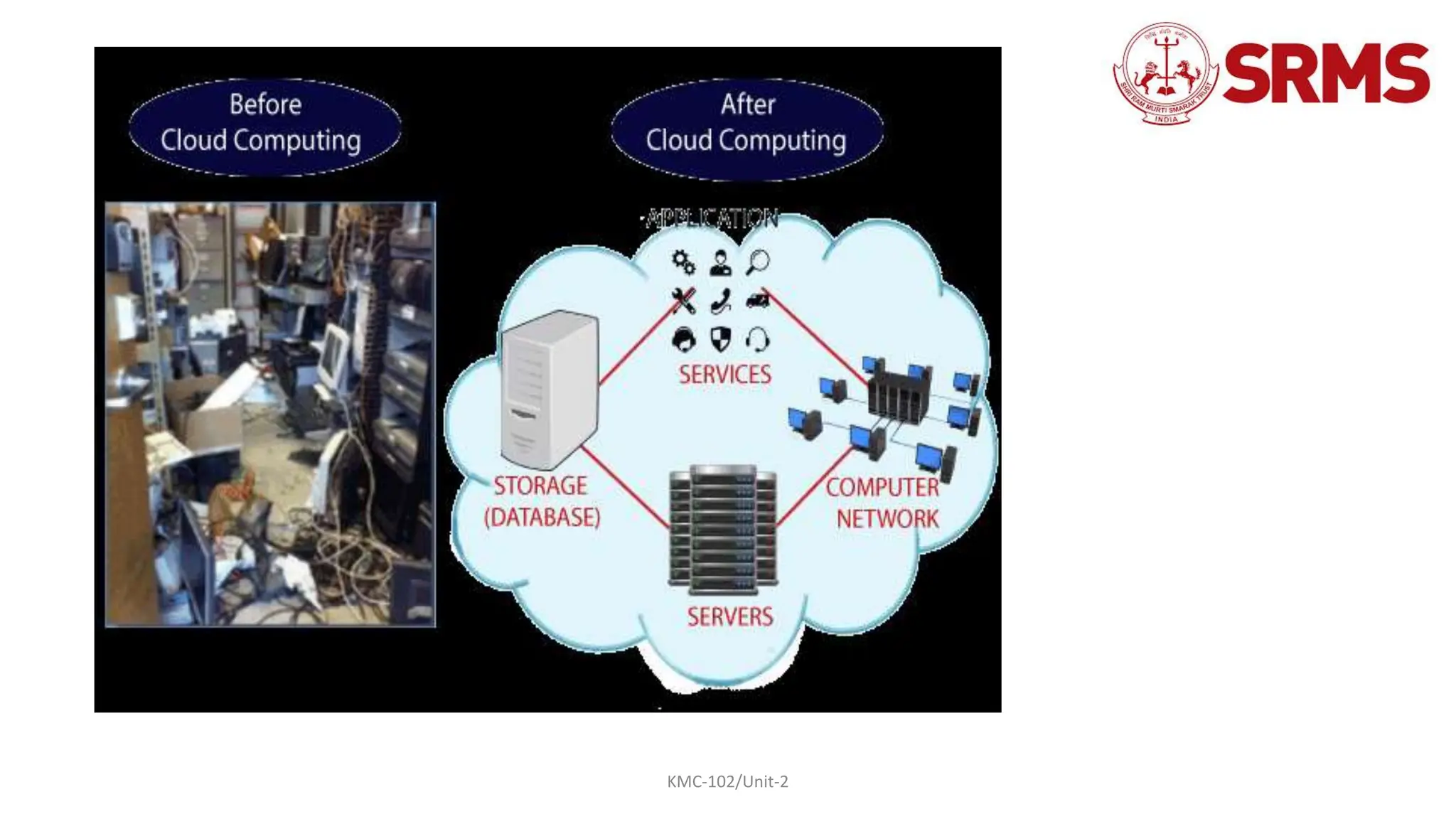
 Small as well as large IT companies, follow the traditional methods to provide the IT
infrastructure. That means for any IT company, we need a Server Room that is the
basic need of IT companies.
 In that server room, there should be a database server, mail server, networking,
firewalls, routers, modem, switches, QPS (Query Per Second means how much
queries or load will be handled by the server), configurable system, high net speed, and
the maintenance engineers.
 Cloud computing is a path to utility computing embraced by major IT companies such
as Amazon, Apple, Google, HP, IBM, Microsoft, Oracle, and others.
 To establish such IT infrastructure, we need to spend lots of money. To overcome all
these problems and to reduce the IT infrastructure cost, Cloud Computing comes into
existence.
KMC-202/Unit-2
KMC-102/Unit-2
KMC-102/Unit-2
Characteristics of Cloud Computing
The characteristics of cloud computing are given below:
1) Agility
The cloud works in a distributed computing environment. It shares resources among
users and works very fast.
2) High availability and reliability
The availability of servers is high and more reliable because the chances of infrastructure
failure are minimum.
3) High Scalability
Cloud offers "on-demand" provisioning of resources on a large scale, without having
engineers for peak loads.
4) Multi-Sharing
With the help of cloud computing, multiple users and applications can work more
efficiently with cost reductions by sharing common infrastructure.
KMC-102/Unit-2
5) Device and Location Independence
Cloud computing enables the users to access systems using a web browser regardless of their
location or what device they use e.g. PC, mobile phone, etc. As infrastructure is off-
site (typically provided by a third-party) and accessed via the Internet, users can connect from
anywhere.
6) Maintenance
Maintenance of cloud computing applications is easier, since they do not need to be installed
on each user's computer and can be accessed from different places. So, it reduces the cost also.
7) Low Cost
By using cloud computing, the cost will be reduced because to take the services of cloud
computing, IT company need not to set its own infrastructure and pay-as-per usage of
resources.
8) Services in the pay-per-use mode
Application Programming Interfaces (APIs) are provided to the users so that they can access
services on the cloud by using these APIs and pay the charges as per the usage of services.
KMC-102/Unit-2
 Before emerging the cloud computing, there was Client/Server computing which is
basically a centralized storage in which all the software applications, all the data and
all the controls are resided on the server side.
 If a single user wants to access specific data or run a program, he/she need to
connect to the server and then gain appropriate access, and then he/she can do
his/her business.
 Then after, distributed computing came into picture, where all the computers are
networked together and share their resources when needed.
 On the basis of above computing, there was emerged of cloud computing concepts
that later implemented.
 At around in 1961, John MacCharty suggested in a speech at MIT that computing
can be sold like a utility, just like a water or electricity. It was a brilliant idea, but
like all brilliant ideas, it was ahead if its time, as for the next few decades, despite
interest in the model, the technology simply was not ready for it.
History of Cloud Computing
KMC-102/Unit-2
 In 1999, Salesforce.com started delivering of applications to users using a simple
website. The applications were delivered to enterprises over the Internet, and this
way the dream of computing sold as utility were true.
 In 2002, Amazon started Amazon Web Services, providing services like storage,
computation and even human intelligence. However, only starting with the launch of
the Elastic Compute Cloud in 2006 a truly commercial service open to everybody
existed.
 In 2009, Google Apps also started to provide cloud computing enterprise
applications.
 Of course, all the big players are present in the cloud computing evolution, some
were earlier, some were later. In 2009, Microsoft launched Windows Azure, and
companies like Oracle and HP have all joined the game. This proves that today, cloud
computing has become mainstream.
History of Cloud Computing
KMC-102/Unit-2
Cloud Computing Architecture
Cloud computing technology is used by both small and large organizations to store the information in cloud
and access it from anywhere at anytime using the internet connection.
Cloud computing architecture is a combination of service-oriented architecture and event-driven
architecture.
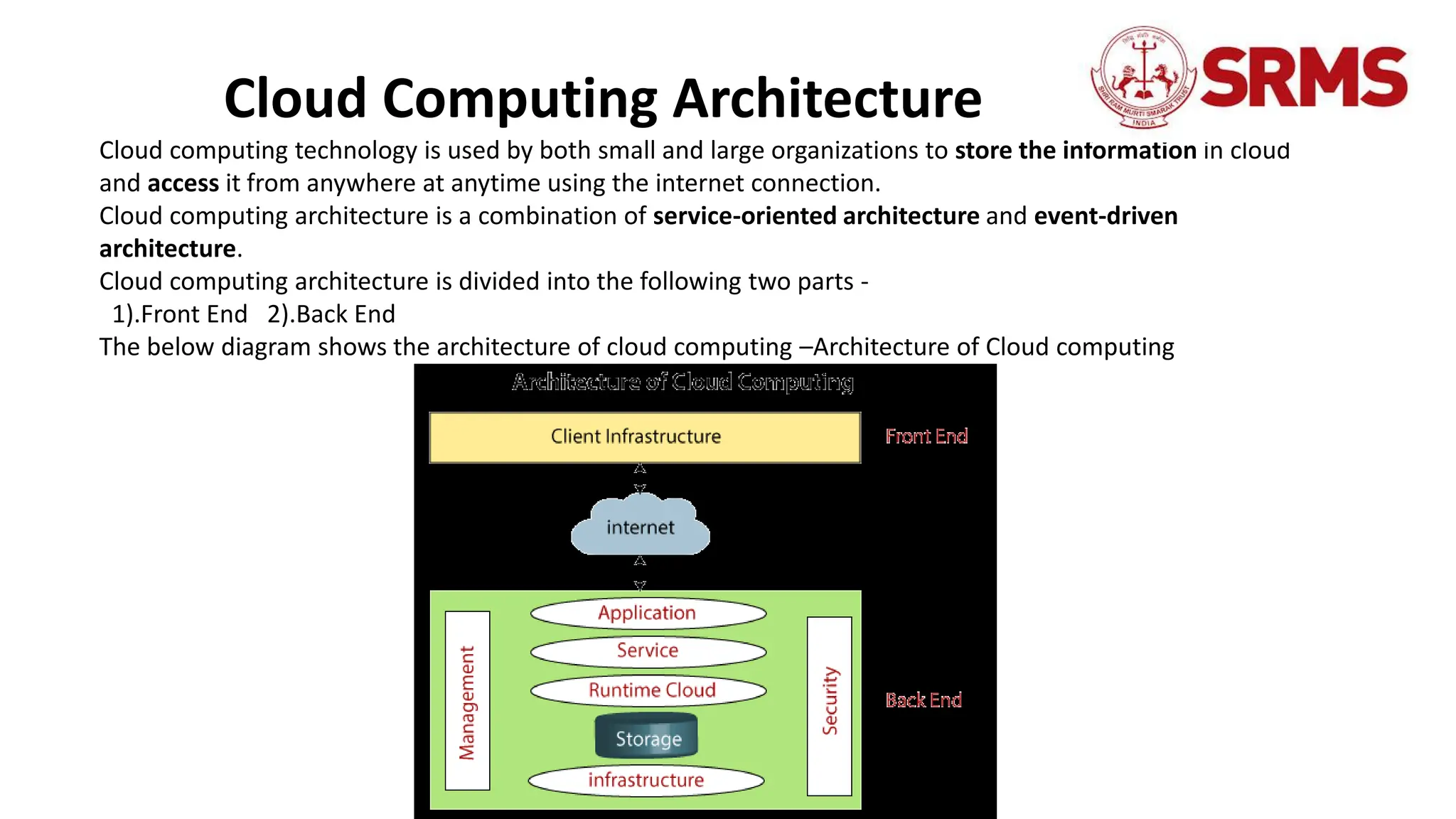
Cloud computing architecture is divided into the following two parts -
1).Front End 2).Back End
The below diagram shows the architecture of cloud computing –Architecture of Cloud computing
KMC-102/Unit-2
Front End
The front end is used by the client. It contains client-side interfaces and
applications that are required to access the cloud computing platforms. The front
end includes web servers (including Chrome, Firefox, internet explorer, etc.), thin
& fat clients, tablets, and mobile devices.
Back End
The back end is used by the service provider. It manages all the resources that are
required to provide cloud computing services. It includes a huge amount of data
storage, security mechanism, virtual machines, deploying models, servers, traffic
control mechanisms, etc.

Cloud computing and its nature and benefits

  • 1.
    Subject Name :-EmergingTechnology for Engineering Subject Code :- KMC 202 Unit 2:- Cloud Computing Topic Name :- Cloud Computing:- it’s nature and benefits KMC-202/Unit-2
  • 2.
    Contents  Cloud Computing Why Cloud Computing  Characteristics of Cloud Computing  History of Cloud Computing  Cloud Computing Architecture  Advantages and Disadvantages of Cloud computing  Cloud Computing Application  Benefits of Cloud Computing  Important Questions  References KMC-202/Unit-2
  • 3.
    Introduction  The termcloud refers to a network or the internet. It is a technology that uses remote servers on the internet to store, manage, and access data online rather than local drives. The data can be anything such as files, images, documents, audio, video, and more.  The word "cloud" often refers to the Internet, which more precisely means a datacenter full of servers connected to the Internet performing a service. However, the term "cloud computing" refers to the software and services that have enabled the Internet to become so prominent in everyday life  A network, in computing, is a group of two or more devices or nodes that can communicate. The devices or nodes in question can be connected by physical or wireless connections.  The Internet is a large network of networks. It connects millions of computers together globally, forming a network in which any computer can communicate with any other computer as long as they are both connected to the Internet.  There are the following operations that we can do using cloud computing:  Developing new applications and services  Storage, back up, and recovery of data  Hosting blogs and websites  Delivery of software on demand  Analysis of data  Streaming videos and audios KMC-202/Unit-2
  • 4.
    Why Cloud Computing? Small as well as large IT companies, follow the traditional methods to provide the IT infrastructure. That means for any IT company, we need a Server Room that is the basic need of IT companies.  In that server room, there should be a database server, mail server, networking, firewalls, routers, modem, switches, QPS (Query Per Second means how much queries or load will be handled by the server), configurable system, high net speed, and the maintenance engineers.  Cloud computing is a path to utility computing embraced by major IT companies such as Amazon, Apple, Google, HP, IBM, Microsoft, Oracle, and others.  To establish such IT infrastructure, we need to spend lots of money. To overcome all these problems and to reduce the IT infrastructure cost, Cloud Computing comes into existence. KMC-202/Unit-2
  • 5.
  • 6.
    KMC-102/Unit-2 Characteristics of CloudComputing The characteristics of cloud computing are given below: 1) Agility The cloud works in a distributed computing environment. It shares resources among users and works very fast. 2) High availability and reliability The availability of servers is high and more reliable because the chances of infrastructure failure are minimum. 3) High Scalability Cloud offers "on-demand" provisioning of resources on a large scale, without having engineers for peak loads. 4) Multi-Sharing With the help of cloud computing, multiple users and applications can work more efficiently with cost reductions by sharing common infrastructure.
  • 7.
    KMC-102/Unit-2 5) Device andLocation Independence Cloud computing enables the users to access systems using a web browser regardless of their location or what device they use e.g. PC, mobile phone, etc. As infrastructure is off- site (typically provided by a third-party) and accessed via the Internet, users can connect from anywhere. 6) Maintenance Maintenance of cloud computing applications is easier, since they do not need to be installed on each user's computer and can be accessed from different places. So, it reduces the cost also. 7) Low Cost By using cloud computing, the cost will be reduced because to take the services of cloud computing, IT company need not to set its own infrastructure and pay-as-per usage of resources. 8) Services in the pay-per-use mode Application Programming Interfaces (APIs) are provided to the users so that they can access services on the cloud by using these APIs and pay the charges as per the usage of services.
  • 8.
    KMC-102/Unit-2  Before emergingthe cloud computing, there was Client/Server computing which is basically a centralized storage in which all the software applications, all the data and all the controls are resided on the server side.  If a single user wants to access specific data or run a program, he/she need to connect to the server and then gain appropriate access, and then he/she can do his/her business.  Then after, distributed computing came into picture, where all the computers are networked together and share their resources when needed.  On the basis of above computing, there was emerged of cloud computing concepts that later implemented.  At around in 1961, John MacCharty suggested in a speech at MIT that computing can be sold like a utility, just like a water or electricity. It was a brilliant idea, but like all brilliant ideas, it was ahead if its time, as for the next few decades, despite interest in the model, the technology simply was not ready for it. History of Cloud Computing
  • 9.
    KMC-102/Unit-2  In 1999,Salesforce.com started delivering of applications to users using a simple website. The applications were delivered to enterprises over the Internet, and this way the dream of computing sold as utility were true.  In 2002, Amazon started Amazon Web Services, providing services like storage, computation and even human intelligence. However, only starting with the launch of the Elastic Compute Cloud in 2006 a truly commercial service open to everybody existed.  In 2009, Google Apps also started to provide cloud computing enterprise applications.  Of course, all the big players are present in the cloud computing evolution, some were earlier, some were later. In 2009, Microsoft launched Windows Azure, and companies like Oracle and HP have all joined the game. This proves that today, cloud computing has become mainstream. History of Cloud Computing
  • 10.
    KMC-102/Unit-2 Cloud Computing Architecture Cloudcomputing technology is used by both small and large organizations to store the information in cloud and access it from anywhere at anytime using the internet connection. Cloud computing architecture is a combination of service-oriented architecture and event-driven architecture. Cloud computing architecture is divided into the following two parts - 1).Front End 2).Back End The below diagram shows the architecture of cloud computing –Architecture of Cloud computing
  • 11.
    KMC-102/Unit-2 Front End The frontend is used by the client. It contains client-side interfaces and applications that are required to access the cloud computing platforms. The front end includes web servers (including Chrome, Firefox, internet explorer, etc.), thin & fat clients, tablets, and mobile devices. Back End The back end is used by the service provider. It manages all the resources that are required to provide cloud computing services. It includes a huge amount of data storage, security mechanism, virtual machines, deploying models, servers, traffic control mechanisms, etc.