Cloud Computing – A CFO Briefing
Presented by:
Joe Nathans, COO and CIO Services
Cloud Computing – Key Trends
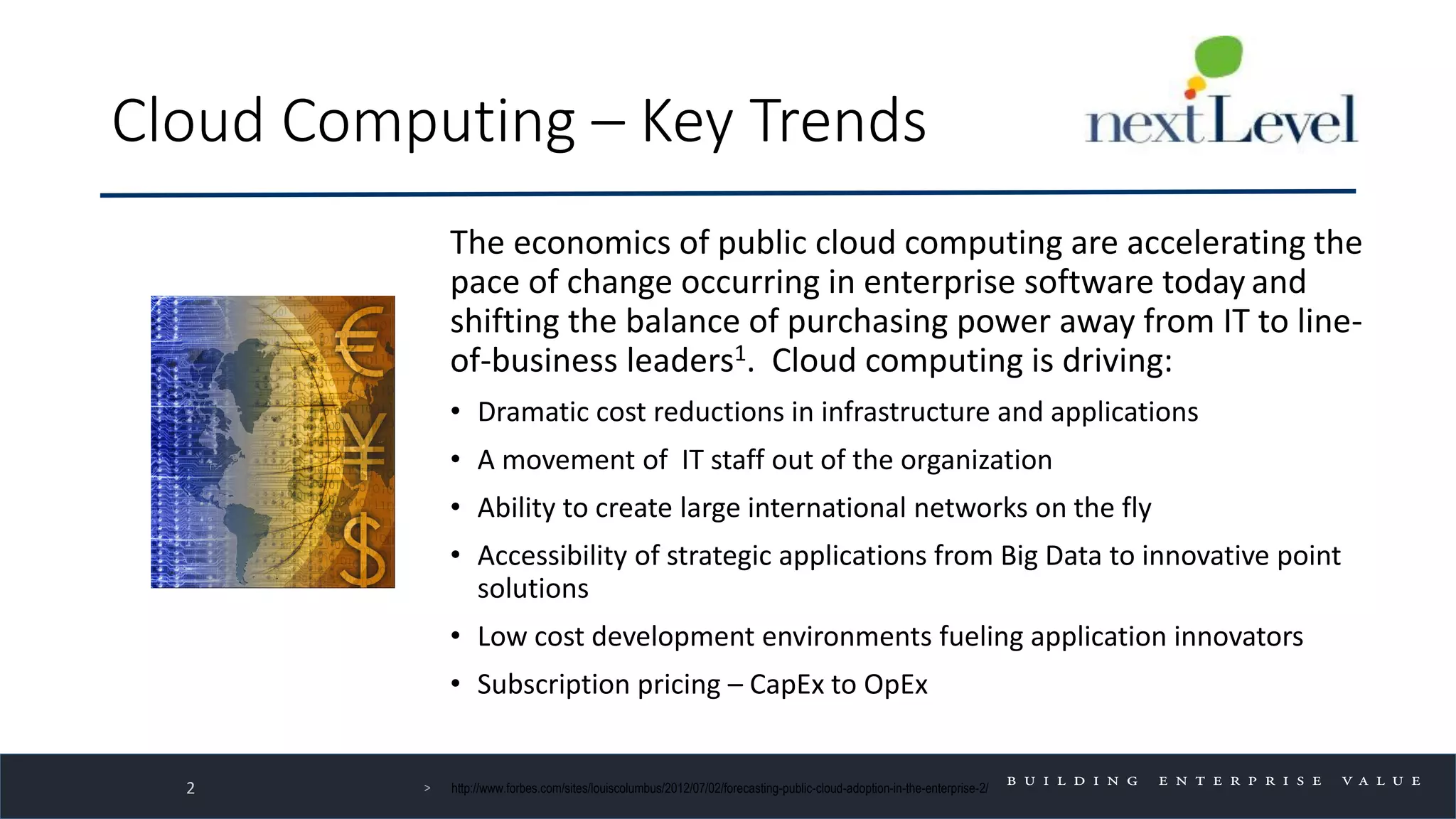
The economics of public cloud computing are accelerating the
pace of change occurring in enterprise software today and
shifting the balance of purchasing power away from IT to line-
of-business leaders1. Cloud computing is driving:
• Dramatic cost reductions in infrastructure and applications
• A movement of IT staff out of the organization
• Ability to create large international networks on the fly
• Accessibility of strategic applications from Big Data to innovative point
solutions
• Low cost development environments fueling application innovators
• Subscription pricing – CapEx to OpEx
2 > http://www.forbes.com/sites/louiscolumbus/2012/07/02/forecasting-public-cloud-adoption-in-the-enterprise-2/
The Scale & Efficiency of Cloud
Computing Drives Down TCO
3
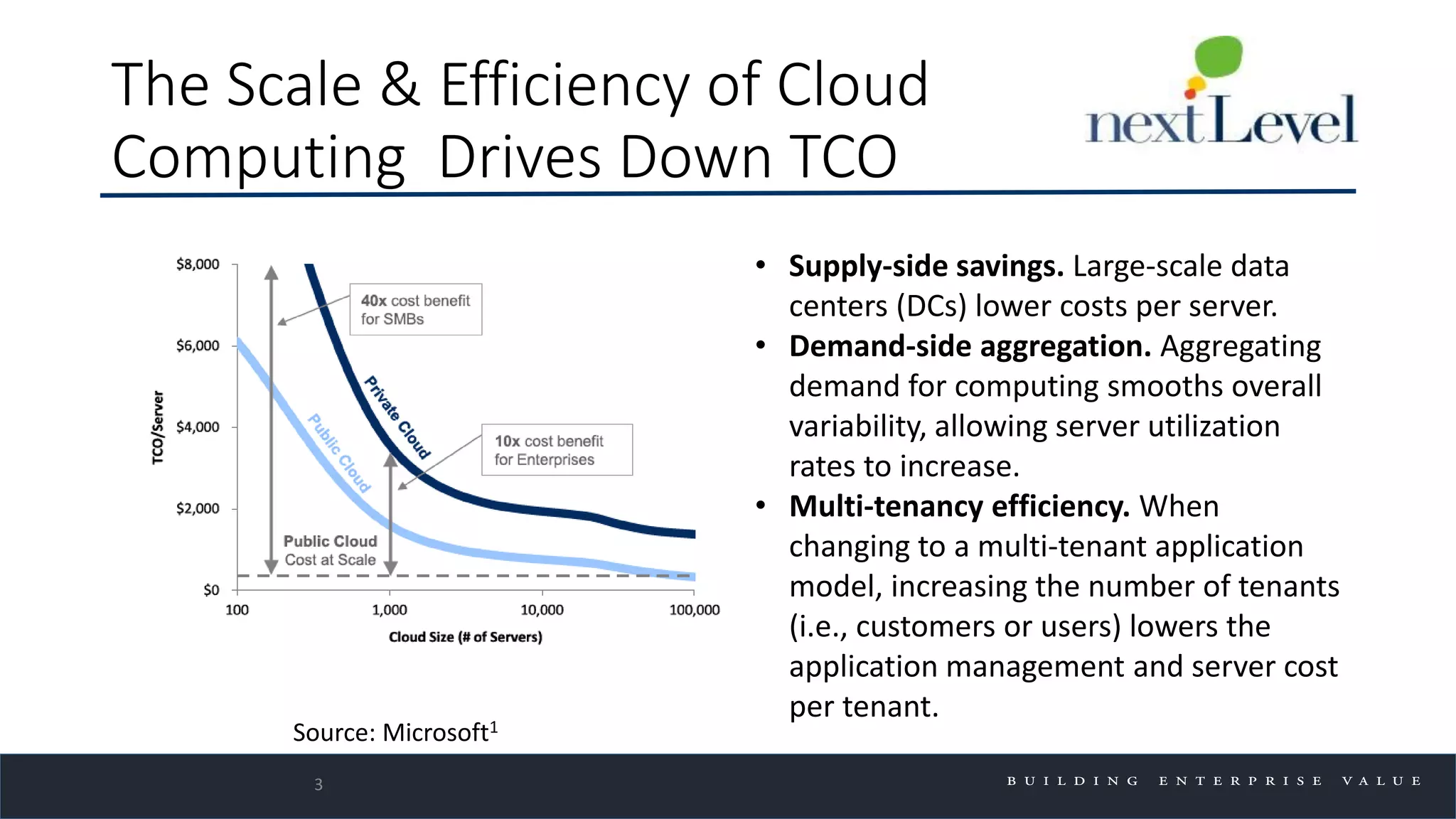
• Supply-side savings. Large-scale data
centers (DCs) lower costs per server.
• Demand-side aggregation. Aggregating
demand for computing smooths overall
variability, allowing server utilization
rates to increase.
• Multi-tenancy efficiency. When
changing to a multi-tenant application
model, increasing the number of tenants
(i.e., customers or users) lowers the
application management and server cost
per tenant.
Source: Microsoft1
Lower TCO Drives Compelling Cost &
Productivity Opportunities
Infrastructure as a Service (IaaS) Software as a Service (SaaS)
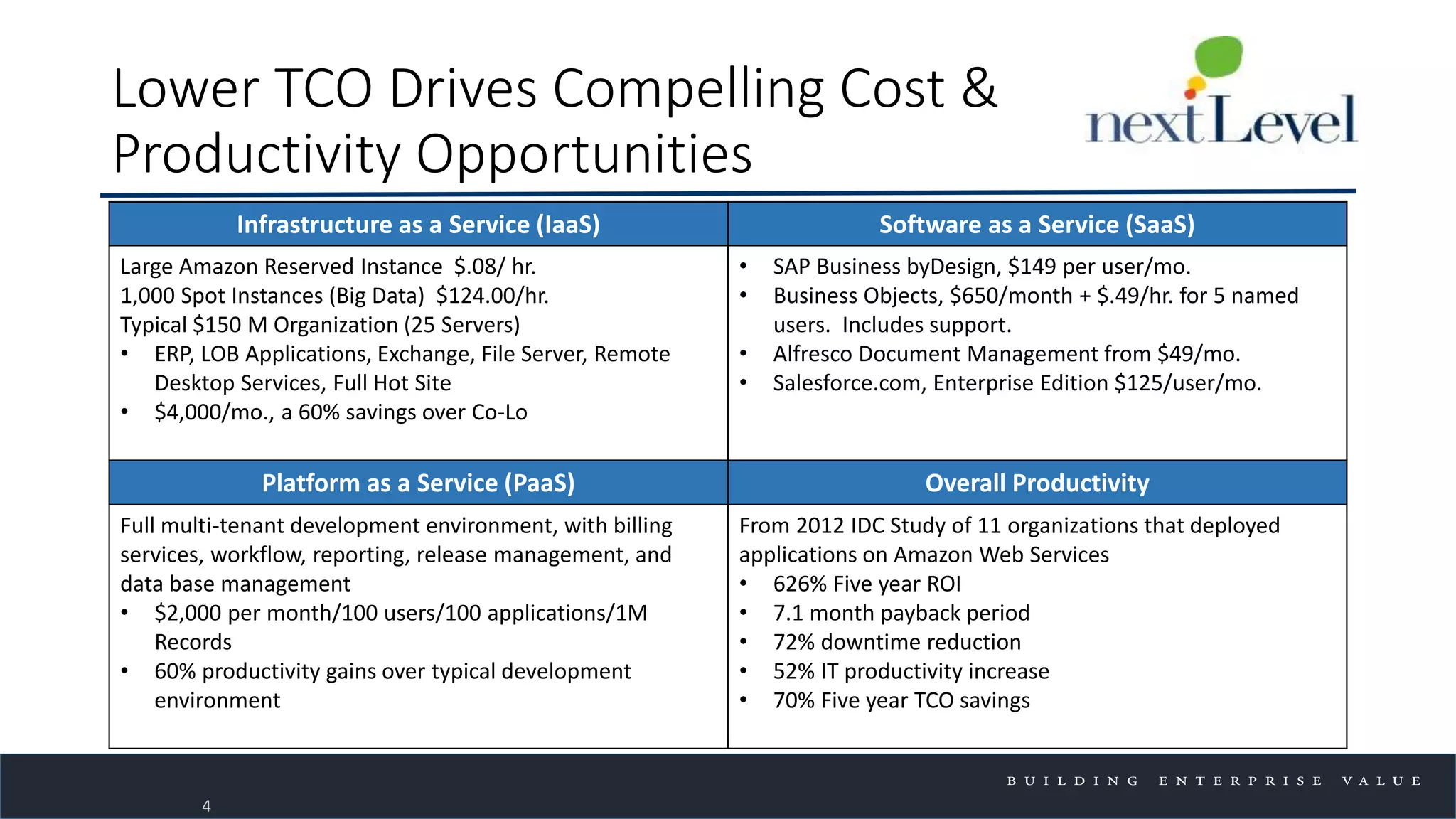
Large Amazon Reserved Instance $.08/ hr.
1,000 Spot Instances (Big Data) $124.00/hr.
Typical $150 M Organization (25 Servers)
• ERP, LOB Applications, Exchange, File Server, Remote
Desktop Services, Full Hot Site
• $4,000/mo., a 60% savings over Co-Lo
• SAP Business byDesign, $149 per user/mo.
• Business Objects, $650/month + $.49/hr. for 5 named
users. Includes support.
• Alfresco Document Management from $49/mo.
• Salesforce.com, Enterprise Edition $125/user/mo.
Platform as a Service (PaaS) Overall Productivity
Full multi-tenant development environment, with billing
services, workflow, reporting, release management, and
data base management
• $2,000 per month/100 users/100 applications/1M
Records
• 60% productivity gains over typical development
environment
From 2012 IDC Study of 11 organizations that deployed
applications on Amazon Web Services
• 626% Five year ROI
• 7.1 month payback period
• 72% downtime reduction
• 52% IT productivity increase
• 70% Five year TCO savings
4
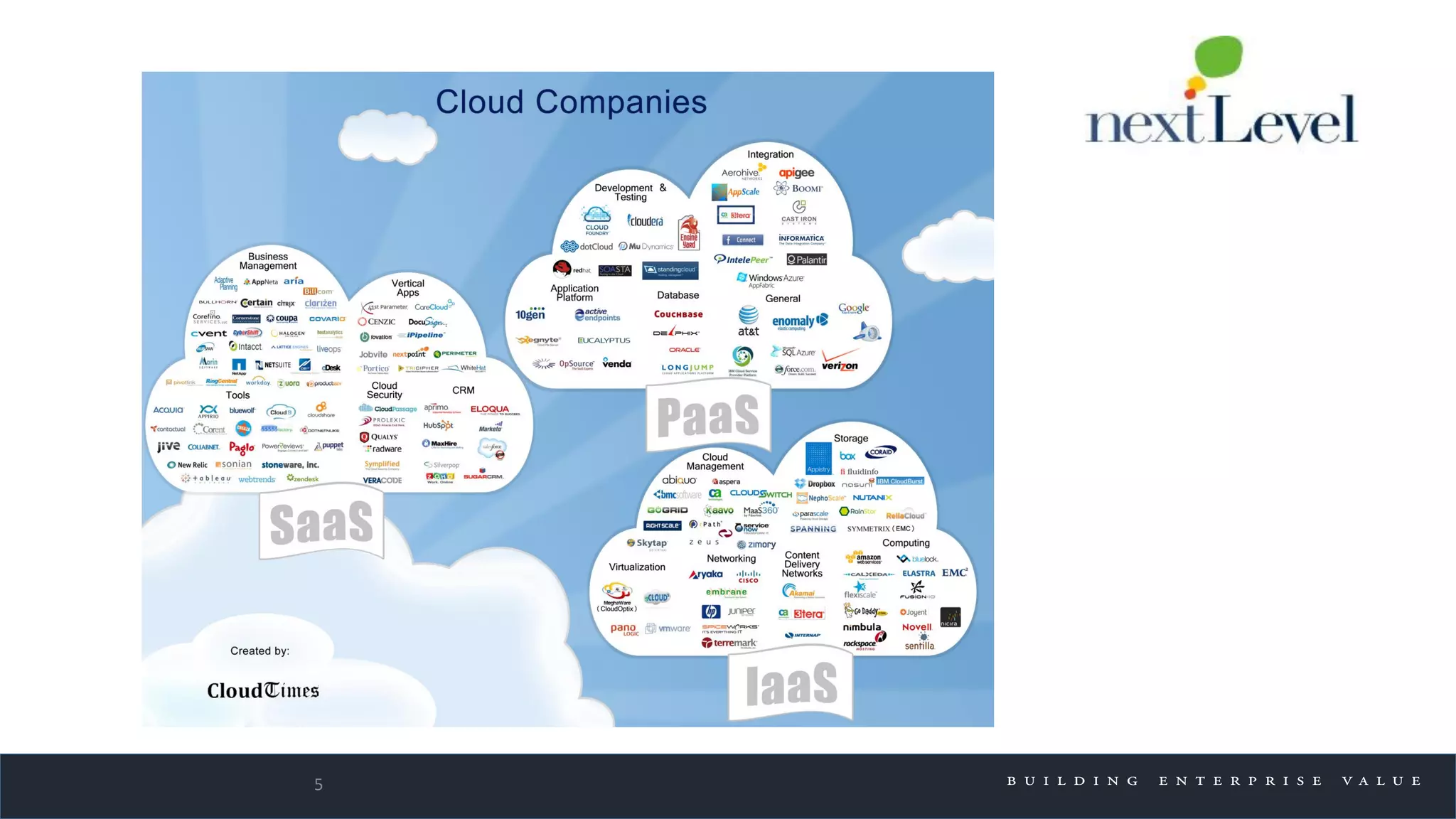
5
IaaS – Infrastructure as a Service
Cloud Computing – A CFO Briefing
6
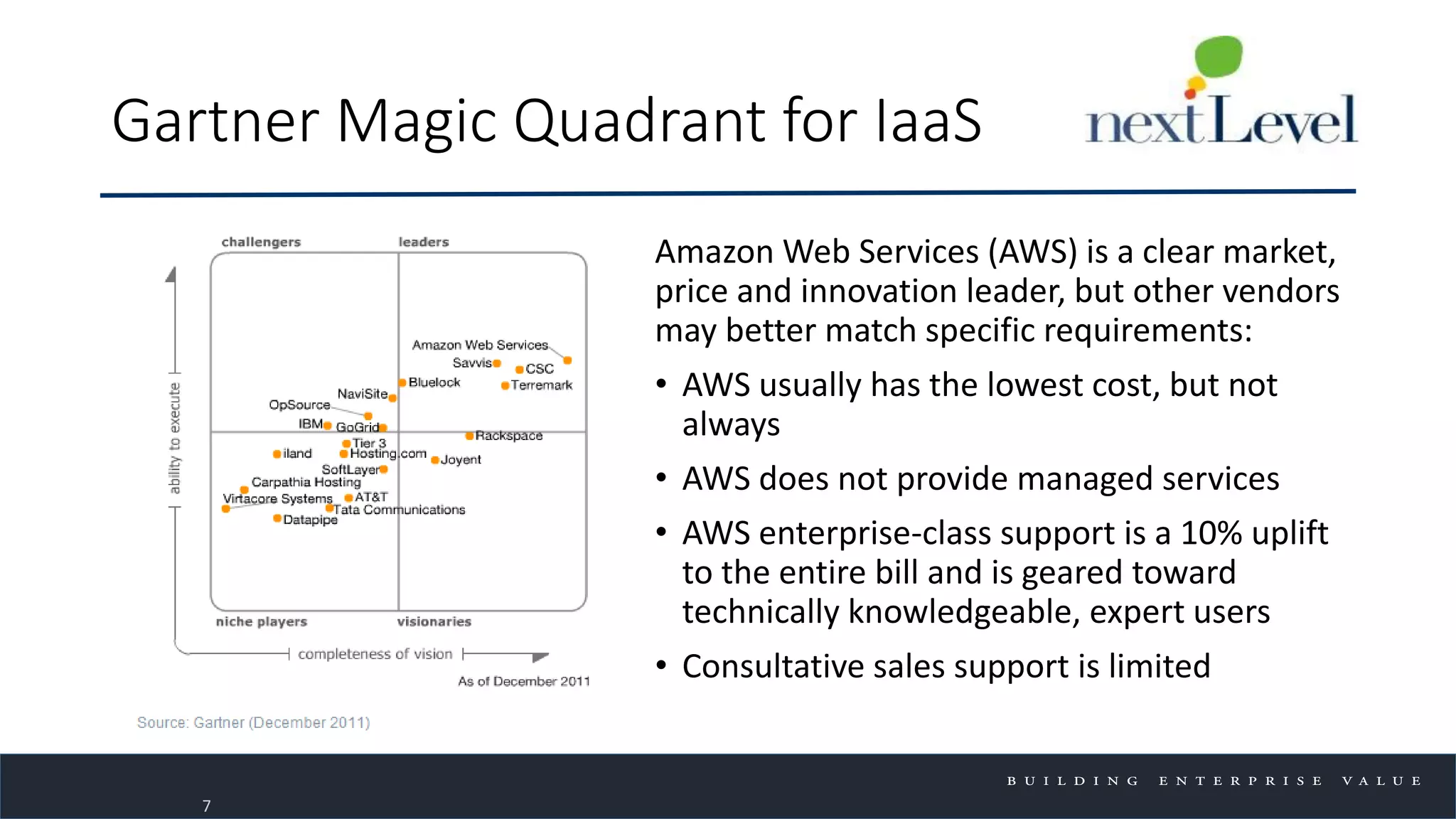
Gartner Magic Quadrant for IaaS
Amazon Web Services (AWS) is a clear market,
price and innovation leader, but other vendors
may better match specific requirements:
• AWS usually has the lowest cost, but not
always
• AWS does not provide managed services
• AWS enterprise-class support is a 10% uplift
to the entire bill and is geared toward
technically knowledgeable, expert users
• Consultative sales support is limited
7
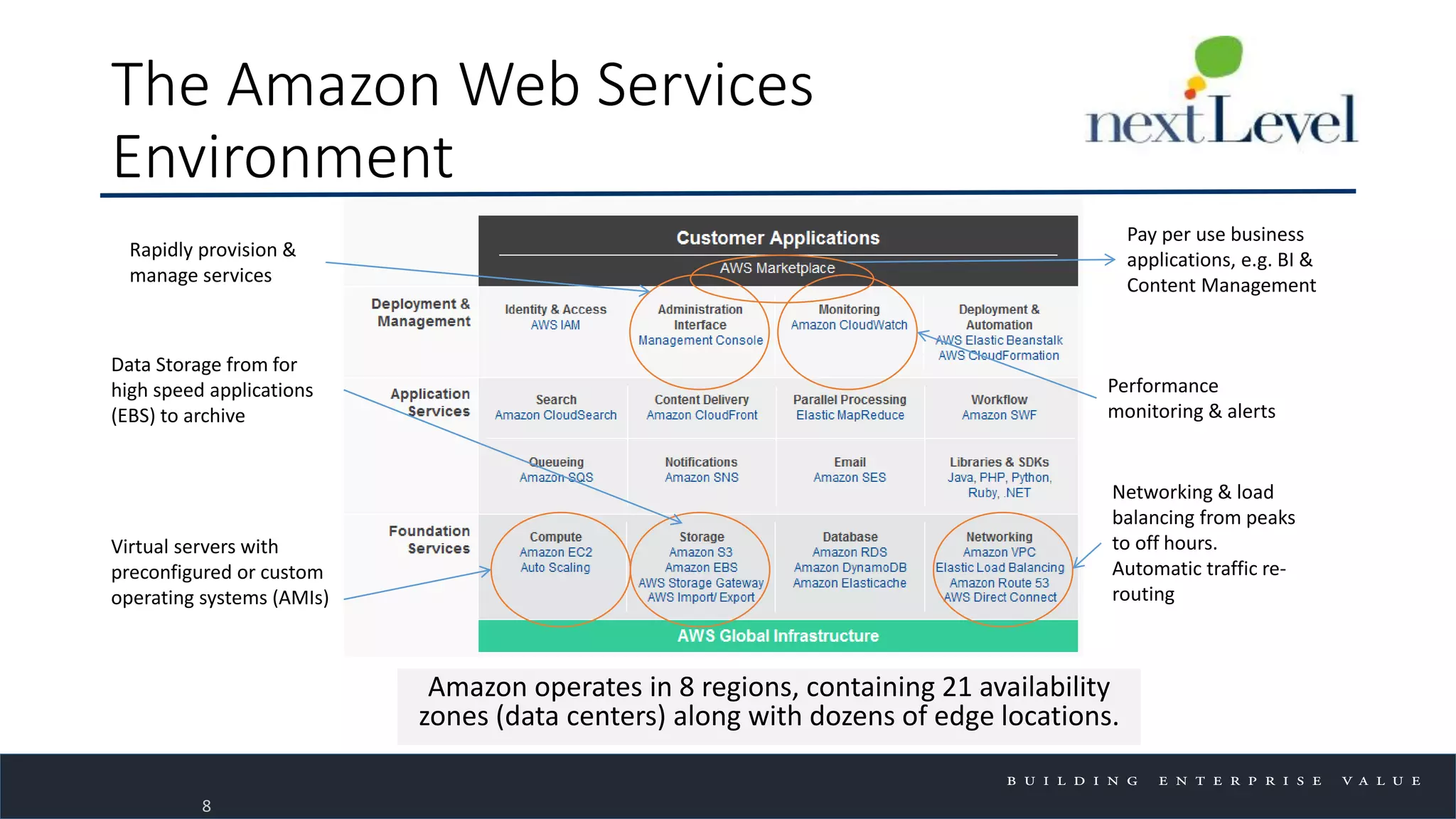
The Amazon Web Services
Environment
Amazon operates in 8 regions, containing 21 availability
zones (data centers) along with dozens of edge locations.
8
Networking & load
balancing from peaks
to off hours.
Automatic traffic re-
routing
Data Storage from for
high speed applications
(EBS) to archive
Virtual servers with
preconfigured or custom
operating systems (AMIs)
Rapidly provision &
manage services
Performance
monitoring & alerts
Pay per use business
applications, e.g. BI &
Content Management
IaaS Case Study – $150M
Construction Management Firm
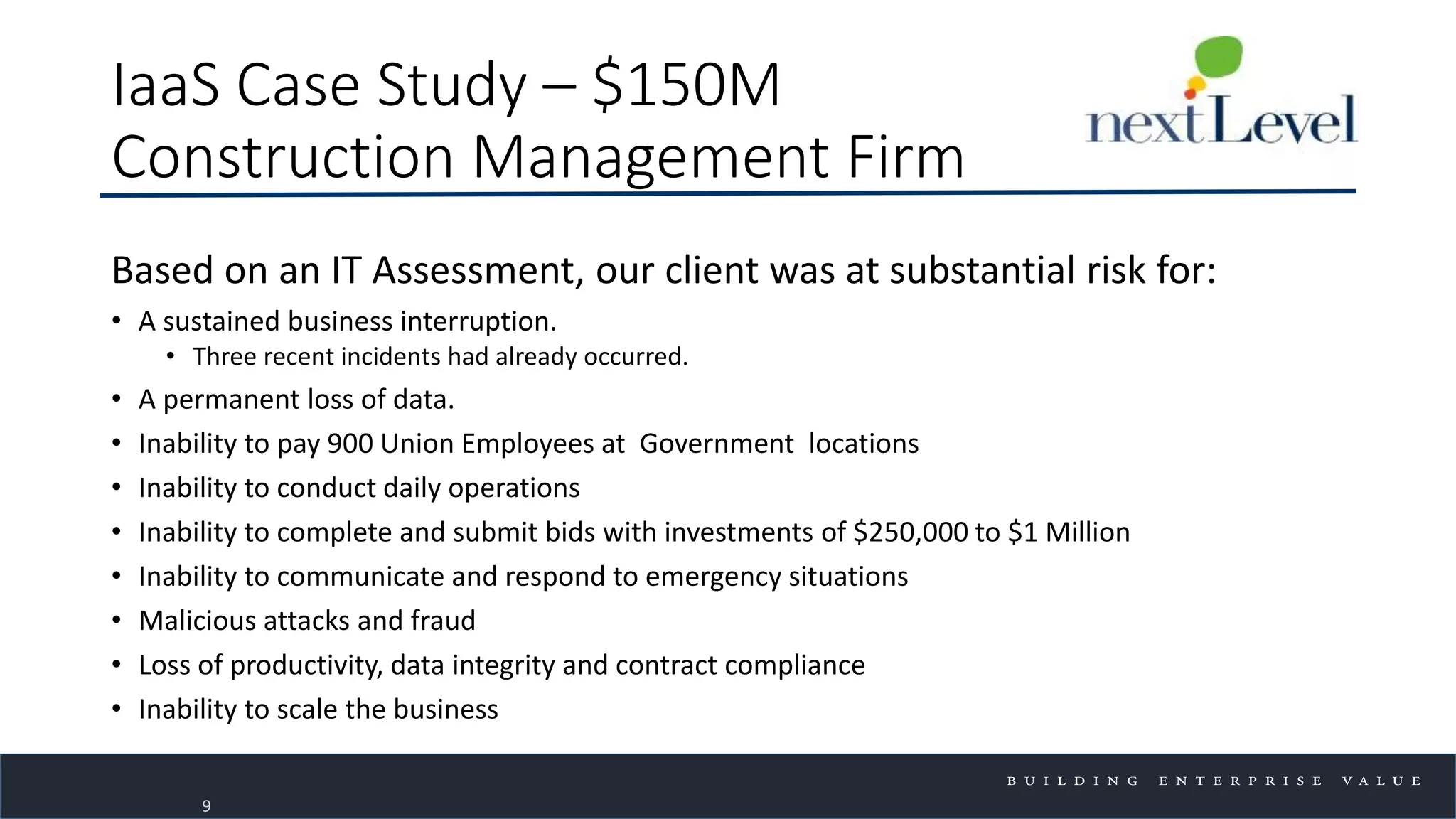
Based on an IT Assessment, our client was at substantial risk for:
• A sustained business interruption.
• Three recent incidents had already occurred.
• A permanent loss of data.
• Inability to pay 900 Union Employees at Government locations
• Inability to conduct daily operations
• Inability to complete and submit bids with investments of $250,000 to $1 Million
• Inability to communicate and respond to emergency situations
• Malicious attacks and fraud
• Loss of productivity, data integrity and contract compliance
• Inability to scale the business
9
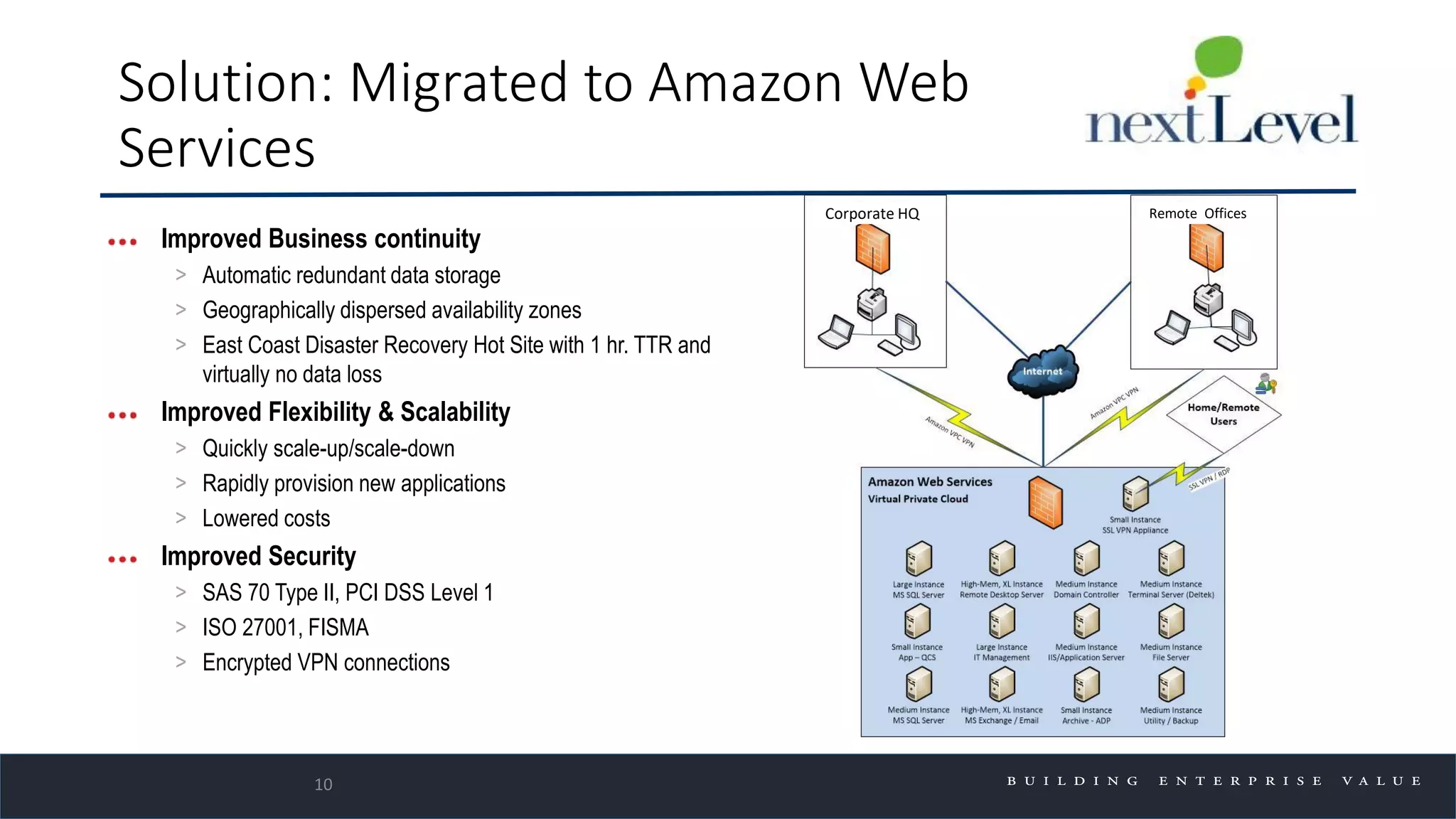
Solution: Migrated to Amazon Web
Services
10
Improved Business continuity
> Automatic redundant data storage
> Geographically dispersed availability zones
> East Coast Disaster Recovery Hot Site with 1 hr. TTR and
virtually no data loss
Improved Flexibility & Scalability
> Quickly scale-up/scale-down
> Rapidly provision new applications
> Lowered costs
Improved Security
> SAS 70 Type II, PCI DSS Level 1
> ISO 27001, FISMA
> Encrypted VPN connections
Corporate HQ Remote Offices
AWS Cost Comparison
11
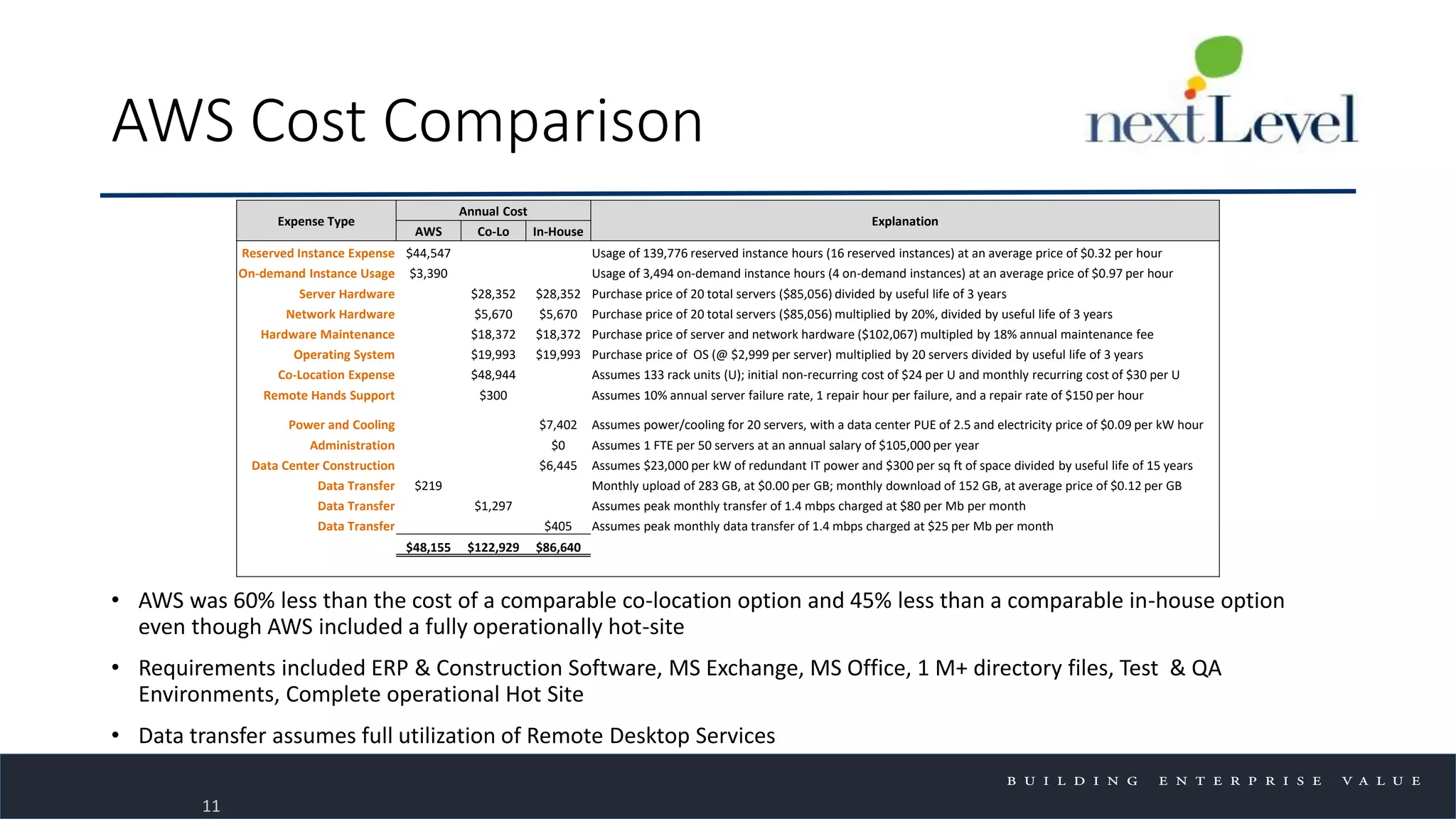
Expense Type
Annual Cost
Explanation
AWS Co-Lo In-House
Reserved Instance Expense $44,547 Usage of 139,776 reserved instance hours (16 reserved instances) at an average price of $0.32 per hour
On-demand Instance Usage $3,390 Usage of 3,494 on-demand instance hours (4 on-demand instances) at an average price of $0.97 per hour
Server Hardware $28,352 $28,352 Purchase price of 20 total servers ($85,056) divided by useful life of 3 years
Network Hardware $5,670 $5,670 Purchase price of 20 total servers ($85,056) multiplied by 20%, divided by useful life of 3 years
Hardware Maintenance $18,372 $18,372 Purchase price of server and network hardware ($102,067) multipled by 18% annual maintenance fee
Operating System $19,993 $19,993 Purchase price of OS (@ $2,999 per server) multiplied by 20 servers divided by useful life of 3 years
Co-Location Expense $48,944 Assumes 133 rack units (U); initial non-recurring cost of $24 per U and monthly recurring cost of $30 per U
Remote Hands Support $300 Assumes 10% annual server failure rate, 1 repair hour per failure, and a repair rate of $150 per hour
Power and Cooling $7,402 Assumes power/cooling for 20 servers, with a data center PUE of 2.5 and electricity price of $0.09 per kW hour
Administration $0 Assumes 1 FTE per 50 servers at an annual salary of $105,000 per year
Data Center Construction $6,445 Assumes $23,000 per kW of redundant IT power and $300 per sq ft of space divided by useful life of 15 years
Data Transfer $219 Monthly upload of 283 GB, at $0.00 per GB; monthly download of 152 GB, at average price of $0.12 per GB
Data Transfer $1,297 Assumes peak monthly transfer of 1.4 mbps charged at $80 per Mb per month
Data Transfer $405 Assumes peak monthly data transfer of 1.4 mbps charged at $25 per Mb per month
$48,155 $122,929 $86,640
• AWS was 60% less than the cost of a comparable co-location option and 45% less than a comparable in-house option
even though AWS included a fully operationally hot-site
• Requirements included ERP & Construction Software, MS Exchange, MS Office, 1 M+ directory files, Test & QA
Environments, Complete operational Hot Site
• Data transfer assumes full utilization of Remote Desktop Services
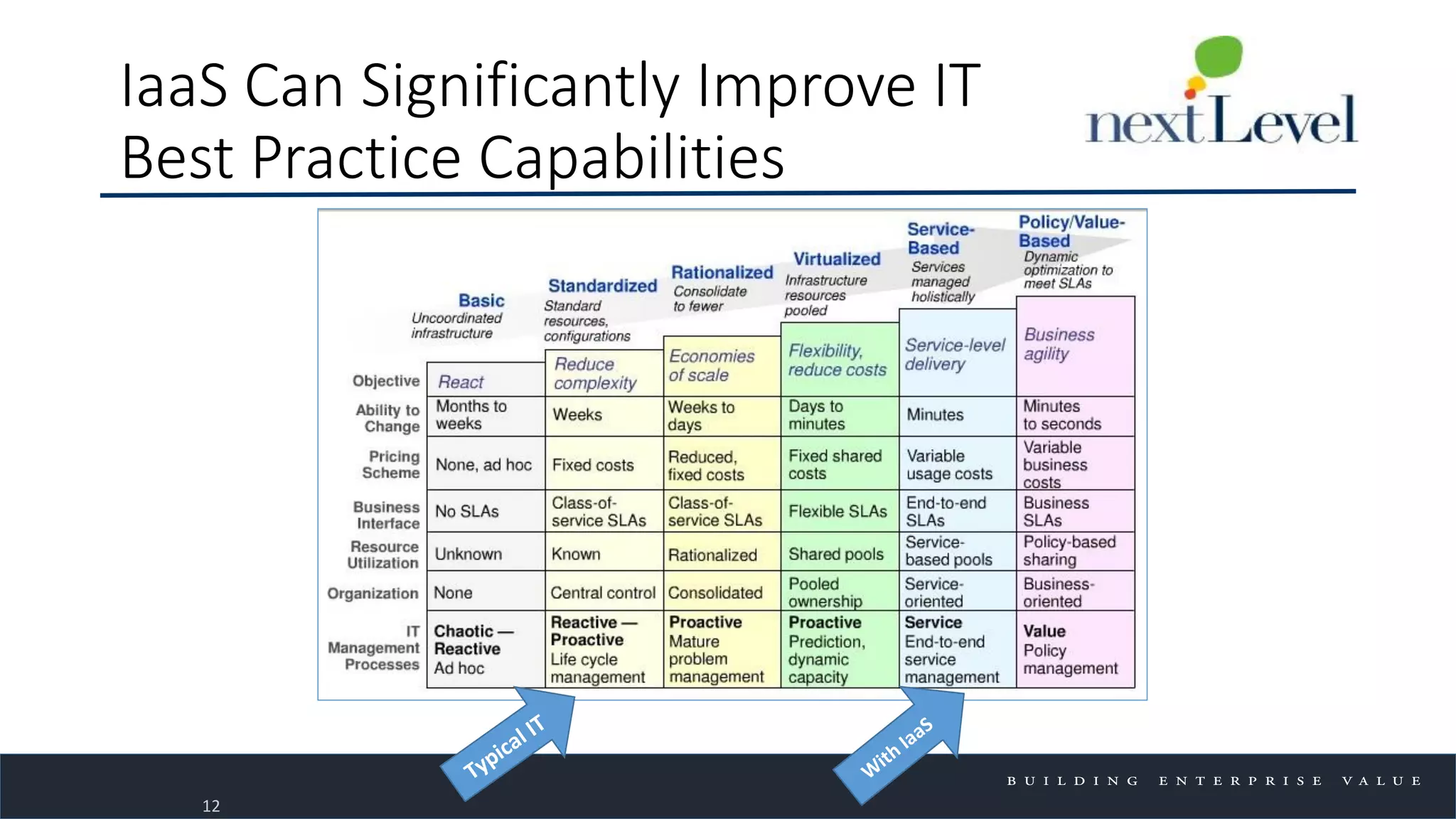
IaaS Can Significantly Improve IT
Best Practice Capabilities
12
SaaS – Software as a Service
Cloud Computing – A CFO Briefing
13
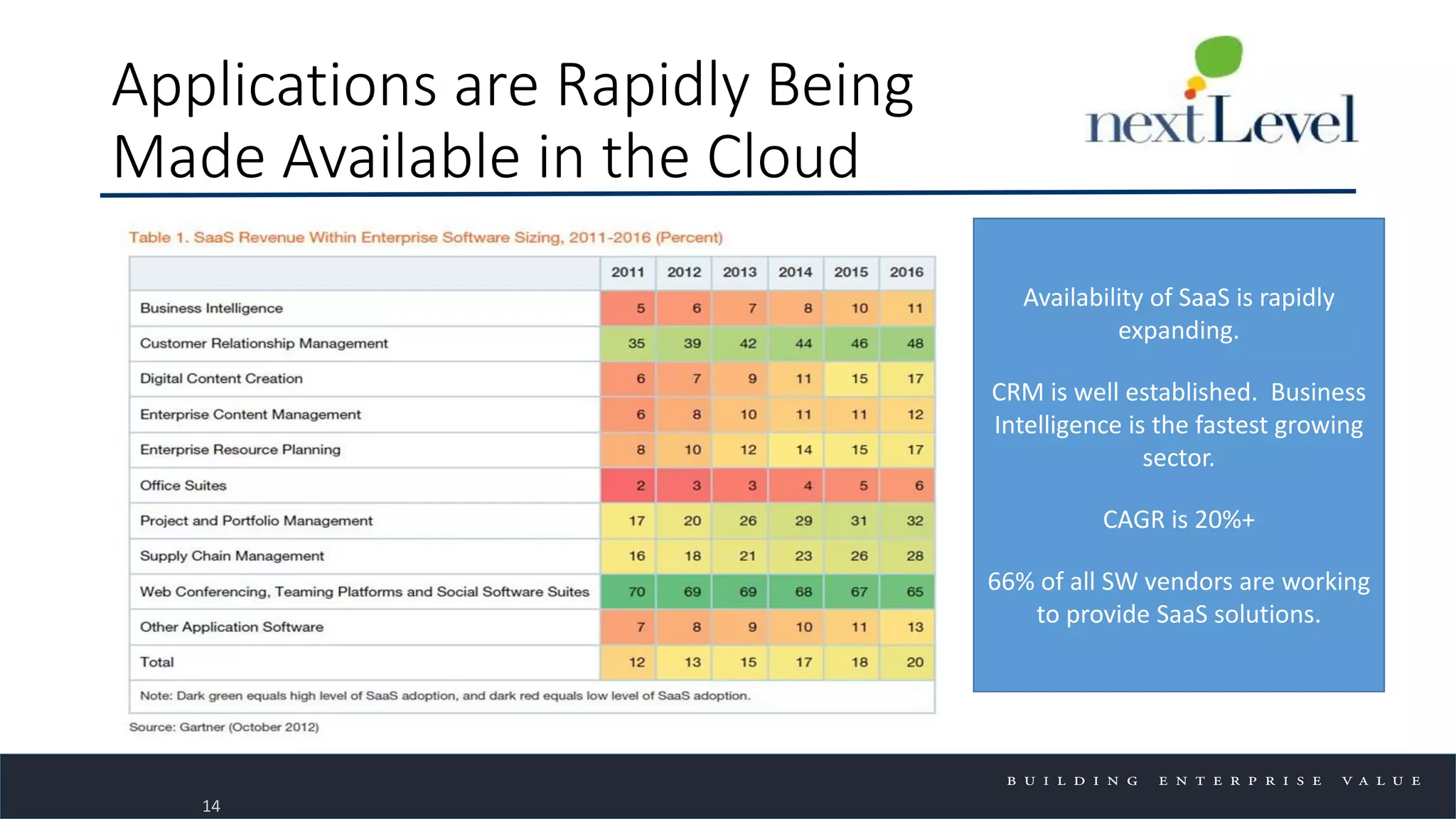
Applications are Rapidly Being
Made Available in the Cloud
14
Availability of SaaS is rapidly
expanding.
CRM is well established. Business
Intelligence is the fastest growing
sector.
CAGR is 20%+
66% of all SW vendors are working
to provide SaaS solutions.
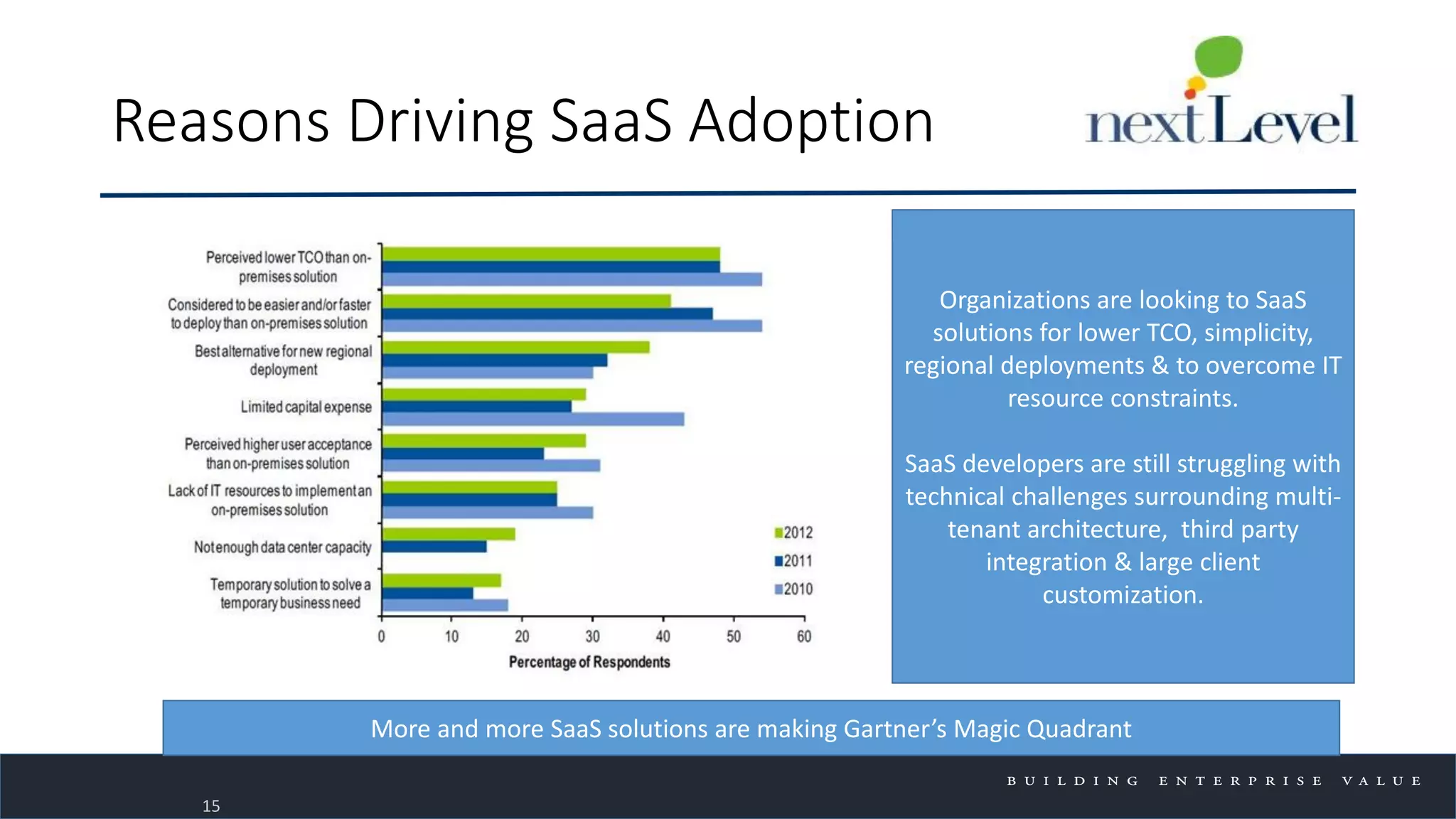
Reasons Driving SaaS Adoption
15
Organizations are looking to SaaS
solutions for lower TCO, simplicity,
regional deployments & to overcome IT
resource constraints.
SaaS developers are still struggling with
technical challenges surrounding multi-
tenant architecture, third party
integration & large client
customization.
More and more SaaS solutions are making Gartner’s Magic Quadrant
SaaS – Software as a Service
• SaaS offerings should definitely be considered when evaluating new business
solutions
• Lower risk – minimizes up-front investment
• Lower TCO and faster time to market
• Vendor responsible for maintenance and upgrades
• Often reduces unnecessary complexity while increasing productivity
• Availability of highly specific solutions
• SaaS Business Intelligence and Corporate Performance Management solutions
can provide significant payback
• There is still a great deal of variability across SaaS solution providers – caution is
required
16
PaaS – Platform as a Service
Cloud Computing – A CFO Briefing
17
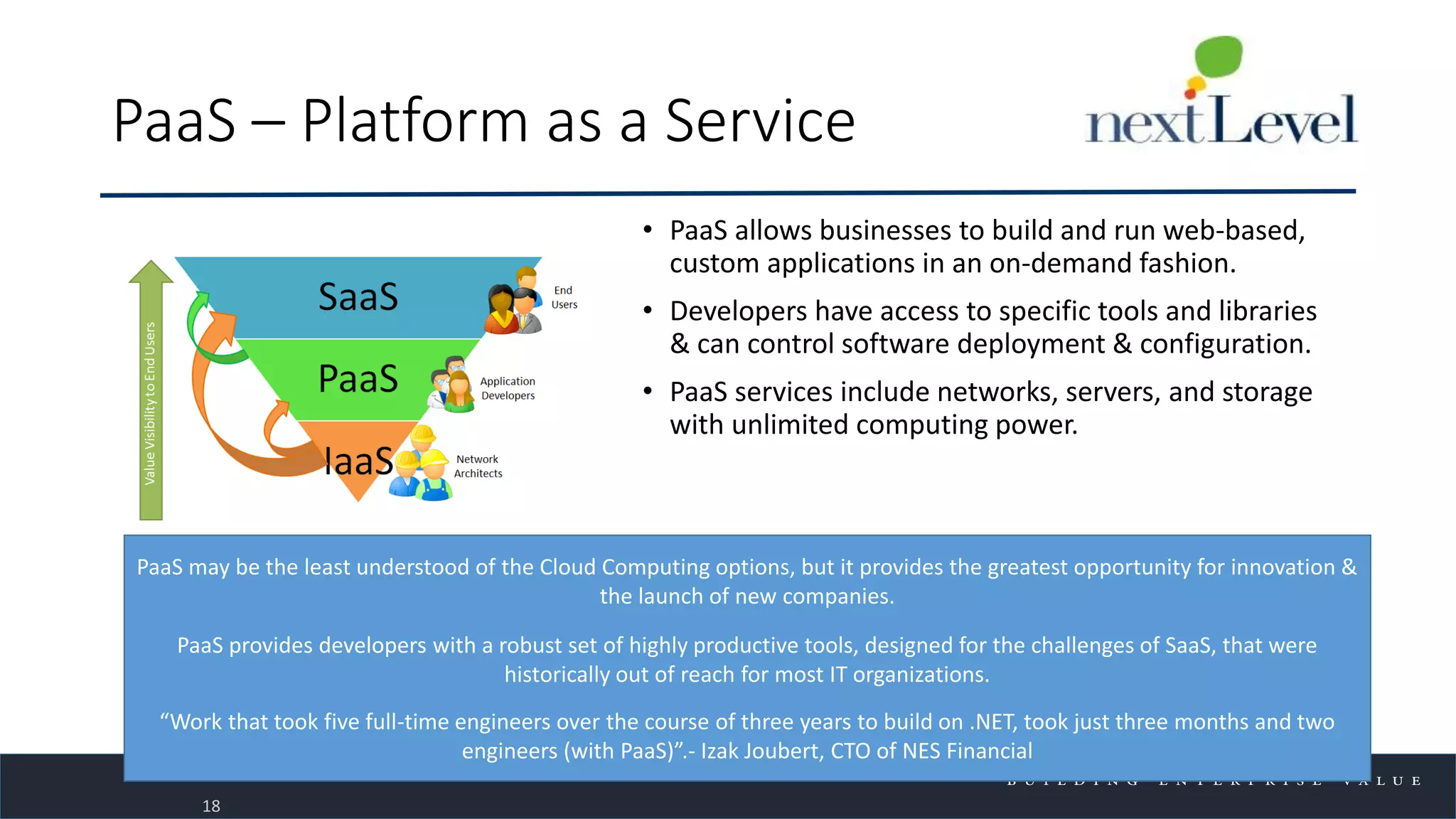
PaaS – Platform as a Service
• PaaS allows businesses to build and run web-based,
custom applications in an on-demand fashion.
• Developers have access to specific tools and libraries
& can control software deployment & configuration.
• PaaS services include networks, servers, and storage
with unlimited computing power.
18
PaaS may be the least understood of the Cloud Computing options, but it provides the greatest opportunity for innovation &
the launch of new companies.
PaaS provides developers with a robust set of highly productive tools, designed for the challenges of SaaS, that were
historically out of reach for most IT organizations.
“Work that took five full-time engineers over the course of three years to build on .NET, took just three months and two
engineers (with PaaS)”.- Izak Joubert, CTO of NES Financial
CIO Concerns
Cloud Computing – A CFO Briefing
19
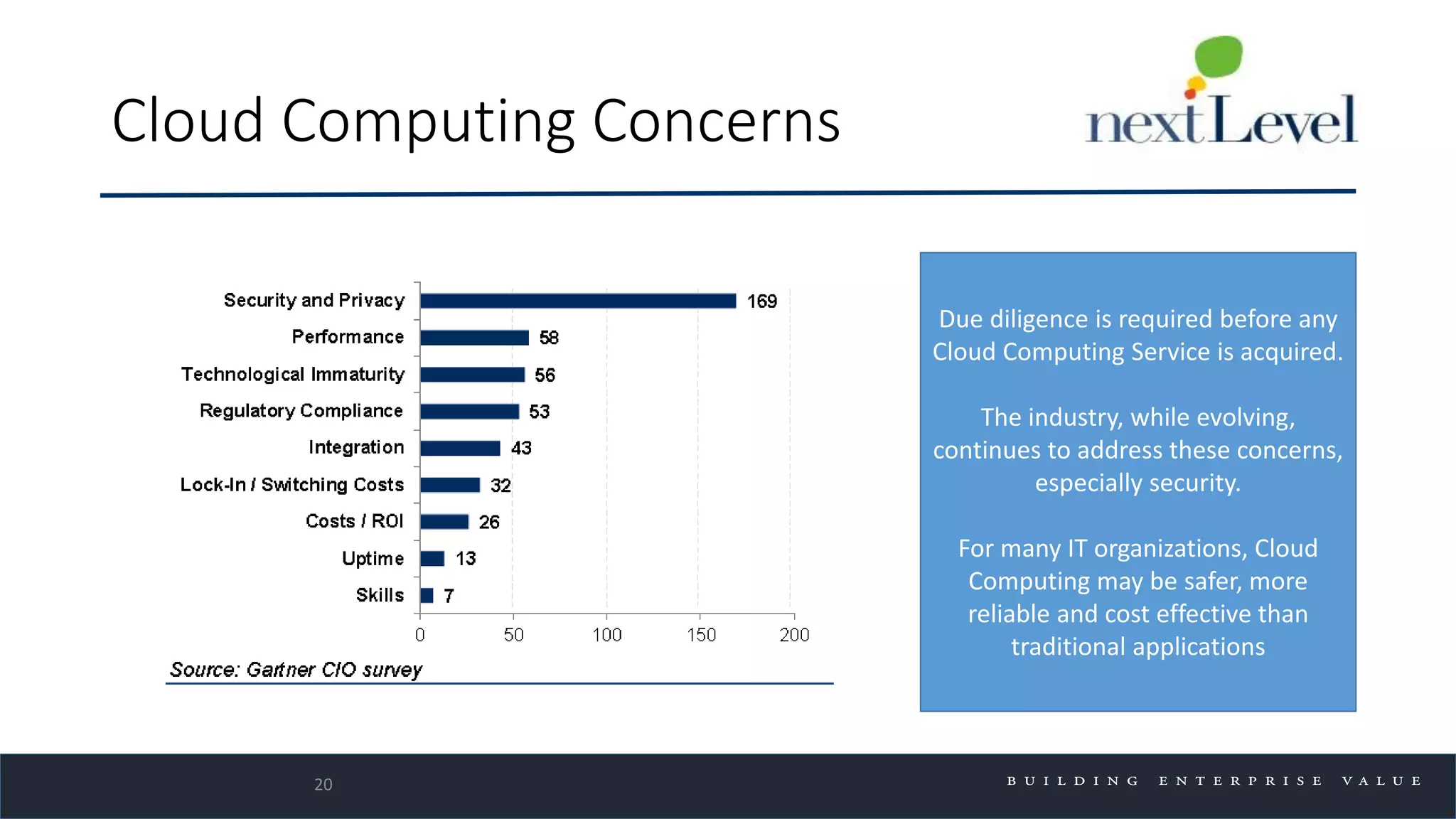
Cloud Computing Concerns
20
Due diligence is required before any
Cloud Computing Service is acquired.
The industry, while evolving,
continues to address these concerns,
especially security.
For many IT organizations, Cloud
Computing may be safer, more
reliable and cost effective than
traditional applications
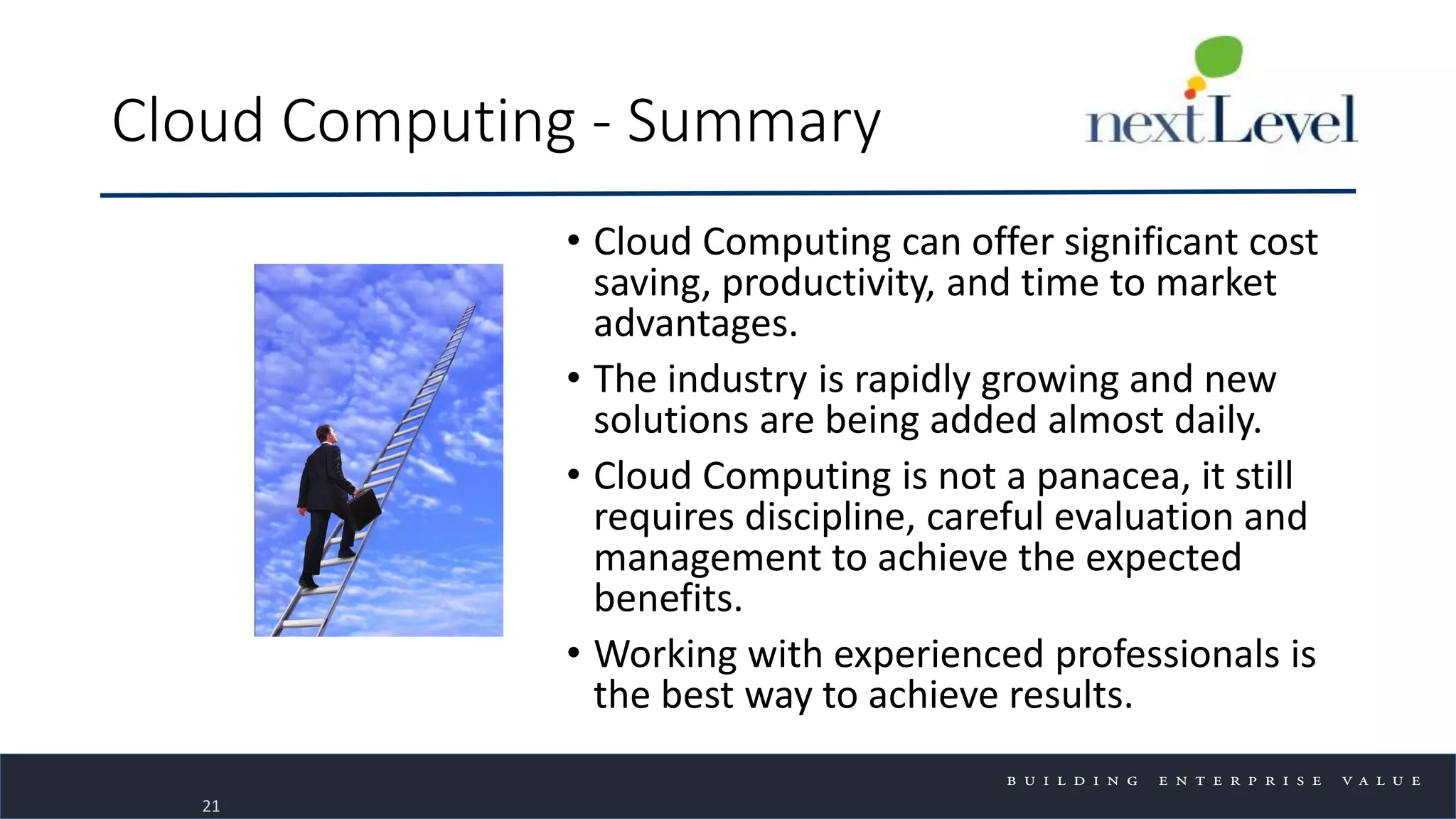
Cloud Computing - Summary
• Cloud Computing can offer significant cost
saving, productivity, and time to market
advantages.
• The industry is rapidly growing and new
solutions are being added almost daily.
• Cloud Computing is not a panacea, it still
requires discipline, careful evaluation and
management to achieve the expected
benefits.
• Working with experienced professionals is
the best way to achieve results.
21
Thank you
Cloud Computing – A CFO Briefing
22

Cloud Computing – A CFO Briefing

  • 1.
    Cloud Computing –A CFO Briefing Presented by: Joe Nathans, COO and CIO Services
  • 2.
    Cloud Computing –Key Trends The economics of public cloud computing are accelerating the pace of change occurring in enterprise software today and shifting the balance of purchasing power away from IT to line- of-business leaders1. Cloud computing is driving: • Dramatic cost reductions in infrastructure and applications • A movement of IT staff out of the organization • Ability to create large international networks on the fly • Accessibility of strategic applications from Big Data to innovative point solutions • Low cost development environments fueling application innovators • Subscription pricing – CapEx to OpEx 2 > http://www.forbes.com/sites/louiscolumbus/2012/07/02/forecasting-public-cloud-adoption-in-the-enterprise-2/
  • 3.
    The Scale &Efficiency of Cloud Computing Drives Down TCO 3 • Supply-side savings. Large-scale data centers (DCs) lower costs per server. • Demand-side aggregation. Aggregating demand for computing smooths overall variability, allowing server utilization rates to increase. • Multi-tenancy efficiency. When changing to a multi-tenant application model, increasing the number of tenants (i.e., customers or users) lowers the application management and server cost per tenant. Source: Microsoft1
  • 4.
    Lower TCO DrivesCompelling Cost & Productivity Opportunities Infrastructure as a Service (IaaS) Software as a Service (SaaS) Large Amazon Reserved Instance $.08/ hr. 1,000 Spot Instances (Big Data) $124.00/hr. Typical $150 M Organization (25 Servers) • ERP, LOB Applications, Exchange, File Server, Remote Desktop Services, Full Hot Site • $4,000/mo., a 60% savings over Co-Lo • SAP Business byDesign, $149 per user/mo. • Business Objects, $650/month + $.49/hr. for 5 named users. Includes support. • Alfresco Document Management from $49/mo. • Salesforce.com, Enterprise Edition $125/user/mo. Platform as a Service (PaaS) Overall Productivity Full multi-tenant development environment, with billing services, workflow, reporting, release management, and data base management • $2,000 per month/100 users/100 applications/1M Records • 60% productivity gains over typical development environment From 2012 IDC Study of 11 organizations that deployed applications on Amazon Web Services • 626% Five year ROI • 7.1 month payback period • 72% downtime reduction • 52% IT productivity increase • 70% Five year TCO savings 4
  • 5.
  • 6.
    IaaS – Infrastructureas a Service Cloud Computing – A CFO Briefing 6
  • 7.
    Gartner Magic Quadrantfor IaaS Amazon Web Services (AWS) is a clear market, price and innovation leader, but other vendors may better match specific requirements: • AWS usually has the lowest cost, but not always • AWS does not provide managed services • AWS enterprise-class support is a 10% uplift to the entire bill and is geared toward technically knowledgeable, expert users • Consultative sales support is limited 7
  • 8.
    The Amazon WebServices Environment Amazon operates in 8 regions, containing 21 availability zones (data centers) along with dozens of edge locations. 8 Networking & load balancing from peaks to off hours. Automatic traffic re- routing Data Storage from for high speed applications (EBS) to archive Virtual servers with preconfigured or custom operating systems (AMIs) Rapidly provision & manage services Performance monitoring & alerts Pay per use business applications, e.g. BI & Content Management
  • 9.
    IaaS Case Study– $150M Construction Management Firm Based on an IT Assessment, our client was at substantial risk for: • A sustained business interruption. • Three recent incidents had already occurred. • A permanent loss of data. • Inability to pay 900 Union Employees at Government locations • Inability to conduct daily operations • Inability to complete and submit bids with investments of $250,000 to $1 Million • Inability to communicate and respond to emergency situations • Malicious attacks and fraud • Loss of productivity, data integrity and contract compliance • Inability to scale the business 9
  • 10.
    Solution: Migrated toAmazon Web Services 10 Improved Business continuity > Automatic redundant data storage > Geographically dispersed availability zones > East Coast Disaster Recovery Hot Site with 1 hr. TTR and virtually no data loss Improved Flexibility & Scalability > Quickly scale-up/scale-down > Rapidly provision new applications > Lowered costs Improved Security > SAS 70 Type II, PCI DSS Level 1 > ISO 27001, FISMA > Encrypted VPN connections Corporate HQ Remote Offices
  • 11.
    AWS Cost Comparison 11 ExpenseType Annual Cost Explanation AWS Co-Lo In-House Reserved Instance Expense $44,547 Usage of 139,776 reserved instance hours (16 reserved instances) at an average price of $0.32 per hour On-demand Instance Usage $3,390 Usage of 3,494 on-demand instance hours (4 on-demand instances) at an average price of $0.97 per hour Server Hardware $28,352 $28,352 Purchase price of 20 total servers ($85,056) divided by useful life of 3 years Network Hardware $5,670 $5,670 Purchase price of 20 total servers ($85,056) multiplied by 20%, divided by useful life of 3 years Hardware Maintenance $18,372 $18,372 Purchase price of server and network hardware ($102,067) multipled by 18% annual maintenance fee Operating System $19,993 $19,993 Purchase price of OS (@ $2,999 per server) multiplied by 20 servers divided by useful life of 3 years Co-Location Expense $48,944 Assumes 133 rack units (U); initial non-recurring cost of $24 per U and monthly recurring cost of $30 per U Remote Hands Support $300 Assumes 10% annual server failure rate, 1 repair hour per failure, and a repair rate of $150 per hour Power and Cooling $7,402 Assumes power/cooling for 20 servers, with a data center PUE of 2.5 and electricity price of $0.09 per kW hour Administration $0 Assumes 1 FTE per 50 servers at an annual salary of $105,000 per year Data Center Construction $6,445 Assumes $23,000 per kW of redundant IT power and $300 per sq ft of space divided by useful life of 15 years Data Transfer $219 Monthly upload of 283 GB, at $0.00 per GB; monthly download of 152 GB, at average price of $0.12 per GB Data Transfer $1,297 Assumes peak monthly transfer of 1.4 mbps charged at $80 per Mb per month Data Transfer $405 Assumes peak monthly data transfer of 1.4 mbps charged at $25 per Mb per month $48,155 $122,929 $86,640 • AWS was 60% less than the cost of a comparable co-location option and 45% less than a comparable in-house option even though AWS included a fully operationally hot-site • Requirements included ERP & Construction Software, MS Exchange, MS Office, 1 M+ directory files, Test & QA Environments, Complete operational Hot Site • Data transfer assumes full utilization of Remote Desktop Services
  • 12.
    IaaS Can SignificantlyImprove IT Best Practice Capabilities 12
  • 13.
    SaaS – Softwareas a Service Cloud Computing – A CFO Briefing 13
  • 14.
    Applications are RapidlyBeing Made Available in the Cloud 14 Availability of SaaS is rapidly expanding. CRM is well established. Business Intelligence is the fastest growing sector. CAGR is 20%+ 66% of all SW vendors are working to provide SaaS solutions.
  • 15.
    Reasons Driving SaaSAdoption 15 Organizations are looking to SaaS solutions for lower TCO, simplicity, regional deployments & to overcome IT resource constraints. SaaS developers are still struggling with technical challenges surrounding multi- tenant architecture, third party integration & large client customization. More and more SaaS solutions are making Gartner’s Magic Quadrant
  • 16.
    SaaS – Softwareas a Service • SaaS offerings should definitely be considered when evaluating new business solutions • Lower risk – minimizes up-front investment • Lower TCO and faster time to market • Vendor responsible for maintenance and upgrades • Often reduces unnecessary complexity while increasing productivity • Availability of highly specific solutions • SaaS Business Intelligence and Corporate Performance Management solutions can provide significant payback • There is still a great deal of variability across SaaS solution providers – caution is required 16
  • 17.
    PaaS – Platformas a Service Cloud Computing – A CFO Briefing 17
  • 18.
    PaaS – Platformas a Service • PaaS allows businesses to build and run web-based, custom applications in an on-demand fashion. • Developers have access to specific tools and libraries & can control software deployment & configuration. • PaaS services include networks, servers, and storage with unlimited computing power. 18 PaaS may be the least understood of the Cloud Computing options, but it provides the greatest opportunity for innovation & the launch of new companies. PaaS provides developers with a robust set of highly productive tools, designed for the challenges of SaaS, that were historically out of reach for most IT organizations. “Work that took five full-time engineers over the course of three years to build on .NET, took just three months and two engineers (with PaaS)”.- Izak Joubert, CTO of NES Financial
  • 19.
    CIO Concerns Cloud Computing– A CFO Briefing 19
  • 20.
    Cloud Computing Concerns 20 Duediligence is required before any Cloud Computing Service is acquired. The industry, while evolving, continues to address these concerns, especially security. For many IT organizations, Cloud Computing may be safer, more reliable and cost effective than traditional applications
  • 21.
    Cloud Computing -Summary • Cloud Computing can offer significant cost saving, productivity, and time to market advantages. • The industry is rapidly growing and new solutions are being added almost daily. • Cloud Computing is not a panacea, it still requires discipline, careful evaluation and management to achieve the expected benefits. • Working with experienced professionals is the best way to achieve results. 21
  • 22.
    Thank you Cloud Computing– A CFO Briefing 22