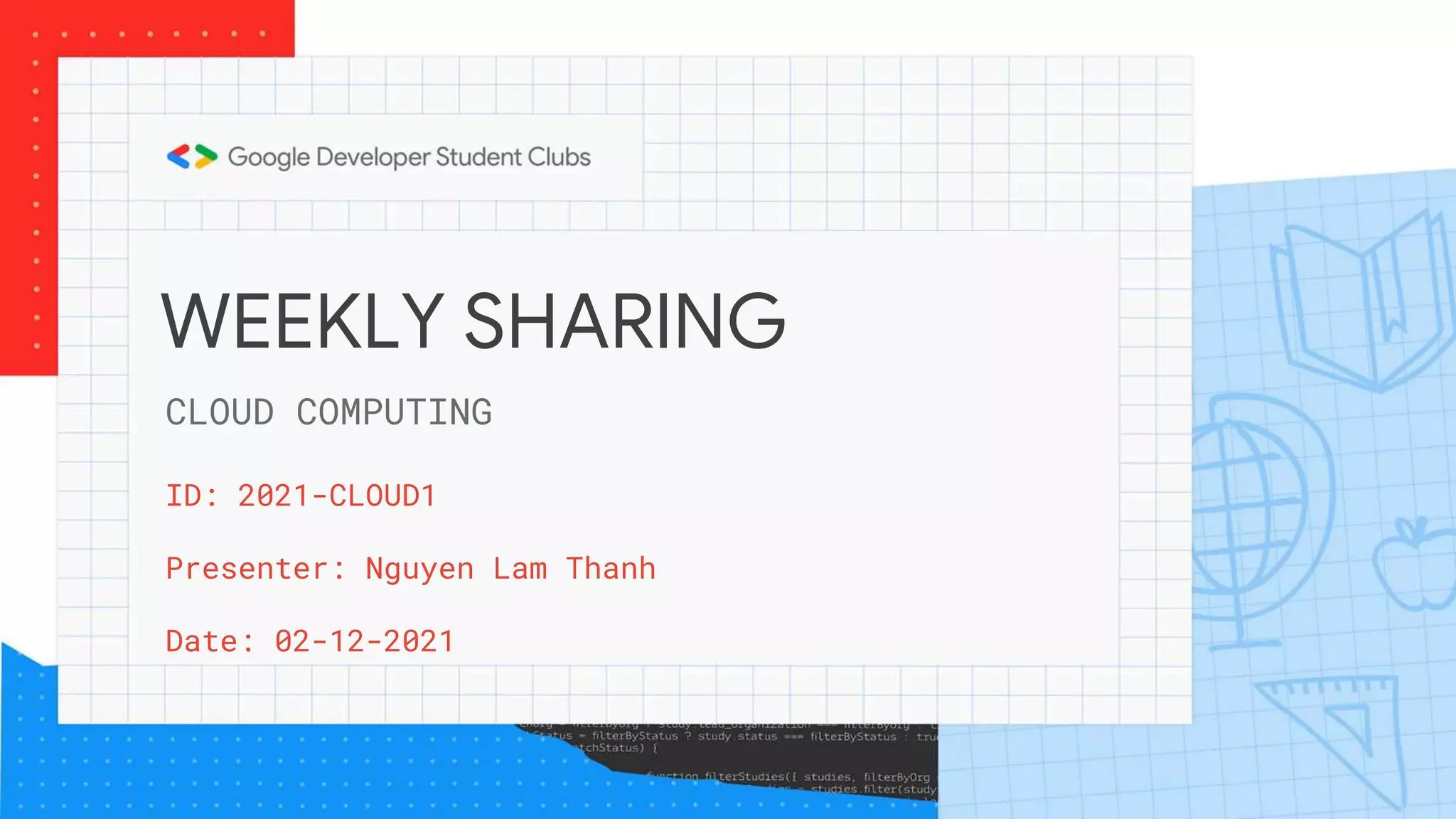
WEEKLY SHARING
ID: 2021-CLOUD1
Presenter: Nguyen Lam Thanh
Date: 02-12-2021
CLOUD COMPUTING
Cloud Computing
–
Overview
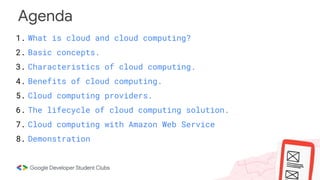
Agenda
1. What is cloud and cloud computing?
2. Basic concepts.
3. Characteristics of cloud computing.
4. Benefits of cloud computing.
5. Cloud computing providers.
6. The lifecycle of cloud computing solution.
7. Cloud computing with Amazon Web Service
8. Demonstration
I. What is cloud and cloud computing?
1. The term “cloud”:
- Network or Internet.
- Like remote location (server).
- Applications executed on cloud such as:
E-mail, Customer Relationship Management (CRM).
I. What is cloud and cloud computing?
2. The term “cloud computing”:
- Technology uses remote servers
To store, manage, and access data ONLINE (over the
internet rather than local drives).
Such as: Google Drive, Dropbox, etc.
- The main purpose
Enable ability to access the data center from remote
server.
II. Basic concepts
1. Deployment models (types of cloud computing)
- Public cloud:
Provide services & infrastructure to the public.
Such as: Gmail (4/2021 – 1B users/month), Netflix, etc.
- Private cloud:
Provide services & infrastructure to particular org.
Such as: AWS VPC (isolate the cloud instances), etc.
II. Basic concepts
1. Deployment models (types of cloud computing)
- Hybrid cloud:
Combinations of Private and Public cloud.
Such as: On-premise database and Web app on AWS ECS.
- Community cloud:
Combinations of multiple of Cloud providers.
Such as: Workload reduction, Higher availability.
II. Basic concepts
2. Service models
- SaaS (Software as a Service):
Applications hosted and managed by cloud providers.
The users access them via internet.
Such as: Google workplace (formerly GSuite).
- PaaS (Platform as a Service):
Cloud providers provide a platform and environment to
allow developers to deploy application/services.
Such as: Heroku, AWS EB.
II. Basic concepts
2. Service models
- IaaS (Infrastructure as a Service):
Cloud providers provide computing infrastructure like
virtual server space, network connections, LB, etc.
Such as: AWS EC2, Google Compute Machine.
III. Characteristics of cloud computing
1. On-demand self-service
Cloud computing allows user themselves can provision,
monitor and manage computing resources as needed (on
demand).
2. Broad network access
Cloud computing is completely web-based, meaning it is
easy to access via internet from anywhere at any time.
III. Characteristics of cloud computing
3. Rapid elasticity
At any point, the resources can be scaled vertically or
horizontally.
4. Resource pooling
Sharing resources with other tenants (customers).
Such as: Multiple virtual machine are sitting on the
sample physical host.
III. Characteristics of cloud computing
5. Measured service
All cloud services are controlled and monitored (resource
optimization, billing, and capacity planning) by cloud
providers and users.
IV. Benefits of cloud computing
1. Reduce cost
2. Access easily over the internet
3. Manipulate and configure at any time
4. Deploy the applications quickly
5. Load balancing
6. Etc.
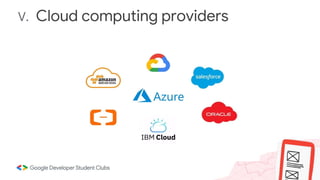
V. Cloud computing providers
VI. Cloud computing solution lifecycle
1. Define the PURPOSE (understand the requirements)
2. Define the HARDWARE (compute services)
3. Define the STORAGE (record, file)
4. Define the NETWORK (DNS, network)
5. Define the SECURITY (user authentication/authorization)
6. Define the MANAGEMENT PROCESS and TOOLS (logs, monitors)
7. Testing the PROCESS (build, test, deploy)
8. Analytics (data visualization)
VII.Cloud computing with AWS
- AWS (Amazon Web Service) is a cloud service from Amazon
- AWS provide servers over the internet
- AWS services can be used to create and deploy any type of
application in the cloud
- AWS use the subscription pricing model (pay for what you
use)
VIII. Demonstration
Install Apache Web Server on a Virtual Machine (AWS EC2)
1. Create an EC2 instance
2. Access through SSH
3. Install Apache Web Server on EC2 instance by using CLI
4. Access the default Apache web page
- Via public IPV4 of EC2 instance
- Via Elastic IPV4 assigned to EC2 instance
IX. References
1.
Tutorialpoints: https://www.tutorialspoint.com/cloud_computing/cloud_computing_overview.htm
JavaTpoint: https://www.javatpoint.com/cloud-computing-tutorial
Guru99: https://www.guru99.com/what-is-cloud-computing-with-example.html#2
Lucidchart: https://www.lucidchart.com/blog/cloud-computing-basics
2.
Tutorialpoints: https://www.tutorialspoint.com/cloud_computing/cloud_computing_overview.htm
Guru99: https://www.guru99.com/what-is-cloud-computing-with-example.html#2
Lucidchart: https://www.lucidchart.com/blog/cloud-computing-basics
Tech Services: https://cloud.illinois.edu/types-of-cloud-computing-private-public-and-hybrid-clouds/
Datamation: https://www.datamation.com/cloud/private-cloud-computing-providers/
https://youtu.be/qkj5W98Xdvw
3.
Tutorialpoints: https://www.tutorialspoint.com/cloud_computing/cloud_computing_overview.htm
jigsaw: https://www.jigsawacademy.com/blogs/cloud-computing/characteristics-of-cloud-computing/
JavaTpoint: https://www.javatpoint.com/cloud-computing-tutorial
https://www.bmc.com/blogs/saas-vs-paas-vs-iaas-whats-the-difference-and-how-to-choose/
https://www.geeksforgeeks.org/characteristics-of-cloud-computing/
https://youtu.be/JYq1AQkMdhE
4.
Tutorialpoints: https://www.tutorialspoint.com/cloud_computing/cloud_computing_overview.htm
DataFlair: https://data-flair.training/blogs/advantages-and-disadvantages-of-cloud-computing/
https://www.guru99.com/advantages-disadvantages-cloud-computing.html
5.
C#Corner: https://www.c-sharpcorner.com/article/top-10-cloud-service-providers/
6.
Simplilearn: https://www.youtube.com/watch?v=RWgW-CgdIk0
GeeksforGeeks: https://www.geeksforgeeks.org/life-cycle-of-cloud-computing-solution/
7.
Simplilearn: https://www.youtube.com/watch?v=RWgW-CgdIk0
Thanks for your
attention!!!

Cloud computing 1

  • 1.
    WEEKLY SHARING ID: 2021-CLOUD1 Presenter:Nguyen Lam Thanh Date: 02-12-2021 CLOUD COMPUTING
  • 2.
  • 3.
    Agenda 1. What iscloud and cloud computing? 2. Basic concepts. 3. Characteristics of cloud computing. 4. Benefits of cloud computing. 5. Cloud computing providers. 6. The lifecycle of cloud computing solution. 7. Cloud computing with Amazon Web Service 8. Demonstration
  • 4.
    I. What iscloud and cloud computing? 1. The term “cloud”: - Network or Internet. - Like remote location (server). - Applications executed on cloud such as: E-mail, Customer Relationship Management (CRM).
  • 5.
    I. What iscloud and cloud computing? 2. The term “cloud computing”: - Technology uses remote servers To store, manage, and access data ONLINE (over the internet rather than local drives). Such as: Google Drive, Dropbox, etc. - The main purpose Enable ability to access the data center from remote server.
  • 6.
    II. Basic concepts 1.Deployment models (types of cloud computing) - Public cloud: Provide services & infrastructure to the public. Such as: Gmail (4/2021 – 1B users/month), Netflix, etc. - Private cloud: Provide services & infrastructure to particular org. Such as: AWS VPC (isolate the cloud instances), etc.
  • 7.
    II. Basic concepts 1.Deployment models (types of cloud computing) - Hybrid cloud: Combinations of Private and Public cloud. Such as: On-premise database and Web app on AWS ECS. - Community cloud: Combinations of multiple of Cloud providers. Such as: Workload reduction, Higher availability.
  • 8.
    II. Basic concepts 2.Service models - SaaS (Software as a Service): Applications hosted and managed by cloud providers. The users access them via internet. Such as: Google workplace (formerly GSuite). - PaaS (Platform as a Service): Cloud providers provide a platform and environment to allow developers to deploy application/services. Such as: Heroku, AWS EB.
  • 9.
    II. Basic concepts 2.Service models - IaaS (Infrastructure as a Service): Cloud providers provide computing infrastructure like virtual server space, network connections, LB, etc. Such as: AWS EC2, Google Compute Machine.
  • 10.
    III. Characteristics ofcloud computing 1. On-demand self-service Cloud computing allows user themselves can provision, monitor and manage computing resources as needed (on demand). 2. Broad network access Cloud computing is completely web-based, meaning it is easy to access via internet from anywhere at any time.
  • 11.
    III. Characteristics ofcloud computing 3. Rapid elasticity At any point, the resources can be scaled vertically or horizontally. 4. Resource pooling Sharing resources with other tenants (customers). Such as: Multiple virtual machine are sitting on the sample physical host.
  • 12.
    III. Characteristics ofcloud computing 5. Measured service All cloud services are controlled and monitored (resource optimization, billing, and capacity planning) by cloud providers and users.
  • 13.
    IV. Benefits ofcloud computing 1. Reduce cost 2. Access easily over the internet 3. Manipulate and configure at any time 4. Deploy the applications quickly 5. Load balancing 6. Etc.
  • 14.
  • 15.
    VI. Cloud computingsolution lifecycle 1. Define the PURPOSE (understand the requirements) 2. Define the HARDWARE (compute services) 3. Define the STORAGE (record, file) 4. Define the NETWORK (DNS, network) 5. Define the SECURITY (user authentication/authorization) 6. Define the MANAGEMENT PROCESS and TOOLS (logs, monitors) 7. Testing the PROCESS (build, test, deploy) 8. Analytics (data visualization)
  • 16.
    VII.Cloud computing withAWS - AWS (Amazon Web Service) is a cloud service from Amazon - AWS provide servers over the internet - AWS services can be used to create and deploy any type of application in the cloud - AWS use the subscription pricing model (pay for what you use)
  • 17.
    VIII. Demonstration Install ApacheWeb Server on a Virtual Machine (AWS EC2) 1. Create an EC2 instance 2. Access through SSH 3. Install Apache Web Server on EC2 instance by using CLI 4. Access the default Apache web page - Via public IPV4 of EC2 instance - Via Elastic IPV4 assigned to EC2 instance
  • 18.
    IX. References 1. Tutorialpoints: https://www.tutorialspoint.com/cloud_computing/cloud_computing_overview.htm JavaTpoint:https://www.javatpoint.com/cloud-computing-tutorial Guru99: https://www.guru99.com/what-is-cloud-computing-with-example.html#2 Lucidchart: https://www.lucidchart.com/blog/cloud-computing-basics 2. Tutorialpoints: https://www.tutorialspoint.com/cloud_computing/cloud_computing_overview.htm Guru99: https://www.guru99.com/what-is-cloud-computing-with-example.html#2 Lucidchart: https://www.lucidchart.com/blog/cloud-computing-basics Tech Services: https://cloud.illinois.edu/types-of-cloud-computing-private-public-and-hybrid-clouds/ Datamation: https://www.datamation.com/cloud/private-cloud-computing-providers/ https://youtu.be/qkj5W98Xdvw 3. Tutorialpoints: https://www.tutorialspoint.com/cloud_computing/cloud_computing_overview.htm jigsaw: https://www.jigsawacademy.com/blogs/cloud-computing/characteristics-of-cloud-computing/ JavaTpoint: https://www.javatpoint.com/cloud-computing-tutorial https://www.bmc.com/blogs/saas-vs-paas-vs-iaas-whats-the-difference-and-how-to-choose/ https://www.geeksforgeeks.org/characteristics-of-cloud-computing/ https://youtu.be/JYq1AQkMdhE 4. Tutorialpoints: https://www.tutorialspoint.com/cloud_computing/cloud_computing_overview.htm DataFlair: https://data-flair.training/blogs/advantages-and-disadvantages-of-cloud-computing/ https://www.guru99.com/advantages-disadvantages-cloud-computing.html 5. C#Corner: https://www.c-sharpcorner.com/article/top-10-cloud-service-providers/ 6. Simplilearn: https://www.youtube.com/watch?v=RWgW-CgdIk0 GeeksforGeeks: https://www.geeksforgeeks.org/life-cycle-of-cloud-computing-solution/ 7. Simplilearn: https://www.youtube.com/watch?v=RWgW-CgdIk0
  • 20.